JP2011138883A - Semiconductor device, and method of manufacturing the same - Google Patents
Semiconductor device, and method of manufacturing the sameDownload PDFInfo
- Publication number
- JP2011138883A JP2011138883AJP2009297229AJP2009297229AJP2011138883AJP 2011138883 AJP2011138883 AJP 2011138883AJP 2009297229 AJP2009297229 AJP 2009297229AJP 2009297229 AJP2009297229 AJP 2009297229AJP 2011138883 AJP2011138883 AJP 2011138883A
- Authority
- JP
- Japan
- Prior art keywords
- silicon
- insulating film
- impurity diffusion
- diffusion layer
- semiconductor device
- Prior art date
- Legal status (The legal status is an assumption and is not a legal conclusion. Google has not performed a legal analysis and makes no representation as to the accuracy of the status listed.)
- Withdrawn
Links
Images

















Classifications
- H—ELECTRICITY
- H10—SEMICONDUCTOR DEVICES; ELECTRIC SOLID-STATE DEVICES NOT OTHERWISE PROVIDED FOR
- H10D—INORGANIC ELECTRIC SEMICONDUCTOR DEVICES
- H10D30/00—Field-effect transistors [FET]
- H10D30/01—Manufacture or treatment
- H10D30/021—Manufacture or treatment of FETs having insulated gates [IGFET]
- H10D30/025—Manufacture or treatment of FETs having insulated gates [IGFET] of vertical IGFETs
- H—ELECTRICITY
- H10—SEMICONDUCTOR DEVICES; ELECTRIC SOLID-STATE DEVICES NOT OTHERWISE PROVIDED FOR
- H10B—ELECTRONIC MEMORY DEVICES
- H10B12/00—Dynamic random access memory [DRAM] devices
- H10B12/01—Manufacture or treatment
- H10B12/02—Manufacture or treatment for one transistor one-capacitor [1T-1C] memory cells
- H10B12/05—Making the transistor
- H10B12/053—Making the transistor the transistor being at least partially in a trench in the substrate
- H—ELECTRICITY
- H10—SEMICONDUCTOR DEVICES; ELECTRIC SOLID-STATE DEVICES NOT OTHERWISE PROVIDED FOR
- H10D—INORGANIC ELECTRIC SEMICONDUCTOR DEVICES
- H10D30/00—Field-effect transistors [FET]
- H10D30/60—Insulated-gate field-effect transistors [IGFET]
- H10D30/63—Vertical IGFETs
Landscapes
- Engineering & Computer Science (AREA)
- Manufacturing & Machinery (AREA)
- Semiconductor Memories (AREA)
- Dram (AREA)
Abstract
Translated fromJapaneseDescription
Translated fromJapanese本発明は半導体装置及びその製造方法に関し、特に、3次元的に形成したトランジスタやサイリスタを用いる半導体装置及びその製造方法に関する。 The present invention relates to a semiconductor device and a manufacturing method thereof, and more particularly to a semiconductor device using a transistor and a thyristor formed three-dimensionally and a manufacturing method thereof.
これまで、半導体装置の集積度向上は、主にトランジスタの微細化によって達成されてきたが、トランジスタの微細化はもはや限界に近づいており、これ以上トランジスタサイズを縮小すると、短チャネル効果などによって正しく動作しないおそれが生じている。 Up to now, the integration of semiconductor devices has been achieved mainly by miniaturization of transistors. However, the miniaturization of transistors is no longer near the limit. There is a risk of not working.
このような問題を根本的に解決する方法として、半導体基板を立体加工し、これによりトランジスタを3次元的に形成する方法が提案されている。中でも、半導体基板の主面に対して垂直方向に延びるシリコンピラーをチャネルとして用いるタイプの3次元トランジスタは、占有面積が小さく且つ完全空乏化によって大きなドレイン電流が得られるという利点を有しており、4F2(Fは最小加工寸法)の最密レイアウトも実現可能である(特許文献1参照)。As a method for fundamentally solving such a problem, a method has been proposed in which a semiconductor substrate is three-dimensionally processed to thereby form a transistor three-dimensionally. Among them, a three-dimensional transistor using a silicon pillar extending in a direction perpendicular to the main surface of the semiconductor substrate as a channel has an advantage that a large drain current can be obtained by a small occupation area and complete depletion, A close-packed layout of 4F2 (F is the minimum processing dimension) can also be realized (see Patent Document 1).
また、半導体装置のうち特にDRAM(Dynamic Random Access Memory)では、これまでキャパシタを用いて情報を記憶する方式が一般的であったが、集積度向上に伴ってキャパシタも微細化し、キャパシタの静電容量を確保するのが難しくなっている。そこで近年、キャパシタを用いないでメモリセルを構成するキャパシタレスDRAMが提案されている。特許文献2には、3次元的に形成したサイリスタを用いて構成したキャパシタレスDRAMの例が開示されている。 In addition, in DRAMs (Dynamic Random Access Memory) among semiconductor devices, in general, a method of storing information using a capacitor has been generally used. However, as the degree of integration increases, the capacitor becomes finer and the electrostatic capacity of the capacitor is increased. It is difficult to secure capacity. In recent years, therefore, capacitorless DRAMs have been proposed in which memory cells are configured without using capacitors.
ところで、3次元的に形成したトランジスタやサイリスタを用いる半導体装置では、微細化の影響により、キャパシタやサイリスタ内に蓄積される電荷量が従来に比べて小さくなっている。そのために、情報保持特性に対するリーク電流の影響が大きくなっており、したがって、トランジスタやサイリスタのリーク電流を低減することが求められている。 By the way, in a semiconductor device using a three-dimensionally formed transistor or thyristor, the amount of charge accumulated in the capacitor or thyristor is smaller than in the past due to the effect of miniaturization. For this reason, the influence of the leakage current on the information retention characteristic is increased, and therefore, it is required to reduce the leakage current of transistors and thyristors.
本発明による半導体装置は、基板の主面に対してほぼ垂直に形成されたシリコンピラーと、前記シリコンピラーの下部及び上部にそれぞれ設けられた第1及び第2の不純物拡散層と、前記シリコンピラーを水平方向に貫いて設けられたゲート電極と、前記ゲート電極と前記シリコンピラーとの間に設けられたゲート絶縁膜とを備えることを特徴とする。 A semiconductor device according to the present invention includes a silicon pillar formed substantially perpendicular to a main surface of a substrate, first and second impurity diffusion layers provided at a lower part and an upper part of the silicon pillar, and the silicon pillar, respectively. In the horizontal direction, and a gate insulating film provided between the gate electrode and the silicon pillar.
また、本発明による半導体装置の製造方法は、マスク絶縁膜を用いてシリコン基板をエッチングすることによりシリコンピラーを形成するとともに、前記シリコンピラーの下部に第1の不純物拡散層を形成する工程と、前記シリコンピラー及び前記マスク絶縁膜の周囲を埋めるように第1の絶縁膜を成膜する工程と、前記マスク絶縁膜を除去する工程と、前記マスク絶縁膜の除去により形成される第1の開口部の内壁にサイドウォール絶縁膜を形成する工程と、前記サイドウォール絶縁膜及び前記第1の絶縁膜をマスクとして用いて前記シリコンピラーをエッチングする工程と、前記シリコンピラーのエッチングにより形成される第2の開口部の内壁を酸化することによりゲート絶縁膜を形成する工程と、前記第2の開口部内に、少なくとも上側を第2の絶縁膜で覆われたゲート電極を形成する工程と、前記シリコンピラーの上端及び前記第2の絶縁膜の上端に接する第2の不純物拡散層を形成する工程とを備えることを特徴とする。 The method of manufacturing a semiconductor device according to the present invention includes a step of forming a silicon pillar by etching a silicon substrate using a mask insulating film, and forming a first impurity diffusion layer below the silicon pillar; Forming a first insulating film so as to fill the periphery of the silicon pillar and the mask insulating film; removing the mask insulating film; and a first opening formed by removing the mask insulating film. Forming a sidewall insulating film on the inner wall of the portion, etching the silicon pillar using the sidewall insulating film and the first insulating film as a mask, and etching the silicon pillar. Forming a gate insulating film by oxidizing the inner wall of the second opening, and at least in the second opening Forming a gate electrode whose side is covered with a second insulating film, and forming a second impurity diffusion layer in contact with the upper end of the silicon pillar and the upper end of the second insulating film. Features.
本発明によれば、シリコンピラーの体積が小さくなるので、シリコンピラー内に形成されるトランジスタやサイリスタのリーク電流を低減できる。 According to the present invention, since the volume of the silicon pillar is reduced, the leakage current of the transistor or thyristor formed in the silicon pillar can be reduced.
以下、添付図面を参照しながら、本発明の好ましい実施の形態について詳細に説明する。 Hereinafter, preferred embodiments of the present invention will be described in detail with reference to the accompanying drawings.
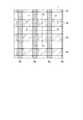
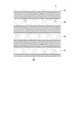
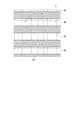
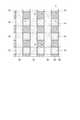
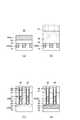
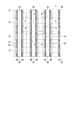
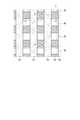
図1は、本発明の第1の実施の形態による半導体装置1の平面図である。ただし、同図には、実際には表面に現れないワード線WLとビット線BLの位置も示している。図2(a)〜(d)はそれぞれ、図1のA−A線断面、B−B線断面、C−C線断面、D−D線断面に対応する断面図である。 FIG. 1 is a plan view of a
本実施の形態による半導体装置1はメモリセルキャパシタを利用する半導体記憶装置(DRAM)であり、シリコン基板10の表面に設けられたP型(第2の導電型)の領域PWELL(不図示)内及びその上方に形成される。 The
図1に示すように、半導体装置1には、図面縦方向に延伸する複数ワード線WLと、図面横方向に延伸する複数のビット線BLとが設けられる。複数のワード線WLと複数のビット線BLはそれぞれ、2F間隔(中心距離)で配置される。ワード線WLとビット線BLの交点には、セルトランジスタ11(MOSトランジスタ)が配置される。 As shown in FIG. 1, the
セルトランジスタ11は、シリコン基板10の主面に対してほぼ垂直に形成されたシリコンピラー12によって構成される。 The
シリコン基板10の上面には、図2の各図に示すように、窒化シリコン(Si3N4)などの絶縁体により構成される層間絶縁膜46と、酸化シリコン(SiO2)などの絶縁膜により構成される層間絶縁膜47とがこの順で積層されており、各シリコンピラー12は、これら層間絶縁膜46,47を垂直方向に貫いて設けられる。On the upper surface of the
各シリコンピラー12の中ほどより下の部分はワード線方向の中心線を挟んで2つに分割されており、分割された部分の間には、図2(c)に示すように、セルトランジスタ11のゲート電極18(ワード線WL)が設けられる。別の見方をすれば、ワード線WLは、シリコンピラー12を水平方向(ワード線方向)に貫いて設けられている。ゲート電極18の側面とシリコンピラー12の内壁面との間には比較的薄いゲート絶縁膜20が設けられる。また、ゲート電極18の上面及び下面にはそれぞれ、比較的厚い絶縁膜22,24が設けられている。絶縁膜22,24は、それぞれGIDL(Gate Induced Drain Leakage)、GISL(Gate Induced Source Leakage)低減の目的で設けられているものである。 A portion below the middle of each
各シリコンピラー12の下部には、セルトランジスタ11のソース/ドレインの一方を構成する第1の不純物拡散層14が設けられる。第1の不純物拡散層14はシリコン基板10内にも拡散しており、図2(a)〜(c)に示すように、ビット線方向に隣接するシリコンピラー12の間でつながっている。こうしてビット線方向に連続する第1の不純物拡散層14により、ビット線BLが構成される。第1の不純物拡散層14は、シリコン内にN型(第1の導電型)の不純物を拡散させることにより形成される。 A first
各シリコンピラー12の上部には、セルトランジスタ11のソース/ドレインの他方を構成する第2の不純物拡散層16が、シリコンピラー12ごとに設けられる。第2の不純物拡散層16も、シリコン内にN型不純物を拡散させることにより形成される。第2の不純物拡散層16は、上単を層間絶縁膜47の上面から少し突き出して構成される。第2の不純物拡散層16及び層間絶縁膜47の上側の全面には、第2の不純物拡散層16の上端を覆うようにして、窒化シリコン(Si3N4)などの絶縁体により構成される層間絶縁膜49が形成される。A second
第2の不純物拡散層16の上面には、筒型の下部電極31を有するセルキャパシタ30が形成される。下部電極31は、層間絶縁膜49と、さらにその上面に形成された酸化シリコン(SiO2)などの絶縁膜により構成される層間絶縁膜50とを、垂直方向に貫通して設けられる。下部電極31の下面は、対応する第2の不純物拡散層16と接触・導通している。下部電極31は、窒化チタンなどの金属膜により構成される。A
筒型の下部電極31の内璧面には、酸化ハフニウム(HfO2)、酸化ジルコニウム(ZrO2)、酸化アルミニウム(Al2O3)、又はこれらの積層体などの高誘電体膜により構成される薄い容量絶縁膜32が形成される。そして、容量絶縁膜32のさらに内側には、セルキャパシタ30の上部電極33が形成される。上部電極33も、窒化チタンなどの金属膜により構成される。上部電極33の上面には配線パターン34が形成される。The inner wall surface of the cylindrical
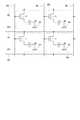
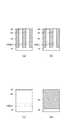
図3は、本実施の形態による半導体装置1の等価回路を示す図である。ただし、同図には、メモリセル4つ分のみを抜き出して示している。同図に示すように、本実施の形態による半導体装置1では、ワード線WLとビット線BLの交点ごとに、セルトランジスタ11とセルキャパシタ30とを有するメモリセルMCが形成される。複数のワード線WLのうちの1つを活性化すると、そのワード線WLによって貫かれているシリコンピラー12内にチャネルが形成されてセルトランジスタ11がオン状態となる。したがって、対応するビット線BLと下部電極31とが電気的に接続され、対応するビット線BLを介してセルキャパシタ30にアクセスすることが可能になる。 FIG. 3 is a diagram showing an equivalent circuit of the
以上説明したように、本実施の形態による半導体装置1では、ワード線WLがシリコンピラー12を水平方向に貫くようにしたので、シリコンピラー12の体積を小さくすることが可能になっている。したがって、シリコン結晶中の点欠陥の数が従来より少なくなり、セルトランジスタの接合リーク電流が低下していることから、セルキャパシタの容量が小さくても十分なリテンション特性を確保することが可能になっている。 As described above, in the
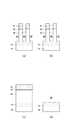
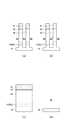
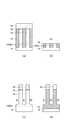
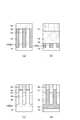
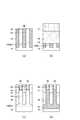
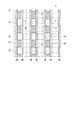
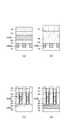
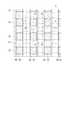
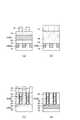
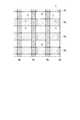
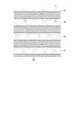
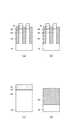
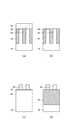
次に、本実施の形態による半導体装置1の製造方法について、図4〜図31を参照しながら説明する。図4〜図31のうち、偶数番号の図面は半導体装置1の平面図であり、奇数番号の図面の(a)〜(d)はそれぞれ、直前の偶数番号の図面のA−A線断面、B−B線断面、C−C線断面、D−D線断面に対応する断面図である。 Next, a method for manufacturing the
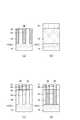
まず、図4及び図5に示すように、シリコン基板10を用意し、その上面を酸化することにより5nm程度の薄いシリコン酸化膜40を形成し、P型不純物を注入することによりPWELL(不図示)を形成する。次いで、60nm程度のシリコン窒化膜を堆積し、フィールドPR(Photo Resist)を行うことにより、ビット線方向に延伸するマスクパターン41(第1のマスク絶縁膜)を形成する。なお、本製造方法では、シリコンピラー12は、いわゆるダブルパターニング法により形成される。つまり、ビット線方向に延伸するマスクパターン41と、ワード線方向に延伸するマスクパターン44(後述)という2つのマスクパターンを用いて形成される。 First, as shown in FIGS. 4 and 5, a
マスクパターン41を形成したら、200nm程度の深さまでドライエッチングを行い、トレンチ60(第3の開口部)を形成する。このトレンチ60により、ビット線方向に延伸する壁状のシリコンピラー42が形成される。この後、シリコンピラー42の側面を含むシリコン基板10表面を熱酸化することにより6nm程度の薄い酸化膜(不図示)を形成し、その後、トレンチ60の底部にN型不純物を注入し、さらにアニールを行うことで、第1の不純物拡散層14を形成する。 After the
次に、図6及び図7に示すように、マスクパターン41をマスクとするドライエッチングをもう一度行い、トレンチ60をさらに50nm程度掘り進める。これにより、第1の不純物拡散層14がシリコンピラー42ごとの部分に分離され、ビット線BLが完成する。 Next, as shown in FIGS. 6 and 7, dry etching is performed once again using the
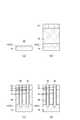
次に、全体の表面をISSG(In-Situ Steam Generation)酸化し、マスクパターン41の表面を含む全体の表面に6nm程度の薄いISSG酸化膜(不図示)を形成する。その後、図8及び図9に示すように、アンドープ化したDOPOS(Doped Poly-Si)膜43(第3の絶縁膜)を成膜し、トレンチ60の内部をDOPOS膜43で埋める。そして、図9(a)及び(b)に示すように、マスクパターン41の上端が突出するまでDOPOS膜43のエッチバック(酸化膜高選択DOPOSドライエッチバック)を行う。なお、DOPOS膜43をアンドープ化しておくのは、ゲート絶縁膜20を形成するためにシリコンピラー12内璧面の酸化(後述)を行う際、DOPOS膜43からシリコンピラー12内に不純物が拡散することを防止するためである。 Next, the entire surface is subjected to ISSG (In-Situ Steam Generation) oxidation, and a thin ISSG oxide film (not shown) of about 6 nm is formed on the entire surface including the surface of the
次に、DOPOS膜43のウエットエッチングを行うとともにマスクパターン41の除去を行い、図10及び図11に示すように、表面を平坦化する。 Next, the
次に、平坦化された表面に、60nm程度のシリコン窒化膜を堆積し、フィールドPR(Photo Resist)を行うことにより、図12及び図13に示すように、ワード線方向に延伸するマスクパターン44(第2のマスク絶縁膜)を形成する。 Next, a silicon nitride film having a thickness of about 60 nm is deposited on the planarized surface, and field PR (Photo Resist) is performed, thereby extending a
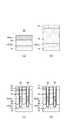
マスクパターン44を形成したら、第1の不純物拡散層14の上面が露出しつつ、第1の不純物拡散層14を貫通しない程度の深さまでシリコンとシリコン酸化膜の同時エッチングを行い、トレンチ61を形成する。ここまでの処理により、図14及び図15に示すように、ワード線WLとビット線BLの交点ごとに、シリコンピラー45が形成される。 After the
次に、図16及び図17に示すように、シリコンピラー45及びマスクパターン44の周囲を埋めるように絶縁膜(第1の絶縁膜)を成膜する。具体的には、シリコンピラー45の側面を含むシリコン基板10表面を熱酸化することにより8nm程度の薄い酸化膜(不図示)を形成し、さらに、シリコン窒化膜46を堆積してウエットエッチバック又はドライエッチバックを行う。その後、さらにシリコン酸化膜47を堆積し、マスクパターン44の表面が露出するまでCMP(Chemical Mechanical Polishing)を行うことにより、表面を平坦化する。 Next, as shown in FIGS. 16 and 17, an insulating film (first insulating film) is formed so as to fill the periphery of the
次に、熱リン酸によりマスクパターン44を除去し、薄くシリコン窒化膜を堆積した後、エッチバックを行う。これにより、図18及び図19に示すように、マスクパターン44を除去してできた開口部62(第1の開口部)内に、7nm程度の厚さのサイドウォール窒化膜48が形成される。 Next, the
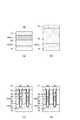
次に、サイドウォール窒化膜48及びシリコン酸化膜47をマスクとして用いて、シリコンピラー45とDOPOS膜43とをエッチングし、図20及び図21に示すように、シリコンピラー45を水平方向に貫通するトレンチ63(第2の開口部)を形成する。これにより、ワード線方向の中心線を挟んで2つに分割されたシリコンピラー12の一部(上端部分以外の部分)が形成される。なお、このエッチングではシリコン酸化膜47もエッチングされるが、エッチングの後にも層間絶縁膜として十分な膜厚のシリコン酸化膜47が残るよう、エッチング選択比とシリコン酸化膜47の厚さとを適宜調整する。 Next, using the
次に、トレンチ63の内壁の酸化(ゲート酸化)を行い、図22及び図23に示すゲート絶縁膜20を形成する。その後、シリコン窒化膜の堆積及びエッチバックと、DOPOS膜の堆積及びエッチバックとを順次行う。これにより、トレンチ63の内部に、図22及び図23に示すように、シリコンピラー12を水平方向に貫通するゲート電極18(ワード線WL)と、ゲート電極18の下面とシリコン基板10及びシリコンピラー12とを絶縁するための絶縁膜24とが形成される。 Next, the inner wall of the
その後、さらにシリコン窒化膜の堆積と、熱リン酸によるエッチバックとを行い、図24及び図25に示すように、ゲート電極18の上面とシリコンピラー12とを絶縁するための絶縁膜22を形成するとともに、サイドウォール窒化膜48を除去する。 Thereafter, a silicon nitride film is further deposited and etched back with hot phosphoric acid to form an insulating
次に、シリコン酸化膜40と、ゲート絶縁膜20の露出部分とを除去したうえで、シリコンピラー12を上方に延設し、図26及び図27に示すように、上端部12aを形成する。具体的には、トレンチ63内壁のシリコンピラー12露出部分を利用して、単結晶シリコンを選択的エピタキシャル成長させる。そして、N型不純物を注入し、さらにアニールを行うことで、図28及び図29に示すように、上端部12a内に第2の不純物拡散層16を形成する。 Next, after removing the
第2の不純物拡散層16を形成した後には、上述したマスクパターン41と同様のマスクパターン(不図示)を形成し、シリコンのドライエッチングを行う。これにより、図30及び図31に示すように、第2の不純物拡散層16がシリコンピラー12ごとに分離される。以上の処理により、図1乃至図3に示したセルトランジスタ11が完成する。 After the second
この後、図2に示したように、層間絶縁膜49,50の成膜、キャパシタ30の形成、配線パターン34の形成を行うことで、半導体装置1が完成する。 Thereafter, as shown in FIG. 2, the
以上説明したように、本製造方法によれば、メモリセル内にキャパシタを有する半導体装置1において、シリコンピラー12を水平方向に貫くワード線WLを形成することが可能になる。また、シリコンピラー12の上端部12aを形成する際に選択的エピタキシャル成長を用いていることから、コンタクト抵抗の上昇を抑制することが可能になっている。 As described above, according to this manufacturing method, it is possible to form the word line WL penetrating the
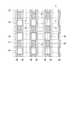
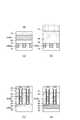
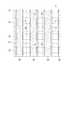
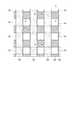
図32は、本発明の第2の実施の形態による半導体装置1の平面図である。ただし、同図には、実際には表面に現れないワード線WLとビット線BLの位置も示している。図33(a)〜(d)はそれぞれ、図32のA−A線断面、B−B線断面、C−C線断面、D−D線断面に対応する断面図である。 FIG. 32 is a plan view of the
本実施の形態による半導体装置1はメモリセルキャパシタを利用しない、いわゆるキャパシタレスタイプの半導体記憶装置(DRAM)であり、シリコン基板10の表面に設けられたP型の領域PWELL(不図示)内及びその上方に形成される。 The
ワード線WLとビット線BLの配置は、第1の実施の形態による半導体装置1と同様である。ワード線WLとビット線BLの交点には、セルトランジスタではなくサイリスタ71が配置される。 The arrangement of the word lines WL and the bit lines BL is the same as that of the
サイリスタ71は、第1の実施の形態で説明したセルトランジスタと同様に、シリコン基板10の主面に対してほぼ垂直に形成されたシリコンピラー12によって構成される。シリコンピラー12は、第1の実施の形態と同様、層間絶縁膜46,47を垂直方向に貫いて設けられる。 The
サイリスタ71は、シリコンピラー12の下側から順にN型不純物拡散層とP型不純物拡散層とが2層ずつ交互に積層したNPNP型の4重構造を有する素子である。図33(c)を参照しながら、これら4つの層と図面に現れる層との対応関係を説明すると、各シリコンピラー12の下部に設けられる第1の不純物拡散層14が最下層のN型不純物拡散層に相当し、N型不純物拡散層14の上側に位置するシリコンピラー12内の領域(PWELL)が下から2番目のP型不純物拡散層に相当し、その上に位置する第2の不純物拡散層16が下から3番目のN型不純物拡散層に相当し、第2の不純物拡散層16の上端に接して設けられる第3の不純物拡散層17が最上層のP型不純物拡散層に相当する。 The
最下層のN型不純物拡散層に相当する第1の不純物拡散層14は、シリコン内にN型不純物を拡散させることにより形成される。第1の不純物拡散層14は、図33の各図に示すようにシリコン基板10内にも拡散しており、隣接するシリコンピラー12の間でつながっている。したがって、ソース線SLは、すべてのサイリスタ71に共通に接続している。 The first
下から2番目のP型不純物拡散層に相当するシリコンピラー12内の領域においては、第1の実施の形態と同様、シリコンピラー12がワード線方向の中心線を挟んで2つに分割されており、分割された部分の間には、図33(c)に示すように、ゲート電極18(ワード線WL)が設けられる。ゲート電極18の側面とシリコンピラー12の内壁面との間に比較的薄いゲート絶縁膜20が設けられる点、及びゲート電極18の上面及び下面に比較的厚い絶縁膜22,24が設けられる点も、第1の実施の形態と同様である。 In the region in the
下から3番目のN型不純物拡散層に相当する第2の不純物拡散層16は、シリコン内にN型不純物を拡散させることにより形成される。第2の不純物拡散層16は、シリコンピラー12ごとに独立して設けられる。 The second
最上層のP型不純物拡散層に相当する第3の不純物拡散層17は、シリコン内にP型不純物を拡散させることにより形成される。第3の不純物拡散層17は、図33(a)〜(c)に示すように、ビット線方向に隣接するシリコンピラー12の間でつながっている。ビット線BLは、第3の不純物拡散層17の上端に接して形成された、窒化タングステン(WN)及びタングステン(W)の積層膜51(WN/W膜)により構成される。ビット線BLのさらに上層には、シリコン窒化膜52が形成される。 The third
なお、図33(a)(b)(d)に示すように、第2の不純物拡散層16、第3の不純物拡散層17、積層膜51(ビット線BL)、シリコン窒化膜52は、酸化シリコン(SiO2)などの絶縁膜により構成される層間絶縁膜53を垂直方向に貫いて設けられる。層間絶縁膜53は、これらの各層(膜)を、ワード線方向に隣接するサイリスタ71の間で電気的に分離する役割を担っている。33A, 33B, and 33D, the second
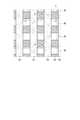
図34は、本実施の形態による半導体装置1の等価回路を示す図である。ただし、同図には、メモリセル4つ分のみを抜き出して示している。同図に示すように、本実施の形態による半導体装置1では、ワード線WLとビット線BLの交点ごとに、サイリスタ71を有するメモリセルが形成される。また、ソース線SLは接地される。この構成によれば、ワード線WLとビット線BLに印加する電圧の組み合わせにより、特定のメモリセル内のサイリスタ71について、下から2番目のP型不純物拡散層内(シリコンピラー12の中ほどの領域)に電荷を蓄積し、或いは蓄積している電荷の量を読み出すことが可能になる。つまり、サイリスタ71に対して書き込み及び読み出しを行うことが可能になっている。 FIG. 34 is a diagram showing an equivalent circuit of the
以上説明したように、本実施の形態による半導体装置1によっても、ワード線WLがシリコンピラー12を水平方向に貫くようにしたので、シリコンピラー12の体積を小さくすることが可能になっている。したがって、シリコン結晶中の点欠陥の数が従来より少なくなり、サイリスタの接合リーク電流が低下していることから、サイリスタに蓄積できる電荷の量が小さくても十分なリテンション特性を確保することが可能になっている。 As described above, also in the
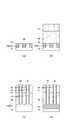
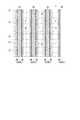
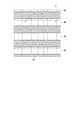
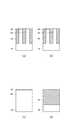
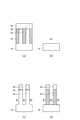
次に、本実施の形態による半導体装置1の製造方法について、図35〜図62を参照しながら説明する。図35〜図62のうち、奇数番号の図面は半導体装置1の平面図であり、偶数番号の図面の(a)〜(d)はそれぞれ、直前の奇数番号の図面のA−A線断面、B−B線断面、C−C線断面、D−D線断面に対応する断面図である。 Next, a method for manufacturing the
まず、図35及び図36に示すように、シリコン基板10を用意し、その上面を酸化することにより5nm程度の薄いシリコン酸化膜40を形成し、P型不純物を注入することによりPWELL(不図示)を形成する。次いで、60nm程度のシリコン窒化膜を堆積し、フィールドPR(Photo Resist)を行うことにより、ビット線方向に延伸するマスクパターン41(第1のマスク絶縁膜)を形成する。なお、本製造方法でも、シリコンピラー12は、いわゆるダブルパターニング法により形成される。 First, as shown in FIGS. 35 and 36, the
マスクパターン41を形成したら、250nm程度の深さまでドライエッチングを行い、トレンチ60(第3の開口部)を形成する。このトレンチ60により、ビット線方向に延伸する壁状のシリコンピラー42が形成される。 After the
次に、全体の表面をISSG(In-Situ Steam Generation)酸化し、マスクパターン41の表面を含む全体の表面に6nm程度の薄いISSG酸化膜(不図示)を形成する。その後、図37及び図38に示すように、アンドープ化したDOPOS(Doped Poly-Si)膜43(第3の絶縁膜)を成膜し、トレンチ60の内部をDOPOS膜43で埋める。そして、図38(a)及び(b)に示すように、マスクパターン41の上端が突出するまでDOPOS膜43のエッチバック(酸化膜高選択poly−Siドライエッチバック)を行う。なお、DOPOS膜43をアンドープ化しておくのは、ゲート絶縁膜20を形成するためにシリコンピラー12内璧面の酸化(後述)を行う際、DOPOS膜43からシリコンピラー12内に不純物が拡散することを防止するためであるとともに、後のエッチング(後述するトレンチ61を形成するためのエッチング)を容易にするためである。 Next, the entire surface is subjected to ISSG (In-Situ Steam Generation) oxidation, and a thin ISSG oxide film (not shown) of about 6 nm is formed on the entire surface including the surface of the
次に、DOPOS膜43のウエットエッチングを行うとともにマスクパターン41の除去を行い、図39及び図40に示すように、表面を平坦化する。 Next, the
次に、平坦化された表面に、60nm程度のシリコン窒化膜を堆積し、フィールドPR(Photo Resist)を行うことにより、図41及び図42に示すように、ワード線方向に延伸するマスクパターン44(第2のマスク絶縁膜)を形成する。 Next, a silicon nitride film having a thickness of about 60 nm is deposited on the planarized surface, and field PR (Photo Resist) is performed, so that a
マスクパターン44を形成したら、シリコンとシリコン酸化膜の同時エッチングを行ってトレンチ61を形成する。ここまでの処理により、図43及び図44に示すように、ワード線WLとビット線BLの交点ごとに、シリコンピラー45が形成される。 After the
次に、シリコンピラー45の側面を含むシリコン基板10表面を熱酸化することにより5nm程度の薄い酸化膜(不図示)を形成し、その後、トレンチ61の底部にN型不純物を注入し、さらにアニールを行うことで、図45及び図46に示すように、第1の不純物拡散層14を形成する。なお、第1の不純物拡散層14は、気相ドーピングを用いて形成することとしてもよい。また、シリコンピラー45の側面にサイドウォール絶縁膜をつけてから第1の不純物拡散層14の形成を行うこととしてもよい。 Next, the surface of the
次に、図47及び図48に示すように、シリコンピラー45及びマスクパターン44の周囲を埋めるように絶縁膜(第1の絶縁膜)を成膜する。具体的には、シリコン窒化膜46を堆積し、熱リン酸によるエッチバックを行う。その後、さらにシリコン酸化膜47を堆積し、マスクパターン44の表面が露出するまでCMPを行うことにより、表面を平坦化する。このシリコン窒化膜とシリコン酸化膜の積層構造は、狭いトレンチの中にウエットエッチング速度が遅い緻密な絶縁膜を形成するために有効なものである。 Next, as shown in FIGS. 47 and 48, an insulating film (first insulating film) is formed so as to fill the periphery of the
次に、酸化膜のウエットエッチングを行い、さらに熱リン酸によりマスクパターン44を除去する。そして、薄くシリコン窒化膜を堆積した後、エッチバックを行う。これにより、図49及び図50に示すように、マスクパターン44を除去してできた開口部62(第1の開口部)内に、7nm程度の厚さのサイドウォール窒化膜48が形成される。 Next, wet etching of the oxide film is performed, and the
次に、サイドウォール窒化膜48及びシリコン酸化膜47をマスクとして用いて、シリコンピラー45とDOPOS膜43とをエッチングし、図51及び図52に示すように、シリコンピラー45を水平方向に貫通するトレンチ63(第2の開口部)を形成する。トレンチ63の深さは、第1の不純物拡散層14の上面が露出しつつ、第1の不純物拡散層14を貫通しない程度とし、具体的には250nm〜300nmとすることが好ましい。これにより、ワード線方向の中心線を挟んで2つに分割されたシリコンピラー12の一部(上端部分以外の部分)が形成される。分割部分の厚みは5nm未満とすることが好ましい。なお、このエッチングではシリコン酸化膜47もエッチングされるが、エッチングの後にも層間絶縁膜として十分な膜厚のシリコン酸化膜47が残るよう、エッチング選択比とシリコン酸化膜47の厚さとを適宜調整しておく。 Next, using the
次に、トレンチ63の内壁の酸化(ゲート酸化)を行い、図53及び図54に示すゲート絶縁膜20を形成する。その後、シリコン窒化膜の堆積及びエッチバックと、N型DOPOS膜の堆積及びエッチバックとを順次行う。これにより、トレンチ63の内部に、図53及び図54に示すように、シリコンピラー12を水平方向に貫通するゲート電極18(ワード線WL)と、ゲート電極18の下面とシリコン基板10及びシリコンピラー12とを絶縁するための絶縁膜24とが形成される。なお、ゲート電極18の膜厚は100nm程度とすることが好ましい。 Next, the inner wall of the
その後、さらにシリコン窒化膜の堆積と、熱リン酸によるエッチバックとを行い、図55及び図56に示すように、ゲート電極18の上面とシリコンピラー12とを絶縁するための絶縁膜22を形成するとともに、サイドウォール窒化膜48を除去する。なお、絶縁膜22の膜厚は50nm程度とすることが好ましい。 Thereafter, a silicon nitride film is further deposited and etched back with hot phosphoric acid to form an insulating
次に、シリコン酸化膜40と、ゲート絶縁膜20の露出部分とを除去したうえで、シリコンピラー12を上方に延設し、図57及び図58に示すように、上端部12aを形成する。具体的には、トレンチ63内壁のシリコンピラー12露出部分を利用して、単結晶シリコンを選択的エピタキシャル成長させる。そして、N型不純物を注入し、さらにアニールを行うことで、図59及び図60に示すように、上端部12a内に第2の不純物拡散層16を形成する。 Next, after removing the
第2の不純物拡散層16を形成した後には、全面にノンドープのアモルファスシリコンを積層し、P型不純物イオンを注入することにより、図62に示す第3の不純物拡散層17を形成する。その後、第3の不純物拡散層17の上面に窒化タングステン(WN)及びタングステン(W)の積層膜51を形成する。そしてさらに、シリコン窒化膜を堆積してフィールドPR(Photo Resist)を行うことにより、ビット線形成用のマスクパターン52を形成する。 After the formation of the second
マスクパターン41を形成したら、ドライエッチングにより積層膜51、第3の不純物拡散層17、第2の不純物拡散層16を順次エッチングし、図61及び図62に示すように、積層膜51、第3の不純物拡散層17、第2の不純物拡散層16をビット線BLごとに分離する。この際、オーバーエッチングを行うことにより、ビット線BL間の領域に形成されている第2の不純物拡散層16(図60(d))を完全に取り除くようにすることが好ましい。 After the
以上説明したように、本製造方法によれば、メモリセル内にキャパシタを有しない半導体装置1において、シリコンピラー12を水平方向に貫くワード線WLを形成することが可能になる。また、シリコンピラー12の上端部12aを形成する際に選択的エピタキシャル成長を用いていることから、コンタクト抵抗の上昇を抑制することが可能になっている。 As described above, according to this manufacturing method, it is possible to form the word line WL penetrating the
以上、本発明の好ましい実施形態について説明したが、本発明は、上記の実施形態に限定されることなく、本発明の主旨を逸脱しない範囲で種々の変更が可能であり、それらも本発明の範囲内に包含されるものであることはいうまでもない。 The preferred embodiments of the present invention have been described above, but the present invention is not limited to the above-described embodiments, and various modifications can be made without departing from the spirit of the present invention. Needless to say, it is included in the range.
例えば、上記実施の形態では半導体装置1をDRAMとしたが、本発明は、例えばPRAM(Phase change Random Access Memory)などの他の種類の半導体装置にも適用可能である。 For example, in the above embodiment, the
また、上記実施の形態では第1及び第2の導電型をそれぞれN型及びP型としたが、この対応関係を入れ替えても構わない。例えば、第1の実施の形態に関して例示すると、半導体装置1を、シリコン基板10の表面に設けられたN型の領域NWELL内及びその上方に形成し、第1及び第2の不純物拡散層14,16をP型不純物の拡散層としてもよい。 In the above embodiment, the first and second conductivity types are N-type and P-type, respectively, but this correspondence may be interchanged. For example, referring to the first embodiment, the
1 半導体装置
10 シリコン基板
11 セルトランジスタ
12,42,45 シリコンピラー
12a シリコンピラー上端部
14 第1の不純物拡散層
16 第2の不純物拡散層
17 第3の不純物拡散層
18 ゲート電極
20 ゲート絶縁膜
22,24 絶縁膜
30 セルキャパシタ
31 下部電極
32 容量絶縁膜
33 上部電極
34 配線パターン
40 シリコン酸化膜
41,44,52 マスクパターン
42 シリコンピラー
43 DOPOS膜
46 層間絶縁膜(シリコン窒化膜)
47 層間絶縁膜(シリコン酸化膜)
48 サイドウォール窒化膜
49,50,53 層間絶縁膜
51 WN/W膜
60,61,63 トレンチ
62 開口部
71 サイリスタDESCRIPTION OF
47 Interlayer insulation film (silicon oxide film)
48
Claims (12)
Translated fromJapanese前記シリコンピラーの下部及び上部にそれぞれ設けられた第1及び第2の不純物拡散層と、
前記シリコンピラーを水平方向に貫いて設けられたゲート電極と、
前記ゲート電極と前記シリコンピラーとの間に設けられたゲート絶縁膜と
を備えることを特徴とする半導体装置。A silicon pillar formed substantially perpendicular to the main surface of the substrate;
First and second impurity diffusion layers provided at a lower portion and an upper portion of the silicon pillar, respectively.
A gate electrode provided horizontally through the silicon pillar;
A semiconductor device comprising: a gate insulating film provided between the gate electrode and the silicon pillar.
をさらに備えることを特徴とする請求項1に記載の半導体装置。The semiconductor device according to claim 1, further comprising a capacitor in which a lower electrode is in contact with an upper end of the second impurity diffusion layer.
前記シリコンピラーはマトリクス状に複数形成され、
前記ゲート電極は、ワード線方向に並ぶ複数の前記シリコンピラーを貫いて設けられて前記ワード線を構成し、
前記第1の不純物拡散層は、ビット線方向に並ぶ複数の前記シリコンピラーに共通に設けられて前記ビット線を構成する
ことを特徴とする請求項2に記載の半導体装置。The semiconductor device is a semiconductor memory device using orthogonal word lines and bit lines,
A plurality of the silicon pillars are formed in a matrix,
The gate electrode is provided through the plurality of silicon pillars arranged in the word line direction to form the word line,
The semiconductor device according to claim 2, wherein the first impurity diffusion layer is provided in common to the plurality of silicon pillars arranged in the bit line direction to constitute the bit line.
前記第3の不純物拡散層の上端に接して設けられた配線パターンとをさらに備え、
前記第1及び第2の不純物拡散層は、シリコン及び該シリコンに注入された第1の導電型の不純物により構成され、
前記第3の不純物拡散層は、シリコン及び該シリコンに注入された第2の導電型の不純物により構成されることを特徴とする請求項1に記載の半導体装置。A third impurity diffusion layer provided in contact with an upper end of the second impurity diffusion layer;
A wiring pattern provided in contact with an upper end of the third impurity diffusion layer,
The first and second impurity diffusion layers are composed of silicon and a first conductivity type impurity implanted into the silicon,
2. The semiconductor device according to claim 1, wherein the third impurity diffusion layer includes silicon and an impurity of a second conductivity type implanted into the silicon.
前記シリコンピラーはマトリクス状に複数形成され、
前記ゲート電極は、ワード線方向に並ぶ複数の前記シリコンピラーを貫いて設けられて前記ワード線を構成し、
前記第3の不純物拡散層は、ビット線方向に並ぶ複数の前記シリコンピラーに共通に設けられて前記ビット線を構成する
ことを特徴とする請求項4に記載の半導体装置。The semiconductor device is a semiconductor memory device using orthogonal word lines and bit lines,
A plurality of the silicon pillars are formed in a matrix,
The gate electrode is provided through the plurality of silicon pillars arranged in the word line direction to form the word line,
The semiconductor device according to claim 4, wherein the third impurity diffusion layer is provided in common to the plurality of silicon pillars arranged in the bit line direction to constitute the bit line.
前記シリコンピラー及び前記マスク絶縁膜の周囲を埋めるように第1の絶縁膜を成膜する工程と、
前記マスク絶縁膜を除去する工程と、
前記マスク絶縁膜の除去により形成される第1の開口部の内壁にサイドウォール絶縁膜を形成する工程と、
前記サイドウォール絶縁膜及び前記第1の絶縁膜をマスクとして用いて前記シリコンピラーをエッチングする工程と、
前記シリコンピラーのエッチングにより形成される第2の開口部の内壁を酸化することによりゲート絶縁膜を形成する工程と、
前記第2の開口部内に、少なくとも上側を第2の絶縁膜で覆われたゲート電極を形成する工程と、
前記シリコンピラーの上端及び前記第2の絶縁膜の上端に接する第2の不純物拡散層を形成する工程と
を備えることを特徴とする半導体装置の製造方法。Forming a silicon pillar by etching the silicon substrate using a mask insulating film, and forming a first impurity diffusion layer under the silicon pillar;
Forming a first insulating film so as to fill the periphery of the silicon pillar and the mask insulating film;
Removing the mask insulating film;
Forming a sidewall insulating film on the inner wall of the first opening formed by removing the mask insulating film;
Etching the silicon pillar using the sidewall insulating film and the first insulating film as a mask;
Forming a gate insulating film by oxidizing the inner wall of the second opening formed by etching the silicon pillar;
Forming a gate electrode having at least an upper side covered with a second insulating film in the second opening;
Forming a second impurity diffusion layer in contact with an upper end of the silicon pillar and an upper end of the second insulating film.
選択的エピタキシャル成長により、前記シリコンピラーの上端及び前記第2の絶縁膜の上端に接するシリコンを成長させる工程と、
前記シリコンに不純物を注入する工程と
を有することを特徴とする請求項6に記載の半導体装置の製造方法。The step of forming the second impurity diffusion layer includes:
Growing silicon in contact with an upper end of the silicon pillar and an upper end of the second insulating film by selective epitaxial growth;
The method for manufacturing a semiconductor device according to claim 6, further comprising a step of implanting impurities into the silicon.
をさらに備えることを特徴とする請求項6又は7に記載の半導体装置の製造方法。The method of manufacturing a semiconductor device according to claim 6, further comprising: forming a capacitor in which a lower electrode is in contact with an upper end of the second impurity diffusion layer.
前記ゲート電極及び前記第1の不純物拡散層はそれぞれ、前記ワード線及び前記ビット線を構成し、
前記シリコンピラー及び前記第1の不純物拡散層を形成する工程は、
ビット線方向に延伸する第1のマスク絶縁膜を用いて前記シリコン基板をエッチングする工程と、
前記シリコン基板のエッチングにより形成される第3の開口部の底面に不純物を注入する工程と、
前記第1のマスク絶縁膜を用いて前記シリコン基板及び前記第1の不純物拡散層をエッチングすることにより前記第1の不純物拡散層を形成する工程と、
前記第3の開口部の内部を埋めるように第3の絶縁膜を成膜する工程と、
前記第1のマスク絶縁膜を除去し、ワード線方向に延伸する第2のマスク絶縁膜を形成する工程と、
前記第2のマスク絶縁膜を用いて前記シリコン基板及び前記第3の絶縁膜を、前記第1の不純物拡散層を貫通しない深さまでエッチングすることにより前記シリコンピラーを形成する工程と
を有することを特徴とする請求項6乃至8のいずれか一項に記載の半導体装置の製造方法。The semiconductor device is a semiconductor memory device using orthogonal word lines and bit lines,
The gate electrode and the first impurity diffusion layer constitute the word line and the bit line, respectively.
The step of forming the silicon pillar and the first impurity diffusion layer includes:
Etching the silicon substrate using a first mask insulating film extending in the bit line direction;
Injecting impurities into the bottom surface of the third opening formed by etching the silicon substrate;
Forming the first impurity diffusion layer by etching the silicon substrate and the first impurity diffusion layer using the first mask insulating film;
Forming a third insulating film so as to fill the inside of the third opening;
Removing the first mask insulating film and forming a second mask insulating film extending in a word line direction;
Forming the silicon pillar by etching the silicon substrate and the third insulating film to a depth not penetrating the first impurity diffusion layer using the second mask insulating film. The method for manufacturing a semiconductor device according to claim 6, wherein the method is a semiconductor device manufacturing method.
前記第3の不純物拡散層の上端に接する配線パターンを形成する工程とをさらに備え、
前記第1及び第2の不純物拡散層は、シリコン及び該シリコンに注入された第1の導電型の不純物により構成され、
前記第3の不純物拡散層は、シリコン及び該シリコンに注入された第2の導電型の不純物により構成されることを特徴とする請求項6又は7に記載の半導体装置の製造方法。Forming a third impurity diffusion layer in contact with an upper end of the second impurity diffusion layer;
Forming a wiring pattern in contact with the upper end of the third impurity diffusion layer,
The first and second impurity diffusion layers are composed of silicon and a first conductivity type impurity implanted into the silicon,
8. The method of manufacturing a semiconductor device according to claim 6, wherein the third impurity diffusion layer is composed of silicon and impurities of a second conductivity type implanted into the silicon.
前記ゲート電極及び前記配線パターンはそれぞれ、前記ワード線及び前記ビット線を構成し、
前記シリコンピラー及び前記第1の不純物拡散層を形成する工程は、
ビット線方向に延伸する第1のマスク絶縁膜を用いて前記シリコン基板をエッチングする工程と、
前記シリコン基板のエッチングにより形成される第3の開口部の内部を埋めるように第3の絶縁膜を成膜する工程と、
前記第1のマスク絶縁膜を除去し、ワード線方向に延伸する第2のマスク絶縁膜を形成する工程と、
前記第2のマスク絶縁膜を用いて前記シリコン基板及び前記第3の絶縁膜をエッチングすることにより前記シリコンピラーを形成する工程と、
前記シリコンピラーの下方に位置する前記シリコン基板の表面に不純物を注入することにより、前記第1の不純物拡散層を形成する工程と、
を有することを特徴とする請求項6乃至8のいずれか一項に記載の半導体装置の製造方法。The semiconductor device is a semiconductor memory device using orthogonal word lines and bit lines,
The gate electrode and the wiring pattern constitute the word line and the bit line, respectively.
The step of forming the silicon pillar and the first impurity diffusion layer includes:
Etching the silicon substrate using a first mask insulating film extending in the bit line direction;
Forming a third insulating film so as to fill a third opening formed by etching the silicon substrate;
Removing the first mask insulating film and forming a second mask insulating film extending in a word line direction;
Forming the silicon pillar by etching the silicon substrate and the third insulating film using the second mask insulating film;
Forming the first impurity diffusion layer by injecting impurities into the surface of the silicon substrate located below the silicon pillar;
The method for manufacturing a semiconductor device according to claim 6, comprising:
Priority Applications (2)
| Application Number | Priority Date | Filing Date | Title |
|---|---|---|---|
| JP2009297229AJP2011138883A (en) | 2009-12-28 | 2009-12-28 | Semiconductor device, and method of manufacturing the same |
| US12/978,975US8426903B2 (en) | 2009-12-28 | 2010-12-27 | Semiconductor device and method of manufacturing same |
Applications Claiming Priority (1)
| Application Number | Priority Date | Filing Date | Title |
|---|---|---|---|
| JP2009297229AJP2011138883A (en) | 2009-12-28 | 2009-12-28 | Semiconductor device, and method of manufacturing the same |
Publications (1)
| Publication Number | Publication Date |
|---|---|
| JP2011138883Atrue JP2011138883A (en) | 2011-07-14 |
Family
ID=44186372
Family Applications (1)
| Application Number | Title | Priority Date | Filing Date |
|---|---|---|---|
| JP2009297229AWithdrawnJP2011138883A (en) | 2009-12-28 | 2009-12-28 | Semiconductor device, and method of manufacturing the same |
Country Status (2)
| Country | Link |
|---|---|
| US (1) | US8426903B2 (en) |
| JP (1) | JP2011138883A (en) |
Cited By (3)
| Publication number | Priority date | Publication date | Assignee | Title |
|---|---|---|---|---|
| JP2013045894A (en)* | 2011-08-24 | 2013-03-04 | Rexchip Electronics Corp | Three-dimensional dram with auxiliary electrode structure |
| JP2013149686A (en)* | 2012-01-17 | 2013-08-01 | Elpida Memory Inc | Semiconductor device |
| JP2013168569A (en)* | 2012-02-16 | 2013-08-29 | Elpida Memory Inc | Semiconductor device and manufacturing method of the same |
Families Citing this family (6)
| Publication number | Priority date | Publication date | Assignee | Title |
|---|---|---|---|---|
| US9245987B2 (en)* | 2012-11-29 | 2016-01-26 | Micron Technology, Inc. | Semiconductor devices and fabrication methods |
| US10461185B2 (en)* | 2017-12-22 | 2019-10-29 | Micron Technology, Inc. | Assemblies having conductive structures along pillars of semiconductor material |
| KR102840454B1 (en) | 2021-02-15 | 2025-07-29 | 삼성전자주식회사 | Semiconductor memory device |
| CN113053897B (en)* | 2021-03-04 | 2022-06-17 | 长鑫存储技术有限公司 | Memory and method of making the same |
| US11877441B2 (en) | 2021-03-04 | 2024-01-16 | Changxin Memory Technologies, Inc. | Memory and fabricating method thereof |
| US12213300B2 (en) | 2021-03-04 | 2025-01-28 | Changxin Memory Technologies, Inc. | Memory and method for manufacturing memory |
Family Cites Families (5)
| Publication number | Priority date | Publication date | Assignee | Title |
|---|---|---|---|---|
| US6528837B2 (en)* | 1997-10-06 | 2003-03-04 | Micron Technology, Inc. | Circuit and method for an open bit line memory cell with a vertical transistor and trench plate trench capacitor |
| KR100723527B1 (en)* | 2006-02-13 | 2007-05-30 | 삼성전자주식회사 | Method for manufacturing semiconductor device having vertical channel transistor and semiconductor device manufactured thereby |
| US7910986B2 (en) | 2007-05-31 | 2011-03-22 | Elpida Memory, Inc. | Semiconductor memory device and data processing system |
| US7940558B2 (en) | 2007-12-21 | 2011-05-10 | Qimonda Ag | Integrated circuit comprising a thyristor and method of controlling a memory cell comprising a thyristor |
| TWI368315B (en)* | 2008-08-27 | 2012-07-11 | Nanya Technology Corp | Transistor structure, dynamic random access memory containing the transistor structure, and method of making the same |
- 2009
- 2009-12-28JPJP2009297229Apatent/JP2011138883A/ennot_activeWithdrawn
- 2010
- 2010-12-27USUS12/978,975patent/US8426903B2/ennot_activeExpired - Fee Related
Cited By (5)
| Publication number | Priority date | Publication date | Assignee | Title |
|---|---|---|---|---|
| JP2013045894A (en)* | 2011-08-24 | 2013-03-04 | Rexchip Electronics Corp | Three-dimensional dram with auxiliary electrode structure |
| JP2013149686A (en)* | 2012-01-17 | 2013-08-01 | Elpida Memory Inc | Semiconductor device |
| US9236387B2 (en) | 2012-01-17 | 2016-01-12 | Ps4 Luxco S.A.R.L. | Semiconductor device and manufacturing method thereof |
| JP2013168569A (en)* | 2012-02-16 | 2013-08-29 | Elpida Memory Inc | Semiconductor device and manufacturing method of the same |
| US9461049B2 (en) | 2012-02-16 | 2016-10-04 | Ps4 Luxco S.A.R.L. | Semiconductor device |
Also Published As
| Publication number | Publication date |
|---|---|
| US20110156120A1 (en) | 2011-06-30 |
| US8426903B2 (en) | 2013-04-23 |
Similar Documents
| Publication | Publication Date | Title |
|---|---|---|
| KR102683677B1 (en) | Vertical memory device | |
| KR100673012B1 (en) | A dynamic random access memory device having double gate type vertical channel transistors and a method of manufacturing the same | |
| JP5679628B2 (en) | Semiconductor device and manufacturing method thereof | |
| US11641730B2 (en) | Semiconductor memory devices and methods of fabricating the same | |
| JP2011138883A (en) | Semiconductor device, and method of manufacturing the same | |
| US12082395B2 (en) | Semiconductor memory devices and methods of fabricating the same | |
| US8431986B2 (en) | Semiconductor device having three-dimensional transistor and manufacturing method thereof | |
| US8581315B2 (en) | Semiconductor device having cylindrical lower electrode of capacitor and manufacturing method thereof | |
| US20250275120A1 (en) | Semiconductor device and method of fabricating the same | |
| JP5430981B2 (en) | Semiconductor memory device and manufacturing method thereof | |
| US20120146136A1 (en) | Vertical semiconductor device and method of manufacturing the same | |
| US20230269928A1 (en) | Semiconductor device and method for fabricating the same | |
| US20240292605A1 (en) | Semiconductor device and method for fabricating the same | |
| US20250194082A1 (en) | Semiconductor device and method for fabricating the same | |
| US20250008724A1 (en) | Semiconductor device and method for fabricating the same | |
| US20250071966A1 (en) | Semiconductor device and method for fabricating the same | |
| US20250220877A1 (en) | Semiconductor device and method for fabricating the same | |
| US20250203844A1 (en) | Semiconductor device and method for fabricating the same | |
| JP2011171507A (en) | Method for manufacturing semiconductor device | |
| KR20250111485A (en) | Semiconductor devies having information storage structure | |
| KR20250062822A (en) | Semiconductor device and method for fabricating the same | |
| KR20250134855A (en) | Semiconductor devies having information storage structure | |
| CN119451102A (en) | Semiconductor device and method for manufacturing the same | |
| TW202347777A (en) | Semiconductor device | |
| CN119486124A (en) | Semiconductor device and method for manufacturing semiconductor device |
Legal Events
| Date | Code | Title | Description |
|---|---|---|---|
| A300 | Application deemed to be withdrawn because no request for examination was validly filed | Free format text:JAPANESE INTERMEDIATE CODE: A300 Effective date:20130305 |