JP2006253927A - Data relay apparatus and data relay method - Google Patents
Data relay apparatus and data relay methodDownload PDFInfo
- Publication number
- JP2006253927A JP2006253927AJP2005065835AJP2005065835AJP2006253927AJP 2006253927 AJP2006253927 AJP 2006253927AJP 2005065835 AJP2005065835 AJP 2005065835AJP 2005065835 AJP2005065835 AJP 2005065835AJP 2006253927 AJP2006253927 AJP 2006253927A
- Authority
- JP
- Japan
- Prior art keywords
- path
- failure
- working
- node
- route
- Prior art date
- Legal status (The legal status is an assumption and is not a legal conclusion. Google has not performed a legal analysis and makes no representation as to the accuracy of the status listed.)
- Granted
Links
Images














Classifications
- H—ELECTRICITY
- H04—ELECTRIC COMMUNICATION TECHNIQUE
- H04L—TRANSMISSION OF DIGITAL INFORMATION, e.g. TELEGRAPHIC COMMUNICATION
- H04L45/00—Routing or path finding of packets in data switching networks
- H04L45/22—Alternate routing
- H—ELECTRICITY
- H04—ELECTRIC COMMUNICATION TECHNIQUE
- H04L—TRANSMISSION OF DIGITAL INFORMATION, e.g. TELEGRAPHIC COMMUNICATION
- H04L41/00—Arrangements for maintenance, administration or management of data switching networks, e.g. of packet switching networks
- H04L41/06—Management of faults, events, alarms or notifications
- H04L41/0654—Management of faults, events, alarms or notifications using network fault recovery
- H04L41/0663—Performing the actions predefined by failover planning, e.g. switching to standby network elements
- H—ELECTRICITY
- H04—ELECTRIC COMMUNICATION TECHNIQUE
- H04L—TRANSMISSION OF DIGITAL INFORMATION, e.g. TELEGRAPHIC COMMUNICATION
- H04L45/00—Routing or path finding of packets in data switching networks
- H04L45/28—Routing or path finding of packets in data switching networks using route fault recovery
- H—ELECTRICITY
- H04—ELECTRIC COMMUNICATION TECHNIQUE
- H04L—TRANSMISSION OF DIGITAL INFORMATION, e.g. TELEGRAPHIC COMMUNICATION
- H04L45/00—Routing or path finding of packets in data switching networks
- H04L45/50—Routing or path finding of packets in data switching networks using label swapping, e.g. multi-protocol label switch [MPLS]
- H—ELECTRICITY
- H04—ELECTRIC COMMUNICATION TECHNIQUE
- H04L—TRANSMISSION OF DIGITAL INFORMATION, e.g. TELEGRAPHIC COMMUNICATION
- H04L45/00—Routing or path finding of packets in data switching networks
- H04L45/62—Wavelength based
Landscapes
- Engineering & Computer Science (AREA)
- Computer Networks & Wireless Communication (AREA)
- Signal Processing (AREA)
- Data Exchanges In Wide-Area Networks (AREA)
- Maintenance And Management Of Digital Transmission (AREA)
Abstract
Translated fromJapaneseDescription
Translated fromJapaneseこの発明は、複数のデータ中継装置を経由してデータを転送する経路として使用中の現用経路のいずれかの箇所に障害が発生すると障害発生箇所を迂回する予備経路への切替によって障害復旧を行うネットワークでデータを中継するデータ中継装置およびデータ中継方法に関し、特に、監視用経路など障害の復旧に用いる経路一つが対応できる現用経路の数を増加させ、もって障害の復旧に用いる経路数を削減することができるデータ中継装置およびデータ中継方法に関するものである。 According to the present invention, when a failure occurs in any part of a working route in use as a route for transferring data via a plurality of data relay devices, the failure is recovered by switching to a backup route that bypasses the failure occurrence point. With regard to data relay devices and data relay methods that relay data over a network, in particular, the number of working paths that can be handled by one path used for fault recovery, such as monitoring paths, is increased, thereby reducing the number of paths used for fault recovery. The present invention relates to a data relay apparatus and a data relay method.
GMPLS(Generalized MPLS)/MPLS(Multi Protocol Label Switching)は、ラベル情報に従ってデータ転送を行う技術である。ここで、ラベル情報としては、パケットの先頭に添付された固定長ラベル、時間分割伝送のタイムスロット、光多重伝送における光波長などが該当する。特に、パケットの先頭に添付された固定長ラベルを用いて転送するネットワークをMPLS網と呼ぶ。なお、GMPLS網では、MPLS網で使用される固定長ラベルも含めいずれか、もしくはいくつかのラベル情報が用いられる。 GMPLS (Generalized MPLS) / MPLS (Multi Protocol Label Switching) is a technique for transferring data according to label information. Here, the label information corresponds to a fixed-length label attached to the head of the packet, a time slot for time division transmission, an optical wavelength in optical multiplex transmission, and the like. In particular, a network that transfers using a fixed-length label attached to the head of a packet is called an MPLS network. Note that in the GMPLS network, some or some of the label information including the fixed length label used in the MPLS network is used.
例えば、固定長ラベルを用いるパケット転送では、中継ノード(LSR: Label Switched Router)は、入力ラベル&入力IF(インタフェース)に対する出力ラベル&出力IFの関係を示すラベルテーブルを保持する。そして、パケット中継時に、アドレスではなく、受信したパケットに添付されているラベルに従って出力IFを決定し、パケットに添付されているラベルを出力ラベルに書き換え中継する。これを繰り返すことにより、宛先までパケットを送信する。なお、MPLS網の入口の中継ノード(始点ノード)が最初にラベルを添付する。MPLSは、このような高速パケット中継技術である。 For example, in packet transfer using a fixed-length label, a relay node (LSR: Label Switched Router) holds a label table indicating the relationship of an output label & output IF to an input label & input IF (interface). At the time of packet relay, the output IF is determined according to the label attached to the received packet instead of the address, and the label attached to the packet is rewritten and relayed to the output label. By repeating this, the packet is transmitted to the destination. A relay node (starting node) at the entrance of the MPLS network first attaches a label. MPLS is such a high-speed packet relay technology.
図34は、固定長ラベルを用いたパケット転送を説明するための説明図である。同図は、「LSR1」から「LSR4」へパケットを転送する例を示す。まず、「LSR1」は転送するパケットにラベルaを添付する。そして、「LSR2」は、ラベルaを持つパケットを「IF#1」から受信すると、ラベルテーブルを検索し、出力IF及び出力ラベルを獲得する。そして、パケットのラベルを出力ラベルに書き換えた後、パケットを出力IFに出力する。MPLSでは、このような処理を各LSRが繰り返すことによって、終端の「LSR4」(終点ノード)までパケットを転送する。 FIG. 34 is an explanatory diagram for explaining packet transfer using a fixed-length label. The figure shows an example in which a packet is transferred from “LSR1” to “LSR4”. First, “LSR1” attaches a label a to a packet to be transferred. When “LSR2” receives a packet having the label “a” from “IF # 1”, the “LSR2” searches the label table and acquires the output IF and the output label. Then, after rewriting the label of the packet to the output label, the packet is output to the output IF. In MPLS, such a process is repeated by each LSR, whereby the packet is transferred to the terminal “
このように、MPLSは、固定長のラベルに従ってパケットを転送することにより、パケット中継の高速化を図ることができる。また、MPLSは、中継ノードにおいて帯域制御と各ラベルを関連付けることにより、各パケットフローに対して帯域保証を行うことができる。 In this way, MPLS can increase the speed of packet relay by transferring a packet according to a fixed-length label. Also, MPLS can guarantee bandwidth for each packet flow by associating bandwidth control with each label at the relay node.
また、時分割伝送では、各ノードが入力タイムスロット&入力IFに対する出力タイムスロット&出力IFの関係を示すラベルテーブルを保持する。そして、各ノードは、受信IFと受信タイムスロットに従って、出力IFと出力タイムスロットを決定し、データを出力IFの出力タイムスロットに出力する。これを繰り返すことにより、宛先までデータを送信する。 Further, in time division transmission, each node holds a label table indicating the relationship between the input time slot & output IF and the output time slot & output IF. Each node determines an output IF and an output time slot according to the reception IF and the reception time slot, and outputs data to the output time slot of the output IF. By repeating this, data is transmitted to the destination.
また、光多重伝送では、各ノードが入力光波長&入力IFに対する出力光波長&出力IFの関係を示すラベルテーブルを保持する。そして、各ノードは、受信IFと受信光波長に従って、出力IFと出力光波長を決定し、受信光波長を出力光波長に変換し、出力IFに出力する。これを繰り返すことにより、宛先までデータを送信する。 In the optical multiplex transmission, each node holds a label table indicating the relationship between the input optical wavelength & the output IF relative to the input IF. Each node determines an output IF and an output optical wavelength according to the reception IF and the reception optical wavelength, converts the reception optical wavelength into an output optical wavelength, and outputs the output optical wavelength to the output IF. By repeating this, data is transmitted to the destination.
GMPLSとは、上記のような、固定長ラベル、タイムスロット、光波長をラベルとして扱うことにより、同一の仕組みで転送を行う技術である。 GMPLS is a technique for performing transfer with the same mechanism by treating fixed-length labels, time slots, and optical wavelengths as labels as described above.
GMPLS/MPLSでは、各ノードでラベルテーブルを構築する必要があり、ラベルテーブルの構築には、パス(経路)確立シグナリングプロトコル(CR-LDP/RSVP-TE等)が用いられる。以下ではRSVP-TEを例に取り、ラベルテーブルを構築することによるパス確立の動作を説明する。 In GMPLS / MPLS, it is necessary to construct a label table at each node, and a path establishment route signaling protocol (CR-LDP / RSVP-TE or the like) is used to construct the label table. In the following, taking RSVP-TE as an example, the operation of establishing a path by constructing a label table will be described.
図35は、パス確立シグナリングプロトコル(RSVP-TE)の動作を説明するための説明図である。同図に示すように、パス確立を要求する始点ノードは、パスの終点ノードまでパス確立要求メッセージ(Pathメッセージ)をHop-by-Hopで送信する。なお、図35では、明示的に経路を指定するため、Pathメッセージ中に経由する中継ノードの情報を挿入している。 FIG. 35 is an explanatory diagram for explaining the operation of the path establishment signaling protocol (RSVP-TE). As shown in the figure, the start-point node that requests path establishment transmits a path-establishment request message (Path message) by Hop-by-Hop to the end-point node of the path. Note that in FIG. 35, in order to explicitly specify a route, information on a relay node that is routed is inserted in the Path message.
Pathメッセージを受信した終点ノードは、ラベルの割り当てを行うパス確立応答メッセージ(Resvメッセージ)をPathメッセージが送られてきた経路に沿って始点ノードへ返信する。このとき、Resvメッセージに格納されているラベルをラベルテーブルに登録することにより、データを転送するためのラベルテーブルが構築される。Path/ResvメッセージともにパスIDが格納されており、ラベルテーブルにはパスIDも合わせて登録される。 The end point node that has received the Path message returns a path establishment response message (Resv message) for assigning a label to the start point node along the path through which the Path message has been sent. At this time, a label table for transferring data is constructed by registering the label stored in the Resv message in the label table. A path ID is stored in both the Path / Resv message, and the path ID is also registered in the label table.
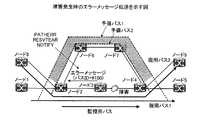
パス確立シグナリングプロトコルには、パス確立要求を示すPathメッセージとその応答であるResvメッセージの他に、確立したパスにエラーが発生したことを通知するエラーメッセージとして、PathErr/ResvTear/Notifyメッセージが用いられる。 In the path establishment signaling protocol, a PathErr / ResvTear / Notify message is used as an error message notifying that an error has occurred in the established path, in addition to a Path message indicating a path establishment request and a Resv message as a response thereto. .
図36は、PathErr/ResvTearメッセージを用いたエラーメッセージの転送を示す図である。同図に示すように、PathErr/ResvTearメッセージは、パスに沿ってHop-by-Hopで始点ノードまで転送される。一方、Notifyメッセージは、メッセージの宛先である始点ノードに直接転送される。そのため、Notifyメッセージは、パスと異なる経路によって始点ノードに到着する場合もある。なお、エラーメッセージにはPath/Resvメッセージに格納されていたパスIDと同じパスIDが格納され、エラーとパスの対応付けを行うことができる。 FIG. 36 is a diagram showing error message transfer using the PathErr / ResvTear message. As shown in the figure, the PathErr / ResvTear message is transferred to the start node by Hop-by-Hop along the path. On the other hand, the Notify message is directly transferred to the start node that is the destination of the message. For this reason, the Notify message may arrive at the start node via a route different from the path. The error message stores the same path ID as the path ID stored in the Path / Resv message, and the error and the path can be associated with each other.
GMPLS/MPLSでは、データを転送する現用パスに障害が発生すると、現用パスを迂回する予備パスを用いてデータの転送が行われる。例えば、MPLSでは、監視用パスを用いて現用パスを監視し、現用パスに障害が発生すると、予備パスに切り替える障害復旧方式が開発されている(特許文献1を参照。)。 In GMPLS / MPLS, when a failure occurs in a working path for transferring data, data is transferred using a backup path that bypasses the working path. For example, in MPLS, a failure recovery method has been developed in which a working path is monitored using a monitoring path, and when a failure occurs in the working path, a failure path is switched to a backup path (see Patent Document 1).
図37は、このような、監視用パスを用いた障害復旧方式を説明するための説明図である。同図に示すように、監視用パスを用いた障害復旧では、まず、パス確立シグナリングプロトコルを用いて、現用パスと、障害発生時に現用パス上のトラヒックを迂回させるための予備パスを確立する。このとき、予備パスは現用パスと同じ始点ノードと終点ノードの間で確立される。 FIG. 37 is an explanatory diagram for explaining such a failure recovery method using a monitoring path. As shown in the figure, in failure recovery using a monitoring path, first, a path establishment signaling protocol is used to establish a working path and a backup path for detouring traffic on the working path when a failure occurs. At this time, the backup path is established between the same start point node and end point node as the working path.
さらに、現用パスの状態を監視するための監視用パスをパス確立シグナリングプロトコルを用いて確立する。監視用パスは、図37に示すように、現用パスに沿って、下流方向/上流方向の両方に2本確立する。そして、2本の監視用パス上で監視パケットを定期的に往復させる。この監視パケットは、監視用パス上を送信されるため、ラベル付きのパケットとなる。 Further, a monitoring path for monitoring the state of the working path is established using a path establishment signaling protocol. As shown in FIG. 37, two monitoring paths are established in both the downstream direction and the upstream direction along the working path. Then, the monitoring packet is periodically reciprocated on the two monitoring paths. Since this monitoring packet is transmitted on the monitoring path, it becomes a labeled packet.
現用パス上で障害が発生すると、以下の手法のいずれかにより、始点ノード「LSR1」は障害を検出する。一つ目の手法は、定期的に送受信されている監視パケットが一定時間内に到着しないことによる検出である。もう一つの手法は、その上流の中継ノードが障害を検出し、その中継ノードが障害通知パケットをラベル付きパケットで始点ノードへ転送する。 When a failure occurs on the working path, the start node “LSR1” detects the failure by one of the following methods. The first method is detection based on the fact that a monitoring packet that is periodically transmitted and received does not arrive within a predetermined time. In another method, the upstream relay node detects a failure, and the relay node transfers the failure notification packet to the start node as a labeled packet.
障害が発生したことを上記二つの手法のいずれかで認識した始点ノードは、現用パスへ送信していたトラヒックを予備パスへ送信することによって、障害を迂回させる。なお、図37で示したように、監視用パスは、同一の経路で確立される複数の現用パスに対して一つを確立してもよい。これにより、監視用パスの総数を減らすことができる。 The source node that has recognized that a failure has occurred by either of the two methods described above bypasses the failure by transmitting the traffic transmitted to the working path to the backup path. As shown in FIG. 37, one monitoring path may be established for a plurality of working paths established by the same route. As a result, the total number of monitoring paths can be reduced.
しかしながら、かかる従来技術には、同一の経路を持った複数パスにのみ予備パスが限定されるため、1監視用パスの数で対応できる現用パス数を増加させることができない。そのため、監視用パス数が増加するという問題がある。 However, since the backup path is limited only to a plurality of paths having the same route in the conventional technique, the number of working paths that can be handled by the number of monitoring paths cannot be increased. Therefore, there is a problem that the number of monitoring paths increases.
さらに、一つの区間に対して2本の監視用パスを確立する必要があることも、監視用パス数を増加させる要因になる。その結果、ネットワークで管理する監視用パス数が増加し、管理負荷が増大するという問題がある。 Furthermore, the need to establish two monitoring paths for one section also increases the number of monitoring paths. As a result, there is a problem that the number of monitoring paths managed by the network increases and the management load increases.
また、定期的に監視パケットを送受信する必要があるため、通常時においても監視パケットが帯域を消費してしまう。また、障害通知用の通知パケットは、パスの入口ノードからでなく、中継ノードから挿入されるため、パスの中継部分からパケットを挿入する機能を新たに設ける必要がある。 Further, since it is necessary to periodically transmit and receive the monitoring packet, the monitoring packet consumes a bandwidth even during normal times. Further, since the notification packet for failure notification is inserted not from the entry node of the path but from the relay node, it is necessary to newly provide a function for inserting the packet from the relay portion of the path.
この発明は、上述した従来技術による問題点を解消するためになされたものであり、監視用パスなどの障害の復旧に用いる経路一つが対応できる現用経路の数を増加させ、もって障害の復旧に用いる経路数を削減することができるデータ中継装置およびデータ中継方法を提供することを目的とする。 The present invention has been made to solve the above-described problems caused by the prior art, and increases the number of working paths that can be handled by one path used for recovery of a failure such as a monitoring path, thereby recovering the failure. An object of the present invention is to provide a data relay apparatus and a data relay method that can reduce the number of paths to be used.
なお、障害復旧方式としては、この他に、シグナリングプロトコルのエラーメッセージを用いたパス迂回、IETFで検討されているFast ReRouting方式(Internet Draft: draft-ietf-mpls-rsvp-lsp-fastreroute-07.txt)、障害情報の同報を用いたパス迂回(藤井泰希、宮崎啓二、伊勢田衡平、「プリプラン型障害復旧方式の検討」、信学技報TM2000-60、pp.67-72、Nov2000)などがある。 Other disaster recovery methods include path detouring using signaling protocol error messages, Fast ReRouting method (Internet Draft: draft-ietf-mpls-rsvp-lsp-fastreroute-07. txt), path detour using the failure information broadcast (Yuki Fujii, Keiji Miyazaki, Kenpei Iseta, "Examination of Preplanned Disaster Recovery Method", IEICE Technical Report TM2000-60, pp.67-72, Nov2000 )and so on.
しかし、シグナリングプロトコルのエラーメッセージを用いたパス迂回には、複数パスに影響を及ぼす傷害が発生した場合、多数のエラーメッセージが発生し、ネットワーク負荷が増大するという問題があり、Fast ReRouting方式には、現用パスが通過するリンクの数だけ予備パス数を確立する必要があり、予備パス数が増加するという問題があり、障害情報の同報を用いたパス迂回には、同報パケットを用いるため、関係のないノードへのパケットが発生するという問題がある。 However, path detouring using signaling protocol error messages has the problem that if an injury that affects multiple paths occurs, a large number of error messages occur and the network load increases. There is a problem that the number of protection paths needs to be established as many as the number of links through which the working path passes, and there is a problem that the number of protection paths increases, and broadcast packets are used for path detours using failure information broadcasts. There is a problem that packets to unrelated nodes are generated.
上述した課題を解決し、目的を達成するため、請求項1の発明に係るデータ中継装置は、複数のデータ中継装置を経由してデータを転送する経路として使用中の現用経路のいずれかの箇所に障害が発生すると該障害発生箇所を迂回する予備経路への切替によって障害復旧を行うネットワークでデータを中継するデータ中継装置であって、始点となる予備経路について現用経路と予備経路とを対応させた障害復旧情報を記憶した障害復旧情報記憶手段と、現用経路に発生した障害の通知である障害発生通知を受信する障害発生通知受信手段と、前記障発生通知受信手段により障害発生通知が受信された現用経路である障害発生現用経路に対応する予備経路を前記障害復旧情報を用いて検索する予備経路検索手段と、前記予備経路検索手段により予備経路が検索された場合に、前記障害発生現用経路を用いて転送されるデータが予備経路を用いて転送されるように経路切替処理を行う経路切替処理手段と、を備えたことを特徴とする。 In order to solve the above-described problems and achieve the object, the data relay device according to the invention of
この請求項1の発明によれば、始点となる予備経路について現用経路と予備経路とを対応させた障害復旧情報を記憶し、現用経路に発生した障害の通知である障害発生通知を受信し、障害発生通知を受信した現用経路である障害発生現用経路に対応する予備経路を障害復旧情報を用いて検索し、予備経路を検索した場合に、障害発生現用経路を用いて転送されるデータが予備経路を用いて転送されるように経路切替処理を行うよう構成したので、監視用経路など障害の復旧に用いる経路が対応できる現用経路の数を増加させることができる。 According to the first aspect of the present invention, the failure recovery information in which the working route and the protection route are associated with each other for the backup route that is the starting point is stored, and the failure occurrence notification that is a notification of the failure that has occurred in the working route is received. When a backup route corresponding to the failure-occurring working route that is the working route that has received the failure notification is searched using the failure recovery information, and the backup route is searched, the data transferred using the failure-occurring current route is reserved. Since the route switching process is performed so that the route is transferred using the route, the number of working routes that can be used by the route used for recovery from a failure such as a monitoring route can be increased.
また、請求項2の発明に係るデータ中継装置は、請求項1の発明において、前記障害発生通知受信手段は、障害の監視専用に用いる監視用経路により前記障害発生通知を受信することを特徴とする。 According to a second aspect of the present invention, there is provided the data relay device according to the first aspect of the invention, wherein the failure occurrence notification receiving means receives the failure occurrence notification through a monitoring path used exclusively for failure monitoring. To do.
この請求項2の発明によれば、障害の監視専用に用いる監視用経路により障害発生通知を受信するよう構成したので、監視用経路一つが対応できる現用経路の数を増加させることができる。 According to the second aspect of the present invention, since the failure occurrence notification is received by the monitoring route used exclusively for monitoring the failure, the number of working routes that can be handled by one monitoring route can be increased.
また、請求項3の発明に係るデータ中継装置は、請求項2の発明において、前記障害発生通知受信手段が障害発生通知を受信する監視用経路として、一部の区間が共通である複数の現用経路に対して共通である区間を含む一つの経路を設定することを特徴とする。 According to a third aspect of the present invention, there is provided the data relay device according to the second aspect of the present invention, wherein the failure occurrence notification receiving means receives a failure occurrence notification as a monitoring route for receiving a failure occurrence notification. One route including a section common to the route is set.
この請求項3の発明によれば、障害発生通知を受信する監視用経路として、一部の区間が共通である複数の現用経路に対して共通である区間を含む一つの経路を設定するよう構成したので、監視用経路一つが対応できる現用経路の数を増加させることができる。 According to the third aspect of the present invention, as the monitoring path for receiving the failure occurrence notification, one path including a section that is common to a plurality of working paths that are common to some sections is set. As a result, the number of working paths that can be handled by one monitoring path can be increased.
また、請求項4の発明に係るデータ中継装置は、請求項3の発明において、複数の現用経路に対応する複数の予備経路の始点が異なる場合には、前記障害発生通知受信手段が障害発生通知を受信する監視用経路として該異なる始点を全て含む経路を設定し、該障害発生通知は監視用経路の各データ中継装置を一つずつ経由して送信されることを特徴とする。 According to a fourth aspect of the present invention, there is provided the data relay device according to the third aspect of the present invention, wherein, when the start points of the plurality of backup paths corresponding to the plurality of working paths are different, the failure occurrence notification receiving means provides a failure occurrence notification. A path including all the different starting points is set as a monitoring path for receiving the error, and the failure occurrence notification is transmitted via each data relay device of the monitoring path one by one.
この請求項4の発明によれば、複数の現用経路に対応する複数の予備経路の始点が異なる場合には、障害発生通知を受信する監視用経路として異なる始点を全て含む経路を設定し、障害発生通知は監視用経路の各データ中継装置を一つずつ経由して送信されるよう構成したので、監視用経路一つが対応できる現用経路の数を増加させることができる。 According to the invention of
また、請求項5の発明に係るデータ中継装置は、請求項2の発明において、経路が同一である複数の予備経路に対しては、迂回トンネルを用いることを特徴とする。 According to a fifth aspect of the present invention, the data relay device according to the second aspect of the present invention is characterized in that a bypass tunnel is used for a plurality of backup paths having the same path.
この請求項5の発明によれば、経路が同一である複数の予備経路に対しては、迂回トンネルを用いるよう構成したので、複数の現用経路からの切替をまとめて行うことができる。 According to the fifth aspect of the present invention, since a bypass tunnel is used for a plurality of backup routes having the same route, switching from a plurality of working routes can be performed collectively.
また、請求項6の発明に係るデータ中継装置は、請求項2の発明において、データの中継に使用するラベルテーブルに新規の現用経路に関する情報を登録する際に、既存の監視用経路が共有される経路を新規の現用経路として優先的に登録することを特徴とする。 According to a sixth aspect of the present invention, in the data relay device according to the second aspect of the present invention, the existing monitoring route is shared when registering information on the new working route in the label table used for data relay. Is preferentially registered as a new working route.
この請求項6の発明によれば、データの中継に使用するラベルテーブルに新規の現用経路に関する情報を登録する際に、既存の監視用経路が共有される経路を新規の現用経路として優先的に登録するよう構成したので、監視用経路一つが対応できる現用経路の数を増加させることができる。 According to the sixth aspect of the present invention, when information related to a new working route is registered in the label table used for data relay, a route sharing an existing monitoring route is preferentially set as a new working route. Since it is configured to register, the number of working routes that can be handled by one monitoring route can be increased.
また、請求項7の発明に係るデータ中継装置は、請求項2の発明において、前記障害発生通知受信手段が障害発生通知を受信する監視用経路の識別には、監視用経路であることを識別可能な監視用経路用識別子を用いることを特徴とする。 According to a seventh aspect of the present invention, there is provided the data relay device according to the second aspect of the present invention, wherein the failure occurrence notification receiving means identifies the monitoring route for receiving the failure occurrence notification as a monitoring route. A possible monitoring path identifier is used.
この請求項7の発明によれば、監視用経路の識別には、監視用経路であることを識別可能な監視用経路用識別子を用いるよう構成したので、監視用経路を容易に識別することができる。 According to the seventh aspect of the present invention, since the monitoring path identifier that can identify the monitoring path is used for identifying the monitoring path, the monitoring path can be easily identified. it can.
また、請求項8の発明に係るデータ中継装置は、請求項1の発明において、前記障害が複数の現用経路で使用されている箇所で発生した場合に、前記障害発生通知受信手段は、前記複数の現用経路のうち監視用に用いられる経路である代表経路により前記障害発生通知を受信することを特徴とする。 The data relay device according to an eighth aspect of the present invention provides the data relay device according to the first aspect, wherein, when the failure occurs at a location used in a plurality of working paths, the failure occurrence notification receiving means The failure occurrence notification is received by a representative route which is a route used for monitoring among the currently used routes.
この請求項8の発明によれば、障害が複数の現用経路で使用されている箇所で発生した場合に、複数の現用経路のうち監視用に用いられる経路である代表経路により障害発生通知を受信するよう構成したので、代表経路一つが対応できる現用経路の数を増加させることができる。 According to the eighth aspect of the present invention, when a failure occurs at a location used in a plurality of working routes, a failure occurrence notification is received by a representative route that is a route used for monitoring among the plurality of working routes. Thus, the number of working routes that can be handled by one representative route can be increased.
また、請求項9の発明に係るデータ中継装置は、請求項1の発明において、前記障害が複数の現用経路で使用されている箇所で発生した場合に、前記障害発生通知受信手段は、前記複数の現用経路にそれぞれ対応する複数の障害発生通知を受信し、前記予備経路検索手段は、前記障害発生通知受信手段により障害発生通知が受信された複数の障害発生現用経路にそれぞれ対応する複数の予備経路を前記障害復旧情報を用いて検索し、前記経路切替処理手段は、前記予備経路検索手段により予備経路が検索された障害発生現用経路のうち、前記複数の障害発生通知のいずれかの障害発生通知により既に経路切替処理が行われている障害発生現用経路については経路切替処理を行わないことを特徴とする。 Further, the data relay device according to the invention of claim 9 is the data relay device according to the invention of
この請求項9の発明によれば、障害が複数の現用経路で使用されている箇所で発生した場合に、複数の現用経路にそれぞれ対応する複数の障害発生通知を受信し、障害発生通知が受信された複数の障害発生現用経路にそれぞれ対応する複数の予備経路を障害復旧情報を用いて検索し、予備経路が検索された障害発生現用経路のうち、複数の障害発生通知のいずれかの障害発生通知により既に経路切替処理が行われている障害発生現用経路については経路切替処理を行わないよう構成したので、一つの現用経路が対応できる現用経路の数を増加させることができる。 According to the ninth aspect of the present invention, when a failure occurs at a location used in a plurality of working routes, a plurality of failure occurrence notifications corresponding to the plurality of working routes are received, and the failure occurrence notification is received. The failure recovery information is searched for a plurality of backup routes respectively corresponding to the plurality of failure occurrence active routes, and one of the failure occurrence notifications of the failure occurrence notification among the failure occurrence active routes for which the backup route is searched is generated. Since the failure switching active route for which the route switching processing has already been performed by the notification is configured not to perform the route switching processing, the number of working routes that can be handled by one active route can be increased.
また、請求項10の発明に係るデータ中継方法は、複数のデータ中継装置を経由してデータを転送する経路として使用中の現用経路のいずれかの箇所に障害が発生すると該障害発生箇所を迂回する予備経路への切替によって障害復旧を行うネットワークでデータを中継するデータ中継方法であって、現用経路に発生した障害の通知である障害発生通知を該障害が発生した現用経路である障害発生現用経路に対応する予備経路の始点である始点データ中継装置が受信する障害発生通知受信工程と、前記障発生通知受信工程により障害発生通知が受信された障害発生現用経路に対応する予備経路を前記始点データ中継装置が現用経路と予備経路とを対応させた障害復旧情報を用いて検索する予備経路検索工程と、前記障害発生現用経路を用いて転送されるデータが前記予備経路検索工程により検索された予備経路を用いて転送されるように前記始点データ中継装置が経路切替処理を行う経路切替処理工程と、を含んだことを特徴とする。 In the data relay method according to the invention of
この請求項10の発明によれば、現用経路に発生した障害の通知である障害発生通知を障害が発生した現用経路である障害発生現用経路に対応する予備経路の始点である始点データ中継装置が受信し、障害発生通知を受信した障害発生現用経路に対応する予備経路を始点データ中継装置が現用経路と予備経路とを対応させた障害復旧情報を用いて検索し、障害発生現用経路を用いて転送されるデータが、検索した予備経路を用いて転送されるように始点データ中継装置が経路切替処理を行うよう構成したので、監視用経路など障害の復旧に用いる経路が対応できる現用経路の数を増加させることができる。 According to the tenth aspect of the present invention, there is provided a starting point data relay device that is a starting point of a backup route corresponding to a failure occurrence working path that is a working path in which a failure occurrence notification that is a notification of a failure that has occurred in a working path The source data relay device searches for a backup route corresponding to the failure-occurring working route that has been received and received the failure occurrence notification using the failure recovery information that associates the active route with the protection route, and uses the failure-occurring working route. Since the source data relay device is configured to perform path switching processing so that the transferred data is transferred using the searched backup path, the number of working paths that can be used by the recovery path such as the monitoring path Can be increased.
請求項1および10の発明によれば、監視用経路など障害の復旧に用いる経路が対応できる現用経路の数を増加させるので、障害の復旧に用いる経路数を削減することができるという効果を奏する。 According to the first and tenth aspects of the present invention, since the number of working paths that can be used by the path used for fault recovery, such as a monitoring path, is increased, the number of paths used for fault recovery can be reduced. .
また、請求項2、3、4および6の発明によれば、監視用経路一つが対応できる現用経路の数を増加させるので、監視用経路の数を削減することができるという効果を奏する。 According to the second, third, fourth, and sixth aspects of the invention, the number of working paths that can be handled by one monitoring path is increased, so that the number of monitoring paths can be reduced.
また、請求項5の発明によれば、複数の現用経路からの切替をまとめて行うので、現用経路からの切替を効率良く行うことができるという効果を奏する。 According to the invention of claim 5, since switching from a plurality of working paths is performed collectively, there is an effect that switching from the working path can be performed efficiently.
また、請求項7の発明によれば、監視用経路を容易に識別するので、監視用経路に対する処理を効率良く行うことができるという効果を奏する。 Further, according to the seventh aspect of the invention, since the monitoring route is easily identified, there is an effect that the processing for the monitoring route can be performed efficiently.
また、請求項8の発明によれば、代表経路一つが対応できる現用経路の数を増加させるので、代表経路の数を削減することができるという効果を奏する。 According to the eighth aspect of the invention, since the number of working routes that can be handled by one representative route is increased, the number of representative routes can be reduced.
また、請求項9の発明によれば、一つの現用経路が対応できる現用経路の数を増加させることができるので、障害の復旧に用いる経路数を削減することができるという効果を奏する。 According to the ninth aspect of the present invention, since the number of working paths that can be handled by one working path can be increased, the number of paths used for recovery from a failure can be reduced.
以下に添付図面を参照して、この発明に係るデータ中継装置およびデータ中継方法の好適な実施例を詳細に説明する。 Exemplary embodiments of a data relay device and a data relay method according to the present invention will be explained below in detail with reference to the accompanying drawings.
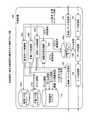
まず、本実施例に係る中継装置の構成について説明する。図1は、本実施例に係る中継装置の構成を示す機能ブロック図である。同図に示すように、この中継装置100は、データ受信部110と、データ送信部120と、データ中継部130と、中継用ラベルテーブル140aと、予備パス用ラベルテーブル140bと、監視パス用ラベルテーブル140cと、制御パケット受信部150と、制御パケット送信部160と、障害復旧テーブル170と、現用パス制御部180aと、予備パス制御部180bと、監視用パス制御部180cと、経路切替処理部190とを有する。 First, the configuration of the relay device according to the present embodiment will be described. FIG. 1 is a functional block diagram illustrating the configuration of the relay device according to the present embodiment. As shown in the figure, the
データ受信部110は、ネットワークからデータを受信し、受信したデータをデータ中継部130に渡す処理部である。データ送信部120は、データ中継部130からデータを受け取り、受け取ったデータをネットワークに送信する処理部である。 The
データ中継部130は、中継用ラベルテーブル140aを用いてデータを中継する処理部である。すなわち、このデータ中継部130は、データ受信部110からデータおよび入力IFを受け取り、中継用ラベルテーブル140aを用いて入力ラベルおよび入力IFから出力ラベルおよび出力IFを検索する。そして、入力ラベルを出力ラベルに置き換え、出力IFを指定してデータをデータ送信部120に渡す。 The
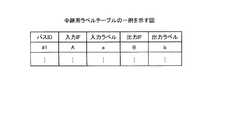
中継用ラベルテーブル140aは、中継に用いるラベル情報を記憶したテーブルである。図2は、中継用ラベルテーブル140aの一例を示す図である。同図に示すように、この中継用ラベルテーブル140aは、パスを識別するパスIDと、入力IFと、入力ラベルと、出力IFと、出力ラベルとを現用パスごとに記憶する。 The relay label table 140a is a table that stores label information used for relay. FIG. 2 is a diagram illustrating an example of the relay label table 140a. As shown in the figure, the relay label table 140a stores a path ID for identifying a path, an input IF, an input label, an output IF, and an output label for each working path.
予備パス用ラベルテーブル140bは、予備パスごとにラベル情報を記憶したテーブルであり、中継用ラベルテーブル140aと同様のデータ構造を有する。監視パス用ラベルテーブル140cは、監視用パスごとにラベル情報を記憶したテーブルであり、中継用ラベルテーブル140aと同様のデータ構造を有する。 The backup path label table 140b is a table that stores label information for each backup path, and has the same data structure as the relay label table 140a. The monitoring path label table 140c is a table storing label information for each monitoring path, and has the same data structure as the relay label table 140a.
制御パケット受信部150は、ネットワークから制御パケットを受信する処理部であり、受け取った制御パケットのパスに関する情報に基づいて、制御パケットを現用パス制御部180a、予備パス制御部180bまたは監視用パス制御部180cのいずれかに渡す。 The control
ここで、制御パケットとしては、パス確立要求メッセージ(PATHメッセージ)、パス確立応答メッセージ(RESV)、エラーメッセージがある。パス確立要求メッセージは、現用パス、予備パス、監視用パスのパス確立を要求するメッセージであり、このメッセージには、パスIDが格納されている。 Here, the control packet includes a path establishment request message (PATH message), a path establishment response message (RESV), and an error message. The path establishment request message is a message requesting path establishment of the working path, the backup path, and the monitoring path, and the path ID is stored in this message.
パス確立応答メッセージ(RESVメッセージ)は、現用パス、予備パス、監視用パスの確立要求メッセージに対する応答メッセージであり、このメッセージには、パスIDと割り当てるラベルが格納されている。 The path establishment response message (RESV message) is a response message to the establishment request message for the working path, the protection path, and the monitoring path, and stores a path ID and a label to be assigned.
エラーメッセージは、パス上でエラーが発生したことを始点ノードに通知するメッセージであり、このメッセージには、エラーが発生した場所に関する情報、パスIDが格納されている。また、このエラーメッセージは、監視用パス制御部180cに渡される。 The error message is a message for notifying the start node that an error has occurred on the path, and this message stores information about the location where the error has occurred and a path ID. The error message is passed to the monitoring
制御パケット送信部160は、現用パス制御部180a、予備パス制御部180bまたは監視用パス制御部180cから制御パケットを受け取り、受け取った制御パケットをネットワークに送信する処理部である。 The control
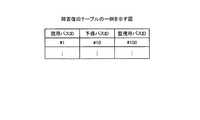
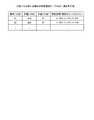
障害復旧テーブル170は、現用パスに障害が発生した場合に、現用パスを予備パスに切り替えるために経路切替処理部190により使用されるテーブルである。図3は、障害復旧テーブル170の一例を示す図である。同図に示すように、この障害復旧テーブル170は、自装置が始点である予備パスについて、現用パスを識別する現用パスIDと、予備パスを識別する予備パスIDと、監視用パスを識別する監視用パスIDとを対応させて記憶する。 The failure recovery table 170 is a table used by the route
この障害復旧テーブル170が、自装置が始点である予備パスについて現用パスと監視用パスを対応させて記憶することによって、予備パスの始点が監視用パスに含まれていさえすれば予備パスの始点と監視用パスの始点とを異なるものとすることができる。 The failure recovery table 170 stores the protection path corresponding to the start path of the self-device in association with the working path and the monitoring path, so that the start point of the protection path is only included in the monitoring path. And the start point of the monitoring path can be different.
現用パス制御部180aは、現用パスに関する制御パケットを処理する処理部である。すなわち、この現用パス制御部180aは、現用パスのパス確立を要求するPATHメッセージに格納されている現用パスの通過ノード情報に従い、PATHメッセージを転送し、さらにはPATHメッセージの送信ノードを記憶しておく。 The working
そして、RESVメッセージを受信すると、その受信インタフェースを出力IFに、受信したRESVメッセージに格納されているラベル情報を出力ラベルとして割り当てる。また、PATHメッセージを受信したインタフェースを入力IFに、PATHメッセージに格納されていたラベル情報を入力ラベルとして割り当てる。 When the RESV message is received, the reception interface is assigned to the output IF, and the label information stored in the received RESV message is assigned as the output label. Also, the interface that received the PATH message is assigned to the input IF, and the label information stored in the PATH message is assigned as the input label.
そして、受信したRESVメッセージのラベルを入力ラベルに置き換えて、PATHメッセージの送信ノードに返信する。また、割り当てたインタフェース、ラベル情報を中継用ラベルテーブル140aに登録する。また、パスIDを障害復旧テーブル170の現用パスIDに登録する。 Then, the label of the received RESV message is replaced with the input label, and the reply is sent to the transmission node of the PATH message. Also, the allocated interface and label information are registered in the relay label table 140a. Further, the path ID is registered in the working path ID of the failure recovery table 170.
予備パス制御部180bは、現用パスに関する制御パケットに対して現用パス制御部180aが行う処理と同様の処理を予備パスに関する制御パケットに対して行う処理部であり、割り当てたインタフェース、ラベル情報は、中継用ラベルテーブル140aの代わりに予備パス用ラベルテーブル140bに登録する。 The protection path control
また、この予備パス制御部180bは、自装置が予備パスの始点である場合には、障害復旧テーブル170に登録されている現用パスIDに対応させて予備パスIDを登録し、自装置が予備パスの始点でない場合には、予備パスIDに対応する障害復旧テーブル170の現用パスIDを削除する。 In addition, when the own device is the starting point of the protection path, the protection path control
監視用パス制御部180cは、現用パスに関する制御パケットに対して現用パス制御部180aが行う処理と同様の処理を監視用パスに関する制御パケットに対して行う処理部であり、割り当てたインタフェース、ラベル情報は、中継用ラベルテーブル140aの代わりに監視パス用ラベルテーブル140cに登録する。 The monitoring
また、この監視用パス制御部180cは、自装置が予備パスの始点である場合には、障害復旧テーブル170に登録されている現用パスIDおよび予備パスIDに対応させて監視用パスIDを登録する。また、この監視用パス制御部180cは、エラーメッセージを受信すると、経路切替処理部190にパス上でエラーが発生したことを通知してエラーメッセージを渡す。 In addition, when the own device is the starting point of the protection path, the monitoring
経路切替処理部190は、監視用パス制御部180cからエラーメッセージを受信したことを通知されると、現用パスから予備パスへの切替処理を行う処理部である。すなわち、この経路切替処理部190は、障害復旧テーブル170を参照し、エラーメッセージに格納されている監視用パスIDが登録されているか否かを判定する。そして、監視用パスIDが登録されている場合には、自装置が予備パスの始点であるので、監視用パスIDに対応する現用パス、予備パスを特定する。そして、該当の予備パスの情報を予備パス用ラベル-テーブル140bから抽出し、中継用ラベルテーブル140aに登録する。これにより、現用パス上のトラヒックが予備パスへ転送される。 The route
このように、この経路切替処理部190が、エラーメッセージに格納されている監視用パスIDが障害復旧テーブル170に登録されているか否かを判定し、監視用パスIDが登録されている場合に監視用パスIDに対応する現用パス、予備パスを特定し、現用パス上のトラヒックが予備パスへ転送されるように経路を切り替える処理を行うことによって、現用パスの障害を復旧することができる。 As described above, the path switching
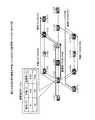
次に、本実施例に係る中継装置100による障害復旧動作について、いくつかのケースを対象に説明する。まず、ケース1として、7ノードで構成されるネットワークを対象に、本実施例に係る中継装置100による障害復旧動作について図4〜図9を用いて説明する。ここで、ノードとは、中継装置のことである。また、以下では、中継用ラベルテーブル140a、予備パス用ラベルテーブル140b、監視パス用ラベルテーブル140cを合わせてラベルテーブルと呼ぶ。 Next, the failure recovery operation by the
まず、パス確立シグナリングプロトコル(RSVP-TE)を用いて、「ノード1」→「ノード2」→「ノード3」→「ノード4」→「ノード5」の経路の現用パスを確立する(図4)。すると、図4に示されている「ノード2」が保持するラベルテーブルと同様のテーブルが現用パス上の全ノードで構築される。 First, using the path establishment signaling protocol (RSVP-TE), a working path of a route of “
そして、現用パス上の「ノード2」−「ノード3」−「ノード4」で発生する障害に対応するため、「ノード2」を始点とし「ノード4」を終点とする、「ノード2」→「ノード6」→「ノード7」→「ノード4」の経路の予備パスを確立する。この予備パスも現用パスと同様にパス確立シグナリングプロトコル(RSVP-TE)を用いて確立する(図5)。すると、図5に示されている「ノード2」、「ノード6」が保持するラベルテーブルと同様のテーブルが予備パス上の全ノードで構築される。 Then, in order to deal with a failure that occurs in “
また、「ノード2」、「ノード4」は、予備パスのPATHメッセージに格納されている現用パスとの対応付け情報に基づき、対応する現用パスのラベル、インタフェース情報を合わせて登録する。上記の現用パスとの対応付け情報として、既に関連付けルールに従ってパスIDを決定する方法や現用パス情報をPATHメッセージに格納する方法等がある。図5中の「ノード2」のラベルテーブルでは、「現用パス1」の入力ラベル、入力インタフェースの情報が登録されている。 Also, “
また、障害時に経路切り替えノードとなる「ノード2」は、現用パスと予備パスとの対応表である障害復旧テーブル170を保持する。なお、ここでは、現用パスIDを「#1」、予備パスIDを「#10」とする。 In addition, “
そして、現用パスが通過する「ノード2」−「ノード3」−「ノード4」間で発生する障害を監視するため、同一の経路で、監視用パスを確立する(図6)。監視用パスの確立のために、パス確立シグナリングプロトコル(RSVP-TE)を用いる。 Then, in order to monitor a failure occurring between “
また、パス確立シグナリングを行う際に、確立されたパスが監視用パスであることを示すために、PATHメッセージに監視用パスであることを示すフラグやオブジェクトなどの情報を埋め込む、あるいは、監視用パスであることを示すパスIDを割り当てる。 Also, when performing path establishment signaling, in order to indicate that the established path is a monitoring path, information such as a flag or object indicating that it is a monitoring path is embedded in the PATH message, or for monitoring A path ID indicating a path is assigned.
その結果、図6に示されている「ノード2」が保持するラベルテーブルと同様のテーブルが監視用パス上の全ノードで構築される。なお、図6中の「ノード2」のラベルテーブルでは、「ノード2」が監視用パスの始点ノードであるため、入力ラベル、入力インタフェースの情報は登録されていない。 As a result, a table similar to the label table held by “
また、障害時に経路切り替えノードとなる「ノード2」は、予備パスと監視用パスとの対応表である障害復旧テーブル170を保持する(図7)。なお、ここでは、監視用パスのIDを「#100」とする。 In addition, “
なお、すでに説明したように、パス確立シグナリングプロトコルには、パス確立要求を示すPathメッセージとその応答であるResvメッセージの他に、確立したパスにエラーが発生したことを通知するエラーメッセージがある。PathErr/ResvTear/Notifyメッセージがそれに相当する。これらはエラーの種類に応じて使用されるが、どのエラーメッセージを用いても以下の動作を実現することが可能である。また、エラーメッセージにはパス確立時にPath/Resvメッセージに格納されていたパスIDが格納される。 As already described, the path establishment signaling protocol includes an error message for notifying that an error has occurred in the established path, in addition to a Path message indicating a path establishment request and a Resv message as a response thereto. PathErr / ResvTear / Notify messages correspond to it. These are used according to the type of error, but the following operations can be realized using any error message. The error message stores the path ID stored in the Path / Resv message when the path is established.
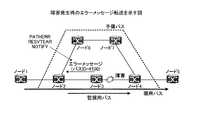
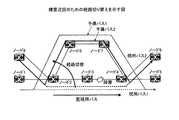
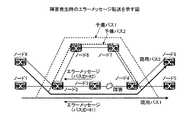
そして、「ノード2」−「ノード3」−「ノード4」間で障害が発生すると、その上流の中継ノードが障害を検出する。ここでは、「ノード3」−「ノード4」間で障害が発生したとして説明する。障害を検出した「ノード3」は、経路の切り替え「ノード2」に障害が発生したことを通知するため、監視用パスに対するエラーメッセージを「ノード2」に送信する(図8)。この監視用パスに対するエラーメッセージには監視用パスのIDが格納されている。 When a failure occurs between “
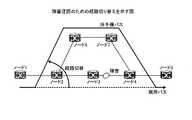
このエラーメッセージを受信した「ノード2」は、エラーメッセージに格納されているパスIDに基づき、障害復旧テーブル170を検索し、現用パスと予備パスを特定する。そして、検索された現用パスのトラヒックを対応する予備パスへ送信することによって、障害から回復させる(図9)。 Receiving this error message, “
このケース1では、「ノード3」−「ノード4」間で障害が発生したとき、障害を検出した「ノード3」は、監視用パスに対するエラーメッセージを「ノード2」に送信し、現用パスに対しては送信しない。このように、パス確立シグナリングプロトコルで規定されているエラーメッセージを現用パスに対して送信する機能を抑制することによって、必要のないエラーメッセージを削減することができる。 In this
また、このケース1では、1現用パスに対して1監視用パスを対応づけているため、大きな効果は得られないが、以降で説明するケース2のように複数の現用パスに対して一つの監視用パスを対応付けている場合には障害発生時に生成されるメッセージ数を大幅に削減することができる。 Further, in this
また、このケース1では、「ノード3」−「ノード4」間で障害が発生したとき、障害を検出した「ノード3」は、監視用パスに対するエラーメッセージを「ノード2」に送信した。しかし、パス確立シグナリングプロトコルで現用パスでのエラーメッセージの送信が規定されている。したがって、ケース1に示した動作を実現するためには、現用パスでのエラーメッセージ送信の抑制機能を追加する必要がある。 Further, in this
一方、現用パスのエラーメッセージが送信されるよりも前に監視用パスのエラーメッセージを優先して送信することで、現用パスでのエラーメッセージ送信の抑制機能を追加せずに上記動作を実現することもできる。すなわち、ほぼ同時に二つのパケットが送信された場合、後に到着したパケットは中継されるときに中継ノードの負荷・処理能力により廃棄される可能性がある。そこで、監視用パスのエラーパケットを初めに送信することによって、監視用パスのエラーパケットの廃棄を回避し、切り替えノードに到達させることができる。 On the other hand, the above-mentioned operation is realized without adding the error message transmission suppression function on the working path by sending the monitoring path error message preferentially before the working path error message is sent. You can also. That is, if two packets are transmitted almost simultaneously, a packet that arrives later may be discarded due to the load / processing capacity of the relay node when it is relayed. Therefore, by sending the monitoring path error packet first, it is possible to avoid discarding the monitoring path error packet and reach the switching node.
また、このケース1では、現用パスを確立した後、予備パスを確立し、監視用パスを確立していた。しかし、予備パスと監視用パスの確立順を逆にし、監視用パスを確立した後に予備パスを確立してもよい。予備パスを先に確立する上記のケース1では、監視用パスが確立されるまでの間に障害が発生した場合には現用パスから予備パスへトラヒックを迂回できなくなる可能性があるが、監視用パスを先に確立した場合には予備パス確立後はいつ障害が発生したとしても現用パスから予備パスへトラヒックを迂回できる。 In
また、このケース1では、現用パスの一部区間だけに対して予備パスを確立し、その区間で障害が起こった場合にだけトラヒックを迂回させている。しかし、一部区間だけに予備パスを確立することに限定する必要はなく、必要に応じて他の区間にも予備パスを確立することができる。一般的には、現用パス上のいずれの箇所で障害が発生したとしても障害を回避させるために複数の予備パスを確立する。 In
また、エラーメッセージを監視用パスの始点ノードへ転送する際に、エラーメッセージとしてPathErr/ResvTearメッセージを用いた場合には、エラーメッセージは監視用パス上をHop-by-Hopで転送される。一方、エラーメッセージとしてNotifyメッセージを用いた場合には、エラーメッセージはパケットの宛先である始点ノードまで直接転送される。そのため、監視用パスと異なる経路を転送される場合もある。 Further, when the error message is transferred to the start node of the monitoring path, if the PathErr / ResvTear message is used as the error message, the error message is transferred on the monitoring path by Hop-by-Hop. On the other hand, when a Notify message is used as an error message, the error message is directly transferred to the start node that is the destination of the packet. Therefore, a route different from the monitoring path may be transferred.
また、現用パス、予備パス、監視パスを確立するためにパス確立シグナリングプロトコル(RSVP-TE)を用いるのではなく、人手で各装置にラベルテーブル、障害復旧テーブルを構築する場合もある。 Further, instead of using the path establishment signaling protocol (RSVP-TE) to establish the working path, the protection path, and the monitoring path, a label table and a failure recovery table may be manually constructed in each device.
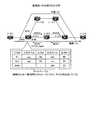
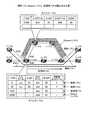
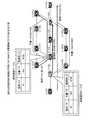
次に、ケース2として、9ノードで構成されるネットワークを対象に、本実施例に係る中継装置100による障害復旧動作について図10〜図13を用いて説明する。まず、パス確立シグナリングプロトコル(RSVP-TE)を用いて、「ノード1」→「ノード2」→「ノード3」→「ノード4」→「ノード5」の経路の「現用パス1」と、「ノード8」→「ノード2」→「ノード3」→「ノード4」→「ノード9」の経路の「現用パス2」を確立する。 Next, as a
そして、「ノード2」−「ノード3」−「ノード4」で発生する障害に対応するため、「ノード2」を始点とし「ノード4」を終点とする、「ノード2」→「ノード6」→「ノード7」→「ノード4」の経路の「予備パス1」、「予備パス2」を確立する。「予備パス1」は、「現用パス1」の迂回路として、「予備パス2」は、「現用パス2」の迂回路として使用される。この「予備パス1」、「予備パス2」も現用パスと同様にパス確立シグナリングプロトコル(RSVP-TE)を用いて確立する。 Then, in order to deal with a failure that occurs in “
また、障害時に経路切り替えノードとなる「ノード2」は、現用パスと予備パスとの対応表である障害復旧テーブル170を保持する。なお、ここでは、「現用パス1」、「現用パス2」のパスIDをそれぞれ「#1」、「#2」とし、「予備パス1」、「予備パス2」のパスIDをそれぞれ「#10」、「#20」とする。 In addition, “
「現用パス1」と「現用パス2」は同じ区間(「ノード2」−「ノード3」−「ノード4」)を通過する。そこで、この区間で発生する障害を監視するため、同一の経路で、監視用パスを確立する。監視用パスの確立のために、パス確立シグナリングプロトコル(RSVP-TE)を用いる。 “Working
また、パス確立シグナリングを行う際に、確立されたパスが監視用パスであることを示すために、PATHメッセージに監視用パスであることを示すフラグやオブジェクトなどの情報を埋め込む、あるいは、監視用パスであることを示すパスIDを割り当てる。 Also, when performing path establishment signaling, in order to indicate that the established path is a monitoring path, information such as a flag or object indicating that it is a monitoring path is embedded in the PATH message, or for monitoring A path ID indicating a path is assigned.
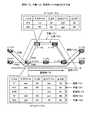
図10に、確立された「現用パス1」、「現用パス2」、「予備パス1」、「予備パス2」、監視用パスを示す。また、パス確立シグナリングプロトコルで構築されるラベルテーブルの例も図10に合わせて示す。 FIG. 10 shows the established “working
また、障害時に経路切り替えノードとなる「ノード2」は、予備パスと監視用パスとの対応表である障害復旧テーブル170を保持する。ここでは、監視用パスのパスIDを「#100」とすると、障害復旧テーブル170は、図11に示すようになる。 In addition, “
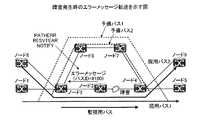
そして、「ノード2」−「ノード3」−「ノード4」間で障害が発生すると、その上流の中継ノードが障害を検出する。ここでは、「ノード3」−「ノード4」間で障害が発生したとして説明する。障害を検出した「ノード3」は、経路の切り替え「ノード2」に障害が発生したことを通知するため、監視用パスに対するエラーメッセージを「ノード2」に送信する。監視用パスに対するエラーメッセージには監視用パスのパスIDが格納されている(図12)。 When a failure occurs between “
このエラーメッセージを受信した「ノード2」は、エラーメッセージに格納されているパスIDに基づき、障害復旧テーブル170を検索し、現用パスと予備パスを特定する。このケース2では、2組の現用パスと予備パスが得られる。そして、「ノード2」は、得られた現用パス上のトラヒックを対応する予備パスへ転送することによって、障害から回復させる。その結果、一つの監視用パスのエラーメッセージを受信することによって、障害の影響を受けた二つの現用パスを障害から回復させることができる(図13)。 Receiving this error message, “
このように、本実施例に係る中継装置100を用いることによって、複数の現用パスに対して一つの監視用パスを設定することが可能になり、監視用パス数を削減することができ、かつ、障害発生時に生成されるエラーメッセージを削減することができる。 In this way, by using the
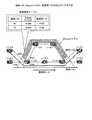
次に、ケース3として、9ノードで構成されるネットワークを対象に、本実施例に係る中継装置100による障害復旧動作について図14〜図17を用いて説明する。まず、パス確立シグナリングプロトコル(RSVP-TE)を用いて、「ノード1」→「ノード2」→「ノード3」→「ノード4」→「ノード5」の経路の「現用パス1」と、「ノード8」→「ノード2」→「ノード3」→「ノード4」→「ノード9」の経路の「現用パス2」を確立する。 Next, as a case 3, a failure recovery operation by the
そして、「ノード2」−「ノード3」−「ノード4」で発生する障害を迂回するため、「ノード2」を始点とし「ノード4」を終点とする、「ノード2」→「ノード6」→「ノード7」→「ノード4」の経路のBypassトンネルを確立する。このBypassトンネルも現用パスと同様にパス確立シグナリングプロトコル(RSVP-TE)を用いて確立する。 Then, in order to circumvent the failure that occurs in “
障害発生時には、現用パスの方路がBypassトンネルへ変えられる。なお、Bypassトンネル上を転送されるトラヒックは現用パスのラベルの前にBypassトンネルのラベルが付加される。また、「ノード4」がBypassトンネルを転送されたトラヒックを現用パスへ転送できるように、「ノード2」は障害前に「ノード4」が使用していたラベルを現用ラベルとしてトラヒックに添付する。 When a failure occurs, the working path is changed to a Bypass tunnel. The traffic transferred on the Bypass tunnel is added with the Bypass tunnel label before the working path label. Also, so that “
また、障害時に経路切り替えノードとなる「ノード2」は、現用パスと予備パスとの対応表である障害復旧テーブル170を保持する。なお、ここでは、「現用パス1」、「現用パス2」のパスIDをそれぞれ「#1」、「#2」とし、BypassのパスIDを「#1000」とする。 In addition, “
「現用パス1」と「現用パス2」は同じ区間(「ノード2」−「ノード3」−「ノード4」)を通過する。そこで、この区間で発生する障害を監視するため、同一の経路で、監視用パスを確立する。監視用パスの確立のために、パス確立シグナリングプロトコル(RSVP-TE)を用いる。 “Working
また、パス確立シグナリングを行う際に、確立されたパスが監視用パスであることを示すために、PATHメッセージに監視用パスであることを示すフラグやオブジェクトなどの情報を埋め込む、あるいは、監視用パスであることを示すパスIDを割り当てる。 Also, when performing path establishment signaling, in order to indicate that the established path is a monitoring path, information such as a flag or object indicating that it is a monitoring path is embedded in the PATH message, or for monitoring A path ID indicating a path is assigned.
図14に、確立された「現用パス1」、「現用パス2」、Bypassトンネル、監視用パスを示す。また、パス確立シグナリングプロトコルで構築されるラベルテーブルの例も合わせて図14に示す。 FIG. 14 shows the established “working
また、障害時に経路切り替えノードとなる「ノード2」は、Bypassトンネルと監視用パスとの対応表である障害復旧テーブルを保持する(図15)。なお、ここでは、監視用パスのパスIDを「#100」とする。 In addition, “
そして、「ノード2」−「ノード3」−「ノード4」間で障害が発生すると、その上流の中継ノードが障害を検出する。ここでは、「ノード3」−「ノード4」間で障害が発生したとして説明する。障害を検出した「ノード3」は、経路の切り替え「ノード2」に障害が発生したことを通知するため、監視用パスに対するエラーメッセージを「ノード2」に送信する(図16)。監視用パスに対するエラーメッセージには監視用パスのパスIDが格納されている。 When a failure occurs between “
このエラーメッセージを受信した「ノード2」は、エラーメッセージに格納されているパスIDに基づき、障害復旧テーブルを検索し、現用パスとBypassトンネルを特定する。このケース2では、2組の現用パスとBypassトンネルが得られる。そして、得られた現用パスをBypassトンネル上に方路を変える。 Upon receiving this error message, “
具体的には、トラヒックに障害時に使用する出力ラベルを添付し、さらにBypassトンネルのラベルを添付した後、Bypassトンネル側へ転送する。これにより障害から回復できる(図17)。その結果、一つの監視用パスのエラーメッセージを受信することによって、障害の影響を受けた二つの現用パスを障害から回復させることができる。 Specifically, an output label to be used in the event of a failure is attached to the traffic, and a Bypass tunnel label is further attached, and then forwarded to the Bypass tunnel side. As a result, the failure can be recovered (FIG. 17). As a result, by receiving an error message for one monitoring path, the two working paths affected by the failure can be recovered from the failure.
このように、本実施例に係る中継装置100を用いることによって、複数の現用パスに対して一つの監視用パスを設定することが可能になり、監視用パス数を削減することができ、かつ、障害発生時に生成されるエラーメッセージを削減することができる。 In this way, by using the
これまでの説明では、予備パスの始点ノード、終点ノードが、監視用パスの始点ノード、終点ノードと同一である場合について説明してきた。しかし、予備パスの始点ノード、終点ノードと、監視用パスの始点ノード、終点ノードを異なるノードとすることも可能である。そこで、ケース4として、予備パスの終点ノードと監視用パスの終点ノードが異なる場合について図18を用いて説明する。 In the above description, the case where the start node and the end node of the protection path are the same as the start node and the end node of the monitoring path has been described. However, the start point node and end point node of the backup path and the start point node and end point node of the monitoring path may be different nodes. Therefore, as a
まず、「ノード1」→「ノード2」→「ノード3」→「ノード4」→「「ノード13」→「ノード14」の経路の「現用パス1」を確立し、「ノード12」→「ノード2」→「ノード3」→「ノード4」→「ノード5」→「ノード6」の経路の「現用パス2」を確立する(図18)。 First, the “working
ここで、「現用パス1」と「現用パス2」がともに通過する共通区間は「ノード2」−「ノード3」−「ノード4」である。そこで、この共通区間で発生した障害を迂回する予備パスを確立する。「現用パス1」に対する「予備パス1」は「ノード2」→「ノード7」→「ノード8」→「ノード13」の経路で確立され、「現用パス2」に対する「予備パス2」は「ノード2」→「ノード9」→「ノード10」→「ノード11」→「ノード5」の経路で確立される。 Here, the common section through which both “working
また、このケース4では、予備パスの終点ノードと、監視用パスの終点ノードを同一にする必要がないため、「現用パス1」と「現用パス2」がともに通過する共通区間(「ノード2」−「ノード3」−「ノード4」)で発生する障害を監視する監視用パスを確立する。 Further, in this
そして、「ノード2」は、監視用パスと「予備パス1」、「予備パス2」とを関連付け、障害復旧テーブル170に登録する。ここでは、「現用パス1」、「現用パス2」のパスIDをそれぞれ「#1」、「#2」とし、「予備パス1」、「予備パス2」のパスIDをそれぞれ「#10」、「#20」とする。また、監視用パスのパスIDを「#100」とする。 Then, “
そして、「ノード2」−「ノード3」−「ノード4」間で障害が発生すると、その上流の中継ノードが障害を検出する。ここでは、「ノード3」−「ノード4」間で障害が発生したとして説明する。障害を検出した「ノード3」は、経路の切り替え「ノード2」に障害が発生したことを通知するため、監視用パスに対するエラーメッセージを「ノード2」に送信する。監視用パスに対するエラーメッセージには監視用パスのパスIDが格納されている。 When a failure occurs between “
このエラーメッセージを受信した「ノード2」は、エラーメッセージに格納されているパスIDに基づき、障害復旧テーブル170を検索し、現用パスと予備パスを特定する。このケース4では、2組の現用パスと予備パスが得られる。そして、得られた現用パス上のトラヒックを対応する予備パスへ転送することによって、障害から回復させる。その結果、一つの監視用パスのエラーメッセージを受信することによって、障害の影響を受けた二つの現用パスを障害から回復させることができる。 Receiving this error message, “
このように、本実施例に係る中継装置100を用いることによって、異なる区間を迂回する複数の予備パスを一つの監視用パスで管理することが可能であるため、監視用パス数を削減することができる。 In this way, by using the
なお、このケース4では、現用パスの一部区間だけに対して予備パスを確立し、その区間で障害が起こった場合にだけトラヒックを迂回させている。しかし、一部区間だけに予備パスを確立することに限定する必要はなく、必要に応じて他の区間にも予備パスを確立することができる。すなわち、この説明の中では、簡単のためネットワークの一部だけを切り出して説明を行っている。 In
すなわち、このケース4では、「現用パス1」に関して設定できる迂回路は、「ノード2」−「ノード3」−「ノード4」−「ノード13」であるが、実際のネットワークでは、その他の部分に対しても迂回路を確立できる。例えば、「ノード14」−「ノード5」間にリンクが存在する場合、「ノード4」−「ノード13」−「ノード14」を迂回する「予備パス1'」が確立できる。 That is, in this
このような場合には、「ノード4」−「ノード13」−「ノード14」間に監視パスを確立し、同様の障害復旧メカニズムを適用することができる。このように、現用パスの全リンクに対して迂回路が設定されるようにすることで、現用パス全体を障害から保護することが可能になる。 In such a case, a similar failure recovery mechanism can be applied by establishing a monitoring path between “
これまでは、複数の現用パスの共通区間に監視用パスを確立し、その監視用パスと予備パスを関連付ける手法について説明してきた。しかし、複数の現用パスの共通区間以外に監視用パスを設けることもできる。そこで、ケース5として、共通区間よりも上流方向に大きい区間に確立した監視用パスと予備パスとを対応付けることによって、さらに監視用パス数を削減する手法について図19を用いて説明する。 So far, a method for establishing a monitoring path in a common section of a plurality of working paths and associating the monitoring path with a backup path has been described. However, a monitoring path can be provided in addition to the common section of the plurality of working paths. Therefore, as a case 5, a method of further reducing the number of monitoring paths by associating a monitoring path and a backup path established in a section larger in the upstream direction than the common section will be described with reference to FIG.
まず、「ノード12」→「ノード3」→「ノード4」→「ノード5」→「ノード13」の経路の「現用パス1」と、「ノード1」→「ノード2」→「ノード3」→「ノード4」→「ノード5」→「ノード6」の経路の「現用パス2」を確立する。そして、それぞれに対応する「予備パス1」、「予備パス2」が図19のように確立されているとする。 First, “working
このとき、「予備パス1」、「予備パス2」が迂回する両区間を含む監視用パスを「ノード2」→「ノード3」→「ノード4」→「ノード5」で確立する。監視用パスを確立した「ノード2」→「ノード3」→「ノード4」→「ノード5」は、「現用パス1」と「現用パス2」の共通区間よりも上流方向に大きい区間である。そのため、監視パスの始点ノードと全ての予備パスの始点ノードが同一にはならない。 At this time, a monitoring path including both sections bypassing “
ここで、「現用パス1」、「現用パス2」のパスIDをそれぞれ「#1」、「#2」とし、「予備パス1」、「予備パス2」のパスIDをそれぞれ「#10」、「#20」とする。また、監視用パスのパスIDを「#100」とする。そして、「予備パス2」の始点である「ノード2」は、「予備パス2」と監視用パスとの関連付けを行い、障害復旧テーブル170に登録する。また、「予備パス1」の始点である「ノード3」は、「予備パス1」と監視用パスとの関連付けを行い、障害復旧テーブル170に登録する。 Here, the path IDs of “working
そして、「ノード2」−「ノード3」−「ノード4」−「ノード5」間で障害が発生すると、その上流の中継ノードが障害を検出する。ここでは、「ノード4」−「ノード5」間で障害が発生したとして説明する。障害を検出した「ノード4」は、監視パスの始点ノードである「ノード2」に障害が発生したことを通知するため、監視用パスに対するエラーメッセージを「ノード2」に送信する。ここでは、エラーメッセージとしてPathErr/Resvエラーを用いる。 When a failure occurs between “
この場合、エラーメッセージは監視用パス上をHop-by-Hop転送されるため、エラーメッセージの送信ノードより上流にある監視用パス上の全ノード(この場合には、中継ノードである「ノード3」と始点ノードである「ノード2」)はエラーメッセージを扱うことができるようになる。 In this case, since the error message is Hop-by-Hop transferred on the monitoring path, all the nodes on the monitoring path upstream from the error message transmission node (in this case, “node 3 that is a relay node) "And the start node"
そして、このエラーメッセージを中継した「ノード3」および「ノード2」は、エラーメッセージに格納されているパスIDに基づき、障害復旧テーブル170を検索し、現用パスと予備パスを特定する。「ノード2」では「現用パス2」と「予備パス2」が、「ノード3」では「現用パス1」と「予備パス1」が得られる。そして、得られた現用パス上のトラヒックを対応する予備パスへ転送することによって、障害から回復させる。 Then, “node 3” and “
このように、本実施例に係る中継装置100を用いることによって、一つの監視用パスに関するエラーメッセージによって、区間の異なる複数の予備パスへトラヒックを迂回させることができるため、監視用パス数を削減することができる。 As described above, by using the
次に、ケース6として、図20に示すように、既に1組の「現用パス2」、「予備パス2」、監視用パスが確立されているときに、新たに「ノード1」から「ノード5」へのパスを追加する場合の手順について説明する。「ノード1」が「ノード1」から「ノード5」への経路を計算するとき、既に確立されている監視用パスを共有することによりネットワーク全体での監視用パス数を少なくする経路を算出する。 Next, as case 6, as shown in FIG. 20, when a set of “working
すなわち、図20では、「ノード1」→「ノード6」→「ノード7」→「ノード5」が最短経路であるが、監視用パスを共有するため、「ノード1」は「ノード1」→「ノード2」→「ノード3」→「ノード4」→「ノード5」を選択した(図21)。そして、「ノード1」は、パス確立シグナリングプロトコル(RSVP-TE)を用いて、「ノード1」→「ノード2」→「ノード3」→「ノード4」→「ノード5」の経路の「現用パス1」を確立する。 That is, in FIG. 20, “
このとき、「ノード2」は、既に確立されている監視用パスと同一の経路を「現用パス1」が通過することを認識すると、監視用パスの始点ノード、終点ノードである「ノード2」から「ノード4」への「予備パス1」を、「ノード2」→「ノード6」→「ノード7」→「ノード4」の経路で確立する。そして、「現用パス1」に対する「予備パス1」、監視用パスを障害復旧テーブル170に登録する。 At this time, when “
ここでは、「現用パス1」、「現用パス2」のパスIDをそれぞれ「#1」、「#2」とし、「予備パス1」、「予備パス2」のパスIDをそれぞれ「#10」、「#20」とする。また、監視用パスのパスIDを「#100」とすると障害復旧テーブル170は図22のようになる。 Here, the path IDs of “working
このように、経路を選択する際に、監視用パスを共有させる経路を選択することにより、ネットワーク全体での監視用パス数を削減することができる。また、パス確立時に現用パス、予備パス、監視用パスの対応付けを人手を介さず自動にすることで、短時間でパス設定を完了させることができる。 Thus, when selecting a route, the number of monitoring paths in the entire network can be reduced by selecting a route for sharing the monitoring path. Further, by automatically associating the working path, the backup path, and the monitoring path with no human intervention when establishing the path, the path setting can be completed in a short time.
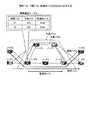
これまでは、監視用パスを用いてエラーメッセージを転送する場合について説明したが、監視用パスを確立することなく、一つのエラーメッセージにより複数パスの障害を復旧することもできる。そこで、ケース7として、9ノードで構成されるネットワークを対象に、監視用パスを用いない障害復旧動作について図23〜図27を用いて説明する。 So far, the case where the error message is transferred using the monitoring path has been described, but it is also possible to recover a failure of a plurality of paths with one error message without establishing the monitoring path. Therefore, as a case 7, a failure recovery operation that does not use a monitoring path will be described with reference to FIGS.
まず、パス確立シグナリングプロトコル(RSVP-TE)を用いて、2本の現用パスを確立する。一つは「ノード1」→「ノード2」→「ノード3」→「ノード4」→「ノード5」の経路の「現用パス1」、もう一つは「ノード8」→「ノード2」→「ノード3」→「ノード4」→「ノード9」の経路の「現用パス2」である。 First, two working paths are established using a path establishment signaling protocol (RSVP-TE). One is “
そして、「ノード2」−「ノード3」−「ノード4」で発生する障害に対応するため、「ノード2」を始点とし「ノード4」を終点とする、「ノード2」→「ノード6」→「ノード7」→「ノード4」の経路の「予備パス1」、「予備パス2」を確立する。「予備パス1」は、「現用パス1」の迂回路として、「予備パス2」は、「現用パス2」の迂回路として使用される。この「予備パス1」、「予備パス2」も現用パスと同様にパス確立シグナリングプロトコル(RSVP-TE)を用いて確立する。 Then, in order to deal with a failure that occurs in “
図23に、確立された「現用パス1」、「現用パス2」、「予備パス1」、「予備パス2」を示す。また、パス確立シグナリングプロトコルで構築されるラベルテーブルの例も合わせて図23に示す。 FIG. 23 shows the established “working
「現用パス1」と「現用パス2」は同じ区間(「ノード2」−「ノード3」−「ノード4」)を通過する。したがって、この区間で発生する障害が発生した場合には、「現用パス1」、「現用パス2」ともに予備パスに経路を切り替え、トラヒックを迂回させる。 “Working
これまでのケースでは、この共通区間に対して監視用パスを確立していた。しかし、ここでは、監視用パスを確立せずに現用パスの一本を代表パスとして定義し(図24)、代表パスを用いてエラーメッセージを転送する。 In the previous cases, a monitoring path was established for this common section. However, here, one of the working paths is defined as a representative path without establishing a monitoring path (FIG. 24), and an error message is transferred using the representative path.
この場合、代表パスである現用パスを確立時に、パス確立シグナリングプロトコルのPATHメッセージに代表フラグとどの区間で代表パスになるかを示す区間の始点情報と区間の終点情報を格納する。例えば、代表パスになる区間として、始点ノードIDである「ノード2」、終点ノードIDである「ノード4」を格納する。 In this case, when the working path which is the representative path is established, the representative flag and the section start point information and the section end point information indicating in which section the representative path is set are stored in the PATH message of the path establishment signaling protocol. For example, “
また、障害時に経路切り替えノードとなる「ノード2」は、予備パスと代表パスとの対応表として図25に示す障害復旧テーブルを保持する。この障害復旧テーブルには、現用パスIDと、予備パスIDと、代表パスIDと、障害区間とが対応させて登録される。なお、ここでは、「現用パス1」、「現用パス2」のパスIDをそれぞれ「#1」、「#2」とし、「予備パス1」、「予備パス2」のパスIDをそれぞれ「#10」、「#20」とする。また、「現用パス1」を代表パスとする。 In addition, “
そして、「ノード2」−「ノード3」−「ノード4」間で障害が発生すると、その上流の中継ノードが障害を検出する。ここでは、「ノード3」−「ノード4」間で障害が発生したとして説明する。障害を検出した「ノード3」は、確立されている代表パスを検索する。そして、経路の切り替えノードである「ノード2」に障害が発生したことを通知するため、代表パスに対するエラーメッセージを他のエラーメッセージに先立ち「ノード2」に送信する。あるいは、代表パスのみのエラーメッセージを「ノード2」に送信する。このエラーメッセージには代表パスのパスID、および障害ポイントのアドレスが格納されている(図26)。 When a failure occurs between “
このエラーメッセージを受信した「ノード2」は、エラーメッセージに格納されているパスIDおよび障害ポイントのアドレスに基づき、障害復旧テーブルを検索し、現用パスと予備パスを特定する。このケースでは2組の現用パスと予備パスが得られる。そして、得られた現用パス上のトラヒックを対応する予備パスへ転送することによって、障害から回復させる。その結果、一つの代表パスのエラーメッセージを受信することによって、障害の影響を受けた二つの現用パスを障害から回復させることができる(図27)。 Receiving this error message, “
このように、代表パスを用いることによって、監視用パスを新たに確立することなく、一つのエラーメッセージにより複数パスの障害復旧を実現することができる。 As described above, by using the representative path, it is possible to realize failure recovery of a plurality of paths with one error message without newly establishing a monitoring path.
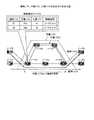
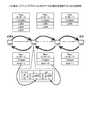
次に、ケース8として、監視用パスも代表パスも用いない場合について、図28〜図33を用いて説明する。まず、パス確立シグナリングプロトコル(RSVP-TE)を用いて、2本の現用パスを確立する。一つは「ノード1」→「ノード2」→「ノード3」→「ノード4」→「ノード5」の経路の「現用パス1」、もう一つは「ノード8」→「ノード2」→「ノード3」→「ノード4」→「ノード9」の経路の「現用パス2」である。 Next, as a case 8, a case where neither a monitoring path nor a representative path is used will be described with reference to FIGS. First, two working paths are established using a path establishment signaling protocol (RSVP-TE). One is “
そして、「ノード2」−「ノード3」−「ノード4」で発生する障害に対応するため、「ノード2」を始点とし「ノード4」を終点とする、「ノード2」→「ノード6」→「ノード7」→「ノード4」の経路の「予備パス1」、「予備パス2」を確立する。「予備パス1」は、「現用パス1」の迂回路として、「予備パス2」は、「現用パス2」の迂回路として使用される。この「予備パス1」、「予備パス2」も現用パスと同様にパス確立シグナリングプロトコル(RSVP-TE)を用いて確立する。 Then, in order to deal with a failure that occurs in “
図28に、確立された「現用パス1」、「現用パス2」、「予備パス1」、「予備パス2」を示す。また、パス確立シグナリングプロトコルで構築されるラベルテーブルの例も合わせて図28に示す。 FIG. 28 shows the established “working
「現用パス1」と「現用パス2」は同じ区間(「ノード2」−「ノード3」−「ノード4」)を通過する。この区間で発生する障害が発生した場合には、「現用パス1」、「現用パス2」ともに予備パスに経路を切り替え、トラヒックを迂回させる。これまでのケースでは、この共通区間に確立された監視用パス、あるいは代表パスを使用していた。しかし、ここでは、監視用パス、代表パスのいずれも用いずに単一のエラーメッセージで複数パスの切り替えを実現する。 “Working
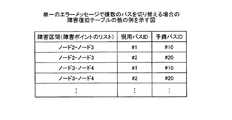
そこで、障害時に経路切り替えノードとなる「ノード2」は、どの障害に対して現用パスを予備パスに切り替えるかを判別するため、図29に示すような、予備パスと障害区間との対応表である障害復旧テーブルを保持する(図30)。この障害復旧テーブルには、現用パスIDと、予備パスIDと、障害区間とが対応させて登録される。なお、ここでは、「現用パス1」、「現用パス2」のパスIDをそれぞれ「#1」、「#2」とし、「予備パス1」、「予備パス2」のパスIDをそれぞれ「#10」、「#20」とする。 Therefore, “
そして、「ノード2」−「ノード3」−「ノード4」間で障害が発生すると、その上流の中継ノードが障害を検出する。ここでは、「ノード3」−「ノード4」間で障害が発生したとして説明する。障害を検出した「ノード3」は、経路の切り替え「ノード2」に障害が発生したことを通知するため、各現用パスに対するエラーメッセージをそれぞれの始点ノードに送信する。このエラーメッセージには障害ポイントのアドレスが格納されている(図31)。 When a failure occurs between “
エラーメッセージを受信する「ノード2」は、最初に到着したエラーメッセージに対してまず以下の処理を行う。最初に到着したエラーメッセージに格納されている障害ポイントのアドレスに基づき、障害復旧テーブルを検索し、現用パスと予備パスを特定する。このとき得られる現用パスと予備パスは2組である。得られた現用パス上のトラヒックを対応する予備パスへ転送することによって、障害から回復させる。次に到着したエラーメッセージについても同等の処理を行うが、検索した結果得られた現用パスの経路が既に切り替えていた場合にその現用パスが無視される。 The “
このケース8では、現用パス毎にエラーメッセージが生成されるため、障害発生時にはエラーメッセージが大量に発生し、輻輳が発生する可能性がある。しかし、到着した最初のエラーメッセージに基づいて、障害の影響を受けた全ての現用パスの経路を変更することによって、輻輳によりエラーメッセージが発生した場合にも高速に障害から回復させることができる(図32)。 In this case 8, since an error message is generated for each working path, a large amount of error messages may occur when a failure occurs, and congestion may occur. However, by changing the route of all the working paths affected by the failure based on the first error message that arrived, even if an error message occurs due to congestion, it is possible to recover from the failure at high speed ( FIG. 32).
なお、図29に示した障害復旧テーブルは、パス毎にリストされているが、図33に示すように、障害区間ごとにリストすることによって、高速に対応する現用パス、予備パスを検索することができる。 The failure recovery table shown in FIG. 29 is listed for each path. However, as shown in FIG. 33, by searching for each failure section, a working path and a backup path corresponding to high speed can be searched. Can do.
上述してきたように、本実施例では、同一経路を有する複数の現用パスだけでなく、一部の区間を共有する複数の現用パスに対して予備パスおよび監視用パスを設定し、予備パスの始点ノードが、現用パスと予備パスと監視用パスとを対応させた障害復旧テーブル170を備え、監視用パス制御部180cが、エラーメッセージを受信すると経路切替処理部190に通知し、経路切替処理部190が、経路切替が必要な現用パスおよび対応する予備パスを障害復旧テーブル170を用いて特定し、特定した現用パスから対応する予備パスに経路を切り替える処理行うこととしたので、監視用パスの数を減らし、障害発生時のネットワーク負荷の増加を抑えることができる。 As described above, in this embodiment, the backup path and the monitoring path are set not only for a plurality of working paths having the same route but also for a plurality of working paths sharing a part of a section, and The starting point node includes a failure recovery table 170 that associates the working path, the protection path, and the monitoring path. When the monitoring
また、監視用パスの代わりに代表パスを用いることによって、監視用パスをなくすことができる。さらに、単一エラーメッセージにより複数の切り替えを行うことで、代表パスをなくすこともできる。 Further, by using a representative path instead of the monitoring path, the monitoring path can be eliminated. Furthermore, the representative path can be eliminated by performing a plurality of switching operations with a single error message.
また、本実施例では、現用パス制御部180a、予備パス制御部180bおよび監視用パス制御部180cが各パスを確立する際に順に障害復旧テーブル170を作成していく場合について説明したが、本発明はこれに限定されるものではなく、パスの確立とは別に、障害復旧テーブル170を作成する場合にも同様に適用することができる。 In this embodiment, the case where the failure recovery table 170 is created in order when the working
(付記1)複数のデータ中継装置を経由してデータを転送する経路として使用中の現用経路のいずれかの箇所に障害が発生すると該障害発生箇所を迂回する予備経路への切替によって障害復旧を行うネットワークでデータを中継するデータ中継装置であって、
始点となる予備経路について現用経路と予備経路とを対応させた障害復旧情報を記憶した障害復旧情報記憶手段と、
現用経路に発生した障害の通知である障害発生通知を受信する障害発生通知受信手段と、
前記障発生通知受信手段により障害発生通知が受信された現用経路である障害発生現用経路に対応する予備経路を前記障害復旧情報を用いて検索する予備経路検索手段と、
前記予備経路検索手段により予備経路が検索された場合に、前記障害発生現用経路を用いて転送されるデータが予備経路を用いて転送されるように経路切替処理を行う経路切替処理手段と、
を備えたことを特徴とするデータ中継装置。(Supplementary note 1) When a failure occurs in any part of the working route in use as a route for transferring data via a plurality of data relay devices, the failure is recovered by switching to a backup route that bypasses the failure occurrence point. A data relay device that relays data in a network
A failure recovery information storage means for storing failure recovery information in which a working route and a backup route are associated with each other for a backup route as a starting point;
A failure occurrence notification receiving means for receiving a failure occurrence notification that is a notification of a failure that has occurred in the working path;
Backup path search means for searching for a backup path corresponding to a faulty working path that is a working path for which a fault occurrence notification has been received by the fault occurrence notification receiving means, using the fault recovery information;
Path switching processing means for performing path switching processing so that data transferred using the faulty working path is transferred using the backup path when the backup path is searched by the backup path searching means;
A data relay device comprising:
(付記2)前記障害発生通知受信手段は、障害の監視専用に用いる監視用経路により前記障害発生通知を受信することを特徴とする付記1に記載のデータ中継装置。(Supplementary note 2) The data relay device according to
(付記3)前記障害発生通知受信手段が障害発生通知を受信する監視用経路として、一部の区間が共通である複数の現用経路に対して共通である区間を含む一つの経路を設定することを特徴とする付記2に記載のデータ中継装置。(Additional remark 3) As a monitoring path | route which the said failure occurrence notification receiving means receives a failure occurrence notification, setting one path | route including the area which is common with respect to several working path | routes with which some areas are common. The data relay device according to
(付記4)前記監視用経路が設定される複数の予備経路の終点が異なることを特徴とする付記3に記載のデータ中継装置。(Supplementary note 4) The data relay device according to supplementary note 3, wherein the end points of the plurality of backup routes to which the monitoring route is set are different.
(付記5)複数の現用経路に対応する複数の予備経路の始点が異なる場合には、前記障害発生通知受信手段が障害発生通知を受信する監視用経路として該異なる始点を全て含む経路を設定し、該障害発生通知は監視用経路の各データ中継装置を一つずつ経由して送信されることを特徴とする付記3に記載のデータ中継装置。(Supplementary Note 5) When the start points of a plurality of backup routes corresponding to a plurality of working routes are different, the failure occurrence notification receiving unit sets a route including all the different start points as a monitoring route for receiving the failure occurrence notification. The data relay device according to appendix 3, wherein the failure occurrence notification is transmitted via each data relay device on the monitoring path one by one.
(付記6)経路が同一である複数の予備経路に対しては、迂回トンネルを用いることを特徴とする付記2に記載のデータ中継装置。(Supplementary note 6) The data relay device according to
(付記7)データの中継に使用するラベルテーブルに新規の現用経路に関する情報を登録する際に、既存の監視用経路が共有される経路を新規の現用経路として優先的に登録することを特徴とする付記2に記載のデータ中継装置。(Appendix 7) When registering information on a new working route in a label table used for data relay, a route sharing an existing monitoring route is preferentially registered as a new working route. The data relay device according to
(付記8)前記障害発生通知受信手段が障害発生通知を受信する監視用経路の識別には、監視用経路であることを識別可能な監視用経路用識別子を用いることを特徴とする付記2に記載のデータ中継装置。(Supplementary note 8) The
(付記9)前記障害が複数の現用経路で使用されている箇所で発生した場合に、
前記障害発生通知受信手段は、前記複数の現用経路のうち監視用に用いられる経路である代表経路により前記障害発生通知を受信することを特徴とする付記1に記載のデータ中継装置。(Supplementary note 9) When the failure occurs at a location used in a plurality of working routes,
The data relay apparatus according to
(付記10)前記障害が複数の現用経路で使用されている箇所で発生した場合に、
前記障害発生通知受信手段は、前記複数の現用経路にそれぞれ対応する複数の障害発生通知を受信し、
前記予備経路検索手段は、前記障害発生通知受信手段により障害発生通知が受信された複数の障害発生現用経路にそれぞれ対応する複数の予備経路を前記障害復旧情報を用いて検索し、
前記経路切替処理手段は、前記予備経路検索手段により予備経路が検索された障害発生現用経路のうち、前記複数の障害発生通知のいずれかの障害発生通知により既に経路切替処理が行われている障害発生現用経路については経路切替処理を行わないことを特徴とする付記1に記載のデータ中継装置。(Supplementary Note 10) When the failure occurs at a location used in a plurality of working routes,
The failure occurrence notification receiving means receives a plurality of failure occurrence notifications respectively corresponding to the plurality of working paths,
The backup path search means searches for a plurality of backup paths respectively corresponding to a plurality of fault occurrence working paths for which the fault notification has been received by the fault occurrence notification receiving means, using the fault recovery information,
The path switching processing means is a fault for which a path switching process has already been performed by a fault occurrence notification of any of the plurality of fault occurrence notifications among the fault occurrence active paths for which a backup path has been searched by the backup path search means. The data relay device according to
(付記11)複数のデータ中継装置を経由してデータを転送する経路として使用中の現用経路のいずれかの箇所に障害が発生すると該障害発生箇所を迂回する予備経路への切替によって障害復旧を行うネットワークでデータを中継するデータ中継方法であって、
現用経路に発生した障害の通知である障害発生通知を該障害が発生した現用経路である障害発生現用経路に対応する予備経路の始点である始点データ中継装置が受信する障害発生通知受信工程と、
前記障発生通知受信工程により障害発生通知が受信された障害発生現用経路に対応する予備経路を前記始点データ中継装置が現用経路と予備経路とを対応させた障害復旧情報を用いて検索する予備経路検索工程と、
前記障害発生現用経路を用いて転送されるデータが前記予備経路検索工程により検索された予備経路を用いて転送されるように前記始点データ中継装置が経路切替処理を行う経路切替処理工程と、
を含んだことを特徴とするデータ中継方法。(Supplementary note 11) If a failure occurs in any part of the working route that is in use as a route for transferring data via a plurality of data relay devices, the failure is recovered by switching to a backup route that bypasses the failure occurrence point. A data relay method for relaying data on a network
A failure occurrence notification receiving step of receiving a failure occurrence notification that is a notification of a failure that has occurred in a working path received by a start point data relay device that is a starting point of a backup path corresponding to a failure occurrence working path that is a working path in which the failure has occurred;
A backup path for searching for a backup path corresponding to the faulty working path for which the fault notification has been received in the fault notification receiving process using the fault recovery information in which the source data relay device associates the working path with the backup path Search process;
A path switching process step in which the start point data relay device performs a path switching process so that data transferred using the failure occurrence working path is transferred using the backup path searched in the backup path search process;
The data relay method characterized by including.
(付記12)前記障害発生通知受信工程は、障害の監視専用に用いる監視用経路により前記障害発生通知を受信することを特徴とする付記11に記載のデータ中継方法。(Supplementary note 12) The data relay method according to supplementary note 11, wherein the failure occurrence notification reception step receives the failure occurrence notification through a monitoring path used exclusively for failure monitoring.
(付記13)前記障害発生通知受信工程が障害発生通知を受信する監視用経路として、一部の区間が共通である複数の現用経路に対して共通である区間を含む一つの経路を設定することを特徴とする付記12に記載のデータ中継方法。(Additional remark 13) As a monitoring path | route which the said failure occurrence notification reception process receives a failure occurrence notification, setting one path | route including the area which is common with respect to several working path | routes with which some areas are common. The data relay method according to appendix 12, characterized by:
(付記14)前記監視用経路が設定される複数の予備経路の終点が異なることを特徴とする付記13に記載のデータ中継方法。(Supplementary note 14) The data relay method according to supplementary note 13, wherein the end points of the plurality of backup routes to which the monitoring route is set are different.
(付記15)複数の現用経路に対応する複数の予備経路の始点が異なる場合には、前記障害発生通知受信工程が障害発生通知を受信する監視用経路として該異なる始点を全て含む経路を設定し、該障害発生通知は監視用経路の各データ中継装置を一つずつ経由して送信されることを特徴とする付記13に記載のデータ中継方法。(Supplementary note 15) When the start points of a plurality of backup routes corresponding to a plurality of working routes are different, the failure occurrence notification receiving step sets a route including all the different start points as a monitoring route for receiving the failure occurrence notification. The data relay method according to appendix 13, wherein the failure occurrence notification is transmitted via each data relay device on the monitoring path one by one.
(付記16)経路が同一である複数の予備経路に対しては、迂回トンネルを用いることを特徴とする付記12に記載のデータ中継方法。(Supplementary note 16) The data relay method according to supplementary note 12, wherein a bypass tunnel is used for a plurality of backup routes having the same route.
(付記17)データの中継に使用するラベルテーブルに新規の現用経路に関する情報を登録する際に、既存の監視用経路が共有される経路を新規の現用経路として優先的に登録することを特徴とする付記12に記載のデータ中継方法。(Supplementary Note 17) When registering information on a new working route in a label table used for data relay, a route sharing an existing monitoring route is preferentially registered as a new working route. The data relay method according to appendix 12.
(付記18)前記障害発生通知受信工程が障害発生通知を受信する監視用経路の識別には、監視用経路であることを識別可能な監視用経路用識別子を用いることを特徴とする付記12に記載のデータ中継方法。(Supplementary note 18) The supplementary note 12 is characterized in that a monitoring path identifier that can identify a monitoring path is used for identifying the monitoring path through which the failure occurrence notification receiving step receives the fault occurrence notification. The data relay method described.
(付記19)前記障害が複数の現用経路で使用されている箇所で発生した場合に、
前記障害発生通知受信工程は、前記複数の現用経路のうち監視用に用いられる経路である代表経路により前記障害発生通知を受信することを特徴とする付記11に記載のデータ中継方法。(Supplementary note 19) When the failure occurs at a location used in a plurality of working routes,
12. The data relay method according to appendix 11, wherein the failure occurrence notification receiving step receives the failure occurrence notification through a representative route that is a route used for monitoring among the plurality of working routes.
(付記20)前記障害が複数の現用経路で使用されている箇所で発生した場合に、
前記障害発生通知受信工程は、前記複数の現用経路にそれぞれ対応する複数の障害発生通知を受信し、
前記予備経路検索工程は、前記障害発生通知受信工程により障害発生通知が受信された複数の障害発生現用経路にそれぞれ対応する複数の予備経路を前記障害復旧情報を用いて検索し、
前記経路切替処理工程は、前記予備経路検索工程により予備経路が検索された障害発生現用経路のうち、前記複数の障害発生通知のいずれかの障害発生通知により既に経路切替処理が行われている障害発生現用経路については経路切替処理を行わないことを特徴とする付記11に記載のデータ中継方法。(Supplementary note 20) When the failure occurs at a location used in a plurality of working routes,
The failure occurrence notification receiving step receives a plurality of failure occurrence notifications respectively corresponding to the plurality of working paths,
The backup route search step uses the failure recovery information to search a plurality of backup routes respectively corresponding to a plurality of failure occurrence working routes for which a failure occurrence notification has been received by the failure occurrence notification reception step.
The route switching processing step is a failure in which the route switching processing has already been performed by the failure occurrence notification of any of the plurality of failure occurrence notifications among the failure occurrence active routes for which the backup route has been searched by the backup route search step. The data relay method according to appendix 11, wherein route switching processing is not performed for the generated working route.
以上のように、本発明に係るデータ中継装置およびデータ中継方法は、GMPLS網/MPLS網で有用であり、特に、監視用パスの数を減らし、障害発生時のネットワーク負荷の増加を抑えたい場合に適している。 As described above, the data relay apparatus and the data relay method according to the present invention are useful in the GMPLS network / MPLS network, and particularly when it is desired to reduce the number of monitoring paths and suppress an increase in network load when a failure occurs. Suitable for
100 中継装置
110 データ受信部
120 データ送信部
130 データ中継部
140a 中継用ラベルテーブル
140b 予備パス用ラベルテーブル
140c 監視パス用ラベルテーブル
150 制御パケット受信部
160 制御パケット送信部
170 障害復旧テーブル
180a 現用パス制御部
180b 予備パス制御部
180c 監視用パス制御部
190 経路切替処理部DESCRIPTION OF
Claims (10)
Translated fromJapanese始点となる予備経路について現用経路と予備経路とを対応させた障害復旧情報を記憶した障害復旧情報記憶手段と、
現用経路に発生した障害の通知である障害発生通知を受信する障害発生通知受信手段と、
前記障発生通知受信手段により障害発生通知が受信された現用経路である障害発生現用経路に対応する予備経路を前記障害復旧情報を用いて検索する予備経路検索手段と、
前記予備経路検索手段により予備経路が検索された場合に、前記障害発生現用経路を用いて転送されるデータが予備経路を用いて転送されるように経路切替処理を行う経路切替処理手段と、
を備えたことを特徴とするデータ中継装置。If a failure occurs in any part of the working route that is in use as a route for transferring data via a plurality of data relay devices, data is restored on the network that recovers the failure by switching to a backup route that bypasses the failure point. A data relay device that relays
A failure recovery information storage unit storing failure recovery information in which a working route and a backup route are associated with each other for a backup route serving as a starting point;
A failure occurrence notification receiving means for receiving a failure occurrence notification that is a notification of a failure that has occurred in the working path;
Backup path search means for searching for a backup path corresponding to a faulty working path that is a working path for which a fault occurrence notification has been received by the fault occurrence notification receiving means, using the fault recovery information;
Path switching processing means for performing path switching processing so that data transferred using the faulty working path is transferred using the backup path when the backup path is searched by the backup path searching means;
A data relay device comprising:
前記障害発生通知受信手段は、前記複数の現用経路のうち監視用に用いられる経路である代表経路により前記障害発生通知を受信することを特徴とする請求項1に記載のデータ中継装置。If the failure occurs at a location that is used on multiple working routes,
2. The data relay device according to claim 1, wherein the failure occurrence notification receiving unit receives the failure occurrence notification through a representative route that is a route used for monitoring among the plurality of working routes.
前記障害発生通知受信手段は、前記複数の現用経路にそれぞれ対応する複数の障害発生通知を受信し、
前記予備経路検索手段は、前記障害発生通知受信手段により障害発生通知が受信された複数の障害発生現用経路にそれぞれ対応する複数の予備経路を前記障害復旧情報を用いて検索し、
前記経路切替処理手段は、前記予備経路検索手段により予備経路が検索された障害発生現用経路のうち、前記複数の障害発生通知のいずれかの障害発生通知により既に経路切替処理が行われている障害発生現用経路については経路切替処理を行わないことを特徴とする請求項1に記載のデータ中継装置。If the failure occurs at a location that is used on multiple working routes,
The failure occurrence notification receiving means receives a plurality of failure occurrence notifications respectively corresponding to the plurality of working paths,
The backup path search means searches for a plurality of backup paths respectively corresponding to a plurality of fault occurrence working paths for which the fault notification has been received by the fault occurrence notification receiving means, using the fault recovery information,
The path switching processing means is a fault for which a path switching process has already been performed by a fault occurrence notification of any of the plurality of fault occurrence notifications among the fault occurrence active paths for which a backup path has been searched by the backup path search means. 2. The data relay device according to claim 1, wherein route switching processing is not performed for the generated working route.
現用経路に発生した障害の通知である障害発生通知を該障害が発生した現用経路である障害発生現用経路に対応する予備経路の始点である始点データ中継装置が受信する障害発生通知受信工程と、
前記障発生通知受信工程により障害発生通知が受信された障害発生現用経路に対応する予備経路を前記始点データ中継装置が現用経路と予備経路とを対応させた障害復旧情報を用いて検索する予備経路検索工程と、
前記障害発生現用経路を用いて転送されるデータが前記予備経路検索工程により検索された予備経路を用いて転送されるように前記始点データ中継装置が経路切替処理を行う経路切替処理工程と、
を含んだことを特徴とするデータ中継方法。If a failure occurs in any part of the working route that is in use as a route for transferring data via a plurality of data relay devices, data is restored on the network that recovers the failure by switching to a backup route that bypasses the failure point. A data relay method for relaying
A failure occurrence notification receiving step of receiving a failure occurrence notification that is a notification of a failure that has occurred in a working path received by a start point data relay device that is a starting point of a backup path corresponding to a failure occurrence working path that is a working path in which the failure has occurred;
A backup path for searching for a backup path corresponding to the faulty working path for which the fault notification has been received in the fault notification receiving process using the fault recovery information in which the source data relay device associates the working path with the backup path Search process;
A path switching process step in which the start point data relay device performs a path switching process so that data transferred using the failure occurrence working path is transferred using the backup path searched in the backup path search process;
The data relay method characterized by including.
Priority Applications (2)
| Application Number | Priority Date | Filing Date | Title |
|---|---|---|---|
| JP2005065835AJP4691372B2 (en) | 2005-03-09 | 2005-03-09 | Data relay apparatus and data relay method |
| US11/166,804US7710860B2 (en) | 2005-03-09 | 2005-06-24 | Data relay apparatus and data relay method |
Applications Claiming Priority (1)
| Application Number | Priority Date | Filing Date | Title |
|---|---|---|---|
| JP2005065835AJP4691372B2 (en) | 2005-03-09 | 2005-03-09 | Data relay apparatus and data relay method |
Publications (2)
| Publication Number | Publication Date |
|---|---|
| JP2006253927Atrue JP2006253927A (en) | 2006-09-21 |
| JP4691372B2 JP4691372B2 (en) | 2011-06-01 |
Family
ID=36970773
Family Applications (1)
| Application Number | Title | Priority Date | Filing Date |
|---|---|---|---|
| JP2005065835AExpired - Fee RelatedJP4691372B2 (en) | 2005-03-09 | 2005-03-09 | Data relay apparatus and data relay method |
Country Status (2)
| Country | Link |
|---|---|
| US (1) | US7710860B2 (en) |
| JP (1) | JP4691372B2 (en) |
Cited By (5)
| Publication number | Priority date | Publication date | Assignee | Title |
|---|---|---|---|---|
| JP2011160371A (en)* | 2010-02-04 | 2011-08-18 | Fujitsu Telecom Networks Ltd | Communication control device |
| JP2012501140A (en)* | 2008-08-26 | 2012-01-12 | アルカテル−ルーセント | How to establish a traffic connection and associated monitoring connection |
| JP2012501141A (en)* | 2008-08-26 | 2012-01-12 | アルカテル−ルーセント | How to establish a traffic connection and associated monitoring connection |
| JP2016036098A (en)* | 2014-08-04 | 2016-03-17 | 富士通株式会社 | Transmission device, network design device, activation method and network design method |
| WO2017010079A1 (en)* | 2015-07-15 | 2017-01-19 | 日本電気株式会社 | Communication system, communication device, and method for controlling communication path |
Families Citing this family (34)
| Publication number | Priority date | Publication date | Assignee | Title |
|---|---|---|---|---|
| US20060215567A1 (en)* | 2005-03-25 | 2006-09-28 | Arun Raghunath | Method and apparatus for monitoring path statistics |
| JP4545658B2 (en)* | 2005-08-11 | 2010-09-15 | 富士通株式会社 | Connection type network node |
| US7593323B2 (en)* | 2005-08-17 | 2009-09-22 | Honeywell International Inc. | Apparatus and methods for managing nodes on a fault tolerant network |
| US7990848B1 (en)* | 2005-11-30 | 2011-08-02 | At&T Intellectual Property Ii, L.P. | System and method for long haul optical protection for storage area network (SAN) transport |
| CN1866806B (en)* | 2005-12-22 | 2011-11-02 | 华为技术有限公司 | Method for realizing shared grid network recovery |
| WO2008044646A1 (en)* | 2006-10-06 | 2008-04-17 | Nippon Telegraph And Telephone Corporation | Communication node apparatus, communication system, and path resource assigning method |
| JP2008199311A (en)* | 2007-02-13 | 2008-08-28 | Fujitsu Ltd | Switch device and path monitoring setting method |
| JP2008271088A (en)* | 2007-04-19 | 2008-11-06 | Kddi Corp | Video transmission network integrated operation management system and operation management method |
| WO2009042856A1 (en)* | 2007-09-28 | 2009-04-02 | Allied Telesis, Inc. | Method and apparatus for preventing network conflict |
| JP2009259161A (en)* | 2008-04-21 | 2009-11-05 | Nec Corp | Knowledge-based failure recovery support system, user terminal, relay server and knowledge supply server, and data relay method |
| EP2243261B1 (en)* | 2008-04-28 | 2015-09-16 | Huawei Technologies Co., Ltd. | Transparent bypass and associated mechanisms |
| JP2009296230A (en)* | 2008-06-04 | 2009-12-17 | Nec Corp | Transmission network, transmission apparatus, channel switching method and program for transmission network |
| JP5402150B2 (en)* | 2009-03-27 | 2014-01-29 | 日本電気株式会社 | Routing device, communication system, and routing method |
| US8848538B2 (en)* | 2009-06-09 | 2014-09-30 | Telefonaktiebolaget Lm Ericsson (Publ) | Power-saving functions in communications networks |
| WO2010144001A1 (en)* | 2009-06-09 | 2010-12-16 | Telefonaktiebolaget L M Ericsson (Publ) | A communications network and a method in a communications network |
| CN101945308B (en)* | 2009-07-07 | 2013-05-08 | 中兴通讯股份有限公司 | Method and device for migrating service in automatic switched optical network |
| JP5392050B2 (en)* | 2009-12-11 | 2014-01-22 | 富士通株式会社 | Relay device, relay method, and communication system |
| JP5533112B2 (en)* | 2010-03-24 | 2014-06-25 | 富士通株式会社 | Monitoring device, monitoring method and monitoring program |
| KR101136375B1 (en)* | 2010-07-12 | 2012-04-18 | 아주대학교산학협력단 | Method and apparatus for establishing a routing path on a multi-hop network |
| EP2408128B1 (en)* | 2010-07-15 | 2017-06-07 | Alcatel Lucent | Interworking agent adapted to interact between network and Precision Time Protocol entities |
| JP5617586B2 (en)* | 2010-12-10 | 2014-11-05 | 富士通株式会社 | Information processing program, relay device, and relay management device |
| EP2472779A1 (en)* | 2010-12-30 | 2012-07-04 | Nokia Siemens Networks Oy | Method for data communication networks and system |
| US8879385B2 (en)* | 2011-03-23 | 2014-11-04 | Telefonaktiebolaget L M Ericsson (Publ) | Use of sub path maintenance elements (SPMES) for multiprotocol label switching (MPLS) shared mesh protection |
| JP5857815B2 (en)* | 2012-03-14 | 2016-02-10 | 富士通株式会社 | Relay apparatus, information processing method and program for relay processing, path control apparatus, information processing method and program for path control, and information processing system |
| US8891360B2 (en)* | 2012-05-04 | 2014-11-18 | Infinera Corporation | Optimal segment identification for shared mesh protection |
| US9178812B2 (en) | 2013-06-05 | 2015-11-03 | Cisco Technology, Inc. | Stacking metadata contexts for service chains |
| US9444675B2 (en) | 2013-06-07 | 2016-09-13 | Cisco Technology, Inc. | Determining the operations performed along a service path/service chain |
| US9426059B2 (en)* | 2013-06-10 | 2016-08-23 | Fujitsu Limited | Systems and methods for utilizing protection paths |
| KR101505624B1 (en) | 2014-01-03 | 2015-03-24 | 아주대학교산학협력단 | Mobility prediction scheme based on Relative Mobile Characteristics |
| US9450916B2 (en) | 2014-08-22 | 2016-09-20 | Honeywell International Inc. | Hardware assist for redundant ethernet network |
| US9590844B1 (en) | 2014-12-30 | 2017-03-07 | Juniper Networks, Inc. | Intra-area LDP node protection |
| US9590845B1 (en)* | 2014-12-30 | 2017-03-07 | Juniper Networks, Inc. | Inter-area LDP node protection |
| JP6523810B2 (en)* | 2015-06-16 | 2019-06-05 | 株式会社東芝 | Wireless relay system, slave unit of wireless relay system, and recovery method of wireless relay system |
| US10476811B2 (en)* | 2017-03-10 | 2019-11-12 | Juniper Networks, Inc | Apparatus, system, and method for providing node protection across label-switched paths that share labels |
Citations (5)
| Publication number | Priority date | Publication date | Assignee | Title |
|---|---|---|---|---|
| JP2003078553A (en)* | 2001-08-31 | 2003-03-14 | Hitachi Ltd | Packet transferring method |
| JP2003179628A (en)* | 2001-12-10 | 2003-06-27 | Mitsubishi Electric Corp | Label saving path protection communication device |
| JP2003229888A (en)* | 2002-02-01 | 2003-08-15 | Nec Corp | Label switching network and label switching path setting method used therefor |
| JP2003244202A (en)* | 2002-02-20 | 2003-08-29 | Nippon Telegr & Teleph Corp <Ntt> | Path switching system and method, communication device and program |
| JP2003338831A (en)* | 2002-05-22 | 2003-11-28 | Nec Corp | Switching method for mpls network |
Family Cites Families (3)
| Publication number | Priority date | Publication date | Assignee | Title |
|---|---|---|---|---|
| JP4647835B2 (en)* | 2001-05-17 | 2011-03-09 | 富士通株式会社 | Transmission apparatus and failure avoidance method |
| JP2004173136A (en)* | 2002-11-22 | 2004-06-17 | Fujitsu Ltd | Network management device |
| JP4617847B2 (en)* | 2004-11-04 | 2011-01-26 | 株式会社日立製作所 | Information processing system and access method |
- 2005
- 2005-03-09JPJP2005065835Apatent/JP4691372B2/ennot_activeExpired - Fee Related
- 2005-06-24USUS11/166,804patent/US7710860B2/ennot_activeExpired - Fee Related
Patent Citations (5)
| Publication number | Priority date | Publication date | Assignee | Title |
|---|---|---|---|---|
| JP2003078553A (en)* | 2001-08-31 | 2003-03-14 | Hitachi Ltd | Packet transferring method |
| JP2003179628A (en)* | 2001-12-10 | 2003-06-27 | Mitsubishi Electric Corp | Label saving path protection communication device |
| JP2003229888A (en)* | 2002-02-01 | 2003-08-15 | Nec Corp | Label switching network and label switching path setting method used therefor |
| JP2003244202A (en)* | 2002-02-20 | 2003-08-29 | Nippon Telegr & Teleph Corp <Ntt> | Path switching system and method, communication device and program |
| JP2003338831A (en)* | 2002-05-22 | 2003-11-28 | Nec Corp | Switching method for mpls network |
Cited By (5)
| Publication number | Priority date | Publication date | Assignee | Title |
|---|---|---|---|---|
| JP2012501140A (en)* | 2008-08-26 | 2012-01-12 | アルカテル−ルーセント | How to establish a traffic connection and associated monitoring connection |
| JP2012501141A (en)* | 2008-08-26 | 2012-01-12 | アルカテル−ルーセント | How to establish a traffic connection and associated monitoring connection |
| JP2011160371A (en)* | 2010-02-04 | 2011-08-18 | Fujitsu Telecom Networks Ltd | Communication control device |
| JP2016036098A (en)* | 2014-08-04 | 2016-03-17 | 富士通株式会社 | Transmission device, network design device, activation method and network design method |
| WO2017010079A1 (en)* | 2015-07-15 | 2017-01-19 | 日本電気株式会社 | Communication system, communication device, and method for controlling communication path |
Also Published As
| Publication number | Publication date |
|---|---|
| JP4691372B2 (en) | 2011-06-01 |
| US7710860B2 (en) | 2010-05-04 |
| US20060203720A1 (en) | 2006-09-14 |
Similar Documents
| Publication | Publication Date | Title |
|---|---|---|
| JP4691372B2 (en) | Data relay apparatus and data relay method | |
| US7590048B2 (en) | Restoration and protection method and an apparatus thereof | |
| US7990946B2 (en) | Node apparatus and path setup method | |
| JP4145025B2 (en) | Backup path setting method and apparatus | |
| CN101953125B (en) | Communication network system, communication device, route design device, and failure recovery method | |
| JP4434867B2 (en) | MPLS network system and node | |
| US20080304494A1 (en) | Communication device | |
| US7978596B2 (en) | Connection-oriented network node | |
| JP4682887B2 (en) | Failure recovery method, node and network | |
| US20070286069A1 (en) | Method For Implementing Working/Standby Transmission Path | |
| KR101750844B1 (en) | Method and device for automatically distributing labels in ring network protection | |
| US8165016B2 (en) | Method and apparatus for setting communication paths in a network | |
| JP2008085642A (en) | Transmission apparatus and path setting method | |
| JP4443442B2 (en) | Relay device | |
| CN101192990A (en) | Method, device and system for realizing fast rerouting in MPLS network | |
| US7626924B2 (en) | Transmission device and label allocation method | |
| JP4509885B2 (en) | Signaling device | |
| WO2015024163A1 (en) | 1+1 end-to-end bidirectional switching method, system and node | |
| JP2009188673A (en) | Transmission apparatus and path setting method | |
| CN101069394B (en) | Fault recovery method and data packet communication device | |
| JP4453483B2 (en) | Network, communication apparatus, and route search method used therefor | |
| KR101624621B1 (en) | Method and apparatus for deciding dynamic label switched path in multi protocol label switching network | |
| CN101355494A (en) | Transmission method, system and router based on border gateway protocol | |
| JP2016086315A (en) | Transmission device and path setting method | |
| JP4377822B2 (en) | Failure location detection method and failure location detection device |
Legal Events
| Date | Code | Title | Description |
|---|---|---|---|
| A621 | Written request for application examination | Free format text:JAPANESE INTERMEDIATE CODE: A621 Effective date:20070710 | |
| A977 | Report on retrieval | Free format text:JAPANESE INTERMEDIATE CODE: A971007 Effective date:20090824 | |
| A131 | Notification of reasons for refusal | Free format text:JAPANESE INTERMEDIATE CODE: A131 Effective date:20091201 | |
| A521 | Request for written amendment filed | Free format text:JAPANESE INTERMEDIATE CODE: A523 Effective date:20100129 | |
| A131 | Notification of reasons for refusal | Free format text:JAPANESE INTERMEDIATE CODE: A131 Effective date:20101130 | |
| A521 | Request for written amendment filed | Free format text:JAPANESE INTERMEDIATE CODE: A523 Effective date:20110126 | |
| TRDD | Decision of grant or rejection written | ||
| A01 | Written decision to grant a patent or to grant a registration (utility model) | Free format text:JAPANESE INTERMEDIATE CODE: A01 Effective date:20110215 | |
| A01 | Written decision to grant a patent or to grant a registration (utility model) | Free format text:JAPANESE INTERMEDIATE CODE: A01 | |
| A61 | First payment of annual fees (during grant procedure) | Free format text:JAPANESE INTERMEDIATE CODE: A61 Effective date:20110221 | |
| R150 | Certificate of patent or registration of utility model | Ref document number:4691372 Country of ref document:JP Free format text:JAPANESE INTERMEDIATE CODE: R150 Free format text:JAPANESE INTERMEDIATE CODE: R150 | |
| FPAY | Renewal fee payment (event date is renewal date of database) | Free format text:PAYMENT UNTIL: 20140225 Year of fee payment:3 | |
| LAPS | Cancellation because of no payment of annual fees |