Movatterモバイル変換


[0]ホーム

URL:


JP2006110260A - Instrument for biological tissue ablation - Google Patents

Instrument for biological tissue ablation
Download PDF

Info

Publication number
JP2006110260A
JP2006110260AJP2004303414AJP2004303414AJP2006110260AJP 2006110260 AJP2006110260 AJP 2006110260AJP 2004303414 AJP2004303414 AJP 2004303414AJP 2004303414 AJP2004303414 AJP 2004303414AJP 2006110260 AJP2006110260 AJP 2006110260A
Authority
JP
Japan
Prior art keywords
cutter body
electrode
tissue
blood vessel
cutter
Prior art date
Legal status (The legal status is an assumption and is not a legal conclusion. Google has not performed a legal analysis and makes no representation as to the accuracy of the status listed.)
Granted
Application number
JP2004303414A
Other languages
Japanese (ja)
Other versions
JP4383314B2 (en
Inventor
Hidemoto Kasahara
秀元 笠原
Current Assignee (The listed assignees may be inaccurate. Google has not performed a legal analysis and makes no representation or warranty as to the accuracy of the list.)
Olympus Corp
Original Assignee
Olympus Corp
Priority date (The priority date is an assumption and is not a legal conclusion. Google has not performed a legal analysis and makes no representation as to the accuracy of the date listed.)
Filing date
Publication date
Application filed by Olympus CorpfiledCriticalOlympus Corp
Priority to JP2004303414ApriorityCriticalpatent/JP4383314B2/en
Priority to PCT/JP2005/011238prioritypatent/WO2005122935A1/en
Priority to EP05751102.4Aprioritypatent/EP1762197B1/en
Publication of JP2006110260ApublicationCriticalpatent/JP2006110260A/en
Priority to US11/418,533prioritypatent/US7850687B2/en
Application grantedgrantedCritical
Publication of JP4383314B2publicationCriticalpatent/JP4383314B2/en
Anticipated expirationlegal-statusCritical
Expired - Fee Relatedlegal-statusCriticalCurrent

Links

Images
Landscapes

Abstract

<P>PROBLEM TO BE SOLVED: To provide an instrument having good workability at low cost for coagulating a biological tissue such as blood vessel, stopping bleeding and ablation, and surely holding and fixing ceramic materials between a pair of electrodes for supporting the organism tissue. <P>SOLUTION: The instrument for the organism tissue ablation has a locking hole part, a cutter body formed of a synthetic resin, a first electrode arranged on one surface of the cutter body, a second electrode having a locking part arranged on the other surface of the cutter body, a slit groove arranged at the cutter body between the first and the second electrodes for supporting the organism tissue, and a tissue supporting part formed of ceramics, and the second electrode holds the tissue supporting part while the locking part is locked in the locking hole part, and so the second electrode is fixed at the cutter body. <P>COPYRIGHT: (C)2006,JPO&NCIPI

Description

Translated fromJapanese

本発明は、内視鏡の観察下に皮下血管を牽引して採取するための生体組織切断用器具に関する。  The present invention relates to a biological tissue cutting instrument for pulling and collecting a subcutaneous blood vessel under observation by an endoscope.

近年、心臓の血管のバイパス手術において、バイパス用血管として、患者自身の大伏在静脈等である下肢の血管を用いることがある。この下肢の血管を内視鏡の観察下によって採取するための生体採取装置が、例えば特許文献1に提案されている。  In recent years, in blood vessel bypass surgery, blood vessels in the lower limbs, such as the patient's own large saphenous vein, may be used as bypass blood vessels. For example,Patent Document 1 proposes a living body collection apparatus for collecting blood vessels of the lower limbs under observation of an endoscope.

この生体採取装置は、ダイセクタ、ハーベスタなどの器具から構成されている。ダイセクタ及びハーベスタには、内視鏡が挿通できるようになっており、術者は、その内視鏡画像を見ながら、血管の採取を行うことができる。ダイセクタは、患者の膝下近傍の切開部にセットされる案内管であるトロッカより挿入され、採取する血管の全長に渡って挿入されることにより、血管とその周辺組織を除々に剥離するための器具である。また、ハーベスタは、ダイセクタによって周辺組織から剥離された血管の側枝を電気的に切断するためのバイポーラカッタを有する器具である。  This biological collection apparatus is composed of instruments such as a dissector and a harvester. An endoscope can be inserted into the dissector and the harvester, and the surgeon can collect blood vessels while viewing the endoscope image. The dissector is inserted through the trocar, which is a guide tube set at the incision near the patient's knee, and is inserted over the entire length of the blood vessel to be collected, thereby gradually peeling the blood vessel and its surrounding tissue. It is. The harvester is an instrument having a bipolar cutter for electrically cutting a side branch of a blood vessel peeled from surrounding tissue by a dissector.

このバイポーラカッタは、先端部に溝が形成され、この溝を上下に挟むように一対の電極が配設される。バイポーラカッタが前進され、先端部の溝に入り込んだ側枝は、これら2つの電極間で放電が起こることによって止血しながら切断される。また、バイポーラカッタは、カッタ本体が透明部材であるポリカーボネイトなどの合成樹脂又はセラミックスによって形成されている。
特開2004−008241号公報
In this bipolar cutter, a groove is formed at the tip, and a pair of electrodes are disposed so as to sandwich the groove vertically. When the bipolar cutter is advanced, the side branch that has entered the groove at the tip is cut while hemostasis is caused by discharge between these two electrodes. In addition, the bipolar cutter is formed of a synthetic resin such as polycarbonate or a ceramic whose cutter body is a transparent member.
JP 2004008241 A

しかしながら、上述のしたように、特許文献1に記載のバイポーラカッタは、カッタ本体の全体が合成樹脂によって形成されている場合、2つの電極の放電によって生じる熱により、耐久性を若干損なう可能性がある。その一方、カッタ本体がセラミックスにより形成されていると、合成樹脂に比して製造コストが高く加工性に劣るという問題もある。  However, as described above, in the bipolar cutter described inPatent Document 1, when the entire cutter body is formed of a synthetic resin, there is a possibility that durability is slightly impaired by heat generated by discharge of two electrodes. is there. On the other hand, when the cutter body is formed of ceramics, there is a problem that the manufacturing cost is high and the workability is inferior to that of synthetic resin.

また、バイポーラカッタは、一方の印加側の電極から他方の帰還側の電極へ高周波電流の放電による熱的作用により生体組織を切断する。そのため、バイポーラカッタは、全体をセラミックスに形成しなくとも、一対の電極間のみ、特に印加側の電極と接する部分をセラミックスによって形成することによって、熱のために耐久性を損なう可能性を抑えることができる。すなわち、バイポーラカッタは、大部分となるカッタ本体を安価で加工性の良い合成樹脂によって形成され、一対の電極間にセラミックス部材を設ける構成とすることが好ましい。  In addition, the bipolar cutter cuts the living tissue from one application-side electrode to the other feedback-side electrode by a thermal action by discharging a high-frequency current. Therefore, even if the bipolar cutter is not formed entirely in ceramics, it suppresses the possibility of impairing durability due to heat by forming the part only between a pair of electrodes, especially the part in contact with the electrode on the application side. Can do. That is, it is preferable that the bipolar cutter has a structure in which the main cutter body is made of a synthetic resin that is inexpensive and has good workability, and a ceramic member is provided between a pair of electrodes.

ところが、バイポーラカッタを上述の構成にすると、ポリカーボネイトなどの合成樹脂からなるカッタ本体とセラミックス部材との材質が異なるため、セラミック部材をカッタ本体に確実に保持する必要がある。  However, when the bipolar cutter is configured as described above, the material of the cutter body and the ceramic member made of synthetic resin such as polycarbonate are different, and therefore the ceramic member needs to be securely held by the cutter body.

そこで、本発明は、上記事情に鑑みてなされたものであり、血管等の生体組織を凝固させ止血切断できると共に、安価で加工性が良く、生体組織を挟持するためのセラミック部材が一対の電極間において確実に保持固定されている生体組織切断用器具を提供することを目的としている。  Accordingly, the present invention has been made in view of the above circumstances, and is capable of coagulating and hemostatically cutting a living tissue such as a blood vessel, is inexpensive and has good workability, and a ceramic member for sandwiching the living tissue is a pair of electrodes. An object of the present invention is to provide a biological tissue cutting instrument that is securely held and fixed in between.

上記目的を達成するため、本発明の生体組織切断用器具は、係止孔部を有し、合成樹脂によって形成されたカッタ本体と、該カッタ本体の一面に配設される第1の電極と、前記カッタ本体の他面に配設され、係止部を有する第2の電極と、前記第1の電極と前記第2の電極の間において、前記カッタ本体に配設され、前記生体組織を挟持するためのスリット溝を有し、セラミックスによって形成された組織挟持部と、を具備し、前記第2の電極は、前記組織挟持部を保持すると共に、前記係止部が前記係止孔部に係止されることにより、前記カッタ本体に固定されている  In order to achieve the above object, a biological tissue cutting instrument of the present invention includes a cutter body having a locking hole and formed of a synthetic resin, and a first electrode disposed on one surface of the cutter body. A second electrode disposed on the other surface of the cutter body and having a locking portion; and disposed between the first electrode and the second electrode, and disposed on the cutter body, A tissue sandwiching portion having a slit groove for sandwiching and formed of ceramics, wherein the second electrode holds the tissue sandwiching portion, and the locking portion is the locking hole portion. It is fixed to the cutter body by being locked to

本発明によれば、血管等の生体組織を凝固させ止血切断できると共に、安価で加工性が良く、生体組織を挟持するためのセラミック部材が一対の電極間において確実に保持固定されている生体組織切断用器具を実現することができる。  According to the present invention, a biological tissue such as a blood vessel that can coagulate and stop hemostasis, is inexpensive, has good workability, and a ceramic member for sandwiching the biological tissue is securely held and fixed between a pair of electrodes. A cutting instrument can be realized.

(第1の実施の形態)
以下、図面を参照して本発明の実施の形態を説明する。
第1の実施の形態において、生体採取手術システムを使った血管採取手術方法、生体採取手術システムの構成及び本発明の生体組織切断用器具であるハーベスタの順に説明する。
(First embodiment)
Embodiments of the present invention will be described below with reference to the drawings.
In the first embodiment, a blood vessel sampling operation method using a living body sampling operation system, a configuration of the living body sampling surgery system, and a harvester which is a living tissue cutting instrument of the present invention will be described in this order.

先ず、生体採取装置を使った採取対象組織である静脈摘出手術方法について、図1から図6を用いて、血管の採取の手術の方法を説明する。
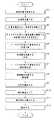
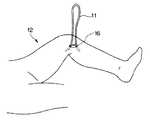
図1は、皮下血管を牽引して採取する手術方法を説明するためのフローチャートである。図2から図6は、その手術方法を説明するための図である。図1に従って、図2から図6を用いて、血管の採取の手術の方法を説明する。
First, regarding a venectomy operation method that is a tissue to be collected using a living body collection device, a blood vessel collection operation method will be described with reference to FIGS. 1 to 6.
FIG. 1 is a flowchart for explaining a surgical method of collecting by pulling a subcutaneous blood vessel. 2 to 6 are diagrams for explaining the operation method. A blood vessel sampling operation method will be described with reference to FIG. 1 and FIGS. 2 to 6.

心臓のバイパス手術において、下肢の採取対象組織である血管がバイパス血管用に利用される。そのバイパス用に用いられる、採取対象血管である下肢の大腿部から足首に亘る大伏在静脈(以下、単に、血管ともいう)を全長に亘って採取する場合について説明する。なお、その採取に用いられる器具である、ダイセクタ31、トロッカ21、ハーベスタ41の詳細な構成は、後述する。さらに、ダイセクタ31とハーベスタ41には、内視鏡が挿通できるようになっており、術者は、その内視鏡画像を見ながら、血管の採取を行うことができる。内視鏡は、後述する図7に示す硬性内視鏡51であり、接眼部に接続されたテレビカメラヘッドを介して、テレビモニタ102に接続され、テレビモニタ102の画面上に内視鏡画像が表示される。硬性鏡の先端部からは照明光が照射され、皮下の組織、血管11を照明することができる。  In the heart bypass operation, a blood vessel, which is a tissue to be collected from the lower limb, is used for a bypass blood vessel. A case will be described in which a large saphenous vein (hereinafter also simply referred to as a blood vessel) is collected over the entire length from the thigh of the lower limb, which is a blood vessel to be collected, to the ankle. In addition, the detailed structure of thedissector 31, thetrocar 21, and theharvester 41 which are the instruments used for the collection is mentioned later. Further, an endoscope can be inserted into thedissector 31 and theharvester 41, and the surgeon can collect blood vessels while viewing the endoscope image. The endoscope is arigid endoscope 51 shown in FIG. 7, which will be described later, and is connected to theTV monitor 102 via a TV camera head connected to the eyepiece, and the endoscope is displayed on the screen of theTV monitor 102. An image is displayed. Illumination light is emitted from the distal end of the rigid endoscope, and the subcutaneous tissue andblood vessel 11 can be illuminated.

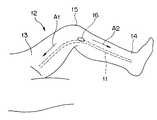
図2に示すように、採取対象血管11は、下肢12の鼠径部13と、足首14との間に存在する。採取する血管11は、例えば60cmの長さであるとする。  As shown in FIG. 2, the collectiontarget blood vessel 11 exists between theinguinal portion 13 of thelower limb 12 and theankle 14. Theblood vessel 11 to be collected is assumed to be 60 cm long, for example.

まず、術者は、その血管11の位置を特定する(ステップ(以下、Sと略す)1)。血管11の位置は、術者の触感によって、あるいはソナーなどの機器を用いて、特定する。次に、その血管11の管の方向に略沿って、特定した血管11の直上であって、膝15の少し下に、術者は、メス等によって一箇所、例えば切り口の長さが2.5cmの皮切部16を設ける(S2)。続いて、皮切部16において、その血管11を露出させ、血管11の周辺の組織を剥離する(S3)。  First, the surgeon specifies the position of the blood vessel 11 (step (hereinafter abbreviated as S) 1). The position of theblood vessel 11 is specified by the operator's tactile sensation or using a device such as sonar. Next, the surgeon has a length of 2. for example with a scalpel, just above the specifiedblood vessel 11 and slightly below theknee 15, approximately along the direction of the tube of theblood vessel 11. A 5cm skin 16 is provided (S2). Subsequently, at theskin incision 16, theblood vessel 11 is exposed, and the tissue around theblood vessel 11 is peeled off (S3).

次に、ダイセクタ31を用いて血管11の全長にわたって周辺の組織の剥離が行われる(S4)。具体的には、術者は、皮切部16にトロッカ21をセットし、ダイセクタ31を、トロッカ21の案内管部22に通して、内視鏡画像を見ながら、皮切部16から鼠径部13の方向(矢印A1で示す)に徐々に挿入して、血管11を周辺の組織から鈍的に剥離していく。内視鏡画像は、術者が血管11に沿って周辺組織を剥離していくために、術者にとって必要なものである。  Next, the surrounding tissue is exfoliated over the entire length of theblood vessel 11 using the disector 31 (S4). Specifically, the surgeon sets thetrocar 21 at theskin incision 16, passes thedissector 31 through theguide tube 22 of thetrocar 21, and views the endoscopic image from theskin incision 16 to the groin. It is gradually inserted in the direction of 13 (indicated by arrow A1), and theblood vessel 11 is bluntly detached from the surrounding tissue. The endoscopic image is necessary for the surgeon in order for the surgeon to peel off the surrounding tissue along theblood vessel 11.

血管11の周辺組織を剥離するとき、例えば、血管11に対して皮膚表面方向を上とすれば、術者は、血管11の上下方向を剥離し、さらに左右方向を剥離することによって、血管11の全周に渡って周辺組織を完全に剥離することができる。血管11の全周に渡って剥離することによって、血管11の側枝が内視鏡画像において良く見えるようになる。  When the peripheral tissue of theblood vessel 11 is peeled, for example, if the skin surface direction is raised with respect to theblood vessel 11, the operator peels theblood vessel 11 in the vertical direction and further peels the left and right direction, whereby theblood vessel 11 is peeled off. The surrounding tissue can be completely exfoliated over the entire circumference. By peeling off the entire circumference of theblood vessel 11, the side branch of theblood vessel 11 can be seen well in the endoscopic image.

鼠径部13の方向における、血管11の周辺組織からの剥離が終わると、ダイセクタ31をトロッカ21から引き抜く。次に、皮切部16のトロッカの向きを変え、皮切部16から、ダイセクタを、足首14の方向に(矢印A2で示す)徐々に挿入して、内視鏡画像を見ながら、血管11を周辺の組織からの剥離を行う。  When the separation from the surrounding tissue of theblood vessel 11 in the direction of theinguinal portion 13 is finished, thedissector 31 is pulled out from thetrocar 21. Next, the direction of the trocar of theskin incision 16 is changed, and the dissector is gradually inserted from theskin incision 16 in the direction of the ankle 14 (indicated by the arrow A2), and theblood vessel 11 is viewed while viewing the endoscopic image. Remove from the surrounding tissue.

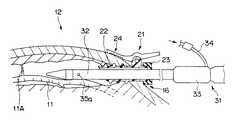
図3は、ダイセクタが、鼠径部13方向に皮切部16からトロッカ21を介して下肢12の皮下へ挿入された状態を示す断面図である。トロッカ21は、ダイセクタ31の挿入部32を挿通させるための筒状の案内管部22と、シール部23と、皮膚に固定するための固定部24とからなる。トロッカ21を皮切部16にセットするときは、案内管部22を、皮切部16から鼠径部方向に挿入し、固定部24によって皮膚に固定する。ダイセクタ31の挿入部32は、固定部24によって皮切部16に固定されたトロッカ21の案内管部22を通して、下肢12の皮下に挿入されている。後述するように、挿入部32の中には、内視鏡挿入部が挿入されている。ダイセクタ31の挿入方向は、血管11の方向に沿っているので、術者は、内視鏡画像を見ながら、血管11の周辺の組織を血管11から剥離するように徐々に挿入していく。すなわち、その挿入は、皮切部16から血管11に沿っていきなり鼠径部13の下まで行われない。ダイセクタ31を挿入方向に沿って進退させながら、徐々に鼠径部13までの血管11と、足首14までの血管11の剥離が行われる。  FIG. 3 is a cross-sectional view showing a state where the dissector is inserted into thelower limb 12 through thetrocar 21 from theskin incision 16 toward thegroin 13. Thetrocar 21 includes a cylindricalguide tube portion 22 for inserting theinsertion portion 32 of thedisector 31, a seal portion 23, and afixing portion 24 for fixing to the skin. When thetrocar 21 is set in theskin cut portion 16, theguide tube portion 22 is inserted from theskin cut portion 16 toward the groin portion and fixed to the skin by thefixing portion 24. Theinsertion part 32 of thedissector 31 is inserted subcutaneously into thelower limb 12 through theguide tube part 22 of thetrocar 21 fixed to theskin cutting part 16 by thefixing part 24. As will be described later, an endoscope insertion portion is inserted into theinsertion portion 32. Since the insertion direction of thedissector 31 is along the direction of theblood vessel 11, the operator gradually inserts the tissue around theblood vessel 11 so as to peel from theblood vessel 11 while viewing the endoscopic image. In other words, the insertion is not performed along theblood vessel 11 from theskin incision 16 and below thegroin 13. While thedissector 31 is advanced and retracted along the insertion direction, theblood vessel 11 up to theinguinal portion 13 and theblood vessel 11 up to theankle 14 are gradually separated.

このとき、ダイセクタ31に設けられた送気コネクタを送気装置108に接続することにより、所定の気体が、ダイセクタ31の把持部33に接続された送気チューブ34から送り込まれ、挿入部32の先端部に設けられた開口部35aから噴き出る。従って、血管11が周辺の組織から剥離されると共に、気体により、内視鏡の術野が広がって、視認性が良くなり、術者は、剥離作業がし易くなる。  At this time, by connecting an air supply connector provided in thedie sector 31 to theair supply device 108, a predetermined gas is sent from theair supply tube 34 connected to thegrip portion 33 of thedie sector 31, and It ejects from theopening part 35a provided in the front-end | tip part. Accordingly, theblood vessel 11 is peeled off from the surrounding tissue, and the operation field of the endoscope is widened by the gas, the visibility is improved, and the operator can easily perform the peeling work.

次に、ダイセクタ31を、トロッカ21から抜き取り、トロッカ21はそのままにして、ハーベスタ41(図5参照)を挿入して、皮切部16から足首14までの間の血管11の側枝の切断が行われる(S5)。  Next, thedissector 31 is extracted from thetrocar 21, and the harvester 41 (see FIG. 5) is inserted while thetrocar 21 is left as it is, and the side branch of theblood vessel 11 between theskin incision 16 and theankle 14 is cut. (S5).

なお、側枝11Aの切断は、ハーベスタ41を皮切部16からまず足首14の下まで挿入して、足首14から皮切部16に向かって、血管11の側枝11Aを1本ずつ切断していく。  In order to cut theside branch 11A, theharvester 41 is first inserted from theskin incision 16 to below theankle 14, and theside branch 11A of theblood vessel 11 is cut one by one from theankle 14 toward theskin incision 16. .

その側枝11Aの切断は、ハーベスタ41の挿入部42の先端部に設けられた電気メスであるバイポーラカッタ43によって行われる。バイポーラカッタ43によって切断された側枝11Aは、切断部は、略止血された状態となる。ハーベスタ41を用いて、足首14までの間の血管11の側枝11Aの全てが切られる。  The cutting of theside branch 11 </ b> A is performed by abipolar cutter 43 that is an electric knife provided at the distal end portion of theinsertion portion 42 of theharvester 41. Theside branch 11A cut by thebipolar cutter 43 is in a state where the cut portion is substantially hemostatic. Using theharvester 41, all of theside branches 11A of theblood vessel 11 up to theankle 14 are cut.

ハーベスタ41の構成については後述するが、ここでは簡単にその構成について説明する。血管11はハーベスタ41の先端に設けられた血管保持部であるベインキーパ45に引掛けられるようになっている。血管11をベインキーパ45に引掛けるときは、ベインキーパ45の一部を開け、開いた場所に血管11を引掛け、引掛けた後に、その開けた一部を閉じるような機構を、ハーベスタ41のベインキーパ45は有している。さらに、ベインキーパ45は、ハーベスタ41の軸方向に可動式であり、内視鏡の先端部からベインキーパ45を離す方向に動かすことができるので、引掛けた血管11を、内視鏡画像において見易くすることができる。  Although the configuration of theharvester 41 will be described later, the configuration will be briefly described here. Theblood vessel 11 is hooked on avein keeper 45 that is a blood vessel holding portion provided at the tip of theharvester 41. When theblood vessel 11 is hooked on thevane keeper 45, a mechanism that opens the part of thevane keeper 45, hooks theblood vessel 11 at the open place, closes the opened part after the hook is applied, is applied to the vein keeper of theharvester 41. 45 has. Further, thevane keeper 45 is movable in the axial direction of theharvester 41 and can be moved in a direction to move thevane keeper 45 away from the distal end portion of the endoscope, so that the hookedblood vessel 11 can be easily seen in the endoscopic image. be able to.

また、バイポーラカッタ43の先端部には、0.5mm幅の溝が形成されており、側枝11Aを切断するときは、側枝11Aを押し込むようにその溝に入れることによって、側枝11Aは圧縮された状態において切断される。さらにまた、ハーベスタ41の先端には、ワイパーガード部によって囲まれた内側に硬性鏡の先端部の窓部に付着した付着物を拭き取るためのワイパーが設けられている。そして、円筒形状のワイパーガード部の一部には、ワイパーによって拭き取られた付着物を外に掃き出すための掃き出し孔が設けられている。その付着物としては、血液、脂肪、電気メスによる煙等がある。  Further, a groove having a width of 0.5 mm is formed at the tip of thebipolar cutter 43, and when theside branch 11A is cut, theside branch 11A is compressed by inserting theside branch 11A into the groove so as to be pushed. Disconnected in state. Furthermore, a wiper is provided at the distal end of theharvester 41 for wiping off deposits adhering to the window portion at the distal end portion of the rigid endoscope inside the wiper guard portion. A part of the cylindrical wiper guard part is provided with a discharge hole for sweeping out the deposits wiped off by the wiper. Examples of such deposits include blood, fat, and smoke from an electric knife.

ハーベスタ41にも送気コネクタが設けられており、送気装置108に接続することにより所定の気体が、ハーベスタ41の把持部400に接続された送気チューブ44から送り込まれ、挿入部42の先端部に設けられた開口部(図示せず)から噴き出る。従って、血管11の側枝11Aの切断処置がし易くなる。  Theharvester 41 is also provided with an air supply connector, and by connecting to theair supply device 108, a predetermined gas is sent from theair supply tube 44 connected to thegrip portion 400 of theharvester 41, and the distal end of theinsertion portion 42. It ejects from the opening part (not shown) provided in the part. Therefore, theside branch 11A of theblood vessel 11 can be easily cut.

なお、側枝11Aは、血管11に複数存在するので、術者は、ハーベスタ41の挿入部42の先端における内視鏡画像を見ながら、ハーベスタ41の先端部のベインキーパ45を操作して血管11を保持し、側枝11Aを一つ一つ確認しながら、バイポーラカッタ43によって側枝11Aを切る。ベインキーパ45の構造についても後で詳述する。  Since there are a plurality ofside branches 11 </ b> A in theblood vessel 11, the surgeon operates thevane keeper 45 at the distal end portion of theharvester 41 while viewing the endoscopic image at the distal end of theinsertion portion 42 of theharvester 41. Theside branch 11A is cut by thebipolar cutter 43 while holding and checking theside branches 11A one by one. The structure of thevane keeper 45 will also be described in detail later.

次に、足首14に、例えば切り口の長さが1cm以下の小さな皮切を施し、その皮切部17から血管11の末端部を引き出して、糸をかけるか、鉗子を留置し、末端部の処置を行う(S6)。この場合、皮切部16の近傍にあるハーベスタ41を再度足首14の皮下まで挿入し、術者は、内視鏡によって、皮切部17の皮下の血管11と鉗子を見ながら、鉗子で血管11をつまんで、皮切部17から血管11を引き出す。  Next, theankle 14 is cut with a small cut having a cut length of 1 cm or less, for example, and the distal end of theblood vessel 11 is pulled out from thecut 17 and threaded or forceps are placed. A treatment is performed (S6). In this case, theharvester 41 in the vicinity of theskin incision 16 is inserted again under theankle 14, and the surgeon looks at theblood vessel 11 and the forceps under theskin 17 using an endoscope, and the blood vessels with the forceps. Theblood vessel 11 is pulled out from theskin incision 17 by pinching 11.

図4にその血管11の末端部の処置を説明するための図である。血管11の末端部の処置は、血管11の一部を糸で結び、その結び目11aよりも膝15側の位置11bにおいて血管11を切る。  FIG. 4 is a view for explaining the treatment of the distal end portion of theblood vessel 11. In the treatment of the end portion of theblood vessel 11, a part of theblood vessel 11 is tied with a thread, and theblood vessel 11 is cut at aposition 11b closer to theknee 15 than the knot 11a.

血管11の末端部の処置において、術者は、内視鏡によって、皮切部17の皮下の血管を見ながら、皮切部17から血管11を引き出す。  In the treatment of the distal end portion of theblood vessel 11, the operator pulls out theblood vessel 11 from theskin incision 17 while viewing the subcutaneous blood vessel in theskin incision 17 with an endoscope.

続いて、ハーベスタ41を、トロッカ21から抜き取り、皮切部16のトロッカ21の案内管部22の向きを鼠径部13の方向に変え、ハーベスタ41を挿入して、皮切部16から鼠径部13までの間の血管11の側枝の切断が行われる(S7)。S6で行ったように、術者は、内視鏡画像を見ながら、皮切部16から鼠径部13までの血管11の側枝11Aを切断する。  Subsequently, theharvester 41 is extracted from thetrocar 21, the direction of theguide tube portion 22 of thetrocar 21 of theskin cutting portion 16 is changed to the direction of thegroin portion 13, theharvester 41 is inserted, and thegroin portion 13 from theskin cutting portion 16 is inserted. Until then, the side branch of theblood vessel 11 is cut (S7). As performed in S <b> 6, the operator cuts theside branch 11 </ b> A of theblood vessel 11 from theskin incision 16 to thegroin 13 while viewing the endoscopic image.

なお、ここでも、側枝11Aの切断は、ハーベスタ41を皮切部16からまず鼠径部13の下まで挿入して、鼠径部13から皮切部16に向かって、血管11の側枝11Aを1本ずつ切断していく。  In this case as well, theside branch 11A is cut by inserting theharvester 41 from theskin incision 16 to the bottom of theinguinal part 13 and moving theside branch 11A of theblood vessel 11 from theinguinal part 13 toward theincision 16. Cut one by one.

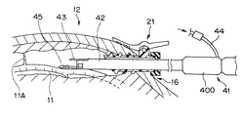
図5は、ハーベスタが、皮切部16からトロッカ21を介して下肢12の皮下へ挿入された状態を示す断面図である。ハーベスタ41の挿入部42は、固定部24によって皮切部16に固定されたトロッカ21の案内管部22を通して、下肢12の皮下に挿入されている。後述するように、挿入部42の中には、内視鏡挿入部が挿入されている。ハーベスタ41の挿入方向は、血管11の方向に沿っているので、術者は、内視鏡画像を見ながら、血管11の側枝11Aを切断する。  FIG. 5 is a cross-sectional view showing a state where the harvester is inserted into thelower limb 12 through theskin incision 16 through thetrocar 21. Theinsertion portion 42 of theharvester 41 is inserted subcutaneously into thelower limb 12 through theguide tube portion 22 of thetrocar 21 fixed to theskin incision portion 16 by the fixingportion 24. As will be described later, an endoscope insertion portion is inserted into theinsertion portion 42. Since the insertion direction of theharvester 41 is along the direction of theblood vessel 11, the operator cuts theside branch 11A of theblood vessel 11 while viewing the endoscopic image.

血管11の側枝11Aの切断が終了すると、図4に示すように、鼠径部13に、例えば切り口の長さが1cm以下の小さな皮切を施し、その皮切部18から血管11の末端部を引き出して、糸をかけるか、鉗子を留置し、末端部の処置を行う(S8)。この場合も、皮切部16の近傍にあるハーベスタ41を再度鼠径部13の皮下まで挿入し、術者は、内視鏡によって、皮切部18の皮下の血管11と鉗子を見ながら、鉗子で血管11をつまんで、皮切部18から血管11を引き出す。足首14の皮切部17において処置したように、血管11の末端部の処置は、血管11の一部を糸で結び、その結び目11cよりも膝15側の位置11dにおいて血管11を切る。なお、皮切部18における皮切も、その後、術者等は、テープ等で皮切部18を閉じることによって行われる。  When the cutting of theside branch 11A of theblood vessel 11 is completed, as shown in FIG. 4, theinguinal portion 13 is cut with a small skin having a cut length of 1 cm or less, for example, and the distal end portion of theblood vessel 11 is cut from theskin cutting portion 18. Pull out and apply a thread or place a forceps to treat the end (S8). Also in this case, theharvester 41 in the vicinity of theskin incision 16 is inserted again under theinguinal part 13, and the surgeon looks at thesubcutaneous blood vessel 11 and the forceps of theskin incision 18 with an endoscope. Theblood vessel 11 is pinched and theblood vessel 11 is pulled out from theskin incision 18. As treated at theskin incision 17 of theankle 14, the treatment of the distal end of theblood vessel 11 ties a part of theblood vessel 11 with a thread and cuts theblood vessel 11 at aposition 11d on the side of theknee 15 from theknot 11c. The skin cut at theskin cut portion 18 is also performed by the operator by closing theskin cut portion 18 with a tape or the like thereafter.

そして、術者は、図6に示すように皮切部16から、例えば60cmの血管11を摘出する(S9)。図6は、皮切部16から血管11を摘出する状態を説明するための図である。血管11の摘出が終わると、続いて、摘出された血管11に孔が開いていると、バイパス用の血管としては利用できないので、術者は、血管11の漏れ検査を行う(S10)。  Then, the surgeon removes, for example, a 60cm blood vessel 11 from theskin incision 16 as shown in FIG. 6 (S9). FIG. 6 is a view for explaining a state in which theblood vessel 11 is removed from theskin incision 16. When extraction of theblood vessel 11 is completed, if the extractedblood vessel 11 has a hole, it cannot be used as a bypass blood vessel, so the surgeon performs a leak test on the blood vessel 11 (S10).

漏れ検査を行いながら、術者は、血管11の全ての側枝11Aの部分に糸結びを施し、先端が切断された側枝11Aの先端部から血液が漏れることのないようにする。このように、全ての側枝11Aの部分に糸結びが施された状態において、血管11内の弁の方向を考慮して、血管11の一端にシリンジを付けて、生理食塩水を血管11内に通し、生理食塩水が漏れ出す孔があるか否かによって、術者は、血管11の漏れ検査を行う。  While performing the leak test, the operator applies a thread knot to all theside branches 11A of theblood vessel 11 so that blood does not leak from the tip of theside branch 11A with the tip cut off. In this way, in a state where all theside branches 11A are tied with a thread knot, taking into consideration the direction of the valve in theblood vessel 11, a syringe is attached to one end of theblood vessel 11, and physiological saline is placed in theblood vessel 11. The surgeon performs a leak test on theblood vessel 11 depending on whether there is a hole through which physiological saline leaks.

生理食塩水が漏れ出している箇所があれば、その箇所の孔を縫合する(S11)。最後に、皮切部16の縫合を行う(S12)。  If there is a portion where the physiological saline leaks, the hole at that portion is sutured (S11). Finally, theskin incision 16 is sutured (S12).

以上のように、従来の、下肢12の鼠径部13から足首14まで血管11が全て見えるように、下肢12の所定の部位の組織を切開するという手術に比べ、上述した内視鏡を用いて血管を摘出する方法は、例えば、皮切部が3つだけであり、患者に対して低侵襲である。例えば、手術後、患者が歩行できるようになるまでの期間を短縮できる可能性がある。  As described above, the above-described endoscope is used in comparison with the conventional operation of incising the tissue at a predetermined site of thelower limb 12 so that theblood vessel 11 can be seen from thegroin portion 13 to theankle 14 of thelower limb 12. The method for removing blood vessels is, for example, having only three skin incisions and is minimally invasive to the patient. For example, there is a possibility that the period until the patient can walk after the operation can be shortened.

次に、図7を用いて、生体採取手術システムを説明する。
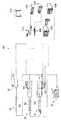
図7は、上述した手術に用いられる装置、器具等からなる生体採取手術システムの構成を示す構成図である。生体採取手術システム(以下、単に手術システムと略記する。)101は、上述したトロッカ21、生体剥離用機器であるダイセクタ31、生体組織切断用器具であるハーベスタ41及び内視鏡である硬性内視鏡51を含む。手術システム101は、さらに、表示装置であるテレビモニタ102と、カメラコントロールユニット(以下、CCUという)103と、テレビカメラ装置104と、光源装置105と、ライトガイドケーブル106と、電気メス装置107と、送気装置108とを含む。
Next, the living body sampling operation system will be described with reference to FIG.
FIG. 7 is a configuration diagram showing a configuration of a living body sampling operation system including devices, instruments and the like used in the above-described operation. A living body collection surgery system (hereinafter simply referred to as a surgery system) 101 includes atrocar 21, adissector 31 that is a biological peeling device, aharvester 41 that is a biological tissue cutting device, and a rigid endoscope that is an endoscope. Amirror 51 is included. Thesurgical system 101 further includes atelevision monitor 102 as a display device, a camera control unit (hereinafter referred to as CCU) 103, atelevision camera device 104, alight source device 105, alight guide cable 106, and anelectric knife device 107. And anair supply device 108.

硬性内視鏡51のライトガイドコネクタ部52には、ライトガイドケーブル106の一端が接続される。ライドガイドケーブル106の他端は、光源装置105に接続される。硬性内視鏡51には、光ファイバのライトガイドが挿通されたライトガイドケーブル106を介して、光源装置105からの光が供給され、硬性内視鏡51の先端部から、被写体への照明が行われる。硬性内視鏡51の基端側の接眼部53には、テレビカメラ装置104のテレビカメラヘッド部が接続される。テレビカメラ装置104は、CCU103に接続され、硬性内視鏡51によって得られた被写体の画像が、接続されたテレビモニタ102の画面上に表示される。  One end of alight guide cable 106 is connected to the lightguide connector portion 52 of therigid endoscope 51. The other end of theride guide cable 106 is connected to thelight source device 105. Light from thelight source device 105 is supplied to therigid endoscope 51 through alight guide cable 106 through which a light guide of an optical fiber is inserted, and the subject is illuminated from the distal end portion of therigid endoscope 51. Done. A television camera head portion of thetelevision camera device 104 is connected to theeyepiece 53 on the proximal end side of therigid endoscope 51. Thetelevision camera device 104 is connected to theCCU 103, and an image of the subject obtained by therigid endoscope 51 is displayed on the screen of the connectedtelevision monitor 102.

硬性内視鏡51の先端挿入部54は、ダイセクタ31の基端側からダイセクタ31の硬性鏡挿入チャネル36に挿入することができる。同様に、硬性内視鏡51の先端挿入部54は、ハーベスタ41の基端側からハーベスタ41の後述する挿入部42内に挿通する硬性鏡挿入チャネル46に挿入することができる。  The distalend insertion portion 54 of therigid endoscope 51 can be inserted into the rigidendoscope insertion channel 36 of the disector 31 from the proximal end side of thedisector 31. Similarly, the distalend insertion portion 54 of therigid endoscope 51 can be inserted from the proximal end side of theharvester 41 into a rigidendoscope insertion channel 46 that passes through aninsertion portion 42 described later of theharvester 41.

ダイセクタ31の送気チューブ34は、送気装置108に接続され、送気装置108からの所定の気体の供給を受け、送気出口である開口部35aから放出する。  Theair supply tube 34 of thedissector 31 is connected to theair supply device 108, receives supply of a predetermined gas from theair supply device 108, and discharges it from the opening 35 a that is an air supply outlet.

ハーベスタ41の送気チューブ44も、送気装置108に接続され、送気装置108からの所定の気体の供給を受け、送気出口である開口部(図7では図示せず)から放出する。  Theair supply tube 44 of theharvester 41 is also connected to theair supply device 108, receives supply of a predetermined gas from theair supply device 108, and discharges it from an opening (not shown in FIG. 7) that is an air supply outlet.

また、ハーベスタ41は、バイポーラカッタ43用の電気的ケーブル47を有し、その電気的ケーブル47の基端端に設けられたコネクタによって、電気メス装置107に接続される。  Theharvester 41 has anelectrical cable 47 for thebipolar cutter 43, and is connected to theelectrical knife device 107 by a connector provided at the proximal end of theelectrical cable 47.

このような構成を有する手術システム101を利用して、術者は、上述した手術を行うことができる。  Using theoperation system 101 having such a configuration, an operator can perform the above-described operation.

次に、図8から図18を用いて、本発明の生体組織切断用器具であるハーベスタについて説明する。  Next, the harvester which is the biological tissue cutting instrument of the present invention will be described with reference to FIGS.

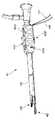
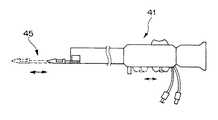
図8は、ハーベスタ41の側面図である。ハーベスタ41の金属製の挿入部42の先端には、上部にはバイポーラカッタ43が、また下部内側には保持子であるベインキーパ45が設けられており、挿入部42の基端に連設された把持部400に設けられているバイポーラカッタレバー401及びベインキーパレバー402を長手軸に沿って進退させると、この進退に連動してバイポーラカッタ43及びベインキーパ45を挿入部42の前方に進退させることができるようになっている。  FIG. 8 is a side view of theharvester 41. Abipolar cutter 43 is provided at the top of themetal insert portion 42 of theharvester 41, and avane keeper 45 as a retainer is provided inside the bottom portion, and is connected to the base end of theinsert portion 42. When thebipolar cutter lever 401 and thevane keeper lever 402 provided in thegrip portion 400 are advanced and retracted along the longitudinal axis, thebipolar cutter 43 and thevane keeper 45 may be advanced and retracted forward of theinsertion portion 42 in conjunction with the advance and retreat. It can be done.

図9は、ハーベスタ41の基端側の構成を説明する部分斜視図である。ハーベスタ41の基端側の構成は、図9に示すように硬性内視鏡51をハーベスタ41の基端部に容易にかつ確実に固定するために、ハーベスタ41の基端部400aの内周面には、案内溝400bが、ハーベスタ41の軸方向に沿って設けられている。さらに、その案内溝400bには、固定部材400cがネジによって固定されている。固定部材400cは、金属の板状部材をコの字形状に折り曲げられ、さらに、コの字の両端部は、コの字の内側に向かって凸状部を有するように折り曲げられている。一方、硬性内視鏡51の接眼部53の先端側には、図示しない凸部が設けられている。  FIG. 9 is a partial perspective view illustrating the configuration of the proximal end side of theharvester 41. As shown in FIG. 9, the configuration of the proximal end side of theharvester 41 is such that therigid endoscope 51 is easily and reliably fixed to the proximal end portion of theharvester 41, so that the inner peripheral surface of the proximal end portion 400 a of theharvester 41. Theguide groove 400 b is provided along the axial direction of theharvester 41. Further, a fixing member 400c is fixed to theguide groove 400b with a screw. The fixing member 400c is formed by bending a metal plate-like member into a U shape, and both ends of the U shape are bent so as to have convex portions toward the inside of the U shape. On the other hand, a convex portion (not shown) is provided on the distal end side of theeyepiece 53 of therigid endoscope 51.

さらに、基端部400aには、切欠き部400dが設けられ、ライトガイドコネクタ部52が、切欠き部400dに沿って移動できるようになっている。  Further, the base end portion 400a is provided with anotch portion 400d so that the lightguide connector portion 52 can move along thenotch portion 400d.

硬性内視鏡51をハーベスタ41の基端部から挿入するとき、その硬性内視鏡51の凸部が図9に示す基端部400aの内周面に設けられた案内溝400bに沿って、かつライトガイドコネクタ部52が切欠き部400dに沿って、入るように、ハーベスタ41の基端部に硬性内視鏡51を挿入する。硬性内視鏡51をハーベスタ41の基端部から挿入していくと、硬性内視鏡51の凸部は、案内溝400bの内側に沿って移動し、固定部材400cの弾性力に抗して金属の固定部材400cの凸状部を、越える。このとき、ライトガイドコネクタ部52も、基端部400aに設けられた切欠き部400dに沿って、移動する。  When therigid endoscope 51 is inserted from the proximal end portion of theharvester 41, the convex portion of therigid endoscope 51 extends along theguide groove 400b provided on the inner peripheral surface of the proximal end portion 400a shown in FIG. In addition, therigid endoscope 51 is inserted into the proximal end portion of theharvester 41 so that the lightguide connector portion 52 enters along thenotch portion 400d. When therigid endoscope 51 is inserted from the proximal end portion of theharvester 41, the convex portion of therigid endoscope 51 moves along the inside of theguide groove 400b and resists the elastic force of the fixing member 400c. The convex portion of the metal fixing member 400c is exceeded. At this time, the lightguide connector part 52 also moves along thenotch part 400d provided in the base end part 400a.

従って、ハーベスタ41の基端部から硬性内視鏡51を挿入するときは、ライトガイドコネクタ部52を切欠き部400dに入るようにし、かつ硬性内視鏡51の凸部を案内溝400bに入るように、ハーベスタ41と硬性内視鏡51の位置関係をセットしてから、硬性内視鏡51をハーベスタ41に挿入する。硬性内視鏡51をハーベスタ41に挿入していくと、途中で硬性内視鏡51の凸部が、固定部材400cによって挟まれるように係合して固定され、かつ固定部材400cの弾性力によって容易には抜け落ちないようになる。  Therefore, when therigid endoscope 51 is inserted from the proximal end portion of theharvester 41, the lightguide connector portion 52 enters thenotch portion 400d, and the convex portion of therigid endoscope 51 enters theguide groove 400b. Thus, after setting the positional relationship between theharvester 41 and therigid endoscope 51, therigid endoscope 51 is inserted into theharvester 41. As therigid endoscope 51 is inserted into theharvester 41, the convex portion of therigid endoscope 51 is engaged and fixed so as to be sandwiched by the fixing member 400c, and the elastic force of the fixing member 400c. It will not come off easily.

また、係合して固定される際に、係合された硬性内視鏡51とハーベスタ41との間で、「カチッ」という音が生じるため、使用者は、セットされたことを音で確認することができる。  In addition, since a “click” sound is generated between the engagedrigid endoscope 51 and theharvester 41 when being engaged and fixed, the user confirms that the set has been made by sound. can do.

図10はハーベスタ41の先端の構成を示す部分斜視図、図11は図10のロック軸414の作用を説明する図、図12は図10の矢印Aから見た矢視図である。  10 is a partial perspective view showing the configuration of the tip of theharvester 41, FIG. 11 is a diagram for explaining the operation of thelock shaft 414 in FIG. 10, and FIG. 12 is a view as seen from the arrow A in FIG.

図10に示すように、ハーベスタ41のベインキーパ45は、略コの字形状の血管保持台411を長手軸方向に進退可能に保持するベインキーパ軸412と、ベインキーパ軸412に平行で略コの字形状の血管保持台411に血管を収納する閉空間413を形成する血管保持台411に対して長手軸方向に進退可能なロック軸414とから構成され、該ロック軸414は、図10の状態では、ベインキーパ軸412と同様に血管保持台411にロックされた状態で空間413を形成するが、該ロック軸414のロック状態を解除することにより図11に示すように閉空間413を解放し閉空間413内に血管11を収納可能に進退できるようになっている。  As shown in FIG. 10, thevein keeper 45 of theharvester 41 includes avein keeper shaft 412 that holds a substantially U-shaped blood vessel holding table 411 so as to be movable back and forth in the longitudinal axis direction, and a substantially U shape that is parallel to thevein keeper shaft 412. 10 is configured with alock shaft 414 that can be advanced and retracted in the longitudinal axis direction with respect to the blood vessel holding table 411 that forms aclosed space 413 that stores a blood vessel in the blood vessel holding table 411. In the state of FIG. Thespace 413 is formed in a state of being locked to the blood vessel holding table 411 similarly to thevane keeper shaft 412. However, by releasing the lock state of thelock shaft 414, theclosed space 413 is released as shown in FIG. Theblood vessel 11 can be advanced and retracted so as to be accommodated therein.

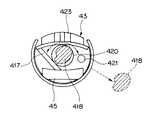
バイポーラカッタ43が設けられる挿入部42の先端側面は切り欠き415が設けられ、バイポーラカッタ43を進退させるカッタ軸(後述)が切り欠き415を経て挿入部42を内挿されている。切り欠き415の内壁面には断面が円弧形状のガード部416が設けられ、また挿入部42の先端内面には硬性内視鏡51の先端部の窓部に付着した付着物を拭き取るためのワイパー417が設けられている。そして、ワイパー417の一端を軸としてワイパー417の他端がガード部416内側をスイープすることで、ワイパーガード部が形成されている。そして、円筒形状のワイパーガード部の一部には、ワイパー417によって拭き取られた付着物418(図12参照)を外に掃き出すための掃き出し孔419aが設けられている。その付着物418としては、血液、脂肪、電気メスによる煙等がある。  Anotch 415 is provided at the tip side surface of theinsertion portion 42 where thebipolar cutter 43 is provided, and a cutter shaft (described later) for moving thebipolar cutter 43 forward and backward is inserted through thenotch 415. Aguard portion 416 having a circular arc cross section is provided on the inner wall surface of thenotch 415, and a wiper for wiping off deposits adhering to the window portion of the distal end portion of therigid endoscope 51 on the distal end inner surface of theinsertion portion 42. 417 is provided. And the wiper guard part is formed because the other end of thewiper 417 sweeps the inside of theguard part 416 around one end of thewiper 417 as an axis. A part of the cylindrical wiper guard part is provided with adischarge hole 419a for sweeping out the deposit 418 (see FIG. 12) wiped by thewiper 417 to the outside. Examples of thedeposit 418 include blood, fat, and smoke generated by an electric knife.

なお、ワイパー417は、ワイパー軸(図示せず:図16参照)を介してワイパーレバー419(図8参照)によりスイープする。  Thewiper 417 is swept by a wiper lever 419 (see FIG. 8) via a wiper shaft (not shown: see FIG. 16).

図10の矢印Aから見た矢視図である図12に示すように、挿入部42の先端面より所定の内側に硬性内視鏡51が挿通する硬性鏡挿入チャネル420の開口部と送気を行う送気チャネル421の開口部が隣接して設けられている。  As shown in FIG. 12, which is an arrow view seen from the arrow A in FIG. 10, the opening of the rigidendoscope insertion channel 420 through which therigid endoscope 51 is inserted into a predetermined inner side than the distal end surface of theinsertion portion 42 and the air supply An opening of anair supply channel 421 for performing the above is provided adjacently.

図13はハーベスタ41の作動構成を示す長軸方向の断面図であり、図14は図13の矢印Aから見たベインキーパレバー402の取り付け概念図である。  FIG. 13 is a cross-sectional view in the major axis direction showing the operation configuration of theharvester 41, and FIG. 14 is a conceptual diagram of the attachment of thevane keeper lever 402 as seen from the arrow A in FIG.

図13に示すように、ハーベスタ41の軸方向に沿って、硬性鏡挿入チャネル420を形成する金属の管部材420aが、把持部400の基端側から挿入部42の先端部までハーベスタ41の内部に挿通されている。バイポーラカッタ43は、把持部400に設けられているバイポーラカッタレバー401と挿入部42を挿通するバイポーラ軸450により連結されており、バイポーラカッタレバー401を長手軸に沿って進退させると、この進退力がバイポーラ軸450を介してバイポーラカッタ43に伝達され、バイポーラカッタ43を挿入部42の前方に進退させることができるようになっている。  As shown in FIG. 13, along the axial direction of theharvester 41, themetal tube member 420 a that forms the rigidendoscope insertion channel 420 is disposed inside theharvester 41 from the proximal end side of thegrip portion 400 to the distal end portion of theinsertion portion 42. Is inserted. Thebipolar cutter 43 is connected to abipolar cutter lever 401 provided in thegrip portion 400 by abipolar shaft 450 that passes through theinsertion portion 42. When thebipolar cutter lever 401 is advanced and retracted along the longitudinal axis, the advancing / retracting force is provided. Is transmitted to thebipolar cutter 43 via thebipolar shaft 450 so that thebipolar cutter 43 can be advanced and retracted forward of theinsertion portion 42.

同様に、ベインキーパ45は、把持部400に設けられているベインキーパレバー402と挿入部42を挿通するベインキーパ軸412により連結されており、ベインキーパレバー402を長手軸に沿って進退させると、この進退力がベインキーパ軸412を介してベインキーパ45に伝達され、ベインキーパ45を挿入部42の前方に進退させることができるようになっている。  Similarly, thevane keeper 45 is connected to avane keeper lever 402 provided in thegrip portion 400 by avane keeper shaft 412 that passes through theinsertion portion 42, and when thevane keeper lever 402 is advanced and retracted along the longitudinal axis, The advancing / retreating force is transmitted to thevane keeper 45 via thevane keeper shaft 412 so that thevane keeper 45 can be moved forward and backward with respect to theinsertion portion 42.

ベインキーパレバー402とベインキーパ軸412は、把持部400の内面をピン押圧するクリック機構451により把持部400の内面を一体的に移動可能であって、クリック機構451が把持部400の内面に設けられた例えば3つのクリック溝452のいずれかに位置すると、その位置にベインキーパレバー402及びベインキーパ軸412を安定して保持することができ、また、長手軸に力を作用させることで、容易にクリック機構451をクリック溝452から脱出させることができるようになっている。  Thevane keeper lever 402 and thevane keeper shaft 412 can be integrally moved on the inner surface of thegripper 400 by aclick mechanism 451 that pin-presses the inner surface of thegripper 400, and theclick mechanism 451 is provided on the inner surface of thegripper 400. For example, if it is located in any one of the threeclick grooves 452, thevein keeper lever 402 and thevein keeper shaft 412 can be stably held at that position, and a force can be applied to the longitudinal axis to easily click. Themechanism 451 can be made to escape from theclick groove 452.

ベインキーパレバー402はロックレバー453と着脱自在に連結されており、ロックボタン454を押下することで、ベインキーパレバー402はロックレバー453とを分離することができるようになっている。このロックレバー453は、ロック軸414と連結されており、ベインキーパレバー402と分離された状態でロックレバー453を進退させることで、閉空間413内に血管11を収納可能に進退できるようになっている(10及び図11参照)。  Thevane keeper lever 402 is detachably connected to thelock lever 453, and thevane keeper lever 402 can be separated from thelock lever 453 by pressing alock button 454. Thelock lever 453 is connected to thelock shaft 414. By moving thelock lever 453 forward and backward while being separated from thevane keeper lever 402, theblood vessel 11 can be advanced and retracted in theclosed space 413 so as to be retractable. (See FIG. 10 and FIG. 11).

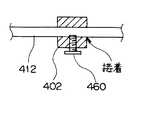
なお、図14に示すように、ベインキーパレバー402はネジ460と接着によりベインキーパ軸412に強固に固定されている。  As shown in FIG. 14, thevane keeper lever 402 is firmly fixed to thevane keeper shaft 412 byscrews 460 and adhesion.

図15はハーベスタ41の送気構成を示す長軸方向の断面図であり、図16は図15のA−A線断面を示す断面図である。  FIG. 15 is a cross-sectional view in the major axis direction showing the air supply configuration of theharvester 41, and FIG. 16 is a cross-sectional view showing the cross section along the line AA in FIG.

図15に示すように、ハーベスタ41の軸方向に沿って、送気チャネル421を形成する金属の送気パイプ461が、把持部400の基端側から挿入部42の先端部までハーベスタ41の内部に挿通されている。把持部400の基端側の送気パイプ461の一端には把持部400内において送気チューブ44が嵌入され、送気チューブ44の基端には、送気コネクタ44aが設けられており、送気コネクタ44aは、送気装置108に接続されたチューブのコネクタに接続される。  As shown in FIG. 15, along the axial direction of theharvester 41, a metalair supply pipe 461 that forms anair supply channel 421 is disposed inside theharvester 41 from the proximal end side of thegrip portion 400 to the distal end portion of theinsertion portion 42. Is inserted. Anair supply tube 44 is fitted into one end of theair supply pipe 461 on the proximal end side of thegrip portion 400 in thegrip portion 400, and an air supply connector 44a is provided at the base end of theair supply tube 44. The air connector 44 a is connected to a connector of a tube connected to theair supply device 108.

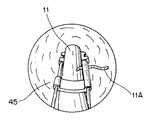
上述したように、本実施形態では、図17に示すように、ベインキーパレバー402を進退させることで、ベインキーパ45を先端において進退させることができるため、例えば、側枝11Aの切断時の内視鏡画象が図18に示すような画像で側枝11Aの状態が確認しにくい場合は、図19にようにベインキーパレバー402を長手軸方向に前進させることで、ベインキーパ45も先端より前進し、図19に示すように側枝11Aの状態の確認に適した内視鏡画象を視認することができる。  As described above, in the present embodiment, as shown in FIG. 17, by moving thevane keeper lever 402 forward and backward, thevane keeper 45 can be advanced and retracted at the distal end, so that, for example, an endoscope at the time of cutting theside branch 11A If the image is an image as shown in FIG. 18 and it is difficult to confirm the state of theside branch 11A, thevane keeper 45 is advanced in the longitudinal direction as shown in FIG. As shown in FIG. 19, an endoscopic image suitable for confirming the state of theside branch 11A can be visually recognized.

次に、図20から図24に基づいて、ハーベスタ41の内部に挿通されているバイポーラカッタ43について説明する。
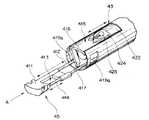
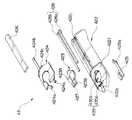
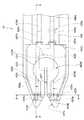
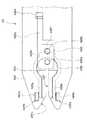
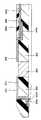
図20は、バイポーラカッタ43の先端部分の分解斜視図、図21はバイポーラカッタ43を上面から見た図、図22は、バイポーラカッタ43を下面から見た図、図23は図21のA−A線断面を示すバイポーラカッタ43の断面図、図24は図21のB−B線断面を示すバイポーラカッタ43の断面図である。
Next, thebipolar cutter 43 inserted into theharvester 41 will be described with reference to FIGS.
20 is an exploded perspective view of the distal end portion of thebipolar cutter 43, FIG. 21 is a view of thebipolar cutter 43 as seen from above, FIG. 22 is a view of thebipolar cutter 43 as seen from below, and FIG. 24 is a cross-sectional view of thebipolar cutter 43 showing a cross section along line A, and FIG. 24 is a cross-sectional view of thebipolar cutter 43 showing a cross section along line BB in FIG.

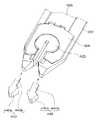
図20から図24に示すように、バイポーラカッタ43は、例えばポリカーボネイトなどの透明な絶縁部材である合成樹脂からなるカッタ本体422と、先端部の略中央に配設される非金属無機材であるセラミックスからなる組織挟持部423と、バイポーラの一方となる第1の電極である印加電極425と、バイポーラの他方となる第2の電極である帰還電極424と、2本のリード線428(印加側リード線428a,帰還側リード線428b)と、リード線カバー426とを有して構成されている。  As shown in FIG. 20 to FIG. 24, thebipolar cutter 43 is a non-metallic inorganic material disposed in the approximate center of the distal end portion and acutter body 422 made of a synthetic resin, which is a transparent insulating member such as polycarbonate. Atissue sandwiching portion 423 made of ceramics, anapplication electrode 425 that is a first electrode that is one of bipolars, afeedback electrode 424 that is a second electrode that is the other of bipolars, and two lead wires 428 (application side) Alead wire 428a, a return-side lead wire 428b), and alead wire cover 426.

カッタ本体422は、長手方向の軸から見たときに、ハーベスタ41の切り欠き415(図10参照)の円弧状の内周面に沿うように横断面が円弧状に湾曲した形状(図23参照)をしている。また、カッタ本体422は、先端から溝が形成され、先端側にV字溝422cと、後述する組織挟持部423が嵌入される溝である嵌入部435と、印加側リード線428a及び帰還側リード線428bが夫々絶縁状態に配置され、リード線カバー426が嵌着される溝部422jと、帰還電極424が配置される凹部422lとを有している。なお、溝部422jの底面には、印加側リード線428a及び帰還側リード線428bの絶縁を保つため全長に渡って、2本の長溝が形成されている。  When viewed from the longitudinal axis, the cuttermain body 422 has a shape in which the cross section is curved in an arc shape along the arc-shaped inner peripheral surface of the notch 415 (see FIG. 10) of the harvester 41 (see FIG. 23). ) Further, thecutter body 422 has a groove formed from the tip, a V-shapedgroove 422c on the tip side, afitting portion 435 that is a groove into which atissue sandwiching portion 423 described later is fitted, an application-side lead wire 428a, and a feedback-side lead. Each of thewires 428b is disposed in an insulated state, and has agroove portion 422j into which thelead wire cover 426 is fitted, and a concave portion 422l in which thereturn electrode 424 is arranged. Note that two long grooves are formed on the bottom surface of thegroove portion 422j over the entire length in order to maintain insulation between the applicationside lead wire 428a and the feedbackside lead wire 428b.

嵌入部435は、V字溝422c側がスリット状となる第1の溝部435aと、基端側が略円形状に形成された第2の溝部435bから構成されている。また、カッタ本体422の嵌入部435が形成される内周には、内向フランジとなる段部422aが形成されており、組織挟持部423の基端に対応する位置に勘合用凹部422bが形成されている。  Thefitting portion 435 includes afirst groove portion 435a having a slit shape on the V-shapedgroove 422c side and asecond groove portion 435b having a proximal end formed in a substantially circular shape. Further, astep portion 422a serving as an inward flange is formed on the inner periphery where theinsertion portion 435 of thecutter body 422 is formed, and a fittingconcave portion 422b is formed at a position corresponding to the proximal end of thetissue sandwiching portion 423. ing.

溝部422jの印加側リード線が配接される溝には、その先端側に印加電極425のリード線接続部425aが挿通される貫通部422eを有している。従って、カッタ本体422の下面側に配設される印加電極425は、リード線接続部425aが貫通部422eに挿通され、そのリード線接続部425aの端部と溝部422jの上面に配置される印加側リード線428aとが電気的に接続可能となる。  The groove in which the application-side lead wire of thegroove portion 422j is disposed has a through-hole 422e through which the leadwire connection portion 425a of theapplication electrode 425 is inserted at the tip side. Accordingly, in theapplication electrode 425 disposed on the lower surface side of thecutter body 422, the leadwire connection portion 425a is inserted through the throughportion 422e, and theapplication electrode 425a disposed on the end portion of the leadwire connection portion 425a and the upper surface of thegroove portion 422j. Theside lead wire 428a can be electrically connected.

組織挟持部423は、基端部分が略円柱形状をしている円柱形状部423Aと、その円柱形状部423Aの側周面から延びる略四角柱形状であって、スリット溝427が設けられた四角柱形状部423Bとを有する、いわゆる前方後円墳形状をしている。  Thetissue sandwiching portion 423 has acolumnar portion 423A having a substantially cylindrical base end portion, and a substantially quadrangular prism shape extending from a side peripheral surface of thecolumnar portion 423A, and is provided with aslit groove 427. It has a so-called front rear circular ridge shape having aprismatic portion 423B.

また、組織挟持部423は、図24に示すように、長手軸方向に沿って長く延び、四角柱形状部423B夫々の両側面から外側へ突起する2つの凸部423aと、円柱形状部423Aの基端部分の側周面から基端側に向けて突起する凸部423bを有している。  In addition, as shown in FIG. 24, thetissue sandwiching portion 423 extends long along the longitudinal axis direction, and includes twoconvex portions 423a projecting outward from both side surfaces of each of the quadrangular prism-shapedportions 423B, and thecylindrical portion 423A. It has aconvex part 423b protruding from the side peripheral surface of the base end part toward the base end side.

すなわち、組織挟持部423は、カッタ本体422の嵌入部435に嵌入され、2つの凸部423aが第1の溝部435aの段部422aに保持され、凸部423bがカッタ本体422の勘合用凹部422bに保持されることによって、カッタ本体422に嵌入される。  That is, thetissue sandwiching portion 423 is fitted into thefitting portion 435 of thecutter body 422, the twoconvex portions 423a are held by thestep portion 422a of thefirst groove portion 435a, and theconvex portion 423b is the fittingconcave portion 422b of the cuttermain body 422. Is held in the cuttermain body 422.

スリット溝427は、四角柱形状部423Bの先端側中央部から円柱形状部423Aの略中央部にかけて、組織挟持部423の長手軸方向において、例えば0.5mm幅に溝切りされている。
なお、この組織挟持部423は、高耐熱性のセラミックス構造材である、例えばジルコニア、アルミナなどの非金属無機材によって形成されている。
また、組織挟持部423の下面には、印加電極425の先端部分を位置決めするため、基端側に向けて切り欠かれた段部430が形成されている。
Theslit groove 427 is grooved to a width of, for example, 0.5 mm in the longitudinal axis direction of thetissue sandwiching portion 423 from the central portion on the distal end side of the quadrangularcolumnar portion 423B to the substantially central portion of thecylindrical portion 423A.
Thetissue sandwiching portion 423 is formed of a non-metallic inorganic material such as zirconia or alumina, which is a highly heat-resistant ceramic structural material.
In addition, a steppedportion 430 that is notched toward the proximal end side is formed on the lower surface of thetissue sandwiching portion 423 in order to position the distal end portion of theapplication electrode 425.

帰還電極424は、カッタ本体422の凹部422lの上面に沿って、長手軸方向からみたときの横断面が湾曲形状の金属板である。この帰還電極424は、カッタ本体422と組織挟持部423の上面における境目、つまり、夫々の境界線に略沿うように前方後円形状に切り欠き形成され、この帰還電極424は、先端部分にフック形状の2つの係止部424aと、基端部分に帰還側リード線と溶着により電気的に接続されるリード線接続部424bと、このリード線接続部424bと並設され、カッタ本体422の溝部422jに嵌入保持される突起部424cとを有している。  Thereturn electrode 424 is a metal plate having a curved cross section when viewed from the longitudinal axis direction along the upper surface of the concave portion 422l of thecutter body 422. Thereturn electrode 424 is cut out in a front rear circular shape so as to substantially follow the boundary between the upper surfaces of thecutter body 422 and thetissue sandwiching portion 423, that is, the respective boundary lines, and thereturn electrode 424 is hooked to the tip portion. Two lockingportions 424a having a shape, a leadwire connecting portion 424b electrically connected to the proximal end portion by welding to the return side lead wire, and a groove portion of the cuttermain body 422 provided in parallel with the leadwire connecting portion 424b. And aprotrusion 424c fitted and held in 422j.

2つの係止部424aは、夫々、略直角に帰還電極424の下方に折り曲げられており、先端部分が前方に延出するように略直角に折り曲げられた形状をしている。
また、リード線接続部424b及び突起部424cは、夫々、下方に略直角に折り曲げられ、さらに、基端側へ延出するように略直角に折り曲げられている。リード線接続部424bは、その基端側への延出長が突起部424cの延出長よりも長く、帰還側リード線と十分な溶着接続ができる長さを有している。
Each of the two lockingportions 424a is bent at a substantially right angle below thereturn electrode 424, and has a shape bent at a substantially right angle so that the tip portion extends forward.
The leadwire connecting portion 424b and the protrudingportion 424c are each bent at a substantially right angle downward, and further bent at a substantially right angle so as to extend toward the base end side. The leadwire connecting portion 424b has a length that extends to the base end side is longer than that of the protrudingportion 424c, and has a length that allows sufficient welding connection with the return side lead wire.

なお、突起部424cは、その基端側への延出長がカッタ本体422の凹部422lの基端から溝部422jの貫通部422eまでの長さよりも短い長さを有している。これにより、突起部424cと印加電極425のリード線接続部425a及び印加側リード線428aが接触することなく絶縁が保たれるため、帰還電極424と印加電極425との絶縁も保たれる。  Theprotrusion 424c has a length that extends to the base end side that is shorter than the length from the base end of the concave portion 422l of thecutter body 422 to the throughportion 422e of thegroove 422j. Thereby, since insulation is maintained without theprotrusion 424c and the leadwire connection part 425a of theapplication electrode 425 and the application-side lead wire 428a contacting each other, the insulation between thefeedback electrode 424 and theapplication electrode 425 is also maintained.

印加電極425は、カッタ本体422と組織挟持部423の下面側に配置され、ここでは、2つの孔部425bを有する略四角形の金属板である。この印加電極425からは、前述したように、印加側リード線428aと溶着により電気的に接続されるリード線接続部425aが基端側へ延出している。
このリード線接続部425aは、延出方向の端部分が上方に略直角に折り曲げられており、さらに、その端部が延出方向側へ略直角に折り曲げられている。
Theapplication electrode 425 is disposed on the lower surface side of thecutter body 422 and thetissue sandwiching portion 423, and here is a substantially rectangular metal plate having twohole portions 425b. As described above, a leadwire connecting portion 425a electrically connected to the applicationside lead wire 428a by welding extends from theapplication electrode 425 to the proximal end side.
The leadwire connecting portion 425a has an end portion in the extending direction bent upward at a substantially right angle, and further, the end portion is bent substantially at a right angle in the extending direction side.

また、カッタ本体422の下面に配設された印加電極425は、その基端側の孔部425bにカッタ本体422の下面から突起する留部422fが挿通され、この留部422fが熱カシメにより融解された後、外向フランジ状に凝固形成されることによってカッタ本体422に固定されている。  In addition, theapplication electrode 425 disposed on the lower surface of thecutter body 422 is inserted with a retaining portion 422f protruding from the lower surface of thecutter body 422 through thehole 425b on the proximal end side, and the retaining portion 422f is melted by heat caulking. After being formed, it is fixed to thecutter body 422 by being solidified and formed into an outward flange shape.

印加側リード線428a及び帰還側リード線428bは、カッタ本体422の溝部422jの底面に形成された2つの長溝に夫々、絶縁状態となるように平行して配設され、外部の電気メス装置107(図7参照)と電気的に接続される。  The application-side lead wire 428a and the return-side lead wire 428b are arranged in parallel in two long grooves formed on the bottom surface of thegroove portion 422j of thecutter body 422 so as to be insulative, and an externalelectric knife device 107 is provided. (See FIG. 7).

次に、上述した本実施形態のバイポーラカッタ43の各構成部材の組立てによる各部の作用と、その組立て手順について、以下に説明する。ただし、各構成部材の組立て手順は、必ずしも後述する順に限定されないものとする。  Next, the operation of each part by assembling each component of thebipolar cutter 43 of this embodiment described above and the assembling procedure will be described below. However, the assembly procedure of each component member is not necessarily limited to the order described later.

先ず、組織挟持部423は、カッタ本体422の嵌入部435に嵌入され、樹脂接着剤などによって固着される。このとき、組織挟持部423は、円柱形状部423Aの凸部423aがカッタ本体422の嵌合用凹部422bと当接保持され、四角柱形状部423Bの2つの凸部423bがカッタ本体422の段部422aと夫々当接保持されることにより、嵌入部435に嵌着される。  First, thetissue sandwiching portion 423 is fitted into thefitting portion 435 of thecutter body 422 and is fixed by a resin adhesive or the like. At this time, in thetissue sandwiching portion 423, theconvex portion 423a of thecylindrical portion 423A is held in contact with the fittingconcave portion 422b of the cuttermain body 422, and the twoconvex portions 423b of the quadrangularcolumnar portion 423B are stepped portions of the cuttermain body 422. By being held in contact with each of 422a, it is fitted into thefitting portion 435.

次に、印加電極425のリード線接続部425aは、カッタ本体422の貫通部422eに挿通され、印加電極425の孔部425bにカッタ本体422の留部422fが挿通される。そして、カッタ本体422の留部422fが熱カシメにより外向フランジ形成され、印加電極425の上面がカッタ本体422の下面及び、組織挟持部423の段部430の面と対向するようにカッタ本体422に固着される。  Next, the leadwire connecting portion 425 a of theapplication electrode 425 is inserted into the throughportion 422 e of thecutter body 422, and the retaining portion 422 f of thecutter body 422 is inserted into thehole 425 b of theapplication electrode 425. Then, the retaining portion 422f of thecutter body 422 is formed with an outward flange by heat caulking, and the upper surface of theapplication electrode 425 is formed on thecutter body 422 so as to face the lower surface of thecutter body 422 and the surface of the steppedportion 430 of thetissue sandwiching portion 423. It is fixed.

次に、印加電極425のリード線接続部425aは、印加側リード線428aの先端部分とろう接などによって溶着接続される。そして、印加側リード線428aは、カッタ本体422の溝部422j底面の一方の溝に配置される。  Next, the leadwire connecting portion 425a of theapplication electrode 425 is welded and connected to the tip portion of the applicationside lead wire 428a by brazing or the like. The application-side lead wire 428a is disposed in one groove on the bottom surface of thegroove portion 422j of thecutter body 422.

次に、帰還電極424は、2つの係止部424aがカッタ本体422の2つの係止孔部422dに夫々挿通され、カッタ本体422の凹部422lに配置される。そして、帰還電極424のリード線接続部424bは、帰還側リード線428bの先端部分とろう接などによって溶着接続される。また、帰還側リード線428bは、カッタ本体422の溝部422j底面に設けられた印加側リード線428aが配置されていない他方の長溝に配置される。  Next, the tworeturn portions 424 a of thereturn electrode 424 are inserted into the twostop holes 422 d of thecutter body 422, respectively, and are arranged in the recesses 422 l of thecutter body 422. The leadwire connecting portion 424b of thereturn electrode 424 is welded and connected to the tip portion of the returnside lead wire 428b by brazing or the like. The return-side lead wire 428b is disposed in the other long groove on the bottom surface of thegroove 422j of thecutter body 422 where the application-side lead wire 428a is not disposed.

最後に、リード線カバー426は、印加側リード線428aと帰還側リード線428bの絶縁状態が保たれながら、カッタ本体422の溝部422jに樹脂接着剤などと共に嵌着される。  Finally, thelead wire cover 426 is fitted together with a resin adhesive or the like in thegroove portion 422j of thecutter body 422 while maintaining the insulation state of the applicationside lead wire 428a and the feedbackside lead wire 428b.

以上のように、バイポーラカッタ43は、帰還電極424を上層とし、帰還電極424、組織挟持部423及びカッタ本体422を中層とし、印加電極425を下層となる3層構造に組立てられる。  As described above, thebipolar cutter 43 is assembled in a three-layer structure in which thefeedback electrode 424 is an upper layer, thefeedback electrode 424, thetissue sandwiching portion 423 and thecutter body 422 are middle layers, and theapplication electrode 425 is a lower layer.

帰還電極424は、係止部424aがカッタ本体422の係止孔部422dに引っ掛かり、リード線接続部424b及び突起部424cがリード線カバー426の下面先端部分とカッタ本体422の溝部422jの上面先端部分に挟まれるように保持される。そのため、帰還電極424は、2つの係止部424a、リード線接続部424b及び突起部424cの4点保持により、カッタ本体422に強固に固着される。  Thereturn electrode 424 has an engagingportion 424a hooked on the engaginghole portion 422d of thecutter body 422, and a leadwire connecting portion 424b and aprotrusion 424c are the lower end tip portion of thelead wire cover 426 and the upper end tip of thegroove portion 422j of thecutter body 422. It is held so as to be sandwiched between the parts. Therefore, thereturn electrode 424 is firmly fixed to the cuttermain body 422 by holding the two lockingportions 424a, the leadwire connecting portion 424b, and the protrudingportion 424c.

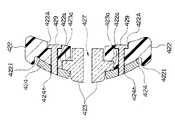
なお、図25に示すように、帰還電極424の係止部424aをカッタ本体422の係止孔部422dに挿入後、カッタ本体422は、下面側より係止孔部422dの一部又は全部を熱カシメにより塞いだ状態にするカシメ部422gを設けても良い。このカシメ部422gを係止孔部422dの下面に設けることによって、帰還電極424は、係止部424aがより強固にカッタ本体の係止孔部422dに固定されるため、カッタ本体422との固着もより強固とすることができる。  As shown in FIG. 25, after inserting the lockingportion 424a of thereturn electrode 424 into thelocking hole portion 422d of thecutter body 422, thecutter body 422 removes part or all of thelocking hole portion 422d from the lower surface side. A caulking portion 422g that is closed by heat caulking may be provided. By providing the crimped portion 422g on the lower surface of thelocking hole 422d, thereturn electrode 424 is fixed to thecutter body 422 because the lockingportion 424a is more firmly fixed to thelocking hole 422d of the cutter body. Can be made stronger.

組織挟持部423は、上述したように、各凸部423a,423bがカッタ本体422の嵌合用凹部422b及び段部422aと夫々当接保持され、さらに、それらの各凸部423a,423bの上面が帰還電極424により覆われるため、カッタ本体422の嵌入部435に確実に嵌着固定され、嵌入部435からの脱落が防止される。  As described above, in thetissue sandwiching portion 423, theconvex portions 423a and 423b are held in contact with the fittingconcave portion 422b and thestep portion 422a of thecutter body 422, respectively, and the upper surfaces of theconvex portions 423a and 423b are Since it is covered with thereturn electrode 424, it is securely fitted and fixed to thefitting portion 435 of the cuttermain body 422, and the drop-out from thefitting portion 435 is prevented.

なお、耐電圧のための沿面距離を保つため、スリット溝427の基端側に位置する印加電極425の先端部分から帰還電極424までの距離が略等しくなるように、帰還電極424の中央部は、スリット溝427の基端部分を略中心とした略円形状に切り欠きされている。さらに、帰還電極424の略円形状に対応する組織挟持部423の帰還電極424側の表面を略円形状、すなわち、組織挟持部423の円柱形状部423Aにより、印加電極425で発生する熱が組織挟持部423へ略均等に伝わる。言い換えれば、カッタ本体422と帰還電極424、印加電極425との接合面となる組織挟持部423においては、局部的に高温になる部分を抑えることができる。従って、印加電極425で発生する熱が組織挟持部423を伝って均一に拡がるため、カッタ本体422及び組織挟持部423の高熱化を防止することができる。  In order to maintain a creepage distance for withstand voltage, the central portion of thefeedback electrode 424 is set so that the distance from the tip portion of theapplication electrode 425 located on the base end side of theslit groove 427 to thefeedback electrode 424 is substantially equal. Theslit groove 427 is cut out into a substantially circular shape with the base end portion of theslit groove 427 as the center. Further, the surface of thetissue sandwiching portion 423 corresponding to the substantially circular shape of thereturn electrode 424 on thefeedback electrode 424 side is substantially circular, that is, the heat generated in the appliedelectrode 425 is generated by thecolumnar portion 423A of thetissue sandwiching portion 423. It is transmitted to the clampingpart 423 substantially evenly. In other words, in thetissue sandwiching portion 423 that serves as a joint surface between thecutter body 422, thereturn electrode 424, and theapplication electrode 425, a locally high temperature portion can be suppressed. Accordingly, the heat generated by theapplication electrode 425 spreads uniformly through thetissue sandwiching portion 423, so that thecutter body 422 and thetissue sandwiching portion 423 can be prevented from increasing in temperature.

ところで、生体組織を止血切断するため、印加電極425から帰還電極424へ放電される高周波電流によって発生する熱は、印加電極425付近に集中する。しかし、印加電極425と帰還電極424の間に高耐熱性のセラミックスによって形成される組織挟持部423を使うことにより、本実施形態のバイポーラカッタ43は、耐久性に優れた構成とすることができる。また、バイポーラカッタ43のカッタ本体422は、ポリカーボネイトなどの合成樹脂が使われ、全体がセラミックスによって形成される場合に比べて、加工性が良く安価となる。  By the way, the heat generated by the high-frequency current discharged from theapplication electrode 425 to thereturn electrode 424 is concentrated in the vicinity of theapplication electrode 425 in order to hemostatically cut the living tissue. However, thebipolar cutter 43 of the present embodiment can be configured to have excellent durability by using thetissue sandwiching portion 423 formed of high heat-resistant ceramic between theapplication electrode 425 and thereturn electrode 424. . Thecutter body 422 of thebipolar cutter 43 is made of synthetic resin such as polycarbonate, and has good workability and low cost compared to the case where the whole is formed of ceramics.

以上の結果、本実施形態のハーベスタ41のバイポーラカッタ43は、熱耐久性を備えた組織挟持部423、一対の電極となる印加電極425及び帰還電極424によって、生体組織である側枝11Aを容易に止血切断することができる。そして、バイポーラカッタ43に用いられる組織挟持部423は、カッタ本体422からの脱落が防止された構成となっている。  As a result of the above, thebipolar cutter 43 of theharvester 41 according to the present embodiment facilitates theside branch 11A, which is a living tissue, by thetissue sandwiching portion 423 having heat durability, theapplication electrode 425 serving as a pair of electrodes, and thereturn electrode 424. Hemostasis can be cut. Thetissue sandwiching portion 423 used in thebipolar cutter 43 is configured to prevent dropping from thecutter body 422.

なお、帰還電極424をカッタ本体422に固定する固定手段は、上述した構成に対して以下のような変形例となる構成にしても良い。
先ず、図26から図28に基づいて、帰還電極424をカッタ本体422に固定する第1変形例である固定手段を説明する。
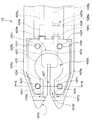
図26は、バイポーラカッタ43を上面から見た図、図27はバイポーラカッタ43を下面から見た図、図28は図26のC−C線断面を示す断面図である。
Note that the fixing means for fixing thefeedback electrode 424 to thecutter body 422 may be configured as the following modification to the above-described configuration.
First, based on FIGS. 26 to 28, a fixing means which is a first modification for fixing thefeedback electrode 424 to thecutter body 422 will be described.
26 is a view of thebipolar cutter 43 as viewed from above, FIG. 27 is a view of thebipolar cutter 43 as viewed from below, and FIG. 28 is a cross-sectional view taken along the line CC of FIG.

図26から図28に示すように、帰還電極424の係止部424a及びカッタ本体422の係止孔部422dに代えて、帰還電極424は、カッタ本体422とピン部材429によりレーザ溶接、スポット溶接、ろう接などの溶着によって固定されている。  As shown in FIGS. 26 to 28, instead of the lockingportion 424a of thereturn electrode 424 and thelocking hole portion 422d of thecutter body 422, thereturn electrode 424 is laser welded or spot welded by thecutter body 422 and thepin member 429. It is fixed by welding such as brazing.

詳しく説明すると、帰還電極424の先端側には、2つの孔部424hが穿設されている。この帰還電極424がカッタ本体422の凹部422lに配設された時に、カッタ本体422は、帰還電極424の2つの孔部424hに対応する位置に、ピン孔部422Aが配設されている。  More specifically, twoholes 424 h are formed on the tip side of thereturn electrode 424. When thereturn electrode 424 is disposed in the concave portion 422l of thecutter body 422, thecutter body 422 is provided with apin hole 422A at a position corresponding to the twoholes 424h of thereturn electrode 424.

このピン孔部422Aは、カッタ本体422の下面側の直径が大きく、カッタ本体422の上面に向かった中途部分において、孔径が小さくなっている。このピン孔部422Aには、一端に外向フランジが設けられたピン部材429が他端側から挿通される。なお、ピン部材429の外向フランジが設けられる端部を基端部とし、その反対側の端部を先端部とする。  Thepin hole portion 422A has a large diameter on the lower surface side of thecutter body 422, and has a small hole diameter in the middle of thecutter body 422 toward the upper surface of thecutter body 422. Apin member 429 having an outward flange at one end is inserted into thepin hole portion 422A from the other end side. In addition, let the edge part in which the outward flange of thepin member 429 is provided be a base end part, and let the edge part on the opposite side be a front-end | tip part.

カッタ本体422の凹部422lに配設される帰還電極424は、孔部424hがレーザ溶接などによりカッタ本体422のピン孔部422Aに挿通されたピン部材429の先端部と溶着される。  Thereturn electrode 424 disposed in the concave portion 422l of the cuttermain body 422 is welded to the tip end portion of thepin member 429 in which thehole portion 424h is inserted into thepin hole portion 422A of the cuttermain body 422 by laser welding or the like.

従って、ピン部材429の外向フランジがカッタ本体422のピン孔部422Aの中途部分において孔径が小さくなる端面部分と当接し、ピン部材429の先端部が帰還電極424の孔部424hとの溶着により、帰還電極424は、カッタ本体422に強固に固定できる。なお、この状態においても、帰還電極424は、リード線接続部424b及び突起部424cがリード線カバー426の下面先端部分とカッタ本体422の溝部422jの上面先端部分に挟まれるように保持されており、2つのピン部材429、リード線接続部424b及び突起部424cの4点保持により、カッタ本体422に強固に固着される。  Therefore, the outward flange of thepin member 429 comes into contact with the end surface portion where the hole diameter is reduced in the middle portion of thepin hole portion 422A of thecutter body 422, and the tip portion of thepin member 429 is welded to thehole portion 424h of thereturn electrode 424. Thereturn electrode 424 can be firmly fixed to thecutter body 422. Even in this state, thefeedback electrode 424 is held such that the leadwire connecting portion 424b and theprotrusion 424c are sandwiched between the bottom surface tip portion of thelead wire cover 426 and the top surface tip portion of thegroove portion 422j of thecutter body 422. By holding the twopin members 429, the leadwire connecting portion 424b, and the protrudingportion 424c at four points, thecutter body 422 is firmly fixed.

次に、図29及び図30に基づいて、帰還電極424をカッタ本体422に固定する第2変形例である固定手段を説明する。
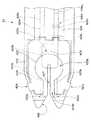
図29は、バイポーラカッタ43を上面から見た図、図30は図29のD−D線断面を示す断面図である。
Next, based on FIG. 29 and FIG. 30, a fixing means which is a second modification for fixing thereturn electrode 424 to thecutter body 422 will be described.
29 is a view of thebipolar cutter 43 as viewed from above, and FIG. 30 is a cross-sectional view taken along the line DD of FIG.

図29及び図30に示すように、帰還電極424は、印加電極425と同様にして、カッタ本体422の留部422iが熱カシメ、超音波溶着などされることによって固定されても良い。  As shown in FIGS. 29 and 30, thereturn electrode 424 may be fixed by heat caulking, ultrasonic welding, or the like on the retaining portion 422 i of thecutter body 422 in the same manner as theapplication electrode 425.

詳しくは、帰還電極424には、ここでは、先端側及び基端側に夫々2つ、合計4つの孔部424iが穿設されている。帰還電極424は、4つの孔部424iにカッタ本体422の上面から突起する留部422iが夫々に挿通され、留部422iが熱カシメ、超音波溶着などにより融解された後、外向フランジ状に凝固形成されることによってカッタ本体422の凹部422lに固定される。  Specifically, thereturn electrode 424 is formed with a total of fourholes 424i here, two at the distal end side and at the proximal end side, respectively. Thereturn electrode 424 is inserted into the fourholes 424i through the retaining portions 422i protruding from the upper surface of thecutter body 422, and the retaining portions 422i are melted by heat caulking, ultrasonic welding, or the like, and then solidified into an outward flange shape. By being formed, it is fixed to the recess 422 l of thecutter body 422.

なお、帰還電極424は、この状態においても、リード線接続部424b及び突起部424cがリード線カバー426の下面先端部分とカッタ本体422の溝部422jの上面先端部分に挟まれるように保持されている。そのため、帰還電極424は、孔部424iが先端側及び基端側に夫々2つ、合計4つ配設されることに限ることなく、カッタ本体422に固定する所定の強度が保もたれるように、孔部424iの配置及び個数が種々変更されて設けられても良い。また、それに合わせて、カッタ本体422の留部422iの配置及び個数が変更されるものとする。  Even in this state, thereturn electrode 424 is held such that the leadwire connecting portion 424b and the protrudingportion 424c are sandwiched between the bottom surface tip portion of thelead wire cover 426 and the top surface tip portion of thegroove portion 422j of thecutter body 422. . Therefore, thereturn electrode 424 is not limited to a total of fourhole portions 424i on the distal end side and the proximal end side, respectively, so that the predetermined strength to be fixed to thecutter body 422 is maintained. The arrangement and number of theholes 424i may be variously changed. In accordance with this, the arrangement and the number of the retaining portions 422i of thecutter body 422 are changed.

次に、図31及び図32に基づいて、帰還電極424をカッタ本体422に固定する第3変形例である固定手段を説明する。
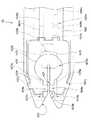
図31及び図32は、バイポーラカッタ43を上面から見た図である。
図31に示すように、帰還電極424の先端側には、両外側方向へ突出する2つの折り返し部424jを有している。これら2つの折り返し部424jは、カッタ本体422の先端側の両外側部分を夫々巻き込むように、カッタ本体422の下面側まで折り返されている。これにより、帰還電極424は、カッタ本体422に固定することができる。
Next, based on FIG. 31 and FIG. 32, a fixing means which is a third modified example for fixing thereturn electrode 424 to thecutter body 422 will be described.
31 and 32 are views of thebipolar cutter 43 as viewed from above.
As shown in FIG. 31, thereturn electrode 424 has two foldedportions 424 j that protrude in the outward direction on the tip side. These two foldedportions 424j are folded back to the lower surface side of thecutter body 422 so that both outer portions on the distal end side of thecutter body 422 are respectively wound. Thereby, thereturn electrode 424 can be fixed to thecutter body 422.

また、図32に示すように、帰還電極424の先端側に、さらに、両内側方向へ突出する2つの折り返し部424kが設けられ、この折り返し部424kが組織挟持部423の先端側の内側部分をスリット溝427に沿って夫々巻き込むように、組織挟持部423の下面まで折り返されることによって、より強固に帰還電極424がカッタ本体422に固定することができる。  In addition, as shown in FIG. 32, tworeturn portions 424k are provided on the distal end side of thereturn electrode 424 so as to protrude in both inner directions, and the foldedportion 424k serves as an inner portion on the distal end side of thetissue sandwiching portion 423. Thereturn electrode 424 can be more firmly fixed to thecutter body 422 by being folded back to the lower surface of thetissue sandwiching portion 423 so as to be wound along theslit grooves 427, respectively.

次に、図33〜図35に基づいて、帰還電極424をカッタ本体422に固定する第4変形例である固定手段を説明する。
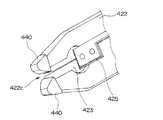
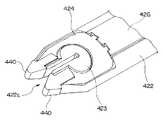
図33及び図34に示すように、V字溝422cが形成されているカッタ本体422の先端部分にある前方へ突出している2つの突出部分に金属(例えば、ステンレス)、樹脂などからなるカップ部材440が夫々固設される。換言すると、カップ部材440は、カッタ本体422の2つの突出部分を包み込み覆い被さるように、カッタ本体422に固着される。
Next, based on FIGS. 33 to 35, a fixing means which is a fourth modification for fixing thereturn electrode 424 to thecutter body 422 will be described.
As shown in FIGS. 33 and 34, a cup member made of metal (for example, stainless steel), resin, or the like on the two projecting portions projecting forward at the distal end portion of thecutter body 422 in which the V-shapedgroove 422c is formed. 440 is fixed respectively. In other words, thecup member 440 is fixed to thecutter body 422 so as to wrap around and cover the two protruding portions of thecutter body 422.

これらカップ部材440は、図35に示すように、先端側に内部がカッタ本体422の突出部分と略同一形状の穴部を有するカップ部440aと、このカップ部440aの基端からカップ部440aの上面と同じ面内に後方へと延出する押さえ部440bとを有している。  As shown in FIG. 35, thecup member 440 includes acup portion 440a having a hole portion having a shape substantially the same as the protruding portion of thecutter body 422 on the distal end side, and thecup portion 440a from the base end of thecup portion 440a. Apressing portion 440b extending backward is provided in the same plane as the upper surface.

これら2つのカップ部材440は、押さえ部440bが帰還電極424の先端側上面を押さえるようにカッタ本体422の突出部分に夫々係合される。カップ部材440が金属性であった場合、押さえ部440bと帰還電極424とが溶着される。その一方、カップ部材440が樹脂により形成されている場合、カップ部440aとカッタ本体422の突出部分とが接着される。この場合、カップ部材440とカッタ本体422の突出部分は、機械的な勘合が行われるような構成となっている。また、加えて、押さえ部440bと帰還電極424とを接着してもよい。  These twocup members 440 are respectively engaged with the protruding portions of the cuttermain body 422 so that thepressing portion 440b presses the upper surface on the distal end side of thereturn electrode 424. When thecup member 440 is metallic, thepressing portion 440b and thereturn electrode 424 are welded. On the other hand, when thecup member 440 is made of resin, thecup portion 440a and the protruding portion of thecutter body 422 are bonded. In this case, the protruding portions of thecup member 440 and thecutter body 422 are configured to be mechanically engaged. In addition, thepressing portion 440b and thereturn electrode 424 may be bonded.

以上により、2つのカップ部材440の夫々の押さえ部440bが帰還電極部424の先端側上面をカッタ本体422側へ押さえつけるように押止するため、帰還電極424は、カッタ本体422に強固に固定される構成となっている。  As described above, the respective holdingportions 440b of the twocup members 440 hold the top surface of thereturn electrode portion 424 so as to press the top surface of thereturn electrode portion 424 against thecutter body 422 side, so that thereturn electrode 424 is firmly fixed to thecutter body 422. It is the composition which becomes.

以上の説明した、帰還電極424をカッタ本体422に固定する各固定手段でも、バイポーラカッタ43に用いられる組織挟持部423は、カッタ本体422からの脱落が防止された構成となっている。  Even in each of the fixing means for fixing thereturn electrode 424 to thecutter body 422 as described above, thetissue sandwiching portion 423 used for thebipolar cutter 43 is configured to be prevented from dropping from thecutter body 422.

なお、本発明は、以上述べた実施形態のみに限定されるものではなく、発明の要旨を逸脱しない範囲で種々変形実施可能である。  It should be noted that the present invention is not limited to the embodiments described above, and various modifications can be made without departing from the spirit of the invention.

皮下血管を牽引して採取する手術方法を説明するためのフローチャートである。It is a flowchart for demonstrating the operation method which pulls a subcutaneous blood vessel and collects.皮下血管を牽引して採取する手術方法を説明するための図である。It is a figure for demonstrating the surgery method which pulls a subcutaneous blood vessel and collects.ダイセクタが、鼠径部方向に皮切部からトロッカを介して下肢の皮下へ挿入された状態を示す断面図である。It is sectional drawing which shows the state by which the dissector was inserted in the subcutaneous part of the lower limbs through the trocar from the skin cut part in the groin part direction.皮下血管を牽引して採取する手術方法を説明するための図である。It is a figure for demonstrating the surgery method which pulls a subcutaneous blood vessel and collects.ハーベスタが、皮切部からトロッカを介して下肢の皮下へ挿入された状態を示す断面図である。It is sectional drawing which shows the state by which the harvester was inserted into the lower limbs subcutaneously through the trocar from the skin incision.皮下血管を牽引して採取する手術方法を説明するための図である。It is a figure for demonstrating the surgery method which pulls a subcutaneous blood vessel and collects.皮下血管を牽引して採取する手術に用いられる装置、器具等からなる生体採取手術システムの構成を示す構成図である。It is a block diagram which shows the structure of the biological collection surgery system which consists of an apparatus, an instrument, etc. which are used for the surgery which pulls a subcutaneous blood vessel and collects.ハーベスタの側面図である。It is a side view of a harvester.ハーベスタの基端側の構成を説明する部分斜視図である。It is a fragmentary perspective view explaining the structure of the base end side of a harvester.ハーベスタの先端の構成を示す部分斜視図である。It is a fragmentary perspective view which shows the structure of the front-end | tip of a harvester.、図10のロック軸の作用を説明する図である。FIG. 11 is a diagram for explaining the operation of the lock shaft in FIG. 10.図10の矢印Aから見た矢視図である。It is an arrow view seen from the arrow A of FIG.ハーベスタの作動構成を示す長軸方向の断面図である。It is sectional drawing of the major axis direction which shows the operation structure of a harvester.図13の矢印Aから見たベインキーパレバーの取り付け概念図である。It is the attachment conceptual diagram of the vane keeper lever seen from the arrow A of FIG.ハーベスタの送気構成を示す長軸方向の断面図である。It is sectional drawing of the major axis direction which shows the air_supply structure of a harvester.図15のA−A線断面を示す断面図である。It is sectional drawing which shows the AA line cross section of FIG.ベインキーパレバーとベインキーパの進退を説明するための図である。It is a figure for demonstrating the advance and retreat of a Bain keeper lever and a Bain keeper.側枝の切断時の内視鏡画象である。It is an endoscopic image at the time of cutting of a side branch.側枝の切断時の内視鏡画象である。It is an endoscopic image at the time of cutting of a side branch.バイポーラカッタの先端部分の分解斜視図である。It is a disassembled perspective view of the front-end | tip part of a bipolar cutter.バイポーラカッタを上面から見た図である。It is the figure which looked at the bipolar cutter from the upper surface.バイポーラカッタを下面から見た図である。It is the figure which looked at the bipolar cutter from the lower surface.図21のバイポーラカッタのA−A線断面を示すバイポーラカッタの断面図である。It is sectional drawing of the bipolar cutter which shows the AA line cross section of the bipolar cutter of FIG.図21のバイポーラカッタのB−B線断面を示すバイポーラカッタの断面図である。It is sectional drawing of the bipolar cutter which shows the BB line cross section of the bipolar cutter of FIG.カシメ部を説明するための説明図である。It is explanatory drawing for demonstrating a crimping part.第1の変形例を説明するためのバイポーラカッタを上面から見た図である。It is the figure which looked at the bipolar cutter for demonstrating the 1st modification from the upper surface.第1の変形例を説明するためのバイポーラカッタを下面から見た図である。It is the figure which looked at the bipolar cutter for demonstrating a 1st modification from the lower surface.図26のC−C線断面を示すバイポーラカッタの断面図である。It is sectional drawing of the bipolar cutter which shows the CC line cross section of FIG.第2の変形例を説明するためのバイポーラカッタを上面から見た図である。It is the figure which looked at the bipolar cutter for demonstrating the 2nd modification from the upper surface.図29のD−D線断面を示すバイポーラカッタの断面図である。It is sectional drawing of the bipolar cutter which shows the DD sectional view of FIG.第3の変形例を説明するためのバイポーラカッタを上面から見た図である。It is the figure which looked at the bipolar cutter for demonstrating the 3rd modification from the upper surface.第3の変形例を説明するためのバイポーラカッタを上面から見た図である。It is the figure which looked at the bipolar cutter for demonstrating the 3rd modification from the upper surface.第4の変形例を説明するためのバイポーラカッタを上面側から見た斜視図である。It is the perspective view which looked at the bipolar cutter for demonstrating the 4th modification from the upper surface side.第3の変形例を説明するためのバイポーラカッタを下面側から見た斜視図である。It is the perspective view which looked at the bipolar cutter for demonstrating the 3rd modification from the lower surface side.カッタ本体の先端に取り付けられるカップを説明するためのバイポーラカッタを上面側から見た斜視図である。It is the perspective view which looked at the bipolar cutter for demonstrating the cup attached to the front-end | tip of a cutter main body from the upper surface side.

符号の説明Explanation of symbols

11・・・採取対象血管
11A・・・側枝
41・・・ハーベスタ
43・・・バイポーラカッタ
422・・・カッタ本体
422d・・・係止孔部
422c・・・V字溝
422a・・・段部
422b・・・嵌合用凹部
422e・・・貫通部
423・・・組織挟持部
424a・・・係止部
424・・・帰還電極
425・・・印加電極
427・・・スリット溝
429・・・ピン部材
422A・・・孔部
代理人 弁理士 伊藤 進

11 ... Blood vessels to be collected
11A ... side branch
41 ... Harvester
43 ... Bipolar cutter
422 ... Cutter body
422d ... Locking hole
422c ... V-shaped groove
422a ... Stepped portion
422b ... concave portion for fitting
422e ... penetrating part
423 ... Tissue clamping part
424a ... Locking portion
424 ... Return electrode
425 ... Applied electrode
427 ... Slit groove
429 ... Pin member
422A ... hole
Attorney Susumu Ito

Claims (5)

Translated fromJapanese
生体組織を切断する生体組織切断用器具であって、
係止孔部を有し、合成樹脂によって形成されたカッタ本体と、
該カッタ本体の一面に配設される第1の電極と、
前記カッタ本体の他面に配設され、係止部を有する第2の電極と、
前記第1の電極と前記第2の電極の間において、前記カッタ本体に配設され、前記生体組織を挟持するためのスリット溝を有し、セラミックスによって形成された組織挟持部と、
を具備し、
前記第2の電極は、前記組織挟持部を保持すると共に、前記係止部が前記係止孔部に係止されることにより、前記カッタ本体に固定されていることを特徴とする生体組織切断用器具。
A biological tissue cutting device for cutting a biological tissue,
A cutter body having a locking hole and formed of synthetic resin;
A first electrode disposed on one surface of the cutter body;
A second electrode disposed on the other surface of the cutter body and having a locking portion;
Between the first electrode and the second electrode, disposed in the cutter body, having a slit groove for sandwiching the living tissue, a tissue sandwiching portion formed of ceramics,
Comprising
The second electrode holds the tissue clamping portion and is fixed to the cutter body by the locking portion being locked to the locking hole portion. Appliances.
生体組織を切断する生体組織切断用器具であって、
ピン部材が挿入される孔部を有し、合成樹脂によって形成されたカッタ本体と、
該カッタ本体の一面に配設される第1の電極と、
前記カッタ本体の他面に配設される第2の電極と、
前記第1の電極と前記第2の電極の間において、前記カッタ本体に配設され、前記生体組織を挟持するためのスリット溝を有し、セラミックスによって形成された組織挟持部と、
を具備し、
前記第2の電極は、前記組織挟持部を保持すると共に、前記ピン部材が溶着されることにより、前記カッタ本体に固定されていることを特徴とする生体組織切断用器具。
A biological tissue cutting device for cutting a biological tissue,
A cutter body having a hole into which the pin member is inserted and formed of a synthetic resin;
A first electrode disposed on one surface of the cutter body;
A second electrode disposed on the other surface of the cutter body;
Between the first electrode and the second electrode, disposed in the cutter body, having a slit groove for sandwiching the living tissue, a tissue sandwiching portion formed of ceramics,
Comprising
The biological tissue cutting instrument, wherein the second electrode holds the tissue clamping portion and is fixed to the cutter body by welding the pin member.
生体組織を切断する生体組織切断用器具であって、
合成樹脂によって形成されたカッタ本体と、
該カッタ本体の一面に配設される第1の電極と、
前記カッタ本体の他面に配設される第2の電極と、
前記第1の電極と前記第2の電極の間において、前記カッタ本体に配設され、前記生体組織を挟持するためのスリット溝を有し、セラミックスによって形成された組織挟持部と、
前記カッタ本体の先端部分を覆うように固着され、基端上面部分に押さえ部を有するカップ部材と、
を具備し、
前記第2の電極は、前記組織挟持部を保持すると共に、先端部分が前記カップ部材の前記押さえ部に押止されることにより、前記カッタ本体に固定されていることを特徴とする生体組織切断用器具。
A biological tissue cutting device for cutting a biological tissue,
A cutter body formed of synthetic resin;
A first electrode disposed on one surface of the cutter body;
A second electrode disposed on the other surface of the cutter body;
Between the first electrode and the second electrode, disposed in the cutter body, having a slit groove for sandwiching the living tissue, a tissue sandwiching portion formed of ceramics,
A cup member fixed so as to cover the distal end portion of the cutter body and having a pressing portion on the upper surface portion of the proximal end; and
Comprising
The second electrode holds the tissue clamping portion and is fixed to the cutter body by a tip portion being held by the pressing portion of the cup member. Appliances.
さらに、前記第2の電極は、先端側に折り返し部を有し、前記カッタ本体の側部を前記折り返し部が巻き込むようにして、前記カッタ本体に固定されていることを特徴とする請求項1から請求項3のいずれかに記載の生体組織切断用器具。  2. The second electrode according to claim 1, wherein the second electrode has a folded portion on a tip end side, and is fixed to the cutter body such that the folded portion is wound around a side portion of the cutter body. The biological tissue cutting instrument according to claim 3. 前記折り返し部は、さらに、前記スリット溝側から前記組織挟持部を巻き込むようにして、前記カッタ本体に固定されていることを特徴とする請求項4に記載の生体組織切断用器具。

The biological tissue cutting instrument according to claim 4, wherein the folded portion is further fixed to the cutter body so as to wind the tissue clamping portion from the slit groove side.

JP2004303414A2004-06-182004-10-18 Biological tissue cutting instrumentExpired - Fee RelatedJP4383314B2 (en)

Priority Applications (4)

Application NumberPriority DateFiling DateTitle
JP2004303414AJP4383314B2 (en)2004-10-182004-10-18 Biological tissue cutting instrument
PCT/JP2005/011238WO2005122935A1 (en)2004-06-182005-06-20Instrument for cutting organism tissue
EP05751102.4AEP1762197B1 (en)2004-06-182005-06-20Instrument for cutting organism tissue
US11/418,533US7850687B2 (en)2004-06-182006-05-03Instrument for cutting living tissue

Applications Claiming Priority (1)

Application NumberPriority DateFiling DateTitle
JP2004303414AJP4383314B2 (en)2004-10-182004-10-18 Biological tissue cutting instrument

Publications (2)

Publication NumberPublication Date
JP2006110260Atrue JP2006110260A (en)2006-04-27
JP4383314B2 JP4383314B2 (en)2009-12-16

Family

ID=36379253

Family Applications (1)

Application NumberTitlePriority DateFiling Date
JP2004303414AExpired - Fee RelatedJP4383314B2 (en)2004-06-182004-10-18 Biological tissue cutting instrument

Country Status (1)

CountryLink
JP (1)JP4383314B2 (en)

Cited By (4)

* Cited by examiner, † Cited by third party
Publication numberPriority datePublication dateAssigneeTitle
WO2011114602A1 (en)*2010-03-162011-09-22テルモ カーディオバスキュラー システムズ コーポレイションEndoscopic treatment device
JP2013126574A (en)*2013-03-182013-06-27Olympus CorpBiological tissue collecting device
JP2013191404A (en)*2012-03-142013-09-26Toyota GakuenNozzle for microplasma capable of contacting sample
WO2014054770A1 (en)*2012-10-052014-04-10富士フイルム株式会社Guide instrument for body cavity insertion tool

Cited By (7)

* Cited by examiner, † Cited by third party
Publication numberPriority datePublication dateAssigneeTitle
WO2011114602A1 (en)*2010-03-162011-09-22テルモ カーディオバスキュラー システムズ コーポレイションEndoscopic treatment device
JP4995352B2 (en)*2010-03-162012-08-08テルモ カーディオバスキュラー システムズ コーポレイション Endoscopic treatment tool
CN102802549A (en)*2010-03-162012-11-28泰尔茂心血管系统公司Endoscopic treatment device
CN102802549B (en)*2010-03-162015-02-04泰尔茂心血管系统公司 Endoscope Processing Instruments
JP2013191404A (en)*2012-03-142013-09-26Toyota GakuenNozzle for microplasma capable of contacting sample
WO2014054770A1 (en)*2012-10-052014-04-10富士フイルム株式会社Guide instrument for body cavity insertion tool
JP2013126574A (en)*2013-03-182013-06-27Olympus CorpBiological tissue collecting device

Also Published As

Publication numberPublication date
JP4383314B2 (en)2009-12-16

Similar Documents

PublicationPublication DateTitle
US7850687B2 (en)Instrument for cutting living tissue
US8016821B2 (en)Living body tissue harvesting apparatus
US6572615B2 (en)Surgical device for applying radio frequency energy to a portion of a captured vessel
JP4995352B2 (en) Endoscopic treatment tool
JP5228138B2 (en) Surgical instrument
US20050159764A1 (en)Living-body tissue removing apparatus
US20050149094A1 (en)Trocar
US8105231B2 (en)Living-body tissue removing apparatus
JP4383314B2 (en) Biological tissue cutting instrument
US7662164B2 (en)Living-body tissue removing apparatus
JP4364070B2 (en) Biological tissue cutting instrument
JP4383297B2 (en) Biological tissue cutting instrument
JP3887563B2 (en) Bipolar lancing device and blood vessel collection device
JP4659758B2 (en) Biological tissue collection device
JP2003310628A (en)In-vivo tissue collection device
JP4373042B2 (en) Blood vessel collection device
WO2021181552A1 (en)Electrode unit and electrode unit operation method
JP5357856B2 (en) Biological tissue collection device and biological tissue collection system
JP2006095336A (en)Treating instrument for cutting living body tissue
JP2013126574A (en)Biological tissue collecting device

Legal Events

DateCodeTitleDescription
A621Written request for application examination

Free format text:JAPANESE INTERMEDIATE CODE: A621

Effective date:20060619

A131Notification of reasons for refusal

Free format text:JAPANESE INTERMEDIATE CODE: A131

Effective date:20090616

A521Request for written amendment filed

Free format text:JAPANESE INTERMEDIATE CODE: A523

Effective date:20090803

TRDDDecision of grant or rejection written
A01Written decision to grant a patent or to grant a registration (utility model)

Free format text:JAPANESE INTERMEDIATE CODE: A01

Effective date:20090825

A01Written decision to grant a patent or to grant a registration (utility model)

Free format text:JAPANESE INTERMEDIATE CODE: A01

A61First payment of annual fees (during grant procedure)

Free format text:JAPANESE INTERMEDIATE CODE: A61

Effective date:20090918

FPAYRenewal fee payment (event date is renewal date of database)

Free format text:PAYMENT UNTIL: 20121002

Year of fee payment:3

R151Written notification of patent or utility model registration

Ref document number:4383314

Country of ref document:JP

Free format text:JAPANESE INTERMEDIATE CODE: R151

FPAYRenewal fee payment (event date is renewal date of database)

Free format text:PAYMENT UNTIL: 20121002

Year of fee payment:3

FPAYRenewal fee payment (event date is renewal date of database)

Free format text:PAYMENT UNTIL: 20131002

Year of fee payment:4

S531Written request for registration of change of domicile

Free format text:JAPANESE INTERMEDIATE CODE: R313531

R350Written notification of registration of transfer

Free format text:JAPANESE INTERMEDIATE CODE: R350

R250Receipt of annual fees

Free format text:JAPANESE INTERMEDIATE CODE: R250

R250Receipt of annual fees

Free format text:JAPANESE INTERMEDIATE CODE: R250

R250Receipt of annual fees

Free format text:JAPANESE INTERMEDIATE CODE: R250

R250Receipt of annual fees

Free format text:JAPANESE INTERMEDIATE CODE: R250

R250Receipt of annual fees

Free format text:JAPANESE INTERMEDIATE CODE: R250

LAPSCancellation because of no payment of annual fees

[8]ページ先頭

©2009-2025 Movatter.jp