JP2004031485A - Semiconductor device - Google Patents
Semiconductor deviceDownload PDFInfo
- Publication number
- JP2004031485A JP2004031485AJP2002182781AJP2002182781AJP2004031485AJP 2004031485 AJP2004031485 AJP 2004031485AJP 2002182781 AJP2002182781 AJP 2002182781AJP 2002182781 AJP2002182781 AJP 2002182781AJP 2004031485 AJP2004031485 AJP 2004031485A
- Authority
- JP
- Japan
- Prior art keywords
- layer
- heat
- good heat
- conductive layer
- semiconductor chip
- Prior art date
- Legal status (The legal status is an assumption and is not a legal conclusion. Google has not performed a legal analysis and makes no representation as to the accuracy of the status listed.)
- Pending
Links
Images







Classifications
- H—ELECTRICITY
- H01—ELECTRIC ELEMENTS
- H01L—SEMICONDUCTOR DEVICES NOT COVERED BY CLASS H10
- H01L2224/00—Indexing scheme for arrangements for connecting or disconnecting semiconductor or solid-state bodies and methods related thereto as covered by H01L24/00
- H01L2224/01—Means for bonding being attached to, or being formed on, the surface to be connected, e.g. chip-to-package, die-attach, "first-level" interconnects; Manufacturing methods related thereto
- H01L2224/26—Layer connectors, e.g. plate connectors, solder or adhesive layers; Manufacturing methods related thereto
- H01L2224/31—Structure, shape, material or disposition of the layer connectors after the connecting process
- H01L2224/32—Structure, shape, material or disposition of the layer connectors after the connecting process of an individual layer connector
- H01L2224/321—Disposition
- H01L2224/32151—Disposition the layer connector connecting between a semiconductor or solid-state body and an item not being a semiconductor or solid-state body, e.g. chip-to-substrate, chip-to-passive
- H01L2224/32221—Disposition the layer connector connecting between a semiconductor or solid-state body and an item not being a semiconductor or solid-state body, e.g. chip-to-substrate, chip-to-passive the body and the item being stacked
- H01L2224/32225—Disposition the layer connector connecting between a semiconductor or solid-state body and an item not being a semiconductor or solid-state body, e.g. chip-to-substrate, chip-to-passive the body and the item being stacked the item being non-metallic, e.g. insulating substrate with or without metallisation
- H—ELECTRICITY
- H01—ELECTRIC ELEMENTS
- H01L—SEMICONDUCTOR DEVICES NOT COVERED BY CLASS H10
- H01L2924/00—Indexing scheme for arrangements or methods for connecting or disconnecting semiconductor or solid-state bodies as covered by H01L24/00
- H01L2924/10—Details of semiconductor or other solid state devices to be connected
- H01L2924/11—Device type
- H01L2924/13—Discrete devices, e.g. 3 terminal devices
- H01L2924/1304—Transistor
- H01L2924/1305—Bipolar Junction Transistor [BJT]
- H—ELECTRICITY
- H01—ELECTRIC ELEMENTS
- H01L—SEMICONDUCTOR DEVICES NOT COVERED BY CLASS H10
- H01L2924/00—Indexing scheme for arrangements or methods for connecting or disconnecting semiconductor or solid-state bodies as covered by H01L24/00
- H01L2924/10—Details of semiconductor or other solid state devices to be connected
- H01L2924/11—Device type
- H01L2924/13—Discrete devices, e.g. 3 terminal devices
- H01L2924/1304—Transistor
- H01L2924/1305—Bipolar Junction Transistor [BJT]
- H01L2924/13055—Insulated gate bipolar transistor [IGBT]
Landscapes
- Cooling Or The Like Of Semiconductors Or Solid State Devices (AREA)
Abstract
Translated fromJapaneseDescription
Translated fromJapanese【0001】
【発明の属する技術分野】
本発明は、作動時に発熱する半導体チップを有するパワーモジュール等の半導体装置に関し、特に、半導体チップの温度を測定する温度センサを備えた半導体装置に関する。
【0002】
【従来の技術】
電力制御素子として知られるIGBT(Insulated Gate Bipolar Transistor)等の半導体チップは、一般に、パッケージ内に封止されてパワーモジュールとして使用される。このようなパワーモジュールは、作動時に半導体チップの温度が大幅に上昇することから、この半導体チップの熱破壊を抑制するための対策を講じることが求められる。このような観点から、パワーモジュールに温度センサを設けて半導体チップの温度変化を検出し、半導体チップの温度が所定の温度を超えた場合には、当該半導体チップへの電力供給を制限する等の制御を行う試みがなされている。
【0003】
温度センサが設けられたパワーモジュールとしては、例えば特開2000−60105号公報にて開示されるものが提案されている。この特開2000−60105号公報にて開示されるパワーモジュールは、半導体チップと金属細線を介して接続された電極端子がパッケージ表面から露出した構造となっており、この電極端子に絶縁材を介して温度センサを取り付けて、この温度センサにより半導体チップの温度を測定するようにしたものである。
【0004】
【発明が解決しようとする課題】
以上のようなパワーモジュールでは、半導体チップからの熱が金属細線、電極端子、絶縁材を介して温度センサに伝達され、この温度センサに伝達された熱量から半導体チップの温度を測定するようになっている。しかしながら、このパワーモジュールでは、金属細線自体やこの金属細線と半導体チップ及び電極端子との接合箇所における熱抵抗が大きいために、半導体チップと温度センサとの間で良好な熱の伝達効率が得られず、半導体チップの温度変化を必ずしも高精度に検出できないといった問題がある。
【0005】
本発明は、以上のような従来の実情に鑑みて創案されたものであって、半導体チップからの熱を効率良く温度センサに伝達し、半導体チップの温度変化を高精度に検出できるようにした半導体装置を提供することを目的としている。
【0006】
【課題を解決するための手段】
本発明に係る半導体装置は、放熱板の一方の主面部上に絶縁層を介して金属配線層が形成され、この金属配線層に半導体チップが実装されてなるものであって、放熱板と金属配線層との間に、放熱板よりも熱伝導率の高い材料よりなる良熱伝導層を設けて、この良熱伝導層に温度センサを取り付けるようにしたものである。この半導体装置では、半導体チップの作動時に発生する熱が、金属配線層及び良熱伝導層を介して効率良く温度センサに伝達される。
【0007】
【発明の効果】
本発明に係る半導体装置によれば、半導体チップの作動時に発生する熱が、半導体チップが実装される金属配線層と、この金属配線層と放熱板との間に設けられた良熱伝導層とを介して効率良く温度センサに伝達されるようになっているので、この温度センサによって半導体チップの温度変化を高精度に検出することができる。
【0008】
【発明の実施の形態】
以下、本発明の実施の形態について図面を参照して説明する。なお、ここでは3相モータの駆動制御に用いられるパワーモジュールに対して本発明を適用した例について具体的に説明するが、本発明は、ここで説明する例に限らず、作動時に発熱する半導体チップを有するあらゆる半導体装置に対して有効に適用可能である。
【0009】
(第1の実施形態)
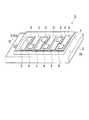
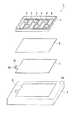
まず、本発明の第1の実施形態について、図1乃至図4を参照して説明する。なお、図1は本発明を適用した第1の実施形態のパワーモジュール1を示す斜視図、図2はパワーモジュール1の分解斜視図、図3はパワーモジュール1の平面図、図4は図3におけるA−A線断面図である。
【0010】
このパワーモジュール1は、ヒートシンクとして機能する放熱板2を備え、この放熱板2の一方の主面部2a上に、良熱伝導層3及び絶縁層4を介して6つの金属配線層5が設けられ、これら各金属配線層5にIGBT等の半導体チップ6が各々実装された構造となっている。また、放熱板2の一方の主面部2a上には、樹脂材料よりなるモジュールケース7が接合され、このモジュールケース7により金属配線層5や半導体チップ6が覆われて、一体のモジュールとして構成されている。
【0011】
放熱板2は、アルミニウム等の金属材料が板状に成形されてなるものであり、半導体チップ6等の各部材を支持すると共に、半導体チップ6で発生した熱を外部に放熱するヒートシンクとしての機能を有している。この放熱板2には、図4に示すように、冷却水の流路となる冷却水路8が形成されており、この冷却水路8を流れる冷却水に半導体チップ6からの熱を効果的に放熱できるようになっている。なお、図4ではモジュールケース7の図示を省略している。また、放熱板2の一方の主面部2a側には、図2に示すように、良熱伝導層3に対応した形状の凹部9が形成されている。そして、この放熱板2に形成された凹部9内に良熱伝導層3が配置されている。
【0012】
良熱伝導層3は、例えば銅や銀のような、放熱板2よりも熱伝導率の高い材料が板状に成形されてなるものであり、放熱板2に形成された凹部9内に嵌合した状態で配設されている。なお、この良熱伝導層3は、放熱板2に形成された凹部9内に銅ペースト等を充填することで形成するようにしてもよい。この良熱伝導層3は、モジュールケース7の外部に張り出した張り出し部3aを有しており、この良熱伝導層3の張り出し部3aに、半導体チップ6の温度変化を検出するための温度センサ10が取り付けられている。
【0013】
温度センサ10は、半導体チップ6から金属配線層5、絶縁層4、良熱伝導層3へと伝達された熱を感知してそれに応じた電気信号を出力するものであり、例えばサーミスタ等のような感熱素子が用いられる。この温度センサ10は、良熱伝導層3の温度変化(半導体チップ6の温度変化)を確実に検出できるように、良熱伝導層3の張り出し部3aに密着した状態で取り付けられる。具体的には、例えばモジュールケース7に突起を設け、モジュールケース7を放熱板2に接合したときに、このモジュールケース7に設けた突起で温度センサ10を良熱伝導層3側に押圧して密着固定させるといった構造が採られる。また、例えば温度センサ10のセンサ部を丸形端子形状とし、この温度センサ10をネジ部材で良熱伝導層3の張り出し部3aに固定する構造としてもよい。また、熱伝導率の高い接着材を用いて温度センサ10を良熱伝導層3の張り出し部3aに接着する構造としてもよい。
【0014】
絶縁層4は、例えば窒化アルミニウム等の熱伝導性に優れた絶縁材料よりなり、良熱伝導層3上に接合されている。また、6つの金属配線層5は、銅等の金属材料が所定の形状で絶縁層4上にパターニング形成されてなり、これら各金属配線層4上に半導体チップ6が半田11等によって各々実装されている。そして、半導体チップ6及び金属配線層5と良熱伝導層3との間の電気的絶縁が、絶縁層4によって図られる構造となっている。
【0015】
以上のような構造のパワーモジュール1は、3相モータの制御回路に組み込まれ、6つの半導体チップ6のオンオフの切り替えが制御されることで、電源からの直流電流を所定の交流電流に変換して、3相モータを駆動制御するインバータとして用いられる。このとき、制御系の異常によって半導体チップ6に過電流が流れたり、或いは放熱系等に故障が生じていたりすると、半導体チップ6の温度が異常に上昇して、半導体チップ6に熱破壊が生じてしまう場合がある。そこで、このパワーモジュール1では、半導体チップ6の温度変化を温度センサ10によって検出し、制御系にフィードバックするようになっている。
【0016】
このパワーモジュール1において、半導体チップ6から発生した熱は、図4中の矢印で示すように、半田11、金属配線層5、絶縁層4を介して良熱伝導層3に伝達される。ここで、半導体チップ6と半田11、半田11と金属配線層5、金属配線層5と絶縁層4、絶縁層4と良熱伝導層3は、それぞれある程度の接触面積をもって互いに接触しているので、各部材間の接合部における熱抵抗は比較的小さくなっている。また、半田11、金属配線層5、絶縁層4の各部は熱伝導率の良好な材料よりなるので、半導体チップ6から発生した熱は、良熱伝導層3へと効率良く伝達されることになる。
【0017】
良熱伝導層3へと伝達された半導体チップ6からの熱は、その一部が放熱板2に伝達されて、冷却水路8を流れる冷却水に放熱されることになるが、良熱伝導層3は放熱板2よりも熱伝導率の高い材料よりなるので、その多くが良熱伝導層3の面内方向に伝播して張り出し部3aに取り付けられた温度センサ10に伝達される。この温度センサ10は、上述したように良熱伝導層3の張り出し部3aに密着した状態となっているので、良熱伝導層3の温度変化、すなわち半導体チップ6の温度変化が、この温度センサ10によって高精度に検出されることになる。
【0018】
以上説明したように、本発明を適用したパワーモジュール1では、半導体チップ6からの熱が良熱伝導層3へと効率良く伝達され、この良熱伝導層3に取り付けられた温度センサ10によって、良熱伝導層3の温度変化、すなわち、半導体チップ6の温度変化が高精度に検出される。したがって、このパワーモジュール1では、半導体チップ6の温度変化を適切に制御系にフィードバックして、半導体チップ6の熱破壊を未然に防止することができる。
【0019】
また、このパワーモジュール1では、6つの半導体チップ6から発生した熱を良熱伝導層3に集めて、この良熱伝導層3に取り付けられた温度センサ10で検出する構造となっているので、6つの半導体チップ6の温度変化を1つの温度センサ10によって検出することができ、各半導体チップ6毎に温度センサ10を設ける構造に比べて部品点数の削減を図り、低コスト化を実現することができる。
【0020】
また、このパワーモジュール1では、絶縁層4によって半導体チップ6及び金属配線層5との電気的絶縁が図られた良熱伝導層3に温度センサ10が取り付けられ、この温度センサ10によって半導体チップ6の温度変化を検出するようになっているので、半導体チップ6と温度センサ10との電気的絶縁を図るために新たな絶縁層を設ける必要がなく、構造の簡素化を実現することができる。
【0021】
(第2の実施形態)
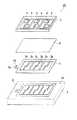
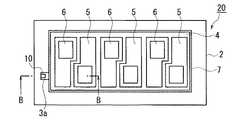
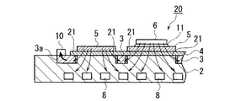
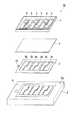
次に、本発明の第2の実施形態について、図5乃至図7を参照して説明する。なお、図5は第2の実施形態のパワーモジュール20を示す分解斜視図、図6はパワーモジュール20の平面図、図7は図6におけるB−B線断面図である。
【0022】
この第2の実施形態のパワーモジュール20は、良熱伝導層3に金属配線層5に対応した開口部3bが設けられて、良熱伝導層3が金属配線層5を囲む形状に形成されていることを特徴としている。また、これに併せて、良熱伝導層3が嵌合される放熱板2の凹部9も、良熱伝導層3に対応した形状とされている。そして、良熱伝導層3の端面と接触する凹部9の壁面には、放熱グリス21が塗布されている。なお、その他の構成については、上述した第1の実施形態のパワーモジュール1と同様であるので、以下、第1の実施形態のパワーモジュール1と同様の構成については、図中同一の符号を付して重複した説明を省略する。
【0023】
このパワーモジュール20において、半導体チップ6から発生した熱は、図7中の矢印で示すように、半田11、金属配線層5、絶縁層4を介して放熱板2に伝達され、冷却水路8を流れる冷却水に放熱される。このとき、放熱板2に形成された凹部9内には、この放熱板2よりも熱伝導率の高い材料よりなる良熱伝導層3が配設され、凹部9の壁面と良熱伝導層3の端面とが互いに接触しているので、半導体チップ6から半田11、金属配線層5、絶縁層4を介して放熱板2に伝達された熱の多くが、良熱伝導層3に伝達されることになる。
【0024】
ここで、放熱板2に形成された凹部9の壁面と良熱伝導層3の端面とは、ある程度の接触面積をもって互いに接触しているので、これらの接触面間における熱抵抗は比較的小さくなっており、特に、良熱伝導層3の端面と接触する凹部9の壁面には放熱グリス21が塗布されているので、放熱板2に伝わった半導体チップ6からの熱は、良熱伝導層3へと効率良く伝達されることになる。そして、この良熱伝導層3の温度変化、すなわち半導体チップ6の温度変化が、温度センサ10によって高精度に検出されることになる。
【0025】
以上説明したように、第2の実施形態のパワーモジュール20においても、上述した第1の実施形態のパワーモジュール1と同様に、半導体チップ6からの熱を効率良く良熱伝導層3へと伝達して、この良熱伝導層3に取り付けられた温度センサ10によって、半導体チップ6の温度変化を高精度に検出することができる。また、6つの半導体チップ6の温度変化を1つの温度センサ10によって検出することができるので、各半導体チップ6毎に温度センサ10を設ける構造に比べて部品点数の削減を図り、低コスト化を実現することができる。また、絶縁層4によって半導体チップ6及び金属配線層5との電気的絶縁が図られた良熱伝導層3に温度センサ10が取り付けられているので、半導体チップ6と温度センサ10との電気的絶縁を図るために新たな絶縁層を設ける必要がなく、構造の簡素化を実現することができる。
【0026】
更に、この第2の実施形態のパワーモジュール20は、良熱伝導層3が金属配線層5を囲む形状に形成されており、金属配線層5の直下に位置する部分には良熱伝導層3が配置されない構造となっているので、良熱伝導層3によって放熱板2の放熱効果が阻害されることなく、半導体チップ6からの熱を放熱板2で効果的に放熱しながら、半導体チップ6の温度上昇を温度センサ10によって高精度に検出することができる。すなわち、金属配線層5の直下に良熱伝導層3が配置されている場合には、この良熱伝導層3の熱伝導率が放熱板2の熱伝導率よりも高いために、半導体チップ6から金属配線層5に伝わった熱の殆どが良熱伝導層3に伝達されて、放熱板2による放熱効果が損なわれる場合もある。そこで、この第2の実施形態のパワーモジュール20では、良熱伝導層3を金属配線層5を囲む形状に形成して、金属配線層5の直下に位置する部分に良熱伝導層3を配置しない構造とし、放熱板2による放熱効果を確保するようにしている。
【0027】
なお、以上は、放熱板2に良熱伝導層3に対応した形状の凹部9を設け、この凹部9内に良熱伝導層3を配置した例について説明したが、放熱板2に凹部9を設けることなく、例えば図8に示すように、良熱伝導層3を絶縁層4内に埋設するかたちで放熱板2の一方の主面部2a上に配置するようにしてもよい。このような構造とした場合には、放熱板2に凹部9を形成する必要がないので、その分製造が容易となる。ただし、良熱伝導層3を放熱板9に設けた凹部9内に配置する構造とした場合には、良熱伝導層3の位置決めが容易となるので、良熱伝導層3に高精度な位置決めが求められる場合には、放熱板9に凹部9を設けてこの凹部9内に良熱伝導層3を配置する構造が望ましい。
【0028】
(第3の実施形態)
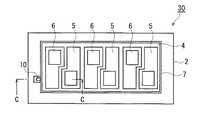
次に、本発明の第3の実施形態について、図9乃至図11を参照して説明する。なお、図9は第3の実施形態のパワーモジュール30を示す分解斜視図、図10はパワーモジュール30の平面図、図11は図10におけるC−C線断面図である。
【0029】
この第3の実施形態のパワーモジュール30は、良熱伝導層3が熱伝導率の異方性を有する材料を用いて形成され、良熱伝導層3の面内方向への熱伝導率が厚み方向への熱伝導率よりも高くされていることを特徴としている。具体的には、良熱伝導層3として、例えばカーボングラファイトのように結晶構造自体に異方性を有する材料を、面内方向への熱伝導率が厚み方向への熱伝導率よりも高くなるように切り出したものが用いられる。また、例えば、セラミック等よりなる熱伝導性の良好な棒状部材をその方向を揃えて樹脂成形したものを良熱伝導層3として用いるようにしてもよい。
【0030】
また、第3の実施形態のパワーモジュール30では、良熱伝導層3を以上のように構成したことに併せて、温度センサ10が良熱伝導層3の端面に密着するように取り付けられている。なお、その他の構成については、上述した第1の実施形態のパワーモジュール1及び第2の実施形態のパワーモジュール20と同様であるので、以下、第1の実施形態のパワーモジュール1及び第2の実施形態のパワーモジュール20と同様の構成については、図中同一の符号を付して重複した説明を省略する。
【0031】
このパワーモジュール30において、半導体チップ6から発生した熱は、図11中の矢印で示すように、半田11、金属配線層5、絶縁層4を介して放熱板2に伝達され、冷却水路8を流れる冷却水に放熱される。このとき、放熱板2に形成された凹部9内には、この放熱板2よりも熱伝導率の高い材料よりなる良熱伝導層3が配設され、凹部9の壁面と良熱伝導層3の端面とが放熱グリス21を挟んで互いに接触しているので、半導体チップ6から半田11、金属配線層5、絶縁層4を介して放熱板2に伝達された熱の多くが、良熱伝導層3に伝達されることになる。ここで、良熱伝導層3は、上述したように面内方向への熱伝導率が厚み方向への熱伝導率よりも高くされているので、放熱板2から良熱伝導層3に伝達された熱は、他の部材への放熱が抑制されて、良熱伝導層3の面内方向に効率良く伝播して温度センサ10に伝達されることになる。そして、この良熱伝導層3の温度変化、すなわち半導体チップ6の温度変化が、温度センサ10によって高精度に検出されることになる。
【0032】
以上説明したように、第3の実施形態のパワーモジュール30においても、上述した第1の実施形態のパワーモジュール1や第2の実施形態のパワーモジュール20と同様に、半導体チップ6からの熱を効率良く良熱伝導層3へと伝達して、この良熱伝導層3に取り付けられた温度センサ10によって、半導体チップ6の温度変化を高精度に検出することができる。また、6つの半導体チップ6の温度変化を1つの温度センサ10によって検出することができるので、各半導体チップ6毎に温度センサ10を設ける構造に比べて部品点数の削減を図り、低コスト化を実現することができる。また、絶縁層4によって半導体チップ6及び金属配線層5との電気的絶縁が図られた良熱伝導層3に温度センサ10が取り付けられているので、半導体チップ6と温度センサ10との電気的絶縁を図るために新たな絶縁層を設ける必要がなく、構造の簡素化を実現することができる。
【0033】
更に、この第3の実施形態のパワーモジュール30では、良熱伝導層3の面内方向への熱伝導率が厚み方向への熱伝導率よりも高くされており、放熱板2から良熱伝導層3に伝達された熱が他の部材へ放熱されることが有効に抑制されているので、温度センサ10への熱の伝達効率を更に良好なものとして、半導体チップ6の温度変化を温度センサ10によって応答性良く検出することが可能となる。
【0034】
(第4の実施形態)
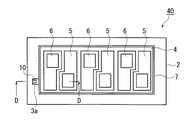
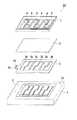
次に、本発明の第4の実施形態について、図12乃至図14を参照して説明する。なお、図12は第4の実施形態のパワーモジュール40を示す分解斜視図、図13はパワーモジュール40の平面図、図14は図13におけるD−D線断面図である。
【0035】
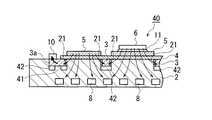
この第4の実施形態のパワーモジュール40は、放熱板2に設けた凹部9の深さを良熱伝導層3の厚みよりも大きくし、この凹部9の底面の適所に突起41を形成して、この突起41によって良熱伝導層3を支持させることで、凹部9の底面と良熱伝導層3との間に空気層42を形成するようにしたことを特徴としている。この突起41は、例えば放熱板2に凹部9を形成する際に、その凹部9の底面の一部を隆起させることで形成するようにしてもよいし、また、凹部9の適所に樹脂やゴム等よりなる柱状部材を配置することで形成してもよい。なお、その他の構成については、上述した第1乃至第3の実施形態のパワーモジュール1,20,30と同様であるので、以下、第1乃至第3の実施形態のパワーモジュール1,20,30と同様の構成については、図中同一の符号を付して重複した説明を省略する。
【0036】
このパワーモジュール40において、半導体チップ6から発生した熱は、図14中の矢印で示すように、半田11、金属配線層5、絶縁層4を介して放熱板2に伝達され、冷却水路8を流れる冷却水に放熱される。このとき、放熱板2に形成された凹部9内には、この放熱板2よりも熱伝導率の高い材料よりなる良熱伝導層3が配設され、凹部9の壁面と良熱伝導層3の端面とが放熱グリス21を挟んで互いに接触しているので、半導体チップ6から半田11、金属配線層5、絶縁層4を介して放熱板2に伝達された熱の多くが、良熱伝導層3に伝達されることになる。ここで、良熱伝導層3は突起41に支持された状態で凹部9内に配設され、凹部9の底面と良熱伝導層3との間には空気層42が形成されているので、この空気層42による断熱効果によって、放熱板2から良熱伝導層3に伝達された熱は良熱伝達層3で均一化され、速やかに温度センサ10に伝達されることになる。そして、この良熱伝導層3の温度変化、すなわち半導体チップ6の温度変化が、温度センサ10によって高精度に検出されることになる。
【0037】
以上説明したように、第4の実施形態のパワーモジュール40においても、上述した第1乃至第3の実施形態のパワーモジュール1,20,30と同様に、半導体チップ6からの熱を効率良く良熱伝導層3へと伝達して、この良熱伝導層3に取り付けられた温度センサ10によって、半導体チップ6の温度変化を高精度に検出することができる。また、6つの半導体チップ6の温度変化を1つの温度センサ10によって検出することができるので、各半導体チップ6毎に温度センサ10を設ける構造に比べて部品点数の削減を図り、低コスト化を実現することができる。また、絶縁層4によって半導体チップ6及び金属配線層5との電気的絶縁が図られた良熱伝導層3に温度センサ10が取り付けられているので、半導体チップ6と温度センサ10との電気的絶縁を図るために新たな絶縁層を設ける必要がなく、構造の簡素化を実現することができる。
【0038】
更に、この第4の実施形態のパワーモジュール40では、凹部9の底面と良熱伝導層3との間に形成された空気層42の断熱効果によって、放熱板2から良熱伝導層3に伝達された熱が良熱伝達層3で均一化され、速やかに温度センサ10に伝達されるので、半導体チップ6の温度変化を温度センサ10によって更に応答性良く検出することが可能となる。
【0039】
なお、以上は、凹部9の底面に突起41を形成して、この突起41により良熱伝導層3を支持することで、凹部9の底面と良熱伝導層3との間に空気層42を形成するようにした例について説明したが、良熱伝導層3の下面(放熱板2側の面)の一部を隆起させて、この隆起した部分を凹部9の底面に当接させた状態で良熱伝導層3を凹部9内に配設することで、凹部9の底面と良熱伝導層3との間に空気層42を形成するようにしてもよい。
【0040】
(第5の実施形態)
次に、本発明の第5の実施形態について、図15乃至図17を参照して説明する。なお、図15は第5の実施形態のパワーモジュール50を示す分解斜視図、図16はパワーモジュール50の平面図、図17は図16におけるE−E線断面図である。
【0041】
この第5の実施形態のパワーモジュール50は、放熱板2に形成した凹部9の深さを良熱伝導層3の厚みよりも大きくし、この凹部9の壁面の上側をテーパ形状とすると共に、良熱伝導層3の端面を凹部9壁面と同様の傾斜角のテーパ形状として、これらテーパ形状とされた部分を互いに接触させるように、良熱伝導層3を凹部9内に配設することによって、凹部9の底面と良熱伝導層3との間に空気層51を形成するようにしたことを特徴としている。なお、その他の構成については、上述した第1乃至第4の実施形態のパワーモジュール1,20,30,40と同様であるので、以下、第1乃至第4の実施形態のパワーモジュール1,20,30,40と同様の構成については、図中同一の符号を付して重複した説明を省略する。
【0042】
このパワーモジュール50において、半導体チップ6から発生した熱は、図17中の矢印で示すように、半田11、金属配線層5、絶縁層4を介して放熱板2に伝達され、冷却水路8を流れる冷却水に放熱される。このとき、放熱板2に形成された凹部9内には、この放熱板2よりも熱伝導率の高い材料よりなる良熱伝導層3が配設され、凹部9の壁面上側と良熱伝導層3の端面とが互いに接触しているので、半導体チップ6から半田11、金属配線層5、絶縁層4を介して放熱板2に伝達された熱の多くが、良熱伝導層3に伝達されることになる。ここで、良熱伝導層3は、テーパ形状とされた端面が凹部9のテーパ形状とされた壁面上側に接触するようにして凹部9内に配設され、凹部9の底面と良熱伝導層3との間には空気層51が形成されているので、この空気層51による断熱効果によって、放熱板2から良熱伝導層3に伝達された熱は良熱伝達層3で均一化され、速やかに温度センサ10に伝達されることになる。そして、この良熱伝導層3の温度変化、すなわち半導体チップ6の温度変化が、温度センサ10によって高精度に検出されることになる。
【0043】
以上説明したように、第5の実施形態のパワーモジュール50においても、上述した第1乃至第4の実施形態のパワーモジュール1,20,30,40と同様に、半導体チップ6からの熱を効率良く良熱伝導層3へと伝達して、この良熱伝導層3に取り付けられた温度センサ10によって、半導体チップ6の温度変化を高精度に検出することができる。また、6つの半導体チップ6の温度変化を1つの温度センサ10によって検出することができるので、各半導体チップ6毎に温度センサ10を設ける構造に比べて部品点数の削減を図り、低コスト化を実現することができる。また、絶縁層4によって半導体チップ6及び金属配線層5との電気的絶縁が図られた良熱伝導層3に温度センサ10が取り付けられているので、半導体チップ6と温度センサ10との電気的絶縁を図るために新たな絶縁層を設ける必要がなく、構造の簡素化を実現することができる。
【0044】
また、この第5の実施形態のパワーモジュール50では、上述した第4の実施形態のパワーモジュール40と同様に、凹部9の底面と良熱伝導層3との間に形成された空気層51の断熱効果によって、放熱板2から良熱伝導層3に伝達された熱が良熱伝達層3で均一化され、速やかに温度センサ10に伝達されるので、半導体チップ6の温度変化を温度センサ10によって更に応答性良く検出することが可能となる。
【0045】
更に、この第5の実施形態のパワーモジュール50では、良熱伝導層3の端面と放熱板2に形成された凹部9の壁面上側とが互いにテーパ形状とされて、これらテーパ形状とされた部分同士を接触させる構造となっており、良熱伝導層3と放熱板2との接触面積が大きくされ、且つ、良熱伝導層3が放熱板2側に押圧されて良熱伝導層3と放熱板2との密着性が増加するようになっているので、これらの間での接触熱抵抗を低減させて熱の伝達効率を更に高め、半導体チップ6の温度変化を温度センサ10によって更に高精度に検出することが可能となる。
【0046】
(第6の実施形態)
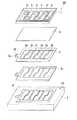
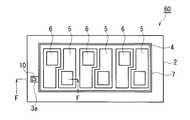
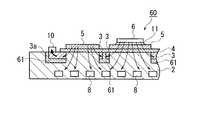
次に、本発明の第6の実施形態について、図18乃至図20を参照して説明する。なお、図18は第6の実施形態のパワーモジュール60を示す分解斜視図、図19はパワーモジュール60の平面図、図20は図19におけるF−F線断面図である。
【0047】
この第6の実施形態のパワーモジュール60は、放熱板2に形成した凹部9の深さを良熱伝導層3の厚みよりも大きくし、この凹部9の底面と良熱伝導層3との間に弾性を有する断熱材層61を設けたことを特徴としている。この断熱材層61は、例えばウレタンやシリコンゴム等のように熱伝導率が低く且つ弾力性に富む材料が良熱伝導層3に対応した形状に成形されてなるものであり、例えば良熱伝導層3の下面(放熱板2側の面)に設けられたスリット等に一部を嵌合させることで良熱伝導層3と一体化され、放熱板2に形成した凹部9の底面と良熱伝導層3との間に介装される。また、この断熱材層61の外周部は、良熱伝導層3の外周端面を囲むように立設され、凹部9の外周壁面と良熱伝導層3の外周端面との間に介装されるようになっている。
【0048】
なお、この断熱材層61は、例えば低熱伝導性樹脂を良熱伝導層5の下面に一体成形することで形成してもよいし、また、放熱板9に形成した凹部9内に液状の樹脂材料を塗布してこれを硬化させることによって形成してもよい。このパワーモジュール60におけるその他の構成については、上述した第1乃至第5の実施形態のパワーモジュール1,20,30,40,50と同様であるので、以下、第1乃至第5の実施形態のパワーモジュール1,20,30,40,50と同様の構成については、図中同一の符号を付して重複した説明を省略する。
【0049】
このパワーモジュール60において、半導体チップ6から発生した熱は、図20中の矢印で示すように、半田11、金属配線層5、絶縁層4を介して放熱板2に伝達され、冷却水路8を流れる冷却水に放熱される。このとき、放熱板2に形成された凹部9内には、この放熱板2よりも熱伝導率の高い材料よりなる良熱伝導層3が配設され、凹部9の壁面と良熱伝導層3の端面とが互いに接触しているので、半導体チップ6から半田11、金属配線層5、絶縁層4を介して放熱板2に伝達された熱の多くが、良熱伝導層3に伝達されることになる。ここで、放熱板2に形成された凹部9の底面と良熱伝導層3との間には断熱材層61が形成されているので、この断熱材層61による断熱効果によって、放熱板2から良熱伝導層3に伝達された熱は良熱伝達層3で均一化され、速やかに温度センサ10に伝達されることになる。そして、この良熱伝導層3の温度変化、すなわち半導体チップ6の温度変化が、温度センサ10によって高精度に検出されることになる。
【0050】
以上説明したように、第6の実施形態のパワーモジュール60においても、上述した第1乃至第5の実施形態のパワーモジュール1,20,30,40,50と同様に、半導体チップ6からの熱を効率良く良熱伝導層3へと伝達して、この良熱伝導層3に取り付けられた温度センサ10によって、半導体チップ6の温度変化を高精度に検出することができる。また、6つの半導体チップ6の温度変化を1つの温度センサ10によって検出することができるので、各半導体チップ6毎に温度センサ10を設ける構造に比べて部品点数の削減を図り、低コスト化を実現することができる。また、絶縁層4によって半導体チップ6及び金属配線層5との電気的絶縁が図られた良熱伝導層3に温度センサ10が取り付けられているので、半導体チップ6と温度センサ10との電気的絶縁を図るために新たな絶縁層を設ける必要がなく、構造の簡素化を実現することができる。
【0051】
また、この第6の実施形態のパワーモジュール60では、凹部9の底面と良熱伝導層3との間に設けられた断熱材層61の断熱効果によって、放熱板2から良熱伝導層3に伝達された熱が良熱伝達層3で均一化され、速やかに温度センサ10に伝達されるので、半導体チップ6の温度変化を温度センサ10によって更に応答性良く検出することが可能となる。
【0052】
更に、この第6の実施形態のパワーモジュール60では、凹部9の底面と良熱伝導層3との間に設けられた断熱材層61が弾性を有しているので、良熱伝導層3の寸法精度がラフな場合であっても、断熱材層61の弾性力によって良熱伝導層3が放熱板2側に押圧されて良熱伝導層3と放熱板2との密着性が増加するので、これらの間での接触熱抵抗を低減させて熱の伝達効率を更に高め、半導体チップ6の温度変化を温度センサ10によって更に高精度に検出することが可能となる。
【0053】
なお、以上は、良熱伝導層3の外周端面を断熱材層61の外周部で囲むようにして、凹部9の外周壁面と良熱伝導層3の外周端面との間での断熱を図るようにした例について説明したが、例えば、凹部9の外周壁面と良熱伝導層3の外周端面との間に、断熱材として楔形の樹脂材を嵌め込むことによっても、同様の断熱効果が期待できる。
【図面の簡単な説明】
【図1】本発明を適用した第1の実施形態のパワーモジュールを示す斜視図である。
【図2】前記第1の実施形態のパワーモジュールを示す分解斜視図である。
【図3】前記第1の実施形態のパワーモジュールを示す平面図である。
【図4】図3におけるA−A線断面図である。
【図5】本発明を適用した第2の実施形態のパワーモジュールを示す分解斜視図である。
【図6】前記第2の実施形態のパワーモジュールを示す平面図である。
【図7】図6におけるB−B線断面図である。
【図8】前記第2の実施形態のパワーモジュールの他の例を示す断面図である。
【図9】本発明を適用した第3の実施形態のパワーモジュールを示す分解斜視図である。
【図10】前記第3の実施形態のパワーモジュールを示す平面図である。
【図11】図10におけるC−C線断面図である。
【図12】本発明を適用した第4の実施形態のパワーモジュールを示す分解斜視図である。
【図13】前記第4の実施形態のパワーモジュールを示す平面図である。
【図14】図13におけるD−D線断面図である。
【図15】本発明を適用した第5の実施形態のパワーモジュールを示す分解斜視図である。
【図16】前記第5の実施形態のパワーモジュールを示す平面図である。
【図17】図16におけるE−E線断面図である。
【図18】本発明を適用した第6の実施形態のパワーモジュールを示す分解斜視図である。
【図19】前記第6の実施形態のパワーモジュールを示す平面図である。
【図20】図19におけるF−F線断面図である。
【符号の説明】
1 パワーモジュール
2 放熱板
3 良熱伝導層
5 金属配線層
6 半導体チップ
9 凹部
10 温度センサ
20 パワーモジュール
21 放熱グリス
30 パワーモジュール
40 パワーモジュール
41 突起
42 空気層
50 パワーモジュール
51 空気層
60 パワーモジュール
61 断熱材層[0001]
TECHNICAL FIELD OF THE INVENTION
The present invention relates to a semiconductor device such as a power module having a semiconductor chip that generates heat during operation, and more particularly to a semiconductor device having a temperature sensor that measures the temperature of the semiconductor chip.
[0002]
[Prior art]
A semiconductor chip such as an IGBT (Insulated Gate Bipolar Transistor) known as a power control element is generally sealed in a package and used as a power module. In such a power module, since the temperature of the semiconductor chip rises significantly during operation, it is required to take measures to suppress thermal destruction of the semiconductor chip. From such a viewpoint, a temperature sensor is provided in the power module to detect a temperature change of the semiconductor chip, and when the temperature of the semiconductor chip exceeds a predetermined temperature, power supply to the semiconductor chip is limited. Attempts have been made to exercise control.
[0003]
As a power module provided with a temperature sensor, for example, a power module disclosed in Japanese Patent Application Laid-Open No. 2000-60105 has been proposed. The power module disclosed in Japanese Patent Application Laid-Open No. 2000-60105 has a structure in which an electrode terminal connected to a semiconductor chip via a thin metal wire is exposed from a package surface, and the electrode terminal is connected to the electrode terminal via an insulating material. A temperature sensor is attached to the semiconductor chip, and the temperature of the semiconductor chip is measured by the temperature sensor.
[0004]
[Problems to be solved by the invention]
In the power module described above, heat from the semiconductor chip is transmitted to the temperature sensor via the thin metal wires, electrode terminals, and insulating material, and the temperature of the semiconductor chip is measured from the amount of heat transmitted to the temperature sensor. ing. However, in this power module, good heat transfer efficiency is obtained between the semiconductor chip and the temperature sensor because the thermal resistance is large at the thin metal wire itself and at the junction between the thin metal wire and the semiconductor chip and the electrode terminal. In addition, there is a problem that the temperature change of the semiconductor chip cannot always be detected with high accuracy.
[0005]
The present invention has been made in view of the above-described conventional circumstances, and has been made to efficiently transmit heat from a semiconductor chip to a temperature sensor and to detect a temperature change of the semiconductor chip with high accuracy. It is an object to provide a semiconductor device.
[0006]
[Means for Solving the Problems]
The semiconductor device according to the present invention includes a heat sink, a metal wiring layer formed on one main surface of the heat sink via an insulating layer, and a semiconductor chip mounted on the metal wiring layer. A good heat conducting layer made of a material having higher heat conductivity than the heat sink is provided between the wiring layer and the heat sink, and a temperature sensor is attached to the good heat conducting layer. In this semiconductor device, heat generated during operation of the semiconductor chip is efficiently transmitted to the temperature sensor via the metal wiring layer and the good heat conducting layer.
[0007]
【The invention's effect】
According to the semiconductor device of the present invention, the heat generated during operation of the semiconductor chip includes a metal wiring layer on which the semiconductor chip is mounted, and a good heat conductive layer provided between the metal wiring layer and the heat sink. , The temperature is efficiently transmitted to the temperature sensor, so that a temperature change of the semiconductor chip can be detected with high accuracy by the temperature sensor.
[0008]
BEST MODE FOR CARRYING OUT THE INVENTION
Hereinafter, embodiments of the present invention will be described with reference to the drawings. Here, an example in which the present invention is applied to a power module used for drive control of a three-phase motor will be specifically described. However, the present invention is not limited to the example described here. The present invention can be effectively applied to any semiconductor device having a chip.
[0009]
(1st Embodiment)
First, a first embodiment of the present invention will be described with reference to FIGS. 1 is a perspective view showing a
[0010]
The
[0011]
The
[0012]
The good heat
[0013]
The
[0014]
The insulating
[0015]
The
[0016]
In this
[0017]
Part of the heat from the
[0018]
As described above, in the
[0019]
Further, the
[0020]
Further, in the
[0021]
(Second embodiment)
Next, a second embodiment of the present invention will be described with reference to FIGS. 5 is an exploded perspective view showing the
[0022]
In the
[0023]
In this
[0024]
Here, since the wall surface of the
[0025]
As described above, also in the
[0026]
Further, in the
[0027]
In the above description, an example was described in which the
[0028]
(Third embodiment)
Next, a third embodiment of the present invention will be described with reference to FIGS. 9 is an exploded perspective view showing the
[0029]
In the
[0030]
In the
[0031]
In this
[0032]
As described above, in the
[0033]
Further, in the
[0034]
(Fourth embodiment)
Next, a fourth embodiment of the present invention will be described with reference to FIGS. FIG. 12 is an exploded perspective view showing the
[0035]
In the
[0036]
In the
[0037]
As described above, also in the
[0038]
Further, in the
[0039]
In the above description, the
[0040]
(Fifth embodiment)
Next, a fifth embodiment of the present invention will be described with reference to FIGS. 15 is an exploded perspective view showing the
[0041]
In the
[0042]
In the
[0043]
As described above, in the
[0044]
In the
[0045]
Further, in the
[0046]
(Sixth embodiment)
Next, a sixth embodiment of the present invention will be described with reference to FIGS. 18 is an exploded perspective view showing the
[0047]
In the
[0048]
The heat insulating
[0049]
In the
[0050]
As described above, also in the
[0051]
In the
[0052]
Further, in the
[0053]
In the above description, the outer peripheral end face of the good heat
[Brief description of the drawings]
FIG. 1 is a perspective view showing a power module according to a first embodiment of the present invention.
FIG. 2 is an exploded perspective view showing the power module according to the first embodiment.
FIG. 3 is a plan view showing the power module according to the first embodiment.
FIG. 4 is a sectional view taken along line AA in FIG. 3;
FIG. 5 is an exploded perspective view showing a power module according to a second embodiment to which the present invention is applied.
FIG. 6 is a plan view showing a power module according to the second embodiment.
FIG. 7 is a sectional view taken along line BB in FIG. 6;
FIG. 8 is a sectional view showing another example of the power module according to the second embodiment.
FIG. 9 is an exploded perspective view illustrating a power module according to a third embodiment of the present invention.
FIG. 10 is a plan view showing a power module according to the third embodiment.
11 is a sectional view taken along line CC in FIG.
FIG. 12 is an exploded perspective view showing a power module according to a fourth embodiment to which the present invention is applied.
FIG. 13 is a plan view showing a power module according to the fourth embodiment.
FIG. 14 is a sectional view taken along line DD in FIG.
FIG. 15 is an exploded perspective view showing a power module according to a fifth embodiment to which the present invention is applied.
FIG. 16 is a plan view showing a power module according to the fifth embodiment.
17 is a sectional view taken along line EE in FIG. 16;
FIG. 18 is an exploded perspective view showing a power module according to a sixth embodiment to which the present invention is applied.
FIG. 19 is a plan view showing a power module according to the sixth embodiment.
20 is a sectional view taken along line FF in FIG. 19;
[Explanation of symbols]
1 Power module
2 Heat sink
3 Good thermal conductive layer
5 Metal wiring layer
6 Semiconductor chip
9 recess
10 Temperature sensor
20 Power Module
21 Thermal radiation grease
30 Power Module
40 Power Module
41 protrusion
42 air layer
50 Power Module
51 Air layer
60 Power Module
61 Insulation layer
Claims (9)
Translated fromJapanese前記放熱板と前記金属配線層との間に、前記放熱板よりも熱伝導率の高い材料よりなる良熱伝導層を設け、この良熱伝導層に温度センサを取り付けたこと
を特徴とする半導体装置。In a semiconductor device in which a metal wiring layer is formed on one main surface portion of a heat sink via an insulating layer, and a semiconductor chip is mounted on the metal wiring layer,
A semiconductor, wherein a good heat conductive layer made of a material having a higher heat conductivity than the heat sink is provided between the heat sink and the metal wiring layer, and a temperature sensor is attached to the good heat conductive layer. apparatus.
を特徴とする請求項1に記載の半導体装置。2. The semiconductor device according to claim 1, wherein the good heat conductive layer is formed in a shape surrounding the metal wiring layer.
を特徴とする請求項1又は2に記載の半導体装置。3. The heat conducting plate according to claim 1, wherein a recess having a shape corresponding to the good heat conducting layer is formed on one main surface side of the heat sink, and the good heat conducting layer is arranged in the recess. Semiconductor device.
を特徴とする請求項3に記載の半導体装置。The semiconductor device according to claim 3, wherein heat radiation grease is applied to a contact surface of the heat radiating plate that contacts an end surface of the good heat conduction layer.
を特徴とする請求項1乃至4の何れかに記載の半導体装置。The good heat conductive layer is formed using a material having anisotropy of heat conductivity, and the heat conductivity in the in-plane direction of the good heat conductive layer is higher than the heat conductivity in the thickness direction. The semiconductor device according to claim 1, wherein:
を特徴とする請求項3に記載の半導体装置。4. The semiconductor device according to claim 3, wherein an air layer is provided between a bottom surface of the concave portion formed in the heat sink and the good heat conducting layer.
を特徴とする請求項6に記載の半導体装置。A protrusion is formed on a part of the bottom surface of the concave portion formed on the heat sink, and the good heat conductive layer is supported by the protrusion, so that the space between the bottom surface of the concave portion formed on the heat sink and the good heat conductive layer is formed. 7. The semiconductor device according to claim 6, wherein an air layer is formed on the semiconductor device.
を特徴とする請求項6に記載の半導体装置。The upper side of the wall surface of the recess formed in the heat sink and the end surface of the good heat conductive layer are each tapered, and the good heat conductive layer is formed on the heat sink so that these tapered portions are in contact with each other. 7. The semiconductor device according to claim 6, wherein an air layer is formed between the bottom surface of the concave portion formed in the heat sink and the good thermal conductive layer by being disposed in the formed concave portion.
を特徴とする請求項3に記載の半導体装置。4. The semiconductor device according to claim 3, wherein a heat insulating material layer having elasticity is provided between the bottom surface of the concave portion formed in the heat sink and the good heat conducting layer.
Priority Applications (1)
| Application Number | Priority Date | Filing Date | Title |
|---|---|---|---|
| JP2002182781AJP2004031485A (en) | 2002-06-24 | 2002-06-24 | Semiconductor device |
Applications Claiming Priority (1)
| Application Number | Priority Date | Filing Date | Title |
|---|---|---|---|
| JP2002182781AJP2004031485A (en) | 2002-06-24 | 2002-06-24 | Semiconductor device |
Publications (1)
| Publication Number | Publication Date |
|---|---|
| JP2004031485Atrue JP2004031485A (en) | 2004-01-29 |
Family
ID=31179188
Family Applications (1)
| Application Number | Title | Priority Date | Filing Date |
|---|---|---|---|
| JP2002182781APendingJP2004031485A (en) | 2002-06-24 | 2002-06-24 | Semiconductor device |
Country Status (1)
| Country | Link |
|---|---|
| JP (1) | JP2004031485A (en) |
Cited By (15)
| Publication number | Priority date | Publication date | Assignee | Title |
|---|---|---|---|---|
| WO2006132087A1 (en) | 2005-06-06 | 2006-12-14 | Dowa Electronics Materials Co., Ltd. | Metal-ceramic composite substrate and method for manufacturing same |
| JP2007012722A (en)* | 2005-06-28 | 2007-01-18 | Honda Motor Co Ltd | Power semiconductor module |
| JP2009277787A (en)* | 2008-05-13 | 2009-11-26 | Toyota Industries Corp | Semiconductor device |
| JP2014158315A (en)* | 2013-02-14 | 2014-08-28 | Toyota Motor Corp | Power reception device and power transmission device |
| JP2016518722A (en)* | 2013-05-08 | 2016-06-23 | コーニンクレッカ フィリップス エヌ ヴェKoninklijke Philips N.V. | Mounting layer for cooling structure |
| JP2017216350A (en)* | 2016-05-31 | 2017-12-07 | 日産自動車株式会社 | Semiconductor device |
| WO2019239484A1 (en)* | 2018-06-12 | 2019-12-19 | 東芝三菱電機産業システム株式会社 | Semiconductor device |
| CN110676237A (en)* | 2019-09-15 | 2020-01-10 | 天水华天电子集团股份有限公司 | Heat dissipation intelligent power semiconductor module based on micro-scale SSOP packaging and preparation method and application thereof |
| CN112654134A (en)* | 2020-11-10 | 2021-04-13 | 深圳可瑞高新材料股份有限公司 | Heat sensor substrate and heat sensor |
| US11426103B2 (en) | 2008-07-03 | 2022-08-30 | Masimo Corporation | Multi-stream data collection system for noninvasive measurement of blood constituents |
| US11638532B2 (en) | 2008-07-03 | 2023-05-02 | Masimo Corporation | User-worn device for noninvasively measuring a physiological parameter of a user |
| CN116125059A (en)* | 2022-12-14 | 2023-05-16 | 广州万孚生物技术股份有限公司 | Constant temperature incubation component, reagent card incubation mechanism and medical detection device |
| US12114974B2 (en) | 2020-01-13 | 2024-10-15 | Masimo Corporation | Wearable device with physiological parameters monitoring |
| US12230393B2 (en) | 2005-03-01 | 2025-02-18 | Willow Laboratories, Inc. | Multiple wavelength sensor emitters |
| US12336796B2 (en) | 2021-07-13 | 2025-06-24 | Masimo Corporation | Wearable device with physiological parameters monitoring |
- 2002
- 2002-06-24JPJP2002182781Apatent/JP2004031485A/enactivePending
Cited By (31)
| Publication number | Priority date | Publication date | Assignee | Title |
|---|---|---|---|---|
| US12230393B2 (en) | 2005-03-01 | 2025-02-18 | Willow Laboratories, Inc. | Multiple wavelength sensor emitters |
| WO2006132087A1 (en) | 2005-06-06 | 2006-12-14 | Dowa Electronics Materials Co., Ltd. | Metal-ceramic composite substrate and method for manufacturing same |
| JP2006339611A (en)* | 2005-06-06 | 2006-12-14 | Dowa Holdings Co Ltd | Metal-ceramic compound substrate and manufacturing method of the same |
| EP1909321A4 (en)* | 2005-06-06 | 2009-09-23 | Dowa Electronics Materials Co Ltd | Metal-ceramic composite substrate and method for manufacturing same |
| JP2007012722A (en)* | 2005-06-28 | 2007-01-18 | Honda Motor Co Ltd | Power semiconductor module |
| JP2009277787A (en)* | 2008-05-13 | 2009-11-26 | Toyota Industries Corp | Semiconductor device |
| US11642037B2 (en) | 2008-07-03 | 2023-05-09 | Masimo Corporation | User-worn device for noninvasively measuring a physiological parameter of a user |
| US11638532B2 (en) | 2008-07-03 | 2023-05-02 | Masimo Corporation | User-worn device for noninvasively measuring a physiological parameter of a user |
| US12036009B1 (en) | 2008-07-03 | 2024-07-16 | Masimo Corporation | User-worn device for noninvasively measuring a physiological parameter of a user |
| US12023139B1 (en) | 2008-07-03 | 2024-07-02 | Masimo Corporation | User-worn device for noninvasively measuring a physiological parameter of a user |
| US11751773B2 (en) | 2008-07-03 | 2023-09-12 | Masimo Corporation | Emitter arrangement for physiological measurements |
| US11647914B2 (en) | 2008-07-03 | 2023-05-16 | Masimo Corporation | User-worn device for noninvasively measuring a physiological parameter of a user |
| US11426103B2 (en) | 2008-07-03 | 2022-08-30 | Masimo Corporation | Multi-stream data collection system for noninvasive measurement of blood constituents |
| US11484230B2 (en) | 2008-07-03 | 2022-11-01 | Masimo Corporation | User-worn device for noninvasively measuring a physiological parameter of a user |
| US11484229B2 (en) | 2008-07-03 | 2022-11-01 | Masimo Corporation | User-worn device for noninvasively measuring a physiological parameter of a user |
| US11642036B2 (en) | 2008-07-03 | 2023-05-09 | Masimo Corporation | User-worn device for noninvasively measuring a physiological parameter of a user |
| JP2014158315A (en)* | 2013-02-14 | 2014-08-28 | Toyota Motor Corp | Power reception device and power transmission device |
| JP2016518722A (en)* | 2013-05-08 | 2016-06-23 | コーニンクレッカ フィリップス エヌ ヴェKoninklijke Philips N.V. | Mounting layer for cooling structure |
| JP2017216350A (en)* | 2016-05-31 | 2017-12-07 | 日産自動車株式会社 | Semiconductor device |
| CN112236929B (en)* | 2018-06-12 | 2024-01-16 | 东芝三菱电机产业系统株式会社 | Semiconductor device with a semiconductor device having a plurality of semiconductor chips |
| US11540426B2 (en) | 2018-06-12 | 2022-12-27 | Toshiba Mitsubishi-Electric Industrial Systems Corporation | Semiconductor device having a switching element and a diode connected in antiparallel |
| KR102455677B1 (en)* | 2018-06-12 | 2022-10-17 | 도시바 미쓰비시덴키 산교시스템 가부시키가이샤 | semiconductor device |
| KR20210018487A (en)* | 2018-06-12 | 2021-02-17 | 도시바 미쓰비시덴키 산교시스템 가부시키가이샤 | Semiconductor device |
| CN112236929A (en)* | 2018-06-12 | 2021-01-15 | 东芝三菱电机产业系统株式会社 | Semiconductor device with a plurality of semiconductor chips |
| JPWO2019239484A1 (en)* | 2018-06-12 | 2020-12-17 | 東芝三菱電機産業システム株式会社 | Semiconductor device |
| WO2019239484A1 (en)* | 2018-06-12 | 2019-12-19 | 東芝三菱電機産業システム株式会社 | Semiconductor device |
| CN110676237A (en)* | 2019-09-15 | 2020-01-10 | 天水华天电子集团股份有限公司 | Heat dissipation intelligent power semiconductor module based on micro-scale SSOP packaging and preparation method and application thereof |
| US12114974B2 (en) | 2020-01-13 | 2024-10-15 | Masimo Corporation | Wearable device with physiological parameters monitoring |
| CN112654134A (en)* | 2020-11-10 | 2021-04-13 | 深圳可瑞高新材料股份有限公司 | Heat sensor substrate and heat sensor |
| US12336796B2 (en) | 2021-07-13 | 2025-06-24 | Masimo Corporation | Wearable device with physiological parameters monitoring |
| CN116125059A (en)* | 2022-12-14 | 2023-05-16 | 广州万孚生物技术股份有限公司 | Constant temperature incubation component, reagent card incubation mechanism and medical detection device |
Similar Documents
| Publication | Publication Date | Title |
|---|---|---|
| JP5257817B2 (en) | Semiconductor device | |
| JP4192396B2 (en) | Semiconductor switching module and semiconductor device using the same | |
| CN103314437B (en) | Power semiconductor modular and power unit device | |
| US8749977B2 (en) | Power semiconductor module and its attachment structure | |
| JP3610015B2 (en) | Semiconductor device | |
| JP2004031485A (en) | Semiconductor device | |
| JP5062005B2 (en) | Power semiconductor device | |
| JP3345241B2 (en) | Semiconductor device | |
| US20220093486A1 (en) | Power semiconductor module with clamping device | |
| US11195775B2 (en) | Semiconductor module, semiconductor device, and manufacturing method of semiconductor module | |
| JP2004047883A (en) | Power semiconductor device | |
| WO2023140050A1 (en) | Semiconductor device | |
| WO2023190334A1 (en) | Semiconductor device | |
| JP2020013923A (en) | Semiconductor device | |
| US20240429139A1 (en) | Semiconductor device | |
| WO2024181147A1 (en) | Semiconductor device and vehicle | |
| US20230197561A1 (en) | Power semiconductor module comprising a substrate, power semiconductor components and comprising a pressure body | |
| JP4045404B2 (en) | Power module and its protection system | |
| JP2013113638A (en) | Semiconductor device | |
| JP3770164B2 (en) | Semiconductor device and manufacturing method thereof | |
| JP2004096135A5 (en) | ||
| WO2025154475A1 (en) | Semiconductor device and method for manufacturing semiconductor device | |
| US20240429154A1 (en) | Semiconductor device | |
| EP4302057B1 (en) | Power module and method for producing a power module | |
| WO2025169688A1 (en) | Semiconductor device |