EP3842321A1 - In-vehicle processing apparatus and in-vehicle processing system - Google Patents
In-vehicle processing apparatus and in-vehicle processing systemDownload PDFInfo
- Publication number
- EP3842321A1 EP3842321A1EP20208307.7AEP20208307AEP3842321A1EP 3842321 A1EP3842321 A1EP 3842321A1EP 20208307 AEP20208307 AEP 20208307AEP 3842321 A1EP3842321 A1EP 3842321A1
- Authority
- EP
- European Patent Office
- Prior art keywords
- vehicle
- parking
- automated
- parking space
- processing apparatus
- Prior art date
- Legal status (The legal status is an assumption and is not a legal conclusion. Google has not performed a legal analysis and makes no representation as to the accuracy of the status listed.)
- Pending
Links
Images
Classifications
- B—PERFORMING OPERATIONS; TRANSPORTING
- B62—LAND VEHICLES FOR TRAVELLING OTHERWISE THAN ON RAILS
- B62D—MOTOR VEHICLES; TRAILERS
- B62D15/00—Steering not otherwise provided for
- B62D15/02—Steering position indicators ; Steering position determination; Steering aids
- B62D15/027—Parking aids, e.g. instruction means
- B62D15/0285—Parking performed automatically
- B—PERFORMING OPERATIONS; TRANSPORTING
- B60—VEHICLES IN GENERAL
- B60W—CONJOINT CONTROL OF VEHICLE SUB-UNITS OF DIFFERENT TYPE OR DIFFERENT FUNCTION; CONTROL SYSTEMS SPECIALLY ADAPTED FOR HYBRID VEHICLES; ROAD VEHICLE DRIVE CONTROL SYSTEMS FOR PURPOSES NOT RELATED TO THE CONTROL OF A PARTICULAR SUB-UNIT
- B60W30/00—Purposes of road vehicle drive control systems not related to the control of a particular sub-unit, e.g. of systems using conjoint control of vehicle sub-units
- B60W30/06—Automatic manoeuvring for parking
- G—PHYSICS
- G01—MEASURING; TESTING
- G01C—MEASURING DISTANCES, LEVELS OR BEARINGS; SURVEYING; NAVIGATION; GYROSCOPIC INSTRUMENTS; PHOTOGRAMMETRY OR VIDEOGRAMMETRY
- G01C21/00—Navigation; Navigational instruments not provided for in groups G01C1/00 - G01C19/00
- G01C21/26—Navigation; Navigational instruments not provided for in groups G01C1/00 - G01C19/00 specially adapted for navigation in a road network
- G01C21/34—Route searching; Route guidance
- G01C21/36—Input/output arrangements for on-board computers
- G01C21/3679—Retrieval, searching and output of POI information, e.g. hotels, restaurants, shops, filling stations, parking facilities
- G01C21/3685—Retrieval, searching and output of POI information, e.g. hotels, restaurants, shops, filling stations, parking facilities the POI's being parking facilities
- G—PHYSICS
- G06—COMPUTING OR CALCULATING; COUNTING
- G06V—IMAGE OR VIDEO RECOGNITION OR UNDERSTANDING
- G06V20/00—Scenes; Scene-specific elements
- G06V20/10—Terrestrial scenes
- G06V20/182—Network patterns, e.g. roads or rivers
- G—PHYSICS
- G06—COMPUTING OR CALCULATING; COUNTING
- G06V—IMAGE OR VIDEO RECOGNITION OR UNDERSTANDING
- G06V20/00—Scenes; Scene-specific elements
- G06V20/50—Context or environment of the image
- G06V20/56—Context or environment of the image exterior to a vehicle by using sensors mounted on the vehicle
- G06V20/58—Recognition of moving objects or obstacles, e.g. vehicles or pedestrians; Recognition of traffic objects, e.g. traffic signs, traffic lights or roads
- G06V20/586—Recognition of moving objects or obstacles, e.g. vehicles or pedestrians; Recognition of traffic objects, e.g. traffic signs, traffic lights or roads of parking space
- G—PHYSICS
- G08—SIGNALLING
- G08G—TRAFFIC CONTROL SYSTEMS
- G08G1/00—Traffic control systems for road vehicles
- G08G1/14—Traffic control systems for road vehicles indicating individual free spaces in parking areas
- G08G1/141—Traffic control systems for road vehicles indicating individual free spaces in parking areas with means giving the indication of available parking spaces
- G08G1/142—Traffic control systems for road vehicles indicating individual free spaces in parking areas with means giving the indication of available parking spaces external to the vehicles
- G—PHYSICS
- G08—SIGNALLING
- G08G—TRAFFIC CONTROL SYSTEMS
- G08G1/00—Traffic control systems for road vehicles
- G08G1/14—Traffic control systems for road vehicles indicating individual free spaces in parking areas
- G08G1/141—Traffic control systems for road vehicles indicating individual free spaces in parking areas with means giving the indication of available parking spaces
- G08G1/144—Traffic control systems for road vehicles indicating individual free spaces in parking areas with means giving the indication of available parking spaces on portable or mobile units, e.g. personal digital assistant [PDA]
Definitions
- the present inventionrelates to an in-vehicle processing apparatus and an in-vehicle processing system.
- International Publication No. WO 2017168754describes as follows: "The automatic parking system is equipped with: an automatic parking control device (10) for controlling automatic parking of a vehicle which has an automatic driving function; and a portable terminal (20) capable of communicating with the automatic parking control device (10).
- the automatic parking control device (10)searches for available parking spaces and transmits the search result to the portable terminal (20).
- the portable terminal (20)Upon receiving the available parking space search result from the automatic parking control device (10), the portable terminal (20) transmits an instruction regarding selection of a parking space to the automatic parking control device (10) on the basis of an operation performed by a user.
- the automatic parking control device (10)selects a target parking space from among the detected available parking spaces and causes the vehicle to automatically park in the target parking space.”
- An object of the present inventionis to provide an in-vehicle processing apparatus and an in-vehicle processing system that enable a user to easily grasp a position where a vehicle is parked.
- An aspect of the present inventionis an in-vehicle processing apparatus that executes control of causing a vehicle to perform automated traveling from a predetermined position to a parking space and causing the vehicle to perform automated entry into the parking space, including a notification control section that causes a portable electronic device carried by a user to display a parking position notification display in which a position of the parking space entered by the vehicle through the automated entry and the predetermined position are superimposed on an image.
- a usercan easily grasp a position where a vehicle is parked.
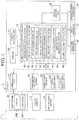
- FIG. 1shows an automated parking system 1 including an automated parking processing apparatus 10 according to the present embodiment.
- the automated parking system 1is a system in which after an occupant gets out of a vehicle 2, the vehicle 2 performs automated traveling from a drop-off position (predetermined position) to a parking space and performs automated entry into the parking space. Moreover, the automated parking system 1 is a system in which in response to a call of the occupant, the vehicle 2 performs automated leaving of the parking space and performs automated traveling to a pick-up position where the occupant previously got out of the vehicle 2.
- the systemis also referred to as so-called "automated valet parking system” and can be used for parking lots, parking spaces, and the like of facilities such as shopping malls, amusement parks, and airports.
- automated travelingrefers to causing the vehicle 2 to travel, to enter the parking space, and to leave the parking space, respectively, without the occupant performing driving operation.
- automated entryrefers to causing the vehicle 2 to travel, to enter the parking space, and to leave the parking space, respectively, without the occupant performing driving operation.
- present inventionis also applicable to roadside parking spaces and the like.
- the automated parking system 1includes the automated parking processing apparatus 10 mounted in the vehicle 2, a smartphone 22 carried by the occupant (user), a center server 5 and a map delivery server 6 that communicate with the automated parking processing apparatus 10.
- the smartphone 22includes a wireless communication circuit that wirelessly communicates with the automated parking processing apparatus 10 from an outside of the vehicle 2.
- the smartphone 22is an example of a portable electronic device that is capable of inputting an operation made by the user to the automated parking processing apparatus 10.
- the smartphone 22includes a touch panel 22A as an operator that receives an operation made by the user (for example, the occupant of the vehicle 2), and a display 22B as a display section that displays various information.
- the smartphone 22may include a gesture detection section that detects a gesture, or the like, as the operator that receives an operation made by the user.
- Each of the center server 5 and the map delivery server 6is a computer that communicates with the automated parking processing apparatus 10 through a telecommunication circuit.
- the center server 5manages a status of entries of vehicles 2 in parking spaces. For example, the center server 5 manages a status of entries of vehicles 2 in parking spaces of a parking lot.
- the map delivery server 6stores a map 70 ( FIG. 4 ) including at least a parking space, and data on an aerial photograph 72 ( FIG. 5 ) including at least the parking space.
- the map delivery server 6transmits the map 70 and the data on the aerial photograph 72 to the automated parking processing apparatus 10, in response to a request from the automated parking processing apparatus 10 of the vehicle 2.
- the automated parking processing apparatus 10is an in-vehicle apparatus that performs automated valet parking control.
- the automated valet parking controlincludes automated entry control and automated leaving control.
- the automated entry controlis control of causing the vehicle 2 to automatically travel from a drop-off position of the occupant to a parking space and to complete automated entry into the parking space.
- the automated leaving controlis control of causing the vehicle 2 to automatically leave the parking space and to automatically travel to the previous drop-off position.
- a destination (predetermined position) of the vehicle 2 by the automated travelingmay be a position designated by the user, or may be a position based on position information on the smartphone 22.
- a communication unit 21, a surroundings detection sensor 24, a vehicle-side sensor 25, a camera 26, a position detection unit 27, and a vehicle control unit 29are connected, through an in-vehicle network (for example, CAN or the like), or directly, to the automated parking processing apparatus 10.
- an in-vehicle networkfor example, CAN or the like
- the communication unit 21includes a wireless communication circuit that relays communication between the automated parking processing apparatus 10 and each of the smartphone 22, the center server 5, and the map delivery server 6.
- a TCUTelematics Control Unit
- the communication unit 21includes a wireless communication circuit that relays communication between the automated parking processing apparatus 10 and each of the smartphone 22, the center server 5, and the map delivery server 6.
- a TCUTelematics Control Unit
- the surroundings detection sensor 24is one or more sensors that sense a position of an obstacle existing around the vehicle 2.
- the sensorinclude a sonar, a radar, and a lidar that can measure a distance to the obstacle by using sound waves, radio waves, electromagnetic waves, light, or the like, and a stereo camera and the like that can measure a distance to the obstacle by using parallax.
- the vehicle-side sensor 25is a collective term for sensors pre-included in the vehicle 2.
- the sensors related to the automated parking system 1are a vehicle speed sensor 25A that senses a vehicle speed of the vehicle 2, and a steering angle sensor 25B that senses a steering angle of the vehicle 2.
- the camera 26functions as a shooting section that shoots surroundings of the vehicle 2 and, in the present embodiment, shoots entire surroundings (360 degrees) centered on the vehicle 2.
- the camera 26includes, for example, four camera devices that shoot a front side of, a left side of, a right side of, and a rear side of the vehicle 2, respectively.
- the camera 26may be a camera device that shoots all directions by using a single camera.
- the camera 26may include any number of cameras that are required to sense the surroundings of the vehicle 2.
- the position detection unit 27is a unit that functions as a position detection section that detects a current position of the vehicle 2.
- the position detection unit 27 in the present embodimentincludes a GNSS (Global Navigation Satellite System) receiver that receives a GNSS signal, and a processor that computes the current position based on the GNSS signal.
- GNSSGlobal Navigation Satellite System
- the vehicle control unit 29is a unit that controls a steering apparatus 30, a drive apparatus 31, and a braking control apparatus 32 that are provided to the vehicle 2.
- the vehicle control unit 29includes a computer (for example, ECU (Electronic Control Unit)) that executes such control.
- the computeris connected, through the in-vehicle network (for example, CAN or the like), or directly, to the steering apparatus 30, the drive apparatus 31, and the braking control apparatus 32.
- the steering apparatus 30is an apparatus including an actuator that causes a steering wheel of the vehicle 2 to steer.
- the drive apparatus 31is an apparatus including an actuator that adjusts driving force of driving wheels of the vehicle 2.
- Such an actuatorcorresponds to a throttle actuator when a power source of the vehicle 2 is an engine, and corresponds to a motor when the power source is the motor.
- the braking control apparatus 32includes an actuator that controls braking force to be applied to wheels of the vehicle 2 by controlling a braking system provided to the vehicle 2, based on information from the automated parking processing apparatus 10.
- the automated parking processing apparatus 10includes a computer (ECU in the present embodiment) that includes a processor such as a CPU (Central Processing Unit) or an MPU (Microprocessor Unit), a memory device (also referred to as main storage device) such as a ROM (Read Only Memory) or a RAM (Random Access Memory), a storage device (also referred to as auxiliary storage device) such as an HDD (Hard Disk Drive) or an SSD (Solid State Drive), an interface circuit for connecting to sensors and peripheral equipment, and an in-vehicle network communication circuit that communicates with another in-vehicle apparatus via the in-vehicle network.
- a processorsuch as a CPU (Central Processing Unit) or an MPU (Microprocessor Unit)
- main storage devicesuch as a ROM (Read Only Memory) or a RAM (Random Access Memory
- a storage devicealso referred to as auxiliary storage device
- HDDHard Disk Drive
- SSDSolid State Drive
- various functional componentsare implemented in such a
- the automated parking processing apparatus 10includes a parking space setting section 40, an automated valet parking control section 42, a notification control section 44, and an information sharing control section 46.
- the parking space setting section 40sets a position of a parking space where the vehicle 2 is to be parked. Any scheme may be used to set the position of the parking space. For example, when available (that is, vacant) parking spaces are managed by the center server 5, the parking space setting section 40 may inquire of the center server 5 about a position of an available parking space, and set the position of the parking space based on a result of the inquiry. For example, the parking space setting section 40 may set the position of the parking space by detecting a position of an available parking space based on a result of detection by the surroundings detection sensor 24 and an image shot by the camera 26. For example, the parking space setting section 40 may set the position of the parking space that is designated by the user through operation of the smartphone 22.
- the automated valet parking control section 42which executes the above-mentioned automated valet parking control in response to user operation of the smartphone 22, includes a position estimation section 50, a map generation section 51, a traveling route setting section 52, a drop-off position storage section 53, and an automated driving control section 54.
- the position estimation section 50estimates a current position (own position) of the vehicle 2, based on a result of sensing by the vehicle-side sensor 25 and a result of detection by the position detection unit 27, by using a publicly known, or well-known, scheme for dead reckoning.
- the own positionis represented by using a two-dimensional local coordinate system that is set based on a position and a yawing angle of the vehicle 2.
- the position estimation section 50generates a local coordinate system at least at a timing before entering a parking lot, and estimates a position of the vehicle 2 in the local coordinate system when estimating the own position. Note that coordinates of the local coordinate system are converted as appropriate into coordinates of an absolute coordinate system that uses a longitude and a latitude or the like by the position estimation section 50, by using a publicly known, or well-known, scheme.
- the map generation section 51generates map data in which an obstacle in a traveling route is recorded on the local coordinate system.
- the obstacleis an appropriate object that hinders or restricts traveling of the vehicle 2. Examples of the obstacle include constructions such as a pillar and a wall, markings such as a pole and a compartment line that demarcate a parking space from a vehicle traveling area, another vehicle, and the like.
- the map generation section 51sequentially records a trajectory of traveling of the vehicle 2 on the local coordinate system, based on the own positions estimated by the position estimation section 50.
- the map generation section 51detects an obstacle around the vehicle 2, based on a result of detection by the surroundings detection sensor 24 and an image shot by the camera 26, and records a position of a point group that forms an outer shape of the obstacle on the local coordinate system.
- the map datais generated in which the trajectory of the traveling of the vehicle 2 from the parking space up to the drop-off position and the point group of the obstacle are presented by using coordinates of the local coordinate system.
- the traveling route setting section 52sets a traveling route between the drop-off position of the occupant and the parking space, based on the map data generated by the map generation section 51, the position of the parking space set by the parking space setting section 40, and the current positions estimated by the position estimation section 50.
- the drop-off position storage section 53stores a current position of the vehicle 2 when the occupant gets out of the vehicle, as the drop-off position. It can be detected that the occupant gets out of the vehicle, by using a publicly known, or well-known, appropriate technique.
- the vehicle-side sensor 25includes a door opening-closing sensor that senses opening and closing of a door of the vehicle 2, or a seat surface pressure sensor that senses pressure on a seat surface of a seat.
- the automated valet parking control section 42can detect that the occupant gets out of the vehicle, by sensing that the door of the vehicle 2 is opened, based on a sensing signal from the door opening-closing sensor.
- the automated valet parking control section 42can detect that the occupant gets out of the vehicle, by sensing that pressure applied on the seat surface of the seat becomes absent, based on a sensing signal from the seat surface pressure sensor. When the automated valet parking control section 42 detects that the occupant gets out of the vehicle, the automated valet parking control section 42 stores the drop-off position in the drop-off position storage section 53, based on the current position of the vehicle 2.
- the automated driving control section 54generates control information for automated traveling, automated entry, and automated leaving, based on the traveling route set by the traveling route setting section 52, and outputs the control information to the vehicle control unit 29. Specifically, at a time of automated entry control that causes the vehicle 2 to automatically enter the parking space, the automated driving control section 54 generates control information related to automated traveling from the drop-off position to the parking space and automated entry into the parking space. At a time of automated leaving control that causes the vehicle 2 to leave the parking space, the automated driving control section 54 generates control information related to automated leaving of the parking space and automated traveling from the parking space to a pick-up position.
- the vehicle control unit 29executes control in accordance with such control information, whereby the vehicle 2 is automatically driven and operated, so that the vehicle accomplishes automated traveling, automated entry, and automated leaving.
- the notification control section 44controls operation for user notification.
- As one of the user notificationat least notification of information related to automated valet parking operation of the vehicle 2 is included.
- the information related to the automated valet parking operationis notified to the user in such a manner that the smartphone 22 displays, on the display 22B, an operation status display screen D that displays a status of the automated valet parking operation of the vehicle 2.
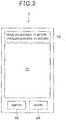
- FIG. 2schematically shows an example of the operation status display screen D.
- a parking position notification display D1As shown in FIG. 2 , a parking position notification display D1, an automated traveling information display D2, a switch button D3, and a share button D4 are provided in the operation status display screen D.
- the parking position notification display D1is a display for notifying the user, by using any one of the map 70 and the aerial photograph 72, of a parking space entered by the vehicle 2 through automated entry and a drop-off position. Specific examples of the parking position notification display D1 will be described later.
- the automated traveling information display D2is a display for notifying the user of information related to automated traveling, and displays a traveling distance and a traveling duration traveled by the vehicle 2 in the automated traveling.
- the switch button D3 and the share button D4are operation buttons that can be operated by the user using the touch panel 22A.
- the switch button D3is operated when the user switches between the map 70 and the aerial photograph 72 used in the parking position notification display D1.
- the smartphone 22transmits, to the automated parking processing apparatus 10, a switching command instructing that a switch be made from the map 70 to the aerial photograph 72, or from the aerial photograph 72 to the map 70.
- the share button D4is operated when the user shares, with another user (for example, a family member, a friend, an acquaintance, or the like), the position of the parking space entered by the vehicle 2 through automated entry.
- the smartphone 22transmits, to the automated parking processing apparatus 10, a sharing command instructing that the position of the parking space be shared.
- the notification control section 44includes a display data generation section 56 that generates display data for the smartphone 22 to display the operation status display screen D.
- the display data generation section 56sequentially generates the display data on the operation status display screen D while the vehicle 2 is performing automated traveling, automated entry, and automated leaving.
- the display data generation section 56transmits the display data to the smartphone 22 and causes the smartphone 22 to display the operation status display screen D.
- the information sharing control section 46executes control of allowing the user to share the position of the parking space entered by the vehicle 2 with another user.
- sharing of parking space position informationis performed by making it possible for a portable electronic device carried by the another user to receive the position of the parking space through an electronic mail or an appropriate SNS (Social Networking Service) app.
- the information sharing control section 46transmits the position of the parking space to an electronic mail account or an SNS app account of the sharing-destination user, whereby the position of the parking space can be shared with the sharing-destination user.
- the information sharing control section 46may acquire the account of the sharing-destination user from an input made by the user into the smartphone 22, or may be acquired from an address book stored in the smartphone 22.
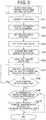
- FIG. 3is a flowchart of automated valet parking processing. Note that FIG. 3 shows the processing when the occupant causes the vehicle 2 to automatically enter a parking space in a parking lot.
- the map generation section 51 of the automated valet parking control section 42sequentially generates map data (step Sa1).
- the automated valet parking control section 42may detect that the vehicle 2 has entered the parking lot, based on information acquired from a navigation system (not shown) included in the vehicle 2, or on an operation made by the user (occupant).
- an automated entry commandis transmitted from the smartphone 22 to the automated parking processing apparatus 10.
- the parking space setting section 40sets a position of a parking space (step Sa3)
- the traveling route setting section 52sets a traveling route from a drop-off position (current position of the vehicle 2) to the parking space (step Sa4).
- the notification control section 44acquires the map 70 and the data on the aerial photograph 72 from the map delivery server 6 (step Sa5).
- the automated driving control section 54generates control information for automated traveling and automated entry, based on the traveling route, and outputs the control information to the vehicle control unit 29, whereby the vehicle 2 starts automated traveling toward the parking space (step Sa6).
- the notification control section 44When the automated traveling of the vehicle 2 is started, the notification control section 44 generates display data on the operation status display screen D, transmits the display data to the smartphone 22, and thus causes the smartphone 22 to display the operation status display screen D (step Sa7).
- the notification control section 44repeats such generation and transmission of display data until entry of the vehicle 2 into the parking space is completed (step Sa8: No).
- the operation status display screen Dis sequentially updated and displayed on the smartphone 22.
- step Sa8the information sharing control section 46 determines whether or not a sharing command is received from the smartphone 22 (step Sa9).
- a sharing commandis received (step Sa9: Yes)
- the information sharing control section 46transmits a position of the parking space to an electronic mail account or an SNS app account of a sharing-destination user (step Sa10).
- the sharing-destination useracquires, through an electronic mail or the SNS app, the position of the parking space entered by the vehicle 2 through the automated entry, and can grasp the position of the parking space.
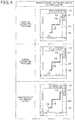
- FIG. 4schematically shows display examples of the parking position notification display D1 in the operation status display screen D. Note that FIG. 4 shows a case of notifying a status of automated entry of the vehicle 2 to the user by using the map 70.
- a drop-off position F3, a parking space position F4 set by the parking space setting section 40, a traveling route F5 by automated traveling, and a vehicle icon F6 indicating a current position of the vehicle 2are displayed, in a superimposed manner, on the map 70 including a parking space of a facility F1 ("XX SHOPPING MALL" in the examples shown) that the vehicle 2 has entered.
- Information related to a vehicle direction (yawing angle) and a traveling directionmay be added to the vehicle icon F6.
- the display data generation section 56 of the notification control section 44generates an image in which the drop-off position F3, the parking space position F4, and the like are superimposed on the map 70, and transmits display data including the image to the smartphone 22.
- the smartphone 22displays the image in an area of the parking position notification display D1 in the operation status display screen D.
- a position of the smartphone 22 at a time of displaying the parking position notification display D1may be displayed in the parking position notification display D1, instead of, or along with, the drop-off position F3.
- the smartphone 22detects the own position, for example, by using a GPS receiver that receives a GPS signal, and transmits the position of the smartphone 22 to the automated parking processing apparatus 10.
- the display data generation section 56generates an image in which the drop-off position F3 or/and the position of the smartphone 22, and the parking space position F4 are superimposed on the map 70, and transmits display data including the image to the smartphone 22.
- the smartphone 22may generate an image in which the drop-off position F3, the parking space position F4, and the like are superimposed on the map 70.
- the display data generation section 56transmits data on the map 70 and data including each of information on the drop-off position F3, information on the parking space position F4, information on the traveling route F5, and information on the current position of the vehicle 2 to the smartphone 22 via the communication unit 21.
- the smartphone 22generates an image in which the drop-off position F3, the parking space position F4, and the like are superimposed on the map 70, based on the information included in the data.
- the smartphone 22may generate an image in which the position of the smartphone 22 is superimposed on the map 70, based on the data and own position information detected by the smartphone 22.
- the automated parking processing apparatus 10does not need to acquire the position information on the smartphone 22 from the smartphone 22, for the parking position notification display D1.
- the vehicle icon F6moves with automated traveling of the vehicle 2, and it is displayed where on the traveling route F5 the vehicle 2 is traveling (a status of automated traveling).
- the parking position notification display D1in which the vehicle icon F6 coincides with the parking space position F4, displays a status where the vehicle 2 has entered the parking space position F4.
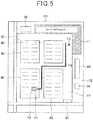
- FIG. 5schematically shows a display example of the parking position notification display D1 in the operation status display screen D.
- FIG. 5shows a case of notifying a status of automated entry of the vehicle 2 to the user by using the aerial photograph 72.
- the aerial photograph 72shows various objects that are not displayed in an ordinary map, such as parking compartment lines 80 in the parking lot F2, entrance and exit gates 82, and various buildings 84 adjacent to the parking lot F2.
- the traveling route F5, and the vehicle icon F6are displayed, in a superimposed manner, on the aerial photograph 72, the user who is present in the parking lot F2 can more accurately grasp the drop-off position F3, the parking space position F4, and a position of the traveling route F5 by comparing a scenery around with the aerial photograph 72.
- the usercan easily grasp a relative positional relationship between the position of the parking space for the vehicle 2 and the smartphone 22 carried by the user.
- the image data on the parking position notification display D1 as described abovemay be transmitted, in place of information (longitude and latitude information) on the position of the parking space.
- the display data generation section 56 of the notification control section 44also generates display data on the operation status display screen D, transmits the display data to the smartphone 22, and thus causes the smartphone 22 to display the operation status display screen D similar to the operation status display screen D at the time of the automated entry.
- the automated parking processing apparatus 10 in the present embodimentcauses the display 22B of the smartphone 22 carried by the user to display the position of the parking space entered by the vehicle 2 through automated entry, and the drop-off position F3 or/and the position of the smartphone 22, in a superimposing manner on the map 70 including the parking space.
- the automated parking processing apparatus 10 in the present embodimentcauses the display 22B of the smartphone 22 carried by the user to display the parking position notification display D1 in which the position of the parking space entered by the vehicle 2 through automated entry, and the drop-off position F3 or/and the position of the smartphone 22 are superimposed on the aerial photograph 72 showing the parking space.
- the usercan easily grasp the relative positional relationship between the parking space and the drop-off position F3, by having a look at the parking position notification display D1.
- the usercan easily find an actual position of the parking space entered by the vehicle 2.
- the position of the smartphone 22is displayed in the parking position notification display D1 instead of, or along with, the drop-off position F3, whereby even when the user is in a building such as the shopping mall and it is therefore difficult for the user to directly see the vehicle, the user can easily grasp the relative positional relationship between the parking space and the smartphone 22 carried by the user, by having a look at the parking position notification display D1.
- the usercan personally go to and smoothly arrive at the vehicle 2, without bothering to cause the vehicle 2 to perform automated leaving.
- the user who is present in the parking lot F2can more accurately grasp the drop-off position F3, the parking space position F4, and the position of the traveling route F5, by comparing a scenery around with the aerial photograph 72.
- the automated parking processing apparatus 10 in the present embodimentcauses the traveling route F5 of the vehicle 2 by automated traveling to be displayed in a manner of being superimposed on the map 70 or the aerial photograph 72, it is easier to grasp an actual position of the parking space entered by the vehicle 2.
- the automated parking processing apparatus 10 in the present embodimentcauses the smartphone 22 to display a traveling distance and a traveling duration traveled by the vehicle 2 in the automated traveling together with the parking position notification display D1, the user can grasp a sense of a distance of the traveling route F5 from the drop-off position to the parking space, based on the traveling distance and the traveling duration.
- the automated parking processing apparatus 10 in the present embodimentallows information on the position of the parking space entered by the vehicle 2 through automated entry to be transmitted to and shared with another user.
- the usercan notify the position of the parking space to not only another user who is an occupant of the vehicle 2, but also a person who is not an occupant, so that such other users can smoothly arrive at the vehicle 2. Accordingly, the user can meet another user at the vehicle 2 that has entered (is parked in) a parking space, or can lend the vehicle 2 that has entered a parking space to another user, without accompanying the another user.
- the smartphone 22, not the automated parking processing apparatus 10may acquire, from the map delivery server 6, and display the map 70 or the aerial photograph 72 for the parking position notification display D1.
- only any one of the traveling distance and the traveling duration traveled by the vehicle 2 in the automated travelingmay be displayed in the automated traveling information display D2 of the operation status display screen D.
- a route length of the traveling route F5 and cardinal pointsmay be displayed in the parking position notification display D1 of the operation status display screen D.
- the map 70 or the aerial photograph 72may include at least the parking space and the drop-off position, or the parking space and the position of the smartphone 22, and it may be arbitrarily set how far surroundings of the parking space are included.
- a map and an aerial photograph that show the surroundings of the parking space in an enlarging mannermay be displayed as appropriate in the parking position notification display D1.
- Blocks depicted in FIG. 1are a schematic diagram in which components are classified according to contents of main processing and shown, to facilitate understanding of the invention of the present application.
- the componentscan be further classified into more components according to contents of processing. Such classification is also possible that one component executes more processing.
- the automated parking processing apparatus 10may integrally include the communication unit 21, the surroundings detection sensor 24, the camera 26, the position detection unit 27, the vehicle control unit 29, and the like, as one unit.
Landscapes
- Engineering & Computer Science (AREA)
- General Physics & Mathematics (AREA)
- Physics & Mathematics (AREA)
- Transportation (AREA)
- Mechanical Engineering (AREA)
- Automation & Control Theory (AREA)
- Remote Sensing (AREA)
- Radar, Positioning & Navigation (AREA)
- Theoretical Computer Science (AREA)
- Multimedia (AREA)
- Chemical & Material Sciences (AREA)
- Combustion & Propulsion (AREA)
- Traffic Control Systems (AREA)
- Instructional Devices (AREA)
- Navigation (AREA)
Abstract
Description
- The present invention relates to an in-vehicle processing apparatus and an in-vehicle processing system.
- Conventionally, there are techniques related to automated parking of a vehicle, and International Publication No.
WO 2017168754 is one of such techniques. International Publication No.WO 2017168754 describes as follows: "The automatic parking system is equipped with: an automatic parking control device (10) for controlling automatic parking of a vehicle which has an automatic driving function; and a portable terminal (20) capable of communicating with the automatic parking control device (10). The automatic parking control device (10) searches for available parking spaces and transmits the search result to the portable terminal (20). Upon receiving the available parking space search result from the automatic parking control device (10), the portable terminal (20) transmits an instruction regarding selection of a parking space to the automatic parking control device (10) on the basis of an operation performed by a user. On the basis of the instruction received from the portable terminal (20), the automatic parking control device (10) selects a target parking space from among the detected available parking spaces and causes the vehicle to automatically park in the target parking space." - However, the technique of International Publication No.
WO 2017168754 has the problem that it is difficult for the user to grasp a position of the parking space where the vehicle is parked. - An object of the present invention is to provide an in-vehicle processing apparatus and an in-vehicle processing system that enable a user to easily grasp a position where a vehicle is parked.
- An aspect of the present invention is an in-vehicle processing apparatus that executes control of causing a vehicle to perform automated traveling from a predetermined position to a parking space and causing the vehicle to perform automated entry into the parking space, including a notification control section that causes a portable electronic device carried by a user to display a parking position notification display in which a position of the parking space entered by the vehicle through the automated entry and the predetermined position are superimposed on an image.
- According to the present invention, a user can easily grasp a position where a vehicle is parked.
FIG. 1 shows an automated parking system including an automated parking processing apparatus according to an embodiment of the present invention;FIG. 2 schematically shows an example of an operation status display screen;FIG. 3 is a flowchart of automated valet parking processing;FIG. 4 shows display examples of a parking position notification display in the operation status display screen; andFIG. 5 schematically shows another display example of the parking position notification display in the operation status display screen.- Hereinafter, an embodiment of the present invention will be described with reference to drawings.
FIG. 1 shows an automated parking system 1 including an automatedparking processing apparatus 10 according to the present embodiment.- The automated parking system 1 is a system in which after an occupant gets out of a
vehicle 2, thevehicle 2 performs automated traveling from a drop-off position (predetermined position) to a parking space and performs automated entry into the parking space. Moreover, the automated parking system 1 is a system in which in response to a call of the occupant, thevehicle 2 performs automated leaving of the parking space and performs automated traveling to a pick-up position where the occupant previously got out of thevehicle 2. The system is also referred to as so-called "automated valet parking system" and can be used for parking lots, parking spaces, and the like of facilities such as shopping malls, amusement parks, and airports. Note that "automated traveling", "automated entry", and "automated leaving" refer to causing thevehicle 2 to travel, to enter the parking space, and to leave the parking space, respectively, without the occupant performing driving operation. Although an example in a parking lot of a facility is described in the present embodiment, the present invention is also applicable to roadside parking spaces and the like. - The automated parking system 1 includes the automated
parking processing apparatus 10 mounted in thevehicle 2, asmartphone 22 carried by the occupant (user), acenter server 5 and amap delivery server 6 that communicate with the automatedparking processing apparatus 10. - The
smartphone 22 includes a wireless communication circuit that wirelessly communicates with the automatedparking processing apparatus 10 from an outside of thevehicle 2. Thesmartphone 22 is an example of a portable electronic device that is capable of inputting an operation made by the user to the automatedparking processing apparatus 10. Thesmartphone 22 includes atouch panel 22A as an operator that receives an operation made by the user (for example, the occupant of the vehicle 2), and adisplay 22B as a display section that displays various information. Note that thesmartphone 22 may include a gesture detection section that detects a gesture, or the like, as the operator that receives an operation made by the user. - Each of the
center server 5 and themap delivery server 6 is a computer that communicates with the automatedparking processing apparatus 10 through a telecommunication circuit. - The
center server 5 manages a status of entries ofvehicles 2 in parking spaces. For example, thecenter server 5 manages a status of entries ofvehicles 2 in parking spaces of a parking lot. - The
map delivery server 6 stores a map 70 (FIG. 4 ) including at least a parking space, and data on an aerial photograph 72 (FIG. 5 ) including at least the parking space. Themap delivery server 6 transmits themap 70 and the data on theaerial photograph 72 to the automatedparking processing apparatus 10, in response to a request from the automatedparking processing apparatus 10 of thevehicle 2. - The automated
parking processing apparatus 10 is an in-vehicle apparatus that performs automated valet parking control. The automated valet parking control includes automated entry control and automated leaving control. The automated entry control is control of causing thevehicle 2 to automatically travel from a drop-off position of the occupant to a parking space and to complete automated entry into the parking space. The automated leaving control is control of causing thevehicle 2 to automatically leave the parking space and to automatically travel to the previous drop-off position. In the automated leaving control, a destination (predetermined position) of thevehicle 2 by the automated traveling may be a position designated by the user, or may be a position based on position information on thesmartphone 22. - A
communication unit 21, asurroundings detection sensor 24, a vehicle-side sensor 25, acamera 26, aposition detection unit 27, and avehicle control unit 29 are connected, through an in-vehicle network (for example, CAN or the like), or directly, to the automatedparking processing apparatus 10. - The
communication unit 21 includes a wireless communication circuit that relays communication between the automatedparking processing apparatus 10 and each of thesmartphone 22, thecenter server 5, and themap delivery server 6. For example, a TCU (Telematics Control Unit) is used for thecommunication unit 21. - The
surroundings detection sensor 24 is one or more sensors that sense a position of an obstacle existing around thevehicle 2. Examples of the sensor include a sonar, a radar, and a lidar that can measure a distance to the obstacle by using sound waves, radio waves, electromagnetic waves, light, or the like, and a stereo camera and the like that can measure a distance to the obstacle by using parallax. - The vehicle-
side sensor 25 is a collective term for sensors pre-included in thevehicle 2. The sensors related to the automated parking system 1 are avehicle speed sensor 25A that senses a vehicle speed of thevehicle 2, and asteering angle sensor 25B that senses a steering angle of thevehicle 2. - The
camera 26 functions as a shooting section that shoots surroundings of thevehicle 2 and, in the present embodiment, shoots entire surroundings (360 degrees) centered on thevehicle 2. Thecamera 26 includes, for example, four camera devices that shoot a front side of, a left side of, a right side of, and a rear side of thevehicle 2, respectively. Thecamera 26 may be a camera device that shoots all directions by using a single camera. Thecamera 26 may include any number of cameras that are required to sense the surroundings of thevehicle 2. - The
position detection unit 27 is a unit that functions as a position detection section that detects a current position of thevehicle 2. Theposition detection unit 27 in the present embodiment includes a GNSS (Global Navigation Satellite System) receiver that receives a GNSS signal, and a processor that computes the current position based on the GNSS signal. - The
vehicle control unit 29 is a unit that controls asteering apparatus 30, adrive apparatus 31, and abraking control apparatus 32 that are provided to thevehicle 2. Thevehicle control unit 29 includes a computer (for example, ECU (Electronic Control Unit)) that executes such control. The computer is connected, through the in-vehicle network (for example, CAN or the like), or directly, to thesteering apparatus 30, thedrive apparatus 31, and thebraking control apparatus 32. - The
steering apparatus 30 is an apparatus including an actuator that causes a steering wheel of thevehicle 2 to steer. - The
drive apparatus 31 is an apparatus including an actuator that adjusts driving force of driving wheels of thevehicle 2. Such an actuator corresponds to a throttle actuator when a power source of thevehicle 2 is an engine, and corresponds to a motor when the power source is the motor. - The
braking control apparatus 32 includes an actuator that controls braking force to be applied to wheels of thevehicle 2 by controlling a braking system provided to thevehicle 2, based on information from the automatedparking processing apparatus 10. - The automated
parking processing apparatus 10 includes a computer (ECU in the present embodiment) that includes a processor such as a CPU (Central Processing Unit) or an MPU (Microprocessor Unit), a memory device (also referred to as main storage device) such as a ROM (Read Only Memory) or a RAM (Random Access Memory), a storage device (also referred to as auxiliary storage device) such as an HDD (Hard Disk Drive) or an SSD (Solid State Drive), an interface circuit for connecting to sensors and peripheral equipment, and an in-vehicle network communication circuit that communicates with another in-vehicle apparatus via the in-vehicle network. In the automatedparking processing apparatus 10, various functional components are implemented in such a manner that the processor executes a computer program stored in the memory device or the storage device. - As such functional components, the automated
parking processing apparatus 10 includes a parkingspace setting section 40, an automated valetparking control section 42, anotification control section 44, and an information sharingcontrol section 46. - The parking
space setting section 40 sets a position of a parking space where thevehicle 2 is to be parked. Any scheme may be used to set the position of the parking space. For example, when available (that is, vacant) parking spaces are managed by thecenter server 5, the parkingspace setting section 40 may inquire of thecenter server 5 about a position of an available parking space, and set the position of the parking space based on a result of the inquiry. For example, the parkingspace setting section 40 may set the position of the parking space by detecting a position of an available parking space based on a result of detection by thesurroundings detection sensor 24 and an image shot by thecamera 26. For example, the parkingspace setting section 40 may set the position of the parking space that is designated by the user through operation of thesmartphone 22. - The automated valet
parking control section 42, which executes the above-mentioned automated valet parking control in response to user operation of thesmartphone 22, includes aposition estimation section 50, amap generation section 51, a travelingroute setting section 52, a drop-offposition storage section 53, and an automateddriving control section 54. - The
position estimation section 50 estimates a current position (own position) of thevehicle 2, based on a result of sensing by the vehicle-side sensor 25 and a result of detection by theposition detection unit 27, by using a publicly known, or well-known, scheme for dead reckoning. In the dead reckoning, the own position is represented by using a two-dimensional local coordinate system that is set based on a position and a yawing angle of thevehicle 2. Theposition estimation section 50 generates a local coordinate system at least at a timing before entering a parking lot, and estimates a position of thevehicle 2 in the local coordinate system when estimating the own position. Note that coordinates of the local coordinate system are converted as appropriate into coordinates of an absolute coordinate system that uses a longitude and a latitude or the like by theposition estimation section 50, by using a publicly known, or well-known, scheme. - The
map generation section 51 generates map data in which an obstacle in a traveling route is recorded on the local coordinate system. The obstacle is an appropriate object that hinders or restricts traveling of thevehicle 2. Examples of the obstacle include constructions such as a pillar and a wall, markings such as a pole and a compartment line that demarcate a parking space from a vehicle traveling area, another vehicle, and the like. After thevehicle 2 enters the parking lot, themap generation section 51 sequentially records a trajectory of traveling of thevehicle 2 on the local coordinate system, based on the own positions estimated by theposition estimation section 50. In addition, themap generation section 51 detects an obstacle around thevehicle 2, based on a result of detection by thesurroundings detection sensor 24 and an image shot by thecamera 26, and records a position of a point group that forms an outer shape of the obstacle on the local coordinate system. Thus, the map data is generated in which the trajectory of the traveling of thevehicle 2 from the parking space up to the drop-off position and the point group of the obstacle are presented by using coordinates of the local coordinate system. - The traveling
route setting section 52 sets a traveling route between the drop-off position of the occupant and the parking space, based on the map data generated by themap generation section 51, the position of the parking space set by the parkingspace setting section 40, and the current positions estimated by theposition estimation section 50. - The drop-off
position storage section 53 stores a current position of thevehicle 2 when the occupant gets out of the vehicle, as the drop-off position. It can be detected that the occupant gets out of the vehicle, by using a publicly known, or well-known, appropriate technique. For example, it is assumed that the vehicle-side sensor 25 includes a door opening-closing sensor that senses opening and closing of a door of thevehicle 2, or a seat surface pressure sensor that senses pressure on a seat surface of a seat. In such a case, the automated valetparking control section 42 can detect that the occupant gets out of the vehicle, by sensing that the door of thevehicle 2 is opened, based on a sensing signal from the door opening-closing sensor. The automated valetparking control section 42 can detect that the occupant gets out of the vehicle, by sensing that pressure applied on the seat surface of the seat becomes absent, based on a sensing signal from the seat surface pressure sensor. When the automated valetparking control section 42 detects that the occupant gets out of the vehicle, the automated valetparking control section 42 stores the drop-off position in the drop-offposition storage section 53, based on the current position of thevehicle 2. - The automated
driving control section 54 generates control information for automated traveling, automated entry, and automated leaving, based on the traveling route set by the travelingroute setting section 52, and outputs the control information to thevehicle control unit 29. Specifically, at a time of automated entry control that causes thevehicle 2 to automatically enter the parking space, the automateddriving control section 54 generates control information related to automated traveling from the drop-off position to the parking space and automated entry into the parking space. At a time of automated leaving control that causes thevehicle 2 to leave the parking space, the automateddriving control section 54 generates control information related to automated leaving of the parking space and automated traveling from the parking space to a pick-up position. - The
vehicle control unit 29 executes control in accordance with such control information, whereby thevehicle 2 is automatically driven and operated, so that the vehicle accomplishes automated traveling, automated entry, and automated leaving. - The
notification control section 44 controls operation for user notification. As one of the user notification, at least notification of information related to automated valet parking operation of thevehicle 2 is included. The information related to the automated valet parking operation is notified to the user in such a manner that thesmartphone 22 displays, on thedisplay 22B, an operation status display screen D that displays a status of the automated valet parking operation of thevehicle 2. FIG. 2 schematically shows an example of the operation status display screen D.- As shown in
FIG. 2 , a parking position notification display D1, an automated traveling information display D2, a switch button D3, and a share button D4 are provided in the operation status display screen D. - The parking position notification display D1 is a display for notifying the user, by using any one of the
map 70 and theaerial photograph 72, of a parking space entered by thevehicle 2 through automated entry and a drop-off position. Specific examples of the parking position notification display D1 will be described later. - The automated traveling information display D2 is a display for notifying the user of information related to automated traveling, and displays a traveling distance and a traveling duration traveled by the
vehicle 2 in the automated traveling. - The switch button D3 and the share button D4 are operation buttons that can be operated by the user using the
touch panel 22A. - The switch button D3 is operated when the user switches between the
map 70 and theaerial photograph 72 used in the parking position notification display D1. When the switch button D3 is operated, thesmartphone 22 transmits, to the automatedparking processing apparatus 10, a switching command instructing that a switch be made from themap 70 to theaerial photograph 72, or from theaerial photograph 72 to themap 70. - The share button D4 is operated when the user shares, with another user (for example, a family member, a friend, an acquaintance, or the like), the position of the parking space entered by the
vehicle 2 through automated entry. When the share button D4 is operated, thesmartphone 22 transmits, to the automatedparking processing apparatus 10, a sharing command instructing that the position of the parking space be shared. - In
FIG. 1 , thenotification control section 44 includes a displaydata generation section 56 that generates display data for thesmartphone 22 to display the operation status display screen D. The displaydata generation section 56 sequentially generates the display data on the operation status display screen D while thevehicle 2 is performing automated traveling, automated entry, and automated leaving. The displaydata generation section 56 transmits the display data to thesmartphone 22 and causes thesmartphone 22 to display the operation status display screen D. - When a sharing command from the
smartphone 22 is received by thecommunication unit 21, the information sharingcontrol section 46 executes control of allowing the user to share the position of the parking space entered by thevehicle 2 with another user. - In the present embodiment, sharing of parking space position information is performed by making it possible for a portable electronic device carried by the another user to receive the position of the parking space through an electronic mail or an appropriate SNS (Social Networking Service) app. In other words, the information sharing
control section 46 transmits the position of the parking space to an electronic mail account or an SNS app account of the sharing-destination user, whereby the position of the parking space can be shared with the sharing-destination user. The information sharingcontrol section 46 may acquire the account of the sharing-destination user from an input made by the user into thesmartphone 22, or may be acquired from an address book stored in thesmartphone 22. FIG. 3 is a flowchart of automated valet parking processing. Note thatFIG. 3 shows the processing when the occupant causes thevehicle 2 to automatically enter a parking space in a parking lot.- When the
vehicle 2 enters the parking lot through driving operation by a driver, at the automatedparking processing apparatus 10, themap generation section 51 of the automated valetparking control section 42 sequentially generates map data (step Sa1). Note that the automated valetparking control section 42 may detect that thevehicle 2 has entered the parking lot, based on information acquired from a navigation system (not shown) included in thevehicle 2, or on an operation made by the user (occupant). - Subsequently, when the occupant gets out of the
vehicle 2 in the parking lot and makes an operation on thesmartphone 22 for instructing thevehicle 2 to perform automated entry, an automated entry command is transmitted from thesmartphone 22 to the automatedparking processing apparatus 10. When the automated entry command is received (step Sa2), the parkingspace setting section 40 sets a position of a parking space (step Sa3), and the travelingroute setting section 52 sets a traveling route from a drop-off position (current position of the vehicle 2) to the parking space (step Sa4). Thenotification control section 44 acquires themap 70 and the data on theaerial photograph 72 from the map delivery server 6 (step Sa5). - The automated
driving control section 54 generates control information for automated traveling and automated entry, based on the traveling route, and outputs the control information to thevehicle control unit 29, whereby thevehicle 2 starts automated traveling toward the parking space (step Sa6). When the automated traveling of thevehicle 2 is started, thenotification control section 44 generates display data on the operation status display screen D, transmits the display data to thesmartphone 22, and thus causes thesmartphone 22 to display the operation status display screen D (step Sa7). Thenotification control section 44 repeats such generation and transmission of display data until entry of thevehicle 2 into the parking space is completed (step Sa8: No). Thus, the operation status display screen D is sequentially updated and displayed on thesmartphone 22. - Thereafter, when the automated entry of the
vehicle 2 into the parking space is completed (step Sa8: Yes), the information sharingcontrol section 46 determines whether or not a sharing command is received from the smartphone 22 (step Sa9). When a sharing command is received (step Sa9: Yes), the information sharingcontrol section 46 transmits a position of the parking space to an electronic mail account or an SNS app account of a sharing-destination user (step Sa10). Thus, the sharing-destination user acquires, through an electronic mail or the SNS app, the position of the parking space entered by thevehicle 2 through the automated entry, and can grasp the position of the parking space. FIG. 4 schematically shows display examples of the parking position notification display D1 in the operation status display screen D. Note thatFIG. 4 shows a case of notifying a status of automated entry of thevehicle 2 to the user by using themap 70.- In the parking position notification display D1, a drop-off position F3, a parking space position F4 set by the parking
space setting section 40, a traveling route F5 by automated traveling, and a vehicle icon F6 indicating a current position of thevehicle 2 are displayed, in a superimposed manner, on themap 70 including a parking space of a facility F1 ("XX SHOPPING MALL" in the examples shown) that thevehicle 2 has entered. Information related to a vehicle direction (yawing angle) and a traveling direction may be added to the vehicle icon F6. - In the present embodiment, at the automated
parking processing apparatus 10, the displaydata generation section 56 of thenotification control section 44 generates an image in which the drop-off position F3, the parking space position F4, and the like are superimposed on themap 70, and transmits display data including the image to thesmartphone 22. Thesmartphone 22 then displays the image in an area of the parking position notification display D1 in the operation status display screen D. - Here, a position of the
smartphone 22 at a time of displaying the parking position notification display D1 may be displayed in the parking position notification display D1, instead of, or along with, the drop-off position F3. - Specifically, the
smartphone 22 detects the own position, for example, by using a GPS receiver that receives a GPS signal, and transmits the position of thesmartphone 22 to the automatedparking processing apparatus 10. - At the automated
parking processing apparatus 10, the displaydata generation section 56 generates an image in which the drop-off position F3 or/and the position of thesmartphone 22, and the parking space position F4 are superimposed on themap 70, and transmits display data including the image to thesmartphone 22. - Note that in place of the display
data generation section 56, thesmartphone 22 may generate an image in which the drop-off position F3, the parking space position F4, and the like are superimposed on themap 70. - In such a case, the display
data generation section 56 transmits data on themap 70 and data including each of information on the drop-off position F3, information on the parking space position F4, information on the traveling route F5, and information on the current position of thevehicle 2 to thesmartphone 22 via thecommunication unit 21. Thesmartphone 22 generates an image in which the drop-off position F3, the parking space position F4, and the like are superimposed on themap 70, based on the information included in the data. - When the parking position notification display D1 includes the position of the
smartphone 22, thesmartphone 22 may generate an image in which the position of thesmartphone 22 is superimposed on themap 70, based on the data and own position information detected by thesmartphone 22. Thus, the automatedparking processing apparatus 10 does not need to acquire the position information on thesmartphone 22 from thesmartphone 22, for the parking position notification display D1. - As shown in
FIG. 4 , in the parking position notification display D1, the vehicle icon F6 moves with automated traveling of thevehicle 2, and it is displayed where on the traveling route F5 thevehicle 2 is traveling (a status of automated traveling). When automated entry into the parking space is completed, the parking position notification display D1, in which the vehicle icon F6 coincides with the parking space position F4, displays a status where thevehicle 2 has entered the parking space position F4. - When the switch button D3 (
FIG. 2 ) is operated by the user in the operation status display screen D and a switching command based on the operation is received by thenotification control section 44, display data in which themap 70 is switched to theaerial photograph 72 in the parking position notification display D1 is displayed on thesmartphone 22. FIG. 5 schematically shows a display example of the parking position notification display D1 in the operation status display screen D.FIG. 5 shows a case of notifying a status of automated entry of thevehicle 2 to the user by using theaerial photograph 72.- The
aerial photograph 72 shows various objects that are not displayed in an ordinary map, such asparking compartment lines 80 in the parking lot F2, entrance andexit gates 82, andvarious buildings 84 adjacent to the parking lot F2. - Since the drop-off position F3, the parking space position F4, the traveling route F5, and the vehicle icon F6 are displayed, in a superimposed manner, on the
aerial photograph 72, the user who is present in the parking lot F2 can more accurately grasp the drop-off position F3, the parking space position F4, and a position of the traveling route F5 by comparing a scenery around with theaerial photograph 72. - Moreover, by displaying the position of the
smartphone 22 in the parking position notification display D1 instead of, or along with, the drop-off position F3 as described above, the user can easily grasp a relative positional relationship between the position of the parking space for thevehicle 2 and thesmartphone 22 carried by the user. - Note that when the information sharing
control section 46 transmits the position of the parking space to an electronic mail account or an SNS app account of a sharing-destination user, the image data on the parking position notification display D1 as described above may be transmitted, in place of information (longitude and latitude information) on the position of the parking space. - When the automated
parking processing apparatus 10 causes thevehicle 2 to perform automated leaving of the parking space and automated traveling to the drop-off position, the displaydata generation section 56 of thenotification control section 44 also generates display data on the operation status display screen D, transmits the display data to thesmartphone 22, and thus causes thesmartphone 22 to display the operation status display screen D similar to the operation status display screen D at the time of the automated entry. - According to the above-described embodiment, following effects are obtained.
- The automated
parking processing apparatus 10 in the present embodiment causes thedisplay 22B of thesmartphone 22 carried by the user to display the position of the parking space entered by thevehicle 2 through automated entry, and the drop-off position F3 or/and the position of thesmartphone 22, in a superimposing manner on themap 70 including the parking space. - The automated
parking processing apparatus 10 in the present embodiment causes thedisplay 22B of thesmartphone 22 carried by the user to display the parking position notification display D1 in which the position of the parking space entered by thevehicle 2 through automated entry, and the drop-off position F3 or/and the position of thesmartphone 22 are superimposed on theaerial photograph 72 showing the parking space. - Accordingly, even if the parking lot is so large that it is difficult to grasp the parking space, or even if so many vehicles are parked in the parking lot that it is difficult to find the
own vehicle 2, the user can easily grasp the relative positional relationship between the parking space and the drop-off position F3, by having a look at the parking position notification display D1. Thus, the user can easily find an actual position of the parking space entered by thevehicle 2. - Moreover, the position of the
smartphone 22 is displayed in the parking position notification display D1 instead of, or along with, the drop-off position F3, whereby even when the user is in a building such as the shopping mall and it is therefore difficult for the user to directly see the vehicle, the user can easily grasp the relative positional relationship between the parking space and thesmartphone 22 carried by the user, by having a look at the parking position notification display D1. - Accordingly, in a scenario where the user places goods purchased at the facility in the vehicle and then goes to the facility again for shopping or the like, the user can personally go to and smoothly arrive at the
vehicle 2, without bothering to cause thevehicle 2 to perform automated leaving. - By using the
aerial photograph 72, the user who is present in the parking lot F2 can more accurately grasp the drop-off position F3, the parking space position F4, and the position of the traveling route F5, by comparing a scenery around with theaerial photograph 72. - Since the automated
parking processing apparatus 10 in the present embodiment causes the traveling route F5 of thevehicle 2 by automated traveling to be displayed in a manner of being superimposed on themap 70 or theaerial photograph 72, it is easier to grasp an actual position of the parking space entered by thevehicle 2. - Since the automated
parking processing apparatus 10 in the present embodiment causes thesmartphone 22 to display a traveling distance and a traveling duration traveled by thevehicle 2 in the automated traveling together with the parking position notification display D1, the user can grasp a sense of a distance of the traveling route F5 from the drop-off position to the parking space, based on the traveling distance and the traveling duration. - The automated
parking processing apparatus 10 in the present embodiment allows information on the position of the parking space entered by thevehicle 2 through automated entry to be transmitted to and shared with another user. - Thus, the user can notify the position of the parking space to not only another user who is an occupant of the
vehicle 2, but also a person who is not an occupant, so that such other users can smoothly arrive at thevehicle 2. Accordingly, the user can meet another user at thevehicle 2 that has entered (is parked in) a parking space, or can lend thevehicle 2 that has entered a parking space to another user, without accompanying the another user. - The above-described embodiment only illustrates one aspect of the present invention, and modifications and applications can be made arbitrarily without departing from the gist of the present invention.
- In the above-described embodiment, the
smartphone 22, not the automatedparking processing apparatus 10, may acquire, from themap delivery server 6, and display themap 70 or theaerial photograph 72 for the parking position notification display D1. - In the above-described embodiment, only any one of the traveling distance and the traveling duration traveled by the
vehicle 2 in the automated traveling may be displayed in the automated traveling information display D2 of the operation status display screen D. - In the above-described embodiment, a route length of the traveling route F5 and cardinal points may be displayed in the parking position notification display D1 of the operation status display screen D.
- The
map 70 or theaerial photograph 72 may include at least the parking space and the drop-off position, or the parking space and the position of thesmartphone 22, and it may be arbitrarily set how far surroundings of the parking space are included. - A map and an aerial photograph that show the surroundings of the parking space in an enlarging manner may be displayed as appropriate in the parking position notification display D1.
- Blocks depicted in
FIG. 1 are a schematic diagram in which components are classified according to contents of main processing and shown, to facilitate understanding of the invention of the present application. The components can be further classified into more components according to contents of processing. Such classification is also possible that one component executes more processing. - In
FIG. 1 , the automatedparking processing apparatus 10 may integrally include thecommunication unit 21, thesurroundings detection sensor 24, thecamera 26, theposition detection unit 27, thevehicle control unit 29, and the like, as one unit. - 1 Automated parking system (in-vehicle processing system)
- 2 Vehicle
- 6 Map delivery server
- 10 Automated parking processing apparatus (in-vehicle processing apparatus)
- 21 Communication unit
- 22 Smartphone (portable electronic device)
- 40 Parking space setting section
- 42 Automated valet parking control section
- 44 Notification control section
- 46 Information sharing control section
- 70 Map
- 72 Aerial photograph
- D Operation status display screen
- D1 Parking position notification display
- D2 Automated traveling information display
- D3 Switch button
- D4 Share button
- F2 Parking lot
- F3 Drop-off position
- F4 Parking space position
- F5 Traveling route
- F6 Vehicle icon
Claims (7)
- An in-vehicle processing apparatus that executes control of causing a vehicle (2) to perform automated traveling from a predetermined position to a parking space and causing the vehicle to perform automated entry into the parking space,characterized by comprising
a notification control section (44) that causes a portable electronic device (22) carried by a user to display a parking position notification display (D1) in which a position of the parking space entered by the vehicle through the automated entry and the predetermined position are superimposed on an image. - The in-vehicle processing apparatus according to claim 1, wherein the image is a map (70).
- The in-vehicle processing apparatus according to claim 1, wherein the image is an aerial photograph (72).
- The in-vehicle processing apparatus according to claim 1, wherein the notification control section causes the portable electronic device to display the parking position notification display in which a traveling route (F5) of the vehicle by the automated traveling between the predetermined position and the parking space is superimposed on the image.
- The in-vehicle processing apparatus according to claim 1, wherein the notification control section causes the portable electronic device to display at least one of a traveling distance and a traveling duration traveled by the vehicle in the automated traveling, together with the parking position notification display in which the position of the parking space entered by the vehicle through the automated entry and the predetermined position are superimposed on the image.
- The in-vehicle processing apparatus according to any one of claims 1 to 3, further comprising an information sharing control section (46) that allows information on the position of the parking space to be shared with another user.
- An in-vehicle processing system, comprising:a communication unit (21) that communicates with a portable electronic device (22) carried by a user; andan in-vehicle processing apparatus (10) that executes control of causing a vehicle (2) to perform automated traveling from a predetermined position to a parking space and causing the vehicle to perform automated entry into the parking space,characterized in that the in-vehicle processing apparatus includes a notification control section (44) that communicates with the portable electronic device via the communication unit and causes the portable electronic device carried by the user to display a parking position notification display (D1) in which a position of the parking space entered ty the vehicle through the automated entry and the predetermined position are superimposed on an image.
Applications Claiming Priority (1)
| Application Number | Priority Date | Filing Date | Title |
|---|---|---|---|
| JP2019235571AJP7372144B2 (en) | 2019-12-26 | 2019-12-26 | In-vehicle processing equipment and in-vehicle processing systems |
Publications (1)
| Publication Number | Publication Date |
|---|---|
| EP3842321A1true EP3842321A1 (en) | 2021-06-30 |
Family
ID=73543964
Family Applications (1)
| Application Number | Title | Priority Date | Filing Date |
|---|---|---|---|
| EP20208307.7APendingEP3842321A1 (en) | 2019-12-26 | 2020-11-18 | In-vehicle processing apparatus and in-vehicle processing system |
Country Status (3)
| Country | Link |
|---|---|
| US (1) | US11358592B2 (en) |
| EP (1) | EP3842321A1 (en) |
| JP (1) | JP7372144B2 (en) |
Families Citing this family (2)
| Publication number | Priority date | Publication date | Assignee | Title |
|---|---|---|---|---|
| JP7505927B2 (en)* | 2020-06-18 | 2024-06-25 | フォルシアクラリオン・エレクトロニクス株式会社 | In-vehicle device and control method |
| EP4401061A4 (en)* | 2021-09-24 | 2025-01-22 | Shenzhen Yinwang Intelligent Technologies Co., Ltd. | METHOD AND DEVICE FOR AUTOMATED PARKING OF VALUABLES |
Citations (5)
| Publication number | Priority date | Publication date | Assignee | Title |
|---|---|---|---|---|
| US20120188100A1 (en)* | 2011-01-25 | 2012-07-26 | Electronics And Telecommunications Research Institute | Terminal, apparatus and method for providing customized auto-valet parking service |
| US20160362103A1 (en)* | 2015-05-20 | 2016-12-15 | Volkswagen Ag | Method for providing user-defined customization of a vehicle |
| WO2017168754A1 (en) | 2016-04-01 | 2017-10-05 | 三菱電機株式会社 | Automatic parking system, automatic parking control device, and automatic parking control method |
| TW201824812A (en)* | 2016-12-30 | 2018-07-01 | 笠眾實業有限公司 | Smart vehicle electronic key system including a cloud server, a first user device, a second user device, and a vehicle control host |
| KR20190084916A (en)* | 2019-06-28 | 2019-07-17 | 엘지전자 주식회사 | Apparatus for informing parking position and method thereof |
Family Cites Families (8)
| Publication number | Priority date | Publication date | Assignee | Title |
|---|---|---|---|---|
| JP5857224B2 (en)* | 2012-03-30 | 2016-02-10 | パナソニックIpマネジメント株式会社 | Parking assistance device and parking assistance method |
| JP2015105833A (en) | 2013-11-28 | 2015-06-08 | 本田技研工業株式会社 | Route search system |
| JP6354542B2 (en) | 2014-11-26 | 2018-07-11 | 株式会社デンソー | Automatic vehicle driving system |
| US9704392B2 (en) | 2014-12-02 | 2017-07-11 | Operr Technologies, Inc. | Method and system for legal parking |
| JP2017140890A (en)* | 2016-02-09 | 2017-08-17 | ソニー株式会社 | Information processing device, information processing method, and program |
| JP6838211B2 (en) | 2017-07-31 | 2021-03-03 | 日立Astemo株式会社 | Autonomous driving control device, autonomous mobile vehicle and autonomous mobile vehicle control system |
| JP2019109632A (en)* | 2017-12-15 | 2019-07-04 | トヨタ自動車株式会社 | Management device for designated parking service, representative terminal, method for management, and program |
| KR20200056497A (en)* | 2018-11-09 | 2020-05-25 | 현대자동차주식회사 | Automated Valet Parking System, and infrastructure and vehicle thereof |
- 2019
- 2019-12-26JPJP2019235571Apatent/JP7372144B2/enactiveActive
- 2020
- 2020-11-18EPEP20208307.7Apatent/EP3842321A1/enactivePending
- 2020-11-19USUS16/952,326patent/US11358592B2/enactiveActive
Patent Citations (5)
| Publication number | Priority date | Publication date | Assignee | Title |
|---|---|---|---|---|
| US20120188100A1 (en)* | 2011-01-25 | 2012-07-26 | Electronics And Telecommunications Research Institute | Terminal, apparatus and method for providing customized auto-valet parking service |
| US20160362103A1 (en)* | 2015-05-20 | 2016-12-15 | Volkswagen Ag | Method for providing user-defined customization of a vehicle |
| WO2017168754A1 (en) | 2016-04-01 | 2017-10-05 | 三菱電機株式会社 | Automatic parking system, automatic parking control device, and automatic parking control method |
| TW201824812A (en)* | 2016-12-30 | 2018-07-01 | 笠眾實業有限公司 | Smart vehicle electronic key system including a cloud server, a first user device, a second user device, and a vehicle control host |
| KR20190084916A (en)* | 2019-06-28 | 2019-07-17 | 엘지전자 주식회사 | Apparatus for informing parking position and method thereof |
Also Published As
| Publication number | Publication date |
|---|---|
| JP7372144B2 (en) | 2023-10-31 |
| JP2021105754A (en) | 2021-07-26 |
| US20210197800A1 (en) | 2021-07-01 |
| US11358592B2 (en) | 2022-06-14 |
Similar Documents
| Publication | Publication Date | Title |
|---|---|---|
| US12090956B2 (en) | Vehicle and program for vehicle | |
| JP6561357B2 (en) | Vehicle control system, vehicle control method, and vehicle control program | |
| US11926313B2 (en) | In-vehicle device and control method | |
| US20220274588A1 (en) | Method for automatically parking a vehicle | |
| US20190228664A1 (en) | Vehicle calling system | |
| JP7233426B2 (en) | Parking assistance system and parking assistance device | |
| JP2017067466A (en) | Parking support device | |
| WO2018083778A1 (en) | Vehicle control system, vehicle control method, and vehicle control program | |
| EP3730353A1 (en) | Parking control method and parking control device | |
| US11181386B2 (en) | Navigation device, destination guiding system, and non-transitory recording medium | |
| CN111009116A (en) | Driving support device, driving support system, driving support method, and storage medium | |
| US11358592B2 (en) | In-vehicle processing apparatus and in-vehicle processing system | |
| CN117373275A (en) | Method and device for determining parking position | |
| JPWO2020157785A1 (en) | Automatic driving instruction device and automatic driving instruction method | |
| JP2020149233A (en) | Vehicle control system, vehicle control method, and program | |
| CN113470422A (en) | Housing area management device | |
| US11113968B2 (en) | Method for mobile parking assistance | |
| JP2021144593A (en) | Parking information management server, parking support device and parking support system | |
| US20200049519A1 (en) | Autonomous valet service apparatus and method | |
| CN114964294A (en) | Navigation method, navigation device, storage medium, electronic equipment, chip and vehicle | |
| JP2018081623A (en) | Vehicle control system, vehicle control method, and vehicle control program | |
| JP7560593B2 (en) | Control system, control method, and program | |
| JP2021162959A (en) | Accommodation area management apparatus | |
| CN110301133B (en) | Information processing apparatus, information processing method, and computer-readable recording medium | |
| CN113168773A (en) | Moving body control apparatus, moving body control method, moving body, information processing apparatus, information processing method, and program |
Legal Events
| Date | Code | Title | Description |
|---|---|---|---|
| PUAI | Public reference made under article 153(3) epc to a published international application that has entered the european phase | Free format text:ORIGINAL CODE: 0009012 | |
| STAA | Information on the status of an ep patent application or granted ep patent | Free format text:STATUS: REQUEST FOR EXAMINATION WAS MADE | |
| 17P | Request for examination filed | Effective date:20201118 | |
| AK | Designated contracting states | Kind code of ref document:A1 Designated state(s):AL AT BE BG CH CY CZ DE DK EE ES FI FR GB GR HR HU IE IS IT LI LT LU LV MC MK MT NL NO PL PT RO RS SE SI SK SM TR | |
| STAA | Information on the status of an ep patent application or granted ep patent | Free format text:STATUS: EXAMINATION IS IN PROGRESS | |
| 17Q | First examination report despatched | Effective date:20220324 | |
| GRAP | Despatch of communication of intention to grant a patent | Free format text:ORIGINAL CODE: EPIDOSNIGR1 | |
| STAA | Information on the status of an ep patent application or granted ep patent | Free format text:STATUS: GRANT OF PATENT IS INTENDED | |
| RIC1 | Information provided on ipc code assigned before grant | Ipc:B62D 15/02 20060101AFI20250709BHEP Ipc:G08G 1/14 20060101ALI20250709BHEP Ipc:G01C 21/36 20060101ALI20250709BHEP Ipc:G01C 21/16 20060101ALI20250709BHEP Ipc:B60W 30/06 20060101ALI20250709BHEP | |
| INTG | Intention to grant announced | Effective date:20250725 | |
| GRAS | Grant fee paid | Free format text:ORIGINAL CODE: EPIDOSNIGR3 |