EP3841968A1 - Method, system, and computer program product for improving the accuracy of glucose sensors using insulin delivery observation in diabetes - Google Patents
Method, system, and computer program product for improving the accuracy of glucose sensors using insulin delivery observation in diabetesDownload PDFInfo
- Publication number
- EP3841968A1 EP3841968A1EP21157923.0AEP21157923AEP3841968A1EP 3841968 A1EP3841968 A1EP 3841968A1EP 21157923 AEP21157923 AEP 21157923AEP 3841968 A1EP3841968 A1EP 3841968A1
- Authority
- EP
- European Patent Office
- Prior art keywords
- cgs
- output
- glucose
- readout
- insulin
- Prior art date
- Legal status (The legal status is an assumption and is not a legal conclusion. Google has not performed a legal analysis and makes no representation as to the accuracy of the status listed.)
- Granted
Links
Images




Classifications
- A—HUMAN NECESSITIES
- A61—MEDICAL OR VETERINARY SCIENCE; HYGIENE
- A61B—DIAGNOSIS; SURGERY; IDENTIFICATION
- A61B5/00—Measuring for diagnostic purposes; Identification of persons
- A61B5/145—Measuring characteristics of blood in vivo, e.g. gas concentration or pH-value ; Measuring characteristics of body fluids or tissues, e.g. interstitial fluid or cerebral tissue
- A61B5/14532—Measuring characteristics of blood in vivo, e.g. gas concentration or pH-value ; Measuring characteristics of body fluids or tissues, e.g. interstitial fluid or cerebral tissue for measuring glucose, e.g. by tissue impedance measurement
- A—HUMAN NECESSITIES
- A61—MEDICAL OR VETERINARY SCIENCE; HYGIENE
- A61B—DIAGNOSIS; SURGERY; IDENTIFICATION
- A61B5/00—Measuring for diagnostic purposes; Identification of persons
- A61B5/145—Measuring characteristics of blood in vivo, e.g. gas concentration or pH-value ; Measuring characteristics of body fluids or tissues, e.g. interstitial fluid or cerebral tissue
- A61B5/1495—Calibrating or testing of in-vivo probes
- A—HUMAN NECESSITIES
- A61—MEDICAL OR VETERINARY SCIENCE; HYGIENE
- A61B—DIAGNOSIS; SURGERY; IDENTIFICATION
- A61B5/00—Measuring for diagnostic purposes; Identification of persons
- A61B5/48—Other medical applications
- A61B5/4836—Diagnosis combined with treatment in closed-loop systems or methods
- A61B5/4839—Diagnosis combined with treatment in closed-loop systems or methods combined with drug delivery
- A—HUMAN NECESSITIES
- A61—MEDICAL OR VETERINARY SCIENCE; HYGIENE
- A61B—DIAGNOSIS; SURGERY; IDENTIFICATION
- A61B5/00—Measuring for diagnostic purposes; Identification of persons
- A61B5/72—Signal processing specially adapted for physiological signals or for diagnostic purposes
- A61B5/7225—Details of analogue processing, e.g. isolation amplifier, gain or sensitivity adjustment, filtering, baseline or drift compensation
- A—HUMAN NECESSITIES
- A61—MEDICAL OR VETERINARY SCIENCE; HYGIENE
- A61B—DIAGNOSIS; SURGERY; IDENTIFICATION
- A61B5/00—Measuring for diagnostic purposes; Identification of persons
- A61B5/72—Signal processing specially adapted for physiological signals or for diagnostic purposes
- A61B5/7235—Details of waveform analysis
- A61B5/725—Details of waveform analysis using specific filters therefor, e.g. Kalman or adaptive filters
- A—HUMAN NECESSITIES
- A61—MEDICAL OR VETERINARY SCIENCE; HYGIENE
- A61M—DEVICES FOR INTRODUCING MEDIA INTO, OR ONTO, THE BODY; DEVICES FOR TRANSDUCING BODY MEDIA OR FOR TAKING MEDIA FROM THE BODY; DEVICES FOR PRODUCING OR ENDING SLEEP OR STUPOR
- A61M1/00—Suction or pumping devices for medical purposes; Devices for carrying-off, for treatment of, or for carrying-over, body-liquids; Drainage systems
- A61M1/36—Other treatment of blood in a by-pass of the natural circulatory system, e.g. temperature adaptation, irradiation ; Extra-corporeal blood circuits
- A—HUMAN NECESSITIES
- A61—MEDICAL OR VETERINARY SCIENCE; HYGIENE
- A61M—DEVICES FOR INTRODUCING MEDIA INTO, OR ONTO, THE BODY; DEVICES FOR TRANSDUCING BODY MEDIA OR FOR TAKING MEDIA FROM THE BODY; DEVICES FOR PRODUCING OR ENDING SLEEP OR STUPOR
- A61M5/00—Devices for bringing media into the body in a subcutaneous, intra-vascular or intramuscular way; Accessories therefor, e.g. filling or cleaning devices, arm-rests
- A61M5/14—Infusion devices, e.g. infusing by gravity; Blood infusion; Accessories therefor
- A61M5/142—Pressure infusion, e.g. using pumps
- A—HUMAN NECESSITIES
- A61—MEDICAL OR VETERINARY SCIENCE; HYGIENE
- A61B—DIAGNOSIS; SURGERY; IDENTIFICATION
- A61B2560/00—Constructional details of operational features of apparatus; Accessories for medical measuring apparatus
- A61B2560/02—Operational features
- A61B2560/0223—Operational features of calibration, e.g. protocols for calibrating sensors
Definitions
- the present inventionrelates generally to the field of medical devices to be used as glucose sensors. More specifically, the invention is in the subfield of glucose sensors and other tools to be used for monitoring glucose levels of a subject.
- Continuous glucose sensorsoffer the potential to markedly change our understanding of glucose homeostasis in health and disease, and to provide the missing information required to achieve near-normoglycemia among persons with both Type 1 and Type 2 diabetes.
- CGScontinuous glucose sensors
- Their potential to assist patients and their families in day-to-day decision-making, to warn of impending hypoglycemia and to reduce the fear of its occurrencehas yet to be fully appreciated.
- An aspect of an embodiment of the present inventionfocuses, for the first time, on the signal from an insulin pump, artificial pancreas, or another insulin delivery device as a source of information for improvement of the accuracy of the CGS that is coupled with an insulin pump, artificial pancreas, or another insulin delivery device.
- the effect of using insulin information to enhance sensor accuracyis most prominent at low blood glucose levels (where the sensor has been shown to be the most inaccurate), i.e., in the hypoglycemic range, which is critical for any treatment.
- Another aspect of an embodiment of the inventionis the use of a filtering/state estimation procedure, such as a Kalman Filter methodology, H-infinity filtering method, a Bayesian filtering method, a Monte Carlo method, or a least squares method, to determine a metabolic state estimate, of which the blood glucose state is a component, at time t- ⁇ .
- a filtering/state estimation proceduresuch as a Kalman Filter methodology, H-infinity filtering method, a Bayesian filtering method, a Monte Carlo method, or a least squares method
- Another aspect of an embodiment of the inventionis the use of the metabolic state estimate at time t- ⁇ to infer the metabolic state estimate at time t given the metabolic state estimate and insulin information up to time t- ⁇ .
- Another aspect of an embodiment of the inventionis the extraction of the blood glucose component from the metabolic state estimate.
- Another aspect of an embodiment of the inventionis the use of a weighting scheme to weight the information from the CGS and the blood glucose component of the metabolic state estimate.
- the weightscan be determined in many ways. In one embodiment of the invention, more weight is given to the KF glucose estimate during hypoglycemia and more weight is given to the CGS reading during euglycemia and hyperglycemia in accordance with the low BG index.
- the weighting schemeaccounts directly for the lack of accuracy of the Kalman Filter state estimate immediately following meals and meal insulin boluses.
- the CGS measurementis generally more accurate than the Kalman Filter state estimate, since the model at the core of the state estimation procedure does not assume knowledge of meal timing and meal amounts.
- Another aspect of an embodiment of the inventionis a processor configured to perform the required calculations, wherein the processor can be implemented in the CGS, the device providing the insulin, or in a separate device (or implemented integrally among two or more of the CGS, insulin device or a separate device).
- An aspect of an embodiment of the present inventionprovides a method for improving the accuracy of a glucose measurement device.
- the methodmay comprise: using insulin delivery information to improve the accuracy of the glucose measurement device.
- An aspect of an embodiment of the present inventionprovides a system for improving the accuracy of a glucose measurement device.
- the glucose measurement devicemay use insulin delivery information to improve the accuracy of the glucose measurement device.
- An aspect of an embodiment of the present inventionprovides a computer program product comprising a computer useable medium having a computer program logic for enabling at least one processor in a computer system for improving the accuracy of a glucose measurement device.
- the computer program logicmay comprise: using insulin delivery information or data to improve the accuracy of the glucose measurement device.
- a subjectmay be a human or any animal. It should be appreciated that an animal may be a variety of any applicable type, including, but not limited thereto, mammal, veterinarian animal, livestock animal or pet type animal, etc. As an example, the animal may be a laboratory animal specifically selected to have certain characteristics similar to human (e.g. rat, dog, pig, monkey), etc. It should be appreciated that the subject may be any applicable human patient, for example. Use of the term "patient" to describe various subjects herein below should be understood to be exemplary only. It should be understood that the systems and method discussed can apply to any subject.
- An aspect of an embodiment of the present invention methodprovides, but not limited thereto, the following steps:
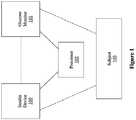
- a processor 102communicates with the glucose monitor 101 and the insulin device 100.
- the glucose monitor 101 and the insulin device 100communicate with the subject 103 to monitor glucose levels of the subject 103 and delivery insulin to the subject 103, respectively.
- the processor 102is configured to perform the required calculations.
- the glucose monitor 101 and the insulin device 100may be implemented as a separate device or as a single device.
- the processor 102can be implemented locally in the glucose monitor 101, the insulin device 100, or a standalone device (or in any combination of two or more of the glucose monitor, insulin device, or a stand along device).
- the processor 102 or a portion of the systemcan be located remotely such that the device is operated as a telemedicine device.
- Step 1The Metabolic State Observer and Prediction Module works as follows: Predictions are derived from a state space model of glucose-insulin interactions, as characterized by a vector of metabolic states including both insulin and glucose states in various compartments of the body. The state space model allows for predictions of metabolic states in the future. Since interstitial glucose concentration measurable via CGS are subject to sensor noise and some states of x ( t ) are not measurable, it is impossible to have perfect knowledge of the state vector x ( t ) , making it necessary to compute an estimate x ⁇ ( t ) of x ( t ) based on all available information: (1) delivered insulin J ctrl ( t ) and (2) CGS measurements of interstitial glucose concentration CGS ( t ).
- the CGS measurements of interstitial glucose concentration CGS(t)include readouts that come at certain intervals.
- the intervalcan be 60 minutes, 30 minutes, 15 minutes, or anything in between, above, or below. It should be appreciated that intervals may vary and can be omitted as desired or required.
- Step 1.1the state space model, which can be Kalman Filter methodology, H-infinity filtering method, a Bayesian filtering method, a Monte Carlo method, or a least squares method, from which BG values are predicted
- Step 1.2the first intermediary computation which includes an algorithmic module responsible for computing state vector estimates x ⁇ ( t ), which we refer to as the "metabolic state estimate.”
- the output of the first intermediary computationis x ⁇ ( t - ⁇ ).
- Step 1.1Glucose State Estimate based on the following State Space Model:
- Step 1.2Glucose State Estimate is then produced as follows:
- Step 2BG Prediction
- a second intermediary computationis performed.
- This prediction 2 as shown in Figure 2uses the output of the first intermediary computation to predict the output of the second intermediary computation.
- the output of the second intermediary computationis BG(t
- Predictionsare derived from the latest estimate of the metabolic state of the patient x ⁇ ( t - ⁇ ) extrapolated to some future time t (where we can think of ⁇ as the time lag, in minutes, associated with the CGS signal because while the CGS signal is a measurement at time t, the actual output of CGS represents a measurement at time t- ⁇ ), assuming that all inputs are held at their steady state values: x ⁇ t
- t ⁇ ⁇A ⁇ x ⁇ t ⁇ + A ⁇ Bu t ⁇ ⁇ + A ⁇ G ⁇ t ⁇ ⁇ , where:
- weights w 1 and w 2are one that accounts directly for the lack of accuracy of the Kalman Filter state estimate x ⁇ ( t ) immediately following meals and meal insulin boluses.
- the CGS measurementis generally more accurate than the Kalman Filter state estimate, since the model at the core of the state estimation procedure does not assume knowledge of meal timing and meal amounts.
- a weighting schemethat places more weight ( w 2 ⁇ 1) on the CGS measurement signal in the time following the detection of a large bolus of insulin that is typically associated with a meal.
- FIG. 5is a functional block diagram for a computer system 300 for implementation of an exemplary embodiment or portion of an embodiment of present invention.
- a method or system of an embodiment of the present inventionmay be implemented using hardware, software or a combination thereof and may be implemented in one or more computer systems or other processing systems, such as personal digit assistants (PDAs) equipped with adequate memory and processing capabilities.
- PDAspersonal digit assistants
- the inventionwas implemented in software running on a general purpose computer 30 as illustrated in Figure 5 .
- the invention callalso be implemented on a microcontroller or using a processor that is located in the CGS monitor, insulin pump or other insulin delivery device, or as a standalone component (or a combination of two or more of the CGS monitor, insulin pump or other insulin delivery device, or stand alone component).
- the computer system 300may includes one or more processors, such as processor 304.
- the Processor 304is connected to a communication infrastructure 306 (e.g., a communications bus, cross-over bar, direct connection, or network).
- the computer system 300may include a display interface 302 that forwards graphics, text, and/or other data from the communication infrastructure 306 (or from a frame buffer not shown) for display on the display unit 330.
- Display unit 330may be digital and/or analog.
- the computer system 300may also include a main memory 308, preferably random access memory (RAM), and may also include a secondary memory 310.
- the secondary memory 310may include, for example, a hard disk drive 312 and/or a removable storage drive 314, representing a floppy disk drive, a magnetic tape drive, an optical disk drive, a flash memory, etc.
- the removable storage drive 314reads from and/or writes to a removable storage unit 318 in a well known manner.
- Removable storage unit 318represents a floppy disk, magnetic tape, optical disk, etc. which is read by and written to by removable storage drive 314.
- the removable storage unit 318includes a computer usable storage medium having stored therein computer software and/or data.
- secondary memory 310may include other means for allowing computer programs or other instructions to be loaded into computer system 300.
- Such meansmay include, for example, a removable storage unit 322 and an interface 320.
- removable storage units/interfacesinclude a program cartridge and cartridge interface (such as that found in video game devices), a removable memory chip (such as a ROM, PROM, EPROM or EEPROM) and associated socket, and other removable storage units 322 and interfaces 320 which allow software and data to be transferred from the removable storage unit 322 to computer system 300.
- the computer system 300may also include a communications interface 324.
- Communications interface 124allows software and data to be transferred between computer system 300 and external devices.
- Examples of communications interface 324may include a modem, a network interface (such as an Ethernet card), a communications port (e.g., serial or parallel, etc.), a PCMCIA slot and card, a modem, etc.
- Software and data transferred via communications interface 324are in the form of signals 328 which may be electronic, electromagnetic, optical or other signals capable of being received by communications interface 324.
- Signals 328are provided to communications interface 324 via a communications path (i.e., channel) 326.
- Channel 326(or any other communication means or channel disclosed herein) carries signals 328 and may be implemented using wire or cable, fiber optics, blue tooth, a phone line, a cellular phone link, an RF link, an infrared link, wireless link or connection and other communications channels.
- computer program mediumand “computer usable medium” are used to generally refer to media or medium such as various software, firmware, disks, drives, removable storage drive 314, a hard disk installed in hard disk drive 312, and signals 328.
- These computer program productsare means for providing software to computer system 300.
- the computer program productmay comprise a computer useable medium having computer program logic thereon.
- the inventionincludes such computer program products.
- the "computer program product” and “computer useable medium”may be any computer readable medium having computer logic thereon.
- Computer programsare may be stored in main memory 308 and/or secondary memory 310. Computer programs may also be received via communications interface 324. Such computer programs, when executed, enable computer system 300 to perform the features of the present invention as discussed herein. In particular, the computer programs, when executed, enable processor 304 to perform the functions of the present invention. Accordingly, such computer programs represent controllers of computer system 300.
- the softwaremay be stored in a computer program product and loaded into computer system 300 using removable storage drive 314, hard drive 312 or communications interface 324.
- the control logicwhen executed by the processor 304, causes the processor 304 to perform the functions of the invention as described herein.
- the inventionis implemented primarily in hardware using, for example, hardware components such as application specific integrated circuits (ASICs).
- ASICsapplication specific integrated circuits
- the inventionis implemented using a combination of both hardware and software.
- the methods described abovemay be implemented in SPSS control language or C + + programming language, but could be implemented in other various programs, computer simulation and computer-aided design, computer simulation environment, MATLAB, or any other software platform or program, windows interface or operating system (or other operating system) or other programs known or available to those skilled in the art.
- the modules and components of Figures 1 and 5may be transmitted to the appropriate or desired computer networks in various locations and sites (local and/or remote) via the desired or required communication links.
- any of the components/modules discussed in Figures 1 and 5may be integrally contained within one or more housings or separated and/or duplicated in different housings. Similarly, any of the components and modules discussed in Figures 1 and 5 may be duplicated more than once. Moreover, various components and modules may be adapted to replace another component or module to perform the intended function.
- modules and components as depicted in Figures 1 and 5may be implemented with any location, person, staff, physician, caregiver, system, device or equipment at any healthcare provider, hospital, clinic, university, vehicle, trailer, or home, as well as any other location, premises, or organization as desired or required.
- a detailed description of the simulation environmenthas been presented previously [26,27].
- the Table of Figure 6presents summary results from these experiments using the A-zone (Accurate readings) of the Continuous Glucose Error-Grid Analysis [CG-EGA, 12]. It is evident that the accuracy of the CGS is increased by the method by more than 10% within the critical hypoglycemic range, a difference that is highly statistically significant. In the euglycemic and hyperglycemic ranges, sensor accuracy is typically high [18,23] and the method provides only a marginal improvement, or equivalent accuracy results.
- the weighting scheme to improve accuracy of the CGSis further validated using real data from recent clinical trials conducted at the University of Virginia, where we have access to CGS measurement signal every 5 minutes (unless the sensor is operating in a faulty mode) and we obtain a reference blood glucose measurement every 30 minutes using a YSI glucose analyzer.
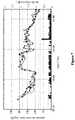
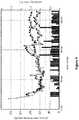
- Figure 7 & 9graphically show traces of actual patient data from a clinical trial conducted at the University of Virginia.
- the trace as shown with dotted symbolsis the CGS measurement signal with data obtained every 5 minutes
- the trace as shown with triangle symbolstracks the reference blood glucose signal obtained every 30 minutes using a YSI glucose analyzer
- the trace as shown with the solid linerepresents the trace obtained using our state estimation and weighting procedure.
- Figure 7graphically demonstrates the use of our weighting scheme to improve the accuracy of the CGS measurement signal using the weighting scheme which places all weight on the CGS measurement signal following the detection of large bolus insulin amounts.
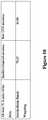
- the Table of Figure 8describes the % A Zone of the EGA for this real patient data.
- Figure 8shows the improvement in sensor accuracy when insulin delivery data is used for real CGS measurements and insulin delivery data with regard to the trial in Figure 7 .
- Figure 9provides another example of the use of our weighting scheme to improve the accuracy of the CGS measurement signal using the weighting scheme which places all weight on the CGS measurement signal following the detection of large bolus insulin amounts.
- the Table of Figure 10describes the % A Zone of the EGA for this real patient data.
- Figure 10shows the improvement in sensor accuracy when insulin delivery data is used for real CGS measurements and insulin delivery data with regard to the trial in Figure 9 .
- Example 1includes
- any activitycan be repeated, any activity can be performed by multiple entities, and/or any element can be duplicated. Further, any activity or element can be excluded, the sequence of activities can vary, and/or the interrelationship of elements can vary. Unless clearly specified to the contrary, there is no requirement for any particular described or illustrated activity or element, any particular sequence or such activities, any particular size, speed, material, dimension or frequency, or any particularly interrelationship of such elements. Accordingly, the descriptions and drawings are to be regarded as illustrative in nature, and not as restrictive. Moreover, when any number or range is described herein, unless clearly stated otherwise, that number or range is approximate. When any range is described herein, unless clearly stated otherwise, that range includes all values therein and all sub ranges therein.
Landscapes
- Health & Medical Sciences (AREA)
- Life Sciences & Earth Sciences (AREA)
- Engineering & Computer Science (AREA)
- Physics & Mathematics (AREA)
- Heart & Thoracic Surgery (AREA)
- Biomedical Technology (AREA)
- Veterinary Medicine (AREA)
- Public Health (AREA)
- General Health & Medical Sciences (AREA)
- Animal Behavior & Ethology (AREA)
- Biophysics (AREA)
- Medical Informatics (AREA)
- Molecular Biology (AREA)
- Surgery (AREA)
- Pathology (AREA)
- Optics & Photonics (AREA)
- Signal Processing (AREA)
- Vascular Medicine (AREA)
- Artificial Intelligence (AREA)
- Physiology (AREA)
- Psychiatry (AREA)
- Computer Vision & Pattern Recognition (AREA)
- Anesthesiology (AREA)
- Hematology (AREA)
- Emergency Medicine (AREA)
- Medicinal Chemistry (AREA)
- Pharmacology & Pharmacy (AREA)
- Bioinformatics & Cheminformatics (AREA)
- Chemical & Material Sciences (AREA)
- Power Engineering (AREA)
- Cardiology (AREA)
- Measurement Of The Respiration, Hearing Ability, Form, And Blood Characteristics Of Living Organisms (AREA)
- Investigating Or Analysing Biological Materials (AREA)
- External Artificial Organs (AREA)
Abstract
Description
- The present application claims priority from
U.S. Provisional Application Serial No. 61/317,902 filed March 26, 2010 - The present invention relates generally to the field of medical devices to be used as glucose sensors. More specifically, the invention is in the subfield of glucose sensors and other tools to be used for monitoring glucose levels of a subject.
- Continuous glucose sensors offer the potential to markedly change our understanding of glucose homeostasis in health and disease, and to provide the missing information required to achieve near-normoglycemia among persons with both
Type 1 andType 2 diabetes. Despite their having appeared on the scene less than five years ago, continuous glucose sensors (CGS) already have been shown to be associated with short term reductions in glucose variability, time spent in nocturnal hypoglycemia, time spent in hyperglycemia, and lower glycosylated hemoglobin values. Their potential to assist patients and their families in day-to-day decision-making, to warn of impending hypoglycemia and to reduce the fear of its occurrence has yet to be fully appreciated. Indeed, the advent of CGS has stimulated the diabetes research community to re-examine the feasibility of developing a closed loop "artificial pancreas" and preliminary clinical studies of prototype closed loop systems are currently being initiated. Given the enormous therapeutic and safety potential of these systems, it seems reasonable to assume that to some extent they have been proven to be numerically and clinically accurate in both the display of glucose values and the tracking of glucose trends and rate of change. - However, unfortunately, the data regarding the accuracy of different CGS systems is presented according to criteria identical to those developed decades ago for assessing the accuracy of home blood glucose (BG) monitors providing episodic self-monitoring (SBGM) readings, and thus do not include assessments designed to evaluate the "continuous" time-dependent information (in particular rate and direction of glucose change), which is unique to CGS. Regardless of the criteria used, sensor accuracy is still substantially inferior to the accuracy of self-monitoring devices that use capillary blood (finger sticks) for glucose determination. This inaccuracy is primarily evident during hypoglycemia and is due to delays observed during blood-to-interstitial glucose transport and other factors.
- The common denominator for all accuracy-enhancing procedures reviewed in the previous section is that they rely on blood glucose data only (e.g. raw sensor current, calibration points, etc.). However, the field is rapidly moving toward systems combining continuous glucose sensors (CGS) with insulin pump, such as the new Medtronic Paradigm RT devices. Thus, insulin delivery data will become available to the sensor processor.
- An aspect of an embodiment of the present invention focuses, for the first time, on the signal from an insulin pump, artificial pancreas, or another insulin delivery device as a source of information for improvement of the accuracy of the CGS that is coupled with an insulin pump, artificial pancreas, or another insulin delivery device. As seen from the simulation results included in the following section, the effect of using insulin information to enhance sensor accuracy is most prominent at low blood glucose levels (where the sensor has been shown to be the most inaccurate), i.e., in the hypoglycemic range, which is critical for any treatment.
- Another aspect of an embodiment of the invention is the use of a filtering/state estimation procedure, such as a Kalman Filter methodology, H-infinity filtering method, a Bayesian filtering method, a Monte Carlo method, or a least squares method, to determine a metabolic state estimate, of which the blood glucose state is a component, at time t-τ.
- Another aspect of an embodiment of the invention is the use of the metabolic state estimate at time t-τ to infer the metabolic state estimate at time t given the metabolic state estimate and insulin information up to time t-τ.
- Another aspect of an embodiment of the invention is the extraction of the blood glucose component from the metabolic state estimate.
- Another aspect of an embodiment of the invention is the use of a weighting scheme to weight the information from the CGS and the blood glucose component of the metabolic state estimate. The weights can be determined in many ways. In one embodiment of the invention, more weight is given to the KF glucose estimate during hypoglycemia and more weight is given to the CGS reading during euglycemia and hyperglycemia in accordance with the low BG index.
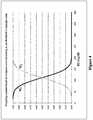
- Many other weighting schemes are possible as well. In another embodiment of the invention, an S-shaped curve increasing at approximately the threshold of hypoglycemia as well as other weighting schemes can be used.
- In another embodiment of the invention the weighting scheme accounts directly for the lack of accuracy of the Kalman Filter state estimate immediately following meals and meal insulin boluses. In the time immediately following meals, the CGS measurement is generally more accurate than the Kalman Filter state estimate, since the model at the core of the state estimation procedure does not assume knowledge of meal timing and meal amounts. To account for this, we have developed a weighting scheme that places more weight on the CGS measurement signal in the time following the detection of a large bolus of insulin that is typically associated with a meal.
- Another aspect of an embodiment of the invention is a processor configured to perform the required calculations, wherein the processor can be implemented in the CGS, the device providing the insulin, or in a separate device (or implemented integrally among two or more of the CGS, insulin device or a separate device).
- An aspect of an embodiment of the present invention provides a method for improving the accuracy of a glucose measurement device. The method may comprise: using insulin delivery information to improve the accuracy of the glucose measurement device.
- An aspect of an embodiment of the present invention provides a system for improving the accuracy of a glucose measurement device. The glucose measurement device may use insulin delivery information to improve the accuracy of the glucose measurement device.
- An aspect of an embodiment of the present invention provides a computer program product comprising a computer useable medium having a computer program logic for enabling at least one processor in a computer system for improving the accuracy of a glucose measurement device. The computer program logic may comprise: using insulin delivery information or data to improve the accuracy of the glucose measurement device.
- It should be appreciated that as discussed herein, a subject may be a human or any animal. It should be appreciated that an animal may be a variety of any applicable type, including, but not limited thereto, mammal, veterinarian animal, livestock animal or pet type animal, etc. As an example, the animal may be a laboratory animal specifically selected to have certain characteristics similar to human (e.g. rat, dog, pig, monkey), etc. It should be appreciated that the subject may be any applicable human patient, for example. Use of the term "patient" to describe various subjects herein below should be understood to be exemplary only. It should be understood that the systems and method discussed can apply to any subject.
- These and other objects, along with advantages and features of various aspects of embodiments of the invention disclosed herein, will be made more apparent from the description, drawings and claims that follow.
- The foregoing and other objects, features and advantages of the present invention, as well as the invention itself, will be more fully understood from the following description of the embodiments, when read together with the accompanying drawings.
- The accompanying drawings, which are incorporated into and form a part of the instant specification, illustrate several aspects and embodiments of the present invention and, together with the description herein, serve to explain the principles of the invention. The drawings are provided only for the purpose of illustrating select embodiments of the invention and are not to be construed as limiting the invention.
Figure 1 is a high level functional block diagram of an embodiment of the invention.Figure 2 is a block diagram of the steps taken in an embodiment of the invention to improve the CGS reading using insulin data.Figure 3 graphically shows the weighting scheme based on the Low BG Index.Figure 4 graphically shows the weighting scheme based on S-shaped curve increasing at the threshold of hypoglycemia.Figure 5 is a schematic block diagram for a system or related method of an embodiment of the present invention in whole or in part.Figure 6 is a table that shows the improvement in sensor accuracy when insulin delivery data is used.Figure 7 graphically demonstrates the use of our weighting scheme to improve the accuracy of the CGS measurement signal using the weighting scheme, which places all weight on the CGS measurement signal following the detection of large bolus insulin amountsFigure 8 is a table that shows the improvement in sensor accuracy when insulin delivery data is used for real CGS measurements and insulin delivery data with regard to the trial inFigure 7 .Figure 9 graphically provides another example of the use of our weighting scheme to improve the accuracy of the CGS measurement signal using the weighting scheme which places all weight on the CGS measurement signal following the detection of large bolus insulin amounts.Figure 10 is a table that shows the improvement in sensor accuracy when insulin delivery data is used for real CGS measurements and insulin delivery data with regard to the trial inFigure 9 .- An aspect of an embodiment of the present invention method provides, but not limited thereto, the following steps:
- Step 1: Glucose state estimation that uses CGS readings, insulin delivery data from an insulin pump, artificial pancreas, or another insulin delivery device, and Kalman Filter (KF) methodology to estimate the glycemic state of the person;
- Step 2: BG prediction and projection of glucose fluctuations a few (e.g. 10; or may be greater or lesser as desired or required) minutes ahead;
- Step 3: Weighting of the glucose state estimate against the sensor readings and calculation of a weighted BG estimate.
- As shown in
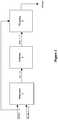
Figure 2 , theobservation 1 refers tostep 1, theprediction 2 refers tostep 2, and theweighting 3 refers tostep 3. As shown inFigure 1 , aprocessor 102 communicates with the glucose monitor101 and theinsulin device 100. The glucose monitor101 and theinsulin device 100 communicate with the subject103 to monitor glucose levels of the subject103 and delivery insulin to the subject103, respectively. Theprocessor 102 is configured to perform the required calculations. The glucose monitor101 and theinsulin device 100 may be implemented as a separate device or as a single device. Theprocessor 102 can be implemented locally in the glucose monitor101, theinsulin device 100, or a standalone device (or in any combination of two or more of the glucose monitor, insulin device, or a stand along device). Theprocessor 102 or a portion of the system can be located remotely such that the device is operated as a telemedicine device. - Step 1: The Metabolic State Observer and Prediction Module works as follows: Predictions are derived from a state space model of glucose-insulin interactions, as characterized by a vector of metabolic states including both insulin and glucose states in various compartments of the body. The state space model allows for predictions of metabolic states in the future. Since interstitial glucose concentration measurable via CGS are subject to sensor noise and some states ofx(t) are not measurable, it is impossible to have perfect knowledge of the state vectorx(t) , making it necessary to compute an estimatex̂(t) ofx(t) based on all available information: (1) delivered insulinJctrl(t) and (2) CGS measurements of interstitial glucose concentrationCGS(t). This is shown as
observation 1 inFigure 2 . The CGS measurements of interstitial glucose concentration CGS(t) include readouts that come at certain intervals. The interval can be 60 minutes, 30 minutes, 15 minutes, or anything in between, above, or below. It should be appreciated that intervals may vary and can be omitted as desired or required. - The following subsections present (Step 1.1) the state space model, which can be Kalman Filter methodology, H-infinity filtering method, a Bayesian filtering method, a Monte Carlo method, or a least squares method, from which BG values are predicted, (Step 1.2) the first intermediary computation which includes an algorithmic module responsible for computing state vector estimatesx̂(t), which we refer to as the "metabolic state estimate." The output of the first intermediary computation isx̂(t - τ).
- All predictions of BG are derived from a population-average model for glucose-insulin kinetics, as described by the vector difference equation:

- 1.x(t) = (∂G(t)∂X(t)∂Isc1(t)∂Isc2(t) ∂Ip(t)∂Gsc(t) ∂Q1(t) ∂Q2(t))T is a vector of state variables referring to:
- a.blood glucose: ∂G(t) =G(t)- Gref, whereG(t) (mg/dl) is blood glucose concentration at minutet andGref = 112.5 (mg/dl) is a reference value for BG
- b.remote compartment insulin action: ∂X(t) =X(t)- Xref whereX(t) (min-1) represents the action of insulin in the "remote" compartment andXref = 0 (min-1) is a reference value
- c.interstitial insulin, first compartment: ∂Isc1(t) =Isc1(t) -Isc1,ref, whereIsc1(t) (mU) is insulin stored in the first of two interstitial compartments andIsc1,ref =1.2949×10³ (mU) is a reference value
- d.interstitial insulin, second compartment: ∂Isc2(t) =Isc2(t) -Ic2,ref, whereIsc2(t) (mU) is insulin stored in the second of two interstitial compartments andIsc2,ref =1.2949×10³ (mU) is a reference value
- e.plasma insulin: ∂Ip(t) =Ip(t) -Ip,ref, whereIp(t) (mU) is plasma insulin andIp,ref = 111.2009 (mU) is a reference value
- f.interstitial glucose concentration: ∂Gsc(t) =Gsc(t) -Gsc,ref, whereGsc(t) (mg/dl) is the concentration of glucose in interstitial fluids, andGsc,ref = 112.5 (mg/dl) is a reference value
- g.gut compartment 1: ∂Q1(t) =Q1(t) -Q1,ref, whereQ1(t) (mg) is glucose stored in the first of two gut compartments andQ1,ref = 0 (mg) is a reference value
- h.gut compartment 2: ∂Q2(t) =Q2(t) -Q2,ref, whereQ2(t) (mg) is glucose stored in the second of two gut compartments andQ2,ref = 0 (mg) is a reference value
- 2.u(t) =Jctrl(t) -Jbasal(t) (mU/min) is the insulin control signal at timet, whereJctrl(t) (mU/min) is the current rate of insulin infusion andJbasal(t) (mU/min) is the patient's normal basal rate
- 3.ω(t) =meal(t) -mealref (mg/min) is the ingested glucose disturbance signal at timet, wheremeal(t) is the rate of glucose ingestion andmealref = 0 (mg/min) is a reference meal input value
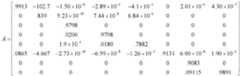
- 4. the state space matricesA,B, and G are


- To compute estimatesx̂(t) ofx(t) we use knowledge of infused insulinu(t) and measurementsy(t) =CGS(t) -Gref (mg/dl), whereCGS(t) is the readout of the CGS at timet. We model the measurement signal from CGS(t) as

- 1. ν(t) (mg/dl) represents CGS signal noise
- 2. the state space matrix C is

- The metabolic state observer is derived from the state space model forx(t) andy(t) as a Kalman filter, treating a possible meal disturbance processω(t) and the noise processν(t) as zero-mean, white, Gaussian processes with covariancesR =k1 = 1 andQ =k2 = .0025, respectively. (We point out that, even though mealsω(t) and sensor noiseν(t) are not zero-mean, white, Guassian processes in reality, the resulting Kalman filter is still a stable state observer.) The observer itself can be expressed recursively (as a dynamic process) as


- 1. x̂(t|t-1) refers to the best estimate ofx(t) using data collected up to staget-1
- 2.x̂(t) refers to the best estimate ofx(t) using data collected up to staget
- 3. the filter gain matrixL =APCT(CPCT +R)-1
- 4. the estimate update matrixM =PCT(CPCT +R)-1
- 5. the matrix P is the unique stabilizing solution to the algebraic Riccati equation:

- A second intermediary computation is performed. This
prediction 2 as shown inFigure 2 uses the output of the first intermediary computation to predict the output of the second intermediary computation. The output of the second intermediary computation isBG(t|t -τ). Predictions are derived from the latest estimate of the metabolic state of the patientx̂(t -τ) extrapolated to some future time t (where we can think ofτ as the time lag, in minutes, associated with the CGS signal because while the CGS signal is a measurement at time t, the actual output of CGS represents a measurement at time t-τ), assuming that all inputs are held at their steady state values:
- 1.x̂(t|t -τ) refers to the prediction ofx(t) given data up to timet - τ
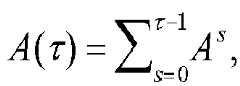
- 2. Aτ =A · A··· A, i.e. theτ-fold composition ofA
- 3.
- Another implementation for weights w1 and w2 is one that accounts directly for the lack of accuracy of the Kalman Filter state estimatex̂(t) immediately following meals and meal insulin boluses. In the time immediately following meals, the CGS measurement is generally more accurate than the Kalman Filter state estimate, since the model at the core of the state estimation procedure does not assume knowledge of meal timing and meal amounts. To account for this, we have developed a weighting scheme that places more weight (w2 ≈ 1) on the CGS measurement signal in the time following the detection of a large bolus of insulin that is typically associated with a meal.
Figure 5 is a functional block diagram for acomputer system 300 for implementation of an exemplary embodiment or portion of an embodiment of present invention. For example, a method or system of an embodiment of the present invention may be implemented using hardware, software or a combination thereof and may be implemented in one or more computer systems or other processing systems, such as personal digit assistants (PDAs) equipped with adequate memory and processing capabilities. In an example embodiment, the invention was implemented in software running on a general purpose computer30 as illustrated inFigure 5 . The invention call also be implemented on a microcontroller or using a processor that is located in the CGS monitor, insulin pump or other insulin delivery device, or as a standalone component (or a combination of two or more of the CGS monitor, insulin pump or other insulin delivery device, or stand alone component). Thecomputer system 300 may includes one or more processors, such asprocessor 304. TheProcessor 304 is connected to a communication infrastructure306 (e.g., a communications bus, cross-over bar, direct connection, or network). Thecomputer system 300 may include adisplay interface 302 that forwards graphics, text, and/or other data from the communication infrastructure306 (or from a frame buffer not shown) for display on thedisplay unit 330.Display unit 330 may be digital and/or analog.- The
computer system 300 may also include amain memory 308, preferably random access memory (RAM), and may also include asecondary memory 310. Thesecondary memory 310 may include, for example, a hard disk drive312 and/or aremovable storage drive 314, representing a floppy disk drive, a magnetic tape drive, an optical disk drive, a flash memory, etc. Theremovable storage drive 314 reads from and/or writes to a removable storage unit318 in a well known manner. Removable storage unit318, represents a floppy disk, magnetic tape, optical disk, etc. which is read by and written to byremovable storage drive 314. As will be appreciated, the removable storage unit318 includes a computer usable storage medium having stored therein computer software and/or data. - In alternative embodiments,
secondary memory 310 may include other means for allowing computer programs or other instructions to be loaded intocomputer system 300. Such means may include, for example, aremovable storage unit 322 and aninterface 320. Examples of such removable storage units/interfaces include a program cartridge and cartridge interface (such as that found in video game devices), a removable memory chip (such as a ROM, PROM, EPROM or EEPROM) and associated socket, and otherremovable storage units 322 andinterfaces 320 which allow software and data to be transferred from theremovable storage unit 322 tocomputer system 300. - The
computer system 300 may also include a communications interface324. Communications interface124 allows software and data to be transferred betweencomputer system 300 and external devices. Examples of communications interface324 may include a modem, a network interface (such as an Ethernet card), a communications port (e.g., serial or parallel, etc.), a PCMCIA slot and card, a modem, etc. Software and data transferred via communications interface324 are in the form ofsignals 328 which may be electronic, electromagnetic, optical or other signals capable of being received by communications interface324.Signals 328 are provided to communications interface324 via a communications path (i.e., channel)326. Channel326 (or any other communication means or channel disclosed herein) carriessignals 328 and may be implemented using wire or cable, fiber optics, blue tooth, a phone line, a cellular phone link, an RF link, an infrared link, wireless link or connection and other communications channels. - In this document, the terms "computer program medium" and "computer usable medium" are used to generally refer to media or medium such as various software, firmware, disks, drives,
removable storage drive 314, a hard disk installed in hard disk drive312, and signals328. These computer program products ("computer program medium" and "computer usable medium") are means for providing software tocomputer system 300. The computer program product may comprise a computer useable medium having computer program logic thereon. The invention includes such computer program products. The "computer program product" and "computer useable medium" may be any computer readable medium having computer logic thereon. - Computer programs (also called computer control logic or computer program logic) are may be stored in
main memory 308 and/orsecondary memory 310. Computer programs may also be received via communications interface324. Such computer programs, when executed, enablecomputer system 300 to perform the features of the present invention as discussed herein. In particular, the computer programs, when executed, enableprocessor 304 to perform the functions of the present invention. Accordingly, such computer programs represent controllers ofcomputer system 300. - In an embodiment where the invention is implemented using software, the software may be stored in a computer program product and loaded into
computer system 300 usingremovable storage drive 314, hard drive312 or communications interface324. The control logic (software or computer program logic), when executed by theprocessor 304, causes theprocessor 304 to perform the functions of the invention as described herein. - In another embodiment, the invention is implemented primarily in hardware using, for example, hardware components such as application specific integrated circuits (ASICs). Implementation of the hardware state machine to perform the functions described herein will be apparent to persons skilled in the relevant art(s).
- In yet another embodiment, the invention is implemented using a combination of both hardware and software.
- In an example software embodiment of the invention, the methods described above may be implemented in SPSS control language or C + + programming language, but could be implemented in other various programs, computer simulation and computer-aided design, computer simulation environment, MATLAB, or any other software platform or program, windows interface or operating system (or other operating system) or other programs known or available to those skilled in the art.
- It should be appreciated that the modules and components of
Figures 1 and5 may be transmitted to the appropriate or desired computer networks in various locations and sites (local and/or remote) as desired or required. - The modules and components of
Figures 1 and5 may be transmitted to the appropriate or desired computer networks in various locations and sites (local and/or remote) via the desired or required communication links. - It should be appreciated that any of the components/modules discussed in
Figures 1 and5 may be integrally contained within one or more housings or separated and/or duplicated in different housings. Similarly, any of the components and modules discussed inFigures 1 and5 may be duplicated more than once. Moreover, various components and modules may be adapted to replace another component or module to perform the intended function. - It should be appreciated that the modules and components as depicted in
Figures 1 and5 may be implemented with any location, person, staff, physician, caregiver, system, device or equipment at any healthcare provider, hospital, clinic, university, vehicle, trailer, or home, as well as any other location, premises, or organization as desired or required. - The exemplary method has been validated using in silico experiments with N=100 virtual subjects with
type 1 diabetes who were equipped with virtual sensors prone to errors that are typical for CGS observed in vivo. A detailed description of the simulation environment has been presented previously [26,27]. The Table ofFigure 6 presents summary results from these experiments using the A-zone (Accurate readings) of the Continuous Glucose Error-Grid Analysis [CG-EGA, 12]. It is evident that the accuracy of the CGS is increased by the method by more than 10% within the critical hypoglycemic range, a difference that is highly statistically significant. In the euglycemic and hyperglycemic ranges, sensor accuracy is typically high [18,23] and the method provides only a marginal improvement, or equivalent accuracy results. The results are presented without weighting (i.e.w1 = 1 regardless of BG level) and with LBGI-based weighting. The table ofFigure 6 shows the improvement in sensor accuracy when insulin delivery data is used and how each of these methods would have certain advantages, depending on the structure and the magnitude of sensor noise. - The weighting scheme to improve accuracy of the CGS is further validated using real data from recent clinical trials conducted at the University of Virginia, where we have access to CGS measurement signal every 5 minutes (unless the sensor is operating in a faulty mode) and we obtain a reference blood glucose measurement every 30 minutes using a YSI glucose analyzer.
Figure 7 &9 graphically show traces of actual patient data from a clinical trial conducted at the University of Virginia. The trace as shown with dotted symbols is the CGS measurement signal with data obtained every 5 minutes, the trace as shown with triangle symbols tracks the reference blood glucose signal obtained every 30 minutes using a YSI glucose analyzer, and the trace as shown with the solid line represents the trace obtained using our state estimation and weighting procedure. Figure 7 graphically demonstrates the use of our weighting scheme to improve the accuracy of the CGS measurement signal using the weighting scheme which places all weight on the CGS measurement signal following the detection of large bolus insulin amounts. The Table ofFigure 8 describes the % A Zone of the EGA for this real patient data.Figure 8 shows the improvement in sensor accuracy when insulin delivery data is used for real CGS measurements and insulin delivery data with regard to the trial inFigure 7 .Figure 9 provides another example of the use of our weighting scheme to improve the accuracy of the CGS measurement signal using the weighting scheme which places all weight on the CGS measurement signal following the detection of large bolus insulin amounts. The Table ofFigure 10 describes the % A Zone of the EGA for this real patient data.Figure 10 shows the improvement in sensor accuracy when insulin delivery data is used for real CGS measurements and insulin delivery data with regard to the trial inFigure 9 .- Practice of an aspect of an embodiment (or embodiments) of the invention will be still more fully understood from the following examples, which are presented herein for illustration only and should not be construed as limiting the invention in any way.
- Example 1 includes a method for improving the accuracy of a glucose measurement device, whereby the method may comprise: using insulin delivery information to improve the accuracy of the glucose measurement device.
- Example 2 may optionally include the method of example 1, wherein the glucose measurement device is a continuous glucose device.
- Example 3 may optionally include the method of example 1 (as well as subject matter of one or more of any combination of examples 1-2), further comprising:
- obtaining a readout from the glucose measurement device;
- obtaining the insulin delivery information from an insulin delivery device;
- performing a first intermediary computation to obtain an output of the first intermediary computation using the readout from the glucose measurement device of the subject and the insulin delivery information; and
- performing a second intermediary computation to obtain an output of the second intermediary computation using the output of the first intermediary computation.
- Example 4 may optionally include the method of example 3(as well as subject matter of one or more of any combination of examples 1-3), wherein the glucose measurement device is a continuous glucose device.
- Example 5 may optionally include the method of example 3(as well as subject matter of one or more of any combination of examples 1-4), wherein the first intermediary computation further comprises a Kalman Filter methodology.
- Example 6 may optionally include the method of example 3(as well as subject matter of one or more of any combination of examples 1-5), wherein the first intermediary computation further comprises a method for filtering/state estimation, such as a H-infinity filtering method, a Bayesian filtering method, a Monte Carlo method, or a least squares method.
- Example 7 may optionally include the method of example 3(as well as subject matter of one or more of any combination of examples 1-6), wherein the readout from the glucose measurement device provides a frequent glucose readout.
- Example 8 may optionally include the method of example 7(as well as subject matter of one or more of any combination of examples 1-7), wherein the frequency of the readout from the glucose measurement device is at least approximately 60 minute intervals.
- Example 9 may optionally include the method of example 7(as well as subject matter of one or more of any combination of examples 1-8), wherein the frequency of the readout from the glucose measurement device is at least approximately 30 minute intervals.
- Example 10 may optionally include the method of example 7(as well as subject matter of one or more of any combination of examples 1-9), wherein the frequency of the readout from the glucose measurement device is at least approximately 15 minute intervals.
- Example 11 may optionally include the method of example 3(as well as subject matter of one or more of any combination of examples 1-10), wherein the insulin delivery information is provided by an insulin pump, artificial pancreas, or another insulin delivery device.
- Example 12 may optionally include the method of example 3 (as well as subject matter of one or more of any combination of examples 1-11), wherein the insulin delivery information is provided by a measuring device.
- Example 13 may optionally include the method of example 3 (as well as subject matter of one or more of any combination of examples 1-12), wherein the second intermediary computation further comprises:
inferring the output of the second intermediary computation from the output of the first intermediary computation. - Example 14 may optionally include the method of example 13 (as well as subject matter of one or more of any combination of examples 1-13), wherein inferring the second intermediary computation further comprises:
extrapolating the output of the first intermediary computation to some future time to determine an extrapolated state vector output. - Example 15 may optionally include the method of example 14 (as well as subject matter of one or more of any combination of examples 1-14), wherein determining the extrapolated output is provided by

- x(t|t-τ) refers to the extrapolated state vector output;
- A is a state space matrix;
- B is a state space matrix;
- G is a state space matrix;
- Aτ =A ·A···A, i.e. theτ-fold composition of the state space matrixA;

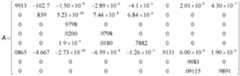
- Example 16 may optionally include the method of example 15 (as well as subject matter of one or more of any combination of examples 1-15), wherein the state space matrix A is:
- Example 17 may optionally include the method of example 15 (as well as subject matter of one or more of any combination of examples 1-16), wherein the state space matrix B is:

- Example 18 may optionally include the method of example 15 (as well as subject matter of one or more of any combination of examples 1-17), wherein the state space matrix G is:

- Example 19 may optionally include the method of example 14 (as well as subject matter of one or more of any combination of examples 1-18), wherein the second intermediary computation further comprises:
extracting a blood glucose state from the extrapolated state vector output. - Example 20 may optionally include the method of example 19 (as well as subject matter of one or more of any combination of examples 1-19), wherein extracting the blood glucose state from the extrapolated value further comprises:
applying a state space matrix to the extrapolated state vector output. - Example 21 may optionally include the method of example 3 (as well as subject matter of one or more of any combination of examples 1-20), further comprising:
performing a third computation to reach an estimate of the blood glucose of the subject by applying a weighting scheme to the readout from the glucose measurement device and the output of the second intermediary computation. - Example 22 may optionally include the method of example 21 (as well as subject matter of one or more of any combination of examples 1-21), wherein the weighting scheme further comprises:
applying a first weighting coefficient to the readout from the glucose measurement device and applying a second weighting coefficient to the output of the second intermediary computation. - Example 23 may optionally include the method of example 22 (as well as subject matter of one or more of any combination of examples 1-22), wherein the weighting yields a linear combination of the readout from the glucose measurement device and the output of the second intermediary so that the sum of the first weighting coefficient and the second weighting coefficient is equal to 1.
- Example 24 may optionally include the method of example 22 (as well as subject matter of one or more of any combination of examples 1-23), wherein the weighting scheme further comprises:
applying more weight to the output of the second intermediary computation during hypoglycemia. - Example 25 may optionally include the method of example 24 (as well as subject matter of one or more of any combination of examples 1-24), wherein the more weight is approximately 1.
- Example 26. may optionally include the method of example 22 (as well as subject matter of one or more of any combination of examples 1-25), wherein the weighting scheme further comprises:
applying more weight to the readout from the glucose measurement device during euglycemia. - Example 27 may optionally include the method of example 26 (as well as subject matter of one or more of any combination of examples 1-26), wherein the more weight is approximately 1.
- Example 28 may optionally include the method of example 22 (as well as subject matter of one or more of any combination of examples 1-27), wherein the weighting scheme further comprises:
applying more weight to the readout from the glucose measurement device during hyperglycemia. - Example 29 may optionally include the method of example 28 (as well as subject matter of one or more of any combination of examples 1-28), wherein the more weight is approximately 1.
- Example 30 may optionally include the method of example 22 (as well as subject matter of one or more of any combination of examples 1-29), wherein the weighting scheme further comprises:
applying a weighting scheme that accounted for the lack of accuracy of the output of the second intermediary computation immediately following meals and meal insulin boluses. - Example 31 may optionally include the method of example 22 (as well as subject matter of one or more of any combination of examples 1-30), wherein the weighting scheme further comprises:
applying more weight on the readout from the glucose measurement device in the time following a detection of a large bolus of insulin. - Example 32 may optionally include the method of example 22 (as well as subject matter of one or more of any combination of examples 1-31), wherein the weighting scheme further comprises:
basing the weighting scheme on an S-shaped curve with the curve increasing at approximately the threshold of hypoglycemia. - Example 33 may optionally include the method of example 22 (as well as subject matter of one or more of any combination of examples 1-32), wherein the first weighting coefficient and the second weighting coefficient are provided by the formula w1 = LBGI(CGS - 50)/100 where LBGI is a low BG index and CGS is the readout from the continuous glucose measurement device.
- Example 34 includes a system for improving the accuracy of a glucose measurement device, wherein the glucose measurement device may uses insulin delivery information (among other data and information) to improve the accuracy of the glucose measurement device.
- Example 35 may optionally include the system of example 34 (as well as subject matter of one or more of any combination of examples 1-34), wherein the glucose measurement device is a continuous glucose device.
- Example 36 may optionally include the system of example 34 (as well as subject matter of one or more of any combination of examples 1-35), further comprising:
- the glucose measurement device configured to provide a readout;
- an insulin delivery device configured to provide the insulin delivery information; and
- a processor, wherein the processor is configured to provide:
- a first intermediary computation that provides an output of the first intermediary computation using the readout from the glucose measurement device of the subject and the insulin delivery information, and
- a second intermediary computation that provides an output of the second intermediary computation using the output of the first intermediary computation.
- Example 37 may optionally include the system of example 36 (as well as subject matter of one or more of any combination of examples 1-36), wherein the glucose measurement device is a continuous glucose device.
- Example 38 may optionally include the system of example 36 (as well as subject matter of one or more of any combination of examples 1-37), wherein the first intermediary computation further comprises a Kalman Filter methodology.
- Example 39 may optionally include the system of example 36 (as well as subject matter of one or more of any combination of examples 1-38), wherein the first intermediary computation further comprises a method for filtering/state estimation, such as a H-infinity filtering method, a Bayesian filtering method, a Monte Carlo method, or a least squares method.
- Example 40 may optionally include the system of example 36 (as well as subject matter of one or more of any combination of examples 1-39), wherein the readout from the glucose measurement device provides a frequent glucose readout.
- Example 41 may optionally include the system of example 40 (as well as subject matter of one or more of any combination of examples 1-40), wherein the frequency of the readout from the glucose measurement device is at least approximately 60 minute intervals.
- Example 42 may optionally include the system of example 40 (as well as subject matter of one or more of any combination of examples 1-41), wherein the frequency of the readout from the glucose measurement device is at least approximately 30 minute intervals.
- Example 43 may optionally include the system of example 40 (as well as subject matter of one or more of any combination of examples 1-42), wherein the frequency of the readout from the glucose measurement device is at least approximately 15 minute intervals.
- Example 44 may optionally include the system of example 36 (as well as subject matter of one or more of any combination of examples 1-43), wherein the insulin delivery information is provided by an insulin pump, artificial pancreas, or another insulin delivery device.
- Example 45 may optionally include the system of example 36 (as well as subject matter of one or more of any combination of examples 1-44), wherein the insulin delivery information is provided by a measuring device.
- Example 46 may optionally include the system of example 36 (as well as subject matter of one or more of any combination of examples 1-45), wherein the second intermediary computation further comprises:
an inference of the output of the second intermediary computation from the output of the first intermediary computation. - Example 47 may optionally include the system of example 46 (as well as subject matter of one or more of any combination of examples 1-46), wherein inferring the second intermediary computation further comprises:
an extrapolation of the output of the first intermediary computation to some future time to determine an extrapolated state vector output. - Example 48 may optionally include the system of example 47 (as well as subject matter of one or more of any combination of examples 1-47), wherein the extrapolated output is determined by

- x̂(t|t-τ) refers to the extrapolated state vector output;
- A is a state space matrix;
- B is a state space matrix;
- G is a state space matrix;
- Aτ =A·A···A, i.e. theτ-fold composition of the state space matrixA;

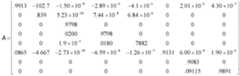
- Example 49 may optionally include the system of example 48 (as well as subject matter of one or more of any combination of examples 1-48), wherein the state space matrix A is:
- Example 50 may optionally include the system of example 48 (as well as subject matter of one or more of any combination of examples 1-49), wherein the state space matrix B is:

- Example 51. The system of example 48, (as well as subject matter of one or more of any combination of examples 1-50), wherein the state space matrix G is:

- Example 52 may optionally include the system of example 47 (as well as subject matter of one or more of any combination of examples 1-51), wherein the second intermediary computation further comprises:
an extraction of a blood glucose state from the extrapolated state vector output. - Example 53 may optionally include the system of example 52 (as well as subject matter of one or more of any combination of examples 1-52), wherein the extraction of the blood glucose state from the extrapolated value further comprises:
an application of a state space matrix to the extrapolated state vector output. - Example 54 may optionally include the system of example 36 (as well as subject matter of one or more of any combination of examples 1-53), wherein the processor is configured to provide a third computation to reach an estimate of the blood glucose of the subject by applying a weighting scheme to the readout from the glucose measurement device and the output of the second intermediary computation .
- Example 55 may optionally include the system of example 54 (as well as subject matter of one or more of any combination of examples 1-54), wherein the weighting scheme further comprises:
an application of a first weighting coefficient to the readout from the glucose measurement device and applying a second weighting coefficient to the output of the second intermediary computation. - Example 56 may optionally include the system of example 55 (as well as subject matter of one or more of any combination of examples 1-55), wherein the weighting yields a linear combination of the readout from the glucose measurement device and the output of the second intermediary so that the sum of the first weighting coefficient and the second weighting coefficient is equal to 1.
- Example 57 may optionally include the system of example 55 (as well as subject matter of one or more of any combination of examples 1-56), wherein the weighting scheme further comprises:
an application of more weight to the output of the second intermediary computation during hypoglycemia. - Example 58 may optionally include the system of example 57 (as well as subject matter of one or more of any combination of examples 1-57), wherein the more weight is approximately 1.
- Example 59 may optionally include the system of example 55 (as well as subject matter of one or more of any combination of examples 1-58), wherein the weighting scheme further comprises:
an application of more weight to the readout from the glucose measurement device during euglycemia. - Example 60 may optionally include the system of example 59 (as well as subject matter of one or more of any combination of examples 1-59), wherein the more weight is approximately 1.
- Example 61 may optionally include the system of example 55 (as well as subject matter of one or more of any combination of examples 1-60), wherein the weighting scheme further comprises:
an application of more weight to the readout from the glucose measurement device during hyperglycemia. - Example 62 may optionally include the system of example 61 (as well as subject matter of one or more of any combination of examples 1-61), wherein the more weight is approximately 1.
- Example 63 may optionally include the system of example 55 (as well as subject matter of one or more of any combination of examples 1-62), wherein the weighting scheme further comprises:
an application of a weighting scheme that accounted for the lack of accuracy of the output of the second intermediary computation immediately following meals and meal insulin boluses. - Example 64 may optionally include the system of example 55 (as well as subject matter of one or more of any combination of examples 1-63), wherein the weighting scheme further comprises:
an application of more weight on the readout from the glucose measurement device in the time following a detection of a large bolus of insulin. - Example 65 may optionally include the system of example 55 (as well as subject matter of one or more of any combination of examples 1-64), wherein the weighting scheme further comprises:
an application of the weighting scheme based on an S-shaped curve with the curve increasing at approximately the threshold of hypoglycemia. - Example 66 may optionally include the system of example 55 (as well as subject matter of one or more of any combination of examples 1-65), wherein the first weighting coefficient and the second weighting coefficient are provided by the formula w1 = LBGI(CGS - 50)/100 where LBGI is a low BG index and CGS is the readout from the continuous glucose measurement device.
- Example 67 includes a computer program product comprising a computer useable medium having a computer program logic for enabling at least one processor in a computer system for improving the accuracy of a glucose measurement device. The computer program logic may comprise: using insulin delivery information (as well as other possible information or data) to improve the accuracy of the glucose measurement device.
- Example 68 may optionally include the computer program product of example 67 (as well as subject matter of one or more of any combination of examples 1-67), wherein the glucose measurement device is a continuous glucose device.
- Example 69 may optionally include the computer program product of example 67 (as well as subject matter of one or more of any combination of examples 1-68), wherein the computer logic further comprises:
- obtaining a readout from the glucose measurement device;
- obtaining the insulin delivery information from an insulin delivery device;
- performing a first intermediary computation to obtain an output of the first intermediary computation using the readout from the glucose measurement device of the subject and the insulin delivery information; and
- performing a second intermediary computation to obtain an output of the second intermediary computation using the output of the first intermediary computation.
- Example 70 may optionally include the computer program product of example 69 (as well as subject matter of one or more of any combination of examples 1-69), wherein the glucose measurement device is a continuous glucose device.
- Example 71 may optionally include the computer program product of example 69 (as well as subject matter of one or more of any combination of examples 1-70), wherein the first intermediary computation further comprises a Kalman Filter methodology.
- Example 72 may optionally include the computer program product of example 69 (as well as subject matter of one or more of any combination of examples 1-71), wherein the first intermediary computation further comprises a method for filtering/state estimation, such as a H-infinity filtering method, a Bayesian filtering method, a Monte Carlo method, or a least squares method.
- Example 73 may optionally include the computer program product of example 69 (as well as subject matter of one or more of any combination of examples 1-72), wherein the readout from the glucose measurement device provides a frequent glucose readout.
- Example 74 may optionally include the computer program product of example 73 (as well as subject matter of one or more of any combination of examples 1-73), wherein the frequency of the readout from the glucose measurement device is at least approximately 60 minute intervals.
- Example 75 may optionally include the computer program product of example 73 w(as well as subject matter of one or more of any combination of examples 1-74), herein the frequency of the readout from the glucose measurement device is at least approximately 30 minute intervals.
- Example 76 may optionally include the computer program product of example 73 (as well as subject matter of one or more of any combination of examples 1-75), wherein the frequency of the readout from the glucose measurement device is at least approximately 15 minute intervals.
- Example 77 may optionally include the computer program product of example 69 (as well as subject matter of one or more of any combination of examples 1-76), wherein the insulin delivery information is provided by an insulin pump, artificial pancreas, or another insulin delivery device.
- Example 78 may optionally include the computer program product of example 69 (as well as subject matter of one or more of any combination of examples 1-77), wherein the insulin delivery information is provided by a measuring device.
- Example 79 may optionally include the computer program product of example 69 (as well as subject matter of one or more of any combination of examples 1-78), wherein the second intermediary computation further comprises:
inferring the output of the second intermediary computation from the output of the first intermediary computation. - Example 80 may optionally include the computer program product of example 79 (as well as subject matter of one or more of any combination of examples 1-79), wherein inferring the second intermediary computation further comprises:
extrapolating the output of the first intermediary computation to some future time to determine an extrapolated state vector output. - Example 81 may optionally include the computer program product of example 80 (as well as subject matter of one or more of any combination of examples 1-80), wherein determining the extrapolated output is provided by

- x̂(t|t-τ) refers to the extrapolated state vector output;
- A is a state space matrix;
- B is a state space matrix;
- G is a state space matrix;
- Aτ =A·A···A, i.e. theτ-fold composition of the state space matrixA;

- Example 82. The computer program product of example 81 (as well as subject matter of one or more of any combination of examples 1-81), wherein the state space matrix A is:
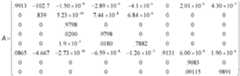
- Example 83 may optionally include the computer program product of example 81 (as well as subject matter of one or more of any combination of examples 1-82), wherein the state space matrix B is:

- Example 84 may optionally include the computer program product of example 81 (as well as subject matter of one or more of any combination of examples 1-83), wherein the state space matrix G is:

- Example 85 may optionally include the computer program product of example 80 (as well as subject matter of one or more of any combination of examples 1-84), wherein the second intermediary computation further comprises:
extracting a blood glucose state from the extrapolated state vector output. - Example 86 may optionally include the computer program product of example 85 (as well as subject matter of one or more of any combination of examples 1-85), wherein extracting the blood glucose state from the extrapolated value further comprises:
applying a state space matrix to the extrapolated state vector output. - Example 87 may optionally include the computer program product of example 69 (as well as subject matter of one or more of any combination of examples 1-86), further comprising:
performing a third computation to reach an estimate of the blood glucose of the subject by applying a weighting scheme to the readout from the glucose measurement device and the output of the second intermediary computation. - Example 88 may optionally include the computer program product of example 87 (as well as subject matter of one or more of any combination of examples 1-87), wherein the weighting scheme further comprises:
applying a first weighting coefficient to the readout from the glucose measurement device and applying a second weighting coefficient to the output of the second intermediary computation. - Example 89 may optionally include the computer program product of example 88 (as well as subject matter of one or more of any combination of examples 1-88), wherein the weighting yields a linear combination of the readout from the glucose measurement device and the output of the second intermediary so that the sum of the first weighting coefficient and the second weighting coefficient is equal to 1.
- Example 90 may optionally include the computer program product of example 88 (as well as subject matter of one or more of any combination of examples 1-89), wherein the weighting scheme further comprises:
applying more weight to the output of the second intermediary computation during hypoglycemia. - Example 91 may optionally include the computer program product of example 90 wherein(as well as subject matter of one or more of any combination of examples 1-90), the more weight is approximately 1.
- Example 92 may optionally include the computer program product of example 88 (as well as subject matter of one or more of any combination of examples 1-91), wherein the weighting scheme further comprises:
applying more weight to the readout from the glucose measurement device during euglycemia. - Example 93 may optionally include the computer program product of example 92 (as well as subject matter of one or more of any combination of examples 1-92), wherein the more weight is approximately 1.
- Example 94 may optionally include the computer program product of example 88 (as well as subject matter of one or more of any combination of examples 1-93), wherein the weighting scheme further comprises:
applying more weight to the readout from the glucose measurement device during hyperglycemia. - Example 95 may optionally include the computer program product of example 94 (as well as subject matter of one or more of any combination of examples 1-94), wherein the more weight is approximately 1.
- Example 96 may optionally include the computer program product of example 88 (as well as subject matter of one or more of any combination of examples 1-95), wherein the weighting scheme further comprises:
applying a weighting scheme that accounted for the lack of accuracy of the output of the second intermediary computation immediately following meals and meal insulin boluses. - Example 97 may optionally include the computer program product of example 88 (as well as subject matter of one or more of any combination of examples 1-96), wherein the weighting scheme further comprises:
applying more weight on the readout from the glucose measurement device in the time following a detection of a large bolus of insulin. - Example 98 may optionally include the computer program product of example 88 (as well as subject matter of one or more of any combination of examples 1-97), wherein the weighting scheme further comprises:
basing the weighting scheme on an S-shaped curve with the curve increasing at approximately the threshold of hypoglycemia. - Example 99 may optionally include the computer program product of example 88 (as well as subject matter of one or more of any combination of examples 1-98), wherein the first weighting coefficient and the second weighting coefficient are provided by the formula w1 = LBGI(CGS - 50)/100 where LBGI is a low BG index and CGS is the readout from the continuous glucose measurement device.
- Example 100 can include, or can optionally be combined with any portion or combination of any portions of any one or more of Examples 1-99 to include, subject matter that can include means for performing any one or more of the functions of Examples 1-99, or a machine-readable medium including instructions that, when performed by a machine, cause the machine to perform any one or more of the functions of Examples 1-99.
- Example 101 can include, or can optionally be combined with any portion or combination of any portions of any one or more of Examples 1-99 to include, subject matter that can include means for performing any one or more of the functions of Examples 1-99, as well devices, systems, structures, components, compositions, materials, shapes, contours, and sizes. Moreover, any of the means discussed throughout examples 1-99 may optionally be performed by any structure, component, device or system discussed throughout this disclosure or any disclosure incorporated by reference herein.
- Example 102 can include, or can optionally be combined with any portion or combination of any portions of any one or more of Examples 1-99 to include, subject matter that can include means for manufacturing any one or more of the components, systems, devices, elements, compositions, material, and/or computer program product of Examples 1-99. The subject matter and means may also be provided from the disclosure provided herein, as well as any references incorporated herein by reference.
- The following patents, applications and publications as listed below and throughout this document are hereby incorporated by reference in their entirety herein.
- The devices, systems, computer program products, components, and methods of various embodiments of the invention disclosed herein may utilize aspects disclosed in the following references, applications, publications and patents and which are hereby incorporated by reference herein in their entirety:
- 1.Klonoff, D: Continuous Glucose Monitoring: Roadmap for the 21st Century Diabetes Therapy. Diabetes Care 288: 1231-1239, 2005.
- 2.Garg,K, Zisser, H, Schwartz, S, Bailey, T, Kaplan, R, Ellis, S, Jovanovic, L:Improvement in Glycemic Excursions With a Transcutaneous, Real-time Continuous Glucose Sensor. Diabetes Care 29:44-50, 2006.
- 3. Deiss, D, Bolinder, J, Riveline,J, Battelino,T, Bosi, E, Tubiana-Rufi, N, Kerr, D, Phillip, M: Improved Glycemic Control in Poorly Controlled Patients with.
- 4.Kovatchev, B, Clarke, W: Continuous Glucose Monitoring (CGM)) reduces risks for hypo- and hyperglycemia and glucose variability in T1DM and insulin-treated T2DM, Diabetes 56 (Suppl 1) : A23, 2007.
- 5.Steil,G, Rebrin,K,Darwin,C,Hariri,F, Saad,M: Feasibility of Automating Insulin Delivery for the Treatment of.
- 6.Hovorka, R:_Continuous glucose monitoring and closed-loop systems. Diabetic Medicine 23:1-12,2006.
- 7.Renard,E: Implantable Closed-Loop Glucose-Sensing and Insulin Delivery: The Future for Insulin Pump Therapy. Curr Opin Pharmacol 2:708-716,2002.
- 8.The Diabetes Research in Children Network (DirecNet) Study Group:_The Accuracy of the GlucoWatch® G2™ Biographer in Children with.
- 9.The Diabetes Research in Children Network (DirecNet) Study Group: The Accuracy of the CGMS™in Children with.
- 10.Wenholt,I, Vollebregt, M, Hart, A, Hoekstra, J, Devries, J: Comparison of a Needle-type and a Microdialysis Continuous Glucose Monitor in.
- 11.Wilson,D Beck,R, Tamborlane,W, Dontchev;M, Kollman,C,;Chase,P, Fox,L,Ruedy,K Tsalikian,E, Weinzimer,S: The DirecNet Study Group:_The Accuracy of the FreeStyle Navigator Continuous Glucose Monitoring System in Children With.
- 12.Kovatchev, B,Gonder-Frederick, A, Cox, D, Clarke, W:_Evaluating the Accuracy of Continuous Glucose-Monitoring Sensors. Diabetes Care 27:1922-1928, 2004.
- 13.Clarke ,W, Anderson,S, Farhy,L, Breton,M, Gonder-Frederick,L, Cox, D, Kovatchev,B: Evaluating the Clinical Accuracy of Two Continuous Glucose Sensors Using Continuous Glucose-Error Grid Analysis. Diabetes Care 28:22412-2417, 2005.
- 14.Weinstein,R, Schwartz,S, Brazg,R,Bugler,J,Peyser,T,McGarraugh,G: Accuracy of the 5-day FreeStyle Navigator Continuous Glucose Monitoring System: comparison with frequent laboratory reference measurements. Diabetes Care 30:1125-1130, 2007.
- 15.US Food and Drug Administration: Review Criteria Assessment of Portable Blood Glucose Monitoring In Vitro Diagnostic Devices using Glucose Oxidase, Dehydrogenase or Hexokinase Methodology-(Version 02/14/96) www.fda.gov.
- 16.Clarke, W, Cox, D, Gonder-Frederick, L, Kovatchev, B: Understanding the Continuous Error-Grid Analysis - CG-EGA. Diabetes Care 30: 449-450, 2007.
- 17.Clarke, WL, Kovatchev, B, Continuous Glucose Sensors: Continuing Questions about Clinical Accuracy, Journal of Diabetes Science and Technology: 2007: 1:669-675.
- 18.Kovatchev, B, Anderson, S, Heinemann, L, Clarke, W, Comparison of the Numerical and Clinical Accuracy of Four Continuous Glucose Monitors, Diabetes Care: 2008: 31: 1160-1164.
- 19.Kovatchev, B, Clarke, W, Peculiarities of the Continuous Glucose Monitoring Data Stream and Their Impact on Developing Closed-Loop Control Technology, Journal of Diabetes Science and Technology: 2008: 2: 1-6.
- 20.Keenan DB, Mastrototaro JJ, Voskanyan G, Steil GM. Delays in Minimally Invasive Continuous Glucose Monitoring Devices: A Review of Current Technology. J Diabetes Sci Technol, 3: 1207-1214, 2009.
- 21. King, et al., (including BP Kovatchev). Method for Improvising Accuracy of Continuous Glucose Sensors and a Continuous Glucose Sensor Using the Same,International Patent Application Serial No.
PCT/US2006/033724, filed August 29, 2006 . - 22. Breton, et al. (including BP Kovatchev), Method, system and computer program product for real-time detection of sensitivity decline in analyte sensors, International Patent Application Serial No.
PCT/US2007/082744, filed October 26, 2007 . - 23.Keenan DB, Cartaya R, Mastrototaro JJ. Accuracy of a New Real-Time Continuous Glucose Monitoring Algorithm. J Diabetes Sci Technol, 4: 111-118, 2010.
- 24.Kovatchev BP, Breton MD._The Accuracy of a New Real-Time Continuous Glucose Monitoring Algorithm: An Analysis. J Diabetes Sci Technol, 4: 119-122, 2010.
- 25.Facchinetti A, Sparacino G, Cobelli C. Modeling the Error of Continuous Glucose Monitoring Sensor Data: Critical Aspects Discussed through Simulation Studies . J Diabetes Sci Technol, 4: 4-14, 2010.
- 26. Kovatchev BP, Breton MD, Dalla Man C, and Cobelli C. Method, System and Computer Simulation Environment for Testing of Monitoring and Control Strategies in Diabetes.
PCT/US2008/067725, filed June, 20, 2008 . - 27.Kovatchev BP, Breton MD, Dalla Man C, Cobelli C (2009). In Silico Preclinical Trials: A Proof of Concept in Closed-Loop Control of.
- 28.Kovatchev BP, Cox DJ, Gonder-Frederick LA Young-Hyman D, Schlundt D and WL Clarke (1998). Assessment of Risk for Severe Hypoglycemia Among Adults with IDDM: Validation of the Low Blood Glucose Index, Diabetes Care, 21: 1870-1875.
- The devices, systems, computer program products, components, and methods of various embodiments of the invention disclosed herein may utilize aspects disclosed in the following references, applications, publications and patents and which are hereby incorporated by reference herein in their entirety:
- A. International Patent Application Serial No.
PCT/US2011/028163, Breton, et al. , entitled "Method and System for the Safety, Analysis and Supervision of Insulin Pump Action and Other Modes of Insulin Delivery in Diabetes", filed March 11, 2011. - B. International Patent Application Serial No.
PCT/US2010/047711, Kovatchev, et al. , "Tracking the Probability for Imminent Hypoglycemia in Diabetes from Self-Monitoring Blood Glucose (SMBG) Data", filed September 2, 2010. - C. International Patent Application Serial No.
PCT/US2010/047386, Kovatchev, et al. , "System, Method and Computer Program Product for Adjustment of Insulin Delivery (AID) in Diabetes Using Nominal Open-Loop Profiles", filed August 31, 2010. - D. International Patent Application Serial No.
PCT/US2010/040097, Kovatchev, et al. , "System, Method, and Computer Simulation Environment for In Silico Trials in Prediabetes andType 2 Diabetes", filed June 25, 2010. - E. International Patent Application Serial No.
PCT/US2010/036629, Kovatchev, et al. , "System Coordinator and Modular Architecture for Open-Loop and Closed-Loop Control of Diabetes", filed May 28, 2010 (Publication No.WO 2010/138848, December 2, 2010 ). - F. International Patent Application Serial No.
PCT/US2010/025405, Kovatchev, et al. , entitled "Method, System and Computer Program Product for CGM-Based Prevention of Hypoglycemia via Hypoglycemia Risk Assessment and Smooth Reduction Insulin Delivery," filed February 25, 2010. - G. International Patent Application Serial No.
PCT/US2009/065725, Kovatchev, et al., filed November 24, 2009 , entitled "Method, System, and Computer Program Product for Tracking of Blood Glucose Variability in Diabetes from Data." - H. International Patent Application Serial No.
PCT/US2008/082063, Magni, et al. , entitled "Model Predictive Control Based Method for Closed-Loop Control of Insulin Delivery in Diabetes Using Continuous Glucose Sensing", filed October 31, 2008;U.S. Patent Application Serial No. 12/740,275, Magni, et al. - I. International Patent Application Serial No.
PCT/US2008/069416, Breton, et al. , entitled "Method, System and Computer Program Product for Evaluation of Insulin Sensitivity, Insulin/Carbohydrate Ratio, and Insulin Correction Factors in Diabetes from Self-Monitoring Data", filed July 8, 2008, (Publication No.WO 2009/009528, January 15, 2009 );U.S. Patent Application Serial No. 12/665,149, Breton, et al. - J. International Patent Application Serial No.
PCT/US2008/067725, Kovatchev, et al. , entitled "Method, System and Computer Simulation Environment for Testing of Monitoring and Control Strategies in Diabetes," filed June 20, 2008, (Publication No.WO 2008/157781, December 24, 2008 );U.S. Patent Application Publication Serial No. 12/664,444, Kovatchev, et al., filed December 14, 2009 2010/0-179768, July 15, 2010 - K. International Patent Application Serial No.
PCT/US2008/067723, Patek, et al. , entitled "LQG Artificial Pancreas Control System and Related Method", filed on 6/20/2008. - L.
U.S. Patent Application Serial No. 12/516,044, Kovatchev, et al., filed May 22, 2009 - M. International Patent Application Serial No.
PCT/US2007/085588, Kovatchev, et al., filed November 27, 2007 , entitled "Method, System, and Computer Program Product for the Detection of Physical Activity by Changes in Heart Rate, Assessment of Fast Changing Metabolic States, and Applications of Closed and Open Control Loop in Diabetes", (Publication No.WO2008/067284, June 5, 2008 ) - N.
U.S. Patent Application Serial No. 11/943,226, Kovatchev, et al., filed November 20, 2007 - O.
U.S. Patent Application Serial No. 11/578,831, Kovatchev, et al., filed October 18, 2006 US2007/0232878, October 4, 2007 ),U.S. Patent No. 7,815,569, Kovatchev, et al., issued October 29, 2010 - P. International Application Serial No.
PCT/US2005/013792, Kovatchev, et al., filed April 21, 2005 , entitled "Method, System, and Computer Program Product for Evaluation of the Accuracy of Blood Glucose Monitoring Sensors/Devices", (Publication No.WO 05106017, November 10, 2005 - Q. International Patent Application Serial No.
PCT/US01/09884, Kovatchev, et al., filed March 29 2001 , entitled "Method, System, and Computer Program Product for Evaluation of Glycemic Control in Diabetes Self-Monitoring Data", (Publication No.WO 01/72208, October 4, 2001 - R.
U.S. Patent Application Serial No. 10/240,228, Kovatchev, et al., filed September 26, 2002 0212317, November 13, 2003 ),U.S. Patent No. 7,025,425 B2, Kovatchev, et al., issued April 11, 2006 , entitled "Method, System, and Computer Program Product for the Evaluation of Glycemic Control in Diabetes from Self-Monitoring Data". - S.
U.S. Patent Application Serial No. 11/305,946, Kovatchev, et al., filed December 19, 2005 2006/0094947, May 4, 2006 ),U.S. Patent No. 7,874,985, Kovatchev, et al., issued January 25, 2011 . - T.
U.S. Patent Application Serial No. 12/975,580, Kovatchev, et al. - U. International Patent Application Serial No.
PCT/US2003/025053, Kovatchev, et al., filed August 8, 2003 , entitled "Method, System, and Computer Program Product for the Processing of Self-Monitoring Blood Glucose (SMBG) Data to Enhance Diabetic Self-Management", (Publication No.WO 2004/015539, February 19, 2004 ). - V.
U.S. Patent Application Serial No. 10/524,094, Kovatchev, et al., filed February 9, 2005 2005/214892, September 29, 2005 ). - W.
U.S. Patent Application Serial No. 12/065,257, Kovatchev, et al., filed August 29, 2008 , entitled "Accuracy of Continuous Glucose Sensors", (Publication No.2008/0314395, December 25, 2008 ). - X. International Patent Application Serial No
PCT/US2006/033724, Kovatchev, et al., filed August 29, 2006 , entitled "Method for Improvising Accuracy of Continuous Glucose Sensors and a Continuous Glucose Sensor Using the Same", (Publication No.WO 07027691, March 8, 2007 - Y.
U.S. Patent Application Serial No. 12/159,891, Kovatchev, B., filed July 2, 2008 2009/0171589, July 2, 2009 ). - Z. International Application No.
PCT/US2007/000370, Kovatchev, B., filed January 5, 2007 , entitled "Method, System and Computer Program Product for Evaluation of Blood Glucose Variability in Diabetes from Self-Monitoring Data", (Publication No.WO 07081853, July 19, 2007 - AA.
U.S. Patent Application Serial No. 11/925,689 PCT/US2007/082744, Breton, et al., both filed October 26, 2007 , entitled "For Method, System and Computer Program Product for Real-Time Detection of Sensitivity Decline in Analyte Sensors", (Publication Nos.2008/0172205, July 17, 2008 WO 2008/052199, May 2, 2008 ). - BB.
U.S. Patent Application Serial No. 10/069,674, Kovatchev, et al., filed February 22, 2002 , entitled "Method and Apparatus for Predicting the Risk of Hypoglycemia". - CC. International Application No.
PCT/US00/22886, Kovatchev, et al., filed August 21, 2000 , entitled "Method and Apparatus for Predicting the Risk of Hypoglycemia", (Publication No.WO 01/13786, March 1, 2001 - DD.
U.S. Patent Application Serial No. 6,923,763 B1, Kovatchev, et al., issued August 2, 2005 , entitled "Method and Apparatus for Predicting the Risk of Hypoglycemia". - EE. U.S. Patent Application Publication No.
US 2004/0254434 A1 , "Glucose Measuring Module and "Insulin Pump Combination", published December 16, 2004.,Goodnow, et al. Serial No. 10/458,914, filed June 10, 2003 - FF. U.S. Patent Application Publication No.
US 2009/00697456 A1, Estes, et al. 11/851,194, September 6, 2007 - In summary, while the present invention has been described with respect to specific embodiments, many modifications, variations, alterations, substitutions, and equivalents will be apparent to those skilled in the art. The present invention is not to be limited in scope by the specific embodiment described herein. Indeed, various modifications of the present invention, in addition to those described herein, will be apparent to those of skill in the art from the foregoing description and accompanying drawings. Accordingly, the invention is to be considered as limited only by the spirit and scope of the following claims, including all modifications and equivalents.
- Still other embodiments will become readily apparent to those skilled in this art from reading the above-recited detailed description and drawings of certain exemplary embodiments. It should be understood that numerous variations, modifications, and additional embodiments are possible, and accordingly, all such variations, modifications, and embodiments are to be regarded as being within the spirit and scope of this application. For example, regardless of the content of any portion (e.g., title, field, background, summary, abstract, drawing figure, etc.) of this application, unless clearly specified to the contrary, there is no requirement for the inclusion in any claim herein or of any application claiming priority hereto of any particular described or illustrated activity or element, any particular sequence of such activities, or any particular interrelationship of such elements. Moreover, any activity can be repeated, any activity can be performed by multiple entities, and/or any element can be duplicated. Further, any activity or element can be excluded, the sequence of activities can vary, and/or the interrelationship of elements can vary. Unless clearly specified to the contrary, there is no requirement for any particular described or illustrated activity or element, any particular sequence or such activities, any particular size, speed, material, dimension or frequency, or any particularly interrelationship of such elements. Accordingly, the descriptions and drawings are to be regarded as illustrative in nature, and not as restrictive. Moreover, when any number or range is described herein, unless clearly stated otherwise, that number or range is approximate. When any range is described herein, unless clearly stated otherwise, that range includes all values therein and all sub ranges therein. Any information in any material (e.g., a United States/foreign patent, United States/foreign patent application, book, article, etc.) that has been incorporated by reference herein, is only incorporated by reference to the extent that no conflict exists between such information and the other statements and drawings set forth herein. In the event of such conflict, including a conflict that would render invalid any claim herein or seeking priority hereto, then any such conflicting information in such incorporated by reference material is specifically not incorporated by reference herein.


Claims (15)
- A method for obtaining a blood glucose (BG) measurement of a patient, comprising,
obtaining a readout (CGS(t)) from a glucose measurement,
obtaining an insulin delivery information (Jctrl(t)),
providing, via a first intermediary computation, an output (x̂(t-τ)) using said readout (CGS(t)) of a subject and said insulin delivery information (Jctrl(t)), wherein said output of said first intermediary computation provides a metabolic state estimate, providing, via a second intermediary computation, an output (BG(t|t-τ)) using said output of said first intermediary computation (x̂(t-τ)),
wherein said output (BG(t|t-τ)) of said second intermediary computation is a predicted blood glucose of the subject,
wherein said second intermediary computation further comprises:an inference of said output (BG(t|t-τ)) of said second intermediary computation from said output (x̂(t-τ)) of said first intermediary computation, andan extrapolation of said output of said first intermediary computation ((x̂(t-τ)) to some future time to determine an extrapolated state vector output. - The method of claim 1,
wherein said second intermediary computation further comprises:
an extraction of a blood glucose state from said extrapolated state vector output. - The method according to any one of claims 1 or 2 further comprises
providing, via a third computation, an estimate of the blood glucose (BGest (t)) of the subject by applying a weighting scheme to said readout (CGS(t)) and said output of said second intermediary computation (BG(t|t-τ)). - The method according to claim 3, wherein said weighting scheme comprises:
an application of a first weighting coefficient to said readout (CGS(t)) and an application of a second weighting coefficient to said output of said second intermediary computation (BG(t|t -τ)). - The method of claim 4, wherein said first weighting coefficient is provided by the formula w1=LBGI(CGS-50)/100 where LBGI is a low BG index and CGS is said readout (CGS(t)).
- The method of any one of claims 4 or 5, wherein the weighting yields a linear combination of said readout (CGS(t)) and said output (BG(t|t-τ)) of said second intermediary so that the sum of the first weighting coefficient and the second weighting coefficient equals 1.
- The method of any one of claims 4 to 6, further comprising any one or combination of:applying more weight to said output of said second intermediary computation (BG(t|t -τ)) during hypoglycemia,applying more weight to said readout (CGS(t)) during euglycemia,applying more weight to said readout (CGS(t)) during hyperglycemia,applying more weight on said readout (CGS(t)) in the time following a detection of a large bolus of insulin.
- The method of any one of claims 3 to 7, wherein said weighting scheme further comprises:
an application of a weighting scheme that accounted for the lack of accuracy of said output of said second intermediary computation (BG(t|t - τ)) immediately following meals and meal insulin boluses. - The method of any one of claims 3 to 8, wherein said weighting scheme comprises:
an application of said weighting scheme based on an S-shaped curve with said curve increasing at approximately the threshold of hypoglycemia. - The method of any one of claims 1 to 9, wherein the first intermediary computation comprises a Kalman Filter methodology.
- The method of any one of claims 1 to 10, wherein the first intermediary computation comprises a method for filtering/state estimation, using one of an H-infinity filtering method, a Bayesian filtering method, a Monte Carlo method, or at least squares method.
- The method of any one of claims 1 to 11,
wherein the frequency of said readout (CGS(t)) is any one of
a continuous rate;
a periodic rate;
at least approximately every 60 minutes;
at least approximately every 30 minutes; or
at least approximately every 15 minutes. - A computer readable medium having instructions stored thereon, the instructions programmed to cause a processor (102), when the computer readable medium is in operative association with the processor (102), to
carry out the method of any one of claims 1 to 12. - The computer readable medium of claim 13, wherein the computer readable medium is operatively associated with the processor (102).
- The computer readable medium any one of claims 13 or 14,
wherein the computer readable medium and the processor (102) are part of a glucose monitor, an insulin delivery device, or a standalone computer device, or
wherein the computer readable medium and the processor (102) are part of a system, the system comprising any one or combination of a glucose monitor, an insulin delivery device, or a standalone computer device.
Priority Applications (1)
| Application Number | Priority Date | Filing Date | Title |
|---|---|---|---|
| EP22202489.5AEP4183326A1 (en) | 2010-03-26 | 2011-03-24 | Method, system, and computer program product for improving the accuracy of glucose sensors using insulin delivery observation in diabetes |
Applications Claiming Priority (4)
| Application Number | Priority Date | Filing Date | Title |
|---|---|---|---|
| US31790210P | 2010-03-26 | 2010-03-26 | |
| EP11760217.7AEP2552301B1 (en) | 2010-03-26 | 2011-03-24 | System for improving the accuracy of glucose sensors using insulin delivery observation in diabetes |
| EP19195030.2AEP3593711B8 (en) | 2010-03-26 | 2011-03-24 | System for improving the accuracy of glucose sensors using insulin delivery observation in diabetes |
| PCT/US2011/029793WO2011119832A1 (en) | 2010-03-26 | 2011-03-24 | Method, system, and computer program product for improving the accuracy of glucose sensors using insulin delivery observation in diabetes |
Related Parent Applications (3)
| Application Number | Title | Priority Date | Filing Date |
|---|---|---|---|
| EP11760217.7ADivisionEP2552301B1 (en) | 2010-03-26 | 2011-03-24 | System for improving the accuracy of glucose sensors using insulin delivery observation in diabetes |
| EP19195030.2ADivisionEP3593711B8 (en) | 2010-03-26 | 2011-03-24 | System for improving the accuracy of glucose sensors using insulin delivery observation in diabetes |
| EP19195030.2ADivision-IntoEP3593711B8 (en) | 2010-03-26 | 2011-03-24 | System for improving the accuracy of glucose sensors using insulin delivery observation in diabetes |
Related Child Applications (2)
| Application Number | Title | Priority Date | Filing Date |
|---|---|---|---|
| EP22202489.5ADivision-IntoEP4183326A1 (en) | 2010-03-26 | 2011-03-24 | Method, system, and computer program product for improving the accuracy of glucose sensors using insulin delivery observation in diabetes |
| EP22202489.5ADivisionEP4183326A1 (en) | 2010-03-26 | 2011-03-24 | Method, system, and computer program product for improving the accuracy of glucose sensors using insulin delivery observation in diabetes |
Publications (2)
| Publication Number | Publication Date |
|---|---|
| EP3841968A1true EP3841968A1 (en) | 2021-06-30 |
| EP3841968B1 EP3841968B1 (en) | 2022-11-30 |
Family
ID=44673617
Family Applications (4)
| Application Number | Title | Priority Date | Filing Date |
|---|---|---|---|
| EP11760217.7AActiveEP2552301B1 (en) | 2010-03-26 | 2011-03-24 | System for improving the accuracy of glucose sensors using insulin delivery observation in diabetes |
| EP21157923.0AActiveEP3841968B1 (en) | 2010-03-26 | 2011-03-24 | Method, system, and computer program product for improving the accuracy of glucose sensors using insulin delivery observation in diabetes |
| EP19195030.2AActiveEP3593711B8 (en) | 2010-03-26 | 2011-03-24 | System for improving the accuracy of glucose sensors using insulin delivery observation in diabetes |
| EP22202489.5APendingEP4183326A1 (en) | 2010-03-26 | 2011-03-24 | Method, system, and computer program product for improving the accuracy of glucose sensors using insulin delivery observation in diabetes |
Family Applications Before (1)
| Application Number | Title | Priority Date | Filing Date |
|---|---|---|---|
| EP11760217.7AActiveEP2552301B1 (en) | 2010-03-26 | 2011-03-24 | System for improving the accuracy of glucose sensors using insulin delivery observation in diabetes |
Family Applications After (2)
| Application Number | Title | Priority Date | Filing Date |
|---|---|---|---|
| EP19195030.2AActiveEP3593711B8 (en) | 2010-03-26 | 2011-03-24 | System for improving the accuracy of glucose sensors using insulin delivery observation in diabetes |
| EP22202489.5APendingEP4183326A1 (en) | 2010-03-26 | 2011-03-24 | Method, system, and computer program product for improving the accuracy of glucose sensors using insulin delivery observation in diabetes |
Country Status (3)
| Country | Link |
|---|---|
| US (1) | US9398869B2 (en) |
| EP (4) | EP2552301B1 (en) |
| WO (1) | WO2011119832A1 (en) |
Families Citing this family (27)
| Publication number | Priority date | Publication date | Assignee | Title |
|---|---|---|---|---|
| WO2011028731A1 (en)* | 2009-09-01 | 2011-03-10 | University Of Virginia Patent Foundation | System, method and computer program product for adjustment of insulin delivery (aid) in diabetes using nominal open-loop profiles |
| ES2924029T3 (en)* | 2010-03-11 | 2022-10-04 | Univ Virginia Patent Foundation | Method and system for the safety, analysis and monitoring of the action of the insulin pump and other modes of insulin administration in diabetes |
| WO2012058694A2 (en) | 2010-10-31 | 2012-05-03 | Trustees Of Boston University | Blood glucose control system |
| US9833191B2 (en) | 2012-11-07 | 2017-12-05 | Bigfoot Biomedical, Inc. | Computer-based diabetes management |
| CA2938078C (en) | 2014-01-31 | 2019-06-11 | Trustees Of Boston University | Offline glucose control based on preceding periods |
| US10188793B2 (en) | 2014-06-10 | 2019-01-29 | Bigfoot Biomedical, Inc. | Insulin on board calculation, schedule and delivery |
| CN106999110A (en) | 2014-08-14 | 2017-08-01 | 弗吉尼亚大学专利基金会 | Continuous glucose monitoring method, system and device with improved accuracy |
| WO2016201120A1 (en) | 2015-06-09 | 2016-12-15 | University Of Virginia Patent Foundation | Insulin monitoring and delivery system and method for cgm based fault detection and mitigation via metabolic state tracking |
| WO2017027459A1 (en) | 2015-08-07 | 2017-02-16 | Trustees Of Boston University | Glucose control system with automatic adaptation of glucose target |
| WO2017040927A1 (en) | 2015-09-02 | 2017-03-09 | University Of Virginia Patent Foundation | System, method, and computer readable medium for dynamic insulin sensitivity in diabetic pump users |
| WO2017070553A1 (en)* | 2015-10-21 | 2017-04-27 | University Of Virginia Patent Foundation | System, method and computer readable medium for dynamical tracking of the risk for hypoglycemia in type 1 and type 2 diabetes |
| EP4552567A1 (en) | 2016-05-02 | 2025-05-14 | DexCom, Inc. | System for providing alerts optimized for a user |
| KR102739829B1 (en) | 2016-09-09 | 2024-12-05 | 덱스콤, 인크. | Systems and methods for cgm-based bolus calculator for display and for provision to medicament delivery devices |
| AU2018261124B2 (en) | 2017-05-05 | 2021-01-28 | Ypsomed Ag | Closed loop control of physiological glucose |
| EP3438858A1 (en) | 2017-08-02 | 2019-02-06 | Diabeloop | Closed-loop blood glucose control systems and methods |
| US11901060B2 (en) | 2017-12-21 | 2024-02-13 | Ypsomed Ag | Closed loop control of physiological glucose |
| CN111655128A (en) | 2018-02-09 | 2020-09-11 | 德克斯康公司 | System and method for decision support |
| CA3103479A1 (en) | 2018-06-22 | 2019-12-26 | Eli Lilly And Company | Insulin and pramlintide delivery systems, methods, and devices |
| CN109375111A (en)* | 2018-10-12 | 2019-02-22 | 杭州电子科技大学 | A UHF-based method for estimating remaining battery power |
| DE102019205430A1 (en)* | 2019-04-15 | 2020-10-15 | Eyesense Gmbh | Method for determining a current glucose level in a transport fluid |
| CN110118936A (en)* | 2019-05-06 | 2019-08-13 | 杭州电子科技大学 | A kind of estimation method of battery dump energy based on EHF |
| EP4000075A4 (en) | 2019-07-16 | 2023-10-04 | Beta Bionics, Inc. | BLOOD GLUCOSE CONTROL SYSTEM |
| WO2021011738A1 (en) | 2019-07-16 | 2021-01-21 | Beta Bionics, Inc. | Blood glucose control system |
| US11957876B2 (en) | 2019-07-16 | 2024-04-16 | Beta Bionics, Inc. | Glucose control system with automated backup therapy protocol generation |
| US20220395200A1 (en)* | 2019-11-14 | 2022-12-15 | University Of Virginia Patent Foundation | Method and system for model-based tracking of hemoglobin a1c from daily continuous glucose monitoring profiles |
| US20220188388A1 (en) | 2020-12-07 | 2022-06-16 | Beta Bionics, Inc. | Ambulatory medicament pump with safe access control |
| US20230166036A1 (en) | 2021-12-01 | 2023-06-01 | Medtronic Minimed, Inc. | Mealtime delivery of correction boluses |
Citations (18)
| Publication number | Priority date | Publication date | Assignee | Title |
|---|---|---|---|---|
| US212317A (en) | 1879-02-18 | Improvement in hoisting-buckets | ||
| WO2001013786A1 (en) | 1999-08-23 | 2001-03-01 | University Of Virginia Patent Foundation | Method and apparatus for predicting the risk of hypoglycemia |
| WO2001072208A2 (en) | 2000-03-29 | 2001-10-04 | University Of Virginia Patent Foundation | Method, system, and computer program product for the evaluation of glycemic control in diabetes from self-monitoring data |
| US6525708B2 (en) | 2001-02-20 | 2003-02-25 | Au Optronics Corporation | Display panel with dot inversion or column inversion |
| WO2004015539A2 (en) | 2002-08-13 | 2004-02-19 | University Of Virginia Patent Foundation | Managing and processing self-monitoring blood glucose |
| US20040254434A1 (en) | 2003-06-10 | 2004-12-16 | Goodnow Timothy T. | Glucose measuring module and insulin pump combination |
| US6923763B1 (en) | 1999-08-23 | 2005-08-02 | University Of Virginia Patent Foundation | Method and apparatus for predicting the risk of hypoglycemia |
| WO2005106017A2 (en) | 2004-04-21 | 2005-11-10 | University Of Virginia Patent Foundation | Method, system and computer program product for evaluating the accuracy of blood glucose monitoring sensors/devices |
| US6967402B2 (en) | 1998-05-15 | 2005-11-22 | Kabushiki Kaisha Toshiba | Hermetically sealed semiconductor power module and large scale module comprising the same |
| WO2007027691A1 (en) | 2005-08-31 | 2007-03-08 | University Of Virginia Patent Foundation | Improving the accuracy of continuous glucose sensors |
| WO2007081853A2 (en) | 2006-01-05 | 2007-07-19 | University Of Virginia Patent Foundation | Method, system and computer program product for evaluation of blood glucose variability in diabetes from self-monitoring data |
| WO2008052199A2 (en) | 2006-10-26 | 2008-05-02 | Abbott Diabetes Care, Inc. | Method, system and computer program product for real-time detection of sensitivity decline in analyte sensors |
| WO2008067284A2 (en) | 2006-11-27 | 2008-06-05 | University Of Virginia Patent Foundation | Method, system, and computer program for detection of conditions of a patient having diabetes |
| WO2008157781A1 (en) | 2007-06-21 | 2008-12-24 | University Of Virginia Patent Foundation | Method, system and computer simulation environment for testing of monitoring and control strategies in diabetes |
| WO2009009528A2 (en) | 2007-07-09 | 2009-01-15 | University Of Virginia Patent Foundation | Diabetes insulin sensitivity, carbohydrate ratio, correction factors data self-monitoring product |
| US20090055149A1 (en)* | 2007-05-14 | 2009-02-26 | Abbott Diabetes Care, Inc. | Method and system for determining analyte levels |
| WO2010025431A1 (en)* | 2008-08-31 | 2010-03-04 | Abbott Diabetes Care Inc. | Closed loop control and signal attenuation detection |
| WO2010138848A1 (en) | 2009-05-29 | 2010-12-02 | University Of Virginia Patent Foundation | System coordinator and modular architecture for open-loop and closed-loop control of diabetes |
Family Cites Families (11)
| Publication number | Priority date | Publication date | Assignee | Title |
|---|---|---|---|---|
| US7285090B2 (en)* | 2000-06-16 | 2007-10-23 | Bodymedia, Inc. | Apparatus for detecting, receiving, deriving and displaying human physiological and contextual information |
| WO2002024065A1 (en)* | 2000-09-22 | 2002-03-28 | Knobbe, Lim & Buckingham | Method and apparatus for real-time estimation and control of pysiological parameters |
| US7591801B2 (en)* | 2004-02-26 | 2009-09-22 | Dexcom, Inc. | Integrated delivery device for continuous glucose sensor |
| US7651845B2 (en)* | 2004-05-13 | 2010-01-26 | The Regents Of The University Of California | Method and apparatus for glucose control and insulin dosing for diabetics |
| US7717903B2 (en) | 2007-09-06 | 2010-05-18 | M2 Group Holdings, Inc. | Operating an infusion pump system |
| US7817575B2 (en) | 2007-10-10 | 2010-10-19 | Intel Corporation | Method for achieving fairness in a network |
| US9089292B2 (en)* | 2010-03-26 | 2015-07-28 | Medtronic Minimed, Inc. | Calibration of glucose monitoring sensor and/or insulin delivery system |
| ES2565482T3 (en) | 2011-08-17 | 2016-04-05 | Otto Fuchs Kg | Heat-resistant Al-Cu-Mg-Ag alloy, as well as a procedure for the manufacture of a semi-finished product or product from such an aluminum alloy |
| US10069674B2 (en) | 2013-12-12 | 2018-09-04 | International Business Machines Corporation | Monitoring file system operations between a client computer and a file server |
| CA2938772C (en) | 2014-02-05 | 2020-04-21 | University Of Melbourne | Method and system for rapid malaria detection |
| DE102017202499A1 (en) | 2017-02-16 | 2018-08-16 | Airbus Operations Gmbh | Communication system, aerospace vehicle and communication method |
- 2011
- 2011-03-24EPEP11760217.7Apatent/EP2552301B1/enactiveActive
- 2011-03-24EPEP21157923.0Apatent/EP3841968B1/enactiveActive
- 2011-03-24EPEP19195030.2Apatent/EP3593711B8/enactiveActive
- 2011-03-24EPEP22202489.5Apatent/EP4183326A1/enactivePending
- 2011-03-24USUS13/637,359patent/US9398869B2/enactiveActive
- 2011-03-24WOPCT/US2011/029793patent/WO2011119832A1/enactiveApplication Filing
Patent Citations (28)
| Publication number | Priority date | Publication date | Assignee | Title |
|---|---|---|---|---|
| US212317A (en) | 1879-02-18 | Improvement in hoisting-buckets | ||
| US6967402B2 (en) | 1998-05-15 | 2005-11-22 | Kabushiki Kaisha Toshiba | Hermetically sealed semiconductor power module and large scale module comprising the same |
| WO2001013786A1 (en) | 1999-08-23 | 2001-03-01 | University Of Virginia Patent Foundation | Method and apparatus for predicting the risk of hypoglycemia |
| US6923763B1 (en) | 1999-08-23 | 2005-08-02 | University Of Virginia Patent Foundation | Method and apparatus for predicting the risk of hypoglycemia |
| WO2001072208A2 (en) | 2000-03-29 | 2001-10-04 | University Of Virginia Patent Foundation | Method, system, and computer program product for the evaluation of glycemic control in diabetes from self-monitoring data |
| US7874985B2 (en) | 2000-03-29 | 2011-01-25 | University Of Virginia Patent Foundation | Method, system, and computer program product for the evaluation of glycemic control in diabetes from self-monitoring data |
| US7025425B2 (en) | 2000-03-29 | 2006-04-11 | University Of Virginia Patent Foundation | Method, system, and computer program product for the evaluation of glycemic control in diabetes from self-monitoring data |
| US20060094947A1 (en) | 2000-03-29 | 2006-05-04 | Kovatchev Boris P | Method, system, and computer program product for the evaluation of glycemic control in diabetes from self-monitoring data |
| US6525708B2 (en) | 2001-02-20 | 2003-02-25 | Au Optronics Corporation | Display panel with dot inversion or column inversion |
| WO2004015539A2 (en) | 2002-08-13 | 2004-02-19 | University Of Virginia Patent Foundation | Managing and processing self-monitoring blood glucose |
| US20050214892A1 (en) | 2002-08-13 | 2005-09-29 | Kovatchev Boris P | Method, system, and computer program product for the processing of self-monitoring blood glucose(smbg)data to enhance diabetic self-management |
| US20040254434A1 (en) | 2003-06-10 | 2004-12-16 | Goodnow Timothy T. | Glucose measuring module and insulin pump combination |
| US20070232878A1 (en) | 2004-04-21 | 2007-10-04 | University Of Virginia Patent Foundation | Method, System and Computer Program Product for Evaluating the Accuracy of Blood Glucose Monitoring Sensors/Devices |
| WO2005106017A2 (en) | 2004-04-21 | 2005-11-10 | University Of Virginia Patent Foundation | Method, system and computer program product for evaluating the accuracy of blood glucose monitoring sensors/devices |
| US7815569B2 (en) | 2004-04-21 | 2010-10-19 | University Of Virginia Patent Foundation | Method, system and computer program product for evaluating the accuracy of blood glucose monitoring sensors/devices |
| US20080314395A1 (en) | 2005-08-31 | 2008-12-25 | Theuniversity Of Virginia Patent Foundation | Accuracy of Continuous Glucose Sensors |
| WO2007027691A1 (en) | 2005-08-31 | 2007-03-08 | University Of Virginia Patent Foundation | Improving the accuracy of continuous glucose sensors |
| US20090171589A1 (en) | 2006-01-05 | 2009-07-02 | University Of Virginia Patent Foundation | Method, System and Computer Program Product for Evaluation of Blood Glucose Variability In Diabetes From Self-Monitoring Data |
| WO2007081853A2 (en) | 2006-01-05 | 2007-07-19 | University Of Virginia Patent Foundation | Method, system and computer program product for evaluation of blood glucose variability in diabetes from self-monitoring data |
| US20080172205A1 (en) | 2006-10-26 | 2008-07-17 | Abbott Diabetes Care, Inc. | Method, system and computer program product for real-time detection of sensitivity decline in analyte sensors |
| WO2008052199A2 (en) | 2006-10-26 | 2008-05-02 | Abbott Diabetes Care, Inc. | Method, system and computer program product for real-time detection of sensitivity decline in analyte sensors |
| WO2008067284A2 (en) | 2006-11-27 | 2008-06-05 | University Of Virginia Patent Foundation | Method, system, and computer program for detection of conditions of a patient having diabetes |
| US20090055149A1 (en)* | 2007-05-14 | 2009-02-26 | Abbott Diabetes Care, Inc. | Method and system for determining analyte levels |
| WO2008157781A1 (en) | 2007-06-21 | 2008-12-24 | University Of Virginia Patent Foundation | Method, system and computer simulation environment for testing of monitoring and control strategies in diabetes |
| US20100179768A1 (en) | 2007-06-21 | 2010-07-15 | University Of Virginia Patent Foundation | Method, System and Computer Simulation Environment for Testing of Monitoring and Control Strategies in Diabetes |
| WO2009009528A2 (en) | 2007-07-09 | 2009-01-15 | University Of Virginia Patent Foundation | Diabetes insulin sensitivity, carbohydrate ratio, correction factors data self-monitoring product |
| WO2010025431A1 (en)* | 2008-08-31 | 2010-03-04 | Abbott Diabetes Care Inc. | Closed loop control and signal attenuation detection |
| WO2010138848A1 (en) | 2009-05-29 | 2010-12-02 | University Of Virginia Patent Foundation | System coordinator and modular architecture for open-loop and closed-loop control of diabetes |
Non-Patent Citations (25)
Also Published As
| Publication number | Publication date |
|---|---|
| EP2552301A1 (en) | 2013-02-06 |
| EP3841968B1 (en) | 2022-11-30 |
| EP2552301B1 (en) | 2019-10-16 |
| EP3593711B1 (en) | 2021-05-05 |
| EP4183326A1 (en) | 2023-05-24 |
| WO2011119832A1 (en) | 2011-09-29 |
| EP3593711A1 (en) | 2020-01-15 |
| EP2552301A4 (en) | 2014-07-30 |
| US9398869B2 (en) | 2016-07-26 |
| US20130079613A1 (en) | 2013-03-28 |
| EP3593711B8 (en) | 2021-07-28 |
Similar Documents
| Publication | Publication Date | Title |
|---|---|---|
| EP2552301B1 (en) | System for improving the accuracy of glucose sensors using insulin delivery observation in diabetes | |
| US11751779B2 (en) | Method, system and computer program product for CGM-based prevention of hypoglycemia via hypoglycemia risk assessment and smooth reduction insulin delivery | |
| US20210361867A1 (en) | Integrated closed-loop medication delivery with error model and safety check | |
| EP2369980B1 (en) | METHOD and SYSTEM FOR TRACKING OF BLOOD GLUCOSE VARIABILITY IN DIABETES | |
| EP2203112B1 (en) | Method, system and computer simulation environment for testing of monitoring and control strategies in diabetes | |
| Longo et al. | Glycemic control in people with type 1 diabetes using a hybrid closed loop system and followed by telemedicine during the COVID-19 pandemic in Italy | |
| EP4231307A1 (en) | System coordinator and modular architecture for open-loop and closed-loop control of diabetes | |
| EP2164387A2 (en) | Diabetes insulin sensitivity, carbohydrate ratio, correction factors data self-monitoring product | |
| EP2470256A1 (en) | System, method and computer program product for adjustment of insulin delivery (aid) in diabetes using nominal open-loop profiles | |
| Knab | Model-Based Closed-Loop Glucose Control in Critical Illness |
Legal Events
| Date | Code | Title | Description |
|---|---|---|---|
| PUAI | Public reference made under article 153(3) epc to a published international application that has entered the european phase | Free format text:ORIGINAL CODE: 0009012 | |
| STAA | Information on the status of an ep patent application or granted ep patent | Free format text:STATUS: THE APPLICATION HAS BEEN PUBLISHED | |
| AC | Divisional application: reference to earlier application | Ref document number:3593711 Country of ref document:EP Kind code of ref document:P Ref document number:2552301 Country of ref document:EP Kind code of ref document:P | |
| AK | Designated contracting states | Kind code of ref document:A1 Designated state(s):AL AT BE BG CH CY CZ DE DK EE ES FI FR GB GR HR HU IE IS IT LI LT LU LV MC MK MT NL NO PL PT RO RS SE SI SK SM TR | |
| STAA | Information on the status of an ep patent application or granted ep patent | Free format text:STATUS: REQUEST FOR EXAMINATION WAS MADE | |
| 17P | Request for examination filed | Effective date:20211228 | |
| RBV | Designated contracting states (corrected) | Designated state(s):AL AT BE BG CH CY CZ DE DK EE ES FI FR GB GR HR HU IE IS IT LI LT LU LV MC MK MT NL NO PL PT RO RS SE SI SK SM TR | |
| RIC1 | Information provided on ipc code assigned before grant | Ipc:A61B 5/00 20060101AFI20220425BHEP | |
| GRAP | Despatch of communication of intention to grant a patent | Free format text:ORIGINAL CODE: EPIDOSNIGR1 | |
| STAA | Information on the status of an ep patent application or granted ep patent | Free format text:STATUS: GRANT OF PATENT IS INTENDED | |
| INTG | Intention to grant announced | Effective date:20220609 | |
| GRAS | Grant fee paid | Free format text:ORIGINAL CODE: EPIDOSNIGR3 | |
| GRAA | (expected) grant | Free format text:ORIGINAL CODE: 0009210 | |
| STAA | Information on the status of an ep patent application or granted ep patent | Free format text:STATUS: THE PATENT HAS BEEN GRANTED | |
| RAP3 | Party data changed (applicant data changed or rights of an application transferred) | Owner name:UNIVERSITY OF VIRGINIA PATENT FOUNDATION | |
| AC | Divisional application: reference to earlier application | Ref document number:2552301 Country of ref document:EP Kind code of ref document:P Ref document number:3593711 Country of ref document:EP Kind code of ref document:P | |
| AK | Designated contracting states | Kind code of ref document:B1 Designated state(s):AL AT BE BG CH CY CZ DE DK EE ES FI FR GB GR HR HU IE IS IT LI LT LU LV MC MK MT NL NO PL PT RO RS SE SI SK SM TR | |
| REG | Reference to a national code | Ref country code:CH Ref legal event code:EP Ref country code:GB Ref legal event code:FG4D | |
| REG | Reference to a national code | Ref country code:AT Ref legal event code:REF Ref document number:1534037 Country of ref document:AT Kind code of ref document:T Effective date:20221215 | |
| REG | Reference to a national code | Ref country code:IE Ref legal event code:FG4D | |
| REG | Reference to a national code | Ref country code:DE Ref legal event code:R096 Ref document number:602011073496 Country of ref document:DE | |
| REG | Reference to a national code | Ref country code:SE Ref legal event code:TRGR | |
| REG | Reference to a national code | Ref country code:NL Ref legal event code:FP | |
| REG | Reference to a national code | Ref country code:NO Ref legal event code:T2 Effective date:20221130 Ref country code:LT Ref legal event code:MG9D | |
| PG25 | Lapsed in a contracting state [announced via postgrant information from national office to epo] | Ref country code:PT Free format text:LAPSE BECAUSE OF FAILURE TO SUBMIT A TRANSLATION OF THE DESCRIPTION OR TO PAY THE FEE WITHIN THE PRESCRIBED TIME-LIMIT Effective date:20230331 Ref country code:LT Free format text:LAPSE BECAUSE OF FAILURE TO SUBMIT A TRANSLATION OF THE DESCRIPTION OR TO PAY THE FEE WITHIN THE PRESCRIBED TIME-LIMIT Effective date:20221130 Ref country code:FI Free format text:LAPSE BECAUSE OF FAILURE TO SUBMIT A TRANSLATION OF THE DESCRIPTION OR TO PAY THE FEE WITHIN THE PRESCRIBED TIME-LIMIT Effective date:20221130 Ref country code:ES Free format text:LAPSE BECAUSE OF FAILURE TO SUBMIT A TRANSLATION OF THE DESCRIPTION OR TO PAY THE FEE WITHIN THE PRESCRIBED TIME-LIMIT Effective date:20221130 | |
| REG | Reference to a national code | Ref country code:AT Ref legal event code:MK05 Ref document number:1534037 Country of ref document:AT Kind code of ref document:T Effective date:20221130 | |
| PG25 | Lapsed in a contracting state [announced via postgrant information from national office to epo] | Ref country code:RS Free format text:LAPSE BECAUSE OF FAILURE TO SUBMIT A TRANSLATION OF THE DESCRIPTION OR TO PAY THE FEE WITHIN THE PRESCRIBED TIME-LIMIT Effective date:20221130 Ref country code:PL Free format text:LAPSE BECAUSE OF FAILURE TO SUBMIT A TRANSLATION OF THE DESCRIPTION OR TO PAY THE FEE WITHIN THE PRESCRIBED TIME-LIMIT Effective date:20221130 Ref country code:LV Free format text:LAPSE BECAUSE OF FAILURE TO SUBMIT A TRANSLATION OF THE DESCRIPTION OR TO PAY THE FEE WITHIN THE PRESCRIBED TIME-LIMIT Effective date:20221130 Ref country code:IS Free format text:LAPSE BECAUSE OF FAILURE TO SUBMIT A TRANSLATION OF THE DESCRIPTION OR TO PAY THE FEE WITHIN THE PRESCRIBED TIME-LIMIT Effective date:20230330 Ref country code:HR Free format text:LAPSE BECAUSE OF FAILURE TO SUBMIT A TRANSLATION OF THE DESCRIPTION OR TO PAY THE FEE WITHIN THE PRESCRIBED TIME-LIMIT Effective date:20221130 Ref country code:GR Free format text:LAPSE BECAUSE OF FAILURE TO SUBMIT A TRANSLATION OF THE DESCRIPTION OR TO PAY THE FEE WITHIN THE PRESCRIBED TIME-LIMIT Effective date:20230301 | |
| P01 | Opt-out of the competence of the unified patent court (upc) registered | Effective date:20230418 | |
| PG25 | Lapsed in a contracting state [announced via postgrant information from national office to epo] | Ref country code:SM Free format text:LAPSE BECAUSE OF FAILURE TO SUBMIT A TRANSLATION OF THE DESCRIPTION OR TO PAY THE FEE WITHIN THE PRESCRIBED TIME-LIMIT Effective date:20221130 Ref country code:RO Free format text:LAPSE BECAUSE OF FAILURE TO SUBMIT A TRANSLATION OF THE DESCRIPTION OR TO PAY THE FEE WITHIN THE PRESCRIBED TIME-LIMIT Effective date:20221130 Ref country code:EE Free format text:LAPSE BECAUSE OF FAILURE TO SUBMIT A TRANSLATION OF THE DESCRIPTION OR TO PAY THE FEE WITHIN THE PRESCRIBED TIME-LIMIT Effective date:20221130 Ref country code:DK Free format text:LAPSE BECAUSE OF FAILURE TO SUBMIT A TRANSLATION OF THE DESCRIPTION OR TO PAY THE FEE WITHIN THE PRESCRIBED TIME-LIMIT Effective date:20221130 Ref country code:CZ Free format text:LAPSE BECAUSE OF FAILURE TO SUBMIT A TRANSLATION OF THE DESCRIPTION OR TO PAY THE FEE WITHIN THE PRESCRIBED TIME-LIMIT Effective date:20221130 Ref country code:AT Free format text:LAPSE BECAUSE OF FAILURE TO SUBMIT A TRANSLATION OF THE DESCRIPTION OR TO PAY THE FEE WITHIN THE PRESCRIBED TIME-LIMIT Effective date:20221130 | |
| PG25 | Lapsed in a contracting state [announced via postgrant information from national office to epo] | Ref country code:SK Free format text:LAPSE BECAUSE OF FAILURE TO SUBMIT A TRANSLATION OF THE DESCRIPTION OR TO PAY THE FEE WITHIN THE PRESCRIBED TIME-LIMIT Effective date:20221130 Ref country code:AL Free format text:LAPSE BECAUSE OF FAILURE TO SUBMIT A TRANSLATION OF THE DESCRIPTION OR TO PAY THE FEE WITHIN THE PRESCRIBED TIME-LIMIT Effective date:20221130 | |
| REG | Reference to a national code | Ref country code:DE Ref legal event code:R097 Ref document number:602011073496 Country of ref document:DE | |
| PLBE | No opposition filed within time limit | Free format text:ORIGINAL CODE: 0009261 | |
| STAA | Information on the status of an ep patent application or granted ep patent | Free format text:STATUS: NO OPPOSITION FILED WITHIN TIME LIMIT | |
| PG25 | Lapsed in a contracting state [announced via postgrant information from national office to epo] | Ref country code:MC Free format text:LAPSE BECAUSE OF FAILURE TO SUBMIT A TRANSLATION OF THE DESCRIPTION OR TO PAY THE FEE WITHIN THE PRESCRIBED TIME-LIMIT Effective date:20221130 | |
| REG | Reference to a national code | Ref country code:CH Ref legal event code:PL | |
| 26N | No opposition filed | Effective date:20230831 | |
| PG25 | Lapsed in a contracting state [announced via postgrant information from national office to epo] | Ref country code:SI Free format text:LAPSE BECAUSE OF FAILURE TO SUBMIT A TRANSLATION OF THE DESCRIPTION OR TO PAY THE FEE WITHIN THE PRESCRIBED TIME-LIMIT Effective date:20221130 | |
| REG | Reference to a national code | Ref country code:BE Ref legal event code:MM Effective date:20230331 | |
| PG25 | Lapsed in a contracting state [announced via postgrant information from national office to epo] | Ref country code:LU Free format text:LAPSE BECAUSE OF NON-PAYMENT OF DUE FEES Effective date:20230324 | |
| PG25 | Lapsed in a contracting state [announced via postgrant information from national office to epo] | Ref country code:LI Free format text:LAPSE BECAUSE OF NON-PAYMENT OF DUE FEES Effective date:20230331 Ref country code:CH Free format text:LAPSE BECAUSE OF NON-PAYMENT OF DUE FEES Effective date:20230331 | |
| PG25 | Lapsed in a contracting state [announced via postgrant information from national office to epo] | Ref country code:BE Free format text:LAPSE BECAUSE OF NON-PAYMENT OF DUE FEES Effective date:20230331 | |
| PG25 | Lapsed in a contracting state [announced via postgrant information from national office to epo] | Ref country code:IT Free format text:LAPSE BECAUSE OF FAILURE TO SUBMIT A TRANSLATION OF THE DESCRIPTION OR TO PAY THE FEE WITHIN THE PRESCRIBED TIME-LIMIT Effective date:20221130 | |
| PG25 | Lapsed in a contracting state [announced via postgrant information from national office to epo] | Ref country code:BG Free format text:LAPSE BECAUSE OF FAILURE TO SUBMIT A TRANSLATION OF THE DESCRIPTION OR TO PAY THE FEE WITHIN THE PRESCRIBED TIME-LIMIT Effective date:20221130 | |
| PG25 | Lapsed in a contracting state [announced via postgrant information from national office to epo] | Ref country code:BG Free format text:LAPSE BECAUSE OF FAILURE TO SUBMIT A TRANSLATION OF THE DESCRIPTION OR TO PAY THE FEE WITHIN THE PRESCRIBED TIME-LIMIT Effective date:20221130 | |
| PGFP | Annual fee paid to national office [announced via postgrant information from national office to epo] | Ref country code:SE Payment date:20250312 Year of fee payment:15 | |
| PGFP | Annual fee paid to national office [announced via postgrant information from national office to epo] | Ref country code:DE Payment date:20250327 Year of fee payment:15 | |
| PGFP | Annual fee paid to national office [announced via postgrant information from national office to epo] | Ref country code:NL Payment date:20250327 Year of fee payment:15 | |
| PGFP | Annual fee paid to national office [announced via postgrant information from national office to epo] | Ref country code:IE Payment date:20250327 Year of fee payment:15 | |
| PGFP | Annual fee paid to national office [announced via postgrant information from national office to epo] | Ref country code:NO Payment date:20250327 Year of fee payment:15 | |
| PGFP | Annual fee paid to national office [announced via postgrant information from national office to epo] | Ref country code:FR Payment date:20250325 Year of fee payment:15 | |
| PGFP | Annual fee paid to national office [announced via postgrant information from national office to epo] | Ref country code:GB Payment date:20250327 Year of fee payment:15 | |
| PG25 | Lapsed in a contracting state [announced via postgrant information from national office to epo] | Ref country code:CY Free format text:LAPSE BECAUSE OF FAILURE TO SUBMIT A TRANSLATION OF THE DESCRIPTION OR TO PAY THE FEE WITHIN THE PRESCRIBED TIME-LIMIT; INVALID AB INITIO Effective date:20110324 | |
| PG25 | Lapsed in a contracting state [announced via postgrant information from national office to epo] | Ref country code:HU Free format text:LAPSE BECAUSE OF FAILURE TO SUBMIT A TRANSLATION OF THE DESCRIPTION OR TO PAY THE FEE WITHIN THE PRESCRIBED TIME-LIMIT; INVALID AB INITIO Effective date:20110324 |