EP3662825A1 - Coronary sinus (cs) catheter movement detection - Google Patents
Coronary sinus (cs) catheter movement detectionDownload PDFInfo
- Publication number
- EP3662825A1 EP3662825A1EP19213218.1AEP19213218AEP3662825A1EP 3662825 A1EP3662825 A1EP 3662825A1EP 19213218 AEP19213218 AEP 19213218AEP 3662825 A1EP3662825 A1EP 3662825A1
- Authority
- EP
- European Patent Office
- Prior art keywords
- catheter
- displacement
- signals
- ecg
- map
- Prior art date
- Legal status (The legal status is an assumption and is not a legal conclusion. Google has not performed a legal analysis and makes no representation as to the accuracy of the status listed.)
- Withdrawn
Links
Images
Classifications
- A—HUMAN NECESSITIES
- A61—MEDICAL OR VETERINARY SCIENCE; HYGIENE
- A61B—DIAGNOSIS; SURGERY; IDENTIFICATION
- A61B5/00—Measuring for diagnostic purposes; Identification of persons
- A61B5/06—Devices, other than using radiation, for detecting or locating foreign bodies ; Determining position of diagnostic devices within or on the body of the patient
- A61B5/061—Determining position of a probe within the body employing means separate from the probe, e.g. sensing internal probe position employing impedance electrodes on the surface of the body
- A61B5/064—Determining position of a probe within the body employing means separate from the probe, e.g. sensing internal probe position employing impedance electrodes on the surface of the body using markers
- A—HUMAN NECESSITIES
- A61—MEDICAL OR VETERINARY SCIENCE; HYGIENE
- A61B—DIAGNOSIS; SURGERY; IDENTIFICATION
- A61B5/00—Measuring for diagnostic purposes; Identification of persons
- A61B5/24—Detecting, measuring or recording bioelectric or biomagnetic signals of the body or parts thereof
- A61B5/25—Bioelectric electrodes therefor
- A61B5/279—Bioelectric electrodes therefor specially adapted for particular uses
- A61B5/28—Bioelectric electrodes therefor specially adapted for particular uses for electrocardiography [ECG]
- A61B5/283—Invasive
- A—HUMAN NECESSITIES
- A61—MEDICAL OR VETERINARY SCIENCE; HYGIENE
- A61B—DIAGNOSIS; SURGERY; IDENTIFICATION
- A61B18/00—Surgical instruments, devices or methods for transferring non-mechanical forms of energy to or from the body
- A61B18/04—Surgical instruments, devices or methods for transferring non-mechanical forms of energy to or from the body by heating
- A61B18/12—Surgical instruments, devices or methods for transferring non-mechanical forms of energy to or from the body by heating by passing a current through the tissue to be heated, e.g. high-frequency current
- A61B18/14—Probes or electrodes therefor
- A61B18/1492—Probes or electrodes therefor having a flexible, catheter-like structure, e.g. for heart ablation
- A—HUMAN NECESSITIES
- A61—MEDICAL OR VETERINARY SCIENCE; HYGIENE
- A61B—DIAGNOSIS; SURGERY; IDENTIFICATION
- A61B5/00—Measuring for diagnostic purposes; Identification of persons
- A61B5/0059—Measuring for diagnostic purposes; Identification of persons using light, e.g. diagnosis by transillumination, diascopy, fluorescence
- A61B5/0082—Measuring for diagnostic purposes; Identification of persons using light, e.g. diagnosis by transillumination, diascopy, fluorescence adapted for particular medical purposes
- A61B5/0084—Measuring for diagnostic purposes; Identification of persons using light, e.g. diagnosis by transillumination, diascopy, fluorescence adapted for particular medical purposes for introduction into the body, e.g. by catheters
- A—HUMAN NECESSITIES
- A61—MEDICAL OR VETERINARY SCIENCE; HYGIENE
- A61B—DIAGNOSIS; SURGERY; IDENTIFICATION
- A61B5/00—Measuring for diagnostic purposes; Identification of persons
- A61B5/05—Detecting, measuring or recording for diagnosis by means of electric currents or magnetic fields; Measuring using microwaves or radio waves
- A61B5/053—Measuring electrical impedance or conductance of a portion of the body
- A61B5/0538—Measuring electrical impedance or conductance of a portion of the body invasively, e.g. using a catheter
- A—HUMAN NECESSITIES
- A61—MEDICAL OR VETERINARY SCIENCE; HYGIENE
- A61B—DIAGNOSIS; SURGERY; IDENTIFICATION
- A61B5/00—Measuring for diagnostic purposes; Identification of persons
- A61B5/06—Devices, other than using radiation, for detecting or locating foreign bodies ; Determining position of diagnostic devices within or on the body of the patient
- A61B5/061—Determining position of a probe within the body employing means separate from the probe, e.g. sensing internal probe position employing impedance electrodes on the surface of the body
- A—HUMAN NECESSITIES
- A61—MEDICAL OR VETERINARY SCIENCE; HYGIENE
- A61B—DIAGNOSIS; SURGERY; IDENTIFICATION
- A61B5/00—Measuring for diagnostic purposes; Identification of persons
- A61B5/06—Devices, other than using radiation, for detecting or locating foreign bodies ; Determining position of diagnostic devices within or on the body of the patient
- A61B5/061—Determining position of a probe within the body employing means separate from the probe, e.g. sensing internal probe position employing impedance electrodes on the surface of the body
- A61B5/063—Determining position of a probe within the body employing means separate from the probe, e.g. sensing internal probe position employing impedance electrodes on the surface of the body using impedance measurements
- A—HUMAN NECESSITIES
- A61—MEDICAL OR VETERINARY SCIENCE; HYGIENE
- A61B—DIAGNOSIS; SURGERY; IDENTIFICATION
- A61B5/00—Measuring for diagnostic purposes; Identification of persons
- A61B5/06—Devices, other than using radiation, for detecting or locating foreign bodies ; Determining position of diagnostic devices within or on the body of the patient
- A61B5/065—Determining position of the probe employing exclusively positioning means located on or in the probe, e.g. using position sensors arranged on the probe
- A61B5/068—Determining position of the probe employing exclusively positioning means located on or in the probe, e.g. using position sensors arranged on the probe using impedance sensors
- A—HUMAN NECESSITIES
- A61—MEDICAL OR VETERINARY SCIENCE; HYGIENE
- A61B—DIAGNOSIS; SURGERY; IDENTIFICATION
- A61B5/00—Measuring for diagnostic purposes; Identification of persons
- A61B5/24—Detecting, measuring or recording bioelectric or biomagnetic signals of the body or parts thereof
- A61B5/316—Modalities, i.e. specific diagnostic methods
- A61B5/318—Heart-related electrical modalities, e.g. electrocardiography [ECG]
- A—HUMAN NECESSITIES
- A61—MEDICAL OR VETERINARY SCIENCE; HYGIENE
- A61B—DIAGNOSIS; SURGERY; IDENTIFICATION
- A61B5/00—Measuring for diagnostic purposes; Identification of persons
- A61B5/68—Arrangements of detecting, measuring or recording means, e.g. sensors, in relation to patient
- A61B5/6846—Arrangements of detecting, measuring or recording means, e.g. sensors, in relation to patient specially adapted to be brought in contact with an internal body part, i.e. invasive
- A61B5/6847—Arrangements of detecting, measuring or recording means, e.g. sensors, in relation to patient specially adapted to be brought in contact with an internal body part, i.e. invasive mounted on an invasive device
- A61B5/6852—Catheters
- A—HUMAN NECESSITIES
- A61—MEDICAL OR VETERINARY SCIENCE; HYGIENE
- A61B—DIAGNOSIS; SURGERY; IDENTIFICATION
- A61B5/00—Measuring for diagnostic purposes; Identification of persons
- A61B5/72—Signal processing specially adapted for physiological signals or for diagnostic purposes
- A61B5/7203—Signal processing specially adapted for physiological signals or for diagnostic purposes for noise prevention, reduction or removal
- A61B5/7207—Signal processing specially adapted for physiological signals or for diagnostic purposes for noise prevention, reduction or removal of noise induced by motion artifacts
- A61B5/721—Signal processing specially adapted for physiological signals or for diagnostic purposes for noise prevention, reduction or removal of noise induced by motion artifacts using a separate sensor to detect motion or using motion information derived from signals other than the physiological signal to be measured
- A—HUMAN NECESSITIES
- A61—MEDICAL OR VETERINARY SCIENCE; HYGIENE
- A61B—DIAGNOSIS; SURGERY; IDENTIFICATION
- A61B18/00—Surgical instruments, devices or methods for transferring non-mechanical forms of energy to or from the body
- A61B2018/00315—Surgical instruments, devices or methods for transferring non-mechanical forms of energy to or from the body for treatment of particular body parts
- A61B2018/00345—Vascular system
- A61B2018/00351—Heart
Definitions
- the present inventionrelates generally to sensing a position of an object placed within a living body, and specifically to providing an accurate intracardiac reference signal for intracardiac electrophysiological mapping.
- U.S. Patent Application Publication 2008/0161681describes a method of tracking a three-dimensional (3D) position of a catheter within a patient including securing a navigational reference at a reference location within the patient. The method further includes defining the reference location as the origin of a coordinate system, determining a location of an electrode moving within the patient relative to that coordinate system, and monitoring for a dislodgement of the navigational reference from the initial reference location.
- 3Dthree-dimensional
- the dislodgementis monitored by measuring the navigational reference relative to a far field reference outside the patient's body, and generating a signal indicating that the navigational reference has dislodged from the reference location.
- a usermay be provided with guidance to help reposition and secure the navigational reference to the initial reference location.
- the navigational referencemay be automatically repositioned and secured to the initial reference location.
- a reference adjustmentmay be calculated to compensate for the changed reference point/origin.
- U.S. Patent Application Publication 2018/0132938describes a method for aligning a cardiac model including receiving an initial position signal from three position sensors disposed along a distal end of a coronary sinus catheter positioned in a coronary sinus of a heart. The method can further include receiving a subsequent position signal from the three position sensors. The method can include determining a positional change vector based on a change in position between an initial position associated with the initial position signal and a subsequent position associated with the subsequent position signal. The method can also include shifting a point of interest associated with a cardiac model, using the positional change vector. The method can include dynamically aligning the cardiac model based on an updated position of the three position sensors.
- An embodiment of the present inventionprovides a method including receiving (i) a plurality of electrocardiogram (ECG) signals acquired by a mapping catheter at a plurality of locations on a surface of a heart of a patient, (ii) a reference ECG signal from a reference catheter positioned at a nominal location in a coronary sinus (CS) of the patient, and (iii) position signals indicative of a position of the reference catheter in the CS.
- ECGelectrocardiogram
- An electrophysiological (EP) map of at least part of the heartis calculated by time-referencing the ECG signals relative to the reference ECG signal. Based on the position signals, a displacement of the reference catheter from the nominal location in the CS, which distorts the time-referencing, is estimated. The distortion in the EP map is mitigated using the estimated displacement.
- the methodfurther includes producing the position signals by performing electrical measurements between the reference catheter and multiple electrodes attached to the body of the patient.
- performing the electrical measurementincludes performing one of current measurements, voltage measurements, and impedance measurements.
- estimating the displacementincludes calculating the displacement using an empirical formula that translates the electrical measurements to the displacement.
- the methodfurther includes presenting to a user a magnitude and a direction of the displacement.
- mitigating the distortionincludes prompting a user to move the reference catheter to the nominal location.
- mitigating the distortionincludes adapting the ECG signals, or the EP map, to compensate for the displacement of the reference catheter.
- a systemincluding an electrical interface and a processor.
- the electrical interfaceis configured to receive (i) a plurality of electrocardiogram (ECG) signals acquired by a mapping catheter at a plurality of locations on a surface of a heart of a patient, (ii) a reference ECG signal from a reference catheter positioned at a nominal location in a coronary sinus (CS) of the patient, and (iii) position signals indicative of a position of the reference catheter in the CS.
- ECGelectrocardiogram
- the processoris configured to: (a) calculate an electrophysiological (EP) map of at least part of the heart, by time-referencing the ECG signals relative to the reference ECG signal, (b) based on the position signals, estimate a displacement of the reference catheter from the nominal location in the CS, which distorts the time-referencing, and (c) mitigate the distortion in the EP map using the estimated displacement.
- EPelectrophysiological
- Intracardiac electrophysiological (EP) mappingis a catheter-based method that may be applied to characterize cardiac EP abnormalities of a patient, such as an arrhythmia.
- ECGintra-cardiac electrocardiogram
- the signals at various intra-cardiac locationsneed to be referenced in time to each other.
- the time referencingis accomplished by annotating measured signals relative to a reference-time (e.g., an instance), such as the beginning of each QRS complex of an ECG reference signal (i.e., the beginning of every heartbeat).
- a processorBased on time referencing (e.g., annotating) the ECG signals with the timings of the acquired reference signal, a processor analyzes the propagation paths and velocities of EP potentials in the heart and produce an EP map that a physician can analyze to diagnose the patient.
- a method for generating an EP mapis described in U.S Patent 9,050,011 , whose disclosure is fully incorporated herein by reference.
- a mapping-cathetermoves in a cardiac chamber and measures EP signals, such as ECG signals, at respectively measured intracardiac locations.
- EP signalssuch as ECG signals
- a reference cathetercomprising a sensing-electrode, such as a coronary sinus (CS) catheter, is statically placed in the CS, in order to measures a stable reference EP signal.
- CScoronary sinus
- Embodiments of the present inventionthat are described hereinafter provide methods and systems to verify and/or correct a placement position of the reference catheter, e.g., a CS catheter, along the CS (e.g., to compensate for possible displacement of the CS catheter), for example, during an EP mapping session.
- the disclosed embodimentsproduce position signals indicative of a position of the reference catheter by performing electrical measurements between the reference catheter and electrodes on the body.
- the electrical measurementsmay comprise measurements of currents, voltages and/or impedances.
- an Active Current Location (ACL) impedance-based system and techniqueserves as an example of an impedance-based position tracking system that is further configured to perform EP mapping, and this mapping-catheter using multiple electrodes is named hereinafter "ACL catheter.”
- the body surface electrodesare named hereinafter "ACL patches.”
- mapping-cathetersare the Lasso and Pentaray® catheters, made by Biosense-Webster.
- Examples of CS catheters typically used for referencing the signals that a mapping-catheter acquiresare the CS Uni-Directional® and the CS BiDirectional® Catheters, also made by Biosense-Webster.
- the disclosed techniqueincludes receiving in a processor (i) a plurality of electrocardiogram (ECG) signals acquired by a mapping catheter at a plurality of locations on a surface of a heart of a patient, (ii) a reference ECG signal from a reference catheter positioned at a nominal location in a coronary sinus (CS) of the patient, and (iii) position signals indicative of a position of the reference catheter in the CS.
- ECGelectrocardiogram
- the processorcalculates an EP map of at least part of the heart, by time-referencing the ECG signals relative to the reference ECG signal. Based on the position signals, the processor estimates a displacement of the reference catheter from the nominal location in the CS, which distorts the time-referencing, mitigates the distortion in the EP map using the estimated displacement.
- two or more electrodes of the CS catheterinject electrical current to the CS tissue, and the ACL system measures the currents acquired by six ACL patch electrodes. If the CS catheter does not move, these six currents maintain a relatively constant pattern, or ratio, between themselves. If there is movement, the pattern is disturbed (i.e., changes). If the movement stops, a new constant pattern is formed.
- Embodiments of the present inventionuse the change of electrical current pattern to indicate the presence of movement.
- embodiments of the present inventiondetermine, from the changed currents, a magnitude of the CS catheter shift, e.g., in millimeters, as well as a direction along the CS for the shift.
- a processoruses an empirical formula that translates current measurements to location in order to calculate the CS catheter shift.
- the formulais based on known mechanical values of the CS catheter, and has several parameters that are optimized to give the same computed interelectrode distances as the real ones.
- the calculationis optimized (e.g., calibrated) at some early stage of the mapping procedure, when the CS catheter is already in place in the CS.
- the calibrationuses the known distance between at least one pair of electrodes of the CS catheter.
- the processorvisually presents the calculated shifted values of the CS catheter movement, and such a visual presentation assists the physician in compensating (e.g., correcting) any CS catheter movement, for example, by moving the CS catheter back to the nominal location.
- the processorcompensates for a displacement of the CS catheter by adapting the EP measurements to the displaced location of the CS catheter.
- mitigating the distortion in the EP mapincludes adapting the ECG signals, or the EP map, to compensate for the displacement of the reference catheter.
- the processoris programmed in software containing a particular algorithm that enables the processor to conduct each of the processor related steps and functions outlined above.
- the disclosed CS catheter movement detection techniqueprovides means to control, in real-time, the EP referencing of an EP mapping. Therefore, the disclosed technique may improve the diagnostic quality of catheter-based EP mapping procedures. By virtue of the improved mapping quality, the disclosed technique can also be used for better identifying and mitigating distortions in the EP map, such as aberrant EP activation patterns (e.g., indicative of an arrhythmia), which may otherwise be incorrectly identified, potentially leading to an ablation at a wrong location.
- aberrant EP activation patternse.g., indicative of an arrhythmia
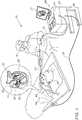
- Fig. 1is a schematic, pictorial illustration of an electrophysiological (EP) mapping system 20, in accordance with an embodiment of the present invention.
- System 20is used for generating an EP map of at least part of a patient heart using a mapping catheter 32 and a coronary sinus (CS) catheter 50 (seen in an inset 25).
- CS catheter 50is fitted at a distal end of a shaft 22.
- CS catheter 50incorporates sensing-electrodes 55.
- CS catheter 50is inserted through a sheath 23 into the CS of a heart 26.
- Physician 30navigates CS catheter 50 to a target location along the inside of the CS by manipulating shaft 22 using a manipulator near the proximal end of the catheter and/or deflection from the sheath 23.
- CS catheter 50is used for time referencing or propagating electrical potentials in the heart in order to produce an accurate EP map.
- a mapping-catheter(not shown) moves inside heart 26 and acquires the EP potentials referenced using the EP signal acquired by CS catheter 50.
- the catheterhas to be kept in one place along the CS during the mapping session.
- Console 24comprises a processor 41, typically a general-purpose computer, with suitable front end and electrical interface circuits 37 for receiving signals from ACL patches 49.
- Processor 41is connected to ACL patches 49, which are attached to the chest skin of patient 26, by wires running through a cable 39.
- processor 41accurately determines a change in the position of sensing-electrodes 55 along the inside of the CS, as described below.
- Processor 41determines the change in position based on, among other inputs, measured currents between sensing-electrodes 55 (on the CS catheter) and ACL patches 49 (i.e., based on injecting electrical current as described above).
- Console 24drives a display 27, which shows the distal end of catheter position change relative to a nominal position along the CS, that physician 30 selected for use for referencing an EP mapping.
- the method of electrode position sensing using system 20is implemented in various medical applications, for example in the CARTOTM system, produced by Biosense Webster and is described in detail in U.S. Patents 8,456,182 , 7,756,576 , 7,869,865 , and 7,848,787 , whose disclosures are all incorporated herein by reference.
- Processor 41is typically programmed in software to carry out the functions described herein.
- the softwaremay be downloaded to the computer in electronic form, over a network, for example, or it may, alternatively or additionally, be provided and/or stored on non-transitory tangible media, such as magnetic, optical, or electronic memory.
- processor 41runs a dedicated algorithm that enables processor 41 to perform the disclosed steps, as described below.
- inventions of system 20 and the methods described hereinmay be performed by applying a voltage gradient using ACL patch electrodes 49 or other skin-attached electrodes, and measuring the potential voltage with sensing electrodes 55 on CS catheter 50. (e.g., using the Carto®4 technology produced by Biosense Webster).
- a voltage gradientusing ACL patch electrodes 49 or other skin-attached electrodes
- sensing electrodes 55 on CS catheter 50e.g., using the Carto®4 technology produced by Biosense Webster.
- embodiments of the present inventionapply to any position-sensing method used for EP mapping in which a sensing-electrode generates signals indicative of its position in the heart.
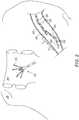
- Fig. 2is a schematic detail view showing mapping catheter 32 and coronary sinus (CS) catheter 50 inside heart 26, in accordance with an embodiment of the present invention.
- CScoronary sinus
- Fig. 2shows PENTARY® mapping catheter 32 having mapping-electrodes 33 inside left atrium 34 in order to EP map the atrium.
- CS catheter 50is seen in three different positions along the inside of coronary sinus 60. Any lateral shift between positions of CS catheter 50 (i.e., over a cross-section of the CS) is negligible, and is illustrated larger in Fig. 2 only for clarity of presentation.
- location 64is a "nominal" (i.e., a selected) location where physician 30 initially positions catheter 50.
- CS catheter 50may be displaced from its nominal position 64 distally by an amount ⁇ 1 , to a position 62, or proximally by an amount ⁇ 2 , to a position 66.
- such displacementsmay result in degraded quality of the reference annotation based on the EP signal acquired by two or more electrodes of CS catheter 50, such as electrodes 55, and can cause inconsistencies in the electro-anatomical maps generated based on signals acquired by mapping-electrodes 33 and referenced by respective signals acquired by sensing-electrodes 55 of CS catheter 50.
- CS catheter 50The catheter configuration described in Fig. 2 is chosen purely for the sake of conceptual clarity. Other devices on CS catheter 50, such as additional electrodes, and other sensors, such as contact force sensors, are not described.
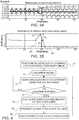
- Fig. 3A and 3Bare graphs of measured ACL currents vs. time and of respective estimated movements of the catheter of Fig. 2 , in accordance with an embodiment of the present invention.
- CS catheter 50moves, e.g., first distally to location 62, as illustrated in the 30s - 40s region of the Fig. 3A , the pattern is disturbed. If the movement stops, e.g., at location 66 proximal to location 64, a new constant pattern forms, as illustrated in the times 45s and onward.
- Fig. 3Bshows CS catheter displacements ⁇ 1 and ⁇ 2 along CS 60 that processor 41 calculates based on the signals of Fig. 3A .
- Processor 41calculates the magnitude of the displacement in millimeters, as well as providing a direction along the CS for the shift. For the calculation, processor 41 uses an empirical formula (e.g., based on calibration) that translates ACL current measurements to shifts in locations.
- x ⁇arg min x ⁇ ⁇ k I k ⁇ j I j ⁇ 1 / x ⁇ ⁇ p ⁇ k ⁇ a k ⁇ j 1 / x ⁇ ⁇ p ⁇ j + a j 2
- x ⁇F I k p ⁇ k a k
- processor 41need as inputs the parameters a k , which are found using the known distances between pairs of electrodes on the catheter: D m,n - known distance between electrodes m and n .
- the parameters a kare the result of the following optimization: arg min a k ⁇ m n ⁇ ep F I k m p ⁇ k a k ⁇ F I k n p ⁇ k a k ⁇ D m , n 2 subject to constraints on a k .
- ⁇ ep ⁇is the group of electrode pairs.
- I k m and I k nare the currents measured at patch number k from electrodes m and n respectively.
- the above formulais based on known mechanical values of CS catheter 50, and has several parameters that are optimized to give the same computed interelectrode distances as the real ones.
- the optimizationhappens at some early stage of an EP mapping procedure, when the CS catheter is already in location 64.
- Fig. 4is a flow chart that schematically illustrates a method and algorithm for correcting the position of CS catheter 50 along coronary sinus 60, in accordance with an embodiment of the present invention.
- the algorithmdrives a process that begins with physician 30 positioning CS catheter 50 at nominal location 64 inside CS 60, at a CS catheter positioning step 70.
- the disclosed modeli.e., Eq. 2 is calibrated at a calibration step 71, using the known distances between pairs of electrodes 55, to find the parameters a k is done one time - once parameters a k are found, they are fixed.
- processor 41uses the dedicated algorithm, monitors the location of CS catheter 50, at a CS catheter location monitoring step 72.
- processor 41checks if the location of CS catheter 50 inside CS 60 has shifted. Processor 41 uses the parameters a k to estimate the position of electrodes 55 and detect shifts of the catheter shaft position along the CS.
- processor 41identifies that the location of CS catheter 50 has shifted from nominal location 64, then processor 41 calculates, using the disclosed dedicated algorithm, the direction and the amount of the shift, at a catheter shift calculation step 76. Processor 41 then presents to physician 30 the direction and amount of shift, at a presenting step 78. Next, physician 30 corrects the catheter location (e.g., brings it back to nominal location 64), at a CS catheter location correction step 80. The process then loops back to location monitoring step 72.
- Embodiments of the present inventionalso comprises additional steps of the algorithm, which have been omitted from the disclosure herein purposely in order to provide a more simplified flow chart.
- additional stepsmay be used, such as magnetic sensing of the CS catheter position.
Landscapes
- Health & Medical Sciences (AREA)
- Life Sciences & Earth Sciences (AREA)
- Engineering & Computer Science (AREA)
- Surgery (AREA)
- Public Health (AREA)
- Veterinary Medicine (AREA)
- General Health & Medical Sciences (AREA)
- Biomedical Technology (AREA)
- Heart & Thoracic Surgery (AREA)
- Medical Informatics (AREA)
- Molecular Biology (AREA)
- Physics & Mathematics (AREA)
- Animal Behavior & Ethology (AREA)
- Biophysics (AREA)
- Pathology (AREA)
- Human Computer Interaction (AREA)
- Cardiology (AREA)
- Signal Processing (AREA)
- Nuclear Medicine, Radiotherapy & Molecular Imaging (AREA)
- Physiology (AREA)
- Psychiatry (AREA)
- Computer Vision & Pattern Recognition (AREA)
- Artificial Intelligence (AREA)
- Radiology & Medical Imaging (AREA)
- Plasma & Fusion (AREA)
- Otolaryngology (AREA)
- Measurement And Recording Of Electrical Phenomena And Electrical Characteristics Of The Living Body (AREA)
- Media Introduction/Drainage Providing Device (AREA)
Abstract
Description
- The present invention relates generally to sensing a position of an object placed within a living body, and specifically to providing an accurate intracardiac reference signal for intracardiac electrophysiological mapping.
- Invasive cardiology techniques involving tracking a position of cardiac catheters has been previously proposed in the patent literature. For example,
U.S. Patent Application Publication 2008/0161681 describes a method of tracking a three-dimensional (3D) position of a catheter within a patient including securing a navigational reference at a reference location within the patient. The method further includes defining the reference location as the origin of a coordinate system, determining a location of an electrode moving within the patient relative to that coordinate system, and monitoring for a dislodgement of the navigational reference from the initial reference location. For example, the dislodgement is monitored by measuring the navigational reference relative to a far field reference outside the patient's body, and generating a signal indicating that the navigational reference has dislodged from the reference location. Upon dislodgement, a user may be provided with guidance to help reposition and secure the navigational reference to the initial reference location. Alternatively, the navigational reference may be automatically repositioned and secured to the initial reference location. Alternatively, a reference adjustment may be calculated to compensate for the changed reference point/origin. - As another example,
U.S. Patent Application Publication 2018/0132938 describes a method for aligning a cardiac model including receiving an initial position signal from three position sensors disposed along a distal end of a coronary sinus catheter positioned in a coronary sinus of a heart. The method can further include receiving a subsequent position signal from the three position sensors. The method can include determining a positional change vector based on a change in position between an initial position associated with the initial position signal and a subsequent position associated with the subsequent position signal. The method can also include shifting a point of interest associated with a cardiac model, using the positional change vector. The method can include dynamically aligning the cardiac model based on an updated position of the three position sensors. - An embodiment of the present invention provides a method including receiving (i) a plurality of electrocardiogram (ECG) signals acquired by a mapping catheter at a plurality of locations on a surface of a heart of a patient, (ii) a reference ECG signal from a reference catheter positioned at a nominal location in a coronary sinus (CS) of the patient, and (iii) position signals indicative of a position of the reference catheter in the CS. An electrophysiological (EP) map of at least part of the heart is calculated by time-referencing the ECG signals relative to the reference ECG signal. Based on the position signals, a displacement of the reference catheter from the nominal location in the CS, which distorts the time-referencing, is estimated. The distortion in the EP map is mitigated using the estimated displacement.
- In some embodiments, the method further includes producing the position signals by performing electrical measurements between the reference catheter and multiple electrodes attached to the body of the patient.
- In some embodiments, performing the electrical measurement includes performing one of current measurements, voltage measurements, and impedance measurements.
- In an embodiment, estimating the displacement includes calculating the displacement using an empirical formula that translates the electrical measurements to the displacement.
- In another embodiment, the method further includes presenting to a user a magnitude and a direction of the displacement.
- In some embodiments, mitigating the distortion includes prompting a user to move the reference catheter to the nominal location.
- In some embodiments, mitigating the distortion includes adapting the ECG signals, or the EP map, to compensate for the displacement of the reference catheter.
- There is additionally provided, in accordance with an embodiment of the present invention, a system including an electrical interface and a processor. The electrical interface is configured to receive (i) a plurality of electrocardiogram (ECG) signals acquired by a mapping catheter at a plurality of locations on a surface of a heart of a patient, (ii) a reference ECG signal from a reference catheter positioned at a nominal location in a coronary sinus (CS) of the patient, and (iii) position signals indicative of a position of the reference catheter in the CS. The processor is configured to: (a) calculate an electrophysiological (EP) map of at least part of the heart, by time-referencing the ECG signals relative to the reference ECG signal, (b) based on the position signals, estimate a displacement of the reference catheter from the nominal location in the CS, which distorts the time-referencing, and (c) mitigate the distortion in the EP map using the estimated displacement.
- The present invention will be more fully understood from the following detailed description of the embodiments thereof, taken together with the drawings in which:
Fig. 1 is a schematic, pictorial illustration of an electrophysiological (EP) mapping system, in accordance with an embodiment of the present invention;Fig. 2 is a schematic detail view showing an EP mapping catheter and a coronary sinus (CS) catheter inside a heart, in accordance with an embodiment of the present invention;Fig. 3A and 3B are graphs of measured ACL currents vs. time and of respective estimated movements of the catheter ofFig. 2 , in accordance with an embodiment of the present invention; andFig. 4 is a flow chart that schematically illustrates a method and algorithm for correcting the position of the CS catheter along the coronary sinus, in accordance with an embodiment of the present invention.- Intracardiac electrophysiological (EP) mapping (also named herein "electroanatomical mapping") is a catheter-based method that may be applied to characterize cardiac EP abnormalities of a patient, such as an arrhythmia. In intra-cardiac EP mapping, the analyzed EP signals are assumed to be intra-cardiac electrocardiogram (ECG) potential-time relationships. In order to fully characterize such relationships, the signals at various intra-cardiac locations need to be referenced in time to each other. The time referencing is accomplished by annotating measured signals relative to a reference-time (e.g., an instance), such as the beginning of each QRS complex of an ECG reference signal (i.e., the beginning of every heartbeat).
- Based on time referencing (e.g., annotating) the ECG signals with the timings of the acquired reference signal, a processor analyzes the propagation paths and velocities of EP potentials in the heart and produce an EP map that a physician can analyze to diagnose the patient. A method for generating an EP map is described in
U.S Patent 9,050,011 - In some embodiments, during an electro-anatomical mapping session, a mapping-catheter moves in a cardiac chamber and measures EP signals, such as ECG signals, at respectively measured intracardiac locations. At the same time, a reference catheter comprising a sensing-electrode, such as a coronary sinus (CS) catheter, is statically placed in the CS, in order to measures a stable reference EP signal.
- In order to maintain an accurate reference EP signal, it is important that the CS catheter remains fixed in-place. Any unintended CS catheter movement along the CS impacts the quality of the reference annotation and can cause inconsistencies in the electro-anatomical maps. Embodiments of the present invention that are described hereinafter provide methods and systems to verify and/or correct a placement position of the reference catheter, e.g., a CS catheter, along the CS (e.g., to compensate for possible displacement of the CS catheter), for example, during an EP mapping session. For that purpose, the disclosed embodiments produce position signals indicative of a position of the reference catheter by performing electrical measurements between the reference catheter and electrodes on the body. The electrical measurements may comprise measurements of currents, voltages and/or impedances.
- In the description hereinafter, an Active Current Location (ACL) impedance-based system and technique, made by Biosense-Webster (Irvine, California), serves as an example of an impedance-based position tracking system that is further configured to perform EP mapping, and this mapping-catheter using multiple electrodes is named hereinafter "ACL catheter." The body surface electrodes are named hereinafter "ACL patches." Examples of mapping-catheters are the Lasso and Pentaray® catheters, made by Biosense-Webster. Examples of CS catheters typically used for referencing the signals that a mapping-catheter acquires are the CS Uni-Directional® and the CS BiDirectional® Catheters, also made by Biosense-Webster.
- In some embodiments, the disclosed technique includes receiving in a processor (i) a plurality of electrocardiogram (ECG) signals acquired by a mapping catheter at a plurality of locations on a surface of a heart of a patient, (ii) a reference ECG signal from a reference catheter positioned at a nominal location in a coronary sinus (CS) of the patient, and (iii) position signals indicative of a position of the reference catheter in the CS. Next, the processor calculates an EP map of at least part of the heart, by time-referencing the ECG signals relative to the reference ECG signal. Based on the position signals, the processor estimates a displacement of the reference catheter from the nominal location in the CS, which distorts the time-referencing, mitigates the distortion in the EP map using the estimated displacement.
- In some embodiments, two or more electrodes of the CS catheter inject electrical current to the CS tissue, and the ACL system measures the currents acquired by six ACL patch electrodes. If the CS catheter does not move, these six currents maintain a relatively constant pattern, or ratio, between themselves. If there is movement, the pattern is disturbed (i.e., changes). If the movement stops, a new constant pattern is formed. Embodiments of the present invention use the change of electrical current pattern to indicate the presence of movement. In addition, based on a calibration, embodiments of the present invention determine, from the changed currents, a magnitude of the CS catheter shift, e.g., in millimeters, as well as a direction along the CS for the shift.
- In some embodiments, a processor uses an empirical formula that translates current measurements to location in order to calculate the CS catheter shift. The formula is based on known mechanical values of the CS catheter, and has several parameters that are optimized to give the same computed interelectrode distances as the real ones. In some embodiments, the calculation is optimized (e.g., calibrated) at some early stage of the mapping procedure, when the CS catheter is already in place in the CS. The calibration uses the known distance between at least one pair of electrodes of the CS catheter.
- In some embodiments the processor visually presents the calculated shifted values of the CS catheter movement, and such a visual presentation assists the physician in compensating (e.g., correcting) any CS catheter movement, for example, by moving the CS catheter back to the nominal location. In another embodiment, the processor compensates for a displacement of the CS catheter by adapting the EP measurements to the displaced location of the CS catheter. In an embodiment, mitigating the distortion in the EP map includes adapting the ECG signals, or the EP map, to compensate for the displacement of the reference catheter.
- Typically, the processor is programmed in software containing a particular algorithm that enables the processor to conduct each of the processor related steps and functions outlined above.
- The disclosed CS catheter movement detection technique provides means to control, in real-time, the EP referencing of an EP mapping. Therefore, the disclosed technique may improve the diagnostic quality of catheter-based EP mapping procedures. By virtue of the improved mapping quality, the disclosed technique can also be used for better identifying and mitigating distortions in the EP map, such as aberrant EP activation patterns (e.g., indicative of an arrhythmia), which may otherwise be incorrectly identified, potentially leading to an ablation at a wrong location.
Fig. 1 is a schematic, pictorial illustration of an electrophysiological (EP)mapping system 20, in accordance with an embodiment of the present invention.System 20 is used for generating an EP map of at least part of a patient heart using amapping catheter 32 and a coronary sinus (CS) catheter 50 (seen in an inset 25).CS catheter 50 is fitted at a distal end of ashaft 22. As seen,CS catheter 50 incorporates sensing-electrodes 55.CS catheter 50 is inserted through asheath 23 into the CS of aheart 26.Physician 30 navigatesCS catheter 50 to a target location along the inside of the CS by manipulatingshaft 22 using a manipulator near the proximal end of the catheter and/or deflection from thesheath 23.CS catheter 50 is used for time referencing or propagating electrical potentials in the heart in order to produce an accurate EP map. In parallel, a mapping-catheter (not shown) moves insideheart 26 and acquires the EP potentials referenced using the EP signal acquired byCS catheter 50. As noted above, in order forCS catheter 50 to acquire meaningful reference signals, the catheter has to be kept in one place along the CS during the mapping session.- Two or more sensing-
electrodes 55 are connected by wires running throughshaft 22 to driver circuitry in aconsole 24.Console 24 comprises aprocessor 41, typically a general-purpose computer, with suitable front end andelectrical interface circuits 37 for receiving signals fromACL patches 49.Processor 41 is connected toACL patches 49, which are attached to the chest skin ofpatient 26, by wires running through acable 39. - In some embodiments,
processor 41 accurately determines a change in the position of sensing-electrodes 55 along the inside of the CS, as described below.Processor 41 determines the change in position based on, among other inputs, measured currents between sensing-electrodes 55 (on the CS catheter) and ACL patches 49 (i.e., based on injecting electrical current as described above).Console 24 drives adisplay 27, which shows the distal end of catheter position change relative to a nominal position along the CS, thatphysician 30 selected for use for referencing an EP mapping. - The method of electrode position sensing using
system 20 is implemented in various medical applications, for example in the CARTO™ system, produced by Biosense Webster and is described in detail inU.S. Patents 8,456,182 ,7,756,576 ,7,869,865 , and7,848,787 , whose disclosures are all incorporated herein by reference. Processor 41 is typically programmed in software to carry out the functions described herein. The software may be downloaded to the computer in electronic form, over a network, for example, or it may, alternatively or additionally, be provided and/or stored on non-transitory tangible media, such as magnetic, optical, or electronic memory. In particular,processor 41 runs a dedicated algorithm that enablesprocessor 41 to perform the disclosed steps, as described below.- The elements of
system 20 and the methods described herein may be performed by applying a voltage gradient usingACL patch electrodes 49 or other skin-attached electrodes, and measuring the potential voltage withsensing electrodes 55 onCS catheter 50. (e.g., using the Carto®4 technology produced by Biosense Webster). Thus, embodiments of the present invention apply to any position-sensing method used for EP mapping in which a sensing-electrode generates signals indicative of its position in the heart. Fig. 2 is a schematic detail view showingmapping catheter 32 and coronary sinus (CS)catheter 50 insideheart 26, in accordance with an embodiment of the present invention.Fig. 2 shows PENTARY® mapping catheter 32 having mapping-electrodes 33 insideleft atrium 34 in order to EP map the atrium.CS catheter 50 is seen in three different positions along the inside ofcoronary sinus 60. Any lateral shift between positions of CS catheter 50 (i.e., over a cross-section of the CS) is negligible, and is illustrated larger inFig. 2 only for clarity of presentation.- Of the three locations along the CS,
location 64 is a "nominal" (i.e., a selected) location wherephysician 30 initially positionscatheter 50. During the EP mapping,CS catheter 50 may be displaced from itsnominal position 64 distally by an amount Δ1, to aposition 62, or proximally by an amount Δ2, to aposition 66. - As noted above, such displacements may result in degraded quality of the reference annotation based on the EP signal acquired by two or more electrodes of
CS catheter 50, such aselectrodes 55, and can cause inconsistencies in the electro-anatomical maps generated based on signals acquired by mapping-electrodes 33 and referenced by respective signals acquired by sensing-electrodes 55 ofCS catheter 50. - The catheter configuration described in
Fig. 2 is chosen purely for the sake of conceptual clarity. Other devices onCS catheter 50, such as additional electrodes, and other sensors, such as contact force sensors, are not described. Fig. 3A and 3B are graphs of measured ACL currents vs. time and of respective estimated movements of the catheter ofFig. 2 , in accordance with an embodiment of the present invention. AsFig. 3A shows, whileCS catheter 50 is stably located in itsnominal position 64 between the times of 0s and 30s, the six currents received byACL patches 49 maintain a relatively constant pattern, or ratio, between themselves. WhenCS catheter 50 moves, e.g., first distally tolocation 62, as illustrated in the 30s - 40s region of theFig. 3A , the pattern is disturbed. If the movement stops, e.g., atlocation 66 proximal tolocation 64, a new constant pattern forms, as illustrated in the times 45s and onward.Fig. 3B shows CS catheter displacements Δ1 and Δ2 alongCS 60 thatprocessor 41 calculates based on the signals ofFig. 3A .Processor 41 calculates the magnitude of the displacement in millimeters, as well as providing a direction along the CS for the shift. For the calculation,processor 41 uses an empirical formula (e.g., based on calibration) that translates ACL current measurements to shifts in locations.- The disclosed empirical model states that the normalized current measured by an ACL patch 49k is equal to normalized reciprocals of adjusted distances of
electrode 55 to ACL patches 49: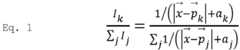
x -Electrode 55 position (unknown)p k - Position ofACL patch 49 numberk (ACL patches have magnetic location sensors)- ak - Distance adjustment parameter (will be optimized)
- Ik - Current measured at an
ACL patch 49 numberk - Given the parametersak' patch positions
p k, and current measurementsIk, we calculateelectrode 55 position by optimization:

- To use the above formula,
processor 41 need as inputs the parametersak, which are found using the known distances between pairs of electrodes on the catheter:Dm,n - known distance between electrodesm andn. The parametersak are the result of the following optimization:
- Where
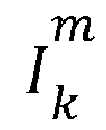
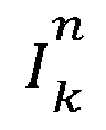
- In an embodiment, the constraint used is that allak are equal (a1=a2=a3=a4=a5=a6).
- Alternatively, other constraints overak may be used.
- The above formula is based on known mechanical values of
CS catheter 50, and has several parameters that are optimized to give the same computed interelectrode distances as the real ones. The optimization happens at some early stage of an EP mapping procedure, when the CS catheter is already inlocation 64. Fig. 4 is a flow chart that schematically illustrates a method and algorithm for correcting the position ofCS catheter 50 alongcoronary sinus 60, in accordance with an embodiment of the present invention. The algorithm, according to embodiments of the present invention, drives a process that begins withphysician 30 positioningCS catheter 50 atnominal location 64 insideCS 60, at a CScatheter positioning step 70. Next, after the catheter is in nominal position, the disclosed model (i.e., Eq. 2) is calibrated at acalibration step 71, using the known distances between pairs ofelectrodes 55, to find the parametersak is done one time - once parametersak are found, they are fixed.- Next, based on reading ACL currents that
electrodes 55 injects and are read byACL patches 49, which are indicative CS catheter position (i.e., position signals),processor 41, using the dedicated algorithm, monitors the location ofCS catheter 50, at a CS catheterlocation monitoring step 72. - At a checking
step 74,processor 41 checks if the location ofCS catheter 50 insideCS 60 has shifted.Processor 41 uses the parametersak to estimate the position ofelectrodes 55 and detect shifts of the catheter shaft position along the CS. - If the location remains the same (i.e., nominal location 64), then the process returns to
location monitoring step 72. Ifprocessor 41 identifies that the location ofCS catheter 50 has shifted fromnominal location 64, thenprocessor 41 calculates, using the disclosed dedicated algorithm, the direction and the amount of the shift, at a cathetershift calculation step 76.Processor 41 then presents tophysician 30 the direction and amount of shift, at a presentingstep 78. Next,physician 30 corrects the catheter location (e.g., brings it back to nominal location 64), at a CS catheterlocation correction step 80. The process then loops back tolocation monitoring step 72. - The example algorithm shown in
Fig. 4 is chosen purely for the sake of conceptual clarity. Embodiments of the present invention also comprises additional steps of the algorithm, which have been omitted from the disclosure herein purposely in order to provide a more simplified flow chart. For example, in alternative embodiments, additional steps may be used, such as magnetic sensing of the CS catheter position. - Although the embodiments described herein mainly address cardiac EP mapping, the methods and systems described herein can also be used in other applications, such as in neurology.
- It will be appreciated that the embodiments described above are cited by way of example, and that the present invention is not limited to what has been particularly shown and described hereinabove. Rather, the scope of the present invention includes both combinations and subcombinations of the various features described hereinabove, as well as variations and modifications thereof which would occur to persons skilled in the art upon reading the foregoing description and which are not disclosed in the prior art. Documents incorporated by reference in the present patent application are to be considered an integral part of the application except that to the extent any terms are defined in these incorporated documents in a manner that conflicts with the definitions made explicitly or implicitly in the present specification, only the definitions in the present specification should be considered.


Claims (14)
- A method, comprising:receiving (i) a plurality of electrocardiogram (ECG) signals acquired by a mapping catheter at a plurality of locations on a surface of a heart of a patient, (ii) a reference ECG signal from a reference catheter positioned at a nominal location in a coronary sinus (CS) of the patient, and (iii) position signals indicative of a position of the reference catheter in the CS;calculating an electrophysiological (EP) map of at least part of the heart, by time-referencing the ECG signals relative to the reference ECG signal;based on the position signals, estimating a displacement of the reference catheter from the nominal location in the CS, which distorts the time-referencing; andmitigating the distortion in the EP map using the estimated displacement.
- The method according to claim 1, and comprising producing the position signals by performing electrical measurements between the reference catheter and multiple electrodes attached to the body of the patient.
- The method according to claim 2, wherein performing the electrical measurement comprises performing one of current measurements, voltage measurements, and impedance measurements.
- The method according to claim 2, wherein estimating the displacement comprises calculating the displacement using an empirical formula that translates the electrical measurements to the displacement.
- The method according to claim 1, and comprising presenting to a user a magnitude and a direction of the displacement.
- The method according to claim 1, wherein mitigating the distortion comprises prompting a user to move the reference catheter to the nominal location.
- The method according to claim 1, wherein mitigating the distortion comprises adapting the ECG signals, or the EP map, to compensate for the displacement of the reference catheter.
- A system, comprising:an electrical interface, configured to receive (i) a plurality of electrocardiogram (ECG) signals acquired by a mapping catheter at a plurality of locations on a surface of a heart of a patient, (ii) a reference ECG signal from a reference catheter positioned at a nominal location in a coronary sinus (CS) of the patient, and (iii) position signals indicative of a position of the reference catheter in the CS; anda processor, which is configured to:calculate an electrophysiological (EP) map of at least part of the heart, by time-referencing the ECG signals relative to the reference ECG signal;based on the position signals, estimate a displacement of the reference catheter from the nominal location in the CS, which distorts the time-referencing; andmitigate the distortion in the EP map using the estimated displacement.
- The system according to claim 8, wherein the electrical interface is configured to receive the position signals from electrical measurements performed between the reference catheter and multiple electrodes attached to the body of the patient.
- The system according to claim 9, wherein the electrical interface is configured to receive electrical measurements comprising one of current measurements, voltage measurements, and impedance measurements.
- The system according to claim 9, wherein the processor is configured to calculate the displacement using an empirical formula that translates the electrical measurements to the displacement.
- The system according to claim 8, wherein the processor is further configured to present to a user a magnitude and a direction of the displacement.
- The system according to claim 8, wherein the processor is configured to mitigate the distortion by prompting a user to move the reference catheter to the nominal location.
- The system according to claim 8, wherein the processor is configured to mitigate the distortion by adapting the ECG signals, or the EP map, to compensate for the displacement of the reference catheter.
Applications Claiming Priority (1)
| Application Number | Priority Date | Filing Date | Title |
|---|---|---|---|
| US16/209,418US11213235B2 (en) | 2018-12-04 | 2018-12-04 | Coronary sinus (CS) catheter movement detection |
Publications (1)
| Publication Number | Publication Date |
|---|---|
| EP3662825A1true EP3662825A1 (en) | 2020-06-10 |
Family
ID=68766662
Family Applications (1)
| Application Number | Title | Priority Date | Filing Date |
|---|---|---|---|
| EP19213218.1AWithdrawnEP3662825A1 (en) | 2018-12-04 | 2019-12-03 | Coronary sinus (cs) catheter movement detection |
Country Status (5)
| Country | Link |
|---|---|
| US (1) | US11213235B2 (en) |
| EP (1) | EP3662825A1 (en) |
| JP (1) | JP7423284B2 (en) |
| CN (1) | CN111265216A (en) |
| IL (1) | IL270402B (en) |
Families Citing this family (4)
| Publication number | Priority date | Publication date | Assignee | Title |
|---|---|---|---|---|
| US20220202370A1 (en)* | 2020-12-29 | 2022-06-30 | Biosense Webster (Israel) Ltd. | Systems, methods, and processes for detecting electrode wire noise |
| US12318211B2 (en) | 2022-07-12 | 2025-06-03 | Biosense Webster (Israel) Ltd. | Location-based pattern matching of coronary sinus (CS) signals |
| CN115317118A (en)* | 2022-08-09 | 2022-11-11 | 苏州歆羡医疗科技有限公司 | An ablation system capable of dynamically detecting lower ablation processes |
| US12198572B1 (en)* | 2024-07-25 | 2025-01-14 | Anumana, Inc. | Apparatus and a method for the generation of an impedance model of a biological chamber |
Citations (12)
| Publication number | Priority date | Publication date | Assignee | Title |
|---|---|---|---|---|
| US20080161681A1 (en) | 2006-12-29 | 2008-07-03 | Hauck John A | Navigational reference dislodgement detection method & system |
| EP2000088A1 (en)* | 2007-06-04 | 2008-12-10 | Biosense Webster, Inc. | Intracorporeal location system with movement compensation |
| US7756576B2 (en) | 2005-08-26 | 2010-07-13 | Biosense Webster, Inc. | Position sensing and detection of skin impedance |
| US7848787B2 (en) | 2005-07-08 | 2010-12-07 | Biosense Webster, Inc. | Relative impedance measurement |
| US7869865B2 (en) | 2005-01-07 | 2011-01-11 | Biosense Webster, Inc. | Current-based position sensing |
| US8456182B2 (en) | 2008-09-30 | 2013-06-04 | Biosense Webster, Inc. | Current localization tracker |
| US8725240B2 (en)* | 2008-04-02 | 2014-05-13 | Rhythmia Medical, Inc. | Intracardiac tracking system |
| US9050011B2 (en) | 2012-12-26 | 2015-06-09 | Biosense Webster (Israel) Ltd. | Removal of artifacts from map data |
| US20160183824A1 (en)* | 2014-12-31 | 2016-06-30 | Biosense Webster (Israel) Ltd. | System and method for visualizing electrophysiology data |
| US9585586B2 (en)* | 2006-12-29 | 2017-03-07 | St. Jude Medical, Atrial Fibrillation Division, Inc. | Navigational reference dislodgement detection method and system |
| US20180132938A1 (en) | 2015-06-03 | 2018-05-17 | St. Jude Medical, Cardiology Division, Inc. | Aligning a cardiac model |
| EP2618730B1 (en)* | 2010-12-17 | 2019-05-15 | St. Jude Medical Atrial Fibrillation Division Inc. | Navigation reference dislodgement detection method and system |
Family Cites Families (2)
| Publication number | Priority date | Publication date | Assignee | Title |
|---|---|---|---|---|
| US9113807B2 (en) | 2010-12-29 | 2015-08-25 | St. Jude Medical, Atrial Fibrillation Division, Inc. | Dynamic adaptive respiration compensation with automatic gain control |
| US10682181B2 (en)* | 2017-09-06 | 2020-06-16 | Biosense Webster (Israel) Ltd. | Methods and systems for modeling and registration of 3-dimensional images of the heart |
- 2018
- 2018-12-04USUS16/209,418patent/US11213235B2/enactiveActive
- 2019
- 2019-11-04ILIL270402Apatent/IL270402B/enunknown
- 2019-12-03EPEP19213218.1Apatent/EP3662825A1/ennot_activeWithdrawn
- 2019-12-03JPJP2019218523Apatent/JP7423284B2/enactiveActive
- 2019-12-04CNCN201911227898.5Apatent/CN111265216A/enactivePending
Patent Citations (12)
| Publication number | Priority date | Publication date | Assignee | Title |
|---|---|---|---|---|
| US7869865B2 (en) | 2005-01-07 | 2011-01-11 | Biosense Webster, Inc. | Current-based position sensing |
| US7848787B2 (en) | 2005-07-08 | 2010-12-07 | Biosense Webster, Inc. | Relative impedance measurement |
| US7756576B2 (en) | 2005-08-26 | 2010-07-13 | Biosense Webster, Inc. | Position sensing and detection of skin impedance |
| US20080161681A1 (en) | 2006-12-29 | 2008-07-03 | Hauck John A | Navigational reference dislodgement detection method & system |
| US9585586B2 (en)* | 2006-12-29 | 2017-03-07 | St. Jude Medical, Atrial Fibrillation Division, Inc. | Navigational reference dislodgement detection method and system |
| EP2000088A1 (en)* | 2007-06-04 | 2008-12-10 | Biosense Webster, Inc. | Intracorporeal location system with movement compensation |
| US8725240B2 (en)* | 2008-04-02 | 2014-05-13 | Rhythmia Medical, Inc. | Intracardiac tracking system |
| US8456182B2 (en) | 2008-09-30 | 2013-06-04 | Biosense Webster, Inc. | Current localization tracker |
| EP2618730B1 (en)* | 2010-12-17 | 2019-05-15 | St. Jude Medical Atrial Fibrillation Division Inc. | Navigation reference dislodgement detection method and system |
| US9050011B2 (en) | 2012-12-26 | 2015-06-09 | Biosense Webster (Israel) Ltd. | Removal of artifacts from map data |
| US20160183824A1 (en)* | 2014-12-31 | 2016-06-30 | Biosense Webster (Israel) Ltd. | System and method for visualizing electrophysiology data |
| US20180132938A1 (en) | 2015-06-03 | 2018-05-17 | St. Jude Medical, Cardiology Division, Inc. | Aligning a cardiac model |
Non-Patent Citations (1)
| Title |
|---|
| ST JUDE ET AL: "EnSite Precision(TM) Cardiac Mapping System Model EE3000 INSTRUCTIONS FOR USE INTERNATIONAL EDITION", LANE COVE NSW 2066 AUSTRALIA +61, 12 January 2016 (2016-01-12), pages 1200, XP055309716, Retrieved from the Internet <URL:https://manuals.sjm.com/~/media/manuals/product-manual-pdfs/f/5/f5a336fa-f714-46ba-808c-528cf101e848.pdf> [retrieved on 20161012]* |
Also Published As
| Publication number | Publication date |
|---|---|
| JP7423284B2 (en) | 2024-01-29 |
| US11213235B2 (en) | 2022-01-04 |
| US20200170525A1 (en) | 2020-06-04 |
| IL270402A (en) | 2020-06-30 |
| CN111265216A (en) | 2020-06-12 |
| JP2020089730A (en) | 2020-06-11 |
| IL270402B (en) | 2022-07-01 |
Similar Documents
| Publication | Publication Date | Title |
|---|---|---|
| EP3607879B1 (en) | Nonlinear electric field location system | |
| EP2120700B1 (en) | System and method for correction of inhomogeneous fields | |
| EP3662825A1 (en) | Coronary sinus (cs) catheter movement detection | |
| EP3571989B1 (en) | Scaling impedance location measurements of a balloon catheter | |
| EP2912997B1 (en) | Determination of reference annotation time from multi-channel electro-cardiogram signals | |
| EP1862114B1 (en) | Model-based correction of position measurements | |
| EP2674126B1 (en) | Compensation for heart movement in a body coordinate system | |
| JP2013255799A5 (en) | ||
| EP3505061A1 (en) | Improving impedance-based position tracking performance using principal component analysis | |
| JP2019205830A (en) | Catheter localization using current location in combination with magnetic-field sensing | |
| EP3607882B1 (en) | Reducing capacitance effects in active current location (acl) | |
| US20210186348A1 (en) | Solving double potential problems | |
| US20240058073A1 (en) | Multi-arm Catheter with Improved Magnetic Location Tracking | |
| EP4566533A1 (en) | Respiration compensation for mapping | |
| EP4538984A2 (en) | Analyzing multi-electrode catheter signals to determine electrophysiological (ep) wave propagation vector | |
| US12144635B2 (en) | Solving double potential problems |
Legal Events
| Date | Code | Title | Description |
|---|---|---|---|
| PUAI | Public reference made under article 153(3) epc to a published international application that has entered the european phase | Free format text:ORIGINAL CODE: 0009012 | |
| STAA | Information on the status of an ep patent application or granted ep patent | Free format text:STATUS: THE APPLICATION HAS BEEN PUBLISHED | |
| AK | Designated contracting states | Kind code of ref document:A1 Designated state(s):AL AT BE BG CH CY CZ DE DK EE ES FI FR GB GR HR HU IE IS IT LI LT LU LV MC MK MT NL NO PL PT RO RS SE SI SK SM TR | |
| AX | Request for extension of the european patent | Extension state:BA ME | |
| STAA | Information on the status of an ep patent application or granted ep patent | Free format text:STATUS: REQUEST FOR EXAMINATION WAS MADE | |
| 17P | Request for examination filed | Effective date:20201110 | |
| RBV | Designated contracting states (corrected) | Designated state(s):AL AT BE BG CH CY CZ DE DK EE ES FI FR GB GR HR HU IE IS IT LI LT LU LV MC MK MT NL NO PL PT RO RS SE SI SK SM TR | |
| STAA | Information on the status of an ep patent application or granted ep patent | Free format text:STATUS: EXAMINATION IS IN PROGRESS | |
| 17Q | First examination report despatched | Effective date:20221215 | |
| STAA | Information on the status of an ep patent application or granted ep patent | Free format text:STATUS: THE APPLICATION HAS BEEN WITHDRAWN | |
| 18W | Application withdrawn | Effective date:20250131 |