EP3075311A1 - Catheter with microelectrode array distal tip - Google Patents
Catheter with microelectrode array distal tipDownload PDFInfo
- Publication number
- EP3075311A1 EP3075311A1EP16171704.6AEP16171704AEP3075311A1EP 3075311 A1EP3075311 A1EP 3075311A1EP 16171704 AEP16171704 AEP 16171704AEP 3075311 A1EP3075311 A1EP 3075311A1
- Authority
- EP
- European Patent Office
- Prior art keywords
- catheter
- distal
- microelectrodes
- distal tip
- basket
- Prior art date
- Legal status (The legal status is an assumption and is not a legal conclusion. Google has not performed a legal analysis and makes no representation as to the accuracy of the status listed.)
- Withdrawn
Links
- 239000000758substrateSubstances0.000claimsabstractdescription41
- 239000012777electrically insulating materialSubstances0.000claims1
- 238000013507mappingMethods0.000abstractdescription15
- 238000007373indentationMethods0.000abstractdescription11
- 230000001154acute effectEffects0.000abstractdescription3
- 239000011162core materialSubstances0.000description15
- 239000003292glueSubstances0.000description10
- 239000000463materialSubstances0.000description10
- 210000001519tissueAnatomy0.000description7
- 229920002614Polyether block amidePolymers0.000description6
- 230000006835compressionEffects0.000description5
- 238000007906compressionMethods0.000description5
- 210000002837heart atriumAnatomy0.000description5
- 239000004814polyurethaneSubstances0.000description5
- KDLHZDBZIXYQEI-UHFFFAOYSA-NPalladiumChemical compound[Pd]KDLHZDBZIXYQEI-UHFFFAOYSA-N0.000description4
- 239000004020conductorSubstances0.000description4
- 238000010276constructionMethods0.000description4
- 229910052751metalInorganic materials0.000description4
- 239000002184metalSubstances0.000description4
- 230000002093peripheral effectEffects0.000description4
- BASFCYQUMIYNBI-UHFFFAOYSA-NplatinumChemical compound[Pt]BASFCYQUMIYNBI-UHFFFAOYSA-N0.000description4
- 229920002635polyurethanePolymers0.000description4
- 229910001220stainless steelInorganic materials0.000description4
- 239000010935stainless steelSubstances0.000description4
- 229920002725thermoplastic elastomerPolymers0.000description4
- 239000004593EpoxySubstances0.000description3
- 230000000694effectsEffects0.000description3
- -1for examplePolymers0.000description3
- 230000006870functionEffects0.000description3
- 239000004033plasticSubstances0.000description3
- 229920003023plasticPolymers0.000description3
- 239000004696Poly ether ether ketoneSubstances0.000description2
- 238000002679ablationMethods0.000description2
- 239000004568cementSubstances0.000description2
- 238000001035dryingMethods0.000description2
- PCHJSUWPFVWCPO-UHFFFAOYSA-NgoldChemical compound[Au]PCHJSUWPFVWCPO-UHFFFAOYSA-N0.000description2
- 239000010931goldSubstances0.000description2
- 229910052737goldInorganic materials0.000description2
- 210000005003heart tissueAnatomy0.000description2
- 230000002262irrigationEffects0.000description2
- 238000003973irrigationMethods0.000description2
- 210000005246left atriumAnatomy0.000description2
- 229910052763palladiumInorganic materials0.000description2
- 229910052697platinumInorganic materials0.000description2
- 229920002530polyetherether ketonePolymers0.000description2
- 230000001681protective effectEffects0.000description2
- 230000035945sensitivityEffects0.000description2
- 229920001651CyanoacrylatePolymers0.000description1
- 239000004642PolyimideSubstances0.000description1
- 239000004721Polyphenylene oxideSubstances0.000description1
- 229910000831SteelInorganic materials0.000description1
- 239000004830Super GlueSubstances0.000description1
- 230000004913activationEffects0.000description1
- 239000000654additiveSubstances0.000description1
- 239000000853adhesiveSubstances0.000description1
- 230000001070adhesive effectEffects0.000description1
- 230000004075alterationEffects0.000description1
- 210000003484anatomyAnatomy0.000description1
- 238000003491arrayMethods0.000description1
- 230000006793arrhythmiaEffects0.000description1
- 206010003119arrhythmiaDiseases0.000description1
- 230000001746atrial effectEffects0.000description1
- 230000003190augmentative effectEffects0.000description1
- 230000009286beneficial effectEffects0.000description1
- 230000015572biosynthetic processEffects0.000description1
- 239000003086colorantSubstances0.000description1
- 238000004891communicationMethods0.000description1
- 238000010586diagramMethods0.000description1
- 229910003460diamondInorganic materials0.000description1
- 239000010432diamondSubstances0.000description1
- 230000007831electrophysiologyEffects0.000description1
- 238000002001electrophysiologyMethods0.000description1
- 238000005516engineering processMethods0.000description1
- 239000012530fluidSubstances0.000description1
- WABPQHHGFIMREM-UHFFFAOYSA-Nlead(0)Chemical compound[Pb]WABPQHHGFIMREM-UHFFFAOYSA-N0.000description1
- 238000000034methodMethods0.000description1
- HLXZNVUGXRDIFK-UHFFFAOYSA-Nnickel titaniumChemical compound[Ti].[Ti].[Ti].[Ti].[Ti].[Ti].[Ti].[Ti].[Ti].[Ti].[Ti].[Ni].[Ni].[Ni].[Ni].[Ni].[Ni].[Ni].[Ni].[Ni].[Ni].[Ni].[Ni].[Ni].[Ni]HLXZNVUGXRDIFK-UHFFFAOYSA-N0.000description1
- 229910001000nickel titaniumInorganic materials0.000description1
- 231100000252nontoxicToxicity0.000description1
- 230000003000nontoxic effectEffects0.000description1
- 229920000570polyetherPolymers0.000description1
- 229920001721polyimidePolymers0.000description1
- 229920003225polyurethane elastomerPolymers0.000description1
- 230000008569processEffects0.000description1
- 210000005245right atriumAnatomy0.000description1
- 238000006748scratchingMethods0.000description1
- 230000002393scratching effectEffects0.000description1
- 238000005476solderingMethods0.000description1
- 239000007787solidSubstances0.000description1
- 239000010959steelSubstances0.000description1
- 238000002560therapeutic procedureMethods0.000description1
- 210000003954umbilical cordAnatomy0.000description1
- 210000005166vasculatureAnatomy0.000description1
- 230000000007visual effectEffects0.000description1
- 238000003466weldingMethods0.000description1
Images




Classifications
- A—HUMAN NECESSITIES
- A61—MEDICAL OR VETERINARY SCIENCE; HYGIENE
- A61B—DIAGNOSIS; SURGERY; IDENTIFICATION
- A61B5/00—Measuring for diagnostic purposes; Identification of persons
- A61B5/68—Arrangements of detecting, measuring or recording means, e.g. sensors, in relation to patient
- A61B5/6846—Arrangements of detecting, measuring or recording means, e.g. sensors, in relation to patient specially adapted to be brought in contact with an internal body part, i.e. invasive
- A61B5/6847—Arrangements of detecting, measuring or recording means, e.g. sensors, in relation to patient specially adapted to be brought in contact with an internal body part, i.e. invasive mounted on an invasive device
- A61B5/6852—Catheters
- A61B5/6858—Catheters with a distal basket, e.g. expandable basket
- A—HUMAN NECESSITIES
- A61—MEDICAL OR VETERINARY SCIENCE; HYGIENE
- A61B—DIAGNOSIS; SURGERY; IDENTIFICATION
- A61B18/00—Surgical instruments, devices or methods for transferring non-mechanical forms of energy to or from the body
- A61B18/04—Surgical instruments, devices or methods for transferring non-mechanical forms of energy to or from the body by heating
- A61B18/12—Surgical instruments, devices or methods for transferring non-mechanical forms of energy to or from the body by heating by passing a current through the tissue to be heated, e.g. high-frequency current
- A61B18/14—Probes or electrodes therefor
- A61B18/1492—Probes or electrodes therefor having a flexible, catheter-like structure, e.g. for heart ablation
- A—HUMAN NECESSITIES
- A61—MEDICAL OR VETERINARY SCIENCE; HYGIENE
- A61B—DIAGNOSIS; SURGERY; IDENTIFICATION
- A61B5/00—Measuring for diagnostic purposes; Identification of persons
- A61B5/24—Detecting, measuring or recording bioelectric or biomagnetic signals of the body or parts thereof
- A61B5/25—Bioelectric electrodes therefor
- A61B5/279—Bioelectric electrodes therefor specially adapted for particular uses
- A61B5/28—Bioelectric electrodes therefor specially adapted for particular uses for electrocardiography [ECG]
- A61B5/283—Invasive
- A61B5/287—Holders for multiple electrodes, e.g. electrode catheters for electrophysiological study [EPS]
- A—HUMAN NECESSITIES
- A61—MEDICAL OR VETERINARY SCIENCE; HYGIENE
- A61B—DIAGNOSIS; SURGERY; IDENTIFICATION
- A61B5/00—Measuring for diagnostic purposes; Identification of persons
- A61B5/68—Arrangements of detecting, measuring or recording means, e.g. sensors, in relation to patient
- A61B5/6846—Arrangements of detecting, measuring or recording means, e.g. sensors, in relation to patient specially adapted to be brought in contact with an internal body part, i.e. invasive
- A61B5/6847—Arrangements of detecting, measuring or recording means, e.g. sensors, in relation to patient specially adapted to be brought in contact with an internal body part, i.e. invasive mounted on an invasive device
- A61B5/6851—Guide wires
- A—HUMAN NECESSITIES
- A61—MEDICAL OR VETERINARY SCIENCE; HYGIENE
- A61B—DIAGNOSIS; SURGERY; IDENTIFICATION
- A61B5/00—Measuring for diagnostic purposes; Identification of persons
- A61B5/68—Arrangements of detecting, measuring or recording means, e.g. sensors, in relation to patient
- A61B5/6846—Arrangements of detecting, measuring or recording means, e.g. sensors, in relation to patient specially adapted to be brought in contact with an internal body part, i.e. invasive
- A61B5/6847—Arrangements of detecting, measuring or recording means, e.g. sensors, in relation to patient specially adapted to be brought in contact with an internal body part, i.e. invasive mounted on an invasive device
- A61B5/6852—Catheters
- A61B5/6859—Catheters with multiple distal splines
- A—HUMAN NECESSITIES
- A61—MEDICAL OR VETERINARY SCIENCE; HYGIENE
- A61M—DEVICES FOR INTRODUCING MEDIA INTO, OR ONTO, THE BODY; DEVICES FOR TRANSDUCING BODY MEDIA OR FOR TAKING MEDIA FROM THE BODY; DEVICES FOR PRODUCING OR ENDING SLEEP OR STUPOR
- A61M25/00—Catheters; Hollow probes
- A61M25/01—Introducing, guiding, advancing, emplacing or holding catheters
- A61M25/0105—Steering means as part of the catheter or advancing means; Markers for positioning
- A61M25/0133—Tip steering devices
- A61M25/0147—Tip steering devices with movable mechanical means, e.g. pull wires
- A—HUMAN NECESSITIES
- A61—MEDICAL OR VETERINARY SCIENCE; HYGIENE
- A61M—DEVICES FOR INTRODUCING MEDIA INTO, OR ONTO, THE BODY; DEVICES FOR TRANSDUCING BODY MEDIA OR FOR TAKING MEDIA FROM THE BODY; DEVICES FOR PRODUCING OR ENDING SLEEP OR STUPOR
- A61M25/00—Catheters; Hollow probes
- A61M25/01—Introducing, guiding, advancing, emplacing or holding catheters
- A61M25/09—Guide wires
- A—HUMAN NECESSITIES
- A61—MEDICAL OR VETERINARY SCIENCE; HYGIENE
- A61B—DIAGNOSIS; SURGERY; IDENTIFICATION
- A61B17/00—Surgical instruments, devices or methods
- A61B2017/00017—Electrical control of surgical instruments
- A61B2017/00022—Sensing or detecting at the treatment site
- A61B2017/00039—Electric or electromagnetic phenomena other than conductivity, e.g. capacity, inductivity, Hall effect
- A61B2017/00044—Sensing electrocardiography, i.e. ECG
- A61B2017/00048—Spectral analysis
- A61B2017/00053—Mapping
- A—HUMAN NECESSITIES
- A61—MEDICAL OR VETERINARY SCIENCE; HYGIENE
- A61B—DIAGNOSIS; SURGERY; IDENTIFICATION
- A61B18/00—Surgical instruments, devices or methods for transferring non-mechanical forms of energy to or from the body
- A61B2018/00053—Mechanical features of the instrument of device
- A61B2018/00214—Expandable means emitting energy, e.g. by elements carried thereon
- A61B2018/00267—Expandable means emitting energy, e.g. by elements carried thereon having a basket shaped structure
- A—HUMAN NECESSITIES
- A61—MEDICAL OR VETERINARY SCIENCE; HYGIENE
- A61B—DIAGNOSIS; SURGERY; IDENTIFICATION
- A61B18/00—Surgical instruments, devices or methods for transferring non-mechanical forms of energy to or from the body
- A61B2018/00315—Surgical instruments, devices or methods for transferring non-mechanical forms of energy to or from the body for treatment of particular body parts
- A61B2018/00345—Vascular system
- A61B2018/00351—Heart
- A—HUMAN NECESSITIES
- A61—MEDICAL OR VETERINARY SCIENCE; HYGIENE
- A61B—DIAGNOSIS; SURGERY; IDENTIFICATION
- A61B18/00—Surgical instruments, devices or methods for transferring non-mechanical forms of energy to or from the body
- A61B2018/00315—Surgical instruments, devices or methods for transferring non-mechanical forms of energy to or from the body for treatment of particular body parts
- A61B2018/00345—Vascular system
- A61B2018/00351—Heart
- A61B2018/00357—Endocardium
- A—HUMAN NECESSITIES
- A61—MEDICAL OR VETERINARY SCIENCE; HYGIENE
- A61B—DIAGNOSIS; SURGERY; IDENTIFICATION
- A61B18/00—Surgical instruments, devices or methods for transferring non-mechanical forms of energy to or from the body
- A61B2018/00571—Surgical instruments, devices or methods for transferring non-mechanical forms of energy to or from the body for achieving a particular surgical effect
- A61B2018/00577—Ablation
- A—HUMAN NECESSITIES
- A61—MEDICAL OR VETERINARY SCIENCE; HYGIENE
- A61B—DIAGNOSIS; SURGERY; IDENTIFICATION
- A61B18/00—Surgical instruments, devices or methods for transferring non-mechanical forms of energy to or from the body
- A61B18/04—Surgical instruments, devices or methods for transferring non-mechanical forms of energy to or from the body by heating
- A61B18/12—Surgical instruments, devices or methods for transferring non-mechanical forms of energy to or from the body by heating by passing a current through the tissue to be heated, e.g. high-frequency current
- A61B18/14—Probes or electrodes therefor
- A61B2018/1465—Deformable electrodes
- A—HUMAN NECESSITIES
- A61—MEDICAL OR VETERINARY SCIENCE; HYGIENE
- A61B—DIAGNOSIS; SURGERY; IDENTIFICATION
- A61B18/00—Surgical instruments, devices or methods for transferring non-mechanical forms of energy to or from the body
- A61B18/04—Surgical instruments, devices or methods for transferring non-mechanical forms of energy to or from the body by heating
- A61B18/12—Surgical instruments, devices or methods for transferring non-mechanical forms of energy to or from the body by heating by passing a current through the tissue to be heated, e.g. high-frequency current
- A61B18/14—Probes or electrodes therefor
- A61B2018/1467—Probes or electrodes therefor using more than two electrodes on a single probe
- A—HUMAN NECESSITIES
- A61—MEDICAL OR VETERINARY SCIENCE; HYGIENE
- A61B—DIAGNOSIS; SURGERY; IDENTIFICATION
- A61B34/00—Computer-aided surgery; Manipulators or robots specially adapted for use in surgery
- A61B34/20—Surgical navigation systems; Devices for tracking or guiding surgical instruments, e.g. for frameless stereotaxis
- A61B2034/2046—Tracking techniques
- A61B2034/2051—Electromagnetic tracking systems
- A—HUMAN NECESSITIES
- A61—MEDICAL OR VETERINARY SCIENCE; HYGIENE
- A61B—DIAGNOSIS; SURGERY; IDENTIFICATION
- A61B90/00—Instruments, implements or accessories specially adapted for surgery or diagnosis and not covered by any of the groups A61B1/00 - A61B50/00, e.g. for luxation treatment or for protecting wound edges
- A61B90/39—Markers, e.g. radio-opaque or breast lesions markers
- A61B2090/3954—Markers, e.g. radio-opaque or breast lesions markers magnetic, e.g. NMR or MRI
- A—HUMAN NECESSITIES
- A61—MEDICAL OR VETERINARY SCIENCE; HYGIENE
- A61B—DIAGNOSIS; SURGERY; IDENTIFICATION
- A61B5/00—Measuring for diagnostic purposes; Identification of persons
- A61B5/24—Detecting, measuring or recording bioelectric or biomagnetic signals of the body or parts thereof
- A61B5/316—Modalities, i.e. specific diagnostic methods
- A61B5/318—Heart-related electrical modalities, e.g. electrocardiography [ECG]
- A61B5/367—Electrophysiological study [EPS], e.g. electrical activation mapping or electro-anatomical mapping
- A—HUMAN NECESSITIES
- A61—MEDICAL OR VETERINARY SCIENCE; HYGIENE
- A61M—DEVICES FOR INTRODUCING MEDIA INTO, OR ONTO, THE BODY; DEVICES FOR TRANSDUCING BODY MEDIA OR FOR TAKING MEDIA FROM THE BODY; DEVICES FOR PRODUCING OR ENDING SLEEP OR STUPOR
- A61M25/00—Catheters; Hollow probes
- A61M25/01—Introducing, guiding, advancing, emplacing or holding catheters
- A61M2025/0177—Introducing, guiding, advancing, emplacing or holding catheters having external means for receiving guide wires, wires or stiffening members, e.g. loops, clamps or lateral tubes
Definitions
- This inventionrelates to electrophysiologic (EP) catheters, in particular, EP catheters for mapping and/or ablation in the heart.
- EPelectrophysiologic
- Electrophysiology cathetersare commonly-used for mapping electrical activity in the heart.
- Various electrode designsare known for different purposes.
- catheters having basket-shaped electrode arraysare known and described, for example, in U.S. Pat. Nos. 5,772,590 , 6,748,255 and 6,973,340 , the entire disclosures of both of which are incorporated herein by reference.
- Basket catheterstypically have an elongated catheter body and a basket-shaped electrode assembly mounted at the distal end of the catheter body.
- the basket assemblyhas proximal and distal ends and comprises a plurality of spines connected at their proximal and distal ends. Each spine comprises at least one electrode.
- the basket assemblyhas an expanded arrangement wherein the spines bow radially outwardly and a collapsed arrangement wherein the spines are arranged generally along the axis of the catheter body.
- the cathetermay further comprise a distal location sensor mounted at or near the distal end of the basket-shaped electrode assembly and a proximal location sensor mounted at or near the proximal end of the basket-shaped electrode assembly. In use, the coordinates of the distal location sensor relative to those of the proximal sensor can be determined and taken together with known information pertaining to the curvature of the spines of the basket-shaped mapping assembly to find the positions of the at least one electrode of each spine.
- a basket assemblyis capable of detecting in a single beat most or all of the electrical function of the left or right atrium.
- the basket assemblybe sufficiently versatile and steerable to conform to the particular atrium.
- a basket catheter with a deflectable basket assembly for improved maneuverability to provide better tissue contact, especially in a cavernous region of the heart, including an atrium,is described in U.S. Application Serial No. 14/028,435, filed September 16, 2013 , the entire disclosure of which is hereby incorporated by reference.
- High-density microelectrodesare also desirable for providing greater sensitivity in detecting more subtle electrical activity of heart tissue in diagnosing arrhythmias.
- a physiciancan more quickly map a large area of the heart's interior geometry.
- Focal cathetersalthough lacking the resolution of a basket catheter with many electrodes, can be advantageous because their electrode location is fixed relative to the catheter distal tip.
- a basket catheterprovide high-density mapping augmented with a focal diagnostic catheter tip with precisely known microelectrode locations, especially where the focal tip electrode is populated with an array of microelectrodes, in a focal catheter dimensional envelope, or even smaller, such as within a guidewire range.
- the present inventionis directed to a basket catheter having an ultra high density microelectrode distal tip electrode comprising a non-metallic electrically insulating structure that is populated with a collection of tiny, closely spaced electrodes formed from, for example, a medical grade metal, such as palladium, platinum, gold, stainless steel and the like, and combinations thereof.
- the distal tip electrodemay be irrigated and fitted with a location sensor.
- the catheter of the present inventionallows for the microelectrode distal tip electrode to be deployed in a number of microelectrode configurations, and a variety of embodiments.
- the ultra high density microelectrode distal tip electrodemay be integrated with a high density basket catheter or a standalone focal catheter, or made smaller to fit the tip of a guidewire.
- the present inventionis directed to a catheter having an elongated catheter body and a basket electrode assembly at the distal end of the catheter body, where the basket electrode assembly has a plurality of electrode-carrying spines and a distal end comprising a substrate body with a plurality of recessed microelectrodes.
- the substrate bodyhas an outer surface and outer surfaces of the recessed microelectrodes are advantageously flush with the outer surface of the substrate body, so that the distal end presents a completely smooth and atraumatic profile.
- the distal end substrate bodyhas a proximal portion with a radial outer surface and a distal portion with a domed outer surface. At least one radial microelectrode has an outer surface in conformity with the radial outer surface of the substrate body and at least one distal microelectrode has an outer surface in conformity with the domed outer surface of the substrate body.
- the outer surface of the substrate bodyis formed with indentations in which the microelectrodes are nested in a manner such that only its outer (or outer-facing) surface is exposed and even with the outer surface of the substrate body.
- the each microelectrodehas a surface area ranging between about 0.05 mm 2 and 0.5 mm 2 , and preferably about 0.15 mm 2 .
- the substrate bodymay carry a plurality of microelectrodes ranging between about two and 20, preferably between about six and 16.
- lead wires connected to the microelectrodesare passed through radial and distal passages formed in the substrate body.
- the present inventionis also directed to a focal catheter having an elongated catheter body and a distal tip with a substrate body and a plurality of recessed microelectrodes, whose outer surface is flush with the outer surface of the substrate body.
- the distal tip of the focal catheterhas all the aforementioned structural advantages for greater mapping resolution and greater location precision.
- the inventionis directed to a catheter 10 having a basket-shaped, high density electrode assembly 18 for large-area mapping, with an integrated distal tip 22 providing an array of ultra high density microelectrodes for acute focal mapping.
- the catheter 10comprises an elongated catheter body 12 having proximal and distal ends, a control handle 16 at the proximal end of the catheter body, an intermediate deflection section 14 distal of the catheter body 12, and the basket-shaped electrode assembly 18 at the distal end of the deflection section 14.
- the basket-shaped electrode assembly (or “basket assembly”) 18has a plurality of spines 27 whose proximal ends and distal ends surround an elongated expander 17 that is afforded longitudinal movement relative to the catheter for adjusting the shape of the basket assembly between an expanded configuration ( FIG. 1 ) and a collapsed configuration ( FIG. 2 ).
- Mounted on the distal end of the basket assembly 18is the distal tip 22 having a plurality of surface-embedded microelectrodes 26 whose outer surface is generally flush with the outer surface of the substrate body to present a generally smooth, atraumatic distal tip profile.
- the catheter body 12comprises an elongated tubular construction having a single, axial or central lumen 15, but can optionally have multiple lumens if desired.
- the catheter body 12is flexible, i.e., bendable, but substantially non-compressible along its length.
- the catheter body 12can be of any suitable construction and made of any suitable material.
- One constructioncomprises an outer wall 20 made of polyurethane or PEBAX.RTM. (polyether block amide).
- the outer wall 20comprises an imbedded braided mesh of stainless steel or the like to increase torsional stiffness of the catheter body 12 so that, when the control handle 16 is rotated, the distal end of the catheter body will rotate in a corresponding manner.
- the outer diameter of the catheter body 12is not critical, but may be no more than about 8 french, more preferably 7 french. Likewise the thickness of the outer wall is not critical, but is preferably thin enough so that the central lumen 15 can accommodate a puller wire, lead wires, sensor cable and any other wires, cables or tubes. If desired, the inner surface of the outer wall is lined with a stiffening tube 21 to provide improved torsional stability.
- a catheter body construction suitable for use in connection with the present inventionis described and depicted in U.S. Pat. No. 6,064,905 , the entire disclosure of which is incorporated herein by reference.
- the intermediate deflection section 14Distal of the catheter body 12 is the intermediate deflection section 14 which comprises a multi-lumened tubing 19, with, for example, at least two off axis lumens 31 and 32, as shown in FIGS. 3A and 3B .
- the multi-lumened tubing 19is made of a suitable non-toxic material that is preferably more flexible than the catheter body 12.
- the material for the tubing 19is braided polyurethane or thermoplastic elastomer (TPE), for example, polyether block amide (PEBAX.RTM), with an imbedded mesh of braided high-strength steel, stainless steel or the like.
- TPEthermoplastic elastomer
- PEBAX.RTMpolyether block amide
- the outer diameter of the deflection section 14is no greater than that of the catheter body 12.
- the outer diameteris no greater than about 8 french, more preferably about 7 french. Larger or smaller embodiments are possible, as determined by the number of spines in the basket, if applicable.
- the size of the lumensis not critical, so long as the lumens can accommodate the components extending therethrough.
- FIG. 3AA means for attaching the catheter body 12 to the deflection section 14 is illustrated in FIG. 3A .
- the proximal end of the deflection section 14comprises an outer circumferential notch 24 that receives the inner surface of the outer wall 20 of the catheter body 12.
- the deflection section 14 and catheter body 12are attached by adhesive (e.g. polyurethane glue) or the like.
- adhesivee.g. polyurethane glue
- the stiffening tube 21is inserted into the catheter body 12.
- the distal end of the stiffening tube 21is fixedly attached near the distal end of the catheter body 12 by forming a glue joint (not shown) with polyurethane glue or the like.
- a small distancee.g., about 3 mm, is provided between the distal end of the catheter body 12 and the distal end of the stiffening tube 21 to permit room for the catheter body 12 to receive the notch 24 of the deflection section 14.
- a forceis applied to the proximal end of the stiffening tube 21, and, while the stiffening tube 21 is under compression, a first glue joint (not shown) is made between the stiffening tube 21 and the outer wall 20 by a fast drying glue, e.g. Super Glue.RTM.
- a second glue joint(not shown) is formed between the proximal ends of the stiffening tube 21 and outer wall 20 using a slower drying but stronger glue, e.g. polyurethane.
- the basket-shaped electrode assembly 18is mounted to the distal end of the catheter body 12. As shown in FIGS. 1 and 4A , the basket-shaped electrode assembly 18 comprises a plurality of electrode-carrying spines 27 or arms (e.g., between about five to ten, and preferably about eight) mounted, generally evenly-spaced in about 360 radial degrees around the expander 17 so that the expander forms the center longitudinal axis of the electrode assembly. Each of the spines 27 is attached, directly or indirectly, at its distal end to the distal end of the expander 17. As actuated by longitudinal movement of the expander 17 relative to the catheter, the basket assembly 18 is adapted to assume an elongated and collapsed configuration with the expander 17 extended distally ( FIG.
- the expander 17comprises a material sufficiently rigid to achieve this function.
- the expander 17is a wire or tensile member, and a guide tube 23 is provided to surround, protect and guide the expander 17 through the control handle 16, the catheter body 12 and the deflection section 14.
- the guide tube 23is made of any suitable material, including polyimide.
- each spine 27 of the basket assembly 18comprises a cabling 210 with build-in or embedded lead wires 212, as shown in FIGS. 5A, 5B and 5C .
- the cablinghas a core 218, and a plurality of generally similar wires 212 covered by an insulating layer 216 that enables each wire to be formed and to function as a conductor 214.
- the core 218provides a lumen 224 in which can pass other components such as additional lead wire(s), cables, tubing and/or a support structure to shape the cabling as desired.
- wire 212Cis formed as conductor 214C covered by insulating layer 216C. While embodiments of the cabling may be implemented with substantially any plurality of wires 212 in the cabling, for clarity and simplicity in the following description cabling 210 is assumed to comprise N wires 212A, 212B, 212C, ...212N, where N equals at least the number of ring electrodes on each respective spine of the basket assembly 18.
- insulating layers 216 of wires 212have been drawn as having approximately the same dimensions as conductors 214. In practice, the insulating layer is typically approximately one-tenth the diameter of the wire.
- the wires 212are formed over an internal core 218, which is typically shaped as a cylindrical tube, and core 218 is also referred to herein as tube 218.
- the core materialis typically selected to be a thermoplastic elastomer such as a polyether block amid (PEBA) or PEBAX.RTM.
- Wires 212are formed on an outer surface 220 of the core 218 by coiling the wires around the tube 218. In coiling wires 212 on the surface 220, the wires are arranged so that they contact each other in a "close-packed" configuration.
- each wire 212 on the outer surfaceis in the form of a helical coil.
- the close packed arrangement of the helical coils of wires 212means that the wires are configured in a multi-start thread configuration.
- wires 212are arranged in an N-start thread configuration around cylindrical tube 218.
- all helical coils of wires 212 hereinhave the same handedness (direction of coiling). Moreover, wires in braids surrounding a cylinder are interleaved, so are not in the form of helices. Because of the non-helical nature of the wires in braids, even braid wires with the same handedness do not have a threaded form, let alone a multi-start thread configuration. Furthermore, because of the lack of interleaving in arrangements of wires in embodiments of the cabling, the overall diameter of the cabling produced is less than that of cabling using a braid, and the reduced diameter is particularly beneficial when the cabling is used for a catheter.
- the protective sheath materialis typically selected to be a thermoplastic elastomer such as PEBA, for example, 55D PEBAX without additives so that it is transparent.
- insulating layer of at least one of wires 212is colored differently from the colors of the remaining wires as an aid in identifying and distinguishing the different wires.
- the process of coiling wires 212 around the core 218, and then covering the wires by the sheath 222essentially embeds the wires within a wall of cabling 210, the wall comprising the core and the sheath.
- Embedding the wires within a wallmeans that the wires are not subject to mechanical damage when the cabling is used to form a catheter. Mechanical damage is prevalent for small wires, such as 48AWG wires, if the wires are left loose during assembly of a catheter.
- the plurality of wires 212 shown in the drawingsis representative only and that a suitable cabling provides at least a plurality of wires equal to or greater than the plurality of ring electrodes mounted on each cabling or spine of the basket assembly. Cabling suitable for use with the present invention is described in U.S. Application Serial No. 13/860,921, filed April 11, 2013 , entitled HIGH DENSITY ELECTRODE STRUCTURE, and U.S. Application Serial No.
- Each cabling 210extends from the control handle 16, through the lumen 15 of the catheter body 12, and the larger lumen 32 of the tubing 19 of the deflection section 14, as shown in FIG. 3A .
- the cabling 210(serving as the spines 27 of the basket assembly 18, and used interchangeably herein) extend through a proximal junction 18P that includes an outer tubing 34 that extends a short distance from the distal end of the tubing 19 of the deflection section 14.
- the outer tubing 34may be made of any suitable material, for example, PEEK (polyetheretherketone).
- a proximal alignment disc 35formed with a plurality of through-holes is provided to receive and position the cabling 210 and the guide tube 23 of the expander 17 in the outer tubing 34.
- the proximal disc 35is made of any suitable material, including metal or plastic.
- the proximal disc 35has an on-axis through-hole 71 for the guide tube 23, and a plurality of off-axis through-holes 70 around a peripheral region of the disc, with each through-hole guiding a respective cabling 210 (only two of which are shown in FIG. 6A for clarity).
- the through-holes 70are situated at about 45 radial degrees around the peripheral region.
- the disc 35includes another off-axis through-hole 72 which receives a distal end of an irrigation tubing 39 from which fluid passing through the tubing 39 exits the catheter.
- a suitable glue 37for example, epoxy.
- the cabling 210 and the expander 17extend distally from the proximal junction 18P to form the basket assembly 18.
- Each cablinghas a predetermined shape flexibly set by a shape memory member 38 that extends through the lumen 224 in the core 218.
- selected or all of the lumens 224 of the cores 218also carry additional lead wires 40 for the array of microelectrodes 26 on the distal tip 22.
- Selected lumens 224may also carry cable(s) 36 for electromagnetic location sensor(s) carried in the distal tip 22.
- the shape memory members 38 in the cabling 210diverge from the proximal junction 18P and bow outwardly from the expander 17, and converge at their distal ends at the distal tip 22, as shown in FIG. 4A .
- the shape memory member 38e.g., a Nitinol shape member or wire, is configured to flexibly provide the shape of the basket-assembly, as known in the art.
- the shape memory member 38 of each cabling 210has a proximal end located near the proximal end of the deflection section 14, and a distal end located in the distal tip 22, although it is understood that the proximal end may be located anywhere proximally of the proximal end of the deflection section 14 along the length of the cabling 210, as desired or appropriate.
- the number of spines 27 or cabling 210 of the basket assembly 18can vary as desired depending on the particular application, so that the basket assembly 18 has at least two spines, preferably at least three spines, and as many as eight or more spines.
- the term "basket-shaped" in describing the electrode assembly 18is not limited to the depicted configuration, but can include other designs, such as spherical or egg-shaped designs, that include a plurality of expandable arms connected, directly or indirectly, at their proximal and distal ends.
- FIGS. 5A and 5Bare schematic diagrams illustrating attachment of a ring electrode 240 to cabling 210, according to an embodiment.
- FIG. 5Ais a schematic top view of the cabling and
- FIG. 5Bis a schematic side view of the cabling; in both views portions of sheath 222 have been cut away to expose wires 212 of the cabling 210, as well as to illustrate the attachment of a ring electrode 240 to the cabling 210.
- FIG. 5Aillustrates cabling 210 before attachment of ring electrode 240
- FIG. 5Billustrates the cabling after the ring electrode has been attached.
- Ring electrodehas dimensions enabling it to be slid over sheath 222.
- a location for attaching a ring electrode 240is selected by visually finding a colored wire, such as wire 212E. The visual determination is possible since sheath 222 is transparent. Once the location has been selected, a section of sheath 222 above the wire and a corresponding section of insulating layer 216E are removed to provide a passage 242 to conductor 214E. In a disclosed embodiment, conductive cement 244 is fed into the passage, ring electrode 240 is slid to contact the cement, and the electrode is then crimped in place. Alternatively, the ring electrode 240 may be attached to a specific wire by pulling the wire through sheath 222, and resistance welding or soldering the ring electrode to the wire.
- the distal tip 22has a generally solid, elongated, nonmetallic, electrically-insulating substrate body 25 with a generally cylindrical shape (with a two-dimensional curvature in the X/Y direction and a linear length in the Z direction), and a domed distal end (with a three-dimensional curvature in the X/Y/Z direction).
- the bodyhas a trepanned proximal face 47 forming a cored-out proximal region 29 in which the distal ends of the cabling 210 and the expander 17 are received, anchored and sealed by glue 49, for example, epoxy.
- a first, on-axis blind hole 50extends distally from the cored-out proximal region to receive a crimped distal tip of the expander 17.
- a second, off axis blind hole 52extends distally from the cored-out proximal region 29 to receive at least a portion of the electromagnetic location sensor 42.
- the distal ends of the cabling 210 in the cored-out proximal region 29are positioned by a distal alignment disc 45.
- the disc 45has a plurality of through-holes to receive the cabling 210 and the expander 17 in the outer tubing 34.
- the disc 45is made of any suitable material, including metal or plastic.
- the distal disc 45has an on-axis through-hole 92 for the expander 17, and a plurality of off-axis through-holes 90 around a peripheral region of the disc, with each through-hole guiding the distal end of a respective cabling 210 (only two of which are shown in FIG. 7A for clarity).
- the through-holes 90are situated at about 45 radial degrees around the peripheral region.
- Proximal of the disc 45, the cored-out proximal region 29is filled and sealed with a suitable glue 49, for example, epoxy.
- axial passages 60 and radial passages 62are formed in the body 25 of the distal tip 22 , as shown in FIG. 7A , providing communication between the cored-out proximal region 29 and indentations 64 formed on outer surface 33 of the body 25 where the microelectrodes 26 are located.
- the additional lead wires 40 that pass through the lumen 224 of the core 218 of the cabling 210extend through the axial and radial passages 60 and 62 for connection to the respective microelectrodes and/or temperature sensing in the distal tip 22.
- Radial microelectrodes 26Rare located on radial outer surface of the body 25.
- Distal microelectrodes 26Dare located on distal outer surface of the body 25. It is understood that the plurality of wires 40 shown in the drawings is representative only and that the plurality of wires is equal to or greater than the plurality of microelectrodes carried on the distal tip 22. Also passing through the lumen 224 of the core 218 of one predetermined cabling 210' is the cable 36D for the distal EM location sensor 42D. A portion of the wall of the cabling 210' is removed at X so as to accommodate the cable 36D extending from a distal EM location sensor 42D.
- the indentations 64are shaped and sized in correspondence with the shape and size of the microelectrode 26 which has a body that is fully received in a respective indentation 64 such that only an outer or outer-facing surface 63 of the microelectrode is exposed and generally even and flush with the outer surface 33 of the body 25 of the distal tip 22, as shown in FIGS. 7A and 7C .
- the indentations 64allow the microelectrodes 26 to be recessed in the body 25 to provide a smooth and atraumatic profile which minimizes the risk of the microelectrodes snagging, scratching or otherwise damaging tissue in contact with the distal tip 22.
- Each indentationminimizes, if not prevents, contact between tissue and a microelectrode except by the outer surface 63 of the microelectrode.
- the indentationlimits tissue contact by any side surface or inner surface of a microelectrode by surrounding the microelectrode except for the outer surface.
- the outer surface 63 of the microelectrode 26has the same contour as the surrounding outer surface 33 of the substrate body 25.
- the distal microelectrodes 26Dhave three-dimensionally curved outer surfaces 63D that conform with the three-dimensionally curved outer surface 33 of the substrate body 25 at its distal end
- the radial microelectrodes 26Rhave two-dimensionally curved outer surfaces 63R that conform with the two-dimensionally curved outer surfaces 33 of the substrate body 25.
- the tip 22can be pivoted about its distal end in a circular motion where its longitudinal axis traces a cone C to improve electrode contact with minimum risk of damage to tissue, especially in a cavernous region, such as an atrium.
- Each microelectrode 26has a surface area ranging between about 0.05 mm 2 and 0.5 mm 2 , and preferably 0.15 mm 2 .
- the distal tip 22comprises a plurality of tiny, closely spaced electrodes that may be formed from any suitable material, including medical-grade metal, for example, palladium, platinum, gold, stainless steel and the like, and combinations thereof.
- the tip 22advantageously provides focal diagnostic capabilities with precisely known microelectrode locations by means of their fixed location relative to the tip body 25, whereas the basket assembly 18 with its large number of ring electrodes 240 on the spines 27 allows the physician to more quickly cover a large area of internal geometry of a cavernous region, such as the heart.
- Each of the ring electrodes 240 on the spines 27 and each of the microelectrodes 26is electrically connected via the lead wires 212 and 40, respectively, to an appropriate mapping system and/or source of ablation energy remote from the catheter by means of a multi-pin connector (not shown) at the proximal end of the control handle 16.
- the cabling 210 with embedded electrode lead wires 212 in its wall and additional lead wires 40 and EM sensor cable 36 in its lumen 224pass from the control handle 16 and through the central lumen 15 of the catheter body 12 and the lumen 32 of the deflection section 14 and extends through the basket assembly 18 as the spines where lead wires 212 are connected to the ring electrodes, the lead wires 40 are connected to the microelectrodes 26 on the distal tip 22 and the cable 36 to the EM sensor in the distal tip 22.
- the catheteris adapted for both large area mapping and acute focal mapping.
- the expander 17has a suitable length that extends the entire length of the catheter.
- the expanderincludes a proximal end 17P ( FIG. 1 ) that is exposed proximally of the control handle 16, a main portion that extends through the control handle 16, the central lumen 15 of the catheter body 12, and the lumen 32 of the deflection section 14, and an exposed distal portion extending through the basket assembly 18 and into the distal tip 22.
- the guide tube 23extends through the control handle 16, the central lumen 15 of the catheter body, and the lumen 32 of the deflection section 14 and has distal end that extends a short distance distal of the distal end of the outer tubing 34 of the proximal junction 18P of the basket assembly 18.
- a usermanipulates the proximal end 17P by advancing or withdrawing the expander 17 longitudinally relative to the control handle 16 and the catheter so that it can move the distal ends of the spines 27 proximally or distally relative to the catheter to radially expand and contract, respectively, the assembly 18.
- a puller wire 48 for uni-directional deflection of the deflection section 14extends from the control handle 16 where its proximal end is anchored and responsive to a deflection knob 13 on the control handle 16, and through the central lumen 15 of the catheter body 12 and the lumen 31 of the deflection section 14.
- a distal end of the puller wire 48is anchored near the distal end of the deflection section 14 by a T-bar 55 as known in the art.
- the puller wireis surrounded by a compression coil 57, as shown in FIG. 3A .
- the compression coilhas a proximal end at or near a junction between the control handle 16 and the catheter body 12, and a distal end at or near the distal end of the catheter body 12. Accordingly, when the puller wire 48 is drawn proximally by manipulation of the deflection knob 13 ( FIG. 1 ) on the control handle 16, the compression coil 57 stops compression along its length so that the puller wire 48 deflects the deflection section 14 distal of the catheter body 12.
- the cathetermay include a second puller wire for bi-directional deflection, as known in the art.
- a distal electromagnetic location sensor 42Dis connected to sensor cable 36D that extends through the lumen 224 of selected cabling 210' ( FIG. 3B ) which extends from the catheter body 12 and control handle 16 and out the proximal end of the control handle 16 ( FIG. 1 ) within an umbilical cord (not shown) to a sensor control module (not shown) that houses a circuit board (not shown).
- the circuit boardcan be housed within the control handle 16, for example, as described in U.S. Pat. No. 6,024,739 , the disclosure of which is incorporated herein by reference.
- the sensor cable 36Dcomprises multiple wires encased within a plastic covered sheath. In the sensor control module, the wires of the sensor cable are connected to the circuit board.
- the circuit boardamplifies the signal received from the corresponding location sensor and transmits it to a computer in a form understandable by the computer by means of the sensor connector at the proximal end of the sensor control module. Also, because the catheter is designed for single use only, the circuit board may contain an EPROM chip that shuts down the circuit board approximately twenty-four hours after the catheter has been used. This prevents the catheter, or at least the location sensor, from being used twice.
- the location sensor 42Dcomprises a magnetic-field-responsive coil, as described in U.S. Pat. No. 5,391,199 , or a plurality of such coils, as described in International Publication WO 96/05758 .
- the plurality of coilsenables six-dimensional position and orientation coordinates to be determined.
- any suitable location sensor known in the artmay be used, such as electrical, magnetic or acoustic sensors.
- Suitable location sensors for use with the present inventionare also described, for example, in U.S. Pat. Nos. 5,558,091 , 5,443,489 , 5,480,422 , 5,546,951 , and 5,568,809 , and International Publication Nos.
- an electromagnetic mapping sensorhas a length of from about 3 mm to about 7 mm, preferably about 4 mm.
- a proximal EM location sensor 42Pmay be provided at the proximal end of the basket assembly 18, as shown in broken lines in FIG. 6A .
- the sensor 42Pis housed in the outer tubing 34 and a cable 36P, also shown in broken lines in FIG. 6A , for the proximal location sensor 42P may extend through the central lumen 15 of the catheter body 12, and the lumen 32 of the deflection section 14.
- the coordinates of the distal sensor 42D, relative to those of the proximal sensor 42Pare determined and taken together with other known information pertaining to the curvature of the spines 27 of the basket-shaped mapping assembly 18. This information is used to find the positions of the ring electrodes 240 mounted on the spines 26.
- the distal tip 22may carry any number of microelectrodes 26.
- the distal tip 22may carry 16 microelectrodes 26 (eight distal and eight radial), as shown in FIG. 8 , or it may carry six microelectrodes 26 (three distal and three radial), as shown in FIG. 9 .
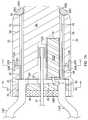
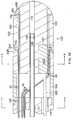
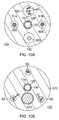
- FIGS. 9 and 10a distal portion of a focal catheter 100 is shown, with a distal tip 122 that extends from a deflection section 114.
- the distal tip 122constructed in a similar manner described above for distal tip 22, including a nonmetallic, electrically insulating substrate body 125 and a plurality of surface-embedded radial and distal microelectrodes 26R and 26D whose outer surfaces 63R and 63D, respectively, are generally flush with outer surface 133 of the substrate body 125 to present a generally smooth, atraumatic distal tip profile.
- the substrate body 125has similar axial and radial passages 160 and 162 for the lead wires and indentations 164 for the embedded microelectrodes.
- a distal location sensor 142Dis located in a blind hole 51 formed in the proximal end of the substrate body 125.
- the focal catheter 100is configured with a guide wire passage 130 that extends longitudinally within the catheter from the control handle 16 to the distal tip 122.
- the passage 130is defined by the lumen of a tubing 128 that extends through the control handle, the center lumen of the catheter body, a dedicated on-axis lumen 141 in the deflection section 114, and a connector tubing 134 connecting the deflection section 114 and the distal tip 122.
- a distal end of the tubing 128is received in a longitudinal on-axis passage 170 formed the substrate body 125 to extend the guidewire passage 130 to the distal face of the substrate body.
- the focal catheter 100may be deflected bi-directionally by means of first and second puller wires 48A and 48B extending through diametrically opposite, off axis lumens 31A and 31B formed in the tubing of the deflection section 114.
- an electrophysiologistintroduces a dilator and a guiding sheath into the patient, as is generally known in the art.
- a suitable guiding sheath for use in connection with the inventive catheteris the PREFACE.TM. Braided Guiding Sheath (commercially available from Biosense Webster, Inc., Diamond Bar, Calif.).
- the catheteris introduced through the guiding sheath with the expander extended and the basket assembly collapsed so that the basket assembly can be fed into the guiding sheath.
- the guiding sheathcovers the spines of the basket assembly in a collapsed position so that the entire catheter can be passed through the patient's vasculature to the desired location.
- the guiding sheathis withdrawn to expose the basket assembly.
- the expanderis drawn proximally or otherwise manipulated so that the spines flex outwardly.
- the ring electrodescontact atrial tissue.
- the electrophysiologistcan map local activation time and/or ablate and irrigate as needed, in diagnosing and providing therapy to the patient.
- the catheterenables the electrophysiologist to obtain a true anatomy of a cavernous region of the heart, including an atrium, by measuring more points than with traditional catheters, allowing him to map the region more quickly.
- the electrophysiologistcan direct the distal tip with high density microelectrodes for greater location precision and greater sensitivity in detecting more subtle electrical activity of heart tissue.
Landscapes
- Health & Medical Sciences (AREA)
- Life Sciences & Earth Sciences (AREA)
- Engineering & Computer Science (AREA)
- General Health & Medical Sciences (AREA)
- Animal Behavior & Ethology (AREA)
- Biomedical Technology (AREA)
- Heart & Thoracic Surgery (AREA)
- Veterinary Medicine (AREA)
- Public Health (AREA)
- Surgery (AREA)
- Biophysics (AREA)
- Molecular Biology (AREA)
- Physics & Mathematics (AREA)
- Medical Informatics (AREA)
- Pathology (AREA)
- Cardiology (AREA)
- Anesthesiology (AREA)
- Pulmonology (AREA)
- Hematology (AREA)
- Nuclear Medicine, Radiotherapy & Molecular Imaging (AREA)
- Otolaryngology (AREA)
- Plasma & Fusion (AREA)
- Physiology (AREA)
- Mechanical Engineering (AREA)
- Measurement And Recording Of Electrical Phenomena And Electrical Characteristics Of The Living Body (AREA)
- Surgical Instruments (AREA)
- Media Introduction/Drainage Providing Device (AREA)
Abstract
Description
- This invention relates to electrophysiologic (EP) catheters, in particular, EP catheters for mapping and/or ablation in the heart.
- Electrophysiology catheters are commonly-used for mapping electrical activity in the heart. Various electrode designs are known for different purposes. In particular, catheters having basket-shaped electrode arrays are known and described, for example, in
U.S. Pat. Nos. 5,772,590 ,6,748,255 and6,973,340 , the entire disclosures of both of which are incorporated herein by reference. - Basket catheters typically have an elongated catheter body and a basket-shaped electrode assembly mounted at the distal end of the catheter body. The basket assembly has proximal and distal ends and comprises a plurality of spines connected at their proximal and distal ends. Each spine comprises at least one electrode. The basket assembly has an expanded arrangement wherein the spines bow radially outwardly and a collapsed arrangement wherein the spines are arranged generally along the axis of the catheter body. The catheter may further comprise a distal location sensor mounted at or near the distal end of the basket-shaped electrode assembly and a proximal location sensor mounted at or near the proximal end of the basket-shaped electrode assembly. In use, the coordinates of the distal location sensor relative to those of the proximal sensor can be determined and taken together with known information pertaining to the curvature of the spines of the basket-shaped mapping assembly to find the positions of the at least one electrode of each spine.
- A basket assembly is capable of detecting in a single beat most or all of the electrical function of the left or right atrium. However, because the atria of an individual patient may vary in size and shape, it is desirable that the basket assembly be sufficiently versatile and steerable to conform to the particular atrium. A basket catheter with a deflectable basket assembly for improved maneuverability to provide better tissue contact, especially in a cavernous region of the heart, including an atrium, is described in
U.S. Application Serial No. 14/028,435, filed September 16, 2013 , the entire disclosure of which is hereby incorporated by reference. - High-density microelectrodes are also desirable for providing greater sensitivity in detecting more subtle electrical activity of heart tissue in diagnosing arrhythmias. By having a large number of electrodes often in a basket formation with spines of spaced ring electrodes, a physician can more quickly map a large area of the heart's interior geometry. Focal catheters, although lacking the resolution of a basket catheter with many electrodes, can be advantageous because their electrode location is fixed relative to the catheter distal tip.
- Accordingly, it is also desirable that a basket catheter provide high-density mapping augmented with a focal diagnostic catheter tip with precisely known microelectrode locations, especially where the focal tip electrode is populated with an array of microelectrodes, in a focal catheter dimensional envelope, or even smaller, such as within a guidewire range.
- The present invention is directed to a basket catheter having an ultra high density microelectrode distal tip electrode comprising a non-metallic electrically insulating structure that is populated with a collection of tiny, closely spaced electrodes formed from, for example, a medical grade metal, such as palladium, platinum, gold, stainless steel and the like, and combinations thereof. The distal tip electrode may be irrigated and fitted with a location sensor. The catheter of the present invention allows for the microelectrode distal tip electrode to be deployed in a number of microelectrode configurations, and a variety of embodiments. The ultra high density microelectrode distal tip electrode may be integrated with a high density basket catheter or a standalone focal catheter, or made smaller to fit the tip of a guidewire.
- The present invention is directed to a catheter having an elongated catheter body and a basket electrode assembly at the distal end of the catheter body, where the basket electrode assembly has a plurality of electrode-carrying spines and a distal end comprising a substrate body with a plurality of recessed microelectrodes. The substrate body has an outer surface and outer surfaces of the recessed microelectrodes are advantageously flush with the outer surface of the substrate body, so that the distal end presents a completely smooth and atraumatic profile.
- In one embodiment, the distal end substrate body has a proximal portion with a radial outer surface and a distal portion with a domed outer surface. At least one radial microelectrode has an outer surface in conformity with the radial outer surface of the substrate body and at least one distal microelectrode has an outer surface in conformity with the domed outer surface of the substrate body. The outer surface of the substrate body is formed with indentations in which the microelectrodes are nested in a manner such that only its outer (or outer-facing) surface is exposed and even with the outer surface of the substrate body. In a more detailed embodiment, the each microelectrode has a surface area ranging between about 0.05 mm2 and 0.5 mm2, and preferably about 0.15 mm2. The substrate body may carry a plurality of microelectrodes ranging between about two and 20, preferably between about six and 16. Moreover, lead wires connected to the microelectrodes are passed through radial and distal passages formed in the substrate body.
- The present invention is also directed to a focal catheter having an elongated catheter body and a distal tip with a substrate body and a plurality of recessed microelectrodes, whose outer surface is flush with the outer surface of the substrate body. The distal tip of the focal catheter has all the aforementioned structural advantages for greater mapping resolution and greater location precision.
- These and other features and advantages of the present invention will be better understood by reference to the following detailed description when considered in conjunction with the accompanying drawings wherein:
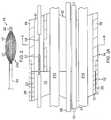
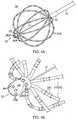
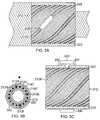
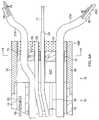
FIG. 1 is a top plan view of a catheter of the present invention, according to one embodiment, with a basket electrode assembly in an expanded, deployed configuration.FIG. 2 is a detailed view of the basket electrode assembly ofFIG. 1 , in a collapsed configuration.FIG. 3A is a side cross-sectional view of the catheter of the present invention, including a junction between a catheter body and a deflection section, along a diameter.FIG. 3B is an end cross-sectional view of the deflection section ofFIG. 3A , taken along line B-B.FIG. 4A is a detailed view of the basket electrode assembly ofFIG. 1 , in an expanded, deployed configuration.FIG. 4B is a detailed view of a distal end of the basket electrode assembly ofFIG. 4A .FIG. 5A is a top view of a cabling for use with the present invention, according to one embodiment, with part(s) broken away.FIG. 5B is an end cross-sectional view of the cabling ofFIG 5A .FIG. 5C is a side view of the cabling ofFIG. 5A , with part(s) broken away.FIG. 6A is a side cross-sectional view of a proximal junction of the basket electrode assembly, according to one embodiment.FIG. 6B is an end cross-section view of the proximal junction ofFIG. 6A , taken along line B-B.FIG. 7A is a side cross-sectional view of a distal tip, in accordance with one embodiment.FIG. 7B is an end cross-sectional view of the distal tip ofFIG. 7A , taken along line B-B.FIG. 7C is an end cross-sectional view of the distal tip ofFIG. 7A , taken along line C-C.FIG. 8 is a detailed perspective view of a distal tip of a focal catheter, in accordance with one embodiment.FIG. 9 is a detailed perspective view of a distal tip of a focal catheter with a guidewire passage, in accordance with one embodiment.FIG. 10 is a side cross-sectional view of the distal tip ofFIG. 9 .FIG. 10A is an end cross-sectional view of the distal tip ofFIG. 10 , taken along line A-A.FIG. 10B is an end cross-sectional view of the distal tip ofFIG. 10 , taken along line B-B.- The invention is directed to a
catheter 10 having a basket-shaped, highdensity electrode assembly 18 for large-area mapping, with an integrateddistal tip 22 providing an array of ultra high density microelectrodes for acute focal mapping. As shown inFIG. 1 , thecatheter 10 comprises anelongated catheter body 12 having proximal and distal ends, acontrol handle 16 at the proximal end of the catheter body, anintermediate deflection section 14 distal of thecatheter body 12, and the basket-shapedelectrode assembly 18 at the distal end of thedeflection section 14. The basket-shaped electrode assembly (or "basket assembly") 18 has a plurality ofspines 27 whose proximal ends and distal ends surround anelongated expander 17 that is afforded longitudinal movement relative to the catheter for adjusting the shape of the basket assembly between an expanded configuration (FIG. 1 ) and a collapsed configuration (FIG. 2 ). Mounted on the distal end of thebasket assembly 18 is thedistal tip 22 having a plurality of surface-embeddedmicroelectrodes 26 whose outer surface is generally flush with the outer surface of the substrate body to present a generally smooth, atraumatic distal tip profile. - With reference to
FIG. 3A , thecatheter body 12 comprises an elongated tubular construction having a single, axial orcentral lumen 15, but can optionally have multiple lumens if desired. Thecatheter body 12 is flexible, i.e., bendable, but substantially non-compressible along its length. Thecatheter body 12 can be of any suitable construction and made of any suitable material. One construction comprises anouter wall 20 made of polyurethane or PEBAX.RTM. (polyether block amide). Theouter wall 20 comprises an imbedded braided mesh of stainless steel or the like to increase torsional stiffness of thecatheter body 12 so that, when the control handle 16 is rotated, the distal end of the catheter body will rotate in a corresponding manner. - The outer diameter of the
catheter body 12 is not critical, but may be no more than about 8 french, more preferably 7 french. Likewise the thickness of the outer wall is not critical, but is preferably thin enough so that thecentral lumen 15 can accommodate a puller wire, lead wires, sensor cable and any other wires, cables or tubes. If desired, the inner surface of the outer wall is lined with a stiffeningtube 21 to provide improved torsional stability. An example of a catheter body construction suitable for use in connection with the present invention is described and depicted inU.S. Pat. No. 6,064,905 , the entire disclosure of which is incorporated herein by reference. - Distal of the
catheter body 12 is theintermediate deflection section 14 which comprises amulti-lumened tubing 19, with, for example, at least two offaxis lumens FIGS. 3A and3B . Themulti-lumened tubing 19 is made of a suitable non-toxic material that is preferably more flexible than thecatheter body 12. In one embodiment, the material for thetubing 19 is braided polyurethane or thermoplastic elastomer (TPE), for example, polyether block amide (PEBAX.RTM), with an imbedded mesh of braided high-strength steel, stainless steel or the like. The outer diameter of thedeflection section 14 is no greater than that of thecatheter body 12. In one embodiment, the outer diameter is no greater than about 8 french, more preferably about 7 french. Larger or smaller embodiments are possible, as determined by the number of spines in the basket, if applicable. The size of the lumens is not critical, so long as the lumens can accommodate the components extending therethrough. - A means for attaching the
catheter body 12 to thedeflection section 14 is illustrated inFIG. 3A . The proximal end of thedeflection section 14 comprises an outer circumferential notch 24 that receives the inner surface of theouter wall 20 of thecatheter body 12. Thedeflection section 14 andcatheter body 12 are attached by adhesive (e.g. polyurethane glue) or the like. Before thedeflection section 14 andcatheter body 12 are attached, however, the stiffeningtube 21 is inserted into thecatheter body 12. The distal end of the stiffeningtube 21 is fixedly attached near the distal end of thecatheter body 12 by forming a glue joint (not shown) with polyurethane glue or the like. Preferably, a small distance, e.g., about 3 mm, is provided between the distal end of thecatheter body 12 and the distal end of the stiffeningtube 21 to permit room for thecatheter body 12 to receive the notch 24 of thedeflection section 14. A force is applied to the proximal end of the stiffeningtube 21, and, while the stiffeningtube 21 is under compression, a first glue joint (not shown) is made between the stiffeningtube 21 and theouter wall 20 by a fast drying glue, e.g. Super Glue.RTM. Thereafter, a second glue joint (not shown) is formed between the proximal ends of the stiffeningtube 21 andouter wall 20 using a slower drying but stronger glue, e.g. polyurethane. - The basket-shaped
electrode assembly 18 is mounted to the distal end of thecatheter body 12. As shown inFIGS. 1 and4A , the basket-shapedelectrode assembly 18 comprises a plurality of electrode-carryingspines 27 or arms (e.g., between about five to ten, and preferably about eight) mounted, generally evenly-spaced in about 360 radial degrees around theexpander 17 so that the expander forms the center longitudinal axis of the electrode assembly. Each of thespines 27 is attached, directly or indirectly, at its distal end to the distal end of theexpander 17. As actuated by longitudinal movement of theexpander 17 relative to the catheter, thebasket assembly 18 is adapted to assume an elongated and collapsed configuration with theexpander 17 extended distally (FIG. 2 ) and a deployed and radially expanded configuration with the expander drawn proximally (FIG. 1 ). Theexpander 17 comprises a material sufficiently rigid to achieve this function. In an embodiment, theexpander 17 is a wire or tensile member, and aguide tube 23 is provided to surround, protect and guide theexpander 17 through the control handle 16, thecatheter body 12 and thedeflection section 14. Theguide tube 23 is made of any suitable material, including polyimide. - In one embodiment, each
spine 27 of thebasket assembly 18 comprises acabling 210 with build-in or embeddedlead wires 212, as shown inFIGS. 5A, 5B and 5C . The cabling has acore 218, and a plurality of generallysimilar wires 212 covered by an insulating layer 216 that enables each wire to be formed and to function as a conductor 214. Thecore 218 provides alumen 224 in which can pass other components such as additional lead wire(s), cables, tubing and/or a support structure to shape the cabling as desired. - In the following description, generally similar components associated with
cabling 210 are referred to generically by their identifying component numeral, and are differentiated from each other, as necessary, by appending a letter A, B, ... to the numeral. Thus,wire 212C is formed asconductor 214C covered by insulatinglayer 216C. While embodiments of the cabling may be implemented with substantially any plurality ofwires 212 in the cabling, for clarity and simplicity in the followingdescription cabling 210 is assumed to compriseN wires basket assembly 18. For purposes of illustration, insulating layers 216 ofwires 212 have been drawn as having approximately the same dimensions as conductors 214. In practice, the insulating layer is typically approximately one-tenth the diameter of the wire. - The
wires 212 are formed over aninternal core 218, which is typically shaped as a cylindrical tube, andcore 218 is also referred to herein astube 218. The core material is typically selected to be a thermoplastic elastomer such as a polyether block amid (PEBA) or PEBAX.RTM.Wires 212 are formed on anouter surface 220 of thecore 218 by coiling the wires around thetube 218. In coilingwires 212 on thesurface 220, the wires are arranged so that they contact each other in a "close-packed" configuration. Thus, in the case thatcore 218 is cylindrical, eachwire 212 on the outer surface is in the form of a helical coil. In the case of thetube 218 being cylindrical, the close packed arrangement of the helical coils ofwires 212 means that the wires are configured in a multi-start thread configuration. Thus, in the case of theN wires 212 assumed herein,wires 212 are arranged in an N-start thread configuration aroundcylindrical tube 218. - In contrast to a braid, all helical coils of
wires 212 herein have the same handedness (direction of coiling). Moreover, wires in braids surrounding a cylinder are interleaved, so are not in the form of helices. Because of the non-helical nature of the wires in braids, even braid wires with the same handedness do not have a threaded form, let alone a multi-start thread configuration. Furthermore, because of the lack of interleaving in arrangements of wires in embodiments of the cabling, the overall diameter of the cabling produced is less than that of cabling using a braid, and the reduced diameter is particularly beneficial when the cabling is used for a catheter. - Once
wires 212 have been formed in the multi-start thread configuration described above, the wires are covered with aprotective sheath 222. The protective sheath material is typically selected to be a thermoplastic elastomer such as PEBA, for example, 55D PEBAX without additives so that it is transparent. In that regard, insulating layer of at least one ofwires 212 is colored differently from the colors of the remaining wires as an aid in identifying and distinguishing the different wires. - The process of coiling
wires 212 around thecore 218, and then covering the wires by thesheath 222 essentially embeds the wires within a wall of cabling 210, the wall comprising the core and the sheath. Embedding the wires within a wall means that the wires are not subject to mechanical damage when the cabling is used to form a catheter. Mechanical damage is prevalent for small wires, such as 48AWG wires, if the wires are left loose during assembly of a catheter. - In use as a catheter, an approximately cylindrical volume or
lumen 224 enclosed by thecore 218, that is afforded by embedding smaller wires (such as the 48 AWG wires) in the wall, allows at least a portion of thelumen 224 to be used for other components. It is understood that the plurality ofwires 212 shown in the drawings is representative only and that a suitable cabling provides at least a plurality of wires equal to or greater than the plurality of ring electrodes mounted on each cabling or spine of the basket assembly. Cabling suitable for use with the present invention is described inU.S. Application Serial No. 13/860,921, filed April 11, 2013 U.S. Application Serial No. 14/063,477, filed October 25, 2013 , entitled CONNECTION OF ELECTRODES TO WIRES COILED ON A CORE, the entire disclosures of which are incorporated herein by reference. Each cabling 210 (with embedded lead wires 212) extends from the control handle 16, through thelumen 15 of thecatheter body 12, and thelarger lumen 32 of thetubing 19 of thedeflection section 14, as shown inFIG. 3A . - With reference to
FIGS. 6A and6B , at the proximal end of thebasket assembly 18, the cabling 210 (serving as thespines 27 of thebasket assembly 18, and used interchangeably herein) extend through aproximal junction 18P that includes anouter tubing 34 that extends a short distance from the distal end of thetubing 19 of thedeflection section 14. Theouter tubing 34 may be made of any suitable material, for example, PEEK (polyetheretherketone). - In the lumen of the
outer tubing 34, aproximal alignment disc 35 formed with a plurality of through-holes is provided to receive and position thecabling 210 and theguide tube 23 of theexpander 17 in theouter tubing 34. Theproximal disc 35 is made of any suitable material, including metal or plastic. In the embodiment ofFIGS. 6A and6B , theproximal disc 35 has an on-axis through-hole 71 for theguide tube 23, and a plurality of off-axis through-holes 70 around a peripheral region of the disc, with each through-hole guiding a respective cabling 210 (only two of which are shown inFIG. 6A for clarity). For example, with eightcabling 210, the through-holes 70 are situated at about 45 radial degrees around the peripheral region. Where irrigation is desired, thedisc 35 includes another off-axis through-hole 72 which receives a distal end of anirrigation tubing 39 from which fluid passing through thetubing 39 exits the catheter. Distal of thedisc 35, the lumen of theouter tubing 34 is filled and sealed with asuitable glue 37, for example, epoxy. - The
cabling 210 and theexpander 17 extend distally from theproximal junction 18P to form thebasket assembly 18. Each cabling has a predetermined shape flexibly set by ashape memory member 38 that extends through thelumen 224 in thecore 218. As shown inFIG. 3B , selected or all of thelumens 224 of thecores 218 also carry additionallead wires 40 for the array ofmicroelectrodes 26 on thedistal tip 22. Selectedlumens 224 may also carry cable(s) 36 for electromagnetic location sensor(s) carried in thedistal tip 22. - In forming the basket shape, the
shape memory members 38 in thecabling 210 diverge from theproximal junction 18P and bow outwardly from theexpander 17, and converge at their distal ends at thedistal tip 22, as shown inFIG. 4A . Theshape memory member 38, e.g., a Nitinol shape member or wire, is configured to flexibly provide the shape of the basket-assembly, as known in the art. In one embodiment, theshape memory member 38 of eachcabling 210 has a proximal end located near the proximal end of thedeflection section 14, and a distal end located in thedistal tip 22, although it is understood that the proximal end may be located anywhere proximally of the proximal end of thedeflection section 14 along the length of thecabling 210, as desired or appropriate. - As understood by one skilled in the art, the number of
spines 27 or cabling 210 of thebasket assembly 18 can vary as desired depending on the particular application, so that thebasket assembly 18 has at least two spines, preferably at least three spines, and as many as eight or more spines. As used herein, the term "basket-shaped" in describing theelectrode assembly 18 is not limited to the depicted configuration, but can include other designs, such as spherical or egg-shaped designs, that include a plurality of expandable arms connected, directly or indirectly, at their proximal and distal ends. - Each
spine 27 or cabling 210 carries a plurality ofring electrodes 240, which may be configured as monopolar or bipolar, as known in the art.FIGS. 5A and 5B are schematic diagrams illustrating attachment of aring electrode 240 to cabling 210, according to an embodiment.FIG. 5A is a schematic top view of the cabling andFIG. 5B is a schematic side view of the cabling; in both views portions ofsheath 222 have been cut away to exposewires 212 of thecabling 210, as well as to illustrate the attachment of aring electrode 240 to thecabling 210.FIG. 5A illustrates cabling 210 before attachment ofring electrode 240, andFIG. 5B illustrates the cabling after the ring electrode has been attached. Ring electrode has dimensions enabling it to be slid oversheath 222. - Initially a location for attaching a
ring electrode 240 is selected by visually finding a colored wire, such aswire 212E. The visual determination is possible sincesheath 222 is transparent. Once the location has been selected, a section ofsheath 222 above the wire and a corresponding section of insulating layer 216E are removed to provide apassage 242 to conductor 214E. In a disclosed embodiment,conductive cement 244 is fed into the passage,ring electrode 240 is slid to contact the cement, and the electrode is then crimped in place. Alternatively, thering electrode 240 may be attached to a specific wire by pulling the wire throughsheath 222, and resistance welding or soldering the ring electrode to the wire. - With reference to
FIGS. 4B ,7A and7B , at the distal end of thebasket assembly 18, the distal ends of thecabling 210 converge around the distal end of theexpander 17 in thedistal tip 22. Thedistal tip 22 has a generally solid, elongated, nonmetallic, electrically-insulatingsubstrate body 25 with a generally cylindrical shape (with a two-dimensional curvature in the X/Y direction and a linear length in the Z direction), and a domed distal end (with a three-dimensional curvature in the X/Y/Z direction). The body has a trepannedproximal face 47 forming a cored-outproximal region 29 in which the distal ends of thecabling 210 and theexpander 17 are received, anchored and sealed byglue 49, for example, epoxy. A first, on-axis blind hole 50 extends distally from the cored-out proximal region to receive a crimped distal tip of theexpander 17. A second, off axis blind hole 52 extends distally from the cored-outproximal region 29 to receive at least a portion of the electromagnetic location sensor 42. - The distal ends of the
cabling 210 in the cored-outproximal region 29 are positioned by adistal alignment disc 45. Thedisc 45 has a plurality of through-holes to receive thecabling 210 and theexpander 17 in theouter tubing 34. Thedisc 45 is made of any suitable material, including metal or plastic. In the embodiment ofFIGS. 7A and7B , thedistal disc 45 has an on-axis through-hole 92 for theexpander 17, and a plurality of off-axis through-holes 90 around a peripheral region of the disc, with each through-hole guiding the distal end of a respective cabling 210 (only two of which are shown inFIG. 7A for clarity). For example, with eightcabling 210, the through-holes 90 are situated at about 45 radial degrees around the peripheral region. Proximal of thedisc 45, the cored-outproximal region 29 is filled and sealed with asuitable glue 49, for example, epoxy. - Also formed in the
body 25 of thedistal tip 22 areaxial passages 60 andradial passages 62, as shown inFIG. 7A , providing communication between the cored-outproximal region 29 andindentations 64 formed onouter surface 33 of thebody 25 where themicroelectrodes 26 are located. With respective pairs of thecabling 210 andaxial passages 60 axially aligned with each other in thetip 22, the additionallead wires 40 that pass through thelumen 224 of thecore 218 of thecabling 210 extend through the axial andradial passages distal tip 22.Radial microelectrodes 26R are located on radial outer surface of thebody 25.Distal microelectrodes 26D are located on distal outer surface of thebody 25. It is understood that the plurality ofwires 40 shown in the drawings is representative only and that the plurality of wires is equal to or greater than the plurality of microelectrodes carried on thedistal tip 22. Also passing through thelumen 224 of thecore 218 of one predetermined cabling 210' is thecable 36D for the distalEM location sensor 42D. A portion of the wall of the cabling 210' is removed at X so as to accommodate thecable 36D extending from a distalEM location sensor 42D. - In accordance with a feature of the present invention, the
indentations 64 are shaped and sized in correspondence with the shape and size of themicroelectrode 26 which has a body that is fully received in arespective indentation 64 such that only an outer or outer-facing surface 63 of the microelectrode is exposed and generally even and flush with theouter surface 33 of thebody 25 of thedistal tip 22, as shown inFIGS. 7A and7C . Theindentations 64 allow themicroelectrodes 26 to be recessed in thebody 25 to provide a smooth and atraumatic profile which minimizes the risk of the microelectrodes snagging, scratching or otherwise damaging tissue in contact with thedistal tip 22. Each indentation minimizes, if not prevents, contact between tissue and a microelectrode except by the outer surface 63 of the microelectrode. The indentation limits tissue contact by any side surface or inner surface of a microelectrode by surrounding the microelectrode except for the outer surface. - Moreover, the outer surface 63 of the
microelectrode 26 has the same contour as the surroundingouter surface 33 of thesubstrate body 25. For example, thedistal microelectrodes 26D have three-dimensionally curvedouter surfaces 63D that conform with the three-dimensionally curvedouter surface 33 of thesubstrate body 25 at its distal end, and theradial microelectrodes 26R have two-dimensionally curvedouter surfaces 63R that conform with the two-dimensionally curvedouter surfaces 33 of thesubstrate body 25. With a generally smooth profile, thetip 22 can be pivoted about its distal end in a circular motion where its longitudinal axis traces a cone C to improve electrode contact with minimum risk of damage to tissue, especially in a cavernous region, such as an atrium. - Each
microelectrode 26 has a surface area ranging between about 0.05 mm2 and 0.5 mm2, and preferably 0.15 mm2. Thus, thedistal tip 22 comprises a plurality of tiny, closely spaced electrodes that may be formed from any suitable material, including medical-grade metal, for example, palladium, platinum, gold, stainless steel and the like, and combinations thereof. With a large number ofmicroelectrodes 26, thetip 22 advantageously provides focal diagnostic capabilities with precisely known microelectrode locations by means of their fixed location relative to thetip body 25, whereas thebasket assembly 18 with its large number ofring electrodes 240 on thespines 27 allows the physician to more quickly cover a large area of internal geometry of a cavernous region, such as the heart. - Each of the
ring electrodes 240 on thespines 27 and each of themicroelectrodes 26 is electrically connected via thelead wires cabling 210 with embeddedelectrode lead wires 212 in its wall and additionallead wires 40 andEM sensor cable 36 in itslumen 224 pass from the control handle 16 and through thecentral lumen 15 of thecatheter body 12 and thelumen 32 of thedeflection section 14 and extends through thebasket assembly 18 as the spines wherelead wires 212 are connected to the ring electrodes, thelead wires 40 are connected to themicroelectrodes 26 on thedistal tip 22 and thecable 36 to the EM sensor in thedistal tip 22. By combining thebasket assembly 18 with a microelectrodedistal tip 22, the catheter is adapted for both large area mapping and acute focal mapping. - The
expander 17 has a suitable length that extends the entire length of the catheter. The expander includes aproximal end 17P (FIG. 1 ) that is exposed proximally of the control handle 16, a main portion that extends through the control handle 16, thecentral lumen 15 of thecatheter body 12, and thelumen 32 of thedeflection section 14, and an exposed distal portion extending through thebasket assembly 18 and into thedistal tip 22. Theguide tube 23 extends through the control handle 16, thecentral lumen 15 of the catheter body, and thelumen 32 of thedeflection section 14 and has distal end that extends a short distance distal of the distal end of theouter tubing 34 of theproximal junction 18P of thebasket assembly 18. A user manipulates theproximal end 17P by advancing or withdrawing theexpander 17 longitudinally relative to the control handle 16 and the catheter so that it can move the distal ends of thespines 27 proximally or distally relative to the catheter to radially expand and contract, respectively, theassembly 18. - As shown in
FIGS. 3A and3B , apuller wire 48 for uni-directional deflection of thedeflection section 14 extends from the control handle 16 where its proximal end is anchored and responsive to adeflection knob 13 on the control handle 16, and through thecentral lumen 15 of thecatheter body 12 and thelumen 31 of thedeflection section 14. As shown inFIG. 6A , a distal end of thepuller wire 48 is anchored near the distal end of thedeflection section 14 by a T-bar 55 as known in the art. Along the length of thelumen 15 of thecatheter body 12, the puller wire is surrounded by a compression coil 57, as shown inFIG. 3A . The compression coil has a proximal end at or near a junction between the control handle 16 and thecatheter body 12, and a distal end at or near the distal end of thecatheter body 12. Accordingly, when thepuller wire 48 is drawn proximally by manipulation of the deflection knob 13 (FIG. 1 ) on the control handle 16, the compression coil 57 stops compression along its length so that thepuller wire 48 deflects thedeflection section 14 distal of thecatheter body 12. The catheter may include a second puller wire for bi-directional deflection, as known in the art. - A distal
electromagnetic location sensor 42D is connected tosensor cable 36D that extends through thelumen 224 of selected cabling 210' (FIG. 3B ) which extends from thecatheter body 12 and control handle 16 and out the proximal end of the control handle 16 (FIG. 1 ) within an umbilical cord (not shown) to a sensor control module (not shown) that houses a circuit board (not shown). Alternatively, the circuit board can be housed within the control handle 16, for example, as described inU.S. Pat. No. 6,024,739 , the disclosure of which is incorporated herein by reference. Thesensor cable 36D comprises multiple wires encased within a plastic covered sheath. In the sensor control module, the wires of the sensor cable are connected to the circuit board. The circuit board amplifies the signal received from the corresponding location sensor and transmits it to a computer in a form understandable by the computer by means of the sensor connector at the proximal end of the sensor control module. Also, because the catheter is designed for single use only, the circuit board may contain an EPROM chip that shuts down the circuit board approximately twenty-four hours after the catheter has been used. This prevents the catheter, or at least the location sensor, from being used twice. - In one embodiment, the
location sensor 42D comprises a magnetic-field-responsive coil, as described inU.S. Pat. No. 5,391,199 , or a plurality of such coils, as described inInternational Publication WO 96/05758 U.S. Pat. Nos. 5,558,091 ,5,443,489 ,5,480,422 ,5,546,951 , and5,568,809 , and International Publication Nos.WO 95/02995 WO 97/24983 WO 98/29033 - A proximal
EM location sensor 42P may be provided at the proximal end of thebasket assembly 18, as shown in broken lines inFIG. 6A . Thesensor 42P is housed in theouter tubing 34 and a cable 36P, also shown in broken lines inFIG. 6A , for theproximal location sensor 42P may extend through thecentral lumen 15 of thecatheter body 12, and thelumen 32 of thedeflection section 14. With a second location sensor, the coordinates of thedistal sensor 42D, relative to those of theproximal sensor 42P, are determined and taken together with other known information pertaining to the curvature of thespines 27 of the basket-shapedmapping assembly 18. This information is used to find the positions of thering electrodes 240 mounted on thespines 26. - As would be recognized by one skilled in the art, other arrangements for constructing the proximal and distal junctions and for mounting the location sensors could also be used in accordance with the invention.
- The
distal tip 22 may carry any number ofmicroelectrodes 26. For example, thedistal tip 22 may carry 16 microelectrodes 26 (eight distal and eight radial), as shown inFIG. 8 , or it may carry six microelectrodes 26 (three distal and three radial), as shown inFIG. 9 . With reference toFIGS. 9 and10 , a distal portion of afocal catheter 100 is shown, with adistal tip 122 that extends from adeflection section 114. With additional reference toFIGS. 10A and 10B , thedistal tip 122 constructed in a similar manner described above fordistal tip 22, including a nonmetallic, electrically insulatingsubstrate body 125 and a plurality of surface-embedded radial anddistal microelectrodes outer surfaces outer surface 133 of thesubstrate body 125 to present a generally smooth, atraumatic distal tip profile. Thesubstrate body 125 has similar axial andradial passages indentations 164 for the embedded microelectrodes. Adistal location sensor 142D is located in ablind hole 51 formed in the proximal end of thesubstrate body 125. However, in this embodiment, thefocal catheter 100 is configured with aguide wire passage 130 that extends longitudinally within the catheter from the control handle 16 to thedistal tip 122. Thepassage 130 is defined by the lumen of atubing 128 that extends through the control handle, the center lumen of the catheter body, a dedicated on-axis lumen 141 in thedeflection section 114, and aconnector tubing 134 connecting thedeflection section 114 and thedistal tip 122. A distal end of thetubing 128 is received in a longitudinal on-axis passage 170 formed thesubstrate body 125 to extend theguidewire passage 130 to the distal face of the substrate body. - The
focal catheter 100 may be deflected bi-directionally by means of first andsecond puller wires axis lumens deflection section 114. - To use the
catheter 100 of the invention, an electrophysiologist introduces a dilator and a guiding sheath into the patient, as is generally known in the art. A suitable guiding sheath for use in connection with the inventive catheter is the PREFACE.TM. Braided Guiding Sheath (commercially available from Biosense Webster, Inc., Diamond Bar, Calif.). The catheter is introduced through the guiding sheath with the expander extended and the basket assembly collapsed so that the basket assembly can be fed into the guiding sheath. The guiding sheath covers the spines of the basket assembly in a collapsed position so that the entire catheter can be passed through the patient's vasculature to the desired location. Once the basket assembly of the catheter reaches the desired location, e.g., the left atrium, the guiding sheath is withdrawn to expose the basket assembly. The expander is drawn proximally or otherwise manipulated so that the spines flex outwardly. With the basket assembly radially expanded, the ring electrodes contact atrial tissue. Using the ring electrodes on the spines in combination with the location sensor(s), the electrophysiologist can map local activation time and/or ablate and irrigate as needed, in diagnosing and providing therapy to the patient. With the multiple electrodes on the basket assembly, the catheter enables the electrophysiologist to obtain a true anatomy of a cavernous region of the heart, including an atrium, by measuring more points than with traditional catheters, allowing him to map the region more quickly. Moreover, for focal tissue contact, the electrophysiologist can direct the distal tip with high density microelectrodes for greater location precision and greater sensitivity in detecting more subtle electrical activity of heart tissue. - The preceding description has been presented with reference to presently disclosed embodiments of the invention. Workers skilled in the art and technology to which this invention pertains will appreciate that alterations and changes in the described structure may be practiced without meaningfully departing from the principal, spirit and scope of this invention. As understood by one of ordinary skill in the art, the drawings are not necessarily to scale and any feature(s) of an embodiment may be incorporated into any other embodiments or combined with any other feature(s) of another embodiment, as desired or needed. Accordingly, the foregoing description should not be read as pertaining only to the precise structures described and illustrated in the accompanying drawings, but rather should be read consistent with and as support to the following claims which are to have their fullest and fair scope.
- 1. A catheter comprising:
- an elongated catheter body having proximal and distal ends and at least one lumen therethrough;
- a basket electrode assembly at the distal end of the catheter body, the basket electrode assembly having proximal and distal ends and comprising a plurality of spines, the spines comprising a plurality of electrodes, the distal end comprising a substrate body, and a plurality of recessed microelectrodes, the substrate body has an outer surface and outer surfaces of the recessed microelectrodes are flush with the outer surface of the substrate body.
- 2. The catheter of aspect 1, wherein the substrate body has a radial outer surface, and at least one radial microelectrode has an outer surface flush with the radial outer surface.
- 3. The catheter of aspect 2, wherein the radial outer surface of the substrate body and the outer surface of the at least one radial microelectrode has a common curvature in at least one direction.
- 4. The catheter of aspect 1, wherein the substrate body has a distal end outer surface, and at least one distal microelectrode has an outer surface flush with the distal end outer surface.
- 5. The catheter of aspect 4, wherein the distal end outer surface of the substrate body and the outer surface of the at least one distal microelectrode has a common curvature in at least one direction.
- 6. The catheter of aspect 1, further comprising an expander having proximal and distal ends, the expander forming a longitudinal axis of the assembly, wherein the spines are attached at their proximal and distal ends to the expander.
- 7. The catheter of aspect 1, further comprising an intermediate deflection section between the catheter body and the basket electrode assembly.
- 8. The catheter of aspect 7, further comprising at least one puller wire that extends through the catheter body and the intermediate deflection section, the puller wire having a distal end anchored at or near the proximal end of the intermediate deflection section.
- 9. The catheter of aspect 8, further comprising a control handle proximal of the catheter body, the control handle having an actuator adapted to move the at least one puller wire.
- 10. The catheter of aspect 1, wherein the outer surface of the substrate body has one or more indentations receiving the microelectrodes.
- 11. The catheter of aspect 1, wherein the indentations are sized and shaped to generally cover all surfaces of the microelectrodes except their outer facing surfaces.
Claims (9)
- A catheter comprising:an elongated catheter body having proximal and distal ends and at least one lumen therethrough; anda distal tip comprising a substrate body, and a plurality of recessed microelectrodes, the substrate body having an outer surface and passages,wherein outer surfaces of the recessed microelectrodes are flush with the outer surface of the substrate body, andwherein lead wires for the microelectrodes pass through the passages.
- The catheter of claim 1, wherein each microelectrode has a surrounding outer surface of the substrate body, and wherein the outer surface of each microelectrode and its surrounding outer surface of the substrate body have a common curvature.
- The catheter of claim 1, wherein the microelectrodes include at least one radial microelectrode and at least one distal microelectrode, and the substrate body has a radial outer surface and a distal outer surface, and wherein outer surface of the at least one radial microelectrode and the radial outer surface of the substrate body have a first common curvature, and outer surface of the at least one distal microelectrode and the distal outer surface of the substrage body have a second common curvature.
- The catheter of claim 1, where in the substrate body comprises a nonmetallic, electrically-insulating material.
- The catheter of claim 1, further comprising a guidewire passage extending through at least the catheter body.
- The catheter of claim 5, wherein the guidewire passage extends through the distal tip.
- The catheter of claim 1, comprising at least sixteen microelectrodes.
- The catheter of claim 7, wherein the microelectrodes comprise at least eight radial microelectrodes and at least eight distal microelectrodes.
- The catheter of claim 1, comprising at least six microelectrodes.
Applications Claiming Priority (2)
| Application Number | Priority Date | Filing Date | Title |
|---|---|---|---|
| US14/526,394US9314208B1 (en) | 2014-10-28 | 2014-10-28 | Basket catheter with microelectrode array distal tip |
| EP15191615.2AEP3015064B1 (en) | 2014-10-28 | 2015-10-27 | Basket catheter with microelectrode array distal tip |
Related Parent Applications (2)
| Application Number | Title | Priority Date | Filing Date |
|---|---|---|---|
| EP15191615.2ADivision-IntoEP3015064B1 (en) | 2014-10-28 | 2015-10-27 | Basket catheter with microelectrode array distal tip |
| EP15191615.2ADivisionEP3015064B1 (en) | 2014-10-28 | 2015-10-27 | Basket catheter with microelectrode array distal tip |
Publications (1)
| Publication Number | Publication Date |
|---|---|
| EP3075311A1true EP3075311A1 (en) | 2016-10-05 |
Family
ID=54360284
Family Applications (2)
| Application Number | Title | Priority Date | Filing Date |
|---|---|---|---|
| EP15191615.2AActiveEP3015064B1 (en) | 2014-10-28 | 2015-10-27 | Basket catheter with microelectrode array distal tip |
| EP16171704.6AWithdrawnEP3075311A1 (en) | 2014-10-28 | 2015-10-27 | Catheter with microelectrode array distal tip |
Family Applications Before (1)
| Application Number | Title | Priority Date | Filing Date |
|---|---|---|---|
| EP15191615.2AActiveEP3015064B1 (en) | 2014-10-28 | 2015-10-27 | Basket catheter with microelectrode array distal tip |
Country Status (7)
| Country | Link |
|---|---|
| US (5) | US9314208B1 (en) |
| EP (2) | EP3015064B1 (en) |
| JP (2) | JP6771878B2 (en) |
| CN (1) | CN105534518B (en) |
| CA (1) | CA2910626A1 (en) |
| IL (1) | IL241381B (en) |
| RU (1) | RU2015145807A (en) |
Cited By (1)
| Publication number | Priority date | Publication date | Assignee | Title |
|---|---|---|---|---|
| US20240050741A1 (en)* | 2017-04-28 | 2024-02-15 | Boston Scientific Scimed, Inc. | Systems, devices, and methods for delivery of pulsed electric field ablative energy to esophageal tissue |
Families Citing this family (81)
| Publication number | Priority date | Publication date | Assignee | Title |
|---|---|---|---|---|
| WO2010093603A1 (en) | 2009-02-11 | 2010-08-19 | Boston Scientific Scimed, Inc. | Insulated ablation catheter devices and methods of use |
| JP6441679B2 (en) | 2011-12-09 | 2018-12-19 | メタベンション インコーポレイテッド | Therapeutic neuromodulation of the liver system |
| AU2014274903B2 (en) | 2013-06-05 | 2019-03-07 | Medtronic Ireland Manufacturing Unlimited Company | Modulation of targeted nerve fibers |
| JP2017529169A (en) | 2014-10-13 | 2017-10-05 | ボストン サイエンティフィック サイムド,インコーポレイテッドBoston Scientific Scimed,Inc. | Tissue diagnosis and treatment using mini-electrodes |
| US9314208B1 (en) | 2014-10-28 | 2016-04-19 | Biosense Webster (Israel) Ltd. | Basket catheter with microelectrode array distal tip |
| CA2969129A1 (en) | 2014-12-03 | 2016-06-09 | Metavention, Inc. | Systems and methods for modulating nerves or other tissue |
| EP4241820B1 (en)* | 2015-01-23 | 2025-07-09 | Terumo Kabushiki Kaisha | Guide wire |
| CN107205774B (en) | 2015-01-28 | 2020-05-29 | 圣犹达医疗用品心脏病学部门有限公司 | Thermal mapping catheter |
| US11020017B2 (en)* | 2015-02-16 | 2021-06-01 | Biosense Webster (Israel) Ltd. | Angioplasty guidewire |
| US10602983B2 (en) | 2015-05-08 | 2020-03-31 | St. Jude Medical International Holding S.À R.L. | Integrated sensors for medical devices and method of making integrated sensors for medical devices |
| US10799287B2 (en)* | 2015-07-07 | 2020-10-13 | Boston Scientific Scimed, Inc. | Medical device having extenable members |
| US10376170B2 (en) | 2015-08-10 | 2019-08-13 | Boston Scientific Scimed, Inc. | Catheter with annular lumen to provide distal flushing |
| EP4205685B1 (en) | 2015-10-21 | 2024-08-28 | St. Jude Medical, Cardiology Division, Inc. | High density electrode mapping catheter |
| CN114668490B (en) | 2015-10-21 | 2025-10-03 | 圣犹达医疗用品心脏病学部门有限公司 | High-density electrode mapping catheter |
| US10639022B2 (en)* | 2015-11-03 | 2020-05-05 | W. L. Gore & Associates, Inc. | Endoscopic organ manipulation devices and methods |
| WO2017112607A1 (en) | 2015-12-20 | 2017-06-29 | Boston Scientific Scimed Inc. | Micro induction position sensor |
| US10128594B2 (en)* | 2015-12-22 | 2018-11-13 | Biosense Webster (Israel) Ltd. | Connectors having three-dimensional surfaces |
| AU2017212715B2 (en) | 2016-01-29 | 2019-08-08 | Boston Scientific Scimed, Inc. | Force sensing catheter with impedance-guided orientation |
| JP5976973B1 (en)* | 2016-03-28 | 2016-08-24 | インター・ノバ株式会社 | Peripheral blood vessel guide catheter with multipolar electrodes |
| US10362991B2 (en)* | 2016-04-04 | 2019-07-30 | Biosense Webster (Israel) Ltd. | Convertible basket catheter |
| EP3858277B1 (en)* | 2016-05-03 | 2023-02-22 | St. Jude Medical, Cardiology Division, Inc. | Irrigated high density electrode catheter |
| US10537260B2 (en)* | 2016-05-06 | 2020-01-21 | Biosense Webster (Israel) Ltd. | Varying diameter catheter distal end design for decreased distal hub size |
| CN107440788A (en)* | 2016-06-01 | 2017-12-08 | 四川锦江电子科技有限公司 | A kind of ablation catheter and ablating device with interpolar discharge function |
| US10524859B2 (en) | 2016-06-07 | 2020-01-07 | Metavention, Inc. | Therapeutic tissue modulation devices and methods |
| US10905329B2 (en) | 2016-06-09 | 2021-02-02 | Biosense Webster (Israel) Ltd. | Multi-function conducting elements for a catheter |
| US11369431B2 (en) | 2016-06-11 | 2022-06-28 | Boston Scientific Scimed Inc. | Inductive double flat coil displacement sensor |
| CN106237513B (en)* | 2016-08-28 | 2019-01-22 | 杭州瑞彼加医疗科技有限公司 | Non-intruding infiltration type radio frequency diagnostic equipment |
| US10485609B2 (en)* | 2016-10-18 | 2019-11-26 | Acclarent, Inc. | Dilation balloon with RF energy delivery feature |
| WO2018080985A1 (en) | 2016-10-24 | 2018-05-03 | St. Jude Medical, Cardiology Division, Inc. | Catheter insertion devices |
| US11172858B2 (en) | 2016-10-28 | 2021-11-16 | St. Jude Medical, Cardiology Division, Inc. | Flexible high-density mapping catheter |
| EP3554406A1 (en)* | 2016-12-19 | 2019-10-23 | Boston Scientific Scimed Inc. | Distally-facing electrode array with longitudinally mounted splines |
| US12011549B2 (en) | 2017-01-19 | 2024-06-18 | St. Jude Medical, Cardiology Division, Inc. | Sheath visualization |
| US10014607B1 (en)* | 2017-03-13 | 2018-07-03 | Bionsense Webster (Israel) Ltd. | PCB sub-connectors |
| US12029545B2 (en) | 2017-05-30 | 2024-07-09 | Biosense Webster (Israel) Ltd. | Catheter splines as location sensors |
| US11647935B2 (en) | 2017-07-24 | 2023-05-16 | St. Jude Medical, Cardiology Division, Inc. | Masked ring electrodes |
| CN107468331A (en)* | 2017-08-21 | 2017-12-15 | 常州朗合医疗器械有限公司 | Radio frequency ablation catheter and system |
| US10359464B2 (en) | 2017-09-18 | 2019-07-23 | Biosense Webster (Israel) Ltd. | Cable and associated continuity monitoring system and method |
| EP3473200B1 (en) | 2017-10-23 | 2020-10-07 | VascoMed GmbH | Ablation catheter with microelectrode and method for producing an ablation catheter |
| US11484359B2 (en) | 2017-10-31 | 2022-11-01 | Biosense Webster (Israel) Ltd. | Method and system for gap detection in ablation lines |
| CN111278497B (en) | 2017-11-28 | 2024-01-12 | 圣犹达医疗用品心脏病学部门有限公司 | Lumen control catheter |
| JP7538039B2 (en) | 2018-01-10 | 2024-08-21 | アトリキュア, インコーポレイテッド | Devices and accessories for punch-type endoscopic access and ablation systems |
| US20190314083A1 (en) | 2018-04-11 | 2019-10-17 | Biosense Webster (Israel) Ltd. | Flexible Multi-Arm Catheter with Diametrically Opposed Sensing Electrodes |
| US12194251B2 (en)* | 2018-05-01 | 2025-01-14 | Magellan Biomedical Inc. | System and method for device steering, tracking, and navigation of devices for interventional procedures |
| US12156979B2 (en) | 2018-05-21 | 2024-12-03 | St. Jude Medical, Cardiology Division, Inc. | Deflectable catheter shaft with pullwire anchor feature |
| EP3768185B1 (en) | 2018-05-21 | 2023-06-14 | St. Jude Medical, Cardiology Division, Inc. | Radio-frequency ablation and direct current electroporation catheters |
| WO2020039392A2 (en) | 2018-08-23 | 2020-02-27 | St. Jude Medical, Cardiology Division, Inc. | Curved high density electrode mapping catheter |
| US12082936B2 (en) | 2018-09-27 | 2024-09-10 | St. Jude Medical, Cardiology Division, Inc. | Uniform mapping balloon |
| US11918762B2 (en) | 2018-10-03 | 2024-03-05 | St. Jude Medical, Cardiology Division, Inc. | Reduced actuation force electrophysiology catheter handle |
| US11357451B2 (en)* | 2018-12-10 | 2022-06-14 | Oscor Inc. | Intravascular mapping catheter with irrigated basket assembly |
| US11045628B2 (en) | 2018-12-11 | 2021-06-29 | Biosense Webster (Israel) Ltd. | Balloon catheter with high articulation |
| US11207016B2 (en) | 2018-12-28 | 2021-12-28 | Biosense Webster (Israel) Ltd. | Mapping ECG signals using a multipole electrode assembly |
| WO2020205128A1 (en)* | 2019-04-04 | 2020-10-08 | St. Jude Medical Cardiology Division, Inc. | System and method for cardiac mapping |
| US11850051B2 (en) | 2019-04-30 | 2023-12-26 | Biosense Webster (Israel) Ltd. | Mapping grid with high density electrode array |
| US11712172B2 (en) | 2019-07-18 | 2023-08-01 | Biosense Webster (Israel) Ltd. | Visual guidance for positioning a distal end of a medical probe |
| US20210085386A1 (en)* | 2019-09-20 | 2021-03-25 | Biosense Webster (Israel) Ltd. | Catheter instrument with three pull wires |
| US11950930B2 (en) | 2019-12-12 | 2024-04-09 | Biosense Webster (Israel) Ltd. | Multi-dimensional acquisition of bipolar signals from a catheter |
| US12029862B2 (en)* | 2019-12-20 | 2024-07-09 | Biosense Webster (Israel) Ltd. | Expandable assembly catheter |
| US11517218B2 (en) | 2019-12-20 | 2022-12-06 | Biosense Webster (Israel) Ltd. | Selective graphical presentation of electrophysiological parameters |
| US12232874B2 (en) | 2020-05-29 | 2025-02-25 | Biosense Webster (Israel) Ltd. | Electrode apparatus for diagnosis of arrhythmias |
| EP4159124B1 (en)* | 2020-05-29 | 2024-04-03 | Biosense Webster (Israel) Ltd. | Intraluminal reference electrode for cardiovascular treatment apparatus |
| US11987017B2 (en) | 2020-06-08 | 2024-05-21 | Biosense Webster (Israel) Ltd. | Features to assist in assembly and testing of devices |
| WO2022038546A1 (en) | 2020-08-18 | 2022-02-24 | St. Jude Medical, Cardiology Division, Inc. | High-density electrode catheters with magnetic position tracking |
| US12048479B2 (en) | 2020-09-10 | 2024-07-30 | Biosense Webster (Israel) Ltd. | Surface mounted electrode catheter |
| US11950841B2 (en) | 2020-09-22 | 2024-04-09 | Biosense Webster (Israel) Ltd. | Basket catheter having insulated ablation electrodes and diagnostic electrodes |
| US11950840B2 (en) | 2020-09-22 | 2024-04-09 | Biosense Webster (Israel) Ltd. | Basket catheter having insulated ablation electrodes |
| US12082875B2 (en) | 2020-09-24 | 2024-09-10 | Biosense Webster (Israel) Ltd | Balloon catheter having a coil for sensing tissue temperature and position of the balloon |
| US11974803B2 (en) | 2020-10-12 | 2024-05-07 | Biosense Webster (Israel) Ltd. | Basket catheter with balloon |
| US12201786B2 (en) | 2020-12-17 | 2025-01-21 | Biosense Webster (Israel) Ltd. | Measurement of distal end dimension of catheters using magnetic fields |
| US11918383B2 (en) | 2020-12-21 | 2024-03-05 | Biosense Webster (Israel) Ltd. | Visualizing performance of catheter electrodes |
| CN114404034A (en)* | 2021-02-09 | 2022-04-29 | 杭州德诺电生理医疗科技有限公司 | Ablation device |
| US12064170B2 (en) | 2021-05-13 | 2024-08-20 | Biosense Webster (Israel) Ltd. | Distal assembly for catheter with lumens running along spines |
| US20230000548A1 (en)* | 2021-07-02 | 2023-01-05 | Boston Scientific Scimed, Inc. | Focal ablation devices with foldable elements, and systems and methods thereof |
| CN113413193B (en)* | 2021-07-29 | 2025-07-22 | 南微医学科技股份有限公司 | Front end cap assembly and choledochoscope stone-taking basket |
| US12364426B2 (en) | 2021-08-12 | 2025-07-22 | Biosense Webster (Israel) Ltd. | Electro-anatomical mapping and annotation presented in electrophysiological procedures |
| US20230053064A1 (en)* | 2021-08-16 | 2023-02-16 | Biosense Webster (Israel) Ltd. | Catheter having electrodes with adjustable size |
| US12004804B2 (en) | 2021-09-09 | 2024-06-11 | Biosense Webster (Israel) Ltd. | Basket catheter with mushroom shape distal tip |
| US12011280B2 (en) | 2021-10-04 | 2024-06-18 | Biosense Webster (Israel) Ltd. | Electrophysiological mapping in the presence of injury current |
| US12419683B2 (en) | 2021-12-22 | 2025-09-23 | Biosense Webster (Israel) Ltd. | Irreversible electroporation with shorted electrodes |
| US20230210580A1 (en) | 2021-12-30 | 2023-07-06 | Biosense Webster (Isreal) Ltd. | Coated Microelectrodes |
| WO2023148597A1 (en) | 2022-02-02 | 2023-08-10 | Biosense Webster (Israel) Ltd. | Medical device with adjustment knob and feedback mechanism |
| EP4593746A1 (en)* | 2022-09-28 | 2025-08-06 | St. Jude Medical, Cardiology Division, Inc. | High density paddle catheter with distal coupler and distal electrode |
Citations (11)
| Publication number | Priority date | Publication date | Assignee | Title |
|---|---|---|---|---|
| WO1995002995A1 (en) | 1993-07-20 | 1995-02-02 | Biosense, Inc. | Apparatus and method for treating cardiac arrhythmias |
| WO1996005758A1 (en) | 1994-08-23 | 1996-02-29 | Trotta Frank P Jr | System and method for automated shopping |
| US5558091A (en) | 1993-10-06 | 1996-09-24 | Biosense, Inc. | Magnetic determination of position and orientation |
| WO1997024983A2 (en) | 1996-01-08 | 1997-07-17 | Biosense Inc. | Mapping catheter |
| US5772590A (en) | 1992-06-30 | 1998-06-30 | Cordis Webster, Inc. | Cardiovascular catheter with laterally stable basket-shaped electrode array with puller wire |
| WO1998029033A1 (en) | 1997-01-03 | 1998-07-09 | Biosense, Inc. | Bend-responsive catheter |
| EP0965302A2 (en)* | 1998-06-18 | 1999-12-22 | Cordis Webster, Inc. | Multi-element tip electrode mapping catheter |
| US6024739A (en) | 1997-09-05 | 2000-02-15 | Cordis Webster, Inc. | Method for detecting and revascularizing ischemic myocardial tissue |
| US6748255B2 (en) | 2001-12-14 | 2004-06-08 | Biosense Webster, Inc. | Basket catheter with multiple location sensors |
| US6973340B2 (en) | 2001-12-14 | 2005-12-06 | Biosense Webster, Inc. | Basket catheter with improved expansion mechanism |
| US20060100669A1 (en)* | 2001-12-31 | 2006-05-11 | Biosense Webster, Inc. | Method and system for atrial defibrillation |
Family Cites Families (23)
| Publication number | Priority date | Publication date | Assignee | Title |
|---|---|---|---|---|
| US5345936A (en)* | 1991-02-15 | 1994-09-13 | Cardiac Pathways Corporation | Apparatus with basket assembly for endocardial mapping |
| AU680569B2 (en)* | 1993-11-10 | 1997-07-31 | Cardiorhythm | Electrode array catheter |
| AU1693095A (en) | 1994-08-19 | 1996-03-14 | Biosense, Inc. | Medical diagnosis, treatment and imaging systems |
| JP3333520B2 (en)* | 1995-10-06 | 2002-10-15 | コーディス ウェブスター,インコーポレイティド | Split tip electrode catheter |
| US7218958B2 (en)* | 2004-02-23 | 2007-05-15 | St. Jude Medical, Atrial Fibrillation Division, Inc. | Electrophysiology/ablation catheter having second passage |
| US20040092806A1 (en) | 2001-12-11 | 2004-05-13 | Sagon Stephen W | Microelectrode catheter for mapping and ablation |
| US7163537B2 (en) | 2003-06-02 | 2007-01-16 | Biosense Webster, Inc. | Enhanced ablation and mapping catheter and method for treating atrial fibrillation |
| US7818048B2 (en)* | 2003-06-02 | 2010-10-19 | Biosense Webster, Inc. | Catheter and method for mapping a pulmonary vein |
| EP2136702B1 (en) | 2007-03-26 | 2015-07-01 | Boston Scientific Limited | High resolution electrophysiology catheter |
| US8588885B2 (en)* | 2007-05-09 | 2013-11-19 | St. Jude Medical, Atrial Fibrillation Division, Inc. | Bendable catheter arms having varied flexibility |
| US8224416B2 (en) | 2007-05-09 | 2012-07-17 | St. Jude Medical, Atrial Fibrillation Division, Inc. | Basket catheter having multiple electrodes |
| US8103327B2 (en)* | 2007-12-28 | 2012-01-24 | Rhythmia Medical, Inc. | Cardiac mapping catheter |
| US20100168557A1 (en) | 2008-12-30 | 2010-07-01 | Deno D Curtis | Multi-electrode ablation sensing catheter and system |
| US8712550B2 (en)* | 2008-12-30 | 2014-04-29 | Biosense Webster, Inc. | Catheter with multiple electrode assemblies for use at or near tubular regions of the heart |
| EP3106116B1 (en) | 2009-06-30 | 2018-08-01 | Boston Scientific Scimed, Inc. | Map and ablate open irrigated hybrid catheter |
| US20120203316A1 (en) | 2011-02-08 | 2012-08-09 | Boston Scientific Neuromodulation Corporation | Leads with segmented electrodes for electrical stimulation of planar regions and methods of making and using |
| US8900228B2 (en)* | 2011-09-01 | 2014-12-02 | Biosense Webster (Israel) Ltd. | Catheter adapted for direct tissue contact and pressure sensing |
| US9050010B2 (en)* | 2012-12-31 | 2015-06-09 | Biosense Webster (Israel) Ltd. | Double loop lasso with single puller wire for bi-directional actuation |
| US9474486B2 (en)* | 2013-03-08 | 2016-10-25 | St. Jude Medical, Atrial Fibrillation Division, Inc. | Basket for a multi-electrode array catheter |
| US10602947B2 (en) | 2013-04-11 | 2020-03-31 | Biosense Webster (Israel), Ltd. | High density electrode structure |
| US9204929B2 (en) | 2013-09-16 | 2015-12-08 | Biosense Webster (Israel) Ltd. | Basket catheter with deflectable spine |
| US20150082693A1 (en) | 2013-09-24 | 2015-03-26 | John Patrick Griffin | Multipurpose, Adjustable, Collapsible and Portable Stand |
| US9314208B1 (en)* | 2014-10-28 | 2016-04-19 | Biosense Webster (Israel) Ltd. | Basket catheter with microelectrode array distal tip |
- 2014
- 2014-10-28USUS14/526,394patent/US9314208B1/enactiveActive
- 2015
- 2015-09-09ILIL241381Apatent/IL241381B/enactiveIP Right Grant
- 2015-10-23RURU2015145807Apatent/RU2015145807A/ennot_activeApplication Discontinuation
- 2015-10-26CACA2910626Apatent/CA2910626A1/ennot_activeAbandoned
- 2015-10-27JPJP2015210478Apatent/JP6771878B2/enactiveActive
- 2015-10-27EPEP15191615.2Apatent/EP3015064B1/enactiveActive
- 2015-10-27EPEP16171704.6Apatent/EP3075311A1/ennot_activeWithdrawn
- 2015-10-28CNCN201510711419.2Apatent/CN105534518B/enactiveActive
- 2016
- 2016-04-18USUS15/132,198patent/US9693733B2/enactiveActive
- 2017
- 2017-07-03USUS15/641,182patent/US10039494B2/enactiveActive
- 2018
- 2018-08-03USUS16/054,715patent/US10470714B2/enactiveActive
- 2019
- 2019-11-11USUS16/680,269patent/US10939871B2/enactiveActive
- 2020
- 2020-09-30JPJP2020164935Apatent/JP7032501B2/enactiveActive
Patent Citations (17)
| Publication number | Priority date | Publication date | Assignee | Title |
|---|---|---|---|---|
| US5772590A (en) | 1992-06-30 | 1998-06-30 | Cordis Webster, Inc. | Cardiovascular catheter with laterally stable basket-shaped electrode array with puller wire |
| US5391199A (en) | 1993-07-20 | 1995-02-21 | Biosense, Inc. | Apparatus and method for treating cardiac arrhythmias |
| US5443489A (en) | 1993-07-20 | 1995-08-22 | Biosense, Inc. | Apparatus and method for ablation |
| US5480422A (en) | 1993-07-20 | 1996-01-02 | Biosense, Inc. | Apparatus for treating cardiac arrhythmias |
| US5546951A (en) | 1993-07-20 | 1996-08-20 | Biosense, Inc. | Method and apparatus for studying cardiac arrhythmias |
| US5568809A (en) | 1993-07-20 | 1996-10-29 | Biosense, Inc. | Apparatus and method for intrabody mapping |
| WO1995002995A1 (en) | 1993-07-20 | 1995-02-02 | Biosense, Inc. | Apparatus and method for treating cardiac arrhythmias |
| US5558091A (en) | 1993-10-06 | 1996-09-24 | Biosense, Inc. | Magnetic determination of position and orientation |
| WO1996005758A1 (en) | 1994-08-23 | 1996-02-29 | Trotta Frank P Jr | System and method for automated shopping |
| WO1997024983A2 (en) | 1996-01-08 | 1997-07-17 | Biosense Inc. | Mapping catheter |
| WO1998029033A1 (en) | 1997-01-03 | 1998-07-09 | Biosense, Inc. | Bend-responsive catheter |
| US6024739A (en) | 1997-09-05 | 2000-02-15 | Cordis Webster, Inc. | Method for detecting and revascularizing ischemic myocardial tissue |
| EP0965302A2 (en)* | 1998-06-18 | 1999-12-22 | Cordis Webster, Inc. | Multi-element tip electrode mapping catheter |
| US6064905A (en) | 1998-06-18 | 2000-05-16 | Cordis Webster, Inc. | Multi-element tip electrode mapping catheter |
| US6748255B2 (en) | 2001-12-14 | 2004-06-08 | Biosense Webster, Inc. | Basket catheter with multiple location sensors |
| US6973340B2 (en) | 2001-12-14 | 2005-12-06 | Biosense Webster, Inc. | Basket catheter with improved expansion mechanism |
| US20060100669A1 (en)* | 2001-12-31 | 2006-05-11 | Biosense Webster, Inc. | Method and system for atrial defibrillation |
Cited By (1)
| Publication number | Priority date | Publication date | Assignee | Title |
|---|---|---|---|---|
| US20240050741A1 (en)* | 2017-04-28 | 2024-02-15 | Boston Scientific Scimed, Inc. | Systems, devices, and methods for delivery of pulsed electric field ablative energy to esophageal tissue |
Also Published As
| Publication number | Publication date |
|---|---|
| US9314208B1 (en) | 2016-04-19 |
| RU2015145807A (en) | 2017-04-27 |
| US20200077959A1 (en) | 2020-03-12 |
| US10939871B2 (en) | 2021-03-09 |
| EP3015064A3 (en) | 2016-11-02 |
| JP2021007767A (en) | 2021-01-28 |
| US20180338722A1 (en) | 2018-11-29 |
| IL241381A0 (en) | 2015-11-30 |
| US20170296125A1 (en) | 2017-10-19 |
| EP3015064A2 (en) | 2016-05-04 |
| US10039494B2 (en) | 2018-08-07 |
| US10470714B2 (en) | 2019-11-12 |
| US9693733B2 (en) | 2017-07-04 |
| JP6771878B2 (en) | 2020-10-21 |
| US20160113582A1 (en) | 2016-04-28 |
| US20160228062A1 (en) | 2016-08-11 |
| JP7032501B2 (en) | 2022-03-08 |
| JP2016083372A (en) | 2016-05-19 |
| EP3015064B1 (en) | 2023-06-07 |
| CA2910626A1 (en) | 2016-04-28 |
| CN105534518B (en) | 2021-12-07 |
| IL241381B (en) | 2019-02-28 |
| CN105534518A (en) | 2016-05-04 |
| RU2015145807A3 (en) | 2019-04-24 |
Similar Documents
| Publication | Publication Date | Title |
|---|---|---|
| US10939871B2 (en) | Basket catheter with microelectrode array distal tip | |
| US10973426B2 (en) | Basket catheter with improved spine flexibility | |
| US11992321B2 (en) | Basket catheter with deflectable spine |
Legal Events
| Date | Code | Title | Description |
|---|---|---|---|
| PUAI | Public reference made under article 153(3) epc to a published international application that has entered the european phase | Free format text:ORIGINAL CODE: 0009012 | |
| AC | Divisional application: reference to earlier application | Ref document number:3015064 Country of ref document:EP Kind code of ref document:P | |
| AK | Designated contracting states | Kind code of ref document:A1 Designated state(s):AL AT BE BG CH CY CZ DE DK EE ES FI FR GB GR HR HU IE IS IT LI LT LU LV MC MK MT NL NO PL PT RO RS SE SI SK SM TR | |
| AX | Request for extension of the european patent | Extension state:BA ME | |
| STAA | Information on the status of an ep patent application or granted ep patent | Free format text:STATUS: REQUEST FOR EXAMINATION WAS MADE | |
| 17P | Request for examination filed | Effective date:20170330 | |
| RBV | Designated contracting states (corrected) | Designated state(s):AL AT BE BG CH CY CZ DE DK EE ES FI FR GB GR HR HU IE IS IT LI LT LU LV MC MK MT NL NO PL PT RO RS SE SI SK SM TR | |
| STAA | Information on the status of an ep patent application or granted ep patent | Free format text:STATUS: EXAMINATION IS IN PROGRESS | |
| 17Q | First examination report despatched | Effective date:20210208 | |
| STAA | Information on the status of an ep patent application or granted ep patent | Free format text:STATUS: THE APPLICATION HAS BEEN WITHDRAWN | |
| 18W | Application withdrawn | Effective date:20210610 |