EP2590047A1 - Portable device - Google Patents
Portable deviceDownload PDFInfo
- Publication number
- EP2590047A1 EP2590047A1EP11187816.1AEP11187816AEP2590047A1EP 2590047 A1EP2590047 A1EP 2590047A1EP 11187816 AEP11187816 AEP 11187816AEP 2590047 A1EP2590047 A1EP 2590047A1
- Authority
- EP
- European Patent Office
- Prior art keywords
- portable device
- sensing system
- remote sensing
- optical remote
- user
- Prior art date
- Legal status (The legal status is an assumption and is not a legal conclusion. Google has not performed a legal analysis and makes no representation as to the accuracy of the status listed.)
- Ceased
Links
Images

Classifications
- G—PHYSICS
- G06—COMPUTING OR CALCULATING; COUNTING
- G06F—ELECTRIC DIGITAL DATA PROCESSING
- G06F3/00—Input arrangements for transferring data to be processed into a form capable of being handled by the computer; Output arrangements for transferring data from processing unit to output unit, e.g. interface arrangements
- G06F3/01—Input arrangements or combined input and output arrangements for interaction between user and computer
- G06F3/017—Gesture based interaction, e.g. based on a set of recognized hand gestures
- G—PHYSICS
- G06—COMPUTING OR CALCULATING; COUNTING
- G06F—ELECTRIC DIGITAL DATA PROCESSING
- G06F1/00—Details not covered by groups G06F3/00 - G06F13/00 and G06F21/00
- G06F1/16—Constructional details or arrangements
- G06F1/1613—Constructional details or arrangements for portable computers
- G06F1/1615—Constructional details or arrangements for portable computers with several enclosures having relative motions, each enclosure supporting at least one I/O or computing function
- G06F1/1616—Constructional details or arrangements for portable computers with several enclosures having relative motions, each enclosure supporting at least one I/O or computing function with folding flat displays, e.g. laptop computers or notebooks having a clamshell configuration, with body parts pivoting to an open position around an axis parallel to the plane they define in closed position
- G—PHYSICS
- G06—COMPUTING OR CALCULATING; COUNTING
- G06F—ELECTRIC DIGITAL DATA PROCESSING
- G06F1/00—Details not covered by groups G06F3/00 - G06F13/00 and G06F21/00
- G06F1/16—Constructional details or arrangements
- G06F1/1613—Constructional details or arrangements for portable computers
- G06F1/1633—Constructional details or arrangements of portable computers not specific to the type of enclosures covered by groups G06F1/1615 - G06F1/1626
- G06F1/1675—Miscellaneous details related to the relative movement between the different enclosures or enclosure parts
- G06F1/1681—Details related solely to hinges
- G—PHYSICS
- G06—COMPUTING OR CALCULATING; COUNTING
- G06F—ELECTRIC DIGITAL DATA PROCESSING
- G06F1/00—Details not covered by groups G06F3/00 - G06F13/00 and G06F21/00
- G06F1/16—Constructional details or arrangements
- G06F1/1613—Constructional details or arrangements for portable computers
- G06F1/1633—Constructional details or arrangements of portable computers not specific to the type of enclosures covered by groups G06F1/1615 - G06F1/1626
- G06F1/1662—Details related to the integrated keyboard
- G—PHYSICS
- G06—COMPUTING OR CALCULATING; COUNTING
- G06F—ELECTRIC DIGITAL DATA PROCESSING
- G06F1/00—Details not covered by groups G06F3/00 - G06F13/00 and G06F21/00
- G06F1/16—Constructional details or arrangements
- G06F1/1613—Constructional details or arrangements for portable computers
- G06F1/1633—Constructional details or arrangements of portable computers not specific to the type of enclosures covered by groups G06F1/1615 - G06F1/1626
- G06F1/1684—Constructional details or arrangements related to integrated I/O peripherals not covered by groups G06F1/1635 - G06F1/1675
- G—PHYSICS
- G06—COMPUTING OR CALCULATING; COUNTING
- G06F—ELECTRIC DIGITAL DATA PROCESSING
- G06F1/00—Details not covered by groups G06F3/00 - G06F13/00 and G06F21/00
- G06F1/16—Constructional details or arrangements
- G06F1/1613—Constructional details or arrangements for portable computers
- G06F1/1633—Constructional details or arrangements of portable computers not specific to the type of enclosures covered by groups G06F1/1615 - G06F1/1626
- G06F1/1684—Constructional details or arrangements related to integrated I/O peripherals not covered by groups G06F1/1635 - G06F1/1675
- G06F1/1686—Constructional details or arrangements related to integrated I/O peripherals not covered by groups G06F1/1635 - G06F1/1675 the I/O peripheral being an integrated camera
- G—PHYSICS
- G06—COMPUTING OR CALCULATING; COUNTING
- G06F—ELECTRIC DIGITAL DATA PROCESSING
- G06F3/00—Input arrangements for transferring data to be processed into a form capable of being handled by the computer; Output arrangements for transferring data from processing unit to output unit, e.g. interface arrangements
- G06F3/01—Input arrangements or combined input and output arrangements for interaction between user and computer
- G—PHYSICS
- G06—COMPUTING OR CALCULATING; COUNTING
- G06F—ELECTRIC DIGITAL DATA PROCESSING
- G06F3/00—Input arrangements for transferring data to be processed into a form capable of being handled by the computer; Output arrangements for transferring data from processing unit to output unit, e.g. interface arrangements
- G06F3/01—Input arrangements or combined input and output arrangements for interaction between user and computer
- G06F3/011—Arrangements for interaction with the human body, e.g. for user immersion in virtual reality
- G—PHYSICS
- G06—COMPUTING OR CALCULATING; COUNTING
- G06F—ELECTRIC DIGITAL DATA PROCESSING
- G06F3/00—Input arrangements for transferring data to be processed into a form capable of being handled by the computer; Output arrangements for transferring data from processing unit to output unit, e.g. interface arrangements
- G06F3/01—Input arrangements or combined input and output arrangements for interaction between user and computer
- G06F3/011—Arrangements for interaction with the human body, e.g. for user immersion in virtual reality
- G06F3/013—Eye tracking input arrangements
Definitions
- the present inventionrelates generally to automatic tracking of distinctive features of users operating electronic equipment. More particularly, the invention relates to a portable device according to the preamble of claim 1.
- US 2005/0110887shows an example of a mobile communication terminal with a main body and a foldable display body.
- a camerais here positioned in a hinge unit interconnecting the display body and the main body.
- the camerais rotatable around the hinge axis to register images of the user as well as subjects/objects in front of the user.
- a very versatile camera functionis attained.
- the camerasince the camera is freely rotatable relative to both the main body and the display body it would be complicated to use the camera for any purposes other than simple image registering, such as for eye-tracking.
- the object of the inventionis to mitigate the above problems and accomplish a slim portable device with an integrated optical remote sensing system for eye- and/or gesture tracking.
- the objectis achieved by the initially described apparatus, wherein the first part includes a recess, which is arranged relative to a position of the optical remote sensing system such that, in the closed position, the optical remote sensing system is at least partly contained in the recess.
- This portable deviceis advantageous because it enables an overall slim design to be combined with an adequate cooling volume for the optical remote sensing system. This is a desirable feature in any portable device, including: laptops, note books, ultrabooks, tablets with keyboards, personal digital assistants and smartphones.
- the recessis co-located with a first piece of the hinge means.
- the optical remote sensing systemis further disposed in a projection of the second part where a second piece of the hinge means is located.
- the first and second pieces of the hinge meansrepresent a pivot axis via which the first and second parts of the portable device are interconnected.
- the first and second parts of the portable deviceare interconnected via the hinge means along a proximal side of the second part.
- the optical remote sensing systemis here disposed in a projection extending along a distal side of the second part, where the distal side is opposite to the proximal side.
- this means that the optical remote sensing systemis located above the screen when the device is arranged in the open/active mode. Such a positioning is especially advantageous if a user's gestures are to be interpreted by the optical remote sensing system.
- the second essentially flat surface of the second partincludes a display unit (e.g. an LCD screen) configured to present information to the user. It is further preferable if the first essentially flat surface of the first part includes a keyboard configured to receive input commands from the user.
- the optical remote sensing systemis included in the same part as the display unit.
- the optical remote sensing systemis arranged such that a view angle thereof has a fixed spatial relation to the display unit irrespective of an orientation of the second part relative to the first part.
- thisis desirable because thereby it is fairly straightforward to determine the user's point of regard on the display unit based on data registered by the optical remote sensing system.
- the first partis a base element and the second part is a lid element.
- the base elementis configured to be placed on an essentially flat supporting surface (e.g. a desk) while the lid element is positioned upright, so that its essentially flat inner surface (typically containing a display unit) is visible to the user.
- the optical remote sensing systemincludes an image registering unit (e.g. a still camera or a video camera), and preferably, at least one illuminator configured to illuminate the user.
- image registering unite.g. a still camera or a video camera
- at least one illuminatorconfigured to illuminate the user.
- a combined camera-and-illuminatoris generally advantageous for cost efficiency.
- eye-tracker implementationsit is also desirable that one or more light sources be arranged close to the optical axis of the image registering unit.
- the inventionis likewise applicable to designs where the light source and the image registering unit are separated from one another.
- the optical remote sensing systemincludes an optical filter, which is arranged in front of an illuminator and/or an image registering unit therein, and which optical filter is configured to block visible light however is transparent to near-infrared (NIR) light.
- NIRnear-infrared
- At least one of the at least one illuminatoris configured to produce structured light, which when registered by the image registering unit, causes resulting data to be created, which resulting data are adapted for generating a depth map of the user. This is advantageous both when interpreting gestures and in eye-tracking, for instance when selecting a relevant image segment to process.
- At least one of the at least one illuminatoris configured to produce near-infrared light. Namely, this type of light is relatively uncomplicated to detect by a camera, however invisible to the human eye.
- At least one of the at least one illuminatoris configured to produce a light beam whose direction is controllable, so that a varying position of the user can be tracked.
- Directional optical illuminatorsare advantageous relative to static ditto because, at each point in time, the directional illuminator only illuminates a fraction of a surface inside a volume within which the subject moves. Thereby, power is conserved corresponding to the size of the non-illuminated surface that would otherwise have been illuminated.
- At least one of the at least one illuminatoris based on LED (Light Emitting Diode) technology. Namely, LEDs represent energy-efficient, compact and reliable light sources.
- At least one of the at least one illuminatoris configured to produce coherent light.
- Coherent light sourcese.g. lasers
- diffractive optical elementsto transform a light beam into a desired spatial pattern.
- the illuminationcan be controlled very efficiently, for instance to follow a position of the user.
- the optical remote sensing systemincludes an eye tracker configured to repeatedly determine a position of at least one eye of the user and/or repeatedly determine a point of regard of the user relative to the portable device.
- an eye trackerconfigured to repeatedly determine a position of at least one eye of the user and/or repeatedly determine a point of regard of the user relative to the portable device.
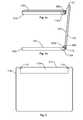
- FIGS 1 a and 1 bshow side views of a portable device including a remote optical sensing system 300 according to a first embodiment of the invention.
- the portable deviceis here embodied as a laptop.
- the portable devicemay equally well be represented by an alternative electronic device, such as a note book, an ultrabook, a tablet with a keyboard, a personal digital assistant (PDA) or a smartphone.
- PDApersonal digital assistant
- the proposed portable deviceincludes a first part 110 (here represented by a laptop base element) and a second part 120 (here represented by a laptop lid element).
- the second part 120includes the optical remote sensing system 300.
- the second part 120is pivotably attached to the first part 110 via a hinge means 115, such that the portable device may be arranged in an open and a closed position respectively.
- Figure 1aillustrates the closed position (predominantly used when the device is inactive) and
- Figure 1billustrates the open position (the typical position when the device is activated).
- the optical remote sensing system 300is configured to track at least one distinctive feature of a user of the portable device when the device is active and arranged in the open position.
- the at least one distinctive featuremay be an eye, a facial feature and/or a limb of the user, such as his/her hand.
- the optical remote sensing system 300may be used for eye-, gaze, gesture and/or facial feature tracking and/or user identification through face or iris recognition or hand gesture detection.
- the first and second parts 110 and 120have a respective essentially flat inner surface 111 and 121.
- the essentially flat inner surfaces 111 and 121are parallel and face one another, as can be seen in Figure 1a .
- the inner surfaces 111 and 121are not entirely flat.
- the first part 110has a recess 112a in the essentially flat inner surface 111, which recess 112a is arranged relative to a position of the optical remote sensing system 300 in the second part 120, such that, in the closed position, the first part 110 receives a projection 125a of the second part 120, which projection 125a includes the optical remote sensing system 300.
- the optical remote sensing system 300is at least partly contained in the recess 112a when the portable device is arranged in the closed position (i.e. normally the inactive mode).
- the first essentially flat surface 111 of the first part 110preferably also includes a keyboard configured to receive input commands from the user.
- the second essentially flat surface 121 of the second part 120preferably includes a display unit 122 (see Figure 5 ) configured to present information to the user, such as text, graphics, images and/or video.
- Figure 2shows a top view of the first part 110 of the portable device in Figures 1a and 1b .
- the recess 112apreferably extends between a pair of hinge means 115 (symbolically illustrated with dashed lines), which in turn are arranged in proximity to the portable device's sides.
- the second part 120preferably extends to a full width of the first part 110 (not shown).
- the recess 112ais co-located with a first piece of the hinge means 115, say a female piece.
- a second piece of the hinge means 115say a male piece, is located on the projection 125a of the second part 120.
- the first and second pieces of the hinge means 115represent a pivot axis via which the first and second parts 110 and 120 are interconnected.
- the recess 112ais represented by a complete, or partial, cut-out in the first part 110.
- the dashed line 113 in Figure 2shows an example of where an edge of such a partial cut-out may be located.
- a bottom part of the recess 112acovers at least any optical filter in front of an illuminator and/or an image registering unit in the optical remote sensing system 300 when the portable device is closed.
- the recess 112ashould be as deep as possible; i.e. in closed mode, as much as possible of the optical remote sensing system 300 should be contained in the recess 112a (or 112b, see below).
- the bottom of the recess 112amay be a 2 mm thick tongue covering a front-most side of the optical remote sensing system 300 when the portable device is closed.
- Figures 3a and 3bshow side views of a portable device including an optical remote sensing system 300 according to a second embodiment of the invention.
- Figure 4shows a top view of the first part 110 of the portable device in Figures 3a and 3b .
- Figures 3a, 3b and 4all elements having labels which also occur in Figures 1a, 1b and/or 2 represent the same entities as those described above with reference to Figures 1a, 1b and/or 2 .
- the portable devicehas first and second parts 110 and 120 that are pivotably attached to one another, such that the portable device may be arranged in an open and a closed position respectively.
- the optical remote sensing system 300is not co-located with the hinge means 115. Instead, the optical remote sensing system 300 is disposed in a projection 125b extending along a distal side of the second part 120, whereas the hinge means 115 are arranged along a proximal side of the second part 120, which proximal and distal sides are opposite to one another.
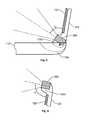
- Figure 5illustrates in further detail the first embodiment of the invention depicted in Figures 1a, 1b and 2 .
- the optical remote sensing system 300is arranged in the projection 125a of the second part 120, which is co-located with the hinge means 115.
- the optical remote sensing system 300is further arranged such that a view angle ⁇ thereof has a fixed spatial relation to the display unit 122 irrespective of an orientation of the second part 120 relative to the first part 110.
- the ideal view angle ⁇depends on the specific characteristics of an image registering unit included in the optical remote sensing system 300. However, preferably ⁇ has a value in the range 50° to 65°, more preferably 56° to 60°, and most preferably ⁇ ⁇ 58°.
- the risk that the user's hands block the optical remote sensing system 300is relatively low, and at the same time, an acceptable angle towards the user's face is attained for the most commonly used inclinations of the second part 120 relative to the first part 110 in the active mode.
- the user's point of regard on the display unit 122can be determined repeatedly based on data from an eye-tracker of the optical remote sensing system 300.
- Figure 6illustrates in further detail the second embodiment of the invention depicted in Figures 3a, 3b and 4 .
- the optical remote sensing system 300is arranged in the projection 125b of the second part 120, which extends along a side of the second part that is opposite to the side where the hinge means 115 are located.
- the optical remote sensing system 300is preferably arranged such that a view angle ⁇ thereof has a fixed spatial relation to the display unit 122 irrespective of an orientation of the second part 120 relative to the first part 110.
- the view angle ⁇preferably has a value in the range 80° to 100°, and most preferably ⁇ ⁇ 90°.
- the optical remote sensing system 300may be efficiently used for eye- and/or gaze tracking as well as for interpretation of facial expressions and/or gestures.
- an illuminator and/or an image registering unit of the optical remote sensing system 300is covered by an optical filter, which, preferably, is configured to block visible light while permitting NIR light to pass through.
- the optical remote sensing system 300includes an image registering unit and at least one illuminator configured to illuminate the user.
- the image registering unitmay contain a still and/or a video camera configured to capture image data representing the user of the portable device, such as images of his/her eyes.
- At least one of the at least one illuminatoris configured to produce structured light, which when reflected against the user and registered by the image registering unit causes resulting data to be created, which resulting data are adapted for generating a depth map of the user.
- Depth mapsare advantageous both when interpreting gestures and during eye-tracking, for instance when selecting a relevant image segment to process.
- one or more of the at least one illuminatormay be configured to produce (NIR) light.
- NIR lightis advantageous because it is relatively uncomplicated to detect by a camera and because it is invisible to the human eye. Thus, NIR light does not disturb the user.
- one or more of the at least one illuminatoris configured to produce a light beam whose direction is controllable to track a varying position of the user. If at least one of the at least one illuminator is configured to produce coherent light, diffractive optical elements (DOE) may be used to transform the light beam into a desired spatial pattern. Thus, the illumination can be controlled very efficiently, for instance to follow a position of the user.
- DOEdiffractive optical elements
- At least one of the at least one illuminatormay be based on LED technology. LEDs are desirable light sources since they are energy-efficient, compact and reliable.
Landscapes
- Engineering & Computer Science (AREA)
- Theoretical Computer Science (AREA)
- General Engineering & Computer Science (AREA)
- Computer Hardware Design (AREA)
- Physics & Mathematics (AREA)
- Human Computer Interaction (AREA)
- General Physics & Mathematics (AREA)
- Mathematical Physics (AREA)
- Position Input By Displaying (AREA)
- Optical Communication System (AREA)
Abstract
Description
- The present invention relates generally to automatic tracking of distinctive features of users operating electronic equipment. More particularly, the invention relates to a portable device according to the preamble of claim 1.
- Laptops with integrated eye-trackers are known. Unfortunately, the known solutions are comparatively bulky, and therefore the design becomes relatively thick, i.e. in closed/inactive mode, the laptop has a rather high profile. Naturally, this is undesired because portable devices, such as laptops, in general should be as compact and slim as possible. Nevertheless, bulkiness as such is associated with an advantage. Namely, the optical remote sensing systems of today's eye-trackers at times consume relatively large amounts of power. Therefore, substantial thermal power dissipation must be handled, and of course, in this context, a larger volume is more useful than smaller ditto. The trend where each generation of laptop is thinner than the foregoing generation is problematic because the available space in the lid becomes very limited. This places severe constraints on which components that can be used to implement eye-trackers and similar devices.
US 2005/0110887 shows an example of a mobile communication terminal with a main body and a foldable display body. A camera is here positioned in a hinge unit interconnecting the display body and the main body. The camera is rotatable around the hinge axis to register images of the user as well as subjects/objects in front of the user. Thus, a very versatile camera function is attained. However, since the camera is freely rotatable relative to both the main body and the display body it would be complicated to use the camera for any purposes other than simple image registering, such as for eye-tracking.- In the light of the above, it is challenging to accomplish a compact and yet resourceful portable device that is equipped with an optical remote sensing system for eye-, gaze, gesture and/or facial feature tracking and/or user identification through face or iris recognition or hand gesture detection.
- The object of the invention is to mitigate the above problems and accomplish a slim portable device with an integrated optical remote sensing system for eye- and/or gesture tracking.
- According to the invention, the object is achieved by the initially described apparatus, wherein the first part includes a recess, which is arranged relative to a position of the optical remote sensing system such that, in the closed position, the optical remote sensing system is at least partly contained in the recess.
- This portable device is advantageous because it enables an overall slim design to be combined with an adequate cooling volume for the optical remote sensing system. This is a desirable feature in any portable device, including: laptops, note books, ultrabooks, tablets with keyboards, personal digital assistants and smartphones.
- According to one preferred embodiment of the invention, the recess is co-located with a first piece of the hinge means. The optical remote sensing system is further disposed in a projection of the second part where a second piece of the hinge means is located. The first and second pieces of the hinge means represent a pivot axis via which the first and second parts of the portable device are interconnected. Such an integration of the optical remote sensing system in the hinge means is desirable because it provides a volume sufficient to ensure adequate cooling of the optical remote sensing system while the tracking functionality can be integrated in an essentially indiscernible manner into the portable device.
- According to another preferred embodiment of the invention, the first and second parts of the portable device are interconnected via the hinge means along a proximal side of the second part. The optical remote sensing system is here disposed in a projection extending along a distal side of the second part, where the distal side is opposite to the proximal side. In a laptop implementation, this means that the optical remote sensing system is located above the screen when the device is arranged in the open/active mode. Such a positioning is especially advantageous if a user's gestures are to be interpreted by the optical remote sensing system.
- According to yet another preferred embodiment of the invention, the second essentially flat surface of the second part includes a display unit (e.g. an LCD screen) configured to present information to the user. It is further preferable if the first essentially flat surface of the first part includes a keyboard configured to receive input commands from the user. Hence, the optical remote sensing system is included in the same part as the display unit.
- According to still another preferred embodiment of the invention, the optical remote sensing system is arranged such that a view angle thereof has a fixed spatial relation to the display unit irrespective of an orientation of the second part relative to the first part. Of course, this is desirable because thereby it is fairly straightforward to determine the user's point of regard on the display unit based on data registered by the optical remote sensing system.
- According to a further preferred embodiment of the invention, the first part is a base element and the second part is a lid element. During operation, the base element is configured to be placed on an essentially flat supporting surface (e.g. a desk) while the lid element is positioned upright, so that its essentially flat inner surface (typically containing a display unit) is visible to the user.
- According to other preferred embodiments of the invention, the optical remote sensing system includes an image registering unit (e.g. a still camera or a video camera), and preferably, at least one illuminator configured to illuminate the user. A combined camera-and-illuminator is generally advantageous for cost efficiency. In eye-tracker implementations it is also desirable that one or more light sources be arranged close to the optical axis of the image registering unit. The invention, however, is likewise applicable to designs where the light source and the image registering unit are separated from one another. In any case, it is generally preferable that the optical remote sensing system includes an optical filter, which is arranged in front of an illuminator and/or an image registering unit therein, and which optical filter is configured to block visible light however is transparent to near-infrared (NIR) light. Namely, as will be discussed below, NIR light is desirable, whereas visible light may disturb the user.
- According to still another preferred embodiment of the invention, at least one of the at least one illuminator is configured to produce structured light, which when registered by the image registering unit, causes resulting data to be created, which resulting data are adapted for generating a depth map of the user. This is advantageous both when interpreting gestures and in eye-tracking, for instance when selecting a relevant image segment to process.
- According to yet another preferred embodiment of the invention, at least one of the at least one illuminator is configured to produce near-infrared light. Namely, this type of light is relatively uncomplicated to detect by a camera, however invisible to the human eye.
- It is further preferred that at least one of the at least one illuminator is configured to produce a light beam whose direction is controllable, so that a varying position of the user can be tracked. Directional optical illuminators are advantageous relative to static ditto because, at each point in time, the directional illuminator only illuminates a fraction of a surface inside a volume within which the subject moves. Thereby, power is conserved corresponding to the size of the non-illuminated surface that would otherwise have been illuminated.
- According to another preferred embodiment of the invention, at least one of the at least one illuminator is based on LED (Light Emitting Diode) technology. Namely, LEDs represent energy-efficient, compact and reliable light sources.
- According to still another preferred embodiment of the invention, at least one of the at least one illuminator is configured to produce coherent light. Coherent light sources (e.g. lasers) are desirable, since such a light source may be combined with diffractive optical elements to transform a light beam into a desired spatial pattern. Thus, the illumination can be controlled very efficiently, for instance to follow a position of the user.
- According to a further preferred embodiment of the invention, the optical remote sensing system includes an eye tracker configured to repeatedly determine a position of at least one eye of the user and/or repeatedly determine a point of regard of the user relative to the portable device. Thereby, it is possible to generate input commands to a laptop based on the user's ocular activity.
- Further advantages, beneficial features and applications of the present invention will be apparent from the following description and the dependent claims.
- The invention is now to be explained more closely by means of preferred embodiments, which are disclosed as examples, and with reference to the attached drawings.
- Figures 1a-b
- show side views of a portable device according to a first embodiment of the invention;
- Figure 2
- shows a top view of a first part of the portable device in
Figures 1 a and 1 b; - Figures 3a-b
- show side views of a portable device according to a second embodiment of the invention;
- Figure 4
- shows a top view of a first part of the portable device in
Figures 3a and 3b ; - Figure 5
- illustrates, in further detail, the first embodiment of the invention depicted in
Figures 1a, 1b and 2 ; and - Figure 6
- illustrates, in further detail, the second embodiment of the invention depicted in
Figures 3a, 3b and 4 . - We refer initially to
Figures 1 a and 1 b, which show side views of a portable device including a remoteoptical sensing system 300 according to a first embodiment of the invention. For convenience, the portable device is here embodied as a laptop. However, according to the invention, the portable device may equally well be represented by an alternative electronic device, such as a note book, an ultrabook, a tablet with a keyboard, a personal digital assistant (PDA) or a smartphone. - The proposed portable device includes a first part 110 (here represented by a laptop base element) and a second part 120 (here represented by a laptop lid element). The
second part 120, in turn, includes the opticalremote sensing system 300. As is common in laptops, thesecond part 120 is pivotably attached to thefirst part 110 via a hinge means 115, such that the portable device may be arranged in an open and a closed position respectively.Figure 1a illustrates the closed position (predominantly used when the device is inactive) andFigure 1b illustrates the open position (the typical position when the device is activated). The opticalremote sensing system 300 is configured to track at least one distinctive feature of a user of the portable device when the device is active and arranged in the open position. The at least one distinctive feature may be an eye, a facial feature and/or a limb of the user, such as his/her hand. Thereby, the opticalremote sensing system 300 may be used for eye-, gaze, gesture and/or facial feature tracking and/or user identification through face or iris recognition or hand gesture detection. - The first and
second parts inner surface inner surfaces Figure 1a . Theinner surfaces first part 110 has arecess 112a in the essentially flatinner surface 111, whichrecess 112a is arranged relative to a position of the opticalremote sensing system 300 in thesecond part 120, such that, in the closed position, thefirst part 110 receives aprojection 125a of thesecond part 120, whichprojection 125a includes the opticalremote sensing system 300. As a result, the opticalremote sensing system 300 is at least partly contained in therecess 112a when the portable device is arranged in the closed position (i.e. normally the inactive mode). - The first essentially
flat surface 111 of thefirst part 110 preferably also includes a keyboard configured to receive input commands from the user. Moreover, the second essentiallyflat surface 121 of thesecond part 120 preferably includes a display unit 122 (seeFigure 5 ) configured to present information to the user, such as text, graphics, images and/or video. Figure 2 shows a top view of thefirst part 110 of the portable device inFigures 1a and 1b . Therecess 112a preferably extends between a pair of hinge means 115 (symbolically illustrated with dashed lines), which in turn are arranged in proximity to the portable device's sides. Above the hinge means 115, thesecond part 120 preferably extends to a full width of the first part 110 (not shown).- As is apparent from
Figures 1a, 1b and 2 , therecess 112a is co-located with a first piece of the hinge means 115, say a female piece. A second piece of the hinge means 115, say a male piece, is located on theprojection 125a of thesecond part 120. The first and second pieces of the hinge means 115 represent a pivot axis via which the first andsecond parts Figure 1a (and in further detail inFigure 5 ), when the portable device is closed, theprojection 125a is configured to swing down into therecess 112a, so that therecess 112a houses the opticalremote sensing system 300, at least partly. It is technically possible that therecess 112a is represented by a complete, or partial, cut-out in thefirst part 110. The dashedline 113 inFigure 2 shows an example of where an edge of such a partial cut-out may be located. Nevertheless, it is desirable that a bottom part of therecess 112a covers at least any optical filter in front of an illuminator and/or an image registering unit in the opticalremote sensing system 300 when the portable device is closed. For optimal compactness of the portable device, therecess 112a should be as deep as possible; i.e. in closed mode, as much as possible of the opticalremote sensing system 300 should be contained in therecess 112a (or 112b, see below). This means that the bottom of therecess 112a may be a 2 mm thick tongue covering a front-most side of the opticalremote sensing system 300 when the portable device is closed. Figures 3a and 3b show side views of a portable device including an opticalremote sensing system 300 according to a second embodiment of the invention.Figure 4 shows a top view of thefirst part 110 of the portable device inFigures 3a and 3b . InFigures 3a, 3b and 4 all elements having labels which also occur inFigures 1a, 1b and/or 2 represent the same entities as those described above with reference toFigures 1a, 1b and/or 2 .- Again, the portable device has first and
second parts remote sensing system 300 is not co-located with the hinge means 115. Instead, the opticalremote sensing system 300 is disposed in aprojection 125b extending along a distal side of thesecond part 120, whereas the hinge means 115 are arranged along a proximal side of thesecond part 120, which proximal and distal sides are opposite to one another. Figure 5 illustrates in further detail the first embodiment of the invention depicted inFigures 1a, 1b and 2 . Here, the opticalremote sensing system 300 is arranged in theprojection 125a of thesecond part 120, which is co-located with the hinge means 115. Preferably, the opticalremote sensing system 300 is further arranged such that a view angle α thereof has a fixed spatial relation to thedisplay unit 122 irrespective of an orientation of thesecond part 120 relative to thefirst part 110. The ideal view angle α depends on the specific characteristics of an image registering unit included in the opticalremote sensing system 300. However, preferably α has a value in the range 50° to 65°, more preferably 56° to 60°, and most preferably α ≈ 58°. Namely, thereby the risk that the user's hands block the opticalremote sensing system 300 is relatively low, and at the same time, an acceptable angle towards the user's face is attained for the most commonly used inclinations of thesecond part 120 relative to thefirst part 110 in the active mode. Hence, for example the user's point of regard on thedisplay unit 122 can be determined repeatedly based on data from an eye-tracker of the opticalremote sensing system 300.Figure 6 illustrates in further detail the second embodiment of the invention depicted inFigures 3a, 3b and 4 . Here, the opticalremote sensing system 300 is arranged in theprojection 125b of thesecond part 120, which extends along a side of the second part that is opposite to the side where the hinge means 115 are located. Also in this embodiment, the opticalremote sensing system 300 is preferably arranged such that a view angle α thereof has a fixed spatial relation to thedisplay unit 122 irrespective of an orientation of thesecond part 120 relative to thefirst part 110. Nevertheless, in this case, the view angle α preferably has a value in the range 80° to 100°, and most preferably α ≈ 90°. Thus, the opticalremote sensing system 300 may be efficiently used for eye- and/or gaze tracking as well as for interpretation of facial expressions and/or gestures.- Irrespective of whether the optical
remote sensing system 300 is co-located with the hinge means 115 (as inFigure 5 ), or arranged in proximity to a distal side thereof (as inFigure 6 ), it is generally desirable that an illuminator and/or an image registering unit of the opticalremote sensing system 300 is covered by an optical filter, which, preferably, is configured to block visible light while permitting NIR light to pass through. - Additionally, regardless of the location of the optical
remote sensing system 300, according to preferred embodiments of the invention, the opticalremote sensing system 300 includes an image registering unit and at least one illuminator configured to illuminate the user. The image registering unit, in turn, may contain a still and/or a video camera configured to capture image data representing the user of the portable device, such as images of his/her eyes. - It is further advantageous if at least one of the at least one illuminator is configured to produce structured light, which when reflected against the user and registered by the image registering unit causes resulting data to be created, which resulting data are adapted for generating a depth map of the user. Depth maps are advantageous both when interpreting gestures and during eye-tracking, for instance when selecting a relevant image segment to process.
- Moreover, one or more of the at least one illuminator may be configured to produce (NIR) light. NIR light is advantageous because it is relatively uncomplicated to detect by a camera and because it is invisible to the human eye. Thus, NIR light does not disturb the user.
- It is further advantageous if one or more of the at least one illuminator is configured to produce a light beam whose direction is controllable to track a varying position of the user. If at least one of the at least one illuminator is configured to produce coherent light, diffractive optical elements (DOE) may be used to transform the light beam into a desired spatial pattern. Thus, the illumination can be controlled very efficiently, for instance to follow a position of the user.
- Alternatively, or as a complement, at least one of the at least one illuminator may be based on LED technology. LEDs are desirable light sources since they are energy-efficient, compact and reliable.
- The term "comprises/comprising" when used in this specification is taken to specify the presence of stated features, integers, steps or components. However, the term does not preclude the presence or addition of one or more additional features, integers, steps or components or groups thereof.
- The invention is not restricted to the described embodiments in the figures, but may be varied freely within the scope of the claims.
Claims (15)
- A portable device comprising:a first part (110), anda second part (120) including an optical remote sensing system (300), the second part (120) being pivotably attached to the first part (110) via a hinge means (115) such that the portable device may be arranged in an open and a closed position respectively, the optical remote sensing system (300) being configured to track at least one distinctive feature of a user of the portable device when arranged in the open position, the first and second parts (110; 120) having a respective essentially flat inner surface (111; 121) which when the portable device is arranged in the closed position are parallel and face one another,characterized in that the first part (110) comprises a recess (112a; 112b) which is arranged relative to a position of the optical remote sensing system (300) such that, in the closed position, the optical remote sensing system (300) is at least partly contained in the recess (112a; 112b).
- The portable device according to claim 1, wherein the recess (112a) is co-located with a first piece of the hinge means (115) and the optical remote sensing system (300) is disposed in a projection (125a) of the second part (120) where a second piece of the hinge means (115) is located, the first and second pieces representing a pivot axis of the hinge means (115) via which the first and second parts (110; 120) of the portable device are interconnected.
- The portable device according to claim 1, wherein the first and second parts (110; 120) of the portable device are interconnected via the hinge means (115) along a proximal side of the second part (120), the optical remote sensing system (300) is disposed in a projection (125b) extending along a distal side of the second part (120), the distal side being opposite to the proximal side.
- The portable device according to any one of the preceding claims, wherein the second essentially flat surface (121) of the second part (120) includes a display unit (122) configured to present information to the user.
- The portable device according to any one of the preceding claims, wherein the first essentially flat surface (111) of the first part (110) includes a keyboard configured to receive input commands from the user.
- The portable device according to any one of claims 4 or 5, wherein the optical remote sensing system (300) is arranged such that a view angle (α) thereof has a fixed spatial relation to the display unit (122) irrespective of an orientation of the second part (120) relative to the first part (110).
- The portable device according to any one of the preceding claims, wherein the first part (110) is a base element and the second part (120) is a lid element, and during operation, the base element (110) is configured to be placed on an essentially flat supporting surface while the lid element (120) is positioned so that its essentially flat inner surface (121) is visible to the user.
- The portable device according to any one of the preceding claims, wherein the optical remote sensing system (300) comprises an image registering unit configured to register image data representing the user.
- The portable device according to claim 8, wherein the optical remote sensing system (300) comprises at least one illuminator configured to illuminate the user with structured light, which when registered by the image registering unit, creates resulting data adapted for generating a depth map of the user.
- The portable device according to any one of claims 8 or 9, wherein the optical remote sensing system (300) comprises at least one illuminator configured to produce near-infrared light.
- The portable device according to any one of claims 8 to 10, wherein the optical remote sensing system (300) comprises at least one illuminator configured to produce a light beam whose direction is controllable to track a varying position of the user.
- The portable device according to any one of claims 8 to 11, wherein the optical remote sensing system (300) comprises at least one illuminator which is based on LED technology.
- The portable device according to any one of claims 8 to 12, wherein the optical remote sensing system (300) comprises at least one illuminator which is configured to produce coherent light.
- The portable device according to any one of the preceding claims, wherein the portable device is an electronic device selected from a group consisting of: a laptop, a note book, an ultrabook, a tablet with a keyboard, a personal digital assistant and a smartphone.
- The portable device according to any one of the preceding claims, wherein the optical remote sensing system (300) comprises an eye tracker configured to repeatedly determine a position of at least one eye of the user and/or repeatedly determine a point of regard of the user relative to the portable device.
Priority Applications (11)
| Application Number | Priority Date | Filing Date | Title |
|---|---|---|---|
| EP11187816.1AEP2590047A1 (en) | 2011-11-04 | 2011-11-04 | Portable device |
| US14/355,978US9465415B2 (en) | 2011-11-04 | 2012-10-02 | Portable device |
| KR1020147011990AKR101946669B1 (en) | 2011-11-04 | 2012-10-02 | Portable device |
| CN201810548854.1ACN108803785B (en) | 2011-11-04 | 2012-10-02 | Portable device |
| CN201280054336.5ACN103988142B (en) | 2011-11-04 | 2012-10-02 | portable device |
| CN201810088889.1ACN108170218B (en) | 2011-11-04 | 2012-10-02 | Portable device |
| PCT/EP2012/069445WO2013064320A1 (en) | 2011-11-04 | 2012-10-02 | Portable device |
| US15/259,538US9772690B2 (en) | 2011-11-04 | 2016-09-08 | Portable device |
| US15/639,764US10037086B2 (en) | 2011-11-04 | 2017-06-30 | Portable device |
| US15/684,669US10061393B2 (en) | 2011-11-04 | 2017-08-23 | Portable device |
| US16/049,290US10409388B2 (en) | 2011-11-04 | 2018-07-30 | Portable device |
Applications Claiming Priority (1)
| Application Number | Priority Date | Filing Date | Title |
|---|---|---|---|
| EP11187816.1AEP2590047A1 (en) | 2011-11-04 | 2011-11-04 | Portable device |
Publications (1)
| Publication Number | Publication Date |
|---|---|
| EP2590047A1true EP2590047A1 (en) | 2013-05-08 |
Family
ID=44992631
Family Applications (1)
| Application Number | Title | Priority Date | Filing Date |
|---|---|---|---|
| EP11187816.1ACeasedEP2590047A1 (en) | 2011-11-04 | 2011-11-04 | Portable device |
Country Status (5)
| Country | Link |
|---|---|
| US (3) | US9465415B2 (en) |
| EP (1) | EP2590047A1 (en) |
| KR (1) | KR101946669B1 (en) |
| CN (3) | CN108170218B (en) |
| WO (1) | WO2013064320A1 (en) |
Families Citing this family (10)
| Publication number | Priority date | Publication date | Assignee | Title |
|---|---|---|---|---|
| US10037086B2 (en) | 2011-11-04 | 2018-07-31 | Tobii Ab | Portable device |
| EP2590047A1 (en) | 2011-11-04 | 2013-05-08 | Tobii Technology AB | Portable device |
| GB2513818B (en)* | 2012-03-25 | 2019-10-23 | Intel Corp | Orientation sensing computing devices |
| US9872356B1 (en) | 2015-02-03 | 2018-01-16 | Google Llc | Interactive lighting handshake |
| US10345919B2 (en)* | 2016-02-02 | 2019-07-09 | Microsoft Technology Licensing, Llc | Accessory between display and keyboard |
| US11409336B2 (en)* | 2017-10-04 | 2022-08-09 | Hewlett-Packard Development Company, L.P. | Camera lenses at computer devices |
| US10474916B2 (en) | 2017-11-20 | 2019-11-12 | Ashok Krishnan | Training of vehicles to improve autonomous capabilities |
| AU2018267553B2 (en)* | 2017-11-20 | 2019-08-22 | Ashok Krishnan | Systems and methods to train vehicles |
| CN109947183B (en)* | 2019-03-27 | 2021-12-24 | 联想(北京)有限公司 | Control method and electronic equipment |
| US11503998B1 (en) | 2021-05-05 | 2022-11-22 | Innodem Neurosciences | Method and a system for detection of eye gaze-pattern abnormalities and related neurological diseases |
Citations (5)
| Publication number | Priority date | Publication date | Assignee | Title |
|---|---|---|---|---|
| US20020036617A1 (en)* | 1998-08-21 | 2002-03-28 | Timothy R. Pryor | Novel man machine interfaces and applications |
| US20050050686A1 (en)* | 2003-06-30 | 2005-03-10 | Casio Computer Co., Ltd. | Two-shaft hinge structure |
| US20050110887A1 (en) | 2003-11-21 | 2005-05-26 | Lg Electronics Inc. | Mobile terminal having rotatable camera and swivel hinge structure |
| US20080284980A1 (en)* | 2005-10-10 | 2008-11-20 | Tobii Technology Ab | Eye Tracker Having an Extended Span of Operating Distances |
| US20090244820A1 (en)* | 2008-03-28 | 2009-10-01 | Kabushiki Kaisha Toshiba | Electronic Apparatus |
Family Cites Families (20)
| Publication number | Priority date | Publication date | Assignee | Title |
|---|---|---|---|---|
| US6542721B2 (en)* | 1999-10-11 | 2003-04-01 | Peter V. Boesen | Cellular telephone, personal digital assistant and pager unit |
| KR100611957B1 (en)* | 1999-09-14 | 2006-08-11 | 삼성전자주식회사 | Display coupling structure of electronic products |
| JP3778490B2 (en)* | 2001-06-15 | 2006-05-24 | コニカミノルタフォトイメージング株式会社 | Folding portable device with camera |
| JP2003259166A (en)* | 2002-02-28 | 2003-09-12 | Matsushita Electric Ind Co Ltd | Mobile phone |
| FI113130B (en)* | 2002-04-17 | 2004-02-27 | Nokia Corp | Portable, foldable electronic device equipped with telephone and camera functions |
| JP2004214946A (en)* | 2002-12-27 | 2004-07-29 | Casio Comput Co Ltd | Foldable portable information device |
| US20120081315A1 (en)* | 2010-10-01 | 2012-04-05 | Imerj LLC | Keyboard spanning multiple screens |
| KR100527164B1 (en)* | 2003-06-16 | 2005-11-09 | 엘지전자 주식회사 | Camera apparatus for folder type potable terminal |
| KR20050066597A (en)* | 2003-12-26 | 2005-06-30 | 엘지전자 주식회사 | Folder type mobile phone with camera apparatus |
| GB2419454A (en)* | 2004-10-19 | 2006-04-26 | Pranil Ram | Multiple monitor display apparatus |
| CN101172034A (en)* | 2006-11-03 | 2008-05-07 | 上海迪康医学生物技术有限公司 | Eyeball moving track detecting method |
| CN101382836B (en)* | 2008-09-05 | 2010-12-15 | 浙江大学 | Electronic painting creative method based on multi-medium user interaction |
| US20100079508A1 (en)* | 2008-09-30 | 2010-04-01 | Andrew Hodge | Electronic devices with gaze detection capabilities |
| US8581838B2 (en)* | 2008-12-19 | 2013-11-12 | Samsung Electronics Co., Ltd. | Eye gaze control during avatar-based communication |
| JP5569062B2 (en)* | 2010-03-15 | 2014-08-13 | オムロン株式会社 | Gesture recognition device, method for controlling gesture recognition device, and control program |
| JP5003781B2 (en)* | 2010-03-25 | 2012-08-15 | ブラザー工業株式会社 | Compound machine |
| US20120098761A1 (en)* | 2010-10-22 | 2012-04-26 | April Slayden Mitchell | Display system and method of display for supporting multiple display modes |
| CN102142084B (en)* | 2011-05-06 | 2012-12-26 | 北京网尚数字电影院线有限公司 | Method for gesture recognition |
| CN102221891A (en)* | 2011-07-13 | 2011-10-19 | 广州视源电子科技有限公司 | Method and system for realizing optical image gesture recognition |
| EP2590047A1 (en) | 2011-11-04 | 2013-05-08 | Tobii Technology AB | Portable device |
- 2011
- 2011-11-04EPEP11187816.1Apatent/EP2590047A1/ennot_activeCeased
- 2012
- 2012-10-02CNCN201810088889.1Apatent/CN108170218B/enactiveActive
- 2012-10-02WOPCT/EP2012/069445patent/WO2013064320A1/enactiveApplication Filing
- 2012-10-02KRKR1020147011990Apatent/KR101946669B1/ennot_activeExpired - Fee Related
- 2012-10-02CNCN201810548854.1Apatent/CN108803785B/enactiveActive
- 2012-10-02USUS14/355,978patent/US9465415B2/enactiveActive
- 2012-10-02CNCN201280054336.5Apatent/CN103988142B/enactiveActive
- 2016
- 2016-09-08USUS15/259,538patent/US9772690B2/enactiveActive
- 2017
- 2017-08-23USUS15/684,669patent/US10061393B2/enactiveActive
Patent Citations (5)
| Publication number | Priority date | Publication date | Assignee | Title |
|---|---|---|---|---|
| US20020036617A1 (en)* | 1998-08-21 | 2002-03-28 | Timothy R. Pryor | Novel man machine interfaces and applications |
| US20050050686A1 (en)* | 2003-06-30 | 2005-03-10 | Casio Computer Co., Ltd. | Two-shaft hinge structure |
| US20050110887A1 (en) | 2003-11-21 | 2005-05-26 | Lg Electronics Inc. | Mobile terminal having rotatable camera and swivel hinge structure |
| US20080284980A1 (en)* | 2005-10-10 | 2008-11-20 | Tobii Technology Ab | Eye Tracker Having an Extended Span of Operating Distances |
| US20090244820A1 (en)* | 2008-03-28 | 2009-10-01 | Kabushiki Kaisha Toshiba | Electronic Apparatus |
Also Published As
| Publication number | Publication date |
|---|---|
| US9465415B2 (en) | 2016-10-11 |
| CN108803785B (en) | 2022-07-08 |
| WO2013064320A1 (en) | 2013-05-10 |
| CN108170218A (en) | 2018-06-15 |
| CN103988142B (en) | 2018-06-26 |
| CN108803785A (en) | 2018-11-13 |
| US20180032143A1 (en) | 2018-02-01 |
| KR101946669B1 (en) | 2019-02-11 |
| US20140300541A1 (en) | 2014-10-09 |
| CN103988142A (en) | 2014-08-13 |
| CN108170218B (en) | 2021-12-17 |
| KR20140088129A (en) | 2014-07-09 |
| US9772690B2 (en) | 2017-09-26 |
| US20160378196A1 (en) | 2016-12-29 |
| US10061393B2 (en) | 2018-08-28 |
Similar Documents
| Publication | Publication Date | Title |
|---|---|---|
| US10061393B2 (en) | Portable device | |
| US10212343B2 (en) | Power management in an eye-tracking system | |
| US10956736B2 (en) | Methods and apparatus for power-efficient iris recognition | |
| Miluzzo et al. | EyePhone: activating mobile phones with your eyes | |
| CN106098019B (en) | A kind of method and electronic equipment adjusting display parameters | |
| EP3200046A1 (en) | Power management in an eye-tracking system | |
| CN107066085B (en) | Method and device for controlling terminal based on eyeball tracking | |
| EP2880506B1 (en) | Adaptive keyboard lighting | |
| Toyama et al. | Wearable reading assist system: Augmented reality document combining document retrieval and eye tracking | |
| Lander et al. | hEYEbrid: A hybrid approach for mobile calibration-free gaze estimation | |
| Olwal | Lightsense: enabling spatially aware handheld interaction devices | |
| US9305207B2 (en) | Depth-photographing method of detecting human face or head | |
| US10409388B2 (en) | Portable device | |
| CN103455209B (en) | Optical sensing apparatus | |
| Beach et al. | Eye tracker system for use with head mounted displays | |
| US20240385725A1 (en) | Devices, Methods, and Graphical User Interfaces for Interacting with Three-Dimensional Environments | |
| US11249517B2 (en) | Electronic apparatus and screen control method thereof | |
| US20240139623A1 (en) | Information handling system display grid and head position monitoring to present a boundary tracking highlight | |
| Hong et al. | Challenges of eye tracking systems for mobile XR glasses | |
| CN210895354U (en) | A CNGaze eye tracking system | |
| Agarwal et al. | Fread: a multimodal interface for audio assisted identification of everyday objects | |
| Kurauchi et al. | Towards wearable gaze supported augmented cognition | |
| Bilal et al. | Design a Real-Time Eye Tracker | |
| JP2011159004A (en) | Intention transmission apparatus | |
| CN102236367A (en) | Electronic device |
Legal Events
| Date | Code | Title | Description |
|---|---|---|---|
| PUAI | Public reference made under article 153(3) epc to a published international application that has entered the european phase | Free format text:ORIGINAL CODE: 0009012 | |
| AK | Designated contracting states | Kind code of ref document:A1 Designated state(s):AL AT BE BG CH CY CZ DE DK EE ES FI FR GB GR HR HU IE IS IT LI LT LU LV MC MK MT NL NO PL PT RO RS SE SI SK SM TR | |
| AX | Request for extension of the european patent | Extension state:BA ME | |
| 17P | Request for examination filed | Effective date:20131024 | |
| RBV | Designated contracting states (corrected) | Designated state(s):AL AT BE BG CH CY CZ DE DK EE ES FI FR GB GR HR HU IE IS IT LI LT LU LV MC MK MT NL NO PL PT RO RS SE SI SK SM TR | |
| 17Q | First examination report despatched | Effective date:20140204 | |
| APBK | Appeal reference recorded | Free format text:ORIGINAL CODE: EPIDOSNREFNE | |
| APBN | Date of receipt of notice of appeal recorded | Free format text:ORIGINAL CODE: EPIDOSNNOA2E | |
| APBR | Date of receipt of statement of grounds of appeal recorded | Free format text:ORIGINAL CODE: EPIDOSNNOA3E | |
| APAF | Appeal reference modified | Free format text:ORIGINAL CODE: EPIDOSCREFNE | |
| RAP1 | Party data changed (applicant data changed or rights of an application transferred) | Owner name:TOBII AB | |
| APBT | Appeal procedure closed | Free format text:ORIGINAL CODE: EPIDOSNNOA9E | |
| STAA | Information on the status of an ep patent application or granted ep patent | Free format text:STATUS: THE APPLICATION HAS BEEN REFUSED | |
| 18R | Application refused | Effective date:20210604 |