EP2468215A1 - Annuloplasty ring - Google Patents
Annuloplasty ringDownload PDFInfo
- Publication number
- EP2468215A1 EP2468215A1EP10196656AEP10196656AEP2468215A1EP 2468215 A1EP2468215 A1EP 2468215A1EP 10196656 AEP10196656 AEP 10196656AEP 10196656 AEP10196656 AEP 10196656AEP 2468215 A1EP2468215 A1EP 2468215A1
- Authority
- EP
- European Patent Office
- Prior art keywords
- ring
- annuloplasty ring
- pushing element
- ring according
- anyone
- Prior art date
- Legal status (The legal status is an assumption and is not a legal conclusion. Google has not performed a legal analysis and makes no representation as to the accuracy of the status listed.)
- Withdrawn
Links
- 210000003709heart valveAnatomy0.000claimsabstractdescription5
- 229910001285shape-memory alloyInorganic materials0.000claimsdescription8
- 230000005540biological transmissionEffects0.000claimsdescription6
- 239000000463materialSubstances0.000claimsdescription6
- 230000002457bidirectional effectEffects0.000claimsdescription3
- 238000007920subcutaneous administrationMethods0.000claimsdescription3
- 239000000560biocompatible materialSubstances0.000claimsdescription2
- 239000000835fiberSubstances0.000description13
- 210000004115mitral valveAnatomy0.000description10
- 238000001356surgical procedureMethods0.000description6
- 238000002513implantationMethods0.000description5
- 230000008439repair processEffects0.000description5
- 238000010009beatingMethods0.000description4
- 229920000642polymerPolymers0.000description4
- 229910052719titaniumInorganic materials0.000description4
- 239000010936titaniumSubstances0.000description4
- 230000006870functionEffects0.000description3
- 238000000034methodMethods0.000description3
- 239000000203mixtureSubstances0.000description3
- 229910001000nickel titaniumInorganic materials0.000description3
- HLXZNVUGXRDIFK-UHFFFAOYSA-Nnickel titaniumChemical compound[Ti].[Ti].[Ti].[Ti].[Ti].[Ti].[Ti].[Ti].[Ti].[Ti].[Ti].[Ni].[Ni].[Ni].[Ni].[Ni].[Ni].[Ni].[Ni].[Ni].[Ni].[Ni].[Ni].[Ni].[Ni]HLXZNVUGXRDIFK-UHFFFAOYSA-N0.000description3
- 229920001343polytetrafluoroethylenePolymers0.000description3
- 239000004810polytetrafluoroethyleneSubstances0.000description3
- 210000000591tricuspid valveAnatomy0.000description3
- 208000031481Pathologic ConstrictionDiseases0.000description2
- RTAQQCXQSZGOHL-UHFFFAOYSA-NTitaniumChemical compound[Ti]RTAQQCXQSZGOHL-UHFFFAOYSA-N0.000description2
- 230000002612cardiopulmonary effectEffects0.000description2
- 239000007943implantSubstances0.000description2
- 229910052759nickelInorganic materials0.000description2
- 208000037804stenosisDiseases0.000description2
- 230000036262stenosisEffects0.000description2
- 239000000126substanceSubstances0.000description2
- 230000007704transitionEffects0.000description2
- WHXSMMKQMYFTQS-UHFFFAOYSA-NLithiumChemical compound[Li]WHXSMMKQMYFTQS-UHFFFAOYSA-N0.000description1
- HBBGRARXTFLTSG-UHFFFAOYSA-NLithium ionChemical compound[Li+]HBBGRARXTFLTSG-UHFFFAOYSA-N0.000description1
- 239000004952PolyamideSubstances0.000description1
- 229920002614Polyether block amidePolymers0.000description1
- 239000004642PolyimideSubstances0.000description1
- 229910000831SteelInorganic materials0.000description1
- 229910004353Ti-CuInorganic materials0.000description1
- 230000009471actionEffects0.000description1
- 230000003213activating effectEffects0.000description1
- 230000004913activationEffects0.000description1
- 229910045601alloyInorganic materials0.000description1
- 239000000956alloySubstances0.000description1
- 238000013459approachMethods0.000description1
- 230000008901benefitEffects0.000description1
- 229920000249biocompatible polymerPolymers0.000description1
- 230000008859changeEffects0.000description1
- 239000002131composite materialSubstances0.000description1
- 229910052802copperInorganic materials0.000description1
- 230000008878couplingEffects0.000description1
- 238000010168coupling processMethods0.000description1
- 238000005859coupling reactionMethods0.000description1
- 238000006073displacement reactionMethods0.000description1
- 238000002592echocardiographyMethods0.000description1
- 229920000295expanded polytetrafluoroethylenePolymers0.000description1
- 239000004744fabricSubstances0.000description1
- 239000012530fluidSubstances0.000description1
- PCHJSUWPFVWCPO-UHFFFAOYSA-NgoldChemical compound[Au]PCHJSUWPFVWCPO-UHFFFAOYSA-N0.000description1
- 239000010931goldSubstances0.000description1
- 229910052737goldInorganic materials0.000description1
- 210000002837heart atriumAnatomy0.000description1
- 230000004217heart functionEffects0.000description1
- 238000010438heat treatmentMethods0.000description1
- 230000000004hemodynamic effectEffects0.000description1
- 229910052744lithiumInorganic materials0.000description1
- 229910001416lithium ionInorganic materials0.000description1
- 238000002690local anesthesiaMethods0.000description1
- 239000007769metal materialSubstances0.000description1
- 230000004048modificationEffects0.000description1
- 238000012986modificationMethods0.000description1
- 230000000877morphologic effectEffects0.000description1
- 229920001778nylonPolymers0.000description1
- 206010033675panniculitisDiseases0.000description1
- 229920002647polyamidePolymers0.000description1
- 229920001721polyimidePolymers0.000description1
- 230000008569processEffects0.000description1
- 238000009958sewingMethods0.000description1
- 238000004904shorteningMethods0.000description1
- 238000004513sizingMethods0.000description1
- 239000010935stainless steelSubstances0.000description1
- 229910001220stainless steelInorganic materials0.000description1
- 239000010959steelSubstances0.000description1
- 210000004304subcutaneous tissueAnatomy0.000description1
- 210000001519tissueAnatomy0.000description1
- 238000003466weldingMethods0.000description1
Images

Classifications
- A—HUMAN NECESSITIES
- A61—MEDICAL OR VETERINARY SCIENCE; HYGIENE
- A61F—FILTERS IMPLANTABLE INTO BLOOD VESSELS; PROSTHESES; DEVICES PROVIDING PATENCY TO, OR PREVENTING COLLAPSING OF, TUBULAR STRUCTURES OF THE BODY, e.g. STENTS; ORTHOPAEDIC, NURSING OR CONTRACEPTIVE DEVICES; FOMENTATION; TREATMENT OR PROTECTION OF EYES OR EARS; BANDAGES, DRESSINGS OR ABSORBENT PADS; FIRST-AID KITS
- A61F2/00—Filters implantable into blood vessels; Prostheses, i.e. artificial substitutes or replacements for parts of the body; Appliances for connecting them with the body; Devices providing patency to, or preventing collapsing of, tubular structures of the body, e.g. stents
- A61F2/02—Prostheses implantable into the body
- A61F2/24—Heart valves ; Vascular valves, e.g. venous valves; Heart implants, e.g. passive devices for improving the function of the native valve or the heart muscle; Transmyocardial revascularisation [TMR] devices; Valves implantable in the body
- A61F2/2442—Annuloplasty rings or inserts for correcting the valve shape; Implants for improving the function of a native heart valve
- A61F2/2445—Annuloplasty rings in direct contact with the valve annulus
- A61F2/2448—D-shaped rings
- A—HUMAN NECESSITIES
- A61—MEDICAL OR VETERINARY SCIENCE; HYGIENE
- A61F—FILTERS IMPLANTABLE INTO BLOOD VESSELS; PROSTHESES; DEVICES PROVIDING PATENCY TO, OR PREVENTING COLLAPSING OF, TUBULAR STRUCTURES OF THE BODY, e.g. STENTS; ORTHOPAEDIC, NURSING OR CONTRACEPTIVE DEVICES; FOMENTATION; TREATMENT OR PROTECTION OF EYES OR EARS; BANDAGES, DRESSINGS OR ABSORBENT PADS; FIRST-AID KITS
- A61F2/00—Filters implantable into blood vessels; Prostheses, i.e. artificial substitutes or replacements for parts of the body; Appliances for connecting them with the body; Devices providing patency to, or preventing collapsing of, tubular structures of the body, e.g. stents
- A61F2/02—Prostheses implantable into the body
- A61F2/24—Heart valves ; Vascular valves, e.g. venous valves; Heart implants, e.g. passive devices for improving the function of the native valve or the heart muscle; Transmyocardial revascularisation [TMR] devices; Valves implantable in the body
- A61F2/2442—Annuloplasty rings or inserts for correcting the valve shape; Implants for improving the function of a native heart valve
- A—HUMAN NECESSITIES
- A61—MEDICAL OR VETERINARY SCIENCE; HYGIENE
- A61F—FILTERS IMPLANTABLE INTO BLOOD VESSELS; PROSTHESES; DEVICES PROVIDING PATENCY TO, OR PREVENTING COLLAPSING OF, TUBULAR STRUCTURES OF THE BODY, e.g. STENTS; ORTHOPAEDIC, NURSING OR CONTRACEPTIVE DEVICES; FOMENTATION; TREATMENT OR PROTECTION OF EYES OR EARS; BANDAGES, DRESSINGS OR ABSORBENT PADS; FIRST-AID KITS
- A61F2/00—Filters implantable into blood vessels; Prostheses, i.e. artificial substitutes or replacements for parts of the body; Appliances for connecting them with the body; Devices providing patency to, or preventing collapsing of, tubular structures of the body, e.g. stents
- A61F2/02—Prostheses implantable into the body
- A61F2/24—Heart valves ; Vascular valves, e.g. venous valves; Heart implants, e.g. passive devices for improving the function of the native valve or the heart muscle; Transmyocardial revascularisation [TMR] devices; Valves implantable in the body
- A61F2/2442—Annuloplasty rings or inserts for correcting the valve shape; Implants for improving the function of a native heart valve
- A61F2/2445—Annuloplasty rings in direct contact with the valve annulus
- A—HUMAN NECESSITIES
- A61—MEDICAL OR VETERINARY SCIENCE; HYGIENE
- A61F—FILTERS IMPLANTABLE INTO BLOOD VESSELS; PROSTHESES; DEVICES PROVIDING PATENCY TO, OR PREVENTING COLLAPSING OF, TUBULAR STRUCTURES OF THE BODY, e.g. STENTS; ORTHOPAEDIC, NURSING OR CONTRACEPTIVE DEVICES; FOMENTATION; TREATMENT OR PROTECTION OF EYES OR EARS; BANDAGES, DRESSINGS OR ABSORBENT PADS; FIRST-AID KITS
- A61F2250/00—Special features of prostheses classified in groups A61F2/00 - A61F2/26 or A61F2/82 or A61F9/00 or A61F11/00 or subgroups thereof
- A61F2250/0001—Means for transferring electromagnetic energy to implants
- A61F2250/0002—Means for transferring electromagnetic energy to implants for data transfer
- A—HUMAN NECESSITIES
- A61—MEDICAL OR VETERINARY SCIENCE; HYGIENE
- A61F—FILTERS IMPLANTABLE INTO BLOOD VESSELS; PROSTHESES; DEVICES PROVIDING PATENCY TO, OR PREVENTING COLLAPSING OF, TUBULAR STRUCTURES OF THE BODY, e.g. STENTS; ORTHOPAEDIC, NURSING OR CONTRACEPTIVE DEVICES; FOMENTATION; TREATMENT OR PROTECTION OF EYES OR EARS; BANDAGES, DRESSINGS OR ABSORBENT PADS; FIRST-AID KITS
- A61F2250/00—Special features of prostheses classified in groups A61F2/00 - A61F2/26 or A61F2/82 or A61F9/00 or A61F11/00 or subgroups thereof
- A61F2250/0004—Special features of prostheses classified in groups A61F2/00 - A61F2/26 or A61F2/82 or A61F9/00 or A61F11/00 or subgroups thereof adjustable
Definitions
- the present inventionrelates to an annuloplasty ring for repairing atrioventricular cardiac valves (such as mitral valve and tricuspid valve) to prevent backflow from the ventricles into the atrium during systole.
- atrioventricular cardiac valvessuch as mitral valve and tricuspid valve
- the description of the inventionis focused on mitral valve, but the concept, the function and the benefit apply to tricuspid valve also.
- Mitral annuloplastyrelays on the implant of mitral ring having fixed shape and size.
- the surgeonsizes the mitral annulus and chooses the mitral ring accordingly. This procedure is done on the arrested heart under cardiopulmonary bypass, which is not a physiologic condition. However, it is only after the weaning off the cardiopulmonary bypass that it is possible to assess the quality of the mitral repair. In other words, the surgeon has to wake up the patient to verify if he succeeded in the mitral repair. If the repair fails, the patient undergoes a second operation. Surgeons and cardiologists express a need in the possibility to adjust the ring after implantation. Having a mitral ring that changes its size after implantation and on a beating heart, could improve the quality of the mitral repair and overcome the annulus miss-sizing problem.
- US 7,713,298discloses an annuloplasty ring which comprises shape memory members configured to transform said annuloplasty ring from a first configuration having a first size of a ring dimension to other configurations having a size of the ring dimension, which is less than said first size.
- the shape memory membersare responsive to changes in temperature and/or exposure to a magnetic field.
- US 5,064,431discloses an adjustable annuloplasty ring for an orifice, comprising: a flexible fabric tube formed in the shape of a ring, means for dividing the tube into an inner channel and an outer channel which functions as a sewing flange by which the ring may be sutured to tissue surrounding the orifice, at least two drawstrings for adjusting the size and shape of the ring disposed in the inner channel, the drawstrings extending substantially around the circumference of the ring and having ends protruding from openings in the tube, each drawstring being coupled to the tube at least two separate anchor points.
- the size and shape of the ringmay be adjusted by selectively tightening one or more ends of the drawstrings to constrict portions of the ring.
- the present inventionprovides an annuloplasty ring for repairing an atrioventricular cardiac valve which allows to avoid the disadvantages of the prior art.
- the present inventionrelates to an annuloplasty ring comprising an external support ring, an inner adjustable ring, a sliding pushing element mounted between said external and inner rings.
- the annuloplasty ringfurther comprises actuating means designed to control said pushing element, the pushing element being designed, when actuated by the actuating means, to slide along the external ring while pushing the inner ring, in such a way that a precise part of the inner ring is deformed without modifying the perimeter of the inner ring.
- the annuloplasty ring of the inventioncan be adjusted several times, on demand.
- the actuating meansmay be designed to be manually activated.
- the actuating meansmay comprise a control unit and an actuator, which can comprise an electric motor or a shape memory alloy device.
- the actuating meansmay be designed to allow a bidirectional movement of the pushing element.
- the present inventionrelates also to an actuator for actuating a device, in particular for actuating an annuloplasty ring as described above, and comprising a shaft, a support, a cogwheel rotatably mounted on said support and linked to the device to be actuated, at least one hook designed to cooperate with said cogwheel, and at least one shape memory element, one of the support and the hook being designed to slide along said shaft with respect to the other when one is moved by at least one shape memory element changing its form, in order to generate a rotation movement of said cogwheel.
- the supportis movable along the shaft of the actuator, the hook being fixed.
- the supportis fixed and the hook is movable along the shaft of the actuator.
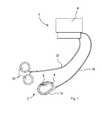
- Figure 1is a schematic view of an embodiment of an annuloplasty ring according to the present invention.
- Figure 2is a detailed view of the ring of Figure 1 , the pushing element being in a first position;
- Figure 3is a detailed view of the ring of Figure 1 , the pushing element being in a second position, and
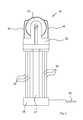
- Figure 4shows an embodiment of an actuator usable with an annuloplasty ring of the invention.
- the present inventionrelates to an annuloplasty ring especially for repairing regurgitating atrioventricular cardiac valves, such as mitral valve and tricuspid valve.
- Figures 1 to 3shows an annuloplasty ring 1 comprising an external support ring 2, an inner adjustable ring 4, a pushing element 6 designed to slide in between external support ring 2 and inner adjustable ring 4, and actuating means designed to control said pushing element 6.
- the external ring 2is rigid.
- itmay be made of rigid biocompatible material like a metallic material, as steel, gold or titanium.
- the external ring 2is not fixed to the mitral annulus and only provides the support for the adjustment of the inner ring 4. This allows an extremely precise reshaping of the ring any time after its implant.
- the external ring 2may comprise an inner flange comprising a first part 10 along which the pushing element 6 is able to slide and a second part 12 to which the facing part of the inner ring 2 is fixed.
- the external ring 2may substantially have a D shape comprising a linear side corresponding to the second part 12 and a convex side corresponding to the first part 10.
- the inner flange of the external ring 2may comprise a recess 14 in which the pushing element 6 can be received, partially or completely, when it is in an initial position.
- the inner ring 4is preferably made of a flexible material, as biocompatible polymers, or may be a ring with a spring core.
- the inner ring 4is designed to be fixed to the mitral annulus using standard surgical technique.
- the inner ring 4comprises a linear part which is fixed to the linear part of the external ring 2 by any means known by one skilled in the art, as bonding or welding.
- arches 16may be mounted on the external ring 2 and around the inner ring 4 to avoid the overlapping of the two rings.
- the connection between each arch 16 and the external ring 2allows the arch 16 to pivot or rotate with respect to the external ring 2 in such a way that the apex of the arch 16 always touches the inner ring 4.
- said pushing element 6has a height greater than the distance between the external ring 2 and the inner ring 6 in such a way that the pushing element 6 pushes and deforms the inner ring 4 when the pushing element 6 slides between said external and inner rings 2 and 4.
- the pushing element 6comprises a first surface 6a able to slide along the inner flange of the external ring 2 and a second surface 6b able to slide along the inner ring 4 and to push it.
- the pushing element 6is activated by actuating means.
- said actuating meanscomprise transmission means linked to the pushing element 6 and able to move the pushing element 6 when said actuating means are actuated.
- the transmission meansmay be mechanical, by using a cable, hydraulic by using any fluid which is able to transmit to the pushing element a sliding movement.
- the transmission meansmay comprise a cable 18 linked to the pushing element 6.
- the end of the cable 18is placed between the inner flange of the external ring 2 and the inner ring 4 and is connected to the pushing element 6.
- Cable 18may be protected by a coaxial sheath.
- the sheathcan be made for example of polyimide, PTFE composites (PTFE and fluoroethylkene polymers), pure PTFE, or other appropriate polymers. Cables are well known in surgery.
- the cablescan be made for example out of polyamide like Nylon®, polyether block amide, PTFE, or other appropriate polymers. Alternatively, other materials, as stainless steel or titanium, can be used. Surgeon is used to place cables in the human body.
- such actuating meansmay further comprise an actuator 8 and its control unit.
- the actuating meansare designed to provide the force to produce the deformation of the inner ring 4.
- the actuator 8may comprise an electric motor or may comprise a shape memory alloy device.
- Figure 4shows a possible embodiment of an actuator of the invention and comprising a shape memory alloy device.
- Said actuator 30comprises a hollow shaft 31 on which a sliding support 32 is mounted.
- a cogwheel 33is rotatably mounted on said support 32.
- the cable 18 linked to the ringgoes through the hollow shaft 31 and is connected to the cogwheel 33.
- the actuatorcomprises also two hooks 34, one designed to engage the teeth of the cogwheel 33 and generate the rotation of said wheel in one direction, the other being designed to prevent the rotation of said wheel in the opposite direction.
- the hooks 34are fixed.
- the actuator 30comprises also at least one shape memory alloy (SMA) fiber 36 fixed to the support 32 and to a base 35 of the actuator.
- SMAshape memory alloy
- a suitable SMA material for the fibersis for example NitinolTM .
- the fiberscan be stretched by as much as 4% when below the transition temperature, and when heated, they contract, recovering thereby to their original, shorter length with a usable amount of force in the process.
- the mechanical characteristicsare a function of the chemical composition and thermal processing.
- the transition temperature rangevaries according to the fiber's chemical composition and is usually comprised between 35°C to 90°C.
- the Nitinolconsists of about 50% Ni and 50% Ti. Such Nitinol wires and fibers are commercialized e.g. by Memry.
- the fiberscan have a spiral form in order to increase the length of the shortening.
- Biometal fiberscommercialized by Toki Corporation Inc., Japan (for example fibers BMX150 or BMF100). Those materials are able to reversibly contract upon a controlled heating caused by the supply of an electric current/voltage and can be repeatedly used several thousands of millions of times.
- Such fibersare made for example of Ni-Ti-Cu alloy.
- the composition ratios of Ni, Ti, and Cuare 46.9%, 44.8%, and 8.3%, respectively.
- the rotation of the cogwheel 33is generated by the activation of Nitinol fibers 36. Fiber's number depends on the pulling force required to displace the cogwheel 33. One fiber can generate a pulling force of about 100g. When the fiber is activated, the cogwheel 33 moves towards the base 35, generating the clockwise rotation of the wheel thanks to the hooks 34. The clockwise movement of the wheel 33 produces the cable movement in backward direction.
- control unit and the actuator 8are placed away from the external and inner rings 2 and 4, for example in a box in the subcutaneous tissue.
- the annuloplasty ringfurther comprises a source of energy for the control unit.
- Said source of energycan be implantable or placed outside the body of the patient.
- An implantable source of energymay be a transcutaneously rechargeable battery.
- Such batteryis for example a Lithium-Ion or Lithium Polymer rechargeable battery commercialized by GreatBatch and others.
- the source of energymay comprise subcutaneous electrical contacts 20 which are linked to the control unit by electrical wires 22.
- Such electrical contacts 20are placed under the skin of the patient and energy is supplied from an external source of energy to the control unit via said electrical contacts 20, when needed.
- control unitmay be controlled via a remote control unit using for example a telemetric coupling system, said remote control unit being placed outside the patient body.
- the actuating meansmay be designed to be manually activated.
- the actuating meansmay comprise a manually activated screw like system connected to the cable 18, in such a way that the pushing element 6 moves, via the cable 18, when said system is manually actuated.
- the actuating meansmay be designed to allow a bidirectional movement of the pushing element.
- the actuating meansmay comprise a second cable placed between the inner flange of the external ring 2 and the inner ring 4, on the side opposite to the side on which the first cable 18 is placed.
- the second cableis linked to the opposite side of the pushing element and linked to a second actuator and to a second control unit, in such a way that the first cable moves the pushing element in one direction and the second cable moves the pushing element in the opposite direction.
- a third subcutaneous electrical contactmay be provided to supply energy to the second control unit.
- the pushing elementis connected on each side to a cable.
- the two cablesrun parallel to the external ring and are connected to its actuator system. Pulling one cable at a time results in pushing element displacement backward and/or forward.
- the annuloplasty ring of the inventionis implanted with standard surgical technique currently used for mitral rings, by suturing the inner ring to the valve annulus.
- the suture linesrun only over the inner ring 4.
- the inner ring 4is adjusted at best.
- the annuloplasty ringis available in different sizes.
- a specialized doctorcan change the geometry of the inner adjustable ring 4 by using the remote external control unit and activating the actuating means or by manually scrolling the cable positioned under the skin under local anesthesia.
- the actuating meansWhen the actuating means are activated, the pushing element 6 slides along the external ring 2 while pushing the inner ring 4.
- the external ring 2When the pushing element 6 slides between the external rigid ring 2 and the inner deformable ring 4, the external ring 2 provides a support to the pushing element 6 in such a way that the pushing element 6 pushes the inner deformable ring 4 resulting in the changes in the shape of the inner ring 4, and therefore of the mitral annulus to which it is attached.
- a precise part of the inner ring 4is deformed without modifying the perimeter of the inner ring 4, such part of the inner ring 4 deforming a precise corresponding part of the mitral valve.
- This movementreduces the distance between the anterior and the posterior leaflets of the mitral valve improving valve coaptation.
- the mitral valvecan then be reshaped and repaired.
- the perimeter of the inner ring 4is not reduced, the risk of stenosis is low.
- the action of reshaping the mitral annulusis local and doesn't affect the entire annulus.
- the pushing elementis able to reshape the mitral annulus in P1 or P2 or P3 according to the need of the patient.
- the posterior leaflet of the mitral valveapproaches the anterior leaflet increasing leaflets' coaptation and valve continence.
- the pushing elementcan be pushed backward and forward as many times as necessary to find the optimal functioning of the valve.
- the doctorcan reshape the mitral annuloplasty and verify the hemodynamic result in real time using standard echocardiography. If the ring is still not correctly adjusted, the doctor can move again the pushing element and find the best position.
- the doctorcan adjust the form of the mitral ring during the operation, on arrested heart, on beating heart and even after the operation has been completed, on a beating heart. Such adjustments could be done any time after the surgical procedure and could be repeated as much as needed. The adjustments could be made during, or just after the surgical procedure or a long time after such a surgical procedure, for example in the case of a morphologic modification of the valve.
Landscapes
- Health & Medical Sciences (AREA)
- Cardiology (AREA)
- Oral & Maxillofacial Surgery (AREA)
- Transplantation (AREA)
- Engineering & Computer Science (AREA)
- Biomedical Technology (AREA)
- Heart & Thoracic Surgery (AREA)
- Vascular Medicine (AREA)
- Life Sciences & Earth Sciences (AREA)
- Animal Behavior & Ethology (AREA)
- General Health & Medical Sciences (AREA)
- Public Health (AREA)
- Veterinary Medicine (AREA)
- Prostheses (AREA)
Abstract
Description
- The present invention relates to an annuloplasty ring for repairing atrioventricular cardiac valves (such as mitral valve and tricuspid valve) to prevent backflow from the ventricles into the atrium during systole. In the interest of simplicity, the description of the invention is focused on mitral valve, but the concept, the function and the benefit apply to tricuspid valve also.
- Mitral annuloplasty relays on the implant of mitral ring having fixed shape and size. During the classical mitral valve repair procedure, the surgeon sizes the mitral annulus and chooses the mitral ring accordingly. This procedure is done on the arrested heart under cardiopulmonary bypass, which is not a physiologic condition. However, it is only after the weaning off the cardiopulmonary bypass that it is possible to assess the quality of the mitral repair. In other words, the surgeon has to wake up the patient to verify if he succeeded in the mitral repair. If the repair fails, the patient undergoes a second operation. Surgeons and cardiologists express a need in the possibility to adjust the ring after implantation. Having a mitral ring that changes its size after implantation and on a beating heart, could improve the quality of the mitral repair and overcome the annulus miss-sizing problem.
- Some solutions have been found to reduce the risk of ineffective mitral annuloplasty.
US 7,713,298 discloses an annuloplasty ring which comprises shape memory members configured to transform said annuloplasty ring from a first configuration having a first size of a ring dimension to other configurations having a size of the ring dimension, which is less than said first size. The shape memory members are responsive to changes in temperature and/or exposure to a magnetic field.US 5,064,431 discloses an adjustable annuloplasty ring for an orifice, comprising: a flexible fabric tube formed in the shape of a ring, means for dividing the tube into an inner channel and an outer channel which functions as a sewing flange by which the ring may be sutured to tissue surrounding the orifice, at least two drawstrings for adjusting the size and shape of the ring disposed in the inner channel, the drawstrings extending substantially around the circumference of the ring and having ends protruding from openings in the tube, each drawstring being coupled to the tube at least two separate anchor points. The size and shape of the ring may be adjusted by selectively tightening one or more ends of the drawstrings to constrict portions of the ring.- However, the drawback of such mitral rings is that their size can be adjusted only one time after implantation. Another drawback is that the ring, when adjusted, modifies its shape in such a way the ring becomes smaller, therefore the surface of the atrioventricular valve becomes smaller. This downsizing of the annulus could induce valve stenosis and has negative consequence on heart function.
- Therefore there are, at the present time, no adequate solutions, whether commercial or in the literature, for a mitral ring having a size which can be changed and adjusted several times after implantation and on a beating heart, on a regular basis.
- The present invention provides an annuloplasty ring for repairing an atrioventricular cardiac valve which allows to avoid the disadvantages of the prior art.
- Accordingly, the present invention relates to an annuloplasty ring comprising an external support ring, an inner adjustable ring, a sliding pushing element mounted between said external and inner rings. The annuloplasty ring further comprises actuating means designed to control said pushing element, the pushing element being designed, when actuated by the actuating means, to slide along the external ring while pushing the inner ring, in such a way that a precise part of the inner ring is deformed without modifying the perimeter of the inner ring.
- By moving the pushing element, the annuloplasty ring of the invention can be adjusted several times, on demand.
- In the simplest embodiment of the invention, the actuating means may be designed to be manually activated.
- In another embodiment, the actuating means may comprise a control unit and an actuator, which can comprise an electric motor or a shape memory alloy device.
- Advantageously, the actuating means may be designed to allow a bidirectional movement of the pushing element.
- The present invention relates also to an actuator for actuating a device, in particular for actuating an annuloplasty ring as described above, and comprising a shaft, a support, a cogwheel rotatably mounted on said support and linked to the device to be actuated, at least one hook designed to cooperate with said cogwheel, and at least one shape memory element, one of the support and the hook being designed to slide along said shaft with respect to the other when one is moved by at least one shape memory element changing its form, in order to generate a rotation movement of said cogwheel. In one embodiment, the support is movable along the shaft of the actuator, the hook being fixed. In another embodiment, the support is fixed and the hook is movable along the shaft of the actuator.
Figure 1 is a schematic view of an embodiment of an annuloplasty ring according to the present invention;Figure 2 is a detailed view of the ring ofFigure 1 , the pushing element being in a first position;Figure 3 is a detailed view of the ring ofFigure 1 , the pushing element being in a second position, andFigure 4 shows an embodiment of an actuator usable with an annuloplasty ring of the invention.- The present invention relates to an annuloplasty ring especially for repairing regurgitating atrioventricular cardiac valves, such as mitral valve and tricuspid valve.
Figures 1 to 3 shows anannuloplasty ring 1 comprising anexternal support ring 2, an inneradjustable ring 4, a pushingelement 6 designed to slide in betweenexternal support ring 2 and inneradjustable ring 4, and actuating means designed to control said pushingelement 6.- Advantageously, the
external ring 2 is rigid. Preferably, it may be made of rigid biocompatible material like a metallic material, as steel, gold or titanium. - The
external ring 2 is not fixed to the mitral annulus and only provides the support for the adjustment of theinner ring 4. This allows an extremely precise reshaping of the ring any time after its implant. - Advantageously, the
external ring 2 may comprise an inner flange comprising afirst part 10 along which the pushingelement 6 is able to slide and asecond part 12 to which the facing part of theinner ring 2 is fixed. Preferably, theexternal ring 2 may substantially have a D shape comprising a linear side corresponding to thesecond part 12 and a convex side corresponding to thefirst part 10. - Advantageously, the inner flange of the
external ring 2 may comprise arecess 14 in which the pushingelement 6 can be received, partially or completely, when it is in an initial position. - The
inner ring 4 is preferably made of a flexible material, as biocompatible polymers, or may be a ring with a spring core. - The
inner ring 4 is designed to be fixed to the mitral annulus using standard surgical technique. - The
inner ring 4 comprises a linear part which is fixed to the linear part of theexternal ring 2 by any means known by one skilled in the art, as bonding or welding. Several arches 16 may be mounted on theexternal ring 2 and around theinner ring 4 to avoid the overlapping of the two rings. The connection between eacharch 16 and theexternal ring 2 allows thearch 16 to pivot or rotate with respect to theexternal ring 2 in such a way that the apex of thearch 16 always touches theinner ring 4.- Between the
external ring 2 and theinner ring 4 is placed the pushingelement 6. Advantageously, said pushingelement 6 has a height greater than the distance between theexternal ring 2 and theinner ring 6 in such a way that the pushingelement 6 pushes and deforms theinner ring 4 when the pushingelement 6 slides between said external andinner rings - Advantageously, the pushing
element 6 comprises afirst surface 6a able to slide along the inner flange of theexternal ring 2 and asecond surface 6b able to slide along theinner ring 4 and to push it. - The pushing
element 6 is activated by actuating means. In a preferred embodiment, said actuating means comprise transmission means linked to the pushingelement 6 and able to move the pushingelement 6 when said actuating means are actuated. - In some embodiments, the transmission means may be mechanical, by using a cable, hydraulic by using any fluid which is able to transmit to the pushing element a sliding movement.
- Preferably, the transmission means may comprise a
cable 18 linked to the pushingelement 6. The end of thecable 18 is placed between the inner flange of theexternal ring 2 and theinner ring 4 and is connected to the pushingelement 6. Cable 18 may be protected by a coaxial sheath. The sheath can be made for example of polyimide, PTFE composites (PTFE and fluoroethylkene polymers), pure PTFE, or other appropriate polymers. Cables are well known in surgery. The cables can be made for example out of polyamide like Nylon®, polyether block amide, PTFE, or other appropriate polymers. Alternatively, other materials, as stainless steel or titanium, can be used. Surgeon is used to place cables in the human body.- In the embodiment as shown on
Figure 1 , such actuating means may further comprise anactuator 8 and its control unit. - The actuating means are designed to provide the force to produce the deformation of the
inner ring 4. Theactuator 8 may comprise an electric motor or may comprise a shape memory alloy device. Figure 4 shows a possible embodiment of an actuator of the invention and comprising a shape memory alloy device.- Said
actuator 30 comprises ahollow shaft 31 on which a slidingsupport 32 is mounted. Acogwheel 33 is rotatably mounted on saidsupport 32. Thecable 18 linked to the ring goes through thehollow shaft 31 and is connected to thecogwheel 33. The actuator comprises also twohooks 34, one designed to engage the teeth of thecogwheel 33 and generate the rotation of said wheel in one direction, the other being designed to prevent the rotation of said wheel in the opposite direction. Thehooks 34 are fixed. - The
actuator 30 comprises also at least one shape memory alloy (SMA)fiber 36 fixed to thesupport 32 and to a base 35 of the actuator. A suitable SMA material for the fibers is for exampleNitinol™. In this case the fibers can be stretched by as much as 4% when below the transition temperature, and when heated, they contract, recovering thereby to their original, shorter length with a usable amount of force in the process. The mechanical characteristics are a function of the chemical composition and thermal processing. The transition temperature range varies according to the fiber's chemical composition and is usually comprised between 35°C to 90°C. The Nitinol consists of about 50% Ni and 50% Ti. Such Nitinol wires and fibers are commercialized e.g. by Memry. - The fibers can have a spiral form in order to increase the length of the shortening.
- Other particularly interesting materials are Biometal fibers (BMF) commercialized by Toki Corporation Inc., Japan (for example fibers BMX150 or BMF100). Those materials are able to reversibly contract upon a controlled heating caused by the supply of an electric current/voltage and can be repeatedly used several thousands of millions of times.
- Such fibers are made for example of Ni-Ti-Cu alloy. For example, the composition ratios of Ni, Ti, and Cu are 46.9%, 44.8%, and 8.3%, respectively.
- The rotation of the
cogwheel 33 is generated by the activation ofNitinol fibers 36. Fiber's number depends on the pulling force required to displace thecogwheel 33. One fiber can generate a pulling force of about 100g. When the fiber is activated, thecogwheel 33 moves towards the base 35, generating the clockwise rotation of the wheel thanks to thehooks 34. The clockwise movement of thewheel 33 produces the cable movement in backward direction. - Preferably, the control unit and the
actuator 8 are placed away from the external andinner rings - The annuloplasty ring further comprises a source of energy for the control unit. Said source of energy can be implantable or placed outside the body of the patient. An implantable source of energy may be a transcutaneously rechargeable battery. Such battery is for example a Lithium-Ion or Lithium Polymer rechargeable battery commercialized by GreatBatch and others.
- In other embodiments, the source of energy may comprise subcutaneous
electrical contacts 20 which are linked to the control unit byelectrical wires 22. Suchelectrical contacts 20 are placed under the skin of the patient and energy is supplied from an external source of energy to the control unit via saidelectrical contacts 20, when needed. - Advantageously, the control unit may be controlled via a remote control unit using for example a telemetric coupling system, said remote control unit being placed outside the patient body.
- In the simplest embodiment of the invention, the actuating means may be designed to be manually activated. For example, the actuating means may comprise a manually activated screw like system connected to the
cable 18, in such a way that the pushingelement 6 moves, via thecable 18, when said system is manually actuated. - Advantageously, the actuating means may be designed to allow a bidirectional movement of the pushing element.
- In some embodiments comprising actuators, the actuating means may comprise a second cable placed between the inner flange of the
external ring 2 and theinner ring 4, on the side opposite to the side on which thefirst cable 18 is placed. The second cable is linked to the opposite side of the pushing element and linked to a second actuator and to a second control unit, in such a way that the first cable moves the pushing element in one direction and the second cable moves the pushing element in the opposite direction. A third subcutaneous electrical contact may be provided to supply energy to the second control unit. - In other embodiments comprising actuating means which are manually activated, the pushing element is connected on each side to a cable. The two cables run parallel to the external ring and are connected to its actuator system. Pulling one cable at a time results in pushing element displacement backward and/or forward.
- The annuloplasty ring of the invention is implanted with standard surgical technique currently used for mitral rings, by suturing the inner ring to the valve annulus. The suture lines run only over the
inner ring 4. Theinner ring 4 is adjusted at best. The annuloplasty ring is available in different sizes. - After the implantation of the ring, a specialized doctor, can change the geometry of the inner
adjustable ring 4 by using the remote external control unit and activating the actuating means or by manually scrolling the cable positioned under the skin under local anesthesia. When the actuating means are activated, the pushingelement 6 slides along theexternal ring 2 while pushing theinner ring 4. When the pushingelement 6 slides between the externalrigid ring 2 and the innerdeformable ring 4, theexternal ring 2 provides a support to the pushingelement 6 in such a way that the pushingelement 6 pushes the innerdeformable ring 4 resulting in the changes in the shape of theinner ring 4, and therefore of the mitral annulus to which it is attached. Therefore, a precise part of theinner ring 4 is deformed without modifying the perimeter of theinner ring 4, such part of theinner ring 4 deforming a precise corresponding part of the mitral valve. This movement reduces the distance between the anterior and the posterior leaflets of the mitral valve improving valve coaptation. The mitral valve can then be reshaped and repaired. Moreover, since the perimeter of theinner ring 4 is not reduced, the risk of stenosis is low. - With the ring of the invention, the action of reshaping the mitral annulus is local and doesn't affect the entire annulus. Using the surgical classification of the mitral valve anatomy that identifies three parts of the posterior leaflet of the mitral valve called P1, P2 and P3, the pushing element is able to reshape the mitral annulus in P1 or P2 or P3 according to the need of the patient. As an example, when the pushing element pushes P2, the posterior leaflet of the mitral valve approaches the anterior leaflet increasing leaflets' coaptation and valve continence.
- The pushing element can be pushed backward and forward as many times as necessary to find the optimal functioning of the valve.
- More specifically, the doctor can reshape the mitral annuloplasty and verify the hemodynamic result in real time using standard echocardiography. If the ring is still not correctly adjusted, the doctor can move again the pushing element and find the best position. The doctor can adjust the form of the mitral ring during the operation, on arrested heart, on beating heart and even after the operation has been completed, on a beating heart. Such adjustments could be done any time after the surgical procedure and could be repeated as much as needed. The adjustments could be made during, or just after the surgical procedure or a long time after such a surgical procedure, for example in the case of a morphologic modification of the valve.
Claims (20)
- Annuloplasty ring for repairing an atrioventricular cardiac valve,characterized in that it comprises an external support ring (2), an inner adjustable ring (4), a sliding pushing element (6) mounted between said external and inner rings (2, 4), and actuating means designed to control said pushing element (6), the pushing element (6) being designed, when actuated by the actuating means, to slide along the external ring (2) while pushing the inner ring (4), in such a way that a precise part of the inner ring (4) is deformed without modifying the perimeter of said inner ring (4).
- Annuloplasty ring according to claim 1,characterized in that the inner ring (4) is designed to be fixed to the mitral annulus.
- Annuloplasty ring according to anyone of claims 1 and 2,characterized in that the external ring (2) comprises an inner flange comprising a first part (10) along which the pushing element (6) is able to slide and a second part (12) to which the inner ring (4) is fixed.
- Annuloplasty ring according to claim 3,characterized in that the inner flange of the external ring (2) comprises a recess (14) in which the pushing element (6) can be received.
- Annuloplasty ring according to anyone of preceding claims,characterized in that the external ring (2) is made of rigid biocompatible material.
- Annuloplasty ring according to anyone of preceding claims,characterized in that the inner ring (4) is made of a flexible material.
- Annuloplasty ring according to anyone of preceding claims,characterized in that the pushing element (6) has a height greater than the distance between the external ring (2) and the inner ring (4).
- Annuloplasty ring according to anyone of preceding claims,characterized in that the pushing element (6) comprises a first surface (6a) able to slide along the external ring (2) and a second surface (6b) able to slide and push the inner ring (4).
- Annuloplasty ring according to anyone of preceding claims,characterized in that the actuating means comprise transmission means linked to the pushing element (6) and able to move the pushing element (6) when the actuating means are actuated.
- Annuloplasty ring according to claim 9,characterized in that the transmission means comprise a cable (18) linking the pushing element (6) to the actuating means.
- Annuloplasty ring according to anyone of preceding claims,characterized in that the actuating means are designed to be manually activated.
- Annuloplasty ring according to anyone of claims 1 to 10,characterized in that the actuating means comprise a control unit and an actuator (8).
- Annuloplasty ring according claim 12,characterized in that the actuator comprises an electric motor.
- Annuloplasty ring according to claim 12,characterized in that the actuator comprises a shape memory alloy device.
- Annuloplasty ring according to claim 14,characterized in that the shape memory alloy device comprises a support (32), a cogwheel (33) rotatably mounted on said support (32) and linked to the transmission means, at least one hook (34) designed to cooperate with said cogwheel (33), one of the support (32) and the hook (34) being designed to slide along a shaft (30) with respect to the other when one is moved by at least one shape memory element changing its form, in order to generate a rotation movement of said cogwheel (33).
- Annuloplasty ring according to anyone of preceding claims,characterized in that the actuating means are designed to allow a bidirectional movement of the pushing element.
- Annuloplasty ring according to anyone of claims 12 to 16,characterized in that it further comprises a source of energy.
- Annuloplasty ring according to claim 17,characterized in that the source of energy comprises subcutaneous electrical contacts (20).
- Annuloplasty ring according to anyone of preceding claims,characterized in that it further comprises arches (16) mounted so as to pivot with respect to the external ring.
- Actuator (30) for actuating a device, in particular for actuating an annuloplasty ring according to anyone of claims 1 to 19,characterized in that it comprises a shaft (31), a support (32), a cogwheel (33) rotatably mounted on said support (32) and linked to the device to be actuated, at least one hook (34) designed to cooperate with said cogwheel (33), and at least one shape memory element, andin that one of the support (32) and the hook (34) is designed to slide along said shaft (31) with respect to the other when one is moved by at least one shape memory element changing its form, in order to generate a rotation movement of said cogwheel (33).
Priority Applications (6)
| Application Number | Priority Date | Filing Date | Title |
|---|---|---|---|
| EP10196656AEP2468215A1 (en) | 2010-12-22 | 2010-12-22 | Annuloplasty ring |
| EP11794800.0AEP2654622B1 (en) | 2010-12-22 | 2011-12-16 | Annuloplasty ring system |
| CN201180068120.XACN103547236B (en) | 2010-12-22 | 2011-12-16 | Annuloplasty loop systems |
| JP2013545219AJP5909241B2 (en) | 2010-12-22 | 2011-12-16 | Annuloplasty ring system |
| US13/635,700US9060861B2 (en) | 2010-12-22 | 2011-12-16 | Annuloplasty ring system |
| PCT/EP2011/073052WO2012084714A2 (en) | 2010-12-22 | 2011-12-16 | Annuloplasty ring system |
Applications Claiming Priority (1)
| Application Number | Priority Date | Filing Date | Title |
|---|---|---|---|
| EP10196656AEP2468215A1 (en) | 2010-12-22 | 2010-12-22 | Annuloplasty ring |
Publications (1)
| Publication Number | Publication Date |
|---|---|
| EP2468215A1true EP2468215A1 (en) | 2012-06-27 |
Family
ID=43828075
Family Applications (2)
| Application Number | Title | Priority Date | Filing Date |
|---|---|---|---|
| EP10196656AWithdrawnEP2468215A1 (en) | 2010-12-22 | 2010-12-22 | Annuloplasty ring |
| EP11794800.0AActiveEP2654622B1 (en) | 2010-12-22 | 2011-12-16 | Annuloplasty ring system |
Family Applications After (1)
| Application Number | Title | Priority Date | Filing Date |
|---|---|---|---|
| EP11794800.0AActiveEP2654622B1 (en) | 2010-12-22 | 2011-12-16 | Annuloplasty ring system |
Country Status (5)
| Country | Link |
|---|---|
| US (1) | US9060861B2 (en) |
| EP (2) | EP2468215A1 (en) |
| JP (1) | JP5909241B2 (en) |
| CN (1) | CN103547236B (en) |
| WO (1) | WO2012084714A2 (en) |
Cited By (2)
| Publication number | Priority date | Publication date | Assignee | Title |
|---|---|---|---|---|
| EP3087952A1 (en) | 2015-04-29 | 2016-11-02 | Kephalios S.A.S. | An annuloplasty system and a method for monitoring the effectiveness of an annuloplasty treatment |
| JP2017505679A (en)* | 2014-02-11 | 2017-02-23 | ケファリオス ソシエテ・パル・アクスィオン・サンプリフィエKephalios S.A.S. | Adjustable annuloplasty instrument |
Families Citing this family (21)
| Publication number | Priority date | Publication date | Assignee | Title |
|---|---|---|---|---|
| WO2009120764A2 (en) | 2008-03-25 | 2009-10-01 | Ellipse Technologies, Inc. | Systems and methods for adjusting an annuloplasty ring with an integrated magnetic drive |
| US11202707B2 (en) | 2008-03-25 | 2021-12-21 | Nuvasive Specialized Orthopedics, Inc. | Adjustable implant system |
| US8579964B2 (en) | 2010-05-05 | 2013-11-12 | Neovasc Inc. | Transcatheter mitral valve prosthesis |
| US9308087B2 (en) | 2011-04-28 | 2016-04-12 | Neovasc Tiara Inc. | Sequentially deployed transcatheter mitral valve prosthesis |
| US9554897B2 (en) | 2011-04-28 | 2017-01-31 | Neovasc Tiara Inc. | Methods and apparatus for engaging a valve prosthesis with tissue |
| EP2881083B1 (en) | 2011-12-12 | 2017-03-22 | David Alon | Heart valve repair device |
| US10398555B2 (en)* | 2011-12-12 | 2019-09-03 | Cardiac Implants Llc | Magnetically coupled cinching of a loop installed in a valve annulus |
| US9345573B2 (en) | 2012-05-30 | 2016-05-24 | Neovasc Tiara Inc. | Methods and apparatus for loading a prosthesis onto a delivery system |
| US9572665B2 (en) | 2013-04-04 | 2017-02-21 | Neovasc Tiara Inc. | Methods and apparatus for delivering a prosthetic valve to a beating heart |
| JP6440694B2 (en) | 2013-06-06 | 2018-12-19 | デイヴィッド・アロン | Heart valve repair and replacement |
| EP3060169B1 (en)* | 2013-10-25 | 2020-01-15 | Kephalios S.A.S. | Adjustable annuloplasty ring and system |
| CA3007660A1 (en) | 2015-12-15 | 2017-06-22 | Neovasc Tiara Inc. | Transseptal delivery system |
| US10433952B2 (en) | 2016-01-29 | 2019-10-08 | Neovasc Tiara Inc. | Prosthetic valve for avoiding obstruction of outflow |
| CA3042588A1 (en) | 2016-11-21 | 2018-05-24 | Neovasc Tiara Inc. | Methods and systems for rapid retraction of a transcatheter heart valve delivery system |
| CA3073834A1 (en) | 2017-08-25 | 2019-02-28 | Neovasc Tiara Inc. | Sequentially deployed transcatheter mitral valve prosthesis |
| CN113271890B (en) | 2018-11-08 | 2024-08-30 | 内奥瓦斯克迪亚拉公司 | Ventricular deployment of transcatheter mitral valve prosthesis |
| CA3132873A1 (en) | 2019-03-08 | 2020-09-17 | Neovasc Tiara Inc. | Retrievable prosthesis delivery system |
| CA3135753C (en) | 2019-04-01 | 2023-10-24 | Neovasc Tiara Inc. | Controllably deployable prosthetic valve |
| US11491006B2 (en) | 2019-04-10 | 2022-11-08 | Neovasc Tiara Inc. | Prosthetic valve with natural blood flow |
| US11779742B2 (en) | 2019-05-20 | 2023-10-10 | Neovasc Tiara Inc. | Introducer with hemostasis mechanism |
| JP7520897B2 (en) | 2019-06-20 | 2024-07-23 | ニオバスク ティアラ インコーポレイテッド | Thin prosthetic mitral valve |
Citations (4)
| Publication number | Priority date | Publication date | Assignee | Title |
|---|---|---|---|---|
| US5064431A (en) | 1991-01-16 | 1991-11-12 | St. Jude Medical Incorporated | Annuloplasty ring |
| US20070016287A1 (en)* | 2005-03-25 | 2007-01-18 | Cartledge Richard G | Methods and apparatus for controlling the internal circumference of an anatomic orifice or lumen |
| US20090248148A1 (en)* | 2008-03-25 | 2009-10-01 | Ellipse Technologies, Inc. | Systems and methods for adjusting an annuloplasty ring with an integrated magnetic drive |
| US7713298B2 (en) | 2004-06-29 | 2010-05-11 | Micardia Corporation | Methods for treating cardiac valves with adjustable implants |
Family Cites Families (13)
| Publication number | Priority date | Publication date | Assignee | Title |
|---|---|---|---|---|
| JP2000356275A (en)* | 1999-06-15 | 2000-12-26 | Seiko Instruments Inc | Variable pressure valve |
| CN1806775A (en)* | 2000-01-14 | 2006-07-26 | 维亚科公司 | Tissue annuloplasty band and apparatus and method for fashioning, sizing and implanting the same |
| US6419696B1 (en)* | 2000-07-06 | 2002-07-16 | Paul A. Spence | Annuloplasty devices and related heart valve repair methods |
| WO2003105670A2 (en)* | 2002-01-10 | 2003-12-24 | Guided Delivery Systems, Inc. | Devices and methods for heart valve repair |
| US20030199974A1 (en)* | 2002-04-18 | 2003-10-23 | Coalescent Surgical, Inc. | Annuloplasty apparatus and methods |
| EP2767260B1 (en)* | 2005-03-25 | 2019-07-03 | St. Jude Medical, Cardiology Division, Inc. | Apparatus for controlling the internal circumference of an anatomic orifice or lumen |
| CN101184454B (en)* | 2005-03-25 | 2010-10-20 | 安普尔医药公司 | Devices, systems, and methods for reshaping a heart valve annulus |
| US7635386B1 (en)* | 2006-03-07 | 2009-12-22 | University Of Maryland, Baltimore | Methods and devices for performing cardiac valve repair |
| US20070276478A1 (en)* | 2006-05-12 | 2007-11-29 | Micardia Corporation | Intraoperative and post-operative adjustment of an annuloplasty ring |
| EP2029053B1 (en)* | 2006-05-15 | 2011-02-23 | Edwards Lifesciences AG | A system for altering the geometry of the heart |
| EP2072027B1 (en)* | 2007-12-21 | 2020-06-17 | Medtentia International Ltd Oy | pre-annuloplasty device and method |
| EP2273951B1 (en)* | 2008-04-09 | 2021-02-17 | Georgia Tech Research Corporation | Annuloplasty rings |
| US8647254B2 (en)* | 2008-07-01 | 2014-02-11 | Maquet Cardiovascular Llc | Epicardial clip |
- 2010
- 2010-12-22EPEP10196656Apatent/EP2468215A1/ennot_activeWithdrawn
- 2011
- 2011-12-16CNCN201180068120.XApatent/CN103547236B/enactiveActive
- 2011-12-16WOPCT/EP2011/073052patent/WO2012084714A2/enactiveApplication Filing
- 2011-12-16EPEP11794800.0Apatent/EP2654622B1/enactiveActive
- 2011-12-16USUS13/635,700patent/US9060861B2/enactiveActive
- 2011-12-16JPJP2013545219Apatent/JP5909241B2/ennot_activeExpired - Fee Related
Patent Citations (4)
| Publication number | Priority date | Publication date | Assignee | Title |
|---|---|---|---|---|
| US5064431A (en) | 1991-01-16 | 1991-11-12 | St. Jude Medical Incorporated | Annuloplasty ring |
| US7713298B2 (en) | 2004-06-29 | 2010-05-11 | Micardia Corporation | Methods for treating cardiac valves with adjustable implants |
| US20070016287A1 (en)* | 2005-03-25 | 2007-01-18 | Cartledge Richard G | Methods and apparatus for controlling the internal circumference of an anatomic orifice or lumen |
| US20090248148A1 (en)* | 2008-03-25 | 2009-10-01 | Ellipse Technologies, Inc. | Systems and methods for adjusting an annuloplasty ring with an integrated magnetic drive |
Cited By (5)
| Publication number | Priority date | Publication date | Assignee | Title |
|---|---|---|---|---|
| JP2017505679A (en)* | 2014-02-11 | 2017-02-23 | ケファリオス ソシエテ・パル・アクスィオン・サンプリフィエKephalios S.A.S. | Adjustable annuloplasty instrument |
| US10758354B2 (en) | 2014-02-11 | 2020-09-01 | Kephalios S.A.S. | Adjustable annuloplasty device |
| EP3087952A1 (en) | 2015-04-29 | 2016-11-02 | Kephalios S.A.S. | An annuloplasty system and a method for monitoring the effectiveness of an annuloplasty treatment |
| WO2016174210A1 (en) | 2015-04-29 | 2016-11-03 | Kephalios S.A.S. | An annuloplasty system and a method for monitoring the effectiveness of an annuloplasty treatment |
| US11147670B2 (en) | 2015-04-29 | 2021-10-19 | Kephalios S.A.S. | Annuloplasty system and a method for monitoring the effectiveness of an annuloplasty treatment |
Also Published As
| Publication number | Publication date |
|---|---|
| US9060861B2 (en) | 2015-06-23 |
| WO2012084714A9 (en) | 2013-01-31 |
| WO2012084714A3 (en) | 2013-01-10 |
| US20130013059A1 (en) | 2013-01-10 |
| WO2012084714A2 (en) | 2012-06-28 |
| EP2654622B1 (en) | 2017-01-18 |
| CN103547236B (en) | 2016-04-20 |
| JP5909241B2 (en) | 2016-04-26 |
| JP2014505525A (en) | 2014-03-06 |
| CN103547236A (en) | 2014-01-29 |
| EP2654622A2 (en) | 2013-10-30 |
Similar Documents
| Publication | Publication Date | Title |
|---|---|---|
| EP2654622B1 (en) | Annuloplasty ring system | |
| EP2554139A1 (en) | Actuating device for a surgical implant | |
| EP3927284B1 (en) | Counterflexing steerable catheter for transcatheter heart valve therapy | |
| US8012202B2 (en) | Mitral valve ring for treatment of mitral valve regurgitation | |
| US7713298B2 (en) | Methods for treating cardiac valves with adjustable implants | |
| CN108635083B (en) | Adjustable annuloplasty ring and system | |
| US7357815B2 (en) | Dynamically adjustable implants and methods for reshaping tissue | |
| US20060184242A1 (en) | Method and apparatus for percutaneous reduction of anterior-posterior diameter of mitral valve | |
| CN111655199A (en) | Heart-shaped retaining anchor | |
| JP2009519783A (en) | Papillary muscle position control device, system and method | |
| WO2007030417A2 (en) | Slotted annuloplasty ring | |
| WO2024065977A1 (en) | Valve leaflet flow blocking repair clamp and repair system thereof | |
| JP2023502996A (en) | Methods and devices for heart valve repair | |
| US20080183285A1 (en) | Adjustable cardiac valve implant with selective dimensional adjustment |
Legal Events
| Date | Code | Title | Description |
|---|---|---|---|
| AK | Designated contracting states | Kind code of ref document:A1 Designated state(s):AL AT BE BG CH CY CZ DE DK EE ES FI FR GB GR HR HU IE IS IT LI LT LU LV MC MK MT NL NO PL PT RO RS SE SI SK SM TR | |
| AX | Request for extension of the european patent | Extension state:BA ME | |
| PUAI | Public reference made under article 153(3) epc to a published international application that has entered the european phase | Free format text:ORIGINAL CODE: 0009012 | |
| STAA | Information on the status of an ep patent application or granted ep patent | Free format text:STATUS: THE APPLICATION IS DEEMED TO BE WITHDRAWN | |
| 18D | Application deemed to be withdrawn | Effective date:20130103 |