EP2264907B1 - Methods and apparatus for decoding LDPC codes - Google Patents
Methods and apparatus for decoding LDPC codesDownload PDFInfo
- Publication number
- EP2264907B1 EP2264907B1EP10009716.1AEP10009716AEP2264907B1EP 2264907 B1EP2264907 B1EP 2264907B1EP 10009716 AEP10009716 AEP 10009716AEP 2264907 B1EP2264907 B1EP 2264907B1
- Authority
- EP
- European Patent Office
- Prior art keywords
- message
- messages
- node
- graph
- variable
- Prior art date
- Legal status (The legal status is an assumption and is not a legal conclusion. Google has not performed a legal analysis and makes no representation as to the accuracy of the status listed.)
- Expired - Lifetime
Links
Images
Classifications
- H—ELECTRICITY
- H03—ELECTRONIC CIRCUITRY
- H03M—CODING; DECODING; CODE CONVERSION IN GENERAL
- H03M13/00—Coding, decoding or code conversion, for error detection or error correction; Coding theory basic assumptions; Coding bounds; Error probability evaluation methods; Channel models; Simulation or testing of codes
- H03M13/63—Joint error correction and other techniques
- H03M13/635—Error control coding in combination with rate matching
- H03M13/6356—Error control coding in combination with rate matching by repetition or insertion of dummy data, i.e. rate reduction
- G—PHYSICS
- G06—COMPUTING OR CALCULATING; COUNTING
- G06N—COMPUTING ARRANGEMENTS BASED ON SPECIFIC COMPUTATIONAL MODELS
- G06N3/00—Computing arrangements based on biological models
- G06N3/02—Neural networks
- H—ELECTRICITY
- H03—ELECTRONIC CIRCUITRY
- H03M—CODING; DECODING; CODE CONVERSION IN GENERAL
- H03M13/00—Coding, decoding or code conversion, for error detection or error correction; Coding theory basic assumptions; Coding bounds; Error probability evaluation methods; Channel models; Simulation or testing of codes
- H03M13/03—Error detection or forward error correction by redundancy in data representation, i.e. code words containing more digits than the source words
- H03M13/05—Error detection or forward error correction by redundancy in data representation, i.e. code words containing more digits than the source words using block codes, i.e. a predetermined number of check bits joined to a predetermined number of information bits
- H03M13/11—Error detection or forward error correction by redundancy in data representation, i.e. code words containing more digits than the source words using block codes, i.e. a predetermined number of check bits joined to a predetermined number of information bits using multiple parity bits
- H03M13/1102—Codes on graphs and decoding on graphs, e.g. low-density parity check [LDPC] codes
- H03M13/1105—Decoding
- H03M13/1111—Soft-decision decoding, e.g. by means of message passing or belief propagation algorithms
- H03M13/1114—Merged schedule message passing algorithm with storage of sums of check-to-bit node messages or sums of bit-to-check node messages, e.g. in order to increase the memory efficiency
- H—ELECTRICITY
- H03—ELECTRONIC CIRCUITRY
- H03M—CODING; DECODING; CODE CONVERSION IN GENERAL
- H03M13/00—Coding, decoding or code conversion, for error detection or error correction; Coding theory basic assumptions; Coding bounds; Error probability evaluation methods; Channel models; Simulation or testing of codes
- H03M13/03—Error detection or forward error correction by redundancy in data representation, i.e. code words containing more digits than the source words
- H03M13/05—Error detection or forward error correction by redundancy in data representation, i.e. code words containing more digits than the source words using block codes, i.e. a predetermined number of check bits joined to a predetermined number of information bits
- H03M13/11—Error detection or forward error correction by redundancy in data representation, i.e. code words containing more digits than the source words using block codes, i.e. a predetermined number of check bits joined to a predetermined number of information bits using multiple parity bits
- H03M13/1102—Codes on graphs and decoding on graphs, e.g. low-density parity check [LDPC] codes
- H03M13/1105—Decoding
- H03M13/1131—Scheduling of bit node or check node processing
- H—ELECTRICITY
- H03—ELECTRONIC CIRCUITRY
- H03M—CODING; DECODING; CODE CONVERSION IN GENERAL
- H03M13/00—Coding, decoding or code conversion, for error detection or error correction; Coding theory basic assumptions; Coding bounds; Error probability evaluation methods; Channel models; Simulation or testing of codes
- H03M13/03—Error detection or forward error correction by redundancy in data representation, i.e. code words containing more digits than the source words
- H03M13/05—Error detection or forward error correction by redundancy in data representation, i.e. code words containing more digits than the source words using block codes, i.e. a predetermined number of check bits joined to a predetermined number of information bits
- H03M13/11—Error detection or forward error correction by redundancy in data representation, i.e. code words containing more digits than the source words using block codes, i.e. a predetermined number of check bits joined to a predetermined number of information bits using multiple parity bits
- H03M13/1102—Codes on graphs and decoding on graphs, e.g. low-density parity check [LDPC] codes
- H03M13/1105—Decoding
- H03M13/1131—Scheduling of bit node or check node processing
- H03M13/1137—Partly parallel processing, i.e. sub-blocks or sub-groups of nodes being processed in parallel
- H—ELECTRICITY
- H03—ELECTRONIC CIRCUITRY
- H03M—CODING; DECODING; CODE CONVERSION IN GENERAL
- H03M13/00—Coding, decoding or code conversion, for error detection or error correction; Coding theory basic assumptions; Coding bounds; Error probability evaluation methods; Channel models; Simulation or testing of codes
- H03M13/03—Error detection or forward error correction by redundancy in data representation, i.e. code words containing more digits than the source words
- H03M13/05—Error detection or forward error correction by redundancy in data representation, i.e. code words containing more digits than the source words using block codes, i.e. a predetermined number of check bits joined to a predetermined number of information bits
- H03M13/11—Error detection or forward error correction by redundancy in data representation, i.e. code words containing more digits than the source words using block codes, i.e. a predetermined number of check bits joined to a predetermined number of information bits using multiple parity bits
- H03M13/1102—Codes on graphs and decoding on graphs, e.g. low-density parity check [LDPC] codes
- H03M13/1148—Structural properties of the code parity-check or generator matrix
- H—ELECTRICITY
- H03—ELECTRONIC CIRCUITRY
- H03M—CODING; DECODING; CODE CONVERSION IN GENERAL
- H03M13/00—Coding, decoding or code conversion, for error detection or error correction; Coding theory basic assumptions; Coding bounds; Error probability evaluation methods; Channel models; Simulation or testing of codes
- H03M13/03—Error detection or forward error correction by redundancy in data representation, i.e. code words containing more digits than the source words
- H03M13/05—Error detection or forward error correction by redundancy in data representation, i.e. code words containing more digits than the source words using block codes, i.e. a predetermined number of check bits joined to a predetermined number of information bits
- H03M13/11—Error detection or forward error correction by redundancy in data representation, i.e. code words containing more digits than the source words using block codes, i.e. a predetermined number of check bits joined to a predetermined number of information bits using multiple parity bits
- H03M13/1102—Codes on graphs and decoding on graphs, e.g. low-density parity check [LDPC] codes
- H03M13/1148—Structural properties of the code parity-check or generator matrix
- H03M13/116—Quasi-cyclic LDPC [QC-LDPC] codes, i.e. the parity-check matrix being composed of permutation or circulant sub-matrices
- H—ELECTRICITY
- H03—ELECTRONIC CIRCUITRY
- H03M—CODING; DECODING; CODE CONVERSION IN GENERAL
- H03M13/00—Coding, decoding or code conversion, for error detection or error correction; Coding theory basic assumptions; Coding bounds; Error probability evaluation methods; Channel models; Simulation or testing of codes
- H03M13/03—Error detection or forward error correction by redundancy in data representation, i.e. code words containing more digits than the source words
- H03M13/05—Error detection or forward error correction by redundancy in data representation, i.e. code words containing more digits than the source words using block codes, i.e. a predetermined number of check bits joined to a predetermined number of information bits
- H03M13/11—Error detection or forward error correction by redundancy in data representation, i.e. code words containing more digits than the source words using block codes, i.e. a predetermined number of check bits joined to a predetermined number of information bits using multiple parity bits
- H03M13/1102—Codes on graphs and decoding on graphs, e.g. low-density parity check [LDPC] codes
- H03M13/1148—Structural properties of the code parity-check or generator matrix
- H03M13/116—Quasi-cyclic LDPC [QC-LDPC] codes, i.e. the parity-check matrix being composed of permutation or circulant sub-matrices
- H03M13/1168—Quasi-cyclic LDPC [QC-LDPC] codes, i.e. the parity-check matrix being composed of permutation or circulant sub-matrices wherein the sub-matrices have column and row weights greater than one, e.g. multi-diagonal sub-matrices
- H—ELECTRICITY
- H03—ELECTRONIC CIRCUITRY
- H03M—CODING; DECODING; CODE CONVERSION IN GENERAL
- H03M13/00—Coding, decoding or code conversion, for error detection or error correction; Coding theory basic assumptions; Coding bounds; Error probability evaluation methods; Channel models; Simulation or testing of codes
- H03M13/03—Error detection or forward error correction by redundancy in data representation, i.e. code words containing more digits than the source words
- H03M13/05—Error detection or forward error correction by redundancy in data representation, i.e. code words containing more digits than the source words using block codes, i.e. a predetermined number of check bits joined to a predetermined number of information bits
- H03M13/11—Error detection or forward error correction by redundancy in data representation, i.e. code words containing more digits than the source words using block codes, i.e. a predetermined number of check bits joined to a predetermined number of information bits using multiple parity bits
- H03M13/1102—Codes on graphs and decoding on graphs, e.g. low-density parity check [LDPC] codes
- H03M13/1148—Structural properties of the code parity-check or generator matrix
- H03M13/1177—Regular LDPC codes with parity-check matrices wherein all rows and columns have the same row weight and column weight, respectively
- H—ELECTRICITY
- H03—ELECTRONIC CIRCUITRY
- H03M—CODING; DECODING; CODE CONVERSION IN GENERAL
- H03M13/00—Coding, decoding or code conversion, for error detection or error correction; Coding theory basic assumptions; Coding bounds; Error probability evaluation methods; Channel models; Simulation or testing of codes
- H03M13/63—Joint error correction and other techniques
- H03M13/635—Error control coding in combination with rate matching
- H03M13/6362—Error control coding in combination with rate matching by puncturing
- H—ELECTRICITY
- H03—ELECTRONIC CIRCUITRY
- H03M—CODING; DECODING; CODE CONVERSION IN GENERAL
- H03M13/00—Coding, decoding or code conversion, for error detection or error correction; Coding theory basic assumptions; Coding bounds; Error probability evaluation methods; Channel models; Simulation or testing of codes
- H03M13/65—Purpose and implementation aspects
- H03M13/6502—Reduction of hardware complexity or efficient processing
- H03M13/6505—Memory efficient implementations
- H—ELECTRICITY
- H03—ELECTRONIC CIRCUITRY
- H03M—CODING; DECODING; CODE CONVERSION IN GENERAL
- H03M13/00—Coding, decoding or code conversion, for error detection or error correction; Coding theory basic assumptions; Coding bounds; Error probability evaluation methods; Channel models; Simulation or testing of codes
- H03M13/65—Purpose and implementation aspects
- H03M13/6566—Implementations concerning memory access contentions
Definitions
- the present inventionis directed to methods and apparatus for detecting and/or correcting errors in binary data, e.g., through the use of parity check codes such as low density parity check (LDPC) codes.
- parity check codessuch as low density parity check (LDPC) codes.
- binary valuese.g., ones and zeros
- various types of informatione.g., video, audio, statistical information, etc.
- errorsmay be unintentionally introduced, e.g., a one may be changed to a zero or vice versa.
- a receiverobserves each received bit in the presence of noise or distortion and only an indication of the bit's value is obtained. Under these circumstances one interprets the observed values as a source of "soft" bits.
- a soft bitindicates a preferred estimate of the bit's value, i.e., a one or a zero, together with some indication of that estimate's reliability. While the number of errors may be relatively low, even a small number of errors or level of distortion can result in the data being unusable or, in the case of transmission errors, may necessitate re-transmission of the data.
- binary datacan be coded to introduce carefully designed redundancy. Coding of a unit of data produces what is commonly referred to as a codeword. Because of its redundancy, a codeword will often include more bits than the input unit of data from which the codeword was produced.
- the redundant information included in the codeword as observed in the signalcan be used to identify and/or correct errors in or remove distortion from the received signal in order to recover the original data unit.
- error checking and/or correctingcan be implemented as part of a decoding process.
- decodingcan be used to recover from the source data being processed, the original data unit that was encoded.
- the decoding processmay produce some indication that the original data cannot be fully recovered. Such indications of decoding failure can be used to initiate retransmission of the data.
- LDPC codesIn conjunction with the advent of turbo codes, there has been increasing interest in another class of related, apparently simpler, codes commonly referred to as low density parity check (LDPC) codes.
- LDPC codeswere actually invented by Gallager some 40 years ago (1961) but have only recently come to the fore.
- Turbo codes and LDPC codesare coding schemes that are used in the context of so-called iterative coding systems, that is, they are decoded using iterative decoders. Recently, it has been shown that LDPC codes can provide very good error detecting and correcting performance, surpassing or matching that of turbo codes for large codewords, e.g., codeword sizes exceeding approximately 1000 bits, given proper selection of LDPC coding parameters.
- LDPC codescan potentially be decoded at much higher speeds than turbo codes.
- long codewordsare often more resilient for purposes of error detection and correction due to the coding interaction over a larger number of bits.
- the use of long codewordscan be beneficial in terms of increasing the ability to detect and correct errors. This is particularly true for turbo codes and LDPC codes.
- the use of long codewordse.g., codewords exceeding a thousand bits in length, is desirable.
- LDPC codes and turbo codesrely on interleaving messages inside an iterative process. In order for the code to perform well, the interleaving must have good mixing properties. This necessitates the implementation of a complex interleaving process.
- LDPC codesare well represented by bipartite graphs, often called Tanner graphs, in which one set of nodes, the variable nodes, corresponds to bits of the codeword and the other set of nodes, the constraint nodes, sometimes called check nodes, correspond to the set of parity-check constraints which define the code.
- Edges in the graphconnect variable nodes to constraint nodes.
- a variable node and a constraint nodeare said to be neighbors if they are connected by an edge in the graph. For simplicity, we generally assume that a pair of nodes is connected by at most one edge. To each variable node is associated one bit of the codeword. In some cases some of these bits might be punctured or known, as discussed further below.
- a bit sequence associated one-to-one with the variable node sequenceis a codeword of the code if and only if, for each constraint node, the bits neighboring the constraint (via their association with variable nodes) sum to zero modulo two, i.e., they comprise an even number of ones.
- the decoders and decoding algorithms used to decode LDPC codewordsoperate by exchanging messages within the graph along the edges and updating these messages by performing computations at the nodes based on the incoming messages. Such algorithms will be generally referred to as message passing algorithms.
- Each variable node in the graphis initially provided with a soft bit, termed a received value, that indicates an estimate of the associated bit's value as determined by observations from, e.g., the communications channel.
- the estimates for separate bitsare statistically independent. This ideal can be, and often is, violated in practice.
- a collection of received valuesconstitutes a received word. For purposes of this application we may identify the signal observed by, e.g., the receiver in a communications system with the received word.
- the number of edges attached to a nodei.e., a variable node or constraint node, is referred to as the degree of the node.
- a regular graph or codeis one for which all variable nodes have the same degree, j say, and all constraint nodes have the same degree, k say. In this case we say that the code is a (j,k) regular code. These were the codes considered originally by Gallager (1961).
- an irregular codehas constraint nodes and/or variable nodes of differing degrees. For example, some variable nodes may be of degree 4, others of degree 3 and still others of degree 2.
- irregular codescan be more complicated to represent and/or implement, it has been shown that irregular LDPC codes can provide superior error correction/detection performance when compared to regular LDPC codes.
- a socketcan be viewed as an association of an edge in the graph to a node in the graph.
- Each nodehas one socket for each edge attached to it and the edges are "plugged into” the sockets.
- a node of degree dhas d sockets attached to it.
- the graphhas L edges then there are L sockets on the variable node side of the graph, called the variable sockets, and L sockets on the constraint node side of the graph, called the constraint sockets.
- the variable socketsmay be enumerated 1,...,L so that all variable sockets attached to one variable node appear contiguously.
- variable sockets 1,...,d 1are attached to the first variable node
- variable sockets d 1 +1,..., d 1 +d 2are attached to the second variable node
- variable sockets d 1 +d 2 +1,..., d 1 +d 2 +d 3are attached to the third variable node.
- Constraint node socketsmay be enumerated similarly 1,...,L with all constraint sockets attached to one constraint node appearing contiguously.
- An edgecan be viewed as a pairing of sockets, one of each pair coming from each side of the graph.
- edges of the graphrepresent an interleaver or permutation on the sockets from one side of the graph, e.g., the variable node side, to the other, e.g., the constraint node side.
- the permutations associated with these systemsare often complex, reflecting the complexity of the interleaver as indicated above, requiring complex routing of the message passing for their implementation.
- the notion of message passing algorithms implemented on graphsis more general than LDPC decoding.
- the general viewis a graph with nodes exchanging messages along edges in the graph and performing computations based on incoming messages in order to produce outgoing messages.
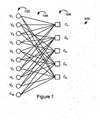
- FIG. 1An exemplary bipartite graph 100 determining a (3,6) regular LDPC code of length ten and rate one-half is shown in Fig. 1 .
- Length tenindicates that there are ten variable nodes V 1 -V 10 , each identified with one bit of the codeword X 1 -X 10 (and no puncturing in this case), generally identified by reference numeral 102.
- Rate one halfindicates that there are half as many check nodes as variable nodes, i.e., there are five check nodes C 1 -C 5 identified by reference numeral 106. Rate one half further indicates that the five constraints are linearly independent, as discussed below.
- Each of the lines 104represents an edge, e.g., a communication path or connection, between the check nodes and variable nodes to which the line is connected.
- Each edgeidentifies two sockets, one variable socket and one constraint socket. Edges can be enumerated according to their variable sockets or their constraint sockets.
- the variable sockets enumerationcorresponds to the edge ordering (top to bottom) as it appears on the variable node side at the point where they are connected to the variable nodes.
- the constraint sockets enumerationcorresponds to the edge ordering (top to bottom) as it appears on the constraint node side at the point they are connected to the constraint nodes.
- messagesare passed in both directions along the edges. Thus, as part of the decoding process messages are passed along an edge from a constraint node to a variable node and vice versa.
- FIG. 1illustrates the graph associated with a code of length 10
- representing the graph for a codeword of length 1000would be 100 times more complicated.
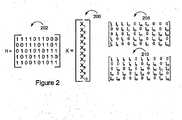
- the matrix H 202includes the relevant edge connection, variable node and constraint node information.
- each columncorresponds to one of the variable nodes while each row corresponds to one of the column nodes. Since there are 10 variable nodes and 5 constraint nodes in the exemplary code, the matrix H includes 10 columns and 5 rows.
- the entry of the matrix corresponding to a particular variable node and a particular constraint nodeis set to 1 if an edge is present in the graph, i.e., if the two nodes are neighbors, otherwise it is set to 0.
- variable node V 1is connected to constraint node C 1 by an edge, a one is located in the uppermost lefthand corner of the matrix 202.
- variable node V 4is not connected to constraint node C 1 so a 0 is positioned in the fourth position of the first row of matrix 202 indicating that the corresponding variable and constraint nodes are not connected.
- the constraintsare linearly independent if the rows of H are linearly independent vectors over GF[2] (a Galois field of order 2). Enumerating edges by sockets, variable or constraint, corresponds to enumerating the 1's in H.
- Variable socket enumerationcorresponds to enumerating top to bottom within columns and proceeding left to right from column to column, as shown in matrix 208.
- Constraint socket enumerationcorresponds to enumerating left to right across rows and proceeding top to bottom from row to row, as shown in matrix 210.
- the codeword X which is to be transmittedcan be represented as a vector 206 which includes the bits X 1 -X n of the codeword to be processed.
- the codewordmay be punctured. Puncturing is the act of removing bits from a codeword to yield, in effect, a shorter codeword. In the case of LDPC graphs this means that some of the variable nodes in the graph correspond to bits that are not actually transmitted. These variable nodes and the bits associated with them are often referred to as state variables.
- the decodercan be used to reconstruct the portion of the codeword which is not physically communicated over a communications channel.
- the receiving devicemay initially populate the missing received word values (bits) with ones or zeros assigned, e.g., in an arbitrary fashion, together with an indication (soft bit) that these values are completely unreliable, i.e., that these values are erased.
- bitsbits
- soft bitan indication that these values are completely unreliable, i.e., that these values are erased.
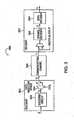
- the system 350includes an encoder 352, a decoder 357 and a communication channel 356.
- the encoder 352includes an encoding circuit 353 that processes the input data A to produce a codeword X.
- the codeword Xincludes, for the purposes of error detection and/or correction, some redundancy.
- the codeword Xmay be transmitted over the communications channel.
- the codeword Xcan be divided via a data selection device 354 into first and second portions X', X" respectively by some data selection technique.
- One of the codeword portionse.g., the first portion X', may then be transmitted over the communications channel to a receiver including decoder 357 while the second portion X" is punctured.
- portions of the transmitted codewordmay be lost or corrupted. From the decoder's perspective, punctured bits may be interpreted as lost.
- soft bitsare inserted into the received word to take the place of lost or punctured bits.
- the inserted indicating erasure of X" soft bitsindicate and/or bits lost in transmission.
- the decoder 357will attempt to reconstruct the full codeword X from the received word Y and any inserted soft bits, and then perform a data decoding operation to produce A from the reconstructed codeword X.
- the decoder 357includes a channel decoder 358 for reconstructing the complete codeword X from the received word Y. In addition it includes a data decoder 359 for removing the redundant information included in the codeword to produce the original input data A from the reconstructed codeword X.
- received words generated in conjunction with LDPC codingcan be processed by performing LDPC decoding operations thereon, e.g., error correction and detection operations, to generate a reconstructed version of the original codeword.
- the reconstructed codewordcan then be subject to data decoding to recover the original data that was coded.
- the data decoding processmay be, e.g., simply selecting a specific subset of the bits from the reconstructed codeword.
- LDPC decoding operationsgenerally comprise message passing algorithms. There are many potentially useful message passing algorithms and the use of such algorithms is not limited to LDPC decoding. The current invention can be applied in the context of virtually any such message passing algorithm and therefore can be used in various message passing systems of which LDPC decoders are but one example.
- Belief propagation for (binary) LDPC codescan be expressed as follows. Messages transmitted along the edges of the graph are interpreted as log-likelihoods log ⁇ p 0 p 1 for the bit associated to the variable node.
- (p 0 ,p 1 )represents a conditional probability distribution on the associated bit.
- the soft bits provided to the decoder by the receiverare also given in the form of a log-likelihood.
- the received valuesi.e., the elements of the received word, are log-likelihoods of the associated bits conditioned on the observation of the bits provided by the communication channel.
- m C2VFor messages from check nodes to variable nodes and by m V2C for messages from variable nodes to check nodes.
- m C2V0 for every edge.
- the present inventionis directed to methods and apparatus for performing decoding operations on words using message passing decoding techniques.
- the techniques of the present inventionare particularly well suited for use with large LDPC codes, e.g., codewords of lengths greater than 750 bits, but they can be used for shorter lengths also.
- the techniques and apparatus of the present inventioncan also be used for graph design and decoding where other types of message passing algorithms are used. For purposes of explaining the invention, however, exemplary LDPC decoders and decoding techniques will be described.
- the techniques of the present inventionallow for decoding of LDPC graphs that possess a certain hierarchal structure in which a full LDPC graph appears to be, in large part, made up of multiple copies, Z say, of a Z times smaller graph.
- the Z graph copiesmay be identical.
- the smaller graphAs the projected graph.
- the techniquecan be best appreciated by first considering a decoder that decodes Z identical small LDPC graphs synchronously and in parallel.
- a message passing decoder for a single small LDPC graphThe decoder implements a sequence of operations corresponding to a message passing algorithm.
- Given now augmenting the same decoderso that it decodes Z identical such LDPC graphs synchronously and in parallel.
- Each operation in the message passing algorithmis replicated Z times. Note that the efficiency of the decoding process is improved because, in total, decoding proceeds Z times faster and because the control mechanisms required to control the message passing process need not be replicated for the Z copies but can rather be shared by the Z copies.
- the present inventionobtains the efficiencies of the above described vectorization while modifying it so that the vector decoder is in fact decoding one large graph, Z times larger than the projected graph. This is accomplished by interconnecting the Z copies of the projected graph in a controlled manner. Specifically, we allow the Z edges within a vector edge to undergo a permutation, or exchange, between copies of the projected graph as they go, e.g., from the variable node side to the constraint node side. In the vectorized message passing process corresponding to the Z parallel projected graphs this exchange is implemented by permuting messages within a vector message as it is passed from one side of the vectorized graph to the other.
- a relatively large graphcan be represented, e.g., described, using relatively little memory.
- a graphmay be represented by storing information describing the projected graph and information describing the rotations.
- the description of the graphmay be embodied as a circuit that implements a function describing the graph connectivity.
- the graph representation technique of the present inventionfacilitates parallel, e.g., vectorized, graph implementations. Furthermore, the graph representation techniques of the present invention can be used to support decoding of regular or irregular graphs, with or without state variables. Information describing the degrees of the nodes in the projected graph may be stored and provided to a vector node processing element. Note that all nodes belonging to a vector node will have the same degree so degree information is required only for one projected graph.
- the decoderis made programmable thereby allowing it to be programmed with multiple graph descriptions, e.g., as expressed in terms of stored projected graph and stored rotation information or in terms of an implemented function. Accordingly, the decoders of the present invention can be programmed to decode a large number of different codes, e.g., both regular and irregular. In some particular embodiments the decoder is used for a fixed graph or for fixed degrees and this information. In such embodiments the graph description information may be preprogrammed or implicit. In such cases the decoder may be less flexible than the programmable embodiments but the resources required to support programmability are saved.
- a message memorywhich includes rows of memory locations, each row corresponding to the messages associated with one copy of the projected graph.
- the messages corresponding to the Z multiple projected graphsare stacked to form columns of Z messages per column, such a column corresponds to a vector message.
- This memory arrangementallows the vector messages, e.g., set of Z messages, corresponding to vector edge to be read out of or written to memory as a unit, e.g., using a SIMD instruction to access all the Z messages in a column in one operation.
- memorysupports reading and writing of vector messages as units. Accordingly, the present invention avoids the need to provide a different read/write address for each individual message in a set of Z messages.
- the Z messagesare subject to a permutation operation, e.g., a re-ordering operation.
- the re-ordering operationmay be a rotation operation, or rotation for short. These rotation operations correspond to the rotations associated to the vector edges which interconnect the Z copies of the projected graph to form the single large graph.
- This rotationmay be applied, e.g., prior to the messages being supplied to a corresponding vector (constraint or variable) node processor. Alternatively the rotation may be applied subsequent to processing by a vector node processor.
- the rotationmay be implemented using a simple switching device which connects, e.g., the message memory to the vector node processing unit and re-orders those messages as they pass from the memory to the vector node processing unit.
- a simple switching devicewhich connects, e.g., the message memory to the vector node processing unit and re-orders those messages as they pass from the memory to the vector node processing unit.
- one of the messages in each vector message read from memoryis supplied to a corresponding one of the Z parallel node processing units, within a vector node processor, as determined by the rotation applied to the vector message by the switching device.
- a rotation operation as implemented by the switching devicemay also or alternatively be applied to the vector message prior to its being written into memory and after node processing.
- the stored or computed description of the projected graphmay include, e.g., information on the order in which messages in a row corresponding to a projected graph are to be read out of and/or written in to memory during constraint and/or variable node processing.
- the messages of the entire large graphare stored in multiple rows, each row corresponding to a different copy of the small graph, the rows being arranged to form columns of messages.
- Each column of messagesrepresents a vector message, which can be accessed as a single unit.
- the information on how to access messages in a row of a projected graphcan be used to determine the order in which vector messages corresponding to multiple copies of the projected graph are accessed in accordance with the present invention.
- the varying of the order in which vector messages are read out and/or written to memory according to whether the read/write operation corresponds to variable node side or constraint node side processingmay be described as a first permutation performed on the messages. This permutation corresponds to the interleaver associated to the projected graph.
- a second set of permutation informatione.g., the rotation information, is stored in addition to vector message (e.g., column) access order information.
- the second permutation information(e.g., the rotation information), representing switching control information, indicates how messages in each vector message, e.g., column of messages, should be reordered when, e.g., read out of and/or written in to memory.
- This two-stage permutation factorsthe larger permutation describing the complete LDPC graph into two parts implemented via different mechanisms.
- a cyclic permutationis used as the second level permutation because of the ease with which such a permutation can be implemented and the compactness of its description. This case motivates the use of the term rotation to describe this second level permutation for purposes of explanation. However, it is to be understood that the second level permutation need not be limited to rotations and can be implemented using other re-ordering schemes.
- the decodergenerates multi-bit soft outputs with one bit, e.g., the sign or parity bit of each soft output, corresponding to a hard decision output of the decoder, e.g., the original codeword in the case where all errors have been corrected or no errors are present in the received word.
- the decoder outpute.g., the recovered codeword, may then be processed further to recover the original data which was used at encoding time to produce the transmitted codeword.
- soft and/or hard outputs produced after each complete iteration of variable node processingare examined to determine if the parity check constraints indicative of a codeword are satisfied by the current hard decisions.
- This checking processalso enjoys the benefits of the graph's two stage factored permutation structure.
- the iterative decoding process(message passing) may be halted once recovery of a codeword is detected in this manner. Accordingly, in the case of relatively error free signals, decoding may be completed and detected promptly, e.g., after two or three iterations of the message passing decoding process. However, in the case of received words that include more errors, numerous iterations of the decoding process may occur before decoding is successful or the process is halted due to a time out constraint.
- Prompt detection of successful decodingallows for more efficient use of resources as compared to systems that allocate a fixed number of decoding iterations to each received word.
- the decoders of the present inventioncan be used to decode received words at high speeds. Furthermore, given the novel technique of the present invention used to represent large graphs and/or controlling message passing for decoding operations associated with such graphs, the difficulties of storing the descriptions of large graphs and controlling their message routing are reduced and/or overcome.
- Certain generalizations of LDPC codes and decoding techniques of the inventioninclude coding/decoding over larger alphabets not simply bits, which have two possible values, but some larger number of possibilities. Codes where constraint nodes represent constraints other than parity check constraints may also be decoded using the methods and apparatus of the present invention.
- Other relevant generalizations to which the invention can be appliedinclude situations where a message passing algorithm is to be implemented on a graph and one has the option to design the graph. It will be apparent to those skilled in the art, in view of the present patent application, how to apply the techniques of the present invention to these more general situations.
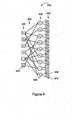
- Figure 4illustrates an exemplary irregular LDPC code using a bipartite graph 400.
- the graphincludes m check nodes 402, n variable nodes 406, and a plurality of edges 404. Messages between the check nodes and variable nodes are exchanged over the edges 404.
- Soft input bits y 1 through y ncorresponding to the received word Y, and soft (or hard) outputs x 1 through x n are indicted by reference numeral 408.
- the m th check nodeis identified using reference numeral 402'
- the n th variable nodeis identified using reference numeral 406' while the n th soft input y n and the nth soft output x n are indicated in Fig. 4 using reference numbers 410, 409 respectively.
- Variable nodes 406process messages from the constraint nodes 402 together with the input soft values from the received word y 1 ,...,y n to update the value of the output variables x 1 ,...,x n corresponding to the variable nodes and to generate messages to the constraint nodes.
- One messageis generated by a variable node for each edge connected to the variable node. The generated message is transmitted along the edge from the variable node to the constraint node attached to the edge.
- messages from variable nodes to constraint nodeswill, from time to time in the present application, be indicated by using the abbreviation V2C while messages from variable nodes to constraint nodes will be indicated by using the abbreviation C2V.
- Each constraint node 402is responsible for processing the messages received from the variable nodes via the edges attached to the particular constraint node.
- the V2C messages received from the variable nodesare processed by the constraint nodes 402 to generate C2V messages which are then transmitted back along the edges attached to each constraint node.
- the variable nodes 406then process the C2V messages, together with the soft input values, to generate and transmit new V2C messages, and generate soft outputs, x i .
- the sequence of performing processing at the variable nodes 406comprising: transmitting generated messages to the check nodes 402, generating at the variable nodes soft outputs x i , and receiving messages from the check nodes, may be performed repeatedly, i.e., iteratively, until the outputs x i from the variable nodes 406 indicate that the codeword has been successfully decoded or some other stopping criterion, e.g., completion of a fixed number of message passing iterations, has been satisfied. It should be appreciated that the sequence of operations described above need not occur strictly in the order described. Node processing may proceed asynchronously and variable and constraint node processing may occur simultaneously. Nevertheless, the logic of the iterative process is as described.
- V2C and C2Vmay be one or more bits, e.g., K bits each, where K is a positive non-zero integer value.
- the soft outputs x imay be one or multiple bits. Multiple bit messages and outputs provide the opportunity to relay confidence or reliability information in the message or output.
- the sign of the soft output valuemay be used to provide the single bit hard output of the decoding process corresponding to a variable node, e.g., the bits of the decoded codeword.
- Output soft valuesmay correspond to decoded soft values or, alternatively, to so-called extrinsic information (excluding the corresponding input information) which may be used in another larger iterative process within which the LDPC decoder is but one module.
- variable and/or constraint node processingmay be performed independently. Accordingly, variable and/or constraint node processing maybe performed one node at time, e.g., in sequence, until some or all of the variable and constraint node processing has been completed for a particular iteration of the decoding process.
- Thisallows a single unit of processing hardware to be provided and reused, if desired, to perform the processing associated with each of the variable and/or constraint nodes.
- Another significant feature of LDPC decodingis that the V2C and C2V messages used during a particular processing iteration need not have been generated at the same time, e.g., during the same processing iteration.
- soft values(messages, received and output values) represent log-likelihoods of the associated bits, i.e., soft values take the form log ⁇ probability bit is a 0 probability bit is a 1 where the probability is conditioned on some random variable, e.g., the physical observation of the bit from the communications channel in the case of a received value.
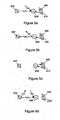
- Fig. 5aillustrates the initial step in an LDPC decoding process.
- the variable node V n 506'is supplied with the soft input, e.g., the received values (1 or more bits) y n from a received word to be processed.
- the C2V messages at the start of a decoding operation and the soft output X n 509are initially set to zero.
- the variable node V n 506'Based on the received inputs, e.g., the zero value C2V messages and input y n , the variable node V n 506' generates one V2C message for each check node to which it is connected. Typically, in the initial step, each of these messages will be equal to y n .
- Fig. 5bgenerated V2C messages are shown being transmitted along each of the edges connected to variable node V n 506'.
- updated V2C messagesare transmitted to each of the check nodes 502 coupled to variable node V n 506' including check node C m 502'.
- variable node processingresults in the updating of the soft output X n 509' corresponding to the variable node doing the processing.
- the soft output X nis shown being updated in Fig. 5c . While shown as different steps, the soft output may be output at the same time the V2C messages are output.
- the soft outputsmay be used to determine when a codeword has been recovered from the received word, i.e., when the parity constraints have been satisfied by the output values. This indicates successful decoding (although the codeword found maybe incorrect, i.e., not the one that was transmitted) thereby allowing the iterative decoding process to be halted in a timely fashion, e.g., before some fixed maximum allowed number of message passing iterations is completed.
- Check node processingcan be performed once a check node, e.g., check node C m 502', receives V2C messages along the edges to which it is connected.
- the received V2C messagesare processed in the check node to generate updated C2V messages, one for each edge connected to the particular check node.
- the C2V message transmitted back to a variable node along an edgewill depend on the value of each of the V2C messages received on the other edges connected to the check node but (usually and preferably but not necessarily) not upon the V2C message received from the particular variable node to which the C2V message is being transmitted.
- C2V messagesare used to transmit information generated from messages received from variable nodes other than the node to which the message is being transmitted.
- Fig. 5dillustrates the passage of updated C2V messages to variable nodes including node 506'.
- constraint node C m 502'is shown outputting two updated C2V messages with the updated C m 2V n message being supplied to variable node V n 506'.
- V n 506'also receives additional updated C2V n message(s) from another constraint node(s) to which it is connected.
- variable node processingcan be repeated to generate updated V2C messages and soft outputs. Then the updating of C2V messages can be repeated and so on until the decoder stopping criterion is satisfied.
- Practical LDPC decoder implementationsoften include an edge memory for storing messages passed along edges between constraint and/or variable nodes.
- theyinclude a graph descriptor sometimes referred to as a permutation map which includes information specifying edge connections, or socket pairing, thereby defining the decoding graph.
- This permutation mapmay be implemented as stored data or as circuit which calculates or implies the permutation.
- one or more node processing unitsare needed to perform the actual processing associated with a node.
- Software LDPC decoder implementationsare possible wherein software is used to control a CPU to operate as a vector processing unit and to control passing of messages using a memory coupled to the CPU.
- a single memorycan also be used to store the decoder graph description, edge messages as well as decoder routines used to control the CPU.
- one or more edge memoriesmay be used.
- a first edge memoryis used for the storage and passing of C2V messages and a second edge memory is used for the storage and passing of V2C messages.
- multiple node processing unitse.g., one to perform constraint node processing and another to perform variable node processing may, and often are, employed.
- such embodimentsallow for variable and constraint processing operations to be performed in parallel with the resulting messages being written into each of the two message memories for use during the next iteration of the decoding process.
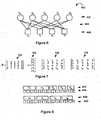
- Fig. 6illustrates a simple irregular LDPC code in the form of a graph 600.
- the codeis of length five as indicated by the 5 variable nodes V 1 through V 5 602.
- Four check nodes C 1 through C 4 606are coupled to the variable nodes 602 by a total of 12 edges 604 over which messages may be passed.
- Fig. 7illustrates, using matrices 702, 704, the LDPC code shown in Fig. 6 , in parity check matrix form.
- edgesare represented in the permutation matrix H 702 using 1's.
- Bit X iis associated to variable node V i .
- Matrices 706 and 708show the 1's in H, corresponding to edges in the graph, indexed according to the variable socket order and constraint socket order, respectively.
- the 12 edgeswill be enumerated from the variable node side, i.e., according to their variable sockets.
- the connections established by the edges between the variable nodes 602 and check nodes 606can be seen in Fig. 6 .
- the edges attached to variable V 1 which connects it to check nodes C 1 , C 2 and C 3are assigned labels 1, 2, 3, corresponding to variable socket enumeration.
- Variable node V 2is connected to check nodes C 1 , C 3 and C 4 by edges 4, 5 and 6, respectively.
- Variable node V 3is coupled to check nodes C 1 and C 4 by edges 7 and 8, respectively.
- variable node V 4is coupled to check nodes C 2 and C 4 by edges 9 and 10, respectively, while variable node V 5 is coupled to check nodes C 2 and C 3 by edges 11 and 12, respectively.
- This indexingcorresponds with matrix 706 of Figure 7 , i.e., variable socket order.
- Fig. 8illustrates the relationship between the 12 edges of Fig. 6 , as enumerated from the variable node side, in relationship to the variable and check nodes to which they are connected.
- Row 802shows the 5 variable nodes V 1 through V 5 .
- Beneath the variables 802are shown the edges 1 through 12 804 corresponding to the associated sockets which are connected to the particular variable node. Note that since the edges are ordered from the variable node side, in row 804 they appear in order from 1-12. Let us assume that messages are stored in memory in the order indicated in row 804.
- variable node processingthe 12 edge messages in memory are accessed in sequence, e.g., in the order shown in 804. Thus, during variable node processing, the messages may simply be read out in order and supplied to a processing unit.
- Row 806illustrates the four constraint nodes C1 through C4 present in the code of Figs. 6 and 7 .
- the edgesare re-ordered in row 804' to reflect the order in which they are connected to the constraint nodes, but the indicated indexing is that induced from the variable node side. Accordingly, assuming that the edge messages are stored in order from the variable node side, when performing constraint node processing the messages would be read out in the order illustrated in row 804'. That is, during constraint node processing the messages would be read out of the memory in the order 1, 4, 7, 2, 9, 11, 3, 5, 12, 6, 8, 10.
- a message ordering modulecan be used to output the correct sequence of edge message access information, e.g., memory locations, for reading data from memory or writing data to memory during variable and check node processing operations.
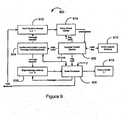
- the LDPC decoder 900comprises a decoder control module 902, a message ordering module (socket permutation memory) 904, a node degree memory 910, an edge memory 906, a node processor 908, output buffer 916, hard decision memory 912 and parity check verifier 914.
- the edge memory 906includes L K bit memory locations with each K bit location corresponding to one edge and where L is the total number of edges in the LDPC graph being used and K is the number of bits per message exchanged along an edge.
- Lis the total number of edges in the LDPC graph being used
- Kis the number of bits per message exchanged along an edge.
- the hard decision memory 912includes L 1 bit memory locations, each 1 bit location corresponding to one edge. This memory stores hard decision transmitted by the variable nodes along each of their edges so that the parity check constraints may be verified.
- the parity check verifier 914receives the hard bit decisions as the check node processor receives messages. The parity checks are verified in the parity check verifier and, in the event that all checks are satisfied, transmits a convergence signal to the decoder control module 902.
- the message ordering module 904may be implemented as a permutation map or look-up table which includes information describing the ordering of messages in edge memory as viewed from the variable node side or as viewed from the constraint node side.
- the sequence 1,4,7,2,9,11,3,5,12,6,8,10which specifies edge order as viewed from the constraint side would be, effectively, stored in the message ordering module. This sequence is used to order messages for constraint node processing and to order hard decisions read out of Hard Decision Memory 912 for processing by the parity check verifier 914.
- the decoder control unit 902is responsible for toggling the decoder operation between variable and check node processing modes of operation, for determining when the iterative decoding process should be stopped, e.g., because of receipt of a convergence signal or reaching a maximum allowed iteration count, for supplying or controlling the supply of degree information to the node processing unit and the parity check verifier, and for controlling the supply of an edge index to the Message Ordering Module 904.
- the decoder control module 902transmits an edge index to the message ordering module 904.
- the value, edge indexis incremented over time to sequence through all the edges in the graph.
- a different, e.g., unique, edge indexis used for each edge in a graph being implemented.
- the message ordering moduleIn response to each received edge index, the message ordering module will output an edge identifier, e.g., edge memory address information, thus selecting the edge memory location that will be accessed, e.g., read from or written to, at any given time. Assuming variable socket ordering, the message ordering module 904 will cause messages to be read out and written back in sequential order during variable node processing and will cause the messages to be read out and written back in order corresponding to constraint socket ordering during constraint node processing. Thus, in our above example, the messages will be read out and written back in order 1,2,3,...,12 during variable node processing and, concurrently, hard decisions will be written into hard decision memory 912 in order 1,2,3,...,12.
- edge identifiere.g., edge memory address information
- the message ordering module 904will cause hard decision bits to be read out of hard decision memory 912 in the order 1,4,7,2,9,11,3,5,12,6,8,10.
- the node processor 908performs the appropriate constraint or variable node processing operation, depending on the mode of operation, thereby using the received messages to generate updated messages corresponding to the particular node being implemented at any given time.
- the resulting updated messagesare then written back into the edge memory overwriting the messages which were just read from the memory.
- Messages sent to a particular nodearrive at the node processor as a contiguous block, i.e., one after another.
- the decoder control module 902signals node delineation to the node processor, e.g., by indicating the last message corresponding to a node thereby providing node degree information.
- variable node degreeswould be specified, e.g., as the sequence (3,3,2,2,2) and the constraint node degrees would be specified, e.g., as the sequence (3,3,3,3).
- This informationmay be stored in node degree memory 910 which would then be read by the decoder control module 902 as it iterates over edge indices.
- the degree informationmay be preprogrammed into each of the node processing units. This can be preferable, e.g., when it is known in advance that the node degrees will be uniform, i.e., the graph will be regular.
- the parity check verifier 914operates in much the same fashion as a check node processor except that incoming messages are single bits, no outgoing message is computed, and the internal computation is simpler.
- variable node mode operationvariable node computations will be performed one node at a time by the node processing unit until the processing, e.g., message updating and soft output value generation operations associated with each of the variable nodes, has been completed.
- Messagesare delivered to the node processor 908 in variable node side order so that all messages corresponding to one node arrive in sequence at the node processor 908.
- the decoder control module 902causes the decoder 900 to switch into the constraint node mode of processing operation.
- the node processing unit 908switches from a variable node processing mode into a constraint node processing mode.
- the message ordering module 904switches into a mode wherein message identifiers will be supplied to the edge memory in the constraint socket order.
- One or more control signals sent over the C/V control linecan be used to control the switch between constraint and variable node processing modes of operation.
- the decoder control circuit 902controls the decoder to perform constraint node processing in constraint node sequence, one node at a time, the messages stored in the edge memory will once again be updated, this time by the C2V messages generated by the constraint node processing.
- the decoder control circuit 902will switch back to the variable node mode of processing operation. In this manner, the decoder 900 toggles between variable node and constraint node processing. As described, the processing is performed sequentially, one node at a time, until the decoder control circuit 902 determines that the decoding operation has been completed.
- scalar or sequential LDPC decoding system illustrated in Fig. 9can be implemented using relatively little hardware. In addition it lends itself well to software implementation. Unfortunately, the sequential nature of the processing performed tends to result in a relatively slow decoder implementation. Accordingly, while the scalar architecture shown in Fig. 9 has some noteworthy attributes, it tends to be unsuitable for high bandwidth applications such as optical communications or data storage where high decoding speed and the use of large codewords is desired.
- the complexity of the representationcomprises, roughly, the number of bits required to specify the permutation matrices
- the subset ⁇can in general be chosen using various criteria.
- One of the main motivations for the above structureis to simplify hardware implementation of decoders. Therefore, it can be beneficial to restrict ⁇ to permutations that can be efficiently implemented in hardware, e.g., in a switching network.
- Parallel switching network topologiesis a well studied subject in connection with multiprocessor architectures and high speed communication switches.
- One practical example of a suitable architecture for the permutation subset ⁇is a class of multi-layer switching networks including, e.g., omega (perfect shuffle) / delta networks, log shifter networks, etc. These networks offer reasonable implementation complexity and sufficient richness for the subset ⁇ .
- multi-layer switching networksscale well e.g., their complexity rises as N log N where N is the number of inputs to the network, which makes them especially suitable for massively parallel LDPC decoders.
- the subset ⁇ of permutationscan be implemented in a single layer.
- An LDPC graphis said to have "multiple edges" if any pair of nodes is connected by more than one edge.
- a multiple edgeis the set of edges connecting a pair of nodes that are connected by more than one edge.
- each edge within the multiple edgeis replaced with a permutation matrix from ⁇ and these matrixes are added to yield the extended parity check matrix of the full code.
- a j>1 in the parity check matrix H of the projected graphwill be 'lifted' to a sum ⁇ k + ⁇ k+1 + ...+ ⁇ k+j-1 , of permutation matrixes from ⁇ .
- the elements of the sumso that each entry of ⁇ k + ⁇ k+1 + ...+ ⁇ k+j-1 is either 0 or 1, i.e., the full graph has no multiple edges.
- the receiverknowing in advance about the additional zeros and punctured bits substitutes soft bits for the punctured bits indicating erasure, and substitutes soft bits for the known zero bits indicating a zero value with largest possible reliability.
- the extended received word, of length EZmay now be decoded to recover the original data unit. In practice one usually makes these adjustments by puncturing bits from only one vector node and declaring known bits from only one vector node.
- message-passing decoding of LDPC codesinvolves passing messages along the edges of the graph representing the code and performing computations based on those messages at the nodes of the graph, e.g., the variable and constraint nodes.
- the decoderoperates as if it were decoding Z copies of the projected LDPC code synchronously and in parallel. Control of the decoding process corresponds to the projected LDPC graph and may be shared across the Z copies.
- Socketsalso become vectorized.
- a vector node processormight comprise Z node processors in parallel and, when a vector of messages, (m 1 ,...,m Z ) is delivered to the vector node processor message m i is delivered to the i th processor.
- no routing or reordering of messagesoccurs within a vector node processor, i.e., the vector message is aligned with the vector of processors in a fixed way.
- ⁇comprises the group of cyclic permutations.
- our large LDPC graphsare constrained to have a quasi-cyclic structure.
- Nbe the number of variable nodes in the graph and let M be the number of constraint nodes in the graph.
- a larger graphcan be generated by replicating, i.e., implementing multiple copies, of the small graph shown in Fig. 6 and then performing rotation operations to interconnect the various copies of the replicated graph.
- replicatingi.e., implementing multiple copies
- rotation operationsto interconnect the various copies of the replicated graph.
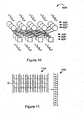
- Fig. 10is a graph 1000 illustrating the result of making 3 parallel copies of the small graph illustrated in Fig. 6 .
- Variable nodes 602', 602" and 602"'correspond to the first through third graphs, respectively, resulting from making three copies of the Fig. 6 graph.
- check nodes 606', 606" and 606"'correspond to the first through third graphs, respectively, resulting from making the three copies. Note that there are no edges connecting nodes of one of the three graphs to nodes of another one of the three graphs. Accordingly, this copying process, which "lifts" the basic graph by a factor of 3, results in three disjoint identical graphs.
- Fig. 11illustrates the result of the copying process discussed above using matrices 1102 and 1104.
- each non-zero element in the matrix 702is replaced with a 3x3 identity matrix.
- each one in the matrix 702is replaced with a 3x3 matrix having 1's along the diagonal and 0's everywhere else to produce the matrix 1102.
- matrix 1102has 3 times the number of edges that matrix 702 had, 12 edges for each one of the 3 copies of the basic graph shown in Fig. 6 .
- variable x ijcorresponds to variable node V ij .
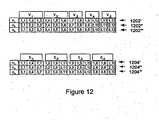
- Fig. 12shows the relationship between the (3x12) 36 edges, the (3x5) 15 variable nodes, and the (3x4) 12 constraint nodes which makeup graph 1000. As in the case of Fig. 8 , edges are enumerated from the variable node side.
- the first number used to identify a node, constraint, or edgeindicates the graph copy to which the edge belongs, e.g., the first, second or third graph copy.
- the second numberis used to identify the element number within the particular specified copy of the basic graph.
- row 1202'the value (1,2) is used to indicate edge 2 of the first copy of the graph while in row 1202" (2,2) is used to indicate edge 2 of the second copy of the graph.
- edge rows 1202', 1202", 1202"'are simply copies of row 804 representing three copies of the row of edges 804, shown in Fig. 8 , as they relate to the variable nodes.
- edge rows 1204', 1204" and 1204"'represent three copies of the row of edges 804' shown in fig. 8 as they relate to the constraint nodes.
- the node processor 908will be made a vector node processor, able to process 3 identical nodes simultaneously in parallel. All outputs from the node processor 908 will be vectorized, thereby carrying 3 times the data previously carried. Hard decision memory 912 and edge message memory 906 will be made 3 times wider, each capable of writing or reading 3 units (bits or K bit messages respectively) in parallel using at the direction of a single SIMD instruction. Outputs from these memories will now be vectors, 3 times wider than before.
- the parity check verifier 914 and the output buffer 916will also be suitably vectorized with all processing suitably parallelized.
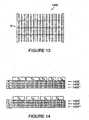
- Fig. 14illustrates the effect of performing the cyclic permutation (rotation) on the constraint node side. Since the permutation is performed from the constraint node side, the relationship between the edges, e.g., ordering, from the variable node side remains unchanged as shown in rows 1402', 1402" and 1402"'. From the constraint side, however, the permutation results in edges within a column, e.g., the edges within a specific vector edge, being reordered as shown in rows 1404', 1404", 1404"'. This produces interconnections between nodes corresponding to different copies of the projected graph.
- constraint node C 1,1is now connected to edge (2,1) as opposed to edge (1,1)
- constraint node C 2,1is coupled to edge (3,1) as opposed to edge (2,1)
- constraint node C 3,1is coupled to edge (1,1) as opposed to edge (3,1).
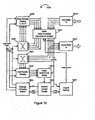
- Figure 15illustrates a decoder incorporating various features of the present invention.
- the decoder control module 1502 and the node degree memory 1510function in the same or a similar manner as their respective counterparts 902 and 910 in decoder 900. For example, to decode LDPC code defined in Figs. 13 and 14 the operation of these components would be exactly the same as their counterparts in decoder 900 when decoding the example graph 600.
- the edge message memory 1506 and hard decision memory 1512are vectorized versions of their counterparts 906 and 912 in decoder 900.
- the memoriesstored single units (K bit messages or bits)
- the corresponding memories in decoder 1500store sets, i.e., vectors, messages, resulting in e.g., Z x K bit messages being stored. These vectors are written or read as single units using SIMD instructions.
- the message identifiers sent to these modules from the message ordering module 1504are equivalent or similar to those in decoder 900.
- the message ordering module 1504has the additional role, beyond what its counterpart 904 had in decoder 900, of storing and providing the permutation, e.g., rotation, information.
- decoder 900stored in its message ordering module 904 the edge sequence (1,4,7,2,9,11,3,5,12,6,8,10).
- the message ordering module 1504would store the same above sequence for accessing message vectors during constraint node processing, and also store the sequence (2, 2, 3, 3, 1, 1, 1, 3, 2, 1, 2, 3) which describes the rotations associated to the same sequence of vector messages. This sequence serves as the basis to generate the rot signal which is used by the message ordering module 1504 to cause the switches 1520 and 1522 to rotate vector messages and vector hard decision bits respectively.
- the vector parity check verifier 1514is a vector version of its counterpart 914 in decoder 900. Note that the output convergence signal is a scalar, as before.
- the output buffer 1516serves the same purpose as buffer 916, but output data is written as vectors.
- the vector node processor 1508,is, e.g., Z node processors, each as in 908, in parallel. These nodes would share the deg signals and C/V control signal from the decoder control module 1502.
- the soft decisions generated by the variable processing unitare supplied to a soft decision input of buffer 1516.
- soft decisionsmaybe obtained form the output of buffer 1516.
- decoder 1500would function decoding the example of Figs. 13 and 14 .
- the edge message memory 1506is populated with 0s.
- the decoder control module 1502first toggles into variable node processing mode.
- the edge message memory 1506 vectors(all 0s at this point) are read out in order and delivered to the vector node processor 1508 for variable node processing.
- the vector node processor 1508then outputs the received values alone along each edge from a variable node, we will use y to denote these first messages to indicate this.
- the rot signalis used to control message re-ordering performed by switching circuits 1520, 1522.
- the rot signal from the message ordering module 1504will cause the messages in the vectors to be rotated to produce processed vectors as follows: (y 2,1 ,y 3,1 ,y 1,1 ), (y 3,2 ,y 1,2 ,y 2,2 ), (y 1,3 ,y 2,3 ,y 3,3 ), (y 2,4 ,y 3,4 ,y 1 , 4 ), (y 3,5 ,y 1,5 ,y 2,5 ), (y 1,6 ,y 2,6 ,y 3,6 ), (y 3,7 ,y 1,7 ,y 2,7 ), (y 2,8 ,y 3,8 ,y 1,8 ), (y 1,9 ,y 2,9 ,y 3,9 ), (y 3,10 ,y 1,10 ,y 2,10 ), (y 1,11 ,y 2,11 ,y 3,11 ), (y 2,12 ,y 3,12 ,y 1,12 ).
- the decoder control module 1502will toggle into constraint mode.
- the stored vector messageswill then be read out in order (1,4,7,2,9,11,3,5,12,6,8,10). Thus, they will be presented to the vector node processor 1508 in the order (y 2,1 ,y 3,1 ,y 1,1 ), (y 2,4 ,y 3,4 ,y 1,4 ), (y 3,7 ,y 1,7 ,y 2,7 ), (y 3,2, y 1,2 ,y 2,2 ), (y 1,9 ,y 2,9 ,y 3,9 ), (y 1,11 ,y 2,11 ,y 3,11 ).
- the 1 st element (message) of each message vector (set of messages)is delivered to the 1 st node processor; the 2 nd message is delivered to the 2 nd processor; and the 3 rd message is delivered to the 3 rd processor, respectively.
- the deg signalwhich indicates the degree of the current node being processed, is supplied by the degree memory 1510 to the three parallel processors of vector node processor 1508. At this point the deg signal indicates that constraints are (all) degree 3 so the 1 st processor would process y 2,1 , y 2,4 , and y 3,7 for its first constraint node and y 3,2 , y 1,9 , and y 1,11 for its second. Similarly, the 2 nd processor would process y 3 , 1 , y 3,4 , and y 1,7 for its first constraint node and y 1,2 , y 2,9 , and y 2,11 for its second.
- m i,jdenote the outgoing message corresponding to the incoming y i,j .
- the message ordering module 1504now toggles into variable node processing mode in response to a C/V signal supplied by decoder control module 1502.
- the vector node processor 1508also outputs soft decoded vectors which are stored in the output buffer 1516. It also outputs hard decisions which are supplied to switching circuit 1522.
- the vectors of one bit hard decisionsundergo the same rotation operation as the message vectors at the corresponding times.
- the rotated hard decision vectors produced by switching circuit 1522are then arrayed in the hard decision memory 1512 where they are stored.
- the hard decisionsmay be read out in the same order as the vector messages are read out during constraint node processing.
- the hard decisionsare delivered to the vector parity check verifier 1514 which performs Z parity checks in parallel. If all parity checks are satisfied then the convergence signal, CON is generated and emitted.
- the decoder control module 1502stops the decoding process.
- decoder 1500there are many variations to decoder 1500 that each embody the current invention.
- the switch 1520could have instead been placed along the data path between the edge message memory 1506 and the vector node processor 1508.
- switch 1522could have instead been placed along the data path between the hard decision memory 1512 and the vector parity check verifier 1514.
- Such a replacementwould also involve appropriate adjustment of the timing of rot signal.
- the hard decision memory 1512, the vector parity check verifier 1514 and the attendant data pathsneed not be used and are eliminated for decoder embodiments that perform a fixed number of iterations and therefore do not require convergence detection.
- Many further variationswill be apparent to those skilled in the art in view of the present invention.
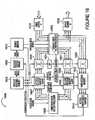
- Fig. 16illustrates a decoder 1600 which is implemented in accordance with another embodiment of the present invention.
- the decoder 1600includes many elements which are the same as, or similar to, the elements of the decoder 1500. Accordingly, for the purposes of brevity, such elements will be identified using the same reference numbers as used in Fig. 15 and will not be discussed again in detail.
- the decoder 1600is capable of performing both variable node and constraint node processing operations, e.g., message updating operations, at the same time, e.g., simultaneously and independently. In contrast to the Fig.
- the decoder 1600can be described as an asynchronous iteration decoder since the variable node and constraint node processing operations can be performed independently, e.g., simultaneously.
- the decoder circuit 1600includes a decoder control module 1602, a message ordering module 1604, a first switching circuit 1621, V2C edge message memory 1606, a constraint node vector processor (e.g., Z-constraint node processors in parallel) 1609, a second switching circuit 1620, C2V edge message memory 1607, a variable node vector processor 1608 (e.g., Z-variable node processors in parallel), a hard decision memory 1612, and a third switch 1622 coupled together as illustrated in Fig. 16 .
- a decoder control module 1602includes a message ordering module 1604, a first switching circuit 1621, V2C edge message memory 1606, a constraint node vector processor (e.g., Z-constraint node processors in parallel) 1609, a second switching circuit 1620, C2V edge message memory 1607, a variable node vector processor 1608 (e.g., Z-variable node processors in parallel), a hard decision memory 1612, and
- each of the message memories 1606, 1607are capable of storing L (ZxK-bit) vector messages.
- Each vector message, e.g., column of Z K-bit messages, in the memories 1606, 1607,can be read from or written to in a single read or write operation.
- V2C edge message memory 1606is used to store V2C messages and therefore has a write input coupled to the output of the switching circuit 1621 which receives data from variable node vector processor 1608.
- the C2V message memory 1607is used to store C2V edge messages and therefore has a write input coupled to the output of the constraint node vector processor 1609.
- Switches 1620 and 1621are used to couple the variable node vector processor 1608 to the input of V2C edge message memory and the output of the C2V edge message memory, respectively.
- message vectorsare stored in vector constraint socket order. Message vectors are written into C2V edge message memory 1607 and read out of V2C edge message memory 1606 in vector constraint socket order, i.e., linearly, thus no external control is required (edge index output from decoder control module 1602 passes through message ordering module 1604 unchanged to it's constraint edge index output). Message vectors are read out of C2V edge message memory 1607 and written into V2C edge message memory 1606 in vector variable socket order.
- the message ordering module 1604generates the variable edge index signal which indicates this ordering.
- this signalcontrols reading of C2V edge message memory 1607 and is delivered to V2C edge message memory 1606 after being delayed.
- the delayaccounts for the time required for processing performed by switches 1620 and 1621 and the vector variable node processor 1608. This delay may be a function of the degree of the node being processed, as indicated in Fig. 16 by the variable node degree signal.
- both constraint and variable nodesare ordered such that nodes of the same degree are processed in a contiguous fashion. Further reduction in pipeline stalls occurring on the boundary of node groups with different degrees can be achieved by sorting node groups by degree in a monotonic fashion e.g., increasing or decreasing degree order. For implementation simplicity embodiments 900, 1500 and 1600 assume increasing degree order.
- Switch 1620rotates the messages in each vector into variable rotation as each C2V vector message proceeds to variable node vector processor 1608 and then switch 1621 applies the inverse rotation to the outgoing V2C vector message corresponding to the same vector edge.
- the rot signal delivered to switch 1620is delivered to switch 1621 via rotation inversion circuit 1624 after a delay matched to the processing time in the vector constraint node processor. This delay may depend on the constraint node degree, as indicated by the constraint node degree signal output by degree memory 1610.
- the decoder 1600includes decoder control module 1602.
- the decoder control moduleoperates in a similar manner to the previously discussed control module 1502. However, in 1602 no C/V control signal is generated.
- the edge index generation functioncan be provided by a counter which cycles through the entire set of vector edges before starting over.
- hard decisionsare generated, one per edge, by each of Z-variable node processing units in the vector variable node processor 1608 each time a vector V2C message is generated. While the vector messages are written into the V2C edge message memory 1606, the Zx1 bit hard decision outputs are written into the hard decision output memory 1612 after being rotated by switch 1622. Switch 1622 and hard decision memory 1612 operate under the same control signals as switch 1621 and V2C edge message memory 1606, respectively.
- the resulting Zx1 rotated vectorsare delivered to the vector parity check verifier 1614 which includes Z parity check verifiers connected in parallel.
- the verifier 1614determines if the parity checks are satisfied and if all are satisfied then a convergence signal is generated and sent to the decoder control module.
- the decoder control modulestops decoding of the received codeword.
- the convergence detection signalis available one iteration after a codeword has been written to the output buffer since constraint verification for data from iteration N is done during iteration N+1 and the convergence signal is available upon completion of iteration N+1.
- Fig. 17illustrates an embodiment similar to the decoder 1700 constraint verification is accomplished "on the fly" as the ZxK-bit output values X are written to the output buffer 1716.
- memory block 1712keeps track of constraints status as vector constraints are updated by hard decision output from variable node processor 1708.
- Each constraint status memory locationcorresponds to a codeword parity check constraint. On the last update of any constraint status location these parity check values are verified. If all verifications during iteration N are satisfied then a convergence signal will be generated and output by the vector parity check verifier 1714 immediately after iteration N. This will qualify to the decoder control module 1702 that data in output buffer 1716 is valid.
- Fig. 17illustrates an embodiment similar to the decoder 1700 constraint verification is accomplished "on the fly" as the ZxK-bit output values X are written to the output buffer 1716.
- memory block 1712keeps track of constraints status as vector constraints are updated by hard decision output from variable node processor 1708.
- the message ordering module 1704generates an additional signal defining constraint node index (as opposed to edge index) which is not generated in the Fig. 16 embodiment.
- the constraint node indexidentifies the constraint node destination of the current V2C message. This field serves as an index to constraint status memory 1712 to which it is supplied.
- the Fig. 16 and Fig. 17 embodimentshave the advantage of more efficient use of the vector constraint and variable node processors 1609/1709,1608/1708 since both vector node processors are utilized fully during each processing iteration.
- decoding timeis reduced as compared to the Fig. 15 embodiment since constraint and variable node processing is performed in parallel, e.g., simultaneously.
- the above described decoding methodsallow for message passing decoding, e.g., LDPC decoding, to be performed using software and general purpose computers capable of supporting SIMD operations.
- one or more parallel processorsserve as vector processing units or, hardware within a single processor may be used to perform multiple vector processing operations in parallel.
- the edge memory, permutation map and information on the number of messages per nodemay all be stored in a common memory, e.g., the computers main memory.
- the message passing control logic and decoder control logicmay be implemented as software routines executed on the computer's processing unit.
- the switching devicemay be implemented using software and one or more SIMD processing instructions.
- LDPC decoding methodsallow for LDPC decoding to performed on various hardware platforms such as Field Programmable Gate Arrays or in an Application Specific Integrated Circuit.
- the present inventionis especially useful in these settings where the simple parallelism can be explicitly exploited.
Landscapes
- Physics & Mathematics (AREA)
- Engineering & Computer Science (AREA)
- Theoretical Computer Science (AREA)
- Probability & Statistics with Applications (AREA)
- Mathematical Physics (AREA)
- Computational Linguistics (AREA)
- Evolutionary Computation (AREA)
- Artificial Intelligence (AREA)
- Biomedical Technology (AREA)
- Biophysics (AREA)
- Health & Medical Sciences (AREA)
- Data Mining & Analysis (AREA)
- Life Sciences & Earth Sciences (AREA)
- General Health & Medical Sciences (AREA)
- Molecular Biology (AREA)
- Computing Systems (AREA)
- General Engineering & Computer Science (AREA)
- General Physics & Mathematics (AREA)
- Software Systems (AREA)
- Error Detection And Correction (AREA)
Abstract
Description
- The present invention is directed to methods and apparatus for detecting and/or correcting errors in binary data, e.g., through the use of parity check codes such as low density parity check (LDPC) codes.
- In the modem information age binary values, e.g., ones and zeros, are used to represent and communicate various types of information, e.g., video, audio, statistical information, etc. Unfortunately, during storage, transmission, and/or processing of binary data, errors may be unintentionally introduced, e.g., a one may be changed to a zero or vice versa.
- Generally, in the case of data transmission, a receiver observes each received bit in the presence of noise or distortion and only an indication of the bit's value is obtained. Under these circumstances one interprets the observed values as a source of "soft" bits. A soft bit indicates a preferred estimate of the bit's value, i.e., a one or a zero, together with some indication of that estimate's reliability. While the number of errors may be relatively low, even a small number of errors or level of distortion can result in the data being unusable or, in the case of transmission errors, may necessitate re-transmission of the data.
- In order to provide a mechanism to check for errors and, in some cases, to correct errors, binary data can be coded to introduce carefully designed redundancy. Coding of a unit of data produces what is commonly referred to as a codeword. Because of its redundancy, a codeword will often include more bits than the input unit of data from which the codeword was produced.
- When signals arising from transmitted codewords are received or processed, the redundant information included in the codeword as observed in the signal can be used to identify and/or correct errors in or remove distortion from the received signal in order to recover the original data unit. Such error checking and/or correcting can be implemented as part of a decoding process. In the absence of errors, or in the case of correctable errors or distortion, decoding can be used to recover from the source data being processed, the original data unit that was encoded. In the case of unrecoverable errors, the decoding process may produce some indication that the original data cannot be fully recovered. Such indications of decoding failure can be used to initiate retransmission of the data.
- While data redundancy can increase the reliability of the data to be stored or transmitted, it comes at the cost of storage space and/or the use of valuable communications bandwidth. Accordingly, it is desirable to add redundancy in an efficient manner, maximizing the amount of error correction/detection capacity gained for a given amount of redundancy introduced into the data.
- With the increased use of fiber optic lines for data communication and increases in the rate at which data can be read from and stored to data storage devices, e.g., disk drives, tapes, etc., there is an increasing need not only for efficient use of data storage and transmission capacity but also for the ability to encode and decode data at high rates of speed.
- While encoding efficiency and high data rates are important, for an encoding and/or decoding system to be practical for use in a wide range of devices, e.g., consumer devices, it is important that the encoders and/or decoders be capable of being implemented at reasonable cost. Accordingly, the ability to efficiently implement encoding/decoding schemes used for error correction and/or detection purposes, e.g., in terms of hardware costs, can be important.
- Various types of coding schemes have been used over the years for error correction purposes. One class of codes, generally referred to as "turbo codes" were recently invented (1993). Turbo codes offer significant benefits over older coding techniques such as convolutional codes and have found numerous applications.
- In conjunction with the advent of turbo codes, there has been increasing interest in another class of related, apparently simpler, codes commonly referred to as low density parity check (LDPC) codes. LDPC codes were actually invented by Gallager some 40 years ago (1961) but have only recently come to the fore. Turbo codes and LDPC codes are coding schemes that are used in the context of so-called iterative coding systems, that is, they are decoded using iterative decoders. Recently, it has been shown that LDPC codes can provide very good error detecting and correcting performance, surpassing or matching that of turbo codes for large codewords, e.g., codeword sizes exceeding approximately 1000 bits, given proper selection of LDPC coding parameters. Moreover, LDPC codes can potentially be decoded at much higher speeds than turbo codes.
- In many coding schemes, longer codewords are often more resilient for purposes of error detection and correction due to the coding interaction over a larger number of bits. Thus, the use of long codewords can be beneficial in terms of increasing the ability to detect and correct errors. This is particularly true for turbo codes and LDPC codes. Thus, in many applications the use of long codewords, e.g., codewords exceeding a thousand bits in length, is desirable.
- The main difficulty encountered in the adoption of LDPC coding and Turbo coding in the context of long codewords, where the use of such codes offers the most promise, is the complexity of implementing these coding systems. In a practical sense, complexity translates directly into cost of implementation. Both of these coding systems are significantly more complex than traditionally used coding systems such as convolutional codes and Reed-Solomon codes.
- Complexity analysis of signal processing algorithms usually focuses on operations counts. When attempting to exploit hardware parallelism in iterative coding systems, especially in the case of LDPC codes, significant complexity arises not from computational requirements but rather from routing requirements. The root of the problem lies in the construction of the codes themselves.
- LDPC codes and turbo codes rely on interleaving messages inside an iterative process. In order for the code to perform well, the interleaving must have good mixing properties. This necessitates the implementation of a complex interleaving process.
- LDPC codes are well represented by bipartite graphs, often called Tanner graphs, in which one set of nodes, thevariable nodes, corresponds to bits of the codeword and the other set of nodes, theconstraint nodes, sometimes calledcheck nodes, correspond to the set of parity-check constraints which define the code. Edges in the graph connect variable nodes to constraint nodes. A variable node and a constraint node are said to beneighbors if they are connected by an edge in the graph. For simplicity, we generally assume that a pair of nodes is connected by at most one edge. To each variable node is associated one bit of the codeword. In some cases some of these bits might bepunctured or known, as discussed further below.
- A bit sequence associated one-to-one with the variable node sequence is a codeword of the code if and only if, for each constraint node, the bits neighboring the constraint (via their association with variable nodes) sum to zero modulo two, i.e., they comprise an even number of ones.
- The decoders and decoding algorithms used to decode LDPC codewords operate by exchanging messages within the graph along the edges and updating these messages by performing computations at the nodes based on the incoming messages. Such algorithms will be generally referred to as message passing algorithms. Each variable node in the graph is initially provided with a soft bit, termed areceived value, that indicates an estimate of the associated bit's value as determined by observations from, e.g., the communications channel. Ideally, the estimates for separate bits are statistically independent. This ideal can be, and often is, violated in practice. A collection of received values constitutes areceived word. For purposes of this application we may identify the signal observed by, e.g., the receiver in a communications system with the received word.
- The number of edges attached to a node, i.e., a variable node or constraint node, is referred to as thedegree of the node. Aregular graph or code is one for which all variable nodes have the same degree, j say, and all constraint nodes have the same degree, k say. In this case we say that the code is a (j,k) regular code. These were the codes considered originally by Gallager (1961). In contrast to a "regular" code, an irregular code has constraint nodes and/or variable nodes of differing degrees. For example, some variable nodes may be of
degree 4, others ofdegree 3 and still others ofdegree 2. - While irregular codes can be more complicated to represent and/or implement, it has been shown that irregular LDPC codes can provide superior error correction/detection performance when compared to regular LDPC codes.
- In order to more precisely describe the decoding process we introduce the notion of asocket in describing LDPC graphs. A socket can be viewed as an association of an edge in the graph to a node in the graph. Each node has one socket for each edge attached to it and the edges are "plugged into" the sockets. Thus, a node of degree d has d sockets attached to it. If the graph has L edges then there are L sockets on the variable node side of the graph, called the variable sockets, and L sockets on the constraint node side of the graph, called the constraint sockets. For identification and ordering purposes, the variable sockets may be enumerated 1,...,L so that all variable sockets attached to one variable node appear contiguously. In such a case, if the first three variable nodes have degrees d1, d2, and d3 respectively, then
variable sockets 1,...,d1 are attached to the first variable node, variable sockets d1+1,..., d1+d2 are attached to the second variable node, and variable sockets d1+d2+1,..., d1+d2+d3 are attached to the third variable node. Constraint node sockets may be enumerated similarly 1,...,L with all constraint sockets attached to one constraint node appearing contiguously. An edge can be viewed as a pairing of sockets, one of each pair coming from each side of the graph. Thus, the edges of the graph represent an interleaver or permutation on the sockets from one side of the graph, e.g., the variable node side, to the other, e.g., the constraint node side. The permutations associated with these systems are often complex, reflecting the complexity of the interleaver as indicated above, requiring complex routing of the message passing for their implementation. - The notion of message passing algorithms implemented on graphs is more general than LDPC decoding. The general view is a graph with nodes exchanging messages along edges in the graph and performing computations based on incoming messages in order to produce outgoing messages.
- An exemplary
bipartite graph 100 determining a (3,6) regular LDPC code of length ten and rate one-half is shown inFig. 1 . Length ten indicates that there are ten variable nodes V1-V10, each identified with one bit of the codeword X1-X10 (and no puncturing in this case), generally identified byreference numeral 102. Rate one half indicates that there are half as many check nodes as variable nodes, i.e., there are five check nodes C1-C5 identified byreference numeral 106. Rate one half further indicates that the five constraints are linearly independent, as discussed below. Each of thelines 104 represents an edge, e.g., a communication path or connection, between the check nodes and variable nodes to which the line is connected. Each edge identifies two sockets, one variable socket and one constraint socket. Edges can be enumerated according to their variable sockets or their constraint sockets. The variable sockets enumeration corresponds to the edge ordering (top to bottom) as it appears on the variable node side at the point where they are connected to the variable nodes. The constraint sockets enumeration corresponds to the edge ordering (top to bottom) as it appears on the constraint node side at the point they are connected to the constraint nodes. During decoding, messages are passed in both directions along the edges. Thus, as part of the decoding process messages are passed along an edge from a constraint node to a variable node and vice versa. - While
Fig. 1 illustrates the graph associated with a code oflength 10, it can be appreciated that representing the graph for a codeword oflength 1000 would be 100 times more complicated. - An alternative to using a graph to represent codes is to use a matrix representation such as that shown in
Fig. 2 . In the matrix representation of a code, thematrix H 202, commonly referred to as theparity check matrix, includes the relevant edge connection, variable node and constraint node information. In the matrix H, each column corresponds to one of the variable nodes while each row corresponds to one of the column nodes. Since there are 10 variable nodes and 5 constraint nodes in the exemplary code, the matrix H includes 10 columns and 5 rows. The entry of the matrix corresponding to a particular variable node and a particular constraint node is set to 1 if an edge is present in the graph, i.e., if the two nodes are neighbors, otherwise it is set to 0. For example, since variable node V1 is connected to constraint node C1 by an edge, a one is located in the uppermost lefthand corner of thematrix 202. However, variable node V4 is not connected to constraint node C1 so a 0 is positioned in the fourth position of the first row ofmatrix 202 indicating that the corresponding variable and constraint nodes are not connected. We say that the constraints are linearly independent if the rows of H are linearly independent vectors over GF[2] (a Galois field of order 2). Enumerating edges by sockets, variable or constraint, corresponds to enumerating the 1's in H. Variable socket enumeration corresponds to enumerating top to bottom within columns and proceeding left to right from column to column, as shown inmatrix 208. Constraint socket enumeration corresponds to enumerating left to right across rows and proceeding top to bottom from row to row, as shown inmatrix 210. - In the case of a matrix representation, the codeword X which is to be transmitted can be represented as a
vector 206 which includes the bits X1-Xn of the codeword to be processed. A bit sequence X1-Xn is a codeword if and only if the product of thematrix - In the context of discussing codewords associated to LDPC graphs, it should be appreciated that in some cases the codeword may bepunctured. Puncturing is the act of removing bits from a codeword to yield, in effect, a shorter codeword. In the case of LDPC graphs this means that some of the variable nodes in the graph correspond to bits that are not actually transmitted. These variable nodes and the bits associated with them are often referred to as state variables. When puncturing is used, the decoder can be used to reconstruct the portion of the codeword which is not physically communicated over a communications channel. Where a punctured codeword is transmitted the receiving device may initially populate the missing received word values (bits) with ones or zeros assigned, e.g., in an arbitrary fashion, together with an indication (soft bit) that these values are completely unreliable, i.e., that these values areerased. For purposes of explaining the invention, we shall assume that, when used, these receiver-populated values are part of the received word which is to be processed.
- Consider for example the
system 350 shown inFig. 3 . Thesystem 350 includes anencoder 352, adecoder 357 and acommunication channel 356. Theencoder 352 includes anencoding circuit 353 that processes the input data A to produce a codeword X. The codeword X includes, for the purposes of error detection and/or correction, some redundancy. The codeword X may be transmitted over the communications channel. Alternatively, the codeword X can be divided via adata selection device 354 into first and second portions X', X" respectively by some data selection technique. One of the codeword portions, e.g., the first portion X', may then be transmitted over the communications channel to areceiver including decoder 357 while the second portion X" is punctured. As a result of distortions produced by thecommunications channel 356, portions of the transmitted codeword may be lost or corrupted. From the decoder's perspective, punctured bits may be interpreted as lost. - At the receiver soft bits are inserted into the received word to take the place of lost or punctured bits. The inserted indicating erasure of X" soft bits indicate and/or bits lost in transmission.
- The
decoder 357 will attempt to reconstruct the full codeword X from the received word Y and any inserted soft bits, and then perform a data decoding operation to produce A from the reconstructed codeword X. - The
decoder 357 includes achannel decoder 358 for reconstructing the complete codeword X from the received word Y. In addition it includes adata decoder 359 for removing the redundant information included in the codeword to produce the original input data A from the reconstructed codeword X. - It will be appreciated that received words generated in conjunction with LDPC coding, can be processed by performing LDPC decoding operations thereon, e.g., error correction and detection operations, to generate a reconstructed version of the original codeword. The reconstructed codeword can then be subject to data decoding to recover the original data that was coded. The data decoding process may be, e.g., simply selecting a specific subset of the bits from the reconstructed codeword.
- LDPC decoding operations generally comprise message passing algorithms. There are many potentially useful message passing algorithms and the use of such algorithms is not limited to LDPC decoding. The current invention can be applied in the context of virtually any such message passing algorithm and therefore can be used in various message passing systems of which LDPC decoders are but one example.
- For completeness we will give a brief mathematical description of one realization of one of the best known message passing algorithms, known as belief propagation.
- Belief propagation for (binary) LDPC codes can be expressed as follows.
Messages transmitted along the edges of the graph are interpreted as log-likelihoods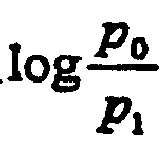
- Let us consider the message-passing rules of belief propagation. Messages are denoted by mC2V for messages from check nodes to variable nodes and by mV2C for messages from variable nodes to check nodes. Consider a variable node with d edges. For each edge j=1,...,d let mC2V(i) denote the incoming message on edge i. At the very beginning of the decoding process we set mC2V =0 for every edge. Then, outgoing messages are given by

- At the check nodes it is more convenient to represent the messages using their 'sign' and magnitudes. Thus, for a message m letmp ∈GF[2] denote the 'parity' of the message, i.e., mp = 0 if m ≥0 and mp = 1 if m < 0. Additionally letmr ∈ [0, ∞] denote the magnitude of m. Thus, we havem = -1m
p mr. At the check node the updates for mp and mr are separate. We have, for a check node of degree d,
where all addition is over GF[2], and
where we define F(x):= log coth (x/2). (In both of the above equations the superscript V2C denotes the incoming messages at the check node.) We note that F is its own inverse, i.e., F-1(x)=F(x). - Most message passing algorithms can be viewed as approximations to belief propagation It will be appreciated that in any practical digital implementation messages will be comprised of a finite number of bits and the message update rules suitably adapted.
- It should be apparent that the complexity associated with representing LDPC codes for large codewords is daunting, at least for hardware implementations trying to exploit parallelism. In addition, it can be difficult to implement message passing in a manner that can support processing at high speeds.
- In order to make the use of LDPC codes more practical, there is a need for methods of representing LDPC codes corresponding to large codewords in an efficient and compact manner thereby reducing the amount of information required to represent the code, i.e., to describe the associated graph. In addition, there is a need for techniques which will allow the message passing associated with multiple nodes and multiple edges, e.g., four or more nodes or edges, to be performed in parallel in an easily controlled manner, thereby allowing even large codewords to be efficiently decoded in a reasonable amount of time. There is further need for a decoder architecture that is flexible enough to decode several different LDPC codes. This is because many applications require codes of different lengths and rates. Even more desirable is an architecture that allows the specification of the particular LDPC code to be programmable.
- Attention is also drawn to a paper byBOUTILLION Emanuel et al., entitled: "Decoder-first code design" and published in PROC. INTERNATIONAL SYMPOSIUM ON TURBO CODES AND RELATED TOPICS, BREST, FRANCE, 4 September 2000, pages 459-462, XP008011934. The paper describes a decoder architecture for a Low Density Parity Check code. In particular, an architecture is described which uses N distinct memories which are separately addressed. In the system N elements are randomly selected one each from each of N memories separately and randomly addressed.
- Attention is also drawn to a paper byTong Zhang et al., entitled: "VLSI implementation-oriented (3, k)-regular low-density parity-check codes" and published in PROC. IEEE WORKSHOP ON SIGNAL PROCESSING SYSTEMS, 26 September 2001 - 28 September 2001, pages 25-36, XP010562749, ISBN: 0-7803-7145-3. The paper describes that in the past few years, Gallager's low-density parity-check (LDPC) codes received a lot of attention and many efforts have been devoted to analyzing and improving their error-correcting performance. However, little consideration has been given to the LDPC decoder VLSI implementation. The straightforward fully parallel decoder architecture usually incurs too high complexity for many practical purposes and should be transformed to a partly parallel realization. Unfortunately, due to the randomness of LDPC codes, it is nearly impossible to develop an effective transformation for an arbitrarily given LDPC code. The authors of the paper propose a joint code and decoder design approach to construct a class of (3,k)-regular LDPC codes which exactly fit a partly parallel decoder implementation and have a very good performance. Moreover, for such LDPC codes, the authors of the paper propose a systematic, efficient encoding scheme by effectively exploiting the sparseness of its parity check matrix.
Figure 1 illustrates a bipartite graph representation of an exemplary regular LDPC code of length ten.Figure 2 is a matrix representation of the code graphically illustrated inFig. 1 .Figure 3 illustrates coding, transmission, and decoding of data.Figure 4 is a bipartite graph representation of an exemplary irregular LDPC code.Figure 5 , which comprises the combination ofFigs. 5a through 5d , illustrates steps performed as part of an LDPC decoding operation in accordance with the LDPC code illustrated inFig. 4 .Figure 6 is a graphical representation of a small LDPC code which is used as the basis of a much larger LDPC code to present an example in accordance with the present invention.Figure 7 illustrates the parity check matrix representation of the small LDPC code graphically illustrated inFig. 6 .Figure 8 illustrates how the edges in the code shown inFig. 6 can be arranged, e.g., enumerated, in order from the variable node side and how the same edges would appear from the constraint node side.Figure 9 illustrates a system for performing a serial LDPC decoding operation.Figure 10 graphically illustrates the effect of making three copies of the small LDPC graph shown inFig. 6 .Figure 11 illustrates the parity check matrix representation of the LDPC graph illustrated inFig. 10 .Figure 12 illustrates how the edges in the code shown inFig. 11 can be arranged, e.g., enumerated, in order from the variable node side and how the same edges will appear from the constraint node side.Figure 13 illustrates the effect of replacing the 3x3 identity matrices shown inFig. 11 with cyclic permutation matrices in accordance with one exemplary embodiment of the present invention.Figure 14 illustrates how the edges in the code shown inFig. 13 can be enumerated in order from the variable node side, and how the same edges will appear from the constraint node side after being subject to a cyclic permutation in accordance with the invention.Figure 15 illustrates an LDPC decoder implemented in accordance with the present invention that vectorizes the decoder ofFig. 9 .Figures 16 and17 illustrate other LDPC decoders implemented in accordance with the present invention.- In accordance with the present invention a method, and an apparatus, as set forth in the independent claims, respectively, are provided. Preferred embodiments of the invention are described in the dependent claims
- The present invention is directed to methods and apparatus for performing decoding operations on words using message passing decoding techniques. The techniques of the present invention are particularly well suited for use with large LDPC codes, e.g., codewords of lengths greater than 750 bits, but they can be used for shorter lengths also. The techniques and apparatus of the present invention can also be used for graph design and decoding where other types of message passing algorithms are used. For purposes of explaining the invention, however, exemplary LDPC decoders and decoding techniques will be described.
- The techniques of the present invention allow for decoding of LDPC graphs that possess a certain hierarchal structure in which a full LDPC graph appears to be, in large part, made up of multiple copies, Z say, of a Z times smaller graph. The Z graph copies may be identical. To be precise we will refer to the smaller graph as theprojected graph. The technique can be best appreciated by first considering a decoder that decodes Z identical small LDPC graphs synchronously and in parallel. Consider a message passing decoder for a single small LDPC graph. The decoder implements a sequence of operations corresponding to a message passing algorithm. Consider now augmenting the same decoder so that it decodes Z identical such LDPC graphs synchronously and in parallel. Each operation in the message passing algorithm is replicated Z times. Note that the efficiency of the decoding process is improved because, in total, decoding proceeds Z times faster and because the control mechanisms required to control the message passing process need not be replicated for the Z copies but can rather be shared by the Z copies. We can also view the above Z-parallel decoder as avector decoder. We can view the process of making Z copies of the smaller graph as vectorizing the smaller (projected) graph: Each node of the smaller graph becomes avector node, comprising Z nodes, each edge of the smaller graph becomes avector edge, consisting of Z edges, each message exchanged in decoding the smaller graph becomes avector message, comprising Z messages.
- The present invention obtains the efficiencies of the above described vectorization while modifying it so that the vector decoder is in fact decoding one large graph, Z times larger than the projected graph. This is accomplished by interconnecting the Z copies of the projected graph in a controlled manner. Specifically, we allow the Z edges within a vector edge to undergo a permutation, or exchange, between copies of the projected graph as they go, e.g., from the variable node side to the constraint node side. In the vectorized message passing process corresponding to the Z parallel projected graphs this exchange is implemented by permuting messages within a vector message as it is passed from one side of the vectorized graph to the other.
- Consider indexing the projected LDPC graphs by 1,j,...,Z. In the strictly parallel decoder variable nodes in graph j are connected only to constraint nodes in graph j. In accordance with the present invention, we take one vector edge, including one corresponding edge each from each graph copy, and allow a permutation within the Z edges, e.g., we permit the constraint sockets corresponding to the edges within the vector edge to be permuted, e.g., re-ordered. Henceforth we will often refer to the permutations, e.g., re-orderings, within the vector edges asrotations.
- Thus, in accordance with the present invention, a relatively large graph can be represented, e.g., described, using relatively little memory. For example, a graph may be represented by storing information describing the projected graph and information describing the rotations. Alternatively, the description of the graph may be embodied as a circuit that implements a function describing the graph connectivity.
- Accordingly, the graph representation technique of the present invention facilitates parallel, e.g., vectorized, graph implementations. Furthermore, the graph representation techniques of the present invention can be used to support decoding of regular or irregular graphs, with or without state variables. Information describing the degrees of the nodes in the projected graph may be stored and provided to a vector node processing element. Note that all nodes belonging to a vector node will have the same degree so degree information is required only for one projected graph.
- In various embodiments, the decoder is made programmable thereby allowing it to be programmed with multiple graph descriptions, e.g., as expressed in terms of stored projected graph and stored rotation information or in terms of an implemented function. Accordingly, the decoders of the present invention can be programmed to decode a large number of different codes, e.g., both regular and irregular. In some particular embodiments the decoder is used for a fixed graph or for fixed degrees and this information. In such embodiments the graph description information may be preprogrammed or implicit. In such cases the decoder may be less flexible than the programmable embodiments but the resources required to support programmability are saved.
- In accordance with one embodiment of the present invention, a message memory is provided which includes rows of memory locations, each row corresponding to the messages associated with one copy of the projected graph. The messages corresponding to the Z multiple projected graphs are stacked to form columns of Z messages per column, such a column corresponds to a vector message. This memory arrangement allows the vector messages, e.g., set of Z messages, corresponding to vector edge to be read out of or written to memory as a unit, e.g., using a SIMD instruction to access all the Z messages in a column in one operation. Thus, memory supports reading and writing of vector messages as units. Accordingly, the present invention avoids the need to provide a different read/write address for each individual message in a set of Z messages.
- At one or more points in the message passing processing, after being read out of memory, the Z messages are subject to a permutation operation, e.g., a re-ordering operation. The re-ordering operation may be a rotation operation, or rotation for short. These rotation operations correspond to the rotations associated to the vector edges which interconnect the Z copies of the projected graph to form the single large graph. This rotation may be applied, e.g., prior to the messages being supplied to a corresponding vector (constraint or variable) node processor. Alternatively the rotation may be applied subsequent to processing by a vector node processor.
- The rotation may be implemented using a simple switching device which connects, e.g., the message memory to the vector node processing unit and re-orders those messages as they pass from the memory to the vector node processing unit. In such an exemplary embodiment, one of the messages in each vector message read from memory is supplied to a corresponding one of the Z parallel node processing units, within a vector node processor, as determined by the rotation applied to the vector message by the switching device. A rotation operation as implemented by the switching device may also or alternatively be applied to the vector message prior to its being written into memory and after node processing.
- The stored or computed description of the projected graph may include, e.g., information on the order in which messages in a row corresponding to a projected graph are to be read out of and/or written in to memory during constraint and/or variable node processing.
The messages of the entire large graph are stored in multiple rows, each row corresponding to a different copy of the small graph, the rows being arranged to form columns of messages. Each column of messages represents a vector message, which can be accessed as a single unit. Thus, the information on how to access messages in a row of a projected graph can be used to determine the order in which vector messages corresponding to multiple copies of the projected graph are accessed in accordance with the present invention. - The varying of the order in which vector messages are read out and/or written to memory according to whether the read/write operation corresponds to variable node side or constraint node side processing may be described as a first permutation performed on the messages. This permutation corresponds to the interleaver associated to the projected graph. In order to represent the large decoder graph from the projected decoder graph, a second set of permutation information, e.g., the rotation information, is stored in addition to vector message (e.g., column) access order information. The second permutation information (e.g., the rotation information), representing switching control information, indicates how messages in each vector message, e.g., column of messages, should be reordered when, e.g., read out of and/or written in to memory. This two-stage permutation factors the larger permutation describing the complete LDPC graph into two parts implemented via different mechanisms.
- In one particular embodiment, a cyclic permutation is used as the second level permutation because of the ease with which such a permutation can be implemented and the compactness of its description. This case motivates the use of the term rotation to describe this second level permutation for purposes of explanation. However, it is to be understood that the second level permutation need not be limited to rotations and can be implemented using other re-ordering schemes.
- In various embodiments of the present invention, the decoder generates multi-bit soft outputs with one bit, e.g., the sign or parity bit of each soft output, corresponding to a hard decision output of the decoder, e.g., the original codeword in the case where all errors have been corrected or no errors are present in the received word. The decoder output, e.g., the recovered codeword, may then be processed further to recover the original data which was used at encoding time to produce the transmitted codeword.
- In accordance with one feature of the present invention, soft and/or hard outputs produced after each complete iteration of variable node processing are examined to determine if the parity check constraints indicative of a codeword are satisfied by the current hard decisions. This checking process also enjoys the benefits of the graph's two stage factored permutation structure. The iterative decoding process (message passing) may be halted once recovery of a codeword is detected in this manner. Accordingly, in the case of relatively error free signals, decoding may be completed and detected promptly, e.g., after two or three iterations of the message passing decoding process. However, in the case of received words that include more errors, numerous iterations of the decoding process may occur before decoding is successful or the process is halted due to a time out constraint.
- Prompt detection of successful decoding, in accordance with the present invention, allows for more efficient use of resources as compared to systems that allocate a fixed number of decoding iterations to each received word.
- Since the decoding techniques of the present invention allow for a large number of decoding operations, e.g., constraint and/or variable node decoder processing operations, to be performed in parallel, the decoders of the present invention can be used to decode received words at high speeds. Furthermore, given the novel technique of the present invention used to represent large graphs and/or controlling message passing for decoding operations associated with such graphs, the difficulties of storing the descriptions of large graphs and controlling their message routing are reduced and/or overcome.
- Certain generalizations of LDPC codes and decoding techniques of the invention include coding/decoding over larger alphabets not simply bits, which have two possible values, but some larger number of possibilities. Codes where constraint nodes represent constraints other than parity check constraints may also be decoded using the methods and apparatus of the present invention. Other relevant generalizations to which the invention can be applied include situations where a message passing algorithm is to be implemented on a graph and one has the option to design the graph. It will be apparent to those skilled in the art, in view of the present patent application, how to apply the techniques of the present invention to these more general situations.
- Numerous additional advantages, features and aspects of the decoding techniques and decoders of the present invention will be apparent from the detailed description which follows.
- As discussed above, the decoding methods and apparatus of the present invention will be described for purposes of explanation in the context of an LDPC decoder embodiment. Steps involved in decoding of an LDPC code will first be described with reference to
Figs. 4 and5 followed by a more detailed discussion of various features of the present invention. Figure 4 illustrates an exemplary irregular LDPC code using abipartite graph 400. The graph includesm check nodes 402, nvariable nodes 406, and a plurality ofedges 404. Messages between the check nodes and variable nodes are exchanged over theedges 404. Soft input bits y1 through yn, corresponding to the received word Y, and soft (or hard) outputs x1 through xn are indicted byreference numeral 408. The mth check node is identified using reference numeral 402', the nth variable node is identified using reference numeral 406' while the nth soft input yn and the nth soft output xn are indicated inFig. 4 usingreference numbers Variable nodes 406 process messages from theconstraint nodes 402 together with the input soft values from the received word y1,...,yn to update the value of the output variables x1,...,xn corresponding to the variable nodes and to generate messages to the constraint nodes. One message is generated by a variable node for each edge connected to the variable node. The generated message is transmitted along the edge from the variable node to the constraint node attached to the edge. For purposes of explanation, messages from variable nodes to constraint nodes will, from time to time in the present application, be indicated by using the abbreviation V2C while messages from variable nodes to constraint nodes will be indicated by using the abbreviation C2V. Indices may be added to the V and C components of this abbreviation to indicate the particular one of the variable nodes and constraint nodes which serves as the source/destination of a particular message. Eachconstraint node 402 is responsible for processing the messages received from the variable nodes via the edges attached to the particular constraint node. The V2C messages received from the variable nodes are processed by theconstraint nodes 402 to generate C2V messages which are then transmitted back along the edges attached to each constraint node. Thevariable nodes 406 then process the C2V messages, together with the soft input values, to generate and transmit new V2C messages, and generate soft outputs, xi. The sequence of performing processing at thevariable nodes 406 comprising: transmitting generated messages to thecheck nodes 402, generating at the variable nodes soft outputs xi, and receiving messages from the check nodes, may be performed repeatedly, i.e., iteratively, until the outputs xi from thevariable nodes 406 indicate that the codeword has been successfully decoded or some other stopping criterion, e.g., completion of a fixed number of message passing iterations, has been satisfied. It should be appreciated that the sequence of operations described above need not occur strictly in the order described. Node processing may proceed asynchronously and variable and constraint node processing may occur simultaneously. Nevertheless, the logic of the iterative process is as described.- Messages, V2C and C2V, may be one or more bits, e.g., K bits each, where K is a positive non-zero integer value. Similarly the soft outputs xi may be one or multiple bits. Multiple bit messages and outputs provide the opportunity to relay confidence or reliability information in the message or output. In the case of a multi-bit, (soft) output, the sign of the soft output value may be used to provide the single bit hard output of the decoding process corresponding to a variable node, e.g., the bits of the decoded codeword. Output soft values may correspond to decoded soft values or, alternatively, to so-called extrinsic information (excluding the corresponding input information) which may be used in another larger iterative process within which the LDPC decoder is but one module.
- The iterative message passing process associated with decoding an LDPC code will now be discussed further with respect to
Figs. 5a through 5d . - When decoding an LDPC code, the processing at each constraint and variable node may be performed independently. Accordingly, variable and/or constraint node processing maybe performed one node at time, e.g., in sequence, until some or all of the variable and constraint node processing has been completed for a particular iteration of the decoding process. This allows a single unit of processing hardware to be provided and reused, if desired, to perform the processing associated with each of the variable and/or constraint nodes. Another significant feature of LDPC decoding is that the V2C and C2V messages used during a particular processing iteration need not have been generated at the same time, e.g., during the same processing iteration. This allows for implementations where constraint and variable node processing can be performed in parallel without regard to when the utilized messages were last updated. Following a sufficient number of message updates and iterations wherein all the variable and constraint nodes process the received messages and generate updated messages, the (hard) output of the variable nodes will converge assuming that the graph was properly designed and there are no remaining uncorrected errors in the received word being processed.
- Given that the processing at each check node and variable node can be viewed as an independent operation, the iterative processing performed at a single exemplary check node Cn 502' and variable node Vn 506' will now be discussed in more detail with reference to
Figs. 5a-5d . For purposes of description we will think of message values and soft input and output values as numbers. A positive number corresponds to a hard bit decision of 0 and a negative number corresponds to a hard bit decision of 1. Larger magnitudes indicate larger reliability. Thus, the number zero indicates total unreliability and the sign (positive or negative) is irrelevant. This convention is consistent with standard practice in which soft values (messages, received and output values) represent log-likelihoods of the associated bits, i.e., soft values take the form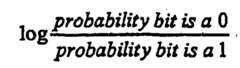
where the probability is conditioned on some random variable, e.g., the physical observation of the bit from the communications channel in the case of a received value. Fig. 5a illustrates the initial step in an LDPC decoding process. Initially, the variable node Vn 506' is supplied with the soft input, e.g., the received values (1 or more bits) yn from a received word to be processed. The C2V messages at the start of a decoding operation and thesoft output X n 509 are initially set to zero. Based on the received inputs, e.g., the zero value C2V messages and input yn, the variable node Vn 506' generates one V2C message for each check node to which it is connected. Typically, in the initial step, each of these messages will be equal to yn.- In
Fig. 5b generated V2C messages are shown being transmitted along each of the edges connected to variable node Vn 506'. Thus, updated V2C messages are transmitted to each of thecheck nodes 502 coupled to variable node Vn 506' including check node Cm 502'. - In addition to generating the V2C messages, variable node processing results in the updating of the soft output Xn 509' corresponding to the variable node doing the processing. The soft output Xn is shown being updated in
Fig. 5c . While shown as different steps, the soft output may be output at the same time the V2C messages are output. - As will be discussed further below, in accordance with some embodiments of the present invention, the soft outputs (or their associated hard decisions) may be used to determine when a codeword has been recovered from the received word, i.e., when the parity constraints have been satisfied by the output values. This indicates successful decoding (although the codeword found maybe incorrect, i.e., not the one that was transmitted) thereby allowing the iterative decoding process to be halted in a timely fashion, e.g., before some fixed maximum allowed number of message passing iterations is completed.
- Check node processing can be performed once a check node, e.g., check node Cm 502', receives V2C messages along the edges to which it is connected. The received V2C messages are processed in the check node to generate updated C2V messages, one for each edge connected to the particular check node. As a result of check node processing, the C2V message transmitted back to a variable node along an edge will depend on the value of each of the V2C messages received on the other edges connected to the check node but (usually and preferably but not necessarily) not upon the V2C message received from the particular variable node to which the C2V message is being transmitted. Thus, C2V messages are used to transmit information generated from messages received from variable nodes other than the node to which the message is being transmitted.
Fig. 5d illustrates the passage of updated C2V messages to variable nodes including node 506'. In particular, inFig. 5d constraint node Cm 502' is shown outputting two updated C2V messages with the updated Cm2Vn message being supplied to variable node Vn 506'. Vn 506' also receives additional updated C2Vn message(s) from another constraint node(s) to which it is connected.- With the receipt of updated C2V messages, variable node processing can be repeated to generate updated V2C messages and soft outputs. Then the updating of C2V messages can be repeated and so on until the decoder stopping criterion is satisfied.
- Thus, the processing shown in
Figs. 5a-5d will be repeated after the first iteration, using updated message values as opposed to initial values, until the decoding process is stopped. - The iterative nature of the LDPC decoding process, and the fact that the processing at individual nodes can be performed independent of the processing at other nodes provides for a great deal of flexibility when implementing an LDPC decoder. However, as discussed above, the sheer complexity of the relationships between the edges and the nodes can make storage of edge relationship information, e.g., the graph description, difficult. Even more importantly, graph complexity can make message passing difficult to implement in parallel implementations where multiple messages are to be passed at the same time.
- Practical LDPC decoder implementations often include an edge memory for storing messages passed along edges between constraint and/or variable nodes. In addition they include a graph descriptor sometimes referred to as a permutation map which includes information specifying edge connections, or socket pairing, thereby defining the decoding graph. This permutation map may be implemented as stored data or as circuit which calculates or implies the permutation. In addition to the edge memory, one or more node processing units are needed to perform the actual processing associated with a node.
- Software LDPC decoder implementations are possible wherein software is used to control a CPU to operate as a vector processing unit and to control passing of messages using a memory coupled to the CPU. In software implementations, a single memory can also be used to store the decoder graph description, edge messages as well as decoder routines used to control the CPU.
- As will be discussed below, in various embodiments of the present invention, one or more edge memories may be used. In one exemplary multiple edge memory embodiment a first edge memory is used for the storage and passing of C2V messages and a second edge memory is used for the storage and passing of V2C messages. In such embodiments, multiple node processing units, e.g., one to perform constraint node processing and another to perform variable node processing may, and often are, employed. As will be discussed below, such embodiments allow for variable and constraint processing operations to be performed in parallel with the resulting messages being written into each of the two message memories for use during the next iteration of the decoding process.
- We will now present a simple example of a small LDPC graph and its representation which will be used subsequently in explaining the invention. The discussion of the LDPC graph will be followed by a description of an LDPC decoder which can be used to decode the small graph.
Fig. 6 illustrates a simple irregular LDPC code in the form of agraph 600. The code is of length five as indicated by the 5 variable nodes V1 throughV 5 602. Four check nodes C1 throughC 4 606 are coupled to thevariable nodes 602 by a total of 12edges 604 over which messages may be passed.Fig. 7 illustrates, usingmatrices Fig. 6 , in parity check matrix form. As discussed above, edges are represented in thepermutation matrix H 702 using 1's. Bit Xi is associated to variable node Vi. Matrices 706 and 708 show the 1's in H, corresponding to edges in the graph, indexed according to the variable socket order and constraint socket order, respectively.- For purposes of explanation, the 12 edges will be enumerated from the variable node side, i.e., according to their variable sockets. The connections established by the edges between the
variable nodes 602 and checknodes 606 can be seen inFig. 6 . For purposes of discussion the edges attached to variable V1 which connects it to check nodes C1, C2 and C3, are assignedlabels edges edges 7 and 8, respectively. In addition, variable node V4 is coupled to check nodes C2 and C4 byedges edges matrix 706 ofFigure 7 , i.e., variable socket order. Fig. 8 illustrates the relationship between the 12 edges ofFig. 6 , as enumerated from the variable node side, in relationship to the variable and check nodes to which they are connected. Row 802 shows the 5 variable nodes V1 through V5. Beneath thevariables 802 are shown theedges 1 through 12 804 corresponding to the associated sockets which are connected to the particular variable node. Note that since the edges are ordered from the variable node side, inrow 804 they appear in order from 1-12. Let us assume that messages are stored in memory in the order indicated inrow 804.- During variable node processing, the 12 edge messages in memory are accessed in sequence, e.g., in the order shown in 804. Thus, during variable node processing, the messages may simply be read out in order and supplied to a processing unit.
- Row 806 illustrates the four constraint nodes C1 through C4 present in the code of
Figs. 6 and 7 . Note that the edges are re-ordered in row 804' to reflect the order in which they are connected to the constraint nodes, but the indicated indexing is that induced from the variable node side. Accordingly, assuming that the edge messages are stored in order from the variable node side, when performing constraint node processing the messages would be read out in the order illustrated in row 804'. That is, during constraint node processing the messages would be read out of the memory in theorder - A
serial LDPC decoder 900 which performs message processing operations sequentially, one edge at a time, will now be discussed with regard toFig. 9 and decoding using the exemplary code shown inFig. 6 will be discussed. TheLDPC decoder 900 comprises adecoder control module 902, a message ordering module (socket permutation memory) 904, anode degree memory 910, anedge memory 906, anode processor 908,output buffer 916,hard decision memory 912 andparity check verifier 914. - The
edge memory 906 includes L K bit memory locations with each K bit location corresponding to one edge and where L is the total number of edges in the LDPC graph being used and K is the number of bits per message exchanged along an edge. For concreteness, we assume that the messages are stored in order according to the edge ordering induced by the variable sockets. Thus, for theexample graph 600 the messages corresponding toedges hard decision memory 912 includesL 1 bit memory locations, each 1 bit location corresponding to one edge. This memory stores hard decision transmitted by the variable nodes along each of their edges so that the parity check constraints may be verified. Theparity check verifier 914 receives the hard bit decisions as the check node processor receives messages. The parity checks are verified in the parity check verifier and, in the event that all checks are satisfied, transmits a convergence signal to thedecoder control module 902. - The
message ordering module 904 may be implemented as a permutation map or look-up table which includes information describing the ordering of messages in edge memory as viewed from the variable node side or as viewed from the constraint node side. Thus, for ourexample graph 600 thesequence Hard Decision Memory 912 for processing by theparity check verifier 914. - In the
Fig. 9 decoder, messages corresponding to an edge are overwritten after they are processed by a node processor. In this manner, the edge memory will alternate between storing V2C messages and storing C2V messages. Hard decision verification occurs during constraint node processing, e.g., as V2C messages are read out ofedge message memory 906. - The
decoder control unit 902 is responsible for toggling the decoder operation between variable and check node processing modes of operation, for determining when the iterative decoding process should be stopped, e.g., because of receipt of a convergence signal or reaching a maximum allowed iteration count, for supplying or controlling the supply of degree information to the node processing unit and the parity check verifier, and for controlling the supply of an edge index to theMessage Ordering Module 904. During operation, thedecoder control module 902 transmits an edge index to themessage ordering module 904. The value, edge index, is incremented over time to sequence through all the edges in the graph. A different, e.g., unique, edge index is used for each edge in a graph being implemented. In response to each received edge index, the message ordering module will output an edge identifier, e.g., edge memory address information, thus selecting the edge memory location that will be accessed, e.g., read from or written to, at any given time. Assuming variable socket ordering, themessage ordering module 904 will cause messages to be read out and written back in sequential order during variable node processing and will cause the messages to be read out and written back in order corresponding to constraint socket ordering during constraint node processing. Thus, in our above example, the messages will be read out and written back inorder hard decision memory 912 inorder order message ordering module 904 will cause hard decision bits to be read out ofhard decision memory 912 in theorder - As messages are read from the edge memory in response to the edge identifier received from
thedecoder control module 902, they are supplied to thenode processor 908. Thenode processor 908 performs the appropriate constraint or variable node processing operation, depending on the mode of operation, thereby using the received messages to generate updated messages corresponding to the particular node being implemented at any given time. The resulting updated messages are then written back into the edge memory overwriting the messages which were just read from the memory. Messages sent to a particular node arrive at the node processor as a contiguous block, i.e., one after another. Thedecoder control module 902 signals node delineation to the node processor, e.g., by indicating the last message corresponding to a node thereby providing node degree information. In the case of theexample graph 600, the variable node degrees would be specified, e.g., as the sequence (3,3,2,2,2) and the constraint node degrees would be specified, e.g., as the sequence (3,3,3,3). This information may be stored innode degree memory 910 which would then be read by thedecoder control module 902 as it iterates over edge indices. Alternatively, the degree information may be preprogrammed into each of the node processing units. This can be preferable, e.g., when it is known in advance that the node degrees will be uniform, i.e., the graph will be regular. - The
parity check verifier 914 operates in much the same fashion as a check node processor except that incoming messages are single bits, no outgoing message is computed, and the internal computation is simpler. - During variable node mode operation, variable node computations will be performed one node at a time by the node processing unit until the processing, e.g., message updating and soft output value generation operations associated with each of the variable nodes, has been completed. Messages are delivered to the
node processor 908 in variable node side order so that all messages corresponding to one node arrive in sequence at thenode processor 908. With an iteration of variable node processing completed, thedecoder control module 902 causes thedecoder 900 to switch into the constraint node mode of processing operation. In response to the change in the C/V control signal, thenode processing unit 908 switches from a variable node processing mode into a constraint node processing mode. In addition themessage ordering module 904 switches into a mode wherein message identifiers will be supplied to the edge memory in the constraint socket order. One or more control signals sent over the C/V control line can be used to control the switch between constraint and variable node processing modes of operation. - As the
decoder control circuit 902 controls the decoder to perform constraint node processing in constraint node sequence, one node at a time, the messages stored in the edge memory will once again be updated, this time by the C2V messages generated by the constraint node processing. When the processing associated with the full set of constraint nodes has been completed, thedecoder control circuit 902 will switch back to the variable node mode of processing operation. In this manner, thedecoder 900 toggles between variable node and constraint node processing. As described, the processing is performed sequentially, one node at a time, until thedecoder control circuit 902 determines that the decoding operation has been completed. - The scalar or sequential LDPC decoding system illustrated in
Fig. 9 can be implemented using relatively little hardware. In addition it lends itself well to software implementation. Unfortunately, the sequential nature of the processing performed tends to result in a relatively slow decoder implementation. Accordingly, while the scalar architecture shown inFig. 9 has some noteworthy attributes, it tends to be unsuitable for high bandwidth applications such as optical communications or data storage where high decoding speed and the use of large codewords is desired. - Before presenting decoders for decoding large vectorized LDPC graphs, we will discuss general concepts and techniques relating to graph vectorizing features of the present invention. The vectorizing discussion will be followed by a presentation of exemplary vectorized LDPC decoders which embody the present invention.
- For purposes of gaining an understanding of vectorizing LDPC graphs consider a 'small' LDPC code with parity check matrixH. The small graph, in the context of a larger vectorized graph, will be referred to as theprojected graph. Let ψ denote a subset of Z × Z permutation matrices. We assume that the inverses of the permutations in ψ are also in ψ. Given the small, projected, graph we can form aZ -times larger LDPC graph by replacing each element ofH with aZ ×Z matrix. The 0 elements ofH are replaced with the zero matrix, denoted 0. The 1 elements ofH are each replaced with a matrix from ψ. In this manner we 'lift' an LDPC graph to oneZ times larger. The complexity of the representation comprises, roughly, the number of bits required to specify the permutation matrices |EH| log|ψ| plus the complexity required to representH , were |EH| denotes the number 1s inH and |ψ| denotes the number of distinct permutations in ψ. E.g., if ψ is the space of cyclic permutations then |ψ|=Z. In practice we might have, e.g., Z = 16 forn ≈ 1000.

Example: Lifting a small parity check matrix, the σ¡ i = 1,...,16 are elements of ψ shown here indexed in projected variable socket order. - The subset ψ can in general be chosen using various criteria. One of the main motivations for the above structure is to simplify hardware implementation of decoders. Therefore, it can be beneficial to restrict ψ to permutations that can be efficiently implemented in hardware, e.g., in a switching network.
- Parallel switching network topologies is a well studied subject in connection with multiprocessor architectures and high speed communication switches. One practical example of a suitable architecture for the permutation subset ψ is a class of multi-layer switching networks including, e.g., omega (perfect shuffle) / delta networks, log shifter networks, etc. These networks offer reasonable implementation complexity and sufficient richness for the subset ψ. Additionally multi-layer switching networks scale well e.g., their complexity rises as N log N where N is the number of inputs to the network, which makes them especially suitable for massively parallel LDPC decoders. Alternatively, in decoders of the present invention with relatively low levels of parallelism and small Z the subset ψ of permutations can be implemented in a single layer.
- An LDPC graph is said to have "multiple edges" if any pair of nodes is connected by more than one edge. Amultiple edge is the set of edges connecting a pair of nodes that are connected by more than one edge. Although it is generally undesirable for an LDPC graph to have multiple edges, in many cases it may be necessary in the construction of vectorized graphs that the projected graph possesses multiple edges. One can extend the notion of a parity check matrix to allow the matrix entries to denote thenumber of edges connecting the associated pair of nodes. The codeword definition is still the same: the code is the set of 0,1 vectors x satisfying Hx=0 modulo 2. When vectorizing a projected graph with multiple edges, in accordance with the invention, each edge within the multiple edge is replaced with a permutation matrix from ψ and these matrixes are added to yield the extended parity check matrix of the full code. Thus, a j>1 in the parity check matrix H of the projected graph will be 'lifted' to a sum σk + σk+1 +...+ σk+j-1, of permutation matrixes from ψ. Usually, one will choose the elements of the sum so that each entry of σk + σk+1 +...+ σk+j-1 is either 0 or 1, i.e., the full graph has no multiple edges.
- The above described lifting appears to have one limitation. Under the above construction both the code length and the length of the encoded data unit must be multiples of Z. This apparent limitation is easily overcome, however. Suppose the data unit to be encoded has length A Z + B where A is a positive integer and B is between 1 and Z inclusive, and the desired code length is C Z + D where C is a positive integer and D is between 0 and Z-1 inclusive. Let E be the smallest positive integer such that E Z >= C Z + D + (Z-B). One can design a lifted graph which encodes a (A+1)Z length data unit to produce a codeword of length E Z such that the data unit appears as part of the codeword, and use this to produce the desired code parameters as follows. Given a data unit of length AZ + B one concatenates Z-B zeros to produce a data unit of length (A+1)Z. That data unit is encoded to produce a codeword of length EZ. The Z-B zeros are not transmitted. Out of the other EZ - (Z-B) bits in the codeword one selects EZ - CZ - D - (Z-B) bits and punctures them, note that the number of puncture bits is between 0 and Z-1 inclusive. These bits will not be transmitted, so the actual number of transmitted bits is EZ - (Z - B) - (EZ - CZ - D - (Z-B)) = CZ + D, which is the desired code length. The receiver, knowing in advance about the additional zeros and punctured bits substitutes soft bits for the punctured bits indicating erasure, and substitutes soft bits for the known zero bits indicating a zero value with largest possible reliability. The extended received word, of length EZ may now be decoded to recover the original data unit. In practice one usually makes these adjustments by puncturing bits from only one vector node and declaring known bits from only one vector node.
- Various decoder implications which use the above discussed technique of vectorizing LDPC graphs will now be addressed.
- As discussed above, message-passing decoding of LDPC codes involves passing messages along the edges of the graph representing the code and performing computations based on those messages at the nodes of the graph, e.g., the variable and constraint nodes.
- Given a vectorized LDPC graphs one can vectorize the decoding process as follows. The decoder operates as if it were decoding Z copies of the projected LDPC code synchronously and in parallel. Control of the decoding process corresponds to the projected LDPC graph and may be shared across the Z copies. Thus, we describe the decoder as operating on vector messages traversing vector edges and being received by vector nodes, each vector having Z elements. Sockets also become vectorized. In particular a vector node processor might comprise Z node processors in parallel and, when a vector of messages, (m1,...,mZ) is delivered to the vector node processor message mi is delivered to the ith processor. Thus, no routing or reordering of messages occurs within a vector node processor, i.e., the vector message is aligned with the vector of processors in a fixed way.
- One deviation from purely disjoint parallel execution of the Z projected graphs is that messages are re-ordered within a vector message during the message passing process. We refer to this re-ordering operation as arotation. The rotation implements the permutation operations defined by ψ. Because of the rotations, the processing paths of the Z copies of the projected graph mix thereby linking them to form a single large graph. Control information which specifies the rotations is needed in addition to the control information required for the projected graph. Fortunately, the rotation control information can be specified using relatively little memory.
While various permutations can be used for the rotations in accordance with the present invention, the use of cyclic permutations is particularly interesting because of the ease with which such permutations can be implemented. For simplicity we will now assume that ψ comprises the group of cyclic permutations. In this case, our large LDPC graphs, are constrained to have a quasi-cyclic structure. For purposes of this example, letN be the number of variable nodes in the graph and letM be the number of constraint nodes in the graph. First, we assume that bothN andM are multiples ofZ ,N =nZ andM =mZ where Z will denote the order of the cycle. - Let us view nodes are doubly indexed. Thus, variable nodevi,j is the jth variable node from the ith copy of the projected graph. Since ψ is the group of cyclic permutations variable nodevi,j is connected to a constraint nodeca,b if and only if variable nodevi+k modZ,j is connected to a constraint nodeca+k modz,b fork =1,...,Z.
- The techniques of the present invention for representing a large graph using a much smaller graph representation and rotation information will now be explained further in reference to
Figs. 10 through 16 which relate to vectorization of thegraph 600. The techniques described with reference to these figures can be applied to much larger LDPC graphs. - In accordance with the present invention, a larger graph can be generated by replicating, i.e., implementing multiple copies, of the small graph shown in
Fig. 6 and then performing rotation operations to interconnect the various copies of the replicated graph. We refer to the small graph within the larger graph structure as the projected graph. Fig. 10 is agraph 1000 illustrating the result of making 3 parallel copies of the small graph illustrated inFig. 6 .Variable nodes 602', 602" and 602"' correspond to the first through third graphs, respectively, resulting from making three copies of theFig. 6 graph. In addition, checknodes 606', 606" and 606"' correspond to the first through third graphs, respectively, resulting from making the three copies. Note that there are no edges connecting nodes of one of the three graphs to nodes of another one of the three graphs. Accordingly, this copying process, which "lifts" the basic graph by a factor of 3, results in three disjoint identical graphs.Fig. 11 illustrates the result of the copying process discussed above usingmatrices matrix 702 is replaced with a 3x3 identity matrix. Thus, each one in thematrix 702 is replaced with a 3x3 matrix having 1's along the diagonal and 0's everywhere else to produce thematrix 1102. Note thatmatrix 1102 has 3 times the number of edges thatmatrix 702 had, 12 edges for each one of the 3 copies of the basic graph shown inFig. 6 . Here, variable xij corresponds to variable node Vij.Fig. 12 shows the relationship between the (3x12) 36 edges, the (3x5) 15 variable nodes, and the (3x4) 12 constraint nodes whichmakeup graph 1000. As in the case ofFig. 8 , edges are enumerated from the variable node side.- For purposes of annotation, the first number used to identify a node, constraint, or edge indicates the graph copy to which the edge belongs, e.g., the first, second or third graph copy. The second number is used to identify the element number within the particular specified copy of the basic graph.
- For example, in row 1202' the value (1,2) is used to indicate
edge 2 of the first copy of the graph while inrow 1202" (2,2) is used to indicateedge 2 of the second copy of the graph. - Note that
edge rows 1202', 1202", 1202"' are simply copies ofrow 804 representing three copies of the row ofedges 804, shown inFig. 8 , as they relate to the variable nodes. Similarly edgerows 1204', 1204" and 1204"' represent three copies of the row of edges 804' shown infig. 8 as they relate to the constraint nodes. - Let us briefly discuss how to modify the
Fig. 9 decoder 900 to decode the Z=3 parallel graphs now defined. Thenode processor 908 will be made a vector node processor, able to process 3 identical nodes simultaneously in parallel. All outputs from thenode processor 908 will be vectorized, thereby carrying 3 times the data previously carried.Hard decision memory 912 andedge message memory 906 will be made 3 times wider, each capable of writing or reading 3 units (bits or K bit messages respectively) in parallel using at the direction of a single SIMD instruction. Outputs from these memories will now be vectors, 3 times wider than before. Theparity check verifier 914 and theoutput buffer 916 will also be suitably vectorized with all processing suitably parallelized. - Let us now consider the introduction of rotations into our example. This can be illustrated by replacing each of the 3x3 identity matrixes shown in
Fig. 11 with 3x3 cyclic permutation matrixes as shown inFig. 13 . Note that there are three possibilities for the cyclic permutation matrix used inFig. 13 . It is possible to indicate the particular permutation matrix to be substituted for an identity matrix by indicating whether the permutation matrix has a "1" located in the first, second or third position in the first row of the permutation matrix. For example, in the case ofmatrix 1302, beginning at the top left and proceeding to the bottom right corner (vector constraint socket order) the rotations could be specified by the sequence (2, 2, 3, 3, 1, 1, 1, 3, 2, 1, 2, 3). Fig. 14 illustrates the effect of performing the cyclic permutation (rotation) on the constraint node side. Since the permutation is performed from the constraint node side, the relationship between the edges, e.g., ordering, from the variable node side remains unchanged as shown inrows 1402', 1402" and 1402"'. From the constraint side, however, the permutation results in edges within a column, e.g., the edges within a specific vector edge, being reordered as shown inrows 1404', 1404", 1404"'. This produces interconnections between nodes corresponding to different copies of the projected graph.- Consider, for example,
column 1 ofrows 1404 in relationship tocolumn 1 ofrows 1104 ofFig. 11 . Note that as a result of the vector edge permutation, operation, constraint node C1,1 is now connected to edge (2,1) as opposed to edge (1,1), constraint node C2,1 is coupled to edge (3,1) as opposed to edge (2,1) and constraint node C3,1 is coupled to edge (1,1) as opposed to edge (3,1). - We discussed above how to vectorize
decoder 900 to decode Z parallel copies of the projected graph. By introducing switches into the message paths to perform rotations, we decode the LDPC code defined inFig. 13 . Figure 15 illustrates a decoder incorporating various features of the present invention. Thedecoder 1500 fully vectorizes, with rotations, thedecoder 600. Note that the figure indicates Z=4 whereas our example has Z=3, in general we may have any Z>1 but in practice Z values of theform 2k for integer k are often preferable. Similarities withdecoder 600 are apparent. In particular thedecoder control module 1502 and thenode degree memory 1510 function in the same or a similar manner as theirrespective counterparts decoder 900. For example, to decode LDPC code defined inFigs. 13 and 14 the operation of these components would be exactly the same as their counterparts indecoder 900 when decoding theexample graph 600. Theedge message memory 1506 andhard decision memory 1512 are vectorized versions of theircounterparts decoder 900. Whereas indecoder 900 the memories stored single units (K bit messages or bits) the corresponding memories indecoder 1500 store sets, i.e., vectors, messages, resulting in e.g., Z x K bit messages being stored. These vectors are written or read as single units using SIMD instructions. Thus the message identifiers sent to these modules from themessage ordering module 1504 are equivalent or similar to those indecoder 900. Themessage ordering module 1504 has the additional role, beyond what itscounterpart 904 had indecoder 900, of storing and providing the permutation, e.g., rotation, information. Recall that in decoding example 600decoder 900 stored in itsmessage ordering module 904 the edge sequence (1,4,7,2,9,11,3,5,12,6,8,10). Consider usingdecoder 1500, to decode the code ofFig. 13 and 14 . Themessage ordering module 1504 would store the same above sequence for accessing message vectors during constraint node processing, and also store the sequence (2, 2, 3, 3, 1, 1, 1, 3, 2, 1, 2, 3) which describes the rotations associated to the same sequence of vector messages. This sequence serves as the basis to generate the rot signal which is used by themessage ordering module 1504 to cause theswitches parity check verifier 1514 is a vector version of itscounterpart 914 indecoder 900. Note that the output convergence signal is a scalar, as before. Theoutput buffer 1516 serves the same purpose asbuffer 916, but output data is written as vectors. Thevector node processor 1508, is, e.g., Z node processors, each as in 908, in parallel. These nodes would share the deg signals and C/V control signal from thedecoder control module 1502.- In order to facilitate the ability to output either soft or hard decoder decisions the soft decisions generated by the variable processing unit are supplied to a soft decision input of
buffer 1516. Thus, at any time prior to completion of decoding, soft decisions maybe obtained form the output ofbuffer 1516. - Consider further how
decoder 1500 would function decoding the example ofFigs. 13 and 14 . Initially theedge message memory 1506 is populated with 0s. Thedecoder control module 1502 first toggles into variable node processing mode. Theedge message memory 1506 vectors (all 0s at this point) are read out in order and delivered to thevector node processor 1508 for variable node processing. Thevector node processor 1508 then outputs the received values alone along each edge from a variable node, we will use y to denote these first messages to indicate this. Thus, the outgoing vectors would be (y1,i, y2,i , y3,i) for i=1,...,12 in increasing order. The rot signal is used to control message re-ordering performed by switchingcircuits message ordering module 1504 will cause the messages in the vectors to be rotated to produce processed vectors as follows: (y2,1,y3,1,y1,1), (y3,2,y1,2,y2,2), (y1,3,y2,3,y3,3), (y2,4,y3,4,y1,4), (y3,5,y1,5,y2,5), (y1,6,y2,6,y3,6), (y3,7,y1,7,y2,7), (y2,8,y3,8,y1,8), (y1,9,y2,9,y3,9), (y3,10,y1,10,y2,10), (y1,11,y2,11,y3,11), (y2,12,y3,12,y1,12). Once the processed vectors are written intoedge memory 1506, in the indicated order, thedecoder control module 1502 will toggle into constraint mode. The stored vector messages will then be read out in order (1,4,7,2,9,11,3,5,12,6,8,10). Thus, they will be presented to thevector node processor 1508 in the order (y2,1,y3,1,y1,1), (y2,4,y3,4,y1,4), (y3,7,y1,7,y2,7), (y3,2,y1,2,y2,2), (y1,9,y2,9,y3,9), (y1,11,y2,11,y3,11). (y1,3,y2,3,y3,3), (y3,5,y1,5,y2,5), (y2,12,y3,12,y1,12), (y1,6,y2,6,y3,6), (Y2,8,y3,8,y1,8), (y3,10,y1,10,y2,10). Thevector node processor 1508 is implemented as three (Z=3) node processors in parallel. The 1st element (message) of each message vector (set of messages) is delivered to the 1st node processor; the 2nd message is delivered to the 2nd processor; and the 3rd message is delivered to the 3rd processor, respectively. The deg signal, which indicates the degree of the current node being processed, is supplied by thedegree memory 1510 to the three parallel processors ofvector node processor 1508. At this point the deg signal indicates that constraints are (all)degree 3 so the 1st processor would process y2,1, y2,4, and y3,7 for its first constraint node and y3,2, y1,9, and y1,11 for its second. Similarly, the 2nd processor would process y3,1, y3,4, and y1,7 for its first constraint node and y1,2, y2,9, and y2,11 for its second. - Let mi,j denote the outgoing message corresponding to the incoming yi,j. As the vectors are emerging from the
vector node processor 1508, the rot signal to switch 1520 will cause the vectors to be reordered so that the previous rotation is reversed, hence they arrive at the edge memory as (m1,j,m2,j,m3,j), in the order j=1,4,7,2,9,11,3,5,12,6,8,10. The messages are written back into memory according to the message identifier order with which they were read, so after writing they appear in memory as (m1,j,m2,j,m3,j) in order j=1,...,12. Themessage ordering module 1504 now toggles into variable node processing mode in response to a C/V signal supplied bydecoder control module 1502. The message vectors are then read out in order j=1,...,12 and delivered to thevector node processor 1508 for variable node processing. This completes an iteration.
During variable node processing thevector node processor 1508 also outputs soft decoded vectors which are stored in theoutput buffer 1516. It also outputs hard decisions which are supplied to switchingcircuit 1522. The vectors of one bit hard decisions undergo the same rotation operation as the message vectors at the corresponding times. The rotated hard decision vectors produced by switchingcircuit 1522 are then arrayed in thehard decision memory 1512 where they are stored. As a result of applying the same rotation applied to the message vectors, the hard decisions may be read out in the same order as the vector messages are read out during constraint node processing. During constraint node processing the hard decisions are delivered to the vectorparity check verifier 1514 which performs Z parity checks in parallel. If all parity checks are satisfied then the convergence signal, CON is generated and emitted. In response to receiving the convergence signal indicating successful decoding, thedecoder control module 1502 stops the decoding process. - It should be apparent that there are many variations to
decoder 1500 that each embody the current invention. For example, theswitch 1520 could have instead been placed along the data path between theedge message memory 1506 and thevector node processor 1508. Similarly,switch 1522 could have instead been placed along the data path between thehard decision memory 1512 and the vectorparity check verifier 1514. Such a replacement would also involve appropriate adjustment of the timing of rot signal. Thehard decision memory 1512, the vectorparity check verifier 1514 and the attendant data paths need not be used and are eliminated for decoder embodiments that perform a fixed number of iterations and therefore do not require convergence detection. Many further variations will be apparent to those skilled in the art in view of the present invention. Fig. 16 illustrates adecoder 1600 which is implemented in accordance with another embodiment of the present invention. Thedecoder 1600 includes many elements which are the same as, or similar to, the elements of thedecoder 1500. Accordingly, for the purposes of brevity, such elements will be identified using the same reference numbers as used inFig. 15 and will not be discussed again in detail. Thedecoder 1600 is capable of performing both variable node and constraint node processing operations, e.g., message updating operations, at the same time, e.g., simultaneously and independently. In contrast to theFig. 15 decoder implementation which may be described as a side-to-side decoder because of the way it toggles between variable node and constraint node processing iterations, thedecoder 1600 can be described as an asynchronous iteration decoder since the variable node and constraint node processing operations can be performed independently, e.g., simultaneously.- The
decoder circuit 1600 includes adecoder control module 1602, amessage ordering module 1604, afirst switching circuit 1621, V2Cedge message memory 1606, a constraint node vector processor (e.g., Z-constraint node processors in parallel) 1609, asecond switching circuit 1620, C2Vedge message memory 1607, a variable node vector processor 1608 (e.g., Z-variable node processors in parallel), ahard decision memory 1612, and athird switch 1622 coupled together as illustrated inFig. 16 . - Various embodiments of individual constraint node processors and individual variable node processors, Z of which can be used in parallel to implement the constraint
node vector processor 1609 andvariable node processor 1608, respectively, are described in detail inU.S. Provisional Patent Application 60/328,469 - In order to support independent and/or parallel updating of constraint and variable messages in the
Fig. 16 embodiment separateedge message memories circuits Fig. 15 embodiment, each of themessage memories memories - V2C
edge message memory 1606 is used to store V2C messages and therefore has a write input coupled to the output of theswitching circuit 1621 which receives data from variablenode vector processor 1608. TheC2V message memory 1607 is used to store C2V edge messages and therefore has a write input coupled to the output of the constraintnode vector processor 1609. Switches node vector processor 1608 to the input of V2C edge message memory and the output of the C2V edge message memory, respectively. In one particular embodiment message vectors are stored in vector constraint socket order. Message vectors are written into C2Vedge message memory 1607 and read out of V2Cedge message memory 1606 in vector constraint socket order, i.e., linearly, thus no external control is required (edge index output fromdecoder control module 1602 passes throughmessage ordering module 1604 unchanged to it's constraint edge index output). Message vectors are read out of C2Vedge message memory 1607 and written into V2Cedge message memory 1606 in vector variable socket order. Themessage ordering module 1604 generates the variable edge index signal which indicates this ordering. Note that this signal controls reading of C2Vedge message memory 1607 and is delivered to V2Cedge message memory 1606 after being delayed. The delay accounts for the time required for processing performed byswitches variable node processor 1608. This delay may be a function of the degree of the node being processed, as indicated inFig. 16 by the variable node degree signal.- To avoid processing pipeline stalls due to variable delay both constraint and variable nodes are ordered such that nodes of the same degree are processed in a contiguous fashion. Further reduction in pipeline stalls occurring on the boundary of node groups with different degrees can be achieved by sorting node groups by degree in a monotonic fashion e.g., increasing or decreasing degree order. For
implementation simplicity embodiments - In the particular embodiment illustrated in
Fig. 16 vectors are stored in vector constraint node rotation order.Switch 1620 rotates the messages in each vector into variable rotation as each C2V vector message proceeds to variablenode vector processor 1608 and then switch 1621 applies the inverse rotation to the outgoing V2C vector message corresponding to the same vector edge. The rot signal delivered to switch 1620 is delivered to switch 1621 viarotation inversion circuit 1624 after a delay matched to the processing time in the vector constraint node processor. This delay may depend on the constraint node degree, as indicated by the constraint node degree signal output bydegree memory 1610. - The
decoder 1600 includesdecoder control module 1602. The decoder control module operates in a similar manner to the previously discussedcontrol module 1502.
However, in 1602 no C/V control signal is generated. The edge index generation function can be provided by a counter which cycles through the entire set of vector edges before starting over. - In addition to outputting the soft decisions, hard decisions are generated, one per edge, by each of Z-variable node processing units in the vector
variable node processor 1608 each time a vector V2C message is generated. While the vector messages are written into the V2Cedge message memory 1606, the Zx1 bit hard decision outputs are written into the harddecision output memory 1612 after being rotated byswitch 1622.Switch 1622 andhard decision memory 1612 operate under the same control signals asswitch 1621 and V2Cedge message memory 1606, respectively. - The resulting Zx1 rotated vectors are delivered to the vector
parity check verifier 1614 which includes Z parity check verifiers connected in parallel. Theverifier 1614 determines if the parity checks are satisfied and if all are satisfied then a convergence signal is generated and sent to the decoder control module. In response to receiving a signal indicating convergence, the decoder control module stops decoding of the received codeword. In theembodiment 1600 the convergence detection signal is available one iteration after a codeword has been written to the output buffer since constraint verification for data from iteration N is done during iteration N+1 and the convergence signal is available upon completion of iteration N+1. - In the
decoder 1600 but which employs different convergence detection circuitryFig. 17 illustrates an embodiment similar to thedecoder 1700 constraint verification is accomplished "on the fly" as the ZxK-bit output values X are written to theoutput buffer 1716. In thiscase memory block 1712 keeps track of constraints status as vector constraints are updated by hard decision output fromvariable node processor 1708. Each constraint status memory location corresponds to a codeword parity check constraint. On the last update of any constraint status location these parity check values are verified. If all verifications during iteration N are satisfied then a convergence signal will be generated and output by the vectorparity check verifier 1714 immediately after iteration N. This will qualify to thedecoder control module 1702 that data inoutput buffer 1716 is valid. In theFig. 17 embodiment themessage ordering module 1704 generates an additional signal defining constraint node index (as opposed to edge index) which is not generated in theFig. 16 embodiment. The constraint node index identifies the constraint node destination of the current V2C message. This field serves as an index toconstraint status memory 1712 to which it is supplied. - While requiring a little more circuitry than the
Fig. 15 embodiment, theFig. 16 andFig. 17 embodiments have the advantage of more efficient use of the vector constraint andvariable node processors 1609/1709,1608/1708 since both vector node processors are utilized fully during each processing iteration. In addition, decoding time is reduced as compared to theFig. 15 embodiment since constraint and variable node processing is performed in parallel, e.g., simultaneously. - The above described decoding methods allow for message passing decoding, e.g., LDPC decoding, to be performed using software and general purpose computers capable of supporting SIMD operations. In such embodiments, one or more parallel processors serve as vector processing units or, hardware within a single processor may be used to perform multiple vector processing operations in parallel. In such embodiments, the edge memory, permutation map and information on the number of messages per node may all be stored in a common memory, e.g., the computers main memory. The message passing control logic and decoder control logic may be implemented as software routines executed on the computer's processing unit. In addition, the switching device may be implemented using software and one or more SIMD processing instructions.
- The above described LDPC decoding methods allow for LDPC decoding to performed on various hardware platforms such as Field Programmable Gate Arrays or in an Application Specific Integrated Circuit. The present invention is especially useful in these settings where the simple parallelism can be explicitly exploited.
- Numerous additional variations on the decoding methods and apparatus of the present invention will be apparent to those skilled in the art in view of the above description of the invention. Such variations are to be considered within the scope of the invention as defined by the appended claims.


Claims (13)
- A method of performing parity check message passing decoding processing using vectorized LDPC graphs representing lifted parity check matrices whereby in a lifted parity check matrix the 0 elements of a parity check matrix H of a projected LDPC code are replaced with ZxZ zero matrices and the 1 elements of the parity check matrix H are replaced with ZxZ permutation matrices, the method comprising the steps of:maintaining L sets of K-bit messages in a message storage device (1506, 1607,1707), each set of K-bit messages including first through Z messages, where L and Z are positive integers greater than one and K is a non-zero positive integer, whereby each of said sets of Z K-bit messages is written or read as a single unit using an SIMD instruction;outputting one of said read sets of Z K-bit messages from the message storage device (1506, 1607, 1707);performing a message reordering operation on said read set of Z K-bit messages to produce a reordered set of Z K-bit messages;supplying, in parallel, the Z K-bit messages in the reordered set of messages to a node vector processor (1508, 1608, 1708) including Z parallel node processing units; operating the node vector processor (1508, 1608, 1708) to perform variable node processing operations using the Z supplied K-bit messages as input whereby a variable node processing operation is performed in each of the Z parallel node processing units and a variable node processing operation includes generating a decision value andexamining the generated decision values to determine if a decoding condition has been satisfied.
- The method of claim 1, further comprising: generating a message set identifier indicating the set of Z K-bit messages to be output by the message storage device (1506, 1607,1707).
- The method of claim 2, wherein the step of outputting one of said sets of Z K-bit messages includes: performing the SIMD output operation using said message set identifier to identify the set of Z K-bit messages to be output as a single unit.
- The method of claim 1, further comprising: performing a second message reordering operation, the second message reordering operation being performed on a set of Z K-bit messages output from the node vector processor (1508, 1608, 1708) to produce a reordered set of generated decoder messages.
- The method of claim 4, wherein the step of performing a second message reordering operation includes performing the inverse of the message reordering operation performed on said set of Z K-bit messages output by the message storage device (1506, 1607,1707).
- The method of claim 5, wherein said message reordering operation is performed as a function of message set permutation information that includes cyclic rotation information.
- The method of claim 1, further comprising: accessing stored message set permutation information; and wherein the step of performing a message reordering operation includes the step of: performing said reordering as a function of the accessed stored message set permutation information.
- An apparatus (1500, 1600, 1700) for performing parity check message passing decoding operations using vectorized LDPC graphs representing lifted parity check matrices whereby in a lifted parity check matrix the 0 elements of a parity check matrix H of a projected LDPC code are replaced with ZxZ zero matrices and the 1 elements of the parity check matrix H are replaced with ZxZ permutation matrices, the apparatus comprising:a message source (1506, 1607, 1707) for supplying at least one set of Z K-bit messages from any of at least L sets of Z K-bit messages, where Z is a positive integer greater than one and K and L are non-zero positive integers, whereby each of said sets of Z K-bits messages is written or read as a single unit using an SIMD instruction;a node vector processor (1508, 1608, 1708) including Z parallel node processing units, each node processing unit for performing a variable node processing operation including generating a decision value;a switching device (1520, 1620, 1720) coupled to the message source (1506, 1607, 1707) and to the node vector processor (1508, 1608, 1708), the switching device (1520, 1620, 1720) for passing sets of Z K-bit messages, each set of Z K-bit messages passed in parallel, between said message source (1506, 1607, 1707) and said node vector processor (1508, 1608, 1708) and for re-ordering the messages in at least one of said passed sets of Z K-bit messages in response to switch control information;a vector parity check verifier (1514, 1614, 1714) adapted to examine the generated decision values to determine if a decoding condition has been satisfied.
- The apparatus of claim 8, wherein said message source (1506,1607, 1707) is a memory device.
- The apparatus of claim 8, further comprising:a message ordering control module (1504, 1604, 1704) coupled to said switching device (1520, 1620, 1720) for generating said switch control information used to control the reordering of messages in said at least one set of Z K-bit messages.
- The apparatus of claim 10, wherein the switching device (1520, 1620, 1720) includes circuitry for performing a message rotation operation to reorder messages included in said at least one set of Z K-bit messages.
- The apparatus of claim 10, wherein the message ordering control module (1504, 1604, 1704) stores information on the order in which sets of Z K-bit messages are to be received from said message source (1506, 1607, 1707) and information indicating what reordering of messages is to be performed by said switch on individual sets of Z K-bit messages received from said message source (1506, 1607, 1707).
- The apparatus of claim 10, wherein the message ordering control module (1504, 1604, 1704) is further coupled to said message source (1506, 1607, 1707) and sequentially generates set identifiers, each set identifier controlling the message source (1506, 1607, 1707) to output a set of Z K-bit messages.
Applications Claiming Priority (3)
| Application Number | Priority Date | Filing Date | Title |
|---|---|---|---|
| US29848001P | 2001-06-15 | 2001-06-15 | |
| US09/975,331US6633856B2 (en) | 2001-06-15 | 2001-10-10 | Methods and apparatus for decoding LDPC codes |
| EP02739608AEP1407420B1 (en) | 2001-06-15 | 2002-05-31 | Methods and apparatus for decoding ldpc codes |
Related Parent Applications (2)
| Application Number | Title | Priority Date | Filing Date |
|---|---|---|---|
| EP02739608ADivisionEP1407420B1 (en) | 2001-06-15 | 2002-05-31 | Methods and apparatus for decoding ldpc codes |
| EP02739608.4Division | 2002-05-31 |
Publications (3)
| Publication Number | Publication Date |
|---|---|
| EP2264907A2 EP2264907A2 (en) | 2010-12-22 |
| EP2264907A3 EP2264907A3 (en) | 2012-03-28 |
| EP2264907B1true EP2264907B1 (en) | 2014-08-13 |
Family
ID=26970692
Family Applications (2)
| Application Number | Title | Priority Date | Filing Date |
|---|---|---|---|
| EP10009716.1AExpired - LifetimeEP2264907B1 (en) | 2001-06-15 | 2002-05-31 | Methods and apparatus for decoding LDPC codes |
| EP02739608AExpired - LifetimeEP1407420B1 (en) | 2001-06-15 | 2002-05-31 | Methods and apparatus for decoding ldpc codes |
Family Applications After (1)
| Application Number | Title | Priority Date | Filing Date |
|---|---|---|---|
| EP02739608AExpired - LifetimeEP1407420B1 (en) | 2001-06-15 | 2002-05-31 | Methods and apparatus for decoding ldpc codes |
Country Status (8)
| Country | Link |
|---|---|
| US (3) | US6633856B2 (en) |
| EP (2) | EP2264907B1 (en) |
| JP (1) | JP4109191B2 (en) |
| CN (1) | CN1255761C (en) |
| AT (1) | ATE514231T1 (en) |
| ES (1) | ES2516765T3 (en) |
| TW (1) | TWI284460B (en) |
| WO (1) | WO2002103631A1 (en) |
Families Citing this family (396)
| Publication number | Priority date | Publication date | Assignee | Title |
|---|---|---|---|---|
| US6307487B1 (en) | 1998-09-23 | 2001-10-23 | Digital Fountain, Inc. | Information additive code generator and decoder for communication systems |
| US7068729B2 (en) | 2001-12-21 | 2006-06-27 | Digital Fountain, Inc. | Multi-stage code generator and decoder for communication systems |
| US7107511B2 (en) | 2002-08-15 | 2006-09-12 | Broadcom Corporation | Low density parity check (LDPC) code decoder using min*, min**, max* or max** and their respective inverses |
| US7383485B2 (en)* | 2000-09-12 | 2008-06-03 | Broadcom Corporation | Fast min*- or max*-circuit in LDPC (low density parity check) decoder |
| US7339955B2 (en)* | 2000-09-25 | 2008-03-04 | Pulse-Link, Inc. | TDMA communication method and apparatus using cyclic spreading codes |
| US7031371B1 (en)* | 2000-09-25 | 2006-04-18 | Lakkis Ismail A | CDMA/TDMA communication method and apparatus for wireless communication using cyclic spreading codes |
| GB0031009D0 (en)* | 2000-12-20 | 2001-01-31 | Robson Brian | Ceramic core and/or mould for metal casting |
| US6567465B2 (en)* | 2001-05-21 | 2003-05-20 | Pc Tel Inc. | DSL modem utilizing low density parity check codes |
| US7673223B2 (en)* | 2001-06-15 | 2010-03-02 | Qualcomm Incorporated | Node processors for use in parity check decoders |
| US6938196B2 (en)* | 2001-06-15 | 2005-08-30 | Flarion Technologies, Inc. | Node processors for use in parity check decoders |
| US6633856B2 (en)* | 2001-06-15 | 2003-10-14 | Flarion Technologies, Inc. | Methods and apparatus for decoding LDPC codes |
| US6948109B2 (en)* | 2001-10-24 | 2005-09-20 | Vitesse Semiconductor Corporation | Low-density parity check forward error correction |
| JP3896822B2 (en)* | 2001-11-12 | 2007-03-22 | 株式会社豊田自動織機 | Swash plate compressor |
| US7154936B2 (en)* | 2001-12-03 | 2006-12-26 | Qualcomm, Incorporated | Iterative detection and decoding for a MIMO-OFDM system |
| US7391815B2 (en) | 2001-12-06 | 2008-06-24 | Pulse-Link, Inc. | Systems and methods to recover bandwidth in a communication system |
| US7403576B2 (en) | 2001-12-06 | 2008-07-22 | Pulse-Link, Inc. | Systems and methods for receiving data in a wireless communication network |
| US20050058180A1 (en)* | 2001-12-06 | 2005-03-17 | Ismail Lakkis | Ultra-wideband communication apparatus and methods |
| US7483483B2 (en)* | 2001-12-06 | 2009-01-27 | Pulse-Link, Inc. | Ultra-wideband communication apparatus and methods |
| US7317756B2 (en)* | 2001-12-06 | 2008-01-08 | Pulse-Link, Inc. | Ultra-wideband communication apparatus and methods |
| US8045935B2 (en) | 2001-12-06 | 2011-10-25 | Pulse-Link, Inc. | High data rate transmitter and receiver |
| US7257156B2 (en)* | 2001-12-06 | 2007-08-14 | Pulse˜Link, Inc. | Systems and methods for equalization of received signals in a wireless communication network |
| US20050152483A1 (en)* | 2001-12-06 | 2005-07-14 | Ismail Lakkis | Systems and methods for implementing path diversity in a wireless communication network |
| US7450637B2 (en)* | 2001-12-06 | 2008-11-11 | Pulse-Link, Inc. | Ultra-wideband communication apparatus and methods |
| US7349439B2 (en)* | 2001-12-06 | 2008-03-25 | Pulse-Link, Inc. | Ultra-wideband communication systems and methods |
| US7406647B2 (en) | 2001-12-06 | 2008-07-29 | Pulse-Link, Inc. | Systems and methods for forward error correction in a wireless communication network |
| US20050201473A1 (en)* | 2001-12-06 | 2005-09-15 | Ismail Lakkis | Systems and methods for receiving data in a wireless communication network |
| US20050053121A1 (en)* | 2001-12-06 | 2005-03-10 | Ismail Lakkis | Ultra-wideband communication apparatus and methods |
| US7349478B2 (en)* | 2001-12-06 | 2008-03-25 | Pulse-Link, Inc. | Ultra-wideband communication apparatus and methods |
| US7289494B2 (en)* | 2001-12-06 | 2007-10-30 | Pulse-Link, Inc. | Systems and methods for wireless communication over a wide bandwidth channel using a plurality of sub-channels |
| US20050103272A1 (en)* | 2002-02-25 | 2005-05-19 | Leo Elektronenmikroskopie Gmbh | Material processing system and method |
| US7139964B2 (en) | 2002-05-31 | 2006-11-21 | Broadcom Corporation | Variable modulation with LDPC (low density parity check) coding |
| US7197690B2 (en)* | 2002-05-31 | 2007-03-27 | Broadcom Corporation | Bandwidth efficient coded modulation scheme based on MLC (multi-level code) signals having multiple maps |
| US7587659B2 (en)* | 2002-05-31 | 2009-09-08 | Broadcom Corporation | Efficient front end memory arrangement to support parallel bit node and check node processing in LDPC (Low Density Parity Check) decoders |
| EP2278718B1 (en)* | 2002-06-11 | 2013-12-18 | Digital Fountain, Inc. | Decoding of chain reaction codes through inactivation |
| US9240810B2 (en)* | 2002-06-11 | 2016-01-19 | Digital Fountain, Inc. | Systems and processes for decoding chain reaction codes through inactivation |
| CA2457420C (en)* | 2002-07-03 | 2016-08-23 | Hughes Electronics Corporation | Bit labeling for amplitude phase shift constellation used with low density parity check (ldpc) codes |
| US7577207B2 (en) | 2002-07-03 | 2009-08-18 | Dtvg Licensing, Inc. | Bit labeling for amplitude phase shift constellation used with low density parity check (LDPC) codes |
| US6829308B2 (en)* | 2002-07-03 | 2004-12-07 | Hughes Electronics Corporation | Satellite communication system utilizing low density parity check codes |
| US7020829B2 (en)* | 2002-07-03 | 2006-03-28 | Hughes Electronics Corporation | Method and system for decoding low density parity check (LDPC) codes |
| US7266750B1 (en)* | 2002-07-10 | 2007-09-04 | Maxtor Corporation | Error recovery strategies for iterative decoders |
| US7864869B2 (en)* | 2002-07-26 | 2011-01-04 | Dtvg Licensing, Inc. | Satellite communication system utilizing low density parity check codes |
| US20040019845A1 (en)* | 2002-07-26 | 2004-01-29 | Hughes Electronics | Method and system for generating low density parity check codes |
| US7409628B2 (en)* | 2002-08-15 | 2008-08-05 | Broadcom Corporation | Efficient design to implement LDPC (Low Density Parity Check) decoder |
| US7447985B2 (en)* | 2002-08-15 | 2008-11-04 | Broadcom Corporation | Efficient design to implement min**/min**- or max**/max**- functions in LDPC (low density parity check) decoders |
| US7178080B2 (en)* | 2002-08-15 | 2007-02-13 | Texas Instruments Incorporated | Hardware-efficient low density parity check code for digital communications |
| US7395487B2 (en)* | 2002-08-15 | 2008-07-01 | Broadcom Corporation | Common circuitry supporting both bit node and check node processing in LDPC (Low Density Parity Check) decoder |
| US7350130B2 (en)* | 2002-08-15 | 2008-03-25 | Broadcom Corporation | Decoding LDPC (low density parity check) code with new operators based on min* operator |
| US6961888B2 (en)* | 2002-08-20 | 2005-11-01 | Flarion Technologies, Inc. | Methods and apparatus for encoding LDPC codes |
| US7630456B2 (en)* | 2002-09-09 | 2009-12-08 | Lsi Corporation | Method and/or apparatus to efficiently transmit broadband service content using low density parity code based coded modulation |
| US7216283B2 (en)* | 2003-06-13 | 2007-05-08 | Broadcom Corporation | Iterative metric updating when decoding LDPC (low density parity check) coded signals and LDPC coded modulation signals |
| EP2355360B1 (en) | 2002-10-05 | 2020-08-05 | QUALCOMM Incorporated | Systematic encoding and decoding of chain reaction codes |
| KR20050083974A (en)* | 2002-11-27 | 2005-08-26 | 코닌클리케 필립스 일렉트로닉스 엔.브이. | Running minimum message passing ldpc decoding |
| US7032166B2 (en)* | 2002-12-03 | 2006-04-18 | Massachusetts Institute Of Technology | Method and apparatus for protecting data |
| JP4062435B2 (en)* | 2002-12-03 | 2008-03-19 | 日本電気株式会社 | Error correction code decoding apparatus |
| KR100502608B1 (en)* | 2002-12-24 | 2005-07-20 | 한국전자통신연구원 | A Simplified Massage-Passing Decoder for Low-Density Parity-Check Codes |
| US7296216B2 (en)* | 2003-01-23 | 2007-11-13 | Broadcom Corporation | Stopping and/or reducing oscillations in low density parity check (LDPC) decoding |
| US7162684B2 (en)* | 2003-01-27 | 2007-01-09 | Texas Instruments Incorporated | Efficient encoder for low-density-parity-check codes |
| US20040157626A1 (en)* | 2003-02-10 | 2004-08-12 | Vincent Park | Paging methods and apparatus |
| JP4339886B2 (en)* | 2003-02-26 | 2009-10-07 | クゥアルコム・インコーポレイテッド | Method and apparatus for performing low density parity check (LDPC) code operations using multi-level permutation |
| CN100576168C (en)* | 2003-02-26 | 2009-12-30 | 高通股份有限公司 | Soft information scaling for iterative decoding |
| US20070234178A1 (en)* | 2003-02-26 | 2007-10-04 | Qualcomm Incorporated | Soft information scaling for interactive decoding |
| US6957375B2 (en)* | 2003-02-26 | 2005-10-18 | Flarion Technologies, Inc. | Method and apparatus for performing low-density parity-check (LDPC) code operations using a multi-level permutation |
| US7139959B2 (en)* | 2003-03-24 | 2006-11-21 | Texas Instruments Incorporated | Layered low density parity check decoding for digital communications |
| US7434145B2 (en)* | 2003-04-02 | 2008-10-07 | Qualcomm Incorporated | Extracting soft information in a block-coherent communication system |
| US7231557B2 (en)* | 2003-04-02 | 2007-06-12 | Qualcomm Incorporated | Methods and apparatus for interleaving in a block-coherent communication system |
| US8196000B2 (en)* | 2003-04-02 | 2012-06-05 | Qualcomm Incorporated | Methods and apparatus for interleaving in a block-coherent communication system |
| CN101567699B (en)* | 2003-05-13 | 2013-10-30 | 索尼株式会社 | Decoding device |
| JP4224777B2 (en)* | 2003-05-13 | 2009-02-18 | ソニー株式会社 | Decoding method, decoding apparatus, and program |
| JP4225163B2 (en)* | 2003-05-13 | 2009-02-18 | ソニー株式会社 | Decoding device, decoding method, and program |
| US6940429B2 (en)* | 2003-05-28 | 2005-09-06 | Texas Instruments Incorporated | Method of context based adaptive binary arithmetic encoding with decoupled range re-normalization and bit insertion |
| US6876317B2 (en)* | 2003-05-30 | 2005-04-05 | Texas Instruments Incorporated | Method of context based adaptive binary arithmetic decoding with two part symbol decoding |
| US7159170B2 (en)* | 2003-06-13 | 2007-01-02 | Broadcom Corporation | LDPC (low density parity check) coded modulation symbol decoding |
| US7383493B2 (en)* | 2003-06-13 | 2008-06-03 | Broadcom Corporation | LDPC (Low Density Parity Check) coded modulation hybrid decoding using non-Gray code maps for improved performance |
| US7185270B2 (en)* | 2003-07-29 | 2007-02-27 | Broadcom Corporation | LDPC (low density parity check) coded modulation hybrid decoding |
| US7436902B2 (en)* | 2003-06-13 | 2008-10-14 | Broadcom Corporation | Multi-dimensional space Gray code maps for multi-dimensional phase modulation as applied to LDPC (Low Density Parity Check) coded modulation |
| US7322005B2 (en)* | 2003-06-13 | 2008-01-22 | Broadcom Corporation | LDPC (Low Density Parity Check) coded modulation symbol decoding using non-Gray code maps for improved performance |
| US7222284B2 (en)* | 2003-06-26 | 2007-05-22 | Nokia Corporation | Low-density parity-check codes for multiple code rates |
| US8140931B2 (en)* | 2003-07-03 | 2012-03-20 | Dtvg Licensing, Inc. | Method and system for generating parallel decodable low density parity check (LDPC) codes |
| US7296208B2 (en)* | 2003-07-03 | 2007-11-13 | The Directv Group, Inc. | Method and system for generating parallel decodable low density parity check (LDPC) codes |
| US7430396B2 (en)* | 2003-07-03 | 2008-09-30 | The Directv Group, Inc. | Encoding low density parity check (LDPC) codes through an LDPC decoder |
| US20050100076A1 (en)* | 2003-08-04 | 2005-05-12 | Gazdzinski Robert F. | Adaptive holographic wideband communications apparatus and methods |
| US20050084033A1 (en)* | 2003-08-04 | 2005-04-21 | Lowell Rosen | Scalable transform wideband holographic communications apparatus and methods |
| US20050041746A1 (en)* | 2003-08-04 | 2005-02-24 | Lowell Rosen | Software-defined wideband holographic communications apparatus and methods |
| KR100809619B1 (en)* | 2003-08-26 | 2008-03-05 | 삼성전자주식회사 | Block Low Density Parity Check Coding / Decoding Apparatus and Method in Mobile Communication System |
| US7237174B2 (en)* | 2003-09-04 | 2007-06-26 | The Directv Group, Inc. | Method and system for providing short block length low density parity check (LDPC) codes in support of broadband satellite applications |
| US7334181B2 (en)* | 2003-09-04 | 2008-02-19 | The Directv Group, Inc. | Method and system for providing short block length low density parity check (LDPC) codes |
| CN101834610B (en) | 2003-10-06 | 2013-01-30 | 数字方敦股份有限公司 | Method and device for receiving data transmitted from source through communication channel |
| US7340671B2 (en)* | 2003-10-10 | 2008-03-04 | Regents Of The University Of California | Decoding low density parity codes |
| KR100955952B1 (en)* | 2003-10-13 | 2010-05-19 | 삼성전자주식회사 | Method and apparatus for space-time encoding using lifting low density parity check code in wireless communication system |
| KR100922956B1 (en)* | 2003-10-14 | 2009-10-22 | 삼성전자주식회사 | Low Density Parity Check Code Encoding Method |
| US7234098B2 (en)* | 2003-10-27 | 2007-06-19 | The Directv Group, Inc. | Method and apparatus for providing reduced memory low density parity check (LDPC) codes |
| US7376883B2 (en)* | 2003-10-27 | 2008-05-20 | The Directv Group, Inc. | Method and system for providing long and short block length low density parity check (LDPC) codes |
| KR100975060B1 (en)* | 2003-11-28 | 2010-08-11 | 삼성전자주식회사 | Error correction method and device for low density parity check |
| US7458003B2 (en)* | 2003-12-01 | 2008-11-25 | Qualcomm Incorporated | Low-complexity, capacity-achieving code for communication systems |
| DE60322082D1 (en)* | 2003-12-17 | 2008-08-21 | Alcatel Lucent | Optimized code interleaving of digital signals |
| KR100523708B1 (en)* | 2003-12-17 | 2005-10-26 | 한국전자통신연구원 | The method for forming girth conditioned parity check matrix for ldpc codes |
| KR100744343B1 (en)* | 2003-12-19 | 2007-07-30 | 삼성전자주식회사 | Apparatus for transmitting and receiving coded data by encoder having unequal error probability in mobile communication system and the method therof |
| US7237181B2 (en)* | 2003-12-22 | 2007-06-26 | Qualcomm Incorporated | Methods and apparatus for reducing error floors in message passing decoders |
| US7395494B2 (en)* | 2003-12-22 | 2008-07-01 | Electronics And Telecommunications Research Institute | Apparatus for encoding and decoding of low-density parity-check codes, and method thereof |
| US7406648B2 (en)* | 2003-12-24 | 2008-07-29 | Electronics And Telecommunications Research Institute | Methods for coding and decoding LDPC codes, and method for forming LDPC parity check matrix |
| US20050160351A1 (en)* | 2003-12-26 | 2005-07-21 | Ko Young J. | Method of forming parity check matrix for parallel concatenated LDPC code |
| US7383487B2 (en)* | 2004-01-10 | 2008-06-03 | Broadcom Corporation | IPHD (iterative parallel hybrid decoding) of various MLC (multi-level code) signals |
| US7395495B2 (en)* | 2004-01-12 | 2008-07-01 | Intel Corporation | Method and apparatus for decoding forward error correction codes |
| JP4296949B2 (en)* | 2004-02-03 | 2009-07-15 | ソニー株式会社 | Decoding apparatus and method, and information processing apparatus and method |
| US7149953B2 (en) | 2004-02-03 | 2006-12-12 | Broadcom Corporation | Efficient LDPC code decoding with new minus operator in a finite precision radix system |
| US20050193320A1 (en)* | 2004-02-09 | 2005-09-01 | President And Fellows Of Harvard College | Methods and apparatus for improving performance of information coding schemes |
| US7260763B2 (en)* | 2004-03-11 | 2007-08-21 | Nortel Networks Limited | Algebraic low-density parity check code design for variable block sizes and code rates |
| US7240236B2 (en)* | 2004-03-23 | 2007-07-03 | Archivas, Inc. | Fixed content distributed data storage using permutation ring encoding |
| JP3875693B2 (en)* | 2004-03-24 | 2007-01-31 | 株式会社東芝 | Coded bit mapping method and transmission apparatus using LPC code |
| US8209579B2 (en)* | 2004-03-31 | 2012-06-26 | Intel Corporation | Generalized multi-threshold decoder for low-density parity check codes |
| WO2005096509A1 (en)* | 2004-03-31 | 2005-10-13 | Intel Corporation | Multi-threshold message passing decoding of low-density parity check codes |
| CN100449948C (en)* | 2004-04-05 | 2009-01-07 | 美国博通公司 | Method and device of ldpc (low density parity check) code signal and checkout decode using parallel and simultaneous |
| US7281192B2 (en)* | 2004-04-05 | 2007-10-09 | Broadcom Corporation | LDPC (Low Density Parity Check) coded signal decoding using parallel and simultaneous bit node and check node processing |
| KR100594818B1 (en)* | 2004-04-13 | 2006-07-03 | 한국전자통신연구원 | Low Density Parity Check Code Decoding Device Using Sequential Decoding |
| WO2005107124A1 (en)* | 2004-04-28 | 2005-11-10 | Samsung Electronics Co., Ltd. | Apparatus and method for coding/decoding block low density parity check code with variable block length |
| US7243287B2 (en)* | 2004-05-03 | 2007-07-10 | Broadcom Corporation | Decoding LDPC (Low Density Parity Check) code and graphs using multiplication (or addition in log-domain) on both sides of bipartite graph |
| KR101161193B1 (en) | 2004-05-07 | 2012-07-02 | 디지털 파운튼, 인크. | File download and streaming system |
| KR20050118056A (en) | 2004-05-12 | 2005-12-15 | 삼성전자주식회사 | Method and apparatus for channel encoding and decoding in mobile communication systems using multi-rate block ldpc codes |
| JP4138700B2 (en)* | 2004-05-31 | 2008-08-27 | 株式会社東芝 | Decoding device and decoding circuit |
| FR2871965B1 (en)* | 2004-06-17 | 2006-09-01 | Turboconcept Soc Par Actions S | METHOD AND DEVICE FOR DECODING ERROR CORRECTING CODES AND SYSTEMS EMPLOYING THEM |
| US20050283707A1 (en)* | 2004-06-22 | 2005-12-22 | Eran Sharon | LDPC decoder for decoding a low-density parity check (LDPC) codewords |
| US7581157B2 (en)* | 2004-06-24 | 2009-08-25 | Lg Electronics Inc. | Method and apparatus of encoding and decoding data using low density parity check code in a wireless communication system |
| JP4282558B2 (en) | 2004-06-30 | 2009-06-24 | 株式会社東芝 | Low density parity check code decoder and method |
| US7181676B2 (en)* | 2004-07-19 | 2007-02-20 | Texas Instruments Incorporated | Layered decoding approach for low density parity check (LDPC) codes |
| US7263335B2 (en) | 2004-07-19 | 2007-08-28 | Purewave Networks, Inc. | Multi-connection, non-simultaneous frequency diversity in radio communication systems |
| US7460839B2 (en) | 2004-07-19 | 2008-12-02 | Purewave Networks, Inc. | Non-simultaneous frequency diversity in radio communication systems |
| US7395490B2 (en)* | 2004-07-21 | 2008-07-01 | Qualcomm Incorporated | LDPC decoding methods and apparatus |
| US7346832B2 (en)* | 2004-07-21 | 2008-03-18 | Qualcomm Incorporated | LDPC encoding methods and apparatus |
| US7730377B2 (en)* | 2004-07-22 | 2010-06-01 | Texas Instruments Incorporated | Layered decoding of low density parity check (LDPC) codes |
| US7127659B2 (en)* | 2004-08-02 | 2006-10-24 | Qualcomm Incorporated | Memory efficient LDPC decoding methods and apparatus |
| US7188297B2 (en)* | 2004-08-12 | 2007-03-06 | Motorola, Inc. | Method and apparatus for encoding and decoding data |
| US7203897B2 (en)* | 2004-08-12 | 2007-04-10 | Motorola, Inc. | Method and apparatus for encoding and decoding data |
| US20060218459A1 (en)* | 2004-08-13 | 2006-09-28 | David Hedberg | Coding systems and methods |
| WO2006016261A1 (en)* | 2004-08-13 | 2006-02-16 | Nokia Corporation | Structured puncturing of irregular low-density parity-check (ldpc) codes |
| CN101341659B (en) | 2004-08-13 | 2012-12-12 | Dtvg许可公司 | Code design and implementation improvements for low density parity check codes for multiple-input multiple-output channels |
| US7506238B2 (en)* | 2004-08-13 | 2009-03-17 | Texas Instruments Incorporated | Simplified LDPC encoding for digital communications |
| WO2006020934A2 (en)* | 2004-08-13 | 2006-02-23 | Conexant Systems, Inc. | Systems and methods for decreasing latency in a digital transmission system |
| US7559010B2 (en)* | 2004-08-18 | 2009-07-07 | Broadcom Corporation | Short length LDPC (Low Density Parity Check) code and modulation adapted for high speed Ethernet applications |
| US7587008B2 (en)* | 2004-08-25 | 2009-09-08 | Broadcom Corporation | Decoding error correcting codes transmitted through multiple wire twisted pair cables with uneven noise on the wires |
| US7515642B2 (en)* | 2004-08-25 | 2009-04-07 | Broadcom Corporation | LDPC (Low Density Parity Check) coded 128 DSQ (Double Square QAM) constellation modulation and associated labeling |
| EP1800407A1 (en)* | 2004-09-08 | 2007-06-27 | Nokia Corporation | System and method for adaptive low-density parity-check (ldpc) coding |
| US7562280B2 (en)* | 2004-09-10 | 2009-07-14 | The Directv Group, Inc. | Code design and implementation improvements for low density parity check codes for wireless routers using 802.11N protocol |
| US7401283B2 (en)* | 2004-09-28 | 2008-07-15 | Broadcom Corporation | Amplifying magnitude metric of received signals during iterative decoding of LDPC (Low Density Parity Check) code and LDPC coded modulation |
| KR20070062534A (en)* | 2004-10-01 | 2007-06-15 | 톰슨 라이센싱 | Low Density Parity Check (LDPC) Decoder |
| US20060085720A1 (en)* | 2004-10-04 | 2006-04-20 | Hau Thien Tran | Message passing memory and barrel shifter arrangement in LDPC (Low Density Parity Check) decoder supporting multiple LDPC codes |
| US7760880B2 (en)* | 2004-10-13 | 2010-07-20 | Viasat, Inc. | Decoder architecture system and method |
| CN100550655C (en)* | 2004-11-04 | 2009-10-14 | 中兴通讯股份有限公司 | A kind of encoder/decoder of low density parity check code and generation method thereof |
| JP4551740B2 (en)* | 2004-11-08 | 2010-09-29 | 株式会社東芝 | Low density parity check code decoder and method |
| US7581159B2 (en)* | 2004-11-23 | 2009-08-25 | Texas Instruments Incorporated | Simplified decoding using structured and punctured LDPC codes |
| KR100703271B1 (en)* | 2004-11-23 | 2007-04-03 | 삼성전자주식회사 | Low density parity check code decoding method and apparatus using integrated node processing |
| US7752520B2 (en)* | 2004-11-24 | 2010-07-06 | Intel Corporation | Apparatus and method capable of a unified quasi-cyclic low-density parity-check structure for variable code rates and sizes |
| KR100913876B1 (en)* | 2004-12-01 | 2009-08-26 | 삼성전자주식회사 | Method and apparatus for generating low density parity check code |
| WO2006059688A1 (en) | 2004-12-02 | 2006-06-08 | Mitsubishi Denki Kabushiki Kaisha | Decoding device and communication device |
| KR100641052B1 (en)* | 2004-12-08 | 2006-11-02 | 한국전자통신연구원 | LDPC encoder and decoder, and method for LDPC encoding and decoding |
| US7555696B2 (en)* | 2004-12-09 | 2009-06-30 | General Instrument Corporation | Method and apparatus for forward error correction in a content distribution system |
| KR100846869B1 (en) | 2004-12-16 | 2008-07-16 | 한국전자통신연구원 | Low complexity LDPC decoding device and method |
| US8438459B2 (en)* | 2004-12-22 | 2013-05-07 | Lg Electronics Inc. | Apparatus and method for decoding using channel code |
| US8015468B2 (en)* | 2004-12-29 | 2011-09-06 | Intel Corporation | Channel estimation and fixed thresholds for multi-threshold decoding of low-density parity check codes |
| US7617441B2 (en)* | 2005-07-18 | 2009-11-10 | Broadcom Corporation | Efficient construction of LDPC (Low Density Parity Check) codes with corresponding parity check matrix having CSI (Cyclic Shifted Identity) sub-matrices |
| US7536629B2 (en) | 2005-01-10 | 2009-05-19 | Broadcom Corporation | Construction of LDPC (Low Density Parity Check) codes using GRS (Generalized Reed-Solomon) code |
| US7617439B2 (en)* | 2005-01-10 | 2009-11-10 | Broadcom Corporation | Algebraic construction of LDPC (Low Density Parity Check) codes with corresponding parity check matrix having CSI (Cyclic Shifted Identity) sub-matrices |
| US7549105B2 (en)* | 2005-01-10 | 2009-06-16 | Broadcom Corporation | Construction of irregular LDPC (low density parity check) codes using RS (Reed-Solomon) codes or GRS (generalized Reed-Solomon) code |
| US7516390B2 (en)* | 2005-01-10 | 2009-04-07 | Broadcom Corporation | LDPC (Low Density Parity Check) coding and interleaving implemented in MIMO communication systems |
| US20080028281A1 (en)* | 2005-01-14 | 2008-01-31 | Shunji Miyazaki | Encoding method, decoding method, and devices for same |
| WO2006075382A1 (en)* | 2005-01-14 | 2006-07-20 | Fujitsu Limited | Encoding method, decoding method, and device thereof |
| CN100486150C (en)* | 2005-01-23 | 2009-05-06 | 中兴通讯股份有限公司 | Non-regular low intensity parity code based coder and its creation method |
| US7500172B2 (en)* | 2005-02-26 | 2009-03-03 | Broadcom Corporation | AMP (accelerated message passing) decoder adapted for LDPC (low density parity check) codes |
| US20060195765A1 (en)* | 2005-02-28 | 2006-08-31 | Texas Instruments Incorporated | Accelerating convergence in an iterative decoder |
| EP1699138A1 (en)* | 2005-03-02 | 2006-09-06 | STMicroelectronics N.V. | Method and device for decoding LDPC encoded codewords, in particular DVB-S2 LDPC encoded codewords |
| EP1715589A1 (en)* | 2005-03-02 | 2006-10-25 | STMicroelectronics N.V. | LDPC decoder in particular for DVB-S2 LDCP code decoding |
| US7475103B2 (en)* | 2005-03-17 | 2009-01-06 | Qualcomm Incorporated | Efficient check node message transform approximation for LDPC decoder |
| US20060212721A1 (en)* | 2005-03-21 | 2006-09-21 | Sehat Sutardja | DVD system for distributing protected content |
| CN101147326B (en)* | 2005-03-31 | 2010-08-18 | 三菱电机株式会社 | Error correction coding apparatus |
| US7447981B2 (en)* | 2005-04-01 | 2008-11-04 | Broadcom Corporation | System correcting random and/or burst errors using RS (Reed-Solomon) code, turbo/LDPC (Low Density Parity Check) code and convolutional interleave |
| TWI255608B (en)* | 2005-04-01 | 2006-05-21 | Univ Nat Chiao Tung | Transmission method combining trellis coded modulation code (TCM) and low-density parity check code (LDPC), and structure thereof |
| US7447984B2 (en) | 2005-04-01 | 2008-11-04 | Broadcom Corporation | System correcting random and/or burst errors using RS (Reed-Solomon) code, turbo/LDPC (Low Density Parity Check) code and convolutional interleave |
| TWI291290B (en)* | 2005-04-21 | 2007-12-11 | Univ Nat Chiao Tung | Method for updating check-node of low-density parity-check (LDPC) codes decoder and device using the same |
| JP4617985B2 (en)* | 2005-04-25 | 2011-01-26 | ソニー株式会社 | Encoding apparatus and encoding method |
| JP4622654B2 (en)* | 2005-04-25 | 2011-02-02 | ソニー株式会社 | Decoding device and decoding method |
| KR101157246B1 (en)* | 2005-05-16 | 2012-06-15 | 삼성전자주식회사 | Padding and puncturing method for ldpc channel code |
| US7577891B2 (en)* | 2005-05-27 | 2009-08-18 | Aquantia Corporation | Method and apparatus for extending decoding time in an iterative decoder using input codeword pipelining |
| JP2006339799A (en) | 2005-05-31 | 2006-12-14 | Toshiba Corp | Irregular low density parity check code decoder and method |
| KR100727316B1 (en)* | 2005-06-01 | 2007-06-12 | 삼성전자주식회사 | Low Density Charity Check Channel Decoding Method and Apparatus |
| US7958424B2 (en)* | 2005-06-22 | 2011-06-07 | Trident Microsystems (Far East) Ltd. | Multi-channel LDPC decoder architecture |
| US7571372B1 (en) | 2005-06-23 | 2009-08-04 | Marvell International Ltd. | Methods and algorithms for joint channel-code decoding of linear block codes |
| US7499490B2 (en)* | 2005-06-24 | 2009-03-03 | California Institute Of Technology | Encoders for block-circulant LDPC codes |
| US7783961B2 (en)* | 2005-07-01 | 2010-08-24 | Nec Laboratories America, Inc. | Rate-compatible low density parity check coding for hybrid ARQ |
| US7617442B2 (en)* | 2005-07-18 | 2009-11-10 | Broadcom Corporation | Efficient construction of LDPC (Low Density Parity Check) codes with corresponding parity check matrix having CSI (Cyclic Shifted Identity) sub-matrices |
| JP4717072B2 (en) | 2005-08-12 | 2011-07-06 | 富士通株式会社 | Transmitter |
| JP4563456B2 (en) | 2005-08-12 | 2010-10-13 | 富士通株式会社 | Transmitting apparatus, encoding apparatus, and decoding apparatus |
| US7757149B2 (en)* | 2005-10-12 | 2010-07-13 | Weizhuang Xin | Broadcast message passing decoding of low density parity check codes |
| DE602006011101D1 (en)* | 2005-10-17 | 2010-01-28 | Samsung Electronics Co Ltd | Method for constructing a test matrix for a low density parity check code |
| KR100809616B1 (en)* | 2005-10-19 | 2008-03-05 | 삼성전자주식회사 | Apparatus and method for coding/decoding block low density parity check code with variable block length |
| US7661037B2 (en) | 2005-10-27 | 2010-02-09 | Samsung Electronics Co., Ltd. | LDPC concatenation rules for IEEE 802.11n systems |
| US7797611B2 (en)* | 2005-11-14 | 2010-09-14 | International Business Machines Corporation | Creating an error correction coding scheme and reducing data loss |
| US7844877B2 (en)* | 2005-11-15 | 2010-11-30 | Ramot At Tel Aviv University Ltd. | Method and device for multi phase error-correction |
| US7818649B1 (en)* | 2005-11-30 | 2010-10-19 | Aquantia Corporation | Efficient message passing scheme of iterative error correcting decoders |
| US8122315B2 (en)* | 2005-12-01 | 2012-02-21 | Electronics And Telecommunications Research Institute | LDPC decoding apparatus and method using type-classified index |
| US7661055B2 (en)* | 2005-12-05 | 2010-02-09 | Broadcom Corporation | Partial-parallel implementation of LDPC (Low Density Parity Check) decoders |
| US7707479B2 (en)* | 2005-12-13 | 2010-04-27 | Samsung Electronics Co., Ltd. | Method of generating structured irregular low density parity checkcodes for wireless systems |
| US7584406B2 (en) | 2005-12-20 | 2009-09-01 | Samsung Electronics Co., Ltd. | LDPC concatenation rules for IEEE 802.11n system with packets length specific in octets |
| US7620880B2 (en)* | 2005-12-20 | 2009-11-17 | Samsung Electronics Co., Ltd. | LDPC concatenation rules for IEEE 802.11n system with packets length specified in OFDM symbols |
| US7562278B2 (en)* | 2005-12-29 | 2009-07-14 | Intel Corporation | Incremental forward error correction redundancy |
| US7617433B2 (en)* | 2006-01-03 | 2009-11-10 | Broadcom Corporation | Implementation of LDPC (low density parity check) decoder by sweeping through sub-matrices |
| US7530002B2 (en)* | 2006-01-03 | 2009-05-05 | Broadcom Corporation | Sub-matrix-based implementation of LDPC (Low Density Parity Check) decoder |
| US7631246B2 (en)* | 2006-01-09 | 2009-12-08 | Broadcom Corporation | LDPC (low density parity check) code size adjustment by shortening and puncturing |
| GB2434946B (en)* | 2006-02-01 | 2008-07-23 | Toshiba Res Europ Ltd | Wireless communications apparatus |
| JP5550834B2 (en) | 2006-02-13 | 2014-07-16 | デジタル ファウンテン, インコーポレイテッド | Streaming and buffering using variable FEC overhead and protection period |
| US7461073B2 (en)* | 2006-02-14 | 2008-12-02 | Microsoft Corporation | Co-clustering objects of heterogeneous types |
| US9270414B2 (en) | 2006-02-21 | 2016-02-23 | Digital Fountain, Inc. | Multiple-field based code generator and decoder for communications systems |
| US8091009B2 (en) | 2006-03-23 | 2012-01-03 | Broadcom Corporation | Symbol by symbol map detection for signals corrupted by colored and/or signal dependent noise |
| US7934143B1 (en) | 2006-04-24 | 2011-04-26 | Marvell International Ltd. | Parity insertion for inner architecture |
| US7657821B1 (en)* | 2006-05-09 | 2010-02-02 | Cisco Technology, Inc. | Error detecting code for multi-character, multi-lane, multi-level physical transmission |
| US7971129B2 (en) | 2006-05-10 | 2011-06-28 | Digital Fountain, Inc. | Code generator and decoder for communications systems operating using hybrid codes to allow for multiple efficient users of the communications systems |
| US7793201B1 (en) | 2006-05-11 | 2010-09-07 | Seagate Technology Llc | Bit error detector for iterative ECC decoder |
| US8042029B2 (en) | 2006-05-21 | 2011-10-18 | Ramot At Tel Aviv University Ltd. | Error correction decoding by trial and error |
| US8028216B1 (en)* | 2006-06-02 | 2011-09-27 | Marvell International Ltd. | Embedded parity coding for data storage |
| US9419749B2 (en) | 2009-08-19 | 2016-08-16 | Qualcomm Incorporated | Methods and apparatus employing FEC codes with permanent inactivation of symbols for encoding and decoding processes |
| US9386064B2 (en) | 2006-06-09 | 2016-07-05 | Qualcomm Incorporated | Enhanced block-request streaming using URL templates and construction rules |
| US9178535B2 (en) | 2006-06-09 | 2015-11-03 | Digital Fountain, Inc. | Dynamic stream interleaving and sub-stream based delivery |
| US9209934B2 (en) | 2006-06-09 | 2015-12-08 | Qualcomm Incorporated | Enhanced block-request streaming using cooperative parallel HTTP and forward error correction |
| US9380096B2 (en) | 2006-06-09 | 2016-06-28 | Qualcomm Incorporated | Enhanced block-request streaming system for handling low-latency streaming |
| US9432433B2 (en) | 2006-06-09 | 2016-08-30 | Qualcomm Incorporated | Enhanced block-request streaming system using signaling or block creation |
| US7689896B2 (en)* | 2006-06-21 | 2010-03-30 | Broadcom Corporation | Minimal hardware implementation of non-parity and parity trellis |
| US7831895B2 (en)* | 2006-07-25 | 2010-11-09 | Communications Coding Corporation | Universal error control coding system for digital communication and data storage systems |
| US7752529B2 (en)* | 2006-07-26 | 2010-07-06 | Broadcom Corporation | Combined LDPC (low density parity check) encoder and syndrome checker |
| JP4748007B2 (en)* | 2006-09-12 | 2011-08-17 | 富士通株式会社 | LDPC decoder operation control data generation method and LDPC decoder |
| US7827461B1 (en)* | 2006-09-18 | 2010-11-02 | Marvell International Ltd. | Low-density parity-check decoder apparatus |
| CA2663235A1 (en)* | 2006-09-22 | 2008-03-27 | Mcgill University | Stochastic decoding of ldpc codes |
| US20080155293A1 (en)* | 2006-09-29 | 2008-06-26 | Schweitzer Engineering Laboratories, Inc. | Apparatus, systems and methods for reliably detecting faults within a power distribution system |
| US7644339B2 (en)* | 2006-10-02 | 2010-01-05 | Broadcom Corporation | Overlapping sub-matrix based LDPC (low density parity check) decoder |
| US8225174B2 (en)* | 2006-12-07 | 2012-07-17 | Nec Corporation | Decoding device and decoding method |
| US8504890B2 (en)* | 2006-12-17 | 2013-08-06 | Ramot At Tel Aviv University Ltd. | Scheduling for LDPC decoding |
| US7913149B2 (en)* | 2006-12-20 | 2011-03-22 | Lsi Corporation | Low complexity LDPC encoding algorithm |
| US20080155372A1 (en)* | 2006-12-21 | 2008-06-26 | Radiospire Networks, Inc. | Methods and apparatus for improving error indication performance in systems with low-density parity check codes |
| WO2008086232A1 (en)* | 2007-01-05 | 2008-07-17 | The Texas A & M University System | Storing information in a memory |
| JP5351045B2 (en)* | 2007-01-09 | 2013-11-27 | モジクス, インコーポレイティッド | System and method for protecting supply chain management and inventory management |
| US7743058B2 (en)* | 2007-01-10 | 2010-06-22 | Microsoft Corporation | Co-clustering objects of heterogeneous types |
| KR20080068218A (en)* | 2007-01-18 | 2008-07-23 | 삼성전자주식회사 | Method and apparatus for receiving data in communication system |
| KR101364160B1 (en) | 2007-01-24 | 2014-02-17 | 퀄컴 인코포레이티드 | Ldpc encoding and decoding of packets of variable sizes |
| US8261155B2 (en)* | 2007-03-09 | 2012-09-04 | Qualcomm Incorporated | Methods and apparatus for encoding and decoding low density parity check (LDPC) codes |
| KR101370903B1 (en)* | 2007-03-16 | 2014-03-10 | 엘지전자 주식회사 | Method of encoding and decoding data using LDPC code |
| US8358220B2 (en)* | 2007-03-27 | 2013-01-22 | Shell Oil Company | Wellbore communication, downhole module, and method for communicating |
| US8341506B2 (en)* | 2007-03-30 | 2012-12-25 | HGST Netherlands B.V. | Techniques for correcting errors using iterative decoding |
| KR101119302B1 (en)* | 2007-04-20 | 2012-03-19 | 재단법인서울대학교산학협력재단 | Apparatus and method for encoding low density parity check codes in a communication system |
| US8359522B2 (en) | 2007-05-01 | 2013-01-22 | Texas A&M University System | Low density parity check decoder for regular LDPC codes |
| US8316258B2 (en)* | 2007-05-03 | 2012-11-20 | Oracle America, Inc. | System and method for error detection in a data storage system |
| US8151171B2 (en)* | 2007-05-07 | 2012-04-03 | Broadcom Corporation | Operational parameter adaptable LDPC (low density parity check) decoder |
| WO2008142683A2 (en)* | 2007-05-21 | 2008-11-27 | Ramot At Tel Aviv University Ltd. | Memory-efficient ldpc decoding |
| US8117523B2 (en)* | 2007-05-23 | 2012-02-14 | California Institute Of Technology | Rate-compatible protograph LDPC code families with linear minimum distance |
| WO2008141453A1 (en)* | 2007-05-23 | 2008-11-27 | The Royal Institution For The Advancement Of Learning/Mcgill University | Method for implementing stochastic equality nodes |
| US7945842B2 (en)* | 2007-06-19 | 2011-05-17 | International Business Machines Corporation | Method and apparatus for rateless source coding with/without decoder side information |
| US8010881B2 (en)* | 2007-07-02 | 2011-08-30 | Broadcom Corporation | Multi-code LDPC (low density parity check) decoder |
| JP2010532129A (en) | 2007-07-02 | 2010-09-30 | テクノロジー・フロム・アイディアズ・リミテッド | Generate parity check matrix |
| US20090013239A1 (en)* | 2007-07-02 | 2009-01-08 | Broadcom Corporation | LDPC (Low Density Parity Check) decoder employing distributed check and/or variable node architecture |
| US7958429B2 (en)* | 2007-07-02 | 2011-06-07 | Broadcom Corporation | Distributed processing LDPC (low density parity check) decoder |
| AU2008298602A1 (en) | 2007-09-12 | 2009-03-19 | Digital Fountain, Inc. | Generating and communicating source identification information to enable reliable communications |
| CN100462986C (en)* | 2007-09-13 | 2009-02-18 | 南京大学 | Low Density Parity Check Codec Hardware Simulation System Based on Programmable Gate Array |
| WO2009041979A1 (en)* | 2007-09-28 | 2009-04-02 | Agere Systems Inc. | Systems and methods for reduced complexity data processing |
| US8478865B2 (en)* | 2007-10-09 | 2013-07-02 | Cleversafe, Inc. | Systems, methods, and apparatus for matching a connection request with a network interface adapted for use with a dispersed data storage network |
| JP4487212B2 (en)* | 2007-10-19 | 2010-06-23 | ソニー株式会社 | Decoding device and method, transmission / reception system, receiving device and method, and program |
| EP2220771A2 (en)* | 2007-10-26 | 2010-08-25 | Qualcomm Incorporated | Optimized viterbi decoder and gnss receiver |
| US7778247B2 (en)* | 2007-10-26 | 2010-08-17 | Nokia Siemens Networks Oy | Cross layer network optimization for OFDMA systems using message passing algorithm |
| TWI410055B (en)* | 2007-11-26 | 2013-09-21 | Sony Corp | Data processing device, data processing method and program product for performing data processing method on computer |
| US8181081B1 (en) | 2007-11-30 | 2012-05-15 | Marvell International Ltd. | System and method for decoding correlated data |
| EP2239854B9 (en)* | 2007-12-06 | 2015-02-18 | Samsung Electronics Co., Ltd. | Shortening and puncturing of low-density parity-check (LDPC) codes for channel decoding |
| RU2446585C2 (en)* | 2007-12-06 | 2012-03-27 | Самсунг Электроникс Ко., Лтд. | Method and device for channel encoding and decoding in communications network using low density parity check |
| AU2012200530B2 (en)* | 2007-12-06 | 2014-02-20 | Postech Academy Industry Foundation | Method and apparatus for encoding and decoding channel in a communication system using low-density parity-check codes |
| KR20090065411A (en)* | 2007-12-17 | 2009-06-22 | 한국전자통신연구원 | Preprocessing apparatus and group thereof for group-based decoding |
| WO2009078653A2 (en)* | 2007-12-17 | 2009-06-25 | Electronics And Telecommunications Research Institute | Preprocessing apparatus and method for group-based decoding |
| CN101471674A (en)* | 2007-12-28 | 2009-07-01 | 三星电子株式会社 | Method and apparatus for decoding low density parity check code |
| US8832518B2 (en)* | 2008-02-21 | 2014-09-09 | Ramot At Tel Aviv University Ltd. | Method and device for multi phase error-correction |
| KR101503059B1 (en)* | 2008-02-26 | 2015-03-19 | 삼성전자주식회사 | Method and apparatus for channel coding / decoding in a communication system using a low-density parity-check code |
| JP5009418B2 (en)* | 2008-06-09 | 2012-08-22 | パイオニア株式会社 | Parity matrix generation method, parity check matrix, decoding apparatus, and decoding method |
| US8296640B2 (en)* | 2008-06-20 | 2012-10-23 | Samsung Electronics Co., Ltd. | Method and apparatus for parallel processing multimode LDPC decoder |
| US8209592B2 (en)* | 2008-06-20 | 2012-06-26 | Samsung Electronics Co., Ltd. | Method and apparatus for software-defined radio LDPC decoder |
| TW201008135A (en)* | 2008-06-23 | 2010-02-16 | Univ Ramot | Using damping factors to overcome LDPC trapping sets |
| US8108760B2 (en)* | 2008-07-15 | 2012-01-31 | The Royal Institute For The Advancement Of Learning/Mcgill University | Decoding of linear codes with parity check matrix |
| US8103931B2 (en)* | 2008-08-27 | 2012-01-24 | Mitsubishi Electric Research Laboratories, Inc. | Method for constructing large-girth quasi-cyclic low-density parity-check codes |
| US8145986B2 (en)* | 2008-09-22 | 2012-03-27 | Broadcom Corporation | Multi-CSI (Cyclic Shifted Identity) sub-matrix based LDPC (Low Density Parity Check) codes |
| US8266497B1 (en)* | 2008-10-17 | 2012-09-11 | Link—A—Media Devices Corporation | Manufacturing testing for LDPC codes |
| US20100138618A1 (en)* | 2008-12-03 | 2010-06-03 | Vns Portfolio Llc | Priority Encoders |
| US8335979B2 (en)* | 2008-12-08 | 2012-12-18 | Samsung Electronics Co., Ltd. | Contention-free parallel processing multimode LDPC decoder |
| US8443270B2 (en)* | 2008-12-09 | 2013-05-14 | Entropic Communications, Inc. | Multiple input hardware reuse using LDPC codes |
| US8397125B2 (en)* | 2008-12-31 | 2013-03-12 | Stmicroelectronics, Inc. | Encoding apparatus, system, and method using low density parity check (LDPC) codes |
| TW201029337A (en)* | 2009-01-16 | 2010-08-01 | Ralink Technology Corp | Method for decoding LDPC code and the circuit thereof |
| US8560917B2 (en)* | 2009-01-27 | 2013-10-15 | International Business Machines Corporation | Systems and methods for efficient low density parity check (LDPC) decoding |
| US9281847B2 (en) | 2009-02-27 | 2016-03-08 | Qualcomm Incorporated | Mobile reception of digital video broadcasting—terrestrial services |
| TW201037529A (en) | 2009-03-02 | 2010-10-16 | David Reynolds | Belief propagation processor |
| US8458114B2 (en)* | 2009-03-02 | 2013-06-04 | Analog Devices, Inc. | Analog computation using numerical representations with uncertainty |
| TWI427936B (en)* | 2009-05-29 | 2014-02-21 | Sony Corp | Receiving apparatus, receiving method, program, and receiving system |
| US9288010B2 (en) | 2009-08-19 | 2016-03-15 | Qualcomm Incorporated | Universal file delivery methods for providing unequal error protection and bundled file delivery services |
| US9917874B2 (en) | 2009-09-22 | 2018-03-13 | Qualcomm Incorporated | Enhanced block-request streaming using block partitioning or request controls for improved client-side handling |
| US8832534B1 (en)* | 2010-01-04 | 2014-09-09 | Viasat, Inc. | LDPC decoder architecture |
| US8566668B1 (en)* | 2010-01-04 | 2013-10-22 | Viasat, Inc. | Edge memory architecture for LDPC decoder |
| US8972831B2 (en) | 2010-01-11 | 2015-03-03 | Analog Devices, Inc. | Belief propagation processor |
| US8631304B2 (en) | 2010-01-28 | 2014-01-14 | Sandisk Il Ltd. | Overlapping error correction operations |
| EP2539828A4 (en)* | 2010-02-22 | 2016-01-06 | Analog Devices Inc | Distributed factor graph system |
| US8914709B1 (en) | 2010-03-04 | 2014-12-16 | Sk Hynix Memory Solutions Inc. | Manufacturing testing for LDPC codes |
| JP5112468B2 (en)* | 2010-03-26 | 2013-01-09 | 株式会社東芝 | Error detection and correction circuit, memory controller, and semiconductor memory device |
| US9225961B2 (en) | 2010-05-13 | 2015-12-29 | Qualcomm Incorporated | Frame packing for asymmetric stereo video |
| US8689083B2 (en) | 2010-06-15 | 2014-04-01 | California Institute Of Technology | Rate-compatible protograph LDPC codes |
| US9596447B2 (en) | 2010-07-21 | 2017-03-14 | Qualcomm Incorporated | Providing frame packing type information for video coding |
| US9319448B2 (en) | 2010-08-10 | 2016-04-19 | Qualcomm Incorporated | Trick modes for network streaming of coded multimedia data |
| US8677227B2 (en)* | 2010-08-25 | 2014-03-18 | Royal Institution for the Advancement of Learning / McGill University | Method and system for decoding |
| US8650464B1 (en)* | 2010-09-07 | 2014-02-11 | Applied Micro Circuits Corporation | Symmetric diagonal interleaving and encoding/decoding circuit and method |
| US8650456B2 (en) | 2010-09-08 | 2014-02-11 | Marvell World Trade Ltd. | Decoder based data recovery |
| US8441768B2 (en) | 2010-09-08 | 2013-05-14 | Schweitzer Engineering Laboratories Inc | Systems and methods for independent self-monitoring |
| US9270299B2 (en) | 2011-02-11 | 2016-02-23 | Qualcomm Incorporated | Encoding and decoding using elastic codes with flexible source block mapping |
| US8958375B2 (en) | 2011-02-11 | 2015-02-17 | Qualcomm Incorporated | Framing for an improved radio link protocol including FEC |
| US9253233B2 (en) | 2011-08-31 | 2016-02-02 | Qualcomm Incorporated | Switch signaling methods providing improved switching between representations for adaptive HTTP streaming |
| US8756478B2 (en)* | 2011-09-07 | 2014-06-17 | Lsi Corporation | Multi-level LDPC layer decoder |
| CN103023603B (en)* | 2011-09-20 | 2015-07-08 | 澜起科技(上海)有限公司 | Method for realizing bit-interleaved coded modulation based on low-density parity-check (LDPC) matrix |
| US9843844B2 (en) | 2011-10-05 | 2017-12-12 | Qualcomm Incorporated | Network streaming of media data |
| KR101922990B1 (en)* | 2011-11-11 | 2018-11-28 | 삼성전자주식회사 | Apparatus and method for transmitting/receiving quasi-cyclic low density parity check code in multimedia communication system |
| US9294226B2 (en) | 2012-03-26 | 2016-03-22 | Qualcomm Incorporated | Universal object delivery and template-based file delivery |
| US9007731B2 (en) | 2012-03-26 | 2015-04-14 | Schweitzer Engineering Laboratories, Inc. | Leveraging inherent redundancy in a multifunction IED |
| US9130589B2 (en)* | 2012-12-19 | 2015-09-08 | Avago Technologies General Ip (Singapore) Pte. Ltd. | Low density parity check decoder with dynamic scaling |
| US9094132B1 (en) | 2013-01-23 | 2015-07-28 | Viasat, Inc. | High data rate optical transport network using 8-PSK |
| US8930789B1 (en)* | 2013-01-23 | 2015-01-06 | Viasat, Inc. | High-speed LDPC decoder |
| US9092353B1 (en) | 2013-01-29 | 2015-07-28 | Pmc-Sierra Us, Inc. | Apparatus and method based on LDPC codes for adjusting a correctable raw bit error rate limit in a memory system |
| US8977938B2 (en)* | 2013-02-08 | 2015-03-10 | Altera Corporation | Parallel decomposition of Reed Solomon umbrella codes |
| WO2014127129A1 (en) | 2013-02-13 | 2014-08-21 | Qualcomm Incorporated | Ldpc design using quasi-cyclic constructions and puncturing for high rate, high parallelism, and low error floor |
| US9813080B1 (en) | 2013-03-05 | 2017-11-07 | Microsemi Solutions (U.S.), Inc. | Layer specific LDPC decoder |
| US10230396B1 (en)* | 2013-03-05 | 2019-03-12 | Microsemi Solutions (Us), Inc. | Method and apparatus for layer-specific LDPC decoding |
| US8990661B1 (en)* | 2013-03-05 | 2015-03-24 | Pmc-Sierra Us, Inc. | Layer specific attenuation factor LDPC decoder |
| US9397701B1 (en) | 2013-03-11 | 2016-07-19 | Microsemi Storage Solutions (Us), Inc. | System and method for lifetime specific LDPC decoding |
| US9590656B2 (en) | 2013-03-15 | 2017-03-07 | Microsemi Storage Solutions (Us), Inc. | System and method for higher quality log likelihood ratios in LDPC decoding |
| US9450610B1 (en) | 2013-03-15 | 2016-09-20 | Microsemi Storage Solutions (Us), Inc. | High quality log likelihood ratios determined using two-index look-up table |
| US9454414B2 (en) | 2013-03-15 | 2016-09-27 | Microsemi Storage Solutions (Us), Inc. | System and method for accumulating soft information in LDPC decoding |
| KR102002559B1 (en) | 2013-07-05 | 2019-07-22 | 삼성전자주식회사 | Transmitting apparatus and signal processing method thereof |
| KR20150005853A (en) | 2013-07-05 | 2015-01-15 | 삼성전자주식회사 | transmitter apparatus and signal processing method thereof |
| KR20150024489A (en)* | 2013-08-26 | 2015-03-09 | 삼성전자주식회사 | Method for performing LDPC decoding in memory system and LDPC decoder using method thereof |
| US20160197703A1 (en)* | 2013-09-10 | 2016-07-07 | Electronics And Telecommunications Research Institute | Ldpc-rs two-dimensional code for ground wave cloud broadcasting |
| US8930790B1 (en) | 2013-09-13 | 2015-01-06 | U-Blox Ag | Method and apparatus for identifying selected values from among a set of values |
| US9276610B2 (en) | 2014-01-27 | 2016-03-01 | Tensorcom, Inc. | Method and apparatus of a fully-pipelined layered LDPC decoder |
| WO2015137575A1 (en)* | 2014-03-13 | 2015-09-17 | 엘지전자 주식회사 | Method and apparatus for decoding low-density parity check code for forward error correction in wireless communication system |
| US9685980B2 (en)* | 2014-03-19 | 2017-06-20 | Samsung Electronics Co., Ltd. | Transmitting apparatus and interleaving method thereof |
| US9391817B2 (en) | 2014-03-24 | 2016-07-12 | Tensorcom, Inc. | Method and apparatus of an architecture to switch equalization based on signal delay spread |
| US9602141B2 (en) | 2014-04-21 | 2017-03-21 | Sandisk Technologies Llc | High-speed multi-block-row layered decoder for low density parity check (LDPC) codes |
| KR101599336B1 (en)* | 2014-04-22 | 2016-03-04 | 아주대학교 산학협력단 | Method and Apparatus for decoding Low-Density Parity-Check code |
| US9748973B2 (en) | 2014-04-22 | 2017-08-29 | Sandisk Technologies Llc | Interleaved layered decoder for low-density parity check codes |
| US9503125B2 (en)* | 2014-05-08 | 2016-11-22 | Sandisk Technologies Llc | Modified trellis-based min-max decoder for non-binary low-density parity-check error-correcting codes |
| US9344116B2 (en)* | 2014-05-29 | 2016-05-17 | Yuan Ze University | Method for determining layer stoppage in LDPC decoding |
| US9417804B2 (en) | 2014-07-07 | 2016-08-16 | Microsemi Storage Solutions (Us), Inc. | System and method for memory block pool wear leveling |
| US9489259B2 (en)* | 2014-08-14 | 2016-11-08 | Electronics And Telecommunications Research Institute | Low density parity check encoder having length of 16200 and code rate of 2/15, and low density parity check encoding method using the same |
| US10313054B2 (en)* | 2015-01-07 | 2019-06-04 | Avago Technologies International Sales Pte. Limited | Low density parity check (LDPC) codes for communication devices and systems |
| CN104767536B (en)* | 2015-03-19 | 2018-05-25 | 深圳市力合微电子股份有限公司 | QC-LDPC interpretation methods and decoder based on OFDM electric line communication systems |
| US10332613B1 (en) | 2015-05-18 | 2019-06-25 | Microsemi Solutions (Us), Inc. | Nonvolatile memory system with retention monitor |
| US9634692B2 (en)* | 2015-05-19 | 2017-04-25 | Samsung Electronics Co., Ltd. | Transmitting apparatus and interleaving method thereof |
| US9692453B2 (en)* | 2015-05-19 | 2017-06-27 | Samsung Electronics Co., Ltd. | Transmitting apparatus and interleaving method thereof |
| US9847794B2 (en) | 2015-05-19 | 2017-12-19 | Samsung Electronics Co., Ltd. | Transmitting apparatus and interleaving method thereof |
| US9595978B2 (en)* | 2015-05-19 | 2017-03-14 | Samsung Electronics Co., Ltd. | Transmitting apparatus and interleaving method thereof |
| US9680505B2 (en)* | 2015-05-19 | 2017-06-13 | Samsung Electronics Co., Ltd. | Transmitting apparatus and interleaving method thereof |
| US9705530B2 (en)* | 2015-05-19 | 2017-07-11 | Samsung Electronics Co., Ltd. | Transmitting apparatus and interleaving method thereof |
| US9716516B2 (en) | 2015-05-19 | 2017-07-25 | Samsung Electronics Co., Ltd. | Transmitting apparatus and interleaving method thereof |
| CN106301389B (en)* | 2015-06-05 | 2019-09-20 | 华为技术有限公司 | Decoding method and device |
| CN106330200B (en)* | 2015-07-09 | 2019-09-10 | 华邦电子股份有限公司 | Low density parity check decoding method executed in flux graphic processor |
| US9799405B1 (en) | 2015-07-29 | 2017-10-24 | Ip Gem Group, Llc | Nonvolatile memory system with read circuit for performing reads using threshold voltage shift read instruction |
| CN106656409B (en)* | 2015-10-30 | 2020-02-14 | 华为技术有限公司 | Check code puncturing and de-puncturing method and device |
| US10784901B2 (en) | 2015-11-12 | 2020-09-22 | Qualcomm Incorporated | Puncturing for structured low density parity check (LDPC) codes |
| US9886214B2 (en) | 2015-12-11 | 2018-02-06 | Ip Gem Group, Llc | Nonvolatile memory system with erase suspend circuit and method for erase suspend management |
| US9892794B2 (en) | 2016-01-04 | 2018-02-13 | Ip Gem Group, Llc | Method and apparatus with program suspend using test mode |
| WO2017126733A1 (en)* | 2016-01-19 | 2017-07-27 | 연세대학교 산학협력단 | Apparatus and method for ldpc encoding suitable for highly reliable and low latency communication |
| US9899092B2 (en) | 2016-01-27 | 2018-02-20 | Ip Gem Group, Llc | Nonvolatile memory system with program step manager and method for program step management |
| US10548158B2 (en)* | 2016-03-10 | 2020-01-28 | Huawei Technologies Co., Ltd. | Message passing algorithm decoder and methods |
| US11043966B2 (en) | 2016-05-11 | 2021-06-22 | Qualcomm Incorporated | Methods and apparatus for efficiently generating multiple lifted low-density parity-check (LDPC) codes |
| US10454499B2 (en) | 2016-05-12 | 2019-10-22 | Qualcomm Incorporated | Enhanced puncturing and low-density parity-check (LDPC) code structure |
| US10320421B2 (en)* | 2016-05-13 | 2019-06-11 | Hyperstone Gmbh | Method and device for error correction coding based on high-rate generalized concatenated codes |
| US9917675B2 (en) | 2016-06-01 | 2018-03-13 | Qualcomm Incorporated | Enhanced polar code constructions by strategic placement of CRC bits |
| US10313057B2 (en) | 2016-06-01 | 2019-06-04 | Qualcomm Incorporated | Error detection in wireless communications using sectional redundancy check information |
| KR102626162B1 (en)* | 2016-06-14 | 2024-01-18 | 삼성전자주식회사 | Method for operating decoder to reduce computational complexity and method for operating data storage device having the same |
| US10291354B2 (en) | 2016-06-14 | 2019-05-14 | Qualcomm Incorporated | High performance, flexible, and compact low-density parity-check (LDPC) code |
| WO2018018464A1 (en) | 2016-07-27 | 2018-02-01 | Qualcomm Incorporated | Design of hybrid automatic repeat request (harq) feedback bits for polar codes |
| US10291263B2 (en) | 2016-07-28 | 2019-05-14 | Ip Gem Group, Llc | Auto-learning log likelihood ratio |
| US10283215B2 (en) | 2016-07-28 | 2019-05-07 | Ip Gem Group, Llc | Nonvolatile memory system with background reference positioning and local reference positioning |
| US10236915B2 (en) | 2016-07-29 | 2019-03-19 | Microsemi Solutions (U.S.), Inc. | Variable T BCH encoding |
| WO2018058294A1 (en) | 2016-09-27 | 2018-04-05 | Qualcomm Incorporated | Harq techniques for polar codes |
| US10419027B2 (en) | 2016-10-13 | 2019-09-17 | Qualcomm Incorporated | Adjusted min-sum decoder |
| US10778371B2 (en) | 2016-11-02 | 2020-09-15 | Qualcomm Incorporated | Deeply-pipelined high-throughput LDPC decoder architecture |
| US10511328B2 (en) | 2016-11-04 | 2019-12-17 | Qualcomm Incorporated | Efficient list decoding of LDPC codes |
| US10340949B2 (en) | 2017-02-06 | 2019-07-02 | Qualcomm Incorporated | Multiple low density parity check (LDPC) base graph design |
| US10348329B2 (en) | 2017-02-13 | 2019-07-09 | Qualcomm Incorporated | Low density parity check (LDPC) circular buffer rate matching |
| US10778366B2 (en) | 2017-03-31 | 2020-09-15 | Qualcomm Incorporated | Techniques for rate matching and interleaving in wireless communications |
| US10680646B2 (en) | 2017-05-12 | 2020-06-09 | Qualcomm Incorporated | Row orthogonality in LDPC rate compatible design |
| US10312939B2 (en) | 2017-06-10 | 2019-06-04 | Qualcomm Incorporated | Communication techniques involving pairwise orthogonality of adjacent rows in LPDC code |
| WO2019018120A1 (en) | 2017-07-07 | 2019-01-24 | Qualcomm Incorporated | Communication techniques applying low-density parity-check code base graph selection |
| US10735134B2 (en) | 2017-08-11 | 2020-08-04 | Qualcomm Incorporated | Self-decodable redundancy versions for low-density parity-check codes |
| TWI672930B (en) | 2018-02-12 | 2019-09-21 | 瑞昱半導體股份有限公司 | Network data prediction method, network data processing device and network data processing method |
| CN110166166B (en)* | 2018-02-14 | 2022-01-28 | 瑞昱半导体股份有限公司 | Network data processing device and method |
| TWI759672B (en)* | 2018-04-20 | 2022-04-01 | 慧榮科技股份有限公司 | Decoding method and associated flash memory controller and electronic device |
| TWI684856B (en)* | 2018-04-20 | 2020-02-11 | 慧榮科技股份有限公司 | Decoding method and associated flash memory controller and electronic device |
| WO2021262049A1 (en)* | 2020-06-23 | 2021-12-30 | Telefonaktiebolaget Lm Ericsson (Publ) | Network node and method performed therein for handling received signal |
| MX2023000126A (en)* | 2020-07-02 | 2023-02-09 | Interdigital Patent Holdings Inc | Methods, apparatus and systems for graph-conditioned autoencoder (gcae) using topology-friendly representations. |
| US11874736B2 (en)* | 2021-08-11 | 2024-01-16 | Apple Inc. | Calculating soft metrics depending on threshold voltages of memory cells in multiple neighbor word lines |
| US12158806B1 (en) | 2023-06-27 | 2024-12-03 | Apple Inc. | Efficient estimation of threshold voltage distributions in a nonvolatile memory |
Family Cites Families (52)
| Publication number | Priority date | Publication date | Assignee | Title |
|---|---|---|---|---|
| US3542756A (en) | 1968-02-07 | 1970-11-24 | Codex Corp | Error correcting |
| US3665396A (en) | 1968-10-11 | 1972-05-23 | Codex Corp | Sequential decoding |
| US4295218A (en) | 1979-06-25 | 1981-10-13 | Regents Of The University Of California | Error-correcting coding system |
| US4561092A (en)* | 1983-05-13 | 1985-12-24 | The Bdm Corporation | Method and apparatus for data communications over local area and small area networks |
| US5293489A (en)* | 1985-01-24 | 1994-03-08 | Nec Corporation | Circuit arrangement capable of centralizing control of a switching network |
| US4805107A (en)* | 1987-04-15 | 1989-02-14 | Allied-Signal Inc. | Task scheduler for a fault tolerant multiple node processing system |
| US5271042A (en)* | 1989-10-13 | 1993-12-14 | Motorola, Inc. | Soft decision decoding with channel equalization |
| US5157671A (en)* | 1990-05-29 | 1992-10-20 | Space Systems/Loral, Inc. | Semi-systolic architecture for decoding error-correcting codes |
| US5313609A (en)* | 1991-05-23 | 1994-05-17 | International Business Machines Corporation | Optimum write-back strategy for directory-based cache coherence protocols |
| US5396518A (en) | 1993-05-05 | 1995-03-07 | Gi Corporation | Apparatus and method for communicating digital data using trellis coding with punctured convolutional codes |
| US5457704A (en)* | 1993-05-21 | 1995-10-10 | At&T Ipm Corp. | Post processing method and apparatus for symbol reliability generation |
| US5526501A (en)* | 1993-08-12 | 1996-06-11 | Hughes Aircraft Company | Variable accuracy indirect addressing scheme for SIMD multi-processors and apparatus implementing same |
| US5615298A (en)* | 1994-03-14 | 1997-03-25 | Lucent Technologies Inc. | Excitation signal synthesis during frame erasure or packet loss |
| US5860085A (en)* | 1994-08-01 | 1999-01-12 | Cypress Semiconductor Corporation | Instruction set for a content addressable memory array with read/write circuits and an interface register logic block |
| US5671221A (en)* | 1995-06-14 | 1997-09-23 | Sharp Microelectronics Technology, Inc. | Receiving method and apparatus for use in a spread-spectrum communication system |
| US5867538A (en)* | 1995-08-15 | 1999-02-02 | Hughes Electronics Corporation | Computational simplified detection of digitally modulated radio signals providing a detection of probability for each symbol |
| US5968198A (en)* | 1996-08-16 | 1999-10-19 | Ericsson, Inc. | Decoder utilizing soft information output to minimize error rates |
| US5892962A (en)* | 1996-11-12 | 1999-04-06 | Lucent Technologies Inc. | FPGA-based processor |
| US5909572A (en)* | 1996-12-02 | 1999-06-01 | Compaq Computer Corp. | System and method for conditionally moving an operand from a source register to a destination register |
| US6438180B1 (en)* | 1997-05-09 | 2002-08-20 | Carnegie Mellon University | Soft and hard sequence detection in ISI memory channels |
| GB2326253A (en)* | 1997-06-10 | 1998-12-16 | Advanced Risc Mach Ltd | Coprocessor data access control |
| US5864703A (en)* | 1997-10-09 | 1999-01-26 | Mips Technologies, Inc. | Method for providing extended precision in SIMD vector arithmetic operations |
| US5933650A (en)* | 1997-10-09 | 1999-08-03 | Mips Technologies, Inc. | Alignment and ordering of vector elements for single instruction multiple data processing |
| US6081918A (en)* | 1997-11-06 | 2000-06-27 | Spielman; Daniel A. | Loss resilient code with cascading series of redundant layers |
| US6195777B1 (en)* | 1997-11-06 | 2001-02-27 | Compaq Computer Corporation | Loss resilient code with double heavy tailed series of redundant layers |
| US6163870A (en)* | 1997-11-06 | 2000-12-19 | Compaq Computer Corporation | Message encoding with irregular graphing |
| US6081909A (en)* | 1997-11-06 | 2000-06-27 | Digital Equipment Corporation | Irregularly graphed encoding technique |
| US6073250A (en)* | 1997-11-06 | 2000-06-06 | Luby; Michael G. | Loss resilient decoding technique |
| US6339834B1 (en)* | 1998-05-28 | 2002-01-15 | Her Majesty The Queen In Right Of Canada, As Represented By The Minister Of Industry Through The Communication Research Centre | Interleaving with golden section increments |
| CA2344046C (en)* | 1998-09-28 | 2008-02-05 | Advanced Hardware Architectures, Inc. | Turbo product code decoder |
| US6247158B1 (en)* | 1998-11-30 | 2001-06-12 | Itt Manufacturing Enterprises, Inc. | Digital broadcasting system and method |
| US6397240B1 (en)* | 1999-02-18 | 2002-05-28 | Agere Systems Guardian Corp. | Programmable accelerator for a programmable processor system |
| US6473010B1 (en)* | 2000-04-04 | 2002-10-29 | Marvell International, Ltd. | Method and apparatus for determining error correction code failure rate for iterative decoding algorithms |
| US6539367B1 (en)* | 2000-05-26 | 2003-03-25 | Agere Systems Inc. | Methods and apparatus for decoding of general codes on probability dependency graphs |
| US20020002695A1 (en)* | 2000-06-02 | 2002-01-03 | Frank Kschischang | Method and system for decoding |
| JP4389373B2 (en)* | 2000-10-11 | 2009-12-24 | ソニー株式会社 | Decoder for iterative decoding of binary cyclic code |
| US6754804B1 (en)* | 2000-12-29 | 2004-06-22 | Mips Technologies, Inc. | Coprocessor interface transferring multiple instructions simultaneously along with issue path designation and/or issue order designation for the instructions |
| US6731700B1 (en)* | 2001-01-04 | 2004-05-04 | Comsys Communication & Signal Processing Ltd. | Soft decision output generator |
| US6938196B2 (en)* | 2001-06-15 | 2005-08-30 | Flarion Technologies, Inc. | Node processors for use in parity check decoders |
| US6633856B2 (en)* | 2001-06-15 | 2003-10-14 | Flarion Technologies, Inc. | Methods and apparatus for decoding LDPC codes |
| US6842872B2 (en)* | 2001-10-01 | 2005-01-11 | Mitsubishi Electric Research Laboratories, Inc. | Evaluating and optimizing error-correcting codes using projective analysis |
| US6619430B2 (en)* | 2001-10-12 | 2003-09-16 | Carrier Corporation | Refrigerant gas buffered seal system |
| US6700867B2 (en)* | 2001-12-20 | 2004-03-02 | Motorola, Inc. | Method and system for reduced memory hybrid automatic repeat request |
| US6757122B1 (en)* | 2002-01-29 | 2004-06-29 | Seagate Technology Llc | Method and decoding apparatus using linear code with parity check matrices composed from circulants |
| US6718504B1 (en)* | 2002-06-05 | 2004-04-06 | Arc International | Method and apparatus for implementing a data processor adapted for turbo decoding |
| US7178080B2 (en)* | 2002-08-15 | 2007-02-13 | Texas Instruments Incorporated | Hardware-efficient low density parity check code for digital communications |
| US6961888B2 (en)* | 2002-08-20 | 2005-11-01 | Flarion Technologies, Inc. | Methods and apparatus for encoding LDPC codes |
| JP4062435B2 (en)* | 2002-12-03 | 2008-03-19 | 日本電気株式会社 | Error correction code decoding apparatus |
| US6957375B2 (en)* | 2003-02-26 | 2005-10-18 | Flarion Technologies, Inc. | Method and apparatus for performing low-density parity-check (LDPC) code operations using a multi-level permutation |
| US6771197B1 (en)* | 2003-09-26 | 2004-08-03 | Mitsubishi Electric Research Laboratories, Inc. | Quantizing signals using sparse generator factor graph codes |
| US7174495B2 (en)* | 2003-12-19 | 2007-02-06 | Emmanuel Boutillon | LDPC decoder, corresponding method, system and computer program |
| US6973375B2 (en)* | 2004-02-12 | 2005-12-06 | Mykrolis Corporation | System and method for flow monitoring and control |
- 2001
- 2001-10-10USUS09/975,331patent/US6633856B2/ennot_activeExpired - Lifetime
- 2002
- 2002-05-31ESES10009716.1Tpatent/ES2516765T3/ennot_activeExpired - Lifetime
- 2002-05-31WOPCT/US2002/017396patent/WO2002103631A1/enactiveApplication Filing
- 2002-05-31EPEP10009716.1Apatent/EP2264907B1/ennot_activeExpired - Lifetime
- 2002-05-31EPEP02739608Apatent/EP1407420B1/ennot_activeExpired - Lifetime
- 2002-05-31CNCNB028142144Apatent/CN1255761C/ennot_activeExpired - Lifetime
- 2002-05-31ATAT02739608Tpatent/ATE514231T1/ennot_activeIP Right Cessation
- 2002-05-31JPJP2003505876Apatent/JP4109191B2/ennot_activeExpired - Lifetime
- 2002-06-07TWTW091112436Apatent/TWI284460B/ennot_activeIP Right Cessation
- 2003
- 2003-07-24USUS10/626,057patent/US7133853B2/ennot_activeExpired - Lifetime
- 2006
- 2006-06-16USUS11/455,014patent/US7552097B2/ennot_activeExpired - Lifetime
Also Published As
| Publication number | Publication date |
|---|---|
| US6633856B2 (en) | 2003-10-14 |
| US20060242093A1 (en) | 2006-10-26 |
| WO2002103631A1 (en) | 2002-12-27 |
| ATE514231T1 (en) | 2011-07-15 |
| EP2264907A3 (en) | 2012-03-28 |
| JP4109191B2 (en) | 2008-07-02 |
| EP1407420B1 (en) | 2011-06-22 |
| TWI284460B (en) | 2007-07-21 |
| JP2004531972A (en) | 2004-10-14 |
| EP2264907A2 (en) | 2010-12-22 |
| CN1531708A (en) | 2004-09-22 |
| CN1255761C (en) | 2006-05-10 |
| US20050278606A1 (en) | 2005-12-15 |
| ES2516765T3 (en) | 2014-10-31 |
| US7552097B2 (en) | 2009-06-23 |
| EP1407420A4 (en) | 2008-05-21 |
| US7133853B2 (en) | 2006-11-07 |
| US20030033575A1 (en) | 2003-02-13 |
| EP1407420A1 (en) | 2004-04-14 |
Similar Documents
| Publication | Publication Date | Title |
|---|---|---|
| EP2264907B1 (en) | Methods and apparatus for decoding LDPC codes | |
| US7730377B2 (en) | Layered decoding of low density parity check (LDPC) codes | |
| US11381255B2 (en) | Vertical layered finite alphabet iterative decoding | |
| US6957375B2 (en) | Method and apparatus for performing low-density parity-check (LDPC) code operations using a multi-level permutation | |
| US8751902B2 (en) | Methods and apparatus for encoding LDPC codes | |
| JP4402699B2 (en) | Node memory based LDPC decoder and decoding method | |
| US7376885B2 (en) | Memory efficient LDPC decoding methods and apparatus | |
| USRE44421E1 (en) | Decoding apparatus for low-density parity-check codes using sequential decoding, and method thereof | |
| US8707144B2 (en) | LDPC decoder with targeted symbol flipping | |
| US20040057575A1 (en) | LDPC code and encoder/decoder regarding same | |
| CN102412847A (en) | Method and apparatus for decoding low density parity check code using united node processing | |
| EP1597828B1 (en) | Method and apparatus for performing low-density parity-check (ldpc) code operations using a multi-level permutation | |
| KR101216075B1 (en) | Apparatus and method for decoding using channel code | |
| HK1152160A (en) | Methods and apparatus for decoding ldpc codes | |
| ES2365131T3 (en) | PROCEDURE AND APPLIANCE TO DECODE LDPC CODES. | |
| KR20240120785A (en) | Scheduling method for layered belief propagation decoding | |
| HK1097118A (en) | Methods and apparatus for decoding ldpc codes |
Legal Events
| Date | Code | Title | Description |
|---|---|---|---|
| PUAI | Public reference made under article 153(3) epc to a published international application that has entered the european phase | Free format text:ORIGINAL CODE: 0009012 | |
| 17P | Request for examination filed | Effective date:20100916 | |
| AC | Divisional application: reference to earlier application | Ref document number:1407420 Country of ref document:EP Kind code of ref document:P | |
| AK | Designated contracting states | Kind code of ref document:A2 Designated state(s):AT BE CH CY DE DK ES FI FR GB GR IE IT LI LU MC NL PT SE TR | |
| RIN1 | Information on inventor provided before grant (corrected) | Inventor name:NOVICHKOV, VLADIMIR Inventor name:RICHARDSON, TOM | |
| REG | Reference to a national code | Ref country code:HK Ref legal event code:DE Ref document number:1152160 Country of ref document:HK | |
| PUAL | Search report despatched | Free format text:ORIGINAL CODE: 0009013 | |
| AK | Designated contracting states | Kind code of ref document:A3 Designated state(s):AT BE CH CY DE DK ES FI FR GB GR IE IT LI LU MC NL PT SE TR | |
| RIC1 | Information provided on ipc code assigned before grant | Ipc:H03M 13/11 20060101AFI20120221BHEP | |
| 17Q | First examination report despatched | Effective date:20121203 | |
| REG | Reference to a national code | Ref country code:DE Ref legal event code:R079 Ref document number:60246540 Country of ref document:DE Free format text:PREVIOUS MAIN CLASS: H03M0013110000 Ipc:G06N0003020000 | |
| GRAP | Despatch of communication of intention to grant a patent | Free format text:ORIGINAL CODE: EPIDOSNIGR1 | |
| RIC1 | Information provided on ipc code assigned before grant | Ipc:H03M 13/11 20060101ALI20140127BHEP Ipc:G06N 3/02 20060101AFI20140127BHEP | |
| INTG | Intention to grant announced | Effective date:20140211 | |
| GRAP | Despatch of communication of intention to grant a patent | Free format text:ORIGINAL CODE: EPIDOSNIGR1 | |
| INTG | Intention to grant announced | Effective date:20140528 | |
| GRAS | Grant fee paid | Free format text:ORIGINAL CODE: EPIDOSNIGR3 | |
| GRAA | (expected) grant | Free format text:ORIGINAL CODE: 0009210 | |
| AC | Divisional application: reference to earlier application | Ref document number:1407420 Country of ref document:EP Kind code of ref document:P | |
| AK | Designated contracting states | Kind code of ref document:B1 Designated state(s):AT BE CH CY DE DK ES FI FR GB GR IE IT LI LU MC NL PT SE TR | |
| REG | Reference to a national code | Ref country code:GB Ref legal event code:FG4D | |
| REG | Reference to a national code | Ref country code:CH Ref legal event code:EP Ref country code:AT Ref legal event code:REF Ref document number:682609 Country of ref document:AT Kind code of ref document:T Effective date:20140815 | |
| REG | Reference to a national code | Ref country code:IE Ref legal event code:FG4D | |
| REG | Reference to a national code | Ref country code:DE Ref legal event code:R096 Ref document number:60246540 Country of ref document:DE Effective date:20140925 | |
| REG | Reference to a national code | Ref country code:ES Ref legal event code:FG2A Ref document number:2516765 Country of ref document:ES Kind code of ref document:T3 Effective date:20141031 | |
| REG | Reference to a national code | Ref country code:NL Ref legal event code:T3 | |
| REG | Reference to a national code | Ref country code:AT Ref legal event code:MK05 Ref document number:682609 Country of ref document:AT Kind code of ref document:T Effective date:20140813 | |
| PG25 | Lapsed in a contracting state [announced via postgrant information from national office to epo] | Ref country code:PT Free format text:LAPSE BECAUSE OF FAILURE TO SUBMIT A TRANSLATION OF THE DESCRIPTION OR TO PAY THE FEE WITHIN THE PRESCRIBED TIME-LIMIT Effective date:20141215 Ref country code:FI Free format text:LAPSE BECAUSE OF FAILURE TO SUBMIT A TRANSLATION OF THE DESCRIPTION OR TO PAY THE FEE WITHIN THE PRESCRIBED TIME-LIMIT Effective date:20140813 Ref country code:GR Free format text:LAPSE BECAUSE OF FAILURE TO SUBMIT A TRANSLATION OF THE DESCRIPTION OR TO PAY THE FEE WITHIN THE PRESCRIBED TIME-LIMIT Effective date:20141114 Ref country code:SE Free format text:LAPSE BECAUSE OF FAILURE TO SUBMIT A TRANSLATION OF THE DESCRIPTION OR TO PAY THE FEE WITHIN THE PRESCRIBED TIME-LIMIT Effective date:20140813 | |
| PG25 | Lapsed in a contracting state [announced via postgrant information from national office to epo] | Ref country code:AT Free format text:LAPSE BECAUSE OF FAILURE TO SUBMIT A TRANSLATION OF THE DESCRIPTION OR TO PAY THE FEE WITHIN THE PRESCRIBED TIME-LIMIT Effective date:20140813 Ref country code:CY Free format text:LAPSE BECAUSE OF FAILURE TO SUBMIT A TRANSLATION OF THE DESCRIPTION OR TO PAY THE FEE WITHIN THE PRESCRIBED TIME-LIMIT Effective date:20140813 | |
| PG25 | Lapsed in a contracting state [announced via postgrant information from national office to epo] | Ref country code:DK Free format text:LAPSE BECAUSE OF FAILURE TO SUBMIT A TRANSLATION OF THE DESCRIPTION OR TO PAY THE FEE WITHIN THE PRESCRIBED TIME-LIMIT Effective date:20140813 | |
| REG | Reference to a national code | Ref country code:DE Ref legal event code:R097 Ref document number:60246540 Country of ref document:DE | |
| PLBE | No opposition filed within time limit | Free format text:ORIGINAL CODE: 0009261 | |
| STAA | Information on the status of an ep patent application or granted ep patent | Free format text:STATUS: NO OPPOSITION FILED WITHIN TIME LIMIT | |
| 26N | No opposition filed | Effective date:20150515 | |
| REG | Reference to a national code | Ref country code:CH Ref legal event code:PL | |
| PG25 | Lapsed in a contracting state [announced via postgrant information from national office to epo] | Ref country code:MC Free format text:LAPSE BECAUSE OF FAILURE TO SUBMIT A TRANSLATION OF THE DESCRIPTION OR TO PAY THE FEE WITHIN THE PRESCRIBED TIME-LIMIT Effective date:20140813 Ref country code:CH Free format text:LAPSE BECAUSE OF NON-PAYMENT OF DUE FEES Effective date:20150531 Ref country code:LU Free format text:LAPSE BECAUSE OF FAILURE TO SUBMIT A TRANSLATION OF THE DESCRIPTION OR TO PAY THE FEE WITHIN THE PRESCRIBED TIME-LIMIT Effective date:20150531 Ref country code:LI Free format text:LAPSE BECAUSE OF NON-PAYMENT OF DUE FEES Effective date:20150531 | |
| REG | Reference to a national code | Ref country code:IE Ref legal event code:MM4A | |
| REG | Reference to a national code | Ref country code:FR Ref legal event code:PLFP Year of fee payment:15 | |
| PG25 | Lapsed in a contracting state [announced via postgrant information from national office to epo] | Ref country code:IE Free format text:LAPSE BECAUSE OF NON-PAYMENT OF DUE FEES Effective date:20150531 | |
| PG25 | Lapsed in a contracting state [announced via postgrant information from national office to epo] | Ref country code:BE Free format text:LAPSE BECAUSE OF FAILURE TO SUBMIT A TRANSLATION OF THE DESCRIPTION OR TO PAY THE FEE WITHIN THE PRESCRIBED TIME-LIMIT Effective date:20140813 | |
| REG | Reference to a national code | Ref country code:FR Ref legal event code:PLFP Year of fee payment:16 | |
| PG25 | Lapsed in a contracting state [announced via postgrant information from national office to epo] | Ref country code:TR Free format text:LAPSE BECAUSE OF FAILURE TO SUBMIT A TRANSLATION OF THE DESCRIPTION OR TO PAY THE FEE WITHIN THE PRESCRIBED TIME-LIMIT Effective date:20140813 | |
| REG | Reference to a national code | Ref country code:HK Ref legal event code:WD Ref document number:1152160 Country of ref document:HK | |
| REG | Reference to a national code | Ref country code:FR Ref legal event code:PLFP Year of fee payment:17 | |
| PGFP | Annual fee paid to national office [announced via postgrant information from national office to epo] | Ref country code:FR Payment date:20210420 Year of fee payment:20 Ref country code:DE Payment date:20210413 Year of fee payment:20 Ref country code:IT Payment date:20210518 Year of fee payment:20 | |
| PGFP | Annual fee paid to national office [announced via postgrant information from national office to epo] | Ref country code:GB Payment date:20210428 Year of fee payment:20 Ref country code:ES Payment date:20210604 Year of fee payment:20 | |
| PGFP | Annual fee paid to national office [announced via postgrant information from national office to epo] | Ref country code:NL Payment date:20210415 Year of fee payment:20 | |
| REG | Reference to a national code | Ref country code:DE Ref legal event code:R071 Ref document number:60246540 Country of ref document:DE | |
| REG | Reference to a national code | Ref country code:NL Ref legal event code:MK Effective date:20220530 | |
| REG | Reference to a national code | Ref country code:GB Ref legal event code:PE20 Expiry date:20220530 | |
| PG25 | Lapsed in a contracting state [announced via postgrant information from national office to epo] | Ref country code:GB Free format text:LAPSE BECAUSE OF EXPIRATION OF PROTECTION Effective date:20220530 | |
| REG | Reference to a national code | Ref country code:ES Ref legal event code:FD2A Effective date:20220905 | |
| PG25 | Lapsed in a contracting state [announced via postgrant information from national office to epo] | Ref country code:ES Free format text:LAPSE BECAUSE OF EXPIRATION OF PROTECTION Effective date:20220601 |