EP2143377A1 - Shielding of catheter handle - Google Patents
Shielding of catheter handleDownload PDFInfo
- Publication number
- EP2143377A1 EP2143377A1EP20090251760EP09251760AEP2143377A1EP 2143377 A1EP2143377 A1EP 2143377A1EP 20090251760EP20090251760EP 20090251760EP 09251760 AEP09251760 AEP 09251760AEP 2143377 A1EP2143377 A1EP 2143377A1
- Authority
- EP
- European Patent Office
- Prior art keywords
- probe
- connector
- sensor
- shield
- adapter
- Prior art date
- Legal status (The legal status is an assumption and is not a legal conclusion. Google has not performed a legal analysis and makes no representation as to the accuracy of the status listed.)
- Withdrawn
Links
- 239000000523sampleSubstances0.000claimsabstractdescription56
- 239000000463materialSubstances0.000claimsabstractdescription8
- 230000035699permeabilityEffects0.000claimsabstractdescription8
- 230000008878couplingEffects0.000claimsabstractdescription7
- 238000010168coupling processMethods0.000claimsabstractdescription7
- 238000005859coupling reactionMethods0.000claimsabstractdescription7
- 238000000034methodMethods0.000claimsdescription24
- 229910000595mu-metalInorganic materials0.000claimsdescription8
- 230000008569processEffects0.000claimsdescription7
- 238000004519manufacturing processMethods0.000claimsdescription6
- 238000003780insertionMethods0.000claimsdescription5
- 230000037431insertionEffects0.000claimsdescription5
- 230000000747cardiac effectEffects0.000description3
- 230000013011matingEffects0.000description3
- 238000012545processingMethods0.000description3
- 238000010586diagramMethods0.000description2
- 230000005672electromagnetic fieldEffects0.000description2
- 238000005259measurementMethods0.000description2
- 229920001707polybutylene terephthalatePolymers0.000description2
- 238000005476solderingMethods0.000description2
- 229910001030Iron–nickel alloyInorganic materials0.000description1
- 238000000137annealingMethods0.000description1
- 230000002238attenuated effectEffects0.000description1
- 239000004020conductorSubstances0.000description1
- 238000002788crimpingMethods0.000description1
- 230000007423decreaseEffects0.000description1
- 238000013461designMethods0.000description1
- 238000003745diagnosisMethods0.000description1
- 229910003460diamondInorganic materials0.000description1
- 239000010432diamondSubstances0.000description1
- 230000006870functionEffects0.000description1
- 239000003292glueSubstances0.000description1
- 239000011810insulating materialSubstances0.000description1
- 238000012986modificationMethods0.000description1
- 230000004048modificationEffects0.000description1
- -1polybutylene terephthalatePolymers0.000description1
- 230000009467reductionEffects0.000description1
- 230000004044responseEffects0.000description1
- 230000001954sterilising effectEffects0.000description1
- 238000004659sterilization and disinfectionMethods0.000description1
- 239000000126substanceSubstances0.000description1
- 230000001225therapeutic effectEffects0.000description1
- 238000002604ultrasonographyMethods0.000description1
- 230000002792vascularEffects0.000description1
Images

Classifications
- A—HUMAN NECESSITIES
- A61—MEDICAL OR VETERINARY SCIENCE; HYGIENE
- A61B—DIAGNOSIS; SURGERY; IDENTIFICATION
- A61B5/00—Measuring for diagnostic purposes; Identification of persons
- A61B5/06—Devices, other than using radiation, for detecting or locating foreign bodies ; Determining position of diagnostic devices within or on the body of the patient
- A61B5/061—Determining position of a probe within the body employing means separate from the probe, e.g. sensing internal probe position employing impedance electrodes on the surface of the body
- A—HUMAN NECESSITIES
- A61—MEDICAL OR VETERINARY SCIENCE; HYGIENE
- A61B—DIAGNOSIS; SURGERY; IDENTIFICATION
- A61B34/00—Computer-aided surgery; Manipulators or robots specially adapted for use in surgery
- A61B34/20—Surgical navigation systems; Devices for tracking or guiding surgical instruments, e.g. for frameless stereotaxis
- A—HUMAN NECESSITIES
- A61—MEDICAL OR VETERINARY SCIENCE; HYGIENE
- A61B—DIAGNOSIS; SURGERY; IDENTIFICATION
- A61B5/00—Measuring for diagnostic purposes; Identification of persons
- A61B5/06—Devices, other than using radiation, for detecting or locating foreign bodies ; Determining position of diagnostic devices within or on the body of the patient
- A—HUMAN NECESSITIES
- A61—MEDICAL OR VETERINARY SCIENCE; HYGIENE
- A61B—DIAGNOSIS; SURGERY; IDENTIFICATION
- A61B5/00—Measuring for diagnostic purposes; Identification of persons
- A61B5/24—Detecting, measuring or recording bioelectric or biomagnetic signals of the body or parts thereof
- A61B5/25—Bioelectric electrodes therefor
- A61B5/279—Bioelectric electrodes therefor specially adapted for particular uses
- A61B5/28—Bioelectric electrodes therefor specially adapted for particular uses for electrocardiography [ECG]
- A61B5/283—Invasive
- A—HUMAN NECESSITIES
- A61—MEDICAL OR VETERINARY SCIENCE; HYGIENE
- A61B—DIAGNOSIS; SURGERY; IDENTIFICATION
- A61B8/00—Diagnosis using ultrasonic, sonic or infrasonic waves
- A61B8/12—Diagnosis using ultrasonic, sonic or infrasonic waves in body cavities or body tracts, e.g. by using catheters
- A—HUMAN NECESSITIES
- A61—MEDICAL OR VETERINARY SCIENCE; HYGIENE
- A61B—DIAGNOSIS; SURGERY; IDENTIFICATION
- A61B8/00—Diagnosis using ultrasonic, sonic or infrasonic waves
- A61B8/42—Details of probe positioning or probe attachment to the patient
- A61B8/4245—Details of probe positioning or probe attachment to the patient involving determining the position of the probe, e.g. with respect to an external reference frame or to the patient
- A61B8/4254—Details of probe positioning or probe attachment to the patient involving determining the position of the probe, e.g. with respect to an external reference frame or to the patient using sensors mounted on the probe
- A—HUMAN NECESSITIES
- A61—MEDICAL OR VETERINARY SCIENCE; HYGIENE
- A61B—DIAGNOSIS; SURGERY; IDENTIFICATION
- A61B17/00—Surgical instruments, devices or methods
- A61B17/00234—Surgical instruments, devices or methods for minimally invasive surgery
- A61B2017/00238—Type of minimally invasive operation
- A61B2017/00243—Type of minimally invasive operation cardiac
- A—HUMAN NECESSITIES
- A61—MEDICAL OR VETERINARY SCIENCE; HYGIENE
- A61B—DIAGNOSIS; SURGERY; IDENTIFICATION
- A61B17/00—Surgical instruments, devices or methods
- A61B2017/00477—Coupling
- A61B2017/00482—Coupling with a code
- A—HUMAN NECESSITIES
- A61—MEDICAL OR VETERINARY SCIENCE; HYGIENE
- A61B—DIAGNOSIS; SURGERY; IDENTIFICATION
- A61B17/00—Surgical instruments, devices or methods
- A61B2017/00681—Aspects not otherwise provided for
- A61B2017/00725—Calibration or performance testing
- A—HUMAN NECESSITIES
- A61—MEDICAL OR VETERINARY SCIENCE; HYGIENE
- A61B—DIAGNOSIS; SURGERY; IDENTIFICATION
- A61B34/00—Computer-aided surgery; Manipulators or robots specially adapted for use in surgery
- A61B34/20—Surgical navigation systems; Devices for tracking or guiding surgical instruments, e.g. for frameless stereotaxis
- A61B2034/2046—Tracking techniques
- A61B2034/2051—Electromagnetic tracking systems
- A—HUMAN NECESSITIES
- A61—MEDICAL OR VETERINARY SCIENCE; HYGIENE
- A61B—DIAGNOSIS; SURGERY; IDENTIFICATION
- A61B90/00—Instruments, implements or accessories specially adapted for surgery or diagnosis and not covered by any of the groups A61B1/00 - A61B50/00, e.g. for luxation treatment or for protecting wound edges
- A61B90/36—Image-producing devices or illumination devices not otherwise provided for
- A61B90/37—Surgical systems with images on a monitor during operation
- A61B2090/378—Surgical systems with images on a monitor during operation using ultrasound
- A61B2090/3782—Surgical systems with images on a monitor during operation using ultrasound transmitter or receiver in catheter or minimal invasive instrument
- A61B2090/3784—Surgical systems with images on a monitor during operation using ultrasound transmitter or receiver in catheter or minimal invasive instrument both receiver and transmitter being in the instrument or receiver being also transmitter
- A—HUMAN NECESSITIES
- A61—MEDICAL OR VETERINARY SCIENCE; HYGIENE
- A61B—DIAGNOSIS; SURGERY; IDENTIFICATION
- A61B2562/00—Details of sensors; Constructional details of sensor housings or probes; Accessories for sensors
- A61B2562/08—Sensors provided with means for identification, e.g. barcodes or memory chips
- A—HUMAN NECESSITIES
- A61—MEDICAL OR VETERINARY SCIENCE; HYGIENE
- A61B—DIAGNOSIS; SURGERY; IDENTIFICATION
- A61B2562/00—Details of sensors; Constructional details of sensor housings or probes; Accessories for sensors
- A61B2562/08—Sensors provided with means for identification, e.g. barcodes or memory chips
- A61B2562/085—Sensors provided with means for identification, e.g. barcodes or memory chips combined with means for recording calibration data
- A—HUMAN NECESSITIES
- A61—MEDICAL OR VETERINARY SCIENCE; HYGIENE
- A61B—DIAGNOSIS; SURGERY; IDENTIFICATION
- A61B2562/00—Details of sensors; Constructional details of sensor housings or probes; Accessories for sensors
- A61B2562/18—Shielding or protection of sensors from environmental influences, e.g. protection from mechanical damage
- A61B2562/182—Electrical shielding, e.g. using a Faraday cage
- A—HUMAN NECESSITIES
- A61—MEDICAL OR VETERINARY SCIENCE; HYGIENE
- A61B—DIAGNOSIS; SURGERY; IDENTIFICATION
- A61B2562/00—Details of sensors; Constructional details of sensor housings or probes; Accessories for sensors
- A61B2562/22—Arrangements of medical sensors with cables or leads; Connectors or couplings specifically adapted for medical sensors
- A61B2562/225—Connectors or couplings
- A61B2562/226—Connectors or couplings comprising means for identifying the connector, e.g. to prevent incorrect connection to socket
- A—HUMAN NECESSITIES
- A61—MEDICAL OR VETERINARY SCIENCE; HYGIENE
- A61B—DIAGNOSIS; SURGERY; IDENTIFICATION
- A61B2562/00—Details of sensors; Constructional details of sensor housings or probes; Accessories for sensors
- A61B2562/22—Arrangements of medical sensors with cables or leads; Connectors or couplings specifically adapted for medical sensors
- A61B2562/225—Connectors or couplings
- A61B2562/227—Sensors with electrical connectors
- A—HUMAN NECESSITIES
- A61—MEDICAL OR VETERINARY SCIENCE; HYGIENE
- A61B—DIAGNOSIS; SURGERY; IDENTIFICATION
- A61B8/00—Diagnosis using ultrasonic, sonic or infrasonic waves
- A61B8/44—Constructional features of the ultrasonic, sonic or infrasonic diagnostic device
- A61B8/4411—Device being modular
Definitions
- the present inventionrelates generally to systems for medical diagnosis and treatment, and specifically to shielding of probes and sensors that are used in such systems against magnetic interference.
- Tracking the position of probes within the bodyis required for many medical procedures.
- various systemshave been developed for determining the position coordinates of an object in the body based on magnetic field sensing. These systems use sensors affixed to the object to measure the relative strengths of externally-generated magnetic fields and to derive from these measurements the position of the object.
- Methods for magnetic-based position sensingare disclosed, for example, in U.S. Patents 5,391,199 , 5,443,489 , and 6,788,967 to Ben-Haim , in U.S. Patent 6,690,963 to Ben-Haim, et al. , in U.S. Patent 5,558,091 to Acker et al. , in U.S. Patent 6,172,499 to Ashe , and in U.S. Patent 6,177,792 to Govari .
- the above-mentioned US 2007/0185397describes methods for generating, storing and computing calibration information with respect to an invasive medical probe, such as a catheter.
- the probeconnects via a suitable mating connector to an adapter, which in turn connects, via another mating connector, to a console.
- the probecomprises a sensor, such as a magnetic position sensor, and a probe microcircuit, which stores sensor calibration data.
- the adaptercomprises a signal processing circuit for processing the signal that is output by the sensor.
- the adapteralso comprises its own microcircuit, which stores calibration data with respect to the signal processing circuit.
- a microcontroller in the adaptercomputes combined calibration data based on the data from both of the microcircuits.
- Signal analysis circuitry in the consolereceives the processed signal and analyzes this signal using the combined calibration data provided by the probe adapter.
- Some types of electrical devicesmust operate under strong magnetic fields, such as the magnetic fields that are used in the above-mentioned magnetic position sensing systems. Care must be taken in the design and handling of the electrical wires in such devices to avoid picking up interference from the magnetic fields.
- the mating connectors of the catheter and the adaptercomprise magnetic shielding, using Mu-metal, for example, to reduce magnetic interference with the weak signals on the pins of the connectors.
- Mu-metalfor example
- the circuit elements that are susceptible to magnetic interferencesuch as exposed pins and associated wires in a connector, be entirely contained in a volume that is enclosed by the shielding, without open seams through which magnetic fields may leak.
- electrical apparatusincluding:
- the materialis a Mu-metal
- the shieldhas a unitary, tubular form, which defines the internal volume.
- the probe adapterincludes at least one amplifier, which is contained in the internal volume and is coupled to process the sensor signal so as to output a amplified signal via the third connector to the console.
- the senorincludes a position sensor, which is operative to generate the sensor signal responsively to a magnetic field applied externally to the body.
- the probemay include a catheter, whose distal end is configured for insertion into a heart of the subject.
- the probeincludes a twisted pair of wires, which are coupled to convey the sensor signal from the sensor to the first connector, and the wires in the twisted pair are separated only within the internal volume of the shield for connection to respective pins of the first connector.
- the apparatusincludes a handle, which contains the second connector and the shield, and the proximal end of the probe is configured to be plugged into and removed from the handle.
- a method for producing an electrical deviceincluding:
- Fig. 1is a schematic, pictorial illustration of a system 20 for cardiac catheterization, in accordance with an embodiment of the present invention.
- System 20may be based, for example, on the CARTO TM system, produced by Biosense Webster Inc. (Diamond Bar, California). This system comprises an invasive probe in the form of a catheter 22 and a control console 24.
- Catheter 22is typically provided to users as a disposable unit, which mates with a reusable adapter 26 via a connector assembly 28, which is described in detail hereinbelow.
- the connector assemblymay also serve as a handle, for use by a practitioner in inserting and manipulating the catheter within the patient's body.
- Adapter 26terminates in a connector 30, typically a plug, that mates with a corresponding connector 32, such as a receptacle, on console 24.
- the term "connector”is used in the conventional sense, to mean any sort of electrical plug or similar device that can be readily connected and disconnected in the field without technical operations such as soldering or crimping.
- Catheter 22comprises an insertion tube whose distal end 34 is designed to be passed through the vascular system and into a chamber of the heart.
- the cathetercontains a position sensor 36, which is used in determining position coordinates of distal end 34.
- the position sensorcomprises three coils (shown below in Fig. 7 ), which output signals in response to magnetic fields that are applied by field generator coils 38. These fields are typically in the range of several hundred to several thousand Hertz, although lower or higher frequencies may be used, as well.
- the signals output by the position sensorare typically amplified by amplifiers in connector assembly 28, as described hereinbelow.
- Console 24processes the amplified signals to determine the coordinates of the distal end of the catheter. Further details of the theory and operation of magnetic position sensing systems of this type are provided in the patents cited in the Background of the Invention.
- Distal end 34 of catheter 22may also comprise one or more functional elements (not shown in the figures) for performing therapeutic and/or diagnostic functions.
- the functional elementsmay comprise an electrode or an ultrasound transducer.
- Embodiments of the present inventionaddress this problem by incorporating a material with high magnetic permeability (i.e., with relative permeability of 1000 or greater) in connector assembly 28, as described in detail hereinbelow.
- the inventorshave found that Mu-metal gives good results in this regard.
- This sort of shieldingis important particularly in protecting position signals from magnetic interference, but it may also be used, additionally or alternatively, in protecting signals associated with functional elements of other types.
- the present embodimentrelates specifically to a cardiac catheter, the principles of the present invention may similarly be applied to other types of medical probes.
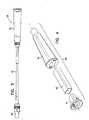
- Figs. 2-4schematically show details of catheter 22 and adapter 26, particularly in regard to connector assembly 28, in accordance with an embodiment of the present invention.
- Figs. 2 and 3are side views of the catheter and the adapter, respectively, while Fig. 4 is an exploded view showing parts of the connector assembly.
- catheter 22comprises a connector 40 at its proximal end, which is inserted into a receptacle 44 in connector assembly 28.
- the receptacleis connected via a cable 42 to connector 30, which plugs into console 24, as noted above.
- a Mu-metal shield 46slides over and encloses receptacle 44, and a shell 48 slides over and covers the shield, resulting in the appearance shown in Fig. 3 .
- Shell 48comprises a suitable insulating material, typically a plastic, such as polybutylene terephthalate (PBT).
- PBTpolybutylene terephthalate
- Mu-metalis a nickel-iron alloy, which undergoes a special annealing process that results in very high magnetic permeability ( ⁇ ).
- Shield 46is made in the form of a tube, with an overlapping, welded seam, so that the tube behaves as a unitary sheath without any discontinuities along its length through which electromagnetic fields may leak. Mu-metal parts of this sort are available to order from a number of suppliers, including MuShield (Londonderry, New Hampshire). Shield 46 defines and encloses an internal volume, contained within the tube, in which external magnetic fields are strongly attenuated, so that wires and other electrical components are protected from magnetic interference.
- the inventorshave found that within this protected volume, the magnetic fields are reduced by three orders of magnitude relative to the field strength outside the volume. Although the ends of the tube are open, boundary conditions constrain the field to drop sharply from the ends of the tube toward the center, where the connector itself is located.
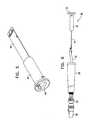
- FIGs. 5 and 6schematically show further details of the production of adapter 26, in accordance with an embodiment of the present invention.
- Fig. 5is a pictorial illustration showing internal components of connector assembly 28 at one stage of production
- Fig. 6is a side view of adapter 26 at a later stage of production.
- shield 46has been slid over the rear side of receptacle 44 (the side opposite the opening, at the left side in Figs. 4 and 5 , into which connector 40 is inserted), and has been fastened in place, using a suitable glue, for example.
- a miniature printed circuit board 50Prior to inserting the receptacle into the shield, a miniature printed circuit board 50 is connected, typically by soldering, to the pins of receptacle 44.
- the printed circuit boardhas pads for accommodating certain circuit components and traces for connecting the pins and the components, as shown in Fig. 7 .
- Cable 42is soldered to the appropriate traces on board 50.
- Cover 48is then slid forward over the cable from the location shown in Fig. 6 so that it covers shield 46.
- a strain-relief nut 52is tightened over a thread at the proximal end of cover 48 in order to hold the cover in place.
- cover 48 of connector assembly 28can be used conveniently by the operator of system 20 as a handle for catheter 22. When the procedure is finished, the operator simply unplugs the catheter from the handle and, typically, disposes of the catheter.
- Adapter 28may be reused in subsequent procedures and typically does not require sterilization between procedures, since only the (disposable) catheter comes into contact with the patient.
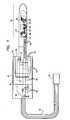
- Fig. 7is a block diagram that schematically shows electrical components of catheter 22 and adapter 26, in accordance with an embodiment of the present invention.
- the figureparticularly shows details of sensor 36 and of the connections and components that are contained in the shielded volume that is defined and enclosed by shield 46 in connector assembly 28.
- Sensor 36comprises three non-concentric coils 60, which may be aligned along mutually-orthogonal axes.
- Coil wires 62wound in tightly-twisted pairs, are connected via cables 64 running through catheter 22 to pins 66 of connector 40.
- the twisted-pair wiresare unwound only in connector 40, which is contained in the shielded volume of shield 46.
- Pins 66mate with sockets 68 of receptacle 44.
- cables 64comprise shields 70, which are connected via a ground pin 72 of connector 40 to a ground line 74 in receptacle 44.
- Sockets 68connect the outputs of coils 60 to respective amplifiers 80, which may be mounted on board 50, as described above.
- Amplifiers 80typically comprise low-noise, low-distortion instrumentation amplifiers, such as the INA103 amplifier produced by Burr-Brown (Tucson, Arizona). For applications in magnetic position sensing, as in system 20, the amplifiers are set and calibrated for high gain, typically in the range of 2000. Amplifiers 80 and the traces leading to their inputs are likewise protected by shield 46.
- the amplified signals produced by amplifiers 80pass through conductors 82 to cable 42, which conveys the signals via connector 30 to console 24.
- these amplified signalsare considerably stronger than the output signals from coils 60, they are much less susceptible to magnetic interference.
- the amplifiersmay be located elsewhere (in console 24, for example), and only connector 40 and receptacle 44 are contained in shield 46.
- the consoletypically filters, digitizes and processes the signals in order to compute the location and orientation coordinates of distal end 34 of catheter 22.
- Catheter 22may comprise a digital component 76, such as a memory component, which stores identification and calibration information regarding the catheter. Digital information from component 76 is conveyed via a bus 84 and cable 42 to console 24. Alternatively or additionally, connector assembly 28 may comprise a digital section (not shown), which receives and processes the information stored by digital component 76, possibly along with other information stored in this digital section, and may then pass the results to the console. This sort of arrangement is described in the above-mentioned US 2007/0185397 .
- the principles of the present inventionmay similarly be applied in preventing magnetic interference with signals that are output by other types of sensors that must operate in strong magnetic fields.
- sensorsmay include, without limitation, impedance-based and ultrasonic position sensors, as well as sensing electrodes, chemical sensors, temperature sensors, pressure sensors and ultrasonic transducers.
- sensing electrodesmay include, without limitation, impedance-based and ultrasonic position sensors, as well as sensing electrodes, chemical sensors, temperature sensors, pressure sensors and ultrasonic transducers.
- these embodimentsrelate specifically to cardiac catheters, the methods of shielding that are described above may likewise be used in connecting sensing probes of other types to respective consoles.
Landscapes
- Health & Medical Sciences (AREA)
- Life Sciences & Earth Sciences (AREA)
- Engineering & Computer Science (AREA)
- Surgery (AREA)
- Animal Behavior & Ethology (AREA)
- Veterinary Medicine (AREA)
- Biomedical Technology (AREA)
- Heart & Thoracic Surgery (AREA)
- Medical Informatics (AREA)
- Molecular Biology (AREA)
- Public Health (AREA)
- General Health & Medical Sciences (AREA)
- Physics & Mathematics (AREA)
- Biophysics (AREA)
- Pathology (AREA)
- Nuclear Medicine, Radiotherapy & Molecular Imaging (AREA)
- Radiology & Medical Imaging (AREA)
- Human Computer Interaction (AREA)
- Robotics (AREA)
- Cardiology (AREA)
- Media Introduction/Drainage Providing Device (AREA)
Abstract
Description
- This application is a continuation-in-part of
U.S. Patent Application 11/351,135, filed February 9, 2006 US 2007/0185397 A1 , whose disclosure is incorporated herein by reference. - The present invention relates generally to systems for medical diagnosis and treatment, and specifically to shielding of probes and sensors that are used in such systems against magnetic interference.
- Tracking the position of probes within the body is required for many medical procedures. For example, various systems have been developed for determining the position coordinates of an object in the body based on magnetic field sensing. These systems use sensors affixed to the object to measure the relative strengths of externally-generated magnetic fields and to derive from these measurements the position of the object. Methods for magnetic-based position sensing are disclosed, for example, in
U.S. Patents 5,391,199 ,5,443,489 , and6,788,967 to Ben-Haim , inU.S. Patent 6,690,963 to Ben-Haim, et al. , inU.S. Patent 5,558,091 to Acker et al. , inU.S. Patent 6,172,499 to Ashe , and inU.S. Patent 6,177,792 to Govari . - The above-mentioned
US 2007/0185397 describes methods for generating, storing and computing calibration information with respect to an invasive medical probe, such as a catheter. The probe connects via a suitable mating connector to an adapter, which in turn connects, via another mating connector, to a console. The probe comprises a sensor, such as a magnetic position sensor, and a probe microcircuit, which stores sensor calibration data. The adapter comprises a signal processing circuit for processing the signal that is output by the sensor. The adapter also comprises its own microcircuit, which stores calibration data with respect to the signal processing circuit. A microcontroller in the adapter computes combined calibration data based on the data from both of the microcircuits. Signal analysis circuitry in the console receives the processed signal and analyzes this signal using the combined calibration data provided by the probe adapter. U.S. Patent 4,290,663, to Fowler et al. , describes a method of interconnecting screened cables. This patent states that reduction of magnetic reluctance of the magnetic path between inner and outer surfaces of the screen in the region of the interconnection decreases external interference to the screened cable. Mu-metal can be used to reduce the magnetic reluctance.- Some types of electrical devices must operate under strong magnetic fields, such as the magnetic fields that are used in the above-mentioned magnetic position sensing systems. Care must be taken in the design and handling of the electrical wires in such devices to avoid picking up interference from the magnetic fields.
- For this purpose, in an embodiment described in the above-mentioned
US 2007/0185397 , the mating connectors of the catheter and the adapter comprise magnetic shielding, using Mu-metal, for example, to reduce magnetic interference with the weak signals on the pins of the connectors. The inventors have discovered, furthermore, that for effective protection against interference, it is helpful that the circuit elements that are susceptible to magnetic interference, such as exposed pins and associated wires in a connector, be entirely contained in a volume that is enclosed by the shielding, without open seams through which magnetic fields may leak. - There is therefore provided, in accordance with an embodiment of the present invention, electrical apparatus, including:
- a probe, having a proximal end and a distal end, the probe including a sensor, which outputs a sensor signal, and a first connector at the proximal end of the probe, electrically coupled at least to the sensor;
- a probe adapter, including a second connector, which is arranged to mate with the first connector, and a third connector, for coupling to a console; and
- a shield, including a material of high magnetic permeability, which is configured to enclose an internal volume containing the first and second connectors when the probe is connected to the probe adapter.
- In a disclosed embodiment, the material is a Mu-metal, and the shield has a unitary, tubular form, which defines the internal volume.
- In some embodiments, the probe adapter includes at least one amplifier, which is contained in the internal volume and is coupled to process the sensor signal so as to output a amplified signal via the third connector to the console.
- In one embodiment, the sensor includes a position sensor, which is operative to generate the sensor signal responsively to a magnetic field applied externally to the body. The probe may include a catheter, whose distal end is configured for insertion into a heart of the subject.
- In some embodiments, the probe includes a twisted pair of wires, which are coupled to convey the sensor signal from the sensor to the first connector, and the wires in the twisted pair are separated only within the internal volume of the shield for connection to respective pins of the first connector.
- In a disclosed embodiment, the apparatus includes a handle, which contains the second connector and the shield, and the proximal end of the probe is configured to be plugged into and removed from the handle.
- There is also provided, in accordance with an embodiment of the present invention, a method for producing an electrical device, including:
- providing a probe, having a proximal end and a distal end, which includes a sensor, which outputs a sensor signal, and a first connector at the proximal end of the probe, electrically coupled at least to the sensor;
- providing a second connector, for use in a probe adapter to mate with the first connector;
- coupling a third connector to connect the probe adapter to a console; and
- configuring a shield, including a material of high magnetic permeability, so as to enclose an internal volume containing the first and second connectors when the probe is connected to the probe adapter.
- The present invention will be more fully understood from the following detailed description of the embodiments thereof, taken together with the drawings in which:
Fig. 1 is a schematic, pictorial illustration of a catheter-based medical system, in accordance with an embodiment of the present invention;Fig. 2 is a schematic side view of a catheter, in accordance with an embodiment of the present invention;Fig. 3 is a schematic side view of an adapter for connecting a catheter to a console, in accordance with an embodiment of the present invention;Fig. 4 is a schematic, pictorial illustration showing an exploded view of parts of a connector assembly, in accordance with an embodiment of the present invention;Fig. 5 is a schematic, pictorial illustration showing internal components of a connector assembly, in accordance with an embodiment of the present invention;Fig. 6 is a schematic side view of an adapter at a stage of production, in accordance with an embodiment of the present invention; andFig. 7 is a block diagram that schematically shows electrical components of a catheter and adapter, in accordance with an embodiment of the present invention.Fig. 1 is a schematic, pictorial illustration of a system 20 for cardiac catheterization, in accordance with an embodiment of the present invention. System 20 may be based, for example, on the CARTO™ system, produced by Biosense Webster Inc. (Diamond Bar, California). This system comprises an invasive probe in the form of acatheter 22 and acontrol console 24.Catheter 22 is typically provided to users as a disposable unit, which mates with areusable adapter 26 via aconnector assembly 28, which is described in detail hereinbelow. (The connector assembly may also serve as a handle, for use by a practitioner in inserting and manipulating the catheter within the patient's body.)Adapter 26 terminates in aconnector 30, typically a plug, that mates with acorresponding connector 32, such as a receptacle, onconsole 24. In the context of the present patent application and in the claims, the term "connector" is used in the conventional sense, to mean any sort of electrical plug or similar device that can be readily connected and disconnected in the field without technical operations such as soldering or crimping.Catheter 22 comprises an insertion tube whosedistal end 34 is designed to be passed through the vascular system and into a chamber of the heart. The catheter contains aposition sensor 36, which is used in determining position coordinates ofdistal end 34. In the CARTO system, the position sensor comprises three coils (shown below inFig. 7 ), which output signals in response to magnetic fields that are applied byfield generator coils 38. These fields are typically in the range of several hundred to several thousand Hertz, although lower or higher frequencies may be used, as well. The signals output by the position sensor are typically amplified by amplifiers inconnector assembly 28, as described hereinbelow.Console 24 processes the amplified signals to determine the coordinates of the distal end of the catheter. Further details of the theory and operation of magnetic position sensing systems of this type are provided in the patents cited in the Background of the Invention.Distal end 34 ofcatheter 22 may also comprise one or more functional elements (not shown in the figures) for performing therapeutic and/or diagnostic functions. For example, the functional elements may comprise an electrode or an ultrasound transducer.- In designing system 20 (and likewise other types of medical probes that must operate in an environment of strong magnetic fields), care should be taken to avoid picking up interference in the wires carrying the signals from the sensors at
distal end 34 ofcatheter 22 to the amplifier circuits inconnector assembly 28 and/or inconsole 24. Field generator coils 38 radiate strong fields in order to enable the position tracking system to achieve sufficient signal/noise ratio, with very small sensor coils in the catheter, to provide accurate position measurements. Long wires leading from the sensor coils to the proximal end of the catheter pass through these strong fields, and any loops in the wires will pick up interference. To minimize this interference, the coils are typically connected to the amplifier circuits by twisted pairs of thin wires running through the catheter with a high twist rate. The wires are untwisted and separated as close as possible to the input pins of the amplifiers in order to minimize the area that can pick up the electromagnetic field. - Nevertheless, given the strength of the magnetic fields and the weakness of the signals output by
sensor 36, even minimal pickup of the magnetic fields at the input to the amplifiers can result in serious errors in the position coordinates ofdistal end 34. Embodiments of the present invention address this problem by incorporating a material with high magnetic permeability (i.e., with relative permeability of 1000 or greater) inconnector assembly 28, as described in detail hereinbelow. The inventors have found that Mu-metal gives good results in this regard. This sort of shielding is important particularly in protecting position signals from magnetic interference, but it may also be used, additionally or alternatively, in protecting signals associated with functional elements of other types. Furthermore, although the present embodiment relates specifically to a cardiac catheter, the principles of the present invention may similarly be applied to other types of medical probes. - Reference is now made to
Figs. 2-4 , which schematically show details ofcatheter 22 andadapter 26, particularly in regard toconnector assembly 28, in accordance with an embodiment of the present invention.Figs. 2 and3 are side views of the catheter and the adapter, respectively, whileFig. 4 is an exploded view showing parts of the connector assembly. As shown in these figures,catheter 22 comprises aconnector 40 at its proximal end, which is inserted into areceptacle 44 inconnector assembly 28. The receptacle is connected via acable 42 toconnector 30, which plugs intoconsole 24, as noted above. A Mu-metal shield 46 slides over and enclosesreceptacle 44, and ashell 48 slides over and covers the shield, resulting in the appearance shown inFig. 3 .Shell 48 comprises a suitable insulating material, typically a plastic, such as polybutylene terephthalate (PBT). - Mu-metal, as is known in the art, is a nickel-iron alloy, which undergoes a special annealing process that results in very high magnetic permeability (µ).
Shield 46 is made in the form of a tube, with an overlapping, welded seam, so that the tube behaves as a unitary sheath without any discontinuities along its length through which electromagnetic fields may leak. Mu-metal parts of this sort are available to order from a number of suppliers, including MuShield (Londonderry, New Hampshire).Shield 46 defines and encloses an internal volume, contained within the tube, in which external magnetic fields are strongly attenuated, so that wires and other electrical components are protected from magnetic interference. The inventors have found that within this protected volume, the magnetic fields are reduced by three orders of magnitude relative to the field strength outside the volume. Although the ends of the tube are open, boundary conditions constrain the field to drop sharply from the ends of the tube toward the center, where the connector itself is located. Figs. 5 and 6 schematically show further details of the production ofadapter 26, in accordance with an embodiment of the present invention.Fig. 5 is a pictorial illustration showing internal components ofconnector assembly 28 at one stage of production, whileFig. 6 is a side view ofadapter 26 at a later stage of production. In these figures,shield 46 has been slid over the rear side of receptacle 44 (the side opposite the opening, at the left side inFigs. 4 and5 , into whichconnector 40 is inserted), and has been fastened in place, using a suitable glue, for example.- Prior to inserting the receptacle into the shield, a miniature printed
circuit board 50 is connected, typically by soldering, to the pins ofreceptacle 44. The printed circuit board has pads for accommodating certain circuit components and traces for connecting the pins and the components, as shown inFig. 7 .Cable 42 is soldered to the appropriate traces onboard 50.Cover 48 is then slid forward over the cable from the location shown inFig. 6 so that it coversshield 46. A strain-relief nut 52 is tightened over a thread at the proximal end ofcover 48 in order to hold the cover in place. - After insertion of
connector 40 intoreceptacle 44, cover 48 ofconnector assembly 28 can be used conveniently by the operator of system 20 as a handle forcatheter 22. When the procedure is finished, the operator simply unplugs the catheter from the handle and, typically, disposes of the catheter.Adapter 28, on the other hand, may be reused in subsequent procedures and typically does not require sterilization between procedures, since only the (disposable) catheter comes into contact with the patient. Fig. 7 is a block diagram that schematically shows electrical components ofcatheter 22 andadapter 26, in accordance with an embodiment of the present invention. The figure particularly shows details ofsensor 36 and of the connections and components that are contained in the shielded volume that is defined and enclosed byshield 46 inconnector assembly 28.Sensor 36 comprises threenon-concentric coils 60, which may be aligned along mutually-orthogonal axes.Coil wires 62, wound in tightly-twisted pairs, are connected viacables 64 running throughcatheter 22 topins 66 ofconnector 40. (For the sake of simplicity, only a single pin is connected to each cable inFig. 7 , but in actuality a respective pair of pins may be connected to the pair of twisted wires in each cable.) Typically, the twisted-pair wires are unwound only inconnector 40, which is contained in the shielded volume ofshield 46.Pins 66 mate withsockets 68 ofreceptacle 44. Typically,cables 64 compriseshields 70, which are connected via a ground pin 72 ofconnector 40 to aground line 74 inreceptacle 44.Sockets 68 connect the outputs ofcoils 60 torespective amplifiers 80, which may be mounted onboard 50, as described above.Amplifiers 80 typically comprise low-noise, low-distortion instrumentation amplifiers, such as the INA103 amplifier produced by Burr-Brown (Tucson, Arizona). For applications in magnetic position sensing, as in system 20, the amplifiers are set and calibrated for high gain, typically in the range of 2000.Amplifiers 80 and the traces leading to their inputs are likewise protected byshield 46. The amplified signals produced byamplifiers 80 pass throughconductors 82 tocable 42, which conveys the signals viaconnector 30 to console 24. Because these amplified signals are considerably stronger than the output signals fromcoils 60, they are much less susceptible to magnetic interference. Alternatively, in other configurations, the amplifiers may be located elsewhere (inconsole 24, for example), and onlyconnector 40 andreceptacle 44 are contained inshield 46. The console typically filters, digitizes and processes the signals in order to compute the location and orientation coordinates ofdistal end 34 ofcatheter 22.Catheter 22 may comprise adigital component 76, such as a memory component, which stores identification and calibration information regarding the catheter. Digital information fromcomponent 76 is conveyed via abus 84 andcable 42 to console 24. Alternatively or additionally,connector assembly 28 may comprise a digital section (not shown), which receives and processes the information stored bydigital component 76, possibly along with other information stored in this digital section, and may then pass the results to the console. This sort of arrangement is described in the above-mentionedUS 2007/0185397 .- Although the embodiments described above relate specifically to magnetic position sensors and systems, the principles of the present invention may similarly be applied in preventing magnetic interference with signals that are output by other types of sensors that must operate in strong magnetic fields. Examples of such sensors may include, without limitation, impedance-based and ultrasonic position sensors, as well as sensing electrodes, chemical sensors, temperature sensors, pressure sensors and ultrasonic transducers. Furthermore, although these embodiments relate specifically to cardiac catheters, the methods of shielding that are described above may likewise be used in connecting sensing probes of other types to respective consoles.
- It will thus be appreciated that the embodiments described above are cited by way of example, and that the present invention is not limited to what has been particularly shown and described hereinabove. Rather, the scope of the present invention includes both combinations and subcombinations of the various features described hereinabove, as well as variations and modifications thereof which would occur to persons skilled in the art upon reading the foregoing description and which are not disclosed in the prior art.
Claims (14)
- Electrical apparatus, comprising:a probe, having a proximal end and a distal end, the probe comprising:a sensor, which outputs a sensor signal; anda first connector at the proximal end of the probe, electrically coupled at least to the sensor; a probe adapter, comprising:a second connector, which is arranged to mate with the first connector; anda third connector, for coupling to a console;anda shield, comprising a material of high magnetic permeability, which is configured to enclose an internal volume containing the first and second connectors when the probe is connected to the probe adapter.
- The apparatus according to claim 1, wherein the probe adapter comprises at least one amplifier, which is contained in the internal volume and is coupled to process the sensor signal so as to output a amplified signal via the third connector to the console.
- The apparatus according to claim 1, wherein the sensor comprises a position sensor, which is operative to generate the sensor signal responsively to a magnetic field applied externally to the body.
- The apparatus according to claim 1, wherein the probe comprises a catheter, and wherein the distal end is configured for insertion into a heart of the subject.
- The apparatus according to claim 1, wherein the probe comprises a twisted pair of wires, which are coupled to convey the sensor signal from the sensor to the first connector, and wherein the wires in the twisted pair are separated only within the internal volume of the shield for connection to respective pins of the first connector.
- The apparatus according to claim 1, and comprising a handle, which contains the second connector and the shield, and wherein the proximal end of the probe is configured to be plugged into and removed from the handle.
- A method for producing an electrical device, comprising:providing a probe, having a proximal end and a distal end, which comprises a sensor, which outputs a sensor signal, and a first connector at the proximal end of the probe, electrically coupled at least to the sensor;providing a second connector, for use in a probe adapter to mate with the first connector;coupling a third connector to connect the probe adapter to a console; andconfiguring a shield, comprising a material of high magnetic permeability, so as to enclose an internal volume containing the first and second connectors when the probe is connected to the probe adapter.
- The apparatus according to claim 1 or the method according to claim 7, wherein the material is a Mu-metal.
- The apparatus according to claim 1 or the method according to claim 7, wherein the shield has a unitary, tubular form, which defines the internal volume.
- The method according to claim 7, and comprising coupling at least one amplifier in the probe adapter to the second connector so as to receive and process the sensor signal in order to output a amplified signal via the third connector to the console, wherein the at least one amplifier is contained in the internal volume of the shield.
- The method according to claim 7, wherein the sensor comprises a position sensor, which is operative to generate the sensor signal responsively to a magnetic field applied externally to the body.
- The method according to claim 7, wherein the probe comprises a catheter for insertion into a heart of the subject.
- The method according to claim 7, wherein providing the probe comprises coupling a twisted pair of wires to convey the sensor signal from the sensor to the first connector, and separating the wires in the twisted pair for connection to respective pins of the first connector only within a part of the probe that is within the internal volume of the shield.
- The method according to claim 7, and comprising:assembling a handle over the second connector and the shield;plugging the proximal end of the probe into the handle prior to performing a medical procedure using the probe; andremoving the proximal end of the probe from the handle after performing the medical procedure.
Applications Claiming Priority (1)
| Application Number | Priority Date | Filing Date | Title |
|---|---|---|---|
| US12/169,693US8798711B2 (en) | 2006-02-09 | 2008-07-09 | Shielding of catheter handle |
Publications (1)
| Publication Number | Publication Date |
|---|---|
| EP2143377A1true EP2143377A1 (en) | 2010-01-13 |
Family
ID=41021055
Family Applications (1)
| Application Number | Title | Priority Date | Filing Date |
|---|---|---|---|
| EP20090251760WithdrawnEP2143377A1 (en) | 2008-07-09 | 2009-07-08 | Shielding of catheter handle |
Country Status (7)
| Country | Link |
|---|---|
| US (1) | US8798711B2 (en) |
| EP (1) | EP2143377A1 (en) |
| JP (1) | JP5701489B2 (en) |
| CN (1) | CN101623195B (en) |
| AU (1) | AU2009202758B2 (en) |
| CA (1) | CA2671630C (en) |
| IL (1) | IL199740A (en) |
Cited By (1)
| Publication number | Priority date | Publication date | Assignee | Title |
|---|---|---|---|---|
| EP2397100A1 (en)* | 2010-06-16 | 2011-12-21 | Biosense Webster (Israel), Ltd | Position dependent interference cancellation |
Families Citing this family (22)
| Publication number | Priority date | Publication date | Assignee | Title |
|---|---|---|---|---|
| US8664938B2 (en)* | 2010-05-05 | 2014-03-04 | Ysi Incorporated | Replaceable probe head |
| US9170132B2 (en) | 2010-05-05 | 2015-10-27 | Ysi Incorporated | Replaceable probe head having an operational amplifier |
| US9977096B2 (en)* | 2011-07-07 | 2018-05-22 | Biosense Webster (Israel) Ltd. | Connector with active shielding |
| US8634901B2 (en) | 2011-09-30 | 2014-01-21 | Covidien Lp | ECG leadwire system with noise suppression and related methods |
| US20130296729A1 (en) | 2012-05-04 | 2013-11-07 | Biosense Webster (Israel), Ltd. | Catheter having two-piece connector for a split handle assembly |
| US9386967B2 (en)* | 2012-07-31 | 2016-07-12 | St. Jude Medical, Atrial Fibrillation Division, Inc. | Magnetic field-compatible components of a medical diagnostic and/or therapeutic system |
| US9703317B2 (en)* | 2013-03-14 | 2017-07-11 | Biosense Webster (Israel) Ltd. | Dongle with shape memory |
| EP3110344B1 (en) | 2014-02-28 | 2020-02-19 | Blue Belt Technologies, Inc. | System and methods for positioning bone cut guide |
| CN103893898B (en)* | 2014-03-24 | 2016-04-20 | 广州保瑞医疗技术有限公司 | A kind of intelligence for tracheal intubation moves back pipe device |
| CN107205784B (en) | 2014-07-03 | 2021-03-09 | 圣犹达医疗用品国际控股有限公司 | Local magnetic field generator |
| WO2016025170A1 (en)* | 2014-08-11 | 2016-02-18 | Halliburton Energy Services, Inc. | Probe assembly for performing electromagnetic field mapping around an antenna |
| US11109774B2 (en)* | 2015-07-06 | 2021-09-07 | Biosense Webster (Israel) Ltd. | Flat location pad using nonconcentric coils |
| AU2016204942A1 (en)* | 2015-07-23 | 2017-02-09 | Biosense Webster (Israel) Ltd. | Surface registration of a ct image with a magnetic tracking system |
| CN108472074B (en)* | 2015-12-31 | 2021-06-29 | 圣犹达医疗用品国际控股有限公司 | Connector shrouds for sensor-enabled medical devices |
| CN108601625B (en)* | 2016-02-03 | 2020-03-17 | 圣犹达医疗用品国际控股有限公司 | System and method for eliminating source induced errors |
| US11175161B2 (en) | 2016-02-23 | 2021-11-16 | Mediatek Inc. | Inductive sensor for position/orientation sensing |
| US11090063B2 (en) | 2016-05-25 | 2021-08-17 | Blue Belt Technologies, Inc. | Cutting assembly for use with electromagnetic tracking |
| US10032552B2 (en)* | 2016-08-30 | 2018-07-24 | Becton, Dickinson And Company | Cover for tissue penetrating device with integrated magnets and magnetic shielding |
| US10148282B1 (en)* | 2017-08-29 | 2018-12-04 | Biosense Webster (Israel) Ltd. | Heterodyne-mimicking adapter |
| US10359464B2 (en) | 2017-09-18 | 2019-07-23 | Biosense Webster (Israel) Ltd. | Cable and associated continuity monitoring system and method |
| EP4064999A4 (en)* | 2019-11-27 | 2023-12-27 | NuVera Medical, Inc. | CABLE ROUTING AND ARRANGEMENT FOR MEDICAL DEVICE HANDLES |
| US20230012775A1 (en)* | 2021-07-16 | 2023-01-19 | Nuvera Medical, Inc. | Cable routing and assemblies for medical device handles |
Citations (10)
| Publication number | Priority date | Publication date | Assignee | Title |
|---|---|---|---|---|
| US4290663A (en) | 1979-10-23 | 1981-09-22 | United Kingdom Atomic Energy Authority | In high frequency screening of electrical systems |
| US5391199A (en) | 1993-07-20 | 1995-02-21 | Biosense, Inc. | Apparatus and method for treating cardiac arrhythmias |
| US5558091A (en) | 1993-10-06 | 1996-09-24 | Biosense, Inc. | Magnetic determination of position and orientation |
| US5868664A (en)* | 1996-02-23 | 1999-02-09 | Envision Medical Corporation | Electrically isolated sterilizable endoscopic video camera head |
| US6080101A (en)* | 1998-08-26 | 2000-06-27 | Olympus Optical Co. Ltd. | Endoscope video camera head which can be autoclaved |
| US6172499B1 (en) | 1999-10-29 | 2001-01-09 | Ascension Technology Corporation | Eddy current error-reduced AC magnetic position measurement system |
| US6177792B1 (en) | 1996-03-26 | 2001-01-23 | Bisense, Inc. | Mutual induction correction for radiator coils of an objects tracking system |
| WO2003101534A1 (en)* | 2002-06-04 | 2003-12-11 | Biophan Technologies, Inc. | Nuclear magnetic resonance spectrometer assembly |
| US6690963B2 (en) | 1995-01-24 | 2004-02-10 | Biosense, Inc. | System for determining the location and orientation of an invasive medical instrument |
| US20070185397A1 (en) | 2006-02-09 | 2007-08-09 | Assaf Govari | Two-stage calibration of medical probes |
Family Cites Families (18)
| Publication number | Priority date | Publication date | Assignee | Title |
|---|---|---|---|---|
| US5357953A (en) | 1992-05-21 | 1994-10-25 | Puritan-Bennett Corporation | Measurement device and method of calibration |
| US5772597A (en) | 1992-09-14 | 1998-06-30 | Sextant Medical Corporation | Surgical tool end effector |
| US5876336A (en) | 1994-10-11 | 1999-03-02 | Ep Technologies, Inc. | Systems and methods for guiding movable electrode elements within multiple-electrode structure |
| US5515853A (en) | 1995-03-28 | 1996-05-14 | Sonometrics Corporation | Three-dimensional digital ultrasound tracking system |
| US6246898B1 (en) | 1995-03-28 | 2001-06-12 | Sonometrics Corporation | Method for carrying out a medical procedure using a three-dimensional tracking and imaging system |
| US5697377A (en) | 1995-11-22 | 1997-12-16 | Medtronic, Inc. | Catheter mapping system and method |
| IL125755A (en)* | 1996-02-15 | 2003-05-29 | Biosense Inc | Catheter calibration and usage monitoring system |
| EP0892908B1 (en)* | 1996-03-26 | 2003-05-14 | Biosense, Inc. | Mutual induction correction |
| US6019725A (en) | 1997-03-07 | 2000-02-01 | Sonometrics Corporation | Three-dimensional tracking and imaging system |
| US5944022A (en) | 1997-04-28 | 1999-08-31 | American Cardiac Ablation Co. Inc. | Catheter positioning system |
| GB2331807B (en) | 1997-11-15 | 2002-05-29 | Roke Manor Research | Catheter tracking system |
| CA2286107C (en) | 1998-02-10 | 2007-01-09 | Biosense, Inc. | Improved catheter calibration |
| AU5882599A (en) | 1998-09-24 | 2000-04-10 | Super Dimension Ltd. | System and method for determining the location of a catheter during an intra-body medical procedure |
| US6626902B1 (en) | 2000-04-12 | 2003-09-30 | University Of Virginia Patent Foundation | Multi-probe system |
| JP2003047653A (en)* | 2001-05-28 | 2003-02-18 | Terumo Corp | Medical composite material, medical tubular body and medical instrument |
| US7194297B2 (en)* | 2001-11-13 | 2007-03-20 | Boston Scientific Scimed, Inc. | Impedance-matching apparatus and construction for intravascular device |
| US6774624B2 (en) | 2002-03-27 | 2004-08-10 | Ge Medical Systems Global Technology Company, Llc | Magnetic tracking system |
| US7090639B2 (en) | 2003-05-29 | 2006-08-15 | Biosense, Inc. | Ultrasound catheter calibration system |
- 2008
- 2008-07-09USUS12/169,693patent/US8798711B2/enactiveActive
- 2009
- 2009-07-07AUAU2009202758Apatent/AU2009202758B2/ennot_activeCeased
- 2009-07-07ILIL199740Apatent/IL199740A/enactiveIP Right Grant
- 2009-07-08EPEP20090251760patent/EP2143377A1/ennot_activeWithdrawn
- 2009-07-08JPJP2009161484Apatent/JP5701489B2/enactiveActive
- 2009-07-09CACA2671630Apatent/CA2671630C/enactiveActive
- 2009-07-09CNCN200910140224.1Apatent/CN101623195B/enactiveActive
Patent Citations (12)
| Publication number | Priority date | Publication date | Assignee | Title |
|---|---|---|---|---|
| US4290663A (en) | 1979-10-23 | 1981-09-22 | United Kingdom Atomic Energy Authority | In high frequency screening of electrical systems |
| US5391199A (en) | 1993-07-20 | 1995-02-21 | Biosense, Inc. | Apparatus and method for treating cardiac arrhythmias |
| US5443489A (en) | 1993-07-20 | 1995-08-22 | Biosense, Inc. | Apparatus and method for ablation |
| US5558091A (en) | 1993-10-06 | 1996-09-24 | Biosense, Inc. | Magnetic determination of position and orientation |
| US6690963B2 (en) | 1995-01-24 | 2004-02-10 | Biosense, Inc. | System for determining the location and orientation of an invasive medical instrument |
| US5868664A (en)* | 1996-02-23 | 1999-02-09 | Envision Medical Corporation | Electrically isolated sterilizable endoscopic video camera head |
| US6177792B1 (en) | 1996-03-26 | 2001-01-23 | Bisense, Inc. | Mutual induction correction for radiator coils of an objects tracking system |
| US6788967B2 (en) | 1997-05-14 | 2004-09-07 | Biosense, Inc. | Medical diagnosis, treatment and imaging systems |
| US6080101A (en)* | 1998-08-26 | 2000-06-27 | Olympus Optical Co. Ltd. | Endoscope video camera head which can be autoclaved |
| US6172499B1 (en) | 1999-10-29 | 2001-01-09 | Ascension Technology Corporation | Eddy current error-reduced AC magnetic position measurement system |
| WO2003101534A1 (en)* | 2002-06-04 | 2003-12-11 | Biophan Technologies, Inc. | Nuclear magnetic resonance spectrometer assembly |
| US20070185397A1 (en) | 2006-02-09 | 2007-08-09 | Assaf Govari | Two-stage calibration of medical probes |
Cited By (5)
| Publication number | Priority date | Publication date | Assignee | Title |
|---|---|---|---|---|
| EP2397100A1 (en)* | 2010-06-16 | 2011-12-21 | Biosense Webster (Israel), Ltd | Position dependent interference cancellation |
| AU2011202360A1 (en)* | 2010-06-16 | 2012-01-19 | Biosense Webster (Israel) Ltd. | Position dependent interference cancellation |
| US8141558B2 (en) | 2010-06-16 | 2012-03-27 | Biosense Webster (Israel), Ltd. | Position dependent interference cancellation |
| CN102389334A (en)* | 2010-06-16 | 2012-03-28 | 韦伯斯特生物官能(以色列)有限公司 | Position dependent interference cancellation |
| CN102389334B (en)* | 2010-06-16 | 2016-01-20 | 韦伯斯特生物官能(以色列)有限公司 | Depend on that the interference effect of position is eliminated |
Also Published As
| Publication number | Publication date |
|---|---|
| AU2009202758B2 (en) | 2014-03-27 |
| US20080306380A1 (en) | 2008-12-11 |
| CA2671630A1 (en) | 2010-01-09 |
| AU2009202758A1 (en) | 2010-01-28 |
| IL199740A (en) | 2012-12-31 |
| JP2010017549A (en) | 2010-01-28 |
| CA2671630C (en) | 2017-04-11 |
| CN101623195B (en) | 2014-03-26 |
| CN101623195A (en) | 2010-01-13 |
| JP5701489B2 (en) | 2015-04-15 |
| IL199740A0 (en) | 2010-04-29 |
| US8798711B2 (en) | 2014-08-05 |
Similar Documents
| Publication | Publication Date | Title |
|---|---|---|
| CA2671630C (en) | Shielding of catheter handle | |
| CA2575659C (en) | Two-stage calibration of medical probes | |
| CN102389334B (en) | Depend on that the interference effect of position is eliminated | |
| US10130344B2 (en) | Magnetic field-compatible components of a medical diagnostic and/or therapeutic system | |
| US11045110B2 (en) | System and method of cancellation of source induced errors | |
| US10838017B2 (en) | Cable and associated continuity monitoring system and method | |
| US20050124898A1 (en) | Method and apparatus for isolating a catheter interface | |
| CN110638515B (en) | Magnetic pickup elimination by compensating leads | |
| HK1110192B (en) | Two-stage calibration of medical probes |
Legal Events
| Date | Code | Title | Description |
|---|---|---|---|
| PUAI | Public reference made under article 153(3) epc to a published international application that has entered the european phase | Free format text:ORIGINAL CODE: 0009012 | |
| AK | Designated contracting states | Kind code of ref document:A1 Designated state(s):AT BE BG CH CY CZ DE DK EE ES FI FR GB GR HR HU IE IS IT LI LT LU LV MC MK MT NL NO PL PT RO SE SI SK SM TR | |
| RIN1 | Information on inventor provided before grant (corrected) | Inventor name:ATIAS, MEIRON Inventor name:BAR-TAL, MEIR Inventor name:PARCHAK, YOCHAI Inventor name:EPHRATH, YARON Inventor name:ALTMANN, ANDRES CLAUDIO Inventor name:GOVARI, ASSAF | |
| 17P | Request for examination filed | Effective date:20100622 | |
| 17Q | First examination report despatched | Effective date:20100716 | |
| STAA | Information on the status of an ep patent application or granted ep patent | Free format text:STATUS: THE APPLICATION IS DEEMED TO BE WITHDRAWN | |
| 18D | Application deemed to be withdrawn | Effective date:20110127 |