EP1995996A1 - Film forming apparatus and method for manufacturing light emitting element - Google Patents
Film forming apparatus and method for manufacturing light emitting elementDownload PDFInfo
- Publication number
- EP1995996A1 EP1995996A1EP07714588AEP07714588AEP1995996A1EP 1995996 A1EP1995996 A1EP 1995996A1EP 07714588 AEP07714588 AEP 07714588AEP 07714588 AEP07714588 AEP 07714588AEP 1995996 A1EP1995996 A1EP 1995996A1
- Authority
- EP
- European Patent Office
- Prior art keywords
- film forming
- layer
- forming apparatus
- gas material
- light emitting
- Prior art date
- Legal status (The legal status is an assumption and is not a legal conclusion. Google has not performed a legal analysis and makes no representation as to the accuracy of the status listed.)
- Withdrawn
Links
- 238000000034methodMethods0.000titleclaimsdescription41
- 238000004519manufacturing processMethods0.000titleclaimsdescription19
- 239000000463materialSubstances0.000claimsabstractdescription131
- 239000010410layerSubstances0.000claimsabstractdescription115
- 239000000758substrateSubstances0.000claimsabstractdescription91
- 239000012044organic layerSubstances0.000claimsabstractdescription74
- 238000012545processingMethods0.000claimsabstractdescription47
- 229910052751metalInorganic materials0.000claimsabstractdescription26
- 239000002184metalSubstances0.000claimsabstractdescription26
- 238000001704evaporationMethods0.000claimsabstractdescription15
- 230000015572biosynthetic processEffects0.000claimsdescription40
- 238000004544sputter depositionMethods0.000claimsdescription28
- 238000005530etchingMethods0.000claimsdescription4
- 239000010408filmSubstances0.000description118
- 239000007789gasSubstances0.000description101
- 238000000151depositionMethods0.000description22
- 230000008021depositionEffects0.000description14
- 239000012159carrier gasSubstances0.000description6
- 238000000059patterningMethods0.000description6
- 239000002245particleSubstances0.000description5
- 238000010438heat treatmentMethods0.000description4
- 238000002347injectionMethods0.000description4
- 239000007924injectionSubstances0.000description4
- 238000012423maintenanceMethods0.000description4
- 238000012546transferMethods0.000description4
- 230000003247decreasing effectEffects0.000description3
- 230000005284excitationEffects0.000description3
- 230000005525hole transportEffects0.000description3
- 229910052581Si3N4Inorganic materials0.000description2
- 230000006866deteriorationEffects0.000description2
- 230000000694effectsEffects0.000description2
- 150000002500ionsChemical class0.000description2
- HQVNEWCFYHHQES-UHFFFAOYSA-Nsilicon nitrideChemical compoundN12[Si]34N5[Si]62N3[Si]51N64HQVNEWCFYHHQES-UHFFFAOYSA-N0.000description2
- 239000013077target materialSubstances0.000description2
- 239000010409thin filmSubstances0.000description2
- 239000004215Carbon black (E152)Substances0.000description1
- 229910052782aluminiumInorganic materials0.000description1
- XAGFODPZIPBFFR-UHFFFAOYSA-NaluminiumChemical compound[Al]XAGFODPZIPBFFR-UHFFFAOYSA-N0.000description1
- -1aluminum-quinolinolChemical compound0.000description1
- 238000005229chemical vapour depositionMethods0.000description1
- 150000001875compoundsChemical class0.000description1
- 238000005137deposition processMethods0.000description1
- 239000002019doping agentSubstances0.000description1
- 238000005401electroluminescenceMethods0.000description1
- 230000002708enhancing effectEffects0.000description1
- 239000011521glassSubstances0.000description1
- 230000005484gravityEffects0.000description1
- 125000001072heteroaryl groupChemical group0.000description1
- 229930195733hydrocarbonNatural products0.000description1
- AMGQUBHHOARCQH-UHFFFAOYSA-Nindium;oxotinChemical compound[In].[Sn]=OAMGQUBHHOARCQH-UHFFFAOYSA-N0.000description1
- 230000005596ionic collisionsEffects0.000description1
- 239000007788liquidSubstances0.000description1
- 239000011159matrix materialSubstances0.000description1
- 150000002736metal compoundsChemical class0.000description1
- 238000012986modificationMethods0.000description1
- 230000004048modificationEffects0.000description1
- 125000002524organometallic groupChemical group0.000description1
- 238000001020plasma etchingMethods0.000description1
- 125000005575polycyclic aromatic hydrocarbon groupChemical group0.000description1
- 230000006798recombinationEffects0.000description1
- 238000005215recombinationMethods0.000description1
- 238000002310reflectometryMethods0.000description1
- 230000004043responsivenessEffects0.000description1
- YYMBJDOZVAITBP-UHFFFAOYSA-NrubreneChemical compoundC1=CC=CC=C1C(C1=C(C=2C=CC=CC=2)C2=CC=CC=C2C(C=2C=CC=CC=2)=C11)=C(C=CC=C2)C2=C1C1=CC=CC=C1YYMBJDOZVAITBP-UHFFFAOYSA-N0.000description1
- 239000007787solidSubstances0.000description1
- 239000000243solutionSubstances0.000description1
- 238000005477sputtering targetMethods0.000description1
- 238000000859sublimationMethods0.000description1
- 230000008022sublimationEffects0.000description1
- 239000012780transparent materialSubstances0.000description1
- TVIVIEFSHFOWTE-UHFFFAOYSA-Ktri(quinolin-8-yloxy)alumaneChemical compound[Al+3].C1=CN=C2C([O-])=CC=CC2=C1.C1=CN=C2C([O-])=CC=CC2=C1.C1=CN=C2C([O-])=CC=CC2=C1TVIVIEFSHFOWTE-UHFFFAOYSA-K0.000description1
Images



Classifications
- C—CHEMISTRY; METALLURGY
- C23—COATING METALLIC MATERIAL; COATING MATERIAL WITH METALLIC MATERIAL; CHEMICAL SURFACE TREATMENT; DIFFUSION TREATMENT OF METALLIC MATERIAL; COATING BY VACUUM EVAPORATION, BY SPUTTERING, BY ION IMPLANTATION OR BY CHEMICAL VAPOUR DEPOSITION, IN GENERAL; INHIBITING CORROSION OF METALLIC MATERIAL OR INCRUSTATION IN GENERAL
- C23C—COATING METALLIC MATERIAL; COATING MATERIAL WITH METALLIC MATERIAL; SURFACE TREATMENT OF METALLIC MATERIAL BY DIFFUSION INTO THE SURFACE, BY CHEMICAL CONVERSION OR SUBSTITUTION; COATING BY VACUUM EVAPORATION, BY SPUTTERING, BY ION IMPLANTATION OR BY CHEMICAL VAPOUR DEPOSITION, IN GENERAL
- C23C14/00—Coating by vacuum evaporation, by sputtering or by ion implantation of the coating forming material
- C23C14/06—Coating by vacuum evaporation, by sputtering or by ion implantation of the coating forming material characterised by the coating material
- C23C14/12—Organic material
- C—CHEMISTRY; METALLURGY
- C23—COATING METALLIC MATERIAL; COATING MATERIAL WITH METALLIC MATERIAL; CHEMICAL SURFACE TREATMENT; DIFFUSION TREATMENT OF METALLIC MATERIAL; COATING BY VACUUM EVAPORATION, BY SPUTTERING, BY ION IMPLANTATION OR BY CHEMICAL VAPOUR DEPOSITION, IN GENERAL; INHIBITING CORROSION OF METALLIC MATERIAL OR INCRUSTATION IN GENERAL
- C23C—COATING METALLIC MATERIAL; COATING MATERIAL WITH METALLIC MATERIAL; SURFACE TREATMENT OF METALLIC MATERIAL BY DIFFUSION INTO THE SURFACE, BY CHEMICAL CONVERSION OR SUBSTITUTION; COATING BY VACUUM EVAPORATION, BY SPUTTERING, BY ION IMPLANTATION OR BY CHEMICAL VAPOUR DEPOSITION, IN GENERAL
- C23C14/00—Coating by vacuum evaporation, by sputtering or by ion implantation of the coating forming material
- C23C14/06—Coating by vacuum evaporation, by sputtering or by ion implantation of the coating forming material characterised by the coating material
- C23C14/14—Metallic material, boron or silicon
- C23C14/20—Metallic material, boron or silicon on organic substrates
- C—CHEMISTRY; METALLURGY
- C23—COATING METALLIC MATERIAL; COATING MATERIAL WITH METALLIC MATERIAL; CHEMICAL SURFACE TREATMENT; DIFFUSION TREATMENT OF METALLIC MATERIAL; COATING BY VACUUM EVAPORATION, BY SPUTTERING, BY ION IMPLANTATION OR BY CHEMICAL VAPOUR DEPOSITION, IN GENERAL; INHIBITING CORROSION OF METALLIC MATERIAL OR INCRUSTATION IN GENERAL
- C23C—COATING METALLIC MATERIAL; COATING MATERIAL WITH METALLIC MATERIAL; SURFACE TREATMENT OF METALLIC MATERIAL BY DIFFUSION INTO THE SURFACE, BY CHEMICAL CONVERSION OR SUBSTITUTION; COATING BY VACUUM EVAPORATION, BY SPUTTERING, BY ION IMPLANTATION OR BY CHEMICAL VAPOUR DEPOSITION, IN GENERAL
- C23C14/00—Coating by vacuum evaporation, by sputtering or by ion implantation of the coating forming material
- C23C14/22—Coating by vacuum evaporation, by sputtering or by ion implantation of the coating forming material characterised by the process of coating
- C23C14/228—Gas flow assisted PVD deposition
- C—CHEMISTRY; METALLURGY
- C23—COATING METALLIC MATERIAL; COATING MATERIAL WITH METALLIC MATERIAL; CHEMICAL SURFACE TREATMENT; DIFFUSION TREATMENT OF METALLIC MATERIAL; COATING BY VACUUM EVAPORATION, BY SPUTTERING, BY ION IMPLANTATION OR BY CHEMICAL VAPOUR DEPOSITION, IN GENERAL; INHIBITING CORROSION OF METALLIC MATERIAL OR INCRUSTATION IN GENERAL
- C23C—COATING METALLIC MATERIAL; COATING MATERIAL WITH METALLIC MATERIAL; SURFACE TREATMENT OF METALLIC MATERIAL BY DIFFUSION INTO THE SURFACE, BY CHEMICAL CONVERSION OR SUBSTITUTION; COATING BY VACUUM EVAPORATION, BY SPUTTERING, BY ION IMPLANTATION OR BY CHEMICAL VAPOUR DEPOSITION, IN GENERAL
- C23C14/00—Coating by vacuum evaporation, by sputtering or by ion implantation of the coating forming material
- C23C14/22—Coating by vacuum evaporation, by sputtering or by ion implantation of the coating forming material characterised by the process of coating
- C23C14/24—Vacuum evaporation
- C23C14/243—Crucibles for source material
- C—CHEMISTRY; METALLURGY
- C23—COATING METALLIC MATERIAL; COATING MATERIAL WITH METALLIC MATERIAL; CHEMICAL SURFACE TREATMENT; DIFFUSION TREATMENT OF METALLIC MATERIAL; COATING BY VACUUM EVAPORATION, BY SPUTTERING, BY ION IMPLANTATION OR BY CHEMICAL VAPOUR DEPOSITION, IN GENERAL; INHIBITING CORROSION OF METALLIC MATERIAL OR INCRUSTATION IN GENERAL
- C23C—COATING METALLIC MATERIAL; COATING MATERIAL WITH METALLIC MATERIAL; SURFACE TREATMENT OF METALLIC MATERIAL BY DIFFUSION INTO THE SURFACE, BY CHEMICAL CONVERSION OR SUBSTITUTION; COATING BY VACUUM EVAPORATION, BY SPUTTERING, BY ION IMPLANTATION OR BY CHEMICAL VAPOUR DEPOSITION, IN GENERAL
- C23C14/00—Coating by vacuum evaporation, by sputtering or by ion implantation of the coating forming material
- C23C14/22—Coating by vacuum evaporation, by sputtering or by ion implantation of the coating forming material characterised by the process of coating
- C23C14/34—Sputtering
- C—CHEMISTRY; METALLURGY
- C23—COATING METALLIC MATERIAL; COATING MATERIAL WITH METALLIC MATERIAL; CHEMICAL SURFACE TREATMENT; DIFFUSION TREATMENT OF METALLIC MATERIAL; COATING BY VACUUM EVAPORATION, BY SPUTTERING, BY ION IMPLANTATION OR BY CHEMICAL VAPOUR DEPOSITION, IN GENERAL; INHIBITING CORROSION OF METALLIC MATERIAL OR INCRUSTATION IN GENERAL
- C23C—COATING METALLIC MATERIAL; COATING MATERIAL WITH METALLIC MATERIAL; SURFACE TREATMENT OF METALLIC MATERIAL BY DIFFUSION INTO THE SURFACE, BY CHEMICAL CONVERSION OR SUBSTITUTION; COATING BY VACUUM EVAPORATION, BY SPUTTERING, BY ION IMPLANTATION OR BY CHEMICAL VAPOUR DEPOSITION, IN GENERAL
- C23C14/00—Coating by vacuum evaporation, by sputtering or by ion implantation of the coating forming material
- C23C14/22—Coating by vacuum evaporation, by sputtering or by ion implantation of the coating forming material characterised by the process of coating
- C23C14/56—Apparatus specially adapted for continuous coating; Arrangements for maintaining the vacuum, e.g. vacuum locks
- C23C14/568—Transferring the substrates through a series of coating stations
- H—ELECTRICITY
- H01—ELECTRIC ELEMENTS
- H01L—SEMICONDUCTOR DEVICES NOT COVERED BY CLASS H10
- H01L21/00—Processes or apparatus adapted for the manufacture or treatment of semiconductor or solid state devices or of parts thereof
- H01L21/02—Manufacture or treatment of semiconductor devices or of parts thereof
- H01L21/04—Manufacture or treatment of semiconductor devices or of parts thereof the devices having potential barriers, e.g. a PN junction, depletion layer or carrier concentration layer
- H01L21/18—Manufacture or treatment of semiconductor devices or of parts thereof the devices having potential barriers, e.g. a PN junction, depletion layer or carrier concentration layer the devices having semiconductor bodies comprising elements of Group IV of the Periodic Table or AIIIBV compounds with or without impurities, e.g. doping materials
- H01L21/30—Treatment of semiconductor bodies using processes or apparatus not provided for in groups H01L21/20 - H01L21/26
- H01L21/31—Treatment of semiconductor bodies using processes or apparatus not provided for in groups H01L21/20 - H01L21/26 to form insulating layers thereon, e.g. for masking or by using photolithographic techniques; After treatment of these layers; Selection of materials for these layers
- H01L21/3105—After-treatment
- H01L21/31051—Planarisation of the insulating layers
- H01L21/31053—Planarisation of the insulating layers involving a dielectric removal step
- H01L21/31055—Planarisation of the insulating layers involving a dielectric removal step the removal being a chemical etching step, e.g. dry etching
- H01L21/31056—Planarisation of the insulating layers involving a dielectric removal step the removal being a chemical etching step, e.g. dry etching the removal being a selective chemical etching step, e.g. selective dry etching through a mask
- H—ELECTRICITY
- H10—SEMICONDUCTOR DEVICES; ELECTRIC SOLID-STATE DEVICES NOT OTHERWISE PROVIDED FOR
- H10K—ORGANIC ELECTRIC SOLID-STATE DEVICES
- H10K71/00—Manufacture or treatment specially adapted for the organic devices covered by this subclass
- H10K71/10—Deposition of organic active material
- H10K71/16—Deposition of organic active material using physical vapour deposition [PVD], e.g. vacuum deposition or sputtering
- H—ELECTRICITY
- H10—SEMICONDUCTOR DEVICES; ELECTRIC SOLID-STATE DEVICES NOT OTHERWISE PROVIDED FOR
- H10K—ORGANIC ELECTRIC SOLID-STATE DEVICES
- H10K71/00—Manufacture or treatment specially adapted for the organic devices covered by this subclass
- H10K71/20—Changing the shape of the active layer in the devices, e.g. patterning
- H10K71/231—Changing the shape of the active layer in the devices, e.g. patterning by etching of existing layers
- H—ELECTRICITY
- H10—SEMICONDUCTOR DEVICES; ELECTRIC SOLID-STATE DEVICES NOT OTHERWISE PROVIDED FOR
- H10K—ORGANIC ELECTRIC SOLID-STATE DEVICES
- H10K71/00—Manufacture or treatment specially adapted for the organic devices covered by this subclass
- H10K71/40—Thermal treatment, e.g. annealing in the presence of a solvent vapour
- H—ELECTRICITY
- H10—SEMICONDUCTOR DEVICES; ELECTRIC SOLID-STATE DEVICES NOT OTHERWISE PROVIDED FOR
- H10K—ORGANIC ELECTRIC SOLID-STATE DEVICES
- H10K71/00—Manufacture or treatment specially adapted for the organic devices covered by this subclass
- H10K71/60—Forming conductive regions or layers, e.g. electrodes
- H—ELECTRICITY
- H01—ELECTRIC ELEMENTS
- H01L—SEMICONDUCTOR DEVICES NOT COVERED BY CLASS H10
- H01L2924/00—Indexing scheme for arrangements or methods for connecting or disconnecting semiconductor or solid-state bodies as covered by H01L24/00
- H01L2924/01—Chemical elements
- H01L2924/01003—Lithium [Li]
- H—ELECTRICITY
- H10—SEMICONDUCTOR DEVICES; ELECTRIC SOLID-STATE DEVICES NOT OTHERWISE PROVIDED FOR
- H10K—ORGANIC ELECTRIC SOLID-STATE DEVICES
- H10K71/00—Manufacture or treatment specially adapted for the organic devices covered by this subclass
Definitions
- the present inventionrelates to a film forming apparatus for forming a film on an organic layer having a light emitting layer, and a method for manufacturing a light emitting element including an organic layer having a light emitting layer.
- organic electroluminescence devicesi.e., organic EL devices
- organic EL devicesare highlighted as a next-generation display device owing to its self-luminosity and high-speed responsiveness.
- organic EL devicesare also used as a surface emitting element besides being used for display devices.
- the organic EL devicehas a structure in which an organic layer having an organic EL layer (light emitting layer) is embedded between an anode (positive electrode) and a cathode (negative electrode), and is configured to let the light emitting layer emit light by injecting holes from the anode and electrons from the cathode into the light emitting layer to induce recombination between the holes and the electrons.
- an organic layer having an organic EL layerlight emitting layer
- an anodepositive electrode
- a cathodenegative electrode
- the organic layermay further contain, if required, a layer for improving luminous efficiency, such as a hole transport layer or an electron transport layer, between the anode and the light emitting layer or between the cathode and the light emitting layer.
- a layer for improving luminous efficiencysuch as a hole transport layer or an electron transport layer, between the anode and the light emitting layer or between the cathode and the light emitting layer.
- an organic layeris formed by a deposition method on a substrate on which an anode formed of ITO (Indium Tin Oxide) is patterned.
- the deposition methodrefers to a method for forming a thin film by depositing evaporated or sublimated material on a target substrate.
- Al (aluminum) layer serving as a cathodeis deposited on the organic layer.
- the light emitting element thus manufacturedis occasionally referred to as "top cathode type" light emitting element.
- the light emitting element in which the organic layer is formed between the anode and the cathodeis manufactured (see, e.g., Patent Document 1).
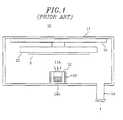
- Fig. 1schematically shows an exemplary configuration of a conventional deposition device.
- a film forming apparatus 10includes a processing chamber 11 having therein an inner space 11A. Installed in the inner space 11A are a deposition source 12 and a substrate holding table 15 facing the deposition source 12. The inner space 11A is exhausted via a gas exhaust line 14 connected to a gas exhaust unit (not shown) such as a vacuum pump or the like to be maintained at a specific depressurized level.
- a gas exhaust unitsuch as a vacuum pump or the like to be maintained at a specific depressurized level.
- the deposition source 12is connected to a heater 13 such that a source material 12A contained therein can be heated by the heater 13 to be turned into a gas material by being evaporated or sublimated.
- the gas materialis deposited on a target substrate S held on the substrate holding table 15.
- the film forming apparatus 10By using the film forming apparatus 10, it is possible to form, e.g., an organic layer (light emitting layer) in a light emitting element, an electrode on the organic layer and the like.
- an organic layerlight emitting layer
- an electrodeon the organic layer and the like.
- the material evaporated or sublimated from the deposition sourcemay be adhered to other parts than the target substrate, causing particle generation. This may require an increased frequency of removing the adhered material, which reduces the productivity.
- the deposition source and the target substrateneed to be spaced apart from each other with a specific distance.
- film formation using, e.g., sputtering methodis advantageous in that the direction of the target substrate is relatively free and the productivity is high.
- larger damagesare inflicted on a target object of film formation compared to film formation using deposition method.
- a light emitting element using an organic layer and a metal electrodeluminous efficiency may be reduced due to the difference between work functions of the organic layer and the electrode.
- a specific metal-containing layere.g., a metal layer or a metal compound layer
- this layermay be referred to as a "work function adjustment layer”
- the organic layermay be damaged depending on film forming method (such as sputtering method). Further, some kinds of materials used for forming the work function adjustment layer are not suitable as a sputtering target.
- Patent Document 2describes a film forming apparatus for performing film formation by transporting evaporated or sublimated material.
- Patent Document 2is silent about problems occurred when forming a film on an organic layer having a light emitting layer, and solutions therefor.
- a first specific object of the present inventionis to provide a film forming apparatus capable of forming a metal-containing layer on an organic layer with a high productivity.
- a second specific object of the present inventionis to provide a method for manufacturing a light emitting element, in which an organic layer having a light emitting layer is formed between a first electrode and a second electrode and a work function adjustment layer is formed between the organic layer and the second electrode, with a high productivity.
- a film forming apparatusincluding a processing chamber having therein a substrate holding table for holding a substrate; a gas material generation unit arranged outside the processing chamber, for generating gas material by evaporating or sublimating source material containing metal; at least one gas material supply unit for supplying the gas material into the processing chamber; and a transport path for transporting the gas material from the gas material generation unit to the gas material supply unit, wherein the film forming apparatus is configured to form a metal-containing layer on an organic layer including a light emitting layer on the substrate.
- the objectsare achieved by providing A method for manufacturing a light emitting element including a first film forming step of forming a metal-containing layer on an organic layer including a light emitting layer; and a second film forming step of forming an electrode on the metal-containing layer, wherein, in the first film forming step, a film is formed by supplying a gas material obtained by evaporating or sublimating a source material onto the organic layer via a transport path.
- a method for manufacturing a light emitting elementin which an organic layer having a light emitting layer is formed between a first electrode and a second electrode and a work function adjustment layer is formed between the organic layer and the second electrode, with a high productivity.
- a film forming apparatus in accordance with the present inventionis characterized in that it includes a processing chamber having therein a substrate holding table for holding a substrate; a gas material generation unit arranged outside the processing chamber, for generating gas material by evaporating or sublimating source material containing metal; at least one gas material supply unit for supplying the gas material into the processing chamber; and a transport path for transporting the gas material from the gas material generation unit to the gas material supply unit, wherein the film forming apparatus is configured to form a metal-containing layer on an organic layer including a light emitting layer on the substrate.
- the above film forming apparatusis configured such that the gas material generated by evaporating or sublimating the film forming source material is transported via the transport path and supplied to the vicinity of the target substrate in the processing chamber.
- the direction of supplying the gas materialmay be chosen with a higher degree of freedom, and the direction of holding the target substrate is less restricted. Therefore, it is possible to perform what is called as "face-up" film formation in which the film forming surface of the target substrate is arranged to face upward (i.e., facing the direction of gravity), and the film formation can be performed more easily on a large-sized substrate.
- the gas material generation unit for evaporating or sublimating the film forming source materialcan be installed separately from the gas material supply unit for supplying the gas material obtained by evaporating or sublimating the film forming source material.
- the gas material supply unitis located near the target substrate or the substrate holding table, the target substrate or the substrate holding table is hardly affected by heating.
- the gas material supply unit and the target substratecan be arranged close to each other. As a consequence, the amount of film formed on other portions than the target substrate is suppressed, so that the use efficiency of the source material is improved. Further, since the maintenance frequency is reduced, the productivity is enhanced.
- a metal-containing layere.g., a work function adjustment layer
- an organic layer having a light emitting layercan be formed on an organic layer having a light emitting layer while reducing damages to the organic layer and ensuring high productivity.
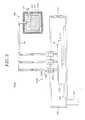
- Fig. 2is a cross sectional view schematically showing a film forming apparatus 100 in accordance with a first embodiment of the present invention.
- the film forming apparatus 100in accordance with the present embodiment includes a processing chamber 101 having therein a substrate holding table 102 for holding a target substrate W; and a gas material generation unit 109 for retaining therein a film forming source material 110A, located outside of the processing chamber 101.
- the gas material generation unit 109generates a gas material by evaporating or sublimating the film forming source material 110A.
- the gas material generated in the gas material generation unit 109is transported to a gas material supply unit 104 installed in the processing chamber 101 via a transport path 108 connected to the gas material generation unit 109. Further, the gas material transported to the gas material supply unit 104 is supplied to vicinity of the target substrate W in the processing chamber 101. Thus, a film is formed on the target substrate W.
- processing chamber 101is configured such that the inside thereof can be exhausted via a gas exhaust line 114 connected to a gas exhaust unit (not shown) such as a vacuum pump or the like to be held in a specified depressurized state.
- a gas exhaust unitsuch as a vacuum pump or the like
- the gas material generation unit 109has a source material container 110, and the source material container 110 stores therein the film forming source material 110A in liquid or solid state.
- the source material container 110is connected to a carrier gas supply line 112 for supplying a carrier gas formed of a nonreactive gas such as Ar, He or the like.
- the gas material formed in the source material container 110is supplied into the processing chamber 101 together with the carrier gas via the transport path 108 to the gas material supply unit 104.
- the gas material supply unit 104has a supply unit main body 105 of cylindrical or housing-like shape connected to the transfer port 108 in a manner that the gas material can be supplied thereinto via the transfer port 108.
- a rectifying plate 106 for controlling a flow of the gas materialis installed in the supply unit main body 105.
- the rectifying plate 106is formed of, e.g., a porous plate having a plurality of gas holes. By installing the rectifying plate 106, the supply amount of the gas material is more uniformly distributed on the target substrate W. Herein, it is also possible to install more than one rectifying plate.
- a filter plate 107 formed of, e.g., a porous metal (metal filter)is installed at a side of the supply unit main body 105 that faces the target substrate W.
- the gas materialis supplied into the processing chamber 101 via the filter plate 107.
- particles contained in the gas materialare removed, thereby improving the quality of a film to be formed.
- the substrate holding table 102can be moved according to the film formation (the supply of the gas material).
- the substrate holding table 102is movable in a horizontal direction on a moving rail 103 installed on a bottom surface of the processing chamber 101 (on a side facing the gas material supply unit 104). Since the substrate holding table 102 can be moved during the film formation, the uniformity in film formation on the surface of the target substrate is improved.
- a gate valve 113is installed at the processing chamber 101.
- the gate valve 113is installed on a side of the processing chamber 101 where the processing chamber 101 is connected to a transfer unit (not shown) such as a vacuum transfer chamber or the like. By opening the gate valve 113, the target substrate W can be carried into and out of the processing chamber 101.
- the gas material formed by evaporating or sublimating the film forming source material 110Ais transported to the vicinity of the target substrate W in the processing chamber 101 via the transport path 108. Therefore, the direction in which the gas material is supplied can be chosen with a higher degree of freedom than in the conventional deposition device. For instance, the degree of freedom is increased in determining the location of the gas material supply unit 104 or the orientation in which the gas material supply unit 104 is to be installed (or the direction in which the gas material is to be supplied).
- the degree of freedomis enhanced in the orientation of the target substrate W, i.e., the location or orientation of the substrate holding table 102 to be installed.
- face-up film formationin which the film forming surface of the target substrate W is arranged to face upward, and the film formation on a large-sized substrate becomes easier.
- the film forming apparatus 100 in accordance with the present embodimenthas the transport path 108 for transporting the gas material from the gas material generation unit 109 to the gas material supply unit 104.
- the gas material generation unit 109 and the gas material supply unit 104can be installed separately from each other.
- the gas material generation unit 109is installed outside the processing chamber 101, whereas the gas material supply unit 104 is installed at an opening of the processing chamber 101 in a manner to face the inside (or the target substrate) of the processing chamber 101.
- the amount of film formed on other portions than the target substrateis reduced, and thus the use efficiency of the material is enhanced. Further, the maintenance frequency is reduced, thereby improving the productivity of the film forming apparatus.
- a metal-containing layere.g., a work function adjustment layer
- a metal-containing layercan be formed on the organic layer having the light emitting layer in the organic EL device with a high productivity. If a film is formed on such an organic layer by the conventional sputtering method, the organic layer gets easily damaged. However, by using the film forming apparatus described above, it is possible to reduce damages inflicted on the organic layer and perform film formation with a high productivity.
- the film forming apparatus in accordance with the present embodimentwhich enables the face-up film formation, achieves a higher productivity than the conventional one.
- a cathode (top cathode) formed at an upper layeris preferably made of a material having a high reflectivity for the emitted light. It is preferable to use, for example, Ag for the cathode.
- the cathodeis made of Ag, it is preferable that an Li layer is used as a layer (work function adjustment layer) for suppressing deterioration in the luminous efficiency formed between the electrode and the organic layer having the light emitting layer.
- Forming, for example, the Li layer by sputtering methodis problematic in that the organic layer may get damaged and a target material used for sputtering is difficult to be formed.
- Liis disadvantageous in that its surface is prone to change (e.g., nitridation) when exposed to the atmosphere. Further, Li is not suitable for a large-sized target material and is difficult to be handled, e.g., transported. For this reason, it has been difficult to employ the sputtering method in forming a work function adjustment layer with Li.
- the work function adjustment layer formed of an Li layercan be formed on an organic layer including a (organic) light emitting layer in an organic EL device while suppressing damages inflicted on the organic layer and ensuring a high productivity.
- the film forming apparatus of the present inventionis not limited to the film forming apparatus described in the present embodiment, but can be variously modified as will be illustrated hereinafter.
- Fig. 3provides a cross sectional view schematically showing a film forming apparatus in accordance with a second embodiment of the present invention.
- like reference numeralswill be used for like parts identical to those described in the first embodiment, and redundant description thereof will be omitted.
- a film forming apparatus 100 in accordance with the present embodimentis characterized in that a plurality of gas material supply units 104A, each corresponding to the gas material supply unit 104 of the first embodiment, are arranged along a movement direction of the substrate holding table 102.
- Each of the gas material supply units 104Aincludes a supply unit main body 105A, a rectifying plate 106A and a filter plate 107A, respectively corresponding to the supply unit main body 105, the rectifying plate 106 and the filter plate 107 of the first embodiment.
- Each of the gas material supply units 104Ais smaller in dimension (i.e., in length measured in the movement direction of the substrate holding table 102) than the gas material supply unit 104. Therefore, more than one gas material supply unit 104A can be arranged along the movement direction of the substrate holding table. As a consequence, it is possible to achieve a desired film thickness or film forming speed by installing a plurality of gas material supply units.
- Fig. 4is a cross sectional view schematically illustrating a film forming apparatus in accordance with a third embodiment of the present invention.
- like reference numeralswill be used for like parts identical to those described in the first embodiment, and redundant description thereof will be omitted.
- a film forming apparatus 100B in accordance with the present embodimentfurther includes a sputtering film formation device 200 in addition to the elements of the first embodiment, and is capable of performing film formation by sputtering method.
- the film forming apparatus 100B in accordance with the present embodimentis configured such that, for example, the film formation (e.g., forming the cathode on the work function adjustment layer) by sputtering method can be performed in a depressurized atmosphere immediately following the film formation (e.g., forming the work function adjustment layer) by evaporating or sublimating the film forming source material 110A as described in the first embodiment.
- the film formatione.g., forming the cathode on the work function adjustment layer
- sputtering methodcan be performed in a depressurized atmosphere immediately following the film formation (e.g., forming the work function adjustment layer) by evaporating or sublimating the film forming source material 110A as described in the first embodiment.
- the sputtering film formation device 200is installed in the processing chamber 100B such that it is almost entirely accommodated in a receding portion 201 in the processing chamber 100B (which corresponds to the processing chamber 101 of the first embodiment).
- the sputtering film formation device 200has voltage applying targets 202A and 202b facing each other and a gas supply unit 204 for supplying a processing gas of, e.g., Ar or the like, between the voltage applying targets 202A and 202B to which voltages are applied.
- the processing gasis plasma-excited by the voltages applied to the voltage applying targets 202A and 202B by a power supply 203.
- the gas supply unit 204has a structure that extends in a direction substantially perpendicular to the movement direction of the substrate holding table 102, and is arranged to face the substrate holding table 102 via the voltage applying targets 202A and 202B.
- the gas supply unit 204is of a hollow pipe structure having a gas channel 205 therein. Therefore, the processing gas of, e.g., Ar or the like, is supplied from a gas supply source (not shown) installed outside the processing chamber 101B to the gas channel 205 via a gas supply line 207. The processing gas supplied to the gas channel 205 is then supplied to a space between the voltage applying targets 202A and 202B via a plurality of gas holes 206 formed at the gas supply unit 204.
- a gas supply sourcenot shown
- the processing gas for plasma excitation of, e.g., Ar or the likeis supplied from the gas supply unit 204 to the space between the voltage applying targets 202A and 202B.
- the electric power supplied by the power supply 203is applied to the voltage applying targets 202A and 202B, respectively, so that the plasma is excited in the space to generate ions.
- the targets 202A and 202Bare subject to sputtering by Ar ions thus generated, and thus, a film is formed on the target substrate W held on the substrate holding table 102.
- the target substrate Wis spaced apart from the space where the plasma is excited (which is the space between the voltage applying targets 202A and 202B), the target substrate W is hardly affected by damages caused by ion collision or ultraviolet accompanied with the plasma excitation. Further, film forming particles generated by sputtering are transported by the processing gas flow toward the substrate holding table 102 to reach the target substrate W.
- the film forming apparatus 100B of the present embodimentit is possible to carry out a first film formation by evaporating or sublimating the film forming source material 110A as described in the first embodiment, and, immediately following the first film formation, the second film formation by the sputtering method using the sputtering film formation device 200.
- the substrate holding table 102is moved after the first film formation is completed, and the second film formation is carried out in a state where the target substrate W is positioned directly below the sputtering film formation device 200.
- the first film forming process for forming a work function adjustment layer on an organic layer having a (organic) light emitting layer in an organic EL deviceand then the second film forming process for forming a cathode (top cathode) on the work function adjustment layer, in a continuous manner under a depressurized atmosphere.
- a surface of the Li layermay be changed (e.g., nitrided).
- nitridationWhen the Li layer is exposed to a space under the atmospheric pressure, its surface undergoes nitridation, which makes it impossible to obtain desired electrical characteristics.
- a cathode (top cathode) made of, e.g., Agcan be formed in a depressurized space immediately after a work function adjustment layer (e.g., Li layer) is formed.
- a work function adjustment layere.g., Li layer
- the work function adjustment layercan be effectively protected from, e.g., nitridation or the like.
- the present embodimenthas been described as to the case where the film is formed by using two targets facing each other, the present invention is not limited thereto.
- the film formationmay also be performed by, e.g., a conventional sputtering method using a single target.
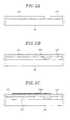
- an anode 302 made of a transparent material such as ITO or the like and a leader line 303 a cathode, wherein the cathode is to be formed in a later processare formed on a transparent substrate 301 made of, e.g., glass or the like.
- a transparent substrate 301made of, e.g., glass or the like.
- an electrode-attached substrateis prepared.
- the anode 302 (and the leader line 303)is formed by, e.g., sputtering method or the like.
- a control devicee.g., a TFT (Thin Film Transistor) or the like, for controlling light emission of a light emitting element may be embedded in the substrate 301.
- the control devicesuch as a TFT or the like may be embedded in each pixel.
- a source electrode of the TFTis connected to the anode 302, and a gate electrode and a drain electrode of the TFT are connected to a gate line and a drain line formed in a grid pattern, thereby controlling the display of each pixel.
- the leader line 303is connected to a specified control circuit (not shown).
- a driving circuit of the display deviceis referred to as an active matrix driving circuit, which is not shown in the drawings.
- an organic layer 304 having a light emitting layeris formed by deposition method on the anode 302, the leader line 303 and the substrate 301, thereby covering the exposed portions of the anode 302, the leader line 303 and the substrate 301.
- the organic layer 304may be structured to include, e.g., a hole transport layer, a hole injection layer or the like formed between the light emitting layer and the anode 302, thereby improving the luminous efficiency of the light emitting layer.
- a hole transport layere.g., a hole injection layer or the like formed between the light emitting layer and the anode 302, thereby improving the luminous efficiency of the light emitting layer.
- either one or both of the hole transport layer and the hole injection layermay be omitted.
- the organic layer 304may be structured to include, e.g., an electron transport layer, an electron injection layer or the like formed between the light emitting layer and the cathode 305 that is to be formed in a later process, thereby improving the luminous efficiency of the light emitting layer. Further, either one or both of the electron transport layer and the electron injection layer may be omitted.
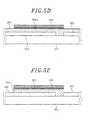
- the film forming apparatus of any one of the first to the third embodimentis used to form the work function adjustment layer 304A made of, e.g., an Li layer on the organic layer 304 by patterning with a pattern mask.
- the film formation by using the film forming apparatus 100 described in the first embodiment ( Fig. 2 )is as follows.
- the film forming source material 110A formed of, e.g., solid-state Liis heated by the heating unit 111 to turn into a gas material through sublimation.
- the gas materialis transported to the gas material supply unit 104 via the transport path 108 together with a carrier gas formed of, e.g., Ar supplied from the carrier gas supply line 112.
- the gas material transported to the gas material supply unit 104is supplied via the filter plate 107 to the vicinity of the target substrate W (which corresponds to the substrate 301) in the processing chamber 101.
- the work function adjustment layer 304A formed of an Li layeris formed on the organic layer 304 formed on the target substrate W (the substrate 301).
- the cathode 305 made of, e.g., Agis patterned to be formed on the organic layer 304 by sputtering using a pattern mask.
- the cathode 305made of, e.g., Ag under the depressurized space consecutively after the work function adjustment layer (e.g., Li layer) 304A is formed.
- the work function adjustment layer 304Acan be effectively protected from nitridation or the like.
- the organic layer 304is etched by, e.g., plasma etching while using as a mask the cathode electrode 305 patterned in the process shown in Fig. 5D , thereby patterning the organic layer 304.
- the patterning of the organic layer 304is performed by etching that removes portions of the organic layer 304 that need to be peeled off (e.g., the portion on the leader line 303 or the like or where the light emitting layer is not to be formed).
- the organic layer by etchingusing the cathode 305 as a mask as described above, it is possible to avoid various problems that might occur when patterning the organic layer by mask deposition method.
- the accuracy of patterning the deposition layer(the organic layer 304) can be maintained without being affected by mask deformation caused by temperature increase of the mask during the deposition process. Further, it is possible to reduce particles that might otherwise be generated when attaching and detaching the mask.
- connection line 305a for electrically connecting the cathode 305 to the leader line 303is patterned by, e.g., sputtering using a pattern mask.
- an insulating protection layer 306made of, e.g., silicon nitride (SiN), is formed on the substrate 301 by CVD method using a pattern mask to cover a part of the anode 302, a part of the leader line 303, the organic layer 304, the cathode 305 and the connection line 305a.
- the light emitting element 300in which the organic layer 304 is formed between the anode 302 and the cathode 305, and the work function layer 304A is formed between the organic layer 304 and the cathode 305, can be formed on the substrate 301.
- the light emitting element 300is occasionally referred to as an organic EL device.
- the light emitting layermay be made of, e.g., polycyclic aromatic hydrocarbon, hetero aromatic hydrocarbon, organometallic complex compound or the like.
- the light emitting layercan be formed by using aluminum-quinolinol complex (Alq3) as a host material and Rubrene as a dopant.
- Alq3aluminum-quinolinol complex
- Rubreneas a dopant.
- itcan also be formed by other materials without being limited thereto.
- the anode 302is formed with a thickness of about 100 nm to 200 nm; the organic layer 303 is formed with a thickness of about 50 nm to 200 nm; the cathode 304 is formed with a thickness of about 50 nm to 300 nm; and the work function adjustment layer 304A is formed with a thickness of about 0.1 nm to 10 nm.
- the light emitting element 300is applicable to, for example, a display device (organic EL display device) or a surface emitting element (lighting device, light source or the like). However, it can also be used for other electronic appliances without being limited thereto.
- the light emitting element 300can be manufactured with a high productivity.
- the work function adjustment layer 304Ais formed by supplying the gas material generated by evaporating or sublimating the film forming source material onto the organic layer 304 via a transport path. In this manner, the effects of the first embodiment can be achieved.
- the degree of freedom in setting the direction of supplying the gas materialis increased, and restriction in the orientation of holding the target substrate is decreased. Therefore, the face-up film formation can be carried out, and the film formation can be easily performed on a large-sized substrate.
- the amount of film formed at portions other than the target substrateis decreased. In this manner, the use efficiency of the source material is increased, and the maintenance frequency is decreased, thereby enhancing the productivity.
- a method for manufacturing a light emitting elementin which an organic layer having a light emitting layer is formed between a first electrode and a second electrode and a work function adjustment layer is formed between the organic layer and the second electrode, with a high productivity.
Landscapes
- Chemical & Material Sciences (AREA)
- Engineering & Computer Science (AREA)
- Chemical Kinetics & Catalysis (AREA)
- Materials Engineering (AREA)
- Mechanical Engineering (AREA)
- Metallurgy (AREA)
- Organic Chemistry (AREA)
- Manufacturing & Machinery (AREA)
- General Chemical & Material Sciences (AREA)
- Physics & Mathematics (AREA)
- Condensed Matter Physics & Semiconductors (AREA)
- General Physics & Mathematics (AREA)
- Computer Hardware Design (AREA)
- Microelectronics & Electronic Packaging (AREA)
- Power Engineering (AREA)
- Electroluminescent Light Sources (AREA)
- Physical Vapour Deposition (AREA)
Abstract
Description
- The present invention relates to a film forming apparatus for forming a film on an organic layer having a light emitting layer, and a method for manufacturing a light emitting element including an organic layer having a light emitting layer.
- Recently, planar displays capable of being made thin are being brought into practical use in place of conventionally used CRTs (Cathode Ray Tubes). For example, organic electroluminescence devices (i.e., organic EL devices) are highlighted as a next-generation display device owing to its self-luminosity and high-speed responsiveness. Further, organic EL devices are also used as a surface emitting element besides being used for display devices.
- The organic EL device has a structure in which an organic layer having an organic EL layer (light emitting layer) is embedded between an anode (positive electrode) and a cathode (negative electrode), and is configured to let the light emitting layer emit light by injecting holes from the anode and electrons from the cathode into the light emitting layer to induce recombination between the holes and the electrons.
- Further, the organic layer may further contain, if required, a layer for improving luminous efficiency, such as a hole transport layer or an electron transport layer, between the anode and the light emitting layer or between the cathode and the light emitting layer.
- As for an example of a method for forming the above light emitting element, the following method has been conventionally employed. First, an organic layer is formed by a deposition method on a substrate on which an anode formed of ITO (Indium Tin Oxide) is patterned. Herein, the deposition method refers to a method for forming a thin film by depositing evaporated or sublimated material on a target substrate. Thereafter, Al (aluminum) layer serving as a cathode is deposited on the organic layer. The light emitting element thus manufactured is occasionally referred to as "top cathode type" light emitting element.
- In this manner, for example, the light emitting element in which the organic layer is formed between the anode and the cathode is manufactured (see, e.g., Patent Document 1).
Fig. 1 schematically shows an exemplary configuration of a conventional deposition device.- Referring to
Fig. 1 , afilm forming apparatus 10 includes aprocessing chamber 11 having therein aninner space 11A. Installed in theinner space 11A are adeposition source 12 and a substrate holding table 15 facing thedeposition source 12. Theinner space 11A is exhausted via agas exhaust line 14 connected to a gas exhaust unit (not shown) such as a vacuum pump or the like to be maintained at a specific depressurized level. - The
deposition source 12 is connected to aheater 13 such that asource material 12A contained therein can be heated by theheater 13 to be turned into a gas material by being evaporated or sublimated. The gas material is deposited on a target substrate S held on the substrate holding table 15. - By using the
film forming apparatus 10, it is possible to form, e.g., an organic layer (light emitting layer) in a light emitting element, an electrode on the organic layer and the like. - However, when a film is formed by using the conventional deposition device, it is necessary to employ a face-down film formation method in which a film-forming surface of a target substrate is arranged to face downward in order to have the source material evaporated or sublimated from the deposition source in the processing chamber be deposited on the target substrate. Accordingly, if the size of the target substrate is increased, handling the substrate becomes difficult. Therefore, there occurs a problem in that the productivity of the film forming apparatus is deteriorated.
- Further, in the conventional deposition device, the material evaporated or sublimated from the deposition source may be adhered to other parts than the target substrate, causing particle generation. This may require an increased frequency of removing the adhered material, which reduces the productivity.
- In order to prevent material from being attached to portions other than the target substrate, it is preferable to shorten the distance between the deposition source and the substrate (holding table). However, when placing the target substrate near the deposition source that heats the source material to evaporate or sublimate it, the target substrate or the mask on the target substrate gets heated, and the uniformity in the film thickness may become deteriorated. To that end, the deposition source and the target substrate need to be spaced apart from each other with a specific distance.
- Further, film formation using, e.g., sputtering method is advantageous in that the direction of the target substrate is relatively free and the productivity is high. However, in this case, larger damages are inflicted on a target object of film formation compared to film formation using deposition method.
- When, for example, film formation is performed on an organic layer having a light emitting layer in an organic EL device or the like, damage inflicted on the organic layer by the sputtering may be problematic. In some cases, the organic layer is damaged to deteriorate the quality of the light emitting element by, e.g., particles of a hard metal such as A1 colliding with the organic layer at a high speed by the sputtering or ultraviolet irradiated thereon following plasma excitation.
- As for the case where a film is formed on an organic layer, the following is an example thereof.
- In, for example, a light emitting element using an organic layer and a metal electrode, luminous efficiency may be reduced due to the difference between work functions of the organic layer and the electrode. In order to suppress such decrease in the luminous efficiency, a specific metal-containing layer (e.g., a metal layer or a metal compound layer) may be formed between the organic layer and the electrode (i.e., on the organic layer). In case of forming the layer for suppressing the decrease in luminous efficiency due to the difference between work functions of the organic layer and the electrode (hereinafter, this layer may be referred to as a "work function adjustment layer"), the organic layer may be damaged depending on film forming method (such as sputtering method). Further, some kinds of materials used for forming the work function adjustment layer are not suitable as a sputtering target.
- On the other hand, in case of forming the work function adjustment layer by the conventional deposition method, it is difficult to overcome the aforementioned problems such as difficulty in handling a large-sized substrate and deterioration in the productivity.
- Besides, Patent Document 2 describes a film forming apparatus for performing film formation by transporting evaporated or sublimated material. However, Patent Document 2 is silent about problems occurred when forming a film on an organic layer having a light emitting layer, and solutions therefor.
- (Patent Document 1) Japanese Patent Application Publication No.
2004-225058 - (Patent Document 2)
U.S. Patent Publication No. 6849241 - Therefore, it is a general object of the present invention to provide a new and useful film forming apparatus and method for manufacturing a light emitting element.
- A first specific object of the present invention is to provide a film forming apparatus capable of forming a metal-containing layer on an organic layer with a high productivity.
- A second specific object of the present invention is to provide a method for manufacturing a light emitting element, in which an organic layer having a light emitting layer is formed between a first electrode and a second electrode and a work function adjustment layer is formed between the organic layer and the second electrode, with a high productivity.
- In accordance with a first aspect of the invention, the objects are achieved by providing a film forming apparatus including a processing chamber having therein a substrate holding table for holding a substrate; a gas material generation unit arranged outside the processing chamber, for generating gas material by evaporating or sublimating source material containing metal; at least one gas material supply unit for supplying the gas material into the processing chamber; and a transport path for transporting the gas material from the gas material generation unit to the gas material supply unit, wherein the film forming apparatus is configured to form a metal-containing layer on an organic layer including a light emitting layer on the substrate.
- In accordance with a second aspect of the invention, the objects are achieved by providing A method for manufacturing a light emitting element including a first film forming step of forming a metal-containing layer on an organic layer including a light emitting layer; and a second film forming step of forming an electrode on the metal-containing layer, wherein, in the first film forming step, a film is formed by supplying a gas material obtained by evaporating or sublimating a source material onto the organic layer via a transport path.
- In accordance with the present invention, it is possible to provide a film forming apparatus capable of forming a metal-containing layer on an organic layer with a high productivity.
- Further, it is possible to provide a method for manufacturing a light emitting element, in which an organic layer having a light emitting layer is formed between a first electrode and a second electrode and a work function adjustment layer is formed between the organic layer and the second electrode, with a high productivity.
Fig. 1 schematically shows a conventional film forming apparatus;Fig. 2 schematically shows a film forming apparatus in accordance with a first embodiment of the present invention;Fig. 3 schematically shows a film forming apparatus in accordance with a second embodiment of the present invention;Fig. 4 schematically shows a film forming apparatus in accordance with a third embodiment of the present invention;Fig. 5A is a view for describing a method for manufacturing a light emitting element in accordance with a fourth embodiment of the present invention;Fig. 5B is another view for describing the method for manufacturing the light emitting element in accordance with the fourth embodiment of the present invention;Fig. 5C is still another view for describing the method for manufacturing the light emitting element in accordance with the fourth embodiment of the present invention;Fig. 5D is still another view for describing the method for manufacturing the light emitting element in accordance with the fourth embodiment of the present invention;Fig. 5E is still another view for describing the method for manufacturing the light emitting element in accordance with the fourth embodiment of the present invention;Fig. 5F is still another view for describing the method for manufacturing the light emitting element in accordance with the fourth embodiment of the present invention; andFig. 5G is still another view for describing the method for manufacturing the light emitting element in accordance with the fourth embodiment of the present invention.- 100, 100A, 100B
- film forming apparatus
- 101, 101B
- processing chamber
- 102
- substrate holding table
- 103
- moving rail
- 104, 104A
- gas material supply unit
- 105, 105A
- supply unit main body
- 106, 106A
- rectifying plate
- 107, 107A
- filter plate
- 108
- transport path
- 109
- gas material generation unit
- 110
- source material container
- 110A
- film forming source material
- 111
- heating unit
- 112
- carrier gas supply line
- 200
- sputtering film formation device
- 201
- receding portion
- 202A, 202B
- target
- 203
- power supply
- 204
- gas supply unit
- 205
- gas channel
- 206
- gas hole
- 207
- gas supply line
- 300
- light emitting element
- 301
- substrate
- 302
- anode
- 303
- leader line
- 304
- organic layer
- 304A
- work function adjustment layer
- 305
- cathode
- 306
- protection layer
- A film forming apparatus in accordance with the present invention is characterized in that it includes a processing chamber having therein a substrate holding table for holding a substrate; a gas material generation unit arranged outside the processing chamber, for generating gas material by evaporating or sublimating source material containing metal; at least one gas material supply unit for supplying the gas material into the processing chamber; and a transport path for transporting the gas material from the gas material generation unit to the gas material supply unit, wherein the film forming apparatus is configured to form a metal-containing layer on an organic layer including a light emitting layer on the substrate.
- The above film forming apparatus is configured such that the gas material generated by evaporating or sublimating the film forming source material is transported via the transport path and supplied to the vicinity of the target substrate in the processing chamber. Thus, compared to the conventional deposition device, the direction of supplying the gas material may be chosen with a higher degree of freedom, and the direction of holding the target substrate is less restricted. Therefore, it is possible to perform what is called as "face-up" film formation in which the film forming surface of the target substrate is arranged to face upward (i.e., facing the direction of gravity), and the film formation can be performed more easily on a large-sized substrate.
- Moreover, in the above film forming apparatus is characterized in that, owing to the presence of the transport path for transporting the gas material, the gas material generation unit for evaporating or sublimating the film forming source material can be installed separately from the gas material supply unit for supplying the gas material obtained by evaporating or sublimating the film forming source material.
- Therefore, even when the gas material supply unit is located near the target substrate or the substrate holding table, the target substrate or the substrate holding table is hardly affected by heating. Hence, the gas material supply unit and the target substrate can be arranged close to each other. As a consequence, the amount of film formed on other portions than the target substrate is suppressed, so that the use efficiency of the source material is improved. Further, since the maintenance frequency is reduced, the productivity is enhanced.
- With the film forming apparatus of the above, a metal-containing layer (e.g., a work function adjustment layer) can be formed on an organic layer having a light emitting layer while reducing damages to the organic layer and ensuring high productivity.
- Hereinafter, the embodiments of the present invention will be described with reference to the accompanying drawings, which form a part hereof.
Fig. 2 is a cross sectional view schematically showing afilm forming apparatus 100 in accordance with a first embodiment of the present invention.- Referring to
Fig. 2 , thefilm forming apparatus 100 in accordance with the present embodiment includes aprocessing chamber 101 having therein a substrate holding table 102 for holding a target substrate W; and a gasmaterial generation unit 109 for retaining therein a film formingsource material 110A, located outside of theprocessing chamber 101. - The gas
material generation unit 109 generates a gas material by evaporating or sublimating the film forming source material 110A. The gas material generated in the gasmaterial generation unit 109 is transported to a gasmaterial supply unit 104 installed in theprocessing chamber 101 via atransport path 108 connected to the gasmaterial generation unit 109. Further, the gas material transported to the gasmaterial supply unit 104 is supplied to vicinity of the target substrate W in theprocessing chamber 101. Thus, a film is formed on the target substrate W. - Further, the
processing chamber 101 is configured such that the inside thereof can be exhausted via agas exhaust line 114 connected to a gas exhaust unit (not shown) such as a vacuum pump or the like to be held in a specified depressurized state. - The gas
material generation unit 109 has a sourcematerial container 110, and the sourcematerial container 110 stores therein the film forming source material 110A in liquid or solid state. Aheating unit 111 formed of, e.g., a heater, is installed outside the sourcematerial container 110, so that the film formingsource material 110A can be evaporated or sublimated by being heated. - Moreover, the source
material container 110 is connected to a carriergas supply line 112 for supplying a carrier gas formed of a nonreactive gas such as Ar, He or the like. The gas material formed in the sourcematerial container 110 is supplied into theprocessing chamber 101 together with the carrier gas via thetransport path 108 to the gasmaterial supply unit 104. - The gas
material supply unit 104 has a supply unitmain body 105 of cylindrical or housing-like shape connected to thetransfer port 108 in a manner that the gas material can be supplied thereinto via thetransfer port 108. - Furthermore, a rectifying
plate 106 for controlling a flow of the gas material is installed in the supply unitmain body 105. The rectifyingplate 106 is formed of, e.g., a porous plate having a plurality of gas holes. By installing the rectifyingplate 106, the supply amount of the gas material is more uniformly distributed on the target substrate W. Herein, it is also possible to install more than one rectifying plate. - Besides, a
filter plate 107 formed of, e.g., a porous metal (metal filter) is installed at a side of the supply unitmain body 105 that faces the target substrate W. The gas material is supplied into theprocessing chamber 101 via thefilter plate 107. Thus, particles contained in the gas material are removed, thereby improving the quality of a film to be formed. - In addition, the substrate holding table 102 can be moved according to the film formation (the supply of the gas material). The substrate holding table 102 is movable in a horizontal direction on a moving
rail 103 installed on a bottom surface of the processing chamber 101 (on a side facing the gas material supply unit 104). Since the substrate holding table 102 can be moved during the film formation, the uniformity in film formation on the surface of the target substrate is improved. - Further, a
gate valve 113 is installed at theprocessing chamber 101. For example, thegate valve 113 is installed on a side of theprocessing chamber 101 where theprocessing chamber 101 is connected to a transfer unit (not shown) such as a vacuum transfer chamber or the like. By opening thegate valve 113, the target substrate W can be carried into and out of theprocessing chamber 101. - With the configuration of the
film forming apparatus 100 in accordance with the present embodiment, the gas material formed by evaporating or sublimating the film forming source material 110A is transported to the vicinity of the target substrate W in theprocessing chamber 101 via thetransport path 108. Therefore, the direction in which the gas material is supplied can be chosen with a higher degree of freedom than in the conventional deposition device. For instance, the degree of freedom is increased in determining the location of the gasmaterial supply unit 104 or the orientation in which the gasmaterial supply unit 104 is to be installed (or the direction in which the gas material is to be supplied). - Accordingly, the degree of freedom is enhanced in the orientation of the target substrate W, i.e., the location or orientation of the substrate holding table 102 to be installed. As a result, it is possible to carry out what is known as "face-up" film formation, in which the film forming surface of the target substrate W is arranged to face upward, and the film formation on a large-sized substrate becomes easier.
- Further, the
film forming apparatus 100 in accordance with the present embodiment has thetransport path 108 for transporting the gas material from the gasmaterial generation unit 109 to the gasmaterial supply unit 104. For this reason, the gasmaterial generation unit 109 and the gasmaterial supply unit 104 can be installed separately from each other. For example, in the present embodiment, the gasmaterial generation unit 109 is installed outside theprocessing chamber 101, whereas the gasmaterial supply unit 104 is installed at an opening of theprocessing chamber 101 in a manner to face the inside (or the target substrate) of theprocessing chamber 101. - As a consequence, the amount of film formed on other portions than the target substrate is reduced, and thus the use efficiency of the material is enhanced. Further, the maintenance frequency is reduced, thereby improving the productivity of the film forming apparatus.
- With the
film forming apparatus 100 of the present embodiment, a metal-containing layer (e.g., a work function adjustment layer) can be formed on the organic layer having the light emitting layer in the organic EL device with a high productivity. If a film is formed on such an organic layer by the conventional sputtering method, the organic layer gets easily damaged. However, by using the film forming apparatus described above, it is possible to reduce damages inflicted on the organic layer and perform film formation with a high productivity. - Further, light emitting elements having a light emitting layer tend to be manufactured with a large-sized substrate accordingly as the display device becomes larger. In this case, the film forming apparatus in accordance with the present embodiment, which enables the face-up film formation, achieves a higher productivity than the conventional one.
- When, for example, fabricating a bottom emission type light emitting element, a cathode (top cathode) formed at an upper layer is preferably made of a material having a high reflectivity for the emitted light. It is preferable to use, for example, Ag for the cathode.
- If the cathode is made of Ag, it is preferable that an Li layer is used as a layer (work function adjustment layer) for suppressing deterioration in the luminous efficiency formed between the electrode and the organic layer having the light emitting layer.
- Forming, for example, the Li layer by sputtering method is problematic in that the organic layer may get damaged and a target material used for sputtering is difficult to be formed.
- Li is disadvantageous in that its surface is prone to change (e.g., nitridation) when exposed to the atmosphere. Further, Li is not suitable for a large-sized target material and is difficult to be handled, e.g., transported. For this reason, it has been difficult to employ the sputtering method in forming a work function adjustment layer with Li.
- Moreover, when forming an Li layer by the conventional deposition method, a large amount of film may be formed at an inner portion of the processing chamber (other than the target substrate) depending on the processing conditions. Therefore, more time may be required for the apparatus maintenance, which deteriorates the productivity.
- However, with the
film forming apparatus 100 in accordance with the present embodiment, the work function adjustment layer formed of an Li layer can be formed on an organic layer including a (organic) light emitting layer in an organic EL device while suppressing damages inflicted on the organic layer and ensuring a high productivity. - Further, the film forming apparatus of the present invention is not limited to the film forming apparatus described in the present embodiment, but can be variously modified as will be illustrated hereinafter.
Fig. 3 provides a cross sectional view schematically showing a film forming apparatus in accordance with a second embodiment of the present invention. InFig. 3 , like reference numerals will be used for like parts identical to those described in the first embodiment, and redundant description thereof will be omitted.- As shown therein, a
film forming apparatus 100 in accordance with the present embodiment is characterized in that a plurality of gasmaterial supply units 104A, each corresponding to the gasmaterial supply unit 104 of the first embodiment, are arranged along a movement direction of the substrate holding table 102. Each of the gasmaterial supply units 104A includes a supply unitmain body 105A, a rectifyingplate 106A and afilter plate 107A, respectively corresponding to the supply unitmain body 105, the rectifyingplate 106 and thefilter plate 107 of the first embodiment. - Each of the gas
material supply units 104A is smaller in dimension (i.e., in length measured in the movement direction of the substrate holding table 102) than the gasmaterial supply unit 104. Therefore, more than one gasmaterial supply unit 104A can be arranged along the movement direction of the substrate holding table. As a consequence, it is possible to achieve a desired film thickness or film forming speed by installing a plurality of gas material supply units. Fig. 4 is a cross sectional view schematically illustrating a film forming apparatus in accordance with a third embodiment of the present invention. InFig. 4 , like reference numerals will be used for like parts identical to those described in the first embodiment, and redundant description thereof will be omitted.- As shown therein, a
film forming apparatus 100B in accordance with the present embodiment further includes a sputteringfilm formation device 200 in addition to the elements of the first embodiment, and is capable of performing film formation by sputtering method. - Therefore, the
film forming apparatus 100B in accordance with the present embodiment is configured such that, for example, the film formation (e.g., forming the cathode on the work function adjustment layer) by sputtering method can be performed in a depressurized atmosphere immediately following the film formation (e.g., forming the work function adjustment layer) by evaporating or sublimating the film forming source material 110A as described in the first embodiment. - The sputtering
film formation device 200 is installed in theprocessing chamber 100B such that it is almost entirely accommodated in a recedingportion 201 in theprocessing chamber 100B (which corresponds to theprocessing chamber 101 of the first embodiment). The sputteringfilm formation device 200 hasvoltage applying targets 202A and 202b facing each other and agas supply unit 204 for supplying a processing gas of, e.g., Ar or the like, between thevoltage applying targets voltage applying targets power supply 203. - The
gas supply unit 204 has a structure that extends in a direction substantially perpendicular to the movement direction of the substrate holding table 102, and is arranged to face the substrate holding table 102 via thevoltage applying targets - Further, the
gas supply unit 204 is of a hollow pipe structure having agas channel 205 therein. Therefore, the processing gas of, e.g., Ar or the like, is supplied from a gas supply source (not shown) installed outside theprocessing chamber 101B to thegas channel 205 via agas supply line 207. The processing gas supplied to thegas channel 205 is then supplied to a space between thevoltage applying targets gas holes 206 formed at thegas supply unit 204. - The following is description of film formation performed by using the sputtering
film formation device 200 in thefilm forming apparatus 100B. - First, the processing gas for plasma excitation of, e.g., Ar or the like, is supplied from the
gas supply unit 204 to the space between thevoltage applying targets power supply 203 is applied to thevoltage applying targets - The
targets - In the
film forming apparatus 100B, since the target substrate W is spaced apart from the space where the plasma is excited (which is the space between thevoltage applying targets - With the
film forming apparatus 100B of the present embodiment, it is possible to carry out a first film formation by evaporating or sublimating the film forming source material 110A as described in the first embodiment, and, immediately following the first film formation, the second film formation by the sputtering method using the sputteringfilm formation device 200. In this case, the substrate holding table 102 is moved after the first film formation is completed, and the second film formation is carried out in a state where the target substrate W is positioned directly below the sputteringfilm formation device 200. - Therefore, it is possible to perform the first film forming process for forming a work function adjustment layer on an organic layer having a (organic) light emitting layer in an organic EL device, and then the second film forming process for forming a cathode (top cathode) on the work function adjustment layer, in a continuous manner under a depressurized atmosphere.
- When, for example, forming a work function layer with an Li layer, a surface of the Li layer may be changed (e.g., nitrided). When the Li layer is exposed to a space under the atmospheric pressure, its surface undergoes nitridation, which makes it impossible to obtain desired electrical characteristics.
- With the film forming apparatus of the present embodiment, a cathode (top cathode) made of, e.g., Ag can be formed in a depressurized space immediately after a work function adjustment layer (e.g., Li layer) is formed. As a result, the work function adjustment layer can be effectively protected from, e.g., nitridation or the like.
- Although the present embodiment has been described as to the case where the film is formed by using two targets facing each other, the present invention is not limited thereto. The film formation may also be performed by, e.g., a conventional sputtering method using a single target.
- Hereinafter, a method for manufacturing a light emitting element in accordance with a fourth embodiment of the present invention will be described sequentially with reference to
Figs. 5A to 5G . In the following drawings, like reference numerals will be used for like parts identical to those described above, and redundant description thereof will be omitted. - First, in a process shown in
Fig. 5A , ananode 302 made of a transparent material such as ITO or the like and a leader line 303 a cathode, wherein the cathode is to be formed in a later process, are formed on atransparent substrate 301 made of, e.g., glass or the like. Thus, an electrode-attached substrate is prepared. In this case, the anode 302 (and the leader line 303) is formed by, e.g., sputtering method or the like. - Further, a control device, e.g., a TFT (Thin Film Transistor) or the like, for controlling light emission of a light emitting element may be embedded in the
substrate 301. When, for example, the light emitting element in the present embodiment is used for a display device, the control device such as a TFT or the like may be embedded in each pixel. - In this case, a source electrode of the TFT is connected to the
anode 302, and a gate electrode and a drain electrode of the TFT are connected to a gate line and a drain line formed in a grid pattern, thereby controlling the display of each pixel. At this time, theleader line 303 is connected to a specified control circuit (not shown). A driving circuit of the display device is referred to as an active matrix driving circuit, which is not shown in the drawings. - Next, in a process described in
Fig. 5B , anorganic layer 304 having a light emitting layer (organic EL layer) is formed by deposition method on theanode 302, theleader line 303 and thesubstrate 301, thereby covering the exposed portions of theanode 302, theleader line 303 and thesubstrate 301. - Further, the
organic layer 304 may be structured to include, e.g., a hole transport layer, a hole injection layer or the like formed between the light emitting layer and theanode 302, thereby improving the luminous efficiency of the light emitting layer. Herein, either one or both of the hole transport layer and the hole injection layer may be omitted. - Likewise, the
organic layer 304 may be structured to include, e.g., an electron transport layer, an electron injection layer or the like formed between the light emitting layer and thecathode 305 that is to be formed in a later process, thereby improving the luminous efficiency of the light emitting layer. Further, either one or both of the electron transport layer and the electron injection layer may be omitted. - Thereafter, in a process shown in
Fig. 5C , the film forming apparatus of any one of the first to the third embodiment is used to form the workfunction adjustment layer 304A made of, e.g., an Li layer on theorganic layer 304 by patterning with a pattern mask. For example, the film formation by using thefilm forming apparatus 100 described in the first embodiment (Fig. 2 ) is as follows. - First, in the gas
material generation unit 109, the film forming source material 110A formed of, e.g., solid-state Li, is heated by theheating unit 111 to turn into a gas material through sublimation. The gas material is transported to the gasmaterial supply unit 104 via thetransport path 108 together with a carrier gas formed of, e.g., Ar supplied from the carriergas supply line 112. - The gas material transported to the gas
material supply unit 104 is supplied via thefilter plate 107 to the vicinity of the target substrate W (which corresponds to the substrate 301) in theprocessing chamber 101. In this manner, the workfunction adjustment layer 304A formed of an Li layer is formed on theorganic layer 304 formed on the target substrate W (the substrate 301). - Next, in a process depicted in
Fig. 5D , thecathode 305 made of, e.g., Ag is patterned to be formed on theorganic layer 304 by sputtering using a pattern mask. - When, for example, the processes of
Figs. 5C and5D are carried out by thefilm forming apparatus 100B described in the third embodiment (Fig. 4 ), it is possible to form thecathode 305 made of, e.g., Ag under the depressurized space consecutively after the work function adjustment layer (e.g., Li layer) 304A is formed. As a consequence, the workfunction adjustment layer 304A can be effectively protected from nitridation or the like. - Next, in a process illustrated in
Fig. 5E , theorganic layer 304 is etched by, e.g., plasma etching while using as a mask thecathode electrode 305 patterned in the process shown inFig. 5D , thereby patterning theorganic layer 304. In this process, the patterning of theorganic layer 304 is performed by etching that removes portions of theorganic layer 304 that need to be peeled off (e.g., the portion on theleader line 303 or the like or where the light emitting layer is not to be formed). - By patterning the organic layer by etching using the
cathode 305 as a mask as described above, it is possible to avoid various problems that might occur when patterning the organic layer by mask deposition method. For example, the accuracy of patterning the deposition layer (the organic layer 304) can be maintained without being affected by mask deformation caused by temperature increase of the mask during the deposition process. Further, it is possible to reduce particles that might otherwise be generated when attaching and detaching the mask. - Thereafter, in a process described in
Fig. 5F , aconnection line 305a for electrically connecting thecathode 305 to theleader line 303 is patterned by, e.g., sputtering using a pattern mask. - Then, in a process shown in
Fig. 5G , an insulatingprotection layer 306 made of, e.g., silicon nitride (SiN), is formed on thesubstrate 301 by CVD method using a pattern mask to cover a part of theanode 302, a part of theleader line 303, theorganic layer 304, thecathode 305 and theconnection line 305a. - In this manner, the
light emitting element 300, in which theorganic layer 304 is formed between theanode 302 and thecathode 305, and thework function layer 304A is formed between theorganic layer 304 and thecathode 305, can be formed on thesubstrate 301. Thelight emitting element 300 is occasionally referred to as an organic EL device. - When the voltage is applied between the
anode 302 and thecathode 305, holes from theanode 302 and electrons from thecathode 305 are injected into the light emitting layer in theorganic layer 304, and the holes and the electrons are recombined therein, so that thelight emitting element 300 emits light. - The light emitting layer may be made of, e.g., polycyclic aromatic hydrocarbon, hetero aromatic hydrocarbon, organometallic complex compound or the like.
- For example, the light emitting layer can be formed by using aluminum-quinolinol complex (Alq3) as a host material and Rubrene as a dopant. However, it can also be formed by other materials without being limited thereto.
- For example, the
anode 302 is formed with a thickness of about 100 nm to 200 nm; theorganic layer 303 is formed with a thickness of about 50 nm to 200 nm; thecathode 304 is formed with a thickness of about 50 nm to 300 nm; and the workfunction adjustment layer 304A is formed with a thickness of about 0.1 nm to 10 nm. - Further, the
light emitting element 300 is applicable to, for example, a display device (organic EL display device) or a surface emitting element (lighting device, light source or the like). However, it can also be used for other electronic appliances without being limited thereto. - By using the above method for manufacturing a light emitting element in accordance with the present embodiment, the
light emitting element 300 can be manufactured with a high productivity. - For example, in a process of
Fig. 5C , the workfunction adjustment layer 304A is formed by supplying the gas material generated by evaporating or sublimating the film forming source material onto theorganic layer 304 via a transport path. In this manner, the effects of the first embodiment can be achieved. - In the above manufacturing method for instance, the degree of freedom in setting the direction of supplying the gas material is increased, and restriction in the orientation of holding the target substrate is decreased. Therefore, the face-up film formation can be carried out, and the film formation can be easily performed on a large-sized substrate.
- Moreover, the amount of film formed at portions other than the target substrate is decreased. In this manner, the use efficiency of the source material is increased, and the maintenance frequency is decreased, thereby enhancing the productivity.
- In the above manufacturing method, forming the work function adjustment layer with Li on the organic layer, which is difficult when using the conventional sputtering method, can be achieved while suppressing damages to the organic layer and ensuring high productivity.
- While the invention has been shown and described with respect to the embodiments, it will be understood by those skilled in the art that various changes and modification may be made without departing from the scope of the invention as defined in the following claims.
- In accordance with the present invention, it is possible to provide a film forming apparatus capable of forming a metal-containing layer on an organic layer with a high productivity.
- Further, it is possible to provide a method for manufacturing a light emitting element, in which an organic layer having a light emitting layer is formed between a first electrode and a second electrode and a work function adjustment layer is formed between the organic layer and the second electrode, with a high productivity.
- This application is based upon and claims priority of Japanese Patent Application No.
2006-045343 filed on Feb. 22, 2006
Claims (14)
- A film forming apparatus comprising:a processing chamber having therein a substrate holding table for holding a substrate;a gas material generation unit arranged outside the processing chamber, for generating gas material by evaporating or sublimating source material containing metal;at least one gas material supply unit for supplying the gas material into the processing chamber; anda transport path for transporting the gas material from the gas material generation unit to the gas material supply unit,wherein the film forming apparatus is configured to form a metal-containing layer on an organic layer including a light emitting layer on the substrate.
- The film forming apparatus of claim 1, wherein the metal-containing layer is a work function adjustment layer formed between the organic layer and an electrode for applying a voltage to the organic layer.
- The film forming apparatus of claim 1, wherein the metal-containing layer is an Li layer.
- The film forming apparatus of claim 1, wherein the electrode is made of Ag.
- The film forming apparatus of claim 1, wherein the substrate holding table is movable relative to substrate according to film formation.
- The film forming apparatus of claim 1, wherein said at least one gas material supply unit is plural in number.
- The film forming apparatus of claim 1, further comprising:a voltage applying target to which a voltage is applied; anda processing gas supply unit,wherein the film forming apparatus is configured to perform film formation by sputtering method by plasma-exciting the processing gas.
- The film forming apparatus of claim 7, wherein the voltage applying target includes a first voltage applying target and a second voltage applying target that face each other.
- The film forming apparatus of claim 7, wherein the film forming apparatus is capable of perform a first film formation by evaporating or sublimating the source material, and, immediately following the first film formation, a second film formation by using the sputtering method are consecutively carried out.
- A method for manufacturing a light emitting element comprising:a first film forming step of forming a metal-containing layer on an organic layer including a light emitting layer; anda second film forming step of forming an electrode on the metal-containing layer,wherein, in the first film forming step, a film is formed by supplying a gas material obtained by evaporating or sublimating a source material onto the organic layer via a transport path.
- The method of claim 10, wherein the metal-containing layer is an Li layer.
- The method of claim 10, wherein the electrode is made of Ag.
- The method of claim 10, wherein, in the second film forming step, the electrode is formed by sputtering method using two targets facing each other.
- The method of claim 10, further comprising:an etching step of etching the organic layer while using the electrode as a mask.
Applications Claiming Priority (2)
| Application Number | Priority Date | Filing Date | Title |
|---|---|---|---|
| JP2006045343AJP2007227086A (en) | 2006-02-22 | 2006-02-22 | Film forming apparatus and light emitting element manufacturing method |
| PCT/JP2007/053085WO2007097329A1 (en) | 2006-02-22 | 2007-02-20 | Film forming apparatus and method for manufacturing light emitting element |
Publications (2)
| Publication Number | Publication Date |
|---|---|
| EP1995996A1true EP1995996A1 (en) | 2008-11-26 |
| EP1995996A4 EP1995996A4 (en) | 2009-07-29 |
Family
ID=38437370
Family Applications (1)
| Application Number | Title | Priority Date | Filing Date |
|---|---|---|---|
| EP07714588AWithdrawnEP1995996A4 (en) | 2006-02-22 | 2007-02-20 | FILM FORMING APPARATUS AND METHOD FOR MANUFACTURING LIGHT EMITTING ELEMENT |
Country Status (7)
| Country | Link |
|---|---|
| US (1) | US8158012B2 (en) |
| EP (1) | EP1995996A4 (en) |
| JP (1) | JP2007227086A (en) |
| KR (1) | KR101057915B1 (en) |
| CN (1) | CN101390450A (en) |
| TW (1) | TW200738052A (en) |
| WO (1) | WO2007097329A1 (en) |
Cited By (2)
| Publication number | Priority date | Publication date | Assignee | Title |
|---|---|---|---|---|
| EP2130941A3 (en)* | 2008-06-04 | 2011-11-09 | DCA Instruments Oy | An apparatus for evaporation comprising an effusion cell and a method of growing a film on a substrate |
| EP2457670A1 (en)* | 2010-11-30 | 2012-05-30 | Oticon A/S | Method and apparatus for plasma induced coating at low pressure |
Families Citing this family (28)
| Publication number | Priority date | Publication date | Assignee | Title |
|---|---|---|---|---|
| JP5255806B2 (en) | 2007-09-28 | 2013-08-07 | 東京エレクトロン株式会社 | Film forming apparatus control method, film forming method, and film forming apparatus |
| JP5512660B2 (en)* | 2008-05-30 | 2014-06-04 | アプライド マテリアルズ インコーポレイテッド | Equipment for coating substrates |
| EP2315501B1 (en)* | 2008-07-22 | 2013-05-15 | Showa Denko K.K. | Method for manufacturing organic electroluminescence element provided with sealing member |
| JP5328726B2 (en) | 2009-08-25 | 2013-10-30 | 三星ディスプレイ株式會社 | Thin film deposition apparatus and organic light emitting display device manufacturing method using the same |
| JP5677785B2 (en) | 2009-08-27 | 2015-02-25 | 三星ディスプレイ株式會社Samsung Display Co.,Ltd. | Thin film deposition apparatus and organic light emitting display device manufacturing method using the same |
| US8876975B2 (en) | 2009-10-19 | 2014-11-04 | Samsung Display Co., Ltd. | Thin film deposition apparatus |
| KR101084184B1 (en) | 2010-01-11 | 2011-11-17 | 삼성모바일디스플레이주식회사 | Thin film deposition apparatus |
| KR101193186B1 (en) | 2010-02-01 | 2012-10-19 | 삼성디스플레이 주식회사 | Apparatus for thin layer deposition, method for manufacturing of organic light emitting display apparatus using the same, and organic light emitting display apparatus manufactured by the method |
| KR101156441B1 (en) | 2010-03-11 | 2012-06-18 | 삼성모바일디스플레이주식회사 | Apparatus for thin layer deposition |
| US8894458B2 (en) | 2010-04-28 | 2014-11-25 | Samsung Display Co., Ltd. | Thin film deposition apparatus, method of manufacturing organic light-emitting display device by using the apparatus, and organic light-emitting display device manufactured by using the method |
| KR101223723B1 (en) | 2010-07-07 | 2013-01-18 | 삼성디스플레이 주식회사 | Apparatus for thin layer deposition, method for manufacturing of organic light emitting display apparatus using the same, and organic light emitting display apparatus manufactured by the method |
| KR101723506B1 (en) | 2010-10-22 | 2017-04-19 | 삼성디스플레이 주식회사 | Apparatus for organic layer deposition and method for manufacturing of organic light emitting display apparatus using the same |
| KR101738531B1 (en)* | 2010-10-22 | 2017-05-23 | 삼성디스플레이 주식회사 | Method for manufacturing of organic light emitting display apparatus, and organic light emitting display apparatus manufactured by the method |
| KR20120045865A (en) | 2010-11-01 | 2012-05-09 | 삼성모바일디스플레이주식회사 | Apparatus for organic layer deposition |
| KR20120065789A (en) | 2010-12-13 | 2012-06-21 | 삼성모바일디스플레이주식회사 | Apparatus for organic layer deposition |
| CN103249860B (en) | 2010-12-13 | 2016-03-16 | Posco公司 | Continuous coating apparatus |
| KR101760897B1 (en) | 2011-01-12 | 2017-07-25 | 삼성디스플레이 주식회사 | Deposition source and apparatus for organic layer deposition having the same |
| KR101840654B1 (en) | 2011-05-25 | 2018-03-22 | 삼성디스플레이 주식회사 | Apparatus for organic layer deposition and method for manufacturing of organic light emitting display apparatus using the same |
| KR101852517B1 (en) | 2011-05-25 | 2018-04-27 | 삼성디스플레이 주식회사 | Apparatus for organic layer deposition and method for manufacturing of organic light emitting display apparatus using the same |
| KR101857249B1 (en) | 2011-05-27 | 2018-05-14 | 삼성디스플레이 주식회사 | Patterning slit sheet assembly, apparatus for organic layer deposition, method for manufacturing organic light emitting display apparatus and organic light emitting display apparatus |
| KR101826068B1 (en) | 2011-07-04 | 2018-02-07 | 삼성디스플레이 주식회사 | Apparatus for thin layer deposition |
| KR101967496B1 (en)* | 2011-09-14 | 2019-04-09 | 엠테크스마트 가부시키가이샤 | Led manufacturing method, led manufacturing device, and led |
| JP5934604B2 (en)* | 2012-08-08 | 2016-06-15 | 株式会社カネカ | Film forming apparatus and organic EL element manufacturing method |
| JP5985302B2 (en)* | 2012-08-13 | 2016-09-06 | 株式会社カネカ | Vacuum deposition apparatus and organic EL device manufacturing method |
| JP6344288B2 (en)* | 2015-03-31 | 2018-06-20 | 豊田合成株式会社 | Decorative product and method for producing decorative product |
| JP7094172B2 (en)* | 2018-07-20 | 2022-07-01 | 東京エレクトロン株式会社 | Film forming equipment, raw material supply equipment and film forming method |
| WO2020082282A1 (en)* | 2018-10-25 | 2020-04-30 | China Triumph International Engineering Co., Ltd. | Vapor deposition apparatus and use thereof |
| CN115247257B (en)* | 2021-04-25 | 2024-01-23 | 广东聚华印刷显示技术有限公司 | Film forming apparatus and method for producing film |
Family Cites Families (29)
| Publication number | Priority date | Publication date | Assignee | Title |
|---|---|---|---|---|
| DE3734069A1 (en)* | 1987-10-08 | 1989-04-20 | Siemens Ag | METHOD FOR DEPOSITING LAYERS FROM AN OXIDE-CERAMIC SUPRALIRECTIONAL MATERIAL ON A SUBSTRATE |
| JPH0867968A (en)* | 1994-08-26 | 1996-03-12 | Sumitomo Electric Ind Ltd | Method for producing oxide thin film |
| US5667650A (en)* | 1995-02-14 | 1997-09-16 | E. I. Du Pont De Nemours And Company | High flow gas manifold for high rate, off-axis sputter deposition |
| KR100228768B1 (en) | 1996-10-02 | 1999-11-01 | 김영환 | Chemical vapor deposition apparatus and deposition method |
| JP2000048966A (en)* | 1998-07-27 | 2000-02-18 | Idemitsu Kosan Co Ltd | Organic electroluminescence device |
| JP4652516B2 (en)* | 1999-03-09 | 2011-03-16 | 株式会社林原生物化学研究所 | Pyran derivatives |
| US6929727B2 (en)* | 1999-04-12 | 2005-08-16 | G & H Technologies, Llc | Rectangular cathodic arc source and method of steering an arc spot |
| KR100780143B1 (en)* | 2000-02-04 | 2007-11-27 | 아익스트론 아게 | Apparatus and methods for depositing one or more layers on a substrate |
| TW527848B (en)* | 2000-10-25 | 2003-04-11 | Matsushita Electric Industrial Co Ltd | Light-emitting element and display device and lighting device utilizing thereof |
| JP2002285323A (en)* | 2001-03-26 | 2002-10-03 | Canon Inc | Apparatus and method for producing ultrafine particle film |
| JP2002339061A (en)* | 2001-05-16 | 2002-11-27 | Canon Inc | Thin film depositing method |
| EP1343206B1 (en)* | 2002-03-07 | 2016-10-26 | Semiconductor Energy Laboratory Co., Ltd. | Light emitting apparatus, electronic apparatus, illuminating device and method of fabricating the light emitting apparatus |
| JP4292777B2 (en)* | 2002-06-17 | 2009-07-08 | ソニー株式会社 | Thin film forming equipment |
| JP2004014245A (en) | 2002-06-05 | 2004-01-15 | Sony Corp | Organic film forming device and method thereof |
| JP2004225058A (en) | 2002-11-29 | 2004-08-12 | Sony Corp | Film deposition apparatus, display panel manufacturing apparatus, and method for the same |
| US7211461B2 (en) | 2003-02-14 | 2007-05-01 | Semiconductor Energy Laboratory Co., Ltd. | Manufacturing apparatus |
| JP4373235B2 (en)* | 2003-02-14 | 2009-11-25 | 株式会社半導体エネルギー研究所 | Film forming apparatus and film forming method |
| JP4041005B2 (en)* | 2003-04-02 | 2008-01-30 | 長州産業株式会社 | Molecular beam source for thin film deposition and thin film deposition method using the same |
| JP4633336B2 (en)* | 2003-04-07 | 2011-02-16 | 株式会社クリスタルシステム | Gas deposition apparatus and gas deposition method |
| US8182862B2 (en)* | 2003-06-05 | 2012-05-22 | Superpower Inc. | Ion beam-assisted high-temperature superconductor (HTS) deposition for thick film tape |
| JP4352379B2 (en)* | 2003-07-18 | 2009-10-28 | 日本ビクター株式会社 | Manufacturing method and manufacturing apparatus of organic electroluminescence element |
| JP3965479B2 (en) | 2003-07-28 | 2007-08-29 | 株式会社エフ・ティ・エスコーポレーション | Box type opposed target type sputtering apparatus and compound thin film manufacturing method |
| JP2005216724A (en) | 2004-01-30 | 2005-08-11 | Seiko Epson Corp | Manufacturing apparatus and manufacturing method of organic EL display device, and organic EL display device |
| JP4366226B2 (en)* | 2004-03-30 | 2009-11-18 | 東北パイオニア株式会社 | Organic EL panel manufacturing method, organic EL panel film forming apparatus |
| JP4454387B2 (en) | 2004-05-20 | 2010-04-21 | 日立造船株式会社 | Vapor deposition equipment |
| JP4458932B2 (en)* | 2004-05-26 | 2010-04-28 | 日立造船株式会社 | Vapor deposition equipment |
| JP4679841B2 (en)* | 2004-06-23 | 2011-05-11 | 大日本印刷株式会社 | Organic device |
| JP2006040784A (en)* | 2004-07-29 | 2006-02-09 | Stanley Electric Co Ltd | Organic EL device |
| JP2006045343A (en) | 2004-08-04 | 2006-02-16 | Yaskawa Electric Corp | Epoxy resin composition for casting and molded coil for electric motor using the same |
- 2006
- 2006-02-22JPJP2006045343Apatent/JP2007227086A/enactivePending
- 2007
- 2007-02-20WOPCT/JP2007/053085patent/WO2007097329A1/enactiveApplication Filing
- 2007-02-20EPEP07714588Apatent/EP1995996A4/ennot_activeWithdrawn
- 2007-02-20CNCNA2007800064001Apatent/CN101390450A/enactivePending
- 2007-02-20USUS12/280,491patent/US8158012B2/ennot_activeExpired - Fee Related
- 2007-02-20KRKR1020087020405Apatent/KR101057915B1/ennot_activeExpired - Fee Related
- 2007-02-26TWTW096106522Apatent/TW200738052A/enunknown
Cited By (2)
| Publication number | Priority date | Publication date | Assignee | Title |
|---|---|---|---|---|
| EP2130941A3 (en)* | 2008-06-04 | 2011-11-09 | DCA Instruments Oy | An apparatus for evaporation comprising an effusion cell and a method of growing a film on a substrate |
| EP2457670A1 (en)* | 2010-11-30 | 2012-05-30 | Oticon A/S | Method and apparatus for plasma induced coating at low pressure |
Also Published As
| Publication number | Publication date |
|---|---|
| CN101390450A (en) | 2009-03-18 |
| JP2007227086A (en) | 2007-09-06 |
| TW200738052A (en) | 2007-10-01 |
| US20090014412A1 (en) | 2009-01-15 |
| WO2007097329A1 (en) | 2007-08-30 |
| KR101057915B1 (en) | 2011-08-19 |
| KR20080087039A (en) | 2008-09-29 |
| US8158012B2 (en) | 2012-04-17 |
| EP1995996A4 (en) | 2009-07-29 |
Similar Documents
| Publication | Publication Date | Title |
|---|---|---|
| US8158012B2 (en) | Film forming apparatus and method for manufacturing light emitting element | |
| US8524313B2 (en) | Method for manufacturing a device | |
| KR101481749B1 (en) | Fabrication system | |
| US20120299016A1 (en) | Organic layer deposition apparatus and method of manufacturing organic light emitting display device using the organic layer deposition apparatus | |
| US8263174B2 (en) | Light emitting device and method for manufacturing light emitting device | |
| US9893283B2 (en) | Vapor deposition device, vapor deposition method, and organic electroluminescence element manufacturing method | |
| US20090206728A1 (en) | Light-emitting device, method for manufacturing light-emitting device, and substrate processing apparatus | |
| CN102732837A (en) | Evaporation device | |
| US8173481B2 (en) | Thin film deposition apparatus and method of manufacturing organic light-emitting display device by using thin film deposition apparatus | |
| US8328999B2 (en) | Method for controlling film forming apparatus, film forming method, film forming apparatus, organic EL electronic device, and storage medium having program for controlling film forming apparatus stored therein | |
| WO2010113659A1 (en) | Film forming device, film forming method, and organic el element | |
| KR101662606B1 (en) | Apparatus for deposition of organic thin film and manufacturing method of organic luminescence emitting device using the same | |
| JP4494126B2 (en) | Film forming apparatus and manufacturing apparatus | |
| JP4439827B2 (en) | Manufacturing apparatus and light emitting device manufacturing method | |
| KR101369908B1 (en) | Organic electroluminescent element and method of manufacturing the same | |
| US20100055816A1 (en) | Light Emitting Device Manufacturing Apparatus and Method | |
| KR101171564B1 (en) | Process Chamber of Deposition Apparatus | |
| JP2007227197A (en) | Organic device and method of manufacturing same |
Legal Events
| Date | Code | Title | Description |
|---|---|---|---|
| PUAI | Public reference made under article 153(3) epc to a published international application that has entered the european phase | Free format text:ORIGINAL CODE: 0009012 | |
| 17P | Request for examination filed | Effective date:20080822 | |
| AK | Designated contracting states | Kind code of ref document:A1 Designated state(s):DE | |
| DAX | Request for extension of the european patent (deleted) | ||
| RBV | Designated contracting states (corrected) | Designated state(s):DE | |
| A4 | Supplementary search report drawn up and despatched | Effective date:20090701 | |
| RIC1 | Information provided on ipc code assigned before grant | Ipc:H01L 51/50 20060101ALI20090625BHEP Ipc:C23C 14/06 20060101ALI20090625BHEP Ipc:C23C 14/12 20060101ALI20090625BHEP Ipc:H05B 33/10 20060101AFI20070928BHEP | |
| 17Q | First examination report despatched | Effective date:20100211 | |
| STAA | Information on the status of an ep patent application or granted ep patent | Free format text:STATUS: THE APPLICATION IS DEEMED TO BE WITHDRAWN | |
| 18D | Application deemed to be withdrawn | Effective date:20140902 |