EP1901076A1 - Device for detecting impacts or vibrations - Google Patents
Device for detecting impacts or vibrationsDownload PDFInfo
- Publication number
- EP1901076A1 EP1901076A1EP07017634AEP07017634AEP1901076A1EP 1901076 A1EP1901076 A1EP 1901076A1EP 07017634 AEP07017634 AEP 07017634AEP 07017634 AEP07017634 AEP 07017634AEP 1901076 A1EP1901076 A1EP 1901076A1
- Authority
- EP
- European Patent Office
- Prior art keywords
- data
- sensing means
- detection device
- integrated microcontroller
- memory
- Prior art date
- Legal status (The legal status is an assumption and is not a legal conclusion. Google has not performed a legal analysis and makes no representation as to the accuracy of the status listed.)
- Ceased
Links
- 238000001514detection methodMethods0.000claimsabstractdescription17
- 238000000034methodMethods0.000claimsdescription9
- 230000004913activationEffects0.000claimsdescription3
- 230000001133accelerationEffects0.000abstractdescription12
- 238000005070samplingMethods0.000description7
- 238000010586diagramMethods0.000description4
- 230000035939shockEffects0.000description3
- 230000003044adaptive effectEffects0.000description1
- 230000000694effectsEffects0.000description1
- 239000010453quartzSubstances0.000description1
- VYPSYNLAJGMNEJ-UHFFFAOYSA-Nsilicon dioxideInorganic materialsO=[Si]=OVYPSYNLAJGMNEJ-UHFFFAOYSA-N0.000description1
Images

Classifications
- G—PHYSICS
- G01—MEASURING; TESTING
- G01P—MEASURING LINEAR OR ANGULAR SPEED, ACCELERATION, DECELERATION, OR SHOCK; INDICATING PRESENCE, ABSENCE, OR DIRECTION, OF MOVEMENT
- G01P1/00—Details of instruments
- G01P1/12—Recording devices
- G01P1/127—Recording devices for acceleration values
- G—PHYSICS
- G01—MEASURING; TESTING
- G01P—MEASURING LINEAR OR ANGULAR SPEED, ACCELERATION, DECELERATION, OR SHOCK; INDICATING PRESENCE, ABSENCE, OR DIRECTION, OF MOVEMENT
- G01P15/00—Measuring acceleration; Measuring deceleration; Measuring shock, i.e. sudden change of acceleration
- G01P15/18—Measuring acceleration; Measuring deceleration; Measuring shock, i.e. sudden change of acceleration in two or more dimensions
Definitions
- the present inventionrelates to devices for detecting impacts, vibrations and the like, and particularly it relates to a device intended to be attached to articles to be transported or otherwise moved; more particularly, the invention relates to a device wherein one or more suitable sensors are interfaced with an RFID (Radio Frequency Identification) unit.
- RFIDRadio Frequency Identification
- Devices for detecting impacts or the likewhich comprise sensing means interfaced with a processor and reporting means by which the occurrence of a detected event is communicated, are known in the state of the art.
- a first problem with this type of devicesis how data can be made available to the operator.
- Another problemis represented by the type of data sampling to be carried out, which has to provide an adaptive answer for different transport or movement requirements while preserving operation efficiency of the device for the whole time during which the same is attached to a given article.
- the aim of the present inventionis to provide a device for detecting impacts and the like, said device being able on one hand to communicate gathered data to an operator, and to achieve a collection of significant data even over a quite long time period on the other hand.
- a processor-coupled RFID devicewith means for detecting impacts, mechanical stress and vibrations.
- an object of the present inventionis a detection device for detecting impacts and the like, comprising an integrated microcontroller which includes an RFID interface and a non-volatile memory, said integrated microcontroller being interfaced with at least one suitable sensing means through a suitable digital interface, said integrated micro-controller being provided with a power management logic able to manage operation modes of said detection device, power consumption of said sensing means being managed by said power management logic.
- said sensing meansis a three-axis accelerometer; preferably, such sensing means is provided with memory registers storing the detected data. Sensing means can work in a continuous sampling mode, at given time frames and over preset time periods. Furthermore, it can be possible to set threshold values which are programmable in suitable memory registers, and sensing means doesn't carry out any logging activity below these threshold values.
- Another object of the present inventionis a method for detecting impacts and/or mechanical stresses, which method can comprise the step of detecting data sensed by sensing means in a substantially continuous manner, said detection being carried out in programmable time frames.
- detectioncan comprise gathering data relative to the last event which exceeds a previously assigned threshold value, said detection being carried out in programmable time frames.
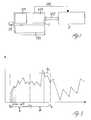
- Figure 1illustrates an embodiment of the device according to the present invention
- reference numeral 1denotes a microcontroller having an RF interface 101, a non-volatile memory 201 integrated therein and a Real Time Clock Module 401 able to control and to manage the time by using embedded resources (internal oscillator) or external references (external oscillator or quartz modules). The selection between the time reference resources is programmable by the micro-controller.
- the micro-controllercan communicate with external devices through a special antenna interface 111 which enables communication with an operator provided with an RFID controller unit, and through a digital interface 102 which places the micro-controller in communication with sensing means 2, such as a 3-axis accelerometer, whose features will be better described below.
- Power 301 of sensing meansis managed by microprocessor 1.
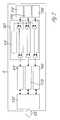
- Figure 2illustrates the configuration of accelerometer 2 in detail; it comprises 3 sensors 212, 222 and 232, which detect events on each of the axes respectively. Each sensor is connected to a controller 302 provided with a register 312 in which signal threshold values are stored. These threshold values are determined by and depend on the characteristics of the transport and of the product to be transported. Detected data are transferred from controller 302 to memory logs 412, 422 and 432, and than to I/O interface 502, which communicates with a digital interface 102 connected to microcontroller 1.
- Management logic of sensor 302is such to be able to write a value in memory registers 412, 422 and 432.
- This valuecan be either a direct value continuously read by acceleration sensors 212, 222 and 232 or the maximum value achieved within a programmable time frame and with a threshold which can be set through the configuration register 312.
- Microcontrollerhas the task to decide which mode will be selected, and the selected mode will be set through digital interface 102.
- Figure 3illustrates a diagram showing time on x-axis, and signal detected by accelerometer 2 on y-axis, as it can be logged in the non-volatile memory 201 of microcontroller 1.
- This diagramemphasizes two different operation modes; in the case denoted by A, at a given time-point t 0 , sensing means and micro-controller are activated, and signal values detected by sensing means and sampled within a time frame ⁇ t , which is small at will and anyway substantially smaller than the activation time frame of sensing means, are stored in the non-volatile memory 201 of microcontroller 1.
- This type of detectionprovides a quite accurate accelerometer curve according to sampling rate ⁇ t , and it is preferable when it is necessary to learn the entire history of mechanical stresses encountered by the article provided with the device of the present invention.
- threshold values set in the register 312 of controller 302will be ignored, and system will log substantially all data detected by sensors 212, 222 and 232 during sampling periods.
- the above-described modeis not very suitable to monitor impacts for a given article in a large time frame because of the limited non-volatile memory resources of the microcontroller, and because of the power consumption of the microcontroller itself, which could be powered by battery packs for example.
- microcontroller 1enters a power saving mode during a programmable time frame t 2 - t 1 .
- sensing means 2is activated and it is programmed to store the last acceleration breach in its memory registers 412, 422 and 432, the acceleration breach having been previously set in the threshold log 312.
- microcontroller 1will automatically exit the power saving mode, it will read memory logs 412, 422 and 432 of accelerometer sensing means 2, it will verify if an acceleration breach has occurred during time frame t 2 - t 1 and, if this is the case, it will log the event in its non-volatile memory 201.
- the acceleration breach eventwill be recorded saving the time information t 2 together with the acceleration samples coming from the 412-422-432 registers. It is clear that the recording data will be as much as accurate as the less the t 2 - t 1 time is.
- the final destination of a given good on which the device described on this invention has been appliedit will be possible to know not only if a specific mechanical "shock" happened and when but also its direction and intensity.
- this type of samplingappears more suitable than the first type described when it is desirable to monitor an article over very long time periods and when it is possible to limit analysis to major events, thus saving device power over a substantially longer time period than the first type of sampling.
- These two operation modes for the devicecan be used either as an alternative to each other or jointly, according to the type of information that the operator wants to obtain.
- sensing meansmanagement of power consumption for sensing means is totally programmable through signal 301.
- Microcontrollercan decide if sensing means should not be powered while it is in power-saving mode, or if sensing means should be continuously powered. Of course, if microcontroller doesn't provide power to sensing means, sensing means cannot acquire acceleration data.
- Figure 4illustrates the preferred embodiment of the firmware stored and running inside the device microcontroller. This algorithm will be executed at every programmed activation period (that can be set-up by a specific RF command). Another RF command can be used also to avoid the accelerometer sensor programming at every wake-up time.
- the next stepis represented by the check of the presence of an error flag at 21; the error flag is related to the program which set up into the accelerometer sensor, and the threshold values for the sensor are programmed at the first switching on of the device, according to the steps 23 and 24 of the flow chart of figure 4.
- the proceduregoes to the step 30, in which is selected the operating mode.
- the device firmwarecould have both the "Shock” or “Acceleration Recording” logging functionalities or implementing only a single branch.
- the procedurecomprise a step 31 in which is verified if the acceleration exceeded the given threshold values; a record is then saved in the memory of the device, containing the time and the value of the violation; the memory is checked at this step 40 for its state. If the memory is over, an error flag is then set as in step 42; if the memory is not over, the in step 41 is carried out the management of the pointers of the memory.
- the simple "acceleration recording”as according to step 34, the data retrieved from the sensor are recorded in the memory until the same is over. In both the above discussed cases, the procedure ended up with the stand by step 44, the device being waiting for the next wake-up as set-up in step 20.
Landscapes
- Physics & Mathematics (AREA)
- General Physics & Mathematics (AREA)
- Recording Measured Values (AREA)
Abstract
Description
- The present invention relates to devices for detecting impacts, vibrations and the like, and particularly it relates to a device intended to be attached to articles to be transported or otherwise moved; more particularly, the invention relates to a device wherein one or more suitable sensors are interfaced with an RFID (Radio Frequency Identification) unit.
- Devices for detecting impacts or the like, which comprise sensing means interfaced with a processor and reporting means by which the occurrence of a detected event is communicated, are known in the state of the art. A first problem with this type of devices is how data can be made available to the operator. Another problem is represented by the type of data sampling to be carried out, which has to provide an adaptive answer for different transport or movement requirements while preserving operation efficiency of the device for the whole time during which the same is attached to a given article.
- Accordingly, the aim of the present invention is to provide a device for detecting impacts and the like, said device being able on one hand to communicate gathered data to an operator, and to achieve a collection of significant data even over a quite long time period on the other hand. To this end, it was investigated the possibility of integrating a processor-coupled RFID device with means for detecting impacts, mechanical stress and vibrations.
- Thus, an object of the present invention is a detection device for detecting impacts and the like, comprising an integrated microcontroller which includes an RFID interface and a non-volatile memory, said integrated microcontroller being interfaced with at least one suitable sensing means through a suitable digital interface, said integrated micro-controller being provided with a power management logic able to manage operation modes of said detection device, power consumption of said sensing means being managed by said power management logic.
- In a preferred embodiment, said sensing means is a three-axis accelerometer; preferably, such sensing means is provided with memory registers storing the detected data. Sensing means can work in a continuous sampling mode, at given time frames and over preset time periods. Furthermore, it can be possible to set threshold values which are programmable in suitable memory registers, and sensing means doesn't carry out any logging activity below these threshold values.
- Another object of the present invention is a method for detecting impacts and/or mechanical stresses, which method can comprise the step of detecting data sensed by sensing means in a substantially continuous manner, said detection being carried out in programmable time frames. Alternatively, detection can comprise gathering data relative to the last event which exceeds a previously assigned threshold value, said detection being carried out in programmable time frames.
- Other advantages and features of the device and method according to the present invention will be apparent from the following description of an embodiment thereof, which is provided by way of illustration, and not by way of limitation, with reference to the accompanying drawings, wherein:
- Figure 1 is a block schematic diagram illustrating the configuration of an embodiment of the device according to the invention;
- Figure 2 is a block schematic diagram depicting the configuration of the acceleration sensor used in the embodiment of Figure 1;
- Figure 3 is a schematic graph showing logged signal versus detection time according to either of two modes described in the present invention.
- Figure 4 is a flow chart describing the preferred embodiment of the software algorithm stored and executed by the device microcontroller (device firmware).
- Figure 1 illustrates an embodiment of the device according to the present invention; reference numeral 1 denotes a microcontroller having an
RF interface 101, anon-volatile memory 201 integrated therein and a RealTime Clock Module 401 able to control and to manage the time by using embedded resources (internal oscillator) or external references (external oscillator or quartz modules). The selection between the time reference resources is programmable by the micro-controller. - The micro-controller can communicate with external devices through a
special antenna interface 111 which enables communication with an operator provided with an RFID controller unit, and through adigital interface 102 which places the micro-controller in communication withsensing means 2, such as a 3-axis accelerometer, whose features will be better described below.Power 301 of sensing means is managed by microprocessor 1. - Figure 2 illustrates the configuration of
accelerometer 2 in detail; it comprises 3sensors controller 302 provided with a register 312 in which signal threshold values are stored. These threshold values are determined by and depend on the characteristics of the transport and of the product to be transported. Detected data are transferred fromcontroller 302 tomemory logs O interface 502, which communicates with adigital interface 102 connected to microcontroller 1. - Management logic of
sensor 302 is such to be able to write a value inmemory registers acceleration sensors digital interface 102. - Operation of the device according to the present invention will become evident from the following, with particular reference to Figure 3. Figure 3 illustrates a diagram showing time on x-axis, and signal detected by
accelerometer 2 on y-axis, as it can be logged in thenon-volatile memory 201 of microcontroller 1. This diagram emphasizes two different operation modes; in the case denoted by A, at a given time-pointt0, sensing means and micro-controller are activated, and signal values detected by sensing means and sampled within a time frame Δt, which is small at will and anyway substantially smaller than the activation time frame of sensing means, are stored in thenon-volatile memory 201 of microcontroller 1. This type of detection provides a quite accurate accelerometer curve according to sampling rate Δt, and it is preferable when it is necessary to learn the entire history of mechanical stresses encountered by the article provided with the device of the present invention. In this case, threshold values set in the register 312 ofcontroller 302 will be ignored, and system will log substantially all data detected bysensors - In the other type of sampling, at time-pointt1, microcontroller 1 enters a power saving mode during a programmable time framet2 -t1. However, during the time frame ranging fromt1 tot2,
sensing means 2 is activated and it is programmed to store the last acceleration breach in itsmemory registers memory logs non-volatile memory 201. The acceleration breach event will be recorded saving the time informationt2 together with the acceleration samples coming from the 412-422-432 registers. It is clear that the recording data will be as much as accurate as the less thet2 -t1 time is. At the final destination of a given good on which the device described on this invention has been applied it will be possible to know not only if a specific mechanical "shock" happened and when but also its direction and intensity. - Of course, this type of sampling appears more suitable than the first type described when it is desirable to monitor an article over very long time periods and when it is possible to limit analysis to major events, thus saving device power over a substantially longer time period than the first type of sampling. These two operation modes for the device can be used either as an alternative to each other or jointly, according to the type of information that the operator wants to obtain.
- In any case, management of power consumption for sensing means is totally programmable through
signal 301. Microcontroller can decide if sensing means should not be powered while it is in power-saving mode, or if sensing means should be continuously powered. Of course, if microcontroller doesn't provide power to sensing means, sensing means cannot acquire acceleration data. - Figure 4 illustrates the preferred embodiment of the firmware stored and running inside the device microcontroller. This algorithm will be executed at every programmed activation period (that can be set-up by a specific RF command). Another RF command can be used also to avoid the accelerometer sensor programming at every wake-up time. After the set-up of the parameters of the device in
step 20, the next step is represented by the check of the presence of an error flag at 21; the error flag is related to the program which set up into the accelerometer sensor, and the threshold values for the sensor are programmed at the first switching on of the device, according to thesteps step 30, in which is selected the operating mode. - The device firmware could have both the "Shock" or "Acceleration Recording" logging functionalities or implementing only a single branch. In the case of "shock" recording, the procedure comprise a
step 31 in which is verified if the acceleration exceeded the given threshold values; a record is then saved in the memory of the device, containing the time and the value of the violation; the memory is checked at thisstep 40 for its state. If the memory is over, an error flag is then set as instep 42; if the memory is not over, the instep 41 is carried out the management of the pointers of the memory. In the case of the simple "acceleration recording", as according tostep 34, the data retrieved from the sensor are recorded in the memory until the same is over. In both the above discussed cases, the procedure ended up with the stand bystep 44, the device being waiting for the next wake-up as set-up instep 20.
Claims (6)
- Detection device for detecting impacts and the like, comprising an integrated microcontroller (1) which includes an RFID interface (101) and a non-volatile memory (201), said integrated microcontroller (1) being interfaced with at least one suitable sensing means (2) through a suitable digital interface (102), said integrated microcontroller (1) being provided with a power management logic (301) to manage operation modes of said detection device, the power consumption of said sensing means (2) being managed by said power management logic (301).
- Detection device according to Claim 1, wherein said sensing means is a three-axis accelerometer (2).
- Detection device according to Claim 2, wherein said three-axis accelerometer (2) comprises: three sensors (212, 222, 232) connected to a controller (302) provided with a memory register (312) to store detection threshold values; three memory registers (412, 422, 432) to store detected data; and an I/O interface (502) to communicate with said digital interface (102) of said integrated microcontroller (1).
- Method for detecting impacts and the like through a detection device according to any one of Claims 1 to 3, comprising the steps of: acquiring data from said sensing means (2) over a given time frame, storing said data in said non-volatile memory (201) of said integrated microcontroller (1), setting said integrated microcontroller (1) in a power saving mode.
- Method according to Claim 4, carried out by a detection device according to Claim 3, wherein data detecting step comprises detecting data in time frames Δt which are small compared to an activation time frame of said sensing means (2), and logging said data in suitable memory registers (412, 422, 432).
- Method according to Claim 4, carried out by a detection device according to Claim 3, wherein data detecting step comprises detecting only data that exceed a threshold value stored and programmed in said memory register (312) of said controller (302), data relative to the major event detected in a given programmable time frame being logged in said memory registers (412, 422, 432).
Applications Claiming Priority (1)
| Application Number | Priority Date | Filing Date | Title |
|---|---|---|---|
| IT000091AITGE20060091A1 (en) | 2006-09-15 | 2006-09-15 | DEVICE FOR DETECTING IMPACTS OR VIBRATIONS. |
Publications (1)
| Publication Number | Publication Date |
|---|---|
| EP1901076A1true EP1901076A1 (en) | 2008-03-19 |
Family
ID=38896918
Family Applications (1)
| Application Number | Title | Priority Date | Filing Date |
|---|---|---|---|
| EP07017634ACeasedEP1901076A1 (en) | 2006-09-15 | 2007-09-10 | Device for detecting impacts or vibrations |
Country Status (3)
| Country | Link |
|---|---|
| US (1) | US7886168B2 (en) |
| EP (1) | EP1901076A1 (en) |
| IT (1) | ITGE20060091A1 (en) |
Families Citing this family (7)
| Publication number | Priority date | Publication date | Assignee | Title |
|---|---|---|---|---|
| TWI405710B (en)* | 2009-10-29 | 2013-08-21 | Univ Chung Hua | Radio frequency identification based thermal bubble type accelerometer |
| CN102804502B (en) | 2009-12-16 | 2015-12-02 | 阿丹特有限责任公司 | Meta Materials reconfigurable antennas |
| CA2847345C (en)* | 2011-09-01 | 2018-01-02 | Riddell, Inc. | Systems and methods for monitoring a physiological parameter of persons engaged in physical activity |
| CN104424736B (en)* | 2013-09-09 | 2018-05-22 | 罗伯特·博世有限公司 | Invade and harass detection device and corresponding invasion detection method |
| US9904884B2 (en) | 2014-01-29 | 2018-02-27 | General Electric Company | Method and systems for detecting turbocharger imbalance with an RFID circuit |
| WO2020037279A1 (en) | 2018-08-16 | 2020-02-20 | Riddell, Inc. | System and method for designing and manufacturing a protective helmet |
| US12134361B2 (en) | 2022-04-11 | 2024-11-05 | Stmicroelectronics, Inc. | Motion event detection |
Citations (5)
| Publication number | Priority date | Publication date | Assignee | Title |
|---|---|---|---|---|
| US5854994A (en)* | 1996-08-23 | 1998-12-29 | Csi Technology, Inc. | Vibration monitor and transmission system |
| US5903856A (en)* | 1994-02-10 | 1999-05-11 | Siemens Aktiengesellschaft | Device and method for monitoring the transit time of transported articles |
| WO2000058572A1 (en) | 1999-03-30 | 2000-10-05 | Kohler Co. | Cooking sink |
| WO2000058752A1 (en)* | 1999-03-30 | 2000-10-05 | Microchip Technology Incorporated | Radio frequency identification tag device with sensor input |
| US20060049926A1 (en)* | 2004-09-03 | 2006-03-09 | Hoshal Gregory D | Data recorder suitable for use as a railcar hunting detector |
Family Cites Families (6)
| Publication number | Priority date | Publication date | Assignee | Title |
|---|---|---|---|---|
| US20030149349A1 (en)* | 2001-12-18 | 2003-08-07 | Jensen Thomas P. | Integral patch type electronic physiological sensor |
| GB0411156D0 (en)* | 2004-05-19 | 2004-06-23 | Powtier Controls Ltd | Wireless sensors |
| US7216053B2 (en)* | 2004-12-30 | 2007-05-08 | Nokia Corporation | Low power motion detector |
| WO2006121758A2 (en)* | 2005-05-05 | 2006-11-16 | Mayo Foundation For Medical Education And Research | Systems, methods and devices for promoting thermogenesis |
| US7558013B2 (en)* | 2006-01-12 | 2009-07-07 | Hewlett-Packard Development Company, L.P. | Programming a sensitivity level into an inertial sensor based on a proxy of whether a system is in transit |
| US8009027B2 (en)* | 2006-05-31 | 2011-08-30 | Infineon Technologies Ag | Contactless sensor systems and methods |
- 2006
- 2006-09-15ITIT000091Apatent/ITGE20060091A1/enunknown
- 2007
- 2007-09-10EPEP07017634Apatent/EP1901076A1/ennot_activeCeased
- 2007-09-15USUS11/856,018patent/US7886168B2/ennot_activeExpired - Fee Related
Patent Citations (5)
| Publication number | Priority date | Publication date | Assignee | Title |
|---|---|---|---|---|
| US5903856A (en)* | 1994-02-10 | 1999-05-11 | Siemens Aktiengesellschaft | Device and method for monitoring the transit time of transported articles |
| US5854994A (en)* | 1996-08-23 | 1998-12-29 | Csi Technology, Inc. | Vibration monitor and transmission system |
| WO2000058572A1 (en) | 1999-03-30 | 2000-10-05 | Kohler Co. | Cooking sink |
| WO2000058752A1 (en)* | 1999-03-30 | 2000-10-05 | Microchip Technology Incorporated | Radio frequency identification tag device with sensor input |
| US20060049926A1 (en)* | 2004-09-03 | 2006-03-09 | Hoshal Gregory D | Data recorder suitable for use as a railcar hunting detector |
Also Published As
| Publication number | Publication date |
|---|---|
| US7886168B2 (en) | 2011-02-08 |
| US20080072082A1 (en) | 2008-03-20 |
| ITGE20060091A1 (en) | 2008-03-16 |
Similar Documents
| Publication | Publication Date | Title |
|---|---|---|
| US7886168B2 (en) | Device for detecting impacts or vibrations | |
| US6122959A (en) | Method and apparatus for recording physical variables of transient acceleration events | |
| WO2010065621A3 (en) | System and method for accident logging in an automated machine | |
| RU2402440C1 (en) | Transport facility data entry system | |
| US10248627B2 (en) | Method for storing image of vehicle black box | |
| CN104114441B (en) | Event data record for vehicle | |
| CA2363552A1 (en) | Vehicle motion detection and recording method and apparatus | |
| CA2568245A1 (en) | Wireless monitoring device | |
| WO2003067350A3 (en) | Apparatus and method for simultaneous monitoring, logging, and controlling of an industrial process | |
| US20040186691A1 (en) | Integrated data acquisition system for product in transit | |
| CN107766008A (en) | Method and device for preventing abnormal writing of storage medium and electronic equipment | |
| CN113466928B (en) | Seismic Sensor | |
| WO2008044569A1 (en) | Apparatus and method capable of recording fall | |
| JP2009003685A (en) | Data storage device, data storage method, and data storage program | |
| US10582985B2 (en) | Device for surgical instrument, having sensors for the storage of information | |
| EP1589490B1 (en) | Control unit and data transmitting method | |
| JP2009059334A5 (en) | ||
| CA2525974A1 (en) | Flow meter monitoring and data logging system | |
| CN106104276B (en) | Apparatus for detecting and recording acceleration experienced by a building and method of operating the same | |
| US8549338B2 (en) | Low-power data loop recorder | |
| KR20240126923A (en) | Smart Container System with Precise Sensing System based on Smart Sensor Node and Method for Controlling the same | |
| KR20000070515A (en) | Tracking detection of electric control motors with incremental position detection | |
| JP2006526139A5 (en) | ||
| CN107707587A (en) | Control method, server, wagon detector and vehicle detecting system | |
| JP2000097730A (en) | Shock recorder |
Legal Events
| Date | Code | Title | Description |
|---|---|---|---|
| PUAI | Public reference made under article 153(3) epc to a published international application that has entered the european phase | Free format text:ORIGINAL CODE: 0009012 | |
| AK | Designated contracting states | Kind code of ref document:A1 Designated state(s):AT BE BG CH CY CZ DE DK EE ES FI FR GB GR HU IE IS IT LI LT LU LV MC MT NL PL PT RO SE SI SK TR | |
| AX | Request for extension of the european patent | Extension state:AL BA HR MK YU | |
| 17P | Request for examination filed | Effective date:20080915 | |
| 17Q | First examination report despatched | Effective date:20081020 | |
| AKX | Designation fees paid | Designated state(s):AT BE BG CH CY CZ DE DK EE ES FI FR GB GR HU IE IS IT LI LT LU LV MC MT NL PL PT RO SE SI SK TR | |
| RAP1 | Party data changed (applicant data changed or rights of an application transferred) | Owner name:MONTALBANO TECHNOLOGY S.P.A. | |
| STAA | Information on the status of an ep patent application or granted ep patent | Free format text:STATUS: THE APPLICATION HAS BEEN REFUSED | |
| 18R | Application refused | Effective date:20111121 |