EP1662546A1 - Inductively coupled plasma processing apparatus - Google Patents
Inductively coupled plasma processing apparatusDownload PDFInfo
- Publication number
- EP1662546A1 EP1662546A1EP04106093AEP04106093AEP1662546A1EP 1662546 A1EP1662546 A1EP 1662546A1EP 04106093 AEP04106093 AEP 04106093AEP 04106093 AEP04106093 AEP 04106093AEP 1662546 A1EP1662546 A1EP 1662546A1
- Authority
- EP
- European Patent Office
- Prior art keywords
- dielectric window
- magnetic cores
- plasma
- chamber
- magnetic core
- Prior art date
- Legal status (The legal status is an assumption and is not a legal conclusion. Google has not performed a legal analysis and makes no representation as to the accuracy of the status listed.)
- Withdrawn
Links
Images


Classifications
- H—ELECTRICITY
- H01—ELECTRIC ELEMENTS
- H01J—ELECTRIC DISCHARGE TUBES OR DISCHARGE LAMPS
- H01J37/00—Discharge tubes with provision for introducing objects or material to be exposed to the discharge, e.g. for the purpose of examination or processing thereof
- H01J37/32—Gas-filled discharge tubes
- H01J37/32431—Constructional details of the reactor
- H01J37/32458—Vessel
Definitions
- the present inventionrelates to an inductively coupled plasma (ICP) processing apparatus and, more particularly, to a processing apparatus for processing of large-area substrates.
- ICPinductively coupled plasma
- ICPinductively coupled plasma
- the poweris electro-magnetically coupled to the plasma through a field source, which comprises in general a multi-turn rf (radio frequency) coil antenna acting as primary winding of a transformer.
- the plasmaacts as a single-turn, lossy conductor that is coupled as secondary winding to the field source placed around or adjacent to the plasma processing chamber.
- two different coil configurationscan be distinguished in ICPs, i.e. cylindrical and planar.
- a coilis wound around the discharge chamber, e.g. as a helix.
- a flat coilis tangentially placed adjacent to the processing chamber and separated from the discharge region by a dielectric.
- magnetic field strength and homogeneityit has been proposed to combine magnetic cores with the coil antenna.
- Such magnetic pole enhanced-ICP (MaPE-ICP) sources with planar coil configurationwill be considered for the purposes of the present disclosure.
- the sealing functionis provided by the dielectric material.
- a plate of dielectric material accommodating the aperture dimensionsis sealingly fitted to the aperture with suitable joints for vacuum sealing.
- the electromagnetic field source including the magnetic coreis attached to the processing chamber and located in front of the dielectric window.
- the thickness of the dielectric windowcauses a reduction of efficiency. This results in increased electrical (rf) power consumption.
- the sealing functionis provided by the magnetic core, which is part of the field source.
- the thickness of dielectric materialcan then be drastically reduced, as its has no sealing function.
- the cost of such large size magnetic coresis considerable. If the aperture size exceeds a certain limit, suitable one-piece magnetic cores are not available at reasonable cost. Moreover, mechanical resistance of the magnetic core becomes critical with increasing size.
- Another problemis related to uniformity of the plasma.
- uniform surface processing of the substrateis required, which depends on the uniformity of the plasma.
- the latterdepends, inter alia, on the design of the field source, and in particular on the configuration of the magnetic core, the associated coil antenna and the dielectric window.
- the uniformity of the plasmabecomes a critical issue.
- the object of the present inventionis to provide an improved processing apparatus for ICP processing, which overcomes the aforementioned problems.
- the present inventionproposes an inductively coupled plasma processing apparatus comprising a plasma chamber with a dielectric window forming a self-supporting wall element of the plasma chamber.
- the dielectric windowhas an external and an internal side with respect to the chamber.
- An electromagnetic field sourceis arranged in front of the external side of the dielectric window for generating an electromagnetic field within the plasma chamber.
- the field sourcecomprises at least one magnetic core.
- the at least one magnetic coreis mounted onto the external side of the dielectric window, so that it is directly supported by the dielectric window and forms a mechanical reinforcement of the latter. As the magnetic core reinforces the dielectric window, the required thickness of the latter can be significantly reduced while insuring sufficient mechanical resistance. A unique rigid structure is created which eases fixation to the plasma processing chamber. Flexibility is gained in the choice of the magnetic core type, e.g. core geometry or core material.
- the electromagnetic field sourcecomprises a plurality of separate magnetic cores mounted onto the external side of the dielectric window, so that they are all directly supported by the dielectric window and form mechanical reinforcements of the latter.
- the separate magnetic coresare mounted onto the external side of the dielectric window according to a predetermined pattern.
- the uniformity of the generated plasmacan be positively influenced by positioning the separate magnetic cores relative the plasma processing chamber. Mounting the magnetic cores directly onto the dielectric window provides the required degrees of freedom.
- the separate magnetic coresare mechanically interconnected.
- the dielectric windowis further reinforced.
- a separator of dielectric materialis arranged between at least some of the plurality of separate magnetic cores and is mounted onto the external side of the dielectric window, so that it is directly supported by the dielectric window and contributes to form a mechanical reinforcement of the latter. Reducing the magnetic flux concentration in front of one or more designated regions of the dielectric window, i.e. the plasma, provides further flexibility for shaping the magnetic field. Thereby plasma uniformity can be increased.
- the magnetic cores and the separator of dielectric materialare advantageously mechanically interconnected.
- the magnetic coreis preferably mounted onto the external side of the dielectric window by means of a bonding agent.
- the apparatusfurther comprises means for injecting a process gas into the chamber through the magnetic core and the dielectric window.
- the means for injecting a process gasadvantageously form a showerhead-like gas injector together with the magnetic core and the dielectric window. Besides contributing to plasma uniformity, this arrangement also provides a unique rigid plasma source structure, which can be easily attached to or detached from the plasma processing chamber.
- a separate induction meanscan be associated with each magnetic core or a group of magnetic cores.
- at least two sets of the induction meansare independently controllable in operation. By two or more independent inductor coils electrical control over the plasma generation area is provided.
- the described apparatusallows for electromagnetic field shaping in inductively coupled plasma processing.
- Fig.1shows a prior art apparatus for inductively coupled plasma (ICP) processing, globally identified by reference 10.
- the apparatus 10comprises a plasma processing chamber 12 and an external electromagnetic field source 14.
- the plasma chamber 12provides a sealed containment in which plasma is generated or sustained and a workpiece, i.e. substrate 16, is exposed thereto.
- the plasma chamber 12comprises a support 18 for the workpiece 16, and both a gas inlet port 20 and a gas outlet port 22 for regulating negative gas pressure and gas composition inside the chamber 12.
- the external field source 14comprises a one-piece magnetic core 30 mounted onto a top face of the chamber 12.
- the magnetic core 30is provided with multiple recesses 32, which accommodate coil windings 34.
- a circumferential frame portion 36is provided for flanging the magnetic core 30 to a rim portion 38 of the chamber 12.
- a window 40 of dielectric materialis fixed to the core 30, so as to cover the recesses 32 and the coil windings 34.
- the dielectric window 40is an electrical insulator between coil windings 34 and the plasma. It also prevents contamination, e.g. due to sputtering, of the plasma by material from the magnetic core 30 or the windings 34.
- the magnetic core 30can be made of a material having sufficient magnetic permeability and low conductivity to limit eddy currents, e.g. a laminated ferromagnetic or a magnetic powder - dielectric binder composite.
- the dielectric window 40can be made of glass, quartz or polyethylene or any other suitable dielectric material.
- the apparatus 10comprises an electrical radio-frequency (rf) generator 42 which supplies the current for the coil windings 34 of the field source 14.
- the rf currents in the coil windings 34generate an rf magnetic flux, which is essentially confined and guided by the magnetic core 30.
- the rf magnetic fluxpenetrates the plasma region through the dielectric window 40.
- the time-varying magnetic flux densityinduces a solenoidal rf electric field, which accelerates the free electrons and thereby generates or sustains the plasma.
- Other known aspects of ICP processingsuch as electrical biasing and heating of the substrate 16 or cooling of the magnetic core 30, have been omitted in Fig.1 for conciseness.
- Gas-tight sealing of the chamber 12is provided by an O-ring joint 44 arranged between the frame portion 36 and the rim portion 38 flanged together by means of several fasteners 46.
- the magnetic core 30has a sealing function for the field admission aperture of the plasma chamber 12. Therefore, the rigidity and thickness of the magnetic core 30 must be sufficient to withstand the collapsing force of atmospheric pressure, when low pressure gas or partial vacuum conditions exist inside the chamber 12. It may be noted that the internal negative pressure is usually in the range of 0.5 - 50 mTorr during operation.
- the size of the field source 14roughly determines the area over which the plasma conditions can be generated or sustained inside the chamber 12, and consequently the area of the workpiece 16 that can be processed.
- the maximum processing areais limited by the available wall thickness and mechanical resistance of the magnetic core 30.
- the choice of material composition and geometry of the magnetic core 30is limited, due to the related mechanical requirements.
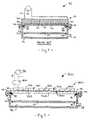
- Fig.2shows a first embodiment of a novel apparatus for inductively coupled plasma (ICP) processing, globally identified by reference 100.
- ICPinductively coupled plasma
- the sealing functionis provided by the dielectric window 400 being a self supporting wall element of the chamber 12.
- the dielectric window 400is flanged with the border of its internal side to the rim portion 38 of the chamber 12 by means of fasteners 46. Gas-tightness is insured by the O-ring joint 44 arranged between the border of the window 400 and the rim portion 38.
- the field source 140comprises a plurality of magnetic cores 301, 302, 303. Each of the magnetic cores 301, 302, 303 is provided with some windings of a single inductor coil 340.
- the inductor coil 340is arranged in "S-shaped" serpentine or any other suitable configuration through the recesses of the respective magnetic cores 301, 302, 303.
- the inductor coil 340is connected to the rf generator by means of an impedance matching network 600.
- each of the separate magnetic cores 301, 302, 303is mounted directly onto the external side of the dielectric window 400. They are mounted to the dielectric window 400 by means of a thin layer 500 of a bonding agent. Additionally, the magnetic cores are mechanically interconnected by a layer 510 of bonding agent between their adjacent side faces.
- a suitable bonding agentis for example an isolating one-part structural epoxy adhesive, such as 3MTM Scotch-WeldTM 2214 (Non Metallic Filled). No additional support structure for the magnetic cores 301, 302, 303 is required.
- the magnetic cores 301, 302, 303essentially cover the dielectric window 400 in both directions parallel and perpendicular to the plane of Fig.2.
- the layer of bonding agent 500preferably extends over the entire extent of the contacting surfaces between the dielectric window 400 and the magnetic cores 301, 302, 303.
- the magnetic cores 301, 302, 303form a mechanical reinforcement of the dielectric window 400 in both directions. In consequence, they increase the rigidity of the dielectric window 400 in order to withstand the collapsing force caused by the pressure gradients exerted onto the latter during operation.
- Fig.3shows a second embodiment of an ICP processing apparatus 100.
- Fig.2shows a second embodiment of an ICP processing apparatus 100.
- the magnetic cores 301, 302 and 303are mechanically interconnected on their rear face by means of an end plate 700.
- the end plate 700exceeds the chamber 12 in width and is fixed to the magnetic cores by a thin layer 710 of bonding agent.
- the end plate 700is mounted to the housing of the chamber 12 by means of fasteners 460, for example to the same mounting structure used for mounting the dielectric window 400.
- the end plate 700provides an additional reinforcement of the sealing assembly composed of dielectric window 400 and magnetic cores 301, 302, 303.
- the field source 140 and in particular the dielectric window 400gain additional mechanical resistance through this "sandwiched" construction.
- the rear plate 700is advantageously part of this cooling system, e.g. in the form of a cooling plate.
- a bonding agent having high thermal conductivityis preferably chosen.
- the end plate 700is made of a dielectric material or a conducting material with an insulating face towards the magnetic cores 301, 302, 303, thus having no or little adverse effect on the return path of the magnetic flux.
- each of the magnetic cores 301, 302, 303is provided with independent inductor coils 341, 342 and 343 respectively.
- the inductor coils 341, 342 and 343have independent electrical connections to the rf generator 42 through respective impedance matching and tuning networks 601, 602 and 603.
- the independent magnetic cores 301, 302, 303 and associated inductor coils 341, 342, 343, combined with the tuning networks 601, 602, 603allow for adjustment of the magnetic field strength along the plane of the figure.
- the tuning networks 601, 602 and 603the distribution of coupled energy and consequently the ion density within the plasma can be controlled so as to increase plasma uniformity in a direction parallel to the plane of Fig.3.
- tuning inductances connected in series with the inductor coils 341, 342, 343to balance the inductively coupled power over the plasma area. This is because small differences of impedance between the inductor coils 341, 342, 343 can cause some important non uniformity of the plasma. Moreover, by increasing the inductance connected to the central inductor coil 342, excessive field strength in the central region, due to field superposition from inductor coils 341 and 343 respectively, can be eliminated.
- gas injection pipes 800e.g. made of stainless steel, can be arranged within the magnetic cores 301, 302 and 303.
- the gas injection pipes 800are inserted through bores which traverse the rear plate 700, the respective magnetic core 301, 302 or 303 and the dielectric window 400.
- the end portions of the gas injection pipes 800are tightened to the dielectric window 400 and the rear plate 700 respectively, e.g. by means of corresponding threads and bolts. Thereby, the mechanical resistance of the dielectric window 400 is additionally increased.
- additional gas injection pipes(not shown) can be arranged so as to provide an essentially uniform gas distribution above the workpiece 16.
- Such a showerhead-like gas above the workpiece 16contributes to increased plasma uniformity.
- the gas injectioncan be effected directly through the bores without insertion of special pipes.
- Fig. 4shows an field source 140 according to a third embodiment.
- the field source 140comprises a plurality of magnetic cores 301, 302, 303, 304, 305, 306 symmetrically arranged in two rows above a dielectric window 400 to which they are attached. Between the two rows, three separators 801, 802, 803 are arranged.
- the separatorsare made of dielectric material, Teflon® for example.
- the magnetic cores 301, 302, 303, 304, 305, 306 and the separators 801, 802, 803are mounted to the dielectric window by a relatively thin layer 500 of bonding agent.
- the magnetic cores 301, 302, 303, 304, 305, 306 and the separators 801, 802, 803are preferably interconnected so as to form a mechanically rigid structure. This can be achieved by bonding together the respective adjacent faces of the latter, e.g. using the aforementioned bonding agent. Consequently, an increase in the rigidity of the field source 140 and of the dielectric window 400 is additionally achieved.
- the use of independent inductor coils and associated tuning networksallows for increasing plasma uniformity in a direction parallel to the plane of Fig.2 or Fig.3 or perpendicular to the coil length. (x-axis in Fig. 4).
- the interspace between the respective rows of magnetic cores 301, 302, 303 and 304, 305, 306in turn allows to increase plasma uniformity in the direction parallel to the coil length (y-axis in Fig. 4). Removing the magnetic poles at the center region allows to decrease the electromagnetic field locally in the direction of the y-axis.
- the two-dimensional configuration of the field source 140 as shown in Fig.4allows to reduce the excess of magnetic field strength in the central plasma region by inhibiting magnetic flux concentration.
- Fig.5shows an exemplary plot of normalized ion current density over the (x, y)-axes of Fig.4.
- Fig.5illustrates the uniformity of the plasma achieved by the "field shaping" measures and field source configuration as described above. It may be noted that the non-uniformity at the periphery is partly due to the wall of chamber 12 which acts as a sink for ions from the plasma. When compared to known ICPs, which generally achieve plasma non-uniformities in the order of 30-40%, plasma uniformity of approximately 15% can now be achieved, as clearly shown in Fig.5. In conclusion, it will be appreciated that what is detailed above provides a significant contribution to ICP processing of large-area workpieces.
Landscapes
- Physics & Mathematics (AREA)
- Engineering & Computer Science (AREA)
- Plasma & Fusion (AREA)
- Chemical & Material Sciences (AREA)
- Analytical Chemistry (AREA)
- Plasma Technology (AREA)
- Drying Of Semiconductors (AREA)
- Chemical Vapour Deposition (AREA)
Abstract
Description
- The present invention relates to an inductively coupled plasma (ICP) processing apparatus and, more particularly, to a processing apparatus for processing of large-area substrates.
- Plasma processing has become an increasingly used technology over the last decades, especially because of its ability to produce fine features with high aspect ratios. As a particular example of high-density plasma sources, the inductively coupled plasma (ICP) type of source is widely used in science and industry. ICP sources (ICPs) are used e.g. in the semiconductor and the MEMS industries for surface treatments or modifications of various kinds, such as deposition, etching, ion implantation, activation, cleaning, hardening, etc.
- In ICPs, the power is electro-magnetically coupled to the plasma through a field source, which comprises in general a multi-turn rf (radio frequency) coil antenna acting as primary winding of a transformer. The plasma acts as a single-turn, lossy conductor that is coupled as secondary winding to the field source placed around or adjacent to the plasma processing chamber.
- Basically, two different coil configurations can be distinguished in ICPs, i.e. cylindrical and planar. In the first configuration, a coil is wound around the discharge chamber, e.g. as a helix. In the second planar coil configuration, which is more commonly used for materials processing, a flat coil, generally in spiral form, is tangentially placed adjacent to the processing chamber and separated from the discharge region by a dielectric. For additional improvement, e.g. magnetic field strength and homogeneity, it has been proposed to combine magnetic cores with the coil antenna. Such magnetic pole enhanced-ICP (MaPE-ICP) sources with planar coil configuration will be considered for the purposes of the present disclosure.
- As industry transitions to processing larger substrates, e.g. large flat panel displays (FPD), large wafers (≥300mm) or photovoltaic cells, there is a need to provide large-area high-density MaPE-ICP plasma reactors that produce reactant fluxes over a large effective area. There is also a desire for increasing processing chamber productivity by processing multiple parts in parallel. The design of large-area MaPE-ICPs however raises some difficulties.
- One of the problems when scaling up MaPE-ICPs is related to the increase in size of the field admission aperture, which transmits electromagnetic energy into the chamber. The sealing element, which closes the aperture is subject to considerable mechanical stresses due to the required negative internal pressure (0.5 - 50 mTorr). Generally speaking, the material strength , which is required to resist the pressure gradients exerted during operation, is a function of the aperture size.
- Until now, two types of aperture sealing windows have been commonly used in MaPE-ICPs with planar coil configuration, as disclosed for example in EP 1 209 721 by the applicant. In a first embodiment the sealing function is provided by the dielectric material. In this embodiment, a plate of dielectric material accommodating the aperture dimensions is sealingly fitted to the aperture with suitable joints for vacuum sealing. The electromagnetic field source including the magnetic core is attached to the processing chamber and located in front of the dielectric window. The latter approach requires the dielectric window to be of sufficient thickness to withstand the negative pressure. However, there is a significant drawback to this approach. The thickness of the dielectric window causes a reduction of efficiency. This results in increased electrical (rf) power consumption. In an alternative second embodiment, the sealing function is provided by the magnetic core, which is part of the field source. The thickness of dielectric material can then be drastically reduced, as its has no sealing function. However, the cost of such large size magnetic cores is considerable. If the aperture size exceeds a certain limit, suitable one-piece magnetic cores are not available at reasonable cost. Moreover, mechanical resistance of the magnetic core becomes critical with increasing size.
- Another problem is related to uniformity of the plasma. For high-quality and reliable products, uniform surface processing of the substrate is required, which depends on the uniformity of the plasma. The latter depends, inter alia, on the design of the field source, and in particular on the configuration of the magnetic core, the associated coil antenna and the dielectric window. With increasing workpiece area, the uniformity of the plasma becomes a critical issue.
- The object of the present invention is to provide an improved processing apparatus for ICP processing, which overcomes the aforementioned problems.
- In order to overcome the abovementioned problems, the present invention proposes an inductively coupled plasma processing apparatus comprising a plasma chamber with a dielectric window forming a self-supporting wall element of the plasma chamber. The dielectric window has an external and an internal side with respect to the chamber. An electromagnetic field source is arranged in front of the external side of the dielectric window for generating an electromagnetic field within the plasma chamber. The field source comprises at least one magnetic core. According to an important aspect of the invention, the at least one magnetic core is mounted onto the external side of the dielectric window, so that it is directly supported by the dielectric window and forms a mechanical reinforcement of the latter. As the magnetic core reinforces the dielectric window, the required thickness of the latter can be significantly reduced while insuring sufficient mechanical resistance. A unique rigid structure is created which eases fixation to the plasma processing chamber. Flexibility is gained in the choice of the magnetic core type, e.g. core geometry or core material.
- In a preferred embodiment, the electromagnetic field source comprises a plurality of separate magnetic cores mounted onto the external side of the dielectric window, so that they are all directly supported by the dielectric window and form mechanical reinforcements of the latter. By eliminating the one-piece requirement, the cost of the field source is drastically reduced.
- Advantageously, the separate magnetic cores are mounted onto the external side of the dielectric window according to a predetermined pattern. The uniformity of the generated plasma can be positively influenced by positioning the separate magnetic cores relative the plasma processing chamber. Mounting the magnetic cores directly onto the dielectric window provides the required degrees of freedom.
- Preferably, the separate magnetic cores are mechanically interconnected. By creating a rigid field source assembly through mutual fixation of the magnetic cores, the dielectric window is further reinforced.
- In another preferred embodiment, a separator of dielectric material is arranged between at least some of the plurality of separate magnetic cores and is mounted onto the external side of the dielectric window, so that it is directly supported by the dielectric window and contributes to form a mechanical reinforcement of the latter. Reducing the magnetic flux concentration in front of one or more designated regions of the dielectric window, i.e. the plasma, provides further flexibility for shaping the magnetic field. Thereby plasma uniformity can be increased. Herein, the magnetic cores and the separator of dielectric material are advantageously mechanically interconnected.
- The magnetic core is preferably mounted onto the external side of the dielectric window by means of a bonding agent.
- In another preferred embodiment, the apparatus further comprises means for injecting a process gas into the chamber through the magnetic core and the dielectric window. In this case, the means for injecting a process gas advantageously form a showerhead-like gas injector together with the magnetic core and the dielectric window. Besides contributing to plasma uniformity, this arrangement also provides a unique rigid plasma source structure, which can be easily attached to or detached from the plasma processing chamber.
- In case separate magnetic cores are mounted to the dielectric window, a separate induction means can be associated with each magnetic core or a group of magnetic cores. Advantageously, at least two sets of the induction means are independently controllable in operation. By two or more independent inductor coils electrical control over the plasma generation area is provided.
- Besides other aforementioned advantages, the described apparatus allows for electromagnetic field shaping in inductively coupled plasma processing.
- The present invention will be more apparent from the following description of not limiting embodiments with reference to the attached drawings, wherein
- Fig.1:
- is a schematic cross-sectional view of a prior art plasma processing apparatus;
- Fig.2:
- is a schematic cross-sectional view of a plasma processing apparatus according to a first embodiment of the invention;
- Fig.3:
- is a schematic cross-sectional view of a plasma processing apparatus according to a second embodiment of the invention;
- Fig.4:
- is a perspective cross-sectional view of a field source assembly according to a third embodiment of the invention;
- Fig.5:
- is a 2-D plot of normalized ion current density achieved with the field source of Fig.4
- Fig.1 shows a prior art apparatus for inductively coupled plasma (ICP) processing, globally identified by
reference 10. Theapparatus 10 comprises aplasma processing chamber 12 and an externalelectromagnetic field source 14. Theplasma chamber 12 provides a sealed containment in which plasma is generated or sustained and a workpiece, i.e.substrate 16, is exposed thereto. In a manner known per se, theplasma chamber 12 comprises asupport 18 for theworkpiece 16, and both agas inlet port 20 and agas outlet port 22 for regulating negative gas pressure and gas composition inside thechamber 12. - In the
prior art apparatus 10, theexternal field source 14 comprises a one-piecemagnetic core 30 mounted onto a top face of thechamber 12. On an internal side turned towards thechamber 12, themagnetic core 30 is provided withmultiple recesses 32, which accommodatecoil windings 34. Acircumferential frame portion 36 is provided for flanging themagnetic core 30 to arim portion 38 of thechamber 12. Within theframe portion 36, awindow 40 of dielectric material is fixed to thecore 30, so as to cover therecesses 32 and thecoil windings 34. Thedielectric window 40 is an electrical insulator betweencoil windings 34 and the plasma. It also prevents contamination, e.g. due to sputtering, of the plasma by material from themagnetic core 30 or thewindings 34. Regarding electrical requirements, themagnetic core 30 can be made of a material having sufficient magnetic permeability and low conductivity to limit eddy currents, e.g. a laminated ferromagnetic or a magnetic powder - dielectric binder composite. Thedielectric window 40 can be made of glass, quartz or polyethylene or any other suitable dielectric material. - As seen in Fig.1, the
apparatus 10 comprises an electrical radio-frequency (rf)generator 42 which supplies the current for thecoil windings 34 of thefield source 14. The rf currents in thecoil windings 34 generate an rf magnetic flux, which is essentially confined and guided by themagnetic core 30. The rf magnetic flux penetrates the plasma region through thedielectric window 40. Within thechamber 12, the time-varying magnetic flux density induces a solenoidal rf electric field, which accelerates the free electrons and thereby generates or sustains the plasma. Other known aspects of ICP processing, such as electrical biasing and heating of thesubstrate 16 or cooling of themagnetic core 30, have been omitted in Fig.1 for conciseness. - Gas-tight sealing of the
chamber 12 is provided by an O-ring joint 44 arranged between theframe portion 36 and therim portion 38 flanged together by means ofseveral fasteners 46. In the embodiment of Fig.1, themagnetic core 30 has a sealing function for the field admission aperture of theplasma chamber 12. Therefore, the rigidity and thickness of themagnetic core 30 must be sufficient to withstand the collapsing force of atmospheric pressure, when low pressure gas or partial vacuum conditions exist inside thechamber 12. It may be noted that the internal negative pressure is usually in the range of 0.5 - 50 mTorr during operation. - As can be seen in Fig.1, the size of the
field source 14 roughly determines the area over which the plasma conditions can be generated or sustained inside thechamber 12, and consequently the area of theworkpiece 16 that can be processed. When scaling up theplasma chamber 12, the maximum processing area is limited by the available wall thickness and mechanical resistance of themagnetic core 30. Moreover, the choice of material composition and geometry of themagnetic core 30 is limited, due to the related mechanical requirements. - Fig.2 shows a first embodiment of a novel apparatus for inductively coupled plasma (ICP) processing, globally identified by
reference 100. When compared to Fig.1, it can be seen that the apparatus in Fig.2 has been scaled up for processing large-area workpieces. In Fig.2, the same reference numerals identify the same or similar parts with respect to Fig.1. - In Fig.2, as opposed to the known embodiment in Fig.1, the sealing function is provided by the
dielectric window 400 being a self supporting wall element of thechamber 12. Thedielectric window 400 is flanged with the border of its internal side to therim portion 38 of thechamber 12 by means offasteners 46. Gas-tightness is insured by the O-ring joint 44 arranged between the border of thewindow 400 and therim portion 38. In theapparatus 100 according to Fig.2, thefield source 140 comprises a plurality ofmagnetic cores magnetic cores single inductor coil 340. Theinductor coil 340 is arranged in "S-shaped" serpentine or any other suitable configuration through the recesses of the respectivemagnetic cores inductor coil 340 is connected to the rf generator by means of animpedance matching network 600. - As will be appreciated, each of the separate
magnetic cores dielectric window 400. They are mounted to thedielectric window 400 by means of athin layer 500 of a bonding agent. Additionally, the magnetic cores are mechanically interconnected by alayer 510 of bonding agent between their adjacent side faces. A suitable bonding agent is for example an isolating one-part structural epoxy adhesive, such as 3M™ Scotch-Weld™ 2214 (Non Metallic Filled). No additional support structure for themagnetic cores magnetic cores dielectric window 400 in both directions parallel and perpendicular to the plane of Fig.2. The layer ofbonding agent 500 preferably extends over the entire extent of the contacting surfaces between thedielectric window 400 and themagnetic cores magnetic cores dielectric window 400 in both directions. In consequence, they increase the rigidity of thedielectric window 400 in order to withstand the collapsing force caused by the pressure gradients exerted onto the latter during operation. - When compared to known plasma chambers where the dielectric window has a sealing function, mounting the magnetic cores directly to the window as a reinforcement allows to reduce the required thickness of
dielectric window 400 significantly. Reducing the thickness of thedielectric window 400 decreases the distance between the plasma and the coil antenna. Mutual inductance is thereby increased which results in increased coupling efficiency. When compared to known "core-sealed" plasma chambers, the mechanical requirements on the magnetic core have been alleviated or eliminated. In particular, the size of the magnetic core need not extend to the size of the field admission aperture. Thus the freedom of choice regarding themagnetic cores field source 140 is reduced. Obviously, the aforementioned aspects facilitate scale-up of the plasma chamber and, accordingly, contribute to plasma processing of large-area workpieces. - Fig.3 shows a second embodiment of an
ICP processing apparatus 100. For conciseness, only the differences with regard to Fig.2 shall be detailed below. - As can be seen in Fig.3, the
magnetic cores end plate 700. Theend plate 700 exceeds thechamber 12 in width and is fixed to the magnetic cores by athin layer 710 of bonding agent. In addition theend plate 700 is mounted to the housing of thechamber 12 by means offasteners 460, for example to the same mounting structure used for mounting thedielectric window 400. Thereby, theend plate 700 provides an additional reinforcement of the sealing assembly composed ofdielectric window 400 andmagnetic cores field source 140 and in particular thedielectric window 400 gain additional mechanical resistance through this "sandwiched" construction. In case a cooling system (not shown) for themagnetic cores rear plate 700 is advantageously part of this cooling system, e.g. in the form of a cooling plate. In the latter case, a bonding agent having high thermal conductivity is preferably chosen. Thereby the thickness of thedielectric window 400 can be reduced to a further extent while insuring sufficient rigidity of the aforementioned assembly. Theend plate 700 is made of a dielectric material or a conducting material with an insulating face towards themagnetic cores - As shown in Fig.3, each of the
magnetic cores rf generator 42 through respective impedance matching and tuningnetworks 601, 602 and 603. The independentmagnetic cores networks 601, 602, 603 allow for adjustment of the magnetic field strength along the plane of the figure. By means of the tuningnetworks 601, 602 and 603, the distribution of coupled energy and consequently the ion density within the plasma can be controlled so as to increase plasma uniformity in a direction parallel to the plane of Fig.3. In particular, it has been found useful to use tuning inductances connected in series with the inductor coils 341, 342, 343 to balance the inductively coupled power over the plasma area. This is because small differences of impedance between the inductor coils 341, 342, 343 can cause some important non uniformity of the plasma. Moreover, by increasing the inductance connected to thecentral inductor coil 342, excessive field strength in the central region, due to field superposition frominductor coils 341 and 343 respectively, can be eliminated. - As further shown in Fig.3, gas injection pipes 800, e.g. made of stainless steel, can be arranged within the
magnetic cores rear plate 700, the respectivemagnetic core dielectric window 400. The end portions of the gas injection pipes 800 are tightened to thedielectric window 400 and therear plate 700 respectively, e.g. by means of corresponding threads and bolts. Thereby, the mechanical resistance of thedielectric window 400 is additionally increased. In a plane perpendicular to the plane of Fig.3, additional gas injection pipes (not shown) can be arranged so as to provide an essentially uniform gas distribution above theworkpiece 16. Such a showerhead-like gas above theworkpiece 16 contributes to increased plasma uniformity. Alternatively, the gas injection can be effected directly through the bores without insertion of special pipes. - Fig. 4 shows an
field source 140 according to a third embodiment. Thefield source 140 comprises a plurality ofmagnetic cores dielectric window 400 to which they are attached. Between the two rows, three separators 801, 802, 803 are arranged. The separators are made of dielectric material, Teflon® for example. Themagnetic cores thin layer 500 of bonding agent. In addition, themagnetic cores field source 140 and of thedielectric window 400 is additionally achieved. As shown above, the use of independent inductor coils and associated tuning networks allows for increasing plasma uniformity in a direction parallel to the plane of Fig.2 or Fig.3 or perpendicular to the coil length. (x-axis in Fig. 4). The interspace between the respective rows ofmagnetic cores field source 140 as shown in Fig.4 allows to reduce the excess of magnetic field strength in the central plasma region by inhibiting magnetic flux concentration. - Fig.5 shows an exemplary plot of normalized ion current density over the (x, y)-axes of Fig.4. Fig.5 illustrates the uniformity of the plasma achieved by the "field shaping" measures and field source configuration as described above. It may be noted that the non-uniformity at the periphery is partly due to the wall of
chamber 12 which acts as a sink for ions from the plasma. When compared to known ICPs, which generally achieve plasma non-uniformities in the order of 30-40%, plasma uniformity of approximately 15% can now be achieved, as clearly shown in Fig.5. In conclusion, it will be appreciated that what is detailed above provides a significant contribution to ICP processing of large-area workpieces.
Claims (13)
- Inductively coupled plasma processing apparatus comprising:a plasma chamber with a dielectric window forming a self-supporting wall element of said plasma chamber, said dielectric window having an external and an internal side with respect to said chamber; andan electromagnetic field source arranged in front of said external side of said dielectric window for generating an electromagnetic field within said plasma chamber, said field source comprising at least one magnetic core;characterized in that
said at least one magnetic core is mounted onto the external side of said dielectric window, so that it is directly supported by said dielectric window and forms a mechanical reinforcement of the latter. - Apparatus according to Claim 1, wherein said electromagnetic field sou rce comprises a plurality of separate magnetic cores mounted onto the external side of said dielectric window, so that they are all directly supported by said dielectric window and form mechanical reinforcements of the latter.
- Apparatus according to Claim 2, wherein said separate magnetic cores are mounted onto the external side of said dielectric window according to a predetermined pattern.
- Apparatus according to Claim 2 or 3, wherein said separate magnetic cores are mechanically interconnected.
- Apparatus according to any one of Claims 2 to 4, wherein a separator of dielectric material is arranged between at least some of said plurality of separate magnetic cores and is mounted onto the external side of said dielectric window, so that it is directly supported by said dielectric window and contributes to form a mechanical reinforcement of the latter.
- Apparatus according to Claim 5, wherein said magnetic cores and said separator of dielectric material are mechanically interconnected.
- Apparatus according to any one of the preceding claims, wherein said magnetic core is mounted onto the external side of said dielectric window by means of a bonding agent.
- Apparatus according to any one of the preceding claims, further comprising means for injecting a process gas into said chamber through said magnetic core and said dielectric window.
- Apparatus according to Claim 8, wherein said means for injecting a process gas form with said magnetic core and said dielectric window a showerhead-like gas injector.
- Apparatus according to any one of Claims 2 to 9, wherein each of said separate magnetic cores has a separate induction means associated therewith.
- Apparatus according to any one of Claims 2 to 9, wherein groups of said separate magnetic cores are formed by a separate induction means associated with each group.
- Apparatus according to Claim 10 or 11, wherein at least two sets of said induction means are independently controllable in operation.
- Use of the apparatus according to any one of the preceding claims for electromagnetic field shaping in inductively coupled plasma processing.
Priority Applications (6)
| Application Number | Priority Date | Filing Date | Title |
|---|---|---|---|
| EP04106093AEP1662546A1 (en) | 2004-11-25 | 2004-11-25 | Inductively coupled plasma processing apparatus |
| JP2007541981AJP2008522353A (en) | 2004-11-25 | 2005-11-22 | Inductively coupled plasma processing equipment |
| EP05808065AEP1815494A1 (en) | 2004-11-25 | 2005-11-22 | Inductively coupled plasma processing apparatus |
| CA002588505ACA2588505A1 (en) | 2004-11-25 | 2005-11-22 | Inductively coupled plasma processing apparatus |
| PCT/EP2005/056157WO2006056573A1 (en) | 2004-11-25 | 2005-11-22 | Inductively coupled plasma processing apparatus |
| US11/720,113US8021515B2 (en) | 2004-11-25 | 2005-11-22 | Inductively coupled plasma processing apparatus |
Applications Claiming Priority (1)
| Application Number | Priority Date | Filing Date | Title |
|---|---|---|---|
| EP04106093AEP1662546A1 (en) | 2004-11-25 | 2004-11-25 | Inductively coupled plasma processing apparatus |
Publications (1)
| Publication Number | Publication Date |
|---|---|
| EP1662546A1true EP1662546A1 (en) | 2006-05-31 |
Family
ID=34929948
Family Applications (2)
| Application Number | Title | Priority Date | Filing Date |
|---|---|---|---|
| EP04106093AWithdrawnEP1662546A1 (en) | 2004-11-25 | 2004-11-25 | Inductively coupled plasma processing apparatus |
| EP05808065AWithdrawnEP1815494A1 (en) | 2004-11-25 | 2005-11-22 | Inductively coupled plasma processing apparatus |
Family Applications After (1)
| Application Number | Title | Priority Date | Filing Date |
|---|---|---|---|
| EP05808065AWithdrawnEP1815494A1 (en) | 2004-11-25 | 2005-11-22 | Inductively coupled plasma processing apparatus |
Country Status (5)
| Country | Link |
|---|---|
| US (1) | US8021515B2 (en) |
| EP (2) | EP1662546A1 (en) |
| JP (1) | JP2008522353A (en) |
| CA (1) | CA2588505A1 (en) |
| WO (1) | WO2006056573A1 (en) |
Cited By (2)
| Publication number | Priority date | Publication date | Assignee | Title |
|---|---|---|---|---|
| EP2087778A4 (en)* | 2006-08-22 | 2010-11-17 | Mattson Tech Inc | Inductive plasma source with high coupling efficiency |
| US8992725B2 (en) | 2006-08-28 | 2015-03-31 | Mattson Technology, Inc. | Plasma reactor with inductie excitation of plasma and efficient removal of heat from the excitation coil |
Families Citing this family (92)
| Publication number | Priority date | Publication date | Assignee | Title |
|---|---|---|---|---|
| FR2878185B1 (en) | 2004-11-22 | 2008-11-07 | Sidel Sas | PROCESS FOR MANUFACTURING CONTAINERS COMPRISING A HEATING STEP BY MEANS OF A COHERENT ELECTROMAGNETIC RADIATION BEAM |
| US7837826B2 (en)* | 2006-07-18 | 2010-11-23 | Lam Research Corporation | Hybrid RF capacitively and inductively coupled plasma source using multifrequency RF powers and methods of use thereof |
| FR2913210B1 (en) | 2007-03-02 | 2009-05-29 | Sidel Participations | IMPROVEMENTS IN THE HEATING OF PLASTIC MATERIALS BY INFRARED RADIATION |
| US7972469B2 (en) | 2007-04-22 | 2011-07-05 | Applied Materials, Inc. | Plasma processing apparatus |
| FR2917005B1 (en) | 2007-06-11 | 2009-08-28 | Sidel Participations | HEATING FACILITY FOR PREFORMING BODIES FOR BLOWING CONTAINERS |
| US7994724B2 (en) | 2009-03-27 | 2011-08-09 | Ecole Polytechnique | Inductive plasma applicator |
| JP5740203B2 (en)* | 2010-05-26 | 2015-06-24 | 東京エレクトロン株式会社 | Plasma processing apparatus and processing gas supply structure thereof |
| JP5606821B2 (en)* | 2010-08-04 | 2014-10-15 | 東京エレクトロン株式会社 | Plasma processing equipment |
| CN102548180A (en)* | 2010-12-27 | 2012-07-04 | 北京北方微电子基地设备工艺研究中心有限责任公司 | Medium window, inductive coupling coil assembly, and plasma processing equipment |
| US10283321B2 (en) | 2011-01-18 | 2019-05-07 | Applied Materials, Inc. | Semiconductor processing system and methods using capacitively coupled plasma |
| US9064815B2 (en) | 2011-03-14 | 2015-06-23 | Applied Materials, Inc. | Methods for etch of metal and metal-oxide films |
| US9267739B2 (en) | 2012-07-18 | 2016-02-23 | Applied Materials, Inc. | Pedestal with multi-zone temperature control and multiple purge capabilities |
| US9373517B2 (en) | 2012-08-02 | 2016-06-21 | Applied Materials, Inc. | Semiconductor processing with DC assisted RF power for improved control |
| US9132436B2 (en) | 2012-09-21 | 2015-09-15 | Applied Materials, Inc. | Chemical control features in wafer process equipment |
| US10256079B2 (en) | 2013-02-08 | 2019-04-09 | Applied Materials, Inc. | Semiconductor processing systems having multiple plasma configurations |
| US9362130B2 (en) | 2013-03-01 | 2016-06-07 | Applied Materials, Inc. | Enhanced etching processes using remote plasma sources |
| US9355922B2 (en) | 2014-10-14 | 2016-05-31 | Applied Materials, Inc. | Systems and methods for internal surface conditioning in plasma processing equipment |
| US9966240B2 (en) | 2014-10-14 | 2018-05-08 | Applied Materials, Inc. | Systems and methods for internal surface conditioning assessment in plasma processing equipment |
| US11637002B2 (en) | 2014-11-26 | 2023-04-25 | Applied Materials, Inc. | Methods and systems to enhance process uniformity |
| US10224210B2 (en) | 2014-12-09 | 2019-03-05 | Applied Materials, Inc. | Plasma processing system with direct outlet toroidal plasma source |
| US10573496B2 (en) | 2014-12-09 | 2020-02-25 | Applied Materials, Inc. | Direct outlet toroidal plasma source |
| US11257693B2 (en) | 2015-01-09 | 2022-02-22 | Applied Materials, Inc. | Methods and systems to improve pedestal temperature control |
| US20160225652A1 (en) | 2015-02-03 | 2016-08-04 | Applied Materials, Inc. | Low temperature chuck for plasma processing systems |
| US9728437B2 (en) | 2015-02-03 | 2017-08-08 | Applied Materials, Inc. | High temperature chuck for plasma processing systems |
| US9881805B2 (en) | 2015-03-02 | 2018-01-30 | Applied Materials, Inc. | Silicon selective removal |
| US9741593B2 (en) | 2015-08-06 | 2017-08-22 | Applied Materials, Inc. | Thermal management systems and methods for wafer processing systems |
| US9691645B2 (en) | 2015-08-06 | 2017-06-27 | Applied Materials, Inc. | Bolted wafer chuck thermal management systems and methods for wafer processing systems |
| US9349605B1 (en) | 2015-08-07 | 2016-05-24 | Applied Materials, Inc. | Oxide etch selectivity systems and methods |
| US10504700B2 (en) | 2015-08-27 | 2019-12-10 | Applied Materials, Inc. | Plasma etching systems and methods with secondary plasma injection |
| US10504754B2 (en) | 2016-05-19 | 2019-12-10 | Applied Materials, Inc. | Systems and methods for improved semiconductor etching and component protection |
| US10522371B2 (en) | 2016-05-19 | 2019-12-31 | Applied Materials, Inc. | Systems and methods for improved semiconductor etching and component protection |
| US9865484B1 (en) | 2016-06-29 | 2018-01-09 | Applied Materials, Inc. | Selective etch using material modification and RF pulsing |
| US10629473B2 (en) | 2016-09-09 | 2020-04-21 | Applied Materials, Inc. | Footing removal for nitride spacer |
| US10062575B2 (en) | 2016-09-09 | 2018-08-28 | Applied Materials, Inc. | Poly directional etch by oxidation |
| US10062585B2 (en) | 2016-10-04 | 2018-08-28 | Applied Materials, Inc. | Oxygen compatible plasma source |
| US10546729B2 (en) | 2016-10-04 | 2020-01-28 | Applied Materials, Inc. | Dual-channel showerhead with improved profile |
| US9934942B1 (en)* | 2016-10-04 | 2018-04-03 | Applied Materials, Inc. | Chamber with flow-through source |
| US10062579B2 (en) | 2016-10-07 | 2018-08-28 | Applied Materials, Inc. | Selective SiN lateral recess |
| US9947549B1 (en) | 2016-10-10 | 2018-04-17 | Applied Materials, Inc. | Cobalt-containing material removal |
| US9768034B1 (en) | 2016-11-11 | 2017-09-19 | Applied Materials, Inc. | Removal methods for high aspect ratio structures |
| US10163696B2 (en) | 2016-11-11 | 2018-12-25 | Applied Materials, Inc. | Selective cobalt removal for bottom up gapfill |
| US10242908B2 (en) | 2016-11-14 | 2019-03-26 | Applied Materials, Inc. | Airgap formation with damage-free copper |
| US10026621B2 (en) | 2016-11-14 | 2018-07-17 | Applied Materials, Inc. | SiN spacer profile patterning |
| US10566206B2 (en) | 2016-12-27 | 2020-02-18 | Applied Materials, Inc. | Systems and methods for anisotropic material breakthrough |
| US10431429B2 (en) | 2017-02-03 | 2019-10-01 | Applied Materials, Inc. | Systems and methods for radial and azimuthal control of plasma uniformity |
| US10403507B2 (en) | 2017-02-03 | 2019-09-03 | Applied Materials, Inc. | Shaped etch profile with oxidation |
| US10043684B1 (en) | 2017-02-06 | 2018-08-07 | Applied Materials, Inc. | Self-limiting atomic thermal etching systems and methods |
| US10319739B2 (en) | 2017-02-08 | 2019-06-11 | Applied Materials, Inc. | Accommodating imperfectly aligned memory holes |
| US10943834B2 (en) | 2017-03-13 | 2021-03-09 | Applied Materials, Inc. | Replacement contact process |
| US10319649B2 (en) | 2017-04-11 | 2019-06-11 | Applied Materials, Inc. | Optical emission spectroscopy (OES) for remote plasma monitoring |
| US11276590B2 (en) | 2017-05-17 | 2022-03-15 | Applied Materials, Inc. | Multi-zone semiconductor substrate supports |
| US11276559B2 (en) | 2017-05-17 | 2022-03-15 | Applied Materials, Inc. | Semiconductor processing chamber for multiple precursor flow |
| JP7176860B6 (en) | 2017-05-17 | 2022-12-16 | アプライド マテリアルズ インコーポレイテッド | Semiconductor processing chamber to improve precursor flow |
| US10497579B2 (en) | 2017-05-31 | 2019-12-03 | Applied Materials, Inc. | Water-free etching methods |
| US10049891B1 (en) | 2017-05-31 | 2018-08-14 | Applied Materials, Inc. | Selective in situ cobalt residue removal |
| US10920320B2 (en) | 2017-06-16 | 2021-02-16 | Applied Materials, Inc. | Plasma health determination in semiconductor substrate processing reactors |
| US10541246B2 (en) | 2017-06-26 | 2020-01-21 | Applied Materials, Inc. | 3D flash memory cells which discourage cross-cell electrical tunneling |
| US10727080B2 (en) | 2017-07-07 | 2020-07-28 | Applied Materials, Inc. | Tantalum-containing material removal |
| US10541184B2 (en) | 2017-07-11 | 2020-01-21 | Applied Materials, Inc. | Optical emission spectroscopic techniques for monitoring etching |
| US10354889B2 (en) | 2017-07-17 | 2019-07-16 | Applied Materials, Inc. | Non-halogen etching of silicon-containing materials |
| US10043674B1 (en) | 2017-08-04 | 2018-08-07 | Applied Materials, Inc. | Germanium etching systems and methods |
| US10170336B1 (en) | 2017-08-04 | 2019-01-01 | Applied Materials, Inc. | Methods for anisotropic control of selective silicon removal |
| US10297458B2 (en) | 2017-08-07 | 2019-05-21 | Applied Materials, Inc. | Process window widening using coated parts in plasma etch processes |
| US10128086B1 (en) | 2017-10-24 | 2018-11-13 | Applied Materials, Inc. | Silicon pretreatment for nitride removal |
| US10283324B1 (en) | 2017-10-24 | 2019-05-07 | Applied Materials, Inc. | Oxygen treatment for nitride etching |
| US10256112B1 (en) | 2017-12-08 | 2019-04-09 | Applied Materials, Inc. | Selective tungsten removal |
| US10903054B2 (en) | 2017-12-19 | 2021-01-26 | Applied Materials, Inc. | Multi-zone gas distribution systems and methods |
| US11328909B2 (en) | 2017-12-22 | 2022-05-10 | Applied Materials, Inc. | Chamber conditioning and removal processes |
| US10854426B2 (en) | 2018-01-08 | 2020-12-01 | Applied Materials, Inc. | Metal recess for semiconductor structures |
| US10964512B2 (en) | 2018-02-15 | 2021-03-30 | Applied Materials, Inc. | Semiconductor processing chamber multistage mixing apparatus and methods |
| US10679870B2 (en) | 2018-02-15 | 2020-06-09 | Applied Materials, Inc. | Semiconductor processing chamber multistage mixing apparatus |
| TWI766433B (en) | 2018-02-28 | 2022-06-01 | 美商應用材料股份有限公司 | Systems and methods to form airgaps |
| US10593560B2 (en) | 2018-03-01 | 2020-03-17 | Applied Materials, Inc. | Magnetic induction plasma source for semiconductor processes and equipment |
| US10319600B1 (en) | 2018-03-12 | 2019-06-11 | Applied Materials, Inc. | Thermal silicon etch |
| US10497573B2 (en) | 2018-03-13 | 2019-12-03 | Applied Materials, Inc. | Selective atomic layer etching of semiconductor materials |
| US10573527B2 (en) | 2018-04-06 | 2020-02-25 | Applied Materials, Inc. | Gas-phase selective etching systems and methods |
| US10490406B2 (en) | 2018-04-10 | 2019-11-26 | Appled Materials, Inc. | Systems and methods for material breakthrough |
| US10699879B2 (en) | 2018-04-17 | 2020-06-30 | Applied Materials, Inc. | Two piece electrode assembly with gap for plasma control |
| US10886137B2 (en) | 2018-04-30 | 2021-01-05 | Applied Materials, Inc. | Selective nitride removal |
| US10755941B2 (en) | 2018-07-06 | 2020-08-25 | Applied Materials, Inc. | Self-limiting selective etching systems and methods |
| US10872778B2 (en) | 2018-07-06 | 2020-12-22 | Applied Materials, Inc. | Systems and methods utilizing solid-phase etchants |
| US10672642B2 (en) | 2018-07-24 | 2020-06-02 | Applied Materials, Inc. | Systems and methods for pedestal configuration |
| US10892198B2 (en) | 2018-09-14 | 2021-01-12 | Applied Materials, Inc. | Systems and methods for improved performance in semiconductor processing |
| US11049755B2 (en) | 2018-09-14 | 2021-06-29 | Applied Materials, Inc. | Semiconductor substrate supports with embedded RF shield |
| US11062887B2 (en) | 2018-09-17 | 2021-07-13 | Applied Materials, Inc. | High temperature RF heater pedestals |
| US11417534B2 (en) | 2018-09-21 | 2022-08-16 | Applied Materials, Inc. | Selective material removal |
| US11682560B2 (en) | 2018-10-11 | 2023-06-20 | Applied Materials, Inc. | Systems and methods for hafnium-containing film removal |
| US11121002B2 (en) | 2018-10-24 | 2021-09-14 | Applied Materials, Inc. | Systems and methods for etching metals and metal derivatives |
| US11437242B2 (en) | 2018-11-27 | 2022-09-06 | Applied Materials, Inc. | Selective removal of silicon-containing materials |
| US11721527B2 (en) | 2019-01-07 | 2023-08-08 | Applied Materials, Inc. | Processing chamber mixing systems |
| US10920319B2 (en) | 2019-01-11 | 2021-02-16 | Applied Materials, Inc. | Ceramic showerheads with conductive electrodes |
| WO2025179485A1 (en)* | 2024-02-28 | 2025-09-04 | Arrayed Materials (China) Co., Ltd. | Inductively-coupled plasma (icp) source for rectangular substrate |
Citations (7)
| Publication number | Priority date | Publication date | Assignee | Title |
|---|---|---|---|---|
| US5435881A (en)* | 1994-03-17 | 1995-07-25 | Ogle; John S. | Apparatus for producing planar plasma using varying magnetic poles |
| US6204607B1 (en)* | 1998-05-28 | 2001-03-20 | Applied Komatsu Technology, Inc. | Plasma source with multiple magnetic flux sources each having a ferromagnetic core |
| EP1089319A1 (en)* | 1999-09-29 | 2001-04-04 | European Community (EC) | Uniform gas distribution in large area plasma treatment device |
| US6273022B1 (en)* | 1998-03-14 | 2001-08-14 | Applied Materials, Inc. | Distributed inductively-coupled plasma source |
| US6361644B1 (en)* | 1995-08-30 | 2002-03-26 | Applied Materials, Inc. | Parallel-plate electrode reactor having an inductive antenna coupling power through a parallel plate electrode |
| EP1253216A1 (en)* | 2001-04-27 | 2002-10-30 | European Community (EC) | Method and apparatus for sequential plasma treatment |
| US20040060517A1 (en)* | 2002-09-26 | 2004-04-01 | Tokyo Electron Limited Of Tbs Broadcast Center | Process apparatus and method for improving plasma production of an inductively coupled plasma |
Family Cites Families (5)
| Publication number | Priority date | Publication date | Assignee | Title |
|---|---|---|---|---|
| US6077384A (en)* | 1994-08-11 | 2000-06-20 | Applied Materials, Inc. | Plasma reactor having an inductive antenna coupling power through a parallel plate electrode |
| US5589737A (en)* | 1994-12-06 | 1996-12-31 | Lam Research Corporation | Plasma processor for large workpieces |
| JP2929275B2 (en)* | 1996-10-16 | 1999-08-03 | 株式会社アドテック | Inductively coupled planar plasma generator with permeable core |
| EP0908923B1 (en)* | 1997-10-10 | 2003-04-02 | European Community | Apparatus to produce large inductive plasma for plasma processing |
| JP2003234338A (en)* | 2002-02-08 | 2003-08-22 | Tokyo Electron Ltd | Inductively coupled plasma treatment apparatus |
- 2004
- 2004-11-25EPEP04106093Apatent/EP1662546A1/ennot_activeWithdrawn
- 2005
- 2005-11-22JPJP2007541981Apatent/JP2008522353A/enactivePending
- 2005-11-22EPEP05808065Apatent/EP1815494A1/ennot_activeWithdrawn
- 2005-11-22WOPCT/EP2005/056157patent/WO2006056573A1/enactiveApplication Filing
- 2005-11-22CACA002588505Apatent/CA2588505A1/ennot_activeAbandoned
- 2005-11-22USUS11/720,113patent/US8021515B2/ennot_activeExpired - Fee Related
Patent Citations (7)
| Publication number | Priority date | Publication date | Assignee | Title |
|---|---|---|---|---|
| US5435881A (en)* | 1994-03-17 | 1995-07-25 | Ogle; John S. | Apparatus for producing planar plasma using varying magnetic poles |
| US6361644B1 (en)* | 1995-08-30 | 2002-03-26 | Applied Materials, Inc. | Parallel-plate electrode reactor having an inductive antenna coupling power through a parallel plate electrode |
| US6273022B1 (en)* | 1998-03-14 | 2001-08-14 | Applied Materials, Inc. | Distributed inductively-coupled plasma source |
| US6204607B1 (en)* | 1998-05-28 | 2001-03-20 | Applied Komatsu Technology, Inc. | Plasma source with multiple magnetic flux sources each having a ferromagnetic core |
| EP1089319A1 (en)* | 1999-09-29 | 2001-04-04 | European Community (EC) | Uniform gas distribution in large area plasma treatment device |
| EP1253216A1 (en)* | 2001-04-27 | 2002-10-30 | European Community (EC) | Method and apparatus for sequential plasma treatment |
| US20040060517A1 (en)* | 2002-09-26 | 2004-04-01 | Tokyo Electron Limited Of Tbs Broadcast Center | Process apparatus and method for improving plasma production of an inductively coupled plasma |
Non-Patent Citations (1)
| Title |
|---|
| MEZIANI T ET AL: "Design of a magnetic-pole enhanced inductively coupled plasma source", PLASMA SOURCES, SCIENCE AND TECHNOLOGY IOP PUBLISHING UK, vol. 10, no. 2, May 2001 (2001-05-01), pages 276 - 283, XP002331669, ISSN: 0963-0252* |
Cited By (6)
| Publication number | Priority date | Publication date | Assignee | Title |
|---|---|---|---|---|
| EP2087778A4 (en)* | 2006-08-22 | 2010-11-17 | Mattson Tech Inc | Inductive plasma source with high coupling efficiency |
| US8444870B2 (en) | 2006-08-22 | 2013-05-21 | Mattson Technology, Inc. | Inductive plasma source with high coupling efficiency |
| US8920600B2 (en) | 2006-08-22 | 2014-12-30 | Mattson Technology, Inc. | Inductive plasma source with high coupling efficiency |
| US10037867B2 (en) | 2006-08-22 | 2018-07-31 | Mattson Technology, Inc. | Inductive plasma source with high coupling efficiency |
| US8992725B2 (en) | 2006-08-28 | 2015-03-31 | Mattson Technology, Inc. | Plasma reactor with inductie excitation of plasma and efficient removal of heat from the excitation coil |
| US10090134B2 (en) | 2006-08-28 | 2018-10-02 | Mattson Technology, Inc. | Plasma reactor with inductive excitation of plasma and efficient removal of heat from the excitation coil |
Also Published As
| Publication number | Publication date |
|---|---|
| US8021515B2 (en) | 2011-09-20 |
| JP2008522353A (en) | 2008-06-26 |
| EP1815494A1 (en) | 2007-08-08 |
| US20090223928A1 (en) | 2009-09-10 |
| CA2588505A1 (en) | 2006-06-01 |
| WO2006056573A1 (en) | 2006-06-01 |
Similar Documents
| Publication | Publication Date | Title |
|---|---|---|
| US8021515B2 (en) | Inductively coupled plasma processing apparatus | |
| EP2411999B1 (en) | Inductive plasma applicator | |
| US6080271A (en) | Plasma source for generating inductively coupled, plate-shaped plasma, having magnetically permeable core | |
| KR101591404B1 (en) | Plasma generating apparatus and plasma processing apparatus | |
| KR101920842B1 (en) | Plasma source design | |
| JP3190690B2 (en) | Method and apparatus for generating large-scale induction plasma for plasma processing | |
| JP4904202B2 (en) | Plasma reactor | |
| US6568346B2 (en) | Distributed inductively-coupled plasma source and circuit for coupling induction coils to RF power supply | |
| US6392351B1 (en) | Inductive RF plasma source with external discharge bridge | |
| US20040040939A1 (en) | Inductively coupled plasma generating apparatus incorporating double-layered coil antenna | |
| EP1727186A1 (en) | Plasma chamber with discharge inducing bridge | |
| US20110114601A1 (en) | Plasma source design | |
| EP2103197A2 (en) | Plasma reactor with inductive excitation of plasma and efficient removal of heat from the excitation coil | |
| JP2003510780A (en) | Uniform gas distribution in a plasma source with a large area | |
| KR101021480B1 (en) | Plasma source having a ferrite structure and a plasma generator adopting the same | |
| KR102842017B1 (en) | Method and device for generating plasma | |
| KR101236206B1 (en) | Inductively coupled plasma reactor for generating high density uniform plasma | |
| TWI406336B (en) | High-density plasma generator | |
| KR100772452B1 (en) | Inductively Coupled Plasma Reactor with Multiple Radio Frequency Antennas | |
| CN119943637A (en) | Plasma device and plasma deposition equipment | |
| JPH04124275A (en) | Ecr plasma generator |
Legal Events
| Date | Code | Title | Description |
|---|---|---|---|
| PUAI | Public reference made under article 153(3) epc to a published international application that has entered the european phase | Free format text:ORIGINAL CODE: 0009012 | |
| AK | Designated contracting states | Kind code of ref document:A1 Designated state(s):AT BE BG CH CY CZ DE DK EE ES FI FR GB GR HU IE IS IT LI LU MC NL PL PT RO SE SI SK TR | |
| AX | Request for extension of the european patent | Extension state:AL HR LT LV MK YU | |
| AKX | Designation fees paid | ||
| REG | Reference to a national code | Ref country code:DE Ref legal event code:8566 | |
| STAA | Information on the status of an ep patent application or granted ep patent | Free format text:STATUS: THE APPLICATION IS DEEMED TO BE WITHDRAWN | |
| 18D | Application deemed to be withdrawn | Effective date:20061201 |