EP1426190A1 - Correction of unevenness caused by inclination angle deviation of the imaging head - Google Patents
Correction of unevenness caused by inclination angle deviation of the imaging headDownload PDFInfo
- Publication number
- EP1426190A1 EP1426190A1EP03027474AEP03027474AEP1426190A1EP 1426190 A1EP1426190 A1EP 1426190A1EP 03027474 AEP03027474 AEP 03027474AEP 03027474 AEP03027474 AEP 03027474AEP 1426190 A1EP1426190 A1EP 1426190A1
- Authority
- EP
- European Patent Office
- Prior art keywords
- imaging
- inclination angle
- pixels
- image
- actual inclination
- Prior art date
- Legal status (The legal status is an assumption and is not a legal conclusion. Google has not performed a legal analysis and makes no representation as to the accuracy of the status listed.)
- Granted
Links
Images




Classifications
- H—ELECTRICITY
- H01—ELECTRIC ELEMENTS
- H01L—SEMICONDUCTOR DEVICES NOT COVERED BY CLASS H10
- H01L21/00—Processes or apparatus adapted for the manufacture or treatment of semiconductor or solid state devices or of parts thereof
- H01L21/02—Manufacture or treatment of semiconductor devices or of parts thereof
- H01L21/027—Making masks on semiconductor bodies for further photolithographic processing not provided for in group H01L21/18 or H01L21/34
- B—PERFORMING OPERATIONS; TRANSPORTING
- B41—PRINTING; LINING MACHINES; TYPEWRITERS; STAMPS
- B41J—TYPEWRITERS; SELECTIVE PRINTING MECHANISMS, i.e. MECHANISMS PRINTING OTHERWISE THAN FROM A FORME; CORRECTION OF TYPOGRAPHICAL ERRORS
- B41J2/00—Typewriters or selective printing mechanisms characterised by the printing or marking process for which they are designed
- B41J2/485—Typewriters or selective printing mechanisms characterised by the printing or marking process for which they are designed characterised by the process of building-up characters or image elements applicable to two or more kinds of printing or marking processes
- B41J2/505—Typewriters or selective printing mechanisms characterised by the printing or marking process for which they are designed characterised by the process of building-up characters or image elements applicable to two or more kinds of printing or marking processes from an assembly of identical printing elements
- B41J2/5056—Typewriters or selective printing mechanisms characterised by the printing or marking process for which they are designed characterised by the process of building-up characters or image elements applicable to two or more kinds of printing or marking processes from an assembly of identical printing elements using dot arrays providing selective dot disposition modes, e.g. different dot densities for high speed and high-quality printing, array line selections for multi-pass printing, or dot shifts for character inclination
- B—PERFORMING OPERATIONS; TRANSPORTING
- B41—PRINTING; LINING MACHINES; TYPEWRITERS; STAMPS
- B41J—TYPEWRITERS; SELECTIVE PRINTING MECHANISMS, i.e. MECHANISMS PRINTING OTHERWISE THAN FROM A FORME; CORRECTION OF TYPOGRAPHICAL ERRORS
- B41J2/00—Typewriters or selective printing mechanisms characterised by the printing or marking process for which they are designed
- B41J2/435—Typewriters or selective printing mechanisms characterised by the printing or marking process for which they are designed characterised by selective application of radiation to a printing material or impression-transfer material
- B41J2/447—Typewriters or selective printing mechanisms characterised by the printing or marking process for which they are designed characterised by selective application of radiation to a printing material or impression-transfer material using arrays of radiation sources
- B41J2/46—Typewriters or selective printing mechanisms characterised by the printing or marking process for which they are designed characterised by selective application of radiation to a printing material or impression-transfer material using arrays of radiation sources characterised by using glass fibres
- B—PERFORMING OPERATIONS; TRANSPORTING
- B41—PRINTING; LINING MACHINES; TYPEWRITERS; STAMPS
- B41J—TYPEWRITERS; SELECTIVE PRINTING MECHANISMS, i.e. MECHANISMS PRINTING OTHERWISE THAN FROM A FORME; CORRECTION OF TYPOGRAPHICAL ERRORS
- B41J2/00—Typewriters or selective printing mechanisms characterised by the printing or marking process for which they are designed
- B41J2/435—Typewriters or selective printing mechanisms characterised by the printing or marking process for which they are designed characterised by selective application of radiation to a printing material or impression-transfer material
- B41J2/465—Typewriters or selective printing mechanisms characterised by the printing or marking process for which they are designed characterised by selective application of radiation to a printing material or impression-transfer material using masks, e.g. light-switching masks
- B—PERFORMING OPERATIONS; TRANSPORTING
- B41—PRINTING; LINING MACHINES; TYPEWRITERS; STAMPS
- B41J—TYPEWRITERS; SELECTIVE PRINTING MECHANISMS, i.e. MECHANISMS PRINTING OTHERWISE THAN FROM A FORME; CORRECTION OF TYPOGRAPHICAL ERRORS
- B41J25/00—Actions or mechanisms not otherwise provided for
- B41J25/001—Mechanisms for bodily moving print heads or carriages parallel to the paper surface
- B41J25/003—Mechanisms for bodily moving print heads or carriages parallel to the paper surface for changing the angle between a print element array axis and the printing line, e.g. for dot density changes
- G—PHYSICS
- G06—COMPUTING OR CALCULATING; COUNTING
- G06K—GRAPHICAL DATA READING; PRESENTATION OF DATA; RECORD CARRIERS; HANDLING RECORD CARRIERS
- G06K15/00—Arrangements for producing a permanent visual presentation of the output data, e.g. computer output printers
- G06K15/02—Arrangements for producing a permanent visual presentation of the output data, e.g. computer output printers using printers
- G06K15/12—Arrangements for producing a permanent visual presentation of the output data, e.g. computer output printers using printers by photographic printing, e.g. by laser printers
- G06K15/1238—Arrangements for producing a permanent visual presentation of the output data, e.g. computer output printers using printers by photographic printing, e.g. by laser printers simultaneously exposing more than one point
Definitions
- the present inventionrelates to an imaging head, an imaging device and an imaging method, and particularly to an imaging head which relatively moves, with respect to an imaging surface, in a predetermined direction along the imaging surface, an imaging device which is equipped with this imaging head, and an imaging method which employs this imaging head.
- DMDdigital micromirror devices
- An example of a DMDis a mirror device in which a plurality of micromirrors, which alter angles of reflection surfaces thereof in accordance with control signals, are arranged in a two-dimensional arrangement of L columns by M rows on a semiconductor support of silicon or the like. Practical exposure can be implemented by scanning the DMD in a certain direction along an exposure surface.
- the micromirrors of a DMDare arranged such that directions of alignment of the respective columns intersect with directions of alignment of the respective rows.
- a spacing of scanning lines at a time of scanningcan be made tighter, and resolution can be raised.
- Japanese National Publication No. 2001-521672discloses that resolution can be raised, in an illumination system which guides light toward sub-regions (spatial light modulation elements) which are equipped with a plurality of light valves, by inclining these sub-regions with respect to projections thereof onto scanning lines.
- the spatial light modulation elementsimplement scanning, for example, row by row (or in units of a number of rows).
- the spacing of a pitch between rows when moving from a row to a next rowbecomes irregular, and unevenness in images is caused by gaps and/or overlaps.
- an object of the present inventionis to provide an imaging head, imaging device and imaging method capable of providing images with high resolution and no unevenness, without causing a rise in costs.
- an imaging head which faces an imaging surface and is relatively moved along the imaging surface in a predetermined scanning directionincludes: an imaging element group including a plurality of imaging elements in a plane substantially parallel to the imaging surface, the imaging elements being two-dimensionally arranged, and the imaging element group generating a group of image pixels at the imaging surface in a two-dimensional arrangement which is inclined, as a whole, at a predetermined inclination angle with respect to the scanning direction; and an alteration section which, on the basis of a difference between the predetermined inclination angle of the imaging element group and an actual inclination angle of the image pixel group, alters a number of image pixels in a direction which is inclined from the scanning direction by the actual inclination angle.
- imagingis carried out at the imaging surface by the plurality of imaging elements constituting the imaging element group. Because the plurality of imaging elements are arranged two-dimensionally in the plane that is substantially parallel with the imaging surface, and the two-dimensional arrangement image pixel group is generated at the imaging surface so as to be inclined, as a whole, at the predetermined angle of inclination with respect to the scanning direction, the spacing of the scanning lines of the respective pixels at the time of relative movement is made tighter, and resolution is improved.
- the alteration sectionchanges the number of image pixels in a direction that is inclined by the inclination angle from the scanning direction, on the basis of this difference. For example, in a case in which it is expected that overlapping will occur in an image, the alteration section operates such that imaging elements that would correspond to overlap portions do not operate. Conversely, in a case in which it is expected that gaps will occur in an image, imaging elements that would correspond to the gaps are pro-actively caused to operate, and the gaps are eliminated.
- the imaging head described abovecan include a resolution conversion section which converts image data so as to convert a resolution of the image data in a direction intersecting the direction of relative movement to a resolution of the image pixel group in the direction intersecting the direction of relative movement. Accordingly, various processes and corrections can be carried out on the image data with higher accuracy.
- the conversion of the image data in such a caseincludes at least one of magnification and reduction of the image data.
- the imaging element groupmay include a modulated light irradiation apparatus which irradiates light, which is modulated for each of pixels in accordance with image information, at an exposure surface which includes the imaging surface.
- the imaging headilluminates light modulated at the respective pixels in accordance with the image information, from the modulated light irradiation apparatus, to the exposure surface, which is the imaging surface.
- the imaging headexposure head
- the imaging headis relatively moved with respect to the exposure surface, in a direction along the exposure surface, and thus a two-dimensional image can be imaged at the exposure surface.
- the imaging head of the present inventionis not limited to the modulated light irradiation apparatus of the present aspect, and may be an inkjet recording head which discharges ink droplets to an imaging surface on the basis of imaging information.
- a two-dimensional array light sourcein which a plurality of point light sources are arranged in a two-dimensional arrangement
- the respective point light sourcesemit light in accordance with the image data.
- This lightis guided, as necessary, through a light-guiding member, such as a high-luminance fiber or the like, to a predetermined position. Further, as necessary, the light is subjected to correction by an optical system of lenses, mirrors and the like, and is irradiated at the exposure surface.
- the modulated light irradiation apparatusmay include: a laser device which irradiates laser light; a spatial light modulation element at which a plurality of imaging element portions, which respectively alter light modulation states in accordance with control signals, are arranged in a two-dimensional arrangement, the spatial light modulation element modulating the laser light irradiated from the laser device; and a control section which controls the imaging element portions by the control signals, which are generated in accordance with the image information.
- the light modulation states of the respective imaging element portions of the spatial light modulation elementare changed by the control section, and the laser light irradiated at the spatial light modulation element is modulated and irradiated at the exposure surface.
- a light-guiding membersuch as a high-luminance fiber or the like, an optical system of lenses, mirrors and the like, and the like may be utilized.
- a micromirror devicewhich includes a plurality of micromirrors arranged in a two-dimensional arrangement, angles of reflection surfaces of which micromirrors are respectively alterable in accordance with the control signals, may be employed as the spatial light modulation element.
- a liquid crystal shutter arraywhich includes a plurality of liquid crystal cells arranged in a two-dimensional arrangement, the liquid crystal cells being respectively capable of blocking transmitted light in accordance with the control signals, may be employed as the spatial light modulation element.
- an imaging deviceincludes the imaging head and a movement section which relatively moves the imaging head at least in the predetermined direction.
- the imaging headwhen a process such as exposure, ink discharge or the like is applied to the imaging surface by the imaging head, the imaging head is synchronously relatively moved, with respect to the imaging surface, to implement imaging on the imaging surface.
- the imaging device of the present aspectincludes an imaging head based on any of the aspects described above, a high quality image that is free of unevenness can be recorded, and a rise in costs will not result.
- an imaging methodwhich employs an imaging head based on any of the aspects described above and relatively moves the imaging head along the imaging surface in the predetermined scanning direction for imaging, includes the steps of: altering the number of image pixels that are employed in the direction which is inclined from the scanning direction by the actual inclination angle, on the basis of the difference between the predetermined inclination angle of the imaging element group and the actual inclination angle of the image pixel group; and employing the altered number of image pixels for imaging at the imaging surface.
- the imagingis carried out at the imaging surface by the plurality of imaging elements constituting the imaging element group.
- the plurality of imaging elementsare arranged two-dimensionally in the plane that is substantially parallel with the imaging surface. Further, the two-dimensional arrangement image pixel group is generated at the imaging surface so as to be inclined, as a whole, at the predetermined angle of inclination with respect to the scanning direction. Consequently, the spacing of the scanning lines of the respective pixels at the time of relative movement is made tighter, and resolution is improved.
- the number of image pixels in a direction that is inclined to the extent of the inclination angle from the scanning directionis changed for imaging on the basis of this difference.
- the imaging element groupis operated such that imaging elements that would correspond to overlap portions do not operate.
- imaging elements that would correspond to the gapsare pro-actively caused to operate, and the gaps are eliminated.
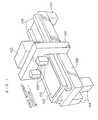
- An imaging device relating to an embodiment of the present inventionis formed as a "flatbed"-type exposure apparatus. As shown in Figure 1, the imaging device is provided with a flat board-form stage 152, which adsorbs and retains a sheet-form photosensitive material 150 at a surface thereof. Two guides 158, which extend in a stage movement direction, are provided at an upper face of a thick board-form equipment platform 156, which is supported by four leg portions 154.
- the stage 152is disposed such that a longitudinal direction thereof is oriented in the stage movement direction, and is supported by the guides 158 so as to be movable backward and forward.
- an unillustrated driving apparatusis provided for driving the stage 152 along the guides 158.
- an 'n'-like gate 160is provided so as to straddle a movement path of the stage 152. Respective end portions of the 'n'-like gate 160 are fixed at two side faces of the equipment platform 156.
- a scanner 162is provided at one side, and a plurality (for example, two) of detection sensors 164 are provided at the other side.
- the detection sensors 164detect a leading end and a trailing end of the photosensitive material 150.
- the scanner 162 and the detection sensors 164are respectively mounted at the gate 160, and are fixedly disposed upward of the movement path of the stage 152.
- the scanner 162 and detection sensors 164are connected to an unillustrated controller which controls the scanner 162 and detection sensors 164. As described later, the scanner 162 and detection sensors 164 are controlled such that, at a time of exposure by exposure heads 166, the exposure heads 166 effect exposure with predetermined timings.
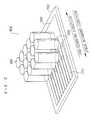
- the scanner 162is equipped with a plurality of the exposure heads 166, which are arranged substantially in a matrix pattern with m rows and n columns (for example, three rows and five columns).
- m rows and n columnsfor example, three rows and five columns.
- four of the exposure heads 166are provided in the third row, and there are fourteen exposure heads 166 in total. Note that when an individual exposure head which is arranged in an m-th row and an n-th column is to be referred to, that exposure head is denoted as exposure head 166 mn .
- Exposure areas 168 covered by the exposure heads 166have rectangular shapes with short sides thereof aligned in a sub-scanning direction, as in Figure 2, and are inclined at a predetermined inclination angle ⁇ , which is discussed later, with respect to the sub-scanning direction.
- band-form exposed regions 170are formed on the photosensitive material 150 at the respective exposure heads 166. Note that when an exposure area corresponding to an individual exposure head which is arranged in an m-th row and an n-th column is to be referred to, that exposure area is denoted as exposure area 168 mn .
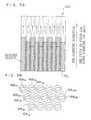
- the respective exposure headswhich are arranged in a line, are disposed to be offset by a predetermined interval in a row arrangement direction (which interval is an integer multiple (two in the present embodiment) of the long dimension of the exposure areas), such that the band-form exposed regions 170 partially overlap with respective neighboring the exposed regions 170.
- a portion that cannot be exposed between exposure area 168 11 and exposure area 168 12 of the first rowcan be exposed by exposure area 168 21 of the second row and exposure area 168 31 of the third row.
- a digital micromirror device (DMD) 50is provided to serve as a spatial light modulation element for modulating an incident light beam at each of pixels in accordance with image data.
- the DMD 50is connected with an unillustrated controller, which is provided with a data processing section and a mirror driving control section.
- the controllerOn the basis of inputted image data, driving signals are generated for driving control of each micromirror in a region of the DMD 50 at the corresponding exposure head 166 which region is to be controlled.
- the controllerincludes an image data conversion function for making resolution in a row direction higher than in an original image.
- the mirror driving control sectioncontrols the angle of a reflection surface of each micromirror of the DMD 50 at the corresponding exposure head 166 on the basis of the control signals generated at the image data processing section. Control of the angles of the reflection surfaces is described later.
- a fiber array light source 66, a lens system 67 and a mirror 69are disposed in this order at a light incidence side of the DMD 50.
- the fiber array light source 66is equipped with a laser emission portion at which emission end portions (light emission points) of optical fibers are arranged in a row along a direction corresponding to the direction of the long sides of the exposure area 168.
- the lens system 67corrects laser light that is emitted from the fiber array light source 66, and focuses the light on the DMD 50.
- the mirror 69reflects the laser light that has been transmitted through the lens system 67 toward the DMD 50.
- the lens system 67is structured with a single pair of combination lenses 71, which make the laser light that has been emitted from the fiber array light source 66 parallel, a single pair of combination lenses 73, which correct the laser light that has been made parallel such that a light amount distribution is more uniform, and a condensing lens 75 which focuses the laser light whose light amount distribution has been corrected on the DMD.
- the combination lenses 73have the functions of, in the direction of arrangement of the laser emission ends, broadening portions of light flux that are close to an optical axis of the lenses and constricting portions of the light flux that are distant from the optical axis, and in a direction intersecting this direction of arrangement, transmitting the light unaltered.
- the laser lightis corrected such that the light amount distribution is uniform.
- Lens systems 54 and 58are disposed at a light reflection side of the DMD 50.
- the lens systems 54 and 58focus the laser light that has been reflected at the DMD 50 on a scanning surface (a surface that is to be exposed) 56 of the photosensitive material 150.
- the lens systems 54 and 58are disposed such that the DMD 50 and the surface to be exposed 56 have a conjugative relationship.
- the present embodimentis specified such that, after the laser light emitted from the fiber array light source 66 has expanded by substantially five times, the laser light is contracted to approximately 5 ⁇ m for each pixel by these lens systems 54 and 58.
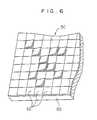
- the DMD 50is a mirror device which is constituted of a large number (for example, 1024 by 768, with a pitch of 13.68 ⁇ m) of these extremely small mirrors arranged in a checkerboard pattern, which extremely small mirrors structure image elements (pixels).
- the micromirror 62is provided so as to be supported at an uppermost portion of the support column.
- a material with high reflectivity, such as aluminium or the like,is applied by vapor deposition at a surface of the micromirror 62.
- the reflectivity of the micromirror 62is at least 90 %.
- the SRAM cell 60 with CMOS silicon gateswhich is produced by a conventional semiconductor memory production line, is disposed directly under the micromirror 62, with the support column, which includes a hinge and a yoke, interposed therebetween.
- the whole of this structureis monolithic (an integrated form).
- the micromirrors 62 supported at the support columnsare inclined, about a diagonal, within a range of ⁇ ⁇ o (for example, ⁇ 10 o) relative to the side of a substrate on which the DMD 50 is disposed.
- Figure 7Ashows a state in which the micromirror 62 is inclined at + ⁇ o, which is an 'ON' state
- Figure 7Bshows a state in which the micromirror 62 is inclined at - ⁇ °, which is an 'OFF' state.
- Figure 6shows a portion of the DMD 50 enlarged, and shows an example of a state in which the micromirrors 62 are controlled to + ⁇ o or - ⁇ o.
- the ON-OFF control of the respective micromirrors 62is carried out by the unillustrated controller connected to the DMD 50.
- a light-absorbing body(which is not shown) is disposed in the direction in which light beams are reflected by the micromirrors 62 that are in the OFF state.
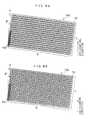
- Figures 8A and 8Bshow the exposure area 168, which is a two-dimensional image provided by one of the DMDs 50.
- the exposure area 168is divided into respective pixels of M columns by L rows, corresponding to exposure beams 53.
- the DMD 50is inclinedly disposed such that this exposure area 168 is angled at the predetermined inclination angle with respect to the sub-scanning direction.
- a row pitch of scanning paths (scanning lines) of the exposure beams 53 from the respective micromirrorsbecomes smaller (approximately 0.27 ⁇ m in the present embodiment), and is narrower than a row pitch of scanning lines in a case in which the exposure area 168 is not inclined and than a resolution of the image data itself (2 ⁇ m).
- resolutioncan be improved.
- the number of pixels employed in the row directionis altered for imaging (image recording) in accordance with the actual inclination angle ⁇ ' by an unillustrated controller, and thus variation of the pitch P is suppressed to a certain range.
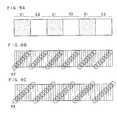
- Figure 9Ais an example of original image data.
- Figure 9Bis an example of image data that has been converted in a case in which the number of pixels employed in the row direction is eight, as in Figure 8A
- Figure 9Cis an example of image data that has been converted in a case in which the number of pixels employed in the row direction is nine, as in Figure 8B.
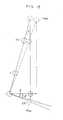
- Figure 15shows an example of shifting of pixels in a case in which the actual inclination angle ⁇ ' is greater than the ideal inclination angle ⁇ .
- a number of pixels employedis 250
- variation of a 251st pixel between an ideal position H251 and an actual position R251is illustrated.
- the ideal inclination angle ⁇when 250 is taken as a center value for the number of pixels employed, is 825.1 seconds. However, because the actual inclination angle ⁇ ' is larger than this, the actual position R251 of the 251 st pixel is shifted from the ideal position H251. Accordingly, in this case, if the number of pixels employed is decreased, the above-mentioned variation can be made smaller as a result.
- the inclination anglemay be corrected in units of approximately 3.3 seconds per pixel of alteration.
- Figure 16shows a relationship, in the case of the present embodiment, between the actual inclination angle ⁇ ' and a correction residual (a difference between an ideal value and an actual value of row pitch) after the correction described above is carried out, as a graph.
- a correction residuala difference between an ideal value and an actual value of row pitch
- the number of pixels employedcan be set to a suitable number at low cost.
- the number of pixels employedmay be determined on the basis of results of such measurement.
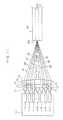
- Figure 10Ashows structure of the fiber array light source 66.
- the fiber array light source 66is equipped with a plurality (for example, six) of laser modules 64. At each of the laser modules 64, one end of a multi-mode optical fiber 30 is connected.
- an optical fiber 31whose core diameter is the same as that of the multi-mode optical fiber 30 and whose cladding diameter is smaller than that of the multi-mode optical fiber 30, is connected.
- emission end portions of the multi-mode optical fibers 31are arranged in a single row along the main scanning direction, which intersects the sub-scanning direction, to structure a laser emission portion 68.
- the light emission pointsmay be arranged in two rows along the main scanning direction, as shown in Figure 10D.
- the emission end portions of the optical fibers 31are interposed and fixed between two support plates 65, which have flat faces. Furthermore, a transparent protective plate 63, of glass or the like, is disposed at the light emission side of the optical fibers 31 in order to protect end faces of the optical fibers 31.
- the protective plate 63may be disposed to be closely contacted with the end faces of the optical fibers 31, and may be disposed such that the end faces of the optical fibers 31 are sealed.
- the emission end portions of the optical fibers 31have high optical density, tend to attract dust, and are susceptible to deterioration. However, by disposing the protective plate 63 thus, adherence of dust to the end faces can be prevented and deterioration can be slowed.
- any of step index-type optical fibers, graded index-type optical fibers and multiplex-type optical fiberscan be used.
- a step index-type optical fiber produced by Mitsubishi Cable Industries, Ltd.could be used.
- the laser module 64is structured by a multiplexed laser light source (fiber light source) shown in Figure 11.
- This multiplex laser light sourceis structured with a plurality (for example, seven) of chip-form lateral multi-mode or single-mode GaN-based semiconductor lasers LD1, LD2, LD3, LD4, LD5, LD6 and LD7, collimator lenses 11, 12, 13, 14, 15, 16 and 17, a single condensing lens 20, and one unit of the multi-mode optical fibers 30.
- the GaN-based semiconductor lasers LD1 to LD7are fixedly arranged on a heat block 10.
- the collimator lenses 11 to 17are provided in correspondence with the GaN-based semiconductor lasers LD1 to LD7, respectively.
- the number of semiconductor lasersis not limited to seven.
- the GaN-based semiconductor lasers LD1 to LD7all have a common oscillation wavelength (for example, 405 nm), and a common maximum output (for example, 100 mW for multi-mode lasers, 30 mW for single-mode lasers).
- a common oscillation wavelengthfor example, 405 nm
- a common maximum outputfor example, 100 mW for multi-mode lasers, 30 mW for single-mode lasers.
- laserscan be utilized which are provided with an oscillation wavelength different from the above-mentioned 405 nm, in a wavelength range of 350 nm to 450 nm.
- the above-described multiplex laser light sourceis accommodated in a box-like package 40, which opens upward.
- the package 40is provided with a package lid 41 prepared so as to close this opening of the package 40. After a degassing treatment, sealed gas is introduced and the opening of the package 40 is closed by the package lid 41.
- the above-described multiplex laser light sourceis hermetically sealed in a closed space (sealed space) formed by the package 40 and the package lid 41.
- a baseplate 42is fixed at a lower face of the package 40.
- the heat block 10, a condensing lens holder 45 and a fiber holder 46are attached at an upper face of the baseplate 42.
- the condensing lens holder 45holds the condensing lens 20.
- the fiber holder 46holds an incidence end portion of the multi-mode optical fiber 30.
- An openingis formed in a wall face of the package 40. The emission end portion of the multi-mode optical fiber 30 is led out through this opening to outside the package.
- a collimator lens holder 44is attached at a side face of the heat block 10, and holds the collimator lenses 11 to 17. Openings are formed in a lateral wall face of the package 40. Wiring 47, which supplies driving current to the GaN-based semiconductor lasers LD1 to LD7, is passed through these openings and led out to outside the package 40.
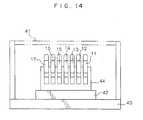
- Figure 14shows the collimator lenses 11 to 17 and mounting portions thereof, as viewed from front faces thereof.
- Each of the collimator lenses 11 to 17is formed in a long, narrow, cut-down shape with parallel flat faces (which shape would be obtained by cutting, with the parallel flat faces, a circular-form lens which is provided with an aspherical surface) defining a region that includes an optical axis of the circular-form lens.
- the collimator lenses with this long, narrow shapemay be formed, for example, by molding-formation of resin or optical glass.
- the collimator lenses 11 to 17are closely disposed in a direction of arrangement of light emission points of the GaN-based semiconductor lasers LD1 to LD7 (the left-right direction in Figure 14) such that the length directions of the collimator lenses 11 to 17 cross the direction of arrangement of the light emission points.
- GaN-based semiconductor lasers LD1 to LD7lasers may be employed which are provided with an active layer with a light emission width of 2 ⁇ m, and which emit respective laser beams B 1 to B7 in forms which widen at angles of, for example, 10o and 30o with respect, respectively, to a direction parallel to the active layers and a direction perpendicular to the active layers.
- These GaN-based semiconductor lasers LD1 to LD7are disposed such that the light emission points are lined up in a single row in the direction parallel to the active layers.
- the laser beams B1 to B7 emitted from the respective light emission pointsare incident, respectively, on the collimator lenses 11 to 17 having the long, narrow forms described above, in states in which the direction for which the divergent angle of the beam is greater coincides with the length direction of the lens and the direction in which the divergent angle is smaller coincides with a width direction (a direction intersecting the length direction).
- the condensing lens 20is formed in a long, narrow, cut-down shape with parallel flat faces (which shape would be obtained by cutting, with the parallel flat faces, a circular-form lens which is provided with an aspherical surface) defining a region that includes an optical axis of the circular-form lens.
- the condensing lens 20is also formed in a shape which is long in the direction of arrangement of the collimator lenses 11 to 17 (i.e., the horizontal direction) and short in a direction perpendicular thereto.
- the condensing lens 20is also formed by, for example, molding-formation of resin or optical glass.
- the respective laser beams B1, B2, B3, B4, B5, B6 and B7which are emitted in divergent forms from the respective GaN-based semiconductor lasers LD1 to LD7 that structure the multiplex laser light source of the fiber array light source 66, are converted to parallel light by the corresponding collimator lenses 11 to 17.
- the laser beams B1 to B7 that have been collimatedare focused by the condensing lens 20, and converge at the incidence end face of a core 30a of the multi-mode optical fiber 30.
- a condensing optical systemis structured by the collimator lenses 11 to 17 and the condensing lens 20, and a multiplexing optical system is structured by the condensing optical system and the multi-mode optical fiber 30.
- the laser beams B1 to B7 focused by the condensing lens 20 as described aboveenter the core 30a of the multi-mode optical fiber 30, are propagated in the optical fiber, multiplexed to a single laser beam B, and emitted from the optical fiber 31 coupled at the emission end portion of the multi-mode optical fiber 30.
- high-luminance light emission pointsare arranged in a single row along the main scanning direction. Because a conventional fiber light source, in which laser light from a single semiconductor laser is focused at a single optical fiber, would have low output, a desired output could not be obtained without arranging these conventional light sources in a large number of rows. However, because the multiplex laser light sources employed in the present embodiment have high output, a desired output can be obtained with only a small number of rows, for example, one row.
- Image data corresponding to an exposure patternis inputted to an unillustrated controller which is connected to the DMDs 50, and is temporarily stored at a frame memory in the controller.
- This image datais data which represents a density of each pixel structuring an image with a binary value (whether or not a dot is to be recorded).
- the stage 152on whose surface the photosensitive material 150 has been adsorbed, is moved along the guides 158 at a constant speed by the unillustrated driving apparatus, from an upstream side of the gate 160 to a downstream side thereof.
- the image data stored in the frame memoryis read out as a plurality of line portion units in sequence, and control signals for each of the exposure heads 166 are generated on the basis of the image data read from the data processing section.
- the micromirrors of the DMDs 50 at the respective exposure heads 166are respectively switched on and off by the mirror driving control section on the basis of the control signals that have been generated.
- the reflected laser lightis focused on the surface to be exposed 56 of the photosensitive material 150 by the lens systems 54 and 58.
- the laser light irradiated from the fiber array light source 66is turned on or off at each pixel, and the photosensitive material 150 is exposed in a unit (the exposure area 168) with a number of pixels substantially the same as a number of pixels employed at the DMD 50.
- the exposure area 168is inclined at the predetermined inclination angle with respect to the sub-scanning direction. Accordingly, the pitch of the scanning tracks (scanning lines) of the exposure beams 53 from the micromirrors is narrower than the pitch of scanning lines would be if the exposure area 168 were not inclined. Thus, the image can be recorded with higher resolution.
- the photosensitive material 150is moved together with the stage 152 at the constant speed, the photosensitive material 150 is scanned in a direction opposite to the stage movement direction by the scanner 162, and the strip-form exposed regions 170 are formed at the respective exposure heads 166.
- the stage 152is returned along the guides 158 by the unillustrated driving apparatus to a start point at an upstream-most side of the gate 160, and is again moved along the guides 158, at the constant speed, from the upstream side to the downstream side of the gate 160.
- a wider area of the DMD 50can be illuminated in comparison to a structure which does not perform multiple exposure. Therefore, it is possible to make a focusing depth of the exposure beams 53 longer.
- the divergent angle of the flux of the laser light that is irradiated at the DMD 50is smaller. Therefore, the focusing depth of the exposure beams 53 is longer.
- MEMSmicroelectro-mechanical systems
- SLMspatial light modulator
- spatial light modulation elements other than MEMS typessuch as optical elements which modulate transmitted light by electro-optical effects (e.g., PLZT elements) and liquid crystal shutter arrays such as liquid crystal shutters (FLC) may be utilized.
- PLZT elementsoptical elements which modulate transmitted light by electro-optical effects
- FLCliquid crystal shutter arrays
- MEMSis a general term for microsystems in which micro-size sensors, actuators and control circuits are integrated by micro-machining technology based on IC producion processes.
- MEMS type spatial light modulation elementsmeans spatial light modulation elements which are driven by electro-mechanical operations by utilization of electrostatic forces.
- a spatial light modulation elementwhich is structured to be two-dimensional by lining up a plurality of grating light valves (GLV) may be utilized.
- grating light valvesgrating light valves
- the fiber array light source that is utilizedis equipped with a plurality of multiplex laser light sources.
- the laser apparatusis not limited to a fiber array light source in which multiplexed laser light sources are arranged.
- a fiber array light sourcemay be utilized in which fiber light sources which are each equipped with a single optical fiber, which emits laser light inputted from a single semiconductor laser having one light emission point, are arrayed.
- a light source in which a plurality of light emission points are two-dimensionally arranged(for example, a laser diode array, an organic electroluminescent array or the like) may be employed. With a structure which employs such a light source, each light emission point corresponds to a pixel. Hence, it is possible to omit the spatial light modulation devices mentioned above.
- an exposure device of the present inventionmay be a so-called outer drum-type exposure device which includes a drum, around which photosensitive material is wound.
- the exposure apparatus described abovemay be suitably utilized for application to, for example, exposure of a dry film resist (DFR) in a process for producing a printed wiring board (PWB), formation of a color filter in a process for producing a liquid crystal display (LCD), exposure of a DFR in a process for producing a TFT, exposure of a DFR in a process for producing a plasma display panel (PDP), and the like.
- DFRdry film resist
- PWBprinted wiring board
- LCDliquid crystal display
- TFTliquid crystal display
- PDPplasma display panel
- any of photon mode photosensitive materials, which are directly recorded with information by exposure, and heat mode photosensitive materials, in which heat is generated by exposure and information is recorded thereby,may be employed.
- GaN-based semiconductor lasers, wavelength-conversion solid state lasers or the likeare employed at the laser apparatus, and in cases in which heat mode photosensitive materials are employed, AlGaAs-based semiconductor lasers (infrared lasers) or solid state lasers are employed at the laser apparatus.
- the present inventionis not limited to exposure devices, and can be employed in similar structures at, for example, inkjet recording heads.
- nozzles which eject ink dropletsare formed in a nozzle face opposing a recording medium (for example, recording paper, an overhead projector sheet or the like).
- a recording mediumfor example, recording paper, an overhead projector sheet or the like.
- inkjet recording headsthere are inkjet recording heads in which these nozzles are plurally disposed in a checkerboard pattern, are inclined relative to a scanning direction of the head itself, and are capable of recording images with high resolution.
- an inkjet recording head which employs such a two-dimensional arrangementeven if an actual inclination angle of the head itself varies from an ideal inclination angle, variations in pitch generated in recorded images can be suppressed to a certain range by application of the present invention.
- the present inventionwith a structure as described above, enables provision of high-resolution images that are free of unevenness without causing a rise in costs.
Landscapes
- Engineering & Computer Science (AREA)
- Physics & Mathematics (AREA)
- General Physics & Mathematics (AREA)
- Toxicology (AREA)
- General Engineering & Computer Science (AREA)
- Theoretical Computer Science (AREA)
- Health & Medical Sciences (AREA)
- General Health & Medical Sciences (AREA)
- Optics & Photonics (AREA)
- Quality & Reliability (AREA)
- Condensed Matter Physics & Semiconductors (AREA)
- Manufacturing & Machinery (AREA)
- Computer Hardware Design (AREA)
- Microelectronics & Electronic Packaging (AREA)
- Power Engineering (AREA)
- Exposure And Positioning Against Photoresist Photosensitive Materials (AREA)
- Printers Or Recording Devices Using Electromagnetic And Radiation Means (AREA)
- Facsimile Scanning Arrangements (AREA)
- Fax Reproducing Arrangements (AREA)
Abstract

Description
- The present invention relates to an imaging head, an imaging device andan imaging method, and particularly to an imaging head which relativelymoves, with respect to an imaging surface, in a predetermined direction alongthe imaging surface, an imaging device which is equipped with this imaginghead, and an imaging method which employs this imaging head.
- Heretofore, as examples of imaging devices, various exposure apparatuseswhich employ spatial light modulation elements such as digital micromirrordevices (DMD) for implementing image exposure with light beams modulatedin accordance with image data have been proposed.
- An example of a DMD is a mirror device in which a plurality ofmicromirrors, which alter angles of reflection surfaces thereof in accordancewith control signals, are arranged in a two-dimensional arrangement of Lcolumns by M rows on a semiconductor support of silicon or the like. Practicalexposure can be implemented by scanning the DMD in a certain directionalong an exposure surface.
- Generally, the micromirrors of a DMD are arranged such that directions of alignment of the respective columns intersect with directions of alignment ofthe respective rows. By disposing such a DMD to be inclined with respect to ascanning direction, a spacing of scanning lines at a time of scanning can bemade tighter, and resolution can be raised. For example, Japanese NationalPublication No. 2001-521672 discloses that resolution can be raised, in anillumination system which guides light toward sub-regions (spatial lightmodulation elements) which are equipped with a plurality of light valves, byinclining these sub-regions with respect to projections thereof onto scanninglines.
- However, fine adjustment of respective inclination angles of spatial lightmodulation elements is generally difficult, and the inclination angles will varyslightly from ideal angles. The spatial light modulation elements implementscanning, for example, row by row (or in units of a number of rows). However,when the above-mentioned variation occurs, the spacing of a pitch betweenrows when moving from a row to a next row becomes irregular, andunevenness in images is caused by gaps and/or overlaps.
- In order to prevent such unevenness of images, it is considered thataccuracy of the inclination angles of the spatial light modulation elementsshould be improved. However, production costs increase when improvementsin accuracy are sought.
- Similar problems can occur not only with imaging heads that employspatial light modulation elements, but also with, for example, inkjet recordingheads which implement imaging by ejecting ink droplets at an imaging surface.
- In consideration of the circumstances described above, an object of thepresent invention is to provide an imaging head, imaging device and imagingmethod capable of providing images with high resolution and no unevenness,without causing a rise in costs.
- In order to achieve the object described above, in a first aspect of thepresent invention, an imaging head which faces an imaging surface and isrelatively moved along the imaging surface in a predetermined scanningdirection includes: an imaging element group including a plurality of imagingelements in a plane substantially parallel to the imaging surface, the imagingelements being two-dimensionally arranged, and the imaging element groupgenerating a group of image pixels at the imaging surface in a two-dimensionalarrangement which is inclined, as a whole, at a predetermined inclination anglewith respect to the scanning direction; and an alteration section which, on thebasis of a difference between the predetermined inclination angle of theimaging element group and an actual inclination angle of the image pixel group,alters a number of image pixels in a direction which is inclined from thescanning direction by the actual inclination angle.
- While the imaging head described above is being relatively moved in thepredetermined scanning direction along the imaging surface, imaging (imagerecording) is carried out at the imaging surface by the plurality of imagingelements constituting the imaging element group. Because the plurality ofimaging elements are arranged two-dimensionally in the plane that issubstantially parallel with the imaging surface, and the two-dimensionalarrangement image pixel group is generated at the imaging surface so as to be inclined, as a whole, at the predetermined angle of inclination with respect tothe scanning direction, the spacing of the scanning lines of the respective pixelsat the time of relative movement is made tighter, and resolution is improved.
- Further, in a case in which there is a difference between the predeterminedinclination angle of the imaging element group and the actual inclination angleof the image pixel group, the alteration section changes the number of imagepixels in a direction that is inclined by the inclination angle from the scanningdirection, on the basis of this difference. For example, in a case in which it isexpected that overlapping will occur in an image, the alteration sectionoperates such that imaging elements that would correspond to overlap portionsdo not operate. Conversely, in a case in which it is expected that gaps will occurin an image, imaging elements that would correspond to the gaps are pro-activelycaused to operate, and the gaps are eliminated.
- As a result, high quality images that are free of unevenness can berecorded. Moreover, because there is no need for rigorous accuracy inadjustment of the inclination angle of the image pixel group, a rise in costs willnot be caused.
- In a second aspect of the present invention, the imaging head describedabove can include a resolution conversion section which converts image dataso as to convert a resolution of the image data in a direction intersecting thedirection of relative movement to a resolution of the image pixel group in thedirection intersecting the direction of relative movement. Accordingly, variousprocesses and corrections can be carried out on the image data with higheraccuracy.
- Further, in a third aspect of the present invention, the conversion of the image data in such a case includes at least one of magnification and reductionof the image data.
- In a fourth aspect of the present invention, the imaging element group mayinclude a modulated light irradiation apparatus which irradiates light, which ismodulated for each of pixels in accordance with image information, at anexposure surface which includes the imaging surface. In such a case, theimaging head illuminates light modulated at the respective pixels in accordancewith the image information, from the modulated light irradiation apparatus, tothe exposure surface, which is the imaging surface. Hence, the imaging head(exposure head) is relatively moved with respect to the exposure surface, in adirection along the exposure surface, and thus a two-dimensional image can beimaged at the exposure surface.
- The imaging head of the present invention is not limited to the modulatedlight irradiation apparatus of the present aspect, and may be an inkjet recordinghead which discharges ink droplets to an imaging surface on the basis ofimaging information.
- As the modulated light irradiation apparatus of the present aspect, forexample, a two-dimensional array light source, in which a plurality of pointlight sources are arranged in a two-dimensional arrangement, can be used. Withsuch a structure, the respective point light sources emit light in accordance withthe image data. This light is guided, as necessary, through a light-guidingmember, such as a high-luminance fiber or the like, to a predetermined position.Further, as necessary, the light is subjected to correction by an optical system oflenses, mirrors and the like, and is irradiated at the exposure surface.
- Further, in a fifth aspect of the present invention, the modulated light irradiation apparatus may include: a laser device which irradiates laser light; aspatial light modulation element at which a plurality of imaging elementportions, which respectively alter light modulation states in accordance withcontrol signals, are arranged in a two-dimensional arrangement, the spatiallight modulation element modulating the laser light irradiated from the laserdevice; and a control section which controls the imaging element portions bythe control signals, which are generated in accordance with the imageinformation.
- With this structure, the light modulation states of the respective imagingelement portions of the spatial light modulation element are changed by thecontrol section, and the laser light irradiated at the spatial light modulationelement is modulated and irradiated at the exposure surface. Needless to say, asnecessary, a light-guiding member such as a high-luminance fiber or the like,an optical system of lenses, mirrors and the like, and the like may be utilized.
- In a sixth aspect of the present invention, a micromirror device whichincludes a plurality of micromirrors arranged in a two-dimensionalarrangement, angles of reflection surfaces of which micromirrors arerespectively alterable in accordance with the control signals, may be employedas the spatial light modulation element.
- Further, in a seventh aspect of the present invention, a liquid crystalshutter array which includes a plurality of liquid crystal cells arranged in atwo-dimensional arrangement, the liquid crystal cells being respectivelycapable of blocking transmitted light in accordance with the control signals,may be employed as the spatial light modulation element.
- In an eighth aspect of the present invention, an imaging device includes the imaging head and a movement section which relatively moves the imaginghead at least in the predetermined direction.
- According to the present aspect, when a process such as exposure, inkdischarge or the like is applied to the imaging surface by the imaging head, theimaging head is synchronously relatively moved, with respect to the imagingsurface, to implement imaging on the imaging surface.
- When the imaging device of the present aspect includes an imaging headbased on any of the aspects described above, a high quality image that is free ofunevenness can be recorded, and a rise in costs will not result.
- In a ninth aspect of the present invention, an imaging method whichemploys an imaging head based on any of the aspects described above andrelatively moves the imaging head along the imaging surface in thepredetermined scanning direction for imaging, includes the steps of: alteringthe number of image pixels that are employed in the direction which is inclinedfrom the scanning direction by the actual inclination angle, on the basis of thedifference between the predetermined inclination angle of the imaging elementgroup and the actual inclination angle of the image pixel group; and employingthe altered number of image pixels for imaging at the imaging surface.
- According to the present aspect, while the imaging head is being relativelymoved in the predetermined scanning direction along the imaging surface, theimaging is carried out at the imaging surface by the plurality of imagingelements constituting the imaging element group. The plurality of imagingelements are arranged two-dimensionally in the plane that is substantiallyparallel with the imaging surface. Further, the two-dimensional arrangementimage pixel group is generated at the imaging surface so as to be inclined, as a whole, at the predetermined angle of inclination with respect to the scanningdirection. Consequently, the spacing of the scanning lines of the respectivepixels at the time of relative movement is made tighter, and resolution isimproved.
- Further, in a case in which there is a difference between the predeterminedinclination angle of the imaging element group and an actual inclination angleof the image pixel group, the number of image pixels in a direction that isinclined to the extent of the inclination angle from the scanning direction ischanged for imaging on the basis of this difference. For example, in a case inwhich it is expected that overlapping will occur in an image, the imagingelement group is operated such that imaging elements that would correspond tooverlap portions do not operate. Conversely, in a case in which it is expectedthat gaps will occur in an image, imaging elements that would correspond tothe gaps are pro-actively caused to operate, and the gaps are eliminated.
- As a result, high quality images that are free of unevenness can berecorded. Moreover, because there is no need for rigorous accuracy inadjustment of the inclination angle of the image pixel group, a rise in costs willnot be caused.
- Figure 1 is a perspective view showing external appearance of an exposuredevice relating to a first embodiment of the present invention.
- Figure 2 is a perspective view showing structure of a scanner of theexposure device relating to the first embodiment of the present invention.
- Figure 3A is a plan view showing exposed regions formed at a photosensitive material.
- Figure 3B is a view showing an arrangement of exposure areas of respectiveexposure heads.
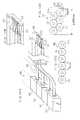
- Figure 4 is a perspective view showing general structure of an exposurehead of the exposure device relating to the first embodiment of the presentinvention.
- Figure 5A is a sectional view, cut in a sub-scanning direction along anoptical axis, which shows structure of the exposure head shown in Figure 4.
- Figure 5B is a side view of Figure 5A.
- Figure 6 is a partial enlarged view showing structure of a digitalmicromirror device (DMD) relating to the exposure head of the firstembodiment of the present invention.
- Figures 7A and 7B are explanatory views for explaining operation of theDMD relating to the exposure head of the first embodiment of the presentinvention.
- Figures 8A and 8B are explanatory views of exposure areas of the exposurehead of the first embodiment of the present invention, which show positions ofexposure beams from the DMD, which is inclinedly disposed.
- Figure 9A shows an image formed by the exposure head of the firstembodiment of the present invention, which is an image according to originalimage data.
- Figures 9B and 9C show images formed by the exposure head of the firstembodiment of the present invention, which are images according to convertedimage data.
- Figure 10A is a perspective view showing structure of a fiber array light source.
- Figure 10B is a partial enlarged view of Figure 10A.
- Figure 10C is a plan view showing an arrangement of light emission pointsat a laser emission portion.
- Figure 10D is a plan view showing another arrangement of light emissionpoints at a laser emission portion.
- Figure 11 is a plan view showing structure of a multiplex laser light sourcerelating to the first embodiment of the present invention.
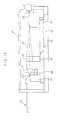
- Figure 12 is a plan view showing structure of a laser module relating to thefirst embodiment of the present invention.
- Figure 13 is a side view showing structure of the laser module shown inFigure 12.
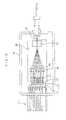
- Figure 14 is a partial elevational view showing structure of the laser moduleshown in Figure 12.
- Figure 15 is an explanatory view showing a relationship between anexpected position of a pixel of the present invention and an actual position ofthe pixel in a case in which an exposure head is inclined.
- Figure 16 is a graph showing a relationship, in the present invention,between an inclination angle of an exposure head and a correction residualwhen a number of pixels employed is altered.
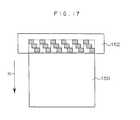
- Figure 17 is a plan view for explaining an exposure technique whichexposes a photosensitive material with a single cycle of scanning by a scanner.
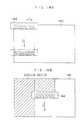
- Figures 18A and 18B are plan views for explaining an exposure techniquewhich exposes a photosensitive material with a plurality of cycles of scanningby a scanner.
- An imaging device relating to an embodiment of the present invention isformed as a "flatbed"-type exposure apparatus. As shown in Figure 1, theimaging device is provided with a flat board-
form stage 152, which adsorbs andretains a sheet-formphotosensitive material 150 at a surface thereof. Twoguides 158, which extend in a stage movement direction, are provided at anupper face of a thick board-form equipment platform 156, which is supportedby fourleg portions 154. - The
stage 152 is disposed such that a longitudinal direction thereof isoriented in the stage movement direction, and is supported by theguides 158 soas to be movable backward and forward. - In this exposure apparatus, an unillustrated driving apparatus is providedfor driving the
stage 152 along theguides 158. - At a central portion of the
equipment platform 156, an 'n'-likegate 160 isprovided so as to straddle a movement path of thestage 152. Respective endportions of the 'n'-likegate 160 are fixed at two side faces of theequipmentplatform 156. - Sandwiching the
gate 160, ascanner 162 is provided at one side, and aplurality (for example, two) ofdetection sensors 164 are provided at the otherside. Thedetection sensors 164 detect a leading end and a trailing end of thephotosensitive material 150. Thescanner 162 and thedetection sensors 164 arerespectively mounted at thegate 160, and are fixedly disposed upward of themovement path of thestage 152. - The
scanner 162 anddetection sensors 164 are connected to an unillustrated controller which controls thescanner 162 anddetection sensors 164. As described later, thescanner 162 anddetection sensors 164 arecontrolled such that, at a time of exposure by exposure heads 166, the exposureheads 166 effect exposure with predetermined timings. - As shown in Figures 2 and 3B, the
scanner 162 is equipped with a pluralityof the exposure heads 166, which are arranged substantially in a matrix patternwith m rows and n columns (for example, three rows and five columns). In thisexample, in consideration of width of thephotosensitive material 150, four ofthe exposure heads 166 are provided in the third row, and there are fourteenexposure heads 166 in total. Note that when an individual exposure head whichis arranged in an m-th row and an n-th column is to be referred to, that exposurehead is denoted asexposure head 166mn. Exposure areas 168 covered by the exposure heads 166 have rectangularshapes with short sides thereof aligned in a sub-scanning direction, as in Figure2, and are inclined at a predetermined inclination angle , which is discussedlater, with respect to the sub-scanning direction. Hence, in accordance withmovement of thestage 152, band-form exposedregions 170 are formed on thephotosensitive material 150 at the respective exposure heads 166. Note thatwhen an exposure area corresponding to an individual exposure head which isarranged in an m-th row and an n-th column is to be referred to, that exposurearea is denoted asexposure area 168mn.- As shown in Figures 3A and 3B, in each row, the respective exposureheads, which are arranged in a line, are disposed to be offset by apredetermined interval in a row arrangement direction (which interval is aninteger multiple (two in the present embodiment) of the long dimension of the exposure areas), such that the band-form exposed
regions 170 partially overlapwith respective neighboring the exposedregions 170. Thus, a portion thatcannot be exposed betweenexposure area 16811 andexposure area 16812 of thefirst row can be exposed byexposure area 16821 of the second row andexposure area 16831 of the third row. - As shown in Figures 4, 5A and 5B, at each of the
exposure areas 16611 to166mn, a digital micromirror device (DMD) 50 is provided to serve as a spatiallight modulation element for modulating an incident light beam at each ofpixels in accordance with image data. TheDMD 50 is connected with anunillustrated controller, which is provided with a data processing section and amirror driving control section. - At the data processing section of this controller, on the basis of inputtedimage data, driving signals are generated for driving control of eachmicromirror in a region of the
DMD 50 at thecorresponding exposure head 166which region is to be controlled. Herein, the controller includes an image dataconversion function for making resolution in a row direction higher than in anoriginal image. - By raising the resolution thus, various processes and corrections of theimage data can be implemented with higher accuracy. For example, in a case inwhich a number of pixels employed is altered in accordance with an inclinationangle of the
DMD 50 and a row pitch is corrected, as described later, correctionwith higher accuracy is enabled. This conversion of the image data enablesconversions which include magnification or reduction of the image data. - The mirror driving control section controls the angle of a reflectionsurface of each micromirror of the
DMD 50 at thecorresponding exposure head 166 on the basis of the control signals generated at the image dataprocessing section. Control of the angles of the reflection surfaces is describedlater. - A fiber
array light source 66, alens system 67 and amirror 69 are disposedin this order at a light incidence side of theDMD 50. The fiberarray lightsource 66 is equipped with a laser emission portion at which emission endportions (light emission points) of optical fibers are arranged in a row along adirection corresponding to the direction of the long sides of theexposure area 168. Thelens system 67 corrects laser light that is emitted from the fiberarraylight source 66, and focuses the light on theDMD 50. Themirror 69 reflects thelaser light that has been transmitted through thelens system 67 toward theDMD 50. - The
lens system 67 is structured with a single pair ofcombination lenses 71, which make the laser light that has been emitted from the fiberarray lightsource 66 parallel, a single pair ofcombination lenses 73, which correct thelaser light that has been made parallel such that a light amount distribution ismore uniform, and a condensinglens 75 which focuses the laser light whoselight amount distribution has been corrected on the DMD. - The
combination lenses 73 have the functions of, in the direction ofarrangement of the laser emission ends, broadening portions of light flux thatare close to an optical axis of the lenses and constricting portions of the lightflux that are distant from the optical axis, and in a direction intersecting thisdirection of arrangement, transmitting the light unaltered. Thus, the laser lightis corrected such that the light amount distribution is uniform. Lens systems DMD 50. Thelens systems DMD 50 on a scanning surface (a surface that is to be exposed) 56 of thephotosensitive material 150. Thelens systems DMD 50 and the surface to be exposed 56 have a conjugative relationship.- The present embodiment is specified such that, after the laser light emittedfrom the fiber
array light source 66 has expanded by substantially five times,the laser light is contracted to approximately 5 µm for each pixel by theselenssystems - As shown in Figure 6, at the
DMD 50, very small mirrors (micromirrors)62, which are supported by support columns, are disposed on an SRAM cell(memory cell) 60. TheDMD 50 is a mirror device which is constituted of alarge number (for example, 1024 by 768, with a pitch of 13.68 µm) of theseextremely small mirrors arranged in a checkerboard pattern, which extremelysmall mirrors structure image elements (pixels). At each pixel, themicromirror 62 is provided so as to be supported at an uppermost portion of the supportcolumn. A material with high reflectivity, such as aluminium or the like, isapplied by vapor deposition at a surface of themicromirror 62. Here, thereflectivity of themicromirror 62 is at least 90 %. - The
SRAM cell 60 with CMOS silicon gates, which is produced by aconventional semiconductor memory production line, is disposed directlyunder themicromirror 62, with the support column, which includes a hinge anda yoke, interposed therebetween. The whole of this structure is monolithic (anintegrated form). - When digital signals are written to the
SRAM cell 60 of theDMD 50, themicromirrors 62 supported at the support columns are inclined, about a diagonal, within a range of ± α º (for example, ± 10 º) relative to the side of asubstrate on which theDMD 50 is disposed. Figure 7A shows a state in whichthemicromirror 62 is inclined at + α º, which is an 'ON' state, and Figure 7Bshows a state in which themicromirror 62 is inclined at - α °, which is an 'OFF'state. - Accordingly, as a result of control of the inclinations of the micro mirrors62 at the pixels of the
DMD 50 in accordance with image signals, as shown inFigure 6, light that is incident at theDMD 50 is reflected in directions ofinclination of therespective micromirrors 62. - Figure 6 shows a portion of the
DMD 50 enlarged, and shows an exampleof a state in which themicromirrors 62 are controlled to + α º or - α º. TheON-OFF control of therespective micromirrors 62 is carried out by theunillustrated controller connected to theDMD 50. A light-absorbing body(which is not shown) is disposed in the direction in which light beams arereflected by themicromirrors 62 that are in the OFF state. - Figures 8A and 8B show the
exposure area 168, which is a two-dimensionalimage provided by one of theDMDs 50. Theexposure area 168 isdivided into respective pixels of M columns by L rows, corresponding toexposure beams 53. - In the example of Figures 8A and 8B, M = 33 and L = 17. However, inpractice, as mentioned above, one of the
exposure areas 168 will often bestructured by a greater number of the exposure beams 53 than in this example.Therefore, when a case for which specific numbers are given is describedherebelow, it should be assumed that M = 1024 and L = 256 therein. - The
DMD 50 is inclinedly disposed such that thisexposure area 168 is angled at the predetermined inclination angle with respect to the sub-scanningdirection. When theexposure area 168 is inclined thus, a row pitch of scanningpaths (scanning lines) of the exposure beams 53 from the respectivemicromirrors becomes smaller (approximately 0.27 µm in the presentembodiment), and is narrower than a row pitch of scanning lines in a case inwhich theexposure area 168 is not inclined and than a resolution of the imagedata itself (2 µm). Thus, resolution can be improved. - Now, in a case in which the angle of the
DMD 50 is adjusted in order toincline the exposure area at the predetermined inclination angle as describedabove, it is difficult to bring accuracy of this angle adjustment to second-scaleaccuracy, and an actual inclination angle ' may be offset from the idealinclination angle . However, regardless of the value of the actual inclinationangle ', it is preferable that a pitch P of the image in the row direction is fixed. - Accordingly, in the present embodiment, the number of pixels employedin the row direction is altered for imaging (image recording) in accordance withthe actual inclination angle ' by an unillustrated controller, and thus variationof the pitch P is suppressed to a certain range.
- For example, when Figures 8A and 8B are compared, the actualinclination angle ' in Figure 8B is smaller than the actual inclination angle ' inFigure 8A. Accordingly, in the case of Figure 8B, the number of pixelsemployed in the row direction is increased relative to Figure 8A. Thus,variation of the pitch P is countered and the pitch P is made substantiallyconstant. Specifically, when numbers of hatched (in the drawing) pixels in therow direction in Figures 8A and 8B (employed
pixels 53U) are considered,there are eight such pixels in Figure 8A, in comparison to nine in Figure 8B. - When the number of pixels employed is altered thus, the pitch of theimage in the row direction is finely adjusted. In accordance therewith,conversion of the image data is preferable. Figures 9A to 9C show examples ofsuch conversion of image data.
- Figure 9A is an example of original image data. Here, an image in whichregions E1, to which shading dots are applied, and blank white regions E2 arearranged alternately in a horizontal direction is supposed. Figure 9B is anexample of image data that has been converted in a case in which the number ofpixels employed in the row direction is eight, as in Figure 8A, and Figure 9C isan example of image data that has been converted in a case in which thenumber of pixels employed in the row direction is nine, as in Figure 8B.
- By carrying out suitable conversion of the image data in this manner, animage similar to the original image can be provided even after conversion.
- Herebelow, the suppression of variation of the aforementioned pitch P to acertain range, by altering the number of pixels employed in the row directionfor imaging (image recording) in accordance with the actual inclination angle', will be described in further detail with reference to Figures 9A to 9C.
- Figure 15 shows an example of shifting of pixels in a case in which theactual inclination angle ' is greater than the ideal inclination angle . Here, fora case in which a number of pixels employed is 250, for an example, variationof a 251st pixel between an ideal position H251 and an actual position R251 isillustrated.
- The ideal inclination angle , when 250 is taken as a center value for thenumber of pixels employed, is 825.1 seconds. However, because the actualinclination angle ' is larger than this, the actual position R251 of the 251 st pixel is shifted from the ideal position H251. Accordingly, in this case, if thenumber of pixels employed is decreased, the above-mentioned variation can bemade smaller as a result.
- Conversely, in a case in which the actual inclination angle ' is smallerthan the ideal inclination angle , the above-mentioned variation can be madesmaller by increasing the number of pixels employed.
- In the present embodiment, given that an ideal inclination angle of 825.1seconds corresponds to 250 pixels, the inclination angle may be corrected inunits of approximately 3.3 seconds per pixel of alteration.
- Figure 16 shows a relationship, in the case of the present embodiment,between the actual inclination angle ' and a correction residual (a differencebetween an ideal value and an actual value of row pitch) after the correctiondescribed above is carried out, as a graph. In this graph, 825.1 seconds, theideal inclination angle, is the center point in a horizontal axis direction. Whenthe actual inclination angle ' coincides with this value, there is no variation.Accordingly, there is no need for correction, and the correction residual is zero.
- Hence, as the actual inclination angle ' increases beyond 825.1 secondsand the actual value of the row pitch becomes larger than the ideal value thereof,the correction residual gradually grows to a plus side. When ' reaches aspecific value (to be precise, ' = 826.75 seconds), the number of pixelsemployed is decremented by one, to 249. As a result, the actual value of the rowpitch is decreased by one pixel, and the correction residual switches to a minusside. Hence, as the actual inclination angle ' increases therefrom, thecorrection residual again gradually grows, crosses over to the plus side andbecomes larger. When ' again reaches a specific value (to be precise, 830.05 seconds), the number of pixels employed is again decremented by one, to 248.
- On the other hand, as the actual inclination angle ' decreases from 825.1seconds and the actual value of the row pitch becomes smaller than the idealvalue thereof, the correction residual gradually grows to the minus side. When' reaches a specific value (to be precise, ' = 823.35 seconds), the number ofpixels employed is incremented by one, to 251. As a result, the actual value ofthe row pitch is increased by one pixel, and the correction residual switches tothe plus side. Hence, as the actual inclination angle ' decreases therefrom, thecorrection residual again gradually grows to the minus side, crosses over to theminus side and becomes larger. When ' again reaches a specific value (to beprecise, 830.05 seconds), the number of pixels employed is again decrementedby one, to 248.
- By adjusting the number of pixels employed stepwise in accordance withthe value of ' in this manner, it is possible to keep the correction residualwithin a certain range (in the present embodiment, no more than ± 0.14 µm).
- Now, if, for example, a specific sample image is recorded and the above-describedalterations of the number of pixels employed are carried out such thatvariations in the pitch P that are found from inspection of the sample image areeliminated, the number of pixels employed can be set to a suitable number atlow cost. Of course, if it is possible to accurately measure the actual inclinationangle ' itself, the number of pixels employed may be determined on the basisof results of such measurement.
- Figure 10A shows structure of the fiber
array light source 66. The fiberarray light source 66 is equipped with a plurality (for example, six) oflasermodules 64. At each of thelaser modules 64, one end of a multi-modeoptical fiber 30 is connected. - At the other end of the multi-mode
optical fiber 30, anoptical fiber 31,whose core diameter is the same as that of the multi-modeoptical fiber 30 andwhose cladding diameter is smaller than that of the multi-modeoptical fiber 30,is connected. As shown in Figure 10C, emission end portions of the multi-modeoptical fibers 31 (light emission points) are arranged in a single rowalong the main scanning direction, which intersects the sub-scanning direction,to structure alaser emission portion 68. - Note that the light emission points may be arranged in two rows along themain scanning direction, as shown in Figure 10D.
- As is shown in Figure 10B, the emission end portions of the
optical fibers 31 are interposed and fixed between twosupport plates 65, which have flatfaces. Furthermore, a transparentprotective plate 63, of glass or the like, isdisposed at the light emission side of theoptical fibers 31 in order to protectend faces of theoptical fibers 31. Theprotective plate 63 may be disposed to beclosely contacted with the end faces of theoptical fibers 31, and may bedisposed such that the end faces of theoptical fibers 31 are sealed. - The emission end portions of the
optical fibers 31 have high opticaldensity, tend to attract dust, and are susceptible to deterioration. However, bydisposing theprotective plate 63 thus, adherence of dust to the end faces can beprevented and deterioration can be slowed. - As the multi-mode
optical fibers 30 and theoptical fibers 31, any of stepindex-type optical fibers, graded index-type optical fibers and multiplex-typeoptical fibers can be used. For example, a step index-type optical fiberproduced by Mitsubishi Cable Industries, Ltd. could be used. - The
laser module 64 is structured by a multiplexed laser light source (fiberlight source) shown in Figure 11. This multiplex laser light source is structuredwith a plurality (for example, seven) of chip-form lateral multi-mode orsingle-mode GaN-based semiconductor lasers LD1, LD2, LD3, LD4, LD5,LD6 and LD7,collimator lenses singlecondensing lens 20, and one unit of the multi-modeoptical fibers 30. TheGaN-based semiconductor lasers LD1 to LD7 are fixedly arranged on aheatblock 10. Thecollimator lenses 11 to 17 are provided in correspondence withthe GaN-based semiconductor lasers LD1 to LD7, respectively. - Note that the number of semiconductor lasers is not limited to seven.
- The GaN-based semiconductor lasers LD1 to LD7 all have a commonoscillation wavelength (for example, 405 nm), and a common maximum output(for example, 100 mW for multi-mode lasers, 30 mW for single-mode lasers).For the GaN-based semiconductor lasers LD1 to LD7, lasers can be utilizedwhich are provided with an oscillation wavelength different from the above-mentioned405 nm, in a wavelength range of 350 nm to 450 nm.
- As shown in Figures 12 and 13, the above-described multiplex laser lightsource, together with other optical elements, is accommodated in a box-
likepackage 40, which opens upward. Thepackage 40 is provided with apackagelid 41 prepared so as to close this opening of thepackage 40. After a degassingtreatment, sealed gas is introduced and the opening of thepackage 40 is closedby thepackage lid 41. Thus, the above-described multiplex laser light source ishermetically sealed in a closed space (sealed space) formed by thepackage 40and thepackage lid 41. - A
baseplate 42 is fixed at a lower face of thepackage 40. Theheat block 10, a condensinglens holder 45 and afiber holder 46 are attached at an upperface of thebaseplate 42. The condensinglens holder 45 holds the condensinglens 20. Thefiber holder 46 holds an incidence end portion of the multi-modeoptical fiber 30. An opening is formed in a wall face of thepackage 40. Theemission end portion of the multi-modeoptical fiber 30 is led out through thisopening to outside the package. - A
collimator lens holder 44 is attached at a side face of theheat block 10,and holds thecollimator lenses 11 to 17. Openings are formed in a lateral wallface of thepackage 40.Wiring 47, which supplies driving current to the GaN-basedsemiconductor lasers LD1 to LD7, is passed through these openings andled out to outside thepackage 40. - Note that in Figure 13, in order to alleviate complexity of the drawing,only the GaN-based semiconductor laser LD7 is marked with a referencenumeral, of the plurality of GaN-based semiconductor lasers, and only the
collimator lens 17 is marked with a reference numeral, of the plurality ofcollimator lenses. - Figure 14 shows the
collimator lenses 11 to 17 and mounting portionsthereof, as viewed from front faces thereof. - Each of the
collimator lenses 11 to 17 is formed in a long, narrow, cut-downshape with parallel flat faces (which shape would be obtained by cutting,with the parallel flat faces, a circular-form lens which is provided with anaspherical surface) defining a region that includes an optical axis of thecircular-form lens. The collimator lenses with this long, narrow shape may beformed, for example, by molding-formation of resin or optical glass. - The
collimator lenses 11 to 17 are closely disposed in a direction of arrangement of light emission points of the GaN-based semiconductor lasersLD1 to LD7 (the left-right direction in Figure 14) such that the lengthdirections of thecollimator lenses 11 to 17 cross the direction of arrangementof the light emission points. - As the GaN-based semiconductor lasers LD1 to LD7, lasers may beemployed which are provided with an active layer with a light emission widthof 2 µm, and which emit respective laser beams B 1 to B7 in forms which widenat angles of, for example, 10º and 30º with respect, respectively, to a directionparallel to the active layers and a direction perpendicular to the active layers.These GaN-based semiconductor lasers LD1 to LD7 are disposed such that thelight emission points are lined up in a single row in the direction parallel to theactive layers.
- Accordingly, the laser beams B1 to B7 emitted from the respective lightemission points are incident, respectively, on the
collimator lenses 11 to 17having the long, narrow forms described above, in states in which the directionfor which the divergent angle of the beam is greater coincides with the lengthdirection of the lens and the direction in which the divergent angle is smallercoincides with a width direction (a direction intersecting the length direction). - The condensing
lens 20 is formed in a long, narrow, cut-down shape withparallel flat faces (which shape would be obtained by cutting, with the parallelflat faces, a circular-form lens which is provided with an aspherical surface)defining a region that includes an optical axis of the circular-form lens. Thecondensinglens 20 is also formed in a shape which is long in the direction ofarrangement of thecollimator lenses 11 to 17 (i.e., the horizontal direction) andshort in a direction perpendicular thereto. A lens that has, for example, a focusing distance f2 = 23 mm and NA = 0.2 can be employed as the condensinglens 20. The condensinglens 20 is also formed by, for example, molding-formationof resin or optical glass. - Next, operation of the exposure device described above will be described.
- At each of the exposure heads 166 of the
scanner 162, the respective laserbeams B1, B2, B3, B4, B5, B6 and B7, which are emitted in divergent formsfrom the respective GaN-based semiconductor lasers LD1 to LD7 that structurethe multiplex laser light source of the fiberarray light source 66, are convertedto parallel light by the correspondingcollimator lenses 11 to 17. The laserbeams B1 to B7 that have been collimated are focused by the condensinglens 20, and converge at the incidence end face of a core 30a of the multi-modeoptical fiber 30. - In the present embodiment, a condensing optical system is structured bythe
collimator lenses 11 to 17 and the condensinglens 20, and a multiplexingoptical system is structured by the condensing optical system and the multi-modeoptical fiber 30. - Thus, the laser beams B1 to B7 focused by the condensing
lens 20 asdescribed above enter the core 30a of the multi-modeoptical fiber 30, arepropagated in the optical fiber, multiplexed to a single laser beam B, andemitted from theoptical fiber 31 coupled at the emission end portion of themulti-modeoptical fiber 30. - At the
laser emission portion 68 of the fiberarray light source 66, high-luminancelight emission points are arranged in a single row along the mainscanning direction. Because a conventional fiber light source, in which laserlight from a single semiconductor laser is focused at a single optical fiber, would have low output, a desired output could not be obtained withoutarranging these conventional light sources in a large number of rows. However,because the multiplex laser light sources employed in the present embodimenthave high output, a desired output can be obtained with only a small number ofrows, for example, one row. - Image data corresponding to an exposure pattern is inputted to anunillustrated controller which is connected to the
DMDs 50, and is temporarilystored at a frame memory in the controller. This image data is data whichrepresents a density of each pixel structuring an image with a binary value(whether or not a dot is to be recorded). - The
stage 152, on whose surface thephotosensitive material 150 has beenadsorbed, is moved along theguides 158 at a constant speed by theunillustrated driving apparatus, from an upstream side of thegate 160 to adownstream side thereof. - When the
stage 152 is passing under thegate 160, and the leading end ofthephotosensitive material 150 has been detected by thedetection sensors 164mounted at thegate 160, the image data stored in the frame memory is read outas a plurality of line portion units in sequence, and control signals for each ofthe exposure heads 166 are generated on the basis of the image data read fromthe data processing section. Hence, the micromirrors of theDMDs 50 at therespective exposure heads 166 are respectively switched on and off by themirror driving control section on the basis of the control signals that have beengenerated. - When laser light is irradiated from the fiber array
light sources 66 to theDMDs 50, if a micromirror of theDMD 50 is in the ON state, the reflected laser light is focused on the surface to be exposed 56 of thephotosensitive material 150 by thelens systems array light source 66 is turned on or off at each pixel, and thephotosensitivematerial 150 is exposed in a unit (the exposure area 168) with a number ofpixels substantially the same as a number of pixels employed at theDMD 50. - In the present embodiment, because the
DMD 50 is inclinedly disposed,theexposure area 168 is inclined at the predetermined inclination angle withrespect to the sub-scanning direction. Accordingly, the pitch of the scanningtracks (scanning lines) of the exposure beams 53 from the micromirrors isnarrower than the pitch of scanning lines would be if theexposure area 168were not inclined. Thus, the image can be recorded with higher resolution. - Furthermore, even in a case in which the actual inclination angle ' of the
DMD 50 varies from the ideal inclination angle , because the number of pixelsemployed in the row direction is altered in accordance therewith, a variation ofthe row direction pitch P can be suppressed. - Hence, as the
photosensitive material 150 is moved together with thestage 152 at the constant speed, thephotosensitive material 150 is scanned in adirection opposite to the stage movement direction by thescanner 162, and thestrip-form exposedregions 170 are formed at the respective exposure heads166. - When scanning of the
photosensitive material 150 by thescanner 162 hasbeen completed and the trailing end of thephotosensitive material 150 has beendetected by thedetection sensors 164, thestage 152 is returned along theguides 158 by the unillustrated driving apparatus to a start point at an upstream-mostside of thegate 160, and is again moved along theguides 158, at the constant speed, from the upstream side to the downstream side of thegate 160. - Now, in a structure that carries out multiple exposure such as the presentembodiment, a wider area of the
DMD 50 can be illuminated in comparison toa structure which does not perform multiple exposure. Therefore, it is possibleto make a focusing depth of the exposure beams 53 longer. - For example, if the
DMD 50 that was employed had a pitch of 15 µm anda length L = 20 rows, a length of theDMD 50 corresponding to a singledivision region 178D (a length in the column direction) would be 15 µm × 20 =0.3 mm. Because the light would be irradiated at this narrow area by, forexample, thelens system 67 shown in Figures 5A and 5B, it would benecessary to make a divergent angle of the flux of the laser light thatilluminates theDMD 50 larger. Therefore, the focusing depth of the exposurebeams 53 would be shorter. - In contrast, in the case in which a wider region of the
DMD 50 isilluminated, the divergent angle of the flux of the laser light that is irradiated attheDMD 50 is smaller. Therefore, the focusing depth of the exposure beams 53is longer. - In the above, an exposure head which is equipped with a DMD as a spatiallight modulation element has been described. However, apart from suchreflection-type spatial light modulation elements, transmission-type spatiallight modulation elements (such as LCDs) may be employed.
- For example, MEMS (microelectro-mechanical systems) type spatial lightmodulation elements (SLM: spatial light modulator) may be utilized.Alternatively, spatial light modulation elements other than MEMS types, suchas optical elements which modulate transmitted light by electro-optical effects (e.g., PLZT elements) and liquid crystal shutter arrays such as liquid crystalshutters (FLC) may be utilized.
- Here, MEMS is a general term for microsystems in which micro-sizesensors, actuators and control circuits are integrated by micro-machiningtechnology based on IC producion processes. MEMS type spatial lightmodulation elements means spatial light modulation elements which are drivenby electro-mechanical operations by utilization of electrostatic forces.
- Further, a spatial light modulation element which is structured to be two-dimensionalby lining up a plurality of grating light valves (GLV) may beutilized. In structures which employ these reflection-type spatial lightmodulation elements (such as GLVs), transmission-type spatial lightmodulation elements (such as LCDs) and the like, apart from the lasersdescribed above, lamps and the like may be employed as light sources.
- For the embodiment described above, an example in which the fiber arraylight source that is utilized is equipped with a plurality of multiplex laser lightsources has been described. However, the laser apparatus is not limited to afiber array light source in which multiplexed laser light sources are arranged.For example, a fiber array light source may be utilized in which fiber lightsources which are each equipped with a single optical fiber, which emits laserlight inputted from a single semiconductor laser having one light emissionpoint, are arrayed.
- A light source in which a plurality of light emission points are two-dimensionallyarranged (for example, a laser diode array, an organicelectroluminescent array or the like) may be employed. With a structure whichemploys such a light source, each light emission point corresponds to a pixel. Hence, it is possible to omit the spatial light modulation devices mentionedabove.
- For the embodiment described above, an example has been described inwhich the whole surface of the
photosensitive material 150 is exposed by asingle cycle of scanning in a direction X by thescanner 162, as shown in Figure17. Alternatively, as shown in Figures 18A and 18B, a cycle of scanning andmovement may be repeated such that, after thephotosensitive material 150 hasbeen scanned in the direction X by thescanner 162, thescanner 162 is movedone step in a direction Y and scanning is again carried out in the direction X.Thus, the whole surface of thephotosensitive material 150 can be exposed by aplurality of cycles. - In the embodiment described above, a so-called flatbed-type exposuredevice has been offered as an example. However, an exposure device of thepresent invention may be a so-called outer drum-type exposure device whichincludes a drum, around which photosensitive material is wound.
- The exposure apparatus described above may be suitably utilized forapplication to, for example, exposure of a dry film resist (DFR) in a process forproducing a printed wiring board (PWB), formation of a color filter in a processfor producing a liquid crystal display (LCD), exposure of a DFR in a processfor producing a TFT, exposure of a DFR in a process for producing a plasmadisplay panel (PDP), and the like.
- With the exposure apparatus described above, any of photon modephotosensitive materials, which are directly recorded with information byexposure, and heat mode photosensitive materials, in which heat is generatedby exposure and information is recorded thereby, may be employed.
- In cases in which photon mode photosensitive materials are employed,GaN-based semiconductor lasers, wavelength-conversion solid state lasers orthe like are employed at the laser apparatus, and in cases in which heat modephotosensitive materials are employed, AlGaAs-based semiconductor lasers(infrared lasers) or solid state lasers are employed at the laser apparatus.
- Further still, the present invention is not limited to exposure devices, andcan be employed in similar structures at, for example, inkjet recording heads.
- Specifically, at an ordinary inkjet recording head, nozzles which eject inkdroplets are formed in a nozzle face opposing a recording medium (for example,recording paper, an overhead projector sheet or the like). Among inkjetrecording heads, there are inkjet recording heads in which these nozzles areplurally disposed in a checkerboard pattern, are inclined relative to a scanningdirection of the head itself, and are capable of recording images with highresolution. With an inkjet recording head which employs such a two-dimensionalarrangement, even if an actual inclination angle of the head itselfvaries from an ideal inclination angle, variations in pitch generated in recordedimages can be suppressed to a certain range by application of the presentinvention.
- In summary, the present invention, with a structure as described above,enables provision of high-resolution images that are free of unevenness withoutcausing a rise in costs.
Claims (22)
- An imaging head which faces an imaging surface and is relatively movedalong the imaging surface in a predetermined scanning direction, the imaginghead comprising:an imaging element group including a plurality of imaging elements in aplane substantially parallel to the imaging surface, the imaging elements beingtwo-dimensionally arranged, and the imaging element group generating agroup of image pixels at the imaging surface in a two-dimensional arrangementwhich is inclined, as a whole, at a predetermined inclination angle with respectto the scanning direction; andan alteration section which, on the basis of a difference between thepredetermined inclination angle of the imaging element group and an actualinclination angle of the image pixel group, alters a number of image pixels thatare employed in a direction which is inclined from the scanning direction by theactual inclination angle.
- The imaging head of claim 1, further comprising a resolution conversionsection which converts image data so as to convert a resolution of the imagedata in a direction intersecting the direction of relative movement to aresolution of the image pixel group in the direction intersecting the direction ofrelative movement.
- The imaging head of claim 2, wherein the conversion of the image dataincludes at least one of magnification and reduction of the image data.
- The imaging head of claim 1, wherein the imaging element groupcomprises a modulated light irradiation apparatus which irradiates light, whichis modulated for each of pixels in accordance with image information, at anexposure surface which includes the imaging surface.
- The imaging head of claim 4, wherein the modulated light irradiationapparatus comprises:a laser device which irradiates laser light;a spatial light modulation element at which a plurality of imaging elementportions, which respectively alter light modulation states in accordance withcontrol signals, are arranged in a two-dimensional arrangement, the spatiallight modulation element modulating the laser light irradiated from the laserdevice; anda control section which controls the imaging element portions by thecontrol signals, which are generated in accordance with the image information.
- The imaging head of claim 5, wherein the spatial light modulation elementcomprises a micromirror device which includes a plurality of micro mirrorsarranged in a two-dimensional arrangement, angles of reflection surfaces ofwhich micromirrors are respectively alterable in accordance with the controlsignals.
- The imaging head of claim 5, wherein the spatial light modulation elementcomprises a liquid crystal shutter array which includes a plurality of liquidcrystal cells arranged in a two-dimensional arrangement, the liquid crystal cells being respectively capable of blocking transmitted light in accordance with thecontrol signals.
- The imaging head of claim 1, wherein the alteration section alters thenumber of pixels employed so as to suppress variation of an image pitch in thedirection which is inclined by the actual inclination angle from the scanningdirection, to a certain range.
- The imaging head of claim 8, wherein, when the actual inclination angle issmaller than the predetermined inclination angle, the alteration sectionincreases the number of pixels employed in the direction which is inclined bythe actual inclination angle from the scanning direction.
- The imaging head of claim 9, wherein, when a difference between thepredetermined inclination angle and the actual inclination angle exceeds acertain value, the alteration section increases the number of pixels employed byone.
- The imaging head of claim 8, wherein, when the actual inclination angle islarger than the predetermined inclination angle, the alteration section decreasesthe number of pixels employed in the direction which is inclined by the actualinclination angle from the scanning direction.
- The imaging head of claim 11, wherein, if a difference between the actualinclination angle and the predetermined inclination angle exceeds a certain value, the alteration section decreases the number of pixels employed by one.
- An imaging device comprising:the imaging head of claim 1; anda movement section which relatively moves the imaging head at least inthe predetermined direction.
- The imaging device of claim 13, further comprising a resolutionconversion section which converts image data so as to convert a resolution ofthe image data in a direction intersecting the direction of relative movement toa resolution of the image pixel group in the direction intersecting the directionof relative movement.
- The imaging device of claim 14, wherein the conversion of the image dataincludes at least one of magnification and reduction of the image data.
- The imaging device of claim 13, wherein the alteration section of theimaging head suppresses variation of an image pitch in the direction which isinclined by the actual inclination angle from the scanning direction, to a certainrange.
- An imaging method which employs the imaging head of claim 1 andrelatively moves the imaging head along the imaging surface in thepredetermined scanning direction for imaging, the method comprising the stepsof:(a) altering the number of image pixels that are employed in the directionwhich is inclined from the scanning direction by the actual inclination angle, onthe basis of the difference between the predetermined inclination angle of theimaging element group and the actual inclination angle of the image pixelgroup; and(b) employing the altered number of image pixels for imaging at the imagingsurface.
- The imaging method of claim 17, wherein the step of (a) altering thenumber of pixels employed comprises the step of:(c) suppressing variation of an image pitch in the direction which is inclinedby the actual inclination angle from the scanning direction, to a certain range.
- The imaging method of claim 18, wherein the step of (c) suppressingvariation of the pitch to the certain range comprises the step of:(d) increasing the number of pixels employed in the direction which is inclinedby the actual inclination angle from the scanning direction, when the actualinclination angle is smaller than the predetermined inclination angle.
- The imaging method of claim 19, wherein the step of (d) increasing thenumber of pixels employed comprises the step of: (e) increasing the number ofpixels employed by one, when a difference between the predeterminedinclination angle and the actual inclination angle exceeds a certain value.
- The imaging method of claim 18, wherein the step of (c) suppressing variation of the pitch to the certain range comprises the step of:(f) decreasing the number of pixels employed in the direction which isinclined by the actual inclination angle from the scanning direction, when theactual inclination angle is larger than the predetermined inclination angle.
- The imaging method of claim 21, wherein the step of (f) decreasing thenumber of pixels employed comprises the step of: (g) decreasing the number ofpixels employed by one, when a difference between the actual inclination angleand the predetermined inclination angle exceeds a certain value.
Applications Claiming Priority (2)
| Application Number | Priority Date | Filing Date | Title |
|---|---|---|---|
| JP2002349961 | 2002-12-02 | ||
| JP2002349961AJP4150250B2 (en) | 2002-12-02 | 2002-12-02 | Drawing head, drawing apparatus and drawing method |
Publications (2)
| Publication Number | Publication Date |
|---|---|
| EP1426190A1true EP1426190A1 (en) | 2004-06-09 |
| EP1426190B1 EP1426190B1 (en) | 2006-03-08 |
Family
ID=32310682
Family Applications (1)
| Application Number | Title | Priority Date | Filing Date |
|---|---|---|---|
| EP03027474AExpired - LifetimeEP1426190B1 (en) | 2002-12-02 | 2003-12-01 | Correction of unevenness caused by inclination angle deviation of the imaging head |
Country Status (7)
| Country | Link |
|---|---|
| US (2) | US6980348B2 (en) |
| EP (1) | EP1426190B1 (en) |
| JP (1) | JP4150250B2 (en) |
| KR (1) | KR100986218B1 (en) |
| CN (2) | CN1827383A (en) |
| DE (1) | DE60303857T2 (en) |
| TW (1) | TWI231700B (en) |
Cited By (35)
| Publication number | Priority date | Publication date | Assignee | Title |
|---|---|---|---|---|
| WO2006091904A3 (en)* | 2005-02-23 | 2006-11-16 | Pixtronix Inc | Methods and apparatus for spatial light modulation |
| US7271945B2 (en) | 2005-02-23 | 2007-09-18 | Pixtronix, Inc. | Methods and apparatus for actuating displays |
| US7304786B2 (en) | 2005-02-23 | 2007-12-04 | Pixtronix, Inc. | Methods and apparatus for bi-stable actuation of displays |
| US7304785B2 (en) | 2005-02-23 | 2007-12-04 | Pixtronix, Inc. | Display methods and apparatus |
| DE102006029088A1 (en)* | 2006-06-24 | 2007-12-27 | Man Roland Druckmaschinen Ag | Method for printing a substrate |
| US7405852B2 (en) | 2005-02-23 | 2008-07-29 | Pixtronix, Inc. | Display apparatus and methods for manufacture thereof |
| US7502159B2 (en) | 2005-02-23 | 2009-03-10 | Pixtronix, Inc. | Methods and apparatus for actuating displays |
| US7616368B2 (en) | 2005-02-23 | 2009-11-10 | Pixtronix, Inc. | Light concentrating reflective display methods and apparatus |
| US7675665B2 (en) | 2005-02-23 | 2010-03-09 | Pixtronix, Incorporated | Methods and apparatus for actuating displays |
| US7742016B2 (en) | 2005-02-23 | 2010-06-22 | Pixtronix, Incorporated | Display methods and apparatus |
| US7746529B2 (en) | 2005-02-23 | 2010-06-29 | Pixtronix, Inc. | MEMS display apparatus |
| US7755582B2 (en) | 2005-02-23 | 2010-07-13 | Pixtronix, Incorporated | Display methods and apparatus |
| US7839356B2 (en) | 2005-02-23 | 2010-11-23 | Pixtronix, Incorporated | Display methods and apparatus |
| US7852546B2 (en) | 2007-10-19 | 2010-12-14 | Pixtronix, Inc. | Spacers for maintaining display apparatus alignment |
| US7876489B2 (en) | 2006-06-05 | 2011-01-25 | Pixtronix, Inc. | Display apparatus with optical cavities |
| WO2011101630A1 (en)* | 2010-02-17 | 2011-08-25 | Cambridge Display Technology Limited | Printing an array of channels on a substrate |
| CN101151207B (en)* | 2005-02-23 | 2012-01-04 | 皮克斯特罗尼克斯公司 | Display device and method of forming image |
| US8159428B2 (en) | 2005-02-23 | 2012-04-17 | Pixtronix, Inc. | Display methods and apparatus |
| US8310442B2 (en) | 2005-02-23 | 2012-11-13 | Pixtronix, Inc. | Circuits for controlling display apparatus |
| US8441602B2 (en) | 2008-04-18 | 2013-05-14 | Pixtronix, Inc. | Light guides and backlight systems incorporating prismatic structures and light redirectors |
| US8482496B2 (en) | 2006-01-06 | 2013-07-09 | Pixtronix, Inc. | Circuits for controlling MEMS display apparatus on a transparent substrate |
| US8520285B2 (en) | 2008-08-04 | 2013-08-27 | Pixtronix, Inc. | Methods for manufacturing cold seal fluid-filled display apparatus |
| US8519945B2 (en) | 2006-01-06 | 2013-08-27 | Pixtronix, Inc. | Circuits for controlling display apparatus |
| US8545084B2 (en) | 2006-10-20 | 2013-10-01 | Pixtronix, Inc. | Light guides and backlight systems incorporating light redirectors at varying densities |
| US8599463B2 (en) | 2008-10-27 | 2013-12-03 | Pixtronix, Inc. | MEMS anchors |
| US9082353B2 (en) | 2010-01-05 | 2015-07-14 | Pixtronix, Inc. | Circuits for controlling display apparatus |
| US9087486B2 (en) | 2005-02-23 | 2015-07-21 | Pixtronix, Inc. | Circuits for controlling display apparatus |
| US9128277B2 (en) | 2006-02-23 | 2015-09-08 | Pixtronix, Inc. | Mechanical light modulators with stressed beams |
| US9135868B2 (en) | 2005-02-23 | 2015-09-15 | Pixtronix, Inc. | Direct-view MEMS display devices and methods for generating images thereon |
| US9134552B2 (en) | 2013-03-13 | 2015-09-15 | Pixtronix, Inc. | Display apparatus with narrow gap electrostatic actuators |
| US9176318B2 (en) | 2007-05-18 | 2015-11-03 | Pixtronix, Inc. | Methods for manufacturing fluid-filled MEMS displays |
| US9229222B2 (en) | 2005-02-23 | 2016-01-05 | Pixtronix, Inc. | Alignment methods in fluid-filled MEMS displays |
| US9261694B2 (en) | 2005-02-23 | 2016-02-16 | Pixtronix, Inc. | Display apparatus and methods for manufacture thereof |
| US9500853B2 (en) | 2005-02-23 | 2016-11-22 | Snaptrack, Inc. | MEMS-based display apparatus |
| US10149390B2 (en) | 2012-08-27 | 2018-12-04 | Mycronic AB | Maskless writing of a workpiece using a plurality of exposures having different focal planes using multiple DMDs |
Families Citing this family (25)
| Publication number | Priority date | Publication date | Assignee | Title |
|---|---|---|---|---|
| US6876494B2 (en)* | 2002-09-30 | 2005-04-05 | Fuji Photo Film Co., Ltd. | Imaging forming apparatus |
| JP4150250B2 (en)* | 2002-12-02 | 2008-09-17 | 富士フイルム株式会社 | Drawing head, drawing apparatus and drawing method |
| JP2005022247A (en)* | 2003-07-02 | 2005-01-27 | Fuji Photo Film Co Ltd | Image recording method and image recording apparatus |
| JP4373731B2 (en)* | 2003-07-22 | 2009-11-25 | 富士フイルム株式会社 | Drawing apparatus and drawing method |
| JP4823581B2 (en)* | 2004-06-17 | 2011-11-24 | 富士フイルム株式会社 | Drawing apparatus and drawing method |
| JP4601482B2 (en) | 2004-07-29 | 2010-12-22 | 新光電気工業株式会社 | Drawing apparatus and drawing method |
| JP4532200B2 (en)* | 2004-08-10 | 2010-08-25 | 株式会社オーク製作所 | Drawing device |
| JP4532202B2 (en)* | 2004-08-11 | 2010-08-25 | 株式会社オーク製作所 | Drawing device |
| JP2006284842A (en)* | 2005-03-31 | 2006-10-19 | Fuji Photo Film Co Ltd | Pattern forming method |
| JP4606949B2 (en)* | 2005-03-31 | 2011-01-05 | 富士フイルム株式会社 | Drawing apparatus and drawing method |
| JP2008535007A (en)* | 2005-04-02 | 2008-08-28 | パンチ グラフィックス プレプレス ジャーマニー ゲーエムベーハー | Printing plate exposure equipment |
| JP2006337601A (en)* | 2005-05-31 | 2006-12-14 | Fujifilm Holdings Corp | Drawing system and drawing method |
| JP2007003661A (en)* | 2005-06-22 | 2007-01-11 | Fujifilm Holdings Corp | Pattern forming method |
| JP2007010785A (en)* | 2005-06-28 | 2007-01-18 | Fujifilm Holdings Corp | Method for forming permanent pattern |
| JP2007024969A (en)* | 2005-07-12 | 2007-02-01 | Fujifilm Holdings Corp | Method for manufacturing structure in cell, structure in cell, and display device |
| JP2007078894A (en)* | 2005-09-12 | 2007-03-29 | Fujifilm Corp | Photosensitive composition, pattern forming material, photosensitive laminate, pattern forming apparatus and pattern forming method |
| JP4948866B2 (en)* | 2006-03-27 | 2012-06-06 | 富士フイルム株式会社 | Drawing state adjusting method and apparatus |
| JP4948867B2 (en)* | 2006-03-27 | 2012-06-06 | 富士フイルム株式会社 | Drawing state adjusting method and apparatus |
| JP5253916B2 (en)* | 2008-03-10 | 2013-07-31 | 株式会社ジャパンディスプレイイースト | Maskless exposure method |
| KR20100042864A (en)* | 2008-10-17 | 2010-04-27 | 삼성전자주식회사 | Exposure apparatus and method to measure straitness thereof |
| JP2012049433A (en)* | 2010-08-30 | 2012-03-08 | Orc Mfg Co Ltd | Exposure device |
| EP2471666B1 (en)* | 2010-12-30 | 2012-09-12 | ALLTEC Angewandte Laserlicht Technologie Gesellschaft mit beschränkter Haftung | Marking apparatus and method for operating a marking apparatus |
| US9446586B2 (en)* | 2013-08-09 | 2016-09-20 | The Procter & Gamble Company | Systems and methods for image distortion reduction in web printing |
| KR102151254B1 (en)* | 2013-08-19 | 2020-09-03 | 삼성디스플레이 주식회사 | Exposing apparatus and method thereof |
| CN112764324B (en)* | 2021-01-07 | 2022-08-23 | 江苏迪盛智能科技有限公司 | Scanning method of photoetching system and photoetching system |
Citations (3)
| Publication number | Priority date | Publication date | Assignee | Title |
|---|---|---|---|---|
| US6189991B1 (en)* | 1998-08-14 | 2001-02-20 | Eastman Kodak Company | Compensating for receiver skew and changing resolution in ink jet printer |
| JP2001521672A (en) | 1997-04-14 | 2001-11-06 | ディーコン エー/エス | Apparatus and method for illuminating a photosensitive medium |
| US20020140801A1 (en)* | 2001-03-29 | 2002-10-03 | Masanori Kubota | Method and apparatus for high speed digitized exposure |
Family Cites Families (11)
| Publication number | Priority date | Publication date | Assignee | Title |
|---|---|---|---|---|
| US196377A (en)* | 1877-10-23 | Improvement in lazy-backs for vehicle-seats | ||
| US140801A (en)* | 1873-07-15 | Improvement in refining petroleum | ||
| JPH08314150A (en)* | 1995-05-19 | 1996-11-29 | Dainippon Screen Mfg Co Ltd | Image processor |
| JPH1039241A (en) | 1996-07-19 | 1998-02-13 | Konica Corp | Laser recording device |
| US6312134B1 (en)* | 1996-07-25 | 2001-11-06 | Anvik Corporation | Seamless, maskless lithography system using spatial light modulator |
| JPH1141473A (en)* | 1997-07-15 | 1999-02-12 | Toshiba Corp | Image processing apparatus, image recording apparatus, and image forming apparatus |
| JP2000131628A (en) | 1998-10-27 | 2000-05-12 | Fuji Photo Film Co Ltd | Image recorder |
| JP3416643B2 (en)* | 2000-11-30 | 2003-06-16 | 大日本スクリーン製造株式会社 | Image recording device |
| JP4174195B2 (en)* | 2001-05-28 | 2008-10-29 | キヤノン株式会社 | Image display device |
| US6951666B2 (en)* | 2001-10-05 | 2005-10-04 | Cabot Corporation | Precursor compositions for the deposition of electrically conductive features |
| JP4150250B2 (en)* | 2002-12-02 | 2008-09-17 | 富士フイルム株式会社 | Drawing head, drawing apparatus and drawing method |
- 2002
- 2002-12-02JPJP2002349961Apatent/JP4150250B2/ennot_activeExpired - Lifetime
- 2003
- 2003-11-13KRKR1020030079980Apatent/KR100986218B1/ennot_activeExpired - Lifetime
- 2003-12-01TWTW092133626Apatent/TWI231700B/ennot_activeIP Right Cessation
- 2003-12-01EPEP03027474Apatent/EP1426190B1/ennot_activeExpired - Lifetime
- 2003-12-01DEDE60303857Tpatent/DE60303857T2/ennot_activeExpired - Lifetime
- 2003-12-02CNCNA2006100094644Apatent/CN1827383A/enactivePending
- 2003-12-02CNCNB200310116949XApatent/CN1251878C/ennot_activeExpired - Lifetime
- 2003-12-02USUS10/724,621patent/US6980348B2/ennot_activeExpired - Lifetime
- 2005
- 2005-10-28USUS11/260,261patent/US7212327B2/ennot_activeExpired - Lifetime
Patent Citations (3)
| Publication number | Priority date | Publication date | Assignee | Title |
|---|---|---|---|---|
| JP2001521672A (en) | 1997-04-14 | 2001-11-06 | ディーコン エー/エス | Apparatus and method for illuminating a photosensitive medium |
| US6189991B1 (en)* | 1998-08-14 | 2001-02-20 | Eastman Kodak Company | Compensating for receiver skew and changing resolution in ink jet printer |
| US20020140801A1 (en)* | 2001-03-29 | 2002-10-03 | Masanori Kubota | Method and apparatus for high speed digitized exposure |
Cited By (51)
| Publication number | Priority date | Publication date | Assignee | Title |
|---|---|---|---|---|
| US8159428B2 (en) | 2005-02-23 | 2012-04-17 | Pixtronix, Inc. | Display methods and apparatus |
| US7742016B2 (en) | 2005-02-23 | 2010-06-22 | Pixtronix, Incorporated | Display methods and apparatus |
| US7304786B2 (en) | 2005-02-23 | 2007-12-04 | Pixtronix, Inc. | Methods and apparatus for bi-stable actuation of displays |
| US7304785B2 (en) | 2005-02-23 | 2007-12-04 | Pixtronix, Inc. | Display methods and apparatus |
| US9500853B2 (en) | 2005-02-23 | 2016-11-22 | Snaptrack, Inc. | MEMS-based display apparatus |
| US7365897B2 (en) | 2005-02-23 | 2008-04-29 | Pixtronix, Inc. | Methods and apparatus for spatial light modulation |
| US7405852B2 (en) | 2005-02-23 | 2008-07-29 | Pixtronix, Inc. | Display apparatus and methods for manufacture thereof |
| US7417782B2 (en) | 2005-02-23 | 2008-08-26 | Pixtronix, Incorporated | Methods and apparatus for spatial light modulation |
| US7502159B2 (en) | 2005-02-23 | 2009-03-10 | Pixtronix, Inc. | Methods and apparatus for actuating displays |
| US7551344B2 (en) | 2005-02-23 | 2009-06-23 | Pixtronix, Inc. | Methods for manufacturing displays |
| US9336732B2 (en) | 2005-02-23 | 2016-05-10 | Pixtronix, Inc. | Circuits for controlling display apparatus |
| US7616368B2 (en) | 2005-02-23 | 2009-11-10 | Pixtronix, Inc. | Light concentrating reflective display methods and apparatus |
| US7619806B2 (en) | 2005-02-23 | 2009-11-17 | Pixtronix, Inc. | Methods and apparatus for spatial light modulation |
| US7636189B2 (en) | 2005-02-23 | 2009-12-22 | Pixtronix, Inc. | Display methods and apparatus |
| US7675665B2 (en) | 2005-02-23 | 2010-03-09 | Pixtronix, Incorporated | Methods and apparatus for actuating displays |
| US9087486B2 (en) | 2005-02-23 | 2015-07-21 | Pixtronix, Inc. | Circuits for controlling display apparatus |
| US7746529B2 (en) | 2005-02-23 | 2010-06-29 | Pixtronix, Inc. | MEMS display apparatus |
| US7755582B2 (en) | 2005-02-23 | 2010-07-13 | Pixtronix, Incorporated | Display methods and apparatus |
| US7839356B2 (en) | 2005-02-23 | 2010-11-23 | Pixtronix, Incorporated | Display methods and apparatus |
| US9274333B2 (en) | 2005-02-23 | 2016-03-01 | Pixtronix, Inc. | Alignment methods in fluid-filled MEMS displays |
| US9261694B2 (en) | 2005-02-23 | 2016-02-16 | Pixtronix, Inc. | Display apparatus and methods for manufacture thereof |
| US7927654B2 (en) | 2005-02-23 | 2011-04-19 | Pixtronix, Inc. | Methods and apparatus for spatial light modulation |
| US8310442B2 (en) | 2005-02-23 | 2012-11-13 | Pixtronix, Inc. | Circuits for controlling display apparatus |
| CN101151207B (en)* | 2005-02-23 | 2012-01-04 | 皮克斯特罗尼克斯公司 | Display device and method of forming image |
| US7271945B2 (en) | 2005-02-23 | 2007-09-18 | Pixtronix, Inc. | Methods and apparatus for actuating displays |
| US9229222B2 (en) | 2005-02-23 | 2016-01-05 | Pixtronix, Inc. | Alignment methods in fluid-filled MEMS displays |
| US9177523B2 (en) | 2005-02-23 | 2015-11-03 | Pixtronix, Inc. | Circuits for controlling display apparatus |
| WO2006091904A3 (en)* | 2005-02-23 | 2006-11-16 | Pixtronix Inc | Methods and apparatus for spatial light modulation |
| US9158106B2 (en) | 2005-02-23 | 2015-10-13 | Pixtronix, Inc. | Display methods and apparatus |
| US9135868B2 (en) | 2005-02-23 | 2015-09-15 | Pixtronix, Inc. | Direct-view MEMS display devices and methods for generating images thereon |
| US8519945B2 (en) | 2006-01-06 | 2013-08-27 | Pixtronix, Inc. | Circuits for controlling display apparatus |
| US8482496B2 (en) | 2006-01-06 | 2013-07-09 | Pixtronix, Inc. | Circuits for controlling MEMS display apparatus on a transparent substrate |
| US9128277B2 (en) | 2006-02-23 | 2015-09-08 | Pixtronix, Inc. | Mechanical light modulators with stressed beams |
| US7876489B2 (en) | 2006-06-05 | 2011-01-25 | Pixtronix, Inc. | Display apparatus with optical cavities |
| DE102006029088A1 (en)* | 2006-06-24 | 2007-12-27 | Man Roland Druckmaschinen Ag | Method for printing a substrate |
| US7571971B2 (en) | 2006-06-24 | 2009-08-11 | Man Roland Druckmaschinen Ag | Method for printing a print fabric |
| US8545084B2 (en) | 2006-10-20 | 2013-10-01 | Pixtronix, Inc. | Light guides and backlight systems incorporating light redirectors at varying densities |
| US9176318B2 (en) | 2007-05-18 | 2015-11-03 | Pixtronix, Inc. | Methods for manufacturing fluid-filled MEMS displays |
| US7852546B2 (en) | 2007-10-19 | 2010-12-14 | Pixtronix, Inc. | Spacers for maintaining display apparatus alignment |
| US9243774B2 (en) | 2008-04-18 | 2016-01-26 | Pixtronix, Inc. | Light guides and backlight systems incorporating prismatic structures and light redirectors |
| US8441602B2 (en) | 2008-04-18 | 2013-05-14 | Pixtronix, Inc. | Light guides and backlight systems incorporating prismatic structures and light redirectors |
| US8520285B2 (en) | 2008-08-04 | 2013-08-27 | Pixtronix, Inc. | Methods for manufacturing cold seal fluid-filled display apparatus |
| US8891152B2 (en) | 2008-08-04 | 2014-11-18 | Pixtronix, Inc. | Methods for manufacturing cold seal fluid-filled display apparatus |
| US9116344B2 (en) | 2008-10-27 | 2015-08-25 | Pixtronix, Inc. | MEMS anchors |
| US9182587B2 (en) | 2008-10-27 | 2015-11-10 | Pixtronix, Inc. | Manufacturing structure and process for compliant mechanisms |
| US8599463B2 (en) | 2008-10-27 | 2013-12-03 | Pixtronix, Inc. | MEMS anchors |
| US9082353B2 (en) | 2010-01-05 | 2015-07-14 | Pixtronix, Inc. | Circuits for controlling display apparatus |
| WO2011101630A1 (en)* | 2010-02-17 | 2011-08-25 | Cambridge Display Technology Limited | Printing an array of channels on a substrate |
| US10149390B2 (en) | 2012-08-27 | 2018-12-04 | Mycronic AB | Maskless writing of a workpiece using a plurality of exposures having different focal planes using multiple DMDs |
| US11284517B2 (en) | 2012-08-27 | 2022-03-22 | Micronic Mydata AB | System for direct writing on an uneven surface of a workpiece that is covered with a radiation sensitive layer using exposures having different focal planes |
| US9134552B2 (en) | 2013-03-13 | 2015-09-15 | Pixtronix, Inc. | Display apparatus with narrow gap electrostatic actuators |
Also Published As
| Publication number | Publication date |
|---|---|
| EP1426190B1 (en) | 2006-03-08 |
| TW200414748A (en) | 2004-08-01 |
| TWI231700B (en) | 2005-04-21 |
| DE60303857D1 (en) | 2006-05-04 |
| CN1827383A (en) | 2006-09-06 |
| KR100986218B1 (en) | 2010-10-07 |
| JP2004181723A (en) | 2004-07-02 |
| CN1251878C (en) | 2006-04-19 |
| DE60303857T2 (en) | 2006-08-17 |
| CN1510904A (en) | 2004-07-07 |
| US20060055998A1 (en) | 2006-03-16 |
| KR20040048298A (en) | 2004-06-07 |
| JP4150250B2 (en) | 2008-09-17 |
| US6980348B2 (en) | 2005-12-27 |
| US20040109216A1 (en) | 2004-06-10 |
| US7212327B2 (en) | 2007-05-01 |
Similar Documents
| Publication | Publication Date | Title |
|---|---|---|
| EP1426190B1 (en) | Correction of unevenness caused by inclination angle deviation of the imaging head | |
| KR100752588B1 (en) | Lithography method and lithography device | |
| US20040184119A1 (en) | Imaging head unit, imaging device and imaging method | |
| US6924883B2 (en) | Exposure device | |
| JP2004009595A (en) | Exposure head and exposure device | |
| KR101067729B1 (en) | Frame data creating device, creating method, creating program, storage medium storing the program, and drawing device | |
| US7369149B2 (en) | Image recording method and image recording device for correcting optical magnification errors | |
| JP4273030B2 (en) | Exposure apparatus calibration method and exposure apparatus | |
| US7339602B2 (en) | Image-drawing device and image-drawing method | |
| US8189171B2 (en) | Plotting state adjusting method and device | |
| US20090148172A1 (en) | Drawing device, exposure device, and drawing method | |
| JP2004212471A (en) | Plotting head, plotting system, and plotting method | |
| US20050254032A1 (en) | Exposure device | |
| US20100259736A1 (en) | Plotting state adjusting method and device | |
| JP2006337601A (en) | Drawing system and drawing method | |
| JP2005138594A (en) | Plotting head, plotting head driving method and plotting unit |
Legal Events
| Date | Code | Title | Description |
|---|---|---|---|
| PUAI | Public reference made under article 153(3) epc to a published international application that has entered the european phase | Free format text:ORIGINAL CODE: 0009012 | |
| AK | Designated contracting states | Kind code of ref document:A1 Designated state(s):AT BE BG CH CY CZ DE DK EE ES FI FR GB GR HU IE IT LI LU MC NL PT RO SE SI SK TR | |
| AX | Request for extension of the european patent | Extension state:AL LT LV MK | |
| 17P | Request for examination filed | Effective date:20040623 | |
| 17Q | First examination report despatched | Effective date:20040907 | |
| AKX | Designation fees paid | Designated state(s):DE FR GB | |
| GRAP | Despatch of communication of intention to grant a patent | Free format text:ORIGINAL CODE: EPIDOSNIGR1 | |
| GRAS | Grant fee paid | Free format text:ORIGINAL CODE: EPIDOSNIGR3 | |
| RBV | Designated contracting states (corrected) | Designated state(s):DE FR GB | |
| GRAA | (expected) grant | Free format text:ORIGINAL CODE: 0009210 | |
| AK | Designated contracting states | Kind code of ref document:B1 Designated state(s):DE FR GB | |
| REG | Reference to a national code | Ref country code:GB Ref legal event code:FG4D | |
| REF | Corresponds to: | Ref document number:60303857 Country of ref document:DE Date of ref document:20060504 Kind code of ref document:P | |
| ET | Fr: translation filed | ||
| PLBE | No opposition filed within time limit | Free format text:ORIGINAL CODE: 0009261 | |
| STAA | Information on the status of an ep patent application or granted ep patent | Free format text:STATUS: NO OPPOSITION FILED WITHIN TIME LIMIT | |
| 26N | No opposition filed | Effective date:20061211 | |
| REG | Reference to a national code | Ref country code:GB Ref legal event code:732E | |
| REG | Reference to a national code | Ref country code:FR Ref legal event code:CD Ref country code:FR Ref legal event code:TP | |
| REG | Reference to a national code | Ref country code:DE Ref legal event code:R082 Ref document number:60303857 Country of ref document:DE Representative=s name:KLUNKER, SCHMITT-NILSON, HIRSCH, DE | |
| REG | Reference to a national code | Ref country code:GB Ref legal event code:732E Free format text:REGISTERED BETWEEN 20140227 AND 20140305 | |
| REG | Reference to a national code | Ref country code:DE Ref legal event code:R081 Ref document number:60303857 Country of ref document:DE Owner name:ADTEC ENGINEERING CO., LTD., JP Free format text:FORMER OWNER: FUJIFILM CORP., TOKIO/TOKYO, JP Effective date:20140311 Ref country code:DE Ref legal event code:R082 Ref document number:60303857 Country of ref document:DE Representative=s name:KLUNKER, SCHMITT-NILSON, HIRSCH, DE Effective date:20140311 Ref country code:DE Ref legal event code:R082 Ref document number:60303857 Country of ref document:DE Representative=s name:KLUNKER IP PATENTANWAELTE PARTG MBB, DE Effective date:20140311 | |
| REG | Reference to a national code | Ref country code:FR Ref legal event code:TP Owner name:ADTEC ENGINEERING CO., LTD., JP Effective date:20140326 | |
| REG | Reference to a national code | Ref country code:FR Ref legal event code:PLFP Year of fee payment:13 | |
| REG | Reference to a national code | Ref country code:FR Ref legal event code:PLFP Year of fee payment:14 | |
| REG | Reference to a national code | Ref country code:DE Ref legal event code:R082 Ref document number:60303857 Country of ref document:DE Representative=s name:KLUNKER IP PATENTANWAELTE PARTG MBB, DE | |
| REG | Reference to a national code | Ref country code:FR Ref legal event code:PLFP Year of fee payment:15 | |
| PGFP | Annual fee paid to national office [announced via postgrant information from national office to epo] | Ref country code:GB Payment date:20221027 Year of fee payment:20 Ref country code:FR Payment date:20221110 Year of fee payment:20 Ref country code:DE Payment date:20221102 Year of fee payment:20 | |
| REG | Reference to a national code | Ref country code:DE Ref legal event code:R071 Ref document number:60303857 Country of ref document:DE | |
| REG | Reference to a national code | Ref country code:GB Ref legal event code:PE20 Expiry date:20231130 | |
| PG25 | Lapsed in a contracting state [announced via postgrant information from national office to epo] | Ref country code:GB Free format text:LAPSE BECAUSE OF EXPIRATION OF PROTECTION Effective date:20231130 | |
| PG25 | Lapsed in a contracting state [announced via postgrant information from national office to epo] | Ref country code:GB Free format text:LAPSE BECAUSE OF EXPIRATION OF PROTECTION Effective date:20231130 |