EP1397172B1 - Safety shield system for prefilled syringes - Google Patents
Safety shield system for prefilled syringesDownload PDFInfo
- Publication number
- EP1397172B1 EP1397172B1EP02744517.0AEP02744517AEP1397172B1EP 1397172 B1EP1397172 B1EP 1397172B1EP 02744517 AEP02744517 AEP 02744517AEP 1397172 B1EP1397172 B1EP 1397172B1
- Authority
- EP
- European Patent Office
- Prior art keywords
- shield
- holder
- barrel
- tubular
- flange
- Prior art date
- Legal status (The legal status is an assumption and is not a legal conclusion. Google has not performed a legal analysis and makes no representation as to the accuracy of the status listed.)
- Expired - Lifetime
Links
Images

Classifications
- C—CHEMISTRY; METALLURGY
- C07—ORGANIC CHEMISTRY
- C07D—HETEROCYCLIC COMPOUNDS
- C07D279/00—Heterocyclic compounds containing six-membered rings having one nitrogen atom and one sulfur atom as the only ring hetero atoms
- C07D279/04—1,3-Thiazines; Hydrogenated 1,3-thiazines
- C07D279/08—1,3-Thiazines; Hydrogenated 1,3-thiazines condensed with carbocyclic rings or ring systems
- A—HUMAN NECESSITIES
- A61—MEDICAL OR VETERINARY SCIENCE; HYGIENE
- A61M—DEVICES FOR INTRODUCING MEDIA INTO, OR ONTO, THE BODY; DEVICES FOR TRANSDUCING BODY MEDIA OR FOR TAKING MEDIA FROM THE BODY; DEVICES FOR PRODUCING OR ENDING SLEEP OR STUPOR
- A61M5/00—Devices for bringing media into the body in a subcutaneous, intra-vascular or intramuscular way; Accessories therefor, e.g. filling or cleaning devices, arm-rests
- A61M5/178—Syringes
- A61M5/31—Details
- A61M5/32—Needles; Details of needles pertaining to their connection with syringe or hub; Accessories for bringing the needle into, or holding the needle on, the body; Devices for protection of needles
- A61M5/3205—Apparatus for removing or disposing of used needles or syringes, e.g. containers; Means for protection against accidental injuries from used needles
- A61M5/321—Means for protection against accidental injuries by used needles
- A61M5/3243—Means for protection against accidental injuries by used needles being axially-extensible, e.g. protective sleeves coaxially slidable on the syringe barrel
- A61M5/326—Fully automatic sleeve extension, i.e. in which triggering of the sleeve does not require a deliberate action by the user
- A—HUMAN NECESSITIES
- A61—MEDICAL OR VETERINARY SCIENCE; HYGIENE
- A61P—SPECIFIC THERAPEUTIC ACTIVITY OF CHEMICAL COMPOUNDS OR MEDICINAL PREPARATIONS
- A61P1/00—Drugs for disorders of the alimentary tract or the digestive system
- A—HUMAN NECESSITIES
- A61—MEDICAL OR VETERINARY SCIENCE; HYGIENE
- A61P—SPECIFIC THERAPEUTIC ACTIVITY OF CHEMICAL COMPOUNDS OR MEDICINAL PREPARATIONS
- A61P1/00—Drugs for disorders of the alimentary tract or the digestive system
- A61P1/02—Stomatological preparations, e.g. drugs for caries, aphtae, periodontitis
- A—HUMAN NECESSITIES
- A61—MEDICAL OR VETERINARY SCIENCE; HYGIENE
- A61P—SPECIFIC THERAPEUTIC ACTIVITY OF CHEMICAL COMPOUNDS OR MEDICINAL PREPARATIONS
- A61P11/00—Drugs for disorders of the respiratory system
- A—HUMAN NECESSITIES
- A61—MEDICAL OR VETERINARY SCIENCE; HYGIENE
- A61P—SPECIFIC THERAPEUTIC ACTIVITY OF CHEMICAL COMPOUNDS OR MEDICINAL PREPARATIONS
- A61P11/00—Drugs for disorders of the respiratory system
- A61P11/06—Antiasthmatics
- A—HUMAN NECESSITIES
- A61—MEDICAL OR VETERINARY SCIENCE; HYGIENE
- A61P—SPECIFIC THERAPEUTIC ACTIVITY OF CHEMICAL COMPOUNDS OR MEDICINAL PREPARATIONS
- A61P17/00—Drugs for dermatological disorders
- A61P17/06—Antipsoriatics
- A—HUMAN NECESSITIES
- A61—MEDICAL OR VETERINARY SCIENCE; HYGIENE
- A61P—SPECIFIC THERAPEUTIC ACTIVITY OF CHEMICAL COMPOUNDS OR MEDICINAL PREPARATIONS
- A61P19/00—Drugs for skeletal disorders
- A61P19/02—Drugs for skeletal disorders for joint disorders, e.g. arthritis, arthrosis
- A—HUMAN NECESSITIES
- A61—MEDICAL OR VETERINARY SCIENCE; HYGIENE
- A61P—SPECIFIC THERAPEUTIC ACTIVITY OF CHEMICAL COMPOUNDS OR MEDICINAL PREPARATIONS
- A61P19/00—Drugs for skeletal disorders
- A61P19/08—Drugs for skeletal disorders for bone diseases, e.g. rachitism, Paget's disease
- A61P19/10—Drugs for skeletal disorders for bone diseases, e.g. rachitism, Paget's disease for osteoporosis
- A—HUMAN NECESSITIES
- A61—MEDICAL OR VETERINARY SCIENCE; HYGIENE
- A61P—SPECIFIC THERAPEUTIC ACTIVITY OF CHEMICAL COMPOUNDS OR MEDICINAL PREPARATIONS
- A61P25/00—Drugs for disorders of the nervous system
- A—HUMAN NECESSITIES
- A61—MEDICAL OR VETERINARY SCIENCE; HYGIENE
- A61P—SPECIFIC THERAPEUTIC ACTIVITY OF CHEMICAL COMPOUNDS OR MEDICINAL PREPARATIONS
- A61P27/00—Drugs for disorders of the senses
- A61P27/02—Ophthalmic agents
- A—HUMAN NECESSITIES
- A61—MEDICAL OR VETERINARY SCIENCE; HYGIENE
- A61P—SPECIFIC THERAPEUTIC ACTIVITY OF CHEMICAL COMPOUNDS OR MEDICINAL PREPARATIONS
- A61P29/00—Non-central analgesic, antipyretic or antiinflammatory agents, e.g. antirheumatic agents; Non-steroidal antiinflammatory drugs [NSAID]
- A—HUMAN NECESSITIES
- A61—MEDICAL OR VETERINARY SCIENCE; HYGIENE
- A61P—SPECIFIC THERAPEUTIC ACTIVITY OF CHEMICAL COMPOUNDS OR MEDICINAL PREPARATIONS
- A61P35/00—Antineoplastic agents
- A—HUMAN NECESSITIES
- A61—MEDICAL OR VETERINARY SCIENCE; HYGIENE
- A61P—SPECIFIC THERAPEUTIC ACTIVITY OF CHEMICAL COMPOUNDS OR MEDICINAL PREPARATIONS
- A61P43/00—Drugs for specific purposes, not provided for in groups A61P1/00-A61P41/00
- A—HUMAN NECESSITIES
- A61—MEDICAL OR VETERINARY SCIENCE; HYGIENE
- A61P—SPECIFIC THERAPEUTIC ACTIVITY OF CHEMICAL COMPOUNDS OR MEDICINAL PREPARATIONS
- A61P9/00—Drugs for disorders of the cardiovascular system
- A61P9/04—Inotropic agents, i.e. stimulants of cardiac contraction; Drugs for heart failure
- A—HUMAN NECESSITIES
- A61—MEDICAL OR VETERINARY SCIENCE; HYGIENE
- A61P—SPECIFIC THERAPEUTIC ACTIVITY OF CHEMICAL COMPOUNDS OR MEDICINAL PREPARATIONS
- A61P9/00—Drugs for disorders of the cardiovascular system
- A61P9/10—Drugs for disorders of the cardiovascular system for treating ischaemic or atherosclerotic diseases, e.g. antianginal drugs, coronary vasodilators, drugs for myocardial infarction, retinopathy, cerebrovascula insufficiency, renal arteriosclerosis
- C—CHEMISTRY; METALLURGY
- C07—ORGANIC CHEMISTRY
- C07D—HETEROCYCLIC COMPOUNDS
- C07D265/00—Heterocyclic compounds containing six-membered rings having one nitrogen atom and one oxygen atom as the only ring hetero atoms
- C07D265/04—1,3-Oxazines; Hydrogenated 1,3-oxazines
- C07D265/12—1,3-Oxazines; Hydrogenated 1,3-oxazines condensed with carbocyclic rings or ring systems
- C07D265/14—1,3-Oxazines; Hydrogenated 1,3-oxazines condensed with carbocyclic rings or ring systems condensed with one six-membered ring
- C07D265/24—1,3-Oxazines; Hydrogenated 1,3-oxazines condensed with carbocyclic rings or ring systems condensed with one six-membered ring with hetero atoms directly attached in positions 2 and 4
- C07D265/26—Two oxygen atoms, e.g. isatoic anhydride
- A—HUMAN NECESSITIES
- A61—MEDICAL OR VETERINARY SCIENCE; HYGIENE
- A61M—DEVICES FOR INTRODUCING MEDIA INTO, OR ONTO, THE BODY; DEVICES FOR TRANSDUCING BODY MEDIA OR FOR TAKING MEDIA FROM THE BODY; DEVICES FOR PRODUCING OR ENDING SLEEP OR STUPOR
- A61M5/00—Devices for bringing media into the body in a subcutaneous, intra-vascular or intramuscular way; Accessories therefor, e.g. filling or cleaning devices, arm-rests
- A61M5/178—Syringes
- A61M5/31—Details
- A61M2005/3143—Damping means for syringe components executing relative movements, e.g. retarders or attenuators slowing down or timing syringe mechanisms
- A—HUMAN NECESSITIES
- A61—MEDICAL OR VETERINARY SCIENCE; HYGIENE
- A61M—DEVICES FOR INTRODUCING MEDIA INTO, OR ONTO, THE BODY; DEVICES FOR TRANSDUCING BODY MEDIA OR FOR TAKING MEDIA FROM THE BODY; DEVICES FOR PRODUCING OR ENDING SLEEP OR STUPOR
- A61M5/00—Devices for bringing media into the body in a subcutaneous, intra-vascular or intramuscular way; Accessories therefor, e.g. filling or cleaning devices, arm-rests
- A61M5/178—Syringes
- A61M5/31—Details
- A61M5/32—Needles; Details of needles pertaining to their connection with syringe or hub; Accessories for bringing the needle into, or holding the needle on, the body; Devices for protection of needles
- A61M5/3205—Apparatus for removing or disposing of used needles or syringes, e.g. containers; Means for protection against accidental injuries from used needles
- A61M5/321—Means for protection against accidental injuries by used needles
- A61M5/3243—Means for protection against accidental injuries by used needles being axially-extensible, e.g. protective sleeves coaxially slidable on the syringe barrel
- A61M5/3245—Constructional features thereof, e.g. to improve manipulation or functioning
- A61M2005/3247—Means to impede repositioning of protection sleeve from needle covering to needle uncovering position
- A—HUMAN NECESSITIES
- A61—MEDICAL OR VETERINARY SCIENCE; HYGIENE
- A61M—DEVICES FOR INTRODUCING MEDIA INTO, OR ONTO, THE BODY; DEVICES FOR TRANSDUCING BODY MEDIA OR FOR TAKING MEDIA FROM THE BODY; DEVICES FOR PRODUCING OR ENDING SLEEP OR STUPOR
- A61M5/00—Devices for bringing media into the body in a subcutaneous, intra-vascular or intramuscular way; Accessories therefor, e.g. filling or cleaning devices, arm-rests
- A61M5/178—Syringes
- A61M5/31—Details
- A61M5/32—Needles; Details of needles pertaining to their connection with syringe or hub; Accessories for bringing the needle into, or holding the needle on, the body; Devices for protection of needles
- A61M5/3205—Apparatus for removing or disposing of used needles or syringes, e.g. containers; Means for protection against accidental injuries from used needles
- A61M5/321—Means for protection against accidental injuries by used needles
- A61M5/3243—Means for protection against accidental injuries by used needles being axially-extensible, e.g. protective sleeves coaxially slidable on the syringe barrel
- A61M5/326—Fully automatic sleeve extension, i.e. in which triggering of the sleeve does not require a deliberate action by the user
- A61M2005/3261—Fully automatic sleeve extension, i.e. in which triggering of the sleeve does not require a deliberate action by the user triggered by radial deflection of the anchoring parts between sleeve and syringe barrel, e.g. spreading of sleeve retaining hooks having slanted surfaces by engagement with conically shaped collet of the piston rod during the last portion of the injection stroke of the plunger
Definitions
- the field of the inventionrelates to shield systems for protecting against needle sticks, and syringes including such systems.
- Syringesare well known medical devices for administering medicaments, drugs and vaccines to patients.
- Prefilled syringesare generally considered as those which are filled with a selected dosage of medicament, drug or vaccine by a pharmaceutical manufacturer for distribution to the end user. They are generally comprised of a glass barrel which contains the medicament, drug or vaccine, and a stopper slidably mounted within the barrel.
- the distal end of the barrelincludes a needle cannula or the like affixed thereto or a connector for a needle cannula assembly such as a Luer fitting.
- the proximal end of the syringeincludes an integral flange and is open to allow the insertion of a stopper of a plunger assembly.
- the plunger and stopper assemblyallows the user to apply manual force to the plunger, causing the medicament, drug or vaccine to be delivered through the needle cannula or other piercing element.
- the healthcare worker or patientgrips the flange and applies pressure to the plunger generally with the thumb.
- a shield system for protecting the piercing element of a prefilled syringeis also disclosed in European Publication No. EP 0 740 942 A1 .
- the disclosed systemincludes a holder which is coupled to the flange of the syringe barrel, and a shield which is telescopically mounted to the holder. Two hands are required to operate this system.
- EP 0 966 983 A1discloses a safety shield system according to the preamble of claim 1 and comprising a barrel, a holder, a shield and a spring urging the shield toward an extended position.
- This inventionrelates to a safety shield system for a syringe, medical cartridge or the like and such a system as used in combination with an assembly capable of functioning as a syringe.
- the useris able to cause the shielding of a needle cannula by simply applying additional pressure to the plunger rod of the syringe following injection of the contents of the syringe barrel.
- the shieldmay accordingly be deployed automatically through.the use of only one hand. As there is no need to place the hand near the needle for any purpose, the risk of needle stick injury is further reduced..
- a medical devicewhich includes an automatically operable shield system mounted to a syringe barrel.
- the systemincludes a tubular holder which defines an enclosure.
- a tubular needle shieldis slidably attached to the holder and preferably telescopically received within the holder.
- the syringe barrelis received within the holder and shield assembly, preferably within the tubular shield, and the shield is extendable from a retracted position, wherein the needle cannula is exposed to an extended position, wherein the shield encloses the needle cannula following injection.
- a compressed springis located within the holder and shield assembly which biases the shield axially toward the extended position.
- the shieldis releaseably retained to the holder, such that upon application of force to the stopper following injection, the shield is released from the retracted position and the spring drives the shield to the extended position.
- the shieldincludes a stop member adjacent its distal end and the holder includes a stop member adjacent its distal end which releaseably retains the shield in its retracted position.
- the stop member on the holderis an annular internal groove adjacent the distal end of the holder and the stop member on the shield is a radially outwardly extending annular rib.
- the shieldincludes a further stop member in the form of a second radial rib adjacent the proximal end of the shield which engages the stop member on the holder when the shield is extended to its extended position.
- the force of the compressed spring by itselfis insufficient to disengage the stop member adjacent the distal end of the shield and the stop member on the holder.
- axial movement of the syringe following injectiondisengages the stop members and releases the shield. It is intended to cover the needle tip when in the extended position.
- the syringe barrelis operably coupled to the shield such that sufficient axial movement of the syringe barrel causes axial displacement of the shield sufficient to cause disengagement of the stop members.
- Such movement of the barrelis ordinarily caused by pressure on the plunger rod of the syringe, driving the stopper against the end of the barrel following complete injection of the contents of the barrel.
- the springUpon disengagement of the first and second stop members, the spring causes the shield to move to the extended position.
- the proximal end of the holderis preferably adapted to engage and retain the syringe flange upon receipt of the syringe barrel through the proximal end of the holder.
- the axial or distal movement of the shieldis preferably limited by a second abutment surface or rib adjacent the proximal end of the shield which engages a radially inwardly projecting distal end portion of the holder. Such movement could alternatively be limited by a tether connecting the holder and shield.
- the shieldis preferably positioned within the holder such that the spring engages a stop member extending radially outwardly from the shield. The opposite end of the spring can bear against any suitable surface, operably connected to the holder, preferably a flange on the end fitting.
- the shield systemis comprised of a holder, a shield, a spring and an end fitting which receives the spring and which isolates the syringe from the holder, reducing damage to the syringe flange.
- the tubular shieldis adapted for receiving a syringe.
- the shieldis slidably mounted to the holder, and is movable between a retracted position, wherein the shield needle cannula is exposed and an extended position wherein the needle cannula is enclosed.
- a springurges the shield towards the extended position.
- the holderincludes a stop member which is engageable with a first stop member of the shield to maintain it in the retracted position.
- Sufficient axial movement of the syringe barrelcauses disengagement of the stop members, allowing the spring to move the shield to the extended position.
- the holderis engageable with a second portion of the shield axially-spaced from the first portion to prevent decoupling of the shield and holder when the shield moves to the extended position.
- An end fittingis incorporated in the system to maintain the position of the spring prior to insertion of a syringe into the holder, prevent direct contact of the spring and the syringe flange and isolate the syringe flange from the holder during extension of the shield, preventing damage to the syringe flange.
- the tubular holderincludes an inwardly opening annular channel or chamber adjacent the open proximal end which receives the flanges of the syringe and an end fitting.
- the chamberincludes opposed first and second abutment surfaces to retain the flanges.
- the fittingis located within the holder and includes a tubular portion surrounding the proximal end of the shield and a flange portion located within the housing chamber between the flange of the syringe barrel and the first abutment surface spaced distally from the proximal abutment surface.
- the flange portion of the fittingincludes a radially outwardly extending portion and a radially inwardly extending portion.
- the radially outwardly extending portionincludes at least one and preferably a plurality of resiliently deformable projections extending toward the first abutment surface which isolates the flange of the barrel from the housing and damps impact of the syringe barrel against the first abutment surface, significantly reducing the likelihood of damage such as cracking of the flange of a glass syringe barrel when the shield is extended to the extended position by the spring.
- the resiliently deformable projectionsare diamond-shaped having a pointed end opposite the first abutment surface and the projections are integral with the fitting preferably formed of a resilient polymer.
- the radially inwardly projecting portion of the fitting flange portionreceives the spring, which is preferably a coil spring biased between the radially inwardly projecting portion of the fitting and a radially outwardly extending rib on the shield which also serves as the second stop.
- the springwhich is preferably a coil spring biased between the radially inwardly projecting portion of the fitting and a radially outwardly extending rib on the shield which also serves as the second stop.
- the shield systemfacilitates the safe use of prefilled syringes, although it can be adapted for other sharp-pointed injection devices, such as syringes filled just before use and other injection devices.
- the systemallows the contents of the syringe to be expressed in a conventional manner.
- Continued, and preferably increased pressure on the plunger rod following injectioncauses the syringe barrel to move axially, thereby axially displacing the shield.
- Such displacementcauses release of the stop members, and the spring to move the shield over the needle of the syringe. Protection against needle sticks is accordingly provided.
- FIG. 1-8An injection device 10 for injecting a medicament, drug or vaccine into a patient is shown in Figures 1-8 .
- the devicecomprises a prefilled or prefillable syringe 12 and a shield assembly coupled to the syringe.
- Syringesare ordinarily comprised of a tubular, generally cylindrical portion 16, known as a barrel, a needle cannula 18 or other piercing element or a connecting element secured to one end of the barrel, and a piston or stopper 20 slidably positioned within the barrel.
- the needle cannulamay be removably secured to the barrel, but is more likely to be permanently secured to the barrel when the barrel is comprised of glass.
- Glass barrelsare commonly used in prefillable syringes, and ordinarily contain a single dose of medication.
- Prefilled syringes made from plasticare also known to the art. Referring to Fig.
- the shield system disclosed hereinis employed in conjunction with a prefillable syringe 12 including a barrel 16, a cannula such as a needle 18 permanently secured to the barrel, a stopper 20 slidably positioned with the barrel, and a plunger rod 22 engageable with the stopper.
- the syringe barrel 16includes a radially outwardly extending integral flange 24, which is normally grasped by the healthcare worker or patient but is used to couple the syringe to the shield system of this invention.
- the shield system 14includes a tubular holder 26, a tubular shield 28 coupled to the holder, a coil spring 30 and an end fitting 32 which engages one end of the spring.
- all of the components of the shield systemmay be made from a semi-rigid plastic material, such as polypropylene.
- the springis preferably a metal coil spring.
- the fittingis preferably formed of a resilient polymer, such as a thermoplastic elastomer, rubber, synthetic rubber or a rubber blend.
- the holder 26is preferably comprised of an elongate, generally cylindrical tubular body 34 which defines a generally cylindrical enclosure.
- the holderhas proximal and distal open ends 35 and 37, respectively, which provide access to the enclosure.
- a flange 38extends radially outwardly from the holder body near the proximal open end 35 thereof.
- the flange and body of the holderare designed for easy handling as an injection is made. Only one hand should be required for injection.
- the inner surface of the holder enclosureincludes a frustoconical surface 40 adjoining the proximal open end 35 as shown in Figs. 3 and 5 .
- a first abutment surface 44is formed by the holder body in opposing spaced relation to the second abutment surface 42.
- a second abutment surface 42is formed at the inner end of this surface, as shown in Figs. 4 and 5 .
- the abutment surfaces 42 and 44 and the outer wall 43form an annular channel or chamber for receipt of the syringe flange 24.
- the inner diameter of the holdermeasured at the abutment surfaces 42 and 44, is smaller than the distance between the edges or major diameter of the syringe flange 24.
- the syringeis inserted far enough into the holder such that the flange 24 is located between abutment surfaces 42, 44, it is slidably coupled to the holder.
- the frustoconical surface 40facilitates this insertion.
- the spring 30urges the syringe flange 24 towards engagement with the second abutment surface 42 as shown in Fig. 5 .
- the gap formed between the abutment surfaces 42 and 44is preferably greater than the thickness of the syringe flange 24 to allow large tolerances in height to ease clipping (particularly at high speed) and absorb flange thickness variations and system built up tolerances.
- a radial groove 48 or stopis provided on the inside surface of the holder adjacent its distal end 37.
- the radial grooveis provided in an arcuately inwardly projecting distal end portion 50 of the holder, which also serves as a stop member as described below.
- a pair of opposed detents 52are provided on the holder which prevent retraction of the shield 28 once extended.
- Each of these detents 52is formed on an axially extending arm 54 which is integral with the holder body 34 and pivotable with respect thereto. (See Figs. 2 , 6 and 7 .)
- the end surface of each detent 52faces the distal open end 37 of the holder which is substantially perpendicular to the longitudinal axis of the holder.
- An inclined end surface 53is provided on the opposite side of each detent, and faces the proximal open end 37.
- the shield 28is comprised of a substantially cylindrical tubular body 56.
- the tubular shield 28preferably has an outside diameter small enough to be positioned within the holder and an inside diameter large enough to receive the barrel 16 of the syringe.
- a stop member 58 in the form of a radially outwardly extending collar or ribis formed integrally on the body 56 of the shield near the distal end thereof.
- a second, radially outwardly extending collar or rib 59is formed integrally on the shield body 56 towards the proximal end, and defines another stop member 59.
- the second collar 59is preferably larger in diameter than the first collar.
- the coil spring 30has an internal diameter large enough to fit over the proximal end of the shield, such that one end thereof bears against the collar 59.
- the opposite end of the springbears against the radially inwardly projecting flange portion 65 of the flange portion or collar 66 of the end fitting 32 as shown in Fig. 5 , and the flange portion 66 is biased against the flange 24 of the syringe barrel as shown in Figure 5 , such that the spring 30 is operably biased between the second abutment surface 42 of the holder 22 and the shield 28.
- the spring 30causes the shield 28 to move axially upon axial movement of the plunger rod 22 when the stopper 20 is driven against the distal end of the barrel as shown in Figure 4 , with sufficient force to disengage the rib 58 on the shield from the groove 48 in the holder distal end as described further below.
- Direct engagement of the end fitting 32 or syringe flange 24 and shield, as provided in the preferred embodiment,is not necessary in such an arrangement.
- the operation of the devicecan be effected whether the shield, spring, end fitting and syringe barrel are directly or indirectly engaged, so long as axial movement of the syringe barrel causes axial movement of the shield.
- the end fitting 32includes a cylindrical tubular portion 64 which is inserted within the body 34 of the holder as shown in Fig. 8 and surrounds the proximal end of the shield 28 between the rib 59 and the proximal open end as shown in Figure 5 .
- the end fittingalso includes a proximal flange portion 66 including a radially inwardly projecting portion 65 which receives the proximal end of the spring 30 and the flange portion 66 further includes a radially outwardly projecting flange portion 67 which extends into the annular channel or chamber defined by the opposed abutment surfaces 42 and 44 and the outer wall 43 as shown in Figures 5 and 8 and is located between the first abutment surface 44 and the flange 24 of the syringe barrel 16.
- the radially outwardly extending flange portion 67has a diameter greater than the internal diameter of the opposed abutment surfaces 42 and 44 of the chamber adjacent the proximal open end 35 of the holder, such that the shield 28, spring 30 and fitting 32 are assembled and inserted through the open end 35 as shown in Figure 5 , wherein the radial outer flange portion 67 is biased against the frustoconical surface 40 as described above.
- the syringe barrel 16is then inserted through the open end 35 or the shield assembly is assembled on the syringe barrel and inserted into the holder 26 as an assembly.
- the spring 30biases the flange portion 66 of the fitting 32 against the flange 24 of the syringe barrel 16, which biases the flange 24 against the second abutment surface 42 as shown in Figure 5 .
- the radially outwardly extending flange portion 67is thus spaced from the first abutment surface 44 and the needle cannula 18 is exposed as shown in Figures 3 and 6 for injection.
- the userfurther compresses the stopper 20 against the end of the syringe barrel 16, releasing or decoupling the stop members 48 and 58 and the spring 30 then drives the shield to its extended position as shown in Figure 7 . This sudden movement of the shield results in vibration of the syringe.
- the syringe flangecannot move to the right in Figure 8 .
- the flange 24 of the barrelmay be driven against the radially outwardly extending portion 67 of the fitting against the first abutment surface 42. It has been found by the applicant that this vibration and sudden movement may result in damage including cracking of the flange 24 of the barrel 16 which, as set forth above, is generally formed of glass.
- the flange portion 67includes a plurality of spaced resiliently deformable projections 70.
- the object of the projectionscan also be fulfilled by a single continuous resiliently deformable projection.
- the distal end of the resiliently deformable projection or projections 70have a pointed distal end facing the abutment surface 42 providing improved damping by the projections.
- the resiliently deformable projectionsare diamond-shaped as best shown in Figure 9 providing excellent damping of vibration of the syringe flange 24 as shown in Figure 8 , wherein the shield 28 has just been released and the spring 30 is not yet fully expanded.
- the end fitting 32also avoids direct contact of the coil spring against the fragile glass syringe flange 24.
- the resiliently deformable projection 70are integral with the flange portion 66 and the tubular portion 28 for ease of manufacture and assembly.
- the fitting 32is preferably formed of a resilient polymeric material, such as a thermoplastic elastomer, rubber, synthetic rubber and blends. The improved end fitting 32 thus reduces damage to the flange 24 of the syringe barrel 16 and isolates the flange from the housing 22.
- the shield 28is slidably mounted to the holder 26 by inserting the shield through the proximal open end 35 thereof until the first stop member or collar 58 is received in the radial groove or stop member 48 in the holder.
- the springis inserted through the proximal open end 35 of the holder, and over the shield until it abuts the relative large collar or rib 59.
- the end fitting 32is slipped over the exposed end of the spring and pushed through the proximal end 35 of the holder. The spring is substantially compressed during this step.
- the shield 28is resiliently urged towards the distal end 37 of the holder 26 while the end fitting 32 is urged towards the proximal end 35 of the holder 26 by the coil spring 30. Neither element can move due to the engagement of the stop members 48, 58, and the annular wall or collar 66 of the end fitting with the abutment surface 42, respectively. The force of the spring 30 is insufficient to cause the disengagement of the shield and holder.
- the shield system 14receives a syringe 12 of appropriate size through the proximal open end 35 of the holder.
- the system as shownis designed for receiving a syringe 12 including a flange 24.
- the syringe flange 24engages the conical surface 40 and is inserted into the shield until the flange 24 snaps behind the second abutment surface 42 in the holder 26.
- the end fitting 32is displaced axially slightly during this procedure.
- the needle of the syringeis ordinarily protected by a needle cover or cap (not shown) at this time, it may be safely coupled to the shield system.
- the force required to disengage the rib or stop 58 of the shield from the stop member or internal groove 48 of the holderis greater than the force of the spring plus the force required to expel the contents of the syringe barrel 16 by compressing the stopper 20.
- the plunger rod 22is employed to move the stopper 20 through the syringe barrel until the contents of the barrel have been completely expelled. (The needle cover is, of course, removed prior to injection.)
- the contents of the barrel of a prefilled syringeordinarily corresponds to a single dose of the prescribed medicament.
- the userapplies a greater force to the plunger rod 22 than that applied during injection.
- Such forcecauses axial displacement of the syringe barrel 16, end fitting 32, the spring 30 and the shield 28 with respect to the holder 26.
- the distance between the annular wall or collar 66 of the end fitting (or the flange 24)is then sufficient to permit the second stop member rib 58 to move far enough axially to where its retention by the groove 48 is overcome by the force of the spring.
- the first stop member 48may also be displaced radially inwardly as such sliding occurs if sufficient flexibility of the holder body is provided.
- the spring 30expands rapidly, causing the shield 28 to slide axially or distally with respect to the holder 26 and syringe barrel.
- the collar or stop member 59moves past the detents 52, causing them to deflect radially outwardly and then inwardly to their original positions.
- the collar 59then engages the abutment surface 50 as shown in Fig. 7 .
- the resiliently deformable projection or projections 70 on the fitting 32damps vibration of syringe 12 during movement the shield 28 reducing damage to the flange 24.
- the needle cannula 18is entirely and permanently enclosed and covered by the shield 28, as shown in Figs. 4 and 7 .
- the shieldcannot be retracted sufficiently to expose the needle tip due to the engagement of the stop member or collar 59 with the detents 52. It cannot be removed from the holder as the stop member 59 cannot move past the abutment surface 50.
- the above-described procedureis particularly safe as it can be accomplished using only one hand. No second hand is required to move the shield, push a button or use any other actuating member to release the shield spring. The risk of accidental actuation of the shield through inadvertent contact with an actuating button is also eliminated. Moreover, a one-handed system is simpler for most people to use. It is readily apparent that the shield system can be adapted for use with syringes of various shapes and sizes without major modification.
- the deployment of a shield in response to the axial displacement of a syringe barrel with respect to a holderis a safe and effective way of protecting against needle sticks.
- the preferred embodiment of the invention, as described above,provides advantages for the user as well as the manufacturer.
- the componentsare relatively easy to manufacture and assemble. It will be appreciated, however, that modifications can be made without changing the basic mode of operation of the device.
- the stop member 58, of the shieldrather than being in the form of a collar, can simply be the end of the shield.
- the dimensions of each component of the medical deviceare determined by the specific uses(s) for which it is designed.
Landscapes
- Health & Medical Sciences (AREA)
- Organic Chemistry (AREA)
- Chemical & Material Sciences (AREA)
- Engineering & Computer Science (AREA)
- Veterinary Medicine (AREA)
- Life Sciences & Earth Sciences (AREA)
- Animal Behavior & Ethology (AREA)
- General Health & Medical Sciences (AREA)
- Public Health (AREA)
- Nuclear Medicine, Radiotherapy & Molecular Imaging (AREA)
- Medicinal Chemistry (AREA)
- Pharmacology & Pharmacy (AREA)
- General Chemical & Material Sciences (AREA)
- Chemical Kinetics & Catalysis (AREA)
- Bioinformatics & Cheminformatics (AREA)
- Physical Education & Sports Medicine (AREA)
- Rheumatology (AREA)
- Heart & Thoracic Surgery (AREA)
- Orthopedic Medicine & Surgery (AREA)
- Pulmonology (AREA)
- Cardiology (AREA)
- Vascular Medicine (AREA)
- Biomedical Technology (AREA)
- Dermatology (AREA)
- Pain & Pain Management (AREA)
- Ophthalmology & Optometry (AREA)
- Neurosurgery (AREA)
- Neurology (AREA)
- Hospice & Palliative Care (AREA)
- Urology & Nephrology (AREA)
- Immunology (AREA)
- Environmental & Geological Engineering (AREA)
- Anesthesiology (AREA)
- Hematology (AREA)
- Infusion, Injection, And Reservoir Apparatuses (AREA)
- Coating By Spraying Or Casting (AREA)
Abstract
Description
- The field of the invention relates to shield systems for protecting against needle sticks, and syringes including such systems.
- Syringes are well known medical devices for administering medicaments, drugs and vaccines to patients. Prefilled syringes are generally considered as those which are filled with a selected dosage of medicament, drug or vaccine by a pharmaceutical manufacturer for distribution to the end user. They are generally comprised of a glass barrel which contains the medicament, drug or vaccine, and a stopper slidably mounted within the barrel. The distal end of the barrel includes a needle cannula or the like affixed thereto or a connector for a needle cannula assembly such as a Luer fitting. The proximal end of the syringe includes an integral flange and is open to allow the insertion of a stopper of a plunger assembly. The plunger and stopper assembly allows the user to apply manual force to the plunger, causing the medicament, drug or vaccine to be delivered through the needle cannula or other piercing element. The healthcare worker or patient grips the flange and applies pressure to the plunger generally with the thumb.
- The use of a sharp-pointed piercing element entails the risk of an accidental needle stick. To avoid such accidents, many prior art hypodermic syringes have included rigid cylindrical safety shields telescoped over the syringe barrel. These shields can be moved between a retracted position, where the needle is exposed for use, to an extended position where the needle is surrounded by the shield.
U. S. Patent Nos. 4,425,120 ,4,573,976 ,4,850,994 and4,923,447 disclose various shield systems for hypodermic syringes. The latter two patents disclose shields which may be spring-actuated. It is ordinarily desirable to lock the needle shields in the protected positions, and a number of prior art designs provide for such locking. Some systems, such as those disclosed inU. S. Patent Nos. 5,201,708 ,5,242,240 and5,318,538 are designed to allow the shields to be retracted from their locked, extended positions. - A shield system for protecting the piercing element of a prefilled syringe is also disclosed in European Publication No.
EP 0 740 942 A1 . The disclosed system includes a holder which is coupled to the flange of the syringe barrel, and a shield which is telescopically mounted to the holder. Two hands are required to operate this system. EP 0 966 983 A1 discloses a safety shield system according to the preamble of claim 1 and comprising a barrel, a holder, a shield and a spring urging the shield toward an extended position.- The subject matter of the invention is defined by independent claim 1.
- This invention relates to a safety shield system for a syringe, medical cartridge or the like and such a system as used in combination with an assembly capable of functioning as a syringe. In accordance with the preferred embodiment of the system, the user is able to cause the shielding of a needle cannula by simply applying additional pressure to the plunger rod of the syringe following injection of the contents of the syringe barrel. The shield may accordingly be deployed automatically through.the use of only one hand. As there is no need to place the hand near the needle for any purpose, the risk of needle stick injury is further reduced..
- In accordance with the objects of the invention, a medical device is provided which includes an automatically operable shield system mounted to a syringe barrel. The system includes a tubular holder which defines an enclosure. A tubular needle shield is slidably attached to the holder and preferably telescopically received within the holder. The syringe barrel is received within the holder and shield assembly, preferably within the tubular shield, and the shield is extendable from a retracted position, wherein the needle cannula is exposed to an extended position, wherein the shield encloses the needle cannula following injection. A compressed spring is located within the holder and shield assembly which biases the shield axially toward the extended position. The shield is releaseably retained to the holder, such that upon application of force to the stopper following injection, the shield is released from the retracted position and the spring drives the shield to the extended position. In the disclosed embodiment, the shield includes a stop member adjacent its distal end and the holder includes a stop member adjacent its distal end which releaseably retains the shield in its retracted position. In the preferred embodiment, the stop member on the holder is an annular internal groove adjacent the distal end of the holder and the stop member on the shield is a radially outwardly extending annular rib. In the most preferred embodiment, the shield includes a further stop member in the form of a second radial rib adjacent the proximal end of the shield which engages the stop member on the holder when the shield is extended to its extended position. The force of the compressed spring by itself is insufficient to disengage the stop member adjacent the distal end of the shield and the stop member on the holder. However, axial movement of the syringe following injection, disengages the stop members and releases the shield. It is intended to cover the needle tip when in the extended position. The syringe barrel is operably coupled to the shield such that sufficient axial movement of the syringe barrel causes axial displacement of the shield sufficient to cause disengagement of the stop members. Such movement of the barrel is ordinarily caused by pressure on the plunger rod of the syringe, driving the stopper against the end of the barrel following complete injection of the contents of the barrel. Upon disengagement of the first and second stop members, the spring causes the shield to move to the extended position.
- The proximal end of the holder is preferably adapted to engage and retain the syringe flange upon receipt of the syringe barrel through the proximal end of the holder. The axial or distal movement of the shield is preferably limited by a second abutment surface or rib adjacent the proximal end of the shield which engages a radially inwardly projecting distal end portion of the holder. Such movement could alternatively be limited by a tether connecting the holder and shield. The shield is preferably positioned within the holder such that the spring engages a stop member extending radially outwardly from the shield. The opposite end of the spring can bear against any suitable surface, operably connected to the holder, preferably a flange on the end fitting.
- The shield system according to the invention is comprised of a holder, a shield, a spring and an end fitting which receives the spring and which isolates the syringe from the holder, reducing damage to the syringe flange. The tubular shield is adapted for receiving a syringe. The shield is slidably mounted to the holder, and is movable between a retracted position, wherein the shield needle cannula is exposed and an extended position wherein the needle cannula is enclosed. A spring urges the shield towards the extended position. The holder includes a stop member which is engageable with a first stop member of the shield to maintain it in the retracted position. Sufficient axial movement of the syringe barrel causes disengagement of the stop members, allowing the spring to move the shield to the extended position. The holder is engageable with a second portion of the shield axially-spaced from the first portion to prevent decoupling of the shield and holder when the shield moves to the extended position. An end fitting is incorporated in the system to maintain the position of the spring prior to insertion of a syringe into the holder, prevent direct contact of the spring and the syringe flange and isolate the syringe flange from the holder during extension of the shield, preventing damage to the syringe flange.
- The tubular holder includes an inwardly opening annular channel or chamber adjacent the open proximal end which receives the flanges of the syringe and an end fitting. The chamber includes opposed first and second abutment surfaces to retain the flanges. The fitting is located within the holder and includes a tubular portion surrounding the proximal end of the shield and a flange portion located within the housing chamber between the flange of the syringe barrel and the first abutment surface spaced distally from the proximal abutment surface. In the disclosed embodiment, the flange portion of the fitting includes a radially outwardly extending portion and a radially inwardly extending portion. In the preferred embodiment, the radially outwardly extending portion includes at least one and preferably a plurality of resiliently deformable projections extending toward the first abutment surface which isolates the flange of the barrel from the housing and damps impact of the syringe barrel against the first abutment surface, significantly reducing the likelihood of damage such as cracking of the flange of a glass syringe barrel when the shield is extended to the extended position by the spring. In the most preferred embodiment, the resiliently deformable projections are diamond-shaped having a pointed end opposite the first abutment surface and the projections are integral with the fitting preferably formed of a resilient polymer. The radially inwardly projecting portion of the fitting flange portion receives the spring, which is preferably a coil spring biased between the radially inwardly projecting portion of the fitting and a radially outwardly extending rib on the shield which also serves as the second stop.
- The shield system facilitates the safe use of prefilled syringes, although it can be adapted for other sharp-pointed injection devices, such as syringes filled just before use and other injection devices. When employed with a syringe, the system allows the contents of the syringe to be expressed in a conventional manner. Continued, and preferably increased pressure on the plunger rod following injection causes the syringe barrel to move axially, thereby axially displacing the shield. Such displacement causes release of the stop members, and the spring to move the shield over the needle of the syringe. Protection against needle sticks is accordingly provided.
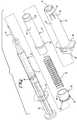
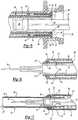
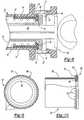
Fig. 1 is a top perspective view of a preferred embodiment of the medical device according to the invention as assembled;Figure 2 is an exploded, perspective view thereof;Fig. 3 is a sectional elevation view thereof;Fig. 4 is a sectional view thereof following actuation of the shield system of the device;Fig. 5 is an enlarged sectional view of the proximal portion of the device prior to actuation of the shield system;Fig. 6 is an enlarged sectional view showing a portion of the device, including the distal portion of a syringe holder of the device, prior to actuation of the shield system;Fig. 7 is an enlarged sectional view showing a portion of the device including the distal portion of the syringe holder following actuation of the shield system;Fig. 8 is an enlarged sectional view of the proximal portion of the device immediately following actuation of the shield system;Figure 9 is an end view of the end fitting; andFigure 10 is a side, partially cross-sectioned view of the fitting shown inFigure 9 .- An
injection device 10 for injecting a medicament, drug or vaccine into a patient is shown inFigures 1-8 . The device comprises a prefilled orprefillable syringe 12 and a shield assembly coupled to the syringe. - Syringes are ordinarily comprised of a tubular, generally
cylindrical portion 16, known as a barrel, aneedle cannula 18 or other piercing element or a connecting element secured to one end of the barrel, and a piston orstopper 20 slidably positioned within the barrel. The needle cannula may be removably secured to the barrel, but is more likely to be permanently secured to the barrel when the barrel is comprised of glass. Glass barrels are commonly used in prefillable syringes, and ordinarily contain a single dose of medication. Prefilled syringes made from plastic are also known to the art. Referring toFig. 2 , the shield system disclosed herein is employed in conjunction with aprefillable syringe 12 including abarrel 16, a cannula such as aneedle 18 permanently secured to the barrel, astopper 20 slidably positioned with the barrel, and aplunger rod 22 engageable with the stopper. Thesyringe barrel 16 includes a radially outwardly extendingintegral flange 24, which is normally grasped by the healthcare worker or patient but is used to couple the syringe to the shield system of this invention. - The
shield system 14 according to this invention includes atubular holder 26, atubular shield 28 coupled to the holder, acoil spring 30 and an end fitting 32 which engages one end of the spring. With the exception of thespring 30 and the fitting 32, all of the components of the shield system may be made from a semi-rigid plastic material, such as polypropylene. The spring is preferably a metal coil spring. The fitting is preferably formed of a resilient polymer, such as a thermoplastic elastomer, rubber, synthetic rubber or a rubber blend. - The
holder 26 is preferably comprised of an elongate, generally cylindricaltubular body 34 which defines a generally cylindrical enclosure. The holder has proximal and distal open ends 35 and 37, respectively, which provide access to the enclosure. Aflange 38 extends radially outwardly from the holder body near the proximalopen end 35 thereof. The flange and body of the holder are designed for easy handling as an injection is made. Only one hand should be required for injection. - The inner surface of the holder enclosure includes a
frustoconical surface 40 adjoining the proximalopen end 35 as shown inFigs. 3 and5 . Afirst abutment surface 44 is formed by the holder body in opposing spaced relation to thesecond abutment surface 42. Asecond abutment surface 42 is formed at the inner end of this surface, as shown inFigs. 4 and5 . As shown inFigures 5 and8 , the abutment surfaces 42 and 44 and theouter wall 43 form an annular channel or chamber for receipt of thesyringe flange 24. The inner diameter of the holder, measured at the abutment surfaces 42 and 44, is smaller than the distance between the edges or major diameter of thesyringe flange 24. Accordingly, once the syringe is inserted far enough into the holder such that theflange 24 is located between abutment surfaces 42, 44, it is slidably coupled to the holder. Thefrustoconical surface 40 facilitates this insertion. Thespring 30 urges thesyringe flange 24 towards engagement with thesecond abutment surface 42 as shown inFig. 5 . The gap formed between the abutment surfaces 42 and 44 is preferably greater than the thickness of thesyringe flange 24 to allow large tolerances in height to ease clipping (particularly at high speed) and absorb flange thickness variations and system built up tolerances. - A
radial groove 48 or stop, best shown inFigs. 6 and 7 , is provided on the inside surface of the holder adjacent itsdistal end 37. The radial groove is provided in an arcuately inwardly projectingdistal end portion 50 of the holder, which also serves as a stop member as described below. - A pair of
opposed detents 52 are provided on the holder which prevent retraction of theshield 28 once extended. Each of thesedetents 52 is formed on anaxially extending arm 54 which is integral with theholder body 34 and pivotable with respect thereto. (SeeFigs. 2 ,6 and 7 .) The end surface of eachdetent 52 faces the distalopen end 37 of the holder which is substantially perpendicular to the longitudinal axis of the holder. Aninclined end surface 53 is provided on the opposite side of each detent, and faces the proximalopen end 37. - The
shield 28 is comprised of a substantially cylindricaltubular body 56. Thetubular shield 28 preferably has an outside diameter small enough to be positioned within the holder and an inside diameter large enough to receive thebarrel 16 of the syringe. As shown inFigs. 2 and7 , astop member 58 in the form of a radially outwardly extending collar or rib is formed integrally on thebody 56 of the shield near the distal end thereof. A second, radially outwardly extending collar orrib 59 is formed integrally on theshield body 56 towards the proximal end, and defines anotherstop member 59. Thesecond collar 59 is preferably larger in diameter than the first collar. - The
coil spring 30 has an internal diameter large enough to fit over the proximal end of the shield, such that one end thereof bears against thecollar 59. The opposite end of the spring bears against the radially inwardly projectingflange portion 65 of the flange portion orcollar 66 of the end fitting 32 as shown inFig. 5 , and theflange portion 66 is biased against theflange 24 of the syringe barrel as shown inFigure 5 , such that thespring 30 is operably biased between thesecond abutment surface 42 of theholder 22 and theshield 28. - The
spring 30 causes theshield 28 to move axially upon axial movement of theplunger rod 22 when thestopper 20 is driven against the distal end of the barrel as shown inFigure 4 , with sufficient force to disengage therib 58 on the shield from thegroove 48 in the holder distal end as described further below. Direct engagement of the end fitting 32 orsyringe flange 24 and shield, as provided in the preferred embodiment, is not necessary in such an arrangement. The operation of the device can be effected whether the shield, spring, end fitting and syringe barrel are directly or indirectly engaged, so long as axial movement of the syringe barrel causes axial movement of the shield. - The end fitting 32 includes a cylindrical
tubular portion 64 which is inserted within thebody 34 of the holder as shown inFig. 8 and surrounds the proximal end of theshield 28 between therib 59 and the proximal open end as shown inFigure 5 . As described above, the end fitting also includes aproximal flange portion 66 including a radially inwardly projectingportion 65 which receives the proximal end of thespring 30 and theflange portion 66 further includes a radially outwardly projectingflange portion 67 which extends into the annular channel or chamber defined by the opposed abutment surfaces 42 and 44 and theouter wall 43 as shown inFigures 5 and8 and is located between thefirst abutment surface 44 and theflange 24 of thesyringe barrel 16. The radially outwardly extendingflange portion 67 has a diameter greater than the internal diameter of the opposed abutment surfaces 42 and 44 of the chamber adjacent the proximalopen end 35 of the holder, such that theshield 28,spring 30 and fitting 32 are assembled and inserted through theopen end 35 as shown inFigure 5 , wherein the radialouter flange portion 67 is biased against thefrustoconical surface 40 as described above. Thesyringe barrel 16 is then inserted through theopen end 35 or the shield assembly is assembled on the syringe barrel and inserted into theholder 26 as an assembly. - Prior to use, the
spring 30 biases theflange portion 66 of the fitting 32 against theflange 24 of thesyringe barrel 16, which biases theflange 24 against thesecond abutment surface 42 as shown inFigure 5 . The radially outwardly extendingflange portion 67 is thus spaced from thefirst abutment surface 44 and theneedle cannula 18 is exposed as shown inFigures 3 and6 for injection. Following injection, the user further compresses thestopper 20 against the end of thesyringe barrel 16, releasing or decoupling thestop members spring 30 then drives the shield to its extended position as shown inFigure 7 . This sudden movement of the shield results in vibration of the syringe. Further, because the user is pressing against the distal end of the syringe barrel during release of the shield as shown inFigure 8 , the syringe flange cannot move to the right inFigure 8 . Thus, theflange 24 of the barrel may be driven against the radially outwardly extendingportion 67 of the fitting against thefirst abutment surface 42. It has been found by the applicant that this vibration and sudden movement may result in damage including cracking of theflange 24 of thebarrel 16 which, as set forth above, is generally formed of glass. - It would therefore be desirable to isolate the
flange 24 of the syringe barrel from theholder 26 and damp impact of thesyringe flange 24 and the radially outwardly projectingflange portion 67 against theabutment surface 42. This is accomplished in the present invention by providing resilientlydeformable projections 70 which extend from the radially outwardly extendingflange portion 67 of the fitting toward thefirst abutment surface 42 as best shown inFigures 5 and8 . Theseprojections 70 isolate theflange 24 of thebarrel 16 from the holder and prevent damage to thesyringe flange 24. In the preferred embodiment, theflange portion 67 includes a plurality of spaced resilientlydeformable projections 70. However, as will be understood, the object of the projections can also be fulfilled by a single continuous resiliently deformable projection. Further, in the preferred embodiment, the distal end of the resiliently deformable projection orprojections 70 have a pointed distal end facing theabutment surface 42 providing improved damping by the projections. In the most preferred embodiment disclosed, the resiliently deformable projections are diamond-shaped as best shown inFigure 9 providing excellent damping of vibration of thesyringe flange 24 as shown inFigure 8 , wherein theshield 28 has just been released and thespring 30 is not yet fully expanded. As will be understood, the end fitting 32 also avoids direct contact of the coil spring against the fragileglass syringe flange 24. Further, in the most preferred embodiment, the resilientlydeformable projection 70 are integral with theflange portion 66 and thetubular portion 28 for ease of manufacture and assembly. In such embodiments, the fitting 32 is preferably formed of a resilient polymeric material, such as a thermoplastic elastomer, rubber, synthetic rubber and blends. The improved end fitting 32 thus reduces damage to theflange 24 of thesyringe barrel 16 and isolates the flange from thehousing 22. - The assembly and use of this preferred embodiment of the invention will now be described. The
shield 28 is slidably mounted to theholder 26 by inserting the shield through the proximalopen end 35 thereof until the first stop member orcollar 58 is received in the radial groove or stopmember 48 in the holder. The spring is inserted through the proximalopen end 35 of the holder, and over the shield until it abuts the relative large collar orrib 59. As a final step, prior to providing the shield system to the end user, the end fitting 32 is slipped over the exposed end of the spring and pushed through theproximal end 35 of the holder. The spring is substantially compressed during this step. Theshield 28 is resiliently urged towards thedistal end 37 of theholder 26 while the end fitting 32 is urged towards theproximal end 35 of theholder 26 by thecoil spring 30. Neither element can move due to the engagement of thestop members collar 66 of the end fitting with theabutment surface 42, respectively. The force of thespring 30 is insufficient to cause the disengagement of the shield and holder. - The
shield system 14 receives asyringe 12 of appropriate size through the proximalopen end 35 of the holder. The system as shown is designed for receiving asyringe 12 including aflange 24. Thesyringe flange 24 engages theconical surface 40 and is inserted into the shield until theflange 24 snaps behind thesecond abutment surface 42 in theholder 26. The end fitting 32 is displaced axially slightly during this procedure. As the needle of the syringe is ordinarily protected by a needle cover or cap (not shown) at this time, it may be safely coupled to the shield system. - The force required to disengage the rib or stop 58 of the shield from the stop member or
internal groove 48 of the holder is greater than the force of the spring plus the force required to expel the contents of thesyringe barrel 16 by compressing thestopper 20. Theplunger rod 22 is employed to move thestopper 20 through the syringe barrel until the contents of the barrel have been completely expelled. (The needle cover is, of course, removed prior to injection.) The contents of the barrel of a prefilled syringe ordinarily corresponds to a single dose of the prescribed medicament. - Following removal of the
needle 18 from the patient, the user applies a greater force to theplunger rod 22 than that applied during injection. Such force causes axial displacement of thesyringe barrel 16, end fitting 32, thespring 30 and theshield 28 with respect to theholder 26. The distance between the annular wall orcollar 66 of the end fitting (or the flange 24) is then sufficient to permit the secondstop member rib 58 to move far enough axially to where its retention by thegroove 48 is overcome by the force of the spring. Thefirst stop member 48 may also be displaced radially inwardly as such sliding occurs if sufficient flexibility of the holder body is provided. - Once the
rib 58 andgroove 48 are disengaged, thespring 30 expands rapidly, causing theshield 28 to slide axially or distally with respect to theholder 26 and syringe barrel. The collar or stopmember 59 moves past thedetents 52, causing them to deflect radially outwardly and then inwardly to their original positions. Thecollar 59 then engages theabutment surface 50 as shown inFig. 7 . The resiliently deformable projection orprojections 70 on the fitting 32 damps vibration ofsyringe 12 during movement theshield 28 reducing damage to theflange 24. Upon such engagement, theneedle cannula 18 is entirely and permanently enclosed and covered by theshield 28, as shown inFigs. 4 and7 . The shield cannot be retracted sufficiently to expose the needle tip due to the engagement of the stop member orcollar 59 with thedetents 52. It cannot be removed from the holder as thestop member 59 cannot move past theabutment surface 50. - The above-described procedure is particularly safe as it can be accomplished using only one hand. No second hand is required to move the shield, push a button or use any other actuating member to release the shield spring. The risk of accidental actuation of the shield through inadvertent contact with an actuating button is also eliminated. Moreover, a one-handed system is simpler for most people to use. It is readily apparent that the shield system can be adapted for use with syringes of various shapes and sizes without major modification.
- The deployment of a shield in response to the axial displacement of a syringe barrel with respect to a holder is a safe and effective way of protecting against needle sticks. The preferred embodiment of the invention, as described above, provides advantages for the user as well as the manufacturer. The components are relatively easy to manufacture and assemble. It will be appreciated, however, that modifications can be made without changing the basic mode of operation of the device. For example, the
stop member 58, of the shield, rather than being in the form of a collar, can simply be the end of the shield. The dimensions of each component of the medical device are determined by the specific uses(s) for which it is designed. - It will be appreciated and understood by those skilled in the art that further and additional revisions to the invention may be devised without departing from the scope of the appended claims, the invention not being limited to the specific embodiment shown.
Claims (10)
- An injection device (10), comprising:a generally cylindrical tubular barrel (16) including a first end having a needle cannula (18) having a sharp distal end and a second open end having a radial flange (24) adjacent said second open end;a tubular holder (26) surrounding said barrel (16) including a first open end (37) adjacent said first end of said barrel spaced from said sharp distal end of said needle cannula and a second open end (35) having a chamber receiving said flange (24) of said barrel, said chamber having an abutment surface (44) facing said flange of said barrel;a tubular shield (28) releaseably retained by said holder (26) located within said holder surrounding at least a portion of said barrel (16), including a first open end and a second open end, said tubular shield (28) axially moveable with respect to said barrel (16) between a retracted position, wherein said sharp distal end of said needle cannula (18) is exposed, to an extended position, wherein said sharp distal end of said needle cannula (18) is enclosed by said shield (28);a fitting (32) within said tubular (26) holder having a tubular portion surrounding said tubular shield (28) and a radial flange portion (66) located within said chamber of said tubular holder between said flange of said barrel and said abutment surface (44) of said chamber;and a spring (30) operably biased between said shield (28) and said holder (26) urging said shield from said retracted position toward said extended position when said shield is released from said tubular holder,characterized in thatsaid fitting (32) has at least one resiliently deformable projection (70) extending toward said abutment surface (44), whereby said resiliently deformable projection (70) on said flange portion of said fitting damps movement of said flange (24) of said barrel in said chamber, reducing damage to said flange of said barrel when said spring (30) urges said shield (28) toward said extended position.
- The injection device as defined in Claim 1, wherein said resiliently deformable projection (70) comprises a plurality of projections circumferentially spaced around said flange portion (66) of said fitting extending toward said abutment surface (44) of said chamber.
- The injection device as defined in Claim 2, wherein said plurality of projections (70) are integral with said flange portion (66) of said fitting and said fitting is formed of a resilient polymer.
- The injection device as defined in Claim 2, wherein said plurality of projections (70) are diamond-shaped each having a pointed distal end.
- The injection device as defined in Claim 1, wherein said tubular shield (28) includes a radially outwardly extending rib (59) and said spring (30) is biased between said rib (59) of said shield and said fitting (32).
- The injection device as defined in Claim 5, wherein said fitting (32) includes an inwardly projecting radial portion (65) and said spring (30) is biased between said rib (59) of said tubular shield and said radial portion of said fitting (32).
- The injection device as defined in Claim 1, wherein said holder (26) includes a first stop member (48) adjacent said first open end (37) and said tubular shield (28) includes a first stop member (58) adjacent said first open end of said tubular shield, wherein said first stop members (48,58) of said holder and said shield releaseably retain said shield in said retracted position.
- The injection device as defined in Claim 7, wherein said tubular shield (28) includes a second stop member (59) axially spaced from said first stop member (58) arresting movement of said tubular shield towards said extended position.
- The injection device as defined in Claim 8, wherein said tubular holder (26) includes a second stop member (52) adjacent to but spaced from said first stop member (48) which prevents retraction of said shield (28) from said extended position enclosing said needle cannula sharp distal end.
- The injection device as defined in Claim 1, wherein said injection device includes a stopper (20) in said barrel (16) telescopically moveable through said barrel to inject fluid through said needle cannula (18) and a plunger (22) attached to said stopper extending through said second open end of said barrel, whereby force applied to said stopper against a reduced diameter end portion of said barrel applies force to said barrel, releasing said tubular shield (28).
Applications Claiming Priority (3)
| Application Number | Priority Date | Filing Date | Title |
|---|---|---|---|
| US88581501A | 2001-06-20 | 2001-06-20 | |
| US885815 | 2001-06-20 | ||
| PCT/US2002/019733WO2003000323A1 (en) | 2001-06-20 | 2002-06-20 | Safety shield system for prefilled syringes |
Publications (2)
| Publication Number | Publication Date |
|---|---|
| EP1397172A1 EP1397172A1 (en) | 2004-03-17 |
| EP1397172B1true EP1397172B1 (en) | 2017-08-02 |
Family
ID=25387758
Family Applications (2)
| Application Number | Title | Priority Date | Filing Date |
|---|---|---|---|
| EP02737571AExpired - LifetimeEP1397170B1 (en) | 2001-06-20 | 2002-06-20 | Safety shield system for prefilled syringes |
| EP02744517.0AExpired - LifetimeEP1397172B1 (en) | 2001-06-20 | 2002-06-20 | Safety shield system for prefilled syringes |
Family Applications Before (1)
| Application Number | Title | Priority Date | Filing Date |
|---|---|---|---|
| EP02737571AExpired - LifetimeEP1397170B1 (en) | 2001-06-20 | 2002-06-20 | Safety shield system for prefilled syringes |
Country Status (7)
| Country | Link |
|---|---|
| EP (2) | EP1397170B1 (en) |
| JP (2) | JP4176631B2 (en) |
| CN (2) | CN1212166C (en) |
| AT (1) | ATE306958T1 (en) |
| DE (1) | DE60206751T2 (en) |
| ES (1) | ES2247343T3 (en) |
| WO (2) | WO2003000322A1 (en) |
Families Citing this family (29)
| Publication number | Priority date | Publication date | Assignee | Title |
|---|---|---|---|---|
| EP1605992B1 (en)* | 2003-01-30 | 2018-11-21 | Becton, Dickinson and Company | Holder with safety shield for a drug delivery device |
| US7101351B2 (en) | 2003-11-03 | 2006-09-05 | Becton, Dickinson And Company | Safety device for a syringe |
| US7468054B2 (en) | 2003-11-03 | 2008-12-23 | Becton, Dickinson And Company | Safety shield system for a syringe |
| US7497847B2 (en) | 2003-11-03 | 2009-03-03 | Becton, Dickinson And Company | Safety shield system for a syringe |
| US7604613B2 (en) | 2004-01-20 | 2009-10-20 | Beckton, Dickinson And Company | Syringe having a retractable needle |
| US7344517B2 (en) | 2004-01-20 | 2008-03-18 | Becton, Dickinson And Company | Syringe having a retractable needle |
| EP1845925B1 (en)* | 2005-01-12 | 2016-08-24 | Biogen MA Inc. | Method for delivering interferon-beta |
| US8062252B2 (en) | 2005-02-18 | 2011-11-22 | Becton, Dickinson And Company | Safety shield system for a syringe |
| EP3108812B1 (en)* | 2007-03-07 | 2020-04-29 | Becton, Dickinson and Company | Safety blood collection assembly with indicator |
| JP4566223B2 (en)* | 2007-08-02 | 2010-10-20 | 株式会社アルテ | Container / Syringe |
| TWI476024B (en)* | 2010-11-18 | 2015-03-11 | Shl Group Ab | Medicament delivery device |
| CN103347557B (en)* | 2010-11-18 | 2015-07-22 | Shl集团有限责任公司 | Medicament delivery device |
| FR2971424B1 (en)* | 2011-02-14 | 2013-11-29 | Marc Brunel | SAFETY SYRINGE |
| CN102406505B (en)* | 2011-09-05 | 2014-04-02 | 汪贤宗 | Split-type hemostix with safety protection device |
| CN102525489B (en)* | 2011-09-05 | 2014-05-14 | 汪贤宗 | Safe split type blood collector |
| WO2013178511A1 (en)* | 2012-05-29 | 2013-12-05 | Carebay Europe Ltd | Medicament container retaining mechanism |
| JP6211790B2 (en)* | 2013-04-23 | 2017-10-11 | 大成化工株式会社 | Syringe |
| USD765838S1 (en) | 2015-03-26 | 2016-09-06 | Tech Group Europe Limited | Syringe retention clip |
| JP6009645B1 (en) | 2015-12-18 | 2016-10-19 | フォルテ グロウ メディカル株式会社 | Syringe protector |
| JP1565215S (en) | 2016-05-16 | 2016-12-12 | ||
| WO2018218167A1 (en) | 2017-05-25 | 2018-11-29 | West Pharmaceutical Services, Inc. | Smart syringe using nfc communication and capacitance detection |
| WO2019068109A1 (en)* | 2017-09-29 | 2019-04-04 | West Pharmaceutical Services, Inc. | Housing with syringe holding feature |
| CN209464389U (en)* | 2018-10-22 | 2019-10-08 | 南通市肿瘤医院(南通市第五人民医院) | A kind of respiratory tumor needle thorn suction means |
| CN113018589B (en)* | 2021-02-06 | 2024-02-06 | 焦作市妇幼保健院(焦作市妇女儿童医院) | Disposable injector for preventing puncture |
| EP4360679A1 (en) | 2022-10-28 | 2024-05-01 | Becton, Dickinson and Company | A syringe assembly for use in medication delivery |
| EP4374895A1 (en) | 2022-11-22 | 2024-05-29 | Becton Dickinson France | Syringe assembly for use in medication delivery |
| EP4389174A1 (en)* | 2022-12-20 | 2024-06-26 | Becton Dickinson France | Safety device for mounting onto a drug delivery device |
| EP4389175A1 (en) | 2022-12-20 | 2024-06-26 | Becton Dickinson France | Safety assembly for mounting onto a syringe |
| WO2024153406A1 (en)* | 2023-01-17 | 2024-07-25 | Shl Medical Ag | A subassembly of a medicament delivery device |
Family Cites Families (7)
| Publication number | Priority date | Publication date | Assignee | Title |
|---|---|---|---|---|
| FR1500058A (en)* | 1966-06-20 | 1967-11-03 | Device for inserting injection needles | |
| CN2176789Y (en)* | 1994-01-03 | 1994-09-14 | 徐景义 | Sterile syringe needle protective cap |
| FR2733687B1 (en)* | 1995-05-04 | 1997-10-03 | Brunel Marc | METHOD FOR MANUFACTURING A PRE-FILLED INJECTION DEVICE CONTAINING A DOSE OF LIQUID TO BE INJECTED, AND INJECTION DEVICE PRODUCED |
| US5591138A (en)* | 1995-08-10 | 1997-01-07 | Vaillancourt; Vincent L. | Protected needle assembly |
| IT1304761B1 (en)* | 1998-01-20 | 2001-03-29 | Nardino Righi | DISPOSABLE SAFETY SYRINGE. |
| US6319233B1 (en)* | 1998-04-17 | 2001-11-20 | Becton, Dickinson And Company | Safety shield system for prefilled syringes |
| GB0003790D0 (en)* | 2000-02-18 | 2000-04-05 | Astrazeneca Uk Ltd | Medical device |
- 2002
- 2002-06-20JPJP2003506964Apatent/JP4176631B2/ennot_activeExpired - Lifetime
- 2002-06-20EPEP02737571Apatent/EP1397170B1/ennot_activeExpired - Lifetime
- 2002-06-20WOPCT/US2002/019715patent/WO2003000322A1/enactiveIP Right Grant
- 2002-06-20JPJP2003506963Apatent/JP4335670B2/ennot_activeExpired - Lifetime
- 2002-06-20EPEP02744517.0Apatent/EP1397172B1/ennot_activeExpired - Lifetime
- 2002-06-20CNCNB028124413Apatent/CN1212166C/ennot_activeExpired - Lifetime
- 2002-06-20WOPCT/US2002/019733patent/WO2003000323A1/enactiveSearch and Examination
- 2002-06-20CNCNB02812443XApatent/CN100358595C/ennot_activeExpired - Lifetime
- 2002-06-20ESES02737571Tpatent/ES2247343T3/ennot_activeExpired - Lifetime
- 2002-06-20ATAT02737571Tpatent/ATE306958T1/ennot_activeIP Right Cessation
- 2002-06-20DEDE60206751Tpatent/DE60206751T2/ennot_activeExpired - Lifetime
Also Published As
| Publication number | Publication date |
|---|---|
| CN1627970A (en) | 2005-06-15 |
| CN1518463A (en) | 2004-08-04 |
| CN100358595C (en) | 2008-01-02 |
| DE60206751D1 (en) | 2005-11-24 |
| EP1397170B1 (en) | 2005-10-19 |
| JP4176631B2 (en) | 2008-11-05 |
| ATE306958T1 (en) | 2005-11-15 |
| WO2003000323A1 (en) | 2003-01-03 |
| CN1212166C (en) | 2005-07-27 |
| JP2005519647A (en) | 2005-07-07 |
| JP2004531332A (en) | 2004-10-14 |
| WO2003000322A1 (en) | 2003-01-03 |
| JP4335670B2 (en) | 2009-09-30 |
| ES2247343T3 (en) | 2006-03-01 |
| DE60206751T2 (en) | 2006-07-06 |
| EP1397172A1 (en) | 2004-03-17 |
| EP1397170A1 (en) | 2004-03-17 |
Similar Documents
| Publication | Publication Date | Title |
|---|---|---|
| EP1392379B1 (en) | Safety shield system for prefilled syringes | |
| US6616639B2 (en) | Safety shield system for syringes | |
| EP1397172B1 (en) | Safety shield system for prefilled syringes | |
| EP1379300B1 (en) | Safety shield system for prefilled syringes | |
| US6685676B2 (en) | Safety shield system for prefilled syringes | |
| CA2549474C (en) | Safety shield system for prefilled syringe | |
| US7601139B2 (en) | Spring launched needle safety clip | |
| AU2011211438B2 (en) | Safety shield system for prefilled syringe |
Legal Events
| Date | Code | Title | Description |
|---|---|---|---|
| PUAI | Public reference made under article 153(3) epc to a published international application that has entered the european phase | Free format text:ORIGINAL CODE: 0009012 | |
| 17P | Request for examination filed | Effective date:20040107 | |
| AK | Designated contracting states | Kind code of ref document:A1 Designated state(s):AT BE CH CY DE DK ES FI FR GB GR IE IT LI LU MC NL PT SE TR | |
| AX | Request for extension of the european patent | Extension state:AL LT LV MK RO SI | |
| RIN1 | Information on inventor provided before grant (corrected) | Inventor name:JANSEN, HUBERT Inventor name:GAGNIEUX, SAMUEL Inventor name:BARRELLE, LAURENT | |
| 17Q | First examination report despatched | Effective date:20150312 | |
| RAP1 | Party data changed (applicant data changed or rights of an application transferred) | Owner name:BECTON, DICKINSON AND COMPANY | |
| GRAP | Despatch of communication of intention to grant a patent | Free format text:ORIGINAL CODE: EPIDOSNIGR1 | |
| STAA | Information on the status of an ep patent application or granted ep patent | Free format text:STATUS: GRANT OF PATENT IS INTENDED | |
| INTG | Intention to grant announced | Effective date:20170202 | |
| GRAS | Grant fee paid | Free format text:ORIGINAL CODE: EPIDOSNIGR3 | |
| GRAA | (expected) grant | Free format text:ORIGINAL CODE: 0009210 | |
| STAA | Information on the status of an ep patent application or granted ep patent | Free format text:STATUS: THE PATENT HAS BEEN GRANTED | |
| AK | Designated contracting states | Kind code of ref document:B1 Designated state(s):AT BE CH CY DE DK ES FI FR GB GR IE IT LI LU MC NL PT SE TR | |
| REG | Reference to a national code | Ref country code:GB Ref legal event code:FG4D | |
| REG | Reference to a national code | Ref country code:CH Ref legal event code:EP Ref country code:AT Ref legal event code:REF Ref document number:913785 Country of ref document:AT Kind code of ref document:T Effective date:20170815 | |
| REG | Reference to a national code | Ref country code:IE Ref legal event code:FG4D | |
| REG | Reference to a national code | Ref country code:DE Ref legal event code:R096 Ref document number:60249000 Country of ref document:DE | |
| REG | Reference to a national code | Ref country code:SE Ref legal event code:TRGR | |
| REG | Reference to a national code | Ref country code:DK Ref legal event code:T3 Effective date:20171113 | |
| REG | Reference to a national code | Ref country code:ES Ref legal event code:FG2A Ref document number:2645562 Country of ref document:ES Kind code of ref document:T3 Effective date:20171205 | |
| REG | Reference to a national code | Ref country code:NL Ref legal event code:MP Effective date:20170802 | |
| REG | Reference to a national code | Ref country code:AT Ref legal event code:MK05 Ref document number:913785 Country of ref document:AT Kind code of ref document:T Effective date:20170802 | |
| PG25 | Lapsed in a contracting state [announced via postgrant information from national office to epo] | Ref country code:FI Free format text:LAPSE BECAUSE OF FAILURE TO SUBMIT A TRANSLATION OF THE DESCRIPTION OR TO PAY THE FEE WITHIN THE PRESCRIBED TIME-LIMIT Effective date:20170802 Ref country code:AT Free format text:LAPSE BECAUSE OF FAILURE TO SUBMIT A TRANSLATION OF THE DESCRIPTION OR TO PAY THE FEE WITHIN THE PRESCRIBED TIME-LIMIT Effective date:20170802 Ref country code:NL Free format text:LAPSE BECAUSE OF FAILURE TO SUBMIT A TRANSLATION OF THE DESCRIPTION OR TO PAY THE FEE WITHIN THE PRESCRIBED TIME-LIMIT Effective date:20170802 | |
| PG25 | Lapsed in a contracting state [announced via postgrant information from national office to epo] | Ref country code:GR Free format text:LAPSE BECAUSE OF FAILURE TO SUBMIT A TRANSLATION OF THE DESCRIPTION OR TO PAY THE FEE WITHIN THE PRESCRIBED TIME-LIMIT Effective date:20171103 | |
| REG | Reference to a national code | Ref country code:DE Ref legal event code:R097 Ref document number:60249000 Country of ref document:DE | |
| REG | Reference to a national code | Ref country code:FR Ref legal event code:PLFP Year of fee payment:17 | |
| PLBE | No opposition filed within time limit | Free format text:ORIGINAL CODE: 0009261 | |
| STAA | Information on the status of an ep patent application or granted ep patent | Free format text:STATUS: NO OPPOSITION FILED WITHIN TIME LIMIT | |
| 26N | No opposition filed | Effective date:20180503 | |
| REG | Reference to a national code | Ref country code:CH Ref legal event code:PL | |
| REG | Reference to a national code | Ref country code:BE Ref legal event code:MM Effective date:20180630 | |
| REG | Reference to a national code | Ref country code:IE Ref legal event code:MM4A | |
| PG25 | Lapsed in a contracting state [announced via postgrant information from national office to epo] | Ref country code:MC Free format text:LAPSE BECAUSE OF FAILURE TO SUBMIT A TRANSLATION OF THE DESCRIPTION OR TO PAY THE FEE WITHIN THE PRESCRIBED TIME-LIMIT Effective date:20170802 Ref country code:LU Free format text:LAPSE BECAUSE OF NON-PAYMENT OF DUE FEES Effective date:20180620 | |
| PG25 | Lapsed in a contracting state [announced via postgrant information from national office to epo] | Ref country code:LI Free format text:LAPSE BECAUSE OF NON-PAYMENT OF DUE FEES Effective date:20180630 Ref country code:IE Free format text:LAPSE BECAUSE OF NON-PAYMENT OF DUE FEES Effective date:20180620 Ref country code:CH Free format text:LAPSE BECAUSE OF NON-PAYMENT OF DUE FEES Effective date:20180630 | |
| PG25 | Lapsed in a contracting state [announced via postgrant information from national office to epo] | Ref country code:BE Free format text:LAPSE BECAUSE OF NON-PAYMENT OF DUE FEES Effective date:20180630 | |
| PG25 | Lapsed in a contracting state [announced via postgrant information from national office to epo] | Ref country code:PT Free format text:LAPSE BECAUSE OF FAILURE TO SUBMIT A TRANSLATION OF THE DESCRIPTION OR TO PAY THE FEE WITHIN THE PRESCRIBED TIME-LIMIT Effective date:20170802 | |
| PG25 | Lapsed in a contracting state [announced via postgrant information from national office to epo] | Ref country code:CY Free format text:LAPSE BECAUSE OF FAILURE TO SUBMIT A TRANSLATION OF THE DESCRIPTION OR TO PAY THE FEE WITHIN THE PRESCRIBED TIME-LIMIT Effective date:20170802 | |
| PGFP | Annual fee paid to national office [announced via postgrant information from national office to epo] | Ref country code:DE Payment date:20210519 Year of fee payment:20 Ref country code:FR Payment date:20210519 Year of fee payment:20 Ref country code:IT Payment date:20210519 Year of fee payment:20 | |
| PGFP | Annual fee paid to national office [announced via postgrant information from national office to epo] | Ref country code:GB Payment date:20210519 Year of fee payment:20 Ref country code:DK Payment date:20210521 Year of fee payment:20 Ref country code:SE Payment date:20210520 Year of fee payment:20 Ref country code:TR Payment date:20210527 Year of fee payment:20 | |
| PGFP | Annual fee paid to national office [announced via postgrant information from national office to epo] | Ref country code:ES Payment date:20210701 Year of fee payment:20 | |
| REG | Reference to a national code | Ref country code:DE Ref legal event code:R071 Ref document number:60249000 Country of ref document:DE | |
| REG | Reference to a national code | Ref country code:DK Ref legal event code:EUP Expiry date:20220620 | |
| REG | Reference to a national code | Ref country code:GB Ref legal event code:PE20 Expiry date:20220619 | |
| PG25 | Lapsed in a contracting state [announced via postgrant information from national office to epo] | Ref country code:GB Free format text:LAPSE BECAUSE OF EXPIRATION OF PROTECTION Effective date:20220619 | |
| REG | Reference to a national code | Ref country code:SE Ref legal event code:EUG | |
| REG | Reference to a national code | Ref country code:ES Ref legal event code:FD2A Effective date:20220805 | |
| PG25 | Lapsed in a contracting state [announced via postgrant information from national office to epo] | Ref country code:ES Free format text:LAPSE BECAUSE OF EXPIRATION OF PROTECTION Effective date:20220621 |