EP1081249A1 - Method for depositing fluorinated silica glass layers - Google Patents
Method for depositing fluorinated silica glass layersDownload PDFInfo
- Publication number
- EP1081249A1 EP1081249A1EP00119011AEP00119011AEP1081249A1EP 1081249 A1EP1081249 A1EP 1081249A1EP 00119011 AEP00119011 AEP 00119011AEP 00119011 AEP00119011 AEP 00119011AEP 1081249 A1EP1081249 A1EP 1081249A1
- Authority
- EP
- European Patent Office
- Prior art keywords
- layer
- fsg
- substrate
- chamber
- gas
- Prior art date
- Legal status (The legal status is an assumption and is not a legal conclusion. Google has not performed a legal analysis and makes no representation as to the accuracy of the status listed.)
- Withdrawn
Links
Images




Classifications
- H—ELECTRICITY
- H01—ELECTRIC ELEMENTS
- H01L—SEMICONDUCTOR DEVICES NOT COVERED BY CLASS H10
- H01L21/00—Processes or apparatus adapted for the manufacture or treatment of semiconductor or solid state devices or of parts thereof
- H01L21/02—Manufacture or treatment of semiconductor devices or of parts thereof
- H01L21/02104—Forming layers
- H01L21/02107—Forming insulating materials on a substrate
- H01L21/02109—Forming insulating materials on a substrate characterised by the type of layer, e.g. type of material, porous/non-porous, pre-cursors, mixtures or laminates
- H01L21/02112—Forming insulating materials on a substrate characterised by the type of layer, e.g. type of material, porous/non-porous, pre-cursors, mixtures or laminates characterised by the material of the layer
- H01L21/02123—Forming insulating materials on a substrate characterised by the type of layer, e.g. type of material, porous/non-porous, pre-cursors, mixtures or laminates characterised by the material of the layer the material containing silicon
- H01L21/02126—Forming insulating materials on a substrate characterised by the type of layer, e.g. type of material, porous/non-porous, pre-cursors, mixtures or laminates characterised by the material of the layer the material containing silicon the material containing Si, O, and at least one of H, N, C, F, or other non-metal elements, e.g. SiOC, SiOC:H or SiONC
- H01L21/02131—Forming insulating materials on a substrate characterised by the type of layer, e.g. type of material, porous/non-porous, pre-cursors, mixtures or laminates characterised by the material of the layer the material containing silicon the material containing Si, O, and at least one of H, N, C, F, or other non-metal elements, e.g. SiOC, SiOC:H or SiONC the material being halogen doped silicon oxides, e.g. FSG
- C—CHEMISTRY; METALLURGY
- C23—COATING METALLIC MATERIAL; COATING MATERIAL WITH METALLIC MATERIAL; CHEMICAL SURFACE TREATMENT; DIFFUSION TREATMENT OF METALLIC MATERIAL; COATING BY VACUUM EVAPORATION, BY SPUTTERING, BY ION IMPLANTATION OR BY CHEMICAL VAPOUR DEPOSITION, IN GENERAL; INHIBITING CORROSION OF METALLIC MATERIAL OR INCRUSTATION IN GENERAL
- C23C—COATING METALLIC MATERIAL; COATING MATERIAL WITH METALLIC MATERIAL; SURFACE TREATMENT OF METALLIC MATERIAL BY DIFFUSION INTO THE SURFACE, BY CHEMICAL CONVERSION OR SUBSTITUTION; COATING BY VACUUM EVAPORATION, BY SPUTTERING, BY ION IMPLANTATION OR BY CHEMICAL VAPOUR DEPOSITION, IN GENERAL
- C23C16/00—Chemical coating by decomposition of gaseous compounds, without leaving reaction products of surface material in the coating, i.e. chemical vapour deposition [CVD] processes
- C23C16/22—Chemical coating by decomposition of gaseous compounds, without leaving reaction products of surface material in the coating, i.e. chemical vapour deposition [CVD] processes characterised by the deposition of inorganic material, other than metallic material
- C23C16/30—Deposition of compounds, mixtures or solid solutions, e.g. borides, carbides, nitrides
- C23C16/40—Oxides
- C23C16/401—Oxides containing silicon
- H—ELECTRICITY
- H01—ELECTRIC ELEMENTS
- H01L—SEMICONDUCTOR DEVICES NOT COVERED BY CLASS H10
- H01L21/00—Processes or apparatus adapted for the manufacture or treatment of semiconductor or solid state devices or of parts thereof
- H01L21/02—Manufacture or treatment of semiconductor devices or of parts thereof
- H01L21/02104—Forming layers
- H01L21/02107—Forming insulating materials on a substrate
- H01L21/02296—Forming insulating materials on a substrate characterised by the treatment performed before or after the formation of the layer
- H01L21/02318—Forming insulating materials on a substrate characterised by the treatment performed before or after the formation of the layer post-treatment
- H01L21/02362—Forming insulating materials on a substrate characterised by the treatment performed before or after the formation of the layer post-treatment formation of intermediate layers, e.g. capping layers or diffusion barriers
- H—ELECTRICITY
- H01—ELECTRIC ELEMENTS
- H01L—SEMICONDUCTOR DEVICES NOT COVERED BY CLASS H10
- H01L21/00—Processes or apparatus adapted for the manufacture or treatment of semiconductor or solid state devices or of parts thereof
- H01L21/02—Manufacture or treatment of semiconductor devices or of parts thereof
- H01L21/02104—Forming layers
- H01L21/02107—Forming insulating materials on a substrate
- H01L21/02109—Forming insulating materials on a substrate characterised by the type of layer, e.g. type of material, porous/non-porous, pre-cursors, mixtures or laminates
- H01L21/02112—Forming insulating materials on a substrate characterised by the type of layer, e.g. type of material, porous/non-porous, pre-cursors, mixtures or laminates characterised by the material of the layer
- H01L21/02123—Forming insulating materials on a substrate characterised by the type of layer, e.g. type of material, porous/non-porous, pre-cursors, mixtures or laminates characterised by the material of the layer the material containing silicon
- H01L21/02126—Forming insulating materials on a substrate characterised by the type of layer, e.g. type of material, porous/non-porous, pre-cursors, mixtures or laminates characterised by the material of the layer the material containing silicon the material containing Si, O, and at least one of H, N, C, F, or other non-metal elements, e.g. SiOC, SiOC:H or SiONC
- H—ELECTRICITY
- H01—ELECTRIC ELEMENTS
- H01L—SEMICONDUCTOR DEVICES NOT COVERED BY CLASS H10
- H01L21/00—Processes or apparatus adapted for the manufacture or treatment of semiconductor or solid state devices or of parts thereof
- H01L21/02—Manufacture or treatment of semiconductor devices or of parts thereof
- H01L21/02104—Forming layers
- H01L21/02107—Forming insulating materials on a substrate
- H01L21/02109—Forming insulating materials on a substrate characterised by the type of layer, e.g. type of material, porous/non-porous, pre-cursors, mixtures or laminates
- H01L21/02205—Forming insulating materials on a substrate characterised by the type of layer, e.g. type of material, porous/non-porous, pre-cursors, mixtures or laminates the layer being characterised by the precursor material for deposition
- H01L21/02208—Forming insulating materials on a substrate characterised by the type of layer, e.g. type of material, porous/non-porous, pre-cursors, mixtures or laminates the layer being characterised by the precursor material for deposition the precursor containing a compound comprising Si
- H01L21/02211—Forming insulating materials on a substrate characterised by the type of layer, e.g. type of material, porous/non-porous, pre-cursors, mixtures or laminates the layer being characterised by the precursor material for deposition the precursor containing a compound comprising Si the compound being a silane, e.g. disilane, methylsilane or chlorosilane
- H—ELECTRICITY
- H01—ELECTRIC ELEMENTS
- H01L—SEMICONDUCTOR DEVICES NOT COVERED BY CLASS H10
- H01L21/00—Processes or apparatus adapted for the manufacture or treatment of semiconductor or solid state devices or of parts thereof
- H01L21/02—Manufacture or treatment of semiconductor devices or of parts thereof
- H01L21/02104—Forming layers
- H01L21/02107—Forming insulating materials on a substrate
- H01L21/02225—Forming insulating materials on a substrate characterised by the process for the formation of the insulating layer
- H01L21/0226—Forming insulating materials on a substrate characterised by the process for the formation of the insulating layer formation by a deposition process
- H01L21/02263—Forming insulating materials on a substrate characterised by the process for the formation of the insulating layer formation by a deposition process deposition from the gas or vapour phase
- H01L21/02271—Forming insulating materials on a substrate characterised by the process for the formation of the insulating layer formation by a deposition process deposition from the gas or vapour phase deposition by decomposition or reaction of gaseous or vapour phase compounds, i.e. chemical vapour deposition
- H01L21/02274—Forming insulating materials on a substrate characterised by the process for the formation of the insulating layer formation by a deposition process deposition from the gas or vapour phase deposition by decomposition or reaction of gaseous or vapour phase compounds, i.e. chemical vapour deposition in the presence of a plasma [PECVD]
- H—ELECTRICITY
- H01—ELECTRIC ELEMENTS
- H01L—SEMICONDUCTOR DEVICES NOT COVERED BY CLASS H10
- H01L21/00—Processes or apparatus adapted for the manufacture or treatment of semiconductor or solid state devices or of parts thereof
- H01L21/02—Manufacture or treatment of semiconductor devices or of parts thereof
- H01L21/02104—Forming layers
- H01L21/02107—Forming insulating materials on a substrate
- H01L21/02296—Forming insulating materials on a substrate characterised by the treatment performed before or after the formation of the layer
- H01L21/02299—Forming insulating materials on a substrate characterised by the treatment performed before or after the formation of the layer pre-treatment
- H01L21/02304—Forming insulating materials on a substrate characterised by the treatment performed before or after the formation of the layer pre-treatment formation of intermediate layers, e.g. buffer layers, layers to improve adhesion, lattice match or diffusion barriers
Definitions
- the present inventionrelates to the manufacture of integrated circuits, and more specifically, to a method of forming fluorinated silicate glass (“FSG”) films with good adhesion to silicon nitride in a high-density-plasma chemical-vapor-deposition (“HDP-CVD”) system.
- FSGfluorinated silicate glass
- circuit elementsare formed by etching a pattern of gaps in a layer of metal such as aluminum.
- the gapsare then filled with a dielectric such as silicon dioxide.
- Copperis poised to take over as the main on-chip conductor for all types of integrated circuits because of its lower resistance when compared to conventional aluminum alloys. Because it is difficult to etch copper, however, damascene processes have been developed for fabricating copper-based integrated circuits. In damascene processes, dielectric layers are deposited and then etched to form gaps that are subsequently filled with copper.
- Fluorine-doped silicon oxidealso known as fluorosilicate glass
- fluorosilicate glassis an attractive solution to replace conventional silicon dioxide as an intermetal dielectric for damascene structures.
- An FSG filmcan be deposited in conventional HDP-CVD systems, which have been widely used for undoped silicate glass (USG) and FSG dielectrics in aluminum interconnects.
- FSGhas a good process scheme in terms of reliability, stability, and throughput.
- the electrical performance of integrated circuitscan be improved because of the lower dielectric constant of FSG (3.4 compared to 4.1 for conventional silicon oxides). The lower dielectric constant reduces the capacitance between metal lines in the same layer and reduces cross talk across layers.
- Dielectric films used in damascene processesutilize a layer known as an etch stop to provide for selective etching of the film.
- Silicon nitrideSi x N y
- Si x N ySilicon nitride
- FSGFSG tends to outgas at temperatures of about 450 °C forming "bubbles" in an overlying Si x N y layer. The bubbles lead to delamination of the Si x N y .
- a multilayer FSG filmis deposited as part of a film stack that includes an adjacent silicon nitride layer.
- the multilayer FSG filmincludes an interfacial FSG layer and a bulk FSG layer.
- the "interacial FSG layer”refers to the portion of the FSG film deposited adjacent to the silicon nitride layer.
- the interfacial part of the FSG filmrefers to the topmost portion if silicon nitride is to be deposited on top of the FSG and it refers to the bottom portion if the FSG is to be deposited on top of silicon nitride. It is not required that the "bulk FSG layer" be thicker than the interfacial layer, although it may be in some embodiments.
- the multilayer FSG filmis deposited by flowing a gaseous mixture comprising flows of silane, a gas that contains both fluorine and silicon, and a gas that contains oxygen to a process chamber.
- the gas that contains both fluorine and siliconis preferably SiF 4
- the gas that contains oxygenis preferably O 2 .
- the gaseous mixturecomprise a flow of inert gas, such as Ar, to promote gas dissociation.
- a plasmapreferably a high-density plasma is generated from the gaseous mixture, and the bulk portion of an FSG layer is deposited on the substrate using the plasma.
- the silane flowis then terminated during deposition of the interfacial part of the FSG film.
- SiH 4By removing the SiH 4 from the deposition of the interfacial part of the FSG film, less hydrogen is incorporated into the film in the interfacial region and adhesion to overlying or underlying silicon nitride is improved.
- a multilayer FSG filmthat includes bottom and top interfacial layers sandwiched around a bulk FSG layer is formed.
- a pure SiF 4 -only fluorinated oxide (“SOFO”) layeris deposited without having any portion of the film formed with silane.
- a gaseous mixtureis provided that comprises flows of a gas that contains both fluorine and silicon and a gas that contains oxygen, but not containing a silane, for the entire deposition. It is again preferred that gaseous mixture comprise a flow of inert gas, such as Ar, and that the gas containing both fluorine and silicon be SiF 4 and that the gas containing oxygen be O 2 .
- the SOFO layeris deposited as part of a copper damascene process on a barrier layer, preferably silicon nitride, previously formed on the substrate.
- the SOFO layeris etched, ashed, and metallized.
- the ashingis preferably performed with an oxygen, ammonia, or mixed oxygen-ammonia chemistry
- the metallization layeris preferably formed of Ta or TaN.
- the methods of the present inventionmay be embodied in a computer-readable storage medium having a computer-readable program embodied therein for directing operation of a substrate processing system.
- a systemmay include a process chamber, a plasma generation system, a substrate holder, a gas delivery system, and a system controller.
- the computer-readable programincludes instructions for operating the substrate processing system to form a thin film on a substrate disposed in the processing chamber in accordance with the embodiments described above. Further preferred embodiments of the invention and the features thereof are given in the appended claims and subclaims.
- Embodiments of the present inventiondeposit fluorinated silicate glass (FSG) in such a manner that it strongly adheres to an overlying or underlying barrier layer such as silicon nitride (Si x N y ).
- FSGfluorinated silicate glass
- SiH 4silane
- SiF 4silicon tetrafluoride
- oxygenO 2
- Arargon
- SiH 4 , SiF 4 , and O 2react to form the FSG.
- Aris included to promote gas dissociation. All four gases may be used for the majority of the deposition. However, for at least the interfacial part of the deposition, and for the entire film in certain embodiments, SiH 4 is not used.
- SiF 4 -only FSGMaterial thus deposited without the use of silane is referred to herein alternatively as "SiF 4 -only FSG” or “SiF 4 -only fluorinated oxide” ("SOFO").
- FSG deposited with silaneis referred to herein as SiH 4 -FSG.
- the interfacial part of the depositionrefers either to the latter or topmost portion of the deposition, if silicon nitride is to be deposited over the FSG. Alternatively, the interfacial portion may be the initial or lowermost portion of the deposition if the FSG is to be deposited over a barrier layer such as silicon nitride.
- FSGis deposited using only SiF 4 , O 2 and Ar throughout the deposition without using SiH 4 for any part of the deposition. Although good adhesion to Si x N y and lower dielectric constant may be obtained this way, FSG deposition using SiF 4 without SiH 4 has a lower deposition rate than FSG deposition with both SiF 4 and SiH 4 .
- Fig. 1Aillustrates one embodiment of a high density plasma chemical vapor deposition (HDP-CVD) system 10 in which a dielectric layer according to the present invention can be deposited.
- System 10includes a chamber 13, a vacuum system 70, a source plasma system 80A, a bias plasma system 80B, a gas delivery system 33, and a remote plasma cleaning system 50.
- HDP-CVDhigh density plasma chemical vapor deposition
- the upper portion of chamber 13includes a dome 14, which is made of a ceramic dielectric material, such as aluminum oxide or aluminum nitride. Dome 14 defines an upper boundary of a plasma processing region 16. Plasma processing region 16 is bounded on the bottom by the upper surface of a substrate 17 and a substrate support member 18.
- a heater plate 23 and a cold plate 24surmount, and are thermally coupled to, dome 14.
- Heater plate 23 and cold plate 24allow control of the dome temperature to within about ⁇ 10 °C over a range of about 100 °C to 200 °C. This allows optimizing the dome temperature for the various processes. For example, it may be desirable to maintain the dome at a higher temperature for cleaning or etching processes than for deposition processes. Accurate control of the dome temperature also reduces the flake or particle counts in the chamber and improves adhesion between the deposited layer and the substrate.
- the lower portion of chamber 13includes a body member 22, which joins the chamber to the vacuum system.
- a base portion 21 of substrate support member 18is mounted on, and forms a continuous inner surface with, body member 22.
- Substratesare transferred into and out of chamber 13 by a robot blade (not shown) through an insertion/removal opening (not shown) in the side of chamber 13.
- Lift pins (not shown)are raised and then lowered under the control of a motor (also not shown) to move the substrate from the robot blade at an upper loading position 57 to a lower processing position 56 in which the substrate is placed on a substrate receiving portion 19 of substrate support member 18.
- Substrate receiving portion 19includes an electrostatic chuck 20 that secures the substrate to substrate support member 18 during substrate processing.
- substrate support member 18is made from an aluminum oxide or aluminum ceramic material.
- Vacuum system 70includes throttle body 25, which houses twin-blade throttle valve 26 and is attached to gate valve 27 and turbo-molecular pump 28. It should be noted that throttle body 25 offers minimum obstruction to gas flow, and allows symmetric pumping. Gate valve 27 can isolate pump 28 from throttle body 25, and can also control chamber pressure by restricting the exhaust flow capacity when throttle valve 26 is fully open. The arrangement of the throttle valve, gate valve, and turbo-molecular pump allow accurate and stable control of chamber pressures from between about 1 millitorr to about 2 torr.
- the source plasma system 80Aincludes a top coil 29 and side coil 30, mounted on dome 14.
- a symmetrical ground shield(not shown) reduces electrical coupling between the coils.
- Top coil 29is powered by top source RF (SRF) generator 31A
- side coil 30is powered by side SRF generator 31B, allowing independent power levels and frequencies of operation for each coil.
- SRFsource RF
- This dual coil systemallows control of the radial ion density in chamber 13, thereby improving plasma uniformity.
- Side coil 30 and top coil 29are typically inductively driven, which does not require a complimentary electrode.
- the top source RF generator 31Aprovides up to 2,500 watts of RF power at nominally 2 MHz and the side source RF generator 31B provides up to 5,000 watts of RF power at nominally 2 MHz.
- the operating frequencies of the top and side RF generatorsmay be offset from the nominal operating frequency (e.g. to 1.7 ⁇ 1.9 MHz and 1.9 ⁇ 2.1 MHz, respectively) to improve plasma-generation efficiency.
- a bias plasma system 80Bincludes a bias RF (“BRF") generator 31C and a bias matching network 32C.
- the bias plasma system 80Bcapacitively couples substrate portion 17 to body member 22, which act as complimentary electrodes.
- the bias plasma system 80Bserves to enhance the transport of plasma species (e.g., ions) created by the source plasma system 80A to the surface of the substrate.
- bias RF generatorprovides up to 5,000 watts of RF power at 13.56 MHz.
- RF generators 31A and 31Binclude digitally-controlled synthesizers and operate over a frequency range between about 1.8 to about 2.1 MHz. Each generator includes an RF control circuit (not shown) that measures reflected power from the chamber and coil back to the generator and adjusts the frequency of operation to obtain the lowest reflected power, as understood by a person of ordinary skill in the art.
- RF generatorsare typically designed to operate into a load with a characteristic impedance of 50 ohms. RF power may be reflected from loads that have a different characteristic impedance than the generator. This can reduce power transferred to the load. Additionally, power reflected from the load back to the generator may overload and damage the generator.
- the impedance of a plasmamay range from less than 5 ohms to over 900 ohms, depending on the plasma ion density, among other factors, and because reflected power may be a function of frequency, adjusting the generator frequency according to the reflected power increases the power transferred from the RF generator to the plasma and protects the generator. Another way to reduce reflected power and improve efficiency is with a matching network.
- Matching networks 32A and 32Bmatch the output impedance of generators 31A and 31B with their respective coils 29 and 30.
- the RF control circuitmay tune both matching networks by changing the value of capacitors within the matching networks to match the generator to the load as the load changes.
- the RF control circuitmay tune a matching network when the power reflected from the load back to the generator exceeds a certain limit.
- One way to provide a constant match, and effectively disable the RF control circuit from tuning the matching networkis to set the reflected power limit above any expected value of reflected power. This may help stabilize a plasma under some conditions by holding the matching network constant at its most recent condition.
- the RF control circuitcan be used to determine the power delivered to the load (plasma) and may increase or decrease the generator output power to keep the delivered power substantially constant during deposition of a layer.
- a gas delivery system 33provides gases from several sources, 34A-34F chamber for processing the substrate via gas delivery lines 38 (only some of which are shown).
- gas delivery lines 38only some of which are shown.
- the actual sources used for sources 34A-34F and the actual connection of delivery lines 38 to chamber 13varies depending on the deposition and cleaning processes executed within chamber 13. Gases are introduced into chamber 13 through a gas ring 37 and/or a top nozzle 45.
- Fig. 1Bis a simplified, partial cross-sectional view of chamber 13 showing additional details of gas ring 37.
- first and second gas sources, 34A and 34B, and first and second gas flow controllers, 35A' and 35B'provide gas to ring plenum 36 in gas ring 37 via gas delivery lines 38 (only some of which are shown).
- Gas ring 37has a plurality of source gas nozzles 39 (only one of which is shown for purposes of illustration) that provide a uniform flow of gas over the substrate. Nozzle length and nozzle angle may be changed to allow tailoring of the uniformity profile and gas utilization efficiency for a particular process within an individual chamber.
- gas ring 37has 12 source gas nozzles made from an aluminum oxide ceramic.
- Gas ring 37also has a plurality of oxidizer gas nozzles 40 (only one of which is shown), which in a preferred embodiment are co-planar with and shorter than source gas nozzles 39, and in one embodiment receive gas from body plenum 41. In some embodiments it is desirable not to mix source gases and oxidizer gases before injecting the gases into chamber 13. In other embodiments, oxidizer gas and source gas may be mixed prior to injecting the gases into chamber 13 by providing apertures (not shown) between body plenum 41 and gas ring plenum 36. In one embodiment, third and fourth gas sources, 34C and 34D, and third and fourth gas flow controllers, 35C and 35D', provide gas to body plenum via gas delivery lines 38.
- the nitrogen source 34Fprovides nitrogen gas (N 2 ) to the oxidizer nozzles of the gas ring to the chamber for process steps utilizing nitrogen plasma.
- the nitrogen gascould be delivered to the chamber through other or additional inlets, such as the top nozzle.
- Additional valves, such as 43B (other valves not shown),may shut off gas from the flow controllers to the chamber.
- a 3-way valvesuch as valve 43B, to isolate chamber 13 from delivery line 38A and to vent delivery line 38A to vacuum foreline 44, for example.
- other similar valvessuch as 43A and 43C, may be incorporated on other gas delivery lines.
- Such 3-way valvesmay be placed as close to chamber 13 as practical, to minimize the volume of the unvented gas delivery line (between the 3-way valve and the chamber).
- two-way (on-off) valvesmay be placed between a mass flow controller (“MFC”) and the chamber or between a gas source and an MFC.
- MFCmass flow controller
- chamber 13also has top nozzle 45 and top vent 46.
- Top nozzle 45 and top vent 46allow independent control of top and side flows of the gases, which improves film uniformity and allows fine adjustment of the film's deposition and doping parameters.
- Top vent 46is an annular opening around top nozzle 45.
- first gas source 34Asupplies source gas nozzles 39 and top nozzle 45.
- Source nozzle MFC 35A'controls the amount of gas delivered to source gas nozzles 39 and top nozzle MFC 35A controls the amount of gas delivered to top gas nozzle 45.
- two MFCs 35B and 35B'may be used to control the flow of oxygen to both top vent 46 and oxidizer gas nozzles 40 from a single source of oxygen, such as source 34B.
- the gases supplied to top nozzle 45 and top vent 46may be kept separate prior to flowing the gases into chamber 13, or the gases may be mixed in top plenum 48 before they flow into chamber 13. Separate sources of the same gas may be used to supply various portions of the chamber.
- a remote microwave-generated plasma cleaning system 50is provided to periodically clean deposition residues from chamber components.
- the cleaning systemincludes a remote microwave generator 51 that creates a plasma from a cleaning gas source 34E (e.g., molecular fluorine, nitrogen trifluoride, other fluorocarbons or equivalents) in reactor cavity 53.
- a cleaning gas source 34Ee.g., molecular fluorine, nitrogen trifluoride, other fluorocarbons or equivalents
- the reactive species resulting from this plasmaare conveyed to chamber 13 through cleaning gas feed port 54 via applicator tube 55.
- the materials used to contain the cleaning plasmae.g., cavity 53 and applicator tube 55
- the distance between reactor cavity 53 and feed port 54should be kept as short as practical, since the concentration of desirable plasma species may decline with distance from reactor cavity 53.
- Generating the cleaning plasma in a remote cavityallows the use of an efficient microwave generator and does not subject chamber components to the temperature, radiation, or bombardment of the glow discharge that may be present in a plasma formed in situ. Consequently, relatively sensitive components, such as electrostatic chuck 20, do not need to be covered with a dummy wafer or otherwise protected, as may be required with an in situ plasma cleaning process.
- System controller 60controls the operation of system 10.
- controller 60includes a memory 62, such as a hard disk drive, a floppy disk drive (not shown), and a card rack (not shown) coupled to a processor 61.
- the card rackmay contain a single-board computer (SBC) (not shown), analog and digital input/output boards (not shown), interface boards (not shown), and stepper motor controller boards (not shown).
- SBCsingle-board computer
- the system controllerconforms to the Versa Modular European (“VME”) standard, which defines board, card cage, and connector dimensions and types.
- the VME standardalso defines the bus structure as having a 16-bit data bus and 24-bit address bus.
- System controller 31operates under the control of a computer program stored on the hard disk drive or through other computer programs, such as programs stored on a removable disk.
- the computer programdictates, for example, the timing, mixture of gases, RF power levels and other parameters of a particular process.
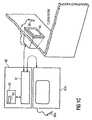
- the interface between a user and the system controlleris via a monitor, such as a cathode ray tube ("CRT") 65, and a light pen 66, as depicted in Fig. 1C.
- CTRcathode ray tube
- Fig. 1Cis an illustration of a portion of an exemplary system user interface used in conjunction with the exemplary CVD processing chamber of Fig. 1A.
- System controller 60includes a processor 61 coupled to a computer-readable memory 62.
- memory 62may be a hard disk drive, but memory 62 may be other kinds of memory, such as ROM, PROM, and others.
- System controller 60operates under the control of a computer program 63 stored in a computer-readable format within memory 62.
- the computer programdictates the timing, temperatures, gas flows, RF power levels and other parameters of a particular process.
- the interface between a user and the system controlleris via a CRT monitor 65 and a light pen 66, as depicted in Fig. 1C.
- two monitors, 65 and 65A, and two light pens, 66 and 66Aare used, one mounted in the clean room wall (65) for the operators and the other behind the wall (65A) for the service technicians. Both monitors simultaneously display the same information, but only one light pen (e.g. 66) is enabled.
- the operatortouches an area of the display screen and pushes a button (not shown) on the pen. The touched area confirms being selected by the light pen by changing its color or displaying a new menu, for example.
- the computer program codecan be written in any conventional computer-readable programming language such as 68000 assembly language, C, C++, or Pascal. Suitable program code is entered into a single file, or multiple files, using a conventional text editor and is stored or embodied in a computer-usable medium, such as a memory system of the computer. If the entered code text is in a high level language, the code is compiled, and the resultant compiler code is then linked with an object code of precompiled windows library routines. To execute the linked compiled object code, the system user invokes the object code causing the computer system to load the code in memory. The CPU reads the code from memory and executes the code to perform the tasks identified in the program.
- a computer-readable programming languagesuch as 68000 assembly language, C, C++, or Pascal.
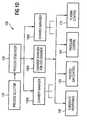
- Fig. 1Dshows an illustrative block diagram of the hierarchical control structure of computer program 100.
- a userenters a process set number and process chamber number into a process selector subroutine 110 in response to menus or screens displayed on the CRT monitor by using the light pen interface.
- the process setsare predetermined sets of process parameters necessary to carry out specified processes, and are identified by predefined set numbers.
- Process selector subroutine 110identifies (i) the desired process chamber in a multichamber system, and (ii) the desired set of process parameters needed to operate the process chamber for performing the desired process.
- the process parameters for performing a specific processrelate to conditions such as process gas composition and flow rates, temperature, pressure, plasma conditions such as RF power levels, and chamber dome temperature, and are provided to the user in the form of a recipe.
- the parameters specified by the recipeare entered utilizing the light pen/CRT monitor interface.
- the signals for monitoring the processare provided by the analog and digital input boards of system controller 60, and the signals for controlling the process are output on the analog and digital output boards of system controller 60.
- a process sequencer subroutine 120comprises program code for accepting the identified process chamber and set of process parameters from the process selector subroutine 110 and for controlling operation of the various process chambers. Multiple users can enter process set numbers and process chamber numbers, or a single user can enter multiple process set numbers and process chamber numbers; sequencer subroutine 120 schedules the selected processes in the desired sequence.
- sequencer subroutine 120includes a program code to perform the steps of (i) monitoring the operation of the process chambers to determine if the chambers are being used, (ii) determining what processes are being carried out in the chambers being used, and (iii) executing the desired process based on availability of a process chamber and type of process to be carried out.
- sequencer subroutine 120can be designed to take into consideration the "age" of each particular user-entered request, or the present condition of the process chamber being used in comparison with the desired process conditions for a selected process, or any other relevant factor a system programmer desires to include for determining scheduling priorities.
- sequencer subroutine 120determines which process chamber and process set combination is going to be executed next, sequencer subroutine 120 initiates execution of the process set by passing the particular process set parameters to a chamber manager subroutine 130A-C, which controls multiple processing tasks in chamber 13 and possibly other chambers (not shown) according to the process set sent by sequencer subroutine 120.
- chamber component subroutinesare substrate positioning subroutine 340, process gas control subroutine 150, pressure control subroutine 160, and plasma control subroutine 170.
- chamber manager subroutine 130Aselectively schedules or calls the process component subroutines in accordance with the particular process set being executed.
- Chamber manager subroutine 130Aschedules process component subroutines in the same manner that sequencer subroutine 120 schedules the process chamber and process set to execute.
- chamber manager subroutine 130Aincludes steps of monitoring the various chamber components, determining which components need to be operated based on the process parameters for the process set to be executed, and causing execution of a chamber component subroutine responsive to the monitoring and determining steps.
- Substrate positioning subroutine 140comprises program code for controlling chamber components that are used to load a substrate onto substrate support number 18. Substrate positioning subroutine 140 may also control transfer of a substrate into chamber 13 from, e.g., a plasma-enhanced CVD ("PECVD") reactor or other reactor in the multi-chamber system, after other processing has been completed.
- PECVDplasma-enhanced CVD
- Process gas control subroutine 150has program code for controlling process gas composition and flow rates. Subroutine 150 controls the open/close position of the safety shut-off valves and also ramps up/ramps down the mass flow controllers to obtain the desired gas flow rates. All chamber component subroutines, including process gas control subroutine 150, are invoked by chamber manager subroutine 130A. Subroutine 150 receives process parameters from chamber manager subroutine 130A related to the desired gas flow rates.
- process gas control subroutine 150opens the gas supply lines, and repeatedly (i) reads the necessary mass flow controllers, (ii) compares the readings to the desired flow rates received from chamber manager subroutine 130A, and (iii) adjusts the flow rates of the gas supply lines as necessary. Furthermore, process gas control subroutine 150 may include steps for monitoring the gas flow rates for unsafe rates and for activating the safety shut-off valves when an unsafe condition is detected.
- an inert gassuch as argon
- the process gas control subroutine 150is programmed to include steps for flowing the inert gas into chamber 13 for an amount of time necessary to stabilize the pressure in the chamber. The steps described above may then be carried out.
- the process gas control subroutine 150may include steps for bubbling a delivery gas such as helium through the liquid precursor in a bubbler assembly or for introducing the helium to a liquid injection valve.
- a delivery gassuch as helium
- the process gas control subroutine 150regulates the flow of the delivery gas, the pressure in the bubbler, and the bubbler temperature to obtain the desired process gas flow rates.
- the desired process gas flow ratesare transferred to process gas control subroutine 150 as process parameters.
- the process gas control subroutine 150includes steps for obtaining the necessary delivery gas flow rate, bubbler pressure, and bubbler temperature for the desired process gas flow rate by accessing a stored table containing the necessary values for a given process gas flow rate. Once the necessary values are obtained, the delivery gas flow rate, bubbler pressure and bubbler temperature are monitored, compared to the necessary values and adjusted accordingly.
- the process gas control subroutine 150may also control the flow of heat-transfer gas, such as helium (He), through the inner and outer passages in the wafer chuck with an independent helium control (IHC) subroutine (not shown).
- the gas flowthermally couples the substrate to the chuck.
- the waferis heated by the plasma and the chemical reactions that form the layer, and the He cools the substrate through the chuck, which may be water-cooled. This keeps the substrate below a temperature that may damage preexisting features on the substrate.
- Pressure control subroutine 160includes program code for controlling the pressure in chamber 13 by regulating the size of the opening of throttle valve 26 in the exhaust portion of the chamber.
- the first methodrelies on characterizing the chamber pressure as it relates to, among other things, the total process gas flow, the size of the process chamber, and the pumping Capacity.
- the first methodsets throttle valve 26 to a fixed position. Setting throttle valve 26 to a fixed position may eventually result in a steady-state pressure.
- the chamber pressuremay be measured, with a manometer for example, and the position of throttle valve 26 may be adjusted according to pressure control subroutine 360, assuming the control point is within the boundaries set by gas flows and exhaust capacity.
- the former methodmay result in quicker chamber pressure changes, as the measurements, comparisons, and calculations associated with the latter method are not invoked.
- the former methodmay be desirable where precise control of the chamber pressure is not required, whereas the latter method may be desirable where an accurate, repeatable, and stable pressure is desired, such as during the deposition of a layer.
- pressure control subroutine 160When pressure control subroutine 160 is invoked, the desired, or target, pressure level is received as a parameter from chamber manager subroutine 130A. Pressure control subroutine 160 measures the pressure in chamber 13 by reading one or more conventional pressure manometers connected to the chamber; compares the measured value(s) to the target pressure; obtains proportional, integral, and differential (PID) values from a stored pressure table corresponding to the target pressure, and adjusts throttle valve 26 according to the PID values obtained from the pressure table. Alternatively, pressure control subroutine 160 may open or close throttle valve 26 to a particular opening size to regulate the pressure in chamber 13 to a desired pressure or pressure range.
- PIDproportional, integral, and differential
- Plasma control subroutine 170comprises program code for controlling the frequency and power output setting of RF generators 31A and 31B and for tuning matching networks 32A and 32B.
- Plasma control subroutine 370like the previously described chamber component subroutines, is invoked by chamber manager subroutine 330A.
- the present inventionunexpectedly improves adhesion of HDP-FSG to overlying or underlying silicon nitride (Si x N y ).
- the methodis best understood with reference to Figs. 2, 3, 4(a) and 4(b).
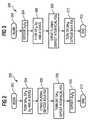
- Figs. 2 and 3depict first and second embodiments of the method of the present invention.
- Figs 4(a) and 4(b)represent dielectric films deposited using the first and second embodiments respectively.
- Fig. 2depicts a flow diagram for depositing an FSG film 400 having improved adhesion to a subsequently deposited overlying Si x N y layer 408.
- the method 200begins at 202.
- a gaseous mixture containing flows of SiH 4 , SiF 4 , O 2 , and Aris introduced to a process chamber such as chamber 13.
- Flow rates for the deposition gasesrange from 20 to 60 standard cubic centimeters per minute (sccm) for SiH 4 , from 20 to 40 sccm for SiF 4 , from 200 to 400 sccm for O 2 , and from 100 to 400 sccm for Ar.
- the chamber pressureis typically maintained at between 4 and 10 millitorr.
- the chamber wall temperatureis typically maintained at between 100°C and 170°C.
- the gaseous mixtureis energized at step 206 to form a plasma for depositing FSG on a substrate 402 such as silicon.
- the plasmais a high density plasma (HDP), i.e. a plasma having an ion density of approximately 10 11 ions/cm 3 or greater.
- Bias poweris not normally used in the deposition process.
- source RF poweris used for plasma generation and deposition and substrate temperature control.
- an HDP chambersuch as chamber 13
- between 1500 and 4800 watts of RF powerare applied to top coil 29 and between 2500 and 4800 watts are applied to side coil 30.
- the substrate temperatureis typically maintained at between 350 and 450 °C during FSG deposition.
- the substrateis heated with the plasma using source RF power only.
- a low bias RF poweri.e., up to 500 watts
- a low bias powerup to 300 W for 200 mm wafers or ⁇ 1.0 W/cm 2
- epiepitaxial silicon
- back side He coolingmay optionally be used for process temperature control and targeting.
- the flow of SiH 4is stopped at step 208.
- An interfacial portion of the FSG filmi.e., a topmost portion 406 in Fig. 4(a) is then deposited using SiF 4 , O 2 and Ar. Without the SiH 4 , less hydrogen is available to be incorporated into the interfacial portion of the FSG film.
- the flow rates of the other gasesare not normally changed when the flow of SiH 4 is stopped, although it may be desirable to adjust some or all of these flow rates to maintain a constant flow-rate concentration.
- interfacial portion 406need not be very thick compared to the overall film thickness. In one exemplary embodiment interfacial portion 406 may amount to about 1500 ⁇ out of a total FSG film 400 approximately 10,000 ⁇ thick.
- a layer of Si x N y 408is deposited on top of the FSG layer 400, i.e. on top of the interfacial portion 406 at step 210.
- Si x N y layer 408can be deposited by any conventional means including PECVD and HDP-CVD. However, from a standpoint of process integration, it is more convenient in some embodiments to deposit the Si x N y in the same chamber as the FSG deposition.
- the FSG layeris deposited in an HDP-CVD chamber
- the Si x N ycan be deposited on top of the FSG to any desired thickness, but adhesion generally worsens as the Si x N y thickness increases.
- Figs. 3 and 4(b)depict a second embodiment of the method of the present invention wherein an FSG layer 401, having an interfacial portion 405 and bulk portion 407 is deposited on a substrate 413 over a layer of Si x N y 403.
- the method 300begins at step 302.
- Si x N y 403 layeris deposited on the substrate 413 at step 304.
- Si x N y layer 403may be deposited by conventional means including HDP-CVD and PECVD.
- substrate 413may include a previously deposited FSG layer 410 having a bulk layer 411 and an interfacial layer 409.
- a gaseous mixture containing flows of SiF 4 , O 2 , and Ar, but not SiH 4is introduced to a process chamber containing substrate 413 at step 306.
- Flow rates for the deposition gasesrange from 20 to 40 sccm for SiF 4 , from 200 to 400 sccm for O 2 , and from 100 to 400 sccm for Ar.
- the gaseous mixtureis energized at step 308 to form a plasma for depositing interfacial portion 405 of FSG layer 401.
- the plasmais a high-density plasma (HDP).
- Interfacial portion 405 of FSG film 401i.e., the lowermost portion, is then deposited using SiF 4 , O 2 , and Ar.
- Source RF power, bias RF power, chamber pressure, chamber temperature, and substrate temperatureare generally maintained within the ranges set forth above with respect to the first embodiment.
- SiH 4Without the SiH 4 , essentially no hydrogen is available to be incorporated into the interfacial portion 405 of FSG film 401.
- Interfacial portion 405need not be very thick compared to the overall desired thickness of FSG film 401.
- the interfacial portionamounts to about 1500 ⁇ out of a total FSG film thickness of approximately 10,000 ⁇ .
- a flow of SiH 4is added to the other gas flows at a rate of 10 ⁇ 60 sccm to deposit the bulk of the FSG layer at step 310 as described above with respect to Fig. 2.
- the flow rates of the other gasesare not normally changed when the flow of SiH 4 is introduced although it may be desirable to adjust these flow rates to maintain a constant deposition rate.
- Step 310is optional if it is desired to deposit the entire FSG layer 401 without using SiH 4 , i.e. to deposit a pure SOFO layer.
- a sufficiently thin FSG layeris to be disposed between two Si x N y barrier layers, it would be desirable to have an interfacial layer at both the bottom and the top of the FSG layer. Rather than deposit the middle of the FSG layer using SiF 4 with SiH 4 , it may be simpler to deposit the whole layer using SiF 4 without SiH 4 .
- Fig. 5illustrates a simplified cross-sectional view of an integrated circuit 500, which may be made in accordance with use of the present invention.
- integrated circuit 500includes NMOS and PMOS transistors 503 and 506, which are separated and electrically isolated from each other by a field oxide region 520 formed by local oxidation of silicon ("LOCOS"), or other technique.
- transistors 503 and 506may be separated and electrically isolated from each other by a groove trench isolation (not shown) when transistors 503 and 506 are both NMOS or both PMOS.
- Each transistor 503 and 506comprises a source region 512, a drain region 515 and a gate region 518.
- a premetal dielectric (PMD) layer 521separates transistors 503 and 506 from metal layer 540 with connections between metal layer 540 and the transistors made by contacts 524.
- Metal layer 540is one of four metal layers, 540, 542, 544, and 546, included in integrated circuit 500. Each metal layer 540, 542, 544, and 546 is separated from adjacent metal layers by respective intermetal dielectric (IMD) layers 527, 528, or 529. Any or all of IMD layers 527, 528, or 529 can be deposited in accordance with embodiments of the present invention. Adjacent metal layers are connected at selected openings by vias 526. Deposited over metal layer 546 are planarized passivation layers 530.
- simplified integrated circuit 500is for illustrative purposes only.
- One of ordinary skill in the artcould implement use of the present invention in relation to fabrication of other integrated circuits such as microprocessors, application specific integrated circuits (ASICs), memory devices, and the like.
- the present inventionmay be applied to PMOS, NMOS, CMOS, bipolar, or BiCMOS devices.
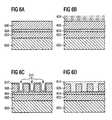
- FIGs. 6(a)-6(h)An example of a dual-damascene process integration scheme that uses the SOFO layer deposition of the present invention in forming an IMD layer is depicted in Figs. 6(a)-6(h).
- the dual damascene processbegins with the deposition of an oxide layer 602 over a silicon substrate 600 as shown in Fig. 6(a).
- a barrier layer 604is deposited over oxide layer 602, e.g., by HDP-CVD using SiH 4 and N 2 or PECVD using SiH 4 + NH 3 /N 2 . In some applications layer 604 acts as a hardmask or etch-stop layer.
- a first SOFO layer 606is deposited, e.g., using the HDP-CVD method described above.
- First SOFO layer 606may be deposited in the same chamber as barrier layer 604 to enhance process integration.
- a first patterned photoresist layer 608covers SOFO layer 606 during a first photolithography as shown in Fig. 6(b).
- a first etchforms a first set of gaps 610 in first SOFO layer 606 down to hardmask layer 604 as shown in Fig. 6(c).
- first SOFO layer 606After the first etch, photoresist 608 is stripped, e.g., by ashing in an oxidizing environment. Gaps 610 and first SOFO layer 606 are then covered with a layer of metal, such as aluminum or copper.
- a seed layer 612(Fig. 6(c)) is deposited over gaps 610 and first SOFO layer 606.
- a first bulk copper layer 614is deposited to fill the gaps 610 as shown in Fig. 6(d).
- a barrier layer(not shown) is deposited over first SOFO layer 606 and gaps 610 prior to deposition of seed layer 612. The barrier layer prevents interdiffusion of copper and SOFO.
- Copper layer 614is planarized, e.g., by chemical and mechanical polishing (CMP). Planarization of copper layer 614 forms, e.g., a first set of metal lines 615 in an interconnect structure.
- CMPchemical and mechanical polishing
- Second SOFO layer 618 and third SOFO layer 622may be deposited by HDP-CVD as described above. Layers 618, 620, and 622 may be deposited in the same chamber, e.g., by HDP-CVD, without removing substrate 600 to enhance process integration for forming IMD layer 621. To prevent oxidation of copper layer 620 and contamination of the chamber, substrate 600 may be heated in a high-density argon plasma without oxygen prior to depositing second FSG layer 618.
- a second lithography and etchforms vias 624 through layers 616, 618, 620 and 622 down to copper layer 614 as shown in Fig. 6(f).
- a third lithography and etchforms a second set of gaps 626.
- Gaps 626define a second set of metal lines and vias 624 define a set of interconnects between the second set of metal lines and the first set of metal lines defined by gaps 610 and copper layer 614. Vias 624 and gaps 626 are then filled with a second bulk copper layer and the resulting structure is annealed and planarized as shown in Fig. 6(h).
- Gaps 626define a second set of metal lines 628 and vias 624 define a set of interconnects 625 between the second set of metal lines 628 and the first set of metal lines 615.
- Damascene processesare used in devices that use copper interconnects because there is currently no acceptable way to etch copper. Structures formed by damascene processes do not require a gap-fill dielectric and generally provide lower RC delays than similar structures formed using metal lines aluminum, tungsten, titanium or other metals. Furthermore, higher deposition rates may be used in damascene processes since gap-fill is not an issue.
- Any of barrier layers 606, 616 and 620can be silicon nitride layers.
- each of SOFO layers 606, 618, and 622may alternatively be replaced with SiH 4 -FSG layers that include a SiF 4 -only interfacial FSG portion as described above.
- barrier layers 606, 616 and 620may also be alternatively desirable to deposit one or more of barrier layers 606, 616 and 620 as silicon-carbon low-k barrier layers such as BLOKTM (Barrier Low K).
- BLOKTMis a trademark of Applied Materials, Inc. of Santa Clara, California.
- the scale valuewas assigned to each result through visual examination of the wafers. Those results assigned a scale value of "1" showed substantially no bubbles, while a scale value of "10" would correspond to substantially the entire volume being occupied by bubbles. At a scale value of "5,” approximately 50% of the volume was occupied by bubbles. Intermediate scale values showed intermediate volume fractions occupied by bubbles. Wafers having FSG films deposited using an SiF 4 -based process, i.e., without SiH 4 , for at least the interface portion of the FSG deposition, passed the test for adhesion to Si x N y after being heated to temperatures of up to 500° C. These results were independent of the thickness of the Si x N y layer at least up to a thickness of 5000 ⁇ . Furthermore, these results were independent of whether the Si x N y was deposited by HDP or PECVD.
- a SOFO processrefers to HDP CVD deposition of FSG using SiF 4 without SiH 4 .
- SROrefers to an undoped silicon-rich oxide.
- UFO 6%refers to unbiased fluorinated oxide containing 6% fluorine.
- Low ⁇ wafer(see Table III) refers to a low-resistivity wafer.
- Cap layer "1”included a 10,000- ⁇ FSG layer deposited by HDP-CVD followed by a 500- ⁇ HDP-CVD Si x N y barrier layer covered by a 7500- ⁇ HDP FSG layer.
- Cap layer "2”included a 10,000- ⁇ HDP FSG layer covered by a 5000- ⁇ HDP Si x N y layer. Note also that two numbers appear for the Ar and SiH 4 gas flow rates. The first number represents the flow rate of gas through the inlets in the side of the chamber. The second number represents the flow rate of gas through inlets in the top of the chamber.
- Table IIshows tabulated adhesion results for a capping layer having a 10,000- ⁇ HDP FSG layer followed by a 500- ⁇ PECVD Si x N y barrier layer and a 7500- ⁇ HDP FSG layer.
- the barrier layerwas deposited ex situ , i.e., the wafer was removed from the chamber and exposed to ambient atmosphere following the deposition of the 10,000- ⁇ HDP FSG layer.
- SiF 4 -weighted processesthat used only a small amount of silane generally obtained better results than SiH 4 -based FSG deposition processes.
- Table IIIshows tabulated adhesion results for a capping layer having a 10,000- ⁇ HDP FSG layer followed by a 5000- ⁇ PECVD Si x N y barrier layer.
- the barrier layerwas deposited ex situ .
- the SiF 4 -weighted processes that used only a small amount of silaneagain generally obtained better results than SiH 4 based FSG deposition processes.
- the adhesion performancewas generally worse with the 5000- ⁇ PECVD-deposited Si x N y layer than with the capping layer used in Table II.
- Annealing Data for Topmost SOFO Layers Deposition Condition Cap layer Scale800- ⁇ SRO + UFO 6% at 8-kA + SOFO at 2-kA 1 1 800- ⁇ SRO + UFO 6% at 8-kA + SOFO at 2-kA 2 1 800- ⁇ SRO + UFO 6% at 7-kA + SOFO at 3-kA 1 1 800- ⁇ SRO + UFO 6% at 7-kA + SOFO at 3-kA 2 1 800- ⁇ SRO + UFO 6% at 6-kA + SOFO at 4-kA 1 1 800- ⁇ SRO + UFO 6% at 6-kA + SOFO at 4-kA 1 1 800- ⁇ SRO + UFO 6% at 6-kA + SOFO at 4-kA 2 1 UFO 6% at 10-kA 1 6 UFO 6% at 10-kA 2 3 800- ⁇ SRO + UFO 6% at 10-kA 1 5 800- ⁇ SRO + UFO 6% at 10-kA 2 2 800- ⁇ SRO + UFO 6% at 8.5-kA + SOFO at 1.5-kA 1 1 800- ⁇ S
- Table IVshows tabulated results for capping layers deposited using an SiF 4 -based process, i.e., without SiH 4 , for the topmost portion of a 10,000- ⁇ deposition.
- the thickness of the topmost portionranges from 1500 ⁇ to 4000 ⁇ .
- Si x N y capshaving two different thicknesses were deposited by HDP-CVD.
- Cap "1"was 5000- ⁇ thick.
- Cap "2"was 2000- ⁇ thick.
- Waferswere annealed for three hours at 400°C in a nitrogen ambient. In each case, the bias applied was 350 W.
- Measurements of the film thickness, non-uniformity, and refractive indexwere carried out on a Tencor UV 1250 SE for damascene FSG films prepared using the HDP-CVD process at wafer temperatures in the range of 380 ⁇ 450 °C and at pressures lower than 10 mtorr.
- the fluorine concentrationwas measured using Fourier-transform infrared ("FTIR") transmission spectroscopy, which measures fluorine bonded to silicon rather than all of the fluorine in the film.
- FTIRFourier-transform infrared
- the height of the Si-O stretching peak at 1090 cm -1was divided by the height of the Si-F peak at 937 cm -1 .
- PHRpeak-height ratio
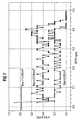
- Figure 7shows nuclear-reaction analysis data indicating the increase in H concentration with bias. It can be readily seen that the HDP-CVD reactor acts as a low-energy hydrogen ion implanter when bias is applied, resulting in hydrogen incorporation into the film.
- the hydrogen concentration in FSG films biased at 7.8 W/cm 2which show poor stability, is approximately 0.8 at.%, but is only 0.1 at.% in unbiased films, which show much better adhesion with Si x N y .
- an intermediate bias of 2.5 W/cm 2is applied, both the adhesive characteristics and the hydrogen concentration in the film are also intermediate.
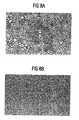
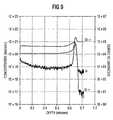
- Fig. 8(b)shows for comparison integration results with silicon nitride for SOFO film with a bias of 300 W. As seen from the figure, no bubbling or delamination was observed even after 12 annealing cycles. The fluorine concentration for these films was approximately 10 at.%. While the SOFO film should theoretically contain no hydrogen, the secondary-ion mass-spectroscopy (“SIMS") profile displayed in Fig. 9 indicates that it has a hydrogen content of about 0.02 at.%. This small amount of hydrogen, which is notably much less than that observed for silane-based damascene FSG (around 0.1 ⁇ 0.8 at.%), may be due to hydrogen coming from the dissociation of the season layer, which was sputtered from the chamber dome and side walls.
- SIMSsecondary-ion mass-spectroscopy
- Si/PE TEOS USG (8000 ⁇ )/FSG (6000 ⁇ )/PE TEOS USG (8000 ⁇ ) type sandwich structurewas fabricated and subjected to furnace annealing at 400°C for 30 minutes per cycle for a total of six cycles in a nitrogen ambient.
- Different types of FSG filmswere used and SIMS analysis was subsequently performed on the structures to determine the extent of F diffusion.
- the SOFO filmhad significantly lower F diffusion than an FSG film deposited using the silane-based PECVD technique.
- the fluorine concentration in SOFOwas 10 at.% while the silane PECVD FSG concentration was 7 at.%.
- SOFO filmsshowed much better bonding integrity than silane-based PECVD FSG. Comparable film properties were obtained with and without bias for the SOFO process, which is significant because of the enhanced robustness that normally results from using bias.
- the heat load on the wafercomes from two different sources: radiation heating from the plasma and heat load when bias is applied. For low resistivity epi wafers, heat loss due to high wafer electrical conductivity increases, thereby decreasing the wafer temperature. The heat load from the bias can be used to compensate for this heat loss, thus increasing process robustness. This may be significant in some embodiments since the fluorine concentration depends on wafer temperature.
- the filmFor an FSG film to be successfully integrated with damascene process flow, the film must withstand etch and ashing processes, and also be compatible with a Ta or TaN metal barrier. Integration of SOFO films with etch, ash processes and with Ta and TaN barriers were also carried out.
- the SOFO filmwas etched and subsequently ashed using three different chemistries: O 2 , NH 3 /O 2 , and NH 3 .
- Ta or TaNwas deposited on the films, which were then annealed in order to simulate the thermal budget for these structures during subsequent processing, and their stability was determined using confocal microscopic techniques.
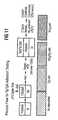
- Fig. 11shows schematically the entire process flow and the adhesion results. No bubbling or delamination was observed on the Ta or TaN surface after annealing. In general, adhesion of SOFO was better to TaN than to Ta.
Landscapes
- Engineering & Computer Science (AREA)
- Chemical & Material Sciences (AREA)
- Physics & Mathematics (AREA)
- Condensed Matter Physics & Semiconductors (AREA)
- General Physics & Mathematics (AREA)
- Manufacturing & Machinery (AREA)
- Computer Hardware Design (AREA)
- Microelectronics & Electronic Packaging (AREA)
- Power Engineering (AREA)
- Chemical Kinetics & Catalysis (AREA)
- General Chemical & Material Sciences (AREA)
- Inorganic Chemistry (AREA)
- Materials Engineering (AREA)
- Mechanical Engineering (AREA)
- Metallurgy (AREA)
- Organic Chemistry (AREA)
- Plasma & Fusion (AREA)
- Formation Of Insulating Films (AREA)
- Chemical Vapour Deposition (AREA)
- Internal Circuitry In Semiconductor Integrated Circuit Devices (AREA)
Abstract


Description
- The present invention relates to the manufacture of integrated circuits, and more specifically,to a method of forming fluorinated silicate glass ("FSG") films with good adhesionto silicon nitride in a high-density-plasma chemical-vapor-deposition ("HDP-CVD") system.
- In conventional integrated circuit fabrication, circuit elements are formed by etching apattern of gaps in a layer of metal such as aluminum. The gaps are then filled with a dielectricsuch as silicon dioxide. Copper is poised to take over as the main on-chip conductor for alltypes of integrated circuits because of its lower resistance when compared to conventionalaluminum alloys. Because it is difficult to etch copper, however, damascene processes havebeen developed for fabricating copper-based integrated circuits. In damascene processes, dielectriclayers are deposited and then etched to form gaps that are subsequently filled withcopper.
- Fluorine-doped silicon oxide, also known as fluorosilicate glass, is an attractive solutionto replace conventional silicon dioxide as an intermetal dielectric for damascene structures.An FSG film can be deposited in conventional HDP-CVD systems, which have beenwidely used for undoped silicate glass (USG) and FSG dielectrics in aluminum interconnects.FSG has a good process scheme in terms of reliability, stability, and throughput. Furthermore,the electrical performance of integrated circuits can be improved because of the lower dielectricconstant of FSG (3.4 compared to 4.1 for conventional silicon oxides). The lower dielectricconstant reduces the capacitance between metal lines in the same layer and reduces crosstalk across layers.
- Dielectric films used in damascene processes utilize a layer known as an etch stop toprovide for selective etching of the film. Silicon nitride (SixNy) is commonly used as an etchstop in damascene applications, for example when forming vias between layers containingmetal lines. In the past, there have been problems in obtaining good adhesion between thesilicon nitride and an underlying or overlying layer of FSG. Specifically, the FSG tends to outgas at temperatures of about 450 °C forming "bubbles" in an overlying SixNy layer. Thebubbles lead to delamination of the SixNy. Previous attempts to improve the adhesion by, forexample, reducing the fluorine content in the FSG merely postpone the delamination. WhenFSG films are deposited on a silicon nitride barrier layer in damascene or dual damasceneapplications, failure to integrate the FSG with the barrier layer poses a significant obstacle inthe widespread acceptance of FSG as an adequate low-k dielectric material.
- Therefore, a need exists in the art for a method of depositing an FSG film with improvedadhesion to an overlying or underlying layer of silicon nitride.
- The disadvantages associated with the prior art are overcome by a method of formationof the damascene FSG film with good adhesion to silicon nitride. In one embodiment ofthe present invention, a multilayer FSG film is deposited as part of a film stack that includesan adjacent silicon nitride layer. The multilayer FSG film includes an interfacial FSG layerand a bulk FSG layer. The "interacial FSG layer" refers to the portion of the FSG film depositedadjacent to the silicon nitride layer. Thus, the interfacial part of the FSG film refers to thetopmost portion if silicon nitride is to be deposited on top of the FSG and it refers to the bottomportion if the FSG is to be deposited on top of silicon nitride. It is not required that the"bulk FSG layer" be thicker than the interfacial layer, although it may be in some embodiments.The multilayer FSG film is deposited by flowing a gaseous mixture comprising flowsof silane, a gas that contains both fluorine and silicon, and a gas that contains oxygen to a processchamber. The gas that contains both fluorine and silicon is preferably SiF4, and the gasthat contains oxygen is preferably O2. It is also preferable that the gaseous mixture comprise aflow of inert gas, such as Ar, to promote gas dissociation. A plasma, preferably a high-densityplasma is generated from the gaseous mixture, and the bulk portion of an FSG layer is depositedon the substrate using the plasma. The silane flow is then terminated during deposition ofthe interfacial part of the FSG film. By removing the SiH4 from the deposition of the interfacialpart of the FSG film, less hydrogen is incorporated into the film in the interfacial regionand adhesion to overlying or underlying silicon nitride is improved. In other embodiments, amultilayer FSG film that includes bottom and top interfacial layers sandwiched around a bulkFSG layer is formed.
- In another embodiment, a pure SiF4-only fluorinated oxide ("SOFO") layer is depositedwithout having any portion of the film formed with silane. In this embodiment, a gaseous mixture is provided that comprises flows of a gas that contains both fluorine and silicon and agas that contains oxygen, but not containing a silane, for the entire deposition. It is again preferredthat gaseous mixture comprise a flow of inert gas, such as Ar, and that the gas containingboth fluorine and silicon be SiF4 and that the gas containing oxygen be O2. In further embodiments,the SOFO layer is deposited as part of a copper damascene process on a barrierlayer, preferably silicon nitride, previously formed on the substrate. In still other embodiments,the SOFO layer is etched, ashed, and metallized. The ashing is preferably performedwith an oxygen, ammonia, or mixed oxygen-ammonia chemistry, and the metallization layeris preferably formed of Ta or TaN.
- The methods of the present invention may be embodied in a computer-readablestorage medium having a computer-readable program embodied therein for directing operationof a substrate processing system. Such a system may include a process chamber, a plasmageneration system, a substrate holder, a gas delivery system, and a system controller. Thecomputer-readable program includes instructions for operating the substrate processing systemto form a thin film on a substrate disposed in the processing chamber in accordance withthe embodiments described above. Further preferred embodiments of the invention and thefeatures thereof are given in the appended claims and subclaims.
- Preferred embodiments of the invention will now be described in detail inconjunction with the accompanying drawings in which
- Fig. 1A is a simplified diagram of one embodiment of a high-density plasma chemical vapordeposition system according to the present invention.
- Fig. 1B is a simplified cross section of a gas ring that may be used in conjunction with theexemplary CVD processing chamber of Fig. 1A.
- Fig. 1C is a simplified diagram of a monitor and light pen that may be used in conjunctionwith the exemplary CVD processing chamber of Fig. 1A.
- Fig. 1D is a flow chart of an exemplary process control computer program product used tocontrol the exemplary CVD processing chamber of Fig. 1A;
- Fig. 2 is a flow diagram of a first embodiment of the method of the present invention;
- Fig. 3 is flow diagram of a second embodiment of the method of the present invention;
- Fig. 4(a) is a cross-sectional view of a dielectric thin film deposited according to the first embodimentof the method of the present invention;
- Fig. 4(b) is a cross-sectional view of a dielectric thin film deposited according to the secondembodiment of the method of the present invention;
- Fig. 5 shows a simplified cross-sectional view of a semiconductor device manufactured accordingto the method of the present invention;
- Fig. 6(a)-6(h) depict a cross section of a partially formed integrated circuit undergoing anintegrated dual-damascene process according to an embodiment of the present invention;
- Fig. 7 is a graph showing nuclear-reaction analysis data indicating that the hydrogen contentin HDP-CVD fluorinated silicate glass increases with bias;
- Fig. 8(a) shows a confocal view of an HDP-CVD FSG/SixNy structure after two annealingcycles, exhibiting circular bubbles;
- Fig. 8(b) shows a confocal view of an HDP-CVD SOFO/SixNy structure after 12 annealingcycles, exhibiting no evidence of delamination;
- Fig. 9 is a secondary-ion mass-spectroscopy graph showing the atomic hydrogen concentrationin unbiased SOFO films to be approximately 0.02%;
- Fig. 10 is a graph showing the fluorine diffusion from SOFO and silane-based plasma-enhancedCVD FSG;
- Fig. 11 is a schematic representation of the process flow for SOFO integration with etching,ashing, and metallization; and
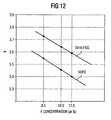
- Fig. 12 is a graph comparing the dielectric constant for FSG formed with and without silaneas a function of fluorine concentration.
- Embodiments of the present invention deposit fluorinated silicate glass (FSG) in sucha manner that it strongly adheres to an overlying or underlying barrier layer such as siliconnitride (SixNy). In one embodiment, silane (SiH4), silicon tetrafluoride (SiF4), oxygen (O2), andargon (Ar) are used as the reactant gases. SiH4, SiF4, and O2 react to form the FSG. Ar is includedto promote gas dissociation. All four gases may be used for the majority of the deposition.However, for at least the interfacial part of the deposition, and for the entire film in certainembodiments, SiH4 is not used. Material thus deposited without the use of silane is referredto herein alternatively as "SiF4-only FSG" or "SiF4-only fluorinated oxide" ("SOFO").FSG deposited with silane is referred to herein as SiH4-FSG. The interfacial part of the deposition refers either to the latter or topmost portion of the deposition, if silicon nitride is to bedeposited over the FSG. Alternatively, the interfacial portion may be the initial or lowermostportion of the deposition if the FSG is to be deposited over a barrier layer such as silicon nitride.
- The presence of SiH4 during deposition incorporates some hydrogen into the FSG filmas an impurity. It is not clear by what mechanism the presence of hydrogen in the FSG degradesthe adhesion of the FSG to SixNy. It is believed that the poor adhesion and consequentdelamination are related to the increased diffusivity of hydrogen in FSG at temperatures of400 °C or greater.
- In an alternative embodiment of the method of the present invention, FSG is depositedusing only SiF4, O2 and Ar throughout the deposition without using SiH4 for any part of thedeposition. Although good adhesion to SixNy and lower dielectric constant may be obtainedthis way, FSG deposition using SiF4 without SiH4 has a lower deposition rate than FSG depositionwith both SiF4 and SiH4.
- Fig. 1A illustrates one embodiment of a high density plasma chemical vapor deposition(HDP-CVD) system 10 in which a dielectric layer according to the present invention canbe deposited. System 10 includes a
chamber 13, avacuum system 70, asource plasma system 80A, abias plasma system 80B, agas delivery system 33, and a remoteplasma cleaning system 50. - The upper portion of
chamber 13 includes adome 14, which is made of a ceramic dielectricmaterial, such as aluminum oxide or aluminum nitride.Dome 14 defines an upperboundary of aplasma processing region 16.Plasma processing region 16 is bounded on thebottom by the upper surface of asubstrate 17 and asubstrate support member 18. - A
heater plate 23 and acold plate 24 surmount, and are thermally coupled to,dome 14.Heater plate 23 andcold plate 24 allow control of the dome temperature to within about ± 10°C over a range of about 100 °C to 200 °C. This allows optimizing the dome temperature forthe various processes. For example, it may be desirable to maintain the dome at a higher temperaturefor cleaning or etching processes than for deposition processes. Accurate control ofthe dome temperature also reduces the flake or particle counts in the chamber and improvesadhesion between the deposited layer and the substrate. - The lower portion of
chamber 13 includes abody member 22, which joins the chamberto the vacuum system. Abase portion 21 ofsubstrate support member 18 is mounted on, andforms a continuous inner surface with,body member 22. Substrates are transferred into andout ofchamber 13 by a robot blade (not shown) through an insertion/removal opening (notshown) in the side ofchamber 13. Lift pins (not shown) are raised and then lowered under thecontrol of a motor (also not shown) to move the substrate from the robot blade at anupperloading position 57 to alower processing position 56 in which the substrate is placed on asubstrate receiving portion 19 ofsubstrate support member 18.Substrate receiving portion 19includes anelectrostatic chuck 20 that secures the substrate tosubstrate support member 18during substrate processing. In a preferred embodiment,substrate support member 18 is madefrom an aluminum oxide or aluminum ceramic material. Vacuum system 70 includesthrottle body 25, which houses twin-blade throttle valve 26 and is attached togate valve 27 and turbo-molecular pump 28. It should be noted thatthrottle body 25 offers minimum obstruction to gas flow, and allows symmetric pumping.Gate valve 27 can isolate pump 28 fromthrottle body 25, and can also control chamber pressureby restricting the exhaust flow capacity whenthrottle valve 26 is fully open. The arrangementof the throttle valve, gate valve, and turbo-molecular pump allow accurate and stablecontrol of chamber pressures from between about 1 millitorr to about 2 torr.- The
source plasma system 80A includes atop coil 29 andside coil 30, mounted ondome 14. A symmetrical ground shield (not shown) reduces electrical coupling between thecoils.Top coil 29 is powered by top source RF (SRF)generator 31A, whereasside coil 30 ispowered byside SRF generator 31B, allowing independent power levels and frequencies ofoperation for each coil. This dual coil system allows control of the radial ion density inchamber 13, thereby improving plasma uniformity.Side coil 30 andtop coil 29 are typically inductivelydriven, which does not require a complimentary electrode. In a specific embodiment,the topsource RF generator 31A provides up to 2,500 watts of RF power at nominally 2 MHzand the sidesource RF generator 31B provides up to 5,000 watts of RF power at nominally 2MHz. The operating frequencies of the top and side RF generators may be offset from thenominal operating frequency (e.g. to 1.7―1.9 MHz and 1.9―2.1 MHz, respectively) to improveplasma-generation efficiency. - A
bias plasma system 80B includes a bias RF ("BRF")generator 31C and abiasmatching network 32C. Thebias plasma system 80B capacitively couplessubstrate portion 17tobody member 22, which act as complimentary electrodes. Thebias plasma system 80Bserves to enhance the transport of plasma species (e.g., ions) created by thesource plasmasystem 80A to the surface of the substrate. In a specific embodiment, bias RF generator providesup to 5,000 watts of RF power at 13.56 MHz. RF generators Matching networks generators respective coils - Other measures may also help stabilize a plasma. For example, the RF control circuitcan be used to determine the power delivered to the load (plasma) and may increase or decrease the generator output power to keep the delivered power substantially constant duringdeposition of a layer.
- A
gas delivery system 33 provides gases from several sources, 34A-34F chamber forprocessing the substrate via gas delivery lines 38 (only some of which are shown). As wouldbe understood by a person of skill in the art, the actual sources used forsources 34A-34F andthe actual connection ofdelivery lines 38 tochamber 13 varies depending on the depositionand cleaning processes executed withinchamber 13. Gases are introduced intochamber 13through agas ring 37 and/or atop nozzle 45. Fig. 1B is a simplified, partial cross-sectionalview ofchamber 13 showing additional details ofgas ring 37. - In one embodiment, first and second gas sources, 34A and 34B, and first and secondgas flow controllers, 35A' and 35B', provide gas to ring
plenum 36 ingas ring 37 via gas deliverylines 38 (only some of which are shown).Gas ring 37 has a plurality of source gas nozzles39 (only one of which is shown for purposes of illustration) that provide a uniform flowof gas over the substrate. Nozzle length and nozzle angle may be changed to allow tailoring ofthe uniformity profile and gas utilization efficiency for a particular process within an individualchamber. In a preferred embodiment,gas ring 37 has 12 source gas nozzles made from analuminum oxide ceramic. Gas ring 37 also has a plurality of oxidizer gas nozzles 40 (only one of which isshown), which in a preferred embodiment are co-planar with and shorter thansource gas nozzles 39, and in one embodiment receive gas frombody plenum 41. In some embodiments it isdesirable not to mix source gases and oxidizer gases before injecting the gases intochamber 13. In other embodiments, oxidizer gas and source gas may be mixed prior to injecting thegases intochamber 13 by providing apertures (not shown) betweenbody plenum 41 andgasring plenum 36. In one embodiment, third and fourth gas sources, 34C and 34D, and third andfourth gas flow controllers, 35C and 35D', provide gas to body plenum via gas delivery lines38. The nitrogen source 34F provides nitrogen gas (N2) to the oxidizer nozzles of the gas ringto the chamber for process steps utilizing nitrogen plasma. Alternatively, the nitrogen gascould be delivered to the chamber through other or additional inlets, such as the top nozzle.Additional valves, such as 43B (other valves not shown), may shut off gas from the flow controllersto the chamber.- In embodiments where flammable, toxic, or corrosive gases are used, it may be desirableto eliminate gas remaining in the gas delivery lines after a deposition. This may be accomplishedusing a 3-way valve, such as
valve 43B, to isolatechamber 13 fromdelivery line 38A and to ventdelivery line 38A to vacuumforeline 44, for example. As shown in Fig. 1A,other similar valves, such as 43A and 43C, may be incorporated on other gas delivery lines.Such 3-way valves may be placed as close tochamber 13 as practical, to minimize the volumeof the unvented gas delivery line (between the 3-way valve and the chamber). Additionally,two-way (on-off) valves (not shown) may be placed between a mass flow controller ("MFC")and the chamber or between a gas source and an MFC. - Referring again to Fig. 1A,
chamber 13 also hastop nozzle 45 and top vent 46.Topnozzle 45 and top vent 46 allow independent control of top and side flows of the gases, whichimproves film uniformity and allows fine adjustment of the film's deposition and doping parameters.Top vent 46 is an annular opening aroundtop nozzle 45. In one embodiment,firstgas source 34A suppliessource gas nozzles 39 andtop nozzle 45.Source nozzle MFC 35A'controls the amount of gas delivered to sourcegas nozzles 39 andtop nozzle MFC 35A controlsthe amount of gas delivered totop gas nozzle 45. Similarly, twoMFCs oxidizer gas nozzles 40from a single source of oxygen, such assource 34B. The gases supplied totop nozzle 45 andtop vent 46 may be kept separate prior to flowing the gases intochamber 13, or the gases maybe mixed intop plenum 48 before they flow intochamber 13. Separate sources of the samegas may be used to supply various portions of the chamber. - A remote microwave-generated
plasma cleaning system 50 is provided to periodicallyclean deposition residues from chamber components. The cleaning system includes aremotemicrowave generator 51 that creates a plasma from a cleaninggas source 34E (e.g., molecularfluorine, nitrogen trifluoride, other fluorocarbons or equivalents) inreactor cavity 53. Thereactive species resulting from this plasma are conveyed tochamber 13 through cleaninggasfeed port 54 viaapplicator tube 55. The materials used to contain the cleaning plasma (e.g.,cavity 53 and applicator tube 55) must be resistant to attack by the plasma. The distance betweenreactor cavity 53 and feedport 54 should be kept as short as practical, since the concentrationof desirable plasma species may decline with distance fromreactor cavity 53. Generatingthe cleaning plasma in a remote cavity allows the use of an efficient microwave generator and does not subject chamber components to the temperature, radiation, or bombardmentof the glow discharge that may be present in a plasma formed in situ. Consequently,relatively sensitive components, such aselectrostatic chuck 20, do not need to be covered witha dummy wafer or otherwise protected, as may be required with an in situ plasma cleaningprocess. System controller 60 controls the operation of system 10. In a preferred embodiment,controller 60 includes amemory 62, such as a hard disk drive, a floppy disk drive (notshown), and a card rack (not shown) coupled to aprocessor 61. The card rack may contain asingle-board computer (SBC) (not shown), analog and digital input/output boards (notshown), interface boards (not shown), and stepper motor controller boards (not shown). Thesystem controller conforms to the Versa Modular European ("VME") standard, which definesboard, card cage, and connector dimensions and types. The VME standard also defines the busstructure as having a 16-bit data bus and 24-bit address bus. System controller 31 operatesunder the control of a computer program stored on the hard disk drive or through other computerprograms, such as programs stored on a removable disk. The computer program dictates,for example, the timing, mixture of gases, RF power levels and other parameters of a particularprocess. The interface between a user and the system controller is via a monitor, such as acathode ray tube ("CRT") 65, and alight pen 66, as depicted in Fig. 1C.- Fig. 1C is an illustration of a portion of an exemplary system user interface used inconjunction with the exemplary CVD processing chamber of Fig. 1A.
System controller 60includes aprocessor 61 coupled to a computer-readable memory 62. Preferably,memory 62may be a hard disk drive, butmemory 62 may be other kinds of memory, such as ROM,PROM, and others. System controller 60 operates under the control of acomputer program 63 stored in acomputer-readable format withinmemory 62. The computer program dictates the timing,temperatures, gas flows, RF power levels and other parameters of a particular process. Theinterface between a user and the system controller is via aCRT monitor 65 and alight pen 66,as depicted in Fig. 1C. In a preferred embodiment, two monitors, 65 and 65A, and two lightpens, 66 and 66A, are used, one mounted in the clean room wall (65) for the operators and theother behind the wall (65A) for the service technicians. Both monitors simultaneously displaythe same information, but only one light pen (e.g. 66) is enabled. To select a particular screen or function, the operator touches an area of the display screen and pushes a button (not shown)on the pen. The touched area confirms being selected by the light pen by changing its color ordisplaying a new menu, for example.- The computer program code can be written in any conventional computer-readableprogramming language such as 68000 assembly language, C, C++, or Pascal. Suitable programcode is entered into a single file, or multiple files, using a conventional text editor and isstored or embodied in a computer-usable medium, such as a memory system of the computer.If the entered code text is in a high level language, the code is compiled, and the resultantcompiler code is then linked with an object code of precompiled windows library routines. Toexecute the linked compiled object code, the system user invokes the object code causing thecomputer system to load the code in memory. The CPU reads the code from memory and executesthe code to perform the tasks identified in the program.
- Fig. 1D shows an illustrative block diagram of the hierarchical control structure of
computer program 100. A user enters a process set number and process chamber number intoaprocess selector subroutine 110 in response to menus or screens displayed on the CRTmonitor by using the light pen interface. The process sets are predetermined sets of processparameters necessary to carry out specified processes, and are identified by predefined setnumbers.Process selector subroutine 110 identifies (i) the desired process chamber in a multichambersystem, and (ii) the desired set of process parameters needed to operate the processchamber for performing the desired process. The process parameters for performing a specificprocess relate to conditions such as process gas composition and flow rates, temperature, pressure,plasma conditions such as RF power levels, and chamber dome temperature, and areprovided to the user in the form of a recipe. The parameters specified by the recipe are enteredutilizing the light pen/CRT monitor interface. - The signals for monitoring the process are provided by the analog and digital inputboards of
system controller 60, and the signals for controlling the process are output on theanalog and digital output boards ofsystem controller 60. - A
process sequencer subroutine 120 comprises program code for accepting the identifiedprocess chamber and set of process parameters from theprocess selector subroutine 110and for controlling operation of the various process chambers. Multiple users can enter processset numbers and process chamber numbers, or a single user can enter multiple process set numbers and process chamber numbers;sequencer subroutine 120 schedules the selected processesin the desired sequence. Preferably,sequencer subroutine 120 includes a program codeto perform the steps of (i) monitoring the operation of the process chambers to determine ifthe chambers are being used, (ii) determining what processes are being carried out in thechambers being used, and (iii) executing the desired process based on availability of a processchamber and type of process to be carried out. Conventional methods of monitoring the processchambers can be used, such as polling. When scheduling which process is to be executed,sequencer subroutine 120 can be designed to take into consideration the "age" of each particularuser-entered request, or the present condition of the process chamber being used incomparison with the desired process conditions for a selected process, or any other relevantfactor a system programmer desires to include for determining scheduling priorities. - After
sequencer subroutine 120 determines which process chamber and process setcombination is going to be executed next,sequencer subroutine 120 initiates execution of theprocess set by passing the particular process set parameters to achamber manager subroutine 130A-C, which controls multiple processing tasks inchamber 13 and possibly other chambers(not shown) according to the process set sent bysequencer subroutine 120. - Examples of chamber component subroutines are substrate positioning subroutine 340,process
gas control subroutine 150,pressure control subroutine 160, andplasma control subroutine 170. Those having ordinary skill in the art will recognize that other chamber controlsubroutines can be included depending on what processes are selected to be performed inchamber 13. In operation,chamber manager subroutine 130A selectively schedules or callsthe process component subroutines in accordance with the particular process set being executed.Chamber manager subroutine 130A schedules process component subroutines in thesame manner that sequencersubroutine 120 schedules the process chamber and process set toexecute. Typically,chamber manager subroutine 130A includes steps of monitoring the variouschamber components, determining which components need to be operated based on theprocess parameters for the process set to be executed, and causing execution of a chambercomponent subroutine responsive to the monitoring and determining steps. - Operation of particular chamber component subroutines will now be described withreference to Figs. 1A and 1D.
Substrate positioning subroutine 140 comprises program codefor controlling chamber components that are used to load a substrate ontosubstrate support number 18.Substrate positioning subroutine 140 may also control transfer of a substrate intochamber 13 from, e.g., a plasma-enhanced CVD ("PECVD") reactor or other reactor in themulti-chamber system, after other processing has been completed. - Process
gas control subroutine 150 has program code for controlling process gas compositionand flow rates.Subroutine 150 controls the open/close position of the safety shut-offvalves and also ramps up/ramps down the mass flow controllers to obtain the desired gas flowrates. All chamber component subroutines, including processgas control subroutine 150, areinvoked bychamber manager subroutine 130A.Subroutine 150 receives process parametersfromchamber manager subroutine 130A related to the desired gas flow rates. - Typically, process
gas control subroutine 150 opens the gas supply lines, and repeatedly(i) reads the necessary mass flow controllers, (ii) compares the readings to the desiredflow rates received fromchamber manager subroutine 130A, and (iii) adjusts the flow rates ofthe gas supply lines as necessary. Furthermore, processgas control subroutine 150 may includesteps for monitoring the gas flow rates for unsafe rates and for activating the safetyshut-off valves when an unsafe condition is detected. - In some processes, an inert gas, such as argon, is flowed into
chamber 13 to stabilizethe pressure in the chamber before reactive process gases are introduced. For these processes,the processgas control subroutine 150 is programmed to include steps for flowing the inertgas intochamber 13 for an amount of time necessary to stabilize the pressure in the chamber.The steps described above may then be carried out. - Additionally, when a process gas is to be vaporized from a liquid precursor, for example,tetraethylorthosilane (TEOS), the process
gas control subroutine 150 may include stepsfor bubbling a delivery gas such as helium through the liquid precursor in a bubbler assemblyor for introducing the helium to a liquid injection valve. For this type of process, the processgas control subroutine 150 regulates the flow of the delivery gas, the pressure in the bubbler,and the bubbler temperature to obtain the desired process gas flow rates. As discussed above,the desired process gas flow rates are transferred to processgas control subroutine 150 as processparameters. - Furthermore, the process
gas control subroutine 150 includes steps for obtaining thenecessary delivery gas flow rate, bubbler pressure, and bubbler temperature for the desiredprocess gas flow rate by accessing a stored table containing the necessary values for a given process gas flow rate. Once the necessary values are obtained, the delivery gas flow rate, bubblerpressure and bubbler temperature are monitored, compared to the necessary values andadjusted accordingly. - The process
gas control subroutine 150 may also control the flow of heat-transfer gas,such as helium (He), through the inner and outer passages in the wafer chuck with an independenthelium control (IHC) subroutine (not shown). The gas flow thermally couples thesubstrate to the chuck. In a typical process, the wafer is heated by the plasma and the chemicalreactions that form the layer, and the He cools the substrate through the chuck, which may bewater-cooled. This keeps the substrate below a temperature that may damage preexisting featureson the substrate. Pressure control subroutine 160 includes program code for controlling the pressure inchamber 13 by regulating the size of the opening ofthrottle valve 26 in the exhaust portion ofthe chamber. There are at least two basic methods of controlling the chamber with the throttlevalve. The first method relies on characterizing the chamber pressure as it relates to, amongother things, the total process gas flow, the size of the process chamber, and the pumping Capacity.The first method setsthrottle valve 26 to a fixed position. Settingthrottle valve 26 to afixed position may eventually result in a steady-state pressure.- Alternatively, the chamber pressure may be measured, with a manometer for example,and the position of
throttle valve 26 may be adjusted according to pressure control subroutine360, assuming the control point is within the boundaries set by gas flows and exhaust capacity.The former method may result in quicker chamber pressure changes, as the measurements,comparisons, and calculations associated with the latter method are not invoked. The formermethod may be desirable where precise control of the chamber pressure is not required,whereas the latter method may be desirable where an accurate, repeatable, and stable pressureis desired, such as during the deposition of a layer. - When
pressure control subroutine 160 is invoked, the desired, or target, pressure levelis received as a parameter fromchamber manager subroutine 130A.Pressure control subroutine 160 measures the pressure inchamber 13 by reading one or more conventional pressuremanometers connected to the chamber; compares the measured value(s) to the target pressure;obtains proportional, integral, and differential (PID) values from a stored pressure table correspondingto the target pressure, and adjuststhrottle valve 26 according to the PID values obtained from the pressure table. Alternatively,pressure control subroutine 160 may open orclose throttle valve 26 to a particular opening size to regulate the pressure inchamber 13 to adesired pressure or pressure range. Plasma control subroutine 170 comprises program code for controlling the frequencyand power output setting ofRF generators matching networks - An example of a system that may incorporate some or all of the subsystems and routinesdescribed above would be the ULTIMA™ system, manufactured by APPLIED MATERIALS,INC., of Santa Clara, California, configured to practice the present invention. Furtherdetails of such a system are disclosed in the copending, commonly assigned U.S. Patent ApplicationNo. 08/679,927, filed July 15, 1996, entitled "Symmetric Tunable Inductively-CoupledHDP-CVD Reactor," having Fred C. Redeker, Farhad Moghadam, Hirogi Hanawa,Tetsuya Ishikawa, Dan Maydan, Shijian Li, Brian Lue, Robert Steger, Yaxin Wang, ManusWong and Ashok Sinha listed as co-inventors, the disclosure of which is incorporated hereinby reference. The described system is for exemplary purpose only. It would be a matter ofroutine skill for a person of skill in the art to select an appropriate conventional substrateprocessing system and computer control system to implement the present invention.
- The present invention unexpectedly improves adhesion of HDP-FSG to overlying orunderlying silicon nitride (SixNy). The method is best understood with reference to Figs. 2, 3,4(a) and 4(b). Figs. 2 and 3 depict first and second embodiments of the method of the presentinvention. Figs 4(a) and 4(b) represent dielectric films deposited using the first and secondembodiments respectively.
- The first embodiment of the method is best understood by simultaneously referring toFigs. 2 and 4(a). Fig. 2 depicts a flow diagram for depositing an
FSG film 400 having improvedadhesion to a subsequently deposited overlying SixNy layer 408. Themethod 200 beginsat 202. At step 204 a gaseous mixture containing flows of SiH4, SiF4, O2, and Ar is introducedto a process chamber such aschamber 13. Flow rates for the deposition gases rangefrom 20 to 60 standard cubic centimeters per minute (sccm) for SiH4, from 20 to 40 sccm forSiF4, from 200 to 400 sccm for O2, and from 100 to 400 sccm for Ar. The chamber pressure istypically maintained at between 4 and 10 millitorr. The chamber wall temperature is typically maintained at between 100°C and 170°C. - The gaseous mixture is energized at
step 206 to form a plasma for depositing FSG on asubstrate 402 such as silicon. Preferably, the plasma is a high density plasma (HDP), i.e. aplasma having an ion density of approximately 1011 ions/cm3 or greater. Bias power is notnormally used in the deposition process. Usually, only source RF power is used for plasmageneration and deposition and substrate temperature control. For example, in an HDP chambersuch aschamber 13, between 1500 and 4800 watts of RF power are applied totop coil 29and between 2500 and 4800 watts are applied toside coil 30. - The substrate temperature is typically maintained at between 350 and 450 °C duringFSG deposition. In one embodiment, the substrate is heated with the plasma using source RFpower only. In another embodiment, a low bias RF power (i.e., up to 500 watts) can be usedfor deposition temperature control using a closed loop with backside emissivity wafer temperaturecontrol. For example, a low bias power (up to 300 W for 200 mm wafers or ∼1.0W/cm2) is sometimes used to heat-up epitaxial silicon (epi) wafers to the desired temperatureduring the process. Because of their low resistivity, epi wafers cannot be heated with onlysource RF and a bias RF is necessary to help in heating up the wafer to the desired temperature.In addition, back side He cooling may optionally be used for process temperature controland targeting.
- After a
bulk portion 404 ofFSG film 400 has been deposited, the flow of SiH4 isstopped atstep 208. An interfacial portion of the FSG film, i.e., atopmost portion 406 in Fig.4(a) is then deposited using SiF4, O2 and Ar. Without the SiH4, less hydrogen is available to beincorporated into the interfacial portion of the FSG film. The flow rates of the other gases arenot normally changed when the flow of SiH4 is stopped, although it may be desirable to adjustsome or all of these flow rates to maintain a constant flow-rate concentration. - The
interfacial portion 406 need not be very thick compared to the overall film thickness.In one exemplary embodimentinterfacial portion 406 may amount to about 1500 Å outof atotal FSG film 400 approximately 10,000 Å thick. Onceinterfacial portion 406 has beendeposited, a layer of SixNy 408 is deposited on top of theFSG layer 400, i.e. on top of theinterfacialportion 406 atstep 210. SixNy layer 408 can be deposited by any conventional meansincluding PECVD and HDP-CVD. However, from a standpoint of process integration, it ismore convenient in some embodiments to deposit the SixNy in the same chamber as the FSG deposition. Thus, if, for example, the FSG layer is deposited in an HDP-CVD chamber, it isconvenient to deposit the SixNy layer by HDP-CVD in the same chamber. The SixNy can bedeposited on top of the FSG to any desired thickness, but adhesion generally worsens as theSixNy thickness increases. - Figs. 3 and 4(b) depict a second embodiment of the method of the present inventionwherein an
FSG layer 401, having aninterfacial portion 405 andbulk portion 407 is depositedon asubstrate 413 over a layer of SixNy 403. Themethod 300 begins atstep 302. SixNy 403layer is deposited on thesubstrate 413 atstep 304. As in the first embodiment, SixNy layer 403may be deposited by conventional means including HDP-CVD and PECVD. Furthermore,substrate 413 may include a previously depositedFSG layer 410 having abulk layer 411 andaninterfacial layer 409. After depositing SixNy layer 403, a gaseous mixture containing flowsof SiF4, O2, and Ar, but not SiH4, is introduced to a processchamber containing substrate 413atstep 306. Flow rates for the deposition gases range from 20 to 40 sccm for SiF4, from 200 to400 sccm for O2, and from 100 to 400 sccm for Ar. As discussed above, in some embodiments,it is desirable, from a process integration standpoint, to deposit both SixNy layer 403andFSG layer 401 in the same chamber. - The gaseous mixture is energized at
step 308 to form a plasma for depositinginterfacialportion 405 ofFSG layer 401. Preferably, the plasma is a high-density plasma (HDP).Interfacial portion 405 ofFSG film 401, i.e., the lowermost portion, is then deposited usingSiF4, O2, and Ar. Source RF power, bias RF power, chamber pressure, chamber temperature,and substrate temperature are generally maintained within the ranges set forth above with respectto the first embodiment. Without the SiH4, essentially no hydrogen is available to beincorporated into theinterfacial portion 405 ofFSG film 401.Interfacial portion 405 need notbe very thick compared to the overall desired thickness ofFSG film 401. In one exemplaryembodiment the interfacial portion amounts to about 1500 Å out of a total FSG film thicknessof approximately 10,000 Å. Following deposition ofinterfacial portion 405, a flow of SiH4 isadded to the other gas flows at a rate of 10 ― 60 sccm to deposit the bulk of the FSG layer atstep 310 as described above with respect to Fig. 2. The flow rates of the other gases are notnormally changed when the flow of SiH4 is introduced although it may be desirable to adjustthese flow rates to maintain a constant deposition rate. - Step 310 is optional if it is desired to deposit the
entire FSG layer 401 without using SiH4, i.e. to deposit a pure SOFO layer. For example, if a sufficiently thin FSG layer is to bedisposed between two SixNy barrier layers, it would be desirable to have an interfacial layer atboth the bottom and the top of the FSG layer. Rather than deposit the middle of the FSG layerusing SiF4 with SiH4, it may be simpler to deposit the whole layer using SiF4 without SiH4. - Fig. 5 illustrates a simplified cross-sectional view of an
integrated circuit 500, whichmay be made in accordance with use of the present invention. As shown, integratedcircuit 500 includes NMOS andPMOS transistors field oxide region 520 formed by local oxidation of silicon("LOCOS"), or other technique. Alternatively,transistors transistors transistor sourceregion 512, adrain region 515 and agate region 518. - A premetal dielectric (PMD)
layer 521separates transistors metallayer 540 with connections betweenmetal layer 540 and the transistors made bycontacts 524.Metal layer 540 is one of four metal layers, 540, 542, 544, and 546, included inintegratedcircuit 500. Eachmetal layer vias 526. Deposited overmetallayer 546 are planarized passivation layers 530. - It should be understood that simplified
integrated circuit 500 is for illustrative purposesonly. One of ordinary skill in the art could implement use of the present invention inrelation to fabrication of other integrated circuits such as microprocessors, application specificintegrated circuits (ASICs), memory devices, and the like. Further, the present invention maybe applied to PMOS, NMOS, CMOS, bipolar, or BiCMOS devices. - An example of a dual-damascene process integration scheme that uses the SOFO layerdeposition of the present invention in forming an IMD layer is depicted in Figs. 6(a)-6(h). Thedual damascene process begins with the deposition of an
oxide layer 602 over asiliconsubstrate 600 as shown in Fig. 6(a). Abarrier layer 604 is deposited overoxide layer 602, e.g.,by HDP-CVD using SiH4 and N2 or PECVD using SiH4 + NH3/N2. In someapplications layer 604 acts as a hardmask or etch-stop layer. Afirst SOFO layer 606 is deposited, e.g., using the HDP-CVD method described above.First SOFO layer 606 may be deposited in the samechamber asbarrier layer 604 to enhance process integration. A firstpatterned photoresist layer 608 coversSOFO layer 606 during a first photolithography as shown in Fig. 6(b). A first etchforms a first set ofgaps 610 infirst SOFO layer 606 down tohardmask layer 604 as shown inFig. 6(c). - After the first etch,
photoresist 608 is stripped, e.g., by ashing in an oxidizingenvironment.Gaps 610 andfirst SOFO layer 606 are then covered with a layer of metal, suchas aluminum or copper. In the case of copper, a seed layer 612 (Fig. 6(c)) is deposited overgaps 610 andfirst SOFO layer 606. A firstbulk copper layer 614 is deposited to fill thegaps 610 as shown in Fig. 6(d). In some applications, a barrier layer (not shown) is deposited overfirst SOFO layer 606 andgaps 610 prior to deposition ofseed layer 612. The barrier layerprevents interdiffusion of copper and SOFO.Copper layer 614 is planarized, e.g., by chemicaland mechanical polishing (CMP). Planarization ofcopper layer 614 forms, e.g., a first set ofmetal lines 615 in an interconnect structure. - After planarization, of
copper layer 614, asecond barrier layer 616, asecond SOFOlayer 618, athird barrier layer 620 andthird SOFO layer 622 are deposited to form anIMDlayer 621 as shown in Fig. 6(e).Second SOFO layer 618 andthird SOFO layer 622 may bedeposited by HDP-CVD as described above.Layers substrate 600 to enhance processintegration for formingIMD layer 621. To prevent oxidation ofcopper layer 620 andcontamination of the chamber,substrate 600 may be heated in a high-density argon plasmawithout oxygen prior to depositingsecond FSG layer 618. A second lithography and etchforms vias 624 throughlayers copper layer 614 as shown inFig. 6(f). In Fig. 6(g), a third lithography and etch forms a second set ofgaps 626.Gaps 626define a second set of metal lines and vias 624 define a set of interconnects between thesecond set of metal lines and the first set of metal lines defined bygaps 610 andcopper layer 614.Vias 624 andgaps 626 are then filled with a second bulk copper layer and the resultingstructure is annealed and planarized as shown in Fig. 6(h).Gaps 626 define a second set ofmetal lines 628 and vias 624 define a set of interconnects 625 between the second set ofmetallines 628 and the first set ofmetal lines 615. - Damascene processes are used in devices that use copper interconnects because there is currently no acceptable way to etch copper. Structures formed by damascene processes donot require a gap-fill dielectric and generally provide lower RC delays than similar structuresformed using metal lines aluminum, tungsten, titanium or other metals. Furthermore, higherdeposition rates may be used in damascene processes since gap-fill is not an issue. Any ofbarrier layers 606, 616 and 620 can be silicon nitride layers. As will further be understood bythose of skill in the art, each of SOFO layers 606, 618, and 622 may alternatively be replacedwith SiH4-FSG layers that include a SiF4-only interfacial FSG portion as described above.Furthermore, it may also be alternatively desirable to deposit one or more of barrier layers606, 616 and 620 as silicon-carbon low-k barrier layers such as BLOK™ (Barrier Low K).BLOK™ is a trademark of Applied Materials, Inc. of Santa Clara, California.
- Experimental results have demonstrated that it is possible to achieve good adhesionbetween FSG films and barrier layers such as silicon nitride using this method. In addition tothis unexpected result, the dielectric constant of SOFO films is found to be reduced whencompared with FSG films, making them preferable over SiH4-FSG films in some applications.Various experimental results are tabulated in Tables I through IV. Each table shows adhesionresults for silicon wafers having capping layers including SixNy and FSG deposited under differentconditions. After the capping layer was deposited, the wafers were heated to temperaturesof up to 500 °C and tested for adhesion. Adhesion was rated on a scale of 1 to 10 withlower numbers representing better adhesion and higher numbers representing poorer adhesion.The scale value was assigned to each result through visual examination of the wafers. Thoseresults assigned a scale value of "1" showed substantially no bubbles, while a scale value of"10" would correspond to substantially the entire volume being occupied by bubbles. At ascale value of "5," approximately 50% of the volume was occupied by bubbles. Intermediatescale values showed intermediate volume fractions occupied by bubbles. Wafers having FSGfilms deposited using an SiF4-based process, i.e., without SiH4, for at least the interface portionof the FSG deposition, passed the test for adhesion to SixNy after being heated to temperaturesof up to 500° C. These results were independent of the thickness of the SixNy layer atleast up to a thickness of 5000 Å. Furthermore, these results were independent of whether theSixNy was deposited by HDP or PECVD.
- In Tables I ― IV, the following notation is used: a "SOFO process" refers to HDPCVD deposition of FSG using SiF4 without SiH4. "SRO" refers to an undoped silicon-rich oxide. "UFO 6%" refers to unbiased fluorinated oxide containing 6% fluorine. "Low ρ wafer"(see Table III) refers to a low-resistivity wafer.
Adhesion Results for Damascene SOFO and H4-FSG Process Gas Flows (sccm) Power (W) Conditions Cap layer Scale Ar O2 SiF 4 SiH4 Top Side Bias 290+38 200 24 0 4200 4800 0 SOFO 1 1 290+38 200 24 0 4200 4800 0 SOFO 2 1 290+38 200 24 0 4200 4800 0 800-Å SRO + SOFO 1 1 290+38 200 24 0 4200 4800 0 800-Å SRO + SOFO 2 1 290+38 200 24 0 4200 4800 300 SOFO w/bias 1 1 290+38 200 24 0 4200 4800 300 SOFO w/bias 2 1 290+38 200 24 0 4200 4800 300 800-Å SRO + SOFO w/bias 1 1 290+38 200 24 0 4200 4800 300 800-Å SRO + SOFO w/bias 2 1 110+16 156 38 44+9.5 1800 4800 400 UFO 6% w/bias 1 5 110+16 156 38 44+9.5 1800 4800 400 UFO 6% w/bias 2 5 110+16 156 38 44+9.5 1800 4800 400 800-Å SRO + UFO 6% w/bias 1 2 110+16 156 38 44+9.5 1800 4800 400 800-Å SRO + UFO 6% w/bias 2 3 110+16 156 43 40+9.5 1800 4800 0 UFO 6.5% 1 4 110+16 156 43 40+9.5 1800 4800 0 800-Å SRO + UFO 6.5% 1 4 110+16 156 43 40+9.5 1800 4800 500 UFO 6.5% w/bias 1 8 110+16 156 43 40+9.5 1800 4800 500 800-Å SRO + UFO 6.5% w/bias 1 6 110+16 156 43 40+9.5 1800 4800 0 UFO 6.5% 2 7 110+16 156 43 40+9.5 1800 4800 0 800-Å SRO + UFO 6.5% 2 5 110+16 156 43 40+9.5 1800 4800 500 UFO 6.5% w/bias 2 8 110+16 156 43 40+9.5 1800 4800 500 800-Å SRO + UFO 6.5% 2 8 - In Table I, two types of capping layers were used. Cap layer "1" included a 10,000-ÅFSG layer deposited by HDP-CVD followed by a 500-Å HDP-CVD SixNy barrier layer covered by a 7500-Å HDP FSG layer. Cap layer "2" included a 10,000-Å HDP FSG layer coveredby a 5000-Å HDP SixNy layer. Note also that two numbers appear for the Ar and SiH4 gasflow rates. The first number represents the flow rate of gas through the inlets in the side of thechamber. The second number represents the flow rate of gas through inlets in the top of thechamber. As seen from the table, the best adhesion performance was obtained for FSG depositionusing SiF4 without SiH4, whether or not a bias is applied. The worst performance wasobtained with the UFO 6.5% recipe (i.e., unbiased fluorinated oxide containing 6.5% fluorine).Note that the adhesion is somewhat better if the fluorine content is reduced to 6%.
Adhesion Results for (10,000-Å HDP FSG)/(500-Å PECVD SixNy)/(7500-ÅHDP FSG) Structures Gas Flows (sccm) Power (W) Conditions Scale Ar O2 SiF 4 SiH4 Top Side Bias 110+16 156 38 44+9.5 1800 4800 0 UFO 6% 1 110+16 156 38 44+9.5 1800 4800 0 800-Å SRO + UFO 6% 6 110+16 156 38 44+9.5 1800 4800 600 UFO 6% w/400-W bias 6 110+16 156 38 44+9.5 1800 4800 600 800-Å SRO + UFO 6% w/400-W bias 5 290+38 200 24 8+3 4200 4800 0 800-Å SRO + small SiH4 w/300- W bias 2 290+38 200 24 8+3 4200 4800 0 800-Å SRO + small SiH 42 110+16 156 38 44+9.5 1800 4800 400 UFO 6% (no chuck, cool); low-ρ wafer 4 110+16 156 38 44+9.5 1800 4800 400 800-Å SRO + UFO 6% (no chuck, cool); low-ρ wafer 3 - Table II shows tabulated adhesion results for a capping layer having a 10,000-Å HDPFSG layer followed by a 500-Å PECVD SixNy barrier layer and a 7500-Å HDP FSG layer.The barrier layer was depositedex situ, i.e., the wafer was removed from the chamber andexposed to ambient atmosphere following the deposition of the 10,000-Å HDP FSG layer. Inthese experiments, the SiF4-weighted processes that used only a small amount of silane generallyobtained better results than SiH4-based FSG deposition processes.
Adhesion Results for (10,000-Å HDP FSG)/(500-Å PECVD SixNy) Structures Gas Flows (sccm) Power (W) Conditions Scale Ar O2 SiF 4 SiH4 Top Side Bias 110+16 156 38 44+9.5 1800 4800 0 UFO 6% 3 110+16 156 38 44+9.5 1800 4800 0 800-Å SRO + UFO 6% 3 110+16 156 38 44+9.5 1800 4800 600 UFO 6% w/400-W bias 3 110+16 156 38 44+9.5 1800 4800 600 800-Å SRO + UFO 6% w/400-W bias 3 290+38 200 24 8+3 4200 4800 0 800-Å SRO + small SiH4 w/300- W bias 2 290+38 200 24 8+3 4200 4800 0 800-Å SRO + small SiH 41 110+16 156 38 44+9.5 1800 4800 400 UFO 6% (no chuck, cool); low-ρ wafer 3 110+16 156 38 44+9.5 1800 4800 400 800-Å SRO + UFO 6% (no chuck, cool); low-ρ wafer 3 - Table III shows tabulated adhesion results for a capping layer having a 10,000-Å HDPFSG layer followed by a 5000-Å PECVD SixNy barrier layer. Once again, the barrier layerwas depositedex situ. In these experiments, the SiF4-weighted processes that used only asmall amount of silane again generally obtained better results than SiH4 based FSG depositionprocesses. Furthermore, the adhesion performance was generally worse with the 5000-ÅPECVD-deposited SixNy layer than with the capping layer used in Table II.
Annealing Data for Topmost SOFO Layers Deposition Condition Cap layer Scale 800-Å SRO + UFO 6% at 8-kA + SOFO at 2- kA 1 1 800-Å SRO + UFO 6% at 8-kA + SOFO at 2- kA 2 1 800-Å SRO + UFO 6% at 7-kA + SOFO at 3- kA 1 1 800-Å SRO + UFO 6% at 7-kA + SOFO at 3- kA 2 1 800-Å SRO + UFO 6% at 6-kA + SOFO at 4- kA 1 1 800-Å SRO + UFO 6% at 6-kA + SOFO at 4- kA 2 1 UFO 6% at 10- kA 1 6 UFO 6% at 10- kA 2 3 800-Å SRO + UFO 6% at 10- kA 1 5 800-Å SRO + UFO 6% at 10- kA 2 2 800-Å SRO + UFO 6% at 8.5-kA + SOFO at 1.5- kA 1 1 800-Å SRO + UFO 6% at 8.5-kA + SOFO at 1.5- kA 2 1 - Table IV shows tabulated results for capping layers deposited using an SiF4-based process,i.e., without SiH4, for the topmost portion of a 10,000-Å deposition. The thickness of thetopmost portion ranges from 1500 Å to 4000 Å. For comparison, four films were depositedwithout using an SiF4 process for any portion of the deposition. SixNy caps having two differentthicknesses were deposited by HDP-CVD. Cap "1" was 5000-Å thick. Cap "2" was 2000-Åthick. Wafers were annealed for three hours at 400°C in a nitrogen ambient. In each case,the bias applied was 350 W. It is noteworthy that the best adhesion results were obtained forthe FSG deposited using an SiF4-based process for the topmost part of the deposition. It is alsoof note that the adhesion results do not depend on the thickness of the topmost portion of theFSG film.
- In general, the best results were obtained for HDP-FSG films deposited using SiF4without SiH4 for the entire deposition. The second best results were obtained using HDP-FSGfilms deposited using SiF4 without SiH4 for the interface portion of the deposition. The thirdbest results were obtained using SiF4 with only a small amount of SiH4 for the entire deposition.It is thus hypothesized that the hydrogen provided by silane acts as an impurity in theFSG film, causing a degradation in stability. This hypothesis is supported by further experimentalresults establishing a correlation between the hydrogen content of the film and its stability.Measurements of the film thickness, non-uniformity, and refractive index were carried out on a Tencor UV 1250 SE for damascene FSG films prepared using the HDP-CVD processat wafer temperatures in the range of 380 ― 450 °C and at pressures lower than 10 mtorr. Thefluorine concentration was measured using Fourier-transform infrared ("FTIR") transmissionspectroscopy, which measures fluorine bonded to silicon rather than all of the fluorine in thefilm. To determine the fluorine concentration, the height of the Si-O stretching peak at 1090cm-1 was divided by the height of the Si-F peak at 937 cm-1. This ratio, termed the peak-heightratio ("PHR"), was used to quantify the fluorine concentration. The dielectric constant wasmeasured using a mercury probe. Thermal oxide film with a dielectric constant of 3.9 wasused as the reference. Stress measurements were carried out using a Tencor FLX 5200 unit.Integration tests with a silicon nitride liner were carried out by annealing Si/FSG/SixNymultistructured stacks in a tube furnace at different temperatures and times using a nitrogenambient.
- Figure 7 shows nuclear-reaction analysis data indicating the increase in H concentrationwith bias. It can be readily seen that the HDP-CVD reactor acts as a low-energy hydrogenion implanter when bias is applied, resulting in hydrogen incorporation into the film. The hydrogenconcentration in FSG films biased at 7.8 W/cm2, which show poor stability, is approximately0.8 at.%, but is only 0.1 at.% in unbiased films, which show much better adhesionwith SixNy. When an intermediate bias of 2.5 W/cm2 is applied, both the adhesive characteristicsand the hydrogen concentration in the film are also intermediate.
- Integration studies of FSG films with silicon nitride were carried out by fabricatingSi/FSG(10,000 Å)/SixNy(5,000 Å) multilayer structures and annealing them at 400 °C for 30minutes per cycle, for a total of 12 cycles. Fig. 8(a) shows clearly the extensive bubbling thatresults for biased FSG film (800-W bias). This failure is attributed to the hydrogen present inthe film, which results from dissociation of SiH4, thereby creating atomic hydrogen and otherhydrogen species that are subsequently incorporated into the FSG. These hydrogen species aregenerally small and not bonded to the SiO2 network. They can diffuse rapidly through the filmand react with fluorine to form HF at temperatures greater than 300 °C. Since HF is very corrosive,it can weaken the bonds at Si/FSG or FSG/SixNy interfaces, thereby causing delaminationand other adhesion issues. While FSG films deposited without bias have lower fluorineconcentrations, only a slight improvement in adhesion with silicon nitride was obtained with unbiased processes; significantly better results are obtained by eliminating silane during thedeposition process.
- Fig. 8(b) shows for comparison integration results with silicon nitride for SOFO filmwith a bias of 300 W. As seen from the figure, no bubbling or delamination was observedeven after 12 annealing cycles. The fluorine concentration for these films was approximately10 at.%. While the SOFO film should theoretically contain no hydrogen, the secondary-ionmass-spectroscopy ("SIMS") profile displayed in Fig. 9 indicates that it has a hydrogen contentof about 0.02 at.%. This small amount of hydrogen, which is notably much less than thatobserved for silane-based damascene FSG (around 0.1 ― 0.8 at.%), may be due to hydrogencoming from the dissociation of the season layer, which was sputtered from the chamberdome and side walls. To test the stability of fluorine bonded with silicon in the SiO2 network,a Si/PE TEOS USG (8000 Å)/FSG (6000 Å)/PE TEOS USG (8000 Å) type sandwich structurewas fabricated and subjected to furnace annealing at 400°C for 30 minutes per cycle for atotal of six cycles in a nitrogen ambient. Different types of FSG films were used and SIMSanalysis was subsequently performed on the structures to determine the extent of F diffusion.
- As seen from Fig. 10, the SOFO film had significantly lower F diffusion than an FSGfilm deposited using the silane-based PECVD technique. In this case, the fluorine concentrationin SOFO was 10 at.% while the silane PECVD FSG concentration was 7 at.%. Despitethe higher F concentration, SOFO films showed much better bonding integrity than silane-basedPECVD FSG. Comparable film properties were obtained with and without bias for theSOFO process, which is significant because of the enhanced robustness that normally resultsfrom using bias. In an HDP-CVD chamber, the heat load on the wafer comes from two differentsources: radiation heating from the plasma and heat load when bias is applied. For lowresistivity epi wafers, heat loss due to high wafer electrical conductivity increases, therebydecreasing the wafer temperature. The heat load from the bias can be used to compensate forthis heat loss, thus increasing process robustness. This may be significant in some embodimentssince the fluorine concentration depends on wafer temperature.
- For an FSG film to be successfully integrated with damascene process flow, the filmmust withstand etch and ashing processes, and also be compatible with a Ta or TaN metalbarrier. Integration of SOFO films with etch, ash processes and with Ta and TaN barriers werealso carried out. The SOFO film was etched and subsequently ashed using three different chemistries: O2, NH3/O2, and NH3. Subsequently, Ta or TaN was deposited on the films,which were then annealed in order to simulate the thermal budget for these structures duringsubsequent processing, and their stability was determined using confocal microscopic techniques.Fig. 11 shows schematically the entire process flow and the adhesion results. No bubblingor delamination was observed on the Ta or TaN surface after annealing. In general, adhesionof SOFO was better to TaN than to Ta.
- Measurements of the dielectric constant for SiH4-FSG and SOFO are compared in Fig.12. When SiH4 is removed from the precursor gas mixture, it is evident that even for the samefluorine concentration, the dielectric constant is reduced in SOFO as compared with SiH4FSG. For example, for the 10 at.% F deposited with SiH4, SiF4, O2, and Ar precursors, thevalue of k is 3.65. Once SiH4 is removed from the precursor mixture, the value of k is insteadmeasured to be 3.45. Generally, there is a reduction by 0.2 in the relative dielectric constant.Since it is known that impurities in materials have a tendency to increase the dielectric constant,the increase in SiH4-FSG relative to SOFO is readily attributable to the presence of hydrogenimpurities in the oxide.
- Having fully described several embodiments of the present invention, many otherequivalent or alternative methods of depositing the low dielectric constant oxide layer accordingto the present invention will be apparent to those skilled in the art. These alternativesand equivalents are intended to be included within the scope of the present invention.
Claims (24)
- A method for depositing a thin film on a substrate in a process chamber, the methodcomprising:(a) providing a gaseous mixture to the chamber, the gaseous mixture comprising flows ofsilane, a gas that contains both fluorine and silicon, and a gas that contains oxygen;(b) generating a plasma from the gaseous mixture;(c) depositing a bulk portion of a fluorinated silicate glass (FSG) layer onto the substrateusing the plasma; and
terminating the silane flow during deposition of a topmost portion of the FSG layer. - A method for depositing a thin film on a substrate in a process chamber, the methodcomprising:(a) providing a gaseous mixture to the chamber, the gaseous mixture comprising flows ofa gas that contains both fluorine and silicon and a gas that contains oxygen, but not containinga silane;(b) generating a plasma from the gaseous mixture;(c) depositing a first portion of a fluorinated silicate glass (FSG) layer onto the substrateusing the plasma; and
introducing a flow of silane to the gaseous mixture to deposit a second portion of the FSGlayer. - The method according to claim 2 wherein the first portion is deposited on a layer ofsilicon nitride that has been deposited on the substrate.
- The method according to claim 1 or 2 wherein the plasma is a high-density plasma.
- The method according to claim 1 or 2 wherein the gas that contains both fluorine andsilicon is silicon tetrafluoride (SiF4).
- The method according to claim 1 or 2 wherein the gaseous mixture further comprisesa flow of an inert gas.
- The method according to claim 6 wherein the inert gas is argon.
- The method according to claim 2 further wherein the FSG layer is deposited on a barrierlayer previously formed on the substrate.
- The method according to claim 8 wherein the barrier layer is a silicon nitride layer.
- The method according to claim 9 wherein the FSG layer and the silicon nitride layerare deposited as part of a copper damascene process.
- The method according to claim 2 further comprising:(a) depositing a layer of copper on the substrate; and(b) heating the substrate in anin situ plasma that does not require an oxygen source,
wherein both the steps of depositing a layer of copper and heating the substrate are performedprior to the step of depositing the FSG layer. - The method according to claim 2 further comprising:(a) etching the FSG layer;(b) ashing the etched FSG layer; and
depositing a layer of metal on the ashed FSG layer. - The method according to claim 12 wherein the layer of metal is a layer of Ta or TaN.
- The method according to claim 12 wherein the step of ashing is performed with anoxygen chemistry or with an ammonia chemistry or with a mixed oxygen-ammonia chemistry.
- A method for depositing a thin film on a substrate in a process chamber, the methodcomprising:(a) providing a gaseous mixture to the chamber, the gaseous mixture consisting essentiallyof a silane, silicon tetrafluoride, oxygen, and argon;(b) generating a high-density plasma from the gaseous mixture;(c) depositing a bulk portion of a fluorinated silicate glass (FSG) layer onto the substrateusing the plasma; and(d) terminating the silane flow during deposition of a topmost portion of the FSG layer.
- A method for depositing a thin film on a substrate in a process chamber, the methodcomprising:(a) providing a gaseous mixture to the chamber, the gaseous mixture consisting essentiallyof silicon tetrafluoride, oxygen, and argon;(b) generating a high-density plasma from the gaseous mixture; and(c) depositing a first portion of a fluorinated silicate glass (FSG) layer onto the substrateusing the plasma.
- The method according to claim 16 further comprising introducing a flow of silane tothe gaseous mixture during deposition of a second portion of the FSG film.
- A method of depositing a multilayer fluorine-doped silicon glass (FSG) film over asubstrate, the method comprising:(a) flowing a first deposition gas consisting essentially of SiF4, O2, and an inert gas into adeposition chamber and forming a plasma from the first deposition gas to deposit a first layerof the FSG film; and(b) flowing a second deposition gas consisting essentially of SiH4, SiF4, O2, and an inertgas into the deposition chamber and forming a plasma from the second deposition gas to deposita second layer of the FSG film.
- The method according to claim 18 wherein the first layer of the FSG film is depositedon a silicon nitride layer and the second layer of the FSG film is deposited on the first layer.
- The method according to claim 18 wherein the first layer of the FSG film is depositedon the second layer and a silicon nitride layer is deposited on the first layer.
- A computer-readable storage medium having a computer-readable program embodiedtherein for directing operation of a substrate processing system including a process chamber, aplasma generation system, a substrate holder, and a gas-delivery system configured to introducegases into the process chamber, the computer-readable program including instructionsfor operating the substrate processing system to form a thin film on a substrate disposed in theprocessing chamber in accordance with the following:(a) providing a gaseous mixture to the chamber, the gaseous mixture consisting essentiallyof a silane, silicon tetrafluoride, oxygen, and argon;(b) generating a high-density plasma from the gaseous mixture;(c) depositing a bulk portion of a fluorinated silicate glass (FSG) layer onto the substrateusing the plasma; and
terminating the silane flow during deposition of a topmost portion of the FSG layer. - A computer-readable storage medium having a computer-readable program embodiedtherein for directing operation of a substrate processing system including a process chamber, aplasma generation system, a substrate holder, and a gas-delivery system configured to introducegases into the process chamber, the computer-readable program including instructionsfor operating the substrate processing system to form a thin film on a substrate disposed in the processing chamber in accordance with the following:(a) providing a gaseous mixture to the chamber, the gaseous mixture consisting essentiallyof silicon tetrafluoride, oxygen, and argon;(b) generating a high-density plasma from the gaseous mixture; and
depositing a first portion of a fluorinated silicate glass (FSG) layer onto the substrate using theplasma. - The computer-readable storage medium according to claim 22 wherein the computer-readableprogram further includes instructions for introducing a flow of silane to the gaseousmixture during deposition of a second portion of the FSG film.
- A substrate processing system comprising:(a) a housing defining a process chamber;(b) a high-density plasma generating system operatively coupled to the process chamber;(c) a substrate holder configured to hold a substrate during substrate processing;(d) a gas-delivery system configured to introduce gases into the process chamber, includingsources for silicon tetrafluoride, oxygen, and an inert gas;(e) a pressure-control system for maintaining a selected pressure within the process chamber;(f) a controller for controlling the high-density plasma generating system, the gas-deliverysystem, and the pressure-control system; and(g) a memory coupled to the controller, the memory comprising a computer-readable mediumhaving a computer-readable program embodied therein for directing operation of thesubstrate processing system, the computer-readable program including:(i) instructions to control the gas-delivery system to provide a gaseous mixture tothe process chamber, the gaseous mixture consisting essentially of silicon tetrafluoride, oxygen,and the inert gas;(ii) instructions to control the high-density plasma generating system to generate ahigh-density plasma from the gaseous mixture; and(iii) instructions to control the substrate processing system to deposit a fluorinatedsilicate glass layer onto the substrate using the high-density plasma.
Applications Claiming Priority (4)
| Application Number | Priority Date | Filing Date | Title |
|---|---|---|---|
| US151855 | 1988-02-03 | ||
| US569744 | 1995-12-08 | ||
| US15185599P | 1999-09-01 | 1999-09-01 | |
| US09/569,744US6410457B1 (en) | 1999-09-01 | 2000-05-11 | Method for improving barrier layer adhesion to HDP-FSG thin films |
Publications (1)
| Publication Number | Publication Date |
|---|---|
| EP1081249A1true EP1081249A1 (en) | 2001-03-07 |
Family
ID=26849035
Family Applications (1)
| Application Number | Title | Priority Date | Filing Date |
|---|---|---|---|
| EP00119011AWithdrawnEP1081249A1 (en) | 1999-09-01 | 2000-09-01 | Method for depositing fluorinated silica glass layers |
Country Status (6)
| Country | Link |
|---|---|
| US (2) | US6410457B1 (en) |
| EP (1) | EP1081249A1 (en) |
| JP (1) | JP2001156064A (en) |
| KR (1) | KR100696040B1 (en) |
| SG (1) | SG116408A1 (en) |
| TW (1) | TW475198B (en) |
Cited By (2)
| Publication number | Priority date | Publication date | Assignee | Title |
|---|---|---|---|---|
| SG93911A1 (en)* | 1999-12-23 | 2003-01-21 | Applied Materials Inc | In situ deposition and integration of silicon nitride in a high density plasma reactor |
| JP2015122449A (en)* | 2013-12-24 | 2015-07-02 | 株式会社ジャパンディスプレイ | Substrate device manufacturing method |
Families Citing this family (24)
| Publication number | Priority date | Publication date | Assignee | Title |
|---|---|---|---|---|
| US6255233B1 (en)* | 1998-12-30 | 2001-07-03 | Intel Corporation | In-situ silicon nitride and silicon based oxide deposition with graded interface for damascene application |
| US6879046B2 (en)* | 2001-06-28 | 2005-04-12 | Agere Systems Inc. | Split barrier layer including nitrogen-containing portion and oxygen-containing portion |
| JP2004103971A (en)* | 2002-09-12 | 2004-04-02 | Hitachi High-Technologies Corp | Damascene processing method, damascene processing apparatus, and damascene structure |
| US20040231798A1 (en)* | 2002-09-13 | 2004-11-25 | Applied Materials, Inc. | Gas delivery system for semiconductor processing |
| US6828255B2 (en)* | 2002-11-22 | 2004-12-07 | Taiwan Semiconductor Manufacturing Co., Ltd | Crack inhibited composite dielectric layer |
| US6903031B2 (en)* | 2003-09-03 | 2005-06-07 | Applied Materials, Inc. | In-situ-etch-assisted HDP deposition using SiF4 and hydrogen |
| US7294851B2 (en) | 2004-11-03 | 2007-11-13 | Infineon Technologies Ag | Dense seed layer and method of formation |
| US7271110B2 (en)* | 2005-01-05 | 2007-09-18 | Chartered Semiconductor Manufacturing, Ltd. | High density plasma and bias RF power process to make stable FSG with less free F and SiN with less H to enhance the FSG/SiN integration reliability |
| KR100689826B1 (en) | 2005-03-29 | 2007-03-08 | 삼성전자주식회사 | High density plasma chemical vapor deposition methods using fluorine-containing chemical etching gas and methods of manufacturing semiconductor devices using the same |
| US7390757B2 (en)* | 2005-11-15 | 2008-06-24 | Applied Materials, Inc. | Methods for improving low k FSG film gap-fill characteristics |
| CN100416794C (en)* | 2005-11-24 | 2008-09-03 | 上海华虹Nec电子有限公司 | A semiconductor back-end wiring method using fluorine-containing silicon glass as a dielectric |
| CN100446195C (en)* | 2006-08-23 | 2008-12-24 | 上海华虹Nec电子有限公司 | Method for improving FSG caulking property |
| KR100745360B1 (en)* | 2006-08-30 | 2007-08-02 | 동부일렉트로닉스 주식회사 | How to improve adhesion between thin films |
| US20080095953A1 (en)* | 2006-10-24 | 2008-04-24 | Samsung Electronics Co., Ltd. | Apparatus for depositing thin film and method of depositing the same |
| US7897505B2 (en)* | 2007-03-23 | 2011-03-01 | Taiwan Semiconductor Manufacturing Co., Ltd. | Method for enhancing adhesion between layers in BEOL fabrication |
| US7832097B1 (en)* | 2008-01-23 | 2010-11-16 | Amkor Technology, Inc. | Shielded trace structure and fabrication method |
| US9941100B2 (en)* | 2011-12-16 | 2018-04-10 | Taiwan Semiconductor Manufacturing Company, Ltd. | Adjustable nozzle for plasma deposition and a method of controlling the adjustable nozzle |
| CN104040710B (en) | 2012-01-06 | 2017-11-28 | 诺发系统公司 | Adaptive heat-transferring method and system for uniformly transfer heat |
| KR101934093B1 (en)* | 2012-08-29 | 2019-01-02 | 삼성전자주식회사 | Semiconductor device and method for manufacturing the same |
| US9018108B2 (en) | 2013-01-25 | 2015-04-28 | Applied Materials, Inc. | Low shrinkage dielectric films |
| US8993446B2 (en)* | 2013-04-23 | 2015-03-31 | Globalfoundries Inc. | Method of forming a dielectric film |
| US9299558B2 (en)* | 2014-03-21 | 2016-03-29 | Applied Materials, Inc. | Run-to-run stability of film deposition |
| US9673091B2 (en) | 2015-06-25 | 2017-06-06 | Globalfoundries Inc. | Structure for BEOL metal levels with multiple dielectric layers for improved dielectric to metal adhesion |
| US10347547B2 (en) | 2016-08-09 | 2019-07-09 | Lam Research Corporation | Suppressing interfacial reactions by varying the wafer temperature throughout deposition |
Citations (3)
| Publication number | Priority date | Publication date | Assignee | Title |
|---|---|---|---|---|
| EP0599730A2 (en)* | 1992-11-24 | 1994-06-01 | Sumitomo Chemical Company, Limited | Semiconductor device and method of producing the same |
| WO1997030188A1 (en)* | 1996-02-20 | 1997-08-21 | Lam Research Corporation | Method for depositing fluorine doped silicon dioxide films |
| EP0883166A2 (en)* | 1997-06-03 | 1998-12-09 | Applied Materials, Inc. | Deposition of fluorinated silicon glass |
Family Cites Families (11)
| Publication number | Priority date | Publication date | Assignee | Title |
|---|---|---|---|---|
| US5217570A (en)* | 1991-01-31 | 1993-06-08 | Sony Corporation | Dry etching method |
| US5739579A (en)* | 1992-06-29 | 1998-04-14 | Intel Corporation | Method for forming interconnections for semiconductor fabrication and semiconductor device having such interconnections |
| US5753564A (en)* | 1992-11-24 | 1998-05-19 | Sumitomo Metal Industries, Ltd. | Method for forming a thin film of a silicon oxide on a silicon substrate, by BCR plasma |
| EP0759481A1 (en) | 1995-06-23 | 1997-02-26 | Novellus Systems, Inc. | Method of depositing a stable fluorinated TEOS film |
| US6157083A (en)* | 1996-06-03 | 2000-12-05 | Nec Corporation | Fluorine doping concentrations in a multi-structure semiconductor device |
| US5661093A (en)* | 1996-09-12 | 1997-08-26 | Applied Materials, Inc. | Method for the stabilization of halogen-doped films through the use of multiple sealing layers |
| JP3178375B2 (en)* | 1997-06-03 | 2001-06-18 | 日本電気株式会社 | Method of forming insulating film |
| JP3501937B2 (en)* | 1998-01-30 | 2004-03-02 | 富士通株式会社 | Method for manufacturing semiconductor device |
| US6025264A (en)* | 1998-02-09 | 2000-02-15 | United Microelectronics Corp. | Fabricating method of a barrier layer |
| US6159872A (en)* | 1998-09-03 | 2000-12-12 | National Semiconductor Corporation | F ion implantation into oxide films to form low-K intermetal dielectric |
| US6165915A (en)* | 1999-08-11 | 2000-12-26 | Taiwan Semiconductor Manufacturing Company | Forming halogen doped glass dielectric layer with enhanced stability |
- 2000
- 2000-05-11USUS09/569,744patent/US6410457B1/ennot_activeExpired - Lifetime
- 2000-09-01KRKR1020000051650Apatent/KR100696040B1/ennot_activeExpired - Fee Related
- 2000-09-01JPJP2000265720Apatent/JP2001156064A/ennot_activeWithdrawn
- 2000-09-01SGSG200005009Apatent/SG116408A1/enunknown
- 2000-09-01EPEP00119011Apatent/EP1081249A1/ennot_activeWithdrawn
- 2000-09-04TWTW089117957Apatent/TW475198B/ennot_activeIP Right Cessation
- 2002
- 2002-04-10USUS10/120,713patent/US6803325B2/ennot_activeExpired - Fee Related
Patent Citations (3)
| Publication number | Priority date | Publication date | Assignee | Title |
|---|---|---|---|---|
| EP0599730A2 (en)* | 1992-11-24 | 1994-06-01 | Sumitomo Chemical Company, Limited | Semiconductor device and method of producing the same |
| WO1997030188A1 (en)* | 1996-02-20 | 1997-08-21 | Lam Research Corporation | Method for depositing fluorine doped silicon dioxide films |
| EP0883166A2 (en)* | 1997-06-03 | 1998-12-09 | Applied Materials, Inc. | Deposition of fluorinated silicon glass |
Cited By (2)
| Publication number | Priority date | Publication date | Assignee | Title |
|---|---|---|---|---|
| SG93911A1 (en)* | 1999-12-23 | 2003-01-21 | Applied Materials Inc | In situ deposition and integration of silicon nitride in a high density plasma reactor |
| JP2015122449A (en)* | 2013-12-24 | 2015-07-02 | 株式会社ジャパンディスプレイ | Substrate device manufacturing method |
Also Published As
| Publication number | Publication date |
|---|---|
| KR100696040B1 (en) | 2007-03-15 |
| US6803325B2 (en) | 2004-10-12 |
| KR20010030225A (en) | 2001-04-16 |
| US6410457B1 (en) | 2002-06-25 |
| US20020150682A1 (en) | 2002-10-17 |
| JP2001156064A (en) | 2001-06-08 |
| SG116408A1 (en) | 2005-11-28 |
| TW475198B (en) | 2002-02-01 |
Similar Documents
| Publication | Publication Date | Title |
|---|---|---|
| US6803325B2 (en) | Apparatus for improving barrier layer adhesion to HDP-FSG thin films | |
| US6713390B2 (en) | Barrier layer deposition using HDP-CVD | |
| US6633076B2 (en) | Methods and apparatus for producing stable low k FSG film for HDP-CVD | |
| US6468927B1 (en) | Method of depositing a nitrogen-doped FSG layer | |
| US6372291B1 (en) | In situ deposition and integration of silicon nitride in a high density plasma reactor | |
| US6903031B2 (en) | In-situ-etch-assisted HDP deposition using SiF4 and hydrogen | |
| US6013584A (en) | Methods and apparatus for forming HDP-CVD PSG film used for advanced pre-metal dielectric layer applications | |
| US5937323A (en) | Sequencing of the recipe steps for the optimal low-k HDP-CVD processing | |
| US6413871B2 (en) | Nitrogen treatment of polished halogen-doped silicon glass | |
| US6926926B2 (en) | Silicon carbide deposited by high density plasma chemical-vapor deposition with bias | |
| US20060286764A1 (en) | Deposition-selective etch-deposition process for dielectric film gapfill | |
| US6511923B1 (en) | Deposition of stable dielectric films | |
| US6667248B2 (en) | Low-bias-deposited high-density-plasma chemical-vapor-deposition silicate glass layers | |
| US6797646B2 (en) | Method of nitrogen doping of fluorinated silicate glass (FSG) while removing the photoresist layer | |
| EP1146142A2 (en) | Process for forming fluorosilicate glass layers using high density plasma, for copper damascene integrated circuits |
Legal Events
| Date | Code | Title | Description |
|---|---|---|---|
| PUAI | Public reference made under article 153(3) epc to a published international application that has entered the european phase | Free format text:ORIGINAL CODE: 0009012 | |
| AK | Designated contracting states | Kind code of ref document:A1 Designated state(s):DE GB NL | |
| AX | Request for extension of the european patent | Free format text:AL;LT;LV;MK;RO;SI | |
| 17P | Request for examination filed | Effective date:20010808 | |
| AKX | Designation fees paid | Free format text:DE GB NL | |
| 17Q | First examination report despatched | Effective date:20070220 | |
| GRAP | Despatch of communication of intention to grant a patent | Free format text:ORIGINAL CODE: EPIDOSNIGR1 | |
| STAA | Information on the status of an ep patent application or granted ep patent | Free format text:STATUS: THE APPLICATION IS DEEMED TO BE WITHDRAWN | |
| 18D | Application deemed to be withdrawn | Effective date:20080626 |