EP0667170A1 - Catheter packaging - Google Patents
Catheter packagingDownload PDFInfo
- Publication number
- EP0667170A1 EP0667170A1EP95200269AEP95200269AEP0667170A1EP 0667170 A1EP0667170 A1EP 0667170A1EP 95200269 AEP95200269 AEP 95200269AEP 95200269 AEP95200269 AEP 95200269AEP 0667170 A1EP0667170 A1EP 0667170A1
- Authority
- EP
- European Patent Office
- Prior art keywords
- lip
- catheter
- enclosing
- push down
- packaging
- Prior art date
- Legal status (The legal status is an assumption and is not a legal conclusion. Google has not performed a legal analysis and makes no representation as to the accuracy of the status listed.)
- Withdrawn
Links
- 238000004806packaging method and processMethods0.000titleclaimsabstractdescription23
- 238000005452bendingMethods0.000claimsabstractdescription17
- 239000000463materialSubstances0.000description4
- 208000014674injuryDiseases0.000description2
- 230000008733traumaEffects0.000description2
- 238000012858packaging processMethods0.000description1
- 239000007779soft materialSubstances0.000description1
Images
Classifications
- A—HUMAN NECESSITIES
- A61—MEDICAL OR VETERINARY SCIENCE; HYGIENE
- A61M—DEVICES FOR INTRODUCING MEDIA INTO, OR ONTO, THE BODY; DEVICES FOR TRANSDUCING BODY MEDIA OR FOR TAKING MEDIA FROM THE BODY; DEVICES FOR PRODUCING OR ENDING SLEEP OR STUPOR
- A61M25/00—Catheters; Hollow probes
- A61M25/002—Packages specially adapted therefor ; catheter kit packages
Definitions
- the inventionrelates to packaging for a catheter, comprising a card received in an envelop.
- This cardis provided with a row of retaining elements with lips formed by cuts, each of which can be pushed out of the surface of the card.
- the catheteris secured under these lips and inserted like this, together with the card, into the envelop, or the envelop is formed in one mechanical packaging process around the card, after which the envelop is sealed hermetically and the entire package is sterilized for future use.
- the catheterWhen using the catheter, it will be taken out of the packaging by opening the envelop at one end, taking hold of the catheter and pulling it along its length from the envelop. When doing so the catheter will be pulled along and through the retaining elements.
- the envelopis opened for instance on the side where the connecting member of the catheter is situated.
- This endusually has a specific curved shape which tends to get stuck in the retaining elements.
- the material of which the catheter has been made and more in particular of which the distal end-section consistsis soft in order to prevent trauma, damage can be caused to the catheter by the relatively sharp and hard edges of the lips when pulling it out , which can even result in uselessness of the catheter.
- the object of the inventionis to provide catheter packaging of the type described in the preamble from which a catheter can be taken without running the risk of damage.
- catheter packagingas characterised in claim 1.
- the enclosing lipcan easily bend towards the surface of the card without being impeded by the catheter.
- a free passageis created through which the catheter can pass without running the risk of damage.
- the catheteris placed in such a way on the packaging that the bending line of the enclosing lips is always turned towards the most delicate, as a rule the distal end of the catheter.
- the measure as set out in claim 2is preferably employed.
- the enclosing lipoffers a minimum of resistance when bending away in the longitudinal direction of the row but a maximum of resistance in the transverse direction in order to carry out the retaining function optimally.
- the enclosing lipWhen taking the catheter from the packaging the enclosing lip can yield easily due to the forces acting at that moment in a transverse direction on the bending line, as a result of which the catheter can pass the enclosing lip without appreciable hindrance and chance of damage.
- An advantageous embodimentis furthermore characterised in claim 4.
- the packaging 1 according to the invention shown in fig. 1comprises a card 2 which is provided with a row of retaining elements.
- a catheter 5is held in a secure position on the card 2 by retaining elements 4, still to be explained in greater detail.
- the card 2 with on it the catheter 5is received in an envelop 3 which is subsequently sealed hermetically and sterilized.
- the envelop 3When using the catheter 5 the envelop 3 will be opened under sterile conditions at the end 8. In order to remove the catheter 5, the attending physician will take hold of its connecting element 6 and pull the catheter 5 in a longitudinal direction from the packaging. In doing so the catheter will be pulled out of the retaining elements 4. Especially the passing of the distal end 7 of the catheter is critical.
- each retaining elementconsists of a push down lip 10 and an enclosing lip 11. Both lips 10 and 11 are formed by cuts 14, 13 respectively in the material of the card 2. As seen in fig. 1 and 2, the push down lip 4 retains the catheter in the right hand direction while the enclosing lip 11 wedges the catheter to prevent movement only in the left hand direction.
- the lateral edge 12 of the enclosing lip 11 directed towards the push down lip 10extends, as is shown clearly in fig. 1 and 2, parallel to the row of retaining elements 4. Because of this the lip 11 can bend unimpeded towards the surface of the card 2, also when a catheter has been received in the retaining element 4.
- the bent section of the distal end 7 of the cathetereasily forces the enclosing lip 11 down, so that the catheter does not grate along the sharp edges of the lips 10 or 11 or jams between the card and the lips.
- the distal end 7can be pulled out very easily past all retaining elements 4 without any risk of damage.
- the tip 9 of the distal end 7 indicated as a separate element, which usually is made of a soft material which does not cause trauma,does not even make any contact at all with the retaining elements 4.
- the bending line of the enclosing lip 11, which is defined by the ends of the cut 13,is at right angles to the longitudinal direction of the row of retaining elements 4. This contributes to a performance of lip 11 which can be used for the intended purpose.
- the push down lip 10has a bending line which extends parallel to the row of retaining elements.
- the cut 13 of the enclosing lip 11is situated on that side of its bending line which is turned away from the push down lip 10. This cut 13 and therefore the lip 11 is longer than the distance from the bending line of that lip 11 to the push down lip 10. For this reason the enclosing lip 11 can be bent back to underneath the push down lip 10 as shown. Because of the springy nature of the material of which the card 2 has been made, usually thick paper or thin cardboard, the lip 11 is subjected to a bias acting in an upward direction which keeps it properly up and in contact with the push down lip 10. Thus it is ensured that the catheter 5 is secured properly in every retaining element under all circumstances, until the catheter is removed from the packaging for use.
- the position of the retaining elements 4 on the carddepends on the catheter to be packed. With the embodiment of fig.1 they have for instance been arranged at one side with the enclosing lips 11 pointing inwards.
- the retaining elementsare arranged at the same distance from the edge of the card, but with one embodiment the enclosing lips point outwards and with the other embodiment they point inwards.
- the card to be used for a specific catheteris chosen in such a way that when pulling the catheter form the packaging the end section will always slide over the enclosing lip to prevent damage.
- the retaining element 4has been arranged more or less in the centre of the card 2, whereby the enclosing lip 11 has been moved sideways on the card 2.
- the enclosing lip 11is situated however, just as is the case with the embodiments of the figures 1 and 2, on that side of the retaining element 4 to which the tip 16 of the catheter is pointing.
- the enclosing lip 11is consequently also pressed down by the curved section of the catheter 15, and enables this curved section to pass without the tip 16 making contact with the lips 10,11 of the retaining element.
- the position of the curved end of the catheter 15 when passing the retaining element 4has been indicated with dotted lines.
- Fig. 4illustrates part of the packaging according to the invention at the retaining element 20.
- the retaining element 20also comprises a push down lip 21 and an enclosing lip 22.
- the push down lip 21secures the catheter 24 on the card in a downward, and as seen in fig. 4 left-hand direction.
- the enclosing lip 22secures the catheter 24 in the right-hand direction.
- the lateral edge 23 of the enclosing lip 22 turned towards the push down lip 21extends, as illustrated in fig. 4, parallel to the catheter 24 and consequently parallel to the row of retaining elements 20.
- a catheterwill be received in packaging with retaining elements 20 in such a way, that the sensitive tip of the catheter is pointing in the same direction as the enclosing lip.
- the curved section of the catheterwill push the enclosing lip 22 down and the tip will be able to pass without making contact with the retaining element 20.
- the inventionis not limited to the embodiments illustrated in the figures.
- the shape of the lips of the retaining elementscan vary considerably.
Landscapes
- Health & Medical Sciences (AREA)
- Life Sciences & Earth Sciences (AREA)
- Biophysics (AREA)
- Pulmonology (AREA)
- Engineering & Computer Science (AREA)
- Anesthesiology (AREA)
- Biomedical Technology (AREA)
- Heart & Thoracic Surgery (AREA)
- Hematology (AREA)
- Animal Behavior & Ethology (AREA)
- General Health & Medical Sciences (AREA)
- Public Health (AREA)
- Veterinary Medicine (AREA)
- Infusion, Injection, And Reservoir Apparatuses (AREA)
- Packages (AREA)
- Media Introduction/Drainage Providing Device (AREA)
Abstract
Description
- The invention relates to packaging for a catheter, comprising a card received in an envelop. This card is provided with a row of retaining elements with lips formed by cuts, each of which can be pushed out of the surface of the card. The catheter is secured under these lips and inserted like this, together with the card, into the envelop, or the envelop is formed in one mechanical packaging process around the card, after which the envelop is sealed hermetically and the entire package is sterilized for future use.
- When using the catheter, it will be taken out of the packaging by opening the envelop at one end, taking hold of the catheter and pulling it along its length from the envelop. When doing so the catheter will be pulled along and through the retaining elements.
- The envelop is opened for instance on the side where the connecting member of the catheter is situated. When pulling the catheter from the envelop, the end of the catheter which is to be introduced into the patient will pass through all the retaining elements.
- This end usually has a specific curved shape which tends to get stuck in the retaining elements. As the material of which the catheter has been made and more in particular of which the distal end-section consists is soft in order to prevent trauma, damage can be caused to the catheter by the relatively sharp and hard edges of the lips when pulling it out , which can even result in uselessness of the catheter.
- The object of the invention is to provide catheter packaging of the type described in the preamble from which a catheter can be taken without running the risk of damage.
- This aim is achieved with catheter packaging as characterised in
claim 1. On the passing of the catheter and in particular on the passing of its curved end-section, the enclosing lip can easily bend towards the surface of the card without being impeded by the catheter. Thus a free passage is created through which the catheter can pass without running the risk of damage. - The catheter is placed in such a way on the packaging that the bending line of the enclosing lips is always turned towards the most delicate, as a rule the distal end of the catheter.
- The measure as set out in
claim 2 is preferably employed. In this way the enclosing lip offers a minimum of resistance when bending away in the longitudinal direction of the row but a maximum of resistance in the transverse direction in order to carry out the retaining function optimally. - An advantageous further development is characterised in
claim 3. By bending the enclosing lip backwards under the push down lip, the enclosing lip is forced upwards by the inherent elastic properties of the material of which the card is made, making contact with the push down lip, so that the push down lip and the enclosing lip of each retaining element form a properly closed unit. Forces exerted during transport etc. on the enclosing lip are only directed towards the bending line, so that the enclosing lip does not yield when such forces occur. Consequently the catheter remains properly fastened in its packaging in transit. When taking the catheter from the packaging the enclosing lip can yield easily due to the forces acting at that moment in a transverse direction on the bending line, as a result of which the catheter can pass the enclosing lip without appreciable hindrance and chance of damage. - An advantageous embodiment is furthermore characterised in
claim 4. - The invention will be explained in the following description with reference to the embodiments illustrated in the drawings.
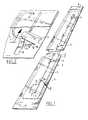
- Fig. 1 shows a partly broken away view of packaging according to the invention, containing a catheter.
- Fig. 2 represents a detailed view at arrow II in fig. 1.
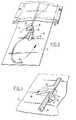
- Fig. 3 shows a view of packaging according to the invention corresponding to fig. 2 with a differently shaped catheter.
- Fig. 4 illustrates another alternative embodiment of a retaining element for packaging according to the invention.
- The
packaging 1 according to the invention shown in fig. 1 comprises acard 2 which is provided with a row of retaining elements. Acatheter 5 is held in a secure position on thecard 2 by retainingelements 4, still to be explained in greater detail. - The
card 2 with on it thecatheter 5 is received in anenvelop 3 which is subsequently sealed hermetically and sterilized. - When using the
catheter 5 theenvelop 3 will be opened under sterile conditions at the end 8. In order to remove thecatheter 5, the attending physician will take hold of its connectingelement 6 and pull thecatheter 5 in a longitudinal direction from the packaging. In doing so the catheter will be pulled out of theretaining elements 4. Especially the passing of the distal end 7 of the catheter is critical. - As fig. 2 shows more clearly, each retaining element consists of a push down
lip 10 and an enclosinglip 11. Bothlips cuts card 2. As seen in fig. 1 and 2, the push downlip 4 retains the catheter in the right hand direction while the enclosinglip 11 wedges the catheter to prevent movement only in the left hand direction. Thelateral edge 12 of the enclosinglip 11 directed towards the push downlip 10 extends, as is shown clearly in fig. 1 and 2, parallel to the row ofretaining elements 4. Because of this thelip 11 can bend unimpeded towards the surface of thecard 2, also when a catheter has been received in theretaining element 4. - When pulling the catheter out, the bent section of the distal end 7 of the catheter easily forces the enclosing
lip 11 down, so that the catheter does not grate along the sharp edges of thelips elements 4 without any risk of damage. Thetip 9 of the distal end 7 indicated as a separate element, which usually is made of a soft material which does not cause trauma, does not even make any contact at all with theretaining elements 4. - As the figures 1 and 2 illustrate, the bending line of the enclosing
lip 11, which is defined by the ends of thecut 13, is at right angles to the longitudinal direction of the row ofretaining elements 4. This contributes to a performance oflip 11 which can be used for the intended purpose. The push downlip 10 has a bending line which extends parallel to the row of retaining elements. - With the embodiment shown, the
cut 13 of the enclosinglip 11 is situated on that side of its bending line which is turned away from the push downlip 10. This cut 13 and therefore thelip 11 is longer than the distance from the bending line of thatlip 11 to the push downlip 10. For this reason the enclosinglip 11 can be bent back to underneath the push downlip 10 as shown. Because of the springy nature of the material of which thecard 2 has been made, usually thick paper or thin cardboard, thelip 11 is subjected to a bias acting in an upward direction which keeps it properly up and in contact with the push downlip 10. Thus it is ensured that thecatheter 5 is secured properly in every retaining element under all circumstances, until the catheter is removed from the packaging for use. - The position of the
retaining elements 4 on the card depends on the catheter to be packed. With the embodiment of fig.1 they have for instance been arranged at one side with the enclosinglips 11 pointing inwards. - With a catheter with a differently shaped distal end, for instance the
catheter 15 as shown in fig. 3, the retaining elements have been arranged more towards the centre. In fig. 3 the elements which correspond to those shown in fig. 1 and 2 , have been indicated with the same reference numbers. - In actual practice two embodiments of the card suffice. In both embodiments the retaining elements are arranged at the same distance from the edge of the card, but with one embodiment the enclosing lips point outwards and with the other embodiment they point inwards. The card to be used for a specific catheter is chosen in such a way that when pulling the catheter form the packaging the end section will always slide over the enclosing lip to prevent damage.
- In fig. 3 the
retaining element 4 has been arranged more or less in the centre of thecard 2, whereby the enclosinglip 11 has been moved sideways on thecard 2. The enclosinglip 11 is situated however, just as is the case with the embodiments of the figures 1 and 2, on that side of theretaining element 4 to which thetip 16 of the catheter is pointing. On removing the catheter the enclosinglip 11 is consequently also pressed down by the curved section of thecatheter 15, and enables this curved section to pass without thetip 16 making contact with thelips catheter 15 when passing theretaining element 4 has been indicated with dotted lines. - Fig. 4 illustrates part of the packaging according to the invention at the
retaining element 20. Theretaining element 20 also comprises a push down lip 21 and an enclosinglip 22. The push down lip 21 secures thecatheter 24 on the card in a downward, and as seen in fig. 4 left-hand direction. The enclosinglip 22 secures thecatheter 24 in the right-hand direction. - The
lateral edge 23 of the enclosinglip 22 turned towards the push down lip 21 extends, as illustrated in fig. 4, parallel to thecatheter 24 and consequently parallel to the row of retainingelements 20. When removing the catheter from the packaging the enclosinglip 22 can be pressed down easily as a result of which the catheter, and in particular its curved end-section, can pass without any problems. - In a manner corresponding to the previous figures, a catheter will be received in packaging with retaining
elements 20 in such a way, that the sensitive tip of the catheter is pointing in the same direction as the enclosing lip. When removing the catheter the curved section of the catheter will push the enclosinglip 22 down and the tip will be able to pass without making contact with the retainingelement 20. - The invention is not limited to the embodiments illustrated in the figures. The shape of the lips of the retaining elements can vary considerably.
Claims (4)
1. Packaging for a catheter, comprising a card received in an envelop, which is provided with a row of retaining elements with lips formed by cuts which can be bent out of the surface of the card around a bending line defined by the ends of the cut, wherein each retaining element comprises at least one push down lip, which can extend across the catheter and an opposing enclosing lip, wherein a lateral edge of the enclosing lip directed towards the push down lip extends mainly parallel to the row.
2. Packaging as claimed in claim 1, wherein the bending line defined by the ends of the cut forming the enclosing lip is at right angles to the row.
3. Packaging as claimed in one of the previous claims, wherein the cut defining the enclosing lip is situated on that side of its bending line which is turned away from the accompanying push down lip and has a length at right angles to this bending line which is longer than the distance of that bending line to the push down lip, so that the enclosing lip can be bent back to a position underneath the push down lip.
4. Packaging as claimed in claim 3, wherein the push down lip is a U-shaped lip with a bending line parallel to the row and the enclosing lip a U-shaped lip with a bending line at right angles to the row.
Applications Claiming Priority (2)
| Application Number | Priority Date | Filing Date | Title |
|---|---|---|---|
| NL9400214 | 1994-02-10 | ||
| NL9400214ANL9400214A (en) | 1994-02-10 | 1994-02-10 | Catheter packaging. |
Publications (1)
| Publication Number | Publication Date |
|---|---|
| EP0667170A1true EP0667170A1 (en) | 1995-08-16 |
Family
ID=19863825
Family Applications (1)
| Application Number | Title | Priority Date | Filing Date |
|---|---|---|---|
| EP95200269AWithdrawnEP0667170A1 (en) | 1994-02-10 | 1995-02-03 | Catheter packaging |
Country Status (4)
| Country | Link |
|---|---|
| US (1) | US5501341A (en) |
| EP (1) | EP0667170A1 (en) |
| JP (1) | JPH0833717A (en) |
| NL (1) | NL9400214A (en) |
Cited By (4)
| Publication number | Priority date | Publication date | Assignee | Title |
|---|---|---|---|---|
| EP0913164A1 (en)* | 1997-10-30 | 1999-05-06 | Schneider/Namic | Multipack package |
| WO2002045785A1 (en)* | 2000-12-06 | 2002-06-13 | Boston Scientific Limited | Holding device for use with catheter packaging |
| WO2005087302A1 (en)* | 2004-03-05 | 2005-09-22 | Boston Scientific Limited | Packaging for elongate medical devices and method of manufacture and use thereof |
| WO2012079590A1 (en)* | 2010-12-17 | 2012-06-21 | Coloplast A/S | A catheter assembly |
Families Citing this family (39)
| Publication number | Priority date | Publication date | Assignee | Title |
|---|---|---|---|---|
| US5699909A (en)* | 1996-08-07 | 1997-12-23 | United States Surgical Corporation | Surgical instrument package |
| US6009998A (en)* | 1997-05-05 | 2000-01-04 | Flour City Packaging Corporation | Cardboard package for holding catheters |
| US6053905A (en)* | 1998-02-23 | 2000-04-25 | Tyco International (Us) Inc. | Self contained urethral catheter assembly with lubricating chamber |
| US20020103467A1 (en) | 2001-01-31 | 2002-08-01 | Kubalak Thomas P. | Urine collection bags for urinary catheter systems |
| US7001370B2 (en) | 2001-01-31 | 2006-02-21 | Mentor Corporation | Urine collection bags for urinary catheter systems |
| US6814236B2 (en)* | 2001-12-31 | 2004-11-09 | Ethicon, Inc. | Blister tray with a package for a small device |
| USD496266S1 (en) | 2003-04-29 | 2004-09-21 | Astra Tech Ab | Catheter package |
| USD503335S1 (en)* | 2003-10-07 | 2005-03-29 | Astra Tech Ab | Catheter package |
| US20050109648A1 (en)* | 2003-10-30 | 2005-05-26 | Hollister Incorporated | No-touch packaging configurations and application methods for hydrophilic intermittent catheters |
| US7334679B2 (en)* | 2004-03-15 | 2008-02-26 | Hollister Incorporated | Tear open package for hydrophilic-coated catheter |
| US7743918B2 (en)* | 2004-03-31 | 2010-06-29 | Terumo Kabushiki Kaisha | Catheter package |
| EP1616593B1 (en)* | 2004-07-14 | 2008-08-27 | Terumo Kabushiki Kaisha | Package for medical tubes |
| US20070227916A1 (en)* | 2006-04-04 | 2007-10-04 | Stan Malinowski | Steel suture package |
| EP2308543B1 (en) | 2006-06-08 | 2013-05-29 | Hollister Incorporated | Catheter product package |
| JP5025401B2 (en)* | 2007-09-28 | 2012-09-12 | 日油技研工業株式会社 | Medical device fixing sheet |
| EP2060296B1 (en)* | 2007-11-19 | 2016-08-24 | Hollister Incorporated | Vapor hydrated catheter assembly and method of making same |
| JP5328253B2 (en)* | 2008-07-30 | 2013-10-30 | テルモ株式会社 | Medical device holding mount |
| USD589347S1 (en)* | 2008-08-27 | 2009-03-31 | Ethicon, Inc.-Usa | Package for holding surgical implants |
| US8413810B2 (en)* | 2010-09-15 | 2013-04-09 | Ethicon, Inc. | Packages for medical devices and methods therefor |
| JP5950393B2 (en)* | 2012-07-12 | 2016-07-13 | 株式会社グッドマン | Catheter holding mount |
| USD734165S1 (en)* | 2013-03-14 | 2015-07-14 | Hollister, Inc. | Catheter package |
| USD747184S1 (en)* | 2013-03-14 | 2016-01-12 | Hollister Incorporated | Compact catheter package |
| US20150114869A1 (en)* | 2013-10-25 | 2015-04-30 | National Concessions Group Inc. | Product packaging with removable indicia |
| US9265578B2 (en) | 2013-11-04 | 2016-02-23 | Ethicon, Llc | Multi-component packages for medical devices |
| JP6108476B2 (en)* | 2014-05-10 | 2017-04-05 | 朝日インテック株式会社 | Mount |
| JP6359404B2 (en)* | 2014-09-26 | 2018-07-18 | 朝日インテック株式会社 | Holding mount |
| US9333289B1 (en) | 2015-01-16 | 2016-05-10 | Plas-Tech Engineering, Inc. | Tamper evident closure container |
| USD789800S1 (en)* | 2015-04-09 | 2017-06-20 | Apple Inc. | Packaging |
| US9776783B2 (en) | 2015-06-04 | 2017-10-03 | Covidien Lp | Foldable sleeve for surgical instrument |
| WO2017141349A1 (en)* | 2016-02-16 | 2017-08-24 | 朝日インテック株式会社 | Backing paper and packaging body provided with said backing paper |
| JP6183868B2 (en)* | 2016-03-15 | 2017-08-23 | 朝日インテック株式会社 | Guide wire |
| US10485627B2 (en)* | 2016-04-07 | 2019-11-26 | Ethicon, Inc. | Containment sleeves for packages containing medical devices |
| US10577165B2 (en) | 2017-09-25 | 2020-03-03 | SEE Forming L.L.C. | Key retention system for product packaging |
| JP7247182B2 (en)* | 2017-11-17 | 2023-03-28 | メリット・メディカル・システムズ・インコーポレイテッド | Systems and methods for reducing deterioration of medical components |
| US10695143B2 (en)* | 2018-02-15 | 2020-06-30 | Medtronic Vascular, Inc. | Medical device package |
| US11155381B1 (en) | 2018-10-08 | 2021-10-26 | SEE Forming L.L.C. | Joinable thermoform product packaging |
| CN112972166A (en)* | 2019-12-17 | 2021-06-18 | 先健科技(深圳)有限公司 | Medical Device System |
| USD1021627S1 (en) | 2022-09-14 | 2024-04-09 | Apple Inc. | Packaging for accessory |
| US12312140B2 (en)* | 2023-02-06 | 2025-05-27 | Plitek, L.L.C. | Package backer card with interlocking article-retaining tabs |
Citations (2)
| Publication number | Priority date | Publication date | Assignee | Title |
|---|---|---|---|---|
| US3967728A (en)* | 1973-03-02 | 1976-07-06 | International Paper Company | Catheter package |
| US5131537A (en)* | 1991-10-03 | 1992-07-21 | Cordis Corporation | Flexible tip tray packaging for medical catheters |
Family Cites Families (5)
| Publication number | Priority date | Publication date | Assignee | Title |
|---|---|---|---|---|
| US435094A (en)* | 1890-08-26 | Peter cooper hewitt | ||
| US2224027A (en)* | 1938-11-03 | 1940-12-03 | E H Tate Company | Display card for door keys |
| US2947415A (en)* | 1957-10-03 | 1960-08-02 | Bard Inc C R | Sterile package and method of making same |
| US4023678A (en)* | 1974-07-01 | 1977-05-17 | Fiedler Dolores E | Package and identification record for an intrauterine device |
| US5351822A (en)* | 1993-02-17 | 1994-10-04 | United States Surgical Corporation | Retainer for an elongated surgical instrument |
- 1994
- 1994-02-10NLNL9400214Apatent/NL9400214A/ennot_activeApplication Discontinuation
- 1995
- 1995-02-03EPEP95200269Apatent/EP0667170A1/ennot_activeWithdrawn
- 1995-02-07USUS08/384,844patent/US5501341A/ennot_activeExpired - Lifetime
- 1995-02-07JPJP7019111Apatent/JPH0833717A/enactivePending
Patent Citations (2)
| Publication number | Priority date | Publication date | Assignee | Title |
|---|---|---|---|---|
| US3967728A (en)* | 1973-03-02 | 1976-07-06 | International Paper Company | Catheter package |
| US5131537A (en)* | 1991-10-03 | 1992-07-21 | Cordis Corporation | Flexible tip tray packaging for medical catheters |
Cited By (9)
| Publication number | Priority date | Publication date | Assignee | Title |
|---|---|---|---|---|
| EP0913164A1 (en)* | 1997-10-30 | 1999-05-06 | Schneider/Namic | Multipack package |
| WO2002045785A1 (en)* | 2000-12-06 | 2002-06-13 | Boston Scientific Limited | Holding device for use with catheter packaging |
| US6892881B2 (en) | 2000-12-06 | 2005-05-17 | Scimed Life Systems, Inc. | Holding device for use with catheter packaging |
| WO2005087302A1 (en)* | 2004-03-05 | 2005-09-22 | Boston Scientific Limited | Packaging for elongate medical devices and method of manufacture and use thereof |
| US7328794B2 (en) | 2004-03-05 | 2008-02-12 | Boston Scientific Scimed, Inc. | Packaging for elongate medical devices and methods of manufacture and use thereof |
| WO2012079590A1 (en)* | 2010-12-17 | 2012-06-21 | Coloplast A/S | A catheter assembly |
| CN103260688A (en)* | 2010-12-17 | 2013-08-21 | 科洛普拉斯特公司 | A catheter assembly |
| US9205222B2 (en) | 2010-12-17 | 2015-12-08 | Coloplast A/S | Catheter assembly |
| CN103260688B (en)* | 2010-12-17 | 2016-07-06 | 科洛普拉斯特公司 | Intermittent catheter assembly |
Also Published As
| Publication number | Publication date |
|---|---|
| US5501341A (en) | 1996-03-26 |
| JPH0833717A (en) | 1996-02-06 |
| NL9400214A (en) | 1995-09-01 |
Similar Documents
| Publication | Publication Date | Title |
|---|---|---|
| EP0667170A1 (en) | Catheter packaging | |
| US6457863B1 (en) | Flexible self-closing container | |
| US2116147A (en) | Book marker | |
| US6080184A (en) | Package for retaining a suture and a suture anchor | |
| US4189048A (en) | Article holder | |
| EP0613697A1 (en) | A packaging for an elongated medical appliance | |
| US3779375A (en) | Suture package | |
| US8105341B2 (en) | Suture removal device | |
| JP3179117B2 (en) | Catheter package | |
| NL8300341A (en) | CASSETTE FOR MAGNETIC TAPE. | |
| CA1081932A (en) | Letter opener device | |
| US2727572A (en) | Slip-on tape cutter | |
| BR8900921A (en) | OPENING DEVICE FOR PACKAGING AND FLEXIBLE PACKAGING | |
| EP0149721A2 (en) | Cigarette lighter holder/cigarette package clip | |
| US6009998A (en) | Cardboard package for holding catheters | |
| JPH11501894A (en) | Flexible product packaging and packaging method | |
| GB2030913A (en) | Pin extractor for integrated circuit tube | |
| GB2250256A (en) | Bank note bundle retainer | |
| US9522251B2 (en) | Mounting card | |
| KR200485303Y1 (en) | Sticker member for cigarette pack | |
| ES2096496T5 (en) | SOFT SHEET WRAP. | |
| WO1990016046A1 (en) | Memory card with removal tab | |
| JPH10139081A (en) | Paper container | |
| JP4207545B2 (en) | Belt-like opening structure and cardboard box or paper box provided with the opening structure | |
| JP3039477U (en) | Thermometer cover for temperature measurement with dropout prevention function |
Legal Events
| Date | Code | Title | Description |
|---|---|---|---|
| PUAI | Public reference made under article 153(3) epc to a published international application that has entered the european phase | Free format text:ORIGINAL CODE: 0009012 | |
| AK | Designated contracting states | Kind code of ref document:A1 Designated state(s):BE CH DE FR GB IE IT LI NL | |
| 17P | Request for examination filed | Effective date:19960214 | |
| STAA | Information on the status of an ep patent application or granted ep patent | Free format text:STATUS: THE APPLICATION IS DEEMED TO BE WITHDRAWN | |
| 18D | Application deemed to be withdrawn | Effective date:19980901 |