EP0542401A1 - Method and apparatus for infusing medical solutions - Google Patents
Method and apparatus for infusing medical solutionsDownload PDFInfo
- Publication number
- EP0542401A1 EP0542401A1EP92305358AEP92305358AEP0542401A1EP 0542401 A1EP0542401 A1EP 0542401A1EP 92305358 AEP92305358 AEP 92305358AEP 92305358 AEP92305358 AEP 92305358AEP 0542401 A1EP0542401 A1EP 0542401A1
- Authority
- EP
- European Patent Office
- Prior art keywords
- fluid
- reservoir
- membrane
- pressure
- discharging
- Prior art date
- Legal status (The legal status is an assumption and is not a legal conclusion. Google has not performed a legal analysis and makes no representation as to the accuracy of the status listed.)
- Withdrawn
Links
- 238000000034methodMethods0.000titleclaimsabstractdescription42
- 239000008155medical solutionSubstances0.000titledescription9
- 239000012530fluidSubstances0.000claimsabstractdescription105
- 239000012528membraneSubstances0.000claimsabstractdescription70
- 238000007599dischargingMethods0.000claimsdescription19
- 238000005086pumpingMethods0.000claimsdescription16
- 238000004891communicationMethods0.000claimsdescription3
- 230000008602contractionEffects0.000claimsdescription3
- 230000000977initiatory effectEffects0.000claimsdescription3
- 238000012163sequencing techniqueMethods0.000claimsdescription2
- 230000008878couplingEffects0.000claims1
- 238000010168coupling processMethods0.000claims1
- 238000005859coupling reactionMethods0.000claims1
- 238000001802infusionMethods0.000abstractdescription43
- 230000008569processEffects0.000abstractdescription15
- 239000000243solutionSubstances0.000description24
- FAPWRFPIFSIZLT-UHFFFAOYSA-MSodium chlorideChemical compound[Na+].[Cl-]FAPWRFPIFSIZLT-UHFFFAOYSA-M0.000description14
- 239000003814drugSubstances0.000description10
- 239000011780sodium chlorideSubstances0.000description10
- 230000003115biocidal effectEffects0.000description9
- HTTJABKRGRZYRN-UHFFFAOYSA-NHeparinChemical compoundOC1C(NC(=O)C)C(O)OC(COS(O)(=O)=O)C1OC1C(OS(O)(=O)=O)C(O)C(OC2C(C(OS(O)(=O)=O)C(OC3C(C(O)C(O)C(O3)C(O)=O)OS(O)(=O)=O)C(CO)O2)NS(O)(=O)=O)C(C(O)=O)O1HTTJABKRGRZYRN-UHFFFAOYSA-N0.000description8
- 229960002897heparinDrugs0.000description8
- 229920000669heparinPolymers0.000description8
- 239000003242anti bacterial agentSubstances0.000description7
- 239000000463materialSubstances0.000description6
- 238000010276constructionMethods0.000description4
- 238000011010flushing procedureMethods0.000description3
- 238000012549trainingMethods0.000description3
- RRHGJUQNOFWUDK-UHFFFAOYSA-NIsopreneChemical compoundCC(=C)C=CRRHGJUQNOFWUDK-UHFFFAOYSA-N0.000description2
- 230000004888barrier functionEffects0.000description2
- 238000010586diagramMethods0.000description2
- 229940079593drugDrugs0.000description2
- 239000007788liquidSubstances0.000description2
- 238000004519manufacturing processMethods0.000description2
- 239000004417polycarbonateSubstances0.000description2
- 229920000515polycarbonatePolymers0.000description2
- 244000043261Hevea brasiliensisSpecies0.000description1
- 230000003466anti-cipated effectEffects0.000description1
- 229940088710antibiotic agentDrugs0.000description1
- 239000012984antibiotic solutionSubstances0.000description1
- 239000003146anticoagulant agentSubstances0.000description1
- 229940127219anticoagulant drugDrugs0.000description1
- 238000004140cleaningMethods0.000description1
- 230000007812deficiencyEffects0.000description1
- 238000013461designMethods0.000description1
- 239000003085diluting agentSubstances0.000description1
- 229920001971elastomerPolymers0.000description1
- 239000000806elastomerSubstances0.000description1
- 230000008571general functionEffects0.000description1
- 238000007373indentationMethods0.000description1
- 230000036512infertilityEffects0.000description1
- 238000001746injection mouldingMethods0.000description1
- 238000003780insertionMethods0.000description1
- 230000037431insertionEffects0.000description1
- 238000001990intravenous administrationMethods0.000description1
- 238000005304joiningMethods0.000description1
- 229920003052natural elastomerPolymers0.000description1
- 229920001194natural rubberPolymers0.000description1
- 239000004033plasticSubstances0.000description1
- 238000005381potential energyMethods0.000description1
- 238000003825pressingMethods0.000description1
- 230000037452primingEffects0.000description1
- 239000002904solventSubstances0.000description1
- 230000007704transitionEffects0.000description1
- 238000011144upstream manufacturingMethods0.000description1
- 238000003466weldingMethods0.000description1
Images


Classifications
- A—HUMAN NECESSITIES
- A61—MEDICAL OR VETERINARY SCIENCE; HYGIENE
- A61M—DEVICES FOR INTRODUCING MEDIA INTO, OR ONTO, THE BODY; DEVICES FOR TRANSDUCING BODY MEDIA OR FOR TAKING MEDIA FROM THE BODY; DEVICES FOR PRODUCING OR ENDING SLEEP OR STUPOR
- A61M5/00—Devices for bringing media into the body in a subcutaneous, intra-vascular or intramuscular way; Accessories therefor, e.g. filling or cleaning devices, arm-rests
- A61M5/14—Infusion devices, e.g. infusing by gravity; Blood infusion; Accessories therefor
- A61M5/1407—Infusion of two or more substances
- A61M5/1408—Infusion of two or more substances in parallel, e.g. manifolds, sequencing valves
- A—HUMAN NECESSITIES
- A61—MEDICAL OR VETERINARY SCIENCE; HYGIENE
- A61M—DEVICES FOR INTRODUCING MEDIA INTO, OR ONTO, THE BODY; DEVICES FOR TRANSDUCING BODY MEDIA OR FOR TAKING MEDIA FROM THE BODY; DEVICES FOR PRODUCING OR ENDING SLEEP OR STUPOR
- A61M5/00—Devices for bringing media into the body in a subcutaneous, intra-vascular or intramuscular way; Accessories therefor, e.g. filling or cleaning devices, arm-rests
- A61M5/14—Infusion devices, e.g. infusing by gravity; Blood infusion; Accessories therefor
- A61M5/142—Pressure infusion, e.g. using pumps
- A61M5/145—Pressure infusion, e.g. using pumps using pressurised reservoirs, e.g. pressurised by means of pistons
- A61M5/148—Pressure infusion, e.g. using pumps using pressurised reservoirs, e.g. pressurised by means of pistons flexible, e.g. independent bags
- A61M5/152—Pressure infusion, e.g. using pumps using pressurised reservoirs, e.g. pressurised by means of pistons flexible, e.g. independent bags pressurised by contraction of elastic reservoirs
- A—HUMAN NECESSITIES
- A61—MEDICAL OR VETERINARY SCIENCE; HYGIENE
- A61M—DEVICES FOR INTRODUCING MEDIA INTO, OR ONTO, THE BODY; DEVICES FOR TRANSDUCING BODY MEDIA OR FOR TAKING MEDIA FROM THE BODY; DEVICES FOR PRODUCING OR ENDING SLEEP OR STUPOR
- A61M5/00—Devices for bringing media into the body in a subcutaneous, intra-vascular or intramuscular way; Accessories therefor, e.g. filling or cleaning devices, arm-rests
- A61M5/14—Infusion devices, e.g. infusing by gravity; Blood infusion; Accessories therefor
- A61M5/142—Pressure infusion, e.g. using pumps
- A61M5/14244—Pressure infusion, e.g. using pumps adapted to be carried by the patient, e.g. portable on the body
Definitions
- the present inventionrelates to methods and apparatus for infusing medical solutions in a predetermined sequence into patients.
- the present inventionis particularly, but not exclusively, useful for infusing medical solutions in accordance with a SASH or SAS process automatically and in the correct sequence.
- SASHrefers to the sequential infusion of a saline (S) solution for initially flushing an IV site, followed by the infusion of a medicant such as an antibiotic (A), followed by another saline (S) solution flush, and for those IV sites that require it a final infusion of a heparin (H) solution as an anti-coagulant.
- Aantibiotic
- Ssaline
- Hheparin
- the dosage of the saline and of the heparinis typically in the range of 3-5 ml.
- the dosage of an antibiotic in a diluentmay vary from about 20-250 ml.
- a SASH method and apparatusthat can be performed by a greater number of untrained personnel such as outpatients.
- a SASH method and apparatuscould also be set up and operated by an ambulatory patient, with little or no additional training from medical personnel.
- One such SASH delivery system that requires additional trainingis marketed by Block Medical, Inc. of Carlsbad, California under the trademark of Auto-SASHTM.
- This systemincludes three separate reservoirs that contain two doses of a saline solution and one dose of a heparin solution.
- Each of the reservoirsis coupled to a single IV line and is discharged by a manually operated press pump formed integrally with the reservoir.
- the systemis designed for treating an IV site while an antibiotic is being administered using a separate IV delivery system.
- Prior to dispensing of an antibiotic into the IV sitethe IV line of the Auto-SASHTM is coupled to the site.
- a patientfirst dispenses a dose of saline solution into the site (for flushing the site) by manually pressing the press pump for that reservoir.
- the antibioticis then dispensed followed by a dose of saline from the Auto-SASHTM. Finally, a dose of a heparin solution can be administered in the same manner.
- a deficiency of this prior art systemis that a patient must manually discharge each valve in the proper sequence. This requires attentiveness and some training on the part of the patient. Additionally, this Auto-SASHTM system must be used in combination with a separate delivery system, such as a pump or IV pole for the antibiotic.
- the present inventionis directed to a portable SASH infusion apparatus and method that overcomes these prior art limitations.
- the inventionprovides apparatus for infusing medical fluids characterised in that it comprises: a first and second fluid pumping means coupled to an IV line for discharging fluid from a first chamber at a substantially constant pressure of P1 and for discharging fluid from a second chamber at a substantially constant pressure of P2; and valving means for controlling fluid flow sequentially from the pumping means such that the first chamber is substantially discharged prior to initiating and discharging flow from the second chamber.
- the inventionprovides a method for sequentially supplying a plurality of solutions characterised by comprising: connecting a first and a second reservoir to a single fluid line; pressurizing a first fluid in the first reservoir to a pressure band of P1 with an elastomeric membrane; pressurizing a second fluid in the second reservoir to a pressure band of P2 with an elastomeric membrane with P1 > P2; sequencing fluid flow such that the first reservoir is effectively discharged of fluid prior to the second reservoir discharging fluid.
- the method of the inventionis suitable for use in a wide range of situations, it is particularly suitable for IV infusion of medical solutions.
- a portable IV infusion apparatusincludes a plurality of separate fluid pumps for sequentially dispensing medical solutions at different fluid delivery pressures to an IV site.
- four separate fluid pumpsare mounted within a transportable support housing and are coupled to a single IV tube.
- the IV tubemay include an on-off valve constructed as a conventional slide clamp.
- Each separate fluid pumpis adapted to deliver solution at a delivery pressure pre-determined by the characteristics of the fluid pump.
- Check valvesare located between the separate pumps for sequentially dispensing solution from each pump into the IV tube after the previous pump is emptied.
- a patientmay use the device by first priming the IV line, opening the on-off clamp to occlude the IV line, and then hooking the line to a venous access device.
- the infusion apparatus of the inventionthen automatically delivers the fluid solutions in a proper sequence as a result of the predetermined delivery pressures of the infusion apparatus.
- the portable IV infusion pumpmay be loaded with the operative solutions at a hospital or pharmacy and is then adapted to dispense multiple solutions to an IV site by a method that generally stated includes the steps of:
- check valvesmay be located between the reservoirs and IV line.
- each separate fluid pumpincludes a pressurized reservoir or fluid chamber formed by an elastomeric membrane permanently stretched into a region of nonlinear elasticity.
- a fluid pumpis disclosed in copending U.S. Patent Application entitled "Portable Infusion Pump” and commonly owned by the Assignee of the present application.
- This type of pumpis characterized by a substantially constant fluid delivery pressure and by a substantially complete discharge of fluid from the pumping chamber.
- four separate pumpsmay be provided to pressurize and deliver fluid at four different substantially constant pressures.
- For a SAS processthree pumps are required.
- a single pump having four separate chambers each pressurized to a different pressure by a single elastomer formed with areas of different thicknesses, corresponding to the different chambersmay be provided.
- an infusion apparatus for infusing medical solutions in accordance with the inventionis shown and generally designated as 10.
- the infusion apparatus 10may be worn by a patient 12 during ambulation and can be attached to the patient 12 by any well known means, such as a belt 14.
- Figure 1shows that the infusion apparatus 10 can be connected in fluid communication with the patient 12 for the infusion of fluids into the patient 12 through an IV line 16.
- the IV line 16can include an in-line air filter 18 of a type well known in the pertinent art which will prevent the infusion of air to the patient 12.
- an on-off valve 20can be operatively associated with the IV line 16 to initiate or terminate the flow of fluid from the infusion apparatus 10 through the IV line 16.
- the infusion apparatus 10includes four fluid pumps 22a-d mounted within a single carrier housing 24.
- the infusion apparatus 10 shownis adapted to perform a SASH process. Alternatively a lesser or greater number of fluid pumps 22a-d may be assembled within the carrier housing 24.
- the fluid pumps 22a-dare coupled in flow communication to the IV line 16. Additionally, each pump 22a-d is coupled to a check valve 25a-d.
- the check valves 25a-bare located between the IV line 16 and the fluid pumps 22a-d to regulate a sequence of fluid flow from the fluid pumps 22a-d.
- Each fluid pump 22a-dis adapted to deliver fluid at a substantially constant pressure until the pump 22a-d is substantially completely discharged.
- Delivery pressure bands, P1 through P4 , of the pumps 22a-dare selected such that P1 band, corresponding to pump 22a is greater than P2 band corresponding to pump 22b. Likewise P2 band is greater than P3 band corresponding to pump 22c band and P3 band is greater than P4 band corresponding to pump 22d. (P1 band > P2 band > P3 band > P4 band).
- P1, P2, P3, and P4refer to a delivery pressure band.
- P1, P2, P3 and P4are not discreet values but bands of pressure which includes the difference in
- the check valves 25a-dare each constructed to open at a preselected low differential pressure ⁇ P sensed between the downstream pressure in the IV line 16 and an upstream pressure determined by the pump delivery pressure of a fluid pump 22a-d.
- the check valves 25a-dcan thus be constructed and arranged to allow fluid flow sequentially from pump 22a at pressure P1, pump 22b at Pressure P2: pump 22c at pressure P3, and pump 22d at pressure P4.
- the infusion apparatus 10is thus constructed to operate in a SASH process that includes the steps of:
- a suitable fluid pump 22a-d for pumping or discharging fluid solutions at a substantially constant pressureis shown in Figures 4, 5, 6A and 6B.
- each of the fluid pumps 22a-dwill be of the same construction but the pumps will be sized differently.
- each pump 22a-dmay be sized to contain a predetermined volume or dosage of solution which may be different.
- the volumetric capacity of a pump 22a-dmay be in the range of 20-250ml for an antibiotic and 3-5 ml for saline depending on a required dosage. It is anticipated that the pump will be charged with a solution at the pharmacy although it is contemplated that a patient may charge some solutions.
- Each pump 22a-dincludes a housing 27a-d.
- An elastomeric membrane 26a-dis clamped between rings 40a-d and 44a-d and is then attached to the housing 27a-d and to a shell (not shown), or to the carrier housing 34.
- Figure 4also shows that the housing 27a-d is formed with an inlet port 28a-d and an outlet port 30a-d.
- Each outlet port 30a-d of the pumps 22a-dis coupled to an outlet conduit 31a-d which in turn is coupled to the IV line 16.
- Each check valve 25a-dis located in an outlet conduit 31a-d situated between the outlet port 30a-d of a pump 22a-d and the IV line 16.
- the individual components of a pump 22a-dare best seen in Figure 5.
- a contour surface 32a-d of housing 27a-dcan have any topology which will stretch the membrane 26a-d into its nonlinear region of elasticity when these components are assembled.
- the contour surface 32a-d of housing 27a-dwill follow and conform to the natural topology of the inflated membrane 26a-d as it transitions from linear to non-linear.
- contour surface 32a-dis substantially hemispherical.
- the periphery 34a-d of housing 27a-dis folded outwardly from the contour surface 32a-d in order to facilitate the connection of the membrane 26a-d onto the housing 27a-d.
- the housing 27a-dcan be manufactured using any well known manufacturing procedures, such as injection molding.
- a thin wall tube which forms valve sleeve 36a-d, and a valve insert 38a-dare shown in Figure 3 in their positions for insertion into the lumen of inlet port 28a-d.
- the sleeve 36a-d and valve insert 38a-destablish a one-way valve for the housing 27a-d which permits the flow of fluid in only one direction through the inlet port 28a-d.
- each fluid pump 22a-dwill be filled with fluid through the inlet port 28a-d of each chamber but that fluid not be able to leave the fluid pump 22a-d through the inlet port 28a-d.
- a fluidmay be loaded into an inlet port 28a-d under pressure utilizing a medical syringe (not shown). Additionally, it is important that during filling of the separate fluid pumps the sequence of filling be accomplished from the highest to the lowest pressures.
- Each pump 22a-dalso includes an upper top ring 40a-d which is engageable with a rib 42a-d that is located on the circumference of membrane 26a-d.
- Upper ring 40a-dis also engageable with a lower bottom ring 44a-d to effectively grip and hold the rib 42a-d of membrane 26a-d between the rings 40a-d and 44a-d.
- These rings 40a-d and 44a-dcan be of any suitable rigid material such as polycarbonate which, when the rings 40a-d and 44a-d are joined together to support the flexible membrane 26a-d, will provide a firm foundation for the membrane 26a-d.
- the membrane 26a-dis substantially a circular sheet when in its unstretched condition. Further, this sheet is formed with a raised rib 42a-d which, as mentioned above, can be gripped between the rings 40a-d and 44a-d.
- the membrane 26a-dis preferably made of a natural rubber or isoprene having a high elastic memory. Regardless of the particular material used for membrane 26a-d, however, it is important that the membrane 26a-d be chemically compatible with the fluid medicament which is to be infused to the user 12 from each pump 22a-d.
- the membrane 26a-dcan be appropriately coated so that the particular surface of membrane 26a-d which is to be placed in contact with the contour surface 32a-d of housing 27a-d will not chemically interact with the fluid medicament in the pump 22a-d.
- a medicament compatible membranecan be held with the membrane 26a-d between the rings 40a-d and 44a-d. With this combination, the medicament compatible membrane is positioned between the membrane 26a-d and the contour surface 32a-d of housing 27a-d when these components are assembled.
- the portion of membrane 26a-d which is circumscribed by the rib 42a-dis preferably of uniform thickness. It is recognized, however, that thickness may be varied across the membrane 26a-d as long as the resultant topology creates a nonlinear elastomeric behavior for the membrane 26a-d. In addition, the thickness of the membranes 26a-d will in part be different for each pump 22a-d for achieving a different operating pressure for each pump 22a-d.
- each pump 22a-dthe upper top ring 40a-d is joined to the lower bottom ring 44a-d to grip and hold rib 42a-d of membrane 26a-d therebetween.
- the rings 40a-d and 44a-dcan be joined together by any of several means, such as ultrasonic welding or solvent bonding.
- the periphery 34a-d of housing 27a-dis joined to upper top ring 40a-d.
- the contour surface 32a-d of housing 27a-dstretches membrane 26a-d substantially as shown.
- both membrane 26a-d and contour surface 32a-dare such that this stretching takes the membrane 26a-d into its nonlinear region of elasticity.
- the joining of housing 27a-d to upper top ring 40a-dalso establishes a potential chamber or reservoir 50a-d between the membrane 25a-d and contour surface 32a-d.
- a fluidmust be introduced under a pressure sufficient to overcome the potential energy of the initially stretched membrane 26a-d and form the chamber 50 a-d. This total amount of energy minus what has been lost through heat loss and elastomeric hysteresis is thus available for displacing fluid from the chamber 50a-d at a substantially constant delivery pressure. Further, because of the initial non-linear stretching of the membrane 26a-d, even after complete discharge of a fluid, a residual force is maintained by the membrane 26a-d acting upon the contour surface 32a-d.
- each pump 22a-dmust be sized to deliver a predetermined volume of fluid solution over a substantially constant predetermined delivery pressure.
- a size of the pump 22a-dmay thus be adjusted to achieve a predetermined volume.
- a thickness of the elastomeric membrane 26a-d as well as the materialmay be selected as required.
- the delivery pressure of a pump 22a-dwill vary with the thickness of the elastomeric membrane 26a-d. Likewise the delivery pressure will vary with the modulus of elasticity of the material selected for the elastomeric membrane 26a-d.
- FIGs 7A and 7Billustrate representative volume versus pressure characteristics of the four fluid pumps 22a-d. Curves C a-d of Figure 7A illustrate the volume versus-pressure characteristics of pumps 22a-d respectively.
- each pump 22a-dis constructed to deliver fluid over a relatively constant pressure band.
- pump 22aoperates at the highest pressure band followed by pump 22b, 22c and 22d respectively.
- These operating pressurescorrespond to the operating pressures or pressure bands P1 > P2 > P3 > P4 shown in Figure 3.
- An illustrative range of pressuresmay be in the range of 1-20 psig.
- Figure 7Billustrates a volume delivered by the separate chambers over a time sequence.
- check valves 25a-d for each pump 22a-dmust be configured to crack with a relatively small pressure differential ⁇ P between the respective operating pressures P1-P4 for the pumps 22a-d.
- Such check valves 25a-dare commercially available and in general function as shown in the schematic illustration of Figure 8. Additionally, the check valve 25a downstream of pump 22a may be eliminated if desired.
- the configuration noted in Figure 2 with four separate fluid pumps 22a-dmay also be varied, as long as four separate reservoirs or chambers each at a different pressure are provided.
- a single pump having a single elastomeric membrane that covers a plurality of juxtaposed chambersmay be provided.
- the thickness of the elastomeric membranemay be varied to provide a pressure differential between the separate chambers.
- Figure 9illustrates such an alternative embodiment infusion apparatus.
- Alternate embodiment infusion apparatus 51includes a housing 53 having a plurality of contour surfaces 54a-d formed thereon.
- a single concentric elastomeric membrane 56is mounted in operative alignment with the contour surfaces 54a-d substantially as previously described for elastomeric membrane 26a-d.
- Concentric elastomeric membrane 56is formed however, with a varying thickness for providing chambers corresponding to contour surfaces 54a-d. The pumping or delivery pressure from each chamber can thus be varied as required.
- a single infusion apparatus 60 for a SASH processmay include four separate chambers S,A,S,H, concentrically arranged and divided.
- Figure 10Aillustrates a single infusion apparatus 62 having three separate and concentrically arranged chambers (S,A,S). In either case the largest chamber (A) is in the center.
- Figure 11illustrates yet another infusion apparatus 64 formed with a shell 68 and separate chambers formed by a single elastomeric membrane 66.
- the shell 66may be sized to contain a fixed volume for each separate chamber.
- the inventionprovides a method and apparatus for infusing a plurality of medical solutions in a controlled sequence.
- the apparatus of the inventionis simple in construction and may operate automatically in a SASH process.
- the method and apparatus of the inventionis suitable for use by a mobile or ambulatory patient.
Landscapes
- Health & Medical Sciences (AREA)
- Vascular Medicine (AREA)
- Engineering & Computer Science (AREA)
- Anesthesiology (AREA)
- Biomedical Technology (AREA)
- Heart & Thoracic Surgery (AREA)
- Hematology (AREA)
- Life Sciences & Earth Sciences (AREA)
- Animal Behavior & Ethology (AREA)
- General Health & Medical Sciences (AREA)
- Public Health (AREA)
- Veterinary Medicine (AREA)
- Infusion, Injection, And Reservoir Apparatuses (AREA)
Abstract
Description
- The present invention relates to methods and apparatus for infusing medical solutions in a predetermined sequence into patients. The present invention is particularly, but not exclusively, useful for infusing medical solutions in accordance with a SASH or SAS process automatically and in the correct sequence.
- Current intravenous IV site flushing techniques for antibiotics and other medicaments use saline and heparin solutions to maintain an IV site. One such technique is known in the art as a SASH process. The term SASH refers to the sequential infusion of a saline (S) solution for initially flushing an IV site, followed by the infusion of a medicant such as an antibiotic (A), followed by another saline (S) solution flush, and for those IV sites that require it a final infusion of a heparin (H) solution as an anti-coagulant. The dosage of the saline and of the heparin is typically in the range of 3-5 ml. The dosage of an antibiotic in a diluent may vary from about 20-250 ml.
- In the past the SASH process has typically been performed using pre-filled medical syringes. This requires separate syringes each having a separate needle. Additionally, multiple site access and a sequential site cleaning are also required. This relatively complicated procedure is difficult for homecare and ambulatory patients to perform. It is critical that the procedure be carried out in a proper sequence to insure a non-clogged access to the IV site.
- For maximum flexibility in the implementation of an extended and comprehensive infusion therapy program there is a recognized need for a SASH method and apparatus that can be performed by a greater number of untrained personnel such as outpatients. Preferably such a SASH method and apparatus could also be set up and operated by an ambulatory patient, with little or no additional training from medical personnel.
- One such SASH delivery system that requires additional training is marketed by Block Medical, Inc. of Carlsbad, California under the trademark of Auto-SASH™. This system includes three separate reservoirs that contain two doses of a saline solution and one dose of a heparin solution. Each of the reservoirs is coupled to a single IV line and is discharged by a manually operated press pump formed integrally with the reservoir. The system is designed for treating an IV site while an antibiotic is being administered using a separate IV delivery system. Prior to dispensing of an antibiotic into the IV site the IV line of the Auto-SASH™ is coupled to the site. A patient first dispenses a dose of saline solution into the site (for flushing the site) by manually pressing the press pump for that reservoir. The antibiotic is then dispensed followed by a dose of saline from the Auto-SASH™. Finally, a dose of a heparin solution can be administered in the same manner. A deficiency of this prior art system is that a patient must manually discharge each valve in the proper sequence. This requires attentiveness and some training on the part of the patient. Additionally, this Auto-SASH™ system must be used in combination with a separate delivery system, such as a pump or IV pole for the antibiotic. The present invention is directed to a portable SASH infusion apparatus and method that overcomes these prior art limitations.
- In light of the above it is an object of the present invention to provide a method and apparatus to simply and safely infuse medical solutions in the proper sequence especially for a mobile or ambulatory patient. Another object of the present invention is to provide a method and apparatus for infusing medical solutions that can automatically dispense solutions in the proper sequence for a SASH process. Still another object of the present invention is to provide a portable IV infusion apparatus which provides for the complete discharge of separate solutions and for a substantially uniform delivery pressure for each separate solution. Yet another object of the present invention is to provide a portable IV infusion apparatus for multiple solutions which can be reused and pre-filled in a ready-to-use configuration for a relatively extended period of time while maintaining sterility of the solutions held in the apparatus. Another object of the present invention is to provide a portable IV infusion apparatus for multiple solutions in the proper sequence which is easy to use, relatively simple to manufacture and comparatively cost effective.
- In a first aspect, the invention provides apparatus for infusing medical fluids characterised in that it comprises:
a first and second fluid pumping means coupled to an IV line for discharging fluid from a first chamber at a substantially constant pressure of P₁ and for discharging fluid from a second chamber at a substantially constant pressure of P₂; and
valving means for controlling fluid flow sequentially from the pumping means such that the first chamber is substantially discharged prior to initiating and discharging flow from the second chamber. - In a further aspect the invention provides a method for sequentially supplying a plurality of solutions characterised by comprising:
connecting a first and a second reservoir to a single fluid line;
pressurizing a first fluid in the first reservoir to a pressure band of P₁ with an elastomeric membrane;
pressurizing a second fluid in the second reservoir to a pressure band of P₂ with an elastomeric membrane with P₁ > P₂;
sequencing fluid flow such that the first reservoir is effectively discharged of fluid prior to the second reservoir discharging fluid. Although the method of the invention is suitable for use in a wide range of situations, it is particularly suitable for IV infusion of medical solutions. - In accordance with the present invention a portable IV infusion apparatus includes a plurality of separate fluid pumps for sequentially dispensing medical solutions at different fluid delivery pressures to an IV site. In an illustrative embodiment for a SASH process four separate fluid pumps are mounted within a transportable support housing and are coupled to a single IV tube. The IV tube may include an on-off valve constructed as a conventional slide clamp. Each separate fluid pump is adapted to deliver solution at a delivery pressure pre-determined by the characteristics of the fluid pump. Check valves are located between the separate pumps for sequentially dispensing solution from each pump into the IV tube after the previous pump is emptied. In use, a patient may use the device by first priming the IV line, opening the on-off clamp to occlude the IV line, and then hooking the line to a venous access device. The infusion apparatus of the invention then automatically delivers the fluid solutions in a proper sequence as a result of the predetermined delivery pressures of the infusion apparatus.
- In a broad sense, the portable IV infusion pump may be loaded with the operative solutions at a hospital or pharmacy and is then adapted to dispense multiple solutions to an IV site by a method that generally stated includes the steps of:
- 1. connecting a first and a second reservoir to a single IV line;
- 2. pressurizing the first reservoir with a first fluid to a pressure of P₁ and completely discharging the first reservoir at a substantially constant delivery pressure;
- 3. pressurizing the second reservoir with a second fluid to a pressure of P₂ and completely discharging the second reservoir at a substantially constant delivery pressure with P₁ > P₂;
- 4. controlling fluid flow such that the first reservoir is completely discharged of fluid prior to the second reservoir initiating discharge of fluid and the second reservoir is then completely discharged of fluid.
- For a SASH process four separate reservoirs are involved, a saline containing reservoir at a pressure of P₁, an antibiotic containing reservoir at a pressure of P₂, a saline containing reservoir at a pressure of P₃, and a heparin containing reservoir at a pressure of P₄, with P₁ > P₂ > P₃ > P₄. (For a SAS process three separate reservoirs are required.) For sequentially controlling flow from the separate reservoirs into the IV tube, check valves may be located between the reservoirs and IV line.
- In an illustrative embodiment each separate fluid pump includes a pressurized reservoir or fluid chamber formed by an elastomeric membrane permanently stretched into a region of nonlinear elasticity. Such a fluid pump is disclosed in copending U.S. Patent Application entitled "Portable Infusion Pump" and commonly owned by the Assignee of the present application. This type of pump is characterized by a substantially constant fluid delivery pressure and by a substantially complete discharge of fluid from the pumping chamber. For a SASH process four separate pumps may be provided to pressurize and deliver fluid at four different substantially constant pressures. For a SAS process three pumps are required. Alternately, in place of four separate pumps a single pump having four separate chambers each pressurized to a different pressure by a single elastomer formed with areas of different thicknesses, corresponding to the different chambers may be provided.
- The novel features of this invention, as well as the invention itself, both as to its structure and its operation, will be best understood from the accompanying drawings, taken in conjunction with the accompanying description, in which similar reference characters refer to similar parts, and in which:
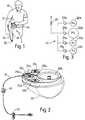
- Figure 1 is a perspective view of a portable infusion apparatus constructed in accordance with the invention shown operatively connected to a patient;
- Figure 2 is an isometric view of a portable infusion apparatus constructed in accordance with the invention;
- Figure 3 is a schematic diagram of a portable infusion apparatus constructed in accordance with the invention;
- Figure 4 is a perspective view of a single pump of the portable infusion apparatus;
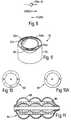
- Figure 5 is an exploded isometric view of the components of a single pump of the portable infusion apparatus;
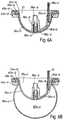
- Figure 6A is a cross sectional view of a single pump of the portable infusion apparatus as seen along line 6-6 in Figure 5 with an elastomeric membrane of the pump collapsed;
- Figure 6B is a cross sectional view of a single pump of the portable infusion apparatus as seen in Figure 6A with the elastomeric membrane of the pump expanded to establish a pressurized fluid chamber;
- Figure 7A is a modeled and empirically obtained Pressure versus Volume graph for the separate pumps of the infusion apparatus;
- Figure 7B is a Pressure v. Volume Delivered graph showing the discharge of fluids in a SASH process in a timed sequence;
- Figure 8 is schematic diagram of a check valve component for the infusion apparatus;
- Figure 9 is a schematic view of an alternate embodiment portable infusion apparatus;
- Figure 10A is a plan view of another alternate embodiment portable infusion apparatus for a SAS sequence; and
- Figure 11 is a schematic view of yet another alternate embodiment portable infusion apparatus having a generally cylindrical construction.
- Referring now to Figure 1, an infusion apparatus for infusing medical solutions in accordance with the invention is shown and generally designated as 10. As indicated in Figure 1 the
infusion apparatus 10 may be worn by a patient 12 during ambulation and can be attached to thepatient 12 by any well known means, such as abelt 14. Further, Figure 1 shows that theinfusion apparatus 10 can be connected in fluid communication with thepatient 12 for the infusion of fluids into the patient 12 through anIV line 16. It is also shown that theIV line 16 can include an in-line air filter 18 of a type well known in the pertinent art which will prevent the infusion of air to thepatient 12. Additionally, an on-offvalve 20 can be operatively associated with theIV line 16 to initiate or terminate the flow of fluid from theinfusion apparatus 10 through theIV line 16. Although the particular on-offvalve 20 which is shown in the Figures is a standard slide clamp, it is to be appreciated that any on-offvalve 20 that is well known in the pertinent art will suffice for purposes of the present invention. that is well known in the pertinent art will suffice for purposes of the present invention. - Referring now to Figure 2 the
infusion apparatus 10 is shown. Theinfusion apparatus 10 includes fourfluid pumps 22a-d mounted within asingle carrier housing 24. Theinfusion apparatus 10 shown is adapted to perform a SASH process. Alternatively a lesser or greater number offluid pumps 22a-d may be assembled within thecarrier housing 24. - As shown schematically in Figure 3, the fluid pumps 22a-d are coupled in flow communication to the
IV line 16. Additionally, eachpump 22a-d is coupled to acheck valve 25a-d. Thecheck valves 25a-b are located between theIV line 16 and the fluid pumps 22a-d to regulate a sequence of fluid flow from the fluid pumps 22a-d. Eachfluid pump 22a-d is adapted to deliver fluid at a substantially constant pressure until thepump 22a-d is substantially completely discharged. - Delivery pressure bands, P₁ through P₄, of the
pumps 22a-d are selected such that P₁ band, corresponding to pump 22a is greater than P₂ band corresponding to pump 22b. Likewise P₂ band is greater than P₃ band corresponding to pump 22c band and P₃ band is greater than P₄ band corresponding to pump 22d. (P₁ band > P₂ band > P₃ band > P₄ band). - As used herein the terms P₁, P₂, P₃, and P₄, refer to a delivery pressure band. P₁, P₂, P₃ and P₄ are not discreet values but bands of pressure which includes the difference in
- The
check valves 25a-d are each constructed to open at a preselected low differential pressure ΔP sensed between the downstream pressure in theIV line 16 and an upstream pressure determined by the pump delivery pressure of afluid pump 22a-d. Thecheck valves 25a-d can thus be constructed and arranged to allow fluid flow sequentially frompump 22a at pressure P₁,pump 22b at Pressure P₂:pump 22c at pressure P3, and pump 22d at pressure P₄. - The
infusion apparatus 10 is thus constructed to operate in a SASH process that includes the steps of: - 1. connecting a first reservoir with a dosage of a saline solution, a second reservoir with a dosage of an antibiotic solution, a third reservoir with a dosage of a saline solution, and a fourth reservoir with a dosage of a heparin solution, to an IV line; and
- 2. sequentially discharging a dose of saline from the first reservoir at a pressure of P₁, a dose of antibiotic from the second reservoir at a pressure of P₂, a dose of saline from the third reservoir at a pressure of P₃, and a dose of heparin from the fourth reservoir at a pressure of P₄ with P₁ > P₂ > P₃ > P₄.
- A
suitable fluid pump 22a-d for pumping or discharging fluid solutions at a substantially constant pressure is shown in Figures 4, 5, 6A and 6B. In general each of the fluid pumps 22a-d will be of the same construction but the pumps will be sized differently. For example eachpump 22a-d may be sized to contain a predetermined volume or dosage of solution which may be different. As an example the volumetric capacity of apump 22a-d may be in the range of 20-250ml for an antibiotic and 3-5 ml for saline depending on a required dosage. It is anticipated that the pump will be charged with a solution at the pharmacy although it is contemplated that a patient may charge some solutions. - With reference to Figure 4 a
pump 22a-d is shown. Eachpump 22a-d includes ahousing 27a-d. Anelastomeric membrane 26a-d is clamped betweenrings 40a-d and 44a-d and is then attached to thehousing 27a-d and to a shell (not shown), or to the carrier housing 34. Figure 4 also shows that thehousing 27a-d is formed with aninlet port 28a-d and anoutlet port 30a-d. Eachoutlet port 30a-d of thepumps 22a-d is coupled to anoutlet conduit 31a-d which in turn is coupled to theIV line 16. Eachcheck valve 25a-d is located in anoutlet conduit 31a-d situated between theoutlet port 30a-d of apump 22a-d and theIV line 16. The individual components of apump 22a-d, however, are best seen in Figure 5. - In Figure 5 the various components of a
pump 22a-d are shown in an exploded isometric and are arranged generally in the order in which they are to be assembled. Preferably, thehousing 27a-d is made of a hard plastic, such as polycarbonate, and is of a material which is chemically compatible with the fluid to be infused into theuser 12. For purposes of the present invention, acontour surface 32a-d ofhousing 27a-d can have any topology which will stretch themembrane 26a-d into its nonlinear region of elasticity when these components are assembled. Preferably, however, thecontour surface 32a-d ofhousing 27a-d will follow and conform to the natural topology of theinflated membrane 26a-d as it transitions from linear to non-linear. For the case shown in the Figures,contour surface 32a-d is substantially hemispherical. On the other hand, as shown in the Figures, theperiphery 34a-d ofhousing 27a-d is folded outwardly from thecontour surface 32a-d in order to facilitate the connection of themembrane 26a-d onto thehousing 27a-d. Thehousing 27a-d can be manufactured using any well known manufacturing procedures, such as injection molding. - A thin wall tube which forms
valve sleeve 36a-d, and avalve insert 38a-d are shown in Figure 3 in their positions for insertion into the lumen ofinlet port 28a-d. When inserted into the lumen ofinlet port 28a-d, thesleeve 36a-d and valve insert 38a-d establish a one-way valve for thehousing 27a-d which permits the flow of fluid in only one direction through theinlet port 28a-d. Specifically, it is important that eachfluid pump 22a-d will be filled with fluid through theinlet port 28a-d of each chamber but that fluid not be able to leave thefluid pump 22a-d through theinlet port 28a-d. A fluid may be loaded into aninlet port 28a-d under pressure utilizing a medical syringe (not shown). Additionally, it is important that during filling of the separate fluid pumps the sequence of filling be accomplished from the highest to the lowest pressures. - Each
pump 22a-d also includes an uppertop ring 40a-d which is engageable with arib 42a-d that is located on the circumference ofmembrane 26a-d.Upper ring 40a-d is also engageable with alower bottom ring 44a-d to effectively grip and hold therib 42a-d ofmembrane 26a-d between therings 40a-d and 44a-d. Theserings 40a-d and 44a-d can be of any suitable rigid material such as polycarbonate which, when therings 40a-d and 44a-d are joined together to support theflexible membrane 26a-d, will provide a firm foundation for themembrane 26a-d. - With specific regard to the
membrane 26a-d, it is seen in Figure 3 that themembrane 26a-d is substantially a circular sheet when in its unstretched condition. Further, this sheet is formed with a raisedrib 42a-d which, as mentioned above, can be gripped between therings 40a-d and 44a-d. Although it will be appreciated that most elastomeric materials may be suitable for the purposes of the present invention, themembrane 26a-d is preferably made of a natural rubber or isoprene having a high elastic memory. Regardless of the particular material used formembrane 26a-d, however, it is important that themembrane 26a-d be chemically compatible with the fluid medicament which is to be infused to theuser 12 from eachpump 22a-d. If there is no compatibility between themembrane 26a-d and the fluid medicament a drug barrier needs to be created between the two. To establish such a drug barrier, themembrane 26a-d can be appropriately coated so that the particular surface ofmembrane 26a-d which is to be placed in contact with thecontour surface 32a-d ofhousing 27a-d will not chemically interact with the fluid medicament in thepump 22a-d. Alternatively, though not shown in the Figures, a medicament compatible membrane can be held with themembrane 26a-d between therings 40a-d and 44a-d. With this combination, the medicament compatible membrane is positioned between themembrane 26a-d and thecontour surface 32a-d ofhousing 27a-d when these components are assembled. For purposes of the present invention, the portion ofmembrane 26a-d which is circumscribed by therib 42a-d is preferably of uniform thickness. It is recognized, however, that thickness may be varied across themembrane 26a-d as long as the resultant topology creates a nonlinear elastomeric behavior for themembrane 26a-d. In addition, the thickness of themembranes 26a-d will in part be different for eachpump 22a-d for achieving a different operating pressure for eachpump 22a-d. - The cooperation of the various structural elements of each
pump 22a-d will be best appreciated with reference to both Figures 6A and 6B. First, in Figure 6A it is seen that the uppertop ring 40a-d is joined to thelower bottom ring 44a-d to grip and holdrib 42a-d ofmembrane 26a-d therebetween. Therings 40a-d and 44a-d can be joined together by any of several means, such as ultrasonic welding or solvent bonding. Additionally, as seen in Figure 6A, theperiphery 34a-d ofhousing 27a-d is joined to uppertop ring 40a-d. Whenhousing 27a-d is joined to uppertop ring 40, thecontour surface 32a-d ofhousing 27a-d stretchesmembrane 26a-d substantially as shown. Importantly, the dimensions of bothmembrane 26a-d andcontour surface 32a-d are such that this stretching takes themembrane 26a-d into its nonlinear region of elasticity. The joining ofhousing 27a-d to uppertop ring 40a-d also establishes a potential chamber orreservoir 50a-d between themembrane 25a-d andcontour surface 32a-d. - Referring now to both Figures 6A and 6B, it can be appreciated that as fluid is introduced through the
inlet port 28a-d ofhousing 27a-d and into thepotential chamber 50a-d under the pressure of a syringe, or some other pumping means, any air in the system will first be vented to theoutlet port 30a-d along theindentation 52a-d which is formed intocontour surface 32a-d. This, of course, always happens when the air pressure is less than the pressure necessary to distend themembrane 26a-d. Then, withoutlet port 30a-d blocked to prevent the flow of liquid medicament fromchamber 50a-d, theelastomeric membrane 26a-d will begin to expand as additional liquid medicament is introduced into thepotential chamber 50. It is important to the present invention that in order to create a substantially constant fluid pumping pressure in thechamber 50a-d, the expansion, and subsequent contraction, ofmembrane 26a-d be entirely accomplished with the exception of the last or lowestpressure fluid pump 22d whilemembrane 26a-d is in its nonlinear region of elasticity. As previously stated theelastomeric membrane 26a-d is initially stretched into its nonlinear region of elasticity during assembly of eachpump 22a-d. It can be appreciated that during subsequent loading of a fluid intochamber 50a-d, a pump means such as a medical syringe must overcome the force which is exerted by theelastomeric membrane 26a-d. There must then be additional non-linear stretching of themembrane 26a-d to form and expand thechamber 50a-d as shown in Figure 6B. - Viewed from an energy standpoint, a fluid must be introduced under a pressure sufficient to overcome the potential energy of the initially stretched
membrane 26a-d and form thechamber 50 a-d. This total amount of energy minus what has been lost through heat loss and elastomeric hysteresis is thus available for displacing fluid from thechamber 50a-d at a substantially constant delivery pressure. Further, because of the initial non-linear stretching of themembrane 26a-d, even after complete discharge of a fluid, a residual force is maintained by themembrane 26a-d acting upon thecontour surface 32a-d. - As previously stated each
pump 22a-d must be sized to deliver a predetermined volume of fluid solution over a substantially constant predetermined delivery pressure. A size of thepump 22a-d may thus be adjusted to achieve a predetermined volume. For achieving a predetermined delivery pressure a thickness of theelastomeric membrane 26a-d as well as the material may be selected as required. - In general, the delivery pressure of a
pump 22a-d will vary with the thickness of theelastomeric membrane 26a-d. Likewise the delivery pressure will vary with the modulus of elasticity of the material selected for theelastomeric membrane 26a-d. - Figures 7A and 7B illustrate representative volume versus pressure characteristics of the four
fluid pumps 22a-d. Curves Ca-d of Figure 7A illustrate the volume versus-pressure characteristics ofpumps 22a-d respectively. In general eachpump 22a-d is constructed to deliver fluid over a relatively constant pressure band. As isapparent pump 22a operates at the highest pressure band followed bypump - The
check valves 25a-d for eachpump 22a-d must be configured to crack with a relatively small pressure differential ΔP between the respective operating pressures P₁-P₄ for thepumps 22a-d.Such check valves 25a-d are commercially available and in general function as shown in the schematic illustration of Figure 8. Additionally, thecheck valve 25a downstream ofpump 22a may be eliminated if desired. - In addition the configuration noted in Figure 2 with four
separate fluid pumps 22a-d may also be varied, as long as four separate reservoirs or chambers each at a different pressure are provided. As an example, a single pump having a single elastomeric membrane that covers a plurality of juxtaposed chambers may be provided. The thickness of the elastomeric membrane may be varied to provide a pressure differential between the separate chambers. - Figure 9 illustrates such an alternative embodiment infusion apparatus. Alternate
embodiment infusion apparatus 51 includes ahousing 53 having a plurality ofcontour surfaces 54a-d formed thereon. A single concentricelastomeric membrane 56 is mounted in operative alignment with the contour surfaces 54a-d substantially as previously described forelastomeric membrane 26a-d. Concentricelastomeric membrane 56 is formed however, with a varying thickness for providing chambers corresponding to contoursurfaces 54a-d. The pumping or delivery pressure from each chamber can thus be varied as required. - As shown in plan view in Figure 10 a
single infusion apparatus 60 for a SASH process may include four separate chambers S,A,S,H, concentrically arranged and divided. Figure 10A illustrates asingle infusion apparatus 62 having three separate and concentrically arranged chambers (S,A,S). In either case the largest chamber (A) is in the center. - Figure 11 illustrates yet another
infusion apparatus 64 formed with ashell 68 and separate chambers formed by a singleelastomeric membrane 66. Theshell 66 may be sized to contain a fixed volume for each separate chamber. - Thus the invention provides a method and apparatus for infusing a plurality of medical solutions in a controlled sequence. The apparatus of the invention is simple in construction and may operate automatically in a SASH process. Moreover the method and apparatus of the invention is suitable for use by a mobile or ambulatory patient.
- While the particular portable IV infusion apparatus as herein shown and disclosed in detail is fully capable of obtaining the objects and providing the advantages herein before stated, it is to be understood that it is merely illustrative of the presently preferred embodiments of the invention and that no limitations are intended to the details of the construction or design herein shown other than as defined in the appended claims.
Claims (16)
- A method for sequentially supplying a plurality of solutions characterised by comprising:
connecting a first and a second reservoir to a single fluid line;
pressurizing a first fluid in the first reservoir to a pressure band of P₁ with an elastomeric membrane;
pressurizing a second fluid in the second reservoir to a pressure band of P₂ with an elastomeric membrane with P₁ > P₂;
sequencing fluid flow such that the first reservoir is effectively discharged of fluid prior to the second reservoir discharging fluid. - The method according to claim 1 further comprising:
discharging the first reservoir at a substantially constant pressure P₁; and
discharging the second reservoir. - A method according to claim 1 or 2 comprising:
pressurizing with an elastomeric membrane a first reservoir for a fluid solution to a pressure band of P₁, a second reservoir for a fluid solution to a pressure band of P₂, a third reservoir for a fluid solution to a pressure band of P₃, and a fourth reservoir for a fluid solution to a pressure band of P₄, with P₁ > P₂ > P₃ > P₄;
connecting each reservoir in flow communication to a fluid line;
discharging fluid sequentially from the first reservoir, then the second reservoir, then the third reservoir, and then the fourth reservoir with each reservoir substantially discharged of fluid prior to a next reservoir discharging fluid. - A method according to claim 3 further comprising:
discharging the first, second and third reservoirs at a substantially constant pressure. - A method according to any one of the preceding claims wherein:
pressurizing the reservoirs is with an elastomeric membrane by nonlinear contraction of the membrane while the membrane remains in a region of nonlinear elasticity. - A method according to any one of the preceding claims wherein sequentially discharging fluid is by sensing a pressure differential between the reservoirs and the fluid line with a check valve for providing sequential fluid flow from each reservoir to the fluid line.
- The method according to any one of the preceding
claims wherein:
the elastomeric membrane is stretched over a contour surface substantially hemispherical in shape to form a chamber. - The method according to any one of the preceding claims wherein:
the pressures P₁, P₂, P₃ and P₄ are controlled by a predetermined thickness of the elastomeric membrane. - The method according to any one of the preceding claims wherein:
different elastomeric membranes are utilized for each reservoir and the pressures P₁, P₂, P₃ and P₄ are controlled by a modulus of elasticity of the elastomeric membrane. - Apparatus for infusing medical fluids characterised in that it comprises:
a first and second fluid pumping means coupled to an IV line for discharging fluid from a first chamber at a substantially constant pressure of P₁ and for discharging fluid from a second chamber at a substantially constant pressure of P₂; and
valving means for controlling fluid flow sequentially from the pumping means such that the first chamber is substantially discharged prior to initiating and discharging flow from the second chamber. - Apparatus according to claim 10 comprising:
first, second, third, and fourth pumping means for pumping fluids at a substantially constant pressure bands of P₁, P₂, P₃ and P₄ respectively from first, second, third and fourth chambers with P₁ > P₂ > P₃ > P₄;
means for mounting and coupling said pumping means to an IV line; and
valving means for sequentially completely discharging fluid from the first then the second then the third, and then the fourth chambers. - Apparatus according to claim 10 or 11 wherein each pumping means comprises:
a housing having a fluid port, the housing being formed with a surface having a periphery ad a predetermined contour circumscribed by the periphery; and
an elastomeric membrane attached to the periphery over said contour surface to stretch the membrane into a nonlinear region of elasticity and create a potential chamber between the stretched membrane and the housing for receiving fluid therein through the port and expelling fluid therefrom through the port by nonlinear contraction of the membrane at a substantially constant pressure. - Apparatus according to claim 15 and wherein:
the valving means comprises a plurality of check valves located between the fluid pumping means and the IV line to sense a differential pressure between the pumping means and IV lines and initiate a sequential fluid flow from the fluid pumping means. - Apparatus according to any one of claims 10 to 12 wherein:
the chambers are formed on a single housing and a single membrane of a varying thickness covers the reservoirs. - Apparatus according to claim 14 wherein:
the chambers are concentrically arranged and divided. - Apparatus according to claim 14 wherein:
the chambers are formed by a cylindrical shell separated into separate chambers by the elastomeric membrane and sized to contain a fixed volume per chamber.
Applications Claiming Priority (2)
| Application Number | Priority Date | Filing Date | Title |
|---|---|---|---|
| US790367 | 1991-11-12 | ||
| US07/790,367US5368570A (en) | 1991-11-12 | 1991-11-12 | Apparatus for infusing medical solutions |
Publications (1)
| Publication Number | Publication Date |
|---|---|
| EP0542401A1true EP0542401A1 (en) | 1993-05-19 |
Family
ID=25150481
Family Applications (1)
| Application Number | Title | Priority Date | Filing Date |
|---|---|---|---|
| EP92305358AWithdrawnEP0542401A1 (en) | 1991-11-12 | 1992-06-11 | Method and apparatus for infusing medical solutions |
Country Status (5)
| Country | Link |
|---|---|
| US (1) | US5368570A (en) |
| EP (1) | EP0542401A1 (en) |
| JP (1) | JPH05208049A (en) |
| AU (1) | AU2356992A (en) |
| CA (1) | CA2068563A1 (en) |
Cited By (5)
| Publication number | Priority date | Publication date | Assignee | Title |
|---|---|---|---|---|
| US5478211A (en)* | 1994-03-09 | 1995-12-26 | Baxter International Inc. | Ambulatory infusion pump |
| US5520523A (en)* | 1992-06-22 | 1996-05-28 | Nippondenso Co., Ltd. | Diaphragm-type pump |
| WO1998001169A3 (en)* | 1996-07-07 | 1998-05-07 | Volker Lang | Application device with metering container, in particular for dispensing drug solutions |
| EP1594559A4 (en)* | 2002-03-26 | 2008-08-13 | Becton Dickinson Co | Multi-stage fluid delivery device and method |
| WO2013118052A1 (en)* | 2012-02-10 | 2013-08-15 | Kimberly-Clark Worldwide, Inc. | Improved inflatable elastomeric pump for an infusion assembly |
Families Citing this family (51)
| Publication number | Priority date | Publication date | Assignee | Title |
|---|---|---|---|---|
| US5716343A (en)* | 1989-06-16 | 1998-02-10 | Science Incorporated | Fluid delivery apparatus |
| US5656032A (en)* | 1989-06-16 | 1997-08-12 | Science Incorporated | Fluid delivery apparatus and method of making same |
| FR2681250B1 (en)* | 1991-09-18 | 1998-09-04 | Pierre Antonetti | MEANS OF PRESSURIZATION FOR DIFFERENT TYPES OF INFUSION OF WHICH THE DROPPER IS PROVIDED WITH A MEANS TO ENSURE ITS VERTICALITY. |
| US20080215029A1 (en)* | 1993-01-22 | 2008-09-04 | I-Flow Corporation | Platen pump |
| US5830187A (en)* | 1995-12-22 | 1998-11-03 | Science Incorporated | Fluid delivery device with conformable ullage and fill assembly |
| US6485462B1 (en)* | 1997-08-27 | 2002-11-26 | Science Incorporated | Fluid delivery device with heat activated energy source |
| US6527744B1 (en)* | 1997-08-27 | 2003-03-04 | Science Incorporated | Fluid delivery device with light activated energy source |
| US6200293B1 (en)* | 1997-08-27 | 2001-03-13 | Science Incorporated | Fluid delivery device with temperature controlled energy source |
| US5961492A (en)* | 1997-08-27 | 1999-10-05 | Science Incorporated | Fluid delivery device with temperature controlled energy source |
| US6074366A (en)* | 1998-01-16 | 2000-06-13 | Tandem Medical Inc. | Medication delivery apparatus |
| US6193704B1 (en) | 1999-06-10 | 2001-02-27 | Thomas F. Winters | Site-specific postoperative pain relief system, fit and method |
| US6428518B1 (en) | 1999-11-05 | 2002-08-06 | Tandem Medical | Medication delivery container |
| US6726655B1 (en) | 1999-11-05 | 2004-04-27 | Tandem Medical | Medication delivery system |
| US6391001B1 (en)* | 2000-09-21 | 2002-05-21 | Jolie Graham | Intravenous line flushing device |
| US20030105428A1 (en)* | 2001-12-05 | 2003-06-05 | John Hogan | Electronically controlled fluid delivery device |
| SE520340C2 (en)* | 2002-03-14 | 2003-06-24 | Billy Nilson | Ambulatory diaphragm pump |
| CN1668358A (en)* | 2002-05-16 | 2005-09-14 | 斯科特实验室公司 | Medical supply kits for sedation and pain relief |
| IL157981A (en) | 2003-09-17 | 2014-01-30 | Elcam Medical Agricultural Cooperative Ass Ltd | Auto-injector |
| IL160891A0 (en) | 2004-03-16 | 2004-08-31 | Auto-mix needle | |
| EP1812101A4 (en) | 2004-11-16 | 2014-04-23 | Medrad Inc | Modeling of pharmaceutical propagation |
| HUE034171T2 (en) | 2004-11-24 | 2018-02-28 | Bayer Healthcare Llc | Devices, systems and methods for fluid delivery |
| TWI268157B (en)* | 2005-06-15 | 2006-12-11 | Zheng-Xian You | Portable transfusing apparatus for medicinal use used for transfusing bag-type medicinal liquid into human body |
| EP3165247B1 (en)* | 2006-02-09 | 2020-10-28 | DEKA Products Limited Partnership | Pumping fluid delivery systems and methods using force application assembley |
| US20080097317A1 (en)* | 2006-08-25 | 2008-04-24 | Jeffery Alholm | Infusion pump |
| EP3376504A1 (en) | 2006-12-29 | 2018-09-19 | Bayer Healthcare, LLC | Patient-based parameter generation systems for medical injection procedures |
| US8428694B2 (en) | 2007-07-17 | 2013-04-23 | Medrad, Inc. | Methods for determination of parameters for a procedure, for estimation of cardiopulmonary function and for fluid delivery |
| EP2334354A4 (en)* | 2008-10-15 | 2014-01-22 | Symbios Medical Products Llc | Electronic flow control |
| US9421330B2 (en) | 2008-11-03 | 2016-08-23 | Bayer Healthcare Llc | Mitigation of contrast-induced nephropathy |
| US8282046B2 (en)* | 2009-02-12 | 2012-10-09 | Becton, Dickinson And Company | Systems and methods for organizing and priming an IV administration set |
| AU2011270772C1 (en) | 2010-06-24 | 2017-04-20 | Bayer Healthcare Llc | Modeling of pharmaceutical propagation and parameter generation for injection protocols |
| DK2850418T3 (en) | 2012-05-14 | 2019-05-20 | Bayer Healthcare Llc | SYSTEMS AND PROCEDURES FOR DETERMINING PROTOCOLS FOR PHARMACEUTICAL LIQUID INJECTION BASED ON X-ray tube tension |
| US9555379B2 (en) | 2013-03-13 | 2017-01-31 | Bayer Healthcare Llc | Fluid path set with turbulent mixing chamber, backflow compensator |
| CN105056338A (en)* | 2015-08-24 | 2015-11-18 | 吴江富凯医用卫生用品有限公司 | Portable infusion frame |
| US10898638B2 (en) | 2016-03-03 | 2021-01-26 | Bayer Healthcare Llc | System and method for improved fluid delivery in multi-fluid injector systems |
| US12263326B2 (en) | 2016-11-14 | 2025-04-01 | Bayer Healthcare Llc | Methods and systems for verifying the contents of a syringe used for medical fluid delivery |
| US9849233B1 (en)* | 2017-05-10 | 2017-12-26 | Novus Medical Products, Inc. | Disposable infusion pump system for ambulatory patients |
| WO2019046261A1 (en) | 2017-08-31 | 2019-03-07 | Bayer Healthcare Llc | System and method for drive member position and fluid injector system mechanical calibration |
| EP3676854A1 (en) | 2017-08-31 | 2020-07-08 | Bayer Healthcare LLC | Fluid path impedance assessment for improving fluid delivery performance |
| AU2018326386B2 (en) | 2017-08-31 | 2024-03-28 | Bayer Healthcare Llc | Fluid injector system volume compensation system and method |
| JP7493337B2 (en) | 2017-08-31 | 2024-05-31 | バイエル・ヘルスケア・エルエルシー | Method for dynamic pressure control in a fluid injector system - Patents.com |
| EP3675931B1 (en) | 2017-08-31 | 2021-08-11 | Bayer Healthcare LLC | Injector pressure calibration system and method |
| EP3781233B1 (en) | 2018-04-19 | 2025-09-17 | Bayer Healthcare LLC | System and method for air detection in fluid injector |
| US11660389B2 (en)* | 2018-07-17 | 2023-05-30 | Insulet Corporation | Semi-rigid and flexible elements for wearable drug delivery device reservoir |
| JP7450608B2 (en) | 2018-08-28 | 2024-03-15 | バイエル・ヘルスケア・エルエルシー | Fluid injector system, method for preventing fluid backflow, and computer program product |
| CA3111209A1 (en) | 2018-08-28 | 2020-03-05 | Bayer Healthcare Llc | Fluid injector system with improved ratio performance |
| US11364339B2 (en) | 2019-07-11 | 2022-06-21 | Aamir Zain Jamal | Infusion unit |
| DE102020202186A1 (en)* | 2020-02-20 | 2021-08-26 | B. Braun Melsungen Aktiengesellschaft | Elastomer diaphragm for a medical elastomer pump and medical elastomer pump with such an elastomer diaphragm |
| CN115443161B (en)* | 2020-04-20 | 2023-11-10 | 株式会社Sk电子 | Pressurized medicine injector with medicine exposure prevention function |
| US11980736B2 (en) | 2020-05-26 | 2024-05-14 | Carefusion 202, Inc. | Infusion pump flow rate control |
| US12090498B2 (en) | 2021-08-19 | 2024-09-17 | Insulet Corporation | Low-friction rolling plunger for a wearable drug delivery device |
| USD1024314S1 (en) | 2022-06-01 | 2024-04-23 | Insulet Corporation | Automated drug delivery device |
Citations (3)
| Publication number | Priority date | Publication date | Assignee | Title |
|---|---|---|---|---|
| DE2430673A1 (en)* | 1974-06-26 | 1976-01-15 | Essig Georg | Medical continuous infusion system - has multi fluid-container system with automatic change-over, level sensor, cut-off valve and alarm |
| EP0089404A1 (en)* | 1979-02-28 | 1983-09-28 | Abbott Laboratories | Gravitational flow system for the sequential administration of a plurality of medical liquids |
| EP0380862A2 (en)* | 1989-02-02 | 1990-08-08 | Imed Corporation | Disposable infusion device |
Family Cites Families (57)
| Publication number | Priority date | Publication date | Assignee | Title |
|---|---|---|---|---|
| US7816A (en)* | 1850-12-03 | Improvement in vulcanizing india-rubber | ||
| US1895623A (en)* | 1930-03-10 | 1933-01-31 | William R Hewitt | Pump |
| US1907673A (en)* | 1931-06-13 | 1933-05-09 | Edward A Rockwell | Fuel pump |
| US2222869A (en)* | 1937-05-27 | 1940-11-26 | Jencick Stephen | Pump |
| US2471796A (en)* | 1945-10-01 | 1949-05-31 | George A Thiberg | Air pump for aquarium aerators |
| US2803195A (en)* | 1953-02-19 | 1957-08-20 | Lock John Henry | Fuel pump |
| US2764942A (en)* | 1953-11-03 | 1956-10-02 | Guarnaschelli Vincent | Fuel pump adjusters |
| US2791186A (en)* | 1954-01-04 | 1957-05-07 | Phillips Petroleum Co | Liquid-fuel system |
| US2930324A (en)* | 1955-10-03 | 1960-03-29 | Ohio Commw Eng Co | Magnetic pump |
| US3039399A (en)* | 1959-12-07 | 1962-06-19 | Foregger Company Inc | Pump |
| US3080825A (en)* | 1960-02-11 | 1963-03-12 | Guarnaschelli Vincent | Fuel pump adjusters |
| US3212446A (en)* | 1962-10-18 | 1965-10-19 | Robertshaw Controls Co | Fluid pump or the like and method for making the same |
| US3469578A (en)* | 1965-10-12 | 1969-09-30 | Howard R Bierman | Infusion device for ambulatory patients with flow control means |
| US3468308A (en)* | 1966-01-17 | 1969-09-23 | Howard R Bierman | Pressure infusion device for ambulatory patients with pressure control means |
| US3381582A (en)* | 1966-06-24 | 1968-05-07 | Robertshaw Controls Co | Fluidic operated multiposition actuator or the like |
| US3416461A (en)* | 1966-09-01 | 1968-12-17 | Hills Mccanna Co | Diaphragm pump |
| US3412906A (en)* | 1966-12-05 | 1968-11-26 | Amp Inc | Plasma infusor |
| US3506005A (en)* | 1967-02-23 | 1970-04-14 | Arthur S Gilio | Pressure infusion device for medical use |
| US3496878A (en)* | 1967-04-07 | 1970-02-24 | Bio Medical Systems Inc | System and apparatus for transfer of human fluids |
| US3698595A (en)* | 1969-12-22 | 1972-10-17 | Norman Gortz | Pressurized dispenser |
| US3677444A (en)* | 1970-03-06 | 1972-07-18 | Estin Hans H | Micropump |
| US3653377A (en)* | 1970-10-01 | 1972-04-04 | Bloom Leonard | Portable power-operated douching appliance |
| US3907169A (en)* | 1970-11-03 | 1975-09-23 | Norman Gortz | Bladder type dispenser |
| US3672543A (en)* | 1971-02-11 | 1972-06-27 | Plant Ind Inc | Flowable substances dispenser |
| US3738538A (en)* | 1971-02-11 | 1973-06-12 | Plant Ind Inc | Dispenser for flowable substances |
| US3791557A (en)* | 1972-01-13 | 1974-02-12 | Plant Ind Inc | Non-aerosol container with expansible bladder and expelling force providing sheath |
| US3947156A (en)* | 1972-03-08 | 1976-03-30 | Erich Becker | Diaphragm pump, particularly for the generation of vacuum |
| US3796356A (en)* | 1972-04-12 | 1974-03-12 | Plant Ind Inc | Telescoping mandrel for expansible bladder container |
| US3876115A (en)* | 1972-04-27 | 1975-04-08 | Plant Ind Inc | Double expansible bladder container |
| US3940026A (en)* | 1973-03-26 | 1976-02-24 | Krdc | Container for pressure dispensing of fluid |
| US3961725A (en)* | 1974-04-09 | 1976-06-08 | Clark Richard A | Method and apparatus for dispensing fluids under pressure |
| US4140117A (en)* | 1975-05-12 | 1979-02-20 | Alza Corporation | Cartridge for liquid infusion apparatus |
| US3981415A (en)* | 1975-10-29 | 1976-09-21 | E. I. Du Pont De Nemours And Company | Dispenser with expansible member and contracting fabric |
| US4324350A (en)* | 1978-04-24 | 1982-04-13 | Thompson Kenneth W | Elastomeric apparatus for pressure dispensing of fluid |
| US4446991A (en)* | 1978-04-24 | 1984-05-08 | Thompson Kenneth W | Self-contained fluid dispenser |
| US4222499A (en)* | 1979-05-07 | 1980-09-16 | Kain's Research & Development Company, Inc. | Pressurized fluid dispensing apparatus having expansible bladder held in place with compressive forces |
| US4318400A (en)* | 1980-01-18 | 1982-03-09 | Alza Corporation | Medical infusor |
| US4386929A (en)* | 1980-01-18 | 1983-06-07 | Alza Corporation | Elastomeric bladder assembly |
| US4458830A (en)* | 1981-05-18 | 1984-07-10 | Werding Winfried J | Appliance for discharging a non-compressible liquid, creamy or pasty product under pressure |
| US4411603A (en)* | 1981-06-24 | 1983-10-25 | Cordis Dow Corp. | Diaphragm type blood pump for medical use |
| US4491247A (en)* | 1981-07-21 | 1985-01-01 | Nitchman Harold L | System, apparatus, and method of dispensing a liquid from a semi-bulk disposable container |
| US4419096A (en)* | 1982-02-22 | 1983-12-06 | Alza Corporation | Elastomeric bladder assembly |
| JPS59194093A (en)* | 1983-04-19 | 1984-11-02 | Toyota Motor Corp | diaphragm fluid pump |
| US4702397A (en)* | 1984-09-18 | 1987-10-27 | Infusion Systems Corporation | Pressurized fluid dispenser |
| US4573883A (en)* | 1985-03-01 | 1986-03-04 | Baylor College Of Medicine | Disposable blood pump |
| US4772263A (en)* | 1986-02-03 | 1988-09-20 | Regents Of The University Of Minnesota | Spring driven infusion pump |
| US4734008A (en)* | 1986-06-20 | 1988-03-29 | General Motors Corporation | Pump impeller |
| US4734092A (en)* | 1987-02-18 | 1988-03-29 | Ivac Corporation | Ambulatory drug delivery device |
| US4925444A (en)* | 1987-08-07 | 1990-05-15 | Baxter Travenol Laboratories, Inc. | Closed multi-fluid delivery system and method |
| US4953753A (en)* | 1988-06-10 | 1990-09-04 | The Norman Company | Fluid dispensing apparatus with prestressed bladder |
| US5013303A (en)* | 1988-11-03 | 1991-05-07 | Yehuda Tamari | Constant pressure infusion device |
| US4994033A (en)* | 1989-05-25 | 1991-02-19 | Schneider (Usa) Inc. | Intravascular drug delivery dilatation catheter |
| US5019047A (en)* | 1989-06-16 | 1991-05-28 | Science Incorporated | Fluid delivery apparatus |
| EP0564567A1 (en)* | 1990-12-27 | 1993-10-13 | Block Medical, Inc. | Closed system for iv site flush |
| US5188603A (en)* | 1991-01-03 | 1993-02-23 | Vaillancourt Vincent L | Fluid infusion delivery system |
| US5298025A (en)* | 1991-07-08 | 1994-03-29 | Baxter International Inc. | Sequential flow rate infusion rate |
| US5167631A (en)* | 1991-09-17 | 1992-12-01 | Imed Corporation | Portable infusion device |
- 1991
- 1991-11-12USUS07/790,367patent/US5368570A/ennot_activeExpired - Lifetime
- 1992
- 1992-05-13CACA002068563Apatent/CA2068563A1/ennot_activeAbandoned
- 1992-06-11EPEP92305358Apatent/EP0542401A1/ennot_activeWithdrawn
- 1992-07-07JPJP4178754Apatent/JPH05208049A/enactivePending
- 1992-09-14AUAU23569/92Apatent/AU2356992A/ennot_activeAbandoned
Patent Citations (3)
| Publication number | Priority date | Publication date | Assignee | Title |
|---|---|---|---|---|
| DE2430673A1 (en)* | 1974-06-26 | 1976-01-15 | Essig Georg | Medical continuous infusion system - has multi fluid-container system with automatic change-over, level sensor, cut-off valve and alarm |
| EP0089404A1 (en)* | 1979-02-28 | 1983-09-28 | Abbott Laboratories | Gravitational flow system for the sequential administration of a plurality of medical liquids |
| EP0380862A2 (en)* | 1989-02-02 | 1990-08-08 | Imed Corporation | Disposable infusion device |
Cited By (11)
| Publication number | Priority date | Publication date | Assignee | Title |
|---|---|---|---|---|
| US5520523A (en)* | 1992-06-22 | 1996-05-28 | Nippondenso Co., Ltd. | Diaphragm-type pump |
| US5478211A (en)* | 1994-03-09 | 1995-12-26 | Baxter International Inc. | Ambulatory infusion pump |
| WO1998001169A3 (en)* | 1996-07-07 | 1998-05-07 | Volker Lang | Application device with metering container, in particular for dispensing drug solutions |
| EP1594559A4 (en)* | 2002-03-26 | 2008-08-13 | Becton Dickinson Co | Multi-stage fluid delivery device and method |
| EP2578253A3 (en)* | 2002-03-26 | 2013-11-27 | Becton, Dickinson and Company | Multi-stage fluid delivery device and method |
| EP3351277A1 (en)* | 2002-03-26 | 2018-07-25 | Becton, Dickinson and Company | Multi-stage fluid delivery device and method |
| WO2013118052A1 (en)* | 2012-02-10 | 2013-08-15 | Kimberly-Clark Worldwide, Inc. | Improved inflatable elastomeric pump for an infusion assembly |
| CN104105514A (en)* | 2012-02-10 | 2014-10-15 | 金伯利-克拉克环球有限公司 | Improved expandable elastic pump for infusion set |
| US8968242B2 (en) | 2012-02-10 | 2015-03-03 | Avent, Inc. | Inflatable elastomeric pump for an infusion assembly |
| CN104105514B (en)* | 2012-02-10 | 2018-01-02 | 金伯利-克拉克环球有限公司 | Improved expandable elastic pump for infusion set |
| US9925332B2 (en) | 2012-02-10 | 2018-03-27 | Avent, Inc. | Inflatable elastomeric pump for an infusion assembly |
Also Published As
| Publication number | Publication date |
|---|---|
| CA2068563A1 (en) | 1993-05-13 |
| US5368570A (en) | 1994-11-29 |
| AU2356992A (en) | 1993-05-13 |
| JPH05208049A (en) | 1993-08-20 |
Similar Documents
| Publication | Publication Date | Title |
|---|---|---|
| US5368570A (en) | Apparatus for infusing medical solutions | |
| US5167631A (en) | Portable infusion device | |
| US5993425A (en) | Fluid dispenser with reservoir fill assembly | |
| US6669669B2 (en) | Laminated patient infusion device | |
| US5308334A (en) | Closed system for iv site flush | |
| US5188603A (en) | Fluid infusion delivery system | |
| US4813937A (en) | Ambulatory disposable infusion delivery system | |
| US5219331A (en) | Pumping system for intravenous administration of a secondary treatment fluid | |
| AU621750B2 (en) | Continuous/bolus infusor | |
| CA2486347C (en) | Refill kit for an implantable pump | |
| EP0291612B1 (en) | Implantable pump. | |
| US20060041229A1 (en) | Flow restriction system and method for patient infusion device | |
| US20080051701A1 (en) | Infusion apparatus with constant force spring energy source | |
| US5263940A (en) | Fluid dispenser | |
| US5298025A (en) | Sequential flow rate infusion rate | |
| US6360784B1 (en) | Valved connector and method of use | |
| US5433709A (en) | Fluid dispensing apparatus including mounting base for a plurality of fluid dispensing devices | |
| US5484415A (en) | Fluid dispensing apparatus | |
| JP2717004B2 (en) | Chemical injection device | |
| WO2021105981A9 (en) | Fluid pump | |
| EP0245056A1 (en) | Ambulatory disposable infusion pump | |
| JP3959285B2 (en) | Liquid supply tool | |
| WO2001052917A2 (en) | Medicament dispenser and cooperating reservoir fill assembly | |
| AU2002331913A1 (en) | Laminated patient infusion device |
Legal Events
| Date | Code | Title | Description |
|---|---|---|---|
| PUAI | Public reference made under article 153(3) epc to a published international application that has entered the european phase | Free format text:ORIGINAL CODE: 0009012 | |
| AK | Designated contracting states | Kind code of ref document:A1 Designated state(s):BE DE FR GB IT LU NL SE | |
| STAA | Information on the status of an ep patent application or granted ep patent | Free format text:STATUS: THE APPLICATION IS DEEMED TO BE WITHDRAWN | |
| 18D | Application deemed to be withdrawn | Effective date:19931120 |