CN215839325U - Suction device for an intraosseous access system - Google Patents
Suction device for an intraosseous access systemDownload PDFInfo
- Publication number
- CN215839325U CN215839325UCN202122169513.3UCN202122169513UCN215839325UCN 215839325 UCN215839325 UCN 215839325UCN 202122169513 UCN202122169513 UCN 202122169513UCN 215839325 UCN215839325 UCN 215839325U
- Authority
- CN
- China
- Prior art keywords
- needle
- access system
- obturator
- vacuum
- housing
- Prior art date
- Legal status (The legal status is an assumption and is not a legal conclusion. Google has not performed a legal analysis and makes no representation as to the accuracy of the status listed.)
- Active
Links
Images

Classifications
- A—HUMAN NECESSITIES
- A61—MEDICAL OR VETERINARY SCIENCE; HYGIENE
- A61B—DIAGNOSIS; SURGERY; IDENTIFICATION
- A61B17/00—Surgical instruments, devices or methods
- A61B17/34—Trocars; Puncturing needles
- A61B17/3472—Trocars; Puncturing needles for bones, e.g. intraosseus injections
- A—HUMAN NECESSITIES
- A61—MEDICAL OR VETERINARY SCIENCE; HYGIENE
- A61B—DIAGNOSIS; SURGERY; IDENTIFICATION
- A61B17/00—Surgical instruments, devices or methods
- A61B17/16—Instruments for performing osteoclasis; Drills or chisels for bones; Trepans
- A61B17/164—Instruments for performing osteoclasis; Drills or chisels for bones; Trepans intramedullary
- A—HUMAN NECESSITIES
- A61—MEDICAL OR VETERINARY SCIENCE; HYGIENE
- A61B—DIAGNOSIS; SURGERY; IDENTIFICATION
- A61B17/00—Surgical instruments, devices or methods
- A61B17/16—Instruments for performing osteoclasis; Drills or chisels for bones; Trepans
- A61B17/1613—Component parts
- A61B17/1628—Motors; Power supplies
- A—HUMAN NECESSITIES
- A61—MEDICAL OR VETERINARY SCIENCE; HYGIENE
- A61B—DIAGNOSIS; SURGERY; IDENTIFICATION
- A61B17/00—Surgical instruments, devices or methods
- A61B17/34—Trocars; Puncturing needles
- A61B17/3476—Powered trocars, e.g. electrosurgical cutting, lasers, powered knives
- A—HUMAN NECESSITIES
- A61—MEDICAL OR VETERINARY SCIENCE; HYGIENE
- A61B—DIAGNOSIS; SURGERY; IDENTIFICATION
- A61B17/00—Surgical instruments, devices or methods
- A61B2017/00367—Details of actuation of instruments, e.g. relations between pushing buttons, or the like, and activation of the tool, working tip, or the like
- A61B2017/00398—Details of actuation of instruments, e.g. relations between pushing buttons, or the like, and activation of the tool, working tip, or the like using powered actuators, e.g. stepper motors, solenoids
- A—HUMAN NECESSITIES
- A61—MEDICAL OR VETERINARY SCIENCE; HYGIENE
- A61B—DIAGNOSIS; SURGERY; IDENTIFICATION
- A61B17/00—Surgical instruments, devices or methods
- A61B2017/00477—Coupling
- A—HUMAN NECESSITIES
- A61—MEDICAL OR VETERINARY SCIENCE; HYGIENE
- A61B—DIAGNOSIS; SURGERY; IDENTIFICATION
- A61B17/00—Surgical instruments, devices or methods
- A61B2017/00681—Aspects not otherwise provided for
- A61B2017/00734—Aspects not otherwise provided for battery operated
- A—HUMAN NECESSITIES
- A61—MEDICAL OR VETERINARY SCIENCE; HYGIENE
- A61B—DIAGNOSIS; SURGERY; IDENTIFICATION
- A61B2217/00—General characteristics of surgical instruments
- A61B2217/002—Auxiliary appliance
- A61B2217/005—Auxiliary appliance with suction drainage system
Landscapes
- Health & Medical Sciences (AREA)
- Surgery (AREA)
- Life Sciences & Earth Sciences (AREA)
- Medical Informatics (AREA)
- Animal Behavior & Ethology (AREA)
- Veterinary Medicine (AREA)
- Public Health (AREA)
- Engineering & Computer Science (AREA)
- Biomedical Technology (AREA)
- Heart & Thoracic Surgery (AREA)
- General Health & Medical Sciences (AREA)
- Molecular Biology (AREA)
- Nuclear Medicine, Radiotherapy & Molecular Imaging (AREA)
- Orthopedic Medicine & Surgery (AREA)
- Dentistry (AREA)
- Oral & Maxillofacial Surgery (AREA)
- Pathology (AREA)
- Infusion, Injection, And Reservoir Apparatuses (AREA)
- Surgical Instruments (AREA)
- External Artificial Organs (AREA)
Abstract
Translated fromChinese
Description
Priority
This application claims priority to U.S. patent application No. 63/076,189, filed 9/2020, which is incorporated by reference in its entirety.
Technical Field
The present application relates to the field of medical devices, and more particularly to suction devices for intraosseous access systems.
Background
An Intraosseous (IO) access system is configured to access the medullary cavity of a bone by drilling an access needle into dense cortical bone and into the medullary cavity. Some IO access systems include a powered drill or similar device configured to rotate a needle assembly at a high rotational speed to drill an access needle through cortical bone. It is challenging to detect when the needle enters the medullary cavity. For example, to confirm access to the medullary cavity, the user must disengage the drill from the needle assembly, withdraw the obturator from the lumen of the needle, attach a syringe to the access needle and aspirate the needle lumen to observe the presence of bone marrow. Failure to aspirate bone marrow may mean that the access needle does not fully enter the medullary cavity and further drilling is required. However, in the event that the needle assembly is disengaged from the drill and the obturator is withdrawn from the needle lumen, the needle cannot be reused and the clinician must withdraw the needle, couple a new needle assembly to the drill, and continue drilling. Furthermore, during needle replacement, the patency of the original access location may be lost.
Systems, devices, and methods directed to solving the above-described problems are disclosed herein.
SUMMERY OF THE UTILITY MODEL
Disclosed herein is an intraosseous access system comprising: a housing; a needle assembly extending from the distal end of the housing and including an obturator extending along a longitudinal axis and disposed within the lumen of the needle; a aspiration system disposed within the housing and including one of a syringe or a vacuum pump, the aspiration system configured to slide the obturator relative to the needle and selectively provide a vacuum in fluid communication with the needle lumen, and a drive train disposed within the housing and configured to rotate the needle assembly and one of the syringe barrel or the vacuum pump canister about the longitudinal axis.
In some embodiments, the drive train includes one of a biasing member, a motor, or a battery. In some embodiments, the syringe includes a plunger slidably engaged with the syringe barrel and the housing along a longitudinal axis, the syringe barrel being rotatable about the longitudinal axis relative to the plunger. In some embodiments, the intraosseous access system further comprises a piston rotatably coupled to one of the plunger, the syringe barrel, or the obturator. In some embodiments, the intraosseous access system further comprises a handle connected to the plunger, a portion of the handle extending through the wall of the housing.
In some embodiments, the vacuum includes a valve configured to selectively place a vacuum disposed within the vacuum canister in fluid communication with the needle lumen. In some embodiments, the vacuum further comprises an actuator configured for sliding the canister along the longitudinal axis or actuating the valve between the open and closed positions. In some embodiments, the housing further comprises a viewing window configured to allow a user to view one of a syringe barrel or a vacuumizer canister disposed thereunder. In some embodiments, one of the syringe barrel or the evacuator canister may include a transparent material. In some embodiments, the biasing member is one of a flat spring, a coil spring, or a torsion spring. In some embodiments, the distal tip of the obturator is configured to be withdrawn into one of the syringe barrel orhousing 104 to mitigate accidental needle stick injury.
Also disclosed is a method for accessing a medullary cavity, the method comprising: actuating a drive train disposed within the housing, rotating a needle assembly, the needle assembly coupled to the drive train and including an obturator disposed within a lumen of the needle, the needle extending along a longitudinal axis, rotating one of the syringe barrel or the vacuum pump canister relative to the housing about the longitudinal axis, withdrawing the obturator from the needle lumen to provide fluid communication between the needle lumen and the one of the syringe barrel or the vacuum pump canister, and retracting the obturator within the needle lumen.
In some embodiments, the drive train includes one of a biasing member, a flat spring, a coil spring, a torsion spring, an electric motor, or a battery. In some embodiments, the method further comprises sliding a handle coupled to one of the plunger or the vacuum canister along the longitudinal axis relative to the housing, the handle being held in a rotationally fixed position about the longitudinal axis relative to the housing. In some embodiments, the handle extends through an aperture disposed in a wall of the housing. In some embodiments, the method further comprises rotating a piston coupled to the distal end of the plunger relative to one of the handle or the syringe barrel, the piston providing a fluid seal between a wall of the syringe barrel and the piston.
In some embodiments, the method further comprises confirming access to the intramedullary canal by observing fluid flowing into one of the syringe barrel or the evacuator through one or more viewing windows disposed in the housing. In some embodiments, the method further comprises separating the needle from the needle assembly. In some embodiments, the method further comprises disposing an obturator within one of the syringe barrel or the vacutainer to mitigate needle stick injury.
These and other features of the concepts provided herein will become more readily apparent to those skilled in the art from the following description and the accompanying drawings which illustrate in greater detail certain embodiments of these concepts.
Drawings
A more particular description of the disclosure will be rendered by reference to specific embodiments thereof which are illustrated in the appended drawings. It is appreciated that these drawings depict only typical embodiments of the utility model and are therefore not to be considered limiting of its scope. Exemplary embodiments of the utility model will be described and explained with additional specificity and detail through the use of the accompanying drawings in which:
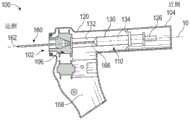
figure 1A illustrates a side view of an intraosseous access system including a suction system, according to some embodiments.
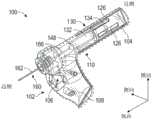
Figure 1B illustrates a perspective view of an intraosseous access system including a suction system, according to some embodiments.
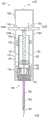
Figure 2 illustrates a plan cross-sectional view of an intraosseous access system including a suction system having a syringe, according to some embodiments.
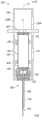
Figure 3 illustrates a plan cross-sectional view of an intraosseous access system including a suction system having a vacuum extractor, according to some embodiments.
Fig. 4 illustrates a flow diagram of an exemplary method for an intraosseous access system, according to some embodiments.
Detailed Description
Before disclosing in greater detail some specific embodiments, it should be understood that the specific embodiments disclosed herein do not limit the scope of the concepts presented herein. It should also be understood that particular embodiments disclosed herein may have features that can be readily separated from the particular embodiments and optionally combined with or substituted for features of any of the numerous other embodiments disclosed herein.
With respect to the terminology used herein, it is also to be understood that these terminology is for the purpose of describing some particular embodiments, and that these terms are not intended to limit the scope of the concepts provided herein. Ordinals (e.g., first, second, third, etc.) are generally used to distinguish or identify different features or steps in a group of features or steps, and do not provide a serial or numerical limitation. For example, "first," "second," "third" features or steps need not necessarily occur in sequence, and particular embodiments that include such features or steps need not necessarily be limited to these three features or steps. For convenience, labels such as "left", "right", "top", "bottom", "front", "back", etc. are used and are not intended to imply any particular fixed position, orientation, or direction, for example. Rather, such indicia are used to reflect, for example, relative position, orientation, or direction. The singular forms "a," "an," and "the" include plural referents unless the context clearly dictates otherwise.
For example, a "proximal," "proximal portion," or "proximal portion" of a needle disclosed herein includes the portion of the needle that is intended to be proximate to a clinician when the needle is used with a patient. Likewise, for example, the "proximal length" of a needle includes the length of the needle that is intended to be near the clinician when the needle is used on a patient. For example, the "proximal end" of a needle includes the end of the needle that is intended to be near the clinician when using the needle on a patient. The proximal portion, or proximal length of the needle may comprise the proximal end of the needle; however, the proximal portion, or proximal length of the needle need not include the proximal end of the needle. That is, unless the context indicates otherwise, the proximal portion, or proximal length of the needle is not the end portion or end length of the needle.
For example, a "distal", "distal portion", or "distal portion" of a needle disclosed herein includes the portion of the needle that is intended to be near or in a patient when the needle is used in the patient. Likewise, for example, the "distal length" of a needle includes the length of the needle that is intended to be near or in a patient when the needle is used in a patient. For example, the "distal end" of a needle includes the end of the needle that is intended to be near or in a patient when the needle is used on the patient. The distal portion, or distal length of the needle may comprise the distal end of the needle; however, the distal portion, or distal length of the needle need not include the distal end of the needle. That is, unless the context indicates otherwise, the distal portion, or distal length of the needle is not the tip portion or length of the needle.
Unless defined otherwise, all technical and scientific terms used herein have the same meaning as commonly understood by one of ordinary skill in the art.
Fig. 1A illustrates a side view of an Intraosseous (IO) access system ("system") 100 including asuction system 110, according to some embodiments. Fig. 1B shows a perspective view of theintraosseous access system 100, partially shown in wire frame.
Thesystem 100 may generally include anentry system 102 and asuction system 110. Theaccess system 102 may include adrive train 106 coupled to aneedle assembly 160. Thedrive train 106 may be configured to rotate theneedle assembly 160 and drill theneedle 162 through cortical bone to access the medullary cavity.Aspiration system 110 may be in fluid communication withneedle 162 ofneedle assembly 160 and access to the intramedullary canal may be confirmed by aspiration of bone marrow throughneedle lumen 164. Advantageously, theintraosseous access system 100 may be configured to determine when the intramedullary canal has been accessed byaspiration needle 162 without disengagingneedle assembly 160 fromsystem 100.
In one embodiment, theintraosseous access system 100 may include ahousing 104, thehousing 104 including one or more of theaccess system 102, thesuction system 110, or portions thereof disposed therein. Theaccess system 102 can include aneedle assembly 160 rotatably coupled to thedrive train 106 and extending from the distal end of thehousing 104. Optionally, thehousing 104 may include a grip, such as apistol grip 108 or similar structure, configured to facilitate grasping thehousing 104 and advancing theneedle 162 distally into the bone.
In one embodiment, thedrive train 106 of theaccess system 102 may be configured to provide rotational motion to one or both of theaspiration system 110 and theneedle assembly 160, as described in more detail herein. In some embodiments, theentry system 102 may be an automated driver (e.g., a drill that achieves high rotational speeds). In one embodiment, theentry system 102 may be an automated drive including adrive train 106, thedrive train 106 having a source of electrical energy (e.g., a battery) to provide power to a drilling mechanism (e.g., an electric motor, etc.). In one embodiment, thesystem 100 may include an actuator, such as a button, switch, or the like, configured to actuate thedrive train 106. In one embodiment, thedrive train 106 may be actuated by axial pressure applied to the distal tip of theneedle 162.
In one embodiment, thedrive train 106 may include a spring driven drilling mechanism, such as a coil spring, a flat spring, a torsion spring, or similar biasing member, which may store potential mechanical energy and may be released upon actuation of thedrive train 106. In one embodiment, thedrive train 106 may further include one or more gear mechanisms, biasing members, bearings, bushings, etc. configured to facilitate rotation of theneedle assembly 160. In one embodiment, theaccess system 102 may be a manual driver, wherein the clinician may use a handle,pistol grip 108, or similar structure to push theneedle assembly 160 through cortical bone.
In one embodiment, a portion of thehousing 104 may include asuction system 110 disposed therein. Thehousing 104 may include one ormore viewing windows 120 configured to allow a user to view a portion of theaspiration system 110 disposed therein. In one embodiment, theviewing window 120 may define an aperture extending through a wall of thehousing 104. In one embodiment, theviewing window 120 may comprise a transparent or translucent portion of thehousing 104. In one embodiment, theentire housing 104 may be formed of a translucent or transparent material configured to allow a user to view one or both of theaspiration system 110 and theaccess system 102, or portions thereof disposed therein.
As shown in fig. 1A-2, in one embodiment,aspiration system 110 may include asyringe 130 having abarrel 132 and aplunger 134 slidably engaged therewith. Thecartridge 132 may be in fluid communication with thelumen 164 of theneedle 162. Slidingplunger 134 relative tobarrel 132 may create a vacuum withinbarrel 132 and may draw a flow of fluid throughneedle lumen 164 and intobarrel 132. In one embodiment, a portion of thebarrel 132 may be formed of a translucent or transparent material. In use, a user may view fluid flow within thesyringe barrel 132 through one of theviewing windows 120.
In one embodiment, theaspiration system 102 may include a vacuum extractor or similar structure configured to maintain a vacuum therein, as described in more detail herein. In use, a user can actuate a release mechanism, such as an actuator, valve, etc., to place the vacuum in fluid communication with theneedle lumen 164 and draw a flow of fluid into the vacuum. A portion of the vacuum can be formed of a transparent or translucent material configured to allow a user to observe the fluid flow, as described herein.
In one embodiment, theaspiration system 110 may be coupled to theaccess system 102 or a portion thereof. In one embodiment, theaspiration system 110 may be connected to aneedle assembly 160 or portion thereof. In one embodiment, one or both of theaspiration system 110 and theneedle assembly 160 may be rotatable relative to thehousing 104. In one embodiment, thedrive train 106 may be configured to rotate theneedle assembly 160 andaspiration system 102 assembly about the centrallongitudinal axis 10.
In one embodiment, the distal end of thesyringe barrel 132 may be coupled to theaccess system 102 or theneedle assembly 160, or both. In one embodiment, the distal end of thesyringe barrel 132 may be integrally formed with theaccess system 102. In one embodiment, the distal end of thesyringe barrel 132 may be selectively coupled with theaccess system 102 using a threaded engagement system, interference fit, press fit, snap fit engagement, luer lock, combinations thereof, and the like. In one embodiment, the distal end of thesyringe barrel 132 may be coupled to theaccess system 102 using an adhesive, bonding, welding, or the like.
In one embodiment, thesyringe barrel 132 may be coupled with theneedle assembly 160 and thedrive train 106 and may rotate both thebarrel 132 and theneedle assembly 160 relative to thehousing 104 about the centrallongitudinal axis 10. Furthermore, theplunger 134 may remain substantially stationary relative to thehousing 104 with respect to any rotational movement about the centrallongitudinal axis 10. Notably, theplunger 134 may still be slidably engaged with thesyringe barrel 132 parallel to the longitudinal axis. Further, theplunger 134 may also slide relative to thehousing 104 along thelongitudinal axis 10.
In one embodiment, theneedle assembly 160 may include anobturator 166 disposed within theneedle lumen 164 and configured to prevent tissue and bone debris from entering and occluding theneedle lumen 164. The proximal end of theobturator 166 may be connected to theplunger 134. In one embodiment, theobturator 166 is rotatable relative to theplunger 134. For example, theobturator 166 may be coupled to theplunger 134 using thebearing 150. As used herein, thebearing 150 may comprise a ball bearing, a sleeve, or similar structure configured to facilitate rotational movement about an axis. As such, theobturator 166 may rotate relative to theplunger 134 as theneedle assembly 160, including theneedle 162 andobturator 166, is rotated by thedrive train 106. Further, sliding theplunger 134 longitudinally relative to thehousing 104 may slide theobturator 166 relative to theneedle 162.
In use, rotating theneedle assembly 160 may drill theneedle 162 through cortical bone and into the medullary cavity. In one embodiment, once the user believes that the intramedullary canal has been accessed, theplunger 134 may be withdrawn proximally to create a vacuum within thebarrel 132 and remove theobturator 166 from theneedle lumen 164 to place thebarrel 134 in fluid communication with theneedle lumen 164. If the medullary cavity has been accessed, bone marrow may be aspirated throughneedle lumen 164. The user may view the bone marrow insyringe barrel 132 through one ormore viewing windows 120 to confirm that the medullary cavity has been accessed. Advantageously,aspiration system 110 allows access to the intramedullary canal to be confirmed by bone marrow aspiration without requiring removal ofneedle assembly 160 fromintraosseous access system 100. In the absence of access to the medullary cavity, i.e., in the absence of visualization of the bone marrow, the user may advance theplunger 134 distally, withdraw theobturator 166 within theneedle lumen 164, and continue to drill theneedle assembly 160 through the cortical bone.
Figure 2 illustrates a plan cross-sectional view of theintraosseous access system 100. In some embodiments, one ormore viewing windows 120 may be located on a distal portion of the housing body 112 and may be configured to allow a user to observe the aspiration of fluid from theneedle lumen 164.
In some embodiments, theplunger 132 may include aplunger shaft 146 extending longitudinally through a portion of thesyringe barrel 134. The proximal end of theplunger shaft 146 may be coupled to the plunger handle 142 extending perpendicular thereto. In one embodiment, the plunger handle 142 may be rotatably coupled to theplunger shaft 146 and may include abearing 150 disposed therebetween. As such, in one embodiment, thedrive train 106 may rotate one or more of theneedle assembly 160,syringe barrel 132, andplunger shaft 146 about the centrallongitudinal axis 10, and thehandle 142 may remain substantially stationary with respect to any rotational movement. In one embodiment, a portion of theplunger handle 142, such as thefirst portion 142A and thesecond portion 142B, may extend from theplunger shaft 146 perpendicular to the longitudinal axis. In one embodiment, a portion of the plunger handle 142 may extend from theplunger shaft 146 perpendicular to the longitudinal axis to contact a wall of thehousing 104.
In one embodiment, a portion of the plunger handle 142 may extend from theplunger shaft 146 perpendicular to the longitudinal axis and extend through thehousing aperture 126 disposed in the wall of thehousing 104. In one embodiment, a portion of the plunger handle 142 may engage thehousing aperture 126 and stabilize theplunger 134 relative to thehousing 104, e.g., prevent rotation of thehandle 142 relative to thehousing 104 about thelongitudinal axis 10. For example, thefirst portion 142A may extend through thefirst housing aperture 126A and thesecond portion 142B may extend through thesecond housing aperture 126B. In one embodiment, thehousing aperture 126 may define a longitudinally extending elongated shape. In use, a user may grasp a portion of the plunger handle 142 extending through thehousing aperture 126 and may push theplunger 134 longitudinally relative to thehousing 104.
In one embodiment, the distal end ofplunger shaft 146 may be coupled topiston 148. Thepiston 148 may be formed of a flexible material (e.g., rubber, etc.) and may engage the inner surface of thebarrel 132 to provide a fluid seal therebetween. In use, proximally withdrawingplunger 134 along the longitudinal axis may create a vacuum between the proximal surface ofpiston 148 and the distal end ofbarrel 132.
In one embodiment, thepiston 148 may be rotatably coupled to theplunger shaft 146 by abearing 150, bushing, or similar structure. In use, thedrive train 106 may rotate theneedle assembly 160,syringe barrel 132, andpiston 148 about thelongitudinal axis 10, while theplunger shaft 146 andhousing 104 may remain rotationally stationary relative to thelongitudinal axis 10.
In one embodiment, thepiston 148 may be in a fixed relationship relative to theplunger shaft 146. Thepiston 148 may then be rotated relative to thesyringe barrel 134 while maintaining a fluid seal therebetween. In use, thedrive train 106 may rotate theneedle assembly 160 andsyringe barrel 132 about thelongitudinal axis 10, while theplunger shaft 146,piston 148, andhousing 104 may remain rotationally fixed relative to thelongitudinal axis 10.
In one embodiment, anobturator 166 may be disposed within theneedle lumen 164. The proximal end of theobturator 166 may be coupled to thepiston 148 of theplunger 134. In some embodiments, theobturator 166 may be coupled to thepiston 148 by a snap fit, press fit, interference fit engagement, or the like, or by an adhesive, welding, bonding, combinations thereof, or the like. In one embodiment, theobturator 166 may be coupled in a fixed relationship relative to theplunger 134. In one embodiment, theobturator 166 may be rotatably coupled to theplunger 134 by abearing 150, sleeve, or similar structure. In this way, the obturator can rotate independently of thepiston 148.
In some embodiments, theobturator 166 may be removed from theneedle lumen 164 to provide fluid communication through theneedle lumen 164 and into thesyringe barrel 132. In one embodiment, withdrawing theplunger 134 may simultaneously create a vacuum within thesyringe barrel 132 and at least partially remove theobturator 166 from theneedle lumen 164.
In some embodiments, theplunger 134 may be advanced distally and theobturator 166 may be placed back into theneedle lumen 164 without fluid flow being observed. In one embodiment, the vacuum within thesyringe barrel 132 may assist in distally advancing theobturator 166, thereby replacing theobturator 166 into theneedle lumen 164. Theobturator 166 may then continue to prevent obstruction of theneedle lumen 164 as theneedle assembly 160 continues to penetrate cortical bone. Advantageously, theobturator 166 may be withdrawn from theneedle 162 and into thebarrel 132 of thesyringe 130. In this way, thecartridge 132 may prevent accidental needle stick injury caused by the distal end of theobturator 166.
In one embodiment, thedrive train 106 may provide rotational motion to theneedle assembly 160 in a variety of ways. For example, whereaspiration system 110 is coupled toneedle assembly 160,drive train 106 may rotate bothaspiration system 110 andneedle assembly 160. In some embodiments, thedrive train 106 may rotate only theneedle assembly 160, i.e., not theaspiration system 110. In some embodiments, thedrive train 106 may rotate one or more components of theaspiration system 110 and/or theneedle assembly 160 while keeping other components stationary relative thereto.
In one embodiment, thedrive train 106 may rotate thebarrel 132 of thesyringe 130 while holding theplunger 134 stationary with respect to any rotation about thelongitudinal axis 10. In one embodiment, the plunger handle 142 may engage thehousing aperture 126 to prevent theplunger 134 from rotating about thelongitudinal axis 10 as thebarrel 132 rotates. In one embodiment,plunger shaft 146 may be coupled to abearing 150 sleeve or the like disposed withinpiston 148. Thebearing 150 is configured to allow rotational movement of thepiston 148 about thecentral axis 10 while allowing theplunger shaft 146 to remain substantially stationary. In some embodiments, thesyringe 130 is configured to receive a volume of fluid therein. In some embodiments, the capacity of the syringe may be between 1ml and 10 ml. It should be understood that other capacities are also contemplated.
Fig. 3 shows further details of an embodiment of theintraosseous access system 100, theintraosseous access system 100 including asuction system 110 having avacuum 400. Theaspiration system 110 may be coupled to theaccess system 102, as described herein. In one embodiment, theaspiration system 110 may include avacuum 400 configured to maintain a vacuum therein. Thevacuum pump 400 may include acanister 402 configured to maintain a vacuum therein, and avalve 404 configured to control fluid communication between theneedle lumen 164 of theneedle assembly 160 and thecanister 402vacuum pump 400.
In one embodiment, thevacuum 400 may further include ahandle 442. In one embodiment, a portion of thehandle 442 may extend through thehousing aperture 126, as described herein. In use, a user can grasp thehandle 442 and slide thevacuum 400 longitudinally relative to thehousing 104. In one embodiment, thevacuum pump 400 may includebearings 150, sleeves, or the like configured to allow thecanister 402 to rotate relative to thehandle 442. In one embodiment, the proximal end of theobturator 166 may be coupled to the distal end of thevacuum 400. In one embodiment, the evacuator may further include abearing 150 configured to allow theobturator 166 to rotate relative to theevacuator 400 or a portion thereof (e.g., thecanister 402 or the valve 404).
In one embodiment, thedrive train 106 may rotate thevacuum 400 and theneedle assembly 160 about thecentral axis 10. When the user believes that the intramedullary canal has been accessed, the user may grasp thehandle 442 and slide thevacuum 400 proximally to at least partially withdraw theobturator 166 from theneedle lumen 164. With theobturator 166 withdrawn, the user may actuate thevalve 404 and provide fluid communication between theneedle lumen 164 and thecanister 402 of theevacuator 400. The vacuum withincanister 402 may then draw a fluid flow throughneedle lumen 164. In one embodiment, a portion oftank 402 may be formed of a transparent material and fluid flow withintank 402 may be observed through one ormore viewing windows 120.
If the medullary cavity has been accessed, the user may view the bone marrow withincanister 402. If the medullary cavity is not accessed, for example, the distal tip of theneedle 162 remains disposed within the cortical bone, the bone marrow will not be visible. In this way, the user can close thevalve 404 and slide thehandle 442 distally to retract theobturator 166 within theneedle lumen 162 and continue to drill theneedle assembly 160 through cortical bone. Advantageously, proximally withdrawing thevacuum device 400 andobturator 166 assembly may retain the tip of theobturator 166 within thehousing 104 and mitigate accidental needle stick injuries. In one embodiment, thehandle 442 may be configured to slide thevacuum 400 along the longitudinal axis and actuate thevalve 404. In one embodiment, a separate actuator may be configured to actuate thevalve 404 and transition thevalve 404 between the open and closed positions.
In some embodiments, portions of theaspiration system 110 may be configured to be selectively disengaged from theaccess system 102. For example, in one embodiment, thesyringe 130, theevacuator 400, or a combination thereof may be configured to be detachable and interchangeable in theaspiration system 110. In one embodiment, theslide syringe 130 or thevacuum 400 may be achieved by manual manipulation and a handle, as described herein. In one embodiment, thesystem 100 may further include a second drive train configured to be actuated by a user and slide theaspiration system 110 or a portion thereof along the longitudinal axis.
Fig. 4 illustrates anexemplary method 500 of use for the intraosseous access system 100 (including the suction system 110). In one embodiment, themethod 500 includes assembling the intraosseous access system 100 (block 502). In some embodiments, assembling theintraosseous access system 100 includes coupling aneedle assembly 106 with theaccess system 102 of thesystem 100. Theneedle assembly 160 is rotatably coupled to thesystem 100. In some embodiments, assemblingintraosseous access system 100 includescoupling suction system 110 withsyringe 130 orvacuum 400 tosystem 100.
In one embodiment, themethod 500 includes actuating theaccess system 102 to rotate theneedle assembly 160, theaspiration system 110, or components thereof to drill theneedle 162 through cortical bone to access the medullary cavity (block 504). In one embodiment, when the user believes that the intramedullary canal has been accessed, the user may confirm access to the intramedullary canal by withdrawing theobturator 166 from the needle lumen 164 (block 506). By providing a vacuum in fluid communication with theneedle lumen 164, a fluid flow may be drawn through the needle lumen 164 (block 508). The vacuum may be provided by withdrawing theplunger 134 from thesyringe barrel 132, or by actuating a valve to place thevacuum 400 in fluid communication with theneedle lumen 164, or a combination thereof. (block 508).
In one embodiment, the user may then determine whether the intramedullary canal has been accessed by observing the fluid flow (block 510). If access to the intramedullary canal has been confirmed, the user may detachsystem 100 from needle 162 (block 512). If access to the medullary cavity is not confirmed, the user retracts theobturator 166 within the needle lumen 164 (block 514) and continues drilling through the cortical bone (return to block 504).
Although some specific embodiments have been disclosed herein, and although specific embodiments have been disclosed in detail, specific embodiments are not intended to limit the scope of the concepts provided herein. Additional adaptations and/or modifications may occur to those skilled in the art and are intended to be included in the broader aspects. Accordingly, departures may be made from the specific embodiments disclosed herein without departing from the scope of the concepts provided herein.
Claims (11)
Translated fromChineseApplications Claiming Priority (2)
| Application Number | Priority Date | Filing Date | Title |
|---|---|---|---|
| US202063076189P | 2020-09-09 | 2020-09-09 | |
| US63/076,189 | 2020-09-09 |
Publications (1)
| Publication Number | Publication Date |
|---|---|
| CN215839325Utrue CN215839325U (en) | 2022-02-18 |
Family
ID=78078402
Family Applications (2)
| Application Number | Title | Priority Date | Filing Date |
|---|---|---|---|
| CN202122169513.3UActiveCN215839325U (en) | 2020-09-09 | 2021-09-08 | Suction device for an intraosseous access system |
| CN202111051846.4APendingCN114224425A (en) | 2020-09-09 | 2021-09-08 | Suction device for an intraosseous access system |
Family Applications After (1)
| Application Number | Title | Priority Date | Filing Date |
|---|---|---|---|
| CN202111051846.4APendingCN114224425A (en) | 2020-09-09 | 2021-09-08 | Suction device for an intraosseous access system |
Country Status (4)
| Country | Link |
|---|---|
| US (1) | US12402911B2 (en) |
| EP (1) | EP4203820B1 (en) |
| CN (2) | CN215839325U (en) |
| WO (1) | WO2022056005A1 (en) |
Cited By (1)
| Publication number | Priority date | Publication date | Assignee | Title |
|---|---|---|---|---|
| CN114224425A (en)* | 2020-09-09 | 2022-03-25 | 巴德阿克塞斯系统股份有限公司 | Suction device for an intraosseous access system |
Families Citing this family (1)
| Publication number | Priority date | Publication date | Assignee | Title |
|---|---|---|---|---|
| CN114668428B (en)* | 2022-03-31 | 2023-05-09 | 四川大学华西医院 | bone marrow aspiration device |
Family Cites Families (337)
| Publication number | Priority date | Publication date | Assignee | Title |
|---|---|---|---|---|
| US2773501A (en) | 1955-01-26 | 1956-12-11 | Harold S Young | Drill element for effecting intraosseous fluid injections and the like |
| US3071135A (en) | 1960-01-27 | 1963-01-01 | Mfg Process Lab Inc | Hollow needle |
| US3261594A (en)* | 1964-04-20 | 1966-07-19 | Raymond S Michel | Means for uniformly mixing human blood samples |
| US3753432A (en)* | 1971-03-10 | 1973-08-21 | L Guerra | Hypodermic syringe for blood tests |
| US3815605A (en) | 1971-05-19 | 1974-06-11 | Philips Corp | Device and holder therefor for inserting a hollow coupling member into bone marrow |
| US3734207A (en)* | 1971-12-27 | 1973-05-22 | M Fishbein | Battery powered orthopedic cutting tool |
| US3804544A (en) | 1971-12-29 | 1974-04-16 | R Adams | Drill feed control |
| US3811442A (en)* | 1972-03-23 | 1974-05-21 | A Maroth | Hypodermic syringe holder and applicator |
| US3991765A (en) | 1975-04-09 | 1976-11-16 | Howard Cohen | Cricothyrotomy apparatus |
| US4314565A (en) | 1978-03-03 | 1982-02-09 | Lee Peter F | Biopsy and aspiration needle unit |
| US4266555A (en) | 1979-11-09 | 1981-05-12 | Khosrow Jamshidi | Biopsy needle with stylet and cannula orientation |
| FR2473318A1 (en)* | 1980-01-14 | 1981-07-17 | Micro Mega Sa | SYRINGE WITH ALTERNATIVE ROTATION |
| US4342724A (en)* | 1980-08-21 | 1982-08-03 | E. R. Squibb & Sons, Inc. | Red cell labeling vial |
| US4383530A (en) | 1981-06-05 | 1983-05-17 | John Bruno | Hypodermic needle and method of making needles |
| US4562844A (en)* | 1984-11-27 | 1986-01-07 | Jett Labs, Inc. | Multipurpose syringe |
| FR2581548B1 (en)* | 1985-05-09 | 1990-07-20 | Villette Alain | DEVICE FOR INTRAOSUS INJECTION OF BIOCOMPATIBLE PRODUCTS |
| US4736742A (en) | 1986-04-03 | 1988-04-12 | Minnesota Mining And Manufacturing Company | Device for driving tools used in orthopedic surgery |
| ES2028192T3 (en) | 1987-07-10 | 1992-07-01 | B. Braun Melsungen Ag | CANNULA. |
| US4952207A (en) | 1988-07-11 | 1990-08-28 | Critikon, Inc. | I.V. catheter with self-locating needle guard |
| US5601559A (en) | 1988-10-24 | 1997-02-11 | Cook Incorporated | Intraosseous needle |
| US4964854A (en) | 1989-01-23 | 1990-10-23 | Luther Medical Products, Inc. | Intravascular catheter assembly incorporating needle tip shielding cap |
| US4969870A (en) | 1989-06-07 | 1990-11-13 | The Regents Of The University Of California | Method and apparatus for intraosseous infusions |
| US5053017A (en) | 1990-02-28 | 1991-10-01 | Chamuel Steven R | Hypodermic needle safety clip |
| US5040542A (en) | 1990-03-05 | 1991-08-20 | Norman Gray | Bone biopsy needle |
| US5042558A (en) | 1990-04-06 | 1991-08-27 | Dennison Manufacturing Company | Fastener dispensing needle and method of making |
| US5290267A (en) | 1991-01-17 | 1994-03-01 | Fresenius Ag | Hypodermic needle |
| US5122114A (en) | 1991-02-01 | 1992-06-16 | Board Of Regents, University Of Texas System | Method of using intramedullary catheter |
| US5451210A (en) | 1991-04-29 | 1995-09-19 | Lifequest Medical, Inc. | System and method for rapid vascular drug delivery |
| US5868711A (en) | 1991-04-29 | 1999-02-09 | Board Of Regents, The University Of Texas System | Implantable intraosseous device for rapid vascular access |
| US5207697A (en) | 1991-06-27 | 1993-05-04 | Stryker Corporation | Battery powered surgical handpiece |
| US5332398A (en) | 1992-02-01 | 1994-07-26 | Board Of Regents, The University Of Texas System | Intramedullary catheter |
| US5384103A (en)* | 1992-03-17 | 1995-01-24 | Micromedics, Inc. | Instrument tray |
| DE4229310A1 (en) | 1992-09-02 | 1994-03-10 | Winter & Ibe Olympus | Medical instrument for creating a tissue channel |
| US5263939A (en) | 1992-10-09 | 1993-11-23 | Surgin Surgical Instrumentation, Inc. | Retainer for laparoscopic cannula |
| US5372583A (en) | 1992-11-25 | 1994-12-13 | Cardiopulmonary Specialities, Inc. | Bone marrow infuser and method of use |
| US5364367A (en) | 1993-04-30 | 1994-11-15 | Minnesota Mining And Manufacturing Company | Cannula anchor |
| US5312364A (en) | 1993-08-06 | 1994-05-17 | Pyng | Intraosseous infusion device |
| DE9313602U1 (en) | 1993-09-09 | 1993-12-23 | Gobbers, Dieter, 89520 Heidenheim | Double tool carrier for hand drills |
| IL109294A (en) | 1994-04-12 | 1998-02-08 | Wais Med Ltd | Surgical instrument for impact insertion of an intraosseous trocar- needle |
| US5667509A (en) | 1995-03-02 | 1997-09-16 | Westin; Craig D. | Retractable shield apparatus and method for a bone drill |
| US5554154A (en) | 1995-03-03 | 1996-09-10 | Rosenberg; Norman | Intra-osseous needle drill |
| US5688249A (en) | 1995-03-28 | 1997-11-18 | Johnson & Johnson Medical, Inc. | Telescoping members for catheter introducer assembly |
| US5575780A (en) | 1995-04-28 | 1996-11-19 | Saito; Yoshikuni | Medical hollow needle and a method of producing thereof |
| US6905486B2 (en) | 1995-06-06 | 2005-06-14 | David Gibbs | Device for targeted, catheterized delivery of medications |
| US5853393A (en) | 1995-06-07 | 1998-12-29 | Johnson & Johnson Medical, Inc. | Catheter needle locking and catheter hub unlocking mechanism |
| JP3515859B2 (en) | 1995-09-29 | 2004-04-05 | 株式会社リコー | Battery charge processing device and battery charge processing system |
| US6159161A (en)* | 1995-10-20 | 2000-12-12 | Hodosh; Milton | Microprocessor-controlled fluid dispensing apparatus |
| US5817052A (en) | 1995-12-26 | 1998-10-06 | Pyng Medical Corp. | Apparatus for intraosseous infusion or aspiration |
| US6629959B2 (en) | 1996-02-27 | 2003-10-07 | Injectimed, Inc. | Needle tip guard for percutaneous entry needles |
| US5927976A (en) | 1996-05-10 | 1999-07-27 | Cyberdent, Inc. | Medication injection device and method |
| US5779708A (en) | 1996-08-15 | 1998-07-14 | Cyberdent, Inc. | Intraosseous drug delivery device and method |
| US6607509B2 (en) | 1997-12-31 | 2003-08-19 | Medtronic Minimed, Inc. | Insertion device for an insertion set and method of using the same |
| US5885293A (en) | 1997-03-03 | 1999-03-23 | Innovasive Devices, Inc. | Apparatus and method for cutting a surface at a repeatable angle |
| US6761726B1 (en) | 1998-05-15 | 2004-07-13 | Pyng Medical Corp. | Method and apparatus for the intraosseous introduction of a device such as an infusion tube |
| US7347840B2 (en) | 2000-03-02 | 2008-03-25 | Pyng Medical Corp. | Patch for locating a target zone for penetration |
| CA2205623A1 (en) | 1997-05-16 | 1998-11-16 | Pyng Medical Corp. | Method and apparatus for intraosseous infusion and aspiration using an automatic release mechanism |
| US6117108A (en) | 1997-08-20 | 2000-09-12 | Braun Melsungen Ag | Spring clip safety IV catheter |
| DE19738539A1 (en) | 1997-09-03 | 1999-03-18 | Juergen Dr Med Klappenberger | Coniotomy device for emergency breathing |
| US5929601A (en) | 1997-12-22 | 1999-07-27 | Lifecor, Inc. | Battery management apparatus for portable electronic devices |
| US6022324A (en)* | 1998-01-02 | 2000-02-08 | Skinner; Bruce A. J. | Biopsy instrument |
| US6183442B1 (en) | 1998-03-02 | 2001-02-06 | Board Of Regents Of The University Of Texas System | Tissue penetrating device and methods for using same |
| US6652490B2 (en) | 1998-04-09 | 2003-11-25 | Becton Dickinson And Company | Catheter and introducer needle assembly with compact needle shield |
| US6247928B1 (en) | 1998-04-09 | 2001-06-19 | Moshe Meller | Disposable anesthesia delivery system |
| US6018227A (en) | 1998-06-22 | 2000-01-25 | Stryker Corporation | Battery charger especially useful with sterilizable, rechargeable battery packs |
| US6689102B2 (en) | 1998-07-31 | 2004-02-10 | Albany Medical College | Safety intravenous catheter assembly |
| US6056165A (en)* | 1998-10-21 | 2000-05-02 | Speranza; James D. | Free standing cordless gun for dispensing liquid glue and similar materials |
| US6199664B1 (en) | 1998-11-16 | 2001-03-13 | General Electric Company | Spring motor for generating constant torque |
| US6135769A (en) | 1998-11-20 | 2000-10-24 | Kwan; Danny Pak-Nam | Intraosseous injection system |
| US6270484B1 (en) | 1999-02-17 | 2001-08-07 | Inbae Yoon | Safety penetrating instrument with expandible portion and method of penetrating anatomical cavity |
| US6626887B1 (en) | 1999-06-08 | 2003-09-30 | Intravantage, Inc. | Hard tissue drug delivery device and method |
| US6273715B1 (en) | 1999-06-09 | 2001-08-14 | X-Tip Technologies, Llc | Disposable anesthesia delivery system with shortened outer sleeve and inner hollow drill |
| US6547561B2 (en)* | 1999-06-09 | 2003-04-15 | Tulsa Dental Products Inc. | Disposable anesthesia delivery system with shortened outer sleeve and inner hollow drill |
| US6104162A (en) | 1999-09-11 | 2000-08-15 | Sainsbury; Simon R. | Method and apparatus for multi-power source for power tools |
| US6602214B2 (en) | 1999-10-19 | 2003-08-05 | Bio Cybernetics International | Orthotic trauma device |
| US6210373B1 (en) | 1999-12-30 | 2001-04-03 | Ethicon, Inc. | Needle safety cover |
| US6458117B1 (en) | 2000-01-19 | 2002-10-01 | Kevin Daniel Pollins, Sr. | Intraosseous infusion assembly and method for intraosseous infusion |
| US6641395B2 (en) | 2000-08-02 | 2003-11-04 | Nobel Biocare Ab | Endosseous implant drill |
| ATE305375T1 (en) | 2000-09-28 | 2005-10-15 | Steen Mandsfelt Eriksen | HAND TURRET DRILL |
| DE10064975C1 (en) | 2000-12-23 | 2002-07-25 | Aesculap Ag & Co Kg | Drilling tool for a surgical drill |
| US6419490B1 (en) | 2001-01-30 | 2002-07-16 | Arthur Kitchings Weathers, Jr. | Grooved intraosseous dental drill bit |
| US6692471B2 (en) | 2001-02-16 | 2004-02-17 | Medex, Inc. | Method and apparatus for safety catheter insertion device |
| US6984213B2 (en) | 2001-03-15 | 2006-01-10 | Specialized Health Products, Inc. | Biopsy needle device |
| US6761706B2 (en) | 2001-04-04 | 2004-07-13 | Patricia B. Vaillancourt | Needle guard |
| US6814734B2 (en) | 2001-06-18 | 2004-11-09 | Sdgi Holdings, Inc, | Surgical instrumentation and method for forming a passage in bone having an enlarged cross-sectional portion |
| ITBO20010497A1 (en) | 2001-07-31 | 2003-01-31 | Delta Med S R L | PROTECTION DEVICE FOR NEEDLE-CANNULA |
| US6830562B2 (en) | 2001-09-27 | 2004-12-14 | Unomedical A/S | Injector device for placing a subcutaneous infusion set |
| ITTO20011228A1 (en) | 2001-12-28 | 2003-06-28 | Cane Srl | DISPOSABLE NEEDLE CONTAINER. |
| IL147983A (en) | 2002-02-04 | 2007-12-03 | Michael Flint | Repeated use trocar-needle insertion instrument and loading tool |
| US9072543B2 (en) | 2002-05-31 | 2015-07-07 | Vidacare LLC | Vascular access kits and methods |
| US8142365B2 (en) | 2002-05-31 | 2012-03-27 | Vidacare Corporation | Apparatus and method for accessing the bone marrow of the sternum |
| US8668698B2 (en) | 2002-05-31 | 2014-03-11 | Vidacare Corporation | Assembly for coupling powered driver with intraosseous device |
| US11298202B2 (en)* | 2002-05-31 | 2022-04-12 | Teleflex Life Sciences Limited | Biopsy devices and related methods |
| US11337728B2 (en) | 2002-05-31 | 2022-05-24 | Teleflex Life Sciences Limited | Powered drivers, intraosseous devices and methods to access bone marrow |
| US10973545B2 (en)* | 2002-05-31 | 2021-04-13 | Teleflex Life Sciences Limited | Powered drivers, intraosseous devices and methods to access bone marrow |
| US8641715B2 (en) | 2002-05-31 | 2014-02-04 | Vidacare Corporation | Manual intraosseous device |
| US8690791B2 (en) | 2002-05-31 | 2014-04-08 | Vidacare Corporation | Apparatus and method to access the bone marrow |
| US7850620B2 (en)* | 2002-05-31 | 2010-12-14 | Vidacare Corporation | Biopsy devices and related methods |
| US10973532B2 (en)* | 2002-05-31 | 2021-04-13 | Teleflex Life Sciences Limited | Powered drivers, intraosseous devices and methods to access bone marrow |
| US20070049945A1 (en) | 2002-05-31 | 2007-03-01 | Miller Larry J | Apparatus and methods to install, support and/or monitor performance of intraosseous devices |
| US7951089B2 (en) | 2002-05-31 | 2011-05-31 | Vidacare Corporation | Apparatus and methods to harvest bone and bone marrow |
| US7811260B2 (en) | 2002-05-31 | 2010-10-12 | Vidacare Corporation | Apparatus and method to inject fluids into bone marrow and other target sites |
| US9451968B2 (en) | 2002-05-31 | 2016-09-27 | Vidacare LLC | Powered drivers, intraosseous devices and methods to access bone marrow |
| EP2039298B1 (en) | 2002-05-31 | 2017-10-25 | Vidacare LLC | Apparatus to access bone marrow |
| US20070276352A1 (en) | 2002-06-04 | 2007-11-29 | Stemcor Systems, Inc. | Removable device and method for tissue disruption |
| WO2003101308A1 (en) | 2002-06-04 | 2003-12-11 | Office Of Technology Licensing Stanford University | Device and method for rapid aspiration and collection of body tissue from within an enclosed body space |
| US20030229308A1 (en) | 2002-06-05 | 2003-12-11 | Israil Tsals | Injector adapter and combination thereof |
| DE20210394U1 (en) | 2002-07-04 | 2002-09-12 | B. Braun Melsungen Ag, 34212 Melsungen | catheter introducer |
| US6916292B2 (en)* | 2002-07-12 | 2005-07-12 | Depuy Spine, Inc. | Bone marrow aspirator |
| US7458954B2 (en) | 2002-11-07 | 2008-12-02 | Specialized Health Products, Inc. | Safety shield for medical needles |
| US6875219B2 (en) | 2003-02-14 | 2005-04-05 | Yves P. Arramon | Bone access system |
| US8078274B2 (en) | 2003-02-21 | 2011-12-13 | Dtherapeutics, Llc | Device, system and method for measuring cross-sectional areas in luminal organs |
| US10172538B2 (en) | 2003-02-21 | 2019-01-08 | 3Dt Holdings, Llc | Body lumen junction localization |
| US10413211B2 (en) | 2003-02-21 | 2019-09-17 | 3Dt Holdings, Llc | Systems, devices, and methods for mapping organ profiles |
| US20040243135A1 (en) | 2003-05-28 | 2004-12-02 | Tomoaki Koseki | Hand drill |
| US9504477B2 (en) | 2003-05-30 | 2016-11-29 | Vidacare LLC | Powered driver |
| EP1502613A1 (en) | 2003-08-01 | 2005-02-02 | Novo Nordisk A/S | Needle device with retraction means |
| CA2542058C (en) | 2003-10-10 | 2014-06-03 | Biocybernetics International | Mechanical advantage tourniquet |
| FR2861572B1 (en) | 2003-10-30 | 2006-07-28 | Patrice Richard | DEVICE FOR TAKING AND / OR INJECTING BONE MARROW AND SYSTEM COMPRISING SUCH A DEVICE |
| US7226434B2 (en) | 2003-10-31 | 2007-06-05 | Tyco Healthcare Group Lp | Safety shield |
| US7699807B2 (en) | 2003-11-10 | 2010-04-20 | Smiths Medical Asd, Inc. | Device and method for insertion of a cannula of an infusion device |
| WO2005046769A2 (en) | 2003-11-12 | 2005-05-26 | Vidacare Corporation | Reusable intraosseous device and method for accessing bone marrow in the sternum |
| ATE441505T1 (en) | 2003-11-24 | 2009-09-15 | Whitehot Solutions Pty Ltd | DOUBLE CHUCK DRILL WITH ONE DRIVE SHAFT |
| US7815642B2 (en) | 2004-01-26 | 2010-10-19 | Vidacare Corporation | Impact-driven intraosseous needle |
| CN101536926B (en) | 2004-01-26 | 2012-07-18 | 维达保健公司 | Manual interosseous device |
| EP1762262A3 (en) | 2004-02-13 | 2007-03-21 | Smiths Medical ASD, Inc. | Needle tip protector |
| US7513888B2 (en) | 2004-02-17 | 2009-04-07 | Smiths Medical Asd, Inc. | Needle guards |
| WO2005112800A2 (en) | 2004-05-17 | 2005-12-01 | Tiax Llc | Intraosseous infusion device |
| US7112191B2 (en) | 2004-06-15 | 2006-09-26 | Neha Daga | Needle safety device for an intravenous catheter apparatus and method of use |
| US7588559B2 (en) | 2004-07-01 | 2009-09-15 | W&H Dentalwerk Bürmoos GmbH | Injection systems |
| US7654956B2 (en)* | 2004-07-13 | 2010-02-02 | Dexcom, Inc. | Transcutaneous analyte sensor |
| US20060025723A1 (en) | 2004-07-28 | 2006-02-02 | Ballarini V J | Antibacterial chest tube, surgical drain, port or access line securing device |
| US20060058826A1 (en) | 2004-08-25 | 2006-03-16 | Evans Avery J | Tissue cavitation device |
| GB0422710D0 (en) | 2004-10-13 | 2004-11-17 | Biocomposites Ltd | Surgical apparatus |
| US7905857B2 (en) | 2005-07-11 | 2011-03-15 | Covidien Ag | Needle assembly including obturator with safety reset |
| US7850650B2 (en) | 2005-07-11 | 2010-12-14 | Covidien Ag | Needle safety shield with reset |
| US8998848B2 (en) | 2004-11-12 | 2015-04-07 | Vidacare LLC | Intraosseous device and methods for accessing bone marrow in the sternum and other target areas |
| US7367757B2 (en) | 2004-12-31 | 2008-05-06 | Sean Peter Phillips | Electric drill with modified bit gripping assembly |
| RU46423U1 (en)* | 2005-02-15 | 2005-07-10 | Скрябин Геннадий Степанович | SPOKE DEVICE |
| EP1876972A4 (en) | 2005-03-30 | 2009-04-01 | Access Scientific Inc | Vascular access |
| CA2604894A1 (en) | 2005-04-11 | 2006-10-19 | John Whitehead | Automated chuck exchange using rotating turret |
| FR2885512B1 (en) | 2005-05-10 | 2007-08-10 | Biocoral Inc | SYRINGE FOR BIO-MATERIAL |
| US7383639B2 (en)* | 2005-07-12 | 2008-06-10 | Medtronic Spine Llc | Measurement instrument for percutaneous surgery |
| US20070096690A1 (en) | 2005-10-31 | 2007-05-03 | Casalena Adam M | Charger system for cordless power devices |
| US7798994B2 (en) | 2005-11-15 | 2010-09-21 | Becton, Dickinson And Company | Needle shield to septum interconnect |
| JP4921779B2 (en) | 2005-11-28 | 2012-04-25 | 日本コヴィディエン株式会社 | Indwelling needle |
| US20070191772A1 (en) | 2006-02-16 | 2007-08-16 | Animas Corporation | Straight insertion safety infusion set |
| US7658725B2 (en) | 2006-02-16 | 2010-02-09 | Smiths Medical Asd, Inc. | Enclosed needle device with duckbill release mechanism |
| AU2007242198B2 (en) | 2006-03-29 | 2012-02-16 | Terumo Kabushiki Kaisha | Protector |
| US7842038B2 (en) | 2006-05-04 | 2010-11-30 | Warsaw Orthopedic, Inc. | Method for using retractable stylet and cannula combination to form an opening in bone |
| US8167899B2 (en) | 2006-05-04 | 2012-05-01 | Warsaw Orthopedic, Inc. | Retractable stylet and cannula combination |
| US8465491B2 (en) | 2006-06-01 | 2013-06-18 | Osteo Innovations Llc | Bone drill |
| WO2007142746A1 (en) | 2006-06-08 | 2007-12-13 | Rishi Baid | Safety device to cover the needle tip of intravenous catheter apparatus |
| US9358348B2 (en) | 2006-06-14 | 2016-06-07 | Covidien Lp | Safety shield for medical needles |
| US8038038B2 (en)* | 2006-08-07 | 2011-10-18 | Chapin Manufacturing, Inc. | Spring engine driven fluid dispensing system |
| US8944069B2 (en) | 2006-09-12 | 2015-02-03 | Vidacare Corporation | Assemblies for coupling intraosseous (IO) devices to powered drivers |
| EP2073728B1 (en) | 2006-09-12 | 2018-11-07 | Teleflex Medical Devices S.à.r.l. | Biopsy device |
| EP2068743B1 (en) | 2006-09-12 | 2017-03-15 | Vidacare LLC | Medical procedures trays, kits and related methods |
| EP3189787B1 (en) | 2006-09-12 | 2019-01-09 | Teleflex Medical Devices S.à.r.l. | Medical procedures trays and related methods |
| US8974410B2 (en) | 2006-10-30 | 2015-03-10 | Vidacare LLC | Apparatus and methods to communicate fluids and/or support intraosseous devices |
| US9345457B2 (en) | 2006-12-13 | 2016-05-24 | Devicor Medical Products, Inc. | Presentation of biopsy sample by biopsy device |
| US20080154304A1 (en) | 2006-12-21 | 2008-06-26 | Arthrocare Corporation | System and method for accessing a tissue structure |
| US8357163B2 (en) | 2007-02-09 | 2013-01-22 | Sidebotham Christopher G | Low cost modular tapered and spherical hollow reamers for medical applications |
| WO2008103606A2 (en) | 2007-02-20 | 2008-08-28 | Gabriel Institute, Inc. | Bone drill and methods of treatment delivery |
| ES2584029T3 (en) | 2007-04-04 | 2016-09-23 | Vidacare LLC | Motorized unit |
| US8356598B2 (en) | 2007-04-17 | 2013-01-22 | Pyng Medical Corp. | Apparatus and related method for providing a passage into the body |
| US20100204649A1 (en) | 2007-04-24 | 2010-08-12 | Vidacare Corporation | High Pressure Intraosseous Bag and Method |
| US7833204B2 (en) | 2007-05-14 | 2010-11-16 | Applied Medical Research | Intramedullary access or infusion devices |
| CN101720243A (en) | 2007-05-17 | 2010-06-02 | 维达保健公司 | Monitor patients and with the method and apparatus of treat with intraosseous fluids |
| US8095285B2 (en)* | 2007-06-29 | 2012-01-10 | Caterpillar Inc. | Method for derating a power source to limit damage |
| KR100899654B1 (en) | 2007-07-12 | 2009-05-27 | 주식회사 메디라바텍 | Spinal needles for drug injection |
| EP2212043B1 (en) | 2007-10-19 | 2018-03-14 | Whitehot Solutions Pty Ltd | Multiple chuck hand tool |
| US10449330B2 (en) | 2007-11-26 | 2019-10-22 | C. R. Bard, Inc. | Magnetic element-equipped needle assemblies |
| US9521961B2 (en) | 2007-11-26 | 2016-12-20 | C. R. Bard, Inc. | Systems and methods for guiding a medical instrument |
| US8781555B2 (en) | 2007-11-26 | 2014-07-15 | C. R. Bard, Inc. | System for placement of a catheter including a signal-generating stylet |
| US10751509B2 (en) | 2007-11-26 | 2020-08-25 | C. R. Bard, Inc. | Iconic representations for guidance of an indwelling medical device |
| US9636031B2 (en) | 2007-11-26 | 2017-05-02 | C.R. Bard, Inc. | Stylets for use with apparatus for intravascular placement of a catheter |
| US8849382B2 (en) | 2007-11-26 | 2014-09-30 | C. R. Bard, Inc. | Apparatus and display methods relating to intravascular placement of a catheter |
| US9649048B2 (en) | 2007-11-26 | 2017-05-16 | C. R. Bard, Inc. | Systems and methods for breaching a sterile field for intravascular placement of a catheter |
| US10524691B2 (en) | 2007-11-26 | 2020-01-07 | C. R. Bard, Inc. | Needle assembly including an aligned magnetic element |
| ES2465915T3 (en) | 2007-11-26 | 2014-06-09 | C.R. Bard, Inc. | Integrated system for intravascular catheter placement |
| US20180116551A1 (en) | 2007-11-26 | 2018-05-03 | C. R. Bard, Inc. | Needles For Use With System For Guiding A Medical Instrument |
| AR070764A1 (en) | 2007-12-07 | 2010-05-05 | Pyng Medical Corp | APPLIANCES AND METHODS TO ENTER OSEOS PORTALS |
| US8740912B2 (en) | 2008-02-27 | 2014-06-03 | Ilion Medical Llc | Tools for performing less invasive orthopedic joint procedures |
| US7828774B2 (en) | 2008-05-12 | 2010-11-09 | Harding Weston F | Sleeved clip safety |
| EP2251057B1 (en) | 2008-05-28 | 2012-07-11 | Poly Medicure Ltd. | Catheter introducer |
| US8911463B2 (en) | 2008-06-10 | 2014-12-16 | Covidien Lp | Bladed/bladeless obturator for use in a surgical trocar assembly |
| EP3649969A1 (en) | 2008-06-26 | 2020-05-13 | Smart Medical Devices, Inc. | Depth controllable and measurable medical driver devices |
| EP2328524B1 (en) | 2008-07-02 | 2019-01-16 | Cook Medical Technologies LLC | Deployment assembly |
| CA2739648A1 (en) | 2008-10-14 | 2010-04-22 | Lawrence Stock | Training device for medical procedures |
| AU2009304681A1 (en) | 2008-10-17 | 2010-04-22 | St. Marianna University School Of Medicine | Bone cement injection needle |
| WO2010061567A1 (en) | 2008-11-27 | 2010-06-03 | Ntn株式会社 | Remote control actuator |
| US20100174243A1 (en) | 2009-01-05 | 2010-07-08 | Warsaw Orthopedic, Inc. | Apparatus for Delivery of Therapeutic Material to an Intervertebral Disc and Method of Use |
| US8936575B2 (en) | 2009-03-19 | 2015-01-20 | Becton, Dickinson And Company | Cannula-tip shielding mechanism |
| US8273053B2 (en) | 2009-05-05 | 2012-09-25 | Pyng Medical Corp. | Patient status sensor |
| US20110004163A1 (en) | 2009-07-01 | 2011-01-06 | Vaidya Hrushikesh U | Method and apparatus for intraosseous infusion |
| DE202009009119U1 (en) | 2009-07-02 | 2009-12-31 | B. Braun Melsungen Ag | Protection device for a hypodermic needle |
| USD633199S1 (en) | 2009-10-05 | 2011-02-22 | Pyng Medical Corp. | Insertion tool for bone portals |
| DE102009052962A1 (en) | 2009-11-12 | 2011-06-01 | B. Braun Melsungen Ag | catheter introducer |
| DE102009052971A1 (en) | 2009-11-12 | 2011-05-19 | B. Braun Melsungen Ag | catheter introducer |
| WO2011070593A1 (en) | 2009-12-11 | 2011-06-16 | Secretary, Department Of Biotechnology | Device for vascular access |
| WO2011097311A2 (en) | 2010-02-02 | 2011-08-11 | Vidacare Corporation | Intraosseous-needle stabilizer and methods |
| US8894654B2 (en) | 2010-03-31 | 2014-11-25 | Smart Medical Devices, Inc. | Depth controllable and measurable medical driver devices and methods of use |
| WO2011146769A2 (en) | 2010-05-19 | 2011-11-24 | Tangent Medical Technologies Llc | Integrated vascular delivery system |
| EP2912999B1 (en) | 2010-05-28 | 2022-06-29 | C. R. Bard, Inc. | Apparatus for use with needle insertion guidance system |
| EP4122385A1 (en) | 2010-05-28 | 2023-01-25 | C. R. Bard, Inc. | Insertion guidance system for needles and medical components |
| RU2729036C2 (en) | 2010-08-05 | 2020-08-03 | Б. Браун Мельзунген Аг | Safe needle device and assembly |
| WO2012040239A1 (en) | 2010-09-20 | 2012-03-29 | Spine View, Inc. | Cannulotome |
| US20130178807A1 (en) | 2010-09-21 | 2013-07-11 | Poly Medicure Limited | Needle tip guard for intravenous catheter assembly |
| ES2721902T5 (en) | 2010-09-23 | 2023-06-28 | Greiner Bio One Gmbh | Needle tip protection device |
| US9039720B2 (en)* | 2010-11-05 | 2015-05-26 | Ethicon Endo-Surgery, Inc. | Surgical instrument with ratcheting rotatable shaft |
| US9011471B2 (en)* | 2010-11-05 | 2015-04-21 | Ethicon Endo-Surgery, Inc. | Surgical instrument with pivoting coupling to modular shaft and end effector |
| MY161281A (en) | 2010-12-02 | 2017-04-14 | Erskine Medical Llc | Needle shield assembly with hub engagement member for needle device |
| EP2476451B1 (en) | 2011-01-17 | 2017-07-19 | Poly Medicure Limited | Needle guard |
| IL211046A0 (en) | 2011-02-03 | 2011-08-01 | Waismed Ltd | Rollable compact transparent splint |
| US8764711B2 (en) | 2011-02-28 | 2014-07-01 | Injectimed, Inc. | Needle guard |
| IL212263A (en) | 2011-04-11 | 2014-01-30 | Alexander Kalnitskiy | Intraosseous device for inserting a cannula into a bone |
| CA2831057C (en) | 2011-04-19 | 2017-08-15 | Ao Technology Ag | Cannula and kit for evaluation and preparation of bone tissue |
| ES2390297B1 (en) | 2011-04-20 | 2013-07-08 | Centro De Estudios E Investigaciones Técnicas (Ceit) | BONE DRILLING METHOD AND DEVICE TO CARRY OUT SUCH DRILLING. |
| PL2699293T3 (en)* | 2011-04-20 | 2019-08-30 | Amgen Inc. | Autoinjector apparatus |
| CN103797681B (en) | 2011-04-28 | 2018-05-11 | 佐尔循环公司 | The system and method for tracking and achieving battery performance |
| WO2013003885A2 (en) | 2011-07-01 | 2013-01-10 | David Noble | Intraosseous infusion device |
| RU2609203C2 (en) | 2011-07-06 | 2017-01-30 | Си.Ар. Бард, Инк. | Determination and calibration of needle length for needle guidance system |
| WO2013009901A2 (en) | 2011-07-11 | 2013-01-17 | Vidacare Corporation | Sternal locators and associated systems and methods |
| EP2741799A1 (en) | 2011-08-09 | 2014-06-18 | Poly Medicure Limited | Needle safety device |
| EP2747811A4 (en)* | 2011-08-23 | 2015-03-25 | Itech Jv Dev Company Llc | Systems and methods for performing an injection |
| KR101785356B1 (en) | 2011-11-08 | 2017-10-16 | 폴리 메디큐어 리미티드 | Intravenous catheter apparatus |
| US8414539B1 (en) | 2011-12-27 | 2013-04-09 | B. Braun Melsungen Ag | Needle tip guard for percutaneous entry needles |
| IN2012DE00486A (en) | 2012-02-21 | 2015-06-05 | Poly Medicure Ltd | |
| JP2013172803A (en) | 2012-02-24 | 2013-09-05 | Masanori Saeki | Pharmaceutical formulation injecting implement |
| JP2015516846A (en) | 2012-04-05 | 2015-06-18 | バード・アクセス・システムズ,インコーポレーテッド | Device and system for navigating and positioning a central venous catheter within a patient |
| US10159531B2 (en) | 2012-04-05 | 2018-12-25 | C. R. Bard, Inc. | Apparatus and methods relating to intravascular positioning of distal end of catheter |
| USD898908S1 (en)* | 2012-04-20 | 2020-10-13 | Amgen Inc. | Pharmaceutical product cassette for an injection device |
| SE537334C2 (en) | 2012-04-27 | 2015-04-07 | Vigmed Ab | Protective device for needle point and mounting device |
| EP2849656B1 (en) | 2012-05-14 | 2017-10-04 | Synthes GmbH | Bone access instrument |
| SE537262C2 (en) | 2012-06-15 | 2015-03-17 | Vigmed Ab | A closed IV catheter system comprising a needle guard device |
| MX2014015901A (en) | 2012-06-19 | 2015-03-03 | Poly Medicure Ltd | Needle guard. |
| EP3593740B1 (en) | 2012-06-20 | 2021-10-06 | Stryker Corporation | System for off-axis tissue manipulation |
| US8870820B2 (en) | 2012-06-29 | 2014-10-28 | Combat Medical Systems, Llc | Locating device for needle insertion |
| EP3158952B1 (en) | 2012-09-14 | 2019-10-23 | Synthes GmbH | Multihole drill sleeve with protection sleeve |
| US9532789B2 (en) | 2012-11-14 | 2017-01-03 | British Columbia Cancer Agency Branch | Cannulated hammer drill attachment |
| US10022520B2 (en) | 2012-12-17 | 2018-07-17 | Nico Corporation | Surgical access system |
| CN104918650B (en) | 2013-01-03 | 2018-03-09 | 威格米德公司 | spring clip needle shield |
| US9790269B2 (en)* | 2013-02-08 | 2017-10-17 | Misfolding Diagnostics, Inc. | Transthyretin antibodies and uses thereof |
| CN105209489B (en)* | 2013-03-05 | 2019-06-14 | 得克萨斯州大学系统董事会 | Specific detection tool for circulating tumor cells of mesenchymal and epithelial-mesenchymal transition |
| US9028464B2 (en) | 2013-03-08 | 2015-05-12 | Kyphon Saul | Bone fracture reduction system and methods of using the same |
| EP2969395B1 (en) | 2013-03-12 | 2018-10-10 | ECA Medical Instruments | Ratcheting torque wrench |
| US10085783B2 (en) | 2013-03-14 | 2018-10-02 | Izi Medical Products, Llc | Devices and methods for treating bone tissue |
| US9974549B2 (en) | 2013-03-14 | 2018-05-22 | Zimmer Knee Creations, Inc. | Surgical access tools, guide instruments and accessories for subchondral treatment of bone |
| US9414815B2 (en) | 2013-03-15 | 2016-08-16 | Vidacare LLC | Intraosseous needle sets and kits |
| US20150025311A1 (en)* | 2013-03-15 | 2015-01-22 | Jeffrey S. Kadan | Small single-port arthroscopic lavage, directed tissue drying, biocompatible tissue scaffold and autologous regenerated cell placement delivery system |
| US10064630B2 (en) | 2013-03-15 | 2018-09-04 | Teleflex Medical Devices S.À R.L. | Driver assemblies, drivers, intraosseous devices, and methods for determining voltages and/or impedances in biological material |
| US9615816B2 (en) | 2013-03-15 | 2017-04-11 | Vidacare LLC | Drivers and drive systems |
| US9883853B2 (en) | 2013-03-15 | 2018-02-06 | Teleflex Medical Devices S.À.R.L. | Intraosseous device couplers, drivers, kits, and methods |
| US10238400B2 (en) | 2013-03-15 | 2019-03-26 | DePuy Synthes Products, Inc. | Soft tissue displacer tool with inclined groove and methods |
| US10820913B2 (en) | 2013-03-15 | 2020-11-03 | Teleflex Life Sciences Limited | Intraosseous device handles, systems, and methods |
| US9623210B2 (en) | 2013-03-15 | 2017-04-18 | B. Braun Melsungen Ag | Catheter assemblies with wipeable bloodstop and related methods |
| US20140262880A1 (en) | 2013-03-15 | 2014-09-18 | Vidacare Corporation | Containment Assemblies, Methods, and Kits |
| WO2015006296A1 (en) | 2013-07-09 | 2015-01-15 | Stryker Corporation | Surgical drill having brake that, upon the drill bit penetrating through bone, prevents further insertion of the drill bit |
| IN2013DE03088A (en) | 2013-10-17 | 2015-04-24 | Poly Medicure Ltd | |
| WO2015061370A1 (en) | 2013-10-21 | 2015-04-30 | Milwaukee Electric Tool Corporation | Adapter for power tool devices |
| US9687633B2 (en) | 2013-12-04 | 2017-06-27 | B. Braun Melsungen Ag | Safety needle devices and related methods |
| CN106572845B (en) | 2014-02-07 | 2020-04-21 | 泰利福医疗工具有限公司 | Auxiliary devices and associated kits and methods for removing biological samples from intraosseous devices |
| CN106470801B (en) | 2014-02-17 | 2019-07-12 | 维达保健公司 | Powered drives actuated by force on a drive shaft and related kits, components and methods |
| US20150238733A1 (en) | 2014-02-25 | 2015-08-27 | Mohamad Yasin bin Abdulla | Catheter devices and related methods |
| EP3137147B1 (en) | 2014-04-28 | 2019-06-19 | Vigmed AB | Catheter instrument and catheter hub therefore |
| EP3145416B1 (en) | 2014-05-19 | 2019-03-20 | Secretary, Department Of Biotechnology | A non-reusable intra-osseous access device |
| US9925068B2 (en) | 2014-05-30 | 2018-03-27 | Treace Medical Concepts, Inc. | Bone harvester and bone marrow removal system and method |
| US10398447B2 (en) | 2014-06-02 | 2019-09-03 | Waismed Ltd. | First-aid tourniquet |
| WO2016033016A1 (en) | 2014-08-27 | 2016-03-03 | Vidacare LLC | Pumping apparatuses and methods for fluid infusion |
| WO2016053834A1 (en) | 2014-10-01 | 2016-04-07 | Smith & Nephew, Inc. | Bone marrow lesion drill |
| CN106999050B (en) | 2014-10-03 | 2021-06-04 | 伍德韦尔丁公司 | Medical device, apparatus and surgical method |
| JP6835731B2 (en) | 2014-11-13 | 2021-02-24 | パヴメド・インコーポレイテッドPAVMed Inc. | Intraosseous infusion port and usage |
| EP3223722B1 (en) | 2014-11-24 | 2019-11-06 | Zimmer Knee Creations, Inc. | Navigation instruments for subchondral bone treatment |
| WO2016114769A1 (en) | 2015-01-13 | 2016-07-21 | Eca Medical Instruments | Trocar device with detachable handle and associated methods |
| WO2016119748A1 (en) | 2015-01-29 | 2016-08-04 | 苏州宝时得电动工具有限公司 | Hand-held power tool and operating method thereof |
| JP6762952B2 (en) | 2015-02-27 | 2020-09-30 | エシコン エルエルシーEthicon LLC | Surgical instrument system with inspection station |
| AU2016246366A1 (en) | 2015-04-09 | 2017-11-23 | Vigmed Ab | Needle tip shielding device and catheter hub therefore |
| CN104783862B (en)* | 2015-04-14 | 2017-04-12 | 魏东 | Auto-stop electric craniotomy drill |
| US10274021B2 (en) | 2015-04-17 | 2019-04-30 | Viant As&O Holding, Llc | Two stage torque limiter |
| US10173002B2 (en) | 2015-06-08 | 2019-01-08 | B. Braun Melsungen Ag | Catheter devices with needle guards and related methods |
| US9681889B1 (en) | 2015-06-09 | 2017-06-20 | Surgentec, Llc | Depth controlled needle assembly |
| US11318287B2 (en) | 2015-06-10 | 2022-05-03 | B. Braun Melsungen Ag | Catheter hub with flexible extended fluid connector and related methods |
| JP6906452B2 (en) | 2015-07-02 | 2021-07-21 | ベー・ブラウン・メルズンゲン・アクチエンゲゼルシャフトB.Braun Melsungen Aktiengesellschaft | Catheter devices with integrated tubing management mechanism and related methods |
| US20170021138A1 (en) | 2015-07-20 | 2017-01-26 | B. Braun Melsungen Ag | Needle assemblies with passive safety systems and related methods |
| US11357546B2 (en) | 2015-07-24 | 2022-06-14 | IOMetry, Inc. | Device for enabling placement of intra-osseous infusion tools in the upper extremity |
| US10729889B2 (en) | 2015-11-13 | 2020-08-04 | B. Braun Melsungen Ag | Needle devices with dual diameter cannula and related methods |
| CN107050622A (en) | 2015-12-01 | 2017-08-18 | B.布劳恩梅尔松根股份公司 | Needle device and correlation technique with bistable structure |
| US9962211B2 (en) | 2015-12-03 | 2018-05-08 | Amendia, Inc. | Handheld instrument assembly |
| EP3405226A4 (en)* | 2016-01-21 | 2019-12-04 | Helios Medical Ventures LLC | INJECTION SITE TARGETING DEVICE |
| WO2018006045A1 (en) | 2016-06-30 | 2018-01-04 | Actuated Medical, Inc. | Medical device for delivery and/or extraction of material |
| WO2018025094A1 (en) | 2016-08-01 | 2018-02-08 | Poly Medicure Limited | Intravenous catheter apparatus with safety function and pressure controlled valve element |
| KR102491431B1 (en) | 2016-09-26 | 2023-01-20 | 씽크 써지컬, 인크. | Pin installation holder for surgical pin driver |
| US10448933B2 (en) | 2016-10-05 | 2019-10-22 | Aperture Medical Technology Llc | Bone marrow access system |
| WO2018075694A1 (en) | 2016-10-18 | 2018-04-26 | Piper Access, Llc | Intraosseous access devices, systems, and methods |
| EP3528723B1 (en) | 2016-10-27 | 2023-08-16 | C. R. Bard, Inc. | Intraosseous access device |
| US10265481B2 (en) | 2016-11-02 | 2019-04-23 | Abul Bashar Mohammad Anwarul Islam | Intramarrow injection/infusion and aspiration needle and method |
| EP3544527B1 (en) | 2016-11-23 | 2023-01-18 | ECA Medical Instruments | Orbital trocar device with detachable handle |
| US11839403B2 (en)* | 2017-02-06 | 2023-12-12 | Distal Access, Llc | Tissue piercing assemblies |
| US10874406B2 (en) | 2017-02-28 | 2020-12-29 | MFr Technologies, Inc. | Handheld surgical instrument |
| JP7169982B2 (en) | 2017-03-07 | 2022-11-11 | パイパー・アクセス、エルエルシー | Safety shields for elongated instruments and related systems and methods |
| CA3050963A1 (en) | 2017-03-10 | 2018-09-13 | Piper Access, Llc. | Securement devices, systems, and methods |
| US10994399B2 (en) | 2017-07-31 | 2021-05-04 | Ryan Duggan | Hammer drill and set tool device |
| AU2018321969B2 (en)* | 2017-08-25 | 2022-08-11 | Mcginley Engineered Solutions, Llc | Sensing of surgical instrument placement relative to anatomic structures |
| US11452575B2 (en) | 2017-08-28 | 2022-09-27 | Boston Scientific Scimed, Inc. | Devices and methods to access a target within the body |
| US20190059986A1 (en) | 2017-08-29 | 2019-02-28 | Ethicon Llc | Methods, systems, and devices for controlling electrosurgical tools |
| US11185259B2 (en) | 2017-09-06 | 2021-11-30 | Becton, Dickinson And Company | Smart obturator with sensor and smart obturator assembly |
| US11357515B2 (en)* | 2017-09-09 | 2022-06-14 | June Access Ip, Llc | Intraosseous device having retractable motor/stylet assembly and automatic stylet point cover upon retraction operation |
| EP3678560A4 (en) | 2017-09-09 | 2021-05-19 | June Medical IP, LLC | Passive safety intraosseous device |
| EP3684275A1 (en) | 2017-09-20 | 2020-07-29 | Boston Scientific Scimed, Inc. | Force gauge and method of use |
| AU2019200218B2 (en) | 2018-01-26 | 2020-11-19 | Techtronic Cordless Gp | An electrical apparatus, a power system, a power tool, a network of power tools and a power tool controller |
| ES2953372T3 (en) | 2018-02-20 | 2023-11-10 | Piper Access Llc | Drilling devices and related methods |
| US20210015529A1 (en)* | 2018-03-16 | 2021-01-21 | Paul V. Fenton, Jr. | Method and apparatus for the refixation of prosthetic implants to bone tissue |
| CN108742795B (en) | 2018-06-22 | 2023-10-03 | 杭州三坛医疗科技有限公司 | Intelligent intramedullary transfusion device and control method thereof |
| CN112566754B (en) | 2018-08-20 | 2023-04-18 | 普罗德克斯有限公司 | Torque limiting device, system and method |
| WO2020110042A1 (en) | 2018-11-28 | 2020-06-04 | Teleflex Medical Devices S.A.R.L. | Pull chord manually driven intraosseous injection devices and methods |
| US20200297452A1 (en)* | 2019-03-20 | 2020-09-24 | June Medical Ip, Llc | Combination intraosseous drill and flashlight |
| US20200297382A1 (en)* | 2019-03-20 | 2020-09-24 | June Medical Ip, Llc | Intraosseous drilling device with barrel having internal stylet/motor housing with barrel opening extender |
| US11701181B2 (en) | 2019-04-24 | 2023-07-18 | Warsaw Orthopedic, Inc. | Systems, instruments and methods for surgical navigation with verification feedback |
| US12150655B2 (en) | 2019-07-16 | 2024-11-26 | The Henry M. Jackson Foundation For The Advancement Of Military Medicine, Inc. | Automated cranial burr hole device and method |
| WO2021016122A1 (en) | 2019-07-19 | 2021-01-28 | The Trustees Of Dartmouth College | Bilateral humeral guide for intraosseous infusion |
| US20220273338A1 (en)* | 2019-08-27 | 2022-09-01 | The Johns Hopkins University | Trocar and stylet stabilizer |
| US11759235B2 (en) | 2019-09-27 | 2023-09-19 | Bard Access Systems, Inc. | Constant-torque intraosseous access devices and methods thereof |
| CN212879457U (en) | 2019-09-27 | 2021-04-06 | 巴德阿克塞斯系统股份有限公司 | Self-advancing intraosseous access device and intraosseous access device |
| CN212879505U (en) | 2019-09-27 | 2021-04-06 | 巴德阿克塞斯系统股份有限公司 | Intraosseous access device |
| WO2021062215A1 (en) | 2019-09-27 | 2021-04-01 | Bard Access Systems, Inc. | Step needle for intraosseous access device |
| CN110547847A (en) | 2019-10-14 | 2019-12-10 | 苏州市美新迪斯医疗科技有限公司 | Bone drill |
| EP3808296B1 (en)* | 2019-10-17 | 2021-12-22 | Heraeus Medical GmbH | Device for local application of and / or for rinsing with fluids |
| WO2021216521A1 (en) | 2020-04-21 | 2021-10-28 | Bard Access Systems , Inc. | Reusable push-activated intraosseous access device |
| EP4154265A1 (en)* | 2020-06-02 | 2023-03-29 | Bard Access Systems, Inc. | Intraosseous device and data transfer |
| CN113749724A (en)* | 2020-06-03 | 2021-12-07 | 巴德阿克塞斯系统股份有限公司 | Intraosseous device including sensing obturator |
| US11806095B2 (en)* | 2020-06-17 | 2023-11-07 | Mazor Robotics Ltd. | Torque sensor with decision support and related systems and methods |
| CN216628654U (en)* | 2020-08-25 | 2022-05-31 | 巴德阿克塞斯系统股份有限公司 | Angled intraosseous access system |
| CN215839325U (en)* | 2020-09-09 | 2022-02-18 | 巴德阿克塞斯系统股份有限公司 | Suction device for an intraosseous access system |
| CN217908006U (en) | 2021-02-01 | 2022-11-29 | 巴德阿克塞斯系统股份有限公司 | Identification equipment in humerus bone |
| CN217960227U (en)* | 2021-02-08 | 2022-12-06 | 巴德阿克塞斯系统股份有限公司 | Intraosseous access system |
| CN219700089U (en) | 2022-03-14 | 2023-09-19 | 巴德阿克塞斯系统股份有限公司 | Intraosseous access system |
| US20240261554A1 (en) | 2023-02-03 | 2024-08-08 | Bard Access Systems, Inc. | Intraosseous Hemodialysis Port |
- 2021
- 2021-09-08CNCN202122169513.3Upatent/CN215839325U/enactiveActive
- 2021-09-08EPEP21786688.8Apatent/EP4203820B1/enactiveActive
- 2021-09-08WOPCT/US2021/049475patent/WO2022056005A1/ennot_activeCeased
- 2021-09-08CNCN202111051846.4Apatent/CN114224425A/enactivePending
- 2021-09-08USUS17/469,613patent/US12402911B2/enactiveActive
Cited By (1)
| Publication number | Priority date | Publication date | Assignee | Title |
|---|---|---|---|---|
| CN114224425A (en)* | 2020-09-09 | 2022-03-25 | 巴德阿克塞斯系统股份有限公司 | Suction device for an intraosseous access system |
Also Published As
| Publication number | Publication date |
|---|---|
| EP4203820A1 (en) | 2023-07-05 |
| CN114224425A (en) | 2022-03-25 |
| WO2022056005A1 (en) | 2022-03-17 |
| EP4203820C0 (en) | 2025-01-29 |
| US12402911B2 (en) | 2025-09-02 |
| US20220071659A1 (en) | 2022-03-10 |
| EP4203820B1 (en) | 2025-01-29 |
Similar Documents
| Publication | Publication Date | Title |
|---|---|---|
| CN215839325U (en) | Suction device for an intraosseous access system | |
| JP6737829B2 (en) | Biopsy device | |
| CN100508897C (en) | Biopsy device incorporating an adjustable probe sleeve | |
| KR101791402B1 (en) | Tetherless biopsy device with reusable portion | |
| JP4869966B2 (en) | Biopsy device with replaceable probe incorporating static vacuum source dual valve specimen deposition search and saline cleaning | |
| CN111714188B (en) | Tissue removal instrument incorporating rotational locking feature | |
| US5971939A (en) | Needle core biopsy device | |
| US8485989B2 (en) | Biopsy apparatus having a tissue sample retrieval mechanism | |
| CN219700089U (en) | Intraosseous access system | |
| US20110184390A1 (en) | Device for the controlled translational displacement of an elongate element | |
| EP2849658B1 (en) | Disposable blade assembly and reusable blade hub assembly | |
| CN104736075A (en) | Devices and methods for cutting tissue | |
| US20250114081A1 (en) | Bone biopsy device and related methods | |
| US20220395261A1 (en) | Bone biopsy device and related methods | |
| CN110602995A (en) | Endoscope with a detachable handle | |
| US20210275154A1 (en) | Bone biopsy device and related methods | |
| CN113101497A (en) | System for accessing the vascular system of a patient | |
| EP2870977B1 (en) | Extraction device for collecting blood samples, including a catheter and a safety system | |
| CN110167452A (en) | Apparatus and method for withdrawing and collecting tissue samples | |
| CN215079456U (en) | Bone cleaning device | |
| US20240041442A1 (en) | Soft tissue fine needle core biopsy and specimen fixation devices and methods | |
| US11571232B2 (en) | Corkscrew tissue resecting device | |
| US20210298782A1 (en) | Tissue resecting device with deflectable tip |
Legal Events
| Date | Code | Title | Description |
|---|---|---|---|
| GR01 | Patent grant | ||
| GR01 | Patent grant |