CN213851154U - Occlusal pad appliance based on band-type opening curvy - Google Patents
Occlusal pad appliance based on band-type opening curvyDownload PDFInfo
- Publication number
- CN213851154U CN213851154UCN202022342803.9UCN202022342803UCN213851154UCN 213851154 UCN213851154 UCN 213851154UCN 202022342803 UCN202022342803 UCN 202022342803UCN 213851154 UCN213851154 UCN 213851154U
- Authority
- CN
- China
- Prior art keywords
- tooth
- pad
- retention base
- adjacent
- molar
- Prior art date
- Legal status (The legal status is an assumption and is not a legal conclusion. Google has not performed a legal analysis and makes no representation as to the accuracy of the status listed.)
- Active
Links
- 230000014759maintenance of locationEffects0.000claimsdescription65
- 229910001220stainless steelInorganic materials0.000claimsdescription16
- 210000004513dentitionAnatomy0.000claimsdescription13
- 230000036346tooth eruptionEffects0.000claimsdescription13
- 239000010935stainless steelSubstances0.000claimsdescription12
- 230000007774longtermEffects0.000claimsdescription10
- 238000005452bendingMethods0.000claimsdescription9
- 230000008034disappearanceEffects0.000claimsdescription7
- 210000003781tooth socketAnatomy0.000claimsdescription6
- 238000006073displacement reactionMethods0.000claimsdescription5
- 239000004033plasticSubstances0.000claimsdescription3
- 229920003023plasticPolymers0.000claimsdescription3
- 230000002159abnormal effectEffects0.000claimsdescription2
- 210000004195gingivaAnatomy0.000claims1
- 238000012423maintenanceMethods0.000abstractdescription16
- 238000012937correctionMethods0.000abstractdescription9
- 238000002513implantationMethods0.000abstractdescription7
- 238000004804windingMethods0.000abstractdescription7
- 230000008901benefitEffects0.000abstractdescription5
- 238000002360preparation methodMethods0.000abstractdescription2
- 206010063659AversionDiseases0.000abstract2
- 230000001629suppressionEffects0.000abstract1
- 239000011505plasterSubstances0.000description11
- 238000000034methodMethods0.000description8
- 230000008569processEffects0.000description6
- 210000000214mouthAnatomy0.000description5
- 239000007943implantSubstances0.000description4
- 239000000463materialSubstances0.000description4
- 241000282465CanisSpecies0.000description3
- 210000001847jawAnatomy0.000description3
- 230000035807sensationEffects0.000description3
- 210000001738temporomandibular jointAnatomy0.000description3
- 235000013290Sagittaria latifoliaNutrition0.000description2
- 230000003796beautyEffects0.000description2
- 210000000988bone and boneAnatomy0.000description2
- 238000004140cleaningMethods0.000description2
- 235000015246common arrowheadNutrition0.000description2
- 230000002950deficientEffects0.000description2
- 238000003745diagnosisMethods0.000description2
- 230000006870functionEffects0.000description2
- 238000004519manufacturing processMethods0.000description2
- 238000003825pressingMethods0.000description2
- 206010003694AtrophyDiseases0.000description1
- 229920004934Dacron®Polymers0.000description1
- 241001484259LacunaSpecies0.000description1
- 208000008312Tooth LossDiseases0.000description1
- 206010044048Tooth missingDiseases0.000description1
- 230000006978adaptationEffects0.000description1
- 210000001909alveolar processAnatomy0.000description1
- 230000037444atrophyEffects0.000description1
- 230000009286beneficial effectEffects0.000description1
- 230000008859changeEffects0.000description1
- 238000006243chemical reactionMethods0.000description1
- 239000003795chemical substances by applicationSubstances0.000description1
- 230000001055chewing effectEffects0.000description1
- 239000011248coating agentSubstances0.000description1
- 238000000576coating methodMethods0.000description1
- 210000003464cuspidAnatomy0.000description1
- 230000007812deficiencyEffects0.000description1
- 230000000881depressing effectEffects0.000description1
- 239000003814drugSubstances0.000description1
- 230000000694effectsEffects0.000description1
- 238000000227grindingMethods0.000description1
- 210000003128headAnatomy0.000description1
- 230000007246mechanismEffects0.000description1
- 230000004630mental healthEffects0.000description1
- 238000012986modificationMethods0.000description1
- 230000004048modificationEffects0.000description1
- 230000000474nursing effectEffects0.000description1
- 238000005498polishingMethods0.000description1
- 239000005020polyethylene terephthalateSubstances0.000description1
- 238000011084recoveryMethods0.000description1
- 239000011347resinSubstances0.000description1
- 229920005989resinPolymers0.000description1
- 238000012360testing methodMethods0.000description1
- 210000000332tooth crownAnatomy0.000description1
- 238000009966trimmingMethods0.000description1
Images

Landscapes
- Dental Tools And Instruments Or Auxiliary Dental Instruments (AREA)
Abstract
Description
Technical Field
The utility model belongs to the technical field of medical instrument, a tooth that uses in the medical field of stomatology closes and fills up and rescues the ware, concretely relates to tooth closes and fills up and rescues ware based on the curved big book is opened to the belt winding formula, is applicable to the orthodontic correction when the long-term disappearance of the first permanent molar in one side causes the slope of adjacent tooth.
Background
In the clinical work of oral medicine, the problem of oral teeth caused by the fact that the first permanent molar on the missing side is not repaired in time is often the case, namely, apart from the fact that the local alveolar ridge at the missing tooth has a small range of atrophy, the long-term missing of the first permanent molar mainly shows the influence on the remaining teeth, the long-term missing of the first permanent molar can cause the remaining teeth to incline to the missing tooth side of the missing tooth, the missing gap in the occlusal direction is elongated, the upper dentition and the lower dentition are contacted early, occlusion interference is caused, great trouble is brought to a repairing doctor, and other multiple teeth can be influenced if the temporary repairing is not carried out in time.
At present, a restorative doctor often suffers from the problems that the implantation gap is insufficient and the adjacent teeth on the deficient side are inclined due to the long-term deficiency of a first permanent molar patient, so that the difficulty is brought to the restoration of the deficient teeth, and therefore, the orthodontic correction is generally recommended in advance. Usually the patient wears full mouthful of fixed ware of correcting, and the dentition about the alignment flattening utilizes and pushes away the spring and opens up the clearance, and implant anchorage nail is pressed down the extension molar, resumes the occlusal height between the jaw. Generally, orthodontic treatment has the factors of long treatment course, frequent frequency of repeated diagnosis, high correction cost, influence on the beauty of patients and the like, so that a part of patients reject correction treatment, the opportunity of repairing teeth is missed, the chewing efficiency of the patients is further reduced, the asymmetry and the beauty of the face are poor, and even the physical and mental health of the patients are seriously influenced.
Aiming at the condition that the adjacent teeth are inclined due to long-term loss of the first constant molar, the current clinical orthodontic treatment before the restoration and implantation generally adopts a fixed appliance, and the inclined teeth are pulled far and pressed down by implanting implant anchorage nails into alveolar bones and utilizing elastic rings for traction. By adopting the correction method, the requirement on the oral hygiene of the patient is high, the correction course of the patient is long, the patient needs to adapt to a longer wearing process of the correction device, and invasive treatment and risks of implantation of the implant nail are borne.
SUMMERY OF THE UTILITY MODEL
In order to solve the problem, the utility model provides a tooth closes pad based on band ring formula is opened Daqu and is rescued ware is applicable to the long-term disappearance of the first permanent molar in one side and causes the condition of adjacent tooth slope for right the adjacent tooth of slope, and adjust the intermittent type of edentulous department, for follow-up implant preparation condition.
The above purpose is realized by the following technical scheme:
the utility model provides a ware is rescued to tooth pad based on draw-ring type is opened Daqu is filled up to take, is applicable to the long-term disappearance of the first permanent molar in one side and causes just abnormal of adjacent tooth slope to rescue, its characterized in that is equipped with:
the retention assembly (1) comprises a retention base (11) and an occlusal pad (12) which are integrally formed, wherein the retention base (11) and the occlusal pad (12) form an arc-shaped tooth socket with one open end, the cross section of the arc-shaped tooth socket is in a U-shaped structure, and the retention base (11) is suitable for surrounding all dentition crowns except for a second permanent molar (04) on the edentulous side; the occlusal pad (12) is positioned at the occlusal surface of the dentition surrounded by the retention base (11);
the centering displacement assembly (2) comprises a band-ring type opening Daqu (21) and a buccal tube (22), the buccal tube (22) is a round tube which is used for being bonded to the buccal side of the second permanent molar (04) on the edentulous side, and the axial direction of the round tube is consistent with the transverse long axis direction of the second permanent molar (04) on the edentulous side; the ring-type opening Daqu (21) is used for applying acting force opposite to the inclination direction of the second permanent molar (04) on the edentulous side, one end of the ring-type opening Daqu is embedded in the retention base (11), and the other end of the ring-type opening Daqu is inserted into the buccal tube (22).
Above-mentioned among the curved tooth of going up closes pad based on area circle formula is opened greatly and is rescued ware, maintenance subassembly (1) is still including locating between a plurality of neighbours hook (13) of maintenance base (11) buccal side, hook (13) between the neighbours are equipped with the connector, and the head end of connector is buried underground in maintenance base (11), and the terminal curved hook form that forms hook portion of making of connector, and the one end at hook portion place is the free end for stretch into in the slit between teeth of adjacent tooth.
In the occlusal pad appliance based on the open curvy ring with the ring, the plurality of adjacent hooks (13) comprise a first adjacent hook (131) used for being arranged between adjacent teeth on the edentulous side and a second adjacent hook (132) used for being arranged between adjacent teeth on the opposite side of the edentulous side; the first adjacent hook (131) and the second adjacent hook (132) are symmetrically arranged on two sides of the retention base (11).
In the above-mentioned tooth closes pad based on band ring formula is opened greatly and is rescued ware, anterior incisal margin is not covered in maintenance base (11), and tooth closes pad (12) is divided into two parts, closes pad (121) and locates second tooth of lacking the tooth contralateral dentition occlusal surface and closes pad (122) including locating first tooth that maintenance base (11) lacked the tooth side dentition occlusal surface.
In the occlusion pad appliance based on the looping type opening curve, the retention base (11) and the occlusion pad (12) are integrally solidified by self-solidifying plastics in a lower jaw or upper jaw model, the retention base (11) wraps the complete dental crown on the lingual side, and wraps theupper part 2/3 of the dental crown on the buccal side, so that a distance is reserved between the retention base (11) and the gingival on the buccal side.
In the above-mentioned occlusal pad unscrambler based on curved big of belt formula division (21), curved system by the stainless steel wire forms of belt formula division (21), including circle curved portion (213), be connected and the nearly well linking arm (212) and far away middle linking arm (214) of angulation with circle curved portion (213) and respectively with nearly well linking arm (212) and far away middle linking arm (214) near middle-end (211) and far away middle-end (215) that link to each other, near middle-end (211) are buried in maintenance base (11), far away middle-end (215) insert in buccal surface pipe (22).
In the occlusal pad appliance based on the belt-type open curvy, an included angle between the proximal connecting arm (212) and the distal connecting arm (214) is a connecting arm included angle beta; the proximal end (211) is oriented horizontally, and the distal end (215) is bent toward the curved portion (213) and forms an angle with the proximal end (211) in the opposite direction, which is called a caster angle δ.
In the occlusal pad appliance based on the looping-type open Daqu, preferably, the looping-type open Daqu (21) is formed by bending a stainless steel square wire with the cross section size of 0.017mm multiplied by 0.025mm, the included angle beta of the connecting arm is 35-85 degrees, and the larger the included angle beta of the connecting arm is, the larger the acting force applied by the looping-type open Daqu (21) to the second permanent molar (04) on the edentulous side is.
In the occlusal pad appliance based on the ring-type open-ended curve, the retroversion angle delta is 15-30 degrees, and the larger the retroversion angle delta is, the larger the acting force of the ring-type open-ended curve (21) on the second permanent molar (04) on the edentulous side is.
Technical means more than adopting, the utility model discloses following technological effect has: the utility model ensures that the tooth position which is not applied with force keeps unchanged through the integral retention base and the tooth combination pad as the integral anchorage, applies force to the inclined molar through the belt ring type opening and bending and presses down the inclined molar through the belt ring type opening and bending and the tooth combination pad, thereby realizing the purposes of righting and pressing down and correcting the inclination of the adjacent teeth caused by the long-term loss of the first constant molar on one side; adjusting the magnitude of the acting force by adjusting the back inclination angle delta of the band-type open-up curve and the included angle beta of the connecting arm, and simultaneously expanding the gap of the tooth lacking area to prepare for subsequent tooth implantation; the retention base support which does not cover the incisal edge of the anterior teeth is adopted, the retention base support at the labial area of the anterior teeth is invisible, and only the occlusal surface of the molar area is provided with the occlusal pad, so that the appearance is not influenced when a patient wears the appliance. The utility model discloses rescue the ware and keep traditional tooth and close the advantage of filling up the ware, exert fixed anchorage and the application of force of rescuing the ware simultaneously, the maintenance base structure is smaller, installs that foreign body sensation is relatively weak in patient's mouth, and the patient wears more comfortablely, does benefit to oral hygiene's maintenance.
Drawings
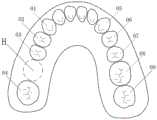
FIG. 1 is a schematic view of the structure of a mandibular plaster model with one side of the first permanent molars missing;
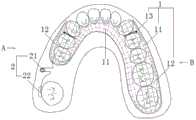
FIG. 2 is a schematic view of an embodiment of the bite block appliance of the present invention;
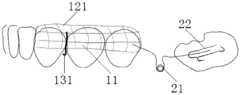
FIG. 3 is a schematic view of the A-direction structure of FIG. 2;
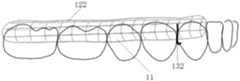
FIG. 4 is a schematic view of the B-direction structure of FIG. 2;
fig. 5 is a schematic structural view of a bent band-type open buckle.
The reference numbers in the figures denote:
01-edentulous side canine, 02-edentulous side first premolar, 03-edentulous side second premolar, 04-edentulous side second permanent molar; 05-missing contralateral canine teeth, 06-missing contralateral first anterior molar teeth, 07-missing contralateral second anterior molar teeth, 08-missing contralateral first constant molar teeth, 09-missing contralateral second constant molar teeth;
1-a retention component, 2-a righting displacement component;
11-retention base, 12-occlusal pad, 121-first occlusal pad, 122-second occlusal pad; 13-adjacent interval hook, 131-first adjacent interval hook, 132-second adjacent interval hook;
21-open Daqu with a ring, 211-near middle end, 212-near middle connecting arm, 213-circle part, 214-far middle connecting arm, 215-far middle end, 216-first curve, 217-second curve, delta-back inclination angle and beta-connecting arm included angle;
22-buccal tube; h-edentulous area.
Detailed Description
The following describes in detail the occlusal pad appliance based on the band-type open Daqu according to the present invention with reference to the accompanying drawings and the specific embodiments.
Aiming at the condition that the adjacent teeth are inclined due to the long-term loss of the first constant molar on one side, the existing appliance commonly used in clinic is a fixed appliance, for example, the existing appliance is used for correcting treatment in invasive forms such as implanting a planting nail into an alveolar bone, and the problems of long treatment course, more frequency of repeated diagnosis, high correction cost, influence on the appearance of a patient and the like generally exist. In order to solve the problem, the utility model provides a ware is rescued to occlusal pad based on open daqu of belt loop formula, this tooth is rescued to be filled up and is rescued the ware and provide sufficient clearance for the regional tooth implantation of lacking the tooth, and the slope adjacent tooth of the department of lacking the tooth of righting simultaneously and correct the tooth occlusal surface height and disturb in order to eliminate the interlock, provide necessary condition for repairing planting the disappearance tooth. In the embodiment shown in fig. 2 to 4, the bite-block appliance comprises a retention component 1 and acentering displacement component 2 for centering the oblique adjacent tooth at the edentulous tooth, wherein:
referring to fig. 2 to 4, in this embodiment, the retention assembly 1 includes aretention base 11 and abite block 12 which are integrally formed, theretention base 11 and thebite block 12 form an arc-shaped mouthpiece which is open at one end, the cross section of the arc tooth socket is of a U-shaped structure, the arc tooth socket can be sleeved on all tooth rows except the secondpermanent molar 04 at the edentulous side, so that theretention base 11 can surround all the tooth crowns except the secondpermanent molars 04 on the edentulous side, theocclusal pad 12 can be placed at the occlusal surface of the tooth row surrounded by theretention base 11, the retention component 1 can connect all teeth except the secondpermanent molar 04 at the edentulous side into a whole, provides stable anchorage and retention functions for righting the inclined secondpermanent molar 04 at the edentulous side, meanwhile, occlusion interference is avoided in the process of opening occlusion of the righting inclined adjacent teeth, and the temporomandibular joint is protected to a certain extent.
Further, the thickness of theocclusal pad 12 is usually about 3mm, and whether the thickness of theocclusal pad 12 is suitable needs to be confirmed and adjusted after the appliance is worn, so that the oblique molar is righted and pressed down while the occlusion of the lacuna adjacent teeth is relieved, and the temporomandibular joint of the patient is not uncomfortable.
Further, the retention assembly 1 is provided with a plurality ofinter-adjacent hooks 13 for assisting in the retention of the appliance. Theadjacent hooks 13 comprise connecting bodies, the head ends of the connecting bodies are embedded in theretention base support 11, the tail ends of the connecting bodies are bent into hook curves to form hook portions, one ends where the hook portions are located are free ends and used for extending into tooth gaps of adjacent teeth to play a role in retention, and on the other hand, one ends of the connecting bodies of theadjacent hooks 13 are embedded in theretention base support 11 to strengthen the strength of theretention base support 11; preferably, the hook portion of theadjacent hook 12 is smoothly curved to prevent stabbing of the gum at the slit between the teeth or to reduce discomfort to the patient.
In one embodiment, the plurality of adjacentintermediate hooks 13 includes a first adjacentintermediate hook 131 for being disposed between adjacent teeth on the edentulous side and a second adjacentintermediate hook 132 for being disposed between adjacent teeth on the edentulous side, and preferably, the first adjacentintermediate hook 131 and the second adjacentintermediate hook 132 are symmetrically disposed on both sides of theretention base 11 such that the first adjacentintermediate hook 131 and the second adjacentintermediate hook 132 can be disposed at corresponding positions of the edentulous side and the edentulous side, respectively.
In another embodiment, the retention assembly 1 further comprises an arrow-head snap ring embedded in theretention base 11 for wrapping the posterior teeth on the opposite side of the missing tooth, and the arrow-head snap ring is a commonly used retention element in a removable appliance to enhance the retention function of the appliance.
In the embodiment shown in fig. 2 to 4, the occlusal pad appliance is manufactured on a lower jaw model (see fig. 1), theretention base 11 and theocclusal pad 12 are formed by integrally solidifying self-hardening plastics, theretention base 11 surrounds the dental crown part of the dentition, wherein theretention base 11 surrounds the complete dental crown on the lingual side and theupper part 2/3 of the dental crown on the buccal side (a distance is left between theretention base 11 and the gingival on the buccal side), so that theretention base 11 has a small structure, reduces the foreign body sensation and ensures that the correctingdisplacement component 2 is installed in place.
In order to ensure the aesthetic appearance of the teeth during the process of correcting the teeth of the patient, theretention base 11 does not cover the incisal margin of the anterior teeth (in this embodiment, the anterior teeth are the anterior mandibular teeth) (namely, after wearing, when the patient normally speaks and opens his mouth, theretention base 11 is generally invisible, and the aesthetic appearance of the teeth is not affected); accordingly, thebite block 12 is divided into two parts, including afirst bite block 121 disposed on the occlusal surface of the edentulous side of theretention base 11 and asecond bite block 122 disposed on the occlusal surface of the edentulous side of the retention base. For example, in one case, thefirst bite block 121 and thesecond bite block 122 do not cover the occlusal surface of the anterior teeth, that is, thefirst bite block 121 is positioned on the occlusal surface of the continuous dentition from the secondanterior molar 03 to thecanine 01 on the edentulous side, and thesecond bite block 122 is positioned on the occlusal surface of the continuous dentition from the secondpermanent molar 09 to thecanine 05 on the opposite side; alternatively, thefirst bite block 121 and thesecond bite block 122 are continuously connected to cover the occlusal surfaces of all dentitions from thesecond premolar 03 on the edentulous side to the secondpermanent molar 09 on the opposite side of the edentulous side.
Referring to fig. 2 and 3, the centering and displacingassembly 2 includes a ringedopen curve 21 for applying a force to the oblique molar (edentulous second constant molar 04) in a direction opposite to the oblique direction, and a buccal tube 23, wherein:
the band-type open Daqu 21 is used for applying an acting force opposite to the inclination direction of the inclined molar (the secondpermanent molar 04 on the edentulous side) to centralize the inclined molar, and simultaneously, the displaced inclined molar is pressed down to adjust the occlusion relation of the posterior teeth, and is matched with thebuccal tube 22 bonded on the buccal side of the molar to be centralized (namely the secondpermanent molar 04 on the edentulous side) for use, and the band-type open Daqu 21 transmits the applying force to the molar to be centralized through thebuccal tube 22.
As shown in fig. 3, thebuccal tube 22 includes a bottom plate fixed to the buccal side of the molar to be centered and a circular tube welded to the bottom plate, the axial direction of the circular tube is kept the same as the direction of the transverse long axis of the molar to be centered, and the open end of the circular tube faces the missing tooth region H. Typically, thebuccal tube 22 is a common component for fixed appliances, where thebuccal tube 22 is used in a removable appliance for the adjustment of the spacing of the teeth in the distal direction.
In the embodiment shown in fig. 5, thelooping type opener 21 is a stainless steel wire bending structure with a loop, which can use a stainless steel round wire or a stainless steel square wire, and the stainless steel square wire is convenient for controlling the torque of the force because the shape of the stainless steel square wire is square, while the stainless steel round wire is easy to be twisted and is not easy to be controlled, and is preferably a stainless steel square wire (for example, the stainless steel square wire with the cross-sectional dimension of 0.017mm × 0.025 mm). Specifically, the looped open Daqu 21 includes a loopedportion 213, a mesial connectingarm 212 and a distal connectingarm 214 connected to the loopedportion 213 and forming an angle, and amesial end 211 and adistal end 215 connected to the mesial connectingarm 212 and the distal connectingarm 214, respectively, where the loopedportion 213 is a force applying mechanism, the force applied by the loopedportion 213 is adjusted by a connecting arm included angle β, where a first curve 216 is formed at a connection between themesial end 211 and the mesial connectingarm 212, a second curve 217 is formed at a connection between thedistal end 215 and the distal connectingarm 214, and the connecting arm included angle β is an included angle between the mesial connectingarm 212 and the distal connectingarm 214. The open loop Dacron 21 with the proximal 211 and distal 215 ends is in the standard position with the proximal 211 and distal 215 arms connecting the proximal 212 and distal 214 arms horizontally symmetrically, i.e. the first 216 and second 217 curves are larger than 90. The teeth connected by the ring-type opening Daqu 21 in the standard state are in the normal state, and based on the principle, when the tooth straightening machine is applied to the straightening of inclined teeth, the angle of the second curve 217 (i.e. the angle between thedistal end 215 and the distal connecting arm 214) should be adjusted by the looping-type opening curve 21 according to the inclination of the inclined teeth, after the ring-type opening curve 21 is connected with the inclined teeth, acting force for restoring the inclined teeth to the normal state is applied to the inclined teeth, the magnitude of this force is determined by the angle of the second curve 217 (i.e. the angle of thedistal end 215 to the horizontal) and the angle of the connecting arm beta, for the embodiment shown in fig. 2, a band-ringtype opening curve 21 is adopted for centralizing and depressing the inclined molar (the secondpermanent molar 04 on the edentulous side), the acting force of theopen loop 21 is adjusted by the back rake angle delta and the angle beta of the connecting arm, the back rake angle δ is an angle formed by thedistal end 215 bending toward thecurved portion 213 and the horizontal line.
Because the molar (i.e. the secondpermanent molar 04 on the edentulous side) inclines towards the direction of the edentulous area H, the ring-shapedopen curve 21 is horizontal, themiddle end 212 is embedded in theretention base 11, thefar end 215 is a free end, and the farend 215 is bent to thecurve 213 at a certain angle, for example, for the ring-shapedopen curve 21 made of stainless steel square wire with the cross-sectional size of 0.017mm × 0.025mm, the back inclination angle delta of the far end 215 (i.e. the angle between the horizontal line where thefar end 215 and themiddle end 211 are opposite) is 15-30 degrees and the connecting arm angle beta is 35-85 degrees (generally, the larger the connecting arm angle beta with the same size is, the larger the size of the stainless steel square wire is, the force is applied to the inclined teeth).
When the appliance is installed, thedistal end 215 is inserted into the round tube of thebuccal tube 22, so that the band-shapedopen buckle 21 crosses over the edentulous area H and is connected with theretention bases 11 and thebuccal tube 22 at two sides of the edentulous area, the installed band-shapedopen buckle 21 has the memory force of returning to the original bending form, and applies a reaction force to the inclined molar to push the inclined molar to move reversely to the inclined direction and simultaneously press down the inclined teeth, so that the band-shapedopen buckle 21 returns to the original state; as the inclination of the inclined molar is smaller and smaller, the force of the loopedopen curve 21 can be further increased by increasing the back-rake angle δ of thedistal end 215 and the connecting arm angle β (generally, the larger the inclination of the inclined molar to the mesial direction is, the smaller the force requirement of the loopedopen curve 21 is, so as to prevent damage to the gum and the root of the tooth, the smaller the connecting arm angle β is, the smaller the force requirement of the loopedopen curve 21 is, and the smaller the back-rake angle δ is, the smaller the force of the loopedopen curve 21 is).
Obviously, the utility model discloses the scene that the ware was rescued to occlusal pad is suitable for is not limited to the condition of the first permanent molar disappearance in lower jaw one side, also can be suitable for the scene of the first permanent molar disappearance on any side of upper jaw.
The manufacturing process of the occlusal pad appliance comprises the following steps:
making a bite-block appliance on the plaster model: preparing a lower jaw or upper jaw plaster model (for example, a lower jaw plaster model shown in figure 1) with a missing tooth position according to the lower jaw or upper jaw of a patient oral cavity, respectively placing a bent and formed belt-type open Daqu 21 and anadjacent hook 13 at a preset position of a plaster model base tooth area (for example, a complete tooth area from asecond premolar 03 at the missing tooth side to a secondpermanent molar 09 at the missing tooth opposite side), filling a prepared self-setting material in a preset base support area (namely a designed base support covering area) and a tooth occlusion pad area (namely a designed tooth occlusion pad covering area) on the plaster model, and demoulding after the self-setting material is solidified to prepare the integrally formed appliance model.
The method specifically comprises the following steps:
1) manufacturing a plaster model with a missing tooth position according to the shape of the lower jaw or the upper jaw of the oral cavity of a patient;
2) coating a layer of separating agent on the dry plaster model abutment area, sequentially placing a ring-typeopen Daqu 21 formed by bending a stainless steel square wire with the cross section size of 0.017mm multiplied by 0.025mm and anadjacent interval hook 13 formed by bending a stainless steel wire with the diameter of 0.7mm at a preset position (see the positions shown in figures 2 to 4), temporarily fixing the ring-typeopen Daqu 21 and the adjacent interval hook with the cross section size of 0.017mm, filling a prepared self-setting material (such as base resin) in the preset abutment area and the tooth combination cushion area on the plaster model, forming anintegrated retention base 11 and atooth combination cushion 12 after the self-setting material is solidified, and simultaneously integrally fixing the ring-typeopen Daqu 21, theadjacent interval hook 13 and theretention base 11.
3) And (4) demolding, namely taking the integrally formed appliance down from the model, and carrying out trimming, grinding and polishing treatment.
The process of wearing the manufactured occlusal pad appliance is as follows (taking the jaw model as an example):
adhering abuccal tube 22 to the buccal side of the secondpermanent molar 04 on the edentulous side to ensure that the long axis of the circular tube of thebuccal tube 22 is consistent with the transverse long axis of the inclined molar, inserting the free end of the loopedopen Daqu 21 of the appliance model into thebuccal tube 22, installing the edentulous side in place, and then installing the opposite side of the edentulous in place; the thickness of theocclusal pad 12 is checked to realize that the incisal occlusion of the incised adjacent teeth (inclined molars) is relieved while the inclined molars are righted and pressed down, no discomfort is caused to the temporomandibular joint of the patient, and the occlusion of the opposite sides of the incised teeth of the patient is not influenced; otherwise, the thickness of thebite block 12 is readjusted, i.e., thebite block 12 is dressed or relined.
Adopt the utility model discloses the occlusal pad rescues the ware and carries out clinical trial. 48 patients with first constant molar loss at one side of 20-60 years old from 2016 to 2019 wear the appliance to carry out clinical tests, full-mouth curved surface fault slices are shot before and after the appliance is taken, a plaster model is prepared, and the full-mouth curved surface fault slices and the plaster model are used for analyzing the change of the tooth loss gap and the recovery of the height between the jaws. The result shows that the total treatment course of all patients is different according to different tooth missing time of the patients, the longest treatment course is nine months, the shortest treatment course is three and a half months, the patients wear the appliance and then provide repairing and planting conditions for repairing the missing teeth, the wearing process does not affect the appearance, and the discomfort is relatively light.
The utility model discloses keep the advantage that the ware was rescued to traditional bite-block pad formula, exert the anchorage and the application of force of fixed ware of rescuring simultaneously, the patient wears more comfortablely, does benefit to oral hygiene's maintenance.
The utility model discloses the tooth closes the pad and rescues the ware through integraltype maintenance base 11 and tooth closespad 12 as whole anchorage, guarantees that the tooth position that does not exert strength keeps unchanged, opens thedaqu 21 through the belt winding formula and applies force to the slope molar, and presses down the slope molar through belt winding formula and tooth closespad 12 and opens thedaqu 21, realizes that the first constant molar of one side lacks for a long time and causes the centering and the purpose of pressing down and rescuring of adjacent tooth slope; the adjustment of the acting force of the band-shapedopen curve 21 is realized by adjusting the back inclination angle delta of the band-shapedopen curve 21 and the included angle beta of the connecting arm, the centralization of the inclined teeth is realized, and the gap of the tooth lacking area is expanded to prepare for the subsequent tooth implantation; theretention base support 11 which does not cover the incisal edge of the anterior teeth is adopted, theretention base support 11 at the labial area of the anterior teeth is invisible, and theocclusal pad 12 is only arranged on the occlusal surface of the molar area, so that the appearance is not influenced when a patient wears the appliance.
The free end of the ring-typeopen buckle 21 of the bite-block appliance of the utility model can go in and out of thebuccal tube 22 and is not fixed, thereby forming a removable appliance. In the using process, the appliance can be taken down and worn after further cleaning, which is beneficial to oral cleaning and nursing; the utility model discloses themaintenance base 11 structure of correcting the ware is smaller, installs that the foreign body sensation is relatively weak in patient's mouth, should correct the ware and take conveniently, only need regularly adjust the afterburning can.
It will be understood by those skilled in the art that these examples are given solely for the purpose of illustration and are not intended to limit the scope of the invention, and that various equivalent modifications and adaptations of the invention are intended to fall within the scope of the invention disclosed herein.
Claims (9)
1. The utility model provides a ware is rescued to tooth pad based on draw-ring type is opened Daqu is filled up to take, is applicable to the long-term disappearance of the first permanent molar in one side and causes just abnormal of adjacent tooth slope to rescue, its characterized in that is equipped with:
the retention assembly (1) comprises a retention base (11) and an occlusal pad (12) which are integrally formed, wherein the retention base (11) and the occlusal pad (12) form an arc-shaped tooth socket with one open end, the cross section of the arc-shaped tooth socket is in a U-shaped structure, and the retention base (11) is suitable for surrounding all dentition crowns except for a second permanent molar (04) on the edentulous side; the occlusal pad (12) is positioned at the occlusal surface of the dentition surrounded by the retention base (11);
the centering displacement assembly (2) comprises a band-ring type opening Daqu (21) and a buccal tube (22), the buccal tube (22) is a round tube which is used for being bonded to the buccal side of the second permanent molar (04) on the edentulous side, and the axial direction of the round tube is consistent with the transverse long axis direction of the second permanent molar (04) on the edentulous side; the ring-type opening Daqu (21) is used for applying acting force opposite to the inclination direction of the second permanent molar (04) on the edentulous side, one end of the ring-type opening Daqu is embedded in the retention base (11), and the other end of the ring-type opening Daqu is inserted into the buccal tube (22).
2. The occlusal pad appliance according to claim 1, wherein the retention component (1) further comprises a plurality of adjacent hooks (13) arranged on the buccal side of the retention base (11), the adjacent hooks (13) are provided with connecting bodies, the head ends of the connecting bodies are embedded in the retention base (11), the tail ends of the connecting bodies are bent into hook shapes to form hook portions, and the ends of the hook portions are free ends and are used for extending into the slits between adjacent teeth.
3. The occlusal pad appliance of claim 2, wherein the plurality of adjacent hooks (13) comprises a first adjacent hook (131) for placing between adjacent teeth on the edentulous side and a second adjacent hook (132) for placing between adjacent teeth on the edentulous side; the first adjacent hook (131) and the second adjacent hook (132) are symmetrically arranged on two sides of the retention base (11).
4. The occlusal pad appliance of claim 1, wherein the retention base (11) does not cover the incisal margin of the anterior teeth, and the occlusal pad (12) is divided into a first occlusal pad (121) disposed on the occlusal surface of the edentulous side of the retention base (11) and a second occlusal pad (122) disposed on the occlusal surface of the edentulous side of the retention base (11).
5. The curvature of loop based occlusal pad appliance of claim 1, wherein the retention base (11) and the occlusal pad (12) are integrally set of self-hardening plastic in a mandibular or maxillary model, the retention base (11) wraps the full crown on the lingual side and the crown upper 2/3 on the buccal side leaving a distance between the retention base (11) and the buccal gingiva.
6. The occlusal pad orthosis according to any one of claims 1 to 5, wherein the open loop (21) is made of a stainless steel wire and comprises a loop portion (213), a proximal connecting arm (212) and a distal connecting arm (214) connected to the loop portion (213) and angled, and a proximal end (211) and a distal end (215) connected to the proximal connecting arm (212) and the distal connecting arm (214), respectively, the proximal end (211) being embedded in the retention base (11), and the distal end (215) being inserted into the buccal tube (22).
7. The occlusal pad appliance of claim 6, wherein the angle between the mesial and distal connecting arms (212, 214) is the connecting arm angle β; the proximal end (211) is oriented horizontally, and the distal end (215) is bent toward the curved portion (213) and forms an angle with the proximal end (211) in the opposite direction, which is called a caster angle δ.
8. The occlusal pad appliance of claim 7, wherein the looping-type opening curve (21) is formed by bending a stainless steel square wire with a cross-sectional dimension of 0.017mm x 0.025mm, and the connecting arm included angle β is 35 ° to 85 °.
9. The bite block appliance of claim 7, wherein the posterior slope angle δ is from 15 ° to 30 °.
Priority Applications (1)
| Application Number | Priority Date | Filing Date | Title |
|---|---|---|---|
| CN202022342803.9UCN213851154U (en) | 2020-10-20 | 2020-10-20 | Occlusal pad appliance based on band-type opening curvy |
Applications Claiming Priority (1)
| Application Number | Priority Date | Filing Date | Title |
|---|---|---|---|
| CN202022342803.9UCN213851154U (en) | 2020-10-20 | 2020-10-20 | Occlusal pad appliance based on band-type opening curvy |
Publications (1)
| Publication Number | Publication Date |
|---|---|
| CN213851154Utrue CN213851154U (en) | 2021-08-03 |
Family
ID=77073160
Family Applications (1)
| Application Number | Title | Priority Date | Filing Date |
|---|---|---|---|
| CN202022342803.9UActiveCN213851154U (en) | 2020-10-20 | 2020-10-20 | Occlusal pad appliance based on band-type opening curvy |
Country Status (1)
| Country | Link |
|---|---|
| CN (1) | CN213851154U (en) |
- 2020
- 2020-10-20CNCN202022342803.9Upatent/CN213851154U/enactiveActive
Similar Documents
| Publication | Publication Date | Title |
|---|---|---|
| CN110063801B (en) | Invisible appliance | |
| US4773853A (en) | Oral orthopedic appliance | |
| US5037295A (en) | Muscular expansion oral shield appliance | |
| US5415542A (en) | Orthodontic finishing appliance | |
| US5002485A (en) | Orthopedic appliance | |
| EP2337529B1 (en) | Dental appliance for constraining the tongue | |
| US20040170941A1 (en) | Embedded features and methods of a dental appliance | |
| CN112315599A (en) | Movable occlusal pad appliance and manufacturing method thereof | |
| CZ301762B6 (en) | Orthodontic appliance | |
| CN106456354B (en) | Oral appliance for treating sleep apnea | |
| US5697781A (en) | Functional regulating device and method for treating malocclusion | |
| CN106821517A (en) | Cushion molar distal jet is closed for tooth phase maxillary teeth | |
| CN113349960B (en) | Maxillary movable appliance in the period of tooth replacement and manufacturing method thereof | |
| EP3348225B1 (en) | Orthodontic apparatus | |
| US20250134626A1 (en) | Removable dental appliance | |
| CN217066631U (en) | Removable appliance for distally erecting and moving first molars | |
| CN216221740U (en) | Shell-shaped appliance with arc guide plate | |
| CN201719394U (en) | Fixed molar uprighting device for correcting lower molar anteversion and impaction | |
| CN214231573U (en) | Movable occlusal pad appliance | |
| EP3482714B1 (en) | Orthodontic appliance for dentistry | |
| KR20230019116A (en) | Mouthpiece-type Removable Orthodontic Device | |
| CN213851154U (en) | Occlusal pad appliance based on band-type opening curvy | |
| CN115770118B (en) | Anshi III type functional appliance suitable for high-angle patient and manufacturing method | |
| CN108294837B (en) | Appliance for correcting open-bite malformation, preparation method and application thereof | |
| CN215130517U (en) | Movable upper jaw appliance for dental period |
Legal Events
| Date | Code | Title | Description |
|---|---|---|---|
| GR01 | Patent grant | ||
| GR01 | Patent grant |