CN1638585A - Electroluminescence device, planar light source and display using the same - Google Patents
Electroluminescence device, planar light source and display using the sameDownload PDFInfo
- Publication number
- CN1638585A CN1638585ACNA2004100900425ACN200410090042ACN1638585ACN 1638585 ACN1638585 ACN 1638585ACN A2004100900425 ACNA2004100900425 ACN A2004100900425ACN 200410090042 ACN200410090042 ACN 200410090042ACN 1638585 ACN1638585 ACN 1638585A
- Authority
- CN
- China
- Prior art keywords
- layer
- light
- organic
- refractive index
- transparent
- Prior art date
- Legal status (The legal status is an assumption and is not a legal conclusion. Google has not performed a legal analysis and makes no representation as to the accuracy of the status listed.)
- Pending
Links
Images


Classifications
- H—ELECTRICITY
- H05—ELECTRIC TECHNIQUES NOT OTHERWISE PROVIDED FOR
- H05B—ELECTRIC HEATING; ELECTRIC LIGHT SOURCES NOT OTHERWISE PROVIDED FOR; CIRCUIT ARRANGEMENTS FOR ELECTRIC LIGHT SOURCES, IN GENERAL
- H05B33/00—Electroluminescent light sources
- H05B33/12—Light sources with substantially two-dimensional radiating surfaces
- H05B33/14—Light sources with substantially two-dimensional radiating surfaces characterised by the chemical or physical composition or the arrangement of the electroluminescent material, or by the simultaneous addition of the electroluminescent material in or onto the light source
- G—PHYSICS
- G02—OPTICS
- G02B—OPTICAL ELEMENTS, SYSTEMS OR APPARATUS
- G02B5/00—Optical elements other than lenses
- G02B5/02—Diffusing elements; Afocal elements
- G02B5/0205—Diffusing elements; Afocal elements characterised by the diffusing properties
- G02B5/0236—Diffusing elements; Afocal elements characterised by the diffusing properties the diffusion taking place within the volume of the element
- G02B5/0242—Diffusing elements; Afocal elements characterised by the diffusing properties the diffusion taking place within the volume of the element by means of dispersed particles
- G—PHYSICS
- G02—OPTICS
- G02B—OPTICAL ELEMENTS, SYSTEMS OR APPARATUS
- G02B5/00—Optical elements other than lenses
- G02B5/02—Diffusing elements; Afocal elements
- G02B5/0273—Diffusing elements; Afocal elements characterized by the use
- G02B5/0278—Diffusing elements; Afocal elements characterized by the use used in transmission
- H—ELECTRICITY
- H05—ELECTRIC TECHNIQUES NOT OTHERWISE PROVIDED FOR
- H05B—ELECTRIC HEATING; ELECTRIC LIGHT SOURCES NOT OTHERWISE PROVIDED FOR; CIRCUIT ARRANGEMENTS FOR ELECTRIC LIGHT SOURCES, IN GENERAL
- H05B33/00—Electroluminescent light sources
- H05B33/12—Light sources with substantially two-dimensional radiating surfaces
- H05B33/20—Light sources with substantially two-dimensional radiating surfaces characterised by the chemical or physical composition or the arrangement of the material in which the electroluminescent material is embedded
- H—ELECTRICITY
- H05—ELECTRIC TECHNIQUES NOT OTHERWISE PROVIDED FOR
- H05B—ELECTRIC HEATING; ELECTRIC LIGHT SOURCES NOT OTHERWISE PROVIDED FOR; CIRCUIT ARRANGEMENTS FOR ELECTRIC LIGHT SOURCES, IN GENERAL
- H05B33/00—Electroluminescent light sources
- H05B33/12—Light sources with substantially two-dimensional radiating surfaces
- H05B33/22—Light sources with substantially two-dimensional radiating surfaces characterised by the chemical or physical composition or the arrangement of auxiliary dielectric or reflective layers
- H—ELECTRICITY
- H10—SEMICONDUCTOR DEVICES; ELECTRIC SOLID-STATE DEVICES NOT OTHERWISE PROVIDED FOR
- H10K—ORGANIC ELECTRIC SOLID-STATE DEVICES
- H10K50/00—Organic light-emitting devices
- H10K50/80—Constructional details
- H10K50/85—Arrangements for extracting light from the devices
- H10K50/854—Arrangements for extracting light from the devices comprising scattering means
- H—ELECTRICITY
- H10—SEMICONDUCTOR DEVICES; ELECTRIC SOLID-STATE DEVICES NOT OTHERWISE PROVIDED FOR
- H10K—ORGANIC ELECTRIC SOLID-STATE DEVICES
- H10K50/00—Organic light-emitting devices
- H10K50/80—Constructional details
- H10K50/85—Arrangements for extracting light from the devices
- H10K50/858—Arrangements for extracting light from the devices comprising refractive means, e.g. lenses
- H—ELECTRICITY
- H10—SEMICONDUCTOR DEVICES; ELECTRIC SOLID-STATE DEVICES NOT OTHERWISE PROVIDED FOR
- H10K—ORGANIC ELECTRIC SOLID-STATE DEVICES
- H10K59/00—Integrated devices, or assemblies of multiple devices, comprising at least one organic light-emitting element covered by group H10K50/00
- H10K59/80—Constructional details
- H10K59/875—Arrangements for extracting light from the devices
- H10K59/877—Arrangements for extracting light from the devices comprising scattering means
- H—ELECTRICITY
- H10—SEMICONDUCTOR DEVICES; ELECTRIC SOLID-STATE DEVICES NOT OTHERWISE PROVIDED FOR
- H10K—ORGANIC ELECTRIC SOLID-STATE DEVICES
- H10K59/00—Integrated devices, or assemblies of multiple devices, comprising at least one organic light-emitting element covered by group H10K50/00
- H10K59/80—Constructional details
- H10K59/875—Arrangements for extracting light from the devices
- H10K59/879—Arrangements for extracting light from the devices comprising refractive means, e.g. lenses
- H—ELECTRICITY
- H10—SEMICONDUCTOR DEVICES; ELECTRIC SOLID-STATE DEVICES NOT OTHERWISE PROVIDED FOR
- H10K—ORGANIC ELECTRIC SOLID-STATE DEVICES
- H10K2102/00—Constructional details relating to the organic devices covered by this subclass
- H10K2102/301—Details of OLEDs
- H10K2102/331—Nanoparticles used in non-emissive layers, e.g. in packaging layer
- H—ELECTRICITY
- H10—SEMICONDUCTOR DEVICES; ELECTRIC SOLID-STATE DEVICES NOT OTHERWISE PROVIDED FOR
- H10K—ORGANIC ELECTRIC SOLID-STATE DEVICES
- H10K85/00—Organic materials used in the body or electrodes of devices covered by this subclass
- H10K85/30—Coordination compounds
- H10K85/311—Phthalocyanine
- H—ELECTRICITY
- H10—SEMICONDUCTOR DEVICES; ELECTRIC SOLID-STATE DEVICES NOT OTHERWISE PROVIDED FOR
- H10K—ORGANIC ELECTRIC SOLID-STATE DEVICES
- H10K85/00—Organic materials used in the body or electrodes of devices covered by this subclass
- H10K85/30—Coordination compounds
- H10K85/321—Metal complexes comprising a group IIIA element, e.g. Tris (8-hydroxyquinoline) gallium [Gaq3]
- H10K85/324—Metal complexes comprising a group IIIA element, e.g. Tris (8-hydroxyquinoline) gallium [Gaq3] comprising aluminium, e.g. Alq3
- H—ELECTRICITY
- H10—SEMICONDUCTOR DEVICES; ELECTRIC SOLID-STATE DEVICES NOT OTHERWISE PROVIDED FOR
- H10K—ORGANIC ELECTRIC SOLID-STATE DEVICES
- H10K85/00—Organic materials used in the body or electrodes of devices covered by this subclass
- H10K85/60—Organic compounds having low molecular weight
- H10K85/615—Polycyclic condensed aromatic hydrocarbons, e.g. anthracene
- H—ELECTRICITY
- H10—SEMICONDUCTOR DEVICES; ELECTRIC SOLID-STATE DEVICES NOT OTHERWISE PROVIDED FOR
- H10K—ORGANIC ELECTRIC SOLID-STATE DEVICES
- H10K85/00—Organic materials used in the body or electrodes of devices covered by this subclass
- H10K85/60—Organic compounds having low molecular weight
- H10K85/631—Amine compounds having at least two aryl rest on at least one amine-nitrogen atom, e.g. triphenylamine
- H—ELECTRICITY
- H10—SEMICONDUCTOR DEVICES; ELECTRIC SOLID-STATE DEVICES NOT OTHERWISE PROVIDED FOR
- H10K—ORGANIC ELECTRIC SOLID-STATE DEVICES
- H10K85/00—Organic materials used in the body or electrodes of devices covered by this subclass
- H10K85/60—Organic compounds having low molecular weight
- H10K85/649—Aromatic compounds comprising a hetero atom
- Y—GENERAL TAGGING OF NEW TECHNOLOGICAL DEVELOPMENTS; GENERAL TAGGING OF CROSS-SECTIONAL TECHNOLOGIES SPANNING OVER SEVERAL SECTIONS OF THE IPC; TECHNICAL SUBJECTS COVERED BY FORMER USPC CROSS-REFERENCE ART COLLECTIONS [XRACs] AND DIGESTS
- Y10—TECHNICAL SUBJECTS COVERED BY FORMER USPC
- Y10S—TECHNICAL SUBJECTS COVERED BY FORMER USPC CROSS-REFERENCE ART COLLECTIONS [XRACs] AND DIGESTS
- Y10S428/00—Stock material or miscellaneous articles
- Y10S428/917—Electroluminescent
- Y—GENERAL TAGGING OF NEW TECHNOLOGICAL DEVELOPMENTS; GENERAL TAGGING OF CROSS-SECTIONAL TECHNOLOGIES SPANNING OVER SEVERAL SECTIONS OF THE IPC; TECHNICAL SUBJECTS COVERED BY FORMER USPC CROSS-REFERENCE ART COLLECTIONS [XRACs] AND DIGESTS
- Y10—TECHNICAL SUBJECTS COVERED BY FORMER USPC
- Y10T—TECHNICAL SUBJECTS COVERED BY FORMER US CLASSIFICATION
- Y10T428/00—Stock material or miscellaneous articles
- Y10T428/24—Structurally defined web or sheet [e.g., overall dimension, etc.]
- Y10T428/24942—Structurally defined web or sheet [e.g., overall dimension, etc.] including components having same physical characteristic in differing degree
- Y—GENERAL TAGGING OF NEW TECHNOLOGICAL DEVELOPMENTS; GENERAL TAGGING OF CROSS-SECTIONAL TECHNOLOGIES SPANNING OVER SEVERAL SECTIONS OF THE IPC; TECHNICAL SUBJECTS COVERED BY FORMER USPC CROSS-REFERENCE ART COLLECTIONS [XRACs] AND DIGESTS
- Y10—TECHNICAL SUBJECTS COVERED BY FORMER USPC
- Y10T—TECHNICAL SUBJECTS COVERED BY FORMER US CLASSIFICATION
- Y10T428/00—Stock material or miscellaneous articles
- Y10T428/25—Web or sheet containing structurally defined element or component and including a second component containing structurally defined particles
Landscapes
- Physics & Mathematics (AREA)
- Optics & Photonics (AREA)
- General Physics & Mathematics (AREA)
- Chemical & Material Sciences (AREA)
- Dispersion Chemistry (AREA)
- Electroluminescent Light Sources (AREA)
Abstract
Translated fromChinese
Description
Translated fromChinese技术领域technical field
本发明涉及一种电致发光装置(在下文中称为“EL装置”),该装置具有极好的发光效率,特别擅于将发射的光提取到外界;还涉及一种使用该电致发光装置的高效平面光源以及使用该平面光源的显示器。The present invention relates to an electroluminescent device (hereinafter referred to as "EL device") which has excellent luminous efficiency and is particularly good at extracting emitted light to the outside; A high-efficiency planar light source and a display using the planar light source.
背景技术Background technique
EL装置包括夹在一对电极之间的发射层,该对电极由阳极和阴极组成,且从该装置发射的光是通过电学手段获得的。积极地研究EL装置不仅为了应用于显示装置,而且为了应用于多种光源,例如平面型照明光源、用于光纤的光源、用于液晶显示器的背光源、或者用于液晶投影仪的背光源。The EL device includes an emission layer sandwiched between a pair of electrodes consisting of an anode and a cathode, and light emitted from the device is obtained by electrical means. EL devices are actively researched not only for application to display devices but also for application to various light sources such as planar illumination light sources, light sources for optical fibers, backlights for liquid crystal displays, or backlights for liquid crystal projectors.
特别是,由于有机EL装置(有机发光二极管)具有发光效率高、低电压下可驱动、重量轻和成本低的优点,近年来研究的精力集中于有机EL装置。在上述作为光源的应用中,主要关心提高发光效率。因此,考虑的是对EL装置的结构和材料、它的驱动方法、它的生产方法等方面的改善,目的在于获得与荧光相媲美的发光效率。In particular, since organic EL devices (organic light emitting diodes) have advantages of high luminous efficiency, drivability at low voltage, light weight, and low cost, research efforts have focused on organic EL devices in recent years. In the above-mentioned application as a light source, the main concern is to improve the luminous efficiency. Therefore, consideration is given to improvements in the structure and material of the EL device, its driving method, its production method, etc., with the aim of obtaining luminous efficiency comparable to that of fluorescence.
然而,关于全固态(in-solid)的发光装置,例如EL装置,光的发射从发射层本身提取,发射角度比临界角度大的光全部反射且限制在内部,因此作为波导光损失,临界角是由发射层折射率和发光部件的折射率确定的。However, regarding all-solid-state (in-solid) light emitting devices, such as EL devices, the emission of light is extracted from the emissive layer itself, and light with an emission angle larger than the critical angle is all reflected and confined inside, so as a waveguide light loss, the critical angle is determined by the refractive index of the emissive layer and the refractive index of the light-emitting component.
依据基于经典的折射理论Snell定律的计算,将产生的光提取到外界的效率,即光提取效率η由近似式:η=1/2n2给出,其中“n”表示发射层的折射率。当发射层的折射率假定为1.7时,η约为17%。也就是说,不少于80%的光作为波导光损失;更特别的是,以光的形式沿着装置的侧面方向损失。According to the calculation based on the classic refraction theory Snell's law, the efficiency of extracting the generated light to the outside world, that is, the light extraction efficiency η is given by the approximate formula: η=1/2n2 , where "n" represents the refractive index of the emitting layer. When the refractive index of the emitting layer is assumed to be 1.7, η is about 17%. That is, no less than 80% of the light is lost as waveguide light; more particularly, in the form of light lost along the sides of the device.
同时,在有机EL装置中,在从电极注入的电子和空穴以复合方式产生的激子中,仅单态激子对光的发射有贡献。生成的激子成为单态激子的概率是1/4。因此,当仅考虑上述因素时,效率不高于5%,这是相当低的。然而,作为改进发射层本身发光效率的一种方法,近年来,也能够由来自三态激子的磷光发射光的发光材料的开发取得了进展(参考文献1)。因此已经看到了明显改善量子效率的潜力。Meanwhile, in an organic EL device, among excitons generated in a recombination manner by electrons and holes injected from electrodes, only singlet excitons contribute to emission of light. The probability that the generated excitons become singlet excitons is 1/4. Therefore, when only the above factors are considered, the efficiency is not higher than 5%, which is quite low. However, as a method of improving the luminous efficiency of the emissive layer itself, in recent years, the development of light-emitting materials capable of emitting light by phosphorescence from triplet excitons has also progressed (reference 1). The potential for significantly improving the quantum efficiency has thus been seen.
然而,即使量子效率得到改善,光提取效率以一定比率乘以量子效率,也降低了发光效率。换言之,作为一种协同影响,改善光提取效率将使得发光效率有根本性的提高。However, even if the quantum efficiency is improved, the light extraction efficiency is multiplied by the quantum efficiency at a certain ratio, which reduces the luminous efficiency. In other words, as a synergistic effect, improving light extraction efficiency will lead to a fundamental increase in luminous efficiency.
将波导光提取到外界的方法的实例包括:形成干扰光的反射角和折射角的区域(下文称作“干扰光的反射/折射角的区域”),从而改变Snell定律的变量并且改变预想进行全反射的光的透射角;赋予发光本身一种光束聚集特性。但是,形成这样一种允许将全部的波导光引出到外界的区域是不容易的。所以,已经提出了许多建议来尽可能多地提取出波导光。Examples of methods for extracting waveguide light to the outside include forming regions of reflection angles and refraction angles of disturbing light (hereinafter referred to as "regions of reflection/refraction angles of disturbing light"), thereby changing variables of Snell's law and changing the predicted behavior. The angle of transmission of light that is totally reflected; giving the glow itself a beam-focusing property. However, it is not easy to form such a region that allows all of the waveguide light to be taken out to the outside. Therefore, many proposals have been made to extract as much waveguide light as possible.
例如,作为改善提取光效率的方法,已经提出了一种通过给基板本身赋予光束聚集特性来提高光提取效率的方法(参考文献2);一种发射层由盘式(discotic)液晶制成以改善发出的光本身的正向方向性的方法(参考文献3);一种在装置中形成立体结构、斜面、衍射光栅或类似物的方法(参考文献4、5和6)。但是,上述方案存在诸如结构复杂、发射层本身发光效率低等问题。For example, as a method of improving the efficiency of extracting light, a method of improving the efficiency of light extraction by imparting beam-condensing properties to the substrate itself has been proposed (Reference 2); an emission layer made of discotic liquid crystal to A method of improving the forward directivity of emitted light itself (reference 3); a method of forming a three-dimensional structure, slope, diffraction grating or the like in a device (
一种相对简单的方法的实例包括形成光漫射层以改变光的折射角,从而降低全反射光的量。例如,已经提出了多种方案,如一种颗粒分散在透明基板中的漫射板,颗粒具有梯度折射率结构,在该结构中,内部的折射率不同于表面的折射率(参考文献7);一种单颗粒层排列在半透明基板上的漫射部件(参考文献8);一种分散颗粒分散在与发射层的材料相同的材料中的方法(参考文献9)。An example of a relatively simple method includes forming a light-diffusing layer to change the refraction angle of light, thereby reducing the amount of total reflected light. For example, various proposals have been proposed, such as a diffuser plate in which particles are dispersed in a transparent substrate with a gradient-index structure in which the refractive index of the interior differs from that of the surface (ref. 7); A diffusion part in which a single particle layer is arranged on a translucent substrate (Reference 8); a method in which dispersed particles are dispersed in the same material as that of the emissive layer (Reference 9).
上述方案的提出是将焦点集中在分散颗粒的特性、与分散基体的折射率差别、颗粒的分散形式、形成分散层的位置等方面上。The proposal of the above scheme focuses on the characteristics of the dispersed particles, the difference in refractive index from the dispersed matrix, the dispersed form of the particles, and the position where the dispersed layer is formed.
此外,已经提出了一种改善用于液晶显示装置的光散射膜的漫射功能的方法(参考文献10);更具体而言,一种在树脂里分散无机颗粒以便提高折射率差,进而改善漫射功能的方法。但是,该方案不包括提取损失光从而改善发光效率的观念,该损失的光假定限制在EL装置内而且以波导光的形式损失。In addition, a method of improving the diffusion function of a light-scattering film used in a liquid crystal display device has been proposed (Reference 10); more specifically, a method of dispersing inorganic particles in a resin to increase the refractive index difference, thereby improving The method of the diffuse function. However, this solution does not include the concept of extracting lost light, which is supposed to be confined within the EL device and lost in the form of waveguide light, thereby improving luminous efficiency.
同时,正如EL装置,对于发光装置来说,在有机薄膜或无机薄膜中发光层夹在一对电极间,光提取表面的电极使用透明电极。对于透明电极,由于通过在锡氧化物中掺杂铟氧化物获得的铟锡氧化物(ITO)具有极好的透明度和电导性,铟锡氧化物得到了广泛的应用。Meanwhile, as with EL devices, for light-emitting devices, a light-emitting layer is sandwiched between a pair of electrodes in an organic thin film or an inorganic thin film, and transparent electrodes are used for the electrodes on the light extraction surface. For transparent electrodes, indium tin oxide (ITO) obtained by doping indium oxide in tin oxide has excellent transparency and electrical conductivity, and indium tin oxide has been widely used.
ITO的折射率根据它的组成、沉积方法或晶体结构而变化,范围大约在1.9至2.0之间。也就是说,ITO是一种折射率很高的物质。The refractive index of ITO varies depending on its composition, deposition method or crystal structure, and ranges from approximately 1.9 to 2.0. In other words, ITO is a substance with a high refractive index.
另一方面,对于用于有机EL装置的透明基板,通常采用玻璃,因为它具有极好的透明度、强度、阻断气体的特性、耐化学性、耐热性等优点。例如,典型的钠钙玻璃的折射率大约为1.52。On the other hand, for a transparent substrate used in an organic EL device, glass is generally used because of its excellent transparency, strength, gas barrier properties, chemical resistance, heat resistance, and the like. For example, typical soda lime glass has a refractive index of about 1.52.
用于有机EL装置的发射层和有机层的发光材料如电子转移材料、空穴转移材料的折射率通常约为1.65至1.75之间,因为分子结构中具有包含有许多苯环的共轭π-键体系,与典型的有机材料相比该折射率是较高的。The refractive index of light-emitting materials such as electron transfer materials and hole transfer materials used in the emission layer and organic layer of organic EL devices is usually between 1.65 and 1.75, because the molecular structure has a conjugated π- bond system, the refractive index is relatively high compared to typical organic materials.
在这样一种有机EL装置中,在发射层产生的光指向所有空间。当上述折射率的关系存在时,全反射不仅发生在玻璃基板和空气层之间的界面上,而且发生在ITO层和玻璃基板之间的界面上。In such an organic EL device, light generated in the emission layer is directed to all spaces. When the above-mentioned relationship of refractive index exists, total reflection occurs not only at the interface between the glass substrate and the air layer but also at the interface between the ITO layer and the glass substrate.
具体而言,在图7中,假设发射层的折射率为1.7、ITO层的折射率为1.9、玻璃基板的折射率为1.52、空气层的折射率为1,当光从发射层射入ITO层时不会发生全反射,因为ITO层的折射率比发射层的折射率高,以至于除了在表面反射的光外,所有的光都进入了ITO层。但是,因为发射层的折射率比玻璃层的折射率高,因此存在一个临界角。Specifically, in Fig. 7, assuming that the refractive index of the emitting layer is 1.7, the refractive index of the ITO layer is 1.9, the refractive index of the glass substrate is 1.52, and the refractive index of the air layer is 1, when the light enters the ITO from the emitting layer Total reflection does not occur in the ITO layer because the refractive index of the ITO layer is higher than that of the emissive layer, so that all light enters the ITO layer except for the light reflected at the surface. However, because the emissive layer has a higher refractive index than the glass layer, there is a critical angle.
因为这个原因,传输角度大于临界角的光在ITO玻璃基板之间的界面上发生了全反射,从而限制在装置内部。进而,进入玻璃基板的入射光在玻璃和空气之间的界面上发生全反射,从而被限制在装置内部。当考虑固体角而对上述比率进行计算时,允许射出的光总计大约为20%,在玻璃和空气之间的界面上反射的光总计约35%,在ITO层和玻璃之间的界面上反射的光总计约45%。在下文中,在A和B之间的界面称作“A/B界面”。For this reason, light transmitted at an angle larger than the critical angle undergoes total reflection at the interface between the ITO glass substrates, thereby being confined inside the device. Furthermore, incident light entering the glass substrate is totally reflected at the interface between the glass and the air, thereby being confined inside the device. When the above ratios are calculated considering the solid angle, the light allowed to exit amounts to about 20%, the light reflected at the interface between glass and air amounts to about 35%, and the light reflected at the interface between the ITO layer and glass The light totals about 45%. Hereinafter, the interface between A and B is referred to as "A/B interface".
因此,当有机EL装置配置如上所述时,即使当光的漫射层形成于玻璃基板上时,允许从那里提取的光仅仅是在玻璃/空气界面上反射的光。换言之,该设置对ITO/玻璃界面上反射的光没有影响。此外,正如到目前为止描述的,基于经典理论的计算表明大约45%的发射光在ITO/玻璃界面上损失掉了。Therefore, when the organic EL device is configured as described above, even when a light-diffusing layer is formed on the glass substrate, light that is allowed to be extracted therefrom is only light reflected on the glass/air interface. In other words, this setup has no effect on the light reflected at the ITO/glass interface. Furthermore, as described so far, calculations based on classical theory indicate that about 45% of the emitted light is lost at the ITO/glass interface.
解决上述问题可能的方法的实例包括:使用高折射率等于或大于发射层的折射率的玻璃作为玻璃基板,在该表面上形成光漫射层的方法;形成由ITO和玻璃基板之间的高折射率材料制成的光漫射层的方法;嵌入高折射率层且在该高折射率层的表面形成上述光漫射层的方法,该高折射率层比光的波长明显厚。Examples of possible methods for solving the above-mentioned problems include: a method of using glass having a high refractive index equal to or greater than that of the emitting layer as a glass substrate, and forming a light-diffusing layer on the surface; A method of a light-diffusing layer made of a material of refractive index; a method of embedding a high-refractive-index layer significantly thicker than the wavelength of light and forming the above-mentioned light-diffusing layer on the surface of the high-refractive-index layer.
但是,高折射率玻璃存在的问题是其成本一般较高。而且,生成光漫射层或由高折射率材料制成的显微透镜结构要求树脂材料有极好的可加工性。但是,通常的树脂材料,甚至高折射率材料,它们的折射率都不大于1.65。可以获得折射率约为1.7的特殊树脂;但是,这样的树脂相当昂贵。However, the problem with high refractive index glass is that its cost is generally high. Furthermore, creating a light-diffusing layer or a microlens structure made of a high-refractive-index material requires excellent workability of the resin material. However, the refractive index of common resin materials, even high refractive index materials, is not greater than 1.65. Special resins with a refractive index of about 1.7 are available; however, such resins are quite expensive.
此外,通过薄膜沉积方法如真空沉积方法、溅射方法或溶胶-凝胶方法能够相对容易地生产厚度不大于1μm的高折射率薄层。但是,由于存在诸如薄膜沉积速度或由内部应力引起裂缝等问题,生成如上所述的比光的波长明显厚的高折射率层是相当困难的。因此,即不昂贵又容易应用的特殊材料已经出现了。In addition, a high-refractive-index thin layer having a thickness of not more than 1 μm can be relatively easily produced by a thin film deposition method such as a vacuum deposition method, a sputtering method, or a sol-gel method. However, it is rather difficult to produce a high-refractive-index layer significantly thicker than the wavelength of light as described above due to problems such as film deposition speed or cracks caused by internal stress. Therefore, special materials that are inexpensive and easy to apply have emerged.
有机EL装置的原理是,通过施加电场使得从阳极注入的空穴和从阴极注入的电子复合成激子,从而使得荧光(或磷光)物质发光。因此,为了改善量子效率,必须高效率地进行复合。为了实现该目的,通常以叠层结构的形式制成一个元件。叠层结构的例子包括:具有空穴传输层和电子传输发射层的两层结构;具有空穴传输层、发射层和电子传输层的三层结构。为了改善效率,已经提出了许多具有双异质结结构的叠层元件。下文中,具有层A、层B和层C的叠层结构称作“层A/层B/层C结构”。The principle of the organic EL device is that holes injected from the anode and electrons injected from the cathode recombine into excitons by applying an electric field, thereby causing fluorescent (or phosphorescent) substances to emit light. Therefore, in order to improve the quantum efficiency, it is necessary to perform recombination efficiently. For this purpose, one element is usually made in the form of a laminated structure. Examples of the laminated structure include: a two-layer structure having a hole transport layer and an electron transport emission layer; a three layer structure having a hole transport layer, an emission layer and an electron transport layer. In order to improve efficiency, many stacked devices having a double heterojunction structure have been proposed. Hereinafter, a laminate structure having layer A, layer B, and layer C is referred to as "layer A/layer B/layer C structure".
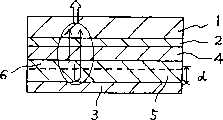
在叠层结构中,复合基本集中在某一区域。例如,在如上所述的两层有机EL装置中,如图10所示,复合集中发生在区域6中,该区域从空穴传输层4与电子传输发射层5之间的界面到电子传输发射层的距离约为10nm,空穴传输层4与电子传输发射层5夹在支撑基板1上的反射电极3和透明电极2之间(如Takuya Ogawa等人在IEICE TRANS ELECTRON,Vol.E85-C,No.6,P1239,2002所报道)。In a laminated structure, compounding is basically concentrated in a certain area. For example, in the two-layer organic EL device as described above, as shown in FIG. 10, recombination concentration occurs in the
在发光区域6中产生的光在所有方向上射出。结果,如图11所示,在穿过透明电极2向其发光表面射出的光与向着反射电极3射出并被其反射后向着发光表面射出的光之间存在光程差。The light generated in the
参照图11,有机EL装置中的电子传输发射层的厚度一般在几十纳米到一百几十纳米范围内,在可见光波长的数量级内。因此,根据在发光区域和反射电极之间的距离d,发出的光束最终相互干涉并且相互加强或减弱。Referring to FIG. 11 , the thickness of the electron transport emission layer in the organic EL device is generally in the range of several tens of nanometers to one hundred and tens of nanometers, which is within the order of magnitude of the wavelength of visible light. Therefore, depending on the distance d between the light-emitting area and the reflective electrode, the emitted light beams end up interfering with each other and mutually intensifying or weakening.
尽管图11仅表示了从正方向射出的光,实际上还存在倾斜地射出的光,依据距离d、发射光波长λ和射出角产生不同方式的干涉。结果,可能发生:在正方向上射出的光束相互增强,而以大角度射出的光束减弱,或者反之。换言之,发光亮度随视角而变化。当然,随着距离d的增大,光的强度随着角度变化更明显。所以,薄膜的厚度通常选择得使距离d约等于发射光波长的四分之一,以保证正方向上射出的光束相互增强。Although FIG. 11 only shows the light emitted from the forward direction, in fact there is also light emitted obliquely, which produces interference in different ways depending on the distance d, the wavelength λ of the emitted light, and the emission angle. As a result, it may happen that the light beams emitted in the positive direction strengthen each other, while the light beams emitted at large angles weaken, or vice versa. In other words, the luminance of light emission varies with the viewing angle. Of course, as the distance d increases, the intensity of the light changes more obviously with the angle. Therefore, the thickness of the film is usually selected so that the distance d is approximately equal to a quarter of the wavelength of the emitted light, so as to ensure that the beams emitted in the positive direction reinforce each other.
例如,如果距离d约小于50纳米时,通常由金属制成的反射电极显著地吸收光从而降低发光强度并且对强度分布产生不利的影响。换言之,在有机EL装置中,射出光的分布根据发光区域和反射电极之间的距离d而显著变化,而且上述的波导光分量相应地产生大的变化。For example, if the distance d is less than about 50 nanometers, the reflective electrode, usually made of metal, absorbs light significantly to reduce the luminous intensity and adversely affect the intensity distribution. In other words, in the organic EL device, the distribution of emitted light varies significantly depending on the distance d between the light emitting region and the reflective electrode, and the above-mentioned waveguide light component varies greatly accordingly.
而且,有机电致发光装置的发射光谱具有在较宽的波长范围内的带宽特性。因此,光束相互增强的波长的范围随着距离d的变化而变化,从而导致光具有变化着的峰值波长。依据距离d,发射光谱也随着视角的变化而变化。Also, the emission spectrum of the organic electroluminescent device has a bandwidth characteristic in a wide wavelength range. Consequently, the range of wavelengths over which the beams mutually enhance varies with distance d, resulting in light with varying peak wavelengths. Depending on the distance d, the emission spectrum also varies with viewing angle.
为了解决这些问题,已经提出了一种方案,选择薄膜厚度来抑制光的颜色随着视角的变化而产生的差异(参考文献11)。但是,没有关于波导光的描述。另外,为了抑制光的颜色对视角的依赖性而选择的薄膜厚度明显地不同于下文中要描述的本发明的范围。To solve these problems, a scheme has been proposed in which the film thickness is selected to suppress the difference in the color of light with the viewing angle (Ref. 11). However, there is no description of waveguide light. In addition, the film thickness selected in order to suppress the dependence of the color of light on the viewing angle is clearly different from the scope of the present invention to be described hereinafter.
基于上述原因,由于大约有80%的发射光作为波导光限制在装置中,因而不可能通过经典算法准确估算出叠层有机EL装置的输出效率。换言之,波导光分量显著地依赖于元件的结构特征。例如,M.H.Lu等人报道,通过使用考虑了微空腔效应的量子力学计算方法,对波导光随元件结构特征的变化进行了详细研究(J.Appl.Phys.,Vol.91,No.2,P.595,2002)。For the above reasons, it is impossible to accurately estimate the output efficiency of stacked organic EL devices by classical algorithms since about 80% of the emitted light is confined in the device as waveguide light. In other words, the waveguide light component depends significantly on the structural features of the element. For example, M.H.Lu et al. reported that the variation of waveguide light with the structural characteristics of the element was studied in detail by using a quantum mechanical calculation method that considered the microcavity effect (J.Appl.Phys., Vol.91, No.2 , P.595, 2002).
此外,如上所述,还没有提出致力于EL装置的波导光的方案;尤其,还没有提出这样的EL装置:在透明电极和玻璃基板之间的界面波导光发生全反射,有效提取这种光且显示改善了发光效率。而且,还没有发现大量可用于这种应用中的高折射率材料,尤其是具有极好可加工性的树脂材料。In addition, as described above, no proposal has been made to waveguide light for an EL device; in particular, no EL device has been proposed in which light is waveguided at an interface between a transparent electrode and a glass substrate, and this light is efficiently extracted. And it was shown that the luminous efficiency was improved. Furthermore, there have not been found a large number of high-refractive-index materials usable in such applications, especially resin materials with excellent processability.
(参考文献1)JP2001-313178A(Reference 1) JP2001-313178A
(参考文献2)JP63-314795A(Reference 2) JP63-314795A
(参考文献3)JP10-321371A(reference 3) JP10-321371A
(参考文献4)JP11-214162A(reference 4) JP11-214162A
(参考文献5)JP11-214163A(Reference 5) JP11-214163A
(参考文献6)JP11-23751A(reference 6) JP11-23751A
(参考文献7)JP6-347617A(reference 7) JP6-347617A
(参考文献8)JP2001-356207A(Reference 8) JP2001-356207A
(参考文献9)JP6-151061A(Reference 9) JP6-151061A
(参考文献10)JP2003-156604A(Reference 10) JP2003-156604A
(参考文献11)JP5-3081A(Reference 11) JP5-3081A
(参考文献12)EP281381B(Reference 12) EP281381B
鉴于上述情况,本发明的一个目的是提供一种EL装置,该装置由于具有有效提取损失掉的光的优点而具有极好的发光效率,损失掉的光以波导光的形式限制在EL装置内部。本发明的另一个目的是提供一种平面高效光源和一种使用如上所述的EL装置的显示器。In view of the above circumstances, an object of the present invention is to provide an EL device which has excellent luminous efficiency due to the advantage of effectively extracting lost light which is confined inside the EL device in the form of waveguide light . Another object of the present invention is to provide a planar high-efficiency light source and a display using the EL device as described above.
发明内容Contents of the invention
本发明的发明人已经热切地对上述问题进行了研究。结果有如下的发现。The inventors of the present invention have earnestly conducted research on the above-mentioned problems. As a result, the following findings were found.
图7是一个示意图,表示从图10中所示的两层有机EL装置的发射区域向外射出的光,仅仅显示了上半球区域。向着反射电极射出的光实际是存在的,但在图中省略了。Fig. 7 is a diagram showing light emitted outward from the emission region of the two-layer organic EL device shown in Fig. 10, showing only the upper hemisphere region. Light emitted toward the reflective electrode actually exists, but is omitted in the figure.
参照图7,向着各个方向射出的光在透明电极和玻璃极板之间的界面首先发生全部内反射并且被限制在内部。这是因为玻璃基板的折射率通常约为1.52,比发射层的折射率低。依据经典计算,假定发射层的折射率为1.7而玻璃基板的折射率为1.52时,在界面上损失的光约占总发射量的45%。接着,传入玻璃基板的光在玻璃基板和空气之间的界面发生全部内反射并且被限制在内部。依据相似的计算,在该界面上损失的光约占总发射量的35%。因此,仅仅20%的光向外射出了并且到达了观察者。Referring to FIG. 7 , the light emitted in various directions first undergoes total internal reflection at the interface between the transparent electrode and the glass plate and is confined inside. This is because the refractive index of the glass substrate is typically about 1.52, which is lower than that of the emissive layer. According to classical calculations, assuming that the refractive index of the emitting layer is 1.7 and that of the glass substrate is 1.52, the light lost at the interface accounts for about 45% of the total emission. Then, light introduced into the glass substrate undergoes total internal reflection at the interface between the glass substrate and air and is confined inside. According to similar calculations, the light lost at this interface accounts for about 35% of the total emission. Therefore, only 20% of the light is emitted outwards and reaches the observer.
在图7(图10)中显示的双层有机EL装置中,当在基板(玻璃基板)上形成如图8所示的用于干扰反射/折射角的光漫射层区域8时,能够通过漫射这些光将在空气/玻璃界面发生全反射的部分传输光导出到外部。但是,这种方法仅仅能够提取在空气/玻璃界面发生全反射的光,在玻璃基板和透明电极之间的界面上发生全反射的光甚至不能射入区域8,因此不能提高光提取效率。In the double-layer organic EL device shown in FIG. 7 (FIG. 10), when the light-diffusing
为了解决上述问题,本发明的发明者已经进行了进一步研究并发现:当在透明电极的旁边形成一个折射率基本等于或大于发射层的折射率的透明层,用于漫射和折射光时,在玻璃基板和透明电极之间的界面上发生全反射的光也能够导出至外部,这对占光总量80%的光产生影响。In order to solve the above-mentioned problems, the inventors of the present invention have conducted further research and found that when a transparent layer having a refractive index substantially equal to or greater than that of the emitting layer is formed beside the transparent electrode for diffusing and refracting light, The light totally reflected at the interface between the glass substrate and the transparent electrode can also be extracted to the outside, which affects the light accounting for 80% of the total light.
为了理解这一点,图9所示为基层1的折射率等于图7(图10)所示的双层有机EL装置的发射层的折射率的情况。如上所述,从发射层发射的所有光传输到具有高折射率的透明电极。其后,当光入射到基层时,如果基层的折射率低于发射层的折射率,会发生全反射。但是,当基层的折射率基本等于或大于发射层的折射率时,依据Snell定律,不存在临界角,以至于所有的光能够进入基层。To understand this, FIG. 9 shows a case where the refractive index of the
当基层的折射率增加时,在空气和基层之间的界面的临界角减小,与上面的情况相似,仅仅占光总量20%的光向外射出。但是,如果光仅仅被导入厚层,不像全部被限制在厚度为几百纳米的极薄薄膜中的光,从像基层这样较厚的层提取光不会降低有机EL装置的性能。When the refractive index of the base layer increases, the critical angle at the interface between the air and the base layer decreases, similar to the above case, and only 20% of the total light is emitted outward. However, if light is only guided into a thick layer, unlike light that is entirely confined in an extremely thin film with a thickness of several hundred nanometers, extracting light from a thicker layer like a base layer does not degrade the performance of an organic EL device.
如上所述,实际的有机EL装置会产生光的干涉。通常这样配置装置以便正向上向外射出的光束相互增强。但是,波导光的干涉使得光束相互减弱。所以不能期望用干扰光的反射/折射角的区域来实现亮度的大大的改善。As described above, actual organic EL devices cause light interference. Typically the arrangement is such that the beams that are directed upwardly and outwardly reinforce each other. However, the interference of the waveguide light causes the beams to attenuate each other. Therefore, it cannot be expected to achieve a large improvement in luminance with regions of reflection/refraction angles that interfere with light.
但是,不同于上述的传统方法,本发明的发明者选择装置的结构特征以便使波导光的形式限制在该装置中的大角度光束能够相互增强,同时正向射出的光束被削弱,且在放大了其中分布有大部分光的波导光后形成干扰光的反射/折射角的区域,可以获得相对现有技术提高了的发光效率。However, unlike the conventional methods described above, the inventors of the present invention have chosen the structural features of the device so that the large-angle beams confined in the device in the form of waveguided light can reinforce each other, while the beams exiting in the forward direction are weakened and amplified The area where the waveguide light in which most of the light is distributed forms the reflection/refraction angle of the interfering light, and the luminous efficiency improved compared with the prior art can be obtained.
换言之,本发明的发明者已经发现,具有上述结构特征且具有用于干扰光的反射/折射角的区域的有机EL装置产生的发光效率比在任何已知结构装置中形成的区域的发光效率都高,而具有该结构特征而没有该区域的有机EL装置的效率低。In other words, the inventors of the present invention have found that an organic EL device having the above-mentioned structural features and a region having a reflection/refraction angle for disturbing light produces a luminous efficiency higher than that of a region formed in any known structural device. High, while the efficiency of the organic EL device having this structural feature without this region is low.
上述发现实现了本发明的第一方面(下文中称作“第一发明”)。The above findings achieve the first aspect of the present invention (hereinafter referred to as "first invention").
而且,本发明的发明者为了解决上述问题在做了热切的研究之后有了如下的发现。EL装置具有夹在一对电极间的发射层,该对电极由阳极和阴极组成,当漫射层设置在光提取表面一侧的电极(透明电极)旁边时,且当漫射层包含有至少两种分散在其内部的微粒且这些微粒的平均粒度很不相同时,能够有效提取以波导光的形式被限制在EL装置内部的损失的光。由此,可以获得一种具有极好的提取光效率的EL装置。Furthermore, the inventors of the present invention have made the following findings after earnest studies in order to solve the above-mentioned problems. The EL device has an emission layer sandwiched between a pair of electrodes consisting of an anode and a cathode, when the diffusion layer is provided next to the electrode (transparent electrode) on the side of the light extraction surface, and when the diffusion layer contains at least When two kinds of particles are dispersed therein and the average particle sizes of these particles are very different, it is possible to effectively extract lost light confined inside the EL device in the form of waveguide light. Thus, an EL device having excellent light extraction efficiency can be obtained.
上述发现实现了本发明的第二方面(下文中称作“第二发明”)。The above findings achieve the second aspect of the present invention (hereinafter referred to as "second invention").
本发明主要包括以下几项:The present invention mainly comprises the following items:
(1)一种有机电致发光装置,包括:包含有一个发射层的有机层;(1) An organic electroluminescent device, comprising: an organic layer comprising an emission layer;
一对包含有阳极和阴极并夹着有机层的电极,其中至少一个电极是透明的;a pair of electrodes comprising an anode and a cathode sandwiching an organic layer, at least one of which is transparent;
一个透明层,临近透明电极的光提取表面;a transparent layer adjacent to the light extraction surface of the transparent electrode;
显著干扰光的反射和折射角的区域,临近透明层的光提取表面或者在透明层的内部,其中透明层的折射率基本等于或大于发射层的折射率。Regions that significantly interfere with the angle of reflection and refraction of light, adjacent to the light extraction surface of the transparent layer or within the interior of the transparent layer, where the refractive index of the transparent layer is substantially equal to or greater than the refractive index of the emissive layer.
(2)依据第1项的有机电致发光装置,其中透明层的折射率不小于1.7。(2) The organic electroluminescent device according to
(3)依据第1项的有机电致发光装置,其中显著干扰光的反射和折射角的区域包括:第一透明材料;分散在第一透明材料中的平均粒度为0.2到20μm的第二透明材料或者不透明材料,其中第二透明材料或者不透明材料的折射率不同于第一透明材料的折射率。(3) The organic electroluminescent device according to
(4)依据第1项的有机电致发光装置,其中显著干扰光的反射和折射角的区域包含透镜结构。(4) The organic electroluminescent device according to
(5)依据第1项的有机电致发光装置,其中显著干扰光的反射和折射角的区域包含一个表面粗糙度不小于1μm的不规则表面。(5) The organic electroluminescent device according to
(6)依据第1项的有机电致发光装置,其中透明层包含有下述通式(I)代表的聚碳酰二亚胺树脂:(6) The organic electroluminescent device according to
R1-N=C=N(-R-N=C=N-)n-R1 (I)R1 -N=C=N(-RN=C=N-)nR1 (I)
其中R、R1和n分别表示有机二异氰酸酯残基、有机一异氰酸酯残基和1到100的整数。Wherein R,R1 and n represent organic diisocyanate residues, organic monoisocyanate residues and integers from 1 to 100, respectively.
(7)依据第6项的有机电致发光装置,其中10mol%或以上的有机二异氰酸酯残基R是萘二异氰酸酯残基。(7) The organic electroluminescent device according to
(8)依据第6项的有机电致发光装置,其中有机一异氰酸酯残基R1是1-萘基异氰酸酯残基。(8) The organic electroluminescence device according to
(9)依据第1项的有机电致发光装置,其中至少一种平均粒度在1到100nm的微粒分散于透明层中。(9) The organic electroluminescent device according to
(10)依据第1项的有机电致发光装置,其中假定没有提供透明层和显著干扰光的反射和折射角的区域,形成有机层和电极对以便于从光的提取表面射出的光的正向亮度和从50°到70°方向上射出的光的亮度满足公式(1):(10) The organic electroluminescent device according to
正向亮度<50°到70°方向上的亮度 (1)Positive luminance < luminance in the direction of 50° to 70° (1)
(11)依据第10项的有机电致发光装置,其中电极对包括反射电极和透明电极,而且还满足下列公式(2):(11) The organic electroluminescence device according to
(0.3/n)λ<d<(0.5/n)λ (2)(0.3/n)λ<d<(0.5/n)λ (2)
其中d表示电子-空穴复合发射区域和反射电极之间的距离(nm),λ表示用于发射层的材料的荧光光谱的峰值波长,n表示在发射层和反射电极之间的有机层的折射率。where d represents the distance (nm) between the electron-hole recombination emission region and the reflective electrode, λ represents the peak wavelength of the fluorescence spectrum of the material used for the emissive layer, and n represents the wavelength of the organic layer between the emissive layer and the reflective electrode refractive index.
(12)一种包含依据第1项的有机电致发光装置的表面光源。(12) A surface light source comprising the organic electroluminescent device according to
(13)一种包含依据第1项的有机电致发光装置的显示器。(13) A display comprising the organic electroluminescent device according to
(14)电致发光装置,包括:发射层;一对包含有阳极和阴极并夹有发射层的电极;临近透明电极的光提取表面设置的漫射层,其中漫射层包括:树脂,和至少两种分散在树脂中的微粒,这些微粒的平均粒度不相同以至于较大微粒的粒度至少是较小微粒粒度的十倍。(14) An electroluminescent device comprising: an emitting layer; a pair of electrodes comprising an anode and a cathode sandwiching the emitting layer; a diffusing layer arranged adjacent to the light extraction surface of the transparent electrode, wherein the diffusing layer includes: a resin, and At least two particles dispersed in a resin, the particles differing in average particle size such that the larger particle is at least ten times the size of the smaller particle.
(15)依据第14项的电致发光装置,其中两种微粒包括:平均粒度为1到100nm的超微颗粒;平均粒度大于0.1μm且不大于50μm的微粒。(15) The electroluminescence device according to
(16)依据第15项的电致发光装置,其中该装置满足下列公式:(16) The electroluminescent device according to
n1≥1.9n1 ≥ 1.9
|[n0·q+n1·(1-q)]-n2|≥0.05 (3)|[n0 ·q+n1 ·(1-q)]-n2 |≥0.05 (3)
其中n0表示树脂的折射率;n1表示分散在树脂中平均粒度为1到10nm的超微颗粒的折射率;n2表示分散在树脂中平均粒度大于0.1μm且不大于50μm的微粒的折射率;“q”表示树脂占树脂和超微颗粒总和的体积分数;“1-q”表示超微颗粒所占的体积分数。Where n0 represents the refractive index of the resin; n1 represents the refractive index of ultrafine particles dispersed in the resin with an average particle size of 1 to 10 nm; n2 represents the refraction of particles dispersed in the resin with an average particle size greater than 0.1 μm and not greater than 50 μm "q" indicates the volume fraction of resin in the sum of resin and ultrafine particles; "1-q" indicates the volume fraction of ultrafine particles.
(17)依据第16项的电致发光装置,其中树脂的折射率n0不小于1.5。(17) The electroluminescent device according to
(18)依据第16项的电致发光装置,其中树脂的折射率n0不小于1.6。(18) The electroluminescent device according to
(19)依据第16项的电致发光装置,其中该装置进一步满足下列公式:(19) The electroluminescent device according to
[n0·q+n1·(1-q)]≥1.65 (4)[n0 ·q+n1 ·(1-q)]≥1.65 (4)
(20)依据第14项的电致发光装置,进一步包括发光材料,其中至少一种发光材料吸收从发射层以激发光的形式射出的光,从而发出荧光或磷光。(20) The electroluminescence device according to
(21)依据第14项的电致发光装置,其中漫射层本身构成了支撑基板。(21) The electroluminescence device according to
(22)一种包括依据第14项的电致发光装置的平面光源。(22) A planar light source comprising the electroluminescent device according to
(23)一种包括依据第14项的电致发光装置的显示器。(23) A display comprising the electroluminescent device according to
附图说明Description of drawings
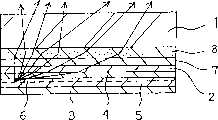
图1表示根据第一发明的有机EL装置的一个示例的截面图。FIG. 1 shows a cross-sectional view of one example of an organic EL device according to the first invention.
图2是一特性要素图,显示了根据第一发明的每个有机EL装置和常规的有机EL装置的基本结构的亮度对角度的依赖性。Fig. 2 is a characteristic element diagram showing the angle dependence of luminance of the basic structure of each organic EL device according to the first invention and a conventional organic EL device.
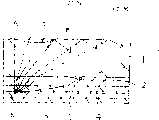
图3表示根据第一发明的有机EL装置的另一个示例的截面图。Fig. 3 shows a cross-sectional view of another example of the organic EL device according to the first invention.
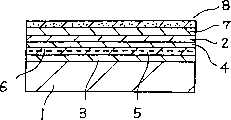
图4表示根据第一发明的有机EL装置的另一个示例的截面图。Fig. 4 shows a cross-sectional view of another example of the organic EL device according to the first invention.
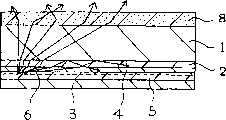
图5表示根据第一发明的有机EL装置的另一个示例的截面图。Fig. 5 shows a cross-sectional view of another example of the organic EL device according to the first invention.
图6表示根据第一发明的有机EL装置的又一个示例的截面图。Fig. 6 shows a cross-sectional view of still another example of the organic EL device according to the first invention.
图7是用于解释第一发明的原理的草图。Fig. 7 is a sketch for explaining the principle of the first invention.
图8是用于解释第一发明不同方面的原理的草图。Fig. 8 is a sketch for explaining the principle of different aspects of the first invention.
图9是用于解释第一发明另一方面的原理的草图。Fig. 9 is a sketch for explaining the principle of another aspect of the first invention.
图10是解释有机EL装置的发光区域的图。FIG. 10 is a diagram explaining a light emitting region of an organic EL device.
图11是解释有机EL装置的亮度的图。FIG. 11 is a graph explaining the luminance of an organic EL device.
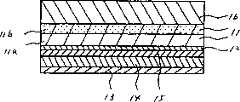
图12表示第二发明的有机EL装置的第一实施方案的截面图。Fig. 12 shows a sectional view of the first embodiment of the organic EL device of the second invention.
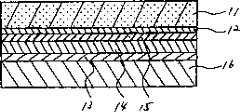
图13表示第二发明的有机EL装置的第二实施方案的截面图。Fig. 13 shows a cross-sectional view of a second embodiment of the organic EL device of the second invention.
图14表示第二发明的有机EL装置的第三实施方案的截面图。Fig. 14 shows a cross-sectional view of a third embodiment of the organic EL device of the second invention.
图15表示第二发明的有机EL装置的第四实施方案的截面图。Fig. 15 shows a sectional view of a fourth embodiment of the organic EL device of the second invention.
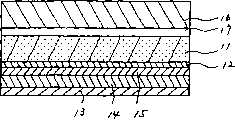
图16表示第二发明的有机EL装置的第五实施方案的截面图。Fig. 16 shows a cross-sectional view of a fifth embodiment of the organic EL device of the second invention.
图17表示常规有机EL装置的截面图。Fig. 17 shows a cross-sectional view of a conventional organic EL device.
图18表示不同于本发明的有机EL装置的截面图。Fig. 18 shows a cross-sectional view of an organic EL device other than the present invention.
具体实施方式Detailed ways
参照附图描述实现第一发明的方式。图1表示第一发明的两层有机EL装置的一个示例。它的基本构造包括依次层叠在支撑基板1上的透明电极2、空穴传输层4、电子传输发射层5和反射电极3。由空穴传输层4和电子传输发射层5构成的有机层夹在一对电极间,这对电极由透明电极2和反射电极3组成,在工作时,复合集中发生在区域6中,该区域从空穴传输层4与电子传输发射层5之间的界面到电子传输发射层的距离约为10nm,空穴传输层4与电子传输发射层5夹在支撑基板1上的反射电极3和透明电极2之间。The manner of carrying out the first invention is described with reference to the drawings. FIG. 1 shows an example of a two-layer organic EL device of the first invention. Its basic structure includes a
在不同于两层型的有机EL装置中,例如三层有机EL装置,它包括空穴传输层、发射层和电子传输层,在电极间施加电压,就从阳极注入了空穴,从阴极注入了电子,它们在各自的载流子传输层中移动并且在发射层中复合以产生激子,由此产生如上所述的电致发光。In an organic EL device other than the two-layer type, such as a three-layer organic EL device, which includes a hole transport layer, an emission layer, and an electron transport layer, when a voltage is applied between the electrodes, holes are injected from the anode and holes are injected from the cathode. electrons, which move in the respective carrier transport layers and recombine in the emission layer to generate excitons, thereby generating electroluminescence as described above.
在上述的基本结构中,有机EL装置的优选构造方式为使得限制在装置中的光束相互增强,同时正向发射的光相互减弱,由此第一发明能够获得更令人满意的效果。参照图2将对这个方面进行详细解释。In the above basic structure, the organic EL device is preferably constructed in such a way that the light beams confined in the device strengthen each other, while the light emitted forward weakens each other, so that the first invention can obtain more satisfactory effects. This aspect will be explained in detail with reference to FIG. 2 .
图2是表示具有如上所述基本结构的有机EL装置亮度的角分布特征图(即在下文描述的高折射层和干扰光的反射/折射角的区域形成之前),测定是在从正向看从0度到80度的范围内以10度的间隔进行的。在该图中,曲线a表示依据第一发明的装置,曲线b表示已知装置的。Fig. 2 is to represent the angular distribution characteristic diagram of the organic EL device luminance with the basic structure as described above (i.e. before the high refraction layer described below and the region of the reflection/refraction angle of disturbing light are formed), and the measurement is viewed from the front It is carried out at intervals of 10 degrees from 0 degrees to 80 degrees. In this figure, curve a represents the device according to the first invention and curve b represents the known device.
在基本构造中,透明电极2的厚度为100纳米,空穴传输层4的厚度为50纳米且电子传输发射层5的厚度为140纳米(第一发明)或60纳米(常规)。通过施加电压进行测定,以便于同样数量的电流流过本发明的元件和已知元件中的每一个。In the basic configuration, the
从图2中明显看出,已知元件显示了理想漫射层的优选亮度分布图,包括从正向上0度角测量的正向亮度高值和在较宽范围内基本相等的亮度值。另一方面,第一发明的装置显示了正向亮度低值和在较宽范围内亮度值的增加。换言之,第一发明装置的构造使得亮度对角度的依赖性满足公式(1):As is apparent from Figure 2, the known element exhibits a preferred luminance profile for an ideal diffuser layer, including high values of forward luminance measured from a positive angle of 0 degrees and substantially equal luminance values over a wide range. On the other hand, the device of the first invention showed low values of forward luminance and increases in luminance values over a wide range. In other words, the device of the first invention is constructed such that the dependence of luminance on angle satisfies the formula (1):
正向亮度<50到70度角度间的亮度(1)Forward luminance < luminance at angles between 50 and 70 degrees (1)
在上述例子中,通过两种元件之间的电子传输发射层5的厚度差可以实现上述公式,通过适当选择含有发射层5的有机层和电极对的材料、厚度等也可以实现上述预定公式。In the above example, the above formula can be realized by the thickness difference of the electron
构造第一发明的更加优选的实施方案,以满足下列公式(2):A more preferred embodiment of the first invention is constructed to satisfy the following formula (2):
(0.3/n)λ<d<(0.5/n)λ (2)(0.3/n)λ<d<(0.5/n)λ (2)
其中d表示区域6的中心和反射电极3之间的距离,λ(nm)表示用于发射层(在本发明中,电子传输发射层5)的材料的荧光发射光谱的峰值波长,n表示在发射层和反射电极3(在本发明中,电子传输发射层5)之间的有机层的折射率。Wherein d represents the distance between the center of the
例如,优选在上述实施方案中,电子传输发射层5发射在其荧光发射光谱中峰值波长为540纳米的绿色光并且当光的折射率为1.65时,距离d选择在98.2纳米至163.6纳米范围内。For example, preferably in the above embodiments, the electron
尽管上述例子中的发射光为绿色光,在实际的照明应用中,发射白色光的有机EL装置是十分重要的。发出白光的方法的示例包括在发射层分散多种发光材料,如蓝和黄发光材料或蓝、绿和红发光材料,叠加蓝光发射层、绿光发射层、红光发射层和黄光发射层,或者使用本身发出白光的材料。Although the emitted light in the above examples is green light, an organic EL device that emits white light is very important in practical lighting applications. Examples of methods of emitting white light include dispersing a plurality of light-emitting materials such as blue and yellow light-emitting materials or blue, green and red light-emitting materials in an emission layer, stacking a blue light-emitting layer, a green light-emitting layer, a red light-emitting layer, and a yellow light-emitting layer , or use materials that themselves emit white light.
与荧光灯相似,这些有机EL装置在每个波长段有多个发射峰值。在这种情况下,依据发射光的波长和复合区域与反射电极之间的距离,向着正向发出的光相互增强或减弱,这根据波长段而显著地变化。Similar to fluorescent lamps, these organic EL devices have multiple emission peaks per wavelength band. In this case, depending on the wavelength of the emitted light and the distance between the recombination region and the reflective electrode, the lights emitted toward the forward direction are mutually enhanced or weakened, which significantly varies depending on the wavelength band.
例如,考虑在上述发射白光的有机EL装置中将发出蓝、绿和红光的发光材料分散在单个发射层中。假设蓝、绿和红光的峰值波长分别为450纳米、540纳米和630纳米而且发射层的折射率是1.65,满足公式(2)的三种颜色的距离d不同,即蓝光为81.8至136纳米、绿光为98.2至163.6纳米、红光为114.6至190.9纳米。For example, consider that in the above-mentioned organic EL device that emits white light, light emitting materials that emit blue, green, and red light are dispersed in a single emissive layer. Assuming that the peak wavelengths of blue, green and red light are 450 nm, 540 nm and 630 nm respectively and the refractive index of the emitting layer is 1.65, the distance d of the three colors satisfying the formula (2) is different, that is, the blue light is 81.8 to 136 nm , The green light is 98.2 to 163.6 nanometers, and the red light is 114.6 to 190.9 nanometers.
在第一发明中,折射率基本等于或高于发射层的折射率的透明层7设置临近于透明电极2的光提取表面,用于显著干扰反射/折射角的光漫射层区域8设置临近于透明层7的光提取表面。第一发明的结构优选满足公式(1)的关系,且更优选满足公式(2)的关系。而且,优选使用通过在透明层分散漫射颗粒而形成的光漫射层作为区域8,该透明层作为基体与上面描述的类似,漫射颗粒的折射率不同于透明层的折射率。在这样的一种构造中,在透明层7和透明电极2之间的界面上不会发生全反射,发射的所有的光分散在光漫射层8上。从而,被引导的波发射到外界的可能性提高,进而极大地提高发光亮度。In the first invention, a
在第一发明中,对于透明层7,与发射层的折射率基本相等或更高的折射率表示折射率不低于发射层折射率的0.95倍,优选不低于发射层的折射率,更优选不低于发射层折射率的1.05倍。In the first invention, for the
从图1中,似乎所有穿过光漫射层8的光都提取到了外界。但是实际上,部分穿过光漫射层8的光在基层1的界面上也发生了全反射并受到了限制。但是,在基层1和空气层之间的界面上发生全反射的光在反射电极3重复反射,且穿过光漫射层8而最终提取到了外界。From Fig. 1, it seems that all the light passing through the light-diffusing
尽管依据图1所示的结构,用于干扰光的反射/折射角的区域8形成于临近透明层7的发光表面上,或者如图3所示,也可在透明层7的内部,部分或整体地形成区域8。换言之,透明层7本身可由光漫射层8形成。而且,如图4所示,能够使用从透明材料形成的支撑基板1作为透明层7。尽管图4显示如上所述形成的光漫射层8临近于支撑基板1(亦作为透明层7)的发光表面,但是如图5所示,光漫射层8可被微透镜列阵或物理棱镜结构代替,微透镜列阵或物理棱镜结构形成在亦作为透明层7的支撑基板1的发光表面上。Although according to the structure shown in FIG. 1, the
图3到图5的其他结构单元与图1中的一致并且用与图1中相同的标记数表示,因此不再赘述。The other structural units in Fig. 3 to Fig. 5 are consistent with those in Fig. 1 and denoted by the same number as in Fig. 1, so they are not repeated here.
第一发明中的有机EL装置可选择地包括顶发射(top-emission)型有机EL装置,如图6所示,该装置由在支撑基板1上依次形成的反射电极3、电子传输发射层5、空穴传输层4和透明电极2并进一步通过在其上依次形成透明层7和光漫射层8而制成,并调适为从支撑基板1的反面发光。支撑基板1不一定是透明的。The organic EL device in the first invention may optionally include a top-emission (top-emission) type organic EL device, as shown in FIG. , a
第一发明也可应用于两边提取型的有机EL装置,该装置中两个电极包括有透明电极而没有反射电极。在这种情况中,透明层和光漫射层形成在两个透明电极上,从而在两个侧面提高光发射强度。没有反射电极的两边提取型的有机EL装置不一定满足公式(1)和公式(2)。The first invention is also applicable to a two-side extraction type organic EL device in which both electrodes include transparent electrodes without reflective electrodes. In this case, a transparent layer and a light-diffusing layer are formed on two transparent electrodes, thereby increasing light emission intensity at both sides. A double-edge extraction type organic EL device without reflective electrodes does not necessarily satisfy the formulas (1) and (2).
如果第一发明中的有机EL装置的结构中包括临近透明电极2的发光表面形成的透明层7以及临近透明层7的发光表面或在透明层7内部形成的用于显著干扰光的反射/散射角的区域8,该装置除了上述的两种形式外,还可有多种形式。在透明电极2和透明层7之间可形成一个旨在获得表面光滑或紧密粘着、阻止残余杂质的漫射、改善气体隔栏特性等的层面。但是,这个层面也需要形成一个透明层,以便可以形成具有如所描述的不同功能的两个或多个透明层。If the structure of the organic EL device in the first invention includes the
在下文中,通过与常规的有机EL装置比较,描述第二发明的有机EL装置的构造和效果。Hereinafter, the configuration and effects of the organic EL device of the second invention are described by comparison with conventional organic EL devices.
图17所示为具有常规结构的有机EL装置。在该有机EL装置中,有一个有机EL层、和夹在电极12和13之间的电子传输发射层14和空穴传输层15,在该有机EL层中,由阳极12和阴极13形成了一对电极,阳极12是支撑在玻璃基板的支撑基板16上的透明电极,阴极13是反射电极。Fig. 17 shows an organic EL device having a conventional structure. In this organic EL device, there is an organic EL layer, and an electron
所示的图是示意图,仅仅显示了从发光区域向外射出的光的上半球区域。向着反射电极射出的光实际上也是存在的,但没有在图中表示出来。The figure shown is a schematic diagram showing only the upper hemispheric area of the light emitted outwardly from the light emitting area. The light emitted toward the reflective electrode actually exists, but it is not shown in the figure.
如上所述,向着各个方向射出的光最初在透明电极和玻璃基板之间的界面发生全反射并且被限制在内部。依据经典理论的计算显示,在透明电极和玻璃基板之间的界面上损失的光约占总发光量的45%。而且,传入玻璃基板的光在玻璃基板和空气之间的界面发生全反射并且被限制在内部。依据与上述方法相似的计算显示,在玻璃基板和空气之间的界面上损失的光约占总发光量的35%。因此,实际上只有20%的光向外射出并且到达了观察者。As described above, light emitted in various directions is initially totally reflected at the interface between the transparent electrode and the glass substrate and is confined inside. Calculations based on classical theory show that the light lost at the interface between the transparent electrode and the glass substrate accounts for about 45% of the total luminescence. Also, light introduced into the glass substrate is totally reflected at the interface between the glass substrate and air and is confined inside. Calculations similar to those described above show that the light lost at the interface between the glass substrate and air accounts for about 35% of the total luminescence. So only 20% of the light actually goes out and reaches the observer.
如图18所示,关于有机EL装置,例如可以采取在玻璃基板上形成用于引起光的反射角/折射角变化的光漫射层10的方法。因为在全反射情况下光被漫射,假设在空气/玻璃界面上发生全反射的光的一部分可射到外界。但是,采用上述方法射到外界的光仅仅是假设在气体/玻璃界面上发生全反射的光,对于在玻璃基板/透明电极界面上发生全反射的光不起作用。As shown in FIG. 18 , regarding the organic EL device, for example, a method of forming a light-diffusing
为此,在本发明中,漫射层设置临近于具有高折射率的透明电极,在该漫射层中,分散有至少两种微粒,这些微粒的平均粒度不相同以至于较大微粒的粒度是较小微粒粒度的至少十倍。结果,平均粒度极小的超微颗粒提高了漫射层的折射率,比超微颗粒的平均粒度大的微粒允许光漫射。结果,假设在玻璃基板和透明电极之间的界面发生全反射的光也射到了外界。因此,EL装置为如上所述的结构时,射出的光约占总光量的80%。For this reason, in the present invention, a diffusing layer is disposed adjacent to a transparent electrode having a high refractive index, and in the diffusing layer, at least two kinds of particles are dispersed, the average particle sizes of which are different so that the particle size of the larger particles At least ten times the particle size of the smaller particles. As a result, ultrafine particles with an extremely small average particle size increase the refractive index of the diffusion layer, and fine particles larger than the average particle size of the ultrafine particles allow light to diffuse. As a result, the light assumed to be totally reflected at the interface between the glass substrate and the transparent electrode is also emitted to the outside. Therefore, when the EL device is configured as described above, the emitted light accounts for about 80% of the total light quantity.
图12所示为第二发明最基本的实施方案。Figure 12 shows the most basic embodiment of the second invention.
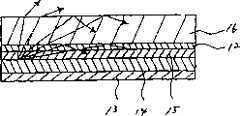
如图17所示的前述的例子中,在有机EL装置中,有一个有机EL层、和夹在电极12和13之间的电子传输发射层14和空穴传输层15,该有机EL层包括由阳极12和阴极13形成的一对电极,阳极12是支撑在玻璃基板的支撑基板16上的透明电极,阴极13是反射电极。在有机EL装置中,设置漫射层临近于阳极12,阳极12是置于光提取表面的电极(透明电极),该漫射层包含有至少两种微粒,这些微粒的平均粒度不相同以至于较大微粒的粒度是较小微粒粒度的至少十倍。In the foregoing example shown in FIG. 17, in the organic EL device, there is an organic EL layer, and an electron
尤其,在上述的光漫射层11中的至少两种微粒优选是由平均粒度为1到100nm的超微颗粒和平均粒度大于0.1μm且不大于50μm的微粒组成。In particular, at least two kinds of fine particles in the above-mentioned light-diffusing layer 11 are preferably composed of ultrafine particles with an average particle size of 1 to 100 nm and fine particles with an average particle size of more than 0.1 μm and not more than 50 μm.
而且,在光漫射层11中,最好是满足下列公式:And, in the light-diffusing layer 11, it is preferable to satisfy the following formula:
n1≥1.9n1 ≥ 1.9
|[n0·q+n1·(1-q)]-n2|≥0.05 (3)|[n0 ·q+n1 ·(1-q)]-n2 |≥0.05 (3)
其中n0表示树脂的折射率;n1表示分散在树脂中平均粒度为1到10nm的超微颗粒的折射率;n2表示分散在树脂中平均粒度大于0.1μm且不大于50μm的微粒的折射率;“q”表示树脂占树脂和超微颗粒总和的体积分数;“1-q”表示超微颗粒所占的体积分数。而且,在上述的这种光漫射层11中,树脂的折射率优选满足n0≥1.5,更优选n0≥1.6。另外,更优选满足下列公式(4):Where n0 represents the refractive index of the resin; n1 represents the refractive index of ultrafine particles dispersed in the resin with an average particle size of 1 to 10 nm; n2 represents the refraction of particles dispersed in the resin with an average particle size greater than 0.1 μm and not greater than 50 μm "q" indicates the volume fraction of resin in the sum of resin and ultrafine particles; "1-q" indicates the volume fraction of ultrafine particles. Also, in such a light-diffusing layer 11 as described above, the refractive index of the resin preferably satisfies n0 ≥ 1.5, more preferably n0 ≥ 1.6. In addition, it is more preferable to satisfy the following formula (4):
[n0·q+n1·(1-q)]≥1.65 (4)[n0 ·q+n1 ·(1-q)]≥1.65 (4)
当有机EL装置的构造如上所述时,表观折射率改善的漫射层11的折射率与阳极12的折射率相等,阳极12是透明电极,传入漫射层11的入射光在漫射层11和阳极12之间的界面上不会发生全反射。此后,光分散在由散布的微粒形成的光漫射部分中,从而提高了射到外面的波导光的比率。结果,亮度增加。When the structure of the organic EL device is as described above, the refractive index of the diffuser layer 11 with improved apparent refractive index is equal to that of the
图13至15分别表示本发明可选的实施方案。13 to 15 respectively show alternative embodiments of the present invention.
首先,图13表示图12中所示的有机EL装置的漫射层11由两个层11a和11b构成。在层11a中,仅分布了改善折射率的超微颗粒。在层11b中,分布了改善折射率的超微颗粒和形成光漫射部分的较大粒度的微粒。图13中所示的其它单元与图12中显示的一致。其它单元用与图12中相同的标记数表示,因此不再赘述。First, FIG. 13 shows that the diffusion layer 11 of the organic EL device shown in FIG. 12 is composed of two layers 11a and 11b. In the layer 11a, only ultrafine particles improving the refractive index are distributed. In the layer 11b, ultrafine particles improving the refractive index and fine particles of a larger particle size forming a light-diffusing portion are distributed. The other units shown in FIG. 13 are the same as those shown in FIG. 12 . The other units are represented by the same reference numerals as those in Fig. 12, and thus will not be described again.
图14所示为其漫射层11本身构成了支撑基板的有机EL装置,从而不再使用如图12所示的玻璃基板16。其它单元与图12中显示的一致。这些单元用与图12中相同的标记数表示,因此不再赘述。FIG. 14 shows an organic EL device whose diffusion layer 11 itself constitutes a supporting substrate, so that the
图15所示为在其中使用了所谓的上表面提取方法的另一个实施方案,在该方法中另一种材料被用于支撑基板16,从而使得可从基板16的背面提取发射的光。在这种情况中,支撑基板16不一定是透明的。其它单元与图12中显示的一致。这些单元用与图12中相同的标记数表示,因此不再赘述。Figure 15 shows another embodiment in which a so-called top surface extraction method is used, in which another material is used to support the
图1到4说明的实施方案仅仅是第二发明的EL装置的一些示例,本发明的结构并不限于此。The embodiments illustrated in FIGS. 1 to 4 are merely examples of the EL device of the second invention, and the structure of the present invention is not limited thereto.
在第二发明中,必要条件是:漫射层置于临近光提取表面的透明电极,并且在该漫射层中,分散有至少两种微粒(用于改善折射率的超微颗粒和用于光漫射的微粒),这些微粒的平均粒度大小不相同以至于较大微粒的粒度是较小微粒粒度的至少十倍。只要满足这些必要条件,其它配置完全任意选择。In the second invention, the necessary condition is that a diffusion layer is placed on the transparent electrode adjacent to the light extraction surface, and in the diffusion layer, at least two kinds of microparticles (ultrafine particles for improving the refractive index and ultrafine particles for improving the refractive index) are dispersed. Light-diffusing particles) that vary in average particle size such that the larger particles are at least ten times the size of the smaller particles. As long as these necessary conditions are met, other configurations can be chosen completely arbitrarily.
而且,在由ITO或类似材料制成的透明电极和漫射层之间可形成另一个旨在改善表面光滑度、改善粘着度、阻止残余杂质漫射、改善气体隔栏特性等的层面。但是,这样嵌入层的折射率与漫射层的折射率很接近。Also, another layer for improving surface smoothness, improving adhesion, preventing diffusion of residual impurities, improving gas barrier characteristics, etc. may be formed between a transparent electrode made of ITO or the like and a diffusion layer. However, the refractive index of the embedded layer is thus very close to that of the diffusing layer.
对于用于第一和第二发明的有机EL装置的基本构造的有机材料、电极材料、层的组合或厚度没有特殊限制。有机层的形成没有任何特殊限制,可以通过采用低分子材料进行真空沉积或者采用高分子材料进行涂覆或其它方式而形成。There are no particular limitations on the organic material, electrode material, combination of layers or thickness used for the basic configuration of the organic EL devices of the first and second inventions. The formation of the organic layer is not particularly limited, and may be formed by vacuum deposition with a low molecular material or coating with a high molecular material or other methods.
更特别的是,可以不受任何特别的限制而选择任何一种不同的组合。组合的例子包括:上述阳极/空穴传输层/电子传输发射层/阴极的两层有机EL装置,阳极/空穴传输层/发射层/电子传输层/阴极的三层有机EL装置,阳极/发光层/阴极的其它叠层有机EL装置。More particularly, any one of the different combinations can be selected without any particular limitation. Examples of combinations include: the above-mentioned two-layer organic EL device of anode/hole transport layer/electron transport emission layer/cathode, a three-layer organic EL device of anode/hole transport layer/emission layer/electron transport layer/cathode, anode/ Other stacked organic EL devices of light-emitting layer/cathode.
可以在阳极界面形成一个空穴注入层,在阴极界面形成一个电子注入层,或者形成一个用于改善复合效率的电子或空穴的阻挡层。最重要的是选择一种组合、材料和形成方法,使得在低功耗下获得更高强度的电致发光,实现更高效的发光效率,从而使本发明有更大的优点。A hole injection layer may be formed at the anode interface, an electron injection layer may be formed at the cathode interface, or an electron or hole blocking layer for improving recombination efficiency may be formed. The most important thing is to choose a combination, material and forming method, so that higher intensity electroluminescence can be obtained under low power consumption, and more efficient luminous efficiency can be realized, so that the present invention has greater advantages.
也可以适当地选择用于电极的材料。透明导电薄膜如铟锡氧化物(ITO)、掺锑锡氧化物、锌氧化物用于阳极。这样的透明导电薄膜的折射率不小于约1.9而且可实现本发明的优点。例如,通过Mg和Ag以约10∶1的原子比率共沉积而形成的电极和掺有少量Li的Ca或Al电极用作阴极,优选通过降低功函数改善电子注入效率,但没有这样的限制。Materials for the electrodes can also be appropriately selected. Transparent conductive films such as indium tin oxide (ITO), antimony-doped tin oxide, and zinc oxide are used for the anode. Such a transparent conductive film has a refractive index of not less than about 1.9 and can realize the advantages of the present invention. For example, an electrode formed by co-deposition of Mg and Ag at an atomic ratio of about 10:1 and a Ca or Al electrode doped with a small amount of Li are used as a cathode, preferably to improve electron injection efficiency by lowering the work function, but there is no such limitation.
不考虑透明度,普通基板可用作第一和第二发明的支撑基板。如图6或15所示,玻璃基板可用于穿过透明电极发光,或不透明的金属板可用作支撑基板以便光从装置的反面射出。Regardless of transparency, general substrates can be used as the supporting substrates of the first and second inventions. As shown in Figure 6 or 15, a glass substrate can be used to emit light through the transparent electrodes, or an opaque metal plate can be used as a supporting substrate for light to emerge from the reflective side of the device.
虽然阳极可为透明电极,但如果例如在几到几十纳米厚且光可穿过的有机层界面上形成金属电极,则阴极可选择性地作为透明电极,然后在其上形成ITO。柔性材料例如聚合物薄膜可用于支撑基板,或如上所述,如图4或图14所示支撑基板自身可构成透明层或漫射层。在第一发明中,支撑基板自身形成用于干扰光的反射/折射角的区域。While the anode may be a transparent electrode, if, for example, a metal electrode is formed on the interface of an organic layer that is several to tens of nanometers thick and light-permeable, the cathode may be selectively used as a transparent electrode, and then ITO may be formed thereon. A flexible material such as a polymer film may be used for the support substrate or, as mentioned above, the support substrate itself may constitute a transparent or diffusing layer as shown in Figure 4 or Figure 14 . In the first invention, the support substrate itself forms a region for disturbing the reflection/refraction angle of light.
在第二发明中,在漫射层自身也用于支撑基板的情况中,从延长装置寿命的角度考虑,优选在干燥以便脱气和脱水后再用作漫射层。In the second invention, in the case where the diffusion layer itself is also used for the support substrate, it is preferably used as the diffusion layer after being dried for degassing and dehydration from the viewpoint of prolonging the life of the device.
此外,在第二发明中,可将折射率比支撑基板的折射率低的层嵌入支撑基板和漫射层之间。例如,如图16所示,可嵌入空气层17。同时,图16中所示的其它单元与图12中显示的一致。这些单元用与图12中相同的标记数表示,因此不再赘述。Furthermore, in the second invention, a layer having a lower refractive index than that of the supporting substrate may be embedded between the supporting substrate and the diffusion layer. For example, as shown in FIG. 16, an air layer 17 may be embedded. Meanwhile, other units shown in FIG. 16 are identical to those shown in FIG. 12 . These units are denoted by the same reference numerals as in Fig. 12, and thus will not be described again.
下面详细说明第一和第二发明用到的材料。The materials used in the first and second inventions will be described in detail below.
<第一发明><First Invention>
任何折射率等于或大于发射层折射率的有机或无机材料都适于作为第一发明的透明层的材料。Any organic or inorganic material whose refractive index is equal to or greater than that of the emitting layer is suitable as the material of the transparent layer of the first invention.
通过使用折射率不小于发射层折射率的0.95倍的材料在某种程度上可获得第一发明的优点,例子包括高折射率的含有硫原子的玻璃、聚对苯二甲酸乙二酯树脂和聚醚砜树脂。优选使用折射率不小于1.7的材料,更优选不小于1.8的,进一步更优选不小于1.9的。考虑可加工性,树脂材料是优选的。The advantages of the first invention can be obtained to some extent by using a material having a refractive index not less than 0.95 times the refractive index of the emitting layer, examples include high refractive index glass containing sulfur atoms, polyethylene terephthalate resin and Polyethersulfone resin. It is preferable to use a material having a refractive index of not less than 1.7, more preferably not less than 1.8, still more preferably not less than 1.9. In consideration of workability, resin materials are preferable.
但是,除了折射率以外的特性,即例如可塑性、耐热性、热膨胀系数、耐潮性、对透明电极的附着力和透明性也是重要的,有许多材料满足这些特征但是折射率并不满足第一发明的要求。而且,为了最大地发挥第一发明的优点,优选折射率不低于发射层折射率的1.05倍。从这点看,优选通过给透明层添加折射率比透明层的高并且直径比光的波长小的微粒以进一步提高折射率。相反地,可散布低折射率的微粒以调整折射率。However, characteristics other than the refractive index, such as plasticity, heat resistance, thermal expansion coefficient, moisture resistance, adhesion to transparent electrodes, and transparency are also important, and there are many materials that satisfy these characteristics but the refractive index does not satisfy the first invention requirements. Also, in order to maximize the advantages of the first invention, it is preferable that the refractive index is not lower than 1.05 times the refractive index of the emitting layer. From this point of view, it is preferable to further increase the refractive index by adding to the transparent layer fine particles having a higher refractive index than that of the transparent layer and having a diameter smaller than the wavelength of light. Conversely, low refractive index particles can be dispersed to adjust the refractive index.
例如,用于此目的的微粒可为金属氧化物、硫化物、硒化物或碲化物,且没有特别的限制,金属氧化物为如二氧化钛、二氧化锆、氧化锌、三氧化二钇、二氧化锡、氧化镉、氧化铅、二氧化硅、五氧化二锑、三氧化二铝、二氧化铈、三氧化二铟、二氧化铪、掺有二氧化锡的三氧化二铟和掺有五氧化二锑的二氧化锑,硫化物为如硫化锌。如果微粒没有造成可见光的散射,微粒可以是或不是球形的,而且形状可有大的变化。For example, the microparticles used for this purpose may be metal oxides, sulfides, selenides or tellurides without particular limitation, metal oxides such as titanium dioxide, zirconium dioxide, zinc oxide, yttrium trioxide, Tin, cadmium oxide, lead oxide, silicon dioxide, antimony pentoxide, aluminum oxide, cerium oxide, indium oxide, hafnium dioxide, indium oxide doped with tin dioxide, and indium oxide doped with Diantimony is antimony dioxide, a sulfide such as zinc sulfide. The particles may or may not be spherical, and the shape may vary widely, provided the particles do not cause scattering of visible light.
微粒必须具有比可见光的波长更小的直径而在可视范围内不引起光的散射。微粒的平均直径优选为1到100纳米,更优选为1到50纳米。The microparticles must have a diameter smaller than the wavelength of visible light without causing scattering of light in the visible range. The average diameter of the fine particles is preferably 1 to 100 nm, more preferably 1 to 50 nm.
可以以希望的数量加入微粒,但是优选在100重量份的树脂中加入10到500重量份的微粒。通过使用不同折射率的微粒或加入不同数量的微粒可将折射率控制在希望的范围内。The fine particles may be added in a desired amount, but preferably 10 to 500 parts by weight of the fine particles are added to 100 parts by weight of the resin. The refractive index can be controlled within a desired range by using particles of different refractive indices or adding different amounts of particles.
可使用任何没有限制的方法来制备微粒,还可对微粒的表面进行任何处理或改动以改进微粒的分散性。Any non-limiting method can be used to prepare the microparticles, and any treatment or modification of the surface of the microparticles can be performed to improve the dispersibility of the microparticles.
如上所述,第一发明中的透明层的折射率不低于发射层折射率的0.95倍,优选不低于发射层的折射率,更优选不低于发射层折射率的1.05倍。尤其,透明层的折射率优选不小于1.7,更优选不小于1.8,进一步更优选不小于1.9。发射层的折射率随分子结构而变化,较高的折射率超过1.75。在这种情况中,因为典型的树脂材料的折射率不高于1.7,需要大量的加入上述微粒以充分提高折射率。As described above, the refractive index of the transparent layer in the first invention is not lower than 0.95 times the refractive index of the emitting layer, preferably not lower than the refractive index of the emitting layer, more preferably not lower than 1.05 times the refractive index of the emitting layer. In particular, the refractive index of the transparent layer is preferably not less than 1.7, more preferably not less than 1.8, still more preferably not less than 1.9. The refractive index of the emissive layer varies with the molecular structure, with higher refractive indices exceeding 1.75. In this case, since a typical resin material has a refractive index not higher than 1.7, it is necessary to add a large amount of the above-mentioned fine particles to sufficiently increase the refractive index.
在第一发明中,当形成光漫射层时,除加入用于提高折射率的微粒之外,还需加入散射光的漫射微粒。此外,在形成透镜结构或不规则结构的情况中,当微粒的比例增加太多时,担心树脂自身的特性如可加工性或强度会降低。因此,当树脂构成基体时,更优选使用较高折射率的材料,并且自身的折射率高于发射层的折射率的材料是适合的。但是,常规树脂的折射率一般约为1.49到1.65,除了特殊种类的树脂如含有硫原子、用于眼镜的塑料镜片的树脂外,很难找到自身适合用于第一发明的树脂。In the first invention, when forming the light-diffusing layer, in addition to adding fine particles for increasing the refractive index, it is necessary to add diffusing fine particles for scattering light. In addition, in the case of forming a lens structure or an irregular structure, when the proportion of fine particles is increased too much, there is a concern that the properties of the resin itself such as workability or strength may decrease. Therefore, when the resin constitutes the matrix, it is more preferable to use a material with a higher refractive index, and a material whose own refractive index is higher than that of the emission layer is suitable. However, the refractive index of conventional resins is generally about 1.49 to 1.65, and it is difficult to find resins suitable for the first invention by themselves, except special kinds of resins such as resins containing sulfur atoms for plastic lenses of eyeglasses.
本发明的发明者已经发现,下式(I)代表的聚碳酰二亚胺树脂是这种透明材料所优选的:The inventors of the present invention have found that polycarbodiimide resins represented by the following formula (I) are preferred for such transparent materials:
R′-N=C=N(-R-N=C=N-)n-R′ (I)R'-N=C=N(-RN=C=N-)n -R' (I)
其中R表示有机二异氰酸酯残基,R1表示有机单异氰酸酯残基,n表示1到100的整数。wherein R represents an organic diisocyanate residue,R represents an organic monoisocyanate residue, and n represents an integer from 1 to 100.
在式(I)中,有机二异氰酸酯残基(R)的例子包括甲苯二异氰酸酯基、二苯甲烷二异氰酸酯基、萘二异氰酸酯基、六亚甲基二异氰酸酯基或十二亚甲基二异氰酸酯基,这些残基可单独使用或两个或多个组合使用。萘二异氰酸酯基优选占整个有机二异氰酸酯基的10mol%或以上。1-萘基异氰酸酯基优选作为有机一异氰酸酯基(R1)。In formula (I), examples of the organic diisocyanate residue (R) include toluene diisocyanate, diphenylmethane diisocyanate, naphthalene diisocyanate, hexamethylene diisocyanate or dodecamethylene diisocyanate These residues may be used alone or in combination of two or more. Naphthalene diisocyanate groups preferably account for 10 mol% or more of the entire organic diisocyanate groups. A 1-naphthylisocyanate group is preferred as the organic monoisocyanate group (R1 ).
通过使用几种有机二异氰酸酯基,使它们优选在0℃到150℃,更优选在10℃到120℃下在碳酰二亚胺化催化剂和溶剂存在下发生碳酰二亚胺化反应,并用有机一异氰酸酯阻断反应物的端基,可以获得碳酰二亚胺树脂。作为溶液的端基受阻的碳酰二亚胺树脂在储存时具有高稳定性。By using several kinds of organic diisocyanate groups, they are subjected to carbodiimidization reaction preferably at 0°C to 150°C, more preferably at 10°C to 120°C, in the presence of a carbodiimidation catalyst and a solvent, and using An organic monoisocyanate blocks the end groups of the reactants to obtain a carbodiimide resin. The end-group hindered carbodiimide resin as a solution has high stability in storage.
通过在聚合反应的末期、中期或初期或整个反应期内向反应系统中加入有机一异氰酸酯,可进行用有机一异氰酸酯阻断末端。通过观察归属于碳酰二亚胺基团的IR吸收(2,140cm-1)和归属于异氰酸酯基团的IR吸收(2,280cm-1)的消失可以确定反应的终点。Blocking of the terminal with an organic monoisocyanate can be performed by adding the organic monoisocyanate to the reaction system at the end, middle or early stage of the polymerization reaction or throughout the reaction period. The end point of the reaction can be determined by observing the disappearance of the IR absorption (2,140 cm−1 ) assigned to the carbodiimide group and the IR absorption (2,280 cm−1 ) assigned to the isocyanate group.
有机二异氰酸酯的例子是一个或多个六亚甲基二异氰酸酯、十二亚甲基二异氰酸酯、2,2,4-三甲基六亚甲基二异氰酸酯、4,4’-二环己基甲烷二异氰酸酯、苯二亚甲基二异氰酸酯、四甲基苯二亚甲基二异氰酸酯、异佛尔酮二异氰酸酯、环己基二异氰酸酯、赖氨酸二异氰酸酯、甲基环乙烷-2,4-二异氰酸酯、4,4’-二苯甲烷二异氰酸酯、4,4’-二苯醚二异氰酸酯、2,6-二异氰酸甲苯酯、2,4-二异氰酸甲苯酯、萘二异氰酸酯、1-甲氧基-苯基-2、4-二异氰酸酯、3,3’-二甲氧基4、4’-二苯基-甲烷二异氰酸酯、4,4’-二苯醚二异氰酸酯、3,3’-二甲基-4、4’-二苯醚二异氰酸酯和2,2-二[4-(4-异氰酸根合苯氧基)苯基]丙烷。尤其希望使用不少于10mol%的萘二异氰酸酯。其它优选实例为二异氰酸甲苯酯、4,4’-二苯甲烷二异氰酸酯、六亚甲基二异氰酸酯和十二亚甲基二异氰酸酯。Examples of organic diisocyanates are one or more of hexamethylene diisocyanate, dodecamethylene diisocyanate, 2,2,4-trimethylhexamethylene diisocyanate, 4,4'-dicyclohexylmethane Diisocyanate, xylylene diisocyanate, tetramethylxylylene diisocyanate, isophorone diisocyanate, cyclohexyl diisocyanate, lysine diisocyanate, methylcycloethane-2,4- Diisocyanate, 4,4'-diphenylmethane diisocyanate, 4,4'-diphenyl ether diisocyanate, 2,6-diisocyanate cresyl, 2,4-diisocyanate cresyl, naphthalene diisocyanate , 1-methoxy-phenyl-2,4-diisocyanate, 3,3'-dimethoxy-4,4'-diphenyl-methane diisocyanate, 4,4'-diphenyl ether diisocyanate, 3,3'-Dimethyl-4,4'-diphenyl ether diisocyanate and 2,2-bis[4-(4-isocyanatophenoxy)phenyl]propane. It is especially desirable to use not less than 10 mol% of naphthalene diisocyanate. Other preferred examples are cresyl diisocyanate, 4,4'-diphenylmethane diisocyanate, hexamethylene diisocyanate and dodecamethylene diisocyanate.
有机一异氰酸酯的优选实例为一个或多个芳香族的一异氰酸酯,比如异氰酸苯酯,异氰酸对硝基苯酯,异氰酸对或间甲苯酯,异氰酸对甲酰苯酯,异氰酸对异丙基苯酯和1-萘基异氰酸酯。优选使用1-萘基异氰酸酯,因为一异氰酸酯之间没有反应,而聚碳酰二亚胺端基的阻断能够有效进行。Preferred examples of organic monoisocyanates are one or more aromatic monoisocyanates, such as phenyl isocyanate, p-nitrophenyl isocyanate, p- or m-cresyl isocyanate, p-formyl isocyanate , p-isopropylphenyl isocyanate and 1-naphthyl isocyanate. The use of 1-naphthyl isocyanate is preferred because there is no reaction between the monoisocyanates and blocking of polycarbodiimide end groups can be efficiently performed.
有机一异氰酸酯优选的使用比例是1到10摩尔有机一异氰酸酯对应100摩尔有机二异氰酸酯。少于1摩尔的使用量可能造成聚碳酰二亚胺树脂溶液由于树脂的分子量太大而具有低稳定性,或者溶液粘度增加或者由于交联反应产生凝固。使用量超过10摩尔会造成聚碳酰二亚胺树脂溶液的粘度太小而不易于通过涂覆和干燥形成薄膜。The organic monoisocyanate is preferably used in a ratio of 1 to 10 moles of organic monoisocyanate to 100 moles of organic diisocyanate. A usage amount of less than 1 mole may cause the polycarbodiimide resin solution to have low stability due to too large a molecular weight of the resin, or increase the viscosity of the solution or cause coagulation due to crosslinking reaction. The use of more than 10 moles may cause the viscosity of the polycarbodiimide resin solution to be too low to form a film easily by coating and drying.
当将脂肪族和芳香族的二异氰酸酯用作有机二异氰酸酯并且两者在碳酰二亚胺化催化剂存在的条件下相互反应时,优选它们的反应在低温条件下进行。特别地,反应温度优选为0℃到50℃,更为优选10℃到40℃。如果反应温度高于50℃,芳香族二异氰酸酯的反应优先进行且脂肪族和芳香族的二异氰酸酯的反应不能令人满意地进行。When aliphatic and aromatic diisocyanates are used as the organic diisocyanate and both are reacted with each other in the presence of a carbodiimidation catalyst, it is preferred that their reaction be carried out under low temperature conditions. In particular, the reaction temperature is preferably 0°C to 50°C, more preferably 10°C to 40°C. If the reaction temperature is higher than 50°C, the reaction of the aromatic diisocyanate proceeds preferentially and the reaction of the aliphatic and aromatic diisocyanates does not proceed satisfactorily.
当通过所述聚合反应获得的聚碳酰二亚胺树脂进一步与反应体系中过量的芳香族二异氰酸酯反应时,反应温度优选为40℃到150℃,更为优选的是50℃到120℃。如果反应温度低于40℃,反应将进行很长的时间,这不切实际,而如果反应温度高于150℃,则很难挑选反应的溶剂。When the polycarbodiimide resin obtained through the polymerization reaction is further reacted with excess aromatic diisocyanate in the reaction system, the reaction temperature is preferably 40°C to 150°C, more preferably 50°C to 120°C. If the reaction temperature is lower than 40°C, the reaction will take a long time, which is impractical, while if the reaction temperature is higher than 150°C, it will be difficult to select a solvent for the reaction.
用于稀释所获的聚碳酰二亚胺树脂的反应溶剂和一种有机溶剂从已知溶剂中挑选。A reaction solvent and an organic solvent for diluting the obtained polycarbodiimide resin are selected from known solvents.
特别地,值得一提的是卤代烃如四氯乙烯、1,2-二氯乙烷和氯仿,酮系列溶剂如丙酮、甲乙酮、甲基异丁基酮和环己酮,环醚溶剂如四氢呋喃和二氧杂环己烷,芳香烃溶剂如甲苯和二甲苯,等等。这些有机溶剂能够单独使用也可以两个或多个混合使用。In particular, it is worth mentioning halogenated hydrocarbons such as tetrachloroethylene, 1,2-dichloroethane and chloroform, ketone series solvents such as acetone, methyl ethyl ketone, methyl isobutyl ketone and cyclohexanone, cyclic ether solvents such as Tetrahydrofuran and dioxane, aromatic hydrocarbon solvents such as toluene and xylene, etc. These organic solvents can be used alone or in combination of two or more.
反应体系中有机二异氰酸酯的浓度优选为5重量%到80重量%。如果该浓度小于5重量%,碳酰二亚胺化反应有时候不能够进行,如果该浓度超过80重量%,反应有时候会难于控制。The concentration of the organic diisocyanate in the reaction system is preferably 5% by weight to 80% by weight. If the concentration is less than 5% by weight, the carbodiimidation reaction may not proceed, and if the concentration exceeds 80% by weight, the reaction may become difficult to control.
任何已知磷类催化剂适合用作碳酰二亚胺化催化剂。特别地,值得一提的是phospholene氧化物,如1-苯基-2-phospholene-1-氧化物、3-甲基-2-phospholene-1-氧化物、1-乙基-2-phospholene-1-氧化物和3-甲基-1-苯基-2-phospholene-1-氧化物及其3-phospholene异构体。Any known phosphorus-based catalyst is suitable as the carbodiimidation catalyst. In particular, mention may be made of phospholene oxides such as 1-phenyl-2-phospholene-1-oxide, 3-methyl-2-phospholene-1-oxide, 1-ethyl-2-phospholene- 1-oxide and 3-methyl-1-phenyl-2-phospholene-1-oxide and its 3-phospholene isomer.
在碳酰二亚胺化反应结束后,将反应产物倒入不良溶剂,如甲醇、乙醇、异丙醇或者(正)己烷,以便聚碳酰二亚胺可沉降并沉淀出来,同时除去未反应单体和催化剂。通过利用已给出的方法制备出一种聚碳酰二亚胺树脂的溶液,用以洗涤沉淀聚合物,干燥并再次溶解于一种有机溶剂中。这一方法有可能会改善聚碳酰二亚胺树脂在溶液中的稳定性。After the carbodiimidization reaction is finished, the reaction product is poured into a poor solvent, such as methanol, ethanol, isopropanol or (n-) hexane, so that the polycarbodiimide can settle and precipitate out, and remove untreated polycarbodiimide simultaneously. Reactive monomers and catalysts. A solution of a polycarbodiimide resin is prepared by using the method given to wash the precipitated polymer, dry and dissolve again in an organic solvent. This approach has the potential to improve the stability of polycarbodiimide resins in solution.
聚碳酰二亚胺树脂的溶液能够用合适的吸附剂等吸附溶液中含有的副产物来提纯。有可能用作吸附剂的是氧化铝凝胶、硅胶、活性碳、沸石、活性氧化镁、活性矾土、漂白土、活性高岭土、碳分子筛等其中的一者或混合物。The solution of the polycarbodiimide resin can be purified by adsorbing by-products contained in the solution with a suitable adsorbent or the like. One or a mixture of alumina gel, silica gel, activated carbon, zeolite, activated magnesia, activated alumina, fuller's earth, activated kaolin, and carbon molecular sieve may be used as the adsorbent.
这样获得的聚碳酰二亚胺树脂具有很高的折射率,能够原样用作透明层的材料。在形成折射率约等于透明电极的折射率的高折射层前,还能够按照所说明的那样,将微粒加入聚碳酰二亚胺树脂而不影响树脂本身的特性,从而更有效地证明了第一发明的优越性。The polycarbodiimide resin thus obtained has a high refractive index and can be used as a material of the transparent layer as it is. Before forming a high-refractive layer with a refractive index approximately equal to that of the transparent electrode, it is also possible to add microparticles to the polycarbodiimide resin as explained without affecting the properties of the resin itself, thereby more effectively proving that the first 1. Superiority of the invention.
在第一发明中,针对形成干扰光的反射/折射角的区域的方法没有特别的限制,但需基本满足的是该区域的形成要使得光的透射角等于,或者大于全内反射角的情况能够被干扰成为光的透射角等于,或者小于全内反射角的情况,而且限制在装置中波导光尽可能地对外放射。任何此前提出的方法本身均是适用的。In the first invention, there is no particular limitation on the method of forming the region of the reflection/refraction angle of the disturbing light, but it is basically satisfied that the formation of the region should make the transmission angle of the light equal to or greater than the total internal reflection angle It can be disturbed to make the transmission angle of light equal to or smaller than the total internal reflection angle, and limit the waveguide light in the device to radiate outward as much as possible. Any of the previously proposed methods are applicable in themselves.
例如,一个光漫射部位可以通过在透明材料中分散和分布另一种具有不同折射率的透明材料,或者不透明材料来形成光的漫射层。更为特别地,值得一提的是例如在高折射材料聚碳酰二亚胺树脂中分散和分布二氧化硅、二氧化钛、氧化锆、塑料或液晶的颗粒或空气泡而获得的光漫射层。For example, a light diffusing portion can form a light diffusing layer by dispersing and distributing another transparent material having a different refractive index, or an opaque material, in a transparent material. More particularly, light-diffusing layers obtained, for example, by dispersing and distributing particles or air bubbles of silica, titania, zirconia, plastics, or liquid crystals in polycarbodiimide resin, a high-refractive material, are worth mentioning. .
虽然没有特别限制此类材料的折射率、材料间折射率的差值或者颗粒的直径,从光散射的观点看来优选的颗粒直径为0.2~20μm,更为优选的为0.3~10μm,更加优选的为0.5~5μm,而优选的折射率间的差值不小于0.05。Although there are no particular limitations on the refractive index of such materials, the difference in refractive index between materials, or the diameter of the particles, from the viewpoint of light scattering, the particle diameter is preferably 0.2 to 20 μm, more preferably 0.3 to 10 μm, and still more preferably The preferred range is 0.5-5 μm, and the preferred difference between the refractive indices is not less than 0.05.
透镜结构同样适用。透镜结构指的是通过多个透镜、棱镜、V-型槽等改变光线直线运动方向的薄片状透明物质,排列或形成同心圆、平行线、栅格等等。具体的例子是双凸透镜、菲涅耳透镜、立体角透镜、蝇眼透镜、猫眼透镜、双蝇眼透镜、双重一双凸透镜、辐射透镜状透镜、棱透镜或微棱透镜、或把任意一种这些透镜的凸面改变为凹面所得到的透镜、或透明或半透明半球的平面阵列。也可以形成凹槽,如V型槽,来改变光线的方向。The lens structure is also applicable. Lens structure refers to thin sheet-like transparent substances that change the direction of light linear movement through multiple lenses, prisms, V-shaped grooves, etc., arranged or formed concentric circles, parallel lines, grids, etc. Specific examples are lenticular lenses, Fresnel lenses, cube-corner lenses, fly-eye lenses, cat-eye lenses, double-fly-eye lenses, double-biconvex lenses, radial lenticular lenses, prism lenses, or microprism lenses, or any of these A lens whose convex surface is changed to a concave surface results in a lens, or a planar array of transparent or translucent hemispheres. Grooves, such as V-grooves, can also be formed to change the direction of light.
此外,可以在支撑基板或每个界面上形成物理不规则表面。特别地,这一不规则表面能够通过转移一个周期不规则结构来形成。优选该不规则表面的尺寸大于光的波长,具体而言,表面粗糙度不小于1μm为优选。当不规则表面的尺寸小于光的波长时,光的反射/透射角不能有效地被干扰,就可能会导致由于光的干涉效应产生彩虹般色彩的眩光这一问题。In addition, a physically irregular surface can be formed on the supporting substrate or each interface. In particular, this irregular surface can be formed by transferring a periodic irregularity. It is preferable that the size of the irregular surface is larger than the wavelength of light, specifically, it is preferable that the surface roughness is not less than 1 μm. When the size of the irregular surface is smaller than the wavelength of light, the reflection/transmission angle of light cannot be effectively disturbed, which may cause the problem of rainbow-colored glare due to the interference effect of light.
根据第一发明,能够提供一个平面光源,它含有作为光发射装置的如上所述而构造出的有机EL装置;以及一个显示装置,它含有上述作为光发射装置的有机EL装置。因此,能够提供一个平面光源和一个显示装置,它们都具有高的发光效率。According to the first invention, there can be provided a planar light source including the organic EL device constructed as described above as the light emitting device; and a display device including the above organic EL device as the light emitting device. Therefore, it is possible to provide a planar light source and a display device, both of which have high luminous efficiency.
<第二发明><Second Invention>
没有特别限制用于第二个发明中漫射层的树脂;然而,该树脂的折射率n0优选不小于1.5,更优选不小于1.6,进一步优选不小于1.65。The resin used for the diffusion layer in the second invention is not particularly limited; however, the resin has a refractive index n0 of preferably not less than 1.5, more preferably not less than 1.6, further preferably not less than 1.65.
用于漫射层的树脂的具体例子包括:热固性树脂,比如苯酚树脂、尿素树脂、酰亚胺或者聚酰亚胺树脂、三聚氰胺树脂、不饱和聚酯、邻苯二甲酸二烯丙酯树脂、二甲苯树脂、烷基苯树脂、环氧树脂、环氧丙烯酸酯树脂、或硅酮树脂;热塑性树脂,比如氟树脂、聚氯乙烯树脂、聚偏氯乙烯树脂、聚乙烯、氯代聚烯烃、聚丙烯、改性聚烯烃,聚乙酸乙烯酯、乙烯-丙烯酸乙酯共聚物、聚苯乙烯、ABS树脂、聚酰胺、(甲基)丙烯酸树脂、聚乙缩醛、聚碳酸酯、纤维素树脂、或聚乙烯醇;工程塑料,比如聚酰亚胺、聚碳酰二亚胺、离聚物树脂、聚亚苯基、聚苯醚、聚甲基戊烯、聚烯丙基砜、聚烯丙基醚、聚苯硫醚、聚砜、聚对苯二甲酸乙二酯、聚对苯二甲酸丁二酯、或聚对苯二酸丁二酯;和辐射固化树脂,比如UV固化树脂或电子辐射固化树脂。Specific examples of the resin used for the diffusion layer include thermosetting resins such as phenol resins, urea resins, imide or polyimide resins, melamine resins, unsaturated polyesters, diallyl phthalate resins, Xylene resins, alkylbenzene resins, epoxy resins, epoxy acrylate resins, or silicone resins; thermoplastic resins such as fluorine resins, polyvinyl chloride resins, polyvinylidene chloride resins, polyethylene, chlorinated polyolefins, Polypropylene, modified polyolefin, polyvinyl acetate, ethylene-ethyl acrylate copolymer, polystyrene, ABS resin, polyamide, (meth)acrylic resin, polyacetal, polycarbonate, cellulose resin , or polyvinyl alcohol; engineering plastics, such as polyimide, polycarbodiimide, ionomer resin, polyphenylene, polyphenylene ether, polymethylpentene, polyallyl sulfone, polyene Propyl ether, polyphenylene sulfide, polysulfone, polyethylene terephthalate, polybutylene terephthalate, or polybutylene terephthalate; and radiation-curable resins such as UV-curable resins or Electron radiation curable resin.
但是普通的树脂材料,甚至是高折射的树脂,其折射率仅约为1.65。因此,在第二个发明中,通过加入折射率大于树脂的超微颗粒来进一步提高折射率。更为具体地,为了上述目的加入的超微颗粒的折射率n1优选不小于1.9,更优选不小于2.5。But ordinary resin materials, even highly refractive resins, have a refractive index of only about 1.65. Therefore, in the second invention, the refractive index is further increased by adding ultrafine particles having a higher refractive index than the resin. More specifically, the refractive index n1 of the ultrafine particles added for the above purpose is preferably not less than 1.9, more preferably not less than 2.5.
加入的超微颗粒的例子包括:金属氧化物,比如分别掺杂了SnO2的TiO2、ZrO2、ZnO、Y2O3、SnO2、CdO、PbO、SiO2、Sb2O5、Al2O3、CeO2、In2O3、HfO2和In2O3;或者掺杂了Sb2O5的SbO2。除了上述例子以外,硫化物,如ZnS;硒化物;或者碲化物也可以作为加入的超微颗粒,且没有特别的限制。为了达到调节折射率的目的,较低折射率的微粒可以和高折射率的微粒混合使用。Examples of added ultrafine particles include: metal oxides, such as TiO2, ZrO2 , ZnO, Y2 O3 , SnO2 , CdO, PbO, SiO2 , Sb2 O5 , Al2 O3 , CeO2 , In2 O3 , HfO2 , and In2 O3 ; or SbO2 doped with Sb2 O5 . In addition to the above examples, sulfides such as ZnS; selenides; or tellurides can also be added as ultrafine particles, and there is no particular limitation. In order to achieve the purpose of adjusting the refractive index, particles with a lower refractive index can be mixed with particles with a higher refractive index.
对于上述超微颗粒的一个基本的必要条件是粒度要显著小于可见光的波长,从而在可见光范围内不会发生光散射。因此,平均粒度优选为1~100nm。更为优选的,为了彻底防止光散射,平均粒度为1~50nm。颗粒可以是也可以不是完全球形的;只要超微颗粒在可见光范围内不造成光散射,形状特殊也没有关系,能够应用而不会引起任何特别的问题。An essential requirement for the aforementioned ultrafine particles is that the particle size be significantly smaller than the wavelength of visible light, so that light scattering does not occur in the visible range. Therefore, the average particle size is preferably 1 to 100 nm. More preferably, in order to completely prevent light scattering, the average particle size is 1-50 nm. The particles may or may not be perfectly spherical; as long as the ultrafine particles do not cause light scattering in the visible range, the particular shape does not matter and can be used without causing any particular problems.
这种超微颗粒的制造方法是完全任意的,对其没有特别的限制。可以出于改进超微颗粒的可分散性的目的应用一些表面处理或表面改性方法,对其没有特别的限制。The method of producing such ultrafine particles is completely arbitrary, and there is no particular limitation thereon. Some surface treatment or surface modification methods may be applied for the purpose of improving the dispersibility of the ultrafine particles, without particular limitation.
此外,超微颗粒的加入量也是任意的。对于每100重量份树脂,超微颗粒的加入量通常优选在10~500份的范围内。通过改变超微颗粒的折射率或加入量,可以把漫射层的折射率控制为某一范围内的一个期望值。In addition, the addition amount of ultrafine particles is also arbitrary. The addition amount of the ultrafine particles is generally preferably in the range of 10 to 500 parts per 100 parts by weight of the resin. By changing the refractive index or the added amount of ultrafine particles, the refractive index of the diffuse layer can be controlled to a desired value within a certain range.
在第二发明中,漫射层的折射率优选地等于或者大于发射层的折射率,更加优选不小于1.65,进一步优选不小于1.7。也就是说,优选满足下列公式(4):In the second invention, the refractive index of the diffusing layer is preferably equal to or greater than that of the emitting layer, more preferably not less than 1.65, further preferably not less than 1.7. That is, it is preferable to satisfy the following formula (4):
[n0·q+n1·(1-q)]≥1.65 (4)[n0 ·q+n1 ·(1-q)]≥1.65 (4)
其中,“q”代表树脂占树脂和超微颗粒总量的体积分数,“1-q”表示超微颗粒所占的体积分数。更为优选的是[n0·q+n1·(1-q)]不小于1.7。Wherein, "q" represents the volume fraction of resin in the total amount of resin and ultrafine particles, and "1-q" represents the volume fraction of ultrafine particles. More preferably, [n0 ·q+n1 ·(1-q)] is not less than 1.7.
在第二发明中,通过分散微粒在漫射层形成引起光散射的漫射部分,这里的微粒指的是平均粒度是上述超微颗粒的至少十倍的颗粒。微粒的平均粒度优选大于0.1μm且不大于50μm,更优选为0.3~30μm,更为是0.5~10μm。这些细微颗粒的折射率n2优选满足下列方程(3):In the second invention, the diffusion portion causing light scattering is formed in the diffusion layer by dispersing fine particles, where the fine particles refer to particles having an average particle size at least ten times that of the above-mentioned ultrafine particles. The average particle size of the fine particles is preferably greater than 0.1 μm and not greater than 50 μm, more preferably 0.3 to 30 μm, even more preferably 0.5 to 10 μm. The refractive indexn of these fine particles preferably satisfies the following equation (3):
[n0·q+n1·(1-q)-n2]≥0.05 (3)[n0 ·q+n1 ·(1-q)-n2 ]≥0.05 (3)
这些微粒的例子包括以分散的方式分布的氧化硅颗粒、氧化铝颗粒、硅酮树脂颗粒、二氧化钛颗粒、氧化锆颗粒、塑料颗粒、液晶颗粒、或空气泡。这些颗粒可以单独使用也可以两种或多种混合使用。此外,通过控制分散方法和加入量,也可以将上述的出于提高折射率的目的而使用的超微颗粒当作分散光的微粒使用,从而聚集部分超微颗粒并增大超微颗粒的粒度。Examples of these fine particles include silica particles, alumina particles, silicone resin particles, titania particles, zirconia particles, plastic particles, liquid crystal particles, or air bubbles distributed in a dispersed manner. These particles may be used alone or in combination of two or more. In addition, by controlling the dispersion method and addition amount, the above-mentioned ultrafine particles used for the purpose of increasing the refractive index can also be used as light-dispersing particles, thereby aggregating part of the ultrafine particles and increasing the particle size of the ultrafine particles .
发光材料可以加入第二发明的漫射层。发光材料优选地分散在漫射层的任意区域。发光材料优选是可溶的,因为发光材料造成的散射是不优选的。在发光材料以分散的形式存在的情况下,从抑制不必要的散射的观点来看,发光材料被漫射的区域范围越小越令人满意。A luminescent material may be added to the diffusion layer of the second invention. The luminescent material is preferably dispersed in any area of the diffusing layer. The luminescent material is preferably soluble, since scattering by the luminescent material is not preferred. In the case where the luminescent material exists in a dispersed form, from the viewpoint of suppressing unnecessary scattering, the smaller the range of the area where the luminescent material is diffused, the more desirable.
为了形成半透明树脂或微区,依照适当的方法能够溶解或分散发光材料,从而把发光材料预先混和到材料中,按要求可以连同其他所需的添加剂一起混和。In order to form translucent resins or domains, the luminescent material can be dissolved or dispersed according to suitable methods, so that the luminescent material is pre-mixed into the material, and can be mixed with other required additives as required.
对于发光材料没有特别的限制,只要发光材料吸收紫外线或可见光,由此来激发和泵激可见光范围内的光线。通常,用发出荧光或冷光的有机材料或者无机材料来制备发光材料,荧光是指从单态激发子发出的光,冷光是指从三重态激发子发出的光。There is no particular limitation on the luminescent material as long as the luminescent material absorbs ultraviolet light or visible light, thereby exciting and pumping light in the visible light range. Usually, organic materials or inorganic materials that emit fluorescence or luminescence are used to prepare luminescent materials. Fluorescence refers to light emitted from singlet excitons, and luminescence refers to light emitted from triplet excitons.
优选,光的发射波长分别允许发蓝光、绿光、和红光的发光材料可以单独或混合使用。下面将要描述有机荧光染料的例子。Preferably, the emission wavelengths of light respectively allow blue, green, and red emitting luminescent materials to be used alone or in combination. Examples of organic fluorescent dyes will be described below.
对于在第二发明中使用的蓝色荧光材料没有特别的限制,只要此材料是一种有机化合物,溶液状态时它的荧光波长峰值降到380~480nm的范围之内;但是,使用时,该蓝色荧光材料优选包含芪衍生物、联苯乙烯亚芳基(distyryl arylene)衍生物和三苯乙烯亚芳基(tristyryl arylene)衍生物其中的至少一种。其他优选的蓝色荧光材料的例子包括多环芳香化合物,比如蒽、苝和蔻,以及它们的烷基衍生物。There is no particular limitation on the blue fluorescent material used in the second invention, as long as the material is an organic compound whose fluorescence wavelength peak falls within the range of 380 to 480 nm in the solution state; but, when used, the The blue fluorescent material preferably contains at least one of stilbene derivatives, distyryl arylene derivatives and tristyryl arylene derivatives. Examples of other preferred blue fluorescent materials include polycyclic aromatic compounds such as anthracene, perylene, and corone, and their alkyl derivatives.
对于在本发明中使用的绿色荧光材料没有特别的限制,只要此材料是一种有机化合物,溶液状态时它的荧光波长峰值降到480~580nm的范围之内。绿色荧光材料的具体例子包括香豆素化合物,比如3-(2’-苯并咪唑基)-7-N,N-二乙基氨基-香豆素(香豆素535)、3-(2-苯并噻唑基)-7-二乙基氨基-香豆素(香豆素540)、2,3,5,6-1H,4H-四氢-8-三氟甲基喹嗪并-<9,9a,1-gh>香豆素(香豆素540A)、3-(5-氯-2-苯并噻唑基)-7-二乙胺香豆素(香豆素34)、4-三氟甲基-哌啶子基[3,2-g]香豆素(香豆素340)、N-乙基-4-三氟甲基-哌啶子基[3,2-g]香豆素(香豆素355)、N-甲基-4-三氟甲基-哌啶子基[2,3-h]香豆素、和9-氰基-1,2,4,5-3H,6H,10H-四氢-1-苯并吡喃[9,9a1-gh]喹嗪-10-酮(香豆素337);黄嘌呤染料,比如2,7-二氯荧光黄;并四苯;和喹吖啶酮化合物。There is no particular limitation on the green fluorescent material used in the present invention, as long as the material is an organic compound whose fluorescence wavelength peak falls within the range of 480-580 nm in a solution state. Specific examples of green fluorescent materials include coumarin compounds such as 3-(2'-benzimidazolyl)-7-N,N-diethylamino-coumarin (coumarin 535), 3-(2 -Benzothiazolyl)-7-diethylamino-coumarin (coumarin 540), 2,3,5,6-1H,4H-tetrahydro-8-trifluoromethylquinazino-< 9, 9a, 1-gh> coumarin (coumarin 540A), 3-(5-chloro-2-benzothiazolyl)-7-diethylaminocoumarin (coumarin 34), 4- Trifluoromethyl-piperidino[3,2-g]coumarin (coumarin 340), N-ethyl-4-trifluoromethyl-piperidino[3,2-g]coumarin Coumarin (coumarin 355), N-methyl-4-trifluoromethyl-piperidino[2,3-h]coumarin, and 9-cyano-1,2,4,5- 3H,6H,10H-tetrahydro-1-benzopyran[9,9a1-gh]quinazin-10-one (coumarin 337); xanthine dyes such as 2,7-dichlorofluorescein; and tetraphenyl; and quinacridone compounds.
对于在第二发明中使用的红色荧光材料没有特别的限制,只要此材料是一种有机化合物,溶液状态时它的荧光波长峰值降到580~650nm的范围之内。红色振荡激光染料的具体例子包括在参考文献12中作为红色振荡激光染料公开的二氰基亚甲基吡喃衍生物、二氰基亚甲基噻喃衍生物、荧光黄衍生物、和苝衍生物。There is no particular limitation on the red fluorescent material used in the second invention as long as the material is an organic compound whose fluorescence wavelength peak falls within the range of 580-650 nm in a solution state. Specific examples of red oscillating laser dyes include dicyanomethylenepyran derivatives, dicyanomethylenethiopyran derivatives, fluorescein derivatives, and perylene derivatives disclosed in
如上所述,在第二发明中,漫射层的任意一部分含有至少一种发光材料,其中,超微颗粒以及粒度大于超微颗粒的微粒被分散到树脂中。至少一种发光材料吸收作为一种激发光源从发射层发射和辐射的光,从而发射荧光或冷光。因此,可以得到一种将如此发射的光作为外部光来利用的EL装置。As described above, in the second invention, any part of the diffusion layer contains at least one light-emitting material, wherein ultrafine particles and fine particles having a particle size larger than the ultrafine particles are dispersed in the resin. At least one luminescent material absorbs light emitted and radiated from the emissive layer as an excitation light source, thereby emitting fluorescence or luminescence. Therefore, it is possible to obtain an EL device that utilizes the thus emitted light as external light.
第二发明提供一种平面光源,其特征在于具有上述的全部结构,还提供一种显示器,其特征在于使用了上述的全部结构,由此本发明提供一种高亮度和高效的发光装置。The second invention provides a planar light source characterized by having all of the above-mentioned structures, and a display characterized by using all of the above-mentioned structures, whereby the present invention provides a high-brightness and high-efficiency light emitting device.
实施例Example
下面将参照实施例和对比实施例对本发明给出更详细的描述,应当理解为对本发明的解释不应局限于这里所给出的实施例。Hereinafter, the present invention will be described in more detail with reference to Examples and Comparative Examples, but it should be construed that the interpretation of the present invention should not be limited to the Examples given here.
合成实施例1-1Synthesis Example 1-1
将29.89g(171.6mM)甲苯二异氰酸酯(一种异构体混合物:T-80,Mitsui Takeda Chemical Co.产品)、94.48g(377.52mM)4,4’-二苯甲烷二异氰酸酯、64.92g(308.88mM)二异氰酸萘酯和184.59g甲苯在一个装有一个搅拌器、滴液漏斗、回流冷凝器和温度计的500ml四颈烧瓶中混合。在搅拌条件下,往混合物中加入8.71g(51.48mM)1-异氰酸萘酯和0.82g(429mM)3-甲基-1-苯基-2-phospholene-2-氧化物,整体加热到100℃并维持两小时。反应的进展用红外光谱监测。更具体地,观察对异氰酸酯的N-C-O伸缩振动(2,270cm-1)吸收的降低,和对碳酰二亚胺的N-C-N伸缩振动(2,135cm-1)吸收的增加。反应终点由IR确定,反应溶液冷却至室温以获得聚碳酰二亚胺树脂溶液。29.89 g (171.6 mM) of toluene diisocyanate (one isomer mixture: T-80, product of Mitsui Takeda Chemical Co.), 94.48 g (377.52 mM) of 4,4'-diphenylmethane diisocyanate, 64.92 g ( 308.88 mM) naphthyl diisocyanate and 184.59 g toluene were mixed in a 500 ml four-necked flask equipped with a stirrer, dropping funnel, reflux condenser and thermometer. Under stirring conditions, 8.71g (51.48mM) 1-naphthyl isocyanate and 0.82g (429mM) 3-methyl-1-phenyl-2-phospholene-2-oxide were added to the mixture, and the whole was heated to 100°C and maintained for two hours. The progress of the reaction was monitored by infrared spectroscopy. More specifically, a decrease in NCO stretching vibration (2,270 cm−1 ) absorption for isocyanate and an increase in NCN stretching vibration (2,135 cm−1 ) absorption for carbodiimide were observed. The reaction end point was determined by IR, and the reaction solution was cooled to room temperature to obtain a polycarbodiimide resin solution.
合成实施例1-2Synthesis Example 1-2
将89.01g(355.68mM)4,4’-二苯甲烷二异氰酸酯、24.92g(118.56mM)二异氰酸萘酯、44.87g(266.76mM)六亚甲基二异氰酸酯和216.56g甲苯在一个装有搅拌器、滴液漏斗、回流冷凝器和温度计的500ml四颈烧瓶中混合。往混合物加入7.52g(44.46mM)1-异氰酸萘酯和0.71g(3.705mM)3-甲基-1-苯基-2-phospholene-2-氧化物,整体在25℃下搅拌3小时,然后边搅拌边加热到100℃再维持两小时。反应的进展用红外光谱监测。更具体地,观察对异氰酸酯的N-C-O伸缩振动(2,270cm-1)吸收的下降,和对碳酰二亚胺的N-C-N伸缩振动(2,135cm-1)吸收的增加。反应终点由IR确定,反应溶液冷却至室温以获得聚碳酰二亚胺树脂溶液。Put 89.01g (355.68mM) 4,4'-diphenylmethane diisocyanate, 24.92g (118.56mM) naphthyl diisocyanate, 44.87g (266.76mM) hexamethylene diisocyanate and 216.56g toluene in a Mix in a 500ml four-necked flask with a stirrer, dropping funnel, reflux condenser and thermometer. Add 7.52g (44.46mM) 1-naphthylisocyanate and 0.71g (3.705mM) 3-methyl-1-phenyl-2-phospholene-2-oxide to the mixture, and stir the whole at 25°C for 3 hours , and then heated to 100°C with stirring for an additional two hours. The progress of the reaction was monitored by infrared spectroscopy. More specifically, a decrease in NCO stretching vibration (2,270 cm−1 ) absorption for isocyanate and an increase in NCN stretching vibration (2,135 cm−1 ) absorption for carbodiimide were observed. The reaction end point was determined by IR, and the reaction solution was cooled to room temperature to obtain a polycarbodiimide resin solution.
由上述的合成实施例1-1和1-2获得的聚碳酰二亚胺树脂按下述说明来测试折射率。把每种聚碳酰二亚胺树脂溶液涂到离析器上,该离析器是由用剥离剂处理过的聚对苯二甲酸乙二酯薄膜制成用剥离剂处理了的涂覆厚度为50μm,而后在130℃下加热一分钟后再在150℃下加热一分钟,从而制备出厚度为50μm的薄膜试样。The polycarbodiimide resins obtained from the above Synthesis Examples 1-1 and 1-2 were tested for refractive index as described below. Each polycarbodiimide resin solution was applied to a separator made of a polyethylene terephthalate film treated with a release agent to a coating thickness of 50 µm. , and then heated at 130° C. for one minute and then heated at 150° C. for one minute to prepare a film sample with a thickness of 50 μm.
将试样按1cm×2cm剪切形成样本,在固化炉中以120℃、150℃和175℃分别固化一个小时后,用多波长阿贝折射计(ASTAGO制造的DR-M4型)来测量折射率。The sample was cut to form a sample by 1 cm × 2 cm, and after being cured in a curing oven at 120 ° C, 150 ° C and 175 ° C for one hour, the refraction was measured with a multi-wavelength Abbe refractometer (DR-M4 type manufactured by ASTAGO) Rate.
所获结果列于表1中。结果证明合成实施例1-1和1-2所获的聚碳酰二亚胺树脂与普通聚合物树脂相比具有高的折射率并且适用于本发明。The obtained results are listed in Table 1. The results demonstrate that the polycarbodiimide resins obtained in Synthesis Examples 1-1 and 1-2 have a high refractive index compared with ordinary polymer resins and are suitable for use in the present invention.
(表1)
实施例1-1Example 1-1
把含有70重量%平均粒径为0.5μm的二氧化硅颗粒的甲苯溶液按20重量%聚碳酰二亚胺树脂的量加入到合成实施例1-1所获得的聚碳酰二亚胺树脂溶液中并搅拌。用涂布器将所得分散液涂到玻璃基板上,再在150℃下固化一个小时,来形成厚度为25μm的透明层,其也在厚度为1.1mm的玻璃基板上用作光漫射层。用阿贝折射计来测量玻璃基板的折射率,波长为587.6nm时结果为1.57。用反射和折射测量计(Murakami色彩研究实验室产的HR-100型)测量所获试样,发现其混浊度(haze)为87.3%。The toluene solution containing 70% by weight of silicon dioxide particles with an average particle diameter of 0.5 μm is added to the polycarbodiimide resin obtained in Synthesis Example 1-1 in an amount of 20% by weight of polycarbodiimide resin solution and stir. The resulting dispersion was applied to a glass substrate with an applicator, and cured at 150° C. for one hour to form a transparent layer with a thickness of 25 μm, which was also used as a light-diffusing layer on a glass substrate with a thickness of 1.1 mm. The refractive index of the glass substrate was measured with an Abbe refractometer, and the result was 1.57 at a wavelength of 587.6 nm. The obtained sample was measured with a reflection and refraction meter (model HR-100 manufactured by Murakami Color Research Laboratories), and found to have a haze of 87.3%.
然后,通过ITO陶瓷标靶(重量比In2O3∶SnO2=90%∶10%)的DC溅射形成一厚度为100nm的ITO层,从而在亦用作光漫射层的透明层上形成一透明电极(阳极),来制备图3所示的有机EL装置。另外,ITO层同样地在玻璃基板上直接形成一透明电极(阳极),但没有形成任何用作光漫射层的透明层,而制备图7所示的有机EL装置。Then, an ITO layer with a thickness of 100 nm was formed by DC sputtering of an ITO ceramic target (weight ratio In2 O3 :SnO2 =90%:10%) so that on the transparent layer also serving as a light-diffusing layer A transparent electrode (anode) was formed to prepare the organic EL device shown in FIG. 3 . In addition, an ITO layer was similarly formed directly on a glass substrate as a transparent electrode (anode), but without forming any transparent layer serving as a light-diffusing layer, and an organic EL device as shown in FIG. 7 was prepared.
然后,通过用光刻胶蚀刻ITO层将每一个透明电极按图案形成面积为15平方毫米的光发射区域。在超声波清洗后,再用一低压紫外灯对其进行臭氧清洗。Then, each transparent electrode was patterned to form a light-emitting region having an area of 15 square millimeters by etching the ITO layer with a photoresist. After ultrasonic cleaning, it is then subjected to ozone cleaning with a low-pressure ultraviolet lamp.
然后,通过真空沉积在ITO表面接连地形成有机层。首先,用式(5)表示的CuPc以0.3nm/s沉积速率来形成厚度为15nm的空穴注入层。而后,用式(6)表示的α-NPD以0.3nm/s沉积速率来形成厚度为50nm的空穴传输层。最后,用式(7)表示的Alq以0.3nm/s沉积速率来形成厚度为140nm的电子传输发射层。Then, organic layers were successively formed on the ITO surface by vacuum deposition. First, CuPc represented by formula (5) was deposited at a rate of 0.3 nm/s to form a hole injection layer having a thickness of 15 nm. Then, α-NPD represented by formula (6) was deposited at a rate of 0.3 nm/s to form a hole transport layer having a thickness of 50 nm. Finally, Alq represented by formula (7) was deposited at a rate of 0.3 nm/s to form an electron transport emission layer with a thickness of 140 nm.
然后,通过沉积速率分别为1nm/s和0.1nm/s的Mg和Ag的共沉积形成厚度为100nm的MgAg层,在MgAg层上形成厚度为50nm的Ag层以防止其氧化,由此形成了反射电极(反电极,或阴极)。Then, a MgAg layer with a thickness of 100 nm was formed by co-deposition of Mg and Ag at deposition rates of 1 nm/s and 0.1 nm/s, respectively, and an Ag layer with a thickness of 50 nm was formed on the MgAg layer to prevent its oxidation, thereby forming Reflective electrode (counter electrode, or cathode).
在元件移出真空沉积设备后,把能用紫外线固化的环氧树脂滴到阴极上,在环氧树脂上放置一玻片,待其分散好后,高压紫外灯固化该环氧树脂,从而将元件密封。After the component is removed from the vacuum deposition equipment, drop the epoxy resin that can be cured by ultraviolet light on the cathode, place a glass slide on the epoxy resin, and after it is dispersed, the high-pressure ultraviolet lamp cures the epoxy resin, so that the component seal.

当15V的电压施加到所制备的每一个有机EL装置上时,会发现装置上有电流密度为10.5mA/cm2的电流流过,并会观察到光的发射。When a voltage of 15 V was applied to each of the prepared organic EL devices, a current with a current density of 10.5 mA/cm2 was found to flow through the device, and light emission was observed.
用可购买到的亮度测试仪(Topcon的BM9)对其中没有形成用作光漫射层的透明层的有机EL装置测试从0°到80°每10°的亮度。测试得到的亮度值在0°为126cd/m2,在10°为138cd/m2,在20°为154cd/m2,在30°为181cd/m2,在40°为225cd/m2,在50°为272cd/m2,在60°为307cd/m2,在70°为386cd/m2和在80°为339cd/m2。The organic EL device in which no transparent layer serving as a light-diffusing layer was formed was measured for luminance every 10° from 0° to 80° with a commercially available luminance tester (BM9 of Topcon). The brightness value obtained by the test is 126cd/m2 at 0°, 138cd/
从结果看来显而易见的是,根据本发明其中没有透明层用作光漫射层的有机EL装置,完全满足关系式(1)。还发现该有机EL装置中的空穴和电子在α-NPD和Alq的界面上基本全部复合。因此,根据本发明,通过空穴和电子的复合来发光的区域中心与反射电极之间的距离d约为140nm。It is apparent from the results that, according to the organic EL device of the present invention, in which no transparent layer is used as a light-diffusing layer, relational expression (1) is fully satisfied. It was also found that holes and electrons in this organic EL device recombine substantially entirely at the interface of α-NPD and Alq. Therefore, according to the present invention, the distance d between the center of the region where light is emitted by the recombination of holes and electrons and the reflective electrode is about 140 nm.
当发射波长为365nm的黑光用作激发光源在沉积于玻璃基板上的Alq薄膜上放射时,它的荧光谱显示波长峰值λ约为530nm。用分光镜偏振光椭圆率测量仪测出该Alq薄膜的折射率n约为1.67。因此,证实根据本发明得到的上面提到的有机EL装置也满足式(2)的关系。When black light with a wavelength of 365nm is used as an excitation light source to radiate on the Alq film deposited on a glass substrate, its fluorescence spectrum shows a peak wavelength λ of about 530nm. The refractive index n of the Alq thin film measured by a spectroscopic ellipsometer is about 1.67. Therefore, it was confirmed that the above-mentioned organic EL device obtained according to the present invention also satisfies the relationship of formula (2).
然后,如上所述,当施加15V的电压时,测试得到本发明的含有也用作光漫射层的透明层的有机EL装置的正向亮度为387cd/m2。Then, as described above, when a voltage of 15 V was applied, it was tested that the organic EL device of the present invention having a transparent layer also serving as a light-diffusing layer had a forward luminance of 387 cd/m2 .
由合成实施例1-1获得的在150℃下固化的聚碳酰二亚胺树脂的折射率为1.7479,该树脂在也用作光漫射层的透明层中用作基体树脂。这一折射率是用作发射层的Alq的折射率的约1.05倍,满足本发明的要求。The refractive index of the polycarbodiimide resin cured at 150° C. obtained from Synthesis Example 1-1 was 1.7479, which was used as a matrix resin in a transparent layer also serving as a light-diffusing layer. This refractive index is about 1.05 times that of Alq used as the emitting layer, satisfying the requirements of the present invention.
从结果看来显而易见的是,根据本发明得到的有机EL装置的正向亮度有了从126cd/m2到387cd/m2的大幅增长,该装置在ITO的透明电极上形成的透明层含有高折射性的聚碳酰二亚胺树脂基体且也用作发射层,特别地,即使其中没有如此形成的透明层,根据本发明得到的有机EL装置同样满足式(1)和式(2)的关系。From the results, it is apparent that the forward luminance of the organic EL device obtained according to the present invention has been greatly increased from 126cd/m to 387cd/m , and the transparent layer of the device formed on the transparent electrode of ITO contains high Refractive polycarbodiimide resin matrix and also used as the emission layer, especially, even if there is no transparent layer thus formed therein, the organic EL device obtained according to the present invention satisfies the formula (1) and formula (2) equally relation.
实施例1-2Example 1-2
用合成实施例1-2的聚碳酰二亚胺树脂溶液代替合成实施例1-1的聚碳酰二亚胺树脂溶液来形成光漫射层,其余重复实施例1-1。把合成实施例1-2获得的聚碳酰二亚胺树脂溶液(即不含二氧化硅颗粒的树脂溶液)涂于光漫射层以形成厚度为25μm的透明层。然后重复实施例1-1制备出如图1所示的有机EL装置。对该装置施加15V电压测出的正向亮度为543cd/m2。The polycarbodiimide resin solution in Synthesis Example 1-2 was used instead of the polycarbodiimide resin solution in Synthesis Example 1-1 to form a light-diffusing layer, and Example 1-1 was repeated for the rest. The polycarbodiimide resin solution obtained in Synthesis Example 1-2 (ie, the resin solution not containing silica particles) was applied to the light-diffusing layer to form a transparent layer with a thickness of 25 μm. Then, Example 1-1 was repeated to prepare an organic EL device as shown in FIG. 1 . The forward luminance measured by applying a voltage of 15V to the device was 543cd/m2 .
实施例1-3Example 1-3
用合成实施例1-2的聚碳酰二亚胺树脂溶液代替合成实施例1-1的聚碳酰二亚胺树脂溶液来形成光漫射层,其余重复实施例1-1。把将细微二氧化钛微粒分散到合成实施例1-2获得的聚碳酰二亚胺树脂溶液中获得的分散液涂于光漫射层以形成厚度为10μm的透明层。然后重复实施例1-1制备出如图1所示的有机EL装置。对该装置施加15V电压测出的正向亮度为633cd/m2。The polycarbodiimide resin solution in Synthesis Example 1-2 was used instead of the polycarbodiimide resin solution in Synthesis Example 1-1 to form a light-diffusing layer, and Example 1-1 was repeated for the rest. A dispersion obtained by dispersing fine titanium dioxide particles into the polycarbodiimide resin solution obtained in Synthesis Example 1-2 was applied to the light-diffusing layer to form a transparent layer having a thickness of 10 µm. Then, Example 1-1 was repeated to prepare an organic EL device as shown in FIG. 1 . The forward luminance measured by applying a voltage of 15V to the device was 633cd/m2 .
“通过分散细微二氧化钛微粒获得的分散液”按下述方法制备。按100重量份对100重量份固体聚碳酰二亚胺树脂的比例把细微TiO2微粒(CIChemical的产品,平均粒径为30nm的球状颗粒,在甲苯溶剂中的分散体)加入到根据合成实施例1-2的聚碳酰二亚胺树脂溶液中制备出该分散液,并混和搅拌。通过旋涂将该分散液涂到玻璃基板上,用分光镜偏振光椭圆率测量仪(Nippon Bunko公司的M220)在波长为588nm时测得的该分散液的折射率为1.913。The "dispersion liquid obtained by dispersing fine titanium dioxide particles" was prepared as follows. In the ratio of 100 parts by weight to 100 parts by weight of solid polycarbodiimide resin, fine TiOmicroparticles (the product of CI Chemical, the average particle diameter is the spherical particle of 30nm, the dispersion in toluene solvent) is added to according to synthetic implementation The dispersion was prepared in the polycarbodiimide resin solution of Example 1-2, and mixed and stirred. The dispersion liquid was coated on a glass substrate by spin coating, and the refractive index of the dispersion liquid measured at a wavelength of 588 nm was 1.913 with a spectroscopic ellipsometer (Nippon Bunko M220).
对比实施例1-1Comparative Example 1-1
制备一种有机EL装置:以0.3mm/s的速率气相沉积Alq形成厚度为60nm的电子传输发射层,没有形成任何用作光漫射层的透明层,其余重复实施例1-1。检测它的亮度对角度的依赖性的方法是对其施加8.2V电压来传递电流密度为10.5mA/cm2的电流从而使其发光。Preparation of an organic EL device: vapor deposition of Alq at a rate of 0.3mm/s to form an electron transport emission layer with a thickness of 60nm without forming any transparent layer used as a light diffusion layer, and repeat Example 1-1 for the rest. The method of detecting the dependence of its brightness on the angle is to apply a voltage of 8.2V to pass a current with a current density of 10.5mA/cm2 to make it emit light.
结果为,0°时亮度值为323cd/m2,10°时亮度值为323cd/m2,20°时亮度值为319cd/m2,30°时亮度值为315cd/m2,40°时亮度值为302cd/m2,50°时亮度值为286cd/m2,60°时亮度值为269cd/m2,70°时亮度值为244cd/m2,和80°时亮度值为202cd/m2。The result is that the brightness value is 323cd/m2 at 0°, 323cd/
结果是,上述有机EL装置不满足本发明的式(1)的关系。该装置也不满足本发明式(2)的关系,因为根据本发明通过空穴和电子的复合来发射光的区域的中心与反射电极之间的距离d约为60nm。As a result, the organic EL device described above does not satisfy the relationship of formula (1) of the present invention. This device also does not satisfy the relationship of formula (2) of the present invention because the distance d between the center of the region where light is emitted by recombination of holes and electrons and the reflective electrode is about 60 nm according to the present invention.
然后,在上述有机EL装置的最外面的玻璃基板上形成与在实施例1-1中形成的同样的(同样也为透明层)光漫射层,测试其正向亮度得到的结果为362cd/m2。换句话说,光漫射层的形成几乎不能带来亮度的提高。Then, on the outermost glass substrate of the above-mentioned organic EL device, the same (transparent layer) light-diffusing layer as that formed in Example 1-1 was formed, and the result obtained by testing its forward luminance was 362cd/ m2 . In other words, the formation of the light-diffusing layer hardly brings about an improvement in luminance.
实施例1-4Example 1-4
除了用由合成实施例1-1获得的聚碳酰二亚胺树脂溶液代替由合成实施例1-1获得的溶液以外,也用作光漫射层的透明层以类似实施例1-1的方式形成。类似实施例1-1进行后续步骤,由此制备出有机EL装置。该有机EL装置的正向亮度在施加15V电压下测得为367cd/m2。由此,证实了亮度的增长。Except that the polycarbodiimide resin solution obtained by Synthesis Example 1-1 was used instead of the solution obtained by Synthesis Example 1-1, the transparent layer also used as the light-diffusing layer was similar to that of Example 1-1. way to form. Subsequent steps were carried out similarly to Example 1-1, thereby preparing an organic EL device. The forward luminance of this organic EL device was measured to be 367 cd/m2 when a voltage of 15 V was applied. Thus, an increase in luminance was confirmed.
实施例1-5Example 1-5
替换实施例1-1中把含有二氧化硅颗粒的分散液涂到玻璃基板上的步骤,把含有二氧化硅颗粒的分散液涂到正表面进行过脱膜处理的聚对苯二甲酸乙二酯(PET)薄膜上,然后在150℃下固化一小时,形成厚度为25μm的光漫射层。随后,把由合成实施例1-1获得的聚碳酰二亚胺树脂溶液(即没有加入二氧化硅颗粒的树脂溶液)本身涂到光漫射层上并在150℃下固化一小时,形成厚度为25μm的透明层。Replace the step of coating the dispersion containing silicon dioxide particles on the glass substrate in Example 1-1, and apply the dispersion containing silicon dioxide particles to the polyethylene terephthalate that has undergone release treatment on the front surface. ester (PET) film, and then cured at 150 ° C for one hour to form a light-diffusing layer with a thickness of 25 μm. Subsequently, the polycarbodiimide resin solution obtained in Synthesis Example 1-1 (that is, the resin solution to which no silica particles were added) was itself coated on the light-diffusing layer and cured at 150° C. for one hour to form Transparent layer with a thickness of 25 μm.
剥离PET薄膜,获得总厚度为50μm的薄膜层(光漫射层和透明层)。把薄膜层叠加粘合到玻璃基板上。类似实施例1-1进行后续步骤,由此制备出如图1所示的有机EL装置。The PET film was peeled off to obtain film layers (light-diffusing layer and transparent layer) with a total thickness of 50 μm. The thin film layer is superimposed and bonded to the glass substrate. Subsequent steps were performed similarly to Example 1-1, thereby preparing an organic EL device as shown in FIG. 1 .
该有机EL装置的正向亮度在施加15V电压下测得为543cd/m2。由此,证实了亮度的增长。The forward luminance of this organic EL device was measured to be 543 cd/m2 when a voltage of 15 V was applied. Thus, an increase in luminance was confirmed.
实施例1-6Examples 1-6
将聚醚砜(PES)树脂以25wt%的浓度溶解到N,N-二甲基乙酰胺(DMAc)溶剂中,把含有70wt%平均颗粒直径为0.5μm的二氧化硅颗粒的DMAc溶液按相对于PES 20wt%的比例加入到PES中并搅拌。用涂布器把该分散液涂到玻璃基板上并在150℃下干燥15分钟,形成厚度为25μm的也用作光漫射层的透明层。Polyethersulfone (PES) resin was dissolved in N,N-dimethylacetamide (DMAc) solvent with a concentration of 25wt%, and the DMAc solution containing 70wt% of silica particles with an average particle diameter of 0.5 μm was Add 20wt% of PES into PES and stir. This dispersion was applied to a glass substrate with an applicator and dried at 150° C. for 15 minutes to form a transparent layer also serving as a light-diffusing layer having a thickness of 25 μm.
用阿贝折射计测量PES的折射率,波长为587.6nm时得到的结果为1.649。用反射和透射测量计(Murakami色彩研究实验室产的HR-100型)测量所获试样,发现其混浊度(haze)为84.7%。The refractive index of PES was measured with an Abbe refractometer, and the result obtained at a wavelength of 587.6 nm was 1.649. The obtained sample was measured with a reflection and transmission meter (model HR-100 manufactured by Murakami Color Research Laboratories), and found to have a haze of 84.7%.
类似于实施例1-1进行后续步骤,由此制备出如图3所示的有机EL装置。该有机EL装置在施加15V电压下测得的正向亮度为356cd/m2。由此,证实了亮度的增长。Subsequent steps were carried out similarly to Example 1-1, thereby preparing an organic EL device as shown in FIG. 3 . The organic EL device had a measured forward luminance of 356 cd/m2 when a voltage of 15 V was applied. Thus, an increase in luminance was confirmed.
对比实施例1-2Comparative Examples 1-2
把含有70wt%平均颗粒直径为0.5μm的二氧化硅颗粒的甲苯溶液按相对于聚碳酰二亚胺树脂20wt%的比例加入到由合成实施例1-1获得的聚碳酰二亚胺树脂溶液中并搅拌。用涂布器把该分散液涂到玻璃基板上并在150℃下干燥1小时。从而在厚度为1.1mm的玻璃基板上形成厚度为25μm的也用作光漫射层的透明层。The toluene solution containing 70wt% average particle diameter of silica particles of 0.5 μm was added to the polycarbodiimide resin obtained in Synthesis Example 1-1 in a ratio of 20 wt% relative to the polycarbodiimide resin solution and stir. The dispersion liquid was applied onto a glass substrate with an applicator and dried at 150° C. for 1 hour. Thus, a transparent layer also serving as a light-diffusing layer was formed with a thickness of 25 μm on a glass substrate with a thickness of 1.1 mm.
随后,在与也用作光漫射层的透明层相对的玻璃基板表面上,通过ITO陶瓷标靶(重量比In2O3∶SnO2=90wt%∶10wt%)的DC溅射形成厚度为100nm的ITO层,从而形成透明电极(阳极)。Subsequently, on the surfaceofthe glass substrate opposite to the transparent layer also serving as the light-diffusing layer, a film having a thickness of 100nm ITO layer to form a transparent electrode (anode).
然后,对该透明电极,使用光刻胶蚀刻其ITO层获得15mm×15mm光发射区域的图案。进行了超声波清洗后,再用低压UV灯进行臭氧清洗。Then, the ITO layer of the transparent electrode was etched using a photoresist to obtain a pattern of a light emitting region of 15 mm×15 mm. After ultrasonic cleaning, ozone cleaning is performed with a low-pressure UV lamp.
类似实施例1-1进行后续步骤,由此制备出如图8所示的有机EL装置。该有机EL装置的正向亮度在15V电压下测得为278cd/m2。这样,与实施例1-1相比,即使在把高折射率的聚碳酰二亚胺树脂用作基体形成光漫射层时,在ITO透明电极上存在低折射率的玻璃基板的情况下,亮度增长也较低。Subsequent steps were performed similarly to Example 1-1, thereby preparing an organic EL device as shown in FIG. 8 . The forward luminance of the organic EL device was measured to be 278 cd/m2 at a voltage of 15V. In this way, compared with Example 1-1, even when a high refractive index polycarbodiimide resin is used as a base to form a light diffusion layer, there is a glass substrate with a low refractive index on the ITO transparent electrode. , the brightness growth is also lower.
对比实施例1-3Comparative Examples 1-3
制备一种有机EL装置:以0.3nm/s速率进行Alq的气相沉积形成厚度为60nm的电子传输发射层,没有形成任何的用作光漫射层的透明层,其余重复实施例1-1。检测它的亮度对角度的依赖性的方法是对其施加8.2V电压来传递电流密度为10.5mA/cm2的电流从而使其发光。Preparation of an organic EL device: vapor deposition of Alq at a rate of 0.3nm/s to form an electron transport emission layer with a thickness of 60nm without forming any transparent layer used as a light diffusion layer, and repeat Example 1-1 for the rest. The method of detecting the dependence of its brightness on the angle is to apply a voltage of 8.2V to pass a current with a current density of 10.5mA/cm2 to make it emit light.
结果为,0°时亮度值为323cd/m2,10°时亮度值为323cd/m2,20°时亮度值为319cd/m2,30°时亮度值为315cd/m2,40°时亮度值为302cd/m2,50°时亮度值为286cd/m2,60°时亮度值为269cd/m2,70°时亮度值为244cm/m2,和80°时亮度值为202cd/m2。The result is that the brightness value is 323cd/m2 at 0°, 323cd/
结果是,上述有机EL装置不满足本发明式(1)的关系。该装置也不满足本发明式(2)的关系,因为根据本发明通过空穴和电子的复合来发射光的区域的中心间与反射电极之间的距离d约为60nm。As a result, the above organic EL device does not satisfy the relationship of formula (1) of the present invention. This device also does not satisfy the relationship of formula (2) of the present invention because the distance d between the center of the region where light is emitted by recombination of holes and electrons and the reflective electrode is about 60 nm according to the present invention.
随后,类似对比实施例1-2来制备有机EL装置,除了用类似上述的方式形成厚度为60nm的Alq层以外。该有机EL装置的正向亮度在施加8.2V电压下测得为335cd/m2。Subsequently, an organic EL device was fabricated similarly to Comparative Example 1-2, except that an Alq layer having a thickness of 60 nm was formed in a similar manner to the above. The forward luminance of this organic EL device was measured to be 335 cd/m2 when a voltage of 8.2 V was applied.
这样,当没有在ITO透明电极上形成使用高折射率的聚碳酰二亚胺树脂作为基体的光漫射层且没有满足式(1)和式(2)的关系时,几乎观察不到亮度的增长。In this way, when the light diffusion layer using polycarbodiimide resin with high refractive index as the matrix is not formed on the ITO transparent electrode and the relationship between formula (1) and formula (2) is not satisfied, almost no brightness can be observed. growth of.
实施例1-7Example 1-7
选用折射率为1.65的可UV固化的丙烯酸酯型树脂(DAINIPPON INKAND CHEMICALS,INCORPORATED生产的“GRANDIC PC2-720系列”),使用一涂布器将其涂到一底部边长为10μm的直角棱锥结构的模具上而不留剩余空间,固化使用的是高压UV灯放射200mJ/cm2的紫外线照射。Select a UV-curable acrylate resin with a refractive index of 1.65 (DAINIPPON INKAND CHEMICALS, "GRANDIC PC2-720 series" produced by INCORPORATED), and use a coater to apply it to a right-angled pyramid structure with a bottom side length of 10 μm Without leaving any remaining space on the mold, the curing uses a high-pressure UV lamp that emits 200mJ/cm2 of ultraviolet rays.
为了提高薄膜的强度,把PES树脂以25wt%的浓度溶解于DMAc溶剂获得的溶液再涂到其表面上,在120℃下干燥20分钟,然后从模具上取下,从而制备出由于棱锥结构而具有不规则表面的树脂薄片。In order to improve the strength of the film, the solution obtained by dissolving the PES resin in a DMAc solvent at a concentration of 25wt% is coated on its surface, dried at 120°C for 20 minutes, and then removed from the mold to prepare a film due to the pyramidal structure. Resin flakes with an irregular surface.
随后,在该树脂薄片上的与棱锥结构表面相对的面的PES树脂表面上,形成厚度为100nm的ITO薄膜。类似实施例1-1进行后续步骤,由此制备出图5所示的有机EL装置。Subsequently, on the surface of the PES resin on the surface of the resin sheet opposite to the surface of the pyramid structure, an ITO thin film was formed to a thickness of 100 nm. Subsequent steps were performed similarly to Example 1-1, thereby preparing the organic EL device shown in FIG. 5 .
该有机EL装置的正向亮度在施加15V电压下测得为402cd/m2。由此,证实实现了高亮度。The forward luminance of the organic EL device was measured to be 402 cd/m2 when a voltage of 15 V was applied. Thus, it was confirmed that high luminance was achieved.
实施例1-8Examples 1-8
把折射率为1.4的CARGILLE标准折射率液体滴到构成在实施例1-7中制备的有机EL装置的棱锥结构的不规则表面上,覆盖作为有机EL装置的发射区域的15mm×15mm的面积,由此平滑了棱锥结构的不规则表面的外表。The CARGILLE standard refractive index liquid with a refractive index of 1.4 is dropped onto the irregular surface of the pyramidal structure constituting the organic EL device prepared in Examples 1-7, covering an area of 15 mm * 15 mm as the emission region of the organic EL device, The appearance of the irregular surfaces of the pyramid structures is thus smoothed.
该有机EL装置的正向亮度在施加15V电压下测得为312cd/m2。由此,再次证实了亮度的增长,虽然亮度低于实施例1-7中的亮度。The forward luminance of the organic EL device was measured to be 312 cd/m2 when a voltage of 15 V was applied. Thus, the increase in luminance was confirmed again, although the luminance was lower than that in Examples 1-7.
对比实施列1-4Comparative Examples 1-4
用氩气反向溅射来使石英玻璃基板(折射率:1.47)的表面变得粗糙,直到平均表面粗糙度变为0.05μm。通过旋涂把合成实施例1获得的聚碳酰二亚胺树脂溶液涂到玻璃表面上,在150℃下固化一个小时,从而形成厚度为3μm的透明层。The surface of the quartz glass substrate (refractive index: 1.47) was roughened with argon reverse sputtering until the average surface roughness became 0.05 μm. The polycarbodiimide resin solution obtained in Synthesis Example 1 was applied to the glass surface by spin coating, and cured at 150° C. for one hour to form a transparent layer with a thickness of 3 μm.
随后,在透明层上形成厚度为100nm的ITO层。类似实施例1-1进行后续步骤,由此制备出有机EL装置。该有机EL装置的正向亮度在施加15V电压下测得为138cd/m2。Subsequently, an ITO layer with a thickness of 100 nm was formed on the transparent layer. Subsequent steps were carried out similarly to Example 1-1, thereby preparing an organic EL device. The forward luminance of this organic EL device was measured to be 138 cd/m2 when a voltage of 15 V was applied.
结果清楚地表明,当玻璃基板的表面粗糙度低于本发明的范围时几乎观察不到亮度的增长。The results clearly show that little increase in luminance is observed when the surface roughness of the glass substrate is lower than the range of the present invention.
实施例2-1Example 2-1
漫射层的制备Preparation of the diffuser layer
把54重量份的平均粒度为18nm的钛氧化物超微颗粒(n1=2.7)(颗粒占钛氧化物和聚醚砜的总量的体积分数为0.15)以在溶剂(N-甲基-2-吡咯烷酮)中的溶液形式加入到100重量份的聚醚砜(n0=1.65)中。用超声波高速搅拌器和混合器处理混合物,从而得到分散液。The average particle size of 54 parts by weight is titanium oxide ultrafine particles (n1 =2.7) (the volume fraction of particles accounting for the total amount of titanium oxide and polyethersulfone is 0.15) in a solvent (N-methyl- 2-pyrrolidone) in the form of a solution was added to 100 parts by weight of polyethersulfone (n0 =1.65). The mixture is treated with an ultrasonic high speed stirrer and mixer to obtain a dispersion.
随后,把5重量份的平均粒度为0.7μm的硅酮树脂微粒(n2=1.43)加入到分散液中,并充分搅拌所得分散液。然后,用涂布器把分散液涂到玻璃基板的一个面上。由此,制备出干燥后厚度为5μm的漫射层。Subsequently, 5 parts by weight of silicone resin microparticles (n2 =1.43) having an average particle size of 0.7 μm were added to the dispersion, and the resulting dispersion was sufficiently stirred. Then, the dispersion was applied to one surface of the glass substrate with an applicator. Thus, a diffusion layer having a thickness of 5 μm after drying was prepared.
有机EL装置的制备Fabrication of Organic EL Devices
通过ITO陶瓷标靶(In2O3∶SnO2=90重量%∶10重量%)的DC溅射方法在玻璃基板上的漫射层表面上形成厚度为100nm的ITO薄膜。从而制备出透明电极(阳极)。与上述不同的是,ITO薄膜是用类似的方法直接在玻璃基板上形成,而没有形成漫射层,由此制备出另一透明电极(阳极)。An ITO thin film with a thickness of 100 nm was formed on the surface of the diffusion layer on the glass substrate by the DC sputtering method of an ITO ceramic target (In2 O3 :SnO2 =90% by weight: 10% by weight). Thus, a transparent electrode (anode) was prepared. Unlike the above, an ITO thin film was formed directly on a glass substrate by a similar method without forming a diffusion layer, thereby preparing another transparent electrode (anode).
然后,对每一个透明电极的ITO薄膜进行使用光刻胶的蚀刻处理,形成图案以获得面积为5mm×5mm的光发射区域,随后进行超声波清洗,并使用低压水银灯进行臭氧清洗。Then, the ITO thin film of each transparent electrode was subjected to an etching process using a photoresist, patterned to obtain a light emitting region with an area of 5 mm × 5 mm, followed by ultrasonic cleaning and ozone cleaning using a low-pressure mercury lamp.
随后,如下所述通过真空沉积方法在ITO薄膜上顺序形成有机EL层。首先,用下式(5)表示的CuPc以0.3nm/s沉积速率来形成厚度为15nm的空穴注入层。然后,用下式(6)表示的α-NPD以0.3nm/s沉积速率来形成厚度为50nm的空穴传输层。最后,用下式(7)表示的Alq以0.3nm/s沉积速率来形成厚度为140nm的电子传输发射层。Subsequently, organic EL layers were sequentially formed on the ITO thin film by a vacuum deposition method as described below. First, CuPc represented by the following formula (5) was deposited at a rate of 0.3 nm/s to form a hole injection layer having a thickness of 15 nm. Then, a hole transport layer having a thickness of 50 nm was formed using α-NPD represented by the following formula (6) at a deposition rate of 0.3 nm/s. Finally, Alq represented by the following formula (7) was deposited at a rate of 0.3 nm/s to form an electron transport emission layer having a thickness of 140 nm.


然后,通过沉积速率分别为1nm/s和0.1nm/s的Mg和Ag的共沉积形成厚度为100nm的MgAg层。此外,出于防止MgAg层氧化的目的,在MgAg层上形成厚度为50nm的Ag层,由此得到了反射电极(背板)(阴极)。Then, a MgAg layer with a thickness of 100 nm was formed by co-deposition of Mg and Ag at deposition rates of 1 nm/s and 0.1 nm/s, respectively. Further, for the purpose of preventing oxidation of the MgAg layer, an Ag layer was formed to a thickness of 50 nm on the MgAg layer, thereby obtaining a reflective electrode (back plate) (cathode).
在该装置移出真空沉积设备后,把能用紫外线固化的环氧树脂滴到该装置的阴极电极上,再放上一玻片。当环氧树脂充分铺开后,用高压水银来固化该环氧树脂,从而对装置进行密封。After the device was removed from the vacuum deposition equipment, UV-curable epoxy resin was dropped onto the cathode electrode of the device, and a glass slide was placed on it. Once the epoxy is fully spread, it is cured with high pressure mercury to seal the device.
当这样制备出的本发明的有机EL装置和没有形成漫射层的常规有机EL装置在电流密度为10mA/cm2的条件下工作时,就会观察到每一个有机EL装置上的发光。When the thus prepared organic EL device of the present invention and a conventional organic EL device not formed with a diffusion layer were operated at a current density of 10 mA/cm2 , light emission was observed on each organic EL device.
用可购得的亮度测试仪(Topcon Corp.生产的BM9)测试正向亮度。结果是,没有形成漫射层的常规有机EL装置的亮度值为136cd/m2,本发明的形成了漫射层的有机EL装置的亮度值为346cd/m2。该结果证实根据本发明来配置的有机EL装置能够大大提高正向亮度值。The front luminance was measured with a commercially available luminance tester (BM9 produced by Topcon Corp.). As a result, the luminance value of the conventional organic EL device without the diffusion layer was 136 cd/m2 , and the organic EL device with the diffusion layer of the present invention was 346 cd/m2 . This result confirms that the organic EL device configured according to the present invention can greatly improve the forward luminance value.
实施例2-2Example 2-2
除了使用相同用量的平均粒度为36nm的钛氧化物超微颗粒(n1=2.7)来代替平均粒度为18nm的钛超微颗粒(n1=2.7)以外,用实施例2-1中同样的方式制备漫射层。其后,以与实施例2-1相同的方式制备有机EL装置。In addition to using the same amount of titanium oxide ultrafine particles (n1 =2.7) with an average particle size of 36 nm instead of titanium ultrafine particles (n1 =2.7) with an average particle size of 18 nm, the same method used in Example 2-1 way to prepare the diffuser layer. Thereafter, an organic EL device was produced in the same manner as in Example 2-1.
当如此获得的有机EL装置以与实施例2-1相同的方式在电流密度为10mA/cm2条件下工作时,观察到发光。正向亮度以与实施例2-1相同的方式来测量,得到的亮度值等于318cd/m2。这一结果也证实根据本发明来配置的有机EL装置能够大大提高正向亮度值。When the organic EL device thus obtained was operated at a current density of 10 mA/cm2 in the same manner as in Example 2-1, luminescence was observed. The forward luminance was measured in the same manner as in Example 2-1, and the resulting luminance value was equal to 318 cd/m2 . This result also confirms that the organic EL device configured according to the present invention can greatly improve the front luminance value.
实施例2-3Example 2-3
除了使用相同用量的平均粒度为2μm的硅树脂微粒(n2=1.43)来代替平均粒度为0.7μm的硅树脂微粒(n2=1.43)以外,用实施例2-1中同样的方式制备漫射层。其后,以与实施例2-1相同的方式制备有机EL装置。Diffusers were prepared in the same manner as in Example 2-1, except that the same amount of silicone resin particles (n2 =1.43) with an average particle size of 2 μm was used instead of silicone resin particles with an average particle size of 0.7 μm (n2 =1.43). shot layer. Thereafter, an organic EL device was produced in the same manner as in Example 2-1.
当如此获得的有机EL装置以与实施例2-1相同的方式在电流密度为10mA/cm2条件下工作时,观察到发光。正向亮度以与实施例2-1相同的方式来测量,获得的亮度值等于332cd/m2。这一结果也证实了根据本发明来配置的有机EL装置能够大大提高正向亮度值。When the organic EL device thus obtained was operated at a current density of 10 mA/cm2 in the same manner as in Example 2-1, luminescence was observed. The forward luminance was measured in the same manner as in Example 2-1, and a luminance value equal to 332 cd/m2 was obtained. This result also confirmed that the organic EL device configured according to the present invention can greatly increase the value of the forward luminance.
实施例2-4Example 2-4
漫射层的制备Preparation of the diffuser layer
把107重量份的平均粒度为45nm的锆氧化物超微颗粒(n1=2)(颗粒占锆氧化物和聚醚砜的总量的体积分数为02)以在溶剂(N-甲基-2-吡咯烷酮)中的溶液的形式加入到100重量份的聚醚砜(n0=1.65)中。用超声波高速搅拌器和混合器处理混合物,从而得到分散液。107 parts by weight of zirconium oxide ultrafine particles (n1 =2) with an average particle size of 45 nm (the volume fraction of particles accounting for the total amount of zirconium oxide and polyethersulfone is 02) in a solvent (N-methyl- 2-pyrrolidone) was added to 100 parts by weight of polyethersulfone (n0 =1.65). The mixture is treated with an ultrasonic high speed stirrer and mixer to obtain a dispersion.
随后,把5重量份的平均粒度为0.7μm的硅树脂微粒(n2=1.43)加入到分散液中,并充分搅拌所得分散液。然后,用涂布器把分散液涂到玻璃基板的一个面上,使得分散体干燥后的厚度为5μm。由此,制备出漫射层。Subsequently, 5 parts by weight of silicone resin microparticles (n2 =1.43) having an average particle size of 0.7 μm were added to the dispersion, and the resulting dispersion was sufficiently stirred. Then, the dispersion was applied to one surface of the glass substrate with an applicator so that the dispersion had a thickness of 5 μm after drying. Thus, a diffusion layer was prepared.
有机EL装置的制备Fabrication of Organic EL Devices
由ITO薄膜制得的透明电极(阳极)的形成,图案的形成,有机EL装置的形成,反射电极(阴极)的形成,和用环氧树脂来密封都以与实施例2-1同样的方式,在形成于玻璃基板上的漫射层表面上进行,由此制备出有机EL装置。The formation of the transparent electrode (anode) made by the ITO thin film, the formation of the pattern, the formation of the organic EL device, the formation of the reflective electrode (cathode), and sealing with epoxy resin are all in the same manner as in Example 2-1 , on the surface of the diffusion layer formed on the glass substrate, thereby preparing an organic EL device.
当如此获得的有机EL装置以与实施例2-1相同的方式在电流密度为10mA/cm2条件下工作时,观察到发光。正向亮度以与实施例2-1相同的方式来测量,得到的亮度值等于276cd/m2。这一结果也证实了根据本发明来配置的有机EL装置能够大大提高正向亮度值。When the organic EL device thus obtained was operated at a current density of 10 mA/cm2 in the same manner as in Example 2-1, luminescence was observed. The forward luminance was measured in the same manner as in Example 2-1, and a luminance value equal to 276 cd/m2 was obtained. This result also confirmed that the organic EL device configured according to the present invention can greatly increase the value of the forward luminance.
实施例2-5Example 2-5
漫射层的制备Preparation of the diffuser layer
把54重量份的平均粒度为18nm的钛氧化物超微颗粒(n1=2.7)(颗粒占锆氧化物和聚醚砜的总量的体积分数为0.15)以在溶剂(N-甲基-2-吡咯烷酮)中的溶液的形式加入到100重量份的聚醚砜(n0=1.65)中。用超声波高速搅拌器和混合器处理混合液,从而得到分散液。The average particle size of 54 parts by weight is titanium oxide ultrafine particles (n1 =2.7) (the volume fraction of particles accounting for the total amount of zirconium oxide and polyethersulfone is 0.15) in a solvent (N-methyl- 2-pyrrolidone) was added to 100 parts by weight of polyethersulfone (n0 =1.65). The mixed liquid is treated with an ultrasonic high-speed stirrer and mixer to obtain a dispersion liquid.
随后,把5重量份的平均粒度为0.7μm的硅树脂微粒(n2=1.43)加入到分散液中,并充分搅拌所得分散体。然后,用涂布器把分散液涂到隔离纸(release paper)上,并干燥。从而制备出厚度为30μm的漫射层。Subsequently, 5 parts by weight of silicone resin microparticles (n2 =1.43) having an average particle size of 0.7 μm were added to the dispersion, and the resulting dispersion was thoroughly stirred. Then, the dispersion was applied onto release paper with an applicator, and dried. Thus, a diffusion layer having a thickness of 30 μm was prepared.
有机EL装置的制备Fabrication of Organic EL Devices
由ITO薄膜制得的透明电极(阳极)的形成,图案的形成,有机EL装置的形成,反射电极(阴极)的形成,和用环氧树脂来密封都以与实施例2-1相同的方式,在上述的用作支撑基板的漫射薄膜的表面上进行,由此制备出有机EL装置。The formation of the transparent electrode (anode) made by the ITO film, the formation of the pattern, the formation of the organic EL device, the formation of the reflective electrode (cathode), and sealing with epoxy resin are all in the same manner as in Example 2-1 , on the surface of the above-mentioned diffusion film used as a support substrate, thereby preparing an organic EL device.
当如此获得的有机EL装置以与实施例2-1相同的方式在电流密度为10mA/cm2条件下工作时,观察到发光。正向亮度以与实施例2-1相同的方式来测量,得到的亮度值等于498cd/m2。这一结果证实了根据本发明来配置的有机EL装置能够大大提高正向亮度值。When the organic EL device thus obtained was operated at a current density of 10 mA/cm2 in the same manner as in Example 2-1, luminescence was observed. The forward luminance was measured in the same manner as in Example 2-1, and the resulting luminance value was equal to 498 cd/m2 . This result confirms that the organic EL device configured according to the present invention can greatly increase the value of the forward luminance.
实施例2-6Example 2-6
除了使用相同用量的平均粒度为6μm的硅树脂微粒(n2=1.43)来代替平均粒度为0.7μm的硅树脂微粒(n2=1.43)以外,用实施例2-5中同样的方式制备漫射层。然后,用实施例2-5中同样的方式制备出有机EL装置。Diffusers were prepared in the same manner as in Example 2-5, except that the same amount of silicone resin particles (n2 =1.43) with an average particle size of 6 μm was used instead of silicone resin particles with an average particle size of 0.7 μm (n2 =1.43). shot layer. Then, an organic EL device was produced in the same manner as in Examples 2-5.
当如此获得的有机EL装置以与实施例2-1相同的方式在电流密度为10mA/cm2条件下工作时,观察到发光。正向亮度以与实施例2-1相同的方式来测量,得到的亮度值等于435cd/m2。这一结果也证实了根据本发明来配置的有机EL装置能够大大提高正向亮度值。When the organic EL device thus obtained was operated at a current density of 10 mA/cm2 in the same manner as in Example 2-1, luminescence was observed. The forward luminance was measured in the same manner as in Example 2-1, and a luminance value equal to 435 cd/m2 was obtained. This result also confirmed that the organic EL device configured according to the present invention can greatly increase the value of the forward luminance.
对比实施列2-1Comparative example column 2-1
漫射层的制备Preparation of the diffuser layer
把含有5重量份的平均粒度为0.7μm的硅树脂细微颗粒(n2=1.43)以在溶剂(N-甲基-2-吡咯烷酮)中的溶液的形式加入到100重量份的聚醚砜(n0=1.65)中。用超声波高速搅拌器和混合器处理混合液,从而得到分散液。然后,用涂布器把分散液涂到玻璃基板的一个面上。从而制备出干燥后厚度为5μm的漫射层。5 parts by weight of silicone resin fine particles (n2 =1.43) with an average particle size of 0.7 μm were added in the form of a solution in a solvent (N-methyl-2-pyrrolidone) to 100 parts by weight of polyethersulfone ( n0 =1.65). The mixed liquid is treated with an ultrasonic high-speed stirrer and mixer to obtain a dispersion liquid. Then, the dispersion was applied to one surface of the glass substrate with an applicator. Thus, a diffusion layer having a thickness of 5 μm after drying was prepared.
有机EL装置的制备Fabrication of Organic EL Devices
由ITO薄膜制得的透明电极(阳极)的形成,图案的形成,有机EL装置的形成,反射电极(阴极)的形成,和用环氧树脂来密封都以与实施例2-1相同的方式,在形成于玻璃基板上的漫射层的表面上进行,由此制备出有机EL装置。The formation of the transparent electrode (anode) made by the ITO film, the formation of the pattern, the formation of the organic EL device, the formation of the reflective electrode (cathode), and sealing with epoxy resin are all in the same manner as in Example 2-1 , on the surface of the diffusion layer formed on the glass substrate, thereby preparing an organic EL device.
当如此获得的有机EL装置以与实施例2-1相同的方式在电流密度为10mA/cm2条件下工作时,观察到发光。正向亮度以与实施例2-1相同的方式来测量,得到的亮度值等于182cd/m2。这一结果证实了在漫射层中不含超微颗粒的有机EL装置不能够可观地提高正向亮度值。When the organic EL device thus obtained was operated at a current density of 10 mA/cm2 in the same manner as in Example 2-1, luminescence was observed. The forward luminance was measured in the same manner as in Example 2-1, and a luminance value equal to 182 cd/m2 was obtained. This result confirms that the organic EL device without ultrafine particles in the diffusion layer cannot appreciably increase the forward luminance value.
对比实施列2-2Comparative example column 2-2
非漫射层的制备Preparation of non-diffusing layer
把54重量份的平均粒度为18nm的钛氧化物超微颗粒(n1=2.7)(颗粒占钛氧化物和聚醚砜的总量的体积分数为0.15)以在溶剂(N-甲基-2-吡咯烷酮)中的溶液的形式加入到100重量份的聚醚砜(n0=1.65)中。用超声波高速搅拌器和混合器处理混合液,从而得到分散液。然后,用涂布器把分散液涂到玻璃基板的一个面上。由此,制备出干燥后的厚度为5μm的非漫射层。换句话说,由于非漫射层不含有大粒度的微粒,非漫射层不具光散射性且是透明的。The average particle size of 54 parts by weight is titanium oxide ultrafine particles (n1 =2.7) (the volume fraction of particles accounting for the total amount of titanium oxide and polyethersulfone is 0.15) in a solvent (N-methyl- 2-pyrrolidone) was added to 100 parts by weight of polyethersulfone (n0 =1.65). The mixed liquid is treated with an ultrasonic high-speed stirrer and mixer to obtain a dispersion liquid. Then, the dispersion was applied to one surface of the glass substrate with an applicator. Thus, a non-diffusing layer having a thickness of 5 μm after drying was prepared. In other words, since the non-diffusing layer does not contain large-sized particles, the non-diffusing layer has no light-scattering property and is transparent.
有机EL装置的制备Fabrication of Organic EL Devices
由ITO薄膜制得的透明电极(阳极)的形成,图案的形成,有机EL装置的形成,反射电极(阴极)的形成,和用环氧树脂来密封都以与实施例2-1同样的方式,在形成于玻璃基板上的非漫射层的表面进行,由此制备出有机EL装置。The formation of the transparent electrode (anode) made by the ITO thin film, the formation of the pattern, the formation of the organic EL device, the formation of the reflective electrode (cathode), and sealing with epoxy resin are all in the same manner as in Example 2-1 , on the surface of the non-diffusion layer formed on the glass substrate, thereby preparing an organic EL device.
当如此获得的有机EL装置以与实施例2-1相同的方式在电流密度为10mA/cm2条件下工作时,观察到发光。正向亮度以与实施例2-1相同的方式来测量,得到的亮度值等于143cd/m2。显而易见的,这一结果证实了含有超微颗粒但不含有粒度大于超微颗粒的粒度的细微颗粒的有机EL装置不能够可观地提高正向亮度值。When the organic EL device thus obtained was operated at a current density of 10 mA/cm2 in the same manner as in Example 2-1, luminescence was observed. The forward luminance was measured in the same manner as in Example 2-1, and the resulting luminance value was equal to 143 cd/m2 . Obviously, this result confirms that an organic EL device containing ultrafine particles but not containing fine particles having a particle size larger than that of the ultrafine particles cannot appreciably improve the front luminance value.
对比实施列2-3Comparative example column 2-3
非漫射层的制备Preparation of non-diffusing layer
在溶剂(N-甲基-2-吡咯烷酮)中充分搅拌100重量份的聚醚砜(n0=1.65)。然后,用涂布器把分散液涂到玻璃基板的一个面上,由此,制备出干燥后的厚度为5μm的非漫射层。不含有超微颗粒也不含有大粒度的微粒的非漫射层不具光散射性且是透明的。100 parts by weight of polyethersulfone (n0 =1.65) were thoroughly stirred in a solvent (N-methyl-2-pyrrolidone). Then, the dispersion was applied to one surface of the glass substrate with an applicator, whereby a non-diffusing layer having a thickness of 5 μm after drying was prepared. A non-diffusing layer that contains neither ultrafine particles nor large-sized particles is non-light-scattering and transparent.
有机EL装置的制备Fabrication of Organic EL Devices
由ITO薄膜制得的透明电极(阳极)的形成,图案的形成,有机EL装置的形成,反射电极(阴极)的形成,和用环氧树脂来密封都以与实施例2-1同样的方式,在形成于玻璃基板上的非漫射层的表面上进行,由此制备出有机EL装置。The formation of the transparent electrode (anode) made by the ITO thin film, the formation of the pattern, the formation of the organic EL device, the formation of the reflective electrode (cathode), and sealing with epoxy resin are all in the same manner as in Example 2-1 , on the surface of the non-diffusing layer formed on the glass substrate, thereby preparing an organic EL device.
当如此获得的有机EL装置以与实施例2-1相同的方式在电流密度为10mA/cm2条件下工作时,观察到发光。正向亮度以与实施例2-1相同的方式来测量,得到的亮度值等于136cd/m2。显而易见的,这一结果证实了当把有机EL装置配置为包含有既不含超微颗粒也不含粒度大于超微颗粒的粒度的微粒的非漫射层时,不能够获得正向亮度的增长。When the organic EL device thus obtained was operated at a current density of 10 mA/cm2 in the same manner as in Example 2-1, luminescence was observed. The forward luminance was measured in the same manner as in Example 2-1, and the resulting luminance value was equal to 136 cd/m2 . Apparently, this result confirms that when the organic EL device is configured as a non-diffusing layer containing neither ultrafine particles nor particles having a particle size larger than that of ultrafine particles, no increase in forward luminance can be obtained .
实施例2-7Example 2-7
漫射层的制备Preparation of the diffuser layer
把54重量份的平均粒度为18nm的钛氧化物超微颗粒(n1=2.7)(颗粒占锆氧化物和聚醚砜的总量的体积分数为0.15)以在溶剂(N-甲基-2-吡咯烷酮)中的溶液的形式加入到100重量份的聚醚砜(n0=1.65)中。用超声波高速搅拌器和混合器处理混合液,从而得到分散液。The average particle size of 54 parts by weight is titanium oxide ultrafine particles (n1 =2.7) (the volume fraction of particles accounting for the total amount of zirconium oxide and polyethersulfone is 0.15) in a solvent (N-methyl- 2-pyrrolidone) was added to 100 parts by weight of polyethersulfone (n0 =1.65). The mixed liquid is treated with an ultrasonic high-speed stirrer and mixer to obtain a dispersion liquid.
随后,把5重量份的硅树脂微粒(n2=1.43),和作为发光材料的0.31重量份的Lumogen F Yellow-083(BASF公司生产)和0.23重量份的Lumogen FRed-305(BASF公司生产)加入到分散液中,并充分搅拌所得分散液。然后,用涂布器把分散液涂到玻璃基板的一个面上。从而制备出干燥后厚度为5μm的漫射层。Subsequently, 5 parts by weight of silicone resin particles (n2 =1.43), and 0.31 parts by weight of Lumogen F Yellow-083 (produced by BASF Corporation) and 0.23 parts by weight of Lumogen FRed-305 (produced by BASF Corporation) as luminescent materials Add to the dispersion and stir the resulting dispersion well. Then, the dispersion was applied to one surface of the glass substrate with an applicator. Thus, a diffusion layer having a thickness of 5 μm after drying was prepared.
有机EL装置的制备Fabrication of Organic EL Devices
用ITO陶瓷标靶(In2O3∶SnO2=90重量%∶10重量%)的DC溅射方法在形成于玻璃基板上的漫射层的表面形成厚度为100nm的ITO薄膜,从而制备出透明电极(阳极)。A 100 nm-thick ITO film was formed on the surface of the diffusion layer formed on the glass substrate by the DC sputtering method of an ITO ceramic target (In2 O3 : SnO2 =90% by weight: 10% by weight), thereby producing Transparent electrode (anode).
然后,通过对每一个透明电极的ITO薄膜进行使用光刻胶的蚀刻,形成图案以获得面积为5mm×5mm的光发射区域,随后进行超声波清洗并使用低压水银灯进行臭氧清洗。Then, the ITO thin film of each transparent electrode was etched using a photoresist, patterned to obtain a light emission region with an area of 5 mm×5 mm, followed by ultrasonic cleaning and ozone cleaning using a low-pressure mercury lamp.
随后,参考文献(Junji.Kido等人,Jpn.J.Appl.Phys.Vol.32,Part 2,No.7A,L917-L920(1993))中的方法,使用下述的真空沉积方法,以蓝光发射作为激发光,在ITO薄膜上继续形成有机EL层。Subsequently, the following vacuum deposition method was used to obtain The blue light is emitted as excitation light, and the organic EL layer continues to be formed on the ITO thin film.
首先,用式(5)表示的CuPc以0.3nm/s沉积速率来形成厚度为15nm的空穴注入层。接着,用式(8)表示的TPD以0.3nm/s沉积速率来形成厚度为40nm的空穴传输蓝光发射层。此外,用式(9)表示的TAZ以0.3nm/s沉积速率来形成厚度为15nm的空穴-阻塞层。最后,用式(7)表示的Alq以0.3nm/s沉积速率来形成厚度为90nm的电子传输层。First, CuPc represented by formula (5) was deposited at a rate of 0.3 nm/s to form a hole injection layer having a thickness of 15 nm. Next, TPD represented by formula (8) was deposited at a rate of 0.3 nm/s to form a hole-transport blue light-emitting layer with a thickness of 40 nm. In addition, TAZ represented by formula (9) was deposited at a rate of 0.3 nm/s to form a hole-blocking layer with a thickness of 15 nm. Finally, Alq represented by formula (7) was deposited at a rate of 0.3 nm/s to form an electron transport layer with a thickness of 90 nm.

然后,通过沉积速率分别为1nm/s和0.1nm/s的Mg和Ag的共沉积形成厚度为100nm的MgAg层。此外,出于防止MgAg层氧化的目的,在其上形成厚度为50nm的Ag层,由此获得反射电极(背板)(阴极)。Then, a MgAg layer with a thickness of 100 nm was formed by co-deposition of Mg and Ag at deposition rates of 1 nm/s and 0.1 nm/s, respectively. Further, for the purpose of preventing oxidation of the MgAg layer, an Ag layer was formed thereon to a thickness of 50 nm, thereby obtaining a reflective electrode (back plate) (cathode).
把该装置从真空沉积设备中取出后,把能用紫外线固化的环氧树脂滴到该装置的阴极表面上,再在环氧树脂上放置一玻片。当环氧树脂充分铺开后,用高压水银来固化该环氧树脂,从而密封该装置。After the device was taken out of the vacuum deposition apparatus, UV-curable epoxy was dropped onto the cathode surface of the device, and a glass slide was placed on top of the epoxy. After the epoxy is fully spread, high pressure mercury is used to cure the epoxy, thereby sealing the device.
当这样制备出的有机EL装置在电流密度为10mA/cm2的条件下以与实施例2-1相同的方式工作时,就会观察到发出白光。正向亮度以与实施例2-1相同的方式来测量,得到的亮度值等于107cd/m2。这一结果证实了根据本发明来配置的有机EL装置获得了大的正向亮度值。When the organic EL device thus prepared was operated in the same manner as in Example 2-1 under the condition of a current density of 10 mA/cm2 , white light emission was observed. The forward luminance was measured in the same manner as in Example 2-1, and the obtained luminance value was equal to 107 cd/m2 . This result confirmed that the organic EL device configured according to the present invention obtained a large value of forward luminance.
对比实施列2-4Comparative Example 2-4
非漫射层的制备Preparation of non-diffusing layer
把54重量份的平均粒度为18nm的钛氧化物超微颗粒(n1=2.7)(颗粒占钛氧化物和聚醚砜的总量的体积分数为0.20),和作为发光材料的0.31重量份的Lumogen F Yellow-083(BASF公司生产)和0.23重量份Lumogen F Red-305(BASF公司生产)以在溶剂(N-甲基-2-吡咯烷酮)中的溶液的形式加入到100重量份的聚醚砜(n0=1.65)中。充分搅拌混合液,由此制备出分散液。54 parts by weight of titanium oxide ultrafine particles (n1 =2.7) with an average particle size of 18nm (the volume fraction of particles accounting for the total amount of titanium oxide and polyethersulfone is 0.20), and 0.31 parts by weight of luminescent material Lumogen F Yellow-083 (produced by BASF) and 0.23 parts by weight of Lumogen F Red-305 (produced by BASF) were added to 100 parts by weight of poly in ethersulfone (n0 =1.65). The mixed liquid was thoroughly stirred, thereby preparing a dispersion liquid.
接着,用涂布器把分散液涂到玻璃基板的一个面上,制备出干燥后厚度为5μm的非漫射层。由于非漫射层不含大粒度的微粒,非漫射层不具光散射性且是透明的。Next, the dispersion was applied to one surface of the glass substrate with an applicator to prepare a non-diffusing layer having a thickness of 5 µm after drying. Since the non-diffusing layer does not contain large-sized particles, the non-diffusing layer is non-light-scattering and transparent.
有机EL装置的制备Fabrication of Organic EL Devices
由ITO薄膜制得的透明电极(阳极)的形成,图案的形成,有机EL装置的形成,反射电极(阴极)的形成,和用环氧树脂来密封都以与实施例2-7同样的方式,在形成于玻璃基板上的非漫射层的表面进行,由此制备出有机EL装置。The formation of the transparent electrode (anode) that is made by ITO thin film, the formation of pattern, the formation of organic EL device, the formation of reflective electrode (cathode), and seal all with embodiment 2-7 same mode with epoxy resin , on the surface of the non-diffusion layer formed on the glass substrate, thereby preparing an organic EL device.
当如此获得的有机EL装置以与实施例2-1相同的方式在电流密度为10mA/cm2条件下工作时,观察到发出白光。正向亮度以与实施例2-1相同的方式来测量,得到的亮度值等于86cd/m2。显而易见的,这一结果证实了在含有超微颗粒和发光材料但不含大粒度的微粒的有机EL装置中,正向亮度值得不到提高;也就是说,该配置比实施例2-7的配置差。When the organic EL device thus obtained was operated at a current density of 10 mA/cm2 in the same manner as in Example 2-1, white light emission was observed. The forward luminance was measured in the same manner as in Example 2-1, and a luminance value equal to 86 cd/m2 was obtained. Apparently, this result confirms that in organic EL devices containing ultrafine particles and luminescent materials but not containing large-sized particles, the forward luminance value does not increase; Poor configuration.
如上所述,本发明能够提供一种高光发射效率的有机EL装置,从而能够有效发射目前作为损失光限制在装置内部的波导光。与现有有机EL装置明显不同的是它允许光的发射在透明电极和玻璃基板的界面上经历全内反射,在此之前这是难以进行的。此外,在平板光源或显示装置上应用该有机EL装置能够降低能量的消耗,而供给装置的电流的减少则能够减缓它的有机材料的退化,由此延长其寿命。As described above, the present invention can provide an organic EL device with high light emission efficiency, thereby being able to efficiently emit waveguide light that is currently confined inside the device as lost light. Significantly different from existing organic EL devices, it allows the emission of light to undergo total internal reflection at the interface of the transparent electrode and the glass substrate, which has been difficult to do heretofore. In addition, applying the organic EL device to a flat light source or display device can reduce energy consumption, and the reduction of current supplied to the device can slow down the degradation of its organic material, thereby prolonging its lifespan.
此外,由于提供了干扰光的反射/折射角的区域,即使该有机EL装置中产生了黑点也几乎看不到。因此,能够提供外观长期不变的有机EL装置。In addition, even if black spots are generated in this organic EL device, they are hardly seen because of the provision of areas that interfere with the reflection/refraction angle of light. Therefore, it is possible to provide an organic EL device whose appearance does not change over a long period of time.
虽然用具体的优选实施方案详细描述了本发明,但本领域的技术人员显然知道在不偏离本发明的精神和范围的情况下,能对本发明作出各种不同的修改和变化。Although the present invention has been described in detail with specific preferred embodiments, it will be apparent to those skilled in the art that various modifications and changes can be made to the present invention without departing from the spirit and scope of the present invention.
本申请基于分别于2003年3月7日,2003年12月26日和2004年1月20提出的日本专利申请No.2003-62553,2003-433726,2003-11452,它们的内容在此引入以作参考。This application is based on Japanese Patent Application Nos. 2003-62553, 2003-433726, and 2003-11452 filed on March 7, 2003, December 26, 2003, and January 20, 2004, respectively, the contents of which are incorporated herein as Reference.
Claims (23)
Translated fromChineseApplications Claiming Priority (4)
| Application Number | Priority Date | Filing Date | Title |
|---|---|---|---|
| JP433726/2003 | 2003-12-26 | ||
| JP2003433726AJP2005190931A (en) | 2003-12-26 | 2003-12-26 | ELECTROLUMINESCENT ELEMENT AND SURFACE LIGHT SOURCE AND DISPLAY DEVICE USING THE SAME |
| JP11452/2004 | 2004-01-20 | ||
| JP2004011452AJP4495978B2 (en) | 2003-03-07 | 2004-01-20 | ORGANIC ELECTROLUMINESCENT ELEMENT AND SURFACE LIGHT SOURCE AND DISPLAY DEVICE USING THIS ELEMENT |
Publications (1)
| Publication Number | Publication Date |
|---|---|
| CN1638585Atrue CN1638585A (en) | 2005-07-13 |
Family
ID=34554885
Family Applications (1)
| Application Number | Title | Priority Date | Filing Date |
|---|---|---|---|
| CNA2004100900425APendingCN1638585A (en) | 2003-12-26 | 2004-09-06 | Electroluminescence device, planar light source and display using the same |
Country Status (4)
| Country | Link |
|---|---|
| US (1) | US7722965B2 (en) |
| EP (1) | EP1548856A3 (en) |
| KR (1) | KR20050066970A (en) |
| CN (1) | CN1638585A (en) |
Cited By (17)
| Publication number | Priority date | Publication date | Assignee | Title |
|---|---|---|---|---|
| CN101790899A (en)* | 2007-08-27 | 2010-07-28 | 松下电工株式会社 | Organic EL light emitting element |
| CN101647316B (en)* | 2007-03-30 | 2011-09-14 | 松下电工株式会社 | Surface light emitting body |
| CN102945917A (en)* | 2007-11-27 | 2013-02-27 | 夏普株式会社 | Light emitting element |
| CN101647134B (en)* | 2007-03-30 | 2013-03-27 | 密执安州立大学董事会 | Oled with improved light outcoupling |
| CN103078065A (en)* | 2013-02-22 | 2013-05-01 | 苏州百纳思光学科技有限公司 | Method for increasing light-emitting efficiency of OLED (Organic Light-Emitting Diode) backlight source |
| CN103137649A (en)* | 2011-12-01 | 2013-06-05 | 三星显示有限公司 | Organic light emitting display device and manufacturing method thereof |
| CN102257649B (en)* | 2008-12-19 | 2014-03-19 | 松下电器产业株式会社 | Organic electroluminescence element |
| CN103650638A (en)* | 2011-08-11 | 2014-03-19 | 木本股份有限公司 | Scattering film for organic EL and organic EL light emitting device using same |
| CN104041181A (en)* | 2012-01-12 | 2014-09-10 | Jsr株式会社 | Light-emitting element and resin composition for forming light-emitting element |
| CN104321900A (en)* | 2012-03-30 | 2015-01-28 | 株式会社Lg化学 | Substrate for organic electronic device |
| CN104508854A (en)* | 2012-07-31 | 2015-04-08 | 株式会社Lg化学 | Substrate for organic electronic device |
| CN104521020A (en)* | 2012-07-31 | 2015-04-15 | 株式会社Lg化学 | Substrate for organic electronic device |
| US9184415B2 (en) | 2005-10-18 | 2015-11-10 | Semiconductor Energy Laboratory Co., Ltd. | Display device and electronic apparatus |
| CN106105389A (en)* | 2014-03-14 | 2016-11-09 | 凸版印刷株式会社 | EL element, EL element substrate, illuminator, display equipment and LCD device |
| US9508957B2 (en) | 2007-03-30 | 2016-11-29 | The Regents Of The University Of Michigan | OLED with improved light outcoupling |
| CN111205313A (en)* | 2018-11-21 | 2020-05-29 | Sfc株式会社 | Indolocarbazole derivative and organic electroluminescent device using the same |
| CN112316173A (en)* | 2014-09-13 | 2021-02-05 | 首尔伟傲世有限公司 | Diffused light illuminator |
Families Citing this family (109)
| Publication number | Priority date | Publication date | Assignee | Title |
|---|---|---|---|---|
| CA2411683A1 (en)* | 2002-11-13 | 2004-05-13 | Luxell Technologies Inc. | Oled with contrast enhancement features |
| DE102004035965B4 (en) | 2004-07-23 | 2007-07-26 | Novaled Ag | Top-emitting, electroluminescent component with at least one organic layer |
| US7540978B2 (en) | 2004-08-05 | 2009-06-02 | Novaled Ag | Use of an organic matrix material for producing an organic semiconductor material, organic semiconductor material and electronic component |
| DE102004042461A1 (en)* | 2004-08-31 | 2006-03-30 | Novaled Gmbh | Top-emitting, electroluminescent device with frequency conversion centers |
| TWI293012B (en)* | 2004-09-22 | 2008-01-21 | Toshiba Matsushita Display Tec | Organic el display and method of manufacturing same |
| EP1648042B1 (en) | 2004-10-07 | 2007-05-02 | Novaled AG | A method for doping a semiconductor material with cesium |
| JP2006164808A (en)* | 2004-12-09 | 2006-06-22 | Hitachi Ltd | LIGHT EMITTING ELEMENT, LIGHTING DEVICE, AND DISPLAY DEVICE HAVING THE SAME |
| US7602118B2 (en)* | 2005-02-24 | 2009-10-13 | Eastman Kodak Company | OLED device having improved light output |
| EP1860919B1 (en)* | 2005-03-11 | 2012-02-15 | Mitsubishi Chemical Corporation | Electroluminescence element and lighting apparatus |
| US20060244370A1 (en)* | 2005-05-02 | 2006-11-02 | Eastman Kodak Company | Light-emitting layer spacing in tandem OLED devices |
| JP2006310710A (en)* | 2005-05-02 | 2006-11-09 | Sony Corp | Semiconductor light emitting device |
| EP1727221B1 (en) | 2005-05-27 | 2010-04-14 | Novaled AG | Transparent organic light emitting diode |
| EP1729346A1 (en)* | 2005-06-01 | 2006-12-06 | Novaled AG | Light-emitting device with an electrode arrangement |
| EP1739765A1 (en)* | 2005-07-01 | 2007-01-03 | Novaled AG | Organic light-emitting diode and stack of organic light emitting diodes |
| US20070013293A1 (en)* | 2005-07-12 | 2007-01-18 | Eastman Kodak Company | OLED device having spacers |
| JP2007053170A (en)* | 2005-08-16 | 2007-03-01 | Toshiba Corp | Light emitting device |
| US7586245B2 (en)* | 2005-08-29 | 2009-09-08 | Osram Opto Semiconductors Gmbh | Using prismatic microstructured films for image blending in OLEDS |
| US7911699B2 (en)* | 2005-12-22 | 2011-03-22 | Guardian Industries Corp. | Optical diffuser with UV blocking coating |
| US7420323B2 (en)* | 2005-10-31 | 2008-09-02 | Osram Opto Semiconductors Gmbh | Electroluminescent apparatus having a structured luminescence conversion layer |
| US8330348B2 (en)* | 2005-10-31 | 2012-12-11 | Osram Opto Semiconductors Gmbh | Structured luminescence conversion layer |
| US7321193B2 (en) | 2005-10-31 | 2008-01-22 | Osram Opto Semiconductors Gmbh | Device structure for OLED light device having multi element light extraction and luminescence conversion layer |
| US7710026B2 (en)* | 2005-12-08 | 2010-05-04 | Global Oled Technology Llc | LED device having improved output and contrast |
| EP1808909A1 (en)* | 2006-01-11 | 2007-07-18 | Novaled AG | Electroluminescent light-emitting device |
| US7791271B2 (en)* | 2006-02-24 | 2010-09-07 | Global Oled Technology Llc | Top-emitting OLED device with light-scattering layer and color-conversion |
| US7594839B2 (en)* | 2006-02-24 | 2009-09-29 | Eastman Kodak Company | OLED device having improved light output |
| EP1830422A3 (en) | 2006-03-03 | 2012-03-07 | Semiconductor Energy Laboratory Co., Ltd. | Light emitting device and electronic device |
| EP1830421A3 (en)* | 2006-03-03 | 2012-03-14 | Semiconductor Energy Laboratory Co., Ltd. | Light emitting device, manufacturing method of light emitting device, and sheet-like sealing material |
| US7417370B2 (en)* | 2006-03-23 | 2008-08-26 | Eastman Kodak Company | OLED device having improved light output |
| US7564063B2 (en)* | 2006-03-23 | 2009-07-21 | Eastman Kodak Company | Composite electrode for light-emitting device |
| US7851995B2 (en)* | 2006-05-05 | 2010-12-14 | Global Oled Technology Llc | Electroluminescent device having improved light output |
| US20070278493A1 (en)* | 2006-06-02 | 2007-12-06 | Semiconductor Energy Laboratory Co., Ltd. | Light-emitting element and display device |
| US20080012471A1 (en)* | 2006-06-29 | 2008-01-17 | Eastman Kodak Company | Oled device having improved light output |
| DE102006059129A1 (en)* | 2006-07-31 | 2008-02-07 | Osram Opto Semiconductors Gmbh | Radiation-emitting component |
| US20080032123A1 (en)* | 2006-08-02 | 2008-02-07 | Spindler Jeffrey P | Dual electron-transporting layer for oled device |
| US7498603B2 (en)* | 2006-12-06 | 2009-03-03 | General Electric Company | Color tunable illumination source and method for controlled illumination |
| WO2008078648A1 (en)* | 2006-12-26 | 2008-07-03 | Sharp Kabushiki Kaisha | Organic electroluminescence panel, organic electroluminescence display, organic electroluminescence illumination and method of manufacturing them |
| US7750558B2 (en)* | 2006-12-27 | 2010-07-06 | Global Oled Technology Llc | OLED with protective electrode |
| WO2008153663A1 (en)* | 2007-05-16 | 2008-12-18 | The Board Of Trustees Of The University Of Illinois | Arrays of microcavity plasma devices and electrodes with reduced mechanical stress |
| US7902748B2 (en)* | 2007-05-31 | 2011-03-08 | Global Oled Technology Llc | Electroluminescent device having improved light output |
| EP2001060A3 (en)* | 2007-06-08 | 2013-03-06 | OSRAM Opto Semiconductors GmbH | Opto-electronic component |
| DE102007032280A1 (en)* | 2007-06-08 | 2008-12-11 | Osram Opto Semiconductors Gmbh | Optoelectronic component |
| US8179034B2 (en) | 2007-07-13 | 2012-05-15 | 3M Innovative Properties Company | Light extraction film for organic light emitting diode display and lighting devices |
| US20090015142A1 (en)* | 2007-07-13 | 2009-01-15 | 3M Innovative Properties Company | Light extraction film for organic light emitting diode display devices |
| KR101548025B1 (en) | 2007-07-27 | 2015-08-27 | 아사히 가라스 가부시키가이샤 | Translucent substrate, method for manufacturing the translucent substrate, organic led element and method for manufacturing the organic led element |
| KR101383711B1 (en)* | 2007-08-08 | 2014-04-09 | 삼성디스플레이 주식회사 | Display device and manufacturing method thereof |
| US20090053559A1 (en)* | 2007-08-20 | 2009-02-26 | Spindler Jeffrey P | High-performance broadband oled device |
| JP5452853B2 (en)* | 2007-08-28 | 2014-03-26 | パナソニック株式会社 | Organic electroluminescence device |
| JP5214284B2 (en)* | 2008-03-10 | 2013-06-19 | 株式会社東芝 | Light extraction layer for light emitting device, and organic electroluminescence element using the same |
| JP5090227B2 (en)* | 2008-03-26 | 2012-12-05 | 学校法人金沢工業大学 | Organic electroluminescence element, lighting device and display device |
| JP2009238694A (en)* | 2008-03-28 | 2009-10-15 | Sumitomo Chemical Co Ltd | Organic electroluminescent element and its manufacturing method |
| KR20110081968A (en)* | 2008-10-06 | 2011-07-15 | 아사히 가라스 가부시키가이샤 | Electronic device board | substrate, its manufacturing method, electronic device using this, its manufacturing method, and organic LED element board | substrate |
| US20100110551A1 (en)* | 2008-10-31 | 2010-05-06 | 3M Innovative Properties Company | Light extraction film with high index backfill layer and passivation layer |
| US7957621B2 (en)* | 2008-12-17 | 2011-06-07 | 3M Innovative Properties Company | Light extraction film with nanoparticle coatings |
| JP2010182449A (en) | 2009-02-03 | 2010-08-19 | Fujifilm Corp | Organic electroluminescent display device |
| WO2010090207A1 (en)* | 2009-02-09 | 2010-08-12 | コニカミノルタホールディングス株式会社 | Organic electroluminescence element and illumination device using same |
| WO2010095621A1 (en)* | 2009-02-18 | 2010-08-26 | 出光興産株式会社 | Aromatic amine derivative and organic electroluminescent element |
| JP2010205650A (en) | 2009-03-05 | 2010-09-16 | Fujifilm Corp | Organic el display device |
| KR101624377B1 (en)* | 2009-06-11 | 2016-05-25 | 니폰 제온 가부시키가이샤 | Surface light source device, lighting equipment, backlight device |
| EP2287938B1 (en)* | 2009-08-22 | 2012-08-01 | Karlsruher Institut für Technologie | Charge carrier transport layer, method for production of same and electro-optical construction element |
| US9640728B2 (en) | 2010-02-09 | 2017-05-02 | Epistar Corporation | Optoelectronic device and the manufacturing method thereof |
| TWI580068B (en)* | 2010-02-09 | 2017-04-21 | 晶元光電股份有限公司 | Optoelectronic component |
| US10205059B2 (en) | 2010-02-09 | 2019-02-12 | Epistar Corporation | Optoelectronic device and the manufacturing method thereof |
| US9136436B2 (en)* | 2010-02-09 | 2015-09-15 | Epistar Corporation | Optoelectronic device and the manufacturing method thereof |
| US8882284B2 (en)* | 2010-03-03 | 2014-11-11 | Cree, Inc. | LED lamp or bulb with remote phosphor and diffuser configuration with enhanced scattering properties |
| EP2383817A1 (en)* | 2010-04-29 | 2011-11-02 | Nederlandse Organisatie voor toegepast -natuurwetenschappelijk onderzoek TNO | Light-emitting device and method for manufacturing the same |
| KR101147423B1 (en) | 2010-05-06 | 2012-05-22 | 삼성모바일디스플레이주식회사 | Organic light emitting diode display |
| JP5216806B2 (en)* | 2010-05-14 | 2013-06-19 | 株式会社日立製作所 | Organic light emitting diode and light source device using the same |
| JP5827104B2 (en)* | 2010-11-19 | 2015-12-02 | 株式会社半導体エネルギー研究所 | Lighting device |
| JP5670178B2 (en)* | 2010-12-28 | 2015-02-18 | ユー・ディー・シー アイルランド リミテッド | Organic electroluminescence device |
| KR20120115841A (en)* | 2011-04-11 | 2012-10-19 | 삼성디스플레이 주식회사 | Organic light emitting diode display |
| KR101353434B1 (en)* | 2011-10-17 | 2014-01-21 | 주식회사 엘지화학 | Substrate for organic electronic device |
| DE102011086805A1 (en)* | 2011-11-22 | 2013-05-23 | Osram Opto Semiconductors Gmbh | Radiation-emitting organic component |
| JP6110695B2 (en)* | 2012-03-16 | 2017-04-05 | 株式会社半導体エネルギー研究所 | Light emitting device |
| JP6199281B2 (en)* | 2012-03-23 | 2017-09-20 | シャープ株式会社 | Semiconductor light emitting device, method for manufacturing semiconductor light emitting device, semiconductor light emitting device, and substrate |
| JP5703251B2 (en)* | 2012-03-23 | 2015-04-15 | 株式会社東芝 | ORGANIC ELECTROLUMINESCENT ELEMENT, LIGHTING DEVICE, AND METHOD FOR PRODUCING ORGANIC ELECTROLUMINESCENT ELEMENT |
| KR20130111155A (en)* | 2012-03-30 | 2013-10-10 | 주식회사 엘지화학 | Substrate for organic electronic devices |
| JP6042103B2 (en) | 2012-05-30 | 2016-12-14 | ユー・ディー・シー アイルランド リミテッド | Organic electroluminescence device |
| KR101715112B1 (en)* | 2012-06-14 | 2017-03-10 | 쌩-고벵 글래스 프랑스 | Layered body for OLED, method for manufacturing the same and OLED element having the same |
| TWI472076B (en)* | 2012-07-31 | 2015-02-01 | Mitsubishi Rayon Co | Light extraction film for EL element, surface light-emitting body, and method for producing light extraction film for EL element |
| FR2997516B1 (en)* | 2012-10-31 | 2015-11-13 | Saint Gobain | GLAZING COMPRISING A VARIABLE LIGHT DISTRIBUTION SYSTEM AND A PAIR OF ABSORBENT ELEMENTS |
| JP6054426B2 (en)* | 2013-01-25 | 2016-12-27 | パイオニア株式会社 | Light emitting device |
| WO2014159970A1 (en)* | 2013-03-13 | 2014-10-02 | Orafol Americas Inc. | Photometrically adjustable diffuser |
| WO2015008431A1 (en) | 2013-07-19 | 2015-01-22 | パナソニックIpマネジメント株式会社 | Organic electroluminescent element and illumination device |
| KR101928598B1 (en)* | 2013-09-30 | 2018-12-12 | 주식회사 엘지화학 | Polyimide film and process for preparing same |
| KR20150042387A (en)* | 2013-10-11 | 2015-04-21 | 에스에프씨 주식회사 | An electroluminescent compound and an electroluminescent device comprising the same |
| JP6640721B2 (en) | 2014-07-04 | 2020-02-05 | 株式会社ホタルクス | Transparent resin layer for organic EL panel, organic EL panel, organic EL lighting device, and organic EL display |
| DE102014110971A1 (en)* | 2014-08-01 | 2016-02-04 | Osram Oled Gmbh | Optoelectronic component and method for producing an optoelectronic component |
| US10615222B2 (en)* | 2014-08-21 | 2020-04-07 | The University Of Hong Kong | Flexible GAN light-emitting diodes |
| JP2016058532A (en)* | 2014-09-09 | 2016-04-21 | ソニー株式会社 | Solid-state imaging device, and electronic apparatus |
| KR102251945B1 (en)* | 2015-01-26 | 2021-05-18 | 한국전자통신연구원 | An organic emitting diode |
| FR3037963A1 (en) | 2015-06-26 | 2016-12-30 | Saint Gobain Performance Plastics Corp | DIFFUSING FILM FOR OLED |
| EP3449517A1 (en)* | 2016-04-29 | 2019-03-06 | SABIC Global Technologies B.V. | Extraction substrate and method for fabrication thereof |
| TWI631130B (en)* | 2016-08-03 | 2018-08-01 | 元智大學 | Organic electroluminescent materials containing carboline group and organic electroluminescent device by using the same |
| KR102659654B1 (en)* | 2016-09-26 | 2024-04-23 | 삼성디스플레이 주식회사 | Display apparatus |
| WO2018084899A1 (en)* | 2016-11-04 | 2018-05-11 | Dow Global Technologies Llc | Quantum dot light emitting devices |
| CN108336237B (en)* | 2017-01-20 | 2020-01-31 | 昆山工研院新型平板显示技术中心有限公司 | An organic electroluminescent device |
| CN106935725A (en)* | 2017-02-17 | 2017-07-07 | 武汉华星光电技术有限公司 | Organic electroluminescence display device and method of manufacturing same |
| JP6907008B2 (en)* | 2017-04-17 | 2021-07-21 | キヤノン株式会社 | Organic light emitting device, manufacturing method of organic light emitting device, and imaging device |
| US11009662B2 (en)* | 2017-09-05 | 2021-05-18 | Facebook Technologies, Llc | Manufacturing a graded index profile for waveguide display applications |
| KR102436671B1 (en)* | 2018-01-03 | 2022-08-29 | 삼성디스플레이 주식회사 | Backlight unit and display apparatus including the same |
| KR102575482B1 (en)* | 2018-02-01 | 2023-09-07 | 삼성디스플레이 주식회사 | Heterocyclic compound and organic light emitting device comprising the same |
| CN110246973B (en)* | 2018-03-09 | 2024-09-10 | 三星电子株式会社 | Quantum dot device and electronic apparatus |
| US11588137B2 (en) | 2019-06-05 | 2023-02-21 | Semiconductor Energy Laboratory Co., Ltd. | Functional panel, display device, input/output device, and data processing device |
| US11659758B2 (en)* | 2019-07-05 | 2023-05-23 | Semiconductor Energy Laboratory Co., Ltd. | Display unit, display module, and electronic device |
| CN113994494A (en) | 2019-07-12 | 2022-01-28 | 株式会社半导体能源研究所 | Function panel, display device, input and output device, data processing device |
| WO2021069999A1 (en) | 2019-10-11 | 2021-04-15 | 株式会社半導体エネルギー研究所 | Function panel, display device, i/o device, and information processing device |
| KR20210085531A (en)* | 2019-12-30 | 2021-07-08 | 엘지디스플레이 주식회사 | Organic light emitting diode and orgnic light emitting device including the same |
| CN112038497B (en)* | 2020-09-15 | 2024-06-25 | 京东方科技集团股份有限公司 | Quantum dot light emitting device, manufacturing method thereof and quantum dot display device |
| KR102791632B1 (en)* | 2020-12-31 | 2025-04-03 | 엘지디스플레이 주식회사 | Display apparatus |
Family Cites Families (87)
| Publication number | Priority date | Publication date | Assignee | Title |
|---|---|---|---|---|
| GB851936A (en) | 1956-07-30 | 1960-10-19 | Du Pont | Improvements in or relating to polymeric products |
| US3929733A (en)* | 1974-10-02 | 1975-12-30 | Upjohn Co | Polycarbodiimides from 4,4{40 -methylenebis(phenyl isocyanate) and certain carbocyclic monoisocyanates |
| DE2802978A1 (en)* | 1978-01-24 | 1979-07-26 | Bayer Ag | USE OF AROMATIC POLYESTERS FOR OPTICAL EQUIPMENT PARTS |
| JPS54162174A (en)* | 1978-06-14 | 1979-12-22 | Sumitomo Bakelite Co | Method of producing flexible printed circuit board |
| DE3643241C2 (en)* | 1985-03-29 | 1990-07-26 | Nisshinbo Industries, Inc., Tokio/Tokyo, Jp | |
| US4769292A (en) | 1987-03-02 | 1988-09-06 | Eastman Kodak Company | Electroluminescent device with modified thin film luminescent zone |
| JP2670572B2 (en) | 1987-06-18 | 1997-10-29 | 株式会社小松製作所 | Thin film EL element |
| JP2725705B2 (en)* | 1988-12-02 | 1998-03-11 | 日清紡績株式会社 | Cell separator for fuel cells |
| JP2769852B2 (en)* | 1989-05-02 | 1998-06-25 | 日清紡績株式会社 | High molecular weight polycarbodiimide solution and method for producing the same |
| US5486949A (en) | 1989-06-20 | 1996-01-23 | The Dow Chemical Company | Birefringent interference polarizer |
| US5008363A (en)* | 1990-03-23 | 1991-04-16 | Union Carbide Chemicals And Plastics Technology Corporation | Low temperature active aliphatic aromatic polycarbodiimides |
| JPH04356015A (en)* | 1991-03-22 | 1992-12-09 | Tosoh Corp | Backlight |
| JPH04342713A (en)* | 1991-05-20 | 1992-11-30 | Nippon Paint Co Ltd | Curable composition |
| JP2843924B2 (en) | 1991-06-24 | 1999-01-06 | パイオニア株式会社 | Surface emitting device |
| JPH059252A (en)* | 1991-07-03 | 1993-01-19 | Nisshinbo Ind Inc | Polycarbodiimide pulp and its production |
| JP3165971B2 (en)* | 1991-12-26 | 2001-05-14 | 日清紡績株式会社 | Polytetramethylxylylenecarbodiimide |
| JP3165972B2 (en)* | 1991-12-27 | 2001-05-14 | 日清紡績株式会社 | Method for producing high molecular weight polycarbodiimide solution |
| JP3188959B2 (en)* | 1992-08-10 | 2001-07-16 | 日清紡績株式会社 | Method for producing polycarbodiimide resin |
| JPH0659102A (en) | 1992-08-12 | 1994-03-04 | Nitto Denko Corp | Microlens array plate and its production |
| JPH06151061A (en) | 1992-11-05 | 1994-05-31 | Mitsubishi Rayon Co Ltd | Electroluminescent element |
| JP3289202B2 (en) | 1992-11-17 | 2002-06-04 | オムロン株式会社 | Microlens array, microlens, and method of manufacturing microlens |
| JPH06347617A (en) | 1993-06-10 | 1994-12-22 | Nitto Denko Corp | Light diffusion plate and its production and display device |
| US5574083A (en)* | 1993-06-11 | 1996-11-12 | Rohm And Haas Company | Aromatic polycarbodiimide crosslinkers |
| EP0736187B1 (en) | 1993-12-21 | 2002-04-03 | Minnesota Mining And Manufacturing Company | Optical polarizer |
| KR100430351B1 (en) | 1993-12-21 | 2004-05-04 | 미네소타 마이닝 앤드 매뉴팩춰링 캄파니 | Brightness enhancing device |
| JP2931211B2 (en)* | 1994-09-13 | 1999-08-09 | 出光興産株式会社 | Organic EL device |
| DE69516480T2 (en)* | 1994-11-14 | 2000-09-07 | Nisshinbo Industries, Inc. | Process for the production of polycarbodiimide resin powder |
| JPH08208788A (en) | 1995-01-31 | 1996-08-13 | Mitsui Toatsu Chem Inc | Polycarbodiimide copolymer and method for producing the same |
| JP2931229B2 (en)* | 1995-02-13 | 1999-08-09 | 出光興産株式会社 | Organic electroluminescence device |
| JPH08271892A (en) | 1995-03-28 | 1996-10-18 | Nitto Denko Corp | Polarization forming method, its device and liquid crystal display device |
| JP3394718B2 (en) | 1995-04-25 | 2003-04-07 | シチズン時計株式会社 | Organic electroluminescence device |
| WO1996034514A1 (en) | 1995-04-25 | 1996-10-31 | Citizen Watch Co., Ltd. | Organic electroluminescence apparatus |
| JPH0959338A (en) | 1995-08-17 | 1997-03-04 | Mitsubishi Gas Chem Co Inc | Optical material for high refractive index lens having high heat resistance and high strength |
| JPH09232475A (en)* | 1996-02-22 | 1997-09-05 | Nitto Denko Corp | Semiconductor device and manufacturing method thereof |
| US5916675A (en)* | 1996-06-14 | 1999-06-29 | Shin-Etsu Chemical Co., Ltd. | Polycarbodiimide resin-containing adhesive and flexible printed circuit board |
| US6143409A (en)* | 1996-06-14 | 2000-11-07 | Shin-Etsu Chemical Co., Ltd. | Polycarbodiimide resin-containing adhesive and flexible printed circuit board |
| JPH1020295A (en) | 1996-07-04 | 1998-01-23 | Dainippon Printing Co Ltd | Image recording device |
| EP1054270A4 (en)* | 1996-07-22 | 2004-07-28 | Maikurooputo Co Ltd | Method of manufacturing flat plate microlens and flat plate microlens |
| TW386609U (en)* | 1996-10-15 | 2000-04-01 | Koninkl Philips Electronics Nv | Electroluminescent illumination apparatus |
| JPH10251595A (en) | 1997-03-11 | 1998-09-22 | Mitsui Chem Inc | Insulation coating material |
| JPH10251406A (en) | 1997-03-11 | 1998-09-22 | Mitsui Chem Inc | Polycarbodiimide copolymer and its production |
| JPH10321371A (en) | 1997-05-20 | 1998-12-04 | Asahi Glass Co Ltd | Novel organic electroluminescence device, method for producing the same, and application thereof |
| JPH11135378A (en)* | 1997-10-30 | 1999-05-21 | Daido Steel Co Ltd | Method for manufacturing solid activated carbon electrode |
| JPH11168235A (en) | 1997-12-05 | 1999-06-22 | Toyoda Gosei Co Ltd | Light emitting diode |
| JPH11211902A (en) | 1998-01-21 | 1999-08-06 | Micro Opt:Kk | Flat microlens array |
| JP2947250B2 (en) | 1998-01-27 | 1999-09-13 | 日本電気株式会社 | Organic electroluminescence device and method of manufacturing the same |
| JP2848386B1 (en) | 1998-01-27 | 1999-01-20 | 日本電気株式会社 | Organic electroluminescence device and method of manufacturing the same |
| JPH11231132A (en) | 1998-02-12 | 1999-08-27 | Nitto Denko Corp | Quarter-wave plate, circular polarizer and liquid crystal display |
| JP2991183B2 (en) | 1998-03-27 | 1999-12-20 | 日本電気株式会社 | Organic electroluminescence device |
| US6392338B1 (en)* | 1998-04-23 | 2002-05-21 | Matsushita Electrical Industrial Co., Ltd. | Organic light emitter having optical waveguide for propagating light along the surface of the substrate |
| JPH11316376A (en) | 1998-05-06 | 1999-11-16 | Toyota Motor Corp | Self-luminous display element |
| JPH11326603A (en)* | 1998-05-19 | 1999-11-26 | Seiko Epson Corp | Microlens array, method of manufacturing the same, and display device |
| JP2000013025A (en) | 1998-06-17 | 2000-01-14 | Dainippon Printing Co Ltd | Wiring board, method of manufacturing the same, transfer master used for manufacturing the wiring board, and method of manufacturing the same |
| JP3824425B2 (en) | 1998-06-17 | 2006-09-20 | 日本板硝子株式会社 | Flat micro lens array |
| JP2000049387A (en) | 1998-07-27 | 2000-02-18 | Matsushita Electron Corp | Semiconductor light emitting device |
| JP2000143756A (en) | 1998-09-03 | 2000-05-26 | Nitto Denko Corp | Aromatic polycarbodiimide and its sheet |
| JP2000104025A (en) | 1998-09-29 | 2000-04-11 | Nisshinbo Ind Inc | Film for flexible printed wiring boards |
| US6248857B1 (en)* | 1998-10-01 | 2001-06-19 | Nitto Denko Corporation | Aromatic polycarbodiimide and polycarbodiimide sheet |
| JP4505067B2 (en) | 1998-12-16 | 2010-07-14 | 淳二 城戸 | Organic electroluminescent device |
| JP2000204157A (en) | 1999-01-11 | 2000-07-25 | Mitsui Chemicals Inc | Polycarbodiimide and its production |
| JP2000275405A (en) | 1999-03-29 | 2000-10-06 | Canon Inc | Method for producing microstructure array, method for producing mold for microlens array, and method for producing microlens array using the same |
| JP2000304906A (en) | 1999-04-23 | 2000-11-02 | Toppan Printing Co Ltd | Microlens array for solid-state imaging device and solid-state imaging device using the same |
| JP2000321675A (en) | 1999-05-14 | 2000-11-24 | Toppan Printing Co Ltd | Microlens array sheet, method of manufacturing the same, and rear transmission screen using the sheet |
| JP3374112B2 (en) | 1999-12-13 | 2003-02-04 | 恵和株式会社 | Optical sheet and backlight unit using the same |
| JP3851749B2 (en)* | 1999-12-16 | 2006-11-29 | 日清紡績株式会社 | Metal foil with resin |
| JP4614400B2 (en) | 2000-01-17 | 2011-01-19 | 日東電工株式会社 | ORGANIC EL LIGHT EMITTING DEVICE, POLARIZING PLANE LIGHT SOURCE DEVICE, AND LIQUID CRYSTAL DISPLAY DEVICE |
| JP2001201609A (en)* | 2000-01-19 | 2001-07-27 | Nippon Sheet Glass Co Ltd | Method for producing planer microlens and planar microlens produced by the method |
| US6700322B1 (en) | 2000-01-27 | 2004-03-02 | General Electric Company | Light source with organic layer and photoluminescent layer |
| TWI273722B (en) | 2000-01-27 | 2007-02-11 | Gen Electric | Organic light emitting device and method for mounting |
| JP2001244080A (en) | 2000-02-28 | 2001-09-07 | Nitto Denko Corp | Organic electroluminescence device |
| JP2001272507A (en) | 2000-03-28 | 2001-10-05 | Omron Corp | Microlens array |
| JP2001313178A (en) | 2000-04-28 | 2001-11-09 | Pioneer Electronic Corp | Organic electroluminescent element |
| JP2001311826A (en) | 2000-05-01 | 2001-11-09 | Nitto Denko Corp | High-brightness circularly polarizing film, display device using the same, and organic electroluminescence display device |
| JP2001356207A (en) | 2000-06-12 | 2001-12-26 | Tomoegawa Paper Co Ltd | Light diffusion member |
| US6492484B2 (en)* | 2000-09-01 | 2002-12-10 | Nitto Denko Corporation | Polycarbodiimide |
| AU2001247342A1 (en) | 2000-11-02 | 2002-05-15 | 3M Innovative Properties Company | Brightness enhancement of emissive displays |
| JP2004513483A (en) | 2000-11-02 | 2004-04-30 | スリーエム イノベイティブ プロパティズ カンパニー | Bright and contrast enhanced direct-view luminescent display |
| JP2002196104A (en)* | 2000-12-27 | 2002-07-10 | Seiko Epson Corp | Microlens array, method of manufacturing the same, and optical device |
| JP2003077944A (en)* | 2001-06-22 | 2003-03-14 | Nitto Denko Corp | Method for manufacturing semiconductor wafer with adhesive film |
| WO2003026357A1 (en) | 2001-09-13 | 2003-03-27 | Nissan Chemical Industries, Ltd. | Organic electroluminescence element-use transparent substrate and organic electroluminescence element |
| US20030068841A1 (en)* | 2001-09-26 | 2003-04-10 | Nitto Denko Corporation | Process of producing semiconductor device and resin composition sheet used therefor |
| ATE403169T1 (en)* | 2001-10-11 | 2008-08-15 | Fujifilm Corp | DIFFUSION FILM WITH A TRANSPARENT SUBSTRATE AND DIFFUSION LAYER |
| JP3969067B2 (en) | 2001-11-21 | 2007-08-29 | 凸版印刷株式会社 | Observer-side electrode substrate for reflective liquid crystal display device |
| TW576864B (en)* | 2001-12-28 | 2004-02-21 | Toshiba Corp | Method for manufacturing a light-emitting device |
| US7012363B2 (en)* | 2002-01-10 | 2006-03-14 | Universal Display Corporation | OLEDs having increased external electroluminescence quantum efficiencies |
| US6891330B2 (en)* | 2002-03-29 | 2005-05-10 | General Electric Company | Mechanically flexible organic electroluminescent device with directional light emission |
| JP2005024885A (en)* | 2003-07-02 | 2005-01-27 | Fuji Photo Film Co Ltd | Liquid crystal display device |
- 2004
- 2004-09-06CNCNA2004100900425Apatent/CN1638585A/enactivePending
- 2004-09-06KRKR1020040070989Apatent/KR20050066970A/ennot_activeWithdrawn
- 2004-09-06EPEP04021155Apatent/EP1548856A3/ennot_activeCeased
- 2004-09-07USUS10/934,727patent/US7722965B2/ennot_activeExpired - Fee Related
Cited By (23)
| Publication number | Priority date | Publication date | Assignee | Title |
|---|---|---|---|---|
| US9184415B2 (en) | 2005-10-18 | 2015-11-10 | Semiconductor Energy Laboratory Co., Ltd. | Display device and electronic apparatus |
| CN101647316B (en)* | 2007-03-30 | 2011-09-14 | 松下电工株式会社 | Surface light emitting body |
| US8283845B2 (en) | 2007-03-30 | 2012-10-09 | Panasonic Corporation | Plane emission device |
| CN101647134B (en)* | 2007-03-30 | 2013-03-27 | 密执安州立大学董事会 | Oled with improved light outcoupling |
| US9508957B2 (en) | 2007-03-30 | 2016-11-29 | The Regents Of The University Of Michigan | OLED with improved light outcoupling |
| CN101790899A (en)* | 2007-08-27 | 2010-07-28 | 松下电工株式会社 | Organic EL light emitting element |
| CN102945917A (en)* | 2007-11-27 | 2013-02-27 | 夏普株式会社 | Light emitting element |
| CN102257649B (en)* | 2008-12-19 | 2014-03-19 | 松下电器产业株式会社 | Organic electroluminescence element |
| CN103650638A (en)* | 2011-08-11 | 2014-03-19 | 木本股份有限公司 | Scattering film for organic EL and organic EL light emitting device using same |
| TWI635638B (en)* | 2011-08-11 | 2018-09-11 | 木本股份有限公司 | Scattering film for organic electro-excitation light and organic electro-excitation light device using the same |
| CN103137649A (en)* | 2011-12-01 | 2013-06-05 | 三星显示有限公司 | Organic light emitting display device and manufacturing method thereof |
| CN104041181A (en)* | 2012-01-12 | 2014-09-10 | Jsr株式会社 | Light-emitting element and resin composition for forming light-emitting element |
| CN104321900A (en)* | 2012-03-30 | 2015-01-28 | 株式会社Lg化学 | Substrate for organic electronic device |
| CN104321900B (en)* | 2012-03-30 | 2017-04-26 | 株式会社Lg化学 | Substrate for organic electronic device |
| CN104508854A (en)* | 2012-07-31 | 2015-04-08 | 株式会社Lg化学 | Substrate for organic electronic device |
| CN104521020A (en)* | 2012-07-31 | 2015-04-15 | 株式会社Lg化学 | Substrate for organic electronic device |
| CN104521020B (en)* | 2012-07-31 | 2017-06-20 | 株式会社Lg化学 | Substrates for organic electronic devices |
| US9391301B2 (en) | 2012-07-31 | 2016-07-12 | Lg Chem, Ltd. | Substrate for organic electronic device |
| CN103078065A (en)* | 2013-02-22 | 2013-05-01 | 苏州百纳思光学科技有限公司 | Method for increasing light-emitting efficiency of OLED (Organic Light-Emitting Diode) backlight source |
| CN106105389A (en)* | 2014-03-14 | 2016-11-09 | 凸版印刷株式会社 | EL element, EL element substrate, illuminator, display equipment and LCD device |
| CN112316173A (en)* | 2014-09-13 | 2021-02-05 | 首尔伟傲世有限公司 | Diffused light illuminator |
| CN111205313A (en)* | 2018-11-21 | 2020-05-29 | Sfc株式会社 | Indolocarbazole derivative and organic electroluminescent device using the same |
| CN111205313B (en)* | 2018-11-21 | 2024-04-30 | Sfc株式会社 | Indolocarbazole derivatives and organic electroluminescent devices using the same |
Also Published As
| Publication number | Publication date |
|---|---|
| EP1548856A3 (en) | 2012-08-08 |
| US7722965B2 (en) | 2010-05-25 |
| US20050142379A1 (en) | 2005-06-30 |
| KR20050066970A (en) | 2005-06-30 |
| EP1548856A2 (en) | 2005-06-29 |
Similar Documents
| Publication | Publication Date | Title |
|---|---|---|
| CN1638585A (en) | Electroluminescence device, planar light source and display using the same | |
| CN1181708C (en) | Light emitting device and display device using electroluminescence | |
| JP4495978B2 (en) | ORGANIC ELECTROLUMINESCENT ELEMENT AND SURFACE LIGHT SOURCE AND DISPLAY DEVICE USING THIS ELEMENT | |
| CN1225150C (en) | Organic electroluminescence display device and manufacturing method thereof | |
| CN1389085A (en) | Organic el display device | |
| CN1076125C (en) | Solar cell device and manufacturing method thereof | |
| CN1173603C (en) | organic electroluminescent display device | |
| CN1503606A (en) | Organic electroluminescent unit, planar light source and display device | |
| CN1864283A (en) | White-emitting microcavity OLED device | |
| CN1929706A (en) | Organic electroluminescent device, method of manufacturing organic electroluminescent device, and electronic apparatus | |
| CN1854853A (en) | display device | |
| CN1372434A (en) | Organic light emitter and indicator adopting same | |
| CN1541384A (en) | display device | |
| CN1500367A (en) | Electroluminescent device | |
| CN1487776A (en) | Method for manufacturing electroluminescent element | |
| CN101038857A (en) | Method for manufacturing semiconductor device | |
| US20080252198A1 (en) | Red Fluorescence Conversion Medium, Color Conversion Substrate Using Same and Light-Emitting Device | |
| CN1643992A (en) | Color light emitting device | |
| CN1512241A (en) | Planar light source and display device using it | |
| CN1665361A (en) | Light-emitting element, light-emitting display device, and lighting device | |
| CN1300521A (en) | Organic electroluminescent device and method for manufacturing the same | |
| CN1622706A (en) | Electro-optic device, semiconductor device, electro-optic device substrate, manufacturing methods thereof, and electronic apparatus | |
| CN1365595A (en) | Apparatus for manufacturing organic EL display device and method for manufacturing organic EL display device using the same | |
| CN1918261A (en) | Anthracene derivative host having ranges of dopants | |
| CN1942308A (en) | surface light |
Legal Events
| Date | Code | Title | Description |
|---|---|---|---|
| C06 | Publication | ||
| PB01 | Publication | ||
| C02 | Deemed withdrawal of patent application after publication (patent law 2001) | ||
| WD01 | Invention patent application deemed withdrawn after publication |