CN1310439C - Power Control Using Signal Quality Evaluation for Smart Antenna Array Communication Systems - Google Patents
Power Control Using Signal Quality Evaluation for Smart Antenna Array Communication SystemsDownload PDFInfo
- Publication number
- CN1310439C CN1310439CCNB998026123ACN99802612ACN1310439CCN 1310439 CCN1310439 CCN 1310439CCN B998026123 ACNB998026123 ACN B998026123ACN 99802612 ACN99802612 ACN 99802612ACN 1310439 CCN1310439 CCN 1310439C
- Authority
- CN
- China
- Prior art keywords
- channel
- sinr
- downlink
- power
- spatial
- Prior art date
- Legal status (The legal status is an assumption and is not a legal conclusion. Google has not performed a legal analysis and makes no representation as to the accuracy of the status listed.)
- Expired - Fee Related
Links
Images


Classifications
- H—ELECTRICITY
- H04—ELECTRIC COMMUNICATION TECHNIQUE
- H04L—TRANSMISSION OF DIGITAL INFORMATION, e.g. TELEGRAPHIC COMMUNICATION
- H04L1/00—Arrangements for detecting or preventing errors in the information received
- H04L1/20—Arrangements for detecting or preventing errors in the information received using signal quality detector
- H—ELECTRICITY
- H04—ELECTRIC COMMUNICATION TECHNIQUE
- H04B—TRANSMISSION
- H04B17/00—Monitoring; Testing
- H04B17/30—Monitoring; Testing of propagation channels
- H04B17/309—Measuring or estimating channel quality parameters
- H04B17/336—Signal-to-interference ratio [SIR] or carrier-to-interference ratio [CIR]
- H—ELECTRICITY
- H04—ELECTRIC COMMUNICATION TECHNIQUE
- H04W—WIRELESS COMMUNICATION NETWORKS
- H04W52/00—Power management, e.g. Transmission Power Control [TPC] or power classes
- H04W52/04—Transmission power control [TPC]
- H04W52/38—TPC being performed in particular situations
- H04W52/42—TPC being performed in particular situations in systems with time, space, frequency or polarisation diversity
- H—ELECTRICITY
- H04—ELECTRIC COMMUNICATION TECHNIQUE
- H04W—WIRELESS COMMUNICATION NETWORKS
- H04W52/00—Power management, e.g. Transmission Power Control [TPC] or power classes
- H04W52/04—Transmission power control [TPC]
- H04W52/38—TPC being performed in particular situations
- H04W52/50—TPC being performed in particular situations at the moment of starting communication in a multiple access environment
- H—ELECTRICITY
- H04—ELECTRIC COMMUNICATION TECHNIQUE
- H04W—WIRELESS COMMUNICATION NETWORKS
- H04W72/00—Local resource management
- H—ELECTRICITY
- H04—ELECTRIC COMMUNICATION TECHNIQUE
- H04W—WIRELESS COMMUNICATION NETWORKS
- H04W72/00—Local resource management
- H04W72/04—Wireless resource allocation
- H—ELECTRICITY
- H04—ELECTRIC COMMUNICATION TECHNIQUE
- H04W—WIRELESS COMMUNICATION NETWORKS
- H04W76/00—Connection management
- H04W76/10—Connection setup
Landscapes
- Engineering & Computer Science (AREA)
- Computer Networks & Wireless Communication (AREA)
- Signal Processing (AREA)
- Quality & Reliability (AREA)
- Physics & Mathematics (AREA)
- Electromagnetism (AREA)
- Mobile Radio Communication Systems (AREA)
- Transmitters (AREA)
- Variable-Direction Aerials And Aerial Arrays (AREA)
- Cable Transmission Systems, Equalization Of Radio And Reduction Of Echo (AREA)
Abstract
Description
The application is on October 11st, 1996 application, and exercise question is " adaptive approach of channel allocation in the cellular communication system ", and sequence number is the continuation part of 08/729,387 U.S. Patent application (after this being called " father's application ").
The present invention relates to field of wireless communications systems, more particularly, relate to and control radiation RF power level in the cellular wireless system during the call setup on the underway basis, the quality evaluation of the angle modulated carrier signal that receives has been used in this power control.
In wireless communication system, wish that generally use obtains required minimized radiation radio frequency (RF) carrier power of regulation level of quality in communications so as conserve energy and, may be prior, reduce other user's of shared RF spectrum interference.Increase along with the cellular radio Communication system use that comprises a base station of each honeycomb (BS) and the remote terminal of communicating by letter (remote terminal is also referred to as subscriber unit (SU) or subscriber station) with specific base, in given cell between each station, and the intelligent interference management of the needs of the interference problem between the adjacent cell, so that more effectively utilize the shared RF bandwidth of distributing.This interference management is the target of power control.Usually should use and keep the required minimized radiation RF power of acceptable service quality.
Need two types power control: initial power control and carry out in power control.In initial power control, target is to start communication with obtaining the required Minimum Power Level of acceptable communication level.Carrying out power is controlled at and keeps the minimum emissive power on the link to use when communication system changes in time when forming new link when having set up other link.
Initial power control
Known have several being used to comprise, for example, and the communication protocol of the cellular system of personal hand-held phone (PHS) and Global Systems for Mobile communications (GSM).Above-mentioned two kinds of systems all use time division multiple access (TDMA) technology in conjunction with frequency division multiple access (FDMA).These communication protocols all comprise the agreement that is used for call setup, for example, are used for the initial communication to BS of subscriber unit, or the initial communication to SU of BS.In these agreements some may not comprise initial power control.Therefore, need technically and a kind ofly can be applied to the existing communication system and can not cause dysgenic initial power control method the existing communication system protocol.
Power control in carrying out
Carry out power control and be the radiant power control when communication environment changes after finishing initial communication.For example, when the quality accepted or other reason in order to obtain received signal, and when improving radiant power in the particular link between SU and the BS, this change may cause the unacceptable mass change at other station of using identical or adjacent channel.In addition, newly connect and disconnect when connecting in carrying out setting up, power division may change, and causes existing quality of connection change (improve or degenerate).For example, may produce " additional mass ", the meaning is to have used too much RF power under New Terms.Also may experience the degeneration quality, the meaning is that some connections may need bigger radiant power.Propagation characteristic, weather, and the variation of artificial disturbance also may cause the variation that needs to regulate the RF power level.This is the target of power control in carrying out.
Space division multiple access (SDMA) technology is known, in this technology, can be (promptly same " normal channel ", same frequency in frequency division multiple access (FDMA) system, time slot in time division multiple access (TDMA) system, code in code division multiple access (CDMA) system, or time slot in the TDMA/FDMA system and frequency) distribute to more than one subscriber station.This is to be undertaken by the antenna array that utilizes several antenna elements to constitute in the base station, and in up link (communication from the subscriber unit to the base station), give amplitude and phase weighting from the signal of each antenna element with receiving flexible strategy (be also referred to as the space and go multiplexed flexible strategy), all reception flexible strategy determine that a complex values that depends on the reception free token of remote subscriber receives weight vector.How reception free token (be also referred to as to receive and duplicate vector) sign antenna for base station battle array receives the signal from a particular subscriber unit.In down link (communication from the base station unit to the subscriber unit), emission is by giving with the emission flexible strategy (being also referred to as the spatial multiplexing flexible strategy) of one group of correspondence and will finish with signal weighting on amplitude and phase place of each antenna element emission, all emission flexible strategy of a specific user having been determined that one also is the complex values Launch Right vector that depends on the free token of remote subscriber.When several remote subscribers on the same normal channel are sent, antenna array send weighted signal and.
On the up link of each antenna element of antenna array, or the weighting of the signal to the down link of each antenna element, spatial manipulation be called here.Even spatial manipulation also is useful when giving any one normal channel a no more than subscriber units for assignment.Therefore, SDMA one speech used herein should comprise that each normal channel has an above user's the multiplexed occasion of real space, usage space is handled and is reduced adjacent-channel interference and adjacent cell interference when with every normal channel a user only being arranged, and reduce honeycomb frequency and use factor again, or the like.The communication link between a base station and the single remote subscriber should be represented in channel one speech, thereby SDMA one speech should comprise that single channel of every normal channel and every normal channel are more than a channel.
Determine that the space receives and the method for Launch Right vector is known in the prior art.For example, see Roy, inventors' such as III the 5th, 515,378 (on May 7th, 1996 is disclosed) and name are called the 5th, 642,353 (on June 24th, 1997 is open) number United States Patent (USP) of " space division multiple access wireless communication system "; Inventors' such as Barratt name is called the 5th, 592, No. 490 (on January 7th, 1997 is disclosed) United States Patent (USP)s of " the effective high capacity wireless communication system of frequency spectrum "; Inventors' such as Ottersten name is called the 08/735th, No. 520 (application on October 10th, the 1996) U.S. Patent application of " the effective high capacity wireless communication system of frequency spectrum of time spent vacancy reason "; Inventors' such as Barratt name is called the 08/729th, No. 390 (application on October 11st, the 1996) U.S. Patent application (after this being called " our demodulation patent ") of " demodulation method and the device by the decision-directed that use antenna array and spatial manipulation "; With inventor's such as Parish name be called " method and apparatus that calibration has the wireless communications station of antenna array " the 08/948th, No. 772 (application on October 10th, 1997) U.S. Patent applications (after this being called " our calibration patent "), each these patent or application all are incorporated herein by reference, and these patents or application are called " our spatial manipulation patent " jointly at this.For example, use time division duplex (TDD) thereby can be undertaken by same frequency in the system of up link and downlink communication (in FDMA or TDMA/FDMA system) at one, can be used for determining the Launch Right vector of the emission flexible strategy that signal post needs on the down link from the base station to same Remote Interface Unit at the reception weight vector of the reception flexible strategy that up link is determined.
Also there is not to be applied to utilize the practical methods of power control in the carrying out of system of SDMA technology in the prior art, because there is in the acceptable quality level that keeps all channels, not regulate effectively the Poewr control method that makes minimum required all the SDMA system parameterss of global radiation RF power.Use SDMA to cause RF radiant power control problem complicated greatly, influence power control because determine weight vector, vice versa.The user who utilizes any variation of the RF power on the normal channel of SDMA that influence is distributed to use same normal channel transmits and receives weight vector, and any variation in the spatial manipulation will influence existing user and keep the suitable required power of level of quality in communications.The art methods of power control is not generally considered the special aspects of SDMA, and may cause the unsteadiness in this SDMA system, wherein unsuitable transmitting power is selected and will be changed spatial multiplexing nocuously (promptly, the emission) and go multiplexed (promptly, receive) weight vector, cause that transmitting power further departs from optimum value, all reduces up to signal quality and network capacity.
The optimization solution of power control problem requires to solve simultaneously multiplexed flexible strategy assignment problem of SDMA and power division problem in the carrying out of SDMA system.This relates to a kind of calculation task of complexity at least, and remains so far and be difficult to solve and all in all calculation task.Therefore, the nearly best approach that needs a kind of practicality is technically determined the spatial manipulation weight vector of SDMA system and is carried out middle power control.
The purpose of power control problem is to make the gross power minimum of launching in the communication system when suitable (" the target ") Signal to Interference plus Noise Ratio (signal to interference-plus-noise ratio) of each connection in assurance obtains each honeycomb (SINR) in the carrying out of communication.When expressing in this way, the Poewr control method of generation is called global optimization method (globallyoptimal method).This global optimization method generally needs the communication between the system base-station.The global optimization method be those in some subsystems of whole system, for example, in the cellular-specific, satisfy the optimization method of optimality.When handling between a large amount of honeycombs and be connected in the honeycomb, exist the practical difficulty of directly definite a kind of global optimization method.For example, with respect to the pace of change of condition of contact, computing time may be oversize; And the necessary data of path gain between each base station of real-time collecting and each Remote Interface Unit and so on may be infeasible, or unpractiaca.Show (California, Berkeley, the thesis for the doctorate of the nineteen ninety-five Yun.L.C.M. of University of California, " multimedia transmission on the wireless network ") for non-SDMA system, by effect, can make local control strategy little by little converge to the global optimization solution in conjunction with the interference that is coupled between the honeycomb.Therefore, it is favourable having the middle power control strategy of the carrying out that utilizes the control of local optimum power.Thereby, need technically and be used for a plurality of local optimum Poewr control methods of wherein operating inter base station communication " dispersion " the SDMA system of not required power control information.
Signal quality estimation
In order to realize power control, need the objective measurement of a received signal quality.The measurement of error is a useful quality objective measurement in generally can acknowledge(ment) signal.This error measure is implemented in hope when carrying out proper communication.
Several art methods that are used to estimate received signal quality are arranged.One class or prior art are used the measured value of the measured value of received signal power as received signal quality.An example is a normally used received signal intensity index (RSSI).The problem of this measurement is, can not distinguish signal and any interference signal and/or the noise of hope.In order to overcome this defective, some prior art Poewr control methods use the measurement of bit error rate (BER) (BER), or the method for easier acquisition frame error rate (FER).For example, the initial power control method that uses in the IS-95CDMA standard has adopted FER.FER is easy to obtain than BER in practice, because the Cyclic Redundancy Check position part of frame structure normally.FER can be regarded as the approximate indication of BER.As the BER that measures and two major defects of FER be:
1. will accumulate the evaluation on the statistical significance of BER or FER with the long time (many frames), control may be too slow for power for this; With
2.BER (or FER) may be not only the function of power, and may be subjected to the influence of other reason of demodulating error.For example, frequency offset residue (even after having used any frequency shift (FS) correction) may cause modulation error.
In addition, also useful error vector carries out the modulation error evaluation method by decision-directed of the prior art of quality evaluation, described error vector represent received signal and the ideal model of the signal that should receive between poor.Ideal model is to be bits switch the bit-symbol mapper of correct code element by detecting bit by one, and bit obtains from detecting with the ideal model (reference signal) that produces signal by a pulse shaper correct code element then.Pulse shaper also need to reduce frequency correction and the reduction timing alignment.Difference between ideal model of the modulation signal of gained (having any frequency shift (FS) and timing error) and the actual reception signal is used for estimating noise and the interference that actual signal exists, and used as quality evaluation.
Quality evaluation value based on this prior art decision-making has some undesirable characteristics, and some of them and BER and FER measure similar:
1. substituting in the quality evaluation of the actual symbol that will send with incorrect code element, demodulating error may cause big error;
2. frequency shift (FS) causes modulation error;
3. the measurement of modulation error and RF strength of carrier and noise and interference level do not have direct relation; With
4. estimate signal from modulation error and will cause high variance (insecure) evaluation of estimate with interference and noise ratio (SINR).
Should be pointed out that the sensitiveness of frequency shift (FS) is undesirable especially when the quality evaluation value being used for transmitter power control.Owing to mistakenly frequency offset error being improved transmitter power as noise or mushing error, it is fully invalid to be not only, and is unsuitable, because unnecessary excessive transmitter power will increase the interference to other system user.
Therefore, need technically utilize a kind of Poewr control method of estimating the processing method of received signal quality, this processing method be (a) fast; (b) the frequency shift (FS) variation is actually insensitive; (c) cause a measured value that signal can be distinguished from interference and noise, for example, signal and interference and noise ratio (SINR).
Therefore, an object of the present invention is a kind of method and apparatus that is used for power control in the carrying out of a system that comprises SDMA.Another object of the present invention is the method and apparatus of a kind of evaluation received signal quality that uses in Poewr control method and other are used (being expressed as signal and interference and noise level than (SINR)).Another aspect of the present invention is to utilize the initial power control method and the application of signal quality estimation method and/or device.Of the present invention on the one hand be again can be applicable to comprise the combination of system of SDMA is initial and carry out in the method for power control.
In one aspect of the invention, disclosed the method for a kind of SDMA of utilization from the up-link power control to the carrying out of a communication station of one or more remote subscribers, this method comprise be used for from the space right vector of the flexible strategy of a particular remote user reception and from this user's emission carry out determine to resolve into independently transmission power adjustment part of a reception weight vector determining section and uniting of power control.The present invention is since a part, for example, and from wherein the initial power control strategy being used for regulating from the emitted power of remote subscriber.Distribute transmitting power according to this initial policy, and send.The signal that transmitting power with this distribution is transmitted into communication station receives weight vector and distributes then.The new weight vector that use obtains, and the new weight vector of gained may influence the quality of communication.Obtain to utilize the communication quality evaluation of the new reception weight vector communication of determining.Utilize the communication quality evaluation to carry out and carry out middle power regulating and controlling, cause from the new power division of the emission of remote subscriber.Utilizing these new power division newly to be received weight vector determines.By the iteration between transmitting power setting and the spatial manipulation reception weight vector determining section, jointly determined the control of reception weight vector and power.
In another aspect of this invention, disclosed and a kind ofly be used for utilizing SDMA from the method for carrying out downlink power control of a communication station to one or more remote subscriber communications, comprise determining from the complete Launch Right vector of the flexible strategy of the particular remote user's of this communication station to one emission, be separated into independently transmission power adjustment part of a relative Launch Right vector determining section and, described complete Launch Right vector comprises a relative Launch Right array and a calibration that is applied to flexible strategy.This method is since a part, for example, and from wherein being used to the initial power control strategy utilize initial phase that certain initial phase of emission flexible strategy is regulated to the emitted power of remote subscriber from communication station the Launch Right vector.Distribute transmitting power according to this initial policy, and launch.Acquisition utilizes the communication quality evaluation of this initial transmissions weight vector communication.In view of the above, utilize the communication quality evaluation to carry out and carry out middle power regulating and controlling, cause, cause newly receiving weight vector and determine from the new power division of the emission of communication station.Determine one independently and upgrade relative Launch Right vector, and the relative Launch Right vector of this renewal is used for emission.Therefore, by determining that independently the relative Launch Right vector with spatial manipulation of power setting has obtained complete Launch Right vector (it comprises relative Launch Right array and power setting).
Of the present invention is a kind of at one or more distant transmitters (for example being used for again on the one hand, SU) with a received communication station (for example, the method of power control in the carrying out of the uplink communication BS), this communication station comprises the array of a reception antenna unit, and carries out the space reception according to group of received flexible strategy (weight vector) and handle.This method comprises: preferably according to method described in " father's patent ", for a particular remote transmitter communications, the initial power that this particular transmitter is set distributes.Distribute from initial power, determine one group of up link flexible strategy (that is, receives weight vector) for this particular remote transmitter in communication station.This weight vector is used for a definite signal from this particular remote transmitter, and this signal is to determine from a plurality of signals that each antenna element receives.At the received signal quality of communication station evaluation, and, determine the new power division of distant transmitter according to the received signal quality evaluation from the signal of this distant transmitter.A received signal quality preferably SINR is estimated.Use new power division at distant transmitter.Preferably determine power division, and change power by communication station order distant transmitter in communication station.Distant transmitter is launched with these new up-link powers, and carries out this up link weight vector repeatedly and determine and power control and treatment process.Preferably carrying out power at interval with official hour determines.
One side more of the present invention is, a kind of (for example being used in an emission communication station, a BS) with one or more remote receivers (for example, the method of power control in the carrying out of the downlink communication SU), communication station comprises the array of a transmit antenna elements, and carry out the spatial emission of a particular remote receiver is handled according to one group of emission flexible strategy (that is Launch Right vector).This method comprises that preferably according to method described in " father's patent ", the initial power that communication station is set distributes, and utilizes initial power distribution and initial transmissions weight vector to launch from communication station, wherein weight vector of each remote receiver.In this preferred embodiment, communication station comprises a group of received device, each device is coupled to an antenna element and receiving processor of the antenna array that is used for received signal, is used for according to receiving weight vector the signal from any distant transmitter that receives at antenna element being carried out spatial manipulation.In this preferred embodiment, each remote receiver also comprises a distant transmitter that is used to transmit, and as signal emission results at the distant transmitter of this particular remote receiver, determine from the Launch Right vector of communication station from the signal that receives at the communication station antenna array to the emission of a particular remote receiver, particularly, this Launch Right vector is from determining to the definite reception weight vector of the signal of communication station emission for receive distant transmitter at the particular remote receiver.Determine quality of signals evaluation in each remote receiver reception.Each signal quality estimation is the evaluation of the SINR at each remote receiver place preferably.Each remote receiver is preferably carried out SINR and is estimated, and at interval received signal quality is reported to communication station with official hour.According to signal quality estimation, be identified for the downlink power allocation of communicating by letter with each remote receiver.The communication station utilization newly divides the emission of orientation remote receiver.Repeat quality evaluation then, power division and emission.In this preferred embodiment, if there is not the concession vector to upgrade, use so and former used identical weight vector, and if have available renewal weight vector, use the Launch Right vector that upgrades so.
Of the present invention on the one hand is a kind ofly to be used for an overall situation that comprises the communication system of one group of one or more communication station and to carry out the method that power is controlled again.In this system, each communication station communicates by letter with one group of one or more corresponding distant transmitter on up link, and communicates by letter with one group of one or more corresponding remote receiver with the coexistence of corresponding distant transmitter on down link.System is a cellular system preferably, and each communication station is a base station, and the remote receiver of each distant transmitter and coexistence is the subscriber unit of the base station communication corresponding with it.Each communication station comprises a reception antenna unit battle array, and one group of receiving system that is coupled to antenna array, the output of receiving system are coupled to one and receive spatial processor, communicate by letter with a specific corresponding distant transmitter according to group of received flexible strategy (that is weight vector).Each communication station also comprises a transmit antenna elements battle array, and one group of emitter and one group of emission space processor that is used for the signal of emitter of a formation that is coupled to each antenna element is communicated by letter with a specific corresponding remote receiver according to a Launch Right vector.The power control of whole system comprises above-mentioned method of carrying out power control and the above-mentioned method of carrying out power control that is used for downlink communication that is used for uplink communication of using.Power division step in descending and up link are carried out in the Poewr control method comprises, under the condition of the level accepted of the communication that keeps each communication link between (in the communication station on down link and in the distant transmitter on up link) any transmitter and (in the corresponding remote receiver on down link and in the communication station on up link) any corresponding receiver, unite and determine to make communicating by letter between the distant transmitter group of correspondence and communication station (up link carry out in power control), and whole transmitting power groups of the weighted sum minimum of whole transmitting powers of the communication between communication station and corresponding remote receiver group (down link carry out in power control).In one embodiment, the weighted sum of transmitting power be whole transmitting powers and, the level accepted of communication is a target SINR, this target SINR is identical for all uplink communications, and is identical for all downlink communications.
Among another embodiment that power is controlled in the overall situation is carried out, power division step in the carrying out of uplink communication in the power control is independently to carry out in the corresponding distant transmitter group of each communication station and this communication station, and the power division step in the power control is independently to carry out in the corresponding remote receiver group of each communication station and this communication station in the carrying out of downlink communication.
An embodiment of the power division step in the carrying out of uplink communication in the Poewr control method comprises, as target signal qualities to the communication of communication station, the power that renewal is used before being used for launching from distant transmitter, the function from the evaluation of quality before the signal of distant transmitter with receiving in communication station is updated periodically from a distant transmitter to the communication station emitted power.Update cycle among this excellent embodiment is two frames.Best, signal quality estimation is that SINR estimates, and target signal qualities is target SINR.In a version of power division step, this function only is target SINR, the function of SINR evaluation recently and the nearest power of using.When whole power and SINR amount is logarithmic scale, in a particular version, the power of using in the next one upgrades is certain function of the difference between nearest SINR evaluation and the target SINR with difference between the power that uses in recent renewal, and this function proportion function preferably.In this preferred embodiment, target SINR is identical for all space channels on the normal channel.
An embodiment of the power division step in the carrying out of downlink communication in the Poewr control method comprises, as target signal qualities to remote receiver communication, power from communication station use to the front of the emission of remote receiver is upgraded, function with the quality evaluation of the front of the signal that receives from communication station at remote receiver is updated periodically from communication station to a remote receiver emitted power.Update cycle in this preferred embodiment is two frames.Best, signal quality estimation is that a SINR estimates, and target signal qualities is a target SINR.In a version of power division step, this function only is target SINR, the function of SINR evaluation recently and the nearest power of using.When whole power and SINR amount is logarithmic scale, in a particular version, the power of using in the next one upgrades is certain function of the difference between nearest SINR evaluation and the target SINR with difference between the power that uses in recent renewal, and this function proportion function preferably.In this preferred embodiment, target SINR is identical for all space channels on the normal channel.
In another embodiment of up-link power allocation step, in a conventional uplink channel, the power packages that the uplink communication of space channel uses on the conventional uplink channel is that those can be accepted (promptly on any specific uplink space channel that keeps this routine uplink channel, target) under the constraint of communication quality, makes the weighted sum minimal power group of emitted power on the up link space channel of the conventional uplink channel from the remote subscriber to the communication station.In a specific implementation, the standard of minimizing is the gross power minimum that makes emission, and its constraint is that a prediction uplink channel quality is measured, prediction SINR on preferably any specific uplink space channel is certain the target SINR that is used for this specific uplink space channel at least, the prediction up link SINR that wherein is used for a particular spatial channel is, the particular space of specific uplink space channel receives weight vector, the specific uplink space channel of conventional uplink channel and the uplink pathloss of other up link space channel, the reception free token of distant transmitter on the specific uplink space channel, the reception free token of other distant transmitter and the rear space that communication station experienced on the specific uplink space channel are handled a kind of expression that noise adds inter-cell interference on the conventional uplink channel.In a specific embodiment, the path loss of any space channel is the SINR of evaluation and the function of most recently used transmitting power.The inter-cell interference plus noise of any up link space channel is confirmed as, the SINR of this up link space channel estimates, the reception weight vector of all the up link space channels on this routine uplink channel and reception free token, the power that uses in the previous renewal of the uplink power control method that distant transmitter is communicated by letter on all up link space channels of this routine uplink channel and should the routine uplink channel on the function of path loss of specific uplink space channel and other up link space channel.In a specific implementation, to the specific uplink space channel represented with subscript i in the space channel sum (representing with d) on the normal channel, a prediction uplink channel quality measured value (preferably predicting SINR) is the value of a target signal qualities at least, and preferably the target SINR of this specific uplink space channel (uses SINRT argetiUExpression) particular constraints can be expressed as mathematics:
Wherein, j=1 ..., d, pjUBe be used on the channel j of up link space from the emission transmitting power of remote subscriber on the channel j of the up link space of communication station, LjUBe the path loss (, can be gain) on up link space channel j goes up from the emission remote subscriber to the up link space channel j of communication station if greater than 1, wjUBe to be used on the channel j of up link space up link (that is, receiving) (flexible strategy) weight vector of receiving from the user, this reception weight vector has 1 euclideam norm, ajUBe the emission space mark of the remote subscriber on the channel j of up link space, each up link space label haseuclideam norm 1, and IjUThe up link rear space processing noise that is the last communication station of up link space channel j experience adds (that is, outside the honeycomb) interference between honeycomb.In a specific implementation, target SINR is identical for all up link space channels of conventional uplink channel.The up link minimization problem generally is to find positive PiUCollection, thus make that the predicted channel quality is when being satisfied on each up link space channel that constrains in normal channel of target signal qualities at least, obtainsMinimum value.
In another of the embodiment of up-link power allocation step implemented, in a conventional uplink channel, the power packages that the uplink communication of the space channel on any conventionally line link channel uses is to be set to equal target SINR of this up link space channel and definite by the prediction up link SINR in each up link space channel of conventional uplink channel.In this preferred embodiment, this target SINR is identical for all up link space channels of conventional uplink channel.
In another embodiment of downlink power allocation step, in a conventional downlink channel, the power packages that the downlink communication of space channel uses on the conventional downlink channel is that those can be accepted under the constraint of (target) communication quality on any particular downlink space channel that keeps this routine downlink channel, make from the communication station to the normal channel on the weighted sum minimal power group of emitted power on the down link space channel of conventional downlink channel of remote receiver.In a specific implementation, the standard of minimizing is the total emission power minimum that makes on conventional downlink channel, and its constraint is that one of the remote receiver on any particular downlink space channel prediction downlink signal quality is measured (down link SINR is preferably predicted in this measurement) is certain target signal qualities at least, this particular downlink space channel target SINR preferably, the prediction down link SINR that wherein is used for this particular spatial channel is, particular space Launch Right vector in the particular downlink space channel, other Launch Right vector that signal post uses in other down link space channel of conventional downlink channel, the particular downlink space channel of conventional downlink channel and the downlink path-loss of other down link space channel, be used for handling a kind of expression that noise adds inter-cell interference to the emission space mark and the rear space that remote receiver experienced on the particular downlink space channel of remote receiver emission on the particular downlink space channel.In a particular embodiment, the path loss of any space channel is at the SINR of this remote receiver evaluation and the function of most recently used transmitting power.The inter-cell interference plus noise of any space channel is confirmed as, the SINR of the remote receiver on this particular spatial channel estimates, the Launch Right vector of all the down link space channels in this routine downlink channel and emission space mark, the power that uses in the renewal before the Poewr control method of in all down link space channels of this routine downlink channel, communicating by letter and should the routine downlink channel on the function of path loss of particular downlink space channel and other down link space channel.In a specific implementation, to the particular downlink space channel represented with subscript i in the down link space channel sum (representing with d) in the conventional down channel, the prediction SINR of the remote receiver on this particular downlink space channel is that the value of the target SINR of this particular downlink space channel (is used SINR at leastTargetiDExpression) particular constraints can be expressed as mathematics:
Wherein, j=1 ..., d, pjDBe to be used for down link space channel j transmitting power on down link space channel j, L from the emission communication station to its remote receiverjDBe the path loss (if greater than 1, it can be a gain) down link space channel j goes up from the emission communication station to the down link space channel j of remote receiver, wjDBe down link (that is, emission) (flexible strategy) weight vector that is used on down link space channel j to user's emission, each vector haseuclideam norm 1, ajDBe the emission space mark of the remote subscriber on the down link space channel j, the down link free token haseuclideam norm 1, and IiDThe down link rear space processing noise that is the last receiver experience of this particular downlink space channel i adds (that is, outside the honeycomb) interference between honeycomb.The down link minimization problem generally is to find positive PiDCollection, thus make when being satisfied on each the down link space channel constrain in conventional downlink channel, obtainMinimum value.
In another of the embodiment of downlink power allocation step implemented, in a conventional downlink channel, the power packages that the downlink communication of the space channel in any conventional downlink channel uses is to be set to equal target SINR of this down link space channel and definite by the prediction down link SINR in each down link space channel of conventional downlink channel.In this preferred embodiment, this target SINR is identical for all down link space channels of conventional downlink channel.
The evaluation of the SINR of the angle-modulated signal that the preferred embodiment of the initial power control method of the invention of Poewr control method and " father's patent " need receive in of the present invention the carrying out.Another aspect of the present invention is a kind ofly to determine the method that SINR estimates at the receiver that is used for receiving angle-modulated signal, this method is used in to receiver emitted power control method, and can use in any application that need estimate the quality of the angle-modulated signal that receives.In one first was realized, this method comprised from the average amplitude level and the average power level (that is, the single order of amplitude and second moment) of the baseband signal of the amplitude measurements evaluation reception of received signal and finds the solution the one group of simultaneous equations that receives the SINR evaluation.
In described first specific embodiments that realizes, be applicable to signal according to a kind of digital modulation scheme modulation, receiver receives this signal, received signal to digital modulation in this receiver is sampled, determine average amplitude level and average power level from the baseband signal amplitude sample value that receives, these sample values are in fact at the baud point of digital modulation scheme.Be used for another specific embodiments according to this realization of a kind of signal of digital modulation scheme modulation, have an antenna array and a communication station that is used for the signal processor of spatial manipulation at one, wherein the received signal of digital modulation is sampled in communication station, receiving baseband signal amplitude sample value after spatial manipulation is determined average amplitude and average power level, and described sample value is in fact at the baud point of digital modulation scheme.
The evaluation magnitudes table of baseband signal is shown R, and is shown E{} estimating operation table, equation group is so:
Wherein
E[R2]=2σ2(1+SINR)。
In a version, use iterative solution, and the value of f (SINR) is pre-stored in the memory.In another kind of version, also use iterative solution, and with the value of 1 approximate representation f (SINR).
In one second is realized, the method of estimating received signal quality comprises, estimate the mean-square value (that is, the second order of amplitude and Fourth-order moment) of the average power level of receiving baseband signal and power level and determine SINR from the measured value of the amplitude of received signal from these evaluations of estimate.In second specific embodiments that realizes, can be applicable to the digital modulation signals that in a receiver, receives, wherein the received signal to digital modulation is sampled in receiver, and from fact determining average power level (RSSI evaluation) and mean square power level in the instantaneous power of baud point sampling (that is, amplitude square).Be used for having another specific embodiments of this realization of communication station digital modulation signals that an antenna array and are used for the signal processor of spatial manipulation, wherein the received signal of digital modulation is sampled in communication station, handle in fact and to sample (that is, amplitude square) by average rear space and determine average power level and mean square power level in the instantaneous power of baud point.WithExpression RSSI (average power level of received signal, rear space is handled under the SDMA situation), and use The expression mean square power, can determine SINR with following formula so:

In the preferred embodiments that first and second realize, be the SINR that in a single time cycle, determines a received signal, under the situation of PHS system preferably in a frame time.Can be applicable among the first and second improvement embodiment that realize at one, with SINR value be defined as SINR in cycle current time estimate with in front time cycle in the operation mean value of definite SINR value.
From following detailed description, those of ordinary skill in the art can have clearer understanding to others of the present invention.
Fig. 1 is the block diagram in conjunction with a transceiver (Receiver And Transmitter) module of the base station of aspects more of the present invention.Transceiver Module extracts I from the RF signal that receives, the Q baseband signal, and further to handle and to accept I from one or more modem modules in modem module (Fig. 2), the Q baseband signal is used for the RF transmission.
Fig. 2 is the block diagram in conjunction with the modem module of the base station of aspects more of the present invention.Modem module is accepted the I from one or more Transceiver Module, Q baseband signal, and handle these signals, and described processing comprises that various aspects according to the present invention determine signal quality and realize power control.
Fig. 3 is that a minimum emissive power that utilizes that is used for the PHS system is set up the flow chart of an embodiment of the method for calling out;
Fig. 4 shows the phase diagram of a typical QPSK signal, comprises homophase and quadrature error;
Fig. 5 (a) shows an a kind of embodiment who comprises device spatial manipulation, that can realize signal quality of the present invention aspect;
Fig. 5 (b) shows a kind of another embodiment that can realize the device of signal quality of the present invention aspect;
Fig. 6 is a kind of flow chart that is used in the method for an angle modulation communication system picked up signal quality evaluation;
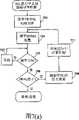
Fig. 7 (a) and 7 (b) respectively show one and make up flow chart initial and an embodiment who carries out middle Poewr control method.Fig. 7 (a) can use in up link, and Fig. 7 (b) can be applicable to down link;
Fig. 8 (a) and 8 (b) respectively show one, for example, use the flow chart of an embodiment of power control in carrying out in method shown in the flow chart separately of Fig. 7 (a) and 7 (b).Fig. 8 (a) can be applicable to up link, and Fig. 8 (b) can be applicable to down link;
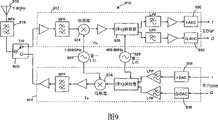
Fig. 9 shows the RF part that can preferably realize the wireless telephone user unit (SU) of SU part of the present invention with it; With
Figure 10 is the block diagram that can preferably realize digital signal processor (DSP) part of SU part of the present invention with it.
System configuration
Method of the present invention can realize on any communication system that comprises one or more communication stations and one or more remote receivers (being used for communicating by letter on the down link) and transmitter (being used for communicating by letter on the up link).For only requirement of quality evaluation of the present invention aspect be used modulation comprise certain form angle (for example, phase place) demodulation, with the requirement that only has for downlink sdma power control be to determine the downlink transmission flexible strategy, for example, determine from the uplink signal that receives.Method of the present invention preferably realizes on as the communication station of a base station and its subscriber unit, and they are that wherein the part of the communication system that SDMA communicates by letter with its subscriber unit is used in the base station.In the preferred embodiment, communication system plans to use in a wireless local loop (WLL) cellular system.Although the subscriber unit in the example embodiment is fixed on the position, they can move in other systems.
The SDMA base station at first is described.
Architecture of base station
For spatial manipulation is provided, in the base station, used a multielement array.Antenna amount in the battle array is variable.The downlink channel of base station comprises a processor that is used for spatial manipulation that is coupled to one group of antenna emitter, and each antenna emitter is coupled to an antenna element.The uplink channel of base station comprises one group of antenna receiving unit, and each antenna receiving unit receives the signal from an antenna element, and each antenna receiving unit is coupled to a processor that is used for the spatial manipulation received signal.In example embodiment, communicating by letter between base station and the subscriber unit used and is called " personal handyphone system " standard (PHS), ARIB standard, second edition (RCRSTD-28).The PHS system is one and has 8-time slot tdma/FDMA system that true time divides duplex (TDD).Each channel (" subcarrier ") has the bandwidth of approximate 300kHz.8 time slots are divided into 4 emission (TX) time slots and 4 receptions (RX) time slot.This means that for any particular channel, receive frequency is identical with tranmitting frequency.This also means reciprocity, promptly, supposing that subscriber unit is minimum when mobile between receiving slot and transmission time slot, is identical for the radio propagation path of down link (distance terminal from the base station to user) and up link (from user's distance terminal to the base station).The frequency band of the PHS system that uses in this preferred embodiment is approximately 1895 to 1920MHz.In 8 time slots each is that 625 microseconds are long.The PHS system has a dedicated frequency and time slot, is used for the initialized control channel of bid.In case set up a link, called out and switch to a Traffic Channel that is used for general communication.Communication takes place at any channel with per second 32 kilobits (kbps) speed, is called full rate.Communication less than full rate also is possible.
In the PHS that this preferred embodiment uses, a pulse train (burst) is defined as in a single time slot by the aerial finite duration RF signal of launching or receiving.A group (group) is defined as the set of 4 TX and 4 RX time slots.A group always begins with a TX time slot, and its duration is 8 * 0.625=5 microsecond.
The PHS system uses π/4 four-phase differential phase shift keyis (π/4DQPSK) modulation to baseband signal.Baud rate is 192 kilobauds.That is per second 192,000 code elements.
The receiver section of Transceiver Module in the base station
An antenna array that is made of antenna element is used in the base station, and each antenna has an emission/reception (T/R) switch, an analog receiver, a digital receiver, a digital transmitter and a simulating transmitting machine.Therefore, this module comprises antenna emitter part and antenna receiving unit group part.The analog-and digital-Receiver And Transmitter of any one antenna element is implemented in the single RF TX/RX Transceiver Module, thereby each module can realize the wide band radio-frequency frequency spectrum of an antenna 16 carrier wave 10MHz.Be familiar with one of ordinary skill in the art and clearly know, this structure is suitable standard, and various variations can be arranged.The special construction of the receiver section that is used for a Transceiver Module has been shown among Fig. 1.Receive the RF signals at antenna element 103, and be embodied as a band pass filter (BPF) 140 with the logical cavity filter of 1895 to 1920MHz bands through one and pass through.Antenna 103 and filter 104 are in the Transceiver Module outside.Signal is sent to emission/reception (T/R) switch 105 on the Transceiver Module from filter 104.From switch 105, signal is by a low noise amplifier (LNA) 107, one or more levels bandpass filtering (not shown), with a variable attenuator 108, arrive one first downconverter 109, this downconverter uses a tunable frequency mixer that utilizes the local oscillator 111 (not being the part of module) of an about 1.6328GHz, produces the IF signal 113 of 275-285MHz (10MHz bandwidth).In one the one IF amplifier 115, amplify this IF signal 113, pass through the SAW BPF filter 117 (275-285MHz) of the byproduct of an inhibition " adjacent channel " and first downconverter then.The signal 118 that produces arrives one by one second variable attenuator 119 and utilizes second downconverter 120 that has from the frequency mixer of the tunable mixer frequency of the 291MHz of local oscillator 121.The output of second downconverter 120 have the 10MHz bandwidth and-the 2nd IF signal 122 of MHz IF frequency of 11MHz centre frequency-(6-16).The 2nd IF signal 122 amplifies in the 2nd IF amplifier 123, and arrives analog to digital converters (ADC) 127 through low pass filter (LPF) 125, analog to digital converter 127 at 36.864MHz to signal sampling.Only to the sampling of the real part of signal: so signal 129 (output of ADC127) comprises the center at-11MHz and at the complex values IF signal of the mirror image of+11MHz, and sampling also produces a mirror image at 25.864MHz.At this moment, (Norwood, AD6620 double-channel Massachusetts) extracts digital down converter/filter device 131 that receiver (AD6620 Dual Channel Decimating Receiver) is realized to this signal with Analog Devices company by one.In substitute realizing, can use Graychip company (Palo Alto, the similar device that GC1011 California) is such, or identical functions can otherwise be provided.Digital down converter/filter device 131 is carried out following several functions:
In any one selected center's frequency of each carrier wave with signal times with the complex phase amount;
Carry out digital band pass filtering with suitable 300kHz band is logical, current be as a center in any centre frequency of each carrier wave, the band pass filter of approximate 450kHz.This has provided three times of baud rate oversamplings, that is, and and the baseband signal of the complex values (homophase I part and quadrature Q part) of sampling for thousand sampling/seconds with 192kHz*3=576.
Above-mentioned receiver is based upon on the RX/TX plate, and 16 reception carriers of each this RX/TX plate processing, and each carrier wave has the AD6620 digital down converter/filter device of himself.Therefore, each AD6620 device produces the I data of 16 bits and the Q data of 16 bits, and each data all is to sample with the sampling rate of 576,000 sampling/seconds.Data are exported each AD6620 device with the 18.432MHz serial.Data delivery is to modem boards.
Modem module in the base station
Fig. 2 shows the block diagram of a modem boards.Each modem boards comprises the single general-purpose processor (GPP) 203 (Motorola/IBM PowerPC device) of two RX square frames of control and two TX square frames, each RX square frame 205 comprises a RX data formatter 207, four respectively by 209.1,209.2,209.3 and the RX digital signal processor device (DSP) of 209.4 expressions, with four be connected to four RX DSP, respectively by 211.1,211.2,211.3 and 211.4 the expression RX DSP memories.Each receiving slot has the RX DSP RX DSP memory related with.Each TX square frame 217 comprises a TX processor modulator square frame 221 and a TX data formatter 225 (realizing with a FPGA).Each RX and TX square frame be to can handling one 12 carrier wave in the antenna system, or two carrier waves in one six antenna system, or reception spatial manipulation, demodulation, modulation and the emission space processing of three carrier waves in one four antenna system.Therefore, a modem boards can be handled one 12 two carrier waves in the antenna system, or four carrier waves in one six antenna system, or the necessary processing of six carrier waves in one four antenna system.
A single RX square frame 205 of a modem boards is described now.Serial i from the receiving unit of the transceiver of each antenna, the Q data are by a data formatter 207 that is embodied as a field programmable gate array (FPGA), in data formatter 207 serial flow is converted to parallel data, parallel data is visited through direct memory and is stored among one of four RX DSP memory 211.1-211.4, the data of each of four receiving slots are sent to a RX DSP memory, by RX DSP (209.1-209.4) processing of association.Each RXDSP209.1-209.4 is the M56303 of a Motorola digital signal processor.Each RXDSP carries out several functionalities, comprising:
Comprise the spatial manipulation of determining flexible strategy;
Frequency shift (FS) is corrected;
Balanced;
Demodulation; With
In one embodiment of the invention, signal quality estimation.
From the restituted signal of each time slot RX DSP209.1-209.4 output, except some control signal enters the GPP203 through a master port interface, all the other signals are sent to a signal bus that is called voice bus 213.The signal quality estimation of determining in RX DSP, SINR data and some state informations that remote subscriber sends also are sent to GPP203.TX processor/modulator square frame 211 that the spatial manipulation flexible strategy that each RXDSP determines are sent in the emission square frame 217 through emission weighting (TX_Wt) bus 233.Undertaken as a part of transmission power adjustment of power control by regulating the emission flexible strategy.
The function that general processor (GPP) 203 is carried out comprises:
Reception is from signal quality and the status data of RX DSP;
In one embodiment of the invention, be used to determine power control from the data of RX DSP; With
Produce all control signals and all RX DSP and TX processor/modulator square frame pattern are set and carry out other more high-rise function and agreement, comprise communicating by letter through other processor in an interface FPGA235 and the system other parts.
217 operations of emission square frame are as follows.TX processor/modulator 221 is accepted the voice data from voice bus 213, from the SACCH of GPP203 and FACCH data with from the emission flexible strategy that are used for spatial manipulation of TX_Wt bus 233.The function of TX processor/modulator 221 comprises that pulse train is set up, and encrypts, scramble, CRC of multiplexed each user in space in each of four time slots, modulation and apply when pulse train just begins, for each pulse train and launch flexible strategy (comprising amplitude) fully as power control.Emission square frame 217 can be handled whole four space channels.Modulation is π/4DQPSK, and produces the I of 2* oversampling and Q data (2*,192 thousand sampling/seconds=384,000 sampling/seconds).Emission flexible strategy applying portion carries out the calculating of plural number emission flexible strategy to reaching 12 transmitting antennas (that is one ten two-element antenna battle array) and reaching four space channels.This has caused nearly 12 digital signals, and each has an I and Q component.With the output serial process of TX processor/modulator 221 is each used nearly 12 the different serial data stream (Q follows I) that reaches in 12 antennas, each I, and Q is to being input to a RX/TX Transceiver Module.In one implementation, TX processor/modulator 221 comprises a DSP device, memory and a FPGA.
The radiating portion of Transceiver Module in the base station
The radiating portion of Transceiver Module is described by Fig. 1 now.As receiver, radiating portion can be handled the carrier wave of 16 300kHz bandwidth of 10MHz total bandwidth.Go up in GC4114 four digital up conversion device/filter devices that the sampling baseband signal enters four Graychip companies one from the input 2* of each carrier wave, four GC4114 devices altogether on the Transceiver Module, each device is handled four carrier waves.A channel with a GC4114 device among Fig. 1 is shown as digital up conversion device/filter 151.It is I, Q data up conversion (interpolation) be 49.152MHz (=2*24.576MHz) sampling a single digital signal, and existing signal and signal (carrier wave) addition from another GC4114 channel of cascade system, thereby final output will be a single real number value 49.152MHz digital signal of the sampling of a 10MHz total bandwidth signal.This signal is input to one 14 figure place weighted-voltage D/A converter (DAC) 153, with the analog baseband signal 155 of the 10MHz bandwidth that produces centre frequency-11MHz.Now signal 155 is input to one and uses a up converter 157 that has from the frequency mixer of the tunable mixer frequency of the 291MHz of local oscillator 121, to produce the IF signal 159 of 257-285MHz (10MHz bandwidth).In this example embodiment, local oscillator 121 is in the outside of Transceiver Module.Now, signal 159 then by an intermediate-frequency strip that comprises two SAW filters and two IF amplifiers, for the sake of simplicity, is shown a single BPF filter 163 and single IF amplifier 165 by a digital variable attenuator 161 in Fig. 1.IF signal through filtering and amplification passes through up converter 167, and up converter comprises a tunable frequency mixer that utilizes the local oscillator 111 (in module-external) of an about 1.6GHz, to produce the RF signal 169 of approximate 1900MHz.RF signal 169 is by BPF171, then by a digital variable attenuator 173.This signal is by a power amplifier (PA), and a BPF and one the 2nd PA are then by a LPF.For the sake of simplicity, this combination with PA and filter in Fig. 1 is shown a single power amplifier 175 and a single BPF177, and to produce signal 179, signal 179 advances to T/R switch 105.As to described in the receiver section, signal is input to antenna element 103 from switch 105.
Subscriber unit
Fig. 9 shows the RF part of the wireless telephone user unit (SU) of preferably realizing SU part of the present invention, and these RF parts are here represented with total reference number 910.RF part 910 comprises a receiverfront end 912 and a last stage oftransmitter 914, they each all pass through aband pass filter 918 and an emission/reception (T/R)switch 920 is connected toantenna 916.
Receive the typical down conversion that uses 1658MHz firstlocal oscillator 922 by,local oscillator 922 is connected to first intermediate frequency (IF)frequency mixer 924 that produces the IF of 248.45MHz.Be connected to an I who operates in secondlocal oscillator 928 of 469.9MHz,Q demodulator 926 separates homophase (I) and quadrature (Q) signal.
Typical local oscillator is a piezo-oscillator, and in 1.9GHz RF carrier frequency about 1/1000000ths (ppm) is arranged, or ± accuracy of 20kHz.Local oscillator among the present invention is phase-locked loop (PLL) type preferably, thereby when the acquisition control channel, can reduce initial crystal frequency error greatly by regulating a voltage controlled oscillator (VCO).In PHS, a 20kHz error causes the phase error of 37.5 degree during a code-element period.As in PHS, using the general carrier wave recovery of in demodulation DQPSK signal, using by decision-directed.If there is noise, may destroy locking by the carrier recovering method of decision-directed, unless use initial coarse frequency to correct.In specific π/4QPSK demodulation of using in this PHS embodiment, when the arrival of frequency shift (FS) phase error during code-element period 45 is spent, decision-directed frequency shift (FS) evaluation will destroy locking fully, and bit error rate (BER) (BER) will increase rapidly.
A homophase analog to digital converter (I-ADC) 930 speed with 768,000 sampling/seconds produce 8 bit I sampling.Quadrature phase analog to digital converter (Q-ADC) 932 with identical 768,000 sampling/second speed produce 8 bit Q sampling.
The signal of emission is by a typical up conversion that utilizes 1658MHzlocal oscillator 922, and this local oscillator is connected to a last radio frequency (RF) frequency mixer 934.Homophase (I) signal that a homophase digital to analog converter (I-DAC) 936 will be launched is received as one 8 bit I sampled flows with the speed of 768,000 sampling/seconds, and quadrature (Q) signal that a quadrature phase digital to analog converter (Q-DAC) 938 will be launched is received as one 8 bit Q sampled flows with the speed of 768,000 sampling/seconds.
Figure 10 is the block diagram that receives from the I/Q sampling of receiverfront end 912 and produce digital signal processor (DSP)part 1040 of the i/q signal that last stage oftransmitter 914sends.DSP part 1040 comprises several DSP devices, comprises a receiver DSP (DSP (RX)) 1042 who is connected to speech coding DSP device (vocoder) DSP1044 and a telephony interface 1046.A transmitter DSP (DSP (TX)) 1048 receives the voice/data frominterface 1046, and they are encoded to the suitable i/q signal that last stage oftransmitter 914 sends.Afast storage 1050 is that DSP (RX) 1042 and DSP (TX) 1048 provide program to carry out and support memory.Can (Phoenix, AZ) DSP56303 24 bit digital signal processors be as DSP (RX) 1042 and DSP (TX) 1048 Motorola.DSP56303 is a kind of in the DSP56300 chip family of programmable CMOS DSP.Those skilled in the art know, can replace with other DSP device or microprocessor.
With reference to figure 9, utilize the RF signal that has about 1900MHz carrier wave to produce homophase (" I ") and quadrature (" the Q ") component that detects with a 469.9MHz carrier wave.Digitlization I and Q signal, and to be four times in the speed sampling of symbol-rate.For the PHS system that uses in the example embodiment, symbol-rate is 192kHz, and therefore sampling rate in this example was 768,000 sampling/seconds.Each 8 bit of sampling is dark.
In Figure 10, the digital I of reception and Q signal are the digital signals of being handled by DSP (RX) 1042.Preferably to DSP (RX) 1042 programming with:
1. collect from the I and the Q sampling of ADC1030 and 1032;
2. carry out control channel and catch basic handling with time division duplex, carry out channel control data pulse train regularly initial evaluation and carry out initial carrier frequency offset and determine;
3. carry out compression and recover, frequency offset compensation, down conversion, filtering and equilibrium, the original base band sample block of one of them four times of oversampling is corresponding to a block that passes through one times of oversampling (192kHz) of balanced and baud calibration for demodulation.As own together, the exercise question of inventor Yun etc. is " method and system that quick initial control signal detects in wireless communication system ", sequence number is 08/xxx, and be similar to baud point to set up the time calibration of carrying out like that described in the U.S. Patent application of xxx (application on August 8th, 1997).In one aspect of the invention, DSP (RX) 1042 utilizes the I and the Q sampling of the bauds calibration that DSP (RX) 1042 determines to estimate the signal quality (Signal to Interference plus Noise Ratio that SU receives) that SU receives;
4. carry out demodulation;
5. decompose the demodulated pulse string signal;
6. go scramble message;
7. execution Cyclic Redundancy Check;
8. deciphering traffic data;
9. send voice service amount data to vocoder DSP1044;
10. to DSP (TX) 1048 transmit control channel signal and channel quality measurements;
Receive compensating filter and frequency shift (FS) evaluation of estimate 11. upgrade;
12. under the SDMA situation, calculating will send it back the calibration information (see, for example, " our calibration patent ") of base station; With
13. upgrade the voltage controlled oscillator (VCO) and phase-locked loop (PLL) (not shown) that use in the RF Receiver And Transmitter part.
Therefore, in DSP (RX) 1042, carried out SU embodiment aspect the quality evaluation of the present invention.
Utilize DSP (TX) 1048 to regulate the power of determining according to certain aspects of the invention that is transmitted into BS.
Those skilled in the art know, the specific receiver that is used for base station and/or subscriber unit described here, and transmitter and signal processing only are a kind of possible structures, and can carry out multiple change, and do not break away from the present invention.For example, in the base station, needn't carry out last down conversion to digitlization, or up conversion.Equally, can be with microprocessor or other general processor, or substitute specific DSP structure with special-purpose software.Also can substitute PHS with many other communication protocols.At last, the invention is not restricted to the TDMA/FDMA system.
Initial power control
One aspect of the present invention is a kind of Poewr control method, this method by according to trial-and-error method RF adaptation transmitter control transmitter power level, in communication system, set up radiation RF power level.The communication system of using in this preferred embodiment is a SDMA system that will use in wireless local loop (WLL) cellular system.Used one or more base stations, each base station (BS) is also referred to as cellular station (CS), communicates by letter with one or more subscriber units (SU), and SU is also referred to as distance terminal or individual station (SU).Each BS comprises a multielement array, so that spatial manipulation is provided.
The control sequence that is provided with and sets up the incoming call from BS to SU in a standard P HS agreement has been shown in the table 1.
| Table 1:PHS |
PCH be a uni-directional downlink a bit to multidrop channel, BS all SU in paging zone send same information on this channel.SCCH is one and sends the two-way point-to-point channel that calling between BS and the SU is connected required information.TCH is the point-to-point two-way channel of emission user (user) information.
General wish that government policy requires to use the minimum transmitter power level that is fit to each connection sometimes, so that reduce to use the interference between the station of common frequency band.The link establishment program of table 1 does not comprise any power control, for example, in order to guarantee to use the minimum transmitter power level that is suitable for each connection, does not mention the influence to existing user's interference that new connection causes yet.When by the enterprising row space channel call of the normal channel of existing CU the time, this power control is crucial especially.
In order to satisfy the requirement of minimum emissive power, an embodiment of Poewr control method of the present invention is included in and makes SU introduce one group in the step 4 of table 1 agreement to attempt the SU transmitter power level.Step 4 with SU emission synchronously the primary power level that uses of (SYNCH) pulse train be arranged on the safe low level of a regulation, this low level generally is not enough to satisfy the acceptable reception quality of BS.Therefore, do not exist the SYNCH pulse train to answer (step 5, table 1) and indicate, do not receive the SYNCH pulse train, that is to say that its SYNCH transmitted in bursts power level is too low can accept quality at BS to SU.Then, SU improves power level and launches a SYNCH pulse train again, and each not as expectation in the step 5 when BS receives a SYNCH pulse train, all carry out thisly launching again.When BS finally received SYNCH pulse train from the quality accepted of SU, it sent a SYNCH pulse train to SU, thereby when finally receiving the SYNCH pulse train that BS launches at SU, SU is using the minimum emissive power level that is enough to communicate by letter.In addition, the initial SU transmitter power level that is used to launch the SYNCH pulse train by standardization (a), (b) each SU incrementally raising of launching again, for example, + 3dB, improve in the time in past of can distributing (step 3, table 1) so from link channel when BS receives the SYNCH pulse train of enough quality of SU emission+number of times of 3dB power increment determines required SU transmitter power level.This also can be used to be provided with the BS transmitter power level.The PHS system is a time division duplex (TDD) system, so actual have a reciprocity that transmits and receives propagation path.Therefore, BS can utilize the SU transmitter power level to determine that BS is used for the minimum transmitter power level (that is, after any difference of considering SU and BS receiver sensitivity) of communicating by letter with SU.For non-TDD system, measure and calibration can solve the difference that transmits and receives in the propagation path by broadcasting.
When starting connection request by a SU, connection protocol is identical with the agreement of table 1, but does not comprise from thestep 1 of BS paging.Therefore, be to comprise that the makeover process of the power control that minimum emissive power is set is identical with said process.
The advantage of above-mentioned Poewr control method is that it can be applied to existing communication system, and can not cause adverse effect to the existing communication system protocol.
Two embodiment of this method relate at BS and determine whether acceptable dual mode of received signal quality.In first embodiment, utilize the measured value of received signal quality to determine the successful reception of SYNCH pulse train at BS.Second embodiment comprises unique SYNCH pulse train part in such pulse train of identification.In the PHS that preferred embodiment uses, a SYNCH pulse train has 224 bit long, and comprises one 62 bit preamble and one 32 bit " unique word " sequence of predesignating, and a BS identification code and a SU identification code.Therefore, BS can determine successful reception by correctly discerning a SYNCH pulse train.This can or substitute by additional use and use signal quality measured values to finish.
Table 2 shows in the preferred embodiment, is used for the explanation of a synchronized standard 224 bit duration SYNCH pulse trains of up link (SU to BS) or down link (BS to SU).Show each pattern in order.
| Table 2 | ||
| Title | Length | Explanation |
| R | 4 bits | Any 4 bit modes |
| SS | 2 bits | Fixed field 10 |
| PR | 62 bits | The fixed cycle preamble 0110011001100110...011001 that is used for up link and down link |
| UW | 32 bits | Unique word, what be used to specify uplink synchronisation is: 01101011100010011001101011110000 and be used to specify downlink synchronization be: 01010000111011110010100110010011; |
| CI | 4 bits | Fixed field 1001 |
| CSID | 42 bits | The BS identification code |
| PSID | 28 bits | The SU identification code |
| IDL | 34 bits | All be zero, idle bit 0...00 |
| CRC | 16 bits | The cyclic redundancy code error-detecting |
Those skilled in the art know, can use other synchronizing signal.
Fig. 3 summarizes one to be used for the flow chart of the initial power control method 310 of the preferred embodiment of the definite suitable power level that can accept to communicate by letter adaptively.The method of Fig. 3 flow process is designed to and PHS connection protocol compatibility, and except simply the augmenting of downward compatibility is provided, does not need the PHS standard is carried out any modification.
With reference to figure 3, whether the method that is used for the flow process 301 of adaptive power control is that the originator of connection request has two kinds of versions according to BS.This is by checking that whether BS is that the decision steps 303 of originator illustrates.If originator, method is from step 305 so, and in step 305, BS is the selected SU of paging on PCH, transfers to step 307 then.If BS is not an originator, method is from step 307 so.In all the other explanations, be to be understood that " selected SU " is illustrated in the SU that BS starts BS paging under the situation about connecting, with the initial SU that starts at SU under the situation about being connected to flow process 301.In step 307, selected SU sends a link channel to BS and sets up request (LCR) message (or when SU started, the SU that starts sent LCR message to BS on SCCH) to answering paging on SCCH.In step 309, BS selects optimal candidate link channel (LCH) from the available traffic channel group, and should select to send to SU as an exploratory distribution LCH on SCCH.Details see and own together, and the exercise question of inventor Yun and Ottersten is " channel allocation and the calling that are used for SDMA communication system enter control ", and sequence number is the U.S. Patent application of 08/777,598 (application on December 31st, 1996).At this binding site, selected SU sends the SYNCH pulse train in step 321 with the predetermined low power level on exploratory distribution LCH, and this predetermined low power level is that expection BS can obtain to accept the approximate minimum power capability level that quality receives.In step 323, selected SU checks whether BS has returned the SYNCH pulse train, describedly return pulse train indication and received last SYNCH pulse train and the BS that SU sends at BS and sent a SYNCH pulse train in response, this represents again that the SU emitted power is enough to set up at BS and can accept quality and receive.If do not receive the SYNCH pulse train that BS sends in step 323, so in step 325, SU increases progressively a scheduled volume to transmitter power level and (is generally+3dB), and turn back to step 321 and launch a SYNCH pulse train again.The 3dB power increment has guaranteed that the power level of setting up receives within the 3dB of required minimum power in quality in step 325.Littler increment will make the power level of foundation can be positioned as close to hope Minimum Power Level (for example ,+the 1dB increment will guarantee the power level set up Minimum Power Level 26% within).At this moment, at BS, in step 311, BS monitors the SYNCH burst transmission that SU starts on exploratory LCH, and in step 313 received signal quality is calculated than (SINR) interference plus noise as signal.As substituting of SINR, can check whether pulse train is correct, because all SYNCH pulse train bits are that priori is known.In test procedure 315, BS determines whether the SYNCH pulse train that receives has acceptable quality.If no, BS waits for next SYNCH pulse train from SU so.Test procedure 315 determine the SYNCH pulse trains that receive have can accept SINR after, BS calculates (in step 317) BS transmitted power level, and power level is to determine according to the time in past between the reception that can accept quality SYNCH pulse train in BS LCH distribution and the step 315 in the step 309.Because, the emission repeatedly of SU SYNCH pulse train takes place at interval with official hour, is 5ms in this preferred embodiment, so can determine the power of the SYNCH pulse train that is used to receive that the SU transmitter uses, and for this preferred embodiment+the 3dB increment, power is 2M-1P0, wherein M is the number of times of power increment, P0It is the initial SU transmitter power of regulation of linear scaled (for example, watt).In step 319, BS uses the power level SYNCH pulse train that calculates according to step 317.In step 323, selected SU is when receiving BS SYNCH pulse train, and the last power level that identifies use is suitable for connecting, and the end process process.
Because PHS SYNCH pulse train is a long Bit String, shown in can be the successful reception of SYNCH pulse as an optional indication, this optional indication represent received signal quality be acceptable and SU to be used to launch the transmitter power level that receives the SYNCH pulse train be suitable.If selected this optional indication, can omit the calculating of the receiving uplink SINR in the step 313 of Fig. 3 so, and if correctly received SYNCH pulse train bit mode, the test in the answer step 315 so for certain.
Should be known in for method shown in the key diagram 3 clearly, used the special characteristics of PHS system.But as mentioned above, this method can be applied to other cellular system, and those skilled in the art understand its availability.For example, the present invention can be used to use the cellular system of Global Systems for Mobile communications (GSM).GSM is extensive use of in the world, and also is called the high frequency version of DCS-1800 and exists as the PCS-1900 standard of PCS Personal Communications System (PCS) in the U.S. as a kind of.Because the step of definite transmitter power level described here does not rely on communication protocol, so entire method is used for the GSM cellular system with in fact can not adding modification.
Power control in carrying out
The explanation of the front of Poewr control method mainly concentrates on and set up transmitter power level when starting new a connection.Another aspect of the present invention is to continue initial power control by controlling transmitter power on the underway basis, so that handle the method for dynamic characteristics of communication system, and this method can be applied to the SDMA system.Should be known in that communication system will dynamically change because new establishment of connection has going offline or handover and change RF propagation conditions of connecting now.This produces a kind of time dependent environment, is connected interaction in the honeycomb with between honeycomb in this environment.New establishment of connection can cause the unacceptable interference level on existing the connection, and the existing connection of cancellation can reduce interference, keeps communication can accept the required power level of quality thereby reservation power level in use can be higher than.
The purpose of power control will keep all user's communications (as certain acceptable signal quality definition in carrying out; For example, certain target SINR value) time, make the number of users maximum.For power control in carrying out, we wish all acceptable signal quality of calling out in carrying out in maintenance, for example, and SINR 〉=SINRTargetThe time, make total transmitting power minimum (or more generally say, make the weighted sum minimum of transmitting power).Generally for the voice signal that uses ADPCM at the 32kbps coding, 10-3The bit error rate (BER) of the order of magnitude (BER) is reasonably, corresponding to 10 or the SINR of the 11dB order of magnitude.In practice, for the safe clearance of offsetting decline is provided, can use value:
SINRtarget≈15dB
For comprising spatial processing technique (SDMA technology), comprise that it can have true SDMA technology more than a communication link at same normal channel, communication system, to can be said to be selective reception flexible strategy and up-link transmission power (being used for up link control) to power control problem in carrying out fully, and emission flexible strategy and transmitting power (being used for down link control), for example, the down-link transmitting power of the relative amplitude of Launch Right vector indication.
Purpose is will make capacity (SINR is certain SINR at leastTargetNumber of users) maximum.Should be noted that generally can be with each space channel/user's different SINRTargetExpress this problem.
Spatial weight determines that controlling with power of task is closely to link to each other.The remote subscriber that utilizes any variation of RF power on the normal channel of SDMA that influence is distributed to use same normal channel transmit and receive flexible strategy, and any change of flexible strategy will influence and have the user now in order to keep the required power of suitable level of quality in communications.Best solution need solve multiplexed flexible strategy assignment problem of SDMA and power division problem simultaneously.For example, on down link, must determine complete Launch Right vector, comprise amplitude, amplitude is represented the relative transmitting power on the particular spatial channel.Solving in the time of multiplexed flexible strategy assignment problem of SDMA and power division problem is the calculation task of a complexity at least.
One aspect of the present invention, for up link, be to be separated into two parts to the spatial multiplexing and the power control problem of up link associating: one receives flexible strategy determining section and a power adjustments part.Method is for example controlled from power since a part.Use a kind of power control strategy, and distribute transmitting power according to this initial policy.Utilize the transmitting power of these distribution to carry out the distribution of space reception flexible strategy now.The new spatial weight that obtains at first influences interference level, may be no longer suitable thereby initial power is distributed.Utilize the new spatial weight of determining, use once more and carry out middle power control techniques, cause new power division.These new power division may show that it no longer is best receiving and launching flexible strategy, thereby a new transmitting power is as the initial condition that newly transmits and receives flexible strategy that will determine.Therefore, by the iteration between transmitting power setting and spatial manipulation flexible strategy determining section, determined the control of spatial weight and power in combination.Each new power Control Allocation and each new emission flexible strategy distribution are preferably in another and determine to use immediately afterwards.Therefore, ambient stable ground changes.
Control for downlink power, can be imagined as one group to a complete Launch Right vector and launch flexible strategy relatively, all launch flexible strategy relatively all is to calibrate with a specific scaling factor, thereby definite complete Launch Right vector has solved simultaneously what relative emission flexible strategy is used for launching to a particular remote user, with the problem with much power emission, the power that calibration provides is applied to relative emission flexible strategy to form complete weight vector.Another aspect of the present invention, for down link, be to be separated into two parts to the complete Launch Right vector problem identificatioin that comprises power control: a relative Launch Right vector determining section determines that with one calibration is to be applied to the power adjustments part of relative Launch Right vector.Described method is for example controlled from power since a part.Use a kind of power control strategy, and distribute transmitting power according to this initial policy.Utilizing the transmitting power of these distribution to launch flexible strategy relatively now determines.The cenotype that obtains at first influences interference level to the Launch Right vector, may be no longer suitable thereby initial power is distributed.Utilize the new space emission flexible strategy of determining, reuse and carry out middle power control techniques, cause new power division.
At first up-link power control is described, uplink power control method 701 during Fig. 7 (a) shows and carries out by Fig. 7 (a).At first, in step 703, each SU uses certain power.In above-mentioned " initial power control " chapters and sections and " father's patent ", illustrated how to set up initial SU power division in this preferred embodiment.Begin with these power division, determine one group of up link (that is, receiving) weight vector in the base station.In this preferred embodiment, step 704 by in fact as the method described in " our demodulation patent " determine up link (that is, receive) weight vector (being shown) to a space channel i's, " our demodulation patent " is in conjunction with therewith as a reference.Should be pointed out that in this preferred embodiment BS utilizes these up link flexible strategy to determine the down link flexible strategy.To point out that also in this preferred embodiment, it is identical with down-link frequencies for same user that system uses time division duplex (TDD) and up link.According to as above-mentioned United States Patent (USP) 5,592,490 and " our calibration patent " (U.S. Patent application 08/948,772, on October 10th, 1997) method described in is determined the down link flexible strategy with the up link flexible strategy, and above-mentioned two patents and patent application are incorporated herein by reference.
The signal quality of BS (up link) signal that the selection influence of up link flexible strategy receives (for example, SINR), thereby may need to use new power control.Periodically use power control in this carrying out in the base station.In this preferred embodiment, after a predetermined period of time is gone over, use and carry out middle power control, and in the present embodiment, this time cycle is two frames preferably.Therefore, in step 705,, determine whether it is the time of applied power control to a particular spatial channel i.If not, base station waits so is up to next cycle.If the time of applied power control, before using this control, whether the calling on definite this space channel of step 708 should or be re-assigned to one other channel, or should or not switch to another base station so.If, stopping power control to this calling on this space channel, this square frame by the mark among Fig. 7 (a) " stopping i connects " illustrates.Otherwise,, determine signal quality (SINR) at the signal of base station reception in step 709.In this preferred embodiment, estimate this signal quality (preferably SINR) with the method that illustrates in " signal quality estimation " chapters and sections below in this specification (for example, utilize equation (20), and Fig. 5 and 6).In view of the above, in step 711, space channel i is determined that up-link power is improved or the new amount of reduction.The explanation of the certain methods of execution in step 711 is the explanation of face as follows.Send order by the Remote Interface Unit on space channel i (distant transmitter), carry out power control according to step 711.SU launches with these new up-link powers, and turns back to the step 704 of determining new up link (reception) flexible strategy at BS.If not enough metering power hinders step 704 carrying out in preceding burst or current power control cycle, can in next pulse string or next power control period, carry out so.This closure the loop.Point out that once more new uplink signal is used to determine the down link flexible strategy, thereby influences downlink communication.
By figure (b) downlink power control is described now, Fig. 7 (B) shows the flow chart that preferred embodiment carries out middle Poewr control method 721.Initial set from relative emission flexible strategy.In this preferred embodiment, these emission flexible strategy are those emission flexible strategy of determining from the up link flexible strategy at first, and the up link flexible strategy are determined from uplink signal after communication is set up.Preferably flexible strategy are launched in normalization, thereby it is to launch flexible strategy relatively.Alternate embodiment can use other method to determine flexible strategy, and for example, can determine the direction that arrives and carry out the beam moulding, as is known in the art (see, for example, above-mentioned United States Patent (USP) 5,515,378 and 5,642,353).Be the presentation of results of all these methods with a relative Launch Right vector weighting here, and such calibration of launching vector relatively is the optimal way of applied power control.In step 723, utilize initial power control method, the method for " father's patent " is preferably determined the initial power that uses, and is used on the down link on the particular spatial channel (i) of a specific SU (remote receiver).Therefore, in step 723, the relative Launch Right vector of these initial phases of specific SU on the space channel to the emission flexible strategy is used in initial transmit power level emission, caused having certain downlink signal quality (for example, signal SINR) what specific SU received.Determine the evaluation of these down links SINR at SU, preferably use following method, and periodically send to BS.In this preferred embodiment, each SU carries out evaluation at each frame, and its signal quality estimation is sent to the base station.Other embodiment can carry out these operations with the different time intervals.As uplink link method, downlink power control method is periodically used in the base station in carrying out.In this preferred embodiment, this cycle is every a frame, and other embodiment can use other update cycle.Therefore,, determine whether it is the time of applied power control at step 725 a couple particular spatial channel i, if not, base station waits is up to next cycle so.If the time of applied power control before applied power control, determines whether that in step 728 calling on the space channel i should or be re-assigned to one other channel, or should or not switch to another base station so.If, stopping power control so to this calling on this channel, the square frame of mark among Fig. 7 (b) " stopping i connects " shows this power control and stops.Otherwise, obtain the downlink signal quality evaluation (step 729) that this method is used, and this signal quality estimation is used for downlink power control in step 733 from specific SU reception.It below is the explanation of the certain methods of step 733.By revising relative emission flexible strategy, carry out power control according to step 733, to determine the actual emission flexible strategy of using, above-mentioned modification is an amplitude of revising the relative emission flexible strategy of any specific SU; That is, revise the norm of the vector of emission flexible strategy relatively.Upgrade if flexible strategy take place, launching flexible strategy so relatively can be previously used identical flexible strategy, if or available renewal flexible strategy are arranged then be the relative flexible strategy of upgrading.Therefore, the step 731 in the flow chart has shown that obtaining this (newly) SDMA in application is carried out before the power controlled step 733 launches flexible strategy relatively.Be familiar with step 731 that those of ordinary skill in the art should be known in the updating value that obtains relative Launch Right vector on stream other point can take place, and step 733 is preferably used the final updating value of launching flexible strategy relatively.
Although above the control of up link and down link is illustrated as and separates, downlink signal and/or flexible strategy are determined in this preferred embodiment of down link flexible strategy in the use, and up link and down link control are not to cut apart fully.In down link control, initial downlink link flexible strategy and power be based on up-link power control and flexible strategy determine in definite those flexible strategy and power.
The details of the alternate embodiment of definite and applied power control method (is respectively step 711 and 733 for up link and down link) is described now.For habitual cellular system, the known Several Methods of power division step that thestep 711 that for example is used for up link is arranged and be used for step 733 and so on of down link, and many such methods can easily be applicable to realization the present invention.But the new method that is used for power controlledstep 711 and 733 that use is advised below has many advantages.But the present invention is not limited to only use the method that is used forstep 711 and 733 of following explanation.
Global issue
At first instep 711 and 733 use the problem of what power in the mathematics explanation whole issue that will solve here.Definition piTransmitting power for i transmitter in the communication system (in the SU of up link, or in the BS of down link).Except as otherwise noted, all quantity of power are nature calibration (for example, power measurement values are watt, rather than dB).Its task is the power p of all i (that is all transmitters) of definite (respectively on the upper and lower line link of up link) gross power minimum of making whole system (on up link, or on the down link)i(on the occasion of).One more generally formula be the weighted sum minimal power p that will determine to make all power of whole systemi(>0), that is, and target function
Wherein no matter subscript i representative is up link (SU) or i transmitter of down link (base station), piBe the transmitting power of i transmitter, and ciBe one of relative flexible strategy of transmitting power of i transmitter of indication on the occasion of parameter.When to all i, ci=1 o'clock, its criterion was to find to make the gross power minimal power.Should be noted that interference user can be between honeycomb or the interior user of honeycomb, or the two.Determine (in step 711) for up link, in global system, have one to be used for the affix i that each up link connects.Equally, determine (in step 733), in global system, have one to be used for the affix i that each down link connects for down link.This general formula (has different ciValue) make a people can specify which connection more important than other.For example, specific ci=0 is illustrated in and does not attempt on this space channel to make the transmitting power minimum, thereby has kept first water.
Keep the requirement that to accept communication quality and retrained above-mentioned minimization problem.That is, needing the SINR of expection is the value of the target SINR of all communication links at least.In order to use mathematical expression, at first consider up link.Definition GIjBe the path loss (and/or gain) in path from transmitter j to receiver i.On up link, transmitter is a SU and receiver is a BS, and on down link, and transmitter is BS and receiver is SU.GIjComprise the RF path loss that experiences between transmitter j and the receiver i, any other decay or the gain factor in spatial manipulation inhibition or gain factor and edge path from transmitter j to receiver i.Also define σi2Be effective background-noise level that i subscriber unit (on down link) or BS (on up link) (after reception and any spatial manipulation) are experienced, and definition SINRiSINR for receiver iTarget
Then, target is definite, on to the up link of SU power controlledstep 711 and on the down link to BS power controlled step 733, makes the target function minimal power p of system-wide equation (1)i(pi>0), guarantee simultaneously:
Can think linear programming optimization problem in the nonnegative number variable (transmitting power) for the optimization problem of the equation (1) of nonnegative number transmitting power and (2).The known method that this linear programming problem of many solutions is arranged.For example, a kind of operable well-known method is Murty, K.G., " linear programming ", Wiley ﹠amp; Sons, New York, the simplex method of explanation in 1983.
Disperse solution
Above-mentioned global optimization method generally needs the communication of the power control information between the base station of system.When handling between a large amount of honeycombs and be connected in the honeycomb, directly definite global optimization method exists many practical difficulties.For example, with respect to the condition of contact rate of change, computing time may be oversize; And the path gain G between real-time collecting such as each base station and each Remote Interface UnitIjAnd so on the power control information of necessity may be infeasible or unpractiaca.In one embodiment, it is true can being reduced to global object in some subsystems of whole system, for example, and in the cellular-specific of a care.At subsystem is under the situation of a cellular-specific, the target of up-link power control is the gross power minimum that will in fact make all subscriber units emissions in the honeycomb of a communication system in carrying out, and will guarantee in this honeycomb the appropriate SINR to each connection of BS simultaneously.Equally, for downlink power control in carrying out, target is to make the total emission power minimum of BS to its all SU, keeps the target level of communication simultaneously.Resultingly wherein target is reduced to the target that needs in some subsystems of communication system and wherein allows each subsystem to finish the up link and the downlink power control method of himself target, be called process for dispersing here.Disperse power control strategy only to need the base station and belong to path gain collection between each subscriber unit of same honeycomb.Do not need direct base station that base station (that is, between honeycomb) communicated by letter.Only use the local optimum judgement that disperses to cause the global optimization behavior.
Process for dispersing comprise with the global optimization problem be divided into many in this communication system little local optimum problem each base station simultaneous solution and that be used for each normal channel on each this base station.
Disperse power to determinemethod 1
Explanation now utilizes process for dispersing to carry out first preferred embodiment (" method 1 ") of step 711 and 733.Process for up link and down link is to be updated periodically to each subscriber station (promptly in each base station, each space channel) power of Ying Yonging, to be the power of using according to recently (being typically current), minimum acceptable signal carry out with certain function at nearest (being typically current) of the space channel of use during SU communicates by letter observed (that is evaluation) SINR than (SINR) with interference plus noise in renewal.In this preferred embodiment, this signal quality (SINR) is to utilize following method (for example, utilizing equation (20) and Fig. 5 and 6) to estimate.Preferably upgrade, and can use other update cycle every a frame, and different up links and down link update cycle.Determine method for mathematics ground explanation power, establish K and represent (that is, K) recently of power control to upgrade, subscript i represents a particular subscriber unit, represent down link (that is, in step 733) and up link (that is, in step 711) respectively with subscript D and U.Except as otherwise noted, suppose that all power and power ratio all are nature (that is, linearity) unit (for example, watt), rather than log unit (for example, dB).If pi(K) be the transmitting power of i user's K renewal.If SINRT arg etiBe that this user's I is accepted SINR and established Be SINR (the two indications of ruling of going up of evaluation of estimate) as this user who determines with a SINR evaluator nearest (being typically current) experience.Should be noted that for simple and direct above-mentioned SINR and pi(K) amount has been omitted D or U subscript.

As follows then, from the update cycle ground applied power control (step 733 onstep 711 on the up link and down link) of a update cycle to one.Upgrade for next (that is, (K+1) is individual), upgrade i user's transmitter power according to following iteration rule.In the up link of user i, the renewal power of use ((K+1) upgrade) be this user's target SINR and this receiver former application power and before the function estimated of SINR.That is, for user i:
F whereinUIt is certain function.In one embodiment, function fUOnly comprise nearest (that is K) and recently before (that is, (K-1)) SINR estimate and only comprise the power of nearest application.That is to say:
In one second embodiment,
Equally, at down link,
F whereinDIt is certain other function.In one embodiment, function fDOnly comprise nearest (K) and recently before (that is, (K-1)) SINR estimate and only comprise the power of nearest application.That is to say:
In one second embodiment,
In this preferred embodiment, all the user i onup link step 711 and the down link step 733 have used identical function.That is f,D=fUParticularly be respectively,
With
Wherein μ is certain constant.The different quality target level of each space channel and up link and downlink communication has been stipulated in the explanation of equation (3).In this preferred embodiment, target SINR is identical for all user i, and also is identical forup link step 711 and down link step 733.
Now can be not with calibration naturally but with all amounts of logarithm calibration (for example, with the power and/or the SINR measured value of dB calibration, and/or evaluation of estimate) present embodiment is described.Subscript L is used for representing the logarithm calibration.Also establishing K represents nearest (that is the K) iteration of power control and establishes SINRLt arg etiBe that the I of a particular spatial channel i is accepted SINR (logarithm calibration) and established Its SINR (logarithm calibration) of nearest experience that is that (for the simple and direct SU of being independent of shows) determined as a SINR evaluator.For a particular spatial channel i, establish PLi(K+1) be the transmitting power (logarithm calibration) that is used for next renewal (at this preferred embodiment, after two frames) and establish PLi(K) be nearest applied power (logarithm calibration).Power control, according to first preferred embodiment is to use the power (logarithm calibration) that uses in nearest iteration to add that an increment, this increment are certain functions of the difference between the evaluation of estimate of target SINR (logarithm calibration) and the nearest SINR (logarithm calibration) that experiences in next iteration.This function is proportion function preferably, thereby makes that power control process is to upgrade applied power according to the difference that the power of (for example, current) application recently and I are accepted between the SINR (all being that logarithm is calibrated) of SINR and evaluation.At up link step 711 (not shown subscript U, but should know) and down link step 733 (not shown subscript D, but should know), be to the mathematic(al) representation of each i:

Wherein power and SINR are the logarithm calibrations, and μ is a constant, is 0.12 in this preferred embodiment.Should be noted that SINRLt arg etiFor each space channel can be different.For example, when a space channel has speech and data business volume simultaneously, for the 32kbps speech that in PHS (adaptive differential PCM), uses, the SINR of 15dBLt arg etCan be enough, and for a data channel, the BER of hope can be 10-6To 10-8The order of magnitude, this is equivalent to the SINR of about 21dBLt arg etIn this preferred embodiment, used the SINR of identical value for all space channelsLt arg etCarry out the power controlled step 711 of utilizing the equation (4) that has subscript U for each space channel on the up link, and carry out the power controlled step 733 of utilizing the equation (4) that has subscript D for each space channel on the down link.It should be noted that, at above-mentioned equation (4) according to poor (the logarithm calibration between target and the actual evaluation SINR, for example, when linear function dB) is regulated power, can be generalized to the method in step 711 or 733 a kind of according to the difference between target and the actual evaluation SINR certain (for example, nonlinear) function (for example, function f n) is to the adjusting of transmitting power (logarithm calibration):
Wherein, subscript U or D from each variable and fn, have been omitted for simple and direct.In each honeycomb of communication system, all space channels are carried out the power control (step 711 on the up link, the step 733 on the down link) that utilizes equation 5.Thereby do not need the communication of base station to the base station.
Should be pointed out that because this method does not need to understand any transmission gain, thus do not need modeling and/or measurement space processing gain, path loss, or distinguish in the honeycomb and inter-cell interference.This method only needs a reliable SINR evaluator, for example following (" signal quality estimation " of the present invention aspect) carrier wave modulus moments method (carrier modulus moment method).
Power is determined method 2
Second embodiment that disperses power control problem (step 711 or 733) is the separating of local optimization methods that will find up link and down link clearly.When localization, optimization problem can followingly be expressed.In any single base station, being located at has d space channel in the normal channel.In the following description all power and SINR are also used nature (linearity) calibration.Task be find to make power weightings and, that is, and target function,
Minimum positive piWherein, as in the past, subscript i indicates space channel, piBe the transmitting power (linear unit) of i space channel, and ciIt is the positive parameter of relative flexible strategy of the transmitting power of indication i space channel.In this preferred embodiment, for all i, ci=1, thus criterion is to make the gross power minimum.In alternate embodiment, what some space channels can be than other is more important, and can select different c for useiThis point of value reflection.
Above-mentioned minimization problem is kept the constraint of minimum communication quality.That is, for all space channels, when particular space flexible strategy of space channel (i represents) use (for example, on down link, wiD) time, the SINR of expection need be the value of the target SINR of this space channel at least.In order to express, in downlink power controlled step 733, realizing the following amount of definition with mathematical expression:
LiDBe the path loss (or gain) of space channel i and related SU thereof;
wiDBe down link (that is, emission) multiplexed (flexible strategy) weight vector of user's (that is, space channel) i, each vector has euclideam norm 1.That is to say, for all i,
aiDBe the free token of i remote subscriber on the down link of this base station, for all i,
IiDThe down link rear space processing noise that is user i experience adds (that is, honeycomb is outer) interference between honeycomb.
Thereby, | wiD*aiD|2Be the boundling gain on the direction of user i measured value and for
And down link optimization problem (being used for step 733) is to find one group of positive piD>0, thus make J
Minimum under the constraint of equation (7a), wherein each amount is represented down link with subscript D like before.
Equally, for up-link power controlledstep 711, as representing down link with subscript D, the same amount with subscript U represents up link is using a particular space flexible strategy w to space channel i soiUThe time, the SINR of expection must be that the constraint of the target SINR value of this space channel can be expressed as at least:
With the up link optimization problem is to find piU>0, thus make
Minimum under the constraint of equation (8a).
The existing flexible strategy group that connects, { wiDAnd { wiUAnd the free token group, { aiDAnd { aiUNormally known, maybe can determine by the base station by known method.For example, see above-mentioned combination United States Patent (USP) 5,592,490 as a reference.Determine that with any the device of this tittle is called spatial processor here.
Can following evaluation path gain, { LiDAnd { LiU.At first, described in the explanation of following " signal quality estimation " of the present invention, according to equation (19b) RSSI as
WhereinWith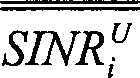 Be respectively that down link and the up link that i subscriber unit and related base station thereof experience estimated Signal to Interference plus Noise Ratio (utilizing front equation (19) and (20) and Fig. 5 and 6 described methods), piDAnd piUBe known downlink and the up-link transmission power that use base station related with i user during the pulse train of each last emission.

As use equation (9a) and first kind of selection (9b), owing to known emitted power during initial call is set up, thereby can be by obtaining path loss in the antenna measurement average power.
Select as another kind, in some systems, for example use in the system of IS-95 CDMA standard, on down link, have a pilot tone, and launch this pilot tone continuously with known power level.Use pilot tone can be used for determining path loss by this way.Therefore can determine path loss with several method.
Although method of the present invention is not limited to these systems, should note TDD system for for example PHS and so on, suppose the path loss of up link and down link identical be rational.
Down link and uplink channel interference plus noise (I between following evaluation honeycombiDAnd IiU).If K represents time cycle before new index and the K-1 representative more time.Upgrade for current (K) so,
In another alternate embodiment, following formula is used to estimate down link and uplink channel interference plus noise (IiDAnd IiU).K also is used as an index to represent the value of current calculating in the equation below:
In an embodiment of explicit solution partial power Control and Optimization problem, each of equation (7) (as down link step 733 part) and equation (8) (as uplink step 711 part) is solved as linear programming problem in each base station.Can use the method for any known solution linear programming problem.
In second (preferably) embodiment of explicit solution partial power control, with equation (7a) and the constraint (8b) be revised as equality constraint.That is, in this preferred embodiment, by solving an equation (7a) with equality constraint respectively and (8a) coming respectively to determine power in down link and the up link.That is to say, in a conventional downlink channel, be set to equal the target SINR of this down link space channel by the expection down link SINR in each down link space channel of conventional downlink channel, determine to be applied to the power packages of the downlink communication of the space channel in any conventional downlink channel.In this preferred embodiment, for all down link space channels of conventional uplink channel, target SINR is identical.And, in a conventional uplink channel, be set to equal the target SINR of this up link space channel by the expection up link SINR in each up link space channel of conventional uplink channel, determine to be applied to the power packages of the uplink communication of the space channel in any conventional uplink channel.In this preferred embodiment, target SINR is identical for all up link space channels of conventional uplink channel.
Suppose that finding the solution partial power's control minimization problem in each base station finally causes global optimization to be separated (when in the quantitative change that does not have path gain and so on, not new the calling, or the like), use equation be physics intuitively: in order to make the gross power minimum, should only distribute the power that is enough to satisfy the acceptability energy level of wishing so, and can not be more.
When equation (7a) and (8a) being revised as equality constraint, can be converted to each equation the linear equation of following form, be used for down link step 733:
Be used for up link step 711:
Immediately as can be seen these two equations each all be the system of linear equations that can represent with following matrix form,
Ap=b
Wherein A is a d (space channel number) dimension square matrix, and p is that the vector (for simple and direct, having omitted subscript U and D) and the b of power multiply by to disturb and noise (Ii) vector of target SINR of amount.Equation (12a) or (12b) group, when expressing with matrix form, each has the exact solution of a matrix form
p=A-1b。(13)
Substitution Li, wi, ai, IiAnd SINRiValue (, also having omitted subscript U and D) for simple and direct accurately produce piValue.
If the p of any such acquisitioniValue is born, and does not have available separating to optimizing power control problem so.Exist several selections.In this preferred embodiment, the channel of carrying out system according to the heavy allocator of channel heavily distributes.
Fig. 8 (a) and 8 (b) are respectively the flow charts that shows that second embodiment that uses this step 711 and 733 carries out up link respectively and down link carries out middle power control.Fig. 8 (a) shows the embodiment 801 that uses the step 711 of carrying out middle up-link power control for a given SDMA channel i.In step 803, processing procedure obtains the up link amount { w of all i from spatial processoriUAnd { aiU.Then, in step 805, with the evaluation of (step 709) acquisitionCalculate the path gain group { L of all i by equation (9b)iU, and utilize equation (10b) or (11b) also determined interference plus noise amount { IiU.In step 807, determine that up-link power distributes, preferably determine by separating problem with equality constraint (equation (12b) and (13)).In step 809, SU uses this power by order, separates adjusting uplink power level and end process process (turning back to step 704) according to what obtain in step 807.Fig. 8 (b) has shown an embodiment 821 who is used for a given SDMA channel i is used the step 721 of carrying out downlink power control equally.In step 823, processing procedure obtains the down link amount { w of all i from spatial processoriDAnd { aiD.Then, in step 825, utilize equation (9a) to calculate the path gain group { L of all iiD, and utilize equation (10a) or (11a) also determined interference plus noise amount { IiD.In step 827, determine downlink power allocation, preferably determine by separating problem with equality constraint (equation (12a) and (13)).In step 829, separate adjusting downlink power level and end process process (turning back to step 724) according to what in step 827, obtain.
Signal quality estimation
The step 313 that is used for the method 301 of initial power control comprises definite signal quality.In addition, utilize the middle Poewr control method of carrying out of equation (3) or (4) and partial power's control method of explicit solution equation (7) and (8) all to comprise the evaluation (seeing the step 709 and 729 in flow chart 701 and 721 respectively) that utilizes signal quality measured values (SINR).Another aspect of the present invention is a kind of method that is used to realize these steps.When can being used to realize power control of the present invention aspect to any method of determining these evaluations of estimate, another aspect of the present invention is a kind of RF carrier signal quality evaluator method and apparatus, and it can be applied to all angle modulation RF carrier waves.Because a large amount of various types of angle modulation system is arranged, in order to strengthen the understanding of the present invention, only with regard to a kind of being elaborated in two types.Two kinds of sampling angle-modulated signals selecting for this purpose are widely used quaternary PSK (QPSK) signals in the communications field, and four-phase differential phase shift keyi (DQPSK) signal.Each code element in these schemes comprises two information bits (dibit).The key character of the phase-modulated signal of relevant signal quality estimation of the present invention aspect is, the amplitude of data symbols is constant when supposing not exist the interference of noise or other form.The quantity of discrete phase level (being four in these cases) is unessential.The difference of these two kinds of signals is that in DQPSK, dibit is mapped to two phase differences between the continuous code element, and in QPSK, dibit is mapped to the phase place of code element itself.Therefore, the phase plane of a QPSK signal is identical with the difference phase plane of a QPSK signal, and the difference phase plane of QPSK signal is the phase plane of two phase differences between the continuous code element.In addition, in QPSK, four code element points that use in explanation are 0, pi/2, π, with 3 pi/2s, and the specific DQPSK that in this preferred embodiment, uses, among π/4 DQPSK, four code element points that use are π/4 in the difference phase plane, 3 π/4,5 π/4 and 7 π/4 (that is, ± π/4 and ± 3 π/4).That is to say that for π/4DQPSK situation, above-mentioned QPSK phase plane has been rotated π/4.How be familiar with those of ordinary skill in the art knows from the explanation of other situation and realizes a kind of situation.From the following description, be familiar with those of ordinary skill in the art and also can know the angular modulation system application that how to make these principles be suitable for other form.
Fig. 4 is the complex phase plane graph 401 of four kinds of states of a QPSK model, just added a parasitic noise vector Δ S, with the phase error Δ θ that causes, amplitude and phase error are incorporated into actual conditions among the observed data code element R to represent existing of wherein noise and interference.Vector Δ S is corresponding to the phasor difference between uncontaminated code element S and the observation code element R.
Fig. 4 is the complex phase plane representative that receives data symbols signal R on the phase plane.Also show respectively in phase place 0 pi/2, four determination points 403,404,405 and 406 (judgement conformation) of π and 3 π/4 on the phase plane 401.Any frequency shift (FS) that exists can be envisioned as the rotation of constellation points with respect to received signal R.Can be envisioned as one to R and add a parasitic noise vector Δ S on it, cause the constant modulus signal S of phase error Δ θ.Δ S representative is in esse and amplitude and phase error are introduced noise and the interference of observed data code element R.That is, vector Δ S is corresponding to the phasor difference between uncontaminated code element S and the observation code element R.Thereby, can recently estimate SINR by the squared magnitude of estimating S and Δ S.That is to say SINR=E[S2]/E[Δ S2].The essence of this preferred embodiment signal quality estimation device is fully from a SINR who receives the observation evaluation received signal of the radius R on the data pulse string.This radius of turn R that has utilized for conformation is constant, thereby makes the SINR evaluation of estimate not be subjected to frequency shift (FS) to influence this fact basically.
For illustrative purposes, noise and interference vector Δ S are modeled as one have independently real number (that is, homophase I) and imaginary number (that is, quadrature Q) part, each is partly with σ2Zero-mean (zero-mean) gaussian random of variance handle.Select this model to be because it causes being used for determining the desirable practical methods of the statistical appraisal of modulus S and correlated noise and interference vector.Although used this model in explaining this method, this method also is applicable to the actual signal and the noise that may not keep the zero-mean gaussian random to handle hypothesis.
An embodiment of Signal to Interference plus Noise Ratio (SINR) method of a received signal is estimated in explanation now.This can be used to comprise the step 313 of Poewr control method 301, and each comprises the power control application of the step among the power control embodiment in the carrying out with SINR evaluation.As shown in Figure 4, vector Δ S can be expressed as two quadrature zero-mean Gaussian noise components and, one is the noise component(s) (n with carrier phasor S homophase in two quadrature zero-mean Gaussian noise components1) and another be quadrature component (n2), n1And n2All has σ2Variance.Therefore, the amount of SINR evaluation is:
SINR=E[S2]/2σ2。(14)
If the modulus of signal S is constant basically during a pulse train, received signal amplitude R is similar to the Rician distribution so, has
Wherein
E[R2]=E[S2]+2σ2
=2σ2(1+SINR)。(16)
Given E[R] and E[R2] value, equation (15) and (16) are that two unknown number (σ are arranged so2And SINR) two (non-linear) equations.Therefore, an embodiment of this method wants simultaneous solution equation (15) and (16), asks SINR.The value of relevant f (SINR) can be stored in the question blank in advance.As selection, can use approximation f (SINR) ≈ 1.In this preferred embodiment, preferably the complex values baseband signal that is used for communication channel is provided as homophase and the quadrature component represented by I and Q respectively.E{Rk, k=1,2, or the like, value by determining the R of each sampling in the pulse train2=(I2+ Q2) estimate.Should be pointed out that (the I of one group of sampling2+ Q2) mean value of value is the measured value of the common received signal intensity indication of using (RSSI) in the receiver.Representing the sample value of I and Q respectively with I (n) and Q (n), is ideally on the baud sample point time at each sequential sampling n, and the baud sample point of a given pulse form code element is corresponding to the central point in the pulse form symbol time.In fact, owing to regularly aim at imperfection, the baud sample point is corresponding to the time sample at the most close pulse form code element center.Therefore, the one baud cycle of interval of the sequential sampling among I (n) and the Q (n).Should be noted that these I and Q value are single modulation signals that is used for single (space) channel.Therefore, in the system of this preferred embodiment, these be after the spatial manipulation and in fact I on baud point and Q value.In the receiver of the transceiver of Fig. 1, the output of downconverter/filter 131 is antennas only---promptly, and sampled signal before the spatial manipulation, and be oversampling.Therefore, suppose or be performed near the definite of signal I (n) after the spatial manipulation of baud point and Q (n), preferably in the RX of correspondence DSP209.See to be used to discuss and be included in or near " our demodulation patent " (above-mentioned U.S. Patent application 08/729,390) of an example of definite processing of signal I (n) after the spatial manipulation of baud point and Q (n).Represent a sampling number in the pulse train with N.Extract sampling modulus information by the quadratic sum that forms homophase and orthogonal signalling,
R2(n)=I2(n)+Q2(n) and (17b)
R4(n)=(I2(n)+Q2(n))2。(17c)
Then, by calculate on this pulse train with The ensemble average value of representative obtains E{R approxk,

At k=1, under 2 and 4 the situation,
Then, canMeasured value as RSSI.
In one embodiment, use a kind of iterative solution method, in this solution, supposed 2 σ2With the value of SINR, and substitution equation (15) and (16), E{R2And the calculated value of E{R} (obtain with the RSSI that estimates respectively from measuring ) and R relatively, if their difference is acceptable little, accepts call by value so as causing separating of SINR evaluation.This is a standard alternative manner of separating two simultaneous nonlinear equations (15) and (16).

Above the attention, in order to estimate E{R} from measured value, (square journey (17A)) need carry out a square root calculation.This is time-consuming calculating.
Second method for optimizing is based on only utilizing according to the equation (17b) and (17c) the non-central square of definite even power, E{R2And E{R4.The non-central square of even power, E{R2And E{R4Be average power and mean square power measured value.In case should be noted that and determined (in equation (17b), using) instantaneous power R2(n)=I2(n)+Q2(n), determine squared power R so4(n)=[R2(n)]2Every sampling only needs a single additional multiplication, and preferably uses maximum square root calculations, utilizes following formula to determine to estimate signal and noise ratio,
Fig. 5 (a) is an a kind of block diagram of realizing that is used for the base station apparatus (501) of picked up signal quality evaluation.This device is the simplification version of the base station apparatus of Fig. 1 and 2.Device 501 comprises an antenna array 503 that is used to receive the RF signal, one group be used for each antenna element of antenna array 503 conversion of signals be the complex values baseband signal RF receiver 505 (promptly, antenna receiving unit), one is used for determining the spatial processor 507 from a particular remote user baseband signal, described baseband signal preferably provides with homophase (I) part 509 and quadrature (Q) part 511, and signal 509 and 511 is actually at baud point to be determined.Respectively I and Q signal 509 and 511 are input to a signal quality estimation device 513, further handle to be created in the signal quality estimation of the hope that is shown signal quality indication 515 among Fig. 5 (a).In the base station of this preferred embodiment, each antenna element of antenna array 503 and each RF receiver 505 are assemblied in shown in Fig. 1 in the Transceiver Module, and produce the pre-spatial manipulation signal of numeral, as the output of downconverter/filter 131.Spatial processor 507 is a programmable digital arithmetic processor preferably.When using in the base station at this preferred embodiment, spatial processor 507 is parts of the modem module of Fig. 2, specifically, is among the RX DSP209, is that the specific RX DSP that is used to be received time slot.Signal quality processor 513 is programmable digital arithmetic processor preferably also.When using in the base station at this preferred embodiment, signal quality processor 513 is parts of the modem module of Fig. 2, specifically is among the RX DSP209, is that the specific RX DSP that is used to be received time slot.
Fig. 5 (b) is a kind of block diagram of realizing that is used for the subscriber unit device (521) of picked up signal quality evaluation.This device is the simplification version of the subscriber unit device of Fig. 9 and10.Device 521 comprises anantenna 523 that is used to receive the RF signal, handle is theRF receiver 525 of complex values baseband signal from the conversion of signals ofantenna 523, preferably be converted to homophase (I)part 529 and quadrature (Q)part 531, signal 529 and 531 is actually to be determined at baud point.Respectively I and Q signal 529 and 531 are input to a signalquality estimation device 533, further handle to be created in the signal quality estimation value of the hope that is shownsignal quality indication 535 among Fig. 5 (b).In the subscriber unit of this preferred embodiment, shown inantenna 523 andRF receiver 525 installation diagrams 9 in the RF system, and produce the I and the Q signal of oversampling.Signal quality processor 533 preferably also is a programmable digital arithmetic processor.When using in the subscriber unit at this preferred embodiment,signal quality processor 533 is DSP (RX) 1042, and its function is determined sampling near being included in baud point.
Under the digital processing situation, at baud point sampling signal of estimating 509 and 511 (in a BS) and signal 529 and 531 (carrying out the processing of baud point with the DSP among the SU (RX) 1042 after).As before, use I (n) and Q (n) to represent these signals respectively, wherein each sequential sampling n or near the continuous wave characteristics.By forming the quadratic sum of homophase and orthogonal signalling, promptly instantaneous power is extracted sampling modulus information.Therefore, utilize equation (17b) to obtain instantaneous power R2(n) and obtain instantaneous squared power R4(n) be [R2(n)]2=R2(n) * R2(n).
By forming the R that crosses over a moving window2(n) and R4(n) mean value is estimated second order and Fourth-order moment respectively, i.e. average power And mean square power
 For the situation of k=2 and k=4, can utilize equation (19b) and (19c) determine this moving average.


Now determine quality evaluation with equation (20).In practice, be familiar with those of ordinary skill in the art and should be understood that, only form equation (19b) (and equation (19c), in if you are using) and.Be not required to be all mean values and determine the 1/N factor, as long as using equation (20) to determine to have kept in the quality evaluation correct calibration.
Improving among the embodiment at one, is not the SINR that determines to cross over a single pulse train, but increases the additional step of the moving average of a SINR who obtains to cross over several pulse trains.For example, the operation of the K after K pulse train mean value is defined as:
SINRK=αSINR+(1-α)SINRK-1 (21)
0<α<1 wherein, SINR is the new measured value to current (K) pulse train, and SINRKRepresent the K operation mean value of SINR.The value of suitably selecting α is with the adaptation speed of control moving average to change condition.In this preferred embodiment of PHS system, α has used 0.8 value.Be familiar with those of ordinary skill in the art and know, be easy to realize the operation mean value of equation (21) with a finite impulse response (FIR) filter, and because data transfer rate low (new SINR of every pulse train), so can not increase computation burden greatly.Rolling average is preferably in signal quality processor 513 (in the base station) and the processor 533 (at SU) and realizes.
Fig. 6 is the flow chart of method 601, and it has summarized the method for picked up signal quality evaluation in the angle modulation communication system.In step 603, receive angle-modulated signal.Step 605 produces homophase (I) part and quadrature (Q) part in the baseband signal of received signal, is to produce after spatial manipulation in the SDMA occasion, and is actually at baud point in the digital processing occasion and produces.Step 607 is from I, the evaluation of at least two different squares of the modulus of Q extracting section received signal, and step 609 is determined the mean value of square.The definite signal quality estimation of step 611 is estimated as SINR.
For the sake of clarity, here the method and apparatus that controls transmitter power level of explanation is limited to particular cellular communication system and realization.But, for being familiar with those of ordinary skill in the art, from the explanation that provides, the present invention is applied to other communication system does not obviously depart from the scope of the present invention such as the system that uses other air interface, the system that is designed for transfer of data, analogue system, WLAN (wireless local area network) (LAN), the spirit and scope of the present invention only are subjected to the restriction of following claim.And being used to of explanation estimated the just mode of example of the ad hoc approach of angle modulation RF carrier-quality of reception and device, unless and outside pointing out in the following claim, can not be as limitation of the present invention.
Claims (47)
Translated fromChineseApplications Claiming Priority (2)
| Application Number | Priority Date | Filing Date | Title |
|---|---|---|---|
| US09/020,049US6463295B1 (en) | 1996-10-11 | 1998-02-06 | Power control with signal quality estimation for smart antenna communication systems |
| US09/020,049 | 1998-02-06 |
Related Child Applications (1)
| Application Number | Title | Priority Date | Filing Date |
|---|---|---|---|
| CN2007100054001ADivisionCN101026398B (en) | 1998-02-06 | 1999-02-03 | Power control with signal quality estimation for smart antenna array communication systems |
Publications (2)
| Publication Number | Publication Date |
|---|---|
| CN1289485A CN1289485A (en) | 2001-03-28 |
| CN1310439Ctrue CN1310439C (en) | 2007-04-11 |
Family
ID=21796467
Family Applications (2)
| Application Number | Title | Priority Date | Filing Date |
|---|---|---|---|
| CN2007100054001AExpired - Fee RelatedCN101026398B (en) | 1998-02-06 | 1999-02-03 | Power control with signal quality estimation for smart antenna array communication systems |
| CNB998026123AExpired - Fee RelatedCN1310439C (en) | 1998-02-06 | 1999-02-03 | Power Control Using Signal Quality Evaluation for Smart Antenna Array Communication Systems |
Family Applications Before (1)
| Application Number | Title | Priority Date | Filing Date |
|---|---|---|---|
| CN2007100054001AExpired - Fee RelatedCN101026398B (en) | 1998-02-06 | 1999-02-03 | Power control with signal quality estimation for smart antenna array communication systems |
Country Status (8)
| Country | Link |
|---|---|
| US (1) | US6463295B1 (en) |
| EP (1) | EP1051811B1 (en) |
| JP (1) | JP2002503053A (en) |
| CN (2) | CN101026398B (en) |
| AT (1) | ATE265109T1 (en) |
| AU (1) | AU2494299A (en) |
| DE (1) | DE69916579T2 (en) |
| WO (1) | WO1999040689A1 (en) |
Cited By (1)
| Publication number | Priority date | Publication date | Assignee | Title |
|---|---|---|---|---|
| US8064944B2 (en) | 1996-10-11 | 2011-11-22 | Intel Corporation | Power control with signal quality estimation for smart antenna communications systems |
Families Citing this family (327)
| Publication number | Priority date | Publication date | Assignee | Title |
|---|---|---|---|---|
| US6885652B1 (en) | 1995-06-30 | 2005-04-26 | Interdigital Technology Corporation | Code division multiple access (CDMA) communication system |
| US7020111B2 (en) | 1996-06-27 | 2006-03-28 | Interdigital Technology Corporation | System for using rapid acquisition spreading codes for spread-spectrum communications |
| US7929498B2 (en)* | 1995-06-30 | 2011-04-19 | Interdigital Technology Corporation | Adaptive forward power control and adaptive reverse power control for spread-spectrum communications |
| US7123600B2 (en) | 1995-06-30 | 2006-10-17 | Interdigital Technology Corporation | Initial power control for spread-spectrum communications |
| US7072380B2 (en) | 1995-06-30 | 2006-07-04 | Interdigital Technology Corporation | Apparatus for initial power control for spread-spectrum communications |
| ZA965340B (en) | 1995-06-30 | 1997-01-27 | Interdigital Tech Corp | Code division multiple access (cdma) communication system |
| FI106665B (en)* | 1997-11-05 | 2001-03-15 | Nokia Mobile Phones Ltd | Method and apparatus for determining the transmission power of a mobile station |
| US5955992A (en)* | 1998-02-12 | 1999-09-21 | Shattil; Steve J. | Frequency-shifted feedback cavity used as a phased array antenna controller and carrier interference multiple access spread-spectrum transmitter |
| JP3881770B2 (en)* | 1998-03-10 | 2007-02-14 | 松下電器産業株式会社 | Mobile station apparatus and communication method |
| FI108588B (en)* | 1998-12-15 | 2002-02-15 | Nokia Corp | Method and radio system for transmitting a digital signal |
| US6977910B1 (en)* | 1998-12-31 | 2005-12-20 | Texas Instruments Incorporated | Power control with space time transmit diversity |
| JP3641961B2 (en)* | 1999-02-01 | 2005-04-27 | 株式会社日立製作所 | Wireless communication device using adaptive array antenna |
| US6587690B1 (en)* | 1999-02-12 | 2003-07-01 | Lucent Technologies Inc. | Method for allocating downlink electromagnetic power in wireless networks |
| KR100399692B1 (en)* | 1999-03-30 | 2003-09-29 | 산요덴키가부시키가이샤 | Radio device and method of calibration of antenna directivity |
| FR2792129B1 (en)* | 1999-04-07 | 2006-07-28 | Valeo Securite Habitacle | PORTABLE SIGNAL RECEIVER WITH MULTIPLE ANTENNAS |
| GB2350524A (en)* | 1999-05-27 | 2000-11-29 | Roke Manor Research | Open loop power control in a hybrid TDD/TDMA system which includes a smart antenna |
| US6795426B1 (en)* | 1999-07-06 | 2004-09-21 | Cisco Technology, Inc. | Realtime power control in OFDM systems |
| US6697343B1 (en)* | 1999-08-26 | 2004-02-24 | Lucent Technologies Inc. | Method and apparatus for controlling power for variable-rate vocoded communications |
| US6507732B1 (en)* | 1999-09-14 | 2003-01-14 | Lucent Technologies Inc. | Dynamic path gain compensation for radios in wireless communication systems |
| SG80071A1 (en) | 1999-09-24 | 2001-04-17 | Univ Singapore | Downlink beamforming method |
| JP2001111464A (en)* | 1999-10-08 | 2001-04-20 | Matsushita Electric Ind Co Ltd | Base station device and method for radio transmission |
| FI107671B (en)* | 1999-10-08 | 2001-09-14 | Nokia Mobile Phones Ltd | Procedure and arrangement for timing the change of diversity coefficients in a cellular radio system |
| US6658262B1 (en)* | 1999-12-27 | 2003-12-02 | Telefonaktiebolget Lm Ericsson (Publ) | Method and system for power control order message management |
| SE0000720D0 (en)* | 2000-03-03 | 2000-03-03 | Ericsson Telefon Ab L M | Handover in cellular system utilization of norrow and wide beam antennas |
| JP3939069B2 (en)* | 2000-03-22 | 2007-06-27 | 三洋電機株式会社 | Antenna directivity control method and radio apparatus |
| US6940845B2 (en)* | 2000-03-23 | 2005-09-06 | At & T, Corp. | Asymmetric measurement-based dynamic packet assignment system and method for wireless data services |
| FI20000851A7 (en)* | 2000-04-10 | 2001-10-11 | Nokia Corp | Communication method and radio system |
| FI20000853L (en) | 2000-04-10 | 2001-10-11 | Nokia Networks Oy | Data transfer method |
| US7003275B1 (en)* | 2000-05-18 | 2006-02-21 | Broadband Innovations, Inc. | Agile frequency converter for multichannel systems using IF-RF level exhange and tunable filters |
| US8363744B2 (en) | 2001-06-10 | 2013-01-29 | Aloft Media, Llc | Method and system for robust, secure, and high-efficiency voice and packet transmission over ad-hoc, mesh, and MIMO communication networks |
| US6631255B1 (en)* | 2000-06-28 | 2003-10-07 | Northrop Grumman Corporation | Multi-carrier receiver for a wireless telecommunication system |
| US7391350B2 (en)* | 2000-07-13 | 2008-06-24 | The Regents Of The University Of California | Adaptive multi-bit delta and sigma-delta modulation |
| US7415285B2 (en)* | 2001-09-27 | 2008-08-19 | The Regents Of The University Of California | Reducing power control errors in wireless communication system |
| US7280495B1 (en) | 2000-08-18 | 2007-10-09 | Nortel Networks Limited | Reliable broadcast protocol in a wireless local area network |
| US7308279B1 (en)* | 2000-08-18 | 2007-12-11 | Nortel Networks Limited | Dynamic power level control on transmitted messages in a wireless LAN |
| US7339892B1 (en) | 2000-08-18 | 2008-03-04 | Nortel Networks Limited | System and method for dynamic control of data packet fragmentation threshold in a wireless network |
| US7366103B2 (en)* | 2000-08-18 | 2008-04-29 | Nortel Networks Limited | Seamless roaming options in an IEEE 802.11 compliant network |
| US7124193B1 (en)* | 2000-08-24 | 2006-10-17 | At&T Corp. | Method of using link adaptation and power control for streaming services in wireless networks |
| US7245880B1 (en)* | 2000-08-31 | 2007-07-17 | Intel Corporation | Transmit power control within a wireless transmitter |
| CA2319287A1 (en)* | 2000-09-14 | 2002-03-14 | Ramesh Mantha | System and method for allocating power |
| US6853633B1 (en)* | 2000-09-26 | 2005-02-08 | Ericsson Inc. | Methods of providing signal parameter information using delta-modulation and related systems and terminals |
| US7062294B1 (en)* | 2000-09-29 | 2006-06-13 | Arraycomm, Llc. | Downlink transmission in a wireless data communication system having a base station with a smart antenna system |
| JP2002112326A (en)* | 2000-10-02 | 2002-04-12 | Ntt Docomo Inc | Radio resource allocation method and base station apparatus |
| US7031290B2 (en)* | 2000-10-27 | 2006-04-18 | L3 Communications Corporation | Code assignment algorithm for synchronous DS-CDMA links with SDMA using channel scanning |
| FR2816141B1 (en)* | 2000-10-31 | 2002-12-06 | Mitsubishi Electric Inf Tech | METHOD FOR OBTAINING TRANSMIT GAIN FUNCTION |
| US6799045B1 (en)* | 2000-11-07 | 2004-09-28 | Telefonaktiebolaget Lm Ericsson (Publ) | Reliable congestion control in a CDMA-based mobile radio commmunications system |
| US8670390B2 (en) | 2000-11-22 | 2014-03-11 | Genghiscomm Holdings, LLC | Cooperative beam-forming in wireless networks |
| US6985739B2 (en)* | 2000-12-15 | 2006-01-10 | Telefonaktiebolaget Lm Ericsson (Publ) | Admission and congestion control in a CDMA-based mobile radio communications system |
| US6947748B2 (en) | 2000-12-15 | 2005-09-20 | Adaptix, Inc. | OFDMA with adaptive subcarrier-cluster configuration and selective loading |
| AU2002219506A1 (en)* | 2000-12-21 | 2002-07-01 | Matsushita Electric Industrial Co., Ltd. | Base station device |
| US7065155B2 (en)* | 2000-12-22 | 2006-06-20 | Atheros Communications, Inc. | Method and apparatus for a transceiver having a constant power output |
| US6987819B2 (en)* | 2000-12-29 | 2006-01-17 | Motorola, Inc. | Method and device for multiple input/multiple output transmit and receive weights for equal-rate data streams |
| US7126930B2 (en)* | 2001-02-10 | 2006-10-24 | Qualcomm, Incorporated | Method and apparatus for transmitting messages in a wireless communication system |
| US9819449B2 (en) | 2002-05-14 | 2017-11-14 | Genghiscomm Holdings, LLC | Cooperative subspace demultiplexing in content delivery networks |
| US10931338B2 (en) | 2001-04-26 | 2021-02-23 | Genghiscomm Holdings, LLC | Coordinated multipoint systems |
| US10355720B2 (en) | 2001-04-26 | 2019-07-16 | Genghiscomm Holdings, LLC | Distributed software-defined radio |
| US6850500B2 (en) | 2001-05-15 | 2005-02-01 | Interdigital Technology Corporation | Transmission power level estimation |
| US7688899B2 (en) | 2001-05-17 | 2010-03-30 | Qualcomm Incorporated | Method and apparatus for processing data for transmission in a multi-channel communication system using selective channel inversion |
| US6751187B2 (en)* | 2001-05-17 | 2004-06-15 | Qualcomm Incorporated | Method and apparatus for processing data for transmission in a multi-channel communication system using selective channel transmission |
| US7072413B2 (en) | 2001-05-17 | 2006-07-04 | Qualcomm, Incorporated | Method and apparatus for processing data for transmission in a multi-channel communication system using selective channel inversion |
| US7339977B2 (en)* | 2001-06-27 | 2008-03-04 | Nokia Corporation | Signal strength assisted searcher and acquisition |
| US20030027579A1 (en)* | 2001-08-03 | 2003-02-06 | Uwe Sydon | System for and method of providing an air interface with variable data rate by switching the bit time |
| CA2398057C (en)* | 2001-08-15 | 2011-07-19 | Raytheon Company | Combining signal images in accordance with signal-to-noise ratios |
| US7003310B1 (en)* | 2001-09-28 | 2006-02-21 | Arraycomm Llc. | Coupled uplink/downlink power control and spatial processing with adaptive antenna arrays |
| US6788948B2 (en) | 2001-09-28 | 2004-09-07 | Arraycomm, Inc. | Frequency dependent calibration of a wideband radio system using narrowband channels |
| US6570527B1 (en) | 2001-09-28 | 2003-05-27 | Arraycomm, Inc. | Calibration of differential frequency-dependent characteristics of a radio communications system |
| US7039016B1 (en) | 2001-09-28 | 2006-05-02 | Arraycomm, Llc | Calibration of wideband radios and antennas using a narrowband channel |
| US6956907B2 (en)* | 2001-10-15 | 2005-10-18 | Qualcomm, Incorporated | Method and apparatus for determining power allocation in a MIMO communication system |
| GB2382748A (en) | 2001-11-28 | 2003-06-04 | Ipwireless Inc | Signal to noise plus interference ratio (SNIR) estimation with corection factor |
| US20030122552A1 (en)* | 2001-12-28 | 2003-07-03 | Litwin Louis Robert | Signal quality indicator on a powerline-modem |
| US7151795B1 (en)* | 2001-12-31 | 2006-12-19 | Arraycomm Llc | Method and apparatus for increasing spectral efficiency using mitigated power near band-edge |
| US7986672B2 (en)* | 2002-02-25 | 2011-07-26 | Qualcomm Incorporated | Method and apparatus for channel quality feedback in a wireless communication |
| US6785520B2 (en) | 2002-03-01 | 2004-08-31 | Cognio, Inc. | System and method for antenna diversity using equal power joint maximal ratio combining |
| WO2003075471A2 (en) | 2002-03-01 | 2003-09-12 | Cognio, Inc. | System and method for joint maximal ratio combining |
| US6687492B1 (en) | 2002-03-01 | 2004-02-03 | Cognio, Inc. | System and method for antenna diversity using joint maximal ratio combining |
| US6862456B2 (en) | 2002-03-01 | 2005-03-01 | Cognio, Inc. | Systems and methods for improving range for multicast wireless communication |
| US6871049B2 (en)* | 2002-03-21 | 2005-03-22 | Cognio, Inc. | Improving the efficiency of power amplifiers in devices using transmit beamforming |
| US9628231B2 (en) | 2002-05-14 | 2017-04-18 | Genghiscomm Holdings, LLC | Spreading and precoding in OFDM |
| US10142082B1 (en) | 2002-05-14 | 2018-11-27 | Genghiscomm Holdings, LLC | Pre-coding in OFDM |
| US10644916B1 (en) | 2002-05-14 | 2020-05-05 | Genghiscomm Holdings, LLC | Spreading and precoding in OFDM |
| US10200227B2 (en) | 2002-05-14 | 2019-02-05 | Genghiscomm Holdings, LLC | Pre-coding in multi-user MIMO |
| JP4134597B2 (en)* | 2002-05-23 | 2008-08-20 | 日本電気株式会社 | Adaptive antenna transceiver |
| US7327800B2 (en) | 2002-05-24 | 2008-02-05 | Vecima Networks Inc. | System and method for data detection in wireless communication systems |
| CN102655430A (en) | 2002-07-30 | 2012-09-05 | 美商智慧财产权授权股份有限公司 | System and method for multiple-input multiple-output (mimo) radio communication |
| TWI339034B (en)* | 2002-08-07 | 2011-03-11 | Interdigital Tech Corp | Closed loop transmit diversity of point to multipoint physical channels |
| EP1401218A1 (en)* | 2002-09-19 | 2004-03-24 | Siemens Aktiengesellschaft | Method for the transmission of broadcast and multicast information in a mobile communications system |
| US8165619B2 (en)* | 2002-10-02 | 2012-04-24 | Qualcomm Incorporated | Power allocation for power control bits in a cellular network |
| EP1557941A4 (en)* | 2002-11-01 | 2012-06-13 | Panasonic Corp | FILTERING CIRCUIT AND RADIO DEVICE |
| US7224717B1 (en)* | 2002-11-15 | 2007-05-29 | Lockheed Martin Corporation | System and method for cross correlation receiver |
| GB2395624B (en)* | 2002-11-19 | 2006-02-22 | Matsushita Electric Industrial Co Ltd | Method for frequency burst snr estimation |
| US7020107B2 (en)* | 2003-01-21 | 2006-03-28 | Arraycomm, Llc | Methods for reliable user switchback on a PHS spatial division multiple access channel |
| KR100571862B1 (en)* | 2003-02-17 | 2006-04-17 | 삼성전자주식회사 | Mobile communication system including multiple antennas and method thereof |
| CN1762121B (en)* | 2003-03-13 | 2010-09-08 | Nxp股份有限公司 | Testing apparatus for digital telecommunication |
| US7327795B2 (en) | 2003-03-31 | 2008-02-05 | Vecima Networks Inc. | System and method for wireless communication systems |
| US7099678B2 (en) | 2003-04-10 | 2006-08-29 | Ipr Licensing, Inc. | System and method for transmit weight computation for vector beamforming radio communication |
| US20040224715A1 (en)* | 2003-05-07 | 2004-11-11 | Rosenlof John R. | System and method for correcting transmitter impairments |
| US7079870B2 (en)* | 2003-06-09 | 2006-07-18 | Ipr Licensing, Inc. | Compensation techniques for group delay effects in transmit beamforming radio communication |
| US8391322B2 (en) | 2003-07-09 | 2013-03-05 | Broadcom Corporation | Method and system for single weight (SW) antenna system for spatial multiplexing (SM) MIMO system for WCDMA/HSDPA |
| US7239885B2 (en)* | 2003-11-05 | 2007-07-03 | Interdigital Technology Corporation | Initial downlink transmit power adjustment for non-real-time services using dedicated or shared channel |
| US7298151B2 (en)* | 2004-04-21 | 2007-11-20 | Analog Devices, Inc. | Methods and apparatus for reducing thermal noise |
| WO2005117309A1 (en)* | 2004-05-25 | 2005-12-08 | Nec Corporation | Transmitter load impedance faulty detecting system |
| DE102004028806B3 (en)* | 2004-06-15 | 2005-12-29 | Infineon Technologies Ag | Receiver for a wireless communication system |
| US7460839B2 (en) | 2004-07-19 | 2008-12-02 | Purewave Networks, Inc. | Non-simultaneous frequency diversity in radio communication systems |
| US7263335B2 (en) | 2004-07-19 | 2007-08-28 | Purewave Networks, Inc. | Multi-connection, non-simultaneous frequency diversity in radio communication systems |
| US11552737B1 (en) | 2004-08-02 | 2023-01-10 | Genghiscomm Holdings, LLC | Cooperative MIMO |
| US7532664B2 (en)* | 2004-08-02 | 2009-05-12 | Nokia Corporation | Method and apparatus to estimate signal to interference plus noise ratio (SINR) in a multiple antenna receiver |
| US11184037B1 (en) | 2004-08-02 | 2021-11-23 | Genghiscomm Holdings, LLC | Demodulating and decoding carrier interferometry signals |
| US11381285B1 (en) | 2004-08-02 | 2022-07-05 | Genghiscomm Holdings, LLC | Transmit pre-coding |
| KR20060016042A (en)* | 2004-08-16 | 2006-02-21 | 삼성전자주식회사 | Apparatus and method for controlling uplink power in a mobile communication system using time division duplexing |
| US7860182B2 (en)* | 2004-09-23 | 2010-12-28 | Interdigital Technology Corporation | Receiver hardware reduction for spatially independent signals and associated methods |
| US7573851B2 (en) | 2004-12-07 | 2009-08-11 | Adaptix, Inc. | Method and system for switching antenna and channel assignments in broadband wireless networks |
| US20060153320A1 (en)* | 2005-01-07 | 2006-07-13 | Zeewaves Systems, Inc. | RF parameterized steerable antenna |
| JP5391471B2 (en)* | 2005-02-10 | 2014-01-15 | エスティー‐エリクソン、ソシエテ、アノニム | Method and apparatus for signal quality estimation |
| US7809336B2 (en)* | 2005-03-07 | 2010-10-05 | Qualcomm Incorporated | Rate selection for a quasi-orthogonal communication system |
| CN1862984B (en)* | 2005-05-11 | 2010-04-28 | 中兴通讯股份有限公司 | Power distributing method of ensuring signal quality in multi-channel multi-antenna communication system |
| EP1744168B1 (en) | 2005-07-11 | 2008-06-18 | Alcatel Lucent | Device and method for measuring VSWR using a pilot signal |
| CN101133571B (en)* | 2005-07-18 | 2012-05-30 | 中兴通讯股份有限公司 | Downlink admission judgment method applied to intelligent antenna CDMA communication system |
| CN101331789B (en)* | 2005-10-26 | 2013-02-13 | 高通股份有限公司 | Weighted fair sharing of a wireless channel using resource utilization masks |
| KR100705501B1 (en) | 2005-11-16 | 2007-04-09 | 한국전자통신연구원 | Downlink / Uplink Scheduling and Resource Allocation Method by Space Division Multiplexing of Mobile Communication System Base Station |
| KR100836141B1 (en)* | 2005-12-21 | 2008-06-09 | 삼성전자주식회사 | Apparatus and Method for Allocating Power in Space Division Multiple Access System |
| KR100906333B1 (en)* | 2006-01-11 | 2009-07-06 | 삼성전자주식회사 | Apparatus and method for merging and assigning radio frequency band resources in a spatial division multiple access system |
| US20070173261A1 (en)* | 2006-01-26 | 2007-07-26 | Nokia Corporation | Predetermined transmission mode sequence and feedback reduction technique |
| US7426198B2 (en) | 2006-02-06 | 2008-09-16 | Motorola, Inc. | Method and apparatus for performing spatial-division multiple access |
| US7864657B2 (en)* | 2006-05-23 | 2011-01-04 | Motorola Mobility, Inc. | Method and apparatus for performing stream weighting in an SDMA communication system |
| EP2034764A4 (en)* | 2006-06-19 | 2013-02-13 | Ntt Docomo Inc | Base station and method |
| GB2440192B (en)* | 2006-07-17 | 2011-05-04 | Ubidyne Inc | Antenna array system |
| JP4695212B2 (en)* | 2006-12-11 | 2011-06-08 | テレフオンアクチーボラゲット エル エム エリクソン(パブル) | Antenna system monitoring method |
| US8358586B2 (en)* | 2007-02-23 | 2013-01-22 | Kyocera Corporation | Radio base station and channel allocation information transmission method |
| CN101267237B (en)* | 2007-03-16 | 2014-08-20 | 中兴通讯股份有限公司 | A smart antenna downlink transmission power overload control method |
| WO2009079653A2 (en)* | 2007-12-18 | 2009-06-25 | Zte U.S.A., Inc. | Wimax multicast broadcast services (mbs) efficient handover and power saving support for intra and inter-mbs zones |
| RU2504083C2 (en)* | 2008-06-04 | 2014-01-10 | Телефонактиеболагет Л М Эрикссон (Пабл) | Method and devices in mobile communication network |
| US8005510B2 (en)* | 2008-07-10 | 2011-08-23 | T-Mobile Usa, Inc. | Cell site power conservation |
| US8729732B2 (en) | 2008-07-10 | 2014-05-20 | T-Mobile Usa, Inc. | Cell site power generation |
| US8412272B2 (en)* | 2009-07-24 | 2013-04-02 | T-Mobile Usa, Inc. | Rectifier circuit management system, such as for use in cell site power systems |
| EP2526638B1 (en)* | 2010-01-21 | 2018-02-28 | Nokia Technologies Oy | Mutual information based signal to interference plus noise ratio estimator for radio link monitoring |
| DK2534853T3 (en)* | 2010-02-12 | 2017-02-13 | Sonova Ag | WIRELESS SOUND TRANSMISSION SYSTEM AND METHOD / WIRELESS SOUND TRANSMISSION SYSTEM AND METHOD |
| US8310103B2 (en) | 2010-03-17 | 2012-11-13 | T-Mobile Usa, Inc. | Cell site power system management, including battery circuit management |
| US20120128040A1 (en) | 2010-11-23 | 2012-05-24 | Peter Kenington | Module for an Active Antenna System |
| US8565806B2 (en)* | 2010-12-12 | 2013-10-22 | St-Ericsson Sa | Real time transmission power control |
| US9275690B2 (en) | 2012-05-30 | 2016-03-01 | Tahoe Rf Semiconductor, Inc. | Power management in an electronic system through reducing energy usage of a battery and/or controlling an output power of an amplifier thereof |
| US9509351B2 (en) | 2012-07-27 | 2016-11-29 | Tahoe Rf Semiconductor, Inc. | Simultaneous accommodation of a low power signal and an interfering signal in a radio frequency (RF) receiver |
| US10009065B2 (en) | 2012-12-05 | 2018-06-26 | At&T Intellectual Property I, L.P. | Backhaul link for distributed antenna system |
| US9113347B2 (en) | 2012-12-05 | 2015-08-18 | At&T Intellectual Property I, Lp | Backhaul link for distributed antenna system |
| US20140210450A1 (en)* | 2013-01-25 | 2014-07-31 | Nokia Siemens Networks Oy | Methods and apparatus for estimating return loss |
| US9722310B2 (en) | 2013-03-15 | 2017-08-01 | Gigpeak, Inc. | Extending beamforming capability of a coupled voltage controlled oscillator (VCO) array during local oscillator (LO) signal generation through frequency multiplication |
| US9716315B2 (en) | 2013-03-15 | 2017-07-25 | Gigpeak, Inc. | Automatic high-resolution adaptive beam-steering |
| US9666942B2 (en) | 2013-03-15 | 2017-05-30 | Gigpeak, Inc. | Adaptive transmit array for beam-steering |
| US9780449B2 (en) | 2013-03-15 | 2017-10-03 | Integrated Device Technology, Inc. | Phase shift based improved reference input frequency signal injection into a coupled voltage controlled oscillator (VCO) array during local oscillator (LO) signal generation to reduce a phase-steering requirement during beamforming |
| US9184498B2 (en) | 2013-03-15 | 2015-11-10 | Gigoptix, Inc. | Extending beamforming capability of a coupled voltage controlled oscillator (VCO) array during local oscillator (LO) signal generation through fine control of a tunable frequency of a tank circuit of a VCO thereof |
| US9837714B2 (en) | 2013-03-15 | 2017-12-05 | Integrated Device Technology, Inc. | Extending beamforming capability of a coupled voltage controlled oscillator (VCO) array during local oscillator (LO) signal generation through a circular configuration thereof |
| US9531070B2 (en) | 2013-03-15 | 2016-12-27 | Christopher T. Schiller | Extending beamforming capability of a coupled voltage controlled oscillator (VCO) array during local oscillator (LO) signal generation through accommodating differential coupling between VCOs thereof |
| US9999038B2 (en) | 2013-05-31 | 2018-06-12 | At&T Intellectual Property I, L.P. | Remote distributed antenna system |
| US9525524B2 (en) | 2013-05-31 | 2016-12-20 | At&T Intellectual Property I, L.P. | Remote distributed antenna system |
| CN104854922A (en)* | 2013-06-17 | 2015-08-19 | 华为技术有限公司 | Radio frequency front end circuit and base station of time division duplex system |
| US8897697B1 (en) | 2013-11-06 | 2014-11-25 | At&T Intellectual Property I, Lp | Millimeter-wave surface-wave communications |
| CN103582104B (en)* | 2013-11-22 | 2016-06-29 | 西安电子科技大学 | Embed the power distribution method based on SINR increment iterative in the cellular network of D2D |
| US9209902B2 (en) | 2013-12-10 | 2015-12-08 | At&T Intellectual Property I, L.P. | Quasi-optical coupler |
| US12224860B1 (en) | 2014-01-30 | 2025-02-11 | Genghiscomm Holdings, LLC | Linear coding in decentralized networks |
| US9184974B1 (en) | 2014-06-26 | 2015-11-10 | The Boeing Company | In-phase and quadrature radio frequency digital-to-analog converter |
| US9692101B2 (en) | 2014-08-26 | 2017-06-27 | At&T Intellectual Property I, L.P. | Guided wave couplers for coupling electromagnetic waves between a waveguide surface and a surface of a wire |
| US9768833B2 (en) | 2014-09-15 | 2017-09-19 | At&T Intellectual Property I, L.P. | Method and apparatus for sensing a condition in a transmission medium of electromagnetic waves |
| US10063280B2 (en) | 2014-09-17 | 2018-08-28 | At&T Intellectual Property I, L.P. | Monitoring and mitigating conditions in a communication network |
| US9628854B2 (en) | 2014-09-29 | 2017-04-18 | At&T Intellectual Property I, L.P. | Method and apparatus for distributing content in a communication network |
| US9615269B2 (en) | 2014-10-02 | 2017-04-04 | At&T Intellectual Property I, L.P. | Method and apparatus that provides fault tolerance in a communication network |
| US9685992B2 (en) | 2014-10-03 | 2017-06-20 | At&T Intellectual Property I, L.P. | Circuit panel network and methods thereof |
| US9503189B2 (en) | 2014-10-10 | 2016-11-22 | At&T Intellectual Property I, L.P. | Method and apparatus for arranging communication sessions in a communication system |
| US9762289B2 (en) | 2014-10-14 | 2017-09-12 | At&T Intellectual Property I, L.P. | Method and apparatus for transmitting or receiving signals in a transportation system |
| US9973299B2 (en) | 2014-10-14 | 2018-05-15 | At&T Intellectual Property I, L.P. | Method and apparatus for adjusting a mode of communication in a communication network |
| US9312919B1 (en) | 2014-10-21 | 2016-04-12 | At&T Intellectual Property I, Lp | Transmission device with impairment compensation and methods for use therewith |
| US9780834B2 (en) | 2014-10-21 | 2017-10-03 | At&T Intellectual Property I, L.P. | Method and apparatus for transmitting electromagnetic waves |
| US9653770B2 (en) | 2014-10-21 | 2017-05-16 | At&T Intellectual Property I, L.P. | Guided wave coupler, coupling module and methods for use therewith |
| US9627768B2 (en) | 2014-10-21 | 2017-04-18 | At&T Intellectual Property I, L.P. | Guided-wave transmission device with non-fundamental mode propagation and methods for use therewith |
| US9577306B2 (en) | 2014-10-21 | 2017-02-21 | At&T Intellectual Property I, L.P. | Guided-wave transmission device and methods for use therewith |
| US9564947B2 (en) | 2014-10-21 | 2017-02-07 | At&T Intellectual Property I, L.P. | Guided-wave transmission device with diversity and methods for use therewith |
| US9520945B2 (en) | 2014-10-21 | 2016-12-13 | At&T Intellectual Property I, L.P. | Apparatus for providing communication services and methods thereof |
| US9769020B2 (en) | 2014-10-21 | 2017-09-19 | At&T Intellectual Property I, L.P. | Method and apparatus for responding to events affecting communications in a communication network |
| US9654173B2 (en) | 2014-11-20 | 2017-05-16 | At&T Intellectual Property I, L.P. | Apparatus for powering a communication device and methods thereof |
| US9742462B2 (en) | 2014-12-04 | 2017-08-22 | At&T Intellectual Property I, L.P. | Transmission medium and communication interfaces and methods for use therewith |
| US10009067B2 (en) | 2014-12-04 | 2018-06-26 | At&T Intellectual Property I, L.P. | Method and apparatus for configuring a communication interface |
| US10340573B2 (en) | 2016-10-26 | 2019-07-02 | At&T Intellectual Property I, L.P. | Launcher with cylindrical coupling device and methods for use therewith |
| US9954287B2 (en) | 2014-11-20 | 2018-04-24 | At&T Intellectual Property I, L.P. | Apparatus for converting wireless signals and electromagnetic waves and methods thereof |
| US9997819B2 (en) | 2015-06-09 | 2018-06-12 | At&T Intellectual Property I, L.P. | Transmission medium and method for facilitating propagation of electromagnetic waves via a core |
| US9800327B2 (en) | 2014-11-20 | 2017-10-24 | At&T Intellectual Property I, L.P. | Apparatus for controlling operations of a communication device and methods thereof |
| US10243784B2 (en) | 2014-11-20 | 2019-03-26 | At&T Intellectual Property I, L.P. | System for generating topology information and methods thereof |
| US9544006B2 (en) | 2014-11-20 | 2017-01-10 | At&T Intellectual Property I, L.P. | Transmission device with mode division multiplexing and methods for use therewith |
| US9461706B1 (en) | 2015-07-31 | 2016-10-04 | At&T Intellectual Property I, Lp | Method and apparatus for exchanging communication signals |
| US9680670B2 (en) | 2014-11-20 | 2017-06-13 | At&T Intellectual Property I, L.P. | Transmission device with channel equalization and control and methods for use therewith |
| US9961487B1 (en)* | 2014-11-27 | 2018-05-01 | Guowang Miao | Methods and apparatus for enabling proximity services in mobile networks |
| US10144036B2 (en) | 2015-01-30 | 2018-12-04 | At&T Intellectual Property I, L.P. | Method and apparatus for mitigating interference affecting a propagation of electromagnetic waves guided by a transmission medium |
| US9876570B2 (en) | 2015-02-20 | 2018-01-23 | At&T Intellectual Property I, Lp | Guided-wave transmission device with non-fundamental mode propagation and methods for use therewith |
| US9749013B2 (en) | 2015-03-17 | 2017-08-29 | At&T Intellectual Property I, L.P. | Method and apparatus for reducing attenuation of electromagnetic waves guided by a transmission medium |
| US10224981B2 (en) | 2015-04-24 | 2019-03-05 | At&T Intellectual Property I, Lp | Passive electrical coupling device and methods for use therewith |
| US9705561B2 (en) | 2015-04-24 | 2017-07-11 | At&T Intellectual Property I, L.P. | Directional coupling device and methods for use therewith |
| US9793954B2 (en) | 2015-04-28 | 2017-10-17 | At&T Intellectual Property I, L.P. | Magnetic coupling device and methods for use therewith |
| US9948354B2 (en) | 2015-04-28 | 2018-04-17 | At&T Intellectual Property I, L.P. | Magnetic coupling device with reflective plate and methods for use therewith |
| US9748626B2 (en) | 2015-05-14 | 2017-08-29 | At&T Intellectual Property I, L.P. | Plurality of cables having different cross-sectional shapes which are bundled together to form a transmission medium |
| US9490869B1 (en) | 2015-05-14 | 2016-11-08 | At&T Intellectual Property I, L.P. | Transmission medium having multiple cores and methods for use therewith |
| US9871282B2 (en) | 2015-05-14 | 2018-01-16 | At&T Intellectual Property I, L.P. | At least one transmission medium having a dielectric surface that is covered at least in part by a second dielectric |
| US10650940B2 (en) | 2015-05-15 | 2020-05-12 | At&T Intellectual Property I, L.P. | Transmission medium having a conductive material and methods for use therewith |
| US10679767B2 (en) | 2015-05-15 | 2020-06-09 | At&T Intellectual Property I, L.P. | Transmission medium having a conductive material and methods for use therewith |
| US9917341B2 (en) | 2015-05-27 | 2018-03-13 | At&T Intellectual Property I, L.P. | Apparatus and method for launching electromagnetic waves and for modifying radial dimensions of the propagating electromagnetic waves |
| US10812174B2 (en) | 2015-06-03 | 2020-10-20 | At&T Intellectual Property I, L.P. | Client node device and methods for use therewith |
| US10154493B2 (en) | 2015-06-03 | 2018-12-11 | At&T Intellectual Property I, L.P. | Network termination and methods for use therewith |
| US9912381B2 (en) | 2015-06-03 | 2018-03-06 | At&T Intellectual Property I, Lp | Network termination and methods for use therewith |
| US10103801B2 (en) | 2015-06-03 | 2018-10-16 | At&T Intellectual Property I, L.P. | Host node device and methods for use therewith |
| US10348391B2 (en) | 2015-06-03 | 2019-07-09 | At&T Intellectual Property I, L.P. | Client node device with frequency conversion and methods for use therewith |
| US9866309B2 (en) | 2015-06-03 | 2018-01-09 | At&T Intellectual Property I, Lp | Host node device and methods for use therewith |
| US9913139B2 (en) | 2015-06-09 | 2018-03-06 | At&T Intellectual Property I, L.P. | Signal fingerprinting for authentication of communicating devices |
| US10142086B2 (en) | 2015-06-11 | 2018-11-27 | At&T Intellectual Property I, L.P. | Repeater and methods for use therewith |
| US9608692B2 (en) | 2015-06-11 | 2017-03-28 | At&T Intellectual Property I, L.P. | Repeater and methods for use therewith |
| US9820146B2 (en) | 2015-06-12 | 2017-11-14 | At&T Intellectual Property I, L.P. | Method and apparatus for authentication and identity management of communicating devices |
| US9667317B2 (en) | 2015-06-15 | 2017-05-30 | At&T Intellectual Property I, L.P. | Method and apparatus for providing security using network traffic adjustments |
| US9509415B1 (en) | 2015-06-25 | 2016-11-29 | At&T Intellectual Property I, L.P. | Methods and apparatus for inducing a fundamental wave mode on a transmission medium |
| US9640850B2 (en) | 2015-06-25 | 2017-05-02 | At&T Intellectual Property I, L.P. | Methods and apparatus for inducing a non-fundamental wave mode on a transmission medium |
| US9865911B2 (en) | 2015-06-25 | 2018-01-09 | At&T Intellectual Property I, L.P. | Waveguide system for slot radiating first electromagnetic waves that are combined into a non-fundamental wave mode second electromagnetic wave on a transmission medium |
| US10044409B2 (en) | 2015-07-14 | 2018-08-07 | At&T Intellectual Property I, L.P. | Transmission medium and methods for use therewith |
| US10205655B2 (en) | 2015-07-14 | 2019-02-12 | At&T Intellectual Property I, L.P. | Apparatus and methods for communicating utilizing an antenna array and multiple communication paths |
| US9847566B2 (en) | 2015-07-14 | 2017-12-19 | At&T Intellectual Property I, L.P. | Method and apparatus for adjusting a field of a signal to mitigate interference |
| US9628116B2 (en) | 2015-07-14 | 2017-04-18 | At&T Intellectual Property I, L.P. | Apparatus and methods for transmitting wireless signals |
| US10033108B2 (en) | 2015-07-14 | 2018-07-24 | At&T Intellectual Property I, L.P. | Apparatus and methods for generating an electromagnetic wave having a wave mode that mitigates interference |
| US10341142B2 (en) | 2015-07-14 | 2019-07-02 | At&T Intellectual Property I, L.P. | Apparatus and methods for generating non-interfering electromagnetic waves on an uninsulated conductor |
| US9853342B2 (en) | 2015-07-14 | 2017-12-26 | At&T Intellectual Property I, L.P. | Dielectric transmission medium connector and methods for use therewith |
| US10148016B2 (en) | 2015-07-14 | 2018-12-04 | At&T Intellectual Property I, L.P. | Apparatus and methods for communicating utilizing an antenna array |
| US10170840B2 (en) | 2015-07-14 | 2019-01-01 | At&T Intellectual Property I, L.P. | Apparatus and methods for sending or receiving electromagnetic signals |
| US9722318B2 (en) | 2015-07-14 | 2017-08-01 | At&T Intellectual Property I, L.P. | Method and apparatus for coupling an antenna to a device |
| US10033107B2 (en) | 2015-07-14 | 2018-07-24 | At&T Intellectual Property I, L.P. | Method and apparatus for coupling an antenna to a device |
| US10320586B2 (en) | 2015-07-14 | 2019-06-11 | At&T Intellectual Property I, L.P. | Apparatus and methods for generating non-interfering electromagnetic waves on an insulated transmission medium |
| US9882257B2 (en) | 2015-07-14 | 2018-01-30 | At&T Intellectual Property I, L.P. | Method and apparatus for launching a wave mode that mitigates interference |
| US9836957B2 (en) | 2015-07-14 | 2017-12-05 | At&T Intellectual Property I, L.P. | Method and apparatus for communicating with premises equipment |
| US9608740B2 (en) | 2015-07-15 | 2017-03-28 | At&T Intellectual Property I, L.P. | Method and apparatus for launching a wave mode that mitigates interference |
| US9793951B2 (en) | 2015-07-15 | 2017-10-17 | At&T Intellectual Property I, L.P. | Method and apparatus for launching a wave mode that mitigates interference |
| US10090606B2 (en) | 2015-07-15 | 2018-10-02 | At&T Intellectual Property I, L.P. | Antenna system with dielectric array and methods for use therewith |
| US9948333B2 (en) | 2015-07-23 | 2018-04-17 | At&T Intellectual Property I, L.P. | Method and apparatus for wireless communications to mitigate interference |
| US9912027B2 (en) | 2015-07-23 | 2018-03-06 | At&T Intellectual Property I, L.P. | Method and apparatus for exchanging communication signals |
| US9749053B2 (en) | 2015-07-23 | 2017-08-29 | At&T Intellectual Property I, L.P. | Node device, repeater and methods for use therewith |
| US9871283B2 (en) | 2015-07-23 | 2018-01-16 | At&T Intellectual Property I, Lp | Transmission medium having a dielectric core comprised of plural members connected by a ball and socket configuration |
| US10784670B2 (en) | 2015-07-23 | 2020-09-22 | At&T Intellectual Property I, L.P. | Antenna support for aligning an antenna |
| US10020587B2 (en) | 2015-07-31 | 2018-07-10 | At&T Intellectual Property I, L.P. | Radial antenna and methods for use therewith |
| US9967173B2 (en) | 2015-07-31 | 2018-05-08 | At&T Intellectual Property I, L.P. | Method and apparatus for authentication and identity management of communicating devices |
| US9735833B2 (en) | 2015-07-31 | 2017-08-15 | At&T Intellectual Property I, L.P. | Method and apparatus for communications management in a neighborhood network |
| US9904535B2 (en) | 2015-09-14 | 2018-02-27 | At&T Intellectual Property I, L.P. | Method and apparatus for distributing software |
| US10009063B2 (en) | 2015-09-16 | 2018-06-26 | At&T Intellectual Property I, L.P. | Method and apparatus for use with a radio distributed antenna system having an out-of-band reference signal |
| US10051629B2 (en) | 2015-09-16 | 2018-08-14 | At&T Intellectual Property I, L.P. | Method and apparatus for use with a radio distributed antenna system having an in-band reference signal |
| US10136434B2 (en)* | 2015-09-16 | 2018-11-20 | At&T Intellectual Property I, L.P. | Method and apparatus for use with a radio distributed antenna system having an ultra-wideband control channel |
| US10079661B2 (en)* | 2015-09-16 | 2018-09-18 | At&T Intellectual Property I, L.P. | Method and apparatus for use with a radio distributed antenna system having a clock reference |
| US10009901B2 (en) | 2015-09-16 | 2018-06-26 | At&T Intellectual Property I, L.P. | Method, apparatus, and computer-readable storage medium for managing utilization of wireless resources between base stations |
| US9705571B2 (en) | 2015-09-16 | 2017-07-11 | At&T Intellectual Property I, L.P. | Method and apparatus for use with a radio distributed antenna system |
| US9769128B2 (en) | 2015-09-28 | 2017-09-19 | At&T Intellectual Property I, L.P. | Method and apparatus for encryption of communications over a network |
| US9729197B2 (en) | 2015-10-01 | 2017-08-08 | At&T Intellectual Property I, L.P. | Method and apparatus for communicating network management traffic over a network |
| US9882277B2 (en) | 2015-10-02 | 2018-01-30 | At&T Intellectual Property I, Lp | Communication device and antenna assembly with actuated gimbal mount |
| US9876264B2 (en) | 2015-10-02 | 2018-01-23 | At&T Intellectual Property I, Lp | Communication system, guided wave switch and methods for use therewith |
| US10074890B2 (en) | 2015-10-02 | 2018-09-11 | At&T Intellectual Property I, L.P. | Communication device and antenna with integrated light assembly |
| US10665942B2 (en) | 2015-10-16 | 2020-05-26 | At&T Intellectual Property I, L.P. | Method and apparatus for adjusting wireless communications |
| US10355367B2 (en) | 2015-10-16 | 2019-07-16 | At&T Intellectual Property I, L.P. | Antenna structure for exchanging wireless signals |
| US10051483B2 (en) | 2015-10-16 | 2018-08-14 | At&T Intellectual Property I, L.P. | Method and apparatus for directing wireless signals |
| US9912419B1 (en) | 2016-08-24 | 2018-03-06 | At&T Intellectual Property I, L.P. | Method and apparatus for managing a fault in a distributed antenna system |
| US9860075B1 (en) | 2016-08-26 | 2018-01-02 | At&T Intellectual Property I, L.P. | Method and communication node for broadband distribution |
| US10291311B2 (en) | 2016-09-09 | 2019-05-14 | At&T Intellectual Property I, L.P. | Method and apparatus for mitigating a fault in a distributed antenna system |
| US11032819B2 (en) | 2016-09-15 | 2021-06-08 | At&T Intellectual Property I, L.P. | Method and apparatus for use with a radio distributed antenna system having a control channel reference signal |
| US10135147B2 (en) | 2016-10-18 | 2018-11-20 | At&T Intellectual Property I, L.P. | Apparatus and methods for launching guided waves via an antenna |
| US10135146B2 (en) | 2016-10-18 | 2018-11-20 | At&T Intellectual Property I, L.P. | Apparatus and methods for launching guided waves via circuits |
| US10340600B2 (en) | 2016-10-18 | 2019-07-02 | At&T Intellectual Property I, L.P. | Apparatus and methods for launching guided waves via plural waveguide systems |
| US9876605B1 (en) | 2016-10-21 | 2018-01-23 | At&T Intellectual Property I, L.P. | Launcher and coupling system to support desired guided wave mode |
| US9991580B2 (en) | 2016-10-21 | 2018-06-05 | At&T Intellectual Property I, L.P. | Launcher and coupling system for guided wave mode cancellation |
| US10811767B2 (en) | 2016-10-21 | 2020-10-20 | At&T Intellectual Property I, L.P. | System and dielectric antenna with convex dielectric radome |
| US10374316B2 (en) | 2016-10-21 | 2019-08-06 | At&T Intellectual Property I, L.P. | System and dielectric antenna with non-uniform dielectric |
| US10312567B2 (en) | 2016-10-26 | 2019-06-04 | At&T Intellectual Property I, L.P. | Launcher with planar strip antenna and methods for use therewith |
| US10225025B2 (en) | 2016-11-03 | 2019-03-05 | At&T Intellectual Property I, L.P. | Method and apparatus for detecting a fault in a communication system |
| US10224634B2 (en) | 2016-11-03 | 2019-03-05 | At&T Intellectual Property I, L.P. | Methods and apparatus for adjusting an operational characteristic of an antenna |
| US10291334B2 (en) | 2016-11-03 | 2019-05-14 | At&T Intellectual Property I, L.P. | System for detecting a fault in a communication system |
| US10498044B2 (en) | 2016-11-03 | 2019-12-03 | At&T Intellectual Property I, L.P. | Apparatus for configuring a surface of an antenna |
| US10090594B2 (en) | 2016-11-23 | 2018-10-02 | At&T Intellectual Property I, L.P. | Antenna system having structural configurations for assembly |
| US10178445B2 (en) | 2016-11-23 | 2019-01-08 | At&T Intellectual Property I, L.P. | Methods, devices, and systems for load balancing between a plurality of waveguides |
| US10340603B2 (en) | 2016-11-23 | 2019-07-02 | At&T Intellectual Property I, L.P. | Antenna system having shielded structural configurations for assembly |
| US10535928B2 (en) | 2016-11-23 | 2020-01-14 | At&T Intellectual Property I, L.P. | Antenna system and methods for use therewith |
| US10340601B2 (en) | 2016-11-23 | 2019-07-02 | At&T Intellectual Property I, L.P. | Multi-antenna system and methods for use therewith |
| US10361489B2 (en) | 2016-12-01 | 2019-07-23 | At&T Intellectual Property I, L.P. | Dielectric dish antenna system and methods for use therewith |
| US10305190B2 (en) | 2016-12-01 | 2019-05-28 | At&T Intellectual Property I, L.P. | Reflecting dielectric antenna system and methods for use therewith |
| US10819035B2 (en) | 2016-12-06 | 2020-10-27 | At&T Intellectual Property I, L.P. | Launcher with helical antenna and methods for use therewith |
| US10382976B2 (en) | 2016-12-06 | 2019-08-13 | At&T Intellectual Property I, L.P. | Method and apparatus for managing wireless communications based on communication paths and network device positions |
| US10694379B2 (en) | 2016-12-06 | 2020-06-23 | At&T Intellectual Property I, L.P. | Waveguide system with device-based authentication and methods for use therewith |
| US10755542B2 (en) | 2016-12-06 | 2020-08-25 | At&T Intellectual Property I, L.P. | Method and apparatus for surveillance via guided wave communication |
| US9927517B1 (en) | 2016-12-06 | 2018-03-27 | At&T Intellectual Property I, L.P. | Apparatus and methods for sensing rainfall |
| US10135145B2 (en) | 2016-12-06 | 2018-11-20 | At&T Intellectual Property I, L.P. | Apparatus and methods for generating an electromagnetic wave along a transmission medium |
| US10326494B2 (en) | 2016-12-06 | 2019-06-18 | At&T Intellectual Property I, L.P. | Apparatus for measurement de-embedding and methods for use therewith |
| US10727599B2 (en) | 2016-12-06 | 2020-07-28 | At&T Intellectual Property I, L.P. | Launcher with slot antenna and methods for use therewith |
| US10439675B2 (en) | 2016-12-06 | 2019-10-08 | At&T Intellectual Property I, L.P. | Method and apparatus for repeating guided wave communication signals |
| US10637149B2 (en) | 2016-12-06 | 2020-04-28 | At&T Intellectual Property I, L.P. | Injection molded dielectric antenna and methods for use therewith |
| US10020844B2 (en) | 2016-12-06 | 2018-07-10 | T&T Intellectual Property I, L.P. | Method and apparatus for broadcast communication via guided waves |
| US9893795B1 (en) | 2016-12-07 | 2018-02-13 | At&T Intellectual Property I, Lp | Method and repeater for broadband distribution |
| US10389029B2 (en) | 2016-12-07 | 2019-08-20 | At&T Intellectual Property I, L.P. | Multi-feed dielectric antenna system with core selection and methods for use therewith |
| US10243270B2 (en) | 2016-12-07 | 2019-03-26 | At&T Intellectual Property I, L.P. | Beam adaptive multi-feed dielectric antenna system and methods for use therewith |
| US10359749B2 (en) | 2016-12-07 | 2019-07-23 | At&T Intellectual Property I, L.P. | Method and apparatus for utilities management via guided wave communication |
| US10027397B2 (en) | 2016-12-07 | 2018-07-17 | At&T Intellectual Property I, L.P. | Distributed antenna system and methods for use therewith |
| US10168695B2 (en) | 2016-12-07 | 2019-01-01 | At&T Intellectual Property I, L.P. | Method and apparatus for controlling an unmanned aircraft |
| US10547348B2 (en) | 2016-12-07 | 2020-01-28 | At&T Intellectual Property I, L.P. | Method and apparatus for switching transmission mediums in a communication system |
| US10446936B2 (en) | 2016-12-07 | 2019-10-15 | At&T Intellectual Property I, L.P. | Multi-feed dielectric antenna system and methods for use therewith |
| US10139820B2 (en) | 2016-12-07 | 2018-11-27 | At&T Intellectual Property I, L.P. | Method and apparatus for deploying equipment of a communication system |
| US10601494B2 (en) | 2016-12-08 | 2020-03-24 | At&T Intellectual Property I, L.P. | Dual-band communication device and method for use therewith |
| US9911020B1 (en) | 2016-12-08 | 2018-03-06 | At&T Intellectual Property I, L.P. | Method and apparatus for tracking via a radio frequency identification device |
| US10411356B2 (en) | 2016-12-08 | 2019-09-10 | At&T Intellectual Property I, L.P. | Apparatus and methods for selectively targeting communication devices with an antenna array |
| US9998870B1 (en) | 2016-12-08 | 2018-06-12 | At&T Intellectual Property I, L.P. | Method and apparatus for proximity sensing |
| US10938108B2 (en) | 2016-12-08 | 2021-03-02 | At&T Intellectual Property I, L.P. | Frequency selective multi-feed dielectric antenna system and methods for use therewith |
| US10326689B2 (en) | 2016-12-08 | 2019-06-18 | At&T Intellectual Property I, L.P. | Method and system for providing alternative communication paths |
| US10777873B2 (en) | 2016-12-08 | 2020-09-15 | At&T Intellectual Property I, L.P. | Method and apparatus for mounting network devices |
| US10389037B2 (en) | 2016-12-08 | 2019-08-20 | At&T Intellectual Property I, L.P. | Apparatus and methods for selecting sections of an antenna array and use therewith |
| US10069535B2 (en) | 2016-12-08 | 2018-09-04 | At&T Intellectual Property I, L.P. | Apparatus and methods for launching electromagnetic waves having a certain electric field structure |
| US10103422B2 (en) | 2016-12-08 | 2018-10-16 | At&T Intellectual Property I, L.P. | Method and apparatus for mounting network devices |
| US10916969B2 (en) | 2016-12-08 | 2021-02-09 | At&T Intellectual Property I, L.P. | Method and apparatus for providing power using an inductive coupling |
| US10530505B2 (en) | 2016-12-08 | 2020-01-07 | At&T Intellectual Property I, L.P. | Apparatus and methods for launching electromagnetic waves along a transmission medium |
| US10264586B2 (en) | 2016-12-09 | 2019-04-16 | At&T Mobility Ii Llc | Cloud-based packet controller and methods for use therewith |
| US9838896B1 (en) | 2016-12-09 | 2017-12-05 | At&T Intellectual Property I, L.P. | Method and apparatus for assessing network coverage |
| US10340983B2 (en) | 2016-12-09 | 2019-07-02 | At&T Intellectual Property I, L.P. | Method and apparatus for surveying remote sites via guided wave communications |
| CN108471324A (en)* | 2017-02-23 | 2018-08-31 | 索尼公司 | Electronic equipment, communication device and signal processing method |
| US9973940B1 (en) | 2017-02-27 | 2018-05-15 | At&T Intellectual Property I, L.P. | Apparatus and methods for dynamic impedance matching of a guided wave launcher |
| US10298293B2 (en) | 2017-03-13 | 2019-05-21 | At&T Intellectual Property I, L.P. | Apparatus of communication utilizing wireless network devices |
| US10637705B1 (en) | 2017-05-25 | 2020-04-28 | Genghiscomm Holdings, LLC | Peak-to-average-power reduction for OFDM multiple access |
| US10243773B1 (en) | 2017-06-30 | 2019-03-26 | Genghiscomm Holdings, LLC | Efficient peak-to-average-power reduction for OFDM and MIMO-OFDM |
| US11343823B2 (en) | 2020-08-16 | 2022-05-24 | Tybalt, Llc | Orthogonal multiple access and non-orthogonal multiple access |
| US11917604B2 (en) | 2019-01-25 | 2024-02-27 | Tybalt, Llc | Orthogonal multiple access and non-orthogonal multiple access |
| US12206535B1 (en) | 2018-06-17 | 2025-01-21 | Tybalt, Llc | Artificial neural networks in wireless communication systems |
| JP6952653B2 (en)* | 2018-07-11 | 2021-10-20 | Kddi株式会社 | Base station equipment that controls the transmission power of terminal equipment, its control method, and programs |
| US11477738B2 (en)* | 2018-09-28 | 2022-10-18 | Ntt Docomo, Inc. | Method and device for uplink power control |
| CN113454964A (en) | 2019-01-25 | 2021-09-28 | 珍吉斯科姆控股有限责任公司 | Orthogonal and non-orthogonal multiple access |
| US10805023B2 (en)* | 2019-03-06 | 2020-10-13 | Pc-Tel, Inc. | Systems and methods for measuring wireless signal quality |
| WO2020242898A1 (en) | 2019-05-26 | 2020-12-03 | Genghiscomm Holdings, LLC | Non-orthogonal multiple access |
| US11411840B2 (en)* | 2020-04-07 | 2022-08-09 | Assia Spe, Llc | Systems and methods for remote collaboration |
Citations (1)
| Publication number | Priority date | Publication date | Assignee | Title |
|---|---|---|---|---|
| US5592490A (en)* | 1991-12-12 | 1997-01-07 | Arraycomm, Inc. | Spectrally efficient high capacity wireless communication systems |
Family Cites Families (148)
| Publication number | Priority date | Publication date | Assignee | Title |
|---|---|---|---|---|
| US3665468A (en) | 1970-02-25 | 1972-05-23 | Air Land Systems Co | Radio communication system |
| US3704465A (en) | 1970-08-28 | 1972-11-28 | Hazeltine Corp | Angular position determining system compensated for doppler |
| US3798645A (en) | 1970-08-28 | 1974-03-19 | Hazeltine Corp | Angular position determining systems using time scanned arrays |
| DE2203442C2 (en) | 1972-01-25 | 1974-04-11 | Standard Elektrik Lorenz Ag | Radio navigation system with cyclical pulse radiation through a line of emitters for determining azimuth or elevation |
| US3946385A (en) | 1975-01-20 | 1976-03-23 | The United States Of America As Represented By The Secretary Of The Department Of Transportation | Interferometric navigation and guidance system |
| US4005379A (en) | 1975-11-04 | 1977-01-25 | Lockheed Electronics Co., Inc. | R.F. power distribution network for phased antenna array |
| US4035746A (en) | 1976-09-07 | 1977-07-12 | The Bendix Corporation | Concentric broadband power combiner or divider |
| US4085319A (en) | 1977-02-01 | 1978-04-18 | The United States Of America As Represented By The Secretary Of The Army | Spatial-multiplex, spatial-diversity optical communication scheme |
| US4128740A (en) | 1977-02-14 | 1978-12-05 | Motorola, Inc. | Antenna array for a cellular RF communications system |
| US4263568A (en) | 1979-03-12 | 1981-04-21 | International Telephone And Telegraph Corporation | Large scale low-loss combiner and divider |
| US4316191A (en) | 1980-04-14 | 1982-02-16 | The Bendix Corporation | Low angle radar processing means |
| US4375622A (en) | 1981-04-20 | 1983-03-01 | Motorola, Inc. | Multiport radio frequency signal combiner |
| US4434505A (en) | 1982-12-01 | 1984-02-28 | The United States Of America As Represented By The Secretary Of The Army | Interference cancelling system for a mobile subscriber access communications system |
| US4827395A (en) | 1983-04-21 | 1989-05-02 | Intelli-Tech Corporation | Manufacturing monitoring and control systems |
| US4475010A (en) | 1983-05-05 | 1984-10-02 | At&T Bell Laboratories | High density cellular mobile radio communications |
| GB2147760B (en) | 1983-10-07 | 1987-04-15 | Racal Res Ltd | Direction finding systems |
| US4796291A (en) | 1983-10-28 | 1989-01-03 | Nec Corporation | Mobile radio communications system |
| US4658096A (en) | 1984-09-18 | 1987-04-14 | Metrofone, Inc. | System for interfacing a standard telephone set with a radio transceiver |
| US4737975A (en) | 1984-09-18 | 1988-04-12 | Metrofone, Inc. | Programmable system for interfacing a standard telephone set with a radio transceiver |
| US4775997A (en) | 1984-09-18 | 1988-10-04 | Metrofone, Inc. | System for interfacing a standard telephone set with a radio transceiver |
| US4639914A (en) | 1984-12-06 | 1987-01-27 | At&T Bell Laboratories | Wireless PBX/LAN system with optimum combining |
| US4829554A (en) | 1985-01-31 | 1989-05-09 | Harris Corporation | Cellular mobile telephone system and method |
| US4639732A (en) | 1985-02-22 | 1987-01-27 | Allied Corporation | Integral monitor system for circular phased array antenna |
| US4972151A (en) | 1985-10-01 | 1990-11-20 | Hughes Aircraft Company | Steered-beam satellite communication system |
| US4965732A (en) | 1985-11-06 | 1990-10-23 | The Board Of Trustees Of The Leland Stanford Junior University | Methods and arrangements for signal reception and parameter estimation |
| US4750147A (en) | 1985-11-06 | 1988-06-07 | Stanford University | Method for estimating signal source locations and signal parameters using an array of signal sensor pairs |
| US4742356A (en) | 1985-12-09 | 1988-05-03 | Mcdonnell Douglas Corporation | Method and apparatus for determining remote object orientation and position |
| US4737794A (en) | 1985-12-09 | 1988-04-12 | Mcdonnell Douglas Corporation | Method and apparatus for determining remote object orientation and position |
| US4922517A (en) | 1987-04-08 | 1990-05-01 | Metrofone, Inc. | System for interfacing a standard telephone set with a radio transceiver |
| JPH0616603B2 (en) | 1988-01-14 | 1994-03-02 | 東京電力株式会社 | Mobile communication system |
| JPH0622345B2 (en) | 1988-01-14 | 1994-03-23 | 東京電力株式会社 | Mobile communication system |
| EP0328100B1 (en) | 1988-02-10 | 1995-06-21 | Nec Corporation | High throughput communication method and system for a digital mobile station when crossing a zone boundary during a session |
| US4855748A (en) | 1988-03-18 | 1989-08-08 | Allied-Signal Inc. | TCAS bearing estimation receiver using a 4 element antenna |
| US4837800A (en) | 1988-03-18 | 1989-06-06 | Motorola, Inc. | Cellular data telephone system and cellular data telephone therefor |
| US5041833A (en) | 1988-03-28 | 1991-08-20 | Stanford Telecommunications, Inc. | Precise satellite ranging and timing system using pseudo-noise bandwidth synthesis |
| JPH063886B2 (en) | 1988-06-14 | 1994-01-12 | 富士通株式会社 | Folding test machine |
| US4910794A (en) | 1988-08-04 | 1990-03-20 | Norand Corporation | Mobile radio data communication system and method |
| US4965849A (en) | 1988-09-29 | 1990-10-23 | Sony Corporation | Cordless telephone |
| US5255210A (en) | 1988-10-28 | 1993-10-19 | The Regents Of The University Of California | Self-coherence restoring signal extraction apparatus and method |
| US5299148A (en) | 1988-10-28 | 1994-03-29 | The Regents Of The University Of California | Self-coherence restoring signal extraction and estimation of signal direction of arrival |
| US5638375A (en) | 1988-11-30 | 1997-06-10 | Motorola, Inc. | AGC isolation of information in TDMA systems |
| US4965850A (en) | 1989-01-23 | 1990-10-23 | Schloemer Jerry R | System for and method of assigning frequencies in a communications system with no central control of frequency allocation |
| US4940963A (en) | 1989-03-10 | 1990-07-10 | Motorola Inc. | Paging system with improved acknowledge-back capabilities |
| US4926186A (en) | 1989-03-20 | 1990-05-15 | Allied-Signal Inc. | FFT-based aperture monitor for scanning phased arrays |
| US5052799A (en) | 1989-07-17 | 1991-10-01 | Thurman Sasser | Object orienting systems and systems and processes relating thereto |
| JP2854346B2 (en) | 1989-09-19 | 1999-02-03 | 日本電信電話株式会社 | Channel assignment method |
| US5124697A (en) | 1989-10-16 | 1992-06-23 | Motorola, Inc. | Acknowledge-back pager |
| GB2237706A (en) | 1989-11-03 | 1991-05-08 | Racal Res Ltd | Radio communications link with diversity |
| US5142253A (en) | 1990-05-02 | 1992-08-25 | Raytheon Company | Spatial field power combiner having offset coaxial to planar transmission line transitions |
| US5103459B1 (en) | 1990-06-25 | 1999-07-06 | Qualcomm Inc | System and method for generating signal waveforms in a cdma cellular telephone system |
| US5159593A (en) | 1990-07-02 | 1992-10-27 | Motorola, Inc. | Channel acquistion and handoff method and apparatus for a TDMA communication system |
| US5276908A (en) | 1990-10-25 | 1994-01-04 | Northern Telecom Limited | Call set-up and spectrum sharing in radio communication on systems with dynamic channel allocation |
| FI86492C (en) | 1990-12-28 | 1992-08-25 | Telenokia Oy | ARRANGEMANG FOER ATT BILDA EN RADIOTESTSLINGA. |
| US5276907A (en) | 1991-01-07 | 1994-01-04 | Motorola Inc. | Method and apparatus for dynamic distribution of a communication channel load in a cellular radio communication system |
| CA2102502A1 (en) | 1991-06-25 | 1992-12-26 | Michael J. Buchenhorner | Method and apparatus for establishing a communication link |
| US5546090A (en) | 1991-12-12 | 1996-08-13 | Arraycomm, Inc. | Method and apparatus for calibrating antenna arrays |
| US5828658A (en) | 1991-12-12 | 1998-10-27 | Arraycomm, Inc. | Spectrally efficient high capacity wireless communication systems with spatio-temporal processing |
| US5515378A (en) | 1991-12-12 | 1996-05-07 | Arraycomm, Inc. | Spatial division multiple access wireless communication systems |
| EP0565507A3 (en) | 1992-04-10 | 1994-11-30 | Ericsson Ge Mobile Communicat | Power control for random access call set-up in a mobile telephone system |
| US5262789A (en) | 1992-04-30 | 1993-11-16 | General Electric Company | Source identification system for closely separated spatial sources |
| US5367559A (en) | 1992-05-11 | 1994-11-22 | Hughes Aircraft Company | Sequential power estimation for cellular system handoff |
| US5274844A (en) | 1992-05-11 | 1993-12-28 | Motorola, Inc. | Beam pattern equalization method for an adaptive array |
| US5260968A (en) | 1992-06-23 | 1993-11-09 | The Regents Of The University Of California | Method and apparatus for multiplexing communications signals through blind adaptive spatial filtering |
| JP2973719B2 (en) | 1992-07-15 | 1999-11-08 | 日本電気株式会社 | Test transmitter / receiver for sector cell base station |
| US5283540A (en) | 1992-07-27 | 1994-02-01 | At&T Bell Laboratories | Compact signal isolating microwave splitters/combiners |
| AU670955B2 (en) | 1992-08-04 | 1996-08-08 | Koninklijke Philips Electronics N.V. | Mobile radio system |
| US5465399A (en) | 1992-08-19 | 1995-11-07 | The Boeing Company | Apparatus and method for controlling transmitted power in a radio network |
| ATE145496T1 (en) | 1992-10-19 | 1996-12-15 | Northern Telecom Ltd | ANTENNA DEVICE FOR BASE STATION |
| FR2706100B1 (en) | 1993-03-03 | 1995-07-21 | Alcatel Mobile Comm France | Method for equalizing a block of data in reception in a time division multiple access communications system and receiver implementing this method. |
| US5379320A (en) | 1993-03-11 | 1995-01-03 | Southern California Edison Company | Hitless ultra small aperture terminal satellite communication network |
| US5361303A (en) | 1993-04-01 | 1994-11-01 | Noise Cancellation Technologies, Inc. | Frequency domain adaptive control system |
| US5471647A (en) | 1993-04-14 | 1995-11-28 | The Leland Stanford Junior University | Method for minimizing cross-talk in adaptive transmission antennas |
| SE500830C2 (en) | 1993-05-17 | 1994-09-12 | Ericsson Telefon Ab L M | Method and apparatus for channel utilization in a radio communication system |
| JP2518156B2 (en) | 1993-07-19 | 1996-07-24 | 日本電気株式会社 | Channel allocation method for wireless communication system |
| GB2280335B (en) | 1993-07-22 | 1997-05-28 | Northern Telecom Ltd | Mobile communications |
| US5870393A (en)* | 1995-01-20 | 1999-02-09 | Hitachi, Ltd. | Spread spectrum communication system and transmission power control method therefor |
| US5335249A (en) | 1993-07-29 | 1994-08-02 | Seattle Silicon Corporation | Method and apparatus for spread spectrum communications |
| US5448621A (en) | 1993-08-02 | 1995-09-05 | Motorola, Inc. | Dynamic reallocation of spectral capacity in cellular communication systems |
| GB2281175B (en) | 1993-08-12 | 1998-04-08 | Northern Telecom Ltd | Base station antenna arrangement |
| EP0647982B1 (en) | 1993-08-12 | 2002-10-23 | Nortel Networks Limited | Base station antenna arrangement |
| GB2281011B (en) | 1993-08-12 | 1998-04-08 | Northern Telecom Ltd | Base station antenna arrangement |
| GB2281660B (en) | 1993-09-03 | 1997-04-16 | Matra Marconi Space Uk Ltd | A digitally controlled beam former for a spacecraft |
| US5440281A (en) | 1993-09-07 | 1995-08-08 | Allen Telecom Group, Inc. | Multichannel transmitter combiners employing cavities having low output impedance |
| US5557657A (en) | 1993-09-09 | 1996-09-17 | Hughes Aircraft Company | Handoff between overlay and underlay cells |
| JP3255319B2 (en) | 1993-09-14 | 2002-02-12 | ソニー株式会社 | Emergency message communication method |
| FI934052A7 (en) | 1993-09-15 | 1995-03-16 | Nokia Telecommunications Oy | Method for monitoring the operation of a radio receiver unit and receiver unit |
| TW351886B (en) | 1993-09-27 | 1999-02-01 | Ericsson Telefon Ab L M | Using two classes of channels with different capacity |
| JP2626514B2 (en) | 1993-11-08 | 1997-07-02 | 日本電気株式会社 | Base station transceiver |
| US5387915A (en) | 1993-11-16 | 1995-02-07 | B. F. Goodrich Flightsystems, Inc. | Method and apparatus for detecting and decoding transponder reply signals |
| US5625885A (en) | 1993-12-15 | 1997-04-29 | Fujitsu Limited | Mobile communication system having pagers for providing two-way data communication between a base station and mobile stations |
| JP2661533B2 (en) | 1993-12-27 | 1997-10-08 | 日本電気株式会社 | Channel allocation method for mobile communication system |
| US5673291A (en) | 1994-09-14 | 1997-09-30 | Ericsson Inc. | Simultaneous demodulation and decoding of a digitally modulated radio signal using known symbols |
| FR2715488B1 (en) | 1994-01-21 | 1996-03-22 | Thomson Csf | Method and device enabling a modem to synchronize with a digital data transmitter over the air in the presence of jammers. |
| US5566209A (en) | 1994-02-10 | 1996-10-15 | Telefonaktiebolaget Lm Ericsson | Transceiver algorithms of antenna arrays |
| US5553074A (en) | 1994-03-04 | 1996-09-03 | Trustees Of Columbia University In The City Of New York | Transmission format in packet based communications |
| US5548813A (en) | 1994-03-24 | 1996-08-20 | Ericsson Inc. | Phased array cellular base station and associated methods for enhanced power efficiency |
| US5621752A (en) | 1994-06-23 | 1997-04-15 | Qualcomm Incorporated | Adaptive sectorization in a spread spectrum communication system |
| FI96550C (en) | 1994-06-30 | 1996-07-10 | Nokia Telecommunications Oy | summation |
| ZA955605B (en) | 1994-07-13 | 1996-04-10 | Qualcomm Inc | System and method for simulating user interference received by subscriber units in a spread spectrum communication network |
| US5596625A (en) | 1994-09-28 | 1997-01-21 | U S West Technologies, Inc. | Method for routing emergency calls during busy interface channel conditions |
| US5530449A (en) | 1994-11-18 | 1996-06-25 | Hughes Electronics | Phased array antenna management system and calibration method |
| GB2295524A (en) | 1994-11-28 | 1996-05-29 | Northern Telecom Ltd | Beamed antenna system for a cellular radio base station |
| US5532706A (en) | 1994-12-05 | 1996-07-02 | Hughes Electronics | Antenna array of radiators with plural orthogonal ports |
| US5684836A (en) | 1994-12-22 | 1997-11-04 | Mitsubishi Denki Kabushiki Kaisha | Receiver with automatic frequency control |
| JPH08331647A (en) | 1995-06-01 | 1996-12-13 | Nec Corp | Phs control method and system therefor |
| US5694416A (en) | 1995-02-24 | 1997-12-02 | Radix Technologies, Inc. | Direct sequence spread spectrum receiver and antenna array for the simultaneous formation of a beam on a signal source and a null on an interfering jammer |
| US5649287A (en) | 1995-03-29 | 1997-07-15 | Telefonaktiebolaget Lm Ericsson | Orthogonalizing methods for antenna pattern nullfilling |
| JP2751869B2 (en) | 1995-04-28 | 1998-05-18 | 日本電気株式会社 | Transmit diversity method |
| US5748676A (en) | 1995-05-01 | 1998-05-05 | Norand Corporation | Network utilizing modified preambles that support antenna diversity |
| US6018317A (en) | 1995-06-02 | 2000-01-25 | Trw Inc. | Cochannel signal processing system |
| US5689502A (en) | 1995-06-05 | 1997-11-18 | Omnipoint Corporation | Efficient frequency division duplex communication system with interleaved format and timing adjustment control |
| US5606729A (en) | 1995-06-21 | 1997-02-25 | Motorola, Inc. | Method and apparatus for implementing a received signal quality measurement in a radio communication system |
| US5726978A (en) | 1995-06-22 | 1998-03-10 | Telefonaktiebolaget L M Ericsson Publ. | Adaptive channel allocation in a frequency division multiplexed system |
| JP3125644B2 (en) | 1995-09-13 | 2001-01-22 | 松下電器産業株式会社 | Demodulator |
| US5774461A (en) | 1995-09-27 | 1998-06-30 | Lucent Technologies Inc. | Medium access control and air interface subsystem for an indoor wireless ATM network |
| JP2739850B2 (en)* | 1995-10-11 | 1998-04-15 | 日本電気株式会社 | Mobile communication system |
| US5732076A (en) | 1995-10-26 | 1998-03-24 | Omnipoint Corporation | Coexisting communication systems |
| US5819182A (en) | 1995-11-13 | 1998-10-06 | Pacific Communication Sciences, Inc. | Method and apparatus for improving receiver performance in a land mobile communications system |
| US5815116A (en) | 1995-11-29 | 1998-09-29 | Trw Inc. | Personal beam cellular communication system |
| GB2309616B (en) | 1996-01-27 | 2000-05-17 | Motorola Ltd | A space division multiple access radio communication system and method for allocating channels therein |
| US5697066A (en) | 1996-03-07 | 1997-12-09 | The Trustees Of Columbia University | Media access protocol for packet access within a radio cell |
| IL120574A (en) | 1996-05-17 | 2002-09-12 | Motorala Ltd | Method and devices for transmitter path weights |
| GB2313261B (en) | 1996-05-17 | 2000-08-30 | Motorola Ltd | Devices for transmitter path weights and methods therefor |
| US5884148A (en) | 1996-07-08 | 1999-03-16 | Omnipoint Corporation | Wireless local loop system and method |
| US5742904A (en) | 1996-07-08 | 1998-04-21 | Motorola, Inc. | Method of providing emergency alarm support via an alternative radio communication system |
| US5825762A (en) | 1996-09-24 | 1998-10-20 | Motorola, Inc. | Apparatus and methods for providing wireless communication to a sectorized coverage area |
| US5905721A (en) | 1996-09-26 | 1999-05-18 | Cwill Telecommunications, Inc. | Methods for channel estimation and signal detection of CDMA signals |
| US5909470A (en) | 1996-10-11 | 1999-06-01 | Arraycomm, Inc. | Method and apparatus for decision directed demodulation using antenna arrays and spatial processing |
| US5930243A (en) | 1996-10-11 | 1999-07-27 | Arraycomm, Inc. | Method and apparatus for estimating parameters of a communication system using antenna arrays and spatial processing |
| US5914946A (en) | 1996-11-08 | 1999-06-22 | Lucent Technologies Inc. | TDM-based fixed wireless loop system |
| FI964714A7 (en) | 1996-11-26 | 1998-05-27 | Nokia Telecommunications Oy | Method for ensuring emergency call in a wireless access network environment |
| JP3526196B2 (en) | 1997-01-07 | 2004-05-10 | 株式会社東芝 | Adaptive antenna |
| US5933421A (en) | 1997-02-06 | 1999-08-03 | At&T Wireless Services Inc. | Method for frequency division duplex communications |
| US5887038A (en) | 1997-04-22 | 1999-03-23 | Golden; Glenn David | Adaptive antenna array processing arrangement using a combined coherent and constant-modulus reference signal |
| US6018643A (en) | 1997-06-03 | 2000-01-25 | Texas Instruments Incorporated | Apparatus and method for adaptively forming an antenna beam pattern in a wireless communication system |
| US5867123A (en) | 1997-06-19 | 1999-02-02 | Motorola, Inc. | Phased array radio frequency (RF) built-in-test equipment (BITE) apparatus and method of operation therefor |
| US6005854A (en) | 1997-08-08 | 1999-12-21 | Cwill Telecommunication, Inc. | Synchronous wireless access protocol method and apparatus |
| US6131016A (en) | 1997-08-27 | 2000-10-10 | At&T Corp | Method and apparatus for enhancing communication reception at a wireless communication terminal |
| US6108565A (en) | 1997-09-15 | 2000-08-22 | Adaptive Telecom, Inc. | Practical space-time radio method for CDMA communication capacity enhancement |
| US6009124A (en) | 1997-09-22 | 1999-12-28 | Intel Corporation | High data rate communications network employing an adaptive sectored antenna |
| US5970394A (en) | 1997-10-24 | 1999-10-19 | Internet Mobility Corporation | Method of detecting damaged cellular telephone facilities |
| US6154661A (en)* | 1997-12-10 | 2000-11-28 | Arraycomm, Inc. | Transmitting on the downlink using one or more weight vectors determined to achieve a desired radiation pattern |
| US5973638A (en) | 1998-01-30 | 1999-10-26 | Micronetics Wireless, Inc. | Smart antenna channel simulator and test system |
| US5955992A (en) | 1998-02-12 | 1999-09-21 | Shattil; Steve J. | Frequency-shifted feedback cavity used as a phased array antenna controller and carrier interference multiple access spread-spectrum transmitter |
| US6067324A (en) | 1998-06-30 | 2000-05-23 | Motorola, Inc. | Method and system for transmitting and demodulating a communications signal using an adaptive antenna array in a wireless communication system |
| US6023203A (en) | 1998-10-14 | 2000-02-08 | Arraycomm, Inc. | RF test fixture for adaptive-antenna radio systems |
| US6064865A (en) | 1999-03-01 | 2000-05-16 | Ford Motor Company | Proportional diversity radio receiver system with dynamic noise-controlled antenna phasers |
| EP1067707A1 (en)* | 1999-07-09 | 2001-01-10 | Alcatel | Method to modify a current transmitted power distribution in case of macro-diversity and corresponding mobile Station |
- 1998
- 1998-02-06USUS09/020,049patent/US6463295B1/ennot_activeExpired - Lifetime
- 1999
- 1999-02-03JPJP2000530987Apatent/JP2002503053A/enactivePending
- 1999-02-03DEDE69916579Tpatent/DE69916579T2/ennot_activeExpired - Lifetime
- 1999-02-03ATAT99904566Tpatent/ATE265109T1/ennot_activeIP Right Cessation
- 1999-02-03WOPCT/US1999/002339patent/WO1999040689A1/enactiveIP Right Grant
- 1999-02-03CNCN2007100054001Apatent/CN101026398B/ennot_activeExpired - Fee Related
- 1999-02-03CNCNB998026123Apatent/CN1310439C/ennot_activeExpired - Fee Related
- 1999-02-03AUAU24942/99Apatent/AU2494299A/ennot_activeAbandoned
- 1999-02-03EPEP99904566Apatent/EP1051811B1/ennot_activeExpired - Lifetime
Patent Citations (1)
| Publication number | Priority date | Publication date | Assignee | Title |
|---|---|---|---|---|
| US5592490A (en)* | 1991-12-12 | 1997-01-07 | Arraycomm, Inc. | Spectrally efficient high capacity wireless communication systems |
Cited By (1)
| Publication number | Priority date | Publication date | Assignee | Title |
|---|---|---|---|---|
| US8064944B2 (en) | 1996-10-11 | 2011-11-22 | Intel Corporation | Power control with signal quality estimation for smart antenna communications systems |
Also Published As
| Publication number | Publication date |
|---|---|
| DE69916579T2 (en) | 2005-04-21 |
| CN101026398A (en) | 2007-08-29 |
| WO1999040689A1 (en) | 1999-08-12 |
| DE69916579D1 (en) | 2004-05-27 |
| EP1051811B1 (en) | 2004-04-21 |
| EP1051811A1 (en) | 2000-11-15 |
| JP2002503053A (en) | 2002-01-29 |
| AU2494299A (en) | 1999-08-23 |
| US6463295B1 (en) | 2002-10-08 |
| CN101026398B (en) | 2013-09-25 |
| ATE265109T1 (en) | 2004-05-15 |
| CN1289485A (en) | 2001-03-28 |
Similar Documents
| Publication | Publication Date | Title |
|---|---|---|
| CN1310439C (en) | Power Control Using Signal Quality Evaluation for Smart Antenna Array Communication Systems | |
| CN1274161C (en) | High frequency spectrum effect high volume radio communication system | |
| CN1077367C (en) | A cellular/satellite communication system with improved frequency reuse | |
| CN1182658C (en) | Systems and methods for accurately predicting signal-to-interference-to-noise ratio to improve communication system performance | |
| CN1218498C (en) | Multiband transceivers and direct conversion receivers using direct conversion receivers | |
| CN102687444B (en) | Method for selecting modulation and coding scheme of a cell | |
| US6597705B1 (en) | Method and apparatus for distributed optimal reverse link scheduling of resources, such as a rate and power in a wireless communication system | |
| US8706152B2 (en) | Method and apparatus of controlling uplink power for multi-cell cooperative system | |
| CN1123990C (en) | Determination of frequency offsets in communication systems | |
| CN1162997C (en) | Apparatus and method for power control of downlink shared channel in mobile communication system | |
| CN1716810A (en) | Apparatus and method for beam forming in a changing-interference environment | |
| CN1951058A (en) | Method and apparatus for received signal quality estimation | |
| CN1921325A (en) | System and method for received signal prediction in wireless communications system | |
| CN1703851A (en) | Frame structure for radio communication systems | |
| CN1555612A (en) | Method and apparatus for controlling uplink transmissions of a wireless communication system | |
| CN1203725A (en) | Method and apparatus for wireless communication employing collector arrays | |
| CN1292607A (en) | Repeater, monitor equipment, repeater system control method and monitoring method | |
| CN1068228A (en) | Calculate the gain of communication channel and the system and method for noise variance | |
| CN1529950A (en) | Allocation of uplink resources in multi-input multi-output (MIMO) communication system | |
| CN1799208A (en) | Aggregate radiated power control for multi-band/multi-mode satellite radiotelephone communications systems and methods | |
| CN106879058A (en) | Transmission power control method, base station and user equipment UE | |
| CN1104144C (en) | Spectrum Efficient High Capacity Wireless Communication System with Spatiotemporal Processing | |
| CN1285701A (en) | Calculation method and device of communication performance and blocking probability, and recording medium | |
| CN1883218A (en) | Transmission device and gain control method | |
| Nguyen et al. | Efficient coordinated multicell beamforming with per-base-station power constraints |
Legal Events
| Date | Code | Title | Description |
|---|---|---|---|
| C06 | Publication | ||
| PB01 | Publication | ||
| C10 | Entry into substantive examination | ||
| SE01 | Entry into force of request for substantive examination | ||
| REG | Reference to a national code | Ref country code:HK Ref legal event code:GR Ref document number:1072424 Country of ref document:HK | |
| C14 | Grant of patent or utility model | ||
| GR01 | Patent grant | ||
| ASS | Succession or assignment of patent right | Owner name:ARRAYCOMM INC Free format text:FORMER OWNER: ARRAYCOMM, INC. Effective date:20070518 | |
| C41 | Transfer of patent application or patent right or utility model | ||
| TR01 | Transfer of patent right | Effective date of registration:20070518 Address after:American California Patentee after:Arraycomm Inc. Address before:American California Patentee before:Arraycomm Inc. | |
| ASS | Succession or assignment of patent right | Owner name:INTEL CORP Free format text:FORMER OWNER: ARRAYCOMM INC Effective date:20090515 | |
| C41 | Transfer of patent application or patent right or utility model | ||
| TR01 | Transfer of patent right | Effective date of registration:20090515 Address after:American California Patentee after:Intel Corporation Address before:American California Patentee before:Arraycomm Inc. | |
| CF01 | Termination of patent right due to non-payment of annual fee | Granted publication date:20070411 Termination date:20180203 | |
| CF01 | Termination of patent right due to non-payment of annual fee |