CN115030995A - Module for a system for synchronizing and driving the countershafts of a gearbox of a transmission - Google Patents
Module for a system for synchronizing and driving the countershafts of a gearbox of a transmissionDownload PDFInfo
- Publication number
- CN115030995A CN115030995ACN202210160203.1ACN202210160203ACN115030995ACN 115030995 ACN115030995 ACN 115030995ACN 202210160203 ACN202210160203 ACN 202210160203ACN 115030995 ACN115030995 ACN 115030995A
- Authority
- CN
- China
- Prior art keywords
- module
- intermediate shaft
- input
- locking
- shaft
- Prior art date
- Legal status (The legal status is an assumption and is not a legal conclusion. Google has not performed a legal analysis and makes no representation as to the accuracy of the status listed.)
- Pending
Links
Images


Classifications
- F—MECHANICAL ENGINEERING; LIGHTING; HEATING; WEAPONS; BLASTING
- F16—ENGINEERING ELEMENTS AND UNITS; GENERAL MEASURES FOR PRODUCING AND MAINTAINING EFFECTIVE FUNCTIONING OF MACHINES OR INSTALLATIONS; THERMAL INSULATION IN GENERAL
- F16D—COUPLINGS FOR TRANSMITTING ROTATION; CLUTCHES; BRAKES
- F16D23/00—Details of mechanically-actuated clutches not specific for one distinct type
- F16D23/02—Arrangements for synchronisation, also for power-operated clutches
- F—MECHANICAL ENGINEERING; LIGHTING; HEATING; WEAPONS; BLASTING
- F16—ENGINEERING ELEMENTS AND UNITS; GENERAL MEASURES FOR PRODUCING AND MAINTAINING EFFECTIVE FUNCTIONING OF MACHINES OR INSTALLATIONS; THERMAL INSULATION IN GENERAL
- F16H—GEARING
- F16H3/00—Toothed gearings for conveying rotary motion with variable gear ratio or for reversing rotary motion
- F16H3/02—Toothed gearings for conveying rotary motion with variable gear ratio or for reversing rotary motion without gears having orbital motion
- F16H3/08—Toothed gearings for conveying rotary motion with variable gear ratio or for reversing rotary motion without gears having orbital motion exclusively or essentially with continuously meshing gears, that can be disengaged from their shafts
- F16H3/087—Toothed gearings for conveying rotary motion with variable gear ratio or for reversing rotary motion without gears having orbital motion exclusively or essentially with continuously meshing gears, that can be disengaged from their shafts characterised by the disposition of the gears
- B—PERFORMING OPERATIONS; TRANSPORTING
- B60—VEHICLES IN GENERAL
- B60K—ARRANGEMENT OR MOUNTING OF PROPULSION UNITS OR OF TRANSMISSIONS IN VEHICLES; ARRANGEMENT OR MOUNTING OF PLURAL DIVERSE PRIME-MOVERS IN VEHICLES; AUXILIARY DRIVES FOR VEHICLES; INSTRUMENTATION OR DASHBOARDS FOR VEHICLES; ARRANGEMENTS IN CONNECTION WITH COOLING, AIR INTAKE, GAS EXHAUST OR FUEL SUPPLY OF PROPULSION UNITS IN VEHICLES
- B60K17/00—Arrangement or mounting of transmissions in vehicles
- B60K17/02—Arrangement or mounting of transmissions in vehicles characterised by arrangement, location, or kind of clutch
- B—PERFORMING OPERATIONS; TRANSPORTING
- B60—VEHICLES IN GENERAL
- B60K—ARRANGEMENT OR MOUNTING OF PROPULSION UNITS OR OF TRANSMISSIONS IN VEHICLES; ARRANGEMENT OR MOUNTING OF PLURAL DIVERSE PRIME-MOVERS IN VEHICLES; AUXILIARY DRIVES FOR VEHICLES; INSTRUMENTATION OR DASHBOARDS FOR VEHICLES; ARRANGEMENTS IN CONNECTION WITH COOLING, AIR INTAKE, GAS EXHAUST OR FUEL SUPPLY OF PROPULSION UNITS IN VEHICLES
- B60K17/00—Arrangement or mounting of transmissions in vehicles
- B60K17/04—Arrangement or mounting of transmissions in vehicles characterised by arrangement, location or kind of gearing
- B60K17/06—Arrangement or mounting of transmissions in vehicles characterised by arrangement, location or kind of gearing of change-speed gearing
- B60K17/08—Arrangement or mounting of transmissions in vehicles characterised by arrangement, location or kind of gearing of change-speed gearing of mechanical type
- B—PERFORMING OPERATIONS; TRANSPORTING
- B60—VEHICLES IN GENERAL
- B60K—ARRANGEMENT OR MOUNTING OF PROPULSION UNITS OR OF TRANSMISSIONS IN VEHICLES; ARRANGEMENT OR MOUNTING OF PLURAL DIVERSE PRIME-MOVERS IN VEHICLES; AUXILIARY DRIVES FOR VEHICLES; INSTRUMENTATION OR DASHBOARDS FOR VEHICLES; ARRANGEMENTS IN CONNECTION WITH COOLING, AIR INTAKE, GAS EXHAUST OR FUEL SUPPLY OF PROPULSION UNITS IN VEHICLES
- B60K6/00—Arrangement or mounting of plural diverse prime-movers for mutual or common propulsion, e.g. hybrid propulsion systems comprising electric motors and internal combustion engines
- B60K6/20—Arrangement or mounting of plural diverse prime-movers for mutual or common propulsion, e.g. hybrid propulsion systems comprising electric motors and internal combustion engines the prime-movers consisting of electric motors and internal combustion engines, e.g. HEVs
- B60K6/22—Arrangement or mounting of plural diverse prime-movers for mutual or common propulsion, e.g. hybrid propulsion systems comprising electric motors and internal combustion engines the prime-movers consisting of electric motors and internal combustion engines, e.g. HEVs characterised by apparatus, components or means specially adapted for HEVs
- B60K6/36—Arrangement or mounting of plural diverse prime-movers for mutual or common propulsion, e.g. hybrid propulsion systems comprising electric motors and internal combustion engines the prime-movers consisting of electric motors and internal combustion engines, e.g. HEVs characterised by apparatus, components or means specially adapted for HEVs characterised by the transmission gearings
- F—MECHANICAL ENGINEERING; LIGHTING; HEATING; WEAPONS; BLASTING
- F16—ENGINEERING ELEMENTS AND UNITS; GENERAL MEASURES FOR PRODUCING AND MAINTAINING EFFECTIVE FUNCTIONING OF MACHINES OR INSTALLATIONS; THERMAL INSULATION IN GENERAL
- F16D—COUPLINGS FOR TRANSMITTING ROTATION; CLUTCHES; BRAKES
- F16D23/00—Details of mechanically-actuated clutches not specific for one distinct type
- F16D23/02—Arrangements for synchronisation, also for power-operated clutches
- F16D23/04—Arrangements for synchronisation, also for power-operated clutches with an additional friction clutch
- F—MECHANICAL ENGINEERING; LIGHTING; HEATING; WEAPONS; BLASTING
- F16—ENGINEERING ELEMENTS AND UNITS; GENERAL MEASURES FOR PRODUCING AND MAINTAINING EFFECTIVE FUNCTIONING OF MACHINES OR INSTALLATIONS; THERMAL INSULATION IN GENERAL
- F16D—COUPLINGS FOR TRANSMITTING ROTATION; CLUTCHES; BRAKES
- F16D25/00—Fluid-actuated clutches
- F16D25/06—Fluid-actuated clutches in which the fluid actuates a piston incorporated in, i.e. rotating with the clutch
- F16D25/062—Fluid-actuated clutches in which the fluid actuates a piston incorporated in, i.e. rotating with the clutch the clutch having friction surfaces
- F16D25/063—Fluid-actuated clutches in which the fluid actuates a piston incorporated in, i.e. rotating with the clutch the clutch having friction surfaces with clutch members exclusively moving axially
- F16D25/0635—Fluid-actuated clutches in which the fluid actuates a piston incorporated in, i.e. rotating with the clutch the clutch having friction surfaces with clutch members exclusively moving axially with flat friction surfaces, e.g. discs
- F16D25/0638—Fluid-actuated clutches in which the fluid actuates a piston incorporated in, i.e. rotating with the clutch the clutch having friction surfaces with clutch members exclusively moving axially with flat friction surfaces, e.g. discs with more than two discs, e.g. multiple lamellae
- F—MECHANICAL ENGINEERING; LIGHTING; HEATING; WEAPONS; BLASTING
- F16—ENGINEERING ELEMENTS AND UNITS; GENERAL MEASURES FOR PRODUCING AND MAINTAINING EFFECTIVE FUNCTIONING OF MACHINES OR INSTALLATIONS; THERMAL INSULATION IN GENERAL
- F16D—COUPLINGS FOR TRANSMITTING ROTATION; CLUTCHES; BRAKES
- F16D67/00—Combinations of couplings and brakes; Combinations of clutches and brakes
- F16D67/02—Clutch-brake combinations
- F16D67/04—Clutch-brake combinations fluid actuated
- F—MECHANICAL ENGINEERING; LIGHTING; HEATING; WEAPONS; BLASTING
- F16—ENGINEERING ELEMENTS AND UNITS; GENERAL MEASURES FOR PRODUCING AND MAINTAINING EFFECTIVE FUNCTIONING OF MACHINES OR INSTALLATIONS; THERMAL INSULATION IN GENERAL
- F16H—GEARING
- F16H3/00—Toothed gearings for conveying rotary motion with variable gear ratio or for reversing rotary motion
- F16H3/02—Toothed gearings for conveying rotary motion with variable gear ratio or for reversing rotary motion without gears having orbital motion
- F16H3/08—Toothed gearings for conveying rotary motion with variable gear ratio or for reversing rotary motion without gears having orbital motion exclusively or essentially with continuously meshing gears, that can be disengaged from their shafts
- F16H3/087—Toothed gearings for conveying rotary motion with variable gear ratio or for reversing rotary motion without gears having orbital motion exclusively or essentially with continuously meshing gears, that can be disengaged from their shafts characterised by the disposition of the gears
- F16H3/091—Toothed gearings for conveying rotary motion with variable gear ratio or for reversing rotary motion without gears having orbital motion exclusively or essentially with continuously meshing gears, that can be disengaged from their shafts characterised by the disposition of the gears including a single countershaft
- F—MECHANICAL ENGINEERING; LIGHTING; HEATING; WEAPONS; BLASTING
- F16—ENGINEERING ELEMENTS AND UNITS; GENERAL MEASURES FOR PRODUCING AND MAINTAINING EFFECTIVE FUNCTIONING OF MACHINES OR INSTALLATIONS; THERMAL INSULATION IN GENERAL
- F16H—GEARING
- F16H3/00—Toothed gearings for conveying rotary motion with variable gear ratio or for reversing rotary motion
- F16H3/02—Toothed gearings for conveying rotary motion with variable gear ratio or for reversing rotary motion without gears having orbital motion
- F16H3/08—Toothed gearings for conveying rotary motion with variable gear ratio or for reversing rotary motion without gears having orbital motion exclusively or essentially with continuously meshing gears, that can be disengaged from their shafts
- F16H3/087—Toothed gearings for conveying rotary motion with variable gear ratio or for reversing rotary motion without gears having orbital motion exclusively or essentially with continuously meshing gears, that can be disengaged from their shafts characterised by the disposition of the gears
- F16H3/091—Toothed gearings for conveying rotary motion with variable gear ratio or for reversing rotary motion without gears having orbital motion exclusively or essentially with continuously meshing gears, that can be disengaged from their shafts characterised by the disposition of the gears including a single countershaft
- F16H3/0915—Toothed gearings for conveying rotary motion with variable gear ratio or for reversing rotary motion without gears having orbital motion exclusively or essentially with continuously meshing gears, that can be disengaged from their shafts characterised by the disposition of the gears including a single countershaft with coaxial input and output shafts
- F—MECHANICAL ENGINEERING; LIGHTING; HEATING; WEAPONS; BLASTING
- F16—ENGINEERING ELEMENTS AND UNITS; GENERAL MEASURES FOR PRODUCING AND MAINTAINING EFFECTIVE FUNCTIONING OF MACHINES OR INSTALLATIONS; THERMAL INSULATION IN GENERAL
- F16H—GEARING
- F16H3/00—Toothed gearings for conveying rotary motion with variable gear ratio or for reversing rotary motion
- F16H3/02—Toothed gearings for conveying rotary motion with variable gear ratio or for reversing rotary motion without gears having orbital motion
- F16H3/08—Toothed gearings for conveying rotary motion with variable gear ratio or for reversing rotary motion without gears having orbital motion exclusively or essentially with continuously meshing gears, that can be disengaged from their shafts
- F16H3/12—Toothed gearings for conveying rotary motion with variable gear ratio or for reversing rotary motion without gears having orbital motion exclusively or essentially with continuously meshing gears, that can be disengaged from their shafts with means for synchronisation not incorporated in the clutches
- F16H3/126—Toothed gearings for conveying rotary motion with variable gear ratio or for reversing rotary motion without gears having orbital motion exclusively or essentially with continuously meshing gears, that can be disengaged from their shafts with means for synchronisation not incorporated in the clutches using an electric drive
- F—MECHANICAL ENGINEERING; LIGHTING; HEATING; WEAPONS; BLASTING
- F16—ENGINEERING ELEMENTS AND UNITS; GENERAL MEASURES FOR PRODUCING AND MAINTAINING EFFECTIVE FUNCTIONING OF MACHINES OR INSTALLATIONS; THERMAL INSULATION IN GENERAL
- F16H—GEARING
- F16H57/00—General details of gearing
- F16H57/02—Gearboxes; Mounting gearing therein
- F16H57/021—Shaft support structures, e.g. partition walls, bearing eyes, casing walls or covers with bearings
- F—MECHANICAL ENGINEERING; LIGHTING; HEATING; WEAPONS; BLASTING
- F16—ENGINEERING ELEMENTS AND UNITS; GENERAL MEASURES FOR PRODUCING AND MAINTAINING EFFECTIVE FUNCTIONING OF MACHINES OR INSTALLATIONS; THERMAL INSULATION IN GENERAL
- F16H—GEARING
- F16H57/00—General details of gearing
- F16H57/02—Gearboxes; Mounting gearing therein
- F16H57/023—Mounting or installation of gears or shafts in the gearboxes, e.g. methods or means for assembly
- F—MECHANICAL ENGINEERING; LIGHTING; HEATING; WEAPONS; BLASTING
- F16—ENGINEERING ELEMENTS AND UNITS; GENERAL MEASURES FOR PRODUCING AND MAINTAINING EFFECTIVE FUNCTIONING OF MACHINES OR INSTALLATIONS; THERMAL INSULATION IN GENERAL
- F16H—GEARING
- F16H63/00—Control outputs from the control unit to change-speed- or reversing-gearings for conveying rotary motion or to other devices than the final output mechanism
- F16H63/02—Final output mechanisms therefor; Actuating means for the final output mechanisms
- F16H63/30—Constructional features of the final output mechanisms
- F16H63/34—Locking or disabling mechanisms
- F16H63/36—Interlocking devices
- B—PERFORMING OPERATIONS; TRANSPORTING
- B60—VEHICLES IN GENERAL
- B60K—ARRANGEMENT OR MOUNTING OF PROPULSION UNITS OR OF TRANSMISSIONS IN VEHICLES; ARRANGEMENT OR MOUNTING OF PLURAL DIVERSE PRIME-MOVERS IN VEHICLES; AUXILIARY DRIVES FOR VEHICLES; INSTRUMENTATION OR DASHBOARDS FOR VEHICLES; ARRANGEMENTS IN CONNECTION WITH COOLING, AIR INTAKE, GAS EXHAUST OR FUEL SUPPLY OF PROPULSION UNITS IN VEHICLES
- B60K6/00—Arrangement or mounting of plural diverse prime-movers for mutual or common propulsion, e.g. hybrid propulsion systems comprising electric motors and internal combustion engines
- B60K6/20—Arrangement or mounting of plural diverse prime-movers for mutual or common propulsion, e.g. hybrid propulsion systems comprising electric motors and internal combustion engines the prime-movers consisting of electric motors and internal combustion engines, e.g. HEVs
- B60K6/42—Arrangement or mounting of plural diverse prime-movers for mutual or common propulsion, e.g. hybrid propulsion systems comprising electric motors and internal combustion engines the prime-movers consisting of electric motors and internal combustion engines, e.g. HEVs characterised by the architecture of the hybrid electric vehicle
- B60K6/48—Parallel type
- B—PERFORMING OPERATIONS; TRANSPORTING
- B60—VEHICLES IN GENERAL
- B60K—ARRANGEMENT OR MOUNTING OF PROPULSION UNITS OR OF TRANSMISSIONS IN VEHICLES; ARRANGEMENT OR MOUNTING OF PLURAL DIVERSE PRIME-MOVERS IN VEHICLES; AUXILIARY DRIVES FOR VEHICLES; INSTRUMENTATION OR DASHBOARDS FOR VEHICLES; ARRANGEMENTS IN CONNECTION WITH COOLING, AIR INTAKE, GAS EXHAUST OR FUEL SUPPLY OF PROPULSION UNITS IN VEHICLES
- B60K6/00—Arrangement or mounting of plural diverse prime-movers for mutual or common propulsion, e.g. hybrid propulsion systems comprising electric motors and internal combustion engines
- B60K6/20—Arrangement or mounting of plural diverse prime-movers for mutual or common propulsion, e.g. hybrid propulsion systems comprising electric motors and internal combustion engines the prime-movers consisting of electric motors and internal combustion engines, e.g. HEVs
- B60K6/50—Architecture of the driveline characterised by arrangement or kind of transmission units
- B60K6/54—Transmission for changing ratio
- B60K6/547—Transmission for changing ratio the transmission being a stepped gearing
- B—PERFORMING OPERATIONS; TRANSPORTING
- B60—VEHICLES IN GENERAL
- B60Y—INDEXING SCHEME RELATING TO ASPECTS CROSS-CUTTING VEHICLE TECHNOLOGY
- B60Y2200/00—Type of vehicle
- B60Y2200/90—Vehicles comprising electric prime movers
- B60Y2200/92—Hybrid vehicles
- F—MECHANICAL ENGINEERING; LIGHTING; HEATING; WEAPONS; BLASTING
- F16—ENGINEERING ELEMENTS AND UNITS; GENERAL MEASURES FOR PRODUCING AND MAINTAINING EFFECTIVE FUNCTIONING OF MACHINES OR INSTALLATIONS; THERMAL INSULATION IN GENERAL
- F16D—COUPLINGS FOR TRANSMITTING ROTATION; CLUTCHES; BRAKES
- F16D23/00—Details of mechanically-actuated clutches not specific for one distinct type
- F16D23/02—Arrangements for synchronisation, also for power-operated clutches
- F16D23/04—Arrangements for synchronisation, also for power-operated clutches with an additional friction clutch
- F16D23/06—Arrangements for synchronisation, also for power-operated clutches with an additional friction clutch and a blocking mechanism preventing the engagement of the main clutch prior to synchronisation
- F16D2023/0693—Clutches with hydraulic actuation
- F—MECHANICAL ENGINEERING; LIGHTING; HEATING; WEAPONS; BLASTING
- F16—ENGINEERING ELEMENTS AND UNITS; GENERAL MEASURES FOR PRODUCING AND MAINTAINING EFFECTIVE FUNCTIONING OF MACHINES OR INSTALLATIONS; THERMAL INSULATION IN GENERAL
- F16H—GEARING
- F16H3/00—Toothed gearings for conveying rotary motion with variable gear ratio or for reversing rotary motion
- F16H3/02—Toothed gearings for conveying rotary motion with variable gear ratio or for reversing rotary motion without gears having orbital motion
- F16H3/08—Toothed gearings for conveying rotary motion with variable gear ratio or for reversing rotary motion without gears having orbital motion exclusively or essentially with continuously meshing gears, that can be disengaged from their shafts
- F16H3/12—Toothed gearings for conveying rotary motion with variable gear ratio or for reversing rotary motion without gears having orbital motion exclusively or essentially with continuously meshing gears, that can be disengaged from their shafts with means for synchronisation not incorporated in the clutches
- F16H2003/123—Toothed gearings for conveying rotary motion with variable gear ratio or for reversing rotary motion without gears having orbital motion exclusively or essentially with continuously meshing gears, that can be disengaged from their shafts with means for synchronisation not incorporated in the clutches using a brake
- F—MECHANICAL ENGINEERING; LIGHTING; HEATING; WEAPONS; BLASTING
- F16—ENGINEERING ELEMENTS AND UNITS; GENERAL MEASURES FOR PRODUCING AND MAINTAINING EFFECTIVE FUNCTIONING OF MACHINES OR INSTALLATIONS; THERMAL INSULATION IN GENERAL
- F16H—GEARING
- F16H61/00—Control functions within control units of change-speed- or reversing-gearings for conveying rotary motion ; Control of exclusively fluid gearing, friction gearing, gearings with endless flexible members or other particular types of gearing
- F16H61/04—Smoothing ratio shift
- F16H61/0403—Synchronisation before shifting
- F16H2061/0411—Synchronisation before shifting by control of shaft brakes
- F—MECHANICAL ENGINEERING; LIGHTING; HEATING; WEAPONS; BLASTING
- F16—ENGINEERING ELEMENTS AND UNITS; GENERAL MEASURES FOR PRODUCING AND MAINTAINING EFFECTIVE FUNCTIONING OF MACHINES OR INSTALLATIONS; THERMAL INSULATION IN GENERAL
- F16H—GEARING
- F16H61/00—Control functions within control units of change-speed- or reversing-gearings for conveying rotary motion ; Control of exclusively fluid gearing, friction gearing, gearings with endless flexible members or other particular types of gearing
- F16H61/04—Smoothing ratio shift
- F16H61/0403—Synchronisation before shifting
- F16H2061/0422—Synchronisation before shifting by an electric machine, e.g. by accelerating or braking the input shaft
- Y—GENERAL TAGGING OF NEW TECHNOLOGICAL DEVELOPMENTS; GENERAL TAGGING OF CROSS-SECTIONAL TECHNOLOGIES SPANNING OVER SEVERAL SECTIONS OF THE IPC; TECHNICAL SUBJECTS COVERED BY FORMER USPC CROSS-REFERENCE ART COLLECTIONS [XRACs] AND DIGESTS
- Y02—TECHNOLOGIES OR APPLICATIONS FOR MITIGATION OR ADAPTATION AGAINST CLIMATE CHANGE
- Y02T—CLIMATE CHANGE MITIGATION TECHNOLOGIES RELATED TO TRANSPORTATION
- Y02T10/00—Road transport of goods or passengers
- Y02T10/60—Other road transportation technologies with climate change mitigation effect
- Y02T10/62—Hybrid vehicles
Landscapes
- Engineering & Computer Science (AREA)
- General Engineering & Computer Science (AREA)
- Mechanical Engineering (AREA)
- Chemical & Material Sciences (AREA)
- Combustion & Propulsion (AREA)
- Transportation (AREA)
- Structure Of Transmissions (AREA)
- Mechanical Operated Clutches (AREA)
Abstract
Description
Technical Field
The present invention relates to the field of vehicle transmissions, and more particularly to a module for a system for synchronizing and driving the countershafts of a transmission gearbox, and a method for controlling such a synchronization and driving system.
Background
As is known, a vehicle transmission gearbox comprises a primary shaft driven by the vehicle's internal combustion engine, a secondary shaft driving the vehicle's driven wheels, and an intermediate shaft which can be coupled to an output shaft and an input shaft by means of gearsets corresponding to different transmission ratios.
Document WO04013517 teaches the use of a gearbox brake coupled to the intermediate shaft of the transmission gearbox to slow the intermediate shaft during the transition phase of a gear ratio change to assist in the synchronization of the transmission gearbox to reduce the length of the transition phase of the gear ratio change.
Documents GB1435517 and AT520019 disclose a reversible electric machine permanently coupled to an intermediate shaft of a transmission gearbox. Thus, during the transition phase of a gear ratio change, the reversible electric machine can be operated in generator mode to reduce the speed of the intermediate shaft, or in motor mode to increase the speed of the intermediate shaft, thereby facilitating synchronization of the transmission gearbox. In these documents, the reversible electric machine is always connected to the intermediate shaft, thus generating a resistant torque that increases the fuel consumption of the main engine. Furthermore, in the event of a failure of the reversible electric machine, or when the battery has reached its maximum charge, so that decelerating the intermediate shaft using the reversible electric machine carries the risk of damaging the battery, it is no longer possible to brake the intermediate shaft of the gearbox in the transitional phase of the gear ratio change, and this poses significant problems in terms of safety.
Disclosure of Invention
One idea behind the present invention is to propose a module for a system for driving and synchronizing an intermediate shaft which is able to overcome the drawbacks of the prior art by allowing the use of a reversible electric machine for synchronizing the transmission gearbox, without increasing the consumption of the main engine or compromising the safety of the vehicle.
To this end, according to one embodiment, the invention relates to a module for a system for driving and synchronizing the countershafts of a gearbox of a transmission, said module comprising:
-a bearing part intended to be mounted on the vehicle chassis but not to be rotatable;
-a coupling device rotatable relative to the support member, the coupling device comprising an input element for rotatable coupling to the reversible electric machine and an output element for rotatable coupling to the intermediate shaft, the coupling device having a coupled state in which the clutch device is capable of transmitting torque between the input element and the output element and a decoupled state in which the input element and the output element are decoupled; and
a locking device having a locked state in which the locking device prevents rotation of the input element of the clutch device relative to the support member and a released state in which the locking device allows rotation of the input element relative to the support member.
Thus, thanks to the coupling device, the reversible electric machine can be disconnected from the intermediate shaft outside the transitional phases of the gear ratio change, making it possible to reduce the consumption of the main engine.
Furthermore, by placing the locking system in the locked state, the coupling device can function like a gearbox brake without placing requirements on the reversible electric machine, in particular in case of a malfunction of the reversible electric machine or when the battery powering the reversible electric machine has reached its maximum charge.
According to other advantageous embodiments, such a module may have one or more of the following features.
According to an embodiment, the input element is supported and rotationally guided by the bearing member.
According to an embodiment, the locking device comprises a moving element movable between a locking position, in which it is in contact with the input element to prevent its rotation, and a releasing position, in which it is distanced from the input element to allow its rotation. The locking is thus performed directly on the input element, avoiding angular clearances between the point of application of the locking force and the input element of the clutch device, and thus making it possible to optimize the performance of the coupling device when it is used as a gearbox brake, to limit undesirable noise and to increase the reliability of the drive and synchronization system.
According to an embodiment, the input element comprises an input hub which is supported and rotationally guided within the bearing part and in the locked position the moving element is in contact with the input hub.
According to an embodiment, the locking means comprise a plurality of holes made on the periphery of the input hub, and the moving element is a pin mounted so as to be able to slide in a hole made in the support part and having an end inserted in one of the holes when the pin is in the locking position.
According to an embodiment, the hole has a chamfered entrance to facilitate insertion of the pin into the hole in the locked position. According to an alternative embodiment, or in addition, the pin has a chamfered end to facilitate insertion of the pin into the hole in the locked position.
According to an embodiment, the locking device comprises a return member configured to return the moving element to the release position and connected to a pneumatic or hydraulic operating circuit configured to move the moving element towards the locking position. This makes it possible to limit the energy consumption of the locking device, since the locking device will take more time to be in the released state and will only be in the locked state in rare cases.
According to another embodiment, the locking means may comprise a plurality of teeth made on the periphery of the input hub, and the moving element is a lever hinged about an axis Y parallel to and remote from the rotation axis X of the intermediate shaft and having an end portion interposed between two teeth when the lever is in the locking position.
According to an embodiment, the module further comprises a reduction gear set coupled to the input element of the coupling device and for rotationally coupling the input element of the coupling device to the reversible electric machine, and in the locked state the locking device cooperates with a gear of the reduction gear set so as to prevent rotation thereof.
According to an embodiment, the coupling device is a multi-plate wet clutch device. Because of its improved cooling capacity and relatively noiseless operation, this coupling is particularly suitable for use as an engine brake.
According to an embodiment, the invention also relates to a system for driving and synchronizing an intermediate shaft of a gearbox of a transmission, comprising the aforementioned module and a reversible electric machine comprising a rotor coupled to an input element of a coupling device.
According to one embodiment, the rotor of the reversible electric machine is coupled to the input element of the coupling device through a reduction gear set.
According to an embodiment, the invention also relates to a transmission assembly comprising a transmission gearbox comprising a primary shaft intended to be connected to a primary engine, a secondary shaft intended to be connected to driven wheels of a vehicle, and an intermediate shaft which can be coupled to an output shaft and an input shaft by means of a gear set, the transmission assembly further comprising the aforementioned drive and synchronization system, the output element of the coupling device being rotatably coupled to the intermediate shaft.
According to an embodiment, the invention also relates to a vehicle comprising the aforementioned transmission assembly, a main engine connected to the main shaft by means of a clutch device and driven wheels connected to the secondary shaft.
Finally, according to an embodiment, the invention relates to a method of controlling a system for driving and synchronizing an intermediate shaft of a gearbox of a transmission, comprising the step of moving a locking device from a released state to a locked state in response to the detection of a critical event.
According to an embodiment, the critical event is indicative of a failure of the reversible electric machine, a state of charge of a battery powering the reversible electric machine being above a maximum charge threshold, a temperature being below a minimum usage temperature of the battery or a temperature being above a maximum usage temperature of the battery.
According to an embodiment, the coupling device is controlled, in response to a command to change the gear ratio, when the locking device is in the locked state, in accordance with a signal representing a set-point rotational speed of the intermediate shaft, so that the coupling device applies a resistive torque that allows the intermediate shaft to attain the set-point rotational speed of the intermediate shaft.
Drawings
The invention will be better understood and other objects, details, characteristics and advantages thereof will become more apparent from the following description of several particular embodiments thereof, given by way of non-limiting illustration only, with reference to the accompanying drawings.
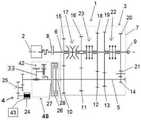
Fig. 1 shows a drive train of a vehicle equipped with a system for driving and synchronizing the countershafts of a gearbox of a transmission.
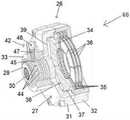
FIG. 2 is a partial perspective and sectional view of the clutch device and locking device of the driving and synchronizing system of FIG. 1.
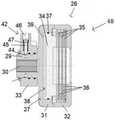
Fig. 3 is a sectional view of the clutch device and the locking device of fig. 2.
Fig. 4 is another sectional view of the clutch device and the locking device of fig. 2 in a different cross section.
Fig. 5 is a front view of a second embodiment of the present invention.
Detailed Description
Fig. 1 shows a drive train 1 of a vehicle, comprising a main engine 2 (e.g. an internal combustion engine), atransmission gearbox 3 and asystem 4 for driving and synchronizing anintermediate shaft 5 of thetransmission gearbox 3.
Themain engine 2 is connected to themain shaft 6 of thetransmission gearbox 3 by means of aclutch device 8 of any suitable type, for example a slip clutch. Theclutch device 8 has an engaged state in which theclutch device 8 can transmit torque between themain engine 2 and themain shaft 6 of thetransmission gear case 3, and a disengaged state in which themain engine 2 and themain shaft 6 of thetransmission gear case 3 are disengaged.
Thetransmission gearbox 3 is accommodated in atransmission housing 7. Thetransmission gearbox 3 comprises aprimary shaft 6, anintermediate shaft 5 and asecondary shaft 9, thesecondary shaft 9 being intended to be connected to the driven wheels of the vehicle by means of a differential not shown.
Thetransmission gearbox 3 includescountershaft gears countershaft 5.
Thetransmission gearbox 3 also comprises twomain gears main shaft 6 and each form a gear set with one of thecountershaft gears dual synchronizer 17 allows one or the other of theprimary gears main shaft 6 and has a neutral position in which neitherprimary gear main shaft 6.
Thetransmission gearbox 3 further comprisesauxiliary gears countershaft 9. The pinion gears 18, 19, 20 each form a gear set with one of thecountershaft gears pinion gears respective countershaft gears additional gear 21 between one of thepinions 20 and one of thecounter gears 14 to produce a reverse gear ratio enabling the direction of rotation of thecounter shaft 9 to be reversed. A three-position dog coupling 22 without synchronizers, positioned between the twocounter gears relative counter gears secondary shaft 9, or to keep thecounter gears secondary shaft 9 in the neutral position.
In the embodiment shown, the axis of rotation of theprimary shaft 6 is aligned with the axis of rotation of thesecondary shaft 9. Furthermore, theprimary gear 16 is positioned such that it straddles one end of theprimary shaft 6 and one end of thesecondary shaft 9. Thus, saidprimary gear 16 may also function as a secondary gear by being rotationally coupled to thesecondary shaft 9. To this end, a three-position dog coupling 23 positioned between said primary 16 and secondary 18 gears makes it possible to couple the primary 16 or secondary 18 gear to thesecondary shaft 9 and also makes it possible to keep the primary 16 and secondary 18 gear decoupled from thesecondary shaft 9 in the neutral position. Such atransmission gearbox 3 therefore has six forward gears and two reverse gears, which, if applicable, can be coupled to a planetary gear set (not shown) at the output of thelayshaft 9, so as to obtain a 12-speed transmission gearbox.
The drive andsynchronization system 4 is associated with theintermediate shaft 5 of thetransmission gearbox 3 in order to drive or brake it. The driving andsynchronization system 4 comprises a reversibleelectric machine 24 powered by abattery 43, a reduction gear set 25 and acoupling device 26.
The reversibleelectric machine 24 comprises a stator and a rotor, the rotor being connected to acoupling device 26 through a reduction gear set 25. Thecoupling device 26 has a coupled state in which it is able to transmit torque between the reversibleelectric machine 24 and theintermediate shaft 5, and a decoupled state in which the torque transmission between the reversibleelectric machine 24 and theintermediate shaft 5 is interrupted.
The drive andsynchronization system 4 is intended in particular for the transition phase of a gear ratio change of thetransmission gearbox 3. Specifically, during these transition phases, the reversibleelectric machine 24 may be used as an electric motor to increase the rotational speed of theintermediate shaft 5, or as an electric brake to decrease the rotational speed of theintermediate shaft 5. This adaptation of the rotational speed of theintermediate shaft 5 thus makes it possible to reduce the length of the transition phase of the gear ratio change.
Outside of the transient phase, the reversibleelectric machine 24 may also be used in a motor mode, wherein the reversibleelectric machine 24 provides drive torque to the wheels. The reversibleelectric machine 24 can be used in conjunction with themain engine 2 to provide additional power for the traction of the vehicle. In this case, theclutch device 8 is in the engaged configuration. According to one embodiment, the reversibleelectric machine 24 may also be used in a mode where vehicle traction is purely electric. In this operating mode, theclutch device 8 is in a disengaged configuration. In addition, the reversibleelectric machine 24 can also be used to charge thebattery 43 in the current generator mode.
Outside the transition phase, and when the reversibleelectric machine 24 is neither used in generator mode nor in motor mode, thecoupling device 26 is in a disengaged state in order to limit the drag torque that the reversibleelectric machine 24 may generate, making it possible to reduce the fuel consumption of themain engine 2.
In connection with the first embodiment of fig. 2-4, it is possible to see amodule 48 according to a first embodiment, which comprises anon-rotatable support member 33 mounted on the vehicle chassis, and thecoupling device 26 of the drive andsynchronization system 4.
Thecoupling device 26 comprises aninput element 27 coupled to the reversibleelectric machine 24 and an output element 28 (only schematically shown in fig. 1, not shown in fig. 2 to 4) coupled to theintermediate shaft 5. In the coupled state, thecoupling device 26 is capable of transmitting torque between theinput member 27 and theoutput member 28. Conversely, in the disengaged state, torque transfer between theinput member 27 and theoutput member 28 is interrupted.
Theinput member 27 includes aninput hub 29. Theinput hub 29 includesinternal splines 30 and is adapted to receive a splined end of a shaft (not shown) that is coupled to the reversibleelectric machine 24 through a reduction gear set 25. Theinput hub 29 is supported and rotationally guided within a bearingpart 33, which bearingpart 33 is fixed to a housing of the transmission family 1 (which housing is not shown), and which bearingpart 33 is intended to be fixed to the chassis of the vehicle. According to another variant of the invention, thesupport element 33 may be a sliding bearing. According to another variant of the invention, needle rollers or ball bearings can be radially interposed between the bearingmember 33 and theinput hub 29.
In the illustrated embodiment, thecoupling 26 is a multi-piece wet coupling. Theinput member 27 comprises two fixed togetherhalf shells input member 27 and theoutput member 28 when said coupling means 26 is in the coupled condition, anactuating piston 34 and a hydraulic fluid such as oil.
The multi-plate assembly comprises a plurality ofannular plates 35, for example made of steel, which rotate integrally with theinput element 27 and are mounted so as to be able to slide axially with respect to theinput element 27. To this end, eachplate 35 has, on its periphery, a set of external teeth which mesh with a set of internal teeth formed on the inside of a cylindrical skirt of one of the half-shells input element 27. The multi-plate assembly further comprises a plurality offriction discs 36 interposed between theplates 35. Thefriction disc 36 rotates integrally with theoutput member 28 with freedom of axial translational movement. To this end, theoutput member 28 includes an outer set of teeth, and eachfriction disc 36 includes an inner set of teeth on its inner periphery that mesh with the outer set of teeth of theoutput member 28. Eachfriction disc 36 includes friction linings disposed on its front and rear faces.
Furthermore, anactuating piston 34 is mounted so as to be axially movable within the inner space of theinput element 27. Theactuator piston 34 comprises, on its periphery, aseal 37 which sealingly cooperates with a cylindrical skirt of the half-shell 31 so as to define a variable-volume sealedchamber 38 between theactuator piston 34 and anend wall 39 of the half-shell 31. Furthermore, theend wall 39 of the half-shell 31 has aconduit 40 visible in fig. 3, thisconduit 40 being connected to a hydraulic circuit equipped with a pump (not shown) by means of aconduit 41 formed in the supportingelement 33.
When the variablevolume seal chamber 38 is supplied with pressurized fluid to move thecoupling device 26 towards the coupled condition, theactuation piston 34 moves towards the multi-plate assembly such that thefriction disc 36 is squeezed between theplates 35 and torque is therefore transmitted between theinput element 27 and theoutput element 28.
Conversely, when hydraulic fluid is drained from the variablevolume seal chamber 38, theactuation piston 34 slides away from the multi-plate assembly, causing thefriction discs 36 andplates 35 to return to a separated position in which they are axially spaced from one another.
Furthermore, themodule 48 comprises alocking device 42, visible in particular in fig. 2 and 4, which has a locked state, in which it prevents theinput element 27 from rotating relative to thesupport part 33, and a released state, in which it allows theinput element 27 to rotate relative to saidsupport part 33. Thus, when thelocking device 42 is in the locked state, thecoupling device 26 can brake theintermediate shaft 5 during a transitional phase of a change in the gear ratio of thetransmission 3. Thecoupling device 26 then acts as a gearbox brake, placing no requirements on the reversibleelectric machine 24. This locked state is used in particular in the event of a failure of the reversibleelectric machine 24, or when thebattery 43 associated with the reversibleelectric machine 24 has reached its maximum charge, so that the use of the reversibleelectric machine 24 to brake theintermediate shaft 5 carries the risk of damaging thebattery 43.
The constitution of themodule 48 is not limited to that of the first embodiment described in conjunction with fig. 2 to 4. For example, themodule 48 may also include all or a portion of the reduction gear set 25, and thelocking device 42 may be located anywhere in the path of torque transfer between the rotor of the reversibleelectric machine 24 and theinput member 27 of thecoupling device 26.
Thus, the lockingdevice 42 may be significantly associated with one gear of the reduction gear set 25, the shaft transferring torque between the reduction gear set 25 and theinput member 27 of the clutch, or directly with theinput member 27 of the clutch device, as is the case in the illustrated embodiment. This last arrangement is particularly advantageous because it avoids angular clearances between the point of application of the rotation blocking force exerted by the lockingdevice 42 and theinput element 27 of the clutch device, which angular clearances tend to reduce its performance when thecoupling device 26 is used as a gearbox brake, thereby generating uncomfortable noises and causing deterioration of the drive andsynchronization system 4.
In the embodiment shown, the locking means 42 comprise a plurality ofholes 44, which are evenly distributed over the periphery of theinput hub 29 of the clutch device, visible in fig. 2, and a movingpin 45 insertable in one of said holes 44. Thepin 45 is mounted so as to be able to slide in ahole 46 formed in thesupport part 33 between, on the one hand, a locking position, in which the end of thepin 45 is inserted in one of theholes 44, thus preventing the rotation of theinput element 27, and, on the other hand, a release position, in which the end of thepin 45 is disengaged from thehole 44, allowing the rotation of theinput element 27.
In the illustrated embodiment, to facilitate insertion of thepin 45 into thehole 44 in the locked position, thehole 44 has a chamfered entrance, thepin 45 has a chamfered end, and the chamfered entrance and the chamfered end are configured to facilitate insertion of thepin 45 into thehole 44.
The lockingdevice 42 further comprises areturn member 47, for example a helical spring, located between the shoulder of thehole 46 and the shoulder of thepin 45, allowing thepin 45 to return towards the release position. Furthermore, theplate 46 of thesupport member 33 communicates with a hydraulic or pneumatic circuit (not shown) equipped with a pump that allows pressure to be applied to thepin 45 in order to move and maintain thepin 45 in the locking position.
Note that thelock device 42 is described above by way of example, and the present invention is not limited in any way to alock device 42 exhibiting such a structure. Thus, according to an embodiment variant, the movement of thepin 45 between the locking position and the release position is caused by an electric actuator. Furthermore, according to another embodiment, the lockingdevice 42 is a dog clutch coupling device. Such a claw clutch coupling comprises, for example, a sliding sleeve which comprises a set of teeth and is rotationally fixed. The sliding sleeve is axially movable between a locking position, in which the sets of teeth of the sliding sleeve mesh with complementary sets of teeth that rotate integrally with theinput hub 29 to prevent rotation of the latter, and a releasing position, in which the sets of teeth are separated from each other to allow rotation of theinput hub 29.
Fig. 5 depicts a second embodiment of the invention, in which thelocking device 42 comprises a plurality ofteeth 54 evenly distributed around the periphery of theinput hub 29 of the clutch device and alever 55 that can be inserted between twoteeth 54. Thelever 55 is articulated about an axis Y parallel to and remote from the rotation axis X of theintermediate shaft 5, between a locking position, on the one hand, in which the end of thelever 55 is inserted between the twoteeth 54 and therefore prevents the rotation of theinput element 27, and a releasing position, on the other hand, in which the end of thelever 55 is disengaged from theteeth 44, allowing the rotation of theinput element 27.
In this second embodiment shown, thelever 55 has anend 56 that is inserted between twoteeth 54 when the lever is in the locked position. In order to facilitate the insertion of thelever 55 between the twoteeth 54 in the locking position, theteeth 54 have a chamfered entrance and thelever 55 has a chamfer at its end.
The lockingdevice 42 also includes areturn member 47, such as a torsion spring, thereturn member 47 being located between anend stop 58 formed on thelocking device 42 and a hole in thelever 55, thereby allowing thelever 55 to return toward the release position. Further, thelever 55 is moved by apush rod 59, and thepush rod 59 can exert pressure on thelever 55 so as to move and hold thelever 55 to and in the lock position.
The following describes a method of operating the drive andsynchronization system 4 as described above during the transition phase of a gear ratio change.
During the transition phase of the transmission ratio change, the drive andsynchronization system 4 provides two selectable operating modes, hereinafter referred to as standard mode and derated mode, respectively. When no critical event is detected indicating the operating state of the reversibleelectric machine 24 or thebattery 43 powering it, the driving andsynchronization system 4 operates in the standard mode. Conversely, when such a critical event is detected, it operates in degraded mode. A critical event corresponds, for example, to the detection of a failure of the reversibleelectric machine 24, or to the detection of a state of charge of thebattery 43 associated with the reversibleelectric machine 24 above a maximum threshold charge.
The critical event may also correspond to detection of a temperature below a minimum use temperature of the battery or a temperature above a maximum use temperature of the battery.
In the normal mode, the lockingdevice 42 is in its released state, and thecoupling device 26 is operated such that it remains in the coupled position if it is already in this position, or is moved from the uncoupled position to the coupled position. The reversibleelectric machine 24 is controlled according to a signal representative of the setpoint rotation speed of theintermediate shaft 5.
In response to detecting a critical event, the drive andsynchronization system 4 switches to a degraded mode. The lockingdevice 42 is then moved from its released state to its locked state. Thecoupling device 26 is then controlled in accordance with a signal representative of the set-point speed of rotation of theintermediate shaft 5, so that thecoupling device 26 applies a resistive torque that allows theintermediate shaft 5 to attain the set-point speed of rotation of theintermediate shaft 5. Thus, thecoupling device 26 acts as a gearbox brake.
Although the invention has been described in connection with several particular embodiments, it is evident that the invention is in no way limited thereto and that the invention comprises all technical equivalents of the means described and combinations thereof, which fall within the scope of the invention as defined by the claims.
In the claims, any reference signs placed between parentheses shall not be construed as limiting the claim.
Claims (15)
1. A module (48) for a system (4) for driving and synchronizing an intermediate shaft (5) of a transmission gearbox (3), said module comprising:
-a support member (33) for mounting on the chassis of the vehicle without rotation;
-a coupling device (26) rotatable relative to the support member (33), the coupling device comprising an input element (27) for rotatable coupling to the reversible electric machine (24) and an output element (28) for rotatable coupling to the intermediate shaft (5), the coupling device (26) having a coupled state in which the clutch device is capable of transmitting torque between the input element (27) and the output element (28) and a decoupled state in which the input element (27) and the output element (28) are decoupled; and
-a locking device (42) having a locked state, in which the locking device (42) prevents the rotation of the input element (27) of the clutch device relative to the support member (33), and a released state, in which the locking device (42) allows the rotation of the input element (27) relative to the support member (33).
2. Module (48) according to claim 1, wherein the locking means (42) comprise a moving element movable between a locking position, in which it is in contact with the input element (27) to prevent its rotation, and a releasing position, in which it is distanced from the input element (27) to allow its rotation.
3. Module (48) according to claim 2, wherein the input element (27) comprises an input hub (29) supported and rotationally guided within the bearing part (33), and wherein, in the locked position, the moving element is in contact with the input hub (29).
4. Module (48) according to claim 3, wherein the locking means comprise a plurality of holes (44) made on the periphery of the input hub (29), and wherein the moving element is a pin (45) mounted so as to be slidable in a hole made in the support part (33) and having an end inserted into one of the holes (44) when the pin (45) is in the locking position.
5. A module (48) according to claim 4, wherein the hole (44) has a chamfered entrance and the pin (45) has a chamfered end, the chamfered entrance and end being configured to facilitate insertion of the pin into the hole (44) in a locked position.
6. A module (48) according to claim 3, wherein the locking means comprise a plurality of teeth (54) made on the periphery of the input hub (29), and wherein the moving element is a lever (55) articulated about an axis (Y) parallel to and remote from the axis of rotation (X) of the intermediate shaft (5) and having an end (56) interposed between two teeth (54) when the lever (55) is in the locking position.
7. Module (48) according to any one of claims 2 to 6, wherein the locking device (42) comprises a return member (47) configured to return the mobile element to the release position and connected to a pneumatic or hydraulic operating circuit configured to move the mobile element towards the locking position.
8. Module (48) according to claim 1, further comprising a reduction gear set (25) coupled to the input element (27) of the coupling device (26) and for rotationally coupling the input element (27) of the coupling device (26) to the reversible electric machine (24), and wherein, in the locked condition, the locking device (42) cooperates with a gear of the reduction gear set (25) so as to prevent rotation thereof.
9. A module (48) according to any of claims 1 to 8 wherein the coupling means (26) is a multi-plate wet clutch device.
10. System (4) for driving and synchronizing an intermediate shaft (5) of a transmission gearbox (3), comprising a module (48) according to any one of claims 1 to 9 and a reversible electric machine (24) comprising a rotor coupled to an input element (27) of a coupling device (26).
11. A transmission assembly comprising a transmission gearbox (3) comprising a primary shaft (6) intended to be connected to a primary engine (2), a secondary shaft (9) intended to be connected to driven wheels of a vehicle, and an intermediate shaft (5) which can be coupled to an output shaft and an input shaft by means of a gear set, the transmission assembly further comprising a drive and synchronization system (4) according to claim 10, the output element (28) of the coupling device (26) being rotatably coupled to the intermediate shaft (5).
12. A vehicle comprising a transmission assembly according to claim 11, a main engine (2) connected to a main shaft (6) by means of a clutch device (8), and driven wheels connected to a secondary shaft (9).
13. A method of controlling a system (4) for driving and synchronizing an intermediate shaft (5) of a transmission gearbox (3) according to claim 10, comprising the step of moving the locking device from the released state to the locked state in response to the detection of a critical event.
14. A control method according to claim 13, wherein the critical event is indicative of a fault of the reversible electric machine, a state of charge of a battery (43) powering the reversible electric machine (24) being above a maximum charge threshold, a temperature being below a minimum use temperature of the battery or a temperature being above a maximum use temperature of the battery.
15. A control method according to claim 13 or 14, wherein, when the locking device is in the locked state, the coupling device (26) is controlled, in response to a command to change the gear ratio, in accordance with a signal representative of the set-point speed of the intermediate shaft (5), so that the coupling device (26) exerts a resisting torque that allows the intermediate shaft (5) to attain the set-point speed of the intermediate shaft (5).
Applications Claiming Priority (2)
| Application Number | Priority Date | Filing Date | Title |
|---|---|---|---|
| FR2101674 | 2021-02-22 | ||
| FR2101674AFR3120102B1 (en) | 2021-02-22 | 2021-02-22 | Module for a synchronization and drive system for an intermediate shaft of a gearbox |
Publications (1)
| Publication Number | Publication Date |
|---|---|
| CN115030995Atrue CN115030995A (en) | 2022-09-09 |
Family
ID=75278243
Family Applications (1)
| Application Number | Title | Priority Date | Filing Date |
|---|---|---|---|
| CN202210160203.1APendingCN115030995A (en) | 2021-02-22 | 2022-02-22 | Module for a system for synchronizing and driving the countershafts of a gearbox of a transmission |
Country Status (4)
| Country | Link |
|---|---|
| US (1) | US11859696B2 (en) |
| EP (1) | EP4047235B1 (en) |
| CN (1) | CN115030995A (en) |
| FR (1) | FR3120102B1 (en) |
Cited By (1)
| Publication number | Priority date | Publication date | Assignee | Title |
|---|---|---|---|---|
| CN115823135A (en)* | 2022-12-12 | 2023-03-21 | 采埃孚商用车系统(青岛)有限公司 | Clutch for air compressor and air compressor |
Families Citing this family (2)
| Publication number | Priority date | Publication date | Assignee | Title |
|---|---|---|---|---|
| FR3150559B1 (en)* | 2023-06-29 | 2025-05-30 | Valeo Embrayages | MOTOR MODULE AND HYBRID TRANSMISSION ASSEMBLY OF A VEHICLE |
| JP2025111002A (en)* | 2024-01-17 | 2025-07-30 | ヤマハ発動機株式会社 | Vehicle transmission and vehicle equipped with same |
Family Cites Families (11)
| Publication number | Priority date | Publication date | Assignee | Title |
|---|---|---|---|---|
| US3478851A (en)* | 1967-08-09 | 1969-11-18 | Smyth Robert Ralston | Automotive transmission |
| GB1435517A (en) | 1972-09-23 | 1976-05-12 | British Leyland Truck & Bus | Gearbox |
| US5195600A (en)* | 1991-07-11 | 1993-03-23 | General Electric Company | Electric drive system for track-laying vehicles |
| DE4202083C2 (en)* | 1992-01-25 | 1994-01-20 | Daimler Benz Ag | Hybrid drive for a motor vehicle |
| JPH07167278A (en)* | 1993-12-14 | 1995-07-04 | Nippondenso Co Ltd | Shift transmission device for automobile |
| JP3291916B2 (en)* | 1994-06-06 | 2002-06-17 | 株式会社エクォス・リサーチ | Hybrid vehicle |
| JP3336951B2 (en)* | 1998-04-28 | 2002-10-21 | 株式会社日立製作所 | Automotive power transmission |
| DE10234579A1 (en) | 2002-07-30 | 2004-02-12 | Zf Friedrichshafen Ag | transmission |
| AU2008355750B2 (en)* | 2008-04-28 | 2013-09-12 | Volvo Truck Corporation | Powertrain with input shaft and engine speed synchronization |
| AT520019B1 (en) | 2017-05-08 | 2019-05-15 | Avl Commercial Driveline & Tractor Eng Gmbh | Method for operating a drive train of a motor vehicle |
| IT201800007576A1 (en)* | 2018-07-27 | 2020-01-27 | Cnh Ind Italia Spa | HYBRID ELECTRIC ARCHITECTURE FOR DOUBLE CLUTCH TRANSMISSION |
- 2021
- 2021-02-22FRFR2101674Apatent/FR3120102B1/enactiveActive
- 2022
- 2022-02-10EPEP22156030.3Apatent/EP4047235B1/enactiveActive
- 2022-02-10USUS17/668,951patent/US11859696B2/enactiveActive
- 2022-02-22CNCN202210160203.1Apatent/CN115030995A/enactivePending
Cited By (1)
| Publication number | Priority date | Publication date | Assignee | Title |
|---|---|---|---|---|
| CN115823135A (en)* | 2022-12-12 | 2023-03-21 | 采埃孚商用车系统(青岛)有限公司 | Clutch for air compressor and air compressor |
Also Published As
| Publication number | Publication date |
|---|---|
| FR3120102B1 (en) | 2023-02-24 |
| US20220268341A1 (en) | 2022-08-25 |
| US11859696B2 (en) | 2024-01-02 |
| EP4047235B1 (en) | 2024-07-24 |
| EP4047235A1 (en) | 2022-08-24 |
| FR3120102A1 (en) | 2022-08-26 |
Similar Documents
| Publication | Publication Date | Title |
|---|---|---|
| CA2155370C (en) | Transmission spring loaded shift device | |
| CN115030995A (en) | Module for a system for synchronizing and driving the countershafts of a gearbox of a transmission | |
| US8821334B2 (en) | High efficiency transfer case | |
| USRE46242E1 (en) | Device for actuating a gearwheel, which is designed as a loose wheel, of a transmission device | |
| EP2510257B1 (en) | A multi-clutch transmission for a motor vehicle | |
| US7219571B2 (en) | Transmission having an electro-mechanical gear actuation system | |
| US5460060A (en) | Transmission shifting mechanism with spring loaded ball screw | |
| CN110030377B (en) | Shift-by-wire parking system | |
| US20110167957A1 (en) | Automatic dual-clutch transmission | |
| EP2886911B1 (en) | Spring loaded shift actuator assembly having a retaining mechanism | |
| CN107763153B (en) | Planetary gear type two-speed transmission for electric vehicle | |
| CN109641519B (en) | Power output transmission gear thrust load cancellation | |
| US7384366B2 (en) | Transfer case with torque synchronizer clutching | |
| US20110174103A1 (en) | Double clutch for cars | |
| US20220144069A1 (en) | Clutch Assembly, Motor Vehicle Powertrain, and Method for Operating a Powertrain | |
| CN117581045A (en) | Electric drives for vehicles | |
| JP7412554B2 (en) | Actuator devices and transmission devices equipped with such actuator devices | |
| KR102859119B1 (en) | Parking and clutch common control device and its control method and vehicle | |
| EP3658802B1 (en) | Shift control arrangement in a gearbox | |
| CN109826947B (en) | Transmission device, shift control method, electric vehicle drive train, and electric vehicle | |
| CN114623208B (en) | Hybrid transmission assembly and vehicle | |
| CN115923491A (en) | Hybrid vehicle transmission with mechanical reverse system | |
| CN114604077A (en) | Hybrid drive subassembly for a vehicle | |
| WO2017160220A1 (en) | Shift control arrangement in a gearbox | |
| JP3462200B2 (en) | Power transmission device for vehicles |
Legal Events
| Date | Code | Title | Description |
|---|---|---|---|
| PB01 | Publication | ||
| PB01 | Publication | ||
| WD01 | Invention patent application deemed withdrawn after publication | Application publication date:20220909 | |
| WD01 | Invention patent application deemed withdrawn after publication |