CN114550584A - Electronic device - Google Patents
Electronic deviceDownload PDFInfo
- Publication number
- CN114550584A CN114550584ACN202210088342.8ACN202210088342ACN114550584ACN 114550584 ACN114550584 ACN 114550584ACN 202210088342 ACN202210088342 ACN 202210088342ACN 114550584 ACN114550584 ACN 114550584A
- Authority
- CN
- China
- Prior art keywords
- flexible body
- electronic device
- state
- rigid
- support
- Prior art date
- Legal status (The legal status is an assumption and is not a legal conclusion. Google has not performed a legal analysis and makes no representation as to the accuracy of the status listed.)
- Pending
Links
- 238000005452bendingMethods0.000claimsdescription12
- 238000010586diagramMethods0.000description54
- 238000009434installationMethods0.000description3
- 238000000034methodMethods0.000description3
- 239000000463materialSubstances0.000description2
- 239000002184metalSubstances0.000description2
- 230000007935neutral effectEffects0.000description2
- 230000037303wrinklesEffects0.000description2
- 238000004891communicationMethods0.000description1
- 238000013016dampingMethods0.000description1
- 230000036544postureEffects0.000description1
- 238000006467substitution reactionMethods0.000description1
Images










Classifications
- G—PHYSICS
- G09—EDUCATION; CRYPTOGRAPHY; DISPLAY; ADVERTISING; SEALS
- G09F—DISPLAYING; ADVERTISING; SIGNS; LABELS OR NAME-PLATES; SEALS
- G09F9/00—Indicating arrangements for variable information in which the information is built-up on a support by selection or combination of individual elements
- G09F9/30—Indicating arrangements for variable information in which the information is built-up on a support by selection or combination of individual elements in which the desired character or characters are formed by combining individual elements
- G09F9/301—Indicating arrangements for variable information in which the information is built-up on a support by selection or combination of individual elements in which the desired character or characters are formed by combining individual elements flexible foldable or roll-able electronic displays, e.g. thin LCD, OLED
Landscapes
- Physics & Mathematics (AREA)
- General Physics & Mathematics (AREA)
- Engineering & Computer Science (AREA)
- Theoretical Computer Science (AREA)
- Telephone Set Structure (AREA)
Abstract
Description
Technical Field
The present application relates to an electronic device.
Background
Electronic devices are devices that people often use; however, the electronic devices are single in shape and poor in adaptability.
Disclosure of Invention
In view of the above, embodiments of the present application are directed to providing an electronic device.
In order to achieve the purpose, the technical scheme of the application is realized as follows:
an embodiment of the present application provides an electronic device, which includes:
a body;
the supporting device is connected with the body;
the flexible body is used for displaying, is arranged on the surface of the supporting device, is matched with the supporting device for use, and can change along with the change of the shape of the supporting device;
the supporting device can drive the flexible body to cover the outer side face of the body to form a first state, and the supporting device can drive the flexible body to unfold and at least partially protrude out of the surface of the body to form a second state.
The electronic device of the embodiment of the application includes: a body; the supporting device is connected with the body; the flexible body is used for displaying, is arranged on the surface of the supporting device, is matched with the supporting device for use, and can change along with the change of the shape of the supporting device; the supporting device can drive the flexible body to cover the outer side face of the body to form a first state, and the supporting device can drive the flexible body to unfold and at least partially protrude out of the surface of the body to form a second state; the flexible body has the first state and the second state, so that the electronic equipment has different states, and the adaptability of the electronic equipment is greatly improved.
Drawings
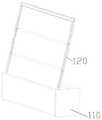
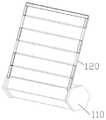
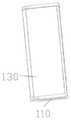
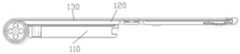
FIG. 1 is a schematic diagram of an alternative configuration of an electronic device in an embodiment of the present application;
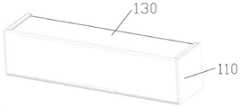
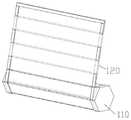
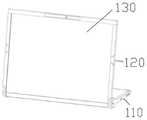
FIG. 2 is a schematic diagram of an alternative configuration of an electronic device in an embodiment of the present application;
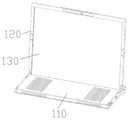
FIG. 3 is a schematic diagram of an alternative configuration of an electronic device in an embodiment of the present application;
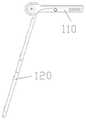
FIG. 4 is an alternative structural diagram of the body of the electronic device in the embodiment of the present application;
FIG. 5 is a schematic diagram of an alternative configuration of an electronic device in an embodiment of the present application;
FIG. 6 is a schematic diagram of an alternative configuration of an electronic device in an embodiment of the present application;
FIG. 7 is a schematic diagram of an alternative configuration of an electronic device in an embodiment of the present application;
FIG. 8 is a schematic diagram of an alternative configuration of an electronic device in an embodiment of the present application;
FIG. 9 is a schematic diagram of an alternative configuration of an electronic device in an embodiment of the application;
FIG. 10 is a schematic diagram of an alternative configuration of an electronic device in an embodiment of the application;
FIG. 11 is a schematic diagram of an alternative configuration of an electronic device in an embodiment of the application;
FIG. 12 is a schematic diagram of an alternative partial structure of an electronic device in an embodiment of the present application;
FIG. 13 is a schematic diagram of an alternative partial structure of an electronic device in an embodiment of the present application;
FIG. 14 is a schematic diagram of an alternative partial structure of an electronic device in an embodiment of the present application;
FIG. 15 is a schematic diagram of an alternative partial structure of an electronic device in an embodiment of the present application;
FIG. 16 is a schematic diagram of an alternative partial structure of an electronic device in an embodiment of the present application;
FIG. 17 is a schematic diagram of an alternative partial structure of an electronic device in an embodiment of the application;
FIG. 18 is a schematic diagram of an alternative partial structure of an electronic device in an embodiment of the present application;
FIG. 19 is a schematic diagram of an alternative partial structure of an electronic device in an embodiment of the application;
FIG. 20 is a schematic diagram of an alternative configuration of an electronic device in an embodiment of the application;
FIG. 21 is a schematic diagram of an alternative configuration of an electronic device in an embodiment of the application;
FIG. 22 is a schematic diagram of an alternative configuration of an electronic device in an embodiment of the application;
FIG. 23 is a schematic diagram of an alternative configuration of an electronic device in an embodiment of the application;
FIG. 24 is a schematic diagram of an alternative configuration of an electronic device in an embodiment of the application;
FIG. 25 is a schematic diagram of an alternative configuration of an electronic device in an embodiment of the application;
FIG. 26 is a schematic diagram of an alternative partial structure of an electronic device in an embodiment of the application;
FIG. 27 is a schematic diagram of an alternative partial structure of an electronic device in an embodiment of the application;
FIG. 28 is a schematic diagram of an alternative configuration of an electronic device in an embodiment of the application;
FIG. 29 is a schematic diagram of an alternative configuration of an electronic device in an embodiment of the application;
FIG. 30 is a schematic diagram of an alternative configuration of an electronic device in an embodiment of the application;
FIG. 31 is a schematic diagram of an alternative configuration of an electronic device in an embodiment of the application;
FIG. 32 is a schematic diagram of an alternative partial structure of an electronic device in an embodiment of the application;
FIG. 33 is a schematic diagram of an alternative partial structure of an electronic device in an embodiment of the application;
FIG. 34 is a schematic diagram of an alternative partial structure of an electronic device in an embodiment of the application;
FIG. 35 is a schematic diagram of an alternative partial structure of an electronic device in an embodiment of the application;
FIG. 36 is a schematic diagram of an alternative partial structure of an electronic device in an embodiment of the present application;
FIG. 37 is a schematic diagram of an alternative partial configuration of an electronic device in an embodiment of the application;
FIG. 38 is a schematic view of an alternative configuration of an electronic device in an embodiment of the application;
FIG. 39 is a schematic diagram of an alternative configuration of an electronic device in an embodiment of the application;
FIG. 40 is a schematic diagram of an alternative partial structure of an electronic device in an embodiment of the application;
FIG. 41 is a schematic diagram of an alternative partial structure of an electronic device in an embodiment of the present application;
FIG. 42 is a schematic diagram of an alternative partial structure of an electronic device in an embodiment of the application;
FIG. 43 is a schematic diagram of an alternative partial structure of an electronic device in an embodiment of the application;
FIG. 44 is a schematic diagram of an alternative partial structure of an electronic device in an embodiment of the present application;
FIG. 45 is a schematic diagram of an alternative partial structure of an electronic device in an embodiment of the application;
FIG. 46 is a schematic view of an alternative partial structure of an electronic device in an embodiment of the present application;
FIG. 47 is a schematic diagram of an alternative partial structure of an electronic device in an embodiment of the application;
FIG. 48 is a schematic diagram of an alternative partial structure of an electronic device in an embodiment of the application;
FIG. 49 is a schematic diagram of an alternative partial structure of an electronic device in an embodiment of the present application;
FIG. 50 is a schematic diagram of an alternative partial structure of an electronic device in an embodiment of the present application;
FIG. 51 is a schematic diagram of an alternative configuration of an electronic device in an embodiment of the application;
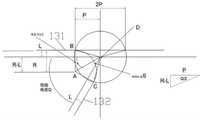
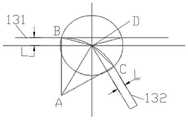
FIG. 52 is a simplified computational diagram of an electronic device in an embodiment of the present application;
FIG. 53 is a simplified computational diagram of an electronic device in an embodiment of the present application;
FIG. 54 is a simplified computational diagram of an electronic device in an embodiment of the present application;
FIG. 55 is a simplified computational diagram of an electronic device in an embodiment of the present application;
FIG. 56 is a simplified computational diagram of an electronic device in an embodiment of the present application.
Reference numerals: 110. a body; 111. a first connection portion; 120. a support device; 121. a rigid portion; 122. a second connecting portion; 123. a support portion; 124. an edge portion; 125. a first shaft structure; 126. a second rotating shaft structure; 127. a first rotating section; 128. a second rotating part; 130. a flexible body; 131. a first portion of a flexible body; 132. a second portion of the flexible body; 133. a third portion of the flexible body; 140. a first support member; 141. a first convex portion; 150. a first fixing portion; 151. a first chute; 152. a first limit groove; 153. a first mounting groove; 154. a second convex portion; 160. a first movable portion; 161. a first guide portion; 162. a first limit protrusion; 163. a first card slot; 170. a second fixing portion; 171. a second chute; 172. a second limit groove; 173. a second mounting groove; 174. a third convex portion; 180. a second movable portion; 181. a second guide portion; 182. a second limit bulge; 183. a second card slot; 190. an elastic member.
Detailed Description
The technical solution of the present application is further described in detail with reference to the drawings and specific embodiments of the specification.
In the description of the embodiments of the present application, it should be noted that, unless otherwise specified and limited, the term "connected" should be understood broadly, for example, an electrical connection may be made, a communication may be made between two elements, a direct connection may be made, and an indirect connection may be made through an intermediate medium.
It should be noted that the terms "first \ second \ third" referred to in the embodiments of the present application are only used for distinguishing similar objects, and do not represent a specific ordering for the objects, and it should be understood that "first \ second \ third" may exchange a specific order or sequence order if allowed. It should be understood that "first \ second \ third" distinct objects may be interchanged under appropriate circumstances such that the embodiments of the application described herein may be implemented in an order other than those illustrated or described herein.
The electronic device according to the embodiment of the present application will be described in detail below with reference to fig. 1 to 56.
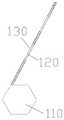
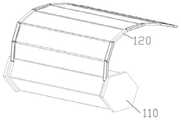
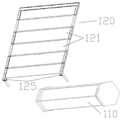
The electronic device includes: abody 110, asupport device 120, and aflexible body 130. The supportingdevice 120 is connected with thebody 110; theflexible body 130 is used for displaying that theflexible body 130 is arranged on the surface of the supportingdevice 120, theflexible body 130 is used in cooperation with the supportingdevice 120, and theflexible body 130 can change along with the change of the form of the supportingdevice 120; the supportingdevice 120 can drive theflexible body 130 to cover the outer side surface of thebody 110 to form a first state, and the supportingdevice 120 can drive theflexible body 130 to unfold and at least partially protrude out of the surface of thebody 110 to form a second state; theflexible body 130 has the first state and the second state, so that the electronic device can have different states, and the adaptability of the electronic device is greatly improved.
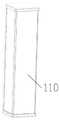
In the embodiment of the present application, the structure of thebody 110 is not limited. For example, as shown in fig. 22 and 23, thebody 110 may have a plate-shaped structure. For another example, thebody 110 may have a strip structure.
Here, the sectional shape of thebody 110 is not limited. For example, the cross-sectional shape of thebody 110 may be a polygon. As an example, as shown in fig. 4, the cross-section of thebody 110 may be square. As yet another example, as shown in fig. 9 and 10, the cross-section of thebody 110 may be a regular hexagon. As yet another example, thebody 110 may be circular in cross-section.
In the embodiment of the present invention, the structure of the supportingdevice 120 is not limited, as long as the supportingdevice 120 can drive theflexible body 130 to cover the outer side surface of thebody 110 to form a first state, and can drive theflexible body 130 to unfold and at least partially protrude from the surface of thebody 110 to form a second state. For example, the supportingdevice 120 may include a metal plate, which may be bent to form different shapes under the action of external force; the metal plate can keep the original shape under the condition that the external force is removed.
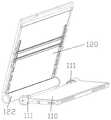
Here, the manner in which the supportingdevice 120 is connected to thebody 110 is not limited. For example, the supportingdevice 120 is fixedly connected with thebody 110. As another example, thesupport device 120 may be rotatably coupled to thebody 110, as shown in FIG. 11.
In the embodiment of the present application, the structure of theflexible body 130 is not limited, and theflexible body 130 is used for displaying, so that the electronic device can display through theflexible body 130. For example, theflexible body 130 may be a flexible screen.
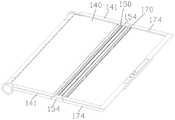
Here, the surface of thesupport device 120 on which theflexible body 130 is disposed is not limited. For example, theflexible body 130 may be secured to a surface of thesupport device 120, as shown in fig. 1 and 5. As another example, portions of theflexible body 130 can move relative to thesupport device 120.
Here, since theflexible body 130 is disposed on the surface of the supportingdevice 120, and theflexible body 130 is used in cooperation with the supportingdevice 120, theflexible body 130 can be changed along with the change of the form of the supportingdevice 120; thereby enabling theflexible body 130 to assume different states according to the form change of the supportingdevice 120.
In the embodiment of the present application, the supportingdevice 120 can drive theflexible body 130 to cover the outer side surface of thebody 110 to form a first state; here, the supportingdevice 120 covers the outer side surface of thebody 110, theflexible body 130 covers the outer side surface of the supportingdevice 120, and theflexible body 130 covers the outer side surface of thebody 110 through the supportingdevice 120, as shown in fig. 3, 9 and 20.
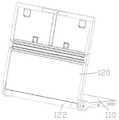
In the embodiment of the present application, the supportingdevice 120 can drive theflexible body 130 to unfold and at least partially protrude from the surface of thebody 110 to form a second state; here, at least a portion of the supportingdevice 120 can be unfolded to protrude from the surface of thebody 110, theflexible body 130 covers the outer side surface of the supportingdevice 120, and at least a portion of theflexible body 130 can be unfolded to protrude from the surface of thebody 110 by the supportingdevice 120, as shown in fig. 1, 5, 22, 23 and 24.
Here, the supportingdevice 120 and theflexible body 130 may be in an unfolded state or in a folded state.
In some optional implementations of the embodiments of the present application, the supportingdevice 120 may include: at least tworigid parts 121, adjacentrigid parts 121 of the at least tworigid parts 121 are rotatably connected, and therigid part 121 at the first end of the at least tworigid parts 121 is rotatably connected with thebody 110; theflexible body 130 is disposed on the surface of the at least tworigid portions 121, and the at least tworigid portions 121 can rotate until the adjacentrigid portions 121 are attached to the adjacent surface of thebody 110 to support theflexible body 130 in a first state.
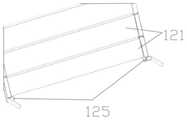
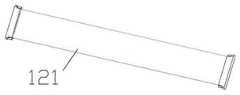
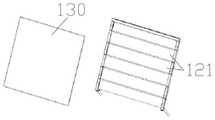
In the present embodiment, the structure of therigid portion 121 is not limited. For example, as shown in fig. 2, 6, 8, and 13, therigid portion 121 may have a plate-like structure.
In the present embodiment, the number of the at least tworigid portions 121 is not limited. For example, the number of the at least tworigid portions 121 matches the number of the outer surfaces of thebody 110.
In the present embodiment, the structures of at least tworigid portions 121 may be the same or different.
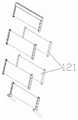
For example, as shown in fig. 2, the cross-sectional shape of thebody 110 is square, and the supportingdevice 120 includes fourrigid portions 121 with the same structure; so that theflexible body 130 can cover thebody 110 for a circle.
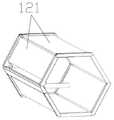
For another example, as shown in fig. 7, 8, 14, 15, and 16, the cross-sectional shape of thebody 110 is a regular hexagon, and thesupport device 120 includes sixrigid portions 121 having the same structure; so that theflexible body 130 can cover thebody 110 for a circle.
For another example, as shown in fig. 21 and 28, the cross-sectional shape of thebody 110 is rectangular, and thesupport device 120 includes threerigid portions 121 having different structures; so that theflexible body 130 can cover three surfaces of thebody 110.
In this implementation, the implementation of the rotatable connection between adjacentrigid portions 121 of the at least tworigid portions 121 is not limited.
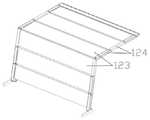
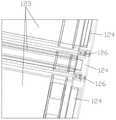
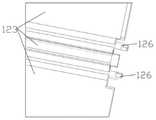
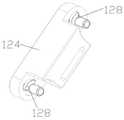
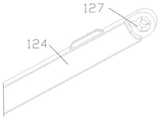
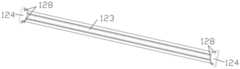
For example, as shown in fig. 17 and 18, therigid portion 121 may include: twoside portions 124 and asupport portion 123; theflexible body 130 is attached to the surface of thesupport portion 123, and thesupport portion 123 supports theflexible body 130. Twoside portions 124 are disposed on opposite sides of thesupport portion 123, theside portions 124 are adapted to be rotatably connected to theside portions 124 of the adjacentrigid portions 121, and theadjacent side portions 124 can be rotatably connected to each other by a pivot structure.
Here, the shape of thesupport portion 123 is not limited. For example, thesupport portion 123 may have a plate-like structure, as shown in fig. 17.
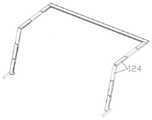
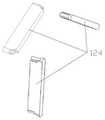
Here, the shape of theside portion 124 is not limited. For example, theedge 124 may have a strip-like configuration, as shown in fig. 18 and 19.
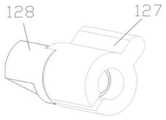
As an example, as shown in fig. 32, 33 and 34, theside portion 124 is configured to be rotatably connected with theside portion 124 of the adjacentrigid portion 121 through a secondrotating shaft structure 126, and the secondrotating shaft structure 126 may include a firstrotating portion 127 and a secondrotating portion 128, the firstrotating portion 127 having a first connecting hole, and a portion of the secondrotating portion 128 being located in the first connecting hole to be rotatable with respect to the firstrotating portion 127.
Here, there is a first frictional force between a portion of the secondrotating part 128 and the first connection hole so that the secondrotating part 128 and the firstrotating part 127 can maintain a relative rotation angle by providing a rotational damping force to the secondrotating part 128 and the firstrotating part 127 by the first frictional force.
Here, the secondrotating portion 128 and the firstrotating portion 127 may be formed integrally with theside portion 124 or may be formed separately. As an example, the secondrotating portion 128 and the firstrotating portion 127 are separated from theedge portion 124, and both the secondrotating portion 128 and the firstrotating portion 127 are fixed in theedge portion 124; at this time, the secondrotating portion 128 and the firstrotating portion 127 may be made of a material having a relatively high hardness, and theside portion 124 may be made of a material having a relatively low hardness; as shown in fig. 35, 36 and 37.
In this implementation, theflexible body 130 is disposed on the surface of the at least tworigid parts 121, and the at least tworigid parts 121 can rotate until the adjacentrigid parts 121 are attached to the adjacent surface of thebody 110 to support theflexible body 130 in the first state, as shown in fig. 3, 9 and 20.
In the present implementation, as shown in fig. 11 and 12, therigid portion 121 at the first end of the at least tworigid portions 121 and the first end of thebody 110 may be rotatably connected through a firstrotating shaft structure 125, so that the at least tworigid portions 121 adjust the angle between the at least tworigid portions 121 and thebody 110 through the firstrotating shaft structure 125.
In the present implementation, as shown in fig. 1 and 5, between adjacentrigid portions 121 of the at least tworigid portions 121 may rotate until the at least tworigid portions 121 are flattened to support theflexible body 130 in a third state; here, at least two of therigid portions 121 are in a flattened state and theflexible body 130 is also in an unfolded state, theflexible body 130 forming a flat larger screen.
In this implementation, as shown in fig. 24, therigid portion 121 of the at least tworigid portions 121, which is rotatable between adjacentrigid portions 121 to the second end of the at least tworigid portions 121, is in contact with the second end of thebody 110, so that the at least tworigid portions 121 and thebody 110 form a ring structure to support theflexible body 130 in a fourth state; so that theflexible body 130 can be displayed on different surfaces of the ring structure; here, the second end of thebody 110 and the first end of thebody 110 are spaced apart from each other, and thebody 110 can also support both ends of the at least tworigid parts 121, so that the at least tworigid parts 121 are in a more stable supporting state.
Of course, due to the rotatable connection between the at least tworigid portions 121, the at least tworigid portions 121 can support theflexible body 130 in a variety of states. As an example, as shown in fig. 8, at least tworigid portions 121 may be curved, and in this case, theflexible body 130 may be curved.
In this implementation, the cross-sectional shape of thebody 110 is a polygon; when the at least tworigid parts 121 rotate to the state that the at least tworigid parts 121 are unfolded, thebody 110 can support the at least tworigid parts 121 at different angles based on the fact that different surfaces abut against the bearing surface; because the connecting position of the at least tworigid parts 121 and thebody 110 is fixed, when different surfaces of thebody 110 abut against the bearing surface, the at least tworigid parts 121 are in different postures relative to the bearing surface, so that the angle between the at least tworigid parts 121 and the bearing surface can be adjusted through the abutment of the different surfaces of thebody 110 against the bearing surface, and meanwhile, the angle between the at least tworigid parts 121 supporting theflexible body 130 and the bearing surface can be adjusted.
As an example, as shown in fig. 6 and 7, when different surfaces of thebody 110 having a regular hexagonal cross-sectional shape abut against the bearing surfaces, the angles between the at least tworigid portions 121 and the bearing surfaces are different.
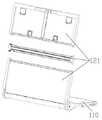
In this implementation manner, as shown in fig. 28, thebody 110 is a plate-shaped structure, and afirst connection portion 111 is suspended outside a first side of thebody 110; therigid part 121 at the first end of the at least tworigid parts 121 has a second connectingpart 122, and the second connectingpart 122 is rotatably connected with the first connectingpart 111; since the first connectingportion 111 is suspended outside thebody 110, the range of the rotation angle of the at least tworigid portions 121 relative to thebody 110 can be increased, so that the range of the display angle of the at least tworigid portions 121 supporting theflexible body 130 is increased.
Here, the structures of thefirst connection portion 111 and thesecond connection portion 122 are not limited. For example, as shown in fig. 28, 29 and 30, thefirst connection portion 111 may include two column portions disposed outside the first side of thebody 110 in the air; the second connectingportion 122 may be a cylindrical structure, and two end portions of the second connectingportion 122 of the cylindrical structure are correspondingly sleeved outside the two columnar portions.
Here, in a case where the at least tworigid portions 121 are rotated between adjacentrigid portions 121 to a state where the at least tworigid portions 121 are flattened, the at least tworigid portions 121 are rotatable within a first angle range with respect to thebody 110; the first angular range is not limited. For example, the first angular range may be greater than 180 degrees.
As an example, the first angle range is 0 to 270 degrees, as shown in fig. 31, the first angle of the at least tworigid portions 121 with respect to thebody 110 is 0 degree, and as shown in fig. 25, the first angle of the at least tworigid portions 121 with respect to thebody 110 is 270 degrees.
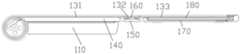
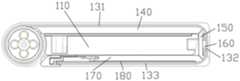
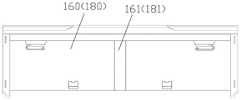
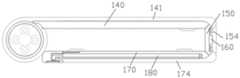
In some optional implementations of the embodiments of the present application, the supportingdevice 120 may include: afirst support 140, anelastic member 190, and a second support. Thefirst support 140 is rotatably connected with thebody 110, and thefirst support 140 is used for supporting thefirst portion 131 of the flexible body; the second support may include: a firststationary portion 150 and a firstmovable portion 160. A first end of thefirst fixing portion 150 is rotatably connected with a first end of thefirst support 140, and thefirst fixing portion 150 is movable relative to thefirst support 140; a firstmovable portion 160 is provided to the first fixedportion 150, the firstmovable portion 160 being movable relative to the first fixedportion 150, the firstmovable portion 160 for supporting thesecond portion 132 of the flexible body; aresilient member 190 for expanding thesecond portion 132 of the flexible body by a deforming force; the firstmovable portion 160 can drive thesecond portion 132 of the flexible body to move relative to the first fixedportion 150, and theelastic member 190 can stretch thesecond portion 132 of the flexible body by a deformation force, so that thesecond portion 132 of the flexible body can be maintained in a stretched state by the firstmovable portion 160 and theelastic member 190, and a wrinkle phenomenon between thesecond portion 132 of the flexible body and thefirst portion 131 of the flexible body can be prevented in a process that the first fixedportion 150 rotates relative to thefirst support member 140.
In the present implementation, the structure of thefirst support 140 is not limited. For example, thefirst support 140 may have a plate-shaped structure.
Here, the first supportingmember 140 is rotatably connected to thebody 110 in a similar manner to therigid portion 121 at the first end of the at least tworigid portions 121 is rotatably connected to the first end of thebody 110, and thus, the detailed description thereof is omitted. As an example, thefirst support 140 and thebody 110 may be rotatably connected by thefirst connection portion 111 and thesecond connection portion 122.
Here, thefirst portion 131 of the flexible body may be fixedly attached to a surface of thefirst support 140.
In the present implementation, the structure of thefirst fixing portion 150 is not limited. For example, thefirst fixing portion 150 may have a plate-shaped structure.
Here, the implementation manner of rotatably connecting the first end of thefirst fixing portion 150 and the first end of thefirst support 140 is not limited. For example, the first end of thefirst fixing portion 150 and the first end of thefirst support 140 can be rotatably connected by the secondrotating shaft structure 126.
In the present implementation, the structure of the firstmovable portion 160 is not limited. For example, the firstmovable portion 160 may have a plate-shaped structure.
Here, the firstmovable portion 160 may be disposed on a surface of the first fixedportion 150, and an implementation manner in which the firstmovable portion 160 is movable with respect to the first fixedportion 150 is not limited.
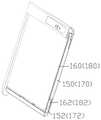
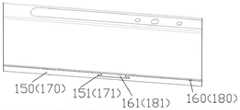
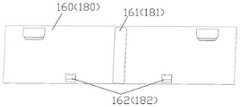
For example, as shown in fig. 40, 41, 43 and 44, the firstfixed part 150 has a first slidingslot 151, the firstmovable part 160 has afirst guide portion 161, thefirst guide portion 161 is inserted into the first slidingslot 151, and thefirst guide portion 161 is slidable in the first slidingslot 151, so that the firstmovable part 160 slides relative to the firstfixed part 150.
Here, a first limit mechanism may be further provided between the first fixedportion 150 and the firstmovable portion 160 so that the firstmovable portion 160 moves within a first set distance range with respect to the first fixedportion 150 by limiting a moving distance of the firstmovable portion 160 with respect to the first fixedportion 150 by the first limit mechanism. Here, as shown in fig. 42, the first stopper mechanism may include: the first limitinggroove 152 is disposed on thefirst fixing portion 150, the first limitingprotrusion 162 is disposed on the first movingportion 160, the first limitingprotrusion 162 is inserted into the first limitinggroove 152, and the first limitingprotrusion 162 contacts with two opposite sidewalls forming the first limitinggroove 152 to enable the first movingportion 160 to move within a first set distance range relative to thefirst fixing portion 150.
In this implementation, thesecond portion 132 of the flexible body may be fixedly connected with the firstmovable portion 160.
In the present implementation, the structure of theelastic member 190 is not limited as long as theelastic member 190 can stretch thesecond portion 132 of the flexible body by a deforming force.
For example, theelastic member 190 may include a tension spring, a first end of which may be fixedly connected to the first fixedportion 150 and a second end of which may be fixedly connected to the firstmovable portion 160, and which may stretch thesecond portion 132 of the flexible body by pulling the firstmovable portion 160 to move relative to the first fixedportion 150 with a deforming force. Of course, the second end of the extension spring may also be connected to thesecond portion 132 of the flexible body; at this time, during the process that the tension spring pulls thesecond part 132 of the flexible body to move, the firstmovable part 160 moves along with the firstmovable part 160, so as to ensure that the area of the firstmovable part 160 supporting thesecond part 132 of the flexible body is unchanged, and prevent the friction force between thesecond part 132 of the flexible body and the firstmovable part 160 from damaging thesecond part 132 of the flexible body.
As an example, theelastic member 190 may include: a first elastic part and a second elastic part. The first elastic part is abutted or connected with the first fixing part; the second elastic part is connected with the first elastic part to form a V-shaped structure, the second elastic part is abutted or connected with the firstmovable part 160, and a first included angle is formed between the second elastic part and the first elastic part; wherein theelastic member 190 provides different pushing force to the firstmovable portion 160 based on the change of the first included angle to expand thesecond portion 132 of the flexible body; since theelastic member 190 can provide the pushing force based on the angle change, the installation space of theelastic member 190 is small, and the volume of the supportingdevice 120 is greatly reduced.
In example one, the structure of the first elastic portion and the second elastic portion is not limited. For example, the first elastic part and the second elastic part may both have a strip-shaped structure; at this time, the overall diameter of theelastic member 190 can be set small, and the installation space of theelastic member 190 can be greatly reduced.
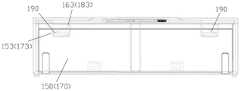
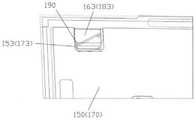
In an example one, as shown in fig. 45 and 46, the first fixing portion may be provided with a first mountinggroove 153, and a first end of the first moving portion, which is far away from thefirst support 140, is provided with afirst locking groove 163; thefirst clamping groove 163 is positioned in the first mountinggroove 153, the first elastic part is abutted against the groove bottom of the first mountinggroove 153, and the second elastic part is clamped in thefirst clamping groove 163; when the first movable portion moves relative to the first fixed portion, the first included angle between the second elastic portion and the first elastic portion is deformed, and theelastic element 190 is deformed by the pushing force of the second elastic portion pushing the firstmovable portion 160 to move relative to the first fixed portion, so that the second portion of theflexible body 130 is stretched along with the movement of the firstmovable portion 160.
In example one, the number of theelastic members 190 is not limited. For example, as shown in fig. 45, the supportingdevice 120 may be provided with twoelastic members 190.
In this implementation, as shown in fig. 38 and 39, the supportingdevice 120 may further include: a third support member. The third support may include: a second fixedportion 170 and a secondmovable portion 180. A first end of thesecond fixing portion 170 is rotatably connected with a second end of thefirst fixing portion 150, thesecond fixing portion 170 being rotatable with respect to thefirst fixing portion 150; a secondmovable portion 180 is provided to said second fixedportion 170, the secondmovable portion 180 being movable with respect to said second fixedportion 170, the secondmovable portion 180 being intended to support thethird portion 133 of the flexible body; theelastic member 190 is disposed on thesecond fixing portion 170, and is used for stretching thethird portion 133 and the second portion of the flexible body. Since the secondmovable portion 180 can drive thethird portion 133 of the flexible body to move relative to the second fixedportion 170, and theelastic member 190 can stretch thethird portion 133 and the second portion of the flexible body by a deforming force, thethird portion 133 and the second portion of the flexible body can be maintained in a stretched state by the secondmovable portion 180 and theelastic member 190, and a wrinkle phenomenon between thethird portion 133 of the flexible body and thesecond portion 132 of the flexible body, and between thesecond portion 132 of the flexible body and thefirst portion 131 of the flexible body can be prevented in a process of rotating the second fixedportion 170 relative to the first fixedportion 150.
Here, the structure of thesecond fixing portion 170 is not limited. For example, thesecond fixing portion 170 may have a plate-shaped structure.
Here, the implementation manner in which the first end of thesecond fixing portion 170 is rotatably connected to the second end of thefirst fixing portion 150 is not limited. For example, a first end of thesecond fixing portion 170 and a second end of thefirst fixing portion 150 may be rotatably connected by thesecond hinge structure 126.
Here, the secondmovable portion 180 may be disposed on a surface of the second fixedportion 170, and an implementation manner in which the secondmovable portion 180 is movable with respect to the second fixedportion 170 is not limited.
For example, as shown in fig. 40, 41, 43 and 44, the second fixedportion 170 has asecond slide groove 171, the secondmovable portion 180 has asecond guide portion 181, thesecond guide portion 181 is inserted into thesecond slide groove 171, and thesecond guide portion 181 is slidable in thesecond slide groove 171, so that the secondmovable portion 180 is slidable with respect to the second fixedportion 170.
Here, a second limiting mechanism may be further provided between the secondfixed part 170 and the secondmovable part 180, so that the secondmovable part 180 is moved within a second set distance range with respect to the secondfixed part 170 by limiting a moving distance of the secondmovable part 180 with respect to the secondfixed part 170 by the second limiting mechanism. Here, as shown in fig. 42, the second limit mechanism may include: the second limitinggroove 172 is disposed on thesecond fixing portion 170, and the second limitingprotrusion 182 is disposed on the second movingportion 180, the second limitingprotrusion 182 is inserted into the second limitinggroove 172, and the second limitingprotrusion 182 contacts with two opposite sidewalls forming the second limitinggroove 172 to move the second movingportion 180 relative to thesecond fixing portion 170 within a second set distance range.
Here, thethird portion 133 of the flexible body and the secondmovable portion 180 may be fixedly connected.
Here, the structure of theelastic member 190 is not limited as long as theelastic member 190 can stretch thesecond portion 132 of the flexible body by a deforming force.
For example, theelastic member 190 may include a tension spring, a first end of which may be fixedly connected to thesecond fixing portion 170, a second end of which may be fixedly connected to the secondmovable portion 180, and the tension spring may stretch thesecond portion 132 of the flexible body by pulling the secondmovable portion 180 to move relative to thesecond fixing portion 170 by a deformation force.
In example two, theelastic member 190 may include: a first elastic part and a second elastic part. The first elastic part is abutted or connected with the second fixing part; the second elastic part is connected with the first elastic part to form a V-shaped structure, the second elastic part is abutted or connected with the secondmovable part 180, and a first included angle is formed between the second elastic part and the first elastic part; wherein theelastic member 190 provides different pushing force to the secondmovable portion 180 based on the change of the first included angle to expand thesecond portion 132 and the third portion of the flexible body; since theelastic member 190 can provide the pushing force based on the angle change, the installation space of theelastic member 190 is small, and the volume of the supportingdevice 120 is greatly reduced.
In example two, as shown in fig. 45 and 46, the second fixing portion may be provided with asecond mounting groove 173, and a first end of the second movable portion, which is away from the first fixing portion, is provided with asecond catching groove 183; thesecond locking groove 183 is located in the second mountinggroove 173, the first elastic portion abuts against the bottom of the second mountinggroove 173, and the second elastic portion is locked in thesecond locking groove 183; when the second movable portion moves relative to the second fixed portion, the first angle between the second elastic portion and the first elastic portion is deformed, and theelastic member 190 is deformed by a pushing force of the second elastic portion pushing the second movable portion to move relative to the second fixed portion, and expands the second portion and the third portion of theflexible body 130.
In example two, the number of theelastic members 190 is not limited. For example, as shown in fig. 45, the supportingdevice 120 may be provided with twoelastic members 190.
It should be noted that, in the case that the supportingdevice 120 further includes a third supporting member, theelastic member 190 may be disposed on thesecond fixing portion 170, and need not be disposed on thefirst fixing portion 150; since thethird portion 133 of the flexible body is connected to thesecond portion 132 of the flexible body, thesecond portion 132 of the flexible body can move relative to the first fixedportion 150 through the firstmovable portion 160, and at this time, thethird portion 133 of the flexible body can be stretched by pushing the second movable portion through theelastic member 190, and thesecond portion 132 of the flexible body can be moved by thethird portion 133 of the flexible body; in the case that the supportingdevice 120 includes only the first supportingmember 140 and the second supporting member, theelastic member 190 may be disposed on thefirst fixing portion 150.
In this implementation, the lengths of theflexible bodies 130 in the flattened state and in the bent state may be equal or may not be equal.
The equal length of theflexible body 130 in the flattened state and in the bent state is not limited.
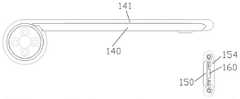
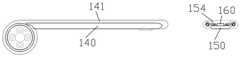
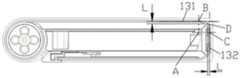
For example, as shown in fig. 26, 27, 47, 48, 49, and 50, the supportingdevice 120 may further include: two first raisedportions 141 and two second raisedportions 154. Two first raisedportions 141 are located on opposite sides of thefirst support 140; two second protrudingportions 154 are located at opposite sides of thefirst fixing portion 150, and the two second protrudingportions 154 are rotatably connected to the two first protrudingportions 141, respectively; when thefirst fixing portion 150 rotates to form a second included angle with respect to thefirst support 140, a first rotation center forms a first set distance with thefirst portion 131 of the flexible body, and forms a first set distance with thesecond portion 132 of the flexible body, and the first set distance satisfies that the lengths of theflexible body 130 in the flat state and the curved state are equal; wherein the first rotation center is a rotation center of the two secondconvex portions 154 with respect to the two firstconvex portions 141; so that the lengths of theflexible body 130 in the flat state and the bent state are equal by forming a first set distance between the first rotation center and thefirst portion 131 and thesecond portion 132 of the flexible body, thereby preventing theflexible body 130 from being wrinkled.
In this example, the structures of the first and secondconvex portions convex portions
Here, that the two secondconvex portions 154 are respectively rotatably connected to the two firstconvex portions 141 means that one secondconvex portion 154 of the two secondconvex portions 154 is rotatably connected to one firstconvex portion 141 of the two firstconvex portions 141; the other of the two secondconvex portions 154 is rotatably connected to the other of the two firstconvex portions 141.
Here, the two second protrudingportions 154 are rotatably connected to the two first protrudingportions 141 respectively in a similar manner to the above-mentioned manner of rotatably connecting the two adjacentrigid portions 121, and therefore, the detailed description thereof is omitted. For example, the two second protrudingportions 154 corresponding to the two first protrudingportions 141, respectively, can be rotatably connected by the secondrotating shaft structure 126. As an example, the firstconvex portion 141 has thefirst rotation part 127, and the secondconvex portion 154 has thesecond rotation part 128.
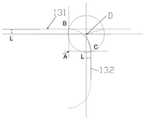
In this example, the first rotation center is a rotation center of the two secondconvex portions 154 rotating with respect to the two firstconvex portions 141, as shown by a point D in fig. 51 and 52. As shown in fig. 51 and 52, the first rotation center forms a first set distance L with thefirst portion 131 of the flexible body as a distance formed between the first rotation center D and the neutral layer of thefirst portion 131 of the flexible body, and the first rotation center forms a first set distance L with thesecond portion 132 of the flexible body as a distance formed between the first rotation center D and the neutral layer of thesecond portion 132 of the flexible body.
In this example, the value of the second angle is not limited. For example, the second angle may have a value ranging from 0 degrees to 180 degrees.
As an example, the second included angle may be 90 degrees, as shown in fig. 53, where R is the bending radius of theflexible body 130, Q is the bending angle of theflexible body 130, and Q is 90 degrees; the length of the bending part is S, and S is pi R/2; the length of the bent part corresponding to 90 degrees after flattening is 2P, and 2P is 2 (R-L); wherein L is a first set distance; the lengths of theflexible bodies 130 in the flat state and the bending state are equal; 2P ═ S; pi R/2 ═ 2 (R-L); it can thus be derived: l ═ (1-pi/4) R; therefore, the lengths of theflexible body 130 in the flattened state and in the bent state can be equalized by setting the first set distance L to (1-pi/4) R.
As yet another example, the second included angle may be greater than 90 degrees, as shown in fig. 54 and 55, where R is the bending radius of theflexible body 130, Q is the bending angle of theflexible body 130, and the bending angle Q is greater than 90 degrees; the length of the bending part is S, S is 2R pi Q/360R pi Q/180; the length of the bend after flattening is 2P, 2P is 2(R-L)/TAN (Q/2); wherein L is a first set distance; the lengths of theflexible bodies 130 in the flat state and the bending state are equal; 2P ═ S; 2(R-L)/TAN (Q/2) ═ R pi Q/180; thus, it can be derived: L-R-TAN (Q/2) R pi Q/360-R (1-TAN (Q/2) pi Q/360); therefore, the lengths of theflexible body 130 in the flattened state and in the bent state can be equalized by setting the first set distance L to R (1-TAN (Q/2). pi.Q/360).
Of course, the second angle may be smaller than 90 degrees, as shown in fig. 56, and in this case, the first set distance L may be calculated by the above formula in which the second angle is larger than 90 degrees, and L ═ R-TAN (Q/2) R ═ Q/360 ═ R (1-TAN (Q/2) π Q/360).
It should be noted that the bending radius is not limited to a positive R, and the bending line may be an ellipse or an arbitrary curve.
In this example, as shown in fig. 47 and 49, in the case that the supportingdevice 120 includes thesecond fixing portion 170, the supportingdevice 120 may further include two third protrudingportions 174, the two third protrudingportions 174 are located at opposite sides of thesecond fixing portion 170, and the two third protrudingportions 174 are respectively and correspondingly rotatably connected with the two second protrudingportions 154; when thesecond fixing portion 170 rotates to form a third angle with respect to thefirst fixing portion 150, a second rotation center forms a second set distance with thesecond portion 132 of the flexible body, and a second set distance with thethird portion 133 of the flexible body; the second set distance satisfies that the lengths of theflexible body 130 in the flattened state and the bent state are equal; wherein the second rotation center is a rotation center of the two thirdconvex portions 174 with respect to the two secondconvex portions 154.
Here, the third angle is similar to the second angle, the second rotation center is similar to the first rotation center, and the second set distance is similar to the first set distance, which is not described herein again.
It should be noted that theflexible body 130 can be prevented from being wrinkled by the arrangement of the first set distance and the second set distance, and theflexible body 130 can also be prevented from being wrinkled by the firstmovable portion 160 and the secondmovable portion 180; the supportingdevice 120 of the present application may be provided with both the first set distance and the second set distance, and the firstmovable portion 160 and the secondmovable portion 180; only the first set distance and the second set distance may be set; it is also possible to provide only the firstmovable portion 160 and the secondmovable portion 180. In the case where the supportingdevice 120 is provided only at the first set distance and the second set distance, thesecond portion 132 of the flexible body may be provided at thefirst fixing portion 150, and thethird portion 133 of the flexible body may be provided at thesecond fixing portion 170.
The electronic device of the embodiment of the application includes: abody 110; a supportingdevice 120 connected with thebody 110; aflexible body 130, for displaying, disposed on a surface of the supportingdevice 120, and cooperating with the supportingdevice 120, capable of changing with the form change of the supportingdevice 120; the supportingdevice 120 can drive theflexible body 130 to cover the outer side surface of thebody 110 to form a first state, and the supportingdevice 120 can drive theflexible body 130 to unfold and at least partially protrude out of the surface of thebody 110 to form a second state; theflexible body 130 has the first state and the second state, so that the electronic device can have different states, and the adaptability of the electronic device is greatly improved.
The above description is only for the specific embodiments of the present application, but the scope of the present application is not limited thereto, and any person skilled in the art can easily conceive of the changes or substitutions within the technical scope of the present application, and shall be covered by the scope of the present application. Therefore, the protection scope of the present application shall be subject to the protection scope of the claims.
Claims (10)
1. An electronic device, the electronic device comprising:
a body;
the supporting device is connected with the body;
the flexible body is used for displaying, is arranged on the surface of the supporting device, is matched with the supporting device for use, and can change along with the change of the shape of the supporting device;
the supporting device can drive the flexible body to cover the outer side face of the body to form a first state, and the supporting device can drive the flexible body to unfold and at least partially protrude out of the surface of the body to form a second state.
2. The electronic device of claim 1, the support apparatus comprising:
at least two rigid parts, adjacent rigid parts of the at least two rigid parts are rotatably connected, and the rigid part at the first end of the at least two rigid parts is rotatably connected with the body;
the flexible body is arranged on the surfaces of the at least two rigid parts, and the at least two rigid parts can rotate until the adjacent rigid parts are attached to the adjacent surfaces of the body to support the flexible body to be in a first state.
3. The electronic device of claim 2, a first end rigid portion of the at least two rigid portions rotatably coupled to the first end of the body;
the space between the adjacent rigid parts in the at least two rigid parts can be rotated to the state that the at least two rigid parts are flattened to support the flexible body to be in a third state;
the rigid part which is rotatable to the second end of the at least two rigid parts among the at least two rigid parts is contacted with the second end of the body, so that the at least two rigid parts and the body form a ring-shaped structure to support the flexible body to be in a fourth state.
4. The electronic device of claim 2, a cross-sectional shape of the body being polygonal;
rotate between the adjacent rigidity portion in at least two rigidity portions to under at least two rigidity portions are the condition of exhibition flat state, the body can support based on different surfaces and bearing surface butt at least two rigidity portions are different angles.
5. The electronic device of claim 2, wherein the body is a plate-shaped structure, and a first connecting portion is suspended outside a first side of the body;
the rigid part at the first end of the at least two rigid parts is provided with a second connecting part which is rotatably connected with the first connecting part;
when the at least two rigid parts rotate to the state that the at least two rigid parts are unfolded, the at least two rigid parts can rotate in a first angle range relative to the body; wherein the first angular range is greater than 180 degrees.
6. The electronic device of claim 1, the support apparatus comprising:
a first support member rotatably connected to the body for supporting a first portion of the flexible body;
a second support comprising:
a first fixed portion having a first end rotatably connected to the first end of the first support member and movable relative to the first support member;
a first movable portion provided to the first fixed portion, movable relative to the first fixed portion, for supporting a second portion of the flexible body;
an elastic member for expanding the second portion of the flexible body by a deforming force.
7. The electronic device of claim 6, the support apparatus further comprising:
a third support comprising:
a second stationary portion rotatably connected at a first end thereof to a second end of the first stationary portion, and rotatable relative to the first stationary portion;
a second movable portion provided to the second fixed portion, movable relative to the second fixed portion, for supporting a third portion of the flexible body;
the elastic piece is arranged on the second fixing part and used for stretching the third part and the second part of the flexible body.
8. The electronic device of claim 7, the spring comprising:
a first elastic part abutting against or connected to the second fixing part;
the second elastic part is connected with the first elastic part to form a V-shaped structure, is abutted or connected with the second movable part and forms a first included angle with the first elastic part;
wherein the elastic member provides different pushing force to the second movable portion based on the change of the first included angle to stretch the flexible body.
9. The electronic device of claim 6, the flexible body being equal in length in the flattened state and in the bent state.
10. The electronic device of claim 9, the support apparatus further comprising:
two first raised portions on opposite sides of the first support;
two second convex parts which are positioned at the opposite sides of the first fixed part and are respectively and correspondingly rotatably connected with the two first convex parts;
under the condition that the first fixed part rotates relative to the first supporting piece to form a second included angle, a first rotating center forms a first set distance with the first part of the flexible body, and the first rotating center forms a first set distance with the second part of the flexible body; the first set distance satisfies that the lengths of the flexible body in the flattening state and the bending state are equal;
wherein the first rotation center is a rotation center of the two second convex portions with respect to the two first convex portions.
Priority Applications (1)
| Application Number | Priority Date | Filing Date | Title |
|---|---|---|---|
| CN202210088342.8ACN114550584A (en) | 2022-01-25 | 2022-01-25 | Electronic device |
Applications Claiming Priority (1)
| Application Number | Priority Date | Filing Date | Title |
|---|---|---|---|
| CN202210088342.8ACN114550584A (en) | 2022-01-25 | 2022-01-25 | Electronic device |
Publications (1)
| Publication Number | Publication Date |
|---|---|
| CN114550584Atrue CN114550584A (en) | 2022-05-27 |
Family
ID=81673985
Family Applications (1)
| Application Number | Title | Priority Date | Filing Date |
|---|---|---|---|
| CN202210088342.8APendingCN114550584A (en) | 2022-01-25 | 2022-01-25 | Electronic device |
Country Status (1)
| Country | Link |
|---|---|
| CN (1) | CN114550584A (en) |
Citations (10)
| Publication number | Priority date | Publication date | Assignee | Title |
|---|---|---|---|---|
| CN203102070U (en)* | 2011-01-31 | 2013-07-31 | 苹果公司 | Accessory equipment |
| CN105549689A (en)* | 2015-12-29 | 2016-05-04 | 广东欧珀移动通信有限公司 | Folding terminal |
| CN107526188A (en)* | 2016-06-17 | 2017-12-29 | 三星显示有限公司 | rollable display device |
| US20180110139A1 (en)* | 2016-10-13 | 2018-04-19 | Samsung Electronics Co., Ltd. | Foldable electronic device including flexible display |
| CN109167855A (en)* | 2018-09-18 | 2019-01-08 | 杭州禾声科技有限公司 | A kind of intelligent mobile device with flexible folding screen |
| CN111314525A (en)* | 2020-04-13 | 2020-06-19 | 安伟 | Flexible folding screen cell-phone of simplified form of a book |
| CN111968513A (en)* | 2020-08-28 | 2020-11-20 | 维沃移动通信有限公司 | Electronic device |
| WO2020256171A1 (en)* | 2019-06-18 | 2020-12-24 | 엘지전자 주식회사 | Flexible display apparatus |
| CN213186169U (en)* | 2020-05-22 | 2021-05-11 | 于会颖 | Mobile phone with three-folding screen |
| JP2021135326A (en)* | 2020-02-25 | 2021-09-13 | 株式会社タッチパネル研究所 | Winding substrate |
- 2022
- 2022-01-25CNCN202210088342.8Apatent/CN114550584A/enactivePending
Patent Citations (10)
| Publication number | Priority date | Publication date | Assignee | Title |
|---|---|---|---|---|
| CN203102070U (en)* | 2011-01-31 | 2013-07-31 | 苹果公司 | Accessory equipment |
| CN105549689A (en)* | 2015-12-29 | 2016-05-04 | 广东欧珀移动通信有限公司 | Folding terminal |
| CN107526188A (en)* | 2016-06-17 | 2017-12-29 | 三星显示有限公司 | rollable display device |
| US20180110139A1 (en)* | 2016-10-13 | 2018-04-19 | Samsung Electronics Co., Ltd. | Foldable electronic device including flexible display |
| CN109167855A (en)* | 2018-09-18 | 2019-01-08 | 杭州禾声科技有限公司 | A kind of intelligent mobile device with flexible folding screen |
| WO2020256171A1 (en)* | 2019-06-18 | 2020-12-24 | 엘지전자 주식회사 | Flexible display apparatus |
| JP2021135326A (en)* | 2020-02-25 | 2021-09-13 | 株式会社タッチパネル研究所 | Winding substrate |
| CN111314525A (en)* | 2020-04-13 | 2020-06-19 | 安伟 | Flexible folding screen cell-phone of simplified form of a book |
| CN213186169U (en)* | 2020-05-22 | 2021-05-11 | 于会颖 | Mobile phone with three-folding screen |
| CN111968513A (en)* | 2020-08-28 | 2020-11-20 | 维沃移动通信有限公司 | Electronic device |
Similar Documents
| Publication | Publication Date | Title |
|---|---|---|
| EP3683787B1 (en) | Folding component and flexible display device | |
| US10571969B2 (en) | Rollable display device | |
| CN111343310B (en) | Display device and mobile terminal | |
| US10716228B2 (en) | Support mechanism and mobile terminal | |
| US10487550B2 (en) | Support device for foldable flexible screen and a display device using the same | |
| US9826626B2 (en) | Display device | |
| KR101452872B1 (en) | Display Device Hinge | |
| JP2024028387A (en) | Portable communication devices including hinged structures | |
| US8899543B2 (en) | Support structure | |
| US9022341B2 (en) | Apparatus to support portable electronic devices and other devices or objects | |
| EP3607413A1 (en) | Hinged device | |
| US11026336B1 (en) | Display device | |
| KR101593042B1 (en) | Hinge Module for Flexible Display Device | |
| TWI656431B (en) | Hinge structure and electronic device | |
| US20130168288A1 (en) | Support for portable computing device | |
| US11973890B2 (en) | Hinge element, hinge, and mobile terminal | |
| KR20220029148A (en) | electronic device having a flexible display | |
| KR20130073331A (en) | Hinge module for flexible display device | |
| US20190003531A1 (en) | Ball joint unit movable along guide groove | |
| US20190017651A1 (en) | Systems and methods for making and using mounts for receiving objects and coupling to surfaces | |
| US20190090363A1 (en) | Foldable module and flexible display device having the same | |
| KR102687975B1 (en) | Structure of arm and Structure of Hinge including the same and electronic device including the same | |
| CN113811752B (en) | 360-Degree bidirectional folding endurance test device for flexible material | |
| CN110065446B (en) | Air outlet support base and portable equipment support with same | |
| CN114005357A (en) | Screen supporting device and electronic equipment |
Legal Events
| Date | Code | Title | Description |
|---|---|---|---|
| PB01 | Publication | ||
| PB01 | Publication | ||
| SE01 | Entry into force of request for substantive examination | ||
| SE01 | Entry into force of request for substantive examination |