CN114266792A - Bridging reconstruction method and device, computer equipment and storage medium - Google Patents
Bridging reconstruction method and device, computer equipment and storage mediumDownload PDFInfo
- Publication number
- CN114266792A CN114266792ACN202111674835.1ACN202111674835ACN114266792ACN 114266792 ACN114266792 ACN 114266792ACN 202111674835 ACN202111674835 ACN 202111674835ACN 114266792 ACN114266792 ACN 114266792A
- Authority
- CN
- China
- Prior art keywords
- blood vessel
- bridging
- segmentation
- mask
- point
- Prior art date
- Legal status (The legal status is an assumption and is not a legal conclusion. Google has not performed a legal analysis and makes no representation as to the accuracy of the status listed.)
- Granted
Links
Images







Landscapes
- Apparatus For Radiation Diagnosis (AREA)
Abstract
Description
Technical Field
The present application relates to the field of medical technology, and in particular, to a method and an apparatus for bridging reconstruction, a computer device, and a storage medium.
Background
Currently, cardiovascular diseases become a common disease, and the morbidity and mortality rate are high. Particularly, coronary heart disease greatly affects daily life of people. Coronary bypass surgery is the most effective surgical method for treating coronary heart disease, so that regular follow-up of postoperative bypass patients is also an essential procedure.
In the conventional technology, the bypass data is usually reconstructed manually after operation, so that doctors can know the effect after operation. However, the conventional method has the problem of low bridging reconstruction efficiency.
Disclosure of Invention
In view of the foregoing, it is desirable to provide a bridge reconstruction method, apparatus, computer device, and storage medium.
A bridge reconstruction method, the method comprising:
obtaining a heart segmentation result and a blood vessel segmentation result;
obtaining a target blood vessel mask according to the heart segmentation result, the blood vessel segmentation result and a segmentation model;
acquiring bypass reconstruction information according to a target blood vessel mask;
and processing the bridging reconstruction information to obtain a bridging reconstruction result.
A bridge reconstruction method, the method comprising:
obtaining a heart segmentation result and a blood vessel segmentation result;
obtaining a target blood vessel mask according to the heart segmentation result, the blood vessel segmentation result and a segmentation model;
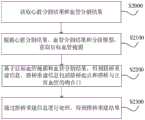
obtaining bypass reconstruction information based on the target blood vessel mask and the blood vessel segmentation result, wherein the bypass reconstruction information comprises a bypass starting point and an anastomotic stoma of a bypass and a normal blood vessel;
and processing the bridging reconstruction information to obtain a bridging reconstruction result.
A bridge reconstruction method, the method comprising:
obtaining a heart segmentation result and a blood vessel segmentation result;
obtaining a target blood vessel mask according to the heart segmentation result, the blood vessel segmentation result and a segmentation model;
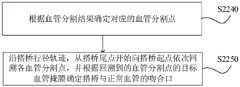
obtaining bypass reconstruction information based on the target blood vessel mask and the blood vessel segmentation result, wherein the bypass reconstruction information comprises a bypass path track and an anastomotic stoma of a bypass and a normal blood vessel;
and processing the bridging reconstruction information to obtain a bridging reconstruction result.
A bypass reconstruction device, the device comprising:
the segmentation result acquisition module is used for acquiring a heart segmentation result and a blood vessel segmentation result;
the mask acquisition module is used for acquiring a target blood vessel mask according to the heart segmentation result, the blood vessel segmentation result and the segmentation model;
the bridging information acquisition module is used for acquiring bridging reconstruction information according to the target blood vessel mask;
and the reconstruction module is used for carrying out reconstruction processing through the bridging reconstruction information to obtain a bridging reconstruction result.
A computer device comprising a memory and a processor, the memory storing a computer program, the processor implementing the following steps when executing the computer program:
obtaining a heart segmentation result and a blood vessel segmentation result;
obtaining a target blood vessel mask according to the heart segmentation result, the blood vessel segmentation result and a segmentation model;
acquiring bypass reconstruction information according to a target blood vessel mask;
and processing the bridging reconstruction information to obtain a bridging reconstruction result.
A storage medium having stored thereon a computer program which, when executed by a processor, performs the steps of:
obtaining a heart segmentation result and a blood vessel segmentation result;
obtaining a target blood vessel mask according to the heart segmentation result, the blood vessel segmentation result and a segmentation model;
acquiring bypass reconstruction information according to a target blood vessel mask;
and processing the bridging reconstruction information to obtain a bridging reconstruction result.
The method comprises the steps of obtaining a heart segmentation result and a blood vessel segmentation result, obtaining a target blood vessel mask according to the heart segmentation result, the blood vessel segmentation result and a segmentation model, obtaining bridging reconstruction information according to the target blood vessel mask, and processing through the bridging reconstruction information to obtain a bridging reconstruction result; according to the method, the target bridging data and the bridging reconstruction information are obtained through the neural network model, and the bridging reconstruction result is reconstructed and determined according to the target bridging data and the bridging reconstruction information, so that manual reconstruction of a bridging model can be avoided, human resources and bridging reconstruction time are saved, the bridging reconstruction cost is reduced, and the bridging reconstruction efficiency is further improved.
Drawings
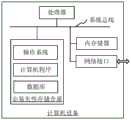
FIG. 1 is a diagram illustrating an internal structure of a computer device according to an embodiment;
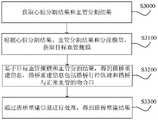
FIG. 2 is a schematic flow chart diagram of a bridge reconstruction method in one embodiment;
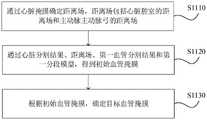
FIG. 3 is a flow diagram illustrating a method for obtaining a target vessel mask according to one embodiment;
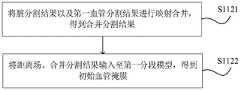
FIG. 4 is a flowchart illustrating a method for obtaining an initial vessel mask according to another embodiment;
FIG. 5 is a flowchart illustrating a specific method for obtaining a target vessel mask according to another embodiment;
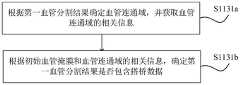
FIG. 6 is a flowchart illustrating a method for determining whether a first vessel segmentation result contains bypass data according to another embodiment;
FIG. 7 is a flowchart illustrating an exemplary method for determining whether a first vessel segmentation result includes bypass data according to another embodiment;
FIG. 7a is a diagram illustrating the result of another embodiment of the bypass reconstruction method performed on a cardiac image of a subject;
FIG. 8 is a schematic flow chart diagram of a bridge reconstruction method in one embodiment;
FIG. 9 is a flowchart illustrating a method for obtaining bridging reconstruction information according to an embodiment;
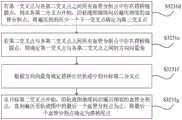
FIG. 10 is a flow diagram illustrating a method for determining bridging candidate points, according to one embodiment;
FIG. 11 is a flowchart illustrating a method for determining a bridge starting point in another embodiment;
FIG. 12 is a flowchart illustrating a specific method for determining a bridge starting point according to another embodiment;
fig. 13 is a schematic flow chart illustrating a specific method for obtaining bridging reestablishment information in another embodiment;
FIG. 14 is a schematic flow chart diagram of a bridge reconstruction method in one embodiment;
FIG. 15 is a flowchart illustrating a method for obtaining bridging reconstruction information according to an embodiment;
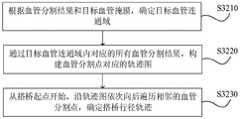
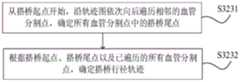
FIG. 16 is a flowchart illustrating a method for determining a bypass trajectory in accordance with one embodiment;
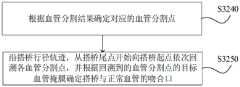
FIG. 17 is a flow diagram illustrating a method for determining a tail point for a bridge under one embodiment;
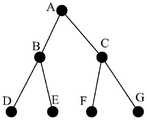
FIG. 18 is a diagram illustrating a distribution of a plurality of vessel partitions in a trajectory diagram according to another embodiment;
FIG. 19 is a schematic flow chart illustrating a method for determining a bridging tail point in another embodiment;
fig. 20 is a schematic flowchart illustrating a specific method for obtaining bridging reconstruction information in another embodiment;
fig. 21 is a block diagram showing the structure of a bridge reconstruction apparatus according to an embodiment.
Detailed Description
In order to make the objects, technical solutions and advantages of the present application more apparent, the present application is described in further detail below with reference to the accompanying drawings and embodiments. It should be understood that the specific embodiments described herein are merely illustrative of the present application and are not intended to limit the present application.
The bridging reconstruction method provided by the application can be applied to the computer equipment shown in the figure 1. As shown in fig. 1, the computer apparatus includes a processor, a memory, a network interface, a display screen, and an input device, which are connected through a system bus. Wherein the processor of the computer device is configured to provide computing and control capabilities. The memory of the computer device comprises a nonvolatile storage medium and an internal memory. The non-volatile storage medium stores an operating system and a computer program. The internal memory provides an environment for the operation of an operating system and computer programs in the non-volatile storage medium. The database of the computer device is used for storing the heart images, the blood vessel segmentation results and the pre-trained segmentation models. The network interface of the computer device is used for communicating with an external terminal through a network connection. The computer program is executed by a processor to implement a bypass reconstruction method.
Those skilled in the art will appreciate that the architecture shown in fig. 1 is merely a block diagram of some of the structures associated with the disclosed aspects and is not intended to limit the computing devices to which the disclosed aspects apply, as particular computing devices may include more or less components than those shown, or may combine certain components, or have a different arrangement of components.
It should be noted that, in the bridging reconstruction method provided in the embodiments of the present application, the execution subject may be a bridging reconstruction apparatus, and the apparatus may be implemented as part of or all of a computer device by software, hardware, or a combination of software and hardware. The execution subjects of the method embodiments described below are described taking a computer device as an example.
In possible embodiments, the above-mentioned bridging reconstruction method may be implemented in various ways, and specifically, several bridging reconstruction methods may be further described in detail by technical solutions in the following examples, but are not limited to the following examples.
First bridging reconstruction method
The bridging reconstruction method can be illustrated in detail by the following examples:
fig. 2 is a schematic flow chart of a bridge reconstruction method according to an embodiment, which is described by taking the method as an example applied to the computer device in fig. 1, and includes the following steps:
s1000, obtaining a heart segmentation result and a blood vessel segmentation result.
Specifically, the computer device may input a plurality of frames of cardiac images of the diagnosis and treatment object to a heart segmentation model trained in advance to obtain a heart segmentation result, further determine a blood vessel range according to the heart segmentation result, and perform blood vessel segmentation on the blood vessel range to obtain a blood vessel segmentation result. Alternatively, the blood vessel segmentation result may be a segmentation result corresponding to all blood vessel regions in the heart segmentation result. The cardiac image may be a three-dimensional CT enhanced image in dicom format. The heart segmentation result may be a heart segmentation image including each chamber of the heart and the aorta and the aortic arch, and each chamber of the heart and the aorta and the aortic arch in the heart segmentation image have corresponding labels to distinguish different tissues in the heart segmentation image, and each chamber of the heart may be a left atrium, a right atrium, a left ventricle and a right ventricle of the heart, wherein the labels corresponding to the left atrium, the right atrium, the left ventricle, the right ventricle, the aorta and the aortic arch of the heart may be different. The heart segmentation result may be represented by heart segmentation data including the respective chambers of the heart, the aorta, and the aortic arch.
It is understood that the pre-trained heart segmentation model may be composed of at least one of a convolutional neural network model, a cyclic neural network model, and an antagonistic neural network model; the computer equipment can perform network model training on the initial heart segmentation model through a heart image training set to obtain a pre-trained heart segmentation model.
Meanwhile, the heart segmentation result can be taken as a whole to determine the range of the blood vessel. The computer equipment can extend the heart segmentation result outwards to a certain preset range to obtain a blood vessel range, and further inputs the blood vessel range into a pre-trained blood vessel segmentation model to obtain a blood vessel segmentation result. The preset range can be self-defined according to actual conditions, and only the range of the blood vessel is ensured to be smaller than the range of the heart image. If the heart segmentation result is represented by the heart segmentation image, the blood vessel range can be represented by an image obtained by extending the heart segmentation image outwards by a certain preset range; if the heart segmentation result is represented by the heart segmentation data, the blood vessel range may be represented by the heart segmentation data corresponding to an image obtained by extending the heart segmentation image outward by a certain preset range. The blood vessel segmentation result may be a binary blood vessel segmentation result.
The pre-trained blood vessel segmentation model may be composed of at least one of a convolutional neural network model, a cyclic neural network model, and an antagonistic neural network model, and if the pre-trained blood vessel segmentation model and the pre-trained heart segmentation model have the same structure, network parameters of the pre-trained blood vessel segmentation model and the pre-trained heart segmentation model may be different after the pre-trained blood vessel segmentation model and the pre-trained heart segmentation model are trained by the network model. The computer equipment can perform network model training on the initial vessel segmentation model through a vessel range training set to obtain a vessel segmentation model trained in advance.
In addition, both the above-mentioned heart segmentation model and the blood vessel segmentation model may complete the network model training before the present embodiment performs S100.
And S1100, acquiring a target blood vessel mask according to the heart segmentation result, the blood vessel segmentation result and the segmentation model.
Specifically, the computer device may process the heart segmentation result and the blood vessel segmentation result to obtain a processing result, and input the processing result to the segmentation model to obtain a multi-vessel mask corresponding to each point in the blood vessel segmentation result, that is, a target blood vessel mask, or directly input the heart segmentation result and the blood vessel segmentation result to the segmentation model to obtain a multi-vessel mask corresponding to each point in the blood vessel segmentation result, that is, a target blood vessel mask. In the present embodiment, both the heart segmentation result and the blood vessel segmentation result may be understood as images or data.
It can be understood that the segment model may be a pre-trained neural network model, and the segment model may be composed of at least one of a convolutional neural network model, a cyclic neural network model, and an antagonistic neural network model, and if the pre-trained segment model is the same as the pre-trained blood vessel segmentation model and the pre-trained heart segmentation model in structure, network parameters of the pre-trained segment model, the pre-trained blood vessel segmentation model, and the pre-trained heart segmentation model may be different. In addition, the segment model may complete network model training before S200 is executed in this embodiment, specifically, the computer device may input the heart segmentation result, the heart segmentation result in the blood vessel segmentation result training set, and the blood vessel segmentation result into the initial segment model to obtain a blood vessel prediction mask, calculate a prediction error value between the blood vessel prediction mask and the standard blood vessel mask through a loss function, update an initial network parameter in the initial segment model according to the prediction error value, and continuously iterate the training steps until the prediction error value satisfies a preset error threshold or the iteration number reaches a preset iteration number threshold, so as to obtain a pre-trained segment model. The standard blood vessel mask can be an idealized blood vessel mask corresponding to the whole blood vessel, namely a gold standard of network training.
S1200, obtaining bypass reconstruction information according to the target blood vessel mask.
Specifically, the computer device may perform transformation processing, comparison processing, operation processing, screening processing, and/or analysis processing on the target blood vessel mask to obtain the bridging reconstruction information, or may further perform analysis processing on the target bridging data to determine the bridging reconstruction information by screening the target bridging data from the target blood vessel mask according to a preset condition. The target blood vessel mask can be understood as a multi-blood vessel label mask corresponding to a blood vessel segmentation result. The bridging reconstruction information may include at least one of a bridging path trajectory, a range in which the bridging path trajectory is located, a bridging start point and a bridging end point in the bridging path trajectory, a size of the bridging path trajectory, and each passing point in the bridging path trajectory.
And S1300, processing the bridging reconstruction information to obtain a bridging reconstruction result.
Specifically, the computer device may process the bypass reconstruction information to obtain a three-dimensional heart bypass model map, i.e., a bypass reconstruction result. In addition, the computer equipment can also perform segmentation processing on the normal blood vessel to obtain the center line information of all the blood vessels, and then perform processing through the center line information of all the blood vessels and the bridging reconstruction information to obtain a bridging reconstruction result. Further, the computer equipment can output the bridging reconstruction result and display the bridging reconstruction result for the doctor to check so that the doctor can make regular return visits to the diagnosis and treatment object according to the bridging reconstruction result.
In the bridging reconstruction method, the computer device can obtain a heart segmentation result and a blood vessel segmentation result, obtain a target blood vessel mask according to the heart segmentation result, the blood vessel segmentation result and the segmentation model, obtain bridging reconstruction information according to the target blood vessel mask, and process the bridging reconstruction information to obtain a bridging reconstruction result; according to the method, the bridging reconstruction information is obtained through the neural network model, and the bridging reconstruction result is determined through the bridging reconstruction information reconstruction, so that manual reconstruction of a bridging model can be avoided, human resources and bridging reconstruction time are saved, the bridging reconstruction cost is reduced, and the bridging reconstruction efficiency is further improved; meanwhile, the method realizes bridging reconstruction through the neural network model, and can avoid reconstruction errors in the process of manual participation in reconstruction, thereby improving the accuracy of bridging reconstruction.
As an embodiment, as shown in fig. 3, the blood vessel segmentation result includes a first blood vessel segmentation result, the segmentation model includes a first segmentation model, and the step of obtaining the target blood vessel mask according to the heart segmentation result, the blood vessel segmentation result, and the segmentation model in S1100 may be implemented by:
s1110, a distance field is determined through the cardiac mask, the distance field including a distance field of the heart chamber and a distance field of the aortic arch.
Specifically, the cardiac mask may include a cardiac chamber mask and an aortic arch mask, and the cardiac mask, the cardiac chamber mask and the aortic arch mask are all the same as the size of the heart segmentation image. The computer device may generate a heart chamber mask according to labels corresponding to the left ventricle and the right ventricle of the heart in the heart segmentation image, where pixel values corresponding to left ventricle and right ventricle regions of the heart in the heart chamber mask may be 1, and pixel values of the remaining regions may be 0. Meanwhile, the computer device may further generate an aortic arch mask according to labels corresponding to the aorta and the aortic arch in the heart segmentation image, where pixel values corresponding to the aorta and the aortic arch region of the heart in the aortic arch mask may be 1, and pixel values of the remaining regions may be 0.
The left ventricle and the right ventricle of the heart in the heart chamber mask are taken as a whole and can be called as the left ventricle and the right ventricle; the aorta and the aortic arch in the aortic arch mask are taken as a whole and can be called as the aortic arch. Further, the computer device may calculate the distance from each point on the other region except the region where the left and right ventricles are located in the heart chamber mask to the nearest point on the surfaces of the left and right ventricles by using an euclidean distance, manhattan distance, cosine distance, minkowski distance, or chebyshev distance calculation method, and use all the calculated distances as the distance field of the heart chamber, and simultaneously, the computer device may calculate the distances from each point on the other region except the region where the aortic arch is located in the aortic arch mask to the nearest point on the surface of the aortic arch by using the euclidean distance, manhattan distance, cosine distance, minkowski distance, or chebyshev distance calculation method, and use all the calculated distances as the distance field of the aortic arch.
S1120, obtaining an initial blood vessel mask through the heart segmentation result, the distance field, the first blood vessel segmentation result and the first segmentation model.
In particular, the computer device can process the cardiac segmentation result and the first vessel segmentation result and then input the processing result and the distance field to the first segmentation model for processing to obtain an initial vessel mask. Alternatively, the computer device may input the heart segmentation result, the distance field, and the first vessel segmentation result directly to the first segmentation model, resulting in an initial vessel mask. Wherein the initial blood vessel mask is part of the target blood vessel mask, and the target blood vessel mask and the initial blood vessel mask may include a blood vessel mask and a bypass mask. The first blood vessel segmentation result may be a segmentation result corresponding to a partial blood vessel region in the heart segmentation result, or may be a segmentation result in which the blood vessel range is only in a region near a chamber of the heart; the distance field input to the first segmentation model may be a distance field of the heart chamber and/or a distance field of the aortic arch.
It should be noted that the computer device may perform network model training on the initial first segment model through the distance field of the heart chamber and the distance field training set of the aortic arch, the heart segmentation result, and the blood vessel segmentation result training set to obtain a pre-trained first segment model, specifically, the computer device may input the distance field of the heart chamber and the distance field of the heart chamber in the distance field training set of the aortic arch and the distance field of the aortic arch, the heart segmentation result, and the heart segmentation result and the blood vessel segmentation result in the blood vessel segmentation result training set corresponding to the blood vessel region around the heart chamber into the initial first segment model, the initial first segment model maps and merges the heart segmentation result and the blood vessel segmentation result to obtain a merged segmentation result, and then votes for each point of the blood vessel region in the merged segmentation result, obtaining a multi-vessel prediction mask, calculating a prediction error value between the multi-vessel prediction mask and a standard multi-vessel mask through a loss function, updating an initial network parameter in an initial first section model according to the prediction error value, and continuously iterating the training steps until the prediction error value meets a preset error threshold or the iteration times reaches a preset iteration time threshold, so as to obtain a pre-trained first section model; wherein, when the first section model is used, the final output of the first section model is the initial blood vessel mask.
In addition, when the initial first segmentation model is trained by the network model, the images in the training set of the heart segmentation result and the corresponding blood vessel segmentation result may be images with a size of 64 × 64-256 × 256, in this embodiment, the size of the image may be 128 × 128, the resolution of the image may be 0.6 mm-2.0 mm, in this embodiment, the resolution of the image may be 1.2mm, minimization of loss functions such as cross entropy, focal loss and/or dice may be simultaneously used as an optimization target in the training process of the network model, and optimization is realized by using parameter optimization methods such as Adam, sgd, Adam, RMSprop and the like. The standard multi-vessel mask may be an idealized multi-vessel mask. The first segmentation model and the normal vessel segmentation model may be identical in structure.
In this embodiment, the distance field of the heart chamber and the distance field of the aortic arch of the aorta are used to help the first segmentation model to determine the relative position of the blood vessel in the heart or the aorta, so as to assist in lifting the segments of the blood vessel. The first segmentation model may include four input channels and 17 output channels, the four input channels being a cardiac segmentation result input channel, a first vascular segmentation result input channel, a distance field input channel of a heart chamber, and a distance field input channel of an aortic arch, respectively, wherein the 17 output channels may output 15 vascular masks, a bypass mask, and a background mask corresponding to a non-vascular region in the cardiac segmentation result, respectively.
S1130, the target blood vessel mask is determined according to the initial blood vessel mask.
Specifically, the computer device may perform expansion processing on the initial vessel mask to obtain a target vessel mask, or perform processing on the initial vessel mask, the heart segmentation result, the vessel segmentation result, and the segmentation model to obtain the target vessel mask.
The bridging reconstruction method can determine a distance field through a heart mask, wherein the distance field comprises a distance field of a heart chamber and a distance field of an aortic arch, an initial blood vessel mask is obtained through a heart segmentation result, the distance field, a first blood vessel segmentation result and a first segmentation model, and a target blood vessel mask is determined according to the initial blood vessel mask; according to the method, the target blood vessel mask of the whole blood vessel region is obtained through the neural network model, so that the accuracy of the obtained blood vessel mask can be improved, and the determination time of the blood vessel mask is shortened.
As an example, as shown in fig. 4, the step of obtaining the initial blood vessel mask through the heart segmentation result, the distance field, the first blood vessel segmentation result and the first segmentation model in S1120 includes:
and S1121, mapping and merging the dirty segmentation result and the first blood vessel segmentation result to obtain a merged segmentation result.
In this embodiment, the computer device may map each tissue in the heart segmentation result with a corresponding tissue in the first blood vessel segmentation result, and merge the heart segmentation result with the mapped corresponding first blood vessel segmentation result to obtain a merged segmentation result.
S1122, inputting the distance field and the merged segmentation result into the first segmentation model to obtain an initial blood vessel mask.
Further, the computer device may input the distance field, the merged segmentation result, to the first segmentation model for processing, resulting in an initial vessel mask, and the distance field may include a distance field of the heart chamber and a distance field of the aortic arch.
It is understood that at least one of the blood vessel mask and the Bypass (Bypass) mask may be included in each of the initial blood vessel mask and the target blood vessel mask. The blood vessel mask can be any one of 15 blood vessel masks, namely a Right Coronary Artery (RCA) mask, a right coronary artery posterior descending branch (R-PDA) mask, a left ventricle posterior right branch (R-PLB) mask, a left coronary artery trunk (LM) mask, a left anterior descending branch (LAD) mask, a diagonal branch (D) mask, a circumflex branch (LCX) mask, a blunt edge branch (OM) mask, a left posterior descending branch (L-PDA) mask, a left ventricle posterior left branch (L-PLB) mask, a middle branch (RAMUS) mask, an atrium branch (LACX) mask, a sharp edge branch (AM) mask, an anterior septal branch (S) mask or a sinus node branch (LSN) mask.
The bridging reconstruction method can map and merge a heart segmentation result and a first blood vessel segmentation result to obtain a merged segmentation result, input a distance field and the merged segmentation result into a first segmentation model to obtain an initial blood vessel mask, and further determine a target blood vessel mask according to the initial blood vessel mask; according to the method, the blood vessel mask of the blood vessel region is obtained through the neural network model, so that the accuracy of the obtained blood vessel mask can be improved, and the determination time of the blood vessel mask is shortened.
As one of the embodiments, the vessel segmentation result comprises a second vessel segmentation result, and the segmentation model comprises a second segmentation model; as shown in fig. 5, the step of determining the target blood vessel mask according to the initial blood vessel mask in S1130 may be implemented by the following steps:
s1131, according to the initial blood vessel mask, whether the first blood vessel segmentation result contains bypass data or not is determined.
Specifically, the computer device may determine, according to an initial blood vessel mask corresponding to a blood vessel region in the merged segmentation result, all first blood vessel segmentation results belonging to the bypass mask in the merged segmentation result, and then determine, according to the number of all first blood vessel segmentation results belonging to the bypass mask, whether the first blood vessel segmentation results include bypass data, that is, bypass data. All the first blood vessel segmentation results belonging to the bypass mask may be equal to all the first blood vessel segmentation results in the merged segmentation result, or may be equal to a part of the first blood vessel segmentation results in the merged segmentation result, or no first blood vessel segmentation result belonging to the bypass mask exists in the merged segmentation result. That is, the number of all the first blood vessel segmentation results belonging to the bypass mask may be equal to 0, and may also be equal to or greater than 1.
And S1132, if the first blood vessel segmentation result contains the bypass data, obtaining a second blood vessel segmentation result by obtaining the remaining blood vessel segmentation results in the blood vessel range.
Specifically, when the computer device determines that the first blood vessel segmentation result contains the bypass data, the remaining blood vessel segmentation results within the blood vessel range may be obtained to obtain the second blood vessel segmentation result. The second blood vessel segmentation result corresponds to a blood vessel region included in the region above the heart in the heart segmentation result, that is, the result of combining the first blood vessel segmentation result and the second blood vessel segmentation result may be equal to the image or data of the entire blood vessel region in the heart segmentation result.
S1133, inputting the heart segmentation result, the distance field, the first blood vessel segmentation result and the second blood vessel segmentation result into the second segment model to obtain a target blood vessel mask.
Specifically, the computer device may perform arithmetic processing on the heart segmentation result, the first blood vessel segmentation result, and the second blood vessel segmentation result, and then input the arithmetic processing result and the distance field to the second segmentation model for processing, thereby obtaining the target blood vessel mask. Or, the computer device may directly input the distance field, the heart segmentation result, the first blood vessel segmentation result, and the second blood vessel segmentation result to the second segmentation model, the second segmentation model maps and merges tissues in the heart segmentation result with corresponding tissues in the first blood vessel segmentation result and the second blood vessel segmentation result, respectively, to obtain a merged segmentation result, and the second segmentation model processes the distance field and the merged segmentation result to obtain the target blood vessel mask. The merged segmentation result obtained by merging and mapping the first blood vessel segmentation result and the second blood vessel segmentation result can be the segmentation result corresponding to all the blood vessel segmentation areas in the heart segmentation result; the distance field input to the second segmentation model may be a distance field of the heart chamber and/or a distance field of the aortic arch.
It should be noted that the computer device may perform network model training on the initial second segment model through the distance field of the heart chamber and the distance field training set of the aortic arch, the heart segmentation result, and the total vessel segmentation result training set to obtain the second segment model trained in advance, specifically, the computer device may input the distance field of the heart chamber and the distance field of the heart chamber in the distance field training set of the aortic arch and the distance field of the aortic arch, the heart segmentation result in the vessel segmentation result training set of the whole vessel region, and the total vessel segmentation result into the initial second segment model, map and merge the initial second segment model first heart segmentation result and the vessel segmentation result in the whole vessel region to obtain a merged segmentation result, and then vote each point of the vessel region in the merged segmentation result, obtaining a multi-vessel prediction mask, calculating a prediction error value between the multi-vessel prediction mask and a standard multi-vessel mask through a loss function, updating initial network parameters in an initial second section model according to the prediction error value, and continuously iterating the training steps until the prediction error value meets a preset error threshold or the iteration times reach a preset iteration time threshold, so as to obtain a pre-trained second section model; wherein, when the second section model is used, the final output of the second section model is the target blood vessel mask. All the blood vessel segmentation results in the present embodiment correspond to the corresponding blood vessel regions after the first blood vessel segmentation result and the second blood vessel segmentation result are combined.
It should be noted that the second segmentation model may include five input channels and 17 output channels, where the five input channels are the cardiac segmentation result input channel, the first blood vessel segmentation result input channel, the second blood vessel segmentation result input channel, the distance field input channel of the heart chamber, and the distance field input channel of the aortic arch, and the 17 output channels may output the 15 masks, the bypass mask, and the background mask corresponding to the non-blood vessel region in the cardiac segmentation result, respectively. In this embodiment, the first segment model and the second segment model may have the same structure, as long as the sampling ratio of the bridging data is increased when the second segment model is trained, so that the second segment model has better segmentation performance for the bridging data, but the network parameters of the first segment model and the second segment model are different.
According to the bridging reconstruction method, when the first blood vessel segmentation result is determined to contain bridging data, the second blood vessel segmentation result is obtained by continuously obtaining the remaining blood vessel segmentation results in the blood vessel range, the first blood vessel segmentation result and the second blood vessel segmentation result are combined to obtain the blood vessel segmentation result corresponding to the whole blood vessel region, the heart segmentation result, the distance field and the blood vessel segmentation result corresponding to the whole blood vessel region are further processed through the neural network model, and the target blood vessel mask of the whole blood vessel region is obtained, so that the integrity and the accuracy of the obtained blood vessel mask can be improved, the time for determining the blood vessel mask can be shortened through the neural network model processing, and the bridging reconstruction efficiency is further improved.
As an embodiment, as shown in fig. 6, the step of determining whether the first blood vessel segmentation result includes the bridging data according to the initial blood vessel mask in S1131 may be implemented by:
s1131a, determining a blood vessel connected domain according to the first blood vessel segmentation result, and acquiring related information of the blood vessel connected domain; the information about the vascular connectivity domain includes an initial separation distance of the vascular connectivity domain in the distance field of the heart chamber or a size of the vascular connectivity domain.
Specifically, the computer device may select any one of all the blood vessel segmentation points corresponding to all the first blood vessel segmentation results in the merged segmentation result as a reference point, obtain a preset number of blood vessel segmentation points around the reference point, determine, according to the initial blood vessel mask, all the blood vessel segmentation points that are blood vessel masks from the reference point and the preset number of blood vessel segmentation points around the reference point, and use, as a blood vessel connected domain, all the blood vessel segmentation points that are blood vessel masks from the reference point and the preset number of blood vessel segmentation points, and at the same time, the computer device may traverse through all the blood vessel segmentation points corresponding to all the first blood vessel segmentation results in the merged segmentation result, and then determine the blood vessel connected domain corresponding to each blood vessel segmentation point. If the first blood vessel segmentation result is the corresponding three-dimensional image, the blood vessel connected domain can be determined by selecting the preset number of all the blood vessel segmentation points corresponding to the first blood vessel segmentation result plus 1 blood vessel segmentation point (namely the reference point and the preset number of blood vessel segmentation points around the reference point). At least one other blood vessel segmentation point can be found in the blood vessel connected domain to which any one blood vessel segmentation point belongs, and the blood vessel segmentation point is connected, namely at least one other blood vessel segmentation point can be found in the same neighborhood (a preset number of blood vessel segmentation points are arranged around the blood vessel segmentation point, namely a preset number of neighborhoods) and is connected with the current blood vessel segmentation point. The preset number may be any number, as long as it is ensured that any one of the blood vessel segmentation points can find at least one other blood vessel segmentation point in the blood vessel connected domain to be connected with the blood vessel segmentation point.
The blood vessel segmentation result may be blood vessel segmentation data. The blood vessel segmentation data can be in the form of point coordinates and displayed in a coordinate system, and each blood vessel segmentation result has a corresponding blood vessel segmentation point.
It will be appreciated that the computer device may determine the corresponding distance of each connected vascular domain in the distance field of the heart chamber, i.e., the initial separation distance, and may also obtain the size of the connected vascular domain. The size of the vascular connected domain may be equal to the total number of vascular segmentation points included in the vascular connected domain. In this embodiment, the number of initial separation distances corresponding to each vascular connected domain may be equal to the number of distances included in the distance field of the heart chamber.
S1131b, determining whether the first blood vessel segmentation result includes bypass data according to the initial blood vessel mask and the related information of the blood vessel connected domain.
Specifically, the computer device may perform comparison processing, calculation processing, screening processing, analysis processing, and/or the like according to the initial blood vessel mask and the related information of the blood vessel connected domain, and determine whether all the first blood vessel segmentation results in each blood vessel connected domain include the bypass data.
The method for reconstructing the bypass can determine the blood vessel connected domain according to the first blood vessel segmentation result, acquire the related information of the blood vessel connected domain, determine whether the first blood vessel segmentation result contains bypass data according to the initial blood vessel mask and the related information of the blood vessel connected domain, and further obtain the target blood vessel mask corresponding to the whole blood vessel in the heart segmentation result when the first blood vessel segmentation result in the blood vessel connected domain is determined to contain the bypass data, so that the accuracy and the integrity of the acquired blood vessel mask can be improved.
As one example, the initial vessel mask comprises a bypass mask; as shown in fig. 7, the step of determining whether the first blood vessel segmentation result includes the bypass data according to the initial blood vessel mask and the related information of the blood vessel connected domain in S1131b may specifically include:
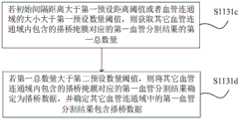
s1131c, if the initial separation distance is greater than the first preset distance threshold or the size of the blood vessel connected domain is greater than the first preset number threshold, obtain a first total number of the first blood vessel segmentation results corresponding to the bypass masks included in the other blood vessel connected domains.
Specifically, for each blood vessel connected domain, the computer device may determine whether each initial interval distance corresponding to the current blood vessel connected domain in the distance field of the heart chamber is greater than a first preset distance threshold, and if the determination result is yes, the current blood vessel connected domain is not considered, at this time, each blood vessel connected domain other than the current blood vessel connected domain may be obtained, and a first total number of blood vessel segmentation results corresponding to all the bypass masks included in each of the other blood vessel connected domains is obtained; each of the other blood vessel connected regions has a corresponding first total number, and the first total number may be greater than or equal to 1.
Meanwhile, the first total number may be determined in another manner, specifically, the computer device may further calculate the size of each blood vessel connected domain first, determine whether the size of the current blood vessel connected domain is larger than a first preset number threshold, if the determination result is yes, disregard the current blood vessel connected domain, and simultaneously obtain the first total number of the blood vessel segmentation results corresponding to all the bypass masks included in each of the other blood vessel connected domains except the current blood vessel connected domain. The size of the vessel connectivity domain may be understood as the total number of vessel segmentation points contained within the vessel connectivity domain.
In addition, for each blood vessel connected domain, the computer device may further determine whether each initial separation distance corresponding to the current blood vessel connected domain in the distance field of the heart chamber is greater than or equal to a first preset distance threshold, and if the determination result is yes, the current blood vessel connected domain is not considered, at this time, other blood vessel connected domains outside the current blood vessel connected domain may be obtained, and a first total number of blood vessel segmentation results corresponding to all the bypass masks included in each of the other blood vessel connected domains is obtained; or, the size of each blood vessel connected domain may be calculated first, whether the size of the current blood vessel connected domain is greater than or equal to a first preset number threshold is determined, and if the size of the current blood vessel connected domain is greater than or equal to the first preset number threshold, the current blood vessel connected domain is not considered, and a first total number of blood vessel segmentation results corresponding to all the bypass masks included in each of the blood vessel connected domains other than the current blood vessel connected domain is obtained.
It can be understood that the specific numerical values of the first preset distance threshold and the first preset number threshold are not limited, and may be set by a user according to actual requirements in a self-defined manner, or obtained by performing cross validation and taking an average value of each validation result. For different types of preset thresholds, cross validation can be understood as dividing a data set corresponding to the preset threshold into multiple parts, taking one part as a validation set, taking the rest data set as a training set, adjusting the corresponding threshold on the training set each time to enable the threshold to be optimal, and simultaneously obtaining the maximum accuracy on validation, wherein the corresponding threshold is used as the optimal result of each validation, namely the preset threshold. For example, in determining the first preset distance threshold, the data set may be a set corresponding to a plurality of initial separation distances.
S1131d, if the first total number is greater than the second preset number threshold, determining the first blood vessel segmentation result corresponding to the bypass mask included in the other blood vessel connected domain as bypass data, and determining that the first blood vessel segmentation result in the other blood vessel connected domain includes the bypass data.
Further, the computer device may continuously determine whether a first total number of the first blood vessel segmentation results corresponding to the bypass masks included in the other blood vessel connected domains is greater than a second preset number threshold, and if the first total number of the first blood vessel segmentation results corresponding to the bypass masks included in the other blood vessel connected domains is greater than the second preset number threshold, the first blood vessel segmentation results corresponding to all the bypass masks included in the other blood vessel connected domains may be determined as bypass data. In addition, the computer device may further determine whether a first total number of the first blood vessel segmentation results corresponding to the bypass masks included in the other blood vessel connected domains is equal to a second preset number threshold, and if the first total number of the first blood vessel segmentation results corresponding to the bypass masks included in the other blood vessel connected domains is equal to the second preset number threshold, the first blood vessel segmentation results corresponding to all the bypass masks included in the other blood vessel connected domains may be determined as bypass data. Optionally, the second preset number threshold and the first preset number threshold may be equal, and the specific determination method may also be the same. In the present embodiment, the steps in S1131b and S1131d described above are performed for each vessel connected domain, that is, it is determined that the first vessel segmentation result in each vessel connected domain contains the bypass data.
The bypass reconstruction method can determine whether the first blood vessel segmentation result contains bypass data or not, and further obtains a target blood vessel mask corresponding to the whole blood vessel in the heart segmentation result when the first blood vessel segmentation result in the blood vessel connected domain contains the bypass data, so that the accuracy and the integrity of the obtained blood vessel mask can be improved.
As an embodiment, the step of acquiring the bypass reconstruction information according to the target blood vessel mask in S1200 may include: and carrying out post-processing through a target blood vessel mask and a blood vessel segmentation result to obtain a bridging starting point, a bridging path track and an anastomotic stoma of a bridging and a normal blood vessel in the bridging reconstruction information.
Specifically, the post-processing may be at least one of comparison processing, arithmetic processing, screening processing, analysis processing, and the like. That is, the computer device may perform transformation processing, comparison processing, arithmetic processing, screening processing, and/or analysis processing, and the like on the target blood vessel mask, the first blood vessel segmentation result, and the second blood vessel segmentation result to obtain the bypass reconstruction information, or merge the first blood vessel segmentation result and the second blood vessel segmentation result based on the target blood vessel mask and then determine the bypass reconstruction information according to the merged result.
In order to reduce the computation amount, the bridge reconstruction can be implemented only by determining the bridge starting point, the bridge path trajectory, and the anastomotic orifice of the bridge and the normal blood vessel in the bridge reconstruction information, and therefore, in this embodiment, the bridge reconstruction information may include the bridge starting point, the bridge path trajectory, and the anastomotic orifice of the bridge and the normal blood vessel. The number of the starting points of the bypass, the path tracks of the bypass and the anastomotic stoma of the bypass and the normal blood vessel can be all more than 1.
Fig. 7a is a schematic diagram of a multi-frame cardiac image of a diagnosis object, a cardiac segmentation result corresponding to the cardiac image, a first blood vessel segmentation result, an initial blood vessel mask corresponding to the first blood vessel segmentation result, a first blood vessel segmentation result and a second blood vessel segmentation result (i.e., a blood vessel segmentation result of an entire blood vessel region on the heart), a target blood vessel mask corresponding to the first blood vessel segmentation result and the second blood vessel segmentation result, and a bypass reconstruction result. The vessel masks corresponding to different vessel segmentation points are different, so that the label values corresponding to the vessel segmentation points of different vessel masks are different, and the vessel segmentation points of different vessel masks in the images corresponding to the initial vessel mask and the target vessel mask show different label values.
The bridging reconstruction method can perform post-processing through the complete blood vessel mask and the complete blood vessel segmentation result to obtain bridging reconstruction information, thereby improving the integrity and the accuracy of the bridging reconstruction information and further improving the accuracy of the bridging reconstruction result.
Second bridging reconstruction method
The bridging reconstruction method can be illustrated in detail by the following examples:
fig. 8 is a schematic flowchart of a bridge reconstruction method according to an embodiment, which is described by taking the example that the method is applied to the computer device in fig. 1, and includes the following steps:
s2000, obtaining a heart segmentation result and a blood vessel segmentation result.
Specifically, the computer device may input a plurality of frames of cardiac images of the diagnosis object to a heart segmentation model trained in advance to obtain a cardiac segmentation result, further draw a blood vessel range according to the cardiac segmentation result, and perform blood vessel segmentation on data corresponding to the blood vessel range to obtain a blood vessel segmentation result. Alternatively, the blood vessel segmentation result may be a segmentation result corresponding to the whole blood vessel region in the heart segmentation result. The cardiac image may be a three-dimensional CT enhanced image in dicom format. The heart segmentation result may be a heart segmentation image including each chamber of the heart, the aorta and the aortic arch, and each chamber of the heart, the aorta and the aortic arch in the heart segmentation image have corresponding labels to distinguish different tissues in the heart segmentation image, and each chamber of the heart may be a left atrium, a right atrium, a left ventricle and a right ventricle of the heart. The heart segmentation result may be represented by heart segmentation data including the respective chambers of the heart, the aorta, and the aortic arch.
It is understood that the pre-trained heart segmentation model may be composed of at least one of a convolutional neural network model, a cyclic neural network model, and an antagonistic neural network model; the computer equipment can perform network model training on the initial heart segmentation model through a heart image training set to obtain a pre-trained heart segmentation model.
Meanwhile, the heart segmentation result can be taken as a whole to determine the range of the blood vessel. The computer equipment can extend the range of the heart region in the heart segmentation result outwards for a certain preset range to obtain a blood vessel range, and further inputs the blood vessel range into a blood vessel segmentation model trained in advance to obtain a blood vessel segmentation result. The preset range can be self-defined according to actual conditions, and only the range of the blood vessel is ensured to be smaller than the range of the heart image. If the heart segmentation result is represented by the heart segmentation image, the blood vessel range can be represented by an image obtained by extending the heart segmentation image outwards by a certain preset range; if the heart segmentation result is represented by the heart segmentation data, the blood vessel range may be represented by the heart segmentation data corresponding to an image obtained by extending the heart segmentation image outward by a certain preset range. The blood vessel segmentation result may be a binary blood vessel segmentation result.
The pre-trained blood vessel segmentation model may be composed of at least one of a convolutional neural network model, a cyclic neural network model, and an antagonistic neural network model, and if the pre-trained blood vessel segmentation model and the pre-trained heart segmentation model have the same structure, network parameters of the pre-trained blood vessel segmentation model and the pre-trained heart segmentation model may be different after the pre-trained blood vessel segmentation model and the pre-trained heart segmentation model are trained by the network model. The computer equipment can perform network model training on the initial vessel segmentation model through a vessel range training set to obtain a vessel segmentation model trained in advance.
In addition, both the heart segmentation model and the blood vessel segmentation model may complete the network model training before the present embodiment performs S2000.
S2100, obtaining a target blood vessel mask according to the heart segmentation result, the blood vessel segmentation result and the segmentation model.
Specifically, the computer device may process the heart segmentation result and the blood vessel segmentation result to obtain a processing result, and input the processing result to the segmentation model to obtain a multi-vessel mask corresponding to each point in the blood vessel segmentation result, that is, a target blood vessel mask, or directly input the heart segmentation result and the blood vessel segmentation result to the segmentation model to obtain a multi-vessel mask corresponding to each point in the blood vessel segmentation result, that is, a target blood vessel mask. In the present embodiment, both the heart segmentation result and the blood vessel segmentation result may be understood as images or data.
It can be understood that the segment model may be a pre-trained neural network model, and the segment model may be composed of at least one of a convolutional neural network model, a cyclic neural network model, and an antagonistic neural network model, and if the pre-trained segment model is the same as the pre-trained blood vessel segmentation model and the pre-trained heart segmentation model in structure, network parameters of the pre-trained segment model, the pre-trained blood vessel segmentation model, and the pre-trained heart segmentation model may be different. In addition, the above-mentioned segment model may complete the network model training before the present embodiment performs S2100.
It should be noted that, the computer device may input the heart segmentation result and data in the training set corresponding to the blood vessel segmentation result of the whole blood vessel in the heart segmentation result to the initial segmentation model to obtain a blood vessel prediction mask, calculate a prediction error value between the blood vessel prediction mask and the standard blood vessel mask through a loss function, update an initial network parameter in the initial segmentation model according to the prediction error value, and continuously iterate the training steps until the prediction error value meets a preset error threshold or the iteration number reaches a preset iteration number threshold, so as to obtain a pre-trained segmentation model. The standard blood vessel mask may be an idealized blood vessel mask corresponding to the entire blood vessel. In this embodiment, the blood vessel prediction mask output by the segmented model may be a blood vessel mask corresponding to the whole blood vessel.
S2200, obtaining bypass reconstruction information based on the target blood vessel mask and the blood vessel segmentation result, wherein the bypass reconstruction information comprises a bypass starting point and an anastomotic stoma of a bypass and a normal blood vessel.
Specifically, the computer device may perform transformation processing, comparison processing, operation processing, screening processing, and/or analysis processing on the target blood vessel mask and the blood vessel segmentation result to obtain bridging reconstruction information, or screen target bridging data from the target blood vessel mask according to a preset condition, and analyze the target bridging data and the blood vessel segmentation result to determine the bridging reconstruction information. The target vessel mask described above may be understood as a multiple vessel label mask. The bridging reconstruction information may include at least one of a bridging path trajectory, a range in which the bridging path trajectory is located, a bridging start point and a bridging end point in the bridging path trajectory, a size of the bridging path trajectory, and each passing point in the bridging path trajectory. However, in the present embodiment, the bypass reconstruction information may include a bypass starting point and an anastomotic orifice of the bypass and the normal blood vessel. The anastomotic orifice of the bypass and the normal blood vessel may be understood as a connection point of the bypass and the normal blood vessel.
And S2300, processing the bridging reconstruction information to obtain a bridging reconstruction result.
Specifically, the computer device may process the bypass reconstruction information to obtain a three-dimensional heart bypass model map, i.e., a bypass reconstruction result. In addition, the computer equipment can also perform segmentation processing on the normal blood vessel to obtain the center line information of all the blood vessels, and then perform processing through the center line information of all the blood vessels and the bridging reconstruction information to obtain a bridging reconstruction result. Further, the computer equipment can output the bridging reconstruction result and display the bridging reconstruction result for the doctor to check so that the doctor can make regular return visits to the diagnosis and treatment object according to the bridging reconstruction result.
In the bridging reconstruction method, the computer device can obtain a heart segmentation result and a blood vessel segmentation result, obtain a target blood vessel mask according to the heart segmentation result, the blood vessel segmentation result and the segmentation model, obtain bridging reconstruction information according to the target blood vessel mask, and process the bridging reconstruction information to obtain a bridging reconstruction result; according to the method, the bridging reconstruction information is obtained through the neural network model, and the bridging reconstruction result is determined through the bridging reconstruction information reconstruction, so that manual reconstruction of a bridging model can be avoided, human resources and bridging reconstruction time are saved, the bridging reconstruction cost is reduced, and the bridging reconstruction efficiency is further improved; meanwhile, the method realizes bridging reconstruction through the neural network model, and can avoid reconstruction errors in the process of manual participation in reconstruction, thereby improving the accuracy of bridging reconstruction.
As an embodiment, as shown in fig. 9, the step of obtaining the bypass reconstruction information based on the target blood vessel mask and the blood vessel segmentation result in S2200 above may be implemented by:
s2210, obtaining a blood vessel central line through the blood vessel segmentation result.
Specifically, the computer device may perform skeletonization on the blood vessel segmentation result to obtain at least one blood vessel centerline. All the vessel segmentation results may be represented by a vessel segmentation image, and each vessel segmentation result may be understood as vessel segmentation data. The above skeletonization process may be understood as reducing a binary object to a 1-pixel wide representation.
Or, the computer device may further determine, through the blood vessel segmentation image, a starting blood vessel layer of the starting blood vessel section of the blood vessel and a terminating blood vessel layer of the terminating blood vessel section of the blood vessel, and use a center of the starting blood vessel layer of the starting blood vessel section as a starting point of the blood vessel center line, and use a center of the terminating blood vessel layer of the terminating blood vessel section as an end point of the blood vessel center line, and then extract the blood vessel center line in the blood vessel segmentation image by using a maximum inscribed sphere method according to the starting point and the end point of the blood vessel center line. Of course, other methods may be used to obtain the blood vessel centerline from the blood vessel segmentation result, which is not limited to this.
S2220, determining a bridging candidate point according to all the blood vessel points on the blood vessel central line.
Specifically, the computer device may acquire all the vessel points on the centerline of each vessel, and use part of the vessel points as the candidate points for bridging. The bridging candidate points may be part of the leading and/or trailing points on the centerline of each vessel.
As shown in fig. 10, the step of determining a candidate bridging point according to all blood vessel points on the blood vessel center line in S2220 may specifically include:
s2221, a blood vessel point set corresponding to all blood vessel points on a blood vessel central line is obtained, and blood vessel end points in the blood vessel point set are obtained.
It can be understood that the computer device can acquire all the blood vessel points on the blood vessel center line and store the blood vessel points into the blood vessel point set, and during the storage, the blood vessel points can be stored together with respective coordinates, and meanwhile, two end points on each blood vessel center line can be screened out from all the blood vessel points, and the coordinates of the two end points on each blood vessel center line can be obtained. Further, the end points of each vessel centerline may be traversed in turn, and each traversed end point may be taken as a vessel end point.
Alternatively, each vessel centerline may correspond to a set of vessel points, and the order of the different vessel points stored in the set of vessel points may be equal to the position order of all vessel points from any one end point of the vessel to the other end point of the vessel on the corresponding vessel centerline.
S2222, a preset number of target blood vessel points including blood vessel end points in the blood vessel point set are determined.
It should be noted that the computer device may determine, based on all the blood vessel points in the blood vessel point sets, a preset number of target blood vessel points before or after the blood vessel end point containing the corresponding blood vessel centerline in each blood vessel point set respectively. The preset number may be smaller than or equal to the total number of all the blood vessel points on the center line of the blood vessel where the current blood vessel endpoint is located. All vessel points on each vessel centerline may include two vessel end points on the root vessel centerline.
S2223, determining a bridging candidate point according to the target blood vessel point.
Specifically, the computer device may determine whether a blood vessel endpoint in a preset number of target blood vessel points is a bridging candidate point according to a target blood vessel mask of a preset number of target blood vessel points on a center line of each blood vessel. At least one bypass candidate point may exist among all vessel end points on all vessel centerlines. The bridging candidate point may be represented by a vessel point coordinate.
In this embodiment, candidate bridging points may be screened from all blood vessel points on the blood vessel centerline, and a bridging start point may be further determined based on the candidate bridging points.
And S2230, determining a bridging starting point based on the bridging candidate points.
Specifically, the computer device may directly determine the bridging candidate points as the bridging start points, or determine a part of the candidate points among all the bridging candidate points as the bridging start points. In the present embodiment, the steps in S2221-S2224 described above are performed for each vessel centerline.
The method for reconstructing the bridge can determine the candidate points of the bridge in the blood vessel segmentation result, and then determine the starting point of the bridge through the candidate points of the bridge.
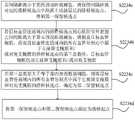
As an embodiment, the step of determining a candidate bridging point according to the target blood vessel point in S2223 may include at least one of the following cases: if the second total number of the target blood vessel points belonging to the bridged blood vessel points is larger than a third preset number threshold, determining the blood vessel end points in all the target blood vessel points as bridged candidate points; and if the distance between each target blood vessel point and the highest point in the heart chamber is greater than a second preset distance threshold, determining the blood vessel end points in all the target blood vessel points as bridging candidate points. And if the minimum distance between the vessel end point of all the target vessel points and the aortic arch is smaller than a third preset distance threshold, determining the vessel end point as a bypass candidate point.
Specifically, the computer device may obtain a total number (i.e., a second total number) of target blood vessel points belonging to the bypass mask in a preset number of target blood vessel points, and at the same time, calculate a distance between each target blood vessel point in the preset number of target blood vessel points and a highest point in the heart chamber, and then determine whether the second total number is greater than a third preset number threshold, and/or whether distances between each target blood vessel point in the preset number of target blood vessel points and the highest point in the heart chamber are both greater than a second preset distance threshold, and if the determination result is yes, may determine a blood vessel endpoint in the preset number of target blood vessel points as a bypass candidate point; otherwise, if it is determined that the second total number is smaller than or equal to the third preset number threshold, and/or at least one of the distances between each target blood vessel point in the preset number of target blood vessel points and the highest point in the heart chamber is smaller than or equal to the second preset distance threshold, filtering out the current preset number of target blood vessel points, that is, in this case, no bridging candidate points exist in the current preset number of target blood vessel points.
Of course, the computer device may further determine whether the second total number is equal to a third preset number threshold, and/or whether a distance between each target blood vessel point in the preset number of target blood vessel points and the highest point in the heart chamber is greater than or equal to the second preset distance threshold, and if the determination result is yes, may determine a blood vessel endpoint in the preset number of target blood vessel points as a candidate bridging point; otherwise, if it is determined that the second total number is smaller than the third preset number threshold, and/or at least one of the distances between each of the preset number of target blood vessel points and the highest point in the heart chamber is smaller than the second preset distance threshold, filtering out the current preset number of target blood vessel points, that is, in this case, no bridging candidate points exist in the current preset number of target blood vessel points. Optionally, a distance between each target blood vessel point in the preset number of target blood vessel points and a highest point in the heart chamber region may be understood as a distance above the heart, where the highest point in the heart chamber region may be a point corresponding to a maximum coordinate of the heart chamber in the coronary position.
Meanwhile, the computer device can also calculate the minimum distance between the blood vessel end points in the preset number of target blood vessel points and the aortic arch, and whether the minimum distance between the blood vessel end points and the aortic arch is smaller than or equal to a third preset distance threshold value or not, if so, the blood vessel end points in the preset number of target blood vessel points can be determined as bridging candidate points; otherwise, if the minimum distance between the blood vessel endpoint and the aortic arch is less than or equal to the third preset distance threshold, filtering out the current preset number of target blood vessel points, that is, in this case, there is no candidate bridging point in the current preset number of target blood vessel points.
It can be understood that the third preset number threshold, the second preset distance threshold, and the third preset distance threshold may be equal or unequal, and may be determined according to actual situations. In this embodiment, the third predetermined number threshold may be greater than 1/2, which is a predetermined number, and the predetermined number may be equal to 50, the second predetermined distance threshold may be equal to 0.5cm, and the third predetermined distance threshold may be equal to 1.5 cm.
The method for reconstructing the bridge can determine the candidate bridge points in the blood vessel segmentation result, further can narrow the candidate range of the bridge starting point, reduce the calculation amount for determining the bridge starting point, improve the determination speed of the bridge starting point, and can quickly obtain the bridge starting point in a short time.
As an embodiment, as shown in fig. 11, the determining of the bridging start point based on the bridging candidate point in the above S2230 may be implemented by:
and S2231, determining a target blood vessel connected domain according to the blood vessel segmentation result.
Specifically, the computer device may select any one of all blood vessel segmentation points corresponding to a blood vessel segmentation result of the entire blood vessel region as a reference point, obtain a preset number of blood vessel segmentation points around the reference point, determine, according to the target blood vessel mask, all blood vessel segmentation points that are blood vessel masks among the reference point and the preset number of blood vessel segmentation points around the reference point, and use, as a target blood vessel connected domain, all blood vessel segmentation points that are blood vessel masks among the reference point and the preset number of blood vessel segmentation points, and at the same time, the computer device may traverse each blood vessel segmentation point corresponding to the blood vessel segmentation result, and then determine the target blood vessel connected domain corresponding to each blood vessel segmentation point. If the blood vessel segmentation result is the corresponding three-dimensional image, the preset number of all the blood vessel segmentation points corresponding to the blood vessel segmentation result plus 1 blood vessel segmentation point (namely the reference point and the preset number of blood vessel segmentation points around the reference point) can be selected to determine the target blood vessel connected domain. At least one other blood vessel division point can be found in the target blood vessel connected domain to which any one blood vessel division point belongs, the selected current blood vessel division point is connected, and at least one other blood vessel division point can be found in the same neighborhood (a preset number of blood vessel division points are arranged around the blood vessel division points, namely a preset number of neighborhoods) and is connected with the current blood vessel division point. In this embodiment, the preset number may be any number, as long as it is ensured that any one blood vessel segmentation point can find at least one other blood vessel segmentation point in the target blood vessel connected domain to be connected therewith.
It should be noted that each target vessel connected domain may be a set of a plurality of vessel segmentation points.
S2232, determining a target blood vessel connected domain to which the bridging candidate point belongs according to the bridging candidate point and the target blood vessel connected domain.
Specifically, for each bridging candidate point, the computer device may match the bridging candidate point with a blood vessel segmentation point in the target blood vessel connected domain, and determine the target blood vessel connected domain to which the successfully matched bridging candidate point belongs. Alternatively, the target vascular connectivity domain to which the bridging candidate point belongs may be any one of all the target vascular connectivity domains.
S2233, obtaining the spacing distance between every two bridging candidate points in the target blood vessel connected domain.
It will be appreciated that the computer device may employ an euclidean distance, a manhattan distance, a cosine distance, a minkowski distance or a chebyshev distance calculation method to calculate the separation distance between two-by-two bridging candidate points of all bridging candidate points within the target vessel connected domain to which the bridging candidate point belongs. At least two bridging candidate points may be included in the target vascular connectivity domain to which the bridging candidate points belong. If the target vascular connectivity domain to which the bridging candidate points belong includes n (n >2) bridging candidate points, every two bridging candidate points in the n bridging candidate points can determine a spacing distance, and the n bridging candidate points can determine n x (n-1)/2 spacing distances.
And S2234, determining a bridge starting point according to the spacing distance.
It should be noted that the computer device may compare the separation distance with a preset distance threshold, and determine whether the bridging candidate point is the bridging starting point according to the comparison result. The comparison result may be that the separation distance is greater than, less than, or equal to a preset distance threshold. In this embodiment, the preset distance threshold may be any value, which is not limited herein.
The bridging reconstruction method can determine a bridging starting point through the bridging candidate point, and further process the bridging starting point to obtain a bridging reconstruction result; the method avoids manual participation, can save human resources and time for determining the bridging starting point, reduces the cost for determining the bridging starting point, simultaneously does not need manual participation for determining the bridging starting point, can improve the accuracy of the determined bridging starting point, and further improves the accuracy of a bridging reconstruction result; in addition, the method can determine the bridging starting point in a smaller range, thereby reducing the calculation amount for determining the bridging starting point, improving the determination speed of the bridging starting point, rapidly acquiring the bridging starting point in a short time and further improving the bridging reconstruction efficiency.
As an embodiment, as shown in fig. 12, the step of determining a bridge starting point according to the separation distance in S2234 may specifically include the following steps:
and S2234a, if the interval distance is smaller than a fourth preset distance threshold, retaining a bridging candidate point closest to the aorta from among the bridging candidate points corresponding to the interval distance, and obtaining a first retained candidate point.
It should be noted that the computer device may determine whether the interval distance corresponding to each bridging candidate point is less than or equal to a fourth preset distance threshold, if so, retain a bridging candidate point closest to the aorta among all bridging candidate points corresponding to each interval distance, and use the retained bridging candidate point as the first retained candidate point. The interval distance corresponding to the bridging candidate point may be an interval distance between every two bridging candidate points in all bridging candidate points in the target blood vessel connected domain to which the bridging candidate point belongs. The fourth preset distance threshold, the second preset distance threshold and the third preset distance threshold may be equal or unequal, and may be determined according to actual conditions. In this embodiment, the fourth preset distance threshold may be equal to 0.5 cm.
S2234b, if the distance between the bridging candidate points in the target blood vessel connected domain and the outer surface of the heart chamber is greater than a fifth preset distance threshold, acquiring a third total number of bridging candidate points belonging to a left anterior descending branch mask and/or a diagonal branch mask in all blood vessel segmentation points in the target blood vessel connected domain according to the target blood vessel mask; the target vessel mask includes a left anterior descending branch mask and/or a diagonal branch mask.
Specifically, the computer device may determine whether distances between all the bridging candidate points in each target blood vessel connected domain and the outer surface of the heart chamber are greater than a fifth preset distance threshold, and if the determination result is yes, these bridging candidate points may be regarded as intramammary artery bridging data, and at this time, a total number of the bridging candidate points belonging to a left anterior descending branch mask and/or a diagonal branch mask among all the blood vessel segmentation points in the target blood vessel connected domain, that is, a third total number, may be obtained according to the target blood vessel mask. In addition, the computer device may further determine whether distances between all the bridging candidate points in each target blood vessel connected domain and the outer surface of the heart chamber are equal to a fifth preset distance threshold, and if the determination result is yes, these bridging candidate points may also be regarded as the intra-mammary artery bridging data. The fifth preset distance threshold, the fourth preset distance threshold, the second preset distance threshold and the third preset distance threshold may be equal or unequal, and may be determined according to actual conditions. In this embodiment, the fifth preset distance threshold may be equal to 5 cm.
In addition, the computer device may determine whether the closest distances between all the bridging candidate points in the target blood vessel connected domain to which the bridging candidate points belong and the outer surface of the heart chamber are greater than a preset distance, and if so, the bridging candidate points may be discarded. The preset distance can be determined according to actual conditions. In this embodiment, the preset distance may be equal to 0.5 cm.
And S2234c, if the third total number is greater than or equal to a fourth preset number threshold, determining the bridging candidate points belonging to the left front descending branch mask and the diagonal branch mask in all the blood vessel segmentation points in the target blood vessel connected domain as second reserved candidate points.
Specifically, the computer device may determine whether the third total number is greater than or equal to a fourth preset number threshold, and if the determination result is yes, may reserve bridging candidate points that belong to a left front descending branch mask or a diagonal branch mask among all blood vessel segmentation points in the target blood vessel connected domain, and determine these bridging candidate points as second reserved candidate points. The fourth preset number threshold may be determined according to actual conditions.
And S2234d, determining the first and second reserved candidate points as the bridging starting points.
Further, the computer device may determine the acquired first and second reservation candidate points as respective bridging start points. The number of bridging start points may be equal to the total number of first and second remaining candidate points.
The bridging starting point can be determined by the bridging reconstruction method, and then the bridging reconstruction result is obtained by processing the bridging starting point; the method avoids manual participation, can save human resources and time for determining the bridging starting point, reduces the cost for determining the bridging starting point, simultaneously does not need manual participation for determining the bridging starting point, can improve the accuracy of the determined bridging starting point, and further improves the accuracy of a bridging reconstruction result; in addition, the method can determine the bridging starting point in a smaller range, thereby reducing the calculation amount for determining the bridging starting point, improving the determination speed of the bridging starting point, rapidly acquiring the bridging starting point in a short time and further improving the bridging reconstruction efficiency.
As an embodiment, as shown in fig. 13, the step of obtaining the bypass reconstruction information based on the target blood vessel mask and the blood vessel segmentation result in S2200 above may be implemented by:
and S2240, determining a corresponding blood vessel segmentation point according to the blood vessel segmentation result.
Specifically, the blood vessel segmentation result may be blood vessel segmentation data. The blood vessel segmentation data can be in the form of point coordinates and displayed in a coordinate system, and each blood vessel segmentation result has a corresponding blood vessel segmentation point.
S2250, sequentially backtracking each blood vessel segmentation point from the tail point of the bypass to the start point of the bypass along the route track of the bypass, and determining an anastomotic stoma of the bypass and a normal blood vessel according to a target blood vessel mask of the blood vessel segmentation point.
Specifically, the computer device may sequentially trace back each blood vessel segmentation point from a bridging tail point to a bridging start point along each bridging path trajectory, and according to a target blood vessel mask of the traced back blood vessel segmentation point, may determine any one of the traced back blood vessel segmentation points as an anastomotic stoma of the bridging and the normal blood vessel. The number of anastomoses of the determined bypass with the normal blood vessel may be 1 or more. In this embodiment, the bridging track may be predetermined, and the bridging end point may be a predetermined bridging end point in the bridging track.
In S2250, the step of determining the anastomotic stoma of the bypass and the normal blood vessel according to the target blood vessel mask of the blood vessel segmentation point may include: and if the bypass tail point is determined to be the blood vessel mask point according to the target blood vessel mask of the blood vessel segmentation point, and the backtracking is stopped when the current blood vessel segmentation point is the bypass mask point, determining the current blood vessel segmentation point as the anastomotic stoma of the bypass and the normal blood vessel.
It should be noted that, if the backtracked bypass tail point is determined to be the blood vessel mask point according to the target blood vessel mask of each blood vessel segmentation point, and the backtracking is stopped when the computer device backtracks that the current blood vessel segmentation point in the bypass path trajectory to which the bypass tail point belongs is the bypass mask point, at this time, the computer device may determine the backtracked current blood vessel segmentation point as the anastomotic stoma of the bypass and the normal blood vessel. In this case, the anastomotic stoma of the bypass and the normal blood vessel may be a bypass starting point, or may be any blood vessel segmentation point between the bypass tail point and the bypass starting point. The blood vessel mask point can be understood as a blood vessel division point of which the target blood vessel mask is the blood vessel mask; the above-mentioned bypass mask points may be understood as blood vessel segmentation points where the target blood vessel mask is a bypass mask.
In S2250, the step of determining an anastomotic stoma between the bypass and the normal blood vessel according to the target blood vessel mask of the blood vessel segmentation point may further include: if the bypass tail point is a bypass mask point, the backtracking is stopped when the current blood vessel division point is a blood vessel mask point, and the current blood vessel division point is determined as an anastomotic stoma of the bypass and the normal blood vessel.
It can be understood that, if the backtracked bypass tail point is determined to be the bypass mask point according to the target blood vessel mask of each blood vessel segmentation point, at this time, the computer device may continue to backtrack forward, and stop backtracking when the current blood vessel segmentation point in the bypass path trajectory to which the bypass tail point belongs is the blood vessel mask point, at this time, the current blood vessel segmentation point may be determined to be the anastomotic stoma of the bypass and the normal blood vessel.
Meanwhile, the step of determining the anastomotic stoma of the bypass and the normal blood vessel according to the target blood vessel mask of the blood vessel segmentation point in S2250 may further include: and if all the traced blood vessel segmentation points between the current blood vessel segmentation point and the bridging tail point are bridging mask points, and the tracing distance between the current blood vessel segmentation point and the bridging tail point is greater than a preset distance threshold, determining the bridging tail point as an anastomotic stoma of the bridging and the normal blood vessel.
It can be understood that, if all the vessel segmentation points (including the current vessel segmentation point and the bridging tail point) between the current vessel segmentation point and the bridging tail point traced back by the computer device are bridging mask points, and the tracing back distance between the current vessel segmentation point and the bridging tail point is greater than or equal to a sixth preset distance threshold, at this time, the bridging tail point may be determined as an anastomotic stoma of the bridging and the normal vessel. And the backtracked current blood vessel segmentation point and the corresponding bypass tail point are on the same bypass path track. The sixth preset distance threshold may be determined according to actual conditions, and specific numerical values are not limited. In this embodiment, the sixth preset distance threshold may be equal to 3 cm.
The method for reconstructing the bypass can determine the anastomotic stoma of the bypass and the normal blood vessel, and further obtains the reconstruction result of the bypass by processing the anastomotic stoma, the starting point of the bypass and the tail point of the bypass and the normal blood vessel.
Third bridging reconstruction method
The bridging reconstruction method can be illustrated in detail by the following examples:
fig. 14 is a schematic flowchart of a bridge reconstruction method according to an embodiment, which is described by taking the method as an example applied to the computer device in fig. 1, and includes the following steps:
s3000, obtaining a heart segmentation result and a blood vessel segmentation result.
Specifically, the computer device may input a plurality of frames of cardiac images of the diagnosis and treatment object to a heart segmentation model trained in advance to obtain a heart segmentation result, further determine a blood vessel range according to the heart segmentation result, and perform blood vessel segmentation on the blood vessel range to obtain a blood vessel segmentation result. Alternatively, the blood vessel segmentation result may be a segmentation result corresponding to the whole blood vessel region in the heart segmentation result. The cardiac image may be a three-dimensional CT enhanced image in dicom format. The heart segmentation result may be a heart segmentation image including each chamber of the heart, the aorta and the aortic arch, and each chamber of the heart, the aorta and the aortic arch in the heart segmentation image have corresponding labels to distinguish different tissues in the heart segmentation image, and each chamber of the heart may be a left atrium, a right atrium, a left ventricle and a right ventricle of the heart. The heart segmentation result may be represented by heart segmentation data including the respective chambers of the heart, the aorta, and the aortic arch.
It is understood that the pre-trained heart segmentation model may be composed of at least one of a convolutional neural network model, a cyclic neural network model, and an antagonistic neural network model; specifically, the computer device can input the heart images in the heart image training set into the initial heart segmentation model to obtain a heart segmentation prediction result, calculate a prediction error value between the heart segmentation prediction result and a standard heart segmentation result through a loss function, update initial network parameters in the initial heart segmentation model according to the prediction error value, and continuously iterate the training steps until the prediction error value meets a preset error threshold or the iteration number reaches a preset iteration number threshold, so as to obtain the heart segmentation model trained in advance. The heart image training set may be a set of heart images of different diagnosis objects, and the standard heart segmentation result may be an idealized heart segmentation result.
Meanwhile, the heart segmentation result can be taken as a whole to determine the range of the blood vessel. The computer equipment can extend the heart segmentation result outwards to a certain preset range to obtain a blood vessel range, and further inputs the blood vessel range into a pre-trained blood vessel segmentation model to obtain a blood vessel segmentation result. The preset range can be self-defined according to actual conditions, and only the range of the blood vessel is ensured to be smaller than the range of the heart image. If the heart segmentation result is represented by the heart segmentation image, the blood vessel range can be represented by an image obtained by extending the heart segmentation image outwards by a certain preset range; if the heart segmentation result is represented by the heart segmentation data, the blood vessel range may be represented by the heart segmentation data corresponding to an image obtained by extending the heart segmentation image outward by a certain preset range. The blood vessel segmentation result may be a binary blood vessel segmentation result.
The pre-trained blood vessel segmentation model may be composed of at least one of a convolutional neural network model, a cyclic neural network model, and an antagonistic neural network model, and if the pre-trained blood vessel segmentation model and the pre-trained heart segmentation model have the same structure, network parameters of the pre-trained blood vessel segmentation model and the pre-trained heart segmentation model may be different after the pre-trained blood vessel segmentation model and the pre-trained heart segmentation model are trained by the network model. Specifically, the computer device can input blood vessel data corresponding to the blood vessel range in the blood vessel range training set into the initial blood vessel segmentation model to obtain a blood vessel segmentation prediction result, calculate a prediction error value between the blood vessel segmentation prediction result and a standard blood vessel segmentation result through a loss function, update initial network parameters in the initial blood vessel segmentation model according to the prediction error value, and continuously iterate the training steps until the prediction error value meets a preset error threshold or the iteration number reaches a preset iteration number threshold, so as to obtain the pre-trained blood vessel segmentation model. The blood vessel range training set may be a set of blood vessel range data corresponding to different diagnosis and treatment objects, and the standard blood vessel segmentation result may be an idealized blood vessel segmentation result.
In addition, both the heart segmentation model and the blood vessel segmentation model may complete the network model training before the present embodiment performs S3000.
And S3100, acquiring a target blood vessel mask according to the heart segmentation result, the blood vessel segmentation result and the segmentation model.
Specifically, the computer device may process the heart segmentation result and the blood vessel segmentation result to obtain a processing result, and input the processing result to the segmentation model to obtain a multi-vessel mask corresponding to each point in the blood vessel segmentation result, that is, a target blood vessel mask, or directly input the heart segmentation result and the blood vessel segmentation result to the segmentation model to obtain a multi-vessel mask corresponding to each point in the blood vessel segmentation result, that is, a target blood vessel mask. In the present embodiment, both the heart segmentation result and the blood vessel segmentation result may be understood as images or data.
It can be understood that the segment model may be a pre-trained neural network model, and the segment model may be composed of at least one of a convolutional neural network model, a cyclic neural network model, and an antagonistic neural network model, and if the pre-trained segment model is the same as the pre-trained blood vessel segmentation model and the pre-trained heart segmentation model in structure, network parameters of the pre-trained segment model, the pre-trained blood vessel segmentation model, and the pre-trained heart segmentation model may be different. In addition, the above-mentioned segmentation model may complete the network model training before the present embodiment performs S3100.
S3200, obtaining bypass reconstruction information based on the target blood vessel mask and the blood vessel segmentation result, wherein the bypass reconstruction information comprises bypass path tracks and anastomotic stoma of bypass and normal blood vessels.
Specifically, the computer device may perform transformation processing, comparison processing, operation processing, screening processing, and/or analysis processing on the target blood vessel mask and the blood vessel segmentation result to obtain bridging reconstruction information, or screen target bridging data from the target blood vessel mask according to a preset condition, and analyze the target bridging data and the blood vessel segmentation result to determine the bridging reconstruction information. The target blood vessel mask may be understood as a multi-blood vessel label mask, and in this embodiment, the target blood vessel mask may include at least one of a blood vessel mask and a Bypass (Bypass) mask. The blood vessel mask may be any one of 15 masks, which are respectively a Right Coronary Artery (RCA) mask, a right posterior descending coronary artery (R-PDA) mask, a left posterior ventricular (R-PLB) mask, a left coronary artery trunk (LM) mask, a Left Anterior Descending (LAD) mask, a diagonal descending (D) mask, a cyclic branch (LCX) mask, a blunt edge branch (OM) mask, a left posterior descending branch (L-PDA) mask, a left posterior left ventricular (L-PLB) mask, a middle branch (RAMUS) mask, an atrial branch (LACX) mask, a sharp edge branch (AM) mask, a front septal branch (S) mask, or a sinus node branch (LSN) mask. The bridging reconstruction information may include at least one of a bridging path trajectory, a range in which the bridging path trajectory is located, a bridging start point and a bridging end point in the bridging path trajectory, a size of the bridging path trajectory, and each passing point in the bridging path trajectory. However, in the present embodiment, the bypass reconstruction information may include a bypass path trajectory and an anastomotic stoma of the bypass and the normal blood vessel.
And S3300, processing the bridging reconstruction information to obtain a bridging reconstruction result.
Specifically, the computer device may process the bypass reconstruction information through the bypass starting point, the acquired bypass path trajectory, and the anastomotic stoma bypass reconstruction information of the bypass and the normal blood vessel to obtain a three-dimensional heart bypass model map, i.e., a bypass reconstruction result. In addition, the computer equipment can also perform segmentation processing on the normal blood vessel to obtain the center line information of all the blood vessels, and then perform processing through the center line information of all the blood vessels and the bridging reconstruction information to obtain a bridging reconstruction result. The bridge starting point may be known information, and may be a starting point in the bridge travel path trajectory. Further, the computer equipment can output the bridging reconstruction result and display the bridging reconstruction result for the doctor to check so that the doctor can make regular return visits to the diagnosis and treatment object according to the bridging reconstruction result.
In the bridging reconstruction method, the computer device can obtain a heart segmentation result and a blood vessel segmentation result, obtain a target blood vessel mask according to the heart segmentation result, the blood vessel segmentation result and the segmentation model, obtain bridging reconstruction information based on the target blood vessel mask and the blood vessel segmentation result, and process the bridging reconstruction information to obtain a bridging reconstruction result; the method comprises the steps of obtaining a target blood vessel mask based on a neural network model, further obtaining bridging reconstruction information based on the target blood vessel mask, and then reconstructing and determining a bridging reconstruction result through the bridging reconstruction information, so that manual reconstruction of a bridging model can be avoided, manpower resources and bridging reconstruction time are saved, bridging reconstruction cost is reduced, and bridging reconstruction efficiency is further improved; meanwhile, the method realizes bridging reconstruction based on the neural network model, and can avoid reconstruction errors in the process of manual participation in reconstruction, thereby improving the accuracy of bridging reconstruction.
In some scenarios, since whether a track map corresponding to the constructed blood vessel segmentation point is complete and accurate may directly affect the integrity and accuracy of the determined bypass path track, in order to improve the integrity and accuracy of the determined bypass path track, in this embodiment, as shown in fig. 15, the step of obtaining the bypass reconstruction information based on the target blood vessel mask and the blood vessel segmentation result in S3200 may be implemented by the following steps:
s3210, determining a target blood vessel connected domain according to the blood vessel segmentation result and the target blood vessel mask.
Specifically, the computer device may select any one of all blood vessel segmentation points corresponding to a blood vessel segmentation result of the entire blood vessel region as a reference point, obtain a preset number of blood vessel segmentation points around the reference point, determine, according to the target blood vessel mask, all blood vessel segmentation points that are blood vessel masks among the reference point and the preset number of blood vessel segmentation points around the reference point, and use, as a target blood vessel connected domain, all blood vessel segmentation points that are blood vessel masks among the reference point and the preset number of blood vessel segmentation points, and at the same time, the computer device may traverse each blood vessel segmentation point corresponding to the blood vessel segmentation result, and then determine the target blood vessel connected domain corresponding to each blood vessel segmentation point.
It should be noted that, if the blood vessel segmentation result is the corresponding three-dimensional image, the preset number of all the blood vessel segmentation points corresponding to the blood vessel segmentation result plus 1 blood vessel segmentation point (that is, the reference point and the preset number of blood vessel segmentation points around the reference point) may be selected to determine the target blood vessel connected domain. At least one other blood vessel division point can be found in the target blood vessel connected domain to which any one blood vessel division point belongs, the selected current blood vessel division point is connected, and at least one other blood vessel division point can be found in the same neighborhood (a preset number of blood vessel division points are arranged around the blood vessel division points, namely a preset number of neighborhoods) and is connected with the current blood vessel division point. The preset number may be any number, as long as it is ensured that any one of the blood vessel segmentation points can find at least one other blood vessel segmentation point in the target blood vessel connected domain to be connected therewith.
S3220, constructing a track map corresponding to the blood vessel segmentation points according to all the corresponding blood vessel segmentation results in the target blood vessel connected domain.
Specifically, the computer device may perform skeletonization on the blood vessel segmentation result to obtain at least one blood vessel centerline. The above skeletonization process may be understood as reducing a binary object to a 1-pixel wide representation. The bridging origin corresponds to the origin on the centerline of the vessel. The number of vessel centerlines may be equal to the number of trackmaps. Each blood vessel center line comprises a plurality of blood vessel division points, and each blood vessel division point has a target blood vessel communication domain to which the blood vessel division point belongs.
Specifically, each blood vessel segmentation result can be understood as a point coordinate, i.e., a blood vessel segmentation point coordinate. The computer device may first establish a dot-shaped graph according to all the corresponding blood vessel segmentation results in each target blood vessel connected domain, and then sequentially connect each adjacent blood vessel segmentation point in the dot-shaped graph from the bridging starting point in the dot-shaped graph according to the position sequence of the bridging starting point in each target blood vessel connected domain and all the blood vessel segmentation points on the center line of each blood vessel to obtain at least one track graph, that is, each track graph includes a plurality of blood vessel segmentation points and edges between every two adjacent blood vessel segmentation points, wherein each edge in the track graph may also be a part of the bridging path track. The number of the trajectory maps corresponding to each target blood vessel connected domain may be greater than or equal to 1, or may be equal to the number of the bridging starting points included in the corresponding target blood vessel connected domain. The edges in the track graph can be understood as the paths in the track graph.
And S3230, sequentially traversing the adjacent blood vessel segmentation points backwards along the track map from the bridging starting point, and determining a bridging path track.
The track graph may be in the form of a straight line or a broken line, which is not limited to this. In this embodiment, the track map may be in a binary tree form, and therefore, the blood vessel segmentation point in the track map may be a blood vessel segmentation point in the bypass path track, or may not be a blood vessel segmentation point in the bypass path track. However, in this embodiment, part of the blood vessel segmentation points in the trajectory graph may be traversed, or all of the blood vessel segmentation points in the trajectory graph may be traversed.
The bridging reconstruction method can determine a target blood vessel communication domain according to a blood vessel segmentation result and a target blood vessel mask, construct a track graph corresponding to a blood vessel segmentation point through all corresponding blood vessel segmentation results in the target blood vessel communication domain, sequentially traverse the adjacent blood vessel segmentation points backwards along the track graph from a bridging starting point, and determine a bridging path track; the process avoids manual construction of a track map corresponding to the blood vessel segmentation point, and can realize map construction through a machine learning algorithm, so that the accuracy and the integrity of a map construction result are improved, the complete and accurate track map can be further traversed, the accuracy and the integrity of the determined bridging path track can be improved, and accurate and complete bridging reconstruction information can be provided for determining a bridging reconstruction result; meanwhile, the method avoids manual work to participate in determining the bridging path track, so that the manpower resource can be saved, and the workload of medical personnel can be reduced.
As an embodiment, as shown in fig. 16, the step of traversing the adjacent blood vessel segmentation points backwards along the trajectory graph from the bridging start point in the above S3230 to determine the bridging path trajectory may be implemented by:
and S3231, sequentially traversing the adjacent blood vessel segmentation points backwards along the trace map from the bridging starting point, and determining a bridging tail point.
Specifically, the computer device may sequentially traverse backward the adjacent blood vessel segmentation points along the bypass starting point in each of the trajectory graphs to determine a bypass tail point in all the blood vessel segmentation points in the corresponding trajectory graph. A tracings graph may include a bridging start point and one or more bridging end points.
S3232, determining a bypass path track according to a bypass starting point, a bypass tail point and a traversed blood vessel segmentation point.
It should be noted that the computer device may determine the bypass trajectory according to the bypass starting point, the bypass end point, and all the blood vessel segmentation points traversed between the bypass starting point and the bypass end point. One track map may include one or more bridging trails. The bridging starting point may be a predetermined bridging point in the bridging path trajectory.
The method for reconstructing the bypass can sequentially traverse the adjacent blood vessel segmentation points backwards along the trace graph from the starting point of the bypass, determine the tail points of the bypass in all the blood vessel segmentation points, and determine the route track of the bypass according to the starting point of the bypass, the tail points of the bypass and the traversed blood vessel segmentation points.
As an embodiment, as shown in fig. 17, the step of traversing the adjacent blood vessel segmentation points backwards along the trajectory diagram in S3231 to determine the bridging tail point may be implemented by the following steps:
s3231a, if the traversed current blood vessel segmentation point is a first bifurcation point, determining at least one second bifurcation point adjacent to the first bifurcation point.
Specifically, if the current blood vessel segmentation point traversed by the computer device is a bifurcation point, i.e., a first bifurcation point, at this time, it may be determined that there are at least two adjacent blood vessel segmentation points after the current blood vessel segmentation point. Further, all the adjacent vessel segmentation points after the first bifurcation point may be referred to as a second intersection point, or one adjacent vessel segmentation point or adjacent partial vessel segmentation points after the first bifurcation point may be referred to as a second intersection point. Wherein the number of first intersections may be equal to 1 and the number of second intersections may be greater than 1.
It should be noted that, at least two blood vessel segmentation points behind the first bifurcation point are in the neighborhood, then all adjacent blood vessel segmentation points behind the first bifurcation point are sequentially processed, if only two blood vessel segmentation points exist in the neighborhood and are blood vessel segmentation points on the edge in the trajectory graph, an unswept blood vessel segmentation point can be selected to continue traversing backwards, if no blood vessel segmentation point exists in the neighborhood, the current second bifurcation point can be determined as a bridging tail point, and if the total number of the blood vessel segmentation points in the neighborhood is greater than 2, the traversed current blood vessel segmentation point is determined as the second bifurcation point.
S3231b, if there is no bridging mask point in all the blood vessel dividing points between the first branch point and each second branch point, determining whether there is a main blood vessel mask point in all the blood vessel dividing points between the first branch point and each second branch point.
It can be understood that the computer device may determine whether a blood vessel segmentation point belonging to a bypass mask exists in all blood vessel segmentation points between the first bifurcation point and any one of the second bifurcation points, and may continue to determine whether a blood vessel segmentation point belonging to a main branch blood vessel mask exists in all blood vessel segmentation points between the first bifurcation point and the current second bifurcation point if it is determined that a bypass mask point does not exist in all blood vessel segmentation points between the first bifurcation point and the current second bifurcation point. The current second cross point may be any one of all the second cross points. The number of bypass mask points in all the blood vessel segmentation points between the first bifurcation point and the current second bifurcation point may be greater than or equal to 0, and the number of main blood vessel mask points in all the blood vessel segmentation points between the first bifurcation point and the current second bifurcation point may be greater than or equal to 0.
It should be noted that the bypass mask point may be understood as a blood vessel segmentation point belonging to the bypass mask. The main branch vessel mask point may be understood as a vessel segmentation point belonging to the main branch vessel mask. One or more other vessel segmentation points may exist between the first intersection point and the second intersection point, and no other vessel segmentation point may exist between the first intersection point and the second intersection point.
And S3231c, if yes, continuously traversing the adjacent blood vessel segmentation points backwards along the track map from each second bifurcation point until the last blood vessel segmentation point in the track map is traversed, and determining the last blood vessel segmentation point as a bypass tail point.
Specifically, if the computer device determines that a main branch vessel mask point exists in all vessel segmentation points between the first bifurcation point and the current second bifurcation point, at this time, the adjacent vessel segmentation points may be continuously traversed backward along the trajectory graph starting from each current second bifurcation point until the last vessel segmentation point on a different path in the trajectory graph is traversed, and the last vessel segmentation point is determined as a bridge tail point. The number of bridging tail points may be greater than 1.
It should be noted that, if there are intersections after the current second bifurcation point in the trajectory graph, in this case, the current second intersection point may be taken as the first bifurcation point, and the traversed intersections are taken as the current second bifurcation point, and the steps in S32 3231b and S3231c are continuously performed until the last vessel segmentation point in the trajectory graph is traversed, so as to obtain the bridging tail point.
Further, the computer device may determine the bypass trajectory by using each bypass starting point, each corresponding bypass tail point, and all traversed blood vessel segmentation points between each bypass starting point and each corresponding bypass tail point. The number of the bridging path tracks can be more than 1, and different bridging path tracks can share one bridging starting point, but the bridging tail points are different.
All the traversed blood vessel segmentation points between the bridging starting point and the bridging tail point can be blood vessel segmentation points in the bridging path track or not. Illustratively, as shown in fig. 18, the starting point of the bypass in a trajectory diagram is point a, the intersection point after point a is point B and point C, the adjacent vessel segmentation point after point B is point D and point E, and the adjacent vessel segmentation point after point C is point F and point G, if there is no main vessel mask point in all the vessel segmentation points between traversed point a and point B, there is a main vessel mask point in all the vessel segmentation points between traversed point a and point C, at this time, point C may be retained, point B may be filtered, traversal continues from point C, and the finally obtained bypass path trajectory may be path a-C-F and/or path a-C-G, that is, the bypass path trajectory does not include the filtered vessel segmentation points and the vessel segmentation points that are not traversed.
The bridging reconstruction method can determine the bridging tail point, further obtain the bridging path track through the bridging tail point, and process the bridging path track and the anastomotic stoma of the bridging and the normal blood vessel to obtain the bridging reconstruction result.
In some scenarios, if there are a plurality of second bifurcation points in the trajectory graph and there are intersection points after each second intersection point, after the step S3231a is executed, as shown in fig. 19, the bridging reconstruction method may further include the steps of:
and S3231d, if a bridging mask point exists in all the blood vessel segmentation points between the first intersection point and each second intersection point, continuously traversing the adjacent blood vessel segmentation points backwards along the locus diagram from each second intersection point, and determining at least one traversed next intersection point as a third intersection point.
Specifically, the computer device may determine whether a blood vessel segmentation point belonging to a bridging mask exists in all blood vessel segmentation points between the first bifurcation point and the current second bifurcation point, and if it is determined that a bridging mask point exists in all blood vessel segmentation points between the first bifurcation point and the current second bifurcation point, may continue to traverse the adjacent blood vessel segmentation points backward along the trajectory diagram from the current second bifurcation point, and determine at least one traversed next intersection point as the third intersection point. The number of third intersections may be 1 or more.
In addition, if the current second bifurcation point starts, the adjacent blood vessel segmentation points are continuously traversed backwards along the locus diagram, and it is determined that no intersection exists in the traversed adjacent blood vessel segmentation points, at this time, the total number of the bridged mask points in the traversed adjacent blood vessel segmentation points can be obtained, whether the total number of the bridged mask points is smaller than or equal to the preset number or not is judged, if the total number of the bridged mask points is smaller than or equal to the preset number, the current second bifurcation point can be discarded, and then the adjacent blood vessel segmentation points are continuously traversed backwards from other second bifurcation points, so as to determine a third intersection.
S3231e, if there is a bypass mask point in all the blood vessel segmentation points between the second intersection point and each third intersection point, determining a direction vector angle between the first intersection point and each second intersection point.
Specifically, the computer device may determine whether a blood vessel segmentation point belonging to a bridging mask exists in all blood vessel segmentation points between the second intersection point and any one of the third intersection points, and may calculate a direction vector angle between the first intersection point and an adjacent second intersection point before a current third intersection point if it is determined that a bridging mask point exists in all blood vessel segmentation points between the second intersection point and the current third intersection point. The present third intersection may be understood as any one of all third intersections.
It should be noted that there may be one or more non-intersection points between the second intersection point and the current third intersection point, or there may be no intersection point. The first intersection point and each second intersection point have corresponding direction vector angles. Numbering all blood vessel segmentation points (including a first intersection point and a current second intersection point) between the first intersection point and the current second intersection point in sequence from the first intersection point, wherein the blood vessel segmentation points are blood vessel segmentation points 1, blood vessel segmentation points 2, blood vessel segmentation points 3, the blood vessel segmentation points n, the first intersection point is a first blood vessel segmentation point 1, the last blood vessel segmentation point n is a current second intersection point, and a direction vector angle between the first intersection point and the current second intersection point can be equal to the coordinate value of the first blood vessel segmentation point 1 minus the coordinate value of the second blood vessel segmentation point 2, the coordinate value of the second blood vessel segmentation point 2 minus the coordinate value of the first blood vessel segmentation point 1, the coordinate value of the third blood vessel segmentation point 3 minus the coordinate value of the first blood vessel segmentation point 1, .., subtracting the coordinate value of the first blood vessel segmentation point 1 from the coordinate value of the last blood vessel segmentation point n, then normalizing to obtain a normalized result, and then calculating the cosine value of the normalized result, namely the direction vector angle. The blood vessel segmentation point may be a three-dimensional coordinate point, and the normalization result may be a direction vector.
S3231f, determining a target second branch point in the bridging path track according to the direction vector angle.
It should be noted that the computer device may compare the direction vector angles corresponding to the second intersection points, determine a minimum direction vector angle, and determine the second intersection point corresponding to the minimum direction vector angle as a target second bifurcation point in the bridging path trajectory. The number of the determined target second diverging points may be 1 or more.
Meanwhile, after the step S3231d is executed, the bridge reconstruction method may further include: and if branch mask points exist in all the blood vessel segmentation points between the first branch point and each second branch point, determining a target second branch point in the bridging path track according to the most attributive mask points corresponding to all the blood vessel segmentation points between the first branch point and the traversed last blood vessel segmentation point.
It can be understood that the computer device may determine whether a blood vessel segmentation point belonging to a branch mask exists in all blood vessel segmentation points between the first bifurcation point and the current second bifurcation point, and if it is determined that a branch mask point exists in all blood vessel segmentation points between the first bifurcation point and the current second bifurcation point, may determine whether a most attributed mask point exists between the first bifurcation point and the current second bifurcation point according to a most attributed mask point corresponding to all blood vessel segmentation points between the first bifurcation point and the traversed previous blood vessel segmentation point, and if so, take the current second intersection point as a target second bifurcation point in the bridging path trajectory. The last vessel segmentation point traversed may be the vessel segmentation point before the first intersection point.
If all the blood vessel segmentation points between the first bifurcation point and the traversed last blood vessel segmentation point include 7 blood vessel segmentation points, which are respectively a blood vessel segmentation point 1 (belonging to a left anterior descending branch mask point), a blood vessel segmentation point 2 (belonging to a left anterior descending branch mask point), a blood vessel segmentation point 3 (belonging to a diagonal branch mask point), a blood vessel segmentation point 4 (belonging to a left anterior descending branch mask point), a blood vessel segmentation point 5 (belonging to a front interval branch mask point), a blood vessel segmentation point 6 (belonging to a diagonal branch mask point), and a blood vessel segmentation point 7 (belonging to a front interval branch mask point), wherein 3 left anterior descending branch mask points, 2 front interval branch mask points, and 2 diagonal branch mask points, and since the left anterior descending branch belongs to three major branches, the most belonging mask points can be the major branch mask points.
And S3231g, starting from the target second intersection point, continuously traversing the adjacent blood vessel segmentation points backwards along the track map until the last blood vessel segmentation point in the track map is traversed, and determining the last blood vessel segmentation point as a bypass tail point.
Specifically, the computer device may continue traversing the blood vessel segmentation point adjacent to the current target second bifurcation backward along the trajectory diagram starting from any one target second bifurcation point until the last blood vessel segmentation point on a different path in the trajectory diagram is traversed, and determine the last blood vessel segmentation point as a bridging tail point. The current target second cross point may be any one of all the target second cross points.
The bridging reconstruction method can determine the bridging tail point, and then reconstruct the target bridging data according to the bridging tail point to obtain the bridging reconstruction result.
As an embodiment, as shown in fig. 20, the step of obtaining the bypass reconstruction information based on the target blood vessel mask and the blood vessel segmentation result in S3200 may be implemented by:
and S3240, determining corresponding blood vessel segmentation points according to the blood vessel segmentation results.
Specifically, the blood vessel segmentation result may be blood vessel segmentation data. The blood vessel segmentation data can be in the form of point coordinates and displayed in a coordinate system, and each blood vessel segmentation result has a corresponding blood vessel segmentation point.
S3250, sequentially backtracking each blood vessel segmentation point from a bridging tail point to a bridging starting point along a bridging path track, and determining an anastomotic stoma of a bypass and a normal blood vessel according to a target blood vessel mask of the blood vessel segmentation point.
Specifically, the computer device may sequentially trace back each blood vessel segmentation point from a bridging tail point to a bridging start point along each bridging path trajectory, and according to a target blood vessel mask of the traced back blood vessel segmentation point, may determine any one of the traced back blood vessel segmentation points as an anastomotic stoma of the bridging and the normal blood vessel. The number of anastomoses of the determined bypass with the normal blood vessel may be 1 or more.
In S3250, the step of determining the anastomotic stoma of the bypass and the normal blood vessel according to the target blood vessel mask of the blood vessel segmentation point may include: if the bypass tail point is a blood vessel mask point and the backtracked current blood vessel segmentation point is a bypass mask point, stopping backtracking, and determining the current blood vessel segmentation point as an anastomotic stoma of the bypass and the normal blood vessel.
It should be noted that, if the backtracked bypass tail point is determined to be the blood vessel mask point according to the target blood vessel mask of each blood vessel segmentation point, and the backtracking is stopped when the computer device backtracks that the current blood vessel segmentation point in the bypass path trajectory to which the bypass tail point belongs is the bypass mask point, at this time, the computer device may determine the backtracked current blood vessel segmentation point as the anastomotic stoma of the bypass and the normal blood vessel. The anastomotic stoma of the bypass and the normal blood vessel can be a bifurcation point, namely any intersection point between the bypass tail point and the bypass starting point.
In addition, in this embodiment, a vessel mask of an edge between two adjacent vessel segmentation points may be determined according to a target vessel mask corresponding to each vessel segmentation point, and the vessel mask of the edge between two adjacent vessel segmentation points may be a target vessel mask corresponding to the most attributed mask point among all the vessel segmentation points between two adjacent vessel segmentation points. The vascular mask for each side may be a vascular mask or a bypass mask.
If the current blood vessel segmentation point (namely the bifurcation point) is the bypass tail point of the blood vessel mask and the last edge connected with the current blood vessel segmentation point is the bypass mask, the current blood vessel segmentation point can be determined to be the anastomotic stoma of the bypass and the normal blood vessel. And if the current blood vessel segmentation point is a bypass tail point (namely a bifurcation point) of the bypass mask and the current blood vessel segmentation point comprises the blood vessel mask, determining that the current blood vessel segmentation point is an anastomotic stoma of the bypass and the normal blood vessel.
In S3250, the step of determining the anastomotic stoma of the bypass and the normal blood vessel according to the target blood vessel mask of the blood vessel segmentation point may further include: if the bypass tail point is a bypass mask point, the backtracking is stopped when the current blood vessel division point is a blood vessel mask point, and the current blood vessel division point is determined as an anastomotic stoma of the bypass and the normal blood vessel.
It can be understood that, if the backtracked bypass tail point is determined to be the bypass mask point according to the target blood vessel mask of each blood vessel segmentation point, at this time, the computer device may continue to backtrack forward, and stop backtracking when the current blood vessel segmentation point in the bypass path trajectory to which the bypass tail point belongs is the blood vessel mask point, at this time, the current blood vessel segmentation point may be determined to be the anastomotic stoma of the bypass and the normal blood vessel.
Meanwhile, the step of determining the anastomotic stoma of the bypass and the normal blood vessel according to the target blood vessel mask of the blood vessel segmentation point in S3250 may further include: and if all the blood vessel segmentation points between the current blood vessel segmentation point and the bridging tail point are bridging mask points and the backtracking distance between the current blood vessel segmentation point and the bridging tail point is greater than a preset distance threshold, determining the bridging tail point as an anastomotic stoma of the bridging and the normal blood vessel.
It can be understood that, if all the vessel segmentation points (including the current vessel segmentation point and the bridging tail point) between the current vessel segmentation point and the bridging tail point traced back by the computer device are bridging mask points, and the tracing distance between the current vessel segmentation point and the bridging tail point is greater than or equal to the preset distance threshold, at this time, the bridging tail point may be determined as an anastomotic stoma of the bridging and the normal vessel. And the backtracked current blood vessel segmentation point and the corresponding bypass tail point are on the same bypass path track. The preset distance threshold value can be determined according to actual conditions, and specific numerical values are not limited. In this embodiment, the preset distance threshold may be equal to 3 cm.
The method for reconstructing the bypass can determine the anastomotic stoma of the bypass and the normal blood vessel, and further obtains the reconstruction result of the bypass by processing the anastomotic stoma, the starting point of the bypass and the tail point of the bypass and the normal blood vessel.
It should be understood that although the various steps in the flow charts of fig. 1-20 are shown in order as indicated by the arrows, the steps are not necessarily performed in order as indicated by the arrows. The steps are not performed in the exact order shown and described, and may be performed in other orders, unless explicitly stated otherwise. Moreover, at least some of the steps in fig. 1-20 may include multiple steps or multiple stages, which are not necessarily performed at the same time, but may be performed at different times, which are not necessarily performed in sequence, but may be performed in turn or alternately with other steps or at least some of the other steps.
In one embodiment, as shown in fig. 21, there is provided a bypass reconstruction device, comprising: a segmentation result obtaining module 11, a mask obtaining module 12, a bridging information obtaining module 13 and a reconstruction module 14, wherein:
a segmentation result obtaining module 11, configured to obtain a heart segmentation result and a blood vessel segmentation result;
a mask obtaining module 12, configured to obtain a target blood vessel mask according to the heart segmentation result, the blood vessel segmentation result, and the segmentation model;
a bridging information obtaining module 13, configured to obtain bridging reconstruction information according to the target blood vessel mask;
and the reconstruction module 14 is configured to perform reconstruction processing on the bridging reconstruction information to obtain a bridging reconstruction result.
The bridging reconstruction apparatus provided in this embodiment may implement the method embodiments described above, and the implementation principle and the technical effect are similar, which are not described herein again.
In one embodiment, the vessel segmentation result comprises a first vessel segmentation result, and the segmentation model comprises a first segmentation model; the mask acquiring module 12 includes: a distance field determination unit, a segmentation model processing unit, and a mask determination unit, wherein:
a distance field determination unit for determining a distance field through a cardiac mask, the distance field including a distance field of a heart chamber and a distance field of an aortic arch;
a segmented model processing unit for obtaining an initial vessel mask from the heart segmentation result, the distance field, the first vessel segmentation result, and the first segmented model;
and the mask determining unit is used for determining the target blood vessel mask according to the initial blood vessel mask.
The bridging reconstruction apparatus provided in this embodiment may implement the method embodiments described above, and the implementation principle and the technical effect are similar, which are not described herein again.
In one embodiment, the segmentation model processing unit includes: a mapping merge subunit and a segmentation model processing subunit, wherein:
a mapping merging subunit, configured to perform mapping merging on the heart segmentation result and the first blood vessel segmentation result to obtain a merged segmentation result;
and the segmentation model processing subunit is used for inputting the distance field and the merged segmentation result into the first segmentation model to obtain an initial blood vessel mask.
The bridging reconstruction apparatus provided in this embodiment may implement the method embodiments described above, and the implementation principle and the technical effect are similar, which are not described herein again.
In one embodiment, the vessel segmentation result comprises a second vessel segmentation result, and the segmentation model comprises a second segmentation model; the mask determining unit includes: the method comprises a bridging data determination subunit, a segmentation result acquisition subunit and a segmentation model processing subunit, wherein:
the bypass data determining subunit is used for determining whether the first blood vessel segmentation result contains bypass data or not according to the initial blood vessel mask;
a segmentation result obtaining subunit, configured to obtain a second blood vessel segmentation result by obtaining remaining blood vessel segmentation results within a blood vessel range when it is determined that the first blood vessel segmentation result includes bypass data;
and the segmented model processing subunit is used for inputting the heart segmentation result, the distance field, the first blood vessel segmentation result and the second blood vessel segmentation result into the second segmented model to obtain the target blood vessel mask.
The bridging reconstruction apparatus provided in this embodiment may implement the method embodiments described above, and the implementation principle and the technical effect are similar, which are not described herein again.
In one embodiment, the bridging data determining subunit includes: a first determining subunit and a second determining subunit, wherein:
the first determining subunit is used for determining a blood vessel connected domain according to the first blood vessel segmentation result and acquiring related information of the blood vessel connected domain; the relevant information of the vessel connected domain comprises an initial separation distance of the vessel connected domain in a distance field of the heart chamber or the size of the vessel connected domain;
and the second determining subunit is used for determining whether the first blood vessel segmentation result contains bypass data or not according to the initial blood vessel mask and the related information of the blood vessel connected domain.
The bridging reconstruction apparatus provided in this embodiment may implement the method embodiments described above, and the implementation principle and the technical effect are similar, which are not described herein again.
In one embodiment, the initial vessel mask comprises a bypass mask; the second determining subunit includes: a third determining subunit and a fourth determining subunit, wherein:
the third determining subunit is used for acquiring a first total number of first blood vessel segmentation results corresponding to the bypass masks contained in other blood vessel connected domains when the initial spacing distance is greater than a first preset distance threshold or the size of the blood vessel connected domain is greater than a first preset number threshold;
and the fourth determining subunit is configured to determine, as the bridging data, the first blood vessel segmentation result corresponding to the bridging mask included in the other blood vessel connected domain when the first total number is greater than the second preset number threshold, and determine that the first blood vessel segmentation result in the other blood vessel connected domain includes the bridging data.
The bridging reconstruction apparatus provided in this embodiment may implement the method embodiments described above, and the implementation principle and the technical effect are similar, which are not described herein again.
In one embodiment, the bridging information obtaining module 13 includes: a post-processing unit, wherein:
and the post-processing unit is used for performing post-processing through the target blood vessel mask and the blood vessel segmentation result to obtain a bridging starting point, a bridging path track and an anastomotic stoma of a bridging and a normal blood vessel in the bridging reconstruction information.
The bridging reconstruction apparatus provided in this embodiment may implement the method embodiments described above, and the implementation principle and the technical effect are similar, which are not described herein again.
For specific limitations of the bypass reconstruction device, reference may be made to the above limitations of the bypass reconstruction method, which are not described herein again. The above-mentioned bridge reconstruction device may be implemented in whole or in part by software, hardware, or a combination thereof. The modules can be embedded in a hardware form or independent from a processor in the computer device, and can also be stored in a memory in the computer device in a software form, so that the processor can call and execute operations corresponding to the modules.
In one embodiment, a computer device is provided, comprising a memory and a processor, the memory having a computer program stored therein, the processor implementing the following steps when executing the computer program:
obtaining a heart segmentation result and a blood vessel segmentation result;
obtaining a target blood vessel mask according to the heart segmentation result, the blood vessel segmentation result and the segmentation model;
acquiring bypass reconstruction information according to a target blood vessel mask;
and processing the bridging reconstruction information to obtain a bridging reconstruction result.
In one embodiment, a storage medium is provided having a computer program stored thereon, the computer program when executed by a processor implementing the steps of:
obtaining a heart segmentation result and a blood vessel segmentation result;
obtaining a target blood vessel mask according to the heart segmentation result, the blood vessel segmentation result and the segmentation model;
acquiring bypass reconstruction information according to a target blood vessel mask;
and processing the bridging reconstruction information to obtain a bridging reconstruction result.
In one embodiment, a computer program product is provided, comprising a computer program which, when executed by a processor, performs the steps of:
obtaining a heart segmentation result and a blood vessel segmentation result;
obtaining a target blood vessel mask according to the heart segmentation result, the blood vessel segmentation result and the segmentation model;
acquiring bypass reconstruction information according to a target blood vessel mask;
and processing the bridging reconstruction information to obtain a bridging reconstruction result.
It will be understood by those skilled in the art that all or part of the processes of the methods of the embodiments described above can be implemented by hardware instructions of a computer program, which can be stored in a non-volatile computer-readable storage medium, and when executed, can include the processes of the embodiments of the methods described above. Any reference to memory, storage, database or other medium used in the embodiments provided herein can include at least one of non-volatile and volatile memory. Non-volatile Memory may include Read-Only Memory (ROM), magnetic tape, floppy disk, flash Memory, optical storage, or the like. Volatile Memory can include Random Access Memory (RAM) or external cache Memory. By way of illustration and not limitation, RAM can take many forms, such as Static Random Access Memory (SRAM) or Dynamic Random Access Memory (DRAM), among others.
The technical features of the above embodiments can be arbitrarily combined, and for the sake of brevity, all possible combinations of the technical features in the above embodiments are not described, but should be considered as the scope of the present specification as long as there is no contradiction between the combinations of the technical features.
The above-mentioned embodiments only express several embodiments of the present application, and the description thereof is more specific and detailed, but not construed as limiting the scope of the invention. It should be noted that, for a person skilled in the art, several variations and modifications can be made without departing from the concept of the present application, which falls within the scope of protection of the present application. Therefore, the protection scope of the present patent shall be subject to the appended claims.
Claims (10)
1. A bridge reconstruction method, the method comprising:
obtaining a heart segmentation result and a blood vessel segmentation result;
obtaining a target blood vessel mask according to the heart segmentation result, the blood vessel segmentation result and a segmentation model;
acquiring bypass reconstruction information according to a target blood vessel mask;
and processing the bridging reconstruction information to obtain a bridging reconstruction result.
2. The method of claim 1, wherein the vessel segmentation result comprises a first vessel segmentation result, and the segmentation model comprises a first segmentation model; the obtaining a target blood vessel mask according to the heart segmentation result, the blood vessel segmentation result and the segmentation model comprises:
determining a distance field through a cardiac mask, the distance field including a distance field of a heart chamber and a distance field of an aortic arch;
obtaining an initial vessel mask from the cardiac segmentation result, the distance field, the first vessel segmentation result, and the first segmentation model;
and determining the target blood vessel mask according to the initial blood vessel mask.
3. The method of claim 2, wherein deriving the initial vessel mask from the cardiac segmentation result, the distance field, the first vessel segmentation result, and the first segmentation model comprises:
mapping and merging the heart segmentation result and the first blood vessel segmentation result to obtain a merged segmentation result;
and inputting the distance field and the merged segmentation result into the first segmentation model to obtain the initial blood vessel mask.
4. The method of claim 2 or 3, wherein the vessel segmentation result comprises a second vessel segmentation result, and the segmentation model comprises a second segmentation model; said determining said target vessel mask from said initial vessel mask comprises:
determining whether the first blood vessel segmentation result contains bypass data or not according to the initial blood vessel mask;
if the first blood vessel segmentation result contains the bypass data, obtaining a second blood vessel segmentation result by obtaining the remaining blood vessel segmentation results in the blood vessel range;
and inputting the heart segmentation result, the distance field, the first blood vessel segmentation result and the second blood vessel segmentation result into the second segmentation model to obtain the target blood vessel mask.
5. The method of claim 4, wherein determining whether the first vessel segmentation result contains bypass data according to the initial vessel mask comprises:
determining a blood vessel connected domain according to the first blood vessel segmentation result, and acquiring related information of the blood vessel connected domain; the relevant information of the vascular connectivity domain comprises an initial separation distance of the vascular connectivity domain in a distance field of a heart chamber or a size of the vascular connectivity domain;
and determining whether the first blood vessel segmentation result contains the bypass data or not according to the initial blood vessel mask and the related information of the blood vessel connected domain.
6. The method of claim 5, wherein the initial vessel mask comprises a bypass mask; the determining whether the first blood vessel segmentation result contains the bypass data according to the initial blood vessel mask and the relevant information of the blood vessel connected domain includes:
if the initial spacing distance is greater than a first preset distance threshold or the size of the blood vessel connected domain is greater than a first preset number threshold, acquiring a first total number of first blood vessel segmentation results corresponding to bypass masks contained in other blood vessel connected domains;
and if the first total quantity is larger than a second preset quantity threshold value, determining a first blood vessel segmentation result corresponding to the bypass mask contained in the other blood vessel connected domain as bypass data, and determining that the first blood vessel segmentation result in the other blood vessel connected domain contains the bypass data.
7. The method of claim 1, wherein obtaining bypass reconstruction information from a target vessel mask comprises:
and post-processing the target blood vessel mask and the blood vessel segmentation result to obtain a bridging starting point, a bridging path track and an anastomotic stoma of a bridging and a normal blood vessel in the bridging reconstruction information.
8. A bypass reconstruction device, the device comprising:
the segmentation result acquisition module is used for acquiring a heart segmentation result and a blood vessel segmentation result;
the mask acquisition module is used for acquiring a target blood vessel mask according to the heart segmentation result, the blood vessel segmentation result and the segmentation model;
the bridging information acquisition module is used for acquiring bridging reconstruction information according to the target blood vessel mask;
and the reconstruction module is used for carrying out reconstruction processing through the bridging reconstruction information to obtain a bridging reconstruction result.
9. A computer device comprising a memory and a processor, the memory storing a computer program, characterized in that the processor, when executing the computer program, implements the steps of the method according to any of claims 1-7.
10. A storage medium having a computer program stored thereon, the computer program, when being executed by a processor, performing the steps of the method as set forth in any one of claims 1-7.
Priority Applications (3)
| Application Number | Priority Date | Filing Date | Title |
|---|---|---|---|
| CN202111674835.1ACN114266792B (en) | 2021-12-31 | 2021-12-31 | Bridge reconstruction method, device, computer equipment and storage medium |
| PCT/CN2022/144130WO2023125969A1 (en) | 2021-12-31 | 2022-12-30 | Systems and methods for bypass vessel reconstruction |
| US18/759,821US20240354952A1 (en) | 2021-12-31 | 2024-06-29 | Systems and methods for bypass vessel reconstruction |
Applications Claiming Priority (1)
| Application Number | Priority Date | Filing Date | Title |
|---|---|---|---|
| CN202111674835.1ACN114266792B (en) | 2021-12-31 | 2021-12-31 | Bridge reconstruction method, device, computer equipment and storage medium |
Publications (2)
| Publication Number | Publication Date |
|---|---|
| CN114266792Atrue CN114266792A (en) | 2022-04-01 |
| CN114266792B CN114266792B (en) | 2025-08-29 |
Family
ID=80832285
Family Applications (1)
| Application Number | Title | Priority Date | Filing Date |
|---|---|---|---|
| CN202111674835.1AActiveCN114266792B (en) | 2021-12-31 | 2021-12-31 | Bridge reconstruction method, device, computer equipment and storage medium |
Country Status (1)
| Country | Link |
|---|---|
| CN (1) | CN114266792B (en) |
Cited By (3)
| Publication number | Priority date | Publication date | Assignee | Title |
|---|---|---|---|---|
| CN115409859A (en)* | 2022-08-30 | 2022-11-29 | 上海科技大学 | Coronary artery blood vessel image segmentation method and device, storage medium and terminal |
| CN115965606A (en)* | 2022-12-30 | 2023-04-14 | 上海联影智能医疗科技有限公司 | Target watershed determination method, device, equipment, storage medium and program product |
| WO2023125969A1 (en)* | 2021-12-31 | 2023-07-06 | Shanghai United Imaging Intelligence Co., Ltd. | Systems and methods for bypass vessel reconstruction |
Citations (6)
| Publication number | Priority date | Publication date | Assignee | Title |
|---|---|---|---|---|
| US20160321803A1 (en)* | 2013-12-17 | 2016-11-03 | Koninklijke Philips N.V. | Spectral image data processing |
| CN108765363A (en)* | 2018-03-24 | 2018-11-06 | 语坤(北京)网络科技有限公司 | A kind of automatic after-treatment systems of coronary artery CTA based on artificial intelligence |
| CN111292314A (en)* | 2020-03-03 | 2020-06-16 | 上海联影智能医疗科技有限公司 | Coronary artery segmentation method, coronary artery segmentation device, image processing system and storage medium |
| CN111325759A (en)* | 2020-03-13 | 2020-06-23 | 上海联影智能医疗科技有限公司 | Blood vessel segmentation method, device, computer equipment and readable storage medium |
| CN111553887A (en)* | 2020-04-14 | 2020-08-18 | 沈阳先进医疗设备技术孵化中心有限公司 | Method and device for obtaining evaluation information of bridge blood vessels |
| WO2021208140A1 (en)* | 2020-04-14 | 2021-10-21 | 博动医学影像科技(上海)有限公司 | Vascular image processing method and system, computing device, and storage medium |
- 2021
- 2021-12-31CNCN202111674835.1Apatent/CN114266792B/enactiveActive
Patent Citations (6)
| Publication number | Priority date | Publication date | Assignee | Title |
|---|---|---|---|---|
| US20160321803A1 (en)* | 2013-12-17 | 2016-11-03 | Koninklijke Philips N.V. | Spectral image data processing |
| CN108765363A (en)* | 2018-03-24 | 2018-11-06 | 语坤(北京)网络科技有限公司 | A kind of automatic after-treatment systems of coronary artery CTA based on artificial intelligence |
| CN111292314A (en)* | 2020-03-03 | 2020-06-16 | 上海联影智能医疗科技有限公司 | Coronary artery segmentation method, coronary artery segmentation device, image processing system and storage medium |
| CN111325759A (en)* | 2020-03-13 | 2020-06-23 | 上海联影智能医疗科技有限公司 | Blood vessel segmentation method, device, computer equipment and readable storage medium |
| CN111553887A (en)* | 2020-04-14 | 2020-08-18 | 沈阳先进医疗设备技术孵化中心有限公司 | Method and device for obtaining evaluation information of bridge blood vessels |
| WO2021208140A1 (en)* | 2020-04-14 | 2021-10-21 | 博动医学影像科技(上海)有限公司 | Vascular image processing method and system, computing device, and storage medium |
Non-Patent Citations (3)
| Title |
|---|
| XIAO ZHANG ET AL.: "CorLab-Net: Anatomical Dependency-Aware Point-Cloud Learning for Automatic Labeling of Coronary Arteries", 《MACHINE LEARNING IN MEDICAL IMAGING》, 21 September 2021 (2021-09-21)* |
| 刘想 等: "AI 软件自动检出胸部CT 图像上肋骨骨折的诊断效能研究", 《临床放射学杂志》, 10 August 2021 (2021-08-10)* |
| 黄信生;周萍;乔瑞国;李海涛;顾承雄;杨俊峰;: "基于冠脉CTA成像乳内动脉-前降支吻合口血流动力学数值模拟", 江西医药, no. 04, 20 April 2018 (2018-04-20)* |
Cited By (4)
| Publication number | Priority date | Publication date | Assignee | Title |
|---|---|---|---|---|
| WO2023125969A1 (en)* | 2021-12-31 | 2023-07-06 | Shanghai United Imaging Intelligence Co., Ltd. | Systems and methods for bypass vessel reconstruction |
| CN115409859A (en)* | 2022-08-30 | 2022-11-29 | 上海科技大学 | Coronary artery blood vessel image segmentation method and device, storage medium and terminal |
| CN115409859B (en)* | 2022-08-30 | 2025-08-15 | 上海科技大学 | Coronary artery blood vessel image segmentation method and device, storage medium and terminal |
| CN115965606A (en)* | 2022-12-30 | 2023-04-14 | 上海联影智能医疗科技有限公司 | Target watershed determination method, device, equipment, storage medium and program product |
Also Published As
| Publication number | Publication date |
|---|---|
| CN114266792B (en) | 2025-08-29 |
Similar Documents
| Publication | Publication Date | Title |
|---|---|---|
| CN114266792B (en) | Bridge reconstruction method, device, computer equipment and storage medium | |
| CN111145206B (en) | Liver image segmentation quality assessment method and device and computer equipment | |
| CN110956635B (en) | Lung segment segmentation method, device, equipment and storage medium | |
| US20240153087A1 (en) | Vascular characteristic determination with correspondence modeling of a vascular tree | |
| US9471989B2 (en) | Vascular anatomy modeling derived from 3-dimensional medical image processing | |
| US11282170B2 (en) | Contrast injection imaging | |
| US11461895B2 (en) | Automatic identification and processing of anatomical structures in an anatomical map | |
| US9773219B2 (en) | Systems and methods for using geometry sensitivity information for guiding workflow | |
| KR102354396B1 (en) | Method and apparatus for calculating coronary artery calcium scoring | |
| CN113192069B (en) | Semantic segmentation method and device for tree structure in three-dimensional tomographic image | |
| CN107292928A (en) | A kind of method and device of blood vessel positioning | |
| CN114037663A (en) | Blood vessel segmentation method, device and computer readable medium | |
| CN111340934A (en) | Method and computer system for generating a combined tissue-vessel representation | |
| CN110246580A (en) | Cranium silhouette analysis method and system based on neural network and random forest | |
| BR112020014144A2 (en) | SYSTEM AND METHOD OF AUTOMATIC SEGMENTATION OF A 3D MEDICAL IMAGE BY VARIOUS NEURAL NETWORKS THROUGH STRUCTURED CONVOLUTION ACCORDING TO THE GEOMETRY OF 3D MEDICAL IMAGE | |
| CN120235898B (en) | Adjacent region sketching auxiliary method before liver segment resection | |
| CN115690114A (en) | A coronary artery segmentation method, device, electronic equipment and storage medium | |
| CN113436187A (en) | Processing method, device, medium and electronic equipment of brain CT angiography image | |
| CN114266791B (en) | Bridge reconstruction method and computer equipment | |
| CN114283150B (en) | Bypass reconstruction method and computer device | |
| CN116051738B (en) | Method and readable storage medium for reconstructing coronary artery model based on CTA images | |
| CN112950600A (en) | Brain identification extraction method and device, computer equipment and storage medium | |
| CN113516623A (en) | Puncture path checking method and device, computer equipment and readable storage medium | |
| US9058651B2 (en) | System and methods for functional analysis of soft organ segments in SPECT-CT images | |
| CN113876420A (en) | Path planning method, system, device and medium for planning surgical path |
Legal Events
| Date | Code | Title | Description |
|---|---|---|---|
| PB01 | Publication | ||
| PB01 | Publication | ||
| SE01 | Entry into force of request for substantive examination | ||
| SE01 | Entry into force of request for substantive examination | ||
| TA01 | Transfer of patent application right | ||
| TA01 | Transfer of patent application right | Effective date of registration:20220629 Address after:200232 floors 20, 21 and 22, No. 701, Yunjin Road, Xuhui District, Shanghai (nominal floors are 23, 25 and 26) Applicant after:SHANGHAI UNITED IMAGING INTELLIGENT MEDICAL TECHNOLOGY Co.,Ltd. Applicant after:Lianying intelligent medical technology (Beijing) Co.,Ltd. Address before:200232 floors 20, 21 and 22, No. 701, Yunjin Road, Xuhui District, Shanghai (nominal floors are 23, 25 and 26) Applicant before:SHANGHAI UNITED IMAGING INTELLIGENT MEDICAL TECHNOLOGY Co.,Ltd. | |
| GR01 | Patent grant |