CN112882233A - Double composite light field device - Google Patents
Double composite light field deviceDownload PDFInfo
- Publication number
- CN112882233A CN112882233ACN202110069265.7ACN202110069265ACN112882233ACN 112882233 ACN112882233 ACN 112882233ACN 202110069265 ACN202110069265 ACN 202110069265ACN 112882233 ACN112882233 ACN 112882233A
- Authority
- CN
- China
- Prior art keywords
- waveguide
- light
- pixels
- doe
- output
- Prior art date
- Legal status (The legal status is an assumption and is not a legal conclusion. Google has not performed a legal analysis and makes no representation as to the accuracy of the status listed.)
- Granted
Links
- 239000002131composite materialSubstances0.000titleabstractdescription6
- 230000003287optical effectEffects0.000claimsabstractdescription56
- 238000000034methodMethods0.000claimsdescription20
- 239000013307optical fiberSubstances0.000claimsdescription14
- 238000010168coupling processMethods0.000claimsdescription4
- 238000005859coupling reactionMethods0.000claimsdescription4
- 238000012545processingMethods0.000claimsdescription4
- 238000002310reflectometryMethods0.000claimsdescription4
- 238000009877renderingMethods0.000claims4
- 230000008878couplingEffects0.000claims3
- 238000010586diagramMethods0.000description10
- 210000001747pupilAnatomy0.000description9
- 239000000835fiberSubstances0.000description8
- 230000003190augmentative effectEffects0.000description6
- 230000006870functionEffects0.000description6
- 210000000887faceAnatomy0.000description5
- 239000000463materialSubstances0.000description4
- 238000004422calculation algorithmMethods0.000description3
- 238000004458analytical methodMethods0.000description2
- 238000000576coating methodMethods0.000description2
- 230000009977dual effectEffects0.000description2
- 230000001902propagating effectEffects0.000description2
- 239000000725suspensionSubstances0.000description2
- VYPSYNLAJGMNEJ-UHFFFAOYSA-NSilicium dioxideChemical compoundO=[Si]=OVYPSYNLAJGMNEJ-UHFFFAOYSA-N0.000description1
- NIXOWILDQLNWCW-UHFFFAOYSA-Nacrylic acid groupChemical groupC(C=C)(=O)ONIXOWILDQLNWCW-UHFFFAOYSA-N0.000description1
- 238000013459approachMethods0.000description1
- 230000000903blocking effectEffects0.000description1
- 238000004364calculation methodMethods0.000description1
- 238000007405data analysisMethods0.000description1
- 230000001419dependent effectEffects0.000description1
- 238000010252digital analysisMethods0.000description1
- 239000005350fused silica glassSubstances0.000description1
- 239000011521glassSubstances0.000description1
- 210000003128headAnatomy0.000description1
- 238000003384imaging methodMethods0.000description1
- 239000004973liquid crystal related substanceSubstances0.000description1
- 230000004807localizationEffects0.000description1
- 238000012986modificationMethods0.000description1
- 230000004048modificationEffects0.000description1
- 229920000515polycarbonatePolymers0.000description1
- 239000004417polycarbonateSubstances0.000description1
- 229910052710siliconInorganic materials0.000description1
- 239000010703siliconSubstances0.000description1
- 238000001228spectrumMethods0.000description1
- 238000007619statistical methodMethods0.000description1
- 230000004936stimulating effectEffects0.000description1
- 239000010409thin filmSubstances0.000description1
- 230000000007visual effectEffects0.000description1
Images




Classifications
- G—PHYSICS
- G01—MEASURING; TESTING
- G01D—MEASURING NOT SPECIALLY ADAPTED FOR A SPECIFIC VARIABLE; ARRANGEMENTS FOR MEASURING TWO OR MORE VARIABLES NOT COVERED IN A SINGLE OTHER SUBCLASS; TARIFF METERING APPARATUS; MEASURING OR TESTING NOT OTHERWISE PROVIDED FOR
- G01D5/00—Mechanical means for transferring the output of a sensing member; Means for converting the output of a sensing member to another variable where the form or nature of the sensing member does not constrain the means for converting; Transducers not specially adapted for a specific variable
- G01D5/26—Mechanical means for transferring the output of a sensing member; Means for converting the output of a sensing member to another variable where the form or nature of the sensing member does not constrain the means for converting; Transducers not specially adapted for a specific variable characterised by optical transfer means, i.e. using infrared, visible, or ultraviolet light
- G01D5/268—Mechanical means for transferring the output of a sensing member; Means for converting the output of a sensing member to another variable where the form or nature of the sensing member does not constrain the means for converting; Transducers not specially adapted for a specific variable characterised by optical transfer means, i.e. using infrared, visible, or ultraviolet light using optical fibres
- G—PHYSICS
- G02—OPTICS
- G02B—OPTICAL ELEMENTS, SYSTEMS OR APPARATUS
- G02B27/00—Optical systems or apparatus not provided for by any of the groups G02B1/00 - G02B26/00, G02B30/00
- G02B27/01—Head-up displays
- G02B27/0101—Head-up displays characterised by optical features
- G—PHYSICS
- G02—OPTICS
- G02B—OPTICAL ELEMENTS, SYSTEMS OR APPARATUS
- G02B27/00—Optical systems or apparatus not provided for by any of the groups G02B1/00 - G02B26/00, G02B30/00
- G02B27/01—Head-up displays
- G02B27/017—Head mounted
- G02B27/0172—Head mounted characterised by optical features
- G—PHYSICS
- G02—OPTICS
- G02B—OPTICAL ELEMENTS, SYSTEMS OR APPARATUS
- G02B6/00—Light guides; Structural details of arrangements comprising light guides and other optical elements, e.g. couplings
- G—PHYSICS
- G02—OPTICS
- G02B—OPTICAL ELEMENTS, SYSTEMS OR APPARATUS
- G02B6/00—Light guides; Structural details of arrangements comprising light guides and other optical elements, e.g. couplings
- G02B6/10—Light guides; Structural details of arrangements comprising light guides and other optical elements, e.g. couplings of the optical waveguide type
- G—PHYSICS
- G02—OPTICS
- G02B—OPTICAL ELEMENTS, SYSTEMS OR APPARATUS
- G02B27/00—Optical systems or apparatus not provided for by any of the groups G02B1/00 - G02B26/00, G02B30/00
- G02B27/01—Head-up displays
- G02B27/0101—Head-up displays characterised by optical features
- G02B2027/0118—Head-up displays characterised by optical features comprising devices for improving the contrast of the display / brillance control visibility
- G—PHYSICS
- G02—OPTICS
- G02B—OPTICAL ELEMENTS, SYSTEMS OR APPARATUS
- G02B27/00—Optical systems or apparatus not provided for by any of the groups G02B1/00 - G02B26/00, G02B30/00
- G02B27/01—Head-up displays
- G02B27/0101—Head-up displays characterised by optical features
- G02B2027/0138—Head-up displays characterised by optical features comprising image capture systems, e.g. camera
- G—PHYSICS
- G02—OPTICS
- G02B—OPTICAL ELEMENTS, SYSTEMS OR APPARATUS
- G02B27/00—Optical systems or apparatus not provided for by any of the groups G02B1/00 - G02B26/00, G02B30/00
- G02B27/01—Head-up displays
- G02B27/0101—Head-up displays characterised by optical features
- G02B2027/014—Head-up displays characterised by optical features comprising information/image processing systems
- G—PHYSICS
- G02—OPTICS
- G02B—OPTICAL ELEMENTS, SYSTEMS OR APPARATUS
- G02B27/00—Optical systems or apparatus not provided for by any of the groups G02B1/00 - G02B26/00, G02B30/00
- G02B27/01—Head-up displays
- G02B27/0179—Display position adjusting means not related to the information to be displayed
- G02B2027/0181—Adaptation to the pilot/driver
Landscapes
- Physics & Mathematics (AREA)
- General Physics & Mathematics (AREA)
- Optics & Photonics (AREA)
- Diffracting Gratings Or Hologram Optical Elements (AREA)
- Light Guides In General And Applications Therefor (AREA)
- Optical Couplings Of Light Guides (AREA)
- Non-Portable Lighting Devices Or Systems Thereof (AREA)
- Stereoscopic And Panoramic Photography (AREA)
- Optical Elements Other Than Lenses (AREA)
- Holo Graphy (AREA)
Abstract
Description
The application is a divisional application of PCT application with the application date of 2016, 5 and 19 months, the international application number of PCT/US2016/033343, the application number of China national phase of 201680041954.4 and the invented name of 'double composite light field device'.
Cross Reference to Related Applications
The present application claims priority from U.S. provisional patent application No.62/163,733 entitled "DUAL COMPOSITE light field device" ("DUAL COMPOSITE LIGHT FIELD DEVICE") filed on 19/5/2015, the entire contents of which are incorporated herein by reference.
Technical Field
The present invention relates to an optical device for use in an augmented reality system. Augmented reality systems are of the type that include a planar waveguide for transmitting a view of the world while also producing and delivering computer-generated images to the user. In the present invention, one or more additional waveguides are provided to capture images from the world.
Background
There is considerable interest in developing systems that produce augmented reality for users. In one example of such a system, a user would be provided with a head-mounted device that includes a window for viewing the outside world. The window will have the ability to generate image information and project the image information into the user's eyes. In such systems, an image of a virtual object may be generated and added to a real-world scene.
A description of an apparatus for generating augmented reality can be found in U.S. patent publication No. 2015/0016777, published on 15/1/2015, the disclosure of which is incorporated herein by reference.
As described in the later disclosure and shown in fig. 1 herein,optical system 100 may include aprimary waveguide device 102, theprimary waveguide device 102 comprising a planar waveguide 1. The planar waveguide is provided with one or more Diffractive Optical Elements (DOEs) 2 for controlling the total internal reflection of light within the planar waveguide. The optical system also includes anoptical coupler system 104 and acontrol system 106.
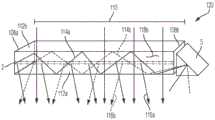
As best shown in fig. 2, the primary planar waveguide 1 has afirst end 108a and asecond end 108b, thesecond end 108b being opposite thefirst end 108a along alength 110 of the primary planar waveguide 1. The primary planar waveguide 1 has afirst face 112a and asecond face 112b, at least the first andsecond faces arrow 114a and dashedarrow 114b, collectively 114) along at least a portion of thelength 110 of the primary planar waveguide 1. The primary planar waveguide 1 may take a variety of forms that provide substantial Total Internal Reflection (TIR) for light striking the facet 112 at angles less than a defined critical angle. The planar waveguide 1 may for example take the form of a pane (pane) or a plane of glass, fused silica, acrylic or polycarbonate.
DOE2 (shown in phantom in fig. 1 and 2) may take many forms of interrupting TIR light path 114, providing multiple light paths (shown byarrows 116a and dashedarrows 116b, collectively 116) between an inner portion 118 and anouter portion 120 of planar waveguide 1 extending along at least a portion oflength 110 of planar waveguide 1. The DOE2 may advantageously combine the phase function of a linear diffraction grating with the phase function of a circular or radially symmetric zone plate, allowing for the localization of a distinct object and a focal plane for the distinct object. The DOE may be formed on the surface of the waveguide or inside it.
Referring to fig. 1, anoptical coupler subsystem 104 optically couples light to awaveguide assembly 102. As shown in fig. 1, the optical coupler subsystem may include anoptical element 5, such as a reflective surface, mirror, dichroic mirror, or prism, to optically couple light to theedge 122 of the primary planar waveguide 1. Light may also be coupled into the waveguide arrangement through the front or back face 112. Theoptical coupler subsystem 104 may additionally or alternatively include a collimating element 6 that collimates light.
As shown in fig. 2, light propagates along the primary planar waveguide with at least some reflection or "bounce" resulting from TIR propagation. It is noted that some embodiments may employ one or more reflectors in the internal optical path, such as thin films, dielectric coatings, metalized coatings, etc., which may facilitate reflection. Light propagating along thelength 110 of the waveguide 1 intersects the DOE2 at various locations along thelength 110. DOE2 may be incorporated within the primary planar waveguide 1, or adjacent or proximate to one or more faces 112 of the primary planar waveguide 1. DOE2 performs at least two functions. DOE2 changes the angle of the light causing a portion of the light to break free of TIR and exit from the interior 118 to theexterior 120 via one or more faces 112 of the primary planar waveguide 1. The DOE2 may also be configured to direct the coupled-out light rays to control the virtual position of the object at the desired viewing distance. Thus, a person looking through theface 112a of the primary planar waveguide 1 may see digital images at one or more viewing distances.
In some implementations, light is coupled into one or more of the primary planar waveguides using a scanning light display. A scanning light display may include a single light source that forms a single beam of light that is scanned over time to form an image. The scanned beam may be intensity modulated to form pixels of different brightness levels. Alternatively, multiple light sources may be used to generate multiple beams that are scanned either with a shared scanning element or with separate scanning elements to form an image. These light sources may include different wavelengths, visible and/or invisible, they may include different geometric origins (X, Y or Z), they may enter the scanner at different angles of incidence, and may produce light corresponding to different portions of one or more images (planar or volumetric, moving or stationary).
For example, vibrating optical fibers may be used to scan light to form an image, for example, as discussed in U.S. patent application serial No. 13/915,530, international patent application serial No. PCT/US2013/045267, and U.S. provisional patent application serial No. 61/658,355. The fiber can be scanned biaxially by a piezo actuator. Alternatively, the fiber may be scanned in a single axis or in three axes. Alternatively, one or more optical components (e.g., a rotating polygonal reflector or mirror, an oscillating reflector or mirror) may be employed to scan the output of the optical fiber.
In other embodiments, the image may be produced using LCOS (liquid crystal on silicon) mirrors formed in an array.
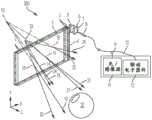
Fig. 3 shows anoptical system 300 including a waveguide device, an optical coupler subsystem to optically couple light to or from the waveguide device, and a control subsystem, according to an example embodiment.
Many of the structures ofoptical system 300 of fig. 3 are similar or even identical to many of the structures ofoptical system 100 of fig. 1. For the sake of brevity, in many cases, only significant differences are discussed below.
The relayed and exit pupil expanded light is optically coupled from the distribution waveguide arrangement into one or more primary planar waveguides 1. The primary planar waveguide 1 relays light along a second axis, which is preferably orthogonal to the first axis (e.g., the horizontal or X-axis in the view of fig. 3). Notably, the second axis may be a non-orthogonal axis to the first axis. The main planar waveguide 1 expands the effective exit pupil of light along this second axis (e.g., the X-axis). For example, the distributionplanar waveguide 3 may relay and expand light along the vertical or Y-axis and deliver the light to the main planar waveguide 1 which relays and expands the light along the horizontal or X-axis. The remainder of the elements of thesystem 300 shown in fig. 3 will be discussed below with reference to fig. 4.
Fig. 4 shows anoptical system 300 illustrating the resulting single focal plane that can be positioned closer than optical infinity.
Theoptical system 300 may include one or morelight sources 11 of red, green and blue light, which may be optically coupled into the proximal end of a single modeoptical fiber 9. The distal end of theoptical fiber 9 may be received through the hollow tube 8 of piezoelectric material or through the hollow tube 8 of piezoelectric material. The distal end extends from the tube 8 as a floating flexible cantilever 7. The piezoelectric tube 8 is associated with a four quadrant electrode (not shown). The electrodes may be plated, for example, on the outside, outer surface or periphery or diameter of the tube 8. A core electrode (not shown) is also located in the core, center, inner circumference, or inner diameter of the tube 8.
The collimator 6 collimates the light exiting the scanning fiber cantilever 7. Collimated light may be reflected by amirror 5 into a narrow distributionplanar waveguide 3 containing at least one Diffractive Optical Element (DOE) 4. The collimated light propagates vertically (i.e., relative to the view of fig. 4) along thedistribution planar waveguide 3 by total internal reflection and in so doing repeatedly intersects with theDOE 4. The DOE4 preferably has a low diffraction efficiency. This results in a portion (e.g. 10%) of the light being diffracted towards the edges of the larger main planar waveguide 1 at each intersection with the DOE4, and a portion of the light continues to propagate along the length of thedistribution planar waveguide 3 on its original trajectory via TIR. At each point of intersection with DOE4, the additional light is diffracted towards the entrance of the main waveguide 1. By splitting the incident light into multiple out-coupling sets, the exit pupil of the light is vertically expanded by the DOE4 in thedistribution plane waveguide 3. This vertically expanded light coupled out of thedistribution planar waveguide 3 enters the edge of the principal planar waveguide 1.
Light entering the main waveguide 1 propagates horizontally (i.e., with respect to the view of fig. 4) along the main waveguide 1 via TIR. Since light propagates horizontally along at least a portion of the length of the primary waveguide 1 via TIR, the light intersects the DOE2 at a plurality of points. The DOE2 may advantageously be designed or configured to have a phase profile that is the sum of a linear diffraction grating and a radially symmetric diffractive lens. The DOE2 may advantageously have a low diffraction efficiency. At each intersection between the propagating light and DOE2, a portion of the light is diffracted towards the adjacent facet of primary waveguide 1, allowing the light to escape TIR and exit the facet of primary waveguide 1. The radially symmetric lens aspect of the DOE2 also steers the beam at an angle that matches the designed focus level. Fig. 4 shows fourbeams focal point 13, and each beam is advantageously given a convex wavefront profile with a center of radius at thefocal point 13 to produce an image or virtual object at a given focal plane.
Fig. 5 shows anoptical system 300 illustrating the resulting multifocal volumetric display, image, or light field. As shown in fig. 4, the first set of fourlight beams focal point 13, and eachlight beam focal point 13 to produce another portion of the image or virtual object to be viewed by theeye 22 at the respective focal plane. Fig. 5 further shows a second set of fourbeams focal point 23, and eachbeam focal point 23 to produce another portion of the image orvirtual object 22 at the respective focal plane.
Fig. 6 illustrates anoptical system 600 according to an exemplary embodiment.Optical system 600 is similar in some respects tooptical systems
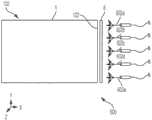
Theoptical system 600 can use a single primary planar waveguide 1, rather than two or more primary planar waveguides 1 (e.g., arranged in a stacked configuration along the Z-axis of fig. 6). The plurality of microdisplays or projectors 602 may be arranged in a linear array, for example, along theedge 122 of the primary planar waveguide closest to the temple of the viewer's head. Each microdisplay or projector 602 injects modulated light encoding sub-image data into the primary planar waveguide 1 from a different respective location, thereby generating a different path of light. These different paths may couple light out of the main planar waveguide 1 bymultiple DOEs 2 at different angles, focus levels, and/or creating different fill patterns at the exit pupil. Different fill patterns at the exit pupil can be advantageously used to produce a light field display. Each layer in the stack or group of layers (e.g., 3 layers) in the stack may be employed to produce a respective color (e.g., red, blue, green). Thus, for example, a first set of three adjacent layers may be employed to produce red, blue, and green light, respectively, at a first focal depth. A second set of three adjacent layers may be used to generate red, blue, and green light, respectively, at a second focal depth.
Disclosure of Invention
In each of the embodiments discussed above, a light source is provided for injecting image information into the waveguide and distributing the light to the wearer using the DOE. As described below, in the present invention, a similar combination comprising a planar waveguide and a diffractive optical element is used to capture light entering one of the planes of the waveguide, and the captured light is then measured with a sensor. The collection waveguide may be used alone or in combination with the output waveguide.
In a preferred embodiment, the device comprises a waveguide having opposing planar input and output faces. A Diffractive Optical Element (DOE) is formed across the waveguide. The DOE is configured to couple a portion of light passing through the waveguide into the waveguide. Light coupled into the waveguide is guided via total internal reflection to an exit location on the waveguide. The apparatus also includes a light sensor having an input positioned adjacent to the exit location of the waveguide to capture light exiting therefrom and generate an output signal corresponding thereto. The processor determines an angle and a position of the coupled light relative to the input face of the waveguide based on the output signal. The apparatus may include a narrow band wavelength filter aligned with the waveguide.
The device may further include a second waveguide having opposing planar input and output faces, wherein the second waveguide may be aligned and parallel to the first waveguide. The DOE may be formed across the second waveguide. The DOE may be configured to control a level of reflectivity at a location across a facet of the second waveguide. The apparatus may further include a light generator having an output positioned adjacent the second waveguide to inject light into the second waveguide. The processor can control light injected into the second waveguide to direct light entering the second waveguide via total internal reflection out of the waveguide at a particular location across the output facet of the second waveguide.
The apparatus may further include a third waveguide extending along an edge of the first waveguide. The third waveguide can capture light exiting the exit location of the first waveguide and deliver the light to the sensor.
Drawings
Fig. 1 is a schematic diagram illustrating an optical system including a waveguide arrangement, a subsystem to couple light to or from the waveguide arrangement, and a control subsystem according to an example embodiment.
FIG. 2 is a front view illustrating a waveguide apparatus including a planar waveguide and at least one diffractive optical element located within the planar waveguide, showing a plurality of optical paths including total internal reflection optical paths and optical paths between the exterior and interior of the planar waveguide, according to an example embodiment.
Fig. 3 is a schematic diagram illustrating an optical system including a waveguide device, an optical coupler subsystem to optically couple light to or from the waveguide device, and a control subsystem, according to an example embodiment.
Fig. 4 is a schematic diagram of the optical system of fig. 3, illustrating generation of a single focal plane that can be positioned closer than optical infinity according to an exemplary embodiment.
FIG. 5 is a schematic diagram of the optical system of FIG. 3 illustrating generation of a multi-focal volume display, image or light field, according to an example embodiment.
Fig. 6 is a schematic diagram illustrating an optical system including a waveguide apparatus, an optical coupler subsystem including a plurality of projectors to optically couple light to a main planar waveguide, according to an example embodiment.
Fig. 7 is a schematic diagram showing an optical system having a planar waveguide and a sensor according to a basic embodiment of the present invention.
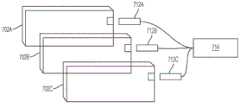
Fig. 8 is a schematic diagram of a system of the present invention including three planar waveguides and associated color filters.
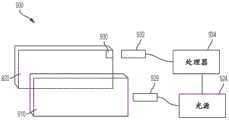
Figure 9 is a schematic diagram of a preferred embodiment of the present invention comprising two planar waveguides, one for delivering images to the eye as in the prior art, and the other for capturing images from the real world.
Detailed Description
Fig. 7 is a schematic diagram of a first embodiment of asystem 700 of the present invention. Thesystem 700 includes aplanar waveguide 702 having at least one diffractiveoptical element 704 formed therein. It is contemplated thatwaveguide 702 may be constructed in a manner similar to any of the output-type waveguides discussed above. In use, light from the real world will be partially transmitted through the waveguide to the user'seye 706.
In accordance with the present invention, a portion of the light rays entering thewaveguide 702 will be captured by the waveguide and guided along the length of the waveguide via total internal reflection to an exit location shown at 710. Thelight exit location 710 may be located in front of or behind the waveguide or to the side thereof. Light exiting the waveguide may be captured bysensor 712. The signals generated by the sensors are coupled toprocessor 714 for analysis.
Various types of sensors may be used. For example, the sensor may comprise a movable optical fibre with an output device as described above. Similarly, an array of sensors may be provided. Additionally, the sensor may comprise an LCOS system that selectively directs light to an additional fixed position sensor, such as a CMOS or CCD imager.
Theprocessor 714 will analyze the input signal to determine the input position and angle of the light rays captured by the waveguide and directed to theexit location 710. In practice, the analysis may be complicated if only a single waveguide is used. For example, a single waveguide embodiment will produce a signal that combines more than one wavelength of light reaching the waveguide.
Thus, in a preferred embodiment, three similar waveguides will be used, each arranged to capture red, blue or green light. Fig. 8 shows an example of such an arrangement. In fig. 8, three aligned waveguides 702a, 702b, and 702c are provided. A diffractive filter 716 is disposed in front of each waveguide to control the light entering the waveguide. The order of the filters can be selected to optimize the distribution of light into the waveguide. For example, the filter 716a may diffract a portion of red light into the waveguide 702a, but allow blue and green light to pass through the waveguide 702 a. Filter 716b may diffract a portion of the green light into waveguide 702 b. Filter 716c may diffract a portion of the blue light into waveguide 702 c. Separate sensors 712a, 712b, and 712c will collect light from waveguides 702a, 702b, and 702c, respectively. The signals generated by the sensors will be analyzed by the processor.
It should be noted that a ray of light entering from any particular point on the waveguide will effectively add up with the same color of light entering at some other point but returning to the sensor on the same TIR path. In fact, one gets a superposition of light from many sources. The processor will need to be arranged to unwrap this superposition of information by digital analysis. In practice, the algorithm may include various statistical analyses in conjunction with a learning system. The specific data analysis method is not the subject of the present application.
It should be noted that the deconvolution problem is simpler if the device is capturing an image of a planar object (e.g., a photograph). For planar objects, the deconvolution will have N shifted images, where N is the number of entrance pupils on the edge elements.
One way to address the deconvolution problem when imaging three-dimensional scenes is to utilize actively switchable multiple DOEs across a waveguide. Using electronic control to vary the diffraction power of the DOE, one can selectively allow individual entrance pupils to be selectively turned on or off. Under this system, the processor will know in advance the entry position of the light guided by the waveguide and measured by the sensor.
It should be noted that if an active DOE system is used to image a planar image, each pupil will capture the entire undistorted image of the object.
Fig. 9 is a diagram of anembodiment 900 including oneoutput waveguide 910 and onecollection waveguide 920. Theoutput waveguide 910 will be of the type discussed above in the background of the specification and will include anoptical image source 924 andoptical fibers 929 for delivering image information to thewaveguide 910. The collectingwaveguide 920 will be similar to the embodiment of fig. 7, where light captured by thewaveguide 920 will be guided by total internal reflection to anoutput location 930 and measured by asensor 932. The output from thesensor 932 is provided to aprocessor 934. As mentioned above, in a preferred embodiment, there will be three output waveguides and three input waveguides, each associated with a particular color spectrum (red, green and blue). For ease of illustration, only one of each type of waveguide is shown in FIG. 9.
In the basic operation of thesystem 900, some light rays from the real world will pass through thewaveguides Waveguide 910 can be used to deliver additional visual images to the eye for augmented reality. Thewaveguide 920 may be used to capture and measure light from the real world. This information may be used in various ways.
For example, the image generated for theoutput waveguide 910 may be modified using information captured from the real world. In particular, the light output from thewaveguide 910 may be some specific function of the input measured at the same coordinates on the surface of thewaveguide 920. The function may include linear scaling, non-linear scaling and shear scaling, as well as any other specific function of intensity calculated on a per-pixel basis or locally with respect to pixel location.
Image information captured by thewaveguide 920 may also be used to help register the virtual image produced by thewaveguide 910. In many currently contemplated augmented reality implementations, virtual objects are located in three dimensions and complex projections are made to calculate their positions on thewaveguide 910. The information collected by thewaveguide 920 allows for specific registration of the objects with respect to the two-dimensional image, thereby ensuring their correct position (i.e., no "jitter") with respect to other landmarks in the image.
In another example, image information collected by thewaveguide 920 may be used to identify particular image elements in the real world, and then calculate alternative elements for presentation to a user via thewaveguide 910. For example, the system may identify a person's face and then present the modified image (e.g., a face with beard) to the user. In another example, the color of the building may be changed. In yet another example, signs in the real world written in one language may be presented in a different language. This concept extends not only to "filters" using image recognition or modeling, but also to simpler filters such as blurring, or combinations of the above.
In an alternative embodiment, a controllable darkening layer (e.g., an LCD, not shown) may be provided betweenwaveguides waveguide 910.
The algorithm used to decode the light captured by thewaveguide 920 and converted into a time series signal is context dependent.
For example, in a system where the sensor is a scanning optical fiber, the signal can be converted into a two-dimensional linear array of the type desired by many image processing algorithms. In some cases, it may be easier to process the pixels in their natural polar form (polar form) and output the pixels in the same polar form.
In one embodiment, the Input Polar Coordinate Pixel (IPCP) values may be directly assigned to the Rectangular Coordinate Pixels (RCPs) found by direct calculation. In another embodiment, one can assign all rectangular coordinate pixels to the nearest rectangular coordinate pixel where the corresponding input polar coordinate pixel can be found. In another approach, one can interpolate the rectangular coordinate pixels to find the assignment of the value of the nearest rectangular coordinate pixel where the corresponding input polar coordinate pixel can be found. The latter method includes linear, quadratic or any other such interpolation. Finally, the relationship between the rectangular coordinate pixel and the associated input polar coordinate pixel projection may be pre-computed and stored.
Although the present invention has been described with reference to some preferred embodiments, various changes and modifications may be made herein by one skilled in the art without departing from the scope and spirit of the invention as defined by the appended claims.
Claims (37)
1. An apparatus, comprising:
a processor;
a first waveguide having opposing planar input and output faces;
a first Diffractive Optical Element (DOE) formed across the first waveguide, the first DOE configured to couple a first light into the first waveguide, wherein the first waveguide is configured to guide the first light to an exit location of the first waveguide by total internal reflection;
a second waveguide having opposing planar input and output faces, the second waveguide aligned and parallel to the first waveguide,
a light sensor having an input positioned adjacent to the exit location of the first waveguide to capture the first light exiting the first waveguide and generate an output signal corresponding thereto, wherein the angle and position of the light sensor relative to the exit location of the first waveguide is movable and controllable by the processor;
a light generator configured to inject second light into the second waveguide, wherein the second waveguide is configured to guide the second light to an output face of the second waveguide by total internal reflection; and
a darkening layer disposed between the first waveguide and the second waveguide, the darkening layer configured to reduce a brightness of third light originating from outside the apparatus.
2. The apparatus of claim 1, further comprising a second DOE formed across the second waveguide, the second DOE configured to control a reflectivity level of the second waveguide.
3. The apparatus of claim 1, wherein an amount of brightness reduced by the darkening layer is controllable by the processor.
4. The apparatus of claim 1, wherein the darkening layer comprises a display.
5. The apparatus of claim 1, wherein a brightness of the second light corresponds to a brightness of the third light reduced by the darkening layer.
6. The device of claim 1, wherein an apparent position of the second light from the output face of the second waveguide corresponds to an apparent position of the third light reduced by the darkening layer.
7. A method, comprising:
coupling first light into a first waveguide having opposing planar input and output faces by a first Diffractive Optical Element (DOE), the first waveguide configured to guide the first light by total internal reflection to an exit location of the first waveguide;
capturing the first light from the first waveguide by a light sensor;
generating an output signal corresponding to the first light captured by the light sensor;
injecting second light into a second waveguide having opposing planar input and output faces by a light generator, the second waveguide configured to direct the second light to the output face of the second waveguide by total internal reflection,
wherein:
the first DOE is formed across the first waveguide,
the second waveguide is aligned and parallel to the first waveguide,
the light sensor has an input adjacent the exit location of the first waveguide, and
the angle and position of the light sensor relative to the exit position of the first waveguide is movable and can be controlled by a processor.
8. The method of claim 7, further comprising: controlling a reflectivity level of the second waveguide by a second DOE formed across the second waveguide.
9. The method of claim 7, further comprising: the brightness of the third light is reduced by a darkening layer disposed between the first waveguide and the second waveguide.
10. The method of claim 9, wherein the amount of brightness reduction by the darkening layer is controllable by the processor.
11. The method of claim 9, wherein the darkening layer comprises a display.
12. The method of claim 9, wherein the brightness of the second light corresponds to the brightness of the third light reduced by the darkening layer.
13. The method of claim 9, wherein an apparent position of the second light from the output face of the second waveguide corresponds to an apparent position of the third light reduced by the darkening layer.
14. An apparatus, comprising:
a processor;
a first waveguide having opposing planar input and output faces;
a first Diffractive Optical Element (DOE) formed across the first waveguide, the first DOE configured to couple light into the first waveguide, wherein the light coupled into the first waveguide is guided by total internal reflection to an exit location of the first waveguide; and
a light sensor having an input positioned adjacent to the exit location of the first waveguide to capture light exiting the first waveguide and generate an output signal corresponding thereto, wherein the angle and position of the light sensor relative to the exit location of the first waveguide is movable and controllable by the processor.
15. The apparatus of claim 14, further comprising a narrow band wavelength filter aligned with the first waveguide.
16. The apparatus of claim 14, further comprising:
a second waveguide having opposing planar input and output faces, the second waveguide aligned and parallel to the first waveguide.
A second DOE formed across the second waveguide, the second DOE configured to control a reflectivity level of the second waveguide; and
a light generator having an output positioned adjacent to the first waveguide and configured to inject light into the second waveguide,
wherein:
the processor is configured to control light injected into the second waveguide, an
The second waveguide is configured to guide light by total internal reflection out of the second waveguide via an output face of the second waveguide.
17. The apparatus of claim 14, further comprising a third waveguide extending along an edge of the first waveguide, the third waveguide configured to capture light exiting the exit location of the first waveguide and convey the light to the sensor.
18. An apparatus, comprising:
a processor;
a first waveguide having opposing planar input and output faces;
a first Diffractive Optical Element (DOE) formed across the first waveguide, the first DOE configured to couple light into the first waveguide, wherein the light coupled into the first waveguide is guided by total internal reflection to an exit location of the first waveguide; and
a light sensor having an input positioned adjacent to the exit location of the first waveguide to capture light exiting the first waveguide and generate an output signal corresponding thereto,
wherein:
the angle and position of the light sensor relative to the exit position of the first waveguide are movable and controllable by the processor, and
the output signal includes polar pixels corresponding to the captured light.
19. The apparatus of claim 18, wherein the light sensor comprises a scanning optical fiber.
20. The apparatus of claim 18, wherein the processor is configured to perform a processing operation on the polar pixels in polar form, the processing operation determining an output in polar form without converting the polar pixels to rectangular form.
21. The apparatus of claim 18, wherein the processor is configured to convert the polar pixels to corresponding rectangular pixels.
22. The apparatus of claim 21, wherein converting the polar coordinate pixels to corresponding rectangular coordinate pixels comprises: the relationship between the rectangular coordinate pixel and the associated polar coordinate pixel projection is pre-computed.
23. A method, comprising:
coupling first light into a first waveguide having opposing planar input and output faces by a first Diffractive Optical Element (DOE), the first waveguide configured to guide the first light by total internal reflection to an exit location of the first waveguide;
capturing the first light from the first waveguide by a light sensor;
generating an output signal corresponding to the first light captured by the light sensor;
wherein:
the first DOE is formed across the first waveguide,
the light sensor has an input positioned adjacent to the exit location of the first waveguide,
the angle and position of the light sensor relative to the exit position of the first waveguide are movable and controllable by a processor, and
the output signal includes a polar pixel corresponding to the first light.
24. The method of claim 23, wherein the light sensor comprises a scanning optical fiber.
25. The method of claim 23, further comprising processing the polar pixels in polar form and determining an output in polar form without converting the polar pixels to rectangular form.
26. The method of claim 23, further comprising converting the polar pixels to corresponding rectangular coordinate pixels.
27. The method of claim 26, wherein converting the polar coordinate pixels to corresponding rectangular coordinate pixels comprises: the relationship between the rectangular coordinate pixel and the associated polar coordinate pixel projection is pre-computed.
28. An apparatus, comprising:
a processor;
a wearable head device including a transmissive display, comprising:
a first waveguide having:
a planar input face; and
a planar output face disposed opposite the planar input face, the output face having an exit location;
a first Diffractive Optical Element (DOE) formed across the first waveguide, the first DOE configured to couple first light into the first waveguide and to direct the first light to the exit location by total internal reflection; and
a light sensor configured to generate an output signal corresponding to light at the exit position,
wherein:
the processor is configured to adjust the angle and position of the light sensor relative to the exit position, and
the processor is further configured to execute a rendering engine to generate an output corresponding to the first light.
29. The apparatus of claim 28, wherein the light sensor comprises a scanning optical fiber.
30. The apparatus of claim 28, wherein the output of the rendering engine comprises a representation of a plurality of polar pixels in polar form.
31. The apparatus of claim 30, wherein the processor is further configured to convert the plurality of polar pixels to a plurality of corresponding rectangular pixels.
32. The apparatus of claim 31, wherein converting the plurality of polar coordinate pixels to a plurality of corresponding rectangular coordinate pixels comprises: the relationship between rectangular coordinate pixels and associated polar coordinate pixel projections is pre-computed.
33. A method, comprising:
receiving an output of a rendering engine, the output corresponding to the first light;
coupling the first light into a first waveguide of a transmissive display of a wearable head device by a first Diffractive Optical Element (DOE), the first waveguide having opposing planar input and output faces, the first DOE configured to direct the first light by total internal reflection to an exit location of the output face;
light at the exit location by the light sensor; and
generating an output signal corresponding to light captured by the light sensor;
wherein:
the first DOE is formed across the first waveguide, and
the angle and position of the light sensor relative to the exit position is movable and can be controlled by a processor.
34. The method of claim 33, wherein the light sensor comprises a scanning optical fiber.
35. The method of claim 33, wherein the output of the rendering engine comprises a representation of a plurality of polar pixels in polar form.
36. The method of claim 35, further comprising converting the plurality of polar pixels to a plurality of corresponding rectangular pixels.
37. The method of claim 36, wherein converting the plurality of polar coordinate pixels to a plurality of corresponding rectangular coordinate pixels comprises: the relationship between rectangular coordinate pixels and associated polar coordinate pixel projections is pre-computed.
Priority Applications (1)
| Application Number | Priority Date | Filing Date | Title |
|---|---|---|---|
| CN202110069265.7ACN112882233B (en) | 2015-05-19 | 2016-05-19 | Double composite light field device |
Applications Claiming Priority (5)
| Application Number | Priority Date | Filing Date | Title |
|---|---|---|---|
| US201562163733P | 2015-05-19 | 2015-05-19 | |
| US62/163,733 | 2015-05-19 | ||
| PCT/US2016/033343WO2016187462A1 (en) | 2015-05-19 | 2016-05-19 | Dual composite light field device |
| CN201680041954.4ACN108139234B (en) | 2015-05-19 | 2016-05-19 | Double composite light field device |
| CN202110069265.7ACN112882233B (en) | 2015-05-19 | 2016-05-19 | Double composite light field device |
Related Parent Applications (1)
| Application Number | Title | Priority Date | Filing Date |
|---|---|---|---|
| CN201680041954.4ADivisionCN108139234B (en) | 2015-05-19 | 2016-05-19 | Double composite light field device |
Publications (2)
| Publication Number | Publication Date |
|---|---|
| CN112882233Atrue CN112882233A (en) | 2021-06-01 |
| CN112882233B CN112882233B (en) | 2023-08-01 |
Family
ID=57320893
Family Applications (2)
| Application Number | Title | Priority Date | Filing Date |
|---|---|---|---|
| CN202110069265.7AActiveCN112882233B (en) | 2015-05-19 | 2016-05-19 | Double composite light field device |
| CN201680041954.4AActiveCN108139234B (en) | 2015-05-19 | 2016-05-19 | Double composite light field device |
Family Applications After (1)
| Application Number | Title | Priority Date | Filing Date |
|---|---|---|---|
| CN201680041954.4AActiveCN108139234B (en) | 2015-05-19 | 2016-05-19 | Double composite light field device |
Country Status (10)
| Country | Link |
|---|---|
| US (6) | US9891077B2 (en) |
| EP (3) | EP3298443B1 (en) |
| JP (6) | JP6700310B2 (en) |
| KR (1) | KR102694898B1 (en) |
| CN (2) | CN112882233B (en) |
| AU (2) | AU2016264599B2 (en) |
| CA (1) | CA2986146A1 (en) |
| IL (3) | IL295437B2 (en) |
| NZ (1) | NZ737402A (en) |
| WO (1) | WO2016187462A1 (en) |
Families Citing this family (12)
| Publication number | Priority date | Publication date | Assignee | Title |
|---|---|---|---|---|
| IL295437B2 (en) | 2015-05-19 | 2024-11-01 | Magic Leap Inc | Dual integrated light field device |
| US10725301B2 (en)* | 2016-12-08 | 2020-07-28 | Darwin Hu | Method and apparatus for transporting optical images |
| US20190162967A1 (en)* | 2016-12-08 | 2019-05-30 | Darwin Hu | Light weight display glasses using an active optical cable |
| US11002967B2 (en)* | 2016-12-08 | 2021-05-11 | Darwin Hu | Method and system for communication between a wearable display device and a portable device |
| US10859834B2 (en) | 2017-07-03 | 2020-12-08 | Holovisions | Space-efficient optical structures for wide field-of-view augmented reality (AR) eyewear |
| US10338400B2 (en) | 2017-07-03 | 2019-07-02 | Holovisions LLC | Augmented reality eyewear with VAPE or wear technology |
| CN115061278A (en)* | 2017-09-28 | 2022-09-16 | 奇跃公司 | Method and apparatus for reducing stray light emission from an eyepiece of an optical imaging system |
| US11141645B2 (en) | 2018-09-11 | 2021-10-12 | Real Shot Inc. | Athletic ball game using smart glasses |
| US11103763B2 (en) | 2018-09-11 | 2021-08-31 | Real Shot Inc. | Basketball shooting game using smart glasses |
| CN112698448A (en)* | 2019-10-22 | 2021-04-23 | 上海信及光子集成技术有限公司 | Reflection type vertical optical coupling structure based on prism |
| US20230221557A1 (en)* | 2020-05-28 | 2023-07-13 | Arizona Board Of Regents On Behalf Of The University Of Arizona | Optical see-through head-mounted lightfield displays based on substrate-guided combiners |
| US11202043B1 (en)* | 2020-08-25 | 2021-12-14 | Facebook Technologies, Llc | Self-testing display device |
Citations (7)
| Publication number | Priority date | Publication date | Assignee | Title |
|---|---|---|---|---|
| CN1365016A (en)* | 2000-12-15 | 2002-08-21 | 三星电子株式会社 | Wearable display system |
| US20100157400A1 (en)* | 2008-11-17 | 2010-06-24 | Fedor Dimov | Holographic Substrate-Guided Wave-Based See-Through Display |
| US20100302196A1 (en)* | 2009-06-01 | 2010-12-02 | Perceptive Pixel Inc. | Touch Sensing |
| US20130181896A1 (en)* | 2009-01-23 | 2013-07-18 | Qualcomm Mems Technologies, Inc. | Integrated light emitting and light detecting device |
| CN103946732A (en)* | 2011-09-26 | 2014-07-23 | 微软公司 | Video display modification based on sensor input for a see-through near-to-eye display |
| US20150016777A1 (en)* | 2012-06-11 | 2015-01-15 | Magic Leap, Inc. | Planar waveguide apparatus with diffraction element(s) and system employing same |
| CN104570353A (en)* | 2015-01-08 | 2015-04-29 | 浙江大学 | Color visual display method, optical system and wearable device using holographic waveguide |
Family Cites Families (59)
| Publication number | Priority date | Publication date | Assignee | Title |
|---|---|---|---|---|
| US60766A (en)* | 1867-01-01 | Geobge w | ||
| US4852988A (en) | 1988-09-12 | 1989-08-01 | Applied Science Laboratories | Visor and camera providing a parallax-free field-of-view image for a head-mounted eye movement measurement system |
| US6847336B1 (en) | 1996-10-02 | 2005-01-25 | Jerome H. Lemelson | Selectively controllable heads-up display system |
| US6433760B1 (en) | 1999-01-14 | 2002-08-13 | University Of Central Florida | Head mounted display with eyetracking capability |
| US6721053B1 (en)* | 1999-05-19 | 2004-04-13 | Corning Intellisense Corporation | System for high resolution chemical and biological sensing |
| US6491391B1 (en) | 1999-07-02 | 2002-12-10 | E-Vision Llc | System, apparatus, and method for reducing birefringence |
| CA2316473A1 (en) | 1999-07-28 | 2001-01-28 | Steve Mann | Covert headworn information display or data display or viewfinder |
| CA2362895A1 (en) | 2001-06-26 | 2002-12-26 | Steve Mann | Smart sunglasses or computer information display built into eyewear having ordinary appearance, possibly with sight license |
| DE10132872B4 (en) | 2001-07-06 | 2018-10-11 | Volkswagen Ag | Head mounted optical inspection system |
| US20030030597A1 (en) | 2001-08-13 | 2003-02-13 | Geist Richard Edwin | Virtual display apparatus for mobile activities |
| CN1559000A (en)* | 2001-09-26 | 2004-12-29 | 皇家飞利浦电子股份有限公司 | Waveguide, edge-lit illumination arrangement and display comprising such |
| CA2388766A1 (en) | 2002-06-17 | 2003-12-17 | Steve Mann | Eyeglass frames based computer display or eyeglasses with operationally, actually, or computationally, transparent frames |
| US6943754B2 (en) | 2002-09-27 | 2005-09-13 | The Boeing Company | Gaze tracking system, eye-tracking assembly and an associated method of calibration |
| US7347551B2 (en) | 2003-02-13 | 2008-03-25 | Fergason Patent Properties, Llc | Optical system for monitoring eye movement |
| US7500747B2 (en) | 2003-10-09 | 2009-03-10 | Ipventure, Inc. | Eyeglasses with electrical components |
| CA2967756C (en) | 2004-04-01 | 2018-08-28 | Google Inc. | Biosensors, communicators, and controllers monitoring eye movement and methods for using them |
| ATE520046T1 (en) | 2004-04-23 | 2011-08-15 | Olivier M Parriaux | HIGHLY EFFICIENT OPTICAL DIFFRACTION DEVICE |
| US8696113B2 (en) | 2005-10-07 | 2014-04-15 | Percept Technologies Inc. | Enhanced optical and perceptual digital eyewear |
| US20070081123A1 (en) | 2005-10-07 | 2007-04-12 | Lewis Scott W | Digital eyewear |
| US9423397B2 (en)* | 2006-03-10 | 2016-08-23 | Indx Lifecare, Inc. | Waveguide-based detection system with scanning light source |
| JP2007304227A (en)* | 2006-05-10 | 2007-11-22 | Konica Minolta Holdings Inc | Video display device and video photographing apparatus |
| GB2453732B (en) | 2007-10-16 | 2012-03-07 | Virtensys Ltd | Data switch |
| EP2215513B1 (en) | 2007-10-18 | 2015-05-20 | BAE Systems PLC | Improvements in or relating to head mounted display systems |
| WO2010085286A1 (en)* | 2009-01-23 | 2010-07-29 | Qualcomm Mems Technologies, Inc. | Integrated light emitting and light detecting device |
| US8331751B2 (en) | 2009-03-02 | 2012-12-11 | mBio Diagnositcs, Inc. | Planar optical waveguide with core of low-index-of-refraction interrogation medium |
| US8624853B2 (en)* | 2009-06-01 | 2014-01-07 | Perceptive Pixel Inc. | Structure-augmented touch sensing with frustated total internal reflection |
| JP2011085769A (en) | 2009-10-15 | 2011-04-28 | Canon Inc | Imaging display device |
| EP2933629B1 (en) | 2010-02-19 | 2019-04-10 | Pacific Biosciences Of California, Inc. | System for measuring analytical reactions comprising a socket for an optode array chip |
| US20110213664A1 (en) | 2010-02-28 | 2011-09-01 | Osterhout Group, Inc. | Local advertising content on an interactive head-mounted eyepiece |
| WO2011106797A1 (en)* | 2010-02-28 | 2011-09-01 | Osterhout Group, Inc. | Projection triggering through an external marker in an augmented reality eyepiece |
| US8890946B2 (en) | 2010-03-01 | 2014-11-18 | Eyefluence, Inc. | Systems and methods for spatially controlled scene illumination |
| US8531355B2 (en) | 2010-07-23 | 2013-09-10 | Gregory A. Maltz | Unitized, vision-controlled, wireless eyeglass transceiver |
| US9292973B2 (en) | 2010-11-08 | 2016-03-22 | Microsoft Technology Licensing, Llc | Automatic variable virtual focus for augmented reality displays |
| JP6144681B2 (en) | 2011-08-30 | 2017-06-07 | マイクロソフト テクノロジー ライセンシング,エルエルシー | Head mounted display with iris scan profiling function |
| US8929589B2 (en) | 2011-11-07 | 2015-01-06 | Eyefluence, Inc. | Systems and methods for high-resolution gaze tracking |
| US8611015B2 (en) | 2011-11-22 | 2013-12-17 | Google Inc. | User interface |
| US8235529B1 (en) | 2011-11-30 | 2012-08-07 | Google Inc. | Unlocking a screen using eye tracking information |
| US10013053B2 (en) | 2012-01-04 | 2018-07-03 | Tobii Ab | System for gaze interaction |
| US8638498B2 (en) | 2012-01-04 | 2014-01-28 | David D. Bohn | Eyebox adjustment for interpupillary distance |
| US9274338B2 (en) | 2012-03-21 | 2016-03-01 | Microsoft Technology Licensing, Llc | Increasing field of view of reflective waveguide |
| JP6145966B2 (en)* | 2012-05-09 | 2017-06-14 | ソニー株式会社 | Display device |
| US8989535B2 (en) | 2012-06-04 | 2015-03-24 | Microsoft Technology Licensing, Llc | Multiple waveguide imaging structure |
| KR102205374B1 (en) | 2012-12-06 | 2021-01-21 | 아이플루언스, 인크. | Eye tracking wearable devices and methods for use |
| JP2016509292A (en) | 2013-01-03 | 2016-03-24 | メタ カンパニー | Extramissive spatial imaging digital eyeglass device or extended intervening vision |
| US20140195918A1 (en) | 2013-01-07 | 2014-07-10 | Steven Friedlander | Eye tracking user interface |
| FI128503B (en)* | 2013-02-27 | 2020-06-30 | Teknologian Tutkimuskeskus Vtt Oy | Sample plate and analyzing method |
| JP6499154B2 (en)* | 2013-03-11 | 2019-04-10 | マジック リープ, インコーポレイテッドMagic Leap,Inc. | Systems and methods for augmented and virtual reality |
| ITTO20130541A1 (en)* | 2013-06-28 | 2014-12-29 | St Microelectronics Srl | SEMICONDUCTOR DEVICE INTEGRATING A RESISTIVE PARTNER AND PROCESS OF MANUFACTURING A SEMICONDUCTOR DEVICE |
| WO2015006784A2 (en)* | 2013-07-12 | 2015-01-15 | Magic Leap, Inc. | Planar waveguide apparatus with diffraction element(s) and system employing same |
| WO2015012280A1 (en)* | 2013-07-24 | 2015-01-29 | コニカミノルタ株式会社 | Sight line detection device |
| DE102013223964B3 (en) | 2013-11-22 | 2015-05-13 | Carl Zeiss Ag | Imaging optics and display device with such imaging optics |
| JP5700105B2 (en) | 2013-11-29 | 2015-04-15 | ソニー株式会社 | Display assembly |
| EP3137935B1 (en)* | 2014-04-30 | 2023-07-05 | Hewlett-Packard Development Company, L.P. | Imaging apparatus using diffraction-based illumination |
| EP3198192A1 (en)* | 2014-09-26 | 2017-08-02 | Milan Momcilo Popovich | Holographic waveguide opticaltracker |
| IL295437B2 (en) | 2015-05-19 | 2024-11-01 | Magic Leap Inc | Dual integrated light field device |
| WO2017071735A1 (en)* | 2015-10-27 | 2017-05-04 | Telefonaktiebolaget Lm Ericsson (Publ) | Light sensor input for controlling device |
| CN109073889B (en)* | 2016-02-04 | 2021-04-27 | 迪吉伦斯公司 | Holographic waveguide optical tracker |
| US10977815B1 (en)* | 2018-07-02 | 2021-04-13 | Facebook Technologies, Llc | Structured light eye-tracking |
| CN117369133A (en)* | 2018-07-13 | 2024-01-09 | 奇跃公司 | System and method for displaying binocular deformation compensation |
- 2016
- 2016-05-19ILIL295437Apatent/IL295437B2/enunknown
- 2016-05-19CNCN202110069265.7Apatent/CN112882233B/enactiveActive
- 2016-05-19ILIL313069Apatent/IL313069A/enunknown
- 2016-05-19USUS15/159,518patent/US9891077B2/enactiveActive
- 2016-05-19CACA2986146Apatent/CA2986146A1/enactivePending
- 2016-05-19KRKR1020177036453Apatent/KR102694898B1/enactiveActive
- 2016-05-19EPEP16797324.7Apatent/EP3298443B1/enactiveActive
- 2016-05-19AUAU2016264599Apatent/AU2016264599B2/enactiveActive
- 2016-05-19EPEP21199507.1Apatent/EP3955095B1/enactiveActive
- 2016-05-19ILIL255713Apatent/IL255713B/enunknown
- 2016-05-19NZNZ737402Apatent/NZ737402A/enunknown
- 2016-05-19EPEP23212739.9Apatent/EP4303541A3/enactivePending
- 2016-05-19WOPCT/US2016/033343patent/WO2016187462A1/ennot_activeCeased
- 2016-05-19JPJP2017560236Apatent/JP6700310B2/enactiveActive
- 2016-05-19CNCN201680041954.4Apatent/CN108139234B/enactiveActive
- 2017
- 2017-11-28USUS15/824,777patent/US10378930B2/enactiveActive
- 2018
- 2018-01-26USUS15/881,345patent/US10060766B2/enactiveActive
- 2018-07-27USUS16/047,771patent/US10890465B2/enactiveActive
- 2019
- 2019-05-20JPJP2019094767Apatent/JP7007327B2/enactiveActive
- 2020
- 2020-03-16JPJP2020045165Apatent/JP2020115213A/enactivePending
- 2020-12-03USUS17/111,372patent/US11454523B2/enactiveActive
- 2021
- 2021-08-12AUAU2021215223Apatent/AU2021215223A1/ennot_activeAbandoned
- 2021-11-18JPJP2021187622Apatent/JP7221362B2/enactiveActive
- 2022
- 2022-08-19USUS17/891,951patent/US11867537B2/enactiveActive
- 2023
- 2023-01-12JPJP2023002989Apatent/JP7454716B2/enactiveActive
- 2024
- 2024-03-01JPJP2024031200Apatent/JP7489560B2/enactiveActive
Patent Citations (7)
| Publication number | Priority date | Publication date | Assignee | Title |
|---|---|---|---|---|
| CN1365016A (en)* | 2000-12-15 | 2002-08-21 | 三星电子株式会社 | Wearable display system |
| US20100157400A1 (en)* | 2008-11-17 | 2010-06-24 | Fedor Dimov | Holographic Substrate-Guided Wave-Based See-Through Display |
| US20130181896A1 (en)* | 2009-01-23 | 2013-07-18 | Qualcomm Mems Technologies, Inc. | Integrated light emitting and light detecting device |
| US20100302196A1 (en)* | 2009-06-01 | 2010-12-02 | Perceptive Pixel Inc. | Touch Sensing |
| CN103946732A (en)* | 2011-09-26 | 2014-07-23 | 微软公司 | Video display modification based on sensor input for a see-through near-to-eye display |
| US20150016777A1 (en)* | 2012-06-11 | 2015-01-15 | Magic Leap, Inc. | Planar waveguide apparatus with diffraction element(s) and system employing same |
| CN104570353A (en)* | 2015-01-08 | 2015-04-29 | 浙江大学 | Color visual display method, optical system and wearable device using holographic waveguide |
Also Published As
Similar Documents
| Publication | Publication Date | Title |
|---|---|---|
| JP7489560B2 (en) | Dual mixed light irradiation field device | |
| CN108139518B (en) | Virtual/augmented reality system with reverse angle diffraction grating | |
| CN113777789B (en) | Beam angle sensor in virtual/augmented reality systems | |
| CN106707518B (en) | Information display device and information display method | |
| JP2874208B2 (en) | Image display device |
Legal Events
| Date | Code | Title | Description |
|---|---|---|---|
| PB01 | Publication | ||
| PB01 | Publication | ||
| SE01 | Entry into force of request for substantive examination | ||
| SE01 | Entry into force of request for substantive examination | ||
| GR01 | Patent grant | ||
| GR01 | Patent grant |