CN112631127B - SCR nitrogen oxide content prediction control method and system - Google Patents
SCR nitrogen oxide content prediction control method and systemDownload PDFInfo
- Publication number
- CN112631127B CN112631127BCN202011256976.7ACN202011256976ACN112631127BCN 112631127 BCN112631127 BCN 112631127BCN 202011256976 ACN202011256976 ACN 202011256976ACN 112631127 BCN112631127 BCN 112631127B
- Authority
- CN
- China
- Prior art keywords
- scr
- coefficient
- representing
- arx
- fuzzy logic
- Prior art date
- Legal status (The legal status is an assumption and is not a legal conclusion. Google has not performed a legal analysis and makes no representation as to the accuracy of the status listed.)
- Active
Links
- MWUXSHHQAYIFBG-UHFFFAOYSA-NNitric oxideChemical compoundO=[N]MWUXSHHQAYIFBG-UHFFFAOYSA-N0.000titleclaimsabstractdescription291
- 238000000034methodMethods0.000titleclaimsabstractdescription122
- QGZKDVFQNNGYKY-UHFFFAOYSA-NAmmoniaChemical compoundNQGZKDVFQNNGYKY-UHFFFAOYSA-N0.000claimsabstractdescription137
- 229910021529ammoniaInorganic materials0.000claimsabstractdescription68
- 230000008569processEffects0.000claimsabstractdescription66
- 238000005507sprayingMethods0.000claimsabstractdescription16
- 238000005516engineering processMethods0.000claimsabstractdescription14
- 238000005457optimizationMethods0.000claimsabstractdescription10
- 238000005096rolling processMethods0.000claimsabstractdescription7
- 238000010531catalytic reduction reactionMethods0.000claimsabstractdescription6
- 238000006722reduction reactionMethods0.000claimsabstractdescription6
- 230000009467reductionEffects0.000claimsabstractdescription4
- 238000002347injectionMethods0.000claimsdescription32
- 239000007924injectionSubstances0.000claimsdescription32
- 239000013598vectorSubstances0.000claimsdescription19
- 230000006870functionEffects0.000claimsdescription18
- 238000004422calculation algorithmMethods0.000claimsdescription13
- 239000011159matrix materialSubstances0.000claimsdescription12
- 229910052757nitrogenInorganic materials0.000claimsdescription5
- 238000009825accumulationMethods0.000claimsdescription4
- 238000004364calculation methodMethods0.000claimsdescription4
- 230000008859changeEffects0.000claimsdescription3
- 238000013461designMethods0.000claimsdescription3
- 101000802640Homo sapiens Lactosylceramide 4-alpha-galactosyltransferaseProteins0.000claimsdescription2
- 102100035838Lactosylceramide 4-alpha-galactosyltransferaseHuman genes0.000claimsdescription2
- 230000001419dependent effectEffects0.000claimsdescription2
- 238000005312nonlinear dynamicMethods0.000claimsdescription2
- YZCKVEUIGOORGS-IGMARMGPSA-NProtiumChemical compound[1H]YZCKVEUIGOORGS-IGMARMGPSA-N0.000claims4
- 229910052739hydrogenInorganic materials0.000claims1
- 238000012937correctionMethods0.000abstractdescription4
- 238000012804iterative processMethods0.000abstractdescription4
- 230000033228biological regulationEffects0.000abstractdescription2
- 230000006641stabilisationEffects0.000abstractdescription2
- 238000011105stabilizationMethods0.000abstractdescription2
- 238000010586diagramMethods0.000description7
- IJGRMHOSHXDMSA-UHFFFAOYSA-NnitrogenSubstancesN#NIJGRMHOSHXDMSA-UHFFFAOYSA-N0.000description4
- UGFAIRIUMAVXCW-UHFFFAOYSA-NCarbon monoxideChemical compound[O+]#[C-]UGFAIRIUMAVXCW-UHFFFAOYSA-N0.000description3
- 238000004891communicationMethods0.000description3
- 230000008878couplingEffects0.000description3
- 238000010168coupling processMethods0.000description3
- 238000005859coupling reactionMethods0.000description3
- 239000003546flue gasSubstances0.000description3
- 239000007789gasSubstances0.000description3
- 230000004048modificationEffects0.000description3
- 238000012986modificationMethods0.000description3
- 238000012545processingMethods0.000description3
- 239000003054catalystSubstances0.000description2
- 238000006243chemical reactionMethods0.000description2
- 230000000694effectsEffects0.000description2
- 230000000750progressive effectEffects0.000description2
- 238000004088simulationMethods0.000description2
- 239000000243solutionSubstances0.000description2
- 108010001267Protein SubunitsProteins0.000description1
- 230000009471actionEffects0.000description1
- XKMRRTOUMJRJIA-UHFFFAOYSA-Nammonia nh3Chemical compoundN.NXKMRRTOUMJRJIA-UHFFFAOYSA-N0.000description1
- 238000013459approachMethods0.000description1
- 238000006555catalytic reactionMethods0.000description1
- 238000005260corrosionMethods0.000description1
- 230000007797corrosionEffects0.000description1
- 230000000593degrading effectEffects0.000description1
- 229910001873dinitrogenInorganic materials0.000description1
- 230000007613environmental effectEffects0.000description1
- 230000005055memory storageEffects0.000description1
- 230000003287optical effectEffects0.000description1
- 239000002243precursorSubstances0.000description1
- 238000006467substitution reactionMethods0.000description1
- XLYOFNOQVPJJNP-UHFFFAOYSA-NwaterSubstancesOXLYOFNOQVPJJNP-UHFFFAOYSA-N0.000description1
Images





Classifications
- G—PHYSICS
- G05—CONTROLLING; REGULATING
- G05B—CONTROL OR REGULATING SYSTEMS IN GENERAL; FUNCTIONAL ELEMENTS OF SUCH SYSTEMS; MONITORING OR TESTING ARRANGEMENTS FOR SUCH SYSTEMS OR ELEMENTS
- G05B13/00—Adaptive control systems, i.e. systems automatically adjusting themselves to have a performance which is optimum according to some preassigned criterion
- G05B13/02—Adaptive control systems, i.e. systems automatically adjusting themselves to have a performance which is optimum according to some preassigned criterion electric
- G05B13/04—Adaptive control systems, i.e. systems automatically adjusting themselves to have a performance which is optimum according to some preassigned criterion electric involving the use of models or simulators
- G05B13/042—Adaptive control systems, i.e. systems automatically adjusting themselves to have a performance which is optimum according to some preassigned criterion electric involving the use of models or simulators in which a parameter or coefficient is automatically adjusted to optimise the performance
Landscapes
- Engineering & Computer Science (AREA)
- Health & Medical Sciences (AREA)
- Artificial Intelligence (AREA)
- Computer Vision & Pattern Recognition (AREA)
- Evolutionary Computation (AREA)
- Medical Informatics (AREA)
- Software Systems (AREA)
- Physics & Mathematics (AREA)
- General Physics & Mathematics (AREA)
- Automation & Control Theory (AREA)
- Feedback Control In General (AREA)
Abstract
Description
Technical Field
The embodiment of the application relates to the technical field of SCR (selective catalytic reduction) of coal-fired power plants, in particular to a method and a system for predicting and controlling the content of nitrogen oxides in SCR.
Background
With the urgent need of environmental protection, the coal-fired power plant adopts the low-nitrogen technology to reduce the emission of nitrogen oxides so as to meet the strict requirement of tail gas emission. In the low nitrogen technology, selective Catalytic Reduction (SCR) has received much attention from people because of its advantages such as high denitration rate, compact structure, low modification cost, etc. SCR is a post-treatment denitration technology and is installed in a tail flue of a boiler to reduce the concentration of nitrogen oxides in flue gas. In the process of degrading the nitrogen oxides, ammonia enters the tail flue through the ammonia injection grid and is mixed with the nitrogen oxides in the flue gas. Then, the mixed gas of nitrogen oxides and ammonia gas passes through a catalytic reaction zone and is converted into harmless nitrogen gas and water under the action of a catalyst. Wherein the ammonia nitrogen molar ratio determines the effect of the denitration reaction. Insufficient ammonia can result in excessive concentrations of nitrogen oxides at the SCR outlet. In contrast, excess ammonia can cause secondary pollution and even plugging and corrosion of downstream equipment, such as air preheaters and the like. Due to the flowing process and the denitration reaction of the mixed gas in the tail flue, the SCR denitration process has a large time lag characteristic. In addition, the denitration process is also influenced by uncertain disturbances such as flue gas temperature, flow velocity, catalyst activity and the like, so that parameters are time-varying and uncertain.
The above characteristics in the SCR denitration process of the coal-fired power plant make it difficult to realize effective control. Although the PI controller is most widely applied to the SCR denitration process of the coal-fired power plant due to simplicity and mature technology, the performance of the PI controller is far from meeting the requirement, so that the problems of large overshoot of the concentration of nitrogen oxides at the outlet of the SCR, long regulation period and difficulty in stabilization occur.
Disclosure of Invention
Therefore, the embodiment of the application provides a method and a system for predicting and controlling the content of nitrogen oxides in SCR.
According to a first aspect of embodiments of the present application, there is provided a method for predictive control of nitrogen oxide content in selective catalytic reduction SCR, the method comprising:
modeling the nitrogen oxide in the SCR process by adopting a two-type fuzzy logic system;
updating the parameters of the rule front piece and the rule back piece of the two-type fuzzy logic system by adopting an online algorithm;
adopting a linearized two-type fuzzy logic system model to carry out multi-step prediction on the concentration of nitrogen oxides at the outlet of the SCR;
calculating the ammonia injection amount of nitrogen oxides in the SCR process based on a quadratic programming technology;
the ammonia spraying amount is controlled by accumulation of a bias mode and an original DCS controller.
Optionally, the model of the SCR process nox is modeled by using a two-type fuzzy logic system, according to the following formula:


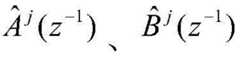
wherein r isout Is the SCR outlet nitrogen oxide concentration u1 Is the ammonia flow rate, rin Is the SCR inlet nitrogen oxide concentration;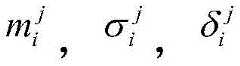 the interval is the central value, the width and the width interval of the interval type two Gaussian fuzzy membership function, and is a fuzzy rule front piece adjustable parameter; ARX polynomial coefficient
 And
And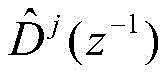 parameters may be adjusted for fuzzy rule backparts.


Optionally, the SCR process nox content model includes an SCR inlet nox concentration;
the fuzzy rule of the type two fuzzy logic system is determined by the design quantity of the type two fuzzy membership functions of each input variable interval;
the type-II fuzzy logic system adopts an NT type reduction method with a closed-loop expression form;
modeling data of the two-type fuzzy logic system, namely the concentration of nitrogen oxides at the SCR outlet, the ammonia flow and the concentration of nitrogen oxides at the SCR inlet are obtained by DCS and stored.
Optionally, the updating of the rule front-part and rule back-part parameters of the two-type fuzzy logic system by using an online algorithm uses the following error loss function:

wherein r isout (k) And respectively the SCR outlet nitrogen oxide concentration measured in real time and the SCR outlet nitrogen oxide concentration predicted by the two-type fuzzy logic system. Fuzzy rule precursor parameter using gradient descent algorithm
 Performing online recursive updating;


wherein eta is the forward learning rate, and eta is more than 0;
the output of the two-type fuzzy logic system is rewritten in a vector form as follows:


where ξ (k-1) is the input data vector, identifying parameter vectors for the postpiece of the fuzzy rule;

in the online identification process, the fuzzy rule back-part adopts a least square method in a recursion form as follows to perform iterative updating:


P(k)=P(k-1)-K(k)ξT (k-1)P(k-1)
where P (K) is a covariance matrix and K (K) is a gain matrix.
Optionally, the step of predicting the concentration of nitrogen oxides at the outlet of the SCR by using the linearized two-type fuzzy logic system model includes:
after the nonlinear dynamic process of the SCR system is identified by the two-type fuzzy logic system, firstly, the following linearization operations are carried out:
A(z-1 )rout (k)=B(z-1 )u1 (k-d-1)+D(z-1 )rin (k-d-1)
left and right sides multiplied by Δ zp ep (z-1 ) Obtaining:
Δzp Cp (z-1 )A(z-1 )rout (k)=Δzp Cp (z-1 )B(z-1 )u1 (k-d-1)+Δzp Cp (z-1 )D(z-1 )rin (k-d-1)

the following charpy equation was introduced:

definition Gp (z-1 )=Cp (z-1 )B(z-1 ),Tp (z-1 )=Cp (z-1 )D(z-1 ) And the predicted value of the content of nitrogen oxides in the SCR process is as follows:

optionally, the calculating the ammonia injection amount of the nitrogen oxides in the SCR process based on the quadratic programming technique includes:
defining the optimization target of the nitrogen oxide at the outlet of the SCR as follows:

wherein, Np And Nu Separate prediction and control domains, Np ≥Nu . d is the time delay of the SCR system. The nitrogen oxide content in the SCR process is predicted p steps ahead. R (k + p) is the reference trajectory leading the SCR NOx content by p steps. Δ =1-z-1 Is a difference operator, z-1 Is a timing back-shift operator.
 And λ (p) are the weights of the tracking error and control input, respectively, of step p. The constraint conditions (1), (2) and (3) are the practical process constraints of outlet nitrogen oxide, ammonia injection quantity and ammonia injection quantity change rate respectively, {. Cndot }min And { }max Respectively the lower limit and the upper limit of the dependent variable;


rewriting the rolling optimization goal in the above equation in vector form as:


the optimal ammonia flow variation at the k moment can be obtained by adopting quadratic programming The optimal ammonia flow at time k is:


optionally, the controlling of the ammonia injection amount by adding the offset mode and the original DCS controller includes:
and the ammonia spraying amount is controlled by accumulating the ammonia spraying instructions of the DCS deviation module and the original PI controller.
According to a second aspect of embodiments of the present application, there is provided an SCR nitrogen oxide content predictive control system, the system comprising:
the modeling module is used for modeling the nitrogen oxide in the SCR process by adopting a two-type fuzzy logic system;
the parameter updating module is used for updating the parameters of the rule front piece and the rule back piece of the two-type fuzzy logic system by adopting an online algorithm;
the multi-step prediction module is used for carrying out multi-step prediction on the concentration of nitrogen oxides at the SCR outlet by adopting the linearized two-type fuzzy logic system model;
the ammonia injection amount calculation module is used for calculating the ammonia injection amount of the nitrogen oxides in the SCR process based on a quadratic programming technology;
and the ammonia spraying amount control module is used for realizing the control of the ammonia spraying amount through accumulation of a bias mode and the original DCS controller.
According to a third aspect of embodiments herein, there is provided an apparatus comprising: the device comprises a data acquisition device, a processor and a memory; the data acquisition device is used for acquiring data; the memory is to store one or more program instructions; the processor is configured to execute one or more program instructions to perform the method of any of the first aspect.
According to a fourth aspect of embodiments herein, there is provided a computer-readable storage medium having one or more program instructions embodied therein for performing the method of any of the first aspects.
In summary, the embodiment of the present application provides a method and a system for predicting and controlling nitrogen oxide content of SCR, where a two-type fuzzy logic system is used as a nitrogen oxide content model in an SCR process, and a NT method is used to overcome a time-consuming iterative process of a KM method in consideration of a type reduction operation of the two-type fuzzy logic system; the model can update the model parameters in real time through a feedback correction technology, and overcome the time-varying characteristic of the parameters of the SCR system; based on the model of the nitrogen oxide content in the SCR process approximated by the two-type fuzzy logic system, the constraint generalized prediction controller is adopted to realize the multi-step prediction and rolling optimization of the nitrogen oxide content in the SCR process, thereby overcoming the inertia and time lag problems of the SCR system and simultaneously meeting the process constraints of the actual SCR process. Ammonia spraying control is achieved through the DCS offset module, an original PI controller does not need to be replaced, engineering is greatly facilitated, and DCS safety is guaranteed.
Drawings
In order to more clearly illustrate the embodiments of the present invention or the technical solutions in the prior art, the drawings used in the description of the embodiments or the prior art will be briefly described below. It should be apparent that the drawings in the following description are merely exemplary, and that other embodiments can be derived from the drawings provided by those of ordinary skill in the art without inventive effort.
The structures, ratios, sizes, and the like shown in the present specification are only used for matching with the contents disclosed in the specification, so that those skilled in the art will understand and read the present invention, and do not limit the conditions for implementing the present invention, so that the present invention has no technical essence, and any modifications of the structures, changes of the ratio relationships, or adjustments of the sizes, should still fall within the scope covered by the technical contents disclosed in the present invention without affecting the efficacy and the achievable purpose of the present invention.
FIG. 1 is a schematic flow chart of a method for predicting and controlling nitrogen oxide content of SCR according to an embodiment of the present disclosure;
FIG. 2 is a block diagram of a two-type fuzzy logic system according to an embodiment of the present application;
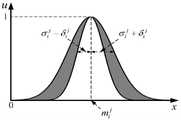
FIG. 3 is a schematic diagram of a two-type interval Gaussian membership function provided in the present embodiment;
fig. 4 is a control structure diagram provided in the embodiment of the present application;
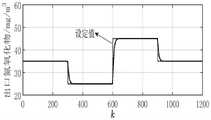
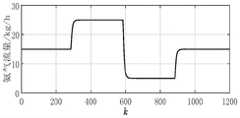
FIG. 5a is a schematic diagram of control input provided by an embodiment of the present application;
FIG. 5b is a schematic diagram illustrating weight factor adjustment provided in an embodiment of the present application;
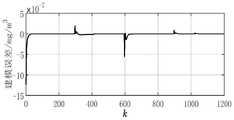
FIG. 5c is a schematic diagram of a prediction error provided by an embodiment of the present application;
FIG. 5d is a schematic illustration of another prediction error provided by an embodiment of the present application;
FIG. 6 is a block diagram of a system for predicting the content of nitrogen oxides in SCR according to an embodiment of the present disclosure.
Detailed Description
The present invention is described in terms of particular embodiments, other advantages and features of the invention will become apparent to those skilled in the art from the following disclosure, and it is to be understood that the described embodiments are merely exemplary of the invention and that it is not intended to limit the invention to the particular embodiments disclosed. All other embodiments, which can be obtained by a person skilled in the art without making any creative effort based on the embodiments in the present invention, belong to the protection scope of the present invention.
In order to solve the problem of a control method in the SCR system of the existing coal-fired power plant, the invention provides a modeling and prediction control method of the nitrogen oxide content in the SCR process based on a two-type fuzzy logic system. The method adopts a type-II fuzzy logic system as a nitrogen oxide content model in the SCR process, and takes the type-reduction operation of the type-II fuzzy logic system into consideration, and adopts the NT method to overcome the time-consuming iterative process of the KM method; the model can update the model parameters in real time through a feedback correction technology, and overcome the time-varying characteristic of the parameters of the SCR system; based on a model of nitrogen oxide content in the SCR process approximated by a two-type fuzzy logic system, a constraint generalized prediction controller is adopted to realize multi-step prediction and rolling optimization of nitrogen oxide content in the SCR process, so that the problems of inertia and time lag of the SCR system are solved, and various process constraints in the actual SCR process are met. Ammonia spraying control is achieved through the DCS offset module, an original PI controller does not need to be replaced, engineering is greatly facilitated, and DCS safety is guaranteed.
Fig. 1 illustrates a method for predictive control of nitrogen oxide content in selective catalytic reduction SCR provided by an embodiment of the present application, where the method includes:
step 101: and modeling the nitrogen oxides in the SCR process by adopting a two-type fuzzy logic system.
Step 102: and updating the parameters of the rule front piece and the rule back piece of the two-type fuzzy logic system by adopting an online algorithm.
Step 103: and (4) performing multi-step prediction on the concentration of nitrogen oxides at the outlet of the SCR by adopting a linearized two-type fuzzy logic system model.
Step 104: and calculating the ammonia injection amount of nitrogen oxides in the SCR process based on a quadratic programming technology.
Step 105: the ammonia spraying amount is controlled by accumulation of a bias mode and an original DCS controller.
In one possible embodiment, thestep 101 employs a two-type fuzzy logic system to model the SCR process NOx content model.
The fuzzy rule of the two-type fuzzy logic system is determined by the design quantity of the interval two-type fuzzy membership function of each input variable, and the input space of all variables is not traversed. The type-down operation of the type-two fuzzy logic system employs the NT method with a closed-loop expression. After modeling data of the two-type fuzzy logic system, namely the concentration of nitrogen oxides at an SCR outlet, the ammonia flow and the concentration of nitrogen oxides at an SCR inlet are obtained and stored by the DCS, referring to a graph 2, an SCR process nitrogen oxide content model based on the two-type fuzzy logic system is as follows:


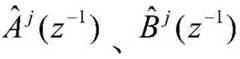
wherein r isout Is the SCR outlet nitrogen oxide concentration u1 Is the ammonia flow rate, rin Is the SCR inlet nitrogen oxide concentration; the central value, the width and the width interval of the interval type two Gaussian fuzzy membership function are front adjustable parameters, and are shown in figure 3; ARX polynomial coefficient
 And
And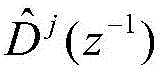 parameters are adjustable for the back piece.


In one possible embodiment, thestep 102 uses an online algorithm to update the rule antecedent and rule successor parameters of the two-type fuzzy logic system.
The following error loss function is defined:

wherein r isout (k) And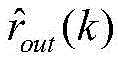 respectively the SCR outlet nitrogen oxide concentration measured in real time and the SCR outlet nitrogen oxide concentration predicted by the two-type fuzzy logic system. Using gradient descent algorithm to process the parameters of the former part
 And performing online recursive updating, wherein the parameter online updating algorithm is derived as follows:


wherein eta is the forward learning rate, and eta is more than 0.
The output of the two-type fuzzy logic system is rewritten in a vector form as follows:


where ξ (k-1) is the input data vector,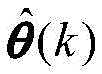 parameter vectors are identified for the back-part.

In the online identification process, the fuzzy rule back part adopts a least square method in a recursion form as follows to carry out iterative updating:

where P (K) is a covariance matrix and K (K) is a gain matrix.
In one possible embodiment, the step 103 adopts a linearized two-type fuzzy logic system model to perform multi-step prediction on the concentration of nitrogen oxides at the outlet of the SCR.
The SCR system performs the following linearization operation:
A(z-1 )rout (k)=B(z-1 )u1 (k-d-1)+D(z-1 )rin (k-d-1) (8)

the following drop-map equation was introduced:

multiplying the left and right sides of (8) by Deltazp ep (z-1 ) To obtain
Δzp Cp (z-1 )A(z-1 )rout (k)=Δzp Cp (z-1 )B(z-1 )u1 (k-d-1)+Δzp Cp (z-1 )D(z-1 )rin (k-d-1) (11)
Definition Gp (z-1 )=Cp (z-1 )B(z-1 ),Tp (z-1 )=Cp (z-1 )D(z-1 );
The predicted value of the content of the nitrogen oxides of the SCR in the future p steps is as follows:

in one possible embodiment, the step 104 uses a quadratic programming technique to calculate the ammonia injection amount of the nox in the SCR process.
Defining the optimization target of the nitrogen oxides at the outlet of the SCR as follows:

wherein N isp And Nu Separate prediction and control fields, Np ≥Nu . d is the time delay of the SCR system.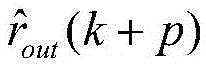 The nitrogen oxide content in the SCR process is predicted value p steps ahead. R (k + p) is the reference trajectory leading the SCR NOx content by p steps. Δ =1-z-1 Is a difference operator, z-1 Is a timing back-shift operator.
 And λ (p) are the weights of the tracking error and control input, respectively, of step p. Constraint conditions (1), (2) and (3) are actual process constraints of outlet nitrogen oxides, ammonia injection quantity and ammonia injection quantity change rate respectively, { · }min And { }max Respectively, a lower limit and an upper limit for the amount of strain.


Rewriting the rolling optimization objective in the above equation in a vector form as:


the optimal ammonia flow variation delta u at the moment k can be obtained by adopting quadratic programming1* (k) The optimal ammonia flow at time k is:

in a possible implementation manner, instep 105, the ammonia injection amount is controlled by accumulating the ammonia injection instructions of the DCS bias module and the original PI controller.
The structure of the specific controller is shown in FIG. 4.
In order to verify the effectiveness of the control method designed by the invention, a simulation experiment is carried out on the SCR system, and controlled objects are as follows:
(1-0.7143z-1 )rout (k)=z-11 (-0.07143-0.1429z-1 -0.07143z-2 )u1 (k-1)+z-11 (0.07143+0.07143z-1 )rin (k-1) (17)
the parameters of the model front piece of the two-type fuzzy logic system are selected to be L =3, and the initial values of the center value, the width and the width interval of the two-type Gaussian fuzzy function are selected as follows:


the initial value of the back-end parameters is selected as P (0) =106 I, I is a unit matrix; prediction time domain selection Np =5, control field select Nu And =1. Inlet nitrogen oxide selection rin (k)=100mg/m3 A step-type set value is used. SCR outlet nitrogen oxide tracking error weight selection
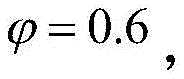 The ammonia flow weight is selected to be lambda =10, and the learning rate eta =0.2. The constraint is chosen as rout,min =15,,rout,min =50,u1,min =0,u1,max =50,Δu1,min =-20,Δu1,max =20. The simulation results are shown in fig. 5a, 5b, 5c, and 5 d.


In summary, the embodiment of the present application provides a method for predicting and controlling nitrogen oxide content in SCR, which uses a type-two fuzzy logic system as a model of nitrogen oxide content in SCR process, and takes the type-reduction operation of the type-two fuzzy logic system into consideration, and uses an NT method to overcome the time-consuming iterative process of KM method; the model can update the model parameters in real time through a feedback correction technology, and overcome the time-varying characteristic of the SCR system parameters; based on the model of the nitrogen oxide content in the SCR process approximated by the two-type fuzzy logic system, the constraint generalized prediction controller is adopted to realize the multi-step prediction and rolling optimization of the nitrogen oxide content in the SCR process, thereby overcoming the inertia and time lag problems of the SCR system and simultaneously meeting the process constraints of the actual SCR process. Ammonia spraying control is realized through a DCS offset module, an original PI controller does not need to be replaced, engineering realization is greatly facilitated, and DCS safety is guaranteed.
Based on the same technical concept, the embodiment of the present application further provides a system for predicting and controlling the content of SCR nitrogen oxides, as shown in fig. 6, the system includes:
and themodeling module 601 is used for modeling the nitrogen oxides in the SCR process by adopting a two-type fuzzy logic system.
And aparameter updating module 602, configured to update the rule front-part and rule back-part parameters of the two-type fuzzy logic system by using an online algorithm.
And themulti-step prediction module 603 is used for performing multi-step prediction on the concentration of nitrogen oxides at the outlet of the SCR by adopting the linearized two-type fuzzy logic system model.
And the ammonia injectionamount calculation module 604 is used for calculating the ammonia injection amount of the nitrogen oxides in the SCR process based on a quadratic programming technology.
And the ammonia injectionamount control module 605 is used for accumulating with the original DCS controller in a bias mode to realize the ammonia injection amount control.
Based on the same technical concept, an embodiment of the present application further provides an apparatus, including: the device comprises a data acquisition device, a processor and a memory; the data acquisition device is used for acquiring data; the memory for storing one or more program instructions; the processor is configured to execute one or more program instructions to perform the method.
Based on the same technical concept, the embodiment of the present application further provides a computer-readable storage medium, which contains one or more program instructions for executing the method.
In the present specification, each embodiment of the method is described in a progressive manner, and the same and similar parts among the embodiments are referred to each other, and each embodiment focuses on the differences from the other embodiments. Reference is made to the description of the method embodiments.
It should be noted that although the operations of the methods of the present invention are depicted in the drawings in a particular order, this does not require or imply that these operations must be performed in this particular order, or that all of the illustrated operations must be performed, to achieve desirable results. Additionally or alternatively, certain steps may be omitted, multiple steps combined into one step execution, and/or one step broken down into multiple step executions.
Although the present application provides method steps as in embodiments or flowcharts, additional or fewer steps may be included based on conventional or non-inventive approaches. The order of steps recited in the embodiments is merely one manner of performing the steps in a multitude of sequences, and does not represent a unique order of performance. When an apparatus or client product in practice executes, it may execute sequentially or in parallel (e.g., in a parallel processor or multithreaded processing environment, or even in a distributed data processing environment) according to the embodiments or methods shown in the figures. The terms "comprises," "comprising," or any other variation thereof, are intended to cover a non-exclusive inclusion, such that a process, method, article, or apparatus that comprises a list of elements does not include only those elements but may include other elements not expressly listed or inherent to such process, method, article, or apparatus. Without further limitation, the presence of additional identical or equivalent elements in processes, methods, articles, or apparatus that include the recited elements is not excluded.
The units, devices, modules, etc. illustrated in the above embodiments may be specifically implemented by a computer chip or an entity, or implemented by a product with certain functions. For convenience of description, the above devices are described as being divided into various modules by functions, and are described separately. Of course, in implementing the present application, the functions of each module may be implemented in one or more software and/or hardware, or a module implementing the same function may be implemented by a combination of a plurality of sub-modules or sub-units, and the like. The above-described embodiments of the apparatus are merely illustrative, and for example, the division of the units is only one type of logical functional division, and other divisions may be realized in practice, for example, multiple units or components may be combined or integrated into another system, or some features may be omitted, or not executed. In addition, the shown or discussed mutual coupling or direct coupling or communication connection may be an indirect coupling or communication connection through some interfaces, devices or units, and may be in an electrical, mechanical or other form.
Those skilled in the art will also appreciate that, in addition to implementing the controller as pure computer readable program code, the same functionality can be implemented by logically programming method steps such that the controller is in the form of logic gates, switches, application specific integrated circuits, programmable logic controllers, embedded microcontrollers and the like. Such a controller may therefore be considered as a hardware component, and the means included therein for performing the various functions may also be considered as a structure within the hardware component. Or even means for performing the functions may be regarded as being both a software module for performing the method and a structure within a hardware component.
The application may be described in the general context of computer-executable instructions, such as program modules, being executed by a computer. Generally, program modules include routines, programs, objects, components, data structures, classes, etc. that perform particular tasks or implement particular abstract data types. The application may also be practiced in distributed computing environments where tasks are performed by remote processing devices that are linked through a communications network. In a distributed computing environment, program modules may be located in both local and remote computer storage media including memory storage devices.
From the above description of the embodiments, it is clear to those skilled in the art that the present application can be implemented by software plus a necessary general hardware platform. Based on such understanding, the technical solutions of the present application or portions thereof that contribute to the prior art may be embodied in the form of a software product, which may be stored in a storage medium, such as a ROM/RAM, a magnetic disk, an optical disk, or the like, and includes several instructions for enabling a computer device (which may be a personal computer, a mobile terminal, a server, or a network device) to execute the method according to the embodiments or some portions of the embodiments of the present application.
The embodiments in the present specification are described in a progressive manner, and the same or similar parts in the embodiments are referred to each other, and each embodiment focuses on differences from other embodiments. The application is operational with numerous general purpose or special purpose computing system environments or configurations. For example: personal computers, server computers, hand-held or portable devices, tablet-type devices, multiprocessor systems, microprocessor-based systems, set top boxes, programmable electronic devices, network PCs, minicomputers, mainframe computers, distributed computing environments that include any of the above systems or devices, and the like.
The above-mentioned embodiments are further described in detail for the purpose of illustrating the invention, and it should be understood that the above-mentioned embodiments are only illustrative of the present invention and are not intended to limit the scope of the present invention, and any modifications, equivalent substitutions, improvements, etc. made within the spirit and principle of the present invention should be included in the scope of the present invention.
Claims (9)
1. A method for predicting the content of nitrogen oxides in Selective Catalytic Reduction (SCR), which is characterized by comprising the following steps:
modeling the nitrogen oxide in the SCR process by adopting a two-type fuzzy logic system;
updating the rule front-piece and rule back-piece parameters of the two-type fuzzy logic system by adopting an online algorithm;
adopting a linearized two-type fuzzy logic system model to carry out multi-step prediction on the concentration of nitrogen oxides at the outlet of the SCR;
calculating the ammonia injection amount of nitrogen oxides in the SCR process based on a quadratic programming technology;
the ammonia spraying amount is controlled by accumulating with the original DCS controller in a bias mode;
the model of the nitrogen oxide in the SCR process is modeled by adopting a two-type fuzzy logic system according to the following formula:


wherein r isout Is the concentration of nitrogen oxides at the outlet of the SCR,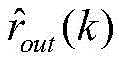 SCR outlet NOx concentration, u, predicted for a two-type fuzzy logic system1 Is the ammonia flow rate, rin Is the SCR inlet nitrogen oxide concentration;
 the interval is the central value, the width and the width interval of the interval type two Gaussian fuzzy membership function, and is an adjustable parameter of a fuzzy rule front piece; ARX polynomial coefficient
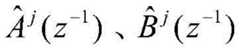 And
And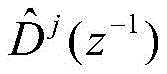 adjustable parameters for fuzzy rule back-parts;
 representing ARX polynomial coefficients
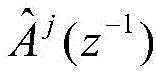 Coefficient of item 1;
 representing ARX polynomial coefficients
 Coefficient of item 2;
 representing ARX polynomial coefficients
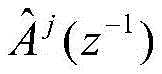 N of (2)r A term coefficient; n isr Representing ARX polynomial coefficients
 The order of (a);
 representing ARX polynomial coefficients
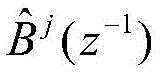 Coefficient of item 1;
 representing ARX polynomial coefficients
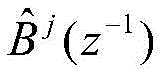 Coefficient of item 2;
 representing ARX polynomial coefficients
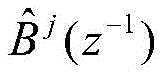 N th of (1)u A term coefficient; n is a radical of an alkyl radicalu Representing ARX polynomial coefficients
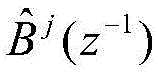 The order of (2);
 representing ARX polynomial coefficients
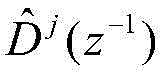 Coefficient of item 1;
 representing ARX polynomial coefficients
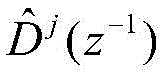 Coefficient of item 2;
 representing ARX polynomial coefficients
 N th of (1)d A term coefficient; n isd Representing ARX polynomial coefficients
 Of the order of (c).


2. The method of claim 1, wherein the SCR process nox model comprises an SCR inlet nox concentration;
the fuzzy rule of the two-type fuzzy logic system is determined by the design quantity of the two-type fuzzy membership function of each input variable interval;
the type-II fuzzy logic system adopts an NT type reduction method with a closed-loop expression form;
modeling data of the two-type fuzzy logic system, namely the concentration of nitrogen oxides at the SCR outlet, the ammonia flow and the concentration of nitrogen oxides at the SCR inlet are obtained by DCS and stored.
3. The method of claim 1, wherein updating the rule antecedent and rule successor parameters of the two-type fuzzy logic system using an online algorithm uses an error loss function as follows:

wherein r isout (k) And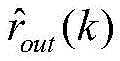 the concentration of the nitrogen oxide at the outlet of the SCR is measured in real time and the concentration of the nitrogen oxide at the outlet of the SCR predicted by the two-type fuzzy logic system; fuzzy rule antecedent parameter using gradient descent algorithm
 Performing online recursive updating;


wherein eta is the forward learning rate, and eta is more than 0;
the output of the two-type fuzzy logic system is rewritten in a vector form as follows:


where ξ (k-1) is the input data vector,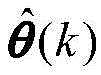 identifying parameter vectors for the postpiece of the fuzzy rule;

in the online identification process, the fuzzy rule back part adopts a least square method in a recursion form as follows to carry out iterative updating:


P(k)=P(k-1)-K(k)ξT (k-1)P(k-1)
wherein P (K) is a covariance matrix and K (K) is a gain matrix;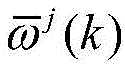 indicating time k
 nr Representing an order of SCR outlet concentration values; r isin (k-d-1) represents the SCR inlet concentration value at the moment k-d-1; r isin (k-d-nd ) Represents k-d-nd The SCR inlet concentration value at the moment; n isd Representing an order of SCR inlet concentration values; u. of1 (k-d-1) represents the ammonia injection amount at the time of k-d-1; u. u1 (k-d-nu ) Represents k-d-nu The amount of sprayed ammonia at that time; n is a radical of an alkyl radicalu Indicating the order of ammonia injection amount;
 ARX polynomial coefficient for expressing k time
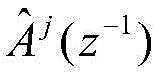 Coefficient of item 1;
 ARX polynomial coefficient representing k time
 N of (2)r A term coefficient;
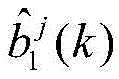 ARX polynomial coefficient representing k time
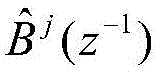 Coefficient of item 1;
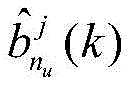 ARX polynomial coefficient for expressing k time
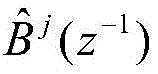 N of (2)u A term coefficient;
 ARX polynomial coefficient for expressing k time
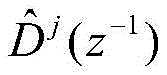 Coefficient of item 1;
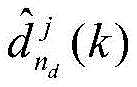 ARX polynomial coefficient representing k time
 N of (2)d A term coefficient; r is a radical of hydrogen1 (k) Representing the SCR outlet concentration value at time k.


4. The method of claim 1, wherein said multi-step predicting SCR outlet nox concentration using a linearized two-type fuzzy logic system model comprises:
after the nonlinear dynamic process of the SCR system is identified by the two-type fuzzy logic system, firstly, the following linearization operations are carried out:
A(z-1 )rout (k)=B(z-1 )u1 (k-d-1)+D(z-1 )rin (k-d-1)
left and right multiplied by Δ zp Cp (z-1 ) Obtaining:
Δzp Cp (z-1 )A(z-1 )rout (k)=Δzp Cp (z-1 )B(z-1 )u1 (k-d-1)+Δzp Cp (z-1 )D(z-1 )rin (k-d-1)


the following drop-map equation was introduced:

definition Gp (z-1 )=Cp (z-1 )B(z-1 ),Tp (z-1 )=Cp (z-1 )D(z-1 ) The predicted value of the content of the nitrogen oxides in the SCR process is as follows:

wherein r isout (k) The SCR outlet concentration value at the moment k is represented; u. of1 (k-d-1) represents the value of the ammonia injection amount at the time of k-d-1; r isin (k-d-1) represents the SCR inlet concentration value at the k-d-1 moment; Δ zp Representing that the time sequence is shifted backwards by p steps and then carrying out differential operation; n is a radical of an alkyl radicalr Representing an order of SCR outlet concentration values;


nu Indicating the order of ammonia injection amount; n isd Representing an order of SCR inlet concentration values; denotes the ith item jth back piece A (z)-1 ) The coefficient of (a);
 denotes the ith item jth back piece B (z)-1 ) The coefficient of (a);
 denotes the ith item jth back piece D (z)-1 ) The coefficient of (a); delta A (z)-1 ) Represents A (z)-1 ) The differential form of (1); c. Cp,0 Represents a polynomial Cp (z-1 ) The 1 st coefficient of (a); c. Cp,1 Represents a polynomial Cp (z-1 ) The 2 nd coefficient of (3); c. Cp,p-1 Represents a polynomial Cp (z-1 ) The p-th coefficient of (2); h is a total ofp,0 Represents a polynomial Hp (z-1 ) The 1 st coefficient of (a); h isp,1 Represents a polynomial Hp (z-1 ) The 2 nd coefficient of (a); h isp,nr Represents a polynomial Hp (z-1 ) N th of (1)r +1 coefficients; Δ u1 (k-1) represents a difference form of the ammonia injection amount at the time k-1; Δ rin (k-1) represents a differential form of SCR inlet NOx concentration at time k-1; gp (z-1 )z-d+p Where d denotes the system delay and p denotes the p-th step in the future.


5. The method of claim 1, wherein the calculating an ammonia injection amount of nitrogen oxides in the SCR process based on the quadratic programming technique comprises:
defining the optimization target of the nitrogen oxide at the outlet of the SCR as follows:


wherein N isp And Nu Separate prediction and control fields, Np ≥Nu (ii) a d is the time delay of the SCR system;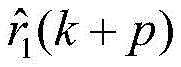 representing a leading p-step type two fuzzy logic system output;
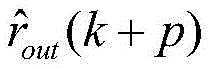 leading the content of nitrogen oxides in the SCR process by p steps to obtain a predicted value; r (k + p) is a reference trajectory leading the SCR nitrogen oxide content by p steps; Δ =1-z-1 Is a difference operator, z-1 Is a timing back shift operator;
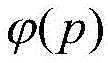 and λ (p) are the weights of the tracking error and control input, respectively, of step p; the constraint conditions (1), (2) and (3) are the practical process constraints of outlet nitrogen oxide, ammonia injection quantity and ammonia injection quantity change rate respectively, {. Cndot }min And { }max Respectively a lower limit and an upper limit to the dependent variable;


rewriting the rolling optimization goal in the above equation in vector form as:

s.t.NΔu1 (k)≤ΔY(k)
Ψ=2(GT ΦG+λ),Ω=2GT Φ(Ξ-R),Υ=(Ξ-R)T Φ(Ξ-R)


the optimal ammonia flow variation at the k moment can be obtained by adopting quadratic programming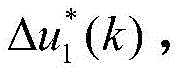 The optimal ammonia flow at time k is:


wherein d represents the system time delay, and p represents the p step in the future; Δ u1 Specific definition of (k + p-1): a difference form of the ammonia injection amount at the k + p-1 moment;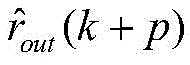 the specific definition of (c): predicting the concentration of NOx at the outlet of the SCR at the moment k + p; u. of1 (k-1 + p) is specifically defined: spraying ammonia amount at the moment k-1+ p; Δ u1 (k-1 + p) is specifically defined: a difference form of ammonia injection amount at the moment k-1+ p; Δ u1 (k) A differential form representing the amount of ammonia injected at time k; λ represents an ammonia injection amount weight factor; in the formula, G, R, H, T and N are respectively: g represents a control coefficient vector, R represents a set value vector, H represents an output coefficient matrix, T represents an input coefficient vector, and N represents a control quantity constraint coefficient vector;
 to representA control quantity historical sequence coefficient matrix;
 a coefficient matrix representing the historical sequence of the input quantity; Δ U (k-1) represents a historical control increment vector; Δ Rin (k-1) representing a historical input delta vector; Δ Y (k) represents a constraint condition vector; phi represents a tracking error weight factor matrix; i denotes an identity matrix.


6. The method of claim 1, wherein the controlling the amount of ammonia injected by the offset mode in addition to the DCS native controller comprises:
and the ammonia spraying amount is controlled by accumulating the ammonia spraying instructions of the DCS deviation module and the original PI controller.
7. An SCR nitrogen oxide content predictive control system, the system comprising:
the modeling module is used for modeling the nitrogen oxide in the SCR process by adopting a two-type fuzzy logic system;
the parameter updating module is used for updating the rule front-piece and rule back-piece parameters of the two-type fuzzy logic system by adopting an online algorithm;
the multi-step prediction module is used for carrying out multi-step prediction on the concentration of nitrogen oxides at the outlet of the SCR by adopting the linearized two-type fuzzy logic system model;
the ammonia injection amount calculation module is used for realizing the ammonia injection amount calculation of the nitrogen oxides in the SCR process based on a quadratic programming technology;
the ammonia spraying amount control module is used for realizing the control of the ammonia spraying amount through the accumulation of a bias mode and the original DCS controller;
the model of the nitrogen oxide in the SCR process is modeled by adopting a two-type fuzzy logic system according to the following formula:


wherein r isout Is the concentration of nitrogen oxides at the outlet of the SCR,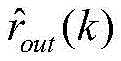 SCR outlet nitrogen oxide concentration, u, predicted for a two-type fuzzy logic system1 Is the ammonia flow rate, rin Is the SCR inlet nitrogen oxide concentration;
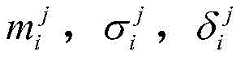 the interval is the central value, the width and the width interval of the interval type two Gaussian fuzzy membership function, and is a fuzzy rule front piece adjustable parameter; coefficient of ARX polynomial
 And
And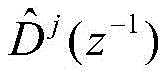 adjustable parameters for fuzzy rule back-parts;
 representing ARX polynomial coefficients
 Coefficient of item 1;
 representing ARX polynomial coefficients
 Coefficient of item 2;
 representing ARX polynomial coefficients
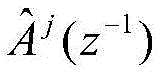 N th of (1)r A term coefficient; n isr Representing ARX polynomial coefficients
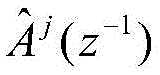 The order of (a);
 representing ARX polynomial coefficients
 Coefficient of item 1;
 representing ARX polynomial coefficients
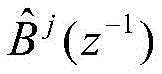 Coefficient of item 2;
 representing ARX polynomial coefficients
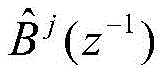 N th of (1)u A term coefficient; n isu Representing ARX polynomial coefficients
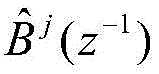 The order of (2);
 representing ARX polynomial coefficients
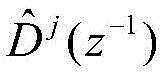 Coefficient of item 1;
 representing ARX polynomial coefficients
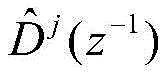 Coefficient of item 2;
 representing ARX polynomial coefficients
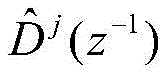 N of (2)d A term coefficient; n isd Representing ARX polynomial coefficients
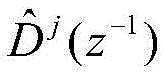 The order of (a).


8. An SCR nitrogen oxide content predictive control apparatus, characterized by comprising: the device comprises a data acquisition device, a processor and a memory;
the data acquisition device is used for acquiring data; the memory for storing one or more program instructions; the processor, configured to execute one or more program instructions to perform the method of any of claims 1-3.
9. A computer-readable storage medium containing one or more program instructions for performing the method of any one of claims 1-3.
Priority Applications (1)
| Application Number | Priority Date | Filing Date | Title |
|---|---|---|---|
| CN202011256976.7ACN112631127B (en) | 2020-11-11 | 2020-11-11 | SCR nitrogen oxide content prediction control method and system |
Applications Claiming Priority (1)
| Application Number | Priority Date | Filing Date | Title |
|---|---|---|---|
| CN202011256976.7ACN112631127B (en) | 2020-11-11 | 2020-11-11 | SCR nitrogen oxide content prediction control method and system |
Publications (2)
| Publication Number | Publication Date |
|---|---|
| CN112631127A CN112631127A (en) | 2021-04-09 |
| CN112631127Btrue CN112631127B (en) | 2022-11-04 |
Family
ID=75302989
Family Applications (1)
| Application Number | Title | Priority Date | Filing Date |
|---|---|---|---|
| CN202011256976.7AActiveCN112631127B (en) | 2020-11-11 | 2020-11-11 | SCR nitrogen oxide content prediction control method and system |
Country Status (1)
| Country | Link |
|---|---|
| CN (1) | CN112631127B (en) |
Citations (9)
| Publication number | Priority date | Publication date | Assignee | Title |
|---|---|---|---|---|
| CN104700374A (en)* | 2015-03-26 | 2015-06-10 | 东莞职业技术学院 | Scene Image Denoising Method Based on Type-2 Fuzzy Logic System |
| CN106681381A (en)* | 2017-01-03 | 2017-05-17 | 华北电力大学 | SCR denitration system ammonia spraying quantity optimal control system and method based on intelligent feedforward signals |
| CN106842962A (en)* | 2017-04-13 | 2017-06-13 | 东南大学 | Based on the SCR denitration control method for becoming constraint multiple model predictive control |
| CN108087065A (en)* | 2017-11-01 | 2018-05-29 | 联创汽车电子有限公司 | SCR catalyst ammonia density modification method and SCR processing systems |
| CN108510060A (en)* | 2018-03-12 | 2018-09-07 | 华南理工大学 | A kind of two type Fuzzy Cognitive Map model of section based on fuzzy neural network |
| CN108837699A (en)* | 2018-07-02 | 2018-11-20 | 大唐环境产业集团股份有限公司 | It is a kind of that ammonia optimization method and system are intelligently sprayed based on the SCR denitration of hard measurement and PREDICTIVE CONTROL |
| CN108905554A (en)* | 2018-06-21 | 2018-11-30 | 华能国际电力股份有限公司 | Minimum continuous ammonia spraying temperature online real-time prediction method for SCR flue gas denitration equipment |
| CN109529620A (en)* | 2018-12-11 | 2019-03-29 | 南京达凯电力自动化设备有限公司 | Based on acoustic measurement temperature field, the ammonia-gas spraying device in flow field and its working method |
| CN110048606A (en)* | 2019-05-23 | 2019-07-23 | 哈尔滨工业大学 | DC-DC boost converter Dynamic sliding mode voltage control method based on two type Adaptive Fuzzy Neural-network of section |
Family Cites Families (1)
| Publication number | Priority date | Publication date | Assignee | Title |
|---|---|---|---|---|
| US7536232B2 (en)* | 2004-08-27 | 2009-05-19 | Alstom Technology Ltd | Model predictive control of air pollution control processes |
- 2020
- 2020-11-11CNCN202011256976.7Apatent/CN112631127B/enactiveActive
Patent Citations (9)
| Publication number | Priority date | Publication date | Assignee | Title |
|---|---|---|---|---|
| CN104700374A (en)* | 2015-03-26 | 2015-06-10 | 东莞职业技术学院 | Scene Image Denoising Method Based on Type-2 Fuzzy Logic System |
| CN106681381A (en)* | 2017-01-03 | 2017-05-17 | 华北电力大学 | SCR denitration system ammonia spraying quantity optimal control system and method based on intelligent feedforward signals |
| CN106842962A (en)* | 2017-04-13 | 2017-06-13 | 东南大学 | Based on the SCR denitration control method for becoming constraint multiple model predictive control |
| CN108087065A (en)* | 2017-11-01 | 2018-05-29 | 联创汽车电子有限公司 | SCR catalyst ammonia density modification method and SCR processing systems |
| CN108510060A (en)* | 2018-03-12 | 2018-09-07 | 华南理工大学 | A kind of two type Fuzzy Cognitive Map model of section based on fuzzy neural network |
| CN108905554A (en)* | 2018-06-21 | 2018-11-30 | 华能国际电力股份有限公司 | Minimum continuous ammonia spraying temperature online real-time prediction method for SCR flue gas denitration equipment |
| CN108837699A (en)* | 2018-07-02 | 2018-11-20 | 大唐环境产业集团股份有限公司 | It is a kind of that ammonia optimization method and system are intelligently sprayed based on the SCR denitration of hard measurement and PREDICTIVE CONTROL |
| CN109529620A (en)* | 2018-12-11 | 2019-03-29 | 南京达凯电力自动化设备有限公司 | Based on acoustic measurement temperature field, the ammonia-gas spraying device in flow field and its working method |
| CN110048606A (en)* | 2019-05-23 | 2019-07-23 | 哈尔滨工业大学 | DC-DC boost converter Dynamic sliding mode voltage control method based on two type Adaptive Fuzzy Neural-network of section |
Non-Patent Citations (3)
| Title |
|---|
| SCR控制策略研究;王洪荣等;《汽车工程学报》;20110731;第1卷(第3期);第204-209页* |
| SCR烟气脱硝系统多模切换DMC-PID串级预测控制;侯鹏飞等;《控制工程》;20200229;第27卷(第2期);第356-358页* |
| 基于T-S模糊模型的SCR脱硝喷氨量动态矩阵预测控制;赵申阳;《万方数据知识服务平台》;20200930;第15-22页* |
Also Published As
| Publication number | Publication date |
|---|---|
| CN112631127A (en) | 2021-04-09 |
Similar Documents
| Publication | Publication Date | Title |
|---|---|---|
| Roubos et al. | Fuzzy model-based predictive control using Takagi–Sugeno models | |
| Rosolia et al. | Learning model predictive control for iterative tasks: A computationally efficient approach for linear system | |
| CN112418284B (en) | A control method and system for a SCR denitration system in a full-operating power station | |
| Lawrynczuk | A family of model predictive control algorithms with artificial neural networks | |
| WO2016010601A2 (en) | Adaptive nonlinear model predictive control using a neural network and input sampling | |
| Hashimoto et al. | Learning self-triggered controllers with Gaussian processes | |
| Feng et al. | Inexact adjoint-based SQP algorithm for real-time stochastic nonlinear MPC | |
| Ławryńczuk | Nonlinear state-space predictive control with on-line linearisation and state estimation | |
| Rosolia et al. | A stochastic MPC approach with application to iterative learning | |
| Marusak | A numerically efficient fuzzy MPC algorithm with fast generation of the control signal | |
| Wu et al. | A simple and fast coordinate-descent augmented-Lagrangian solver for model predictive control | |
| Han et al. | Data-driven tube-based robust predictive control for constrained wastewater treatment process | |
| CN112631127B (en) | SCR nitrogen oxide content prediction control method and system | |
| CN114360656B (en) | Modeling method, device and equipment for selective catalytic reduction denitration model | |
| Boukezzoula et al. | Fuzzy feedback linearizing controller and its equivalence with the fuzzy nonlinear internal model control structure | |
| CN112799297B (en) | Temperature prediction control method, system, equipment and readable storage medium | |
| He et al. | Approximate dynamic programming for constrained piecewise affine systems with stability and safety guarantees | |
| Minh et al. | Robust model predictive control for input saturated and softened state constraints | |
| MacKinnon et al. | Robust closed-loop dynamic real-time optimization | |
| Shujaee et al. | Vibrational feedback control of time delay systems | |
| Tang et al. | Multi‐model predictive control of SCR flue gas denitrification system in coal‐fired power plant based on kernel fuzzy c‐means clustering and integrated model | |
| Martí et al. | An efficient distributed algorithm for multi-stage robust nonlinear predictive control | |
| Hernández et al. | Economics optimizing control with model mismatch based on modifier adaptation | |
| Peng et al. | A predictive control strategy for nonlinear NOx decomposition process in thermal power plants | |
| Ling et al. | A methodology for control-relevant nonlinear system identification using restricted complexity models |
Legal Events
| Date | Code | Title | Description |
|---|---|---|---|
| PB01 | Publication | ||
| PB01 | Publication | ||
| SE01 | Entry into force of request for substantive examination | ||
| SE01 | Entry into force of request for substantive examination | ||
| GR01 | Patent grant | ||
| GR01 | Patent grant |