CN111741734A - Device, system and method for thermal treatment of body tissue - Google Patents
Device, system and method for thermal treatment of body tissueDownload PDFInfo
- Publication number
- CN111741734A CN111741734ACN201980014017.3ACN201980014017ACN111741734ACN 111741734 ACN111741734 ACN 111741734ACN 201980014017 ACN201980014017 ACN 201980014017ACN 111741734 ACN111741734 ACN 111741734A
- Authority
- CN
- China
- Prior art keywords
- balloon
- catheter
- bladder
- conduits
- conduit
- Prior art date
- Legal status (The legal status is an assumption and is not a legal conclusion. Google has not performed a legal analysis and makes no representation as to the accuracy of the status listed.)
- Pending
Links
- 238000000034methodMethods0.000titleabstractdescription20
- 238000007669thermal treatmentMethods0.000titledescription6
- 239000012530fluidSubstances0.000claimsdescription73
- 238000011282treatmentMethods0.000claimsdescription14
- 239000000523sampleSubstances0.000claimsdescription13
- 229920001296polysiloxanePolymers0.000claimsdescription8
- 210000001635urinary tractAnatomy0.000claimsdescription7
- 239000007788liquidSubstances0.000claimsdescription4
- 238000003780insertionMethods0.000claimsdescription3
- 230000037431insertionEffects0.000claimsdescription3
- 238000013022ventingMethods0.000claims1
- 210000001519tissueAnatomy0.000abstractdescription27
- 238000010438heat treatmentMethods0.000abstractdescription15
- 210000003903pelvic floorAnatomy0.000abstractdescription5
- 210000005068bladder tissueAnatomy0.000abstractdescription3
- 201000010099diseaseDiseases0.000abstractdescription3
- 208000037265diseases, disorders, signs and symptomsDiseases0.000abstractdescription3
- 210000003932urinary bladderAnatomy0.000description62
- 210000003708urethraAnatomy0.000description13
- 238000004873anchoringMethods0.000description10
- 230000009977dual effectEffects0.000description10
- 239000000463materialSubstances0.000description8
- 210000000664rectumAnatomy0.000description6
- 208000023610Pelvic Floor diseaseDiseases0.000description5
- 230000008439repair processEffects0.000description5
- 210000001215vaginaAnatomy0.000description5
- 102000008186CollagenHuman genes0.000description4
- 108010035532CollagenProteins0.000description4
- 241001313288LabiaSpecies0.000description4
- 229920001436collagenPolymers0.000description4
- XLYOFNOQVPJJNP-UHFFFAOYSA-NwaterSubstancesOXLYOFNOQVPJJNP-UHFFFAOYSA-N0.000description4
- 208000034347Faecal incontinenceDiseases0.000description3
- 239000002537cosmeticSubstances0.000description3
- 230000002572peristaltic effectEffects0.000description3
- 210000005070sphincterAnatomy0.000description3
- 206010020853Hypertonic bladderDiseases0.000description2
- 208000005615Interstitial CystitisDiseases0.000description2
- 239000004677NylonSubstances0.000description2
- 208000009722Overactive Urinary BladderDiseases0.000description2
- 208000000450Pelvic PainDiseases0.000description2
- 210000003484anatomyAnatomy0.000description2
- 230000008602contractionEffects0.000description2
- 230000003247decreasing effectEffects0.000description2
- 238000007599dischargingMethods0.000description2
- 239000000835fiberSubstances0.000description2
- 238000012986modificationMethods0.000description2
- 230000004048modificationEffects0.000description2
- 238000012544monitoring processMethods0.000description2
- 229920001778nylonPolymers0.000description2
- 208000020629overactive bladderDiseases0.000description2
- 230000008058pain sensationEffects0.000description2
- 229920000642polymerPolymers0.000description2
- 230000037452primingEffects0.000description2
- 208000024891symptomDiseases0.000description2
- 238000002560therapeutic procedureMethods0.000description2
- 230000002485urinary effectEffects0.000description2
- 210000002700urineAnatomy0.000description2
- 206010005063Bladder painDiseases0.000description1
- 208000034423DeliveryDiseases0.000description1
- 208000002193PainDiseases0.000description1
- 206010064229Pelvic discomfortDiseases0.000description1
- FAPWRFPIFSIZLT-UHFFFAOYSA-MSodium chlorideChemical compound[Na+].[Cl-]FAPWRFPIFSIZLT-UHFFFAOYSA-M0.000description1
- 206010066218Stress Urinary IncontinenceDiseases0.000description1
- 206010046543Urinary incontinenceDiseases0.000description1
- 208000003728VulvodyniaDiseases0.000description1
- 206010069055Vulvovaginal painDiseases0.000description1
- 210000001015abdomenAnatomy0.000description1
- 210000002255anal canalAnatomy0.000description1
- 230000001580bacterial effectEffects0.000description1
- 230000002457bidirectional effectEffects0.000description1
- 238000000071blow mouldingMethods0.000description1
- 210000000746body regionAnatomy0.000description1
- 238000005266castingMethods0.000description1
- 230000008859changeEffects0.000description1
- 230000001684chronic effectEffects0.000description1
- 230000001351cycling effectEffects0.000description1
- 238000013461designMethods0.000description1
- 230000004064dysfunctionEffects0.000description1
- 230000000694effectsEffects0.000description1
- 230000006870functionEffects0.000description1
- 208000027866inflammatory diseaseDiseases0.000description1
- 230000001404mediated effectEffects0.000description1
- 230000027939micturitionEffects0.000description1
- 238000013021overheatingMethods0.000description1
- 239000004417polycarbonateSubstances0.000description1
- 229920000515polycarbonatePolymers0.000description1
- 229920002050silicone resinPolymers0.000description1
- 229920002379silicone rubberPolymers0.000description1
- 239000004945silicone rubberSubstances0.000description1
- 239000011780sodium chlorideSubstances0.000description1
- 230000003068static effectEffects0.000description1
- 208000011580syndromic diseaseDiseases0.000description1
- 210000004876tela submucosaAnatomy0.000description1
- 238000012360testing methodMethods0.000description1
- 230000001225therapeutic effectEffects0.000description1
- 238000000015thermotherapyMethods0.000description1
- 230000008719thickeningEffects0.000description1
- 238000012384transportation and deliveryMethods0.000description1
- 210000000689upper legAnatomy0.000description1
- 230000009677vaginal deliveryEffects0.000description1
Images






Classifications
- A—HUMAN NECESSITIES
- A61—MEDICAL OR VETERINARY SCIENCE; HYGIENE
- A61M—DEVICES FOR INTRODUCING MEDIA INTO, OR ONTO, THE BODY; DEVICES FOR TRANSDUCING BODY MEDIA OR FOR TAKING MEDIA FROM THE BODY; DEVICES FOR PRODUCING OR ENDING SLEEP OR STUPOR
- A61M25/00—Catheters; Hollow probes
- A61M25/10—Balloon catheters
- A61M25/1002—Balloon catheters characterised by balloon shape
- A—HUMAN NECESSITIES
- A61—MEDICAL OR VETERINARY SCIENCE; HYGIENE
- A61F—FILTERS IMPLANTABLE INTO BLOOD VESSELS; PROSTHESES; DEVICES PROVIDING PATENCY TO, OR PREVENTING COLLAPSING OF, TUBULAR STRUCTURES OF THE BODY, e.g. STENTS; ORTHOPAEDIC, NURSING OR CONTRACEPTIVE DEVICES; FOMENTATION; TREATMENT OR PROTECTION OF EYES OR EARS; BANDAGES, DRESSINGS OR ABSORBENT PADS; FIRST-AID KITS
- A61F7/00—Heating or cooling appliances for medical or therapeutic treatment of the human body
- A61F7/12—Devices for heating or cooling internal body cavities
- A61F7/123—Devices for heating or cooling internal body cavities using a flexible balloon containing the thermal element
- A—HUMAN NECESSITIES
- A61—MEDICAL OR VETERINARY SCIENCE; HYGIENE
- A61M—DEVICES FOR INTRODUCING MEDIA INTO, OR ONTO, THE BODY; DEVICES FOR TRANSDUCING BODY MEDIA OR FOR TAKING MEDIA FROM THE BODY; DEVICES FOR PRODUCING OR ENDING SLEEP OR STUPOR
- A61M25/00—Catheters; Hollow probes
- A61M25/0021—Catheters; Hollow probes characterised by the form of the tubing
- A61M25/0023—Catheters; Hollow probes characterised by the form of the tubing by the form of the lumen, e.g. cross-section, variable diameter
- A61M25/0026—Multi-lumen catheters with stationary elements
- A61M25/003—Multi-lumen catheters with stationary elements characterized by features relating to least one lumen located at the distal part of the catheter, e.g. filters, plugs or valves
- A—HUMAN NECESSITIES
- A61—MEDICAL OR VETERINARY SCIENCE; HYGIENE
- A61F—FILTERS IMPLANTABLE INTO BLOOD VESSELS; PROSTHESES; DEVICES PROVIDING PATENCY TO, OR PREVENTING COLLAPSING OF, TUBULAR STRUCTURES OF THE BODY, e.g. STENTS; ORTHOPAEDIC, NURSING OR CONTRACEPTIVE DEVICES; FOMENTATION; TREATMENT OR PROTECTION OF EYES OR EARS; BANDAGES, DRESSINGS OR ABSORBENT PADS; FIRST-AID KITS
- A61F7/00—Heating or cooling appliances for medical or therapeutic treatment of the human body
- A61F2007/0001—Body part
- A61F2007/0018—Trunk or parts thereof
- A61F2007/0028—Rectum
- A—HUMAN NECESSITIES
- A61—MEDICAL OR VETERINARY SCIENCE; HYGIENE
- A61F—FILTERS IMPLANTABLE INTO BLOOD VESSELS; PROSTHESES; DEVICES PROVIDING PATENCY TO, OR PREVENTING COLLAPSING OF, TUBULAR STRUCTURES OF THE BODY, e.g. STENTS; ORTHOPAEDIC, NURSING OR CONTRACEPTIVE DEVICES; FOMENTATION; TREATMENT OR PROTECTION OF EYES OR EARS; BANDAGES, DRESSINGS OR ABSORBENT PADS; FIRST-AID KITS
- A61F7/00—Heating or cooling appliances for medical or therapeutic treatment of the human body
- A61F2007/0001—Body part
- A61F2007/0048—Genitals
- A—HUMAN NECESSITIES
- A61—MEDICAL OR VETERINARY SCIENCE; HYGIENE
- A61F—FILTERS IMPLANTABLE INTO BLOOD VESSELS; PROSTHESES; DEVICES PROVIDING PATENCY TO, OR PREVENTING COLLAPSING OF, TUBULAR STRUCTURES OF THE BODY, e.g. STENTS; ORTHOPAEDIC, NURSING OR CONTRACEPTIVE DEVICES; FOMENTATION; TREATMENT OR PROTECTION OF EYES OR EARS; BANDAGES, DRESSINGS OR ABSORBENT PADS; FIRST-AID KITS
- A61F7/00—Heating or cooling appliances for medical or therapeutic treatment of the human body
- A61F2007/0001—Body part
- A61F2007/0048—Genitals
- A61F2007/005—Genitals female
- A—HUMAN NECESSITIES
- A61—MEDICAL OR VETERINARY SCIENCE; HYGIENE
- A61F—FILTERS IMPLANTABLE INTO BLOOD VESSELS; PROSTHESES; DEVICES PROVIDING PATENCY TO, OR PREVENTING COLLAPSING OF, TUBULAR STRUCTURES OF THE BODY, e.g. STENTS; ORTHOPAEDIC, NURSING OR CONTRACEPTIVE DEVICES; FOMENTATION; TREATMENT OR PROTECTION OF EYES OR EARS; BANDAGES, DRESSINGS OR ABSORBENT PADS; FIRST-AID KITS
- A61F7/00—Heating or cooling appliances for medical or therapeutic treatment of the human body
- A61F2007/0054—Heating or cooling appliances for medical or therapeutic treatment of the human body with a closed fluid circuit, e.g. hot water
- A—HUMAN NECESSITIES
- A61—MEDICAL OR VETERINARY SCIENCE; HYGIENE
- A61F—FILTERS IMPLANTABLE INTO BLOOD VESSELS; PROSTHESES; DEVICES PROVIDING PATENCY TO, OR PREVENTING COLLAPSING OF, TUBULAR STRUCTURES OF THE BODY, e.g. STENTS; ORTHOPAEDIC, NURSING OR CONTRACEPTIVE DEVICES; FOMENTATION; TREATMENT OR PROTECTION OF EYES OR EARS; BANDAGES, DRESSINGS OR ABSORBENT PADS; FIRST-AID KITS
- A61F7/00—Heating or cooling appliances for medical or therapeutic treatment of the human body
- A61F2007/0095—Heating or cooling appliances for medical or therapeutic treatment of the human body with a temperature indicator
- A61F2007/0096—Heating or cooling appliances for medical or therapeutic treatment of the human body with a temperature indicator with a thermometer
- A—HUMAN NECESSITIES
- A61—MEDICAL OR VETERINARY SCIENCE; HYGIENE
- A61F—FILTERS IMPLANTABLE INTO BLOOD VESSELS; PROSTHESES; DEVICES PROVIDING PATENCY TO, OR PREVENTING COLLAPSING OF, TUBULAR STRUCTURES OF THE BODY, e.g. STENTS; ORTHOPAEDIC, NURSING OR CONTRACEPTIVE DEVICES; FOMENTATION; TREATMENT OR PROTECTION OF EYES OR EARS; BANDAGES, DRESSINGS OR ABSORBENT PADS; FIRST-AID KITS
- A61F7/00—Heating or cooling appliances for medical or therapeutic treatment of the human body
- A61F7/12—Devices for heating or cooling internal body cavities
- A61F2007/126—Devices for heating or cooling internal body cavities for invasive application, e.g. for introducing into blood vessels
- A—HUMAN NECESSITIES
- A61—MEDICAL OR VETERINARY SCIENCE; HYGIENE
- A61M—DEVICES FOR INTRODUCING MEDIA INTO, OR ONTO, THE BODY; DEVICES FOR TRANSDUCING BODY MEDIA OR FOR TAKING MEDIA FROM THE BODY; DEVICES FOR PRODUCING OR ENDING SLEEP OR STUPOR
- A61M25/00—Catheters; Hollow probes
- A61M25/0021—Catheters; Hollow probes characterised by the form of the tubing
- A61M25/0023—Catheters; Hollow probes characterised by the form of the tubing by the form of the lumen, e.g. cross-section, variable diameter
- A61M25/0026—Multi-lumen catheters with stationary elements
- A61M2025/0037—Multi-lumen catheters with stationary elements characterized by lumina being arranged side-by-side
- A—HUMAN NECESSITIES
- A61—MEDICAL OR VETERINARY SCIENCE; HYGIENE
- A61M—DEVICES FOR INTRODUCING MEDIA INTO, OR ONTO, THE BODY; DEVICES FOR TRANSDUCING BODY MEDIA OR FOR TAKING MEDIA FROM THE BODY; DEVICES FOR PRODUCING OR ENDING SLEEP OR STUPOR
- A61M2210/00—Anatomical parts of the body
- A61M2210/10—Trunk
- A61M2210/1042—Alimentary tract
- A—HUMAN NECESSITIES
- A61—MEDICAL OR VETERINARY SCIENCE; HYGIENE
- A61M—DEVICES FOR INTRODUCING MEDIA INTO, OR ONTO, THE BODY; DEVICES FOR TRANSDUCING BODY MEDIA OR FOR TAKING MEDIA FROM THE BODY; DEVICES FOR PRODUCING OR ENDING SLEEP OR STUPOR
- A61M2210/00—Anatomical parts of the body
- A61M2210/10—Trunk
- A61M2210/1078—Urinary tract
- A61M2210/1085—Bladder
- A—HUMAN NECESSITIES
- A61—MEDICAL OR VETERINARY SCIENCE; HYGIENE
- A61M—DEVICES FOR INTRODUCING MEDIA INTO, OR ONTO, THE BODY; DEVICES FOR TRANSDUCING BODY MEDIA OR FOR TAKING MEDIA FROM THE BODY; DEVICES FOR PRODUCING OR ENDING SLEEP OR STUPOR
- A61M2210/00—Anatomical parts of the body
- A61M2210/10—Trunk
- A61M2210/1078—Urinary tract
- A61M2210/1089—Urethra
- A—HUMAN NECESSITIES
- A61—MEDICAL OR VETERINARY SCIENCE; HYGIENE
- A61M—DEVICES FOR INTRODUCING MEDIA INTO, OR ONTO, THE BODY; DEVICES FOR TRANSDUCING BODY MEDIA OR FOR TAKING MEDIA FROM THE BODY; DEVICES FOR PRODUCING OR ENDING SLEEP OR STUPOR
- A61M2210/00—Anatomical parts of the body
- A61M2210/14—Female reproductive, genital organs
- A61M2210/1475—Vagina
Landscapes
- Health & Medical Sciences (AREA)
- Life Sciences & Earth Sciences (AREA)
- Heart & Thoracic Surgery (AREA)
- Animal Behavior & Ethology (AREA)
- General Health & Medical Sciences (AREA)
- Engineering & Computer Science (AREA)
- Biomedical Technology (AREA)
- Veterinary Medicine (AREA)
- Public Health (AREA)
- Pulmonology (AREA)
- Biophysics (AREA)
- Anesthesiology (AREA)
- Hematology (AREA)
- Physics & Mathematics (AREA)
- Thermal Sciences (AREA)
- Vascular Medicine (AREA)
- Child & Adolescent Psychology (AREA)
- Media Introduction/Drainage Providing Device (AREA)
- Thermotherapy And Cooling Therapy Devices (AREA)
Abstract
Description
RELATED APPLICATIONS
This application claims priority to U.S. provisional patent application No.62/617, 645, filed 2018, month 1,day 16, the contents of which are incorporated herein by reference in their entirety.
Technical field and background
The present invention relates to devices, systems and methods for treating body tissues, and more particularly, to systems and methods for uniform thermal treatment of the vagina, rectum, urethra and/or bladder for therapeutic or aesthetic purposes.
There are a wide variety of non-bacterial inflammatory disorders of the urinary tract that are generally less known, more difficult to diagnose, and more difficult to successfully treat. Such a variety of conditions include overactive bladder, interstitial cystitis, urinary or fecal incontinence, chronic pelvic syndrome, and the like. These diseases are often accompanied by symptoms such as pelvic pain or discomfort, urgency or frequency of urination, bladder pain, and even pain in various body regions such as the abdomen, lower back or thighs.
It has been recognized by various physicians that the application of heat to various urethral tissues may help alleviate the various symptoms of such various diseases. Thermotherapy is typically performed by microwaves or multiple balloons filled with a liquid.
Thermal therapy has also been applied to a variety of body tissues for repair purposes, such as the tissues of the vulvovaginal tract.
A variety of vaginal repair treatments are commonly used to restore and reconstruct the vaginal tissue of a plurality of women who have had multiple vaginal deliveries resulting in stretching of the vaginal walls, or excessive laxity of the vagina and/or labia.
Non-invasive heat treatment of the vaginal cavity (e.g., Femilift)TMOr ThermiVaTM) A laser or radio frequency energy source is typically used to heat and contract a plurality of collagen fibers present in the submucosa of the vaginal wall. The thermal contraction of the collagen causes a contraction of the collagen-rich spaces and provides a "tightening" effect on the overlying tissue.
Although various methods of radiant energy, such as microwave, radiofrequency or microwave, may be effective to "tighten up" or create new multiple collagen fibers, the energy delivered by such various means may be difficult to control (in terms of direction and intensity), resulting in uneven heating of the tissue and the creation of "hot spots" that may damage the tissue.
Disclosure of Invention
According to one aspect of the present invention there is provided a device for intravaginal or intrarectal use, the device comprising a stylet sized and configured for intravaginal or intrarectal use, the stylet comprising a handle attached to a proximal end of a cylindrical balloon, the handle having a plurality of conduits for circulating a fluid through the balloon and a support member; the support member is adapted to support the balloon for insertion into a vaginal or rectal canal when the balloon is at least partially inflated by the fluid.
According to one aspect of the present invention there is provided a catheter for urinary use, the catheter comprising a shaft having a balloon disposed thereon, the shaft being configured for passage through a urinary tract and into a bladder such that when a distal end of the shaft is placed within the bladder, the balloon is positioned within the urinary tract, the shaft comprising at least one inflow catheter for directing a heated fluid through the balloon and out an opening in the distal end and into the bladder, and at least one outflow catheter for directing the fluid out of the bladder and out an opening in a proximal end of the shaft.
The present invention successfully addresses the shortcomings of the presently known structures by providing a device for uniform thermal treatment of a body cavity, such as the vaginal cavity, and anal canal, and rectum, and urethra, and bladder.
Unless defined otherwise, all technical and scientific terms used herein have the same meaning as commonly understood by one of ordinary skill in the art to which this invention belongs. Although methods and materials similar or equivalent to those described herein can be used in the practice or testing of the present invention, suitable methods and materials are described below. In case of conflict, the present specification, including definitions, will control. In addition, the various materials, methods, and embodiments are illustrative only and not intended to be limiting.
Drawings
The invention is described herein, by way of example only, with reference to the accompanying drawings. Having now described in detail and by reference to the drawings in detail, it is stressed that the particulars shown are by way of example and for purposes of illustrative discussion of the preferred embodiments of the present invention only, and are presented in the cause of providing what is believed to be the most useful and readily understood description of the principles and conceptual aspects of the invention. In this regard, no attempt is made to show structural details of the invention in more detail than is necessary for a fundamental understanding of the invention, the description taken with the drawings making apparent to those skilled in the art how the several forms of the invention may be embodied in practice.
In the drawings:
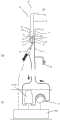
figure 1 shows the vaginal/rectal device connected to an extracorporeal unit comprising a reservoir, pump and heat exchanger.
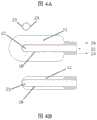
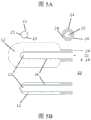
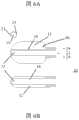
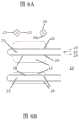
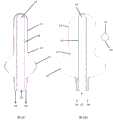
Fig. 2A-8B illustrate various embodiments of catheters for a probe region of the device of fig. 1, shown in an expanded (fig. 2A-8A) state and an unexpanded (fig. 2B-8B) state.
Figures 8C-8D illustrate an alternative balloon design for the probe of figures 2A-8B having a bullseye (Taurus) shaped expansion at the base.
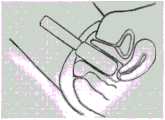
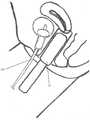
FIG. 9 shows the probe of the device of FIG. 1 positioned within a vaginal canal.
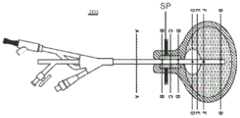
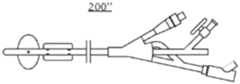
Figures 10A-10B illustrate the urethral and bladder catheter (referred to herein as a dual thermal catheter) positioned within a female urethra and bladder (figure 10A), and a male urethra and bladder (figure 10B). bladder-BL, urethra-UR, sphincter-SP.
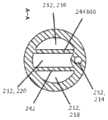
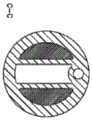
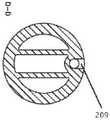
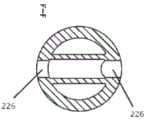
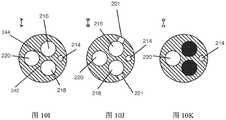
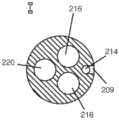
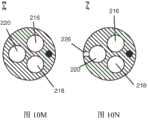
Fig. 10C to 10N show cross-sectional views of dual heat pipes at regions corresponding to those indicated in fig. 10A.
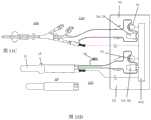
Figures 11A to 11D show a system comprising the vaginal/rectal probe and the dual thermal conduit, both connected to a single controller (figure 11C); and an optional multiple conduit configuration (fig. 11A-11B) that can be used in place of the dual heat pipe, and an optional vaginal probe (fig. 11D).
Figure 12 shows the vaginal/rectal probe and the dual thermal conduits positioned in the vaginal and urethral bladders, respectively.
Detailed Description
The present invention relates to devices and systems that can be used to thermally treat body lumens. In particular, the present invention can be used for the thermal treatment of the urethra and bladder, a vaginal cavity and rectum, alone or in combination, to treat various pelvic floor disorders and/or to repair various vaginal tissues.
The principles and operation of the present invention may be better understood with reference to the drawings and the accompanying description.
Before explaining at least one embodiment of the invention in detail, it is to be understood that the invention is not limited in its application to the details set forth in the following description or illustrated by the examples. The invention is capable of other embodiments or of being practiced or carried out in various ways. Also, it is to be understood that the phraseology and terminology used herein is for the purpose of description and should not be regarded as limiting.
Various methods for thermally treating various pelvic floor disorders are well known in the art, and multiple urinary tract tissues are typically heated using multiple radiofrequency probes, lasers, or balloon-mediated. While these methods may be successful to some extent, they can result in uneven heating of the tissue, which in turn can result in less than ideal treatment and, in some cases, damage due to overheating of the tissue.
While simplifying the invention to practice, the inventors speculate that thermal treatment of various pelvic floor disorders and treatment of specific areas (e.g., the vagina) can be greatly enhanced if heat is transferred in a uniform manner to achieve and maintain a stable temperature in all of these tissues during the treatment.
As described further below, the inventors of the present invention have developed a vaginal/rectal device having a probe that includes an expandable/fillable chamber (also referred to herein as a "balloon") that is expandable by a thermal fluid circulating therein. The balloon expands to fully occupy the rectal/vaginal cavity, thereby maximizing thermal contact between the thermal fluid and these tissues to thereby provide uniform heating.
The inventors of the present invention have also developed a catheter for uniform and controlled heating of the urethral and bladder tissues (referred to herein as a "dual heat catheter"). The vaginal/rectal device and the dual thermal conduit may be used alone or in combination to treat a variety of pelvic floor disorders and to provide cosmetic repair of vaginal tissue.
Vaginal/rectal devices:
according to one aspect of the present invention, there is provided a device for thermally treating a body cavity, such as a vaginal cavity or the rectal cavity. As used herein, the term "treatment" includes cosmetic treatments such as vaginal repair, as well as various non-cosmetic (physiological) treatments for reducing stress urinary incontinence, fecal incontinence, sphincter dysfunction, and the like.
The device includes a probe having a handle attached to a proximal end of a cylindrical balloon. In the case of a vaginal device, the balloon is sized and configured for intravaginal use and may be 30 to 150 mm in length, 10 to 30 mm in diameter when deflated, and 15 to 80 mm in diameter when fully inflated. In the case of a rectal device, the balloon is sized and configured for rectal and anal sphincter use, and may be 10 to 150 a in length, 10 to 20 mm in diameter when deflated, and 20 to 60 mm in diameter when fully inflated.
The bladder is preferably made of a compliant material, such as silicone, silicone rubber, nylon, etc., having a thickness of 100 to 700 microns and a modulus of elasticity of 1 to 50 mpa.
The balloon may also be made of a flexible inelastic (non-compliant) or semi-elastic (semi-compliant) material, such as nylon or high shore silicone (shore a50 or higher), in which case the balloon may be made at a final inflation volume and folded against the stylet for delivery, or may be primed with a fluid and stretched (non-elastically) to a final volume prior to treatment.
When inflated (filled) with a fluid such as saline or water, the balloon may expand (radially and optionally longitudinally) or deploy to completely fill the vaginal/rectal cavity. Since the balloon may be compliant, the balloon will assume the shape of the volume of the vaginal/rectal cavity to maximize contact between the walls of the balloon and the walls of the vaginal/rectal cavity.
Inflation to a pressure of 0.05 to over 1.0 standard atmospheres can expand the balloon and stretch the balloon walls such that the balloon increases in length by 20% to 100% and increases in diameter by 30% to 300%. The increase in length may be directional, i.e. starting from the bottom of the balloon attached to the handle, in a distal direction or may also be bidirectional. In the latter case, the walls of the balloon not attached to the base may be expanded in a proximal direction.
The outer surface of the balloon may be smooth or textured to increase contact and thermal conductivity.
The handle attached to the balloon, the handle including a plurality of conduits for circulating a fluid through the balloon and a support member; the support member is adapted to support the balloon for insertion into a vaginal/rectal canal when the balloon is at least partially inflated.
Because the balloon is comprised of a flexible material, the balloon, even when inflated, will not have sufficient longitudinal rigidity to be inserted into a vaginal cavity. The support member is attached to the handle and extends through the full length of the balloon, the support member providing the necessary longitudinal stiffness and also carrying at least some of the fluid conduits required for circulating a hot fluid through the balloon. The support member is attached to the bottom of the balloon and optionally also to a distal end of the balloon.
To expand/fill the balloon with a heated fluid and maintain the heated fluid circulating through the balloon to maintain a uniform temperature, the device employs one of several conduit arrangements.
Filling a compliant balloon with circulating fluid requires careful planning of the multiple inflow and outflow catheters. If the inflow is greater than the outflow, a balloon may over-inflate, and conversely, if the outflow is greater than the inflow, the balloon may not fully inflate. This balancing is complicated by the walls of the tissue surrounding the balloon (e.g., vaginal walls), as contact between an inflated balloon and tissue walls can increase the pressure in the balloon and alter fluid dynamics.
In order to provide a uniform and stable temperature within the balloon, which should be inflated uniformly while maintaining contact with the walls of the vaginal/rectal cavity, the device includes at least three conduits (2 in and one out, or two out and one in) that circulate fluid through the balloon. Filling of the balloon may begin at the distal or proximal end of the balloon, while evacuation typically occurs from an opposite end. The plurality of inflow and outflow openings may be in the same plane or they may be rotationally offset (e.g. at 30 to 90 degrees) from each other. By continuously filling the balloon from one end and emptying the balloon from the other end (i.e., cycling from distal to proximal), an inflation/filling pressure (0.05 to 1 atm) is maintained within the balloon while fluid is continuously circulated, thereby maintaining a stable fluid temperature within the balloon and a stable temperature on the walls of the vagina/rectum. Additionally, the plurality of openings of the plurality of conduits into and out of the balloon may be configured such that a plurality of pressure changes within the balloon change the opening size to compensate for overpressure or underpressure in the balloon. A number of configurations of fluid conduits for providing such functionality are further described below with reference to fig. 1-8D.
It will be appreciated that in the case of a flexible non-compliant (or semi-compliant) balloon, there is no need to apply a significant amount of back pressure, as filling this balloon (much like a balloon) does not apply a significant amount of pressure to the fluid movement within it.
In order to circulate the fluid through the balloon, the device is fluidly connected to an integral external unit comprising a reservoir (e.g. bag), a pump and a heat exchanger (fig. 1). A plurality of control means for the extracorporeal unit (e.g. fluid temperature, fluid flow rate, etc.) may be provided on the extracorporeal unit and/or on the handle of the present device.
The fluid within the reservoir is circulated through the reservoir by a pump (e.g., a peristaltic pump) and into a plurality of inflow tubes connected with the inflow conduit(s) of the handle. The fluid is forced through the plurality of conduits of the handle and into the balloon thereof to expand the balloon. Once the balloon reaches an expanded internal pressure, fluid is returned through outflow conduits and outflow tubes connected to a fluid reservoir, thereby forming a circulation loop between the balloon and the reservoir.
Referring now to the several figures, FIG. 1 illustrates the present device, which is referred to herein asdevice 10. Thedevice 10 is fluidly connected to anextracorporeal unit 50, thedevice 10 andextracorporeal unit 50 being collectively referred to herein as asystem 100.
Thedevice 10 includes aballoon 12, theballoon 12 being attached at aproximal end 14 thereof to ahandle 16. Thebladder 12 may be made from a silicone resin having a shore a hardness of 10 to 50 and a thickness of 300 to 800 microns by blow molding or casting. Thebladder 12 may be glued or welded to thehandle 16. Thehandle 16 is attached to or abuts asupport member 18, thesupport member 18 extending the length of thebladder 12. Thesupport member 18 may extend to thedistal end 20 of theballoon 12 to contact an inner wall of the balloon 12 (and otherwise optionally be attached, e.g., glued), or to an area within the balloon that is displaced from thedistal end 20 by 5 to 20 millimeters.
Thehandle 16 may be cylindrical in shape and sized to be grasped by one hand of an operator (e.g., 100 mm long and 30 mm wide). Thehandle 16 may be made from a polymer using a variety of known methods.
Thehandle 16 andsupport member 18 include a plurality of fluid conduits for circulating a fluid through theballoon 12. In the configuration shown in fig. 1, thesupport member 18 comprises a single inflow conduit 22 (having an inner diameter of 2 to 12 mm) and a single (lateral) opening 23 (having a diameter of 2 to 5 mm), theopening 23 being used to provide a fluid to a distal portion (tip) of theballoon 12. Thehandle 16 includes twooutflow catheters 24, eachoutflow catheter 24 having anopening 26 at or near a bottom of theballoon 12. The inner diameter of eachconduit 24 may be 1 to 4 millimeters and the diameter of opening 26 may be 1 to 4 millimeters. A number of alternative configurations of the plurality of inflow and outflow conduits are described below with reference to fig. 2A through 8B.
Theinflow catheters 22 are connected to an inflow tube 30 (through aport 31 on the handle 16), while eachoutflow catheter 24 is connected to an outflow tube 32 (merged into a single outflow tube 34) through aport 33 on thehand handle 16. Theinflow tube 22 may be made of a polymer, such as polycarbonate, and has an inner diameter of 1 to 12 mm. Theoutflow tube 24 may be made of silicone tubing and has an inner diameter of 1 to 5 mm; and theoutflow conduit 26 is made of silicone tubing and has an inner diameter of 1 to 5 mm.
Theinflow tube 30 and theoutflow tube 34 are connected to anextracorporeal unit 50 which includes apump 52, aheat exchanger 54 and acontroller 402. Theinlet pipe 30 includes an in-line temperature sensor 36, the in-line temperature sensor 36 including an outer sensor housing and an inner sensor sleeve (condom-like) to separate the temperature sensor from the hot fluid, which is in contact with the outer housing. Theoutflow tube 34 includes aport 38, theport 38 being used for priming the system. A syringe is connected to port 38 and the air present indevice 10 is evacuated using the syringe. Water is then introduced into thedevice 10 via theport 38 to inflate thebladder 12 and circulate the fluid through thebladder 12 and theheat exchanger 54.
Thepump 52 may be a peristaltic pump having a flow rate capability of 50 to 500 milliliters per second. Theheat exchanger 54 may be as described in US 8940035.
The setup and operation of thesystem 100 is as follows. Thedevice 10 is connected to theheat exchanger 54 by thepump 52, while thecontroller 402 operates both (after priming the system 100). The fluid is then circulated through thedevice 10 at a predetermined rate while the fluid temperature is monitored (and modified if necessary). The influent flows through theconduit 22 and into the balloon 12 (through the opening 23). The fluid then exits theballoon 12 through theopening 26 and enters thecatheter 24 and then 34, and returns to theheat exchanger 54.
Thedevice 10 includes a single inflow catheter having an opening at or near the distal end of the balloon and two outflow catheters having a plurality of openings at the proximal end of the balloon. It will be appreciated that this arrangement of conduits may be reversed, i.e. two inflow conduits, i.e. an outflow conduit, and the openings of these conduits may be positioned anywhere in the balloon. Fig. 2A through 8B, described below, provide several alternative catheter arrangements for thedevice 10.
Fig. 2A through 8B illustrate several configurations of fluid conduits that may be used in thedevice 10 of the present invention.
A fluid is circulated within theballoon 12 while maintaining theballoon 12 uniformly expanded about the support member so that theballoon 12 contacts the body lumen/lumens depending on the number of inflow and outflow catheters, their inner diameters and the location and orientation of the plurality of openings of the catheters within theballoon 12.
Fig. 6A-6B illustrate an embodiment of thedevice 10 having a single inflow conduit 22 (surrounded by the support member 18) and twooutflow conduits 24 of thedevice 10. Fig. 6A shows theballoon 12 in an expanded state, while theballoon 12 in fig. 2B is in a non-expanded state. A cross-section (plane X-X) of thedevice 10 at thesupport member 18 showing the arrangement of theconduits 22 and the spatial position of the plurality ofopenings 23 is provided on fig. 6A. The inflow catheter has one ormore openings 23 on the distal (D) side of the balloon 12 (also referred to herein as the "distal end"), while eachoutflow catheter 24 has asingle opening 26 at a proximal end of theballoon 12. The inner diameter ofinflow conduits 22 is 2 to 6 times larger than the inner diameter of eachoutflow conduit 24. In this configuration of thedevice 10, thesupport member 18 is attached (glued/welded) to a distal wall of theballoon 12.
Fig. 7A-7B illustrate an embodiment of thedevice 10 having asingle inflow conduit 22 and threeoutflow conduits 24 of thedevice 10. Fig. 7A shows theballoon 12 in an expanded state, while theballoon 12 of fig. 3B is unexpanded. In fig. 7A (left and right, respectively) a cross-section (plane X-X) of thedevice 10 at thesupport member 18 showing the arrangement of theconduits 22 and the plurality ofopenings 26 and a cross-section (plane Y-Y) at thehandle 16 showing the arrangement of the plurality ofconduits inflow catheter 22 has one ormore openings 23 at the distal end of theballoon 12, while eachoutflow catheter 24 has asingle opening 26 at a proximal end of theballoon 12. In this configuration of thedevice 10, thesupport member 18 is attached (glued/welded) to a distal wall of theballoon 12.
Fig. 4A-4B illustrate an embodiment of thedevice 10 having asingle inflow conduit 22 and two outflow conduits 24 (similar to fig. 2A-2B) of thedevice 10. In this configuration, when theballoon 12 is expanded (fig. 4A), theopening 23 of theinflow catheter 22 is displaced (10 to 30 mm) from the distal end of theballoon 12 because thesupport member 18 is not attached to the distal end wall of theballoon 12. Note that when deflated (fig. 4B), the support member 18 (surrounding catheter 22) contacts a distal wall of theballoon 12. A cross-section (at plane X-X) of thesupport member 18 is shown in fig. 4A.
Fig. 5A-5B illustrate an embodiment of thedevice 10 having asingle inflow conduit 22 and three outflow conduits 24 (similar to fig. 3A-3B) of thedevice 10. In this configuration, when theballoon 12 is expanded (fig. 5A), theopening 23 of theinflow catheter 22 is displaced (10 to 30 mm) from the distal end of theballoon 12 because thesupport member 18 is not attached to the distal end wall of theballoon 12. Note that when deflated (fig. 5B), the support member 18 (surrounding catheter 22) contacts a distal wall of theballoon 12. A cross-section of the support member 18 (at plane X-X) and a cross-section at plane Y-Y (handle 16) are shown on figure 5A (left and right respectively).
The plurality ofopenings 23 of the arrangement illustrated in fig. 4A to 8B are directed to one side of theairbag 12. In fig. 2A-2B, adevice 10 is shown, thedevice 10 having twooutflow catheters 24 and oneinflow catheter 22, theopening 23 opening towards a distal end of theballoon 12. A similar arrangement is shown in fig. 3A-3B, which shows adevice 10 having threeoutflow catheters 24 and aninflow catheter 22, with anopening 23 towards a distal end of theballoon 12, and anopening 23 directed towards a distal end of theballoon 12.
Thebladder 12 may further include an annular protrusion 15 (shown in fig. 8C-8D and 11D) at a bottom thereof, theannular protrusion 15 may be continuous with or separate from thebladder 12. In the case where theprojection 15 is continuous with the balloon, a thickening band 17 (fig. 8C to 8D) is provided between theprojection 15 and the distal balloon portion, in addition to ensuring that these continuous portions of theballoon 12 maintain the desired shape upon inflation. Theprojection 15 may be a separate annular bladder, saidprojection 15 being positioned on thehandle 16 near said bottom of thebladder 12. Theannular protrusion 15 may have a diameter of 30 to 70 mm and a width of 10 to 40 mm. Like theair bag 12, theannular projection 15 may be made of silicone or the like. Thebulge 15 may be co-inflatable with the balloon 12 (sharing the same plurality of fluid inflation chambers), or thebulge 15 may comprise a plurality of dedicated chambers for inflating/deflating the balloon with a hot fluid.Balloon protrusions 15 inflated with a heated fluid can be used to heat extra-vaginal tissue (vulvar tissue, e.g., the labia, etc.) when thedevice 10 is positioned within the vaginal cavity. This heating can be done alone or in conjunction with the vaginal cavity via theballoon 12. Heating of the vulvar tissue may be used to aesthetically reduce the tissue of the labia minora and multiple labia majora, or as a treatment for vulvodynia.
FIGS. 8A-8B illustrate an embodiment of thedevice 10, thedevice 10 having twoinflow conduits 22 enclosed within the formingmember 18; and twooutflow conduits 24 enclosed within thesupport member 18. In fig. 8A (on support member 18-left and handle 16-right) are shown a number of cross-sections showing the arrangement of a number ofinflow 22 andoutflow 24conduits 24 withinsupport member 18.
Thesystem 100 of the present invention may be used to thermally treat a vaginal/rectal cavity as follows. Thedevice 10 is first operated by aspirating air from theballoon 12 through theport 38. Theballoon 12 is then partially filled with 50 to 200 milliliters of water, which is then circulated through thedevice 10 via thepump 52. Inserting the partially filleddevice 10 into the vaginal cavity. Theballoon 12 is inflated (via port 38) with a syringe until theballoon 12 contacts the plurality of vaginal/rectal walls and additional applied pressure causes no discomfort. This procedure can be repeated during the treatment. Hot water (at 40-48 degrees celsius) is then circulated through theballoon 12 for 30 to 60 minutes (theballoon 12 is periodically inflated/deflated through the port 38). During the procedure, a portion of theballoon 12 extending out of the vaginal/rectal cavity may be manually pumped (squeezed) in order to expand/contract the portion of theballoon 12 located within the vaginal/rectal cavity.
It should be understood that although theabove device 10 andsystem 100 are described above in connection with vaginal thermal therapy, thedevice 10 may be configured for the treatment of other multiple body lumens, such as the rectum. For example, adevice 10 having aballoon 12, saidballoon 12 configured with a diameter and length suitable for use within the anal/rectal cavity, saiddevice 10 may be used to uniformly heat rectal tissue and the anal sphincter for the purpose of treating fecal incontinence.
Double heat pipes:
as noted above, the present invention also includes a dual heat pipe capable of simultaneously heating the urethra and bladder of a male or female subject.
Fig. 10A through 10N illustrate a dual heat pipe of the present invention, referred to herein as aconduit 200.
Fig. 10A showscatheter 200 positioned in a female anatomy, while fig. 10B showscatheter 200 positioned in a male anatomy (bladder-BL, urethra-UR, sphincter-SP, fig. 10B). A plurality of reference numerals and a plurality of letters used herein are shown in fig. 10B, but are also applicable to fig. 10A.
Thecatheter 200 includes ashaft 202, theshaft 202 being connected to ahandle 204, which supports a plurality ofports 206. A distal region of theshaft 202 includes an anchoring structure 208 (e.g., catheter balloon) for anchoring thecatheter 200 to the bladder neck to prevent catheter pull-out. Theshaft 202 also includes aballoon 210, theballoon 210 being positioned proximal to the anchoringstructure 208. When the anchoringstructure 208 is anchored at the bladder neck region, theballoon 210 is positioned at the urethra.
Theballoon 210 may be manufactured as described above with a length of 20 to 60 mm and an inflated diameter of 10 to 20 mm.
Theshaft 202 may be cylindrical with a length of 100 to 350 mm and a diameter of 5 to 8 mm. Theport 206 is connected to a plurality ofconduits 212, the plurality ofconduits 212 extending along the length of theshaft 202. Eachport 206 is fluidly connected to a particular conduit 212 (multiple numbers of conduits are shown in fig. 10C by application to fig. 10D through 10H).
As shown in fig. 10C to 10H, thestem 202 includes four conduits: acatheter 214 for inflating (via air or liquid) a catheter-type (Foley) anchoring structure 208 (via openings 209); a plurality ofconduits balloon 210 and the bladder; and acatheter 220 for discharging the thermal fluid from the bladder andballoon 210. Themultiple conduits balloon 210 and the bladder. A plurality ofconduits balloon 210 at a plurality of openings 221 (2 shown in fig. 10D and 4 shown in fig. 10B) and to the bladder at a plurality ofopenings shaft 202. Anopening 226 connects the bladder space with thecatheter 220 to allow the bladder contents to be expelled.
Theport 240 includes atemperature sensor probe 230 for monitoring the temperature of the fluid flowing into theballoon 210 and the bladder. Thesensor 230 may be a temperature sensor similar to that described above (with reference to the device 10).
Each of the plurality ofconduits conduit 220 may have a diameter of 1 to 4 millimeters. In order to effectively circulate fluid throughballoon 210 and the bladder, and to properly and uniformly inflate balloon 210 (to maximize contact with the walls of the urethra), the combined fluid flow of the plurality ofconduits conduit 220 in the case of a compliant balloon, while the combined fluid flow of the plurality ofconduits conduit 220 in the case of a flexible non-or semi-compliant balloon. Alternatively, the diameter of the plurality ofproximal openings 221 may be larger (or higher flow rate) than the diameter of the plurality ofdistal openings 221 within theballoon 210 to create the backpressure. For example, the diameter of the plurality ofproximal openings 221 may be 1.5 to 2.5 millimeters (e.g., 2 millimeters) and the diameter of the plurality ofdistal openings 221 may be 1 to 2 millimeters (e.g., 1 millimeter).
To regulate the flow and pressure within the conduits and to ensure that both theballoon 210 and the bladder are completely filled with circulating fluid, thewalls conduits conduits conduit 220. Thewalls catheter shaft 202 or a resilient/pliable material such as silicone.
Such a pressure differential may be created if the bladder is under-filled or over-filled. When underfilling, the flow inconduit 220 may drop, thereby increasing the flow in themultiple conduits 216 and 218 (due to the lumen enlargement). This increase will result in a faster bladder filling. If the bladder overfills, the flow and pressure (static) in thelumen 220 may increase, thereby allowing the bladder to empty more quickly. In any event, this feature of thecatheter 200 self-regulates pressure and flow and allows a more continuous, more efficient circulation through theballoon 210 and the bladder.
An alternative configuration of the plurality of conduits is shown in fig. 10I to 10N (the plurality of positions of the cross-sections a-a to F-F are shown in fig. 10A). Thestem 202 includes 4 conduits: acatheter 214 for inflating (by air or liquid) a catheter-type anchoring structure 208 (through opening 209), a plurality ofcatheters balloon 210 and the bladder; and acatheter 220 for discharging the thermal fluid from the bladder andballoon 210. Themultiple conduits balloon 210 and the bladder. A plurality ofconduits balloon 210 at a plurality of openings 221 (2 shown in fig. 10J). Anopening 226 connects the bladder space with thecatheter 220 to allow the bladder contents to be expelled (fig. 10N).
Port 240 (fig. 10B) is an inflow port for the plurality ofconduits port 245 is an outflow port forconduit 220; and includes avalve 233 for perfusing thecatheter 200, draining the bladder of urine at the beginning of the procedure, increasing/decreasing the bladder's multiple volumes during the procedure, and emptying the bladder at the end of the procedure. Theport 234 enables inflation of a catheter-type anchoring structure 208 or expansion of amechanical anchoring structure 208 by, for example, a wire that is threaded through thecatheter 220.
Theport 240 includes atemperature sensor probe 230 for monitoring the temperature of the fluid flowing into theballoon 210 and the bladder. Thesensor 230 may be a temperature sensor similar to that described above (with reference to the device 10).
Each of the plurality ofconduits conduit 220 may have a diameter of 1 to 4 millimeters. In order to effectively circulate fluid throughballoon 210 and the bladder, and to properly and uniformly inflate balloon 210 (to maximize contact with the walls of the urethra), the combined fluid flow of the plurality ofconduits conduit 220 in the case of a compliant balloon, while the combined fluid flow of the plurality ofconduits conduit 220 in the case of a flexible non-or semi-compliant balloon. Alternatively, the diameter of the plurality ofproximal openings 221 may be larger (or higher flow rate) than the diameter of the plurality ofdistal openings 221 within theballoon 210 to create the backpressure. For example, the diameter of the plurality ofproximal openings 221 may be 1.5 to 2.5 millimeters (e.g., 2 millimeters) and the diameter of the plurality ofdistal openings 221 may be 1 to 2 millimeters (e.g., 1 millimeter).
Theconduit 200 may be connected to anextracorporeal unit 50 including apump 52, aheat exchanger 54 and areservoir 56 to form a system 300 (shown in fig. 11). Theport 240 may be connected to the plurality of fluid outflow lines of thefluid reservoir 56.Port 245 may be connected to the inflow line intopump 52.
Thepump 52 may be a peristaltic pump as described above with reference to thesystem 100.
Thecatheter 200 may be used to thermally treat multiple urethral and bladder tissues as follows.
Thecatheter 200 is prepared for use with thedevice 10 as described above except that the opening into the bladder is blocked (by, for example, a cap or outer sleeve) to prevent outflow from this opening. Theprepared catheter 200 is then inserted through the urethra and into the bladder, and theballoon 208 is inflated and thecatheter 200 is pulled back (in the proximal direction) until theballoon 208 is anchored at the neck of the bladder and theballoon 210 is positioned within the urethra. The fluid then circulates through theballoon 210 and the bladder while keeping theballoon 210 inflated and the fluid at a stable preset temperature (40 to 48 degrees celsius). The volume of the fluid circulating throughballoon 210 and the bladder is adjusted to accommodate the patient (set below a volume of pain sensation, e.g., less than a volume of the bladder that produces a pain sensation in the subject).
System for uniform heating of the pelvic floor:
the rectal/vaginal device and dual heat pipes described above may be used to heat the urethra and/or bladder, and the rectum/vagina simultaneously, in order to heat the pelvic floor more evenly. Such uniform heating can provide benefits for the treatment of a variety of urethral/bladder related conditions as well as rectal/vaginal related conditions.
Fig. 11A-11D and 12 illustrate a system 400, includingsystems systems single controller 402.
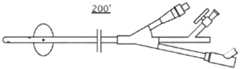
Fig. 11A-11B illustrate a number of alternative configurations of catheter 200 (denoted ascatheters 200' and 200 "), which may be used in place ofcatheter 200 in system 400.
Fig. 11A shows catheter 200 'that does not include the urethral balloon, such that catheter 200' only functions when circulating a thermal fluid through a bladder. Fig. 11B shows acatheter 200 "that includes the urethral balloon but does not have a plurality of openings for circulation through the bladder.
Thecatheters 200' and 200 "may be used in place of thecatheter 200 without the need for additional heating of multiple adjacent lumen structures.
By heating the urethra, and bladder, and the vaginal/rectal cavity and surrounding tissues simultaneously, the system 400 of the present invention provides uniform heating of the entire pelvic floor and effective treatment of a variety of conditions associated therewith. Such combined heating would be particularly useful for treating a variety of pelvic floor disorders such as overactive bladder, interstitial cystitis, chronic pelvic pain syndrome, and the like.
The term "about" as used herein means ± 10%.
It is appreciated that certain features of the invention, which are, for clarity, described in the context of separate embodiments, may also be provided in combination in a single embodiment. Conversely, various features of the invention which are, for brevity, described in the context of a single embodiment, may also be provided separately or in any suitable subcombination.
While the invention has been described in conjunction with specific embodiments thereof, it is evident that many alternatives, modifications, and variations will be apparent to those skilled in the art. Accordingly, it is intended to embrace all such alternatives, modifications and variations that fall within the spirit and broad scope of the appended claims. All publications, patents, and patent applications mentioned in this specification are herein incorporated in their entirety by reference into the specification, to the same extent as if each individual publication, patent, or patent application was specifically and individually indicated to be incorporated herein by reference. In addition, citation or identification of any reference in this application shall not be construed as an admission that such reference is available as prior art to the present invention.
Claims (25)
1. A device for intravaginal or intrarectal use, characterized by: the device comprises a probe sized and configured for intravaginal or intrarectal use, the probe including a handle attached to a proximal end of a cylindrical balloon; the handle having a plurality of conduits for circulating a fluid through the balloon and a support member; the support member is adapted to support the balloon for insertion into a vaginal or rectal canal when the balloon is at least partially inflated by the fluid.
2. The apparatus of claim 1, wherein: the support member extends the full length of the air bag when the air bag is deflated.
3. The apparatus of claim 2, wherein: a first conduit of the plurality of conduits extends a length of the support member.
4. The apparatus of claim 3, wherein: the first catheter forms an opening at a distal end of the balloon.
5. The apparatus of claim 4, wherein: a second catheter of the plurality of catheters forms an opening at the bottom of the balloon.
6. The apparatus of claim 5, wherein: a flow rate through the first conduit is equal to a flow rate through the second conduit.
7. The apparatus of claim 1, wherein: the plurality of conduits comprises; at least one catheter for filling the balloon; and at least two catheters for evacuating the balloon.
8. The apparatus of claim 1, wherein: the plurality of conduits includes: at least one conduit for venting the balloon; and at least two conduits for inflating said balloon.
9. The apparatus of claim 1, wherein: the balloon is a compliant balloon.
10. The apparatus of claim 9, wherein: the flexible bladder is a silicone bladder.
11. The apparatus of claim 10, wherein: the silicone balloon has a length of 50 to 150 mm and a diameter of 15 to 80 mm when the balloon is inflated to a pressure of 1 atm.
12. The apparatus of claim 1, wherein: the handle includes: a plurality of ports for connecting the plurality of conduits to an external fluid source.
13. The apparatus of claim 2, wherein: a distal end of the balloon is attached to the support member.
14. The apparatus of claim 1, wherein: the balloon is configured for longitudinal and radial elastic stretching.
15. The apparatus of claim 1, wherein: a proximal portion of the balloon includes an annular protrusion.
16. A system for intravaginal or intrarectal treatment, comprising: the system comprises: the apparatus of claim 1; and an integral external unit having a liquid reservoir.
17. The system of claim 16, wherein: the extracorporeal unit further comprises a pump and a heat exchanger.
18. A catheter for urinary tract use, characterized by: the catheter includes a shaft having a balloon disposed thereon, the shaft configured to pass through a urinary tract and into a bladder such that the balloon is positioned within the urinary tract when a distal end of the shaft is positioned within the bladder, the shaft including at least one inflow catheter for directing a thermal fluid through the balloon and out an opening at the distal end and into the bladder, and at least one outflow catheter for directing the fluid out of the bladder and out an opening at a proximal end of the shaft.
19. The catheter of claim 18, wherein: the inflow conduit has a fluid flow capacity that is at least 25% higher than a fluid flow capacity of the outflow conduit.
20. The catheter of claim 18, wherein: the conduit comprises two inflow conduits arranged coaxially around the outflow conduit.
21. The catheter of claim 18, wherein: the conduits include two inflow and outflow conduits arranged in a circle.
22. The catheter of claim 18, wherein: a wall separating the inflow conduit and the outflow conduit is resilient such that a pressure differential between the inflow conduit and the outflow conduit causes the wall to flex.
23. A system, characterized by: the system comprises: the device of claim 1 and the catheter of claim 18.
24. The system of claim 23, wherein: the system also includes at least one integral external unit having a fluid reservoir.
25. The system of claim 24, wherein: the extracorporeal unit further comprises a pump and a heat exchanger.
Applications Claiming Priority (3)
| Application Number | Priority Date | Filing Date | Title |
|---|---|---|---|
| US201862617645P | 2018-01-16 | 2018-01-16 | |
| US62/617,645 | 2018-01-16 | ||
| PCT/IL2019/050060WO2019142184A1 (en) | 2018-01-16 | 2019-01-16 | Devices, systems and methods for thermal treatment of body tissues |
Publications (1)
| Publication Number | Publication Date |
|---|---|
| CN111741734Atrue CN111741734A (en) | 2020-10-02 |
Family
ID=67302040
Family Applications (1)
| Application Number | Title | Priority Date | Filing Date |
|---|---|---|---|
| CN201980014017.3APendingCN111741734A (en) | 2018-01-16 | 2019-01-16 | Device, system and method for thermal treatment of body tissue |
Country Status (7)
| Country | Link |
|---|---|
| US (1) | US20210059856A1 (en) |
| EP (1) | EP3740175A4 (en) |
| JP (1) | JP2021510614A (en) |
| CN (1) | CN111741734A (en) |
| CA (1) | CA3088412A1 (en) |
| IL (1) | IL276120A (en) |
| WO (1) | WO2019142184A1 (en) |
Cited By (2)
| Publication number | Priority date | Publication date | Assignee | Title |
|---|---|---|---|---|
| CN114699163A (en)* | 2022-04-11 | 2022-07-05 | 南京德文医学科技有限公司 | A radiofrequency ablation catheter with a cooling bladder |
| CN114848228A (en)* | 2022-05-23 | 2022-08-05 | 江苏泰科博曼医疗器械有限公司 | An auxiliary pressure device for stress urinary incontinence |
Families Citing this family (6)
| Publication number | Priority date | Publication date | Assignee | Title |
|---|---|---|---|---|
| US12082844B2 (en)* | 2018-04-18 | 2024-09-10 | Lalu Joseph | Multipurpose vaginal occlusion and distension device with distension controller |
| US20220071803A1 (en)* | 2020-09-09 | 2022-03-10 | Bandula Wijay | System and Method for Vaginal Remodeling |
| CA3202053A1 (en)* | 2020-12-11 | 2022-06-16 | Rachel BARTHOLOMEW | Device, method, and system for pelvic floor rehabilitation |
| JPWO2022270494A1 (en)* | 2021-06-21 | 2022-12-29 | ||
| DK181575B1 (en) | 2022-02-16 | 2024-05-29 | Qufora As | An enema nozzle comprising retention means, and an enema system comprising said enema nozzle |
| US20250177027A1 (en)* | 2022-05-13 | 2025-06-05 | Bioprotect Ltd. | Apparatus and method for protecting biological tissue during cryotherapy |
Citations (10)
| Publication number | Priority date | Publication date | Assignee | Title |
|---|---|---|---|---|
| US5195965A (en)* | 1991-03-07 | 1993-03-23 | Shantha Totada R | Method and apparatus for localized treatment of human viral infections and cancers |
| US20040186538A1 (en)* | 2003-03-18 | 2004-09-23 | Elmedical Ltd. | System and method for treating urinary tract disorders |
| CN1787790A (en)* | 2003-05-13 | 2006-06-14 | 效思因公司 | Device and method for treating tissue adjacent to a body duct by compressing a balloon |
| CN201029974Y (en)* | 2007-05-09 | 2008-03-05 | 肖永敏 | Puerperal flushing inflatable bag pad |
| JP2008154751A (en)* | 2006-12-22 | 2008-07-10 | Osaka Industrial Promotion Organization | Cryotherapy equipment |
| CN101242793A (en)* | 2004-06-25 | 2008-08-13 | 生产力有限公司 | Antiviral heat treatment |
| CN101810527A (en)* | 2010-03-23 | 2010-08-25 | 杭州富善医疗器械有限公司 | Efficient security silica gel thermal therapy conduit |
| IL171027A (en)* | 2003-03-18 | 2010-11-30 | Elmedical Ltd | System and method for treating urinary tract disorders |
| CN104107497A (en)* | 2014-07-09 | 2014-10-22 | 河南科技大学第一附属医院 | Auxiliary uterine cervix dilator |
| CN205126791U (en)* | 2015-11-24 | 2016-04-06 | 南阳医学高等专科学校第二附属医院 | Perineum belt cleaning device of gynaecology and obstetrics |
Family Cites Families (18)
| Publication number | Priority date | Publication date | Assignee | Title |
|---|---|---|---|---|
| US1652954A (en)* | 1926-03-29 | 1927-12-13 | Charles C Pierce | Prostate applicator |
| US2026747A (en)* | 1935-03-16 | 1936-01-07 | William P B Nemzek | Gravity thermal dilator |
| US3496942A (en)* | 1968-03-01 | 1970-02-24 | Darrell R Shipley | Heater for internal use |
| US4638806A (en)* | 1985-07-09 | 1987-01-27 | Robert T. Johnson | Rectal hemorrhoid therapeutic apparatus |
| US5571153A (en)* | 1991-09-20 | 1996-11-05 | Wallst+E,Acu E+Ee N; Hans I. | Device for hyperthermia treatment |
| US6620188B1 (en)* | 1998-08-24 | 2003-09-16 | Radiant Medical, Inc. | Methods and apparatus for regional and whole body temperature modification |
| US5624395A (en)* | 1995-02-23 | 1997-04-29 | Cv Dynamics, Inc. | Urinary catheter having palpitatable valve and balloon and method for making same |
| US6009351A (en)* | 1997-07-14 | 1999-12-28 | Urologix, Inc. | System and method for transurethral heating with rectal cooling |
| US6602276B2 (en)* | 1998-03-31 | 2003-08-05 | Innercool Therapies, Inc. | Method and device for performing cooling- or cryo-therapies for, e.g., angioplasty with reduced restenosis or pulmonary vein cell necrosis to inhibit atrial fibrillation |
| US6287314B1 (en)* | 1998-04-21 | 2001-09-11 | Advanced Cardiovascular Systems, Inc. | Stent deploying catheter system |
| US8323324B2 (en)* | 2000-06-14 | 2012-12-04 | Innercool Therapies, Inc. | Therapeutic heating and cooling via temperature management of a colon-inserted dual balloon |
| US6702783B1 (en)* | 2002-02-05 | 2004-03-09 | Radiant Medical, Inc. | Endovascular heat-and gas-exchange catheter device and related methods |
| US7144407B1 (en)* | 2002-05-30 | 2006-12-05 | Alsius Corporation | Cardiovascular intra aortic balloon pump catheter with heat exchange function and methods of use |
| US7727191B2 (en)* | 2005-05-13 | 2010-06-01 | Medtronic Cryocath Lp | Compliant balloon catheter |
| US20080149100A1 (en)* | 2006-12-20 | 2008-06-26 | Gerrit Jan Van Holst | Antiviral Heat Treatment |
| US8366758B2 (en)* | 2008-02-11 | 2013-02-05 | The Regents Of The University Of California | Hypothermia for improving rate of functional recovery following pelvic surgeries |
| WO2014055514A2 (en)* | 2012-10-01 | 2014-04-10 | C.R. Bard, Inc. | Balloon catheter having multiple inflation lumens and related methods |
| EP3328331A4 (en)* | 2015-07-27 | 2019-04-10 | University of Maryland, Baltimore | DEVICES AND METHODS FOR BODY TEMPERATURE MANAGEMENT |
- 2019
- 2019-01-16JPJP2020559057Apatent/JP2021510614A/enactivePending
- 2019-01-16CNCN201980014017.3Apatent/CN111741734A/enactivePending
- 2019-01-16EPEP19741364.4Apatent/EP3740175A4/ennot_activeWithdrawn
- 2019-01-16USUS16/962,258patent/US20210059856A1/ennot_activeAbandoned
- 2019-01-16WOPCT/IL2019/050060patent/WO2019142184A1/ennot_activeCeased
- 2019-01-16CACA3088412Apatent/CA3088412A1/enactivePending
- 2020
- 2020-07-16ILIL276120Apatent/IL276120A/enunknown
Patent Citations (10)
| Publication number | Priority date | Publication date | Assignee | Title |
|---|---|---|---|---|
| US5195965A (en)* | 1991-03-07 | 1993-03-23 | Shantha Totada R | Method and apparatus for localized treatment of human viral infections and cancers |
| US20040186538A1 (en)* | 2003-03-18 | 2004-09-23 | Elmedical Ltd. | System and method for treating urinary tract disorders |
| IL171027A (en)* | 2003-03-18 | 2010-11-30 | Elmedical Ltd | System and method for treating urinary tract disorders |
| CN1787790A (en)* | 2003-05-13 | 2006-06-14 | 效思因公司 | Device and method for treating tissue adjacent to a body duct by compressing a balloon |
| CN101242793A (en)* | 2004-06-25 | 2008-08-13 | 生产力有限公司 | Antiviral heat treatment |
| JP2008154751A (en)* | 2006-12-22 | 2008-07-10 | Osaka Industrial Promotion Organization | Cryotherapy equipment |
| CN201029974Y (en)* | 2007-05-09 | 2008-03-05 | 肖永敏 | Puerperal flushing inflatable bag pad |
| CN101810527A (en)* | 2010-03-23 | 2010-08-25 | 杭州富善医疗器械有限公司 | Efficient security silica gel thermal therapy conduit |
| CN104107497A (en)* | 2014-07-09 | 2014-10-22 | 河南科技大学第一附属医院 | Auxiliary uterine cervix dilator |
| CN205126791U (en)* | 2015-11-24 | 2016-04-06 | 南阳医学高等专科学校第二附属医院 | Perineum belt cleaning device of gynaecology and obstetrics |
Cited By (2)
| Publication number | Priority date | Publication date | Assignee | Title |
|---|---|---|---|---|
| CN114699163A (en)* | 2022-04-11 | 2022-07-05 | 南京德文医学科技有限公司 | A radiofrequency ablation catheter with a cooling bladder |
| CN114848228A (en)* | 2022-05-23 | 2022-08-05 | 江苏泰科博曼医疗器械有限公司 | An auxiliary pressure device for stress urinary incontinence |
Also Published As
| Publication number | Publication date |
|---|---|
| IL276120A (en) | 2020-08-31 |
| US20210059856A1 (en) | 2021-03-04 |
| EP3740175A1 (en) | 2020-11-25 |
| WO2019142184A1 (en) | 2019-07-25 |
| JP2021510614A (en) | 2021-04-30 |
| EP3740175A4 (en) | 2021-11-03 |
| CA3088412A1 (en) | 2019-07-25 |
Similar Documents
| Publication | Publication Date | Title |
|---|---|---|
| CN111741734A (en) | Device, system and method for thermal treatment of body tissue | |
| US7850722B2 (en) | System and method for treating urinary tract disorders | |
| US5419763A (en) | Prostatic drug-delivery catheter | |
| US6641602B2 (en) | Method and device including a colo-rectal heat exchanger | |
| JP4928436B2 (en) | Miniature X-ray tube cooling system | |
| EP1330285B1 (en) | Device and method for delivery of topically applied local anesthetic to wall forming a passage in tissue | |
| US20030045869A1 (en) | Device and method for treating intraluminal tissue | |
| JPH05506174A (en) | Combined hyperthermia and dilatation catheter | |
| EP1326564A1 (en) | Expandable device for thermal therapy including spiral element | |
| JPH11506639A (en) | Instruments for transurethral heat treatment | |
| CN116492012A (en) | Valve shock wave balloon catheter | |
| KR20240046225A (en) | Devices for reducing or preventing preterm birth | |
| CN114733048A (en) | Transurethral prostate treatment device | |
| CN111643180B (en) | Resistance thermal ablation for treatment of anatomical structures | |
| US20230041626A1 (en) | Method and device for intermittently triggering a reflex-coordinated defecation | |
| CN116019542A (en) | Duodenal ablation catheter and ablation equipment | |
| EP1039861B1 (en) | Medical device for internal heat treatment and drug delivery | |
| CN111317518A (en) | A rectal eccentric double-chamber balloon | |
| CN1938063A (en) | Apparatus for accessing a body cavity and methods of making same | |
| US9370645B2 (en) | Delivery devices and related methods of use | |
| US20050209628A1 (en) | System and method for fluid dynamics in a medical procedure | |
| WO2024153206A1 (en) | Duodenum ablation catheter and ablation device |
Legal Events
| Date | Code | Title | Description |
|---|---|---|---|
| PB01 | Publication | ||
| PB01 | Publication | ||
| SE01 | Entry into force of request for substantive examination | ||
| SE01 | Entry into force of request for substantive examination | ||
| RJ01 | Rejection of invention patent application after publication | ||
| RJ01 | Rejection of invention patent application after publication | Application publication date:20201002 |