CN111543273B - Three-generation peanut breeding method in northern area - Google Patents
Three-generation peanut breeding method in northern areaDownload PDFInfo
- Publication number
- CN111543273B CN111543273BCN202010374415.0ACN202010374415ACN111543273BCN 111543273 BCN111543273 BCN 111543273BCN 202010374415 ACN202010374415 ACN 202010374415ACN 111543273 BCN111543273 BCN 111543273B
- Authority
- CN
- China
- Prior art keywords
- generation
- peanuts
- temperature
- management
- sowing
- Prior art date
- Legal status (The legal status is an assumption and is not a legal conclusion. Google has not performed a legal analysis and makes no representation as to the accuracy of the status listed.)
- Expired - Fee Related
Links
Images

Classifications
- A—HUMAN NECESSITIES
- A01—AGRICULTURE; FORESTRY; ANIMAL HUSBANDRY; HUNTING; TRAPPING; FISHING
- A01G—HORTICULTURE; CULTIVATION OF VEGETABLES, FLOWERS, RICE, FRUIT, VINES, HOPS OR SEAWEED; FORESTRY; WATERING
- A01G22/00—Cultivation of specific crops or plants not otherwise provided for
- A01G22/40—Fabaceae, e.g. beans or peas
- A—HUMAN NECESSITIES
- A01—AGRICULTURE; FORESTRY; ANIMAL HUSBANDRY; HUNTING; TRAPPING; FISHING
- A01G—HORTICULTURE; CULTIVATION OF VEGETABLES, FLOWERS, RICE, FRUIT, VINES, HOPS OR SEAWEED; FORESTRY; WATERING
- A01G13/00—Protection of plants
- A01G13/30—Ground coverings
- A01G13/32—Mats; Nets; Sheets or films
- A01G13/33—Sheets or films
- C—CHEMISTRY; METALLURGY
- C05—FERTILISERS; MANUFACTURE THEREOF
- C05B—PHOSPHATIC FERTILISERS
- C05B7/00—Fertilisers based essentially on alkali or ammonium orthophosphates
- C—CHEMISTRY; METALLURGY
- C05—FERTILISERS; MANUFACTURE THEREOF
- C05G—MIXTURES OF FERTILISERS COVERED INDIVIDUALLY BY DIFFERENT SUBCLASSES OF CLASS C05; MIXTURES OF ONE OR MORE FERTILISERS WITH MATERIALS NOT HAVING A SPECIFIC FERTILISING ACTIVITY, e.g. PESTICIDES, SOIL-CONDITIONERS, WETTING AGENTS; FERTILISERS CHARACTERISED BY THEIR FORM
- C05G3/00—Mixtures of one or more fertilisers with additives not having a specially fertilising activity
- C—CHEMISTRY; METALLURGY
- C05—FERTILISERS; MANUFACTURE THEREOF
- C05G—MIXTURES OF FERTILISERS COVERED INDIVIDUALLY BY DIFFERENT SUBCLASSES OF CLASS C05; MIXTURES OF ONE OR MORE FERTILISERS WITH MATERIALS NOT HAVING A SPECIFIC FERTILISING ACTIVITY, e.g. PESTICIDES, SOIL-CONDITIONERS, WETTING AGENTS; FERTILISERS CHARACTERISED BY THEIR FORM
- C05G5/00—Fertilisers characterised by their form
- C05G5/20—Liquid fertilisers
- Y—GENERAL TAGGING OF NEW TECHNOLOGICAL DEVELOPMENTS; GENERAL TAGGING OF CROSS-SECTIONAL TECHNOLOGIES SPANNING OVER SEVERAL SECTIONS OF THE IPC; TECHNICAL SUBJECTS COVERED BY FORMER USPC CROSS-REFERENCE ART COLLECTIONS [XRACs] AND DIGESTS
- Y02—TECHNOLOGIES OR APPLICATIONS FOR MITIGATION OR ADAPTATION AGAINST CLIMATE CHANGE
- Y02A—TECHNOLOGIES FOR ADAPTATION TO CLIMATE CHANGE
- Y02A40/00—Adaptation technologies in agriculture, forestry, livestock or agroalimentary production
- Y02A40/10—Adaptation technologies in agriculture, forestry, livestock or agroalimentary production in agriculture
- Y02A40/28—Adaptation technologies in agriculture, forestry, livestock or agroalimentary production in agriculture specially adapted for farming
Landscapes
- Life Sciences & Earth Sciences (AREA)
- Chemical & Material Sciences (AREA)
- Organic Chemistry (AREA)
- Environmental Sciences (AREA)
- Pest Control & Pesticides (AREA)
- Health & Medical Sciences (AREA)
- General Health & Medical Sciences (AREA)
- Toxicology (AREA)
- Botany (AREA)
- Cultivation Of Plants (AREA)
- Pretreatment Of Seeds And Plants (AREA)
Abstract
Description
Technical Field
The invention relates to the technical field of modern breeding technology, in particular to a three-generation-per-year peanut breeding method in a northern area.
Background
Peanuts are main oil crops and important economic crops in China, the planting area of the peanuts in a northern peanut area accounts for about 60% of the total area of the whole country, and the cultivation system mainly comprises spring peanuts, wheat ridge interplanting and summer direct seeding of the peanuts, and all cultivation modes are one-year-one-crop cultivation modes. The propagation coefficient of the peanuts is low, 8-9 years are generally needed for conventionally breeding a new peanut variety, and even more than 10 years are needed for some special types and combinations. The method slows down the update of peanut varieties, is not beneficial to the development of peanut industry, and restricts the breeding of peanuts and the transformation of new varieties.
In recent years, in order to accelerate the breeding process of peanuts, the south multiplication generation is provided, but the breeding cost is high, the distance is long, and the management is inconvenient; and some epidemic disease, pest and weed detection can be introduced in the south numerous generations, so that the ecological safety cost and the labor input are increased, and the seed cultivation cost is increased.
Therefore, how to accelerate the peanut breeding process in northern areas, improve the breeding efficiency and reduce the breeding cost is a problem which needs to be solved urgently by technical personnel in the field.
Disclosure of Invention
In view of the above, the invention provides a method for accelerating the breeding of third-generation peanuts in the northern area, which makes full use of natural resources such as photo-heat and the like, scientifically improves the propagation coefficient of the peanuts according to the growth and development rules of the peanuts, reduces the breeding years of the peanuts and improves the breeding efficiency.
In order to achieve the purpose, the invention adopts the following technical scheme:
a three-generation annual peanut breeding method in northern areas comprises the following steps:
(1) planting first generation peanuts by using a heating facility;
(2) planting second-generation peanuts by adopting a normal sowing and early harvesting mode;
(3) and 3, planting third-generation peanuts by adopting a later-stage temperature increasing and harvest delaying mode.
The beneficial effects of the preferred technical scheme are as follows: according to the invention, the first generation of peanuts are planted and harvested in advance by using a heating facility, then the second generation of peanuts are planted and harvested in a normal sowing and early harvesting manner, and finally the third generation of peanuts are planted and harvested by using a later-stage heating and delayed harvesting manner, so that the third generation of peanuts can be planted in one year. The method specifically utilizes natural resources such as photo-heat and the like, scientifically improves the peanut propagation coefficient according to the growth and development rule of the peanuts, reduces the breeding period of the peanuts, and improves the breeding efficiency.
Preferably, the sowing time in the step (1) is 1 month 25 days to 1 month 30 days;
the sowing method comprises the following steps: indoor germination acceleration is carried out on seeds, soil preparation is carried out simultaneously, and a heating facility is built; detecting the soil temperature and the relative water content during sowing, carrying out temperature management through a heating facility to enable the daily average ground temperature to be 15-20 ℃, enabling the relative water content of the soil to be 60% -70% through aerial spraying, and then carrying out single-seed dibbling on the seeds after germination acceleration, wherein the density is 13000-14000 holes/mu;
and (3) management in a growing period: performing temperature management according to the ground temperature, controlling the temperature of the shed to be 25-30 ℃ inmonth 2, controlling the temperature of the shed to be 15-20 ℃, controlling the temperature of the shed to be 30-35 ℃ after blooming inlate month 2, and controlling the temperature of the ground to be 20-25 ℃; forming fruit needles in the last 3 th ten days of the month, and strengthening field management; after the pod fruits develop for 40 days, the first generation peanut seeds are obtained after harvesting and sun drying in the last 4 th ten days.
Preferably, the ground temperature in the step (1) is a temperature of soil with a depth of 10cm, and the temperature management specifically comprises: continuously heating the flame path for 0.5h when the ground temperature is lower than 15 ℃, and stopping heating the flame path when the ground temperature is higher than 25 ℃;
the specific operations of the field management reinforcement are as follows: 10 kg/mu of urea, 8 kg/mu of monopotassium phosphate, 15 g/mu of triadimefon, 15-20 g/mu of fulvic acid salt and 5-10 g/mu of single azole are applied in a drip irrigation mode.
Preferably, the heating facility comprises a mulching film, a double-layer arched shed and a heating flame path;
the mulching film is covered on soil of the peanut planting area, the thickness of the mulching film is 0.006mm, and the width of the mulching film is 90 cm;
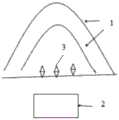
the double-layer arched shed is arranged above the peanut planting area and comprises an inner arched shed and an outer arched shed, the outer arched shed is arranged outside the inner arched shed, the width of the inner arched shed is 1m, the arch height of the inner arched shed is 40-45cm, the width of the outer arched shed is 3.5m, and the arch height of the outer arched shed is 1.5-1.8 m;
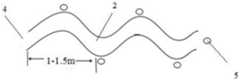
the heating flame path is arranged below the peanut planting area in a digging mode, and the heating flame path adopts a zigzag multi-chimney flame path.
The beneficial effects of the preferred technical scheme are as follows: the invention is beneficial to rapid heating and cooling through the heating facility, keeps the temperature in the shed stable and proper day and night temperature difference, is beneficial to peanut germination and normal growth, increases the breeding amount of the first generation of peanuts under the artificial assistance state, and provides powerful support for accelerating the breeding process.
Preferably, the sowing time in the step (2) is 5 months 1-5months 3 days;
the sowing method comprises the following steps: taking healthy first-generation peanut seeds, carrying out indoor germination acceleration, and then carrying out field ridging, film covering and single-seed sowing;
and (3) management in a growing period: and (4) performing field management after seedling emergence, performing water and fertilizer management in the growing period, and harvesting and drying in the middle 8 th of month to obtain second-generation peanut seeds.
Preferably, the field management in the step (2) comprises film breaking for seedling emergence, seedling checking and supplementing and first lateral branch leading-out;
the water and fertilizer management comprises the following steps: drip irrigation water once before blooming, the water quantity is 15m3One mu, needle insertion and full fruitDrip irrigation for 1 time in each period, the water quantity is 15m3Nitrogen 4 kg/mu,phosphorus 5 kg/mu andpotassium 5 kg/mu.
The beneficial effects of the preferred technical scheme are as follows: the invention can ensure that the peanuts emerge more than 10 days in advance, and are harvested 15-20 days in advance, thereby shortening the field growth time of the second generation of peanuts, striving for the advanced seeding time of 20-30 days for the third generation of peanuts and ensuring the smooth implementation of the third generation.
Preferably, the sowing time in the step (3) is 8 months and 21-8 months and 23 days;
the sowing method comprises the following steps: taking healthy second-generation peanut seeds for indoor pregermination; ridging, film mulching and single-seed sowing in the field; the double ridges are in a group, and two sides of each group are provided with passageways;
and (3) management in a growing period: after seedling emergence, performing field management, and supplementing water and fertilizer in the middle 9 months; disease control is carried out in 9-10 months; in ten days of 10 months, a small arched shed is built above each group by utilizing the spaces on two sides of each group; harvesting in 11 middle of the month, and drying in the sun in time to obtain the third generation peanut seeds.
Preferably, the field management in the step (3) comprises film breaking for seedling emergence, seedling checking and supplementing and first lateral branch leading-out;
the supplementary water and fertilizer comprises the following components: drip irrigation for 1 time with water amount of15m 3/mu, nitrogen content of 4 kg/mu, phosphorus content of 5 kg/mu and potassium content of 5 kg/mu;
the disease control is as follows: 20 ml/mu of difenoconazole, 20 ml/mu of fludioxonil and 400 g/mu of thiophanate-methyl are sprayed on the leaf surfaces.
Preferably, the aisle width in the step (3) is 50 cm; the width of the small arched shed is 2.5-3m, and the arch height is 1.5-2 m.
The beneficial effects of the preferred technical scheme are as follows: the invention ensures that the harvested seeds of the third generation germinate smoothly, prolongs the full fruit period of the third generation peanuts, improves the photosynthesis time after the temperature is reduced, and meets the requirement of the normal growth of the third generation peanuts.
Preferably, the indoor germination accelerating in the steps (1) to (3) is specifically: firstly, soaking seeds for 12 hours by using sodium hypochlorite with the concentration of 2-3% at 37 ℃; taking out, cleaning, placing in wet sand of germination bed, and germinating at 30-35 deg.C for 36 hr to obtain germinated seed.
The beneficial effects of the preferred technical scheme are as follows: the invention successfully meets the requirement of three generations of propagation in the north, accelerates the peanut breeding process, reduces the waste of economy and time caused by the generation increase of south numerous varieties, reduces the labor intensity and is a favorable technical means of the northern peanut breeding technology.
According to the technical scheme, compared with the prior art, the invention discloses and provides a three-generation peanut breeding method in northern areas, which has the following beneficial effects:
(1) the one-year three-generation peanut breeding method disclosed by the invention can be realized only in northern areas, and the generation addition of south multiplication is not needed, so that the breeding cost can be greatly reduced, and the operation difficulty is reduced;
(2) the method fully utilizes natural resources such as photo-heat and the like, scientifically improves the propagation coefficient of the peanuts according to the growth and development rules of the peanuts, reduces the breeding years of the peanuts, and improves the breeding efficiency.
Drawings
In order to more clearly illustrate the embodiments of the present invention or the technical solutions in the prior art, the drawings used in the description of the embodiments or the prior art will be briefly described below, it is obvious that the drawings in the following description are only embodiments of the present invention, and for those skilled in the art, other drawings can be obtained according to the provided drawings without creative efforts.
FIG. 1 is a schematic structural view of a heating facility according to the present invention;
FIG. 2 is a schematic view of a heating flue structure according to the present invention;
fig. 3 is a schematic view of a small shed structure provided by the invention.
In the figure:
1 is a double-layer arched shed, 2 is a heating flame path, 3 is a peanut planting row, 4 is a flame inlet, 5 is a chimney and 6 is a small arched shed.
Detailed Description
The technical solutions in the embodiments of the present invention will be clearly and completely described below with reference to the drawings in the embodiments of the present invention, and it is obvious that the described embodiments are only a part of the embodiments of the present invention, and not all of the embodiments. All other embodiments, which can be derived by a person skilled in the art from the embodiments given herein without making any creative effort, shall fall within the protection scope of the present invention.
The embodiment of the invention provides a three-generation one-year peanut breeding method in northern areas, which comprises the following steps:
(1) first generation peanuts planted by means of warming facilities
The sowing time is 1 month 25 days to 1 month 30 days;
the sowing method comprises the following steps: indoor germination acceleration is carried out on seeds, soil preparation is carried out simultaneously, and a heating facility is built; detecting the soil temperature and the relative water content during sowing, carrying out temperature management through a heating facility to enable the daily average ground temperature to be 15-20 ℃, enabling the relative water content of the soil to be 60% -70% through aerial spraying, and then carrying out single-seed dibbling on the seeds after germination acceleration, wherein the density is 13000-14000 holes/mu;
and (3) management in a growing period: performing temperature management according to the ground temperature, controlling the temperature of the shed to be 25-30 ℃ inmonth 2, controlling the temperature of the shed to be 15-20 ℃, controlling the temperature of the shed to be 30-35 ℃ after blooming inlate month 2, and controlling the temperature of the ground to be 20-25 ℃; forming fruit needles in the last 3 th ten days of the month, and strengthening field management; harvesting and drying in the last 4 th ten days after pod development for 40 days to obtain first-generation peanut seeds;
wherein, the ground temperature is the temperature of soil 10cm degree of depth, and temperature management specifically is: continuously heating the flame path for 0.5h when the ground temperature is lower than 15 ℃, and stopping heating the flame path when the ground temperature is higher than 25 ℃;
the specific operations of field management enhancement are as follows: applying 10 kg/mu of urea, 8 kg/mu of monopotassium phosphate, 15 g/mu of triadimefon, 15-20 g/mu of fulvic acid salt and 5-10 g/mu of single azole in a drip irrigation mode;
the heating facility comprises a mulching film, a double-layer arched shed and a heating flame path;
the mulching film is covered on the soil of the peanut planting area, the thickness of the mulching film is 0.006mm, and the width of the mulching film is 90 cm;
the double-layer arched shed is arranged above the peanut planting area and comprises an inner arched shed and an outer arched shed, the outer arched shed is arranged outside the inner arched shed, the width of the inner arched shed is 1m, the arch height of the inner arched shed is 40-45cm, the width of the outer arched shed is 3.5m, and the arch height of the outer arched shed is 1.5-1.8 m;
the heating flame path is dug below the peanut planting area and adopts a zigzag multi-chimney flame path.
(2) Planting second generation peanuts by adopting normal sowing and harvesting in advance
The sowing time is 5 months and 1-5 months and 3 days;
the sowing method comprises the following steps: taking healthy first-generation peanut seeds, carrying out indoor germination acceleration, and then carrying out field ridging, film covering and single-seed sowing;
and (3) management in a growing period: and (4) performing field management after seedling emergence, performing water and fertilizer management in the growing period, and harvesting and drying in the middle 8 th of month to obtain second-generation peanut seeds.
Wherein the field management comprises film breaking for seedling emergence, seedling checking and supplementing and leading out a first lateral branch;
the water and fertilizer management comprises the following steps: drip irrigation water once before blooming, the water quantity is 15m3Drip irrigation for 1 time of water and fertilizer per mu in the needle-feeding and full fruit period, with the water quantity of 15m3Nitrogen 4 kg/mu,phosphorus 5 kg/mu andpotassium 5 kg/mu.
(3) Third-generation peanuts are planted by adopting a mode of later-stage temperature rise and harvest delay
The sowing time is 8 months, 21-8 months and 23 days;
the sowing method comprises the following steps: taking healthy second-generation peanut seeds for indoor pregermination; ridging, film mulching and single-seed sowing in the field; the double ridges are in a group, and two sides of each group are provided with passageways;
and (3) management in a growing period: after seedling emergence, performing field management, and supplementing water and fertilizer in the middle 9 months; disease control is carried out in 9-10 months; in ten days of 10 months, a small arched shed is built above each group by utilizing the spaces on two sides of each group; harvesting in 11 middle ten days of the month and drying in the sun in time to obtain third generation peanut seeds;
wherein the field management comprises film breaking for seedling emergence, seedling checking and supplementing and leading out a first lateral branch;
the water and fertilizer supplement comprises the following steps: drip irrigation for 1 time with water amount of15m 3/mu, nitrogen content of 4 kg/mu, phosphorus content of 5 kg/mu and potassium content of 5 kg/mu;
the disease control is as follows: 20 ml/mu of difenoconazole, 20 ml/mu of fludioxonil and 400 g/mu of thiophanate-methyl are sprayed on the leaf surfaces;
the width of the passageway is 50 cm; the width of the small arch shed is 2.5-3m, and the arch height is 1.5-2 m.
In order to further optimize the technical scheme, the indoor germination accelerating in the steps (1) to (3) is specifically as follows: firstly, soaking seeds for 12 hours by using sodium hypochlorite with the concentration of 2-3% at 37 ℃; taking out, cleaning, placing in wet sand of germination bed, and germinating at 30-35 deg.C for 36 hr to obtain germinated seed.
Example 1
Theembodiment 1 of the invention discloses a three-generation peanut breeding method in northern areas, wherein,
test materials: hybrid combination of Ji 0607-19 XP 09-2F 1 generation, 23 seeds in total;
the method comprises the following steps:
(1) the first generation is planted in advance by using double arch sheds and underground heating facilities.
(11) Sowing time: planted in 2017, 1 month and 25 days.
(12) The sowing method comprises the following steps: accelerating germination indoors to obtain 20 germinated seeds; constructing a fire tunnel 50cm underground, establishing a double-layer arched shed with the width of 1.5 meters and the length of 3 meters, applying 0.3kg of urea and 1.0kg of ternary compound fertilizer (16-16-16) in a land preparation manner; after sowing, heating by a flame path to keep the soil temperature at 15-20 ℃, and after 5 days, the seedlings come out of the soil.
(13) And (3) management in a growing period: according to the humidity change in the arched shed and the ground temperature condition of 10cm soil, the daily management is determined, and the requirements are as follows: in the month of 2, the greenhouse temperature is 25-30 ℃, and the ground temperature is 15-20 ℃; 2, blooming in late ten days, and keeping the temperature of the greenhouse at 30-35 ℃ and the ground temperature at 20-25 ℃ after blooming; in the last 3 th month, fruit needles are formed, and at the moment, fertilizer water and pest management are properly enhanced; after the pods develop for 40 days, the pods are harvested in the last 4 th month, 150 pods are harvested in total, and the pods are quickly dried in the sun after being harvested to obtain 210 dry seeds.
(2) Normal sowing, harvesting in advance and increasing the second generation.
(21) Sowing time: planted in 5 months and 1 day.
(22) The sowing method comprises the following steps: indoor pregermination is carried out to obtain 181 germinating seeds; ridging three ridges in the field, wherein the ridge length is 5m, the ridge width is 0.9 m, single-row single-seed dibbling is carried out on one ridge in double rows, the hole distance is 0.16cm, and film mulching is carried out;
(23) and (3) management in a growing period: normal field management is carried out after seedling emergence, and drought in the seedling stage is avoided in order to harvest in advance; the fertilizer and water supply is maintained during the whole growth period, and meanwhile, the pest control is enhanced. Generally, the seeds bloom in the early 6 months, are harvested in advance in the middle 8 months, 20 single plants are harvested according to the growth performance in the field, 260 pods are harvested, and the seeds are dried in the sun in time to obtain 480 dry seeds.
(3) The third generation is obtained by late heating and delayed harvest.
(31) Sowing time: planted in 8 months and 21 days.
(32) The sowing method comprises the following steps: indoor pregermination is carried out to obtain 430 germinated seeds; (ii) aRidging 6 ridges in the field, wherein the ridge length is 5m, the ridge width is 0.9 m, single-row single-seed dibbling is carried out on one ridge in double rows, the hole distance is 0.16cm, and film mulching is carried out; and a space is reserved on two sides of each group for later building of the arched shed.
(33) And (3) management in a growing period: normal field management is carried out after seedling emergence, and as the flowering period is 9 months and 14 days, the northern area is in a rainless period, and water is properly supplemented in the flowering period; the 9-10 months are the autumn harvest period in northern areas, the leaf spot is serious, and the disease control is enhanced. When the period of 10 months enters a next-needle podding period, the air temperature is obviously reduced in 10 months, the temperature difference between day and night is increased, a small arched shed is built in ten days of 10 months, and the temperature is increased; performing field investigation in the early stage, harvesting in 16 days in 11 months, harvesting single plants according to the shape of pods, the number of fruits and the characteristics of parents, harvesting 43 single plants in total, bearing 15 pods on average, and drying in the sun in time.
By the method, three generations of filial seed progeny are harvested within one year, non-hybrid strains are eliminated in the second generation, and 43 excellent single strains are obtained by single plant selection in the third generation, so that the breeding process is obviously accelerated.
Comparative example 1
The conventional method uses hybrid combination of F1 seeds of Ji 0607-19 XP 09-2, sowing in 1 day of 5 months, harvesting in 5 days of 9 months, only obtaining F2 generation groups, removing non-hybrid strains, not carrying out individual plant selection, and obviously lags behind the breeding method disclosed in example 1.
Example 2
Theembodiment 2 of the invention discloses a three-generation peanut breeding method in northern areas, wherein,
test materials: hybrid combination hz0902 XJi 0607-19F 1 generations, with 10 seeds in total;
the method comprises the following steps:
(1) the first generation is planted in advance by using double arch sheds and underground heating facilities.
(11) Sowing time: planting in 2016, 1 month and 25 days.
(12) The sowing method comprises the following steps: carrying out indoor pregermination to obtain 8 germinated seeds; constructing a fire tunnel 50cm underground, establishing a double-layer arched shed with the width of 1.0 meter and the length of 1.5 meters, applying 0.3kg of urea and 1.0kg of ternary compound fertilizer (16-16-16) in a land preparation manner; after sowing, heating by a flame path to keep the soil temperature at 15-20 ℃, and after 5 days, the seedlings come out of the soil.
(13) And (3) management in a growing period: according to the humidity change in the arched shed and the ground temperature condition of 10cm soil, the daily management is determined, and the requirements are as follows: in the month of 2, the greenhouse temperature is 25-30 ℃, and the ground temperature is 15-20 ℃; 2, blooming in late ten days, and keeping the temperature of the greenhouse at 30-35 ℃ and the ground temperature at 20-25 ℃ after blooming; in the last 3 th month, fruit needles are formed, and at the moment, fertilizer water and pest management are properly enhanced; after 40 days of pod development, harvesting 105 pods in the last 4 th month, and quickly drying in the sun after harvesting to obtain 180 dry seeds.
(2) Normal sowing, harvesting in advance and increasing the second generation.
(21) Sowing time: planted in 5 months and 1 day.
(22) The sowing method comprises the following steps: carrying out indoor pregermination to obtain 162 germinated seeds; ridging three ridges in the field, wherein the ridge length is 5m, the ridge width is 0.9 m, single-row single-seed dibbling is carried out on one ridge in double rows, the hole distance is 0.16cm, and film mulching is carried out;
(23) and (3) management in a growing period: normal field management is carried out after seedling emergence, and drought in the seedling stage is avoided in order to harvest in advance; the fertilizer and water supply is maintained during the whole growth period, and meanwhile, the pest control is enhanced. Generally blooming in the beginning of 6 months, harvesting in the first ten days of 8 months, harvesting 18 single plants according to the growth performance in the field, harvesting 278 pods, and drying in the sun in time to obtain 504 dry seeds.
(3) The third generation is obtained by late heating and delayed harvest.
(31) Sowing time: planting in 8 months and 15 days.
(32) The sowing method comprises the following steps: accelerating germination indoors to obtain 473 germinated seeds; ridging 6 ridges in the field, wherein the ridge length is 5m, the ridge width is 0.9 m, single-row single-seed dibbling is carried out on one ridge in double rows, the hole distance is 0.16cm, and film mulching is carried out; and a space is reserved on two sides of each group for later building of the arched shed.
(33) And (3) management in a growing period: normal field management is carried out after seedling emergence, and as the flowering period is 9 months and 5 days, the northern area is in a rainless period, and water is properly supplemented in the flowering period; the 9-10 months are the autumn harvest period in northern areas, the leaf spot is serious, and the disease control is enhanced. When the period of 10 months enters a next-needle podding period, the air temperature is obviously reduced in 10 months, the temperature difference between day and night is increased, a small arched shed is built in ten days of 10 months, and the temperature is increased; performing field investigation in the early stage, harvesting in 16 days in 11 months, harvesting single plants according to the shape of pods, the number of fruits and the characteristics of parents, harvesting 38 single plants in total, bearing 18 pods on average, and drying in the sun in time.
By the method, three generations of filial seed progeny are harvested within one year, non-hybrid strains are eliminated in the second generation, and 43 excellent single strains are obtained by single plant selection in the third generation, so that the breeding process is obviously accelerated.
Comparative example 2
The conventional method is to use hybrid combination hz0902 XJi 0607-19 seeds of F1 generation, sow seeds in 1 day of 5 months and harvest seeds in 5 days of 9 months, remove non-hybrid strains, obtain only 10 strains of F2 generation single plants, harvest seeds for 302 grains and obviously lags behind the breeding method disclosed in theembodiment 2.
The embodiments in the present description are described in a progressive manner, each embodiment focuses on differences from other embodiments, and the same and similar parts among the embodiments are referred to each other. The device disclosed by the embodiment corresponds to the method disclosed by the embodiment, so that the description is simple, and the relevant points can be referred to the method part for description.
The previous description of the disclosed embodiments is provided to enable any person skilled in the art to make or use the present invention. Various modifications to these embodiments will be readily apparent to those skilled in the art, and the generic principles defined herein may be applied to other embodiments without departing from the spirit or scope of the invention. Thus, the present invention is not intended to be limited to the embodiments shown herein but is to be accorded the widest scope consistent with the principles and novel features disclosed herein.
Claims (7)
1. A three-generation one-year peanut breeding method in northern areas is characterized by comprising the following steps:
(1) planting first generation peanuts by using a heating facility;
the sowing time is 1 month 25 days to 1 month 30 days;
the sowing method comprises the following steps: indoor germination acceleration is carried out on seeds, soil preparation is carried out simultaneously, and a heating facility is built; detecting the soil temperature and the relative water content during sowing, carrying out temperature management through a heating facility to enable the daily average ground temperature to be 15-20 ℃, enabling the relative water content of the soil to be 60% -70% through aerial spraying, and then carrying out single-seed dibbling on the seeds after germination acceleration, wherein the density is 13000-14000 holes/mu;
and (3) management in a growing period: performing temperature management according to the ground temperature, controlling the temperature of the shed to be 25-30 ℃ in month 2, controlling the temperature of the shed to be 15-20 ℃, controlling the temperature of the shed to be 30-35 ℃ after blooming in late month 2, and controlling the temperature of the ground to be 20-25 ℃; forming fruit needles in the last 3 th ten days of the month, and strengthening field management; harvesting and drying in the last 4 th ten days after pod development for 40 days to obtain first-generation peanut seeds;
(2) planting second-generation peanuts by adopting a normal sowing and early harvesting mode;
the sowing time is 5 months and 1-5 months and 3 days;
the sowing method comprises the following steps: taking healthy first-generation peanut seeds, carrying out indoor germination acceleration, and then carrying out field ridging, film covering and single-seed sowing;
and (3) management in a growing period: performing field management after seedling emergence, performing water and fertilizer management in the growing period, harvesting in the middle 8 th month, and drying in the sun to obtain second generation peanut seeds;
(3) planting third-generation peanuts by adopting a later-stage temperature-increasing and harvest-delaying mode;
the sowing time is 8 months, 21-8 months and 23 days;
the sowing method comprises the following steps: taking healthy second-generation peanut seeds for indoor pregermination; ridging, film mulching and single-seed sowing in the field; the double ridges are in a group, and two sides of each group are provided with passageways;
and (3) management in a growing period: after seedling emergence, performing field management, and supplementing water and fertilizer in the middle 9 months; disease control is carried out in 9-10 months; in ten days of 10 months, a small arched shed is built above each group by utilizing the spaces on two sides of each group; harvesting in 11 middle of the month, and drying in the sun in time to obtain the third generation peanut seeds.
2. The method for breeding peanuts of three generations in the northern area for one year according to claim 1, wherein the ground temperature in the step (1) is a temperature of soil with a depth of 10cm, and the temperature management comprises: continuously heating the flame path for 0.5h when the ground temperature is lower than 15 ℃, and stopping heating the flame path when the ground temperature is higher than 25 ℃;
the specific operations of the field management reinforcement are as follows: 10 kg/mu of urea, 8 kg/mu of monopotassium phosphate, 15 g/mu of triadimefon, 15-20 g/mu of fulvic acid salt and 5-10 g/mu of single azole are applied in a drip irrigation mode.
3. The method of claim 1, wherein the heating facility comprises a mulching film, a double-layer arched shed and a heating flame path;
the mulching film is covered on soil of the peanut planting area, the thickness of the mulching film is 0.006mm, and the width of the mulching film is 90 cm;
the double-layer arched shed is arranged above the peanut planting area and comprises an inner arched shed and an outer arched shed, the outer arched shed is arranged outside the inner arched shed, the width of the inner arched shed is 1m, the arch height of the inner arched shed is 40-45cm, the width of the outer arched shed is 3.5m, and the arch height of the outer arched shed is 1.5-1.8 m;
the heating flame path is arranged below the peanut planting area in a digging mode, and the heating flame path adopts a zigzag multi-chimney flame path.
4. The method for breeding peanuts of three generations in the northern area in one year as claimed in claim 1, wherein the field management in the step (2) comprises film breaking, seedling emergence, seedling inspection and seedling supplement and first lateral branch leading-out;
the water and fertilizer management comprises the following steps: drip irrigation water once before blooming, the water quantity is 15m3Drip irrigation for 1 time of water and fertilizer per mu in the needle-feeding and full fruit period, with the water quantity of 15m3Nitrogen 4 kg/mu, phosphorus 5 kg/mu and potassium 5 kg/mu.
5. The method for breeding peanuts of three generations in the northern area in one year as claimed in claim 1, wherein the field management in the step (3) comprises film breaking, seedling emergence, seedling inspection and seedling supplement and first lateral branch leading-out;
the supplementary water and fertilizer comprises the following components: drip irrigation for 1 time with water and fertilizer, water quantity 15m3Each mu, 4 kg/mu of nitrogen, 5 kg/mu of phosphorus and 5 kg/mu of potassium;
the disease control is as follows: 20 ml/mu of difenoconazole, 20 ml/mu of fludioxonil and 400 g/mu of thiophanate-methyl are sprayed on the leaf surfaces.
6. The northern area three-generation-a-year peanut breeding method according to claim 1, wherein the aisle width in step (3) is 50 cm; the width of the small arched shed is 2.5-3m, and the arch height is 1.5-2 m.
7. The method for breeding peanuts of three generations in the northern area in one year according to claim 1, wherein the indoor pregermination in the steps (1) to (3) is specifically as follows: firstly, soaking seeds for 12 hours by using sodium hypochlorite with the concentration of 2-3% at 37 ℃; taking out, cleaning, placing in wet sand of germination bed, and germinating at 30-35 deg.C for 36 hr to obtain germinated seed.
Priority Applications (1)
| Application Number | Priority Date | Filing Date | Title |
|---|---|---|---|
| CN202010374415.0ACN111543273B (en) | 2020-05-06 | 2020-05-06 | Three-generation peanut breeding method in northern area |
Applications Claiming Priority (1)
| Application Number | Priority Date | Filing Date | Title |
|---|---|---|---|
| CN202010374415.0ACN111543273B (en) | 2020-05-06 | 2020-05-06 | Three-generation peanut breeding method in northern area |
Publications (2)
| Publication Number | Publication Date |
|---|---|
| CN111543273A CN111543273A (en) | 2020-08-18 |
| CN111543273Btrue CN111543273B (en) | 2022-03-08 |
Family
ID=71996174
Family Applications (1)
| Application Number | Title | Priority Date | Filing Date |
|---|---|---|---|
| CN202010374415.0AExpired - Fee RelatedCN111543273B (en) | 2020-05-06 | 2020-05-06 | Three-generation peanut breeding method in northern area |
Country Status (1)
| Country | Link |
|---|---|
| CN (1) | CN111543273B (en) |
Families Citing this family (3)
| Publication number | Priority date | Publication date | Assignee | Title |
|---|---|---|---|---|
| CN117461533A (en)* | 2023-11-02 | 2024-01-30 | 菏泽市林业科学研究院(山东省林业科学研究院菏泽分院) | Paeonia lactiflora cultivation method |
| CN117546747A (en)* | 2023-12-18 | 2024-02-13 | 安徽省农业科学院作物研究所 | A method for breeding peanut varieties in the Huaihe River Basin |
| CN118511798A (en)* | 2024-04-26 | 2024-08-20 | 新疆农业科学院经济作物研究所(新疆维吾尔自治区棉花研究所新疆维吾尔自治区甜菜改良中心) | Planting method for cotton for more than one year |
Family Cites Families (5)
| Publication number | Priority date | Publication date | Assignee | Title |
|---|---|---|---|---|
| KR101351643B1 (en)* | 2013-04-03 | 2014-01-15 | 윤춘식 | Cultivating method of peanut sprouts |
| CN104823658A (en)* | 2015-05-04 | 2015-08-12 | 姜言生 | One-year two-season added-generation breeding method for northern peanuts |
| CN104904456B (en)* | 2015-05-18 | 2017-05-17 | 慈溪市紫来山庄杨梅开发有限公司 | Vegetable-purpose peanut producing method in steel tube greenhouse |
| CN105519337A (en)* | 2016-01-05 | 2016-04-27 | 河南农业大学 | Peanut three-generations-a-year generation-increasing breeding technology |
| CN105684689B (en)* | 2016-01-15 | 2018-05-25 | 广东省农业科学院作物研究所 | A kind of quick method for adding generation of 1 year four seville orange flower life |
- 2020
- 2020-05-06CNCN202010374415.0Apatent/CN111543273B/ennot_activeExpired - Fee Related
Also Published As
| Publication number | Publication date |
|---|---|
| CN111543273A (en) | 2020-08-18 |
Similar Documents
| Publication | Publication Date | Title |
|---|---|---|
| CN110150014B (en) | Industrialized planting method of Or | |
| CN102017859B (en) | Interplant high-yielding cultivation method for potato and corn | |
| CN111543273B (en) | Three-generation peanut breeding method in northern area | |
| CN105746120A (en) | Industrial hemp seed generation-adding reproduction method | |
| CN108849474A (en) | A method of improving sweet potato runoff catchment hybrid seed yield | |
| CN110192487B (en) | Management method of young citrus reiculata trees | |
| CN102687665A (en) | Breeding method for improving yield and seed production purity of hot pickled mustard tubers | |
| CN110583401A (en) | Water-saving cultivation method for ratoon rice | |
| CN112715305B (en) | A planting method imitating wild baicalin | |
| CN109804871B (en) | Cultivation method for preventing and delaying premature senility of outdoor muskmelon plants in autumn | |
| CN100596270C (en) | Increasing generation technique of tobacco | |
| CN118020635A (en) | Breeding method of drought-resistant high-yield wheat | |
| CN111248082A (en) | Breeding method of density-resistant direct-seeding japonica rice variety | |
| CN105519337A (en) | Peanut three-generations-a-year generation-increasing breeding technology | |
| CN114080965B (en) | Method for interplanting platycodon grandiflorum and fritillaria hupehensis in southwest mountain area | |
| CN108849321A (en) | A kind of cultural method of mountain area area rape interplanting vegetables | |
| CN109662000B (en) | A kind of cultivation method for improving mustard seed production yield | |
| CN112450023A (en) | Drought-never-top-harvest planting method for soybean intercropping oil sunflowers | |
| CN107396738B (en) | Cultivation method of intercropping symbiosis between greenhouse pepper and kidney bean | |
| CN112997821A (en) | Corn-peanut-corn triple cropping cultivation method | |
| CN111133945A (en) | High-benefit intercropping cultivation method for apricot trees in sandy soil barren land | |
| ZHANG et al. | Effect of preplant fertilizer on agronomic and physiological traits of soybean cultivars from different breeding programs | |
| CN110089251A (en) | A kind of fertilizing method improving melon fruit nutritional quality and sugar content | |
| CN112400634B (en) | Single-season hybrid late rice cultivation method | |
| CN114847155A (en) | One-year and four-generation rapid breeding method for millet |
Legal Events
| Date | Code | Title | Description |
|---|---|---|---|
| PB01 | Publication | ||
| PB01 | Publication | ||
| SE01 | Entry into force of request for substantive examination | ||
| SE01 | Entry into force of request for substantive examination | ||
| GR01 | Patent grant | ||
| GR01 | Patent grant | ||
| CF01 | Termination of patent right due to non-payment of annual fee | Granted publication date:20220308 | |
| CF01 | Termination of patent right due to non-payment of annual fee |