CN111227896B - Electric clip applier with continuous feeding belt - Google Patents
Electric clip applier with continuous feeding beltDownload PDFInfo
- Publication number
- CN111227896B CN111227896BCN201811439578.1ACN201811439578ACN111227896BCN 111227896 BCN111227896 BCN 111227896BCN 201811439578 ACN201811439578 ACN 201811439578ACN 111227896 BCN111227896 BCN 111227896B
- Authority
- CN
- China
- Prior art keywords
- clip applier
- assembly
- firing
- electric
- belt
- Prior art date
- Legal status (The legal status is an assumption and is not a legal conclusion. Google has not performed a legal analysis and makes no representation as to the accuracy of the status listed.)
- Active
Links
- 238000010304firingMethods0.000claimsabstractdescription55
- 230000005540biological transmissionEffects0.000claimsdescription14
- 230000000694effectsEffects0.000abstractdescription4
- 238000000034methodMethods0.000abstractdescription4
- 230000002439hemostatic effectEffects0.000description5
- 230000000712assemblyEffects0.000description4
- 238000000429assemblyMethods0.000description4
- 210000000683abdominal cavityAnatomy0.000description1
- 230000009286beneficial effectEffects0.000description1
- 210000004204blood vesselAnatomy0.000description1
- 230000008878couplingEffects0.000description1
- 238000010168coupling processMethods0.000description1
- 238000005859coupling reactionMethods0.000description1
- 208000014674injuryDiseases0.000description1
- 210000001503jointAnatomy0.000description1
- 238000002357laparoscopic surgeryMethods0.000description1
- 238000012986modificationMethods0.000description1
- 230000004048modificationEffects0.000description1
Images


Classifications
- A—HUMAN NECESSITIES
- A61—MEDICAL OR VETERINARY SCIENCE; HYGIENE
- A61B—DIAGNOSIS; SURGERY; IDENTIFICATION
- A61B17/00—Surgical instruments, devices or methods
- A61B17/12—Surgical instruments, devices or methods for ligaturing or otherwise compressing tubular parts of the body, e.g. blood vessels or umbilical cord
- A61B17/12009—Implements for ligaturing other than by clamps or clips, e.g. using a loop with a slip knot
- A—HUMAN NECESSITIES
- A61—MEDICAL OR VETERINARY SCIENCE; HYGIENE
- A61B—DIAGNOSIS; SURGERY; IDENTIFICATION
- A61B17/00—Surgical instruments, devices or methods
- A61B2017/00367—Details of actuation of instruments, e.g. relations between pushing buttons, or the like, and activation of the tool, working tip, or the like
- A61B2017/00398—Details of actuation of instruments, e.g. relations between pushing buttons, or the like, and activation of the tool, working tip, or the like using powered actuators, e.g. stepper motors, solenoids
- A—HUMAN NECESSITIES
- A61—MEDICAL OR VETERINARY SCIENCE; HYGIENE
- A61B—DIAGNOSIS; SURGERY; IDENTIFICATION
- A61B17/00—Surgical instruments, devices or methods
- A61B2017/0046—Surgical instruments, devices or methods with a releasable handle; with handle and operating part separable
Landscapes
- Health & Medical Sciences (AREA)
- Surgery (AREA)
- Life Sciences & Earth Sciences (AREA)
- Heart & Thoracic Surgery (AREA)
- Nuclear Medicine, Radiotherapy & Molecular Imaging (AREA)
- Vascular Medicine (AREA)
- Engineering & Computer Science (AREA)
- Biomedical Technology (AREA)
- Reproductive Health (AREA)
- Medical Informatics (AREA)
- Molecular Biology (AREA)
- Animal Behavior & Ethology (AREA)
- General Health & Medical Sciences (AREA)
- Public Health (AREA)
- Veterinary Medicine (AREA)
- Surgical Instruments (AREA)
Abstract
Description
Technical Field
The invention relates to an electric clip applier capable of continuously feeding belts, and belongs to the technical field of medical instruments.
Background
The clip applier is a novel surgical instrument widely adopted by medical institutions of all countries in the world in recent decades, and achieves micro-trauma to patients, so that surgical risks are greatly reduced. As the clamp applier is used in a large area, the requirement of the clamp applier capable of continuously applying clamps is provided by professional doctors of various large medical institutions, so that the clamp applier does not leave a human body after entering the abdominal cavity of the human body, continuous and quick operations are realized, and the clamp applier can be operated quickly and effectively by one hand. However, in the prior art, the hemostatic clip is generally a single-hair clip applier, which can only be used to insert one hemostatic clip each time, and the hemostatic clip needs to be refilled after each blood vessel occlusion. As for a general simple laparoscopic surgery, six hemostatic clamps need to be continuously applied and clamped once, and the process of repeatedly filling the hemostatic clamps increases the workload of operators, and meanwhile, accidents can occur, so that the rapid and stable operation is not facilitated.
Disclosure of Invention
The invention aims to provide the electric clip applier with the continuous belt feeding function, which is simple in structure and convenient to operate, and can continuously feed the clip to save operation time and improve working efficiency.
In order to achieve the purpose, the invention provides the following technical scheme: an electric clip applier with continuous belt feeding function comprises an electric holding device used for holding and a machine shell assembly connected with the electric holding device, wherein the machine shell assembly comprises a clip used for closing target tissues, a belt reel device used for continuously conveying a ligation belt to the clip and a firing device used for driving the clip to open or close, the firing device comprises at least one firing rod, a firing sleeve coated outside the firing rod, a cavity arranged in the firing sleeve and arranged on one side of the firing rod and a first driving assembly used for driving the firing rod, and the first driving assembly drives the firing rod to further drive the clip to open or close; the cavity is internally provided with a track for conveying a ligation band, and the tape reel device conveys the ligation band to the clamp through the track.
Further, the belt disc device comprises a belt disc provided with a binding belt, at least one transmission assembly used for conveying the binding belt and a second driving assembly used for driving the transmission assembly to convey the binding belt; the transmission assembly is arranged on one side of the track to convey the ligation band to the track.
Further, transmission assembly includes conveying wheel and the follow driving wheel of relative setting, conveying wheel and follow driving wheel move in opposite directions in order to carry the ligature area.
Further, the second driving assembly comprises a second motor, the second motor is provided with an output shaft, and the conveying wheel is arranged on the output shaft.
Further, the clamp includes fixed jaw, movable jaw and is used for connecting the pivot of fixed jaw with movable jaw, the firing bar with the pivot is connected in order to drive movable jaw open or close for fixed jaw.
Furthermore, a first guide groove used for conveying the ligation belt to the movable jaw is arranged on the fixed jaw, and the first guide groove is connected with the track.
Furthermore, a second guide groove in butt joint with the first guide groove and a stop piece for preventing the ligature belt from being conveyed continuously are arranged on the movable jaw, and the stop piece is arranged at one end, close to the cavity, of the movable jaw.
Further, the electric clip applier for the continuous belt conveying further comprises a cutting assembly for cutting off the ligation belt, and the cutting assembly is arranged on the cavity.
Further, the cutting assembly comprises a through hole arranged on the cavity, a spring arranged in the through hole and a pressure head sleeved in the spring.
Further, the pressure head includes the pressure head body and with the cylinder piece of pressure head body coupling, the pressure head body sets up in the spring, the cylinder piece sets up outside the spring.
Furthermore, a convex hull is arranged at one end, close to the cavity, of the movable jaw, and the movable jaw is opened upwards to enable the convex hull to abut against the cylindrical block so as to press the pressure head downwards to enable the pressure head body to shear the banding belt.
Furthermore, the first driving assembly comprises a first motor and a driving piece connected with the first motor, the first motor is provided with a first output shaft, and the output shaft and the driving piece are in threaded connection, so that the first motor drives the driving piece to drive the firing rod to fire.
Further, the case assembly also comprises a shell used for covering the tape reel device and the firing device.
The invention has the beneficial effects that: according to the invention, the ligation band is continuously conveyed to the clamp by the tape reel device which is arranged for continuously conveying the band to the clamp, so that an operator does not need to repeatedly place ligation nails in the operation process, and the effects of saving operation time and improving working efficiency are achieved; the invention has simple structure and convenient operation.
The foregoing description is only an overview of the technical solutions of the present invention, and in order to make the technical solutions of the present invention more clearly understood and to implement them in accordance with the contents of the description, the following detailed description is given with reference to the preferred embodiments of the present invention and the accompanying drawings.
Drawings
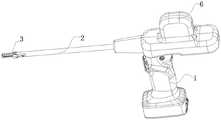
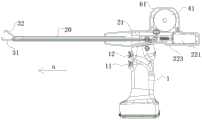
Fig. 1 is a schematic view of the overall structure of a continuously feeding belt electric clip applier of the present invention.
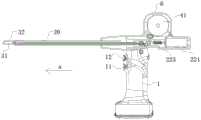
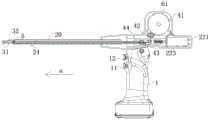
Fig. 2 is a schematic sectional view of a motor-driven clip applier for continuously feeding tapes according to the present invention.
Fig. 3 is a schematic view of an internal structure of the electric clip applier for continuously feeding belts according to the present invention.
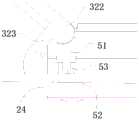
Fig. 4 is a schematic view of a cutting assembly of the electric clip applier for continuously feeding tapes according to the present invention.
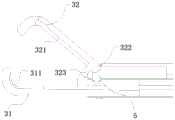
Fig. 5 is a schematic view of a gripper structure of a motor-driven clip applier for continuously feeding belts according to the present invention.
Fig. 6 is a schematic view illustrating an operation state of the electric clip applier for continuously feeding the tapes according to the present invention.
Fig. 7 is a schematic view illustrating another operation state of the motor-driven clip applier for continuously feeding belts according to the present invention.
Fig. 8 is a schematic view illustrating still another operation state of the motor-driven clip applier for continuously feeding tapes according to the present invention.
Detailed Description
The following detailed description of embodiments of the present invention is provided in connection with the accompanying drawings and examples. The following examples are intended to illustrate the invention but are not intended to limit the scope of the invention.
Referring to fig. 1 to 3, a continuous belt feeding electric clip applier in accordance with a preferred embodiment of the present invention includes anelectric holding device 1 for holding a clip, and ahousing assembly 6 connected to theelectric holding device 1, wherein thehousing assembly 6 includes a clip 3 for closing a target tissue, a tape reel device 4 for continuously feeding a ligation band to the clip 3, and afiring device 2 for driving the clip 3 to open or close. In the present embodiment, thehousing assembly 6 further includes acasing 61 for covering the tape reel device 4 and thefiring device 2.
Thefiring device 2 comprises at least onefiring bar 21, afiring sleeve 20 covering the outside of thefiring bar 21, and afirst driving assembly 22 for driving thefiring bar 21. The clamp 3 comprises afixed jaw 31, amovable jaw 32 and arotating shaft 33 for connecting thefixed jaw 31 and themovable jaw 32, and thefiring bar 21 is connected with therotating shaft 33 to drive themovable jaw 32 to open or close relative to thefixed jaw 31. In this embodiment, the number of thefiring bars 21 is two, and the firing bars include afirst firing bar 211 and asecond firing bar 212. Thefirst firing bar 211 and thesecond firing bar 212 are disposed at two sides of themovable jaw 32, and two ends of themovable jaw 32 are respectively connected to thefirst firing bar 211 and thesecond firing bar 212 through arotating shaft 33. Thefirst firing bar 211 and thesecond firing bar 212 drive themovable jaw 32 to rotate around the rotatingshaft 33 at the same time. Connecting pieces, namely a first connectingpiece 321 and a second connectingpiece 322, are further arranged between thefirst firing bar 211, thesecond firing bar 212 and themovable jaw 32. The first andsecond firing bars movable jaw 32 to open or close relative to thefixed jaw 31 by driving the first andsecond links
Naturally, in other embodiments, the number of thefiring rods 21 may be other, for example, the number of thefiring rods 21 is 1, and the effect of driving the jaws 3 to open or close can also be achieved by connecting thefiring rods 21 with therotating shaft 33, and here, the number of thefiring rods 21 is not particularly limited, depending on the actual situation.
Thefirst driving assembly 22 includes afirst motor 221 and adriving member 222 connected to thefirst motor 221, thefirst motor 221 is provided with afirst output shaft 223, and thedriving member 222 is sleeved on thefirst output shaft 223. Thefirst output shaft 223 is screwed to thedriving member 222 in a direction of an arrow a so that thefirst motor 221 drives thedriving member 222 to drive thefiring rod 21 to advance or retreat.
Thefiring device 2 further comprises acavity 24 which is arranged in thefiring sleeve 20 and arranged on one side of thefiring rod 21, a track for conveying a ligation band is arranged in thecavity 24, and the belt disc device 4 conveys the ligation band to the clamp 3 through the track.
The tape reel device 4 comprises atape reel 41 provided with a binding tape, at least onetransmission assembly 44 for delivering the binding tape, and a second driving assembly for driving thetransmission assembly 44 to deliver the binding tape.
Thetransmission assembly 44 includes a conveying wheel and a driven wheel which are oppositely disposed, and the conveying wheel and the driven wheel move in opposite directions to achieve the purpose of conveying the ligation band. In this embodiment, thetape reel 41 is disposed above thecavity 24. In addition to one set ofdriving assemblies 44, two sets of auxiliary assemblies are provided for better conveying the ligation bands, namely a firstauxiliary assembly 42 and a secondauxiliary assembly 43. For convenience of distinction, the firstauxiliary assembly 42 includes a first auxiliary wheel and a second auxiliary wheel which are oppositely arranged, the secondauxiliary assembly 43 includes a third auxiliary wheel and a fourth auxiliary wheel which are oppositely arranged, and thetransmission assembly 44 includes a conveying wheel and a driven wheel which are oppositely arranged. Use the directional direction of arrow a in the figure as the left direction, firstauxiliary component 42 sets up be used for carrying the ligature area from last down to secondauxiliary component 43 under thetep reel 41, secondauxiliary component 43 sets up the setting of staggering in the below of firstauxiliary component 42, the third auxiliary wheel with first auxiliary wheel parallel arrangement, the fourth auxiliary wheel sets up the left side below of third auxiliary wheel and with the track flushes the setting. The secondauxiliary assembly 43 is used for conveying the binding belt in a reversing manner, namely, the conveying manner of the binding belt from top to bottom is converted into a transverse horizontal conveying manner, so that the binding belt is conveniently conveyed to thetransmission assembly 44. Thetransmission assembly 44 is arranged on one side of the track, and the conveying wheels and the driven wheels convey the ligation band to the track to convey the ligation band to the clamp 3. Balls (not shown) are also provided in thecavity 24 to reduce friction and facilitate the delivery of the ligature to the clamp 3.
The second drive assembly includes a second motor connected to adrive assembly 44 disposed adjacent the track to drive thedrive assembly 44 to deliver the ligation band to the track. In the present embodiment, the second driving assembly is disposed in theelectric holding device 1. Wherein the second motor is provided with a second output shaft, and the conveying wheel is arranged on the second output shaft.
Indeed, in other embodiments, the number ofdrive assemblies 44 may be other. For example, when thereel 41 is disposed horizontally with thecavity 24, thedriving assembly 44 is disposed at one side of the track to feed the ligation band to the track. At this time, the number of thetransmission assemblies 44 is one, and no additional auxiliary assembly is required. Thetransmission assembly 44 includes a conveying wheel and a driven wheel which are oppositely disposed, and the conveying wheel and the driven wheel move in opposite directions to achieve the purpose of conveying the ligation band. The number of the auxiliary components is set to be changed according to the setting of different positions of thetape reel 41, and is not described herein.
Referring to fig. 4 and 5, in this embodiment, the rail is horizontally disposed and connected to the fixedjaw 31, afirst guide slot 311 for conveying the ligation band to themovable jaw 32 is disposed on the fixedjaw 31, and thefirst guide slot 311 is connected to the rail. Correspondingly, themovable jaw 32 is provided with asecond guide slot 321 butted with thefirst guide slot 311 and astop member 323 for preventing the ligature band from being conveyed further, and thestop member 323 is arranged at one end of themovable jaw 32 close to thecavity 24. When the ligation band is transferred to the clamp 3 through the rail, the ligation band is transferred to thesecond guide groove 321 through thefirst guide groove 311 and stops the operation of thestopper 323. In this embodiment, when the fixedjaw 31 and themovable jaw 32 are closed, thefirst guide slot 311 and thesecond guide slot 321 are seamlessly connected to allow the ligation band to be smoothly delivered into themovable jaw 32.
The electric clip applier 3 for the continuous feed further comprises a cuttingassembly 5 for cutting the ligation band, wherein the cuttingassembly 5 is disposed on thecavity 24. The cuttingassembly 5 comprises a throughhole 53 arranged on thecavity 24, a spring partially and fixedly arranged in the throughhole 53, and apressure head 5 arranged on the throughhole 53 through the spring. Thepressure head 5 comprises apressure head body 52 and a cylindrical block connected with thepressure head body 52, thepressure head body 52 is arranged in the spring, and the cylindrical block is arranged outside the spring. One end of themovable jaw 32 close to thecavity 24 is provided with aconvex hull 322, and themovable jaw 32 is opened upwards to enable theconvex hull 322 to abut against the cylindrical block so as to press down thepressure head 5 to enable thepressure head body 52 to shear the ligation band. In this embodiment, the end of theram body 52 adjacent to the ligation band is provided with a pointed tip to shear the ligation band.
Theelectric holding device 1 comprises a controller, a battery coupled to the controller, afirst driving component 22 and a second driving component, afirst switch 11 disposed on theelectric holding device 1 and coupled to the controller and thefirst driving component 22, asecond switch 12 disposed on theelectric holding device 1 and coupled to the controller and the second driving component, and an electrical socket coupled to the controller and connected with the battery.
Referring to fig. 6 to 8, when the electric clip applier 3 for tape feeding is used, thefirst switch 11 is pressed to open the clip 3, so that the target tissue is placed in the space formed by themovable jaw 32 and the fixedjaw 31, and thefirst guide slot 311 and thesecond guide slot 321 are abutted. When thesecond switch 12 is pressed, the second driving assembly drives thetransmission assembly 44 to convey the ligation band on thetape reel 41 to the clamp 3 through the track in thecavity 24, and then to thesecond guide groove 321 of themovable jaw 32 through thefirst guide groove 311 of the fixedjaw 31 until thestop member 323 stops. Pressing thefirst switch 11 causes the first drivingassembly 22 to drive the firingbar 21 to fire the clip 3, so that themovable jaw 32 is locked in a staggered manner with respect to the fixedjaw 31. After the target tissue is closed, themovable jaw 32 is opened relative to the fixedjaw 31, so that theconvex hull 322 abuts against thecylinder 51 to cut off the ligation band by thepressure head body 52, thereby completing the action of closing the target tissue. When other target tissues need to be closed, the steps are repeated, and the ligation band on thetape reel 41 is continuously conveyed to the clamp 3, so that the time for replacing the instrument is saved.
In summary, the following steps: according to the invention, the tape reel device 4 for continuously feeding the tape to the clamp 3 is arranged, and the tape reel device 4 continuously feeds the ligation tape to the clamp 3, so that an operator does not need to repeatedly place ligation nails in the operation process, and the effects of saving operation time and improving working efficiency are achieved; the invention has simple structure and convenient operation.
The technical features of the embodiments described above may be arbitrarily combined, and for the sake of brevity, all possible combinations of the technical features in the embodiments described above are not described, but should be considered as being within the scope of the present specification as long as there is no contradiction between the combinations of the technical features.
The above-mentioned embodiments only express several embodiments of the present invention, and the description thereof is more specific and detailed, but not construed as limiting the scope of the invention. It should be noted that, for a person skilled in the art, several variations and modifications can be made without departing from the inventive concept, which falls within the scope of the present invention. Therefore, the protection scope of the present patent shall be subject to the appended claims.
Claims (11)
1. The electric clip applier with the continuous belt feeding function is characterized by comprising an electric holding device used for holding and a case assembly connected with the electric holding device, wherein the case assembly comprises a clip used for closing target tissues, a belt disc device used for continuously conveying a ligation belt to the clip and a firing device used for driving the clip to open or close, the firing device comprises at least one firing rod, a firing sleeve coated outside the firing rod, a cavity arranged in the firing sleeve and arranged on one side of the firing rod and a first driving assembly used for driving the firing rod, and the first driving assembly drives the firing rod to further drive the clip to open or close; a track for conveying the binding belt is arranged in the cavity, and the binding belt is conveyed to the clamp through the track by the belt disc device; the firing rod is connected with the rotating shaft so as to drive the movable jaw to open or close relative to the fixed jaw;
the electric clip applier for the continuous belt conveying further comprises a cutting assembly used for cutting off the ligation belt, and the cutting assembly is arranged on the cavity.
2. The continuous feed electric clip applier of claim 1, wherein said reel means comprises a reel on which a ligation band is disposed, at least one driving assembly for delivering the ligation band, and a second driving assembly for driving said driving assembly to deliver the ligation band; the transmission assembly is arranged on one side of the track to convey the ligation band to the track.
3. The power clip applier of claim 2, wherein said drive assembly includes a feed wheel and a driven wheel disposed opposite to each other, said feed wheel and driven wheel being moved toward each other to feed said ligation band.
4. The continuous feed electric clip applier of claim 3, wherein said second drive assembly includes a second motor, said second motor having an output shaft, said feed wheel being disposed on said output shaft.
5. The power clip applier according to claim 1, wherein a first guide groove for delivering a ligation band to said movable jaw is provided on said fixed jaw, and said first guide groove is connected to said rail.
6. The power clip applier for sequential tape feeding of claim 5, wherein said movable jaw is provided with a second guide slot for abutting against said first guide slot and a stopper for preventing the ligation band from being further fed, said stopper being provided at an end of said movable jaw near said chamber.
7. The electric clip applier for a continuous tape feeding of claim 1, wherein said cutting assembly comprises a through hole provided on said chamber, a spring provided in said through hole, and a pressing head fitted in said spring.
8. The electric clip applier of claim 7, wherein said indenter comprises an indenter body and a cylindrical block coupled to said indenter body, said indenter body being disposed within said spring, said cylindrical block being disposed outside said spring.
9. The electric clip applier with sequential feed through as recited in claim 8, wherein a protruding dome is disposed at an end of said movable jaw near said chamber, and said movable jaw opens upward to allow said protruding dome to abut against said cylindrical block to press said indenter downward to shear said indenter body.
10. The continuous feed electric clip applier of claim 1, wherein said first drive assembly comprises a drive member having a first motor coupled to said first motor, said first motor having a first output shaft, said output shaft being threadably coupled to said drive member such that said first motor drives said drive member and thereby said firing bar to fire.
11. The continuous feed motor-driven clip applier of claim 2, wherein said housing assembly further comprises a housing for enclosing said reel assembly and firing device.
Priority Applications (1)
| Application Number | Priority Date | Filing Date | Title |
|---|---|---|---|
| CN201811439578.1ACN111227896B (en) | 2018-11-29 | 2018-11-29 | Electric clip applier with continuous feeding belt |
Applications Claiming Priority (1)
| Application Number | Priority Date | Filing Date | Title |
|---|---|---|---|
| CN201811439578.1ACN111227896B (en) | 2018-11-29 | 2018-11-29 | Electric clip applier with continuous feeding belt |
Publications (2)
| Publication Number | Publication Date |
|---|---|
| CN111227896A CN111227896A (en) | 2020-06-05 |
| CN111227896Btrue CN111227896B (en) | 2021-05-14 |
Family
ID=70866442
Family Applications (1)
| Application Number | Title | Priority Date | Filing Date |
|---|---|---|---|
| CN201811439578.1AActiveCN111227896B (en) | 2018-11-29 | 2018-11-29 | Electric clip applier with continuous feeding belt |
Country Status (1)
| Country | Link |
|---|---|
| CN (1) | CN111227896B (en) |
Families Citing this family (1)
| Publication number | Priority date | Publication date | Assignee | Title |
|---|---|---|---|---|
| CN113796917A (en)* | 2021-11-19 | 2021-12-17 | 杭州康基医疗器械有限公司 | Continuous hair clip applying mechanism applied to continuous hair clip applying clamp |
Citations (11)
| Publication number | Priority date | Publication date | Assignee | Title |
|---|---|---|---|---|
| CN1994236A (en)* | 2005-09-15 | 2007-07-11 | 伊西康内外科公司 | Clip applier with migrational resistance features |
| CN201586020U (en)* | 2009-12-09 | 2010-09-22 | 上海菲捷实业有限公司 | Repeating clip applying pincers |
| CN201798771U (en)* | 2010-06-24 | 2011-04-20 | 王兵 | Scalp clip gun |
| CN103110440A (en)* | 2013-01-29 | 2013-05-22 | 北京中法派尔特医疗设备有限公司 | Power-driven binding instrument used in surgery |
| WO2014137662A1 (en)* | 2013-03-01 | 2014-09-12 | Ethicon Endo-Surgery, Inc. | Electromechanical surgical device with signal relay arrangement |
| CN104487005A (en)* | 2012-06-28 | 2015-04-01 | 伊西康内外科公司 | Empty clip cartridge lockout |
| CN104490446A (en)* | 2014-12-12 | 2015-04-08 | 浙江微度医疗器械有限公司 | Clip applier capable of continuously releasing hemostatic clips |
| CN106108964A (en)* | 2015-05-05 | 2016-11-16 | 柯惠Lp公司 | The adapter assembly of surgical stapling equipment and load units |
| WO2016210080A1 (en)* | 2015-06-26 | 2016-12-29 | Ethicon Endo-Surgery, Llc | Surgical stapler with ready state indicator |
| CN107049400A (en)* | 2016-02-10 | 2017-08-18 | 柯惠Lp公司 | Connector, extension and connector assembly for operation device |
| CN207821868U (en)* | 2017-10-24 | 2018-09-07 | 昆明医科大学第二附属医院 | A kind of running fire hemolok Clip Appliers |
Family Cites Families (5)
| Publication number | Priority date | Publication date | Assignee | Title |
|---|---|---|---|---|
| CN2848145Y (en)* | 2005-11-14 | 2006-12-20 | 韩生印 | Funicle sealing separator |
| CN201529148U (en)* | 2009-09-28 | 2010-07-21 | 徐志明 | Bipolar-coagulation cutting forceps |
| US9265926B2 (en)* | 2013-11-08 | 2016-02-23 | Ethicon Endo-Surgery, Llc | Electrosurgical devices |
| CN205729516U (en)* | 2016-04-14 | 2016-11-30 | 天津海迈医用科技有限公司 | A kind of tourniquet machine automatically telling band |
| CN207707981U (en)* | 2017-05-15 | 2018-08-10 | 首都医科大学宣武医院 | Puncture positioning paste with handle and various geometric figures |
- 2018
- 2018-11-29CNCN201811439578.1Apatent/CN111227896B/enactiveActive
Patent Citations (11)
| Publication number | Priority date | Publication date | Assignee | Title |
|---|---|---|---|---|
| CN1994236A (en)* | 2005-09-15 | 2007-07-11 | 伊西康内外科公司 | Clip applier with migrational resistance features |
| CN201586020U (en)* | 2009-12-09 | 2010-09-22 | 上海菲捷实业有限公司 | Repeating clip applying pincers |
| CN201798771U (en)* | 2010-06-24 | 2011-04-20 | 王兵 | Scalp clip gun |
| CN104487005A (en)* | 2012-06-28 | 2015-04-01 | 伊西康内外科公司 | Empty clip cartridge lockout |
| CN103110440A (en)* | 2013-01-29 | 2013-05-22 | 北京中法派尔特医疗设备有限公司 | Power-driven binding instrument used in surgery |
| WO2014137662A1 (en)* | 2013-03-01 | 2014-09-12 | Ethicon Endo-Surgery, Inc. | Electromechanical surgical device with signal relay arrangement |
| CN104490446A (en)* | 2014-12-12 | 2015-04-08 | 浙江微度医疗器械有限公司 | Clip applier capable of continuously releasing hemostatic clips |
| CN106108964A (en)* | 2015-05-05 | 2016-11-16 | 柯惠Lp公司 | The adapter assembly of surgical stapling equipment and load units |
| WO2016210080A1 (en)* | 2015-06-26 | 2016-12-29 | Ethicon Endo-Surgery, Llc | Surgical stapler with ready state indicator |
| CN107049400A (en)* | 2016-02-10 | 2017-08-18 | 柯惠Lp公司 | Connector, extension and connector assembly for operation device |
| CN207821868U (en)* | 2017-10-24 | 2018-09-07 | 昆明医科大学第二附属医院 | A kind of running fire hemolok Clip Appliers |
Also Published As
| Publication number | Publication date |
|---|---|
| CN111227896A (en) | 2020-06-05 |
Similar Documents
| Publication | Publication Date | Title |
|---|---|---|
| US20230165626A1 (en) | Pinion blade drive mechanism for a laparoscopic vessel dissector | |
| US11317916B2 (en) | Surgical stapling device with elongated tool assembly and methods of use | |
| CN103099670A (en) | Surgical forceps | |
| CN103767751A (en) | Surgical instrument capable of being operated by signal hand | |
| CN103371859A (en) | Variable compression surgical fastener apparatus | |
| AU2002340426A1 (en) | Surgical cutting and stapling device | |
| CN103381104A (en) | Surgical forceps | |
| CN111227896B (en) | Electric clip applier with continuous feeding belt | |
| US20240341757A1 (en) | Powered surgical devices including predictive motor control | |
| US12096943B2 (en) | Medical apparatus | |
| CN108403176A (en) | A kind of stapler with safety device | |
| CN112754566B (en) | A minimally invasive endoscopic stapler that can be fired when the head is deflected | |
| US4891883A (en) | Pliers | |
| CN110090073B (en) | Press-buckling type medical steel wire connecting system | |
| EP3834747B1 (en) | Medical instrument | |
| CN209269772U (en) | Tissue Closure Devices and Medical Devices | |
| CN219126502U (en) | Lengthened electric cutting anastomat | |
| CN215228164U (en) | Medical tissue forceps | |
| CN210784650U (en) | Hand-held bipolar hemostatic forceps device | |
| CN112773451B (en) | Surgical instrument | |
| CN209269773U (en) | Tissue Closure Devices and Medical Devices | |
| CN111265266B (en) | Medical instrument | |
| CN209347123U (en) | Tissue Closure Devices and Medical Devices | |
| CN211156183U (en) | Press-buckling type medical steel wire connecting system | |
| CN120345943B (en) | A thoracoscopic cutting and stapling device for facilitating fixed tissue resection |
Legal Events
| Date | Code | Title | Description |
|---|---|---|---|
| PB01 | Publication | ||
| PB01 | Publication | ||
| SE01 | Entry into force of request for substantive examination | ||
| SE01 | Entry into force of request for substantive examination | ||
| GR01 | Patent grant | ||
| GR01 | Patent grant |