CN110140352B - Stereoscopic image projection with high intra-frame contrast - Google Patents
Stereoscopic image projection with high intra-frame contrastDownload PDFInfo
- Publication number
- CN110140352B CN110140352BCN201780019982.0ACN201780019982ACN110140352BCN 110140352 BCN110140352 BCN 110140352BCN 201780019982 ACN201780019982 ACN 201780019982ACN 110140352 BCN110140352 BCN 110140352B
- Authority
- CN
- China
- Prior art keywords
- light
- stereoscopic
- image
- polarization modulator
- image light
- Prior art date
- Legal status (The legal status is an assumption and is not a legal conclusion. Google has not performed a legal analysis and makes no representation as to the accuracy of the status listed.)
- Active
Links
- 229940125730polarisation modulatorDrugs0.000claimsabstractdescription199
- 238000003384imaging methodMethods0.000claimsabstractdescription82
- 230000003287optical effectEffects0.000claimsdescription127
- 230000010287polarizationEffects0.000claimsdescription73
- 239000000356contaminantSubstances0.000claimsdescription27
- 238000000034methodMethods0.000claimsdescription18
- 238000000576coating methodMethods0.000claimsdescription9
- 239000011248coating agentSubstances0.000claimsdescription8
- 239000002245particleSubstances0.000claimsdescription7
- 239000011358absorbing materialSubstances0.000claimsdescription3
- 239000000835fiberSubstances0.000claimsdescription3
- 230000008569processEffects0.000claimsdescription3
- 238000012546transferMethods0.000claimsdescription3
- 230000001846repelling effectEffects0.000claims1
- 230000015556catabolic processEffects0.000abstractdescription9
- 238000006731degradation reactionMethods0.000abstractdescription9
- 239000004973liquid crystal related substanceSubstances0.000description50
- 210000004027cellAnatomy0.000description30
- 238000013461designMethods0.000description16
- 239000011521glassSubstances0.000description15
- 239000000463materialSubstances0.000description14
- 125000006850spacer groupChemical group0.000description14
- 230000000903blocking effectEffects0.000description13
- 239000010408filmSubstances0.000description13
- 238000000149argon plasma sinteringMethods0.000description12
- 238000005286illuminationMethods0.000description11
- 239000000428dustSubstances0.000description10
- 238000004140cleaningMethods0.000description8
- 238000011109contaminationMethods0.000description8
- 230000006872improvementEffects0.000description7
- 230000007246mechanismEffects0.000description7
- 238000013459approachMethods0.000description6
- 239000011324beadSubstances0.000description6
- 238000001914filtrationMethods0.000description6
- 238000005259measurementMethods0.000description6
- 201000009310astigmatismDiseases0.000description5
- 238000005516engineering processMethods0.000description5
- 238000012360testing methodMethods0.000description5
- 230000007704transitionEffects0.000description5
- 229910052724xenonInorganic materials0.000description5
- FHNFHKCVQCLJFQ-UHFFFAOYSA-Nxenon atomChemical compound[Xe]FHNFHKCVQCLJFQ-UHFFFAOYSA-N0.000description5
- 230000000712assemblyEffects0.000description4
- 238000000429assemblyMethods0.000description4
- 238000001816coolingMethods0.000description4
- 238000010586diagramMethods0.000description4
- 230000031700light absorptionEffects0.000description4
- 229920000642polymerPolymers0.000description4
- VYPSYNLAJGMNEJ-UHFFFAOYSA-Nsilicon dioxideInorganic materialsO=[Si]=OVYPSYNLAJGMNEJ-UHFFFAOYSA-N0.000description4
- 239000007779soft materialSubstances0.000description4
- 230000008901benefitEffects0.000description3
- 230000007547defectEffects0.000description3
- 239000005262ferroelectric liquid crystals (FLCs)Substances0.000description3
- 230000006870functionEffects0.000description3
- 230000033001locomotionEffects0.000description3
- 230000008447perceptionEffects0.000description3
- 230000004044responseEffects0.000description3
- 239000000758substrateSubstances0.000description3
- 239000010409thin filmSubstances0.000description3
- 239000000853adhesiveSubstances0.000description2
- 230000001070adhesive effectEffects0.000description2
- 230000003667anti-reflective effectEffects0.000description2
- 230000009286beneficial effectEffects0.000description2
- 238000006243chemical reactionMethods0.000description2
- 210000002858crystal cellAnatomy0.000description2
- 230000007423decreaseEffects0.000description2
- 230000000694effectsEffects0.000description2
- 239000005350fused silica glassSubstances0.000description2
- 239000007788liquidSubstances0.000description2
- 238000012423maintenanceMethods0.000description2
- 238000004519manufacturing processMethods0.000description2
- 230000010363phase shiftEffects0.000description2
- 229920003023plasticPolymers0.000description2
- 239000010453quartzSubstances0.000description2
- 230000009467reductionEffects0.000description2
- 230000001360synchronised effectEffects0.000description2
- 241000271566AvesSpecies0.000description1
- JOYRKODLDBILNP-UHFFFAOYSA-NEthyl urethaneChemical compoundCCOC(N)=OJOYRKODLDBILNP-UHFFFAOYSA-N0.000description1
- 229920000106Liquid crystal polymerPolymers0.000description1
- 239000004977Liquid-crystal polymers (LCPs)Substances0.000description1
- XUIMIQQOPSSXEZ-UHFFFAOYSA-NSiliconChemical compound[Si]XUIMIQQOPSSXEZ-UHFFFAOYSA-N0.000description1
- 239000004990Smectic liquid crystalSubstances0.000description1
- 238000010521absorption reactionMethods0.000description1
- 238000009825accumulationMethods0.000description1
- 230000006978adaptationEffects0.000description1
- 230000004075alterationEffects0.000description1
- 230000001668ameliorated effectEffects0.000description1
- 238000002048anodisation reactionMethods0.000description1
- 239000006117anti-reflective coatingSubstances0.000description1
- 230000004888barrier functionEffects0.000description1
- 238000009412basement excavationMethods0.000description1
- 230000005540biological transmissionEffects0.000description1
- 239000000919ceramicSubstances0.000description1
- 239000003086colorantSubstances0.000description1
- 239000002131composite materialSubstances0.000description1
- 230000021615conjugationEffects0.000description1
- 238000010276constructionMethods0.000description1
- 230000008878couplingEffects0.000description1
- 238000010168coupling processMethods0.000description1
- 238000005859coupling reactionMethods0.000description1
- 230000005574cross-species transmissionEffects0.000description1
- 239000013078crystalSubstances0.000description1
- 230000006378damageEffects0.000description1
- -1debrisSubstances0.000description1
- 230000001419dependent effectEffects0.000description1
- 230000001627detrimental effectEffects0.000description1
- 238000007516diamond turningMethods0.000description1
- 238000009826distributionMethods0.000description1
- 230000005684electric fieldEffects0.000description1
- 239000004744fabricSubstances0.000description1
- 239000005357flat glassSubstances0.000description1
- 230000004907fluxEffects0.000description1
- 239000003779heat-resistant materialSubstances0.000description1
- 238000003475laminationMethods0.000description1
- 238000001459lithographyMethods0.000description1
- 238000013507mappingMethods0.000description1
- 238000000691measurement methodMethods0.000description1
- 239000002184metalSubstances0.000description1
- 238000012986modificationMethods0.000description1
- 230000004048modificationEffects0.000description1
- 239000002105nanoparticleSubstances0.000description1
- 230000007935neutral effectEffects0.000description1
- 238000003199nucleic acid amplification methodMethods0.000description1
- 239000013307optical fiberSubstances0.000description1
- 239000005304optical glassSubstances0.000description1
- 238000012634optical imagingMethods0.000description1
- 238000005457optimizationMethods0.000description1
- 239000003973paintSubstances0.000description1
- 239000004033plasticSubstances0.000description1
- 229920006254polymer filmPolymers0.000description1
- 239000002861polymer materialSubstances0.000description1
- 229920000307polymer substratePolymers0.000description1
- 229920002635polyurethanePolymers0.000description1
- 239000004814polyurethaneSubstances0.000description1
- 238000007639printingMethods0.000description1
- 238000005096rolling processMethods0.000description1
- 229910052594sapphireInorganic materials0.000description1
- 239000010980sapphireSubstances0.000description1
- 230000035945sensitivityEffects0.000description1
- 238000000926separation methodMethods0.000description1
- 229910052710siliconInorganic materials0.000description1
- 239000010703siliconSubstances0.000description1
- 239000002904solventSubstances0.000description1
- 230000003595spectral effectEffects0.000description1
- 230000007480spreadingEffects0.000description1
- 238000003892spreadingMethods0.000description1
- 239000000126substanceSubstances0.000description1
- 238000004381surface treatmentMethods0.000description1
- 230000003685thermal hair damageEffects0.000description1
- 230000008646thermal stressEffects0.000description1
Images





Classifications
- H—ELECTRICITY
- H04—ELECTRIC COMMUNICATION TECHNIQUE
- H04N—PICTORIAL COMMUNICATION, e.g. TELEVISION
- H04N13/00—Stereoscopic video systems; Multi-view video systems; Details thereof
- H04N13/30—Image reproducers
- H04N13/363—Image reproducers using image projection screens
- G—PHYSICS
- G02—OPTICS
- G02B—OPTICAL ELEMENTS, SYSTEMS OR APPARATUS
- G02B6/00—Light guides; Structural details of arrangements comprising light guides and other optical elements, e.g. couplings
- G02B6/24—Coupling light guides
- G02B6/26—Optical coupling means
- G02B6/35—Optical coupling means having switching means
- G02B6/351—Optical coupling means having switching means involving stationary waveguides with moving interposed optical elements
- G02B6/353—Optical coupling means having switching means involving stationary waveguides with moving interposed optical elements the optical element being a shutter, baffle, beam dump or opaque element
- G—PHYSICS
- G03—PHOTOGRAPHY; CINEMATOGRAPHY; ANALOGOUS TECHNIQUES USING WAVES OTHER THAN OPTICAL WAVES; ELECTROGRAPHY; HOLOGRAPHY
- G03B—APPARATUS OR ARRANGEMENTS FOR TAKING PHOTOGRAPHS OR FOR PROJECTING OR VIEWING THEM; APPARATUS OR ARRANGEMENTS EMPLOYING ANALOGOUS TECHNIQUES USING WAVES OTHER THAN OPTICAL WAVES; ACCESSORIES THEREFOR
- G03B35/00—Stereoscopic photography
- H—ELECTRICITY
- H04—ELECTRIC COMMUNICATION TECHNIQUE
- H04N—PICTORIAL COMMUNICATION, e.g. TELEVISION
- H04N13/00—Stereoscopic video systems; Multi-view video systems; Details thereof
- H04N13/30—Image reproducers
- H04N13/332—Displays for viewing with the aid of special glasses or head-mounted displays [HMD]
- H04N13/337—Displays for viewing with the aid of special glasses or head-mounted displays [HMD] using polarisation multiplexing
Landscapes
- Engineering & Computer Science (AREA)
- Multimedia (AREA)
- Signal Processing (AREA)
- Physics & Mathematics (AREA)
- General Physics & Mathematics (AREA)
- Optics & Photonics (AREA)
- Testing, Inspecting, Measuring Of Stereoscopic Televisions And Televisions (AREA)
- Projection Apparatus (AREA)
Abstract
Description
Cross Reference to Related Applications
The present disclosure claims priority to U.S. provisional patent application serial No. 62/287,184 entitled "STEREO IMAGE production WITH HIGH INTRA-FRAME control," filed on 26.1.2016, the entire contents of which are incorporated herein by reference.
Technical Field
The present disclosure relates generally to projecting polarization-based stereoscopic images with improved image quality, where polarization modulation may be used to switch between left-eye and right-eye images while intra-frame contrast is maintained or improved.
Background
Image quality attributes, including image projections for movies, may be evaluated and specified in terms of resolution, contrast, uniformity, color mapping, white point, and other parameters. Stereoscopic image projection, in which polarization, color, or spectral bandwidth is used to alternately encode left and right images perceived by audience members viewing through appropriate glasses, may also be specified for image quality, crosstalk with respect to stereo, uniformity, angular sensitivity, and other factors. Although the projected image quality is improved with the use of more complex projection techniques, the stereo encoding optics will still degrade the projected image quality during two-dimensional (2D) or three-dimensional (3D) image projection.
Stereoscopic image projection for motion pictures is first performed by IMAXTMCompanies are spreading that use a configuration with two film-based projectors in a projection room and direct image light through a linear polarizing filter before it reaches a distant screen. These linear polarizers are crossed so that one projector provides vertically polarized light and the other projector provides horizontally polarized light. Then, an observer wearing stereoscopic glasses having a pair of crossed linearly polarized lenses can view stereoscopic image content.
U.S. Pat. No.4,792,850 to Liptoh et al, entitled "Method and System Employing a Push-Pull Liquid Crystal Modulator," provides polarization-based stereoscopic image projection in which a polarization Modulator is placed behind the projector to modify the emitted image light into one or the other of two circular polarization states. As shown in fig. 4 of Liptoh, the electro-optic polarization modulator is a pi-cell, surface mode or push-pull type device that provides two serially positioned liquid crystal cell modulators that are electrically driven out of phase to stereo encode the passing image light. One or more polarization retarders or polarizers may also be integrated into the device. As shown in fig. 6 of Liptoh, the polarization modulator is positioned after but close to the projector and provides left-handed and right-handed circularly polarized light in a time-sequential manner. A viewer wearing stereoscopic glasses having a pair of left and right circularly polarized lenses can then perceive stereoscopic image content.
U.S. patent No.8,177,366 to Lee et al, entitled "Stereoscopic Image Projecting System Using circular Polarized Filter Module," provides a circular Polarized Filter or wheel having a series of left and right Polarized filters, each including a linear Polarized Filter and a polarizing retarder (e.g., a quarter wave plate) that modifies incident Image light in an alternating manner as the device rotates to produce left-handed and right-handed Circularly Polarized Image light. A circular polarized filter wheel (e.g., fig. 5 in Lee) is positioned between the projector and the screen (see, e.g., fig. 4 in Lee), and the projected image content is synchronized with the filter rotation so that the left-handed and left-handed circularly polarized image light has the proper timing.
Even though projection techniques for stereo have evolved and improved, other aspects of projection techniques have likewise changed. For example, in recent years, projection technology has shifted from analog (film) to digital (using spatial light modulators), and lasers have begun to replace xenon arc lamps as light sources in film projectors. These variations improve the image quality in terms of resolution, contrast, brightness and other attributes compared to the traditional experience seen in a cinema. Notably, these variations initially can significantly improve projected image contrast, including intra-frame contrast, as described by American National Standards Institute (ANSI) contrast ratio (or ANSI CR) and similar standards in other jurisdictions. However, the design of stereoscopic projection systems has not kept pace and the technology has not yet adapted to the high ANSI contrast that new generation projectors can produce, but may have reduced the ANSI contrast to levels below even conventional film projectors. Accordingly, there is an opportunity to improve the design of stereoscopic image projection systems such that enhanced ANSI or intra-frame contrast levels may be achieved.
Disclosure of Invention
In one example, a stereoscopic projection system may project a left-eye image and a right-eye image. A stereoscopic projection system includes a spatial light modulator device, a stereoscopic polarization modulator, and imaging optics. The spatial light modulator device may modulate incident light to generate image light. The stereoscopic polarization modulator may alternately encode the image light into the imaging light including the left-eye image light and the right-eye image light. The stereoscopic polarization modulator may scatter a portion of the imaging light. The imaging optics may project an image using the left eye image light and the right eye image light. A stereoscopic polarization modulator is positioned between the spatial light modulator device and the imaging optics. The imaging optics may prevent a portion of the imaging light scattered by the stereoscopic polarization modulator from being projected by the stereoscopic projection system.
In another example, a method comprises:
modulating incident light by a spatial light modulator device to generate image light;
alternately encoding, by a stereoscopic polarization modulator positioned between the spatial light modulator device and the imaging optics, the image light to form imaging light comprising left eye image light and right eye image light, a portion of the imaging light being scattered by the stereoscopic polarization modulator; and
projecting an image using the left eye image light and the right eye image light by the imaging optics by preventing a portion of the imaging light scattered by the stereoscopic polarization modulator from being projected.
In another example, a projection system includes a projection lens, a partial window, and an enclosure (enclosure). The projection lens may project image light along an image optical path toward the port window and redirect a portion of the image light away from the image optical path. The port window may transmit the projected image light from the projection lens. The port window has a surface for redirecting a portion of the projected image light. An accessory is positioned between the port window and the projection lens to surround an image light path between the port window and the projection lens. The accessory may absorb a portion of the image light redirected by the projection lens and absorb a portion of the projected image light redirected by the surface.
In another example, a method comprises:
projecting, by a projection lens, image light along an image optical path toward a port window, and redirecting a portion of the image light away from the image optical path by the projection lens;
transmitting the projected image light from the projection lens by the port window and redirecting a portion of the projected image light by a surface of the port window; and
a portion of the image light redirected by the projection lens and a portion of the projected image light redirected by the surface are absorbed by an appendage positioned between the port window and the projection lens to surround an image light path between the port window and the projection lens.
Drawings
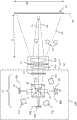
Fig. 1 depicts portions of a projection system and components of a projection system according to one example of the present disclosure.
Fig. 2 depicts a liquid crystal-type polarization modulator according to one example of the present disclosure.
FIG. 3 depicts a segmented rotating disk-type polarization modulator according to one example of the present disclosure.
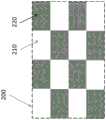
Fig. 4 depicts an ANSI contrast target used to measure intra-frame contrast according to one example of the present disclosure.
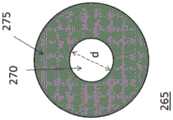
FIG. 5 depicts an aperture stop according to one example of the present disclosure.
Fig. 6 depicts a projection system with a stereoscopic polarization modulator for improved intra-frame contrast according to one example of the present disclosure.
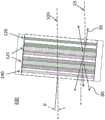
Fig. 7 depicts a stereoscopic polarization modulator usable in the projection system of fig. 6 according to one example of the present disclosure.
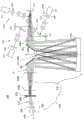
Fig. 8 depicts a projection system with refractive relay and a stereoscopic polarization modulator for improved intra-frame contrast according to one example of the present disclosure.
Fig. 9 depicts a projection system with refractive relay and a stereoscopic polarization modulator for improved intra-frame contrast according to one example of the present disclosure.
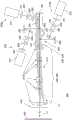
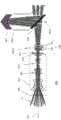
Fig. 10 depicts a projection system having a stereoscopic polarization modulator and a polarizing beam splitter positioned near an intermediate image created by relay optics within a projector according to one example of the present disclosure.
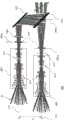
Fig. 11 depicts an alternative projection system to the projection system of fig. 10 in which rejected image light is directed to a second projection lens according to one example of the present disclosure.
Fig. 12 depicts measured data of ANSI contrast for a stereoscopic polarization modulator positioned at different distances from a projection lens according to one example of the present disclosure.
Fig. 13 depicts measured data of ANSI contrast for a tilted stereoscopic polarization modulator when positioned at a fixed distance from a projection lens according to one example of the present disclosure.
Fig. 14 depicts data for a measurement of a stereoscopic polarization modulator versus tilted polarization contrast ratio according to one example of the present disclosure.
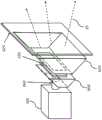
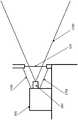
Fig. 15 depicts a projection system having an accessory component positioned between a stereoscopic polarization modulator and a projector according to one example of the present disclosure.
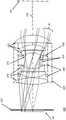
Fig. 16 depicts an imaging lens having a barrel or housing including baffles to block stray light according to one example of the present disclosure.
Fig. 17 depicts a schematic block diagram of an example of a projection system with an accessory according to an example of the present disclosure.
Fig. 18 depicts a schematic diagram of a cleaning system for a port window of a projection system according to one example of the present disclosure.
Detailed Description
Certain aspects and features of the present subject matter relate to a projection system that uses a stereo polarization modulator positioned inside to direct stereo image content to a display surface while using the stereo polarization modulator to avoid intra-frame contrast degradation. In one example, a stereoscopic polarization modulator is positioned between the spatial light modulator device and imaging optics in the projection system. The imaging optics may prevent a portion of the imaging light scattered by the stereoscopic polarization modulator from being projected by the projection system while allowing other light (e.g., the desired light or light passing through the main path of the projection system) to be projected. Doing so may reduce or avoid intra-frame contrast degradation of the projected imaging light that may otherwise occur due to the presence of the stereoscopic polarization modulator. In this example or as a separate example, the projection system may comprise an attachment between the port window and the projection lens to absorb a portion of the light scattered by the stereoscopic polarization modulator.
Elements that include elements not specifically shown or described may take various forms. The figures shown and described herein are provided to illustrate examples of principles of operation and component relationships along their respective optical paths according to some aspects of the present disclosure, and may not show actual dimensions or proportions. Some exaggeration may be included to emphasize principles of structural relationship or operation. In some cases, components that are typically located in the optical path of the projection device are not shown to more clearly describe the operation of the illustrated projection optics. Furthermore, the word "or" is used in this disclosure in a non-exclusive sense unless otherwise explicitly stated or required.
Certain aspects and features of the present disclosure include combinations of the examples described herein. References to particular examples, etc., refer to features that are present in at least one example. Separate references to "an example" or "a particular example" or the like do not necessarily refer to the same example; however, unless so indicated or otherwise clear to one of ordinary skill in the art, such examples are not mutually exclusive. The use of singular or plural in referring to "method" or "methods" and the like is not limiting.
The term "F-number" (or F # or F/#) as used in this disclosure has its conventional optical meaning, i.e., the ratio of the effective focal length to the receive aperture (F # ═ EFL/d). The F-number is used to scale the width of the converging to diverging cone of light, so that the smaller the F #, the larger the cone angle, and the greater the light carrying capacity of the cone of light. In general, with respect to optical systems, the f-number in question refers to the f-number for light collected by a projection lens (e.g., from an intermediate image plane) or the f-number for light incident on a display surface. The term "numerical aperture" (or NA) is also used and has its conventional meaning, i.e., twice the reciprocal of F # (NA 1/(2 x F #)). The numerical aperture is directly calculated using the angle (θ) described by the light from the bottom of the object to the inner edge of the limiting aperture (aperture stop) [ NA ═ sin (θ) ≈ θ (expressed in radians) ]. In general, the f-number and numerical aperture define the speed of an optical system such as a projection lens. For example, the larger the NA or the smaller the F #, the larger the cone angle and the greater the light carrying capacity or optical speed of the optical element delivering the cone of light.
Fig. 1 is a schematic diagram of aprojector 100 having aprojection lens 40, whichprojection lens 40 may project animage beam 46 to form an image on a remote screen ordisplay surface 50. A customer orviewer 70, which may be positioned below theimage beam 46, may view the projected image on thedisplay surface 50. In cinema applications,projector 100 may reside in a projection room and may project image light through a port window (not shown) at a frame rate of 24 frames per second (fps) into an accompanying theater to benefit the audience therein. Internally,projector 100 has three ormore color channels 10, typically red (R), green (G), and blue (B). Eachcolor channel 10 has alight source light modulator light modulators lens aperture stop 65 to createimage light 25. In the OFF state, each micromirror can direct light toward a beam dump (not shown). The frame sequence contrast may measure the light passing through thelens aperture stop 65 as a ratio of the leakage of on-state light to the remaining off-state light not captured by the beam dump. For color projection, the modulated exit light from each spatiallight modulator 20 may provideimage light 25, and image light 25 may be combined onto the same optical path, typically along a localoptical axis 35, using a combining element such as adichroic combiner 30. This architecture may be used if the spatial light modulator is another technology, such as a Liquid Crystal Device (LCD), of which a Liquid Crystal On Silicon (LCOS) device is an example.
Eachlight source light sources light source light source light sources light modulators dichroic combiner 30, and projection optics, such as aprojection lens 40. Each spatiallight modulator object plane projection lens 40.Projection lens 40 includes an illustrative pair oflens elements 42a, 42B. If the source light is initially polarized, the optics can be designed to either preserve the polarization quality or intentionally depolarize it. In the former case, with appropriate optics, polarization quality can be maintained until the polarized image or illumination light encounters the stereoscopic polarization switch.
In addition, each spatiallight modulator image plane 64 of the display at thedisplay surface 50 where the screen is located. The projected images from the spatiallight modulators projection lens 40 at a magnification m ═ θ2/θ1Amplification of where theta2And theta1Is the angle that defines the object and image plane numerical aperture relative toaperture stop 65. The numerical aperture may be directly calculated [ NA ═ sin (θ) ≈ θ (in radians) using an angle (θ) described by light from a position where the localoptical axis 35 intersects theobject plane 60 to a limiting aperture edge (e.g., aperture stop 65)]. Further, the screen has a width "W" and is located at a distance "D" away from the projector in image space. In the movie field, the distance "D" is "throw", and the throw ratio (T) may be defined as a ratio of the throw distance (distance D) to the screen width (W), so that T is D/W. The projector may provide an image to fill a projected field of view (FOV), which may be described by the actual physical size of the image on the screen (e.g., projection width W '), throw ratio T' of the projection, angular width to the edge of the screen (e.g., ± 45 °), or a combination thereof.
Each spatiallight modulator projection lens 40 ontodisplay surface 50 to form an array of image pixels projected on a screen. Each spatiallight modulator
To implement stereoscopic projection, theprojector 100 may be further equipped with apolarization modulator 75, thepolarization modulator 75 may provide left and right polarization images, and the left and right polarization images may be wornAn observer wearing appropriate stereo glasses perceives as a fused stereo image. Thepolarization modulator 75 may also be referred to subsequently as a stereoscopic polarization modulator, which may encode image light into stereoscopic image light in two orthogonal polarization directions. The left and right polarized images may be linearly or circularly polarized and the viewer may wear appropriate glasses to view the polarized images. Thepolarization modulator 75 may be a push-pull, pi-type or surface mode Liquid Crystal (LC) type device (e.g., Z-screen), achromatic polarization liquid crystal switch, rotating polarization wheel, or other device type. Commercially available Z-screen devices include a DepthQ polarization modulator from Lightspeed Design (Belvue, Washington), Wave 3D or RealD from Masterimage (Hollywood, Calif.)TMPro LP (Bifrey mountain, Calif.). MasterImage also provides a polarization wheel modulator device MI-Clarity 3D. These devices can also be integrated into polarization-converting imaging systems, which can improve light efficiency and image brightness on the screen.
In other systems, with or without a polarization conversion system, the polarization modulator is positioned between theprojection lens 40 and thedisplay surface 50, and is positioned very close (within a few inches) to the projector, because such positioning can reduce the size and cost of the polarization modulator device given the rapid outward expansion of the image light to fill the optical projection FOV on the screen. Such modulators may be mounted on the base alone or to external mounting features on the projector housing of the port sash (not shown) or frame. In contrast, according to some examples of the present method, thepolarization modulator 75 is positioned within theprojector 100 to improve intra-frame contrast and polarization contrast. A portion of theimage beam 46 passing through the modulator (see, e.g., fig. 7) becomes diffused or stray light by light scattering, diffraction, and reflection occurring within the modulator device. Although stray light may be generated by these optical mechanisms, the term "scattering" is also used herein to generally include or encompass various forms of diffuse or stray light. Positioning the stereoscopic polarization modulator and the baffle within the projection system may enable the stray light to be selectively blocked either angularly or spatially. The aperture stop may provide angular filtering, while the field stop may provide spatial filtering, and other baffles may provide a combination of spatial and angular filtering.
In more detail, FIG. 2 depicts one type ofLC polarization modulator 150 that may be used as thepolarization modulator 75 in FIG. 1 and that provides sufficient polarization contrast (e.g., ≧ 300:1) to provide polarized stereoscopic image light encoded in two orthogonal polarization directions for effective stereoscopic perception. When used with a rear projection lens, this type ofLC polarization modulator 150 may have an active area of 8-12 inches in width or 40-100 square inches in area, depending on the design. The polarized stereoscopic image light refers to imaging light including left-eye image light and right-eye image light, in which the left-eye imaging light and the right-eye imaging light are differently polarized. TheLC polarization modulator 150 may be an electro-optical device having a structure that combines to provide two serial push-pull surface-mode LC modulators (LC cells 125) with alinear polarizer 120. Incident image light is transmitted throughlinear polarizer 120 andLC cell 125 ofLC polarization modulator 150 is driven so that a continuous field of alternating left-handed and right-handed circularly polarized light may appear. This polarization modulator 150, which is a Z-screen type device using surface mode liquid crystals and push-pull operation, has twoLC cells 125, eachLC cell 125 introducing its own independent phase shift equal to a quarter-wave retardation into the light beam exiting thelinear polarizer 120. EachLC cell 125 may include a thin layer of liquid crystal polymer material positioned between twowindows 135 coated withITO electrodes 130. The pair of surfacemode LC cells 125 may have orthogonal rubbing axes for LC alignment, andlinear polarizer 120 may have an absorption axis that bisects the orthogonal rubbing axes. A driver (not shown) may be responsive to the synchronization pulse provided byprojector 100 and may provide a driving voltage toLC cell 125 in synchronization with the synchronization pulse so that the polarized light exitingLC cell 125 may be synchronized with the image produced by the projector. The phase shifts provided by the twoLC cells 125 may be vectorially combined in a manner similar to the function of a push-pull amplifier acting on the oscillating electrical signal, and the resulting delay of the phase-shifted light may be significantly greater than the delay of the phase-shifted light that would be produced without one of the cells.
TheLC polarization modulator 150 of fig. 2 may include additional waveplates or retarders (e.g., quarter-wave plates) and polarizers. This type of device may also include optimizing the alignment of the rubbing axis and drive voltage, replacing the absorbing dye polarizer type linear polarizer with a wire grid polarizer, and using a polarization compensator. This type of device may also be used to switch image light between two orthogonal linear polarization states rather than between left-handed and right-handed circular polarization states. In this case, eachviewer 70 may observe the image content through a pair of linearly polarized stereoscopic glasses. Also, other liquid crystal type devices may provide functionality for thepolarization modulator 75 of FIG. 2. For example, a device having only a single LC cell, such as a Ferroelectric Liquid Crystal (FLC) switch, may be used. As another example, thepolarization modulator 75 may be an achromatic polarization switch comprising a single rotatable smectic liquid crystal half-wave plate with a polarizer and two passive retarders (waveplates), or two achromatic liquid crystal variable retarders with a polarizer and two passive retarders.
As an alternative to using a liquid crystal stereoscopic polarization modulator to alternately encode image light into stereoscopic image light including left eye image light and right eye image light, fig. 3 depicts apolarizing filter wheel 175 having a polarizing filter of the type that may be used as thepolarization modulator 75 in fig. 1 and that provides sufficient polarization contrast for stereoscopic projection. (polarized filter wheel 175 may also be referred to as a "circular polarized filter.)polarized filter wheel 175 or disk may be a circular structure that includes at least one left imagepolarized filter 160 and at least one right imagepolarized filter 165. Thepolarized filter wheel 175 may be rotated at an appropriate rate to scan the filter across the projected image path (image area 180). Typically, each polarization filter (160 or 165) includes a linear polarization filter and a quarter-wave plate or retarder to convert incident light into right-or left-handed circularly polarized light that can be laminated onto a transparent plastic or polymer substrate (not shown). A polarized filter wheel driver (not shown) may rotatepolarized filter wheel 175 according to the timing synchronization of the left and right image emissions ofprojector 100.
As shown in fig. 3,polarized filter wheel 175 may be segmented in an alternating manner (e.g., L, L, R, R) using 12 equally sized fan-shaped left and rightimage polarizing filters polarized filter wheel 175 decreases. The allowable transition time for transitioning the filter edges between the left and right filter segments to move throughimage region 180 may affect the size of the wheel relative to the number of filter pairs and the rate of rotation. Furthermore, synchronization of the image content with a suitable blanking shutter in the imaging optical path may further reduce image crosstalk between the left-eye and right-eye images.
The projector may also benchmark against intra-frame (e.g., within a single frame) contrast, or relative tendency of image light directed to bright areas in a projected image frame, to "spill over" into adjacent dark or black areas, due to scattering, diffraction, or reflection redirecting and diffusing a portion of the image light to other areas of the display surface. Light reflected from the screen or display surface may be used to measure intra-frame contrast. Using an optical detector directed towards the projector may obtain a potentially better measurement, since the measurement is less affected by ambient light scattering in the test environment. Intra-frame contrast may be measured using a variety of targets, including an angular bin contrast target, or an ANSI "checkerboard" contrast target as shown in fig. 4 may be used. TheANSI contrast target 200 includes a pattern of sixteen equally sized whiterectangular regions 210 and blackrectangular regions 220. The brightness level can be measured and reported as the average ANSI contrast, where the average luminance measured at the center of arrival of the light rectangle is divided by the average luminance of the measurement of the dark rectangle. In a digital projector where images can be easily switched, both the ANSI target and the inverse of theANSI contrast target 200 can be imaged by theprojector 100, and thus the ANSI CR values for sixteen rectangles can be tabulated separately. Also, spatial variations in ANSI contrast can be examined at multiple coordinate locations (x1, x2) on the screen. The central ANSI contrast can be collected by measuring the light and dark light levels of one of the four central rectangular areas of theANSI contrast target 200. ANSI CR may be determined forprojector 100 with or withoutpolarization modulator 75 or other stereo polarization optics.
In an optical device, an aperture is a hole or opening through which light travels, and the associated surface outside the hole blocks or blocks light that misses the hole. Aperture stop 265 (see fig. 5) is a stop that determines the beam cone angle or system F-number (e.g., F/4) collected from or projected onto an object or light source or area to an image location or area. By selectively blocking light, aphysical aperture stop 265 in the imaging lens may define the ray angle of the rays passing through the lens. Also, since the lens design is optimized to limit and balance aberrations of the lens for imaging light rays passing throughaperture stop 265, the size (diameter, "d") of aperture stop opening 270 (which is typically, but not always, a circular hole) may directly contribute to the image quality provided by the lens. Theaperture 265 may block stray light, such as light that misses the intendedaperture opening 270 and strikes thelight blocking surface 275. By blocking stray light, aperture stop 265 can contribute to angular filtering (angular selective blocking or light transmission) and improvement of image contrast within a frame. During optical design, the optical element is also determined to have one or more transparent apertures that may define portions of the external optical surface through which light is intentionally passed, and may define, for example, areas of the optical device that would benefit from an anti-reflective (AR) coating.
High contrast performance from the projector can improve image quality not only with respect to the dynamic range from black to white, but also with respect to resolution (MTF) and volume of renderable color space. Furthermore, when projector ANSI contrast is low, the value of very high frame sequence contrast (e.g., ≧ 100,000:1) can be significantly reduced unless the image content has only a small amount of highlight in very dark scenes, such as scenes with starry scatter in deep space. Historically, cinema film projectors provided frame sequence contrast >5,000:1 using printed film, but the ANSI contrast performance was only ≈ 200 ≈ 300: 1. As movie projectors are increasingly replaced by electronic or digital projectors, the frame sequence contrast varies greatly (2,000-100,000:1), depending on the technology, but the ANSI contrast is typically kept in the same low 200-300:1 range. However, digital projectors ANSI CR also began to improve, and ANSI CR values of about 700:1 or higher were rarely reported.
The stereoscopic polarization modulator may undergo a variety of mechanisms, including light scattering from dust and internal structures, and back reflection from projector scattering, which may reduce the intra-frame contrast of the projection. Certain aspects and features of the present approach may provide a projection system in which a very high ANSI CR (e.g., ≧ 800:1) may be provided and intentional additional effort may be provided when combining the projector with the stereoscopic polarization modulator. Care may be applied because once acquired, the high ANSI or intra-frame contrast may drop significantly when light scattering optics (e.g., polarization modulators) or even dirty optics are used within the projector.
As light interacts with various surfaces, including modulator 15 (e.g., DMD), filters, mirrors, projection lenses, and other optics, measurements of ANSI CR in the projected image may be affected by light scattering, diffraction, reflection, or ghosting, resulting in the spill of diffused image light into the blackrectangular region 220 of fig. 4. The sides of the optic may be blackened with a black paint or other light absorbing coating. The inner surfaces of the optics housing and barrel (including the baffles or light traps) and the outer surface of the lens aperture at theaperture stop 65 may also be blackened using Black anodization (e.g., Avian Black). This can result in typical measured ANSI contrast values in the 200-300:1 range. The optical housing or barrel (see, e.g., fig. 16) is generally a rigid structure that not only surrounds, protects, and supports the optics, but also the baffles and other light capturing surfaces or features therein. For example, the baffle, aperture stop, field stop, and inner housing surface may have blackened and threaded, corrugated, or textured surfaces, wherein the undulations of these light trapping surfaces help to limit and reduce stray light through multiple successive light absorbing reflections.
Little attention has been paid to their effect on intra-frame contrast, particularly ANSI contrast, when using thepolarization modulator 75 to provide stereoscopic projection. However, as projector ANSI contrast increases, these devices may have a greater impact than previously experienced. For example, when a stereoscopic polarization modulator is used in front of the projector, the measured intra-frame contrast of the projected image from an atypical projector providing an average ANSI contrast of ≧ 800:1 frames drops to only 160: 1.
These polarization modulator devices may help reduce ANSI contrast from a number of mechanisms or scattering elements, including dust, debris, and other contaminants that fall on thepolarization modulators 75 when thepolarization modulators 75 are exposed to unfiltered air in a projection room or theater environment. Internally, polarizing and retarder films may also contribute light scattered from surface defects and internal non-uniformities, including fibrous structures or patterns produced during film stretching or rolling. Moreover, in a liquid crystal device, the windows may be intentionally spaced to control the cell thickness ofLC cell 125 of fig. 2, and thereby control the polarization uniformity of the device; for example, a uniform 10 micron cell gap is provided across a device of several inches or more. The liquid crystal cell spacing or cell gap can be controlled by using posts, spacers or spacer beads or particles, typically made of transparent polymer or glass. However, such spacers, in particular transparent spacer beads, may be light scattering elements which may lead to a significant reduction of the projected intra-frame contrast or ANSI contrast.
To enhance robustness, somepolarization modulators 150 of the LC type depicted in fig. 2 may replace wire grid polarizers (with metal wires on glass)/dye type polarizers for polymers while providing the functionality of thelinear polarizer 120. However, wire grid polarizers can retroreflect and scatter light. This back reflected light can illuminate the front surface ofprojector 100 if the modulator and wire grid polarizer are positioned betweenprojection lens 40 and the screen. Even if the wire grid polarizer is tilted, enough of this light can scatter off the front surface ofprojector 100 and propagate diffusely to the screen to significantly reduce intra-frame contrast, including the measured ANSI contrast. Although better blackening of the front surface of the projector may enhance the intra-frame contrast, the improvement may be insufficient when the intra-frame contrast of the projector is particularly high.
Certain aspects and features of the present method provide a projector with a stereoscopic polarization modulator that enables stereoscopic image perception and preserves intra-frame contrast of the projected image compared to a level equal or nearly equal to the level in the case of no polarization modulator. By way of example, fig. 6 depicts a schematic diagram ofprojector 300 including threeillumination assemblies light source assembly 315. Thelight source assembly 315 may include one or more light sources, which in this example are laser light source devices. The illumination light is directed onto spatiallight modulator 350 by redirection with one or more mirrors 320. Modulated image light, including image data imparted into the transition light by addressed pixels of the spatiallight modulator 350, is combined to traverse a common optical path. Includingoptical axis 335, and passes throughimaging optics 400 and onto display surface 420 (e.g., a projection screen). Theprojector 300 may be tilted or theimaging optics 400 used with an offset, or a combination thereof, to aim the projected image from the projection chamber down and toward the screen.
In more detail, theillumination assemblies more illumination lenses 325, a light integrator 330 (e.g., a fly-eye integrator or integrating bar) that forms and directs the transitional light beam, andadditional illumination lenses 325 and mirrors 320 that together direct the illumination light along anoptical axis 335 to an associated spatiallight modulator 350. Themirror 320 need not be positioned in the plane of the optical system. For example,mirror 320 in the optical path for the green channel may be out of plane and not block light from passing toimaging optics 400, which may otherwise be implied by fig. 6.
In the projection system of FIG. 6,dichroic combiner 345 comprises afirst combiner 346 and asecond combiner 347, each being a dichroic element with a suitable thin film optical coating that selectively transmits or reflects light depending on its wavelength. Althoughdichroic combiner 345 is shown as a pair of tilted glass plates, other examples of structures may be used, including an X-prism, a V-prism, or a philips (or Plumbicon) type prism. Themirror 320 may also be provided in the form of a prism, such as the widely used TIR (total internal reflection) prism, which may be used in combination with philips prisms and DLP devices.
Inprojector 300 of fig. 6,imaging optics 400 is depicted as a multi-element assembly orprojection lens 460 having a plurality oflens elements 415 and anaperture stop 410,aperture stop 410 imaging or projecting light from spatial light modulators 350r, 350g and 350b directly onto the image plane (display surface 420) at their respective object planes at high magnification (typically 100x-400 x). In theaters providing stereoscopic content, the screen may be a high gain screen, with a silver-plated or nanoparticle surface structure that preserves the polarization of incident light upon reflection. To encode image content for stereoscopic (3D) viewing with left-eye image light and right-eye image light, and to aid in intra-frame contrast of the projected polarizedstereoscopic image light 25, thestereoscopic polarization modulator 430 is shown positioned at an interior location 445, before theimaging optics 400, but after thedichroic combiner 345. Thestereoscopic polarization modulator 430 may be a liquid crystal or polarization wheel device. If this function is located in the system even earlier, such as before thedichroic combiner 345, then multiplestereoscopic polarization modulators 430 may be used.
Certain aspects and features ofprojector 300 may provide astereoscopic polarization modulator 430 at an interior location 445 withinprojector 300, and thestereoscopic polarization modulator 430 is positioned in front ofimaging optics 400 along an optical path or optical axis. Stray light generated by the stereoscopic polarization modulator may have room to propagate from the residual image light and encounter baffles or light traps (e.g., blackened interior surfaces of the barrel) andlight blocking surface 275 ofphysical aperture stop 265, which may help block or angularly filter such stray light. Thestereoscopic polarization modulator 430 may also be positioned within theimaging optics 400, for example at theaperture stop 410, although the projector optics may less block stray light generated by thestereoscopic polarization modulator 430. In other polarization switching stereoscopic projectors using LC-type polarization modulators or polarization modulators as wheels, the polarization switch is positioned outside the projector, in image space, at or near theouter position 440 near thelast lens element 415 of theimaging optics 400, and the scattered light from the modulator can easily propagate onto the screen. Although in this case, the tilting of the modulator may increase the intra-frame contrast, the external mounting and use of thestereoscopic polarization modulator 430 may be constrained such that the device is aligned in a direction perpendicular to theoptical axis 335 of the projected image light, as the modulator modifies the highly divergent light and device performance is limited by the angle.
In the context of theprojector 300 of fig. 6, thestereoscopic polarization modulator 430 may provide improved intra-frame or ANSI contrast as a result of several different design variations operating alone or in combination. By way of context, fig. 7 depicts theimage light 25 incident on thestereoscopic polarization modulator 430, and both thescattered light 90 and the backreflected light 95 exit different interior regions of the device and proceed in various forward and backward directions around the main or intended path of the image light. As an alternative to assisting contrast within the frame, thestereoscopic polarization modulator 430 may be upgraded with better materials with less scattering, resulting in less stray light. For example, these devices may currently include a fixed retarder (wave plate) or a compensator comprising a polymer film. While such films are generally inexpensive, they may have both surface defects and internal non-uniformities that may lead to light scattering. However, with thestereoscopic polarization modulator 430 positioned at an interior location 445 of theprojector 300, the modulator device may be small enough (e.g., 1-6 square inches) so that more expensive materials with better optical quality may be used. These changes may also cause the wavefront quality of thestereoscopic polarization modulator 430 to be improved, if desired, to help reduce image quality (MTF) degradation that the device may cause when positioned within a projector.
For example, the polymer retarder or waveplate may be replaced with an achromatic quartz waveplate, which may be a more robust material less sensitive to thermal damage. Alternatively, the retarder may comprise a polymer retarder attached to a robust, thermally conductive, optically transmissive substrate, such as from Surmet corporation of burlington, massachusetts Which may then be air or liquid cooledBut instead.
 Is a high refractive index sapphire optical ceramic with optical double refraction. With a thickness of 1.0mm to 1.5mm
 May be able to substantially maintain polarization contrast.


Likewise, by modifying the configuration ofLC cell 125, ANSI contrast within the projection frame of a projector equipped with LC-typestereoscopic polarization modulator 430 can be improved. For example, large area devices may use spacer beads to control cell gap thickness, but these spacer beads may cause significant geometric light scattering, thereby reducing intra-frame contrast. Since the LC typestereoscopic polarization modulator 430 positioned at the interior location 445 within theprojector 300 may be significantly smaller than the external device at theexterior location 440, other cell gap spacing methods may be used. If the device is small enough, the cell gap can be maintained near the outer edge of the optical clear aperture using an outer frame mounting method. Alternatively, the cell gap may be maintained with a spacer pillar formed, for example, by a photomask process. Since the spacer pillars may be smaller, more uniform, and more sparsely distributed than the spacer beads, the amount of optical scattering may be reduced. Spacer density (spatial distribution), shape, and other properties can also be adjusted to reduce light scattering and improve intra-frame contrast. In addition, the spacer beads or posts can be made dark or light absorbing (e.g., with increased optical density) to scatter less light. The thermal risk of damage to thestereoscopic polarization modulator 430 may be realized by switching from a glass of a typical window that may be selected for low cost and durability in an LC device to an alternative material that may provide better thermal performance. For example, fused silica may be used instead because it has very low visible light absorption. Alternatively, the LC cell window glass may also be made of Made and cooled to extract from the apparatusHeat, thereby benefiting the LC polymer material inside. The external optical surfaces or windows of the
stereoscopic polarization modulator 430 may also be anti-reflection coated to reduce back reflections that may subsequently affect intra-frame contrast or image resolution (MTF).

Not only can the detrimental effects of thestereoscopic polarization modulator 430 on the intra-frame contrast of theprojector 300 be ameliorated by physically changing the structure of the device, but careful placement and tilting of the device within theprojector 300 can also be beneficial. For example, FIG. 6 depicts thestereoscopic polarization modulator 430 at an interior position 445 and tilted with respect to the localoptical axis 335. Fig. 7 depicts astereoscopic polarization modulator 430 residing in the optical path of the optical system at an oblique angle θ away from normal alignment with the localoptical axis 335. Additionally, if thelinear polarizer 120 is a wire grid polarizer type of optic, it may be separate from the integratedstereoscopic polarization modulator 430 device and positioned elsewhere in the projection system.
Although the optical architecture ofprojector 300 of fig. 6 may allow for the above-described tilt and repositioning changes ofstereoscopic polarization modulator 430, the available space may be limited. In contrast, fig. 8 depicts an alternative configuration ofprojector 301 compared toimaging optics 400 of fig. 6, which may have a long workingdistance projection lens 460. A combination ofrelay lens 450 andprojection lens 461 may be utilized in place of the projection lens in fig. 6. The use of relay optics in the projector may be useful to reduce the cost of theprojection lens 461, as a projection lens paired with a relay may not be needed to provide a short focal length (for high magnification) and a long working distance or long back focal length (to provide room for beam combing optics). Therelay lens 450 images the spatiallight modulator 350 to anintermediate image plane 455, whichintermediate image plane 455 is in turn re-imaged by aprojection lens 461 onto a distant display surface or screen (not shown) oriented downward as shown by theoptical axis 335. In this example, both therelay lens 450 andprojection lens 461 assemblies include a plurality ofrefractive lens elements 415. Although the relay lens 450 (with light traveling generally from left to right) shown in FIG. 8 has field lens elements near theintermediate image plane 455, it may also be used that are farther toward the intermediate image plane 455A relay lens arrangement that centrically provides image light. The luminous flux density or optical power density at or nearintermediate image plane 455 may be high depending on the total luminous output of the projector and the image content at a given time. For example, the optical power density near the intermediate image plane can be as high as 2-30W/cm2Thestereoscopic polarization modulator 430 can therefore be carefully designed so that it can withstand these exposure levels.
The use of relay optics may be useful for improving intra-frame contrast in imaging systems because the elongated optical path length may allow for additional light blocking and absorbing (e.g., black) surfaces, such as baffles, masks, and light traps. For example, in the system of fig. 8, two aperture stops 410 are depicted, and although only one of them is a limiting aperture defining the f-number of the system, both apertures may contribute to stray light blocking or angular filtering. Thus, when the internalstereoscopic polarization modulator 430 and its linear polarizer are introduced into theprojector 301 with relay optics, there is an additional opportunity to position these components to reduce the loss of contrast within the frame. In the example system shown, thestereoscopic polarization modulator 430 is positioned at an interior location 445 on the input side of therelay lens 450, and the two aperture stops 410 may help attenuate stray or stray light that is lost as useful image light 25. Alternativeinterior location 445c has similar characteristics. However, thestereoscopic polarization modulator 430 may be positioned at other locations internally, including at other illustratedinternal locations aperture stop 410 may then contribute to stray light blocking.
Similarly, fig. 9 depicts an alternative configuration ofprojector 302 in which theimaging optics 400 of fig. 6, which is a long working distance projection lens, has been replaced with a combination ofOffner relay 470 andprojection lens 462. TheOffner relay 470 is a reflective imaging system that includes aprimary mirror 475 and a secondary mirror 480. TheOffner relay 470 of FIG. 9 can be supplemented by two folding mirrors 321, one for collecting image light 25 (spatial light modulator 350) from the object and one for directing the image light toward theprojection lens 462. Theprimary mirror 475 and the secondary mirror 480 can share a common optical axis 335a on-axis of theaperture stop 410, but the fields (object and image) are "off-axis". Design performance can then be optimized over the annular region between the minimum and maximum radial fields. And the image light may be incident telecentrically tointermediate image plane 455 and then re-imaged by a projection lens. That is, with concentric layout and folding frommirror 321, the area of best image quality atintermediate image plane 455 is annular and centered onoptical axis 335. TheOffner relay 470 nominally operates at unity magnification, but can deviate moderately (e.g., -1.04 ×) with minimal degradation in imaging performance. TheOffner relay 470 or its housing may also be equipped with baffles, masks, and optical traps (all not shown), including primary and secondary mirror masks that provide blocking at the edges of the mirror surfaces, to reduce the amount of stray light. Similarly, afield stop 435 may be positioned near the intermediate image plane to block stray light that may be outside the area of the intermediate image itself. Alternatively, the relay optics represented by therelay lens 450 or theOffner relay 470 can be modified to be a hybrid or catadioptric system, including both refractive and reflective imaging optics.
Although thestereoscopic polarization modulator 430, which may convert unpolarized image light into polarized left-eye image light and right-eye image light, may be positioned on the input side of theOffner relay 470 at aninterior location 445c near thedichroic combiner 345, it may be easier to position the modulator in the optical path on the output side of the Offner relay, as indicated byinterior locations projector 303 and a portion of itsimaging optics 400, where output image light 25 from the relay optics is focused at anintermediate image plane 455, which in turn is re-imaged byprojection lens 463.Imaging optics 400 includes relay optics (not shown) and aprojection lens 463. To reduce ANSI contrast loss, thestereoscopic polarization modulator 430 can be positioned and tilted at aninterior position 445a in the optical path that is typically positioned near the intermediate body. Afield stop 435 positioned near theintermediate image plane 455 may be included to assist in stray light blocking. As shown, the integratedstereoscopic polarization modulator 430 includes twoLC cells 125 and aretarder 140. However, although a linear polarizer may remain integrated in the device, power density issues may favor a wire grid device rather than an absorptive device, but back reflection and scattering can be carefully controlled. In some examples, the polarizer is separate from thestereoscopic polarization modulator 430 and positioned at the previousinterior position 445 b. As shown, wire grid plate Polarizing Beamsplitter (PBS)495 is a polarizing element that can act as a pre-polarizer and emitimage light 25 of one polarization towardstereoscopic polarization modulator 430 and can reflect image light of an orthogonal polarization state towardbeam 485 to be absorbed. If the input image light is already pre-polarized, thePBS 495 may not be needed, although a clean-up polarizer or PBS may be used if the previous polarization quality (e.g., contrast, orientation, uniformity) from the light source is not fully preserved. By directing unused, reflected, and scattered image light into thebeam dump 485, supplemented by appropriate light baffles 490, little unused light can be scattered into the optical path and affect intra-frame contrast. An internal housing or enclosure (not shown) with seals or gaskets may be used to keep thespatial polarization modulator 430 and other internal optical surfaces free of dust and other contaminants.
While bothLC cell 125 andretarder 140 contribute to light scattering and intra-frame contrast loss because they transform unpolarized image light into polarized stereoscopic image light, LC cells may be a major contributor to scattering. Thus, it is acceptable to leaveLC cell 125 at inner position 445,separate retarder 140 from the integrated device, and move retarder 140 toouter position 440. The optical power density exposure to theretarder 140 may be mitigated. The externally mounted retarder can be easily removed or switched out of the 2D display and is also easy to replace or clean. In contrast, when switching the display from 3D to 2D image content using aprojector 303 of the type of fig. 10, it may be mechanically more difficult to temporarily remove both thestereoscopic polarization modulator 430 and thepolarizing beam splitter 495 and insert any suitable optical path length compensator. Thus, if the scattering of light from thestereoscopic polarization modulator 430 is adequately controlled, the modulator may be left in the system for both 2D and 3D operation, but they may be dormant during 2D image projection. However, unless the projector is constructed using the two-lens approach of FIG. 11, the polarizer may still need to be removed. Alternatively, a movable assembly (not shown) may be used to move thestereoscopic polarization modulator 430 and thepolarization beam splitter 495 out of theoptical axis 335 and move the appropriate optical path length compensator into theoptical axis 335.
The polarizing element, typically a polarizing beam splitter as in fig. 10, may be a plate wire grid PBS (as shown), a prism embedded wire grid PBS, a dichroic plate polarizer, a Mac Nielle prism, a double-pigeon thin Film Total Internal Reflection (FTIR) prism, or other type of polarizing beam splitter. The wire grid plate PBS is thermally stable and relatively angle insensitive compared to the Mac Nielle prism. However, the PBS has wire grids embedded in the cube glass prisms, removing astigmatism from the tilted plates, but the wires are embedded in the adhesive, changing the index of refraction, reducing the visible contrast performance. A more optimized device may then reduce the line spacing (below 100nm) to compensate. Further, for high power applications like cinema projection, the use of more heat resistant materials in prismatic glass (e.g., fused silica) and flexible adhesives or chemical bonding may be useful for either or both of the polarizing beam splitter and the stereoscopic polarization modulator. These material improvements may also be applied to a twin-pigeon thin Film Total Internal Reflection (FTIR) prism or other prismatic structures.
Fig. 11 depicts a variation ofprojector 303 of fig. 10, where the polarizing element isPBS 495 used as a pre-polarizer and beam splitter, andbeam dump 485 is replaced by a second opticalpath having mirror 321, quarter-wave retarder 140 oriented to provide half-wave rotation, secondstereoscopic polarization modulator 430, and a portion of second imaging optics represented bysecond projection lens 463. In this case, theimaging optics 400 includes relay optics (not shown) and twoprojection lenses 463. The twostereoscopic polarization modulators 430, which together provide the left-eye image light and the right-eye image light, are positioned and tilted so as to reduce their degradation of intra-frame contrast. In the projector of fig. 11, the polarization conversion system represented by the twostereoscopic polarization modulators 430 is positioned at a comparableinterior location 445a, which is integrated into theprojector 303 in terms of optomechanics and design, rather than adding a "photomultiplier" after theprojector 303. Such an approach may be optically advantageous because the rear projector photomultiplier has difficulty receiving and optically containing the highly divergent image light 25 emitted by the projector.
Projection systems having a stereoscopic polarization modulator positioned in front of the projector may cause a portion of the image light to be back-reflected or scattered from the modulator and cause significant intra-frame contrast degradation. However, theprojector 303 having the configuration as in fig. 10 may be arranged such that the relay optics provide anintermediate image plane 455 of about 10mm before theprojection lens 463, and the axial distance between the last relay optical element (not shown) and the first projection lens element may be greater than 200 mm. In this example, thePBS 495 may be offset from theprojection lens 463 by a distance greater than 200 mm. When thestereoscopic polarization modulator 430 is mounted at anexternal location 440 in front of the projector system, the ANSI contrast can be reduced to about 150:1 by scattering and retro-reflection. In contrast, the measured ANSI contrast of an optical system without thespatial polarization modulator 430 in the optical path may exceed 800: 1.
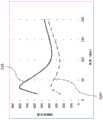
An LC typestereoscopic polarization modulator 430 without an integrated pre-polarizer may be used at various interior locations 445 in the optical path. The pre-polarizer function may be provided by thePBS 495, whichPBS 495 may be offset from thestereoscopic polarization modulator 430 by a distance of 10-200mm, depending on the given position of the modulator. The results of some examples of such configurations are shown in fig. 12, fig. 12 showing a plot of the measured ANSI CR versus modulator position away from the first projection lens element and toward the final relay optical element. Fig. 12 shows the higher ANSI CR of the test stereo polarization modulator positioned at these inner positions 445 compared to theouter positions 440. In particular,curve 500 of a non-rotated ANSI CR with the stereoscopic polarization modulator not tilted but aligned perpendicular to the local optical axis provides a minimum ANSI CR >250:1 and provides approximately 400:1 at a position about 30mm from theprojection lens 463. However,curve 525 with rotated ANSI CR versus position shows the performance of thestereoscopic polarization modulator 430 at a fixed tilt perpendicular to the local optical axis and at a different position. The curve indicates a minimum ANSI CR >350:1, and a maximum ANSI contrast of the peak exceeding 800:1 is achieved by thestereoscopic polarization modulator 430 at an optical path position approximately 30mm from the projection lens. The projection system can support significantly higher measurable ANSI CR values than shown in fig. 12. For example,curve 525 for a modified ANSI CR is acquired in a projection test system assembled without a field stop. These graphs show that the stereo modulator position can be optimized for ANSI contrast, improving both optimized positions, and additional improvements come from both optimized positions and tilts. At internal distances along the local optical axis or optical path where peak intra-frame CR occurs, a significant amount of scattered light from thestereoscopic polarization modulator 430 may miss the lens or be blocked by the light absorbing or capturing surfaces of the lens barrel, including thelight blocking surface 275 of thephysical aperture stop 265, and the lens barrel's blackened lens mount and walls (see also fig. 16). In general, projectors with relay optics (e.g., fig. 8, 9, 10, and 11) may provide more optical path length for stray light generated within the stereoscopic polarization modulator to propagate away from the remaining image light and encounter thelight blocking surface 275 of the baffle or light trap or aperture stop 265 than projection systems with direct imaging (e.g., fig. 6).
These curves indicate that a peak ANSI CR may occur when thestereoscopic polarization modulator 430 is positioned at an interior location 445 in the optical path at or near theintermediate image plane 455, in this example, theintermediate image plane 455 is positioned at about 10mm from the projection lens 463 (the lens has a short working distance (-10-15 mm)). In particular, thestereoscopic polarization modulator 430 may be positioned at a distance outside the depth of focus of the projection lens or imaging optics so that the modulator, or any structures or debris thereon, are not in focus with the projected image. Likewise, the further away the modulator is from the intermediate image plane, the less likely any structure or debris will cause a visible shadow in the projected image. As an example, for a projection lens having a focal depth of 100-150 microns wide, a 10-30mm offset distance between theintermediate image plane 455 and thestereoscopic polarization modulator 430 may adequately account for both focal depth and shadow artifacts in the far field. However, for astereoscopic polarization modulator 430 fabricated with less scattering elements, whether from cell gap spacers, scratches, gouges, dust, or other non-uniformities that scatter less light, the generation of stray light may be reduced, and the optimal position for positioning the modulator device to obtain ANSI contrast may be positioned at a wider range of interior positions 445 (e.g., 5-35mm before the intermediate image), and thus maintain or nearly maintain the original high ANSI contrast of the projector. Likewise, otherstereoscopic polarization modulators 430 may have different light scattering properties that cause the peak ANSI contrast to be closer to the intermediate image, or closer to an interior location 445 between the barrel and theintermediate image plane 455. The projection optics may be designed with a long enough working distance (e.g., 25-50mm) or clearance from the barrel to allow positioning. However, even in the case where the modulator positioned between the lens and the intermediate image plane experiences peak ANSI contrast, a much improved ANSI contrast can be obtained with the modulator positioned at the mechanically constrained interior location 445 in front of the intermediate image.
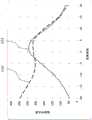
By comparison, fig. 13 shows ameasurement curve 525 of ANSI CR versus rotation, where thestereoscopic polarization modulator 430 is in a fixed position about 30mm from the projection lens and tilted away from being perpendicular to the local optical axis. For this test setup, a peak ANSI contrast of about 800:1 occurs first, with the tilt (θ) of thespatial polarization modulator 430 being about 9-13 degrees. The tilt can be kept at the minimum necessary value because the tilted plate introduces astigmatism which degrades the image quality unless corrected otherwise. However, thestereoscopic polarization modulator 430 that introduces less optical scattering may have less tilt to help reduce ANSI contrast degradation, although astigmatism may be corrected with another compensating tilt plate.
However, further care may be required because the polarization contrast of thestereoscopic polarization modulator 430 also has an angular dependence, particularly because some LC devices have an asymmetric angular response. FIG. 14 depicts the measured polarization contrast of the LCstereo polarization modulator 430 versus tilt relative to the local optical axis, and when the horizontally rotatedpolarization contrast 555 has a symmetric response that decreases with angle, the vertically rotatedpolarization contrast curve 500 has an asymmetric response, with the polarization contrast being improved in the particular direction of vertical tilt. This type of polarization contrast asymmetry typically occurs because the LC alignment layer within the LC cell is deposited with a pretilt angle, which therefore breaks the device symmetry, and the pretilt may be useful for obtaining a domain-free LC molecular orientation when the device is operated under an applied electric field. For a particular test setup, FIG. 14 shows that a vertical tilt (θ) is preferred to maintain high polarization contrast. If the device tilt is limited due to astigmatism or mechanical or other constraints, a more modest tilt (e.g., about 3-7 °) may still provide some polarization contrast and intra-frame contrast improvement (as shown in fig. 13). Thus, for example, when using thestereoscopic polarization modulator 430 positioned in an interior location 445 in theprojector 300, the tilt (e.g., 5-6 °) used to improve ANSI CR may also account for or balance astigmatism and polarization contrast also caused by the tilted device.
In summary, the measured contrast data of fig. 12, 13 and 14 show that by positioning the modulator at an internal location rather than an external location, while further tilting the modulator device to further improve intra-frame contrast and substantially maintain polarization contrast, the intra-frame contrast of a projector capable of operating with a stereoscopic polarization modulator can be improved. For example, in the projectors of fig. 6 and 8-11, the stereoscopic polarization modulator is positioned and tilted at an interior position 445. As a result, a substantial portion of stray image light that is diffused, scattered, reflected, or otherwise redirected by the stereoscopic polarization modulator may be blocked, thereby preventing light from reaching the display surface and reducing intra-frame contrast. These may improve the intra-frame contrast of the projected scene, although the amplitude may depend on both the average scene brightness and the structure of the image content (e.g., the size and location of the highlights). Alternatively, the projector may be further equipped with an iris diaphragm (e.g., an adjustable diaphragm) to help control intra-frame contrast on a scene-dependent basis. The variable aperture may be positioned at theaperture stop 410 or other internal location in the projector.
The design of aperture stops and other baffles in the optical (lens) housing or barrel can capture or block stray light and aid in intra-frame contrast. For example, FIG. 16 depicts an imaging lens assembly orprojection lens 460 that directsimage beam 46 to imageobject plane 60 to adistant image plane 64, generally alongoptical axis 335. Theobject plane 60 may also be an intermediate image plane. The lens assembly, which may also be a relay lens, also includes a housing orlens barrel 405 that provides physical support not only for thelens element 415 but also for thebaffle 490. Thestray light 425 may hit both thebaffle 490 and theaperture stop 265 at the same time, and both thebaffle 490 and theaperture stop 265 may be textured, blackened, and positioned to block or capture and absorb the stray light. The inner surface of thelens barrel 405 and the outer edges of thelens elements 415 may also advantageously be blackened. Afield stop 435 and other baffles having light absorbing features may also be positioned outside thebarrel 405 and used to assist in stray light blocking. Improvements in ANSI or intra-frame contrast can also be beneficial to the image resolution or MTF provided to the display surface, since the light level in the black areas between resolvable details is also reduced.
Furthermore, thestereoscopic polarization modulator 430 designed for an internal location 445 within the projector may be optimized for superior polarization performance (e.g., higher polarization contrast) because it operates under moderately divergent light (e.g., an F/3.5 or ± 8.2 ° cone). Likewise, if the optical design provides telecentric optics that provide telecentric space near the intermediate image (e.g., angular field of view parallel to within ± 0.5 ° tolerance), the optical angle seen by the device may be further reduced to facilitate angular polarization contrast performance optimization. This increased level of performance and reduced deviation obtained using telecentric optics may help the polarization modulator device to better tolerate tilt (θ). However, thestereoscopic polarization modulator 430 positioned at theexternal location 440 is subject to performance limitations due to being in highly divergent light (e.g., ± 45 °), thereby severely limiting any device tilt that may be applied to enhance intra-frame contrast.
In addition to or as an alternative to the placement and construction of the stereoscopic polarization modulator, intra-frame contrast improvement may also be applied to thecircular polarization filter 175 of fig. 3 and equivalent devices. The rotating circular filter wheel type device may similarly be positioned at interior locations 445 withinprojector 300, all at an angle, and tilted at those locations such that all or most of the stray light generated by the device is captured or blocked byaperture stop 410 and other surfaces. In these devices, scattered light may be generated by scattering due to unevenness of the film or the substrate, scratches, excavation or dust, film waviness, and film lamination defects or bubbles. However, since the circularpolarized filter 175 includes a linear polarized filter and a quarter-wave retarder, these materials can be assembled or upgraded to provide better optical quality. For example, the wave plate may comprise crystalline quartz, and the linear polarizer may be separate from the device and mounted in a separate location in the system. Likewise, the plastic base material may be replaced with glass, which is more isotropic and has better surface quality. Furthermore, for circularpolarized filter 175 to be positioned at an interior location 445 rather than an exterior location of the projector, scannedimage area 180 is smaller, and thus the device can be smaller and less expensive to manufacture and operate. Alternatively, replacing the LCstereo polarisation modulator 430 of fig. 7 with a simpler device (such as an FLC switch) may enhance intra-frame contrast as a single LC cell device may have fewer light scattering surfaces, including cell gap spacers.
However, since the retarder remains on the rotating circularpolarized filter 175 and thepolarized filter 175 is fixed at the previous interior position 445, the two polarized components do not rotate together and theoutput image light 25 may be elliptically polarized instead of circularly polarized. If desired, the segmented wire grid PBS wheel can replace the PBS 495 (FIGS. 10-11) atposition 445b and rotate in synchronization with the polarization filter stereo modulator wheel. As the wheel rotates, the dwell time of the interior of theimage area 180 relative to the center of rotation of the wheel, relative to the exterior of theimage area 180, may be different. However, the illumination non-uniformity of the spatial light modulator 170 may be constructed to compensate.
In another example, the rotating circularpolarizing filter 175 may also be used with the projector of fig. 11 having two projection paths with twoprojection lenses 463. However, if the optical path length and the offset distance "t" between the two projection paths are managed, then the comparableinterior position 445a may be positioned in a common plane (e.g., coplanar) that is also perpendicular to the two local optical axes 336. In this case, the rotating circular polarizing filter 175 (not shown) may be positioned such that it provides stereo polarization modulation for both optical paths while being modulated to the right (R) or left (L) at each optical path.
As previously described, operating the projector in combination with thestereoscopic polarization modulator 430 while providing or maintaining a high (e.g., ≧ 800:1) ANSI contrast for the projector may motivate positioning thestereoscopic polarization modulator 430 at an interior position 445 within the projector. However, whenimage light 25 for stereoscopic perception is modulated using polarization, the perceived image quality may depend on the polarization quality of the image light. In the case where the light source is a xenon lamp, the emitted light is inherently completely and randomly unpolarized. A linear polarizer orPBS 495 may be used as a pre-polarizer on the input image light before thestereoscopic polarization modulator 430. Thereafter, any spatial or angular polarization features from downstream optics, such as the spatiallight modulator 350 and thedichroic combiner 345, can be washed away because the light from the xenon lamp lacks any angular or spatial polarization bias.
However, once the polarized image light passes through thestereoscopic polarization modulator 430, downstream optics reduce the polarization state purity and reduce the stereoscopic image quality. For example, in the projector of fig. 6, with thestereoscopic polarization modulator 430 positioned at the interior location 445, theprojection lens 460 can reduce the polarization quality of the image light, depending on the design of the lens and the thermal load indicated by the screen size (or total screen lumens) and the image content. If desired, polarization maintenance of the lens can be achieved by careful lens design, with different optical glasses strategically selected and placed to reduce thermal stress birefringence.
In addition, if the projector uses a laser light source, emitting laser light that is generally intrinsically polarized causes complications if polarization quality is not generally maintained. Alternatively, for example, the laser-based illumination assembly 310 may be further equipped with adepolarizer 340, as shown in fig. 6, 8, and 9, such as those of the crystal-based Lyot or Cornu type. However, even with these devices, the laser light may not be completely depolarized, and more care may be taken to ensure thatdichroic combiner 345 is also polarization neutral. For example, image light 25 passing through the projection optics may be angularly and spatially depolarized such that the ratio of "s" polarized light to "p" polarized light (which is 1:1 in the ideal case, with a tolerance ≦ 0.1%) for the field position is, for example, 1.001: 1.
In one example, providing a stereoscopic image projection with improved intra-frame contrast may include a stereoscopic polarization modulator positioned in an optical path before an aperture stop of an imaging optic. The imaging optics may include a refractive projection lens (fig. 6), a refractive relay lens and refractive projection lens combination (fig. 8), or a reflective relay lens and refractive projection lens combination (fig. 9). Additionally, the relay may be catadioptric and include refractive and reflective optical elements having optical power. In addition, the projection optics may also be catadioptric or reflective (using all reflective elements), for example using a telescopic optical configuration, rather than the more typical projection lens comprising all refractive lens elements. Most classical telescope forms (such as the cassegrain or Ritchey-Chretien design) are used for astronomy and have a narrow field of view and infinite conjugation. However, there are telescopic, reflective, imaging optical designs that provide limited (albeit remote) conjugate imaging and large fields of view. For example, for image projection applications, an off-axis telescopic design form may be used, such as a "reflective triplet" using three primary mirror elements and lacking an intermediate image, or a "triple mirror polarizer" typically comprising an intermediate image. Additionally, mirrors typically use some combination of elliptical, hyperbolic, parabolic, or free-form surface profiles.
Alternatively, for the case where a projector with high intra-frame contrast can be equipped with an externally mounted stereoscopic polarization modulator. Further efforts may be made to reduce or capture redirected light (e.g., scattered or reflected light) from any optical elements between the projection lens and the port window, from the projection chamber port window, or from the projection lens element to improve image quality, such as a stereo polarization modulator. In particular, various features to handle stray light may be added to the support component of the optical element, the front of the projector, the port window, the space between the projector and the stereoscopic polarization modulator, the space between the stereoscopic polarization modulator and the port window, or the space between the projector and the port window. Features to handle stray light may also be added to the optical elements, such as to reduce optical scattering from cell gap spacers in a stereoscopic polarization modulator. The other optical element may be an optical encoding element, such as a polarizer, analyzer, or other optical encoding device. The surface may reflect light based on an angle of incidence of light received by the surface. A portion of the light may be directed to a surface capable of absorbing the received light, and heat may be dissipated by the surface, or it may be actively cooled using a fan. An optical surface with contaminants (e.g., dust or other air contaminants) in the light path may scatter light received by the surface. The more contaminants on the optical surface, the more light can be redirected by scattering by contaminants on the optical surface. The port window, projection lens, or stereoscopic polarization modulator may redirect more light over time as contaminant buildup on any optical surface of these devices is exposed to the projection room or auditorium air.
Fig. 15 depicts an exploded view of twoaccessories projector 305 and theport window 625 with the projectorstereoscopic polarization modulator 430. Thefirst attachment 600 is positioned between theprojection lens 460 and an optical element or component, such as the externalstereoscopic polarization modulator 430. Thesecond appendage 620 is positioned between thestereoscopic polarization modulator 430 and theport window 625. The dashed line (in addition to the line indicating light) reflection helps to show the internal components of some of the interior surfaces of the accessory.Image light 25 may exit (emerge) fromprojection lens 460 and be received byport window 625; however, stray light may be generated from scattering, reflection, or diffraction of light from theprojection lens 460, theport window 625, and optical surfaces on the optical element, such that the light is redirected in an undesired (e.g., unintended or secondary) light path between the projection lens and the port window. Light that has been redirected may encounter the interior light absorbing surfaces of theappendages
Theaccessory 600 can be added and constructed to enclose or surround a space or volume with imaging light between theprojector 305 orprojection lens 460 and thestereoscopic polarization modulator 430, where the interior surface of the accessory between thestereoscopic polarization modulator 430 andprojection lens 460 has light absorbing materials or features. Preferably, these materials have a matte black finish (matte black finish) that is capable of handling intense light levels and neither significantly outgas nor easily shed material that may cause contamination. Possible coatings include those from Lord corporation (Carry, North Carolina) Z306 and Avian Black from Avian Technologies (new london, new hampshire). Light absorption and intra-frame contrast may also be improved if the light absorbing surface or baffle has a textured surface (such as a surface that has been sandblasted or otherwise provided with surface relief), or a fin, cone or pyramid shaped feature. The inner walls of the
attachment 600 may also be configured such that these high light absorption surfaces are positioned outside or offset from the direct optical path between the projection lens and the active portion of the stereoscopic polarization modulator. Regions on the attachment where the stray light has an intensity suitable for use with other light absorbing materials, such as velvet-like flocked materials or flocked papers provided by Edmund Optics (Barrington, new jersey), can effectively absorb the stray light, including when they minimally shed fibers or other contaminants. A flocked textured finish (flocked finish) or flocked material may be created by a flocking process such that black fibers are deposited on the surface to provide a matte finishFor enhanced light absorption. The external optical surfaces of thestereoscopic polarization modulator 430 may also have an anti-reflective coating to help reduce the effects of reflected and scattered light.

Theaccessory 600 may also be designed such that the space enclosed between the front of theprojection lens 460 or the front of theprojector 305 and thestereoscopic polarization modulator 430 remains relatively free of contaminants that might otherwise end up on the optical surfaces of the stereoscopic polarization modulator or the projection lens. In the case where 2D projection does not use a stereoscopic polarization modulator in front ofprojection lens 460, a mechanism (not shown) may causestereoscopic polarization modulator 430 to switch out of the direct optical path while keepingattachment 600 relatively closed or sealed against the ingress of contaminants.
As previously discussed, thestereoscopic polarization modulator 430 may include a wire grid pre-polarizer, which may reflect light back toward the projector, which may scatter significant light from the front surface of the projector, contributing to the reduction in intra-frame contrast. Both thestereoscopic polarization modulator 430 and the associated pre-polarizer may be positioned within the projector, in the light path, before theprojection lens 460. Alternatively, the pre-polarizer may be positioned before theprojection lens 460, while the rest of thestereoscopic polarization modulator 430 may be positioned after theprojection lens 460. As an additional option, thestereoscopic polarization modulator 430 may have an accompanying polarizer that absorbs rather than reflects light as a wire grid polarizer does, and additional cooling may be used for the stereoscopic polarization modulator.
Additional cooling for the stereoscopic polarization modulator may be provided by a fan (not shown) mounted within theaccessory 600 to cool the surface of thestereoscopic polarization modulator 430 that is located inside theaccessory 600. Air filtration may also be utilized to further reduce the risk of dust contamination of the interior surfaces of theattachment 600. Another way is to use an air knife positioned to blow dust free air over the surface to be cooled, wherein the air to the air knife is filtered. Another possible advantage of using an external air source to blow across the surface to be cooled within the enclosure is that an internal positive pressure can be created to induce a pressure gradient that ensures that contaminants external to the enclosure remain outside the enclosed space. If cooling is not used, positive air pressure may still be used to prevent contaminants from migrating into the enclosed space.
Fig. 15 also shows asecond appendage 620 that may be provided between thestereoscopic polarization modulator 430 and theport window 625.Port window 625 is a window of glass that separates the studio space from the theater space in which patrons are seated to view projected images. Enclosing the space between thestereoscopic polarization modulator 430 and theport window 625 may allow another volume of air to be created that is substantially free of contaminants, thereby reducing the accumulation of contaminants over time on the surface of thestereoscopic polarization modulator 430 facing theport window 625. Thesecond appendage 620 may allow for contamination-free cooling of the surface of the stereoscopic polarization modulator facing theport window 625. Likewise, the surface of thestereoscopic polarization modulator 430 facing theport window 625 may also be cooled, wherein the filtered air provides positive pressure to further reduce the risk of surface contamination. For projection systems that do not use thestereoscopic polarization modulator 430, it may be temporarily removed from the projected image light path while holding both theaccessory 600 and thesecond accessory 620 in place (and appropriate seals or gaskets) to help keep this local environment clean.
Alternatively, as shown in fig. 17, anattachment 1702 may be used between the front of theprojection lens 460 orprojector 305 and theport window 625. Asingle attachment 1702 may extend from the front ofprojector 305 and from approximately adjacent toprojection lens 460 to theport window 625 area to protect the enclosed volume of air from contamination.Light 1704 projected fromprojection lens 460 is directed toward a screen (not shown) in the auditorium side ofport window 625. Theattachment 1702 may also allow the stereoscopic polarization modulator to be positioned within an enclosed space so that it is in place as needed and can be moved out of the optical path when not in use. For a 2D projection system that does not use a stereoscopic polarization modulator, thefirst attachment 600 and thesecond attachment 620 from fig. 15 may be aseparate attachment 1702 between theprojector 305 orprojection lens 460 and theport window 625 of fig. 15. Theattachment 1702 may have an inner surface with light absorbing features and create a contamination free environment by enclosing the assembly and by having a positive air pressure within theattachment 1702. For 3D projection with internal polarization switch, thestereoscopic polarization modulator 430 and polarizer may remain positioned within the projector before theprojection lens 460 and theattachment 1702, in which case theattachment 1702 may reduce the risk of contamination on the optical surfaces between theprojector 305 and theport window 625.
The walls of the enclosure, whether a single enclosure between the projector and the port window or two separate enclosures, may be constructed of a soft or hard material. The accessory that mates with the port window may be a retractable barrier to allow for different distances between the projector and the port window. The soft material that can be used for the baffle can be cloth or a composite material, such as These soft materials may be black in color and may limit contaminants outside the accessory from passing through the wall of the accessory to the interior space. The attachment may have a frame structure to support the soft material forming the flexible attachment wall. The accessory may be mounted to the port window assembly, the port window frame, or the front of the projector. Providing quick connect and disconnect may be used
 Or similar coupling mechanism, mounts the soft material of the accessory to the port window or projector. If two accessory assemblies are used, one accessory may be mounted on the projector and the other accessory may be mounted on the port window assembly. For example,
accessory 600 from fig. 15 may be mounted to the front ofprojector 305, andaccessory 620 may be mounted atport window 625. The accessories may also be adjustable to positionprojector 305 at different distances fromport window 625.


To maintain high intra-frame contrast, theport window 625 may be kept clean. Various ways may be used to keep theport window 625 clean, or to clean theport window 625 as needed. As previously described, filtered air may also be directed to the port window surfaces to help keep them clean. As another example, the surface of theport window 625 may have a self-cleaning or anti-static surface treatment or coating, such as Pilkington ActivTM(Lankashire, UK) or Clevios from Heraeus (Haaga, Germany)TM. The surface may also have a conductive surface coating to reduce the ability of charged contaminant particles to adhere to the surface, similar to the mechanism used to reduce dust and other contaminants attracted to motion picture film. As yet another way to keep contaminants to a minimum on surfaces such as port windows, Particle Transfer Rollers (PTRs) may roll over the surface with contaminants to pick up contaminant particles. The outer surface of a PTR such as that from Eastman Kodak (rochester, new york) includes a slightly viscous polyurethane (urethane) material that can remove dust from the surface as the roller passes over the surface. The PTR can be cleaned, dried and reused using an ultrasonic cleaner with solvent. In some examples, the PTR may be automatically scrolled over aport window 625 in a theater to intermittently clean the window surface.
For example, fig. 18 shows a view of aport window 1802 withwindow cleaning system 1800 when the viewer is positioned directly in front of the auditorium-side port window 1802. The projectionchamber port window 1802 has acarriage 1804 mounted onrails carriage 1804 can be moved over the surface of theport window 1802 to clean it. Thetray 1804 may have aPTR 1810 such that as thetray 1804 moves across or over theport window 1802, thePTR 1810 may pick up surface contaminants as it contacts and rolls over the window surface. Thetray 1804 can include motors and control systems so that tray movement can be controlled remotely. Thetray 1804 may also or alternatively include a nozzle positioned on thetray 1804 that can direct pressurized non-contaminated air at the port window surface to blow contaminants off the port window surface as thetray 1804 traverses theport window 1802. Next to theport window 1802, where thetray 1804 may be located, may be anaccess door 1812 in the wall between the projection booth and the auditorium to allow access from the projection booth to thetray PTR 1810 on the auditorium side. For example,PTR 1810 may be removed to be cleaned and then reinserted, or other maintenance work may be performed oncarriage 1804.
As described above, there are many configurations to address contamination on the port window. The disclosed approaches may be combined in various ways or performed in different configurations. For example, theport window 625 may be surrounded by an enclosure on the projection chamber side of theport window 625, wherein theentire port window 625 is enclosed, or a portion of theport window 625 through which the projected image passes is enclosed. The screen side of the port window surface may be configured with a self-cleaning, conductive or antistatic coating, or with a window cleaning system, or both. The cleaning system may be a PTR mechanism that can move (transition) theport window 625 to remove contaminant particles. Alternatively, both the projection chamber side and the screen side of theport window 625 may be configured with the surface of theport window 625 treated with a conductive or antistatic coating or configured with a window cleaning system, or both. In another example, theport window 625 and thestereoscopic polarization modulator 430 may be the same.
Various aspects and features of the described approaches for improving intra-frame contrast may be combined. For example, a projector with an internally mounted stereoscopic polarization modulator 430 (e.g., according to fig. 6, 8, 9, 10, and 11) that is further positioned and tilted to improve intra-frame contrast can be used in conjunction with anattachment 600 that extends from the projector to theport window 625, where the attachment both helps contain stray light and reduces contamination on the projection lens or port window surface. Other techniques, such as mounting the port window surface to be static-free and self-cleaning, may also be used in conjunction with the projector.
Certain aspects and features of the present approach for improving ANSI contrast while providing polarization switching may be provided in other optical imaging systems or for other purposes in addition to movie image projection. For example, certain aspects may be used for polarization sensitive printing applications, including certain types of lithography. Likewise, optimally positioning and tilting the stereoscopic polarization modulator within the imaging system may also be applied to other partially scattering optical components, including mild optical diffusers, diamond turning optics, or diffractive optics. Additionally, although some descriptions refer to ANSI contrast, various aspects may be applied with reference to other contrast standards.
The foregoing description of examples of the subject matter, including illustrative examples, has been presented for the purposes of illustration and description only and is not intended to be exhaustive or to limit the subject matter to the precise forms disclosed. Numerous modifications, adaptations, combinations, and uses thereof will be apparent to those skilled in the art without departing from the scope of the present disclosure. The above illustrative examples are presented to introduce the reader to the general subject matter discussed herein and are not intended to limit the scope of the disclosed concepts.
Claims (22)
1. A stereoscopic projection system for projecting left-eye and right-eye images, the stereoscopic projection system comprising:
a spatial light modulator device configured to modulate incident light to generate image light;
a stereoscopic polarization modulator to alternately encode the image light into imaging light comprising left-eye image light and right-eye image light and to redirect the light out of an image path as a result of scattering; and
imaging optics to project an image using the left eye image light and the right eye image light, the stereoscopic polarization modulator positioned between the spatial light modulator device and the imaging optics, the imaging optics including an aperture configured to prevent the portion of the imaging light scattered by the stereoscopic polarization modulator from being projected by the stereoscopic projection system by absorbing the portion of the imaging light scattered by the stereoscopic polarization modulator.
2. The stereoscopic projection system of claim 1, wherein the imaging optics are telecentric optics having the aperture defined by a housing, the aperture configured to prevent the portion of the imaging light scattered by the stereoscopic polarization modulator from being projected by the stereoscopic projection system.
3. The stereoscopic projection system of claim 1 or 2, wherein the imaging optics comprise lens elements and are mounted in a housing having surfaces between the lens elements configured to prevent the portion of the imaging light scattered by the stereoscopic polarization modulator from being projected by the stereoscopic projection system by capturing the portion of the imaging light between the lens elements, wherein the surfaces are configured to capture the portion of the imaging light between the lens elements by absorbing the portion of the imaging light via being coated with a light absorbing material, textured, or configured with baffles.
4. The stereoscopic projection system of claim 1 or 2, wherein the stereoscopic polarization modulator is tiltable with respect to a local optical axis.
5. The stereoscopic projection system of claim 1 or 2, wherein the stereoscopic polarization modulator is positionable in an optical path before the imaging optics and outside a depth of focus of the imaging optics.
6. The stereoscopic projection system of claim 1 or 2, wherein the imaging optics comprise a projection lens.
7. The stereoscopic projection system of claim 6, wherein the imaging optics further comprise relay optics configured to provide an intermediate image before the projection lens, the projection lens configured to re-image the intermediate image.
8. The stereoscopic projection system of claim 7, wherein the relay optics comprise an Offner relay.
9. The stereoscopic projection system of claim 1 or 2, wherein the stereoscopic polarization modulator further comprises a polarizing element positionable in an optical path of the image light, the polarizing element configured to separate the image light into light of a first polarization state directed to the stereoscopic polarization modulator and light of a second polarization state not directed to the stereoscopic polarization modulator.
10. The stereoscopic projection system of claim 9, wherein the polarizing element is configured to direct the light of the second polarization state along a second optical path to a second stereoscopic polarization modulator and a second set of imaging optics, wherein the second stereoscopic polarization modulator is positionable in a further optical path relative to a physical aperture stop of the second set of imaging optics.
11. A method of projecting a left-eye image and a right-eye image by the stereoscopic projection system defined in any one of claims 1 to 10, comprising:
modulating incident light by the spatial light modulator device to generate image light;
alternately encoding the image light by the stereoscopic polarization modulator positioned between the spatial light modulator device and imaging optics to form imaging light comprising left eye image light and right eye image light, a portion of the imaging light being scattered by the stereoscopic polarization modulator; and
projecting, by the imaging optics, an image using the left eye image light and the right eye image light, wherein the imaging optics prevent the portion of the imaging light scattered by the stereoscopic polarization modulator from being projected.
12. A projection system, comprising:
a projection lens to project image light along an image optical path toward a port window and to redirect a portion of the image light out of the image optical path as a result of being scattered or reflected out of the image optical path;
the port window configured to transmit projected image light from the projection lens, the port window having a surface for redirecting a portion of the projected image light as a result of being scattered or reflected off the image light path; and
an accessory positioned between the port window and the projection lens to surround an image light path between the port window and the projection lens, the accessory configured to absorb the portion of the image light redirected by the projection lens and to absorb the portion of the projected image light redirected by the surface.
13. The projection system of claim 12, further comprising an optical element between the projection lens and the port window, the optical element configured to redirect a portion of the projected image light as a result of being scattered or reflected off the image light path.
14. The projection system of claim 13, wherein the optical element is a stereoscopic polarization modulator.
15. The projection system of claim 13 or 14, wherein the enclosure has an inner surface configured to receive the portion of the projected image light to be absorbed from the optical element.
16. The projection system of claim 12, further comprising a stereoscopic polarization modulator positioned inside the projection system.
17. The projection system of any of claims 12 to 14, wherein the accessory has an interior surface configured to absorb light, the interior surface having:
a matte black facing;
flocking texture facing;
a veneer created by a flocking process using black fibers; or
A light shield structure comprising a fin, a cone or a pyramid-like structure.
18. The projection system of any of claims 12 to 14, wherein the accessory is configured to have an internal positive pressure relative to a pressure external to the accessory.
19. The projection system of any of claims 12 to 14, wherein the port window has an outer surface with a coating for repelling contaminants.
20. The projection system of any of claims 12 to 14, further comprising:
a particle transfer roller for contacting a window surface of the port window to remove contaminants from the window surface; or
A nozzle positioned to direct air over the window surface to remove contaminants from the window surface.
21. The projection system of claim 20, wherein the particle transfer roller is configured to move over the window surface to remove the contaminants.
22. A method of reducing or capturing stray light in a projector by a projection system as defined in any of claims 12 to 21, comprising:
projecting image light along an image light path toward a port window by a projection lens, and redirecting a portion of the image light out of the image light path by the projection lens;
transmitting, by the port window, projected image light from the projection lens and redirecting a portion of the projected image light by a surface of the port window; and
absorbing, by an appendage positioned between the port window and the projection lens to surround the image light path between the port window and the projection lens, the portion of the image light redirected by the projection lens and the portion of the projected image light redirected by the surface.
Applications Claiming Priority (3)
| Application Number | Priority Date | Filing Date | Title |
|---|---|---|---|
| US201662287184P | 2016-01-26 | 2016-01-26 | |
| US62/287,184 | 2016-01-26 | ||
| PCT/IB2017/050396WO2017130121A1 (en) | 2016-01-26 | 2017-01-25 | Stereo image projection with high intra-frame contrast |
Publications (2)
| Publication Number | Publication Date |
|---|---|
| CN110140352A CN110140352A (en) | 2019-08-16 |
| CN110140352Btrue CN110140352B (en) | 2021-07-27 |
Family
ID=59397574
Family Applications (1)
| Application Number | Title | Priority Date | Filing Date |
|---|---|---|---|
| CN201780019982.0AActiveCN110140352B (en) | 2016-01-26 | 2017-01-25 | Stereoscopic image projection with high intra-frame contrast |
Country Status (4)
| Country | Link |
|---|---|
| US (2) | US20210168352A1 (en) |
| EP (1) | EP3409014B1 (en) |
| CN (1) | CN110140352B (en) |
| WO (1) | WO2017130121A1 (en) |
Families Citing this family (7)
| Publication number | Priority date | Publication date | Assignee | Title |
|---|---|---|---|---|
| CN110140352B (en) | 2016-01-26 | 2021-07-27 | 图象公司 | Stereoscopic image projection with high intra-frame contrast |
| US11889234B2 (en)* | 2017-11-14 | 2024-01-30 | Imax Theatres International Limited | Light conditioning of direct view display for cinema |
| US20230296968A1 (en)* | 2020-08-30 | 2023-09-21 | Lumus Ltd. | Reflective slm image projector with intermediate image plane |
| CN112444212B (en)* | 2020-12-17 | 2022-08-02 | 北京微链道爱科技有限公司 | Method for compensating structured light three-dimensional measurement error caused by chromatic aberration |
| US12222495B2 (en)* | 2021-05-29 | 2025-02-11 | Teledyne Flir Defense, Inc. | Telescope and sensor systems and methods |
| TWI842293B (en)* | 2021-12-30 | 2024-05-11 | 南韓商細美事有限公司 | Mask treatment apparatus and substrate treatment apparatus |
| CN114355623B (en)* | 2022-03-14 | 2022-05-17 | 成都工业学院 | One-dimensional retro-reflection sheet for projection light field stereoscopic display |
Citations (10)
| Publication number | Priority date | Publication date | Assignee | Title |
|---|---|---|---|---|
| CN1467561A (en)* | 2002-06-05 | 2004-01-14 | ��˹���´﹫˾ | Projection display using a wire grid polarization beamsplitter with compensator |
| JP2004302478A (en)* | 1996-12-17 | 2004-10-28 | Matsushita Electric Ind Co Ltd | Active matrix display panel, viewfinder, and projection display device |
| CN101344713A (en)* | 2008-08-15 | 2009-01-14 | 浙江大学 | A double-sided display screen and three-dimensional display device thereof |
| CN101925855A (en)* | 2008-01-22 | 2010-12-22 | 阿尔卡特朗讯美国公司 | Diffuser configuration for image projector |
| CN102737563A (en)* | 2011-03-23 | 2012-10-17 | 微软公司 | Flexible mobile display |
| CN102971659A (en)* | 2010-06-29 | 2013-03-13 | 图象公司 | Spatially modifying polarization state of light |
| CN103246002A (en)* | 2013-05-13 | 2013-08-14 | 上海图锐数码科技有限公司 | Polaroid with optical thin-films |
| CN104220920A (en)* | 2012-04-03 | 2014-12-17 | 图象公司 | Color dependent aperture stop |
| CN105182672A (en)* | 2015-07-07 | 2015-12-23 | 杨毅 | Light emitting device and projection display device |
| CN105210361A (en)* | 2013-02-13 | 2015-12-30 | 萨尔布吕肯大学 | Plenoptic imaging device |
Family Cites Families (52)
| Publication number | Priority date | Publication date | Assignee | Title |
|---|---|---|---|---|
| US4957361A (en) | 1987-03-31 | 1990-09-18 | Imax Systems Corporation | Method of producing and displaying a 3-D motion picture |
| US4792850A (en) | 1987-11-25 | 1988-12-20 | Sterographics Corporation | Method and system employing a push-pull liquid crystal modulator |
| KR100220674B1 (en)* | 1994-01-18 | 1999-09-15 | 전주범 | Projection type image display device |
| US5658490A (en) | 1995-04-07 | 1997-08-19 | Board Of Regents Of The University Of Colorado | Liquid crystal achromatic compound retarder |
| US5870159A (en) | 1995-10-30 | 1999-02-09 | Kaj | Switchable achromatic polarization rotator |
| US5820673A (en)* | 1996-11-12 | 1998-10-13 | Sentilles; J. Bruce | Apparatus for applying coatings to lenses and curing the coatings |
| US6185041B1 (en) | 1998-10-23 | 2001-02-06 | Duke University | Projection lens and system |
| US6771323B1 (en)* | 1999-11-15 | 2004-08-03 | Thx Ltd. | Audio visual display adjustment using captured content characteristics |
| US7031034B2 (en)* | 2000-10-02 | 2006-04-18 | Eastman Kodak Company | Articulating camera for digital image acquisition |
| EP1350138A4 (en) | 2000-11-02 | 2007-02-28 | 3M Innovative Properties Co | Optical systems for reflective lcds |
| WO2002056092A1 (en) | 2001-01-12 | 2002-07-18 | Sld3 Inc. | Stereoscopic aperture valves |
| JP3710724B2 (en) | 2001-05-14 | 2005-10-26 | 大日本スクリーン製造株式会社 | Imaging optical device |
| US6692129B2 (en) | 2001-11-30 | 2004-02-17 | Silicon Light Machines | Display apparatus including RGB color combiner and 1D light valve relay including schlieren filter |
| US20040071889A1 (en)* | 2002-08-07 | 2004-04-15 | Hoya Corporation | Method of producing an antireflection-coated substrate |
| JP4158611B2 (en) | 2002-09-06 | 2008-10-01 | 株式会社日立製作所 | Projection-type image display device |
| US7427146B2 (en) | 2004-02-11 | 2008-09-23 | 3M Innovative Properties Company | Light-collecting illumination system |
| WO2005088355A1 (en)* | 2004-03-12 | 2005-09-22 | Matsushita Electric Industrial Co., Ltd. | Light-absorbing member |
| CN101010629A (en) | 2005-06-21 | 2007-08-01 | 索尼株式会社 | Projection type display system |
| US7400458B2 (en) | 2005-08-12 | 2008-07-15 | Philips Lumileds Lighting Company, Llc | Imaging optics with wavelength dependent aperture stop |
| US7528906B2 (en) | 2006-01-23 | 2009-05-05 | Real D | Achromatic polarization switches |
| JP5635773B2 (en) | 2006-09-29 | 2014-12-03 | リアルディー インコーポレイテッドRealD Inc. | Polarization conversion system for stereoscopic projection, projection system, and stereoscopic image projection method |
| US7857455B2 (en) | 2006-10-18 | 2010-12-28 | Reald Inc. | Combining P and S rays for bright stereoscopic projection |
| EP2092389A4 (en) | 2006-11-06 | 2009-11-11 | Master Image Co Ltd | STEREOSCOPIC IMAGE PROJECTION SYSTEM USING CIRCULAR POLARIZATION FILTER MODULE |
| US8727536B2 (en) | 2007-05-09 | 2014-05-20 | Reald Inc. | Polarization conversion system and method for projecting polarization encoded imagery |
| US7633666B2 (en) | 2007-06-20 | 2009-12-15 | Real D | ZScreen® modulator with wire grid polarizer for stereoscopic projection |
| EP2191655B8 (en) | 2007-09-13 | 2019-01-09 | Philips Lighting Holding B.V. | Illumination device for pixelated illumination |
| US7623560B2 (en) | 2007-09-27 | 2009-11-24 | Ostendo Technologies, Inc. | Quantum photonic imagers and methods of fabrication thereof |
| JP2009116050A (en)* | 2007-11-07 | 2009-05-28 | Hitachi Displays Ltd | Liquid crystal display device |
| US7871165B2 (en) | 2007-11-30 | 2011-01-18 | Eastman Kodak Company | Stereo projection apparatus using polarized solid state light sources |
| US20090190101A1 (en) | 2008-01-28 | 2009-07-30 | International Business Machines Corporation | Double-Reverse Total-Internal-Reflection-Prism Optical Engine |
| US8029139B2 (en) | 2008-01-29 | 2011-10-04 | Eastman Kodak Company | 2D/3D switchable color display apparatus with narrow band emitters |
| US8220938B2 (en)* | 2009-06-25 | 2012-07-17 | Eastman Kodak Company | Image path light intensity sensing during a blanking period between a left-eye light beam and a right-eye light beam in a stereoscopic light projector |
| KR20120050982A (en) | 2009-06-29 | 2012-05-21 | 리얼디 인크. | Stereoscopic projection system employing spatial multiplexing at an intermediate image plane |
| US8746887B2 (en)* | 2009-07-24 | 2014-06-10 | Samsung Electronics Co., Ltd. | Stereoscopic image projection system |
| CN102804058B (en)* | 2010-01-20 | 2016-04-20 | 瑞尔D股份有限公司 | Wide field-of-view stereoscopic projection system |
| DE102010020244A1 (en)* | 2010-05-11 | 2011-11-17 | Jos. Schneider Optische Werke Gmbh | System for stereoscopic cinema projection |
| US8649094B2 (en) | 2010-05-21 | 2014-02-11 | Eastman Kodak Company | Low thermal stress birefringence imaging lens |
| US8444275B2 (en) | 2010-08-12 | 2013-05-21 | Eastman Kodak Company | Light source control for projector with multiple pulse-width modulated light sources |
| US8023052B1 (en) | 2010-08-17 | 2011-09-20 | Lc-Tec Displays Ab | High-speed liquid crystal polarization modulator |
| CN103080836B (en)* | 2010-09-29 | 2015-12-02 | 日立麦克赛尔株式会社 | Projection type video display |
| US9224320B2 (en)* | 2011-03-09 | 2015-12-29 | Dolby Laboratories Licensing Corporation | Projection display providing additional modulation and related methods |
| US8830580B2 (en) | 2011-10-27 | 2014-09-09 | Eastman Kodak Company | Low thermal stress catadioptric imaging optics |
| US9507158B2 (en)* | 2012-06-11 | 2016-11-29 | Panasonic Intellectual Property Management Co., Ltd. | Stereoscopic image display apparatus and stereoscopic image display method |
| EP2941667B1 (en) | 2013-01-04 | 2019-11-06 | RealD Inc. | Multi-primary backlight for multi-functional active-matrix liquid crystal displays |
| EP2972556B1 (en) | 2013-03-15 | 2021-06-02 | Imax Theatres International Limited | Method for testing and sorting a plurality of micro mirror array optical modulators |
| JP6131736B2 (en)* | 2013-06-25 | 2017-05-24 | 大日本印刷株式会社 | Projection device and projection display device |
| WO2015073838A1 (en)* | 2013-11-15 | 2015-05-21 | Reald Inc. | High dynamic range, high contrast projection systems |
| US10070106B2 (en) | 2015-06-17 | 2018-09-04 | Texas Instruments Incorporated | Optical system designs for generation of light fields using spatial light modulators |
| JP2017015927A (en) | 2015-07-01 | 2017-01-19 | 株式会社リコー | Image display unit |
| WO2017040530A1 (en) | 2015-08-31 | 2017-03-09 | Reald Inc. | High dynamic range projection with multiple numerical aperture illumination |
| CN110140352B (en) | 2016-01-26 | 2021-07-27 | 图象公司 | Stereoscopic image projection with high intra-frame contrast |
| CN108303842B (en) | 2017-01-12 | 2020-09-15 | 深圳光峰科技股份有限公司 | Projection Display System |
- 2017
- 2017-01-25CNCN201780019982.0Apatent/CN110140352B/enactiveActive
- 2017-01-25USUS16/071,136patent/US20210168352A1/ennot_activeAbandoned
- 2017-01-25EPEP17743810.8Apatent/EP3409014B1/enactiveActive
- 2017-01-25WOPCT/IB2017/050396patent/WO2017130121A1/ennot_activeCeased
- 2022
- 2022-02-08USUS17/667,290patent/US12047553B2/enactiveActive
Patent Citations (10)
| Publication number | Priority date | Publication date | Assignee | Title |
|---|---|---|---|---|
| JP2004302478A (en)* | 1996-12-17 | 2004-10-28 | Matsushita Electric Ind Co Ltd | Active matrix display panel, viewfinder, and projection display device |
| CN1467561A (en)* | 2002-06-05 | 2004-01-14 | ��˹���´﹫˾ | Projection display using a wire grid polarization beamsplitter with compensator |
| CN101925855A (en)* | 2008-01-22 | 2010-12-22 | 阿尔卡特朗讯美国公司 | Diffuser configuration for image projector |
| CN101344713A (en)* | 2008-08-15 | 2009-01-14 | 浙江大学 | A double-sided display screen and three-dimensional display device thereof |
| CN102971659A (en)* | 2010-06-29 | 2013-03-13 | 图象公司 | Spatially modifying polarization state of light |
| CN102737563A (en)* | 2011-03-23 | 2012-10-17 | 微软公司 | Flexible mobile display |
| CN104220920A (en)* | 2012-04-03 | 2014-12-17 | 图象公司 | Color dependent aperture stop |
| CN105210361A (en)* | 2013-02-13 | 2015-12-30 | 萨尔布吕肯大学 | Plenoptic imaging device |
| CN103246002A (en)* | 2013-05-13 | 2013-08-14 | 上海图锐数码科技有限公司 | Polaroid with optical thin-films |
| CN105182672A (en)* | 2015-07-07 | 2015-12-23 | 杨毅 | Light emitting device and projection display device |
Also Published As
| Publication number | Publication date |
|---|---|
| EP3409014A1 (en) | 2018-12-05 |
| EP3409014A4 (en) | 2019-07-03 |
| EP3409014B1 (en) | 2020-10-28 |
| WO2017130121A1 (en) | 2017-08-03 |
| CN110140352A (en) | 2019-08-16 |
| US12047553B2 (en) | 2024-07-23 |
| US20220159234A1 (en) | 2022-05-19 |
| US20210168352A1 (en) | 2021-06-03 |
Similar Documents
| Publication | Publication Date | Title |
|---|---|---|
| US12047553B2 (en) | Stereo image projection with high intra-frame contrast | |
| US7559653B2 (en) | Stereoscopic display apparatus using LCD panel | |
| US7926951B2 (en) | Laser illuminated micro-mirror projector | |
| US7458687B2 (en) | High efficiency digital cinema projection system with increased etendue | |
| US7871165B2 (en) | Stereo projection apparatus using polarized solid state light sources | |
| US7188953B2 (en) | Display apparatus using LCD panel | |
| US8220931B2 (en) | Etendue reduced stereo projection using segmented disk | |
| US20070273798A1 (en) | High efficiency digital cinema projection system with increased etendue | |
| US20070273797A1 (en) | High efficiency digital cinema projection system with increased etendue | |
| US9554125B2 (en) | Wide field-of-view stereoscopic projection system | |
| US7198373B2 (en) | Display apparatus using LCD panel | |
| CN106569381A (en) | Projection-type image display apparatus | |
| CN111344605A (en) | Light conditioning for direct view display for cinema | |
| US20110051092A1 (en) | Optical element, optical unit, and projection display apparatus for switching polarization direction | |
| US20110261174A1 (en) | Stereoscopic digital projection apparatus using polarized light | |
| KR20060091543A (en) | Lossless Polarized Stereoscopic Display Device |
Legal Events
| Date | Code | Title | Description |
|---|---|---|---|
| PB01 | Publication | ||
| PB01 | Publication | ||
| SE01 | Entry into force of request for substantive examination | ||
| SE01 | Entry into force of request for substantive examination | ||
| GR01 | Patent grant | ||
| GR01 | Patent grant |