CN107242903B - Multi-fluid tissue ablation method and apparatus - Google Patents
Multi-fluid tissue ablation method and apparatusDownload PDFInfo
- Publication number
- CN107242903B CN107242903BCN201710426658.2ACN201710426658ACN107242903BCN 107242903 BCN107242903 BCN 107242903BCN 201710426658 ACN201710426658 ACN 201710426658ACN 107242903 BCN107242903 BCN 107242903B
- Authority
- CN
- China
- Prior art keywords
- tissue
- fluid
- prostate
- ablation
- energy
- Prior art date
- Legal status (The legal status is an assumption and is not a legal conclusion. Google has not performed a legal analysis and makes no representation as to the accuracy of the status listed.)
- Active
Links
- 239000012530fluidSubstances0.000titleclaimsabstractdescription428
- 238000002679ablationMethods0.000titleabstractdescription123
- 238000000034methodMethods0.000titledescription56
- 210000001519tissueAnatomy0.000claimsabstractdescription323
- 210000002307prostateAnatomy0.000claimsabstractdescription93
- 238000011282treatmentMethods0.000claimsabstractdescription58
- 210000003708urethraAnatomy0.000claimsabstractdescription43
- 230000000762glandularEffects0.000claimsdescription45
- 238000002271resectionMethods0.000claimsdescription26
- 238000012986modificationMethods0.000claimsdescription15
- 230000004048modificationEffects0.000claimsdescription15
- 210000000746body regionAnatomy0.000claimsdescription13
- 239000002775capsuleSubstances0.000claimsdescription10
- 230000003287optical effectEffects0.000claimsdescription10
- 238000012800visualizationMethods0.000claimsdescription10
- 230000003247decreasing effectEffects0.000claimsdescription4
- 210000004907glandAnatomy0.000claimsdescription3
- 208000024891symptomDiseases0.000abstractdescription7
- 206010060862Prostate cancerDiseases0.000abstractdescription5
- 208000000236Prostatic NeoplasmsDiseases0.000abstractdescription5
- 239000000126substanceSubstances0.000abstractdescription5
- 201000007094prostatitisDiseases0.000abstractdescription4
- 210000004872soft tissueAnatomy0.000abstractdescription4
- 239000013543active substanceSubstances0.000abstractdescription2
- 238000004873anchoringMethods0.000description26
- 210000003932urinary bladderAnatomy0.000description22
- 230000008901benefitEffects0.000description18
- 230000006870functionEffects0.000description18
- 206010004446Benign prostatic hyperplasiaDiseases0.000description16
- 208000004403Prostatic HyperplasiaDiseases0.000description16
- 230000006378damageEffects0.000description16
- 239000007789gasSubstances0.000description15
- 239000000523sampleSubstances0.000description12
- 239000003814drugSubstances0.000description10
- 210000004204blood vesselAnatomy0.000description9
- 238000009834vaporizationMethods0.000description9
- FAPWRFPIFSIZLT-UHFFFAOYSA-MSodium chlorideChemical compound[Na+].[Cl-]FAPWRFPIFSIZLT-UHFFFAOYSA-M0.000description8
- 230000007423decreaseEffects0.000description8
- 230000002262irrigationEffects0.000description8
- 238000003973irrigationMethods0.000description8
- 239000007788liquidSubstances0.000description8
- 238000010926purgeMethods0.000description8
- 229940124597therapeutic agentDrugs0.000description8
- 230000002792vascularEffects0.000description8
- 230000001965increasing effectEffects0.000description7
- 210000003734kidneyAnatomy0.000description7
- 230000035515penetrationEffects0.000description7
- 230000002829reductive effectEffects0.000description7
- 239000011780sodium chlorideSubstances0.000description7
- 230000008016vaporizationEffects0.000description7
- 208000032843HemorrhageDiseases0.000description6
- 230000000740bleeding effectEffects0.000description6
- 210000000056organAnatomy0.000description6
- 239000002245particleSubstances0.000description6
- 238000011471prostatectomyMethods0.000description6
- 238000001356surgical procedureMethods0.000description6
- 239000002699waste materialSubstances0.000description6
- XLYOFNOQVPJJNP-UHFFFAOYSA-NwaterSubstancesOXLYOFNOQVPJJNP-UHFFFAOYSA-N0.000description6
- 241000282465CanisSpecies0.000description5
- 239000000203mixtureSubstances0.000description5
- 230000036961partial effectEffects0.000description5
- 210000003899penisAnatomy0.000description5
- 210000002381plasmaAnatomy0.000description5
- 230000008569processEffects0.000description5
- 230000005540biological transmissionEffects0.000description4
- 238000005345coagulationMethods0.000description4
- 230000015271coagulationEffects0.000description4
- 239000006185dispersionSubstances0.000description4
- 230000000670limiting effectEffects0.000description4
- 230000033001locomotionEffects0.000description4
- 239000011148porous materialSubstances0.000description4
- 239000007787solidSubstances0.000description4
- 208000027418Wounds and injuryDiseases0.000description3
- 230000001154acute effectEffects0.000description3
- 210000003484anatomyAnatomy0.000description3
- 239000003242anti bacterial agentSubstances0.000description3
- 229940088710antibiotic agentDrugs0.000description3
- 230000001427coherent effectEffects0.000description3
- 238000005520cutting processMethods0.000description3
- 239000000835fiberSubstances0.000description3
- 238000002347injectionMethods0.000description3
- 239000007924injectionSubstances0.000description3
- 208000014674injuryDiseases0.000description3
- 210000003205muscleAnatomy0.000description3
- 210000001087myotubuleAnatomy0.000description3
- 230000002980postoperative effectEffects0.000description3
- 150000003839saltsChemical class0.000description3
- 210000001625seminal vesicleAnatomy0.000description3
- 210000005070sphincterAnatomy0.000description3
- 201000010653vesiculitisDiseases0.000description3
- SXRSQZLOMIGNAQ-UHFFFAOYSA-NGlutaraldehydeChemical compoundO=CCCCC=OSXRSQZLOMIGNAQ-UHFFFAOYSA-N0.000description2
- XEEYBQQBJWHFJM-UHFFFAOYSA-NIronChemical compound[Fe]XEEYBQQBJWHFJM-UHFFFAOYSA-N0.000description2
- PXHVJJICTQNCMI-UHFFFAOYSA-NNickelChemical compound[Ni]PXHVJJICTQNCMI-UHFFFAOYSA-N0.000description2
- 206010046555Urinary retentionDiseases0.000description2
- 230000002159abnormal effectEffects0.000description2
- 210000000577adipose tissueAnatomy0.000description2
- 229940035674anestheticsDrugs0.000description2
- 229940121363anti-inflammatory agentDrugs0.000description2
- 239000002260anti-inflammatory agentSubstances0.000description2
- 239000002246antineoplastic agentSubstances0.000description2
- 238000013459approachMethods0.000description2
- TZCXTZWJZNENPQ-UHFFFAOYSA-Lbarium sulfateChemical compound[Ba+2].[O-]S([O-])(=O)=OTZCXTZWJZNENPQ-UHFFFAOYSA-L0.000description2
- 210000000988bone and boneAnatomy0.000description2
- 210000001185bone marrowAnatomy0.000description2
- 210000004556brainAnatomy0.000description2
- 210000004027cellAnatomy0.000description2
- 239000003795chemical substances by applicationSubstances0.000description2
- 210000001072colonAnatomy0.000description2
- 230000001419dependent effectEffects0.000description2
- 238000010586diagramMethods0.000description2
- RBLGLDWTCZMLRW-UHFFFAOYSA-Kdicalcium;phosphate;dihydrateChemical compoundO.O.[Ca+2].[Ca+2].[O-]P([O-])([O-])=ORBLGLDWTCZMLRW-UHFFFAOYSA-K0.000description2
- 230000010339dilationEffects0.000description2
- 201000010099diseaseDiseases0.000description2
- 208000037265diseases, disorders, signs and symptomsDiseases0.000description2
- 229940079593drugDrugs0.000description2
- 230000009977dual effectEffects0.000description2
- 230000000694effectsEffects0.000description2
- 210000003238esophagusAnatomy0.000description2
- 210000001508eyeAnatomy0.000description2
- 239000003193general anesthetic agentSubstances0.000description2
- 210000002216heartAnatomy0.000description2
- 208000006750hematuriaDiseases0.000description2
- 238000003384imaging methodMethods0.000description2
- 201000001881impotenceDiseases0.000description2
- 238000003780insertionMethods0.000description2
- 230000037431insertionEffects0.000description2
- 210000000936intestineAnatomy0.000description2
- 238000000608laser ablationMethods0.000description2
- 210000004185liverAnatomy0.000description2
- 210000004072lungAnatomy0.000description2
- 239000011159matrix materialSubstances0.000description2
- 230000027939micturitionEffects0.000description2
- HLXZNVUGXRDIFK-UHFFFAOYSA-Nnickel titaniumChemical compound[Ti].[Ti].[Ti].[Ti].[Ti].[Ti].[Ti].[Ti].[Ti].[Ti].[Ti].[Ni].[Ni].[Ni].[Ni].[Ni].[Ni].[Ni].[Ni].[Ni].[Ni].[Ni].[Ni].[Ni].[Ni]HLXZNVUGXRDIFK-UHFFFAOYSA-N0.000description2
- 229910001000nickel titaniumInorganic materials0.000description2
- 210000001672ovaryAnatomy0.000description2
- 210000000496pancreasAnatomy0.000description2
- 230000000149penetrating effectEffects0.000description2
- 230000001681protective effectEffects0.000description2
- 230000002685pulmonary effectEffects0.000description2
- 238000011472radical prostatectomyMethods0.000description2
- 210000005084renal tissueAnatomy0.000description2
- 210000003491skinAnatomy0.000description2
- 241000894007speciesSpecies0.000description2
- 210000000278spinal cordAnatomy0.000description2
- 210000002784stomachAnatomy0.000description2
- 230000008961swellingEffects0.000description2
- 210000001550testisAnatomy0.000description2
- 230000001225therapeutic effectEffects0.000description2
- 238000002560therapeutic procedureMethods0.000description2
- 210000000626ureterAnatomy0.000description2
- 210000004291uterusAnatomy0.000description2
- 239000005526vasoconstrictor agentSubstances0.000description2
- RWYRUDPAALLKPX-UHFFFAOYSA-N2,2-difluoro-n-methylethanamine;hydrochlorideChemical compoundCl.CNCC(F)FRWYRUDPAALLKPX-UHFFFAOYSA-N0.000description1
- 206010000060Abdominal distensionDiseases0.000description1
- QTBSBXVTEAMEQO-UHFFFAOYSA-MAcetateChemical compoundCC([O-])=OQTBSBXVTEAMEQO-UHFFFAOYSA-M0.000description1
- 208000008035Back PainDiseases0.000description1
- 208000035143Bacterial infectionDiseases0.000description1
- FERIUCNNQQJTOY-UHFFFAOYSA-MButyrateChemical compoundCCCC([O-])=OFERIUCNNQQJTOY-UHFFFAOYSA-M0.000description1
- FERIUCNNQQJTOY-UHFFFAOYSA-NButyric acidNatural productsCCCC(O)=OFERIUCNNQQJTOY-UHFFFAOYSA-N0.000description1
- OYPRJOBELJOOCE-UHFFFAOYSA-NCalciumChemical compound[Ca]OYPRJOBELJOOCE-UHFFFAOYSA-N0.000description1
- UXVMQQNJUSDDNG-UHFFFAOYSA-LCalcium chlorideChemical compound[Cl-].[Cl-].[Ca+2]UXVMQQNJUSDDNG-UHFFFAOYSA-L0.000description1
- 239000001749Calcium fumarateSubstances0.000description1
- VEXZGXHMUGYJMC-UHFFFAOYSA-MChloride anionChemical compound[Cl-]VEXZGXHMUGYJMC-UHFFFAOYSA-M0.000description1
- VYZAMTAEIAYCRO-UHFFFAOYSA-NChromiumChemical compound[Cr]VYZAMTAEIAYCRO-UHFFFAOYSA-N0.000description1
- KRKNYBCHXYNGOX-UHFFFAOYSA-KCitrateChemical compound[O-]C(=O)CC(O)(CC([O-])=O)C([O-])=OKRKNYBCHXYNGOX-UHFFFAOYSA-K0.000description1
- RYGMFSIKBFXOCR-UHFFFAOYSA-NCopperChemical compound[Cu]RYGMFSIKBFXOCR-UHFFFAOYSA-N0.000description1
- RGHNJXZEOKUKBD-SQOUGZDYSA-MD-gluconateChemical compoundOC[C@@H](O)[C@@H](O)[C@H](O)[C@@H](O)C([O-])=ORGHNJXZEOKUKBD-SQOUGZDYSA-M0.000description1
- 208000010228Erectile DysfunctionDiseases0.000description1
- BDAGIHXWWSANSR-UHFFFAOYSA-MFormateChemical compound[O-]C=OBDAGIHXWWSANSR-UHFFFAOYSA-M0.000description1
- VZCYOOQTPOCHFL-OWOJBTEDSA-NFumaric acidChemical compoundOC(=O)\C=C\C(O)=OVZCYOOQTPOCHFL-OWOJBTEDSA-N0.000description1
- 229910052689HolmiumInorganic materials0.000description1
- 206010020843HyperthermiaDiseases0.000description1
- 206010021639IncontinenceDiseases0.000description1
- 206010061218InflammationDiseases0.000description1
- JVTAAEKCZFNVCJ-UHFFFAOYSA-MLactateChemical compoundCC(O)C([O-])=OJVTAAEKCZFNVCJ-UHFFFAOYSA-M0.000description1
- 208000008930Low Back PainDiseases0.000description1
- FYYHWMGAXLPEAU-UHFFFAOYSA-NMagnesiumChemical compound[Mg]FYYHWMGAXLPEAU-UHFFFAOYSA-N0.000description1
- 206010028980NeoplasmDiseases0.000description1
- 208000028389Nerve injuryDiseases0.000description1
- 206010030113OedemaDiseases0.000description1
- 229910019142PO4Inorganic materials0.000description1
- XBDQKXXYIPTUBI-UHFFFAOYSA-MPropionateChemical compoundCCC([O-])=OXBDQKXXYIPTUBI-UHFFFAOYSA-M0.000description1
- 206010038967Retrograde ejaculationDiseases0.000description1
- 208000002847Surgical WoundDiseases0.000description1
- 206010046543Urinary incontinenceDiseases0.000description1
- 206010047139VasoconstrictionDiseases0.000description1
- HCHKCACWOHOZIP-UHFFFAOYSA-NZincChemical compound[Zn]HCHKCACWOHOZIP-UHFFFAOYSA-N0.000description1
- 210000000683abdominal cavityAnatomy0.000description1
- 230000005856abnormalityEffects0.000description1
- 239000000654additiveSubstances0.000description1
- 230000002411adverseEffects0.000description1
- 229910052782aluminiumInorganic materials0.000description1
- XAGFODPZIPBFFR-UHFFFAOYSA-NaluminiumChemical compound[Al]XAGFODPZIPBFFR-UHFFFAOYSA-N0.000description1
- 210000000709aortaAnatomy0.000description1
- 208000022362bacterial infectious diseaseDiseases0.000description1
- 229910052788bariumInorganic materials0.000description1
- DSAJWYNOEDNPEQ-UHFFFAOYSA-Nbarium atomChemical compound[Ba]DSAJWYNOEDNPEQ-UHFFFAOYSA-N0.000description1
- 230000009286beneficial effectEffects0.000description1
- 229910052797bismuthInorganic materials0.000description1
- JCXGWMGPZLAOME-UHFFFAOYSA-Nbismuth atomChemical compound[Bi]JCXGWMGPZLAOME-UHFFFAOYSA-N0.000description1
- 239000011575calciumSubstances0.000description1
- 229960005069calciumDrugs0.000description1
- 229910052791calciumInorganic materials0.000description1
- XQKKWWCELHKGKB-UHFFFAOYSA-Lcalcium acetate monohydrateChemical compoundO.[Ca+2].CC([O-])=O.CC([O-])=OXQKKWWCELHKGKB-UHFFFAOYSA-L0.000description1
- 229940067460calcium acetate monohydrateDrugs0.000description1
- 239000001110calcium chlorideSubstances0.000description1
- 229910001628calcium chlorideInorganic materials0.000description1
- 229960002713calcium chlorideDrugs0.000description1
- FNAQSUUGMSOBHW-UHFFFAOYSA-Hcalcium citrateChemical compound[Ca+2].[Ca+2].[Ca+2].[O-]C(=O)CC(O)(CC([O-])=O)C([O-])=O.[O-]C(=O)CC(O)(CC([O-])=O)C([O-])=OFNAQSUUGMSOBHW-UHFFFAOYSA-H0.000description1
- 239000001354calcium citrateSubstances0.000description1
- JUNWLZAGQLJVLR-UHFFFAOYSA-Jcalcium diphosphateChemical compound[Ca+2].[Ca+2].[O-]P([O-])(=O)OP([O-])([O-])=OJUNWLZAGQLJVLR-UHFFFAOYSA-J0.000description1
- 235000019296calcium fumarateNutrition0.000description1
- 239000004227calcium gluconateSubstances0.000description1
- 229960004494calcium gluconateDrugs0.000description1
- 235000013927calcium gluconateNutrition0.000description1
- FUFJGUQYACFECW-UHFFFAOYSA-Lcalcium hydrogenphosphateChemical compound[Ca+2].OP([O-])([O-])=OFUFJGUQYACFECW-UHFFFAOYSA-L0.000description1
- MKJXYGKVIBWPFZ-UHFFFAOYSA-Lcalcium lactateChemical compound[Ca+2].CC(O)C([O-])=O.CC(O)C([O-])=OMKJXYGKVIBWPFZ-UHFFFAOYSA-L0.000description1
- 239000001527calcium lactateSubstances0.000description1
- 235000011086calcium lactateNutrition0.000description1
- 229960002401calcium lactateDrugs0.000description1
- 239000001362calcium malateSubstances0.000description1
- OLOZVPHKXALCRI-UHFFFAOYSA-Lcalcium malateChemical compound[Ca+2].[O-]C(=O)C(O)CC([O-])=OOLOZVPHKXALCRI-UHFFFAOYSA-L0.000description1
- 229940016114calcium malateDrugs0.000description1
- 235000011038calcium malatesNutrition0.000description1
- GUPPESBEIQALOS-UHFFFAOYSA-Lcalcium tartrateChemical compound[Ca+2].[O-]C(=O)C(O)C(O)C([O-])=OGUPPESBEIQALOS-UHFFFAOYSA-L0.000description1
- 239000001427calcium tartrateSubstances0.000description1
- 235000011035calcium tartrateNutrition0.000description1
- NEEHYRZPVYRGPP-UHFFFAOYSA-Lcalcium;2,3,4,5,6-pentahydroxyhexanoateChemical compound[Ca+2].OCC(O)C(O)C(O)C(O)C([O-])=O.OCC(O)C(O)C(O)C(O)C([O-])=ONEEHYRZPVYRGPP-UHFFFAOYSA-L0.000description1
- PBUBJNYXWIDFMU-UHFFFAOYSA-Lcalcium;butanedioateChemical compound[Ca+2].[O-]C(=O)CCC([O-])=OPBUBJNYXWIDFMU-UHFFFAOYSA-L0.000description1
- KTAAUBVMSAZOLC-UHFFFAOYSA-Lcalcium;hexanedioateChemical compound[Ca+2].[O-]C(=O)CCCCC([O-])=OKTAAUBVMSAZOLC-UHFFFAOYSA-L0.000description1
- 201000011510cancerDiseases0.000description1
- 125000002091cationic groupChemical group0.000description1
- 239000000919ceramicSubstances0.000description1
- 230000008859changeEffects0.000description1
- 238000002512chemotherapyMethods0.000description1
- 229910052804chromiumInorganic materials0.000description1
- 239000011651chromiumSubstances0.000description1
- 229940001468citrateDrugs0.000description1
- 238000004140cleaningMethods0.000description1
- 239000000701coagulantSubstances0.000description1
- 238000004891communicationMethods0.000description1
- 239000012141concentrateSubstances0.000description1
- 210000002808connective tissueAnatomy0.000description1
- 239000000470constituentSubstances0.000description1
- 230000008602contractionEffects0.000description1
- 238000007796conventional methodMethods0.000description1
- 229910052802copperInorganic materials0.000description1
- 239000010949copperSubstances0.000description1
- 238000009799cystectomyMethods0.000description1
- 229940127089cytotoxic agentDrugs0.000description1
- 238000013461designMethods0.000description1
- 235000019821dicalcium diphosphateNutrition0.000description1
- 229910000393dicalcium diphosphateInorganic materials0.000description1
- 229940095079dicalcium phosphate anhydrousDrugs0.000description1
- 230000000916dilatatory effectEffects0.000description1
- 238000002224dissectionMethods0.000description1
- 238000002651drug therapyMethods0.000description1
- 238000001839endoscopyMethods0.000description1
- 230000002708enhancing effectEffects0.000description1
- 230000007159enucleationEffects0.000description1
- 230000001747exhibiting effectEffects0.000description1
- 238000002474experimental methodMethods0.000description1
- 238000001125extrusionMethods0.000description1
- 238000002839fiber optic waveguideMethods0.000description1
- 238000010304firingMethods0.000description1
- 239000000834fixativeSubstances0.000description1
- 238000011010flushing procedureMethods0.000description1
- 229940050410gluconateDrugs0.000description1
- PCHJSUWPFVWCPO-UHFFFAOYSA-NgoldChemical compound[Au]PCHJSUWPFVWCPO-UHFFFAOYSA-N0.000description1
- 238000010438heat treatmentMethods0.000description1
- KJZYNXUDTRRSPN-UHFFFAOYSA-Nholmium atomChemical compound[Ho]KJZYNXUDTRRSPN-UHFFFAOYSA-N0.000description1
- 230000036031hyperthermiaEffects0.000description1
- 230000004054inflammatory processEffects0.000description1
- 238000007915intraurethral administrationMethods0.000description1
- 230000009545invasionEffects0.000description1
- 229910052742ironInorganic materials0.000description1
- 230000001788irregularEffects0.000description1
- 210000000629knee jointAnatomy0.000description1
- 229940001447lactateDrugs0.000description1
- 229910052746lanthanumInorganic materials0.000description1
- FZLIPJUXYLNCLC-UHFFFAOYSA-Nlanthanum atomChemical compound[La]FZLIPJUXYLNCLC-UHFFFAOYSA-N0.000description1
- 238000002357laparoscopic surgeryMethods0.000description1
- 229910052749magnesiumInorganic materials0.000description1
- 239000011777magnesiumSubstances0.000description1
- 229940049920malateDrugs0.000description1
- BJEPYKJPYRNKOW-UHFFFAOYSA-Nmalic acidChemical compoundOC(=O)C(O)CC(O)=OBJEPYKJPYRNKOW-UHFFFAOYSA-N0.000description1
- WPBNNNQJVZRUHP-UHFFFAOYSA-Lmanganese(2+);methyl n-[[2-(methoxycarbonylcarbamothioylamino)phenyl]carbamothioyl]carbamate;n-[2-(sulfidocarbothioylamino)ethyl]carbamodithioateChemical compound[Mn+2].[S-]C(=S)NCCNC([S-])=S.COC(=O)NC(=S)NC1=CC=CC=C1NC(=S)NC(=O)OCWPBNNNQJVZRUHP-UHFFFAOYSA-L0.000description1
- 238000004519manufacturing processMethods0.000description1
- 230000000873masking effectEffects0.000description1
- 238000000968medical method and processMethods0.000description1
- 238000013160medical therapyMethods0.000description1
- 238000002483medicationMethods0.000description1
- 230000003446memory effectEffects0.000description1
- 230000008764nerve damageEffects0.000description1
- 230000001537neural effectEffects0.000description1
- 229910052759nickelInorganic materials0.000description1
- WWZKQHOCKIZLMA-UHFFFAOYSA-MoctanoateChemical compoundCCCCCCCC([O-])=OWWZKQHOCKIZLMA-UHFFFAOYSA-M0.000description1
- 239000013307optical fiberSubstances0.000description1
- 238000011369optimal treatmentMethods0.000description1
- 230000003534oscillatory effectEffects0.000description1
- 230000002093peripheral effectEffects0.000description1
- NBIIXXVUZAFLBC-UHFFFAOYSA-KphosphateChemical compound[O-]P([O-])([O-])=ONBIIXXVUZAFLBC-UHFFFAOYSA-K0.000description1
- 239000010452phosphateSubstances0.000description1
- XAEFZNCEHLXOMS-UHFFFAOYSA-Mpotassium benzoateChemical compound[K+].[O-]C(=O)C1=CC=CC=C1XAEFZNCEHLXOMS-UHFFFAOYSA-M0.000description1
- 208000017497prostate diseaseDiseases0.000description1
- 238000000197pyrolysisMethods0.000description1
- 230000000191radiation effectEffects0.000description1
- 229940121896radiopharmaceuticalDrugs0.000description1
- 239000012217radiopharmaceuticalSubstances0.000description1
- 230000002799radiopharmaceutical effectEffects0.000description1
- 230000009467reductionEffects0.000description1
- 230000001105regulatory effectEffects0.000description1
- 238000006748scratchingMethods0.000description1
- 230000002393scratching effectEffects0.000description1
- 238000000926separation methodMethods0.000description1
- 239000000243solutionSubstances0.000description1
- 230000006641stabilisationEffects0.000description1
- 238000011105stabilizationMethods0.000description1
- 230000000087stabilizing effectEffects0.000description1
- 230000000638stimulationEffects0.000description1
- 229910052712strontiumInorganic materials0.000description1
- CIOAGBVUUVVLOB-UHFFFAOYSA-Nstrontium atomChemical compound[Sr]CIOAGBVUUVVLOB-UHFFFAOYSA-N0.000description1
- 230000003685thermal hair damageEffects0.000description1
- 230000000699topical effectEffects0.000description1
- VZCYOOQTPOCHFL-UHFFFAOYSA-Ntrans-butenedioic acidNatural productsOC(=O)C=CC(O)=OVZCYOOQTPOCHFL-UHFFFAOYSA-N0.000description1
- 238000011277treatment modalityMethods0.000description1
- 238000011269treatment regimenMethods0.000description1
- 235000013337tricalcium citrateNutrition0.000description1
- 206010046459urethral obstructionDiseases0.000description1
- 201000002327urinary tract obstructionDiseases0.000description1
- 229940070710valerateDrugs0.000description1
- NQPDZGIKBAWPEJ-UHFFFAOYSA-Nvaleric acidChemical compoundCCCCC(O)=ONQPDZGIKBAWPEJ-UHFFFAOYSA-N0.000description1
- 229910052720vanadiumInorganic materials0.000description1
- LEONUFNNVUYDNQ-UHFFFAOYSA-Nvanadium atomChemical compound[V]LEONUFNNVUYDNQ-UHFFFAOYSA-N0.000description1
- 230000025033vasoconstrictionEffects0.000description1
- 210000003462veinAnatomy0.000description1
- 230000003313weakening effectEffects0.000description1
- 239000011701zincSubstances0.000description1
- 229910052725zincInorganic materials0.000description1
Images








Classifications
- A—HUMAN NECESSITIES
- A61—MEDICAL OR VETERINARY SCIENCE; HYGIENE
- A61B—DIAGNOSIS; SURGERY; IDENTIFICATION
- A61B18/00—Surgical instruments, devices or methods for transferring non-mechanical forms of energy to or from the body
- A61B18/04—Surgical instruments, devices or methods for transferring non-mechanical forms of energy to or from the body by heating
- A—HUMAN NECESSITIES
- A61—MEDICAL OR VETERINARY SCIENCE; HYGIENE
- A61B—DIAGNOSIS; SURGERY; IDENTIFICATION
- A61B17/00—Surgical instruments, devices or methods
- A61B17/32—Surgical cutting instruments
- A61B17/3203—Fluid jet cutting instruments
- A—HUMAN NECESSITIES
- A61—MEDICAL OR VETERINARY SCIENCE; HYGIENE
- A61B—DIAGNOSIS; SURGERY; IDENTIFICATION
- A61B17/00—Surgical instruments, devices or methods
- A61B17/32—Surgical cutting instruments
- A61B17/3203—Fluid jet cutting instruments
- A61B17/32037—Fluid jet cutting instruments for removing obstructions from inner organs or blood vessels, e.g. for atherectomy
- A—HUMAN NECESSITIES
- A61—MEDICAL OR VETERINARY SCIENCE; HYGIENE
- A61B—DIAGNOSIS; SURGERY; IDENTIFICATION
- A61B18/00—Surgical instruments, devices or methods for transferring non-mechanical forms of energy to or from the body
- A61B18/04—Surgical instruments, devices or methods for transferring non-mechanical forms of energy to or from the body by heating
- A61B18/12—Surgical instruments, devices or methods for transferring non-mechanical forms of energy to or from the body by heating by passing a current through the tissue to be heated, e.g. high-frequency current
- A61B18/14—Probes or electrodes therefor
- A—HUMAN NECESSITIES
- A61—MEDICAL OR VETERINARY SCIENCE; HYGIENE
- A61B—DIAGNOSIS; SURGERY; IDENTIFICATION
- A61B18/00—Surgical instruments, devices or methods for transferring non-mechanical forms of energy to or from the body
- A61B18/04—Surgical instruments, devices or methods for transferring non-mechanical forms of energy to or from the body by heating
- A61B18/12—Surgical instruments, devices or methods for transferring non-mechanical forms of energy to or from the body by heating by passing a current through the tissue to be heated, e.g. high-frequency current
- A61B18/14—Probes or electrodes therefor
- A61B18/1485—Probes or electrodes therefor having a short rigid shaft for accessing the inner body through natural openings
- A—HUMAN NECESSITIES
- A61—MEDICAL OR VETERINARY SCIENCE; HYGIENE
- A61B—DIAGNOSIS; SURGERY; IDENTIFICATION
- A61B18/00—Surgical instruments, devices or methods for transferring non-mechanical forms of energy to or from the body
- A61B18/18—Surgical instruments, devices or methods for transferring non-mechanical forms of energy to or from the body by applying electromagnetic radiation, e.g. microwaves
- A—HUMAN NECESSITIES
- A61—MEDICAL OR VETERINARY SCIENCE; HYGIENE
- A61B—DIAGNOSIS; SURGERY; IDENTIFICATION
- A61B18/00—Surgical instruments, devices or methods for transferring non-mechanical forms of energy to or from the body
- A61B18/18—Surgical instruments, devices or methods for transferring non-mechanical forms of energy to or from the body by applying electromagnetic radiation, e.g. microwaves
- A61B18/20—Surgical instruments, devices or methods for transferring non-mechanical forms of energy to or from the body by applying electromagnetic radiation, e.g. microwaves using laser
- A61B18/201—Surgical instruments, devices or methods for transferring non-mechanical forms of energy to or from the body by applying electromagnetic radiation, e.g. microwaves using laser with beam delivery through a hollow tube, e.g. forming an articulated arm ; Hand-pieces therefor
- A—HUMAN NECESSITIES
- A61—MEDICAL OR VETERINARY SCIENCE; HYGIENE
- A61B—DIAGNOSIS; SURGERY; IDENTIFICATION
- A61B18/00—Surgical instruments, devices or methods for transferring non-mechanical forms of energy to or from the body
- A61B18/18—Surgical instruments, devices or methods for transferring non-mechanical forms of energy to or from the body by applying electromagnetic radiation, e.g. microwaves
- A61B18/20—Surgical instruments, devices or methods for transferring non-mechanical forms of energy to or from the body by applying electromagnetic radiation, e.g. microwaves using laser
- A61B18/22—Surgical instruments, devices or methods for transferring non-mechanical forms of energy to or from the body by applying electromagnetic radiation, e.g. microwaves using laser the beam being directed along or through a flexible conduit, e.g. an optical fibre; Couplings or hand-pieces therefor
- A61B18/24—Surgical instruments, devices or methods for transferring non-mechanical forms of energy to or from the body by applying electromagnetic radiation, e.g. microwaves using laser the beam being directed along or through a flexible conduit, e.g. an optical fibre; Couplings or hand-pieces therefor with a catheter
- A—HUMAN NECESSITIES
- A61—MEDICAL OR VETERINARY SCIENCE; HYGIENE
- A61F—FILTERS IMPLANTABLE INTO BLOOD VESSELS; PROSTHESES; DEVICES PROVIDING PATENCY TO, OR PREVENTING COLLAPSING OF, TUBULAR STRUCTURES OF THE BODY, e.g. STENTS; ORTHOPAEDIC, NURSING OR CONTRACEPTIVE DEVICES; FOMENTATION; TREATMENT OR PROTECTION OF EYES OR EARS; BANDAGES, DRESSINGS OR ABSORBENT PADS; FIRST-AID KITS
- A61F9/00—Methods or devices for treatment of the eyes; Devices for putting in contact-lenses; Devices to correct squinting; Apparatus to guide the blind; Protective devices for the eyes, carried on the body or in the hand
- A61F9/007—Methods or devices for eye surgery
- A—HUMAN NECESSITIES
- A61—MEDICAL OR VETERINARY SCIENCE; HYGIENE
- A61F—FILTERS IMPLANTABLE INTO BLOOD VESSELS; PROSTHESES; DEVICES PROVIDING PATENCY TO, OR PREVENTING COLLAPSING OF, TUBULAR STRUCTURES OF THE BODY, e.g. STENTS; ORTHOPAEDIC, NURSING OR CONTRACEPTIVE DEVICES; FOMENTATION; TREATMENT OR PROTECTION OF EYES OR EARS; BANDAGES, DRESSINGS OR ABSORBENT PADS; FIRST-AID KITS
- A61F9/00—Methods or devices for treatment of the eyes; Devices for putting in contact-lenses; Devices to correct squinting; Apparatus to guide the blind; Protective devices for the eyes, carried on the body or in the hand
- A61F9/007—Methods or devices for eye surgery
- A61F9/00736—Instruments for removal of intra-ocular material or intra-ocular injection, e.g. cataract instruments
- A—HUMAN NECESSITIES
- A61—MEDICAL OR VETERINARY SCIENCE; HYGIENE
- A61B—DIAGNOSIS; SURGERY; IDENTIFICATION
- A61B17/00—Surgical instruments, devices or methods
- A61B17/00234—Surgical instruments, devices or methods for minimally invasive surgery
- A61B2017/00238—Type of minimally invasive operation
- A61B2017/00274—Prostate operation, e.g. prostatectomy, turp, bhp treatment
- A—HUMAN NECESSITIES
- A61—MEDICAL OR VETERINARY SCIENCE; HYGIENE
- A61B—DIAGNOSIS; SURGERY; IDENTIFICATION
- A61B17/00—Surgical instruments, devices or methods
- A61B17/22—Implements for squeezing-off ulcers or the like on inner organs of the body; Implements for scraping-out cavities of body organs, e.g. bones; for invasive removal or destruction of calculus using mechanical vibrations; for removing obstructions in blood vessels, not otherwise provided for
- A61B2017/22079—Implements for squeezing-off ulcers or the like on inner organs of the body; Implements for scraping-out cavities of body organs, e.g. bones; for invasive removal or destruction of calculus using mechanical vibrations; for removing obstructions in blood vessels, not otherwise provided for with suction of debris
- A—HUMAN NECESSITIES
- A61—MEDICAL OR VETERINARY SCIENCE; HYGIENE
- A61B—DIAGNOSIS; SURGERY; IDENTIFICATION
- A61B18/00—Surgical instruments, devices or methods for transferring non-mechanical forms of energy to or from the body
- A61B2018/00053—Mechanical features of the instrument of device
- A61B2018/00184—Moving parts
- A61B2018/00196—Moving parts reciprocating lengthwise
- A—HUMAN NECESSITIES
- A61—MEDICAL OR VETERINARY SCIENCE; HYGIENE
- A61B—DIAGNOSIS; SURGERY; IDENTIFICATION
- A61B18/00—Surgical instruments, devices or methods for transferring non-mechanical forms of energy to or from the body
- A61B2018/00053—Mechanical features of the instrument of device
- A61B2018/00273—Anchoring means for temporary attachment of a device to tissue
- A61B2018/00279—Anchoring means for temporary attachment of a device to tissue deployable
- A61B2018/00285—Balloons
- A—HUMAN NECESSITIES
- A61—MEDICAL OR VETERINARY SCIENCE; HYGIENE
- A61B—DIAGNOSIS; SURGERY; IDENTIFICATION
- A61B18/00—Surgical instruments, devices or methods for transferring non-mechanical forms of energy to or from the body
- A61B2018/00315—Surgical instruments, devices or methods for transferring non-mechanical forms of energy to or from the body for treatment of particular body parts
- A61B2018/00547—Prostate
- A—HUMAN NECESSITIES
- A61—MEDICAL OR VETERINARY SCIENCE; HYGIENE
- A61B—DIAGNOSIS; SURGERY; IDENTIFICATION
- A61B18/00—Surgical instruments, devices or methods for transferring non-mechanical forms of energy to or from the body
- A61B2018/00571—Surgical instruments, devices or methods for transferring non-mechanical forms of energy to or from the body for achieving a particular surgical effect
- A61B2018/00577—Ablation
- A—HUMAN NECESSITIES
- A61—MEDICAL OR VETERINARY SCIENCE; HYGIENE
- A61B—DIAGNOSIS; SURGERY; IDENTIFICATION
- A61B18/00—Surgical instruments, devices or methods for transferring non-mechanical forms of energy to or from the body
- A61B2018/00571—Surgical instruments, devices or methods for transferring non-mechanical forms of energy to or from the body for achieving a particular surgical effect
- A61B2018/00577—Ablation
- A61B2018/00583—Coblation, i.e. ablation using a cold plasma
- A—HUMAN NECESSITIES
- A61—MEDICAL OR VETERINARY SCIENCE; HYGIENE
- A61B—DIAGNOSIS; SURGERY; IDENTIFICATION
- A61B18/00—Surgical instruments, devices or methods for transferring non-mechanical forms of energy to or from the body
- A61B2018/0091—Handpieces of the surgical instrument or device
- A61B2018/00916—Handpieces of the surgical instrument or device with means for switching or controlling the main function of the instrument or device
- A61B2018/0094—Types of switches or controllers
- A61B2018/00946—Types of switches or controllers slidable
- A—HUMAN NECESSITIES
- A61—MEDICAL OR VETERINARY SCIENCE; HYGIENE
- A61B—DIAGNOSIS; SURGERY; IDENTIFICATION
- A61B18/00—Surgical instruments, devices or methods for transferring non-mechanical forms of energy to or from the body
- A61B2018/0091—Handpieces of the surgical instrument or device
- A61B2018/00916—Handpieces of the surgical instrument or device with means for switching or controlling the main function of the instrument or device
- A61B2018/0094—Types of switches or controllers
- A61B2018/00952—Types of switches or controllers rotatable
- A—HUMAN NECESSITIES
- A61—MEDICAL OR VETERINARY SCIENCE; HYGIENE
- A61B—DIAGNOSIS; SURGERY; IDENTIFICATION
- A61B18/00—Surgical instruments, devices or methods for transferring non-mechanical forms of energy to or from the body
- A61B18/04—Surgical instruments, devices or methods for transferring non-mechanical forms of energy to or from the body by heating
- A61B2018/044—Surgical instruments, devices or methods for transferring non-mechanical forms of energy to or from the body by heating the surgical action being effected by a circulating hot fluid
- A61B2018/046—Surgical instruments, devices or methods for transferring non-mechanical forms of energy to or from the body by heating the surgical action being effected by a circulating hot fluid in liquid form
- A—HUMAN NECESSITIES
- A61—MEDICAL OR VETERINARY SCIENCE; HYGIENE
- A61B—DIAGNOSIS; SURGERY; IDENTIFICATION
- A61B18/00—Surgical instruments, devices or methods for transferring non-mechanical forms of energy to or from the body
- A61B18/04—Surgical instruments, devices or methods for transferring non-mechanical forms of energy to or from the body by heating
- A61B18/12—Surgical instruments, devices or methods for transferring non-mechanical forms of energy to or from the body by heating by passing a current through the tissue to be heated, e.g. high-frequency current
- A61B18/14—Probes or electrodes therefor
- A61B2018/1472—Probes or electrodes therefor for use with liquid electrolyte, e.g. virtual electrodes
- A—HUMAN NECESSITIES
- A61—MEDICAL OR VETERINARY SCIENCE; HYGIENE
- A61B—DIAGNOSIS; SURGERY; IDENTIFICATION
- A61B18/00—Surgical instruments, devices or methods for transferring non-mechanical forms of energy to or from the body
- A61B18/04—Surgical instruments, devices or methods for transferring non-mechanical forms of energy to or from the body by heating
- A61B18/12—Surgical instruments, devices or methods for transferring non-mechanical forms of energy to or from the body by heating by passing a current through the tissue to be heated, e.g. high-frequency current
- A61B18/14—Probes or electrodes therefor
- A61B2018/1497—Electrodes covering only part of the probe circumference
- A—HUMAN NECESSITIES
- A61—MEDICAL OR VETERINARY SCIENCE; HYGIENE
- A61B—DIAGNOSIS; SURGERY; IDENTIFICATION
- A61B18/00—Surgical instruments, devices or methods for transferring non-mechanical forms of energy to or from the body
- A61B18/18—Surgical instruments, devices or methods for transferring non-mechanical forms of energy to or from the body by applying electromagnetic radiation, e.g. microwaves
- A61B18/1815—Surgical instruments, devices or methods for transferring non-mechanical forms of energy to or from the body by applying electromagnetic radiation, e.g. microwaves using microwaves
- A61B2018/1861—Surgical instruments, devices or methods for transferring non-mechanical forms of energy to or from the body by applying electromagnetic radiation, e.g. microwaves using microwaves with an instrument inserted into a body lumen or cavity, e.g. a catheter
- A—HUMAN NECESSITIES
- A61—MEDICAL OR VETERINARY SCIENCE; HYGIENE
- A61B—DIAGNOSIS; SURGERY; IDENTIFICATION
- A61B2218/00—Details of surgical instruments, devices or methods for transferring non-mechanical forms of energy to or from the body
- A61B2218/001—Details of surgical instruments, devices or methods for transferring non-mechanical forms of energy to or from the body having means for irrigation and/or aspiration of substances to and/or from the surgical site
- A61B2218/002—Irrigation
- A—HUMAN NECESSITIES
- A61—MEDICAL OR VETERINARY SCIENCE; HYGIENE
- A61B—DIAGNOSIS; SURGERY; IDENTIFICATION
- A61B2218/00—Details of surgical instruments, devices or methods for transferring non-mechanical forms of energy to or from the body
- A61B2218/001—Details of surgical instruments, devices or methods for transferring non-mechanical forms of energy to or from the body having means for irrigation and/or aspiration of substances to and/or from the surgical site
- A61B2218/007—Aspiration
Landscapes
- Health & Medical Sciences (AREA)
- Surgery (AREA)
- Life Sciences & Earth Sciences (AREA)
- Engineering & Computer Science (AREA)
- Animal Behavior & Ethology (AREA)
- Veterinary Medicine (AREA)
- Nuclear Medicine, Radiotherapy & Molecular Imaging (AREA)
- Public Health (AREA)
- Biomedical Technology (AREA)
- Heart & Thoracic Surgery (AREA)
- General Health & Medical Sciences (AREA)
- Physics & Mathematics (AREA)
- Medical Informatics (AREA)
- Molecular Biology (AREA)
- Otolaryngology (AREA)
- Plasma & Fusion (AREA)
- Electromagnetism (AREA)
- Ophthalmology & Optometry (AREA)
- Optics & Photonics (AREA)
- Vascular Medicine (AREA)
- Surgical Instruments (AREA)
- Laser Surgery Devices (AREA)
Abstract
Description
The present application is a divisional application of chinese patent application No. 201180014687.9 (international application No. PCT/US2011/023781) entitled "multi-fluid tissue resection method and apparatus", filed on 04/02/2011.
Background
1. The field of the invention.The present invention relates generally to medical methods and devices. In particular, the invention relates to a method for applying energy to the urethra and prostate to achieve tissue volume reductionA method and apparatus.
Various medical conditions affect the male urethra, resulting in a variety of symptoms including painful or difficult urination, enlargement of the prostate, hematuria, lumbago, etc. Some of these conditions, such as prostatitis, are bacterial infections that can be treated with antibiotics and other medications. However, other conditions, such as Benign Prostatic Hyperplasia (BPH) and prostate cancer, cause enlargement of the prostate and obstruction of the urethra, sometimes resulting in complete loss of bladder function.
Although various drug therapies for treating BPH have proven effective, their effectiveness is often limited in duration and often requires additional intervention such as surgical treatment.
Surgical treatment of BPH includes several forms of radical prostatectomy or partial prostatectomy, involving electrosurgical total or partial electrosurgical resection of the prostate. Prostatectomy is the most invasive and effective treatment for alleviating urinary obstruction secondary to a pressure enlargement of the prostate. Although its use in urological practice has declined rapidly due to the introduction of less invasive techniques, it is still considered by the American Urological Association (AUA) as the gold standard of care for the treatment of acute symptomatic BPH. Radical prostatectomy based on open surgery is rarely employed in the treatment of BPH, which is almost exclusively used for prostate cancer indications.
Prostatectomy may be accomplished via an open route, a laparoscopic route, or a transurethral route. The latter is preferred for partial prostatectomy, which is typically performed on patients with acute symptomatic BPH. Established techniques include transurethral resection of the prostate (TURP), transurethral vaporization of the prostate (TUVP), and transurethral prostatectomy (TUIP) based on electrocautery, but the latter technique is not commonly used. In TURP, an electrocision ring is inserted into the urethra and used to remove excess prostate tissue, while TUIP relies on cutting the muscle adjacent to the prostate to relax the bladder orifice in order to relieve the difficulty of urination. TUVP was developed to produce results similar to standard TURP while reducing surgical morbidity and hospital stays. In TUVP, the resecting loop is replaced with a roller ball capable of delivering energy sufficient to vaporize prostate tissue.
Over the last decade, medical device manufacturers have developed several Minimally Invasive (MI) directed energy-based techniques for BPH that aim to reduce morbidity and complications with electrosurgical approaches, allow treatment in a more economical outpatient manner, and make it suitable for patients who have failed medical therapy but are not severe enough to warrant electrosurgical intervention such as TURP. Among these MI techniques are transurethral microwave hyperthermia (TUMT), RF-based transurethral needle ablation (TUNA), hydrothermal therapy (WIT), and several laser ablation techniques using transurethral fibers, such as interstitial laser prostate coagulation (ILC), holmium laser enucleation of the prostate (HoLEP), and light selective vaporization of the prostate (PVP).
Although TUMP, TUNA, and WIT are generally successful, they are not sufficient to treat all patients and all conditions. In particular, patients with severe invasion of tissue into the urethral lumen caused by BPH or prostate cancer are difficult to treat with the above-described methods that rely on tissue contraction rather than resection. Thus, many of these patients will eventually require traditional surgical resection.
In contrast, HoLEP and PVP are able to actively clear tissue by vaporization. However, HoLEP is limited by long surgical time and relatively high learning curve, which limits its widespread use.
Thus, the urology community has recently received PVP, which is relatively technically less demanding, in which a laser beam having an output power of 60W to 120W is directed from the urethra to the prostate tissue to achieve a level of irradiation (power density) that exceeds a certain volumetric power density, known as the vaporisation threshold, below which tissue coagulation rather than vaporisation occurs. When the irradiation level increases above the vaporization threshold, tissue vaporization increases and coagulation decreases. However, the light beam emitted from the probe in the PVP system is divergent. Thus, the laser spot size increases with increasing distance of the probe from the tissue, and the power density decreases, thereby decreasing the vaporization rate. Thus, to maximize the rate at which tissue vaporizes and thereby limit the extent of the thermal injury characterized by coagulation of the tissue left behind after the procedure, the physician must stably maintain the fiber at a fixed distance (e.g., 1-2mm) from the tissue and slowly sweep the beam over the target tissue without changing that distance. As the procedure progresses, the tissue becomes carbonized and more difficult to ablate. Thus, a serious limitation of PVP is the progressively decreasing rate of tissue clearance as the procedure progresses, which significantly increases procedure time, patient expense and risk. In addition, the effectiveness and duration of the procedure is highly dependent on the skill of the attending physician and the use of very expensive high power laser systems.
Furthermore, most of the procedures described above require very high energy to coagulate and/or vaporize tissue, which can only be generated with bulky and expensive high power equipment.
In addition, current treatments for BPH are often associated with high risk of complications. For example, TURP is associated with the following complications: retrograde ejaculation, post-operative stimulation, erectile dysfunction, severe hematuria, and acute urinary retention and incontinence, among other complications. Post-treatment complications may be due to excision, ablation, or otherwise damage of non-glandular tissue within the prostate-urethra region, such as the seminal vesicles, sphincters, intraprostatic vessels, neural tissue, or the muscle fiber interstitium. In addition, treatment modalities that utilize selective pyrolysis to ablate, coagulate or denature target tissue to substantially reduce prostate volume are likely to result in extensive thermal injury to the tissue. The consequences are edema and swelling of prostate tissue following heat treatment, which often results in failure to provide immediate symptomatic relief to patients suffering from urinary retention, as well as the need for post-operative catheterisation and hospitalisation.
In addition, since symptoms of prostate diseases such as BPH often lead to urethral obstruction, transurethral prostate treatment methods and devices are likely to be hindered by abnormal tissue occlusion. This is because the device may not be able to move properly within the occluded space to treat the desired area, thus preventing the treatment device from functioning properly or optimally. In addition, abnormal tissue occlusion may also limit the visibility of the treatment process and generally prevent optimal treatment.
For these reasons, it is desirable to provide minimally invasive methods and devices that increase the resection volume of the periurethral tissue and/or the urethral lumen area. It would be particularly desirable if such methods and apparatus provided for non-heated removal of tissue, thereby allowing tissue resection without thermal damage to the tissue. It would be particularly desirable if such methods and devices provided for the removal or destruction of such tissue surrounding the urethra, wherein even when large volumes of tissue are removed, the products of ablation or destruction products can still be removed from the lumen, thereby relieving pressure on the urethra. Furthermore, it is desirable that such methods and apparatus minimize post-treatment complications by selectively resecting glandular tissue while leaving non-glandular tissue intact. In addition, it would be desirable for such methods and devices to expand the treatment area by creating a workspace to support better device movement and better visualization of the treatment area. Alternatively or additionally, the method and device should provide anchoring of the treatment device relative to the urethra in order to provide a stable platform for the treatment regimen. The methods and apparatus for performing such regimens should pose minimal risk to the patient, should be relatively easy to perform by the attending physician, and should allow for alleviation of symptoms with minimal complications even when the patient is suffering from severe disease. At least some of these objectives will be met by the invention described below.
Background of the invention is described.Bipolar radiofrequency prostate vaporization using transurethral endoscopy is described in Boffo et al (2001) J.Endourol.15: 313-316. Radio frequency discharges in saline solutions for generating tissue ablative plasmas are discussed in Woszko et al (2002) IEEE Trans. plasma Sci.30:1376-1383 and Stalder et al (2001) appl. Phys. Lett.79: 4503-4505. Asme246-248 describes an air/water jet for ablating tissue in Jian and Jiajun (2001) trans. US20050288639 describes a needle-type syringe on a catheter-based system that can be anchored in the urethra by means of a balloon in the bladder. U.S. patent nos. 6,890,332; 6,821,275, respectively; and 6,413,256 eachA catheter for generating RF plasma for tissue ablation is self-described.
The use of lasers to cut biological tissue is described in U.S. patent publication No. 20020128637, and in U.S. patent No. 5,257,991; 5,514,669, respectively; and 6,986,764 describe the use of lasers to ablate prostate tissue. In U.S. Pat. nos. 7,122,017; 5,620,414, respectively; and 5,505,729, for creating a surgical incision. In U.S. patent publication No. 20070278195, canadian publishedapplication 2,330436a1, PCT publication WO 99/56907, and U.S. patent No. 7,163,875; 5,902,499, respectively; and 5,773,791 describe the use of water or other fluid jets as waveguides to carry laser beams for cutting and other manufacturing operations.
Us patent No. 6,960,182 describes the use of a liquid jet instrument for resecting tissue such as the knee joint capsule, wherein a nozzle forms a liquid jet and the jet is received by a jet receiving opening. Us patent No. 5,135,482 describes a hydrodynamic device for eliminating organic deposits that partially or completely occlude a human blood vessel. The patent does not disclose the use of fluid flow to resect tissue in an enclosed tissue region such as the prostate-urethra region. Us patent No. 5,782,848 describes the use of a water jet to remove coagulated tissue. The patent does not disclose the use of fluid flow to resect non-coagulated or other untreated tissue.
Us patent No. 5,207,672 describes compressing a portion of the prostate by using a balloon and ablating the tissue with a laser beam. The patent does not disclose dilating the urethra and then using fluid flow to resect tissue.
U.S. patent nos. 4,560,373; 3,818,913, respectively; 4,913,698, respectively; 5,505,729, respectively; and U.S. patent publication nos. 20090149712 and 20090157114 describe the use of fluid flow to treat various tissues. The patents and patent applications do not describe the use of fluid flow to resect tissue in an enclosed tissue region such as the prostate-urethra region. In U.S. patent nos. 5,037,431; 6,720,745, respectively; various other aspects of fluid jet surgical devices such as pumps, applicators, and the like are described in U.S. patent publication nos. 20070129680, 20080038124, 20080243157, 20080221602, and 20090060764.
U.S. patent publication No. 20080097470 to Gruber et al discloses the use of mechanical dilation and fluid jet dissection in gynecological procedures. This application does not describe the use of fluid flow to resect a volume of tissue. U.S. patent publication nos. 20080188868, 20080249526, and 20090287045 disclose the use of fluid jets to resect tissue in, for example, laparoscopic procedures. It is well known that laparoscopic surgery creates a working space in the abdominal cavity, and that the working space is not created within the organ undergoing the surgical procedure. The above publication does not describe the insertion of a device into an organ, the creation of a working space within the organ, and the use of a fluid flow to resect organ tissue.
Disclosure of Invention
Methods, devices and systems according to this embodiment provide treatment of prostate tissue to alleviate symptoms of conditions such as BPH, prostatitis, and prostate cancer, where enlargement of the prostate can occlude and compress the urethra and cause partial or complete occlusion of the urethra.
In a first aspect, a method for resecting prostate tissue includes positioning a device having a fluid delivery element within a lumen of a urethra within a prostate. The fluid flow is directed outwardly from the fluid transport element and toward the wall of the urethral lumen. The fluid flow is sufficiently powerful to clear the tissue. Moving the fluid transport element to sweep the fluid flow over the wall to clear a volume of tissue surrounding the lumen to alleviate symptoms associated with lumen occlusion. The fluid transport element may transport water, saline or other fluids, optionally in combination with therapeutically active substances, for combining the treatment with other therapies such as chemotherapy or with the introduction of anesthetics, antibiotics, vasoconstrictors and anti-inflammatory agents or radiopharmaceuticals containing therapeutic radioisotopes. The fluid may be combined with gas, solubles, or grains to improve ablation efficiency.
The use of fluid flow to resect tissue in accordance with the present embodiments provides a number of advantages. Tissue ablation is performed very rapidly, depending on selected set-up parameters such as fluid source pressure, fluid flow pattern, treatment time, and treatment mode. The present fluid flow technique ablates tissue about an order of magnitude faster than conventional techniques such as laser ablation. In addition, since no heat source is required for tissue ablation, the present method is substantially free of heat and therefore does not leave a zone of thermal injury on the treated tissue. Thus, there will be no or little post-operative swelling, thereby eliminating or reducing the need for catheterization and providing immediate relief from symptoms. The use of fluid flow to ablate tissue also reduces patient risk by avoiding the use of other energy sources in the body that could otherwise cause nerve damage.
The present fluid flow ablation technique also provides the advantage of selective tissue ablation at appropriate pressures, where fluid pressure and other characteristics can be set such that soft tissue is removed, while harder tissue, such as connective tissue, is substantially unaffected by the fluid flow. In addition, the fluid flow may be configured as a divergent flow, thereby reducing impingement on tissue further from the fluid delivery element, which protects the prostate capsule and the aorta and great veins from damage during surgery.
To obtain a working space within the urethra, the method of the present invention may further comprise introducing the urethra in the area of fluid insufflating treatment before or during delivery of the fluid stream to resect tissue. Such insufflation may be used to help control the distance from the source of pressurized fluid to the surface of the tissue being treated. In addition, the insufflating fluid may be selected to be a lower viscosity medium than the resection fluid, thereby reducing the resistance encountered by the resection fluid during tissue resection and maintaining the integrity of the resection fluid manifold. In addition, the two fluids may be chosen such that the difference in their refractive indices provides internal reflection, particularly total internal reflection, in the ablative fluid, as well as allowing the ablative fluid to act as a conduit for electromagnetic energy transmission, for example for cauterization or other energy delivery to tissue. Alternatively, the workspace may be formed mechanically.
The method of the present invention may also include removing fluid that has been delivered to the treatment area and removing tissue debris and fluid that has been generated by the ablation. The treatment area may also be flushed or sprayed with saline or other fluid before, during, or after treatment with the fluid stream.
While tissue ablation according to the present embodiments will typically be achieved using forceful fluid flow, in some instances it may be beneficial to deliver his therapeutic energy before, during, or after the delivery of the forceful fluid flow. In such other methods, the fluid flow may not be sufficiently powerful to resect tissue. Such energy may be delivered for enhancing tissue resection, but will typically be delivered for providing cauterization of tissue — typically after treatment with a forced fluid flow is complete. Suitable energy sources include laser energy, radio frequency energy, heat, cold, etc., and may broadly include the application of any electromagnetic energy, mechanical energy, vibrational energy, thermal energy, and/or electrical energy.
Positioning of the source of pressurized fluid will typically include pushing the probe into the urethra, directing the pressurized fluid through a fluid delivery element (such as a nozzle or nozzles) movably mounted on the probe, and moving the fluid delivery element relative to the probe so as to sweep the fluid stream over the wall. The probe may be anchored by a balloon or other expandable element on the distal end of the probe and/or by an external anchoring frame configured to non-invasively engage an external surface area of the body, such as the root of the penis, to stabilize the probe against proximal and distal dislodgement. By so anchoring the distal end of the probe in the bladder, the position of the fluid delivery element on the probe relative to the bladder neck will be precisely defined, thereby facilitating precise positioning of the fluid delivery element at the prostatic tissue within the urethra. The use of anchors is particularly advantageous because it allows the procedure to be performed without endoscopic, fluoroscopic or other imaging, although the procedure may also be used in conjunction with imaging techniques. The device stability provided by the anchor also allows for precise movement of the fluid delivery element, which in turn facilitates automation of the procedure.
The fluid transport element will typically be placed at the end of a lumen or tube that passes through or over the probe and allows the fluid transport element to translate and/or rotate relative to the axis of the probe. The fluid flow may diverge, converge, or maintain a constant cross-sectional area after it exits the fluid transport element. Typically, the fluid transport element will move in a predetermined manner to cover and treat a cylindrical volume of prostate tissue surrounding the urethra. Alternatively, the fluid transport element may be scanned to cover a non-cylindrical and optionally asymmetric region within the urethra targeted by the treatment. Typically, the source of pressurized fluid will comprise a powered pump that can be controllably driven to deliver a desired pressure through the fluid delivery element.
The invention also provides an apparatus for treating a prostate. Such devices include an elongate member (e.g., a shaft) having a proximal end and a distal end. An expandable anchor, such as an inflatable balloon, is secured at or near the distal end of the elongate member for anchoring the member in the bladder, and an external anchoring frame may provide additional stability by engaging an external surface of the body, such as the root of the penis. At least one fluid delivery element is coupled to the elongate element and disposed proximate to the anchor. The fluid transport element is movable relative to the elongate element, typically being capable of moving in an axial, rotational or oscillatory motion relative to the elongate element. The fluid may be directed at a right or normal angle relative to the elongate member, and may also be directed at other angles relative to the elongate member. The elongate element may include one or more lumens for carrying out additional portions of the versions of the present invention. For example, a lumen may be provided to deliver pressurized gas or other fluid to the urethra for insufflating the urethra. Other lumens may be provided for clearing excised debris from the treatment area, for delivering irrigation fluid, and the like. The elongate member will be sized to be introduced through the urethra into the prostate. The elongate member may comprise means for delivering any of the energy sources discussed herein with respect to the present methods, including laser energy, radio frequency energy, heat, cold, and the like.
While the present invention is particularly directed to transurethral treatment of the prostate, certain aspects of the present invention may also be used to treat and remodel other organs such as the brain, heart, lung, intestine, eye, skin, kidney, liver, pancreas, stomach, uterus, ovary, testis, bladder, ear, nose, soft tissues such as bone marrow, adipose tissue, muscle, glandular tissue, spinal cord tissue, hard biological tissues such as teeth, bones, and body cavities and passages such as the sinuses, ureters, colon, esophagus, pulmonary tract, blood vessels. The devices disclosed herein may be inserted through an existing body cavity, or through solid body tissue.
Drawings
The invention has other advantages and features which will be more readily understood from the following detailed description of the invention and the appended claims, taken in conjunction with the accompanying drawings, in which:
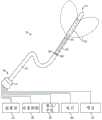
figure 1 is a schematic view of an apparatus suitable for use in intraurethral debulking of prostate tissue in accordance with the principles of the present invention.
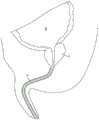
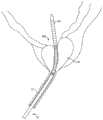
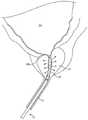
Figures 2A-2D illustrate the use of the apparatus of figure 1 in performing a prostate tissue debulking procedure.
Figure 3 illustrates a particular prostate tissue treatment device that includes prostate tissue debulking using a radio frequency saline plasma.
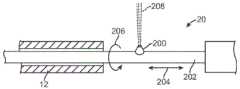
FIG. 4 illustrates an energy source suitable for use in the apparatus of the present invention, wherein the energy source delivers a fluid flow for tissue ablation.
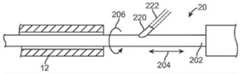
Fig. 5 illustrates an energy source suitable for use in the apparatus of the present invention, wherein the energy source comprises a deflecting optical waveguide for delivering laser energy to prostate tissue.
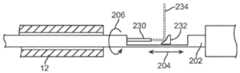
Fig. 6 illustrates a device similar to that shown in fig. 5, except that the optical waveguide directs the laser energy at an optical mirror that laterally deflects the laser energy.
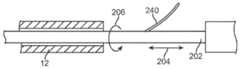
Fig. 7 illustrates an energy source suitable for use in the apparatus of the present invention, wherein the energy source comprises a laterally projecting electrode that can engage the urethral wall and prostate tissue in order to deliver radiofrequency energy for tissue ablation.
FIG. 8 is a graph of tissue ablation rate exhibiting critical pressure.
Fig. 9a is a flow chart of selective and controlled ablation.
Figure 9b is a flow chart of a selective ablation in which the fluid flow is configured to penetrate the urethral wall prior to ablation of prostate tissue.
Fig. 10a illustrates columnar fluid flow and divergent fluid flow.
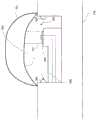
Figure 10b illustrates a cross-sectional view of a tissue modification device configured to emit a columnar flow of fluid.
Figure 10c illustrates a cross-sectional view of a tissue modification device configured to emit a divergent fluid stream.
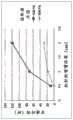
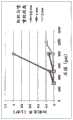
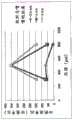
FIG. 11 is a graph of penetration time using divergent fluid flow as a function of distance between tissue and a fluid transport element.
FIG. 12 is a graph of critical pressure using divergent fluid flow as shown by the ablation rate variation as a function of pressure and distance between the tissue and the fluid delivery element.
FIG. 13 is a graph of glandular tissue ablation rate as a function of pressure and distance between the tissue and the fluid delivery element.
FIG. 14 is a graph of the ratio of ablation rates of glandular tissue and cystic tissue.
FIG. 15 illustrates a tissue modification device that performs tissue ablation using a fluid flow, where the fluid flow may optionally act as a conduit for electromagnetic energy.
Figure 16 illustrates a tissue modification device placed in the urethra where tissue contact with the device results in inefficient device operation.
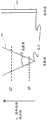
Figure 17 illustrates the tissue modification device placed in the urethra as seen in figure 16, wherein the device dilates the surrounding tissue and forms a working space.
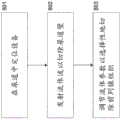
Fig. 18 is a flowchart illustrating the operation of the tissue modification apparatus.
Detailed Description
While the detailed description contains many specifics, these should not be construed as limitations on the scope of the invention, but merely as illustrations of various examples and aspects of the invention. It should be understood that the scope of the present invention includes other embodiments not discussed in detail above. Various other changes, modifications and variations which will be apparent to those skilled in the art may be made in the arrangement, operation and details of the method and apparatus of the present invention disclosed herein without departing from the spirit and scope of the invention described herein.
Referring to fig. 1, an exemplary prostatetissue debulking apparatus 10 constructed in accordance with the principles of the present invention includes a catheter assembly generally comprising ashaft 12 having adistal end 14 and a proximal end 16. Theshaft 12 will typically be a polymeric extrusion comprising one, two, three, four or more axial lumens extending from a hub (hub)18 at the proximal end 16 to a location near thedistal end 14. Theshaft 12 will typically have a length ranging from 15cm to 25cm and a diameter ranging from 1mm to 10mm, typically from 2mm to 6 mm. The shaft will have sufficient column strength so that it can be introduced up through the male urethra as described in more detail below.
The shaft will include an energy source disposed in theenergy delivery region 20, wherein the energy source can be any of a number of specific components as discussed in more detail below. Theinflatable anchor balloon 24 distal to the energy delivery region will be positioned at or very near thedistal end 14 of the shaft. The balloon will be connected through one of the axial lumens to aballoon inflation source 26 connected through thehub 18. In addition to theenergy source 22 andballoon inflation source 26, the hub will optionally include a source for irrigation/irrigation 28,suction 30 and/or insufflation (pressurized CO)2Or other gas)source 32. In an exemplary embodiment, the irrigation orirrigation source 28 may be connected through an axial lumen (not shown) to one ormore delivery ports 34, theports 34 being located proximal to theballoon anchor 24 and distal to theenergy delivery area 20. Theaspiration source 30 may be connected to a second port or opening 36 generally located proximal to theenergy delivery region 20, while the insufflatingsource 32 may be connected to anadditional port 38 also generally located proximal to the energy delivery region. It should be understood that the location of theports shaft 12.
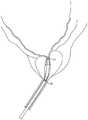
Although the present embodiment is described with reference to a human prostate, it should be understood that it can be used generally for treating a mammalian prostate. Referring now to fig. 2A-2D, the prostatictissue debulking device 10 is introduced through the male urethra U to a region within the prostate P located proximate to the distal end of the bladder B. The anatomy is shown in fig. 2A. Once thecatheter 10 has been positioned such that the anchoringballoon 24 is located immediately at the distal end of the bladder neck BN (fig. 2B), the balloon may be inflated, preferably occupying substantially the entire interior of the bladder, as shown in fig. 2C. Once the anchoringballoon 24 is inflated, the position of the prostatictissue debulking device 10 will be fixed and stabilized within the urethra U in order to position theenergy delivery region 20 within the prostate P. It should be appreciated that proper positioning of theenergy delivery region 20 is solely dependent upon inflation of the anchoringballoon 24 within the bladder. Since the prostate is located immediately proximal to the bladder neck BN, the delivery zone can be correctly positioned by placing the distal end of the energy delivery zone very close to the proximal end of the balloon, typically in the range from 0mm to 5mm, preferably from 1mm to 3 mm. After the anchoringballoon 24 has been inflated, energy may be delivered into the prostate for debulking, as indicated by the arrows in fig. 2. As shown in fig. 2D, once the energy has been delivered over the desired surface area for a period of time, the energy region may be stopped and the prostate will be debulked to relieve the pressure on the urethra. At this point, as shown in fig. 2D, flushing fluid may be delivered throughport 34 and drawn intoport 36. Optionally, after treatment, the area may be cauterized using a cauterization balloon and/or stent that may be placed using a modified or separate catheter apparatus.
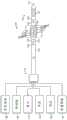
Referring now to fig. 3-7, a number of representative energy delivery zones will be described. Referring now to fig. 3, a first exemplary prostatectomy device 110 constructed in accordance with the principles of the present invention includes ashaft 112, theshaft 112 having aproximal end 114 and adistal end 116. A plurality ofnozzles 118 are mounted on the shaft 112 a short distance of 1cm to 5cm from thedistal end 116. The nozzle, which is typically a ceramic core capable of generating a plasma or a port capable of directing a radially outward flow of electrically conductive fluid, may be mounted to thestructure 120, which allows thenozzle 118 to move radially outward, as shown in phantom in fig. 3. Ananchor 122, illustrated as an inflatable balloon, is mounted on thedistal end 116 of theshaft 112 at a location between thenozzle 118 and thedistal tip 124. As described in more detail below, theexpandable structure 122 will be able to expand within the bladder to anchor theshaft 112, thereby leaving thenozzle array 118 within the prostate. Theshaft 112 will include lumens, passageways, conductive wires, etc. for delivering energy and substances from theproximal end 114 to thedistal end 116 of the shaft. For example, theRF energy source 126 would be connected to theshaft 112, typically to thenozzle 118, to deliver RF energy to the conductive fluid delivered to thenozzle 118 from the source 128 (typically via a lumen within the shaft 112). Additional lumens, channels or conduits will be provided to allow thevacuum source 130, which is typically connected to one ormore aspiration ports 132, to create aspiration. Other conduits may be provided within theshaft 112 to allow introduction of an irrigation fluid, such as saline, from thesource 134 to theport 136. In other instances, it will be possible to connect theaspiration source 130 and theirrigation source 134 to a common port so that aspiration and irrigation can occur sequentially rather than simultaneously. Further, optionally, an inner lumen, tubing, or the like may be provided to connect theinsufflating source 140 to one ormore insufflating ports 142 on the shaft in the region of thearray 118. Finally, an inner lumen, conduit, or the like may be provided for connecting theballoon 122 to the balloon inflation source 144.
As shown in fig. 4, ahigh pressure nozzle 200 carried on adelivery tube 380 disposed within theshaft 12 may form an exampleenergy delivery area 20. Thecarrier tube 380 may be axially translated as indicated byarrow 204 and/or rotated as indicated byarrow 206 so that thefluid stream 208 emanating from thenozzle 200 may sweep or sweep over all or selected portions of the intra-prostatic urethra. Specific pressures and other details of such high pressure water treatment are described, for example, in Jian and Jiajun, above.
Referring now to fig. 5, the energy source within theenergy delivery region 20 may include a fiber optic waveguide or bundle 220 carried on a rotating and translatingshaft 380. Theoptical waveguide 220 transmits laser or other coherent optical energy in abeam 222, whichbeam 222 can be swept or swept across the urethral wall and prostate tissue by rotating and/or translating thecarrier tube 380.
As shown in fig. 6, laser energy from an optical waveguide orfiber bundle 230 can be directed axially to anoptical mirror 232, where both the waveguide and the optical mirror are carried on a rotating and axially translatingcarrier 380. Again, by rotating and/or translating thecarrier tube 380, the emittedlight beam 234 can sweep or sweep over the urethral wall.
Referring now to FIG. 7, in another embodiment, a rotating and axially translatingtube 380 can carry anelectrode 240, theelectrode 240 projecting laterally from the tube. Theelectrode 240 will be adapted to connect to a source of radiofrequency energy such that when the electrode contacts the urethral wall and prostate tissue, radiofrequency energy can be delivered in either a monopolar mode or a bipolar mode. Thus, the radiofrequency energy can ablate tissue at selected volumes and regions of the prostate. Optionally, theelectrode 240 may also be used to cauterize tissue after it has been treated by altering the properties of the radio frequency energy.
In one embodiment of the invention, the apparatus is configured for selectively resecting tissue, thereby causing clearance of some tissue components while leaving other tissue components intact. For example, the prostate and surrounding areas contain a variety of tissue components including glandular prostate tissue, blood vessels within the prostate, muscle fibers interstitium, cystic tissue, sphincters, seminal vesicles, and the like. When treating BPH or other prostate conditions, it is desirable to clear the glandular prostate tissue and keep other tissues, such as blood vessels and cystic tissue, substantially undamaged.
As referred to herein, the term "ablation" is intended to include any ablation of tissue-including the removal of one or more clumps of tissue cells, the partial removal of tissue cells, and the like.
One advantage of treating BPH by selective tissue ablation is that there is a reduced need (or no need) for cauterization, since there is little or no damage to the blood vessels within the prostate, and thus limited bleeding. Another advantage resides in reducing the likelihood of incontinence or impotence, as selective ablation reduces the risk of puncturing or otherwise damaging surrounding tissue such as the prostatic capsule, sphincter, seminal vesicle, and the like.
When using a fluid stream to resect tissue, selective tissue resection may be achieved by varying one or more parameters of the fluid stream, such as the pressure within a nozzle or other fluid delivery element or the flow rate of the fluid in the fluid stream, such that it resects some tissue components while leaving other tissue components substantially intact.
In one embodiment, the fluid flow parameters may be set to keep non-target tissues substantially undamaged even when these tissues are exposed to the fluid flow for an extended period of time (i.e., typically a period of time sufficient to achieve the desired ablation). In another embodiment, the fluid flow parameters may be set to ablate target tissue at a much higher rate than non-target tissue, thereby limiting damage to non-target tissue. Such parameters may be adjusted depending on the target tissue to be selectively ablated.
In one embodiment, the ablation rate is set higher for glandular tissue than for non-glandular tissue. The ablation rate may be set by changing the pressure of the fluid, or by adjusting other fluid parameters as described above. In particular, the ablation rate for glandular tissue can be set significantly higher than for non-glandular tissue, effectively keeping the non-glandular tissue from being damaged during treatment. For example, the ablation rate of glandular tissue may be set up to at least twice the ablation rate for non-glandular tissue. As another example, the ablation rate for glandular tissue may be set to be at least 10 times as high as the ablation rate for non-glandular tissue.
It should be noted that tissue ablation has a critical pressure (below which tissue is not ablated; above which tissue is ablated) because the removal process involves tearing of the tissue, wherein the tissue is stretched on a microscopic scale to the point of rupturing or tearing the tissue stroma. Since the tissue is elastic, there will be a critical breaking point. Different types of tissue will have different critical breakpoints and therefore different critical pressures associated therewith.
In fact, each tissue type typically has a critical pressure (hereinafter also referred to as P) of the fluid flow source given a particular fluid delivery element size (such as nozzle diameter)crit) Below which the ablation rate approaches zeroAbove this pressure, the ablation rate generally increases monotonically and possibly exponentially. In particular, due to differences in tissue composition, the pressure of the fluid flow source may be set to selectively ablate a particular type of tissue, while keeping other tissue types having higher critical pressures substantially undamaged.
An important aspect of resecting tissue in a multiple tissue environment according to the present embodiments is that it is possible to operate with a scheme in which one tissue type is resected while another tissue type remains substantially intact. This occurs most strongly when operating at pressures between the critical pressures of the two tissue types. As seen in fig. 8, the operating pressure Po of the fluid flow may be set to be greater than the critical pressure of tissue 1 (Po > Pcrit1) so thattissue 1 experiences an ablation rate greater than zero, while maintaining the pressure Po less than the critical pressure of tissue 2 (Po < Pcrit2) so thattissue 2 experiences an ablation rate substantially close to zero. In such an arrangement, the fluid flow is said to be arranged to selectively ablatetissue 1 rather than ablatingtissue 2.
In one embodiment configured for treatment of BPH, the fluid flow source pressure is set above the critical pressure for glandular prostate tissue but below the critical pressure for non-glandular prostate tissue. In such embodiments, the pressure is high enough to ablate the glandular tissue, but too low to substantially ablate or damage non-glandular tissue such as blood vessels within the prostate, the muscle fiber stroma, the capsule tissue, and the like. In one embodiment, the fluid is pressurized to a pressure in the range of about 1-30000 pounds per square inch (psi), more preferably to a pressure in the range of about 50-1500psi, and most preferably to a pressure in the range of about 100-1000psi, prior to exiting the fluid transport element.
The following examples illustrate some of the critical pressures of tissue for fluid flow ablation. It should be noted that the following settings are provided as examples and should not be construed as limiting.
Example 1: exemplary critical pressures for different kidney tissue constituents.Tissue critical pressure was measured in pig kidney. The kidney tissue is selected becauseIts composition is similar to that of prostate tissue. A columnar flow of fluid having a diameter of about 200 microns is used for tissue ablation. The glandular tissue (pink peripheral part of the kidney) is very soft and easily torn by the pressure of the fingers, while the inside of the kidney contains the tougher vascular tissue. The critical pressure of this fluid flow was found to be about 80psi for glandular tissue and about 500psi for vascular tissue, as seen in table 1 below.
| Tissue of | Pcrit(psi) |
| 80 | |
| Blood vessel | 500 |
Table 1: different critical pressures of glandular tissues and vascular tissues in pig kidney
For example, experiments have shown that when pig kidneys are resected using a nozzle of about 200 microns in diameter at a source pressure of about 500psi, at 10cm2The ablation rate over the area is about 1cm per 30 seconds for glandular tissue (i.e., 10cc cleared per 30 seconds) and about 0.1cm per 180 seconds for vascular tissue, which is about a 6-fold difference in ablation rate. Thus, in the same ablation time period, more glandular tissue will be ablated than vascular tissue. Thereby, the resection period may be set to allow resection of the glandular tissue without significantly damaging the vascular tissue. The rate of ablation may be adjusted by varying the fluid source pressure and/or nozzle size. For example, the ablation rate for glandular tissue may be adjusted to be about every minute1cc, 5cc per minute, 10cc per minute, 30cc per minute, or other rate. As discussed above, it should be understood herein that varying the size of the nozzle may necessitate varying the fluid source pressure in order to cause the fluid stream to impinge upon the tissue with sufficient force to achieve a desired ablation rate.
Figure 9a is a flow diagram of a method for selective prostate resection, according to one embodiment. Atstep 700, the device is positioned and anchored in the urethra as described above. Atstep 701, various fluid parameters, such as pressure of a fluid source, shape of a fluid flow, etc., are set to ablate a particular tissue type, such as glandular prostate tissue. By setting the fluid parameters, the fluid force, ablation rate, treatment time, tissue area to be ablated, etc. can be controlled to achieve controlled and selective ablation. After the parameters are set, atstep 702, the device is set to discharge the fluid flow to ablate the target tissue. Atstep 703, if it is determined that the treatment has been completed, the device is withdrawn from the urethra U atstep 704.
However, if it is determined atstep 703 that the treatment has not been completed, the fluid parameters may be reset as needed, as described instep 701, and the loop of steps repeated until the treatment is completed. In particular, the resetting of the fluid parameters is advantageous in embodiments where it is desired to resect two different types of tissue for a complete treatment. In such embodiments, the fluid parameters may be adjusted to account for variations in the type of target tissue to be ablated.
Typically, other tissue types, such as vascular tissue or cystic tissue, will be exposed to the fluid flow after some or all of the glandular tissue has been excised. While the fluid flow parameters are set for selective ablation of glandular tissue, it is also contemplated that the fluid parameters may be dynamically adjusted during the ablation procedure to account for gradual exposure of non-glandular tissue and fine-tune ablation selectivity as needed. After the fluid parameters have been so reset atstep 701, the reset fluid flow is then emitted atstep 702 to continue the tissue resection and the procedure continues until the treatment is complete.
In particular, it should be noted that when treating the prostate from within the urethra, the urethral wall is interposed between the source of the fluid stream (such as a nozzle or other fluid delivery element) and the target glandular prostate tissue to be ablated. Thus, in one embodiment, the fluid flow parameters are initially set for ablating and penetrating a portion of urethral tissue (e.g., the urethral wall). However, since the composition of glandular prostate tissue is weaker than the composition of urethral tissue, it is desirable to avoid ablating glandular tissue using the same fluid flow forces used to ablate the urethral wall. To do this, the fluid flow may be used for a period of time sufficient to cut and penetrate the urethral wall, rather than for a longer period of time. Thereafter, the reduced intensity fluid stream can be used to ablate glandular prostate tissue.
Figure 9b is a flow diagram of a method for selective prostate ablation, wherein fluid flow is configured to first penetrate and ablate a urethral wall, according to one embodiment. Atstep 801, the device is positioned and anchored in the urethra as described above. Atstep 802, the apparatus is set up to discharge a sufficiently forceful flow of fluid to ablate and penetrate the urethral wall. Atstep 803, after the fluid flow has penetrated the urethral wall, the fluid flow is regulated to a level that selectively resects the desired prostate tissue while leaving the blood vessels, sacs, and other non-glandular tissue within the prostate substantially intact.
In addition, it is contemplated that the shape of the fluid stream also affects selective ablation. While the fluid flow is illustratively shown in fig. 10a as acolumnar fluid flow 333 or adivergent fluid flow 334, it is also contemplated that the fluid flow may be any shape or arrangement that allows for ablation according to the present embodiments. In particular, as will be described further below, there are a number of advantages for both columnar and divergent fluid flow arrangements.
In the columnarfluid flow configuration 333, the device emits the fluid flow as a substantially focused rod-like fluid column with a substantially zero divergence angle. In one embodiment, the columnar fluid flow is configured as a generally straight or non-divergent fluid flow. In such a configuration, the device substantially emits the fluid flow into a cylindrical or other non-diverging shape, thereby delivering energy to the tissue in an area or spot size that is largely independent of the distance between the fluid transport element and the tissue. Alternatively, the fluid streams may be adjusted to converge, for example, when the fluid delivery element comprises a plurality of nozzles or when the fluid contains bubbles, so as to concentrate the energy delivered to the tissue.
Figure 10b shows a cross-sectional view of a device emitting a columnar flow of fluid to remodel tissue such as the prostate. Anelongate element 310 of the device, such as a shaft as described above, is placed within the urethra U.Fluid delivery element 320, placed on a carrier tube (not shown) withinelongate member 310, is configured to emitcolumnar fluid flow 333. As understood herein, thefluid transport element 320 may include a nozzle as described above, or any other element configured to emit a fluid.Columnar fluid flow 333 is configured to cut tissue within the resection area RA, such as the urethral wall UW and prostate tissue P.
One characteristic of the columnar fluid flow arrangement is: since the width of the cut-out region RA is substantially independent of the distance from thefluid transport element 320, the cut-out region RA remains substantially constant over a distance from thefluid transport element 320. This is advantageous because the ablation region RA remains concentrated and constant as thefluid flow 333 exits thefluid transport element 320, thereby delivering energy to the tissue in a concentrated area. When ablating or penetrating tough tissue, such as the urethral wall UW, it is particularly advantageous for the energy to be concentrated in the region of the ablation RA. In one embodiment, the columnar shape of the fluid flow may be altered by introducing pressure fluctuations in the fluid delivery. For example, the columnar shape of the fluid flow may be altered by mechanically and controllably introducing a substantially solid object in the fluid delivery path, such as in the path after the aperture of thefluid delivery element 320 or after the fluid flow exits the aperture of thefluid delivery element 320. In another example, the columnar shape of the fluid flow may be altered by introducing a vibrating element, such as a piezoelectric element, in the fluid path to create pressure fluctuations.
In another embodiment, the fluid flow is configured to diverge as seen in FIG.10aFluid flow 334. Thedivergent fluid flow 334 is such that: wherein the fluid exits a fluid flow source, such asfluid transport element 320, and diverges in a substantially conical shape, wherein the tip of the cone is at the fluid flow source. The ablation rate of thedivergent fluid flow 334 may be expressed as a function of the distance z from thefluid transport element 320 emitting the fluid to the tissue to be ablated. As shown in FIG. 10a, z2Ratio z1Further away from the aperture and, therefore, at z1At an ablation rate higher than at z2The ablation rate of (c).
Thedivergent fluid flow 334 may be characterized by the divergence angle of the fluid flow. In one embodiment, the divergence angle is configured to be about 0-90 degrees, preferably about 2-45 degrees, more preferably about 4-20 degrees, and most preferably about 7 degrees, while also allowing for the divergence angle to be varied as desired.
Additionally, the divergingfluid flow 334 may be characterized by the cross-sectional shape of the fluid flow. In general, the farther away from the fluid flow source (e.g., fluid transport element 320), the larger the cross-sectional area or spot area of the divergingfluid flow 334, thereby proportionally reducing the force per unit area of the fluid flow. This increase in spot area generally results in a greater ablation rate of tissue proximate the source of the fluid flow.
In one embodiment, the cross-sectional shape of the divergingfluid stream 334 is configured to be substantially a narrow rectangle (to create a fan-shaped fluid stream). In another embodiment, the cross-sectional shape of the divergingfluid flow 334 is configured to be substantially circular (to create a conical fluid flow) with the smallest cross-sectional area at the source of the fluid flow. It should be noted that the cross-sectional shape of the divergingfluid stream 334 may be configured in any shape that encloses a non-zero area (e.g., an oval or irregular shape).
Figure 10c shows a cross-sectional view of a device emitting divergent fluid streams to remodel tissue such as the prostate. Theelongate element 310 of the device is placed within the urethra U. Afluid transport element 320 disposed on a carrier tube (not shown) withinelongate member 310 is configured to emit adivergent fluid flow 334. Thedivergent fluid flow 334 is configured to ablate tissue such as the urethral wall UW and prostate tissue P within the ablation region RA. The area of ablation RA covered by thedivergent fluid flow 334 increases as the fluid flow moves away from thefluid transport element 320, thereby proportionally decreasing the fluid flow intensity per unit area.
Thedivergent fluid flow 334 is characterized by an increase in ablation width as a function of distance from thefluid transport element 320, while the ablation rate per unit area decreases as a function of distance from thefluid transport element 320. This is because the total energy delivered in the fluid flow is generally constant (without taking into account any reduction in fluid velocity), but the energy is delivered over a larger area. Thus, the delivered energy per unit area is reduced, which is a key parameter on which the ablation rate depends. Thus, the ablation rate per unit area decreases as a function of distance.
Further, in thedivergent fluid flow 334, the volumetric rate of ablation may be substantially constant as a function of distance. That is, although the ablation rate per unit area decreases, the total area ablated increases proportionately, and thus the total ablation volume remains substantially constant. It should be noted that if the ablation area rate as a function of area energy density is non-linear and increases monotonically with energy, the volumetric rate of ablation will decrease as a function of distance from thefluid transport element 320. It should also be noted that any deceleration of the fluid stream particles (e.g., droplets) will also cause the volumetric ablation rate to decrease as a function of distance.
The following example illustrates tissue ablation using divergent fluid flow. It should be noted that the following arrangements are provided as examples and should not be construed as limiting.
Example 2: prostate penetration using divergent fluid flow.The measured data relating to the resection of canine prostate capsule tissue is shown in figure 11. The penetration time through the balloon is measured as a function of the distance between the tissue and the fluid transport element. The divergence angle of the fluid flow is about 7 degrees. The penetration time is plotted as the time to penetrate the capsule, wherein the capsule has a thickness of less than 1 mm.
Fig. 11 shows that the penetration time increases with increasing distance between the tissue and the fluid transport element. It should be noted that this effect is stronger at lower fluid source pressures. It should also be noted that the penetration time of the columnar fluid flow is generally independent of the distance between the tissue and the fluid delivery unit.
Example 3: critical pressure using divergent fluid flow and prostate tissue ablation.The change in critical pressure as a function of different distances in divergent fluid flow ablation, measured on canine prostate capsule tissue, is shown in figure 12. The ablation rate is measured as the inverse of the time it takes to ablate (i.e., penetrate) the entire thickness of the capsule. The ablation rate is measured as a function of the fluid source pressure and the distance between the tissue and the fluid delivery element. The ablation rate increases at greater distances and higher pressures from the fluid transport element. This increase in ablation rate is indicative of the critical pressure. The increase in critical pressure as a function of distance shows that ablation effectiveness decreases with increasing distance in a divergent fluid stream.
Figure 13 illustrates the ablation rate of divergent fluid flow on canine gland tissue as a function of source pressure and distance between the tissue and the fluid delivery element. Above the critical pressure (about 300psi), the target tissue is more sensitive to pressure changes as it is closer to the fluid delivery element. This helps to selectively ablate glandular tissue while preserving cystic tissue, since higher pressures can be used to ablate glandular tissue near the fluid delivery element while preserving cystic tissue at a greater distance from the fluid delivery element.
The relative rates of ablation of the two different tissues are shown in figure 14 as the ratio of the glandular tissue ablation rate to the cystic tissue ablation rate. As seen in fig. 14, there is a significant maximum ratio at intermediate pressures (approximately 500 psi). This indicates operation between two critical pressures as described above, and shows that selective tissue ablation can be achieved by setting the appropriate pressure range.
Example 4: the critical distance for ablation using divergent fluid flow.As shown in the table below, for a given pressure, there is also a critical ablation distance when performing divergent fluid flow ablation. As seen in Table 2, when the fluid flow is large from the tissueAbove about 10mm, no penetration of the canine bladder by the divergent fluid stream occurs, further illustrating the advantage of using the divergent fluid stream for selective ablation purposes.


Table 2: canine cystectomy with divergent fluid flow
One advantageous aspect of the present invention is that it allows for the ablation of tissue, such as prostate tissue, without the need to ablate, weaken, mechanically alter or otherwise treat the tissue prior to ablation. While treatments such as tissue ablation may be performed to weaken the target tissue, primarily by separating it from the tissue matrix of the body region, and thereby allow the pretreated tissue to be easily removed using a lower intensity fluid stream, such treatments require a two-step process (weakening of the tissue followed by separation of the weakened tissue from the tissue matrix) and may result in undesirable adverse side effects such as increased inflammation. Thus, one advantageous aspect is that the present invention allows for the use of fluid flow to perform ablation of a target tissue without the need for prior ablation, modification or treatment of the tissue.
As described above, fluid injection into the urethral canal can be used to create a working space before or during the directing of energy to the prostate tissue. Fig. 15 illustrates an exemplary tissue modification device configured for injection and resection of tissue. One challenge inherent in tissue modification within closed tissue systems is the lack of sufficient working space between the tissue modification device and the surrounding tissue of the body region. The presence of such a workspace is advantageous because it will help to improve energy transmission efficiency, achieve effective clearance of debris products, and better visualization of tissue regions, among other advantages. Apparatus and methods for tissue modification by forming and utilizing a workspace, and the advantages of such apparatus and methods, are described in greater detail below. While the following embodiments are exemplarily described in the context of prostate treatment, it is also contemplated that the present invention may be used to remodel any tissue within the following closed tissue system: in this tissue system, one tissue or anatomical structure substantially invades or squeezes another tissue or anatomical structure, and wherein it is advantageous to form a working space prior to tissue reconstruction.
Referring now to fig. 15, the device comprises anelongate element 310, such as a shaft, arranged to be inserted into a body region. Theelongate member 310 includes a window that exposes thecarrier tube 380 and other components described below. The window reveals acarrier tube 380 and a high pressurefluid transport element 320 disposed on thecarrier tube 380. Thefluid delivery element 320 is connected to a fluid source (not shown) via afluid lumen 390, thefluid lumen 390 delivering fluid from the source to thefluid delivery element 320.
Optionally, theelongated element 310 may be covered by a sheath or other covering (not shown) as theelongated element 310 is introduced through the urethra. When fully covered with the sheath, the window is protected, thereby reducing scratching and damage to the urethra as theelongate element 310 is advanced. Once in position, the sheath is retracted, exposing the window. Thecarrier tube 380 may then be rotated and advanced and/or retracted to deliver fluid through thefluid delivery element 320.
Additionally or alternatively, the device may include a shield element (not shown) positioned to substantially cover thefluid transport element 320 while maintaining a space between thefluid transport element 320 and the shield element. This in turn effectively maintains the space between thefluid transport element 320 and any tissue that may impact the shield element. In one embodiment, the masking element is a substantially flat sheet-like element that is placed over thefluid transport element 320. The shield member is positioned or shaped such that it allows thecarrier tube 380 to move within theelongated member 310 as desired. For example, the shield element may be curved to follow the curvature of thecarrier tube 380. The shield member includes openings through which the fluid stream emitted by thefluid transport member 320 passes unobstructed and impinges upon tissue. The opening may be circular, or it may comprise other shapes. One advantage of such a shield member is that it protects thefluid delivery member 320 from damage during insertion or removal procedures and/or during treatment. Another advantage of the shield member is that during or after fluid firing, fluid returning to thefluid transport member 320 can pass through the shield member opening (or through other paths around the shield member) and into the space between the shield member and thefluid transport member 320. Such return fluid may then be directed out of the space such that fluid emission is not obstructed or impeded by such return fluid.
The shield element may also be configured such that the space between the shield element and thefluid transport element 320 is in continuous communication with the waste disposal chamber via a low flow resistance fluid path. This creates a low flow resistance path between thefluid transport element 320 and the external destination of such waste, so that waste and fluid exiting thefluid transport element 320 can easily exit the area around thefluid transport element 320. In this case, a low resistance should be understood as a low flow resistance compared to the flow resistance of thefluid transport element 320. This configuration advantageously prevents back pressure from being created at thefluid transport element 320 that would otherwise reduce flow and thereby allow the fluid flow emitted by thefluid transport element 320 to be substantially undisturbed by waste and return fluid.
Thefluid transport element 320 may be a single nozzle, multiple nozzles, or an array of nozzles in various configurations.Fluid transport element 320 is configured to emit fluid radially outward asfluid stream 331 with sufficient force to ablate tissue whenfluid stream 331 contacts tissue. Thefluid flow 331 may be perpendicular to theelongated element 310, or it may be disposed at various angles relative to theelongated element 310.
Thecarrier tube 380 may be axially translated, rotated, oscillated, or rotationally oscillated relative to theelongate member 310 such that thefluid flow 331 may sweep or sweep a desired tissue area or volume for ablation. The desired area or volume may be a sphere, a cylinder, or any other predetermined area or volume of any shape and size.
Additionally and optionally, when the device is not being used to resect tissue, thecarrier tube 380 can be positioned such that thefluid delivery element 320 and/or any other elements (such as a visualization element or a cauterization element) are distal to the window, thereby reducing the risk of damage to such elements, as well as reducing the risk of any accidental resection of tissue.
The device further includes at least oneinsufflating port 340 disposed on theelongate member 310. The insufflatingport 340 is connected to an insufflating source (not shown) via one or more lumens, wherein the insufflating source delivers the fluid 330 through the insufflatingport 340 into the body region in order to distend the surrounding tissue and form a working space. The apparatus also includes at least onepurge port 360 for purging debris products, such as ablation products, ablation fluid, other waste products, or mixtures thereof. Theelongate member 310 may include a lumen, passageway, conductive wire, etc., configured to deliver energy from the proximal end to the distal end of theelongate member 310 and/or for removing debris and waste products, the details of which are described above.
Optionally, in addition tofluid delivery element 320, the apparatus may include an electromagneticenergy delivery port 350,port 350 being disposed oncarrier tube 380 and located in or nearfluid delivery element 320. As also described in more detail above,electromagnetic energy 332 is delivered toenergy delivery port 350 by means of one ormore conduits 351, such as acarrier tube 380 and an optical fiber or other waveguide withinelongate member 310. Theelectromagnetic energy 332 may be radio frequency energy, coherent or incoherent light, or any other form of electromagnetic energy.Energy delivery port 350 is configured to deliverenergy 332 through the interior offluid stream 331 so thatelectromagnetic energy 332 may ablate tissue in lieu of or in combination with fluid ablation.
Additionally and optionally, the various electromagnetic energy modalities described above may be configured to cauterize tissue in conjunction with or independent of tissue ablation. Because the selective tissue removal disclosed herein generally results in little or no damage to the remaining tissue, such as vascular tissue, and thus limited or no bleeding, such cauterization need only be used on a limited basis if desired. When electromagnetic energy is delivered to the tissue for cauterization byfluid flow 331, the fluid source pressure may be adjusted to be substantially below the critical pressure for tissue resection so that additional tissue is not resected. Alternatively or additionally, cauterization may be accomplished using other means, for example, using a cauterizing balloon and/or stent placed in contact with the tissue using a catheter device as described above.
Further, the device may include an optional deflecting element, for example, disposed within the window or within theelongate member 310 and distal from the window, the deflecting element being configured to deflect fluid emitted by thefluid transport element 320 back toward thefluid transport element 320, thereby clearing any debris that may accumulate on thefluid transport element 320 and/or theenergy delivery port 350 during tissue ablation. Further, thefluid delivery element 320, in combination with the deflection element, may be configured to clean substantially the entirefluid delivery element 320, any visualization or cauterization elements, and/or thecarrier tube 380, or a portion thereof. The deflecting element may be arranged to be substantially flat or concave. Alternatively, the deflecting element may be provided in any shape or design.
In addition, the deflecting element may be arranged to function as a protective element for the fluid transport element. The fluid transport element can be placed in a specific position relative to a protective element that protects the prostate from accidental fluid emission and, for example, protects thefluid transport element 320 from clogging or blockage by tissue, particularly when inserted and removed from the body.
Referring now to FIG. 16, a tissue modification device inserted into a body region is shown. The body region is exemplarily illustrated as the prostate-urethra region PU. The device may be occluded by surrounding tissue T due to abnormalities such as BPH or other tissue characteristics, which complicates treatment. As shown in fig. 16, after theelongate member 310 has been introduced into the urethra, the surrounding tissue T may occlude thefluid delivery element 320 and prevent thecarrier tube 380 from normally axially translating, rotating, swinging, or rotationally swinging relative to theelongate member 310. As seen in fig. 17, to address this drawback, the apparatus is arranged to dilate the surrounding tissue T, thereby forming a working space WS in which the apparatus can resect the tissue T using a fluid stream 311.
The expansion of the surrounding tissue T may be achieved in a variety of ways. In one embodiment, the device is configured to dilate the surrounding tissue T by delivering afirst fluid 330 through aninsufflating port 340. The fluid 330 contacts and expands the surrounding tissue T, thereby forming a working space WS around thecarrier tube 380 and thefluid transport element 320.
In another embodiment, the device is arranged to dilate the surrounding tissue T by mechanical means. In one such embodiment, one or more stents or mechanical structures may be disposed onelongate member 310 and expanded within a body region. Expansion may be achieved by using one or more inflation balloons, or by configuring the stent to exhibit a memory effect of the expanded shape after release from the constrained space (such as a nitinol stent). Alternatively, the stent may be expanded by other means, as will be appreciated by those skilled in the art. In yet another embodiment, one or more inflation balloons disposed onelongate element 310 are used to dilate the surrounding tissue T. The balloon may be inflated by a fluid, such as a gas or liquid.
It is contemplated that forming the working space WS in the body region may include expanding the surrounding tissue T, stretching the surrounding tissue T, repositioning the surrounding tissue T, deploying the surrounding tissue T, and/or any other manner of forming the working space WS in the body region.
Once the working space WS is formed, thecarrier tube 380 can be axially translated, rotated, swung, or rotationally swung relative to theelongate member 310 and unobstructed within the working space WS without thefluid transport element 320 becoming clogged with surrounding tissue T. At this point, the device may deliver thesecond fluid 331 as a fluid stream effective to initiate treatment to ablate the surrounding tissue T.
As will be described in more detail below,fluids first fluid 330 used to expand the tissue and form the working space WS is a gas, such as pressurized CO2、CO、N2He, Ar, other biocompatible gases, or combinations thereof. Thesecond fluid 331 for resecting tissue is a liquid, such as water, saline, other biocompatible liquids, or combinations thereof.
Additionally and optionally, thesecond fluid 331 may include one or more soluble substances, such as sodium chloride or barium sulfate. One advantage of using such soluble species is that it increases the efficiency of the ablation by adding corrosive capabilities to the second fluid 301. In fact, depending on the concentration of soluble species present in the second fluid 301, increasing the efficiency of the ablation may lower the fluid pressure necessary for the ablation. Another advantage of using such soluble substances is that they can help prevent or reduce bleeding.
Alternatively and optionally, thesecond fluid 331 may also generally include grains that may increase ablation efficiency and reduce the fluid pressure necessary for ablation. In one embodiment, the grains may be calcium, magnesium, aluminum, manganese, iron, nickel, copper, zinc, strontium, barium, bismuth, chromium, vanadium, lanthanum, salts thereof, or combinations thereof. In another embodiment, the crystallites may be a cationic salt, such as formate, fumarate, acetate, propionate, butyrate, caprylate, valerate, lactate, citrate, malate, gluconate, chloride, potassium salt, phosphate, or combinations thereof. In yet another embodiment, the crystalline particles may be calcium citrate, calcium tartrate, calcium succinate, calcium fumarate, calcium adipate, calcium malate, calcium lactate, calcium gluconate, dicalcium phosphate dihydrate, calcium diphosphate, dicalcium phosphate anhydrous, calcium chloride, calcium acetate monohydrate, or combinations thereof. Furthermore, the grains may be any solid particles.
The grains may have a lifetime of at least 30 days, at least 10 days, at least 1 day, at least 1 minute, at least 10 seconds, or at least 1 second. In addition, the grains may be smaller in size than the pores of thefluid transport element 320, thereby making the particles small enough to pass through thefluid transport element 320. Additionally, the particles can be set small enough so that thefluid transport element 320 is not clogged or clogged. To achieve this, the maximum size of the particles may generally be a fraction of the minimum size of the opening or openings of the fluid transport element, wherein the fraction is preferably in the range of about 1/10 to 1/2. In one embodiment, the largest dimension of the grains is generally less than 1/2, the smallest dimension of the pores of thefluid transport element 320. In another embodiment, the largest dimension of the grains is generally less than 1/4, the smallest dimension of the pores of thefluid transport element 320. In yet another embodiment, the largest dimension of the grains is generally less than 1/10, the smallest dimension of the pores of thefluid transport element 320.
Additionally, thesecond fluid 331 may include one or more dissolved gases to improve the efficiency of the ablation. Such dissolved gases may include CO2、CO、N2He, Ar, other biocompatible gases, or combinations thereof. In one embodiment, the device is configured such that a bubble is formed after the emission of thesecond fluid 331 from thefluid transport element 320 but before the fluid 331 reaches the tissue. In another embodiment, the device is arranged such that a bubble is formed in thesecond fluid 331 when it hits the tissue. The device may be arranged to use a combination of such effects-some of the bubbles forming before the collision and others forming at the time of the collision.
Optionally, the temperature of thesecond fluid 331 may be set significantly below the tissue temperature in order to cause vasoconstriction and thereby reduce or inhibit bleeding. Additionally, the temperature of thesecond fluid 331 may be set to have an elevated temperature, e.g., a sufficient elevation to assist in resection or cauterization.
The pressure of thefirst fluid 330 configured as a gas is in the range of about 0.1-5.0psi, preferably in the range of about 0.5-2.5 psi. Optionally, a pressure sensor may be provided to monitor the pressure of thefirst fluid 330 so that the pressure may be maintained within a desired range. The source pressure of the second fluid configured as a liquid may also be in the range of about 1-2000psi, more preferably in the range of about 50-1500psi, and most preferably in the range of about 100-1000 psi.
Alternatively, the insufflatingport 340 may be disposed on theelongate member 310 in close proximity to thefluid delivery member 320. In such a configuration, some of the first fluid (e.g., gas) 330 delivered into the workspace WS through the insufflatingport 340 is carried outwardly by the fluid stream containing the second fluid (e.g., liquid) 331 so as to form an envelope around the ablation fluid stream, thereby helping to maintain the integrity of the fluid stream. The proximity of the insufflatingport 340 to thefluid transport element 320 may also protect thefluid transport element 320 from fluid and tissue buildup, thereby maintaining fluid flow integrity.
FIG. 18 is a flow chart illustrating example operations of a device. Atstep 1101, anelongate element 310 is introduced into a body region, such as the prostate-urethra region PU. Atstep 1102, theelongate member 310 is manipulated into position and engaged with an anchor member (not shown) to stabilize theelongate member 310 during the remainder of the procedure. The anchoring element may include an anchoring balloon and/or an external anchoring frame, wherein the anchoring balloon and external anchoring frame are configured to substantially prevent proximal and distal dislodgement of theelongate element 310 by stabilizing theelongate element 310 within the treatment region.
The anchoring balloon is configured to be inflated against the distal end of the bladder neck. The anchoring balloon may be inflated to occupy a sufficient portion of the bladder to prevent theelongate element 310 from moving significantly beyond the treatment area (in a direction away from the bladder) during surgery. Inflation of the anchoring balloon may be accomplished in various ways as described above. Alternatively, other expanded structures, such as nitinol semi-arch stents or the like, may be used as the anchoring element in place of the balloon.
The outer anchoring frame is configured for engaging an external surface area of the body, for example, a surface area of the base of the penis. The outer anchor frame typically includes an atraumatic ring for engaging an outer surface region of the body. In one embodiment, once theelongated element 310 has been introduced into the treatment area and the dilation anchor balloon occupies a portion of the bladder, the outer anchor frame is coaxially advanced over the penis, either automatically or manually, such that the atraumatic ring engages the external body surface area at the base of the penis. Once the outer anchoring frame engages the body outer surface area, theelongate member 310 is prevented from moving significantly (in a direction toward the bladder) beyond the treatment area. The anchoring elements, including the anchoring balloon and the outer anchoring frame, are configured to stabilize theelongate member 310 by substantially compressing theelongate member 310 within the treatment region while preventing proximal and distal ends thereof from being displaced beyond the treatment region. The device stability provided by the anchoring element also allows for precise movement of the fluid delivery element, which in turn facilitates automation of the treatment process. Advantageously, it should be noted that in such embodiments configured to use an external anchoring frame in conjunction with a balloon, the balloon need not fill substantially the entire bladder to stabilize the device, as inflating the balloon to fill a portion of the bladder may provide sufficient stabilization. The anchoring process is also described in co-pending patent application publication No. 2009/0227998.
Atstep 1103, the window covering on theelongate member 310 may be retracted after theelongate member 310 is stabilized in its position to reveal the insufflatingport 340, theclearing port 360 and thecarrier 380.
Atstep 1104, the insufflatingport 340 delivers thefirst fluid 330 into the body region and causes the surrounding tissue T to expand, thereby forming a working space WS. Atstep 1105, thefluid delivery element 320 delivers thesecond fluid 331 as a fluid stream to resect the surrounding tissue T within the working space WS.
As mentioned above, there are several advantages to having thefirst fluid 330 and thesecond fluid 331 be different media. For example, when thedistention fluid 330 is a medium with a lower viscosity than theablation fluid 331, the fluid source pressure or flow rate required to ablate tissue using thesecond fluid 331 is less than when the working space WS is filled with the same (or a higher viscosity) medium as thesecond fluid 331. This is because if thesecond fluid 331 were to travel through the working space WS filled with thefirst fluid 330 of the same or higher viscosity medium, thesecond fluid 331 would need to overcome a greater resistance in the working space WS before reaching the target tissue.
Another advantage of the dual media embodiment relates to the integrity of the fluid flow. The friction or resistance between thefirst fluid 330 in the workspace WS and the fluid stream containing thesecond fluid 331 causes a portion of thesecond fluid 331 to disperse out of the stream, causing the fluid stream to gradually lose its structural integrity. Such dispersion may be undesirable because the fluid stream subjected to significant dispersion may have reduced ablation effectiveness when it reaches the surrounding tissue T and may additionally cause damage to surrounding healthy tissue due to reduced ablation accuracy. To maintain fluid flow integrity in such a high resistance working space WS, increased pressure would have to be applied to the fluid 331 in an attempt to counteract the rate of fluid dispersion. In contrast, by forming the working space WS containing a first fluid (e.g., gas) having a lower medium viscosity than thefluid stream 331 using a first fluid (e.g., gas) having a lower medium viscosity, a lower source pressure or flow rate configuration may be used for thefluid stream 331 while maintaining sufficient fluid stream integrity and ablation effectiveness. Alternatively, the resistance between thefirst fluid 330 and thesecond fluid 331 may be set to disperse the fluid flow such that the cutting force is reduced at a desired distance away from thefluid transport element 320. Thefirst fluid 330 may be adjusted (e.g., the pressure of the gas is adjusted) to configure the distance that the dispersion affects the ablation rate in a desired manner.
Yet another advantage of the dual medium embodiment relates to the difference in refractive index of the two media. In an alternative embodiment, atstep 1105,electromagnetic energy 332 may be delivered through the interior of the fluid stream to cauterize tissue, resect tissue, or a combination thereof. In such embodiments, the ablation fluid flow acts as a conduit for electromagnetic energy transmission, and the refractive index difference between the fluid in the working space WS and the ablation fluid flow may be set to allow for more efficient energy conduction within the interior of the ablation fluid flow. It is also contemplated that when the fluid stream acts as a conduit for the transmission of electromagnetic energy, it may be configured to have a flow and force sufficient to transmit energy to the tissue but insufficient to ablate the tissue.
In particular, when the refractive index of thefirst fluid 330 is set to be smaller than the refractive index of the second fluid 331 (e.g., gas and liquid, respectively), total or near total internal reflection within the fluid flow may be achieved. In such an arrangement, more of the electromagnetic energy traveling through the fluid stream may reach the target tissue at the desired location, and less of the electromagnetic energy may be spread out into the working space WS. Thus, as a result of the increased conduction efficiency, the amount ofelectromagnetic energy 332 at the source may be reduced while maintaining cauterization and/or ablation effectiveness, thereby reducing the power consumption of the device and reducing any harmful radiation effects on the patient. The types of electromagnetic energy contemplated for use in the present invention include radio frequency energy and optical energy, such as coherent light (e.g., laser energy) or incoherent light.
Atstep 1106, the ablation debris product (along with the fluid for ablation) is purged from the working space WS through thepurge port 360. In one embodiment, debris products may be purged through thepurge port 360 by creating a positive pressure differential between thepurge port 360 and theinjection port 340 to cause the debris products to travel through thepurge port 360 and thereby be purged. In another embodiment, purging may be accomplished by attaching a vacuum source to thepurge port 360 and applying suction to the workspace WS. Alternatively, a combination of the two cleaning methods may be used.
The above-describedsteps step 1105 may be performed simultaneously with the debris product removal described instep 1106.
Optionally, the treatment may be visualized by providing a visualization element within the expanded working space WS. Such visualization elements may include an endoscopic camera or other suitable visualization elements. In one embodiment, the visualization element may be disposed on theelongate element 310 or on thecarrier tube 380. In another embodiment, the visualization element may be inserted separately into the workspace WS.
Additionally and optionally, thefirst fluid 330 may be continuously delivered into the body region during treatment to maintain the working space WS. Further, when sufficient working space WS exists in the body area before thefirst fluid 330 is delivered, thefirst fluid 330 may be delivered into the body area to maintain such working space WS.
This embodiment also contemplates that thesecond fluid 331 can be combined with a therapeutic agent to treat the surrounding tissue T. Therapeutic agents may be utilized to minimize patient discomfort and bleeding, and/or to provide topical treatment of cancer, prostatitis, or other diseases. The therapeutic agent may include soluble substances such as salts (e.g., salts described above), antibiotics, coagulants, anesthetics, vasoconstrictors, anti-inflammatory agents, chemotherapeutic agents, anti-cancer agents, other additives or drugs, or combinations thereof. In addition, the therapeutic agent may be a fixative, such as glutaraldehyde, for contracting the tissue T in order to minimize bleeding. It should be noted that glutaraldehyde may also help to increase the working space WS by causing tissue tightening and urethral lumen enlargement.
The therapeutic agent may be delivered to tissue T during, before, after, or independently of the tissue removal. When the therapeutic agent is delivered to the tissue T during ablation, asecond fluid 331 having a pressure configuration as described above may be used. When the therapeutic agent is delivered to the tissue T before and/or after or independently of the tissue resection in order to irrigate the working space WS, the pressure of thesecond fluid 331 may be adjusted to be below the critical pressure required to resect the tissue T. In such embodiments, the pressure of the second fluid source before and/or after tissue resection may be in the range of about 1-50psi, or alternatively less than about 10 psi. Alternatively and optionally, a short burst of thesecond fluid 331 above the critical pressure, which effectively injects the agent into the tissue T with minimal damage to the tissue T, may be used to deliver the therapeutic agent to the tissue T. The intensity of such emissions may be set so that the agent is injected into the tissue T to an appropriate depth, depending on the desired treatment.
Although the present embodiments have been described primarily with reference to transurethral treatment of the prostate, certain aspects of the embodiments may also be used to treat and modify other organs such as the brain, heart, lung, intestine, eye, skin, kidney, liver, pancreas, stomach, uterus, ovary, testis, bladder, ear, nose, soft tissues such as bone marrow, adipose tissue, muscle, glandular tissue, spinal cord tissue, hard biological tissues such as teeth, bones, and body cavities and passageways such as the sinuses, ureters, colon, esophagus, pulmonary tract, blood vessels. The devices disclosed herein may be inserted through an existing body cavity, or through solid body tissue.
While the above is a complete description of the preferred embodiments of the invention, various alternatives, modifications, and equivalents may be used. Accordingly, the above description should not be taken as limiting the scope of the invention, which is defined by the appended claims.
Claims (13)
1. A tissue modification apparatus for transurethral treatment of a prostate gland having gland tissue and capsule tissue, the apparatus comprising:
an elongate element having a proximal end and a distal end, wherein the elongate element is configured to be inserted into a urethra; and
a fluid delivery element disposed within the elongate element, wherein the fluid delivery element is configured to discharge fluid as a diverging fluid stream for ablating a volume of prostate tissue surrounding a urethra, characterized in that the apparatus is configured to deliver the diverging fluid stream having a shape, pressure, and flow rate to selectively ablate glandular tissue of the prostate while preserving the cystic tissue of the prostate;
a window formed in the elongate member, the window exposing the fluid transport element;
wherein a shield element is positioned to cover the fluid transport element while maintaining a space between the fluid transport element and the shield element; and is
Wherein the shielding element includes an opening such that a divergent fluid stream emitted by the fluid transport element passes unobstructed through the opening and impinges on glandular tissue.
2. The apparatus of claim 1, wherein the divergent angle of the divergent fluid stream is between 2-45 degrees.
3. The apparatus of claim 1 or 2, wherein the fluid transport element is configured to translate, rotate, oscillate, and/or rotationally oscillate relative to the elongate element.
4. The apparatus of claim 1 or 2, further comprising a visualization element disposed within the elongate element and configured to visualize the prostate tissue.
5. The apparatus of claim 1 or 2, further comprising an energy conduit configured to transmit energy through the interior of the fluid stream so as to cauterize the prostate tissue, wherein the apparatus is configured to reduce the force of the fluid stream to a level sufficient to transmit the energy but insufficient to resect the prostate tissue.
6. The device of claim 5, wherein the device is further configured to ablate the prostate tissue using the energy transmitted through the interior of the fluid flow.
7. The apparatus of claim 6, wherein the energy is electromagnetic energy.
8. The device of claim 1 or 2, further comprising an expandable anchor proximate the distal end of the elongate element, wherein the expandable anchor is configured to expand within a bladder body region to stabilize the elongate element during resection of a prostate.
9. The apparatus of claim 1 or 2, further comprising an evacuation lumen in the elongate member for evacuating prostate tissue surrounding the fluid delivery element to remove excised products.
10. The device of claim 9, wherein the device is configured to maintain a pressure differential between a fluid delivery lumen and the exhaust lumen so as to exhaust excised products through the exhaust lumen.
11. The apparatus of claim 7, wherein the electromagnetic energy is optical energy or radio frequency energy.
12. The apparatus of claim 1, wherein the divergent fluid flow is configured to ablate the glandular tissue at an ablated volume rate, the ablated volume rate decreasing with distance from a nozzle.
13. The apparatus of claim 1, wherein the pressure is above a first critical pressure effective to remove the glandular tissue and the pressure is below a second critical pressure effective to remove the capsular tissue.
Applications Claiming Priority (3)
| Application Number | Priority Date | Filing Date | Title |
|---|---|---|---|
| US12/700,568US9232959B2 (en) | 2007-01-02 | 2010-02-04 | Multi fluid tissue resection methods and devices |
| US12/700,568 | 2010-02-04 | ||
| CN201180014687.9ACN102905633B (en) | 2010-02-04 | 2011-02-04 | Multi-fluid tissue resection method and device |
Related Parent Applications (1)
| Application Number | Title | Priority Date | Filing Date |
|---|---|---|---|
| CN201180014687.9ADivisionCN102905633B (en) | 2010-02-04 | 2011-02-04 | Multi-fluid tissue resection method and device |
Publications (2)
| Publication Number | Publication Date |
|---|---|
| CN107242903A CN107242903A (en) | 2017-10-13 |
| CN107242903Btrue CN107242903B (en) | 2021-02-02 |
Family
ID=44355811
Family Applications (2)
| Application Number | Title | Priority Date | Filing Date |
|---|---|---|---|
| CN201710426658.2AActiveCN107242903B (en) | 2010-02-04 | 2011-02-04 | Multi-fluid tissue ablation method and apparatus |
| CN201180014687.9AActiveCN102905633B (en) | 2010-02-04 | 2011-02-04 | Multi-fluid tissue resection method and device |
Family Applications After (1)
| Application Number | Title | Priority Date | Filing Date |
|---|---|---|---|
| CN201180014687.9AActiveCN102905633B (en) | 2010-02-04 | 2011-02-04 | Multi-fluid tissue resection method and device |
Country Status (6)
| Country | Link |
|---|---|
| US (8) | US9232959B2 (en) |
| EP (1) | EP2531121B1 (en) |
| JP (2) | JP5905397B2 (en) |
| CN (2) | CN107242903B (en) |
| ES (1) | ES2675911T3 (en) |
| WO (1) | WO2011097505A1 (en) |
Families Citing this family (55)
| Publication number | Priority date | Publication date | Assignee | Title |
|---|---|---|---|---|
| US9232959B2 (en) | 2007-01-02 | 2016-01-12 | Aquabeam, Llc | Multi fluid tissue resection methods and devices |
| US12290277B2 (en) | 2007-01-02 | 2025-05-06 | Aquabeam, Llc | Tissue resection with pressure sensing |
| ES2769535T3 (en) | 2008-03-06 | 2020-06-26 | Aquabeam Llc | Tissue ablation and cauterization with optical energy carried in a fluid stream |
| US9848904B2 (en) | 2009-03-06 | 2017-12-26 | Procept Biorobotics Corporation | Tissue resection and treatment with shedding pulses |
| US10588609B2 (en) | 2010-02-04 | 2020-03-17 | Procept Biorobotics Corporation | Gene analysis and generation of stem cell methods and apparatus |
| US10016620B2 (en) | 2010-02-04 | 2018-07-10 | Procept Biorobotics Incorporation | Tissue sampling and cancer treatment apparatus |
| EP2677961B1 (en) | 2011-02-24 | 2024-12-11 | Eximo Medical Ltd. | Hybrid catheter for vascular intervention |
| EP3351196A1 (en)* | 2012-02-29 | 2018-07-25 | Procept Biorobotics Corporation | Automated image-guided tissue resection and treatment |
| WO2014016827A1 (en)* | 2012-07-23 | 2014-01-30 | Pollogen Ltd. | Liquid- jet rf energy treatment system and method |
| WO2014051589A1 (en) | 2012-09-27 | 2014-04-03 | Empire Technology Development Llc | Treatment balloon with beam position detector |
| US10231867B2 (en)* | 2013-01-18 | 2019-03-19 | Auris Health, Inc. | Method, apparatus and system for a water jet |
| JP6403695B2 (en)* | 2013-02-14 | 2018-10-10 | プロセプト バイオロボティクス コーポレイション | Aqua ablation aqua beam ophthalmic surgery method and apparatus |
| EP2981219B1 (en)* | 2013-04-03 | 2024-08-28 | PROCEPT BioRobotics Corporation | Water enucleation of the prostate |
| FR3004115B1 (en)* | 2013-04-04 | 2016-05-06 | Nestis | FLUID INJECTION CATHETER WITH TWO SLIDING SHEATHERS |
| BR112016005036A2 (en) | 2013-09-06 | 2020-04-07 | Procept Biorobotics Corp | automated image guided tissue resection device |
| US20150257908A1 (en)* | 2014-03-14 | 2015-09-17 | The Board Of Trustees Of The Leland Stanford Junior University | Indwelling body lumen expander |
| US20170079718A1 (en) | 2014-05-18 | 2017-03-23 | Eximo Medical Ltd. | System for tissue ablation using pulsed laser |
| ES2886204T3 (en)* | 2014-06-24 | 2021-12-16 | Procept Biorobotics Corp | Cancer Treatment and Tissue Sampling Apparatus |
| JP6651471B2 (en)* | 2014-06-30 | 2020-02-19 | プロセプト バイオロボティクス コーポレイション | Fluid jet tissue ablation and cold coagulation (AQUABLATION) method and apparatus |
| EP4477143A3 (en) | 2014-09-05 | 2025-03-19 | PROCEPT BioRobotics Corporation | Physician controlled tissue resection integrated with treatment mapping of target organ images |
| EP3188667B1 (en) | 2014-09-05 | 2020-12-09 | PROCEPT BioRobotics Corporation | Apparatus for isolation of cells |
| CN104523305B (en)* | 2014-12-30 | 2017-09-26 | 武汉唐济科技有限公司 | A kind of special epitheca of prostate endoscope operation instruments |
| US9955986B2 (en) | 2015-10-30 | 2018-05-01 | Auris Surgical Robotics, Inc. | Basket apparatus |
| US9949749B2 (en) | 2015-10-30 | 2018-04-24 | Auris Surgical Robotics, Inc. | Object capture with a basket |
| US10231793B2 (en) | 2015-10-30 | 2019-03-19 | Auris Health, Inc. | Object removal through a percutaneous suction tube |
| US10856940B2 (en)* | 2016-03-02 | 2020-12-08 | Covidien Lp | Ablation antenna including customizable reflectors |
| RU2018136593A (en) | 2016-03-18 | 2020-04-20 | Просепт Байороботикс Корпорейшн | MINIMALLY INVASIVE METHODS AND SYSTEMS FOR HEMOSTASIS IN THE BLOODING BLOOD CLOSED TISSUE |
| CN109414292A (en) | 2016-05-05 | 2019-03-01 | 爱克斯莫医疗有限公司 | Device and method for cutting off and/or melting unwanted tissue |
| CN106063718B (en)* | 2016-07-19 | 2018-01-19 | 屈小丰 | A kind of water knife apparatus for debridement and preparation method thereof |
| WO2019154847A1 (en)* | 2018-02-06 | 2019-08-15 | Septulus Ab | Negative pressure-based gripping system and method |
| CN112384169A (en) | 2018-05-17 | 2021-02-19 | 真复灵公司 | Systems, devices, and methods for proper deployment and imaging of implants in the prostatic urethra |
| WO2019241697A1 (en) | 2018-06-14 | 2019-12-19 | Arrinex, Inc. | Drug delivery systems and methods for treating the nasal cavity |
| CN119655878A (en) | 2018-06-21 | 2025-03-21 | 普罗赛普特生物机器人公司 | Artificial intelligence for robotic surgery |
| IT201800007185A1 (en)* | 2018-07-13 | 2020-01-13 | DEVICE AND METHOD FOR THE TREATMENT OF CANCER AND SIMILAR INJURIES | |
| WO2020092593A1 (en)* | 2018-11-01 | 2020-05-07 | Theranova, Llc | Devices and methods for treating the prostate |
| EP3931445B1 (en) | 2019-03-01 | 2024-10-02 | PROCEPT BioRobotics Corporation | Pump cartridge and console |
| EP3934558A4 (en) | 2019-03-07 | 2022-12-14 | PROCEPT BioRobotics Corporation | Robotic arms and methods for tissue resection and imaging |
| EP3934508B1 (en) | 2019-03-07 | 2025-10-15 | PROCEPT BioRobotics Corporation | Stiff sheath for imaging probe |
| WO2020181278A1 (en) | 2019-03-07 | 2020-09-10 | Procept Biorobotics Corporation | Material removal from surgical site |
| WO2020263949A1 (en) | 2019-06-28 | 2020-12-30 | Auris Health, Inc. | Medical instruments including wrists with hybrid redirect surfaces |
| US11896330B2 (en) | 2019-08-15 | 2024-02-13 | Auris Health, Inc. | Robotic medical system having multiple medical instruments |
| US11737845B2 (en) | 2019-09-30 | 2023-08-29 | Auris Inc. | Medical instrument with a capstan |
| US11071601B2 (en) | 2019-11-11 | 2021-07-27 | Procept Biorobotics Corporation | Surgical probes for tissue resection with robotic arms |
| WO2021127253A1 (en) | 2019-12-18 | 2021-06-24 | Hypertherm, Inc. | Liquid jet cutting head sensor systems and methods |
| CN114901188A (en) | 2019-12-31 | 2022-08-12 | 奥瑞斯健康公司 | Dynamic pulley system |
| EP4084724A4 (en) | 2019-12-31 | 2023-12-27 | Auris Health, Inc. | ADVANCED BASKET DRIVE MODE |
| US11096753B1 (en) | 2020-06-26 | 2021-08-24 | Procept Biorobotics Corporation | Systems and methods for defining and modifying range of motion of probe used in patient treatment |
| US11877818B2 (en) | 2020-06-26 | 2024-01-23 | Procept Biorobotics Corporation | Integration of robotic arms with surgical probes |
| US12376904B1 (en) | 2020-09-08 | 2025-08-05 | Angiodynamics, Inc. | Dynamic laser stabilization and calibration system |
| EP4284282A4 (en)* | 2021-03-16 | 2024-11-27 | AtriCure, Inc. | ADMINISTRATION DEVICES AND ASSOCIATED METHODS |
| JP2024515193A (en) | 2021-04-20 | 2024-04-05 | プロセプト バイオロボティクス コーポレイション | Surgical probe with independent energy source - Patents.com |
| CN115670642A (en)* | 2021-05-20 | 2023-02-03 | 黄虹凤 | Laser wire cutting device capable of ensuring high precision and high speed |
| US12329582B2 (en) | 2022-02-17 | 2025-06-17 | Procept Biorobotics Corporation | Apparatus to detect tissue stretching during insertion of probes |
| US12038322B2 (en) | 2022-06-21 | 2024-07-16 | Eximo Medical Ltd. | Devices and methods for testing ablation systems |
| US12329574B2 (en) | 2022-10-31 | 2025-06-17 | Procept Biorobotics Corporation | Fiducial systems for probe tracking and identification |
Citations (3)
| Publication number | Priority date | Publication date | Assignee | Title |
|---|---|---|---|---|
| CN101108138A (en)* | 2006-07-21 | 2008-01-23 | 王水良 | Vaporization electric excision scope for medical purpose |
| WO2008083407A1 (en)* | 2007-01-02 | 2008-07-10 | Aquabeam Llc | Minimally invasive methods and devices for the treatment of prostate diseases |
| CN101394877A (en)* | 2006-01-24 | 2009-03-25 | 海德鲁西昂公司 | Liquid jet surgical instrument having a distal end with a selectively controllable shape |
Family Cites Families (646)
| Publication number | Priority date | Publication date | Assignee | Title |
|---|---|---|---|---|
| US3763860A (en) | 1971-08-26 | 1973-10-09 | H Clarke | Laparoscopy instruments and method for suturing and ligation |
| US3847988A (en) | 1971-12-23 | 1974-11-12 | Schering Corp | Substituted imidates |
| US3818913A (en) | 1972-08-30 | 1974-06-25 | M Wallach | Surgical apparatus for removal of tissue |
| US3875229A (en) | 1972-11-24 | 1975-04-01 | Schering Corp | Substituted carboxanilides |
| US3821510A (en) | 1973-02-22 | 1974-06-28 | H Muncheryan | Hand held laser instrumentation device |
| US4040413A (en) | 1974-07-18 | 1977-08-09 | Fuji Photo Optical Co. Ltd. | Endoscope |
| US4024866A (en) | 1974-12-02 | 1977-05-24 | Hydro Pulse Corporation | Surgical apparatus for removal of tissue |
| FR2329276A1 (en) | 1975-10-29 | 1977-05-27 | Roussel Uclaf | NEW SUBSTITUTES IMIDAZOLIDINES, METHOD OF PREPARATION, APPLICATION AS A MEDICINAL PRODUCT AND COMPOSITIONS CONTAINING THEM |
| JPS5394515A (en) | 1977-01-31 | 1978-08-18 | Kubota Ltd | Method of producing glass fiber reinforced cement plate |
| EP0002309B1 (en) | 1977-10-12 | 1982-12-01 | Imperial Chemical Industries Plc | Acylanilides, process for their manufacture and pharmaceutical and veterinary compositions containing them |
| US4377584A (en) | 1978-04-13 | 1983-03-22 | Merck & Co., Inc. | 4-Aza-17β-substituted-5α-androstan-3-one-reductase inhibitors |
| US4220735A (en) | 1978-12-18 | 1980-09-02 | General Electric Company | Modified polyester compositions |
| NZ197008A (en) | 1980-05-22 | 1984-10-19 | Ici Ltd | Acylanilide derivatives and pharmaceutical compositions |
| US4474251A (en) | 1980-12-12 | 1984-10-02 | Hydronautics, Incorporated | Enhancing liquid jet erosion |
| JPS57168656A (en) | 1981-04-10 | 1982-10-18 | Medos Kenkyusho Kk | Endoscope laser coagulator |
| US4470407A (en) | 1982-03-11 | 1984-09-11 | Laserscope, Inc. | Endoscopic device |
| LU88769I2 (en) | 1982-07-23 | 1996-11-05 | Zeneca Ltd | Bicalutamide and its pharmaceutically acceptable salts and esters (Casodex (R)) |
| US4532935A (en) | 1982-11-01 | 1985-08-06 | Wang Ko P | Bronchoscopic needle assembly |
| JPS59225049A (en)* | 1983-06-06 | 1984-12-18 | 株式会社 スギノマシン | Operation nozzle apparatus |
| US4597388A (en) | 1983-12-15 | 1986-07-01 | Trutek Research, Inc. | Apparatus for removing cataracts |
| US4760071A (en) | 1984-02-27 | 1988-07-26 | Merck & Co., Inc. | 17β-N-monosubstituted carbamoyl-4-aza-5α-androst-1-en-3-ones which are active as testosterone 5α-reductase inhibitors |
| US4685458A (en) | 1984-03-01 | 1987-08-11 | Vaser, Inc. | Angioplasty catheter and method for use thereof |
| US4747405A (en) | 1984-03-01 | 1988-05-31 | Vaser, Inc. | Angioplasty catheter |
| JPS61263444A (en) | 1985-05-17 | 1986-11-21 | 旭光学工業株式会社 | Body cavity pressure adjusting apparatus of laser treatment apparatus |
| US4672963A (en) | 1985-06-07 | 1987-06-16 | Israel Barken | Apparatus and method for computer controlled laser surgery |
| AT385894B (en) | 1985-10-04 | 1988-05-25 | Basem Dr Nashef | TUBULAR PROBE |
| US5135482A (en) | 1985-12-31 | 1992-08-04 | Arnold Neracher | Hydrodynamic device for the elimination of an organic deposit obstructing a vessel of a human body |
| DE3715418A1 (en) | 1986-05-08 | 1987-11-12 | Olympus Optical Co | LITHOTOM |
| DE3622352C1 (en) | 1986-07-03 | 1987-12-03 | Dornier System Gmbh | Spark gap with electrode tips of different geometries |
| US4854301A (en) | 1986-11-13 | 1989-08-08 | Olympus Optical Co., Ltd. | Endoscope apparatus having a chair with a switch |
| JPH01198539A (en) | 1987-10-26 | 1989-08-10 | Marui Ika:Kk | Water jet knife apparatus for cerebral surgery use |
| US5029574A (en) | 1988-04-14 | 1991-07-09 | Okamoto Industries, Inc. | Endoscopic balloon with a protective film thereon |
| DE68917895T2 (en) | 1988-06-06 | 1995-02-02 | Sumitomo Electric Industries | CATHETER. |
| JP2757377B2 (en) | 1988-06-28 | 1998-05-25 | ソニー株式会社 | Stereo demodulation circuit |
| US6066130A (en) | 1988-10-24 | 2000-05-23 | The General Hospital Corporation | Delivering laser energy |
| US5116615A (en) | 1989-01-27 | 1992-05-26 | Immunolytics, Inc. | Method for treating benign prostatic hypertrophy |
| US5425735A (en) | 1989-02-22 | 1995-06-20 | Psi Medical Products, Inc. | Shielded tip catheter for lithotripsy |
| JP2722132B2 (en) | 1989-05-03 | 1998-03-04 | 日機装株式会社 | Device and method for alleviating stenosis from the lumen |
| AU643445B2 (en) | 1989-07-07 | 1993-11-18 | Endorecherche Inc. | Combination therapy for prophylaxis and/or treatment of benign prostatic hyperplasia |
| US5037431A (en) | 1989-11-03 | 1991-08-06 | The Curators Of The University Of Missouri | Surgical liquid lance apparatus |
| US5338292A (en) | 1989-11-06 | 1994-08-16 | Mectra Labs, Inc. | Disposable lavage with instrument shield |
| US5344395A (en) | 1989-11-13 | 1994-09-06 | Scimed Life Systems, Inc. | Apparatus for intravascular cavitation or delivery of low frequency mechanical energy |
| US4983165A (en) | 1990-01-23 | 1991-01-08 | Loiterman David A | Guidance system for vascular catheter or the like |
| DE9001262U1 (en) | 1990-02-05 | 1990-08-09 | Martin, Werner, 7207 Rietheim-Weilheim | Surgical needle holder for an endo-suture, endo-ligature or similar. |
| US5345927A (en) | 1990-03-02 | 1994-09-13 | Bonutti Peter M | Arthroscopic retractors |
| US5269785A (en) | 1990-06-28 | 1993-12-14 | Bonutti Peter M | Apparatus and method for tissue removal |
| US6007513A (en) | 1990-07-17 | 1999-12-28 | Aziz Yehia Anis | Removal of tissue |
| CA2048120A1 (en) | 1990-08-06 | 1992-02-07 | William J. Drasler | Thrombectomy method and device |
| US5496267A (en) | 1990-11-08 | 1996-03-05 | Possis Medical, Inc. | Asymmetric water jet atherectomy |
| US5257991A (en) | 1990-11-15 | 1993-11-02 | Laserscope | Instrumentation for directing light at an angle |
| US5085659A (en) | 1990-11-21 | 1992-02-04 | Everest Medical Corporation | Biopsy device with bipolar coagulation capability |
| DE9190181U1 (en) | 1990-12-10 | 1993-07-29 | Howmedica Inc. (n.d.Ges.d.Staates Delaware), New York, N.Y. | Device for interstitial laser energy delivery |
| US5316000A (en) | 1991-03-05 | 1994-05-31 | Technomed International (Societe Anonyme) | Use of at least one composite piezoelectric transducer in the manufacture of an ultrasonic therapy apparatus for applying therapy, in a body zone, in particular to concretions, to tissue, or to bones, of a living being and method of ultrasonic therapy |
| NZ241979A (en) | 1991-03-20 | 1996-01-26 | Merck & Co Inc | Treatment of benign prostatic hyperplasia using 5alpha-reductase inhibitor and an alpha1-adrenergic recepter blocker |
| JPH05208014A (en) | 1991-04-10 | 1993-08-20 | Olympus Optical Co Ltd | Treating tool |
| US5242438A (en) | 1991-04-22 | 1993-09-07 | Trimedyne, Inc. | Method and apparatus for treating a body site with laterally directed laser radiation |
| JP3307392B2 (en) | 1991-05-29 | 2002-07-24 | オリジン・メドシステムズ・インク | Endoscope retraction device for surgery |
| US5279309A (en) | 1991-06-13 | 1994-01-18 | International Business Machines Corporation | Signaling device and method for monitoring positions in a surgical operation |
| US5417210A (en) | 1992-05-27 | 1995-05-23 | International Business Machines Corporation | System and method for augmentation of endoscopic surgery |
| US5269797A (en) | 1991-09-12 | 1993-12-14 | Meditron Devices, Inc. | Cervical discectomy instruments |
| JPH0576540A (en) | 1991-09-18 | 1993-03-30 | Olympus Optical Co Ltd | Water jet knife |
| US6406486B1 (en) | 1991-10-03 | 2002-06-18 | The General Hospital Corporation | Apparatus and method for vasodilation |
| CA2120516A1 (en) | 1991-10-03 | 1993-04-15 | Ralph De La Torre | Apparatus and method for vasodilation |
| US5562703A (en) | 1994-06-14 | 1996-10-08 | Desai; Ashvin H. | Endoscopic surgical instrument |
| US5861002A (en) | 1991-10-18 | 1999-01-19 | Desai; Ashvin H. | Endoscopic surgical instrument |
| US6231591B1 (en) | 1991-10-18 | 2001-05-15 | 2000 Injectx, Inc. | Method of localized fluid therapy |
| US5449356A (en) | 1991-10-18 | 1995-09-12 | Birtcher Medical Systems, Inc. | Multifunctional probe for minimally invasive surgery |
| US5322503A (en) | 1991-10-18 | 1994-06-21 | Desai Ashvin H | Endoscopic surgical instrument |
| US5267341A (en) | 1991-10-30 | 1993-11-30 | Baxter International Inc. | Fluid catheter with aqueous fluid core and method of use |
| US5217001A (en) | 1991-12-09 | 1993-06-08 | Nakao Naomi L | Endoscope sheath and related method |
| DE9200447U1 (en) | 1992-01-16 | 1992-04-09 | Pein, Andreas, 23627 Groß Grönau | Device for separating biological structures |
| DE9200452U1 (en) | 1992-01-16 | 1992-06-04 | Rau, Horst-Günter, Dr.med., 8000 München | High frequency power assisted high pressure liquid jet cutting device |
| MX9300607A (en) | 1992-02-06 | 1993-10-01 | American Med Syst | APPARATUS AND METHOD FOR INTERSTITIAL TREATMENT. |
| US5217465A (en) | 1992-02-28 | 1993-06-08 | Alcon Surgical, Inc. | Flexible and steerable aspiration tip for microsurgery |
| US5994362A (en) | 1992-03-11 | 1999-11-30 | Merck & Co., Inc. | Method of treatment for prostatic cancer |
| JP3349716B2 (en) | 1992-04-09 | 2002-11-25 | オリンパス光学工業株式会社 | Water jet surgical device |
| US5318589A (en) | 1992-04-15 | 1994-06-07 | Microsurge, Inc. | Surgical instrument for endoscopic surgery |
| US5322504A (en) | 1992-05-07 | 1994-06-21 | United States Surgical Corporation | Method and apparatus for tissue excision and removal by fluid jet |
| US5308673A (en) | 1992-05-07 | 1994-05-03 | Minnesota Mining And Manufacturing Company | Stitchbonded absorbent articles and method of making same |
| US5361768A (en) | 1992-06-30 | 1994-11-08 | Cardiovascular Imaging Systems, Inc. | Automated longitudinal position translator for ultrasonic imaging probes, and methods of using same |
| US5620414A (en) | 1992-06-30 | 1997-04-15 | Campbell, Jr.; Robert M. | Apparatus and method for effecting surgical incision through use of a fluid jet |
| US5292320A (en) | 1992-07-06 | 1994-03-08 | Ceramoptec, Inc. | Radial medical laser delivery device |
| US5630794A (en) | 1992-08-12 | 1997-05-20 | Vidamed, Inc. | Catheter tip and method of manufacturing |
| US5672153A (en) | 1992-08-12 | 1997-09-30 | Vidamed, Inc. | Medical probe device and method |
| US5325848A (en) | 1992-09-10 | 1994-07-05 | Ethicon, Inc. | Endoscopic tissue manipulator with expandable frame |
| US5545170A (en) | 1992-10-09 | 1996-08-13 | Innovasive Devices, Inc. | Surgical instrument |
| US5342381A (en) | 1993-02-11 | 1994-08-30 | Everest Medical Corporation | Combination bipolar scissors and forceps instrument |
| US5454807A (en) | 1993-05-14 | 1995-10-03 | Boston Scientific Corporation | Medical treatment of deeply seated tissue using optical radiation |
| JP3587848B2 (en) | 1993-06-10 | 2004-11-10 | ミア エイ イムラン | Transurethral RF resection device |
| US5320617A (en) | 1993-06-25 | 1994-06-14 | Leach Gary E | Method of laser-assisted prostatectomy and apparatus for carrying out the method |
| US5792165A (en) | 1993-07-21 | 1998-08-11 | Charles H. Klieman | Endoscopic instrument with detachable end effector |
| US5631236A (en) | 1993-08-26 | 1997-05-20 | Baylor College Of Medicine | Gene therapy for solid tumors, using a DNA sequence encoding HSV-Tk or VZV-Tk |
| US5431649A (en) | 1993-08-27 | 1995-07-11 | Medtronic, Inc. | Method and apparatus for R-F ablation |
| JPH07171162A (en) | 1993-09-07 | 1995-07-11 | Olympus Optical Co Ltd | Laser probe |
| US5514669A (en) | 1993-09-29 | 1996-05-07 | Medical College Of Ohio | Use of photodynamic therapy to treat prostatic tissue |
| JP3476878B2 (en) | 1993-11-15 | 2003-12-10 | オリンパス株式会社 | Surgical manipulator |
| DE4343218C2 (en) | 1993-12-17 | 1996-02-01 | Rechmann Peter Dr Med Dent | Device and method for removing deposits on teeth |
| US5645083A (en) | 1994-02-10 | 1997-07-08 | Essig; Mitchell N. | Peritoneal surgical method |
| US5411016A (en) | 1994-02-22 | 1995-05-02 | Scimed Life Systems, Inc. | Intravascular balloon catheter for use in combination with an angioscope |
| US5441485A (en) | 1994-02-24 | 1995-08-15 | Peters; Michael J. | Bladder catheter |
| US5501667A (en) | 1994-03-15 | 1996-03-26 | Cordis Corporation | Perfusion balloon and method of use and manufacture |
| JPH09512466A (en) | 1994-04-29 | 1997-12-16 | ボストン・サイエンティフィック・コーポレーション | Technology for cutting coagulated tissue |
| US5496309A (en) | 1994-05-06 | 1996-03-05 | Trimedyne, Inc. | Catheter device utilizing a laser beam laterally directed by a high index prism in a liquid medium |
| DE4418845C5 (en) | 1994-05-30 | 2012-01-05 | Synova S.A. | Method and device for material processing using a laser beam |
| US5672171A (en) | 1994-06-30 | 1997-09-30 | American Medical Systems, Inc. | Apparatus and method for interstitial laser treatment |
| EP0699418A1 (en) | 1994-08-05 | 1996-03-06 | United States Surgical Corporation | Self-contained powered surgical apparatus |
| US5454782A (en) | 1994-08-11 | 1995-10-03 | Perkins; Rodney C. | Translumenal circumferential energy delivery device |
| US5527330A (en)* | 1994-08-18 | 1996-06-18 | United States Surgical Corporation | Fluid cutting instrument |
| US5833701A (en) | 1994-09-12 | 1998-11-10 | Medjet, Inc. | Procedure and device for corrective and therapeutic eye treatment |
| US5556406A (en) | 1994-09-12 | 1996-09-17 | Medjet Inc. | Corneal template and surgical procedure for refractive vision correction |
| US5573535A (en) | 1994-09-23 | 1996-11-12 | United States Surgical Corporation | Bipolar surgical instrument for coagulation and cutting |
| US5613973A (en) | 1995-03-10 | 1997-03-25 | Wilson Greatbatch Ltd. | Laraposcopic surgical grasper having an attachable strap |
| US5562648A (en) | 1995-03-31 | 1996-10-08 | E. I. Du Pont De Nemours And Company | Adult incontinent absorbent undergarment |
| US6135993A (en) | 1995-04-17 | 2000-10-24 | Hussman; Karl L. | Optical localization fiber |
| US5772657A (en) | 1995-04-24 | 1998-06-30 | Coherent, Inc. | Side firing fiber optic laser probe |
| US5697949A (en) | 1995-05-18 | 1997-12-16 | Symbiosis Corporation | Small diameter endoscopic instruments |
| US5562678A (en) | 1995-06-02 | 1996-10-08 | Cook Pacemaker Corporation | Needle's eye snare |
| WO2003024506A2 (en) | 2001-09-14 | 2003-03-27 | Arthrocare Corporation | Methods and apparatus for treating intervertebral discs |
| US6216573B1 (en) | 1995-06-07 | 2001-04-17 | Hydrocision, Inc. | Fluid jet cutting system |
| US5871462A (en) | 1995-06-07 | 1999-02-16 | Hydrocision, Inc. | Method for using a fluid jet cutting system |
| DE19532098A1 (en) | 1995-08-30 | 1997-03-06 | Stuemed Gmbh | Device for endoscopic operations, in particular an expandable support epi-hypopharyngo-laryngoscope according to Feyh-Kastenbauer |
| US5785521A (en) | 1995-08-31 | 1998-07-28 | Biolase Technology, Inc. | Fluid conditioning system |
| US7320594B1 (en) | 1995-08-31 | 2008-01-22 | Biolase Technology, Inc. | Fluid and laser system |
| US6254597B1 (en) | 1995-08-31 | 2001-07-03 | Biolase Technology, Inc. | Tissue remover and method |
| US5710870A (en) | 1995-09-07 | 1998-01-20 | California Institute Of Technology | Decoupled six degree-of-freedom robot manipulator |
| US6071284A (en) | 1995-10-30 | 2000-06-06 | Biomedical Enterprises, Inc. | Materials collection system and uses thereof |
| JP3318733B2 (en) | 1995-12-22 | 2002-08-26 | 株式会社スギノマシン | Surgical equipment |
| US5989230A (en) | 1996-01-11 | 1999-11-23 | Essex Technology, Inc. | Rotate to advance catheterization system |
| EP1011889B1 (en) | 1996-01-30 | 2002-10-30 | Medtronic, Inc. | Articles for and methods of making stents |
| US5624398A (en) | 1996-02-08 | 1997-04-29 | Symbiosis Corporation | Endoscopic robotic surgical tools and methods |
| US6436107B1 (en) | 1996-02-20 | 2002-08-20 | Computer Motion, Inc. | Method and apparatus for performing minimally invasive surgical procedures |
| US5769843A (en) | 1996-02-20 | 1998-06-23 | Cormedica | Percutaneous endomyocardial revascularization |
| US5879349A (en) | 1996-02-23 | 1999-03-09 | Somnus Medical Technologies, Inc. | Apparatus for treatment of air way obstructions |
| US5872150A (en) | 1996-03-01 | 1999-02-16 | Merck & Co., Inc. | Treatment of prostate disease with a nonsteroidal anti-androgenic compound |
| GB9607729D0 (en) | 1996-04-13 | 1996-06-19 | Zeneca Ltd | Quinazoline derivatives |
| US6419673B1 (en) | 1996-05-06 | 2002-07-16 | Stuart Edwards | Ablation of rectal and other internal body structures |
| DE69634385D1 (en) | 1996-05-10 | 2005-03-31 | Emmanuil Giannadakis | SYSTEM FOR LAPAROSCOPIC AND ENDOSCOPIC SURGERY |
| US5797900A (en) | 1996-05-20 | 1998-08-25 | Intuitive Surgical, Inc. | Wrist mechanism for surgical instrument for performing minimally invasive surgery with enhanced dexterity and sensitivity |
| US5658311A (en) | 1996-07-05 | 1997-08-19 | Schneider (Usa) Inc. | High pressure expander bundle for large diameter stent deployment |
| US5788667A (en) | 1996-07-19 | 1998-08-04 | Stoller; Glenn | Fluid jet vitrectomy device and method for use |
| US6505629B1 (en)* | 1996-07-23 | 2003-01-14 | Endocare, Inc. | Cryosurgical system with protective warming feature |
| US5785704A (en) | 1996-07-29 | 1998-07-28 | Mrc Systems Gmbh | Method for performing stereotactic laser surgery |
| US5773791A (en) | 1996-09-03 | 1998-06-30 | Kuykendal; Robert | Water laser machine tool |
| US5836909A (en) | 1996-09-13 | 1998-11-17 | Cosmescu; Ioan | Automatic fluid control system for use in open and laparoscopic laser surgery and electrosurgery and method therefor |
| US5733256A (en) | 1996-09-26 | 1998-03-31 | Micro Medical Devices | Integrated phacoemulsification system |
| US5752518A (en) | 1996-10-28 | 1998-05-19 | Ep Technologies, Inc. | Systems and methods for visualizing interior regions of the body |
| EP0984727A4 (en) | 1996-11-08 | 2000-05-24 | Thomas J Fogarty | TRANSMYOCARDIAL VASCULARIZATION METHOD AND DEVICE |
| US6331181B1 (en) | 1998-12-08 | 2001-12-18 | Intuitive Surgical, Inc. | Surgical robotic tools, data architecture, and use |
| US5810770A (en) | 1996-12-13 | 1998-09-22 | Stryker Corporation | Fluid management pump system for surgical procedures |
| US5893869A (en) | 1997-02-19 | 1999-04-13 | University Of Iowa Research Foundation | Retrievable inferior vena cava filter system and method for use thereof |
| DE19712718C2 (en) | 1997-03-26 | 1999-09-23 | Asta Medica Ag | Immobilized and activity-stabilized complexes of LHRH antagonists and process for their preparation |
| CA2287971C (en) | 1997-04-29 | 2007-04-24 | Raymond F. Lippitt | Annularly expanding and retracting gripping and releasing mechanism |
| US6117128A (en) | 1997-04-30 | 2000-09-12 | Kenton W. Gregory | Energy delivery catheter and method for the use thereof |
| US6228046B1 (en) | 1997-06-02 | 2001-05-08 | Pharmasonics, Inc. | Catheters comprising a plurality of oscillators and methods for their use |
| US6156030A (en) | 1997-06-04 | 2000-12-05 | Y-Beam Technologies, Inc. | Method and apparatus for high precision variable rate material removal and modification |
| AU8673898A (en) | 1997-08-07 | 1999-03-01 | Pharos Optics, Inc. | Dental laser and method of using same |
| US6720745B2 (en) | 1997-08-26 | 2004-04-13 | Color Kinetics, Incorporated | Data delivery track |
| IL121861A (en) | 1997-09-29 | 2003-07-31 | Moshe Ein Gal | Prostate radiotherapy apparatus |
| US6174318B1 (en) | 1998-04-23 | 2001-01-16 | Scimed Life Systems, Inc. | Basket with one or more moveable legs |
| US6071281A (en) | 1998-05-05 | 2000-06-06 | Ep Technologies, Inc. | Surgical method and apparatus for positioning a diagnostic or therapeutic element within the body and remote power control unit for use with same |
| WO1999019899A1 (en) | 1997-10-15 | 1999-04-22 | Analytica Of Branford, Inc. | Curved introduction for mass spectrometry |
| US6093157A (en) | 1997-10-22 | 2000-07-25 | Scimed Life Systems, Inc. | Radiopaque guide wire |
| US6120476A (en) | 1997-12-01 | 2000-09-19 | Cordis Webster, Inc. | Irrigated tip catheter |
| RU2130762C1 (en) | 1997-12-10 | 1999-05-27 | Федоров Святослав Николаевич | Device for performing ophthalmosurgical operations |
| US6378525B1 (en) | 1998-01-29 | 2002-04-30 | American Medical Systems, Inc. | Combined cryotherapy and hyperthermia method for the treatment of airway obstruction or prostrate enlargement |
| US6893430B2 (en) | 1998-02-04 | 2005-05-17 | Wit Ip Corporation | Urethral catheter and guide |
| US6517534B1 (en) | 1998-02-11 | 2003-02-11 | Cosman Company, Inc. | Peri-urethral ablation |
| US6440127B2 (en) | 1998-02-11 | 2002-08-27 | Cosman Company, Inc. | Method for performing intraurethral radio-frequency urethral enlargement |
| US20080177285A1 (en) | 1998-02-24 | 2008-07-24 | Hansen Medical, Inc. | Surgical instrument |
| US6120498A (en) | 1998-03-05 | 2000-09-19 | Jani; Mahendra G. | Aspirating handpieces for laser surgical operations |
| US6142991A (en) | 1998-03-31 | 2000-11-07 | Galil Medical, Ltd. | High resolution cryosurgical method and apparatus |
| US20020010502A1 (en) | 1998-04-01 | 2002-01-24 | Trachtenberg John R. | Thermotherapy method |
| DE19815598B4 (en) | 1998-04-07 | 2007-01-18 | Stm Medizintechnik Starnberg Gmbh | Flexible access tube with everting tube system |
| JPH11332880A (en) | 1998-05-22 | 1999-12-07 | Olympus Optical Co Ltd | Puncture treatment apparatus |
| TW528754B (en) | 1998-04-29 | 2003-04-21 | Wyeth Corp | Indolyl derivatibes as serotonergic agents |
| CN1134322C (en) | 1998-04-30 | 2004-01-14 | 辛诺瓦有限公司 | Material shaping device with laser beam which is injected into stream of liquid |
| FR2779934B1 (en) | 1998-06-17 | 2001-01-05 | Saphir Medical Sa | PNEUMATICALLY CONTROLLED HANDPIECE FOR SURGICAL AND MEDICAL APPLICATIONS |
| US6296639B1 (en) | 1999-02-12 | 2001-10-02 | Novacept | Apparatuses and methods for interstitial tissue removal |
| US6602227B1 (en) | 1998-09-25 | 2003-08-05 | Sherwood Services Ag | Surgical system console |
| US6398726B1 (en) | 1998-11-20 | 2002-06-04 | Intuitive Surgical, Inc. | Stabilizer for robotic beating-heart surgery |
| US6309397B1 (en) | 1999-12-02 | 2001-10-30 | Sri International | Accessories for minimally invasive robotic surgery and methods |
| US6522906B1 (en) | 1998-12-08 | 2003-02-18 | Intuitive Surgical, Inc. | Devices and methods for presenting and regulating auxiliary information on an image display of a telesurgical system to assist an operator in performing a surgical procedure |
| DE19859133C1 (en) | 1998-12-21 | 2000-05-18 | Ferton Holding Sa | Injection unit for small, precise, cubic millimeter liquid quantities includes detachable sections for ease of cleaning and sterilization, preventing contamination of liquid ejected |
| DE19859434C2 (en) | 1998-12-22 | 2001-03-08 | Bruker Optik Gmbh | IR spectroscopic endoscope with inflatable balloon |
| US6405078B1 (en) | 1999-01-15 | 2002-06-11 | Biosense Webster, Inc. | Porous irrigated tip electrode catheter |
| US6394998B1 (en) | 1999-01-22 | 2002-05-28 | Intuitive Surgical, Inc. | Surgical tools for use in minimally invasive telesurgical applications |
| US6110171A (en) | 1999-03-09 | 2000-08-29 | Everest Medical Corporation | Electrosurgical cutting and coagulating instrument for open surgery |
| CN1352538A (en) | 1999-03-09 | 2002-06-05 | 先进警戒股份有限公司 | Biopsy device and method of obtaining a biopsy sample |
| US6183435B1 (en) | 1999-03-22 | 2001-02-06 | Cordis Webster, Inc. | Multi-directional steerable catheters and control handles |
| US6911026B1 (en) | 1999-07-12 | 2005-06-28 | Stereotaxis, Inc. | Magnetically guided atherectomy |
| US6425877B1 (en) | 1999-04-02 | 2002-07-30 | Novasys Medical, Inc. | Treatment of tissue in the digestive circulatory respiratory urinary and reproductive systems |
| US6424885B1 (en) | 1999-04-07 | 2002-07-23 | Intuitive Surgical, Inc. | Camera referenced control in a minimally invasive surgical apparatus |
| US6179831B1 (en) | 1999-04-29 | 2001-01-30 | Galil Medical Ltd. | Method of cryoablating benign prostate hyperplasia |
| US6375635B1 (en) | 1999-05-18 | 2002-04-23 | Hydrocision, Inc. | Fluid jet surgical instruments |
| US6890332B2 (en) | 1999-05-24 | 2005-05-10 | Csaba Truckai | Electrical discharge devices and techniques for medical procedures |
| US6398792B1 (en) | 1999-06-21 | 2002-06-04 | O'connor Lawrence | Angioplasty catheter with transducer using balloon for focusing of ultrasonic energy and method for use |
| DE19929112A1 (en) | 1999-06-24 | 2001-01-11 | Ferton Holding Sa | Medical instrument for the treatment of biological tissue and method for transmitting pressure waves |
| US7637905B2 (en) | 2003-01-15 | 2009-12-29 | Usgi Medical, Inc. | Endoluminal tool deployment system |
| DE19930408A1 (en) | 1999-07-02 | 2001-01-04 | Zeiss Carl Fa | An optical coherence computer tomography (OCT) system for surgical support combines pre-operation tissue position data and CT data for use in navigation assistance for the operating surgeon |
| US6709427B1 (en) | 1999-08-05 | 2004-03-23 | Kensey Nash Corporation | Systems and methods for delivering agents into targeted tissue of a living being |
| JP4216414B2 (en) | 1999-08-13 | 2009-01-28 | テルモ株式会社 | Heat treatment device |
| ATE323530T1 (en) | 1999-08-13 | 2006-05-15 | Terumo Corp | THERMOTHERAPY DEVICE |
| AT410055B (en) | 1999-08-31 | 2003-01-27 | Austrian Laser Produktion Und | LASER SCALPEL |
| US6491691B1 (en) | 1999-10-08 | 2002-12-10 | Intuitive Surgical, Inc. | Minimally invasive surgical hook apparatus and method for using same |
| US6206903B1 (en) | 1999-10-08 | 2001-03-27 | Intuitive Surgical, Inc. | Surgical tool with mechanical advantage |
| US6200573B1 (en) | 1999-12-03 | 2001-03-13 | Starcor Pharmaceuticals, Inc. | Method of medical management for lower urinary tract symptoms and benign prostatic hyperplasia |
| SE515932C2 (en) | 1999-12-23 | 2001-10-29 | Prostalund Operations Ab | Method and apparatus for the treatment of prostate |
| US6451017B1 (en) | 2000-01-10 | 2002-09-17 | Hydrocision, Inc. | Surgical instruments with integrated electrocautery |
| US6953461B2 (en) | 2002-05-16 | 2005-10-11 | Tissuelink Medical, Inc. | Fluid-assisted medical devices, systems and methods |
| US6440061B1 (en) | 2000-03-24 | 2002-08-27 | Donald E. Wenner | Laparoscopic instrument system for real-time biliary exploration and stone removal |
| US6858005B2 (en) | 2000-04-03 | 2005-02-22 | Neo Guide Systems, Inc. | Tendon-driven endoscope and methods of insertion |
| EP1269535B1 (en) | 2000-04-04 | 2007-10-10 | Synova S.A. | Method for cutting an object and for further processing the cut material and a carrier for holding the object or the cut material |
| US6630164B2 (en) | 2000-05-09 | 2003-10-07 | Kenneth Weisman | Dutasteride to prevent and treat atherosclerosis |
| DE60131273T2 (en) | 2000-05-19 | 2008-08-28 | Michael S. Beverly Hills Berlin | LASER APPLICATION SYSTEM AND METHOD FOR EYE-USE |
| JP4458630B2 (en) | 2000-07-03 | 2010-04-28 | オリンパス株式会社 | Heat treatment device |
| US6942680B2 (en) | 2000-07-24 | 2005-09-13 | Jeffrey Grayzel | Stiffened balloon catheter for dilatation and stenting |
| US6746443B1 (en) | 2000-07-27 | 2004-06-08 | Intuitive Surgical Inc. | Roll-pitch-roll surgical tool |
| WO2002009571A2 (en) | 2000-07-31 | 2002-02-07 | Galil Medical Ltd. | Planning and facilitation systems and methods for cryosurgery |
| US6413256B1 (en) | 2000-08-01 | 2002-07-02 | Csaba Truckai | Voltage threshold ablation method and apparatus |
| US6572578B1 (en) | 2000-08-25 | 2003-06-03 | Patrick A. Blanchard | Fluid-jet catheter and its application to flexible endoscopy |
| US20030158545A1 (en) | 2000-09-28 | 2003-08-21 | Arthrocare Corporation | Methods and apparatus for treating back pain |
| WO2002034152A1 (en) | 2000-10-23 | 2002-05-02 | Deutsches Krebsforschungszentrum Stiftung des öffentlichen Rechts | Method, device and navigation aid for navigation during medical interventions |
| CA2427967C (en) | 2000-11-13 | 2012-01-10 | Atossa Healthcare, Inc. | Methods and devices for collecting, handling and processing mammary fluid samples for evaluating breast diseases, including cancer |
| US6638246B1 (en) | 2000-11-28 | 2003-10-28 | Scimed Life Systems, Inc. | Medical device for delivery of a biologically active material to a lumen |
| US6986764B2 (en) | 2000-12-15 | 2006-01-17 | Laserscope | Method and system for photoselective vaporization of the prostate, and other tissue |
| US6554824B2 (en) | 2000-12-15 | 2003-04-29 | Laserscope | Methods for laser treatment of soft tissue |
| US6840938B1 (en) | 2000-12-29 | 2005-01-11 | Intuitive Surgical, Inc. | Bipolar cauterizing instrument |
| EP2335660B1 (en) | 2001-01-18 | 2018-03-28 | The Regents of The University of California | Minimally invasive glaucoma surgical instrument |
| US6743226B2 (en) | 2001-02-09 | 2004-06-01 | Cosman Company, Inc. | Adjustable trans-urethral radio-frequency ablation |
| US7699835B2 (en) | 2001-02-15 | 2010-04-20 | Hansen Medical, Inc. | Robotically controlled surgical instruments |
| JP4588906B2 (en) | 2001-03-13 | 2010-12-01 | オリンパス株式会社 | Endoscope collection tool |
| JP2003000713A (en) | 2001-06-21 | 2003-01-07 | Nippon Clean Engine Lab Co Ltd | Liquid jetting method and apparatus therefor |
| US20030004455A1 (en) | 2001-06-28 | 2003-01-02 | Kadziauskas Kenneth E. | Bi-manual phaco needle |
| US6817974B2 (en) | 2001-06-29 | 2004-11-16 | Intuitive Surgical, Inc. | Surgical tool having positively positionable tendon-actuated multi-disk wrist joint |
| US7015253B2 (en) | 2001-07-10 | 2006-03-21 | American Medical Systems, Inc. | Regimen for treating prostate tissue and surgical kit for use in the regimen |
| WO2003013374A1 (en) | 2001-08-06 | 2003-02-20 | Penn State Research Foundation | Multifunctional tool and method for minimally invasive surgery |
| US6827718B2 (en) | 2001-08-14 | 2004-12-07 | Scimed Life Systems, Inc. | Method of and apparatus for positioning and maintaining the position of endoscopic instruments |
| US7326054B2 (en) | 2001-08-23 | 2008-02-05 | Brigham Young University | Method and apparatus for drilling teeth with a pressurized water stream |
| US20030060813A1 (en) | 2001-09-22 | 2003-03-27 | Loeb Marvin P. | Devices and methods for safely shrinking tissues surrounding a duct, hollow organ or body cavity |
| US7166103B2 (en) | 2001-10-01 | 2007-01-23 | Electrosurgery Associates, Llc | High efficiency electrosurgical ablator with electrode subjected to oscillatory or other repetitive motion |
| EP1434530A2 (en) | 2001-10-12 | 2004-07-07 | AMS Research Corporation | Surgical instrument and method |
| US8137279B2 (en) | 2001-10-16 | 2012-03-20 | Envisioneering, Llc | Scanning probe |
| US6620100B2 (en) | 2001-10-17 | 2003-09-16 | Natus Medical Inc. | Hearing evaluation device with noise-weighting capabilities |
| US20030208189A1 (en) | 2001-10-19 | 2003-11-06 | Payman Gholam A. | Integrated system for correction of vision of the human eye |
| US6676668B2 (en) | 2001-12-12 | 2004-01-13 | C.R. Baed | Articulating stone basket |
| US6652537B2 (en) | 2001-12-12 | 2003-11-25 | C. R. Bard, Inc. | Articulating stone basket |
| US6960307B2 (en) | 2002-01-18 | 2005-11-01 | Leclair Mark L | Method and apparatus for the controlled formation of cavitation bubbles |
| US6824516B2 (en) | 2002-03-11 | 2004-11-30 | Medsci Technologies, Inc. | System for examining, mapping, diagnosing, and treating diseases of the prostate |
| US7087061B2 (en) | 2002-03-12 | 2006-08-08 | Lithotech Medical Ltd | Method for intracorporeal lithotripsy fragmentation and apparatus for its implementation |
| DE10212154A1 (en) | 2002-03-19 | 2003-10-09 | Norbert F Heske | Handheld biopsy unit for the removal of tissue, comprises at least one tensioning and launching unit, and a needle unit with an outer hollow needle and a hollow biopsy needle |
| EP1524940B1 (en) | 2002-03-19 | 2011-08-24 | Bard Dublin ITC Limited | Biopsy device and biopsy needle module that can be inserted into the biopsy device |
| US6802838B2 (en) | 2002-04-22 | 2004-10-12 | Trimedyne, Inc. | Devices and methods for directed, interstitial ablation of tissue |
| US8244327B2 (en) | 2002-04-22 | 2012-08-14 | The Johns Hopkins University | Apparatus for insertion of a medical device during a medical imaging process |
| US20040158261A1 (en) | 2002-05-15 | 2004-08-12 | Vu Dinh Q. | Endoscopic device for spill-proof laparoscopic ovarian cystectomy |
| IL149706A0 (en) | 2002-05-16 | 2002-11-10 | Dolopaz Technologies Ltd | Multipurpose fluid jet surgical device |
| US6814731B2 (en) | 2002-05-20 | 2004-11-09 | Scimed Life Systems, Inc. | Methods for RF ablation using jet injection of conductive fluid |
| US8956280B2 (en) | 2002-05-30 | 2015-02-17 | Intuitive Surgical Operations, Inc. | Apparatus and methods for placing leads using direct visualization |
| EP1380319B1 (en) | 2002-07-11 | 2006-03-01 | Nucletron B.V. | Urethral probe device |
| US7442192B2 (en) | 2002-07-14 | 2008-10-28 | Knowlton Edward W | Method and apparatus for surgical dissection |
| US20040030349A1 (en) | 2002-08-08 | 2004-02-12 | Mikhail Boukhny | Liquefaction handpiece tip |
| AU2003257309A1 (en) | 2002-08-13 | 2004-02-25 | Microbotics Corporation | Microsurgical robot system |
| US20040176751A1 (en) | 2002-08-14 | 2004-09-09 | Endovia Medical, Inc. | Robotic medical instrument system |
| US7998107B2 (en) | 2002-09-24 | 2011-08-16 | Kensey Nash Corporation | Interventional procedure drive and control system |
| US20050054994A1 (en) | 2002-09-25 | 2005-03-10 | Iulian Cioanta | Catheters with suction capability and related methods and systems for obtaining biosamples in vivo |
| US7115100B2 (en) | 2002-11-15 | 2006-10-03 | Ethicon, Inc. | Tissue biopsy and processing device |
| US8414565B2 (en) | 2002-12-16 | 2013-04-09 | The Ohio State University | Parametric model based ablative surgical systems and methods |
| US20040186349A1 (en) | 2002-12-24 | 2004-09-23 | Usgi Medical Corp. | Apparatus and methods for achieving endoluminal access |
| US6847848B2 (en) | 2003-01-07 | 2005-01-25 | Mmtc, Inc | Inflatable balloon catheter structural designs and methods for treating diseased tissue of a patient |
| US7410484B2 (en)* | 2003-01-15 | 2008-08-12 | Cryodynamics, Llc | Cryotherapy probe |
| US6984232B2 (en) | 2003-01-17 | 2006-01-10 | St. Jude Medical, Daig Division, Inc. | Ablation catheter assembly having a virtual electrode comprising portholes |
| US20040153093A1 (en) | 2003-01-31 | 2004-08-05 | Advanced Medical Optics, Inc. | Bi-manual phacoemulsification apparatus and method |
| US7297154B2 (en) | 2003-02-24 | 2007-11-20 | Maxwell Sensors Inc. | Optical apparatus for detecting and treating vulnerable plaque |
| US7559934B2 (en) | 2003-04-07 | 2009-07-14 | Scimed Life Systems, Inc. | Beaded basket retrieval device |
| US7122003B2 (en) | 2003-04-16 | 2006-10-17 | Granit Medical Innovations, Llc | Endoscopic retractor instrument and associated method |
| JP2004351005A (en) | 2003-05-29 | 2004-12-16 | Japan Science & Technology Agency | Bending tube and method of manufacturing the same |
| US7121781B2 (en) | 2003-06-11 | 2006-10-17 | Intuitive Surgical | Surgical instrument with a universal wrist |
| US9002518B2 (en) | 2003-06-30 | 2015-04-07 | Intuitive Surgical Operations, Inc. | Maximum torque driving of robotic surgical tools in robotic surgical systems |
| US7101362B2 (en) | 2003-07-02 | 2006-09-05 | St. Jude Medical, Atrial Fibrillation Division, Inc. | Steerable and shapable catheter employing fluid force |
| WO2005009213A2 (en) | 2003-07-16 | 2005-02-03 | Arthrocare Corporation | Rotary electrosurgical apparatus and methods thereof |
| US8403828B2 (en) | 2003-07-21 | 2013-03-26 | Vanderbilt University | Ophthalmic orbital surgery apparatus and method and image-guide navigation system |
| US20050049508A1 (en) | 2003-08-06 | 2005-03-03 | Michael Forman | Treatment of age-related macular degeneration |
| US20050159676A1 (en) | 2003-08-13 | 2005-07-21 | Taylor James D. | Targeted biopsy delivery system |
| DE10348832A1 (en) | 2003-09-30 | 2006-05-18 | Erbe Elektromedizin Gmbh | Conveying device for transporting sterile fluids through a reservoir to a surgical instrument comprises volumetric pumps, line and valve arrangements for connecting the pump with a source and the consumer, and drive units |
| US7998112B2 (en) | 2003-09-30 | 2011-08-16 | Abbott Cardiovascular Systems Inc. | Deflectable catheter assembly and method of making same |
| US20050159645A1 (en) | 2003-11-12 | 2005-07-21 | Bertolero Arthur A. | Balloon catheter sheath |
| ITPI20030107A1 (en) | 2003-11-14 | 2005-05-15 | Massimo Bergamasco | DEVICE FOR PERFORMING OPERATIONS |
| SI2329785T1 (en) | 2004-01-22 | 2013-07-31 | Biolase, Inc. | Electromagnetically induced treatment devices |
| EP1718193B1 (en) | 2004-02-09 | 2013-07-03 | Smart Medical Systems Ltd. | Endoscope assembly |
| US20050192652A1 (en) | 2004-02-26 | 2005-09-01 | Iulian Cioanta | Thermal treatment systems with enhanced tissue penetration depth using adjustable treatment pressures and related methods |
| CA2561913A1 (en) | 2004-03-11 | 2005-09-22 | Medrad, Inc. | Energy assisted medical devices, systems and methods |
| US9345456B2 (en) | 2004-03-24 | 2016-05-24 | Devicor Medical Products, Inc. | Biopsy device |
| JP4638683B2 (en) | 2004-03-25 | 2011-02-23 | テルモ株式会社 | Intravascular foreign body removal aspiration catheter |
| DE102004021035B3 (en) | 2004-04-07 | 2005-11-17 | Erbe Elektromedizin Gmbh | Apparatus for waterjet surgery |
| DE102004020855B4 (en) | 2004-04-28 | 2009-06-10 | Erbe Elektromedizin Gmbh | Applicator for waterjet surgery |
| DE102004021754A1 (en) | 2004-04-30 | 2005-11-24 | Reinhardt Thyzel | Device for removing epithelial cells from a lens capsular bag of a human or animal eye |
| US20050261705A1 (en) | 2004-05-21 | 2005-11-24 | Gist Christopher W | Device to remove kidney stones |
| US7892230B2 (en) | 2004-06-24 | 2011-02-22 | Arthrocare Corporation | Electrosurgical device having planar vertical electrode and related methods |
| US20050288639A1 (en) | 2004-06-25 | 2005-12-29 | Hibner Michael C | Instrument used in treatment of the urinary incontinence in women |
| DE102004031674B3 (en) | 2004-06-30 | 2005-08-04 | Erbe Elektromedizin Gmbh | Medical pump for a water jet in liver surgery comprises a drive unit for opening and closing holders and/or coupling units |
| DE102004031673B4 (en) | 2004-06-30 | 2009-04-16 | Erbe Elektromedizin Gmbh | Medical pump |
| US7556632B2 (en) | 2004-07-09 | 2009-07-07 | Reza Zadno | Device and method for repairing tissue |
| DE102004040959B4 (en) | 2004-08-24 | 2008-12-24 | Erbe Elektromedizin Gmbh | Surgical instrument |
| WO2006031596A2 (en) | 2004-09-09 | 2006-03-23 | Onset Medical Corporation | Expandable gastrointestinal sheath |
| US7824415B2 (en) | 2004-09-15 | 2010-11-02 | Boston Scientific Scimed, Inc. | Atraumatic medical device |
| US10646292B2 (en) | 2004-09-30 | 2020-05-12 | Intuitive Surgical Operations, Inc. | Electro-mechanical strap stack in robotic arms |
| US20060089626A1 (en) | 2004-10-22 | 2006-04-27 | Vlegele James W | Surgical device guide for use with an imaging system |
| JP2006122307A (en) | 2004-10-28 | 2006-05-18 | Nano Optec Kk | Medical fluid supply apparatus |
| EP1657020A1 (en) | 2004-11-10 | 2006-05-17 | Synova S.A. | Process and device for optimising the coherence of a fluidjet used for materialworking and fluid flow nozzle for such a device |
| WO2006058195A2 (en) | 2004-11-23 | 2006-06-01 | Pneumrx, Inc. | Steerable device for accessing a target site and methods |
| DE102004057366B4 (en) | 2004-11-27 | 2009-04-09 | Erbe Elektromedizin Gmbh | Device for a water jet surgical device |
| US20060116693A1 (en) | 2004-12-01 | 2006-06-01 | Weisenburgh William B Ii | Apparatus and method for stone capture and removal |
| US8262605B2 (en) | 2004-12-09 | 2012-09-11 | Ams Research Corporation | Needleless delivery systems |
| WO2006066160A1 (en) | 2004-12-14 | 2006-06-22 | Hydrocision, Inc. | Liquid jet surgical instrument |
| JP4982637B2 (en) | 2004-12-15 | 2012-07-25 | クック メディカル テクノロジーズ エルエルシー | Flexible surgical needle device |
| US20060149193A1 (en) | 2005-01-05 | 2006-07-06 | Biomec, Inc. | High pressure liquid jet ablation of tissue and apparatus |
| US20060156875A1 (en) | 2005-01-19 | 2006-07-20 | Depuy Mitek, Inc. | Fluid cutting device and method of use |
| US7967799B2 (en) | 2005-03-16 | 2011-06-28 | Alcon, Inc. | Liquefaction handpiece tip |
| JP2007209465A (en) | 2006-02-08 | 2007-08-23 | Terumo Corp | Laser induced liquid jet generator |
| JP2006271691A (en) | 2005-03-29 | 2006-10-12 | Terumo Corp | Laser-induced liquid jet generating device |
| US8375808B2 (en) | 2005-12-30 | 2013-02-19 | Intuitive Surgical Operations, Inc. | Force sensing for surgical instruments |
| DE102005038694A1 (en) | 2005-04-11 | 2006-10-26 | Erbe Elektromedizin Gmbh | Endoscopic surgery device |
| US10555775B2 (en) | 2005-05-16 | 2020-02-11 | Intuitive Surgical Operations, Inc. | Methods and system for performing 3-D tool tracking by fusion of sensor and/or camera derived data during minimally invasive robotic surgery |
| US7465288B2 (en) | 2005-06-28 | 2008-12-16 | St. Jude Medical, Atrial Fibrillation Division, Inc. | Actuation handle for a catheter |
| US20070027443A1 (en) | 2005-06-29 | 2007-02-01 | Ondine International, Ltd. | Hand piece for the delivery of light and system employing the hand piece |
| JP2009500086A (en) | 2005-07-01 | 2009-01-08 | ハンセン メディカル,インク. | Robotic guide catheter system |
| AU2006265810B2 (en)* | 2005-07-01 | 2012-02-09 | C.R. Bard, Inc. | Indwelling urinary drainage catheter |
| JP4671282B2 (en) | 2005-07-15 | 2011-04-13 | 株式会社日立メディコ | Ultrasonic device |
| EP1904010A1 (en) | 2005-07-18 | 2008-04-02 | Phaco Treat AB | Methods and devices for eye surgery |
| US20070025874A1 (en) | 2005-07-26 | 2007-02-01 | Heiner Ophardt | Water jet guided laser disinfection |
| JP2009502304A (en)* | 2005-07-26 | 2009-01-29 | ウルトラサージ テクノロジーズ リミティッド | Surgical instruments |
| US8790396B2 (en) | 2005-07-27 | 2014-07-29 | Medtronic 3F Therapeutics, Inc. | Methods and systems for cardiac valve delivery |
| JP2009507617A (en) | 2005-09-14 | 2009-02-26 | ネオガイド システムズ, インコーポレイテッド | Method and apparatus for performing transluminal and other operations |
| US8597303B2 (en) | 2005-11-03 | 2013-12-03 | Cook Medical Technologies Llc | Articulating basket with simultaneous basket extension or basket retraction |
| WO2007052354A1 (en) | 2005-11-04 | 2007-05-10 | Olympus Medical Systems Corp. | Endoscope system, endoscope, supporting member and method of using endoscope system |
| WO2007056590A1 (en) | 2005-11-08 | 2007-05-18 | Trustees Of Boston University | Manipulators employing multiple deformable elongate members |
| CN101351236B (en) | 2005-11-15 | 2013-05-29 | 约翰霍普金斯大学 | An active sleeve for biosensing and surgery |
| US8162878B2 (en) | 2005-12-05 | 2012-04-24 | Medrad, Inc. | Exhaust-pressure-operated balloon catheter system |
| US8292827B2 (en) | 2005-12-12 | 2012-10-23 | Boston Scientific Scimed, Inc. | Micromachined medical devices |
| US8820603B2 (en) | 2006-01-31 | 2014-09-02 | Ethicon Endo-Surgery, Inc. | Accessing data stored in a memory of a surgical instrument |
| AU2007212089B2 (en) | 2006-02-07 | 2010-04-22 | Ams Research Corporation | Laparoscopic laser device and method |
| EP1986563B1 (en) | 2006-02-22 | 2012-12-26 | Hansen Medical, Inc. | System and apparatus for measuring distal forces on a working instrument |
| US20070239153A1 (en) | 2006-02-22 | 2007-10-11 | Hodorek Robert A | Computer assisted surgery system using alternative energy technology |
| US20070208375A1 (en) | 2006-02-23 | 2007-09-06 | Kouji Nishizawa | Surgical device |
| WO2007103995A2 (en) | 2006-03-07 | 2007-09-13 | Vance Products Incorporated, D/B/A Cook Urological Incorporated | Foot operated irrigation control apparatus for medical procedures |
| JP5631585B2 (en) | 2006-03-22 | 2014-11-26 | コーニンクレッカ フィリップス エレクトロニクス エヌ.ヴィ. | Optical fiber equipment sensing system |
| US8548562B2 (en) | 2006-04-04 | 2013-10-01 | John Trachtenberg | System and method of guided treatment within malignant prostate tissue |
| US8211114B2 (en) | 2006-04-24 | 2012-07-03 | Ethicon Endo-Surgery, Inc. | Medical instrument having a medical snare |
| US8518024B2 (en) | 2006-04-24 | 2013-08-27 | Transenterix, Inc. | System and method for multi-instrument surgical access using a single access port |
| US7927327B2 (en) | 2006-04-25 | 2011-04-19 | Ethicon Endo-Surgery, Inc. | Medical instrument having an articulatable end effector |
| US8038598B2 (en) | 2006-05-15 | 2011-10-18 | Baystate Health, Inc. | Balloon endoscope device |
| JP5193190B2 (en) | 2006-05-17 | 2013-05-08 | セント・ジュード・メディカル・エイトリアル・フィブリレーション・ディヴィジョン・インコーポレーテッド | Self-locking catheter handle |
| US8092470B2 (en) | 2006-06-08 | 2012-01-10 | Olympus Medical Systems Corp. | Calculus crushing apparatus and medical procedure using endoscope |
| KR101477133B1 (en) | 2006-06-13 | 2014-12-29 | 인튜어티브 서지컬 인코포레이티드 | Minimally invasive surgical system |
| EP2040635A1 (en) | 2006-06-14 | 2009-04-01 | MacDonald Dettwiler & Associates Inc. | Surgical manipulator with right-angle pulley drive mechanisms |
| US9718190B2 (en) | 2006-06-29 | 2017-08-01 | Intuitive Surgical Operations, Inc. | Tool position and identification indicator displayed in a boundary area of a computer display screen |
| CN101528146B (en) | 2006-07-13 | 2011-06-29 | 博维医药公司 | Surgical sealing and cutting apparatus |
| US20080032251A1 (en) | 2006-07-19 | 2008-02-07 | Mau-Song Chou | Laser carious region ablation |
| US8652086B2 (en) | 2006-09-08 | 2014-02-18 | Abbott Medical Optics Inc. | Systems and methods for power and flow rate control |
| US20080082091A1 (en) | 2006-09-10 | 2008-04-03 | Vladimir Rubtsov | Fiber optic tissue ablation |
| US8747350B2 (en) | 2006-09-11 | 2014-06-10 | Boston Scientific Scimed, Inc. | Steerable catheter with rapid exchange lumen |
| AU2007297702B2 (en) | 2006-09-19 | 2013-04-04 | The Trustees Of Columbia University In The City Of New York | Systems, devices, and methods for surgery on a hollow anatomically suspended organ |
| JP5362573B2 (en) | 2006-10-10 | 2013-12-11 | セダラ ソフトウェア コーポレイション | System and method for segmenting regions in medical images |
| US7535991B2 (en) | 2006-10-16 | 2009-05-19 | Oraya Therapeutics, Inc. | Portable orthovoltage radiotherapy |
| US7763033B2 (en) | 2006-10-18 | 2010-07-27 | Interlace Medical, Inc. | System and methods for preventing intravasation during intrauterine procedures |
| US20090131885A1 (en) | 2006-11-08 | 2009-05-21 | Takayuki Akahoshi | Curved Irrigation/Aspiration Needle |
| US7935130B2 (en) | 2006-11-16 | 2011-05-03 | Intuitive Surgical Operations, Inc. | Two-piece end-effectors for robotic surgical tools |
| US9456877B2 (en) | 2006-12-01 | 2016-10-04 | Boston Scientific Scimed, Inc. | Direct drive instruments and methods of use |
| US8480595B2 (en) | 2006-12-13 | 2013-07-09 | Devicor Medical Products, Inc. | Biopsy device with motorized needle cocking |
| CN100574719C (en) | 2006-12-26 | 2009-12-30 | 上海导向医疗系统有限公司 | Gas throttling cooled radio frequency ablation electrode |
| US9232959B2 (en) | 2007-01-02 | 2016-01-12 | Aquabeam, Llc | Multi fluid tissue resection methods and devices |
| US20090036900A1 (en) | 2007-02-02 | 2009-02-05 | Hansen Medical, Inc. | Surgery methods using a robotic instrument system |
| US8092507B2 (en) | 2007-02-05 | 2012-01-10 | Novian Health, Inc. | Interstitial energy treatment probe holders |
| WO2008101206A2 (en) | 2007-02-15 | 2008-08-21 | St. Jude Medical, Atrial Fibrillation Division, Inc. | Catheter and method of manufacture |
| JP2010520801A (en) | 2007-03-13 | 2010-06-17 | オプティメディカ・コーポレイション | Apparatus for creating eye surgery and a detonation incision |
| US8795194B2 (en) | 2007-03-30 | 2014-08-05 | Smith & Nephew, Inc. | Tissue harvesting |
| US7987046B1 (en) | 2007-04-04 | 2011-07-26 | Garmin Switzerland Gmbh | Navigation device with improved user interface and mounting features |
| US8903546B2 (en) | 2009-08-15 | 2014-12-02 | Intuitive Surgical Operations, Inc. | Smooth control of an articulated instrument across areas with different work space conditions |
| US20090030446A1 (en) | 2007-07-25 | 2009-01-29 | Measamer John P | Tissue Manipulator |
| US20090062602A1 (en) | 2007-07-30 | 2009-03-05 | Hansen Medical, Inc. | Apparatus for robotic instrument having variable flexibility and torque transmission |
| JP5296351B2 (en) | 2007-08-28 | 2013-09-25 | オリンパスメディカルシステムズ株式会社 | Endoscope insertion device |
| US20090082634A1 (en) | 2007-09-25 | 2009-03-26 | Biten Kishore Kathrani | Surgical method |
| US9050120B2 (en) | 2007-09-30 | 2015-06-09 | Intuitive Surgical Operations, Inc. | Apparatus and method of user interface with alternate tool mode for robotic surgical tools |
| US8328819B2 (en) | 2007-10-22 | 2012-12-11 | Boston Scientific Scimed, Inc. | Steerable stone basket |
| JP2009111736A (en) | 2007-10-30 | 2009-05-21 | Kyocera Corp | Portable electronic devices |
| US20140058365A1 (en) | 2007-12-17 | 2014-02-27 | Josef F. Bille | System and Method for Using Compensating Incisions in Intrastromal Refractive Surgery |
| US20090299352A1 (en) | 2007-12-21 | 2009-12-03 | Boston Scientific Scimed, Inc. | Steerable laser-energy delivery device |
| AU2008342949A1 (en) | 2007-12-21 | 2009-07-09 | Alcon Refractivehorizons, Inc. | Virtual microscope system for monitoring the progress of corneal ablative surgery and associated methods |
| EP3272395B1 (en) | 2007-12-23 | 2019-07-17 | Carl Zeiss Meditec, Inc. | Devices for detecting, controlling, and predicting radiation delivery |
| US8454212B2 (en) | 2007-12-28 | 2013-06-04 | Sirio Panel S.P.A. | Anti-collision light for aircraft |
| EP2244784A2 (en) | 2008-01-30 | 2010-11-03 | The Trustees of Columbia University in the City of New York | Systems, devices, and methods for robot-assisted micro-surgical stenting |
| EP2092916A1 (en) | 2008-02-19 | 2009-08-26 | Institut National De La Sante Et De La Recherche Medicale (Inserm) | A method of treating an ocular pathology by applying high intensity focused ultrasound and device thereof |
| ES2769535T3 (en) | 2008-03-06 | 2020-06-26 | Aquabeam Llc | Tissue ablation and cauterization with optical energy carried in a fluid stream |
| US20090254083A1 (en) | 2008-03-10 | 2009-10-08 | Hansen Medical, Inc. | Robotic ablation catheter |
| US8048024B2 (en) | 2008-03-17 | 2011-11-01 | Boston Scientific Scimed, Inc. | Steering mechanism |
| US8049873B2 (en) | 2008-03-19 | 2011-11-01 | Carl Zeiss Meditec Ag | Surgical microscopy system having an optical coherence tomography facility |
| US10368838B2 (en) | 2008-03-31 | 2019-08-06 | Intuitive Surgical Operations, Inc. | Surgical tools for laser marking and laser cutting |
| DE102008025233A1 (en) | 2008-05-27 | 2009-12-03 | Erbe Elektromedizin Gmbh | Water jet surgical instrument for resection of tumor tissue in gastrointestinal tract, has jet-forming device arranged relative to nozzle such that fluid jet is adjusted by device with respect to expansion angle and/or discharge energy |
| WO2009131928A1 (en) | 2008-04-21 | 2009-10-29 | Electromedical Associates Llc | Devices and methods for ablating and removing a tissue mass |
| US8864681B2 (en) | 2008-04-23 | 2014-10-21 | Devicor Medical Products, Inc. | Biopsy devices |
| US8169468B2 (en) | 2008-04-26 | 2012-05-01 | Intuitive Surgical Operations, Inc. | Augmented stereoscopic visualization for a surgical robot |
| US20100036294A1 (en) | 2008-05-07 | 2010-02-11 | Robert Mantell | Radially-Firing Electrohydraulic Lithotripsy Probe |
| US9539381B2 (en) | 2008-05-12 | 2017-01-10 | Humparkull, Llc | Hemostatic devices and methods for use thereof |
| ES2580177T3 (en) | 2008-05-13 | 2016-08-19 | Boston Scientific Scimed, Inc. | Steering system with locking mechanism |
| US20090287045A1 (en) | 2008-05-15 | 2009-11-19 | Vladimir Mitelberg | Access Systems and Methods of Intra-Abdominal Surgery |
| WO2009140688A2 (en) | 2008-05-16 | 2009-11-19 | The Johns Hopkins University | System and method for macro-micro distal dexterity enhancement in micro-surgery of the eye |
| KR101016102B1 (en) | 2008-05-30 | 2011-02-17 | 정창욱 | Minimally invasive surgical instruments |
| DE102008027486B4 (en) | 2008-06-10 | 2013-11-07 | Human Med Ag | Method and apparatus for separating tissue cells from a fluid |
| CA2727432C (en) | 2008-06-12 | 2016-10-11 | Medtronic Xomed, Inc. | Method for treating chronic wounds with an extracellular polymeric substance solvating system |
| WO2009152352A2 (en) | 2008-06-13 | 2009-12-17 | Aspen Medtech, Inc. | Shockwave balloon catheter system |
| EP2309942A4 (en) | 2008-06-18 | 2017-06-21 | Engineering Services Inc. | Mri compatible robot with calibration phantom and phantom |
| US9179832B2 (en) | 2008-06-27 | 2015-11-10 | Intuitive Surgical Operations, Inc. | Medical robotic system with image referenced camera control using partitionable orientational and translational modes |
| US20100004642A1 (en) | 2008-07-02 | 2010-01-07 | Lumpkin Christopher F | Selectively bendable laser fiber for surgical laser probe |
| US8540748B2 (en) | 2008-07-07 | 2013-09-24 | Intuitive Surgical Operations, Inc. | Surgical instrument wrist |
| US9204923B2 (en) | 2008-07-16 | 2015-12-08 | Intuitive Surgical Operations, Inc. | Medical instrument electronically energized using drive cables |
| US8821480B2 (en) | 2008-07-16 | 2014-09-02 | Intuitive Surgical Operations, Inc. | Four-cable wrist with solid surface cable channels |
| US9186221B2 (en) | 2008-07-16 | 2015-11-17 | Intuitive Surgical Operations Inc. | Backend mechanism for four-cable wrist |
| US20100076269A1 (en) | 2008-09-18 | 2010-03-25 | Acclarent, Inc. | Systems and Methods for Treating Sinuses |
| US8390438B2 (en) | 2008-09-24 | 2013-03-05 | St. Jude Medical, Atrial Fibrillation Division, Inc. | Robotic catheter system including haptic feedback |
| US20100082017A1 (en) | 2008-09-26 | 2010-04-01 | Advanced Medical Optics, Inc. | Laser modification of intraocular lens |
| JP2012508068A (en) | 2008-11-06 | 2012-04-05 | エヌエックスセラ インコーポレイテッド | System and method for treatment of prostate tissue |
| CN102271595A (en)* | 2008-11-06 | 2011-12-07 | 恩克斯特拉公司 | Systems and methods for treatment of bph |
| CN102264434B (en) | 2008-12-02 | 2016-02-03 | 拜欧利泰克投资二代公司 | The medical procedure of induced with laser steam/plasma-mediated and device |
| JP5685546B2 (en) | 2008-12-03 | 2015-03-18 | コーニンクレッカ フィリップス エヌ ヴェ | A feedback system that integrates interventional planning and navigation |
| US20100179632A1 (en) | 2009-01-12 | 2010-07-15 | Medtronic Vascular, Inc. | Robotic Fenestration Device Having Impedance Measurement |
| US20100179522A1 (en) | 2009-01-14 | 2010-07-15 | Medsci Technologies, Inc. | System for endosurgical removal of tumors by laser ablation with treatment verification - particularly tumors of the prostate |
| ITBO20090004U1 (en) | 2009-02-11 | 2010-08-12 | Tre Esse Progettazione Biomedica S R L | ROBOTIC MANIPULATOR FOR DISTANCE MANEUVERING OF STEERABLE CATHETERS IN THE HUMAN CARDIOVASCULAR SYSTEM. |
| US20100204556A1 (en) | 2009-02-12 | 2010-08-12 | Keimar, Inc. | Physiological parameter sensors |
| US20100228191A1 (en) | 2009-03-05 | 2010-09-09 | Hansen Medical, Inc. | Lockable support assembly and method |
| US9848904B2 (en) | 2009-03-06 | 2017-12-26 | Procept Biorobotics Corporation | Tissue resection and treatment with shedding pulses |
| US8120301B2 (en) | 2009-03-09 | 2012-02-21 | Intuitive Surgical Operations, Inc. | Ergonomic surgeon control console in robotic surgical systems |
| US8418073B2 (en) | 2009-03-09 | 2013-04-09 | Intuitive Surgical Operations, Inc. | User interfaces for electrosurgical tools in robotic surgical systems |
| US8945163B2 (en) | 2009-04-01 | 2015-02-03 | Ethicon Endo-Surgery, Inc. | Methods and devices for cutting and fastening tissue |
| US9730749B2 (en) | 2009-04-17 | 2017-08-15 | Domain Surgical, Inc. | Surgical scalpel with inductively heated regions |
| US20100280320A1 (en) | 2009-04-29 | 2010-11-04 | Hansen Medical, Inc. | Flexible and steerable elongate instruments with shape control and support elements |
| US9254123B2 (en) | 2009-04-29 | 2016-02-09 | Hansen Medical, Inc. | Flexible and steerable elongate instruments with shape control and support elements |
| US20100280525A1 (en) | 2009-04-29 | 2010-11-04 | Hansen Medical, Inc. | Flexible and steerable elongate instruments with shape control and support elements |
| US8517955B2 (en) | 2009-05-08 | 2013-08-27 | Broncus Medical Inc. | Tissue sampling devices, systems and methods |
| BRPI1007726A2 (en) | 2009-05-18 | 2017-01-31 | Koninl Philips Electronics Nv | Image-to-image registration method, Image-to-image registration system, Guided endoscopy camera position calibration method and Guided endoscopy camera calibration system |
| SG176213A1 (en) | 2009-05-29 | 2011-12-29 | Univ Nanyang Tech | Robotic system for flexible endoscopy |
| WO2010144402A2 (en) | 2009-06-08 | 2010-12-16 | Surgivision, Inc. | Mri-guided surgical systems with preset scan planes |
| US20110015648A1 (en) | 2009-07-16 | 2011-01-20 | Hansen Medical, Inc. | Endoscopic robotic catheter system |
| US20110015483A1 (en) | 2009-07-16 | 2011-01-20 | Federico Barbagli | Endoscopic robotic catheter system |
| US20110071541A1 (en) | 2009-09-23 | 2011-03-24 | Intuitive Surgical, Inc. | Curved cannula |
| US8888789B2 (en) | 2009-09-23 | 2014-11-18 | Intuitive Surgical Operations, Inc. | Curved cannula surgical system control |
| US8721631B2 (en) | 2009-09-24 | 2014-05-13 | Biolite Pharma Marketing Ltd | Twister fiber optic systems and their use in medical applications |
| JP5360690B2 (en) | 2009-09-25 | 2013-12-04 | セイコーエプソン株式会社 | Fluid ejecting apparatus and method for controlling fluid ejecting apparatus |
| WO2011047339A2 (en) | 2009-10-15 | 2011-04-21 | Inventio Llc | Disposable and reusable complex shaped see-through endoscope |
| ES2388867B1 (en) | 2009-10-27 | 2013-09-18 | Universitat Politècnica De Catalunya | MINIMALLY INVASIVE LAPAROSCOPIC SURGERY CLAMPS. |
| US10045882B2 (en) | 2009-10-30 | 2018-08-14 | The Johns Hopkins University | Surgical instrument and systems with integrated optical sensor |
| JP5750116B2 (en) | 2009-11-16 | 2015-07-15 | コーニンクレッカ フィリップス エヌ ヴェ | Human-Robot Shared Control for Endoscope-Assisted Robot |
| US20110152880A1 (en) | 2009-12-23 | 2011-06-23 | Hansen Medical, Inc. | Flexible and steerable elongate instruments with torsion control |
| EP2347740A1 (en) | 2010-01-25 | 2011-07-27 | Technolas Perfect Vision GmbH | System and method for performing a presbyopic correction |
| JP5707148B2 (en) | 2010-01-27 | 2015-04-22 | 株式会社東芝 | Medical image diagnostic apparatus and medical image processing apparatus |
| US20130053877A1 (en) | 2010-02-05 | 2013-02-28 | Imds Corporation | Multiple Function Surgical Instrument |
| US20130096422A1 (en) | 2010-02-15 | 2013-04-18 | The University Of Texas At Austin | Interventional photoacoustic imaging system |
| US8414564B2 (en) | 2010-02-18 | 2013-04-09 | Alcon Lensx, Inc. | Optical coherence tomographic system for ophthalmic surgery |
| US8292889B2 (en) | 2010-02-26 | 2012-10-23 | Tyco Healthcare Group Lp | Drive mechanism for articulation of a surgical instrument |
| US8574217B2 (en)* | 2010-04-08 | 2013-11-05 | Kmg Pharma, Llc | Sub-mucosal agent delivery method for the eye |
| GB201006079D0 (en) | 2010-04-13 | 2010-05-26 | Central Manchester University | Surgical device and methods |
| US20110257641A1 (en) | 2010-04-14 | 2011-10-20 | Roger Hastings | Phototherapy for renal denervation |
| US8394120B2 (en) | 2010-05-04 | 2013-03-12 | Jacek Krzyzanowski | End effector assembly with increased clamping force for a surgical instrument |
| JP5647338B2 (en) | 2010-05-14 | 2014-12-24 | サバンジ・ウニヴェルシテシSabanci Universitesi | Apparatus for using hydrodynamic cavitation for therapy |
| US20130085442A1 (en) | 2010-06-13 | 2013-04-04 | Motus Gi Medical Technologies Ltd. | Systems and methods for cleaning body cavities |
| US20110313343A1 (en) | 2010-06-18 | 2011-12-22 | Alcon Research, Ltd. | Phacoemulsification Fluidics System Having a Single Pump Head |
| WO2011160686A1 (en) | 2010-06-23 | 2011-12-29 | Renzo Marco Giovanni Brun Del Re | Biopsy alignment guide |
| WO2017066518A1 (en) | 2010-06-29 | 2017-04-20 | Mighty Oak Medical, Inc. | Patient-matched apparatus and methods for performing surgical procedures |
| WO2012009486A2 (en) | 2010-07-13 | 2012-01-19 | Loma Vista Medical, Inc. | Inflatable medical devices |
| JP5636811B2 (en) | 2010-08-20 | 2014-12-10 | セイコーエプソン株式会社 | Liquid ejecting apparatus and medical device using liquid ejecting apparatus |
| US20120071752A1 (en) | 2010-09-17 | 2012-03-22 | Sewell Christopher M | User interface and method for operating a robotic medical system |
| US9730690B2 (en) | 2010-09-20 | 2017-08-15 | Entourage Medical Technologies, Inc. | Method for providing surgical access |
| US8822875B2 (en) | 2010-09-25 | 2014-09-02 | Queen's University At Kingston | Methods and systems for coherent imaging and feedback control for modification of materials |
| US9066741B2 (en) | 2010-11-01 | 2015-06-30 | Atricure, Inc. | Robotic toolkit |
| DE102011086032A1 (en) | 2010-11-16 | 2012-05-16 | Deutsches Zentrum für Luft- und Raumfahrt e.V. | Liquid jet scalpel for use with medical robot for performing minimally invasive surgery on thorax of patient in surgical site, has nozzle for outputting liquid jet, and functional end effector for manipulating tissue in surgical site |
| US20130066136A1 (en) | 2010-11-24 | 2013-03-14 | Mount Sinai School Of Medicine | Magnetic based device for retrieving a misplaced article |
| WO2012083176A2 (en) | 2010-12-16 | 2012-06-21 | Ams Research Corporation | High-pressure pneumatic injection system and method |
| US11612377B2 (en) | 2010-12-16 | 2023-03-28 | Best Medical International, Inc. | Image guided surgical methodology and system employing patient movement detection and correction |
| US9119655B2 (en) | 2012-08-03 | 2015-09-01 | Stryker Corporation | Surgical manipulator capable of controlling a surgical instrument in multiple modes |
| US20120191079A1 (en) | 2011-01-20 | 2012-07-26 | Hansen Medical, Inc. | System and method for endoluminal and translumenal therapy |
| DE102011011497A1 (en) | 2011-02-17 | 2012-08-23 | Kuka Roboter Gmbh | Surgical instrument |
| EP2694125A4 (en) | 2011-04-01 | 2015-01-14 | Christopher Burnside Gordon | Fluid jet cell harvester and cellular delivery system |
| US10716706B2 (en) | 2011-04-07 | 2020-07-21 | Bausch & Lomb Incorporated | System and method for performing lens fragmentation |
| EP3620139B1 (en) | 2011-05-12 | 2021-11-10 | Carl Zeiss Meditec AG | Laser instrument for eye therapy |
| US9301876B2 (en) | 2011-05-16 | 2016-04-05 | Wavelight Gmbh | System and process for surgical treatment of an eye as well as process for calibrating a system of such a type |
| WO2013003088A1 (en) | 2011-06-28 | 2013-01-03 | Cook Medical Technologies, LLC | Biopsy needle with flexible length |
| US10874552B2 (en) | 2011-07-08 | 2020-12-29 | Doheny Eye Institute | Ocular lens cutting device |
| US9931445B2 (en) | 2011-07-08 | 2018-04-03 | Jointechlabs, Inc. | System and methods for preparation of adipose-derived stem cells |
| US20130035537A1 (en) | 2011-08-05 | 2013-02-07 | Wallace Daniel T | Robotic systems and methods for treating tissue |
| US9335327B2 (en) | 2011-08-08 | 2016-05-10 | The Henry M. Jackson Foundation For The Advancement Of Military Medicine, Inc. | Isolation and detection of cancer cells |
| US8821377B2 (en) | 2011-09-07 | 2014-09-02 | Justin Collins | Laparoscopic surgery |
| EP2753250B1 (en) | 2011-09-10 | 2019-03-20 | Cook Medical Technologies LLC | Control handles for medical devices |
| EP2755591B1 (en) | 2011-09-16 | 2020-11-18 | Auris Health, Inc. | System for displaying an image of a patient anatomy on a movable display |
| EP3453353A3 (en) | 2011-09-29 | 2019-06-19 | Biolase, Inc. | Devices for treating eye conditions |
| CA2850495A1 (en) | 2011-10-03 | 2013-04-11 | Biolase, Inc. | Surgical laser cutting device |
| EP2763636B1 (en) | 2011-10-03 | 2017-12-06 | Biolase, Inc. | Systems for disruption of an eye lens |
| US9060794B2 (en) | 2011-10-18 | 2015-06-23 | Mako Surgical Corp. | System and method for robotic surgery |
| JP6170931B2 (en) | 2011-10-31 | 2017-07-26 | ボストン サイエンティフィック サイムド,インコーポレイテッドBoston Scientific Scimed,Inc. | Endoscopic instrument with a deflectable distal tool |
| WO2013063675A1 (en) | 2011-11-04 | 2013-05-10 | Titan Medical Inc. | Apparatus and method for controlling an end-effector assembly |
| US10213260B2 (en) | 2011-12-01 | 2019-02-26 | Joe Denton Brown | End fire fiber arrangements with improved erosion resistance |
| US9131987B2 (en) | 2011-12-02 | 2015-09-15 | Ethicon Endo-Surgery, Inc. | Elbow assembly for surgical devices |
| US9179927B2 (en) | 2011-12-02 | 2015-11-10 | Ethicon Endo-Surgery, Inc. | Surgical methods using a surgical device having a fixed angular orientation |
| US20140135745A1 (en) | 2011-12-15 | 2014-05-15 | Imricor Medical Systems, Inc. | Mri compatible handle and steerable sheath |
| US9504604B2 (en) | 2011-12-16 | 2016-11-29 | Auris Surgical Robotics, Inc. | Lithotripsy eye treatment |
| CN106726125B (en) | 2012-01-18 | 2019-07-05 | 视乐有限公司 | The surgical device that laser energy is adjusted according to optical density |
| ES2833281T3 (en) | 2012-02-25 | 2021-06-14 | Thrufocus Optics Inc | Devices to improve eyesight using laser photomyosis |
| GB2500784B (en) | 2012-02-28 | 2015-07-22 | Spiration Inc | Lung Biopsy Needle |
| EP3351196A1 (en) | 2012-02-29 | 2018-07-25 | Procept Biorobotics Corporation | Automated image-guided tissue resection and treatment |
| WO2013149034A2 (en) | 2012-03-28 | 2013-10-03 | Cibiem, Inc. | Carotid body modulation planning and assessment |
| US10383765B2 (en) | 2012-04-24 | 2019-08-20 | Auris Health, Inc. | Apparatus and method for a global coordinate system for use in robotic surgery |
| US20140142591A1 (en) | 2012-04-24 | 2014-05-22 | Auris Surgical Robotics, Inc. | Method, apparatus and a system for robotic assisted surgery |
| CN104586510B (en) | 2012-04-27 | 2018-10-02 | 库卡实验仪器有限公司 | Robotic surgical system |
| US9820768B2 (en) | 2012-06-29 | 2017-11-21 | Ethicon Llc | Ultrasonic surgical instruments with control mechanisms |
| DE102012212510B4 (en) | 2012-07-17 | 2014-02-13 | Richard Wolf Gmbh | Endoscopic instrument |
| US20140051985A1 (en) | 2012-08-17 | 2014-02-20 | Tailin Fan | Percutaneous nephrolithotomy target finding system |
| JP6420764B2 (en) | 2012-08-27 | 2018-11-07 | ファセット テクノロジーズ エルエルシーFacet Technologies, LLC | Twist loading mechanism of puncture device |
| US9375235B2 (en) | 2012-12-12 | 2016-06-28 | Boston Scientific Scimed, Inc. | Method and system for transhiatal esophagectomy |
| WO2014110043A1 (en) | 2013-01-08 | 2014-07-17 | Boston Scientific Scimed, Inc. | Low profile medical device and related methods of use |
| US20140194859A1 (en) | 2013-01-10 | 2014-07-10 | Pravoslava IANCHULEV | System and method of performing femtosecond laser accomodative capsulotomy |
| US10231867B2 (en) | 2013-01-18 | 2019-03-19 | Auris Health, Inc. | Method, apparatus and system for a water jet |
| JP6403695B2 (en) | 2013-02-14 | 2018-10-10 | プロセプト バイオロボティクス コーポレイション | Aqua ablation aqua beam ophthalmic surgery method and apparatus |
| EA033708B1 (en) | 2013-02-26 | 2019-11-19 | Ahmet Sinan Kabakci | Robotic manipulator system |
| WO2014136579A1 (en) | 2013-03-06 | 2014-09-12 | オリンパスメディカルシステムズ株式会社 | Endoscope system and endoscope system operation method |
| US10149720B2 (en) | 2013-03-08 | 2018-12-11 | Auris Health, Inc. | Method, apparatus, and a system for facilitating bending of an instrument in a surgical or medical robotic environment |
| US9867635B2 (en) | 2013-03-08 | 2018-01-16 | Auris Surgical Robotics, Inc. | Method, apparatus and system for a water jet |
| US10080576B2 (en) | 2013-03-08 | 2018-09-25 | Auris Health, Inc. | Method, apparatus, and a system for facilitating bending of an instrument in a surgical or medical robotic environment |
| US9737300B2 (en) | 2013-03-13 | 2017-08-22 | Ethicon Llc | Electrosurgical device with disposable shaft having rack and pinion drive |
| US9173713B2 (en) | 2013-03-14 | 2015-11-03 | Hansen Medical, Inc. | Torque-based catheter articulation |
| US10258364B2 (en) | 2013-03-14 | 2019-04-16 | The Brigham And Women's Hospital | System and method for laparoscopic morcellator |
| WO2014143388A1 (en) | 2013-03-14 | 2014-09-18 | Gyrus Acmi, Inc. (D.B.A Olympus Surgical Technologies America) | Surgical positioning circuit |
| US9498601B2 (en) | 2013-03-14 | 2016-11-22 | Hansen Medical, Inc. | Catheter tension sensing |
| US9867636B2 (en) | 2013-03-15 | 2018-01-16 | The Regents Of The University Of California | Method, apparatus, and a system for a water jet |
| US8974472B2 (en) | 2013-04-16 | 2015-03-10 | Calcula Technologies, Inc. | Method for removing kidney stones |
| US10076231B2 (en) | 2013-04-22 | 2018-09-18 | Gyrus Acmi, Inc. | Surgeon controlled endoscope device and method |
| US11020016B2 (en) | 2013-05-30 | 2021-06-01 | Auris Health, Inc. | System and method for displaying anatomy and devices on a movable display |
| WO2014201165A1 (en) | 2013-06-11 | 2014-12-18 | Auris Surgical Robotics, Inc. | System for robotic assisted cataract surgery |
| US10426661B2 (en) | 2013-08-13 | 2019-10-01 | Auris Health, Inc. | Method and apparatus for laser assisted cataract surgery |
| CN105451802B (en) | 2013-08-15 | 2019-04-19 | 直观外科手术操作公司 | Graphical user interface for catheter positioning and insertion |
| US9861428B2 (en) | 2013-09-16 | 2018-01-09 | Ethicon Llc | Integrated systems for electrosurgical steam or smoke control |
| US9737373B2 (en) | 2013-10-24 | 2017-08-22 | Auris Surgical Robotics, Inc. | Instrument device manipulator and surgical drape |
| EP3060157B1 (en) | 2013-10-24 | 2019-12-11 | Auris Health, Inc. | System for robotic-assisted endolumenal surgery |
| WO2015061775A1 (en) | 2013-10-26 | 2015-04-30 | The United States Of America, As Represented By The Secretary, Department Of Health & Human Services | Atrial appendage ligation |
| CN105813582B (en) | 2013-12-11 | 2019-05-28 | 柯惠Lp公司 | Wrist and jaw assemblies for robotic surgical systems |
| US9808269B2 (en) | 2013-12-12 | 2017-11-07 | Boston Scientific Scimed, Inc. | Adjustable medical retrieval devices and related methods of use |
| CN114366181B (en) | 2013-12-13 | 2024-08-02 | 直观外科手术操作公司 | Telescopic biopsy needle |
| ES2746123T3 (en) | 2014-01-17 | 2020-03-04 | Merit Medical Systems Inc | Flush Cut Biopsy Needle Mount |
| JP6431678B2 (en) | 2014-03-20 | 2018-11-28 | オリンパス株式会社 | Insertion shape detection device |
| JP6629230B2 (en) | 2014-04-02 | 2020-01-15 | インテュイティブ サージカル オペレーションズ, インコーポレイテッド | Minimal invasive system |
| US20150314110A1 (en) | 2014-05-05 | 2015-11-05 | Hansen Medical, Inc. | Balloon visualization for traversing a vessel |
| US11826172B2 (en) | 2014-05-06 | 2023-11-28 | St. Jude Medical, Cardiology Division, Inc. | Electrode support structure assembly |
| ES2886204T3 (en) | 2014-06-24 | 2021-12-16 | Procept Biorobotics Corp | Cancer Treatment and Tissue Sampling Apparatus |
| JP6651471B2 (en) | 2014-06-30 | 2020-02-19 | プロセプト バイオロボティクス コーポレイション | Fluid jet tissue ablation and cold coagulation (AQUABLATION) method and apparatus |
| US10792464B2 (en) | 2014-07-01 | 2020-10-06 | Auris Health, Inc. | Tool and method for using surgical endoscope with spiral lumens |
| US9744335B2 (en) | 2014-07-01 | 2017-08-29 | Auris Surgical Robotics, Inc. | Apparatuses and methods for monitoring tendons of steerable catheters |
| US9788910B2 (en) | 2014-07-01 | 2017-10-17 | Auris Surgical Robotics, Inc. | Instrument-mounted tension sensing mechanism for robotically-driven medical instruments |
| US20170007337A1 (en) | 2014-07-01 | 2017-01-12 | Auris Surgical Robotics, Inc. | Driver-mounted torque sensing mechanism |
| US20160270865A1 (en) | 2014-07-01 | 2016-09-22 | Auris Surgical Robotics, Inc. | Reusable catheter with disposable balloon attachment and tapered tip |
| US9561083B2 (en) | 2014-07-01 | 2017-02-07 | Auris Surgical Robotics, Inc. | Articulating flexible endoscopic tool with roll capabilities |
| US10159533B2 (en) | 2014-07-01 | 2018-12-25 | Auris Health, Inc. | Surgical system with configurable rail-mounted mechanical arms |
| WO2016015011A1 (en) | 2014-07-24 | 2016-01-28 | Lim Innovations, Inc. | A sequential series of orthopedic devices that include incremental changes in form |
| US10828051B2 (en) | 2014-07-28 | 2020-11-10 | Shaw P. Wan | Suction evacuation device |
| US20160030014A1 (en) | 2014-07-30 | 2016-02-04 | Covidien Lp | Exchangeable core biopsy needle |
| US10085759B2 (en) | 2014-08-14 | 2018-10-02 | Boston Scientific Scimed, Inc. | Kidney stone suction device |
| EP3188667B1 (en) | 2014-09-05 | 2020-12-09 | PROCEPT BioRobotics Corporation | Apparatus for isolation of cells |
| JP6682513B2 (en) | 2014-09-08 | 2020-04-15 | ボストン サイエンティフィック サイムド,インコーポレイテッドBoston Scientific Scimed,Inc. | Recovery device |
| EP3200718A4 (en) | 2014-09-30 | 2018-04-25 | Auris Surgical Robotics, Inc | Configurable robotic surgical system with virtual rail and flexible endoscope |
| US10314463B2 (en) | 2014-10-24 | 2019-06-11 | Auris Health, Inc. | Automated endoscope calibration |
| US9999745B2 (en) | 2014-11-05 | 2018-06-19 | Clph, Llc | Catheter devices and methods for making them |
| DE102014226240A1 (en) | 2014-12-17 | 2016-06-23 | Kuka Roboter Gmbh | System for robot-assisted medical treatment |
| DE102015200428B3 (en) | 2015-01-14 | 2016-03-17 | Kuka Roboter Gmbh | Method for aligning a multi-axis manipulator with an input device |
| US20160287279A1 (en) | 2015-04-01 | 2016-10-06 | Auris Surgical Robotics, Inc. | Microsurgical tool for robotic applications |
| WO2016164824A1 (en) | 2015-04-09 | 2016-10-13 | Auris Surgical Robotics, Inc. | Surgical system with configurable rail-mounted mechanical arms |
| US9622827B2 (en) | 2015-05-15 | 2017-04-18 | Auris Surgical Robotics, Inc. | Surgical robotics system |
| US10610254B2 (en) | 2015-08-20 | 2020-04-07 | Boston Scientific Scimed, Inc. | Medical device and related methods |
| CN108348133B (en) | 2015-09-09 | 2020-11-13 | 奥瑞斯健康公司 | Instrument Manipulators for Surgical Robotic Systems |
| JP6824967B2 (en) | 2015-09-18 | 2021-02-03 | オーリス ヘルス インコーポレイテッド | Tubular net navigation |
| US10052164B2 (en) | 2015-10-02 | 2018-08-21 | Ethicon Llc | System and method of converting user input into motion of a surgical instrument via a robotic surgical system |
| ITUB20155057A1 (en) | 2015-10-16 | 2017-04-16 | Medical Microinstruments S R L | Robotic surgery set |
| US10231793B2 (en) | 2015-10-30 | 2019-03-19 | Auris Health, Inc. | Object removal through a percutaneous suction tube |
| US9955986B2 (en) | 2015-10-30 | 2018-05-01 | Auris Surgical Robotics, Inc. | Basket apparatus |
| US9949749B2 (en) | 2015-10-30 | 2018-04-24 | Auris Surgical Robotics, Inc. | Object capture with a basket |
| WO2017095753A1 (en) | 2015-12-01 | 2017-06-08 | Invivo Therapeutics Corporation | Compositions and methods for preparing an injectable medium for administration into the central nervous system |
| GB201521804D0 (en) | 2015-12-10 | 2016-01-27 | Cambridge Medical Robotics Ltd | Pulley arrangement for articulating a surgical instrument |
| EP3397184A1 (en) | 2015-12-29 | 2018-11-07 | Koninklijke Philips N.V. | System, control unit and method for control of a surgical robot |
| US10932861B2 (en) | 2016-01-14 | 2021-03-02 | Auris Health, Inc. | Electromagnetic tracking surgical system and method of controlling the same |
| US10932691B2 (en) | 2016-01-26 | 2021-03-02 | Auris Health, Inc. | Surgical tools having electromagnetic tracking components |
| EP3426176B1 (en) | 2016-03-07 | 2020-10-07 | Ethicon LLC | Robotic bi-polar instruments |
| US11324554B2 (en) | 2016-04-08 | 2022-05-10 | Auris Health, Inc. | Floating electromagnetic field generator system and method of controlling the same |
| WO2017218947A1 (en) | 2016-06-17 | 2017-12-21 | Align Technology, Inc. | Intraoral appliances with sensing |
| US11037464B2 (en) | 2016-07-21 | 2021-06-15 | Auris Health, Inc. | System with emulator movement tracking for controlling medical devices |
| US10687904B2 (en) | 2016-08-16 | 2020-06-23 | Ethicon Llc | Robotics tool exchange |
| KR20230096148A (en) | 2016-08-31 | 2023-06-29 | 아우리스 헬스, 인코포레이티드 | Length conservative surgical instrument |
| US9931025B1 (en) | 2016-09-30 | 2018-04-03 | Auris Surgical Robotics, Inc. | Automated calibration of endoscopes with pull wires |
| GB2554915B (en) | 2016-10-14 | 2022-03-02 | Cmr Surgical Ltd | Driving arrangement for articulating a surgical instrument |
| US10136959B2 (en) | 2016-12-28 | 2018-11-27 | Auris Health, Inc. | Endolumenal object sizing |
| US10244926B2 (en) | 2016-12-28 | 2019-04-02 | Auris Health, Inc. | Detecting endolumenal buckling of flexible instruments |
| US10543048B2 (en) | 2016-12-28 | 2020-01-28 | Auris Health, Inc. | Flexible instrument insertion using an adaptive insertion force threshold |
| US10987120B2 (en) | 2017-01-10 | 2021-04-27 | New Wave Endo-Surgery Inc. | Multifunction surgical instrument for use in laparoscopic surgery |
| CN108934160B (en) | 2017-03-28 | 2021-08-31 | 奥瑞斯健康公司 | Shaft actuating handle |
| WO2018183727A1 (en) | 2017-03-31 | 2018-10-04 | Auris Health, Inc. | Robotic systems for navigation of luminal networks that compensate for physiological noise |
| US10285574B2 (en) | 2017-04-07 | 2019-05-14 | Auris Health, Inc. | Superelastic medical instrument |
| EP3606400B1 (en) | 2017-04-07 | 2022-03-09 | Auris Health, Inc. | Patient introducer alignment |
| KR102643758B1 (en) | 2017-05-12 | 2024-03-08 | 아우리스 헬스, 인코포레이티드 | Biopsy devices and systems |
| KR102576296B1 (en) | 2017-05-17 | 2023-09-08 | 아우리스 헬스, 인코포레이티드 | Interchangeable working channels |
| US10022192B1 (en) | 2017-06-23 | 2018-07-17 | Auris Health, Inc. | Automatically-initialized robotic systems for navigation of luminal networks |
| CN116725667A (en) | 2017-06-28 | 2023-09-12 | 奥瑞斯健康公司 | System for providing positioning information and method for positioning an instrument within an anatomical structure |
| US10299870B2 (en) | 2017-06-28 | 2019-05-28 | Auris Health, Inc. | Instrument insertion compensation |
| US11026758B2 (en) | 2017-06-28 | 2021-06-08 | Auris Health, Inc. | Medical robotics systems implementing axis constraints during actuation of one or more motorized joints |
| WO2019005696A1 (en) | 2017-06-28 | 2019-01-03 | Auris Health, Inc. | Electromagnetic distortion detection |
| US10426559B2 (en) | 2017-06-30 | 2019-10-01 | Auris Health, Inc. | Systems and methods for medical instrument compression compensation |
| US10973600B2 (en) | 2017-09-29 | 2021-04-13 | Ethicon Llc | Power axle wrist for robotic surgical tool |
| US10464209B2 (en) | 2017-10-05 | 2019-11-05 | Auris Health, Inc. | Robotic system with indication of boundary for robotic arm |
| US10145747B1 (en) | 2017-10-10 | 2018-12-04 | Auris Health, Inc. | Detection of undesirable forces on a surgical robotic arm |
| US10016900B1 (en) | 2017-10-10 | 2018-07-10 | Auris Health, Inc. | Surgical robotic arm admittance control |
| US10555778B2 (en) | 2017-10-13 | 2020-02-11 | Auris Health, Inc. | Image-based branch detection and mapping for navigation |
| US11058493B2 (en) | 2017-10-13 | 2021-07-13 | Auris Health, Inc. | Robotic system configured for navigation path tracing |
| EP3684282B1 (en) | 2017-12-06 | 2024-02-21 | Auris Health, Inc. | Systems to correct for uncommanded instrument roll |
| JP7208237B2 (en) | 2017-12-08 | 2023-01-18 | オーリス ヘルス インコーポレイテッド | Systems and medical devices for performing medical procedures |
| WO2019113391A1 (en) | 2017-12-08 | 2019-06-13 | Auris Health, Inc. | System and method for medical instrument navigation and targeting |
| CN111770736A (en) | 2017-12-11 | 2020-10-13 | 奥瑞斯健康公司 | Systems and methods for instrument-based insertion architectures |
| US11510736B2 (en) | 2017-12-14 | 2022-11-29 | Auris Health, Inc. | System and method for estimating instrument location |
| WO2019125964A1 (en) | 2017-12-18 | 2019-06-27 | Auris Health, Inc. | Methods and systems for instrument tracking and navigation within luminal networks |
| KR102264368B1 (en) | 2018-01-17 | 2021-06-17 | 아우리스 헬스, 인코포레이티드 | Surgical platform with adjustable arm support |
| US10779839B2 (en) | 2018-02-08 | 2020-09-22 | Ethicon Llc | Surgical clip applier with parallel closure jaws |
| KR20240118200A (en) | 2018-02-13 | 2024-08-02 | 아우리스 헬스, 인코포레이티드 | System and method for driving medical instrument |
| JP2021514761A (en) | 2018-03-01 | 2021-06-17 | オーリス ヘルス インコーポレイテッド | Methods and systems for mapping and navigation |
| JP7225259B2 (en) | 2018-03-28 | 2023-02-20 | オーリス ヘルス インコーポレイテッド | Systems and methods for indicating probable location of instruments |
| CN117017505A (en) | 2018-03-28 | 2023-11-10 | 奥瑞斯健康公司 | Composite instrument and robotic system |
| WO2019191144A1 (en) | 2018-03-28 | 2019-10-03 | Auris Health, Inc. | Systems and methods for registration of location sensors |
| MX2020010220A (en) | 2018-03-29 | 2021-01-15 | Auris Health Inc | Robotically-enabled medical systems with multifunction end effectors having rotational offsets. |
| US10905499B2 (en) | 2018-05-30 | 2021-02-02 | Auris Health, Inc. | Systems and methods for location sensor-based branch prediction |
| MX2020012904A (en) | 2018-05-31 | 2021-02-26 | Auris Health Inc | Image-based airway analysis and mapping. |
| JP7371026B2 (en) | 2018-05-31 | 2023-10-30 | オーリス ヘルス インコーポレイテッド | Path-based navigation of tubular networks |
| KR102567087B1 (en) | 2018-05-31 | 2023-08-17 | 아우리스 헬스, 인코포레이티드 | Robotic systems and methods for navigation of luminal networks detecting physiological noise |
| US10744981B2 (en) | 2018-06-06 | 2020-08-18 | Sensata Technologies, Inc. | Electromechanical braking connector |
| JP7267309B2 (en) | 2018-06-07 | 2023-05-01 | オーリス ヘルス インコーポレイテッド | Robotic medical system with high-strength instruments |
| WO2020005370A1 (en) | 2018-06-27 | 2020-01-02 | Auris Health, Inc. | Systems and techniques for providing multiple perspectives during medical procedures |
| JP7391886B2 (en) | 2018-06-28 | 2023-12-05 | オーリス ヘルス インコーポレイテッド | Medical system incorporating pulley sharing |
| WO2020033318A1 (en) | 2018-08-07 | 2020-02-13 | Auris Health, Inc. | Combining strain-based shape sensing with catheter control |
| WO2020036685A1 (en) | 2018-08-15 | 2020-02-20 | Auris Health, Inc. | Medical instruments for tissue cauterization |
| WO2020036686A1 (en) | 2018-08-17 | 2020-02-20 | Auris Health, Inc. | Bipolar medical instrument |
| CN113164184B (en) | 2018-08-24 | 2024-06-14 | 奥瑞斯健康公司 | Medical instrument capable of being controlled manually and robotically |
| CN112770689B (en) | 2018-09-26 | 2024-07-19 | 奥瑞斯健康公司 | Systems and instruments for suction and irrigation |
| CN112804933B (en) | 2018-09-26 | 2024-10-18 | 奥瑞斯健康公司 | Articulating medical device |
| WO2020069080A1 (en) | 2018-09-28 | 2020-04-02 | Auris Health, Inc. | Devices, systems, and methods for manually and robotically driving medical instruments |
| CN112804959B (en) | 2018-09-28 | 2025-01-28 | 奥瑞斯健康公司 | Robotic systems and methods for accompanying endoscopic and percutaneous medical procedures |
| KR102852843B1 (en) | 2018-09-28 | 2025-09-03 | 아우리스 헬스, 인코포레이티드 | System and method for docking medical devices |
| US11576738B2 (en) | 2018-10-08 | 2023-02-14 | Auris Health, Inc. | Systems and instruments for tissue sealing |
- 2010
- 2010-02-04USUS12/700,568patent/US9232959B2/enactiveActive
- 2011
- 2011-02-04JPJP2012552116Apatent/JP5905397B2/enactiveActive
- 2011-02-04CNCN201710426658.2Apatent/CN107242903B/enactiveActive
- 2011-02-04ESES11740445.9Tpatent/ES2675911T3/enactiveActive
- 2011-02-04CNCN201180014687.9Apatent/CN102905633B/enactiveActive
- 2011-02-04WOPCT/US2011/023781patent/WO2011097505A1/enactiveApplication Filing
- 2011-02-04EPEP11740445.9Apatent/EP2531121B1/enactiveActive
- 2013
- 2013-03-08USUS13/790,144patent/US9364250B2/enactiveActive
- 2013-03-08USUS13/790,218patent/US9232960B2/enactiveActive
- 2013-03-11USUS13/792,780patent/US9237902B2/enactiveActive
- 2015
- 2015-10-21JPJP2015206872Apatent/JP6502825B2/enactiveActive
- 2015-11-25USUS14/952,840patent/US10251665B2/enactiveActive
- 2015-12-01USUS14/956,199patent/US10321931B2/enactiveActive
- 2019
- 2019-04-24USUS16/392,984patent/US11478269B2/enactiveActive
- 2021
- 2021-04-23USUS17/302,126patent/US11350964B2/enactiveActive
Patent Citations (3)
| Publication number | Priority date | Publication date | Assignee | Title |
|---|---|---|---|---|
| CN101394877A (en)* | 2006-01-24 | 2009-03-25 | 海德鲁西昂公司 | Liquid jet surgical instrument having a distal end with a selectively controllable shape |
| CN101108138A (en)* | 2006-07-21 | 2008-01-23 | 王水良 | Vaporization electric excision scope for medical purpose |
| WO2008083407A1 (en)* | 2007-01-02 | 2008-07-10 | Aquabeam Llc | Minimally invasive methods and devices for the treatment of prostate diseases |
Also Published As
| Publication number | Publication date |
|---|---|
| CN102905633A (en) | 2013-01-30 |
| US20160074059A1 (en) | 2016-03-17 |
| EP2531121B1 (en) | 2018-05-30 |
| EP2531121A4 (en) | 2014-03-05 |
| ES2675911T3 (en) | 2018-07-13 |
| JP6502825B2 (en) | 2019-04-17 |
| US20110184391A1 (en) | 2011-07-28 |
| US9364250B2 (en) | 2016-06-14 |
| CN102905633B (en) | 2017-06-27 |
| US20130253484A1 (en) | 2013-09-26 |
| US9232960B2 (en) | 2016-01-12 |
| US20190247071A1 (en) | 2019-08-15 |
| CN107242903A (en) | 2017-10-13 |
| US10321931B2 (en) | 2019-06-18 |
| WO2011097505A1 (en) | 2011-08-11 |
| JP2016027905A (en) | 2016-02-25 |
| EP2531121A1 (en) | 2012-12-12 |
| US20130253488A1 (en) | 2013-09-26 |
| US10251665B2 (en) | 2019-04-09 |
| US9237902B2 (en) | 2016-01-19 |
| US9232959B2 (en) | 2016-01-12 |
| US20130267889A1 (en) | 2013-10-10 |
| US11350964B2 (en) | 2022-06-07 |
| US20210251646A1 (en) | 2021-08-19 |
| US11478269B2 (en) | 2022-10-25 |
| JP5905397B2 (en) | 2016-04-20 |
| JP2013518684A (en) | 2013-05-23 |
| US20160228141A1 (en) | 2016-08-11 |
Similar Documents
| Publication | Publication Date | Title |
|---|---|---|
| US11350964B2 (en) | Minimally invasive treatment device for tissue resection | |
| US12318137B2 (en) | Controlled tissue treatment with energy and control circuitry | |
| US12108964B2 (en) | Minimally invasive tissue treatment device |
Legal Events
| Date | Code | Title | Description |
|---|---|---|---|
| PB01 | Publication | ||
| PB01 | Publication | ||
| SE01 | Entry into force of request for substantive examination | ||
| SE01 | Entry into force of request for substantive examination | ||
| GR01 | Patent grant | ||
| GR01 | Patent grant |