CN107195686B - Semiconductor device with a plurality of semiconductor chips - Google Patents
Semiconductor device with a plurality of semiconductor chipsDownload PDFInfo
- Publication number
- CN107195686B CN107195686BCN201710266672.0ACN201710266672ACN107195686BCN 107195686 BCN107195686 BCN 107195686BCN 201710266672 ACN201710266672 ACN 201710266672ACN 107195686 BCN107195686 BCN 107195686B
- Authority
- CN
- China
- Prior art keywords
- film
- metal oxide
- oxide semiconductor
- oxide film
- transistor
- Prior art date
- Legal status (The legal status is an assumption and is not a legal conclusion. Google has not performed a legal analysis and makes no representation as to the accuracy of the status listed.)
- Expired - Fee Related
Links
Images















Classifications
- H—ELECTRICITY
- H10—SEMICONDUCTOR DEVICES; ELECTRIC SOLID-STATE DEVICES NOT OTHERWISE PROVIDED FOR
- H10D—INORGANIC ELECTRIC SEMICONDUCTOR DEVICES
- H10D30/00—Field-effect transistors [FET]
- H10D30/60—Insulated-gate field-effect transistors [IGFET]
- H10D30/67—Thin-film transistors [TFT]
- H10D30/674—Thin-film transistors [TFT] characterised by the active materials
- H10D30/6755—Oxide semiconductors, e.g. zinc oxide, copper aluminium oxide or cadmium stannate
- H—ELECTRICITY
- H10—SEMICONDUCTOR DEVICES; ELECTRIC SOLID-STATE DEVICES NOT OTHERWISE PROVIDED FOR
- H10D—INORGANIC ELECTRIC SEMICONDUCTOR DEVICES
- H10D30/00—Field-effect transistors [FET]
- H10D30/01—Manufacture or treatment
- H10D30/021—Manufacture or treatment of FETs having insulated gates [IGFET]
- H10D30/031—Manufacture or treatment of FETs having insulated gates [IGFET] of thin-film transistors [TFT]
- H—ELECTRICITY
- H10—SEMICONDUCTOR DEVICES; ELECTRIC SOLID-STATE DEVICES NOT OTHERWISE PROVIDED FOR
- H10D—INORGANIC ELECTRIC SEMICONDUCTOR DEVICES
- H10D30/00—Field-effect transistors [FET]
- H10D30/01—Manufacture or treatment
- H10D30/021—Manufacture or treatment of FETs having insulated gates [IGFET]
- H10D30/031—Manufacture or treatment of FETs having insulated gates [IGFET] of thin-film transistors [TFT]
- H10D30/0312—Manufacture or treatment of FETs having insulated gates [IGFET] of thin-film transistors [TFT] characterised by the gate electrodes
- H—ELECTRICITY
- H10—SEMICONDUCTOR DEVICES; ELECTRIC SOLID-STATE DEVICES NOT OTHERWISE PROVIDED FOR
- H10D—INORGANIC ELECTRIC SEMICONDUCTOR DEVICES
- H10D30/00—Field-effect transistors [FET]
- H10D30/60—Insulated-gate field-effect transistors [IGFET]
- H10D30/67—Thin-film transistors [TFT]
- H10D30/6704—Thin-film transistors [TFT] having supplementary regions or layers in the thin films or in the insulated bulk substrates for controlling properties of the device
- H—ELECTRICITY
- H10—SEMICONDUCTOR DEVICES; ELECTRIC SOLID-STATE DEVICES NOT OTHERWISE PROVIDED FOR
- H10D—INORGANIC ELECTRIC SEMICONDUCTOR DEVICES
- H10D30/00—Field-effect transistors [FET]
- H10D30/60—Insulated-gate field-effect transistors [IGFET]
- H10D30/67—Thin-film transistors [TFT]
- H10D30/6704—Thin-film transistors [TFT] having supplementary regions or layers in the thin films or in the insulated bulk substrates for controlling properties of the device
- H10D30/6723—Thin-film transistors [TFT] having supplementary regions or layers in the thin films or in the insulated bulk substrates for controlling properties of the device having light shields
- H—ELECTRICITY
- H10—SEMICONDUCTOR DEVICES; ELECTRIC SOLID-STATE DEVICES NOT OTHERWISE PROVIDED FOR
- H10D—INORGANIC ELECTRIC SEMICONDUCTOR DEVICES
- H10D30/00—Field-effect transistors [FET]
- H10D30/60—Insulated-gate field-effect transistors [IGFET]
- H10D30/67—Thin-film transistors [TFT]
- H10D30/6729—Thin-film transistors [TFT] characterised by the electrodes
- H10D30/6737—Thin-film transistors [TFT] characterised by the electrodes characterised by the electrode materials
- H10D30/6739—Conductor-insulator-semiconductor electrodes
- H—ELECTRICITY
- H10—SEMICONDUCTOR DEVICES; ELECTRIC SOLID-STATE DEVICES NOT OTHERWISE PROVIDED FOR
- H10D—INORGANIC ELECTRIC SEMICONDUCTOR DEVICES
- H10D64/00—Electrodes of devices having potential barriers
- H10D64/60—Electrodes characterised by their materials
- H10D64/66—Electrodes having a conductor capacitively coupled to a semiconductor by an insulator, e.g. MIS electrodes
- H10D64/68—Electrodes having a conductor capacitively coupled to a semiconductor by an insulator, e.g. MIS electrodes characterised by the insulator, e.g. by the gate insulator
- H—ELECTRICITY
- H10—SEMICONDUCTOR DEVICES; ELECTRIC SOLID-STATE DEVICES NOT OTHERWISE PROVIDED FOR
- H10D—INORGANIC ELECTRIC SEMICONDUCTOR DEVICES
- H10D86/00—Integrated devices formed in or on insulating or conducting substrates, e.g. formed in silicon-on-insulator [SOI] substrates or on stainless steel or glass substrates
- H10D86/40—Integrated devices formed in or on insulating or conducting substrates, e.g. formed in silicon-on-insulator [SOI] substrates or on stainless steel or glass substrates characterised by multiple TFTs
- H10D86/421—Integrated devices formed in or on insulating or conducting substrates, e.g. formed in silicon-on-insulator [SOI] substrates or on stainless steel or glass substrates characterised by multiple TFTs having a particular composition, shape or crystalline structure of the active layer
- H10D86/423—Integrated devices formed in or on insulating or conducting substrates, e.g. formed in silicon-on-insulator [SOI] substrates or on stainless steel or glass substrates characterised by multiple TFTs having a particular composition, shape or crystalline structure of the active layer comprising semiconductor materials not belonging to the Group IV, e.g. InGaZnO
- H—ELECTRICITY
- H10—SEMICONDUCTOR DEVICES; ELECTRIC SOLID-STATE DEVICES NOT OTHERWISE PROVIDED FOR
- H10D—INORGANIC ELECTRIC SEMICONDUCTOR DEVICES
- H10D86/00—Integrated devices formed in or on insulating or conducting substrates, e.g. formed in silicon-on-insulator [SOI] substrates or on stainless steel or glass substrates
- H10D86/40—Integrated devices formed in or on insulating or conducting substrates, e.g. formed in silicon-on-insulator [SOI] substrates or on stainless steel or glass substrates characterised by multiple TFTs
- H10D86/60—Integrated devices formed in or on insulating or conducting substrates, e.g. formed in silicon-on-insulator [SOI] substrates or on stainless steel or glass substrates characterised by multiple TFTs wherein the TFTs are in active matrices
- H—ELECTRICITY
- H10—SEMICONDUCTOR DEVICES; ELECTRIC SOLID-STATE DEVICES NOT OTHERWISE PROVIDED FOR
- H10D—INORGANIC ELECTRIC SEMICONDUCTOR DEVICES
- H10D99/00—Subject matter not provided for in other groups of this subclass
Landscapes
- Thin Film Transistor (AREA)
- Electroluminescent Light Sources (AREA)
- Liquid Crystal (AREA)
- Devices For Indicating Variable Information By Combining Individual Elements (AREA)
Abstract
Translated fromChinese
Description
Technical Field
The disclosed invention relates to a semiconductor device and a method of manufacturing the same.
In this specification, a semiconductor device generally refers to a device which operates by utilizing semiconductor characteristics, and therefore, an electro-optical device, a semiconductor circuit, and an electronic apparatus are all semiconductor devices.
Background
A technique of forming a transistor using a semiconductor thin film formed over a substrate having an insulating surface has attracted attention. The transistor is widely used in electronic devices such as an Integrated Circuit (IC), an image display device (display device), and the like. As a material that can be applied to a semiconductor thin film of a transistor, a silicon-based semiconductor material is widely known. However, as another material, an oxide semiconductor is attracting attention.
For example, a transistor using an electron carrier concentration of less than 10 as an active layer of the transistor has been disclosed18/cm3The amorphous oxide containing indium (In), gallium (Ga), and zinc (Zn) (see patent document 1).
[ reference documents ]
[ patent document ]
[ patent document 1] Japanese patent application laid-open No. 2006-165528.
Disclosure of Invention
However, if deviation from the stoichiometric composition due to oxygen deficiency or the like occurs in the oxide semiconductor, factors such as hydrogen or water forming an electron donor in the device manufacturing process are mixed into the oxide semiconductor, or the like, the conductivity of the oxide semiconductor may vary. Such a phenomenon causes variations in electrical characteristics of a semiconductor device such as a transistor using an oxide semiconductor.
In view of the above problems, one object of one embodiment of the disclosed invention is to provide a semiconductor device using an oxide semiconductor with stable electrical characteristics and improved reliability.
In one embodiment of the disclosed invention, by forming the insulating film in contact with the oxide semiconductor film using materials each containing a group 13 element and oxygen, a favorable state of an interface with the oxide semiconductor film can be maintained. Further, by supplying oxygen to the oxide semiconductor film by each of the insulating films including a region whose oxygen ratio is larger than the stoichiometric composition, oxygen defects in the oxide semiconductor film can be reduced. Further, by adopting a stacked-layer structure as an insulating film in contact with the oxide semiconductor film so that films containing aluminum respectively are provided above and below the oxide semiconductor film, intrusion of water into the oxide semiconductor film can be prevented. More specifically, for example, the following structure may be adopted.
One embodiment of the present invention is a semiconductor device including: a gate electrode; a gate insulating film covering the gate electrode and including a stacked structure of a first metal oxide film and a second metal oxide film; an oxide semiconductor film which is in contact with the second metal oxide film and is provided in a region overlapping with the gate electrode; a source electrode and a drain electrode electrically connected to the oxide semiconductor film; a third metal oxide film in contact with the oxide semiconductor film; and a fourth metal oxide film in contact with the third oxide film. The first to fourth metal oxide films contain a group 13 element and oxygen, respectively.
In the semiconductor device, a conductive layer may be provided in a region overlapping with the oxide semiconductor film over the fourth metal oxide film.
Another embodiment of the present invention is a semiconductor device including: a first metal oxide film; a second metal oxide film on and in contact with the first metal oxide film; an oxide semiconductor film in contact with the second metal oxide film; a source electrode and a drain electrode electrically connected to the oxide semiconductor film; a gate insulating film of a stacked-layer structure including a third metal oxide film in contact with the oxide semiconductor film and a fourth metal oxide film on and in contact with the third metal oxide film; and a gate electrode provided over the gate insulating film and in a region overlapping with the oxide semiconductor film. The first to fourth metal oxide films contain a group 13 element and oxygen, respectively.
In any of the above semiconductor devices, the second metal oxide film and the third metal oxide film are preferably provided so as to be at least partially in contact with each other.
In any of the above semiconductor devices, it is preferable that the first to fourth metal oxide films each include a region having an oxygen ratio larger than a stoichiometric composition.
In any of the semiconductor devices, it is preferable that the first metal oxide film and the fourth metal oxide film contain one of aluminum oxide and aluminum gallium oxide, respectively.
In any of the above semiconductor devices, it is preferable that the second metal oxide film and the third metal oxide film contain one of gallium oxide and gallium aluminum oxide, respectively.
Note that in this specification, ordinal numbers such as "first", "second", and the like are used for convenience, and do not indicate a process order or a lamination order. In addition, in the present specification, these ordinal words do not denote particular names which specify the present invention.
According to one embodiment of the present invention, a transistor having stable electrical characteristics is provided.
Further, according to one embodiment of the present invention, a semiconductor device including a transistor having excellent electric characteristics and high reliability can be provided.
Drawings
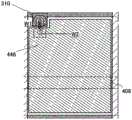
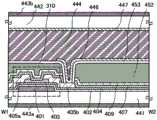
Fig. 1A to 1C are a plan view and a sectional view showing one embodiment of a semiconductor device;
fig. 2A to 2C are a plan view and a sectional view showing one embodiment of a semiconductor device;
fig. 3A to 3C are a plan view and a sectional view showing one embodiment of a semiconductor device;
fig. 4A to 4F are sectional views each showing one embodiment of a semiconductor device;
fig. 5A to 5E are diagrams showing an example of a manufacturing process of a semiconductor device;
fig. 6A to 6E are diagrams showing an example of a manufacturing process of a semiconductor device;
fig. 7A to 7C are diagrams each illustrating one embodiment of a semiconductor device;
fig. 8 is a diagram illustrating an embodiment of a semiconductor device;
fig. 9 is a diagram illustrating an embodiment of a semiconductor device;
fig. 10 is a diagram illustrating an embodiment of a semiconductor device;
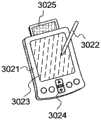
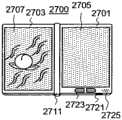
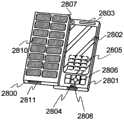
fig. 11A to 11F are diagrams respectively showing electronic apparatuses;
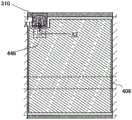
fig. 12A and 12B are a plan view and a sectional view showing one embodiment of a semiconductor device;
fig. 13A and 13B are a plan view and a sectional view showing one embodiment of a semiconductor device;
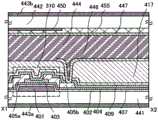
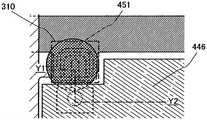
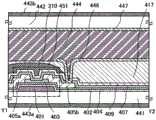
fig. 14A and 14B are a plan view and a sectional view showing one embodiment of a semiconductor device;
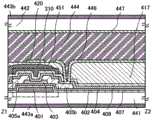
fig. 15A and 15B are a plan view and a sectional view showing one embodiment of a semiconductor device.
Detailed Description
Hereinafter, embodiments of the present invention will be described in detail with reference to the drawings. Note that the present invention is not limited to the following description, and a person of ordinary skill in the art can easily understand the fact that the modes and details thereof can be changed into various forms. Therefore, the present invention should not be construed as being limited to the description of the embodiments shown below.
[ embodiment 1]
In this embodiment, an embodiment of a semiconductor device and a method for manufacturing the semiconductor device will be described with reference to fig. 1A to 1C, fig. 2A to 2C, fig. 3A to 3C, fig. 4A to 4F, fig. 5A to 5E, and fig. 6A to 6E.
< example of semiconductor device construction >
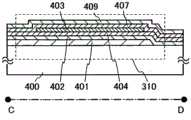
Fig. 1A to 1C illustrate a plan view and a cross-sectional view of atransistor 310 as an example of a semiconductor device according to one embodiment of the disclosed invention. In fig. 1A to 1C, as a transistor according to one embodiment of the disclosed invention, a bottom gate type transistor is illustrated. Here, fig. 1A is a plan view, and fig. 1B and 1C are sectional views along line a-B and line C-D in fig. 1A, respectively. Note that in fig. 1A, a part of the constituent elements of the transistor 310 (for example, the thirdmetal oxide film 407, the fourthmetal oxide film 409, and the like) is omitted for the sake of simplicity.
Thetransistor 310 shown in fig. 1A to 1C includes, over asubstrate 400 having an insulating surface: agate electrode 401; a gate insulating film including a firstmetal oxide film 402 and a secondmetal oxide film 404; anoxide semiconductor film 403; asource electrode 405 a; adrain electrode 405 b; a thirdmetal oxide film 407; and a fourthmetal oxide film 409.
In thetransistor 310 shown in fig. 1A to 1C, the thirdmetal oxide film 407 is provided so as to cover thesource electrode 405a and thedrain electrode 405b and to be in contact with the secondmetal oxide film 404 and theoxide semiconductor film 403. In addition, in thetransistor 310 illustrated in fig. 1A to 1C, the thirdmetal oxide film 407 and the secondmetal oxide film 404 are in contact with each other in a region where theoxide semiconductor film 403 is not present. In other words, theoxide semiconductor film 403 is surrounded by the secondmetal oxide film 404 and the thirdmetal oxide film 407.
Here, theoxide semiconductor film 403 is preferably formed by being sufficiently removed of impurities such as hydrogen and water, or by being sufficiently supplied with impuritiesThe oxide semiconductor film is highly purified. Specifically, for example, the hydrogen concentration in theoxide semiconductor film 403 is 5 × 10¹⁹atoms/cm3Hereinafter, it is preferably 5 × 10¹⁸atoms/cm3Hereinafter, more preferably 5 × 10¹⁷atoms/cm3The following. Note that the hydrogen concentration in theoxide semiconductor film 403 is measured by Secondary Ion Mass Spectrometry (SIMS). In theoxide semiconductor film 403 in which the hydrogen concentration is sufficiently reduced to be high-purity, and sufficient oxygen is supplied to reduce the defect level in the energy gap due to oxygen deficiency, the carrier concentration is less than 1 × 10¹²/cm3Preferably less than 1X 10¹¹/cm3More preferably less than 1.45X 10¹⁰/cm3. By using the i-type oxide semiconductor formed as described above, a transistor having excellent electrical characteristics can be obtained.
As for the secondmetal oxide film 404 and the thirdmetal oxide film 407 which are in contact with theoxide semiconductor film 403, respectively, an insulating film containing oxygen is preferably used, and more preferably, a film including a region whose oxygen ratio is larger than the stoichiometric composition (such a region is also referred to as an oxygen excess region) is used. Since the secondmetal oxide film 404 and the thirdmetal oxide film 407 which are in contact with theoxide semiconductor film 403, respectively, have an oxygen excess region, oxygen can be prevented from moving from theoxide semiconductor film 403 to the secondmetal oxide film 404 or the thirdmetal oxide film 407. In addition, oxygen may be supplied from the secondmetal oxide film 404 or the thirdmetal oxide film 407 into theoxide semiconductor film 403. Therefore, theoxide semiconductor film 403 sandwiched between the secondmetal oxide film 404 and the thirdmetal oxide film 407 can be made to be a film containing sufficient oxygen.
Many of the oxide semiconductor materials used for theoxide semiconductor film 403 contain a group 13 element. Therefore, by forming the secondmetal oxide film 404 or the thirdmetal oxide film 407 in contact with theoxide semiconductor film 403 using a material containing a group 13 element and oxygen, respectively, a favorable state of an interface with the oxide semiconductor film can be maintained. This is because the material containing the group 13 element and oxygen has good compatibility with the oxide semiconductor material.
For example, when an oxide semiconductor film containing gallium is formed, by using a material containing gallium oxide for the secondmetal oxide film 404 or the thirdmetal oxide film 407, good interface characteristics between the oxide semiconductor film and a metal oxide film in contact with the oxide semiconductor film can be maintained. By providing the oxide semiconductor film and the metal oxide film containing gallium oxide in contact with each other, hydrogen accumulation (hydrogen accumulation) at the interface of the oxide semiconductor film and the metal oxide film can be reduced. Note that when an element of the same group as a constituent element of the oxide semiconductor is used, a similar effect can be obtained. That is, it is also effective to form the secondmetal oxide film 404 or the thirdmetal oxide film 407 using a material containing aluminum oxide or the like. Note that alumina has a property of not easily transmitting water. Therefore, a material containing aluminum oxide is also preferably used from the viewpoint of preventing water from entering the oxide semiconductor film.
In addition, the secondmetal oxide film 404 or the thirdmetal oxide film 407 may contain two or more kinds of group 13 elements. For example, a material such as gallium aluminum oxide (or aluminum gallium oxide) containing gallium and aluminum may be used for the secondmetal oxide film 404 or the thirdmetal oxide film 407. In this case, both the effect due to the gallium content and the effect due to the aluminum content can be obtained, and therefore, this is preferable. For example, by providing the oxide semiconductor film and the metal oxide film containing gallium and aluminum in contact with each other, intrusion of water into the oxide semiconductor film can be prevented, and accumulation of hydrogen (including hydrogen ions) at the interface between the oxide semiconductor film and the metal oxide film can be sufficiently reduced.
Here, gallium aluminum oxide means a substance having a gallium content (at.%) higher than an aluminum content (at.%), and gallium aluminum oxide means a substance having an aluminum content (at.%) higher than a gallium content (at.%).
In addition, since the electronegativity of aluminum is smaller than that of gallium, aluminum adsorbs hydrogen more easily than gallium in some cases. Therefore, in order to suppress hydrogen accumulation at the interface with the oxide semiconductor film, a gallium oxide film or a gallium oxide aluminum film having a large gallium content is preferably used as the metal oxide film in contact with the oxide semiconductor film.
In addition, when a structure is employed in which the secondmetal oxide film 404 and the thirdmetal oxide film 407 are in contact with each other in a region where theoxide semiconductor film 403 is not present, adhesion between the secondmetal oxide film 404 and the thirdmetal oxide film 407 can be improved by forming the secondmetal oxide film 404 and the thirdmetal oxide film 407 using the same material, which is preferable. Further, it is more preferable that the ratio of the constituent elements of the secondmetal oxide film 404 is equal to the ratio of the constituent elements of the thirdmetal oxide film 407. Alternatively, when the second or third metal oxide film is formed using a gallium oxide film or a gallium aluminum oxide film, the preferable composition of gallium oxide or gallium aluminum oxide consists of And (4) showing.

In thetransistor 310, the firstmetal oxide film 402 is a film stacked over the secondmetal oxide film 404 and serving as a gate insulating film. Further, in thetransistor 310, the fourthmetal oxide film 409 is a film stacked under the thirdmetal oxide film 407 and functions as a protective film. By forming the firstmetal oxide film 402 and the fourthmetal oxide film 409 using a material containing a group 13 element and oxygen, favorable states of the interface with the secondmetal oxide film 404 and the interface with the thirdmetal oxide film 407 can be maintained, respectively. Note that as described above, since aluminum oxide has a property of not easily transmitting water, it is also preferable to use an aluminum gallium oxide film having a large aluminum content as the first or fourth metal oxide film provided below or above thetransistor 310 in order to prevent water from entering the oxide semiconductor film.
In addition, the firstmetal oxide film 402 and the fourthmetal oxide film 409 preferably include regions each having an oxygen ratio larger than the stoichiometric composition. Oxygen can be supplied to the metal oxide film or theoxide semiconductor film 403 which is in contact with theoxide semiconductor film 403, thereby reducing the oxide semiconductor filmOxygen defects in 403 or oxygen defects at the interface of theoxide semiconductor film 403 and the metal oxide film in contact therewith. For example, in the case of using an aluminum gallium oxide film as the first or fourth metal oxide film, the preferable composition of aluminum gallium oxide consists of
 And (4) showing.


In the case of using an oxide semiconductor film having no defects (oxygen defects), the first to fourth metal oxide films and the like preferably contain oxygen in a proportion in accordance with the stoichiometric composition, respectively. However, in order to obtain reliability of the transistor (such as suppression of shift in threshold voltage) or the like, it is preferable that a large amount of oxygen is contained in the metal oxide film so that the proportion of oxygen can be more than the stoichiometric composition, otherwise oxygen deficiency may occur in the oxide semiconductor film.
An insulator may also be provided over thetransistor 310. In addition, openings may be formed in the first to fourth metal oxide films or the like so that thesource electrode 405a and thedrain electrode 405b electrically connected to theoxide semiconductor film 403 can be electrically connected to a wiring. Note that theoxide semiconductor film 403 is desirably processed into an island shape, but may not be processed into an island shape.
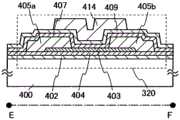
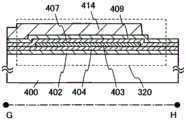
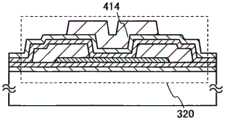
Fig. 2A to 2C are a sectional view and a plan view showing atransistor 320 having a different structure from thetransistor 310. In fig. 2A to 2C, as a transistor according to one embodiment of the disclosed invention, a top gate type transistor is shown. Here, fig. 2A is a plan view, and fig. 2B and 2C are sectional views along a line E-F and a line G-H in fig. 2A. Note that in fig. 2A, a part of the constituent elements of the transistor 320 (for example, the thirdmetal oxide film 407 and the fourth metal oxide film 409) is omitted for the sake of simplicity.
Thetransistor 320 shown in fig. 2A to 2C includes, over asubstrate 400 having an insulating surface: a firstmetal oxide film 402; a secondmetal oxide film 404; anoxide semiconductor film 403; asource electrode 405 a; adrain electrode 405 b; a gate insulating film including a thirdmetal oxide film 407 and a fourthmetal oxide film 409; and agate electrode 414.
In thetransistor 320 illustrated in fig. 2A to 2C, the thirdmetal oxide film 407 is provided so as to cover thesource electrode 405a and thedrain electrode 405b and to be in contact with the secondmetal oxide film 404 and part of theoxide semiconductor film 403. Like thetransistor 310 illustrated in fig. 1A to 1C, in thetransistor 320 illustrated in fig. 2A to 2C, the thirdmetal oxide film 407 and the secondmetal oxide film 404 are in contact with each other in a region where theoxide semiconductor film 403 is not present. In other words, theoxide semiconductor film 403 is surrounded by the secondmetal oxide film 404 and the thirdmetal oxide film 407. Other constituent elements are the same as those of thetransistor 310 in fig. 1A to 1C. Therefore, as for details, reference may be made to the description regarding fig. 1A to 1C.
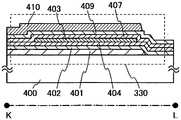
In addition, fig. 3A to 3C are a sectional view and a plan view showing atransistor 330 which is different in structure from thetransistor 310 and thetransistor 320. Here, fig. 3A is a plan view, and fig. 3B and 3C are sectional views along the line I-J and the line K-L in fig. 3A, respectively. Note that in fig. 3A, a part of the constituent elements of the transistor 330 (for example, the thirdmetal oxide film 407 and the fourth metal oxide film 409) is omitted for the sake of simplicity.
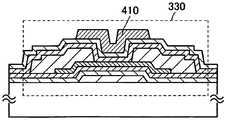
Thetransistor 330 shown in fig. 3A to 3C includes, over asubstrate 400 having an insulating surface: agate electrode 401; a gate insulating film including a firstmetal oxide film 402 and a secondmetal oxide film 404; anoxide semiconductor film 403; asource electrode 405 a; adrain electrode 405 b; a thirdmetal oxide film 407; a fourthmetal oxide film 409; and aconductive layer 410 provided in a region overlapping with theoxide semiconductor film 403.
In thetransistor 330 shown in fig. 3A to 3C, the thirdmetal oxide film 407 is provided so as to cover thesource electrode 405a and thedrain electrode 405b and to be in contact with the secondmetal oxide film 404 and theoxide semiconductor film 403. Like thetransistor 310 illustrated in fig. 1A to 1C, in thetransistor 330 illustrated in fig. 3A to 3C, the thirdmetal oxide film 407 and the secondmetal oxide film 404 are in contact with each other in a region where theoxide semiconductor film 403 is not present. In other words, theoxide semiconductor film 403 is surrounded by the secondmetal oxide film 404 and the thirdmetal oxide film 407.
In thetransistor 330, theconductive layer 410 can function as a second gate electrode. In this case, the thirdmetal oxide film 407 and the fourthmetal oxide film 409 function as gate insulating films. Other constituent elements are the same as those of thetransistor 310 shown in fig. 1A to 1C; therefore, as for details, reference may be made to the description regarding fig. 1A to 1C.
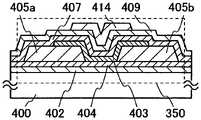
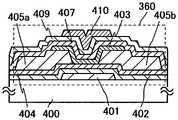
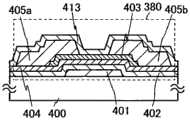
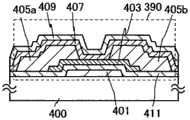
Fig. 4A to 4F show cross-sectional views of transistors having different structures from those of the above-described transistors. Note that the structures of fig. 4A to 4F can be combined with any of the structures of fig. 1A to 1C, fig. 2A to 2C, and fig. 3A to 3C as appropriate.
Thetransistor 340 shown in fig. 4A includes, over asubstrate 400 having an insulating surface: agate electrode 401; a gate insulating film including a firstmetal oxide film 402 and a secondmetal oxide film 404; anoxide semiconductor film 403; asource electrode 405 a; adrain electrode 405 b; a thirdmetal oxide film 407; and a fourthmetal oxide film 409 which is common to thetransistor 340 and thetransistor 310. Thetransistor 340 is different from thetransistor 310 in the position where theoxide semiconductor film 403 is connected to thesource electrode 405a and thedrain electrode 405 b. That is, in thetransistor 340, the lower portion of theoxide semiconductor film 403 is in contact with thesource electrode 405a and thedrain electrode 405 b. Other components are the same as those of thetransistor 310 shown in fig. 1A to 1C, and therefore, for details, reference may be made to the description of fig. 1A to 1C.
Thetransistor 350 shown in fig. 4B includes over asubstrate 400 having an insulating surface: a firstmetal oxide film 402; a secondmetal oxide film 404; anoxide semiconductor film 403; asource electrode 405 a; adrain electrode 405 b; a gate insulating film including a thirdmetal oxide film 407 and a fourthmetal oxide film 409; and agate electrode 414, which is common totransistor 350 andtransistor 320. Thetransistor 350 is different from thetransistor 320 in the position where theoxide semiconductor film 403 is connected to thesource electrode 405a and thedrain electrode 405 b. That is, in thetransistor 350, the lower portion of theoxide semiconductor film 403 is in contact with thesource electrode 405a and thedrain electrode 405 b. Other components are the same as those of thetransistor 320 shown in fig. 2A to 2C, and therefore, for details, reference may be made to the description of fig. 2A to 2C.
Thetransistor 360 shown in fig. 4C includes over thesubstrate 400 having an insulating surface: agate electrode 401; a gate insulating film including a firstmetal oxide film 402 and a secondmetal oxide film 404; anoxide semiconductor film 403; asource electrode 405 a; adrain electrode 405 b; a thirdmetal oxide film 407; a fourthmetal oxide film 409; and aconductive layer 410 provided in a region overlapping with theoxide semiconductor film 403, which is common to thetransistor 360 and thetransistor 330. Thetransistor 360 is different from thetransistor 330 in the position where theoxide semiconductor film 403 is connected to thesource electrode 405a and thedrain electrode 405 b. That is, in thetransistor 360, the lower portion of theoxide semiconductor film 403 is in contact with thesource electrode 405a and thedrain electrode 405 b. Other components are the same as those of thetransistor 330 shown in fig. 3A to 3C, and therefore, for details, reference may be made to the description of fig. 3A to 3C.
The transistor 370 shown in fig. 4D includes over asubstrate 400 having an insulating surface: agate electrode 401; a gate insulating film including a firstmetal oxide film 402 and a secondmetal oxide film 404; anoxide semiconductor film 403; asource electrode 405 a; adrain electrode 405 b; a thirdmetal oxide film 407; and a fourthmetal oxide film 409 which is common to the transistor 370 and thetransistor 310. Transistor 370 differs fromtransistor 310 in that: in the transistor 370, in a region where theoxide semiconductor film 403 is not present, the thirdmetal oxide film 407 and the secondmetal oxide film 404 are in contact with each other, and the firstmetal oxide film 402 and the fourthmetal oxide film 409 are in contact with each other. In the transistor 370, theoxide semiconductor film 403 is surrounded by not only the secondmetal oxide film 404 and the thirdmetal oxide film 407 but also the firstmetal oxide film 402 and the fourthmetal oxide film 409, so that impurities such as hydrogen or moisture can be further prevented from being mixed into theoxide semiconductor film 403. Note that the structure of the transistor 370 shown in fig. 4D can be formed by, for example, patterning the thirdmetal oxide film 407 and the secondmetal oxide film 404 after the thirdmetal oxide film 407 is formed. Further, as the firstmetal oxide film 402 and the secondmetal oxide film 404, materials that can be used to obtain selective etching are preferably used. Other components are the same as those of thetransistor 310 shown in fig. 1A to 1C, and therefore, for details, reference may be made to the description of fig. 1A to 1C.
Note that the number of metal oxide films provided over theoxide semiconductor film 403 is not necessarily limited to 2. Similarly, it is not necessary to limit the number of metal oxide films provided under theoxide semiconductor film 403 to 2. For example, thetransistor 380 shown in fig. 4E is an example in which a single-layer structure of themetal oxide film 413 is used instead of the stacked-layer structure of the thirdmetal oxide film 407 and the fourthmetal oxide film 409 in thetransistor 310. Thetransistor 390 shown in fig. 4F is an example in which a single-layer structure of themetal oxide film 411 is used instead of the stacked-layer structure of the firstmetal oxide film 402 and the secondmetal oxide film 404 in thetransistor 310. Themetal oxide film 413 or themetal oxide film 411 may be formed using a material containing a group 13 element and oxygen, and for example, a material containing one or more of gallium oxide, aluminum oxide, gallium aluminum oxide, and gallium aluminum oxide may be used. Themetal oxide film transistor 310 shown in fig. 1A to 1C, and therefore, for details, reference may be made to the description of fig. 1A to 1C.
< example of manufacturing Process of transistor >
Hereinafter, an example of a manufacturing process of the transistor according to the present embodiment will be described with reference to fig. 5A to 6E.
< manufacturing Process oftransistor 330 >
An example of a manufacturing process of thetransistor 330 illustrated in fig. 3A to 3C is described with reference to fig. 5A to 5E. Note that thetransistor 310 illustrated in fig. 1A to 1C has a structure in which theconductive layer 410 is omitted from thetransistor 330, and thus thetransistor 310 can be manufactured in a manner similar to the manufacturing process of thetransistor 330 except that theconductive layer 410 is provided.
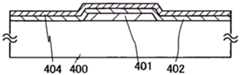
First, after a conductive film is formed over asubstrate 400 having an insulating surface, agate electrode 401 is formed by a first photolithography step. Note that the resist mask may be formed using an inkjet method. When the resist mask is formed using the inkjet method, a photomask is not required, so the manufacturing cost can be reduced.
Although there is no particular limitation on a substrate that can be used as thesubstrate 400 having an insulating surface, the substrate needs to have at least heat resistance to such an extent that it can withstand subsequent heat treatment. For example, a substrate such as a glass substrate, a ceramic substrate, a quartz substrate, or a sapphire substrate can be used. As long as thesubstrate 400 has an insulating surface, a single crystal semiconductor substrate or a polycrystalline semiconductor substrate of silicon, silicon carbide, or the like, a compound semiconductor substrate of silicon germanium, or the like, an SOI substrate, or the like can be applied, and a semiconductor element can be provided over the substrate. As thesubstrate 400, a flexible substrate may be used.
An insulating film serving as a base film may also be provided between thesubstrate 400 and thegate electrode 401. The base film has a function of preventing diffusion of an impurity element from thesubstrate 400, and can be formed using a single-layer structure or a stacked-layer structure of one or more films selected from a silicon nitride film, a silicon oxide film, a silicon nitride oxide film, and a silicon oxynitride film.
Further, thegate electrode 401 can be formed using a single-layer structure or a stacked-layer structure of any of metal materials such as molybdenum, titanium, tantalum, tungsten, aluminum, copper, neodymium, and scandium, or an alloy material containing any of these metal materials as a main component.
Next, a firstmetal oxide film 402 is formed over thegate electrode 401. The firstmetal oxide film 402 may be formed using a material containing a group 13 element and oxygen, and for example, a material containing one or more of gallium oxide, aluminum oxide, gallium aluminum oxide, and gallium aluminum oxide, or the like may be used. Note that an aluminum gallium oxide film is preferably used as the firstmetal oxide film 402 in order to keep a good state of an interface with the secondmetal oxide film 404 to be formed later and prevent water from entering the oxide semiconductor film.
The firstmetal oxide film 402 may contain an impurity element other than hydrogen, such as a group 3 element such as yttrium, a group 4 element such as hafnium, a group 14 element such as nitrogen or silicon, in addition to the group 13 element. For example, by making the firstmetal oxide film 402 contain the above-described impurity element of approximately more than 0at.% and 20at.% or less, the energy gap of the firstmetal oxide film 402 can be controlled according to the addition amount of the element.
The firstmetal oxide film 402 is preferably formed by using a method in which impurities such as hydrogen and water are not mixed into the firstmetal oxide film 402. If an impurity such as hydrogen or water is contained in the firstmetal oxide film 402, the impurity such as hydrogen or water may intrude into an oxide semiconductor film formed later, or oxygen in the oxide semiconductor film may be extracted. Thus, the resistance of the oxide semiconductor film (which becomes an n-type oxide semiconductor film) is reduced and a parasitic channel may be formed. For example, the firstmetal oxide film 402 is preferably formed by a sputtering method. As the sputtering gas used when forming the film, it is preferable to use a high-purity gas from which impurities such as hydrogen or water are removed.
As the sputtering method, a DC sputtering method using a direct-current power supply, a pulse DC sputtering method in which a direct-current bias is applied in a pulse manner, an AC sputtering method, or the like can be used.
Note that in the case of forming an aluminum gallium oxide film or an aluminum gallium oxide film as the firstmetal oxide film 402, a gallium oxide target to which aluminum particles are added may be used as a target for the sputtering method. By using a gallium oxide target to which aluminum particles are added, the conductivity of the target can be improved, and discharge during sputtering can be facilitated. By using such a target, a metal oxide film suitable for mass production can be formed.
Next, a process of supplying oxygen to the firstmetal oxide film 402 is preferably performed. As the treatment for supplying oxygen, heat treatment in an oxygen atmosphere, oxygen doping treatment, and the like are given. Alternatively, oxygen may be added by irradiating oxygen ions accelerated by an electric field. Note that "oxygen doping treatment" in this specification and the like refers to a treatment of adding oxygen to a bulk (bulk), and the term "bulk" is used to explicitly show that oxygen is added not only to the film surface but also to the film interior. In addition, "oxygen doping" includes "oxygen plasma doping" in which plasma-formed oxygen is added to the block.
By performing a process of supplying oxygen such as an oxygen doping process on the firstmetal oxide film 402, a region having an oxygen ratio larger than the stoichiometric composition is formed in the firstmetal oxide film 402. By providing such a region, oxygen can be supplied to the second metal oxide film or the oxide semiconductor film formed later, so that oxygen defects in the oxide semiconductor film or oxygen defects at the interface between the oxide semiconductor film and the second metal oxide film can be suppressed.
Alternatively, when the firstmetal oxide film 402 is deposited using a sputtering method, an oxygen excess region may be formed in the firstmetal oxide film 402 by introducing oxygen gas or a mixed gas containing an inert gas (e.g., a rare gas such as argon or the like or nitrogen) and oxygen. Note that the heat treatment may be performed after deposition using a sputtering method.
For example, when an aluminum gallium oxide film is used as the firstmetal oxide film 402, the composition of aluminum gallium oxide can be made to be aluminum gallium oxide by performing a process of supplying oxygen such as an oxygen doping process 。
。

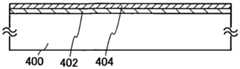
Next, a secondmetal oxide film 404 is formed over the first metal oxide film 402 (fig. 5A). Thereby, a gate insulating film (first gate insulating film) including the firstmetal oxide film 402 and the secondmetal oxide film 404 is formed. The secondmetal oxide film 404 may be formed using a material containing a group 13 element and oxygen, and for example, a material containing any one or more of gallium oxide, aluminum oxide, gallium aluminum oxide, and gallium aluminum oxide, or the like may be used. As described above, in order to suppress hydrogen accumulation at the interface with the oxide semiconductor film while maintaining a good state at the interface with the oxide semiconductor film to be formed later, it is preferable to use a gallium oxide aluminum film as the secondmetal oxide film 404.
As in the case of the firstmetal oxide film 402, the secondmetal oxide film 404 may contain not only the group 13 element but also an impurity element other than hydrogen, for example, a group 3 element such as yttrium, a group 4 element such as hafnium, a group 14 element such as silicon, nitrogen, or the like in the secondmetal oxide film 404.
The secondmetal oxide film 404 is preferably formed by a method in which impurities such as hydrogen and water are not mixed. For example, sputtering can be used. These details are similar to those of the firstmetal oxide film 402, and therefore, reference may be made to the formation method of the firstmetal oxide film 402.
Next, a process of supplying oxygen to the secondmetal oxide film 404 is preferably performed. As the treatment for supplying oxygen, heat treatment in an oxygen atmosphere, oxygen doping treatment, and the like are given. Alternatively, oxygen may be added by irradiating oxygen ions accelerated by an electric field.
Alternatively, when the secondmetal oxide film 404 is deposited using a sputtering method, oxygen may be supplied to the secondmetal oxide film 404 by introducing oxygen gas or a mixed gas containing an inert gas (e.g., a rare gas such as argon or the like or nitrogen) and oxygen. For example, a gallium oxide film is deposited under the following conditions: the distance between the substrate and the target material is 60 mm; the pressure is 0.4 Pa; the RF power supply is 1 kW; the deposition temperature is room temperature; the flow rate of argon was 25 sccm; and the flow rate of the oxygen gas was 25 sccm. The deposition temperature is not limited to room temperature, and may be, for example, 400 ℃. Further, the flow rate of oxygen gas may be set to 50sccm without introducing argon gas. Further, the heat treatment may be performed after the deposition using the sputtering method (for example, in an ultra dry air, at a temperature of 450 ℃ or more and 650 ℃ or less for one hour). By the above deposition method, a gallium oxide film having an oxygen ratio larger than the stoichiometric composition can be formed, and the composition of gallium oxide can be made to be 。
。

By performing a process of supplying oxygen (hereinafter, also referred to as an oxygen supplying process) such as an oxygen doping process on the secondmetal oxide film 404, a region having an oxygen ratio larger than the stoichiometric composition is formed in the secondmetal oxide film 404. By providing such a region, oxygen can be supplied to an oxide semiconductor film formed later, thereby reducing oxygen defects in the oxide semiconductor film or oxygen defects at an interface between the oxide semiconductor film and the second metal oxide film. Note that the oxygen supply treatment to the secondmetal oxide film 404 may also be used as the oxygen supply treatment to the firstmetal oxide film 402 as described above.
When a gallium oxide film or a gallium aluminum oxide film is used as the secondmetal oxide film 404, it is preferable to perform oxygen supplying treatment such as oxygen doping treatment, and therefore gallium oxide or gallium aluminum oxide can be made to have a composition of 。
。

Next, anoxide semiconductor film 403 with a thickness of 3nm or more and 30nm or less is formed over the secondmetal oxide film 404 by a sputtering method. When the thickness of theoxide semiconductor film 403 is too large (for example, when the thickness is 50nm or more), the transistor may be normally on, and thus the above thickness is preferably used. Note that the firstmetal oxide film 402, the secondmetal oxide film 404, and theoxide semiconductor film 403 are preferably formed continuously without being exposed to the air.
Examples of the oxide semiconductor used for theoxide semiconductor film 403 include In-Sn-Ga-Zn-O-based oxide semiconductors of quaternary metal oxides; an In-Ga-Zn-O based oxide semiconductor, an In-Sn-Zn-O based oxide semiconductor, an In-Al-Zn-O based oxide semiconductor, a Sn-Ga-Zn-O based oxide semiconductor, an Al-Ga-Zn-O based oxide semiconductor and a Sn-Al-Zn-O based oxide semiconductor of a ternary metal oxide; an In-Zn-O-based oxide semiconductor, an Sn-Zn-O-based oxide semiconductor, an Al-Zn-O-based oxide semiconductor, a Zn-Mg-O-based oxide semiconductor, an Sn-Mg-O-based oxide semiconductor, an In-Ga-O-based oxide semiconductor of a binary metal oxide; In-O-based oxide semiconductors, Sn-O-based oxide semiconductors, Zn-O-based oxide semiconductors, and the like. In addition, the oxide semiconductor may contain SiO2. Note that, here, for example, an In-Ga-Zn-O-based oxide semiconductor refers to an oxide containing indium (In), gallium (Ga), and zinc (Zn)The semiconductor film is not particularly limited in composition ratio. The In-Ga-Zn-O based oxide semiconductor may contain elements other than In, Ga, and Zn.
As theoxide semiconductor film 403, an oxide semiconductor film represented by the chemical formula InMO can be used3(ZnO)m(m>0) A film formed of the material shown. Here, M represents one or more metal elements selected from Ga, Al, Mn, and Co. For example, M may be Ga, Ga and Al, Ga and Mn, Ga and Co, and the like.
When an In-Zn-O-based material is used for theoxide semiconductor film 403, the composition ratio of the target is In at the atomic ratio In: Zn =50:1 to 1:2 (In terms of the molar ratio)2O3: ZnO =25:1 to 1: 4), preferably In: Zn =20:1 to 1:1 (In as a molar ratio)2O3ZnO =10:1 to 1: 2), and more preferably the atomic ratio is In: Zn =15:1 to 1.5:1 (In as a molar ratio)2O3ZnO =15:2 to 3: 4). For example, In a target material for forming an In-Zn-O-based oxide semiconductor, the atomic ratio is In: Zn: O = X: Y: Z, and Z is satisfied>1.5X + Y.
In this embodiment mode, theoxide semiconductor film 403 is formed by a sputtering method using an In-Ga-Zn-O-based target. Further, theoxide semiconductor film 403 can be formed by a sputtering method in a rare gas (typically argon) atmosphere, an oxygen atmosphere, or a mixed atmosphere of a rare gas and oxygen.
As a target for forming an In-Ga-Zn-O film as theoxide semiconductor film 403 by a sputtering method, for example, a target having an In composition ratio can be used2O3:Ga2O3ZnO =1:1:1[ molar ratio ]]The target of (1). In addition, the material and composition of the target are not limited to those described above. For example, In may be used2O3:Ga2O3ZnO =1:1:2[ molar ratio]The target of (1).
The filling ratio of the target material is 90% to 100%, preferably 95% to 99.9%. By using a target with a high filling ratio, theoxide semiconductor film 403 to be formed has high density.
As a sputtering gas for forming theoxide semiconductor film 403, a high-purity gas from which impurities such as hydrogen, water, a hydroxyl group, or hydride are removed is preferably used.
In order to form theoxide semiconductor film 403, thesubstrate 400 is held in a deposition chamber which is kept in a reduced pressure state, and the substrate temperature is set to a temperature of 100 ℃ to 600 ℃, preferably 200 ℃ to 400 ℃. By forming the film while heating thesubstrate 400, the impurity concentration in theoxide semiconductor film 403 can be reduced. In addition, damage caused by sputtering can be reduced. Thus, in the deposition chamber from which the residual moisture is removed, a sputtering gas from which impurities such as hydrogen or water are sufficiently removed is introduced so that theoxide semiconductor film 403 is formed over thesubstrate 400 using the target. In order to remove moisture remaining in the deposition chamber, an adsorption type vacuum pump, for example, a cryopump, an ion pump, a titanium sublimation pump, is preferably used. In addition, as the evacuation unit, a turbo pump provided with a cold trap may also be used. In a deposition chamber evacuated by a cryopump, for example, hydrogen atoms such as water (H)2O), or the like (more preferably, also a compound containing a carbon atom), or the like is discharged, whereby the impurity concentration in theoxide semiconductor film 403 formed in the deposition chamber can be reduced.
As an example of the deposition condition, the distance between the substrate and the target is 100 mm; the pressure is 0.6 Pa; the Direct Current (DC) power supply was 0.5kW and the atmosphere was an oxygen atmosphere (oxygen flow rate ratio was 100%). Note that a pulsed direct current power supply is preferably used, and in this case, powdery substances (also referred to as particles or dust) generated at the time of deposition can be reduced, and the film thickness can be made uniform.
Then, theoxide semiconductor film 403 is preferably subjected to heat treatment (first heat treatment). By the first heat treatment, excessive hydrogen (including water and a hydroxyl group) in theoxide semiconductor film 403 can be removed. Further, by the first heat treatment, excess hydrogen (including water and hydroxyl groups) in the firstmetal oxide film 402 and the secondmetal oxide film 404 can be removed. The temperature at which the first heat treatment is performed is set to 250 ℃ or more and 700 ℃ or less, preferably 450 ℃ or more and 600 ℃ or less, or lower than the strain point of the substrate.
The heat treatment may be performed by: for example, the object to be treated is introduced into an electric furnace using a resistance heating unit or the like, and heated at 450 ℃ for one hour under a nitrogen atmosphere. During this heat treatment, theoxide semiconductor film 403 is not exposed to the atmosphere, so that mixing of water and hydrogen is avoided.
The heat treatment apparatus is not limited to the electric furnace, and an apparatus that heats the object to be treated by heat conduction or heat radiation of a medium such as a gas to be heated may be used. For example, an RTA (Rapid Thermal Anneal) device such as a GRTA (Gas Rapid Thermal Anneal) device, an LRTA (Lamp Rapid Thermal Anneal) device, or the like can be used. The LRTA apparatus heats an object to be processed by radiation of light (electromagnetic wave) emitted from a lamp such as a halogen lamp, a metal halide lamp, a xenon arc lamp, a carbon arc lamp, a high-pressure sodium lamp, or a high-pressure mercury lamp. The GRTA apparatus is an apparatus for performing heat treatment using a high-temperature gas. As the gas, a rare gas such as argon or an inert gas such as nitrogen which does not react with the object to be processed even when heat treatment is performed is used.
For example, as the first heat treatment, a GRTA process may be performed as described below. The object to be treated is placed in the heated inert gas atmosphere, heating is performed for several minutes, and then the object to be treated is taken out from the inert gas atmosphere. By using the GRTA process, high temperature heat treatment can be performed for a short time. The GRTA process can be applied even if the temperature exceeds the upper temperature limit of the object to be treated. Note that during this process, the inert gas may be converted to a gas containing oxygen. This is because: by performing the first heat treatment in an atmosphere containing oxygen, the level of defects in the energy gap due to oxygen deficiency can be reduced.
Note that as the inert gas atmosphere, an atmosphere containing nitrogen or a rare gas (e.g., helium, neon, or argon) as a main component and containing no water, hydrogen, or the like is preferably used. For example, the purity of nitrogen or a rare gas such as helium, neon, or argon introduced into the heat treatment apparatus is set to 6N (99.9999%) or more, preferably 7N (99.99999%) or more (that is, the impurity concentration is 1ppm or less, preferably 0.1ppm or less).
Since the heat treatment (first heat treatment) has a function of removing hydrogen, water, and the like, the heat treatment may be referred to as dehydration treatment, dehydrogenation treatment, or the like. For example, theoxide semiconductor film 403 may be processed into an island shape and then subjected to dehydration treatment or dehydrogenation treatment. This dehydration treatment or dehydrogenation treatment may be carried out once or more than once.
Since the gate insulating film (the stack of the firstmetal oxide film 402 and the second metal oxide film 404) in contact with theoxide semiconductor film 403 has been subjected to oxygen doping treatment, there is an oxygen excess region. Therefore, oxygen can be suppressed from moving from theoxide semiconductor film 403 to the gate insulating film. Further, by forming theoxide semiconductor film 403 in contact with the gate insulating film to which oxygen is supplied, oxygen can be supplied to theoxide semiconductor film 403 from the gate insulating film. In addition, when a gallium oxide aluminum film having an oxygen excess region is formed as the secondmetal oxide film 404 in contact with theoxide semiconductor film 403, a good state of an interface with theoxide semiconductor film 403 can be maintained, and oxygen deposition at the interface can be reduced. Further, when an aluminum gallium oxide film having an oxygen excess region is formed as the firstmetal oxide film 402, water can be prevented from entering theoxide semiconductor film 403.
By performing heat treatment in a state where the gate insulating film is in contact with theoxide semiconductor film 403, oxygen supply from the gate insulating film having the oxygen excess region to theoxide semiconductor film 403 is further promoted. Further, at least a part of oxygen added to the gate insulating film and supplied to theoxide semiconductor film 403 preferably has a dangling bond in the oxide semiconductor. This is because: hydrogen can be bonded to hydrogen remaining in the oxide semiconductor film by a dangling bond to be immobilized (hydrogen is made to be an immobile ion).
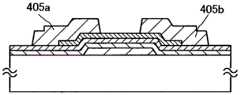
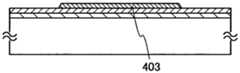
Next, theoxide semiconductor film 403 is preferably processed into an island-shapedoxide semiconductor film 403 by a second photolithography step (fig. 5B). A resist mask for forming the island-shapedoxide semiconductor film 403 can be formed by an ink-jet method. Since a photomask is not required when a resist mask is formed using an inkjet method, manufacturing cost can be reduced. As the etching of theoxide semiconductor film 403, either or both of dry etching and wet etching can be used.
Next, a conductive film for forming a source electrode and a drain electrode (including a wiring formed using the same layer as the source electrode and the drain electrode) is formed over the secondmetal oxide film 404 and theoxide semiconductor film 403. As the conductive film used for the source electrode and the drain electrode, for example, a metal film containing an element selected from Al, Cr, Cu, Ta, Ti, Mo, and W, a metal nitride film containing some of the elements described above (for example, a titanium nitride film, a molybdenum nitride film, or a tungsten nitride film), or the like can be used. A high melting point metal film such as Ti, Mo, or W, or a metal nitride film of these elements (a titanium nitride film, a molybdenum nitride film, and a tungsten nitride film) may be stacked on one or both of the lower side and the upper side of the metal film of Al, Cu, or the like. In addition, a conductive film for the source electrode and the drain electrode may be formed using a conductive metal oxide. As the conductive metal oxide, indium oxide (In) can be used2O3) Tin oxide (SnO)2) Zinc oxide (ZnO), indium oxide-tin oxide alloy (In)2O3-SnO2Abbreviated as ITO), indium oxide zinc oxide alloy (In)2O3ZnO) or any of these metal oxide materials containing silicon oxide.
A resist mask is formed over the conductive film by a third photolithography step, and selective etching is performed to form thesource electrode 405a and thedrain electrode 405 b. The resist mask is then removed (fig. 5C). Exposure in forming the resist mask in the third photolithography step may be performed using ultraviolet light, a KrF laser, or an ArF laser. The channel length L of a transistor to be completed later depends on the distance between the lower edge of thesource electrode 405a and the lower edge of thedrain electrode 405b adjacent over theoxide semiconductor film 403. When the exposure is performed in the case where the channel length L is shorter than 25nm, the exposure in the formation of the resist mask in the third photolithography step is preferably performed using, for example, ultra Ultraviolet light (Extreme Ultraviolet) having an extremely short wavelength of several nm to several tens of nm. When the ultra-ultraviolet ray is used for exposure, the resolution is high and the focusing depth is large. Therefore, the channel length L of a transistor formed later can be reduced, so that the operating speed of the circuit can be increased.
In order to reduce the number of photomasks and the number of processes used in the photolithography process, the etching process may be performed using a multi-tone mask (multi-tone mask) which is an exposure mask through which light is transmitted to have various intensities. Since a resist mask formed using a multi-tone mask has various thicknesses and can further change the shape by performing etching, the resist mask can be used in a plurality of etching processes so as to be processed into different patterns. Therefore, a resist mask corresponding to at least two or more different patterns can be formed using one multi-tone mask. Therefore, the number of exposure masks can be reduced, and the number of corresponding photolithography processes can be reduced, thereby simplifying the processes.
Note that when the conductive film is etched, it is desirable to optimize conditions so that theoxide semiconductor film 403 can be prevented from being divided by etching. However, it is difficult to obtain such etching conditions that only the conductive film is etched without etching theoxide semiconductor film 403 at all. In some cases, when the conductive film is etched, only a part of the oxide semiconductor film 403 (for example, 5% to 50% of the thickness of the oxide semiconductor film 403) is etched, and thus theoxide semiconductor film 403 becomes theoxide semiconductor film 403 having a groove portion (concave portion).
Next, N may be used2O、N2Or Ar or the like, in order to remove water adsorbed to the surface of the exposedoxide semiconductor film 403. When plasma treatment is performed, it is desirable that the thirdmetal oxide film 407 which is in contact with theoxide semiconductor film 403 be formed without being exposed to the atmosphere after the plasma treatment.
The thirdmetal oxide film 407 can be formed using the same material and process as the secondmetal oxide film 404. In order to suppress oxygen deposition at the interface with the oxide semiconductor film while maintaining a good state at the interface with the oxide semiconductor film, the thirdmetal oxide film 407 is preferably formed using a gallium aluminum oxide film as in the secondmetal oxide film 404.
Next, the thirdmetal oxide film 407 is preferably subjected to a process of supplying oxygen such as an oxygen doping process. Note that during deposition of the thirdmetal oxide film 407 using a sputtering method, oxygen may be supplied to the thirdmetal oxide film 407 by introducing oxygen gas or a mixed gas containing an inert gas (e.g., a rare gas such as argon or the like or nitrogen) and oxygen.
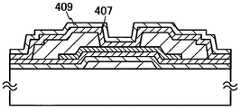
Next, a fourthmetal oxide film 409 is formed over the third metal oxide film 407 (fig. 5D). In thetransistor 330, the thirdmetal oxide film 407 and the fourthmetal oxide film 409 function as a gate insulating film (second gate insulating film). The fourthmetal oxide film 409 may be formed using the same material and method as the firstmetal oxide film 402. Note that in order to maintain a good state at the interface with the thirdmetal oxide film 407 and prevent water from invading into the oxide semiconductor film, an aluminum gallium oxide film is preferably used as the fourthmetal oxide film 409.
Next, the fourthmetal oxide film 409 is preferably subjected to a treatment of supplying oxygen. Note that when the fourthmetal oxide film 409 is deposited using a sputtering method, oxygen may be supplied to the fourthmetal oxide film 409 by introducing oxygen gas or a mixed gas containing an inert gas (e.g., a rare gas such as argon or the like or nitrogen) and oxygen. Note that the process of supplying oxygen to the fourthmetal oxide film 409 may also be used as the process of supplying oxygen to the thirdmetal oxide film 407.
After that, the second heat treatment is preferably performed in a state where a part of the oxide semiconductor film 403 (channel formation region) is in contact with the thirdmetal oxide film 407. The temperature of the second heat treatment is set to 250 ℃ or more and 700 ℃ or less, preferably 450 ℃ or more and 600 ℃ or less, or lower than the strain point of the substrate.
The second heat treatment may be performed in an atmosphere of nitrogen, oxygen, ultra-dry air (air having a water content of 20ppm or less, preferably 1ppm or less, more preferably 10ppb or less), or a rare gas (argon, helium, or the like). Note that the atmosphere of nitrogen, oxygen, super dry air, a rare gas, or the like preferably does not contain water, hydrogen, or the like. It is also preferable to set the purity of nitrogen, oxygen, or a rare gas introduced into the heat treatment apparatus to 6N (99.9999%) or more, and preferably to 7N (99.99999%) or more (that is, to set the impurity concentration to 1ppm or less, and preferably to 0.1ppm or less).
The second heat treatment is performed in a state where theoxide semiconductor film 403 is in contact with the secondmetal oxide film 404 and the thirdmetal oxide film 407 each having an oxygen excess region. Therefore, oxygen, which is one of the main components constituting the oxide semiconductor and is likely to be reduced by the dehydration (or dehydrogenation) treatment, can be supplied to theoxide semiconductor film 403 from at least one of the secondmetal oxide film 404 and the thirdmetal oxide film 407 each containing oxygen. Thereby, charge trapping centers in theoxide semiconductor film 403 can be reduced. Through the above steps, theoxide semiconductor film 403 can be highly purified and electrically i-type (intrinsic). In addition, by performing the heat treatment, impurities in the first to fourth metal oxide films are also removed, and therefore, the first to fourth metal oxide films can be highly purified.
In this embodiment, the second heat treatment is performed after the fourthmetal oxide film 409 is formed, but the timing of performing the second heat treatment is not particularly significant, and the second heat treatment may be performed after the thirdmetal oxide film 407 is formed. For example, the second heat treatment may be performed after the thirdmetal oxide film 407 is formed.
As described above, by performing the first heat treatment and the second heat treatment, theoxide semiconductor film 403 can be highly purified so as to contain as little impurities as possible other than the main component. Theoxide semiconductor film 403 with high purity contains few (almost 0) carriers derived from donors and has a carrier concentration of less than 1 × 10¹⁴/cm3Preferably less than 1X 10¹²/cm3More preferably less than 1X 10¹¹/cm3。
Next, aconductive layer 410 is provided over the fourthmetal oxide film 409 and in a region overlapping with a channel formation region of theoxide semiconductor film 403. Accordingly, thetransistor 330 shown in fig. 5E can be completed. Theconductive layer 410 may function as a second gate electrode. Theconductive layer 410 can be formed using the same material and method as thegate electrode 401. Note that when theconductive layer 410 is used as the second gate electrode, a stacked film including the thirdmetal oxide film 407 and the fourthmetal oxide film 409 is used as the second gate insulating film.
Providing theconductive layer 410 to serve as a second gate electrode and overlapping theconductive layer 410 with a channel formation region of theoxide semiconductor film 403 allows reducing an amount of shift between before a bias temperature stress test (hereinafter referred to as a BT test) for checking reliability of thetransistor 330 and a threshold voltage of thetransistor 330 after the BT test. Note that the potential of the second gate electrode may be the same as that of the gate electrode 401 (first gate electrode), or may be different from that of thefirst gate electrode 401. Alternatively, the potential of the second gate electrode may also be GND, 0V, or the second gate electrode may be in a floating state.
Through the above steps, thetransistor 330 is completed. Thetransistor 330 thus obtained includes theoxide semiconductor film 403, and theoxide semiconductor film 403 is a high-purity film in which impurities such as hydrogen, water, a hydroxyl group, or hydride (also referred to as a hydrogen compound) are intentionally removed. Further, by providing the first to fourth metal oxide films, re-mixing of impurities such as water or hydrogen into theoxide semiconductor film 403, or emission of oxygen from theoxide semiconductor film 403 and the interfaces between theoxide semiconductor film 403 and the insulating film can be reduced or prevented. Therefore, the variation in the electrical characteristics of thetransistor 330 is suppressed, and thetransistor 330 is electrically stable.
Although not shown, a protective insulating film may be formed so as to cover thetransistor 330. As the protective insulating film, a silicon nitride oxide film, an aluminum nitride film, or the like can be used.
Further, a planarizing insulating film may be formed over thetransistor 330. The planarization insulating film may be formed using an organic material having heat resistance such as acrylic resin, polyimide, benzocyclobutene, polyamide, epoxy resin, or the like. In addition, as an alternative to the organic material, a low dielectric constant material (low-k material), a siloxane-based resin, PSG (phosphosilicate glass), BPSG (borophosphosilicate glass), or the like may be used. The planarization insulating film may be formed by stacking a plurality of insulating films formed of any of these materials.
< manufacturing Process oftransistor 320 >
An example of a manufacturing process of thetransistor 320 illustrated in fig. 2A to 2C is described with reference to fig. 6A to 6E. Note that most of the manufacturing process of thetransistor 320 is the same as that of thetransistor 330. Therefore, some description of the same parts is omitted below.
First, a firstmetal oxide film 402 is formed over asubstrate 400 having an insulating surface. Then, the firstmetal oxide film 402 is preferably subjected to a process of supplying oxygen such as an oxygen doping process.
Note that an insulating film serving as a base film may be provided between thesubstrate 400 and the firstmetal oxide film 402. The base film has a function of preventing diffusion of an impurity element from thesubstrate 400, and can be formed with a single-layer structure or a stacked-layer structure using one or more of a silicon nitride film, a silicon oxide film, a silicon nitride oxide film, and a silicon oxynitride film.
Next, a secondmetal oxide film 404 is formed over the first metal oxide film 402 (fig. 6A). After the secondmetal oxide film 404 is formed, a process of supplying oxygen such as an oxygen doping process is preferably performed. Note that the oxygen supplying process performed on the firstmetal oxide film 402 may also be used as the oxygen supplying process performed on the secondmetal oxide film 404.
Next, anoxide semiconductor film 403 is formed over the secondmetal oxide film 404, and then theoxide semiconductor film 403 is processed into an island shape (fig. 6B).
Note that after theoxide semiconductor film 403 is formed or after theoxide semiconductor film 403 is processed into an island shape, heat treatment (dehydration treatment, dehydrogenation treatment) is preferably performed. These details are the same as intransistor 330.
Next, a conductive film for forming a source electrode and a drain electrode (including a wiring formed using the same layer as the source electrode and the drain electrode) is formed over theoxide semiconductor film 403. The conductive film is processed to form asource electrode 405a and adrain electrode 405b (fig. 6C).
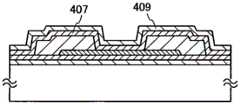
Next, a thirdmetal oxide film 407 is formed so as to cover thesource electrode 405a and thedrain electrode 405b and be in contact with part of theoxide semiconductor film 403. Next, a process of supplying oxygen such as an oxygen doping process is preferably performed on the thirdmetal oxide film 407.
Then, a fourthmetal oxide film 409 is formed over the thirdmetal oxide film 407, so that a gate insulating film including a stack of the thirdmetal oxide film 407 and the fourthmetal oxide film 409 is formed (fig. 6D). Note that after the fourthmetal oxide film 409 is formed, a process of supplying oxygen such as an oxygen doping process is preferably performed. Alternatively, the oxygen supplying treatment performed on the thirdmetal oxide film 407 may also be used as the oxygen supplying treatment performed on the fourthmetal oxide film 409.
It is preferable to perform the heat treatment after performing the oxygen supplying treatment on the thirdmetal oxide film 407. By this heat treatment, oxygen can be supplied to theoxide semiconductor film 403 from at least one of the secondmetal oxide film 404 and the thirdmetal oxide film 407 each containing oxygen.
Next, a conductive film is formed over the fourthmetal oxide film 409, and then the conductive film is processed. Thus, thegate electrode 414 is formed. Thegate electrode 414 can be formed using similar materials and methods as thegate electrode 401 in thetransistor 330.
Thetransistor 320 can be formed by the above-described process (fig. 6E).
As described in this embodiment mode, since the insulating film in contact with the oxide semiconductor film is formed using a material containing a group 13 element and oxygen, a favorable state of an interface between the oxide semiconductor film and the insulating film can be maintained.
In particular, when a gallium oxide film or a gallium oxide aluminum film containing a large amount of gallium is formed as an insulating film in contact with the oxide semiconductor film, hydrogen accumulation at the interface between the insulating film and the oxide semiconductor film can be effectively suppressed. Further, when the insulating film in contact with the oxide semiconductor film has a stacked structure and an aluminum gallium oxide film or the like having a large aluminum content is provided in contact with the gallium oxide film or the aluminum gallium oxide film (that is, outside the oxide semiconductor film), water can be prevented from entering the oxide semiconductor film. In addition, when films each containing aluminum are provided over and under the oxide semiconductor film and these films each containing aluminum are in close contact with each other, intrusion of water can be further effectively prevented.
In the case where the insulating film in contact with the oxide semiconductor film includes a region in which the oxygen proportion is more than the stoichiometric composition, the oxide semiconductor film may be supplied with oxygen that may be reduced by dehydration (or dehydrogenation) treatment of the oxide semiconductor. Thereby, oxygen defects in the oxide semiconductor film can be reduced, and charge trapping centers in the oxide semiconductor film can be reduced. The oxide semiconductor film which is highly purified to be electrically i-type (intrinsic) can be formed by the above steps.
In the semiconductor device according to one embodiment of the present invention, by using an oxide semiconductor film which is highly purified as an active layer, the off-state current density of the transistor can be set to 10zA/μm or less, preferably 1zA/μm or less, and more preferably 1yA/μm or less, depending on the voltage between the source electrode and the drain electrode. Therefore, the off-state current of a transistor in which an oxide semiconductor film with high purity is used as an active layer is much lower than that of a transistor in which silicon having crystallinity is used.
In addition, by using an oxide semiconductor with high purity, the temperature dependence of the off-state current of the transistor can be significantly reduced. This is because: the oxide semiconductor is highly purified by removing impurities which become electron donors (donors) in the oxide semiconductor, and the conductivity type is made as close to the intrinsic type as possible so that the fermi level is located at the center of the forbidden band. This also arises from the fact that: the oxide semiconductor has an energy gap of 3eV or more and contains extremely few thermally excited carriers. In addition, the source electrode and the drain electrode are in a degraded state, which is also a factor of reducing the temperature dependence. Since the transistor operates by carriers injected into the oxide semiconductor from the degenerated source electrode in most cases and there is no temperature dependence of the carrier density, the temperature dependence of the off-state current can be significantly reduced.
The carrier concentration is sufficiently low in the following oxide semiconductor films: in the oxide semiconductor film, the hydrogen concentration is sufficiently reduced so that the oxide semiconductor film is highly purified, and the level of defects in the energy gap due to oxygen deficiency is reduced by supplying sufficient oxygen. By using such an oxide semiconductor film as an active layer, a transistor can be normally-off while suppressing a shift in threshold voltage.
As described above, according to one embodiment of the present invention, a semiconductor device using an oxide semiconductor and having stable electrical characteristics can be provided. Therefore, a highly reliable semiconductor device can be provided.
The structures, methods, and the like described in this embodiment can be combined with the structures, methods, and the like described in other embodiments as appropriate.
[ embodiment 2]
A semiconductor device having a display function (also referred to as a display device) can be manufactured using the transistor described above in embodiment mode 1. In addition, a part or all of a driver circuit including these transistors is formed over a substrate in which a pixel portion is formed, and thus a system-on-panel (system-on-panel) can be obtained.
In fig. 7A, a sealingmaterial 4005 is provided so as to surround apixel portion 4002 provided over afirst substrate 4001, and thepixel portion 4002 is sealed between thefirst substrate 4001 and asecond substrate 4006. In fig. 7A, a signalline driver circuit 4003 and a scanline driver circuit 4004 are mounted over afirst substrate 4001 in a region different from a region surrounded by asealant 4005, and are formed using a single crystal semiconductor film or a polycrystalline semiconductor film over a substrate which is separately prepared. Further, various signals and potentials are supplied from FPCs (Flexible printed circuits) 4018a and 4018b to the signalline driver circuit 4003 and the scanningline driver circuit 4004 which are formed separately and to thepixel portion 4002.
In fig. 7B and 7C, asealant 4005 is provided so as to surround apixel portion 4002 and a scanline driver circuit 4004 provided over afirst substrate 4001. Asecond substrate 4006 is provided over thepixel portion 4002 and the scanline driver circuit 4004. Therefore, thepixel portion 4002 and the scanline driver circuit 4004 are sealed together with the display element by thefirst substrate 4001, thesealant 4005, and thesecond substrate 4006. In fig. 7B and 7C, a signalline driver circuit 4003 is mounted in a region different from a region surrounded by a sealingmaterial 4005 over afirst substrate 4001, and the signalline driver circuit 4003 is formed using a single crystal semiconductor film or a polycrystalline semiconductor film over a substrate which is separately prepared. In fig. 7B and 7C, various signals and potentials are supplied from anFPC 4018 to the signalline driver circuit 4003, the scanline driver circuit 4004, and thepixel portion 4002 which are formed separately.
Although fig. 7B and 7C each show an example in which the signalline driver circuit 4003 is formed separately and the signalline driver circuit 4003 is mounted on thefirst substrate 4001, the display device according to the present invention is not limited to this structure. The scanning line driver circuit may be formed separately and then mounted, or only a part of the signal line driver circuit or a part of the scanning line driver circuit may be formed separately and then mounted.
Note that a connection method of the driver circuit formed separately is not particularly limited, and a COG (Chip On Glass) method, a wire Bonding method, a TAB (Tape Automated Bonding) method, or the like can be employed. Fig. 7A illustrates an example in which the signalline driver circuit 4003 and the scanline driver circuit 4004 are mounted by a COG method. Fig. 7B shows an example in which the signalline driver circuit 4003 is mounted by a COG method. Fig. 7C shows an example in which the signalline driver circuit 4003 is mounted by a TAB method.
Further, the display device includes a panel in which a display element is sealed, and a module in which an IC or the like including a controller is mounted in the panel.
Note that a display device in this specification refers to an image display device, a display device, or a light source (including an illumination device). In addition, the display device further includes the following modules in its category: a module to which a connector (such as an FPC, a TAB tape, or a TCP) is attached; a module having a TAB tape or a TCP and provided with a printed wiring board on a top end of the TAB tape or the TCP; and a module in which an IC (integrated circuit) is directly mounted to a display element by a COG method.
Further, the pixel portion and the scan line driver circuit provided over the first substrate include a plurality of transistors, and the transistor shown in embodiment mode 1 can be used therefor.
As a display element provided in a display device, a liquid crystal element (also referred to as a liquid crystal display element) or a light emitting element (also referred to as a light emitting display element) can be used. The light-emitting element includes, in its category, an element whose luminance is controlled by a current or a voltage, and specifically includes, in its category, an inorganic EL (Electro Luminescence) element, an organic EL element, and the like. In addition, a display medium such as electronic ink whose contrast is changed by an electric action may also be applied.
One embodiment of a semiconductor device is described with reference to fig. 8 to 10. Fig. 8 to 10 correspond to sectional views along the line M-N of fig. 7B.
As shown in fig. 8 to 10, the semiconductor device includes aconnection terminal electrode 4015 and aterminal electrode 4016. Theconnection terminal electrode 4015 and theterminal electrode 4016 are electrically connected to a terminal included in anFPC 4018 through an anisotropicconductive film 4019.
Theconnection terminal electrode 4015 is formed using the same conductive film as the first electrode layer (first electrode) 4030. Theterminal electrode 4016 is formed using the same conductive film as the source and drain electrodes of thetransistor 4010 and thetransistor 4011.
Each of thepixel portion 4002 and the scanline driver circuit 4004 provided over thefirst substrate 4001 includes a plurality of transistors. Fig. 8 to 10 illustrate atransistor 4010 included in thepixel portion 4002 and atransistor 4011 included in the scanline driver circuit 4004.
In this embodiment, the transistors described in embodiment 1 can be applied to thetransistors transistor 330 illustrated in embodiment 1 is used, this embodiment is not limited to this example, and thetransistor 330 may be replaced with thetransistor transistor 4010 and thetransistor 4011 do not necessarily need to use the same structure. Variations in electrical characteristics of thetransistor 4010 and thetransistor 4011 are suppressed, and thetransistor 4010 and thetransistor 4011 are electrically stable. Therefore, a highly reliable semiconductor device can be obtained as the semiconductor device of the present embodiment shown in fig. 8 to 10.
Atransistor 4010 included in thepixel portion 4002 is electrically connected to a display element to constitute a display panel. The kind of the display element is not particularly limited as long as display can be performed, and various display elements can be used.
Fig. 8 shows an example of a liquid crystal display device using a liquid crystal element as a display element. In fig. 8, aliquid crystal element 4013 which is a display element includes afirst electrode layer 4030, a second electrode layer (second electrode) 4031, and aliquid crystal layer 4008. In addition, insulatingfilms liquid crystal layer 4008 interposed therebetween. Thesecond electrode layer 4031 is provided on thesecond substrate 4006 side, and thefirst electrode layer 4030 and thesecond electrode layer 4031 are stacked with theliquid crystal layer 4008 interposed therebetween.
A columnar spacer denoted byreference numeral 4035 is obtained by selectively etching an insulating film, and is used to control the thickness (cell gap) of theliquid crystal layer 4008. Alternatively, a spherical spacer may also be used.
When a liquid crystal cell is used as a display element, a ferroelectric liquid crystal, an antiferroelectric liquid crystal, a low molecular liquid crystal, a high molecular liquid crystal, a polymer dispersed liquid crystal, a ferroelectric liquid crystal, an antiferroelectric liquid crystal or the like can be used. The liquid crystal material exhibits a cholesteric phase, a smectic phase, a cubic phase, a chiral nematic phase, or a homogeneous phase, depending on the conditions.
Alternatively, a liquid crystal exhibiting a blue phase without an alignment film may be used. The blue phase is one of liquid crystal phases, which is a phase occurring immediately before a cholesteric phase is transformed into a homogeneous phase from a cholesteric phase when the temperature of cholesteric liquid crystal is increased. Since the blue phase occurs only in a narrow temperature range, a liquid crystal composition mixed with 5wt% or more of a chiral material is used for the liquid crystal layer in order to improve the temperature range. Since the liquid crystal composition containing a liquid crystal exhibiting a blue phase and a chiral agent has a fast response speed, i.e., 1msec or less, and has optical isotropy (which makes an alignment process unnecessary), and viewing angle dependence is small. In addition, since it is not necessary to provide an alignment film and a rubbing process, electrostatic discharge damage due to the rubbing process can be prevented and defects and breakage of the liquid crystal display device during the manufacturing process can be reduced. Thus, the productivity of the liquid crystal display device can be improved.
The specific resistivity of the liquid crystal material is 1X 10⁹Omega cm or more, preferably 1X 10¹¹Omega cm or more, more preferably 1X 10¹²Omega cm or more. The values for the specific resistivity in this specification are measured at 20 ℃.
The size of the storage capacitor formed in the liquid crystal display device is set so that charge can be held for a predetermined period in consideration of leakage current or the like of transistors arranged in the pixel portion. By using a transistor having a high-purity oxide semiconductor film, it is sufficient to provide a storage capacitor having a capacitance of one third or less, preferably one fifth or less, of the liquid crystal capacitance in each pixel.
The transistor using the oxide semiconductor film with high purity which is used in this embodiment mode can reduce a current in an off state (off-state current). Therefore, the holding time of an electric signal such as an image signal can be extended in the pixel, and the interval between writing operations in the on state can also be extended. Therefore, the frequency of refresh operations can be reduced, which can produce an effect of suppressing power consumption.
Further, the transistor having the oxide semiconductor film with high purity used in this embodiment mode can have high field-effect mobility, and thus can operate at high speed. Thus, by using the transistor in a pixel portion of a liquid crystal display device, a high-quality image can be provided. Further, since the transistor can be provided in each of the driver circuit portion and the pixel portion provided over one substrate using the transistor, the number of components of the liquid crystal display device can be reduced.
For the Liquid Crystal display device, a TN (Twisted Nematic) mode, an IPS (In-Plane-Switching) mode, an FFS (Fringe Field Switching) mode, an ASM (Axially Symmetric aligned Micro-cell) mode, an OCB (optically Compensated Birefringence) mode, an FLC (Ferroelectric Liquid Crystal) mode, an AFLC (Antiferroelectric Liquid Crystal) mode, or the like can be used.
A normally black type liquid crystal display device (for example, a transmissive type liquid crystal display device employing a Vertical Alignment (VA) mode) is preferable. The vertical alignment mode refers to a manner of controlling the alignment of liquid crystal molecules of the liquid crystal display panel, in which the liquid crystal molecules are aligned to be vertical to the panel surface when no voltage is applied. As the vertical alignment mode, several examples can be given. For example, an MVA (Multi-Domain Vertical Alignment: Multi-Domain Vertical Alignment) mode, a PVA (Patterned Vertical Alignment: Vertical Alignment) mode, an ASV mode, or the like can be used. Further, a method called multi-domain or multi-domain design in which a pixel is divided into some regions (sub-pixels) and molecules are oriented in different directions in their respective regions may be used.
In the display device, a black matrix (light shielding layer), an optical member (optical substrate) such as a polarizing member, a retardation member (antireflection member), an antireflection member, or the like, and the like are appropriately provided. For example, circular polarization can also be obtained by using a polarizing substrate and a retardation substrate. Further, as the light source, a backlight, a side light, or the like may be used.
In addition, a time-division display method (also referred to as a field sequential driving method) may be performed using a plurality of Light Emitting Diodes (LEDs) as a backlight. By applying the field sequential driving method, color display can be performed without using a color filter.
As a display method in the pixel portion, a progressive scanning method, an interlaced scanning method, or the like can be employed. Further, the color elements controlled in the pixel when color display is performed are not limited to three colors of R, G, and B (R represents red, G represents green, and B represents blue). For example, RGBW (W represents white), or RGB may be added with one or more colors of yellow (yellow), cyan (cyan), magenta (magenta), and the like. In addition, the size of the display area may be different between the corresponding points of the color elements. However, the disclosed invention is not limited to being applied to a display device for color display, but may also be applied to a display device for monochrome display.
In addition, fig. 12A shows a plan view of one pixel in a liquid crystal display device using thetransistor 310 shown in embodiment mode 1. In addition, FIG. 12B is a cross-sectional view taken along line X1-X2 in FIG. 12A.
In fig. 12A, a plurality of source wirings (including asource electrode 405 a) are arranged in parallel with each other (extending in the vertical direction in the drawing) with a space therebetween. A plurality of gate wirings (including the gate electrode 401) are provided so as to extend in a direction substantially perpendicular to the source wiring (horizontal direction in the drawing) with a space therebetween. Thecapacitor wiring 408 is arranged in a position adjacent to the plurality of gate wirings, and extends in a direction substantially parallel to the gate wirings, that is, in a direction substantially perpendicular to the source wirings (horizontal direction in the drawing). A pixel electrode and a common electrode of the liquid crystal display device are provided in a substantially rectangular space surrounded by the source wiring, thecapacitor wiring 408, and the gate wiring, with theliquid crystal layer 444 interposed therebetween. Atransistor 310 for driving the pixel electrode is provided at the upper left corner of the drawing. The plurality of pixel electrodes and the plurality of transistors are arranged in a matrix.
In the liquid crystal display device of fig. 12A and 12B, thefirst electrode 446 electrically connected to thetransistor 310 serves as a pixel electrode, and thesecond electrode 447 serves as a common electrode. An alignment film may be provided between thefirst electrode 446 and theliquid crystal layer 444 or between thesecond electrode 447 and theliquid crystal layer 444. In the pixel shown in fig. 12A and 12B, a light-shielding layer 450 (black matrix) is provided on thesecond substrate 442 side which is the counter substrate side in a region where thefirst electrode 446 and thesecond electrode 447 do not overlap. In thesecond substrate 442, an insulatinglayer 455 is provided over the light-shielding layer 450.
Note that the light-shielding layer 450 may be provided on the inner side (theliquid crystal layer 444 side) of a pair of substrates bonded to each other with theliquid crystal layer 444 interposed therebetween, or on the outer side (the opposite side to the liquid crystal layer 444) of the substrates.
Thetransistor 310 includes: agate electrode 401; a gate insulating film having a stacked-layer structure including a firstmetal oxide film 402 and a secondmetal oxide film 404; anoxide semiconductor film 403; asource electrode 405 a; adrain electrode 405 b; a thirdmetal oxide film 407; and a fourthmetal oxide film 409. Further, aninterlayer film 417 is formed over thetransistor 310.
Although not shown, a backlight, a side light, or the like may be used as the light source. Light from the light source is irradiated so as to pass through thefirst substrate 441 as an element substrate to thesecond substrate 442 on the visible side.
In fig. 12A and 12B, apolarizing plate 443a is provided on the outer side of the first substrate 441 (the side opposite to the liquid crystal layer 444), and a polarizing plate 443B is provided on the outer side of the second substrate 442 (the side opposite to the liquid crystal layer 444).
In the structure shown in fig. 12A and 12B, thegate electrode 401 is provided so as to overlap with the lower side of theoxide semiconductor film 403, and the light-shielding layer 450 is provided so as to cover the upper side of theoxide semiconductor film 403. Therefore, light enters thetransistor 310 from neither the upper side nor the lower side. Since light does not enter the transistor, deterioration in transistor characteristics can be prevented.
Further, fig. 13A shows a plan view of a part of one pixel in another liquid crystal display device using thetransistor 310 shown in embodiment mode 1. FIG. 13B is a cross-sectional view taken along line Y1-Y2 of FIG. 13A.
In the liquid crystal display device in fig. 13A and 13B, a plurality of pixels are arranged in a matrix, and thetransistor 310 including an oxide semiconductor film shown in embodiment 1 is formed in the pixel. Further, the liquid crystal display device includes a light-shielding layer 451; aninterlayer film 417 serving as a planarization film; afirst electrode 446 serving as a pixel electrode; and aliquid crystal layer 444 over the pixel electrode layer. Note that although fig. 13A and 13B illustrate an example in which thebottom-gate transistor 310 illustrated in embodiment 1 is used, the present embodiment is not limited to this example.
In fig. 13A and 13B, a light-shielding layer 451 (black matrix) is provided in a region overlapping with at least theoxide semiconductor film 403 so as to cover thetransistor 310. The light-shielding layer 451 can shield light incident on theoxide semiconductor film 403 in thetransistor 310, and therefore, the electric characteristics of thetransistor 310 can be prevented from starting to fluctuate due to photosensitivity of theoxide semiconductor film 403, and the electric characteristics of thetransistor 310 can be stabilized. Further, the light-shielding layer 451 can prevent light from leaking to adjacent pixels, which allows higher contrast and higher definition display. Therefore, high definition and high reliability of the liquid crystal display device can be achieved.
A light-shielding layer may be formed on the counter substrate side of the liquid crystal display device, because the contrast ratio and the stability of the transistor can be further improved. When the light-shielding layer is formed on the counter substrate side, the light-shielding layer is formed in a region corresponding to the transistor with the liquid crystal layer interposed therebetween (at least a region overlapping with the semiconductor layer of the transistor), so that variation in electrical characteristics of the transistor due to light incident from the counter substrate can be further prevented.
The light-shielding layer 451 is formed using a light-shielding material that reflects light or absorbs light. For example, a black organic resin may be used, which is formed by mixing a black resin of a pigment material, carbon black, titanium black, or the like, with a resin material such as photosensitive or non-photosensitive polyimide. Alternatively, a light-shielding metal film may be used, which may be formed using, for example, chromium, molybdenum, nickel, titanium, cobalt, copper, tungsten, aluminum, or the like.
The method for forming the light-shielding layer 451 is not particularly limited, and a dry method such as an evaporation method, a sputtering method, or a CVD method, or a wet method such as a spin coating method, a dip coating method, a spray coating method, or a droplet discharge (offset) method (such as an inkjet method, a screen printing method, or an offset printing method) may be used depending on the material. Etching methods (dry etching or wet etching) may be used as necessary to form a desired pattern.
Note that as shown in fig. 13A and 13B, when the light-shielding layer is formed as part of theinterlayer film 417, a problem of misalignment between the light-shielding layer and the pixel region does not occur, and thus the formation region can be controlled more accurately (even if the pixel has a fine pattern). When the light-shielding layer 451 is provided on thefirst substrate 441 side, light emitted from the counter substrate side is not absorbed by the light-shielding layer 451 and is not blocked by the light-shielding layer 451 when theliquid crystal layer 444 is irradiated with light in order to stabilize a polymer, so that the entireliquid crystal layer 444 can be uniformly irradiated with light. Therefore, disorder of liquid crystal alignment due to unevenness of photopolymerization can be prevented, display unevenness due to disorder of liquid crystal alignment can be prevented, and the like.
As shown in fig. 14A and 14B, aconductive layer 420 formed of the same layer as thefirst electrode 446 may be provided over the light-shielding layer 451 and theinterlayer film 417 in a region overlapping with a channel formation region of theoxide semiconductor film 403. Theconductive layer 420 may function as a second gate electrode. Note that fig. 14B is a sectional view along line Z1-Z2 in fig. 14A.
In the structure shown in fig. 13A to 14B, thegate electrode 401 is provided so as to overlap with the lower side of theoxide semiconductor film 403, and the light-shielding layer 451 is provided so as to cover the upper side of theoxide semiconductor film 403. Thus, light enters the transistor neither from the upper side nor from the lower side. Thus, stray light irradiated onto theoxide semiconductor film 403 can be reduced to about one tenth, preferably to about one hundredth of that when the light-shielding layer is not provided. By such light shielding, deterioration of the transistor can be reduced.
In the structure shown in fig. 14A and 14B, theconductive layer 420 is provided so as to overlap with the channel formation region of theoxide semiconductor film 403, which allows reduction of the amount of shift between before the BT test to check the reliability of the transistor and the threshold voltage of the transistor after the BT test.
A colored light-transmitting resin layer may be used as the interlayer film. Fig. 15A and 15B illustrate a liquid crystal display device using thetransistor 310 described in embodiment mode 1 and using a color light-transmitting resin layer as an interlayer film. Note that fig. 15B is a sectional view taken along line W1-W2 of fig. 15A.
In the liquid crystal display device in fig. 15A and 15B, a plurality of pixels are arranged in a matrix, and atransistor 310 including an oxide semiconductor film is formed in the pixel. Further, the liquid crystal display device includes aninterlayer film 452 over the transistor; an insulatinglayer 453 over theinterlayer film 452; afirst electrode 446 functioning as a pixel electrode over the insulatinglayer 453; and aliquid crystal layer 444 over the pixel electrode. Theinterlayer film 452 is a color light-transmitting resin layer.
Thetransistor 310 includes: agate electrode 401; a gate insulating film including a firstmetal oxide film 402 and a secondmetal oxide film 404; anoxide semiconductor film 403; asource electrode 405 a; adrain electrode 405 b; a thirdmetal oxide film 407; and a fourthmetal oxide film 409.
As theinterlayer film 452 of the liquid crystal display device of fig. 15A and 15B, a color light-transmitting resin layer is used as a film having a function of attenuating the intensity of transmitted visible light. The transmittance of visible light of the color light-transmitting resin layer is lower than that of theoxide semiconductor film 403.
When a colored layer of a color light-transmitting resin layer is used as theinterlayer film 452 provided over thetransistor 310, light intensity incident on theoxide semiconductor film 403 of thetransistor 310 can be attenuated without decreasing the aperture ratio of the pixel. Thus, it is possible to prevent the electric characteristics of thetransistor 310 from being varied due to the photosensitivity of the oxide semiconductor and to stabilize the electric characteristics of thetransistor 310. In addition, the color light-transmitting resin layer may be used as a color filter layer. When a color filter layer is provided on the counter substrate side, it is difficult to perform position alignment of a pixel electrode with an element substrate over which a transistor is formed, and image quality may be degraded. Here, since the interlayer film as a color filter layer is directly formed on the element substrate side, the formation region can be controlled more accurately, and such a structure can be adjusted to suit a pixel having a fine pattern. Further, one insulating layer can be used as an interlayer film and a color filter layer, so that the process can be simplified and a liquid crystal display device can be manufactured at low cost.
Color refers to colors other than achromatic colors such as black, gray, and white. In order to use the colored layer as a color filter, the colored layer is formed using a material that transmits only colored light. As the color, red, green, blue, or the like can be used. Alternatively, cyan, magenta, yellow, or the like may also be used. The light transmitting only the color light means that the light transmitting the colored layer has a peak at the wavelength of the color light thereof.
In order to use the color light-transmitting resin layer as a coloring layer (color filter), it is preferable to appropriately control and optimize the thickness of the color light-transmitting resin layer in consideration of the relationship between the concentration of the coloring material contained and the transmittance of light. When theinterlayer film 452 is formed using a stack of a plurality of thin films, theinterlayer film 452 can be used as a color filter as long as at least one of the layers is a colored light-transmitting resin layer.
When the thickness of the color light-transmitting resin layer is different depending on the color of the color or when the color light-transmitting resin layer has irregularities due to the light-shielding layer or the transistor, an insulating layer which transmits light having a wavelength in the visible light range (so-called a colorless transparent insulating layer) may be stacked to planarize the interlayer film surface. By improving the flatness of the interlayer film, the coverage of the pixel electrode or the common electrode formed thereon is also improved, and the gap (thickness) of the liquid crystal layer can be made uniform, whereby the visibility of the liquid crystal display device can be further improved and higher image quality can be achieved.
Although not illustrated in fig. 12A to 15B, an alignment film, an optical film such as a retardation plate or an antireflection film, or the like is appropriately provided. For example, circular polarization using a polarizing plate or a retardation plate may also be used.
Alternatively, as a display element included in the display device, a light-emitting element using electroluminescence can be applied. Light-emitting elements using electroluminescence are classified according to whether a light-emitting material is an organic compound or an inorganic compound. Generally, the former is referred to as an organic EL element, and the latter is referred to as an inorganic EL element.
In an organic EL element, when a voltage is applied to a light-emitting element, electrons and holes are separately injected from a pair of electrodes into a layer containing a light-emitting organic compound, and then a current flows. These carriers (electrons and holes) are recombined, and the light-emitting organic compound is thus brought into an excited state. The organic compound that emits light when returning from the excited state to the ground state. Due to such a mechanism, such a light-emitting element is called a current excitation type light-emitting element.
Inorganic EL elements are classified into dispersion-type inorganic EL elements and thin-film-type inorganic EL elements according to their element structures. A dispersion-type inorganic EL element has a light-emitting layer in which fine particles of a light-emitting material are dispersed in a binder, and its light-emitting mechanism is donor-acceptor recombination type light emission utilizing a donor level and an acceptor level. The thin film type inorganic EL element has a structure in which a light emitting layer is sandwiched between dielectric layers and the dielectric layer sandwiching the light emitting layer is sandwiched between electrodes, and its light emitting mechanism is localized type light emission utilizing inner shell electron transition of metal ions. Note that an example of an organic EL element as a light-emitting element is described here.
In order to extract light emitted from the light-emitting element, it is acceptable to make at least one of the pair of electrodes transparent. A transistor and a light-emitting element are formed over a substrate. The light emitting element may employ any of the following emission structures: extracting a top emission structure emitting light through a surface opposite to the substrate; taking out the light-emitting bottom emission structure through the surface of one side of the substrate; or a double-sided emission structure in which light emission is extracted through a surface on one side of the substrate and a surface on the opposite side of the substrate.
Fig. 9 shows an example of a light-emitting device using a light-emitting element as a display element. A light-emittingelement 4513 which is a display element is electrically connected to atransistor 4010 provided in thepixel portion 4002. The structure of the light-emittingelement 4513 is not limited to a stacked-layer structure including thefirst electrode layer 4030, theelectroluminescent layer 4511, and thesecond electrode layer 4031. The structure of the light-emittingelement 4513 can be changed as appropriate depending on the direction of light extracted from the light-emittingelement 4513, and the like.
Thepartition wall 4510 can be formed using an organic insulating material or an inorganic insulating material. In particular, it is preferable to form thepartition 4510 using a photosensitive resin material so as to have an opening over thefirst electrode layer 4030, thereby forming a side wall of the opening as an inclined surface having a continuous curvature.
Theelectroluminescent layer 4511 may be formed using one layer, or may be formed using a stack of a plurality of layers.
In order to prevent oxygen, hydrogen, water, carbon dioxide, or the like from entering the light-emittingelement 4513, a protective film may be formed over thesecond electrode layer 4031 and thepartition 4510. As the protective film, a silicon nitride oxide film, a DLC film, or the like can be formed. Further, afiller 4514 is provided for sealing in a space formed by thefirst substrate 4001, thesecond substrate 4006, and thesealant 4005. In order to prevent the light-emitting element from being exposed to the outside air, it is preferable to perform encapsulation (sealing) using a protective film (such as a laminate film or an ultraviolet-curable resin film) or a cover material which has high airtightness and is less likely to outgas.
As thefiller 4514, an ultraviolet curable resin or a thermosetting resin may be used in addition to an inert gas such as nitrogen or argon. For example, PVC (polyvinyl chloride), acrylic resin, polyimide, epoxy resin, silicone resin, PVB (polyvinyl butyral), or EVA (ethylene vinyl acetate) may be used. For example, nitrogen is used as the filler.
In addition, if necessary, an optical film such as a polarizing plate, a circular polarizing plate (including an elliptical polarizing plate), a retardation plate (λ/4 plate or λ/2 plate), a color filter, or the like may be appropriately provided on the emission surface of the light emitting element. Further, an antireflection film may be provided on the polarizing plate or the circular polarizing plate. For example, an anti-glare treatment may be performed, which is a treatment capable of diffusing reflected light by the surface irregularities and reducing glare.
Further, as the display device, electronic paper that drives electronic ink may be provided. This electronic paper is also called an electrophoretic display device (electrophoretic display), and has the following advantages: legibility on the same level as normal paper; the power consumption is lower than that of other display devices; and is thin and light in shape.
There are various forms of electrophoretic display devices. The electrophoretic display device includes a plurality of microcapsules dispersed in a solvent or solute and each microcapsule contains first particles having a positive charge and second particles having a negative charge. By applying an electric field to the microcapsules, the particles in the microcapsules are moved to opposite directions from each other to display only the color of the particles gathered on one side. The first particles and the second particles each contain a dye and do not move when no electric field is applied. Further, the color of the first particles and the color of the second particles are different (which may be colorless).
Therefore, the electrophoretic display device is a display device utilizing a so-called dielectrophoretic effect (dielectrophoretic effect) in which a substance having a high dielectric constant moves to a high electric field region.
A liquid in which the above microcapsules are dispersed in a solvent is called an electronic ink. The electronic ink may be printed onto the surface of glass, plastic, cloth, paper, or the like. In addition, color display can be performed by using a color filter or fine particles having a pigment.
Note that the first fine particles and the second fine particles in the microcapsules may be formed using one material selected from a conductive material, an insulating material, a semiconductor material, a magnetic material, a liquid crystal material, a ferroelectric material, an electroluminescent material, an electrochromic material, and a magnetophoretic material, or a composite material of any of these materials.
As the electronic paper, a display device using a twist ball display system can be applied. The twisting ball display method is a method in which spherical fine particles each colored in white and black are arranged between a first electrode layer and a second electrode layer which are electrode layers for a display element, and a potential difference is generated between the first electrode layer and the second electrode layer to control the direction of the spherical fine particles, thereby performing display.
Fig. 10 shows active matrix electronic paper as one embodiment of a semiconductor device. The electronic paper shown in fig. 10 is an example of a display device using a twisting ball display method.
In fig. 8 to 10, as thefirst substrate 4001 and thesecond substrate 4006, a flexible substrate other than a glass substrate, for example, a plastic substrate having light transmittance, or the like can be used. As the plastic, FRP (fiber-Reinforced Plastics) sheets, PVF (polyvinyl fluoride) films, polyester films or acrylic resin films can be used. Further, a sheet having a structure in which an aluminum foil is sandwiched between PVF films or polyester films may be used.
The insulatinglayer 4021 can be formed using an inorganic insulating material or an organic insulating material. Note that the insulatinglayer 4021 formed using an organic insulating material having heat resistance such as acrylic resin, polyimide, benzocyclobutene resin, polyamide, or epoxy resin is preferably used as the planarization insulating film. In addition to the above-described organic insulating material, a low dielectric constant material (low-k material), a siloxane-based resin, PSG (phosphosilicate glass), BPSG (borophosphosilicate glass), or the like can be used. Further, the insulating layer may be formed by laminating a plurality of insulating films formed of these materials.
A method for forming the insulatinglayer 4021 is not particularly limited, and the insulatinglayer 4021 can be formed by a sputtering method, a spin coating method, a dipping method, a spray method, a droplet discharge method (for example, an ink jet method, screen printing, offset printing, or the like), a roll coating method, a curtain coating method, a doctor blade coating method, or the like, depending on a material thereof.
The display device displays an image by transmitting light from a light source or a display element. Therefore, the substrate provided with the pixel portion for transmitting light and the thin films such as the insulating film and the conductive film have light transmissivity for light in the visible light wavelength region.
Thefirst electrode layer 4030 and thesecond electrode layer 4031 which are used for applying a voltage to a display element (each of which may be referred to as a pixel electrode layer, a common electrode layer, a counter electrode layer, or the like) may have light-transmitting properties or reflective properties depending on a direction in which light is extracted, where the electrode layers are provided, and a pattern structure of the electrode layers.
For thefirst electrode layer 4030 and thesecond electrode layer 4031, a light-transmitting conductive material such as indium oxide including tungsten oxide, indium zinc oxide including tungsten oxide, indium oxide including titanium oxide, Indium Tin Oxide (ITO), indium zinc oxide, or indium tin oxide to which silicon oxide is added can be used.
Thefirst electrode layer 4030 and thesecond electrode layer 4031 can be formed using one or more of the following: metals such as tungsten (W), molybdenum (Mo), zirconium (Zr), hafnium (Hf), vanadium (V), niobium (Nb), tantalum (Ta), chromium (Cr), cobalt (Co), nickel (Ni), titanium (Ti), platinum (Pt), aluminum (Al), copper (Cu), or silver (Ag), alloys of any of these metals, and nitrides of any of these metals.
Thefirst electrode layer 4030 and thesecond electrode layer 4031 can use a conductive composition including a conductive high molecule (also referred to as a conductive polymer). As the conductive polymer, a so-called pi-electron conjugated conductive polymer can be used. For example, polyaniline or a derivative thereof, polypyrrole or a derivative thereof, polythiophene or a derivative thereof, or a copolymer or a derivative thereof composed of two or more kinds of aniline, pyrrole, and thiophene can be given.
Since the transistor is easily broken by static electricity or the like, a protection circuit for protecting the drive circuit is preferably provided. The protection circuit is preferably formed using a nonlinear element.
As described above, by applying any of the transistors described in embodiment 1, a highly reliable semiconductor device can be provided. Note that the transistor described in embodiment mode 1 can be applied not only to a semiconductor device having the above-described display function but also to a semiconductor device having a plurality of functions (such as a power device mounted in a power supply circuit, a semiconductor integrated circuit such as an LSI, and a semiconductor device having an image sensor function of reading information of an object to be processed).
This embodiment can be implemented in appropriate combination with the structures described in the other embodiments.
[ embodiment 3]
The semiconductor device disclosed in this specification can be applied to various electronic apparatuses (including game machines). Examples of the electronic devices include a television (also referred to as a television or a television receiver), a monitor of a computer or the like, a video camera such as a digital camera or a digital video camera, a digital photo frame, a mobile phone handset (also referred to as a mobile phone or a mobile phone device), a portable game machine, a portable information terminal, an audio reproducing device, a large-sized game machine such as a pachinko machine, and the like. An example of an electronic device each including the liquid crystal display device described in the above embodiment will be described.
Fig. 11A shows a laptop personal computer, which includes amain body 3001, ahousing 3002, adisplay portion 3003, akeyboard 3004, and the like. By applying the semiconductor device described in embodiment mode 1 or 2, a highly reliable laptop personal computer can be provided.
Fig. 11B illustrates a portable information terminal (PDA) which includes adisplay portion 3023, anexternal interface 3025,operation buttons 3024, and the like in amain body 3021. Astylus 3022 is provided as an accessory for the operation. By applying the semiconductor device described in embodiment mode 1 or 2, a highly reliable portable information terminal (PDA) can be provided.
Fig. 11C illustrates an example of an electronic book reader. For example, theelectronic book reader 2700 includes two housings, ahousing 2701 and ahousing 2703. Thehousing 2701 and thehousing 2703 are combined by ahinge 2711 so that theelectronic book reader 2700 can be opened and closed with thehinge 2711 as an axis. With this structure, theelectronic book reader 2700 can be operated like a paper book.
Adisplay portion 2705 is incorporated in thehousing 2701, and adisplay portion 2707 is incorporated in thehousing 2703. Thedisplay portion 2705 and thedisplay portion 2707 may display one image or different images. When thedisplay portion 2705 and thedisplay portion 2707 display different images (for example, a text can be displayed on the display portion on the right side (thedisplay portion 2705 in fig. 11C) and a graphic can be displayed on the display portion on the left side (thedisplay portion 2707 in fig. 11C), the semiconductor device described in embodiment mode 1 or 2 is applied, whereby the highly reliableelectronic book reader 2700 can be provided.
Fig. 11C shows an example in which thehousing 2701 includes an operation unit and the like. For example, thehousing 2701 includes a power switch 2721, operation keys 2723, aspeaker 2725, and the like. Pages can be turned by the operation key 2723. Note that a keyboard, a pointing device (pointing device), or the like may also be provided on the surface of the housing on which the display portion is provided. In addition, an external connection terminal (an earphone terminal, a USB terminal, or the like), a recording medium insertion portion, or the like may be provided on the back surface or the side surface of the case. Also, theelectronic book reader 2700 may have a function of an electronic dictionary.
Theelectronic book reader 2700 may employ a configuration capable of transmitting and receiving data in a wireless manner. By wireless communication, desired book data and the like can be purchased from an electronic book server and downloaded therefrom.
Fig. 11D shows a mobile phone, which includes two housings, ahousing 2800 and ahousing 2801. Thehousing 2801 includes adisplay panel 2802, aspeaker 2803, amicrophone 2804, apointing device 2806, alens 2807 for image capturing, anexternal connection terminal 2808, and the like. Thehousing 2800 includes asolar cell 2810 having a function of charging the portable information terminal, anexternal storage slot 2811, and the like. In addition, an antenna is incorporated in thehousing 2801. By applying the semiconductor device described in embodiment mode 1 or 2, a highly reliable mobile phone can be provided.
Thedisplay panel 2802 includes a touch panel, and a plurality ofoperation keys 2805 displayed as images are shown by broken lines in fig. 11D. Note that a booster circuit for boosting the voltage output from thesolar battery cell 2810 to a voltage sufficiently high for each circuit is also mounted.
In thedisplay panel 2802, the display direction is changed as appropriate according to the usage. In addition, since thelens 2807 for image taking is provided on the same surface as thedisplay panel 2802, it can be used as a video phone. Thespeaker 2803 and themicrophone 2804 can be used for voice telephone conversation, recording and playing sound, and the like, as well as voice calling. Further, thehousing 2800 and thehousing 2801 in the expanded state as shown in fig. 11D can be moved so as to be stacked one on another by sliding, and therefore the size of the mobile phone can be reduced, which makes the mobile phone suitable for carrying.
Theexternal connection terminal 2808 can be connected to an AC adapter and various cables (such as a USB cable) and can perform charging and data communication with a personal computer and the like. In addition, by inserting a storage medium into theexternal storage slot 2811, a large amount of data can be stored and transferred.
In addition to the above functions, an infrared communication function, a television receiving function, and the like may be provided.
Fig. 11E shows a digital video camera, which includes amain body 3051, a display portion a 3057, aneyepiece 3053, anoperation switch 3054, a display portion B3055, abattery 3056, and the like. By applying the semiconductor device described in embodiment mode 1 or 2, a highly reliable digital video camera can be provided.
Fig. 11F shows an example of a television set. In thetelevision set 9600, adisplay portion 9603 is incorporated in ahousing 9601. An image can be displayed by thedisplay portion 9603. Further, thehousing 9601 is supported by abracket 9605. By applying the semiconductor device described in embodiment mode 1 or 2, a highlyreliable television set 9600 can be provided.
Thetelevision set 9600 can be operated by an operation switch using thehousing 9601 or a separate remote controller. The remote control device may further include a display unit for displaying data output from the remote control device.
Note that thetelevision set 9600 includes a receiver, a modem, and the like. General television broadcasting can be received by using a receiver. Further, when the display device is connected to a communication network by wire or wirelessly through a modem, information communication can be performed in one direction (from a sender to a receiver) or in two directions (between a sender and a receiver or between receivers, etc.).
This embodiment can be implemented in appropriate combination with the structures described in the other embodiments.
Description of the reference numerals
310: transistor, 320: transistor, 330: transistor, 340: transistor, 350: transistor, 360: transistor, 370: a transistor, 380: transistor, 390: transistor, 400: substrate, 401: gate electrode, 402: first metal oxide film, 403: oxide semiconductor film, 404: second metal oxide film, 405 a: source electrode, 405 b: drain electrode, 407: third metal oxide film, 408: capacitive wiring, 409: fourth metal oxide film, 410: conductive layer, 411: metal oxide film, 413: metal oxide film, 414: gate electrode, 417: interlayer film, 420: conductive layer, 441: substrate, 442: substrate, 443 a: polarizing plate, 443 b: polarizing plate, 444: liquid crystal layer, 446: electrode, 447: electrode, 450: light-shielding layer, 451: light-shielding layer, 452: interlayer film, 453: insulating layer, 455: insulating layer, 2700: electronic book reader, 2701: housing, 2703: housing, 2705: display portion, 2707: display unit, 2711: hinge, 2721: power switch, 2723: operation keys, 2725: speaker, 2800: housing, 2801: housing, 2802: display panel, 2803: speaker, 2804: microphone, 2805: operation keys, 2806: indication device, 2807: image capturing lens, 2808: external connection terminal, 2810: solar cell, 2811: external storage tank, 3001: main body, 3002: housing, 3003: display unit, 3004: keyboard, 3021: body, 3022: stylus, 3023: display unit, 3024: operation buttons, 3025: external interface, 3051: main body, 3053: eyepiece, 3054: operating switch, 3055: display unit B, 3056: battery, 3057: display section a, 4001: substrate, 4002: pixel portion, 4003: signal line driver circuit, 4004: scanning line driver circuit, 4005: sealing material, 4006: substrate, 4008: liquid crystal layer, 4010: a transistor, 4011: a transistor, 4013: liquid crystal element, 4015: connection terminal electrode, 4016: terminal electrode, 4018: FPC, 4019: anisotropic conductive film, 4021: insulating layer, 4030: electrode layer, 4031: electrode layer, 4032: insulating film, 4510: partition wall, 4511: electroluminescent layer, 4513: light-emitting element, 4514: filler material, 4612: void, 4613: spherical microparticles, 4614: filler material, 4615 a: black region, 4615 b: white region, 9600: television set, 9601: housing, 9603: display portion, and 9605: and (4) a bracket.
This application is based on japanese patent application 2010-152342 filed on 7/2/2010 to the present patent office, the entire content of which is incorporated herein by reference.
Claims (5)
1. A semiconductor device, comprising:
a first metal oxide film containing aluminum oxide over a substrate;
an oxide semiconductor film over the first metal oxide film;
a second metal oxide film including gallium aluminum oxide in which an atomic percentage content of gallium is larger than an atomic percentage content of aluminum on the oxide semiconductor film; and
a third metal oxide film comprising aluminum gallium oxide on the second metal oxide film, wherein an atomic percent content of aluminum is greater than an atomic percent content of gallium in the aluminum gallium oxide.
2. A semiconductor device, comprising:
a first metal oxide film containing aluminum oxide over a substrate;
an oxide semiconductor film over the first metal oxide film;
a source electrode and a drain electrode electrically connected to the oxide semiconductor film;
a second metal oxide film including gallium aluminum oxide in which an atomic percentage content of gallium is larger than an atomic percentage content of aluminum on the oxide semiconductor film, the source electrode, and the drain electrode; and
a third metal oxide film comprising aluminum gallium oxide on the second metal oxide film, wherein an atomic percent content of aluminum is greater than an atomic percent content of gallium in the aluminum gallium oxide.
3. The semiconductor device according to claim 1 or 2, wherein a part of a top surface of the first metal oxide film is in direct contact with a part of a bottom surface of the second metal oxide film.
4. The semiconductor device according to claim 1 or 2, wherein the first metal oxide film is a gate insulating film.
5. The semiconductor device according to claim 1 or 2, wherein the semiconductor device is one selected from the group consisting of a laptop personal computer, a portable information terminal, an electronic book reader, a mobile phone, a digital video camera, and a television set.
Applications Claiming Priority (3)
| Application Number | Priority Date | Filing Date | Title |
|---|---|---|---|
| JP2010-152342 | 2010-07-02 | ||
| JP2010152342 | 2010-07-02 | ||
| CN201180033141.8ACN102959713B (en) | 2010-07-02 | 2011-06-20 | Semiconductor device |
Related Parent Applications (1)
| Application Number | Title | Priority Date | Filing Date |
|---|---|---|---|
| CN201180033141.8ADivisionCN102959713B (en) | 2010-07-02 | 2011-06-20 | Semiconductor device |
Publications (2)
| Publication Number | Publication Date |
|---|---|
| CN107195686A CN107195686A (en) | 2017-09-22 |
| CN107195686Btrue CN107195686B (en) | 2021-02-09 |
Family
ID=45399021
Family Applications (3)
| Application Number | Title | Priority Date | Filing Date |
|---|---|---|---|
| CN201710266672.0AExpired - Fee RelatedCN107195686B (en) | 2010-07-02 | 2011-06-20 | Semiconductor device with a plurality of semiconductor chips |
| CN201180033141.8AExpired - Fee RelatedCN102959713B (en) | 2010-07-02 | 2011-06-20 | Semiconductor device |
| CN201710265723.8AExpired - Fee RelatedCN107452630B (en) | 2010-07-02 | 2011-06-20 | semiconductor device |
Family Applications After (2)
| Application Number | Title | Priority Date | Filing Date |
|---|---|---|---|
| CN201180033141.8AExpired - Fee RelatedCN102959713B (en) | 2010-07-02 | 2011-06-20 | Semiconductor device |
| CN201710265723.8AExpired - Fee RelatedCN107452630B (en) | 2010-07-02 | 2011-06-20 | semiconductor device |
Country Status (6)
| Country | Link |
|---|---|
| US (2) | US8878173B2 (en) |
| JP (4) | JP5838051B2 (en) |
| KR (2) | KR101995851B1 (en) |
| CN (3) | CN107195686B (en) |
| TW (2) | TWI612672B (en) |
| WO (1) | WO2012002292A1 (en) |
Families Citing this family (85)
| Publication number | Priority date | Publication date | Assignee | Title |
|---|---|---|---|---|
| KR101862808B1 (en)* | 2010-06-18 | 2018-05-30 | 가부시키가이샤 한도오따이 에네루기 켄큐쇼 | Semiconductor device |
| WO2012002040A1 (en) | 2010-07-01 | 2012-01-05 | Semiconductor Energy Laboratory Co., Ltd. | Driving method of liquid crystal display device |
| TWI624878B (en) | 2011-03-11 | 2018-05-21 | 半導體能源研究所股份有限公司 | Semiconductor device manufacturing method |
| TWI521612B (en) | 2011-03-11 | 2016-02-11 | 半導體能源研究所股份有限公司 | Semiconductor device manufacturing method |
| US8541266B2 (en) | 2011-04-01 | 2013-09-24 | Semiconductor Energy Laboratory Co., Ltd. | Method for manufacturing semiconductor device |
| US9111795B2 (en) | 2011-04-29 | 2015-08-18 | Semiconductor Energy Laboratory Co., Ltd. | Semiconductor device with capacitor connected to memory element through oxide semiconductor film |
| US8709922B2 (en) | 2011-05-06 | 2014-04-29 | Semiconductor Energy Laboratory Co., Ltd. | Semiconductor device |
| US8901554B2 (en) | 2011-06-17 | 2014-12-02 | Semiconductor Energy Laboratory Co., Ltd. | Semiconductor device including channel formation region including oxide semiconductor |
| US9660092B2 (en) | 2011-08-31 | 2017-05-23 | Semiconductor Energy Laboratory Co., Ltd. | Oxide semiconductor thin film transistor including oxygen release layer |
| KR102108572B1 (en) | 2011-09-26 | 2020-05-07 | 가부시키가이샤 한도오따이 에네루기 켄큐쇼 | Semiconductor device and method for manufacturing the same |
| CN102832226B (en) | 2011-10-06 | 2016-06-01 | 友达光电股份有限公司 | Active element array substrate and manufacturing method thereof |
| US8785258B2 (en)* | 2011-12-20 | 2014-07-22 | Semiconductor Energy Laboratory Co., Ltd. | Method for manufacturing semiconductor device |
| US8916424B2 (en) | 2012-02-07 | 2014-12-23 | Semiconductor Energy Laboratory Co., Ltd. | Method for manufacturing semiconductor device |
| US9859114B2 (en)* | 2012-02-08 | 2018-01-02 | Semiconductor Energy Laboratory Co., Ltd. | Oxide semiconductor device with an oxygen-controlling insulating layer |
| TWI498974B (en)* | 2012-03-03 | 2015-09-01 | Chunghwa Picture Tubes Ltd | Method for making pixel structure and pixel structure |
| US8999773B2 (en)* | 2012-04-05 | 2015-04-07 | Semiconductor Energy Laboratory Co., Ltd. | Processing method of stacked-layer film and manufacturing method of semiconductor device |
| JP2013236068A (en)* | 2012-04-12 | 2013-11-21 | Semiconductor Energy Lab Co Ltd | Semiconductor device and manufacturing method therefor |
| CN102683423A (en)* | 2012-05-08 | 2012-09-19 | 东莞彩显有机发光科技有限公司 | Metal oxide thin film transistor with top gate structure and manufacturing method thereof |
| CN102751240B (en) | 2012-05-18 | 2015-03-11 | 京东方科技集团股份有限公司 | Thin film transistor array substrate, manufacturing method thereof, display panel and display device |
| KR101965167B1 (en)* | 2012-05-21 | 2019-04-03 | 엘지디스플레이 주식회사 | Liquid Crystal Display Device |
| KR102113160B1 (en)* | 2012-06-15 | 2020-05-20 | 가부시키가이샤 한도오따이 에네루기 켄큐쇼 | Semiconductor device |
| WO2014002920A1 (en) | 2012-06-29 | 2014-01-03 | Semiconductor Energy Laboratory Co., Ltd. | Semiconductor device |
| CN103579354B (en)* | 2012-07-25 | 2017-09-29 | 群康科技(深圳)有限公司 | Thin film transistor base plate and the display device for possessing thin film transistor base plate |
| KR102100290B1 (en)* | 2012-08-14 | 2020-05-27 | 삼성디스플레이 주식회사 | Thin film transistor and method of manufacturing the same and display device including the same |
| TWI799011B (en) | 2012-09-14 | 2023-04-11 | 日商半導體能源研究所股份有限公司 | Semiconductor device and method for fabricating the same |
| US9166021B2 (en)* | 2012-10-17 | 2015-10-20 | Semiconductor Energy Laboratory Co., Ltd. | Semiconductor device and method for manufacturing the same |
| KR102220279B1 (en)* | 2012-10-19 | 2021-02-24 | 가부시키가이샤 한도오따이 에네루기 켄큐쇼 | Method for forming multilayer film including oxide semiconductor film and method for manufacturing semiconductor device |
| US9287411B2 (en) | 2012-10-24 | 2016-03-15 | Semiconductor Energy Laboratory Co., Ltd. | Semiconductor device and method for manufacturing the same |
| TWI637517B (en) | 2012-10-24 | 2018-10-01 | 半導體能源研究所股份有限公司 | Semiconductor device and method of manufacturing same |
| TWI661553B (en) | 2012-11-16 | 2019-06-01 | 日商半導體能源研究所股份有限公司 | Semiconductor device |
| TWI620323B (en)* | 2012-11-16 | 2018-04-01 | 半導體能源研究所股份有限公司 | Semiconductor device |
| US9263531B2 (en)* | 2012-11-28 | 2016-02-16 | Semiconductor Energy Laboratory Co., Ltd. | Oxide semiconductor film, film formation method thereof, and semiconductor device |
| TWI624949B (en) | 2012-11-30 | 2018-05-21 | 半導體能源研究所股份有限公司 | Semiconductor device |
| JP6320009B2 (en) | 2012-12-03 | 2018-05-09 | 株式会社半導体エネルギー研究所 | Semiconductor device and manufacturing method thereof |
| DE112013006219T5 (en) | 2012-12-25 | 2015-09-24 | Semiconductor Energy Laboratory Co., Ltd. | Semiconductor device and its manufacturing method |
| JP6329762B2 (en)* | 2012-12-28 | 2018-05-23 | 株式会社半導体エネルギー研究所 | Semiconductor device |
| JP2014143410A (en)* | 2012-12-28 | 2014-08-07 | Semiconductor Energy Lab Co Ltd | Semiconductor device and manufacturing method of the same |
| TWI614813B (en) | 2013-01-21 | 2018-02-11 | 半導體能源研究所股份有限公司 | Semiconductor device manufacturing method |
| TWI618252B (en)* | 2013-02-12 | 2018-03-11 | 半導體能源研究所股份有限公司 | Semiconductor device |
| US9276125B2 (en) | 2013-03-01 | 2016-03-01 | Semiconductor Energy Laboratory Co., Ltd. | Semiconductor device and method for manufacturing the same |
| US9368636B2 (en)* | 2013-04-01 | 2016-06-14 | Semiconductor Energy Laboratory Co., Ltd. | Method for manufacturing a semiconductor device comprising a plurality of oxide semiconductor layers |
| US9312392B2 (en)* | 2013-05-16 | 2016-04-12 | Semiconductor Energy Laboratory Co., Ltd. | Semiconductor device |
| US9343579B2 (en) | 2013-05-20 | 2016-05-17 | Semiconductor Energy Laboratory Co., Ltd. | Semiconductor device |
| CN109888022A (en)* | 2013-05-20 | 2019-06-14 | 株式会社半导体能源研究所 | semiconductor device |
| KR102522133B1 (en) | 2013-06-27 | 2023-04-17 | 가부시키가이샤 한도오따이 에네루기 켄큐쇼 | Semiconductor device |
| TWI632688B (en)* | 2013-07-25 | 2018-08-11 | 半導體能源研究所股份有限公司 | Semiconductor device and method of manufacturing the same |
| WO2015060203A1 (en)* | 2013-10-22 | 2015-04-30 | Semiconductor Energy Laboratory Co., Ltd. | Display device |
| JP2016001712A (en) | 2013-11-29 | 2016-01-07 | 株式会社半導体エネルギー研究所 | Method for manufacturing semiconductor device |
| US20150155313A1 (en)* | 2013-11-29 | 2015-06-04 | Semiconductor Energy Laboratory Co., Ltd. | Semiconductor device |
| KR102264987B1 (en)* | 2013-12-02 | 2021-06-16 | 가부시키가이샤 한도오따이 에네루기 켄큐쇼 | Display device |
| KR102132697B1 (en) | 2013-12-05 | 2020-07-10 | 엘지디스플레이 주식회사 | Curved Display Device |
| US9472678B2 (en) | 2013-12-27 | 2016-10-18 | Semiconductor Energy Laboratory Co., Ltd. | Semiconductor device |
| WO2015132694A1 (en)* | 2014-03-07 | 2015-09-11 | Semiconductor Energy Laboratory Co., Ltd. | Touch sensor, touch panel, and manufacturing method of touch panel |
| WO2015136427A1 (en)* | 2014-03-14 | 2015-09-17 | 株式会社半導体エネルギー研究所 | Semiconductor device |
| WO2015141777A1 (en)* | 2014-03-20 | 2015-09-24 | シャープ株式会社 | Light detection device |
| TWI772799B (en)* | 2014-05-09 | 2022-08-01 | 日商半導體能源研究所股份有限公司 | Semiconductor device |
| DE102014111140B4 (en)* | 2014-08-05 | 2019-08-14 | Infineon Technologies Austria Ag | Semiconductor device with field effect structures with different gate materials and method for the production thereof |
| KR102182828B1 (en)* | 2014-08-14 | 2020-11-26 | 엘지디스플레이 주식회사 | Organic light emitting display panel |
| US10032888B2 (en) | 2014-08-22 | 2018-07-24 | Semiconductor Energy Laboratory Co., Ltd. | Semiconductor device, method for manufacturing semiconductor device, and electronic appliance having semiconductor device |
| US9722091B2 (en) | 2014-09-12 | 2017-08-01 | Semiconductor Energy Laboratory Co., Ltd. | Method for manufacturing semiconductor device |
| US9704704B2 (en)* | 2014-10-28 | 2017-07-11 | Semiconductor Energy Laboratory Co., Ltd. | Semiconductor device and display device including the same |
| CN113793872A (en) | 2014-12-10 | 2021-12-14 | 株式会社半导体能源研究所 | Semiconductor device and method of manufacturing the same |
| KR102669385B1 (en)* | 2015-02-04 | 2024-05-28 | 가부시키가이샤 한도오따이 에네루기 켄큐쇼 | Semiconductor device, method of manufacturing a semiconductor device, or display device including a semiconductor device |
| US9722092B2 (en)* | 2015-02-25 | 2017-08-01 | Semiconductor Energy Laboratory Co., Ltd. | Semiconductor device having a stacked metal oxide |
| JP6662665B2 (en)* | 2015-03-19 | 2020-03-11 | 株式会社半導体エネルギー研究所 | Liquid crystal display device and electronic equipment using the liquid crystal display device |
| KR102582523B1 (en) | 2015-03-19 | 2023-09-26 | 가부시키가이샤 한도오따이 에네루기 켄큐쇼 | Semiconductor device and electronic device |
| WO2016166635A1 (en)* | 2015-04-13 | 2016-10-20 | 株式会社半導体エネルギー研究所 | Semiconductor device and method for manufacturing same |
| CN105070729A (en)* | 2015-08-31 | 2015-11-18 | 京东方科技集团股份有限公司 | Array substrate and display device |
| WO2017081579A1 (en) | 2015-11-13 | 2017-05-18 | Semiconductor Energy Laboratory Co., Ltd. | Semiconductor device and method for manufacturing the same |
| JP6887243B2 (en)* | 2015-12-11 | 2021-06-16 | 株式会社半導体エネルギー研究所 | Transistors, semiconductor devices, electronic devices and semi-conducting wafers |
| JP6851814B2 (en) | 2015-12-29 | 2021-03-31 | 株式会社半導体エネルギー研究所 | Transistor |
| CN105514120B (en)* | 2016-01-21 | 2018-07-20 | 京东方科技集团股份有限公司 | A kind of double grid tft array substrate and its manufacturing method and display device |
| KR102320483B1 (en) | 2016-04-08 | 2021-11-02 | 가부시키가이샤 한도오따이 에네루기 켄큐쇼 | Semiconductor device and method for manufacturing the same |
| US9978879B2 (en)* | 2016-08-31 | 2018-05-22 | Semiconductor Energy Laboratory Co., Ltd. | Semiconductor device |
| US10411003B2 (en) | 2016-10-14 | 2019-09-10 | Semiconductor Energy Laboratory Co., Ltd. | Semiconductor device and method for manufacturing the same |
| KR102642016B1 (en)* | 2016-11-29 | 2024-02-28 | 엘지디스플레이 주식회사 | Display device having a reflecting area |
| JP7126823B2 (en) | 2016-12-23 | 2022-08-29 | 株式会社半導体エネルギー研究所 | Manufacturing method of semiconductor device |
| CN107910331B (en)* | 2017-11-17 | 2020-07-28 | 南方科技大学 | Nonvolatile memory unit and preparation method thereof |
| KR102451538B1 (en)* | 2017-12-05 | 2022-10-07 | 삼성디스플레이 주식회사 | Display panel and manufacturing method thereof |
| US11031506B2 (en) | 2018-08-31 | 2021-06-08 | Semiconductor Energy Laboratory Co., Ltd. | Semiconductor device including transistor using oxide semiconductor |
| CN110911840B (en)* | 2018-09-14 | 2021-06-11 | 群创光电股份有限公司 | Antenna device |
| WO2020084406A1 (en) | 2018-10-26 | 2020-04-30 | 株式会社半導体エネルギー研究所 | Semiconductor device and method for producing semiconductor device |
| US10978563B2 (en)* | 2018-12-21 | 2021-04-13 | Semiconductor Energy Laboratory Co., Ltd. | Semiconductor device and method for manufacturing semiconductor device |
| JP7587210B2 (en)* | 2019-09-20 | 2024-11-20 | ナショナル ユニヴァーシティー オブ シンガポール | Electronic devices including one or more monoatomic layer amorphous films and methods for forming such electronic devices |
| US11491469B2 (en)* | 2020-03-31 | 2022-11-08 | Toyota Research Institute, Inc. | Kirigami derived metal catalysts |
Family Cites Families (139)
| Publication number | Priority date | Publication date | Assignee | Title |
|---|---|---|---|---|
| JPS60198861A (en) | 1984-03-23 | 1985-10-08 | Fujitsu Ltd | Thin film transistor |
| JPH0244256B2 (en) | 1987-01-28 | 1990-10-03 | Kagaku Gijutsucho Mukizaishitsu Kenkyushocho | INGAZN2O5DESHIMESARERUROTSUHOSHOKEINOSOJOKOZOOJUSURUKAGOBUTSUOYOBISONOSEIZOHO |
| JPH0244258B2 (en) | 1987-02-24 | 1990-10-03 | Kagaku Gijutsucho Mukizaishitsu Kenkyushocho | INGAZN3O6DESHIMESARERUROTSUHOSHOKEINOSOJOKOZOOJUSURUKAGOBUTSUOYOBISONOSEIZOHO |
| JPS63210023A (en) | 1987-02-24 | 1988-08-31 | Natl Inst For Res In Inorg Mater | Compound having a hexagonal layered structure represented by InGaZn↓4O↓7 and its manufacturing method |
| JPH0244260B2 (en) | 1987-02-24 | 1990-10-03 | Kagaku Gijutsucho Mukizaishitsu Kenkyushocho | INGAZN5O8DESHIMESARERUROTSUHOSHOKEINOSOJOKOZOOJUSURUKAGOBUTSUOYOBISONOSEIZOHO |
| JPH0244262B2 (en) | 1987-02-27 | 1990-10-03 | Kagaku Gijutsucho Mukizaishitsu Kenkyushocho | INGAZN6O9DESHIMESARERUROTSUHOSHOKEINOSOJOKOZOOJUSURUKAGOBUTSUOYOBISONOSEIZOHO |
| JPH0244263B2 (en) | 1987-04-22 | 1990-10-03 | Kagaku Gijutsucho Mukizaishitsu Kenkyushocho | INGAZN7O10DESHIMESARERUROTSUHOSHOKEINOSOJOKOZOOJUSURUKAGOBUTSUOYOBISONOSEIZOHO |
| JPH05251705A (en) | 1992-03-04 | 1993-09-28 | Fuji Xerox Co Ltd | Thin-film transistor |
| JP3479375B2 (en) | 1995-03-27 | 2003-12-15 | 科学技術振興事業団 | Metal oxide semiconductor device in which a pn junction is formed with a thin film transistor made of a metal oxide semiconductor such as cuprous oxide, and methods for manufacturing the same |
| KR100394896B1 (en) | 1995-08-03 | 2003-11-28 | 코닌클리케 필립스 일렉트로닉스 엔.브이. | A semiconductor device including a transparent switching element |
| JP3625598B2 (en) | 1995-12-30 | 2005-03-02 | 三星電子株式会社 | Manufacturing method of liquid crystal display device |
| JP4170454B2 (en) | 1998-07-24 | 2008-10-22 | Hoya株式会社 | Article having transparent conductive oxide thin film and method for producing the same |
| JP2000150861A (en) | 1998-11-16 | 2000-05-30 | Tdk Corp | Oxide thin film |
| JP3276930B2 (en) | 1998-11-17 | 2002-04-22 | 科学技術振興事業団 | Transistor and semiconductor device |
| TW460731B (en) | 1999-09-03 | 2001-10-21 | Ind Tech Res Inst | Electrode structure and production method of wide viewing angle LCD |
| JP2001291594A (en)* | 2000-04-07 | 2001-10-19 | Canon Inc | Conductive liquid crystal element |
| JP4089858B2 (en) | 2000-09-01 | 2008-05-28 | 国立大学法人東北大学 | Semiconductor device |
| KR20020038482A (en) | 2000-11-15 | 2002-05-23 | 모리시타 요이찌 | Thin film transistor array, method for producing the same, and display panel using the same |
| JP3997731B2 (en) | 2001-03-19 | 2007-10-24 | 富士ゼロックス株式会社 | Method for forming a crystalline semiconductor thin film on a substrate |
| JP2002289859A (en) | 2001-03-23 | 2002-10-04 | Minolta Co Ltd | Thin film transistor |
| JP3925839B2 (en) | 2001-09-10 | 2007-06-06 | シャープ株式会社 | Semiconductor memory device and test method thereof |
| JP4090716B2 (en) | 2001-09-10 | 2008-05-28 | 雅司 川崎 | Thin film transistor and matrix display device |
| WO2003040441A1 (en) | 2001-11-05 | 2003-05-15 | Japan Science And Technology Agency | Natural superlattice homologous single crystal thin film, method for preparation thereof, and device using said single crystal thin film |
| JP4164562B2 (en) | 2002-09-11 | 2008-10-15 | 独立行政法人科学技術振興機構 | Transparent thin film field effect transistor using homologous thin film as active layer |
| JP4083486B2 (en) | 2002-02-21 | 2008-04-30 | 独立行政法人科学技術振興機構 | Method for producing LnCuO (S, Se, Te) single crystal thin film |
| CN1445821A (en) | 2002-03-15 | 2003-10-01 | 三洋电机株式会社 | Forming method of ZnO film and ZnO semiconductor layer, semiconductor element and manufacturing method thereof |
| JP3933591B2 (en) | 2002-03-26 | 2007-06-20 | 淳二 城戸 | Organic electroluminescent device |
| US7339187B2 (en) | 2002-05-21 | 2008-03-04 | State Of Oregon Acting By And Through The Oregon State Board Of Higher Education On Behalf Of Oregon State University | Transistor structures |
| JP2004022625A (en) | 2002-06-13 | 2004-01-22 | Murata Mfg Co Ltd | Semiconductor device and method of manufacturing the semiconductor device |
| US7105868B2 (en) | 2002-06-24 | 2006-09-12 | Cermet, Inc. | High-electron mobility transistor with zinc oxide |
| US7067843B2 (en) | 2002-10-11 | 2006-06-27 | E. I. Du Pont De Nemours And Company | Transparent oxide semiconductor thin film transistors |
| JP4166105B2 (en) | 2003-03-06 | 2008-10-15 | シャープ株式会社 | Semiconductor device and manufacturing method thereof |
| JP2004273732A (en) | 2003-03-07 | 2004-09-30 | Sharp Corp | Active matrix substrate and manufacturing method thereof |
| JP4108633B2 (en) | 2003-06-20 | 2008-06-25 | シャープ株式会社 | THIN FILM TRANSISTOR, MANUFACTURING METHOD THEREOF, AND ELECTRONIC DEVICE |
| CN1806322A (en)* | 2003-06-20 | 2006-07-19 | 夏普株式会社 | Semiconductor device, manufacturing method thereof, and electronic device |
| US7262463B2 (en) | 2003-07-25 | 2007-08-28 | Hewlett-Packard Development Company, L.P. | Transistor including a deposited channel region having a doped portion |
| US7642573B2 (en)* | 2004-03-12 | 2010-01-05 | Hewlett-Packard Development Company, L.P. | Semiconductor device |
| US7242039B2 (en) | 2004-03-12 | 2007-07-10 | Hewlett-Packard Development Company, L.P. | Semiconductor device |
| CN1998087B (en) | 2004-03-12 | 2014-12-31 | 独立行政法人科学技术振兴机构 | Amorphous oxide and thin film transistor |
| US7297977B2 (en)* | 2004-03-12 | 2007-11-20 | Hewlett-Packard Development Company, L.P. | Semiconductor device |
| US7282782B2 (en) | 2004-03-12 | 2007-10-16 | Hewlett-Packard Development Company, L.P. | Combined binary oxide semiconductor device |
| US7145174B2 (en) | 2004-03-12 | 2006-12-05 | Hewlett-Packard Development Company, Lp. | Semiconductor device |
| US7211825B2 (en) | 2004-06-14 | 2007-05-01 | Yi-Chi Shih | Indium oxide-based thin film transistors and circuits |
| JP2006100760A (en) | 2004-09-02 | 2006-04-13 | Casio Comput Co Ltd | Thin film transistor and manufacturing method thereof |
| US7285501B2 (en) | 2004-09-17 | 2007-10-23 | Hewlett-Packard Development Company, L.P. | Method of forming a solution processed device |
| US7298084B2 (en) | 2004-11-02 | 2007-11-20 | 3M Innovative Properties Company | Methods and displays utilizing integrated zinc oxide row and column drivers in conjunction with organic light emitting diodes |
| EP2453481B1 (en) | 2004-11-10 | 2017-01-11 | Canon Kabushiki Kaisha | Field effect transistor with amorphous oxide |
| AU2005302964B2 (en) | 2004-11-10 | 2010-11-04 | Canon Kabushiki Kaisha | Field effect transistor employing an amorphous oxide |
| US7863611B2 (en) | 2004-11-10 | 2011-01-04 | Canon Kabushiki Kaisha | Integrated circuits utilizing amorphous oxides |
| KR100953596B1 (en) | 2004-11-10 | 2010-04-21 | 캐논 가부시끼가이샤 | Light emitting device |
| US7829444B2 (en) | 2004-11-10 | 2010-11-09 | Canon Kabushiki Kaisha | Field effect transistor manufacturing method |
| JP5126729B2 (en) | 2004-11-10 | 2013-01-23 | キヤノン株式会社 | Image display device |
| US7791072B2 (en) | 2004-11-10 | 2010-09-07 | Canon Kabushiki Kaisha | Display |
| US7453065B2 (en) | 2004-11-10 | 2008-11-18 | Canon Kabushiki Kaisha | Sensor and image pickup device |
| US7579224B2 (en) | 2005-01-21 | 2009-08-25 | Semiconductor Energy Laboratory Co., Ltd. | Method for manufacturing a thin film semiconductor device |
| TWI505473B (en) | 2005-01-28 | 2015-10-21 | Semiconductor Energy Lab | Semiconductor device, electronic device, and method of manufacturing semiconductor device |
| TWI445178B (en) | 2005-01-28 | 2014-07-11 | Semiconductor Energy Lab | Semiconductor device, electronic device, and method of manufacturing semiconductor device |
| US7858451B2 (en) | 2005-02-03 | 2010-12-28 | Semiconductor Energy Laboratory Co., Ltd. | Electronic device, semiconductor device and manufacturing method thereof |
| US7948171B2 (en) | 2005-02-18 | 2011-05-24 | Semiconductor Energy Laboratory Co., Ltd. | Light emitting device |
| US20060197092A1 (en) | 2005-03-03 | 2006-09-07 | Randy Hoffman | System and method for forming conductive material on a substrate |
| US8681077B2 (en) | 2005-03-18 | 2014-03-25 | Semiconductor Energy Laboratory Co., Ltd. | Semiconductor device, and display device, driving method and electronic apparatus thereof |
| US7544967B2 (en) | 2005-03-28 | 2009-06-09 | Massachusetts Institute Of Technology | Low voltage flexible organic/transparent transistor for selective gas sensing, photodetecting and CMOS device applications |
| US7645478B2 (en) | 2005-03-31 | 2010-01-12 | 3M Innovative Properties Company | Methods of making displays |
| US8300031B2 (en) | 2005-04-20 | 2012-10-30 | Semiconductor Energy Laboratory Co., Ltd. | Semiconductor device comprising transistor having gate and drain connected through a current-voltage conversion element |
| JP2006344849A (en) | 2005-06-10 | 2006-12-21 | Casio Comput Co Ltd | Thin film transistor |
| US7691666B2 (en) | 2005-06-16 | 2010-04-06 | Eastman Kodak Company | Methods of making thin film transistors comprising zinc-oxide-based semiconductor materials and transistors made thereby |
| US7402506B2 (en) | 2005-06-16 | 2008-07-22 | Eastman Kodak Company | Methods of making thin film transistors comprising zinc-oxide-based semiconductor materials and transistors made thereby |
| US7507618B2 (en) | 2005-06-27 | 2009-03-24 | 3M Innovative Properties Company | Method for making electronic devices using metal oxide nanoparticles |
| JP4984446B2 (en)* | 2005-07-11 | 2012-07-25 | 大日本印刷株式会社 | Method for forming light emitting layer, hole injection layer, and method for manufacturing organic light emitting device using them |
| KR100711890B1 (en) | 2005-07-28 | 2007-04-25 | 삼성에스디아이 주식회사 | OLED display and manufacturing method thereof |
| JP2007059128A (en) | 2005-08-23 | 2007-03-08 | Canon Inc | Organic EL display device and manufacturing method thereof |
| JP2007073698A (en)* | 2005-09-06 | 2007-03-22 | Canon Inc | Transistor |
| JP4850457B2 (en) | 2005-09-06 | 2012-01-11 | キヤノン株式会社 | Thin film transistor and thin film diode |
| JP5116225B2 (en) | 2005-09-06 | 2013-01-09 | キヤノン株式会社 | Manufacturing method of oxide semiconductor device |
| JP2007073705A (en) | 2005-09-06 | 2007-03-22 | Canon Inc | Oxide semiconductor channel thin film transistor and method for manufacturing the same |
| JP4280736B2 (en) | 2005-09-06 | 2009-06-17 | キヤノン株式会社 | Semiconductor element |
| EP1770788A3 (en)* | 2005-09-29 | 2011-09-21 | Semiconductor Energy Laboratory Co., Ltd. | Semiconductor device having oxide semiconductor layer and manufacturing method thereof |
| CN101278403B (en) | 2005-10-14 | 2010-12-01 | 株式会社半导体能源研究所 | Semiconductor device and manufacturing method thereof |
| JP5037808B2 (en) | 2005-10-20 | 2012-10-03 | キヤノン株式会社 | Field effect transistor using amorphous oxide, and display device using the transistor |
| CN101577231B (en) | 2005-11-15 | 2013-01-02 | 株式会社半导体能源研究所 | Semiconductor device and method of manufacturing the same |
| TWI292281B (en) | 2005-12-29 | 2008-01-01 | Ind Tech Res Inst | Pixel structure of active organic light emitting diode and method of fabricating the same |
| US7867636B2 (en) | 2006-01-11 | 2011-01-11 | Murata Manufacturing Co., Ltd. | Transparent conductive film and method for manufacturing the same |
| JP4977478B2 (en) | 2006-01-21 | 2012-07-18 | 三星電子株式会社 | ZnO film and method of manufacturing TFT using the same |
| JP5177954B2 (en)* | 2006-01-30 | 2013-04-10 | キヤノン株式会社 | Field effect transistor |
| JP4179327B2 (en)* | 2006-01-31 | 2008-11-12 | エプソンイメージングデバイス株式会社 | LCD panel |
| US7576394B2 (en) | 2006-02-02 | 2009-08-18 | Kochi Industrial Promotion Center | Thin film transistor including low resistance conductive thin films and manufacturing method thereof |
| US7977169B2 (en) | 2006-02-15 | 2011-07-12 | Kochi Industrial Promotion Center | Semiconductor device including active layer made of zinc oxide with controlled orientations and manufacturing method thereof |
| KR20070101595A (en) | 2006-04-11 | 2007-10-17 | 삼성전자주식회사 | ZnO TFT |
| US20070252928A1 (en) | 2006-04-28 | 2007-11-01 | Toppan Printing Co., Ltd. | Structure, transmission type liquid crystal display, reflection type display and manufacturing method thereof |
| JP5028033B2 (en) | 2006-06-13 | 2012-09-19 | キヤノン株式会社 | Oxide semiconductor film dry etching method |
| JP4609797B2 (en) | 2006-08-09 | 2011-01-12 | Nec液晶テクノロジー株式会社 | Thin film device and manufacturing method thereof |
| JP4999400B2 (en) | 2006-08-09 | 2012-08-15 | キヤノン株式会社 | Oxide semiconductor film dry etching method |
| JP5127183B2 (en) | 2006-08-23 | 2013-01-23 | キヤノン株式会社 | Thin film transistor manufacturing method using amorphous oxide semiconductor film |
| JP4332545B2 (en) | 2006-09-15 | 2009-09-16 | キヤノン株式会社 | Field effect transistor and manufacturing method thereof |
| JP4274219B2 (en) | 2006-09-27 | 2009-06-03 | セイコーエプソン株式会社 | Electronic devices, organic electroluminescence devices, organic thin film semiconductor devices |
| JP5164357B2 (en) | 2006-09-27 | 2013-03-21 | キヤノン株式会社 | Semiconductor device and manufacturing method of semiconductor device |
| US7622371B2 (en) | 2006-10-10 | 2009-11-24 | Hewlett-Packard Development Company, L.P. | Fused nanocrystal thin film semiconductor and method |
| US7772021B2 (en) | 2006-11-29 | 2010-08-10 | Samsung Electronics Co., Ltd. | Flat panel displays comprising a thin-film transistor having a semiconductive oxide in its channel and methods of fabricating the same for use in flat panel displays |
| JP2008140684A (en) | 2006-12-04 | 2008-06-19 | Toppan Printing Co Ltd | Color EL display and manufacturing method thereof |
| JP5258277B2 (en)* | 2006-12-26 | 2013-08-07 | 株式会社半導体エネルギー研究所 | Liquid crystal display |
| KR101303578B1 (en) | 2007-01-05 | 2013-09-09 | 삼성전자주식회사 | Etching method of thin film |
| US8207063B2 (en) | 2007-01-26 | 2012-06-26 | Eastman Kodak Company | Process for atomic layer deposition |
| KR100851215B1 (en) | 2007-03-14 | 2008-08-07 | 삼성에스디아이 주식회사 | Thin film transistor and organic light emitting display device using same |
| JP5320746B2 (en) | 2007-03-28 | 2013-10-23 | 凸版印刷株式会社 | Thin film transistor |
| US8173487B2 (en)* | 2007-04-06 | 2012-05-08 | Sharp Kabushiki Kaisha | Semiconductor element, method for manufacturing same, and electronic device including same |
| US7795613B2 (en) | 2007-04-17 | 2010-09-14 | Toppan Printing Co., Ltd. | Structure with transistor |
| KR101325053B1 (en) | 2007-04-18 | 2013-11-05 | 삼성디스플레이 주식회사 | Thin film transistor substrate and manufacturing method thereof |
| KR20080094300A (en) | 2007-04-19 | 2008-10-23 | 삼성전자주식회사 | Thin film transistors and methods of manufacturing the same and flat panel displays comprising thin film transistors |
| KR101334181B1 (en) | 2007-04-20 | 2013-11-28 | 삼성전자주식회사 | Thin Film Transistor having selectively crystallized channel layer and method of manufacturing the same |
| CN101663762B (en) | 2007-04-25 | 2011-09-21 | 佳能株式会社 | Oxynitride semiconductor |
| KR101345376B1 (en) | 2007-05-29 | 2013-12-24 | 삼성전자주식회사 | Fabrication method of ZnO family Thin film transistor |
| US8202365B2 (en) | 2007-12-17 | 2012-06-19 | Fujifilm Corporation | Process for producing oriented inorganic crystalline film, and semiconductor device using the oriented inorganic crystalline film |
| KR20090077280A (en)* | 2008-01-10 | 2009-07-15 | 삼성전자주식회사 | Resin composition for light shielding member, and display panel containing same |
| US20100039208A1 (en)* | 2008-01-15 | 2010-02-18 | Epstein Richard I | High-frequency, thin-film liquid crystal thermal switches |
| JP2009224737A (en)* | 2008-03-19 | 2009-10-01 | Fujifilm Corp | Insulating film formed of metal oxide mainly containing gallium oxide, and manufacturing method thereof |
| JP4555358B2 (en) | 2008-03-24 | 2010-09-29 | 富士フイルム株式会社 | Thin film field effect transistor and display device |
| KR100941850B1 (en) | 2008-04-03 | 2010-02-11 | 삼성모바일디스플레이주식회사 | Thin film transistor, its manufacturing method, and flat panel display device comprising thin film transistor |
| KR101423970B1 (en)* | 2008-04-15 | 2014-08-01 | 삼성디스플레이 주식회사 | Thin film transistor array panel and method for manufacturing the same |
| KR100963027B1 (en) | 2008-06-30 | 2010-06-10 | 삼성모바일디스플레이주식회사 | Thin film transistor, its manufacturing method, and flat panel display device comprising thin film transistor |
| KR100963026B1 (en) | 2008-06-30 | 2010-06-10 | 삼성모바일디스플레이주식회사 | Thin film transistor, its manufacturing method, and flat panel display device comprising thin film transistor |
| KR100963104B1 (en)* | 2008-07-08 | 2010-06-14 | 삼성모바일디스플레이주식회사 | Thin film transistor, its manufacturing method, and flat panel display device comprising thin film transistor |
| JP5345456B2 (en) | 2008-08-14 | 2013-11-20 | 富士フイルム株式会社 | Thin film field effect transistor |
| US8129718B2 (en)* | 2008-08-28 | 2012-03-06 | Canon Kabushiki Kaisha | Amorphous oxide semiconductor and thin film transistor using the same |
| US9082857B2 (en)* | 2008-09-01 | 2015-07-14 | Semiconductor Energy Laboratory Co., Ltd. | Semiconductor device comprising an oxide semiconductor layer |
| JP5537787B2 (en)* | 2008-09-01 | 2014-07-02 | 株式会社半導体エネルギー研究所 | Method for manufacturing semiconductor device |
| JP5627071B2 (en)* | 2008-09-01 | 2014-11-19 | 株式会社半導体エネルギー研究所 | Method for manufacturing semiconductor device |
| JP4623179B2 (en) | 2008-09-18 | 2011-02-02 | ソニー株式会社 | Thin film transistor and manufacturing method thereof |
| JP5552753B2 (en)* | 2008-10-08 | 2014-07-16 | ソニー株式会社 | Thin film transistor and display device |
| JP5451280B2 (en) | 2008-10-09 | 2014-03-26 | キヤノン株式会社 | Wurtzite crystal growth substrate, manufacturing method thereof, and semiconductor device |
| US8106400B2 (en) | 2008-10-24 | 2012-01-31 | Semiconductor Energy Laboratory Co., Ltd. | Semiconductor device and method for manufacturing the same |
| KR20160072845A (en)* | 2008-10-24 | 2016-06-23 | 가부시키가이샤 한도오따이 에네루기 켄큐쇼 | Semiconductor device and method for manufacturing the same |
| TWI749283B (en)* | 2008-11-28 | 2021-12-11 | 日商半導體能源研究所股份有限公司 | Liquid crystal display device |
| WO2011052384A1 (en) | 2009-10-30 | 2011-05-05 | Semiconductor Energy Laboratory Co., Ltd. | Semiconductor device and method for manufacturing the same |
| JP2011138934A (en) | 2009-12-28 | 2011-07-14 | Sony Corp | Thin film transistor, display device, and electronic equipment |
| KR102276768B1 (en) | 2010-04-02 | 2021-07-13 | 가부시키가이샤 한도오따이 에네루기 켄큐쇼 | Semiconductor device |
| KR101806271B1 (en) | 2010-05-14 | 2017-12-07 | 가부시키가이샤 한도오따이 에네루기 켄큐쇼 | Method for manufacturing semiconductor device |
| WO2011155302A1 (en) | 2010-06-11 | 2011-12-15 | Semiconductor Energy Laboratory Co., Ltd. | Semiconductor device |
| WO2011158704A1 (en) | 2010-06-18 | 2011-12-22 | Semiconductor Energy Laboratory Co., Ltd. | Method for manufacturing semiconductor device |
| KR101862808B1 (en) | 2010-06-18 | 2018-05-30 | 가부시키가이샤 한도오따이 에네루기 켄큐쇼 | Semiconductor device |
- 2011
- 2011-06-20KRKR1020137002603Apatent/KR101995851B1/ennot_activeExpired - Fee Related
- 2011-06-20WOPCT/JP2011/064601patent/WO2012002292A1/enactiveApplication Filing
- 2011-06-20KRKR1020197018489Apatent/KR102220873B1/ennot_activeExpired - Fee Related
- 2011-06-20CNCN201710266672.0Apatent/CN107195686B/ennot_activeExpired - Fee Related
- 2011-06-20CNCN201180033141.8Apatent/CN102959713B/ennot_activeExpired - Fee Related
- 2011-06-20CNCN201710265723.8Apatent/CN107452630B/ennot_activeExpired - Fee Related
- 2011-06-28USUS13/171,029patent/US8878173B2/enactiveActive
- 2011-06-29TWTW105102505Apatent/TWI612672B/ennot_activeIP Right Cessation
- 2011-06-29JPJP2011143681Apatent/JP5838051B2/ennot_activeExpired - Fee Related
- 2011-06-29TWTW100122817Apatent/TWI529934B/ennot_activeIP Right Cessation
- 2014
- 2014-10-30USUS14/527,915patent/US9449991B2/ennot_activeExpired - Fee Related
- 2015
- 2015-11-09JPJP2015219561Apatent/JP6092987B2/enactiveActive
- 2017
- 2017-02-09JPJP2017021822Apatent/JP6360575B2/ennot_activeExpired - Fee Related
- 2018
- 2018-06-22JPJP2018118519Apatent/JP6532577B2/enactiveActive
Also Published As
| Publication number | Publication date |
|---|---|
| JP5838051B2 (en) | 2015-12-24 |
| KR101995851B1 (en) | 2019-07-03 |
| JP6092987B2 (en) | 2017-03-08 |
| JP2012033908A (en) | 2012-02-16 |
| JP2018186279A (en) | 2018-11-22 |
| JP6360575B2 (en) | 2018-07-18 |
| TW201616657A (en) | 2016-05-01 |
| CN102959713B (en) | 2017-05-10 |
| US9449991B2 (en) | 2016-09-20 |
| JP6532577B2 (en) | 2019-06-19 |
| CN102959713A (en) | 2013-03-06 |
| TW201205814A (en) | 2012-02-01 |
| KR102220873B1 (en) | 2021-02-25 |
| KR20190077622A (en) | 2019-07-03 |
| CN107452630A (en) | 2017-12-08 |
| JP2016034038A (en) | 2016-03-10 |
| WO2012002292A1 (en) | 2012-01-05 |
| US8878173B2 (en) | 2014-11-04 |
| TWI529934B (en) | 2016-04-11 |
| CN107195686A (en) | 2017-09-22 |
| KR20130030296A (en) | 2013-03-26 |
| TWI612672B (en) | 2018-01-21 |
| JP2017103480A (en) | 2017-06-08 |
| CN107452630B (en) | 2020-11-27 |
| US20120001170A1 (en) | 2012-01-05 |
| US20150053978A1 (en) | 2015-02-26 |
Similar Documents
| Publication | Publication Date | Title |
|---|---|---|
| CN107195686B (en) | Semiconductor device with a plurality of semiconductor chips | |
| JP6273330B2 (en) | Liquid crystal display device and method for manufacturing semiconductor device | |
| JP6360224B2 (en) | Semiconductor device | |
| CN102844872B (en) | Semiconductor device | |
| JP6200468B2 (en) | Semiconductor device | |
| KR101938726B1 (en) | Semiconductor device and method for manufacturing the same | |
| KR102276768B1 (en) | Semiconductor device | |
| US9059047B2 (en) | Semiconductor device | |
| CN102906881B (en) | Semiconductor device | |
| TWI527222B (en) | Semiconductor device and method of manufacturing same | |
| TWI651856B (en) | Semiconductor device | |
| CN102906882A (en) | Semiconductor device and manufacturing method thereof | |
| TWI605595B (en) | Semiconductor device and manufacturing method thereof |
Legal Events
| Date | Code | Title | Description |
|---|---|---|---|
| PB01 | Publication | ||
| PB01 | Publication | ||
| SE01 | Entry into force of request for substantive examination | ||
| SE01 | Entry into force of request for substantive examination | ||
| GR01 | Patent grant | ||
| GR01 | Patent grant | ||
| CF01 | Termination of patent right due to non-payment of annual fee | Granted publication date:20210209 | |
| CF01 | Termination of patent right due to non-payment of annual fee |