CN103857354A - Surgical cutting instrument with electromechanical cutting - Google Patents
Surgical cutting instrument with electromechanical cuttingDownload PDFInfo
- Publication number
- CN103857354A CN103857354ACN201380003080.XACN201380003080ACN103857354ACN 103857354 ACN103857354 ACN 103857354ACN 201380003080 ACN201380003080 ACN 201380003080ACN 103857354 ACN103857354 ACN 103857354A
- Authority
- CN
- China
- Prior art keywords
- cutting
- cutting blade
- power signal
- blade
- window
- Prior art date
- Legal status (The legal status is an assumption and is not a legal conclusion. Google has not performed a legal analysis and makes no representation as to the accuracy of the status listed.)
- Granted
Links
Images




Classifications
- A—HUMAN NECESSITIES
- A61—MEDICAL OR VETERINARY SCIENCE; HYGIENE
- A61B—DIAGNOSIS; SURGERY; IDENTIFICATION
- A61B18/00—Surgical instruments, devices or methods for transferring non-mechanical forms of energy to or from the body
- A61B18/04—Surgical instruments, devices or methods for transferring non-mechanical forms of energy to or from the body by heating
- A61B18/12—Surgical instruments, devices or methods for transferring non-mechanical forms of energy to or from the body by heating by passing a current through the tissue to be heated, e.g. high-frequency current
- A61B18/14—Probes or electrodes therefor
- A61B18/148—Probes or electrodes therefor having a short, rigid shaft for accessing the inner body transcutaneously, e.g. for neurosurgery or arthroscopy
- A—HUMAN NECESSITIES
- A61—MEDICAL OR VETERINARY SCIENCE; HYGIENE
- A61B—DIAGNOSIS; SURGERY; IDENTIFICATION
- A61B17/00—Surgical instruments, devices or methods
- A61B17/32—Surgical cutting instruments
- A61B17/320016—Endoscopic cutting instruments, e.g. arthroscopes, resectoscopes
- A61B17/32002—Endoscopic cutting instruments, e.g. arthroscopes, resectoscopes with continuously rotating, oscillating or reciprocating cutting instruments
- A—HUMAN NECESSITIES
- A61—MEDICAL OR VETERINARY SCIENCE; HYGIENE
- A61B—DIAGNOSIS; SURGERY; IDENTIFICATION
- A61B17/00—Surgical instruments, devices or methods
- A61B17/32—Surgical cutting instruments
- A61B17/3205—Excision instruments
- A61B17/3207—Atherectomy devices working by cutting or abrading; Similar devices specially adapted for non-vascular obstructions
- A61B17/320783—Atherectomy devices working by cutting or abrading; Similar devices specially adapted for non-vascular obstructions through side-hole, e.g. sliding or rotating cutter inside catheter
- A—HUMAN NECESSITIES
- A61—MEDICAL OR VETERINARY SCIENCE; HYGIENE
- A61B—DIAGNOSIS; SURGERY; IDENTIFICATION
- A61B18/00—Surgical instruments, devices or methods for transferring non-mechanical forms of energy to or from the body
- A61B2018/00053—Mechanical features of the instrument of device
- A61B2018/00184—Moving parts
- A61B2018/00196—Moving parts reciprocating lengthwise
- A—HUMAN NECESSITIES
- A61—MEDICAL OR VETERINARY SCIENCE; HYGIENE
- A61B—DIAGNOSIS; SURGERY; IDENTIFICATION
- A61B18/00—Surgical instruments, devices or methods for transferring non-mechanical forms of energy to or from the body
- A61B2018/00053—Mechanical features of the instrument of device
- A61B2018/00184—Moving parts
- A61B2018/00202—Moving parts rotating
- A—HUMAN NECESSITIES
- A61—MEDICAL OR VETERINARY SCIENCE; HYGIENE
- A61B—DIAGNOSIS; SURGERY; IDENTIFICATION
- A61B18/00—Surgical instruments, devices or methods for transferring non-mechanical forms of energy to or from the body
- A61B2018/00636—Sensing and controlling the application of energy
- A61B2018/00696—Controlled or regulated parameters
- A61B2018/00702—Power or energy
- A—HUMAN NECESSITIES
- A61—MEDICAL OR VETERINARY SCIENCE; HYGIENE
- A61B—DIAGNOSIS; SURGERY; IDENTIFICATION
- A61B90/00—Instruments, implements or accessories specially adapted for surgery or diagnosis and not covered by any of the groups A61B1/00 - A61B50/00, e.g. for luxation treatment or for protecting wound edges
- A61B90/08—Accessories or related features not otherwise provided for
- A61B2090/0807—Indication means
- A61B2090/0811—Indication means for the position of a particular part of an instrument with respect to the rest of the instrument, e.g. position of the anvil of a stapling instrument
Landscapes
- Health & Medical Sciences (AREA)
- Life Sciences & Earth Sciences (AREA)
- Surgery (AREA)
- Engineering & Computer Science (AREA)
- General Health & Medical Sciences (AREA)
- Veterinary Medicine (AREA)
- Nuclear Medicine, Radiotherapy & Molecular Imaging (AREA)
- Public Health (AREA)
- Animal Behavior & Ethology (AREA)
- Molecular Biology (AREA)
- Biomedical Technology (AREA)
- Heart & Thoracic Surgery (AREA)
- Medical Informatics (AREA)
- Neurosurgery (AREA)
- Physics & Mathematics (AREA)
- Neurology (AREA)
- Otolaryngology (AREA)
- Plasma & Fusion (AREA)
- Vascular Medicine (AREA)
- Orthopedic Medicine & Surgery (AREA)
- Surgical Instruments (AREA)
Abstract
Description
Background of invention
The disclosure relates to a kind of operating theater instruments, and particularly relate to one and there is machine cuts blade and one or more for example, for providing operation energy to area for treatment (, tissue and/or other treatment effect are used for solidifying, vaporize) the surgical cutting instrument of electrode.
The known shaving, cutting, excision, wearing and tearing and/or remove the surgical apparatus of tissue, bone and/or other body material of being used for.Such surgical apparatus can comprise cutting surfaces, and such as the rotating blade being arranged in microscler inner tube, this microscler inner tube is rotated in the microscler outer tube with cutting window.Inner and outer tubes form surgical cutting instrument or unit together.Conventionally, microscler outer tube comprises far-end, and this far-end limits opening or the cutting window at a side place of the far-end that is arranged on outer tube.The cutting window of outer tube is exposed to the cutting surfaces (being usually located at a side place of the far-end of inner tube) of inner tube and treats removed tissue, bone and/or any other body material.Powered handpiece is used for making inner tube to be fixed to this handpiece with respect to outer tube rotation while outer tube hub (being connected to the near-end of outer tube) and inner tube hub (being connected to the near-end of inner tube) is kept loosely by powered handpiece and rotated by the motor of handpiece.
In some apparatuses, inner tube be hollow and have near the cutting window of its far-end on side surface, make tissue, bone etc. by the cutting window of inner tube and the cutting window of outer tube is aimed at and then because inner tube is rotated within the outer tube when the cutting window of inner tube and the cutting window of outer tube are staggered and is cut or shaving.In this, therefore can say, in the time that inner tube is rotated within the outer tube, cutter sweep bites away or takes away the fragment of bone, tissue etc.
In some apparatuses, vacuum is applied in by inner tube, the body material of to be cut, shaving etc. is become being drawn on time in those windows at the window of inner and outer tubes, thereby be convenient to the tissues such as cutting, shaving, these are organized then because inner tube is passed in suction.The flush fluid that also commonly, can comprise liquid is supplied to operative site via the passage being arranged between inner and outer tubes.
Micro-cleanser doctor blade is the common apparatus for endoscopic surgery.Doctor blade invades by minimum level the particular anatomical location that otch or natural aperture can arrive surgeon provides high speed machine to cut and organize.Utilizing such apparatus to carry out challenge of intra-operative be, in the hemorrhage deceleration of intra-operative or stop (hemostasis).A scheme that is used for the hemostasis that keeps suitable at intra-operative is to utilize the galvanocautery apparatus that can be used in identical minimum level intrusion surgical pathway.During Minimally Invasive Surgery, in the time that surgeon exchanges cutting device with electric cautery tool, the required time of performing the operation correspondingly increases, and has the risk that human body is suffered a loss causing due to change of equipment.Therefore be, in conjunction with to form an apparatus carrying out two functions easily by machine cuts and galvanocautery apparatus.By the micro-cleanser doctor blade that also can carry out electric cautery is provided, to being reduced and even can being eliminated at the needs of operative site executing means exchange.
There is the electric cautery of two types: bipolar and one pole.One pole cautery uses an electrode and then relies on the neutral electrode that is placed on patient other place (typically on the skin patient) with it to help expenditure enough to make energy safely by patient's energy in surgical site.Bipolar cautery does not use independent neutral electrode.On the contrary, bipolar cautery utilization carrys out conveying capacity and energy is returned by device at two electrodes of surgical site.That is to say, bipolar devices will provide two electrodes at operative site, an active electrode and a refurn electrode.
Knownly provide a kind of micro-cleanser doctor blade with bipolar energy electrode to carry out electric cautery.As is known, cutting or shaving are applied suction by device simultaneously and are carried out by rotation (or utilizing some device vibrations) internal cutting blade.The signal of telecommunication that is suitable for realizing electric cautery is applied to active electrode, makes tissue be burnt during operative installations, to realize hemostasis.
Also the known electric energy that only utilizes is carried out surgical cut.For example, cutter sweep (such as electric mes) can be used for removing completely operative region.Such device is for example used for carrying out tonsillectomy.These Electrosurgical devices do not have the movable part of joining tissue conventionally.Therefore these programs that, use electric energy to remove tissue are usually performed and utilize manual hold apparatus in the mode of " opening " so that tissue contacts with cutting electrode.
Summary of the invention
According to certain aspects of the invention, utilize mechanical movement and suction also to apply the ablation energy that is enough to vaporization tissue with the machine cuts device of joining tissue.When using, this device (for example rotatablely moves, this device comprises the rotation internal blade of the cutting window with aspect-oriented, this rotation internal blade turns in the outer cutting blade inward turning of the cutting window with aspect-oriented) time, (internal blade) this rotatablely move can than typical micro-cleanser speed slow many (in illustrated example, speed is low to about 60rpm or lower).Rotation and suction are used to joining tissue (will organize in the time that the cutting window of internal blade and external blade is aligned and suck in cutting window), and then cutting element (or multiple cutting element) is used as electrode and has the electricity cutting signal that is applied to it, electricity cutting tissue while making this cutting element (or multiple cutting element) cutting element (, internal cutting blade) rotation therein.Dynamo-electric action can provide clearer, the cutting more accurately of tissue large " biting " compared with machine cuts.Pure machine cuts under fair speed is bitten (obtain large " biting " required multiple rotary) tissue conventionally into pieces, and can be limited to less tissue " biting " owing to wherein cutting the relatively little time range that window opens.
Preferably, electricity cutting signal only becomes and aims at and then become and staggered until organize while having cut and be applied in by the rotation (or other oscillating movements) of internal cutting blade at window.Thereby cutoff signal preferably becomes after staggering and is stopped at cutting window, thereby undesirable tissue vaporization can not occur.In the time that cutting window staggers, coagulation signal still can be provided to cutting element, makes device be used as electro-cautery device, thereby minimizes or eliminate hemorrhage.
Galvanocautery induced signal is preferably only applied in during partial rotation at internal cutting blade.Preferably, galvanocautery induced signal is only applied in (that is to say, galvanocautery induced signal is not applied in the time that tissue can be inhaled into the window of aligning) in the time that cutting window staggers.All the time apply the temperature that galvanocautery induced signal can increase the end of apparatus, thereby cause the mechanical support face of eschar accumulation (tissue/blood accumulation of burning) and the cutting device that weares and teares potentially.Apply off and on the quantity that galvanocautery induced signal has reduced the energy that is delivered to tissue, thereby reduced the hot polymerization collection of tissue, minimize thus or eliminated eschar accumulation.This aspect of the present invention is applicable to have or do not have the micro-cleanser of machine cuts of electricity cutting (tissue vaporization) ability.
According to certain aspects of the invention, surgical cutting instrument comprises the first cutting blade, the second cutting blade, at least one the first electrode and control circuit.Described the first cutting blade has the tubular body of band distal end and near-end, and comprises cutting window, is arranged on the described far-end of described the first cutting blade this cutting window aspect-oriented.Described cutting window comprises cut edge.Described the second cutting blade is arranged in a movable manner in described the first cutting blade and has distal incision portion, together with the cut edge of this distal incision portion and described cutting window by mobile cutting and organizing in described the first cutting blade.Described at least one first electrode is at least adjacent to location with the described cut edge of the described far-end that is positioned at described the first cutting blade.Described control circuit is configured to control the electrical power signal that is applied to described at least one the first electrode.Described control circuit changes described electrical power signal based on described the second cutting blade with respect to the rotary speed of the position of described the first cutting blade, described the second cutting blade or both.
The surgical cutting instrument with said structure can be according to the described electrical power signal that is applied to described at least one the first electrode by described control circuit optionally vaporize tissue or solidified structure.
According to some embodiments, described the second cutting blade moves between primary importance and the second position, and at described primary importance place, tissue to be cut is allowed to enter the cutting window of described first (outward) cutting blade, at described second position place, described organizing cut by described cutting window.Described control circuit is supplied the first electrical power signal at described the second cutting blade at least part of time during in described primary importance, and at described the second cutting blade supply second electrical power signal different from described the first electrical power signal at least part of time during in the described second position.Described the first electrical power signal for example causes be cut/vaporization of tissue.According to some embodiments, described the second electrical power signal causes tissue to be solidified/to burn.
According to other embodiments, described the second electrical power signal is zero energy signal (that is to say, described the second electrical power signal can not cause tissue vaporization or solidify).
According to some embodiments, the described electrical power signal of being supplied by described control circuit is unipolar signal.
According to some embodiments, insulating barrier is arranged at least a portion of described far-end of described the first cutting blade.In addition, at least one second positioning of electrode is at least a portion of described insulating barrier and be electrically coupled to described control circuit.In such layout, the described electrical power signal of being supplied by described control circuit is bipolar signal.
According to preferred implementation, apply suction at the described far-end of described the first cutting blade by described cutting window.
According to some embodiments, described the second cutting blade is around the longitudinal axis rotation of described surgical cutting instrument.
According to other embodiments, described the second cutting blade moves back and forth along the longitudinal direction of described surgical cutting instrument.
According to some embodiments, described control circuit comprises sensor, described in this sensor sensing the second cutting blade with respect to the position of described the first cutting blade, the rotary speed of described the second cutting blade, or both.Described control circuit also preferably includes processor, and described second cutting blade of this processor based on sensed is with respect to electrical power signal described in the position change of described the first cutting blade.
According to some embodiments, described control circuit comprises at least one movable electrical contact that is coupled to described the second cutting blade, and has a rest and contact at least one fixed contact of described at least one movable electrical contact at described the second cutting blade traveling time.
According to some embodiments, described the second cutting blade moves between primary importance and the second position, and at described primary importance place, at least a portion of described distal incision portion is towards described cutting window, at described second position place, described distal incision portion can be towards described cutting window.In addition, described control circuit is supplied the first electrical power signal at described the second cutting blade at least part of time during in described primary importance, and at described the second cutting blade at least part of time during in the described second position supply be different from the second electrical power signal of described the first electrical power signal.Described the first electrical power signal can be enough to cause the vaporization (electricity cutting) of tissue.Described the second electrical power signal can be enough to cause solidifying.
Surgical cutting instrument according to a further aspect in the invention comprises the first cutting blade, the second cutting blade, at least one first electrode, sensor and processor.Described the first cutting blade has the tubular body with near-end and far-end, and cutting window is arranged on a side place of the close described far-end of described the first cutting blade.Described the second cutting blade has the tubular body with near-end and far-end, and cutting window is arranged on a side place of the close described far-end of described the second cutting blade.Described the second cutting blade is rotatably arranged in described the first cutting blade, make described surgical cutting instrument apply by the endoporus of described the second cutting blade vacuum with during tissue is sucked to the cutting window of described the first cutting blade and the cutting window of described the second cutting blade and in cutting off tissue by the rotation of described the second cutting blade by making described the second cutting blade in described the first cutting blade inward turning then cut and organize.Described at least one first electrode at least with the cutting window adjacent positioned of far-end that is positioned at described the first cutting blade.Described in described sensor sensing, the second cutting blade is with respect to the position of rotation of described the first cutting blade.Described processor at least in part described the second cutting blade based on sensed is controlled the electrical power signal that is fed to described at least one the first electrode with respect to the position of rotation of described the first cutting blade.Particularly, described processor is (i) supplied the first electrical power signal at the cutting window of described the first cutting blade and the cutting window of described the second cutting blade at least part of time time aligned with each other, and (ii) the cutting window of described the first cutting blade and the cutting window of described the second cutting blade each other at least part of time when misalignment supply be different from the second electrical power signal of described the first electrical power signal.Described the first electrical power signal can be enough to cause tissue vaporization (electricity cutting).Described the second electrical power signal can be enough to cause solidifying.
Surgical cutting instrument according to a further aspect in the invention comprises the first cutting blade and the second cutting blade, at least one the first electrode and control circuit.Described the first cutting blade has the tubular body with near-end and far-end, and cutting window is arranged on a side place of the close described far-end of described the first cutting blade.Described the second cutting blade has the tubular body with near-end and far-end, and cutting window is arranged on a side place of the close described far-end of described the second cutting blade.Described the second cutting blade is rotatably arranged in described the first cutting blade, make described surgical cutting instrument apply by the endoporus of described the second cutting blade vacuum with during tissue is sucked to the cutting window of described the first cutting blade and the cutting window of described the second cutting blade and in cutting off tissue by the rotation of described the second cutting blade by making described the second cutting blade in described the first cutting blade inward turning then cut and organize.Described at least one first electrode is at least adjacent to location with the cutting window of the far-end that is positioned at described the first cutting blade.Described control circuit is at least coupled to described the second cutting blade and to described at least one first electrode supplied with electric power signal.Particularly, described control circuit is (i) supplied the first electrical power signal at the cutting window of described the first cutting blade and the cutting window of described the second cutting blade at least part of time time aligned with each other, and (ii) the cutting window of described the first cutting blade and the cutting window of described the second cutting blade each other at least part of time when misalignment supply be different from the second electrical power signal of described the first electrical power signal.Described the first electrical power signal can be enough to cause tissue vaporization (electricity cutting).Described the second electrical power signal can be enough to cause solidifying.
Accompanying drawing explanation
Describe with reference to the accompanying drawings the various illustrative embodiments of disclosed operating theater instruments in detail, in accompanying drawing:
Fig. 1 shows the axonometric chart of the powered surgical device system that is combined with operating theater instruments, control unit, fluid source and suction source;
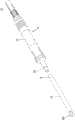
Fig. 2 is according to the axonometric chart of the illustrative embodiments of operating theater instruments of the present disclosure;
Fig. 3 is according to side view, partial perspective view and the part sectioned view of the operating theater instruments with turn-sensitive device system of embodiment of the present disclosure;
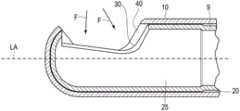
Fig. 4 is the sectional side view with Fig. 3 of the operating theater instruments distal end of the cutting window of aiming at completely;
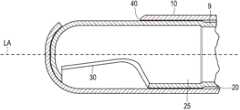
Fig. 5 is the sectional side view that is similar to Fig. 4, but cut the complete misalignment of window, suction is not applied by cutting window;
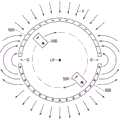
Fig. 6 A is the profile of magnet assembly thoroughly that illustrates that the magnetic member of internal cutting blade and the ferrimagnet of outer cutting blade are made;
Fig. 6 B is the view that is similar to Fig. 6 A, and different is internal cutting blade Rotate 180 o makes the direction of the magnetic flux of responding in magnet assembly thoroughly reverse;
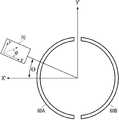
Fig. 7 shows the linear magnetic sensor of twin shaft with respect to the location of magnetic member thoroughly of outer cutting blade;
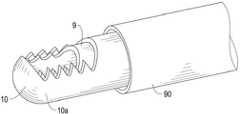
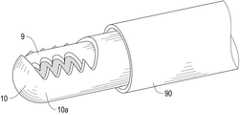
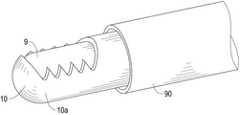
Fig. 8 A to Fig. 8 C shows cutting device wherein and is provided with an embodiment of the electrode for receiving unipolar signal;
Fig. 9 shows cutting zone wherein and is provided with the embodiment of two electrodes for receiving bipolar signal;
Figure 10 is that the driven wheel of wherein leaf spring contact internal cutting blade is to provide the side view of embodiment of coagulation signal;
Figure 11 is the axonometric chart of Figure 10 internal cutting blade;
Figure 12 is that the outer surface of wherein leaf spring contact internal cutting blade is to provide the side view of embodiment of coagulation signal;
Figure 13 is the profile of Figure 12 internal cutting blade;
Figure 14 shows the LVDT(linear variable differential sensor that comprises the relative position for determining internal cutting blade and outer cutting blade) embodiment;
Figure 15 is the end-view of Figure 14 internal cutting blade;
Figure 16 shows the sensor device for the another type of the position of sensing cutting blade;
Figure 17 and Figure 18 are similar to Figure 10 and Figure 11, wherein solidify energy and the two embodiment being optionally applied in of vaporization energy but show;
Figure 19 is the internal cutting blade schematic diagram of reciprocating surgical cutting instrument therein; And
Figure 20 and Figure 21 are wherein internal cutting blade rotation (longitudinal axis of winding apparatus) and the axonometric chart that moves back and forth the embodiment of (along the longitudinal axis of device).
The specific embodiment
Perform the operation the mankind with reference to the accompanying drawings (such as ear, nose and larynx operation) and particularly under the situation of Dou Shoushu and head and neck operation, describe following illustrative embodiments.Following illustrative embodiments also can be in spinal operation, orthomorphia and various other operation application.All illustrative embodiments of the present invention are intended to be used in any pursuit applicatory field.
Fig. 1 is the schematic diagram of powered surgical device system.Except treating that, turn-sensitive device system described below, electrode and control system, this system can be according to U.S. Patent No. 7,247, the system described in 161, its disclosed full content is incorporated to herein by reference.Applicable another system of the present invention is in U.S. Patent No. 7,318, is described in 831, and its whole disclosures are incorporated to herein by reference.As shown in Figure 1, powered surgical device system 1 comprises that handle (or handpiece) 2, foot switch 4(have pedal 12), fluid (liquid and/or gas)source 22,suction source 28,control unit 6,fluid pump 5 and fluid intake/flushing outlet 7.System is supplied with from power supply 16(such as wall outlet) electricpower.Suction source 28 can be such as exporting by being attached to the facility suction being arranged on wall the external suction source providing.Handpiece 2 is connected tooperating theater instruments 8 at its far-end.Operating theater instruments 8 comprises the cutting tip that is positioned at its far-end 8A place in this embodiment, and this cutting tip is for example used for cutting, shaving, removal, excision and/or wearing and tearing tissue, bone and/or other body material.One or more electrodes (treating to describe after a while) are arranged in operating theater instruments 8.In order to simplify accompanying drawing, electrode is not labeled in Fig. 1 to Fig. 5.
Fig. 2 shows the axonometric chart of the illustrative embodiments ofoperating theater instruments 8 according to aspects of thepresent invention.Apparatus 8 is combined withinner tube 9 and outer tube 10.In this illustrative embodiments,inner tube hub 13 is formed on thesecond end 14 of inner tube 9 (referring to Fig. 3), andouter tube hub 15 is formed on thesecond end 17 of outer tube 10 (referring to Fig. 3).For the disclosure, eachpipe 9/10 with andhub 13/15 be generically and collectively referred to as " pipe " or " member ".Inner tube 9 is inserted in thefluid passage 20 being formed inouter tube 10, andinner tube 9 is arranged inouter tube 10 coaxially until the interior distal surface of the outer distal end contactouter tube 10 of inner tube 9.Outer tube 10 has the diameter that is greater thaninner tube 9, therefore allowsinner tube 9 to insert in outer tube 10.It should be understood, however, that inner and outer tubes will be preassembled before being delivered to user.Therefore, user does not probably insert inner tube in outer tube.By flushing liquid is fed topassage 20 viaentrance 26, flushing liquid can be fed to operative site.
Referring to Fig. 3, this Fig. 3 shows the profile of the axonometric chart ofend 8A and the near-end ofhandpiece 2 andcutting blade outer tube 10 comprises thecutting window 40 at a side place that is arranged on its far-end.Therefore,outer tube 10 can be called as the first cutting blade.Inner tube 9 also comprises thecutting window 30 at a side place that is arranged on its far-end.Therefore,inner tube 9 can be called as the second cutting blade.The edge ofcutting window internal cutting blade 9 interior rotation ofcutting blade 10 outside, and therefore in the time thatinternal cutting blade 9 rotates, it is aligned with each other and then become misalignment each other as shown in Figure 5 as shown in Figure 4 that cuttingwindow window cutting window 30 ofinner tube 9 distal end stops thecutting window 40 ofouter cutting blade 10.
Therefore first orouter cutting blade 10 are the outer tubes with near-end and far-end, wherein cutwindow 40 and be arranged on the side place of thefirst cutting blade 10 near far-end.
In, thesecond cutting blade 9 is the tubular bodies with near-end and far-end, wherein cutswindow 30 and be arranged on a side place of its far-end.As previously mentioned, the second,internal cutting blade 9 be rotatably arranged on first, the inside ofouter cutting blade 10, makeoperating theater instruments 8 theendoporus 25 by cuttingblade 9 apply vacuum with in tissue being sucked to thecutting window 30 ofcutting blade 9 and thecutting window 40 ofcutting blade 10 and cutting off tissue bycircumgyration incision blade 9 by first, the interior rotation second ofouter cutting blade 10,internal cutting blade 9 cut and organize.Therefore,cutting blade 9 is the interior rotating members that have near the cutting element of its far-end.This interior rotating member is not necessarily managed.For example, interior rotating member can be the axle at its far-end with cutting element.By such device, apply suction by hollow outer tube 10.In addition, internal cutting member can be the direction reciprocating motion of longitudinally axis LA rather than pipe or the axle of rotation.Inner member pipe or axle can rotate and longitudinally move back and forth.
Fig. 3 also shows turn-sensitive device system according to the embodiment of the present invention.The U.S. Patent application No.13/251 that the turn-sensitive device system of this embodiment was submitted on October 3rd, 2011, is described in 493 in more detail, and whole disclosures of this U. S. application are incorporated to herein by reference.In order to detect the position ofinternal cutting blade 9 with respect toouter cutting blade 10, provide turn-sensitive device system.Turn-sensitive device system comprises the near-endmagnetic member 50 that (on hub 13) arranges oninternal cutting blade 9 nearinternal cutting blade 9, near the near-endmagnetic member 60 thoroughly that (on hub 15) arranges on thisouter cutting blade 10 ofouter cutting blade 10, and be arranged on thesensor 70 on handpiece 2.The magnetic flux ofmagnetic member 60 thoroughly thatsensor 70 sensings are adjacent with this sensor 70.The output ofsensor 70 is provided forcontroller 100, this controller is a part forcontrol unit 6, and comprise for example microprocessor (CPU), working storage (RAM) and memorizer (ROM), be stored in this memorizer for the suitable program of the output that utilizessensor 70.
In connection with Fig. 3, Fig. 6 A and Fig. 6 B, the mode that an embodiment works is described.Handpiece 2 comprises longitudinal axes L A.As shown in Figure 3,magnetic member 50, thoroughlymagnetic member 60 andsensor 70 are radially aimed at each other with respect to the longitudinal axis of handpiece 2.In fact,magnetic member 50 is arranged onmagnetic member 60 inner radial thoroughly.(that is to say themagnetic member 50 ratio more close longitudinal axes L A ofmagnetic member 60 thoroughly).In addition,magnetic member 60 is arranged on the inner radial ofsensor 70 thoroughly.As shown in Figure 6 A and 6 B,magnetic member 50 comprises the magnet 50a and the 50b that are arranged on two phase contrapolarizations at diameter opposite location place with respect to the longitudinal axes L A ofinternal cutting blade 9, and this longitudinal axis is also corresponding to the longitudinal axes L A of handpiece 2.Magnet 50a and 50b are located so that the polarity towards outer magnetic pole of first magnet (50a) in magnet is contrary with the polarity towards outer magnetic pole of second magnet (50b) in magnet.If symbol+expression arctic and symbol-expression South Pole, as shown in Figure 6 A and 6 B, magnet 50a is arranged to its north pole face to radially outer, and magnet 50b is arranged to its south face to radially outer.
Fig. 7 shows an example of sensor 70.According to preferred implementation,sensor 70 is the linear magnetic sensors of twin shaft along two vertical direction (directions X and Y-direction) sensingmagnetic flux.Sensor 70, with respect to magnetic part 60a thoroughly and 60b location, makes one of them measure axis (line of X-axis shown in Fig. 7) and is orthogonal to the adjacently situated surfaces of magnetic structure thoroughly.
Fixedly be, as long assensor 70 radial locations become enough close to magnetic part 60a and/or 60b thoroughly,sensor 70 just effectively sensing and sensor adjacent positioned can magnetic-permeable material moment of polarity switch, and with sensor around by can magnetic-permeable material part 60a and the circumferential registration of the magnetic member thoroughly that limits of 60b have nothing to do.Therefore, disclosed be arranged in detect wheninternal cutting blade 9 position with respect toouter cutting blade 10 very effective, even ifouter cutting blade 10 is with respect to handpiece 2(and therefore with respect to sensor 70) the change of rotation orientation be also like this.
Because the position relationship between thecutting window 30 of magnet 50a and 50b andinternal cutting blade 9 is fixed, and because can magnetic-permeable material part 60a and 60b and thecutting window 40 ofouter cutting blade 10 between position relationship fix, the signal of therefore being exported bysensor 70 can be understood to determine by the signal processing software ofcontroller 100 and/or hardware and cutwindow cutting window 40 ofouter cutting blade 10 outside the page, can magnetic-permeable material part 60a and 60b can be arranged onhub 15, make clearance G be arranged in top side and the bottom side of Fig. 3 of hub 15.Similarly, if thecutting window 30 ofinternal cutting blade 9 as shown in Figure 3 outside the page, magnet 50a and 50b can be arranged so that the upside of theirhubs 13 from Fig. 3 and downside extend.Therefore,, whenever magnet 50a and 50b and clearance G are on time,window sensor 70 also can be used for determining the rotary speed of internal cutting blade.
Fig. 8 A to Fig. 8 B show control circuit (being included in controller 100) wherein to first (outside) at least one electrode of the adjacent setting in cut edge of thecutting window 40 of the far-end ofcutting blade 10 applies unipolar signal.Becauseouter cutting blade 10 can be made up of conductive material (such as rustless steel), thereforeelectric connector 40A(is set referring to Fig. 3 by the near-end nearouter cutting blade 10 simply), the signal of telecommunication that is enough to carry out electricity cutting (vaporization of tissue) or solidify can be provided for the region adjacent with thecutting window 40 of outer cutting blade 10.According to an embodiment of the invention,electric connector 40A is attached tocontroller 100 and is supplied to the suitable signal (vaporize or solidify) with respect to the position that detects ofouter cutting blade 10 based on internal cutting blade 9.As shown in Fig. 8 A to Fig. 8 C, insulatingsheath 90 is arranged onouter cutting blade 10 tops, and only the far-end ofcutting blade 10 is provided for tissue outside to make electric energy (for vaporizing or solidifying).In this, the far-end ofcutting blade 10 is as electrode 10A.
When the cutting window 30 of internal cutting blade and the cutting window 40 of outer cutting blade are as shown in Figure 8 A completely on time, controller 100 sends to first signal of telecommunication electrode 10A of the far-end that is formed on outer cutting blade 10, and this first signal of telecommunication is enough to cause tissue vaporization.First signal of telecommunication continues to be applied in the time that the open position shown in Fig. 8 A rotates to the closed position shown in Fig. 8 C at internal cutting blade 9.That is to say, first signal of telecommunication that is enough to cause tissue vaporization is also applied in during in state shown in Fig. 8 B at apparatus, and under this state, cutting window 40 is because the rotation of internal cutting blade 9 is partially closed.Therefore, tissue is due to the machine cuts action of cutting window 30 and 40 and because the electric gasifying signal that offers electrode 10A is cut.Once outside the window 40 of cutting blade 10 close because the rotation of internal cutting blade 9 becomes completely, the supply of first signal of telecommunication is stopped.The confession of the first electricity (vaporization) signal should be able to be before window 30/40 becomes aligning (or when them become punctual or become aligning after a while at them) starts just, and can become while being stopped completely by internal cutting blade 9 at cutting window 40 (or slightly or after a while) and be stopped.
If expect to solidify, second signal of telecommunication that is different from first signal of telecommunication offers electrode 10A bycontroller 100, and apparatus can not carried out any machinery (or electricity) cutting of tissue simultaneously.Second signal of telecommunication is enough to realize tissue coagulation, but is preferably not enough to realize tissue vaporization.Depend on operation process, hemostasis may not be problem, and therefore the value of second signal of telecommunication can be zero, makes not apply and solidifies energy.If expect to solidify, the value of second signal of telecommunication can be effective well-known value in the time realizing tissue coagulation.
In the embodiment shown in Fig. 8 A to Fig. 8 B, the material ofouter cutting blade 10 is as electrode.In order to limit patient's the area of reception electric energy, electric insulation coating layer or Contraction Ducts can be formed on the outer surface ofblade 10, thereby makeblade 10 the part as electrode is capped.Alternatively, independent conductive layer can be arranged on the material top that formsouter cutting blade 10 to form electrode 10A.Conductive material can be arranged on the whole outer surface top ofouter cutting blade 10, or it can only be arranged on the far-end ofouter cutting blade 10 and cutwindow 40 adjacent.
Embodiment shown in Fig. 8 A to Fig. 8 C be one pole embodiment and therefore independent refurn electrode be for example set to the sticking patch of the skin that is attached to patient.The present invention also can be applicable to bipolar DC system.
Fig. 9 shows the example of bipolar DC system.In Fig. 9, the far-end ofouter cutting blade 10 forms electrode 10A, and this electrode is by the refurn electrode as bipolar DC system.Insulating barrier 92 is formed onouter cutting blade 10 tops.Another electrode 10B is formed as the conductive material layer on insulating barrier 92.Electrode 10B can and will receive signal (for example,, to carry out vaporization or to solidify) fromcontroller 100 as active electrode.External insulation layer 9 is formed on electrode layer 10B top and protects patient's the region of not standing to solidify or cut not receive the energy of self-electrode 10B.
In the above-described embodiment,controller 100 is via being arranged on the electrode (multiple electrode) that is coupled to outer cutting blade near theelectric connector 40A on the outer surface of the near-end of outer cutting blade 10.But other connecting devices are possible.For example,controller 100 can be coupled to electrode (multiple electrode) by thehub 15 being positioned inhandpiece 2.
In the above-described embodiment, the signal of exporting from turn-sensitive device 70 by controller 100 use to determine internal cutting blade 9 with respect to the position of cutting blade 10.Based on determined relative position, the signal of suitably controlling is offered and the electrode (multiple electrode) of the adjacent setting of far-end of outer cutting blade 10 by controller 100.This signal can be enough to carry out the electricity cutting (vaporization) of tissue, as mentioned above.In addition, or alternatively, signal can be suitable for realizing as mentioned above solidifying of tissue.Because only expect the tissue that cutting/vaporization is clamped by the cutting window 30/40 of cutting blade 9/10, the signal of therefore vaporizing is preferably only supplied in the time that tissue is clamped by the cutting surfaces of window 30/40.That is to say, in the time that outer cutting window 40 is fully closed due to the position of rotation of internal cutting blade 9, should not provide vaporization signal.Otherwise its hetero-organization contacting with the distal end of outer cutting blade 10 can undesirably be vaporized.In addition, because conventionally have no reason solidified structure in the time that cutting occurs, therefore coagulation signal (as it is provided) preferably only in the time that tissue cutting does not occur (that is to say, in the time that the cutting window 40 of outer cutting blade 10 is closed due to the position of rotation of internal cutting blade 9) be provided.Coagulation signal can also be supplied during cutting window 40 is while starting to open, and this is because do not cut at that time.As previously mentioned, even in the time that apparatus is used to only carry out machine cuts (that is to say, vaporization signal is not combined with machine cuts), coagulation signal also can be provided.In such embodiment, preferably to only have when cutting window 30/40 and do not cut while organizing, coagulation signal is supplied.
Also as previously mentioned, if carry out electromechanics cutting, preferably makeinternal cutting blade 9 to be slower than the speed rotation that is commonly used to the speed of carrying out machine cuts.For example, if carry out electromechanics cutting, internal cutting blade can be to be less than about 60rpm(revolutions per minute) rotation.Because the cutting being provided by vaporization signal is auxiliary, can use slower rotary speed.In addition, slower rotary speed is preferred, because it will make surgeon more easily clamp more tissue by apparatus.Compared with machine cuts, more clean, the cutting of large " biting " of tissue that dynamo-electric action can provide.Pure machine cuts under fair speed is bitten (obtaining large " biting " required multiple rotary) tissue conventionally into pieces, and can be limited to due to the time range that relatively little cutting window is opened less tissue " biting ".
In the embodiment of the first description,magnetic sensor 70 is for the relative position of sensing internal cutting blade and outer cutting blade, and then the information that senses used to control the signal that is supplied to electrode (multiple electrode) by controller 100.The relative position of some embodiments in following simpler embodiment based on internal cutting blade and outer cutting blade be directly for example, to electrode suppling signal (, coagulation signal), and do not use sensor.
In following embodiment, the signal of telecommunication is provided for internal cutting blade, and the signal of telecommunication be only provided for carry out solidify.Because interior andouter cutting blade 9/10 is preferably made up of conductive material, therefore inwardly cuttingblade 9 is supplied the signal of telecommunication and after passing the far-end ofouter cutting blade 10, is arrived still cause solidifying energy in tissue.That is to say, internal cutting blade and outer cutting blade be at least at their far-end physical contact and electrically contacting each other, make signal will be from internal cutting blade be transmitted to cutting blade.
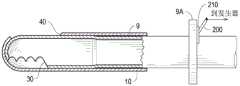
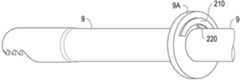
Figure 10 and Figure 11 show the signal of telecommunication wherein and are supplied to by gear 9A the embodiment of internal cutting blade 9, and this gear is used for internal cutting blade 9 to be attached to the motor that makes blade rotation.In Figure 10, the relative position of interior and outer cutting blade 9/10 makes interior and outer cutting window 30/40 misalignment (that is to say, outer cutting window 40 is by the distal end barrier of internal cutting blade 9).This is wherein to expect to provide a position of solidifying energy.Generator is supplied coagulation signal to handpiece.In handpiece, be connected to its distal end of internal cutting blade 9(as electrode by the electroplax spring 200 of making such as the material of beryllium copper by gear 9A).In fact, electric liner 210 is arranged on the side surface of driven wheel 9A.Driven wheel 9A for example, is made up of non-conducting material (acetal).Figure 11 illustrates in greater detail electric liner 210.Electricity liner 210 via conductor 220(such as electric wire) be electrically connected to internal cutting blade 9.As understood from Figure 10 and Figure 11, liner 210 extends along arc, makes the part for each rotation of cutting blade 9, and this liner keeps contacting with leaf spring 200, and therefore receives coagulation signal.By accurately controlling the length of liner 210, the part that is supplied to each rotation of internal cutting blade 9 during the distal end of apparatus in coagulation signal can be accurately controlled.
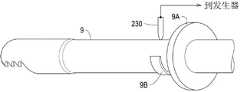
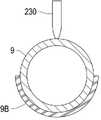
Figure 12 and Figure 13 show another embodiment.In the embodiment of Figure 12 and Figure 13, be connected to generator and ride on the outer surface ofinternal cutting blade 9 to receive theleaf spring 230 of coagulation signal.A part for the outer surface ofinternal cutting blade 9 is covered by non-conductive liner 9B.In the time thatleaf spring 230 directly contacts the outer surface ofinternal cutting blade 9, the distal end of apparatus is solidified energy to the tissue contacting with distal end by receiving and applying.In the time ofleaf spring 230 contact pad designed 9B, do not have coagulation signal to be provided for the distal end of apparatus, this is becauseliner 9B is non-conductive and therefore makecutting blade 9 andleaf spring 230 insulate.Again, the radial extension ofliner 9B affects the part thatinner blade 9 rotates during being accurately controlled the distal end not to be supplied to apparatus in coagulation signal.
In the embodiment shown in Figure 10 to Figure 13,outer cutting blade 10 is fixing and uncontrollable with respect to the orientation of handpiece 2.But, as is known in the art, can regulate the orientation (for example, make the orientation ofouter cutting window 40 can be conditioned) ofouter cutting blade 10 with respect to handpiece.
If the orientation scalable ofouter cutting blade 10, need to be about the orientation ofouter cutting blade 10 information of (more specifically, the orientation of outer cutting window 40), coagulation signal can for example, be provided reasonable time (, in thetime cutting window outer cutting blade 9/10, so that the embodiment of controlling when being supplied in coagulation signal.
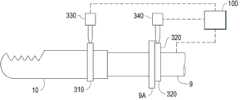
In the embodiment of Figure 14 and Figure 15, each cutting blade 9/10 includes eccentric cam.In addition, transducer or sensor (for example linear variable differential sensor (LVDT)) thus be provided to and each cam interacts and obtains the information about the position of the cutting blade being associated with this cam.As shown in figure 14, the internal cutting blade 9 that has a gear 9A comprises cam 320.The LVDT340 with the sensor arm contacting with the periphery of cam 320 is used for detecting the position of rotation of internal cutting blade 9.In the time that internal cutting blade 9 rotates, towards and will move up and down against the sensor arm of the biased LVDT340 of the periphery of cam, thereby the position of rotation of indication internal cutting blade 9.Because cam is known with respect to the orientation of the cutting window 30 of blade 9, therefore signal for example, by the position of indication cutting window 30 (,, with respect to Figure 14 and Figure 15, the information of upper and lower or position therebetween of whether pointing to about cutting window 30 can be determined).Outer cutting blade 10 has similar cam 310 and LVDT330.Before cutting operation starts, the position of rotation of outer cutting blade 10 can be conditioned with respect to handpiece 2 (although blade 10 will not rotate during cutting operation), and therefore LVDT330 can be used for determining the position that outer cutting blade 10 has been adjusted to.Therefore, the position/orientation of outer cutting window 40 will be known.Controller 100 receives from the signal of LVDT330 and 340 outputs, and therefore can determine when cutting window 30 and 40 is aimed at and misalignment.Therefore, controller 100 can determine when and coagulation signal should be fed to internal cutting blade 9, and this internal cutting blade is electrically coupled to generator via controller 100.
Figure 16 shows dissimilar sensing system.In Figure 16,internal cutting blade 9 is provided withouter shroud 400, and this outer shroud hasconductive part 410 and non-conductive portion 420.Threeconductive pin conductive part 410, this situation can be detected.The position ofpin 450A to 450C andconductive part 410 can be selected, and makes to learn the information of the position on cuttingblade 9 about cutting window 30.Can provide as required greater or less than three pins.If outer cutting blade can regulate with respect to handpiece, similarly layout can be provided forouter cutting blade 10.
Although about the embodiment that applies coagulation signal and described Figure 10 to Figure 16, these embodiments can be used for applying vaporization signal or apply coagulation signal and vaporization signal.For example, referring to the embodiment of Figure 10 and Figure 11, the electric liner that is similar toelectric liner 210 can be arranged to aim at (rather than not aiming at cutting window 30) with cuttingwindow 30 asliner 210, and is similar toleaf spring 200 but the additional leaf spring that is attached to vaporization signal generator can be provided to alternately contact electric liner.If vaporization and coagulation signal will be applied in, for the electric liner of vaporizing with can be arranged on different radial position place ongear 9A for theelectric liner 210 solidifying.
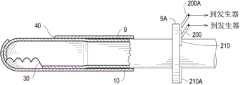
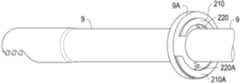
Figure 17 and Figure 18 show the modified form of the embodiment of Figure 10 and Figure 11, wherein solidify and the signal of vaporizing is optionally applied.Generator is to handpiece supply coagulation signal and vaporization signal.In handpiece, be connected to its distal end of internal cutting blade 9(as electrode by the first electroplax spring 200 of making such as the material of beryllium copper by gear 9A).Particularly, the first electric liner 210 is arranged on the side surface of driven wheel 9A.Driven wheel 9A is made up of the electrically non-conductive material such as acetal.Figure 18 illustrates in greater detail the first electric liner 210.The first electric liner 210 is electrically connected to internal cutting blade 9 via the first conductor 220 such as electric wire.As understood from Figure 17 and Figure 18, the first liner 210 extends along arc, makes the part for each rotation of cutting blade 9, and this first liner contacts maintenance with the first leaf spring 200, and therefore receives coagulation signal.By accurately controlling the length of the first liner 210, a part that is supplied to each rotation of internal cutting blade 9 during the distal end of apparatus in coagulation signal can be accurately controlled.The second electric liner 210A is arranged on the side surface of driven wheel 9A.The second liner 210A can be arranged in a side identical with the first liner 210 of driven wheel 9A or on the opposition side of gear 9A.Figure 18 illustrates in greater detail the second electric liner 210A.The second electric liner 210A is electrically connected to internal cutting blade 9 via the second conductor 220A such as electric wire.As understood from Figure 17 and Figure 18, the second liner 210A extends along arc, makes the part for each rotation of cutting blade 9, and this second liner will keep contacting with the second leaf spring 200A, and therefore receives vaporization signal.By accurately controlling the length of the second liner 210A, during vaporization signal is supplied to the distal end of apparatus, a part for each rotation of internal cutting blade 9 can be accurately controlled.The second liner 210A is positioned to than the first liner 210, more radially away from gear 9A center, to make the second liner 210A will only contact the second leaf spring 200A, and to make the first liner 210 will only contact the first leaf spring 200.
As previously mentioned,internal cutting blade 9 can rather than rotate around longitudinal axis along the longitudinal axes L A reciprocating motion of apparatus.In addition,internal cutting blade 9 can move back and forth and rotate.Figure 19 shows the example of the internal cutting blade moving back and forth and rotate.
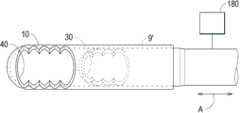
Figure 19 is internal cutting blade 9 ' (the have cutting window 30) schematic diagram of the arbitrary embodiment in reciprocating aforementioned embodiments in the longitudinal axis direction of operating theater instruments in the direction of arrow Awherein.Driving mechanism 180 drives internal cutting blade along the longitudinal axis.Can use the driving mechanism of any well-known type.For example, can use U.S. Patent No. 5,106, disclosed longitudinal reciprocating drive mechanism in 364, whole disclosures of this U. S. application are incorporated to herein by reference.Internal cutting blade 9/9 ' can also be rotated and move back and forth.
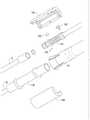
Figure 20 and Figure 21 are the three-dimensional exploded views that makes 9 rotations of internal cutting blade and reciprocating driving mechanism.The level-wind gear mechanism (such as fishing reel and hose reel) of reciprocating gear mechanism based on common in various consumer goodss.Interaction gear has single continuous helicla flute, or track 110, and its outer surface along gear mass 105 is wound around to both along right-hand lay and left-hand.Interior hub (not shown) is fixed to rigidly the proximal portion of interior drive member and transmits rotatablely moving of input from powered handpiece.The proximal portion of interior drive member is fixed to the near-end of gear rigidly.Be arranged on static outer tube assembly 130 and extend through the hole 132 in this assembly from untie-sell 120, and in the time that it is driven by handpiece, causing gear 105 axially reciprocatings.Pin 120 is allowed on its axis, rotate in the time that stroke finishes, because track 110 changes direction and rotates with opposite way.Outer tube assembly 130 and pin 120 are fixed to outer hub 150 rigidly, and outer tube assembly, pin and outer hub all keep static in the time that device uses.Pin 120 is configured with " furcula " shape, and it allows the leading edge of pin to be directed in correct track 110 by the trailing edge of pin.Because pin 120 rides on gear 105, therefore sell 120 leading edge or the trailing edge groove of engaging gear all the time, be also like this even if the right hand portion of track and left hand portion cross one another.
On the far-end of gear mass 105, the extremity of internal cutting blade 9 to gear, is made the linear movement of gear 105 be transformed into the distal part of internal cutting blade 9 by constraint in the axial direction (still needn't restrainedly rotating).If internal cutting blade 9 rotates and moves back and forth, cutting blade 9 is fixed to gear 105 about rotation and translation.If internal cutting blade 9 only moves back and forth (but keeping coplanar with outer cutting blade 10), cutting blade 9 is allowed to rotate with respect to gear 105.But the distal part of internal cutting blade 9 is nailed to or is otherwise fixed to outer cutting blade 10 to allow reciprocating motion in plane, but does not allow rotation.For example, pilot pin 140 extends through the hole in cutting blade 9 and rides on the outer surface of gear 105 in the groove near the far-end of gear 105, makes cutting blade 9 be fixed to vertically gear 105, but can rotate with respect to gear 105.Pilot pin 140, also through the slit 134 in outer tube assembly 130, makes inner blade 9 and outer blade 10 keep suitably aiming at (if inner blade 9 only moves back and forth).If inner blade 9 also rotates with respect to outer blade 10, pilot pin 140 and slit will be removed by province.
The structure (for example, far-end and vacuum and the liquid service duct of interior and outer cutting blade) of the remainder of device can be similar to the structure in upper description for aforementioned embodiments.The stroke of internal cutting blade assembly is determined by the axial length of groove.The number of turns of gear relation between rotation and reciprocating motion based in gear to complete the length of track (stroke) on gear.For example, if gear track forms three and has enclosed reversing stroke and formed three to have enclosed forward stroke, and be 12 from the input speed of handpiece, 000rpm,, for rotation and reciprocating device, distally cutting tip will be with 12, the speed of 000rpm is rotated and is moved back and forth (three circle reversings and three circle forwards equal 6 rotations to complete a complete interaction stroke) with the speed of 2,000rpm.Conventionally, allow the larger motion ratio between rotation and reciprocating motion compared with long stroke.
In the embodiment shown,internal cutting blade 9 andouter cutting blade 10 are straight.But, in operatingtheater instruments 8, can there are one or more bendings, it is not straight making it.In such device,internal cutting blade 9 will be flexible.Flexible hollow cutting blade is known and uses with together with bending cutting device.For example, referring to U.S. Patent No. 4,646,738, its whole disclosures are incorporated to herein by reference, and for example referring to U.S. Patent No. 5,707,350, its whole disclosures are incorporated to herein by reference.
It is exemplary rather than restrictive that the example shown embodiment of foregoing operation tool is intended to.In the situation that not departing from the spirit and scope of the present invention, can carry out various changes.
Claims (17)
Translated fromChineseApplications Claiming Priority (3)
| Application Number | Priority Date | Filing Date | Title |
|---|---|---|---|
| US13/646,229 | 2012-10-05 | ||
| US13/646,229US8702702B1 (en) | 2012-10-05 | 2012-10-05 | Surgical cutting instrument with electromechanical cutting |
| PCT/US2013/039820WO2014055131A1 (en) | 2012-10-05 | 2013-05-07 | Surgical cutting instrument with electromechanical cutting |
Publications (2)
| Publication Number | Publication Date |
|---|---|
| CN103857354Atrue CN103857354A (en) | 2014-06-11 |
| CN103857354B CN103857354B (en) | 2016-02-03 |
Family
ID=48539379
Family Applications (1)
| Application Number | Title | Priority Date | Filing Date |
|---|---|---|---|
| CN201380003080.XAExpired - Fee RelatedCN103857354B (en) | 2012-10-05 | 2013-05-07 | Surgical cutting instruments with electromechanical cutting |
Country Status (5)
| Country | Link |
|---|---|
| US (1) | US8702702B1 (en) |
| EP (1) | EP2731533B1 (en) |
| JP (1) | JP5813245B2 (en) |
| CN (1) | CN103857354B (en) |
| WO (1) | WO2014055131A1 (en) |
Cited By (10)
| Publication number | Priority date | Publication date | Assignee | Title |
|---|---|---|---|---|
| CN105496551A (en)* | 2015-12-31 | 2016-04-20 | 江苏钱璟医疗器械有限公司 | Microscopic kinetic-energy rotary-flushed-absorbed integrated knife system |
| CN108324365A (en)* | 2017-01-10 | 2018-07-27 | 韦伯斯特生物官能(以色列)有限公司 | The cleanser and coagulator of combination |
| CN109561846A (en)* | 2016-03-11 | 2019-04-02 | 锐凌公司 | Arthroscope device and method |
| CN109662755A (en)* | 2019-01-28 | 2019-04-23 | 上海逸思医疗科技有限公司 | A kind of Echinococcus hydatid cyst rotary cut device of aspiration-type |
| CN109788969A (en)* | 2016-10-04 | 2019-05-21 | 波士顿科学医学有限公司 | Cutting tissue device, the tissue ablation system of manual operation and correlation technique |
| CN109770999A (en)* | 2019-01-28 | 2019-05-21 | 逸思(苏州)医疗科技有限公司 | A kind of surgical cutter |
| CN109843198A (en)* | 2016-10-20 | 2019-06-04 | 阿克拉伦特公司 | Multiwindow surgery cuts equipment |
| CN110678135A (en)* | 2017-03-27 | 2020-01-10 | 锐凌公司 | Arthroscopic devices and methods |
| CN114343775A (en)* | 2022-01-06 | 2022-04-15 | 天津大学 | Longitudinal-bending composite ultrasonic vibration reciprocating sternum saw |
| CN116370020A (en)* | 2023-06-07 | 2023-07-04 | 杭州锐健马斯汀医疗器材有限公司 | Planing tool and planing system |
Families Citing this family (99)
| Publication number | Priority date | Publication date | Assignee | Title |
|---|---|---|---|---|
| US11229472B2 (en)* | 2001-06-12 | 2022-01-25 | Cilag Gmbh International | Modular battery powered handheld surgical instrument with multiple magnetic position sensors |
| US20080121343A1 (en) | 2003-12-31 | 2008-05-29 | Microfabrica Inc. | Electrochemical Fabrication Methods Incorporating Dielectric Materials and/or Using Dielectric Substrates |
| US9814484B2 (en) | 2012-11-29 | 2017-11-14 | Microfabrica Inc. | Micro debrider devices and methods of tissue removal |
| US10939934B2 (en) | 2008-06-23 | 2021-03-09 | Microfabrica Inc. | Miniature shredding tools for use in medical applications, methods for making, and procedures for using |
| US11090104B2 (en) | 2009-10-09 | 2021-08-17 | Cilag Gmbh International | Surgical generator for ultrasonic and electrosurgical devices |
| US8979861B2 (en) | 2011-11-17 | 2015-03-17 | NovApproach, Spine LLC | Method and system for performing spinal surgical procedures using natural orifices |
| US9033864B2 (en)* | 2011-12-02 | 2015-05-19 | Interscope, Inc. | Endoscope including a torque generation component or torque delivery component disposed within an insertable portion of the endoscope and a surgical cutting assembly insertable within the endoscope |
| US9033895B2 (en) | 2011-12-02 | 2015-05-19 | Interscope, Inc. | Endoscope including an torque generation component or torque delivery component disposed within an insertable portion of the endoscope and a surgical cutting assembly insertable within the endoscope |
| US8882680B2 (en) | 2011-12-02 | 2014-11-11 | Interscope, Inc. | Insertable endoscopic instrument for tissue removal |
| US9204868B2 (en) | 2011-12-02 | 2015-12-08 | Interscope, Inc. | Methods and apparatus for removing material from within a mammalian cavity using an insertable endoscopic instrument |
| US9028424B2 (en)* | 2011-12-02 | 2015-05-12 | Interscope, Inc. | Endoscope including a torque generation component or torque delivery component disposed within an insertable portion of the endoscope and a surgical cutting assembly insertable within the endoscope |
| US9808146B2 (en) | 2011-12-02 | 2017-11-07 | Interscope, Inc. | Endoscopic tool for debriding and removing polyps |
| US11076840B2 (en) | 2011-12-02 | 2021-08-03 | Interscope, Inc. | Surgical console, specimen receiver, and insertable endoscopic instrument for tissue removal |
| USD855802S1 (en) | 2011-12-23 | 2019-08-06 | Interscope, Inc. | Disposable tool |
| US9226792B2 (en) | 2012-06-12 | 2016-01-05 | Medtronic Advanced Energy Llc | Debridement device and method |
| US9408622B2 (en) | 2012-06-29 | 2016-08-09 | Ethicon Endo-Surgery, Llc | Surgical instruments with articulating shafts |
| US20140276741A1 (en)* | 2013-03-15 | 2014-09-18 | Warsaw Orthopedic, Inc. | Peak plasma blade for soft tissue decompression |
| MX367291B (en) | 2013-04-24 | 2019-08-13 | Medovex Corp | Minimally invasive methods for spinal facet therapy to alleviate pain and associated surgical tools, kits and instructional media. |
| US10004556B2 (en)* | 2013-05-10 | 2018-06-26 | Corinth MedTech, Inc. | Tissue resecting devices and methods |
| EP3137249B1 (en)* | 2014-04-30 | 2020-06-03 | Gyrus Acmi, Inc., D.B.A. Olympus Surgical | Rotary tool with improved coupling assembly |
| WO2015175176A1 (en)* | 2014-05-13 | 2015-11-19 | Acclarent, Inc. | Apparatus for treating disorders of the ear, nose, and throat |
| US10398494B2 (en) | 2014-07-30 | 2019-09-03 | Medovex Corp. | Surgical tools for spinal facet therapy to alleviate pain and related methods |
| EP3148451B1 (en) | 2014-07-30 | 2018-06-06 | Medovex Corp. | Surgical tools for spinal facet therapy to alleviate pain |
| WO2016094653A1 (en) | 2014-12-12 | 2016-06-16 | Medovex Corp. | Surgical tools with positional components |
| AU2016219980B2 (en)* | 2015-02-18 | 2020-09-03 | Medtronic Xomed, Inc. | RF energy enabled tissue debridement device |
| US10188456B2 (en) | 2015-02-18 | 2019-01-29 | Medtronic Xomed, Inc. | Electrode assembly for RF energy enabled tissue debridement device |
| US10376302B2 (en) | 2015-02-18 | 2019-08-13 | Medtronic Xomed, Inc. | Rotating electrical connector for RF energy enabled tissue debridement device |
| US9681913B2 (en) | 2015-04-21 | 2017-06-20 | RELIGN Corporation | Arthroscopic devices and methods |
| US10226276B2 (en) | 2015-06-26 | 2019-03-12 | Covidien Lp | Tissue-removing catheter including operational control mechanism |
| WO2017004268A1 (en) | 2015-06-29 | 2017-01-05 | 480 Biomedical, Inc. | Implantable scaffolds for treatment of sinusitis |
| US10232082B2 (en) | 2015-06-29 | 2019-03-19 | 480 Biomedical, Inc. | Implantable scaffolds for treatment of sinusitis |
| EP3313330A4 (en) | 2015-06-29 | 2019-03-20 | 480 Biomedical, Inc. | SUPPORT LOADING AND DISTRIBUTION SYSTEMS |
| CA2985992A1 (en)* | 2015-07-16 | 2017-01-19 | Cardiovascular Systems, Inc. | Methods, devices and systems for sensing, measuring and/or characterizing vessel and/or lesion compliance and/or elastance changes during vascular procedures |
| US20190015127A1 (en) | 2015-09-23 | 2019-01-17 | Gyrus Acmi, Inc. D/B/A Olympus Surgical Technologies America | Blade positioning system |
| WO2017052703A1 (en) | 2015-09-23 | 2017-03-30 | GYRUS ACMI, INC. (d/b/a OLYMPUS SURGICAL TECHNOLOGIES AMERICA) | Blade positioning device |
| US10194973B2 (en) | 2015-09-30 | 2019-02-05 | Ethicon Llc | Generator for digitally generating electrical signal waveforms for electrosurgical and ultrasonic surgical instruments |
| US9585675B1 (en) | 2015-10-23 | 2017-03-07 | RELIGN Corporation | Arthroscopic devices and methods |
| US9603656B1 (en) | 2015-10-23 | 2017-03-28 | RELIGN Corporation | Arthroscopic devices and methods |
| US10973664B2 (en) | 2015-12-30 | 2021-04-13 | Lyra Therapeutics, Inc. | Scaffold loading and delivery systems |
| US12193698B2 (en) | 2016-01-15 | 2025-01-14 | Cilag Gmbh International | Method for self-diagnosing operation of a control switch in a surgical instrument system |
| US11051840B2 (en) | 2016-01-15 | 2021-07-06 | Ethicon Llc | Modular battery powered handheld surgical instrument with reusable asymmetric handle housing |
| US11129670B2 (en) | 2016-01-15 | 2021-09-28 | Cilag Gmbh International | Modular battery powered handheld surgical instrument with selective application of energy based on button displacement, intensity, or local tissue characterization |
| US11229471B2 (en) | 2016-01-15 | 2022-01-25 | Cilag Gmbh International | Modular battery powered handheld surgical instrument with selective application of energy based on tissue characterization |
| US10052149B2 (en) | 2016-01-20 | 2018-08-21 | RELIGN Corporation | Arthroscopic devices and methods |
| USD810290S1 (en) | 2016-01-29 | 2018-02-13 | Medovex Corp. | Surgical portal driver |
| US10022140B2 (en) | 2016-02-04 | 2018-07-17 | RELIGN Corporation | Arthroscopic devices and methods |
| US20170258519A1 (en) | 2016-03-10 | 2017-09-14 | RELIGN Corporation | Arthroscopic devices and methods |
| US10595889B2 (en) | 2016-04-11 | 2020-03-24 | RELIGN Corporation | Arthroscopic devices and methods |
| US11172953B2 (en) | 2016-04-11 | 2021-11-16 | RELIGN Corporation | Arthroscopic devices and methods |
| CN109561899A (en)* | 2016-04-22 | 2019-04-02 | 锐凌公司 | Arthroscope device and method |
| WO2017205424A1 (en)* | 2016-05-23 | 2017-11-30 | Csaba Truckai | Surgical device having axially reciprocating electrode assembly and methods for treating prostate |
| CN109661209A (en) | 2016-07-01 | 2019-04-19 | 锐凌公司 | Arthroscope device and method |
| US10342572B2 (en)* | 2016-08-15 | 2019-07-09 | Biosense Webster (Israel) Ltd. | Gear mechanism to drive oscillating shaft |
| US10610291B2 (en) | 2016-09-26 | 2020-04-07 | Gyrus Acmi, Inc. | Reconfigurable instrument |
| US11266430B2 (en) | 2016-11-29 | 2022-03-08 | Cilag Gmbh International | End effector control and calibration |
| US11426231B2 (en) | 2017-01-11 | 2022-08-30 | RELIGN Corporation | Arthroscopic devices and methods |
| US11065023B2 (en) | 2017-03-17 | 2021-07-20 | RELIGN Corporation | Arthroscopic devices and methods |
| US10201639B2 (en) | 2017-05-01 | 2019-02-12 | 480 Biomedical, Inc. | Drug-eluting medical implants |
| US12064341B2 (en) | 2017-05-31 | 2024-08-20 | Edwards Lifesciences Corporation | Sealing member for prosthetic heart valve |
| US10765503B2 (en)* | 2017-07-31 | 2020-09-08 | Edwards Lifesciences Corporation | Bicuspid valve dissection device |
| CN109381224A (en)* | 2017-08-02 | 2019-02-26 | 温伯格医学物理有限公司 | Using Magnetic driving capsule carry out tissue biopsy or removal or to tissue added material devices, systems, and methods |
| US10751077B2 (en)* | 2017-10-09 | 2020-08-25 | Gyrus Acmi, Inc. | Tissue Resection Device |
| WO2019094708A1 (en)* | 2017-11-09 | 2019-05-16 | Caldera Medical, Inc. | Rotary instruments and methods for intrauterine tissue resection |
| DE102017011054B4 (en) | 2017-11-29 | 2019-08-08 | OLYMPUS Winter & lbe GmbH | Electrosurgical instrument |
| WO2019133542A1 (en)* | 2017-12-27 | 2019-07-04 | Aaron Germain | Arthroscopic devices and methods |
| US10517629B2 (en) | 2018-01-26 | 2019-12-31 | Gyrus Acmi, Inc. | Disposable debrider with cannulated solenoid |
| US11617596B2 (en)* | 2018-04-30 | 2023-04-04 | RELIGN Corporation | Arthroscopic devices and methods |
| US11246650B2 (en)* | 2019-01-10 | 2022-02-15 | RELIGN Corporation | Arthroscopic devices and methods |
| US11766288B2 (en) | 2019-02-22 | 2023-09-26 | Gyrus Acmi, Inc. | Flexible bipolar sheath |
| US11272980B2 (en) | 2019-04-04 | 2022-03-15 | Biosense Webster (Israel) Ltd. | Medical instrument with coagulation |
| US11717342B2 (en)* | 2019-04-11 | 2023-08-08 | Gyrus Acmi, Inc. | Medical device |
| US11712287B2 (en) | 2019-04-18 | 2023-08-01 | Biosense Webster (Israel) Ltd. | Grasper tool with coagulation |
| US11350948B2 (en) | 2019-04-22 | 2022-06-07 | Medos International Sarl | Bone and tissue resection devices and methods |
| US11324530B2 (en) | 2019-04-22 | 2022-05-10 | Medos International Sarl | Bone and tissue resection devices and methods |
| US11389178B2 (en) | 2019-04-22 | 2022-07-19 | Medos International Sarl | Bone and tissue resection devices and methods |
| US11413056B2 (en) | 2019-04-22 | 2022-08-16 | Medos International Sarl | Bone and tissue resection devices and methods |
| EP4014901A3 (en)* | 2019-05-17 | 2022-09-07 | Covidien LP | Manually-actuated tissue resecting instruments |
| US11504181B2 (en)* | 2019-07-01 | 2022-11-22 | RELIGN Corporation | Arthroscopic devices and methods |
| US12023086B2 (en) | 2019-12-30 | 2024-07-02 | Cilag Gmbh International | Electrosurgical instrument for delivering blended energy modalities to tissue |
| US11786294B2 (en) | 2019-12-30 | 2023-10-17 | Cilag Gmbh International | Control program for modular combination energy device |
| US11937863B2 (en) | 2019-12-30 | 2024-03-26 | Cilag Gmbh International | Deflectable electrode with variable compression bias along the length of the deflectable electrode |
| US11786291B2 (en) | 2019-12-30 | 2023-10-17 | Cilag Gmbh International | Deflectable support of RF energy electrode with respect to opposing ultrasonic blade |
| US12262937B2 (en) | 2019-12-30 | 2025-04-01 | Cilag Gmbh International | User interface for surgical instrument with combination energy modality end-effector |
| US11779387B2 (en) | 2019-12-30 | 2023-10-10 | Cilag Gmbh International | Clamp arm jaw to minimize tissue sticking and improve tissue control |
| US11812957B2 (en) | 2019-12-30 | 2023-11-14 | Cilag Gmbh International | Surgical instrument comprising a signal interference resolution system |
| US12082808B2 (en) | 2019-12-30 | 2024-09-10 | Cilag Gmbh International | Surgical instrument comprising a control system responsive to software configurations |
| US12053224B2 (en) | 2019-12-30 | 2024-08-06 | Cilag Gmbh International | Variation in electrode parameters and deflectable electrode to modify energy density and tissue interaction |
| US12076006B2 (en) | 2019-12-30 | 2024-09-03 | Cilag Gmbh International | Surgical instrument comprising an orientation detection system |
| US12343063B2 (en) | 2019-12-30 | 2025-07-01 | Cilag Gmbh International | Multi-layer clamp arm pad for enhanced versatility and performance of a surgical device |
| US11986201B2 (en) | 2019-12-30 | 2024-05-21 | Cilag Gmbh International | Method for operating a surgical instrument |
| US11944366B2 (en) | 2019-12-30 | 2024-04-02 | Cilag Gmbh International | Asymmetric segmented ultrasonic support pad for cooperative engagement with a movable RF electrode |
| US11937866B2 (en) | 2019-12-30 | 2024-03-26 | Cilag Gmbh International | Method for an electrosurgical procedure |
| US12336747B2 (en) | 2019-12-30 | 2025-06-24 | Cilag Gmbh International | Method of operating a combination ultrasonic / bipolar RF surgical device with a combination energy modality end-effector |
| US11950797B2 (en) | 2019-12-30 | 2024-04-09 | Cilag Gmbh International | Deflectable electrode with higher distal bias relative to proximal bias |
| US20210196357A1 (en) | 2019-12-30 | 2021-07-01 | Ethicon Llc | Electrosurgical instrument with asynchronous energizing electrodes |
| US20210282837A1 (en)* | 2020-03-11 | 2021-09-16 | Covidien Lp | Thermal cutting-assisted tissue resection devices and systems |
| US11957373B2 (en) | 2020-05-12 | 2024-04-16 | Smith & Nephew, Inc. | Systems and methods of determining orientation of cutting windows of a mechanical resection instrument |
| CN115227385A (en)* | 2022-06-17 | 2022-10-25 | 上海修能医疗器械有限公司 | Radio frequency scalpel and system |
| GB2622265B (en)* | 2022-09-08 | 2025-03-26 | Gyrus Medical Ltd | Rotary shaver arrangement for a surgical instrument |
Citations (6)
| Publication number | Priority date | Publication date | Assignee | Title |
|---|---|---|---|---|
| US5106364A (en)* | 1989-07-07 | 1992-04-21 | Kabushiki Kaisha Topcon | Surgical cutter |
| EP0923907A1 (en)* | 1997-12-19 | 1999-06-23 | Gyrus Medical Limited | An electrosurgical instrument |
| US6258111B1 (en)* | 1997-10-03 | 2001-07-10 | Scieran Technologies, Inc. | Apparatus and method for performing ophthalmic procedures |
| CN1628615A (en)* | 2003-09-29 | 2005-06-22 | 伊西康内外科公司 | Endoscopic mucosal resection device and usage |
| US20060129145A1 (en)* | 1997-10-23 | 2006-06-15 | Arthrocare Corporation | Bipolar electrosurgical clamp for removing and modifying tissue |
| US20060178670A1 (en)* | 2003-07-16 | 2006-08-10 | Arthro Care Corporation | Rotary electrosurgical apparatus and methods thereof |
Family Cites Families (7)
| Publication number | Priority date | Publication date | Assignee | Title |
|---|---|---|---|---|
| US4646738A (en) | 1985-12-05 | 1987-03-03 | Concept, Inc. | Rotary surgical tool |
| US5152744A (en) | 1990-02-07 | 1992-10-06 | Smith & Nephew Dyonics | Surgical instrument |
| US5904681A (en)* | 1997-02-10 | 1999-05-18 | Hugh S. West, Jr. | Endoscopic surgical instrument with ability to selectively remove different tissue with mechanical and electrical energy |
| US7226459B2 (en)* | 2001-10-26 | 2007-06-05 | Smith & Nephew, Inc. | Reciprocating rotary arthroscopic surgical instrument |
| US7247161B2 (en) | 2002-03-22 | 2007-07-24 | Gyrus Ent L.L.C. | Powered surgical apparatus, method of manufacturing powered surgical apparatus, and method of using powered surgical apparatus |
| CA2493356A1 (en) | 2002-07-13 | 2004-01-22 | Stryker Corporation | System and method for performing irrigated nose and throat surgery |
| US7674263B2 (en)* | 2005-03-04 | 2010-03-09 | Gyrus Ent, L.L.C. | Surgical instrument and method |
- 2012
- 2012-10-05USUS13/646,229patent/US8702702B1/enactiveActive
- 2013
- 2013-05-07JPJP2014540237Apatent/JP5813245B2/ennot_activeExpired - Fee Related
- 2013-05-07WOPCT/US2013/039820patent/WO2014055131A1/enactiveApplication Filing
- 2013-05-07EPEP13726327.3Apatent/EP2731533B1/enactiveActive
- 2013-05-07CNCN201380003080.XApatent/CN103857354B/ennot_activeExpired - Fee Related
Patent Citations (6)
| Publication number | Priority date | Publication date | Assignee | Title |
|---|---|---|---|---|
| US5106364A (en)* | 1989-07-07 | 1992-04-21 | Kabushiki Kaisha Topcon | Surgical cutter |
| US6258111B1 (en)* | 1997-10-03 | 2001-07-10 | Scieran Technologies, Inc. | Apparatus and method for performing ophthalmic procedures |
| US20060129145A1 (en)* | 1997-10-23 | 2006-06-15 | Arthrocare Corporation | Bipolar electrosurgical clamp for removing and modifying tissue |
| EP0923907A1 (en)* | 1997-12-19 | 1999-06-23 | Gyrus Medical Limited | An electrosurgical instrument |
| US20060178670A1 (en)* | 2003-07-16 | 2006-08-10 | Arthro Care Corporation | Rotary electrosurgical apparatus and methods thereof |
| CN1628615A (en)* | 2003-09-29 | 2005-06-22 | 伊西康内外科公司 | Endoscopic mucosal resection device and usage |
Cited By (17)
| Publication number | Priority date | Publication date | Assignee | Title |
|---|---|---|---|---|
| CN105496551A (en)* | 2015-12-31 | 2016-04-20 | 江苏钱璟医疗器械有限公司 | Microscopic kinetic-energy rotary-flushed-absorbed integrated knife system |
| US11207119B2 (en) | 2016-03-11 | 2021-12-28 | RELIGN Corporation | Arthroscopic devices and methods |
| US12096969B2 (en) | 2016-03-11 | 2024-09-24 | RELIGN Corporation | Arthroscopic devices and methods |
| CN109561846A (en)* | 2016-03-11 | 2019-04-02 | 锐凌公司 | Arthroscope device and method |
| CN109561846B (en)* | 2016-03-11 | 2022-01-28 | 锐凌公司 | Arthroscopic devices and methods |
| CN109788969A (en)* | 2016-10-04 | 2019-05-21 | 波士顿科学医学有限公司 | Cutting tissue device, the tissue ablation system of manual operation and correlation technique |
| CN109843198A (en)* | 2016-10-20 | 2019-06-04 | 阿克拉伦特公司 | Multiwindow surgery cuts equipment |
| CN108324365B (en)* | 2017-01-10 | 2023-06-16 | 韦伯斯特生物官能(以色列)有限公司 | Combined debrider and coagulator |
| CN108324365A (en)* | 2017-01-10 | 2018-07-27 | 韦伯斯特生物官能(以色列)有限公司 | The cleanser and coagulator of combination |
| CN110678135A (en)* | 2017-03-27 | 2020-01-10 | 锐凌公司 | Arthroscopic devices and methods |
| CN109770999A (en)* | 2019-01-28 | 2019-05-21 | 逸思(苏州)医疗科技有限公司 | A kind of surgical cutter |
| CN109662755A (en)* | 2019-01-28 | 2019-04-23 | 上海逸思医疗科技有限公司 | A kind of Echinococcus hydatid cyst rotary cut device of aspiration-type |
| CN109770999B (en)* | 2019-01-28 | 2024-04-16 | 逸思(苏州)医疗科技有限公司 | Surgical cutter |
| CN114343775A (en)* | 2022-01-06 | 2022-04-15 | 天津大学 | Longitudinal-bending composite ultrasonic vibration reciprocating sternum saw |
| CN114343775B (en)* | 2022-01-06 | 2023-10-31 | 天津大学 | Longitudinal and bending composite ultrasonic vibration reciprocating sternum saw |
| CN116370020A (en)* | 2023-06-07 | 2023-07-04 | 杭州锐健马斯汀医疗器材有限公司 | Planing tool and planing system |
| CN116370020B (en)* | 2023-06-07 | 2023-08-25 | 杭州锐健马斯汀医疗器材有限公司 | Planing tool and planing system |
Also Published As
| Publication number | Publication date |
|---|---|
| CN103857354B (en) | 2016-02-03 |
| EP2731533A1 (en) | 2014-05-21 |
| WO2014055131A1 (en) | 2014-04-10 |
| US20140100567A1 (en) | 2014-04-10 |
| US8702702B1 (en) | 2014-04-22 |
| JP5813245B2 (en) | 2015-11-17 |
| JP2014534874A (en) | 2014-12-25 |
| EP2731533B1 (en) | 2015-08-19 |
Similar Documents
| Publication | Publication Date | Title |
|---|---|---|
| CN103857354A (en) | Surgical cutting instrument with electromechanical cutting | |
| US20220096147A1 (en) | Electrode assembly for rf energy enabled tissue debridement device | |
| US9078664B2 (en) | Bipolar surgical instrument with two half tube electrodes | |
| US11350983B2 (en) | Tissue sealing instrument with tissue-dissecting electrode | |
| US8968298B2 (en) | Electrosurgical instrument | |
| US10376302B2 (en) | Rotating electrical connector for RF energy enabled tissue debridement device | |
| JP5489397B2 (en) | Electrosurgical high frequency energy transfer medium | |
| US11497551B2 (en) | Arthroscopic devices and methods | |
| CN113329709A (en) | Combined electrosurgical and mechanical resection device | |
| JP7231580B2 (en) | medical device | |
| CA2613581A1 (en) | Bipolar tissue debrider and method | |
| US10383682B2 (en) | Powered bipolar resectoscope | |
| US20240293140A1 (en) | Arthroscopic devices and methods | |
| JP7326482B2 (en) | Endoscopic Treatment Tool, Endoscopic Treatment System, and Endoscopic Treatment Method | |
| US20160256181A1 (en) | Morcellator concept for tonsillectomy | |
| US20140276813A1 (en) | Suction electrocautery device having controlled irrigation and rotating auger | |
| JP7471897B2 (en) | Grasping tool with solidification | |
| WO2023129658A1 (en) | Pericardiotomy devices and related methods | |
| JPS62501473A (en) | electrosurgical instruments |
Legal Events
| Date | Code | Title | Description |
|---|---|---|---|
| C06 | Publication | ||
| PB01 | Publication | ||
| C10 | Entry into substantive examination | ||
| SE01 | Entry into force of request for substantive examination | ||
| C14 | Grant of patent or utility model | ||
| GR01 | Patent grant | ||
| CF01 | Termination of patent right due to non-payment of annual fee | ||
| CF01 | Termination of patent right due to non-payment of annual fee | Granted publication date:20160203 |