CN101730864B - Spacer lithography - Google Patents
Spacer lithographyDownload PDFInfo
- Publication number
- CN101730864B CN101730864BCN2008800237522ACN200880023752ACN101730864BCN 101730864 BCN101730864 BCN 101730864BCN 2008800237522 ACN2008800237522 ACN 2008800237522ACN 200880023752 ACN200880023752 ACN 200880023752ACN 101730864 BCN101730864 BCN 101730864B
- Authority
- CN
- China
- Prior art keywords
- shielding pattern
- layer
- acid
- cross
- distance piece
- Prior art date
- Legal status (The legal status is an assumption and is not a legal conclusion. Google has not performed a legal analysis and makes no representation as to the accuracy of the status listed.)
- Active
Links
Images
Classifications
- G—PHYSICS
- G03—PHOTOGRAPHY; CINEMATOGRAPHY; ANALOGOUS TECHNIQUES USING WAVES OTHER THAN OPTICAL WAVES; ELECTROGRAPHY; HOLOGRAPHY
- G03F—PHOTOMECHANICAL PRODUCTION OF TEXTURED OR PATTERNED SURFACES, e.g. FOR PRINTING, FOR PROCESSING OF SEMICONDUCTOR DEVICES; MATERIALS THEREFOR; ORIGINALS THEREFOR; APPARATUS SPECIALLY ADAPTED THEREFOR
- G03F7/00—Photomechanical, e.g. photolithographic, production of textured or patterned surfaces, e.g. printing surfaces; Materials therefor, e.g. comprising photoresists; Apparatus specially adapted therefor
- G03F7/0035—Multiple processes, e.g. applying a further resist layer on an already in a previously step, processed pattern or textured surface
- G—PHYSICS
- G03—PHOTOGRAPHY; CINEMATOGRAPHY; ANALOGOUS TECHNIQUES USING WAVES OTHER THAN OPTICAL WAVES; ELECTROGRAPHY; HOLOGRAPHY
- G03F—PHOTOMECHANICAL PRODUCTION OF TEXTURED OR PATTERNED SURFACES, e.g. FOR PRINTING, FOR PROCESSING OF SEMICONDUCTOR DEVICES; MATERIALS THEREFOR; ORIGINALS THEREFOR; APPARATUS SPECIALLY ADAPTED THEREFOR
- G03F7/00—Photomechanical, e.g. photolithographic, production of textured or patterned surfaces, e.g. printing surfaces; Materials therefor, e.g. comprising photoresists; Apparatus specially adapted therefor
- G03F7/26—Processing photosensitive materials; Apparatus therefor
- G03F7/40—Treatment after imagewise removal, e.g. baking
- H—ELECTRICITY
- H01—ELECTRIC ELEMENTS
- H01L—SEMICONDUCTOR DEVICES NOT COVERED BY CLASS H10
- H01L21/00—Processes or apparatus adapted for the manufacture or treatment of semiconductor or solid state devices or of parts thereof
- H01L21/02—Manufacture or treatment of semiconductor devices or of parts thereof
- H01L21/027—Making masks on semiconductor bodies for further photolithographic processing not provided for in group H01L21/18 or H01L21/34
- H01L21/0271—Making masks on semiconductor bodies for further photolithographic processing not provided for in group H01L21/18 or H01L21/34 comprising organic layers
- H01L21/0273—Making masks on semiconductor bodies for further photolithographic processing not provided for in group H01L21/18 or H01L21/34 comprising organic layers characterised by the treatment of photoresist layers
- H01L21/0274—Photolithographic processes
- H—ELECTRICITY
- H01—ELECTRIC ELEMENTS
- H01L—SEMICONDUCTOR DEVICES NOT COVERED BY CLASS H10
- H01L21/00—Processes or apparatus adapted for the manufacture or treatment of semiconductor or solid state devices or of parts thereof
- H01L21/02—Manufacture or treatment of semiconductor devices or of parts thereof
- H01L21/04—Manufacture or treatment of semiconductor devices or of parts thereof the devices having potential barriers, e.g. a PN junction, depletion layer or carrier concentration layer
- H01L21/18—Manufacture or treatment of semiconductor devices or of parts thereof the devices having potential barriers, e.g. a PN junction, depletion layer or carrier concentration layer the devices having semiconductor bodies comprising elements of Group IV of the Periodic Table or AIIIBV compounds with or without impurities, e.g. doping materials
- H01L21/30—Treatment of semiconductor bodies using processes or apparatus not provided for in groups H01L21/20 - H01L21/26
- H01L21/31—Treatment of semiconductor bodies using processes or apparatus not provided for in groups H01L21/20 - H01L21/26 to form insulating layers thereon, e.g. for masking or by using photolithographic techniques; After treatment of these layers; Selection of materials for these layers
- H01L21/3205—Deposition of non-insulating-, e.g. conductive- or resistive-, layers on insulating layers; After-treatment of these layers
- H01L21/321—After treatment
- H01L21/3213—Physical or chemical etching of the layers, e.g. to produce a patterned layer from a pre-deposited extensive layer
- H01L21/32139—Physical or chemical etching of the layers, e.g. to produce a patterned layer from a pre-deposited extensive layer using masks
Landscapes
- Physics & Mathematics (AREA)
- Engineering & Computer Science (AREA)
- General Physics & Mathematics (AREA)
- Condensed Matter Physics & Semiconductors (AREA)
- Manufacturing & Machinery (AREA)
- Computer Hardware Design (AREA)
- Microelectronics & Electronic Packaging (AREA)
- Power Engineering (AREA)
- Exposure And Positioning Against Photoresist Photosensitive Materials (AREA)
- Photosensitive Polymer And Photoresist Processing (AREA)
- Exposure Of Semiconductors, Excluding Electron Or Ion Beam Exposure (AREA)
Abstract
Description
Translated fromChinese技术领域technical field
本发明系关于具有准确形成之超细微设计特征(design feature)的半导体器件之制造。本发明系尤其可应用于以增加制造产量之有效方法而制造具有深次微米(deep sub-micron)范围的设计特征之高速集成电路的半导体器件。The present invention relates to the fabrication of semiconductor devices with precisely formed ultrafine design features. The present invention is particularly applicable to semiconductor devices for manufacturing high-speed integrated circuits with design features in the deep sub-micron range in an efficient manner to increase manufacturing yield.
背景技术Background technique
半导体器件特征的尺寸持续进入深次微米范围(如数十奈米(decananometer)的范围中),以挑战习知的制造技术。随着关键尺寸的收缩,以具高制造产量之有效方法而达到高尺寸精确度变得日益困难。最小特征尺寸系根据特定微影蚀刻(lithography)系统的化学和光学限制以及对外形变形的容忍度而定。除了习知微影蚀刻的限制之外,形成超细微设计特征所伴随之制造成本会增加,因此需要对设备之有效使用和高制造产量提前设计处理。The dimensions of semiconductor device features continue to enter the deep sub-micron range (eg, in the decananometer range) to challenge conventional fabrication techniques. As critical dimensions shrink, it becomes increasingly difficult to achieve high dimensional accuracy in an efficient manner with high manufacturing throughput. The minimum feature size is determined by the chemical and optical constraints of the particular lithography system and the tolerance to shape distortion. In addition to the limitations of conventional lithographic etching, the increased manufacturing costs associated with forming ultra-fine design features necessitates efficient use of equipment and high manufacturing throughput in advance design processes.
涉及间隔件微影蚀刻制程的双重曝光技术已有所发展。然而,这些技术尚未完全成功并且有低制造产量的问题,某些技术需要使用到不同工具和频繁的化学机械研磨(CMP)。从一个工具到另一工具的晶圆传送以及CMP的频繁使用不仅浪费时间,还不可避免地导致降低产率,因此对芯片制造商不利。在现今的竞争市场,需要至少70%的产率才有获利。Double exposure techniques involving spacer lithographic etching processes have been developed. However, these techniques have not been completely successful and suffer from low manufacturing throughput, some techniques require the use of different tools and frequent chemical mechanical polishing (CMP). The transfer of wafers from one tool to another and the frequent use of CMP not only wastes time, but also inevitably leads to lower yields and is therefore not good for chipmakers. In today's competitive market, a yield of at least 70% is required to be profitable.
因此,需要有一种方法,能够制造包括已准确形成有深次微米范围内之特征(例如:小于35nm的设计特征,包含小于20nm的设计特征(如小于10nm))的器件的半导体芯片。特别需要有此种方法,以使精确形成具有高效率和高制造产量之超细微设计特征。Therefore, there is a need for a method that can manufacture semiconductor chips including devices that have accurately formed features in the deep sub-micron range (for example: design features less than 35nm, including design features less than 20nm (eg less than 10nm). There is a particular need for such a method to precisely form ultrafine design features with high efficiency and high manufacturing throughput.
发明内容Contents of the invention
本发明的一个优点为一种制造半导体器件的方法,该半导体器件具有深次微米范围之尺寸的准确形成的特征。One advantage of the present invention is a method of fabricating a semiconductor device having accurately formed features with dimensions in the deep submicron range.
本发明的另一个优点为一种制造半导体器件的有效方法,该半导体器件具有在高制造产量时之精确形成的微米特征。Another advantage of the present invention is an efficient method of fabricating semiconductor devices having precisely formed micron features at high manufacturing throughput.
本发明之额外优点和其它特征将在以下叙述提出,且部分将对本领域具通常知识者在审视下列叙述后变得显而易见,或是可以经由本发明之具体实施而了解。Additional advantages and other features of the present invention will be set forth in the following description, and some of them will become apparent to those skilled in the art after reviewing the following description, or can be understood through the specific practice of the present invention.
根据本发明,前述或其它优点系部分通过一种制造半导体器件的方法达成,该方法包括:形成第一屏蔽图案(mask pattern)于目标层之上;形成可交联层(cross-linkable)于该第一屏蔽图案之上;形成交联间隔件(cross-linked spacer)于该第一屏蔽图案和该可交联层之间;以及去除该可交联层、用以暴露该第一屏蔽图案的该交联间隔件的足够部分以及该第一屏蔽图案,以形成包含该交联间隔件的剩余部分的第二屏蔽图案。According to the present invention, the foregoing and other advantages are achieved in part by a method of manufacturing a semiconductor device, the method comprising: forming a first mask pattern on a target layer; forming a cross-linkable layer on On the first shielding pattern; forming a cross-linked spacer (cross-linked spacer) between the first shielding pattern and the crosslinkable layer; and removing the crosslinkable layer to expose the first shielding pattern A sufficient portion of the cross-linked spacer and the first masking pattern are formed to form a second masking pattern comprising the remainder of the cross-linked spacer.
本发明的另一优点为一种制造半导体器件的方法,该方法包括:形成第一光阻(photoresist)屏蔽图案于目标层之上,该第一光阻屏蔽图案具有上表面与侧表面且具有可产生酸的材料;形成可交联层于该第一光阻屏蔽图案上,该可交联层具有可在酸存在下进行交联反应的材料;通过加热或辐射在该第一光阻屏蔽图案中产生酸;加热以向该可交联层扩散酸而在该第一光阻屏蔽图案的上表面和侧表面上形成交联间隔件;去除该可交联层的部分以暴露在该第一光阻屏蔽图案之上表面上的该交联间隔件,且从该第一光阻屏蔽图案之上表面去除被暴露的该交联间隔件,而留下在该第一光阻屏蔽图案之侧表面上的该交联间隔件;去除该可交联层的剩余部分以及去除该第一光阻屏蔽图案以形成第二屏蔽图案,该第二屏蔽图案包括先前在该第一光阻屏蔽图案之侧表面上的该交联间隔件;以及使用该第二屏蔽图案蚀刻该目标层。Another advantage of the present invention is a method of manufacturing a semiconductor device, the method comprising: forming a first photoresist (photoresist) masking pattern on the target layer, the first photoresist masking pattern has an upper surface and a side surface and has A material that can generate acid; forming a cross-linkable layer on the first photoresist masking pattern, the cross-linkable layer has a material that can undergo a cross-linking reaction in the presence of an acid; Generating acid in the pattern; heating to diffuse the acid to the crosslinkable layer to form crosslinking spacers on the upper surface and side surfaces of the first photoresist mask pattern; removing part of the crosslinkable layer to expose the first photoresist mask pattern the crosslinked spacer on the upper surface of a photoresist masking pattern, and remove the exposed crosslinked spacer from the upper surface of the first photoresist masking pattern, leaving behind the first photoresist masking pattern The cross-linking spacer on the side surface; removing the remaining part of the cross-linkable layer and removing the first photoresist masking pattern to form a second masking pattern, the second masking pattern includes the first photoresist masking pattern previously the cross-linked spacer on the side surface; and etching the target layer using the second mask pattern.
本发明的再一优点为一种制造半导体器件的方法,该方法包括:形成第一屏蔽图案于目标层之上,该第一屏蔽图案包括第一有机材料;形成一层,该层包括可在酸的存在下进行交联反应的第二有机材料;形成并扩散酸至该第二有机材料以交联其一部分而在该第一屏蔽图案上形成交联间隔件;蚀刻以去除该第二有机材料和该交联间隔件之一部分以足够暴露该第一屏蔽图案;以及蚀刻该第二有机材料的剩余部分和该第一屏蔽图案以形成包括该交联间隔件的剩余部分的第二屏蔽图案。Another advantage of the present invention is a method of manufacturing a semiconductor device, the method comprising: forming a first shielding pattern on a target layer, the first shielding pattern comprising a first organic material; forming a layer comprising a A second organic material that undergoes a crosslinking reaction in the presence of an acid; forming and diffusing acid to the second organic material to crosslink a part thereof to form a crosslinking spacer on the first shielding pattern; etching to remove the second organic material material and a portion of the cross-linked spacer to sufficiently expose the first masking pattern; and etching the remaining portion of the second organic material and the first masking pattern to form a second masking pattern including the remaining portion of the cross-linked spacer .
本发明之实施例包含形成该间隔件层为少于35nm之厚度,以及蚀刻(如通过定时蚀刻技术(timed etching technique))以去除该第二有机材料之一部分和该交联间隔件层的部分,以足够暴露该第一屏蔽图案,接着蚀刻该第二有机材料的剩余部份和该第一屏蔽图案。本发明之实施例包含从光阻材料形成该第一屏蔽图案,该光阻材料包括酚醛树脂(novolac resin)、以重氮萘醌为主(naphthoquinonediazide-base)的光敏剂、以及氯-甲基-三嗪(chloro-methyl-triazine)酸产生剂,或是从多羟基-苯乙烯衍生物(polyhydroxy-styrene derivative)和作用为光辅助酸产生剂之鎓盐(onium salt)形成该第一有机材料。本发明之实施例也包含沉积含有水溶性树脂之有机材料以作为该可交联层。Embodiments of the present invention include forming the spacer layer to a thickness of less than 35 nm, and etching (e.g., by a timed etching technique) to remove a portion of the second organic material and a portion of the cross-linked spacer layer , to sufficiently expose the first masking pattern, and then etch the remaining portion of the second organic material and the first masking pattern. Embodiments of the present invention include forming the first mask pattern from a photoresist material including novolac resin, a naphthoquinonediazide-based photosensitizer, and chloro-methyl -triazine (chloro-methyl-triazine) acid generator, or from polyhydroxy-styrene derivative (polyhydroxy-styrene derivative) and onium salt (onium salt) acting as light-assisted acid generator to form the first organic Material. Embodiments of the present invention also include depositing an organic material comprising a water-soluble resin as the crosslinkable layer.
本领域具有通常知识者在阅读下列实施方式后,本发明之额外优点将变得显而易见,其中本发明所描述的实施例系仅通过考虑用于实施本发明之最佳模式来表述。要了解到的是,本发明能够具有其它及不同实施例,且其数个细节能够在不背离本发明的情况下,在各种明显态样中予以修改。因此,图式与描述本质上系被视为例示性而限制性的。Additional advantages of the present invention will become apparent to those of ordinary skill in the art upon reading the following description, wherein the described embodiments of the invention are presented only by considering the best modes for carrying out the invention. As will be realized, the invention is capable of other and different embodiments, and its several details are capable of modifications in various obvious respects, all without departing from the invention. Accordingly, the drawings and descriptions are to be regarded as illustrative and restrictive in nature.
附图说明Description of drawings
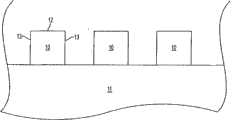
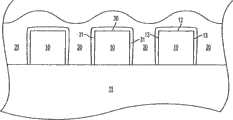
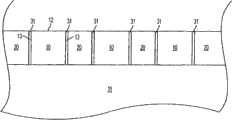
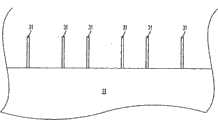
图1到图6为概要表示根据本发明实施例之一种方法的连续阶段之剖面图。在图1至图6中,类似的特征以相同的组件符号表示。1 to 6 are cross-sectional views schematically illustrating successive stages of a method according to an embodiment of the invention. In Figures 1 to 6, similar features are denoted by the same reference numerals.
具体实施方式Detailed ways
本发明系满足与解决制造具有小于35nm(像是小于20nm,例如小于10nm)的精确形成之超细微设计特征的半导体器件之问题。这些问题系起源于习知微影蚀刻系统的化学和光学限制所加诸的尺寸限制、起因于多重曝光步骤与其间的处理之未对准(misalignment)以及特征形状的变形。习知制造技术一直挑战要跟上精确形成之超细微特征的需求,特别为使高制造产量的有效方法维持竞争性。像是多重曝光、在不同工具间传送晶圆之操作以及特别是化学机械处理(CMP)操作会降低制造产量,因此不利地冲击获利能力。The present invention satisfies and solves the problem of fabricating semiconductor devices with precisely formed ultra-fine design features less than 35nm, such as less than 20nm, eg less than 10nm. These problems arise from the size constraints imposed by the chemical and optical limitations of conventional lithography systems, misalignment due to multiple exposure steps and intervening processes, and distortion of feature shapes. Conventional fabrication techniques have been challenged to keep pace with the demands of precisely formed ultra-fine features, especially to maintain competitiveness in efficient methods for high fabrication throughput. Operations such as multiple exposures, transferring wafers between different tools, and especially chemical-mechanical processing (CMP) operations reduce manufacturing throughput, thus adversely impacting profitability.
习知微影蚀刻实务缺乏满足对于精确形成之愈加细微的器件特征之持续需求,特别是在于增加制造产量的有效方法。例如:习知实务通常涉及在微影蚀刻期间使用数个不同工具(其包含具有伴随的未对准问题的多重曝光),以及通常需要CMP。不同工具与CMP的使用,特别是在介电质表面上,不仅浪费时间,而且也增加了芯片被退回的机率,且因此降低制造产量和降低获利能力。Conventional lithographic etch practices lack efficient methods to meet the continuing demand for precisely formed finer and finer device features, particularly to increase manufacturing throughput. For example: conventional practice often involves the use of several different tools during lithography, which involves multiple exposures with attendant misalignment issues, and often requires CMP. The use of different tools and CMP, especially on dielectric surfaces, not only wastes time, but also increases the chances of chips being returned, and thus reduces manufacturing yield and profitability.
本发明提供的方法能够以增加制造产量的有效方法形成包括各种类型之半导体器件的芯片,该等半导体器件具有精确形成之超细微设计特征。根据本发明的实施例,第一屏蔽图案系形成在目标层之上,其中超细微图案将形成于该目标层中。交联间隔件系形成在该第一屏蔽图案上。第二屏蔽图案系接着形成,其中该第二屏蔽图案包括该交联间隔件的部分。该间隔件的厚度控制在达成精确超细微之自行对准特征(self-aligned feature),例如小于35nm。The method provided by the present invention enables the formation of chips including various types of semiconductor devices with precisely formed ultrafine design features in an efficient manner to increase manufacturing yield. According to an embodiment of the present invention, the first shielding pattern is formed on the target layer in which the ultrafine pattern is to be formed. A cross-link spacer is formed on the first shielding pattern. A second masking pattern is then formed, wherein the second masking pattern includes a portion of the cross-linked spacer. The thickness of the spacer is controlled to achieve precise ultrafine self-aligned features, such as less than 35nm.
本发明的实施例之连续阶段系概要揭示在图1至图6中,其中类似特征系以相同组件符号代表。注意到图1,包含有间隔部分之第一屏蔽图案10系形成在目标层11之上。目标层11可以是在将被蚀刻之习知半导体制造技术期间所形成的任何各种层,例如导电层或半导体层,其中系形成闸极电极。该第一屏蔽图案典型地包含有机材料,例如光阻材料,且包括在后续敷设层中能够引起反应(例如:交联反应)的成分。根据本发明之丨些实施例,第一屏蔽图案10包括可以产生酸的光阻材料。适当的材料包括酚醛树脂、以重氮萘醌为主的光敏剂、以及作用为酸产生剂之氯-甲基-三嗪的混合物。本发明之丨些实施例也包含从包括多羟基-苯乙烯衍生物和作用为光辅助酸产生剂之鎓盐的混合物中形成该第一屏蔽图案。该第一屏蔽层可由化学放大型光阻剂(chemicallyamplified resist)所组成,其系采用当暴露在某些类型的辐射下(例如UV射线、电子束或X射线)或是当加热时而产生酸之机制。Successive stages of an embodiment of the invention are schematically disclosed in Figures 1-6, where like features are represented by like reference numerals. Referring to FIG. 1 , a
根据图2,层20系沉积覆盖于该第一屏蔽图案10。在本发明的一些实施例中,层20包括可进行交联反应的材料,像是可在酸的存在下进行交联反应的材料。层20之适当材料包含水溶性及水不溶性树脂,该水溶性及水不溶性树脂在酸、水溶性及水不溶性交联剂及其混合的存在下导致交联反应。本发明的一些实施例中,水溶性树脂系选自聚丙烯酸(polyacrylic acid)、聚乙烯缩醛(polyvinyl acetal)、聚乙烯吡咯烷酮(polyvinylpyrrolidone)、聚乙烯醇(polyvinyl alcohol)、聚乙亚胺(polyethyleneimine)、苯乙烯-顺丁烯二酸酐共聚物(styrene-maleicanhydride copolymer)、聚乙烯胺(polyvinylamine)、聚烯丙基胺(polyallylamine)、含唑啉基团(oxazoline group)之水溶性树脂、水溶性胺甲酸乙酯(water-soluble urethane)、水溶性酚、水溶性环氧树脂、水溶性三聚氢胺树脂、水溶性尿素树脂、醇酸树脂、磺酰胺、其盐类以及其二种或更多种之混合物所组成的群组。该水溶性交联剂可以是选自以三聚氢胺为主的交联剂(如:三聚氢胺衍生物或羟甲基三聚氰胺衍生物)、以尿素为主的交联剂(如:尿素衍生物、羟甲基尿素衍生物、乙烯尿素羧酸酯或羟甲基-伸乙基-尿素衍生物)以及以胺基为主的交联剂(如:苯并胍胺、甘脲(glycoluril)或异氰酸酯(isocyanate))所组成之群组其中之丨类材料或是二类或更多类的材料。According to FIG. 2 , a
在本发明的一实施例中,层20系以聚乙烯缩醛树脂所形成,而其含量系由控制该聚乙烯缩醛树脂的缩醛化作用之范围所控制。在本发明的其它实施例中,层20可以包括选自聚乙烯缩醛和甲氧基-羟甲基-尿素树脂之混合物、聚乙烯缩醛和甲氧基-羟甲基-三聚氰胺之混合物或是甲氧基-羟甲基-三聚氰胺和聚烯丙基胺之混合物所组成之群组的材料。在本发明的另一实施例中,其发现特别适用于使用交联剂,像是由Sunnyvale,CA.之JSR Micro,Inc.所贩卖的JSR CSX004,JSR CSX004仅稍微溶于水。In one embodiment of the present invention, the
典型地,该层20系使用不能分解该第丨屏蔽图案10的溶液所沉积。用于沉积层20的适当溶液包含纯水或是纯水与酒精的混合物。Typically, the
根据一些实施例,能够与层20进行反应或引起交联反应的物种(species)系在该第丨屏蔽图案上形成或是在该第丨屏蔽图案中产生。适当的处理包含在整个暴露表面之上以具有适度波长的光线进行辐射,如箭头A(图2)所表示者。在本发明之另一实施例中,第丨屏蔽图案10的部分可以例如通过屏蔽其它部分而选择性地被辐射,以在该第丨屏蔽图案的选择部分10中产生酸。在本发明的其它实施例中,可以实施雷射加热退火以对该第丨屏蔽图案的选择部分10加热而产生酸。在仅该第丨屏蔽图案的某些部分10被选择性的加热或处理之情况下,该交联间隔件层会仅在该选择性加热或处理之部分上形成。According to some embodiments, species capable of reacting with
根据图3,系导致层20的部分进行一反应以在该第丨屏蔽图案之上形成间隔件。例如,晶圆可以例如被加热到大约60至130℃所烘烤,藉此允许在第丨屏蔽图案中产生的酸扩散到层20而引起交联反应,以在该第丨屏蔽图案上形成交联间隔件。如图3所示,该交联间隔件包括形成在该第一屏蔽图案10的上表面12上之上部分30以及形成在该第一屏蔽图案10的侧表面13上之侧部分31。加热量可以通过根据所包含的特定材料和该交联间隔件的所需厚度而控制加热期间(如60秒至120秒)来予以控制。According to FIG. 3, portions of
随后,如图4所示,去除该层20的上部分和该交联间隔件的该上部分30。这样的去除可以透过化学去除或CMP而达成。然而,根据本发明的实施例,CMP可被有利地省略,且该层20的上部分和该交联间隔件的上部分30则通过蚀刻所去除,例如通过选择性蚀刻该层20的上部分,接着通过选择性蚀刻去去除该交联间隔件的上部分30。或者,可以各自地或在其中一个步骤中使用定时蚀刻技术来去除该层20的上部分与该交联间隔件的上部分30,以暴露出该第丨屏蔽图案的部分10的上表面12,即如图4所示。用以去除该(未交联之)可交联层20的上部分与该交联间隔件的上部分30之适当蚀刻剂包含具有O2、N2和CXHYFZ之气体蚀刻剂成分。Subsequently, as shown in FIG. 4 , the upper portion of the
根据图5,该(未交联之)可交联层20的剩余部分和该第丨屏蔽图案的部分10一起被去除(例如通过蚀刻),以形成第二或最终屏蔽图案,该第二或最终屏蔽图案包括先前在该第丨屏蔽图案的部分10的侧表面13上的交联部分31。用以去除剩余的未交联层20和部分10之适当蚀刻剂包含具有O2、N2和CXHYFZ之气体蚀刻剂成分。接着,使用该第二屏蔽图案以导入蚀刻而在该目标层11中形成特征60,例如为闸极电极。特征60系与交联间隔件部分31自行对准且具有类似于间隔件层31之厚度的宽度。According to FIG. 5, the remaining part of the (uncrosslinked) crosslinkable
本发明可使用不同类型的材料和技术而实施。例如:可以由在美国专利第5,858,620号和美国专利第6,319,853号中所解释的方法与所采用的材料而产生酸,以上各专利案之完整揭露系在此合并作为参考。例如:预烤(prebaking)可以在形成该第一屏蔽图案之后和在沉积层20之后执行。除了通过辐射之外,还可以通过例如在沉积层20之前使用酸性溶液对该第丨屏蔽图案进行处理,且接着,加热以允许酸扩散和交联层20的一部分,从而形成酸。The invention can be implemented using different types of materials and techniques. For example, acids can be generated by the methods and materials used as explained in US Patent No. 5,858,620 and US Patent No. 6,319,853, the entire disclosures of which are hereby incorporated by reference. For example: prebaking may be performed after forming the first mask pattern and after depositing the
本发明的实施例对于第丨屏蔽图案和层20有利地采用有机材料,因此可以最小化在不同工具间之传送。再者,在本发明的实施例中,绝缘层中有问题的CMP可通过蚀刻而避免,像是采用定时蚀刻技术。本发明的实施例可以在形成该第丨屏蔽图案使用单一曝光步骤而予以实施,因此避免其间处理的多重曝光所伴随而来的未对准问题。Embodiments of the present invention advantageously employ organic materials for the first masking pattern and
本发明可以在包括各种类型的半导体器件之半导体芯片制造中实施,该半导体器件包含半导体内存器件,例如可抹除可程序化只读存储器(EPROM)、电子可抹除可程序化只读存储器(EEPROM)以及快闪可抹除可程序化只读存储器(FEPROM)。根据本发明的实施例所制造出的半导体芯片可以在各种商业电子器件上实施,例如,计算机、行动电话和数字相机,也可以依照习用方法轻易地整合在印刷电路板上。The present invention may be practiced in the manufacture of semiconductor chips including various types of semiconductor devices including semiconductor memory devices such as Erasable Programmable Read Only Memory (EPROM), Electronically Erasable Programmable Read Only Memory (EPROM), Electronically Erasable Programmable Read Only Memory (EEPROM) and flash erasable programmable read-only memory (FEPROM). The semiconductor chips manufactured according to the embodiments of the present invention can be implemented on various commercial electronic devices, such as computers, mobile phones and digital cameras, and can also be easily integrated on printed circuit boards according to conventional methods.
本发明能够有效制造出包括具有高制造产量的精确超细微之设计特征的器件之半导体芯片。本发明享有在制造有利于各种类型的工业应用之半导体芯片之工业应用性,其包含具有高度整合之半导体器件之芯片,其包含展现出增加电路速度的闪存半导体器件。The present invention enables efficient fabrication of semiconductor chips including devices with precise ultrafine design features with high fabrication yield. The present invention enjoys industrial applicability in the manufacture of semiconductor chips advantageous for various types of industrial applications, including chips with highly integrated semiconductor devices, including flash memory semiconductor devices exhibiting increased circuit speed.
在前揭描述中,本发明系根据其特定例示性实施例而描述。然而,其明显可在不违反如申请专利范围所描述之本发明之较宽广的精神与范围的情况下进行各种改良或变化。因此,说明书与图式将被视为例示性而非限制性。应了解到的是,本发明能够使用各种其它组合和实施例,且能够如在此表现的发明概念范围内做任何改变或改良。In the foregoing description, the invention has been described in terms of specific illustrative embodiments thereof. It will, however, be evident that various modifications or changes may be made without departing from the broader spirit and scope of the invention as described in the claims. Accordingly, the specification and drawings are to be regarded as illustrative rather than restrictive. It is to be understood that the present invention is capable of various other combinations and embodiments and is capable of any changes or modifications within the scope of the inventive concepts presented herein.
Claims (10)
Applications Claiming Priority (3)
| Application Number | Priority Date | Filing Date | Title |
|---|---|---|---|
| US11/775,727US8642474B2 (en) | 2007-07-10 | 2007-07-10 | Spacer lithography |
| US11/775,727 | 2007-07-10 | ||
| PCT/US2008/008470WO2009009095A1 (en) | 2007-07-10 | 2008-07-10 | Spacer lithography |
Publications (2)
| Publication Number | Publication Date |
|---|---|
| CN101730864A CN101730864A (en) | 2010-06-09 |
| CN101730864Btrue CN101730864B (en) | 2012-07-18 |
Family
ID=39765015
Family Applications (1)
| Application Number | Title | Priority Date | Filing Date |
|---|---|---|---|
| CN2008800237522AActiveCN101730864B (en) | 2007-07-10 | 2008-07-10 | Spacer lithography |
Country Status (7)
| Country | Link |
|---|---|
| US (1) | US8642474B2 (en) |
| EP (1) | EP2168008B1 (en) |
| JP (1) | JP5120983B2 (en) |
| KR (1) | KR101520440B1 (en) |
| CN (1) | CN101730864B (en) |
| TW (1) | TWI431665B (en) |
| WO (1) | WO2009009095A1 (en) |
Families Citing this family (11)
| Publication number | Priority date | Publication date | Assignee | Title |
|---|---|---|---|---|
| CN101963755B (en) | 2009-06-26 | 2012-12-19 | 罗门哈斯电子材料有限公司 | Self-aligned spacer multiple patterning methods |
| EP2287669A1 (en)* | 2009-06-26 | 2011-02-23 | Rohm and Haas Electronic Materials, L.L.C. | Methods of forming electronic devices |
| JP5753351B2 (en)* | 2009-11-19 | 2015-07-22 | ローム アンド ハース エレクトロニック マテリアルズ エルエルシーRohm and Haas Electronic Materials LLC | Method for forming an electronic device |
| US8815747B2 (en)* | 2010-06-03 | 2014-08-26 | Micron Technology, Inc. | Methods of forming patterns on substrates |
| US9233840B2 (en)* | 2010-10-28 | 2016-01-12 | International Business Machines Corporation | Method for improving self-assembled polymer features |
| US9330914B2 (en) | 2013-10-08 | 2016-05-03 | Micron Technology, Inc. | Methods of forming line patterns in substrates |
| JP6126570B2 (en)* | 2013-12-13 | 2017-05-10 | 富士フイルム株式会社 | Pattern forming method, electronic device manufacturing method |
| US9257439B2 (en)* | 2014-02-27 | 2016-02-09 | Taiwan Semiconductor Manufacturing Company, Ltd. | Structure and method for FinFET SRAM |
| CN110391133B (en)* | 2018-04-17 | 2021-07-20 | 联华电子股份有限公司 | patterning method |
| US11069692B2 (en) | 2018-07-31 | 2021-07-20 | Taiwan Semiconductor Manufacturing Co., Ltd. | FinFET SRAM cells with dielectric fins |
| US11437385B2 (en) | 2018-09-24 | 2022-09-06 | Taiwan Semiconductor Manufacturing Co., Ltd. | FinFET SRAM cells with reduced fin pitch |
Family Cites Families (62)
| Publication number | Priority date | Publication date | Assignee | Title |
|---|---|---|---|---|
| DE3242113A1 (en)* | 1982-11-13 | 1984-05-24 | Ibm Deutschland Gmbh, 7000 Stuttgart | METHOD FOR PRODUCING A THIN DIELECTRIC INSULATION IN A SILICON SEMICONDUCTOR BODY |
| JPS62199068A (en)* | 1986-02-27 | 1987-09-02 | Toshiba Corp | Semiconductor device and manufacture thereof |
| EP0238690B1 (en)* | 1986-03-27 | 1991-11-06 | International Business Machines Corporation | Process for forming sidewalls |
| US5322764A (en)* | 1991-05-21 | 1994-06-21 | Mitsubishi Denki Kabushiki Kaisha | Method for forming a patterned resist |
| US5654202A (en)* | 1992-03-24 | 1997-08-05 | Eastman Kodak Company | Stabilization of a patterned planarizing layer for solid state imagers prior to color filter pattern formation |
| US5618383A (en)* | 1994-03-30 | 1997-04-08 | Texas Instruments Incorporated | Narrow lateral dimensioned microelectronic structures and method of forming the same |
| JP3317582B2 (en)* | 1994-06-01 | 2002-08-26 | 菱電セミコンダクタシステムエンジニアリング株式会社 | Method of forming fine pattern |
| JPH08152716A (en)* | 1994-11-28 | 1996-06-11 | Mitsubishi Electric Corp | Negative resist and method of forming resist pattern |
| JPH08321613A (en)* | 1995-05-26 | 1996-12-03 | Ricoh Co Ltd | Method for manufacturing semiconductor device |
| US5795830A (en)* | 1995-06-06 | 1998-08-18 | International Business Machines Corporation | Reducing pitch with continuously adjustable line and space dimensions |
| US5879955A (en)* | 1995-06-07 | 1999-03-09 | Micron Technology, Inc. | Method for fabricating an array of ultra-small pores for chalcogenide memory cells |
| TW329539B (en)* | 1996-07-05 | 1998-04-11 | Mitsubishi Electric Corp | The semiconductor device and its manufacturing method |
| TW353775B (en)* | 1996-11-27 | 1999-03-01 | Tokyo Electron Ltd | Production of semiconductor device |
| TW372337B (en)* | 1997-03-31 | 1999-10-21 | Mitsubishi Electric Corp | Material for forming micropattern and manufacturing method of semiconductor using the material and semiconductor apparatus |
| TW383416B (en)* | 1997-06-26 | 2000-03-01 | Matsushita Electric Industrial Co Ltd | Pattern forming method |
| US6063688A (en)* | 1997-09-29 | 2000-05-16 | Intel Corporation | Fabrication of deep submicron structures and quantum wire transistors using hard-mask transistor width definition |
| JP3189773B2 (en)* | 1998-01-09 | 2001-07-16 | 三菱電機株式会社 | Method of forming resist pattern, method of manufacturing semiconductor device using the same, and semiconductor device |
| US6331378B1 (en)* | 1998-02-25 | 2001-12-18 | Matsushita Electric Industrial Co., Ltd. | Pattern forming method |
| US6291137B1 (en)* | 1999-01-20 | 2001-09-18 | Advanced Micro Devices, Inc. | Sidewall formation for sidewall patterning of sub 100 nm structures |
| US6183938B1 (en)* | 1998-12-08 | 2001-02-06 | Advanced Micro Devices, Inc. | Conformal organic coatings for sidewall patterning of sublithographic structures |
| US6335531B1 (en)* | 1999-04-06 | 2002-01-01 | Micron Technology, Inc. | Modification of resist and/or resist processing with fluorescence detection |
| JP3950584B2 (en)* | 1999-06-29 | 2007-08-01 | Azエレクトロニックマテリアルズ株式会社 | Water-soluble resin composition |
| JP2001066782A (en)* | 1999-08-26 | 2001-03-16 | Mitsubishi Electric Corp | Semiconductor device manufacturing method and semiconductor device |
| JP2001100428A (en)* | 1999-09-27 | 2001-04-13 | Mitsubishi Electric Corp | Manufacturing method of semiconductor device, chemical solution for forming fine pattern, and semiconductor device |
| US6239008B1 (en)* | 1999-09-29 | 2001-05-29 | Advanced Micro Devices, Inc. | Method of making a density multiplier for semiconductor device manufacturing |
| US6362057B1 (en)* | 1999-10-26 | 2002-03-26 | Motorola, Inc. | Method for forming a semiconductor device |
| JP2001284813A (en)* | 2000-03-31 | 2001-10-12 | Mitsubishi Electric Corp | Method for manufacturing multilayer wiring board |
| JP3343341B2 (en)* | 2000-04-28 | 2002-11-11 | ティーディーケイ株式会社 | Fine pattern forming method, developing / cleaning apparatus used therefor, plating method using the same, and method of manufacturing thin film magnetic head using the same |
| US6492075B1 (en)* | 2000-06-16 | 2002-12-10 | Advanced Micro Devices, Inc. | Chemical trim process |
| US6534243B1 (en)* | 2000-10-23 | 2003-03-18 | Advanced Micro Devices, Inc. | Chemical feature doubling process |
| US6383952B1 (en)* | 2001-02-28 | 2002-05-07 | Advanced Micro Devices, Inc. | RELACS process to double the frequency or pitch of small feature formation |
| JP3633595B2 (en)* | 2001-08-10 | 2005-03-30 | 富士通株式会社 | Resist pattern swelling material, micropattern formation method using the same, and semiconductor device manufacturing method |
| US7189783B2 (en)* | 2001-11-27 | 2007-03-13 | Fujitsu Limited | Resist pattern thickening material, resist pattern and forming process thereof, and semiconductor device and manufacturing process thereof |
| US6638441B2 (en)* | 2002-01-07 | 2003-10-28 | Macronix International Co., Ltd. | Method for pitch reduction |
| US6862798B2 (en)* | 2002-01-18 | 2005-03-08 | Hitachi Global Storage Technologies Netherlands B.V. | Method of making a narrow pole tip by ion beam deposition |
| JP3953822B2 (en)* | 2002-01-25 | 2007-08-08 | 富士通株式会社 | Resist pattern thinning material, resist pattern and manufacturing method thereof, and semiconductor device and manufacturing method thereof |
| JP2004056000A (en)* | 2002-07-23 | 2004-02-19 | Renesas Technology Corp | Method for forming resist pattern and method for manufacturing semiconductor device using the same |
| JP3850767B2 (en)* | 2002-07-25 | 2006-11-29 | 富士通株式会社 | Resist pattern thickening material, resist pattern and manufacturing method thereof, and semiconductor device and manufacturing method thereof |
| US6566280B1 (en)* | 2002-08-26 | 2003-05-20 | Intel Corporation | Forming polymer features on a substrate |
| KR100493029B1 (en)* | 2002-10-26 | 2005-06-07 | 삼성전자주식회사 | Forming method of fine patterns for semiconductor device |
| JP4191506B2 (en)* | 2003-02-21 | 2008-12-03 | Tdk株式会社 | High density inductor and manufacturing method thereof |
| US6905975B2 (en)* | 2003-07-03 | 2005-06-14 | Micron Technology, Inc. | Methods of forming patterned compositions |
| JP3774713B2 (en)* | 2003-10-15 | 2006-05-17 | 株式会社東芝 | Contact hole formation method |
| JP4143023B2 (en)* | 2003-11-21 | 2008-09-03 | 株式会社東芝 | Pattern forming method and semiconductor device manufacturing method |
| US7498225B1 (en)* | 2003-12-04 | 2009-03-03 | Advanced Micro Devices, Inc. | Systems and methods for forming multiple fin structures using metal-induced-crystallization |
| US7314691B2 (en)* | 2004-04-08 | 2008-01-01 | Samsung Electronics Co., Ltd. | Mask pattern for semiconductor device fabrication, method of forming the same, method for preparing coating composition for fine pattern formation, and method of fabricating semiconductor device |
| JP4490228B2 (en)* | 2004-06-15 | 2010-06-23 | 富士通株式会社 | Resist pattern thickening material, resist pattern forming method, semiconductor device and manufacturing method thereof |
| US7655387B2 (en)* | 2004-09-02 | 2010-02-02 | Micron Technology, Inc. | Method to align mask patterns |
| JP4302065B2 (en)* | 2005-01-31 | 2009-07-22 | 株式会社東芝 | Pattern formation method |
| JP4676325B2 (en)* | 2005-02-18 | 2011-04-27 | 富士通株式会社 | Resist pattern thickening material, resist pattern forming method, semiconductor device and manufacturing method thereof |
| GB2423634A (en)* | 2005-02-25 | 2006-08-30 | Seiko Epson Corp | A patterning method for manufacturing high resolution structures |
| US7429536B2 (en)* | 2005-05-23 | 2008-09-30 | Micron Technology, Inc. | Methods for forming arrays of small, closely spaced features |
| US7396781B2 (en)* | 2005-06-09 | 2008-07-08 | Micron Technology, Inc. | Method and apparatus for adjusting feature size and position |
| GB2429332A (en)* | 2005-08-18 | 2007-02-21 | Filtronic Compound Semiconduct | A method of producing a trench with a coating of a cross linked polymer |
| US8153350B2 (en)* | 2005-08-24 | 2012-04-10 | Taiwan Semiconductor Manufacturing Co., Ltd. | Method and material for forming high etch resistant double exposure patterns |
| JP4566862B2 (en)* | 2005-08-25 | 2010-10-20 | 富士通株式会社 | Resist pattern thickening material, resist pattern forming method, semiconductor device and manufacturing method thereof |
| JP5177948B2 (en)* | 2005-10-11 | 2013-04-10 | 東京エレクトロン株式会社 | Resist film removing method and computer-readable storage medium |
| JP2007140151A (en)* | 2005-11-18 | 2007-06-07 | Renesas Technology Corp | Fine pattern forming material, fine pattern forming method, method for manufacturing electronic device using the same, and electronic device manufactured by the method |
| JP4719069B2 (en)* | 2006-04-21 | 2011-07-06 | パナソニック株式会社 | Resist material and pattern forming method using the same |
| US7488685B2 (en)* | 2006-04-25 | 2009-02-10 | Micron Technology, Inc. | Process for improving critical dimension uniformity of integrated circuit arrays |
| US7959818B2 (en)* | 2006-09-12 | 2011-06-14 | Hynix Semiconductor Inc. | Method for forming a fine pattern of a semiconductor device |
| US7790357B2 (en)* | 2006-09-12 | 2010-09-07 | Hynix Semiconductor Inc. | Method of forming fine pattern of semiconductor device |
- 2007
- 2007-07-10USUS11/775,727patent/US8642474B2/enactiveActive
- 2008
- 2008-07-08TWTW097125658Apatent/TWI431665B/enactive
- 2008-07-10JPJP2010516054Apatent/JP5120983B2/enactiveActive
- 2008-07-10EPEP08780091.8Apatent/EP2168008B1/enactiveActive
- 2008-07-10KRKR1020107002932Apatent/KR101520440B1/enactiveActive
- 2008-07-10CNCN2008800237522Apatent/CN101730864B/enactiveActive
- 2008-07-10WOPCT/US2008/008470patent/WO2009009095A1/enactiveApplication Filing
Also Published As
| Publication number | Publication date |
|---|---|
| US20090017628A1 (en) | 2009-01-15 |
| US8642474B2 (en) | 2014-02-04 |
| CN101730864A (en) | 2010-06-09 |
| JP5120983B2 (en) | 2013-01-16 |
| JP2010534346A (en) | 2010-11-04 |
| TW200915389A (en) | 2009-04-01 |
| KR20100057799A (en) | 2010-06-01 |
| WO2009009095A1 (en) | 2009-01-15 |
| EP2168008B1 (en) | 2014-11-26 |
| EP2168008A1 (en) | 2010-03-31 |
| KR101520440B1 (en) | 2015-05-15 |
| TWI431665B (en) | 2014-03-21 |
Similar Documents
| Publication | Publication Date | Title |
|---|---|---|
| CN101730864B (en) | Spacer lithography | |
| CN106226998B (en) | Photoetching method | |
| US20030219683A1 (en) | Low temperature resist trimming process | |
| JP5728566B2 (en) | Method and system for altering patterned features of a substrate using ion implantation | |
| US8158332B2 (en) | Method of manufacturing a semiconductor device | |
| US6416933B1 (en) | Method to produce small space pattern using plasma polymerization layer | |
| TW533505B (en) | Process for forming sub-lithographic photoresist features | |
| TWI549162B (en) | Patterned structure of semiconductor storage device and method for manufacturing the same | |
| CN106324998B (en) | The forming method of litho pattern | |
| KR20160063318A (en) | Exposure activated chemically amplified directed self-assembly(dsa) for back end of line(beol) pattern cutting and plugging | |
| US6900002B1 (en) | Antireflective bi-layer hardmask including a densified amorphous carbon layer | |
| JP2002134379A (en) | Pattern formation method | |
| CN103280403B (en) | Manufacturing method for dual gate oxide device | |
| CN110556288A (en) | Method for forming semiconductor device | |
| JP4413880B2 (en) | Manufacturing method of semiconductor device | |
| US7157211B2 (en) | Method of fabricating a semiconductor device | |
| KR100493029B1 (en) | Forming method of fine patterns for semiconductor device | |
| US20090246708A1 (en) | Method of forming mask pattern | |
| CN101221889A (en) | pattern forming method | |
| JP2010073899A (en) | Method for processing substrate and substrate processing apparatus | |
| KR100645835B1 (en) | Method of forming photoresist pattern of semiconductor device | |
| US7416990B2 (en) | Method for patterning low dielectric layer of semiconductor device | |
| TWI873630B (en) | Method for forming a resist pattern | |
| TWI882736B (en) | Manufacturing method of semiconductor device | |
| US11189495B2 (en) | Semiconductor structure and fabrication method thereof |
Legal Events
| Date | Code | Title | Description |
|---|---|---|---|
| C06 | Publication | ||
| PB01 | Publication | ||
| C10 | Entry into substantive examination | ||
| SE01 | Entry into force of request for substantive examination | ||
| C14 | Grant of patent or utility model | ||
| GR01 | Patent grant |