CN101057481B - Method and apparatus for scheduling packets for routing in a network with implicit determination of packets to be processed with priority - Google Patents
Method and apparatus for scheduling packets for routing in a network with implicit determination of packets to be processed with priorityDownload PDFInfo
- Publication number
- CN101057481B CN101057481BCN2005800390393ACN200580039039ACN101057481BCN 101057481 BCN101057481 BCN 101057481BCN 2005800390393 ACN2005800390393 ACN 2005800390393ACN 200580039039 ACN200580039039 ACN 200580039039ACN 101057481 BCN101057481 BCN 101057481B
- Authority
- CN
- China
- Prior art keywords
- stream
- grouping
- priority queues
- tabulation
- queue
- Prior art date
- Legal status (The legal status is an assumption and is not a legal conclusion. Google has not performed a legal analysis and makes no representation as to the accuracy of the status listed.)
- Active
Links
- 238000000034methodMethods0.000titleclaimsabstractdescription62
- 230000015572biosynthetic processEffects0.000claimsdescription50
- 238000012545processingMethods0.000claimsdescription16
- 230000005540biological transmissionEffects0.000claimsdescription7
- 239000013256coordination polymerSubstances0.000claimsdescription7
- 238000005755formation reactionMethods0.000description49
- 238000012360testing methodMethods0.000description47
- 230000006870functionEffects0.000description14
- 230000008569processEffects0.000description11
- 230000015654memoryEffects0.000description9
- 238000005259measurementMethods0.000description6
- 238000004590computer programMethods0.000description5
- 230000014509gene expressionEffects0.000description5
- 229920006395saturated elastomerPolymers0.000description5
- 241001522296Erithacus rubeculaSpecies0.000description3
- 238000009825accumulationMethods0.000description3
- 230000008901benefitEffects0.000description3
- 230000000694effectsEffects0.000description3
- 239000007787solidSubstances0.000description3
- 238000004422calculation algorithmMethods0.000description2
- 238000004891communicationMethods0.000description2
- 125000004122cyclic groupChemical group0.000description2
- 230000007423decreaseEffects0.000description2
- 230000006735deficitEffects0.000description2
- 238000003780insertionMethods0.000description2
- 230000037431insertionEffects0.000description2
- 238000012423maintenanceMethods0.000description2
- 238000007616round robin methodMethods0.000description2
- 101100070542Podospora anserina het-s geneProteins0.000description1
- 230000005856abnormalityEffects0.000description1
- 230000003139buffering effectEffects0.000description1
- 230000008859changeEffects0.000description1
- 230000003111delayed effectEffects0.000description1
- 230000005611electricityEffects0.000description1
- 238000005516engineering processMethods0.000description1
- 238000000605extractionMethods0.000description1
- 230000002349favourable effectEffects0.000description1
- 230000006855networkingEffects0.000description1
- 238000011160researchMethods0.000description1
- 238000012546transferMethods0.000description1
- 238000005303weighingMethods0.000description1
Images

Classifications
- H—ELECTRICITY
- H04—ELECTRIC COMMUNICATION TECHNIQUE
- H04L—TRANSMISSION OF DIGITAL INFORMATION, e.g. TELEGRAPHIC COMMUNICATION
- H04L47/00—Traffic control in data switching networks
- H04L47/10—Flow control; Congestion control
- H04L47/20—Traffic policing
- H—ELECTRICITY
- H04—ELECTRIC COMMUNICATION TECHNIQUE
- H04L—TRANSMISSION OF DIGITAL INFORMATION, e.g. TELEGRAPHIC COMMUNICATION
- H04L47/00—Traffic control in data switching networks
- H04L47/10—Flow control; Congestion control
- H—ELECTRICITY
- H04—ELECTRIC COMMUNICATION TECHNIQUE
- H04L—TRANSMISSION OF DIGITAL INFORMATION, e.g. TELEGRAPHIC COMMUNICATION
- H04L47/00—Traffic control in data switching networks
- H04L47/10—Flow control; Congestion control
- H04L47/11—Identifying congestion
- H—ELECTRICITY
- H04—ELECTRIC COMMUNICATION TECHNIQUE
- H04L—TRANSMISSION OF DIGITAL INFORMATION, e.g. TELEGRAPHIC COMMUNICATION
- H04L47/00—Traffic control in data switching networks
- H04L47/10—Flow control; Congestion control
- H04L47/15—Flow control; Congestion control in relation to multipoint traffic
- H—ELECTRICITY
- H04—ELECTRIC COMMUNICATION TECHNIQUE
- H04L—TRANSMISSION OF DIGITAL INFORMATION, e.g. TELEGRAPHIC COMMUNICATION
- H04L47/00—Traffic control in data switching networks
- H04L47/10—Flow control; Congestion control
- H04L47/24—Traffic characterised by specific attributes, e.g. priority or QoS
- H04L47/2441—Traffic characterised by specific attributes, e.g. priority or QoS relying on flow classification, e.g. using integrated services [IntServ]
- H—ELECTRICITY
- H04—ELECTRIC COMMUNICATION TECHNIQUE
- H04L—TRANSMISSION OF DIGITAL INFORMATION, e.g. TELEGRAPHIC COMMUNICATION
- H04L47/00—Traffic control in data switching networks
- H04L47/50—Queue scheduling
- H—ELECTRICITY
- H04—ELECTRIC COMMUNICATION TECHNIQUE
- H04L—TRANSMISSION OF DIGITAL INFORMATION, e.g. TELEGRAPHIC COMMUNICATION
- H04L47/00—Traffic control in data switching networks
- H04L47/50—Queue scheduling
- H04L47/52—Queue scheduling by attributing bandwidth to queues
- H04L47/525—Queue scheduling by attributing bandwidth to queues by redistribution of residual bandwidth
- H—ELECTRICITY
- H04—ELECTRIC COMMUNICATION TECHNIQUE
- H04L—TRANSMISSION OF DIGITAL INFORMATION, e.g. TELEGRAPHIC COMMUNICATION
- H04L47/00—Traffic control in data switching networks
- H04L47/50—Queue scheduling
- H04L47/52—Queue scheduling by attributing bandwidth to queues
- H04L47/527—Quantum based scheduling, e.g. credit or deficit based scheduling or token bank
- H—ELECTRICITY
- H04—ELECTRIC COMMUNICATION TECHNIQUE
- H04L—TRANSMISSION OF DIGITAL INFORMATION, e.g. TELEGRAPHIC COMMUNICATION
- H04L47/00—Traffic control in data switching networks
- H04L47/50—Queue scheduling
- H04L47/62—Queue scheduling characterised by scheduling criteria
- H04L47/621—Individual queue per connection or flow, e.g. per VC
- H—ELECTRICITY
- H04—ELECTRIC COMMUNICATION TECHNIQUE
- H04L—TRANSMISSION OF DIGITAL INFORMATION, e.g. TELEGRAPHIC COMMUNICATION
- H04L47/00—Traffic control in data switching networks
- H04L47/70—Admission control; Resource allocation
- H—ELECTRICITY
- H04—ELECTRIC COMMUNICATION TECHNIQUE
- H04L—TRANSMISSION OF DIGITAL INFORMATION, e.g. TELEGRAPHIC COMMUNICATION
- H04L47/00—Traffic control in data switching networks
- H04L47/70—Admission control; Resource allocation
- H04L47/82—Miscellaneous aspects
- H04L47/822—Collecting or measuring resource availability data
- H—ELECTRICITY
- H04—ELECTRIC COMMUNICATION TECHNIQUE
- H04L—TRANSMISSION OF DIGITAL INFORMATION, e.g. TELEGRAPHIC COMMUNICATION
- H04L47/00—Traffic control in data switching networks
- H04L47/70—Admission control; Resource allocation
- H04L47/83—Admission control; Resource allocation based on usage prediction
Landscapes
- Engineering & Computer Science (AREA)
- Computer Networks & Wireless Communication (AREA)
- Signal Processing (AREA)
- Data Exchanges In Wide-Area Networks (AREA)
Abstract
Description
Technical field
The field of the invention is a telecommunications network architecture.
Purpose of the present invention especially is to provide a kind of scheduling (ordonnancing) method, controlling equipment and many service data packets router of low complex degree, and its target is to improve the transmission service quality of the many service data packets in the various streams that are included in network.
It especially can be used for the internet.
Background technology
The notion of used in the presents " stream " is the notion of disclosed " flow awareness " in the paper that the people showed " IP traffic and QoS control:the need for aflow-aware architecture " such as Bonald in WorldCom's meeting in Paris in 2002 for instance.
The Internet has the mission of many services and is required to support service on a large scale and application.Distinguished the business of two big main types on the internet, i.e. real time business (being also referred to as flow-type business), its usually by audio or video use produced, and data service (being also referred to as elastic business), it is corresponding to the transmission of digital document.Real time business has QoS requirement, and the variation of the bit rate of the characteristic of the signal that it is produced by the source corresponding to the demand-sign of inhibit signal must be held when signal passes network.The service quality of data service is measured by the file transfer time.This time, perhaps the corresponding mean bit rate that is reached during the transmission depends on the whole communication chain from the source to the destination.The quality of service goals of internet can be transparent to the data business, does not reduce and can not introduce any extra bit rate in the restriction that other places (server, Access Network, subscriber equipment) introduced; In this sense, network has kept the bit rate of data flow.
The Internet public network provides transmission to serve to subscription client commercial.Therefore charging problem is important.Network configuration is necessary for operator and provides profit in investment, and the high-quality service for customer requirements provides emulative price simultaneously.
Be called DRR (representative " difference round-robin method ", having deficit round robin) be (O (1) level, just irrelevant with the quantity of stream) the prior art dispatching method of low complex degree, in by " Efficient fair queuing usingdeficit round robin " that M.SHREEDHAR and G.VARGHESE showed, be described, the document is at the IEEE/ACMTransactions in June, 1996 Networking, the 4th volume, the 3rd phase,, in the 375-385 page or leaf.
The DRR dispatching method is handled stream according to " round-robin method (round robin) " principle in circulation (cyclic) mode.This method is associated each stream with formation, each formation that is recycled processing is authorized to send the grouping (for example data volume of weighing with byte) that reaches quota (quota) in each circulation.
This DRR method is guaranteed rational equitable degree by keeping difference (deficit) counter with any difference in the grouping size that compensates various streams.
The variable of DRR method with the packet associated of some stream in processed.
Especially, the DRR+ method of describing in above-mentioned document has realized the processed to the stream of delay sensitive, and this is unfavorable for " doing one's best " stream.In this method, preferential stream must be abide by contract, and just they must not send more than a certain amount of data in predetermined period.
The applicant's file FR2854296 has proposed a kind of dispatching method to distinguishing with the implicit expression of the grouping of processed, and therefore can advantageously remove the contract of the type.Yet the dispatching method of " self-clock (self-clock) fair-queueing " type of describing in this document is O (log n) level, and n is the quantity of the stream that will consider, seemingly a kind of restriction when this realizes it in the router of some type.
The objective of the invention is to address the above problem.
Summary of the invention
For this reason, a first aspect of the present invention provides a kind of scheduling to belong to the not method of the grouping of homogeneous turbulence, and described method comprises the following steps:
With formation that the stream of described grouping is associated in to each packet queue;
Each is recycled the formation of processing, sends the grouping in the formation that is included in the quota that reaches described circulation;
Determine the priority of grouping before described queue step, described prior packet is:
At first, first grouping of non-active (active) stream, this non-active stream does not just receive the stream of grouping in circulation; And
Secondly, the grouping of active stream, concerning this active stream, the amount of the grouping that receives in described circulation is less than described quota; And
Be sent in the grouping that is defined as having priority in the above-mentioned determining step with the priority in the described circulation.
The present invention also provide a kind of be used to dispatch belong to the not equipment of the grouping of homogeneous turbulence, described equipment comprises:
Be used at the device of the formation that is associated with the stream of described grouping each packet queue;
The device that is used for each described formation of circular treatment, these processing unit comprise the device of the grouping that is used for sending the formation that is included in the quota that reaches circulation;
Be used for determining before above-mentioned queuing is carried out in grouping the device of the priority of this grouping, described prior packet is:
At first, first grouping of non-active stream, this non-active stream does not just receive the stream of grouping in described circulation; And
Secondly, the grouping of active stream, concerning this active stream, the amount of the grouping that receives in described circulation is less than described quota; And
Be used for sending by those and determine that device is defined as having the device of the grouping of priority with the priority of described circulation.
Therefore, scheduling according to the present invention is different from prior art, this is because it is a priority of distinguishing like this stream: according to the intrinsic bit rate characteristic of stream rather than based on contract or the outside of the certain priority related with grouping or stream authorize the complexity that it has kept and the fluxion amount has nothing to do.
Described controlling equipment and method place formation according to the shared algorithm of according to priority justice with described grouping.The grouping that priority is flowed in the scheduling of " according to priority carry out fair share " type, its bit rate be lower than with by the corresponding dynamic threshold of the bit rate that stream produced that always has grouping to send.
This dispatching method and equipment advantageously use DRR dispatching method above-mentioned.
A specific implementation according to dispatching method of the present invention also comprises the step of measuring congested counter, and described congested counter is suitable for the processed congestion estimation amount that is used for access control that is used for calculating.
These congestion estimation amounts especially can be used to control the access to core network.
In a specific implementation, these congestion estimation amounts (or parameter) are:
Fair bit-rates values, event data stream always has grouping to send, and then this bit-rates values is the measurement of the bit rate of data flow generation; And
Preferential load value, corresponding to the amount of the described prior packet that in the time interval, sends, the described time interval be according to the duration in this time interval divide.
In a specific implementation, scheduling according to the present invention is associated with " fair-queueing " type access control about each stream.
Therefore a second aspect of the present invention is a group router, and it comprises above-mentioned controlling equipment and is used for controlling according to the congestion parameter of being measured by this controlling equipment the module of the access of grouping.
In a specific implementation, described access control module also is suitable for the grouping that direct route belongs to protected stream, promptly begins the stream that has at least a grouping to be received by described access module from predetermined time interval.
This equipment or method can not have to work under the situation of access permission control device in the particular condition of Access Network, wherein in Access Network congested risk than easier to be controlled in core net.
In a specific implementation, the step of described dispatching method is to be carried out by the computer that is subjected to computer program instructions control.Therefore, the present invention also is a kind of computer program that is stored in the information medium, and this program comprises instruction, and this instruction can realize above-mentioned dispatching method when described program is written into electronic data processing system and is carried out by it.
The invention still further relates to a kind of information medium, this information medium is that electronic data processing system is readable and removable whole or in part alternatively, especially CD-ROM or magnetic medium, for example hard disk or disk, perhaps transmissible medium, for example electricity or the signal of light, it comprises the computer program instructions that is used for realizing above-mentioned dispatching method when described program is written into electronic data processing system and is carried out by it.
In view of the distinct advantages of described controlling equipment, router, information medium and computer program is identical with the advantage of above-mentioned dispatching method, here no longer repeat.
Description of drawings
To the description of specific embodiment, other aspects of the present invention and advantage become more apparent below reading, and described description just provides with reference to the accompanying drawings as the mode of unrestricted example, wherein:
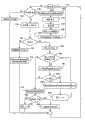
Fig. 1 is the flow chart that the key step of the queuing operator that uses in the dispatching method of the specific implementation according to the present invention is described;
Fig. 2 is the flow chart that the key step of using in the dispatching method of the specific implementation according to the present invention that goes out group operator is described;
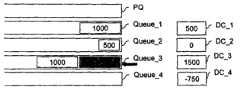
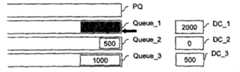
Fig. 3 A illustrates the execution example of the dispatching method of Fig. 1 and 2 to 3F;
Fig. 4 illustrates the controlling equipment of the specific embodiment according to the present invention; And
Fig. 5 illustrates the packet handling facilities of the specific embodiment according to the present invention.
Embodiment
A specific implementation according to dispatching method of the present invention is described below.In the example described herein, described dispatching method is realized by computer program PROG_ORD.
According to the present invention, this dispatching method is a DRR type method, and it is modified the processed with the grouping that realizes convection current, and its bit rate is no more than fair bit rate.
Here in the specific implementation of Miao Shuing, this dispatching method also is used to carry out congested measurement, need this congested measurement below with reference to the access control module that Fig. 4 describes.
The described dispatching method of hypothesis is handled and is belonged to the grouping p that flows i below.
Here in the specific implementation of Miao Shuing, dispatching method of the present invention uses different formation Queue_i to store the grouping p of each active stream i.
Notice that dispatching method of the present invention allows the different quota Q_i for each stream i, although the application supposition quota Q_i that the implicit expression district office of service quality is imagined is identical and equals largest packet size MTU (MTU).
However, quota Q_i is more than or equal to largest packet size MTU.
Here in the detailed example of Miao Shuing, these formations are arranged in numerical order from 1 to n, wherein n is the maximum number of active stream.
Dispatching method described herein also uses the additional formation that keeps as vacation stream, and this is used to measure fair bit rate, the i.e. bit rate that is produced by the data flow that always has grouping to send.
Also use Priority Queues PQ to serve such grouping according to dispatching method of the present invention: to be determined according to the inherent bit rate characteristic of the stream under it and to have priority.
In the remaining part of this specification, with " very " formation (PQ, Queue_1 ..., Queue_n) and " vacation " formation difference that is used to measure fair bit rate come.
True formation is all FIFO (first in first out) type formation known to those skilled in the art.
Dispatching method described herein also uses tabulation ActiveList and two the operator InsertActiveList () and the RemoveActiveList () of active stream, and these two operators are suitable for respectively adding the stream numbering and deleting the stream numbering from this tabulation at the end of active stream tabulation ActiveList.
This dispatching method also uses and is suitable for being positioned at the function F reeBuffer () that grouping first of the maximum queue Queue_i discharges storage space by refusal, and this has used in Internetworking:Research and Experience the 2nd volume 113-131 page or leaf in January, 1991 by the method described in the article " Stochastic Fairness Queuing " that P.McKenney showed.
Also can use the strategy of other release memories of the fairness between being used for keeping flowing.
As most prior art dispatching methods, dispatching method of the present invention described herein mainly uses two standard queues to handle operator:
Operator InsertInQueue () is used for dividing into groups terminal insertion of formation;
Operator RemoveFromQueue () is used for fetching element first of formation.
In initial initialization step, scheduler program PROG_ORD is initialized as 0 for all formation Queue_i with balance counter DC_i, and will insert among the active stream tabulation ActiveList corresponding to thenumbering 0 of the vacation stream that is used for measuring fair bit rate.
The key step of Enqueue () operator is described below with reference to Fig. 1.
When receiving grouping p, operator Enqueue () carries out first step E10, and whether its test buffer area (buffering area) is saturated during this, has stored the grouping of all active stream in this buffer area.
If described buffer memory is saturated, the result who then tests E10 is sure.
Then is step e 20 after this test, refuses to be positioned at grouping first of the maximum queue Queue_i by calling above-mentioned function F reeBuffer () in the meantime, memory space is released.
Behind the memory release steps E20 then isstep e 30, obtains the number i of the affiliated stream of grouping p during this.
On the contrary, if the tabulation ActiveList of active stream is not full, the result of then above-mentioned test E10 negates.After the test then is above-mentioned steps E30.
Thestep e 30 of obtaining the stream numbering then is afterwards whether the stream i of check grouping p is the test E40 that enlivens, and promptly whether check stream i is in the tabulation ActiveList of active stream.
If not, the result who then tests E40 negates.Then is step e 42 after this test, stream i is by among the tabulation ActiveList that calls above-mentioned function InsertActiveList () and be inserted into active stream during this.
Behind this inserting step E42 then is step e 44, and the balance counter DC_i of the formation Queue_i that will be associated with active stream i during this is initialized as 0.
This balance counter DC_i is similar to the counter of the DRR dispatching method known to those skilled in the art.
According to the present invention, in each circulation, each stream that newly receives can send the prioritized data that reaches its quota Q_i.
For this reason, then bestep e 46 behind the initialization step E44, during this big or small size (p) of grouping p by being deposited among the variable BytesCount_i, this variable storage the byte number of grouping of the stream i that will according to priority handle.
After this allocation step E46 then is step e 48, utilizes at tail of the queue during this and inserts the tail that the function InsertInQueue () that divides into groups adds grouping p to Priority Queues PQ.
After the step e 48 in this insertion formation then is E50, and variable Silence is initialised with Boolean FALSE during this, is ready for sending at least one this fact of grouping p with storage.
As mentioned below, this designator Silence is used to measure the fair bit rate that does not exist under the service conditions, does not exist business to equal this fact of Boolean TRUE by identifier and indicates.
In the present embodiment,step e 50 stops the process to grouping p queuing.
If just processed grouping p is the grouping of active stream i, the result of then above-mentioned test E40 is sure.
Then is step e 52 after this test, size of grouping p is added among the above-mentioned variable BytesCount_i during this, and this variable is the blocked byte number that is used for storing the stream i that will according to priority handle.
This accumulation then is test E54 after step, the blocked byte number (being BytesCount_i) of the stream i that its check will according to priority be handled be less than or equal quota Q_i for the formation Queue_i of this stream reservation.
If the result who then tests E54 is sure.After this test then is the queue step E56 that is similar to above-mentioned queue step E48, and grouping p is added to the tail of Priority Queues PQ during this.
Otherwise if according to priority the byte number BytesCount_i of the stream i of Chu Liing exceeds quota Q_i in this circulation, the result who then tests E54 negates.Then the step e 58 of in for normal (as non-preferential) the formation Queue_i that flows the i reservation, grouping p being lined up after this test.
Queue step E56 and E58 have stopped the queuing process of this specific embodiment.
The key step of extracting operation Dequeue () from formation is described below with reference to Fig. 2.
Be used for stopping following being used of this operator Dequeue () of packet transaction:
Ending in each operation that sends grouping p; And
When being sky, system after grouping arrives,, then satisfies this second condition if each formation Queue_i is that sky and formation PQ are empty to i from 1 to n.
Here in the realization of Miao Shuing, this operator Dequeue () takes to comprise the form of the Infinite Cyclic of thestep F 10 to F84 that describes below.
Whether first step F10 check Priority Queues PQ is empty.If not, then testing behind the F10 then is step F 20, the grouping p first of tabulation is extracted from Priority Queues PQ during this period.
This operation is to utilize the function R emoveFromQueue () be suitable for fetching element first of formation to realize.
Then be to be similar to the step F of having described 22step e 30, that obtain the stream number i of grouping p behind this extraction step F20 with reference to figure 1.
Obtaining after the step F 22 of number then isstep F 24, sends grouping p during this.
Behind this forwarding step F24 then is step F 26, and size (p) of grouping p is deducted from the balance counter DC_i of formation Queue_i during this, and this formation Queue_i is associated with the stream i of the grouping p that is removed from Priority Queues PQ in step F 20.
This then is a step F 28 after deducting step F 26, and size of grouping p is added among the variable PB during this, and variable PB is used for storing the traffic carrying capacity that will according to priority handle.
Then be the test F10 that has described after this accumulation step F 28, whether its check Priority Queues PQ is empty.Therefore stepF 10 has constituted circulation to F28, as long as exist this circulation of dividing into groups to proceed in Priority Queues PQ.
In this circulation, the balance counter DC_i that is associated with stream i that its grouping according to priority has been sent out successively decreases, and exceeds the quota Q_i in its current circulation to prevent each stream.
If Priority Queues PQ is empty, the result who then tests F10 is sure.Then be test F30 after this test, whether its check has at least a true stream to enliven.
Here among the embodiment of Miao Shuing, this is equivalent to check the tabulation ActiveList of active stream to comprise a more than element, and this is because this tabulation always comprises thevacation stream 0 that is used to measure fair bit rate at least.
If not, the result who then tests F30 negates.Then test F30 after this test, described during this astop step e 50 about Fig. 1, be that variable Silence distributes Boolean constant TRUE, so that such fact to be described: in Priority Queues PQ and in any non-Priority Queues Queue_i, all no longer include any grouping and will send.
Then be above-mentioned steps E10 behind this allocation step E32, whether its test Priority Queues PQ is empty.
If have at least a true stream to enliven, the result who then tests F30 is sure.Then bestep F 34 after this test, it obtains the identifier of the stream i first of the tabulation ActiveList of active stream.
Obtaining after thisstep F 34 of identifier then is one group of step F 40 to F44, is used for measuring thefalse stream 0 amount of bytes FB that has sent, and this amount FB is used for estimating fair bit rate, as described later.
Or rather, whether the stream that is obtained first of the tabulation ActiveList of step F 40 tests active stream in abovementioned steps E34 isfalse stream 0.
If the result who then tests F40 is sure.After this test then is step F 42, is assigned with the quota Q_0 amount of the being added to FB of thestream 0 of granting the leave during this.
After this accumulation step F 42 then is step F 44, and during this,false stream 0 is removed and be added to immediately the end of this circulation first of circulation, and this realizes by using above-mentioned standard operation InsertActiveList () and RemoveActiveList ().
If the active stream i that obtains when test active stream tabulation ActiveList instep F 34 is true stream, the result who then tests F40 negates.
After this test then isstep F 50, and its quota Q_i is added the currency to balance counter DC_i during this at stream i.
Or rather, test F60 check balance counter DC_i whether strict for just and non-Priority Queues Queue_i whether be sky.
If the result who then tests F60 is sure.After this test then is step F 61, and the grouping size during this first of formation Queue_i is stored among the variable s.
Then be step F 62 after the step F 61, its check this size s be less than or equal the balance counter DC_i of this stream.
If the result who then tests F62 is sure.After this test then is step F 64, is utilizing function R emoveFromQueue () will divide into groups to remove back this grouping of transmission from formation Queue_i during this.
Then be step F 66 behind the forwarding step F64, big or small s of this grouping is deducted from balance counter DC_i during this.
This then is above-mentioned test F60 after deducting step F 66, its check and the formation Queue_i that is associated of stream i whether for the balance counter DC_i of empty and this formation whether strictness for just.
If stream i reach and authorize whole groupings of quota DC_i all to be sent out, the result who then tests F60 or test F62 negates.
In step F 70, stream i utilizes above-mentioned operator RemoveActiveList and is removed from active stream tabulation ActiveList.
This then is test F80 after removing step F 70, and whether its check is empty with the formation Queue_i that stream i is associated.
If then the balance counter DC_i that is associated with stream i is turned to 0 by the beginning in initialization step F82.
If not, then flow i and in inserting step F84, utilize function InsertActiveList to be inserted into the tail of active stream tabulation ActiveList.
The step F 82 of initialization balance counter DC_i and will to flow i then be above-mentioned test F10 after inserting the step F 84 of active stream tabulation ActiveList.
Those skilled in the art will appreciate that in fact active stream tabulation ActiveList must be suitable for overflowing of small probability.
In a particular embodiment, when the grouping that receives new stream and active stream tabulation ActiveList when full, this grouping is placed among the Priority Queues PQ, but the stream under its is not added to active stream tabulation ActiveList.
This grouping is sent out (step F 24) then, but the information that is associated with stream under it is not updated.
Therefore, its grouping of carrying out abnormality processing had priority, even the bit rate of their stream surpasses current fair bit rate.
Suppose when grouping arrives for bit rate greater than fair bit rate stream for have only very little probability to keep this state, this fault is out of question.
Noting, is O (1) based on the complexity according to dispatching algorithm of the present invention of known DRR method.
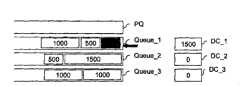
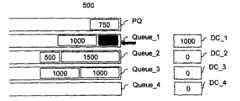
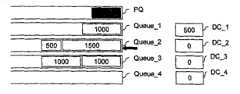
Fig. 3 A shows the execution example of describing with reference to figure 1 and Fig. 2 of dispatching method according to the present invention to 3F.
This description hypothesis three formation Queue_1, Queue_2, Queue_3 comprise that each stream promptly flows 1, the grouping p ofstream 2, stream 3.The size of these groupings is instructed in these figure.
Priority Queues PQ is empty when supposing also that this programme begins.
At last, the value of distributing to the quota Q_i of each stream i is supposed to equal 1500.
In these figure, the stem of the active stream tabulation during black arrow is represented to circulate, following non-Priority Queues order is followed in this circulation: Queue_1, Queue_2, Queue_3, Queue_4.
Grouping serviced in each different step shows with shade.
At first, as shown in Figure 3A, the stream that is positioned at the tabulation stem is thestream 1 that is associated with formation Queue_1.
Its balance counter DC_1 increases quota Q_i, and promptly 1500.
Therefore router one 00 can begin to serve first grouping (hypographous) of this formation Queue_1, and this grouping size is 500 bytes here.
During belonging to the last packet service of being grouped in of new stream 4, Fig. 3 B hypothesis arrives.
Formation Queue_1 is produced and is associated to this stream 4.
With under the situation of traditional DRR type scheduling, compare, this grouping here is inserted among the Priority Queues PQ, and is described as top refer step E48.
Yet the processing ofstream 1 continues, and the size (50 byte) of second grouping of Queue_1 is less than new difference DC_1 (result of test F60 and F62 is sure).
In the step shown in Fig. 3 C, the processing ofstream 1 is finished, and at this moment the difference DC_1 that is associated with formation Queue_1 equals 500, and this difference is less than the size 1000 (result of test F62 negates) of next grouping.
According to the present invention, and with under the situation of traditional DRR type scheduling, compare, comprise the Priority Queues PQ serviced (result of test F10 negates) of the grouping that belongs to stream 4, the difference DC_4 of stream 4 successively decrease (seeing step F 66).
In shown in Fig. 3 D next step, Priority Queues PQ is empty (result of test F10 is sure) now, the first active true stream processed (result of test F30 is sure), the i.e.stream 2 that is associated with formation Queue_2.
In next step that shows at Fig. 3 E, next stream (stream 3) is processed, because the size of packets remaining is greater than the quota DC_2 that is associated with this formation among the formation Queue_2.
Final step shown in Fig. 3 F constitutes the beginning of new circulation, wherein restarts service flow 1.Stream 4 no longer enlivens, because its formation Queue_4 is empty, and therefore it is not the part of ActiveList.
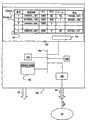
Fig. 4 shows a specific embodiment according to controllingequipment 100 of the present invention.This controlling equipment can typically be implemented in the processor or microprocessor that uses in router or the router.
In traditional mode, this equipment receives grouping p, and this grouping of this equipment scheduling is to send them or to refuse this grouping in the case of overflow.
In Fig. 4, set out (stepF 24, the F64) ofReference numeral 34 expression groupings, Reference numeral 32 expressions are to the refusal (step e 20) of grouping.
Controllingequipment 100 comprisesprocessor 110, read-only memory 120,random access memory 130 andclock 140.
Controllingequipment 100 also comprises hardware andsoftware communicator 150, the software layer that it for example comprises the network interface card that is connected to theInternet 10 and is suitable for realizing the tcp/ip communication agreement.
Thesecommunicators 150 are particularly suited for receiving grouping p and it are stored in thedistrict 131 ofrandom access memory 130, and read grouping p with 10 these groupings of transmission in the Internet from this district.
The different hardware unit of controllingequipment 100 is bybus system 160 interconnection.This is known in the prior art.
According to the present invention, read-only memory 120 comprises scheduler program PROG_ORD, andrandom access memory 130 comprises thedata structure 170 that is used to carry out this scheduler program PROG_ORD.
Thisdata structure 170 is to represent with the form of table, and wherein every row is corresponding to the formation Queue_i that is associated with stream i.Or rather, in this table:
The numbering i of the first row storage flow;
The identifier of secondary series storage flow i;
The quota Q_i of the 3rd row storage queue Queue_i;
The balance counter DC_i of the 4th row storage queue Queue_i;
The 5th row are used to manage the circulation from the stream of active stream tabulation ActiveList, this is to number (As be well known in the art, as to manage these pointers and make stream can be inserted into active stream tabulation ActiveList and be extracted) realized by the formation after the storage queue Queue_i in this tabulation from this tabulation; And
Last row have provided the memory address (as be known in the art, the follow-up grouping among the formation Queue_i can obtain by means of the tabulation of chain pointer) of the grouping first of the formation Queue_i inrandom access memory 130.
In a particular embodiment, the activity of stream i is to be verified by flow identifier is compared with the secondary series content of data structure 1709, for example utilizes content adressable memory (CAM, content-addressable memory).
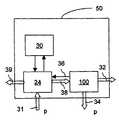
The router five 0 of the specific embodiment according to the present invention is described below with reference to Fig. 5.
This router five 0 comprises and the last identical orsimilar controlling equipment 100 of controlling equipment with reference to figure 4 descriptions.In the described here specific embodiment, this router also comprises themodule 24 of the access that is used for controlling each the grouping p that enters stream (solid arrow 31).
For example, the grouping p that is to this module is determined that by standard route function this function can comprise by the field subclass to flow identifier uses the load Sharing that hash function obtains.
Among the described here embodiment, thisaccess control module 24 is carried out two other controls of level that can independently realize.
For this reason; 24 inquiries of access control module are also upgraded thetabulation 30 that " shielded " flows; that is to say; by the active stream (i.e. the grouping of this stream is determined at predetermined time interval) ofaccess control module 24 permissions; and thistabulation 30 according to shielded stream judges whether directly to be routed for the grouping of constant current; that is to say, needn't check the entry criteria that this grouping is routed to described controlling equipment.
Specifically, thetabulation 30 of protected stream is the flow identifier tabulation of the time of advent of last grouping in each stream of indication.
In a particular embodiment, for the capacity that limits each tabulation also guarantees autgmentability thus, each tabulation is associated with the subregion of identifier space.
In this embodiment, if surpassed threshold value or overtime from time of last grouping consumption of receiving this stream, then described stream is deleted from identifier list 30.This overtime length is system parameters, for example several seconds.
In a particular embodiment, thistabulation 30 is suitable for limiting saturated probability, and promptly described stream should be placed in the described tabulation but this situation has been expired in this tabulation.
This saturated result is that stream is delayed when obtaining protected stream mode.If yet the congestion state permission should be divided into groups by correct route.As be known in the art, can make that saturated probability is enough little by suitable adjustment.
If this grouping belongs to shielded stream, then directly route (arrow 38) is to the controllingequipment 100 corresponding to correct output interface for its quilt, and be updated the time of advent of last grouping of this protected stream inidentifier list 30.
If it is protected that this stream does not also have, then must carry out routing decision based on the entry criteria that receives from scheduler module.
According to the present invention, another function is determined entry criteria based on the congested measurement of being carried out by controlling equipment 100.The arrow 36 of Fig. 5 has been indicated the supply of these conditions.
In a particular embodiment, used two congestion estimation amounts, promptly fair bit rate and preferential load C P:
-fair bit rate is the measurement to the bit rate that is produced by the data flow that always has grouping to send; And
-preferential load is the summation of the prior packet length that sends in specified time interval, and the described time interval is to divide according to the duration in this time interval.
Realize the continuous counter of the load condition of controlled link by the measurement of execution cycle property.Measuring period is different typically for fair bit-rates values (for example hundred Milliseconds) and preferential load value (for example ten Milliseconds).
In the specific embodiment of the present invention described here, congestion estimation amount CP is based on congested counter PB and FB, next calculated by the measuring process different with above-mentioned scheduling process with DE, and described congested counter is upgraded regularly by the scheduling process among step F 28 and the F42.
In addition, this measuring process (or another module) comprises the device of not describing that is suitable for measuring total time Silence_Time here, the logical variable Silence of this total time equals Boolean TRUE, remember, this variable Silence instep F 32 value of being made as TRUE and instep e 50 value of being made as FALSE.
By congested counter FB was sampled with the rule time interval, this measuring process is inferred the estimation of preferential load, poor as the PB value measured at the beginning of measuring intervals of TIME and end, this time interval is to divide according to the duration in this time interval.
The preferential load estimator CP in this time interval is provided by following equation:
CP(T1,T2)=(PB(T2)-PB(T1))×8/(T2-T1)/C
Wherein:
PB (T) is the value of the moment T PB of place, and unit is a byte;
(T1 T2) is measuring period (is unit with the second); And
C is link bit rates (unit is bps).
According to the present invention, estimate fair bit rate DE, suppose thatfalse stream 0 sends the grouping that equals Q_0 of fixed size (this quota is associated with false stream 0) continuously.
In the frequent occupied cycle,false stream 0 byte number that has sent is to infer according to the change state of congested counter FB at priority Q.When formation is empty,false stream 0 has sent with link bit rates C.
By changing the activity periods and the continuity in quiet cycle, according to the derive estimation of fair bit rate DE of following equation:
DE(T1,T2)=
max(Silence_Time×C/(T2-T1),(FB(T2)-FB(T1))×8/(T2-T1))
Wherein:
FB (T) is the FB value at moment T place, and unit is a byte;
(T1 T2) is measuring period; And
Silence_Time be the time interval (T1, T2) during total quiet duration.
Those skilled in the art will readily appreciate that, when calculating fair bit rate DE, if link load lower (becausefalse stream 0 has used all told available in this link), then preponderate for first, and second preponderated in activity periods, this measures the bit rate that true stream is reached approx, and this true stream always has at least one grouping in the formation related with it.
If entry criteria is favourable, then the new stream that is routed of its grouping is inserted in the tabulation of protected stream and has therefore obtained protected stream mode.
In the figure,solid arrow 39 is represented first grouping of the new stream of router-module 24 refusals.
In the figure,solid arrow 38 representatives are routed toscheduler module 100 with the grouping of protected stream.
Applied condition may depend on the particular community of grouping, comprises value of " trafficclass " field among the IPv6 or value or the IP source and destination address of the field ToS among the IPv4.
The transparency of the stream of permitting is guaranteed in access control: the maintenance of the bit rate of the maintenance of the signal of stream, data flow in real time.
In fact, this transparency just is provided for the stream that its (determined by outside limits) Peak bit rate keeps below certain threshold level.
About selecting with respect to the access threshold value of fair bit rate and can realize the detailed content of access control with the preferential load of guaranteeing the flow transparent degree, the file FR2854296 above-mentioned that those skilled in the art can the REFERENCE TO RELATED people.
In the above description, measuring process and scheduling process are separated from one another.Measuring process also can be merged in scheduling process.
Claims (8)
1. one kind when receiving that at controlling equipment when grouping scheduling belongs to the method for the grouping (p) of various flows (i), and non-Priority Queues (Queue_i) is associated with each stream, and described method comprises:
Determine the priority of the grouping that received at the processor of described controlling equipment, prior packet is:
Be not present at its first grouping in the stream in the tabulation of the active stream of reception grouping in circulation, the index of described stream is inserted in the place, end of described active stream tabulation; With
As long as grouping in the described stream that receives in circulation is the quota (Q_i) of the amount (BytesCount_i) of grouping less than the described stream that is associated with described circulation that receive of described stream;
If described grouping is determined to be non-preferential, then receive for being associated with in the non-Priority Queues (Queue_i) of described stream of grouping (p) receive and divide into groups to rank; With
If it is preferential that described grouping is determined to be, then rank for the grouping that receives (p) in the Priority Queues (PQ);
Wherein, the non-Priority Queues (Queue_i) that is associated with the stream in the described active stream tabulation is respectively handled according to their grades in the tabulation of described active stream with being recycled, and described Priority Queues (PQ) is compared each described non-Priority Queues (Queue_i) and preferentially handled in described circulation;
Wherein, the processing to described Priority Queues (PQ) comprises that transmission is contained in all groupings in the described Priority Queues; With
Wherein, the processing to single non-Priority Queues (Queue_i) comprises:
-send the grouping that is contained in this single non-Priority Queues (Queue_i), up to reaching the described quota (Q_i) that is associated with described stream; With
If-this single non-Priority Queues described be empty after to the processing of single non-Priority Queues, then from described active stream tabulation, remove the index that is associated with this non-Priority Queues; Or
If-described formation described be not empty after to the processing of single non-Priority Queues, then the index of described stream is moved to the end of the tabulation of described active stream.
2. according to the method for claim 1, it is characterized in that it also comprises the congested counter of measuring the prior packet store a certain amount of (PB) that send from described Priority Queues (PQ), this congested counter calculates the congestion estimation amount that is used for access control.
3. one kind is utilized the congestion estimation amount to carry out admission control method, and described congestion estimation amount comprises:
Preferential load value (CP), it is corresponding to the amount (PB) of the grouping of being lined up in Priority Queues that sends in a period of time, described a period of time is to divide according to the duration of this section period, and the amount of described grouping is to obtain by the dispatching method according to claim 2.
4. one kind is used for belonging to the not equipment of the grouping (p) of homogeneous turbulence (i) when receiving to dispatch when dividing into groups, and non-Priority Queues (Queue_i) is associated with each stream, and described equipment comprises:
Be used to determine the device of the priority of the grouping (p) that received, prior packet is:
Be not present at its first grouping in the stream in the tabulation of the active stream of reception grouping in circulation, the index of described stream is inserted in the place, end of described active stream tabulation; With
As long as grouping in the described stream that receives in circulation is the quota (Q_i) of the amount (BytesCount_i) of grouping less than the described stream that is associated with described circulation that receive in the described stream;
If being used for described grouping is determined to be non-preferential then receive the device of ranking of dividing into groups that receives of non-Priority Queues (Queue_i) of the described stream of grouping (p) for being associated with;
Be determined to be device preferential then that rank for the grouping that receives (p) of Priority Queues if be used for described grouping; With
Be used for handling their device circularly according to the grade of non-Priority Queues in described tabulation of the stream that is associated with described active stream tabulation respectively, described Priority Queues (PQ) is compared each described non-Priority Queues (Queue_i) and is preferentially handled in described circulation, described processing unit comprises:
-be used for sending the device of all groupings that are contained in described Priority Queues; With
-be used for sending be contained in non-Priority Queues (Queue_i) grouping up to the device that reaches the described quota (Q_i) that is associated with described stream, these devices are suitable for:
If-described non-Priority Queues is empty, then from described active stream tabulation, remove the index that is associated with this non-Priority Queues after to the processing of non-Priority Queues; Or
If-described non-Priority Queues described be not empty after to the processing of non-Priority Queues, then the index of described stream is moved to the end of described tabulation.
5. according to the controlling equipment of claim 4, it is characterized in that, it also comprises the device that is used for measuring the congested counter store a certain amount of prior packet that sends from described Priority Queues (PQ), and this congested counter calculates the congestion estimation amount that is used for access control.
6. group router, it is characterized in that, it comprises the controlling equipment according to claim 4, with the module that is used to utilize congestion estimation amount control access, described congestion estimation amount is preferential load value (CP), this value is corresponding to the amount (PB) of the prior packet that sends in a period of time, and described a period of time is to divide according to the duration of this section period, and the amount of described prior packet (PB) is that the described device that is used to measure congested counter by described controlling equipment obtains.
7. according to the group router of claim 6, it is characterized in that the described access module that is used to control access also is configured to the grouping that direct route belongs to protected stream.
8. according to the group router of claim 7, wherein, described shielded stream comprises such stream: for this stream, receive at least one grouping by described access module in the interval at the fixed time.
Applications Claiming Priority (3)
| Application Number | Priority Date | Filing Date | Title |
|---|---|---|---|
| FR0412063 | 2004-11-15 | ||
| FR0412063AFR2878106A1 (en) | 2004-11-15 | 2004-11-15 | METHOD AND DEVICE FOR ORDERING PACKETS FOR THEIR ROUTING IN A NETWORK WITH IMPLICIT DETERMINATION OF PACKETS TO BE PROCESSED IN PRIORITY |
| PCT/FR2005/050949WO2006051244A1 (en) | 2004-11-15 | 2005-11-15 | Method and device for scheduling packets for routing in a network with implicit determination of packets to be treated as a priority |
Publications (2)
| Publication Number | Publication Date |
|---|---|
| CN101057481A CN101057481A (en) | 2007-10-17 |
| CN101057481Btrue CN101057481B (en) | 2011-05-25 |
Family
ID=34951715
Family Applications (1)
| Application Number | Title | Priority Date | Filing Date |
|---|---|---|---|
| CN2005800390393AActiveCN101057481B (en) | 2004-11-15 | 2005-11-15 | Method and apparatus for scheduling packets for routing in a network with implicit determination of packets to be processed with priority |
Country Status (8)
| Country | Link |
|---|---|
| US (1) | US8311049B2 (en) |
| EP (2) | EP2940960B1 (en) |
| JP (1) | JP4762996B2 (en) |
| CN (1) | CN101057481B (en) |
| ES (2) | ES2799698T3 (en) |
| FR (1) | FR2878106A1 (en) |
| PL (1) | PL1813081T3 (en) |
| WO (1) | WO2006051244A1 (en) |
Families Citing this family (51)
| Publication number | Priority date | Publication date | Assignee | Title |
|---|---|---|---|---|
| DE50107065D1 (en)* | 2001-08-29 | 2005-09-15 | Alcatel Sa | router |
| US8260286B2 (en)* | 2006-10-30 | 2012-09-04 | Nokia Corporation | Method, apparatus and system for testing user equipment functionality |
| US8700187B2 (en) | 2007-08-28 | 2014-04-15 | Consert Inc. | Method and apparatus for actively managing consumption of electric power supplied by one or more electric utilities |
| US8527107B2 (en) | 2007-08-28 | 2013-09-03 | Consert Inc. | Method and apparatus for effecting controlled restart of electrical servcie with a utility service area |
| US8805552B2 (en) | 2007-08-28 | 2014-08-12 | Causam Energy, Inc. | Method and apparatus for actively managing consumption of electric power over an electric power grid |
| US12438368B2 (en) | 2007-08-28 | 2025-10-07 | Causam Enterprises, Inc. | System and method for estimating and providing dispatchable operating reserve energy capacity through use of active load management |
| US9177323B2 (en) | 2007-08-28 | 2015-11-03 | Causam Energy, Inc. | Systems and methods for determining and utilizing customer energy profiles for load control for individual structures, devices, and aggregation of same |
| US9130402B2 (en) | 2007-08-28 | 2015-09-08 | Causam Energy, Inc. | System and method for generating and providing dispatchable operating reserve energy capacity through use of active load management |
| US7715951B2 (en) | 2007-08-28 | 2010-05-11 | Consert, Inc. | System and method for managing consumption of power supplied by an electric utility |
| US8542685B2 (en)* | 2007-08-28 | 2013-09-24 | Consert, Inc. | System and method for priority delivery of load management messages on IP-based networks |
| US8996183B2 (en) | 2007-08-28 | 2015-03-31 | Consert Inc. | System and method for estimating and providing dispatchable operating reserve energy capacity through use of active load management |
| US10295969B2 (en) | 2007-08-28 | 2019-05-21 | Causam Energy, Inc. | System and method for generating and providing dispatchable operating reserve energy capacity through use of active load management |
| US8806239B2 (en) | 2007-08-28 | 2014-08-12 | Causam Energy, Inc. | System, method, and apparatus for actively managing consumption of electric power supplied by one or more electric power grid operators |
| US8890505B2 (en) | 2007-08-28 | 2014-11-18 | Causam Energy, Inc. | System and method for estimating and providing dispatchable operating reserve energy capacity through use of active load management |
| CN101971662B (en)* | 2008-01-30 | 2014-07-23 | 爱立信电话股份有限公司 | Method and device for configuring measurement time slots for mobile terminals in TDD system |
| EP2187580B1 (en)* | 2008-11-18 | 2013-01-16 | Alcatel Lucent | Method for scheduling packets of a plurality of flows and system for carrying out the method |
| WO2010129059A1 (en) | 2009-05-08 | 2010-11-11 | Consert Inc. | System and method for estimating and providing dispatchable operating reserve energy capacity through use of active load management |
| EP2486707A4 (en) | 2009-10-09 | 2013-08-28 | Consert Inc | Apparatus and method for controlling communications to and from utility service points |
| KR101458245B1 (en)* | 2010-08-20 | 2014-11-07 | 한국전자통신연구원 | Method for notifying/avoding congestion situation of data transmission in wireless mesh network, and mesh node for the same |
| US9465398B2 (en) | 2012-06-20 | 2016-10-11 | Causam Energy, Inc. | System and methods for actively managing electric power over an electric power grid |
| US9461471B2 (en) | 2012-06-20 | 2016-10-04 | Causam Energy, Inc | System and methods for actively managing electric power over an electric power grid and providing revenue grade date usable for settlement |
| US9207698B2 (en) | 2012-06-20 | 2015-12-08 | Causam Energy, Inc. | Method and apparatus for actively managing electric power over an electric power grid |
| US9563215B2 (en) | 2012-07-14 | 2017-02-07 | Causam Energy, Inc. | Method and apparatus for actively managing electric power supply for an electric power grid |
| US8983669B2 (en) | 2012-07-31 | 2015-03-17 | Causam Energy, Inc. | System, method, and data packets for messaging for electric power grid elements over a secure internet protocol network |
| US8849715B2 (en) | 2012-10-24 | 2014-09-30 | Causam Energy, Inc. | System, method, and apparatus for settlement for participation in an electric power grid |
| US10475138B2 (en) | 2015-09-23 | 2019-11-12 | Causam Energy, Inc. | Systems and methods for advanced energy network |
| US10861112B2 (en) | 2012-07-31 | 2020-12-08 | Causam Energy, Inc. | Systems and methods for advanced energy settlements, network-based messaging, and applications supporting the same on a blockchain platform |
| US9513648B2 (en) | 2012-07-31 | 2016-12-06 | Causam Energy, Inc. | System, method, and apparatus for electric power grid and network management of grid elements |
| WO2015076708A1 (en)* | 2013-11-19 | 2015-05-28 | Telefonaktiebolaget L M Ericsson (Publ) | Method and first network node for managing a first ip path used by a connection |
| US9887974B2 (en) | 2013-11-27 | 2018-02-06 | Architecture Technology Corporation | Method for network communication past encryption devices |
| US9191377B2 (en)* | 2013-11-27 | 2015-11-17 | Architecture Technology Corporation | Method for network communication past encryption devices |
| US9160553B2 (en) | 2013-11-27 | 2015-10-13 | Architecture Technology Corporation | Adaptive multicast network communications |
| EP3073680B1 (en)* | 2015-03-23 | 2017-12-06 | Alcatel Lucent | Methods, queueing system, network element and network system for queueing and processing of packets |
| EP3136678B1 (en) | 2015-08-27 | 2019-11-27 | Tata Consultancy Services Limited | System and method for real-time transfer of audio and/or video streams through an ethernet avb network |
| US10069748B2 (en) | 2015-12-14 | 2018-09-04 | Mellanox Technologies Tlv Ltd. | Congestion estimation for multi-priority traffic |
| US10069701B2 (en) | 2016-01-13 | 2018-09-04 | Mellanox Technologies Tlv Ltd. | Flexible allocation of packet buffers |
| US10250530B2 (en) | 2016-03-08 | 2019-04-02 | Mellanox Technologies Tlv Ltd. | Flexible buffer allocation in a network switch |
| US10084716B2 (en) | 2016-03-20 | 2018-09-25 | Mellanox Technologies Tlv Ltd. | Flexible application of congestion control measures |
| US10205683B2 (en) | 2016-03-28 | 2019-02-12 | Mellanox Technologies Tlv Ltd. | Optimizing buffer allocation for network flow control |
| US10387074B2 (en) | 2016-05-23 | 2019-08-20 | Mellanox Technologies Tlv Ltd. | Efficient use of buffer space in a network switch |
| US9985910B2 (en)* | 2016-06-28 | 2018-05-29 | Mellanox Technologies Tlv Ltd. | Adaptive flow prioritization |
| US10659476B2 (en) | 2016-09-12 | 2020-05-19 | Architecture Technology Corporation | Transparent bridge for monitoring crypto-partitioned wide-area network |
| US10389646B2 (en) | 2017-02-15 | 2019-08-20 | Mellanox Technologies Tlv Ltd. | Evading congestion spreading for victim flows |
| US10645033B2 (en) | 2017-03-27 | 2020-05-05 | Mellanox Technologies Tlv Ltd. | Buffer optimization in modular switches |
| US11005770B2 (en) | 2019-06-16 | 2021-05-11 | Mellanox Technologies Tlv Ltd. | Listing congestion notification packet generation by switch |
| US10999221B2 (en) | 2019-07-02 | 2021-05-04 | Mellanox Technologies Tlv Ltd. | Transaction based scheduling |
| US11470010B2 (en) | 2020-02-06 | 2022-10-11 | Mellanox Technologies, Ltd. | Head-of-queue blocking for multiple lossless queues |
| US11463366B1 (en) | 2020-09-22 | 2022-10-04 | Architecture Technology Corporation | Autonomous network optimization using network templates |
| US11973696B2 (en) | 2022-01-31 | 2024-04-30 | Mellanox Technologies, Ltd. | Allocation of shared reserve memory to queues in a network device |
| US12375404B2 (en) | 2022-08-25 | 2025-07-29 | Mellanox Technologies, Ltd | Flow-based congestion control |
| WO2024187312A1 (en)* | 2023-03-10 | 2024-09-19 | Huawei Technologies Co., Ltd. | A device and methodology for asynchronous deterministic scheduling in networks at large scale |
Citations (3)
| Publication number | Priority date | Publication date | Assignee | Title |
|---|---|---|---|---|
| US5812526A (en)* | 1995-12-21 | 1998-09-22 | Industrial Technology Research Institute | Traffic control mechanism in ATM communications network |
| CN1275008A (en)* | 1999-05-25 | 2000-11-29 | 日本电气株式会社 | Quick-circulating port dispatcher for high-volume asynchronous transmission mode exchange |
| CN1463509A (en)* | 2001-05-04 | 2003-12-24 | 三星电子株式会社 | Multimedia Service Transmission Device and Method in Mobile Communication System |
Family Cites Families (12)
| Publication number | Priority date | Publication date | Assignee | Title |
|---|---|---|---|---|
| JPH0646079A (en)* | 1992-07-22 | 1994-02-18 | Toshiba Corp | Cell transfer control system |
| ATE392758T1 (en)* | 2000-01-05 | 2008-05-15 | Mitsubishi Electric Inf Tech | METHOD AND DEVICE FOR DETERMINING PACKET TRANSMISSION PRIORITY BETWEEN SEVERAL DATA STREAMS |
| US6574195B2 (en)* | 2000-04-19 | 2003-06-03 | Caspian Networks, Inc. | Micro-flow management |
| US6810426B2 (en)* | 2001-01-30 | 2004-10-26 | Nomadix, Inc. | Methods and systems providing fair queuing and priority scheduling to enhance quality of service in a network |
| CN1611035A (en)* | 2001-04-13 | 2005-04-27 | 飞思卡尔半导体公司 | Data Flow Management in Data Flow Processor |
| US7457297B2 (en)* | 2001-11-16 | 2008-11-25 | Enterasys Networks, Inc. | Methods and apparatus for differentiated services over a packet-based network |
| JP2004032157A (en)* | 2002-06-24 | 2004-01-29 | Matsushita Electric Ind Co Ltd | Packet transmission method, traffic conditioner and priority control mechanism |
| JP2004166080A (en)* | 2002-11-14 | 2004-06-10 | Matsushita Electric Ind Co Ltd | Packet shaper, packet relay device |
| JP2004297775A (en)* | 2003-03-12 | 2004-10-21 | Matsushita Electric Ind Co Ltd | Packet relay device |
| FR2854296A1 (en) | 2003-04-24 | 2004-10-29 | France Telecom | Flow packet processing device for use in network link, has scheduling module to schedule packet in queue based on analyzing incoming bit rate of flow relative to fair bit rate and fair queuing with priority algorithm |
| US7161916B2 (en)* | 2003-08-20 | 2007-01-09 | Qualcomm Incorporated | Method and apparatus for uplink rate selection in the presence of multiple transport channels in a wireless communication system |
| US8406235B2 (en)* | 2003-11-26 | 2013-03-26 | Qualcomm Incorporated | Quality of service scheduler for a wireless network |
- 2004
- 2004-11-15FRFR0412063Apatent/FR2878106A1/enactivePending
- 2005
- 2005-11-15EPEP15150092.3Apatent/EP2940960B1/enactiveActive
- 2005-11-15JPJP2007540694Apatent/JP4762996B2/enactiveActive
- 2005-11-15USUS11/667,893patent/US8311049B2/enactiveActive
- 2005-11-15ESES15150092Tpatent/ES2799698T3/enactiveActive
- 2005-11-15WOPCT/FR2005/050949patent/WO2006051244A1/enactiveApplication Filing
- 2005-11-15ESES05819159.4Tpatent/ES2533774T3/enactiveActive
- 2005-11-15CNCN2005800390393Apatent/CN101057481B/enactiveActive
- 2005-11-15EPEP05819159.4Apatent/EP1813081B1/enactiveActive
- 2005-11-15PLPL05819159Tpatent/PL1813081T3/enunknown
Patent Citations (3)
| Publication number | Priority date | Publication date | Assignee | Title |
|---|---|---|---|---|
| US5812526A (en)* | 1995-12-21 | 1998-09-22 | Industrial Technology Research Institute | Traffic control mechanism in ATM communications network |
| CN1275008A (en)* | 1999-05-25 | 2000-11-29 | 日本电气株式会社 | Quick-circulating port dispatcher for high-volume asynchronous transmission mode exchange |
| CN1463509A (en)* | 2001-05-04 | 2003-12-24 | 三星电子株式会社 | Multimedia Service Transmission Device and Method in Mobile Communication System |
Non-Patent Citations (2)
| Title |
|---|
| Shih-Chiang Tsao.Pre-order Deficit Round Robin: a new scheduling algorithm forpacket-switched networks.Computer Networksvol. 35 no. 2-3.2001,vol. 35(no. 2-3),第290-294页、附图2和3.* |
| Shih-ChiangTsao.Pre-orderDeficitRoundRobin:anewschedulingalgorithmforpacket-switchednetworks.ComputerNetworksvol.35no.2-3.2001 vol. 35(no. 2-3) |
Also Published As
| Publication number | Publication date |
|---|---|
| EP2940960A1 (en) | 2015-11-04 |
| US20070291644A1 (en) | 2007-12-20 |
| JP4762996B2 (en) | 2011-08-31 |
| PL1813081T3 (en) | 2015-06-30 |
| US8311049B2 (en) | 2012-11-13 |
| EP1813081A1 (en) | 2007-08-01 |
| CN101057481A (en) | 2007-10-17 |
| FR2878106A1 (en) | 2006-05-19 |
| EP2940960B1 (en) | 2020-04-01 |
| WO2006051244A1 (en) | 2006-05-18 |
| JP2008520141A (en) | 2008-06-12 |
| ES2799698T3 (en) | 2020-12-21 |
| EP1813081B1 (en) | 2015-01-07 |
| ES2533774T3 (en) | 2015-04-15 |
Similar Documents
| Publication | Publication Date | Title |
|---|---|---|
| CN101057481B (en) | Method and apparatus for scheduling packets for routing in a network with implicit determination of packets to be processed with priority | |
| US6721796B1 (en) | Hierarchical dynamic buffer management system and method | |
| CA2575869C (en) | Hierarchal scheduler with multiple scheduling lanes | |
| US5675573A (en) | Delay-minimizing system with guaranteed bandwidth delivery for real-time traffic | |
| Ramabhadran et al. | Stratified round robin: A low complexity packet scheduler with bandwidth fairness and bounded delay | |
| US8977774B2 (en) | Method for reducing buffer capacity in a pipeline processor | |
| KR100323258B1 (en) | Rate guarantees through buffer management | |
| US6937561B2 (en) | Method and apparatus for guaranteeing data transfer rates and enforcing conformance with traffic profiles in a packet network | |
| US7986706B2 (en) | Hierarchical pipelined distributed scheduling traffic manager | |
| US8000247B2 (en) | Bandwidth management apparatus | |
| US7894347B1 (en) | Method and apparatus for packet scheduling | |
| EP2923479A1 (en) | Method and apparatus for controlling utilization in a horizontally scaled software application | |
| JP4163044B2 (en) | BAND CONTROL METHOD AND BAND CONTROL DEVICE THEREOF | |
| CN102104545A (en) | Credit scheduling method and device and bypass device for solving linear speed of packet | |
| CN100466593C (en) | A Realization Method of Integrated Queue Scheduling Supporting Multiple Services | |
| US6490629B1 (en) | System and method for scheduling the transmission of packet objects having quality of service requirements | |
| US7756037B2 (en) | Oversubscription of guaranteed bandwidth | |
| HUP0203928A2 (en) | Method and system for controlling transmission of packets in computer networks | |
| US7599381B2 (en) | Scheduling eligible entries using an approximated finish delay identified for an entry based on an associated speed group | |
| Dwekat et al. | A practical fair queuing scheduler: Simplification through quantization | |
| Fiat et al. | Competitive queue management for latency sensitive packets | |
| US6987774B1 (en) | Method and apparatus for traffic scheduling | |
| CN100550831C (en) | The gigabit passive optical network strict priority weighted round robin scheduling method and system | |
| CN100570551C (en) | Method for reducing buffer capacity in pipeline processor | |
| EP2891293B1 (en) | Method and device for scheduling data traffic |
Legal Events
| Date | Code | Title | Description |
|---|---|---|---|
| C06 | Publication | ||
| PB01 | Publication | ||
| C10 | Entry into substantive examination | ||
| SE01 | Entry into force of request for substantive examination | ||
| C14 | Grant of patent or utility model | ||
| GR01 | Patent grant |