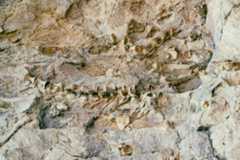
Would you bid on a Stegosaurus fossil at auction? Photo credit:Steve Wrzeszczynski viaUnsplash
Around 150 million years ago, a Stegosaurus walked the Earth. The bony plates along its backlikely warded off most predators, meaning it could graze freely on nearby flora. With warmer temperatures, higher sea levels, and the continents united as Pangea, thedinosaur’s world looked different from the one we know today. After a long life, this creature would eventually succumb to time. It laid to rest in what would later become the United States of America, not knowing that 150 million years later, itsbones would be excavated in Moffat County, Colorado. It also would not know that its skeleton would beauctioned for a record-breaking $44.6 million. This is the story of Apex, the Stegosaurus who led to the highest bid for a fossil at auction.
This is the story of Apex, the Stegosaurus who led to the highest bid for a fossil at auction.
On July 17, 2024,Sotheby’s, a New York City auction house, put Apex up for bidding. Apex is deemed the most-complete Stegosaurus skeleton, includingfossilised skin impressions, throat armour and signs of arthritis.Sotheby’s estimated the specimen would sell between $4- and $6-million. Anyone with the means could place a bid, meaning that anyone could be Apex’s new owner. But shouldthe owner be anyone?
Before the auction, palaeontologist Dr. Cary Woodruff pushed back on the notion that fossils should be auctioned at all. In aninterview with NPR, Dr. Woodruff argued that each fossil represents an individual life, making the price of a fossil “largely arbitrary.” Moreover, fossils like Apex require a high level of care.Organic materials decay faster in open air and warmer temperatures, meaning fossils and artifacts must remain in controlled environments. There are also smaller upkeep tasks, such as maintaining the glue used to pose specimens. While museums are equipped to handle this, a private individual may not know these needs exist.
…each fossil represents an individual life, making the price of a fossil “largely arbitrary.”
Sotheby’s does not share Dr. Woodruff’s concerns. In the same NPR article, senior vice president Cassandra Hatton countered that losing scientifically important fossils to private collections has yet to occur, and winning bids often come from museums or private individuals who later donate to museums.
…auctioning fossils is a new practice.
Selling fossils is not a new practice. The history of palaeontology isfundamentally linked to fossil selling, and commercial palaeontologists, including renowned fossil collector Mary Anning,have contributed new discoveries that deepen our knowledge of the past. However, auctioning fossils is a new practice. In 1997, Sotheby’s hosted the first-ever dinosaur auction of Sue theT. rex. The question of who had the rights to Sue was adecade-long battle, with stakeholders including Native Americans, academic palaeontologists, and the U.S. government. Sue ultimately went to auction andsold for over $8-million in a joint bid between the Field Museum in Chicago, Walt Disney Parks and Resorts, McDonald’s, and other private donors. While casts of Sue weregiven to McDonald’s and Disney Parks, the original fossil resides in the Field Museum.
Sotheby’s experience with auctioning fossils supports Hatton’s claims, but it also highlights an important point: museums on their owndo not have the funds to compete for such rare specimens. Many museums rely on wealthy donors, and even iconic institutionslike the Smithsonian originate from private individuals. For example, steel baron Andrew Carnegie was responsible for donatingDippy the dinosaur to the Natural History Museum in London, and his financial contributions led to the description of anew dinosaur species:Diplodocus carnegii. Wealthy donors can provide the resources for advancing science and education, but this also means commercial palaeontology is more likely to target this demographic.
With large and rare fossils creating fame and fortune, it is not uncommon for skeletons to be doctored and/or taken from other countries without permission.
Fossil sales havedoubled in the U.S. since the 1980’s, and high-profile auctions can inspire illegal fossil trading. With large and rare fossils creating fame and fortune, it is not uncommon for skeletons to bedoctored and/ortaken from other countries without permission. In an example from 2007, prominent actorNicolas Cage paid $276 thousand for aTyrannosaurus bataarskull after a high-profile bidding war against Leonardo DiCaprio. But in 2015, Cagereturned the skull to the Mongolian government after it was found to be smuggled from the Gobi Desert.Rampant smuggling is a pressing issue in palaeontology, and many scientists are pushing for a better code of conduct for fossil collecting. While Apex the Stegosaurus is a United States specimen, its record-breaking $44.6 million sale may increase demand for illegal fossil trading from other countries.
Moreover, it is not uncommon for owners to act irresponsibly with artefacts. In the 1800’s, anoriginal copy ofBirds of America was reduced to wallpaper for aristocrat Lady Hertford’s Chinese drawing room. This rare book is worth around$9 million, and Lady Hertford was wealthy enough to own it. This also extends to animal remains. In 1890, an auction was held for 180,000 mummified cats. The winning bidderused them as fertilizer. These examples illustrate how a rare item can lose its value, significance, and structural integrity when put in the wrong hands. This once again begs the question: shouldanyone be able to own Apex the Stegosaurus?
Ultimately, the winning bid for Apex was billionaire founder and CEO of Citadel, Ken Griffin. Griffin has ahistory of museum philanthropy and hasstated his plans to loan Apex to an educational institution in the United States. While this is a happy ending for Apex, what will happen when the next dinosaur is up for auction?