
Business Insights
Harvard Business School Online's Business Insights Blog provides the career insights you need to achieve your goals and gain confidence in your business skills.
- Accounting
- Analytics
- Business Essentials
- Business in Society
- Career Development
- Communication
- Community
- ConneXt
- Decision-Making
- Digital Transformation
- Earning Your MBA
- Entrepreneurship & Innovation
- Finance
- For Organizations
- Leadership
- Management
- Marketing
- Negotiation
- News & Events
- Productivity
- Staff Spotlight
- Strategy
- Student Profiles
- Technology
- Work-Life Balance
- AI Essentials for Business
- AI for Leaders
- Alternative Investments
- Business Analytics
- Business Strategy
- Business and Climate Change
- CLIMB
- CORe
- Creating Brand Value
- Credential of Digital Innovation and Strategy
- Data Science and AI for Decision Making
- Design Thinking and Innovation
- Digital Marketing Strategy
- Disruptive Strategy
- Dynamic Teaming
- Economics for Managers
- Entrepreneurial Marketing
- Entrepreneurship Essentials
- Financial Accounting
- Global Business
- Launching Tech Ventures
- Leadership Principles
- Leadership, Ethics, and Corporate Accountability
- Leading Change and Organizational Renewal
- Leading with Finance
- Management Essentials
- Negotiation Mastery
- Organizational Leadership
- Personal Branding
- Power and Influence for Positive Impact
- Strategic Financial Analysis
- Strategy Execution
- Sustainable Business Strategy
- Sustainable Investing
- Transforming Customer Experiences
- Winning with Digital Platforms
Filters
- Accounting
- Analytics
- Business Essentials
- Business in Society
- Career Development
- Communication
- Community
- ConneXt
- Decision-Making
- Digital Transformation
- Earning Your MBA
- Entrepreneurship & Innovation
- Finance
- For Organizations
- Leadership
- Management
- Marketing
- Negotiation
- News & Events
- Productivity
- Staff Spotlight
- Strategy
- Student Profiles
- Technology
- Work-Life Balance
- AI Essentials for Business
- AI for Leaders
- Alternative Investments
- Business Analytics
- Business Strategy
- Business and Climate Change
- CLIMB
- CORe
- Creating Brand Value
- Credential of Digital Innovation and Strategy
- Data Science and AI for Decision Making
- Design Thinking and Innovation
- Digital Marketing Strategy
- Disruptive Strategy
- Dynamic Teaming
- Economics for Managers
- Entrepreneurial Marketing
- Entrepreneurship Essentials
- Financial Accounting
- Global Business
- Launching Tech Ventures
- Leadership Principles
- Leadership, Ethics, and Corporate Accountability
- Leading Change and Organizational Renewal
- Leading with Finance
- Management Essentials
- Negotiation Mastery
- Organizational Leadership
- Personal Branding
- Power and Influence for Positive Impact
- Strategic Financial Analysis
- Strategy Execution
- Sustainable Business Strategy
- Sustainable Investing
- Transforming Customer Experiences
- Winning with Digital Platforms
4 Effects of Globalization on the Environment

- 15 Apr 2021
Globalization—defined in the online courseGlobal Business as the increased flow of goods, services, capital, people, and ideas across international boundaries—has broughtmany changes in its wake.
While globalization can positively and negatively impact society, its effect on the environment is primarily negative. Here’s a breakdown of how globalization impacts society and the environment and what business leaders can do to reduce these negative consequences.
How Does Globalization Affect Society?
The world has become more connected than ever before through the increase in technological advancements and economic integrations. Advanced economies are formed as domestic businesses transform into international ones and further contribute to the spread of technology around the world.
There are severalbenefits of globalization, such as increased international trade and cooperation and less international aggression.Social globalization—the sharing of ideas and information between countries—has led to innovation in the medical, technological, and environmental preservation industries.
Additionally, globalization has improved the quality of life in several developing nations. This includes implementing efficient transportation systems and ensuring accessibility to services such as education and healthcare.
However, globalization can also have negative effects on society, such as increased income inequality and substandard working conditions in developing countries that produce goods for wealthier nations. Income inequality is directly related to globalization as it further increases the gap between more advanced and developing areas of a nation. As a result, it can also increase the risk of societal violence.
Along with its societal effects, globalization has a lasting impact on the environment—and typically not a positive one.
Free E-Book: How to Be a Purpose-Driven, Global Business Professional
Access your free e-book today.
DOWNLOAD NOWWhat Are the Effects of Globalization on the Environment?
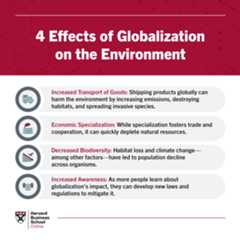
1. Increased Transport of Goods
One of the primary results of globalization is that it opens businesses up to new markets in which they can sell goods and source labor, raw materials, and components.
Both of these realities mean finished products travel farther now than ever before—potentially halfway around the globe. In the past, products were more likely to be produced, sold, and consumed locally. This increased transport of goods can impact the environment in several ways, including:
- Increased emissions: The farther a product travels, the more fuel is consumed, and a greater level of greenhouse gas emissions is produced. According to a report by theInternational Transport Forum, CO2 emissions from transport will increase 16 percent by 2050. These emissions contribute to pollution,climate change, and ocean acidification around the world and have been shown to significantly impact biodiversity.
- Habitat destruction: Transportation—especially when land-based—requires infrastructure like roads and bridges. The development of such infrastructure can lead to issues including habitat loss and pollution. The more ships that travel by sea, the greater the chances for major oil spills or leaks that damage the delicate marine environment.
- Invasive species: Every shipping container and vessel presents an opportunity for a living organism—from plants to animals to fungus—to hitch a ride to a new location where it can become invasive and grow without checks and balances that might be present in its natural environment.
2. Economic Specialization
One often-overlooked side effect of globalization is that it allows nations and geographical regions to focus on their economic strengths while relying on trading partners for goods they don’t produce themselves. This economic specialization often boosts productivity and efficiency.
Unfortunately, overspecialization can threaten forest health and lead to serious environmental issues, often in the form of habitat loss, deforestation, or natural resource overuse. A few examples include:
- Illegal deforestation in Brazil due to an increase in the country’s cattle ranching operations, which requires significant land for grazing
- Overfishing in coastal areas that include Southeast Asia, which has significantly contributed to reduced fish populations and oceanic pollution
- Overdependence on cash crops, such as coffee, cacao, and various fruits, which has contributed to habitat loss, especially in tropical climates
It’s worth considering that globalization has allowed some nations to specialize in producing various energy commodities, such as oil, natural gas, and timber. Nations that depend on energy sales to fund a large portion of their national budgets, along with those that note “energy security” as a priority, are more likely to take intervening actions in the market in the form of subsidies or laws that make transitioning to renewable energy more difficult.
The main byproduct of these energy sources comes in the form of greenhouse gas emissions, which significantly contribute to global warming and climate change.
3. Decreased Biodiversity
Increased greenhouse gas emissions, ocean acidification, deforestation (and other forms of habitat loss or destruction), climate change, and the introduction of invasive species all work to reduce biodiversity around the globe.
According to the World Wildlife Fund’s recentLiving Planet Report, the population sizes of all organisms—including mammals, birds, fish, amphibians, and reptiles—have decreased 68 percent since 1970. Latin America and Africa—two rapidly developing regions important to global trade—have seen disproportionate levels of biodiversity loss, especially among environmentally sensitive fish, reptiles, and amphibians.
While this decrease in biodiversity has many causes, it’s widely believed that the issues listed above have contributed in part.
4. Increased Awareness
While many of globalization’s environmental effects have been negative, its increase has heightened environmental awareness worldwide.
Greater connectivity and higher rates of international travel have made it easier than ever for individuals to see the effects of deforestation, habitat loss, and climate change on the environment. This, in turn, has contributed to new laws, regulations, and processes that limit negative effects.

Globalization as a Threat and an Opportunity
Globalization has allowed society to enjoy many benefits, including increased global cooperation, reduced risk of global conflict, and lower prices for goods and commodities. Unfortunately, it’s also led to serious negative effects on the environment.
Since it isn’t feasible for globalization to end or reverse, it’s likely the situation will worsen until nations, governing bodies, and other organizations are compelled to implement laws and regulations that limit negative effects.
Businesses and industries that operate globally have an incentive to take whatever voluntary actions they can to reduce the potential for negative consequences. Doing so can not only provide an organization greater control over its initiatives, but also a powerful marketing andcommunication tool.
Some ways businesses address climate change include:
- Transitioning to renewable energy sources
- Choosing greener infrastructures or equipment
- Reducing energy consumption
- Creating credible climate transition plans
- Raising awareness among employees
In addition, investing in renewable energy and packaging, embracing responsible land-use management, and shifting goods production to move closer to the end customer are all viable options that businesses can and should consider. The challenge lies in balancing a desire to embracecorporate social responsibility with the need to turn a profit and run a successful business.
Are you interested in breaking into a global market? Sharpen your knowledge of theinternational business world with our four-weekGlobal Business course. In addition, explore ourBusiness and Climate Change course to help your organization adapt to and embrace business risks and opportunities created by climate change, as well as our otheronline courses related to business in society.
This post was updated on February 28, 2024. It was originally published on April 15, 2021.