The Elemental Architecture of Jeanne Gang
A Chicago architect renowned for her sublime engineering makes buildings that really work for New Yorkers.

Save this article to read it later.
Find this story in your account’s‘Saved for Later’ section.
Comment
It’s moving day for Fire Rescue Company 2 in Brooklyn, and a naked male mannequin, looking soot stained and stunned, lies supine on a gurney that has been tossed atop several million dollars’ worth of machinery and tools. The building at 1815 Sterling Place in Brownsville is still pristine, its golden fire poles shiny, its concrete unscuffed and flame-red terra-cotta trim unchipped. Brooklyn’s newest fire station, headquarters for the borough’s only rescue company, was designed by Studio Gang, the firm Jeanne Gang founded in Chicago in 1997. But the building isn’t hers anymore: Captain Liam Flaherty, a 29-year Fire Department veteran, looks around with a proprietary air. “This is basically the firefighter’s Swiss Army knife,” he says. “We used to be in an 1893 building that was made for horses. We couldn’t even unload any equipment without pulling the rig onto the sidewalk. Sothis— this is beautiful.”
The high-speed, high-rise development of the past decade has increased Brooklyn’s firefighting needs and at the same time made them more difficult to keep up with. “When I started out, we’d go find a vacant building to practice in, but they’re few and far between now. We could go to the Rock [the FDNY’s nickname for Randall’s Island], but you have to set aside half a day.” Now, the crew can train whenever they’re not eating, sleeping, or answering calls. If you ever need to be rescued in Brooklyn, you’ll be suddenly grateful for the company’s versatile new real estate.
When Gang’s first high-rise, Aqua Tower, opened in 2009, bringing her worldwide renown, she was still pegged as aChicago architect, awoman architect, a young architect (then 45, she was practically a toddler in her profession), or all three. Those qualifiers mostly dropped away when she won a MacArthur grant in 2011, and since then she has built up an international portfolio that includes a fistful of major projects in New York.
In a city of brawny skyscrapers, Aqua Tower’s wavy balconies struck some as refreshingly — or, depending on your outlook, frivolously — decorative, but Paul Goldberger, thenThe New Yorker’s architecture critic, pointed out that, in designing balconies that diffuse the battering gusts that come off the lake, Gang was eliding the distinction between a building’s surface and its bones. “She brings aesthetics and engineering together in a way that is more aligned with the tradition of Chicago’s canonical modern architecture than the building’s appearance suggests,” he wrote. A decade later, Gang and her firm are doing the same in New York, in so many different ways that her projects could almost be the work of several entirely disparate, equally talented architects. There’s the fire station in Brownsville, an apartment tower in downtown Brooklyn (11 Hoyt Street), an office building near the High Line, and an addition to the American Museum of Natural History. As different as they are, each is a lyrical expression of a prosaic challenge: need transfigured into structure, structure into art.
Fire Rescue 2 doesn’t have the luxury of self-indulgent design: The architecture is only as good as the job it does, and its job is to help firefighters save lives. Every second it adds to a routine is a potentially lethal liability; every skill it helps hone represents someone’s shot at survival. Talking to me, Flaherty flicks through the features that help train specialists in a spectacular array of disasters — a manhole that drops down to a warrenlike basement that can be filled with fake smoke, a balcony for high-angle rescues, a trench that mimics a construction-site collapse, an elevator that can be deliberately knocked out of order, and a 50-foot wall for rappelling, dangling, and hoisting. “When someone gets trapped in a burning building, we might have to lower someone off the roof and pluck them out of a window,” Flaherty explains. “That’s a very risky evolution, but we have to own it.”
It’s bracing, if a little ghoulish, for an architect to confront all the ways a building can kill people, but it’s part of what makes this small, tough, and pragmatic building, far from the corridors of glamorous design, such a perfect emblem of an unusual practice. The stakes don’t preclude elegance, though — they practically require it. Gang has built an office full of good listeners, and with the Sterling Place project, they paid close attention to the voices of experience, voices like Flaherty’s. And those voices had plenty of demands.
“They wanted to have total blackout when they sleep,” Gang told me. “They wanted eyes on the street, so in the office we gave them windows that tilt down so they can watch what’s going on. They cook a lot, and sometimes they get called when they’re in the middle of dinner so we put the kitchen right next to the trucks.” Firefighters see architecture at its worst and treat it roughly, which, Gang discovered, made them excellent creative partners. “They poke holes in buildings to get access, so we made a building full of cuts and voids.”
The result is a four-story concrete shell with a skylight over a hollow core, a $32 million magician’s box full of openings and secret compartments. An assortment of flourishes on the exterior signals the thought that went into its guts. Windows, doors, truck bays, and balconies are bordered in tubular tiles that have been diagonally set and glazed in a range of fiery reds. It’s a building that fits in neatly on its residential block and also stands out, brightly beckoning neighbors and delighting kids.
For an architecture firm with an international reputation and a menu of large-scale projects (Studio Gang recently won commissions fora new terminal at O’Hare anda new tech campus for Harvard), designing a roughly 20,000-square-foot facility for a sluggish municipal bureaucracy can be a masochistic exercise. But Gang embraces the caution, the grind, even the byzantine approvals process of civic architecture. “There are challenges [to working for the city],” she says, “but there’s also a very high level of design intelligence here, and it shows. You have experienced eyes looking at this, and they’re critical. It’s not just,Oh, thank you for designing this small building! They want the architecture to be good, and you have to show that you have a reason for everything you do. I appreciate that.”
Those could be just make-nice words in pursuit of more and bigger commissions, but Gang has also provided the city with a mountain of work that few will ever see. In 2017, her firm completeda study of two troubled neighborhoods for the Mayor’s Office for Criminal Justice, which hoped that design could help shore up long-neglected neighborhoods. In areas where sidewalks go unrepaired, playgrounds decay, and streetlights never turn on, residents shun public spaces as dangerous. The firm’s brief was first to listen and observe, then to help communities figure out how to take control of places that breed resentment, crime, and distrust.
“When I started the practice in Chicago, I wanted to do community projects because they were real,” Gang says. “There are whole areas where architects never work but where you can really make friends.” (Gang opened the New York office five years ago and now spends a third of her time here, another third in Chicago, and the rest in hotel rooms all over the world.)
The idea that designers can supplement the work of cops, teachers, social workers, and activists in making a neighborhood more livable goes back to the early 1970s, when scholars developed a set of practices called “crime prevention through environmental design” (CPTED). The de Blasio administration has made that conceptan element of its crime-fighting strategy. Gang’s team settled on two neighborhoods where a design intervention could have the most impact: Morrisania in the Bronx and Brownsville. The architects began with the premise that residents know their neighborhood’s needs but not how to get government to meet them. They mapped bus shelters, bike racks, playgrounds, police precincts, and public WiFi kiosks — traces of city government administered by a scattering of different agencies.
Gang’s spray of proposals was guaranteed to make a bureaucrat sigh thinking of all the different agencies, approvals, and conflicting agendas that the pretty pictures entailed. The architects suggested redesigning a police precinct to make it less bunkerlike, dissuade cops from parking up against the wall, and encourage people to come in even without a complaint or a crime. (The firm’s work will also inform arenovation of the Brownsville branch of the Brooklyn Public Library, led byLTL Architects.)
The notion of neighbors wandering into a precinct house just to swap a few jokes with the local cop sounds like a Norman Rockwell fantasy, but the city seems serious about Gang’s work. It has led, for instance, toprograms that merge illumination with public art both in the Bronx and in Brownsville. A projector attached to a lighting pole projects images onto a blank wall, turning a forlorn space into a spectacle and coaxing residents out into the open.
Programs that boost pedestrian traffic also build social networks, says Ifeoma Ebo, an architect and director of strategic design initiatives at the Mayor’s Office for Criminal Justice. “People use public space as a way of forming neighborly connections — the kinds of connections they can leverage when there’s an emergency or a crime.”
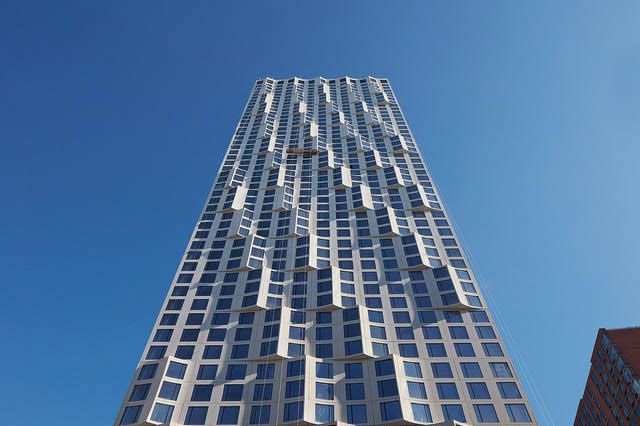
Not all of Gang’s New York work takes places in the trenches; she’s also tinkering with the skyline. In downtown Brooklyn, the apartment building at 11 Hoyt Street is taking shape, a distant cousin of the Aqua Tower with wavelike bays instead of balconies rippling across the façade. Construction in commercial high-rise development is a repetitive business; every deviation or complexity adds time and expense. Only what is rote makes economic sense. At 11 Hoyt, though, Studio Gang figured out a way to eke variety out of standardization. While onsite workers made every floor plate identical, a factory in Canada was cranking out 1,100 precast concrete bays with windows preinstalled in 119 slightly different shapes. The bays were trucked in two by two and affixed to the façade, creating nearly 200 distinct apartment configurations. The effect is of a weather pattern playing out on the white concrete exterior and whirling around the four sides. And as in Chicago, the illusion of turbulence helps to tame it: The shallow bays scatter the wind, which would otherwise slam into a flat wall.
If Gang has a signature, it’s not stylistic but philosophical: Her architecture is an ongoing negotiation with nature. A dark-glass office building in Chelsea, which she has called Solar Carve, twists and dodges to let sunlight hit the High Line. The corner resembles a crystalline cliff with the dirt scraped away to reveal a vein of quartzlike facets. The black diamond-like façade acts as a new kind of setback, opening a way for sunshine to flow around its base rather than over its crown. “One of the biggest misconceptions about shadows is that people think it’s only about height and the top of the building,” says Weston Walker, the partner who heads Gang’s New York office. “But shaping the bulk down at the bottom is really crucial for getting light to the immediate environment.”

For a building that promotes light, Solar Carve has a menacing mien. Its charcoal-tinted glass glowers even at a brilliant Hudson sunset and makes a cloudy day positively bleak. That too has a purpose: Dark glass cuts glare, cuts down on air-conditioning, reduces reflections that can distract drivers, and warns away suicidal wildlife. Every year, nearly a quarter-million birds hurl themselves at clear-glass towers they never even see, a massacre so dire that theCity Council now requires builders to prevent it.
I’ve complained loudly and often about ubiquitous glass façades, often a low-budget, unthinking outer layer dressed up in lofty statements about the virtues of transparency. But Gang believes the future belongs to glass — not the ultraclear, virtually invisible kind architects were touting a decade ago or themirrored-aviator-shade exteriors of the 1970s but a more subtle and customized palette of coatings that can be detailed almost pane by pane like individual pixels. HerVista Tower in Chicago is a study in shades of glass. Three distinct shafts each narrow and widen as they go up like vertical waves. New technology allows Gang to treat crests and troughs differently, deepening shadows and softening highlights in a curtain-wall chiaroscuro.
Gang waxes rhapsodic about the manufacturing process at the German companyAGC Interpane, where designers can customize colors and specifications by computer. The glass then goes through an oven with dozens of chambers where fine sprays of magnesium, silver, copper, and other substances fuse to the surface. It used to take weeks to get a single glass sample, and if it wasn’t right, the process would start all over again. Now, it can be done immediately. “I think of glass as a metal now,” Gang says. “It’s a hybrid material, and I want it to be present, not go away. I’m embracing the metallic aspect and seeing what we can do with it.”
Fire, flood, wind, and sun — these forces shape Gang’s architecture even in an environment as artificial as New York. That sensibility makes her the ideal person to design the latest iteration of the American Museum of Natural History, an institution that has evolved along with the sciences it promotes. Founded in 1869 and relocated to a new building at West 77th Street and Central Park West in 1877, the museum has grown into a tuberous accretion of wings, sheds, and exhibition halls, most recently the glass-cube Rose Center for Earth and Space. “Over the years, the museum developed piecemeal:We need to store heavy dinosaur bones here.We need to do tech stuff over there,” Walker says. “That diluted the clarity of the whole institution.” Gang’s brief was to add yet another chunk of architecture that would present a dramatically new face and at the same time coax the rest into cohesion.

In the museum’s new Gilder Center, which faces Columbus Avenue and is now under construction, disjointed floors, departments, hallways, and galleries funnel into a sort of indoor slot canyon. Sunshine drops through a skylight, swirling around the cone-shaped space and bouncing off pale concrete reminiscent of white sandstone cliffs. Ceilings, walls, balconies, and bridges all flow together, forming a hive of arches and vaults that look as if they were eroded by wind and water over millions of years. The key to achieving this effect is shotcrete, an old technique that computer modeling has helped renew. Instead of pouring liquid concrete into wooden forms that then get dismantled and discarded, workers bend rebar into curving shapes and shoot wet concrete at it through a hose, producing a continuous structure and seamless walls. Shotcrete is common in tunnels, pools, and foundations, but Gang uses it to design the kinds of apparently haphazard, dizzyingly complex structures that are usually found only in the wild. “We went down into the [LIRR] East Side Access tunnels, and we saw these incredible intersecting vaults that they were able to do with this technique. That’s what convinced us it would be possible,” she says.
The result is architecture that looks at once familiar and new: sinuous like Eero Saarinen’s TWA Terminal, mountainous like the atrium of Daniel Libeskind’sDenver Art Museum, and cavelike in the manner ofOpen Architecture’s Dune Museum in China. But the next iteration of one of the world’s great natural-history museums will possess its own specific exuberance, an energy calibrated for a place where very young humans come to encounter some very old rocks, bugs, and bones.
Things you buy through our links may earnVox Media a commission.


