Multicell Topology

In system-level simulations with 3GPP channel modeling, it is customary to placecells on a spiral hexagonal grid. The grid is defined by the inter-site distance,determining the distance between any two adjacent hexagonal cell centers, andthe number of rings of the grid, typically 1 or 2 (corresponding to 7 and 19cells, hence 21 and 57 base stations, respectively).
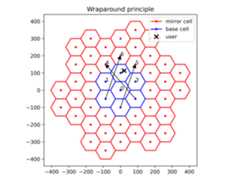
To eliminate edge effects that would result in users at the cell bordersexperiencing reduced interference levels, the grid is usuallywrapped around to create a seamless topology.
To learn how to place base stations and drop users on a hexagonal grid inSionna, refer to theHexagonal Grid Topology notebook.
- classsionna.sys.topology.Hexagon(radius,coord,coord_type='offset',precision=None)[source]
Class defining a hexagon placed in a hexagonal grid
- Input:
radius (float) – Hexagon radius, defined as the distance between the hexagon center andany of its corners
coord ([2],list |tuple) – Coordinates of the hexagon center within the grid. If
coord_typeiseuclid, the unit of measurement is meters [m].coord_type (‘offset’ (default) | ‘axial’ | ‘euclid’) – Coordinate type of
coord
- propertycoord_axial
Axial coordinates of the hexagon within a grid
The basis of axial coordinates are 2D vectors\(\mathbf{b}^{(1)}=\left(\frac{3}{2}r,\frac{\sqrt{3}}{2}r \right)\),\(\mathbf{b}^{(2)}=\left(0, \sqrt{3}r \right)\). Thus, therelationship between axial coordinates\(\mathbf{a}=(a_1,a_2)\) andtheir corresponding Euclidean ones\(\mathbf{x}=(x_1,x_2)\) is thefollowing:
\[\mathbf{x} = a_1 \mathbf{b}^{(1)} + a_2 \mathbf{b}^{(2)}\]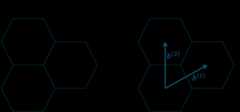
- Type:
[2],tf.int32
- coord_dict()[source]
Returns the hexagon coordinates in the form of dictionary
- Output:
dict – Dictionary containing the three hexagon coordinates,with key ‘euclid’, ‘offset’, ‘axial’
- propertycoord_euclid
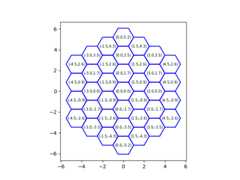
Euclidean coordinates of the hexagon within a grid
- Type:
[2],tf.float
- propertycoord_offset
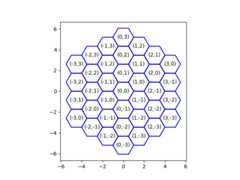
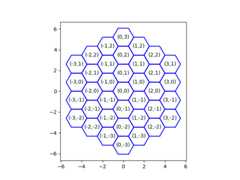
Offset coordinates of the hexagon within a grid. Thefirst (second, respectively) coordinate defines the horizontal(vertical, resp.) offset with respect to the grid center.
- Type:
[2],tf.int32
- corners()[source]
Computes the Euclidean coordinates of the 6 corners of the hexagon
- Output:
[6, 2],float – Euclidean coordinates of the 6 corners of the hexagon
- neighbor(axial_direction_idx)[source]
Returns the neighboring hexagon over the specified axialdirection
- Input:
axial_direction_idx (int) – Index determining the neighbor relative axial direction with respectto the current hexagon. Must be one of {0,…,5}.
- Output:
Hexagon– Neighboring hexagon, in the axial relative direction
- propertyradius
Hexagon radius, defined as the distance between its center andany of its corners
- Type:
tf.float

- classsionna.sys.topology.HexGrid(num_rings,cell_radius=None,cell_height=0.0,isd=None,center_loc=(0,0),center_loc_type='offset',precision=None)[source]
Creates a hexagonal spiral grid of cells, drops users uniformly at random init uniformly at random and computes wraparound distances and base stationpositions
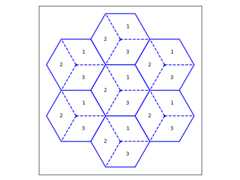
Cell sectors are numbered as follows:
To eliminate border effects that would cause users at the edge of the gridto experience reduced interference, the wraparound principle artificiallytranslates each base station to its closest corresponding “mirror” image ina neighboring hexagon for each user.
- Parameters:
num_rings (int) – Number of spiral rings in the grid
cell_radius (float |None (default)) – Radius of each hexagonal cell in the grid, defined as the distancebetween the cell center and any of its corners. Either
isdorcell_radiusmust be specified.cell_height (float (default: 0.)) – Cell height [m]
isd (float |None (default)) – Inter-site distance. Either
isdorcell_radiusmust bespecified.center_loc ([2],list |tuple (default: (0,0))) – Coordinates of the grid center
center_loc_type ('offset' (default)|'axial' |'euclid') – Coordinate type of
center_coordprecision (None (default) | “single” | “double”) – Precision used for internal calculations and outputs.If set toNone,
precisionis used.
- Input:
batch_size (int) – Batch size
num_ut_per_sector (int) – Number of users to sample per sector and per batch
min_bs_ut_dist (float) – Minimum distance between a base station (BS) and a user [m]
max_bs_ut_dist (float (default:None)) – Maximum distance between a base station (BS) and a user [m]. IfNone, itis not considered.
ut_height (float (default: 0)) – User height, i.e., distance between the user and the X-Y plane [m]
- Output:
ut_loc ([batch_size, num_cells, num_sectors=3, num_ut_per_sector, 3],
tf.float) – Location of users, dropped uniformly at random within each sectormirror_cell_per_ut_loc ([batch_size, num_cells, num_sectors=3, num_ut_per_sector, num_cells, 3],tf.float) – Coordinates of the artificial mirror cell centers, locatedat Euclidean distance
wraparound_distfrom each userwraparound_dist ([batch_size, num_cells, num_sectors=3, num_ut_per_sector, num_cells],tf.float) – Wraparound distance in the X-Y plane between each userand the cell centers
Example
fromsionna.sysimportHexGrid# Create a hexagonal grid with a specified radius and number of ringsgrid=HexGrid(cell_radius=1,cell_height=10,num_rings=1,center_loc=(0,0))# Cell center locationsprint(grid.cell_loc.numpy())# [[ 0. 0. 10. ]# [-1.5 0.8660254 10. ]# [ 0. 1.7320508 10. ]# [ 1.5 0.8660254 10. ]# [ 1.5 -0.8660254 10. ]# [ 0. -1.7320508 10. ]# [-1.5 -0.8660254 10. ]]
- propertycell_height
Cell height [m]
- Type:
float
- propertycell_loc
Euclidean coordinates of the cell centers [m]
- Type:
[num_cells, 3],float
- propertycell_radius
Radius of any hexagonal cell in the grid [m]
- Type:
float
- propertycenter_loc
Grid center coordinates in the X-Y plane, of type
center_loc_type- Type:
[2],int |float
- propertyisd
Inter-site Euclidean distance [m]
- Type:
float
- propertymirror_cell_loc
Euclidean (x,y,z) coordinates(axis=2) of the 6 mirror + base cells (axis=1) for each base cell (axis=0)
- Type:
[num_cells, num_mirror_grids+1=7, 3], tf.float
- propertynum_cells
Number of cells in the grid
- Type:
int
- propertynum_rings
Number of rings of the spiral grid
- Type:
int
- show(show_mirrors=False,show_coord=False,show_coord_type='euclid',show_sectors=False,coord_fontsize=8,fig=None,color='b',label='base')[source]
Visualizes the base hexagonal grid and, if specified, themirror grids too
Note that a mirror grid is a replica of the base grid, repeatedaround its boundaries to enable wraparound.
- Input:
show_mirrors (bool) – IfTrue, then the mirror grids are visualized
show_coord (bool) – IfTrue, then the hexagon coordinates are visualized
show_coord_type (str) – Type of coordinates to be visualized. Must be one of {‘offset’,‘axial’, ‘euclid’}. Only effective ifshow_coord isTrue
show_sectors (bool) – IfTrue, then the three sectors within each hexagon are visualized
coord_fontsize (int) – Coordinate fontsize. Only effective ifshow_coord isTrue
fig (matplotlib.figure.Figure |None (default)) – Existing figure handle on which the grid is overlayed.IfNone, then a new figure is created
color (str (default: ‘b’)) – Matplotlib line color
- Output:
fig (matplotlib.figure.Figure) – Figure handle

- sionna.sys.topology.gen_hexgrid_topology(batch_size,num_rings,num_ut_per_sector,scenario,min_bs_ut_dist=None,max_bs_ut_dist=None,isd=None,bs_height=None,min_ut_height=None,max_ut_height=None,indoor_probability=None,min_ut_velocity=None,max_ut_velocity=None,downtilt_to_sector_center=True,los=None,return_grid=False,precision=None)[source]
Generates a batch of topologies with hexagonal cells placed on a spiralgrid, 3 base stations per cell, and user terminals (UT) dropped uniformly at randomacross the cells
UT orientation and velocity are drawn uniformly randomly within thespecified bounds, whereas the BSs point toward the center of their respective sector.
Parameters provided asNone are set to valid values according to the chosen
scenario(see[TR38901]).The returned batch of topologies can be fed into the
set_topology()method of the system level models, i.e.UMi,UMa,andRMa.- Input:
batch_size (int) – Batch size
num_ut (int) – Number of UTs to sample per batch example
scenario (“uma” | “umi” | “rma” | “uma-calibration” | “umi-calibration”) – System level model scenario
min_bs_ut_dist (None (default) |tf.float) – Minimum BS-UT distance [m]
max_bs_ut_dist (None (default) |tf.float) – Maximum BS-UT distance [m]
isd (None (default) |tf.float) – Inter-site distance [m]
bs_height (None (default) |tf.float) – BS elevation [m]
min_ut_height (None (default) |tf.float) – Minimum UT elevation [m]
max_ut_height (None (default) |tf.float) – Maximum UT elevation [m]
indoor_probability (None (default) |tf.float) – Probability of a UT to be indoor
min_ut_velocity (None (default) |tf.float) – Minimum UT velocity [m/s]
max_ut_velocity (None (default) |tf.float) – Maximim UT velocity [m/s]
downtilt_to_sector_center (bool (default:True)) – IfTrue, the BS is mechanically downtilted and points towards thesector center. Else, no mechanical downtilting is applied.
los (bool |None (default)) – LoS/NLoS states of UTs
return_grid (bool (default:False)) – Determines whether the
HexGridobjectis returnedprecision (None (default) | “single” | “double”) – Precision used for internal calculations and outputs.If set toNone,
precisionis used.
- Output:
ut_loc ([batch_size, num_ut, 3],tf.float) – UT locations
bs_loc ([batch_size, num_cells*3, 3],tf.float) – BS location
ut_orientations ([batch_size, num_ut, 3],tf.float) – UT orientations [radian]
bs_orientations ([batch_size, num_cells*3, 3],tf.float) – BS orientations [radian]. Oriented toward the center of the sector.
ut_velocities ([batch_size, num_ut, 3],tf.float) – UT velocities [m/s]
in_state ([batch_size, num_ut],tf.float) – Indoor/outdoor state of UTs.True means indoor,False meansoutdoor.
los (None) – LoS/NLoS states of UTs. This is convenient for directly using thefunction’s output as input to
set_topology(), ensuring thatthe LoS/NLoS states adhere to the 3GPP specification (Section 7.4.2 of TR38.901).bs_virtual_loc ([batch_size, num_cells*3, num_ut, 3],tf.float) – Virtual, i.e., mirror, BS positions for each UT, computed according tothe wraparound principle
grid (
HexGrid) – Hexagonal grid object. Only returned ifreturn_gridisTrue.
Example
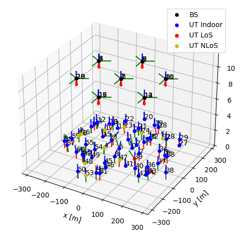
fromsionna.phy.channel.tr38901importPanelArray,UMifromsionna.sysimportgen_hexgrid_topology# Create antenna arraysbs_array=PanelArray(num_rows_per_panel=4,num_cols_per_panel=4,polarization='dual',polarization_type='VH',antenna_pattern='38.901',carrier_frequency=3.5e9)ut_array=PanelArray(num_rows_per_panel=1,num_cols_per_panel=1,polarization='single',polarization_type='V',antenna_pattern='omni',carrier_frequency=3.5e9)# Create channel modelchannel_model=UMi(carrier_frequency=3.5e9,o2i_model='low',ut_array=ut_array,bs_array=bs_array,direction='uplink')# Generate the topologytopology=gen_hexgrid_topology(batch_size=100,num_rings=1,num_ut_per_sector=3,scenario='umi')# Set the topologychannel_model.set_topology(*topology)channel_model.show_topology()
- sionna.sys.topology.get_num_hex_in_grid(num_rings)[source]
Computes the number of hexagons in a spiral hexagonal grid with a givennumber of rings\(N\). It equals\(1+3N(N+1)\)
- Input:
num_rings (int) – Number of rings of the hexagonal spiral grid
- Output:
int – Number of hexagons in the spiral hexagonal grid
- sionna.sys.topology.convert_hex_coord(coord,conversion_type,hex_radius=None,precision=None)[source]
Converts the center coordinates of a hexagon within a grid between any twoof the types {“offset”, “axial”, “euclid”}
- Input:
coord ([…, 2],tf.int |tf.float) – Coordinates of the center of a hexagon contained in ahexagonal grid
conversion_type (‘offset2euclid’ | ‘euclid2offset’ | ‘euclid2axial’ | ‘offset2axial’ | ‘axial2offset’ | ‘axial2euclid’) – Type of coordinate conversion
hex_radius ([…],tf.float |None (default)) – Hexagon radius, i.e., distance between its center and any ofits corners. It must be specified if
convert_typeis‘offset2euclid’.precision (None (default) | “single” | “double”) – Precision used for internal calculations and outputs.If set toNone,
precisionis used.
- Output:
[2],tf.float |tf.int – Output coordinates