Utility Functions
Complex-valued tensors
- sionna.rt.utils.cpx_abs(x)[source]
Element-wise absolute value of a complex-valued tensor
The tensor is represented as a tuple of two real-valued tensors,corresponding to the real and imaginary part, respectively.
- Parameters:
x (
typing.Tuple[drjit.cuda.ad.TensorXf,drjit.cuda.ad.TensorXf]) – A tensor- Return type:
drjit.cuda.ad.TensorXf
- sionna.rt.utils.cpx_abs_square(x)[source]
Element-wise absolute squared value of a complex-valued tensor
The tensor is represented as a tuple of two real-valued tensors,corresponding to the real and imaginary part, respectively.
- Parameters:
x (
typing.Tuple[drjit.cuda.ad.TensorXf,drjit.cuda.ad.TensorXf]) – A tensor- Return type:
drjit.cuda.ad.TensorXf
- sionna.rt.utils.cpx_add(a,b)[source]
Element-wise addition of two complex-valued tensors
Each tensor is represented as a tuple of two real-valued tensors,corresponding to the real and imaginary part, respectively.
- Parameters:
a (
typing.Tuple[drjit.cuda.ad.TensorXf,drjit.cuda.ad.TensorXf]) – First tensorb (
typing.Tuple[drjit.cuda.ad.TensorXf,drjit.cuda.ad.TensorXf]) – Second tensor
- Return type:
typing.Tuple[drjit.cuda.ad.TensorXf,drjit.cuda.ad.TensorXf]
- sionna.rt.utils.cpx_convert(x,out_type)[source]
Converts a complex-valued tensor to any of the supported frameworks
The tensor is represented as a tuple of two real-valued tensors,corresponding to the real and imaginary part, respectively.
Note that the chosen framework must be installed for this functionto work.
- Parameters:
x (
typing.Tuple[drjit.cuda.ad.TensorXf,drjit.cuda.ad.TensorXf]) – A tensorout_type (
typing.Literal['numpy','jax','tf','torch']) – Name of the target framework. Currently supportedareNumpy (“numpy”),Jax (“jax”),TensorFlow (“tf”),andPyTorch (“torch”).
- Return type:
np.array|jax.array|tf.Tensor|torch.tensor
- sionna.rt.utils.cpx_div(a,b)[source]
Element-wise division of a complex-valued tensor by another
Each tensor is represented as a tuple of two real-valued tensors,corresponding to the real and imaginary part, respectively.
- Parameters:
a (
typing.Tuple[drjit.cuda.ad.TensorXf,drjit.cuda.ad.TensorXf]) – First tensorb (
typing.Tuple[drjit.cuda.ad.TensorXf,drjit.cuda.ad.TensorXf]) – Second tensor by which the first is divided
- Return type:
typing.Tuple[drjit.cuda.ad.TensorXf,drjit.cuda.ad.TensorXf]
- sionna.rt.utils.cpx_exp(x)[source]
Element-wise exponential of a complex-valued tensor
The tensor is represented as a tuple of two real-valued tensors,corresponding to the real and imaginary part, respectively.
- Parameters:
x (
typing.Tuple[drjit.cuda.ad.TensorXf,drjit.cuda.ad.TensorXf]) – A tensor- Return type:
typing.Tuple[drjit.cuda.ad.TensorXf,drjit.cuda.ad.TensorXf]
- sionna.rt.utils.cpx_mul(a,b)[source]
Element-wise multiplication of two complex-valued tensors
Each tensor is represented as a tuple of two real-valued tensors,corresponding to the real and imaginary part, respectively.
- Parameters:
a (
typing.Tuple[drjit.cuda.ad.TensorXf,drjit.cuda.ad.TensorXf]) – First tensorb (
typing.Tuple[drjit.cuda.ad.TensorXf,drjit.cuda.ad.TensorXf]) – Second tensor
- Return type:
typing.Tuple[drjit.cuda.ad.TensorXf,drjit.cuda.ad.TensorXf]
- sionna.rt.utils.cpx_sqrt(x)[source]
Element-wise square root of a complex-valued tensor
The tensor is represented as a tuple of two real-valued tensors,corresponding to the real and imaginary part, respectively.
The following formula is implemented to compute the square roots of complexnumbers:https://en.wikipedia.org/wiki/Square_root#Algebraic_formula
- Parameters:
x (
typing.Tuple[drjit.cuda.ad.TensorXf,drjit.cuda.ad.TensorXf]) – A tensor- Return type:
drjit.cuda.ad.TensorXf
- sionna.rt.utils.cpx_sub(a,b)[source]
Element-wise substraction of a complex-valued tensor from another
Each tensor is represented as a tuple of two real-valued tensors,corresponding to the real and imaginary part, respectively.
- Parameters:
a (
typing.Tuple[drjit.cuda.ad.TensorXf,drjit.cuda.ad.TensorXf]) – First tensorb (
typing.Tuple[drjit.cuda.ad.TensorXf,drjit.cuda.ad.TensorXf]) – Second tensor which is substracted from the first
- Return type:
typing.Tuple[drjit.cuda.ad.TensorXf,drjit.cuda.ad.TensorXf]
Electromagnetics
- sionna.rt.utils.complex_relative_permittivity(eta_r,sigma,omega)[source]
Computes the complex relative permittivity of a materialas defined in(9)
- Parameters:
eta_r (
drjit.cuda.ad.Float) – Real component of the relative permittivitysigma (
drjit.cuda.ad.Float) – Conductivity [S/m]omega (
drjit.cuda.ad.Float) – Angular frequency [rad/s]
- Return type:
drjit.cuda.ad.Complex2f
- sionna.rt.utils.fresnel(x)[source]
Computes the complex-valued Fresnel integral
The complex-valued Fresnel integral is defined as:
(55)\[F_c(x) = \int_0^{\sqrt{\frac{2x}{\pi}}} \exp\left(j\frac{\pi s^2}{2}\right)ds = C(x) + jS(x)\]This function computes an approximation of this integral as described inSection 2.7 of[ITU_R_P_526_15]. It has sufficient accuracy for mostpurposes. Note that we let the upper limit of the integral be\(\sqrt{2x/\pi}\) instead of\(x\), which is different from the definitionin[ITU_R_P_526_15]. Thus, evaluating\(F_c(x)\) corresponds to\(F_c(\sqrt{2x/\pi})\) in the classical definition.
- Parameters:
x (
drjit.cuda.ad.Float) – Argument of the Fresnel integral- Return type:
drjit.cuda.ad.Complex2f- Returns:
Complex-valued Fresnel integral
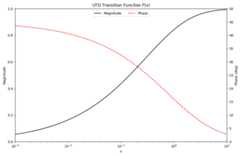
- sionna.rt.utils.f_utd(x)[source]
Computes the UTD transition function
The UTD transition function is defined as:
\[F(x) = \sqrt{\frac{\pi x}{2}} e^{jx}\left(1+j-2jF_c^*(x) \right)\]where\(F_c^*(x)\) is the complex conjugate of the Fresnel integral(55).
- Parameters:
x (
drjit.cuda.ad.Float) – Argument of the UTD transition function- Return type:
drjit.cuda.ad.Complex2f- Returns:
Real and imaginary parts of the UTD transition function
Example
The following code snippet produces a visualization of the magnitude and phase ofthe UTD transition function which matches that of Fig. 6 in[Kouyoumjian74].
importnumpyasnpimportmatplotlib.pyplotaspltimportdrjitasdrimportmitsubaasmimi.set_variant("cuda_ad_mono_polarized","llvm_ad_mono_polarized")fromsionna.rt.utilsimportf_utd,cpx_convertx=np.logspace(-3,1,1000)y=cpx_convert(f_utd(mi.Float(x)),"numpy")fig,ax1=plt.subplots(figsize=(10,6.5))# Plot magnitude with labelmag_line,=ax1.semilogx(x,np.abs(y),"k-",label="Magnitude")ax1.set_ylabel("Magnitude")# Create second y-axisax2=plt.twinx()# Plot phase with labelphase_line,=ax2.semilogx(x,np.angle(y,deg=True),"r--",label="Phase")ax2.set_ylabel("Phase (deg)")# Combine lines from both axes for the legendlines=[mag_line,phase_line]labels=[line.get_label()forlineinlines]# Add legend with both linesax1.legend(lines,labels,loc='upper center',frameon=True,ncol=2)# Set title and x labelplt.title(r"UTD Transition Function $F(x)$")ax1.set_xlabel("x")# Adjust limits and ticksax1.set_xlim(x.min(),x.max())ax1.set_ylim(np.abs(y).min(),np.abs(y).max())ax2.set_ylim(np.angle(y,deg=True).min(),np.angle(y,deg=True).max())ax1.set_yticks(np.linspace(0,1,6))ax2.set_yticks(np.linspace(0,50,11))plt.show()
- sionna.rt.utils.fresnel_reflection_coefficients_simplified(cos_theta,eta)[source]
Computes the Fresnel transverse electric and magnetic reflectioncoefficients assuming an incident wave propagating in vacuum(34)
- Parameters:
cos_theta (
drjit.cuda.ad.Float) – Cosine of the angle of incidenceeta (
drjit.cuda.ad.Complex2f) – Complex-valued relative permittivity of the medium upon which the wave is incident
- Return type:
typing.Tuple[drjit.cuda.ad.Complex2f,drjit.cuda.ad.Complex2f]- Returns:
Transverse electric\(r_{\perp}\) and magnetic\(r_{\parallel}\) Fresnel reflection coefficients
- sionna.rt.utils.itu_coefficients_single_layer_slab(cos_theta,eta,d,wavelength)[source]
Computes the single-layer slab Fresnel transverse electric andmagnetic reflection and refraction coefficients assuming the incident wavepropagates in vacuum using recommendation ITU-R P.2040 [ITU_R_2040_3]
More precisely, this function implements equations (43) and (44) from[ITU_R_2040_3].
- Parameters:
cos_theta (
drjit.cuda.ad.Float) – Cosine of the angle of incidenceeta (
drjit.cuda.ad.Complex2f) – Complex-valued relative permittivity of the medium upon which the wave is incidentd (
drjit.cuda.ad.Float) – Thickness of the slab [m]wavelength (
drjit.cuda.ad.Float) – Wavelength [m]
- Return type:
typing.Tuple[drjit.cuda.ad.Complex2f,drjit.cuda.ad.Complex2f,drjit.cuda.ad.Complex2f,drjit.cuda.ad.Complex2f]- Returns:
Transverse electric reflection coefficient\(R_{eTE}\), transverse magnetic reflection coefficient\(R_{eTM}\), transverse electric refraction coefficient\(T_{eTE}\), and transverse magnetic refraction coefficient\(T_{eTM}\)
Geometry
- sionna.rt.utils.phi_hat(phi)[source]
Computes the spherical unit vector\(\hat{\boldsymbol{\varphi}}(\theta, \varphi)\)as defined in(1)
- Parameters:
phi (
drjit.cuda.ad.Float) – Azimuth angle\(\varphi\) [rad]- Return type:
mitsuba.Vector3f
- sionna.rt.utils.theta_hat(theta,phi)[source]
Computes the spherical unit vector\(\hat{\boldsymbol{\theta}}(\theta, \varphi)\)as defined in(1)
- Parameters:
theta (
drjit.cuda.ad.Float) – Zenith angle\(\theta\) [rad]phi (
drjit.cuda.ad.Float) – Azimuth angle\(\varphi\) [rad]
- Return type:
mitsuba.Vector3f
- sionna.rt.utils.r_hat(theta,phi)[source]
Computes the spherical unit vetor\(\hat{\mathbf{r}}(\theta, \phi)\)as defined in(1)
- Parameters:
theta (
drjit.cuda.ad.Float) – Zenith angle\(\theta\) [rad]phi (
drjit.cuda.ad.Float) – Azimuth angle\(\varphi\) [rad]
- Return type:
mitsuba.Vector3f
- sionna.rt.utils.theta_phi_from_unit_vec(v)[source]
Computes zenith and azimuth angles (\(\theta,\varphi\))from unit-norm vectors as described in(2)
- Parameters:
v (
mitsuba.Vector3f) – Unit vector- Return type:
typing.Tuple[drjit.cuda.ad.Float,drjit.cuda.ad.Float]- Returns:
Zenith angle\(\theta\) [rad] and azimuth angle\(\varphi\) [rad]
- sionna.rt.utils.rotation_matrix(angles)[source]
Computes the rotation matrix as defined in(3)
The closed-form expression in (7.1-4)[TR38901] is used.
- Parameters:
angles (
mitsuba.Point3f) – Angles for the rotations\((\alpha,\beta,\gamma)\)[rad] that define rotations about the axes\((z, y, x)\),respectively- Return type:
drjit.cuda.ad.Matrix3f
Jones calculus
- sionna.rt.utils.implicit_basis_vector(k)[source]
Returns a reference frame basis vector for a Jones vector, representing atransverse wave propagating in direction
kThe spherical basis vector\(\hat{\boldsymbol{\theta}}(\theta, \varphi)\)(1) is used as basis vector, where the zenith and azimuth anglesare obtained from the unit vector
k.- Parameters:
k (
mitsuba.Vector3f) – A unit vector corresponding to the direction of propagation of a transverse wave- Return type:
mitsuba.Vector3f- Returns:
A basis vector orthogonal to
k
- sionna.rt.utils.jones_matrix_rotator(k,s_current,s_target)[source]
Constructs the 2D change-of-basis matrix to rotate the reference frame ofa Jones vector representing a transverse wave propagating in direction
kfrom basis vectors_currentto basisvectors_target- Parameters:
k (
mitsuba.Vector3f) – Direction of propagation as a unit vectors_current (
mitsuba.Vector3f) – Current basis vector as a unit vectors_target (
mitsuba.Vector3f) – Target basis vector as a unit vector
- Return type:
drjit.cuda.ad.Matrix2f
- sionna.rt.utils.jones_matrix_rotator_flip_forward(k)[source]
Constructs the 2D change-of-basis matrix that flips the direction ofpropagation of the reference frame of a Jones vector representing atransverse wave from the basis vector corresponding to
kto theone corresponding to-kThis is useful to evaluate the antenna pattern of a receiver, as the patternneeds to be rotated to match the frame in which the incident wave isrepresented.
Note that the rotation matrix returned by this function is a diagonalmatrix:
\[\begin{split}\mathbf{R} = \begin{bmatrix} \begin{array}{c c} c & 0 \\ 0 & -c \end{array} \end{bmatrix}\end{split}\]where:
\[c = \mathbf{s_c}^\textsf{T} \mathbf{s_t}\]and\(\mathbf{s_c}\) and\(\mathbf{s_t}\) are the basisvectors corresponding to
kand-k,respectively, and computed usingimplicit_basis_vector().- Parameters:
k (
mitsuba.Vector3f) – Current direction of propagation as a unit vector- Return type:
drjit.cuda.ad.Matrix2f
- sionna.rt.utils.to_world_jones_rotator(to_world,k_local)[source]
Constructs the 2D change-of-basis matrix to rotate the reference frame ofa Jones vector representing a transverse wave with
k_localasdirection of propagation from the local implicit frame to the world implicitframe- Parameters:
to_world (
drjit.cuda.ad.Matrix3f) – Change-of-basis matrix from the local to the world framek_local (
mitsuba.Vector3f) – Direction of propagation in the local frame as a unit vector
- Return type:
drjit.cuda.ad.Matrix2f
- sionna.rt.utils.jones_matrix_to_world_implicit(c1,c2,to_world,k_in_local,k_out_local)[source]
Builds the Jones matrix that models a specular reflection or a refraction
c1andc2are Fresnel coefficients that depend on thecomposition of the scatterer.k_in_localandk_out_localare the direction of propagation of theincident and scattered wave, respectively, represented in the local frame ofthe interaction.Note that in the local frame of the interaction, the z-axis vectorcorresponds to the normal to the scatterer surface at the interaction point.The returned matrix operates on the incident wave represented in theimplicit world frame. The resulting scattered wave is also represented inthe implicit world frame.This is ensured by applying a left and right rotation matrix to the 2x2diagonal matrix containing the Fresnel coefficients, which operates on thelocal frame having the transverse electric component as basis vector:
\[\mathbf{J} = \mathbf{R_O} \mathbf{D} \mathbf{R_I}^\textsf{T}\]where:
\[\begin{split}\mathbf{D} = \begin{bmatrix} \begin{array}{c c} \texttt{c1} & 0 \\ 0 & \texttt{c2} \end{array} \end{bmatrix}\end{split}\]and\(\mathbf{R_I}\) (\(\mathbf{R_O}\)) is the change-of-basismatrix from the local frame using the transverse electric direction as basisvector to the world implicit frame for the incident (scattered) wave.
This function returns the\(4 \times 4\) real-valued matrix equivalentto\(\mathbf{J}\):
\[\begin{split}\mathbf{M} = \begin{bmatrix} \begin{array}{c c} \Re\{\mathbf{J}\} & -\Im\{\mathbf{J}\} \\ \Im\{\mathbf{J}\} & \Re\{\mathbf{J}\} \end{array} \end{bmatrix}\end{split}\]where\(\mathbf{M}\) is the returned matrix and\(\Re\{\mathbf{J}\}\)and\(\Im\{\mathbf{J}\}\) the real and imaginary components of\(\mathbf{J}\), respectively.
- Parameters:
c1 (
drjit.cuda.ad.Complex2f) – First complex-valued Fresnel coefficientc2 (
drjit.cuda.ad.Complex2f) – Second complex-valued Fresnel coefficientto_world (
drjit.cuda.ad.Matrix3f) – Change-of-basis matrix from the local to the world framek_in_local (
mitsuba.Vector3f) – Direction of propagation of the incident wave in the local frame as a unit vectork_out_local (
mitsuba.Vector3f) – Direction of propagation of the scattered wave in the local frame as a unit vector
- Return type:
drjit.cuda.ad.Matrix4f
- sionna.rt.utils.jones_vec_dot(u,v)[source]
Computes the dot product of two Jones vectors\(\mathbf{u}\) and\(\mathbf{v}\)
A Jones vector is assumed to be represented by a real-valued vector offour dimensions, obtained by concatenating its real and imaginary components.The returned array is complex-valued.
More precisely, the following formula is implemented:
\[\begin{split}\begin{multline}a = \mathbf{u}^\textsf{H} \mathbf{v}\\ = \left( \Re\{\mathbf{u}\}^\textsf{T} \Re\{\mathbf{v}\}\\ + \Im\{\mathbf{u}\}^\textsf{T} \Im\{\mathbf{v}\} \right)\\ + j\left( \Re\{\mathbf{u})^\textsf{T} \Im\{\mathbf{v}\}\\ - \Im\{\mathbf{u}\}^\textsf{T} \Re\{\mathbf{v}\} \right)\end{multline}\end{split}\]- Parameters:
u (
mitsuba.Vector4f) – First input vectorv (
mitsuba.Vector4f) – Second input vector
- Return type:
drjit.cuda.ad.Complex2f
Meshes
- sionna.rt.utils.load_mesh(fname,flip_normals=True)[source]
Load a mesh from a file
This function loads a mesh from a given file and returns it as a Mitsuba mesh.The file must be in either PLY or OBJ format.
- Parameters:
fname (
str) – Filename of the mesh to be loadedflip_normals (
bool) – Whether to invert the normals of the mesh.
- Return type:
mitsuba.Mesh- Returns:
Mitsuba mesh object representing the loaded mesh
- sionna.rt.utils.transform_mesh(mesh,translation=None,rotation=None,scale=None)[source]
In-place transformation of a mesh by applying translation, rotation, and scaling
The order of the transformations is as follows:
Scaling
Rotation
Translation
Before applying the transformations, the mesh is centered.
- Parameters:
mesh (
mitsuba.Mesh) – Mesh to be edited. The mesh is modified in-place.translation (
typing.Optional[mitsuba.Point3f]) – Translation vector to applyrotation (
typing.Optional[mitsuba.Point3f]) – Rotation angles [rad] specified through three angles\((\alpha, \beta, \gamma)\) corresponding to a 3D rotation as defined in(3)scale (
typing.Optional[mitsuba.Point3f]) – Scaling vector for scaling along the x, y, and z axes
Miscellaneous
- sionna.rt.utils.complex_sqrt(x)[source]
Computes the square root of a complex number\(x\)
The following formula is implemented to compute the square roots of complexnumbers:https://en.wikipedia.org/wiki/Square_root#Algebraic_formula
- Parameters:
x (
drjit.cuda.ad.Complex2f) – Complex number- Return type:
drjit.cuda.ad.Complex2f
- sionna.rt.utils.dbm_to_watt(x)[source]
Converts dBm to Watt
Implements the following formula:
\[P_W = 10^{\frac{P_{dBm}-30}{10}}\]- Parameters:
x (
drjit.cuda.ad.Float) – Power [dBm]- Return type:
drjit.cuda.ad.Float
- sionna.rt.utils.isclose(a,b,rtol=1e-05,atol=1e-08)[source]
Returns an array of boolean in which an element is set toTrue if thecorresponding entries in
aandbare equal within a toleranceMore precisely, this function returnsTrue for the\(i^{th}\) elementif:
\[|\texttt{a}[i] - \texttt{b}[i]| < \texttt{atol} + \texttt{rtol} \cdot \texttt{b}[i]\]- Parameters:
a (
drjit.cuda.ad.Float) – First input array to compareb (
drjit.cuda.ad.Float) – Second input array to comparertol (
drjit.cuda.ad.Float) – Relative error thresholdatol (
drjit.cuda.ad.Float) – Absolute error threshold
- Return type:
drjit.cuda.ad.Bool
- sionna.rt.utils.log10(x)[source]
Evaluates the base-10 logarithm
- Parameters:
x (
drjit.cuda.ad.Float) – Input value- Return type:
drjit.cuda.ad.Float
- sionna.rt.utils.sigmoid(x)[source]
Evaluates the sigmoid of
x- Parameters:
x (
drjit.cuda.ad.Float) – Input value- Return type:
drjit.cuda.ad.Float
- sionna.rt.utils.sinc(x)[source]
Evaluates the normalized sinc function
The sinc function is defined as\(\sin(\pi x)/(\pi x)\)for any\(x \neq 0\) and equals\(0\) for\(x=0\).
- Return type:
drjit.cuda.ad.Float- Parameters:
x (Float)
- sionna.rt.utils.subcarrier_frequencies(num_subcarriers,subcarrier_spacing)[source]
Compute the baseband frequencies of
num_subcarriersubcarriers spaced bysubcarrier_spacing, i.e.,>>># If num_subcarrier is even:>>>frequencies=[-num_subcarrier/2,...,0,...,num_subcarrier/2-1]*subcarrier_spacing>>>>>># If num_subcarrier is odd:>>>frequencies=[-(num_subcarrier-1)/2,...,0,...,(num_subcarrier-1)/2]*subcarrier_spacing
- Parameters:
num_subcarriers (
int) – Number of subcarrierssubcarrier_spacing (
float) – Subcarrier spacing [Hz]
- Return type:
drjit.cuda.ad.Float- Returns:
Baseband frequencies of subcarriers
Ray tracing
- sionna.rt.utils.fibonacci_lattice(num_points)[source]
Generates a Fibonacci lattice of size
num_pointson the unit square\([0, 1] \times [0, 1]\)- Parameters:
num_points (
int) – Size of the lattice- Return type:
mitsuba.Point2f
- sionna.rt.utils.spawn_ray_from_sources(lattice,samples_per_src,src_positions)[source]
Spawns
samples_per_srcrays for each source at the positions specifiedbysrc_positions, oriented in the directions defined by thelatticeThe spawned rays are ordered samples-first.
- Parameters:
lattice (
typing.Callable[[int],mitsuba.Point2f]) – Callable that generates the lattice used as directions forthe rayssamples_per_src (
int) – Number of rays per source to spawnsrc_positions (
mitsuba.Point3f) – Positions of the sources
- Return type:
mitsuba.Ray3f
- sionna.rt.utils.offset_p(p,d,n)[source]
Adds a small offset to\(\mathbf{p}\) along\(\mathbf{n}\) such that\(\mathbf{n}^{\textsf{T}} \mathbf{d} \gt 0\)
More precisely, this function returns\(\mathbf{o}\) such that:
\[\mathbf{o} = \mathbf{p} + \epsilon\left(1 + \max{\left\{|p_x|,|p_y|,|p_z|\right\}}\right)\texttt{sign}(\mathbf{d} \cdot \mathbf{n})\mathbf{n}\]where\(\epsilon\) depends on the numerical precision and\(\mathbf{p} = (p_x,p_y,p_z)\).
- Parameters:
p (
mitsuba.Point3f) – Point to offsetd (
mitsuba.Vector3f) – Direction toward which to offset alongnn (
mitsuba.Vector3f) – Direction along which to offset
- Return type:
mitsuba.Point3f
- sionna.rt.utils.spawn_ray_towards(p,t,n=None)[source]
Spawns a ray with infinite length from\(\mathbf{p}\) toward\(\mathbf{t}\)
If\(\mathbf{n}\) is not
None, then a small offset is addedto\(\mathbf{p}\) along\(\mathbf{n}\) in the direction of\(\mathbf{t}\).- Parameters:
p (
mitsuba.Point3f) – Origin of the rayt (
mitsuba.Point3f) – Point towards which to spawn the rayn (
typing.Optional[mitsuba.Vector3f]) – (Optional) Direction along which to offset\(\mathbf{p}\)
- Return type:
mitsuba.Ray3f
- sionna.rt.utils.spawn_ray_to(p,t,n=None)[source]
Spawns a finite ray from\(\mathbf{p}\) to\(\mathbf{t}\)
The length of the ray is set to\(\|\mathbf{p} - \mathbf{t}\|\).
If\(\mathbf{n}\) is not
None, then a small offset is addedto\(\mathbf{p}\) along\(\mathbf{n}\) in the direction of\(\mathbf{t}\).- Parameters:
p (
mitsuba.Point3f) – Origin of the rayt (
mitsuba.Point3f) – Point towards which to spawn the rayn (
typing.Optional[mitsuba.Vector3f]) – (Optional) Direction along which to offset\(\mathbf{p}\)
- Return type:
mitsuba.Ray3f
- References:
- [ITU_R_2040_3]
Recommendation ITU-R P.2040-3, “Effects of building materialsand structures on radiowave propagation above about 100 MHz”
[TR38901]3GPP TR 38.901, “Study on channel model for frequencies from 0.5to 100 GHz”, Release 18.0