Antenna Arrays
- classsionna.rt.AntennaArray(antenna_pattern,normalized_positions)[source]
Class implementing an antenna array
An antenna array is composed of antennas which are placed atdifferent positions. All antennas share the same antenna pattern,which can be single- or dual-polarized.
- Parameters:
antenna_pattern (
sionna.rt.antenna_pattern.AntennaPattern) – Antenna pattern to be used across the arraynormalized_positions (
mitsuba.Point3f) – Array of relative positions of eachantenna with respect to the position of the radio device,normalized by the wavelength.Dual-polarized antennas are counted as a single antennaand share the same position.
- propertyantenna_pattern
Get/set the antenna pattern
- Type:
- propertyarray_size
Number of antennas in the array. Dual-polarized antennas are counted asa single antenna.
- Type:
int
- propertynormalized_positions
Get/set array of relative normalized positions\((x,y,z)\)[\(\lambda\)] of each antenna. Dual-polarized antennas are countedas a single antenna and share the same position.
- Type:
mi.Point3f
- propertynum_ant
Number of linearly polarized antennas in the array. Dual-polarizedantennas are counted as two linearly polarized antennas.
- Type:
int
- positions(wavelength)[source]
Get the relative positions of all antennas(dual-polarized antennas are counted as a single antenna and share thesame position).
Positions are computed by scaling the normalized positions of antennasby the
wavelength.- Parameters:
wavelength (
float) – Wavelength [m]- Return type:
mitsuba.Point3f- Returns:
Relative antenna positions\((x,y,z)\) [m]
- rotate(wavelength,orientation)[source]
Computes the relative positions of all antennas rotated accordingto the
orientationDual-polarized antennas are counted as a single antenna and share thesame position.
Positions are computed by scaling the normalized positions of antennasby the
wavelengthand rotating byorientation.- Parameters:
wavelength (
float) – Wavelength [m]orientation (
mitsuba.Point3f) – Orientation [rad] specified through three anglescorresponding to a 3D rotation as defined in(3)
- Return type:
mitsuba.Point3f- Returns:
Rotated relative antenna positions\((x,y,z)\) [m]
- classsionna.rt.PlanarArray(*,num_rows,num_cols,vertical_spacing=0.5,horizontal_spacing=0.5,pattern,**kwargs)[source]
Class implementing a planar antenna array
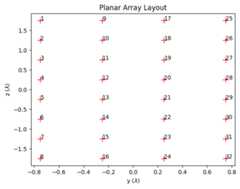
The antennas of a planar array are regularly spaced, located in they-z plane, and numbered column-first from the top-left tobottom-right corner.
- Parameters:
num_rows (
int) – Number of rowsnum_cols (
int) – Number of columnsvertical_spacing (
float) – Vertical antenna spacing[multiples of wavelength]horizontal_spacing (
float) – Horizontal antenna spacing[multiples of wavelength]pattern (
str) – Name of a registered antenna pattern factory method(“iso” | “dipole” | “hw_dipole” | “tr38901”)
- Keyword Arguments:
polarization (
str) – Name of a registered polarization(“V” | “H” | “VH” | “cross”)polarization_model (
str) – Name of a registered polarization model(“tr38901_1” | “tr38901_2”).Defaults to “tr38901_2”.**kwargs (
Any) – Depending on the chosen antenna pattern, other keyword argumentsmust be provided.See theDeveloper Guide formore details.
Example
fromsionna.rtimportPlanarArrayarray=PlanarArray(num_rows=8,num_cols=4,pattern="tr38901",polarization="VH")array.show()
- propertyantenna_pattern
Get/set the antenna pattern
- Type:
- propertyarray_size
Number of antennas in the array. Dual-polarized antennas are counted asa single antenna.
- Type:
int
- propertynormalized_positions
Get/set array of relative normalized positions\((x,y,z)\)[\(\lambda\)] of each antenna. Dual-polarized antennas are countedas a single antenna and share the same position.
- Type:
mi.Point3f
- propertynum_ant
Number of linearly polarized antennas in the array. Dual-polarizedantennas are counted as two linearly polarized antennas.
- Type:
int
- positions(wavelength)
Get the relative positions of all antennas(dual-polarized antennas are counted as a single antenna and share thesame position).
Positions are computed by scaling the normalized positions of antennasby the
wavelength.- Parameters:
wavelength (
float) – Wavelength [m]- Return type:
mitsuba.Point3f- Returns:
Relative antenna positions\((x,y,z)\) [m]
- rotate(wavelength,orientation)
Computes the relative positions of all antennas rotated accordingto the
orientationDual-polarized antennas are counted as a single antenna and share thesame position.
Positions are computed by scaling the normalized positions of antennasby the
wavelengthand rotating byorientation.- Parameters:
wavelength (
float) – Wavelength [m]orientation (
mitsuba.Point3f) – Orientation [rad] specified through three anglescorresponding to a 3D rotation as defined in(3)
- Return type:
mitsuba.Point3f- Returns:
Rotated relative antenna positions\((x,y,z)\) [m]
