
Physical Layer Abstraction
In this notebook, you will learn how to bypass the simulation of time-consuming physical layer (PHY) procedures, such as MIMO detection and decoding, viaphysical layer abstraction.
Specifically, we will demonstrate how to abstract PHY computations for each user by
Aggregating the per-stream SINR values into a single, AWGN-equivalent effective SINR value;
Mapping the effective SINR value to a transport block error rate (TBLER) using pre-computed look-up tables from the forward error correction (FEC) module of Sionna PHY.
This method enables the fast computation of the transmission rate and HARQ feedback on a per-user basis, allowing system-level simulations to scale up to tens of base stations and hundreds of users, as demonstrated in the relatedsystem-level simulation notebook.
Imports
We start by importing Sionna and the relevant external libraries.
[15]:
importosos.environ['TF_CPP_MIN_LOG_LEVEL']='3'ifos.getenv("CUDA_VISIBLE_DEVICES")isNone:gpu_num=0# Use "" to use the CPUifgpu_num!="":print(f'\nUsing GPU{gpu_num}\n')else:print('\nUsing CPU\n')os.environ["CUDA_VISIBLE_DEVICES"]=f"{gpu_num}"# Import Sionnatry:importsionna.sysexceptImportErrorase:importsysif'google.colab'insys.modules:# Install Sionna in Google Colabprint("Installing Sionna and restarting the runtime. Please run the cell again.")os.system("pip install sionna")os.kill(os.getpid(),5)else:raisee# Configure the notebook to use only a single GPU and allocate only as much memory as needed# For more details, see https://www.tensorflow.org/guide/gpuimporttensorflowastftf.get_logger().setLevel('ERROR')gpus=tf.config.list_physical_devices('GPU')ifgpus:try:tf.config.experimental.set_memory_growth(gpus[0],True)exceptRuntimeErrorase:print(e)
[16]:
# Additional external librariesimportnumpyasnpimportmatplotlib.pyplotasplt# Sionna componentsfromsionna.phy.utilsimportlog2,insert_dims,db_to_linfromsionna.phy.constantsimportBOLTZMANN_CONSTANTfromsionna.phy.channelimportsubcarrier_frequencies,cir_to_ofdm_channelfromsionna.phy.channel.tr38901importUMi,UMa,RMa,PanelArrayfromsionna.phy.mimoimportStreamManagementfromsionna.sysimportPHYAbstraction,InnerLoopLinkAdaptationfromsionna.phyimportconfig# Internal computational precisionsionna.phy.config.precision='single'# 'single' or 'double'# Set random seed for reproducibilitysionna.phy.config.seed=45
Instantiate a PHYAbstraction object
[17]:
# Instantiate a PHYAbstraction objectphy_abs=PHYAbstraction()mcs_category=0# 0 for uplink, 1 for downlinkmcs_table_index=1# Table index: [1,2] for UL, [1,2,3,4] for DLmcs_index=15# MCS index# Plot a BLER table_=phy_abs.plot(plot_subset={'category':{mcs_category:{'index':{mcs_table_index:{'MCS':[mcs_index,mcs_index+2]}}}}},# MCS indexshow=True)

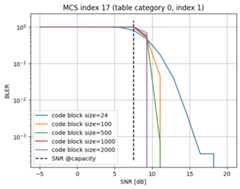
As can be seen from the figure above, the BLER depends not only depend on the MCS but also on the code block size (CBS). The longer the code, the lower the BLER.
Retrieve BLER values from interpolated tables
When aPHYAbstraction class is instantiated, the precomputed tables are interpolated over a fine two-dimensional grid of SINR and code block size (CBS) values. These interpolated tables are then used to obtain the BLER for different values of SINR and CBS.
The following code snippet shows this operation in detail. In general, you are not supposed to call this method directly, but rather use thecall method of thePHYAbstraction class which does this for you, as shown later on.
This method also returns the transport block error rate (TBLER), which is the probability that at least one code block in a transport block is not decoded correctly.
[18]:
# Define the SNR and CB size at which BLER is retrievedsnr_eff_db=9cb_size=80# Compute the corresponding indices for the BLER interpolated tablesnr_db_idx=phy_abs.get_idx_from_grid(snr_eff_db,'snr')cbs_idx=phy_abs.get_idx_from_grid(cb_size,'cbs')# Retrieve the interpolated BLER valuebler=phy_abs.bler_table_interp[mcs_category,mcs_table_index-1,mcs_index,cbs_idx,snr_db_idx]print(f'The BLER for MCS{mcs_index} at SNR{snr_eff_db} dB and CB size{cb_size} is{bler.numpy():.4f}')
The BLER for MCS 15 at SNR 9 dB and CB size 80 is 0.0511
Generate a new BLER table
For more details, see the documentation of thenew_bler_table method and/or its source code.
[19]:
# Define MCS indices at which the new BLER table is simulatedsim_set={'category':{1:# 0 for PUSCH, 1 for PDSCH{'index':{2:{'MCS':[16]}}}}}# SINR and Code Block size values at which new simulations are performedsinr_dbs=np.linspace(5,25,25)cb_sizes=[24,200,3000]# Compute new BLER tablesnew_table=phy_abs.new_bler_table(sinr_dbs,cb_sizes,sim_set,max_mc_iter=15,# max n. Monte-Carlo iterations per SNR pointsbatch_size=10,verbose=True)
BLER simulations started.Total # (category, index, MCS, SINR) points to simulate: 3Simulating category=1, index=2, CBS=24, MCS=16...EbNo [dB] | BER | BLER | bit errors | num bits | block errors | num blocks | runtime [s] | status--------------------------------------------------------------------------------------------------------------------------------------- -1.246 | 2.6222e-01 | 1.0000e+00 | 944 | 3600 | 150 | 150 | 0.8 |reached max iterations -0.412 | 2.5417e-01 | 9.8667e-01 | 915 | 3600 | 148 | 150 | 0.4 |reached max iterations 0.421 | 2.4778e-01 | 9.9333e-01 | 892 | 3600 | 149 | 150 | 0.5 |reached max iterations 1.254 | 2.1000e-01 | 1.0000e+00 | 756 | 3600 | 150 | 150 | 0.5 |reached max iterations 2.088 | 2.0056e-01 | 9.8667e-01 | 722 | 3600 | 148 | 150 | 0.4 |reached max iterations 2.921 | 1.8944e-01 | 9.6000e-01 | 682 | 3600 | 144 | 150 | 0.5 |reached max iterations 3.754 | 1.7667e-01 | 9.6000e-01 | 636 | 3600 | 144 | 150 | 0.4 |reached max iterations 4.588 | 1.5972e-01 | 9.0000e-01 | 575 | 3600 | 135 | 150 | 0.4 |reached max iterations 5.421 | 1.1722e-01 | 8.0667e-01 | 422 | 3600 | 121 | 150 | 0.4 |reached max iterations 6.254 | 9.8333e-02 | 6.6667e-01 | 354 | 3600 | 100 | 150 | 0.5 |reached max iterations 7.088 | 7.6389e-02 | 4.3333e-01 | 275 | 3600 | 65 | 150 | 0.4 |reached max iterations 7.921 | 3.6667e-02 | 2.5333e-01 | 132 | 3600 | 38 | 150 | 0.4 |reached max iterations 8.754 | 2.8056e-02 | 1.6000e-01 | 101 | 3600 | 24 | 150 | 0.5 |reached max iterations 9.588 | 1.7222e-02 | 1.0667e-01 | 62 | 3600 | 16 | 150 | 0.5 |reached max iterations 10.421 | 5.8333e-03 | 4.0000e-02 | 21 | 3600 | 6 | 150 | 0.4 |reached max iterations 11.254 | 1.1111e-03 | 6.6667e-03 | 4 | 3600 | 1 | 150 | 0.5 |reached max iterations 12.088 | 0.0000e+00 | 0.0000e+00 | 0 | 3600 | 0 | 150 | 0.5 |reached max iterationsSimulation stopped as no error occurred @ EbNo = 12.1 dB.PROGRESS: 33.33%Estimated remaining time: 0:00:16 [h:m:s]Simulating category=1, index=2, CBS=200, MCS=16...EbNo [dB] | BER | BLER | bit errors | num bits | block errors | num blocks | runtime [s] | status--------------------------------------------------------------------------------------------------------------------------------------- -1.246 | 2.5390e-01 | 1.0000e+00 | 7617 | 30000 | 150 | 150 | 0.8 |reached max iterations -0.412 | 2.4080e-01 | 1.0000e+00 | 7224 | 30000 | 150 | 150 | 0.5 |reached max iterations 0.421 | 2.2620e-01 | 1.0000e+00 | 6786 | 30000 | 150 | 150 | 0.5 |reached max iterations 1.254 | 2.1337e-01 | 1.0000e+00 | 6401 | 30000 | 150 | 150 | 0.5 |reached max iterations 2.088 | 2.0313e-01 | 1.0000e+00 | 6094 | 30000 | 150 | 150 | 0.5 |reached max iterations 2.921 | 1.8740e-01 | 1.0000e+00 | 5622 | 30000 | 150 | 150 | 0.4 |reached max iterations 3.754 | 1.7140e-01 | 1.0000e+00 | 5142 | 30000 | 150 | 150 | 0.5 |reached max iterations 4.588 | 1.5637e-01 | 1.0000e+00 | 4691 | 30000 | 150 | 150 | 0.5 |reached max iterations 5.421 | 1.3770e-01 | 1.0000e+00 | 4131 | 30000 | 150 | 150 | 0.5 |reached max iterations 6.254 | 1.1050e-01 | 9.9333e-01 | 3315 | 30000 | 149 | 150 | 0.4 |reached max iterations 7.088 | 7.2367e-02 | 8.4667e-01 | 2171 | 30000 | 127 | 150 | 0.4 |reached max iterations 7.921 | 4.3367e-02 | 5.8000e-01 | 1301 | 30000 | 87 | 150 | 0.4 |reached max iterations 8.754 | 8.5667e-03 | 1.6667e-01 | 257 | 30000 | 25 | 150 | 0.5 |reached max iterations 9.588 | 7.0000e-04 | 2.0000e-02 | 21 | 30000 | 3 | 150 | 0.5 |reached max iterations 10.421 | 0.0000e+00 | 0.0000e+00 | 0 | 30000 | 0 | 150 | 0.5 |reached max iterationsSimulation stopped as no error occurred @ EbNo = 10.4 dB.PROGRESS: 66.67%Estimated remaining time: 0:00:07 [h:m:s]Simulating category=1, index=2, CBS=3000, MCS=16...EbNo [dB] | BER | BLER | bit errors | num bits | block errors | num blocks | runtime [s] | status--------------------------------------------------------------------------------------------------------------------------------------- -1.246 | 2.1102e-01 | 1.0000e+00 | 94957 | 450000 | 150 | 150 | 0.8 |reached max iterations -0.412 | 1.9497e-01 | 1.0000e+00 | 87738 | 450000 | 150 | 150 | 0.4 |reached max iterations 0.421 | 1.8022e-01 | 1.0000e+00 | 81097 | 450000 | 150 | 150 | 0.4 |reached max iterations 1.254 | 1.6595e-01 | 1.0000e+00 | 74677 | 450000 | 150 | 150 | 0.4 |reached max iterations 2.088 | 1.5181e-01 | 1.0000e+00 | 68316 | 450000 | 150 | 150 | 0.4 |reached max iterations 2.921 | 1.3863e-01 | 1.0000e+00 | 62383 | 450000 | 150 | 150 | 0.4 |reached max iterations 3.754 | 1.2621e-01 | 1.0000e+00 | 56794 | 450000 | 150 | 150 | 0.4 |reached max iterations 4.588 | 1.1146e-01 | 1.0000e+00 | 50157 | 450000 | 150 | 150 | 0.4 |reached max iterations 5.421 | 9.6727e-02 | 1.0000e+00 | 43527 | 450000 | 150 | 150 | 0.4 |reached max iterations 6.254 | 7.8140e-02 | 1.0000e+00 | 35163 | 450000 | 150 | 150 | 0.4 |reached max iterations 7.088 | 4.9962e-02 | 1.0000e+00 | 22483 | 450000 | 150 | 150 | 0.4 |reached max iterations 7.921 | 6.6133e-03 | 6.2667e-01 | 2976 | 450000 | 94 | 150 | 0.4 |reached max iterations 8.754 | 0.0000e+00 | 0.0000e+00 | 0 | 450000 | 0 | 150 | 0.4 |reached max iterationsSimulation stopped as no error occurred @ EbNo = 8.8 dB.PROGRESS: 100.00%Estimated remaining time: 0:00:00 [h:m:s]Simulations completed!
[20]:
# Plot the new BLER tablephy_abs.plot(plot_subset=sim_set,show=True);
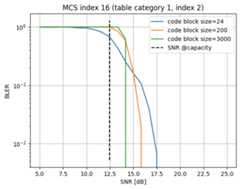
Please note that the new BLER table is overwritten tophy_abs.bler_table at the corresponding entries. We can also inspect the BLER table directly:
[21]:
new_table["category"][1]["index"][2]["MCS"][16]["CBS"][200]
[21]:
{'BLER': [1.0, 1.0, 1.0, 1.0, 1.0, 1.0, 1.0, 1.0, 1.0, 0.9933333396911621, 0.846666693687439, 0.5799999833106995, 0.1666666716337204, 0.019999999552965164, 0.0, 0.0, 0.0, 0.0, 0.0, 0.0, 0.0, 0.0, 0.0, 0.0, 0.0]}Bypass physical layer computations
Once thePHYAbstraction object has been instantiated, we can use it to produce
Number of succesfully decoded bits;
Hybrid automatic repeat request (HARQ) value, reporting an ACK (HARQ=1) or a NACK (HARQ=0) depending on whether the transport block has been correctly received. If missing, -1 is reported;
Effective SINR value, that can be used as a measure of the channel condition quality for the user;
Block error rate (BLER), defining the probability that a code block is not decoded correctly;
Transport block error rate (TBLER), being the probability that at least one code block in a transport block is not decoded correctly.
We first set up the main parameters:
[22]:
# MCS table index# Ranges within [1;4] for downlink and [1;2] for uplink, as in TS 38.214mcs_table_index=1direction='uplink'# 'downlink' or 'uplink'mcs_category=int(direction=='downlink')num_ut=80# Time/frequency resource gridnum_ofdm_symbols=14num_subcarriers=1024num_streams_per_ut=1# BLER target valuebler_target=.1
[23]:
# Generate random SINR values across UT# Target shape:# […, num_ofdm_symbols, num_subcarriers, num_ut, num_streams_per_ut]sinr_db=config.tf_rng.uniform([1,1,num_ut,1],minval=-5,maxval=30)# Generate random SINR values across UT, subcarriers, and OFDM symbolssinr_db=sinr_db+config.tf_rng.normal([num_ofdm_symbols,num_subcarriers,num_ut,num_streams_per_ut],mean=0,stddev=2)sinr=db_to_lin(sinr_db)
PHYAbstraction module also needs the MCS indices for each user.[24]:
illa=InnerLoopLinkAdaptation(phy_abs,bler_target)mcs_index=illa(sinr=sinr,mcs_table_index=mcs_table_index)print("MCS indices: ",mcs_index.numpy())
MCS indices: [14 18 10 5 27 23 7 5 13 27 25 27 24 23 12 27 5 27 19 2 16 17 27 27 21 27 22 25 3 15 25 27 21 7 27 2 27 7 23 22 9 15 27 27 27 27 20 27 27 7 21 16 16 17 5 27 25 12 27 23 27 16 27 27 3 12 27 27 27 17 4 27 27 12 14 27 5 27 19 21]
We can now call thePHYAbstraction object, providing the generated per-stream SINR and per-user MCS index to obtain the number of decoded bits, HARQ feedback, effective SINR, BLER and TBLER.
Note that the transport block size is derived internally from the shape of the input per-stream SINR, revealing the number of allocated resources, and MCS index.
[25]:
# [batch_size, num_ut]num_decoded_bits,harq_feedback,sinr_eff,bler,tbler= \phy_abs(mcs_index,sinr=sinr,mcs_table_index=mcs_table_index,mcs_category=mcs_category)sinr_eff=sinr_eff.numpy()# When HARQ feedback = 0, the Transport Block has not been decoded successfullyassertnp.all(num_decoded_bits.numpy()[harq_feedback.numpy()==0]==0)# Inspect the HARQ feedbackprint("HARQ feedback: ",harq_feedback.numpy())
HARQ feedback: [1 0 1 1 1 1 1 1 1 1 1 1 1 1 1 1 1 1 1 1 1 1 0 1 1 1 1 1 1 1 1 1 1 1 1 1 1 1 1 1 1 1 1 1 1 1 1 1 1 1 1 1 1 1 1 1 1 1 1 1 1 1 1 1 1 1 1 1 1 1 1 1 1 1 1 0 1 1 1 1]
Effective SINR
For a user experiencing a signal-to-interference-plus-noise ratio\(\mathrm{SINR}_i\) on time/frequency resource\(i=1,\dots,N\), its effective SINR is computed as:
where\(\beta>0\) is a parameter whose value depends on the used MCS.
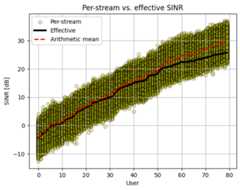
It is interesting to visualize the relationship between the per-stream and the equivalent SINR for each user.
[26]:
# Sort users in increasing order of effective SINRind_sort=np.argsort(sinr_eff)# [num_ut, num_ofdm_symbols, num_subcarriers, num_streams_per_ut]sinr_t=np.transpose(sinr.numpy(),[2,0,1,3])# [num_ut, num_ofdm_symbols*num_subcarriers*num_streams_per_ut]sinr_t=np.reshape(sinr_t,[num_ut,-1])sinr_t=sinr_t[ind_sort,:]# Visualize the effective vs. per-stream SINR valuesfig,ax=plt.subplots()forutinrange(num_ut):label='Per-stream'ifut==0elseNoneax.scatter([ut]*sinr_t.shape[1],10*np.log10(sinr_t[ut,:]),c='y',alpha=.3,edgecolors='k',label=label)ax.plot(10*np.log10(sinr_eff[ind_sort]),'-k',linewidth=3,label='Effective')ax.plot(10*np.log10(sinr_t.mean(axis=1)),'--r',linewidth=2,label='Arithmetic mean')ax.set_xlabel('User')ax.set_ylabel('SINR [dB]')ax.set_title('Per-stream vs. effective SINR')ax.grid()ax.legend(framealpha=1)plt.show()
Achieved vs. Shannon spectral efficiency
Finally, we compute the achieved spectral efficiency and compare it against the corresponding Shannon upper bound, for each user.
[27]:
# Determine if a resource element carries energy from at# least one stream of a particular user# [num_ofdm_sym, num_subcarriers, num_ut]is_re_allocated=np.sum(sinr.numpy(),axis=-1)>0# Sum the number of allocated resource elements across# all subcarriers and OFDM symbols# [num_ut]num_allocated_re=np.sum(is_re_allocated,axis=(-2,-3))# Achieved spectral efficiency# number of decoded bits of the transport block divided by the number of# allocated resource elements# [num_ut]se_achieved=num_decoded_bits/num_allocated_re# Shannon capacity# [num_ut]se_shannon=log2(tf.cast(1,sinr_eff.dtype)+sinr_eff)
[28]:
defget_cdf(values):""" Computes the Cumulative Distribution Function (CDF) of the input vector """values=np.array(values).flatten()n=len(values)sorted_val=np.sort(values)cumulative_prob=np.arange(1,n+1)/nreturnsorted_val,cumulative_probfig,ax=plt.subplots(figsize=(5,4))ind_sort=np.argsort(se_shannon.numpy())ax.plot(se_achieved.numpy()[ind_sort],label='Achieved')ax.plot(se_shannon.numpy()[ind_sort],label='Shannon bound')ax.set_title('Spectral Efficiency')ax.set_xlabel('User')ax.set_ylabel('SE [bits/s/Hz]')ax.legend()ax.grid()fig.tight_layout()plt.show()
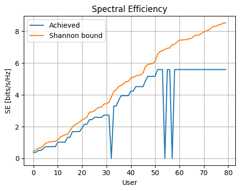
One can see that the achieved spectral efficiency is substantially lower than the Shannon capacity. At low SINR, this is mainly due to the fact that the targeted BLER limits the achievable spectral efficiency. At high SINR, the highest available MCS scheme is the main limiting factor. A zero spectral efficiency is observed when the transport block has not been decoded correctly, which occurs with probability TBLER.
You can play around with different BLER targets, MCS indices, tables, and resource grid sizes (i.e., number of OFDM symbols and subcarriers) to observe their impact on the achieved spectral efficiency.
Conclusions
ThePHYAbstraction class bypasses the physical layer processing via the computation of an AWGN-equivalent effective SINR which is mapped to a BLER value according to precomputed tables.
SINR computation from OFDM channel matrices is covered in thehexagonal grid topology notebook;
Link adaptation for MCS selection is discussed in thelink adaptation notebook.
References
[1] S. Lagen, K. Wanuga, H. Elkotby, S. Goyal, N. Patriciello, L. Giupponi.New radio physical layer abstraction for system-level simulations of 5G networks. IEEE International Conference on Communications (ICC), 2020