numpy.atan#
- numpy.atan(x,/,out=None,*,where=True,casting='same_kind',order='K',dtype=None,subok=True[,signature])=<ufunc'arctan'>#
Trigonometric inverse tangent, element-wise.
The inverse of tan, so that if
y=tan(x)thenx=arctan(y).- Parameters:
- xarray_like
- outndarray, None, or tuple of ndarray and None, optional
A location into which the result is stored. If provided, it must havea shape that the inputs broadcast to. If not provided or None,a freshly-allocated array is returned. A tuple (possible only as akeyword argument) must have length equal to the number of outputs.
- wherearray_like, optional
This condition is broadcast over the input. At locations where thecondition is True, theout array will be set to the ufunc result.Elsewhere, theout array will retain its original value.Note that if an uninitializedout array is created via the default
out=None, locations within it where the condition is False willremain uninitialized.- **kwargs
For other keyword-only arguments, see theufunc docs.
- Returns:
- outndarray or scalar
Out has the same shape asx. Its real part is in
[-pi/2,pi/2](arctan(+/-inf)returns+/-pi/2).This is a scalar ifx is a scalar.
See also
Notes
arctanis a multi-valued function: for eachx there are infinitelymany numbersz such that tan(z) =x. The convention is to returnthe anglez whose real part lies in [-pi/2, pi/2].For real-valued input data types,
arctanalways returns real output.For each value that cannot be expressed as a real number or infinity,it yieldsnanand sets theinvalid floating point error flag.For complex-valued input,
arctanis a complex analytic function thathas [1j,infj] and [-1j,-infj] as branch cuts, and is continuousfrom the left on the former and from the right on the latter.The inverse tangent is also known as
atanor tan^{-1}.References
Abramowitz, M. and Stegun, I. A.,Handbook of Mathematical Functions,10th printing, New York: Dover, 1964, pp. 79.https://personal.math.ubc.ca/~cbm/aands/page_79.htm
Examples
We expect the arctan of 0 to be 0, and of 1 to be pi/4:
>>>importnumpyasnp>>>np.arctan([0,1])array([ 0. , 0.78539816])
>>>np.pi/40.78539816339744828
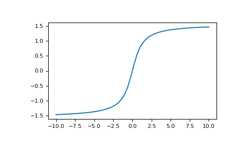
Plot arctan:
>>>importmatplotlib.pyplotasplt>>>x=np.linspace(-10,10)>>>plt.plot(x,np.arctan(x))>>>plt.axis('tight')>>>plt.show()