
To appeal to suburban voters in late summer 2020, President Trumptweetedthat “people living their Suburban Lifestyle Dream” would “no longer be bothered or financially hurt by having low income housing built in your neighborhood.” The tweet referred to the president’sgutting of the Affirmatively Furthering, which required local governments to affirmatively address racial segregation as required by the 1968 Fair Housing Act. He continued, “Your housing prices will go up based on the market, and crime will go down. I have rescinded the Obama-Biden AFFH Rule. Enjoy!”
President Trump’s HUD Secretary Ben Carson concurred with President Trump’s desire to roll back fair housing enforcement at HUD. In an op-ed shortly after President Trump’s tweet, then Secretary Carson affirmed the president’s abhorrent rhetoric by stating that fair housing practices could lead suburbs to become dens of “crime and chaos,” suggesting that low-income people are inherently criminal. This type of comment has obvious racist elements, as a disproportionate number of low-income people in this country are Black or Hispanic.
While President Trump’s and Secretary Carson’s words played to deplorable racist perceptions of people living in affordable housing, the vision of the suburbs they paint is also incorrect. The exclusive, white, middle-class vision of the suburbs is rapidly changing. Whites fled cities to move to outlying majority white middle-class enclaves in the mid-1900s, a phenomenon known as “white flight.” The federal government encouraged whites to move to suburbs by constructing federal highways and providing white families low-interest mortgages for homes in car-centric, less dense neighborhoods.Racist residential segregation policies, like redlining, housing discrimination, and racially restrictive covenants, limited opportunities for people of color to follow the same path.
But like all of America, thesuburbs are diversifying.Across the country, the share of non-Hispanic whites in the suburbs is declining as people of colormove into previously majority-white neighborhoods outside of central metro areas. Researchers point tomany causes for this change, including suburban housing stock becoming more affordable as it ages, fewer barriers for people of color to afford homes in suburbia, the rising cost of housing and displacement in urban areas, and increasing job opportunities outside of cities.
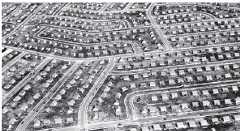 Just because suburbs havediversified does not mean they are integrated, however. White flight persists in anew form. Studies show that as neighborhoods get more diverse,many whites leave to further-out exurbs or return to center cities. In some cases, white higher-income residents are displacing communities of color in urban areas. As Thomas Sugrue from the NYU Cities Collaborativewrites, “While in the aggregate, suburbs are more diverse, the distribution of nonwhites isn’t random. Metropolitan America is not a place of free housing choice. It’s still very much shaped by deep patterns of racial inequality and a maldistribution of resources.”
In 2011, the Brookings Institutionpointed out that many suburbs, including those in Houston, Las Vegas, and San Francisco, have become majority non-white, but white residents accounted for 73% of the growth in further outlying exurban areas. Continued racial segregation can be seen in citieslike Atlanta, where in 2010, 87% of the Black population lived in the suburbs—but in largely segregated Black neighborhoods.
As fair housing advocates strive to address residential segregation, the suburbs offer many opportunities for an increase racial and socioeconomic inclusion. Even in as the demographics of suburbs have changed, the suburban single-family home on a large lot with a white picket fence ideal has not faded. There is still opposition to multifamily housing and dense development. As suggested by theUrban Institute and championed by NLIHC, local policies can encourage inclusivity and opportunity by building more affordable housing, enforcing fair housing protections, reforming restrictive zoning laws, and expanding access to rental assistance for low-income households.
Related Content
Now Available: The Gap: Assessing the Affordability and Availability of Rental Housing in Puerto Rico
Across the United States, the private market alone fails to meet the housing needs of the lowest-income renters, and insufficient federal housing assistance fails to make up for it. Puerto Rico is no…
Now Available: Our Homes, Our Votes Turning Renters into Voters: Lessons in Engaging Low-Income Communities
In 2024, Our Homes, Our Votes launched the Pilot Communities initiative to strengthen engagement with low-income renters throughout the electoral process, foster partnerships with subsidized…
16-2 Impacts of the "One Big Beautiful Bill Act"
This summer, Congress passed the “One Big Beautiful Bill Act,” (H.R. 1) a massive piece of legislation that includes tax reform, defense and immigration enforcement spending, and cuts to vital safety…