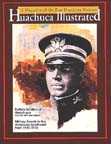
Henry O. Flipper was the first African-American graduate (1877) of the U.S. Military Academy. The 10th Cavalry officer was dismissed from the service in 1882 after discrepancies were found in the post commissary funds of which he was in charge. Flipper maintained his innocence. He stayed on the Mexican border, serving as a mining engineer and publishing theNogales Sunday Herald.He later became the interpreter for the Senate Committee on Foreign Relations from 1919-1922, an assistant to the Secretary of Interior, 1922-1923, and an engineer with a New York oil company operating in Venezuela. He authored several books before his death in Atlanta, Georgia, in 1940 at the age of 84. U.S. Army Signal Corps photo.
The story of black Americans fighting under their nation's flag is olderthan the flag itself. First introduced as slaves by the British early inthe 17th century, blacks served alongside their white masters in the firstcolonial militias organized to defend against Indian attacks.
By the time of the American Revolution, some freed slaves were takinga stand for independence along with the white colonists. A freedman namedCrispus Attucks was among those eleven Americans gunned down in the Bostonmassacre of March 5, 1770, when they defied the British soldiery. When thewar broke out, blacks like Peter Salem and Salem Poore were in the thickof the fighting. Salem was credited with shooting the British commanderat Bunker Hill and Poore was cited for gallantry. A number of other blackswere serving in New England militia units in 1775, but when the ContinentalArmy was officially formed in 1775, Congress bowed to the insistence ofthe southern slaveholders and excluded blacks, free or slave, from service.These regulations were soon overridden by the necessities of the desperatefighting and the need for manpower. Black veterans were retained and newrecruits were accepted.
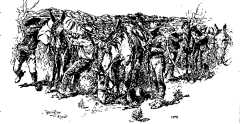
In all, there were approximately 5,000 blacks who served in the AmericanRevolutionary War. Despite the fact that they continued to make real militarycontributions in the War of 1812 and in the Civil War, it was not untilafter that latter war that blacks were accepted into the regular Army.
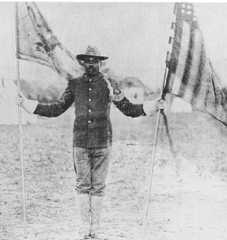 Fort Huachuca, more than any other installation in the U.S. militaryestablishment, was at the heart of half a century of black military history.It was here that black soldiers came to reflect upon their worth, to rememberthe part they had played in taming Comanche, Kiowa, Apache, and Sioux; inpunching a hole through Spanish lines on a Cuban hilltop so Teddy Rooseveltand his Rough Riders could dash through it; and in winning the day againstMexican forces at Agua Caliente in 1916. If their white fellow Americansdid not show them the respect they deserved, their foes in battle did. TheIndians called them "Buffalo Soldiers." The Germans in World WarI referred to them as "Hell Fighters."
It was on Huachuca's parade field that they felt the stirrings of pridethat only the soldier knows, and they marched with a growing sense of equalitythat their brother civilians would not be allowed to feel until decadeslater. Problems of discrimination were as widespread in the Army as theywere in other parts of American society, but minority barriers fell fasterin the Army where the most important measure of a man is his dependabilityin a fight.
In 1866 six black regular Army regiments were formed. They were the 38th,39th, 40th and 41st Infantry and the 9th and 10th Cavalry. Three years later,as part of a reduction in the size of the Army, the 38th and 41st were consolidatedto form the 24th Infantry and the 39th and 40th made up the new 25th Infantry.Officered by whites, these regiments went on to justify the belief by blackleaders that men of their race could contribute mightily to the nation'sdefense. Some of the service of each of these regiments in the latter partof the 19th century is highlighted in the paragraphs that follow.
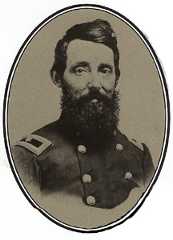 The 24th Infantry Regiment participated in 1875 expeditions againsthostile Kiowas and Commanches in the Department of Texas. One of the engagementsof this campaign saw Lieutenant John Bullis and three Seminole-Negro Indianscouts attack a 25-man war party on the Pecos River. Sergeant John Ward,Private Pompey Factor and Trumpeter Isaac Payne were rewarded with the Medalof Honor for their exceptional bravery in this encounter.
The 25th Infantry Regiment spent its first ten years in Texas buildingand repairing military posts, roads and telegraph lines; performing escortand guard duty of all description; marching and counter-marching from postto post; and scouting for Indians. In 1880 the regiment was ordered to theDepartment of Dakota and stationed at Fort Missoula, Montana. It participatedin the Pine Ridge Campaign of 189091, the last stand of the Sioux, and quelledcivil disorders in Missoula during the Northern Pacific Railroad strikein 1894.
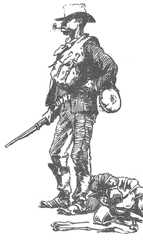
The 10th Cavalry Regiment, or "Buffalo Soldiers," is probablythe most renowned of the black regiments. At its inception, the commander,Colonel Benjamin H. Grierson, was determined to fill the ranks only withmen of the highest quality. Orders went out to recruit none but "superiormen ... who would do credit to the regiment." The 10th's record inseveral Indian War campaigns attests to the fact that Grierson achievedhis goal. In 1886, the Buffalo Soldiers tracked Geronimo's renegades inthe Pinito Mountains in Mexico and several months later ran down the lastApache holdout Mangas and his band.
In 1890 the Battle of Wounded Knee Creek, the last major fight of theIndian Wars, pitted the U.S. 7th Cavalry against Big Foot's Sioux. The 9thCavalry Regiment also took part in this campaign and played a dramatic partin the Battle of Clay Creek Mission. Over 1,800 Sioux under Little Woundand Two Strike had encircled the battle-weary 7th. The situation lookedgrave until the 9th Cavalry arrived on the field and drove off the Indianforce with an their rear. For conspicuous gallantry displayed on this occasion,Corporal William O. Wilson, Troop 1, 9th Cavalry, was granted the Medalof Honor.
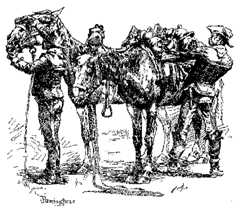
 The paths of all four of these regiments would intersect in a sceniccanyon in southeastern Arizona, just twenty miles from the Mexican border.The place was called Fort Huachuca and it had played an important part inthe Apache campaigns since its establishment in 1877.
The first black regiment to arrive at Huachuca was the 24th Infantrywhich sent companies there in 1892. During the next year, the entire regimentwould come together at the fort. Here they remained until 1896, a year thatsaw some excitement for the troops who thought that the Indian Wars wereended. It was in that year that Colonel John Mosby Bacon took CompaniesC and H, of the 24th Infantry out of Fort Huachuca to run down Yaqui Indianswho had been raiding around Harshaw and Nogales. The search for these Mexico-basedIndians proved inconclusive.
Companies A and H of the 25th Infantry regiment took up residence inHuachuca Canyon in 1898, after returning from fighting in Cuba, and A Companyremained there until the end of April 1899.
Troops of the 9th Cavalry joined the 25th Infantry at Fort Huachuca in1898 and rotated its units in and out of the post until 1900. A detachmentof the 9th would return briefly for a short tour in 1912.
Although the 9th Cavalry and the 24th and 25th Infantry regiments hadall served briefly at Fort Huachuca during the 1890s, it wasn't until the10th Cavalry, or the "Buffalo Soldiers," arrived there in December1913 that the continuous era of black soldiers began at Huachuca. (The nickname"Buffalo Soldiers" was first given to the men of the 10th Cavalryby the Indians of the plains who likened their hair to that of the buffalo.Over the years this name has been extended by veterans to include soldiersof all of the original black regiments.)
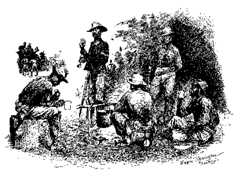
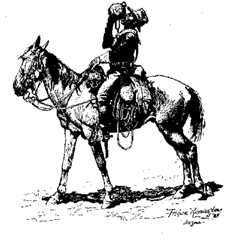
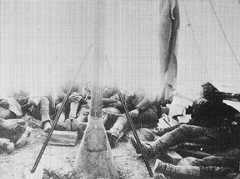 This proud cavalry unit had served in Arizona before, in the last century,rotating from one post to another in Arizona, New Mexico or Texas, whereverthey were needed to track down Apache renegades. So the startling vistaswere not new to many of the veterans. Nor was the relentless desert suna stranger to these horsemen who doggedly followed the trail of Pancho Villainto Mexico in 1916. In Huachuca Canyon they found a home for the next eighteenyears, the longest this mobile unit would stay at any one place since itsformation in 1866.
Right after their arrival at Huachuca, in 1914, the men of the 10th werespread out at encampments along the Arizona-Mexico border from Yuma on theWest to Naco on the east. They corralled their horses and stretched theirtents at points in between like Forrest, Osborne, Nogales, Lochiel, Harrison'sRanch, Arivaca, Sasabe, La Osa, and San Fernando. Many would sweat it outunder canvas for as long as ten months before being rotated back to theirhome station in the cooler elevations of the Huachucas.
 They were picketed along the border, not as some training exercise,but to enforce neutrality laws. Mexico was experiencing political upheavalon a scale that alarmed statesmen in Washington, D. C., and they quicklylegislated that there could be no encroachments upon American soil.
They were relieved in 1931 by the 25th Infantry Regiment. First arrivingat the post in 1928, the 25th continued the tradition of black soldieringthere. Like the 10th Cavalry, they had seen hard combat in both the IndianWars and in Cuba. Also like the Tenth, they were to serve there for 14 yearsuntil 1942 when they were incorporated as cadre into the newly formed 93dInfantry Division.
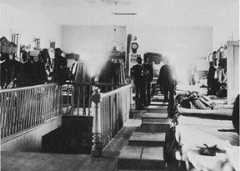 The 93d and 92d Divisions trained one after the other at Fort Huachucaduring World War II. The 93d, which would be the first black division tosee action in the war, arrived in Arizona in 1942 and shipped out to thePacific in 1944. Because its regiments, the 368th and 369th, were assignedto the French Army in World War 1, the light blue French helmet became thedivision's shoulder patch.
The 92d too had regiments (365th, 370th and 371st) that could trace theirlineage to some heroic fighting in France in 1918, but the division choseto reach back to the Indian Wars of the 1870s and 80s for their symbol.They chose for their shoulder patch the buffalo, recalling the "BuffaloSoldiers," as the black troops were respectfully called by the Indiansof the Western plains.
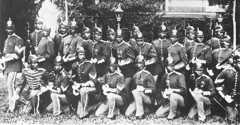
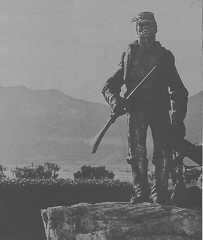
To some blacks Huachuca was a mountain refuge far away from the immensestruggle that was taking place in America's city streets and country lanes,a fight for equality. But for others it was a way to participate in thestruggle, to take up a profession that offered dignity, service to country,and maybe a warrior's death. For whatever reason they joined the Army (theMarines did not admit blacks; the Navy had only a few openings for the menialjob of messboy), Fort Huachuca would be an almost inevitable stop alongtheir way. Some found it to be "a very fine place to serve." Toothers it was "an infamous place." For all it was, for a time,home. Black infantrymen and cavalrymen carved out a place in history there.If the sobriquet "Buffalo Soldier" has come to stand collectivelyfor the black men who served in the four regular army regiments from 1866to World War 11, then Fort Huachuca has earned the distinction of being"Home of the Buffalo Soldier."