 MacTutor
Maryam Mirzakhani
Quick Info
Tehran, Iran
California, USA
Biography
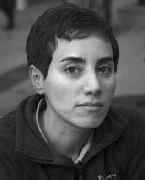
Maryam Mirzakhani's parents are Ahmad Mirzakhani, an electrical engineer, and Zahra Haghighi. She was born on12th May1977, though some references incorrectly give3rd May as her birthday. Maryam said of her family(see[6] or[7]):-I grew up in a family with three siblings. My parents were always very supportive and encouraging. It was important for them that we have meaningful and satisfying professions, but they didn't care as much about success and achievement. In many ways, it was a great environment for me, though these were hard times during the Iran-Iraq war. My older brother was the person who got me interested in science in general. He used to tell me what he learned in school.Her young days were difficult ones growing up in Tehran since the Iran-Iraq war was fought from1980 to1988. Maryam had a great imagination and, when she was eight years old, she would make up stories about a girl who achieved great things, such as becoming mayor or travelling the world. About the time the war ended, Maryam completed her studies at elementary school and sat an examination for the Farzanegan middle school for girls in Tehran. This school, administered by Iran's National Organization for Development of Exceptional Talents, aimed to educate the brightest pupils. She said(see[6] or[7]):-
I met my friend Roya Beheshti the first week after entering middle school. It is invaluable to have a friend who shares your interests, and helps you stay motivated. Our school was close to a street full of bookstores in Tehran. I remember how walking along this crowded street, and going to the bookstores, was so exciting for us. We couldn't skim through the books like people usually do here in a bookstore, so we would end up buying a lot of random books.Roya Beheshti was, like Maryam, born in1977. She is now Associate Professor of Mathematics at Washington University in St Louis, United States, with research interests in algebraic geometry.
Since books were cheap, buying at random was not such a bad strategy. Maryam thought at this time that she would like to become an author and write such books. Her favourite television programmes were biographies and the stories of people like Marie Curie and Helen Keller inspired her. In this first year at Farzanegan middle school she did not do particularly well at mathematics and her teacher told her that she was not particularly talented in that subject. This was a blow to her confidence and she lost interest in it. However, in her second year she had a different mathematics teacher who encouraged her and this led to her showing great talent.
Both Maryam and her friend Roya Beheshti progressed from Farzanegan middle school to Farzanegan high school. They both found a copy of six Mathematical Olympiad problems and Maryam managed to do three of them. Encouraged by this she went with her friend to the school principal and asked her if she could arrange for them to have mathematical problem-solving classes. These happened in schools for the most talented boys, but not for the girls. The principal of Farzanegan high school was very encouraging and, even though no girls had ever taken part in the Iranian Mathematical Olympiad team, classes were arranged. Maryam said[9]:-
The principal of the school was a very strong character. If we really wanted something, she would make it happen. Her mindset was very positive and upbeat - that "you can do it, even though you'll be the first one." I think that has influenced my life quite a lot.Both Maryam Mirzakhani and her friend Roya Beheshti made the Iranian Mathematical Olympiad team in1994. The international competition was held that year in Hong Kong and Mirzakhani scored41 out of42 and was awarded a gold medal. Beheshti was awarded a silver medal. Again in1995 Mirzakhani was a member of the Iranian Mathematical Olympiad team. This time the international competition was held in Toronto, Canada, and Mirzakhani scored42 out of42 and was again awarded a gold medal.
In1995 Mirzakhani began her study of mathematics at Sharif University of Technology funded with an IPM fellowship. This university in Tehran, established in1966, is the leading university in Iran for physical science. She said(see[6] or[7]):-
I met many inspiring mathematicians and friends at Sharif University. The more I spent time on mathematics, the more excited I became. At Sharif University, we had problem-solving sessions and informal reading groups with my classmates. The friendship and support of all the people I met there ... helped me a lot in many different ways.Mirzakhani published papers while an undergraduate. Jointly with E S Mahmoodian, she publishedDecomposition of complete tripartite graphs into5-cycles in theProceeding of the conference 'Combinatorics advances' held in Tehran in1995. She also publishedA small non-4-choosable planar graph in1996 andA simple proof of a theorem of Schur in1998.
In February1998 the top mathematical students from Sharif University of Technology took part in a competition in the Iranian city of Ahwaz. Mirzakhani was one of these students. A bus bringing the students back from Ahwaz to Tehran skidded and crashed into a ravine. Seven students and two bus drivers died in the crash but Mirzakhani survived. She graduated from Sharif University of Technology in1999 with a B.S.
After obtaining her degree from Sharif University, Mirzakhani went to the United States where she attended graduate school at Harvard University. There she started to attendCurtis McMullen's seminar.McMullen had been appointed to a professorship at Harvard University in1998, the year in which he had been awarded aFields Medal at the International Congress of Mathematicians in Berlin.McMullen became her doctoral advisor. He said[9]:-
She had a sort of daring imagination. She would formulate in her mind an imaginary picture of what must be going on, then come to my office and describe it. At the end, she would turn to me and say, "Is it right?" I was always very flattered that she thought I would know.Her work involved[11]:-
... closed geodesics on a hyperbolic surface. These are closed curves whose length cannot be shortened by deforming them. A now-classic theorem proved more than50 years ago gives a precise way of estimating the number of closed geodesics whose length is less than some bound L. The number of closed geodesics grows exponentially with L ... Mirzakhani looked at what happens to the "prime number theorem for geodesics" when one considers only the closed geodesics that are simple, meaning that they do not intersect themselves. The behavior is very different in this case: the growth of the number of geodesics of length at most L is no longer exponential in L but is of the order of, where g is the genus.Harvard University awarded Mirzakhani a Merit fellowship in2003. She was awarded her doctorate in2004 for her130-page thesisSimple Geodesics on Hyperbolic Surfaces and Volume of the Moduli Space of Curves.For this outstanding thesis she was awarded the Leonard M and Eleanor B Blumenthal Award for the Advancement of Research in Pure Mathematics in2009. The citation reads:-
[Mirzakhani is honoured] for her exceptionally creative, highly original thesis. This work combines tools as diverse as hyperbolic geometry, 'classical methods' of automorphic forms, and symplectic reduction to obtain results on three different important questions. These results include a recursive formula forWeil-Petersson volumes of moduli spaces ofRiemann surfaces, a determination of the asymptotics of the number of simple closed geodesics on a hyperbolic surface in terms of length, and a new proof ofWitten's Conjecture(originally established byKontsevich) establishing the KdV recursion for the intersection numbers on moduli space.In2004 she was offered a junior fellowship at Harvard, but turned down the offer since something better awaited her. In that year she was awarded a Clay Research Fellowship and was appointed as an Assistant Professor of Mathematics at Princeton University. She said(see[6] or[7]):-
[The Clay fellowship] was a great opportunity for me; I spent most of my time at Princeton which was a great experience. The Clay Fellowship gave me the freedom to think about harder problems, travel freely, and talk to other mathematicians. I am a slow thinker, and have to spend a lot of time before I can clean up my ideas and make progress. So I really appreciate that I didn't have to write up my work in a rush.Indeed her next papers appeared three years after her thesis was published, but there were many remarkably deep papers. These papers were:Weil-Petersson volumes and intersection theory on the moduli space of curves(2007);Simple geodesics and Weil-Petersson volumes of moduli spaces of bordered Riemann surfaces(2007);Random hyperbolic surfaces and measured laminations(2007);Growth of the number of simple closed geodesics on hyperbolic surfaces(2008);Ergodic theory of the earthquake flow(2008); and(with Elon Lindenstrauss)Ergodic theory of the space of measured laminations(2008).
Mirzakhani's Clay Research Fellowship ran until2008 when she left Princeton and was appointed as Professor of Mathematics at Stanford University. She had met Jan Vondrák, a theoretical computer scientist and applied mathematician who was a postdoctoral teaching fellow at Princeton University from2006 to2009. She married Vondrák, a Czech with a Ph.D. in Computer Science from the Charles University of Prague and a Ph.D. in Applied Mathematics from the Massachusetts Institute of Technology, and they have a daughter Anahita born in2011. Vondrák was appointed as an Associate Professor at Stanford University in January2016.
It was in2006 that Mirzakhani began a collaboration with Alex Eskin of the University of Chicago. They tackled one of the hardest problems in their area, to generalise a result whichCurtis McMullen had published in2003[11]:-
Mirzakhani, together with Alex Eskin and, in part, Amir Mohammadi, made a major breakthrough in understanding another dynamical system on moduli space that is related to the behaviour of geodesics in moduli space. Non-closed geodesics in moduli space are very erratic and even pathological, and it is hard to obtain any understanding of their structure and how they change when perturbed slightly. However, Mirzakhani et al have proved that complex geodesics and their closures in moduli space are in fact surprisingly regular, rather than irregular or fractal. It turns out that, while complex geodesics are transcendental objects defined in terms of analysis and differential geometry, their closures are algebraic objects defined in terms of polynomials and therefore have certain rigidity properties.Eskin spoke about Mirzakhani, saying[9]:-
She is very optimistic, and that's infectious. When you work with her, you feel you have a much better chance of solving problems that at first seem hopeless.Sometimes Eskin was pessimistic but Mirzakhani was not:-
Sometimes there were setbacks, but she never panicked.After they were successful, she said:-
If we knew things would be so complicated, I think we would have given up. I don't know; actually, I don't know, I don't give up easily.Eskin and Mirzakhani publishedCounting closed geodesics in moduli space in2011.
In2014 Mirzakhani became the first woman to be awarded aFields Medal. This Medal was presented to her by theInternational Mathematical Union on13 August2014 at the International Congress of Mathematicians, held in Seoul, South Korea. The citation states that the award was:-
... for her outstanding contributions to the dynamics and geometry ofRiemann surfaces and their moduli spaces.Mirzakhani won many honours during her short lifetime in addition to those we have already mentioned. She was awarded the Ruth Lyttle Satter Prize in Mathematics in San Diego on10 January2013. She was elected to theParis Academy of Sciences in2015, the American Philosophical Society in2015, theNational Academy of Sciences in2016, and theAmerican Academy of Arts and Sciences in2017. She was an invited speaker at the Topology and Dynamical Systems & ODE section of the International Congress of Mathematicians in2010 when she gave the lectureOn Weil-Petersson volumes and geometry of random hyperbolic surfaces. Again at the International Congress of Mathematicians in Seoul, South Korea, in2014 she was a plenary speaker.
Even before she was awarded theFields Medal in2014, Mirzakhani had been diagnosed with breast cancer. She continued working on mathematics producing not only results of great significance but developing tools along the way that will be used by researchers in the field as they continue to push forward. The cancer spread to her liver and bones and her death in a California hospital in July2017 robbed mathematics of one of its brightest stars who, at the age of40, was at the peak of her creativity. Stanford President Marc Tessier-Lavigne said following her death[12]:-
Maryam is gone far too soon, but her impact will live on for the thousands of women she inspired to pursue math and science. Maryam was a brilliant mathematical theorist, and also a humble person who accepted honours only with the hope that it might encourage others to follow her path. Her contributions as both a scholar and a role model are significant and enduring, and she will be dearly missed here at Stanford and around the world.Ralph L Cohen, the Barbara Kimball Browning Professor of Mathematics at Stanford, said[12]:-
Maryam was a wonderful colleague. She not only was a brilliant and fearless researcher, but she was also a great teacher and terrific PhD adviser. Maryam embodied what being a mathematician or scientist is all about: the attempt to solve a problem that hadn't been solved before, or to understand something that hadn't been understood before. This is driven by a deep intellectual curiosity, and there is great joy and satisfaction with every bit of success. Maryam had one of the great intellects of our time, and she was a wonderful person. She will be tremendously missed.
References(show)
- M Bridson, Maryam Mirzakhani obituary,The Guardian(19 July2017).
- K Bryan, Trailblazing maths genius who was first woman to win Fields Medal dies aged40,Independent(15 July2017).
- J Carey, Stanford's Maryam Mirzakhani wins Fields Medal,Stanford Report(12 August2014).
- K Chang, Maryam Mirzakhani, Only Woman to Win a Fields Medal, Dies at40,The New York Times(16 July2017).
- Iranian woman wins top maths prize,New Scientist(12 August2014).
- Interview with Research Fellow Maryam Mirzakhani,Clay Mathematics Institute Report(2008).
- Interview with Maryam Mirzakhani: 'The more I spent time on maths, the more excited I got',The Guardian(13 August2013).
- Y Juris, Maryam Mirzakhani, first woman to receive the prestigious Fields Medal, dies at age of40 after breast cancer battle,People Magazine(16 July2017).
- E Klarreich, A Tenacious Explorer of Abstract Surfaces,Quanta Magazine(12 August2014).https://www.quantamagazine.org/maryam-mirzakhani-is-first-woman-fields-medalist-20140812/
- E Lamb, Maryam Mirzakhani, only woman to win Fields Medal,Scientific American(17 July2017).
- Maryam Mirzakhan,International Mathematical Union(2014).
- A Myers and B Carey, Maryam Mirzakhani, Stanford mathematician and Fields Medal winner, dies,Stanford News(15 July2017).
- President Rouhani Congratulates Iranian Woman for Winning Math Nobel Prize,Fars News Agency, Tehran(14 August2014).http://english.farsnews.com/newstext.aspx?nn=13930523000321
- S Roberts, Maryam Mirzakhani's pioneering mathematical legacy,The New Yorker(17 July2017).
- I Sample, Fields Medal mathematics prize won by woman for first time in its history,The Guardian(13 August2014).
- Sorrow as Maryam Mirzakhani, the first woman to win mathematics' Fields Medal, dies aged40,The Telegraph(15 July2017).
Additional Resources(show)
Other pages about Maryam Mirzakhani:
Other websites about Maryam Mirzakhani:
Honours(show)
Honours awarded to Maryam Mirzakhani
Cross-references(show)
Written byJ J O'Connor and E F Robertson
Last Update August 2017
Last Update August 2017