

The Great Gatsby Curve
Alan Krueger, the chairman of the Council of Economic Advisers — who is not only a colleague of mine at Princeton, but gets a lot of my mail and vice versa — gave avery informative speech on inequality last week that should have received more press than it did. Much of it was stuff that inequality mavens already know, but he had one striking result that was what I suspected but hadn’t seen demonstrated: a clear negative relationship between inequality at a point in time and intergenerational social mobility.
Below is what he dubs the Great Gatsby Curve. On the horizontal axis is the Gini coefficient, a measure of inequality. On the vertical axis is the intergenerational elasticity of income — how much a 1 percent rise in your father’s income affects your expected income; the higher this number, the lower is social mobility.
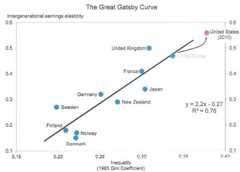
As he shows, America is both especially unequal and has especially low mobility. But he also argues that because we are even more unequal now than we were a generation ago, we should expect even less social mobility going forward.
Very illuminating — and disturbing.
What's Next
- Previous PostBain The Betrayer
- Next PostBut The Top 0.1 Percent Isn’t Diverse
ABOUT
Paul Krugman is an Op-Ed columnist for The New York Times.
- Biography »
- Columns »
- End This Depression Now! (2013)
- Principles of Economics, 2nd ed. (2009)
- The Return of Depression Economics and the Crisis of 2008 (Dec. 2008)
- The Conscience of a Liberal (Oct. 2007)